A Wave-to-Wire Model of Ocean
Wave Energy Conversion System
Using MATLAB/Simulink
Platform
4th International Conference on Development
of Renewable Energy Technology
[ICDRET 2016]
AUTHORS
Jakir Hossain, B.Sc in EEE, KUET
Eklas Hossain, PhD Candidate, UWM, USA
Sarder Shazali Sikander, M.Sc in EE, NUST, Pakistan
Title and Content Layout with List
e
What and Why Wave Energy?
Wave energy vs. other Renewable Sources
Global Resources of Wave Energy
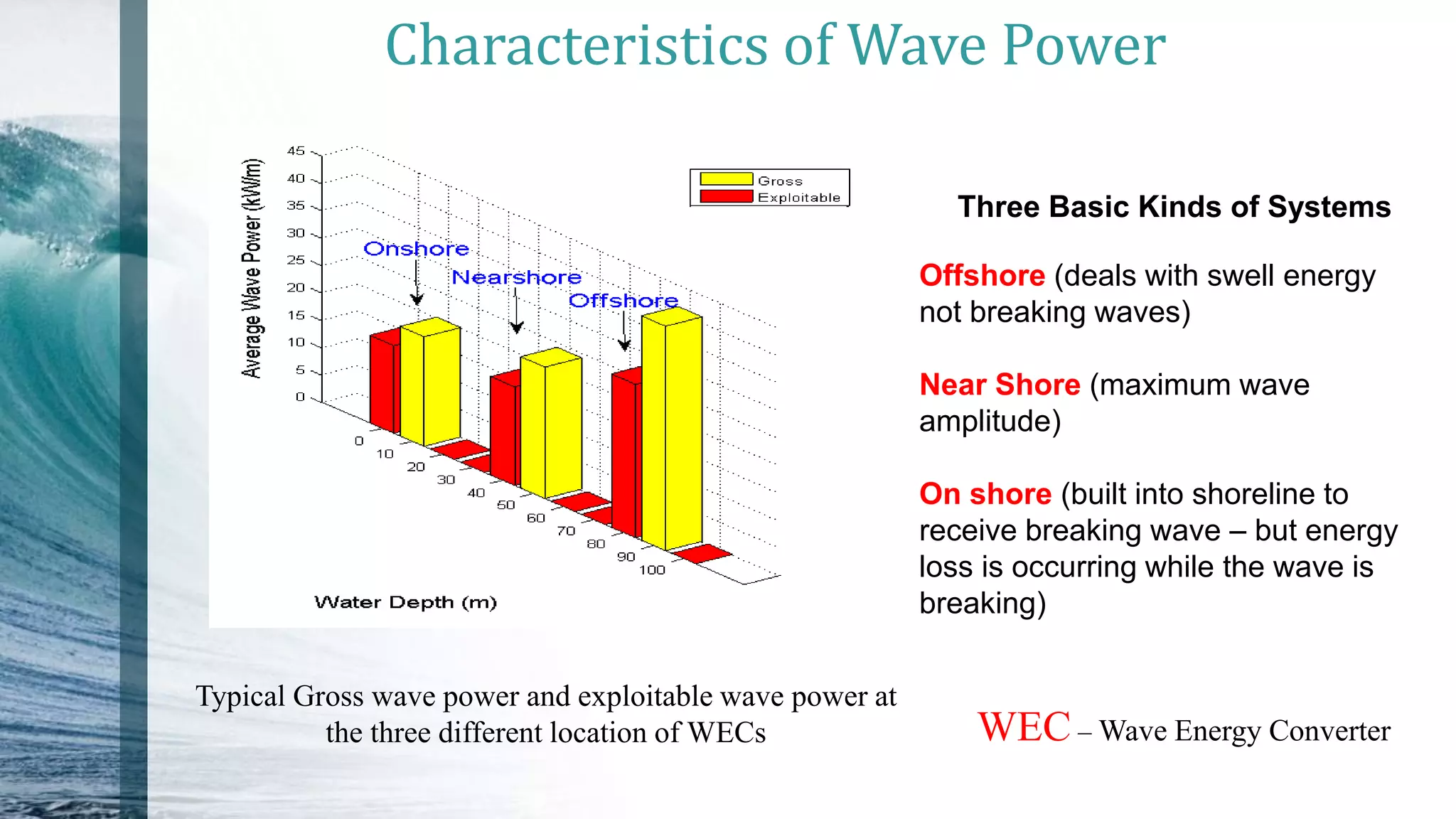
Characteristics of Wave Power
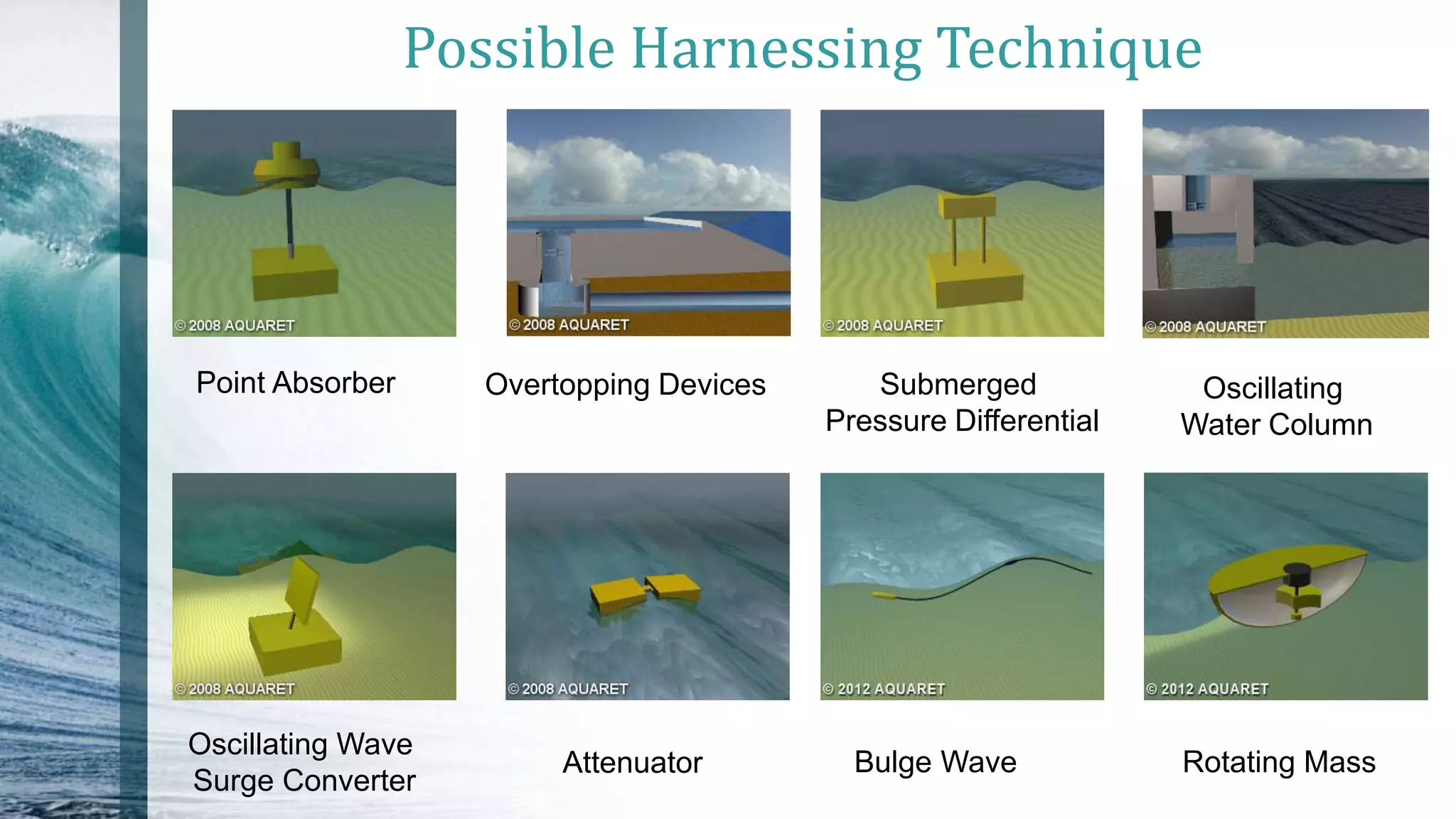
Possible Harnessing Technique
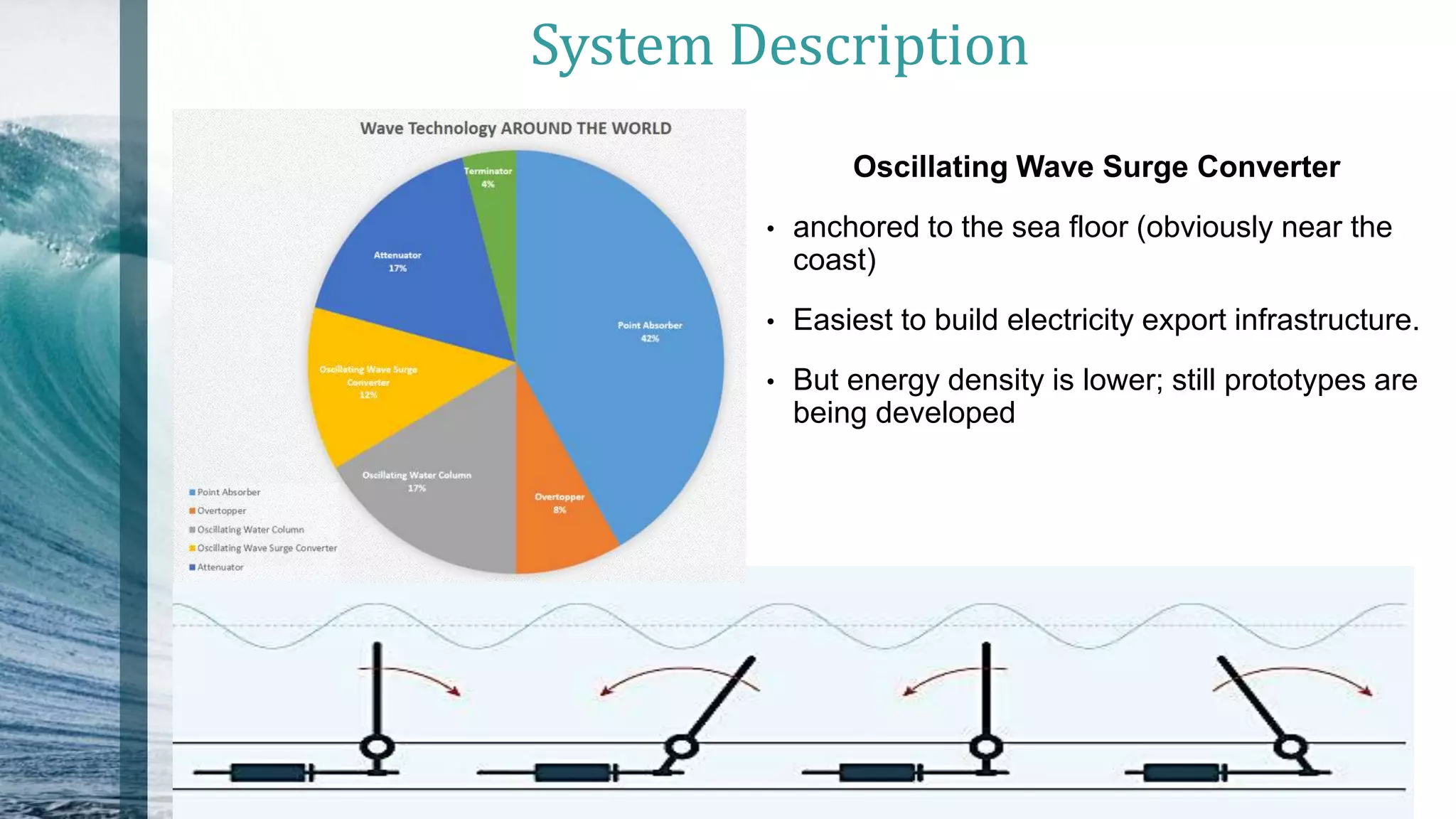
System Description
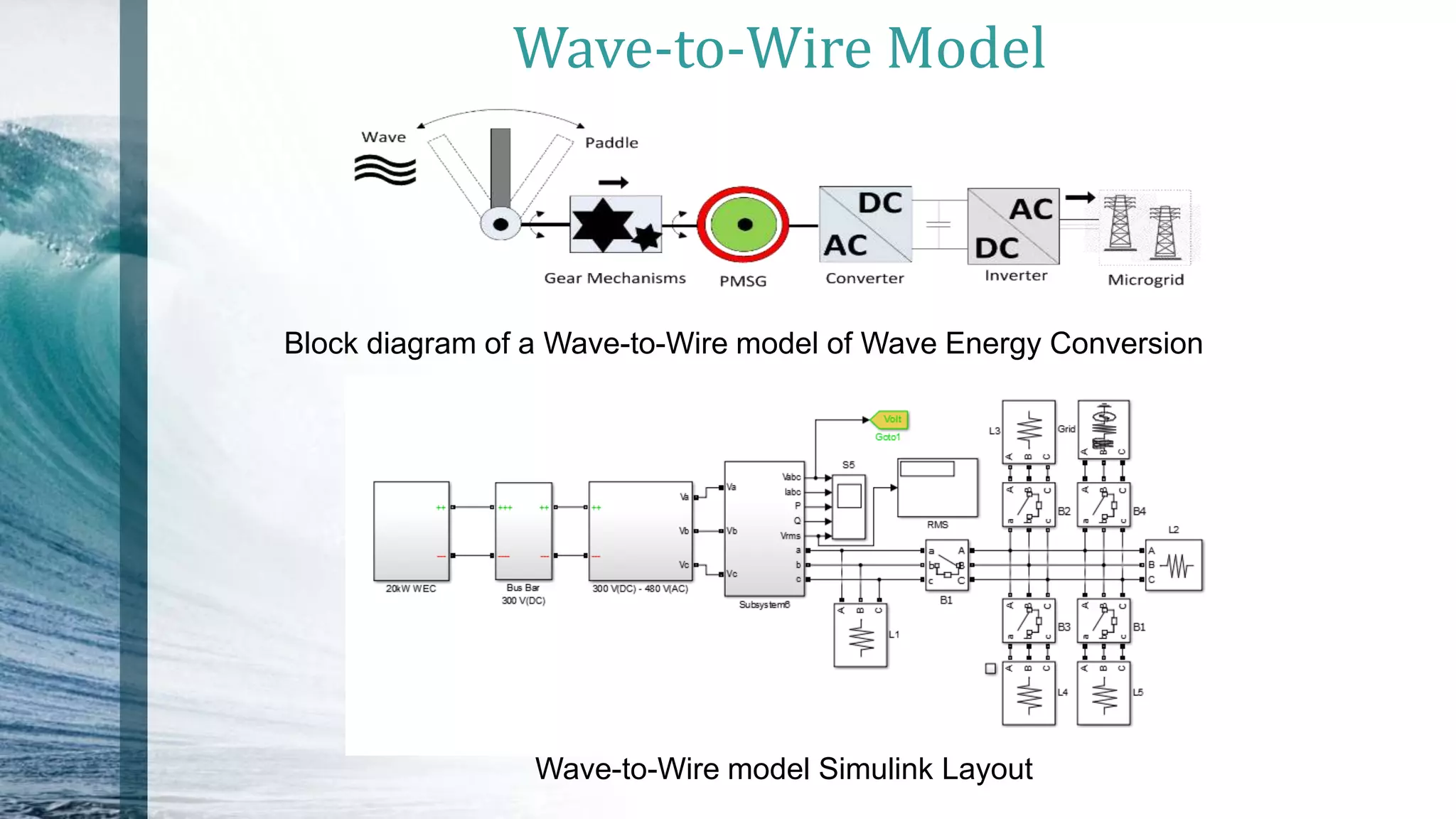
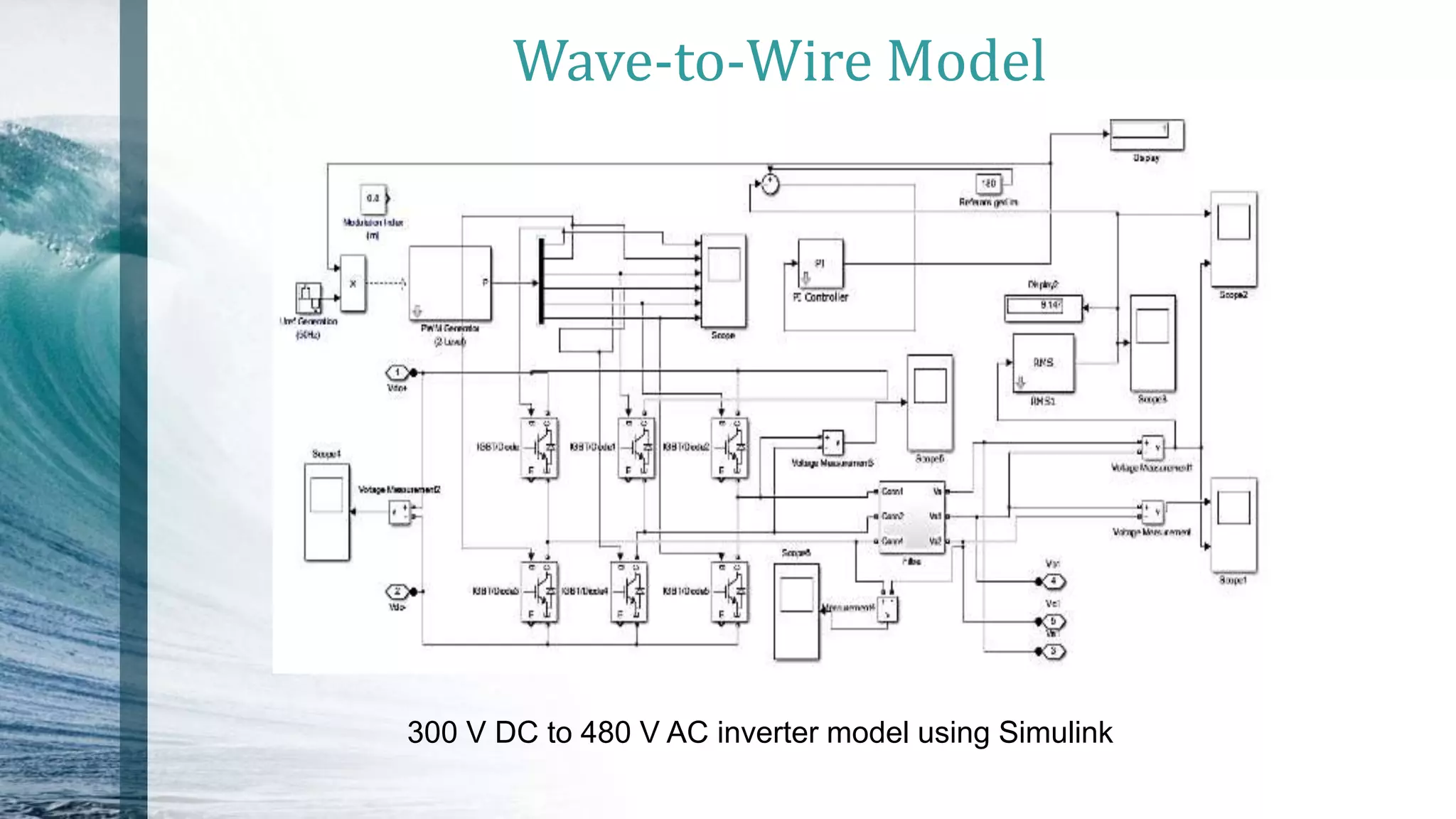
Wave-to-Wire Model
Results from Simulation
Challenges of Harnessing Wave Power
Conclusion
Outlines
What and Why Wave Energy?
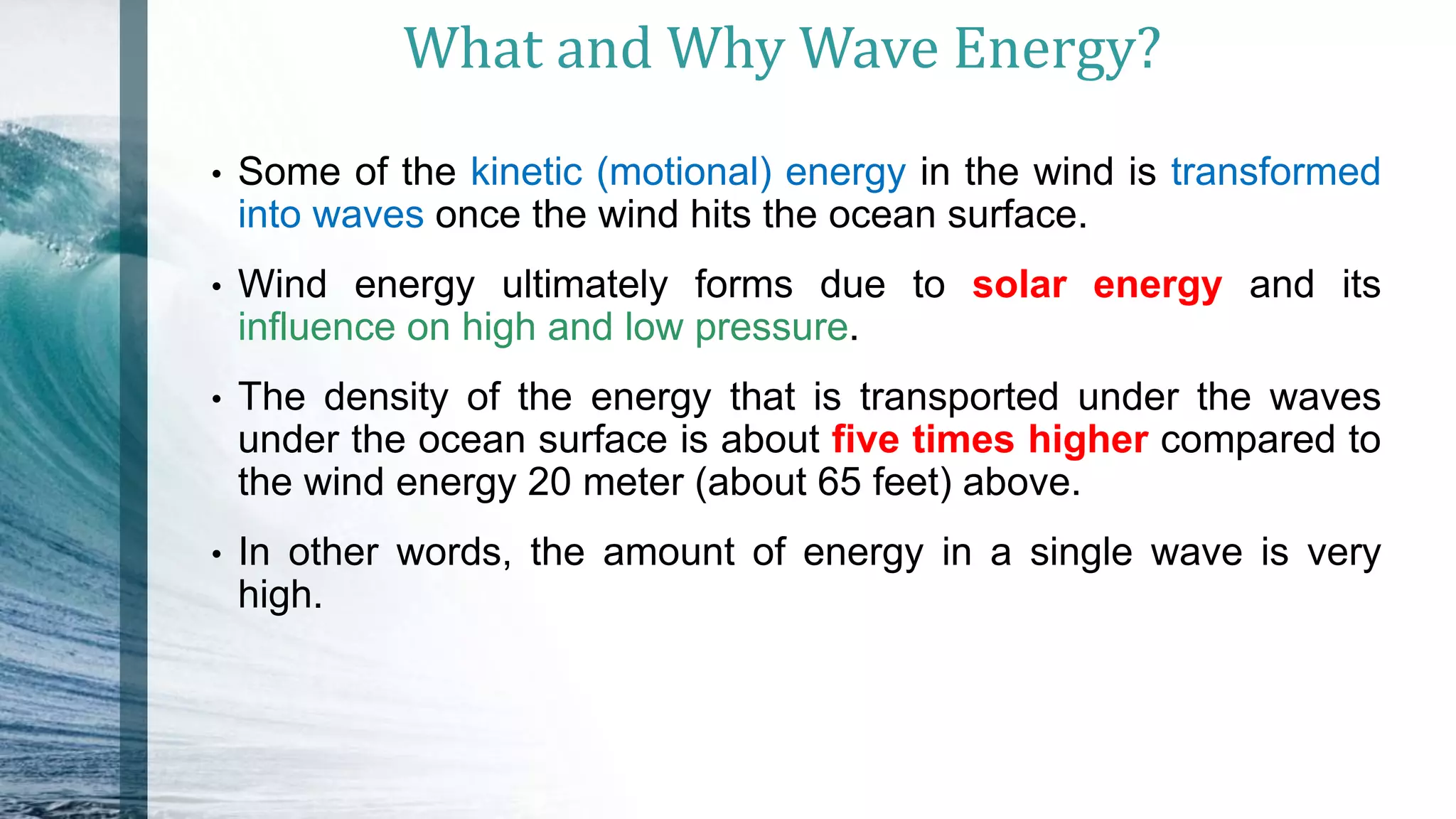
• Some of the kinetic (motional) energy in the wind is transformed
into waves once the wind hits the ocean surface.
• Wind energy ultimately forms due to solar energy and its
influence on high and low pressure.
• The density of the energy that is transported under the waves
under the ocean surface is about five times higher compared to
the wind energy 20 meter (about 65 feet) above.
• In other words, the amount of energy in a single wave is very
high.
Wave Energy vs. Other Renewable Sources
Photovoltaic Wind Wave
Status Early commercial Commercial Pre-commercial
Energy Source Sun Sun Sun-Wind
Power Density 1 kW/m2 at peak
solar insolation
1 kW/m2 at 12
m/s [General
Electric (GE) 1.5
MW machine]
25 kW/m at Sun
Francisco, average
annual power flux
Variability Daily cycles-clouds When it blows 24×7 and highly
variable
Predictability Poor Hours Daily
Availability 20-30% 30-40% 80-90%
Potential Sites Limited Limited Extensive but
limited
Average Power
Output per Plant
Scalable to 5 MW Scalable to 30
MW
Scalable to 100+
MW [Provides
Highest energy
density]
Environmental
issues
Visual Pollution Noise and Visual
Pollution
None [Virtually no
environmental
impacts]
80% to 90%
Availability
Scalable to
100+ MW
Environmentally
Zero Impacts
Daily
Predictability
Title and Content Layout with List
Global Resources of Wave Energy
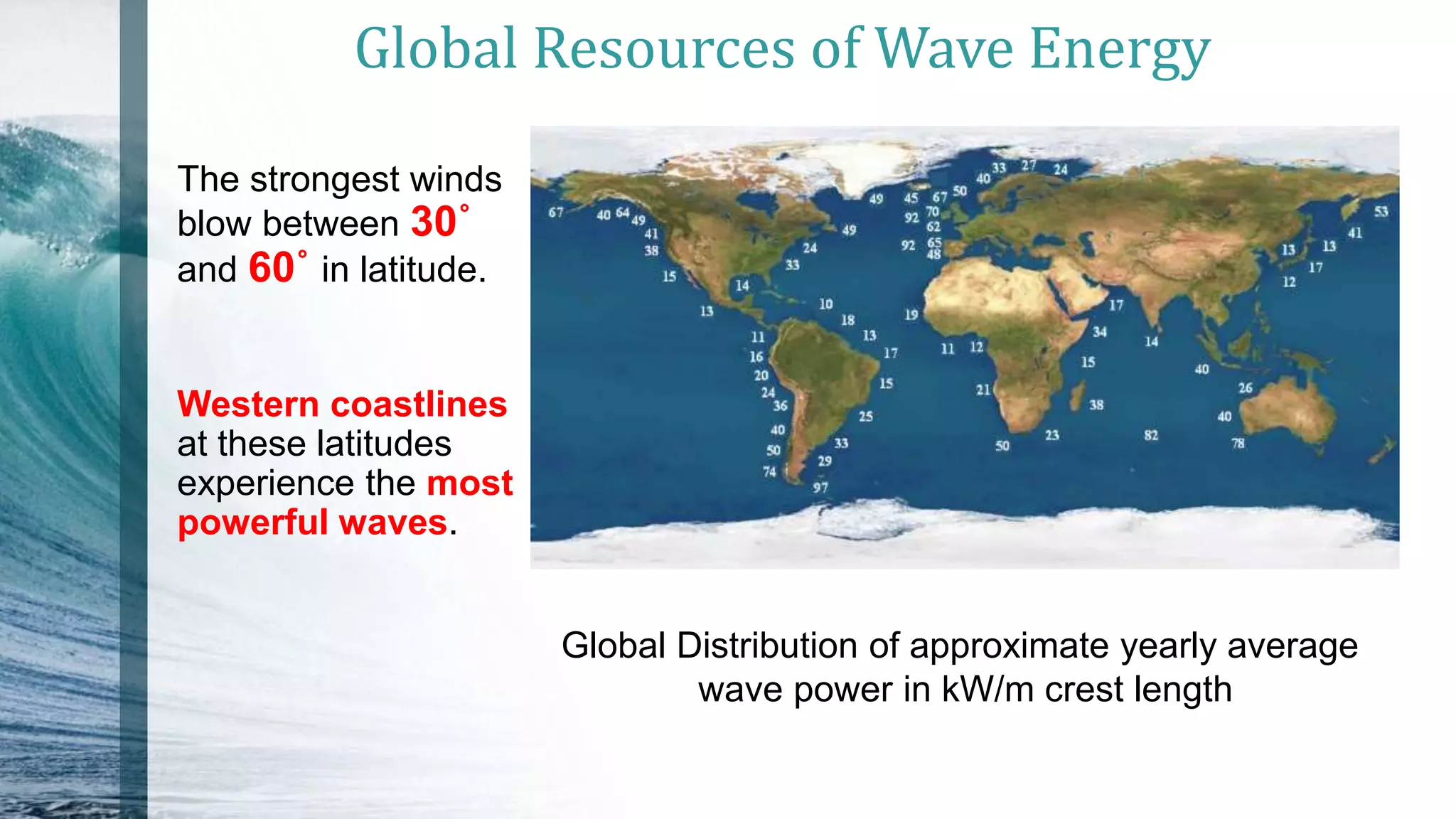
The strongest winds
blow between 30˚
and 60˚ in latitude.
Western coastlines
at these latitudes
experience the most
powerful waves.
Global Distribution of approximate yearly average
wave power in kW/m crest length
Characteristics of Wave Power
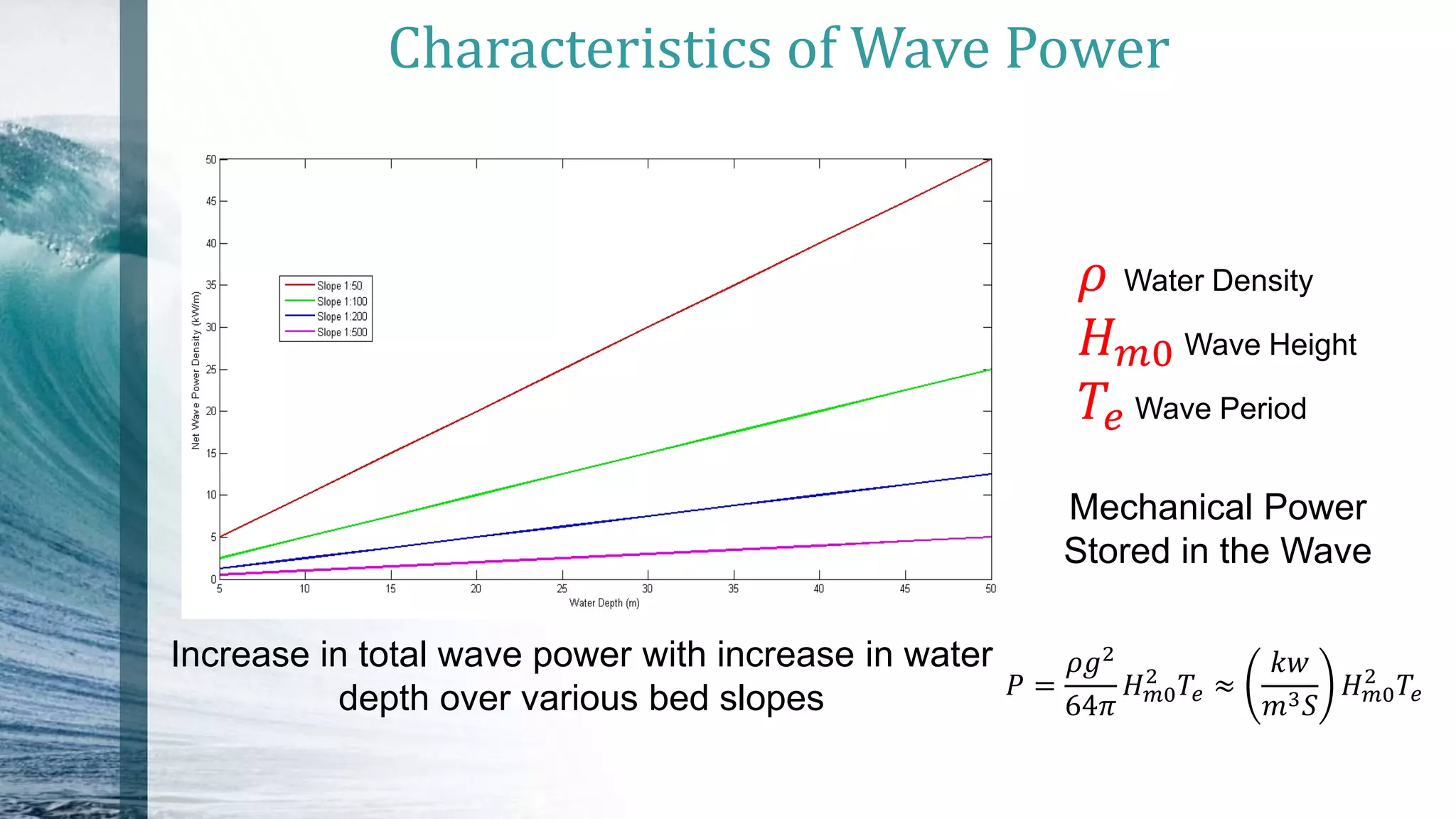
Increase in total wave power with increase in water
depth over various bed slopes 𝑃 =
𝜌𝑔2
64𝜋
𝐻 𝑚0
2
𝑇𝑒 ≈
𝑘𝑤
𝑚3 𝑆
𝐻 𝑚0
2
𝑇𝑒
𝜌 Water Density
𝐻 𝑚0 Wave Height
𝑇𝑒 Wave Period
Mechanical Power
Stored in the Wave
Characteristics of Wave Power
Three Basic Kinds of Systems
Offshore (deals with swell energy
not breaking waves)
Near Shore (maximum wave
amplitude)
On shore (built into shoreline to
receive breaking wave – but energy
loss is occurring while the wave is
breaking)
Typical Gross wave power and exploitable wave power at
the three different location of WECs WEC – Wave Energy Converter
Possible Harnessing Technique
Point Absorber Oscillating
Water Column
Submerged
Pressure Differential
Overtopping Devices
Oscillating Wave
Surge Converter
Rotating MassBulge WaveAttenuator
Title and Content Layout with List
System Description
Oscillating Wave Surge Converter
• anchored to the sea floor (obviously near the
coast)
• Easiest to build electricity export infrastructure.
• But energy density is lower; still prototypes are
being developed
Wave-to-Wire Model
Block diagram of a Wave-to-Wire model of Wave Energy Conversion
Wave-to-Wire model Simulink Layout
Title and Content Layout with List
Wave-to-Wire Model
300 V DC to 480 V AC inverter model using Simulink
Title and Content Layout with List
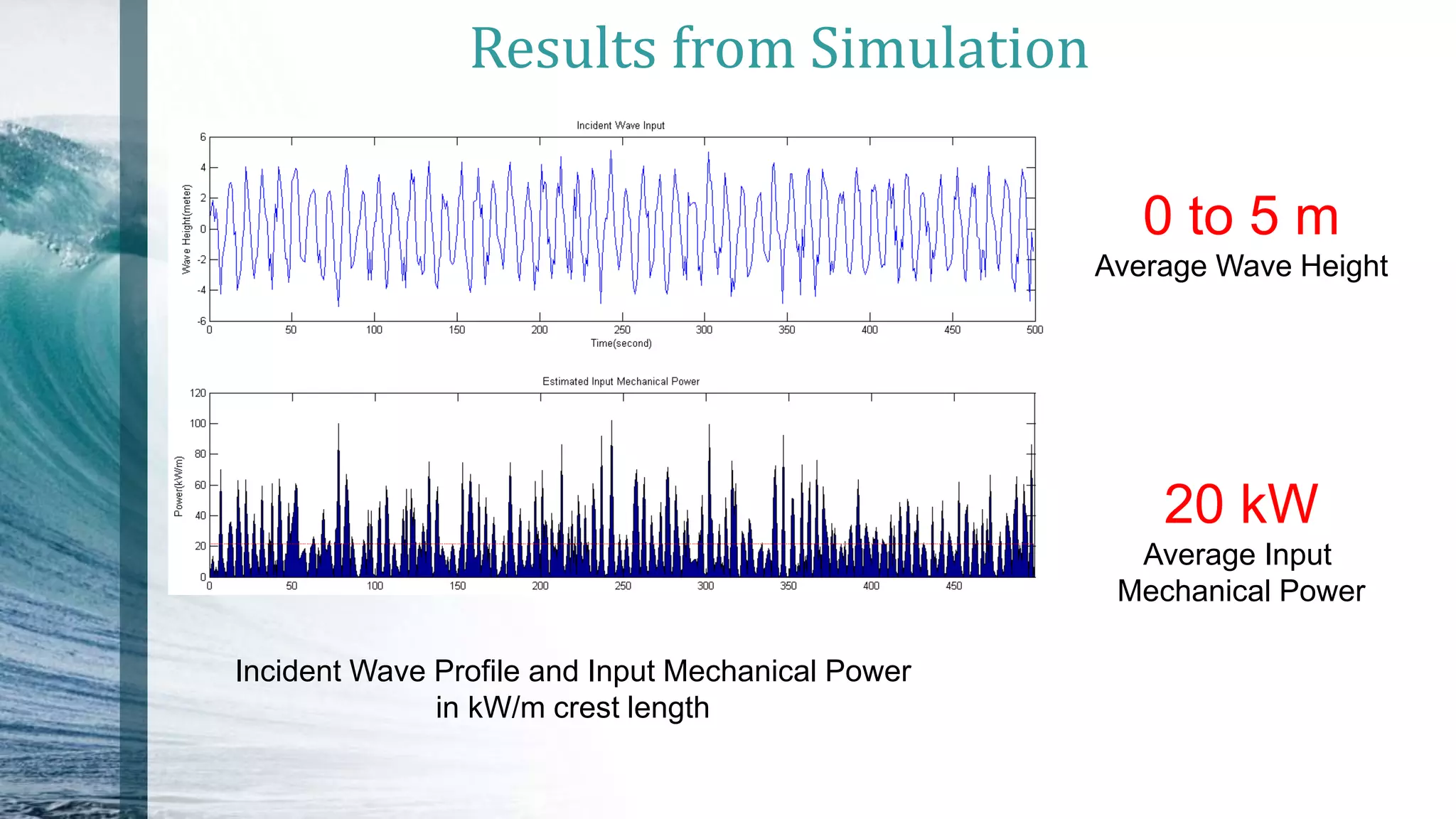
Results from Simulation
Incident Wave Profile and Input Mechanical Power
in kW/m crest length
0 to 5 m
Average Wave Height
20 kW
Average Input
Mechanical Power
Title and Content Layout with List
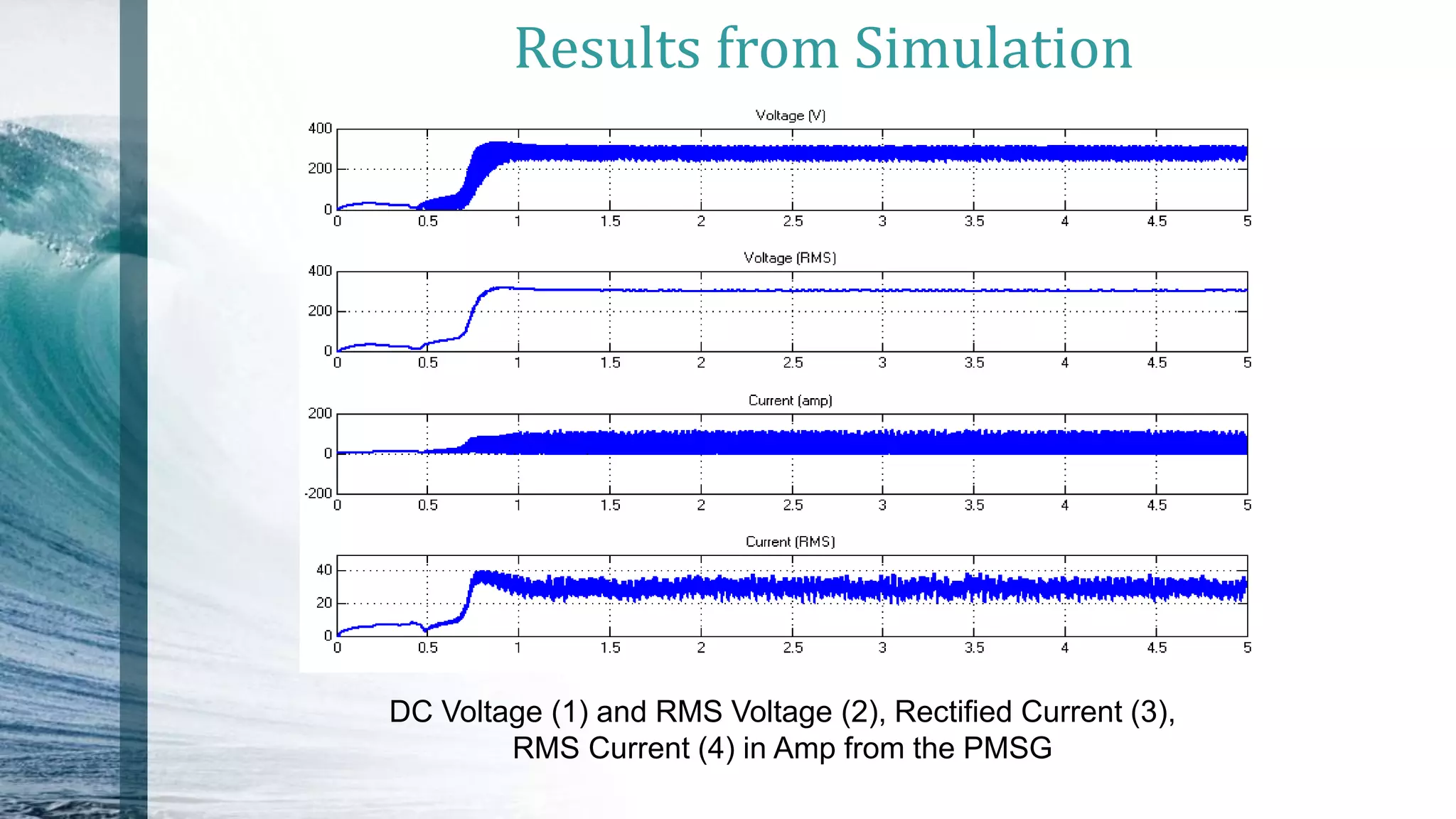
Results from Simulation
DC Voltage (1) and RMS Voltage (2), Rectified Current (3),
RMS Current (4) in Amp from the PMSG
Title and Content Layout with List
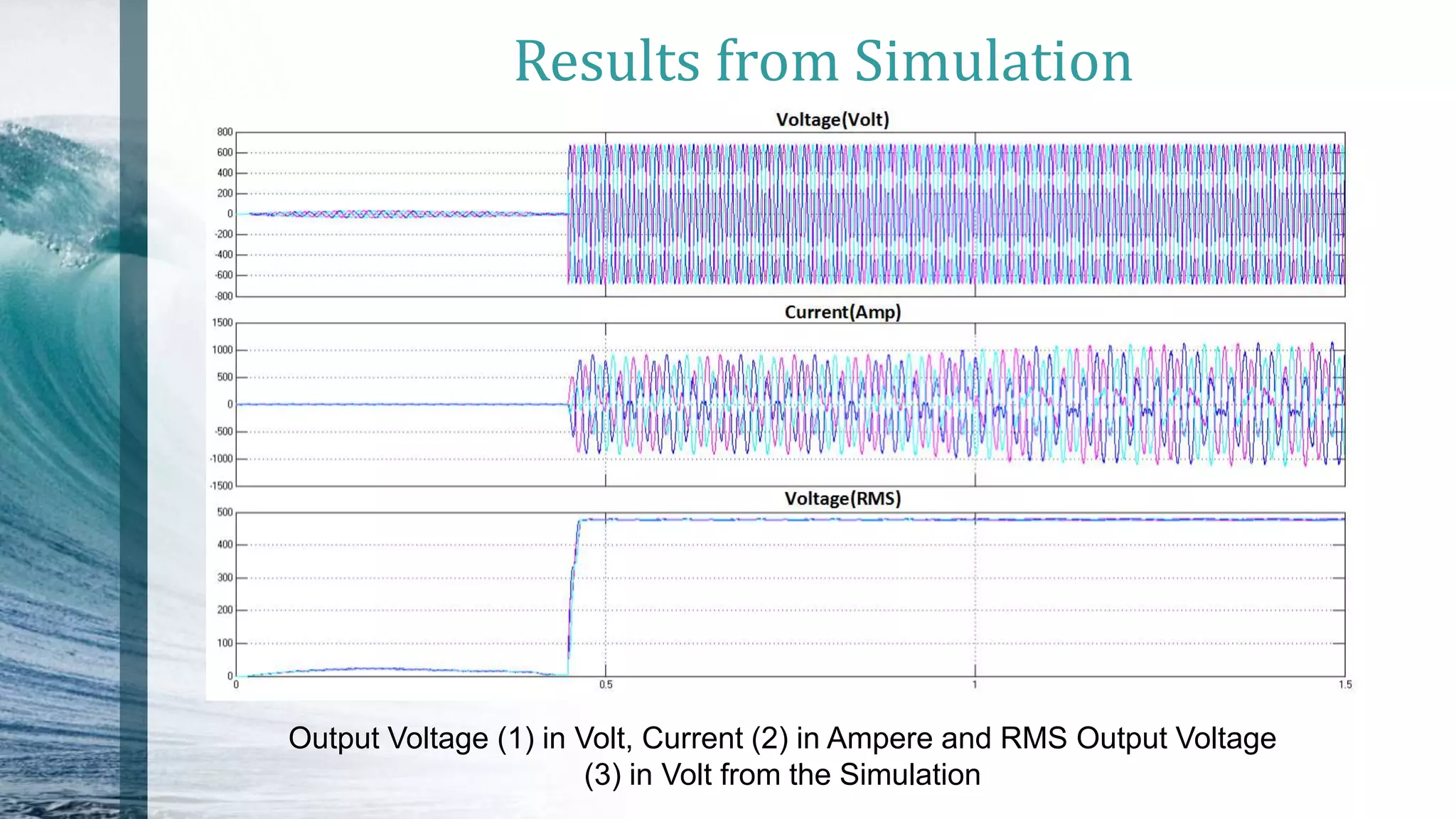
Results from Simulation
Output Voltage (1) in Volt, Current (2) in Ampere and RMS Output Voltage
(3) in Volt from the Simulation
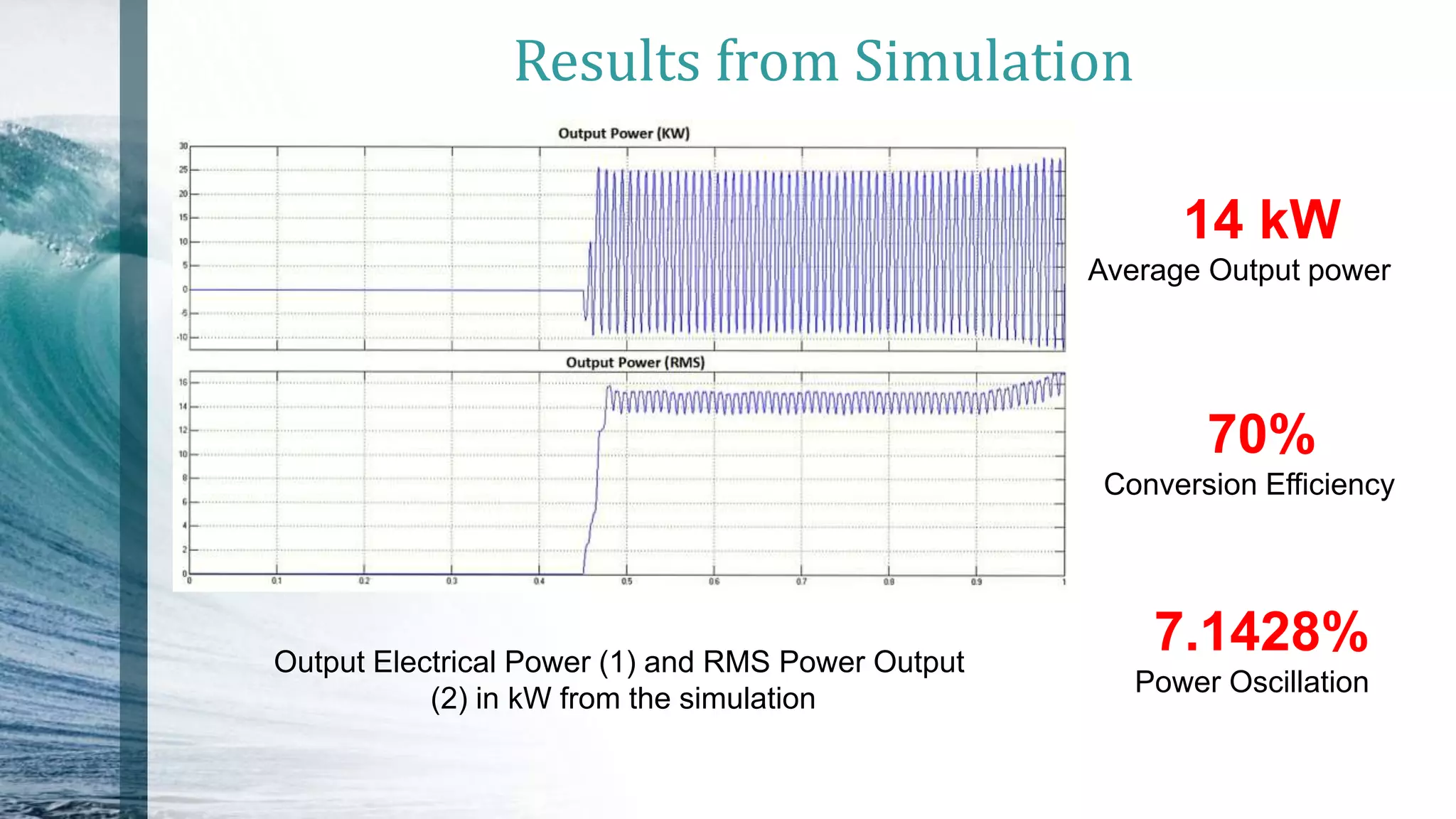
Results from Simulation
Output Electrical Power (1) and RMS Power Output
(2) in kW from the simulation
14 kW
Average Output power
70%
Conversion Efficiency
7.1428%
Power Oscillation
Challenges of Wave Energy Conversion
• Some devices already been destroyed by the forces of tides and strong storms.
• Accessibility, maintenance and repair can also be costly.
• The typical efficiency of a wave energy device at the moment being only about
30%.
• There is a potential impact on the marine environment.
• Noise pollution, for example, could have negative impact if not monitored,
although the noise and visible impact of each design varies greatly.
• The major competitor of wave power is offshore wind power.
• Wave farms can result in the displacement of commercial and recreational
fishermen from productive fishing grounds.
• Waves generate about 2,700 gigawatts of power.
• Of those 2,700 gigawatts, only about 500 gigawatts can be captured with the
current technology.
Conclusion & Future Vision
• There is much potential in worldwide wave energy; 1000 Terra Watts
available.
• Capturing wave energy and converting that into electricity is difficult but this
allows for innovate devices to be designed
• Technology produces no greenhouse gas emissions making it a non-
polluting and renewable source of energy.
• In this article a Wave-to-Wire model is presented
• Overall Designed Conversion efficiency is 70%
• Power Oscillation is Limited to 7.1428%
• The technical challenges are solvable.
• Design a Wave Energy Plant for Bangladesh.
Thank you

A wave-to-wire model of ocean wave energy conversion system using MATLAB/Simulink platform

  • 1.
    A Wave-to-Wire Modelof Ocean Wave Energy Conversion System Using MATLAB/Simulink Platform 4th International Conference on Development of Renewable Energy Technology [ICDRET 2016] AUTHORS Jakir Hossain, B.Sc in EEE, KUET Eklas Hossain, PhD Candidate, UWM, USA Sarder Shazali Sikander, M.Sc in EE, NUST, Pakistan
  • 2.
    Title and ContentLayout with List e What and Why Wave Energy? Wave energy vs. other Renewable Sources Global Resources of Wave Energy Characteristics of Wave Power Possible Harnessing Technique System Description Wave-to-Wire Model Results from Simulation Challenges of Harnessing Wave Power Conclusion Outlines
  • 3.
    What and WhyWave Energy? • Some of the kinetic (motional) energy in the wind is transformed into waves once the wind hits the ocean surface. • Wind energy ultimately forms due to solar energy and its influence on high and low pressure. • The density of the energy that is transported under the waves under the ocean surface is about five times higher compared to the wind energy 20 meter (about 65 feet) above. • In other words, the amount of energy in a single wave is very high.
  • 4.
    Wave Energy vs.Other Renewable Sources Photovoltaic Wind Wave Status Early commercial Commercial Pre-commercial Energy Source Sun Sun Sun-Wind Power Density 1 kW/m2 at peak solar insolation 1 kW/m2 at 12 m/s [General Electric (GE) 1.5 MW machine] 25 kW/m at Sun Francisco, average annual power flux Variability Daily cycles-clouds When it blows 24×7 and highly variable Predictability Poor Hours Daily Availability 20-30% 30-40% 80-90% Potential Sites Limited Limited Extensive but limited Average Power Output per Plant Scalable to 5 MW Scalable to 30 MW Scalable to 100+ MW [Provides Highest energy density] Environmental issues Visual Pollution Noise and Visual Pollution None [Virtually no environmental impacts] 80% to 90% Availability Scalable to 100+ MW Environmentally Zero Impacts Daily Predictability
  • 5.
    Title and ContentLayout with List Global Resources of Wave Energy The strongest winds blow between 30˚ and 60˚ in latitude. Western coastlines at these latitudes experience the most powerful waves. Global Distribution of approximate yearly average wave power in kW/m crest length
  • 6.
    Characteristics of WavePower Increase in total wave power with increase in water depth over various bed slopes 𝑃 = 𝜌𝑔2 64𝜋 𝐻 𝑚0 2 𝑇𝑒 ≈ 𝑘𝑤 𝑚3 𝑆 𝐻 𝑚0 2 𝑇𝑒 𝜌 Water Density 𝐻 𝑚0 Wave Height 𝑇𝑒 Wave Period Mechanical Power Stored in the Wave
  • 7.
    Characteristics of WavePower Three Basic Kinds of Systems Offshore (deals with swell energy not breaking waves) Near Shore (maximum wave amplitude) On shore (built into shoreline to receive breaking wave – but energy loss is occurring while the wave is breaking) Typical Gross wave power and exploitable wave power at the three different location of WECs WEC – Wave Energy Converter
  • 8.
    Possible Harnessing Technique PointAbsorber Oscillating Water Column Submerged Pressure Differential Overtopping Devices Oscillating Wave Surge Converter Rotating MassBulge WaveAttenuator
  • 9.
    Title and ContentLayout with List System Description Oscillating Wave Surge Converter • anchored to the sea floor (obviously near the coast) • Easiest to build electricity export infrastructure. • But energy density is lower; still prototypes are being developed
  • 10.
    Wave-to-Wire Model Block diagramof a Wave-to-Wire model of Wave Energy Conversion Wave-to-Wire model Simulink Layout
  • 11.
    Title and ContentLayout with List Wave-to-Wire Model 300 V DC to 480 V AC inverter model using Simulink
  • 12.
    Title and ContentLayout with List Results from Simulation Incident Wave Profile and Input Mechanical Power in kW/m crest length 0 to 5 m Average Wave Height 20 kW Average Input Mechanical Power
  • 13.
    Title and ContentLayout with List Results from Simulation DC Voltage (1) and RMS Voltage (2), Rectified Current (3), RMS Current (4) in Amp from the PMSG
  • 14.
    Title and ContentLayout with List Results from Simulation Output Voltage (1) in Volt, Current (2) in Ampere and RMS Output Voltage (3) in Volt from the Simulation
  • 15.
    Results from Simulation OutputElectrical Power (1) and RMS Power Output (2) in kW from the simulation 14 kW Average Output power 70% Conversion Efficiency 7.1428% Power Oscillation
  • 16.
    Challenges of WaveEnergy Conversion • Some devices already been destroyed by the forces of tides and strong storms. • Accessibility, maintenance and repair can also be costly. • The typical efficiency of a wave energy device at the moment being only about 30%. • There is a potential impact on the marine environment. • Noise pollution, for example, could have negative impact if not monitored, although the noise and visible impact of each design varies greatly. • The major competitor of wave power is offshore wind power. • Wave farms can result in the displacement of commercial and recreational fishermen from productive fishing grounds. • Waves generate about 2,700 gigawatts of power. • Of those 2,700 gigawatts, only about 500 gigawatts can be captured with the current technology.
  • 17.
    Conclusion & FutureVision • There is much potential in worldwide wave energy; 1000 Terra Watts available. • Capturing wave energy and converting that into electricity is difficult but this allows for innovate devices to be designed • Technology produces no greenhouse gas emissions making it a non- polluting and renewable source of energy. • In this article a Wave-to-Wire model is presented • Overall Designed Conversion efficiency is 70% • Power Oscillation is Limited to 7.1428% • The technical challenges are solvable. • Design a Wave Energy Plant for Bangladesh.
  • 18.