A Very Brief Introduction to Hieratic
Joshua Aaron ROBERSON
rev 1.0 (Spring 2018)
ROBERSON, Introduction to Hieratic. - 2 -
Contents
About this document ..................................................................................................3
General references ..................................................................................................... 4
1 Introduction ..........................................................................................................5
2 Basic Strategies: Context. Mono-literals, Determinatives, and Logograms. Gestalt ... 6
3 Abbreviated signs. Common bi- and tri-literal signs ................................................9
4 Dissimilar Hieroglyphic signs with similar Hieratic forms ........................................12
5 Similar Hieroglyphic signs with dissimilar Hieratic forms ........................................13
6 Signs with reduced iconicity .................................................................................. 13
7 Ligatures ...............................................................................................................14
8 Regnal dates ......................................................................................................... 15
9 Numbers ...............................................................................................................16
ROBERSON, Introduction to Hieratic. - 3 -
About this document
The present, short Introduction was designed as an overview of the basic principles of the
Hieratic script, in conjunction with a representative sample of diachronic sign forms, from the
Old Kingdom through the Ramesside era. This concise presentation was intended to address a
basic problem that confronts most beginners in Hieratic: Faced with a text that looks more or
less like gibberish, the only life-preserver thrown to you is Georg MÖLLERʼs Hieratische
Paläographie, with its seemingly endless parade of orthographic variants. However, there can
be little doubt that most of these variants̶which are exceptionally useful to the expert as dating
criteria̶serve mainly to confuse the beginner. In addition, the idiosyncratic organization of the
Paläographie is notoriously counter-intuitive, due largely to the fact that MÖLLERʼs signs appear
in thematic groups that are similar, but not identical, to those of GARDINERʼs sign list.1
Anyone
who has struggled through the process of learning Hieratic knows the frustration that arises
when progress slows to a snailʼs pace, as you search the Paläographie̶page by page, sign by
sign, and variant by variant̶for that one perfect match. Therein, I think, lies the problem. Of
course, no method can ever obviate completely the occasional need for a sign-by-sign search,
but any tips or tricks that can minimize that route of last resort should be exploited, as far as
possible. To that end, the signs, etc., presented in this Introduction have been organized
according to the same principles used to learn the Hieroglyphic script, as opposed to thematic
sign-categories. Thus, 2‒3 present the mono-literal signs in phonetic order together as a group
(p. 7, Table 2), followed by common determinatives and ideograms (p. 8, Table 3), common bi-
literals (p. 9‒11, Table 4), and tri-literals (p. 11‒12, Table 5), again in phonetic order. This
division by sign function, rather than sign form, encourages the student to build upon reading
skills cultivated already with regard to Hieroglyphic Egyptian, through identification of
phonemes and phonetic complements, placement of determinatives, etc. In addition, the
selection of a relatively small numbers of Hieratic forms̶typically a single variant each from
the Old Kingdom, Middle Kingdom, Dynasty 18, Dynasty 19, and Dynasty 20̶encourages the
student to focus less upon the palaeographic “noise” of the individual scribeʼs hand and more
upon the underlying gestalt ( 2) linking all of the Hieratic variants to their corresponding
Hieroglyphs. The following sections ( 4‒6) presents some of the common difficulties that
emerge directly from production of cursive texts, namely, the use of similar (or identical) strokes
for otherwise dissimilar Hieroglyphic signs; the use of distinct Hieratic signs for similar
Hieroglyphs; reduction of iconicity, resulting in the collapse of distinct sign forms; and the use
of ligatures. The final sections ( 8‒9) provide a concise overview of the regnal dating system
and numbers. It should go without saying that the present division of material and the selection
of sign variants were deeply subjective endeavors, reflecting my personal experience with the
Hieratic script. Other scholars would doubtless divide the material differently, or select
different/more/less Hieratic variants. However, the nature of Hieratic is such that one benefits
tremendously from broad consultation with multiple references, as the proliferation of
specialized, genre- and text-specific palaeographies will attest (see ʻGeneral Referencesʼ, below).
Thus, I have compiled the present Introduction as one more tool, which, I hope, might lighten
the new studentʼs burden, when faced with Hieratic for the first time. Above all, it serves as a
companion and gateway to MÖLLERʼs more robust Paläographie, which remains the foundation
for any serious study of the Hieratic writing system and its change over time.2
̲̲̲̲̲̲̲̲̲̲̲̲̲̲̲̲̲̲̲̲
1. For a convenient re-organization of the Middle Kingdom forms in MÖLLERʼs Paläographie according to GARDINERʼs
sign-list, see SCHRAUDER et al. 2011; for a concise index of MÖLLERʼs numbers relative to those of GARDINER, see also
VERVLOESEM 2006.
2. In this regard, note especially the Digital Hieratic project of Mainz University, which aims to create a comprehensive
and searchable archive of Hieratic signs (for project overview, see VERHOEVEN et al. 2017).
ROBERSON, Introduction to Hieratic. - 4 -
General References
DOBREV, Vassil, Miroslav VERNER, and Hana VYMAZALOVÁ. 2011. Old Hieratic Palaeography I:
Buildersʼ Inscriptions and Masonsʼ Marks from Saqqara and Abusir. Prague: Charles
University.
GOEDICKE, Hans. 1988. Old Hieratic Palaeography. Baltimore: Halgo.
GOSLINE, Sheldon Lee. 2001. Hieratic Palaeography 3a: Late Egyptian Letters, Signs A1‒D60.
Warren Center, PA.
GOSLINE, Sheldon Lee. 1999. Hieratic Palaeography 1: Introductory Late Egyptian. Warren
Center, PA.
MÖLLER, Georg. 1909‒1936. Hieratische Paläographie. Die Aegyptische Buchschrift in ihrer
Entwicklung von der Fünften Dynastie bis zur Römischen Kaiserzeit, 4 vols. Leipzig: J.C
Hinrichs.
MÖLLER, Georg. 1927. Hieratische Lesestücke für den akademischen Gebrauch, 3 vols.
Leipzig: J.C Hinrichs.
SCHRAUDER, Julienne N. and Frederic G. Laudenklos. 2011. Neue Paläografie des
mittelägyptischen Hieratisch. Berlin: GmbH.
VERHOEVEN, Ursula and Svenja A. GÜLDEN. 2017. A New Long-term Digital Project on Hieratic
and Cursive Hieroglyphs,” in G. Rosati and M.C. Guidotti, eds., Proceedings of the XIth
International Congress of Egyptologists, 671‒675. Oxford: Archaeopress.
VERVLOESEM, F. 2006. “Index bij Möller, Hieratische Paläographie. 24 februari 2006.”
Available online: http://www.filipvervloesem.be/indexmoller.pdf
WIMMER, Stefan. 1995. Hieratische Paläographie der nicht-literarischen Ostraka der 19. und
20. Dynastie, 2 vols., Ägypten und Altes Testament 28. Wiesbaden: Harrassowitz.
ROBERSON, Introduction to Hieratic. - 5 -
1 Introduction
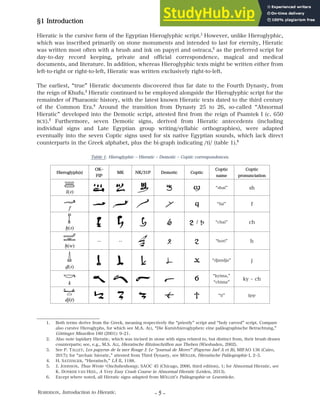
Hieratic is the cursive form of the Egyptian Hieroglyphic script.1
However, unlike Hieroglyphic,
which was inscribed primarily on stone monuments and intended to last for eternity, Hieratic
was written most often with a brush and ink on papyri and ostraca,2
as the preferred script for
day-to-day record keeping, private and official correspondence, magical and medical
documents, and literature. In addition, whereas Hieroglyphic texts might be written either from
left-to-right or right-to-left, Hieratic was written exclusively right-to-left.
The earliest, “true” Hieratic documents discovered thus far date to the Fourth Dynasty, from
the reign of Khufu.3
Hieratic continued to be employed alongside the Hieroglyphic script for the
remainder of Pharaonic history, with the latest known Hieratic texts dated to the third century
of the Common Era.4
Around the transition from Dynasty 25 to 26, so-called “Abnormal
Hieratic” developed into the Demotic script, attested first from the reign of Psamtek I (c. 650
BCE).5
Furthermore, seven Demotic signs, derived from Hieratic antecedents (including
individual signs and Late Egyptian group writing/syllabic orthographies), were adapted
eventually into the seven Coptic signs used for six native Egyptian sounds, which lack direct
counterparts in the Greek alphabet, plus the bi-graph indicating /ti/ (table 1).6
Table 1. Hieroglyphic ‒ Hieratic ‒ Demotic ‒ Coptic correspondences.
Hieroglyph(s)
OK‒
FIP
MK NK/31P Demotic Coptic
Coptic
name
Coptic
pronunciation
S(A)
S “shai” sh
f
f “fai” f
x(A)
| / K “chai” ch
H(w)
-- -- h “hori” h
D(A)
j “djandja” j
k
G
“kyima,”
“chima”
ky ~ ch
dj(t)
T “ti” tee
̲̲̲̲̲̲̲̲̲̲̲̲̲̲̲̲̲̲̲̲
1. Both terms derive from the Greek, meaning respectively the “priestly” script and “holy carved” script. Compare
also cursive Hieroglyphs, for which see M.A. ALI, “Die Kursivhieroglyphen: eine paläographische Betrachtung,”
Göttinger Miszellen 180 (2001): 9‒21.
2. Also note lapidary Hieratic, which was incised in stone with signs related to, but distinct from, their brush-drawn
counterparts; see, e.g., M.S. ALI, Hieratische Ritzinschriften aus Theben (Wiesbaden, 2002).
3. See P. TALLET, Les papyrus de la mer Rouge I: Le “journal de Merer” (Papyrus Jarf A et B), MIFAO 136 (Cairo,
2017); for “archaic hieratic,” attested from Third Dynasty, see MÖLLER, Hieratische Paläographie I, 2‒3.
4. H. SATZINGER, “Hieratisch,” LÄ II, 1188.
5. J. JOHNSON, Thus Wrote ᶜOnchsheshonqy, SAOC 45 (Chicago, 2000, third edition), 1; for Abnormal Hieratic, see
K. DONKER VAN HEEL, A Very Easy Crash Course in Abnormal Hieratic (Leiden, 2013).
6. Except where noted, all Hieratic signs adapted from MÖLLERʼs Paläographie or Lesestücke.
ROBERSON, Introduction to Hieratic. - 6 -
2 Basic Strategies: Context. Mono-literals, Determinatives, Logograms. Gestalt.
Hieratic, like modern cursive handwriting, employed simplified versions of more formal or
elaborate signs, which were frequently ligatured together, to form connected groups ( 9). In
addition, because of the decreased iconicity of cursive writing in general, a great many Hieratic
signs and groups look very similar, or even identical, to one another ( 6). Consequently,
recognizing the correct sign(s) in a group requires application of contextual knowledge: What
vocabulary and grammar are expected in the genre and time period in question? What signs do
we expect in a conventional orthography of a suspected word or group? Which word(s)
immediately precede the word or group in question? Which word(s) immediately follow it? Are
there any complements, which might help identify a preceding or following bi- or tri-literal sign?
Which sign(s) are the determinatives? Etc. Put simply, the more familiar you are with the
grammar, vocabulary, and orthography of Hieroglyphic inscriptions, the easier you will find
identification of Hieratic signs and reading Hieratic texts. Fortunately, the spellings of Hieratic
words correspond more or less to the spellings of their Hieroglyphic counterparts, such that a
one-to-one transcription from the former to the latter script is almost always possible.1
Consequently, the same strategies that help the beginning student learn to recognize and read
words in the Hieroglyphic script apply also to Hieratic. Above all, the beginner should become
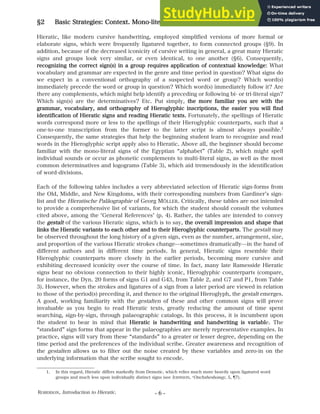
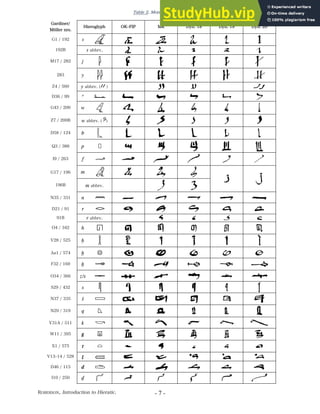
familiar with the mono-literal signs of the Egyptian “alphabet” (Table 2), which might spell
individual sounds or occur as phonetic complements to multi-literal signs, as well as the most
common determinatives and logograms (Table 3), which aid tremendously in the identification
of word-divisions.
Each of the following tables includes a very abbreviated selection of Hieratic sign-forms from
the Old, Middle, and New Kingdoms, with their corresponding numbers from Gardinerʼs sign-
list and the Hieratische Paläographie of Georg MÖLLER. Critically, these tables are not intended
to provide a comprehensive list of variants, for which the student should consult the volumes
cited above, among the ʻGeneral Referencesʼ (p. 4). Rather, the tables are intended to convey
the gestalt of the various Hieratic signs, which is to say, the overall impression and shape that
links the Hieratic variants to each other and to their Hieroglyphic counterparts. The gestalt may
be observed throughout the long history of a given sign, even as the number, arrangement, size,
and proportion of the various Hieratic strokes change̶sometimes dramatically̶in the hand of
different authors and in different time periods. In general, Hieratic signs resemble their
Hieroglyphic counterparts more closely in the earlier periods, becoming more cursive and
exhibiting decreased iconicity over the course of time. In fact, many late Ramesside Hieratic
signs bear no obvious connection to their highly iconic, Hieroglyphic counterparts (compare,
for instance, the Dyn. 20 forms of signs G1 and G43, from Table 2, and G7 and P1, from Table
3). However, when the strokes and ligatures of a sign from a later period are viewed in relation
to those of the period(s) preceding it, and thence to the original Hieroglyph, the gestalt emerges.
A good, working familiarity with the gestalten of these and other common signs will prove
invaluable as you begin to read Hieratic texts, greatly reducing the amount of time spent
searching, sign-by-sign, through palaeographic catalogs. In this process, it is incumbent upon
the student to bear in mind that Hieratic is handwriting and handwriting is variable. The
“standard” sign forms that appear in the palaeographies are merely representative examples. In
practice, signs will vary from these “standards” to a greater or lesser degree, depending on the
time period and the preferences of the individual scribe. Greater awareness and recognition of
the gestalten allows us to filter out the noise created by these variables and zero-in on the
underlying information that the scribe sought to encode.
̲̲̲̲̲̲̲̲̲̲̲̲̲̲̲̲̲̲̲̲
1. In this regard, Hieratic differs markedly from Demotic, which relies much more heavily upon ligatured word
groups and much less upon individually distinct signs (see JOHNSON, ᶜOnchsheshonqy, 5, 7).
ROBERSON, Introduction to Hieratic. - 7 -
Table 2. Mono-literal signs.
Gardiner/
Möller nrs.
Hieroglyph OK‒FIP MK Dyn. 18 Dyn. 19 Dyn. 20
G1 / 192 A
192B A abbrv.
M17 / 282 j
283 y
Z4 / 560 y abbrv. ( )
D36 / 99 a
G43 / 200 w
Z7 / 200B w abbrv. ( )
D58 / 124 b
Q3 / 388 p
I9 / 263 f
G17 / 196 m
196B m abbrv.
N35 / 331 n
D21 / 91 r
91B r abbrv.
O4 / 342 h
V28 / 525 H
Aa1 / 574 x
F32 / 169 X
O34 / 366 z/s
S29 / 432 s
N37 / 335 S
N29 / 319 o
V31A / 511 k
W11 / 395 g
X1 / 575 t
V13‒14 / 528 T
D46 / 115 d
I10 / 250 D
ROBERSON, Introduction to Hieratic. - 8 -
Table 3. Some common determinatives and logograms.
Gardiner /
Möller nrs.
Hieroglyph OK‒FIP MK Dyn. 18 Dyn. 19 Dyn. 20
A1 / 33
33B A1 abbrev.
A2 / 35
35B A2 abbrev.
A17 / 30
A24 / 15
B1 / 61
61B B1 abbrev.
D40 / 105
D54 / 119
F27 / 166
G7 / 188
188B G7 abbrev.
G37 / 197
[BAD]
M1 / 266
M2 / 268
N2 / 301
N5 / 303
N23 / 324
N25 / 322
O1 / 340
O49 / 339
P1 / 374
Y1 / 538
538 Y1 abbrev.
Z2 / 561
561 Z2 abbrev.
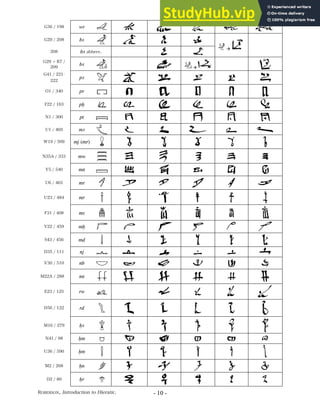
ROBERSON, Introduction to Hieratic. - 9 -
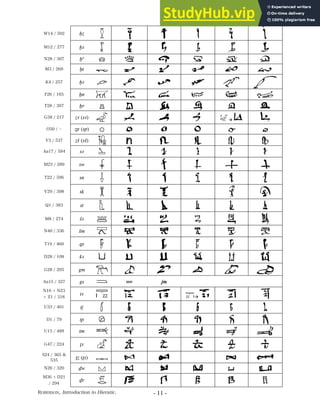
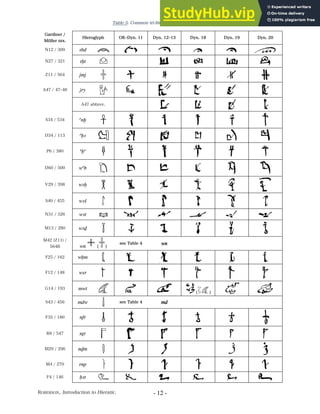
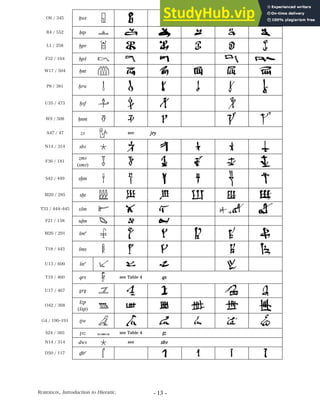
3 Abbreviated signs. Common bi- and tri-literal signs.
The preceding tables include a number of abbreviated versions of certain signs (book rolls,
plurals, first person suffixes and male/female/divine determinatives, the r-mouth, and mono-
literal birds). These and other abbreviated orthographies were employed because the signs in
question were exceedingly common (particularly in ligatures; see 7), and could be simplified̶
sometimes to just a single stroke or dot̶without obscuring the sense of the passage to the
ancient reader. Unfortunately, these same abbreviated orthographies can quite easily obscure
meaning for the modern reader and provide an additional stumbling block, of which the student
must remain aware. In this regard, context again plays a critical role.
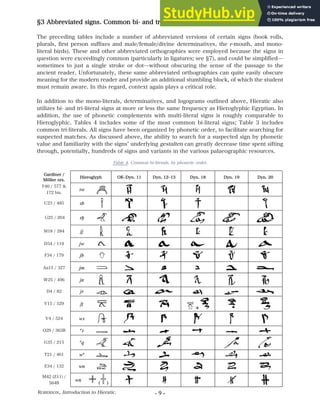
In addition to the mono-literals, determinatives, and logograms outlined above, Hieratic also
utilizes bi- and tri-literal signs at more or less the same frequency as Hieroglyphic Egyptian. In
addition, the use of phonetic complements with multi-literal signs is roughly comparable to
Hieroglyphic. Tables 4 includes some of the most common bi-literal signs; Table 3 includes
common tri-literals. All signs have been organized by phonetic order, to facilitate searching for
suspected matches. As discussed above, the ability to search for a suspected sign by phonetic
value and familiarity with the signsʼ underlying gestalten can greatly decrease time spent sifting
through, potentially, hundreds of signs and variants in the various palaeographic resources.
Table 4. Common bi-literals, by phonetic order.
Gardiner /
Möller nrs.
Hieroglyph OK‒Dyn. 11 Dyn. 12‒13 Dyn. 18 Dyn. 19 Dyn. 20
F40 / 577 &
172 bis.
Aw
U23 / 485 Ab
G25 / 204 Ax
M18 / 284 jj
D54 / 119 jw
F34 / 179 jb
Aa15 / 327 jm
W25 / 496 jn
D4 / 82 jr
V15 / 529 jT
à
V4 / 524 wA
O29 / 363B aA
G35 / 215 ao
T21 / 461 wa
E34 / 132 wn
M42 (Z11) /
564B
wn
( )
ROBERSON, Introduction to Hieratic. - 10 -
G36 / 198 wr
G29 / 208 bA
à
208 bA abbrev.
G29 + R7 /
209
bA
à
G41 / 221-
222
pA
O1 / 340 pr
F22 / 163 pH
N1 / 300 pt
U1 / 469 mA
W19 / 509 mj (mr)
N35A / 333 mw
Y5 / 540 mn
U6 / 465 mr
U23 / 484 mr
F31 / 408 ms
V22 / 459 mH
S43 / 456 md
D35 / 111 nj
V30 / 510 nb
M22A / 288 nn
E23 / 125 rw
D56 / 122 rd
M16 / 279 HA
N41 / 98 Hm
U36 / 590 Hm
M2 / 268 Hn
D2 / 80 Hr
ROBERSON, Introduction to Hieratic. - 11 -
W14 / 502 Hz
M12 / 277 xA
N28 / 307 xa
M3 / 269 xt
K4 / 257 XA
F26 / 165 Xn
T28 / 397 Xr
G38 / 217 zA (sA) à
O50 / -- zp (sp)
Y3 / 537 zS (sS)
Aa17 / 594 sA
M23 / 289 sw
T22 / 596 sn
V29 / 398 sk
Q1 / 383 st
M8 / 274 SA
N40 / 336 Sm
T19 / 460 os
D28 / 108 kA
G28 / 205 gm
Aa15 / 327 gs see jm
N16 + N23
+ Z1 / 318
tA
à
U33 / 401 tj
D1 / 79 tp
U15 / 489 tm
G47 / 224 TA
S24 / 365 &
535
Tz (Ts)
N26 / 320 Dw
M36 + D21
/ 294
Dr
ROBERSON, Introduction to Hieratic. - 12 -
Table 5. Common tri-literals, by phonetic order.
Gardiner /
Möller nrs.
Hieroglyph OK‒Dyn. 11 Dyn. 12‒13 Dyn. 18 Dyn. 19 Dyn. 20
N12 / 309 Abd
N27 / 321 Axt
Z11 / 564 jmj
A47 / 47‒48 jry
A47 abbrev.
S34 / 534 anx
D34 / 113 aHA
P6 / 380 aHa
D60 / 500 wab
V29 / 398 wAH
S40 / 455 wAS
N31 / 326 wAt
M13 / 280 wAD
M42 (Z11) /
564B wn ( )
see Table 4 wn
F25 / 162 wHm
F12 / 148 wsr
G14 / 193 mwt
( )
S43 / 456 mdw see Table 4 md
F35 / 180 nfr
R8 / 547 nTr
M29 / 296 nDm
M4 / 270 rnp
F4 / 146 HAt
ROBERSON, Introduction to Hieratic. - 13 -
O6 / 345 Hwt
R4 / 552 Htp
L1 / 258 xpr
F32 / 164 xpS
W17 / 504 xnt
P8 / 381 xrw
U35 / 473 xsf
W9 / 508 Xnm
A47 / 47 zA see jry
N14 / 314 sbA
F36 / 181
zmA
(smA)
S42 / 449 sxm
M20 / 285 sxt
T33 / 444‒445 sSm
à
F21 / 158 sDm
M26 / 291 Sma
T18 / 443 Sms
U13 / 600 Sna
T19 / 460 ors see Table 4 os
U17 / 467 grg
O42 / 368
Szp
(Ssp)
G4 / 190‒191 tjw
S24 / 365 TAz see Table 4 Tz
N14 / 314 dwA see sbA
D50 / 117 Dba
ROBERSON, Introduction to Hieratic. - 14 -
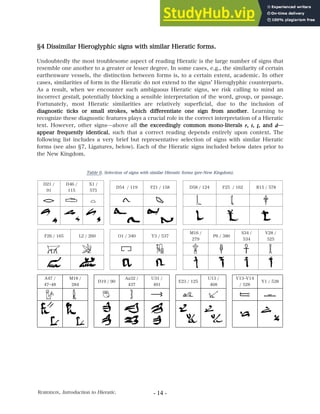
4 Dissimilar Hieroglyphic signs with similar Hieratic forms.
Undoubtedly the most troublesome aspect of reading Hieratic is the large number of signs that
resemble one another to a greater or lesser degree. In some cases, e.g., the similarity of certain
earthenware vessels, the distinction between forms is, to a certain extent, academic. In other
cases, similarities of form in the Hieratic do not extend to the signsʼ Hieroglyphic counterparts.
As a result, when we encounter such ambiguous Hieratic signs, we risk calling to mind an
incorrect gestalt, potentially blocking a sensible interpretation of the word, group, or passage.
Fortunately, most Hieratic similarities are relatively superficial, due to the inclusion of
diagnostic ticks or small strokes, which differentiate one sign from another. Learning to
recognize these diagnostic features plays a crucial role in the correct interpretation of a Hieratic
text. However, other signs̶above all the exceedingly common mono-literals r, t, T, and d̶
appear frequently identical, such that a correct reading depends entirely upon context. The
following list includes a very brief but representative selection of signs with similar Hieratic
forms (see also 7, Ligatures, below). Each of the Hieratic signs included below dates prior to
the New Kingdom.
Table 6. Selection of signs with similar Hieratic forms (pre-New Kingdom).
D21 /
91
D46 /
115
X1 /
575
D54 / 119 F21 / 158 D58 / 124 F25 / 162 R15 / 578
F26 / 165 L2 / 260 O1 / 340 Y3 / 537
M16 /
279
P6 / 380
S34 /
534
V28 /
525
A47 /
47‒48
M18 /
284
D19 / 90
Aa32 /
437
U31 /
491
E23 / 125
U13 /
468
V13‒V14
/ 528
Y1 / 538
ROBERSON, Introduction to Hieratic. - 15 -
5 Similar Hieroglyphic signs with dissimilar Hieratic forms
In contrast to the signs discussed in the previous section, some Hieratic orthographies are
actually easier to distinguish than their Hieroglyphic counterparts. Unfortunately, these
relatively transparent signs are more of an exception than a rule. Nevertheless, when reading
Hieratic texts, every little bit of clarity and disambiguation that the ancient scribes might have
employed should be recognized and exploited.
Table 7. Similar Hieroglyphic signs with dissimilar Hieratic forms (pre-New Kingdom).
A19 / 13
jAw, wr,
smsw
A21 / 11
sr
D50 / 117
Dba
T14 / 457
[FOREIGN]
D23 / 485
Ab
D23 / 484
mr
G1 / 192
A
G4 / 191
tjw
G36 / 198
wr
G37 / 197
[BAD]
V29 / 398
wAH (OK-FIP)
V29 / 399
sk (OK-FIP)
6 Signs with reduced iconicity
Some Hieroglyphic signs exhibit reduced iconicity in Hieratic. This phenomenon results in the
collapse of otherwise distinct determinatives and phonograms to generic equivalents, notably,
the a-arm, / (D36 / 99) as a generic arm determinative and phonogram, replacing
(D37), (D38), (D39), (D40), (D41), (D42), (D43), and (D44);
the zA-duck, / (G39 / 216), as a generic determinative for words relating to birds and
insects; and the Seth animal, / (E20 / n.a.), replacing (E7), and (E27).2
̲̲̲̲̲̲̲̲̲̲̲̲̲̲̲̲̲̲̲̲
1. Hieratic sign omitted in MÖLLER, Paläographie. See Shipwrecked Sailor, 32, 98 (E20: nSny) and 31, 97 (E27: sr),
respectively (A.H. GARDINER, Egyptian Grammar , 460‒461, E20 and E27, citing confusion between the two signs).
2. For the various signs and substitutions, see the relevant sign-list entries in GARDINER, Egyptian Grammar (Oxford,
third edition), 442 ff. Note that the seated Seth animal (E20) does not appear in MÖLLERʼs Paläographie; the
example cited above appears in the tale of the Shipwrecked Sailor, 31‒32.
ROBERSON, Introduction to Hieratic. - 16 -
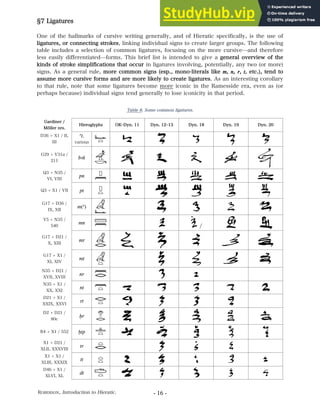
7 Ligatures
One of the hallmarks of cursive writing generally, and of Hieratic specifically, is the use of
ligatures, or connecting strokes, linking individual signs to create larger groups. The following
table includes a selection of common ligatures, focusing on the more cursive̶and therefore
less easily differentiated̶forms. This brief list is intended to give a general overview of the
kinds of stroke simplifications that occur in ligatures involving, potentially, any two (or more)
signs. As a general rule, more common signs (esp., mono-literals like m, n, r, t, etc.), tend to
assume more cursive forms and are more likely to create ligatures. As an interesting corollary
to that rule, note that some ligatures become more iconic in the Ramesside era, even as (or
perhaps because) individual signs tend generally to lose iconicity in that period.
Table 8. Some common ligatures.
Gardiner /
Möller nrs.
Hieroglyphs OK‒Dyn. 11 Dyn. 12‒13 Dyn. 18 Dyn. 19 Dyn. 20
D36 + X1 / II,
III
at,
various
G29 + V31a /
211
bAk
Q3 + N35 /
VI, VIII
pn
Q3 + X1 / VII pt
G17 + D36 /
IX, XII
m(a)
Y5 + N35 /
540
mn
/
G17 + D21 /
X, XIII
mr
G17 + X1 /
XI, XIV
mt
N35 + D21 /
XVII, XVIII
nr
N35 + X1 /
XX, XXI
nt
D21 + X1 /
XXIX, XXVI
rt
D2 + D21 /
80c
Hr
R4 + X1 / 552 Htp
X1 + D21 /
XLII, XXXVIII
tr
X1 + X1 /
XLIII, XXXIX
tt
D46 + X1 /
XLVI, XL
dt
ROBERSON, Introduction to Hieratic. - 17 -
8 Regnal dates.
Regnal dates occur frequently in administrative documents and correspondence, very often at
the beginning of the text, or at the beginning of a discrete section within a text. The regnal
dating formula takes the form: [1] HA.t-zp (“regnal year”) + year number of reigning king (see
9), [2] Abd (“month”) + month number 1‒4, [3] season (Ax.t, pr.t, or Smw), and [4] sw (“day”) +
day number 1‒30 ( 9).1
Note that, in many cases, the word (sw) was omitted or, alternately, the
determinative of the preceding month name serves double duty as sw.
Table 9. Regnal dates.
2
Möller nrs. Hieroglyphs OK‒Dyn. 11 Dyn. 12‒13 Dyn. 18 Dyn. 19 Dyn. 20
270+403
(see indiv.)
HA.t-zp /
+ number ( 9) +
310 Abd 1
311 Abd 2
312 Abd 3
313 Abd 4
LX and see
indiv.
Ax.t /
LXXI and
see indiv.
pr.t /
LXXVI and
see indiv.
Smw /
303 (sw)
(also omitted)
/ / /
+ number ( 9).
̲̲̲̲̲̲̲̲̲̲̲̲̲̲̲̲̲̲̲̲
1. For the dating system, see generally, GARDINER, Egyptian Grammar, 203–206. Note that some scholars prefer to transliterate the
“regnal date” group as rnp.t-zp or rnp.t-Hsb; for the reading as HA.t-zp, see A.H. GARDINER, “The Reading of the Year Hieroglyph,”
JNES 8/3 (1949): 165–171.
2. Dyn. 20 HA.t-zp exemplar adapted from MÖLLER, Hieratische Lesestücke, vol. 3, 16, 1; other Ramesside values in Table 9, which do
not derive from MÖLLER’s Paläographie, taken from P. GRANDET, Catalogue des Ostraca Hiératiques non littéraires IX (Cairo:
IFAO).
ROBERSON, Introduction to Hieratic. - 18 -
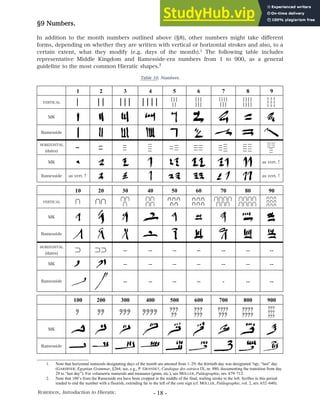
9 Numbers.
In addition to the month numbers outlined above ( 8), other numbers might take different
forms, depending on whether they are written with vertical or horizontal strokes and also, to a
certain extent, what they modify (e.g. days of the month).1
The following table includes
representative Middle Kingdom and Ramesside-era numbers from 1 to 900, as a general
guideline to the most common Hieratic shapes.2
Table 10. Numbers.
1 2 3 4 5 6 7 8 9
VERTICAL
MK
Ramesside
HORIZONTAL
(dates)
MK as vert.↑
Ramesside as vert.↑ as vert.↑
10 20 30 40 50 60 70 80 90
VERTICAL
MK
Ramesside
HORIZONTAL
(dates)
-- -- -- -- -- -- --
MK -- -- -- -- -- -- --
Ramesside -- -- -- -- - -- --
100 200 300 400 500 600 700 800 900
MK
Ramesside
__________________
1. Note that horizontal numerals designating days of the month are attested from 1–29; the thirtieth day was designated aroy, “last” day
(GARDINER, Egyptian Grammar, §264; see, e.g., P. GRANDET, Catalogue des ostraca IX, nr. 880, documenting the transition from day
29 to “last day”). For volumetric numerals and measures (grain, etc.), see MÖLLER, Paläographie, nrs. 679–712.
2. Note that 100’s from the Ramesside era have been cropped in the middle of the final, trailing stroke to the left. Scribes in this period
tended to end the number with a flourish, extending far to the left of the core sign (cf. MÖLLER, Paläographie, vol. 2, nrs. 632–640).
ROBERSON, Introduction to Hieratic. - 19 -

A Very Brief Introduction To Hieratic

  • 1.
    A Very BriefIntroduction to Hieratic Joshua Aaron ROBERSON rev 1.0 (Spring 2018)
  • 2.
    ROBERSON, Introduction toHieratic. - 2 - Contents About this document ..................................................................................................3 General references ..................................................................................................... 4 1 Introduction ..........................................................................................................5 2 Basic Strategies: Context. Mono-literals, Determinatives, and Logograms. Gestalt ... 6 3 Abbreviated signs. Common bi- and tri-literal signs ................................................9 4 Dissimilar Hieroglyphic signs with similar Hieratic forms ........................................12 5 Similar Hieroglyphic signs with dissimilar Hieratic forms ........................................13 6 Signs with reduced iconicity .................................................................................. 13 7 Ligatures ...............................................................................................................14 8 Regnal dates ......................................................................................................... 15 9 Numbers ...............................................................................................................16
  • 3.
    ROBERSON, Introduction toHieratic. - 3 - About this document The present, short Introduction was designed as an overview of the basic principles of the Hieratic script, in conjunction with a representative sample of diachronic sign forms, from the Old Kingdom through the Ramesside era. This concise presentation was intended to address a basic problem that confronts most beginners in Hieratic: Faced with a text that looks more or less like gibberish, the only life-preserver thrown to you is Georg MÖLLERʼs Hieratische Paläographie, with its seemingly endless parade of orthographic variants. However, there can be little doubt that most of these variants̶which are exceptionally useful to the expert as dating criteria̶serve mainly to confuse the beginner. In addition, the idiosyncratic organization of the Paläographie is notoriously counter-intuitive, due largely to the fact that MÖLLERʼs signs appear in thematic groups that are similar, but not identical, to those of GARDINERʼs sign list.1 Anyone who has struggled through the process of learning Hieratic knows the frustration that arises when progress slows to a snailʼs pace, as you search the Paläographie̶page by page, sign by sign, and variant by variant̶for that one perfect match. Therein, I think, lies the problem. Of course, no method can ever obviate completely the occasional need for a sign-by-sign search, but any tips or tricks that can minimize that route of last resort should be exploited, as far as possible. To that end, the signs, etc., presented in this Introduction have been organized according to the same principles used to learn the Hieroglyphic script, as opposed to thematic sign-categories. Thus, 2‒3 present the mono-literal signs in phonetic order together as a group (p. 7, Table 2), followed by common determinatives and ideograms (p. 8, Table 3), common bi- literals (p. 9‒11, Table 4), and tri-literals (p. 11‒12, Table 5), again in phonetic order. This division by sign function, rather than sign form, encourages the student to build upon reading skills cultivated already with regard to Hieroglyphic Egyptian, through identification of phonemes and phonetic complements, placement of determinatives, etc. In addition, the selection of a relatively small numbers of Hieratic forms̶typically a single variant each from the Old Kingdom, Middle Kingdom, Dynasty 18, Dynasty 19, and Dynasty 20̶encourages the student to focus less upon the palaeographic “noise” of the individual scribeʼs hand and more upon the underlying gestalt ( 2) linking all of the Hieratic variants to their corresponding Hieroglyphs. The following sections ( 4‒6) presents some of the common difficulties that emerge directly from production of cursive texts, namely, the use of similar (or identical) strokes for otherwise dissimilar Hieroglyphic signs; the use of distinct Hieratic signs for similar Hieroglyphs; reduction of iconicity, resulting in the collapse of distinct sign forms; and the use of ligatures. The final sections ( 8‒9) provide a concise overview of the regnal dating system and numbers. It should go without saying that the present division of material and the selection of sign variants were deeply subjective endeavors, reflecting my personal experience with the Hieratic script. Other scholars would doubtless divide the material differently, or select different/more/less Hieratic variants. However, the nature of Hieratic is such that one benefits tremendously from broad consultation with multiple references, as the proliferation of specialized, genre- and text-specific palaeographies will attest (see ʻGeneral Referencesʼ, below). Thus, I have compiled the present Introduction as one more tool, which, I hope, might lighten the new studentʼs burden, when faced with Hieratic for the first time. Above all, it serves as a companion and gateway to MÖLLERʼs more robust Paläographie, which remains the foundation for any serious study of the Hieratic writing system and its change over time.2 ̲̲̲̲̲̲̲̲̲̲̲̲̲̲̲̲̲̲̲̲ 1. For a convenient re-organization of the Middle Kingdom forms in MÖLLERʼs Paläographie according to GARDINERʼs sign-list, see SCHRAUDER et al. 2011; for a concise index of MÖLLERʼs numbers relative to those of GARDINER, see also VERVLOESEM 2006. 2. In this regard, note especially the Digital Hieratic project of Mainz University, which aims to create a comprehensive and searchable archive of Hieratic signs (for project overview, see VERHOEVEN et al. 2017).
  • 4.
    ROBERSON, Introduction toHieratic. - 4 - General References DOBREV, Vassil, Miroslav VERNER, and Hana VYMAZALOVÁ. 2011. Old Hieratic Palaeography I: Buildersʼ Inscriptions and Masonsʼ Marks from Saqqara and Abusir. Prague: Charles University. GOEDICKE, Hans. 1988. Old Hieratic Palaeography. Baltimore: Halgo. GOSLINE, Sheldon Lee. 2001. Hieratic Palaeography 3a: Late Egyptian Letters, Signs A1‒D60. Warren Center, PA. GOSLINE, Sheldon Lee. 1999. Hieratic Palaeography 1: Introductory Late Egyptian. Warren Center, PA. MÖLLER, Georg. 1909‒1936. Hieratische Paläographie. Die Aegyptische Buchschrift in ihrer Entwicklung von der Fünften Dynastie bis zur Römischen Kaiserzeit, 4 vols. Leipzig: J.C Hinrichs. MÖLLER, Georg. 1927. Hieratische Lesestücke für den akademischen Gebrauch, 3 vols. Leipzig: J.C Hinrichs. SCHRAUDER, Julienne N. and Frederic G. Laudenklos. 2011. Neue Paläografie des mittelägyptischen Hieratisch. Berlin: GmbH. VERHOEVEN, Ursula and Svenja A. GÜLDEN. 2017. A New Long-term Digital Project on Hieratic and Cursive Hieroglyphs,” in G. Rosati and M.C. Guidotti, eds., Proceedings of the XIth International Congress of Egyptologists, 671‒675. Oxford: Archaeopress. VERVLOESEM, F. 2006. “Index bij Möller, Hieratische Paläographie. 24 februari 2006.” Available online: http://www.filipvervloesem.be/indexmoller.pdf WIMMER, Stefan. 1995. Hieratische Paläographie der nicht-literarischen Ostraka der 19. und 20. Dynastie, 2 vols., Ägypten und Altes Testament 28. Wiesbaden: Harrassowitz.
  • 5.
    ROBERSON, Introduction toHieratic. - 5 - 1 Introduction Hieratic is the cursive form of the Egyptian Hieroglyphic script.1 However, unlike Hieroglyphic, which was inscribed primarily on stone monuments and intended to last for eternity, Hieratic was written most often with a brush and ink on papyri and ostraca,2 as the preferred script for day-to-day record keeping, private and official correspondence, magical and medical documents, and literature. In addition, whereas Hieroglyphic texts might be written either from left-to-right or right-to-left, Hieratic was written exclusively right-to-left. The earliest, “true” Hieratic documents discovered thus far date to the Fourth Dynasty, from the reign of Khufu.3 Hieratic continued to be employed alongside the Hieroglyphic script for the remainder of Pharaonic history, with the latest known Hieratic texts dated to the third century of the Common Era.4 Around the transition from Dynasty 25 to 26, so-called “Abnormal Hieratic” developed into the Demotic script, attested first from the reign of Psamtek I (c. 650 BCE).5 Furthermore, seven Demotic signs, derived from Hieratic antecedents (including individual signs and Late Egyptian group writing/syllabic orthographies), were adapted eventually into the seven Coptic signs used for six native Egyptian sounds, which lack direct counterparts in the Greek alphabet, plus the bi-graph indicating /ti/ (table 1).6 Table 1. Hieroglyphic ‒ Hieratic ‒ Demotic ‒ Coptic correspondences. Hieroglyph(s) OK‒ FIP MK NK/31P Demotic Coptic Coptic name Coptic pronunciation S(A) S “shai” sh f f “fai” f x(A) | / K “chai” ch H(w) -- -- h “hori” h D(A) j “djandja” j k G “kyima,” “chima” ky ~ ch dj(t) T “ti” tee ̲̲̲̲̲̲̲̲̲̲̲̲̲̲̲̲̲̲̲̲ 1. Both terms derive from the Greek, meaning respectively the “priestly” script and “holy carved” script. Compare also cursive Hieroglyphs, for which see M.A. ALI, “Die Kursivhieroglyphen: eine paläographische Betrachtung,” Göttinger Miszellen 180 (2001): 9‒21. 2. Also note lapidary Hieratic, which was incised in stone with signs related to, but distinct from, their brush-drawn counterparts; see, e.g., M.S. ALI, Hieratische Ritzinschriften aus Theben (Wiesbaden, 2002). 3. See P. TALLET, Les papyrus de la mer Rouge I: Le “journal de Merer” (Papyrus Jarf A et B), MIFAO 136 (Cairo, 2017); for “archaic hieratic,” attested from Third Dynasty, see MÖLLER, Hieratische Paläographie I, 2‒3. 4. H. SATZINGER, “Hieratisch,” LÄ II, 1188. 5. J. JOHNSON, Thus Wrote ᶜOnchsheshonqy, SAOC 45 (Chicago, 2000, third edition), 1; for Abnormal Hieratic, see K. DONKER VAN HEEL, A Very Easy Crash Course in Abnormal Hieratic (Leiden, 2013). 6. Except where noted, all Hieratic signs adapted from MÖLLERʼs Paläographie or Lesestücke.
  • 6.
    ROBERSON, Introduction toHieratic. - 6 - 2 Basic Strategies: Context. Mono-literals, Determinatives, Logograms. Gestalt. Hieratic, like modern cursive handwriting, employed simplified versions of more formal or elaborate signs, which were frequently ligatured together, to form connected groups ( 9). In addition, because of the decreased iconicity of cursive writing in general, a great many Hieratic signs and groups look very similar, or even identical, to one another ( 6). Consequently, recognizing the correct sign(s) in a group requires application of contextual knowledge: What vocabulary and grammar are expected in the genre and time period in question? What signs do we expect in a conventional orthography of a suspected word or group? Which word(s) immediately precede the word or group in question? Which word(s) immediately follow it? Are there any complements, which might help identify a preceding or following bi- or tri-literal sign? Which sign(s) are the determinatives? Etc. Put simply, the more familiar you are with the grammar, vocabulary, and orthography of Hieroglyphic inscriptions, the easier you will find identification of Hieratic signs and reading Hieratic texts. Fortunately, the spellings of Hieratic words correspond more or less to the spellings of their Hieroglyphic counterparts, such that a one-to-one transcription from the former to the latter script is almost always possible.1 Consequently, the same strategies that help the beginning student learn to recognize and read words in the Hieroglyphic script apply also to Hieratic. Above all, the beginner should become familiar with the mono-literal signs of the Egyptian “alphabet” (Table 2), which might spell individual sounds or occur as phonetic complements to multi-literal signs, as well as the most common determinatives and logograms (Table 3), which aid tremendously in the identification of word-divisions. Each of the following tables includes a very abbreviated selection of Hieratic sign-forms from the Old, Middle, and New Kingdoms, with their corresponding numbers from Gardinerʼs sign- list and the Hieratische Paläographie of Georg MÖLLER. Critically, these tables are not intended to provide a comprehensive list of variants, for which the student should consult the volumes cited above, among the ʻGeneral Referencesʼ (p. 4). Rather, the tables are intended to convey the gestalt of the various Hieratic signs, which is to say, the overall impression and shape that links the Hieratic variants to each other and to their Hieroglyphic counterparts. The gestalt may be observed throughout the long history of a given sign, even as the number, arrangement, size, and proportion of the various Hieratic strokes change̶sometimes dramatically̶in the hand of different authors and in different time periods. In general, Hieratic signs resemble their Hieroglyphic counterparts more closely in the earlier periods, becoming more cursive and exhibiting decreased iconicity over the course of time. In fact, many late Ramesside Hieratic signs bear no obvious connection to their highly iconic, Hieroglyphic counterparts (compare, for instance, the Dyn. 20 forms of signs G1 and G43, from Table 2, and G7 and P1, from Table 3). However, when the strokes and ligatures of a sign from a later period are viewed in relation to those of the period(s) preceding it, and thence to the original Hieroglyph, the gestalt emerges. A good, working familiarity with the gestalten of these and other common signs will prove invaluable as you begin to read Hieratic texts, greatly reducing the amount of time spent searching, sign-by-sign, through palaeographic catalogs. In this process, it is incumbent upon the student to bear in mind that Hieratic is handwriting and handwriting is variable. The “standard” sign forms that appear in the palaeographies are merely representative examples. In practice, signs will vary from these “standards” to a greater or lesser degree, depending on the time period and the preferences of the individual scribe. Greater awareness and recognition of the gestalten allows us to filter out the noise created by these variables and zero-in on the underlying information that the scribe sought to encode. ̲̲̲̲̲̲̲̲̲̲̲̲̲̲̲̲̲̲̲̲ 1. In this regard, Hieratic differs markedly from Demotic, which relies much more heavily upon ligatured word groups and much less upon individually distinct signs (see JOHNSON, ᶜOnchsheshonqy, 5, 7).
  • 7.
    ROBERSON, Introduction toHieratic. - 7 - Table 2. Mono-literal signs. Gardiner/ Möller nrs. Hieroglyph OK‒FIP MK Dyn. 18 Dyn. 19 Dyn. 20 G1 / 192 A 192B A abbrv. M17 / 282 j 283 y Z4 / 560 y abbrv. ( ) D36 / 99 a G43 / 200 w Z7 / 200B w abbrv. ( ) D58 / 124 b Q3 / 388 p I9 / 263 f G17 / 196 m 196B m abbrv. N35 / 331 n D21 / 91 r 91B r abbrv. O4 / 342 h V28 / 525 H Aa1 / 574 x F32 / 169 X O34 / 366 z/s S29 / 432 s N37 / 335 S N29 / 319 o V31A / 511 k W11 / 395 g X1 / 575 t V13‒14 / 528 T D46 / 115 d I10 / 250 D
  • 8.
    ROBERSON, Introduction toHieratic. - 8 - Table 3. Some common determinatives and logograms. Gardiner / Möller nrs. Hieroglyph OK‒FIP MK Dyn. 18 Dyn. 19 Dyn. 20 A1 / 33 33B A1 abbrev. A2 / 35 35B A2 abbrev. A17 / 30 A24 / 15 B1 / 61 61B B1 abbrev. D40 / 105 D54 / 119 F27 / 166 G7 / 188 188B G7 abbrev. G37 / 197 [BAD] M1 / 266 M2 / 268 N2 / 301 N5 / 303 N23 / 324 N25 / 322 O1 / 340 O49 / 339 P1 / 374 Y1 / 538 538 Y1 abbrev. Z2 / 561 561 Z2 abbrev.
  • 9.
    ROBERSON, Introduction toHieratic. - 9 - 3 Abbreviated signs. Common bi- and tri-literal signs. The preceding tables include a number of abbreviated versions of certain signs (book rolls, plurals, first person suffixes and male/female/divine determinatives, the r-mouth, and mono- literal birds). These and other abbreviated orthographies were employed because the signs in question were exceedingly common (particularly in ligatures; see 7), and could be simplified̶ sometimes to just a single stroke or dot̶without obscuring the sense of the passage to the ancient reader. Unfortunately, these same abbreviated orthographies can quite easily obscure meaning for the modern reader and provide an additional stumbling block, of which the student must remain aware. In this regard, context again plays a critical role. In addition to the mono-literals, determinatives, and logograms outlined above, Hieratic also utilizes bi- and tri-literal signs at more or less the same frequency as Hieroglyphic Egyptian. In addition, the use of phonetic complements with multi-literal signs is roughly comparable to Hieroglyphic. Tables 4 includes some of the most common bi-literal signs; Table 3 includes common tri-literals. All signs have been organized by phonetic order, to facilitate searching for suspected matches. As discussed above, the ability to search for a suspected sign by phonetic value and familiarity with the signsʼ underlying gestalten can greatly decrease time spent sifting through, potentially, hundreds of signs and variants in the various palaeographic resources. Table 4. Common bi-literals, by phonetic order. Gardiner / Möller nrs. Hieroglyph OK‒Dyn. 11 Dyn. 12‒13 Dyn. 18 Dyn. 19 Dyn. 20 F40 / 577 & 172 bis. Aw U23 / 485 Ab G25 / 204 Ax M18 / 284 jj D54 / 119 jw F34 / 179 jb Aa15 / 327 jm W25 / 496 jn D4 / 82 jr V15 / 529 jT à V4 / 524 wA O29 / 363B aA G35 / 215 ao T21 / 461 wa E34 / 132 wn M42 (Z11) / 564B wn ( )
  • 10.
    ROBERSON, Introduction toHieratic. - 10 - G36 / 198 wr G29 / 208 bA à 208 bA abbrev. G29 + R7 / 209 bA à G41 / 221- 222 pA O1 / 340 pr F22 / 163 pH N1 / 300 pt U1 / 469 mA W19 / 509 mj (mr) N35A / 333 mw Y5 / 540 mn U6 / 465 mr U23 / 484 mr F31 / 408 ms V22 / 459 mH S43 / 456 md D35 / 111 nj V30 / 510 nb M22A / 288 nn E23 / 125 rw D56 / 122 rd M16 / 279 HA N41 / 98 Hm U36 / 590 Hm M2 / 268 Hn D2 / 80 Hr
  • 11.
    ROBERSON, Introduction toHieratic. - 11 - W14 / 502 Hz M12 / 277 xA N28 / 307 xa M3 / 269 xt K4 / 257 XA F26 / 165 Xn T28 / 397 Xr G38 / 217 zA (sA) à O50 / -- zp (sp) Y3 / 537 zS (sS) Aa17 / 594 sA M23 / 289 sw T22 / 596 sn V29 / 398 sk Q1 / 383 st M8 / 274 SA N40 / 336 Sm T19 / 460 os D28 / 108 kA G28 / 205 gm Aa15 / 327 gs see jm N16 + N23 + Z1 / 318 tA à U33 / 401 tj D1 / 79 tp U15 / 489 tm G47 / 224 TA S24 / 365 & 535 Tz (Ts) N26 / 320 Dw M36 + D21 / 294 Dr
  • 12.
    ROBERSON, Introduction toHieratic. - 12 - Table 5. Common tri-literals, by phonetic order. Gardiner / Möller nrs. Hieroglyph OK‒Dyn. 11 Dyn. 12‒13 Dyn. 18 Dyn. 19 Dyn. 20 N12 / 309 Abd N27 / 321 Axt Z11 / 564 jmj A47 / 47‒48 jry A47 abbrev. S34 / 534 anx D34 / 113 aHA P6 / 380 aHa D60 / 500 wab V29 / 398 wAH S40 / 455 wAS N31 / 326 wAt M13 / 280 wAD M42 (Z11) / 564B wn ( ) see Table 4 wn F25 / 162 wHm F12 / 148 wsr G14 / 193 mwt ( ) S43 / 456 mdw see Table 4 md F35 / 180 nfr R8 / 547 nTr M29 / 296 nDm M4 / 270 rnp F4 / 146 HAt
  • 13.
    ROBERSON, Introduction toHieratic. - 13 - O6 / 345 Hwt R4 / 552 Htp L1 / 258 xpr F32 / 164 xpS W17 / 504 xnt P8 / 381 xrw U35 / 473 xsf W9 / 508 Xnm A47 / 47 zA see jry N14 / 314 sbA F36 / 181 zmA (smA) S42 / 449 sxm M20 / 285 sxt T33 / 444‒445 sSm à F21 / 158 sDm M26 / 291 Sma T18 / 443 Sms U13 / 600 Sna T19 / 460 ors see Table 4 os U17 / 467 grg O42 / 368 Szp (Ssp) G4 / 190‒191 tjw S24 / 365 TAz see Table 4 Tz N14 / 314 dwA see sbA D50 / 117 Dba
  • 14.
    ROBERSON, Introduction toHieratic. - 14 - 4 Dissimilar Hieroglyphic signs with similar Hieratic forms. Undoubtedly the most troublesome aspect of reading Hieratic is the large number of signs that resemble one another to a greater or lesser degree. In some cases, e.g., the similarity of certain earthenware vessels, the distinction between forms is, to a certain extent, academic. In other cases, similarities of form in the Hieratic do not extend to the signsʼ Hieroglyphic counterparts. As a result, when we encounter such ambiguous Hieratic signs, we risk calling to mind an incorrect gestalt, potentially blocking a sensible interpretation of the word, group, or passage. Fortunately, most Hieratic similarities are relatively superficial, due to the inclusion of diagnostic ticks or small strokes, which differentiate one sign from another. Learning to recognize these diagnostic features plays a crucial role in the correct interpretation of a Hieratic text. However, other signs̶above all the exceedingly common mono-literals r, t, T, and d̶ appear frequently identical, such that a correct reading depends entirely upon context. The following list includes a very brief but representative selection of signs with similar Hieratic forms (see also 7, Ligatures, below). Each of the Hieratic signs included below dates prior to the New Kingdom. Table 6. Selection of signs with similar Hieratic forms (pre-New Kingdom). D21 / 91 D46 / 115 X1 / 575 D54 / 119 F21 / 158 D58 / 124 F25 / 162 R15 / 578 F26 / 165 L2 / 260 O1 / 340 Y3 / 537 M16 / 279 P6 / 380 S34 / 534 V28 / 525 A47 / 47‒48 M18 / 284 D19 / 90 Aa32 / 437 U31 / 491 E23 / 125 U13 / 468 V13‒V14 / 528 Y1 / 538
  • 15.
    ROBERSON, Introduction toHieratic. - 15 - 5 Similar Hieroglyphic signs with dissimilar Hieratic forms In contrast to the signs discussed in the previous section, some Hieratic orthographies are actually easier to distinguish than their Hieroglyphic counterparts. Unfortunately, these relatively transparent signs are more of an exception than a rule. Nevertheless, when reading Hieratic texts, every little bit of clarity and disambiguation that the ancient scribes might have employed should be recognized and exploited. Table 7. Similar Hieroglyphic signs with dissimilar Hieratic forms (pre-New Kingdom). A19 / 13 jAw, wr, smsw A21 / 11 sr D50 / 117 Dba T14 / 457 [FOREIGN] D23 / 485 Ab D23 / 484 mr G1 / 192 A G4 / 191 tjw G36 / 198 wr G37 / 197 [BAD] V29 / 398 wAH (OK-FIP) V29 / 399 sk (OK-FIP) 6 Signs with reduced iconicity Some Hieroglyphic signs exhibit reduced iconicity in Hieratic. This phenomenon results in the collapse of otherwise distinct determinatives and phonograms to generic equivalents, notably, the a-arm, / (D36 / 99) as a generic arm determinative and phonogram, replacing (D37), (D38), (D39), (D40), (D41), (D42), (D43), and (D44); the zA-duck, / (G39 / 216), as a generic determinative for words relating to birds and insects; and the Seth animal, / (E20 / n.a.), replacing (E7), and (E27).2 ̲̲̲̲̲̲̲̲̲̲̲̲̲̲̲̲̲̲̲̲ 1. Hieratic sign omitted in MÖLLER, Paläographie. See Shipwrecked Sailor, 32, 98 (E20: nSny) and 31, 97 (E27: sr), respectively (A.H. GARDINER, Egyptian Grammar , 460‒461, E20 and E27, citing confusion between the two signs). 2. For the various signs and substitutions, see the relevant sign-list entries in GARDINER, Egyptian Grammar (Oxford, third edition), 442 ff. Note that the seated Seth animal (E20) does not appear in MÖLLERʼs Paläographie; the example cited above appears in the tale of the Shipwrecked Sailor, 31‒32.
  • 16.
    ROBERSON, Introduction toHieratic. - 16 - 7 Ligatures One of the hallmarks of cursive writing generally, and of Hieratic specifically, is the use of ligatures, or connecting strokes, linking individual signs to create larger groups. The following table includes a selection of common ligatures, focusing on the more cursive̶and therefore less easily differentiated̶forms. This brief list is intended to give a general overview of the kinds of stroke simplifications that occur in ligatures involving, potentially, any two (or more) signs. As a general rule, more common signs (esp., mono-literals like m, n, r, t, etc.), tend to assume more cursive forms and are more likely to create ligatures. As an interesting corollary to that rule, note that some ligatures become more iconic in the Ramesside era, even as (or perhaps because) individual signs tend generally to lose iconicity in that period. Table 8. Some common ligatures. Gardiner / Möller nrs. Hieroglyphs OK‒Dyn. 11 Dyn. 12‒13 Dyn. 18 Dyn. 19 Dyn. 20 D36 + X1 / II, III at, various G29 + V31a / 211 bAk Q3 + N35 / VI, VIII pn Q3 + X1 / VII pt G17 + D36 / IX, XII m(a) Y5 + N35 / 540 mn / G17 + D21 / X, XIII mr G17 + X1 / XI, XIV mt N35 + D21 / XVII, XVIII nr N35 + X1 / XX, XXI nt D21 + X1 / XXIX, XXVI rt D2 + D21 / 80c Hr R4 + X1 / 552 Htp X1 + D21 / XLII, XXXVIII tr X1 + X1 / XLIII, XXXIX tt D46 + X1 / XLVI, XL dt
  • 17.
    ROBERSON, Introduction toHieratic. - 17 - 8 Regnal dates. Regnal dates occur frequently in administrative documents and correspondence, very often at the beginning of the text, or at the beginning of a discrete section within a text. The regnal dating formula takes the form: [1] HA.t-zp (“regnal year”) + year number of reigning king (see 9), [2] Abd (“month”) + month number 1‒4, [3] season (Ax.t, pr.t, or Smw), and [4] sw (“day”) + day number 1‒30 ( 9).1 Note that, in many cases, the word (sw) was omitted or, alternately, the determinative of the preceding month name serves double duty as sw. Table 9. Regnal dates. 2 Möller nrs. Hieroglyphs OK‒Dyn. 11 Dyn. 12‒13 Dyn. 18 Dyn. 19 Dyn. 20 270+403 (see indiv.) HA.t-zp / + number ( 9) + 310 Abd 1 311 Abd 2 312 Abd 3 313 Abd 4 LX and see indiv. Ax.t / LXXI and see indiv. pr.t / LXXVI and see indiv. Smw / 303 (sw) (also omitted) / / / + number ( 9). ̲̲̲̲̲̲̲̲̲̲̲̲̲̲̲̲̲̲̲̲ 1. For the dating system, see generally, GARDINER, Egyptian Grammar, 203–206. Note that some scholars prefer to transliterate the “regnal date” group as rnp.t-zp or rnp.t-Hsb; for the reading as HA.t-zp, see A.H. GARDINER, “The Reading of the Year Hieroglyph,” JNES 8/3 (1949): 165–171. 2. Dyn. 20 HA.t-zp exemplar adapted from MÖLLER, Hieratische Lesestücke, vol. 3, 16, 1; other Ramesside values in Table 9, which do not derive from MÖLLER’s Paläographie, taken from P. GRANDET, Catalogue des Ostraca Hiératiques non littéraires IX (Cairo: IFAO).
  • 18.
    ROBERSON, Introduction toHieratic. - 18 - 9 Numbers. In addition to the month numbers outlined above ( 8), other numbers might take different forms, depending on whether they are written with vertical or horizontal strokes and also, to a certain extent, what they modify (e.g. days of the month).1 The following table includes representative Middle Kingdom and Ramesside-era numbers from 1 to 900, as a general guideline to the most common Hieratic shapes.2 Table 10. Numbers. 1 2 3 4 5 6 7 8 9 VERTICAL MK Ramesside HORIZONTAL (dates) MK as vert.↑ Ramesside as vert.↑ as vert.↑ 10 20 30 40 50 60 70 80 90 VERTICAL MK Ramesside HORIZONTAL (dates) -- -- -- -- -- -- -- MK -- -- -- -- -- -- -- Ramesside -- -- -- -- - -- -- 100 200 300 400 500 600 700 800 900 MK Ramesside __________________ 1. Note that horizontal numerals designating days of the month are attested from 1–29; the thirtieth day was designated aroy, “last” day (GARDINER, Egyptian Grammar, §264; see, e.g., P. GRANDET, Catalogue des ostraca IX, nr. 880, documenting the transition from day 29 to “last day”). For volumetric numerals and measures (grain, etc.), see MÖLLER, Paläographie, nrs. 679–712. 2. Note that 100’s from the Ramesside era have been cropped in the middle of the final, trailing stroke to the left. Scribes in this period tended to end the number with a flourish, extending far to the left of the core sign (cf. MÖLLER, Paläographie, vol. 2, nrs. 632–640).
  • 19.
    ROBERSON, Introduction toHieratic. - 19 -