A UNITY OF ENGAGEMENT FROM
MANY, FOR MANY, SHALL
FLOURISH ONLINE
J. Joseph Hoey, Ed.D.
Carmen “Lizy” Lamboy-Naughton, Ed.D.
Morgan Johnson, M.A.
OUTCOMES
After participating in this session, participants will be able to:
 Understand the history and identify the elements of Ashford
University’s faculty engagement culture
 Share onboarding, governance, faculty development and
engagement in program review and assessment of learning
 Discuss elements presented and possible applicability in their
school.
2
AGENDA
Conceptual Framework
Serving a Diverse Faculty Community
Faculty Development and Review
Governance
Curriculum Development
Program Review
Developing Common Standards
Summary
Q & A
3
ASHFORD: WHO ARE WE?
4
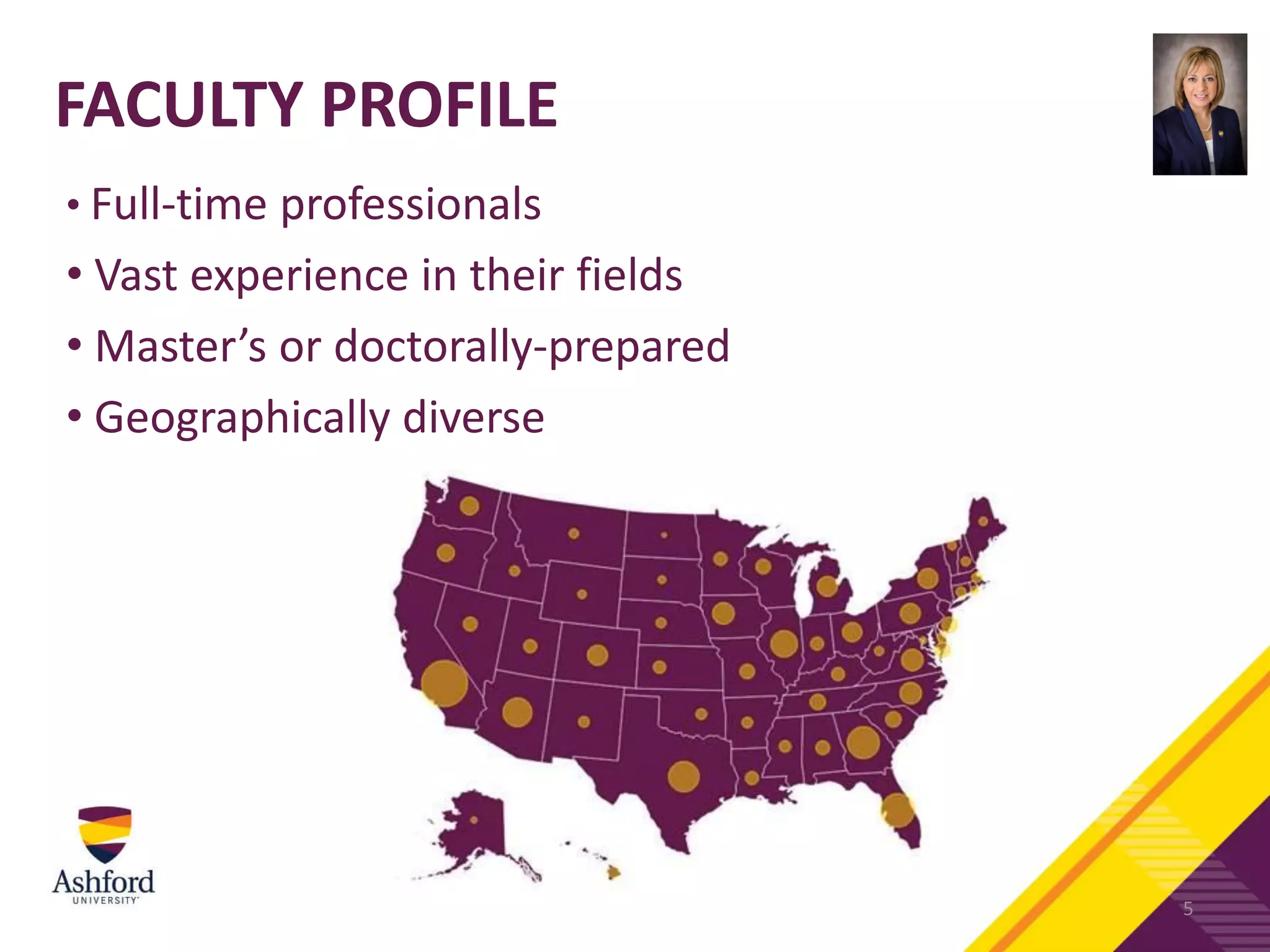
FACULTY PROFILE
• Full-time professionals
• Vast experience in their fields
• Master’s or doctorally-prepared
• Geographically diverse
5
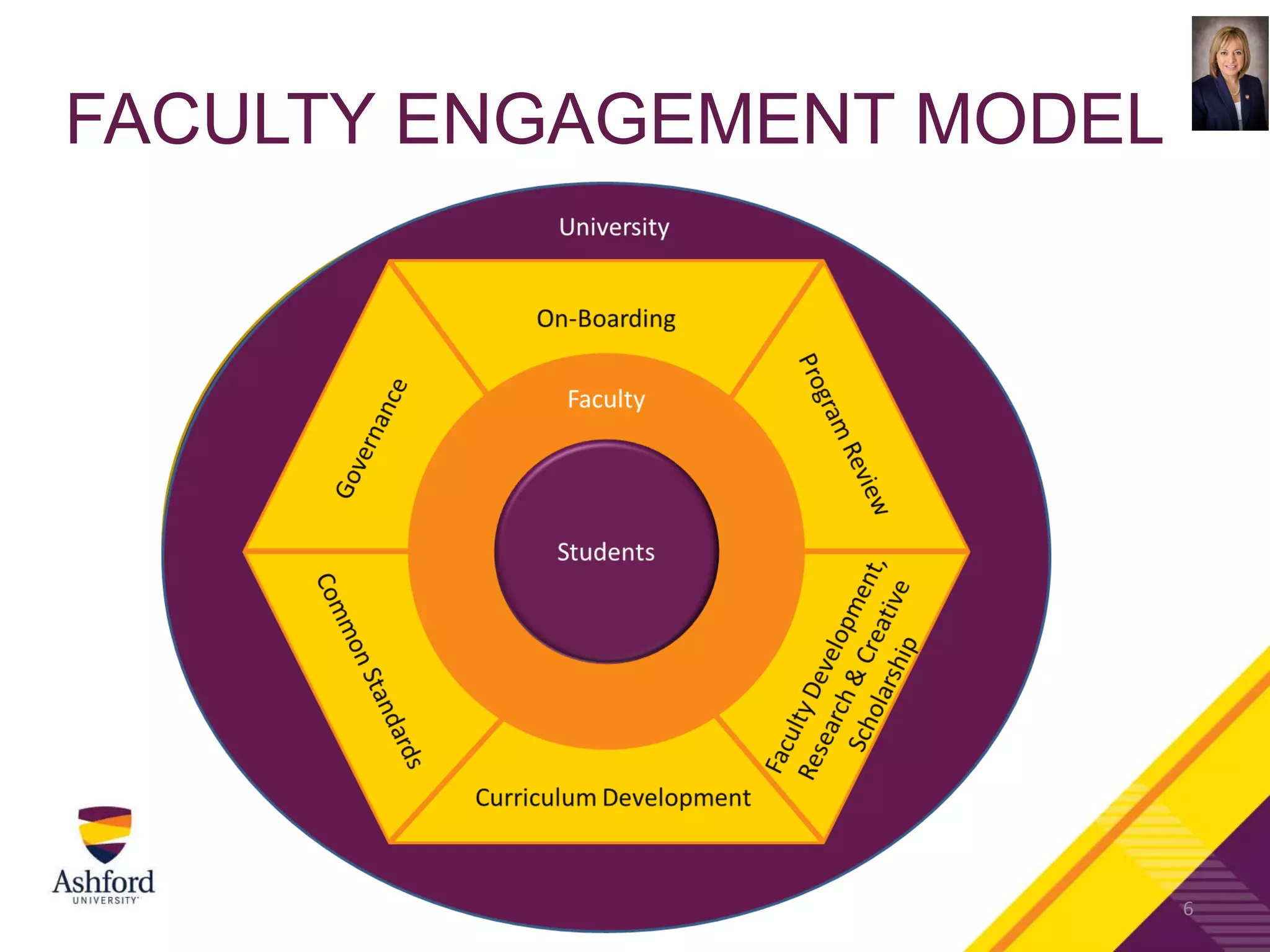
FACULTY ENGAGEMENT MODEL
6
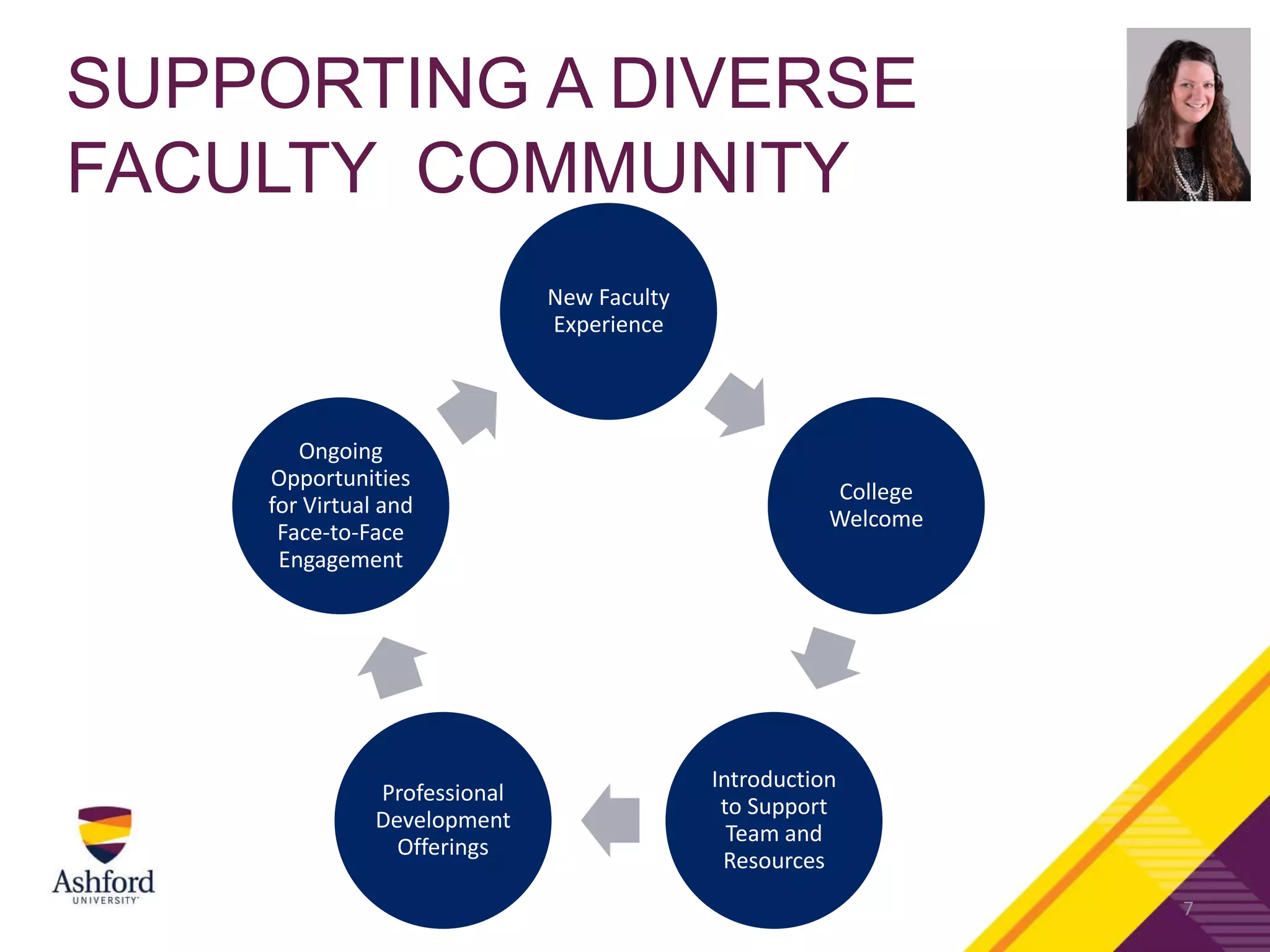
SUPPORTING A DIVERSE
FACULTY COMMUNITY
7
New Faculty
Experience
College
Welcome
Introduction
to Support
Team and
Resources
Professional
Development
Offerings
Ongoing
Opportunities
for Virtual and
Face-to-Face
Engagement
NEW FACULTY EXPERIENCE
The New Faculty Experience (NFE) is an orientation for our
faculty. NFE is designed to provide faculty with the
information necessary to run a productive and effective
learning environment in the online setting.
3 week orientation, includes a training course where
engagement with a facilitator and other new faculty members
occur. New faculty also complete tasks in a simulated course.
8
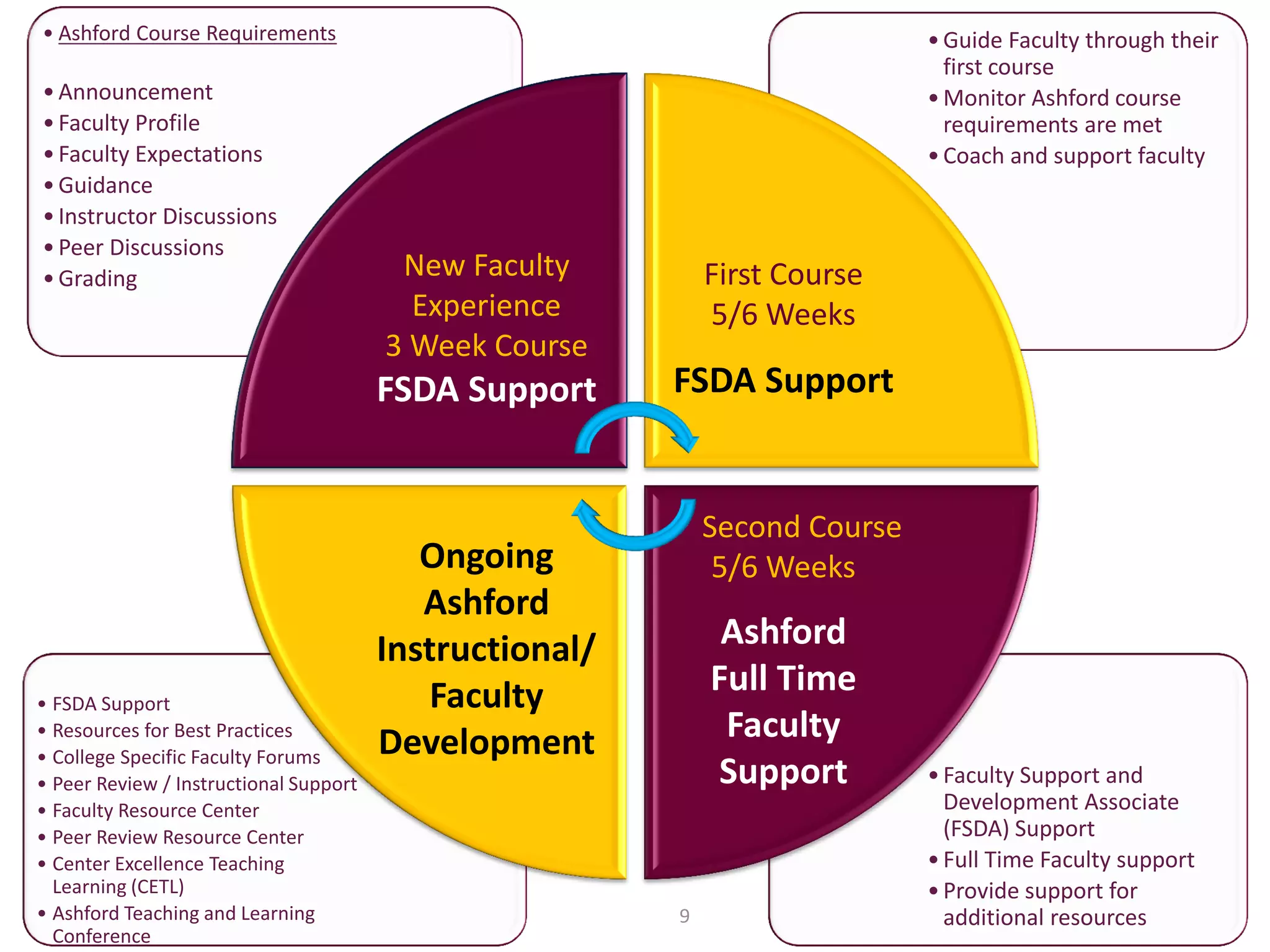
•Faculty Support and
Development Associate
(FSDA) Support
•Full Time Faculty support
•Provide support for
additional resources
• FSDA Support
• Resources for Best Practices
• College Specific Faculty Forums
• Peer Review / Instructional Support
• Faculty Resource Center
• Peer Review Resource Center
• Center Excellence Teaching
Learning (CETL)
• Ashford Teaching and Learning
Conference
•Guide Faculty through their
first course
•Monitor Ashford course
requirements are met
•Coach and support faculty
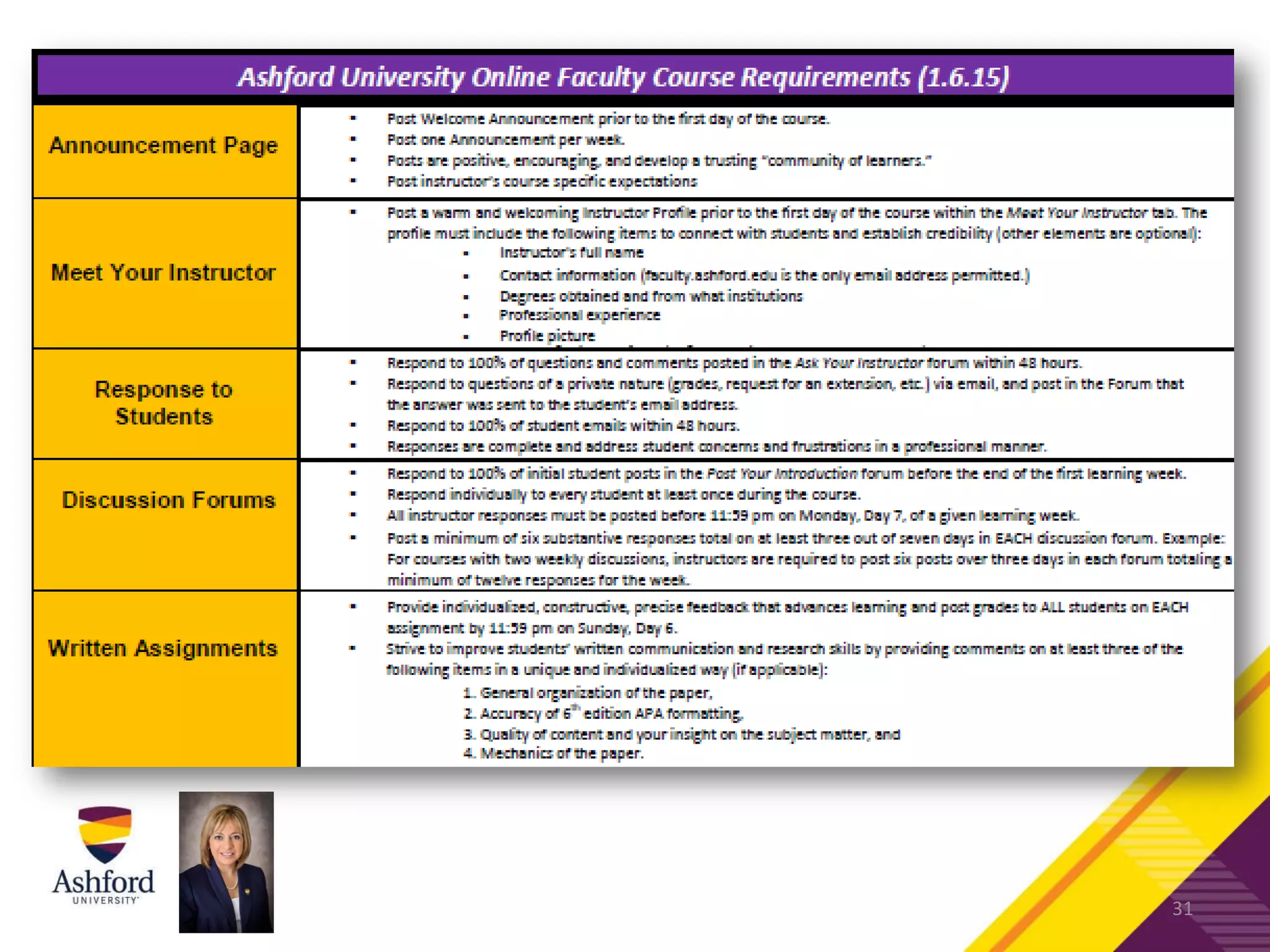
• Ashford Course Requirements
•Announcement
•Faculty Profile
•Faculty Expectations
•Guidance
•Instructor Discussions
•Peer Discussions
•Grading New Faculty
Experience
3 Week Course
FSDA Support
First Course
5/6 Weeks
FSDA Support
Second Course
5/6 Weeks
Ashford
Full Time
Faculty
Support
Ongoing
Ashford
Instructional/
Faculty
Development
9
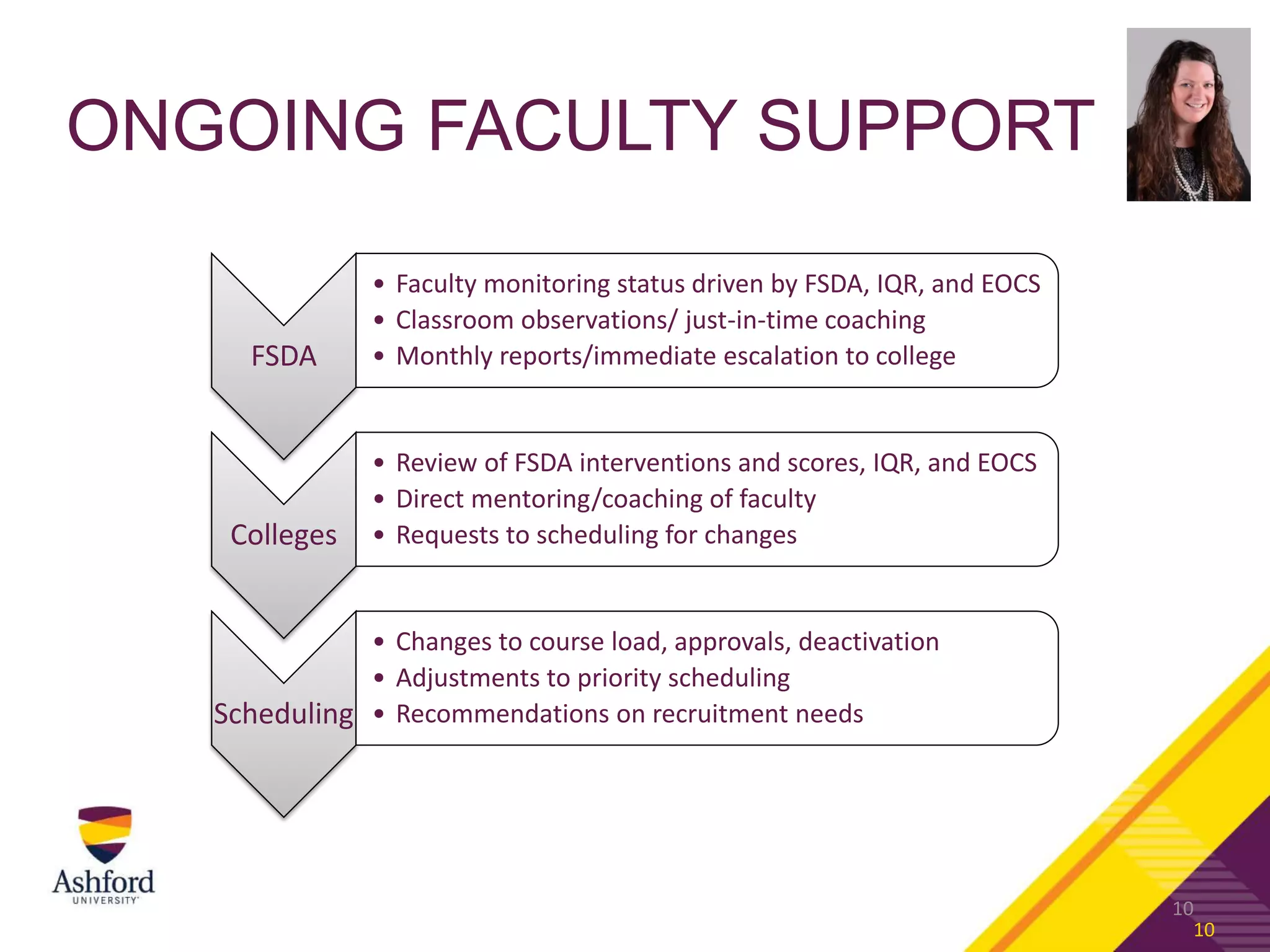
ONGOING FACULTY SUPPORT
10
FSDA
• Faculty monitoring status driven by FSDA, IQR, and EOCS
• Classroom observations/ just-in-time coaching
• Monthly reports/immediate escalation to college
Colleges
• Review of FSDA interventions and scores, IQR, and EOCS
• Direct mentoring/coaching of faculty
• Requests to scheduling for changes
Scheduling
• Changes to course load, approvals, deactivation
• Adjustments to priority scheduling
• Recommendations on recruitment needs
10
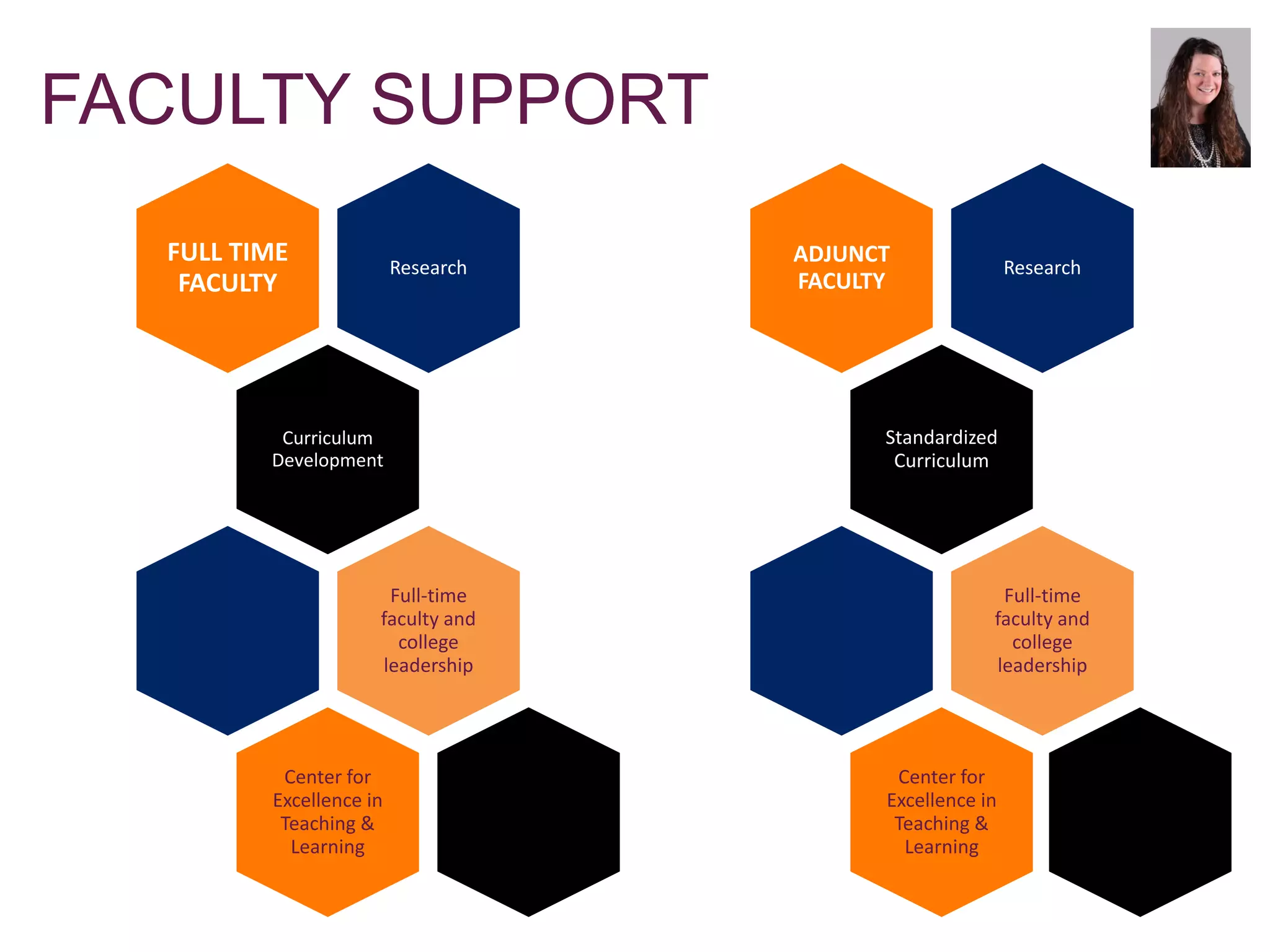
FACULTY SUPPORT
Research
FULL TIME
FACULTY
Curriculum
Development
Full-time
faculty and
college
leadership
Center for
Excellence in
Teaching &
Learning
Research
ADJUNCT
FACULTY
Standardized
Curriculum
Full-time
faculty and
college
leadership
Center for
Excellence in
Teaching &
Learning
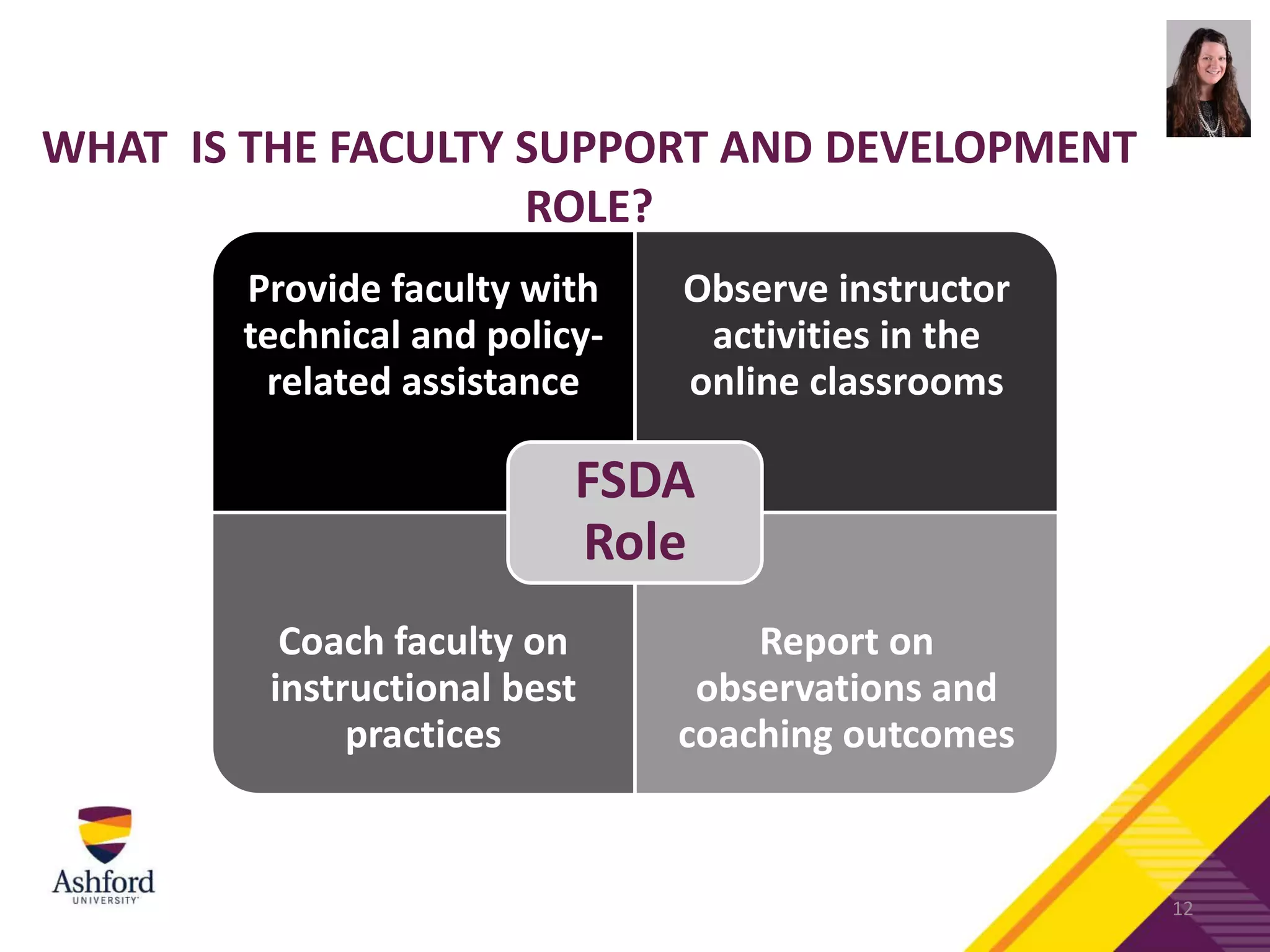
WHAT IS THE FACULTY SUPPORT AND DEVELOPMENT
ROLE?
Provide faculty with
technical and policy-
related assistance
Observe instructor
activities in the
online classrooms
Coach faculty on
instructional best
practices
Report on
observations and
coaching outcomes
FSDA
Role
12
13
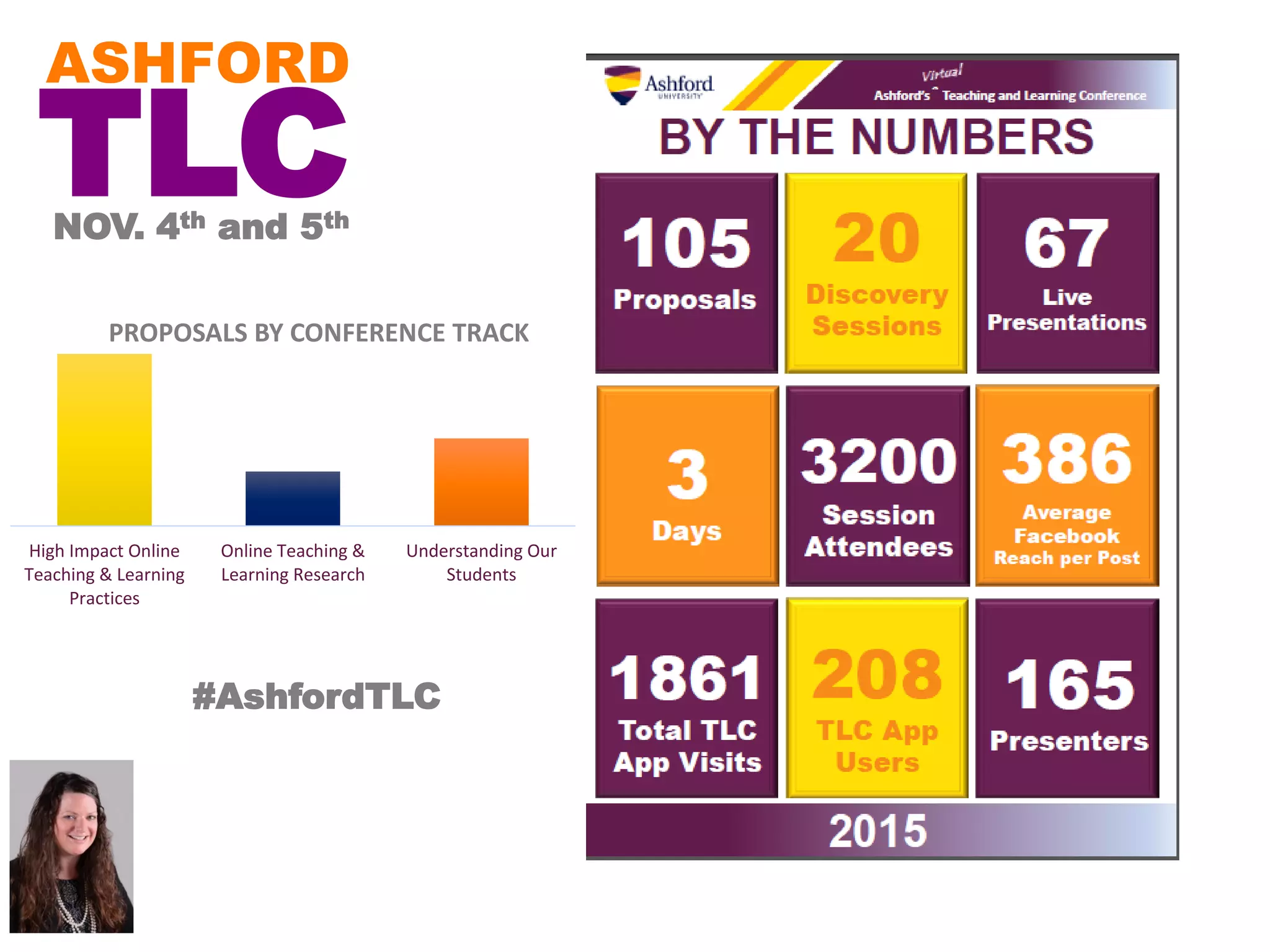
High Impact Online
Teaching & Learning
Practices
Online Teaching &
Learning Research
Understanding Our
Students
PROPOSALS BY CONFERENCE TRACK
ASHFORD
NOV. 4th and 5th
TLC
#AshfordTLC
FACULTY
GOVERNANCE
14
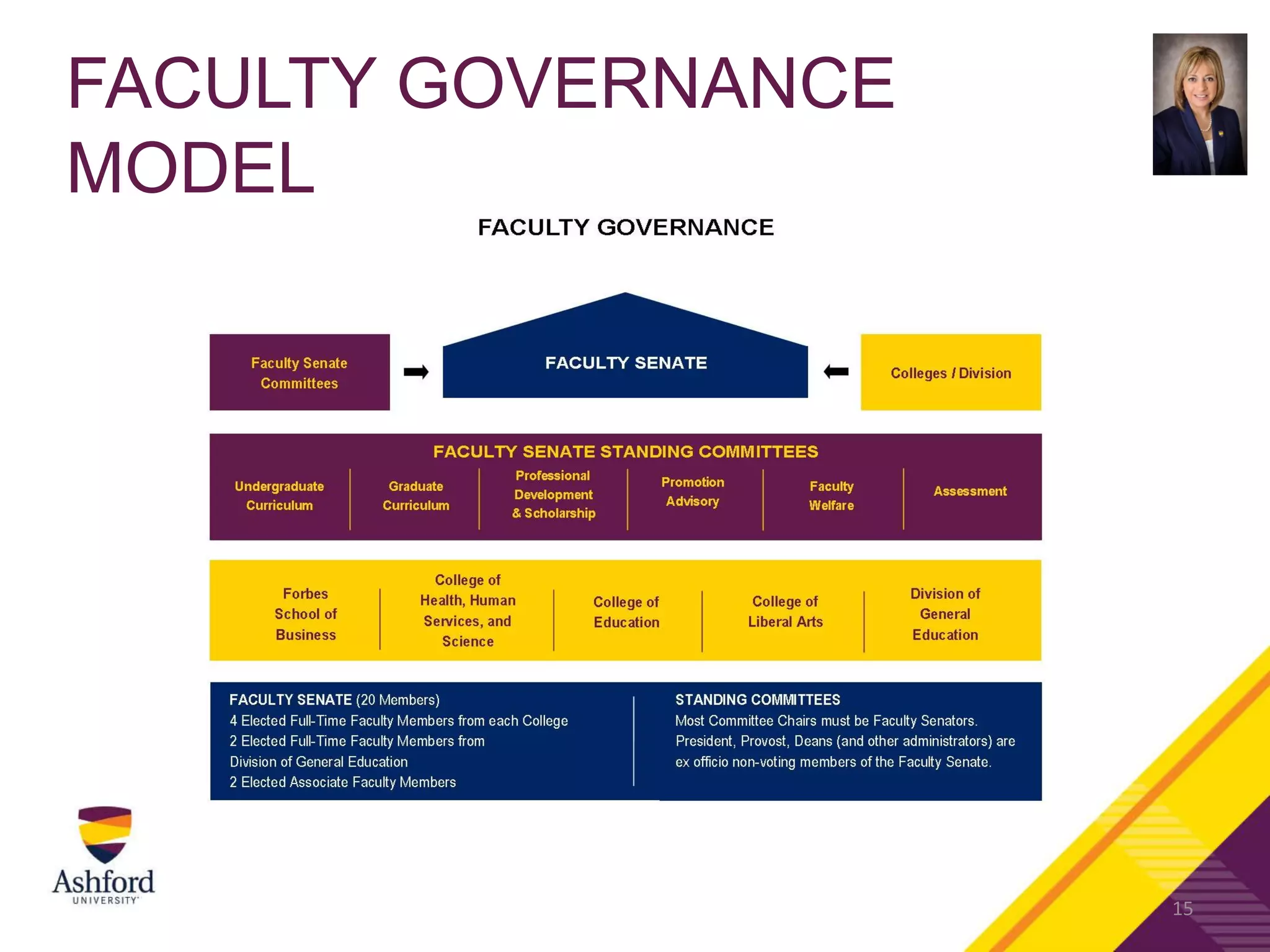
FACULTY GOVERNANCE
MODEL
15
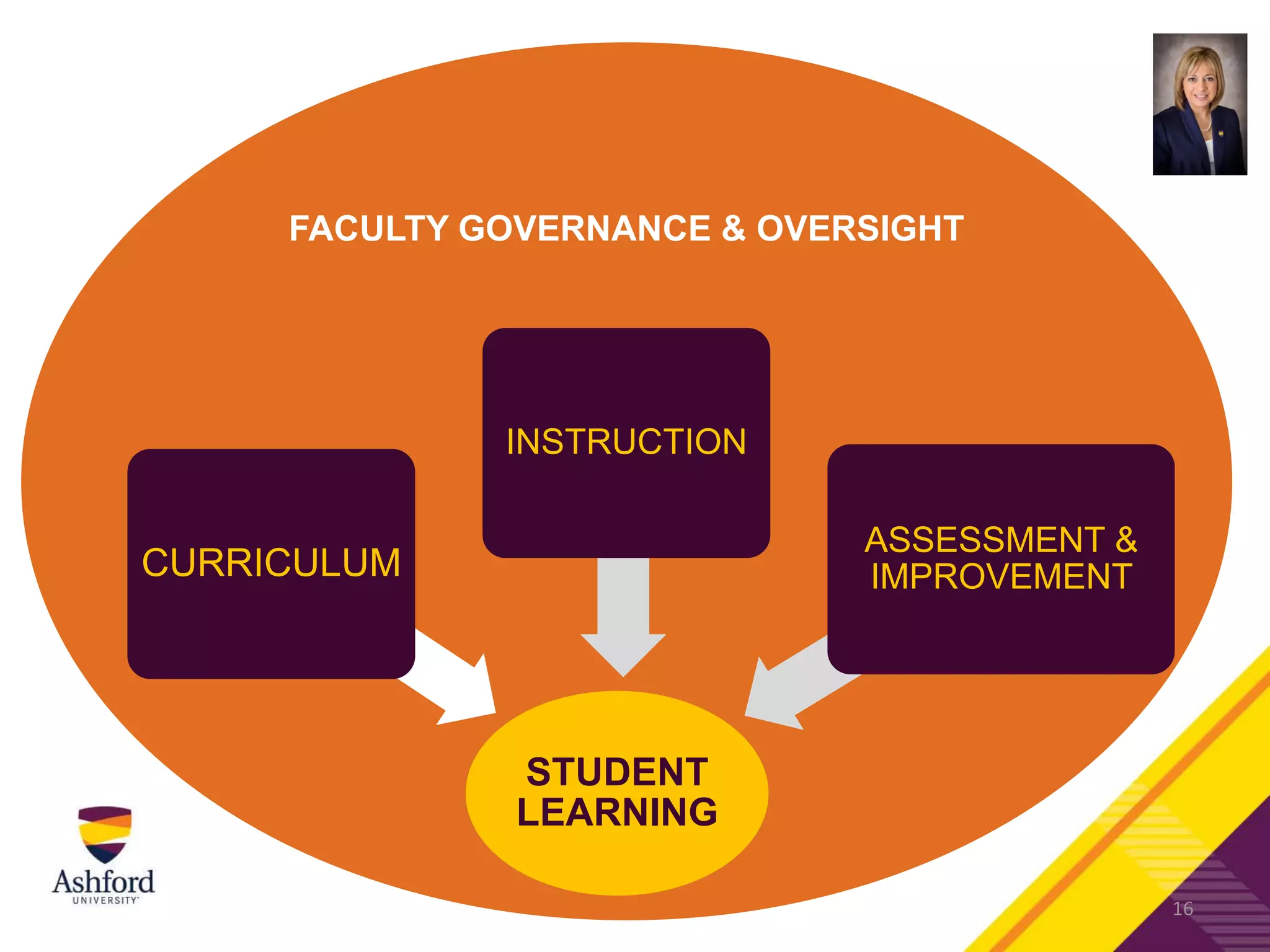
FACULTY GOVERNANCE & OVERSIGHT
STUDENT
LEARNING
CURRICULUM
INSTRUCTION
ASSESSMENT &
IMPROVEMENT
16
CURRICULUM
DEVELOPMENT
17
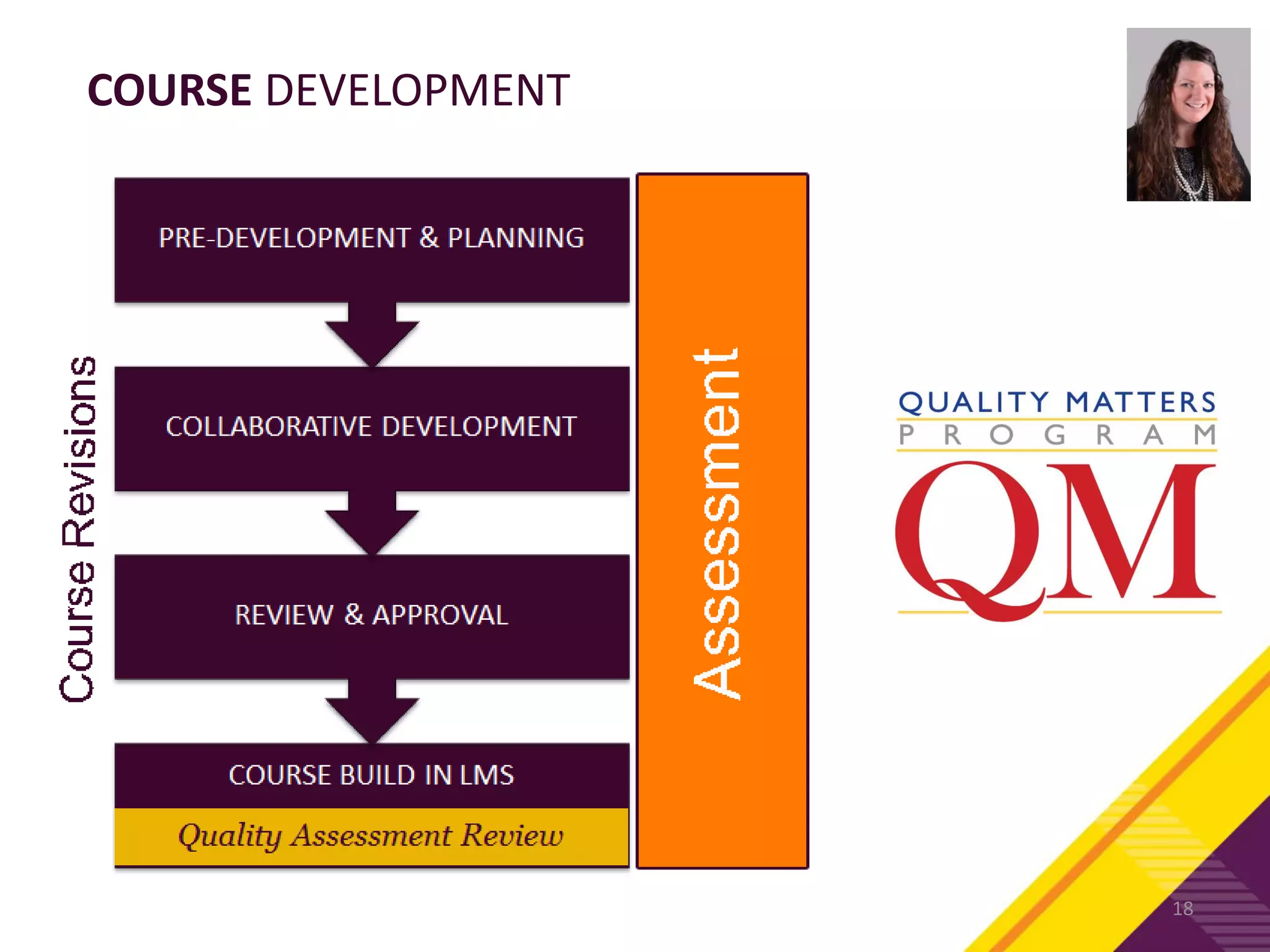
COURSE DEVELOPMENT
18
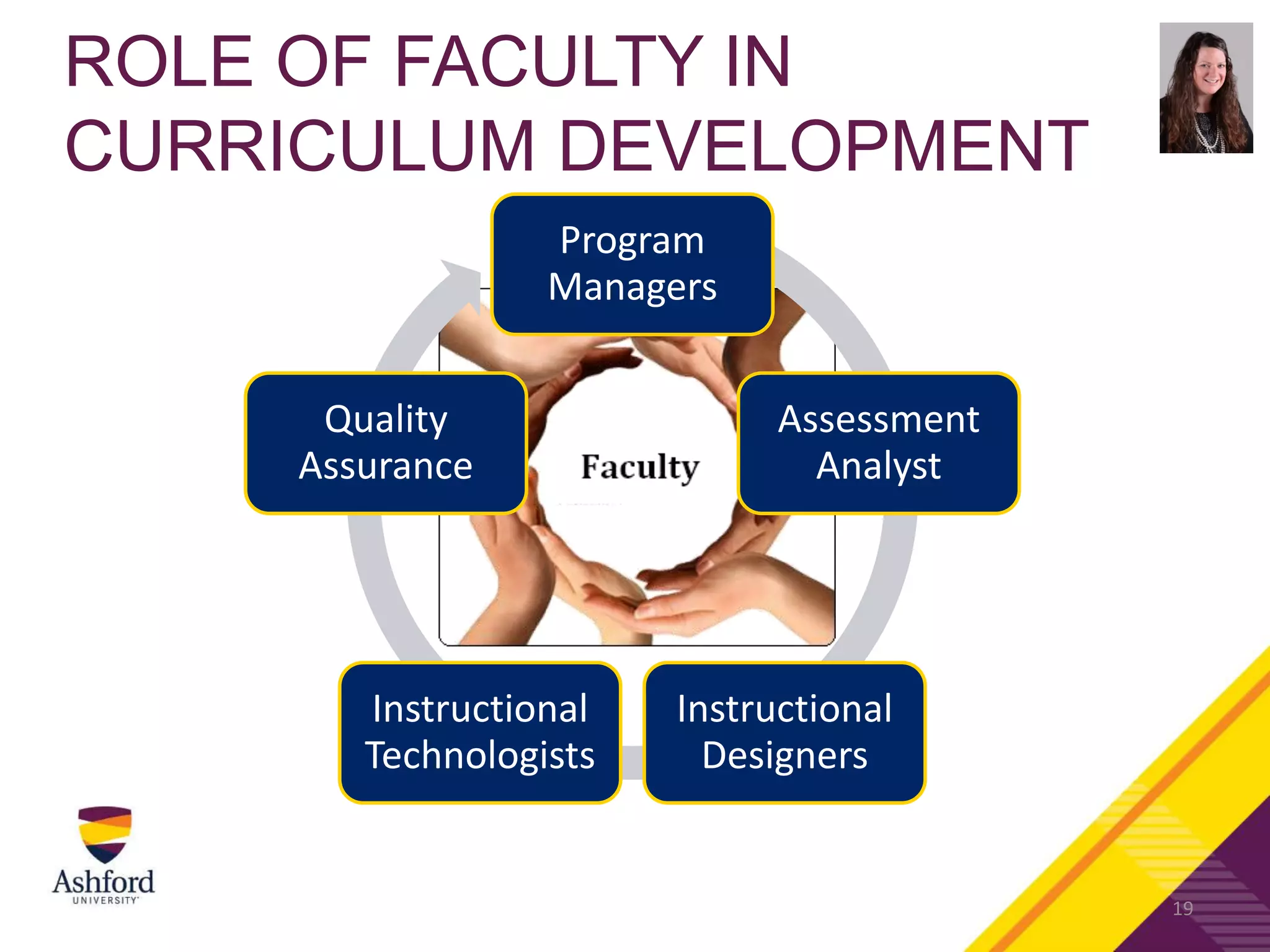
ROLE OF FACULTY IN
CURRICULUM DEVELOPMENT
19
Program
Managers
Assessment
Analyst
Instructional
Designers
Instructional
Technologists
Quality
Assurance
PROGRAM
REVIEW
20
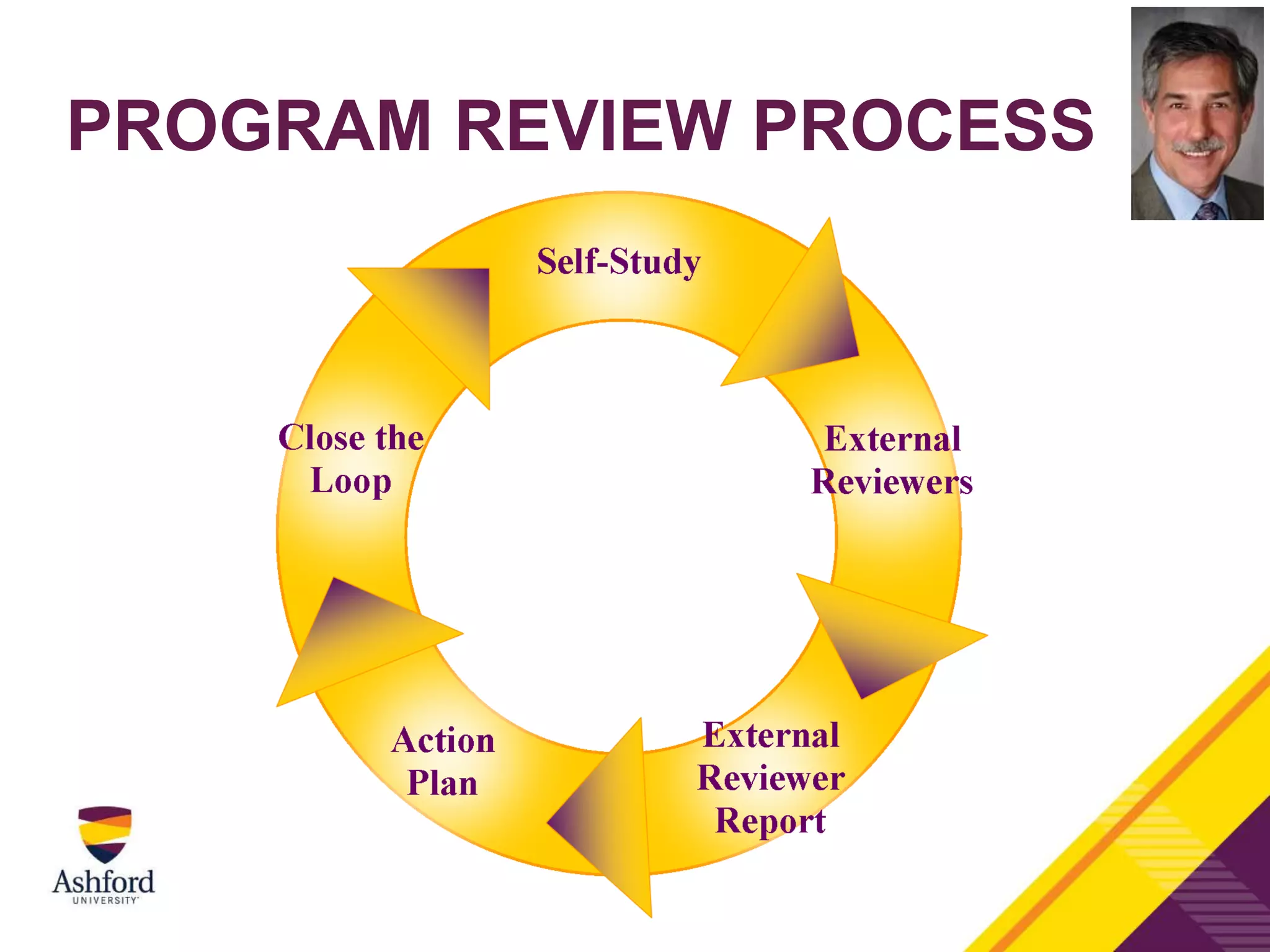
ASHFORD PROGRAM
REVIEW PROCESS
Three guiding principles:
The faculty-driven process should be highly collaborative
and involve academic contributions from faculty, students,
staff, and administrators.
The review should provide an opportunity to analyze,
reflect upon, and improve the program with regard to
student learning, instruction, and leadership support.
The process should include both short- and long-term
goals in a variety of areas, including: student learning,
curricular development, resource allocation, and faculty
development.
- Ashford University, Program Review Handbook, 2013-2014
21
PROGRAM REVIEW PROCESS
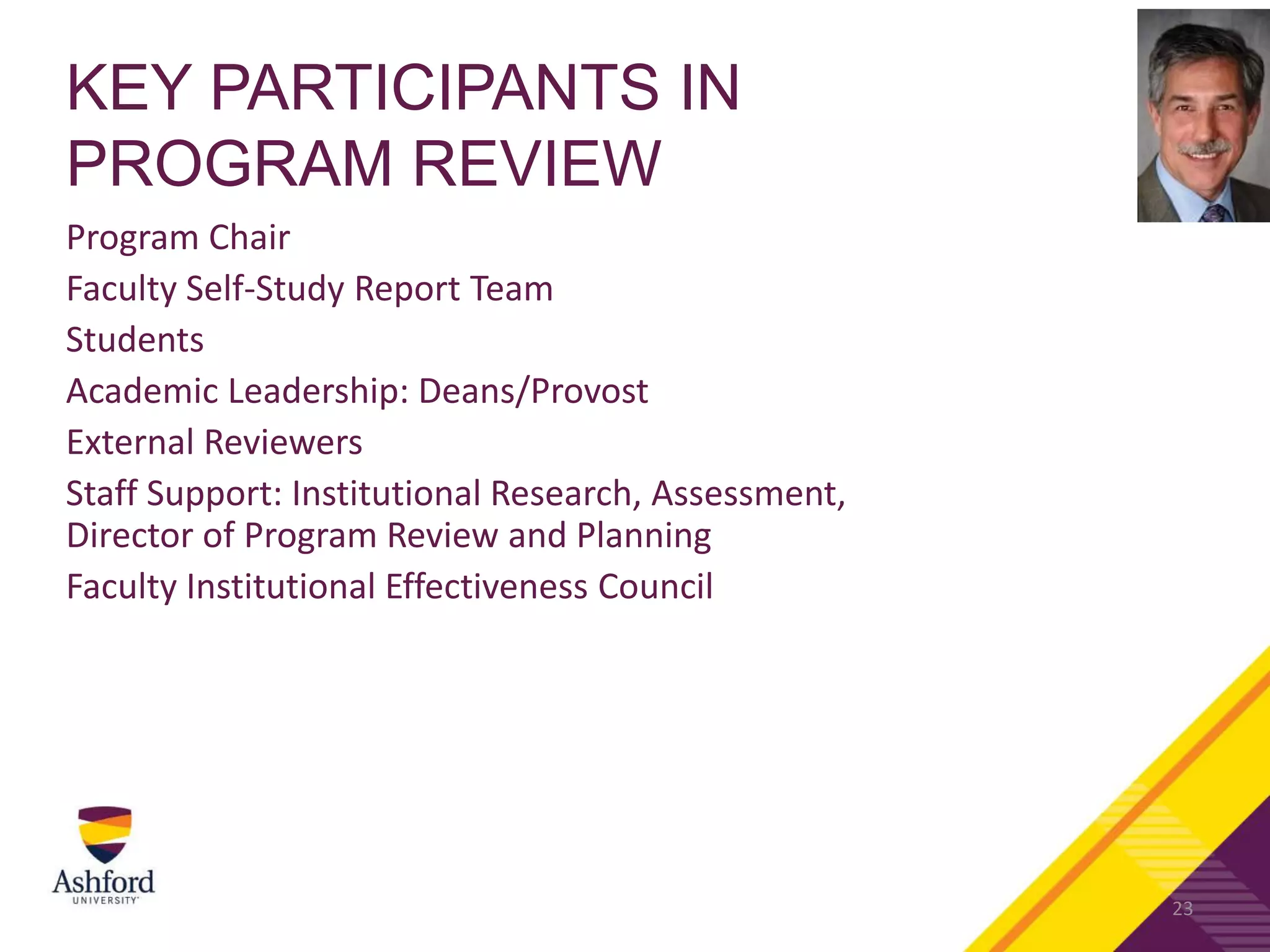
KEY PARTICIPANTS IN
PROGRAM REVIEW
Program Chair
Faculty Self-Study Report Team
Students
Academic Leadership: Deans/Provost
External Reviewers
Staff Support: Institutional Research, Assessment,
Director of Program Review and Planning
Faculty Institutional Effectiveness Council
23
HOW WELL IS IT
WORKING?
“The application of Bloom’s Taxonomy, the use of the
Waypoint Outcomes tool, and the triangulation of
IQR data [scores from instructional quality review,
faculty support and development associates, and
end-of-course surveys] to assess student learning
revealed an impressive and disciplined culture that
supports student learning.”
External Program Review Report of Ashford University’s Bachelor of Arts in Business Information
Systems Program (Connolly & Sayeed, 2014)
24
DEVELOPING
COMMON
STANDARDS
25
DEVELOPING COMMON
FACULTY STANDARDS
Course Health Dashboard
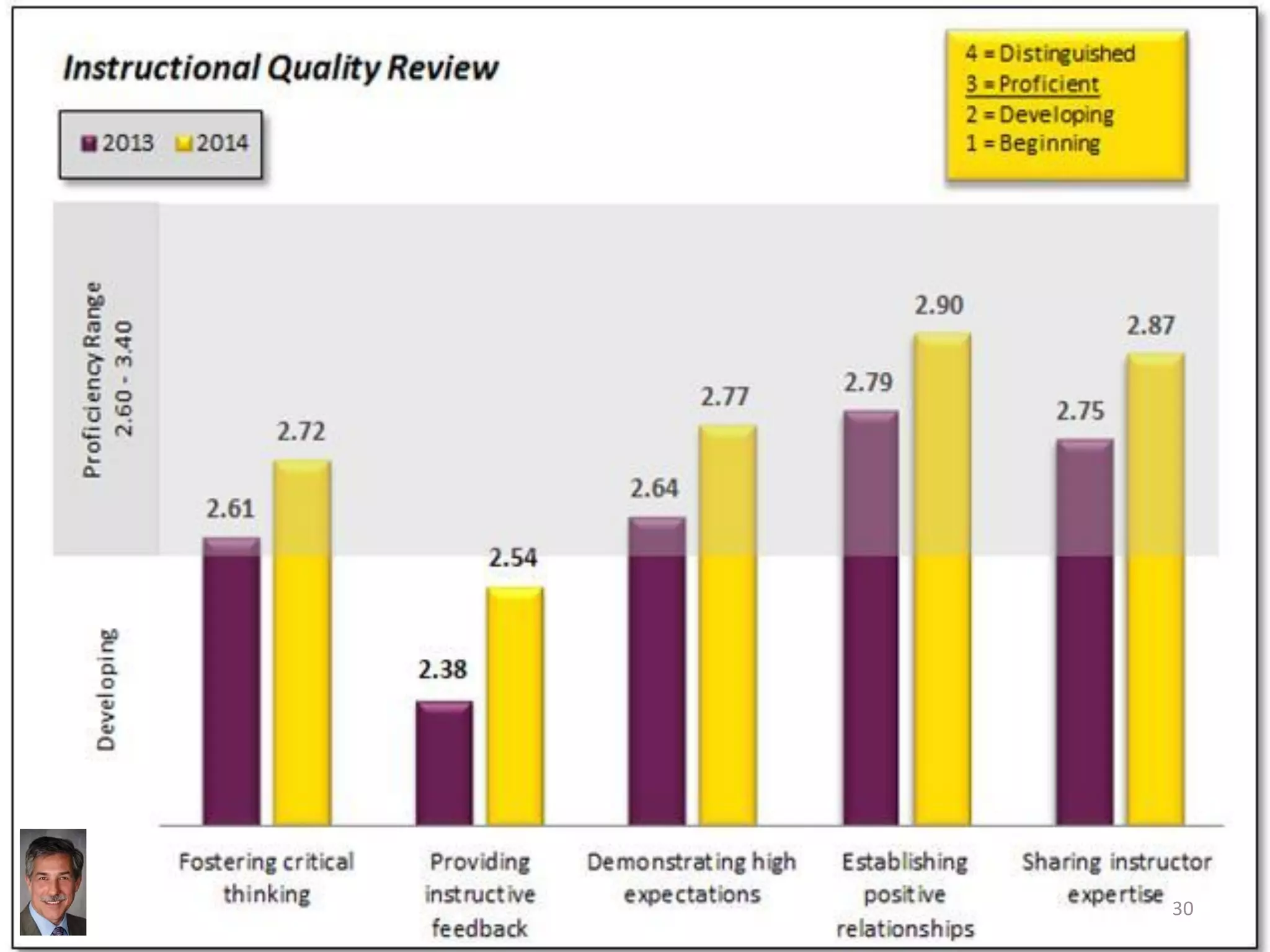
Instructor Quality Review (Peer Review)
Faculty Support and Development Associates
End of Course Surveys (Faculty assessment portion
only)
Faculty Mentoring
Results
26
COURSE HEALTH
DASHBOARD
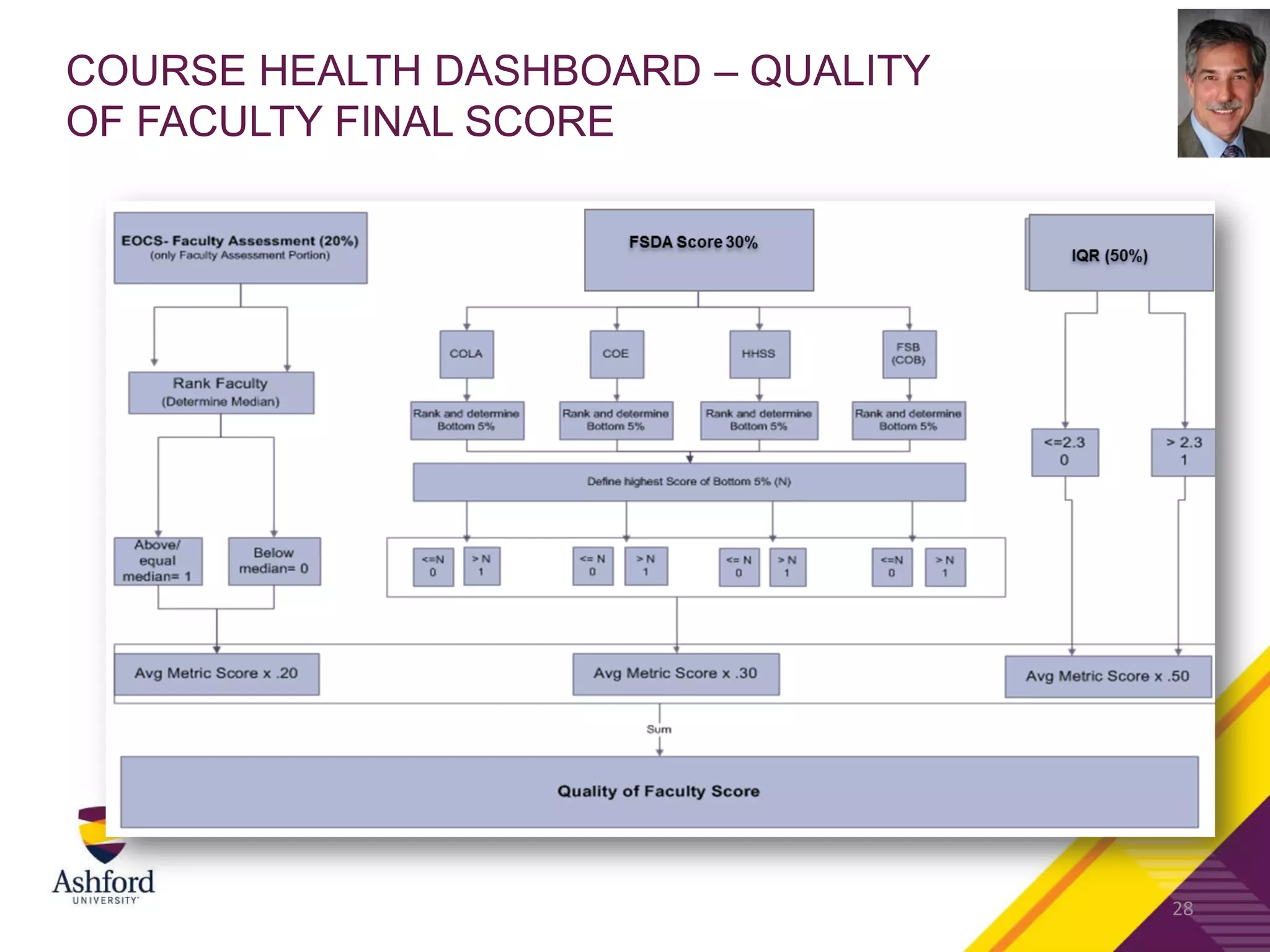
Final Scores to be reviewed include:
Quality of Faculty Score
Instructor Quality Review (Peer Review)
Faculty Support and Development Associate Score
End of Course Survey (Faculty Assessment portion only)
Student Success Score
Grades
End of Course Survey (Course Assessment portion only)
Course Completion
Course to Course Progression
Learning Outcomes
Course Failure Rate
27
COURSE HEALTH DASHBOARD – QUALITY
OF FACULTY FINAL SCORE
28
EFFECTIVE FACULTY
MENTORING
During Faculty Mentoring, a full time faculty member
mentors a low-performing instructor for the duration
of a course.
Average improvement score pre-post mentoring is
25%, or one full level of proficiency, on the
Instructional Quality Review Rubric.
29
30
COURSE REQUIREMENTS
31
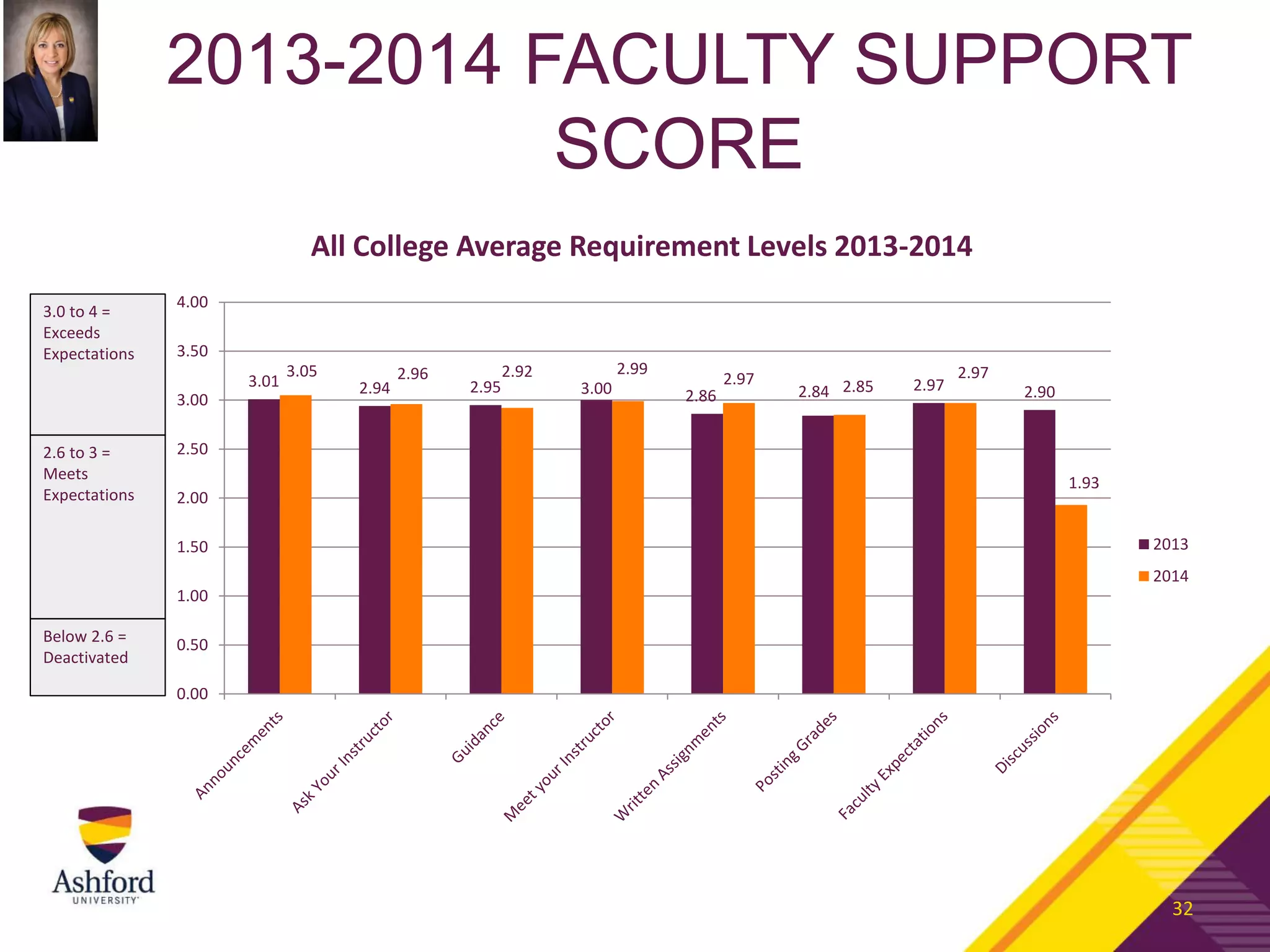
2013-2014 FACULTY SUPPORT
SCORE
32
3.0 to 4 =
Exceeds
Expectations
2.6 to 3 =
Meets
Expectations
Below 2.6 =
Deactivated
3.01 2.94 2.95 3.00 2.86 2.84 2.97 2.90
3.05 2.96 2.92 2.99
2.97 2.85
2.97
1.93
0.00
0.50
1.00
1.50
2.00
2.50
3.00
3.50
4.00
2013
2014
All College Average Requirement Levels 2013-2014
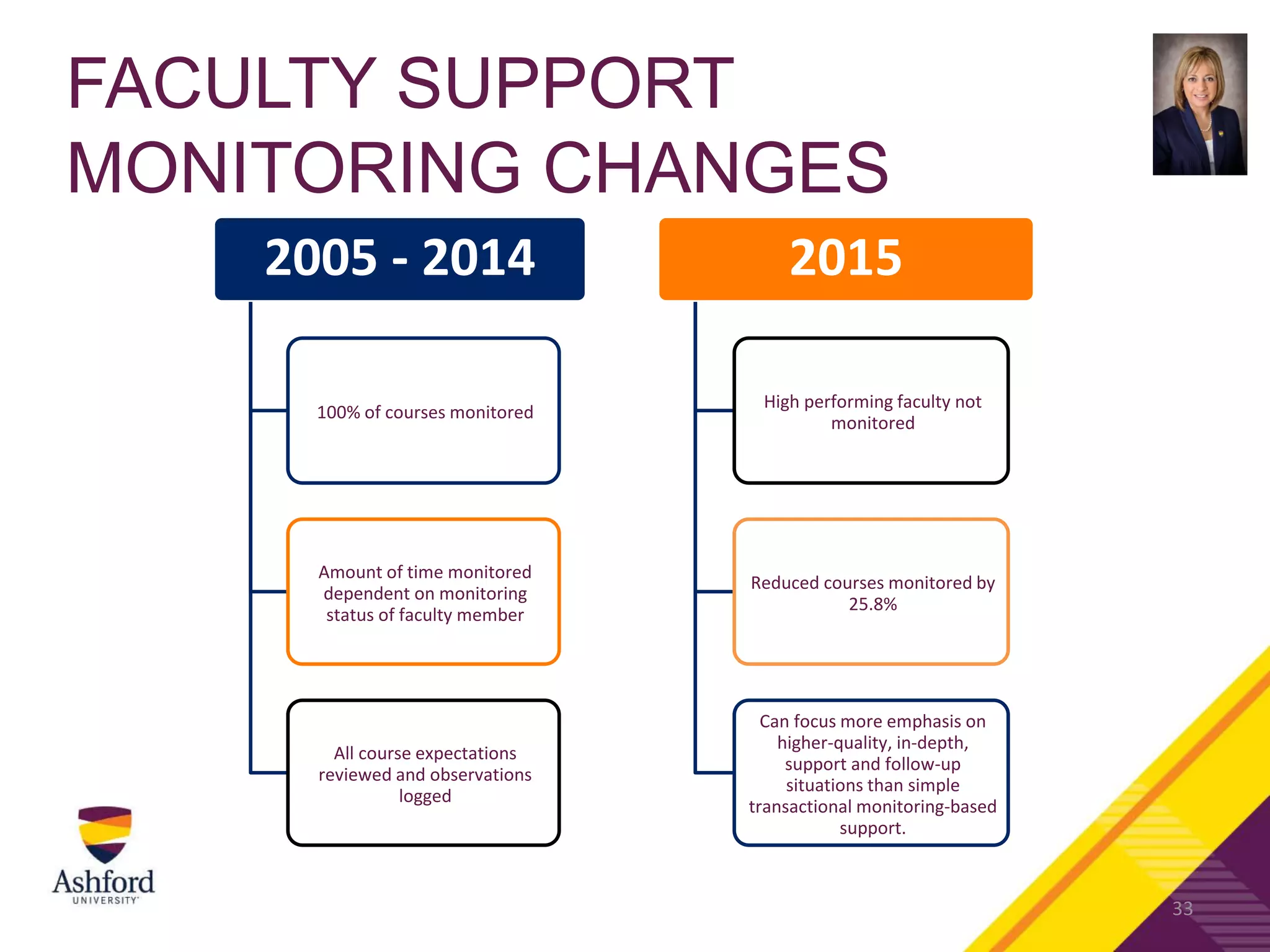
FACULTY SUPPORT
MONITORING CHANGES
33
2005 - 2014
100% of courses monitored
Amount of time monitored
dependent on monitoring
status of faculty member
All course expectations
reviewed and observations
logged
2015
High performing faculty not
monitored
Reduced courses monitored by
25.8%
Can focus more emphasis on
higher-quality, in-depth,
support and follow-up
situations than simple
transactional monitoring-based
support.
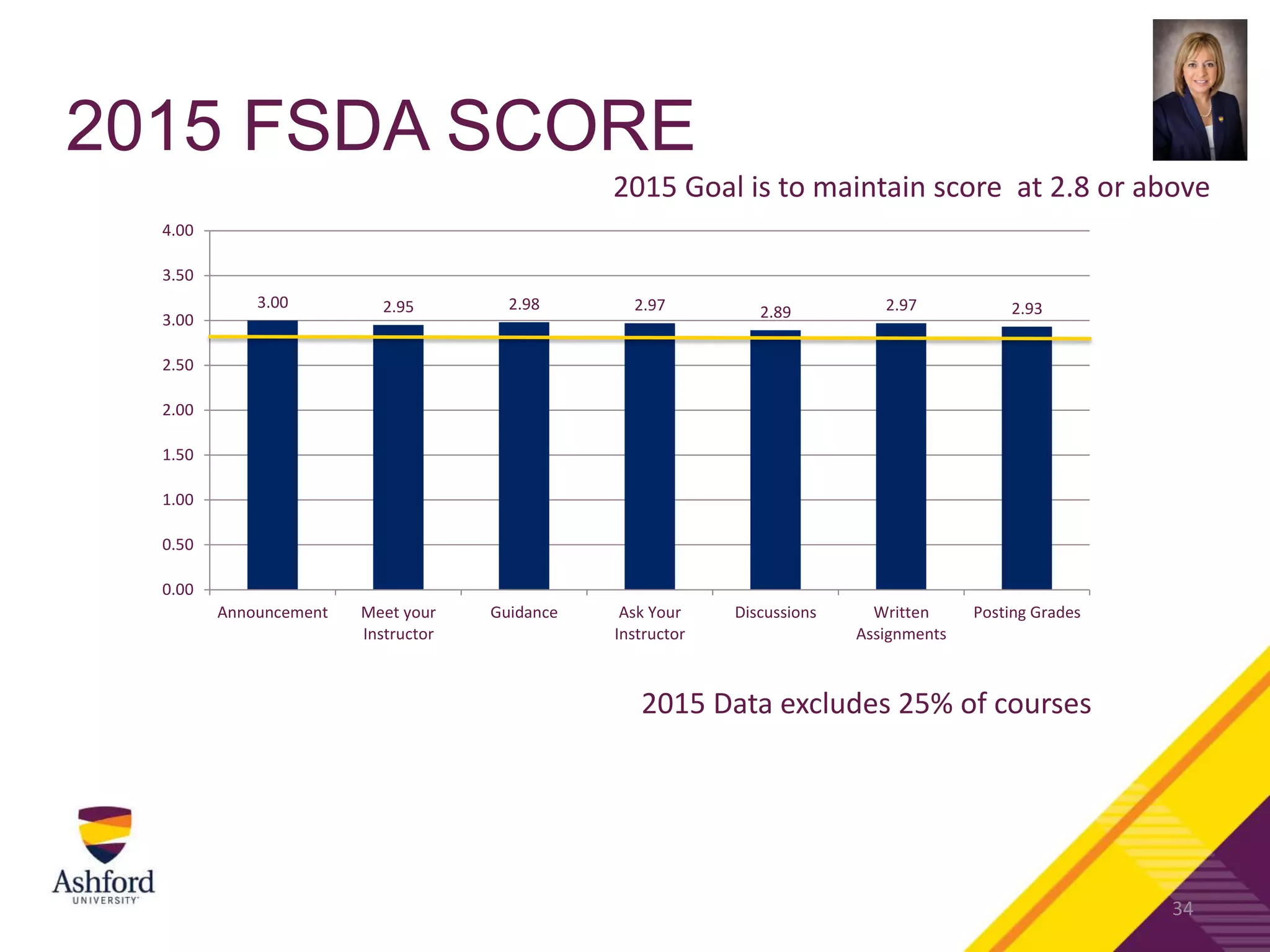
2015 FSDA SCORE
34
3.00 2.95 2.98 2.97 2.89 2.97 2.93
0.00
0.50
1.00
1.50
2.00
2.50
3.00
3.50
4.00
Announcement Meet your
Instructor
Guidance Ask Your
Instructor
Discussions Written
Assignments
Posting Grades
2015 Data excludes 25% of courses
2015 Goal is to maintain score at 2.8 or above
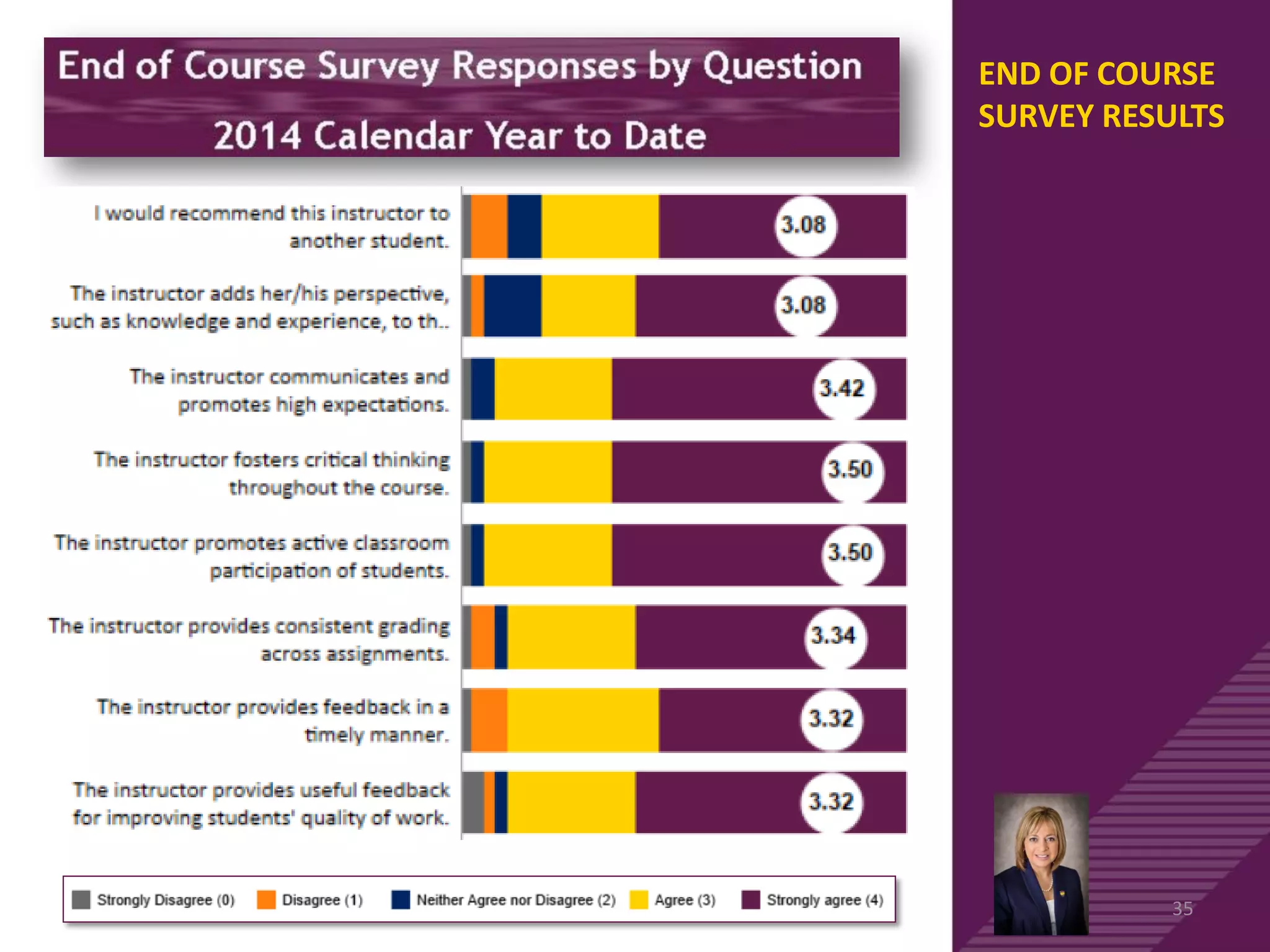
END OF COURSE
SURVEY RESULTS
35
36
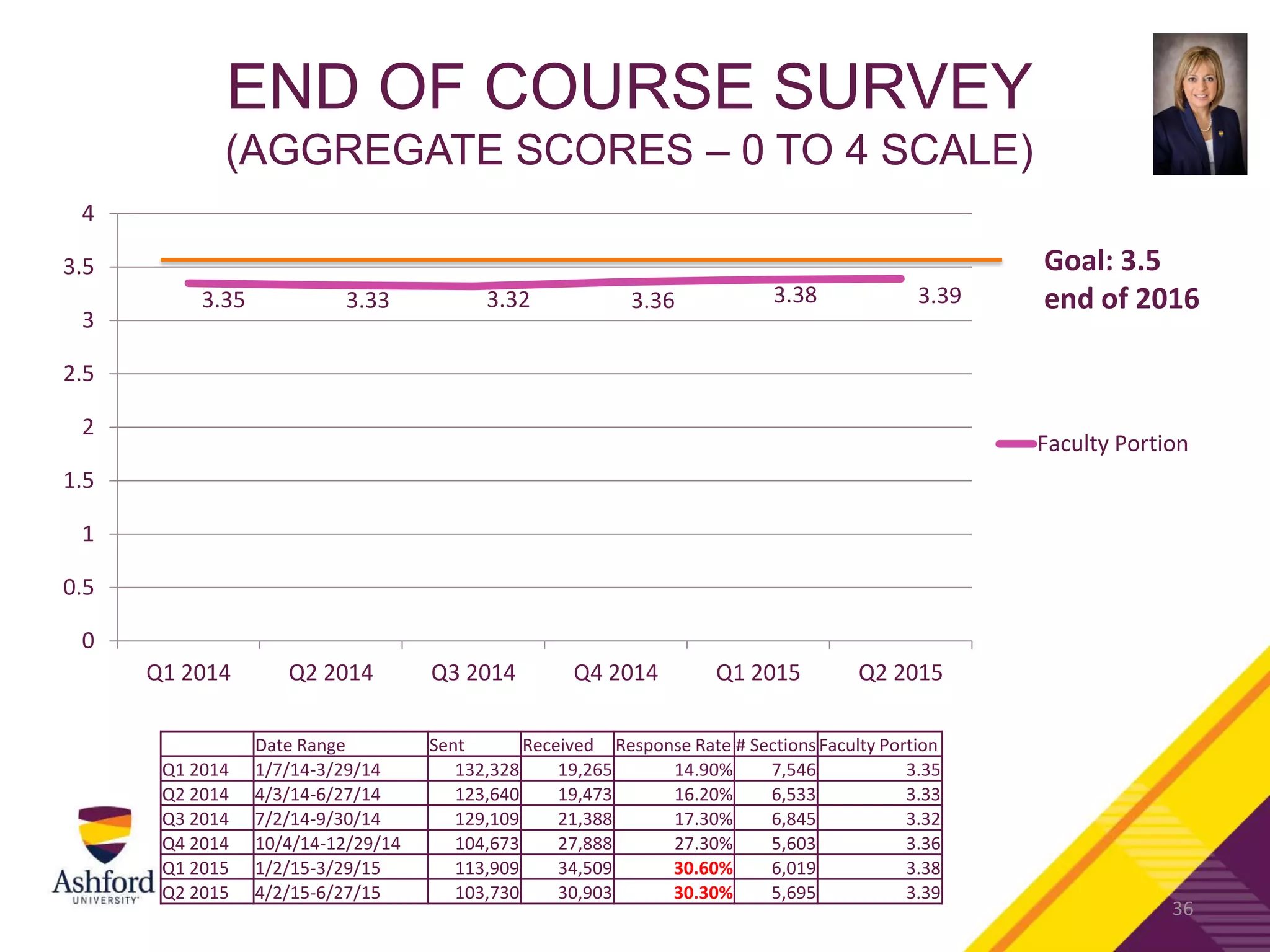
END OF COURSE SURVEY
(AGGREGATE SCORES – 0 TO 4 SCALE)
Date Range Sent Received Response Rate # Sections Faculty Portion
Q1 2014 1/7/14-3/29/14 132,328 19,265 14.90% 7,546 3.35
Q2 2014 4/3/14-6/27/14 123,640 19,473 16.20% 6,533 3.33
Q3 2014 7/2/14-9/30/14 129,109 21,388 17.30% 6,845 3.32
Q4 2014 10/4/14-12/29/14 104,673 27,888 27.30% 5,603 3.36
Q1 2015 1/2/15-3/29/15 113,909 34,509 30.60% 6,019 3.38
Q2 2015 4/2/15-6/27/15 103,730 30,903 30.30% 5,695 3.39
3.35 3.33 3.32 3.36 3.38 3.39
0
0.5
1
1.5
2
2.5
3
3.5
4
Q1 2014 Q2 2014 Q3 2014 Q4 2014 Q1 2015 Q2 2015
Faculty Portion
Goal: 3.5
end of 2016
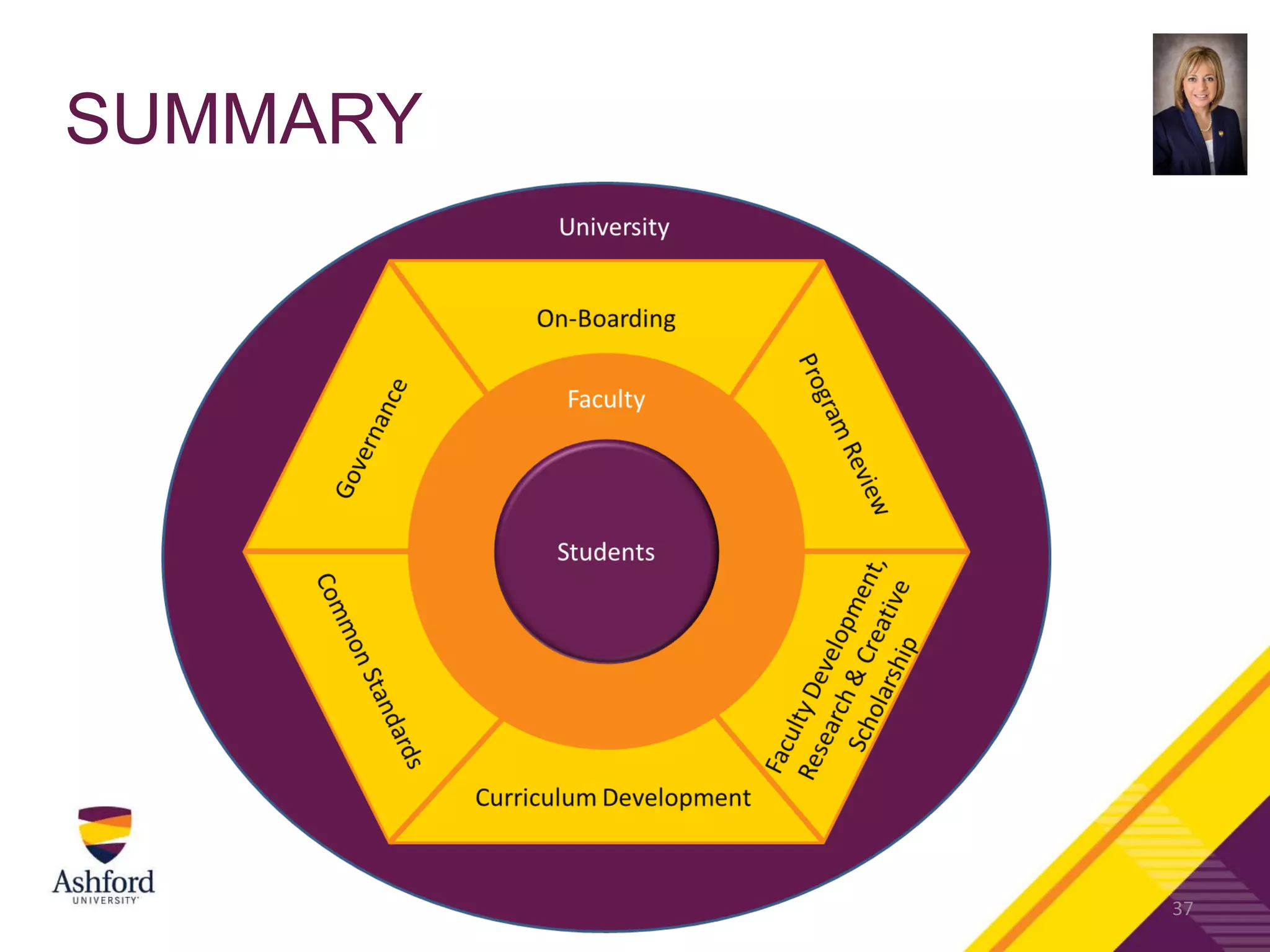
SUMMARY
37
38
A UNITY OF ENGAGEMENT
FROM MANY, FOR MANY, SHALL
FLOURISH ONLINE
joseph.hoey@bpiedu.com
lizy.lamboy@ashford.edu
morgan.johnson@ashford.edu
39
A Unity of Engagement from Many, for Many, Shall Flourish Online-Clean

A Unity of Engagement from Many, for Many, Shall Flourish Online-Clean

  • 1.
    A UNITY OFENGAGEMENT FROM MANY, FOR MANY, SHALL FLOURISH ONLINE J. Joseph Hoey, Ed.D. Carmen “Lizy” Lamboy-Naughton, Ed.D. Morgan Johnson, M.A.
  • 2.
    OUTCOMES After participating inthis session, participants will be able to:  Understand the history and identify the elements of Ashford University’s faculty engagement culture  Share onboarding, governance, faculty development and engagement in program review and assessment of learning  Discuss elements presented and possible applicability in their school. 2
  • 3.
    AGENDA Conceptual Framework Serving aDiverse Faculty Community Faculty Development and Review Governance Curriculum Development Program Review Developing Common Standards Summary Q & A 3
  • 4.
  • 5.
    FACULTY PROFILE • Full-timeprofessionals • Vast experience in their fields • Master’s or doctorally-prepared • Geographically diverse 5
  • 6.
  • 7.
    SUPPORTING A DIVERSE FACULTYCOMMUNITY 7 New Faculty Experience College Welcome Introduction to Support Team and Resources Professional Development Offerings Ongoing Opportunities for Virtual and Face-to-Face Engagement
  • 8.
    NEW FACULTY EXPERIENCE TheNew Faculty Experience (NFE) is an orientation for our faculty. NFE is designed to provide faculty with the information necessary to run a productive and effective learning environment in the online setting. 3 week orientation, includes a training course where engagement with a facilitator and other new faculty members occur. New faculty also complete tasks in a simulated course. 8
  • 9.
    •Faculty Support and DevelopmentAssociate (FSDA) Support •Full Time Faculty support •Provide support for additional resources • FSDA Support • Resources for Best Practices • College Specific Faculty Forums • Peer Review / Instructional Support • Faculty Resource Center • Peer Review Resource Center • Center Excellence Teaching Learning (CETL) • Ashford Teaching and Learning Conference •Guide Faculty through their first course •Monitor Ashford course requirements are met •Coach and support faculty • Ashford Course Requirements •Announcement •Faculty Profile •Faculty Expectations •Guidance •Instructor Discussions •Peer Discussions •Grading New Faculty Experience 3 Week Course FSDA Support First Course 5/6 Weeks FSDA Support Second Course 5/6 Weeks Ashford Full Time Faculty Support Ongoing Ashford Instructional/ Faculty Development 9
  • 10.
    ONGOING FACULTY SUPPORT 10 FSDA •Faculty monitoring status driven by FSDA, IQR, and EOCS • Classroom observations/ just-in-time coaching • Monthly reports/immediate escalation to college Colleges • Review of FSDA interventions and scores, IQR, and EOCS • Direct mentoring/coaching of faculty • Requests to scheduling for changes Scheduling • Changes to course load, approvals, deactivation • Adjustments to priority scheduling • Recommendations on recruitment needs 10
  • 11.
    FACULTY SUPPORT Research FULL TIME FACULTY Curriculum Development Full-time facultyand college leadership Center for Excellence in Teaching & Learning Research ADJUNCT FACULTY Standardized Curriculum Full-time faculty and college leadership Center for Excellence in Teaching & Learning
  • 12.
    WHAT IS THEFACULTY SUPPORT AND DEVELOPMENT ROLE? Provide faculty with technical and policy- related assistance Observe instructor activities in the online classrooms Coach faculty on instructional best practices Report on observations and coaching outcomes FSDA Role 12
  • 13.
    13 High Impact Online Teaching& Learning Practices Online Teaching & Learning Research Understanding Our Students PROPOSALS BY CONFERENCE TRACK ASHFORD NOV. 4th and 5th TLC #AshfordTLC
  • 14.
  • 15.
  • 16.
    FACULTY GOVERNANCE &OVERSIGHT STUDENT LEARNING CURRICULUM INSTRUCTION ASSESSMENT & IMPROVEMENT 16
  • 17.
  • 18.
  • 19.
    ROLE OF FACULTYIN CURRICULUM DEVELOPMENT 19 Program Managers Assessment Analyst Instructional Designers Instructional Technologists Quality Assurance
  • 20.
  • 21.
    ASHFORD PROGRAM REVIEW PROCESS Threeguiding principles: The faculty-driven process should be highly collaborative and involve academic contributions from faculty, students, staff, and administrators. The review should provide an opportunity to analyze, reflect upon, and improve the program with regard to student learning, instruction, and leadership support. The process should include both short- and long-term goals in a variety of areas, including: student learning, curricular development, resource allocation, and faculty development. - Ashford University, Program Review Handbook, 2013-2014 21
  • 22.
  • 23.
    KEY PARTICIPANTS IN PROGRAMREVIEW Program Chair Faculty Self-Study Report Team Students Academic Leadership: Deans/Provost External Reviewers Staff Support: Institutional Research, Assessment, Director of Program Review and Planning Faculty Institutional Effectiveness Council 23
  • 24.
    HOW WELL ISIT WORKING? “The application of Bloom’s Taxonomy, the use of the Waypoint Outcomes tool, and the triangulation of IQR data [scores from instructional quality review, faculty support and development associates, and end-of-course surveys] to assess student learning revealed an impressive and disciplined culture that supports student learning.” External Program Review Report of Ashford University’s Bachelor of Arts in Business Information Systems Program (Connolly & Sayeed, 2014) 24
  • 25.
  • 26.
    DEVELOPING COMMON FACULTY STANDARDS CourseHealth Dashboard Instructor Quality Review (Peer Review) Faculty Support and Development Associates End of Course Surveys (Faculty assessment portion only) Faculty Mentoring Results 26
  • 27.
    COURSE HEALTH DASHBOARD Final Scoresto be reviewed include: Quality of Faculty Score Instructor Quality Review (Peer Review) Faculty Support and Development Associate Score End of Course Survey (Faculty Assessment portion only) Student Success Score Grades End of Course Survey (Course Assessment portion only) Course Completion Course to Course Progression Learning Outcomes Course Failure Rate 27
  • 28.
    COURSE HEALTH DASHBOARD– QUALITY OF FACULTY FINAL SCORE 28
  • 29.
    EFFECTIVE FACULTY MENTORING During FacultyMentoring, a full time faculty member mentors a low-performing instructor for the duration of a course. Average improvement score pre-post mentoring is 25%, or one full level of proficiency, on the Instructional Quality Review Rubric. 29
  • 30.
  • 31.
  • 32.
    2013-2014 FACULTY SUPPORT SCORE 32 3.0to 4 = Exceeds Expectations 2.6 to 3 = Meets Expectations Below 2.6 = Deactivated 3.01 2.94 2.95 3.00 2.86 2.84 2.97 2.90 3.05 2.96 2.92 2.99 2.97 2.85 2.97 1.93 0.00 0.50 1.00 1.50 2.00 2.50 3.00 3.50 4.00 2013 2014 All College Average Requirement Levels 2013-2014
  • 33.
    FACULTY SUPPORT MONITORING CHANGES 33 2005- 2014 100% of courses monitored Amount of time monitored dependent on monitoring status of faculty member All course expectations reviewed and observations logged 2015 High performing faculty not monitored Reduced courses monitored by 25.8% Can focus more emphasis on higher-quality, in-depth, support and follow-up situations than simple transactional monitoring-based support.
  • 34.
    2015 FSDA SCORE 34 3.002.95 2.98 2.97 2.89 2.97 2.93 0.00 0.50 1.00 1.50 2.00 2.50 3.00 3.50 4.00 Announcement Meet your Instructor Guidance Ask Your Instructor Discussions Written Assignments Posting Grades 2015 Data excludes 25% of courses 2015 Goal is to maintain score at 2.8 or above
  • 35.
  • 36.
    36 END OF COURSESURVEY (AGGREGATE SCORES – 0 TO 4 SCALE) Date Range Sent Received Response Rate # Sections Faculty Portion Q1 2014 1/7/14-3/29/14 132,328 19,265 14.90% 7,546 3.35 Q2 2014 4/3/14-6/27/14 123,640 19,473 16.20% 6,533 3.33 Q3 2014 7/2/14-9/30/14 129,109 21,388 17.30% 6,845 3.32 Q4 2014 10/4/14-12/29/14 104,673 27,888 27.30% 5,603 3.36 Q1 2015 1/2/15-3/29/15 113,909 34,509 30.60% 6,019 3.38 Q2 2015 4/2/15-6/27/15 103,730 30,903 30.30% 5,695 3.39 3.35 3.33 3.32 3.36 3.38 3.39 0 0.5 1 1.5 2 2.5 3 3.5 4 Q1 2014 Q2 2014 Q3 2014 Q4 2014 Q1 2015 Q2 2015 Faculty Portion Goal: 3.5 end of 2016
  • 37.
  • 38.
  • 39.
    A UNITY OFENGAGEMENT FROM MANY, FOR MANY, SHALL FLOURISH ONLINE joseph.hoey@bpiedu.com lizy.lamboy@ashford.edu morgan.johnson@ashford.edu 39