International Research Journal of Engineering and Technology (IRJET) e-ISSN: 2395-0056
Volume: 04 Issue: 08 | Aug -2017 www.irjet.net p-ISSN: 2395-0072
© 2017, IRJET | Impact Factor value: 5.181 | ISO 9001:2008 Certified Journal | Page 400
A Unique Polymeric Surfactant for Hand Washes
Shubham D. Wagh 1, Dr. V. Y. Karadbhajne2, Dr. B.B Gogte3
1M. Tech final year, Dept. of Oil Technology, LIT Nagpur, India
2Assistant Professor, Dept. of Oil Technology, LIT Nagpur, India
3Associate Professor, Dept. of Oil Technology, LIT Nagpur, India
---------------------------------------------------------------------***---------------------------------------------------------------------
Abstract - A Polymeric Surfactant, based on Sugar,
Polyethylene Glycol 400 and organic acids has been
synthesized. The Polymers have been analyzed systematically
and selected polymer has been used to the extent of 25 to 35%
in Hand wash compositions. The Hand wash give excellent
foaming, viscosity and surface tension reductions
characteristics. The characteristics are comparable to
commercial Hand wash in the market.
Key Words - Hand wash, Polymer, Surfactant.
1. INTRODUCTION
Awareness about hygiene cleanliness in developing
countries is increasing at very fast pace in last decade. With
increasing standard of living, better per capita income, role
of T.V. media the hand wash now has become an essential
commodity in every family.
In developing countries childhood mortality rates
related to respiratory diarrhoeal diseases can be reduced by
50%, by proper use of soap and hand washes. In the present
work we have synthesized polymers based mainly on sugar.
As we know sugar and liquid glucose are natural
preservatives which have been used for centuries in our
Mango and Lemon based preparations. In our laboratories
we have already synthesized polymers based on sorbitol1,
starch2, liquid glucose3 and Maleinizedvegetableoils4.These
polymers have been successfully utilized in various
surfactant compositions. In our country large number of
sugar factories are producing sugar. We export sugar and
sometimes surplus is available. This work is to generate
value added product from sugar for a non-food use like
surfactant8. If we are able to generatevalueaddedproductat
reasonable rate, then this will also help the economics of
sugar industry and sugar cane growers. The raw materials
used are sugar, polyethylene glycol-400, organic acids and
sodium bisulphate. These polymers have been analysed
systematically and selected polymer has been used to
prepare Hand wash compositions with following special
features.
1) The product does not contain any large amount of acid
slurry or petroleum based surfactant. Thus the product
is likely to be eco-friendly.
2) Any phosphate has not been used in formulation so it
will not create any pollution.
3) Use of sugar gives clean, transparent, free flowing
homogeneous product which does not irritate the hand.
A smooth feel is obtained.
4) The product does not use any alcohol. Let us try to
understand what are the essential and desirable
characteristics of a hand wash.
 It should completely & quickly remove dirt, oil,
grease and other foreignmaterial depositedonhand.
 It should have a moderate viscosity neither too high
nor too low because higher viscosity sometimes
make it difficult to remove from the bottle and very
low viscosity is also not desirable.
 It should be clear, transparent with excellent
stability at least for one year. It should not show any
separation on standing.
 It should contain some glycerine or sorbitol so that
after application it should not show anyskindryness
or irritation.
 The special features of hand wash is its pH. It should
be slightly acidic pH 5-6(1%solution) which should
match with our skin.
 It should have excellent minimum negative effects
like stripping skin of natural oils.
 It should give excellent foaming properties non-
foaming compositions are not popular in India.
 It should not show any feeling of stickiness after
application and removal.
 The hand should be clean of pathogeus including
bacteria or viruses and chemicals which can cause
personal harm or disease to the person using it. In
our laboratory we have already prepare hand wash
and commercial surfactant based on liquid glucose,
starch, sorbitol and Maleinized oil. In the present
research work special polymers basedonsugarhave
be synthesised and used in formulation of hand
wash. The use of sugar based polymer is expected to
give stablility and excellent technical properties.
 A mild perfume should be incorporated which will
give decent and pleasant feeling after application.
 Some Herbal extracts like neem, aloe Vera or other
plants should be incorporated this will make the
product acceptable to Indian customers who have
special taste for herbal products.
International Research Journal of Engineering and Technology (IRJET) e-ISSN: 2395-0056
Volume: 04 Issue: 08 | Aug -2017 www.irjet.net p-ISSN: 2395-0072
© 2017, IRJET | Impact Factor value: 5.181 | ISO 9001:2008 Certified Journal | Page 401
2. EXPERIMENTAL SET UP
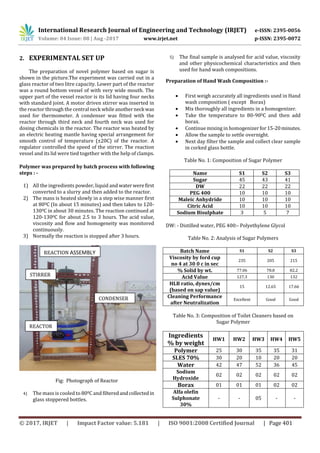
The preparation of novel polymer based on sugar is
shown in the picture.The experiment was carried out in a
glass reactor of two litre capacity. Lower part of the reactor
was a round bottom vessel of with very wide mouth. The
upper part of the vessel reactor is its lid having four necks
with standard joint. A motor driven stirrer was inserted in
the reactor through the central neck while anotherneck was
used for thermometer. A condenser was fitted with the
reactor through third neck and fourth neck was used for
dosing chemicals in the reactor. The reactor was heated by
an electric heating mantle having special arrangement for
smooth control of temperature (±20C) of the reactor. A
regulator controlled the speed of the stirrer. The reaction
vessel and its lid were tied together with the help of clamps.
Polymer was prepared by batch process with following
steps : -
1) All the ingredients powder, liquid and water werefirst
converted to a slurry and then added to the reactor.
2) The mass is heated slowly in a step wise manner first
at 800C (In about 15 minutes) and then takes to 120-
1300C in about 30 minutes. The reaction continued at
120-1300C for about 2.5 to 3 hours. The acid value,
viscosity and flow and homogeneity was monitored
continuously.
3) Normally the reaction is stopped after 3 hours.
Fig: Photograph of Reactor
4) The mass is cooled to 800C and filteredandcollectedin
glass stoppered bottles.
5) The final sample is analysed for acid value, viscosity
and other physicochemical characteristics and then
used for hand wash compositions.
Preparation of Hand Wash Composition :-
 First weigh accurately all ingredients used in Hand
wash composition ( except Borax)
 Mix thoroughly all ingredients in a homogenizer.
 Take the temperature to 80-900C and then add
borax.
 Continue mixing in homogenizer for15-20minutes.
 Allow the sample to settle overnight.
 Next day filter the sample and collect clear sample
in corked glass bottle.
Table No. 1: Composition of Sugar Polymer
Name S1 S2 S3
Sugar 45 43 41
DW 22 22 22
PEG 400 10 10 10
Maleic Anhydride 10 10 10
Citric Acid 10 10 10
Sodium Bisulphate 3 5 7
DW: - Distilled water, PEG 400:- Polyethylene Glycol
Table No. 2: Analysis of Sugar Polymers
Batch Name S1 S2 S3
Viscosity by ford cup
no 4 at 30 0 c in sec
235 205 215
% Solid by wt. 77.06 78.8 82.2
Acid Value 127.3 130 132
HLB ratio, dynes/cm
(based on sap value)
15 12.65 17.66
Cleaning Performance
after Neutralization
Excellent Good Good
Table No. 3: Composition of Toilet Cleaners based on
Sugar Polymer
Ingredients
% by weight
HW1 HW2 HW3 HW4 HW5
Polymer 25 30 35 35 31
SLES 70% 30 20 10 20 20
Water 42 47 52 36 45
Sodium
Hydroxide
02 02 02 02 02
Borax 01 01 01 02 02
Alfa olefin
Sulphonate
30%
- - 05 - -
REACTION ASSEMBLY
STIRRER
REACTOR
CONDENSER
International Research Journal of Engineering and Technology (IRJET) e-ISSN: 2395-0056
Volume: 04 Issue: 08 | Aug -2017 www.irjet.net p-ISSN: 2395-0072
© 2017, IRJET | Impact Factor value: 5.181 | ISO 9001:2008 Certified Journal | Page 402
Table No. 4: Analysis of Toilet Cleaners and Comparison
with Commercial Product
Sam-
ple
pH
Foam in c.c.
(cylinder
method)
Visco
sity
(by
ford
cup
at
300c)
in sec
Surface
Tension
by
Stalagm
-ometer
Method
Dynes/c
m
1 %
0.5
%
0.25
%
HW1 7.0 850 650 500 660 37.0
HW2 6.0 700 550 450 220 38.0
HW3 6.0 450 300 250 370 33.0
HW4 5.6
100
0
650 500 840 31.0
HW5 6.0 850 700 600 660 37.0
Comm
ercial
6.0
100
0
800 700 600 32.0
3. RESULT AND DISCUSSION
Table no 1 give composition of different sugar based
polymer, same amount of distilled water is used in all
samples.
In progressive sets sodium bisulphate is increased from 3 to
7 %. Sodium bisulphate has a dual role. It catalyses
esterification at the same time it can react with –OH groups
to form sulphonates. Useofpolyethyleneglycol givesuperior
surfactants as it contains ethoxy groups. All organic acids
used are likely to react with –OH groups in carbohydrates
skeleton of sugar. The analysis of sugar based polymer is
given in table no 2. Standard methods of analysis have been
used. Sample s1 gives excellent cleaning performance, high
viscosity and desired HLB ratio. So it has been used for
formulation of various Hand wash composition.
Composition of hand wash polymers based on s1 sugar
polymer is given in table no 3. 25-35% polymer has been
used in different compositions. 10-30% SLES (70%) has
been used in different formulations. NaOH is used to
neutralised the acid polymer. 1 % borax gives a
homogeneous products and stable pH Hand wash. The
analysis of Hand wash and its comparison with commercial
Hand wash is given in table no 4. Sample HW2 and HW3
have lower viscosity and lower foaming compared to
commercial Hand wash sample. Sample HW4 andHW5have
desired pH, viscosity, surface tension reduction when
compared against commercial product. Sample HW1 is also
good but it is utilizing very high percentage of SLES.
The samples after testing antibacterial activity can be
recommended for commercial use as they meet most of all
the requirement given at the beginning of article.
4. CONCLUSION
Sugar based polymers can be incorporated to the extent
of 25 to 35% as they give good viscosity, smooth feel,
transparency, foaming,andsurfacetensioncharacteristicsas
desired in commercial products. The price of sugar polymer
is reasonable and the formulation can be called eco-friendly
as they do not contain acid slurry or any other petroleum
based surfactants. This sugar basedpolymerisa valueadded
product from sugar so it will be a good outlet for sugar
producing industries.
5. ACKNOWLEDGMENT
Special appreciation goes to Department of Oil, Fats and
Surfactant Technology, LaxminarayanInstituteofTechnology,
Nagpur for accessing their laboratory and givingtrainingfor
how to use equipment’s. Also thanks to library staff for their
contribution in using books and journals. Thanks for
supporting us in every aspect.
REFERENCES
1. Garrett F. Bass, Mark S. Colt, Anton D. Chavez,
“Synthetic design and investigation of novel
polymeric surfactants”, March 2015
2. Jean-Louis Salagar, “surfactant Types and Uses” ,
2002
3. Michael A. R. Meier, Ju¨rgen O. MetzgerbandUlrichS.
Schubert, “Plant oil renewable resources as green
alternatives in polymer science”, July 2007,1788-
1802
4. Qinghong Fu, “Polymeric Surfactants Based on Oleic
Acid”, 2001
5. Y. Mylonas , G. Bokias , I. Iliopoulos, G. Staikos,
“Interpolymer association betweenhydrophobically
modified poly(sodium acrylate) and poly(N-
isopropylacrylamide) in water: The role of
hydrophobic interactions and polymer structure”
European Polymer Journal 42 , 849–857,2006.
6. SantipharpPanmai,RobertK. Prud’homme,DennisG.
Peiffer, Steffen Jockusch, and Nicholas J. Turro,
“Interactions between Hydrophobically Modified
Polymers and Surfactants:AFluorescenceStudy”,18,
3860-3864,2002.
7. A S Shedge,“Hydrophobically Modified Watersoluble
Polymers: Synthesis, Characterization & Rheology”,
2012
8. Hoi Y.H., “Baily’s Industrial oil and fats products”, 5,
p. 78-80, Fifth edition, John Wileyand Son’s,Inc,New
York, 1996.
9. Hugh D., Voungs Roger A., “Freedom Univarting
Physics with modern physics Addison-Wisley
Publication”, P. 374, 2012.
International Research Journal of Engineering and Technology (IRJET) e-ISSN: 2395-0056
Volume: 04 Issue: 08 | Aug -2017 www.irjet.net p-ISSN: 2395-0072
© 2017, IRJET | Impact Factor value: 5.181 | ISO 9001:2008 Certified Journal | Page 403
10. Jayasekara R., Harding I., Bowater I., Lonergan G.;
Journal of Polymer Environment, Vol 13,pp203-205,
2005.
11. Tian Huayu, Tang Zhaohui Zhuang, Xiuli Chen, Xuesi
Jing Xiabin; Progress in Polymer Science, Vol 37(2),
pp 237-280, 2012.
12. Dhakite P. A, Deshpande A. D., Gogte B. B., Phate B.
W.; International Journal of Research in Pharmacyof
Chemistry, Vol 1(3), pp 432-437,2011.
13. Lichtenberg D., Ahyayauch H., Goni F.M.,Bio-Physics
Journal for Detergent,
Vol 105(2), pp 289-299,2013.
14. Sindhu R., Suprabha G.N., Shashidhar S.; African
Journal of Microbiology Research , Vol 3(9), pp 498-
503, Sep 2009.
15. IS 3025-44 (1993): Methods of Sampling and Test
(physical and chemical) for Water and Wastewater,
Part 44: Biochemical Oxygen Demand (BOD) [CHD
32: Environmental Protection and Waste
Management]

A Unique Polymeric Surfactant for Hand Washes

  • 1.
    International Research Journalof Engineering and Technology (IRJET) e-ISSN: 2395-0056 Volume: 04 Issue: 08 | Aug -2017 www.irjet.net p-ISSN: 2395-0072 © 2017, IRJET | Impact Factor value: 5.181 | ISO 9001:2008 Certified Journal | Page 400 A Unique Polymeric Surfactant for Hand Washes Shubham D. Wagh 1, Dr. V. Y. Karadbhajne2, Dr. B.B Gogte3 1M. Tech final year, Dept. of Oil Technology, LIT Nagpur, India 2Assistant Professor, Dept. of Oil Technology, LIT Nagpur, India 3Associate Professor, Dept. of Oil Technology, LIT Nagpur, India ---------------------------------------------------------------------***--------------------------------------------------------------------- Abstract - A Polymeric Surfactant, based on Sugar, Polyethylene Glycol 400 and organic acids has been synthesized. The Polymers have been analyzed systematically and selected polymer has been used to the extent of 25 to 35% in Hand wash compositions. The Hand wash give excellent foaming, viscosity and surface tension reductions characteristics. The characteristics are comparable to commercial Hand wash in the market. Key Words - Hand wash, Polymer, Surfactant. 1. INTRODUCTION Awareness about hygiene cleanliness in developing countries is increasing at very fast pace in last decade. With increasing standard of living, better per capita income, role of T.V. media the hand wash now has become an essential commodity in every family. In developing countries childhood mortality rates related to respiratory diarrhoeal diseases can be reduced by 50%, by proper use of soap and hand washes. In the present work we have synthesized polymers based mainly on sugar. As we know sugar and liquid glucose are natural preservatives which have been used for centuries in our Mango and Lemon based preparations. In our laboratories we have already synthesized polymers based on sorbitol1, starch2, liquid glucose3 and Maleinizedvegetableoils4.These polymers have been successfully utilized in various surfactant compositions. In our country large number of sugar factories are producing sugar. We export sugar and sometimes surplus is available. This work is to generate value added product from sugar for a non-food use like surfactant8. If we are able to generatevalueaddedproductat reasonable rate, then this will also help the economics of sugar industry and sugar cane growers. The raw materials used are sugar, polyethylene glycol-400, organic acids and sodium bisulphate. These polymers have been analysed systematically and selected polymer has been used to prepare Hand wash compositions with following special features. 1) The product does not contain any large amount of acid slurry or petroleum based surfactant. Thus the product is likely to be eco-friendly. 2) Any phosphate has not been used in formulation so it will not create any pollution. 3) Use of sugar gives clean, transparent, free flowing homogeneous product which does not irritate the hand. A smooth feel is obtained. 4) The product does not use any alcohol. Let us try to understand what are the essential and desirable characteristics of a hand wash.  It should completely & quickly remove dirt, oil, grease and other foreignmaterial depositedonhand.  It should have a moderate viscosity neither too high nor too low because higher viscosity sometimes make it difficult to remove from the bottle and very low viscosity is also not desirable.  It should be clear, transparent with excellent stability at least for one year. It should not show any separation on standing.  It should contain some glycerine or sorbitol so that after application it should not show anyskindryness or irritation.  The special features of hand wash is its pH. It should be slightly acidic pH 5-6(1%solution) which should match with our skin.  It should have excellent minimum negative effects like stripping skin of natural oils.  It should give excellent foaming properties non- foaming compositions are not popular in India.  It should not show any feeling of stickiness after application and removal.  The hand should be clean of pathogeus including bacteria or viruses and chemicals which can cause personal harm or disease to the person using it. In our laboratory we have already prepare hand wash and commercial surfactant based on liquid glucose, starch, sorbitol and Maleinized oil. In the present research work special polymers basedonsugarhave be synthesised and used in formulation of hand wash. The use of sugar based polymer is expected to give stablility and excellent technical properties.  A mild perfume should be incorporated which will give decent and pleasant feeling after application.  Some Herbal extracts like neem, aloe Vera or other plants should be incorporated this will make the product acceptable to Indian customers who have special taste for herbal products.
  • 2.
    International Research Journalof Engineering and Technology (IRJET) e-ISSN: 2395-0056 Volume: 04 Issue: 08 | Aug -2017 www.irjet.net p-ISSN: 2395-0072 © 2017, IRJET | Impact Factor value: 5.181 | ISO 9001:2008 Certified Journal | Page 401 2. EXPERIMENTAL SET UP The preparation of novel polymer based on sugar is shown in the picture.The experiment was carried out in a glass reactor of two litre capacity. Lower part of the reactor was a round bottom vessel of with very wide mouth. The upper part of the vessel reactor is its lid having four necks with standard joint. A motor driven stirrer was inserted in the reactor through the central neck while anotherneck was used for thermometer. A condenser was fitted with the reactor through third neck and fourth neck was used for dosing chemicals in the reactor. The reactor was heated by an electric heating mantle having special arrangement for smooth control of temperature (±20C) of the reactor. A regulator controlled the speed of the stirrer. The reaction vessel and its lid were tied together with the help of clamps. Polymer was prepared by batch process with following steps : - 1) All the ingredients powder, liquid and water werefirst converted to a slurry and then added to the reactor. 2) The mass is heated slowly in a step wise manner first at 800C (In about 15 minutes) and then takes to 120- 1300C in about 30 minutes. The reaction continued at 120-1300C for about 2.5 to 3 hours. The acid value, viscosity and flow and homogeneity was monitored continuously. 3) Normally the reaction is stopped after 3 hours. Fig: Photograph of Reactor 4) The mass is cooled to 800C and filteredandcollectedin glass stoppered bottles. 5) The final sample is analysed for acid value, viscosity and other physicochemical characteristics and then used for hand wash compositions. Preparation of Hand Wash Composition :-  First weigh accurately all ingredients used in Hand wash composition ( except Borax)  Mix thoroughly all ingredients in a homogenizer.  Take the temperature to 80-900C and then add borax.  Continue mixing in homogenizer for15-20minutes.  Allow the sample to settle overnight.  Next day filter the sample and collect clear sample in corked glass bottle. Table No. 1: Composition of Sugar Polymer Name S1 S2 S3 Sugar 45 43 41 DW 22 22 22 PEG 400 10 10 10 Maleic Anhydride 10 10 10 Citric Acid 10 10 10 Sodium Bisulphate 3 5 7 DW: - Distilled water, PEG 400:- Polyethylene Glycol Table No. 2: Analysis of Sugar Polymers Batch Name S1 S2 S3 Viscosity by ford cup no 4 at 30 0 c in sec 235 205 215 % Solid by wt. 77.06 78.8 82.2 Acid Value 127.3 130 132 HLB ratio, dynes/cm (based on sap value) 15 12.65 17.66 Cleaning Performance after Neutralization Excellent Good Good Table No. 3: Composition of Toilet Cleaners based on Sugar Polymer Ingredients % by weight HW1 HW2 HW3 HW4 HW5 Polymer 25 30 35 35 31 SLES 70% 30 20 10 20 20 Water 42 47 52 36 45 Sodium Hydroxide 02 02 02 02 02 Borax 01 01 01 02 02 Alfa olefin Sulphonate 30% - - 05 - - REACTION ASSEMBLY STIRRER REACTOR CONDENSER
  • 3.
    International Research Journalof Engineering and Technology (IRJET) e-ISSN: 2395-0056 Volume: 04 Issue: 08 | Aug -2017 www.irjet.net p-ISSN: 2395-0072 © 2017, IRJET | Impact Factor value: 5.181 | ISO 9001:2008 Certified Journal | Page 402 Table No. 4: Analysis of Toilet Cleaners and Comparison with Commercial Product Sam- ple pH Foam in c.c. (cylinder method) Visco sity (by ford cup at 300c) in sec Surface Tension by Stalagm -ometer Method Dynes/c m 1 % 0.5 % 0.25 % HW1 7.0 850 650 500 660 37.0 HW2 6.0 700 550 450 220 38.0 HW3 6.0 450 300 250 370 33.0 HW4 5.6 100 0 650 500 840 31.0 HW5 6.0 850 700 600 660 37.0 Comm ercial 6.0 100 0 800 700 600 32.0 3. RESULT AND DISCUSSION Table no 1 give composition of different sugar based polymer, same amount of distilled water is used in all samples. In progressive sets sodium bisulphate is increased from 3 to 7 %. Sodium bisulphate has a dual role. It catalyses esterification at the same time it can react with –OH groups to form sulphonates. Useofpolyethyleneglycol givesuperior surfactants as it contains ethoxy groups. All organic acids used are likely to react with –OH groups in carbohydrates skeleton of sugar. The analysis of sugar based polymer is given in table no 2. Standard methods of analysis have been used. Sample s1 gives excellent cleaning performance, high viscosity and desired HLB ratio. So it has been used for formulation of various Hand wash composition. Composition of hand wash polymers based on s1 sugar polymer is given in table no 3. 25-35% polymer has been used in different compositions. 10-30% SLES (70%) has been used in different formulations. NaOH is used to neutralised the acid polymer. 1 % borax gives a homogeneous products and stable pH Hand wash. The analysis of Hand wash and its comparison with commercial Hand wash is given in table no 4. Sample HW2 and HW3 have lower viscosity and lower foaming compared to commercial Hand wash sample. Sample HW4 andHW5have desired pH, viscosity, surface tension reduction when compared against commercial product. Sample HW1 is also good but it is utilizing very high percentage of SLES. The samples after testing antibacterial activity can be recommended for commercial use as they meet most of all the requirement given at the beginning of article. 4. CONCLUSION Sugar based polymers can be incorporated to the extent of 25 to 35% as they give good viscosity, smooth feel, transparency, foaming,andsurfacetensioncharacteristicsas desired in commercial products. The price of sugar polymer is reasonable and the formulation can be called eco-friendly as they do not contain acid slurry or any other petroleum based surfactants. This sugar basedpolymerisa valueadded product from sugar so it will be a good outlet for sugar producing industries. 5. ACKNOWLEDGMENT Special appreciation goes to Department of Oil, Fats and Surfactant Technology, LaxminarayanInstituteofTechnology, Nagpur for accessing their laboratory and givingtrainingfor how to use equipment’s. Also thanks to library staff for their contribution in using books and journals. Thanks for supporting us in every aspect. REFERENCES 1. Garrett F. Bass, Mark S. Colt, Anton D. Chavez, “Synthetic design and investigation of novel polymeric surfactants”, March 2015 2. Jean-Louis Salagar, “surfactant Types and Uses” , 2002 3. Michael A. R. Meier, Ju¨rgen O. MetzgerbandUlrichS. Schubert, “Plant oil renewable resources as green alternatives in polymer science”, July 2007,1788- 1802 4. Qinghong Fu, “Polymeric Surfactants Based on Oleic Acid”, 2001 5. Y. Mylonas , G. Bokias , I. Iliopoulos, G. Staikos, “Interpolymer association betweenhydrophobically modified poly(sodium acrylate) and poly(N- isopropylacrylamide) in water: The role of hydrophobic interactions and polymer structure” European Polymer Journal 42 , 849–857,2006. 6. SantipharpPanmai,RobertK. Prud’homme,DennisG. Peiffer, Steffen Jockusch, and Nicholas J. Turro, “Interactions between Hydrophobically Modified Polymers and Surfactants:AFluorescenceStudy”,18, 3860-3864,2002. 7. A S Shedge,“Hydrophobically Modified Watersoluble Polymers: Synthesis, Characterization & Rheology”, 2012 8. Hoi Y.H., “Baily’s Industrial oil and fats products”, 5, p. 78-80, Fifth edition, John Wileyand Son’s,Inc,New York, 1996. 9. Hugh D., Voungs Roger A., “Freedom Univarting Physics with modern physics Addison-Wisley Publication”, P. 374, 2012.
  • 4.
    International Research Journalof Engineering and Technology (IRJET) e-ISSN: 2395-0056 Volume: 04 Issue: 08 | Aug -2017 www.irjet.net p-ISSN: 2395-0072 © 2017, IRJET | Impact Factor value: 5.181 | ISO 9001:2008 Certified Journal | Page 403 10. Jayasekara R., Harding I., Bowater I., Lonergan G.; Journal of Polymer Environment, Vol 13,pp203-205, 2005. 11. Tian Huayu, Tang Zhaohui Zhuang, Xiuli Chen, Xuesi Jing Xiabin; Progress in Polymer Science, Vol 37(2), pp 237-280, 2012. 12. Dhakite P. A, Deshpande A. D., Gogte B. B., Phate B. W.; International Journal of Research in Pharmacyof Chemistry, Vol 1(3), pp 432-437,2011. 13. Lichtenberg D., Ahyayauch H., Goni F.M.,Bio-Physics Journal for Detergent, Vol 105(2), pp 289-299,2013. 14. Sindhu R., Suprabha G.N., Shashidhar S.; African Journal of Microbiology Research , Vol 3(9), pp 498- 503, Sep 2009. 15. IS 3025-44 (1993): Methods of Sampling and Test (physical and chemical) for Water and Wastewater, Part 44: Biochemical Oxygen Demand (BOD) [CHD 32: Environmental Protection and Waste Management]