Indian Journal of Science and Technology, Vol 9(32), DOI: 10.17485/ijst/2016/v9i32/100184, August 2016
ISSN (Print) : 0974-6846
ISSN (Online) : 0974-5645
* Author for correspondence
1. Introduction
In the new era of digital world, the three attributes
of big data Volume, velocity and variety are growing
exponentially. For example: on a daily basis in 2013 an
average of approx. 2.8 quintillion bytes of data were
created1
. The source of this data explosion includes
smart phones, different types of sensors, individual
Archives, Social-Networking sites, business Enterprises,
digital audio video recorders, Software Logs, data from
healthcare industry etc. Due to such data explosions
it becomes challenging for researches to analyze and
interpret the large and complex datasets manually or
by using different data management applications thus
leading to an issue known as “Big-Data Problem”. The
Big-Data problem is not confined to one sector but is a
common phenomenon in sector of Science, Medicine,
commerce and engineering. Healthcare industry is an
important sector in terms of Big Data application; a
wide variety of data sets differing in volume, variety and
velocity are generated. The data from health industry as
suggested by IDC digital universe study (2011) is growing
at an enormous rate, according to their study in year 2005
around 130 Exabyte’s of data was created and stored, in
2010 data generated grew rapidly to 1227Exabytes and in
2015 it is expected to grow at the rate of 45% i.e. around
7910 Exabytes. The application of Big-data analytics in
health-care industry is emerging into a promising field
and is providing insights from very large datasets to help
in improving outcomes cost effectively2
.
Diabetes a prolonged metabolic disorder characterized
by high level of sugar in blood which can either be due to
inadequate insulin production by beta cells of pancreas
or improper response of body’s cells to insulin or both. In
2014, around 382 million people throughout the world were
diagnosed with diabetes. As diabetes is a lifestyle disorder,
treatment and prevention can be done through diet control,
weight reduction, exercise and smoking cessation along with
along with drugs (type2) and insulin (type 1) treatment5
.
2. Types of Diabetes
2.1 Type-1 Diabetes
This is an immune disorder characterized by insufficiency
of beta cells of pancreas to produce insulin. Although,
can occur at any age group but usually seen more in
people who are in early adulthood or teenage years.
Approximately 10% of all diabetes cases are of this type.
Abstract
Objectives: The goal is to study about the disease called Diabetes Mellitus (Type_2) and how to cure it for better healthcare.
Methods/Statistical Analysis: To explore dataset of the Type-2 Diabetes and R environment statisticallythe Hadoop/Map-
Reducer algorithm will be used.Findings:Analyzing the different parameters of the disease, apart from medical diagnosis
and causal agents, our review shows that by using Big Data we can predict the other factors which result in demographic
variations of diabetes, geographical distribution of disease and its causes and other factors needed for better outcomes of
healthcare. Application/Improvements: Big data is mostly used for data analytics in business, more research is needed
to make use of this technology in other fields where the data generated is huge.
Keywords: Big-data, Diabetes-Mellitus (DM), Hadoop
A Systematic Review of Type-2 Diabetes
by Hadoop/Map-Reduce
Munaza Ramzan, Farha Ramzan and Sanjeev Thakur
Amity University, Noida - 201313, Uttar Pradesh, India; munaza.ramzan43@gmail.com, Id:frimz.r@gmail.com,
sanjeevthakur3@amity.edu
Vol 9 (32) | August 2016 | www.indjst.org Indian Journal of Science and Technology
2
A Systematic Review of Type- Diabetes by Hadoop/Map-Reduce
2.2 Type-2 Diabetes
Thisisthecommonformofdiabeteswhichischaracterized
by either inadequate insulin production by beta cells
of pancreas or insulin produced is defective because of
which cells in the body are not able to react with it. This
form of diabetes is prevalent worldwide and comprises
90% of all diabetic cases. Obesity is a major predisposing
factor for type 2 diabetes. This is a progressive disorder,
which gradually becomes life threatening over a period
of time and patients usually end up using insulin as a
treatment option. A possible method of preventing type-2
diabetes is by adopting healthy life style habits like weight
loss, healthy diet, exercise, and monitoring blood glucose
levels on regular intervals.
2.3 Gestational-diabetes
This type of diabetes occurs in pregnant women. This
type of gestational diabetes is temporary and usually
disappears after pregnancy. Pregnant women need 3-4
times more insulin to combat high glucose levels in the
blood. A woman who has gestational diabetes has 50%-
60% chances of developing type 2 diabetes later in her life.
3. Symptoms of Diabetes
a) Polyuria(frequent urination)
b) Polydipsia (Increasingly thirsty)
c) Polyphagia(Hungry)
d) Weight Gain
e) Unusual Weight Loss
f) Fatigue
g) wounds that don’t heal
h) Numbness and Tingling in hands and feet6
4. 
EmergingMedical Information
Technologies
There are wide varieties of techniques and emerging
models that are making a major stir in the medical
information technologies and their applications. Some of
the trends are observed like:
Health sensing: To capture various aspects of
Physiological, Cognitive and Physical Health. The wide
variety of consumer devices and medical Sensors were
increasing sharply.
Big-data analysis in Health-care: With the growing
digitization of health-care industry, enormous amount
of health-care data has been generated and the size is
increasing at a bizarre rate. To deliver best evidence based,
generalized and patient centric care, the big data from
industry has to be analyzed to discover deep knowledge
and values.
Health-Care Cloud Computing: Cloud computing
supports the analysis of big data in healthcare and
enables healthcare providers to efficiently use computing
resources, manage and improve services in a cost effective
manner. How effective a health-care service would be,
depends on the efficiency of health problem detection, and
allocation of medical resource, which in turn is decided
by how effectively healthcare information is collected,
managed and utilized. This paper aims at documenting
how to implement emerging technologies on creating
new ways to access and use health-care information and
at the same time help in improving the quality, safety, and
efficiency of the health-care services.
Big-data in health-care includes the patient-oriented
data (physician notes, Lab reports, radiological reports,
case history, and Diet plans), list of health care providers
in a hospital, national health register data, medicine and
surgical instrument manuals and their expiry data[8]
.
Big-data technology is widely used by Health-care
organizations to capture all the patient related information
for better patient care coordination, outcomes of services,
and management.
5. Literature Review
Mu-Hsing-Kuo1
discusses how to improve healthcare
services by improving Cloud computing tools and identify
novel and innovative solutions to allocate resources for
treating patients.
Elsevier, Software tools and techniques for big-data
analytics in health-care2
, Discuses about how techniques
are applied on the data which is growing both in terms of
in the volume of data, rate of generation (velocity), and
variety.
Big-Data3
, the data from health industry as suggested
by IDC digital universe study (2011) is growing at an
enormous rate, according to their study, in year 2005
around 130Exabytes of data was created and stored, in
2010 data generated grew rapidly to 1227Exabytes and in
2015 it is expected to grow at the rate of 45% i.e. around
7910Exabytes.
Munaza Ramzan, Farha Ramzan and Sanjeev Thakur
Vol 9 (32) | August 2016 | www.indjst.org Indian Journal of Science and Technology 3
Kumar et al.4
discusses about the big data and its
characteristics, methods and challenges and suggests how
to overcome the underlying problems being faced by the
health care industry. Also presents the big ideas to fix the
healthcare system in India.
Aljumah et al.5
presents a study that concludes that
treatment plan for elderly patients should be assessed on
basis of their needs and lifestyle habits. Also predictions
on the effectiveness of different treatment methods for
young and old age groups were elucidated.
Rajesh etal.6
disuses about the reliable prediction
methodology to diagnose diabetes and interpret the data
patterns so as to get meaningful and useful information
for the healthcare providers.
Sharmila etal.7
surveyed various progress made in the
area of big-data technology, its latest adoption in Hadoop
platform, algorithms used in such platform, and listed out
the open challenges in using such algorithms in health-
care data-sets.
Archenaa etal.8
discusses about the big-data use cases
in health-care and government. Also gives an insight of
how uncover additional values from the data generated by
health-care and government.
Ren etal.9
discuses about how to detect diseases at prior
stages based on the historical medical data, minimizing
drug usage to avoid the side effects and give effective and
efficient medicine based on genetic make-ups.
Dean etal.10
discuss about how to address the basic
needs of a citizen quickly and reliably using big-data
analytics.
Yean etal.11
discusses how big-data analytics helps the
government to assess the educational needs for children
who are in the age to be admitted to the school.
Hamilton etal.12
discusses how to minimize the
unemployment rate by predicting the job needs before
based the literacy rate by analyzing the students data that
are graduating every year.
Yang etal.13
in analyzing genomic data of patients, The
Big Data technologies such as the Apache Hadoop project
provides distributed and parallelized data processing and
analysis.
6. Methodology for Analysis
Our analysis is solely based on Apache Hadoop. To store
and process enormous amount of data in a distributed
manner, The Hadoop distributed file system is used.
Our query is expressed as a MAP Reduce job for parallel
processing. Query processing using MapReduce works by
breaking the processing of data into the map phase and
the reduce phase having their key value pairs as input
and output. Programmer decides which type to be used
depending on query. The environments like Hive, pig and
R were used to analyze the data better7
.
6.1 Dataset Collection
The medical data sets for analysis were collected from
the GHDx (Global Health Data Exchange). The GHDx
is a data catalogue produced and supported by IHME
(Institute for Health Metrics and Evaluation).
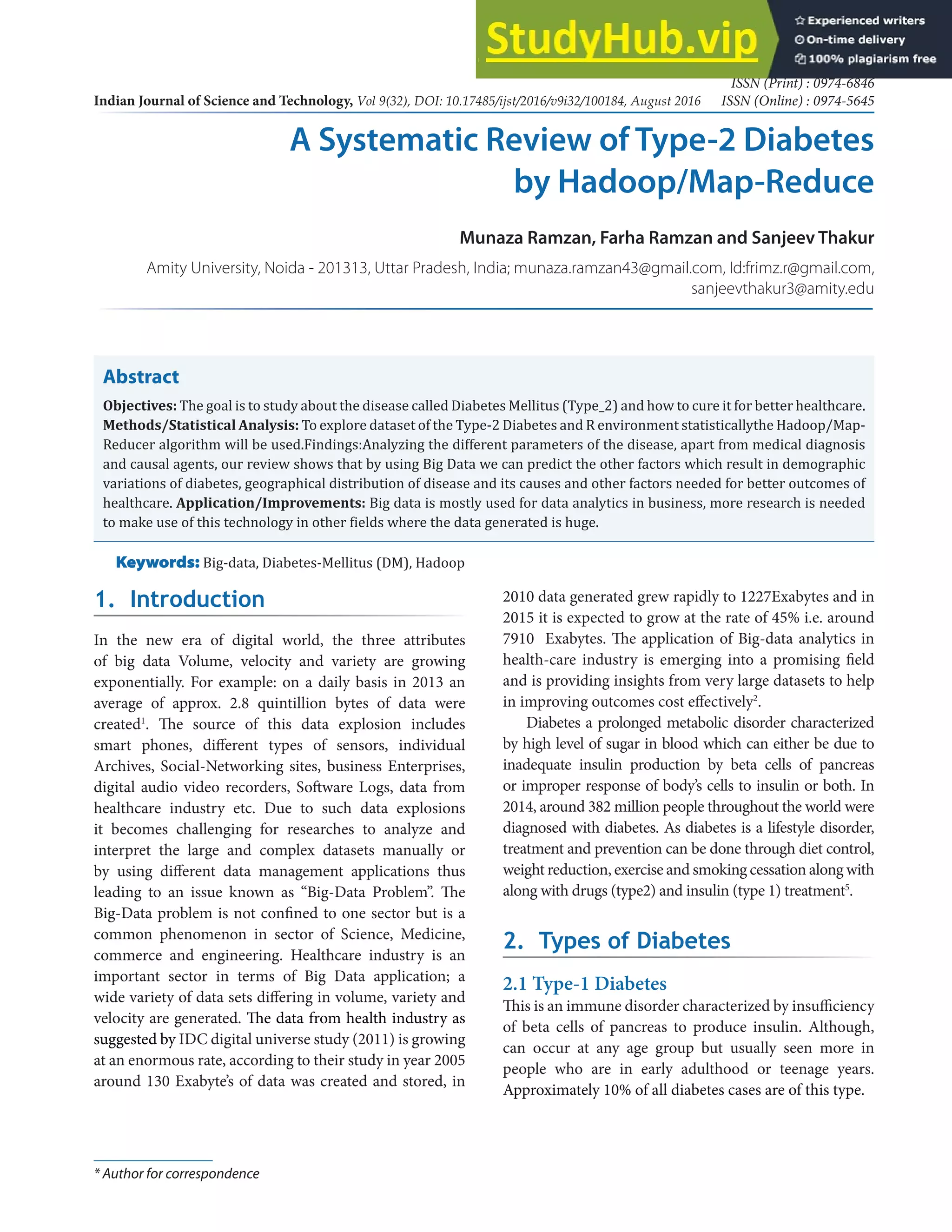
Figure 1. Screenshot of the data.
Vol 9 (32) | August 2016 | www.indjst.org Indian Journal of Science and Technology
4
A Systematic Review of Type- Diabetes by Hadoop/Map-Reduce
This dataset, delimited with commas (.csv), provides
the different attributes for the treatment of type-2
diabetes by race, age, and gender and also the age adjusted
lower and upper limit in both genders. The data was in
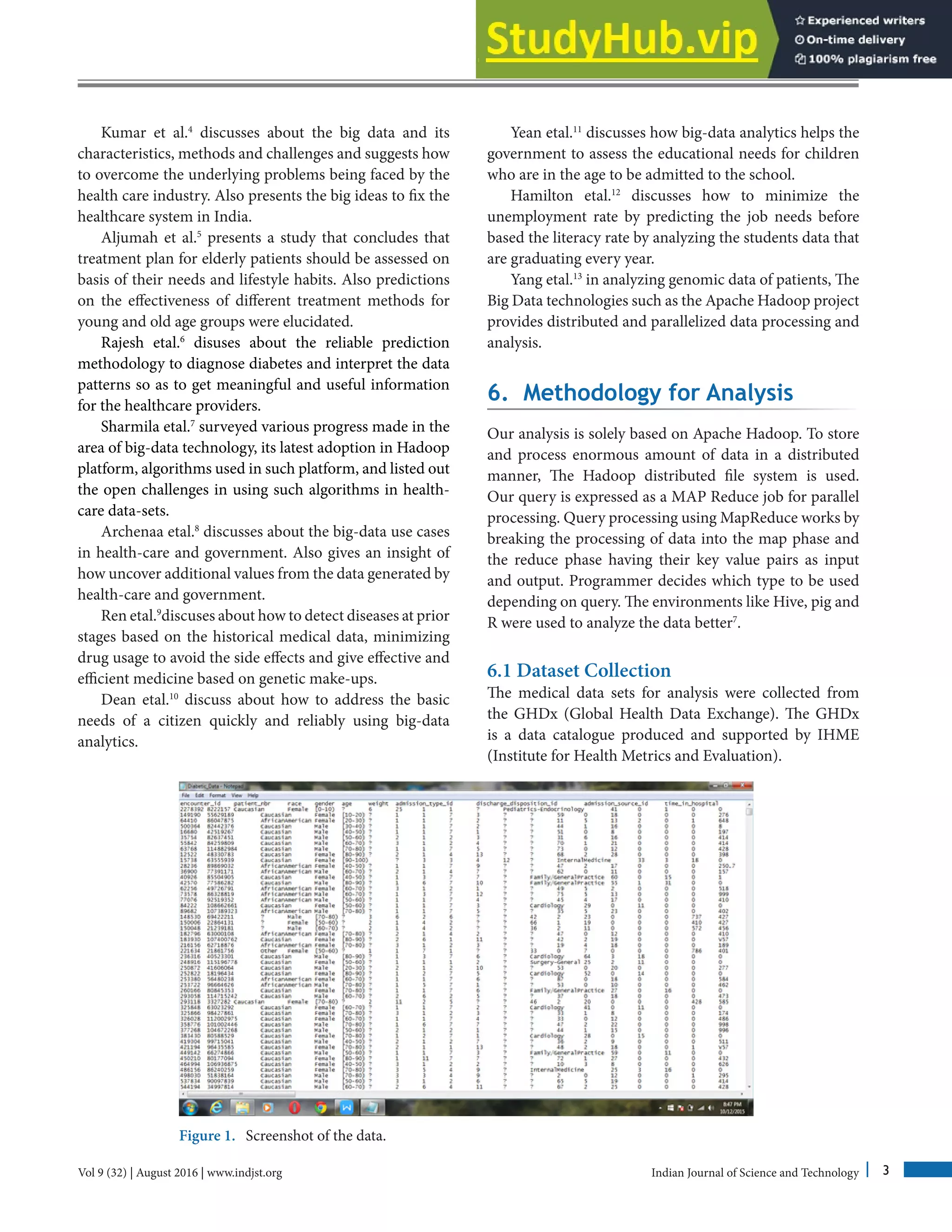
.csv format, we made it more unstructured so as to check
the reliability of Hadoop when used on unstructured
data-sets. Then again saved as in tab delimited format.
Figures 1 and 2 are the screenshot of the dataset after all
manipulation process.
The Type-2 Diabetes Mellitus has been monitored
according to the following parameters:
a. North Africa and Middle East (Egypt, Iran, Iraq,
Saudi Arabia, Morocco etc.)
b. South Asia (India, Pakistan, Afghanistan etc.)
c. East Asia (Mongolia, China, South Korea, Japan etc.)
d. Age Group (0-30, 30-60 and 60-77)
e. Year (1990, 2005 and 2010)
f. Race and Gender(Male, Female and Both)
Figure 2. Screenshot of data in HDFS.
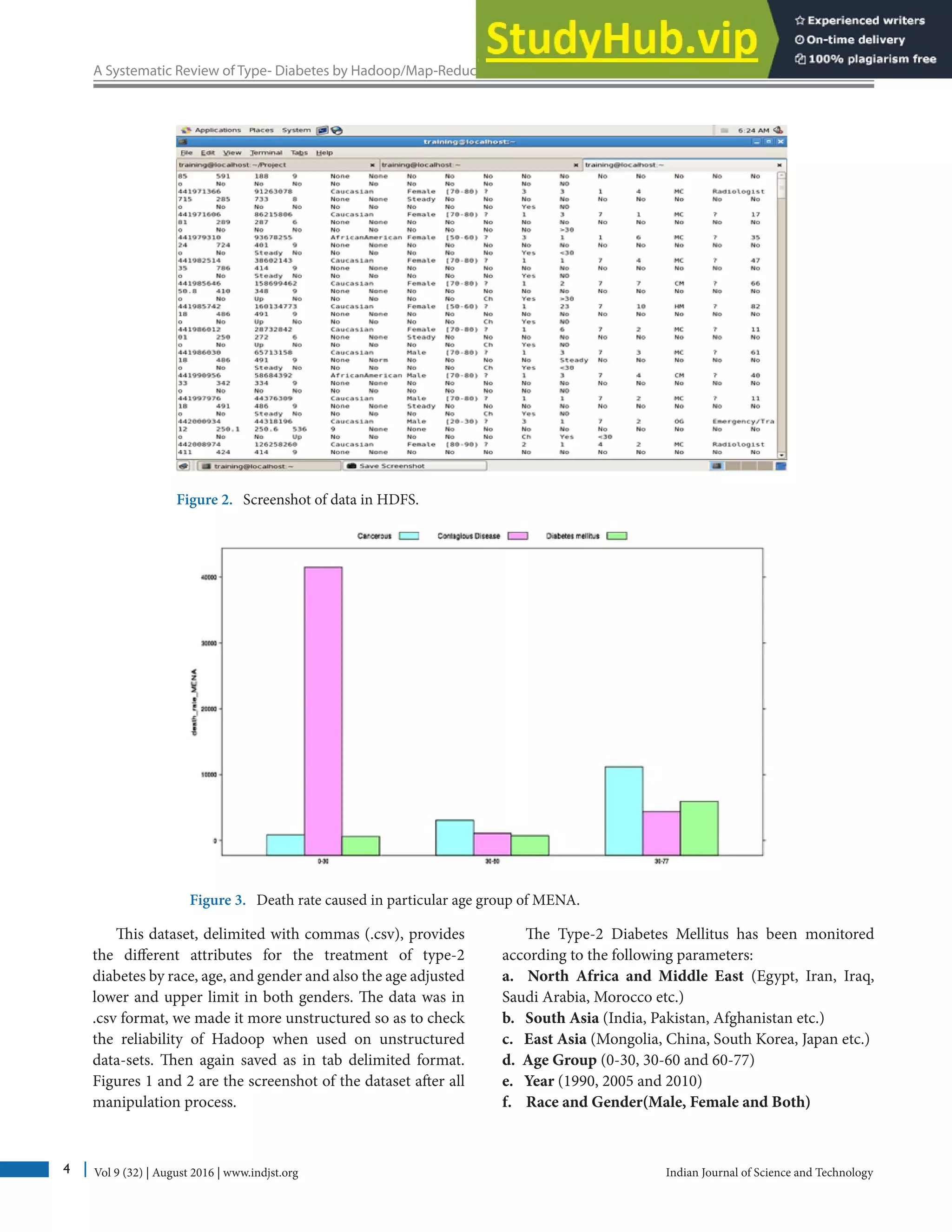
Figure 3. Death rate caused in particular age group of MENA.
Munaza Ramzan, Farha Ramzan and Sanjeev Thakur
Vol 9 (32) | August 2016 | www.indjst.org Indian Journal of Science and Technology 5
7. Syntax for Plotting
]$ R res - read.Table(“Data-File-Name”,
sep=“,”,header=FALSE)barplot(Y_Axis_Data_
Frame,names.arg=c(X_Axis_Data_Frame), col=c(“Red”,
“Blue”)).
8. Graphs
The following are the graphs with the corresponding
variables and constants:
Result 1
Region: MENA (Iraq, Iran, Algeria, Arab countries,
Sudan etc.)
Years: All
Gender: All
We have seen the deaths caused in particular years
and in particular genders of MENA. Figure 3 bar plot
gives a notion of the death rate caused in particular age
group. As indicated the population of the age group “0-
30” is most effected. While in the third age group cancer
is the dominatingdisease category, causing more deaths.
Result2
Region: East Asia
Gender: All
Years: All
As indicated by the earlier graphs of East Asian
countries the cancerous disease, which has caused most
deaths in the region, is affecting the population of the
age group “30-60” and “60-70”. While as the contagious
diseases is affecting the age group of “0-30” followed by
“60-77” and a little in “30-60”. The death rate caused
by Diabetes mellitus is almost constant for the first two
age groups but is gaining hike in the last one (Figure 4).
Result3
Region: South Asia
Gender: All
Years: All
Figure 5 is the death rate in South Asian countries by
three diseases. We have already analyzed that contagious
diseases have caused most death rates in South Asian
countries,withmalepopulationaffectedworse.Thisgraph
indicates that in the age group of 0-30 yrs. maximum
deaths have been caused by communicable diseases. And
next to this age group is “60-77”, again the pink bar has
the more shares of deaths in this age group, followed by
the cancerous diseases. Age group “30-60” has not been
affected as are the other two.
Figure 4. Death rate caused in particular age group of East Asia.
Vol 9 (32) | August 2016 | www.indjst.org Indian Journal of Science and Technology
6
A Systematic Review of Type- Diabetes by Hadoop/Map-Reduce
9. Conclusion
Big-data technology for data analytics is an emerging
technology. Although, big data is mostly used for data
analytics in business, more research is needed to make use
of this technology in other fields where the data generated
is huge. For our research, we used data from healthcare
sector for analytics using Big Data. In this research the
data of Diabetes Mellitus from different parts of the world
was taken for analysis using Hadoop. Analyzing the
different parameters of the disease, apart from medical
diagnosis and causal agents, using Big Data we can predict
the other factors which result in demographic variations
of diabetes, geographical distribution of disease and its
causes and other factors needed for better outcomes of
health-care.
10 References
1. Yang JJ, Li J, Mulder J, Wang Y, Chen S, Wu H. Emerging
information technologies for enhanced healthcare. Com-
puters in Industry.2015 May, 69:3–11.
2. Lizhe Wang, Ranjan R, Kolodziej, Zomaya A. Software
tools and techniques for big data computing inhealth-care
clouds.Future Generation Computer Systems. 2015 Feb;
43:38–9.
3. Big-Data[Internet]. [Cited 2015 Apr 05]. Available from:
https://www.ida.gov.sg/~/media/Files/Infocomm%20
Landscape/Technology/TechnologyRoadmap/BigData.pdf.
4. Kumar NM, Manjula R. Role of big data analytics in rural
health care – a step towardsSvasthBharath. International
Journal of Computer Science and Information Technolo-
gies. 2014; 5(6):7172–78.
5. Aljumah A, Ahamad M, Siddiqui M. Application of data
mining: diabetes health care in young and old patients.
Journal of King Saud University-Computer and Informa-
tion Sciences. 2015; 25(2):127–36.
6. Rajesh K,Sangeetha V. Application of data mining methods
and techniques for diabetes diagnosis. The International
Journal of Engineering and Innovative Technology. 2012;
2(3):224–29.
7. Sharmila K, Vethamanickam SA. Survey on data mining
algorithm and its application in healthcare sector using Ha-
doop platform. International Journal of Emerging Technol-
ogy and Advanced Engineering. 2015; 5(1):567–71.
8. Archenaa J, Anita EAM. A survey of big data analytics in
healthcare and government. Procedia Computer Science.
2015; 50:408–13.
9. Ren Y, Werner R, Pazzi N, Boukerche A.Monitoring pa-
tients via a secure and mobile healthcare system. IEEE
Wireless Communications.2010 Feb; 17(1).
10. Dean J, Ghemawat S. MapReduce: Simplified data process-
ing on large clusters. ACM; 2008.
11. Yean J et al. White paperby U.S.General Services Adminis-
tration, Big data bigger opportunities.
12. Hamilton B etal.Cognizant white paper. Big data is the fu-
ture of healthcare;2010.
13. Patel JA, Sharma P. Big data for better health planning. 2014
International Conference on Advances in Engineering and
Technology Research (ICAETR);2014.
Figure 5. Death rate caused in particular age group of South Asia.

A Systematic Review Of Type-2 Diabetes By Hadoop Map-Reduce

  • 1.
    Indian Journal ofScience and Technology, Vol 9(32), DOI: 10.17485/ijst/2016/v9i32/100184, August 2016 ISSN (Print) : 0974-6846 ISSN (Online) : 0974-5645 * Author for correspondence 1. Introduction In the new era of digital world, the three attributes of big data Volume, velocity and variety are growing exponentially. For example: on a daily basis in 2013 an average of approx. 2.8 quintillion bytes of data were created1 . The source of this data explosion includes smart phones, different types of sensors, individual Archives, Social-Networking sites, business Enterprises, digital audio video recorders, Software Logs, data from healthcare industry etc. Due to such data explosions it becomes challenging for researches to analyze and interpret the large and complex datasets manually or by using different data management applications thus leading to an issue known as “Big-Data Problem”. The Big-Data problem is not confined to one sector but is a common phenomenon in sector of Science, Medicine, commerce and engineering. Healthcare industry is an important sector in terms of Big Data application; a wide variety of data sets differing in volume, variety and velocity are generated. The data from health industry as suggested by IDC digital universe study (2011) is growing at an enormous rate, according to their study in year 2005 around 130 Exabyte’s of data was created and stored, in 2010 data generated grew rapidly to 1227Exabytes and in 2015 it is expected to grow at the rate of 45% i.e. around 7910 Exabytes. The application of Big-data analytics in health-care industry is emerging into a promising field and is providing insights from very large datasets to help in improving outcomes cost effectively2 . Diabetes a prolonged metabolic disorder characterized by high level of sugar in blood which can either be due to inadequate insulin production by beta cells of pancreas or improper response of body’s cells to insulin or both. In 2014, around 382 million people throughout the world were diagnosed with diabetes. As diabetes is a lifestyle disorder, treatment and prevention can be done through diet control, weight reduction, exercise and smoking cessation along with along with drugs (type2) and insulin (type 1) treatment5 . 2. Types of Diabetes 2.1 Type-1 Diabetes This is an immune disorder characterized by insufficiency of beta cells of pancreas to produce insulin. Although, can occur at any age group but usually seen more in people who are in early adulthood or teenage years. Approximately 10% of all diabetes cases are of this type. Abstract Objectives: The goal is to study about the disease called Diabetes Mellitus (Type_2) and how to cure it for better healthcare. Methods/Statistical Analysis: To explore dataset of the Type-2 Diabetes and R environment statisticallythe Hadoop/Map- Reducer algorithm will be used.Findings:Analyzing the different parameters of the disease, apart from medical diagnosis and causal agents, our review shows that by using Big Data we can predict the other factors which result in demographic variations of diabetes, geographical distribution of disease and its causes and other factors needed for better outcomes of healthcare. Application/Improvements: Big data is mostly used for data analytics in business, more research is needed to make use of this technology in other fields where the data generated is huge. Keywords: Big-data, Diabetes-Mellitus (DM), Hadoop A Systematic Review of Type-2 Diabetes by Hadoop/Map-Reduce Munaza Ramzan, Farha Ramzan and Sanjeev Thakur Amity University, Noida - 201313, Uttar Pradesh, India; munaza.ramzan43@gmail.com, Id:frimz.r@gmail.com, sanjeevthakur3@amity.edu
  • 2.
    Vol 9 (32)| August 2016 | www.indjst.org Indian Journal of Science and Technology 2 A Systematic Review of Type- Diabetes by Hadoop/Map-Reduce 2.2 Type-2 Diabetes Thisisthecommonformofdiabeteswhichischaracterized by either inadequate insulin production by beta cells of pancreas or insulin produced is defective because of which cells in the body are not able to react with it. This form of diabetes is prevalent worldwide and comprises 90% of all diabetic cases. Obesity is a major predisposing factor for type 2 diabetes. This is a progressive disorder, which gradually becomes life threatening over a period of time and patients usually end up using insulin as a treatment option. A possible method of preventing type-2 diabetes is by adopting healthy life style habits like weight loss, healthy diet, exercise, and monitoring blood glucose levels on regular intervals. 2.3 Gestational-diabetes This type of diabetes occurs in pregnant women. This type of gestational diabetes is temporary and usually disappears after pregnancy. Pregnant women need 3-4 times more insulin to combat high glucose levels in the blood. A woman who has gestational diabetes has 50%- 60% chances of developing type 2 diabetes later in her life. 3. Symptoms of Diabetes a) Polyuria(frequent urination) b) Polydipsia (Increasingly thirsty) c) Polyphagia(Hungry) d) Weight Gain e) Unusual Weight Loss f) Fatigue g) wounds that don’t heal h) Numbness and Tingling in hands and feet6 4. EmergingMedical Information Technologies There are wide varieties of techniques and emerging models that are making a major stir in the medical information technologies and their applications. Some of the trends are observed like: Health sensing: To capture various aspects of Physiological, Cognitive and Physical Health. The wide variety of consumer devices and medical Sensors were increasing sharply. Big-data analysis in Health-care: With the growing digitization of health-care industry, enormous amount of health-care data has been generated and the size is increasing at a bizarre rate. To deliver best evidence based, generalized and patient centric care, the big data from industry has to be analyzed to discover deep knowledge and values. Health-Care Cloud Computing: Cloud computing supports the analysis of big data in healthcare and enables healthcare providers to efficiently use computing resources, manage and improve services in a cost effective manner. How effective a health-care service would be, depends on the efficiency of health problem detection, and allocation of medical resource, which in turn is decided by how effectively healthcare information is collected, managed and utilized. This paper aims at documenting how to implement emerging technologies on creating new ways to access and use health-care information and at the same time help in improving the quality, safety, and efficiency of the health-care services. Big-data in health-care includes the patient-oriented data (physician notes, Lab reports, radiological reports, case history, and Diet plans), list of health care providers in a hospital, national health register data, medicine and surgical instrument manuals and their expiry data[8] . Big-data technology is widely used by Health-care organizations to capture all the patient related information for better patient care coordination, outcomes of services, and management. 5. Literature Review Mu-Hsing-Kuo1 discusses how to improve healthcare services by improving Cloud computing tools and identify novel and innovative solutions to allocate resources for treating patients. Elsevier, Software tools and techniques for big-data analytics in health-care2 , Discuses about how techniques are applied on the data which is growing both in terms of in the volume of data, rate of generation (velocity), and variety. Big-Data3 , the data from health industry as suggested by IDC digital universe study (2011) is growing at an enormous rate, according to their study, in year 2005 around 130Exabytes of data was created and stored, in 2010 data generated grew rapidly to 1227Exabytes and in 2015 it is expected to grow at the rate of 45% i.e. around 7910Exabytes.
  • 3.
    Munaza Ramzan, FarhaRamzan and Sanjeev Thakur Vol 9 (32) | August 2016 | www.indjst.org Indian Journal of Science and Technology 3 Kumar et al.4 discusses about the big data and its characteristics, methods and challenges and suggests how to overcome the underlying problems being faced by the health care industry. Also presents the big ideas to fix the healthcare system in India. Aljumah et al.5 presents a study that concludes that treatment plan for elderly patients should be assessed on basis of their needs and lifestyle habits. Also predictions on the effectiveness of different treatment methods for young and old age groups were elucidated. Rajesh etal.6 disuses about the reliable prediction methodology to diagnose diabetes and interpret the data patterns so as to get meaningful and useful information for the healthcare providers. Sharmila etal.7 surveyed various progress made in the area of big-data technology, its latest adoption in Hadoop platform, algorithms used in such platform, and listed out the open challenges in using such algorithms in health- care data-sets. Archenaa etal.8 discusses about the big-data use cases in health-care and government. Also gives an insight of how uncover additional values from the data generated by health-care and government. Ren etal.9 discuses about how to detect diseases at prior stages based on the historical medical data, minimizing drug usage to avoid the side effects and give effective and efficient medicine based on genetic make-ups. Dean etal.10 discuss about how to address the basic needs of a citizen quickly and reliably using big-data analytics. Yean etal.11 discusses how big-data analytics helps the government to assess the educational needs for children who are in the age to be admitted to the school. Hamilton etal.12 discusses how to minimize the unemployment rate by predicting the job needs before based the literacy rate by analyzing the students data that are graduating every year. Yang etal.13 in analyzing genomic data of patients, The Big Data technologies such as the Apache Hadoop project provides distributed and parallelized data processing and analysis. 6. Methodology for Analysis Our analysis is solely based on Apache Hadoop. To store and process enormous amount of data in a distributed manner, The Hadoop distributed file system is used. Our query is expressed as a MAP Reduce job for parallel processing. Query processing using MapReduce works by breaking the processing of data into the map phase and the reduce phase having their key value pairs as input and output. Programmer decides which type to be used depending on query. The environments like Hive, pig and R were used to analyze the data better7 . 6.1 Dataset Collection The medical data sets for analysis were collected from the GHDx (Global Health Data Exchange). The GHDx is a data catalogue produced and supported by IHME (Institute for Health Metrics and Evaluation). Figure 1. Screenshot of the data.
  • 4.
    Vol 9 (32)| August 2016 | www.indjst.org Indian Journal of Science and Technology 4 A Systematic Review of Type- Diabetes by Hadoop/Map-Reduce This dataset, delimited with commas (.csv), provides the different attributes for the treatment of type-2 diabetes by race, age, and gender and also the age adjusted lower and upper limit in both genders. The data was in .csv format, we made it more unstructured so as to check the reliability of Hadoop when used on unstructured data-sets. Then again saved as in tab delimited format. Figures 1 and 2 are the screenshot of the dataset after all manipulation process. The Type-2 Diabetes Mellitus has been monitored according to the following parameters: a. North Africa and Middle East (Egypt, Iran, Iraq, Saudi Arabia, Morocco etc.) b. South Asia (India, Pakistan, Afghanistan etc.) c. East Asia (Mongolia, China, South Korea, Japan etc.) d. Age Group (0-30, 30-60 and 60-77) e. Year (1990, 2005 and 2010) f. Race and Gender(Male, Female and Both) Figure 2. Screenshot of data in HDFS. Figure 3. Death rate caused in particular age group of MENA.
  • 5.
    Munaza Ramzan, FarhaRamzan and Sanjeev Thakur Vol 9 (32) | August 2016 | www.indjst.org Indian Journal of Science and Technology 5 7. Syntax for Plotting ]$ R res - read.Table(“Data-File-Name”, sep=“,”,header=FALSE)barplot(Y_Axis_Data_ Frame,names.arg=c(X_Axis_Data_Frame), col=c(“Red”, “Blue”)). 8. Graphs The following are the graphs with the corresponding variables and constants: Result 1 Region: MENA (Iraq, Iran, Algeria, Arab countries, Sudan etc.) Years: All Gender: All We have seen the deaths caused in particular years and in particular genders of MENA. Figure 3 bar plot gives a notion of the death rate caused in particular age group. As indicated the population of the age group “0- 30” is most effected. While in the third age group cancer is the dominatingdisease category, causing more deaths. Result2 Region: East Asia Gender: All Years: All As indicated by the earlier graphs of East Asian countries the cancerous disease, which has caused most deaths in the region, is affecting the population of the age group “30-60” and “60-70”. While as the contagious diseases is affecting the age group of “0-30” followed by “60-77” and a little in “30-60”. The death rate caused by Diabetes mellitus is almost constant for the first two age groups but is gaining hike in the last one (Figure 4). Result3 Region: South Asia Gender: All Years: All Figure 5 is the death rate in South Asian countries by three diseases. We have already analyzed that contagious diseases have caused most death rates in South Asian countries,withmalepopulationaffectedworse.Thisgraph indicates that in the age group of 0-30 yrs. maximum deaths have been caused by communicable diseases. And next to this age group is “60-77”, again the pink bar has the more shares of deaths in this age group, followed by the cancerous diseases. Age group “30-60” has not been affected as are the other two. Figure 4. Death rate caused in particular age group of East Asia.
  • 6.
    Vol 9 (32)| August 2016 | www.indjst.org Indian Journal of Science and Technology 6 A Systematic Review of Type- Diabetes by Hadoop/Map-Reduce 9. Conclusion Big-data technology for data analytics is an emerging technology. Although, big data is mostly used for data analytics in business, more research is needed to make use of this technology in other fields where the data generated is huge. For our research, we used data from healthcare sector for analytics using Big Data. In this research the data of Diabetes Mellitus from different parts of the world was taken for analysis using Hadoop. Analyzing the different parameters of the disease, apart from medical diagnosis and causal agents, using Big Data we can predict the other factors which result in demographic variations of diabetes, geographical distribution of disease and its causes and other factors needed for better outcomes of health-care. 10 References 1. Yang JJ, Li J, Mulder J, Wang Y, Chen S, Wu H. Emerging information technologies for enhanced healthcare. Com- puters in Industry.2015 May, 69:3–11. 2. Lizhe Wang, Ranjan R, Kolodziej, Zomaya A. Software tools and techniques for big data computing inhealth-care clouds.Future Generation Computer Systems. 2015 Feb; 43:38–9. 3. Big-Data[Internet]. [Cited 2015 Apr 05]. Available from: https://www.ida.gov.sg/~/media/Files/Infocomm%20 Landscape/Technology/TechnologyRoadmap/BigData.pdf. 4. Kumar NM, Manjula R. Role of big data analytics in rural health care – a step towardsSvasthBharath. International Journal of Computer Science and Information Technolo- gies. 2014; 5(6):7172–78. 5. Aljumah A, Ahamad M, Siddiqui M. Application of data mining: diabetes health care in young and old patients. Journal of King Saud University-Computer and Informa- tion Sciences. 2015; 25(2):127–36. 6. Rajesh K,Sangeetha V. Application of data mining methods and techniques for diabetes diagnosis. The International Journal of Engineering and Innovative Technology. 2012; 2(3):224–29. 7. Sharmila K, Vethamanickam SA. Survey on data mining algorithm and its application in healthcare sector using Ha- doop platform. International Journal of Emerging Technol- ogy and Advanced Engineering. 2015; 5(1):567–71. 8. Archenaa J, Anita EAM. A survey of big data analytics in healthcare and government. Procedia Computer Science. 2015; 50:408–13. 9. Ren Y, Werner R, Pazzi N, Boukerche A.Monitoring pa- tients via a secure and mobile healthcare system. IEEE Wireless Communications.2010 Feb; 17(1). 10. Dean J, Ghemawat S. MapReduce: Simplified data process- ing on large clusters. ACM; 2008. 11. Yean J et al. White paperby U.S.General Services Adminis- tration, Big data bigger opportunities. 12. Hamilton B etal.Cognizant white paper. Big data is the fu- ture of healthcare;2010. 13. Patel JA, Sharma P. Big data for better health planning. 2014 International Conference on Advances in Engineering and Technology Research (ICAETR);2014. Figure 5. Death rate caused in particular age group of South Asia.