Using the TIMES-Ireland Model (TIM) to inform Ireland’s
energy transition
ETSAP Winter Workshop – 2022 – Columbia University
Prof. Hannah Daly
University College Cork – December 1st 2022
1
TIM development team:
Dr. Olexandr Balyk
Andrew Smith
Ankita Gaur
Vahid Aryanpur
Jason McGuire
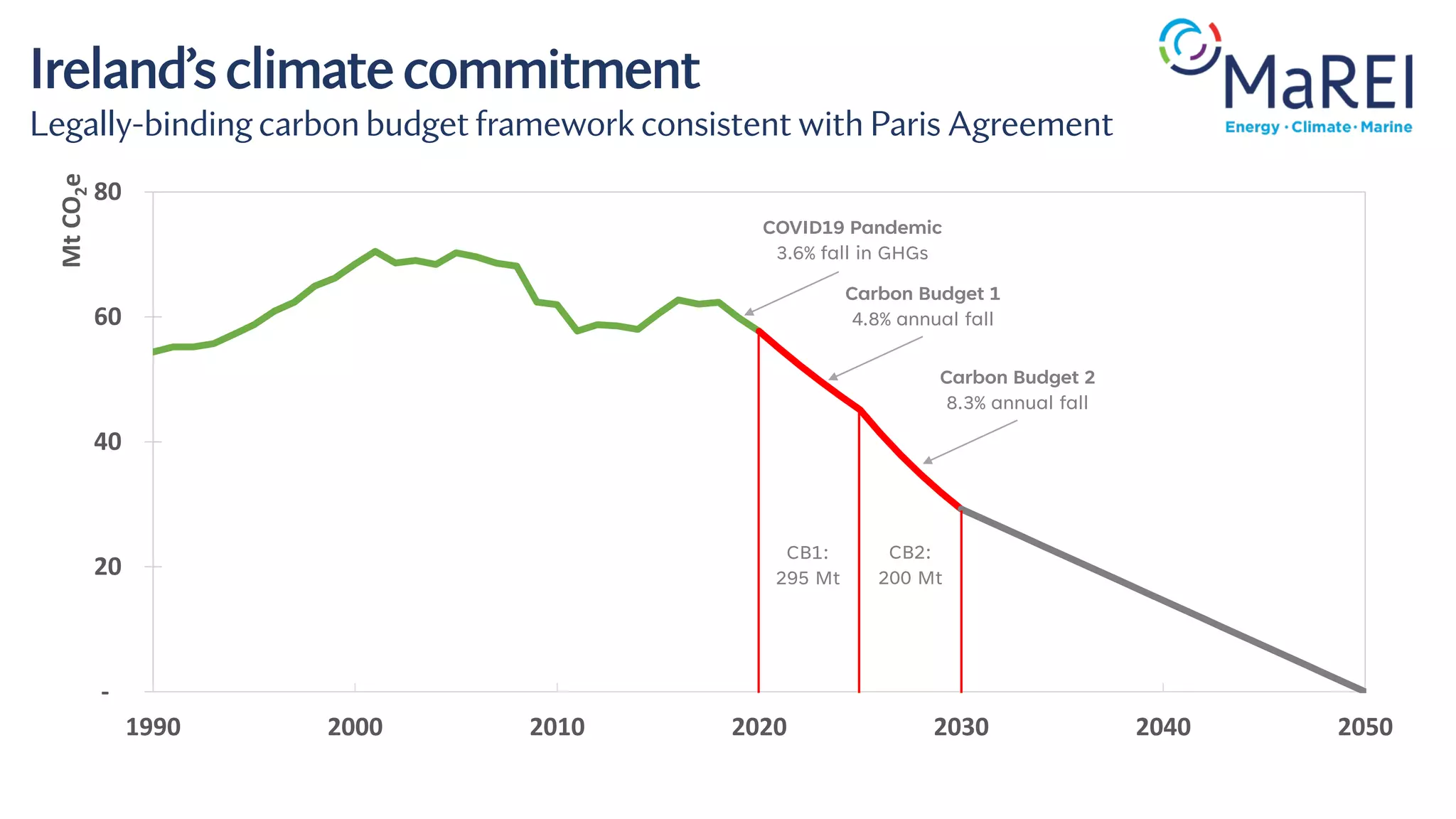
Ireland’s climate commitment
Legally-binding carbon budget framework consistent with Paris Agreement
-
20
40
60
80
1990 2000 2010 2020 2030 2040 2050
Mt
CO
2
e
COVID19 Pandemic
3.6% fall in GHGs
Carbon Budget 1
4.8% annual fall
Carbon Budget 2
8.3% annual fall
CB1:
295 Mt
CB2:
200 Mt
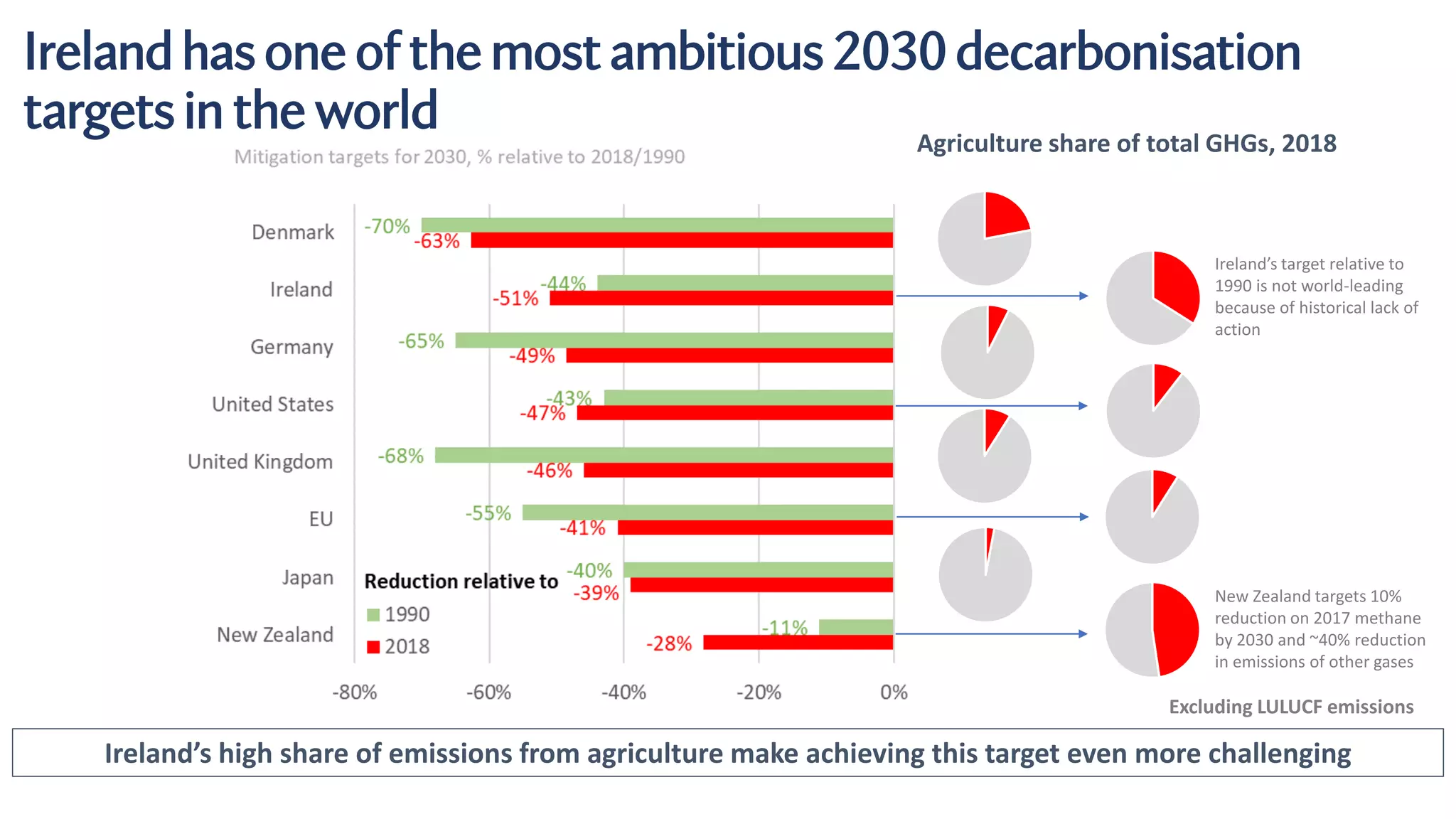
Ireland has one of the most ambitious 2030 decarbonisation
targets in the world
Ireland’s high share of emissions from agriculture make achieving this target even more challenging
Agriculture share of total GHGs, 2018
Excluding LULUCF emissions
New Zealand targets 10%
reduction on 2017 methane
by 2030 and ~40% reduction
in emissions of other gases
Ireland’s target relative to
1990 is not world-leading
because of historical lack of
action
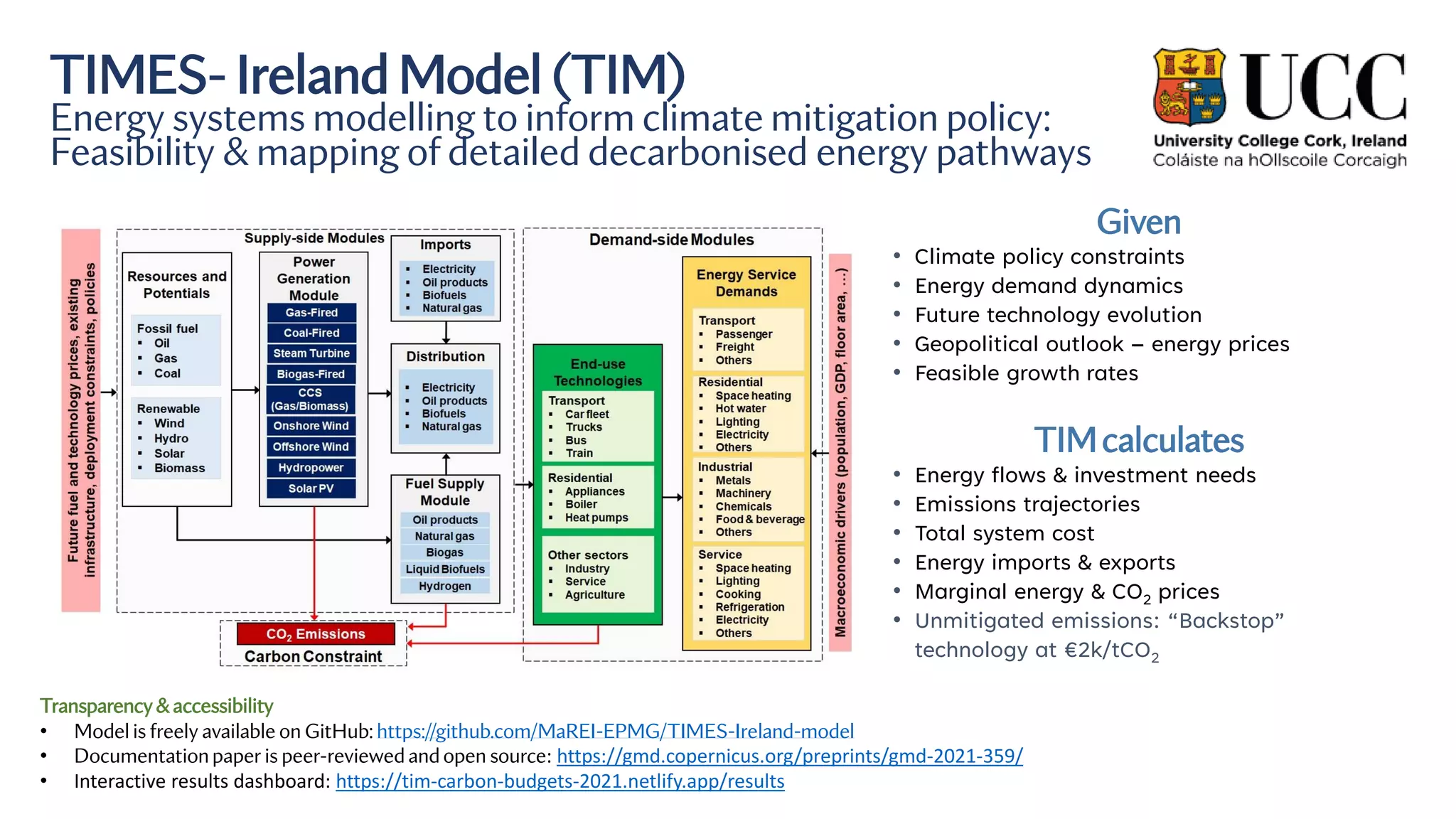
TIMES- Ireland Model (TIM)
Energy systems modelling to inform climate mitigation policy:
Feasibility & mapping of detailed decarbonised energy pathways
Given
• Climate policy constraints
• Energy demand dynamics
• Future technology evolution
• Geopolitical outlook – energy prices
• Feasible growth rates
TIMcalculates
• Energy flows & investment needs
• Emissions trajectories
• Total system cost
• Energy imports & exports
• Marginal energy & CO2 prices
• Unmitigated emissions: “Backstop”
technology at €2k/tCO2
Transparency& accessibility
• Model is freely available on GitHub: https://github.com/MaREI-EPMG/TIMES-Ireland-model
• Documentation paper is peer-reviewed and open source: https://gmd.copernicus.org/preprints/gmd-2021-359/
• Interactive results dashboard: https://tim-carbon-budgets-2021.netlify.app/results
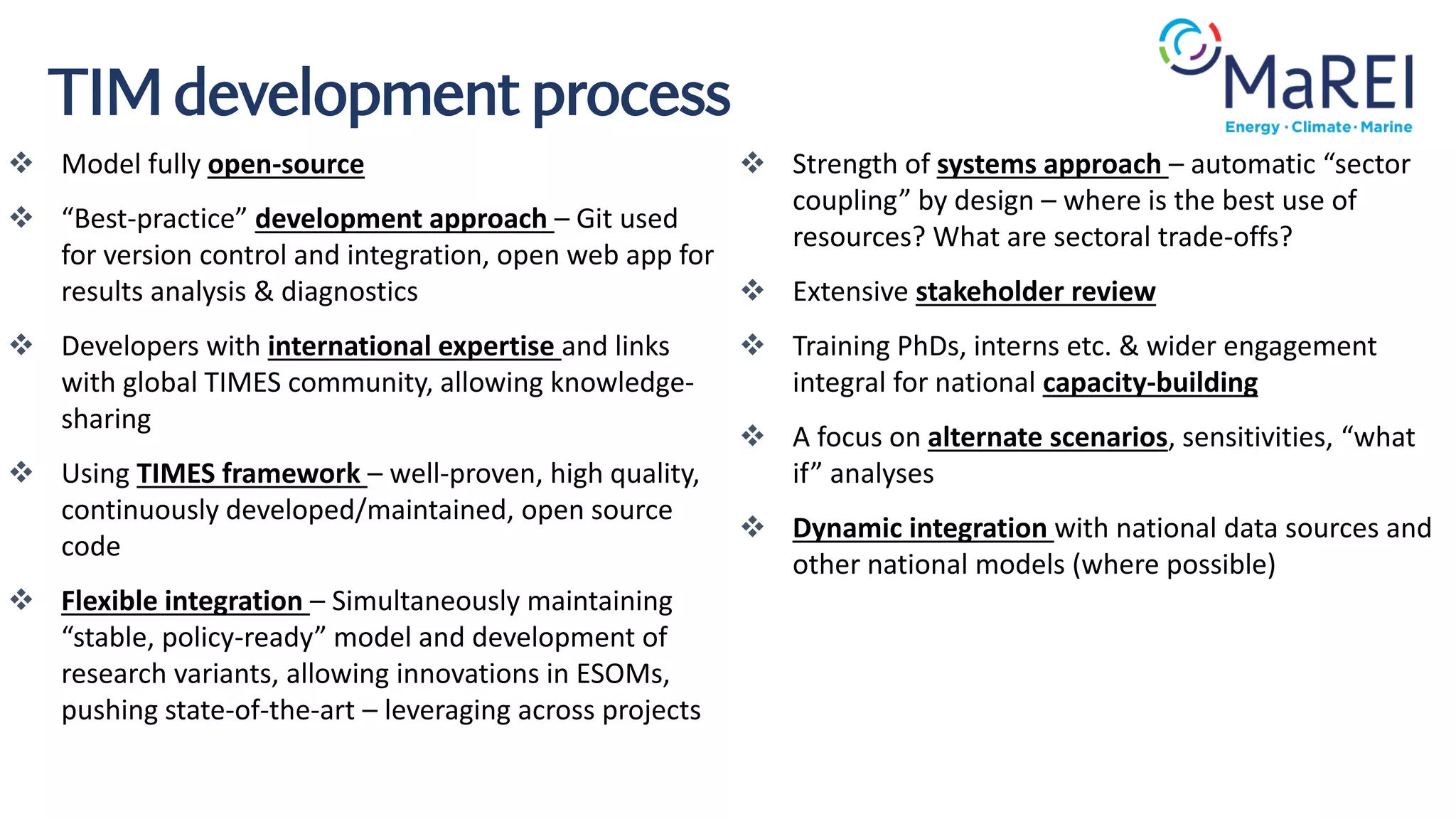
❖ Model fully open-source
❖ “Best-practice” development approach – Git used
for version control and integration, open web app for
results analysis & diagnostics
❖ Developers with international expertise and links
with global TIMES community, allowing knowledge-
sharing
❖ Using TIMES framework – well-proven, high quality,
continuously developed/maintained, open source
code
❖ Flexible integration – Simultaneously maintaining
“stable, policy-ready” model and development of
research variants, allowing innovations in ESOMs,
pushing state-of-the-art – leveraging across projects
TIM development process
❖ Strength of systems approach – automatic “sector
coupling” by design – where is the best use of
resources? What are sectoral trade-offs?
❖ Extensive stakeholder review
❖ Training PhDs, interns etc. & wider engagement
integral for national capacity-building
❖ A focus on alternate scenarios, sensitivities, “what
if” analyses
❖ Dynamic integration with national data sources and
other national models (where possible)
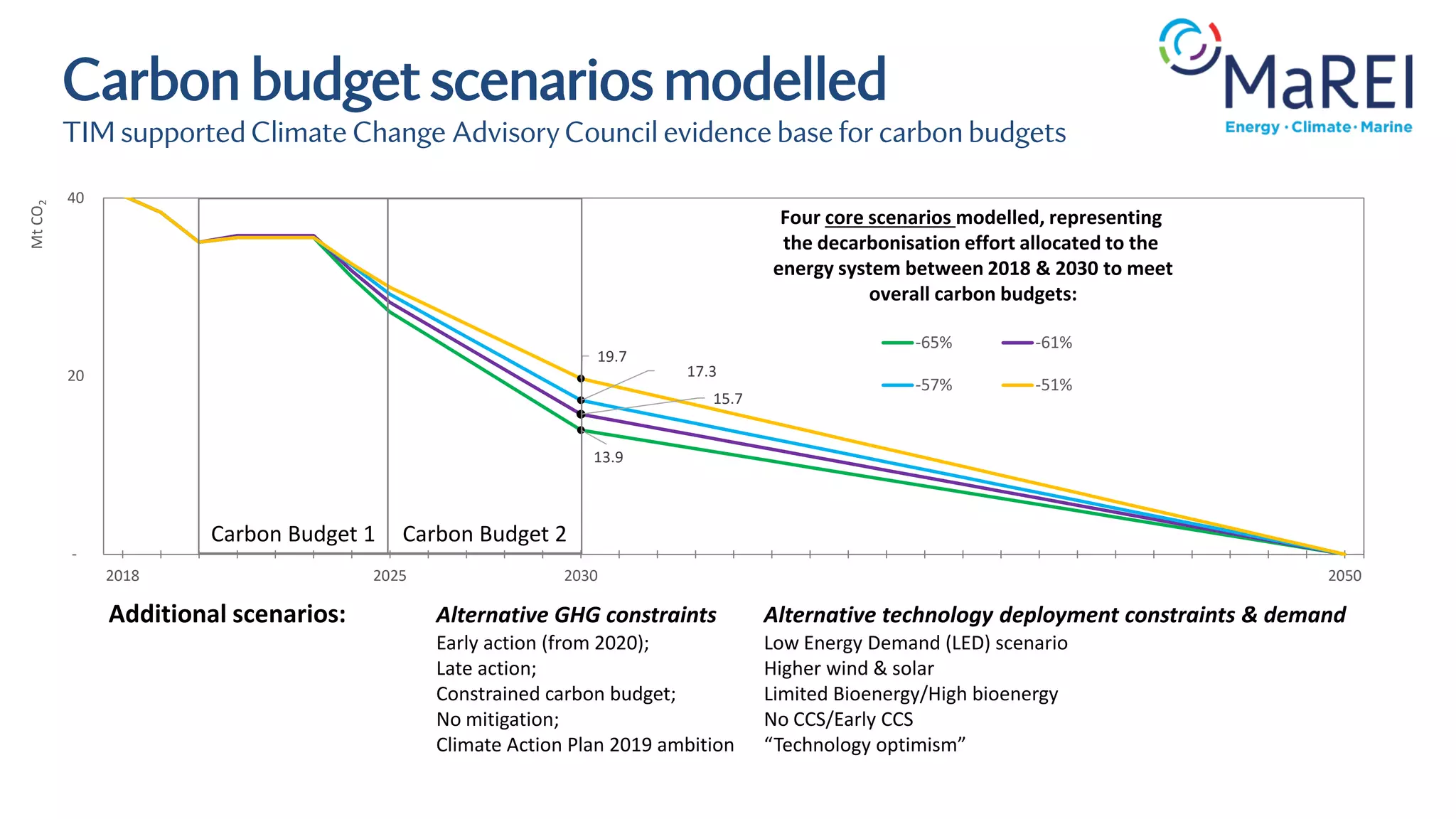
15.7
13.9
17.3
19.7
-
20
40
2018 2025 2030 2050
Mt
CO
2
-65% -61%
-57% -51%
Four core scenarios modelled, representing
the decarbonisation effort allocated to the
energy system between 2018 & 2030 to meet
overall carbon budgets:
Carbon Budget 1 Carbon Budget 2
Additional scenarios: Alternative GHG constraints Alternative technology deployment constraints & demand
Early action (from 2020); Low Energy Demand (LED) scenario
Late action; Higher wind & solar
Constrained carbon budget; Limited Bioenergy/High bioenergy
No mitigation; No CCS/Early CCS
Climate Action Plan 2019 ambition “Technology optimism”
Carbon budget scenarios modelled
TIM supported Climate Change Advisory Council evidence base for carbon budgets
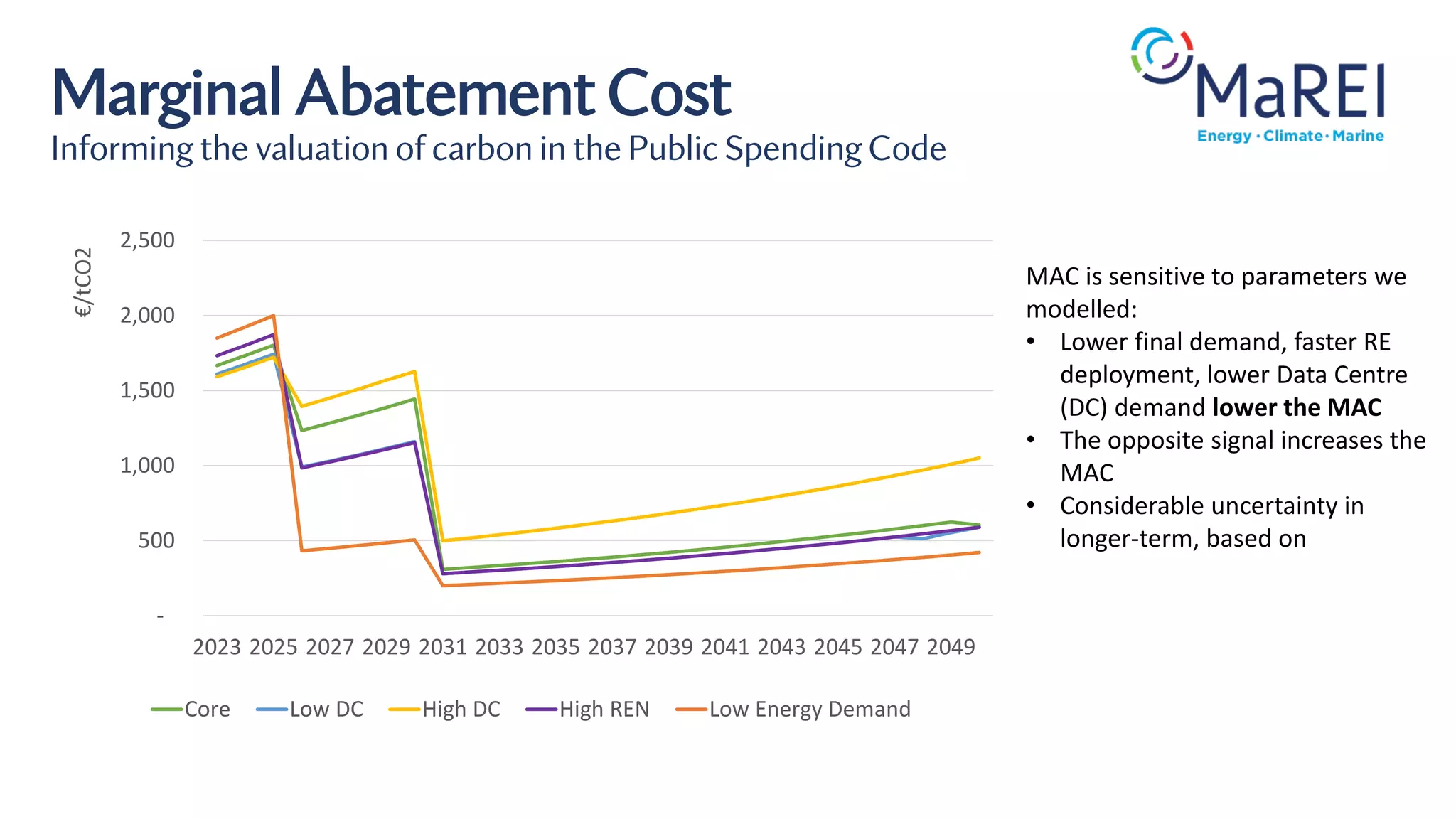
Marginal Abatement Cost
Informing the valuation of carbon in the Public Spending Code
-
500
1,000
1,500
2,000
2,500
2023 2025 2027 2029 2031 2033 2035 2037 2039 2041 2043 2045 2047 2049
€/tCO2
Core Low DC High DC High REN Low Energy Demand
MAC is sensitive to parameters we
modelled:
• Lower final demand, faster RE
deployment, lower Data Centre
(DC) demand lower the MAC
• The opposite signal increases the
MAC
• Considerable uncertainty in
longer-term, based on
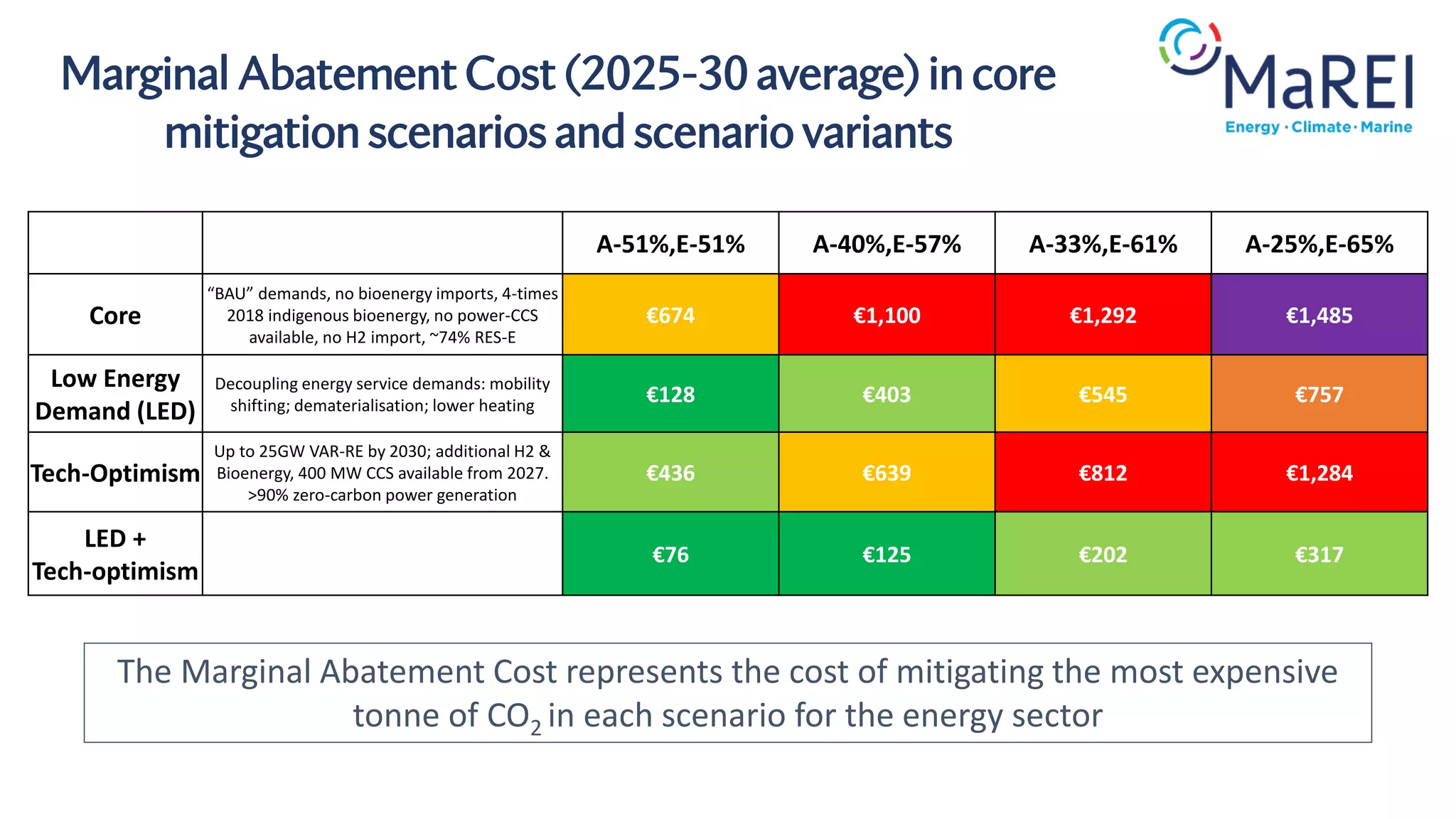
A-51%,E-51% A-40%,E-57% A-33%,E-61% A-25%,E-65%
Core
“BAU” demands, no bioenergy imports, 4-times
2018 indigenous bioenergy, no power-CCS
available, no H2 import, ~74% RES-E
€674 €1,100 €1,292 €1,485
Low Energy
Demand (LED)
Decoupling energy service demands: mobility
shifting; dematerialisation; lower heating
€128 €403 €545 €757
Tech-Optimism
Up to 25GW VAR-RE by 2030; additional H2 &
Bioenergy, 400 MW CCS available from 2027.
>90% zero-carbon power generation
€436 €639 €812 €1,284
LED +
Tech-optimism
€76 €125 €202 €317
The Marginal Abatement Cost represents the cost of mitigating the most expensive
tonne of CO2 in each scenario for the energy sector
Marginal Abatement Cost (2025-30 average) in core
mitigation scenarios and scenario variants
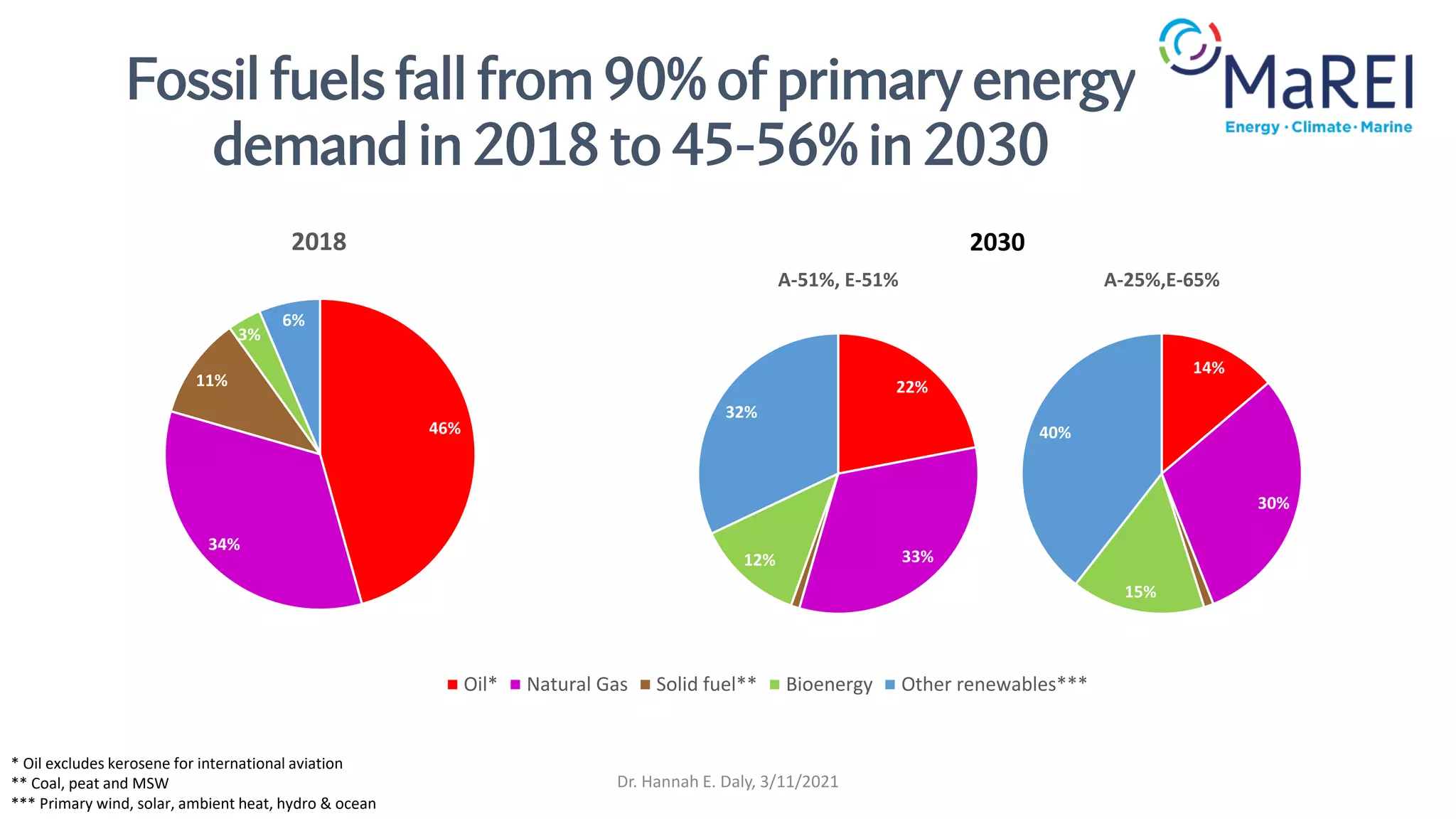
Fossil fuels fall from 90% of primary energy
demand in 2018 to 45-56% in 2030
46%
34%
11%
3%
6%
2018
Oil* Natural Gas Solid fuel** Bioenergy Other renewables***
2030
* Oil excludes kerosene for international aviation
** Coal, peat and MSW
*** Primary wind, solar, ambient heat, hydro & ocean
22%
33%
1%
12%
32%
A-51%, E-51%
14%
30%
1%
15%
40%
A-25%,E-65%
Dr. Hannah E. Daly, 3/11/2021
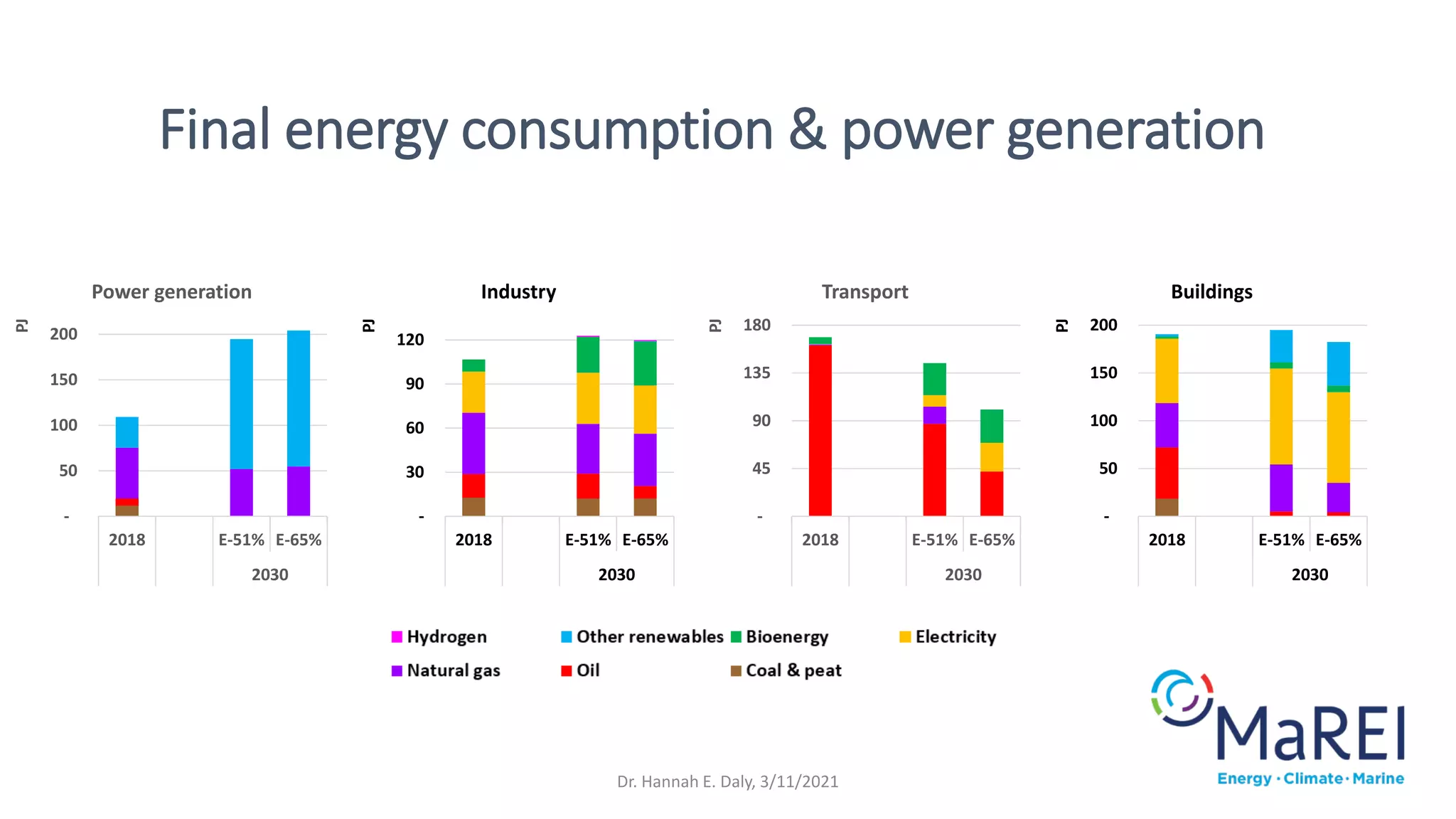
Final energy consumption & power generation
-
50
100
150
200
2018 E-51% E-65%
2030
PJ
Power generation
-
30
60
90
120
2018 E-51% E-65%
2030
PJ
Industry
-
45
90
135
180
2018 E-51% E-65%
2030
PJ
Transport
-
50
100
150
200
2018 E-51% E-65%
2030
PJ
Buildings
Dr. Hannah E. Daly, 3/11/2021
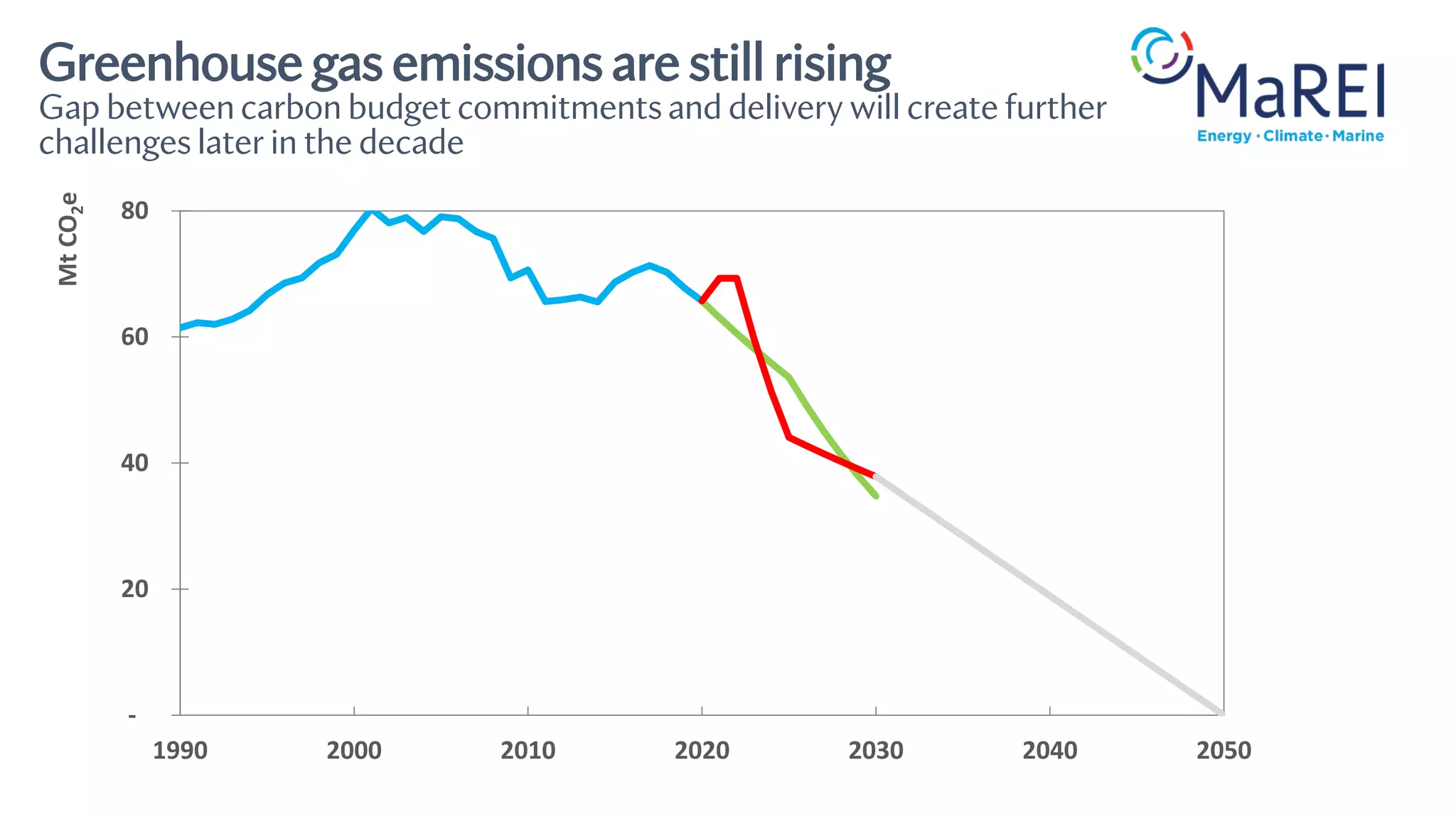
-
20
40
60
80
1990 2000 2010 2020 2030 2040 2050
Mt
CO
2
e
Greenhouse gas emissions are still rising
Gap between carbon budget commitments and delivery will create further
challenges later in the decade
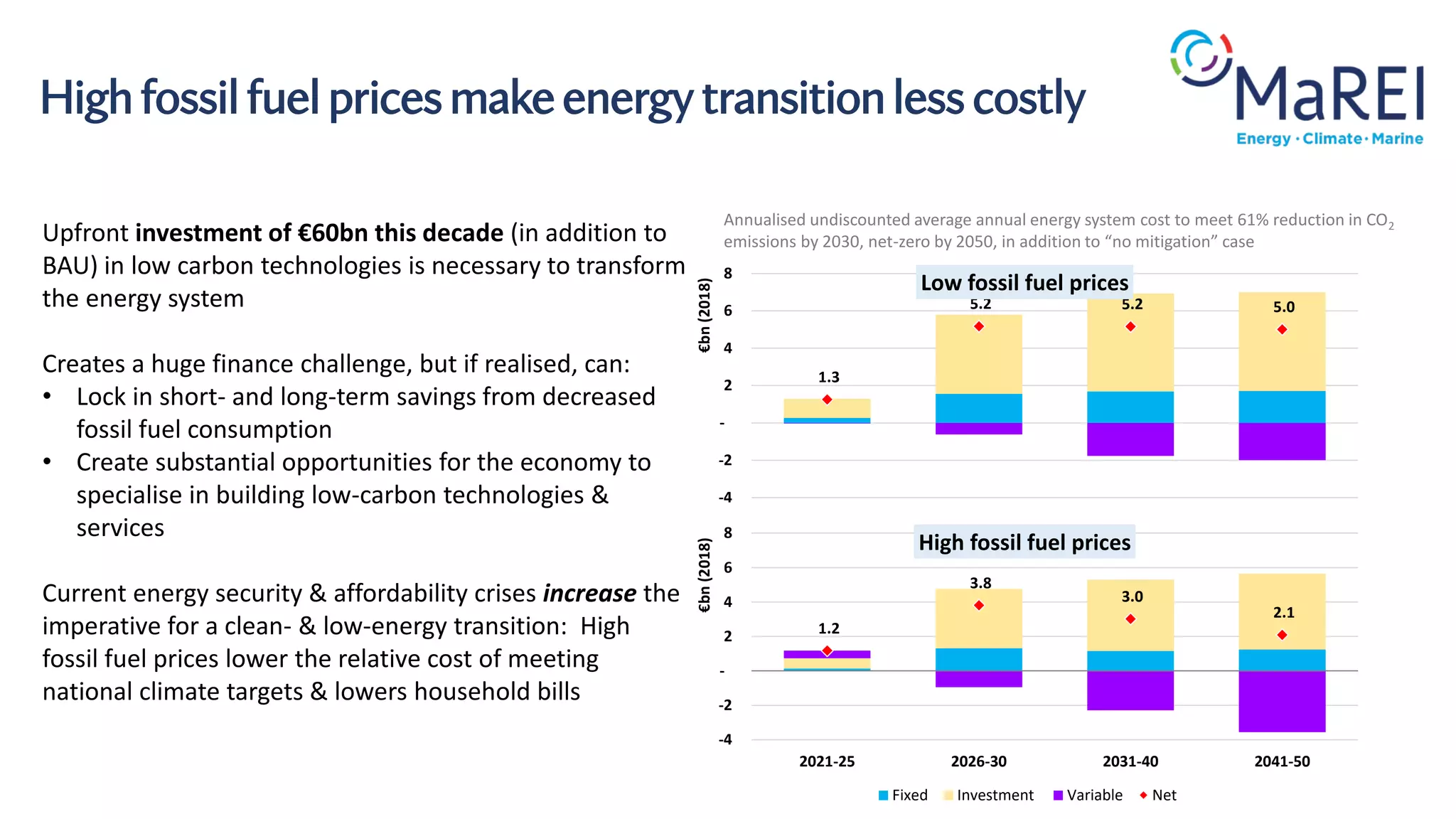
High fossil fuel prices make energy transition less costly
1.2
3.8
3.0
2.1
-4
-2
-
2
4
6
8
2021-25 2026-30 2031-40 2041-50
€bn
(2018)
High fossil fuel prices
Fixed Investment Variable Net
1.3
5.2 5.2 5.0
-4
-2
-
2
4
6
8
€bn
(2018)
Low fossil fuel prices
Annualised undiscounted average annual energy system cost to meet 61% reduction in CO2
emissions by 2030, net-zero by 2050, in addition to “no mitigation” case
Upfront investment of €60bn this decade (in addition to
BAU) in low carbon technologies is necessary to transform
the energy system
Creates a huge finance challenge, but if realised, can:
• Lock in short- and long-term savings from decreased
fossil fuel consumption
• Create substantial opportunities for the economy to
specialise in building low-carbon technologies &
services
Current energy security & affordability crises increase the
imperative for a clean- & low-energy transition: High
fossil fuel prices lower the relative cost of meeting
national climate targets & lowers household bills
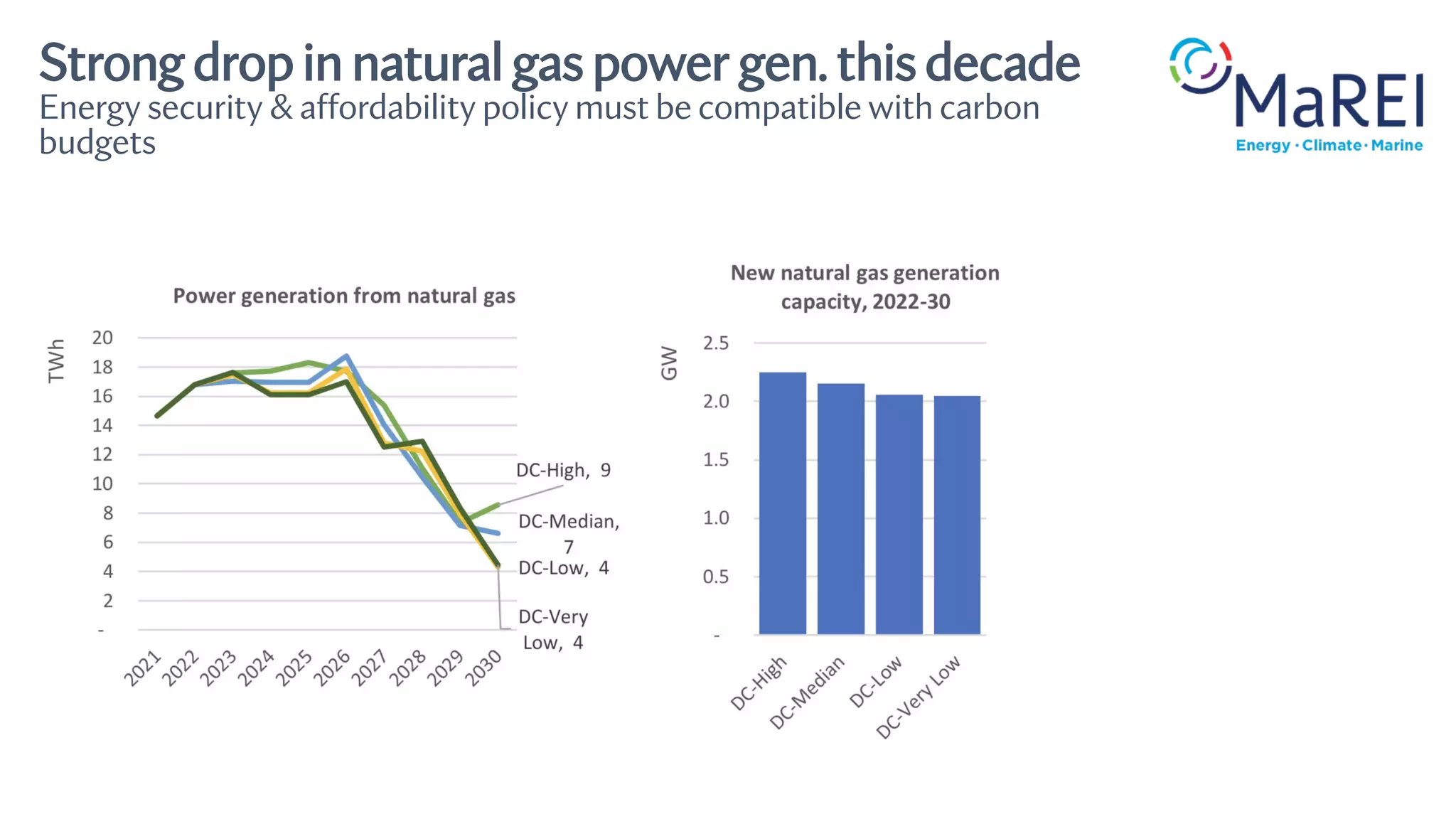
Strong drop in natural gas power gen. this decade
Energy security & affordability policy must be compatible with carbon
budgets
Conclusions
❖Carbon budgets require transition of unprecedented speed & scale and Herculean effort. High marginal
abatement cost signal need for rapid action: any delay in mitigation raises cost.
❖Combination of measures to accelerate innovation & deployment of new technology and lower energy
demands is necessary to meet sectoral budgets: broad-brush approach necessary.
❖Technologies required to meet trajectory to 2030 are already mature, and often cost-optimal or bring
wider societal benefits. Modelling driven by user constraints on speed – how to remove barriers?
❖Analysis at the centre of highly political and public discourse – important role for models and analysis to
inform policymakers, hold commitments to account, communicate what is required to public
Contact
h.daly@ucc.ie

Using the TIMES-Ireland Model (TIM) to understand Ireland's Carbon Budget implementation gap

  • 1.
    Using the TIMES-IrelandModel (TIM) to inform Ireland’s energy transition ETSAP Winter Workshop – 2022 – Columbia University Prof. Hannah Daly University College Cork – December 1st 2022 1 TIM development team: Dr. Olexandr Balyk Andrew Smith Ankita Gaur Vahid Aryanpur Jason McGuire
  • 2.
    Ireland’s climate commitment Legally-bindingcarbon budget framework consistent with Paris Agreement - 20 40 60 80 1990 2000 2010 2020 2030 2040 2050 Mt CO 2 e COVID19 Pandemic 3.6% fall in GHGs Carbon Budget 1 4.8% annual fall Carbon Budget 2 8.3% annual fall CB1: 295 Mt CB2: 200 Mt
  • 3.
    Ireland has oneof the most ambitious 2030 decarbonisation targets in the world Ireland’s high share of emissions from agriculture make achieving this target even more challenging Agriculture share of total GHGs, 2018 Excluding LULUCF emissions New Zealand targets 10% reduction on 2017 methane by 2030 and ~40% reduction in emissions of other gases Ireland’s target relative to 1990 is not world-leading because of historical lack of action
  • 4.
    TIMES- Ireland Model(TIM) Energy systems modelling to inform climate mitigation policy: Feasibility & mapping of detailed decarbonised energy pathways Given • Climate policy constraints • Energy demand dynamics • Future technology evolution • Geopolitical outlook – energy prices • Feasible growth rates TIMcalculates • Energy flows & investment needs • Emissions trajectories • Total system cost • Energy imports & exports • Marginal energy & CO2 prices • Unmitigated emissions: “Backstop” technology at €2k/tCO2 Transparency& accessibility • Model is freely available on GitHub: https://github.com/MaREI-EPMG/TIMES-Ireland-model • Documentation paper is peer-reviewed and open source: https://gmd.copernicus.org/preprints/gmd-2021-359/ • Interactive results dashboard: https://tim-carbon-budgets-2021.netlify.app/results
  • 5.
    ❖ Model fullyopen-source ❖ “Best-practice” development approach – Git used for version control and integration, open web app for results analysis & diagnostics ❖ Developers with international expertise and links with global TIMES community, allowing knowledge- sharing ❖ Using TIMES framework – well-proven, high quality, continuously developed/maintained, open source code ❖ Flexible integration – Simultaneously maintaining “stable, policy-ready” model and development of research variants, allowing innovations in ESOMs, pushing state-of-the-art – leveraging across projects TIM development process ❖ Strength of systems approach – automatic “sector coupling” by design – where is the best use of resources? What are sectoral trade-offs? ❖ Extensive stakeholder review ❖ Training PhDs, interns etc. & wider engagement integral for national capacity-building ❖ A focus on alternate scenarios, sensitivities, “what if” analyses ❖ Dynamic integration with national data sources and other national models (where possible)
  • 6.
    15.7 13.9 17.3 19.7 - 20 40 2018 2025 20302050 Mt CO 2 -65% -61% -57% -51% Four core scenarios modelled, representing the decarbonisation effort allocated to the energy system between 2018 & 2030 to meet overall carbon budgets: Carbon Budget 1 Carbon Budget 2 Additional scenarios: Alternative GHG constraints Alternative technology deployment constraints & demand Early action (from 2020); Low Energy Demand (LED) scenario Late action; Higher wind & solar Constrained carbon budget; Limited Bioenergy/High bioenergy No mitigation; No CCS/Early CCS Climate Action Plan 2019 ambition “Technology optimism” Carbon budget scenarios modelled TIM supported Climate Change Advisory Council evidence base for carbon budgets
  • 7.
    Marginal Abatement Cost Informingthe valuation of carbon in the Public Spending Code - 500 1,000 1,500 2,000 2,500 2023 2025 2027 2029 2031 2033 2035 2037 2039 2041 2043 2045 2047 2049 €/tCO2 Core Low DC High DC High REN Low Energy Demand MAC is sensitive to parameters we modelled: • Lower final demand, faster RE deployment, lower Data Centre (DC) demand lower the MAC • The opposite signal increases the MAC • Considerable uncertainty in longer-term, based on
  • 8.
    A-51%,E-51% A-40%,E-57% A-33%,E-61%A-25%,E-65% Core “BAU” demands, no bioenergy imports, 4-times 2018 indigenous bioenergy, no power-CCS available, no H2 import, ~74% RES-E €674 €1,100 €1,292 €1,485 Low Energy Demand (LED) Decoupling energy service demands: mobility shifting; dematerialisation; lower heating €128 €403 €545 €757 Tech-Optimism Up to 25GW VAR-RE by 2030; additional H2 & Bioenergy, 400 MW CCS available from 2027. >90% zero-carbon power generation €436 €639 €812 €1,284 LED + Tech-optimism €76 €125 €202 €317 The Marginal Abatement Cost represents the cost of mitigating the most expensive tonne of CO2 in each scenario for the energy sector Marginal Abatement Cost (2025-30 average) in core mitigation scenarios and scenario variants
  • 9.
    Fossil fuels fallfrom 90% of primary energy demand in 2018 to 45-56% in 2030 46% 34% 11% 3% 6% 2018 Oil* Natural Gas Solid fuel** Bioenergy Other renewables*** 2030 * Oil excludes kerosene for international aviation ** Coal, peat and MSW *** Primary wind, solar, ambient heat, hydro & ocean 22% 33% 1% 12% 32% A-51%, E-51% 14% 30% 1% 15% 40% A-25%,E-65% Dr. Hannah E. Daly, 3/11/2021
  • 10.
    Final energy consumption& power generation - 50 100 150 200 2018 E-51% E-65% 2030 PJ Power generation - 30 60 90 120 2018 E-51% E-65% 2030 PJ Industry - 45 90 135 180 2018 E-51% E-65% 2030 PJ Transport - 50 100 150 200 2018 E-51% E-65% 2030 PJ Buildings Dr. Hannah E. Daly, 3/11/2021
  • 11.
    - 20 40 60 80 1990 2000 20102020 2030 2040 2050 Mt CO 2 e Greenhouse gas emissions are still rising Gap between carbon budget commitments and delivery will create further challenges later in the decade
  • 12.
    High fossil fuelprices make energy transition less costly 1.2 3.8 3.0 2.1 -4 -2 - 2 4 6 8 2021-25 2026-30 2031-40 2041-50 €bn (2018) High fossil fuel prices Fixed Investment Variable Net 1.3 5.2 5.2 5.0 -4 -2 - 2 4 6 8 €bn (2018) Low fossil fuel prices Annualised undiscounted average annual energy system cost to meet 61% reduction in CO2 emissions by 2030, net-zero by 2050, in addition to “no mitigation” case Upfront investment of €60bn this decade (in addition to BAU) in low carbon technologies is necessary to transform the energy system Creates a huge finance challenge, but if realised, can: • Lock in short- and long-term savings from decreased fossil fuel consumption • Create substantial opportunities for the economy to specialise in building low-carbon technologies & services Current energy security & affordability crises increase the imperative for a clean- & low-energy transition: High fossil fuel prices lower the relative cost of meeting national climate targets & lowers household bills
  • 13.
    Strong drop innatural gas power gen. this decade Energy security & affordability policy must be compatible with carbon budgets
  • 14.
    Conclusions ❖Carbon budgets requiretransition of unprecedented speed & scale and Herculean effort. High marginal abatement cost signal need for rapid action: any delay in mitigation raises cost. ❖Combination of measures to accelerate innovation & deployment of new technology and lower energy demands is necessary to meet sectoral budgets: broad-brush approach necessary. ❖Technologies required to meet trajectory to 2030 are already mature, and often cost-optimal or bring wider societal benefits. Modelling driven by user constraints on speed – how to remove barriers? ❖Analysis at the centre of highly political and public discourse – important role for models and analysis to inform policymakers, hold commitments to account, communicate what is required to public
  • 15.