A Streamlined
                       Approach to
                       Customized
                       Employment
      Job Creation in 5 Steps
for Job Developers Serving People
     with Significant Disabilities
              Joe Chiappetta
    Chicagoland Chamber of Commerce
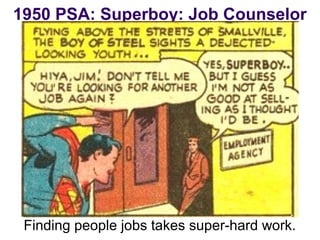
1950 PSA: Superboy: Job Counselor


 Finding people jobs takes super-hard work.
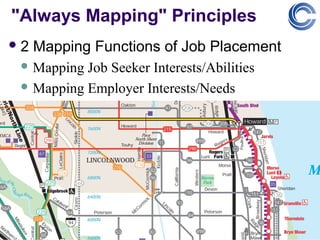
"Always Mapping" Principles
2   Mapping Functions of Job Placement
  Mapping Job Seeker Interests/Abilities
  Mapping Employer Interests/Needs
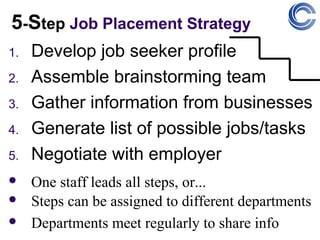
5-Step Job Placement Strategy
1.   Develop job seeker profile
2.   Assemble brainstorming team
3.   Gather information from businesses
4.   Generate list of possible jobs/tasks
5.   Negotiate with employer
    One staff leads all steps, or...
    Steps can be assigned to different departments
    Departments meet regularly to share info
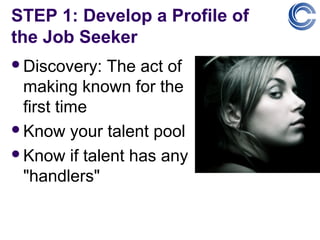
STEP 1: Develop a Profile of
the Job Seeker
Discovery:  The act of
 making known for the
 first time
Know your talent pool

Know if talent has any
 "handlers"
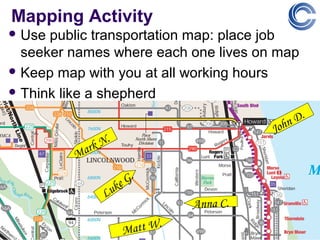
Mapping Activity
 Use public transportation map: place job
  seeker names where each one lives on map
 Keep map with you at all working hours

 Think like a shepherd

                                               D.
                                          John
               N.
         M ark

                     e G.
               Luk
                                Anna C.

                     M att W.
 With each question,
Discovery         ask "Why?"
Questions for    May need to rephrase

Job Seekers       questions
                 Ask same questions 1
                  month later
                  May get different answers
                  For your benefit (review)

                 Pictures
                        or
                 demonstrations
                 enhance questions
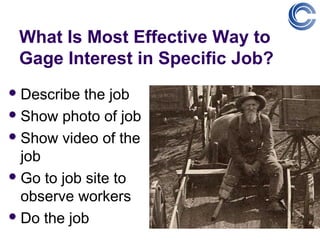
What Is Most Effective Way to
 Gage Interest in Specific Job?
 Describe  the job
 Show photo of job

 Show video of the
  job
 Go to job site to
  observe workers
 Do the job
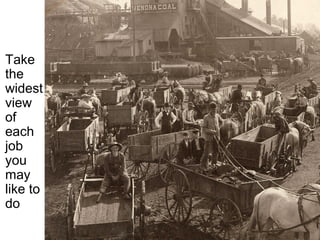
The More Immersion, the
       Better Decision a Person
 Take Makes on their Interests
 the
 widest
 view
 of
 each
 job
 you
 may
 like to
 do
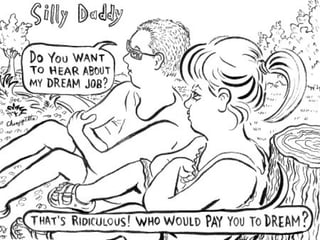
Dream Job Cartoon
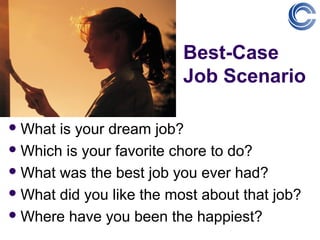
Best-Case
                          Job Scenario

 What is your dream job?
 Which is your favorite chore to do?

 What was the best job you ever had?

 What did you like the most about that job?

 Where have you been the happiest?
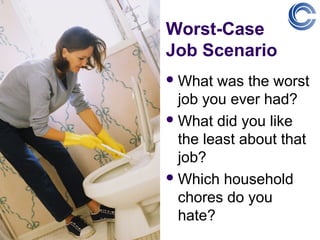
Worst-Case
Job Scenario
 What  was the worst
  job you ever had?
 What did you like
  the least about that
  job?
 Which household
  chores do you
  hate?
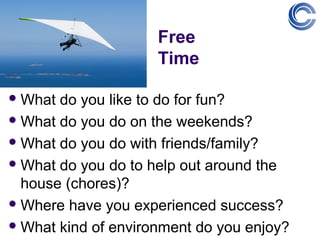
Free
                     Time

 What do you like to do for fun?
 What do you do on the weekends?

 What do you do with friends/family?

 What do you do to help out around the
  house (chores)?
 Where have you experienced success?

 What kind of environment do you enjoy?
School Days
      What   subjects or
       classes did you like in
       school? Why?
      What subjects or
       classes did you not
       like in school? Why?
      What did you not like
       about those topics?
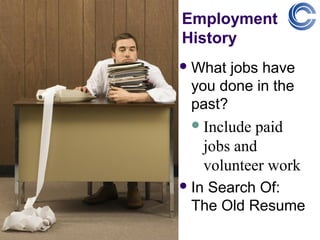
Employment
History
 What jobs have
 you done in the
 past?
  Include paid
   jobs and
   volunteer work
 In
   Search Of:
 The Old Resume
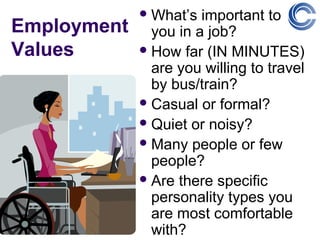
 What’s  important to
Employment     you in a job?
Values        How far (IN MINUTES)
               are you willing to travel
               by bus/train?
              Casual or formal?
              Quiet or noisy?
              Many people or few
               people?
              Are there specific
               personality types you
               are most comfortable
               with?
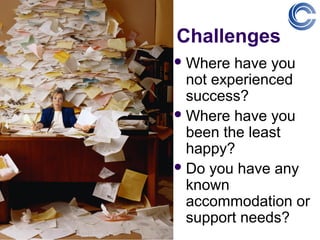
Challenges
 Where  have you
  not experienced
  success?
 Where have you
  been the least
  happy?
 Do you have any
  known
  accommodation or
  support needs?
STEP 2: Assemble a
Brainstorming Team
 Social Capital (a sociology term): benefits
  gained from preferential treatment between
  people
   Leveraged relationships
 Mining contacts/insight from the job
  seeker's own contacts
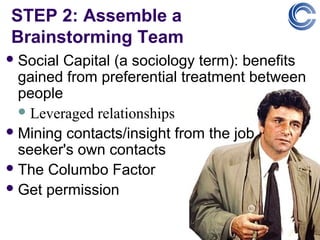
 The Columbo Factor
 Get permission
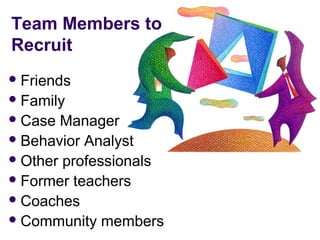
Team Members to
Recruit
 Friends
 Family
 Case Manager
 Behavior Analyst
 Other professionals
 Former teachers
 Coaches
 Community members
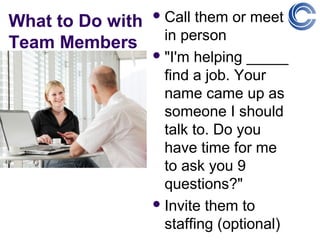
 Call  them or meet
What to Do with
                    in person
Team Members
                   "I'm helping _____
                    find a job. Your
                    name came up as
                    someone I should
                    talk to. Do you
                    have time for me
                    to ask you 9
                    questions?"
                   Invite them to
                    staffing (optional)
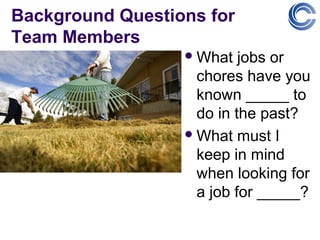
Background Questions for
Team Members
                   What   jobs or
                    chores have you
                    known _____ to
                    do in the past?
                   What must I
                    keep in mind
                    when looking for
                    a job for _____?
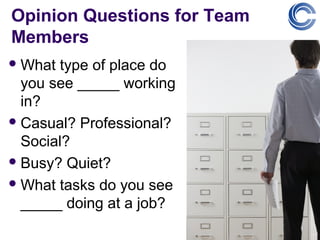
Opinion Questions for Team
Members
 What type of place do
  you see _____ working
  in?
 Casual? Professional?
  Social?
 Busy? Quiet?

 What tasks do you see
  _____ doing at a job?
Contact Mining Questions for
Team Members
 What   types of businesses might be a good
  match?
 Do you know anyone who works in _____
  [type of business]?
 Can I use your name when I contact them?

 Do you know any hiring managers,
  business owners, executives, government
  officials, community leaders, or any other
  persons of influence?
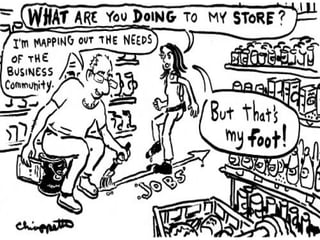
STEP 3: Gather Information from
Businesses (Cartoon)
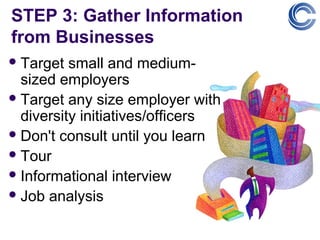
STEP 3: Gather Information
from Businesses
 Target  small and medium-
  sized employers
 Target any size employer with
  diversity initiatives/officers
 Don't consult until you learn
 Tour
 Informational interview
 Job analysis
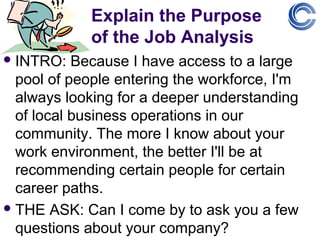
Explain the Purpose
             of the Job Analysis
 INTRO:   Because I have access to a large
  pool of people entering the workforce, I'm
  always looking for a deeper understanding
  of local business operations in our
  community. The more I know about your
  work environment, the better I'll be at
  recommending certain people for certain
  career paths.
 THE ASK: Can I come by to ask you a few
  questions about your company?
Warm-Up Questions
 What  is the work
  atmosphere and
  culture like here?
 What kinds of job
  duties do your
  workers perform?
  Feel free to include
  the behind-the-
  scenes details.
Forecast Questions
             What   are areas of
              potential growth for
              your business?
             Where would you like
              to see your business in
              five years? Ten years?
             Are there services your
              business would like to
              offer, or could offer,
              that are not in place
              presently?
Gap-Seeking Questions (1 of 2)
 When  is the company busiest: each
  day, during the week, during the year?
 Are there tasks that could be done
  more efficiently or more often?
 Are there tasks not getting done
  because no one has the time?
 Are there tasks that take employees
  away from their more critical job
  duties? (areas of expertise or "real"
  jobs)
Gap-Seeking Questions (2 of 2)
 Do  you have employees working overtime?
 Are there tasks that you use temporary or
  student employees for?
 If you could have help with anything, what
  would it be?
 If your employees could have help with
  anything, what do you think it would be?
 What is the biggest challenge the business
  faces in its day-to-day operations?
STEP 4: Generate List of
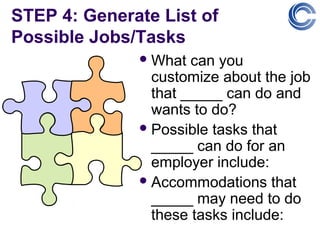
Possible Jobs/Tasks
               What  can you
                customize about the job
                that _____ can do and
                wants to do?
               Possible tasks that
                _____ can do for an
                employer include:
               Accommodations that
                _____ may need to do
                these tasks include:
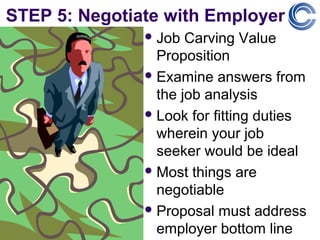
STEP 5: Negotiate with Employer
                Job  Carving Value
                 Proposition
                Examine answers from
                 the job analysis
                Look for fitting duties
                 wherein your job
                 seeker would be ideal
                Most things are
                 negotiable
                Proposal must address
                 employer bottom line
Value Proposition Questions
 When    proposing new position, plan
  must answer "Yes" to these questions:
 Will creating this job help employer to...

   Increase workforce effectiveness and
    efficiency?
   Fill gaps in the workplace?

   Reduce costly or inefficient temporary
    help and overtime wages?
   Increase customer satisfaction?
Before Making the
Job Carve Pitch
 Establish trust
 Place a person without carving

 Be professional

 Write proposal to company

 Share other success stories

 Conduct disability awareness
  training
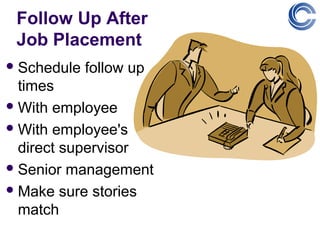
Follow Up After
 Job Placement
 Schedule   follow up
  times
 With employee

 With employee's
  direct supervisor
 Senior management

 Make sure stories
  match
Chicagoland Chamber
                   of Commerce

If info from this session helps you find
    anyone a job, please let me know:
                          Joe Chiappetta
 http://www.linkedin.com/in/chiappetta/
            www.chicagolandchamber.org

A Streamlined Approach to Customized Employment

  • 1.
    A Streamlined Approach to Customized Employment Job Creation in 5 Steps for Job Developers Serving People with Significant Disabilities Joe Chiappetta Chicagoland Chamber of Commerce
  • 2.
    1950 PSA: Superboy:Job Counselor Finding people jobs takes super-hard work.
  • 3.
    "Always Mapping" Principles 2 Mapping Functions of Job Placement  Mapping Job Seeker Interests/Abilities  Mapping Employer Interests/Needs
  • 4.
    5-Step Job PlacementStrategy 1. Develop job seeker profile 2. Assemble brainstorming team 3. Gather information from businesses 4. Generate list of possible jobs/tasks 5. Negotiate with employer  One staff leads all steps, or...  Steps can be assigned to different departments  Departments meet regularly to share info
  • 5.
    STEP 1: Developa Profile of the Job Seeker Discovery: The act of making known for the first time Know your talent pool Know if talent has any "handlers"
  • 6.
    Mapping Activity  Usepublic transportation map: place job seeker names where each one lives on map  Keep map with you at all working hours  Think like a shepherd D. John N. M ark e G. Luk Anna C. M att W.
  • 7.
     With eachquestion, Discovery ask "Why?" Questions for  May need to rephrase Job Seekers questions  Ask same questions 1 month later  May get different answers  For your benefit (review)  Pictures or demonstrations enhance questions
  • 8.
    What Is MostEffective Way to Gage Interest in Specific Job?  Describe the job  Show photo of job  Show video of the job  Go to job site to observe workers  Do the job
  • 9.
    The More Immersion,the Better Decision a Person  Take Makes on their Interests the widest view of each job you may like to do
  • 10.
  • 11.
    Best-Case Job Scenario  What is your dream job?  Which is your favorite chore to do?  What was the best job you ever had?  What did you like the most about that job?  Where have you been the happiest?
  • 12.
    Worst-Case Job Scenario  What was the worst job you ever had?  What did you like the least about that job?  Which household chores do you hate?
  • 13.
    Free Time  What do you like to do for fun?  What do you do on the weekends?  What do you do with friends/family?  What do you do to help out around the house (chores)?  Where have you experienced success?  What kind of environment do you enjoy?
  • 14.
    School Days  What subjects or classes did you like in school? Why?  What subjects or classes did you not like in school? Why?  What did you not like about those topics?
  • 15.
    Employment History  What jobshave you done in the past?  Include paid jobs and volunteer work  In Search Of: The Old Resume
  • 16.
     What’s important to Employment you in a job? Values  How far (IN MINUTES) are you willing to travel by bus/train?  Casual or formal?  Quiet or noisy?  Many people or few people?  Are there specific personality types you are most comfortable with?
  • 17.
    Challenges  Where have you not experienced success?  Where have you been the least happy?  Do you have any known accommodation or support needs?
  • 18.
    STEP 2: Assemblea Brainstorming Team  Social Capital (a sociology term): benefits gained from preferential treatment between people  Leveraged relationships  Mining contacts/insight from the job seeker's own contacts  The Columbo Factor  Get permission
  • 19.
    Team Members to Recruit Friends  Family  Case Manager  Behavior Analyst  Other professionals  Former teachers  Coaches  Community members
  • 20.
     Call them or meet What to Do with in person Team Members  "I'm helping _____ find a job. Your name came up as someone I should talk to. Do you have time for me to ask you 9 questions?"  Invite them to staffing (optional)
  • 21.
    Background Questions for TeamMembers  What jobs or chores have you known _____ to do in the past?  What must I keep in mind when looking for a job for _____?
  • 22.
    Opinion Questions forTeam Members  What type of place do you see _____ working in?  Casual? Professional? Social?  Busy? Quiet?  What tasks do you see _____ doing at a job?
  • 23.
    Contact Mining Questionsfor Team Members  What types of businesses might be a good match?  Do you know anyone who works in _____ [type of business]?  Can I use your name when I contact them?  Do you know any hiring managers, business owners, executives, government officials, community leaders, or any other persons of influence?
  • 24.
    STEP 3: GatherInformation from Businesses (Cartoon)
  • 25.
    STEP 3: GatherInformation from Businesses  Target small and medium- sized employers  Target any size employer with diversity initiatives/officers  Don't consult until you learn  Tour  Informational interview  Job analysis
  • 26.
    Explain the Purpose of the Job Analysis  INTRO: Because I have access to a large pool of people entering the workforce, I'm always looking for a deeper understanding of local business operations in our community. The more I know about your work environment, the better I'll be at recommending certain people for certain career paths.  THE ASK: Can I come by to ask you a few questions about your company?
  • 27.
    Warm-Up Questions  What is the work atmosphere and culture like here?  What kinds of job duties do your workers perform? Feel free to include the behind-the- scenes details.
  • 28.
    Forecast Questions  What are areas of potential growth for your business?  Where would you like to see your business in five years? Ten years?  Are there services your business would like to offer, or could offer, that are not in place presently?
  • 29.
    Gap-Seeking Questions (1of 2)  When is the company busiest: each day, during the week, during the year?  Are there tasks that could be done more efficiently or more often?  Are there tasks not getting done because no one has the time?  Are there tasks that take employees away from their more critical job duties? (areas of expertise or "real" jobs)
  • 30.
    Gap-Seeking Questions (2of 2)  Do you have employees working overtime?  Are there tasks that you use temporary or student employees for?  If you could have help with anything, what would it be?  If your employees could have help with anything, what do you think it would be?  What is the biggest challenge the business faces in its day-to-day operations?
  • 31.
    STEP 4: GenerateList of Possible Jobs/Tasks  What can you customize about the job that _____ can do and wants to do?  Possible tasks that _____ can do for an employer include:  Accommodations that _____ may need to do these tasks include:
  • 32.
    STEP 5: Negotiatewith Employer  Job Carving Value Proposition  Examine answers from the job analysis  Look for fitting duties wherein your job seeker would be ideal  Most things are negotiable  Proposal must address employer bottom line
  • 33.
    Value Proposition Questions When proposing new position, plan must answer "Yes" to these questions:  Will creating this job help employer to...  Increase workforce effectiveness and efficiency?  Fill gaps in the workplace?  Reduce costly or inefficient temporary help and overtime wages?  Increase customer satisfaction?
  • 34.
    Before Making the JobCarve Pitch  Establish trust  Place a person without carving  Be professional  Write proposal to company  Share other success stories  Conduct disability awareness training
  • 35.
    Follow Up After Job Placement  Schedule follow up times  With employee  With employee's direct supervisor  Senior management  Make sure stories match
  • 36.
    Chicagoland Chamber of Commerce If info from this session helps you find anyone a job, please let me know: Joe Chiappetta http://www.linkedin.com/in/chiappetta/ www.chicagolandchamber.org

Editor's Notes

  • #2 High speed train photo
  • #3 You need to be super at helping people find employment. That doesn’t take super powers. It takes hard work. Illustration: Superboy helping someone find a job
  • #4 Public transportation map detail
  • #6 Photo: Profile of a woman
  • #7 Public transportation map
  • #8 Illustration: Person seeking answers
  • #9 Photo Detail: 1903, Sam Hallam with Prosthetic Leg working on coal wagon at Wenona Coal Company, Illinois
  • #10 Photo: 1903, Sam Hallam with Prosthetic Leg working on coal wagon at Wenona Coal Company, Illinois
  • #11 Comic by Joe Chiappetta: “Do you want to hear about my dream job?” a brother asks his younger sister. The sister replies, “That’s ridiculous! Who would pay you to dream?”
  • #12 Photo: Profile of woman working
  • #13 Photo: Woman cleaning toilet
  • #14 Photo: person hang gliding
  • #15 Photo: Kid walking to school
  • #16 Photo: Man overworked at office
  • #17 Illustration: Woman in wheelchair working at desk
  • #18 Photo: Woman at desk with a hill of paperwork
  • #19 Photo: Detective Columbo
  • #20 Illustration: People working together to fit pieces in proper place
  • #21 Photo: Two people in a meeting
  • #22 Photo: People working on the yard
  • #23 Photo: Office worker by filing cabinets
  • #24 Illustration: Business card holder
  • #25 Comic by Joe Chiappetta: “What are you doing in my store?” asks the store manager as her aisle and shoe is painted over by an employment specialist. The employment specialist replies, “I’m mapping out the needs of the business community.” The manager exclaims, “But that’s my foot!”
  • #26 Illustration: Worker gathering information from a city
  • #27 Illustration: Worker seeking direction
  • #28 Illustration: Worker on assembly line
  • #29 Photo: Worker seeking with spyglass
  • #30 Illustration: person putting pieces together
  • #31 Illustration: Pie pieces coming together
  • #32 Illustration: Puzzle pieces together
  • #33 Illustration: Worker standing in a puzzle
  • #34 Illustration: Group having bright ideas
  • #35 Illustration: Baseball pitcher throwing
  • #36 Illustration: People scheduling in an office
  • #37 Logo: Chicagoland Chamber of Commerce - Disabilityworks