Applica t i o n Brief
Abstract
High-density arrays that simultaneously genotype hundreds of thousands of single nucleotide polymorphisms (SNPs) can theoretically be
a powerful tool for population genetics studies, whether for learning about human history or natural selection. However, SNP arrays
designed for medical genetics have been limited in their utility for population genetics because the polymorphisms on the arrays were
discovered and selected for inclusion in a complicated manner that is difficult to model. This “ascertainment bias” has severely limited the
types of population genetic analyses that can be carried out with SNP arrays. Here we report on the first SNP array for human population
genetics studies, developed in collaboration with Harvard Medical School.
A total of 1.81 million candidate SNPs, all from genome locations covered by sequencing reads from Neanderthals, Denisovans, and
chimpanzees, were ascertained using a simple SNP discovery procedure first described by Keinan, et al., 2007.1 The most important
ascertainment involved using whole-genome shotgun sequencing data to discover differences between the two chromosomes carried by
individuals from 11 populations (San, Yoruba, Mbuti, French, Sardinian, Han, Cambodian, Mongolian, Karitiana, Papuan, and Bougainville).
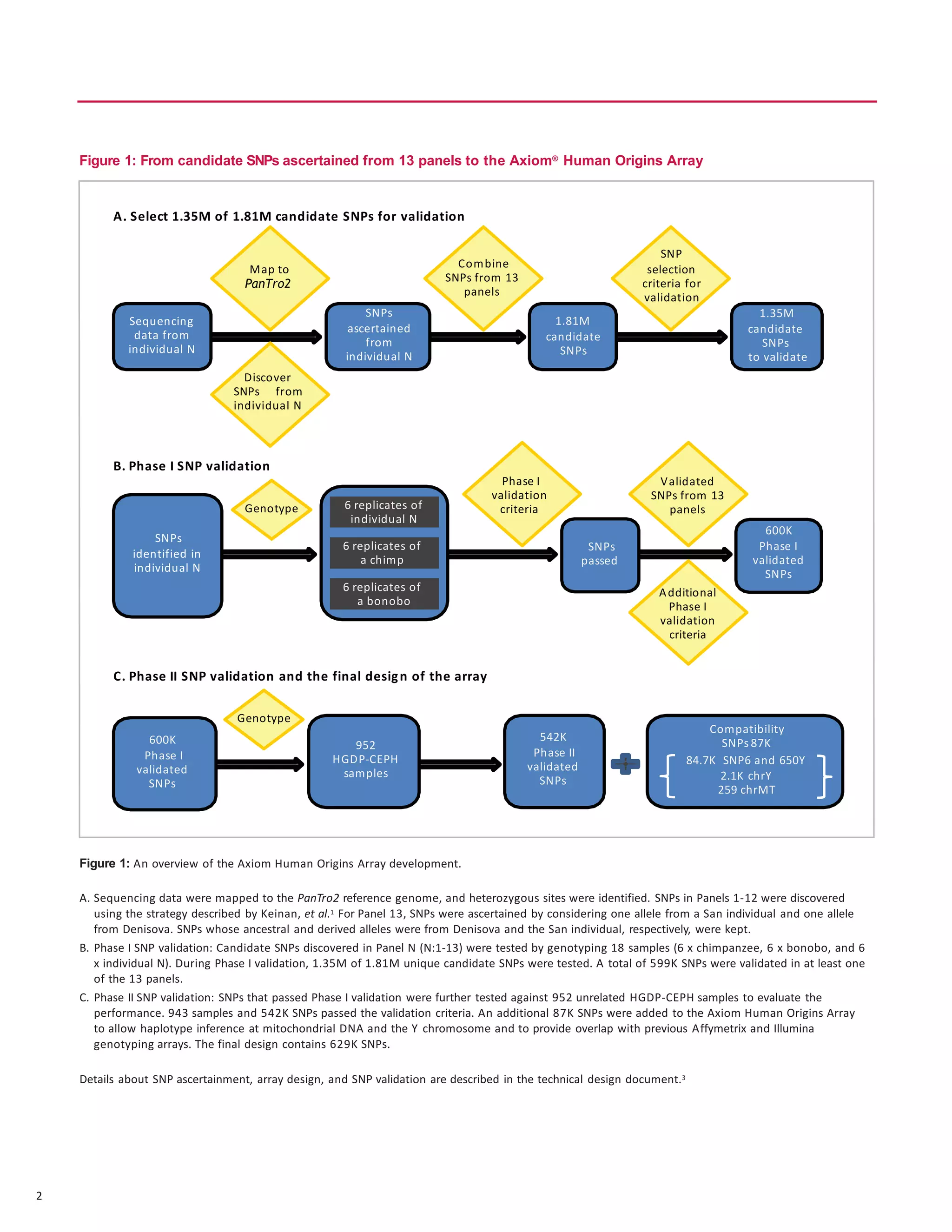
This resulted in 13 panels of SNPs ascertained in simple ways that are appropriate for population genetic analysis (Figure 1). An Axiom®
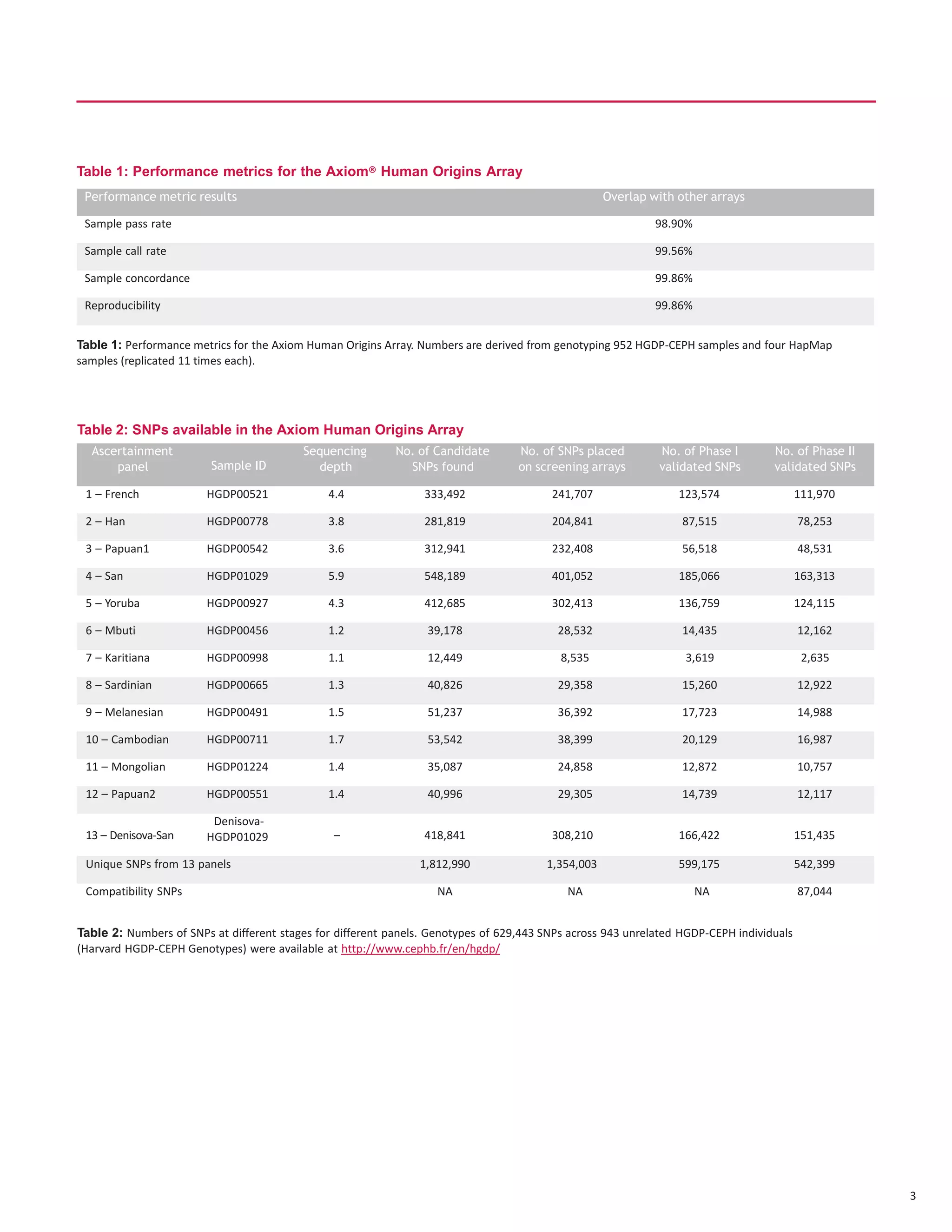
genotyping screen was carried to validate 1.35 million SNPs on the Axiom platform (Table 2). A total of 542,399 SNPs were selected
that produced genotypes that passed rigorous quality thresholds appropriate for inclusion in a commercial array design. To facilitate
joint analysis with other data sets that have been collected on diverse populations, the final array contains an additional approximately
87,044 SNPs that overlap between the Affymetrix® Genome-Wide Human SNP Array 6.0 and the Illumina® 650Y Array.
We genotyped 943 unrelated samples from 53 populations in the CEPH-Human Genome Diversity Panel (Cann, et al., 20022), and have
made the data freely available in the CEPH-HGDP database (Table 1). In addition, we report on the genotyping of approximately 400
samples from 70 other diverse worldwide populations. Preliminary analyses demonstrate the promise of this SNP array for population
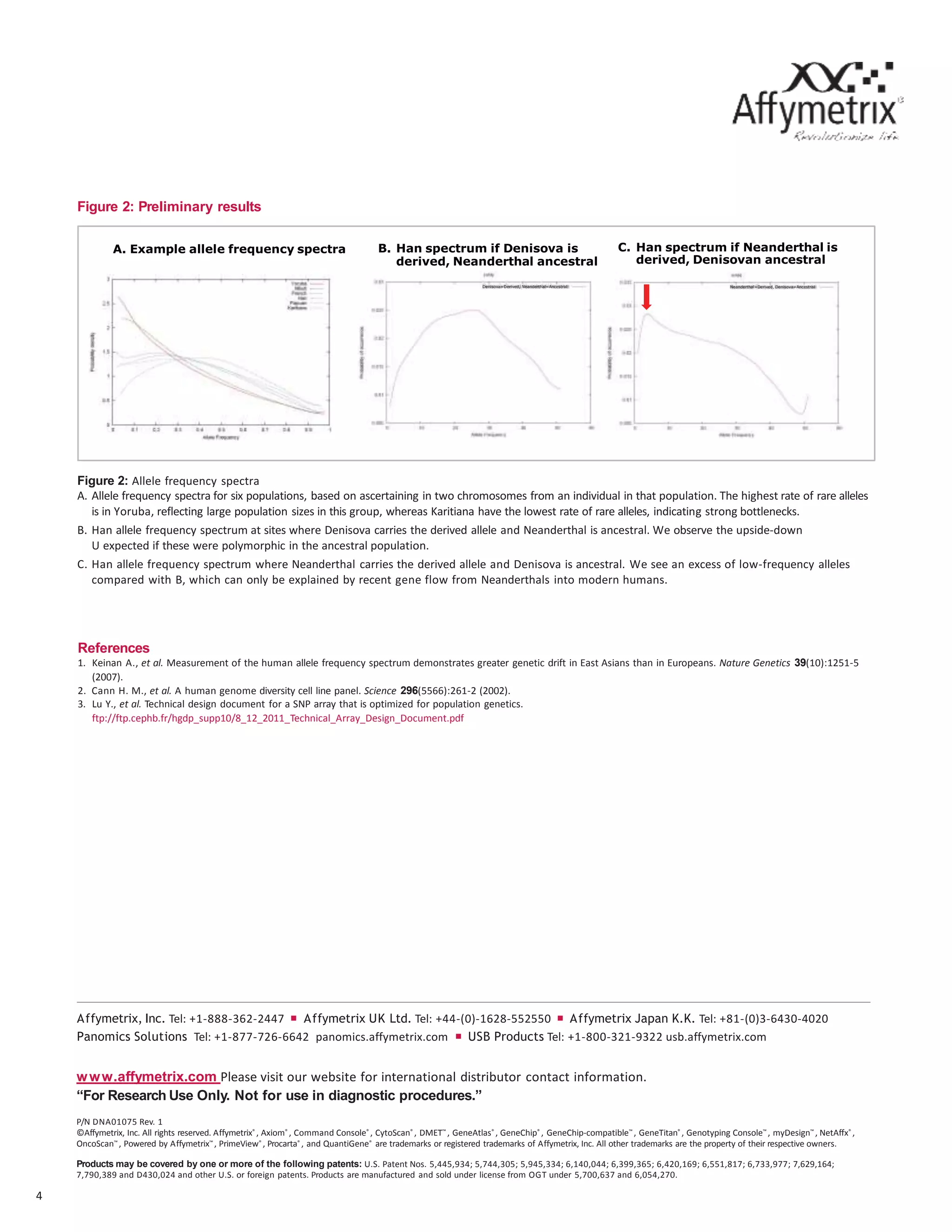
genetics. As examples, we use the data to provide a new line of evidence for gene flow from Neanderthals into modern humans (Figure 2).
1
A SNP array for human population genetics studies
Yontao Lu1
, Teri Genschoreck1
, Swapan Mallick2,3
, Amy Ollmann1
, Nick Patterson3
, Yiping Zhan1
,
Teresa Webster1
, David Reich2,3
1. Affymetrix, Inc., 3420 Central Expressway, Santa Clara, CA 95051
2. Harvard Medical School Department of Genetics, Boston, MA 02115
3. Broad Institute of Harvard and MIT, Cambridge, MA 02142
2
1.81M
candidate
SNPs
Sequencing
data from
individual N
SNPs
ascertained
from
individual N
1.35M
candidate
SNPs
to validate
B. Phase I SNP validation
6 replicates of
individual N
SNPs
passed
6 replicates of
a chimp
6 replicates of
a bonobo
600K
Phase I
validated
SNPs
SNPs
identified in
individual N
C. Phase II SNP validation and the final design of the array
542K
Phase II
validated
SNPs
600K
Phase I
validated
SNPs
952
HGDP-CEPH
samples
Compatibility
SNPs 87K
84.7K SNP6 and 650Y
2.1K chrY
259 chrMT
Discover
SNPs from
individual N
Map to
PanTro2
Combine
SNPs from 13
panels
SNP
selection
criteria for
validation
Validated
SNPs from 13
panels
Additional
Phase I
validation
criteria
Phase I
validation
criteriaGenotype
Genotype
Figure 1: From candidate SNPs ascertained from 13 panels to the Axiom®
Human Origins Array
A. Select 1.35M of 1.81M candidate SNPs for validation
Figure 1: An overview of the Axiom Human Origins Array development.
A. Sequencing data were mapped to the PanTro2 reference genome, and heterozygous sites were identified. SNPs in Panels 1-12 were discovered
using the strategy described by Keinan, et al.1 For Panel 13, SNPs were ascertained by considering one allele from a San individual and one allele
from Denisova. SNPs whose ancestral and derived alleles were from Denisova and the San individual, respectively, were kept.
B. Phase I SNP validation: Candidate SNPs discovered in Panel N (N:1-13) were tested by genotyping 18 samples (6 x chimpanzee, 6 x bonobo, and 6
x individual N). During Phase I validation, 1.35M of 1.81M unique candidate SNPs were tested. A total of 599K SNPs were validated in at least one
of the 13 panels.
C. Phase II SNP validation: SNPs that passed Phase I validation were further tested against 952 unrelated HGDP-CEPH samples to evaluate the
performance. 943 samples and 542K SNPs passed the validation criteria. An additional 87K SNPs were added to the Axiom Human Origins Array
to allow haplotype inference at mitochondrial DNA and the Y chromosome and to provide overlap with previous Affymetrix and Illumina
genotyping arrays. The final design contains 629K SNPs.
Details about SNP ascertainment, array design, and SNP validation are described in the technical design document.3
3
Table 2: SNPs available in the Axiom Human Origins Array
Ascertainment
panel Sample ID
Sequencing
depth
No. of Candidate
SNPs found
No. of SNPs placed
on screening arrays
No. of Phase I
validated SNPs
No. of Phase II
validated SNPs
1 – French HGDP00521 4.4 333,492 241,707 123,574 111,970
2 – Han HGDP00778 3.8 281,819 204,841 87,515 78,253
3 – Papuan1 HGDP00542 3.6 312,941 232,408 56,518 48,531
4 – San HGDP01029 5.9 548,189 401,052 185,066 163,313
5 – Yoruba HGDP00927 4.3 412,685 302,413 136,759 124,115
6 – Mbuti HGDP00456 1.2 39,178 28,532 14,435 12,162
7 – Karitiana HGDP00998 1.1 12,449 8,535 3,619 2,635
8 – Sardinian HGDP00665 1.3 40,826 29,358 15,260 12,922
9 – Melanesian HGDP00491 1.5 51,237 36,392 17,723 14,988
10 – Cambodian HGDP00711 1.7 53,542 38,399 20,129 16,987
11 – Mongolian HGDP01224 1.4 35,087 24,858 12,872 10,757
12 – Papuan2 HGDP00551 1.4 40,996 29,305 14,739 12,117
13 – Denisova-San
Denisova-
HGDP01029 – 418,841 308,210 166,422 151,435
Unique SNPs from 13 panels 1,812,990 1,354,003 599,175 542,399
Compatibility SNPs NA NA NA 87,044
Table 2: Numbers of SNPs at different stages for different panels. Genotypes of 629,443 SNPs across 943 unrelated HGDP-CEPH individuals
(Harvard HGDP-CEPH Genotypes) were available at http://www.cephb.fr/en/hgdp/
Table 1: Performance metrics for the Axiom® Human Origins Array
Performance metric results Overlap with other arrays
Sample pass rate 98.90%
Sample call rate 99.56%
Sample concordance 99.86%
Reproducibility 99.86%
Table 1: Performance metrics for the Axiom Human Origins Array. Numbers are derived from genotyping 952 HGDP-CEPH samples and four HapMap
samples (replicated 11 times each).
A. Example allele frequency spectra B. Han spectrum if Denisova is
derived, Neanderthal ancestral
C. Han spectrum if Neanderthal is
derived, Denisovan ancestral
Denisova=Derived, Neanderthal=Ancestral Neanderthal=Derived, Denisova=Ancestral
References
1. Keinan A., et al. Measurement of the human allele frequency spectrum demonstrates greater genetic drift in East Asians than in Europeans. Nature Genetics 39(10):1251-5
(2007).
2. Cann H. M., et al. A human genome diversity cell line panel. Science 296(5566):261-2 (2002).
3. Lu Y., et al. Technical design document for a SNP array that is optimized for population genetics.
ftp://ftp.cephb.fr/hgdp_supp10/8_12_2011_Technical_Array_Design_Document.pdf
Figure 2: Allele frequency spectra
A. Allele frequency spectra for six populations, based on ascertaining in two chromosomes from an individual in that population. The highest rate of rare alleles
is in Yoruba, reflecting large population sizes in this group, whereas Karitiana have the lowest rate of rare alleles, indicating strong bottlenecks.
B. Han allele frequency spectrum at sites where Denisova carries the derived allele and Neanderthal is ancestral. We observe the upside-down
U expected if these were polymorphic in the ancestral population.
C. Han allele frequency spectrum where Neanderthal carries the derived allele and Denisova is ancestral. We see an excess of low-frequency alleles
compared with B, which can only be explained by recent gene flow from Neanderthals into modern humans.
Figure 2: Preliminary results
Affymetrix, Inc. Tel: +1-888-362-2447  Affymetrix UK Ltd. Tel: +44-(0)-1628-552550  Affymetrix Japan K.K. Tel: +81-(0)3-6430-4020
Panomics Solutions Tel: +1-877-726-6642 panomics.affymetrix.com  USB Products Tel: +1-800-321-9322 usb.affymetrix.com
www.affymetrix.com Please visit our website for international distributor contact information.
“For Research Use Only. Not for use in diagnostic procedures.”
P/N DNA01075 Rev. 1
©Affymetrix, Inc. All rights reserved. Affymetrix® , Axiom® , Command Console® , CytoScan® , DMET™ , GeneAtlas® , GeneChip® , GeneChip-compatible™ , GeneTitan® , Genotyping Console™ , myDesign™ , NetAffx® ,
OncoScan™ , Powered by Affymetrix™ , PrimeView® , Procarta® , and QuantiGene® are trademarks or registered trademarks of Affymetrix, Inc. All other trademarks are the property of their respective owners.
Products may be covered by one or more of the following patents: U.S. Patent Nos. 5,445,934; 5,744,305; 5,945,334; 6,140,044; 6,399,365; 6,420,169; 6,551,817; 6,733,977; 7,629,164;
7,790,389 and D430,024 and other U.S. or foreign patents. Products are manufactured and sold under license from OGT under 5,700,637 and 6,054,270.
4

A SNP array for human population genetics studies

  • 1.
    Applica t io n Brief Abstract High-density arrays that simultaneously genotype hundreds of thousands of single nucleotide polymorphisms (SNPs) can theoretically be a powerful tool for population genetics studies, whether for learning about human history or natural selection. However, SNP arrays designed for medical genetics have been limited in their utility for population genetics because the polymorphisms on the arrays were discovered and selected for inclusion in a complicated manner that is difficult to model. This “ascertainment bias” has severely limited the types of population genetic analyses that can be carried out with SNP arrays. Here we report on the first SNP array for human population genetics studies, developed in collaboration with Harvard Medical School. A total of 1.81 million candidate SNPs, all from genome locations covered by sequencing reads from Neanderthals, Denisovans, and chimpanzees, were ascertained using a simple SNP discovery procedure first described by Keinan, et al., 2007.1 The most important ascertainment involved using whole-genome shotgun sequencing data to discover differences between the two chromosomes carried by individuals from 11 populations (San, Yoruba, Mbuti, French, Sardinian, Han, Cambodian, Mongolian, Karitiana, Papuan, and Bougainville). This resulted in 13 panels of SNPs ascertained in simple ways that are appropriate for population genetic analysis (Figure 1). An Axiom® genotyping screen was carried to validate 1.35 million SNPs on the Axiom platform (Table 2). A total of 542,399 SNPs were selected that produced genotypes that passed rigorous quality thresholds appropriate for inclusion in a commercial array design. To facilitate joint analysis with other data sets that have been collected on diverse populations, the final array contains an additional approximately 87,044 SNPs that overlap between the Affymetrix® Genome-Wide Human SNP Array 6.0 and the Illumina® 650Y Array. We genotyped 943 unrelated samples from 53 populations in the CEPH-Human Genome Diversity Panel (Cann, et al., 20022), and have made the data freely available in the CEPH-HGDP database (Table 1). In addition, we report on the genotyping of approximately 400 samples from 70 other diverse worldwide populations. Preliminary analyses demonstrate the promise of this SNP array for population genetics. As examples, we use the data to provide a new line of evidence for gene flow from Neanderthals into modern humans (Figure 2). 1 A SNP array for human population genetics studies Yontao Lu1 , Teri Genschoreck1 , Swapan Mallick2,3 , Amy Ollmann1 , Nick Patterson3 , Yiping Zhan1 , Teresa Webster1 , David Reich2,3 1. Affymetrix, Inc., 3420 Central Expressway, Santa Clara, CA 95051 2. Harvard Medical School Department of Genetics, Boston, MA 02115 3. Broad Institute of Harvard and MIT, Cambridge, MA 02142
  • 2.
    2 1.81M candidate SNPs Sequencing data from individual N SNPs ascertained from individualN 1.35M candidate SNPs to validate B. Phase I SNP validation 6 replicates of individual N SNPs passed 6 replicates of a chimp 6 replicates of a bonobo 600K Phase I validated SNPs SNPs identified in individual N C. Phase II SNP validation and the final design of the array 542K Phase II validated SNPs 600K Phase I validated SNPs 952 HGDP-CEPH samples Compatibility SNPs 87K 84.7K SNP6 and 650Y 2.1K chrY 259 chrMT Discover SNPs from individual N Map to PanTro2 Combine SNPs from 13 panels SNP selection criteria for validation Validated SNPs from 13 panels Additional Phase I validation criteria Phase I validation criteriaGenotype Genotype Figure 1: From candidate SNPs ascertained from 13 panels to the Axiom® Human Origins Array A. Select 1.35M of 1.81M candidate SNPs for validation Figure 1: An overview of the Axiom Human Origins Array development. A. Sequencing data were mapped to the PanTro2 reference genome, and heterozygous sites were identified. SNPs in Panels 1-12 were discovered using the strategy described by Keinan, et al.1 For Panel 13, SNPs were ascertained by considering one allele from a San individual and one allele from Denisova. SNPs whose ancestral and derived alleles were from Denisova and the San individual, respectively, were kept. B. Phase I SNP validation: Candidate SNPs discovered in Panel N (N:1-13) were tested by genotyping 18 samples (6 x chimpanzee, 6 x bonobo, and 6 x individual N). During Phase I validation, 1.35M of 1.81M unique candidate SNPs were tested. A total of 599K SNPs were validated in at least one of the 13 panels. C. Phase II SNP validation: SNPs that passed Phase I validation were further tested against 952 unrelated HGDP-CEPH samples to evaluate the performance. 943 samples and 542K SNPs passed the validation criteria. An additional 87K SNPs were added to the Axiom Human Origins Array to allow haplotype inference at mitochondrial DNA and the Y chromosome and to provide overlap with previous Affymetrix and Illumina genotyping arrays. The final design contains 629K SNPs. Details about SNP ascertainment, array design, and SNP validation are described in the technical design document.3
  • 3.
    3 Table 2: SNPsavailable in the Axiom Human Origins Array Ascertainment panel Sample ID Sequencing depth No. of Candidate SNPs found No. of SNPs placed on screening arrays No. of Phase I validated SNPs No. of Phase II validated SNPs 1 – French HGDP00521 4.4 333,492 241,707 123,574 111,970 2 – Han HGDP00778 3.8 281,819 204,841 87,515 78,253 3 – Papuan1 HGDP00542 3.6 312,941 232,408 56,518 48,531 4 – San HGDP01029 5.9 548,189 401,052 185,066 163,313 5 – Yoruba HGDP00927 4.3 412,685 302,413 136,759 124,115 6 – Mbuti HGDP00456 1.2 39,178 28,532 14,435 12,162 7 – Karitiana HGDP00998 1.1 12,449 8,535 3,619 2,635 8 – Sardinian HGDP00665 1.3 40,826 29,358 15,260 12,922 9 – Melanesian HGDP00491 1.5 51,237 36,392 17,723 14,988 10 – Cambodian HGDP00711 1.7 53,542 38,399 20,129 16,987 11 – Mongolian HGDP01224 1.4 35,087 24,858 12,872 10,757 12 – Papuan2 HGDP00551 1.4 40,996 29,305 14,739 12,117 13 – Denisova-San Denisova- HGDP01029 – 418,841 308,210 166,422 151,435 Unique SNPs from 13 panels 1,812,990 1,354,003 599,175 542,399 Compatibility SNPs NA NA NA 87,044 Table 2: Numbers of SNPs at different stages for different panels. Genotypes of 629,443 SNPs across 943 unrelated HGDP-CEPH individuals (Harvard HGDP-CEPH Genotypes) were available at http://www.cephb.fr/en/hgdp/ Table 1: Performance metrics for the Axiom® Human Origins Array Performance metric results Overlap with other arrays Sample pass rate 98.90% Sample call rate 99.56% Sample concordance 99.86% Reproducibility 99.86% Table 1: Performance metrics for the Axiom Human Origins Array. Numbers are derived from genotyping 952 HGDP-CEPH samples and four HapMap samples (replicated 11 times each).
  • 4.
    A. Example allelefrequency spectra B. Han spectrum if Denisova is derived, Neanderthal ancestral C. Han spectrum if Neanderthal is derived, Denisovan ancestral Denisova=Derived, Neanderthal=Ancestral Neanderthal=Derived, Denisova=Ancestral References 1. Keinan A., et al. Measurement of the human allele frequency spectrum demonstrates greater genetic drift in East Asians than in Europeans. Nature Genetics 39(10):1251-5 (2007). 2. Cann H. M., et al. A human genome diversity cell line panel. Science 296(5566):261-2 (2002). 3. Lu Y., et al. Technical design document for a SNP array that is optimized for population genetics. ftp://ftp.cephb.fr/hgdp_supp10/8_12_2011_Technical_Array_Design_Document.pdf Figure 2: Allele frequency spectra A. Allele frequency spectra for six populations, based on ascertaining in two chromosomes from an individual in that population. The highest rate of rare alleles is in Yoruba, reflecting large population sizes in this group, whereas Karitiana have the lowest rate of rare alleles, indicating strong bottlenecks. B. Han allele frequency spectrum at sites where Denisova carries the derived allele and Neanderthal is ancestral. We observe the upside-down U expected if these were polymorphic in the ancestral population. C. Han allele frequency spectrum where Neanderthal carries the derived allele and Denisova is ancestral. We see an excess of low-frequency alleles compared with B, which can only be explained by recent gene flow from Neanderthals into modern humans. Figure 2: Preliminary results Affymetrix, Inc. Tel: +1-888-362-2447  Affymetrix UK Ltd. Tel: +44-(0)-1628-552550  Affymetrix Japan K.K. Tel: +81-(0)3-6430-4020 Panomics Solutions Tel: +1-877-726-6642 panomics.affymetrix.com  USB Products Tel: +1-800-321-9322 usb.affymetrix.com www.affymetrix.com Please visit our website for international distributor contact information. “For Research Use Only. Not for use in diagnostic procedures.” P/N DNA01075 Rev. 1 ©Affymetrix, Inc. All rights reserved. Affymetrix® , Axiom® , Command Console® , CytoScan® , DMET™ , GeneAtlas® , GeneChip® , GeneChip-compatible™ , GeneTitan® , Genotyping Console™ , myDesign™ , NetAffx® , OncoScan™ , Powered by Affymetrix™ , PrimeView® , Procarta® , and QuantiGene® are trademarks or registered trademarks of Affymetrix, Inc. All other trademarks are the property of their respective owners. Products may be covered by one or more of the following patents: U.S. Patent Nos. 5,445,934; 5,744,305; 5,945,334; 6,140,044; 6,399,365; 6,420,169; 6,551,817; 6,733,977; 7,629,164; 7,790,389 and D430,024 and other U.S. or foreign patents. Products are manufactured and sold under license from OGT under 5,700,637 and 6,054,270. 4