
Towards   Personal Genomics Tools for Navigating the  Genome of an Individual Saul A. Kravitz J. Craig Venter Institute Rockville, MD Bio-IT World 2008
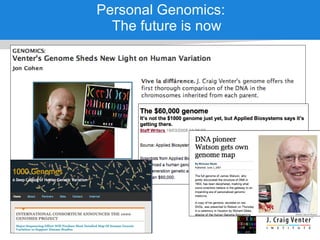
Personal Genomics:  The future is now
Outline HuRef Project:  Genome of an Individual HuRef Research Highlights The HuRef Browser – http://huref.jcvi.org Towards Personal Genomics Browsers Conclusions and Credits
Genome of a Single Individual:  Goals Provide a diploid genome that could serve as a reference for future individualized genomics Characterize the individual’s genetic variation HuRef vs NCBI HuRef haplotypes Understand the individual’s risk profile based on their genomic data
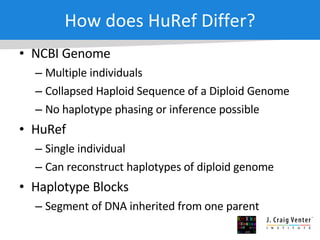
How does HuRef Differ? NCBI Genome Multiple individuals Collapsed Haploid Sequence of a Diploid Genome No haplotype phasing or inference possible HuRef Single individual Can reconstruct haplotypes of diploid genome Haplotype Blocks Segment of DNA inherited from one parent
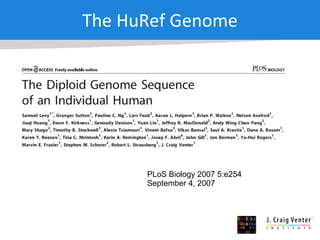
The HuRef Genome PLoS Biology 2007 5:e254 September 4, 2007
DNA from a single individual De Novo Assembly 7.5x Coverage Sanger Reads Diploid Reconstruction Half of genome is in haplotype blocks of >200kb HuRef Data Released NCBI:  Genome Project 19621 JCVI:  http://huref.jcvi.org   The HuRef Genome
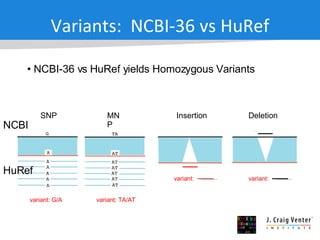
Variants:  NCBI-36 vs HuRef NCBI-36 vs HuRef yields Homozygous Variants SNP MNP Insertion Deletion NCBI HuRef variant: G/A variant: TA/AT variant: variant:
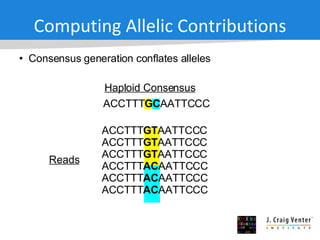
Computing Allelic Contributions Consensus generation conflates alleles Reads ACCTTT GT AATTCCC ACCTTT GT AATTCCC ACCTTT GT AATTCCC ACCTTT AC AATTCCC ACCTTT AC AATTCCC ACCTTT AC AATTCCC Haploid Consensus ACCTTT GC AATTCCC
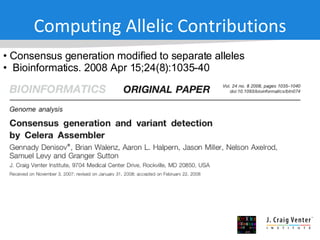
Computing Allelic Contributions Consensus generation conflates alleles Consensus generation modified to separate alleles Bioinformatics. 2008 Apr 15;24(8):1035-40
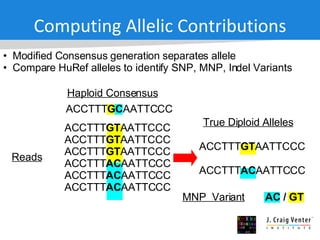
Computing Allelic Contributions Modified Consensus generation separates allele Compare HuRef alleles to identify SNP, MNP, Indel Variants MNP  Variant Reads ACCTTT GT AATTCCC ACCTTT GT AATTCCC ACCTTT GT AATTCCC ACCTTT AC AATTCCC ACCTTT AC AATTCCC ACCTTT AC AATTCCC True Diploid Alleles ACCTTT GT AATTCCC ACCTTT AC AATTCCC Haploid Consensus ACCTTT GC AATTCCC AC / GT
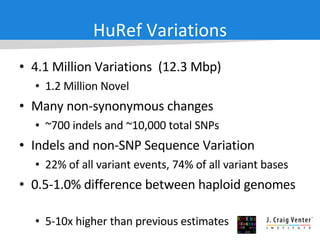
HuRef Variations 4.1 Million Variations  (12.3 Mbp) 1.2 Million Novel Many non-synonymous changes ~700 indels and ~10,000 total SNPs Indels and non-SNP Sequence Variation 22% of all variant events, 74% of all variant bases 0.5-1.0% difference between haploid genomes 5-10x higher than previous estimates
HuRef Browser Why do this?  Research tool focused on variation Verify assembly and variants Show ALL the evidence High Perfomance Features Use HuRef or NCBI as reference Genome vs Genome Comparison Drill down from chromosome to reads and alignments Overlay of Ensembl and NCBI Annotation Links from HuRef features in NCBI (e.g., dbSNP) Export of data for further analysis
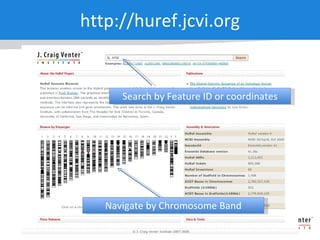
http://huref.jcvi.org Search by Feature ID or coordinates Navigate by Chromosome Band
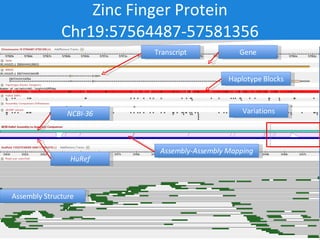
Zinc Finger Protein Chr19:57564487-57581356 Assembly Structure Variations Transcript Gene Haplotype Blocks NCBI-36 HuRef Assembly-Assembly Mapping
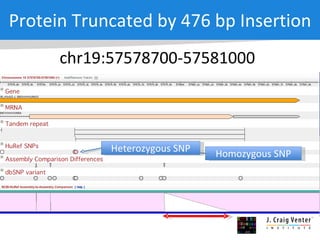
chr19:57578700-57581000 Protein Truncated by 476 bp Insertion Homozygous SNP Heterozygous SNP
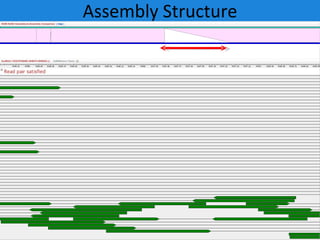
Assembly Structure
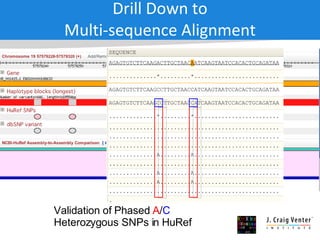
Drill Down to Multi-sequence Alignment Validation of Phased  A / C  Heterozygous SNPs in HuRef
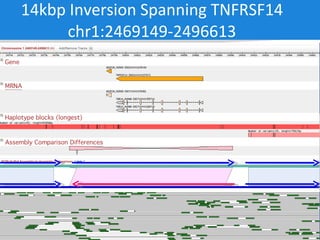
14kbp Inversion Spanning TNFRSF14 chr1:2469149-2496613
Browser for Multiple Genomes Expand on existing features Variants and haplotype blocks in individuals Structural variation among individuals Genetic traits of variants related to diseases Required Features Which genome/haplotype is the reference? Correlation with phenotypic, medical, and population data Correlation within families
Future Challenges Data volumes read data included from new technologies Multiplication of genomes Enormous number of potential comparisons Populations, individuals, variants Dynamic generation of views in web time Use cases are evolving
Conclusion A high performance visualization tool for an individual genome Validation of variants Comparison with NCBI-36 Planned extensions for multi-genome era Website: http://huref.jcvi.org Contact:  [email_address]
Acknowledgements HuRef Browser :  Nelson Axelrod, Yuan Lin, and Jonathan Crabtree Scientific Leadership :  Sam Levy, Craig Venter, Robert Strausberg,  Marvin Frazier Sequence Data Generation and Indel Validation :  Yu-Hui Rogers, John Gill, Jon Borman, JTC Production, Tina McIntosh, Karen Beeson, Dana Busam, Alexia Tsiamouri, Celera Genomics. Data Analysis : Sam Levy, Granger Sutton, Pauline Ng, Aaron Halpern, Brian Walenz, Nelson Axelrod, Yuan Lin, Jiaqi Huang, Ewen Kirkness, Gennady Denisov, Tim Stockwell, Vikas Basal, Vineet Bafna, Karin Remington, and Josep Abril CNV, Genotyping, FISH mapping :  Steve Scherer, Lars Feuk, Andy Wing Chun Pang, Jeff MacDonald Funding :  J. Craig Venter Foundation DNA :  J. Craig Venter

Human Reference Genome Browser Presentation at BIO-ITWorld 2008

  • 1.
    Towards Personal Genomics Tools for Navigating the Genome of an Individual Saul A. Kravitz J. Craig Venter Institute Rockville, MD Bio-IT World 2008
  • 2.
    Personal Genomics: The future is now
  • 3.
    Outline HuRef Project: Genome of an Individual HuRef Research Highlights The HuRef Browser – http://huref.jcvi.org Towards Personal Genomics Browsers Conclusions and Credits
  • 4.
    Genome of aSingle Individual: Goals Provide a diploid genome that could serve as a reference for future individualized genomics Characterize the individual’s genetic variation HuRef vs NCBI HuRef haplotypes Understand the individual’s risk profile based on their genomic data
  • 5.
    How does HuRefDiffer? NCBI Genome Multiple individuals Collapsed Haploid Sequence of a Diploid Genome No haplotype phasing or inference possible HuRef Single individual Can reconstruct haplotypes of diploid genome Haplotype Blocks Segment of DNA inherited from one parent
  • 6.
    The HuRef GenomePLoS Biology 2007 5:e254 September 4, 2007
  • 7.
    DNA from asingle individual De Novo Assembly 7.5x Coverage Sanger Reads Diploid Reconstruction Half of genome is in haplotype blocks of >200kb HuRef Data Released NCBI: Genome Project 19621 JCVI: http://huref.jcvi.org The HuRef Genome
  • 8.
    Variants: NCBI-36vs HuRef NCBI-36 vs HuRef yields Homozygous Variants SNP MNP Insertion Deletion NCBI HuRef variant: G/A variant: TA/AT variant: variant:
  • 9.
    Computing Allelic ContributionsConsensus generation conflates alleles Reads ACCTTT GT AATTCCC ACCTTT GT AATTCCC ACCTTT GT AATTCCC ACCTTT AC AATTCCC ACCTTT AC AATTCCC ACCTTT AC AATTCCC Haploid Consensus ACCTTT GC AATTCCC
  • 10.
    Computing Allelic ContributionsConsensus generation conflates alleles Consensus generation modified to separate alleles Bioinformatics. 2008 Apr 15;24(8):1035-40
  • 11.
    Computing Allelic ContributionsModified Consensus generation separates allele Compare HuRef alleles to identify SNP, MNP, Indel Variants MNP Variant Reads ACCTTT GT AATTCCC ACCTTT GT AATTCCC ACCTTT GT AATTCCC ACCTTT AC AATTCCC ACCTTT AC AATTCCC ACCTTT AC AATTCCC True Diploid Alleles ACCTTT GT AATTCCC ACCTTT AC AATTCCC Haploid Consensus ACCTTT GC AATTCCC AC / GT
  • 12.
    HuRef Variations 4.1Million Variations (12.3 Mbp) 1.2 Million Novel Many non-synonymous changes ~700 indels and ~10,000 total SNPs Indels and non-SNP Sequence Variation 22% of all variant events, 74% of all variant bases 0.5-1.0% difference between haploid genomes 5-10x higher than previous estimates
  • 13.
    HuRef Browser Whydo this? Research tool focused on variation Verify assembly and variants Show ALL the evidence High Perfomance Features Use HuRef or NCBI as reference Genome vs Genome Comparison Drill down from chromosome to reads and alignments Overlay of Ensembl and NCBI Annotation Links from HuRef features in NCBI (e.g., dbSNP) Export of data for further analysis
  • 14.
    http://huref.jcvi.org Search byFeature ID or coordinates Navigate by Chromosome Band
  • 15.
    Zinc Finger ProteinChr19:57564487-57581356 Assembly Structure Variations Transcript Gene Haplotype Blocks NCBI-36 HuRef Assembly-Assembly Mapping
  • 16.
    chr19:57578700-57581000 Protein Truncatedby 476 bp Insertion Homozygous SNP Heterozygous SNP
  • 17.
  • 18.
    Drill Down toMulti-sequence Alignment Validation of Phased A / C Heterozygous SNPs in HuRef
  • 19.
    14kbp Inversion SpanningTNFRSF14 chr1:2469149-2496613
  • 20.
    Browser for MultipleGenomes Expand on existing features Variants and haplotype blocks in individuals Structural variation among individuals Genetic traits of variants related to diseases Required Features Which genome/haplotype is the reference? Correlation with phenotypic, medical, and population data Correlation within families
  • 21.
    Future Challenges Datavolumes read data included from new technologies Multiplication of genomes Enormous number of potential comparisons Populations, individuals, variants Dynamic generation of views in web time Use cases are evolving
  • 22.
    Conclusion A highperformance visualization tool for an individual genome Validation of variants Comparison with NCBI-36 Planned extensions for multi-genome era Website: http://huref.jcvi.org Contact: [email_address]
  • 23.
    Acknowledgements HuRef Browser: Nelson Axelrod, Yuan Lin, and Jonathan Crabtree Scientific Leadership : Sam Levy, Craig Venter, Robert Strausberg, Marvin Frazier Sequence Data Generation and Indel Validation : Yu-Hui Rogers, John Gill, Jon Borman, JTC Production, Tina McIntosh, Karen Beeson, Dana Busam, Alexia Tsiamouri, Celera Genomics. Data Analysis : Sam Levy, Granger Sutton, Pauline Ng, Aaron Halpern, Brian Walenz, Nelson Axelrod, Yuan Lin, Jiaqi Huang, Ewen Kirkness, Gennady Denisov, Tim Stockwell, Vikas Basal, Vineet Bafna, Karin Remington, and Josep Abril CNV, Genotyping, FISH mapping : Steve Scherer, Lars Feuk, Andy Wing Chun Pang, Jeff MacDonald Funding : J. Craig Venter Foundation DNA : J. Craig Venter

Editor's Notes

  • #2 Introduce yourself Relate our experience with individual genomics and building tools for individual genomics