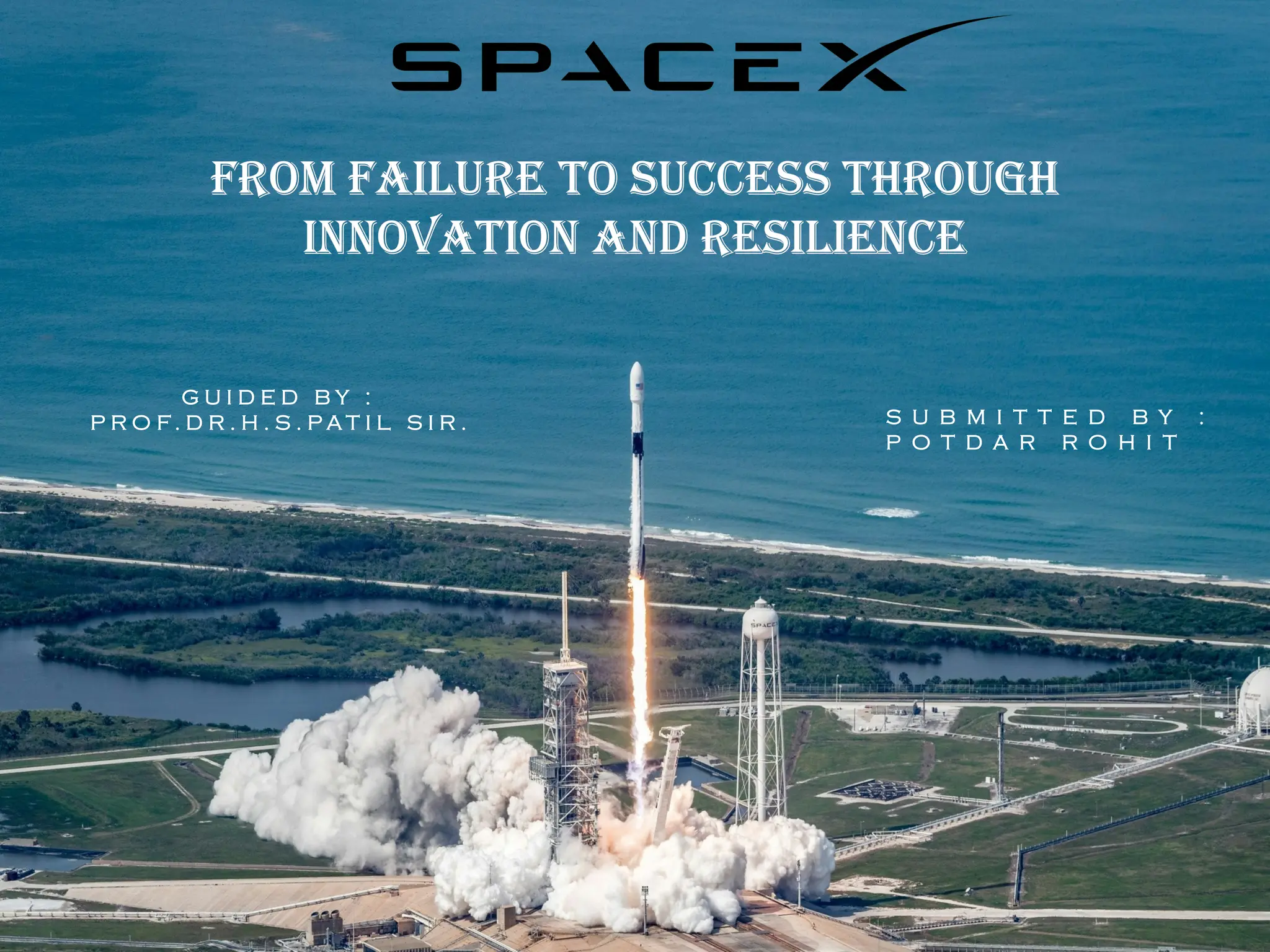
From Failure to Success Through
Innovation And Resilience
G U I D E D B Y :
P R O F. D R . H . S . P A T I L S I R . S U B M I T T E D B Y :
P O T D A R R O H I T
 SpaceX was founded by Elon Musk in 2001 with
a vision to decrease the cost of space launch,
paving the way to a sustainable colony on
Mars.
 SpaceX’s vision aimed to reduce the costs of
space exploration by developing reusable
rockets.
1.INTRODUCTION
 To understand the challenges faced by Spacex
during its early years.
 To analyze the statergies that Spacex adopted
to overcome failure.
 To explore the decision- making processes that
led Spacex near bankruptcy to becoming a
leader in space exploration.
 To evaluate the factors behind Spacex ultimate
success and what can be learned from its
journey.
2.OBJECTIVES
 SpaceX’s early years were filled with technical difficulties
and financial stress.
 The first three launches of its Falcon 1 rocket failed
between 2006 and 2008, and the company was on the
verge of bankruptcy.
 SpaceX also faced skepticism from both the public and
experts in the aerospace industry.
 SpaceX managed to not only recover from early failures
but also become a disruptor in the industry.
3.ANALYSIS
 Technical Failures: The early rocket launches failed due to
issues like fuel leaks, structural failures, and engine problems.
 Financial Struggles: With each failed launch, SpaceX lost
millions of dollars, pushing the company closer to insolvency.
 Skepticism and Lack of Support: SpaceX struggled to
gain credibility among investors and government agencies like
NASA due to the initial string of failures.
4.DECISION-MAKING
A) Identification of Problems Leading to Early Failures.
 Engineering and Design Challenges:
 SpaceX had to address significant technological issues with
their rockets, particularly around propulsion and structural
integrity.
 Inadequate Testing Procedures:
 Early failures were partly attributed to gaps in testing
protocols and a lack of experience with building reliable
rockets.
 Limited Resources:
 SpaceX’s limited funding meant they had fewer
opportunities to refine their products compared to
established players like NASA or Boeing.
B) Diagnosing Areas Responsible for
Failures
 1. Technical Innovation:
 SpaceX focused heavily on learning from each failure. After
each unsuccessful launch, they conducted in-depth failure
analyses to refine designs and improve performance.
 2. Reusability Concept:
 A key differentiator was SpaceX’s pursuit of reusable rockets.
Reusing rocket components would drastically reduce costs over
time, even if initial development was expensive.
C) Development of Strategies to Resolve
Failures
 3. Partnership with NASA:
 To address funding concerns, SpaceX won a NASA
contract under the Commercial Orbital
Transportation Services (COTS) program, securing
financial support and gaining credibility.
 4. Internal R&D Focus:
 SpaceX invested in an in-house engineering team
and developed nearly all of its rocket components,
which gave them more control over production
quality and cost management.
C) Development of Strategies to
Resolve Failures
 5. Persistent Testing and Iteration:
 SpaceX adopted a rapid prototyping approach where
it was not afraid of failure. They built, tested, and
iterated more quickly than other aerospace
companies.
C) Development of Strategies to Resolve
Failures
 1. Technical Innovation:
 Over time, SpaceX’s engineering team became adept at
pinpointing specific technical issues, leading to breakthroughs
like the successful development of the Falcon 9 rocket.
 2. Reusability Concept:
 Though initially risky, the focus on reusability was a game-
changer. By 2015, SpaceX successfully landed a Falcon 9 rocket,
making reusability a reality and drastically reducing launch
costs.
D) Evaluation of Each Strategy
 3. Partnership with NASA:
 This was crucial for SpaceX’s financial stability. NASA’s support,
combined with a series of successful cargo missions to the
International Space Station (ISS), built the company’s credibility.
 4. Internal R&D Focus:
 By building components in-house, SpaceX lowered costs and
retained control over quality, allowing for faster innovation
cycles.
D) Evaluation of Each Strategy
 5. Persistent Testing and Iteration:
 This approach allowed SpaceX to learn from failures quickly.
Rather than being deterred by setbacks, they leveraged them as
learning opportunities.
D) Evaluation of Each Strategy
 The combination of technical innovation, the NASA partnership,
and the focus on reusability were the most critical elements that
led to SpaceX’s success.
 The NASA contract provided the necessary financial lifeline and
credibility, while the technological breakthroughs, especially
with reusable rockets, allowed SpaceX to drastically reduce
launch costs and scale its operations.
 These strategies allowed SpaceX to go from nearly bankrupt to
securing a multi-billion-dollar contract to send astronauts to the
ISS under NASA’s Commercial Crew Program.
E) Selection of Best Strategy Leading to
Success
 Elon Musk and his team demonstrated the importance of
learning from failure, remaining committed to long-term goals,
and adapting strategies as new challenges arise.
 Today, SpaceX is a leader in the aerospace industry, proving
that with the right combination of vision, leadership, and
strategic partnerships, even the most audacious goals can be
achieved.
 The case of SpaceX highlights how perseverance, combined with
technical innovation and partnerships, can overcome significant
obstacles and lead to groundbreaking success.
5.Conclusion
QUESTIONS AND ANSWERS
THANK YOU !!!

A short Case Study Presentation on the Spacex company.

  • 1.
    From Failure toSuccess Through Innovation And Resilience G U I D E D B Y : P R O F. D R . H . S . P A T I L S I R . S U B M I T T E D B Y : P O T D A R R O H I T
  • 2.
     SpaceX wasfounded by Elon Musk in 2001 with a vision to decrease the cost of space launch, paving the way to a sustainable colony on Mars.  SpaceX’s vision aimed to reduce the costs of space exploration by developing reusable rockets. 1.INTRODUCTION
  • 3.
     To understandthe challenges faced by Spacex during its early years.  To analyze the statergies that Spacex adopted to overcome failure.  To explore the decision- making processes that led Spacex near bankruptcy to becoming a leader in space exploration.  To evaluate the factors behind Spacex ultimate success and what can be learned from its journey. 2.OBJECTIVES
  • 4.
     SpaceX’s earlyyears were filled with technical difficulties and financial stress.  The first three launches of its Falcon 1 rocket failed between 2006 and 2008, and the company was on the verge of bankruptcy.  SpaceX also faced skepticism from both the public and experts in the aerospace industry.  SpaceX managed to not only recover from early failures but also become a disruptor in the industry. 3.ANALYSIS
  • 5.
     Technical Failures:The early rocket launches failed due to issues like fuel leaks, structural failures, and engine problems.  Financial Struggles: With each failed launch, SpaceX lost millions of dollars, pushing the company closer to insolvency.  Skepticism and Lack of Support: SpaceX struggled to gain credibility among investors and government agencies like NASA due to the initial string of failures. 4.DECISION-MAKING A) Identification of Problems Leading to Early Failures.
  • 6.
     Engineering andDesign Challenges:  SpaceX had to address significant technological issues with their rockets, particularly around propulsion and structural integrity.  Inadequate Testing Procedures:  Early failures were partly attributed to gaps in testing protocols and a lack of experience with building reliable rockets.  Limited Resources:  SpaceX’s limited funding meant they had fewer opportunities to refine their products compared to established players like NASA or Boeing. B) Diagnosing Areas Responsible for Failures
  • 7.
     1. TechnicalInnovation:  SpaceX focused heavily on learning from each failure. After each unsuccessful launch, they conducted in-depth failure analyses to refine designs and improve performance.  2. Reusability Concept:  A key differentiator was SpaceX’s pursuit of reusable rockets. Reusing rocket components would drastically reduce costs over time, even if initial development was expensive. C) Development of Strategies to Resolve Failures
  • 8.
     3. Partnershipwith NASA:  To address funding concerns, SpaceX won a NASA contract under the Commercial Orbital Transportation Services (COTS) program, securing financial support and gaining credibility.  4. Internal R&D Focus:  SpaceX invested in an in-house engineering team and developed nearly all of its rocket components, which gave them more control over production quality and cost management. C) Development of Strategies to Resolve Failures
  • 9.
     5. PersistentTesting and Iteration:  SpaceX adopted a rapid prototyping approach where it was not afraid of failure. They built, tested, and iterated more quickly than other aerospace companies. C) Development of Strategies to Resolve Failures
  • 10.
     1. TechnicalInnovation:  Over time, SpaceX’s engineering team became adept at pinpointing specific technical issues, leading to breakthroughs like the successful development of the Falcon 9 rocket.  2. Reusability Concept:  Though initially risky, the focus on reusability was a game- changer. By 2015, SpaceX successfully landed a Falcon 9 rocket, making reusability a reality and drastically reducing launch costs. D) Evaluation of Each Strategy
  • 11.
     3. Partnershipwith NASA:  This was crucial for SpaceX’s financial stability. NASA’s support, combined with a series of successful cargo missions to the International Space Station (ISS), built the company’s credibility.  4. Internal R&D Focus:  By building components in-house, SpaceX lowered costs and retained control over quality, allowing for faster innovation cycles. D) Evaluation of Each Strategy
  • 12.
     5. PersistentTesting and Iteration:  This approach allowed SpaceX to learn from failures quickly. Rather than being deterred by setbacks, they leveraged them as learning opportunities. D) Evaluation of Each Strategy
  • 13.
     The combinationof technical innovation, the NASA partnership, and the focus on reusability were the most critical elements that led to SpaceX’s success.  The NASA contract provided the necessary financial lifeline and credibility, while the technological breakthroughs, especially with reusable rockets, allowed SpaceX to drastically reduce launch costs and scale its operations.  These strategies allowed SpaceX to go from nearly bankrupt to securing a multi-billion-dollar contract to send astronauts to the ISS under NASA’s Commercial Crew Program. E) Selection of Best Strategy Leading to Success
  • 14.
     Elon Muskand his team demonstrated the importance of learning from failure, remaining committed to long-term goals, and adapting strategies as new challenges arise.  Today, SpaceX is a leader in the aerospace industry, proving that with the right combination of vision, leadership, and strategic partnerships, even the most audacious goals can be achieved.  The case of SpaceX highlights how perseverance, combined with technical innovation and partnerships, can overcome significant obstacles and lead to groundbreaking success. 5.Conclusion
  • 15.