Blockchain as a Service (BaaS)
for IoT
Part I - Overview, Security issues in iot
What is IoT ?
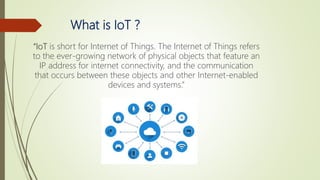
“IoT is short for Internet of Things. The Internet of Things refers
to the ever-growing network of physical objects that feature an
IP address for internet connectivity, and the communication
that occurs between these objects and other Internet-enabled
devices and systems.”
Problems with centralized communication
 Trust between parties and devices
 Higher cost due to number of middlemen and third party
applications
 Higher cost due to maintain centralized data centers and
cloud services
 Due to network traffic lags and system down times could
occur.
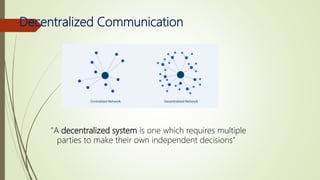
Decentralized Communication
"A decentralized system is one which requires multiple
parties to make their own independent decisions"
Decentralizing Methods
1. Architectural decentralization: What is the number of the physical computers
present in the network? How many of them can breakdown at the same time without
jeopardizing the entire system?
2. Political decentralization: How many parties control the computers that are part of
the system?
3. Logical decentralization: Can the data structure and interface, function the same
way independently, if the system is split into two parts
Advantages and Disadvantages in
Decentralized Networks
Advantages
 Fault Tolerance
 Attack Resistance
 Collusion Resistance
 Divide personal responsibilities
for the system managers
Disadvantages
 Security in peer-peer
communication
 Speed in action
 Lack of Focus
Key Challenges in a Nutshell
If a solution is to be apply in industry level , following challenges has to be
overcome.
 Scalability
 Security
 Interoperability
 Legal, compliance and regulation
 Cost Effectiveness
 Technology
 Operation complexity
Introduction to Blockchain
Part 2 – Understanding blockchain technology
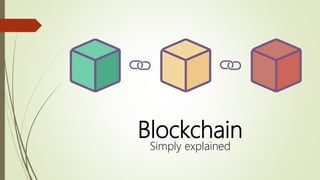
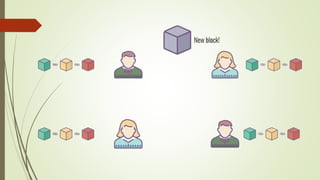
Blockchain
Simply explained
Digital timestamps
like a notary!
Bitcoin
By “Satoshi Nakamoto”
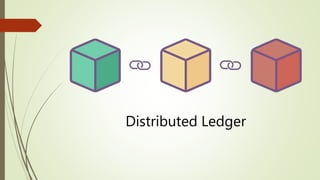
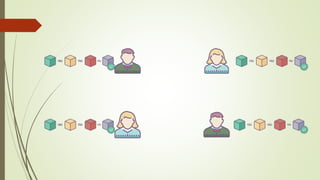
Distributed Ledger
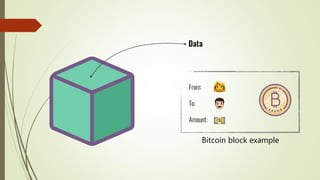
Bitcoin block example
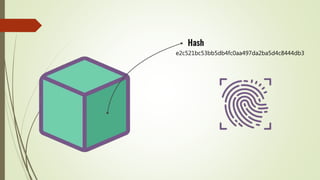
e2c521bc53bb5db4fc0aa497da2ba5d4c8444db3
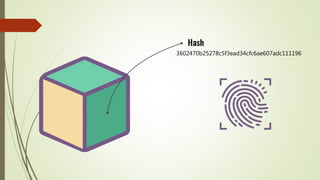
3602470b25278c5f3ead34cfc6ae607adc111196
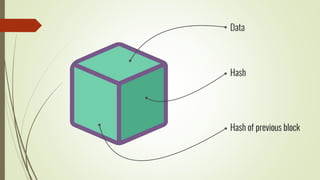
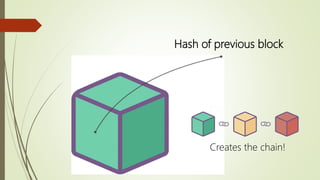
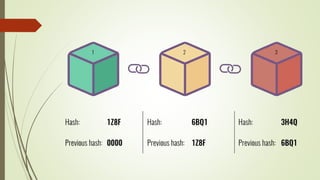
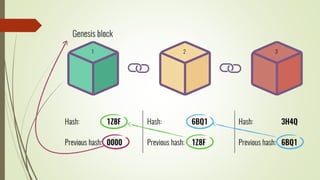
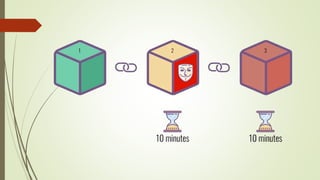
Hash of previous block
Creates the chain!
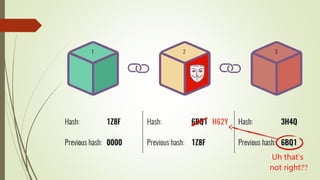
Uh that’s
not right??
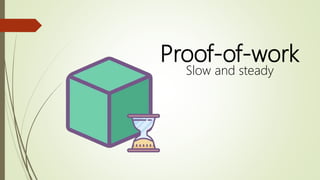
Proof-of-work
Slow and steady
Blockchain
Let’s dive further…
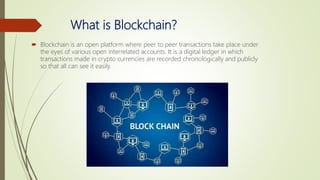
What is Blockchain?
 Blockchain is an open platform where peer to peer transactions take place under
the eyes of various open interrelated accounts. It is a digital ledger in which
transactions made in crypto currencies are recorded chronologically and publicly
so that all can see it easily.
The Term Blockchain
 Name for a data structure
 Name for an algorithm
 Name for a suite of Technologies
 An umbrella term for purely distributed peer-to-peer
systems with a common application area
 A peer-to-peer-based operating system with its own
unique rule set that utilizes hashing to provide unique
data transactions with a distributed ledger
, III
31
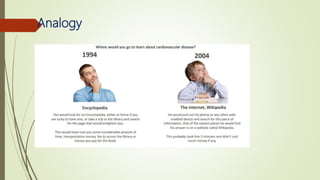
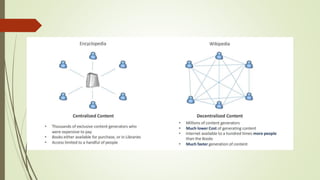
Analogy
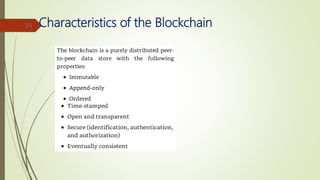
Characteristics of the Blockchain34
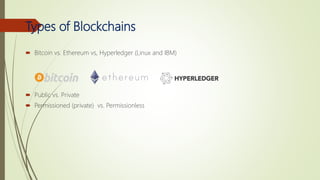
Types of Blockchains
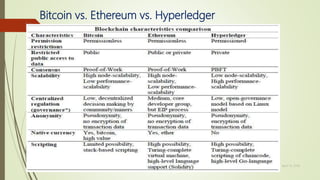
 Bitcoin vs. Ethereum vs, Hyperledger (Linux and IBM)
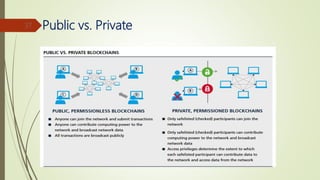
 Public vs. Private
 Permissioned (private) vs. Permissionless
Bitcoin vs. Ethereum vs. Hyperledger
April 13, 2018Blockchain and Blockchain Development - William Favre Slater, III
36
Public vs. Private37
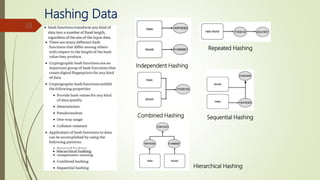
Hashing Data
38
Independent Hashing
Combined Hashing
Repeated Hashing
Sequential Hashing
Hierarchical Hashing
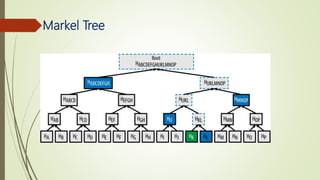
Markel Tree
IoT and Blockchain Integration
Part 3 – Developing real world applications
• Decentralization and Scalability
o will remove central points of failures and bottlenecks
o prevent scenarios where a few powerful companies control the processing and storage
o improvement of the fault tolerance and system scalability
• Identity
o able to identify every single device
o Data provided and fed into the system is immutable and uniquely identified
IoT can greatly benefit from the functionality provided by blockchain and will help to
further develop current IoT technologies. There are still a great number of research
challenges and open issues that have to be studied in order to seamlessly use these
two technologies together and this research topic is still in a preliminary stage.
• Autonomy
o devices are capable of interacting with each other without the involvement of any servers
• Reliability
o information can remain immutable and distributed over time in blockchain
o enables sensor data traceability and accountability
• Security
o validated by smart contracts, in this way securing communications between devices
o information and communications can be secured if they are stored as transactions of the blockchain
• Secure code deployment
o taking advantage of blockchain secure-immutable storage, code can be safety and securely pushed into
devices and also trace states and update IoT devices
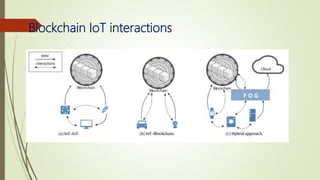
Blockchain IoT interactions
1. IoT–IoT
o works offline
o fastest model
o only an important part of IoT data is stored in blockchain
2. IoT–Blockchain
o all the transaction data is stored along with IoT data in blockchain
o increase in bandwidth which is one of the well-known challenges in blockchain
3. Hybrid approach
o only part of the interactions and data take place in the blockchain and the rest are directly shared between
the IoT devices
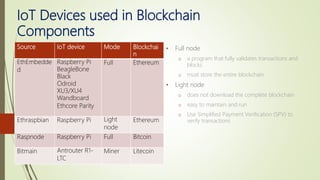
IoT Devices used in Blockchain
Components
• Full node
o a program that fully validates transactions and
blocks
o must store the entire blockchain
• Light node
o does not download the complete blockchain
o easy to maintain and run
o Use Simрlifiеd Pауmеnt Vеrifiсаtiоn (SPV) to
verify transactions
Source IoT device Mode Blockchai
n
EthEmbedde
d
Raspberry Pi
BeagleBone
Black
Odroid
XU3/XU4
Wandboard
Ethcore Parity
Full Ethereum
Ethraspbian Raspberry Pi Light
node
Ethereum
Raspnode Raspberry Pi Full Bitcoin
Bitmain Antrouter R1-
LTC
Miner Litecoin
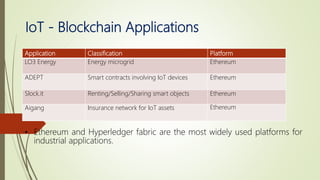
IoT - Blockchain Applications
• Ethereum and Hyperledger fabric are the most widely used platforms for
industrial applications.
Application Classification Platform
LO3 Energy Energy microgrid Ethereum
ADEPT Smart contracts involving IoT devices Ethereum
Slock.it Renting/Selling/Sharing smart objects Ethereum
Aigang Insurance network for IoT assets Ethereum
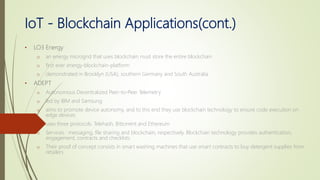
IoT - Blockchain Applications(cont.)
• LO3 Energy
o an energy microgrid that uses blockchain must store the entire blockchain
o first ever energy-blockchain-platform
o demonstrated in Brooklyn (USA), southern Germany and South Australia
• ADEPT
o Autonomous Decentralized Peer-to-Peer Telemetry
o led by IBM and Samsung
o aims to promote device autonomy, and to this end they use blockchain technology to ensure code execution on
edge devices
o uses three protocols: Telehash, Bittorrent and Ethereum
o Services : messaging, file sharing and blockchain, respectively. Blockchain technology provides authentication,
engagement, contracts and checklists
o Their proof of concept consists in smart washing machines that use smart contracts to buy detergent supplies from
retailers
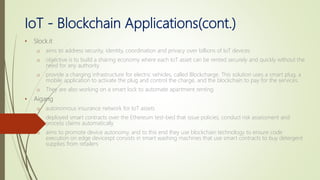
IoT - Blockchain Applications(cont.)
• Slock.it
o aims to address security, identity, coordination and privacy over billions of IoT devices
o objective is to build a sharing economy where each IoT asset can be rented securely and quickly without the
need for any authority
o provide a charging infrastructure for electric vehicles, called Blockcharge. This solution uses a smart plug, a
mobile application to activate the plug and control the charge, and the blockchain to pay for the services.
o They are also working on a smart lock to automate apartment renting
• Aigang
o autonomous insurance network for IoT assets
o deployed smart contracts over the Ethereum test-bed that issue policies, conduct risk assessment and
process claims automatically
o aims to promote device autonomy, and to this end they use blockchain technology to ensure code
execution on edge devicespt consists in smart washing machines that use smart contracts to buy detergent
supplies from retailers
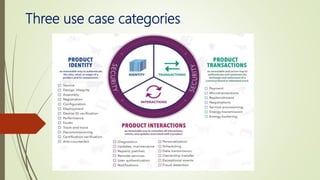
Three use case categories
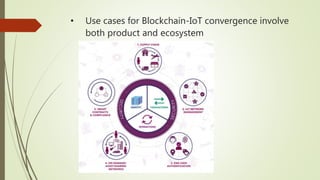
• Use cases for Blockchain-IoT convergence involve
both product and ecosystem
Thank You!

BaaS for IoT

  • 1.
    Blockchain as aService (BaaS) for IoT Part I - Overview, Security issues in iot
  • 2.
    What is IoT? “IoT is short for Internet of Things. The Internet of Things refers to the ever-growing network of physical objects that feature an IP address for internet connectivity, and the communication that occurs between these objects and other Internet-enabled devices and systems.”
  • 3.
    Problems with centralizedcommunication  Trust between parties and devices  Higher cost due to number of middlemen and third party applications  Higher cost due to maintain centralized data centers and cloud services  Due to network traffic lags and system down times could occur.
  • 4.
    Decentralized Communication "A decentralizedsystem is one which requires multiple parties to make their own independent decisions"
  • 5.
    Decentralizing Methods 1. Architecturaldecentralization: What is the number of the physical computers present in the network? How many of them can breakdown at the same time without jeopardizing the entire system? 2. Political decentralization: How many parties control the computers that are part of the system? 3. Logical decentralization: Can the data structure and interface, function the same way independently, if the system is split into two parts
  • 6.
    Advantages and Disadvantagesin Decentralized Networks Advantages  Fault Tolerance  Attack Resistance  Collusion Resistance  Divide personal responsibilities for the system managers Disadvantages  Security in peer-peer communication  Speed in action  Lack of Focus
  • 7.
    Key Challenges ina Nutshell If a solution is to be apply in industry level , following challenges has to be overcome.  Scalability  Security  Interoperability  Legal, compliance and regulation  Cost Effectiveness  Technology  Operation complexity
  • 8.
    Introduction to Blockchain Part2 – Understanding blockchain technology
  • 9.
  • 10.
  • 11.
  • 12.
  • 14.
  • 15.
  • 16.
  • 17.
    Hash of previousblock Creates the chain!
  • 20.
  • 21.
  • 29.
  • 30.
    What is Blockchain? Blockchain is an open platform where peer to peer transactions take place under the eyes of various open interrelated accounts. It is a digital ledger in which transactions made in crypto currencies are recorded chronologically and publicly so that all can see it easily.
  • 31.
    The Term Blockchain Name for a data structure  Name for an algorithm  Name for a suite of Technologies  An umbrella term for purely distributed peer-to-peer systems with a common application area  A peer-to-peer-based operating system with its own unique rule set that utilizes hashing to provide unique data transactions with a distributed ledger , III 31
  • 32.
  • 34.
  • 35.
    Types of Blockchains Bitcoin vs. Ethereum vs, Hyperledger (Linux and IBM)  Public vs. Private  Permissioned (private) vs. Permissionless
  • 36.
    Bitcoin vs. Ethereumvs. Hyperledger April 13, 2018Blockchain and Blockchain Development - William Favre Slater, III 36
  • 37.
  • 38.
    Hashing Data 38 Independent Hashing CombinedHashing Repeated Hashing Sequential Hashing Hierarchical Hashing
  • 39.
  • 40.
    IoT and BlockchainIntegration Part 3 – Developing real world applications
  • 41.
    • Decentralization andScalability o will remove central points of failures and bottlenecks o prevent scenarios where a few powerful companies control the processing and storage o improvement of the fault tolerance and system scalability • Identity o able to identify every single device o Data provided and fed into the system is immutable and uniquely identified IoT can greatly benefit from the functionality provided by blockchain and will help to further develop current IoT technologies. There are still a great number of research challenges and open issues that have to be studied in order to seamlessly use these two technologies together and this research topic is still in a preliminary stage.
  • 42.
    • Autonomy o devicesare capable of interacting with each other without the involvement of any servers • Reliability o information can remain immutable and distributed over time in blockchain o enables sensor data traceability and accountability • Security o validated by smart contracts, in this way securing communications between devices o information and communications can be secured if they are stored as transactions of the blockchain • Secure code deployment o taking advantage of blockchain secure-immutable storage, code can be safety and securely pushed into devices and also trace states and update IoT devices
  • 43.
  • 44.
    1. IoT–IoT o worksoffline o fastest model o only an important part of IoT data is stored in blockchain 2. IoT–Blockchain o all the transaction data is stored along with IoT data in blockchain o increase in bandwidth which is one of the well-known challenges in blockchain 3. Hybrid approach o only part of the interactions and data take place in the blockchain and the rest are directly shared between the IoT devices
  • 45.
    IoT Devices usedin Blockchain Components • Full node o a program that fully validates transactions and blocks o must store the entire blockchain • Light node o does not download the complete blockchain o easy to maintain and run o Use Simрlifiеd Pауmеnt Vеrifiсаtiоn (SPV) to verify transactions Source IoT device Mode Blockchai n EthEmbedde d Raspberry Pi BeagleBone Black Odroid XU3/XU4 Wandboard Ethcore Parity Full Ethereum Ethraspbian Raspberry Pi Light node Ethereum Raspnode Raspberry Pi Full Bitcoin Bitmain Antrouter R1- LTC Miner Litecoin
  • 46.
    IoT - BlockchainApplications • Ethereum and Hyperledger fabric are the most widely used platforms for industrial applications. Application Classification Platform LO3 Energy Energy microgrid Ethereum ADEPT Smart contracts involving IoT devices Ethereum Slock.it Renting/Selling/Sharing smart objects Ethereum Aigang Insurance network for IoT assets Ethereum
  • 47.
    IoT - BlockchainApplications(cont.) • LO3 Energy o an energy microgrid that uses blockchain must store the entire blockchain o first ever energy-blockchain-platform o demonstrated in Brooklyn (USA), southern Germany and South Australia • ADEPT o Autonomous Decentralized Peer-to-Peer Telemetry o led by IBM and Samsung o aims to promote device autonomy, and to this end they use blockchain technology to ensure code execution on edge devices o uses three protocols: Telehash, Bittorrent and Ethereum o Services : messaging, file sharing and blockchain, respectively. Blockchain technology provides authentication, engagement, contracts and checklists o Their proof of concept consists in smart washing machines that use smart contracts to buy detergent supplies from retailers
  • 48.
    IoT - BlockchainApplications(cont.) • Slock.it o aims to address security, identity, coordination and privacy over billions of IoT devices o objective is to build a sharing economy where each IoT asset can be rented securely and quickly without the need for any authority o provide a charging infrastructure for electric vehicles, called Blockcharge. This solution uses a smart plug, a mobile application to activate the plug and control the charge, and the blockchain to pay for the services. o They are also working on a smart lock to automate apartment renting • Aigang o autonomous insurance network for IoT assets o deployed smart contracts over the Ethereum test-bed that issue policies, conduct risk assessment and process claims automatically o aims to promote device autonomy, and to this end they use blockchain technology to ensure code execution on edge devicespt consists in smart washing machines that use smart contracts to buy detergent supplies from retailers
  • 49.
    Three use casecategories
  • 50.
    • Use casesfor Blockchain-IoT convergence involve both product and ecosystem
  • 51.