International Research Journal of Engineering and Technology (IRJET) e-ISSN: 2395 -0056
Volume: 03 Issue: 01 | Jan-2016 www.irjet.net p-ISSN: 2395-0072
© 2016, IRJET | Impact Factor value: 4.45 | ISO 9001:2008 Certified Journal | Page 1274
A Review Paper on PLC Based Automatic Fly Ash Brick Machine
Bhupendra Singh1, Arun Kumar2
1 M-Tech scholar, E&TC department, Bhilai institute of technology, Chhattisgarh, India
2 Associate Professor, E&TC department, Bhilai institute of technology, Chhattisgarh, India
---------------------------------------------------------------------***---------------------------------------------------------------------
Abstract - Production of ash brick is an alternative
utilization of fly ash. A most important part of the Fly
Ash Bricks plant is Pan Mixer and molding machine.
This study mainly focused on the Brick Molding
Mechanism. . There are so many methods for molding of
bricks, but here we have used only hydraulic
compression method which is more efficient and
reliable method. The pressing machine has three sets of
brick moulds which are 120º apart from each other.
One set of mould receive the mixture, then it is
compressed and finally two bricks are made in one
revolution of this machine. This paper is basically based
on the saving of unnecessary economical losses and
provided safety for plants workers and increases the
efficiency of bricks industry. For this we have
implemented this mechanism through Programming
Logic Controller (PLC).
Key Words: Programming Logic Controller, Hydraulic
Machine, Gear motor etc…
1. INTRODUCTION
These days India is witnessing a new phase in
development with rapid economic growth and high rate of
urbanization. In India the estimation of total fly ash
generation from thermal power plants is at about 60
million tons per year, which may increase to about 110
million tons per year by 2015, therefore the use of fly ash
for the production of bricks as an alternative utilization of
fly ash. Essentially, the only solid ingredient of the bricks
is the ash and the liquid ingredient is water. Many studies
have been conducted on cement and concrete applications
which were authorized and federally approved. The use of
fly ash for the production of bricks is an alternative
utilization of fly ash. Fly ash itself can be used for the
brick-making since it contains suitable ceramic
characteristics and properties. Other ingredients that so
far are commercially protected are cheap, commonly
available and, though essential, are only minor quantities.
1.1 Brick Making Plant
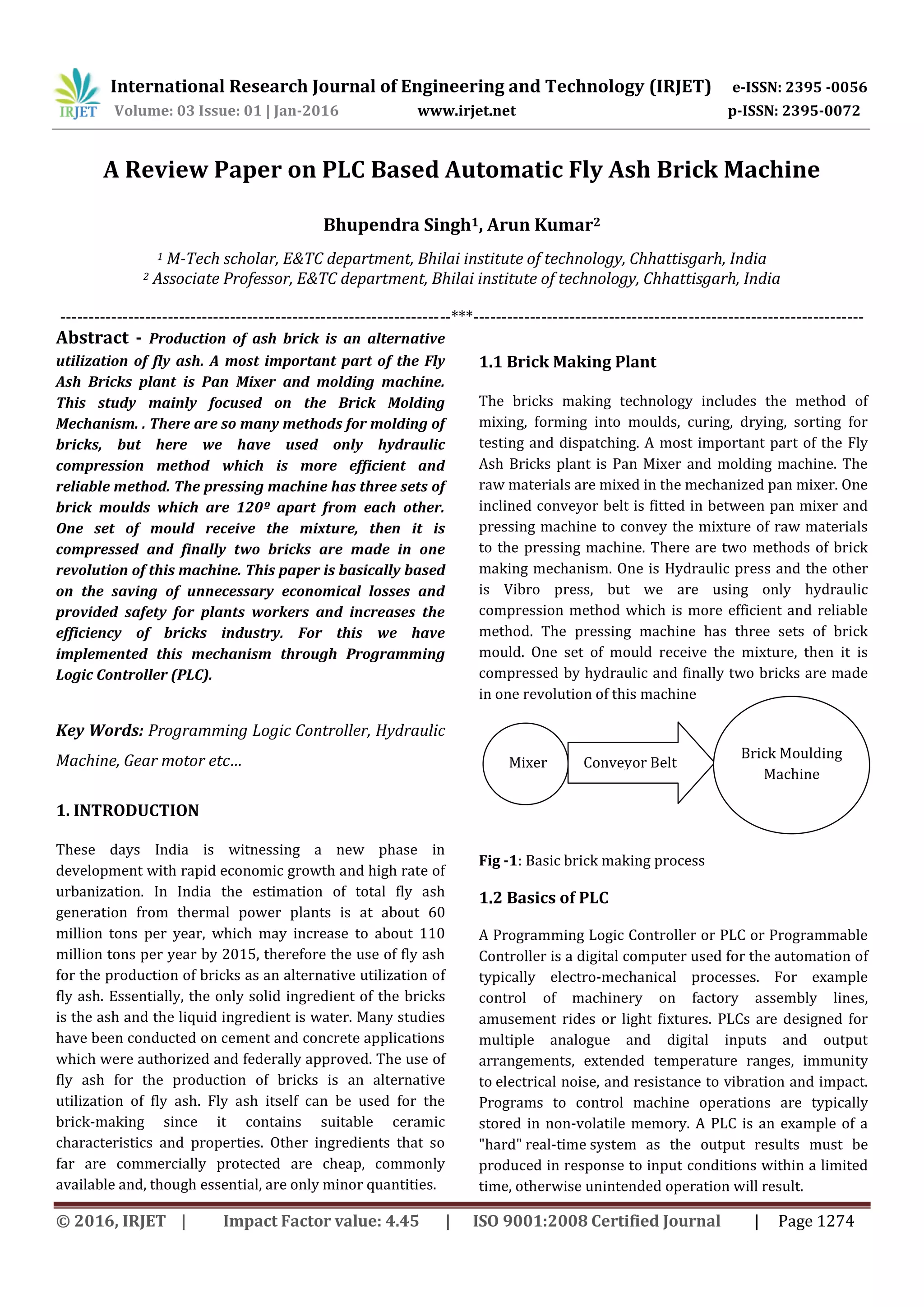
The bricks making technology includes the method of
mixing, forming into moulds, curing, drying, sorting for
testing and dispatching. A most important part of the Fly
Ash Bricks plant is Pan Mixer and molding machine. The
raw materials are mixed in the mechanized pan mixer. One
inclined conveyor belt is fitted in between pan mixer and
pressing machine to convey the mixture of raw materials
to the pressing machine. There are two methods of brick
making mechanism. One is Hydraulic press and the other
is Vibro press, but we are using only hydraulic
compression method which is more efficient and reliable
method. The pressing machine has three sets of brick
mould. One set of mould receive the mixture, then it is
compressed by hydraulic and finally two bricks are made
in one revolution of this machine
Fig -1: Basic brick making process
1.2 Basics of PLC
A Programming Logic Controller or PLC or Programmable
Controller is a digital computer used for the automation of
typically electro-mechanical processes. For example
control of machinery on factory assembly lines,
amusement rides or light fixtures. PLCs are designed for
multiple analogue and digital inputs and output
arrangements, extended temperature ranges, immunity
to electrical noise, and resistance to vibration and impact.
Programs to control machine operations are typically
stored in non-volatile memory. A PLC is an example of a
"hard" real-time system as the output results must be
produced in response to input conditions within a limited
time, otherwise unintended operation will result.
Mixer Conveyor Belt
Brick Moulding
Machine
International Research Journal of Engineering and Technology (IRJET) e-ISSN: 2395 -0056
Volume: 03 Issue: 01 | Jan-2016 www.irjet.net p-ISSN: 2395-0072
© 2016, IRJET | Impact Factor value: 4.45 | ISO 9001:2008 Certified Journal | Page 1275
1.3 Problems Background
In bricks manufacturing industry there is a common
problem that is lack of communication and sudden fault
that occurred in machine. In industry a loud sound
produced when machine is running so some time works
cannot hear proper command to on or off that cause of
accident. These accidents creates economical problem.
Second issue is that in traditional bricks making plant
mixing and molding process are done by manually which
is time consuming process. So this operating procedure
should be automatic. That improve safety efficacy of plant
without change their basic ruining procedure.
1.4 Objective of the Work
Basic objective of this thesis is to develop a fully
automated model of fly ash brick making machine. This
will reduce the communication gap and mismanagement
of bricks plant. Less numbers of man powers is required
and hence increases the speed and efficiency of
production.
2. METHODOLOGY
The work is mainly focused on fly ash brick moulding
mechanism. There are two methods of brick making
mechanism. One is Hydraulic press and the other is Vibro
press, but we are using only hydraulic compression
method which is more efficient and reliable method. The
pressing table is circular having three sets of brick moulds
each 120° apart. One set of mould receive the mixture,
then it is compressed by press hydraulic and after
moulding of brick dispatch hydraulic ejects the moulded
brick from the mould. All these processes of filling of
moulds, pressing of material and dispatching of moulded
bricks for one revolution are done same time. In this way
two bricks are made in one revolution of this circular
table.
2.1 Hardware Description
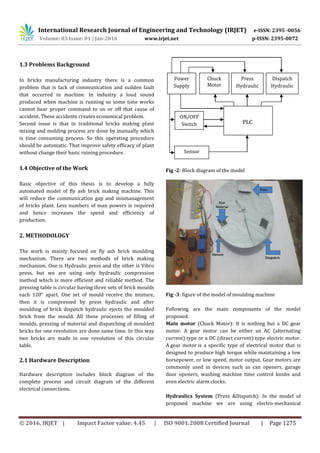
Hardware description includes block diagram of the
complete process and circuit diagram of the different
electrical connections.
Fig -2: Block diagram of the model
Fig -3: figure of the model of moulding machine
Following are the main components of the model
proposed.
Main motor (Chuck Motor): It is nothing but a DC gear
motor. A gear motor can be either an AC (alternating
current) type or a DC (direct current) type electric motor.
A gear motor is a specific type of electrical motor that is
designed to produce high torque while maintaining a low
horsepower, or low speed, motor output. Gear motors are
commonly used in devices such as can openers, garage
door openers, washing machine time control knobs and
even electric alarm clocks.
Hydraulics System (Press &Dispatch): In the model of
proposed machine we are using electro-mechanical
Power
Supply
Chuck
Motor
Press
Hydraulic
Dispatch
Hydraulic
ON/OFF
Switch
Sensor
PLC
International Research Journal of Engineering and Technology (IRJET) e-ISSN: 2395 -0056
Volume: 03 Issue: 01 | Jan-2016 www.irjet.net p-ISSN: 2395-0072
© 2016, IRJET | Impact Factor value: 4.45 | ISO 9001:2008 Certified Journal | Page 1276
hydraulic press. It mainly works on the principle of shaded
pole mechanism.
Fig -4: Electrical Hydraulic Mechanism.
In this mechanism a fiber pole is considered which is
coated by iron sheet on its 2/3 portion. Fiber end of the
pole is free and Iron coated end is connected to a spring
mechanism which due to which pole comes to its original
position. Also a fiber bobbin is used on which winding is
wrapped. A supply of 230V A.C is applied across the
winding, resulting in magnetic field inside the bobbin. Due
to this magnetic field N-S pair is created. Due to AC
excitation iron shaded portion of the pole acting as
electromagnet and the opposite polarities i.e. S-N are
created on it. According to magnetic property opposite
polarities attracts each other.
Therefore, every time when ac excitation is given to
winding, polarities of field attracts the polarities of pole
and pole comes out through the bobbin as hydraulic press
or hydraulic dispatch form open end. In case of no supply
magnetic field disappears and pole comes to its previous
position due to spring mechanism.
IR Sensor: The proximity sensing uses an external, pulsed
infrared LED source to emit controlled amounts of
infrared radiation. When an external object reflects back
some of this infrared radiation back to the IC, it is detected
by the integrated light detector. The amount of reflected
light detected is then used to determine the object’s
proximity to the sensor
Proposed method is completely automatic and is
controlled by PLC programming. Flow of the process can
be explained as:
i. Switch on the power supply
ii. Main motor starts and rotate the circular table
iii. Sensor start sensing for the Mould
a. Stops the motor when mould is present
b. Keep sensing until mould is present
iv. As motor stops, timer TON is turned on for required
time
v. Both the hydraulic are pressed simultaneously until
timer is up
a. Keep pressed till timer is on
b. As timer times up, hydraulics are released
vi. Starts the chuck motor again
Process explained above will be continued automatically
till power switch is on.
2.2. Software Description
This automatic process is done by the PLC programming.
The programming done in PLC is called Ladder
Programming. Ladder Diagrams are similar to relay logic
diagrams that represent relay control circuits. A program
written in Ladder Diagram language is composed of rungs
which are sets of graphical instructions drawn between 2
vertical potential bars. The rungs are executed
sequentially by the logic controller.
Fig -5: Ladder diagram of the complete process
Timer TON is used in the programming. It is the flexibility
that we can increase or decrease the time of hydraulic
action by the timer. Also output of the timer is used to stop
or run the main motor.
3. RESULTS
In result section after connecting all components of brick
machine and its connection with plc the program is run
International Research Journal of Engineering and Technology (IRJET) e-ISSN: 2395 -0056
Volume: 03 Issue: 01 | Jan-2016 www.irjet.net p-ISSN: 2395-0072
© 2016, IRJET | Impact Factor value: 4.45 | ISO 9001:2008 Certified Journal | Page 1277
properly. It shows that there is no difficulty to run our
hardware and software.
Table -1: Outputs at different rpm
S.No.
Speed of
motor (rpm)
No. of
moulds
No. of
bricks
/rotation
Total
Bricks
(8 hrs)
1. 3
3 3 4320
6 6 8640
2. 5
3 3 7200
6 6 14,400
From the above table we can draw a remarkable
conclusion that
No. of bricks α No. of Moulds & rpm of motor
From the above relation we can see that how we can
increase the efficiency of the model.
Table -2: Boolean output for the different process
INPUTS OUTPUTS
X1(switch)
X2(Sensor)
Y2(Timer
output)
Y1(Motor)
Y3
(Hydraulic
Press)
Y4
(Hydraulic
Dispatch)
0 0 0 0 0 0
1 0 0 1 0 0
1 1
0 (Till
timer
is up)
0 1 1
1 0 1 1 0 0
1 1 0 0 1 1
1 1 0 (up) 0 1 1
The above process will goes on till we do not press the
input switch.
Table -3: Comparison with the existing method
S.
No.
Features
Proposed
method
Existing
method
1. Time
Time saving (
Material filling ,
pressing &
ejection
simultaneously )
Time
consuming
(One process
at a time)
2. Capacity
8000-10,000
bricks per day
5000-6000
bricks per day
3. Manpower
Manpower
reduces
(2-3 person)
Manpower is
needed for
every process
(5-8 person)
4.
Safety and
fault
diagnosis
Safe and easier
(PLC operated)
Less safe and
faulty due to
contactor
relays
5.
Nos. of
moulds
Can be increased
by changing the
die.(3,6,9.. as
available)
Not such
option
available
6. Costing
Installation cost is
high but running
cost is cheaper
Installation
cost is cheaper
but running
cost is high
7. Operation
Automatic based
on ladder
programming
Hydraulics are
operated
manually
4. CONCLUSIONS
In case of semi automatic plant all the process done by
automatic machine but not simultaneously. Time slot is
provided for each process and after that only next process
can be perform which is time consuming process. But the
proposed model of brick making machine is fully
automated and is controlled by using Programming Logic
controller. The pressing machine has three sets of brick
mould which are 120º apart from each other. One set of
mould receive the mixture, then it is compressed and
finally two bricks are made in one revolution of this
International Research Journal of Engineering and Technology (IRJET) e-ISSN: 2395 -0056
Volume: 03 Issue: 01 | Jan-2016 www.irjet.net p-ISSN: 2395-0072
© 2016, IRJET | Impact Factor value: 4.45 | ISO 9001:2008 Certified Journal | Page 1278
machine. Thus, by implementation of this model efficiency
is increased. Complete system is automatic. The accident
cases also reduce.
REFERENCES
[1] Kendesarin Pimraksa, Matthias Wilhelm and Michael
kochhberger,” A New Approach to the Production of
Bricks Made of 100% Fly Ash, International Ash
Utilization Symposium, University of Kentucky, 2001.
[2] Obada Kayali, “High Performance Bricks From Fly
Ash”lecture notes, Lexington, Kentucky,USA, 2005.
[3] Ankit H Parmar, Kinnarraj P Zala, Ankit R Patel,
“Modification of Foremost Element of Hydraulic Press
Machine”, IJASTR,vol. 3, june 2014.
[4] A. Sumathi, K. Saravana Raja Mohan, “Compressive
Strength of Fly Ash Brick with Addition of Lime,
Gypsum and Quarry Dust”, IJCRGG, Vol. 7, pp 28-36,
2014-2016.
[5] Cockrell, L. Sander, T.M. Holnan Inc., Dundee, MI.,”
Process control in cement industry”, IEEE
Transaction, vol-28, pp: 945 – 953, 2006.
[6] Prime, J.B. Valdes, J.G, “use of ladder diagram in
discrete system of PLC,” IEEE Transaction, vol. PAS-
100, pp- 143 – 153, January 1989.
[7] N.Gangadhar Reddy,” High Capacity Fly Ash Bricks &
Blocks Unit, “A project report, May 2014.
[8] Ravi Masand, Prof. S.P Shukla,” PLC and SCADA based
Fault Diagnosis of Induction Motor”, IJDACR, Vol. 2,
January 2001.
[9] A.K. Swain,August, “Material mix control in cement
plant automation”, IEEE, vol. 4, pp. 24-27, 2009.

A Review Paper on PLC Based Automatic Fly Ash Brick Machine

  • 1.
    International Research Journalof Engineering and Technology (IRJET) e-ISSN: 2395 -0056 Volume: 03 Issue: 01 | Jan-2016 www.irjet.net p-ISSN: 2395-0072 © 2016, IRJET | Impact Factor value: 4.45 | ISO 9001:2008 Certified Journal | Page 1274 A Review Paper on PLC Based Automatic Fly Ash Brick Machine Bhupendra Singh1, Arun Kumar2 1 M-Tech scholar, E&TC department, Bhilai institute of technology, Chhattisgarh, India 2 Associate Professor, E&TC department, Bhilai institute of technology, Chhattisgarh, India ---------------------------------------------------------------------***--------------------------------------------------------------------- Abstract - Production of ash brick is an alternative utilization of fly ash. A most important part of the Fly Ash Bricks plant is Pan Mixer and molding machine. This study mainly focused on the Brick Molding Mechanism. . There are so many methods for molding of bricks, but here we have used only hydraulic compression method which is more efficient and reliable method. The pressing machine has three sets of brick moulds which are 120º apart from each other. One set of mould receive the mixture, then it is compressed and finally two bricks are made in one revolution of this machine. This paper is basically based on the saving of unnecessary economical losses and provided safety for plants workers and increases the efficiency of bricks industry. For this we have implemented this mechanism through Programming Logic Controller (PLC). Key Words: Programming Logic Controller, Hydraulic Machine, Gear motor etc… 1. INTRODUCTION These days India is witnessing a new phase in development with rapid economic growth and high rate of urbanization. In India the estimation of total fly ash generation from thermal power plants is at about 60 million tons per year, which may increase to about 110 million tons per year by 2015, therefore the use of fly ash for the production of bricks as an alternative utilization of fly ash. Essentially, the only solid ingredient of the bricks is the ash and the liquid ingredient is water. Many studies have been conducted on cement and concrete applications which were authorized and federally approved. The use of fly ash for the production of bricks is an alternative utilization of fly ash. Fly ash itself can be used for the brick-making since it contains suitable ceramic characteristics and properties. Other ingredients that so far are commercially protected are cheap, commonly available and, though essential, are only minor quantities. 1.1 Brick Making Plant The bricks making technology includes the method of mixing, forming into moulds, curing, drying, sorting for testing and dispatching. A most important part of the Fly Ash Bricks plant is Pan Mixer and molding machine. The raw materials are mixed in the mechanized pan mixer. One inclined conveyor belt is fitted in between pan mixer and pressing machine to convey the mixture of raw materials to the pressing machine. There are two methods of brick making mechanism. One is Hydraulic press and the other is Vibro press, but we are using only hydraulic compression method which is more efficient and reliable method. The pressing machine has three sets of brick mould. One set of mould receive the mixture, then it is compressed by hydraulic and finally two bricks are made in one revolution of this machine Fig -1: Basic brick making process 1.2 Basics of PLC A Programming Logic Controller or PLC or Programmable Controller is a digital computer used for the automation of typically electro-mechanical processes. For example control of machinery on factory assembly lines, amusement rides or light fixtures. PLCs are designed for multiple analogue and digital inputs and output arrangements, extended temperature ranges, immunity to electrical noise, and resistance to vibration and impact. Programs to control machine operations are typically stored in non-volatile memory. A PLC is an example of a "hard" real-time system as the output results must be produced in response to input conditions within a limited time, otherwise unintended operation will result. Mixer Conveyor Belt Brick Moulding Machine
  • 2.
    International Research Journalof Engineering and Technology (IRJET) e-ISSN: 2395 -0056 Volume: 03 Issue: 01 | Jan-2016 www.irjet.net p-ISSN: 2395-0072 © 2016, IRJET | Impact Factor value: 4.45 | ISO 9001:2008 Certified Journal | Page 1275 1.3 Problems Background In bricks manufacturing industry there is a common problem that is lack of communication and sudden fault that occurred in machine. In industry a loud sound produced when machine is running so some time works cannot hear proper command to on or off that cause of accident. These accidents creates economical problem. Second issue is that in traditional bricks making plant mixing and molding process are done by manually which is time consuming process. So this operating procedure should be automatic. That improve safety efficacy of plant without change their basic ruining procedure. 1.4 Objective of the Work Basic objective of this thesis is to develop a fully automated model of fly ash brick making machine. This will reduce the communication gap and mismanagement of bricks plant. Less numbers of man powers is required and hence increases the speed and efficiency of production. 2. METHODOLOGY The work is mainly focused on fly ash brick moulding mechanism. There are two methods of brick making mechanism. One is Hydraulic press and the other is Vibro press, but we are using only hydraulic compression method which is more efficient and reliable method. The pressing table is circular having three sets of brick moulds each 120° apart. One set of mould receive the mixture, then it is compressed by press hydraulic and after moulding of brick dispatch hydraulic ejects the moulded brick from the mould. All these processes of filling of moulds, pressing of material and dispatching of moulded bricks for one revolution are done same time. In this way two bricks are made in one revolution of this circular table. 2.1 Hardware Description Hardware description includes block diagram of the complete process and circuit diagram of the different electrical connections. Fig -2: Block diagram of the model Fig -3: figure of the model of moulding machine Following are the main components of the model proposed. Main motor (Chuck Motor): It is nothing but a DC gear motor. A gear motor can be either an AC (alternating current) type or a DC (direct current) type electric motor. A gear motor is a specific type of electrical motor that is designed to produce high torque while maintaining a low horsepower, or low speed, motor output. Gear motors are commonly used in devices such as can openers, garage door openers, washing machine time control knobs and even electric alarm clocks. Hydraulics System (Press &Dispatch): In the model of proposed machine we are using electro-mechanical Power Supply Chuck Motor Press Hydraulic Dispatch Hydraulic ON/OFF Switch Sensor PLC
  • 3.
    International Research Journalof Engineering and Technology (IRJET) e-ISSN: 2395 -0056 Volume: 03 Issue: 01 | Jan-2016 www.irjet.net p-ISSN: 2395-0072 © 2016, IRJET | Impact Factor value: 4.45 | ISO 9001:2008 Certified Journal | Page 1276 hydraulic press. It mainly works on the principle of shaded pole mechanism. Fig -4: Electrical Hydraulic Mechanism. In this mechanism a fiber pole is considered which is coated by iron sheet on its 2/3 portion. Fiber end of the pole is free and Iron coated end is connected to a spring mechanism which due to which pole comes to its original position. Also a fiber bobbin is used on which winding is wrapped. A supply of 230V A.C is applied across the winding, resulting in magnetic field inside the bobbin. Due to this magnetic field N-S pair is created. Due to AC excitation iron shaded portion of the pole acting as electromagnet and the opposite polarities i.e. S-N are created on it. According to magnetic property opposite polarities attracts each other. Therefore, every time when ac excitation is given to winding, polarities of field attracts the polarities of pole and pole comes out through the bobbin as hydraulic press or hydraulic dispatch form open end. In case of no supply magnetic field disappears and pole comes to its previous position due to spring mechanism. IR Sensor: The proximity sensing uses an external, pulsed infrared LED source to emit controlled amounts of infrared radiation. When an external object reflects back some of this infrared radiation back to the IC, it is detected by the integrated light detector. The amount of reflected light detected is then used to determine the object’s proximity to the sensor Proposed method is completely automatic and is controlled by PLC programming. Flow of the process can be explained as: i. Switch on the power supply ii. Main motor starts and rotate the circular table iii. Sensor start sensing for the Mould a. Stops the motor when mould is present b. Keep sensing until mould is present iv. As motor stops, timer TON is turned on for required time v. Both the hydraulic are pressed simultaneously until timer is up a. Keep pressed till timer is on b. As timer times up, hydraulics are released vi. Starts the chuck motor again Process explained above will be continued automatically till power switch is on. 2.2. Software Description This automatic process is done by the PLC programming. The programming done in PLC is called Ladder Programming. Ladder Diagrams are similar to relay logic diagrams that represent relay control circuits. A program written in Ladder Diagram language is composed of rungs which are sets of graphical instructions drawn between 2 vertical potential bars. The rungs are executed sequentially by the logic controller. Fig -5: Ladder diagram of the complete process Timer TON is used in the programming. It is the flexibility that we can increase or decrease the time of hydraulic action by the timer. Also output of the timer is used to stop or run the main motor. 3. RESULTS In result section after connecting all components of brick machine and its connection with plc the program is run
  • 4.
    International Research Journalof Engineering and Technology (IRJET) e-ISSN: 2395 -0056 Volume: 03 Issue: 01 | Jan-2016 www.irjet.net p-ISSN: 2395-0072 © 2016, IRJET | Impact Factor value: 4.45 | ISO 9001:2008 Certified Journal | Page 1277 properly. It shows that there is no difficulty to run our hardware and software. Table -1: Outputs at different rpm S.No. Speed of motor (rpm) No. of moulds No. of bricks /rotation Total Bricks (8 hrs) 1. 3 3 3 4320 6 6 8640 2. 5 3 3 7200 6 6 14,400 From the above table we can draw a remarkable conclusion that No. of bricks α No. of Moulds & rpm of motor From the above relation we can see that how we can increase the efficiency of the model. Table -2: Boolean output for the different process INPUTS OUTPUTS X1(switch) X2(Sensor) Y2(Timer output) Y1(Motor) Y3 (Hydraulic Press) Y4 (Hydraulic Dispatch) 0 0 0 0 0 0 1 0 0 1 0 0 1 1 0 (Till timer is up) 0 1 1 1 0 1 1 0 0 1 1 0 0 1 1 1 1 0 (up) 0 1 1 The above process will goes on till we do not press the input switch. Table -3: Comparison with the existing method S. No. Features Proposed method Existing method 1. Time Time saving ( Material filling , pressing & ejection simultaneously ) Time consuming (One process at a time) 2. Capacity 8000-10,000 bricks per day 5000-6000 bricks per day 3. Manpower Manpower reduces (2-3 person) Manpower is needed for every process (5-8 person) 4. Safety and fault diagnosis Safe and easier (PLC operated) Less safe and faulty due to contactor relays 5. Nos. of moulds Can be increased by changing the die.(3,6,9.. as available) Not such option available 6. Costing Installation cost is high but running cost is cheaper Installation cost is cheaper but running cost is high 7. Operation Automatic based on ladder programming Hydraulics are operated manually 4. CONCLUSIONS In case of semi automatic plant all the process done by automatic machine but not simultaneously. Time slot is provided for each process and after that only next process can be perform which is time consuming process. But the proposed model of brick making machine is fully automated and is controlled by using Programming Logic controller. The pressing machine has three sets of brick mould which are 120º apart from each other. One set of mould receive the mixture, then it is compressed and finally two bricks are made in one revolution of this
  • 5.
    International Research Journalof Engineering and Technology (IRJET) e-ISSN: 2395 -0056 Volume: 03 Issue: 01 | Jan-2016 www.irjet.net p-ISSN: 2395-0072 © 2016, IRJET | Impact Factor value: 4.45 | ISO 9001:2008 Certified Journal | Page 1278 machine. Thus, by implementation of this model efficiency is increased. Complete system is automatic. The accident cases also reduce. REFERENCES [1] Kendesarin Pimraksa, Matthias Wilhelm and Michael kochhberger,” A New Approach to the Production of Bricks Made of 100% Fly Ash, International Ash Utilization Symposium, University of Kentucky, 2001. [2] Obada Kayali, “High Performance Bricks From Fly Ash”lecture notes, Lexington, Kentucky,USA, 2005. [3] Ankit H Parmar, Kinnarraj P Zala, Ankit R Patel, “Modification of Foremost Element of Hydraulic Press Machine”, IJASTR,vol. 3, june 2014. [4] A. Sumathi, K. Saravana Raja Mohan, “Compressive Strength of Fly Ash Brick with Addition of Lime, Gypsum and Quarry Dust”, IJCRGG, Vol. 7, pp 28-36, 2014-2016. [5] Cockrell, L. Sander, T.M. Holnan Inc., Dundee, MI.,” Process control in cement industry”, IEEE Transaction, vol-28, pp: 945 – 953, 2006. [6] Prime, J.B. Valdes, J.G, “use of ladder diagram in discrete system of PLC,” IEEE Transaction, vol. PAS- 100, pp- 143 – 153, January 1989. [7] N.Gangadhar Reddy,” High Capacity Fly Ash Bricks & Blocks Unit, “A project report, May 2014. [8] Ravi Masand, Prof. S.P Shukla,” PLC and SCADA based Fault Diagnosis of Induction Motor”, IJDACR, Vol. 2, January 2001. [9] A.K. Swain,August, “Material mix control in cement plant automation”, IEEE, vol. 4, pp. 24-27, 2009.