How To create a

ONE PAGE Business Plan

Sometimes you have a brilliant idea that you need to thrash out
before you begin the process of building more, fully fledged business
plans & marketing plans
This template is designed to give you a better idea as to what’s
involved in establishing your business, and to help you communicate
the idea to people that can provide you feedback.
It’s not a substitute for a full business plan, but it’s a great way to get
a good (more objective) view.

By Kameel Vohra
www.kameelvohra.com
CONTENTS
1
2
3
4
5
6

The Key People
Your Vision
Mission (Customer)
Key Constraints

7 The Competition
8 Go To Market Strategy
9 Financial Plans
1 0 Implementation

Nice to Have
Key Delivery Requirements
By Kameel Vohra
www.kameelvohra.com
Step 1: The
Key People

An idea is only as good as
it’s implementation. You
need the right people for
the job, and you, personally,
might not be the right
person. So answer the
following questions about
the team members:

Who are they?
What do they know?
Whom do they know?
How well are they known?

Write about 4 Lines on
people critical to your
mission

By Kameel Vohra
www.kameelvohra.com
Step 2: Your
Vision

Broad, end-game objective
that illustrates where you
want your company to go. It
sounds cliché, but it’s
important that the people
you’re working with share
your vision.

For Example:
To be the largest national,
premiere institute that
bridges the gap between
formal education and
employability.

Write about 2-3 Lines on
what you actually want
to achieve

By Kameel Vohra
www.kameelvohra.com
Step 3: The Mission
(Customer)

What we do?
Whom we do it for?
Who will pay?
Why will they pay?

These four questions are
crucial. Think very carefully
about who will be paying &
why, especially if the person
paying isn’t the person that
directly uses your
product/service!

Write one line per
question. Answer all the
questions.

By Kameel Vohra
www.kameelvohra.com
Step 4: Key
Constraints

Identify things without
which our business can NOT
work. It’s very important to
know, you should be candid
about anything that could
be a deal breaker. You
shouldn’t have more than
one or two of these.

For Example:
A corporate relationship to
ensure employment of our
students with a company

Write two lines at most
per constraint. You
shouldn’t have too many
critical constraints.

By Kameel Vohra
www.kameelvohra.com
Step 5: Nice to Have
(But not Constraints)

Things that would be great,
but that we can find a
workaround for. Most items
that we think are constraints
will end up here. These are
things that we can buy in,
rent or somehow manage to
get. They’re not so critical
that the business won’t run
without them.

For Example:
A trainer with experience in
teaching chosen
field/course. Ability to use
prospective employers
name in marketing
collateral.

Careful this could be a
big list. Just list the top 3
or 4.

By Kameel Vohra
www.kameelvohra.com
Step 6: Key Delivery
Requirements
Things that we need in order
to service constraints / deliver
your service-product. These
are the things that take your
client to the end point of
having used your
product/service. If you have a
constraint, the things that
manage/interact with that
constraint should be
mentioned here, as they’ll be
equally important.

Constraint: Corporate
Relationship to
Employ Students

Sales person to
approach
companies

Mission: Training
Students to be
employable

Relationship with
high schools to
provide students

Create this for each of the key constraints
you’ve listed. List the one thing that you
need in order for your product to actually
make something happen.
By Kameel Vohra
www.kameelvohra.com
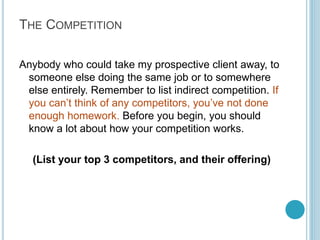
Step 7: The
Competition

Anybody who could take my
prospective client away, to
someone else doing the
same job or to somewhere
else entirely. Remember to
list indirect competition.

If you can’t think of any
competitors, you’ve not
done enough homework.
Before you begin, you
should know a lot about
how your competition
works.

List your top 3
competitors, their offering,
differentiator, and their
pricing.

By Kameel Vohra
www.kameelvohra.com
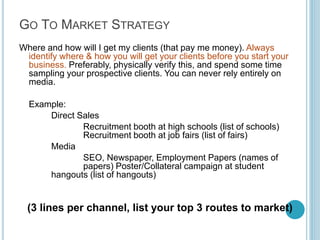
Step 8: Go To
Market Strategy

Where and how will I get my
clients (that pay me money).
Always identify where &
how you will get your clients
before you start your
business. Preferably,
physically verify this, and
spend some time sampling
your prospective clients. You
can never rely entirely on
media.

For Example:
Direct Sales
Recruitment booth at high
schools (list of schools)
Media
SEO, Newspaper,
Employment Papers (names
of papers) Poster/Collateral
campaign at student
hangouts (list of hangouts)

Write 3 lines per
channel, list your top 3
routes to market.

By Kameel Vohra
www.kameelvohra.com
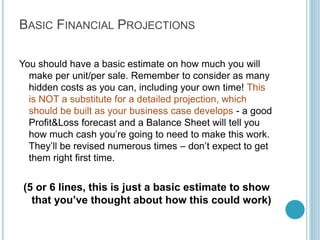
Step 9: Basic
Financial
Projections
You should have a basic
estimate on how much you
will make per unit/per sale.
Remember to consider as
many hidden costs as you
can, including your own
time!

This is NOT a substitute for a
detailed projection, which
should be built as your
business case develops - a
good P&L forecast and a
Balance Sheet will tell you
how much cash you’re going
to need to make this work.
They’ll be revised numerous
times – don’t expect to get
them right first time.

Write 5 or 6 lines, this is a
basic estimate so you
start thinking about what’s
involved

By Kameel Vohra
www.kameelvohra.com
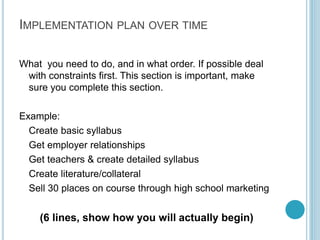
Step 10:
Implementation Plan
over time
What you need to do, and in
what order. If possible deal
with constraints first. This
section is important, make
sure you complete this
section.
In time this should turn
into an actual project plan
(Gannt chart)

For Example:
Create basic syllabus
Get employer relationships
Get teachers & create
detailed syllabus
Create literature/collateral
Sell 30 places on course
through high school
marketing

No less than 6 lines,
showing how you are
actually going to begin

By Kameel Vohra
www.kameelvohra.com
Thank You
Download a sample ONE PAGE Business Plan Template,
from here: http://kameelvohra.com/marketing-resources/

If you found this helpful, please share!

By Kameel Vohra
www.kameelvohra.com

A quick ONE PAGE Business Plan Template

  • 1.
    How To createa ONE PAGE Business Plan Sometimes you have a brilliant idea that you need to thrash out before you begin the process of building more, fully fledged business plans & marketing plans This template is designed to give you a better idea as to what’s involved in establishing your business, and to help you communicate the idea to people that can provide you feedback. It’s not a substitute for a full business plan, but it’s a great way to get a good (more objective) view. By Kameel Vohra www.kameelvohra.com
  • 2.
    CONTENTS 1 2 3 4 5 6 The Key People YourVision Mission (Customer) Key Constraints 7 The Competition 8 Go To Market Strategy 9 Financial Plans 1 0 Implementation Nice to Have Key Delivery Requirements By Kameel Vohra www.kameelvohra.com
  • 3.
    Step 1: The KeyPeople An idea is only as good as it’s implementation. You need the right people for the job, and you, personally, might not be the right person. So answer the following questions about the team members: Who are they? What do they know? Whom do they know? How well are they known? Write about 4 Lines on people critical to your mission By Kameel Vohra www.kameelvohra.com
  • 4.
    Step 2: Your Vision Broad,end-game objective that illustrates where you want your company to go. It sounds cliché, but it’s important that the people you’re working with share your vision. For Example: To be the largest national, premiere institute that bridges the gap between formal education and employability. Write about 2-3 Lines on what you actually want to achieve By Kameel Vohra www.kameelvohra.com
  • 5.
    Step 3: TheMission (Customer) What we do? Whom we do it for? Who will pay? Why will they pay? These four questions are crucial. Think very carefully about who will be paying & why, especially if the person paying isn’t the person that directly uses your product/service! Write one line per question. Answer all the questions. By Kameel Vohra www.kameelvohra.com
  • 6.
    Step 4: Key Constraints Identifythings without which our business can NOT work. It’s very important to know, you should be candid about anything that could be a deal breaker. You shouldn’t have more than one or two of these. For Example: A corporate relationship to ensure employment of our students with a company Write two lines at most per constraint. You shouldn’t have too many critical constraints. By Kameel Vohra www.kameelvohra.com
  • 7.
    Step 5: Niceto Have (But not Constraints) Things that would be great, but that we can find a workaround for. Most items that we think are constraints will end up here. These are things that we can buy in, rent or somehow manage to get. They’re not so critical that the business won’t run without them. For Example: A trainer with experience in teaching chosen field/course. Ability to use prospective employers name in marketing collateral. Careful this could be a big list. Just list the top 3 or 4. By Kameel Vohra www.kameelvohra.com
  • 8.
    Step 6: KeyDelivery Requirements Things that we need in order to service constraints / deliver your service-product. These are the things that take your client to the end point of having used your product/service. If you have a constraint, the things that manage/interact with that constraint should be mentioned here, as they’ll be equally important. Constraint: Corporate Relationship to Employ Students Sales person to approach companies Mission: Training Students to be employable Relationship with high schools to provide students Create this for each of the key constraints you’ve listed. List the one thing that you need in order for your product to actually make something happen. By Kameel Vohra www.kameelvohra.com
  • 9.
    Step 7: The Competition Anybodywho could take my prospective client away, to someone else doing the same job or to somewhere else entirely. Remember to list indirect competition. If you can’t think of any competitors, you’ve not done enough homework. Before you begin, you should know a lot about how your competition works. List your top 3 competitors, their offering, differentiator, and their pricing. By Kameel Vohra www.kameelvohra.com
  • 10.
    Step 8: GoTo Market Strategy Where and how will I get my clients (that pay me money). Always identify where & how you will get your clients before you start your business. Preferably, physically verify this, and spend some time sampling your prospective clients. You can never rely entirely on media. For Example: Direct Sales Recruitment booth at high schools (list of schools) Media SEO, Newspaper, Employment Papers (names of papers) Poster/Collateral campaign at student hangouts (list of hangouts) Write 3 lines per channel, list your top 3 routes to market. By Kameel Vohra www.kameelvohra.com
  • 11.
    Step 9: Basic Financial Projections Youshould have a basic estimate on how much you will make per unit/per sale. Remember to consider as many hidden costs as you can, including your own time! This is NOT a substitute for a detailed projection, which should be built as your business case develops - a good P&L forecast and a Balance Sheet will tell you how much cash you’re going to need to make this work. They’ll be revised numerous times – don’t expect to get them right first time. Write 5 or 6 lines, this is a basic estimate so you start thinking about what’s involved By Kameel Vohra www.kameelvohra.com
  • 12.
    Step 10: Implementation Plan overtime What you need to do, and in what order. If possible deal with constraints first. This section is important, make sure you complete this section. In time this should turn into an actual project plan (Gannt chart) For Example: Create basic syllabus Get employer relationships Get teachers & create detailed syllabus Create literature/collateral Sell 30 places on course through high school marketing No less than 6 lines, showing how you are actually going to begin By Kameel Vohra www.kameelvohra.com
  • 13.
    Thank You Download asample ONE PAGE Business Plan Template, from here: http://kameelvohra.com/marketing-resources/ If you found this helpful, please share! By Kameel Vohra www.kameelvohra.com