CHAPTER 4 INTERNATIONAL TRADE AND THE THOERY
MEANING OF INTERNATIONAL TRADE International trade -  is the exchange of goods and services across international boundaries and territories.  The guiding principle of international trade is comparative advantage (every country find something that it can produce cheaper than another country.) While international trade has been present  importance have been on the rise in recent centuries, because of Industrialization, Globalization and Multinational corporations .
International trade is a major source of economic revenue for any nation that is considered a world power. . Without international trade, nations would be limited to the goods found within their own borders. New developments include in patterns of international trade: the integration of countries into trade blocs(European Union, NAFTA, EFTA, CEFTA) and globalisation.
INTERNATIONAL TRADE IN DEVELOPING COUNTRIES Recent decades have seen rapid growth of the world economy.  This growth has been driven in part by the even faster rise in international trade. The growth in trade is in turn the result of both technological developments and concerted efforts to reduce trade barriers.
International Trade and the World Economy Over the past 20 years, the growth of  international trade has averaged 6 percent per year, twice as fast as world output. But trade has been an engine of growth for much longer. Since 1947, when the General Agreement on Tariffs and Trade (GATT) was created, the world trading system has benefited from eight rounds of multilateral trade liberalization, as well as from unilateral and regional liberalization.
The resulting integration of the world economy has raised living standards around the world. Most developing countries have shared in this prosperity; in some, incomes have risen dramatically.  Many developing countries have substantially increased their exports of manufactures and services relative to traditional commodity exports: manufactures have risen to 80 percent of developing country exports. Moreover, trade between developing countries has grown rapidly, with 40 percent of their exports now going to other developing countries. CONT
The Benefits of Trade Liberalization Policies that make an economy open to trade and investment with the rest of the world are needed for sustained economic growth. Opening up their economies to the global economy has been essential in enabling many developing countries to develop competitive advantages in the manufacture of certain products. In these countries, defined by the World Bank as the "new globalizers," the number of people in absolute poverty declined by over 120 million (14 percent) between 1993 and 1998.
CONT There is considerable evidence that more outward-oriented countries tend consistently to grow faster than ones that are inward-looking. Indeed, one finding is that the benefits of trade liberalization can exceed the costs by more than a factor of 10. Freeing trade frequently benefits the poor especially. Developing countries can ill-afford the large implicit subsidies, often channeled to narrow privileged interests, that trade protection provides.
CONT The potential gains from eliminating remaining trade barriers are considerable. Moreover, developing countries would gain more from global trade liberalization as a percentage of their GDP than industrial countries, because their economies are more highly protected and because they face higher barriers. The group of low-income countries, however, would gain most from agricultural liberalization in industrial countries because of the greater relative importance of agriculture in their economies.
The Need for Further Liberalization of International Trade   These are the considerations point to the need to liberalize trade further. In industrial countries, protection of manufacturing is generally low, but it remains high on many labor-intensive products produced by developing countries Many developing countries themselves have high tariffs. On average, their tariffs on the industrial products they import are three to four times as high as those of industrial countries, and they exhibit the same characteristics of tariff peaks and escalation. Tariffs on agriculture are even higher than those on industrial products.
CONT For a variety of reasons, preferential access schemes for poorer countries have not proven very effective at increasing market access for these countries.  Further liberalization of international trade will be needed to realize trade's potential as a driving force for economic growth and development Enhanced market access for the poorest developing countries would provide them with the means to harness trade for development and poverty reduction.
INTERNATIONAL TRADE IN DEVELOPING COUNTRIES The developing countries that participated in international trade are: Brazil India North Korea Philippine Thailand South Africa
IMPORTANCE OF INTERNATIONAL TRADE International trade was importance to developing countries for 4 reasons: Primary means of realizing the benefits of globalization. Continuing reallocation of manufacturing activities. Intertwined with another element of globalization. Trade supported by WTO that creating a commercial environment more conducive to the multilateral exchange of goods and services.
Brazil Brazil is a developing country that participated in international trade. The activities including export and import from and to other countries such as US, Argentina, China, Germany, Japan and so on. Brazil was in sustained growth, coupled with booming exports, healthy external accounts, moderate inflation, decreasing unemployment, and reductions in the debt-to-GDP ratio.
BRAZIL - Impact of International Trade Sustainable growth of economy Depends on the impact of structural  reform program and efforts to build a  more welcoming climate for investment Healthy export growth To increase exports, the government is seeking  access to foreign markets through trade  negotiations and increased export promotion as  well as government financing for exports.
Cont Decreasing of unemployed rate Need a volume of skilled workers in using the new technologies in the production process. Reductions in the debt-to-GDP ratio  Through international trade, Brazil total foreign  debt falling by the increasingly of export income.
Russia Russia is a developing countries but it is slow in economy growth. The main industries are mining, machine building, defense, shipbuilding, agricultural machinery, construction equipment, consumer durables, textiles, foodstuffs and handicrafts. Main export and import partners are Germany, Italy, France, Netherland, Turkey and Japan.
RUSSIA - Impact of international trade Increasing in national income when tariffs are lowered and relative prices change, resources are reallocated to production activities that raise national incomes. New economy environment economies adjust to technological innovations, new production structures and new patterns of competition
Cont Transition of economy system The change of economic system from  central planning to a market-based  economy system. Increasing in capital investments Russia has been experiencing a boom in capital investments.  Changing of manufacturing structure manufacturing is now moving away from low value-added activities to more technology intensive goods
South Africa has rich mineral resources. It is the world's largest producer and exporter of gold and platinum and also exports a significant amount of coal. Another major export is diamonds. During 2000, platinum overtook gold as South Africa's largest foreign exchange earner.  The value-added processing of minerals to produce ferroalloys, stainless steels, and similar products is a major industry and an important growth area. The country's diverse manufacturing industry is a world leader in several specialized sectors, including railway rolling stock, synthetic fuels, and mining equipment and machinery. SOUTH AFRICA
AFTA AFTA is a free trade zone in Southeast Asia where member countries include Malaysia, Singapore, Thailand, Philippines, Indonesia, and Brunei.  Malaysian Participation in  International Trade
History of AFTA The proposal to set up a Free Trade Area in ASEAN was first mooted by the Thai Prime Minister Anand Panyarachun and the Thai proposal was agreed upon with amendments during the ASEAN Seniors Economic Official Meeting (AEM) in Kuala Lumpur. In January 1992, the ASEAN members then signed the Singapore Declaration at the heart of which was the creation of AFTA in 15 years.
The primary goals of AFTA seek to : Increase ASEAN’s competitive edge as a production base in the world market through the elimination, within ASEAN, of tariffs and non-tariff barriers. Attract more foreign direct investment to ASEAN. The purpose was to develop greater trade and industrial linkages among ASEAN member countries. With a combined population of 513 million people, the establishment of the Free Trade Area among ASEAN, offers vast potential for greater economic collaboration.
Impact of AFTA on Malaysia’s Economy Positive impact to Malaysia’s industries Negative impact to Malaysia’s industries
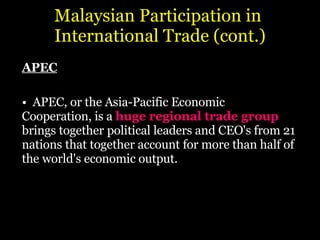
Malaysian Participation in  International Trade (cont.) APEC APEC, or the Asia-Pacific Economic  Cooperation, is a  huge regional trade group  brings together   political leaders and CEO's from 21 nations   that together account for more than half of the   world's economic output.
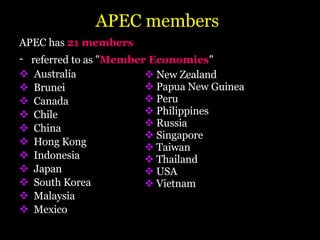
APEC members APEC has  21 members   referred to as " Member Economies "   Australia  Brunei Canada  Chile China Hong Kong  Indonesia Japan South Korea  Malaysia  Mexico New Zealand Papua New Guinea Peru  Philippines Russia  Singapore Taiwan Thailand USA Vietnam
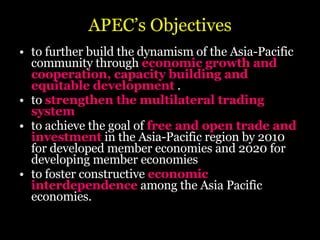
APEC’s Objectives to further build the dynamism of the Asia-Pacific community through  economic growth and cooperation, capacity building and equitable development  .  to  strengthen the multilateral trading system   to achieve the goal of  free and open trade and investment  in the Asia-Pacific region by 2010 for developed member economies and 2020 for developing member economies  to foster constructive  economic interdependence  among the Asia Pacific economies.


international biz chapter 4

  • 1.
    CHAPTER 4 INTERNATIONALTRADE AND THE THOERY
  • 2.
    MEANING OF INTERNATIONALTRADE International trade - is the exchange of goods and services across international boundaries and territories. The guiding principle of international trade is comparative advantage (every country find something that it can produce cheaper than another country.) While international trade has been present importance have been on the rise in recent centuries, because of Industrialization, Globalization and Multinational corporations .
  • 3.
    International trade isa major source of economic revenue for any nation that is considered a world power. . Without international trade, nations would be limited to the goods found within their own borders. New developments include in patterns of international trade: the integration of countries into trade blocs(European Union, NAFTA, EFTA, CEFTA) and globalisation.
  • 4.
    INTERNATIONAL TRADE INDEVELOPING COUNTRIES Recent decades have seen rapid growth of the world economy. This growth has been driven in part by the even faster rise in international trade. The growth in trade is in turn the result of both technological developments and concerted efforts to reduce trade barriers.
  • 5.
    International Trade andthe World Economy Over the past 20 years, the growth of international trade has averaged 6 percent per year, twice as fast as world output. But trade has been an engine of growth for much longer. Since 1947, when the General Agreement on Tariffs and Trade (GATT) was created, the world trading system has benefited from eight rounds of multilateral trade liberalization, as well as from unilateral and regional liberalization.
  • 6.
    The resulting integrationof the world economy has raised living standards around the world. Most developing countries have shared in this prosperity; in some, incomes have risen dramatically. Many developing countries have substantially increased their exports of manufactures and services relative to traditional commodity exports: manufactures have risen to 80 percent of developing country exports. Moreover, trade between developing countries has grown rapidly, with 40 percent of their exports now going to other developing countries. CONT
  • 7.
    The Benefits ofTrade Liberalization Policies that make an economy open to trade and investment with the rest of the world are needed for sustained economic growth. Opening up their economies to the global economy has been essential in enabling many developing countries to develop competitive advantages in the manufacture of certain products. In these countries, defined by the World Bank as the "new globalizers," the number of people in absolute poverty declined by over 120 million (14 percent) between 1993 and 1998.
  • 8.
    CONT There isconsiderable evidence that more outward-oriented countries tend consistently to grow faster than ones that are inward-looking. Indeed, one finding is that the benefits of trade liberalization can exceed the costs by more than a factor of 10. Freeing trade frequently benefits the poor especially. Developing countries can ill-afford the large implicit subsidies, often channeled to narrow privileged interests, that trade protection provides.
  • 9.
    CONT The potentialgains from eliminating remaining trade barriers are considerable. Moreover, developing countries would gain more from global trade liberalization as a percentage of their GDP than industrial countries, because their economies are more highly protected and because they face higher barriers. The group of low-income countries, however, would gain most from agricultural liberalization in industrial countries because of the greater relative importance of agriculture in their economies.
  • 10.
    The Need forFurther Liberalization of International Trade These are the considerations point to the need to liberalize trade further. In industrial countries, protection of manufacturing is generally low, but it remains high on many labor-intensive products produced by developing countries Many developing countries themselves have high tariffs. On average, their tariffs on the industrial products they import are three to four times as high as those of industrial countries, and they exhibit the same characteristics of tariff peaks and escalation. Tariffs on agriculture are even higher than those on industrial products.
  • 11.
    CONT For avariety of reasons, preferential access schemes for poorer countries have not proven very effective at increasing market access for these countries. Further liberalization of international trade will be needed to realize trade's potential as a driving force for economic growth and development Enhanced market access for the poorest developing countries would provide them with the means to harness trade for development and poverty reduction.
  • 12.
    INTERNATIONAL TRADE INDEVELOPING COUNTRIES The developing countries that participated in international trade are: Brazil India North Korea Philippine Thailand South Africa
  • 13.
    IMPORTANCE OF INTERNATIONALTRADE International trade was importance to developing countries for 4 reasons: Primary means of realizing the benefits of globalization. Continuing reallocation of manufacturing activities. Intertwined with another element of globalization. Trade supported by WTO that creating a commercial environment more conducive to the multilateral exchange of goods and services.
  • 14.
    Brazil Brazil isa developing country that participated in international trade. The activities including export and import from and to other countries such as US, Argentina, China, Germany, Japan and so on. Brazil was in sustained growth, coupled with booming exports, healthy external accounts, moderate inflation, decreasing unemployment, and reductions in the debt-to-GDP ratio.
  • 15.
    BRAZIL - Impactof International Trade Sustainable growth of economy Depends on the impact of structural reform program and efforts to build a more welcoming climate for investment Healthy export growth To increase exports, the government is seeking access to foreign markets through trade negotiations and increased export promotion as well as government financing for exports.
  • 16.
    Cont Decreasing ofunemployed rate Need a volume of skilled workers in using the new technologies in the production process. Reductions in the debt-to-GDP ratio Through international trade, Brazil total foreign debt falling by the increasingly of export income.
  • 17.
    Russia Russia isa developing countries but it is slow in economy growth. The main industries are mining, machine building, defense, shipbuilding, agricultural machinery, construction equipment, consumer durables, textiles, foodstuffs and handicrafts. Main export and import partners are Germany, Italy, France, Netherland, Turkey and Japan.
  • 18.
    RUSSIA - Impactof international trade Increasing in national income when tariffs are lowered and relative prices change, resources are reallocated to production activities that raise national incomes. New economy environment economies adjust to technological innovations, new production structures and new patterns of competition
  • 19.
    Cont Transition ofeconomy system The change of economic system from central planning to a market-based economy system. Increasing in capital investments Russia has been experiencing a boom in capital investments. Changing of manufacturing structure manufacturing is now moving away from low value-added activities to more technology intensive goods
  • 20.
    South Africa hasrich mineral resources. It is the world's largest producer and exporter of gold and platinum and also exports a significant amount of coal. Another major export is diamonds. During 2000, platinum overtook gold as South Africa's largest foreign exchange earner. The value-added processing of minerals to produce ferroalloys, stainless steels, and similar products is a major industry and an important growth area. The country's diverse manufacturing industry is a world leader in several specialized sectors, including railway rolling stock, synthetic fuels, and mining equipment and machinery. SOUTH AFRICA
  • 21.
    AFTA AFTA isa free trade zone in Southeast Asia where member countries include Malaysia, Singapore, Thailand, Philippines, Indonesia, and Brunei.  Malaysian Participation in International Trade
  • 22.
    History of AFTAThe proposal to set up a Free Trade Area in ASEAN was first mooted by the Thai Prime Minister Anand Panyarachun and the Thai proposal was agreed upon with amendments during the ASEAN Seniors Economic Official Meeting (AEM) in Kuala Lumpur. In January 1992, the ASEAN members then signed the Singapore Declaration at the heart of which was the creation of AFTA in 15 years.
  • 23.
    The primary goalsof AFTA seek to : Increase ASEAN’s competitive edge as a production base in the world market through the elimination, within ASEAN, of tariffs and non-tariff barriers. Attract more foreign direct investment to ASEAN. The purpose was to develop greater trade and industrial linkages among ASEAN member countries. With a combined population of 513 million people, the establishment of the Free Trade Area among ASEAN, offers vast potential for greater economic collaboration.
  • 24.
    Impact of AFTAon Malaysia’s Economy Positive impact to Malaysia’s industries Negative impact to Malaysia’s industries
  • 25.
    Malaysian Participation in International Trade (cont.) APEC APEC, or the Asia-Pacific Economic Cooperation, is a huge regional trade group brings together political leaders and CEO's from 21 nations that together account for more than half of the world's economic output.
  • 26.
    APEC members APEChas 21 members referred to as " Member Economies " Australia Brunei Canada Chile China Hong Kong Indonesia Japan South Korea Malaysia Mexico New Zealand Papua New Guinea Peru Philippines Russia Singapore Taiwan Thailand USA Vietnam
  • 27.
    APEC’s Objectives tofurther build the dynamism of the Asia-Pacific community through economic growth and cooperation, capacity building and equitable development . to strengthen the multilateral trading system to achieve the goal of free and open trade and investment in the Asia-Pacific region by 2010 for developed member economies and 2020 for developing member economies to foster constructive economic interdependence among the Asia Pacific economies.
  • 28.
  • 29.
  • 30.
  • 31.