ADITYA SILVER OAK INSTITUTE OF TECHNOLOGY
TOPIC : CONCRETE MIX DESIGN
Patel Nishil Bhaveshbhai (191200106022)
INTRODUCTION
• Concrete is obtained by mixing cement, fine aggregate, coarse aggregate, water and
admixtures in required proportions. The mixture when placed in forms and allowed
to cure becomes hard like stone.
• The hardening is caused by chemical action between water and the cement due to
which concrete grows stronger with age.
• It is the most widely-used man-made construction material in the world.
CONCRETE MIX DESIGN
• DEFINITION
"Mix Design is the science of determining the relative proportions of the
ingredients of concrete to achieve the desired properties in the most
economical way.“
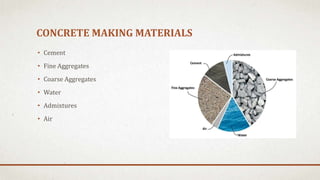
CONCRETE MAKING MATERIALS
• Cement
• Fine Aggregates
• Coarse Aggregates
• Water
• Admixtures
• Air
TYPES OF CONCRETE MIXES
1. Nominal Mixes –
• These mixes are of fixed cement-aggregate ratio.
• These offer simplicity and under normal circumstances.
• Have a margin of strength above that specified
2. Standard Mixes –
• The minimum compressive strength has been included by IS-456:2000 in many specifications.
These mixes are termed standard mixes.
• E.g.: M10, M15, M20, etc.
3. Designed Mixes –
• In these mixes the performance of the concrete is specified by the designer but the mix
proportions are determined by the producer of concrete, except that the minimum cement
content can be laid down.
PRINCIPLES OF MIX DESIGN
I. The environment exposure condition for the structure
II. The grade of concrete, their characteristic strength's and standard deviations
III. The type of cement
IV. The types and sizes of aggregates and their sources of supply
V. The nominal maximum sizes of aggregates
VI. Maximum and minimum cement content in kg/m³
VII. Water cement ratio
VIII. The degree of workability of concrete based on placing conditions
VIX. Air content inclusive of entrained air
X. The maximum/minimum density of concrete
XI. The maximum/minimum temperature of fresh concrete
XII. Type of water available for mixing and curing
XIII. The source of water and the impurities present in it.
FACTORS DEFINING THE CHOICE OF MIX
PROPORTIONS
1. Compressive Strength
2. Workability
3. Durability
4. Type, size and grading of aggregates
5. Aggregate-cement ratio
6. Quality Control
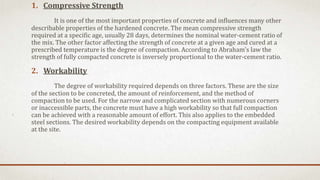
1. Compressive Strength
It is one of the most important properties of concrete and influences many other
describable properties of the hardened concrete. The mean compressive strength
required at a specific age, usually 28 days, determines the nominal water-cement ratio of
the mix. The other factor affecting the strength of concrete at a given age and cured at a
prescribed temperature is the degree of compaction. According to Abraham's law the
strength of fully compacted concrete is inversely proportional to the water-cement ratio.
2. Workability
The degree of workability required depends on three factors. These are the size
of the section to be concreted, the amount of reinforcement, and the method of
compaction to be used. For the narrow and complicated section with numerous corners
or inaccessible parts, the concrete must have a high workability so that full compaction
can be achieved with a reasonable amount of effort. This also applies to the embedded
steel sections. The desired workability depends on the compacting equipment available
at the site.
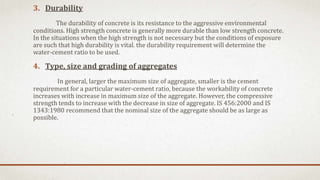
3. Durability
The durability of concrete is its resistance to the aggressive environmental
conditions. High strength concrete is generally more durable than low strength concrete.
In the situations when the high strength is not necessary but the conditions of exposure
are such that high durability is vital. the durability requirement will determine the
water-cement ratio to be used.
4. Type, size and grading of aggregates
In general, larger the maximum size of aggregate, smaller is the cement
requirement for a particular water-cement ratio, because the workability of concrete
increases with increase in maximum size of the aggregate. However, the compressive
strength tends to increase with the decrease in size of aggregate. IS 456:2000 and IS
1343:1980 recommend that the nominal size of the aggregate should be as large as
possible.
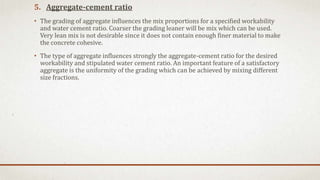
5. Aggregate-cement ratio
• The grading of aggregate influences the mix proportions for a specified workability
and water cement ratio. Coarser the grading leaner will be mix which can be used.
Very lean mix is not desirable since it does not contain enough finer material to make
the concrete cohesive.
• The type of aggregate influences strongly the aggregate-cement ratio for the desired
workability and stipulated water cement ratio. An important feature of a satisfactory
aggregate is the uniformity of the grading which can be achieved by mixing different
size fractions.
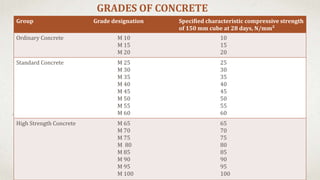
Group Grade designation Specified characteristic compressive strength
of 150 mm cube at 28 days, N/mm²
Ordinary Concrete M 10
M 15
M 20
10
15
20
Standard Concrete M 25
M 30
M 35
M 40
M 45
M 50
M 55
M 60
25
30
35
40
45
50
55
60
High Strength Concrete M 65
M 70
M 75
M 80
M 85
M 90
M 95
M 100
65
70
75
80
85
90
95
100
GRADES OF CONCRETE
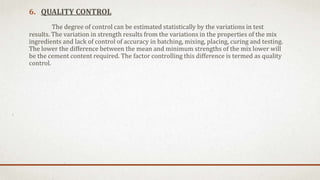
6. QUALITY CONTROL
The degree of control can be estimated statistically by the variations in test
results. The variation in strength results from the variations in the properties of the mix
ingredients and lack of control of accuracy in batching, mixing, placing, curing and testing.
The lower the difference between the mean and minimum strengths of the mix lower will
be the cement content required. The factor controlling this difference is termed as quality
control.
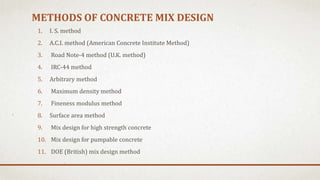
METHODS OF CONCRETE MIX DESIGN
1. I. S. method
2. A.C.I. method (American Concrete Institute Method)
3. Road Note-4 method (U.K. method)
4. IRC-44 method
5. Arbitrary method
6. Maximum density method
7. Fineness modulus method
8. Surface area method
9. Mix design for high strength concrete
10. Mix design for pumpable concrete
11. DOE (British) mix design method

CONCRETE MIX DESIGN.pptx

  • 1.
    ADITYA SILVER OAKINSTITUTE OF TECHNOLOGY TOPIC : CONCRETE MIX DESIGN Patel Nishil Bhaveshbhai (191200106022)
  • 2.
    INTRODUCTION • Concrete isobtained by mixing cement, fine aggregate, coarse aggregate, water and admixtures in required proportions. The mixture when placed in forms and allowed to cure becomes hard like stone. • The hardening is caused by chemical action between water and the cement due to which concrete grows stronger with age. • It is the most widely-used man-made construction material in the world.
  • 3.
    CONCRETE MIX DESIGN •DEFINITION "Mix Design is the science of determining the relative proportions of the ingredients of concrete to achieve the desired properties in the most economical way.“
  • 4.
    CONCRETE MAKING MATERIALS •Cement • Fine Aggregates • Coarse Aggregates • Water • Admixtures • Air
  • 5.
    TYPES OF CONCRETEMIXES 1. Nominal Mixes – • These mixes are of fixed cement-aggregate ratio. • These offer simplicity and under normal circumstances. • Have a margin of strength above that specified 2. Standard Mixes – • The minimum compressive strength has been included by IS-456:2000 in many specifications. These mixes are termed standard mixes. • E.g.: M10, M15, M20, etc. 3. Designed Mixes – • In these mixes the performance of the concrete is specified by the designer but the mix proportions are determined by the producer of concrete, except that the minimum cement content can be laid down.
  • 6.
    PRINCIPLES OF MIXDESIGN I. The environment exposure condition for the structure II. The grade of concrete, their characteristic strength's and standard deviations III. The type of cement IV. The types and sizes of aggregates and their sources of supply V. The nominal maximum sizes of aggregates VI. Maximum and minimum cement content in kg/m³ VII. Water cement ratio VIII. The degree of workability of concrete based on placing conditions
  • 7.
    VIX. Air contentinclusive of entrained air X. The maximum/minimum density of concrete XI. The maximum/minimum temperature of fresh concrete XII. Type of water available for mixing and curing XIII. The source of water and the impurities present in it.
  • 8.
    FACTORS DEFINING THECHOICE OF MIX PROPORTIONS 1. Compressive Strength 2. Workability 3. Durability 4. Type, size and grading of aggregates 5. Aggregate-cement ratio 6. Quality Control
  • 9.
    1. Compressive Strength Itis one of the most important properties of concrete and influences many other describable properties of the hardened concrete. The mean compressive strength required at a specific age, usually 28 days, determines the nominal water-cement ratio of the mix. The other factor affecting the strength of concrete at a given age and cured at a prescribed temperature is the degree of compaction. According to Abraham's law the strength of fully compacted concrete is inversely proportional to the water-cement ratio. 2. Workability The degree of workability required depends on three factors. These are the size of the section to be concreted, the amount of reinforcement, and the method of compaction to be used. For the narrow and complicated section with numerous corners or inaccessible parts, the concrete must have a high workability so that full compaction can be achieved with a reasonable amount of effort. This also applies to the embedded steel sections. The desired workability depends on the compacting equipment available at the site.
  • 10.
    3. Durability The durabilityof concrete is its resistance to the aggressive environmental conditions. High strength concrete is generally more durable than low strength concrete. In the situations when the high strength is not necessary but the conditions of exposure are such that high durability is vital. the durability requirement will determine the water-cement ratio to be used. 4. Type, size and grading of aggregates In general, larger the maximum size of aggregate, smaller is the cement requirement for a particular water-cement ratio, because the workability of concrete increases with increase in maximum size of the aggregate. However, the compressive strength tends to increase with the decrease in size of aggregate. IS 456:2000 and IS 1343:1980 recommend that the nominal size of the aggregate should be as large as possible.
  • 11.
    5. Aggregate-cement ratio •The grading of aggregate influences the mix proportions for a specified workability and water cement ratio. Coarser the grading leaner will be mix which can be used. Very lean mix is not desirable since it does not contain enough finer material to make the concrete cohesive. • The type of aggregate influences strongly the aggregate-cement ratio for the desired workability and stipulated water cement ratio. An important feature of a satisfactory aggregate is the uniformity of the grading which can be achieved by mixing different size fractions.
  • 12.
    Group Grade designationSpecified characteristic compressive strength of 150 mm cube at 28 days, N/mm² Ordinary Concrete M 10 M 15 M 20 10 15 20 Standard Concrete M 25 M 30 M 35 M 40 M 45 M 50 M 55 M 60 25 30 35 40 45 50 55 60 High Strength Concrete M 65 M 70 M 75 M 80 M 85 M 90 M 95 M 100 65 70 75 80 85 90 95 100 GRADES OF CONCRETE
  • 13.
    6. QUALITY CONTROL Thedegree of control can be estimated statistically by the variations in test results. The variation in strength results from the variations in the properties of the mix ingredients and lack of control of accuracy in batching, mixing, placing, curing and testing. The lower the difference between the mean and minimum strengths of the mix lower will be the cement content required. The factor controlling this difference is termed as quality control.
  • 14.
    METHODS OF CONCRETEMIX DESIGN 1. I. S. method 2. A.C.I. method (American Concrete Institute Method) 3. Road Note-4 method (U.K. method) 4. IRC-44 method 5. Arbitrary method 6. Maximum density method 7. Fineness modulus method 8. Surface area method 9. Mix design for high strength concrete 10. Mix design for pumpable concrete 11. DOE (British) mix design method