A new integer programming model for HP problem


        N. Yanev 1, P. Milanov 2; 3, I. Trenchev 2

   1 Faculty of Mathematics and Informatics, University of Sofia, Bulgaria.

   2 South-West University “Neot Rilski", Blagoevgrad, Bulgaria.

   3 Institute of Mathematics and Informatics, Bulgarian Academy of Sciences.

   choby@math.bas.bg, peter milanov77@yahoo.com, trenchev@swu.bg
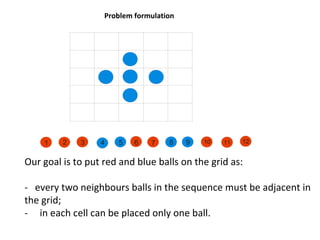
Problem formulation


    1    2   3    4   5    6   7    8    9   10   11   12


Our goal is to put red and blue balls on the grid as:

- every two neighbours balls in the sequence must be adjacent in
the grid;
- in each cell can be placed only one ball.
Problem formulation


         A self-avoiding walk is a path from one point
           to another which never intersects itself.
          Such paths are usually considered to occur
         on lattices, so that steps are only allowed in
            a discrete number of directions and of
                        certain lengths.
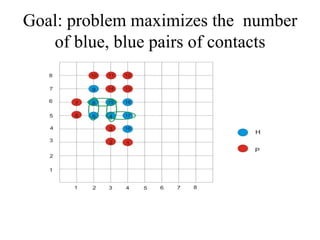
Goal: problem maximizes the number
   of blue, blue pairs of contacts
From Protein folding to HP model


Amino acids sequence:                         HP folding sequence :
SLDRSSCFTGSLDSIRAQSGLGCNSFRY                  PHPPPPPHPPPHPPHPHPPPHPPPPHPP
In this research, we study the hydrophobic-hydrophilic (HP) model on two-dimensional
(2D) square lattice, which is one of the most extensively studied lattice models. The HP
model was first introduced by Dill (1985).
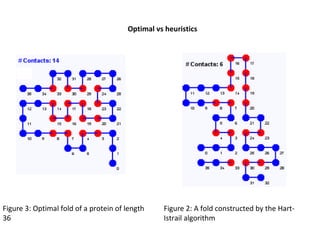
Optimal vs heuristics


Figure 3: Optimal fold of a protein of length    Figure 2: A fold constructed by the Hart-
36                                               Istrail algorithm
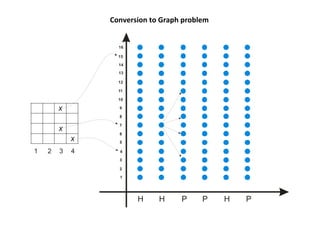
Conversion to Graph problem


                  16

                  15

                  14

                  13

                  12

                  11

                  10

        x         9

                  8

                  7
        x
                  6
            x     5

1   2   3   4     4

                  3

                  2

                  1


                       H     H     P     P    H   P
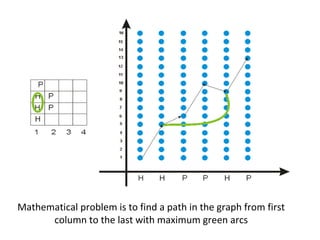
Mathematical problem is to find a path in the graph from first
      column to the last with maximum green arcs
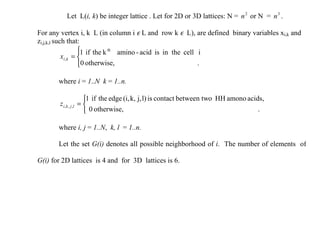
Let L(i, k) be integer lattice . Let for 2D or 3D lattices: N = n 2 or N = n 3 .

For any vertex i, k L (in column i ϵ L and row k ϵ L), are defined binary variables xi,k and
zi,j,k,l such that:
                    1 if the k th amino - acid is in the cell i
                    
            xi ,k = 
                    0 otherwise,
                                                              .

       where i = 1..N k = 1..n.

                         1 if the edge (i, k, j, l) is contact between two HH amono acids,
        z i , k , j ,l = 
                          0 otherwise,                                                  .

       where i, j = 1..N, k, l = 1..n.

       Let the set G(i) denotes all possible neighborhood of i. The number of elements of

G(i) for 2D lattices is 4 and for 3D lattices is 6.
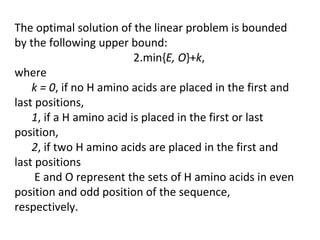
The optimal solution of the linear problem is bounded
by the following upper bound:
                          2.min{E, O}+k,
where
    k = 0, if no H amino acids are placed in the first and
last positions,
    1, if a H amino acid is placed in the first or last
position,
    2, if two H amino acids are placed in the first and
last positions
     E and O represent the sets of H amino acids in even
position and odd position of the sequence,
respectively.
Computational runs


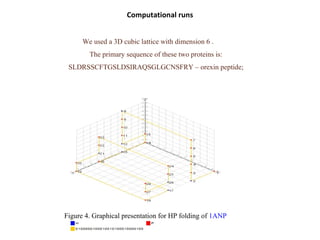
        We used a 3D cubic lattice with dimension 6 .
          The primary sequence of these two proteins is:
   SLDRSSCFTGSLDSIRAQSGLGCNSFRY – orexin peptide;
FSGPPGLQGRLQRLLQASGNHAAGILTM – hypotensive hormone.


  Figure 4. Graphical presentation for HP folding of 1ANP
Future trends:
• Improving of the model;

• Adaptation of CPLEX for special branch and
  bound for HP folding;

• Solving larger problems.
Thank you for
  attention.
A new integer programming model for hp problem

A new integer programming model for hp problem

  • 1.
    A new integerprogramming model for HP problem N. Yanev 1, P. Milanov 2; 3, I. Trenchev 2 1 Faculty of Mathematics and Informatics, University of Sofia, Bulgaria. 2 South-West University “Neot Rilski", Blagoevgrad, Bulgaria. 3 Institute of Mathematics and Informatics, Bulgarian Academy of Sciences. choby@math.bas.bg, peter milanov77@yahoo.com, trenchev@swu.bg
  • 2.
    Problem formulation 1 2 3 4 5 6 7 8 9 10 11 12 Our goal is to put red and blue balls on the grid as: - every two neighbours balls in the sequence must be adjacent in the grid; - in each cell can be placed only one ball.
  • 3.
    Problem formulation A self-avoiding walk is a path from one point to another which never intersects itself. Such paths are usually considered to occur on lattices, so that steps are only allowed in a discrete number of directions and of certain lengths.
  • 4.
    Goal: problem maximizesthe number of blue, blue pairs of contacts
  • 6.
    From Protein foldingto HP model Amino acids sequence: HP folding sequence : SLDRSSCFTGSLDSIRAQSGLGCNSFRY PHPPPPPHPPPHPPHPHPPPHPPPPHPP In this research, we study the hydrophobic-hydrophilic (HP) model on two-dimensional (2D) square lattice, which is one of the most extensively studied lattice models. The HP model was first introduced by Dill (1985).
  • 7.
    Optimal vs heuristics Figure3: Optimal fold of a protein of length Figure 2: A fold constructed by the Hart- 36 Istrail algorithm
  • 8.
    Conversion to Graphproblem 16 15 14 13 12 11 10 x 9 8 7 x 6 x 5 1 2 3 4 4 3 2 1 H H P P H P
  • 9.
    Mathematical problem isto find a path in the graph from first column to the last with maximum green arcs
  • 10.
    Let L(i, k)be integer lattice . Let for 2D or 3D lattices: N = n 2 or N = n 3 . For any vertex i, k L (in column i ϵ L and row k ϵ L), are defined binary variables xi,k and zi,j,k,l such that: 1 if the k th amino - acid is in the cell i  xi ,k =  0 otherwise,  . where i = 1..N k = 1..n. 1 if the edge (i, k, j, l) is contact between two HH amono acids, z i , k , j ,l =   0 otherwise, . where i, j = 1..N, k, l = 1..n. Let the set G(i) denotes all possible neighborhood of i. The number of elements of G(i) for 2D lattices is 4 and for 3D lattices is 6.
  • 11.
    The optimal solutionof the linear problem is bounded by the following upper bound: 2.min{E, O}+k, where k = 0, if no H amino acids are placed in the first and last positions, 1, if a H amino acid is placed in the first or last position, 2, if two H amino acids are placed in the first and last positions E and O represent the sets of H amino acids in even position and odd position of the sequence, respectively.
  • 12.
    Computational runs We used a 3D cubic lattice with dimension 6 . The primary sequence of these two proteins is: SLDRSSCFTGSLDSIRAQSGLGCNSFRY – orexin peptide; FSGPPGLQGRLQRLLQASGNHAAGILTM – hypotensive hormone. Figure 4. Graphical presentation for HP folding of 1ANP
  • 13.
    Future trends: • Improvingof the model; • Adaptation of CPLEX for special branch and bound for HP folding; • Solving larger problems.
  • 14.
    Thank you for attention.