Mathematical Theory and Modeling                                                                www.iiste.org
ISSN 2224-5804 (Paper)    ISSN 2225-0522 (Online)
Vol.2, No.1, 2011


     A New Computational Methodology to Find Appropriate
                              Solutions of Fuzzy Equations
                                       Shapla Shirin *   Goutam Kumar Saha
           Department of Mathematics, University of Dhaka, PO box 1000, Dhaka, Bangladesh
            * E-mail of the corresponding author: shapla@univdhaka.edu


Abstract
In this paper, a new computational methodology to get an appropriate solution of a fuzzy equation of the
form           , where , are known continuous triangular fuzzy numbers and          is an unknown fuzzy
number, are presented. In support of that some propositions with proofs and theorems are presented. A
different approach of the definition of ‘positive fuzzy number’ and ‘negative fuzzy number’ have been
focused. Also, the concept of ‘half-positive and half-negative fuzzy number’ has been introduced. The
solution of the fuzzy equation can be ‘positive fuzzy number’ or ‘negative fuzzy number’ or ‘half positive
or half negative fuzzy number’ which is computed by using the methodology focused in the proposed
propositions.
Keywords: Fuzzy number, Fuzzy equation, Positive fuzzy number, Negative fuzzy number, half positive
and half negative fuzzy number,      of a fuzzy number.


1. Introduction
In most cases in our life, the data obtained for decision making are only approximately known. The concept
of fuzzy set theory to meet those problems have been introduced [11]. The fuzziness of a property lies in
the lack of well defined boundaries [i.e., ill-defined boundaries] of the set of objects, to which this property
applies. Therefore, the membership grade is essential to define the fuzzy set theory.
The notion of fuzzy numbers has been introduced from the idea of real numbers [4] as a fuzzy subset of the
real line. There are arithmetic operations, which are similar to those of the set of real numbers, such that +,
–, . , /, on fuzzy numbers [6 8]. Fuzzy numbers allow us to make the mathematical model of linguistic
variable or fuzzy environment, and are also used to describe the data with vagueness and imprecision.
The definition of ‘positive fuzzy number’ and ‘negative fuzzy number’ have been introduced [5, 9]. The
shortcoming of the definitions [5] has been focused [10] and the concept of ‘nonnegative fuzzy numbers’
has been introduced [10] as well. None has introduced the notion of ‘half-positive and half-negative fuzzy
number’. In this paper, a different approach of the definitions of ‘positive fuzzy number’ and ‘negative
fuzzy number’ have been focused; and a new notion of ‘half-positive and half-negative fuzzy number’ has
been introduced. There are another notion in the fuzzy set theory is the concept of the solution of fuzzy
equations [8] of the form             and          , which have been discussed in [1 3, 8]. It is easy to
solve the fuzzy equation of the form                , where , are known fuzzy numbers and              is an
unknown fuzzy number [8], but there are some limitations to solve the fuzzy equation of the form           ,
where     is an unknown fuzzy number. Our main objective is to introduce a new computational
methodology to overcome the limitations to get a solution, if it exists, of the fuzzy equation of the form
         where     and      are known continuous triangular fuzzy numbers. Here it is noted that the core of
a known continuous triangular fuzzy number is a singleton set.

2. Preliminaries
In this section, some definitions [1     11] have been reviewed which are important to us for representing

                                                         1
Mathematical Theory and Modeling                                                                       www.iiste.org
ISSN 2224-5804 (Paper)    ISSN 2225-0522 (Online)
Vol.2, No.1, 2011


our main objective in the later sections. Let       be the set of all fuzzy numbers and             means that     is a
fuzzy number whose membership function is                         .
2.1 Definition : The              of a fuzzy set     is denoted by                                   and is defined by
                       ,                 .
2.2 Definition : The strong                of a fuzzy set         is denoted by                                  and is
defined by                           ,               .
2.3 Definition : The support of a fuzzy set         is denoted by                                   and is defined by
                      .
2.4 Definition :   A fuzzy set           is normal if there exist          , s.t          .
2.5 Definition : A fuzzy number is a fuzzy set, whose membership function is denoted by                               ,
which satisfies the conditions as under :
            (a)   is normal fuzzy set;
            (b)     is a closed interval             ;
            (c) support of , i.e.,       is a bounded set in the classical sense.
That is, a fuzzy number satisfies the condition of normality and convexity.
2.6 Definition [5] : A fuzzy number            is called positive (negative), denoted by               (      ), if its
membership function       satisfies                                  .
2.7 Definition [10] : A fuzzy number           is called positive, denoted by       , if its membership function
     satisfies                 .
2.8 Definition [10] : A fuzzy number   is called nonnegative, denoted by                          , if its membership
function      satisfies              .


3. Existence of a Solution of a Fuzzy Equation
Consider the fuzzy equation       , where , are known fuzzy numbers and is an unknown fuzzy
number. If                           ,                       and                              are
          of , and , respectively, then the fuzzy equation      has a solution if and only if the
equation
                                                                                                                   (A)
has a solution                               and      satisfies the following conditions [8] :
Condition 1:                                          .                                                            (B)
Condition 2 : If           then                                                                                    (C)

4. New Proposed Definitions
Here we have introduced some definitions which will help us to solve the fuzzy equation of the form
           , where , are known continuous fuzzy numbers and is an unknown fuzzy number. The
definitions are as follows and will be used in the next section.
4.1 Definition     : A triangular fuzzy number                    is called negative, denoted by                 , if
            there exist                where                          ),           ,                         such that
                                                          , and                               .
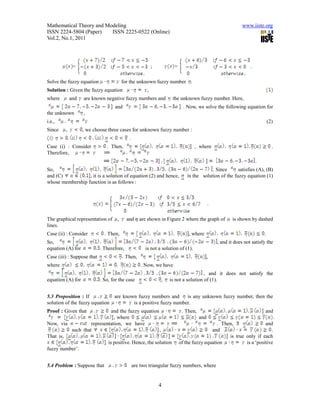
4.2 Example :      is a negative fuzzy number which is defined by


                                                            2
Mathematical Theory and Modeling                                                                           www.iiste.org
ISSN 2224-5804 (Paper)    ISSN 2225-0522 (Online)
Vol.2, No.1, 2011


                     ( )=                                            ,

where                                                                            ,   and
              .
4.3 Definition : A triangular fuzzy number    is called positive, denoted by                     , if                there
exist                     where            ),              ,                                 such that
                                                      , and                                     .
4.4 Example :     is a positive fuzzy number which is defined by


                     ( )=                                        ,

where                                                                        ,       and
              .
4.5 Definition [Half positive and half negative] : A triangular fuzzy number                   is called ‘half-positive and
half-negative’, denoted by                  , if                   there exist                                       where
            ),              ,                   such that
                                                      , and                                     .
4.6 Example :     is a half-positive and half-negative fuzzy number which is defined by


                     ( )=

where                                                           and                                           .
Figure 1 represents the fuzzy numbers which are given in examples 4.2, 4.4, and 4.6.


5. Problems, Discussions, and Results
In this section, we have proposed some propositions with their proofs, which will help us to solve the fuzzy
equation             without any difficulties and within a reasonable time. We have also established related
theorems. In support of that some problems and their solutions have also been investigated.


5.1 Proposition : If           are known fuzzy numbers and is any unknown fuzzy number, then the
solution of the fuzzy equation         is a positive fuzzy number.
Proof : Given that               and the fuzzy equation                  . Then,                                       and
                                , where                                         and                                           .
Now, via             representation, we have,         =                                         .
Then,                 and                 such that                                        ,                           and
                       . That is,                     ( )]                             ( )]
is true if each                                is positive. Hence, the solution            of the fuzzy equation
           is a ‘positive fuzzy number’.


5.2 Problem : Suppose that          and   are two triangular negative continuous fuzzy numbers, where

                                                        3
Mathematical Theory and Modeling                                                                          www.iiste.org
ISSN 2224-5804 (Paper)    ISSN 2225-0522 (Online)
Vol.2, No.1, 2011


              =                                            ;         =                                         .

Solve the fuzzy equation                 for the unknown fuzzy number
Solution : Given the fuzzy equation                    ,
where        and   are known negative fuzzy numbers and             the unknown fuzzy number. Here,
                                   and                                     . Now, we solve the following equation for
the unknown        ,
i.e.,                                                                                                                      (2)
Since    ,         , we choose three cases for unknown fuzzy number :
                                            .
Case (i) : Consider            . Then,                                            , where                                    .
Therefore,
                                                                                                                   .
So,                                                                                      . Since      satisfies (A), (B)
and (C)           , it is a solution of equation (2) and hence,              is the solution of the fuzzy equation (1)
whose membership function is as follows :


                                                                                          .

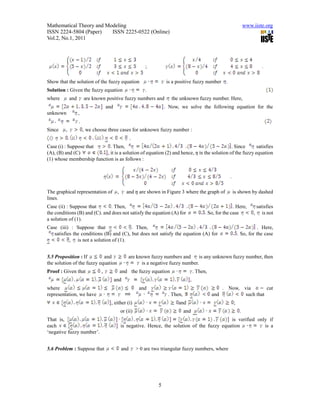
The graphical representation of      ,     and  are shown in Figure 2 where the graph of           is shown by dashed
lines.
Case (ii) : Consider          . Then,                                        , where                                   .
So,                                                                                           , and it does not satisfy the
equation (A) for            . Therefore,              is not a solution of (1).
Case (iii) : Suppose that                  Then,                                          ,
where                                               . Now, we have
                                                                                     , and it does not satisfy the
equation (A) for            . So, for the case                 ,   is not a solution of (1).


5.3 Proposition : If           are known fuzzy numbers and      is any unknown fuzzy number, then the
solution of the fuzzy equation         is a positive fuzzy number.
Proof : Given that           and the fuzzy equation                       . Then,                                      and
                              , where                                               and                                          .
Now, via           representation, we have                                                  . Then,                and
          such that                                  ,                                   and                          .
That is,                                                                                         is true only if each
                           is positive. Hence, the solution              of the fuzzy equation           is a ‘positive
fuzzy number’.


5.4 Problem : Suppose that                      are two triangular fuzzy numbers, where


                                                               4
Mathematical Theory and Modeling                                                                                       www.iiste.org
ISSN 2224-5804 (Paper)    ISSN 2225-0522 (Online)
Vol.2, No.1, 2011


                                                            ;                                                                    .

Show that the solution of the fuzzy equation                          is a positive fuzzy number .
Solution : Given the fuzzy equation                         .
where        and       are known positive fuzzy numbers and              the unknown fuzzy number. Here,
                                   and                                . Now, we solve the following equation for the
unknown            ,
                   .
Since    ,             , we choose three cases for unknown fuzzy number :
                                                    .
Case (i) : Suppose that      . Then,                                                         . Since      satisfies
(A), (B) and (C)           , it is a solution of equation (2) and hence,  is the solution of the fuzzy equation
(1) whose membership function is as follows :


                                                                                                          .

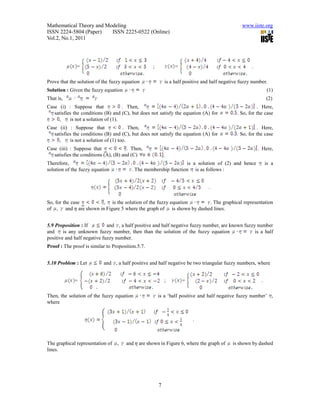
The graphical representation of           ,      and  are shown in Figure 3 where the graph of              is shown by dashed
lines.
Case (ii) : Suppose that       . Then,                                                                      . Here,            satisfies
the conditions (B) and (C). and does not satisfy the equation (A) for                        . So, for the case            ,      is not
a solution of (1).
Case (iii) : Suppose that                 Then,                                                                              . Here,
   satisfies the conditions (B) and (C), but does not satisfy the equation (A) for                                . So, for the case
           , is not a solution of (1).


5.5 Proposition : If        and                   are known fuzzy numbers and       is any unknown fuzzy number, then
the solution of the fuzzy equation                      is a negative fuzzy number.
Proof : Given that             ,              and the fuzzy equation                   . Then,
                                         and                                       ,
where                                                    and                                           . Now, via        cut
representation, we have                                                . Then,                   and           such that
                                     , either (i)                           and                               ;
                                              or (ii)                            and                               .
That is,                                                                                        is verified only if
each                                          is negative. Hence, the solution of the fuzzy equation           is a
‘negative fuzzy number’.


5.6 Problem : Suppose that                    and       > 0 are two triangular fuzzy numbers, where


                                                                  5
Mathematical Theory and Modeling                                                                                www.iiste.org
ISSN 2224-5804 (Paper)    ISSN 2225-0522 (Online)
Vol.2, No.1, 2011


     =                                                   ;       =                                                .

Then, show that the solution of the fuzzy equation                          is a negative fuzzy number.
Solution : Given that                  and the fuzzy equation                     .                                         (1)
That is,                                                                                                                     (2)
We have        = [                       ] and                   = [                        ]. Since                    , so we
choose three cases for unknown fuzzy number :                                                       .
Case (i) : Suppose that          . Then,                                                                                 . Here,
   satisfies the conditions (B) and (C), but does not satisfy the equation (A) for                            . So, for the case
      ,    is not a solution of (1).
Case (ii) : Suppose that       . Then,                                                                                   . Here,
   satisfies the conditions (A), (B) and (C)                      .
Therefore,                                                                         is a solution of (2) and hence
      is the solution of the fuzzy equation                      . The membership function     is as follows :


                                                                                                     .

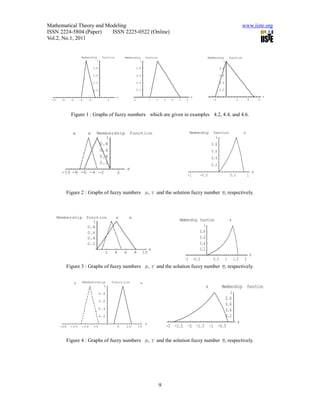
The graphical representation of    ,        and  are shown in Figure 4 where the graph of              is shown by dashed
lines.
Case (iii) : Suppose that                  . Then,                                                                                .
Here,      does not satisfy the equation (A) for                 . So, for the case              ,           is not a solution of
(2).


5.7 Proposition : If      and , a half positive and half negative, are known fuzzy numbers and         is any
unknown fuzzy number, then the solution of the fuzzy equation            is a half positive and half negative
fuzzy number.
Proof : Given that       ,   is a half positive and half negative fuzzy number, and the fuzzy equation
         , where   is an unknown fuzzy number. Then,        =                    ( )] and
                                 , where                                              and                                             .
Now, via            representation, we have                                                 .
Then,                                              and                                           such that
                                       ,                              and                                .
Which implies that                         and                       . Therefore,                           is the
solution of                                                                                     , that is, the
corresponding fuzzy number        , which is a ‘half positive and half negative fuzzy number’, is the solution of
         .


5.8 Problem : Suppose that                   and     , a half positive and half negative, are two triangular fuzzy
numbers, where


                                                             6
Mathematical Theory and Modeling                                                                www.iiste.org
ISSN 2224-5804 (Paper)    ISSN 2225-0522 (Online)
Vol.2, No.1, 2011


              =                                    ;            =                                    .

Prove that the solution of the fuzzy equation              is a half positive and half negative fuzzy number.
Solution : Given the fuzzy equation                                                                            (1)
That is,                                                                                                      (2)
Case (i) : Suppose that              . Then,                                                            . Here,
   satisfies the conditions (B) and (C), but does not satisfy the equation (A) for            . So, for the case
      ,    is not a solution of (1).
Case (ii) : Suppose that              . Then,                                                           . Here,
   satisfies the conditions (B) and (C), but does not satisfy the equation (A) for            . So, for the case
      ,    is not a solution of (1) too.
Case (iii) : Suppose that              . Then,                                                           . Here,
   satisfies the conditions (A), (B) and (C)               .
Therefore,                                                       is a solution of (2) and hence               is a
solution of the fuzzy equation           . The membership function is as follows :


                                                                                .

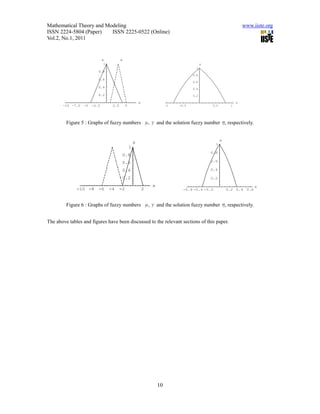
So, for the case        , is the solution of the fuzzy equation       . The graphical representation
of , and  are shown in Figure 5 where the graph of is shown by dashed lines.


5.9 Proposition : If         and , a half positive and half negative fuzzy number, are known fuzzy number
and     is any unknown fuzzy number, then than the solution of the fuzzy equation                 is a half
positive and half negative fuzzy number.
Proof : The proof is similar to Proposition.5.7.


5.10 Problem : Let         and , a half positive and half negative be two triangular fuzzy numbers, where


             =                                             ;        =                                     .

Then, the solution of the fuzzy equation               is a ‘half positive and half negative fuzzy number’ ,
where


                                                                        .


The graphical representation of   ,   and  are shown in Figure 6, where the graph of      is shown by dashed
lines.


                                                       7
Mathematical Theory and Modeling                                                               www.iiste.org
ISSN 2224-5804 (Paper)    ISSN 2225-0522 (Online)
Vol.2, No.1, 2011


6. Conclusion
In this paper we have established a new methodology to overcome the discussed shortcomings or limitations
of the method [8] of the solutions of a fuzzy equation of the form            , where , are known positive
or negative continuous fuzzy numbers and          is an unknown fuzzy number. For this reason, different
approaches of the definitions of ‘positive fuzzy number’ and ‘negative fuzzy number’ have been introduced.
A new notion of ‘half positive and half negative fuzzy number’ has also been innovated. Some propositions
with their proofs and some related problems with their solutions have been discussed. The propositions will
help to assume the sign of unknown fuzzy number of the fuzzy equation                     for which we will be
able to get a solution of the fuzzy equation easily. After that, some related theorems are presented. There is
none who has discussed these notions yet. Without this notion it is very difficult to solve a fuzzy equation of
the form discussed above.


References
[1] Bhiwani, R. J., & Patre, B. M., (2009), “Solving First Order Fuzzy Equations : A Modal Interval
Approach”, IEEE Computer Society, Conference paper.
[2] Buckley, J. J., & Qu, Y., (1990), “Solving linear and quadratic fuzzy equations”, Fuzzy Sets and
Systems, Vol. 38, pp. 43 – 59.
[3] Buckley, J. J., Eslami, E. & Hayashi, Y. , (1997), “Solving fuzzy equation using neural nets”, Fuzzy
Sets and Systems, Vol. 86, No. 3, pp. 271 – 278.
[4] Dubois, D., & Prade H., (1978), “Operations on Fuzzy Numbers”, Internet. J. Systems Science, 9(6),
pp. 13 626.
[5] Dubois, D., & Prade H., (1980), “Fuzzy sets and systems: Theory and applications”, Academic Press,
New York, p. 40.
[6] Gaichetti, R. E. & Young, R. E., (1997), “A parametric representation of fuzzy numbers and their
arithmetic operators”, Fuzzy Sets and Systems, Vol. 91, No. 2, pp. 185 – 202.
[7] Kaufmann, A., & Gupta, M. M., (1985), “Introduction to Fuzzy Arithmetic Theory and Applications”,
Van Nostrand Reinhold Company Inc., pp. 1 43.
[8] Klir, G. J., & Yuan, B., (1997), “Fuzzy Sets and Fuzzy Logic Theory and Applications”, Prentice-
Hall of India Private Limited, New Delhi, pp. 1 117.
[9] Dehghan, M., Hashemi, B., & Ghattee, M., (2006), “Computational methods for solving fully
fuzzy linear systems, Applied Mathematics and Computation”, 176, pp. 328–343.
[10] Nasseri, H., (2008), “Fuzzy Numbers : Positive and Nonnegative” , International Mathematical
Forum, 3, No. 36, pp. 1777 – 1780.
[11] Zadeh, L. A., (1965), “Fuzzy Sets”, Information and Control, 8(3), pp. 338 353.


Shapla Shirin The author has born on 16th January, 1963, in Bangladesh. She obtained her M.Sc degree in
Pure Mathematics from the University of Dhaka in the year 1984. In 1996 she also received M. S. Degree
(in Fuzzy Set Theory) from La Trobe University, Melbourne, Australia. Her main topic of interest is Fuzzy
Set Theory and its applications. The author is an Associate Professor of Department of Mathematics,
University of Dhaka, Bangladesh. She is a member of Bangladesh Mathematical Society.


Goutam Kumar Saha The author has born on 14th October, 1985, in Bangladesh. He is a student of M.S.
(Applied Mathematics), Department of Mathematics, University of Dhaka, Bangladesh. His area of interest
is Fuzzy Set Theory.


                                                      8
Mathematical Theory and Modeling                                                                                                                       www.iiste.org
ISSN 2224-5804 (Paper)    ISSN 2225-0522 (Online)
Vol.2, No.1, 2011


                        Membership      function       Membership          function                                      Membership         function
                                  1                              1                                                                 1

                                 0.8                                0.8                                                           0.8

                                 0.6                                0.6                                                           0.6

                                 0.4                                0.4                                                           0.4

                                 0.2                                0.2                                                           0.2

                                                   x                                                         x                                                              x
 -10    -8    -6       -4   -2               2                 -1              1   2       3     4   5   6                  -2                    2         4           6


               Figure 1 : Graphs of fuzzy numbers which are given in examples 4.2, 4.4, and 4.6.


               x            x
                    Membership function                                                                      Membership     function                   x
                        1                                                                                                    1
                      0.8                                                                                                  0.8
                      0.6                                                                                                  0.6
                      0.4                                                                                                  0.4
                      0.2                                                                                                  0.2
                              x
        -10 -8 -6 -4 -2    2                                                                                                                                        x
                                                                                                          -1      -0.5                      0.5             1


             Figure 2 : Graphs of fuzzy numbers                                ,   and the solution fuzzy number , respectively.


       Membership function                         x       x
                     1                                                                               Membership function                    x
                   0.8                                                                                            1
                   0.6                                                                                          0.8
                   0.4                                                                                          0.6
                   0.2                                                                                          0.4
                                                                               x                                0.2
                                         2        4    6       8          10
                                                                                                                                                                x
                                                                                                         -1 -0.5            0.5         1       1.5     2
             Figure 3 : Graphs of fuzzy numbers                                ,   and the solution fuzzy number , respectively.


                   x    Membership               function             x
                                 1                                                                                   x         Membership function
                                       0.8                                                                                         1
                                                                                                                                 0.8
                                       0.6
                                                                                                                                 0.6
                                       0.4                                                                                       0.4
                                       0.2                                                                                       0.2
                                                                          x                                                            x
        -20   -15       -10      -5                5    10          15                         -3 -2.5    -2 -1.5         -1 -0.5


             Figure 4 : Graphs of fuzzy numbers                                ,   and the solution fuzzy number , respectively.


                                                                                       9
Mathematical Theory and Modeling                                                                                         www.iiste.org
ISSN 2224-5804 (Paper)    ISSN 2225-0522 (Online)
Vol.2, No.1, 2011


                              x           x
                               1                                                                  x
                                                                                              1
                          0.8
                                                                                            0.8
                          0.6
                                                                                            0.6
                          0.4
                                                                                            0.4

                          0.2                                                               0.2

                                                           x                                                         x
       -10 -7.5   -5   -2.5         2.5        5                                -1   -0.5             0.5        1


         Figure 5 : Graphs of fuzzy numbers                        ,       and the solution fuzzy number , respectively.


                                                                                                            x
                                                       x                                                1
                                                   1
                                                                                                      0.8
                                           0.8
                                           0.6                                                        0.6

                                           0.4                                                        0.4

                                           0.2                                                        0.2

                                                                       x                                                      x
              -10 -8      -6       -4     -2                   2                       -0.6 -0.4 -0.2           0.2 0.4 0.6


         Figure 6 : Graphs of fuzzy numbers                        ,       and the solution fuzzy number , respectively.


The above tables and figures have been discussed to the relevant sections of this paper.


                                                                           10

A new computational methodology to find appropriate

  • 1.
    Mathematical Theory andModeling www.iiste.org ISSN 2224-5804 (Paper) ISSN 2225-0522 (Online) Vol.2, No.1, 2011 A New Computational Methodology to Find Appropriate Solutions of Fuzzy Equations Shapla Shirin * Goutam Kumar Saha Department of Mathematics, University of Dhaka, PO box 1000, Dhaka, Bangladesh * E-mail of the corresponding author: shapla@univdhaka.edu Abstract In this paper, a new computational methodology to get an appropriate solution of a fuzzy equation of the form , where , are known continuous triangular fuzzy numbers and is an unknown fuzzy number, are presented. In support of that some propositions with proofs and theorems are presented. A different approach of the definition of ‘positive fuzzy number’ and ‘negative fuzzy number’ have been focused. Also, the concept of ‘half-positive and half-negative fuzzy number’ has been introduced. The solution of the fuzzy equation can be ‘positive fuzzy number’ or ‘negative fuzzy number’ or ‘half positive or half negative fuzzy number’ which is computed by using the methodology focused in the proposed propositions. Keywords: Fuzzy number, Fuzzy equation, Positive fuzzy number, Negative fuzzy number, half positive and half negative fuzzy number, of a fuzzy number. 1. Introduction In most cases in our life, the data obtained for decision making are only approximately known. The concept of fuzzy set theory to meet those problems have been introduced [11]. The fuzziness of a property lies in the lack of well defined boundaries [i.e., ill-defined boundaries] of the set of objects, to which this property applies. Therefore, the membership grade is essential to define the fuzzy set theory. The notion of fuzzy numbers has been introduced from the idea of real numbers [4] as a fuzzy subset of the real line. There are arithmetic operations, which are similar to those of the set of real numbers, such that +, –, . , /, on fuzzy numbers [6 8]. Fuzzy numbers allow us to make the mathematical model of linguistic variable or fuzzy environment, and are also used to describe the data with vagueness and imprecision. The definition of ‘positive fuzzy number’ and ‘negative fuzzy number’ have been introduced [5, 9]. The shortcoming of the definitions [5] has been focused [10] and the concept of ‘nonnegative fuzzy numbers’ has been introduced [10] as well. None has introduced the notion of ‘half-positive and half-negative fuzzy number’. In this paper, a different approach of the definitions of ‘positive fuzzy number’ and ‘negative fuzzy number’ have been focused; and a new notion of ‘half-positive and half-negative fuzzy number’ has been introduced. There are another notion in the fuzzy set theory is the concept of the solution of fuzzy equations [8] of the form and , which have been discussed in [1 3, 8]. It is easy to solve the fuzzy equation of the form , where , are known fuzzy numbers and is an unknown fuzzy number [8], but there are some limitations to solve the fuzzy equation of the form , where is an unknown fuzzy number. Our main objective is to introduce a new computational methodology to overcome the limitations to get a solution, if it exists, of the fuzzy equation of the form where and are known continuous triangular fuzzy numbers. Here it is noted that the core of a known continuous triangular fuzzy number is a singleton set. 2. Preliminaries In this section, some definitions [1 11] have been reviewed which are important to us for representing 1
  • 2.
    Mathematical Theory andModeling www.iiste.org ISSN 2224-5804 (Paper) ISSN 2225-0522 (Online) Vol.2, No.1, 2011 our main objective in the later sections. Let be the set of all fuzzy numbers and means that is a fuzzy number whose membership function is . 2.1 Definition : The of a fuzzy set is denoted by and is defined by , . 2.2 Definition : The strong of a fuzzy set is denoted by and is defined by , . 2.3 Definition : The support of a fuzzy set is denoted by and is defined by . 2.4 Definition : A fuzzy set is normal if there exist , s.t . 2.5 Definition : A fuzzy number is a fuzzy set, whose membership function is denoted by , which satisfies the conditions as under : (a) is normal fuzzy set; (b) is a closed interval ; (c) support of , i.e., is a bounded set in the classical sense. That is, a fuzzy number satisfies the condition of normality and convexity. 2.6 Definition [5] : A fuzzy number is called positive (negative), denoted by ( ), if its membership function satisfies . 2.7 Definition [10] : A fuzzy number is called positive, denoted by , if its membership function satisfies . 2.8 Definition [10] : A fuzzy number is called nonnegative, denoted by , if its membership function satisfies . 3. Existence of a Solution of a Fuzzy Equation Consider the fuzzy equation , where , are known fuzzy numbers and is an unknown fuzzy number. If , and are of , and , respectively, then the fuzzy equation has a solution if and only if the equation (A) has a solution and satisfies the following conditions [8] : Condition 1: . (B) Condition 2 : If then (C) 4. New Proposed Definitions Here we have introduced some definitions which will help us to solve the fuzzy equation of the form , where , are known continuous fuzzy numbers and is an unknown fuzzy number. The definitions are as follows and will be used in the next section. 4.1 Definition : A triangular fuzzy number is called negative, denoted by , if there exist where ), , such that , and . 4.2 Example : is a negative fuzzy number which is defined by 2
  • 3.
    Mathematical Theory andModeling www.iiste.org ISSN 2224-5804 (Paper) ISSN 2225-0522 (Online) Vol.2, No.1, 2011 ( )= , where , and . 4.3 Definition : A triangular fuzzy number is called positive, denoted by , if there exist where ), , such that , and . 4.4 Example : is a positive fuzzy number which is defined by ( )= , where , and . 4.5 Definition [Half positive and half negative] : A triangular fuzzy number is called ‘half-positive and half-negative’, denoted by , if there exist where ), , such that , and . 4.6 Example : is a half-positive and half-negative fuzzy number which is defined by ( )= where and . Figure 1 represents the fuzzy numbers which are given in examples 4.2, 4.4, and 4.6. 5. Problems, Discussions, and Results In this section, we have proposed some propositions with their proofs, which will help us to solve the fuzzy equation without any difficulties and within a reasonable time. We have also established related theorems. In support of that some problems and their solutions have also been investigated. 5.1 Proposition : If are known fuzzy numbers and is any unknown fuzzy number, then the solution of the fuzzy equation is a positive fuzzy number. Proof : Given that and the fuzzy equation . Then, and , where and . Now, via representation, we have, = . Then, and such that , and . That is, ( )] ( )] is true if each is positive. Hence, the solution of the fuzzy equation is a ‘positive fuzzy number’. 5.2 Problem : Suppose that and are two triangular negative continuous fuzzy numbers, where 3
  • 4.
    Mathematical Theory andModeling www.iiste.org ISSN 2224-5804 (Paper) ISSN 2225-0522 (Online) Vol.2, No.1, 2011 = ; = . Solve the fuzzy equation for the unknown fuzzy number Solution : Given the fuzzy equation , where and are known negative fuzzy numbers and the unknown fuzzy number. Here, and . Now, we solve the following equation for the unknown , i.e., (2) Since , , we choose three cases for unknown fuzzy number : . Case (i) : Consider . Then, , where . Therefore, . So, . Since satisfies (A), (B) and (C) , it is a solution of equation (2) and hence, is the solution of the fuzzy equation (1) whose membership function is as follows : . The graphical representation of , and are shown in Figure 2 where the graph of is shown by dashed lines. Case (ii) : Consider . Then, , where . So, , and it does not satisfy the equation (A) for . Therefore, is not a solution of (1). Case (iii) : Suppose that Then, , where . Now, we have , and it does not satisfy the equation (A) for . So, for the case , is not a solution of (1). 5.3 Proposition : If are known fuzzy numbers and is any unknown fuzzy number, then the solution of the fuzzy equation is a positive fuzzy number. Proof : Given that and the fuzzy equation . Then, and , where and . Now, via representation, we have . Then, and such that , and . That is, is true only if each is positive. Hence, the solution of the fuzzy equation is a ‘positive fuzzy number’. 5.4 Problem : Suppose that are two triangular fuzzy numbers, where 4
  • 5.
    Mathematical Theory andModeling www.iiste.org ISSN 2224-5804 (Paper) ISSN 2225-0522 (Online) Vol.2, No.1, 2011 ; . Show that the solution of the fuzzy equation is a positive fuzzy number . Solution : Given the fuzzy equation . where and are known positive fuzzy numbers and the unknown fuzzy number. Here, and . Now, we solve the following equation for the unknown , . Since , , we choose three cases for unknown fuzzy number : . Case (i) : Suppose that . Then, . Since satisfies (A), (B) and (C) , it is a solution of equation (2) and hence, is the solution of the fuzzy equation (1) whose membership function is as follows : . The graphical representation of , and are shown in Figure 3 where the graph of is shown by dashed lines. Case (ii) : Suppose that . Then, . Here, satisfies the conditions (B) and (C). and does not satisfy the equation (A) for . So, for the case , is not a solution of (1). Case (iii) : Suppose that Then, . Here, satisfies the conditions (B) and (C), but does not satisfy the equation (A) for . So, for the case , is not a solution of (1). 5.5 Proposition : If and are known fuzzy numbers and is any unknown fuzzy number, then the solution of the fuzzy equation is a negative fuzzy number. Proof : Given that , and the fuzzy equation . Then, and , where and . Now, via cut representation, we have . Then, and such that , either (i) and ; or (ii) and . That is, is verified only if each is negative. Hence, the solution of the fuzzy equation is a ‘negative fuzzy number’. 5.6 Problem : Suppose that and > 0 are two triangular fuzzy numbers, where 5
  • 6.
    Mathematical Theory andModeling www.iiste.org ISSN 2224-5804 (Paper) ISSN 2225-0522 (Online) Vol.2, No.1, 2011 = ; = . Then, show that the solution of the fuzzy equation is a negative fuzzy number. Solution : Given that and the fuzzy equation . (1) That is, (2) We have = [ ] and = [ ]. Since , so we choose three cases for unknown fuzzy number : . Case (i) : Suppose that . Then, . Here, satisfies the conditions (B) and (C), but does not satisfy the equation (A) for . So, for the case , is not a solution of (1). Case (ii) : Suppose that . Then, . Here, satisfies the conditions (A), (B) and (C) . Therefore, is a solution of (2) and hence is the solution of the fuzzy equation . The membership function is as follows : . The graphical representation of , and are shown in Figure 4 where the graph of is shown by dashed lines. Case (iii) : Suppose that . Then, . Here, does not satisfy the equation (A) for . So, for the case , is not a solution of (2). 5.7 Proposition : If and , a half positive and half negative, are known fuzzy numbers and is any unknown fuzzy number, then the solution of the fuzzy equation is a half positive and half negative fuzzy number. Proof : Given that , is a half positive and half negative fuzzy number, and the fuzzy equation , where is an unknown fuzzy number. Then, = ( )] and , where and . Now, via representation, we have . Then, and such that , and . Which implies that and . Therefore, is the solution of , that is, the corresponding fuzzy number , which is a ‘half positive and half negative fuzzy number’, is the solution of . 5.8 Problem : Suppose that and , a half positive and half negative, are two triangular fuzzy numbers, where 6
  • 7.
    Mathematical Theory andModeling www.iiste.org ISSN 2224-5804 (Paper) ISSN 2225-0522 (Online) Vol.2, No.1, 2011 = ; = . Prove that the solution of the fuzzy equation is a half positive and half negative fuzzy number. Solution : Given the fuzzy equation (1) That is, (2) Case (i) : Suppose that . Then, . Here, satisfies the conditions (B) and (C), but does not satisfy the equation (A) for . So, for the case , is not a solution of (1). Case (ii) : Suppose that . Then, . Here, satisfies the conditions (B) and (C), but does not satisfy the equation (A) for . So, for the case , is not a solution of (1) too. Case (iii) : Suppose that . Then, . Here, satisfies the conditions (A), (B) and (C) . Therefore, is a solution of (2) and hence is a solution of the fuzzy equation . The membership function is as follows : . So, for the case , is the solution of the fuzzy equation . The graphical representation of , and are shown in Figure 5 where the graph of is shown by dashed lines. 5.9 Proposition : If and , a half positive and half negative fuzzy number, are known fuzzy number and is any unknown fuzzy number, then than the solution of the fuzzy equation is a half positive and half negative fuzzy number. Proof : The proof is similar to Proposition.5.7. 5.10 Problem : Let and , a half positive and half negative be two triangular fuzzy numbers, where = ; = . Then, the solution of the fuzzy equation is a ‘half positive and half negative fuzzy number’ , where . The graphical representation of , and are shown in Figure 6, where the graph of is shown by dashed lines. 7
  • 8.
    Mathematical Theory andModeling www.iiste.org ISSN 2224-5804 (Paper) ISSN 2225-0522 (Online) Vol.2, No.1, 2011 6. Conclusion In this paper we have established a new methodology to overcome the discussed shortcomings or limitations of the method [8] of the solutions of a fuzzy equation of the form , where , are known positive or negative continuous fuzzy numbers and is an unknown fuzzy number. For this reason, different approaches of the definitions of ‘positive fuzzy number’ and ‘negative fuzzy number’ have been introduced. A new notion of ‘half positive and half negative fuzzy number’ has also been innovated. Some propositions with their proofs and some related problems with their solutions have been discussed. The propositions will help to assume the sign of unknown fuzzy number of the fuzzy equation for which we will be able to get a solution of the fuzzy equation easily. After that, some related theorems are presented. There is none who has discussed these notions yet. Without this notion it is very difficult to solve a fuzzy equation of the form discussed above. References [1] Bhiwani, R. J., & Patre, B. M., (2009), “Solving First Order Fuzzy Equations : A Modal Interval Approach”, IEEE Computer Society, Conference paper. [2] Buckley, J. J., & Qu, Y., (1990), “Solving linear and quadratic fuzzy equations”, Fuzzy Sets and Systems, Vol. 38, pp. 43 – 59. [3] Buckley, J. J., Eslami, E. & Hayashi, Y. , (1997), “Solving fuzzy equation using neural nets”, Fuzzy Sets and Systems, Vol. 86, No. 3, pp. 271 – 278. [4] Dubois, D., & Prade H., (1978), “Operations on Fuzzy Numbers”, Internet. J. Systems Science, 9(6), pp. 13 626. [5] Dubois, D., & Prade H., (1980), “Fuzzy sets and systems: Theory and applications”, Academic Press, New York, p. 40. [6] Gaichetti, R. E. & Young, R. E., (1997), “A parametric representation of fuzzy numbers and their arithmetic operators”, Fuzzy Sets and Systems, Vol. 91, No. 2, pp. 185 – 202. [7] Kaufmann, A., & Gupta, M. M., (1985), “Introduction to Fuzzy Arithmetic Theory and Applications”, Van Nostrand Reinhold Company Inc., pp. 1 43. [8] Klir, G. J., & Yuan, B., (1997), “Fuzzy Sets and Fuzzy Logic Theory and Applications”, Prentice- Hall of India Private Limited, New Delhi, pp. 1 117. [9] Dehghan, M., Hashemi, B., & Ghattee, M., (2006), “Computational methods for solving fully fuzzy linear systems, Applied Mathematics and Computation”, 176, pp. 328–343. [10] Nasseri, H., (2008), “Fuzzy Numbers : Positive and Nonnegative” , International Mathematical Forum, 3, No. 36, pp. 1777 – 1780. [11] Zadeh, L. A., (1965), “Fuzzy Sets”, Information and Control, 8(3), pp. 338 353. Shapla Shirin The author has born on 16th January, 1963, in Bangladesh. She obtained her M.Sc degree in Pure Mathematics from the University of Dhaka in the year 1984. In 1996 she also received M. S. Degree (in Fuzzy Set Theory) from La Trobe University, Melbourne, Australia. Her main topic of interest is Fuzzy Set Theory and its applications. The author is an Associate Professor of Department of Mathematics, University of Dhaka, Bangladesh. She is a member of Bangladesh Mathematical Society. Goutam Kumar Saha The author has born on 14th October, 1985, in Bangladesh. He is a student of M.S. (Applied Mathematics), Department of Mathematics, University of Dhaka, Bangladesh. His area of interest is Fuzzy Set Theory. 8
  • 9.
    Mathematical Theory andModeling www.iiste.org ISSN 2224-5804 (Paper) ISSN 2225-0522 (Online) Vol.2, No.1, 2011 Membership function Membership function Membership function 1 1 1 0.8 0.8 0.8 0.6 0.6 0.6 0.4 0.4 0.4 0.2 0.2 0.2 x x x -10 -8 -6 -4 -2 2 -1 1 2 3 4 5 6 -2 2 4 6 Figure 1 : Graphs of fuzzy numbers which are given in examples 4.2, 4.4, and 4.6. x x Membership function Membership function x 1 1 0.8 0.8 0.6 0.6 0.4 0.4 0.2 0.2 x -10 -8 -6 -4 -2 2 x -1 -0.5 0.5 1 Figure 2 : Graphs of fuzzy numbers , and the solution fuzzy number , respectively. Membership function x x 1 Membership function x 0.8 1 0.6 0.8 0.4 0.6 0.2 0.4 x 0.2 2 4 6 8 10 x -1 -0.5 0.5 1 1.5 2 Figure 3 : Graphs of fuzzy numbers , and the solution fuzzy number , respectively. x Membership function x 1 x Membership function 0.8 1 0.8 0.6 0.6 0.4 0.4 0.2 0.2 x x -20 -15 -10 -5 5 10 15 -3 -2.5 -2 -1.5 -1 -0.5 Figure 4 : Graphs of fuzzy numbers , and the solution fuzzy number , respectively. 9
  • 10.
    Mathematical Theory andModeling www.iiste.org ISSN 2224-5804 (Paper) ISSN 2225-0522 (Online) Vol.2, No.1, 2011 x x 1 x 1 0.8 0.8 0.6 0.6 0.4 0.4 0.2 0.2 x x -10 -7.5 -5 -2.5 2.5 5 -1 -0.5 0.5 1 Figure 5 : Graphs of fuzzy numbers , and the solution fuzzy number , respectively. x x 1 1 0.8 0.8 0.6 0.6 0.4 0.4 0.2 0.2 x x -10 -8 -6 -4 -2 2 -0.6 -0.4 -0.2 0.2 0.4 0.6 Figure 6 : Graphs of fuzzy numbers , and the solution fuzzy number , respectively. The above tables and figures have been discussed to the relevant sections of this paper. 10