




A New Classification Model for
COVID-19 based on
Convolutional Neural Networks
and Alexnet Algorithm
Walid Hamdy
Authors
Walid Hamdy1, *, Ismail Elansary1, *, Ashraf Darwish 2, * and Aboul Ella Hassanien3, *
1 Faculty1 of Science, Port Said University, Cairo, Egypt
2 Faculty of Science, Helwan University, Cairo, Egypt
3 Faculty of Computers and Artificial Intelligence, Cairo University, Giza, Egypt.
*Scientific Research Group in Egypt (SRGE), http://www.egyptscience.net
Outline
Introduction
The Proposed Model
Results and Conclusion
Future work
Introduction
 COVID-19 is *:
- an infectious disease caused by the recently found virus known as SARS-
CoV-2 (or coronavirus).
 Before the outbreak originated in Wuhan, China on December 2019, there
was no information about this virus.
 Researchers around the world are working to fight against COVID-19 and
to reduce its spread and prevent it.
Introduction
 Computed tomography (CT) became one of the essential methods for the
rapid diagnosis of COVID-19
 Deep learning (DL), a branch of Artificial Intelligence, is a family of multi-
layer neural network models that excel at the problem of learning from big
data
 Deep learning algorithms are perfect approaches for detecting disease
from various types of image sources, such as X-Ray and CT scans.
 we present a new proposed model based on using AlexNet to classify CT
chest scan.
The Proposed Model
 We present a new proposed model based on DL using AlexNet
Convolutional Neural Network (CNN) to differentiate the abnormal CT
chest image regions which refer to different forms of pneumonia.
 The proposed model distinguish five types of CT chest images: normal
lung, COVID-19, non-COVID-19 viral pneumonia (VP), bacterial pneumonia
(BP), and mycoplasma pneumonia (MP).
The Proposed Model
 We present a new proposed model based on DL using AlexNet
Convolutional Neural Network (CNN) to differentiate the abnormal CT
chest image regions which refer to different forms of pneumonia.
 The proposed model distinguish five types of CT chest images: normal
lung, COVID-19, non-COVID-19 viral pneumonia (VP), bacterial pneumonia
(BP), and mycoplasma pneumonia (MP).
Data Set
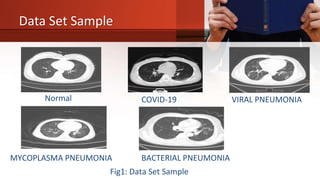
 CT chest data set is images CCAP which is a dataset that contains five
categories of CT chest images and include about 5000 CT images.
 BACTERIAL PNEUMONIA (BP) 981
 MYCOPLASMA PNEUMONIA (MP) 537
 VIRAL PNEUMONIA (VP) 465
 COVID-19 1935
 NORMAL LUNG 579
Data Set Sample
Normal COVID-19 VIRAL PNEUMONIA
Fig1: Data Set Sample
MYCOPLASMA PNEUMONIA BACTERIAL PNEUMONIA
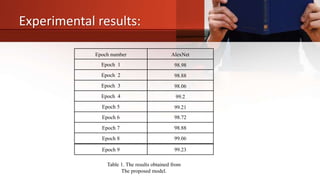
Experimental results:
Epoch number AlexNet
Epoch 1 98.98
Epoch 2 98.88
Epoch 3 98.06
Epoch 4 99.2
Epoch 5 99.21
Epoch 6 98.72
Epoch 7 98.88
Epoch 8 99.06
Table 1. The results obtained from
The proposed model.
Epoch 9 99.23
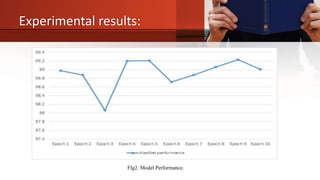
Experimental results:
FIg2. Model Performance.
Conclusion
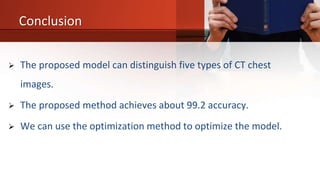
 The proposed model can distinguish five types of CT chest
images.
 The proposed method achieves about 99.2 accuracy.
 We can use the optimization method to optimize the model.
Thank You

A new classification model for covid 19 based on convolutional neural networks

  • 1.
    A New ClassificationModel for COVID-19 based on Convolutional Neural Networks and Alexnet Algorithm Walid Hamdy
  • 2.
    Authors Walid Hamdy1, *,Ismail Elansary1, *, Ashraf Darwish 2, * and Aboul Ella Hassanien3, * 1 Faculty1 of Science, Port Said University, Cairo, Egypt 2 Faculty of Science, Helwan University, Cairo, Egypt 3 Faculty of Computers and Artificial Intelligence, Cairo University, Giza, Egypt. *Scientific Research Group in Egypt (SRGE), http://www.egyptscience.net
  • 3.
  • 4.
    Introduction  COVID-19 is*: - an infectious disease caused by the recently found virus known as SARS- CoV-2 (or coronavirus).  Before the outbreak originated in Wuhan, China on December 2019, there was no information about this virus.  Researchers around the world are working to fight against COVID-19 and to reduce its spread and prevent it.
  • 5.
    Introduction  Computed tomography(CT) became one of the essential methods for the rapid diagnosis of COVID-19  Deep learning (DL), a branch of Artificial Intelligence, is a family of multi- layer neural network models that excel at the problem of learning from big data  Deep learning algorithms are perfect approaches for detecting disease from various types of image sources, such as X-Ray and CT scans.  we present a new proposed model based on using AlexNet to classify CT chest scan.
  • 6.
    The Proposed Model We present a new proposed model based on DL using AlexNet Convolutional Neural Network (CNN) to differentiate the abnormal CT chest image regions which refer to different forms of pneumonia.  The proposed model distinguish five types of CT chest images: normal lung, COVID-19, non-COVID-19 viral pneumonia (VP), bacterial pneumonia (BP), and mycoplasma pneumonia (MP).
  • 7.
    The Proposed Model We present a new proposed model based on DL using AlexNet Convolutional Neural Network (CNN) to differentiate the abnormal CT chest image regions which refer to different forms of pneumonia.  The proposed model distinguish five types of CT chest images: normal lung, COVID-19, non-COVID-19 viral pneumonia (VP), bacterial pneumonia (BP), and mycoplasma pneumonia (MP).
  • 8.
    Data Set  CTchest data set is images CCAP which is a dataset that contains five categories of CT chest images and include about 5000 CT images.  BACTERIAL PNEUMONIA (BP) 981  MYCOPLASMA PNEUMONIA (MP) 537  VIRAL PNEUMONIA (VP) 465  COVID-19 1935  NORMAL LUNG 579
  • 9.
    Data Set Sample NormalCOVID-19 VIRAL PNEUMONIA Fig1: Data Set Sample MYCOPLASMA PNEUMONIA BACTERIAL PNEUMONIA
  • 10.
    Experimental results: Epoch numberAlexNet Epoch 1 98.98 Epoch 2 98.88 Epoch 3 98.06 Epoch 4 99.2 Epoch 5 99.21 Epoch 6 98.72 Epoch 7 98.88 Epoch 8 99.06 Table 1. The results obtained from The proposed model. Epoch 9 99.23
  • 11.
  • 12.
    Conclusion  The proposedmodel can distinguish five types of CT chest images.  The proposed method achieves about 99.2 accuracy.  We can use the optimization method to optimize the model.
  • 13.