A Dividing Nation
Chapter 20
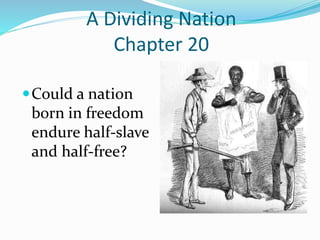
Could a nation
born in freedom
endure half-slave
and half-free?
Confronting the Issue of Slavery
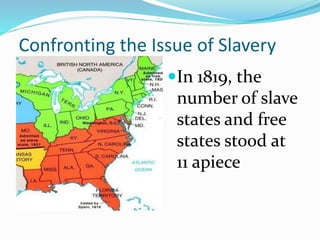
In 1819, the
number of slave
states and free
states stood at
11 apiece
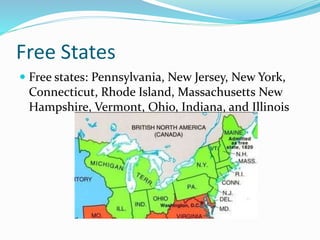
Free States
 Free states: Pennsylvania, New Jersey, New York,
Connecticut, Rhode Island, Massachusetts New
Hampshire, Vermont, Ohio, Indiana, and Illinois
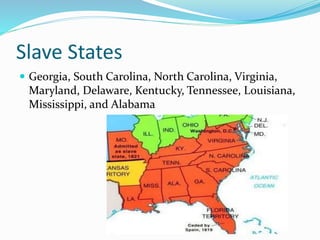
Slave States
 Georgia, South Carolina, North Carolina, Virginia,
Maryland, Delaware, Kentucky, Tennessee, Louisiana,
Mississippi, and Alabama
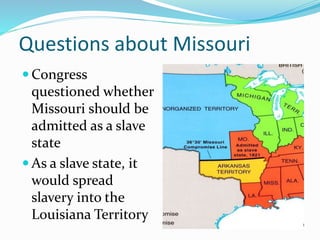
Questions about Missouri
 Congress
questioned whether
Missouri should be
admitted as a slave
state
 As a slave state, it
would spread
slavery into the
Louisiana Territory
Issue 1: Missouri applied for
statehood as a slave state
Northerners
favored/opposed
this because…
Southerners
favored/opposed
this because…
Issue 2: The Tallmadge Amendment
proposed that Missouri be admitted
as a free state
Northerners
favored/opposed
this because…
Southerners
favored/opposed
this because …
On your own…
Given these two issues,
create a compromise that
satisfies northerners of
southerners.
The Missouri Compromise
 Missouri entered the Union as a slave
state
 Maine entered the Union as a free state
 Congress drew an imaginary line across
the Louisiana Territory at latitude 36°30‫׳‬
 Slavery was permitted south of that line
and prohibited north of it
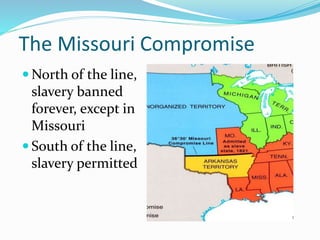
The Missouri Compromise
 North of the line,
slavery banned
forever, except in
Missouri
 South of the line,
slavery permitted
The Missouri Compromise Unravels
 Because of slavery, southerners threatened to secede,
or withdraw from the Union
 Northerners felt that slavery was a crime against
humanity… a great evil.
Issue 1:Abolitionists wanted to stop slavery in
Washington, D.C., but Congress refused to
consider anti-slavery petitions.
Northern
abolitionists
were
pleased/angered
because…
Southerners
were
pleased/angere
d because…
Issue 2: Some northerners assisted
fugitive slaves.
 Northerners
tolerated/condemned
this practice because…
 Southerners
tolerated/condemned
this practice because…
Issue 3: The Wilmot Proviso stated slavery
would not be allowed in the Mexican Cession
 Northerners
favored/opposed this
amendment because…
 Southerners
favored/opposed this
amendment because…
Issue 4: California applied for
admission as a free state
 Northerners
favored/opposed
admitting California as a
free state because…
 Southerners
favored/opposed
admitting California as a
free state because…
On your own…
Given these four issues,
create a compromise
that satisfies
northerners and
southerners.
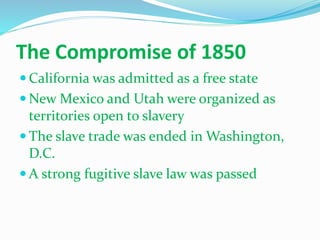
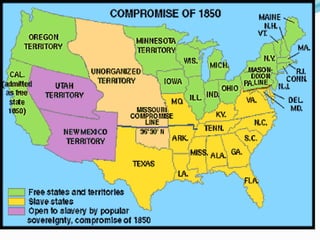
The Compromise of 1850
 California was admitted as a free state
 New Mexico and Utah were organized as
territories open to slavery
 The slave trade was ended in Washington,
D.C.
 A strong fugitive slave law was passed
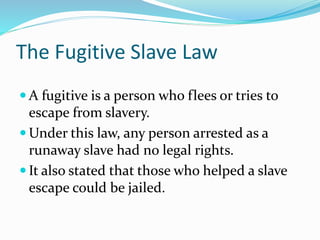
The Fugitive Slave Law
 A fugitive is a person who flees or tries to
escape from slavery.
 Under this law, any person arrested as a
runaway slave had no legal rights.
 It also stated that those who helped a slave
escape could be jailed.
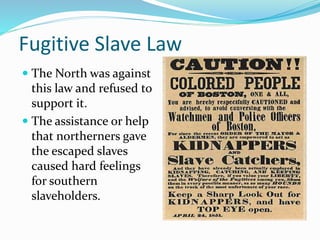
Fugitive Slave Law
 The North was against
this law and refused to
support it.
 The assistance or help
that northerners gave
the escaped slaves
caused hard feelings
for southern
slaveholders.
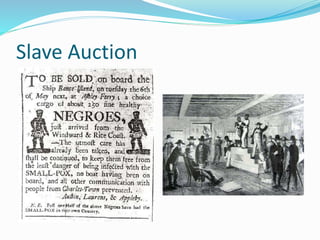
Slave Auction
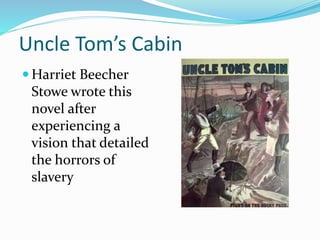
Uncle Tom’s Cabin
 Harriet Beecher
Stowe wrote this
novel after
experiencing a
vision that detailed
the horrors of
slavery
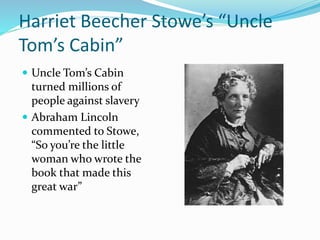
Harriet Beecher Stowe’s “Uncle
Tom’s Cabin”
 Uncle Tom’s Cabin
turned millions of
people against slavery
 Abraham Lincoln
commented to Stowe,
“So you’re the little
woman who wrote the
book that made this
great war”
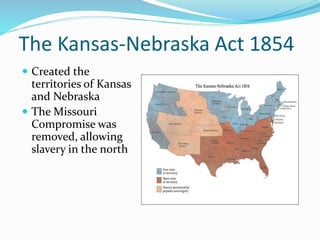
The Kansas-Nebraska Act 1854
 Created the
territories of Kansas
and Nebraska
 The Missouri
Compromise was
removed, allowing
slavery in the north
Popular Sovereignty
 Left it up to the settlers themselves to vote
on whether to permit slavery in Kansas and
Nebraska
 Popular Sovereignty is rule by the people
 Northerners were outraged because they did
not want slavery and it violated the Missouri
Compromise
Bloodshed in Kansas
The struggle over slavery turned violent on May 21,
1856
Pro-slavery vs. Anti-slavery
John Brown, an abolitionist, got revenge by
dragging 5 men who supported slavery and hacked
them to death with swords
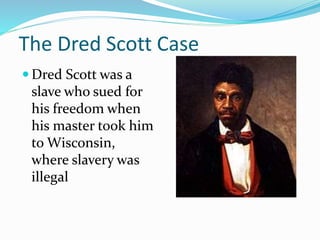
The Dred Scott Case
 Dred Scott was a
slave who sued for
his freedom when
his master took him
to Wisconsin,
where slavery was
illegal
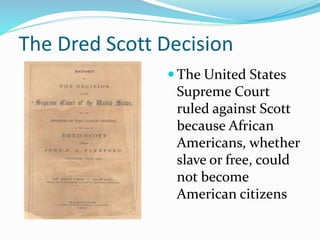
The Dred Scott Decision
 The United States
Supreme Court
ruled against Scott
because African
Americans, whether
slave or free, could
not become
American citizens
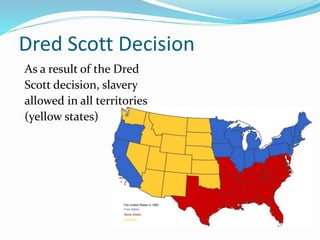
Dred Scott Decision
As a result of the Dred
Scott decision, slavery
allowed in all territories
(yellow states)
Issue 1: The Fugitive Slave Law caused
bitterness between North and the South
 Northerners were
satisfied/dissatisfied
with the way the Fugitive
Slave Law was enforced
because…
 Southerners were
satisfied/dissatisfied
with the way the Fugitive
Slave Law was enforced
because
Issue 2: The book Uncle Tom’s Cabin told
the story of a slave and his master.
The book was
popular/unpopular
in the North
because …
The book was
popular/unpopular
in the South
because…
Issue 3: The Kansas-Nebraska Act stated that the issue of slavery in
those territories would be decided by popular sovereignty. Both pro-
slavery and anti-slavery forces rushed to the territories to vote
Northerners were
pleased/unhappy
about the act
because….
Southerners were
pleased/unhappy
about the act
because….
Issue 4: The Dred Scott case. Scott was
a slave who believed his trip to
Wisconsin made him a free man.
 Northerners probably
believed he was a
free/still a slave because
….
 Southerners probably
believed he was free/still
a slave because…
On your own
 Recommend a ruling to the Supreme Court
on the Dred Scott case that satisfied
northerners and southerners. Your ruling
must address these issues: Was Scott a
citizen with the right to sue in federal court?
Did Scott’s visit to Wisconsin make him a
free man? Can Congress ban slavery in the
territories?
The Dred Scott Decision
 Scott could not sue for his freedom in a
federal court because he was not a citizen,
nor could any African American ever
become an American citizen
 Scott’s stay in Wisconsin did not make him a
free man because the Missouri Compromise
was unconstitutional
 Congress cannot ban slavery in the
territories
Issue 1: During the Lincoln-Douglass
debates, positions regarding slavery were
made clear
 Lincoln, representing the
opinion of the North, felt
slavery was a legal/moral
issue because…
 Douglas, representing
the opinion of the South,
felt that slavery was a
legal/moral issue
because…
Issue 2: John Brown attacked the
arsenal at Harpers Ferry to get
weapons for a slave rebellion.
 Some northerners
upset/reassured
southerners after
Brown’s raid because…
 Southerners were
unconcerned/fearful
about Brown’s raid
because…
Issue 3: In 1860 Abraham Lincoln
was elected president
 Northerners were
happy/unhappy about
the election because…
 Southerners were
happy/unhappy with the
election because…
On your own…
Given these three issues,
create a compromise that
satisfied northerners and
southerners and can save the
Union.
Secession
South Carolina and six other
states seceded from the
Union
South Carolina fired on Fort
Sumter (first shots)

Pre civil war events

  • 1.
    A Dividing Nation Chapter20 Could a nation born in freedom endure half-slave and half-free?
  • 2.
    Confronting the Issueof Slavery In 1819, the number of slave states and free states stood at 11 apiece
  • 3.
    Free States  Freestates: Pennsylvania, New Jersey, New York, Connecticut, Rhode Island, Massachusetts New Hampshire, Vermont, Ohio, Indiana, and Illinois
  • 4.
    Slave States  Georgia,South Carolina, North Carolina, Virginia, Maryland, Delaware, Kentucky, Tennessee, Louisiana, Mississippi, and Alabama
  • 5.
    Questions about Missouri Congress questioned whether Missouri should be admitted as a slave state  As a slave state, it would spread slavery into the Louisiana Territory
  • 6.
    Issue 1: Missouriapplied for statehood as a slave state Northerners favored/opposed this because… Southerners favored/opposed this because…
  • 7.
    Issue 2: TheTallmadge Amendment proposed that Missouri be admitted as a free state Northerners favored/opposed this because… Southerners favored/opposed this because …
  • 8.
    On your own… Giventhese two issues, create a compromise that satisfies northerners of southerners.
  • 9.
    The Missouri Compromise Missouri entered the Union as a slave state  Maine entered the Union as a free state  Congress drew an imaginary line across the Louisiana Territory at latitude 36°30‫׳‬  Slavery was permitted south of that line and prohibited north of it
  • 10.
    The Missouri Compromise North of the line, slavery banned forever, except in Missouri  South of the line, slavery permitted
  • 11.
    The Missouri CompromiseUnravels  Because of slavery, southerners threatened to secede, or withdraw from the Union  Northerners felt that slavery was a crime against humanity… a great evil.
  • 12.
    Issue 1:Abolitionists wantedto stop slavery in Washington, D.C., but Congress refused to consider anti-slavery petitions. Northern abolitionists were pleased/angered because… Southerners were pleased/angere d because…
  • 13.
    Issue 2: Somenortherners assisted fugitive slaves.  Northerners tolerated/condemned this practice because…  Southerners tolerated/condemned this practice because…
  • 14.
    Issue 3: TheWilmot Proviso stated slavery would not be allowed in the Mexican Cession  Northerners favored/opposed this amendment because…  Southerners favored/opposed this amendment because…
  • 15.
    Issue 4: Californiaapplied for admission as a free state  Northerners favored/opposed admitting California as a free state because…  Southerners favored/opposed admitting California as a free state because…
  • 16.
    On your own… Giventhese four issues, create a compromise that satisfies northerners and southerners.
  • 17.
    The Compromise of1850  California was admitted as a free state  New Mexico and Utah were organized as territories open to slavery  The slave trade was ended in Washington, D.C.  A strong fugitive slave law was passed
  • 19.
    The Fugitive SlaveLaw  A fugitive is a person who flees or tries to escape from slavery.  Under this law, any person arrested as a runaway slave had no legal rights.  It also stated that those who helped a slave escape could be jailed.
  • 20.
    Fugitive Slave Law The North was against this law and refused to support it.  The assistance or help that northerners gave the escaped slaves caused hard feelings for southern slaveholders.
  • 21.
  • 22.
    Uncle Tom’s Cabin Harriet Beecher Stowe wrote this novel after experiencing a vision that detailed the horrors of slavery
  • 23.
    Harriet Beecher Stowe’s“Uncle Tom’s Cabin”  Uncle Tom’s Cabin turned millions of people against slavery  Abraham Lincoln commented to Stowe, “So you’re the little woman who wrote the book that made this great war”
  • 24.
    The Kansas-Nebraska Act1854  Created the territories of Kansas and Nebraska  The Missouri Compromise was removed, allowing slavery in the north
  • 25.
    Popular Sovereignty  Leftit up to the settlers themselves to vote on whether to permit slavery in Kansas and Nebraska  Popular Sovereignty is rule by the people  Northerners were outraged because they did not want slavery and it violated the Missouri Compromise
  • 26.
    Bloodshed in Kansas Thestruggle over slavery turned violent on May 21, 1856 Pro-slavery vs. Anti-slavery John Brown, an abolitionist, got revenge by dragging 5 men who supported slavery and hacked them to death with swords
  • 27.
    The Dred ScottCase  Dred Scott was a slave who sued for his freedom when his master took him to Wisconsin, where slavery was illegal
  • 28.
    The Dred ScottDecision  The United States Supreme Court ruled against Scott because African Americans, whether slave or free, could not become American citizens
  • 29.
    Dred Scott Decision Asa result of the Dred Scott decision, slavery allowed in all territories (yellow states)
  • 30.
    Issue 1: TheFugitive Slave Law caused bitterness between North and the South  Northerners were satisfied/dissatisfied with the way the Fugitive Slave Law was enforced because…  Southerners were satisfied/dissatisfied with the way the Fugitive Slave Law was enforced because
  • 31.
    Issue 2: Thebook Uncle Tom’s Cabin told the story of a slave and his master. The book was popular/unpopular in the North because … The book was popular/unpopular in the South because…
  • 32.
    Issue 3: TheKansas-Nebraska Act stated that the issue of slavery in those territories would be decided by popular sovereignty. Both pro- slavery and anti-slavery forces rushed to the territories to vote Northerners were pleased/unhappy about the act because…. Southerners were pleased/unhappy about the act because….
  • 33.
    Issue 4: TheDred Scott case. Scott was a slave who believed his trip to Wisconsin made him a free man.  Northerners probably believed he was a free/still a slave because ….  Southerners probably believed he was free/still a slave because…
  • 34.
    On your own Recommend a ruling to the Supreme Court on the Dred Scott case that satisfied northerners and southerners. Your ruling must address these issues: Was Scott a citizen with the right to sue in federal court? Did Scott’s visit to Wisconsin make him a free man? Can Congress ban slavery in the territories?
  • 35.
    The Dred ScottDecision  Scott could not sue for his freedom in a federal court because he was not a citizen, nor could any African American ever become an American citizen  Scott’s stay in Wisconsin did not make him a free man because the Missouri Compromise was unconstitutional  Congress cannot ban slavery in the territories
  • 36.
    Issue 1: Duringthe Lincoln-Douglass debates, positions regarding slavery were made clear  Lincoln, representing the opinion of the North, felt slavery was a legal/moral issue because…  Douglas, representing the opinion of the South, felt that slavery was a legal/moral issue because…
  • 37.
    Issue 2: JohnBrown attacked the arsenal at Harpers Ferry to get weapons for a slave rebellion.  Some northerners upset/reassured southerners after Brown’s raid because…  Southerners were unconcerned/fearful about Brown’s raid because…
  • 38.
    Issue 3: In1860 Abraham Lincoln was elected president  Northerners were happy/unhappy about the election because…  Southerners were happy/unhappy with the election because…
  • 39.
    On your own… Giventhese three issues, create a compromise that satisfied northerners and southerners and can save the Union.
  • 40.
    Secession South Carolina andsix other states seceded from the Union South Carolina fired on Fort Sumter (first shots)