Name
Instructor Name
Course Title and Number
Date
A Modest Proposal by Jonathan Swift
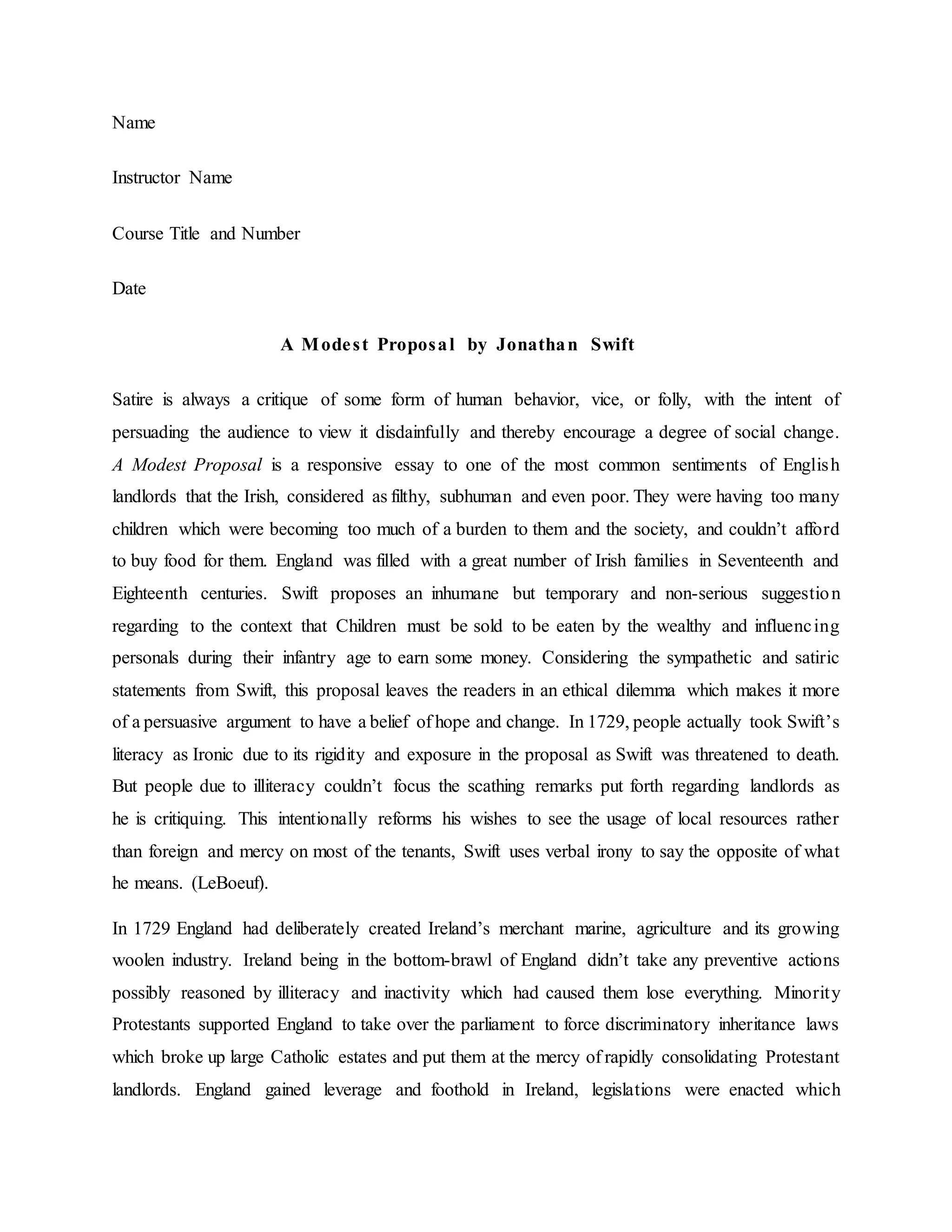
Satire is always a critique of some form of human behavior, vice, or folly, with the intent of
persuading the audience to view it disdainfully and thereby encourage a degree of social change.
A Modest Proposal is a responsive essay to one of the most common sentiments of English
landlords that the Irish, considered as filthy, subhuman and even poor. They were having too many
children which were becoming too much of a burden to them and the society, and couldn’t afford
to buy food for them. England was filled with a great number of Irish families in Seventeenth and
Eighteenth centuries. Swift proposes an inhumane but temporary and non-serious suggestion
regarding to the context that Children must be sold to be eaten by the wealthy and influencing
personals during their infantry age to earn some money. Considering the sympathetic and satiric
statements from Swift, this proposal leaves the readers in an ethical dilemma which makes it more
of a persuasive argument to have a belief of hope and change. In 1729, people actually took Swift’s
literacy as Ironic due to its rigidity and exposure in the proposal as Swift was threatened to death.
But people due to illiteracy couldn’t focus the scathing remarks put forth regarding landlords as
he is critiquing. This intentionally reforms his wishes to see the usage of local resources rather
than foreign and mercy on most of the tenants, Swift uses verbal irony to say the opposite of what
he means. (LeBoeuf).
In 1729 England had deliberately created Ireland’s merchant marine, agriculture and its growing
woolen industry. Ireland being in the bottom-brawl of England didn’t take any preventive actions
possibly reasoned by illiteracy and inactivity which had caused them lose everything. Minority
Protestants supported England to take over the parliament to force discriminatory inheritance laws
which broke up large Catholic estates and put them at the mercy of rapidly consolidating Protestant
landlords. England gained leverage and foothold in Ireland, legislations were enacted which
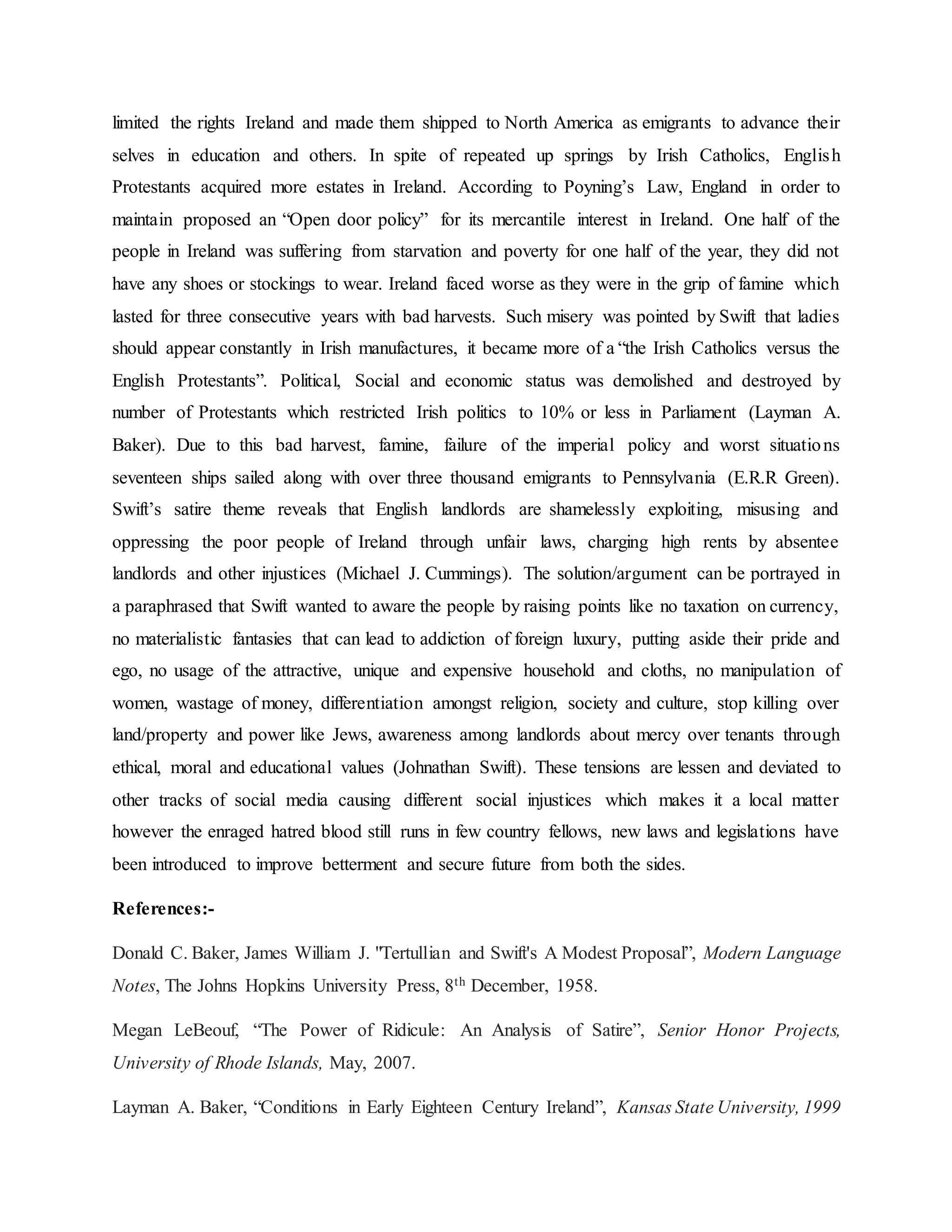
limited the rights Ireland and made them shipped to North America as emigrants to advance their
selves in education and others. In spite of repeated up springs by Irish Catholics, English
Protestants acquired more estates in Ireland. According to Poyning’s Law, England in order to
maintain proposed an “Open door policy” for its mercantile interest in Ireland. One half of the
people in Ireland was suffering from starvation and poverty for one half of the year, they did not
have any shoes or stockings to wear. Ireland faced worse as they were in the grip of famine which
lasted for three consecutive years with bad harvests. Such misery was pointed by Swift that ladies
should appear constantly in Irish manufactures, it became more of a “the Irish Catholics versus the
English Protestants”. Political, Social and economic status was demolished and destroyed by
number of Protestants which restricted Irish politics to 10% or less in Parliament (Layman A.
Baker). Due to this bad harvest, famine, failure of the imperial policy and worst situations
seventeen ships sailed along with over three thousand emigrants to Pennsylvania (E.R.R Green).
Swift’s satire theme reveals that English landlords are shamelessly exploiting, misusing and
oppressing the poor people of Ireland through unfair laws, charging high rents by absentee
landlords and other injustices (Michael J. Cummings). The solution/argument can be portrayed in
a paraphrased that Swift wanted to aware the people by raising points like no taxation on currency,
no materialistic fantasies that can lead to addiction of foreign luxury, putting aside their pride and
ego, no usage of the attractive, unique and expensive household and cloths, no manipulation of
women, wastage of money, differentiation amongst religion, society and culture, stop killing over
land/property and power like Jews, awareness among landlords about mercy over tenants through
ethical, moral and educational values (Johnathan Swift). These tensions are lessen and deviated to
other tracks of social media causing different social injustices which makes it a local matter
however the enraged hatred blood still runs in few country fellows, new laws and legislations have
been introduced to improve betterment and secure future from both the sides.
References:-
Donald C. Baker, James William J. "Tertullian and Swift's A Modest Proposal”, Modern Language
Notes, The Johns Hopkins University Press, 8th December, 1958.
Megan LeBeouf, “The Power of Ridicule: An Analysis of Satire”, Senior Honor Projects,
University of Rhode Islands, May, 2007.
Layman A. Baker, “Conditions in Early Eighteen Century Ireland”, Kansas State University, 1999

A modest Proposal by Jonathan Swift

  • 1.
    Name Instructor Name Course Titleand Number Date A Modest Proposal by Jonathan Swift Satire is always a critique of some form of human behavior, vice, or folly, with the intent of persuading the audience to view it disdainfully and thereby encourage a degree of social change. A Modest Proposal is a responsive essay to one of the most common sentiments of English landlords that the Irish, considered as filthy, subhuman and even poor. They were having too many children which were becoming too much of a burden to them and the society, and couldn’t afford to buy food for them. England was filled with a great number of Irish families in Seventeenth and Eighteenth centuries. Swift proposes an inhumane but temporary and non-serious suggestion regarding to the context that Children must be sold to be eaten by the wealthy and influencing personals during their infantry age to earn some money. Considering the sympathetic and satiric statements from Swift, this proposal leaves the readers in an ethical dilemma which makes it more of a persuasive argument to have a belief of hope and change. In 1729, people actually took Swift’s literacy as Ironic due to its rigidity and exposure in the proposal as Swift was threatened to death. But people due to illiteracy couldn’t focus the scathing remarks put forth regarding landlords as he is critiquing. This intentionally reforms his wishes to see the usage of local resources rather than foreign and mercy on most of the tenants, Swift uses verbal irony to say the opposite of what he means. (LeBoeuf). In 1729 England had deliberately created Ireland’s merchant marine, agriculture and its growing woolen industry. Ireland being in the bottom-brawl of England didn’t take any preventive actions possibly reasoned by illiteracy and inactivity which had caused them lose everything. Minority Protestants supported England to take over the parliament to force discriminatory inheritance laws which broke up large Catholic estates and put them at the mercy of rapidly consolidating Protestant landlords. England gained leverage and foothold in Ireland, legislations were enacted which
  • 2.
    limited the rightsIreland and made them shipped to North America as emigrants to advance their selves in education and others. In spite of repeated up springs by Irish Catholics, English Protestants acquired more estates in Ireland. According to Poyning’s Law, England in order to maintain proposed an “Open door policy” for its mercantile interest in Ireland. One half of the people in Ireland was suffering from starvation and poverty for one half of the year, they did not have any shoes or stockings to wear. Ireland faced worse as they were in the grip of famine which lasted for three consecutive years with bad harvests. Such misery was pointed by Swift that ladies should appear constantly in Irish manufactures, it became more of a “the Irish Catholics versus the English Protestants”. Political, Social and economic status was demolished and destroyed by number of Protestants which restricted Irish politics to 10% or less in Parliament (Layman A. Baker). Due to this bad harvest, famine, failure of the imperial policy and worst situations seventeen ships sailed along with over three thousand emigrants to Pennsylvania (E.R.R Green). Swift’s satire theme reveals that English landlords are shamelessly exploiting, misusing and oppressing the poor people of Ireland through unfair laws, charging high rents by absentee landlords and other injustices (Michael J. Cummings). The solution/argument can be portrayed in a paraphrased that Swift wanted to aware the people by raising points like no taxation on currency, no materialistic fantasies that can lead to addiction of foreign luxury, putting aside their pride and ego, no usage of the attractive, unique and expensive household and cloths, no manipulation of women, wastage of money, differentiation amongst religion, society and culture, stop killing over land/property and power like Jews, awareness among landlords about mercy over tenants through ethical, moral and educational values (Johnathan Swift). These tensions are lessen and deviated to other tracks of social media causing different social injustices which makes it a local matter however the enraged hatred blood still runs in few country fellows, new laws and legislations have been introduced to improve betterment and secure future from both the sides. References:- Donald C. Baker, James William J. "Tertullian and Swift's A Modest Proposal”, Modern Language Notes, The Johns Hopkins University Press, 8th December, 1958. Megan LeBeouf, “The Power of Ridicule: An Analysis of Satire”, Senior Honor Projects, University of Rhode Islands, May, 2007. Layman A. Baker, “Conditions in Early Eighteen Century Ireland”, Kansas State University, 1999