Jonathan Swift As a ‘Satirist’
Prepare by: Jay Maruniya
Personal information:
Name: Jay . B. Maruniya
Roll No:23
Enrollment Number:5108230027
Sem:1 (M .A)
Batch:2023- 2024
Paper No:102
Paper Name: Literature of The Neo- classical era
Submitted To: smt.S.B.Gardi, Department of English,M.K.B.U
Email : maruniyajay2018@gmail.com
Table of contents:
● Introduction of Jonathan Swift
● Defination of satire
● Jonathan Swift's Early works
● Satire Techniques
● Impact of Swift's satire
● Citation
● Conclusion
Introduction:
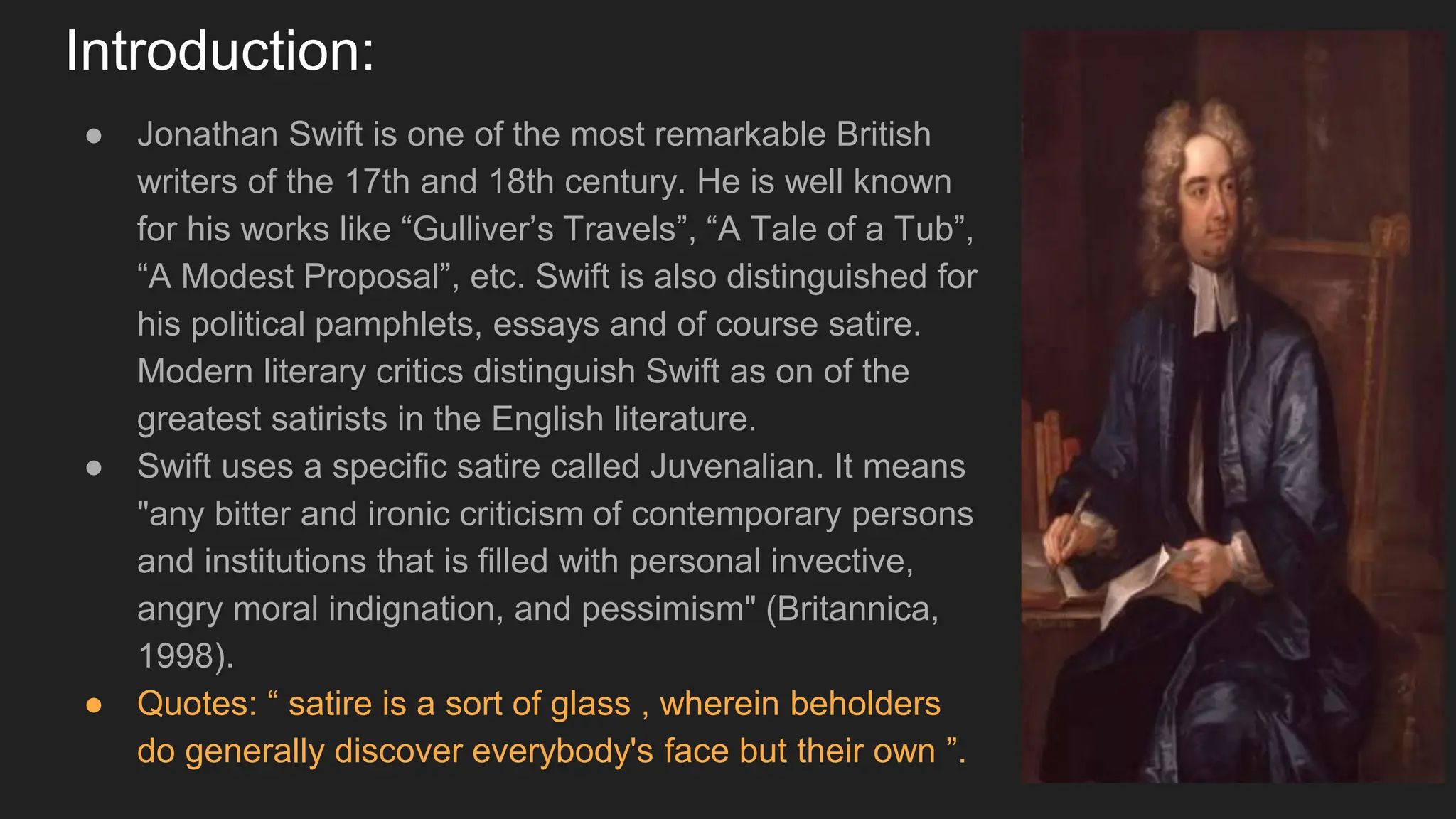
● Jonathan Swift is one of the most remarkable British
writers of the 17th and 18th century. He is well known
for his works like “Gulliver’s Travels”, “A Tale of a Tub”,
“A Modest Proposal”, etc. Swift is also distinguished for
his political pamphlets, essays and of course satire.
Modern literary critics distinguish Swift as on of the
greatest satirists in the English literature.
● Swift uses a specific satire called Juvenalian. It means
"any bitter and ironic criticism of contemporary persons
and institutions that is filled with personal invective,
angry moral indignation, and pessimism" (Britannica,
1998).
● Quotes: “ satire is a sort of glass , wherein beholders
do generally discover everybody's face but their own ”.
Jonathan Swift's Early satirical works:
Jonathan Swift, an Irish satirist, essayist, and political pamphleteer, is best known for his works in the
early 18th century. His literary style is characterized by wit, irony, and sharp social commentary. Some of
his notable early literary work.
1. Tale of a Tub (1704): This work is a satirical exploration of religious and political themes. It's a
complex, allegorical text that uses a variety of styles and tones, from the mock-heroic to the
grotesque.
2. The battal of books (1704):This is a short satirical work in which Swift humorously depicts a battle
between books, representing the ancient and modern scholars.
3. Drapier’s Letters (1724): Under the pseudonym M. B. Drapier, Swift wrote these letters as a protest
against the imposition of Wood's halfpence in Ireland. His style is direct and passionately patriotic,
rallying the Irish against British economic exploitation.
4. A modest proposal( 1729):Perhaps one of his most famous works, Swift suggests a satirical solution
to the problem of overpopulation and poverty in Ireland. The style is characterized by extreme irony,
with a deadpan, rational tone as he proposes cannibalism as a solutions.
5. Gulliver's travels (1726) :Gulliver's Travels," stands as a classic example of his satirical genius,
using allegory and fantasy to expose the follies and vices of society.
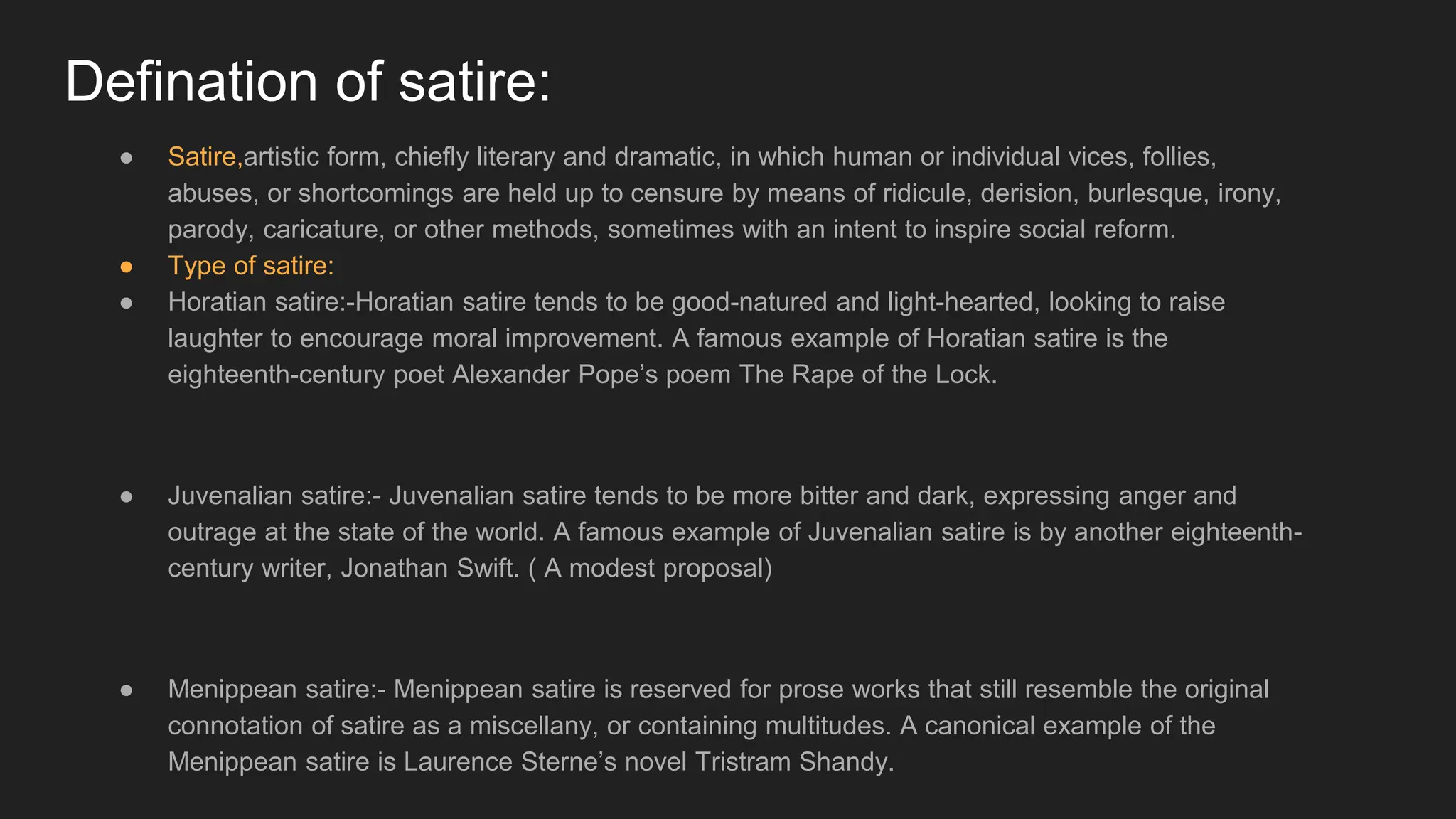
Defination of satire:
● Satire,artistic form, chiefly literary and dramatic, in which human or individual vices, follies,
abuses, or shortcomings are held up to censure by means of ridicule, derision, burlesque, irony,
parody, caricature, or other methods, sometimes with an intent to inspire social reform.
● Type of satire:
● Horatian satire:-Horatian satire tends to be good-natured and light-hearted, looking to raise
laughter to encourage moral improvement. A famous example of Horatian satire is the
eighteenth-century poet Alexander Pope’s poem The Rape of the Lock.
● Juvenalian satire:- Juvenalian satire tends to be more bitter and dark, expressing anger and
outrage at the state of the world. A famous example of Juvenalian satire is by another eighteenth-
century writer, Jonathan Swift. ( A modest proposal)
● Menippean satire:- Menippean satire is reserved for prose works that still resemble the original
connotation of satire as a miscellany, or containing multitudes. A canonical example of the
Menippean satire is Laurence Sterne’s novel Tristram Shandy.
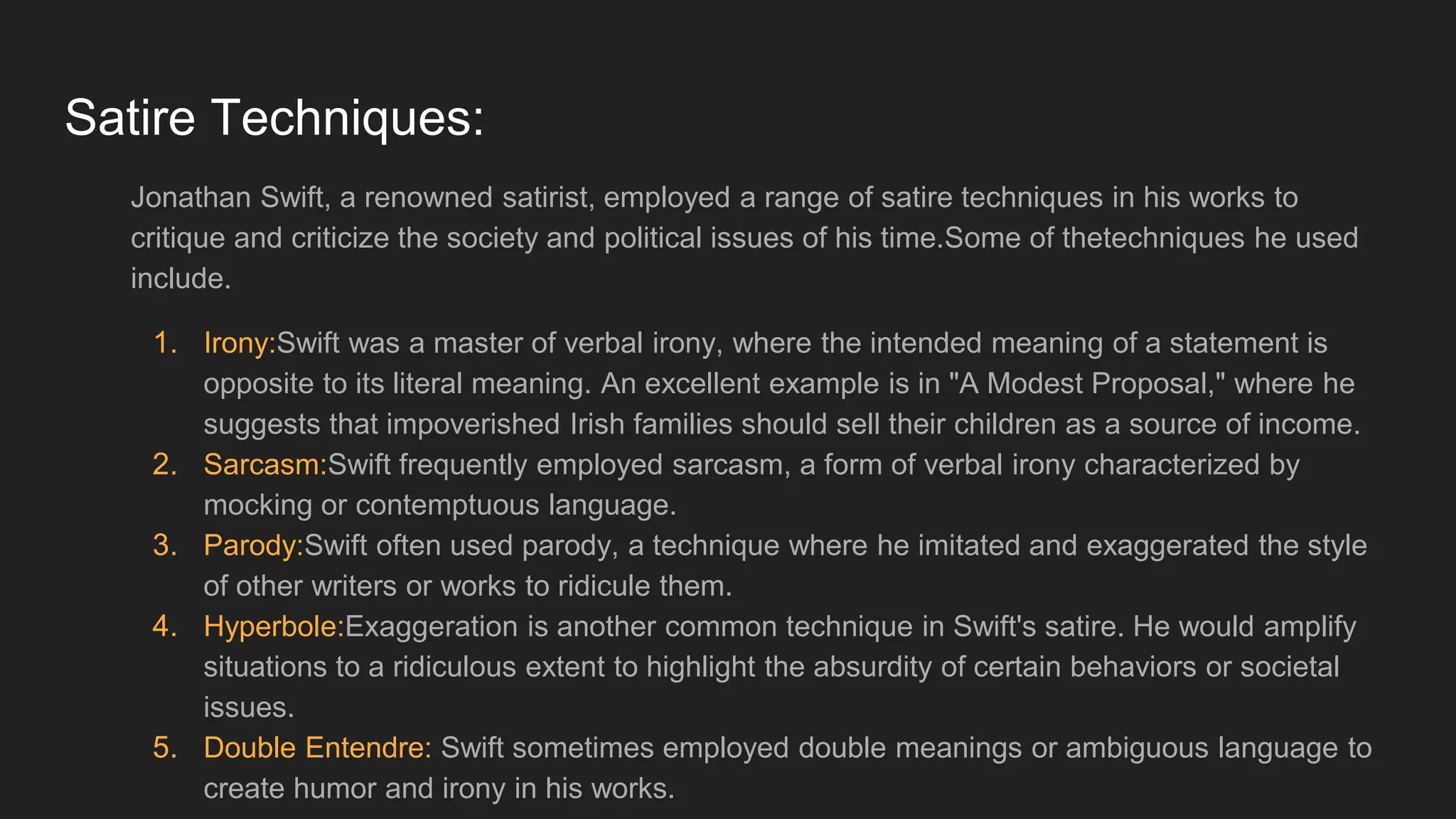
Satire Techniques:
Jonathan Swift, a renowned satirist, employed a range of satire techniques in his works to
critique and criticize the society and political issues of his time.Some of thetechniques he used
include.
1. Irony:Swift was a master of verbal irony, where the intended meaning of a statement is
opposite to its literal meaning. An excellent example is in "A Modest Proposal," where he
suggests that impoverished Irish families should sell their children as a source of income.
2. Sarcasm:Swift frequently employed sarcasm, a form of verbal irony characterized by
mocking or contemptuous language.
3. Parody:Swift often used parody, a technique where he imitated and exaggerated the style
of other writers or works to ridicule them.
4. Hyperbole:Exaggeration is another common technique in Swift's satire. He would amplify
situations to a ridiculous extent to highlight the absurdity of certain behaviors or societal
issues.
5. Double Entendre: Swift sometimes employed double meanings or ambiguous language to
create humor and irony in his works.
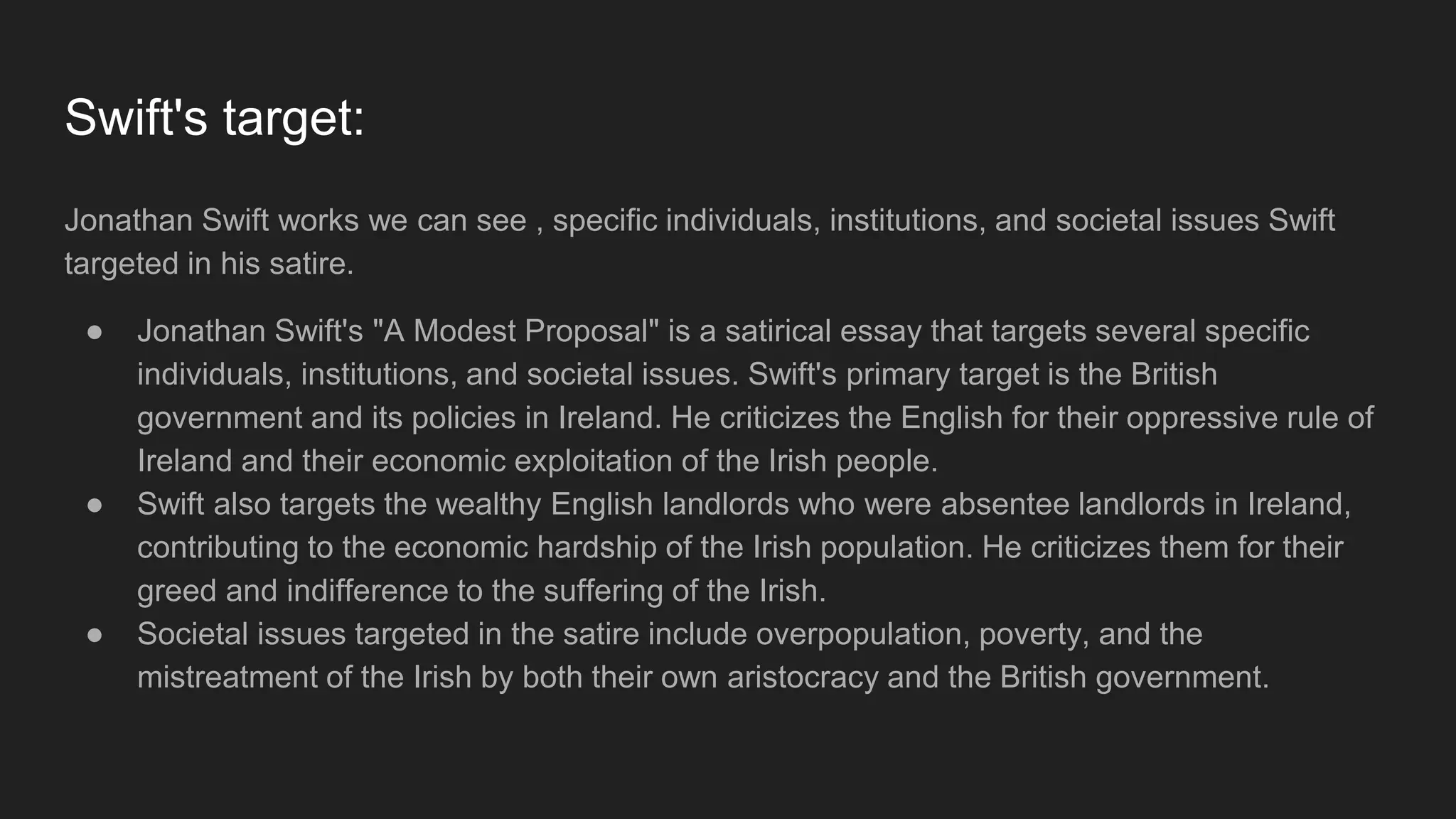
Swift's target:
Jonathan Swift works we can see , specific individuals, institutions, and societal issues Swift
targeted in his satire.
● Jonathan Swift's "A Modest Proposal" is a satirical essay that targets several specific
individuals, institutions, and societal issues. Swift's primary target is the British
government and its policies in Ireland. He criticizes the English for their oppressive rule of
Ireland and their economic exploitation of the Irish people.
● Swift also targets the wealthy English landlords who were absentee landlords in Ireland,
contributing to the economic hardship of the Irish population. He criticizes them for their
greed and indifference to the suffering of the Irish.
● Societal issues targeted in the satire include overpopulation, poverty, and the
mistreatment of the Irish by both their own aristocracy and the British government.
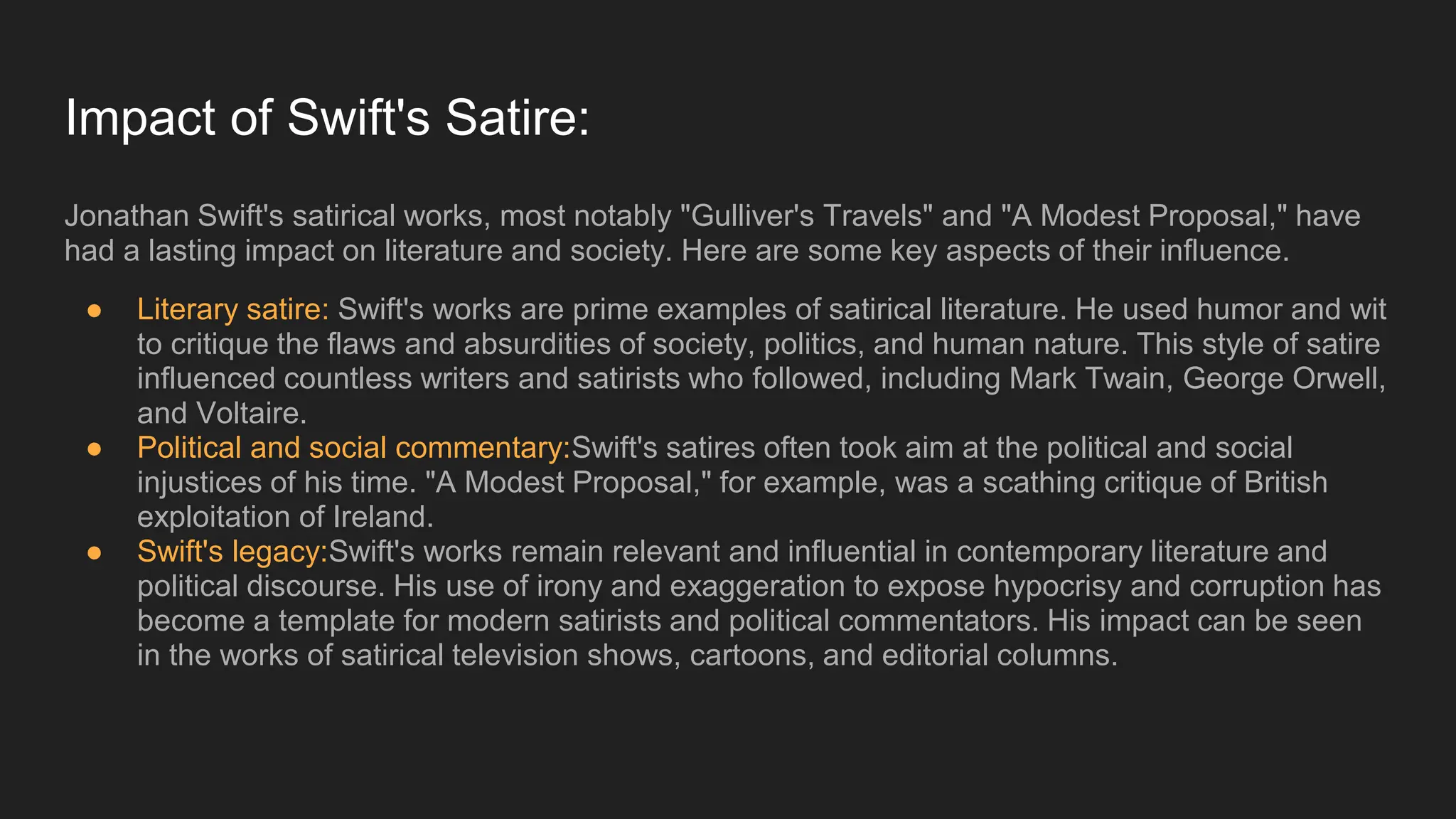
Impact of Swift's Satire:
Jonathan Swift's satirical works, most notably "Gulliver's Travels" and "A Modest Proposal," have
had a lasting impact on literature and society. Here are some key aspects of their influence.
● Literary satire: Swift's works are prime examples of satirical literature. He used humor and wit
to critique the flaws and absurdities of society, politics, and human nature. This style of satire
influenced countless writers and satirists who followed, including Mark Twain, George Orwell,
and Voltaire.
● Political and social commentary:Swift's satires often took aim at the political and social
injustices of his time. "A Modest Proposal," for example, was a scathing critique of British
exploitation of Ireland.
● Swift's legacy:Swift's works remain relevant and influential in contemporary literature and
political discourse. His use of irony and exaggeration to expose hypocrisy and corruption has
become a template for modern satirists and political commentators. His impact can be seen
in the works of satirical television shows, cartoons, and editorial columns.
Conclusion:
● Jonathan Swift, the renowned Irish author and satirist, left an indelible mark
on the world of literature through his scathing and thought-provoking satirical
works.
● His wit and humor were powerful tools through which he critiqued the social,
political, and moral issues of his time.
● In conclusion, Jonathan Swift's legacy as a satirist endures, and his works
continue to be studied and appreciated for their insightful commentary on
human nature and society.
References:
● Quintana, Ricardo and Luebering, J.E.. "Jonathan Swift".
Encyclopedia Britannica, 15 Oct. 2023,
https://www.britannica.com/biography/Jonathan-Swift. Accessed 27
October 2023.
● https://essays.io/jonathan-swift-and-satire-in-his-works-
research-paper-example/
● Skiffington, Lloyd A. “SWIFT AND SATIRIC TECHNIQUES.”
CEA Critic, vol. 16, no. 9, 1954, pp. 6–7. JSTOR,
http://www.jstor.org/stable/44420110. Accessed 31 Oct.
2023.
Thank you.

"Jonathan Swift" as a writer Satirist..

  • 1.
    Jonathan Swift Asa ‘Satirist’ Prepare by: Jay Maruniya
  • 2.
    Personal information: Name: Jay. B. Maruniya Roll No:23 Enrollment Number:5108230027 Sem:1 (M .A) Batch:2023- 2024 Paper No:102 Paper Name: Literature of The Neo- classical era Submitted To: smt.S.B.Gardi, Department of English,M.K.B.U Email : maruniyajay2018@gmail.com
  • 3.
    Table of contents: ●Introduction of Jonathan Swift ● Defination of satire ● Jonathan Swift's Early works ● Satire Techniques ● Impact of Swift's satire ● Citation ● Conclusion
  • 4.
    Introduction: ● Jonathan Swiftis one of the most remarkable British writers of the 17th and 18th century. He is well known for his works like “Gulliver’s Travels”, “A Tale of a Tub”, “A Modest Proposal”, etc. Swift is also distinguished for his political pamphlets, essays and of course satire. Modern literary critics distinguish Swift as on of the greatest satirists in the English literature. ● Swift uses a specific satire called Juvenalian. It means "any bitter and ironic criticism of contemporary persons and institutions that is filled with personal invective, angry moral indignation, and pessimism" (Britannica, 1998). ● Quotes: “ satire is a sort of glass , wherein beholders do generally discover everybody's face but their own ”.
  • 5.
    Jonathan Swift's Earlysatirical works: Jonathan Swift, an Irish satirist, essayist, and political pamphleteer, is best known for his works in the early 18th century. His literary style is characterized by wit, irony, and sharp social commentary. Some of his notable early literary work. 1. Tale of a Tub (1704): This work is a satirical exploration of religious and political themes. It's a complex, allegorical text that uses a variety of styles and tones, from the mock-heroic to the grotesque. 2. The battal of books (1704):This is a short satirical work in which Swift humorously depicts a battle between books, representing the ancient and modern scholars. 3. Drapier’s Letters (1724): Under the pseudonym M. B. Drapier, Swift wrote these letters as a protest against the imposition of Wood's halfpence in Ireland. His style is direct and passionately patriotic, rallying the Irish against British economic exploitation. 4. A modest proposal( 1729):Perhaps one of his most famous works, Swift suggests a satirical solution to the problem of overpopulation and poverty in Ireland. The style is characterized by extreme irony, with a deadpan, rational tone as he proposes cannibalism as a solutions. 5. Gulliver's travels (1726) :Gulliver's Travels," stands as a classic example of his satirical genius, using allegory and fantasy to expose the follies and vices of society.
  • 6.
    Defination of satire: ●Satire,artistic form, chiefly literary and dramatic, in which human or individual vices, follies, abuses, or shortcomings are held up to censure by means of ridicule, derision, burlesque, irony, parody, caricature, or other methods, sometimes with an intent to inspire social reform. ● Type of satire: ● Horatian satire:-Horatian satire tends to be good-natured and light-hearted, looking to raise laughter to encourage moral improvement. A famous example of Horatian satire is the eighteenth-century poet Alexander Pope’s poem The Rape of the Lock. ● Juvenalian satire:- Juvenalian satire tends to be more bitter and dark, expressing anger and outrage at the state of the world. A famous example of Juvenalian satire is by another eighteenth- century writer, Jonathan Swift. ( A modest proposal) ● Menippean satire:- Menippean satire is reserved for prose works that still resemble the original connotation of satire as a miscellany, or containing multitudes. A canonical example of the Menippean satire is Laurence Sterne’s novel Tristram Shandy.
  • 7.
    Satire Techniques: Jonathan Swift,a renowned satirist, employed a range of satire techniques in his works to critique and criticize the society and political issues of his time.Some of thetechniques he used include. 1. Irony:Swift was a master of verbal irony, where the intended meaning of a statement is opposite to its literal meaning. An excellent example is in "A Modest Proposal," where he suggests that impoverished Irish families should sell their children as a source of income. 2. Sarcasm:Swift frequently employed sarcasm, a form of verbal irony characterized by mocking or contemptuous language. 3. Parody:Swift often used parody, a technique where he imitated and exaggerated the style of other writers or works to ridicule them. 4. Hyperbole:Exaggeration is another common technique in Swift's satire. He would amplify situations to a ridiculous extent to highlight the absurdity of certain behaviors or societal issues. 5. Double Entendre: Swift sometimes employed double meanings or ambiguous language to create humor and irony in his works.
  • 8.
    Swift's target: Jonathan Swiftworks we can see , specific individuals, institutions, and societal issues Swift targeted in his satire. ● Jonathan Swift's "A Modest Proposal" is a satirical essay that targets several specific individuals, institutions, and societal issues. Swift's primary target is the British government and its policies in Ireland. He criticizes the English for their oppressive rule of Ireland and their economic exploitation of the Irish people. ● Swift also targets the wealthy English landlords who were absentee landlords in Ireland, contributing to the economic hardship of the Irish population. He criticizes them for their greed and indifference to the suffering of the Irish. ● Societal issues targeted in the satire include overpopulation, poverty, and the mistreatment of the Irish by both their own aristocracy and the British government.
  • 9.
    Impact of Swift'sSatire: Jonathan Swift's satirical works, most notably "Gulliver's Travels" and "A Modest Proposal," have had a lasting impact on literature and society. Here are some key aspects of their influence. ● Literary satire: Swift's works are prime examples of satirical literature. He used humor and wit to critique the flaws and absurdities of society, politics, and human nature. This style of satire influenced countless writers and satirists who followed, including Mark Twain, George Orwell, and Voltaire. ● Political and social commentary:Swift's satires often took aim at the political and social injustices of his time. "A Modest Proposal," for example, was a scathing critique of British exploitation of Ireland. ● Swift's legacy:Swift's works remain relevant and influential in contemporary literature and political discourse. His use of irony and exaggeration to expose hypocrisy and corruption has become a template for modern satirists and political commentators. His impact can be seen in the works of satirical television shows, cartoons, and editorial columns.
  • 10.
    Conclusion: ● Jonathan Swift,the renowned Irish author and satirist, left an indelible mark on the world of literature through his scathing and thought-provoking satirical works. ● His wit and humor were powerful tools through which he critiqued the social, political, and moral issues of his time. ● In conclusion, Jonathan Swift's legacy as a satirist endures, and his works continue to be studied and appreciated for their insightful commentary on human nature and society.
  • 11.
    References: ● Quintana, Ricardoand Luebering, J.E.. "Jonathan Swift". Encyclopedia Britannica, 15 Oct. 2023, https://www.britannica.com/biography/Jonathan-Swift. Accessed 27 October 2023. ● https://essays.io/jonathan-swift-and-satire-in-his-works- research-paper-example/ ● Skiffington, Lloyd A. “SWIFT AND SATIRIC TECHNIQUES.” CEA Critic, vol. 16, no. 9, 1954, pp. 6–7. JSTOR, http://www.jstor.org/stable/44420110. Accessed 31 Oct. 2023.
  • 12.