
A Lightweight Approach to
Barcode Medication Administration
The Paper’s Authors:
Vadim Zimin
Jeruel Fernandes
Annie Wang
Joseph Ogunyebi
Rob Ticehurst*
Dr David Parry
*Auckland District Health Board

Presented by:
Vadim Zimin
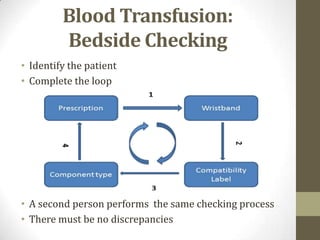
Blood Transfusion:
Bedside Checking
• Identify the patient
• Complete the loop

• A second person performs the same checking process
• There must be no discrepancies
Medication Administration
on a Ward
The procedure
• Medications prescribed for each patient on a paper chart
• Nurse selects required medicines from shelving in
medication room
• Nurse administers to the patient
Several points
• Only one patients medicines should be prepared at a time
• Repetitive task
• Nurses create workarounds = error-potential
Where does it go wrong?
• Current checks are wholly reliant on humans
• Humans make mistakes
• All hospitals will have reports of “wrong patient” errors
from blood products and medicines
• The consequences of these errors are devastating for all
involved – patient and healthcare professional
• Simply telling someone to do better is not an effective
nor sustaining intervention
• Can we use technology to make it harder for the human
to get it wrong?
Literature Review
Hassink, J., M. Jansen, et al. (2012).
"Effects of bar code-assisted medication administration (BCMA) on
frequency, type and severity of medication administration errors: a
review of the literature." European Journal of Hospital PharmacyScience and Practice 19(5): 489-494.

• Summarises 11 studies
• Reviewed literature manly supports the idea that BCMA
helps to reduce proportion of medication errors
• Use of barcode technologies do not increase time spent
by nurses for medication administration
Literature Review
Chan, J. C. W., J. Lau, et al. (2004).
“Use of an electronic barcode system for patient identification
during blood transfusion: 3-year experience in a regional hospital.”
Hong Kong Medical Journal 10(3): 166.

• Three-year study in a Hong Kong regional hospital
• Scan-and-print device was used to verify and document
patients’ identity
• No incidents occurred with 41 000 blood sampling
procedures and administration of 27 000 units of blood
• Barcode system was effective in reducing human error
related to bedside transfusion procedures
Literature Review
Van Onzenoort, H. A., A. van de Plas, et al. (2008).
"Factors influencing bar-code verification by nurses during
medication administration in a Dutch hospital." American Journal
of Health-System Pharmacy 65(7): 644-648.

• Electronic records were compared to number of
prescribed medication administrations
• Rate of nurses’ noncompliance – about half of cases
• Five most common reasons:
•
•
•
•
•

Issues with scanning barcodes
Delay of software
Not knowing that medication had barcode label
Lack of time
Medication administration prior prescription
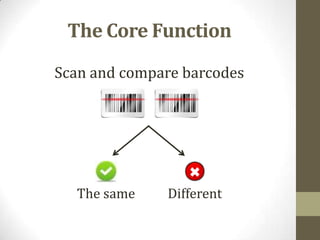
The Core Function
Scan and compare barcodes

The same

Different
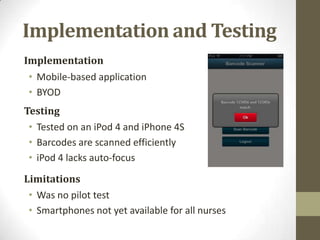
Implementation and Testing
Implementation
• Mobile-based application
• BYOD
Testing
• Tested on an iPod 4 and iPhone 4S
• Barcodes are scanned efficiently
• iPod 4 lacks auto-focus
Limitations
• Was no pilot test
• Smartphones not yet available for all nurses
Future Work
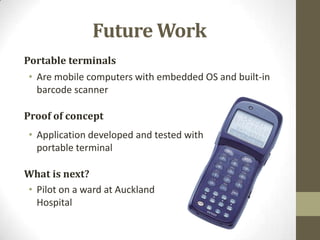
Portable terminals
• Are mobile computers with embedded OS and built-in
barcode scanner
Proof of concept
• Application developed and tested with
portable terminal
What is next?
• Pilot on a ward at Auckland
Hospital
Key Points
• Simple implementation
• Barcodes are already available on patient
identifier label
• Significant potential to improve patient safety
• Supporting evidence in published literature
• In-demand
Questions?

A Lightweight Approach to Barcode Medication Administration

  • 1.
    A Lightweight Approachto Barcode Medication Administration The Paper’s Authors: Vadim Zimin Jeruel Fernandes Annie Wang Joseph Ogunyebi Rob Ticehurst* Dr David Parry *Auckland District Health Board Presented by: Vadim Zimin
  • 2.
    Blood Transfusion: Bedside Checking •Identify the patient • Complete the loop • A second person performs the same checking process • There must be no discrepancies
  • 3.
    Medication Administration on aWard The procedure • Medications prescribed for each patient on a paper chart • Nurse selects required medicines from shelving in medication room • Nurse administers to the patient Several points • Only one patients medicines should be prepared at a time • Repetitive task • Nurses create workarounds = error-potential
  • 4.
    Where does itgo wrong? • Current checks are wholly reliant on humans • Humans make mistakes • All hospitals will have reports of “wrong patient” errors from blood products and medicines • The consequences of these errors are devastating for all involved – patient and healthcare professional • Simply telling someone to do better is not an effective nor sustaining intervention • Can we use technology to make it harder for the human to get it wrong?
  • 5.
    Literature Review Hassink, J.,M. Jansen, et al. (2012). "Effects of bar code-assisted medication administration (BCMA) on frequency, type and severity of medication administration errors: a review of the literature." European Journal of Hospital PharmacyScience and Practice 19(5): 489-494. • Summarises 11 studies • Reviewed literature manly supports the idea that BCMA helps to reduce proportion of medication errors • Use of barcode technologies do not increase time spent by nurses for medication administration
  • 6.
    Literature Review Chan, J.C. W., J. Lau, et al. (2004). “Use of an electronic barcode system for patient identification during blood transfusion: 3-year experience in a regional hospital.” Hong Kong Medical Journal 10(3): 166. • Three-year study in a Hong Kong regional hospital • Scan-and-print device was used to verify and document patients’ identity • No incidents occurred with 41 000 blood sampling procedures and administration of 27 000 units of blood • Barcode system was effective in reducing human error related to bedside transfusion procedures
  • 7.
    Literature Review Van Onzenoort,H. A., A. van de Plas, et al. (2008). "Factors influencing bar-code verification by nurses during medication administration in a Dutch hospital." American Journal of Health-System Pharmacy 65(7): 644-648. • Electronic records were compared to number of prescribed medication administrations • Rate of nurses’ noncompliance – about half of cases • Five most common reasons: • • • • • Issues with scanning barcodes Delay of software Not knowing that medication had barcode label Lack of time Medication administration prior prescription
  • 8.
    The Core Function Scanand compare barcodes The same Different
  • 9.
    Implementation and Testing Implementation •Mobile-based application • BYOD Testing • Tested on an iPod 4 and iPhone 4S • Barcodes are scanned efficiently • iPod 4 lacks auto-focus Limitations • Was no pilot test • Smartphones not yet available for all nurses
  • 10.
    Future Work Portable terminals •Are mobile computers with embedded OS and built-in barcode scanner Proof of concept • Application developed and tested with portable terminal What is next? • Pilot on a ward at Auckland Hospital
  • 11.
    Key Points • Simpleimplementation • Barcodes are already available on patient identifier label • Significant potential to improve patient safety • Supporting evidence in published literature • In-demand
  • 12.