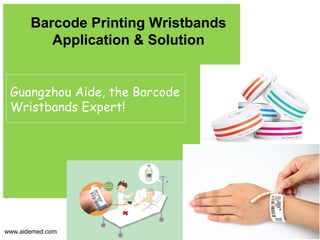
Barcode Printing Wristbands
Application & Solution
Guangzhou Aide, the Barcode
Wristbands Expert!
www.aidemed.com
Barcode Wristbands & Barcode
Identification
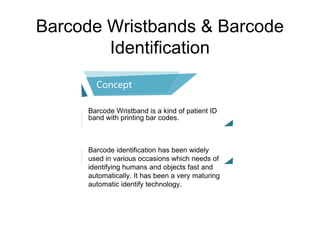
Barcode Wristband is a kind of patient ID
band with printing bar codes.
Barcode identification has been widely
used in various occasions which needs of
identifying humans and objects fast and
automatically. It has been a very maturing
automatic identify technology.
Concept
Why Replace the Write-on ID
Wristbands???
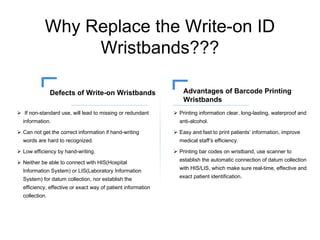
 If non-standard use, will lead to missing or redundant
information.
 Can not get the correct information if hand-writing
words are hard to recognized.
 Low efficiency by hand-writing.
 Neither be able to connect with HIS(Hospital
Information System) or LIS(Laboratory Information
System) for datum collection, nor establish the
efficiency, effective or exact way of patient information
collection.
Defects of Write-on Wristbands
 Printing information clear, long-lasting, waterproof and
anti-alcohol.
 Easy and fast to print patients’ information, improve
medical staff’s efficiency.
 Printing bar codes on wristband, use scanner to
establish the automatic connection of datum collection
with HIS/LIS, which make sure real-time, effective and
exact patient identification.
Advantages of Barcode Printing
Wristbands
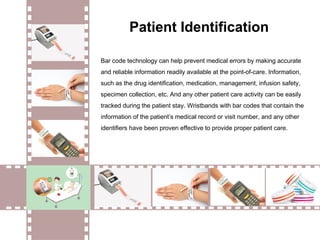
Bar code technology can help prevent medical errors by making accurate
and reliable information readily available at the point-of-care. Information,
such as the drug identification, medication, management, infusion safety,
specimen collection, etc. And any other patient care activity can be easily
tracked during the patient stay. Wristbands with bar codes that contain the
information of the patient’s medical record or visit number, and any other
identifiers have been proven effective to provide proper patient care.
Patient Identification
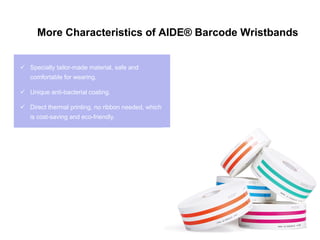
 Specially tailor-made material, safe and
comfortable for wearing.
 Unique anti-bacterial coating.
 Direct thermal printing, no ribbon needed, which
is cost-saving and eco-friendly.
More Characteristics of AIDE® Barcode Wristbands
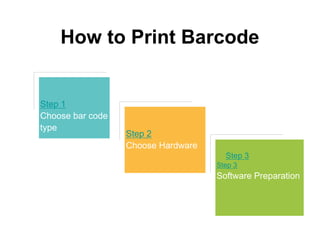
How to Print Barcode
Step 1
Choose bar code
type
Step 2
Choose Hardware
Step 3
Software Preparation
Step 3
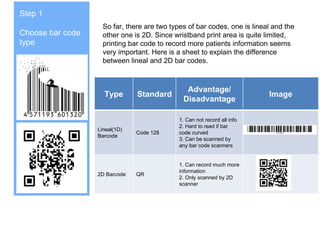
So far, there are two types of bar codes, one is lineal and the
other one is 2D. Since wristband print area is quite limited,
printing bar code to record more patients information seems
very important. Here is a sheet to explain the difference
between lineal and 2D bar codes.
Type Standard
Advantage/
Disadvantage
Image
Lineal(1D)
Barcode
Code 128
1. Can not record all info
2. Hard to read if bar
code curved
3. Can be scanned by
any bar code scanners
2D Barcode QR
1. Can record much more
information
2. Only scanned by 2D
scanner
Step 1
Choose bar code
type
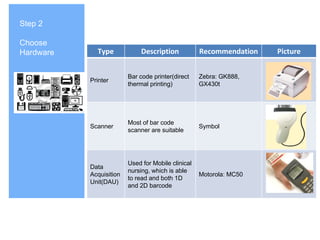
Step 2
Choose
Hardware Type Description Recommendation Picture
Printer
Bar code printer(direct
thermal printing)
Zebra: GK888,
GX430t
Scanner
Most of bar code
scanner are suitable
Symbol
Data
Acquisition
Unit(DAU)
Used for Mobile clinical
nursing, which is able
to read and both 1D
and 2D barcode
Motorola: MC50
Step 3
Software
Preparation
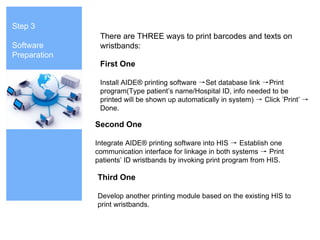
First One
Install AIDE® printing software →Set database link →Print
program(Type patient’s name/Hospital ID, info needed to be
printed will be shown up automatically in system) → Click ’Print’ →
Done.
Second One
Integrate AIDE® printing software into HIS → Establish one
communication interface for linkage in both systems → Print
patients’ ID wristbands by invoking print program from HIS.
Third One
Develop another printing module based on the existing HIS to
print wristbands.
There are THREE ways to print barcodes and texts on
wristbands:
Barcode Application in
Healthcare
Application
0
1
0
3
0
2
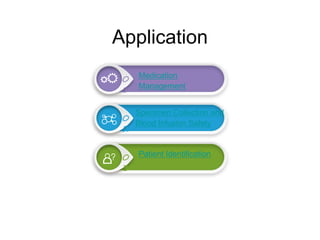
Medication
Management
Specimen Collection and
Blood Infusion Safety
Patient Identification
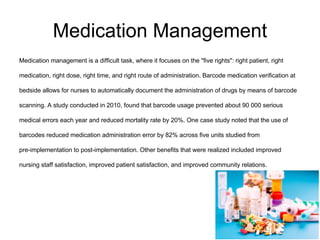
Medication Management
Medication management is a difficult task, where it focuses on the "five rights": right patient, right
medication, right dose, right time, and right route of administration. Barcode medication verification at
bedside allows for nurses to automatically document the administration of drugs by means of barcode
scanning. A study conducted in 2010, found that barcode usage prevented about 90 000 serious
medical errors each year and reduced mortality rate by 20%. One case study noted that the use of
barcodes reduced medication administration error by 82% across five units studied from
pre-implementation to post-implementation. Other benefits that were realized included improved
nursing staff satisfaction, improved patient satisfaction, and improved community relations.
Specimen Collection and Blood
Infusion Safety
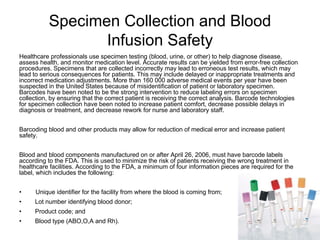
Healthcare professionals use specimen testing (blood, urine, or other) to help diagnose disease,
assess health, and monitor medication level. Accurate results can be yielded from error-free collection
procedures. Specimens that are collected incorrectly may lead to erroneous test results, which may
lead to serious consequences for patients. This may include delayed or inappropriate treatments and
incorrect medication adjustments. More than 160 000 adverse medical events per year have been
suspected in the United States because of misidentification of patient or laboratory specimen.
Barcodes have been noted to be the strong intervention to reduce labeling errors on specimen
collection, by ensuring that the correct patient is receiving the correct analysis. Barcode technologies
for specimen collection have been noted to increase patient comfort, decrease possible delays in
diagnosis or treatment, and decrease rework for nurse and laboratory staff.
Barcoding blood and other products may allow for reduction of medical error and increase patient
safety.
Blood and blood components manufactured on or after April 26, 2006, must have barcode labels
according to the FDA. This is used to minimize the risk of patients receiving the wrong treatment in
healthcare facilities. According to the FDA, a minimum of four information pieces are required for the
label, which includes the following:
• Unique identifier for the facility from where the blood is coming from;
• Lot number identifying blood donor;
• Product code; and
• Blood type (ABO,O,A and Rh).
Patient Identification
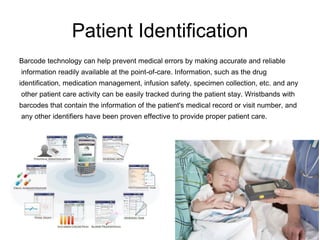
Barcode technology can help prevent medical errors by making accurate and reliable
information readily available at the point-of-care. Information, such as the drug
identification, medication management, infusion safety, specimen collection, etc. and any
other patient care activity can be easily tracked during the patient stay. Wristbands with
barcodes that contain the information of the patient's medical record or visit number, and
any other identifiers have been proven effective to provide proper patient care.
THANKS
AIDE®

Barcode Printing Wristbands Application & Solution-W20140401

  • 1.
    Barcode Printing Wristbands Application& Solution Guangzhou Aide, the Barcode Wristbands Expert! www.aidemed.com
  • 2.
    Barcode Wristbands &Barcode Identification Barcode Wristband is a kind of patient ID band with printing bar codes. Barcode identification has been widely used in various occasions which needs of identifying humans and objects fast and automatically. It has been a very maturing automatic identify technology. Concept
  • 3.
    Why Replace theWrite-on ID Wristbands???  If non-standard use, will lead to missing or redundant information.  Can not get the correct information if hand-writing words are hard to recognized.  Low efficiency by hand-writing.  Neither be able to connect with HIS(Hospital Information System) or LIS(Laboratory Information System) for datum collection, nor establish the efficiency, effective or exact way of patient information collection. Defects of Write-on Wristbands  Printing information clear, long-lasting, waterproof and anti-alcohol.  Easy and fast to print patients’ information, improve medical staff’s efficiency.  Printing bar codes on wristband, use scanner to establish the automatic connection of datum collection with HIS/LIS, which make sure real-time, effective and exact patient identification. Advantages of Barcode Printing Wristbands
  • 4.
    Bar code technologycan help prevent medical errors by making accurate and reliable information readily available at the point-of-care. Information, such as the drug identification, medication, management, infusion safety, specimen collection, etc. And any other patient care activity can be easily tracked during the patient stay. Wristbands with bar codes that contain the information of the patient’s medical record or visit number, and any other identifiers have been proven effective to provide proper patient care. Patient Identification
  • 5.
     Specially tailor-madematerial, safe and comfortable for wearing.  Unique anti-bacterial coating.  Direct thermal printing, no ribbon needed, which is cost-saving and eco-friendly. More Characteristics of AIDE® Barcode Wristbands
  • 6.
    How to PrintBarcode Step 1 Choose bar code type Step 2 Choose Hardware Step 3 Software Preparation Step 3
  • 7.
    So far, thereare two types of bar codes, one is lineal and the other one is 2D. Since wristband print area is quite limited, printing bar code to record more patients information seems very important. Here is a sheet to explain the difference between lineal and 2D bar codes. Type Standard Advantage/ Disadvantage Image Lineal(1D) Barcode Code 128 1. Can not record all info 2. Hard to read if bar code curved 3. Can be scanned by any bar code scanners 2D Barcode QR 1. Can record much more information 2. Only scanned by 2D scanner Step 1 Choose bar code type
  • 8.
    Step 2 Choose Hardware TypeDescription Recommendation Picture Printer Bar code printer(direct thermal printing) Zebra: GK888, GX430t Scanner Most of bar code scanner are suitable Symbol Data Acquisition Unit(DAU) Used for Mobile clinical nursing, which is able to read and both 1D and 2D barcode Motorola: MC50
  • 9.
    Step 3 Software Preparation First One InstallAIDE® printing software →Set database link →Print program(Type patient’s name/Hospital ID, info needed to be printed will be shown up automatically in system) → Click ’Print’ → Done. Second One Integrate AIDE® printing software into HIS → Establish one communication interface for linkage in both systems → Print patients’ ID wristbands by invoking print program from HIS. Third One Develop another printing module based on the existing HIS to print wristbands. There are THREE ways to print barcodes and texts on wristbands:
  • 10.
  • 11.
  • 12.
    Medication Management Medication managementis a difficult task, where it focuses on the "five rights": right patient, right medication, right dose, right time, and right route of administration. Barcode medication verification at bedside allows for nurses to automatically document the administration of drugs by means of barcode scanning. A study conducted in 2010, found that barcode usage prevented about 90 000 serious medical errors each year and reduced mortality rate by 20%. One case study noted that the use of barcodes reduced medication administration error by 82% across five units studied from pre-implementation to post-implementation. Other benefits that were realized included improved nursing staff satisfaction, improved patient satisfaction, and improved community relations.
  • 13.
    Specimen Collection andBlood Infusion Safety Healthcare professionals use specimen testing (blood, urine, or other) to help diagnose disease, assess health, and monitor medication level. Accurate results can be yielded from error-free collection procedures. Specimens that are collected incorrectly may lead to erroneous test results, which may lead to serious consequences for patients. This may include delayed or inappropriate treatments and incorrect medication adjustments. More than 160 000 adverse medical events per year have been suspected in the United States because of misidentification of patient or laboratory specimen. Barcodes have been noted to be the strong intervention to reduce labeling errors on specimen collection, by ensuring that the correct patient is receiving the correct analysis. Barcode technologies for specimen collection have been noted to increase patient comfort, decrease possible delays in diagnosis or treatment, and decrease rework for nurse and laboratory staff. Barcoding blood and other products may allow for reduction of medical error and increase patient safety. Blood and blood components manufactured on or after April 26, 2006, must have barcode labels according to the FDA. This is used to minimize the risk of patients receiving the wrong treatment in healthcare facilities. According to the FDA, a minimum of four information pieces are required for the label, which includes the following: • Unique identifier for the facility from where the blood is coming from; • Lot number identifying blood donor; • Product code; and • Blood type (ABO,O,A and Rh).
  • 14.
    Patient Identification Barcode technologycan help prevent medical errors by making accurate and reliable information readily available at the point-of-care. Information, such as the drug identification, medication management, infusion safety, specimen collection, etc. and any other patient care activity can be easily tracked during the patient stay. Wristbands with barcodes that contain the information of the patient's medical record or visit number, and any other identifiers have been proven effective to provide proper patient care.
  • 15.