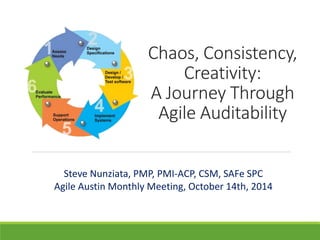
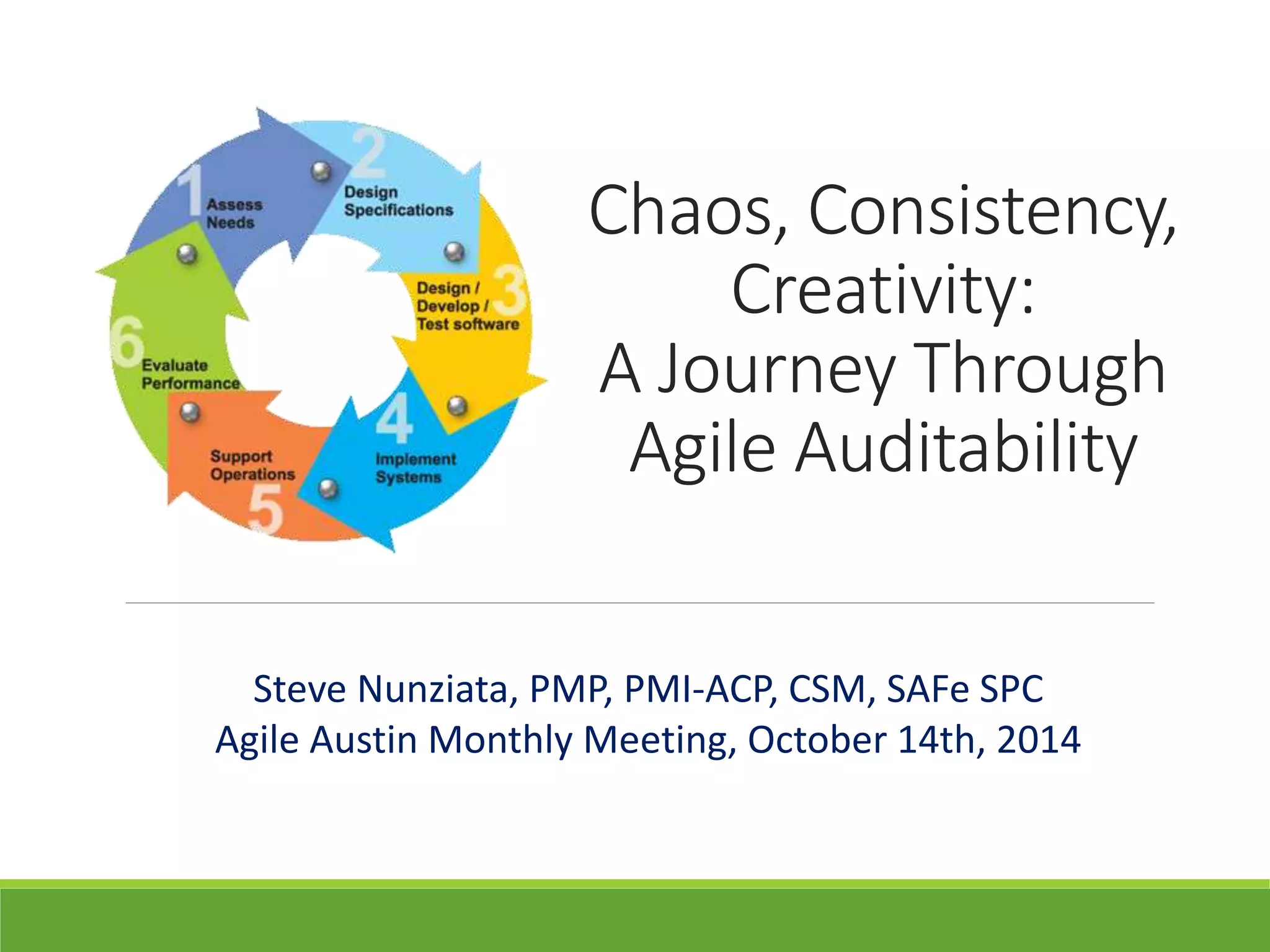

Chaos, Consistency, 
Creativity: 
A Journey Through 
Agile Auditability 
Steve Nunziata, PMP, PMI-ACP, CSM, SAFe SPC 
Agile Austin Monthly Meeting, October 14th, 2014
About Steve… 
PMP, ACP, CSM, SAFe SPC 
EDS, Nike, Adidas, USAA 
Agile Trainer & Coach 
New Jersey / Oregon 
Bassist Extraordinaire 
Alamo Agilistas / PMI
Background: My Story 
Zero to Sixty (Days): Chaos to 
Consistency
So… Why Are We Here? 
Opportunity: 
Educate internal auditors to evolve away 
from formal artifacts and accept Agile 
tenets of visibility and transparency to 
demonstrate adherence to defined 
Quality standards. 
We will collaborate on an approach to 
define an Agile Risk & Control framework 
that can start you on your journey.
How Would You Like: 
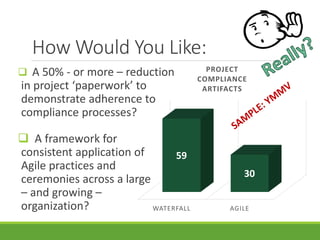
 A 50% - or more – reduction 
in project ‘paperwork’ to 
demonstrate adherence to 
compliance processes? 
59 
COMPLIANCE 
ARTIFACTS 
30 
PROJECT 
WATERFALL AGILE 
 A framework for 
consistent application of 
Agile practices and 
ceremonies across a large 
– and growing – 
organization?
Remember…Use the Force 
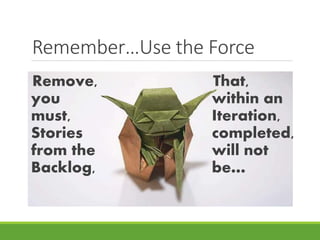
Remove, 
you 
must, 
Stories 
from the 
Backlog, 
That, 
within an 
Iteration, 
completed, 
will not 
be…
Agenda 
Chaos 
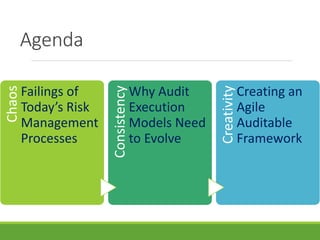
Failings of 
Today’s Risk 
Management 
Processes 
Consistency 
Why Audit 
Execution 
Models Need 
to Evolve 
Creativity 
Creating an 
Agile 
Auditable 
Framework
Managing Risk – How Important is it? 
 The primary goal of a 
business is to… stay in 
business. 
 It is therefore necessary to continually evaluate, 
monitor, and address threats to retain market share. 
Otherwise, what would happen?
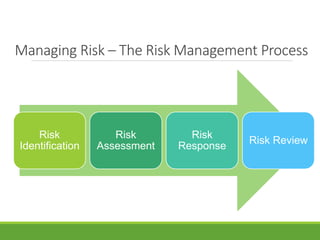
Managing Risk – The Risk Management Process 
Risk 
Identification 
Risk 
Assessment 
Risk 
Response 
Risk Review
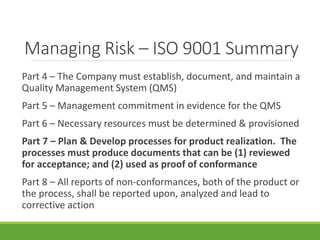
Managing Risk – ISO 9001 Summary 
Part 4 – The Company must establish, document, and maintain a 
Quality Management System (QMS) 
Part 5 – Management commitment in evidence for the QMS 
Part 6 – Necessary resources must be determined & provisioned 
Part 7 – Plan & Develop processes for product realization. The 
processes must produce documents that can be (1) reviewed 
for acceptance; and (2) used as proof of conformance 
Part 8 – All reports of non-conformances, both of the product or 
the process, shall be reported upon, analyzed and lead to 
corrective action
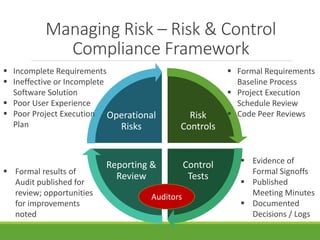
Managing Risk – Risk & Control 
Compliance Framework 
Risk 
Controls 
Control 
Tests 
Operational 
Risks 
 Incomplete Requirements 
 Ineffective or Incomplete 
Reporting & 
Review 
Software Solution 
 Poor User Experience 
 Poor Project Execution 
Plan 
 Formal Requirements 
Baseline Process 
 Project Execution 
Schedule Review 
 Code Peer Reviews 
 Evidence of 
Formal Signoffs 
 Published 
Meeting Minutes 
 Documented 
Decisions / Logs 
 Formal results of 
Audit published for 
review; opportunities 
for improvements 
noted 
Auditors
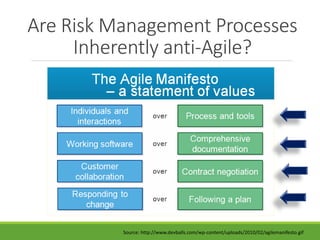
Are Risk Management Processes 
Inherently anti-Agile? 
Source: http://www.devballs.com/wp-content/uploads/2010/02/agilemanifesto.gif
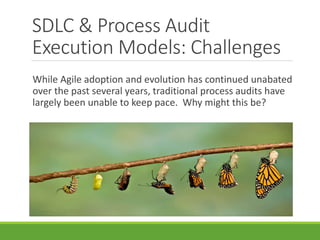
SDLC & Process Audit 
Execution Models: Challenges 
While Agile adoption and evolution has continued unabated 
over the past several years, traditional process audits have 
largely been unable to keep pace. Why might this be?
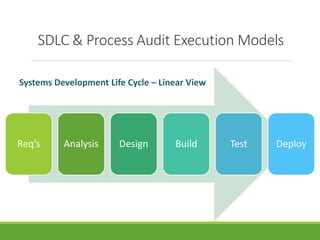
SDLC & Process Audit Execution Models 
Systems Development Life Cycle – Linear View 
Req’s Analysis Design Build Test Deploy
SDLC & Process Audit Execution Models 
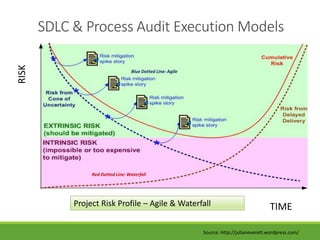
Source: http://julianeverett.wordpress.com/ 
Blue Dotted Line: Agile 
Red Dotted Line: Waterfall 
RISK 
Project Risk Profile – Agile & Waterfall TIME
SDLC & Process Audit Execution Models 
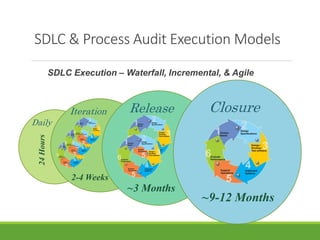
SDLC Execution – Waterfall, Incremental, & Agile 
Daily 
24 Hours 
Iteration 
2-4 Weeks 
Release 
~3 Months 
Closure 
~9-12 Months
SDLC & Process Audit Execution Models 
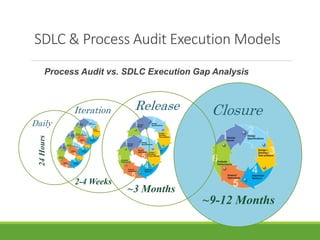
Process Audit vs. SDLC Execution Gap Analysis 
Closure 
~9-12 Months 
Release 
~3 Months 
Iteration 
2-4 Weeks 
Daily 
24 Hours
SDLC & Process Audit Execution Models 
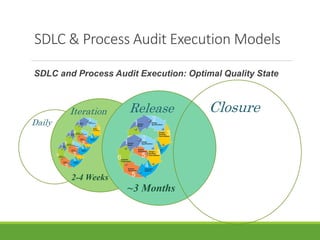
SDLC and Process Audit Execution: Optimal Quality State 
Daily 
Iteration 
2-4 Weeks 
Release 
~3 Months 
Closure
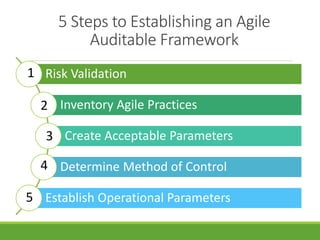
5 Steps to Establishing an Agile 
Auditable Framework 
Risk Validation 
Inventory Agile Practices 
Create Acceptable Parameters 
Determine Method of Control 
Establish Operational Parameters 
1 
2 
3 
4 
5
5 Steps to Evolving an Agile Auditable Framework 
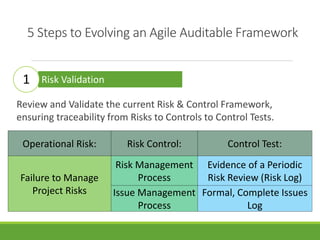
Risk Validation 
Review and Validate the current Risk & Control Framework, 
ensuring traceability from Risks to Controls to Control Tests. 
Operational Risk: Risk Control: Control Test: 
Failure to Manage 
Project Risks 
Risk Management 
Process 
Evidence of a Periodic 
Risk Review (Risk Log) 
Issue Management 
Process 
Formal, Complete Issues 
Log 
1
5 Steps to Evolving an Agile Auditable Framework 
Inventory Agile Practices 
2 
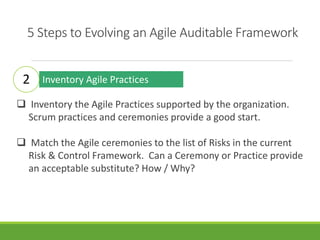
 Inventory the Agile Practices supported by the organization. 
Scrum practices and ceremonies provide a good start. 
 Match the Agile ceremonies to the list of Risks in the current 
Risk & Control Framework. Can a Ceremony or Practice provide 
an acceptable substitute? How / Why?
5 Steps to Evolving an Agile Auditable Framework 
Inventory Agile Practices 
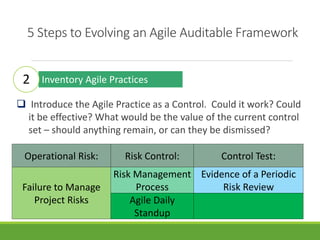
 Introduce the Agile Practice as a Control. Could it work? Could 
it be effective? What would be the value of the current control 
set – should anything remain, or can they be dismissed? 
Operational Risk: Risk Control: Control Test: 
Failure to Manage 
Project Risks 
Risk Management 
Process 
Evidence of a Periodic 
Risk Review 
Agile Daily 
Standup 
2
5 Steps to Evolving an Agile Auditable Framework 
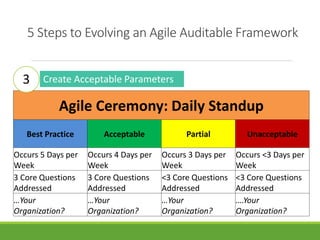
Create Acceptable Parameters 
3 
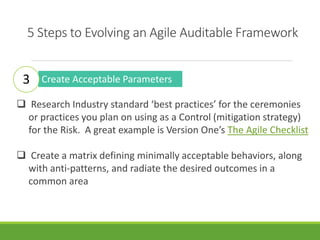
 Research Industry standard ‘best practices’ for the ceremonies 
or practices you plan on using as a Control (mitigation strategy) 
for the Risk. A great example is Version One’s The Agile Checklist 
 Create a matrix defining minimally acceptable behaviors, along 
with anti-patterns, and radiate the desired outcomes in a 
common area
5 Steps to Evolving an Agile Auditable Framework 
Create Acceptable Parameters 
Agile Ceremony: Daily Standup 
Best Practice Acceptable Partial Unacceptable 
Occurs 5 Days per 
Week 
Occurs 4 Days per 
Week 
Occurs 3 Days per 
Week 
Occurs <3 Days per 
Week 
3 Core Questions 
Addressed 
3 Core Questions 
Addressed 
<3 Core Questions 
Addressed 
<3 Core Questions 
Addressed 
…Your 
Organization? 
…Your 
Organization? 
…Your 
Organization? 
….Your 
Organization? 
3
5 Steps to Evolving an Agile Auditable Framework 
Determine Method of Control 
4 
 Does the new Control Test require someone observe an Agile 
Ceremony, or is there a consistent formal artifact from an Agile 
practice that can be viewed?
5 Steps to Evolving an Agile Auditable Framework 
Establish Operational Parameters 
5 
 Review the total number of Control Tests. How 
many require observation from an Auditor? 
 Establish the Audit cycle & reporting time 
(Weekly? Sprint Level? Release Level? Other..?) 
 Train and deploy Audit resources 
 Execute an Audit cycle… and report to Risk Owners 
 Learn… and continue to evolve!
5 Steps to Evolving… Creativity 
 Host a Retrospective Ceremony with some of the 
Agile teams to uncover: 
 What may be challenging teams in conforming to 
minimal standards? 
 What opportunities can they recommend to 
evolve to controls? 
 Are the audits providing value in holding roles 
accountable for their deliverables? 
 Finally – when minimal standards are easily 
achieved – it’s time to take the next steps in 
maturity, and shift the pattern.
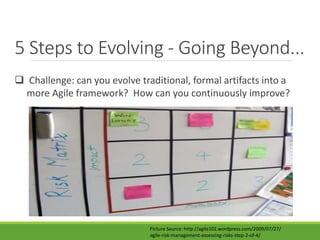
5 Steps to Evolving - Going Beyond... 
 Challenge: can you evolve traditional, formal artifacts into a 
more Agile framework? How can you continuously improve? 
Picture Source: http://agile101.wordpress.com/2009/07/27/ 
agile-risk-management-assessing-risks-step-2-of-4/
Positive Outcomes 
 Better alignment of Controls and Tests to the project execution model 
 Real time, actionable feedback & reporting to teams and Risk owners 
 Scalable for future methodologies & practices 
 Continual quality assessments; a project can have multiple reviews 
 Sets a benchmark for Agile maturity across an Organization 
 ‘Humanizes’ the Audit (not ‘check the box’) – gives teams a voice 
 Experience – 50% reduction in Controls… while doubling Quality 
 Leading – NOT lagging – metric; address problems before they manifest 
 Opportunity for two-way communication and learnings
Challenges 
 Optimal model is labor intensive 
 Inherent subjectivity in assessments (‘Auditor Bias’) 
 Potential for teams to feel ‘over controlled’ 
 Oversight and administration of the process 
 Communication and support for changes 
 Determining boundaries of adherence vs. non-adherence, 
and appropriate remedies 
 Ever-evolving process; can feel like an ‘arms race’
Common Questions 
 Does this model Scale? 
 How much time per week would this require? 
 Isn’t this just the Scrum Master’s… or (insert role here) – 
job? 
 Could we use Pair Programming as a Control? 
 What is the future of Agile Quality Assurance?
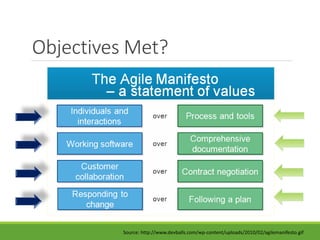
Objectives Met? 
Source: http://www.devballs.com/wp-content/uploads/2010/02/agilemanifesto.gif
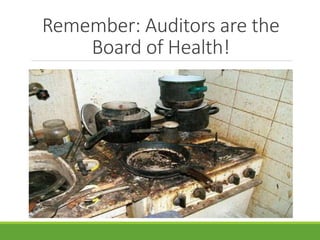
Remember: Auditors are the 
Board of Health!
Questions?
Thank You!
Information Sources 
Malik Imran Ullah & Waqar Ali Zaidi, “Quality 
Assurance Activities in Agile – Philosophy to 
Practice”. Sep. 2009. 
Larry Whittington, “ISO9001:2008 Requirements 
Summary in Plain English”. 
http://www.whittingtonassociates.com/ 
Tor Stalhane, Geir Kjetil Hanssen, “The application 
of ISO 9001 to Agile Software Development”. 2008. 
Buck Kulkami, “Agile Projects: An Emerging 
Challenge for IT Auditors”.
Information Sources 
R. Gopinath, “Guideline: How to Audit and Agile 
Project?” 
George Schlitz, “Is your Agile Audit and Compliance 
Process really Agile?” 
Christelle Scharff, “Guiding Global Software 
Development Projects using Scrum and Agile with 
Quality Assurance”

Chaos, Consistency, Creativity - A Journey Through Agile Auditability

  • 1.
    Chaos, Consistency, Creativity: A Journey Through Agile Auditability Steve Nunziata, PMP, PMI-ACP, CSM, SAFe SPC Agile Austin Monthly Meeting, October 14th, 2014
  • 2.
    About Steve… PMP,ACP, CSM, SAFe SPC EDS, Nike, Adidas, USAA Agile Trainer & Coach New Jersey / Oregon Bassist Extraordinaire Alamo Agilistas / PMI
  • 3.
    Background: My Story Zero to Sixty (Days): Chaos to Consistency
  • 4.
    So… Why AreWe Here? Opportunity: Educate internal auditors to evolve away from formal artifacts and accept Agile tenets of visibility and transparency to demonstrate adherence to defined Quality standards. We will collaborate on an approach to define an Agile Risk & Control framework that can start you on your journey.
  • 5.
    How Would YouLike:  A 50% - or more – reduction in project ‘paperwork’ to demonstrate adherence to compliance processes? 59 COMPLIANCE ARTIFACTS 30 PROJECT WATERFALL AGILE  A framework for consistent application of Agile practices and ceremonies across a large – and growing – organization?
  • 6.
    Remember…Use the Force Remove, you must, Stories from the Backlog, That, within an Iteration, completed, will not be…
  • 7.
    Agenda Chaos Failingsof Today’s Risk Management Processes Consistency Why Audit Execution Models Need to Evolve Creativity Creating an Agile Auditable Framework
  • 8.
    Managing Risk –How Important is it?  The primary goal of a business is to… stay in business.  It is therefore necessary to continually evaluate, monitor, and address threats to retain market share. Otherwise, what would happen?
  • 9.
    Managing Risk –The Risk Management Process Risk Identification Risk Assessment Risk Response Risk Review
  • 10.
    Managing Risk –ISO 9001 Summary Part 4 – The Company must establish, document, and maintain a Quality Management System (QMS) Part 5 – Management commitment in evidence for the QMS Part 6 – Necessary resources must be determined & provisioned Part 7 – Plan & Develop processes for product realization. The processes must produce documents that can be (1) reviewed for acceptance; and (2) used as proof of conformance Part 8 – All reports of non-conformances, both of the product or the process, shall be reported upon, analyzed and lead to corrective action
  • 11.
    Managing Risk –Risk & Control Compliance Framework Risk Controls Control Tests Operational Risks  Incomplete Requirements  Ineffective or Incomplete Reporting & Review Software Solution  Poor User Experience  Poor Project Execution Plan  Formal Requirements Baseline Process  Project Execution Schedule Review  Code Peer Reviews  Evidence of Formal Signoffs  Published Meeting Minutes  Documented Decisions / Logs  Formal results of Audit published for review; opportunities for improvements noted Auditors
  • 12.
    Are Risk ManagementProcesses Inherently anti-Agile? Source: http://www.devballs.com/wp-content/uploads/2010/02/agilemanifesto.gif
  • 13.
    SDLC & ProcessAudit Execution Models: Challenges While Agile adoption and evolution has continued unabated over the past several years, traditional process audits have largely been unable to keep pace. Why might this be?
  • 14.
    SDLC & ProcessAudit Execution Models Systems Development Life Cycle – Linear View Req’s Analysis Design Build Test Deploy
  • 15.
    SDLC & ProcessAudit Execution Models Source: http://julianeverett.wordpress.com/ Blue Dotted Line: Agile Red Dotted Line: Waterfall RISK Project Risk Profile – Agile & Waterfall TIME
  • 16.
    SDLC & ProcessAudit Execution Models SDLC Execution – Waterfall, Incremental, & Agile Daily 24 Hours Iteration 2-4 Weeks Release ~3 Months Closure ~9-12 Months
  • 17.
    SDLC & ProcessAudit Execution Models Process Audit vs. SDLC Execution Gap Analysis Closure ~9-12 Months Release ~3 Months Iteration 2-4 Weeks Daily 24 Hours
  • 18.
    SDLC & ProcessAudit Execution Models SDLC and Process Audit Execution: Optimal Quality State Daily Iteration 2-4 Weeks Release ~3 Months Closure
  • 19.
    5 Steps toEstablishing an Agile Auditable Framework Risk Validation Inventory Agile Practices Create Acceptable Parameters Determine Method of Control Establish Operational Parameters 1 2 3 4 5
  • 20.
    5 Steps toEvolving an Agile Auditable Framework Risk Validation Review and Validate the current Risk & Control Framework, ensuring traceability from Risks to Controls to Control Tests. Operational Risk: Risk Control: Control Test: Failure to Manage Project Risks Risk Management Process Evidence of a Periodic Risk Review (Risk Log) Issue Management Process Formal, Complete Issues Log 1
  • 21.
    5 Steps toEvolving an Agile Auditable Framework Inventory Agile Practices 2  Inventory the Agile Practices supported by the organization. Scrum practices and ceremonies provide a good start.  Match the Agile ceremonies to the list of Risks in the current Risk & Control Framework. Can a Ceremony or Practice provide an acceptable substitute? How / Why?
  • 22.
    5 Steps toEvolving an Agile Auditable Framework Inventory Agile Practices  Introduce the Agile Practice as a Control. Could it work? Could it be effective? What would be the value of the current control set – should anything remain, or can they be dismissed? Operational Risk: Risk Control: Control Test: Failure to Manage Project Risks Risk Management Process Evidence of a Periodic Risk Review Agile Daily Standup 2
  • 23.
    5 Steps toEvolving an Agile Auditable Framework Create Acceptable Parameters 3  Research Industry standard ‘best practices’ for the ceremonies or practices you plan on using as a Control (mitigation strategy) for the Risk. A great example is Version One’s The Agile Checklist  Create a matrix defining minimally acceptable behaviors, along with anti-patterns, and radiate the desired outcomes in a common area
  • 24.
    5 Steps toEvolving an Agile Auditable Framework Create Acceptable Parameters Agile Ceremony: Daily Standup Best Practice Acceptable Partial Unacceptable Occurs 5 Days per Week Occurs 4 Days per Week Occurs 3 Days per Week Occurs <3 Days per Week 3 Core Questions Addressed 3 Core Questions Addressed <3 Core Questions Addressed <3 Core Questions Addressed …Your Organization? …Your Organization? …Your Organization? ….Your Organization? 3
  • 25.
    5 Steps toEvolving an Agile Auditable Framework Determine Method of Control 4  Does the new Control Test require someone observe an Agile Ceremony, or is there a consistent formal artifact from an Agile practice that can be viewed?
  • 26.
    5 Steps toEvolving an Agile Auditable Framework Establish Operational Parameters 5  Review the total number of Control Tests. How many require observation from an Auditor?  Establish the Audit cycle & reporting time (Weekly? Sprint Level? Release Level? Other..?)  Train and deploy Audit resources  Execute an Audit cycle… and report to Risk Owners  Learn… and continue to evolve!
  • 27.
    5 Steps toEvolving… Creativity  Host a Retrospective Ceremony with some of the Agile teams to uncover:  What may be challenging teams in conforming to minimal standards?  What opportunities can they recommend to evolve to controls?  Are the audits providing value in holding roles accountable for their deliverables?  Finally – when minimal standards are easily achieved – it’s time to take the next steps in maturity, and shift the pattern.
  • 28.
    5 Steps toEvolving - Going Beyond...  Challenge: can you evolve traditional, formal artifacts into a more Agile framework? How can you continuously improve? Picture Source: http://agile101.wordpress.com/2009/07/27/ agile-risk-management-assessing-risks-step-2-of-4/
  • 29.
    Positive Outcomes Better alignment of Controls and Tests to the project execution model  Real time, actionable feedback & reporting to teams and Risk owners  Scalable for future methodologies & practices  Continual quality assessments; a project can have multiple reviews  Sets a benchmark for Agile maturity across an Organization  ‘Humanizes’ the Audit (not ‘check the box’) – gives teams a voice  Experience – 50% reduction in Controls… while doubling Quality  Leading – NOT lagging – metric; address problems before they manifest  Opportunity for two-way communication and learnings
  • 30.
    Challenges  Optimalmodel is labor intensive  Inherent subjectivity in assessments (‘Auditor Bias’)  Potential for teams to feel ‘over controlled’  Oversight and administration of the process  Communication and support for changes  Determining boundaries of adherence vs. non-adherence, and appropriate remedies  Ever-evolving process; can feel like an ‘arms race’
  • 31.
    Common Questions Does this model Scale?  How much time per week would this require?  Isn’t this just the Scrum Master’s… or (insert role here) – job?  Could we use Pair Programming as a Control?  What is the future of Agile Quality Assurance?
  • 32.
    Objectives Met? Source:http://www.devballs.com/wp-content/uploads/2010/02/agilemanifesto.gif
  • 33.
    Remember: Auditors arethe Board of Health!
  • 34.
  • 35.
  • 36.
    Information Sources MalikImran Ullah & Waqar Ali Zaidi, “Quality Assurance Activities in Agile – Philosophy to Practice”. Sep. 2009. Larry Whittington, “ISO9001:2008 Requirements Summary in Plain English”. http://www.whittingtonassociates.com/ Tor Stalhane, Geir Kjetil Hanssen, “The application of ISO 9001 to Agile Software Development”. 2008. Buck Kulkami, “Agile Projects: An Emerging Challenge for IT Auditors”.
  • 37.
    Information Sources R.Gopinath, “Guideline: How to Audit and Agile Project?” George Schlitz, “Is your Agile Audit and Compliance Process really Agile?” Christelle Scharff, “Guiding Global Software Development Projects using Scrum and Agile with Quality Assurance”