Risk Management in
an Agile Lifecycle
PMI Chicagoland
Professional Development Day
November 1, 2013
Elena Yatzeck
eyatzeck@gmail.com
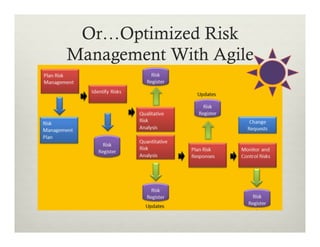
Or…Optimized Risk
Management With Agile
What is Agile?
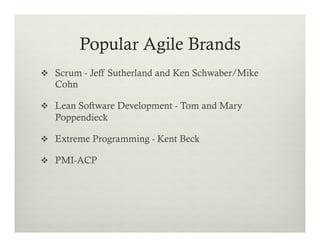
Popular Agile Brands
v  Scrum - Jeff Sutherland and Ken Schwaber/Mike

Cohn
v  Lean Software Development - Tom and Mary

Poppendieck
v  Extreme Programming - Kent Beck
v  PMI-ACP
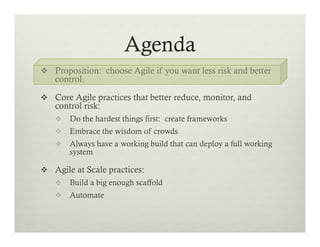
Agenda
v  Proposition: choose Agile if you want less risk and better

control.

v  Core Agile practices that better reduce, monitor, and

control risk:

v  Do the hardest things first: create frameworks
v  Embrace the wisdom of crowds
v  Always have a working build that can deploy a full working

system

v  Agile at Scale practices:
v  Build a big enough scaffold
v  Automate
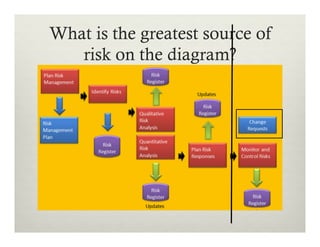
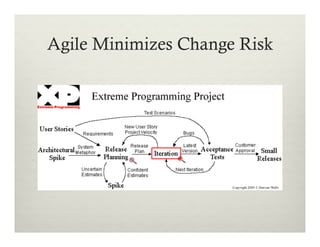
What is the greatest source of
risk on the diagram?
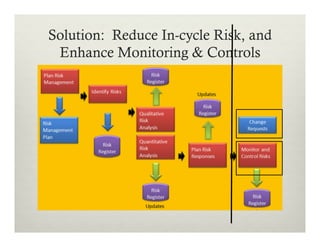
Solution: Reduce In-cycle Risk, and
Enhance Monitoring & Controls
Agile Minimizes Change Risk
Agenda
v  Proposition: choose Agile if you want less risk and better

control.

v  Core Agile practices that better reduce, monitor, and

control risk:

v  Do the hardest things first: create frameworks
v  Embrace the wisdom of crowds
v  Always have a working build that can deploy a full working

system

v  Agile at Scale practices:
v  Build a big enough scaffold
v  Automate
Long Runways Are Needed
Concretely
v  Identify what you don’t know and quickly learn it:

“Spikes”
v  Solutions architecture: how will the pieces work?

Build frameworks (not fully detailed):
v  Life of a Query
v  Data model
v  Error handling

v  Riskiest system pieces first (along with highest value to

product owner)
Agenda
v  Proposition: choose Agile if you want less risk and better

control.

v  Core Agile practices that better reduce, monitor, and

control risk:

v  Do the hardest things first: create frameworks
v  Embrace the wisdom of crowds
v  Always have a working build that can deploy a full working

system

v  Agile at Scale practices:
v  Build a big enough scaffold
v  Automate
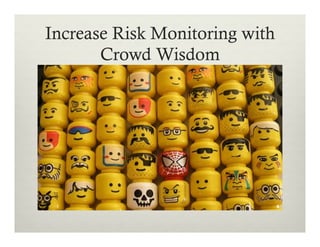
Increase Risk Monitoring with
Crowd Wisdom
Concretely
v  Hire the whole team, provision them properly, and keep

them all the way through.

v  Schedule and facilitate efficient communication paths and

meetings:

v  Collocation
v  Daily stand-up
v  Story and backlog refinement
v  Story kick-offs and desk checks
v  Demos, Product Owner sign-offs, Showcases

v  Information radiators
Agenda
v  Proposition: choose Agile if you want less risk and better

control.

v  Core Agile practices that better reduce, monitor, and

control risk:

v  Do the hardest things first: create frameworks
v  Embrace the wisdom of crowds
v  Always have a working build that can deploy a full working

system

v  Agile at Scale practices:
v  Build a big enough scaffold
v  Automate
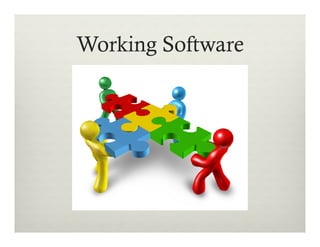
Working Software
Concretely
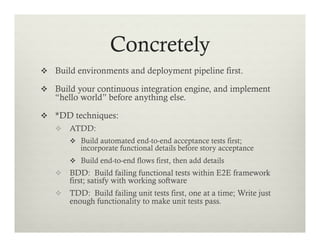
v  Build environments and deployment pipeline first.
v  Build your continuous integration engine, and implement

“hello world” before anything else.

v  *DD techniques:
v  ATDD:
v  Build automated end-to-end acceptance tests first;

incorporate functional details before story acceptance

v  Build end-to-end flows first, then add details

v  BDD: Build failing functional tests within E2E framework

first; satisfy with working software

v  TDD: Build failing unit tests first, one at a time; Write just

enough functionality to make unit tests pass.
But wait!
There’s more!
Agenda
v  Proposition: choose Agile if you want less risk and better

control.

v  Core Agile practices that better reduce, monitor, and

control risk:

v  Do the hardest things first: create frameworks
v  Embrace the wisdom of crowds
v  Always have a working build that can deploy a full working

system

v  Agile at Scale practices:
v  Build a big enough scaffold
v  Automate
Build a Big Enough Scaffold
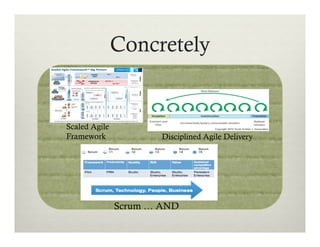
Concretely

Scaled Agile
Framework

Disciplined Agile Delivery

Scrum … AND
Agenda
v  Proposition: choose Agile if you want less risk and better

control.

v  Core Agile practices that better reduce, monitor, and

control risk:

v  Do the hardest things first: create frameworks
v  Embrace the wisdom of crowds
v  Always have a working build that can deploy a full working

system

v  Agile at Scale practices:
v  Build a big enough scaffold
v  Automate
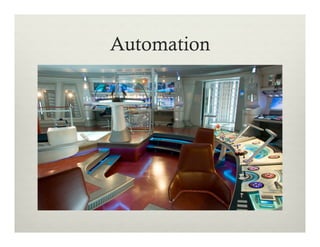
Automation
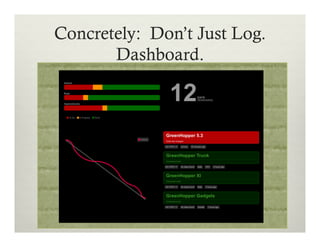
Concretely: Don’t Just Log.
Dashboard.
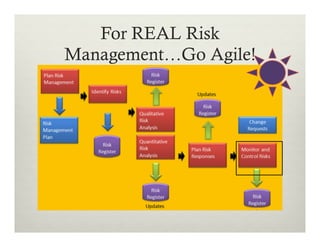
For REAL Risk
Management…Go Agile!
Questions?
Elena Yatzeck | JPMorgan Chase | eyatzeck@gmail.com | 773-573-7114
http://pagilista.blogspot.com
As Manifesto Hints: Agile Is All About
Reducing Risk of the Unknown
We are uncovering better ways of developing software by doing
it and helping others do it. Through this work we have come to
value:
v  Individuals and interactions over processes and tools
v  Working software over comprehensive documentation
v  Customer collaboration over contract negotiation
v  Responding to change over following a plan

That is, while there is value in the items on the right, we value
the items on the left more.
Abstract
Increasingly, risk control is key to successful project delivery, and large companies are
incorporating Agile practices into their SDLC specifically to improve their risk
controls. Although Agile has a reputation for “legalized cowboy coding,” core Agile
principles actually accelerate identification of risks, enabling more time for mitigation.
Additionally, some of the newer Agile practices create even better controls over
project delivery risk, making Agile the best available framework for risk control.
Core Practices that Control Risk:
•  Group conversation provides “wisdom of teams” to bring out risks earlier.
•  Partitioning the work into small pieces instead of handling in batch allows for
better quality control and business inspection.
•  “Fail fast” philosophy puts “solving unknowns” first in line for project execution,
and asks IT to start identifying those unknowns and proving out solutions from
Day 1.
Evolved Agile Practices:
•  “Scrum-AND” and other scaled Agile frameworks call for a mandatory, collocated
workshop at the start of the project (business and all roles represented) to build a
higher quality backlog that can be prioritized for risk.
•  Continuous integration, delivery, and deployment with automated testing
guarantee defect-free software that meets functional requirements from day 1.

Want Effective Risk Control? Try Agile!

  • 1.
    Risk Management in anAgile Lifecycle PMI Chicagoland Professional Development Day November 1, 2013 Elena Yatzeck eyatzeck@gmail.com
  • 2.
  • 3.
  • 4.
    Popular Agile Brands v Scrum - Jeff Sutherland and Ken Schwaber/Mike Cohn v  Lean Software Development - Tom and Mary Poppendieck v  Extreme Programming - Kent Beck v  PMI-ACP
  • 5.
    Agenda v  Proposition: chooseAgile if you want less risk and better control. v  Core Agile practices that better reduce, monitor, and control risk: v  Do the hardest things first: create frameworks v  Embrace the wisdom of crowds v  Always have a working build that can deploy a full working system v  Agile at Scale practices: v  Build a big enough scaffold v  Automate
  • 6.
    What is thegreatest source of risk on the diagram?
  • 7.
    Solution: Reduce In-cycleRisk, and Enhance Monitoring & Controls
  • 8.
  • 9.
    Agenda v  Proposition: chooseAgile if you want less risk and better control. v  Core Agile practices that better reduce, monitor, and control risk: v  Do the hardest things first: create frameworks v  Embrace the wisdom of crowds v  Always have a working build that can deploy a full working system v  Agile at Scale practices: v  Build a big enough scaffold v  Automate
  • 10.
  • 11.
    Concretely v  Identify whatyou don’t know and quickly learn it: “Spikes” v  Solutions architecture: how will the pieces work? Build frameworks (not fully detailed): v  Life of a Query v  Data model v  Error handling v  Riskiest system pieces first (along with highest value to product owner)
  • 12.
    Agenda v  Proposition: chooseAgile if you want less risk and better control. v  Core Agile practices that better reduce, monitor, and control risk: v  Do the hardest things first: create frameworks v  Embrace the wisdom of crowds v  Always have a working build that can deploy a full working system v  Agile at Scale practices: v  Build a big enough scaffold v  Automate
  • 13.
    Increase Risk Monitoringwith Crowd Wisdom
  • 14.
    Concretely v  Hire thewhole team, provision them properly, and keep them all the way through. v  Schedule and facilitate efficient communication paths and meetings: v  Collocation v  Daily stand-up v  Story and backlog refinement v  Story kick-offs and desk checks v  Demos, Product Owner sign-offs, Showcases v  Information radiators
  • 15.
    Agenda v  Proposition: chooseAgile if you want less risk and better control. v  Core Agile practices that better reduce, monitor, and control risk: v  Do the hardest things first: create frameworks v  Embrace the wisdom of crowds v  Always have a working build that can deploy a full working system v  Agile at Scale practices: v  Build a big enough scaffold v  Automate
  • 16.
  • 17.
    Concretely v  Build environmentsand deployment pipeline first. v  Build your continuous integration engine, and implement “hello world” before anything else. v  *DD techniques: v  ATDD: v  Build automated end-to-end acceptance tests first; incorporate functional details before story acceptance v  Build end-to-end flows first, then add details v  BDD: Build failing functional tests within E2E framework first; satisfy with working software v  TDD: Build failing unit tests first, one at a time; Write just enough functionality to make unit tests pass.
  • 18.
  • 19.
    Agenda v  Proposition: chooseAgile if you want less risk and better control. v  Core Agile practices that better reduce, monitor, and control risk: v  Do the hardest things first: create frameworks v  Embrace the wisdom of crowds v  Always have a working build that can deploy a full working system v  Agile at Scale practices: v  Build a big enough scaffold v  Automate
  • 20.
    Build a BigEnough Scaffold
  • 21.
  • 22.
    Agenda v  Proposition: chooseAgile if you want less risk and better control. v  Core Agile practices that better reduce, monitor, and control risk: v  Do the hardest things first: create frameworks v  Embrace the wisdom of crowds v  Always have a working build that can deploy a full working system v  Agile at Scale practices: v  Build a big enough scaffold v  Automate
  • 23.
  • 24.
    Concretely: Don’t JustLog. Dashboard.
  • 25.
  • 26.
    Questions? Elena Yatzeck |JPMorgan Chase | eyatzeck@gmail.com | 773-573-7114 http://pagilista.blogspot.com
  • 27.
    As Manifesto Hints:Agile Is All About Reducing Risk of the Unknown We are uncovering better ways of developing software by doing it and helping others do it. Through this work we have come to value: v  Individuals and interactions over processes and tools v  Working software over comprehensive documentation v  Customer collaboration over contract negotiation v  Responding to change over following a plan That is, while there is value in the items on the right, we value the items on the left more.
  • 28.
    Abstract Increasingly, risk controlis key to successful project delivery, and large companies are incorporating Agile practices into their SDLC specifically to improve their risk controls. Although Agile has a reputation for “legalized cowboy coding,” core Agile principles actually accelerate identification of risks, enabling more time for mitigation. Additionally, some of the newer Agile practices create even better controls over project delivery risk, making Agile the best available framework for risk control. Core Practices that Control Risk: •  Group conversation provides “wisdom of teams” to bring out risks earlier. •  Partitioning the work into small pieces instead of handling in batch allows for better quality control and business inspection. •  “Fail fast” philosophy puts “solving unknowns” first in line for project execution, and asks IT to start identifying those unknowns and proving out solutions from Day 1. Evolved Agile Practices: •  “Scrum-AND” and other scaled Agile frameworks call for a mandatory, collocated workshop at the start of the project (business and all roles represented) to build a higher quality backlog that can be prioritized for risk. •  Continuous integration, delivery, and deployment with automated testing guarantee defect-free software that meets functional requirements from day 1.