





A Happy Marriage between
Context-Driven and Agile
llari Henrik Aegerter
Managing Director – House of Test
Executive at Large – Association for Software Testing (AST)
President – International Society for Software Testing (ISST)
@ilarihenrik
picture credit: https://www.flickr.com/photos/clement127/15504975089/
Today’s Menu
1. European Product Development
2. Automate everything?
3. How we did it
4. How you can make it work
5. Questions
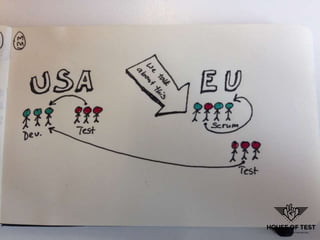
European Product
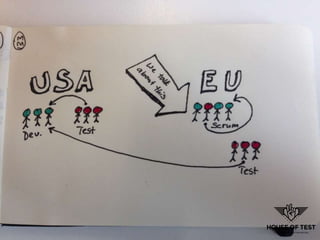
Development - Structure
Automate Everything?
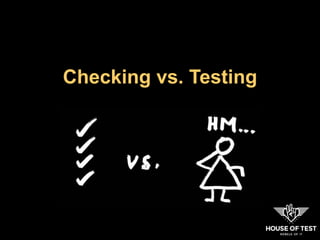
Checking vs. Testing
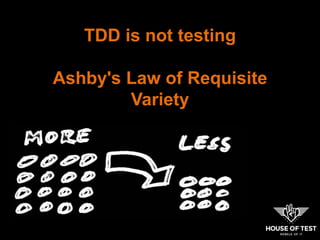
TDD is not testing
Ashby's Law of Requisite
Variety
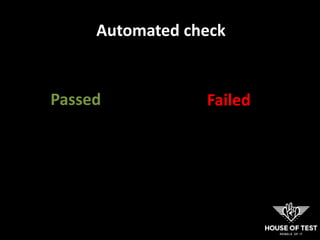
Automated check
Passed Failed
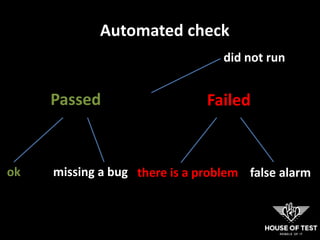
Automated check
Passed Failed
there is a problem false alarmok missing a bug
did not run
Technical focus
image credit: https://www.flickr.com/photos/machintoy/3486236621
Social focus
image credit: https://www.flickr.com/photos/chrism70/272065545
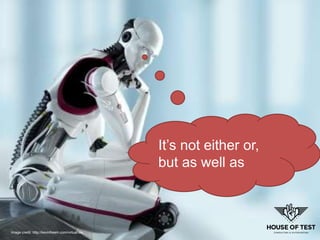
image credit: http://kevinfream.com/virtual-cio
It’s not either or,
but as well as
How we did it
What was before?
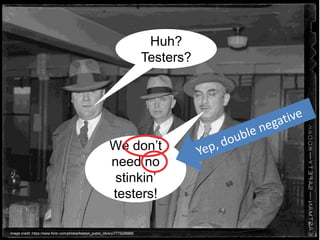
Suspicion
We don’t
need no
stinkin’
testers!
Huh?
Testers?
image credit: https://www.flickr.com/photos/boston_public_library/7775298866
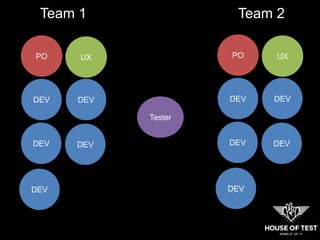
Integration
Tester
DEV
PO UX
DEV DEV
DEV DEV
DEV
PO UX
DEV DEV
DEV DEV
Team 1 Team 2
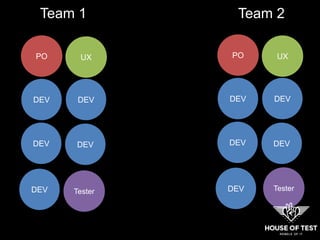
TesterDEV
PO UX
DEV DEV
DEV DEV
DEV
PO UX
DEV DEV
DEV DEV
Team 1 Team 2
Tester
Integration
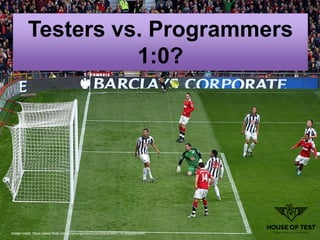
Testers vs. Programmers
1:0?
image credit: https://www.flickr.com/photos/gordon2208/5093639901/in/photostream/
Where we are now
PO UX
DEV
PO UX
DEV DEV
DEV DEV
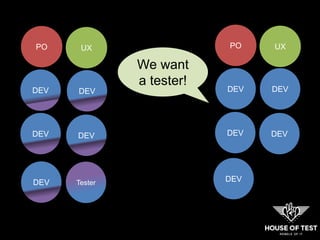
We want
a tester!
DEV
Tester
DEV
DEV DEV
DEV
Integration
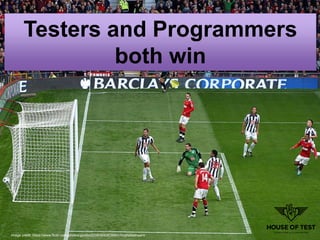
Testers and Programmers
both win
image credit: https://www.flickr.com/photos/gordon2208/5093639901/in/photostream/
We are uncovering better ways of developing
software by doing it and helping others do it.
Through this work we have come to value:
Individuals and interactions over processes and tools
Working software over comprehensive documentation
Customer collaboration over contract negotiation
Responding to change over following a plan
That is, while there is value in the items on
the right, we value the items on the left more.
Agile Manifesto
1. The value of any practice depends on its context
2. There are good practices in context, but there are no best practices.
3. People, working together, are the most important part of any project’s context.
4. Projects unfold over time in ways that are often not predictable.
5. The product is a solution. If the problem isn’t solved, the product doesn’t work.
6. Good software testing is a challenging intellectual process.
7. Only through judgment and skill, exercised cooperatively throughout the entire
project, are we able to do the right things at the right times to effectively test our
products.
Context-Driven
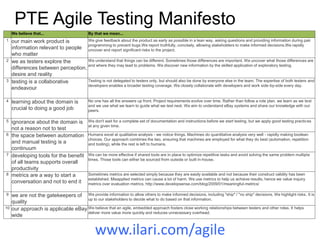
PTE Agile Testing Manifesto
We believe that... By that we mean...
1 our main work product is
information relevant to people
who matter
We give feedback about the product as early as possible in a lean way, asking questions and providing information during pair
programming to prevent bugs.We report truthfully, concisely, allowing stakeholders to make informed decisions.We rapidly
uncover and report significant risks to the project.
2 we as testers explore the
differences between perception,
desire and reality
We understand that things can be different. Sometimes those differences are important. We uncover what those differences are
and where they may lead to problems. We discover new information by the skilled application of exploratory testing.
3 testing is a collaborative
endeavour
Testing is not delegated to testers only, but should also be done by everyone else in the team. The expertise of both testers and
developers enables a broader testing coverage. We closely collaborate with developers and work side-by-side every day.
4 learning about the domain is
crucial to doing a good job
No one has all the answers up front. Project requirements evolve over time. Rather than follow a rote plan, we learn as we test
and we use what we learn to guide what we test next. We aim to understand eBay systems and share our knowledge with our
peers.
5 ignorance about the domain is
not a reason not to test
We don't wait for a complete set of documentation and instructions before we start testing, but we apply good testing practices
at any given time.
6 the space between automation
and manual testing is a
continuum
Humans excel at qualitative analysis - we notice things. Machines do quantitative analysis very well - rapidly making boolean
choices. Our approach combines the two, ensuring that machines are employed for what they do best (automation, repetition
and tooling), while the rest is left to humans.
7 developing tools for the benefit
of all teams supports overall
productivity
We can be more effective if shared tools are in place to optimize repetitive tasks and avoid solving the same problem multiple
times. Those tools can either be sourced from outside or built in-house.
8 metrics are a way to start a
conversation and not to end it
Sometimes metrics are selected simply because they are easily available and not because their construct validity has been
established. Misapplied metrics can cause a lot of harm. We use metrics to help us achieve results, hence we value inquiry
metrics over evaluation metrics. http://www.developsense.com/blog/2009/01/meaningful-metrics/
9 we are not the gatekeepers of
quality
We provide information to allow others to make informed decisions, including "ship" / "no ship" decisions. We highlight risks. It is
up to our stakeholders to decide what to do based on that information.
10 our approach is applicable eBay
wide
We believe that an agile, embedded approach fosters close working relationships between testers and other roles. It helps
deliver more value more quickly and reduces unnecessary overhead.
www.ilari.com/agile
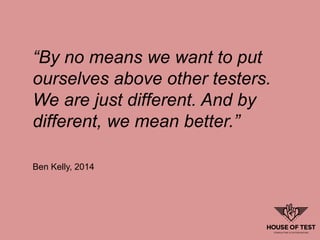
“By no means we want to put
ourselves above other testers.
We are just different. And by
different, we mean better.”
Ben Kelly, 2014
How you can make it work
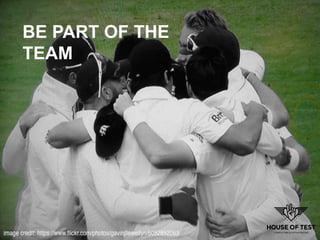
BE PART OF THE
TEAM
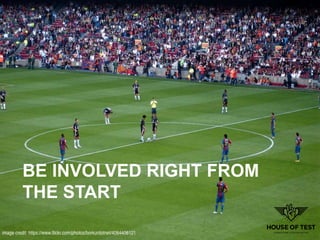
BE INVOLVED RIGHT FROM
THE START
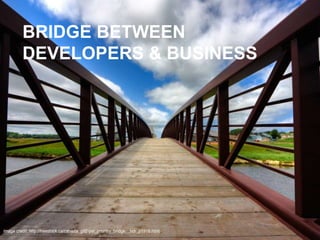
BRIDGE BETWEEN
DEVELOPERS & BUSINESS
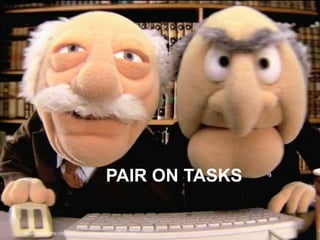
PAIR ON TASKS
Image credit: http://jmyersdev.com/images/muppet-pair.png
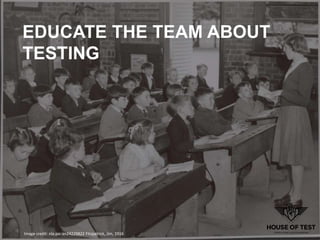
Image credit: nla.pic-an24229822 Fitzpatrick, Jim, 1916
EDUCATE THE TEAM ABOUT
TESTING
What skills do you need?
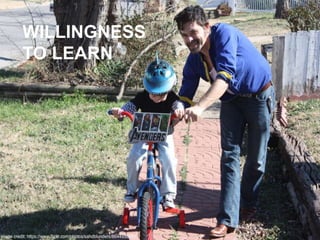
WILLINGNESS TO LEARN
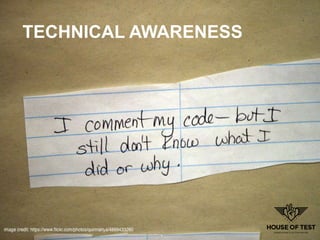
TECHNICAL AWARENESS
WILLINGNESS TO LEARN
TECHNICAL UNDERSTANDINGDOMAIN KNOWLEDGE
WILLINGNESS
TO LEARN
When craftspeople meet other
craftspeople, that’s where the
magic happens
Imagecredit:http://j.mp/LkUoLC
Questions?
ilari.aegerter@houseoftest.ch
@ilarihenrik
Imagecredit:http://j.mp/LkUoLC

A Happy Marriage between Context-Driven and Agile

  • 1.
    A Happy Marriagebetween Context-Driven and Agile
  • 2.
    llari Henrik Aegerter ManagingDirector – House of Test Executive at Large – Association for Software Testing (AST) President – International Society for Software Testing (ISST) @ilarihenrik
  • 3.
  • 4.
    Today’s Menu 1. EuropeanProduct Development 2. Automate everything? 3. How we did it 4. How you can make it work 5. Questions
  • 6.
  • 8.
  • 9.
  • 10.
    TDD is nottesting Ashby's Law of Requisite Variety
  • 11.
  • 12.
    Automated check Passed Failed thereis a problem false alarmok missing a bug did not run
  • 13.
    Technical focus image credit:https://www.flickr.com/photos/machintoy/3486236621
  • 14.
    Social focus image credit:https://www.flickr.com/photos/chrism70/272065545
  • 15.
  • 16.
  • 18.
  • 19.
    Suspicion We don’t need no stinkin’ testers! Huh? Testers? imagecredit: https://www.flickr.com/photos/boston_public_library/7775298866
  • 20.
  • 21.
    Tester DEV PO UX DEV DEV DEVDEV DEV PO UX DEV DEV DEV DEV Team 1 Team 2
  • 22.
    TesterDEV PO UX DEV DEV DEVDEV DEV PO UX DEV DEV DEV DEV Team 1 Team 2 Tester
  • 23.
    Integration Testers vs. Programmers 1:0? imagecredit: https://www.flickr.com/photos/gordon2208/5093639901/in/photostream/
  • 24.
  • 25.
    PO UX DEV PO UX DEVDEV DEV DEV We want a tester! DEV Tester DEV DEV DEV DEV
  • 26.
    Integration Testers and Programmers bothwin image credit: https://www.flickr.com/photos/gordon2208/5093639901/in/photostream/
  • 27.
    We are uncoveringbetter ways of developing software by doing it and helping others do it. Through this work we have come to value: Individuals and interactions over processes and tools Working software over comprehensive documentation Customer collaboration over contract negotiation Responding to change over following a plan That is, while there is value in the items on the right, we value the items on the left more. Agile Manifesto
  • 28.
    1. The valueof any practice depends on its context 2. There are good practices in context, but there are no best practices. 3. People, working together, are the most important part of any project’s context. 4. Projects unfold over time in ways that are often not predictable. 5. The product is a solution. If the problem isn’t solved, the product doesn’t work. 6. Good software testing is a challenging intellectual process. 7. Only through judgment and skill, exercised cooperatively throughout the entire project, are we able to do the right things at the right times to effectively test our products. Context-Driven
  • 29.
    PTE Agile TestingManifesto We believe that... By that we mean... 1 our main work product is information relevant to people who matter We give feedback about the product as early as possible in a lean way, asking questions and providing information during pair programming to prevent bugs.We report truthfully, concisely, allowing stakeholders to make informed decisions.We rapidly uncover and report significant risks to the project. 2 we as testers explore the differences between perception, desire and reality We understand that things can be different. Sometimes those differences are important. We uncover what those differences are and where they may lead to problems. We discover new information by the skilled application of exploratory testing. 3 testing is a collaborative endeavour Testing is not delegated to testers only, but should also be done by everyone else in the team. The expertise of both testers and developers enables a broader testing coverage. We closely collaborate with developers and work side-by-side every day. 4 learning about the domain is crucial to doing a good job No one has all the answers up front. Project requirements evolve over time. Rather than follow a rote plan, we learn as we test and we use what we learn to guide what we test next. We aim to understand eBay systems and share our knowledge with our peers. 5 ignorance about the domain is not a reason not to test We don't wait for a complete set of documentation and instructions before we start testing, but we apply good testing practices at any given time. 6 the space between automation and manual testing is a continuum Humans excel at qualitative analysis - we notice things. Machines do quantitative analysis very well - rapidly making boolean choices. Our approach combines the two, ensuring that machines are employed for what they do best (automation, repetition and tooling), while the rest is left to humans. 7 developing tools for the benefit of all teams supports overall productivity We can be more effective if shared tools are in place to optimize repetitive tasks and avoid solving the same problem multiple times. Those tools can either be sourced from outside or built in-house. 8 metrics are a way to start a conversation and not to end it Sometimes metrics are selected simply because they are easily available and not because their construct validity has been established. Misapplied metrics can cause a lot of harm. We use metrics to help us achieve results, hence we value inquiry metrics over evaluation metrics. http://www.developsense.com/blog/2009/01/meaningful-metrics/ 9 we are not the gatekeepers of quality We provide information to allow others to make informed decisions, including "ship" / "no ship" decisions. We highlight risks. It is up to our stakeholders to decide what to do based on that information. 10 our approach is applicable eBay wide We believe that an agile, embedded approach fosters close working relationships between testers and other roles. It helps deliver more value more quickly and reduces unnecessary overhead. www.ilari.com/agile
  • 30.
    “By no meanswe want to put ourselves above other testers. We are just different. And by different, we mean better.” Ben Kelly, 2014
  • 31.
    How you canmake it work
  • 32.
    BE PART OFTHE TEAM
  • 33.
    BE INVOLVED RIGHTFROM THE START
  • 34.
  • 35.
    PAIR ON TASKS Imagecredit: http://jmyersdev.com/images/muppet-pair.png
  • 36.
    Image credit: nla.pic-an24229822Fitzpatrick, Jim, 1916 EDUCATE THE TEAM ABOUT TESTING
  • 37.
    What skills doyou need?
  • 38.
  • 39.
    WILLINGNESS TO LEARN TECHNICALUNDERSTANDINGDOMAIN KNOWLEDGE
  • 40.
  • 41.
    When craftspeople meetother craftspeople, that’s where the magic happens
  • 42.
  • 43.

Editor's Notes

  • #10 Algoritmisches vs. Heuristisches Vorgehen Binäre (oder diskrete, oder kontinuierliche) Evaluation -> erwarteter Ausgang bekannt Verletzung einer expliziten Erwartung vs. Verletzung einer impliziten Erwartung