ii
Acknowledgement
First and foremost, thanks to Almighty God, without whose blessings this book wouldn’t be possible.
The idea behind this book came surely during the immense amount of time that we got from our
unemployment. Thanks to everyone for not hiring us during this period.
A fair share of greetings to our students too, who let us believe during our teaching days that we can
do much better in life than to teach them.
We would also like to thank Ar. Faisal Husaini, because of his absence only we could complete this
book in time, thanks for not being here and supporting us virtually.
We would also like to extend our thanks to Mr. Aman Zarar and Ar. Moh’d Shoeb for dancing day and
night in formatting of the book, so that words don’t dance here and there on the pages.
Ar. Shadab Razvi’s efforts in promoting our page ARCUS, with the same intensity as he posts his
display pictures on Facebook is worth appreciating too.
Also, we would like to extend our sincere gratitude to Ar. Anand Khatri Sir for his endless support
and guidance throughout the process.
Thanking you
Arcus
2018
iii
About Arcus
Arcus, an initiative of the few Architects from Jamia Millia Islamia, has been formed with an intent
of providing academic assistance to Architecture and Planning Students all over the country. Arcus
helps students in clearing doubts regarding Gate examination, Government jobs examination and
any other doubt in the academics. Arcus has been doing this job effectively since 2017.
Arcus launched its first book named ‘Jamia M. Arch. 2018’ for the preparation of Master of
architecture entrance of Jamia Millia, this year and got huge appreciation from the students around
the country preparing for it. Inspired by this success, Arcus is presenting another much needed book
‘A guidebook for Government jobs in Architecture and Planning’.
We hope you shall like and appreciate the effort even more.
Thanking you
Arcus
2018
iv
Preface
This book in your hand is an honest attempt to minimize the confusion that many students have
regarding various government jobs examination within the country. A decent amount of effort has
been done in collecting various Central level and State level examination’s questions, and in solving
them with explanation. This guidebook would certainly let us all aware of the various examinations,
its pattern of asking questions and a brief idea of the syllabi to be covered.
The book covers 10 different chapters, each chapter denoting different examination conducted in
recent years. Solution of each and every question is provided. Detailed explanation and suitable
examples for all questions have also been incorporated. Extreme care has been taken so as to
eliminate any sort of discrepancy, anywhere in the book. In case, if you find some, do let us know.
We are always open for suggestions at:
www.facebook.com/arcus.education
www.youtube.com/arcus.education
Table of Contents
FOR THE POST OF ARCHITECT
Chapter 01: Indian Space Research Organisation (ISRO)................................................................ 1
ISRO-2018........................................................................................................................................................2
ISRO-2017......................................................................................................................................................17
ISRO-2015......................................................................................................................................................32
Chapter 02: Union Public Service Commission (UPSC) ................................................................ 49
UPSC-2015.....................................................................................................................................................50
UPSC-2016.....................................................................................................................................................70
Chapter 03: Delhi Metro Rail Corporation (DMRC) ..................................................................... 93
DMRC-2015....................................................................................................................................................94
DMRC-2014..................................................................................................................................................105
Chapter 04: Lucknow Metro Rail Corporation (LMRC) ...............................................................133
LMRC-2018 ..................................................................................................................................................134
Chapter 05: National Buildings Construction Corporation Ltd. (NBCC)........................................151
NBCC-2018...................................................................................................................................................152
FOR THE POST OF TOWN PLANNER
Chapter 06: Gujarat Public Service Commission (GPSC).............................................................171
GPSC-2017 ...................................................................................................................................................172
Chapter 07: Maharashtra Public Service Commission (MPSC)....................................................205
MPSC-2013 ..................................................................................................................................................206
Chapter 08: Rajasthan Public Service Commission (RPSC)..........................................................219
RPSC-2011 ...................................................................................................................................................220
RPSC-2015 ...................................................................................................................................................238
Chapter 09: Punjab Public Service Commission (PPSC) ..............................................................259
PPSC-2016....................................................................................................................................................260
PPSC-2013....................................................................................................................................................277
Chapter 10: Punjab Urban Planning and Development Authority (PUDA)..................................291
PUDA-2013 ..................................................................................................................................................292
CCHAPTER ONE: ISRO
Chapter 01
Indian Space Research Organisation
(ISRO)
IISRO-2018
A Guidebook for Government Jobs in Architecture & Planning
2
ISRO-2018
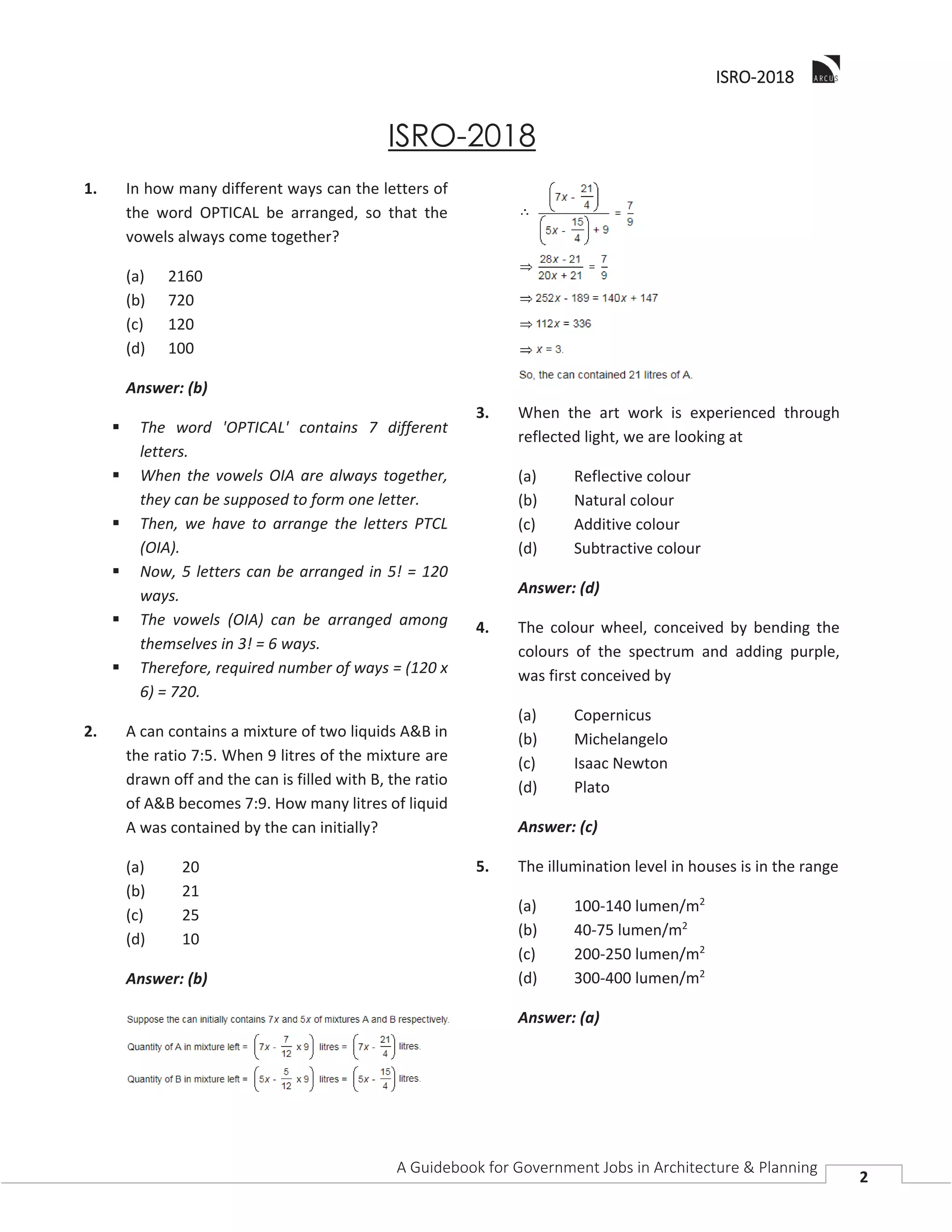
1. In how many different ways can the letters of
the word OPTICAL be arranged, so that the
vowels always come together?
(a) 2160
(b) 720
(c) 120
(d) 100
Answer: (b)
The word 'OPTICAL' contains 7 different
letters.
When the vowels OIA are always together,
they can be supposed to form one letter.
Then, we have to arrange the letters PTCL
(OIA).
Now, 5 letters can be arranged in 5! = 120
ways.
The vowels (OIA) can be arranged among
themselves in 3! = 6 ways.
Therefore, required number of ways = (120 x
6) = 720.
2. A can contains a mixture of two liquids A&B in
the ratio 7:5. When 9 litres of the mixture are
drawn off and the can is filled with B, the ratio
of A&B becomes 7:9. How many litres of liquid
A was contained by the can initially?
(a) 20
(b) 21
(c) 25
(d) 10
Answer: (b)
3. When the art work is experienced through
reflected light, we are looking at
(a) Reflective colour
(b) Natural colour
(c) Additive colour
(d) Subtractive colour
Answer: (d)
4. The colour wheel, conceived by bending the
colours of the spectrum and adding purple,
was first conceived by
(a) Copernicus
(b) Michelangelo
(c) Isaac Newton
(d) Plato
Answer: (c)
5. The illumination level in houses is in the range
(a) 100-140 lumen/m2
(b) 40-75 lumen/m2
(c) 200-250 lumen/m2
(d) 300-400 lumen/m2
Answer: (a)
IISRO-2017
A Guidebook for Government Jobs in Architecture & Planning
17
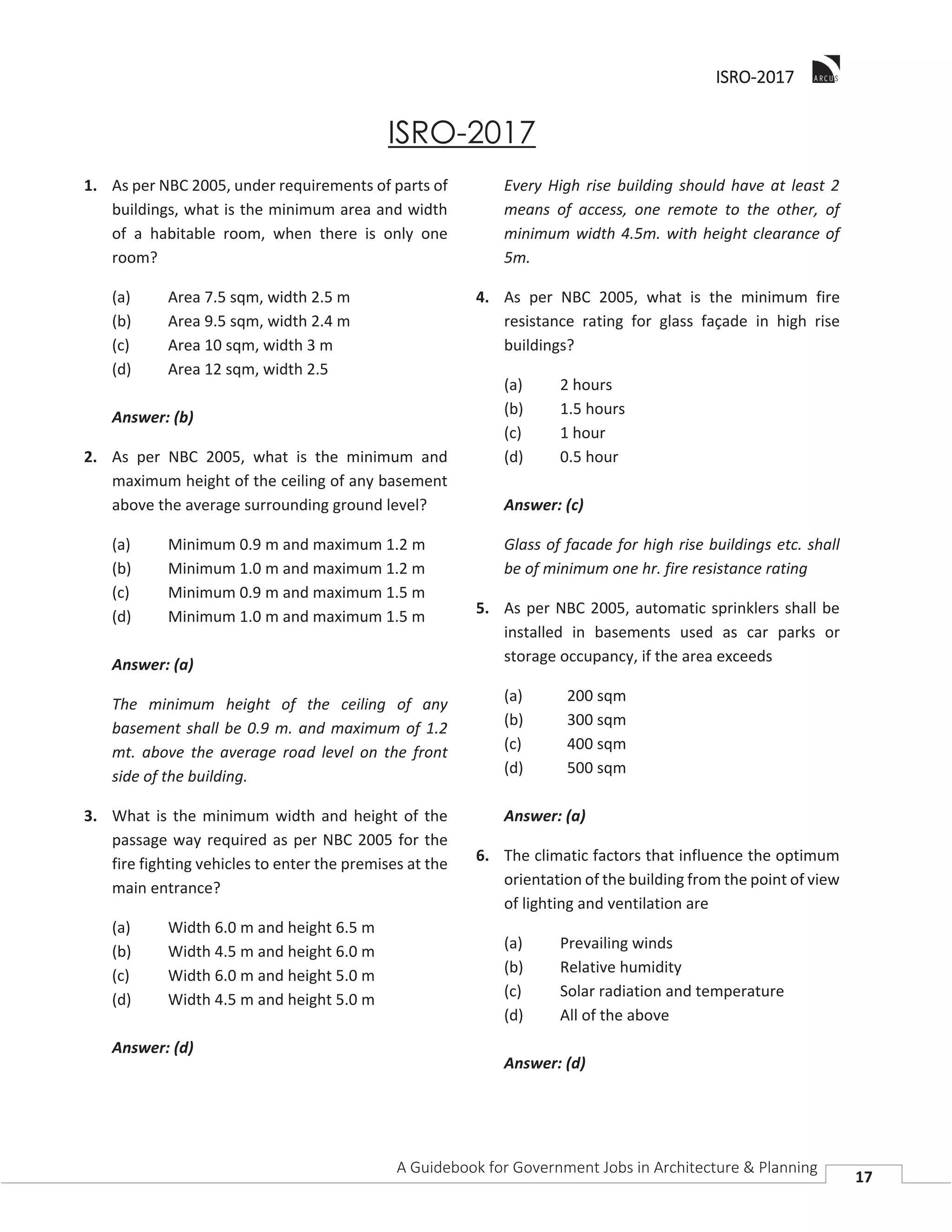
ISRO-2017
1. As per NBC 2005, under requirements of parts of
buildings, what is the minimum area and width
of a habitable room, when there is only one
room?
(a) Area 7.5 sqm, width 2.5 m
(b) Area 9.5 sqm, width 2.4 m
(c) Area 10 sqm, width 3 m
(d) Area 12 sqm, width 2.5
Answer: (b)
2. As per NBC 2005, what is the minimum and
maximum height of the ceiling of any basement
above the average surrounding ground level?
(a) Minimum 0.9 m and maximum 1.2 m
(b) Minimum 1.0 m and maximum 1.2 m
(c) Minimum 0.9 m and maximum 1.5 m
(d) Minimum 1.0 m and maximum 1.5 m
Answer: (a)
The minimum height of the ceiling of any
basement shall be 0.9 m. and maximum of 1.2
mt. above the average road level on the front
side of the building.
3. What is the minimum width and height of the
passage way required as per NBC 2005 for the
fire fighting vehicles to enter the premises at the
main entrance?
(a) Width 6.0 m and height 6.5 m
(b) Width 4.5 m and height 6.0 m
(c) Width 6.0 m and height 5.0 m
(d) Width 4.5 m and height 5.0 m
Answer: (d)
Every High rise building should have at least 2
means of access, one remote to the other, of
minimum width 4.5m. with height clearance of
5m.
4. As per NBC 2005, what is the minimum fire
resistance rating for glass façade in high rise
buildings?
(a) 2 hours
(b) 1.5 hours
(c) 1 hour
(d) 0.5 hour
Answer: (c)
Glass of facade for high rise buildings etc. shall
be of minimum one hr. fire resistance rating
5. As per NBC 2005, automatic sprinklers shall be
installed in basements used as car parks or
storage occupancy, if the area exceeds
(a) 200 sqm
(b) 300 sqm
(c) 400 sqm
(d) 500 sqm
Answer: (a)
6. The climatic factors that influence the optimum
orientation of the building from the point of view
of lighting and ventilation are
(a) Prevailing winds
(b) Relative humidity
(c) Solar radiation and temperature
(d) All of the above
Answer: (d)
IISRO-2015
A Guidebook for Government Jobs in Architecture & Planning
32
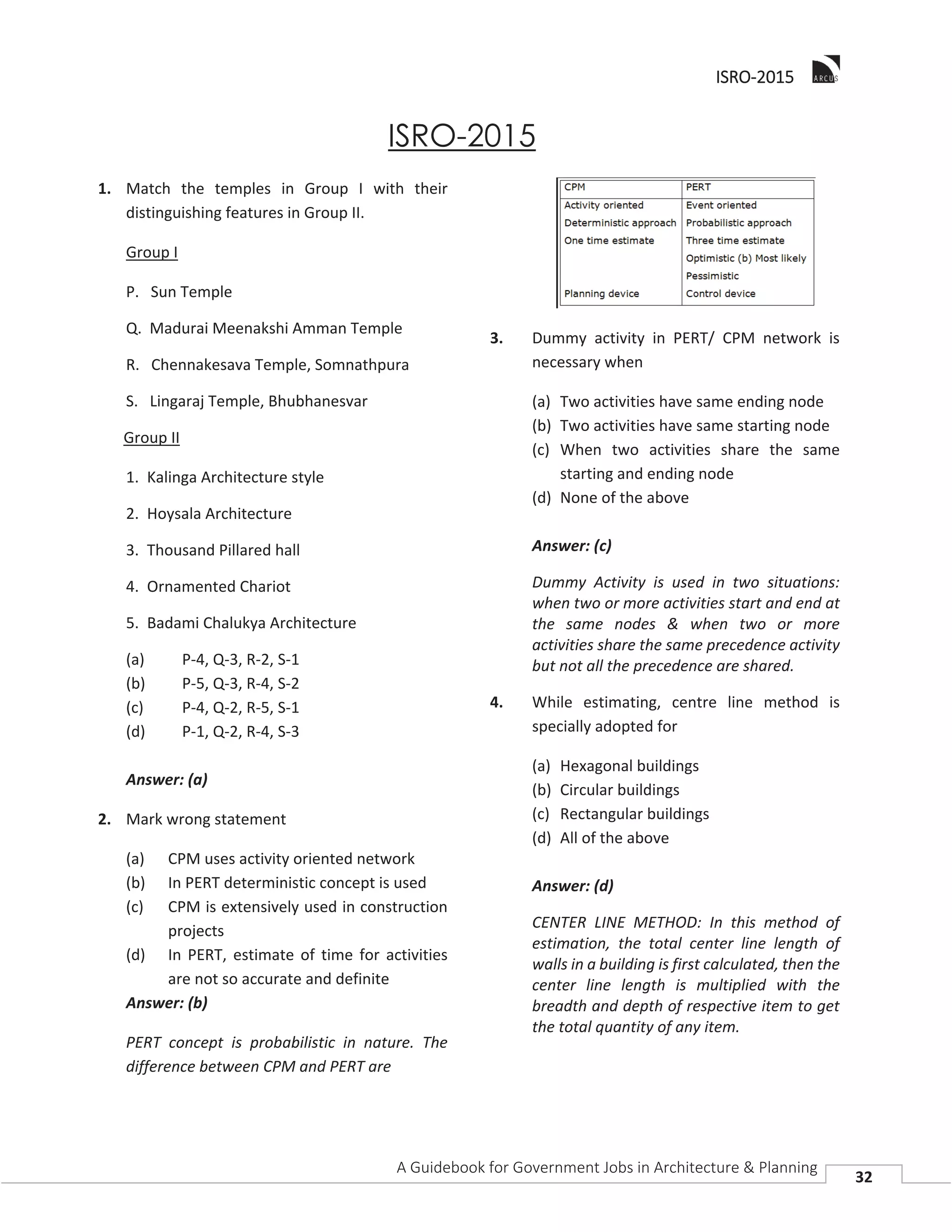
ISRO-2015
1. Match the temples in Group I with their
distinguishing features in Group II.
Group I
P. Sun Temple
Q. Madurai Meenakshi Amman Temple
R. Chennakesava Temple, Somnathpura
S. Lingaraj Temple, Bhubhanesvar
Group II
1. Kalinga Architecture style
2. Hoysala Architecture
3. Thousand Pillared hall
4. Ornamented Chariot
5. Badami Chalukya Architecture
(a) P-4, Q-3, R-2, S-1
(b) P-5, Q-3, R-4, S-2
(c) P-4, Q-2, R-5, S-1
(d) P-1, Q-2, R-4, S-3
Answer: (a)
2. Mark wrong statement
(a) CPM uses activity oriented network
(b) In PERT deterministic concept is used
(c) CPM is extensively used in construction
projects
(d) In PERT, estimate of time for activities
are not so accurate and definite
Answer: (b)
PERT concept is probabilistic in nature. The
difference between CPM and PERT are
3. Dummy activity in PERT/ CPM network is
necessary when
(a) Two activities have same ending node
(b) Two activities have same starting node
(c) When two activities share the same
starting and ending node
(d) None of the above
Answer: (c)
Dummy Activity is used in two situations:
when two or more activities start and end at
the same nodes & when two or more
activities share the same precedence activity
but not all the precedence are shared.
4. While estimating, centre line method is
specially adopted for
(a) Hexagonal buildings
(b) Circular buildings
(c) Rectangular buildings
(d) All of the above
Answer: (d)
CENTER LINE METHOD: In this method of
estimation, the total center line length of
walls in a building is first calculated, then the
center line length is multiplied with the
breadth and depth of respective item to get
the total quantity of any item.
CCHAPTER TWO: UPSC
Chapter 02
Union Public Service Commission
(UPSC)
UUPSC-2015
A Guidebook for Government Jobs in Architecture & Planning
50
UPSC-2015
1. A screen, usually of louvers, placed on the
outside of a building to shield the windows from
direct sunlight is
(a) Drum wall
(b) Solarium
(c) Brise-soleil
(d) Trombe-wall
Answer: (c)
Brise Soliel: A screen, usually louvered, placed on
the outside of a building to shield the windows
from direct sunlight.
2. A vertical diaphragm acting as a thin, deep
cantilever beam in transferring lateral loads to
the foundation is
(a) Pneumatic structure
(b) Shell
(c) Membrane
(d) Shear wall
Answer: (d)
3. A glass unit consisting of two or more sheets of
glass separated by a hermetically sealed air
space, to provide thermal insulation and restrict
condensation is
(a) Reflective glass
(b) Heat-absorbing glass
(c) Low emissivity (Low-E) glass
(d) Insulating glass
Answer: (d)
4. ‘Sky Component’ is an element of
(a) Earthquake resistant design
(b) Daylight factor
(c) Rainwater harvesting
(d) Thermal performance analysis
Answer: (b)
The sum of the three components gives the
daylight factor:
DF = SC + ERC + IRC
SC – Sky Component
ERC – Externally Reflected Component
IRC – Internally Reflected Component
5. Architectural design today need not address
(a) Climatic considerations
(b) Energy efficiency
(c) Stylistic affiliations
(d) User response
Answer: (c)
6. Designing responsive architectural spaces
requires consideration given to
(a) Passive cooling systems
(b) Innovation in structural systems
(c) Smart building systems
(d) User satisfaction
Answer: (d)
Responsive architectures distinguish themselves
from other forms of interactive design by
incorporating intelligent and responsive
technologies into the core elements of a
building's fabric
7. Creating architectural design proposals may not
include
(a) Formulating an area programme
(b) Evolving design alternatives
(c) Incorporating structure and services into
finalized proposal
(d) Design detail of interior furniture
Answer: (d)
UUPSC-2016
A Guidebook for Government Jobs in Architecture & Planning
70
UPSC-2016
1. Anti-static tiles are usually specified in areas
having
(a) Chemical spillage
(b) High dampness
(c) Several electrical equipment
(d) Movement of heavy machineries
Answer: (d)
Anti-static floors help by taking the static
electricity that builds up due to movement of
vehicles or heavy equipment through the
floor to ground. Anti-static flooring,
however, is capable of capturing all those
charges and grounding them before they
cause reactions.
2. The project ‘HABITAT’ Montreal Canada,
designed by renowned architect ‘Moshe
Safdie’, is an example of
(a) Prefabricated housing
(b) Low-rise detached dwellings
(c) High-rise apartments
(d) Organic architecture
Answer: (a)
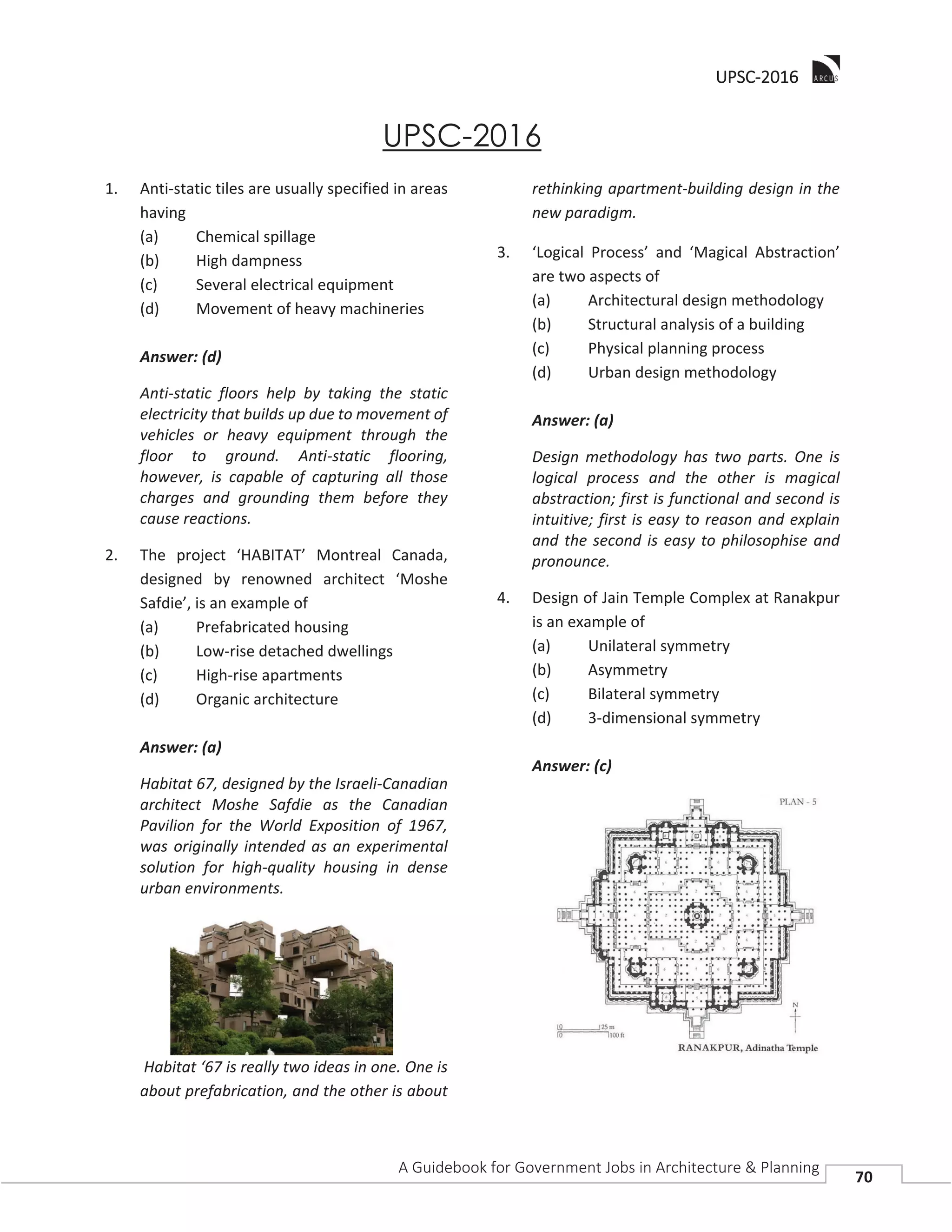
Habitat 67, designed by the Israeli-Canadian
architect Moshe Safdie as the Canadian
Pavilion for the World Exposition of 1967,
was originally intended as an experimental
solution for high-quality housing in dense
urban environments.
Habitat ‘67 is really two ideas in one. One is
about prefabrication, and the other is about
rethinking apartment-building design in the
new paradigm.
3. ‘Logical Process’ and ‘Magical Abstraction’
are two aspects of
(a) Architectural design methodology
(b) Structural analysis of a building
(c) Physical planning process
(d) Urban design methodology
Answer: (a)
Design methodology has two parts. One is
logical process and the other is magical
abstraction; first is functional and second is
intuitive; first is easy to reason and explain
and the second is easy to philosophise and
pronounce.
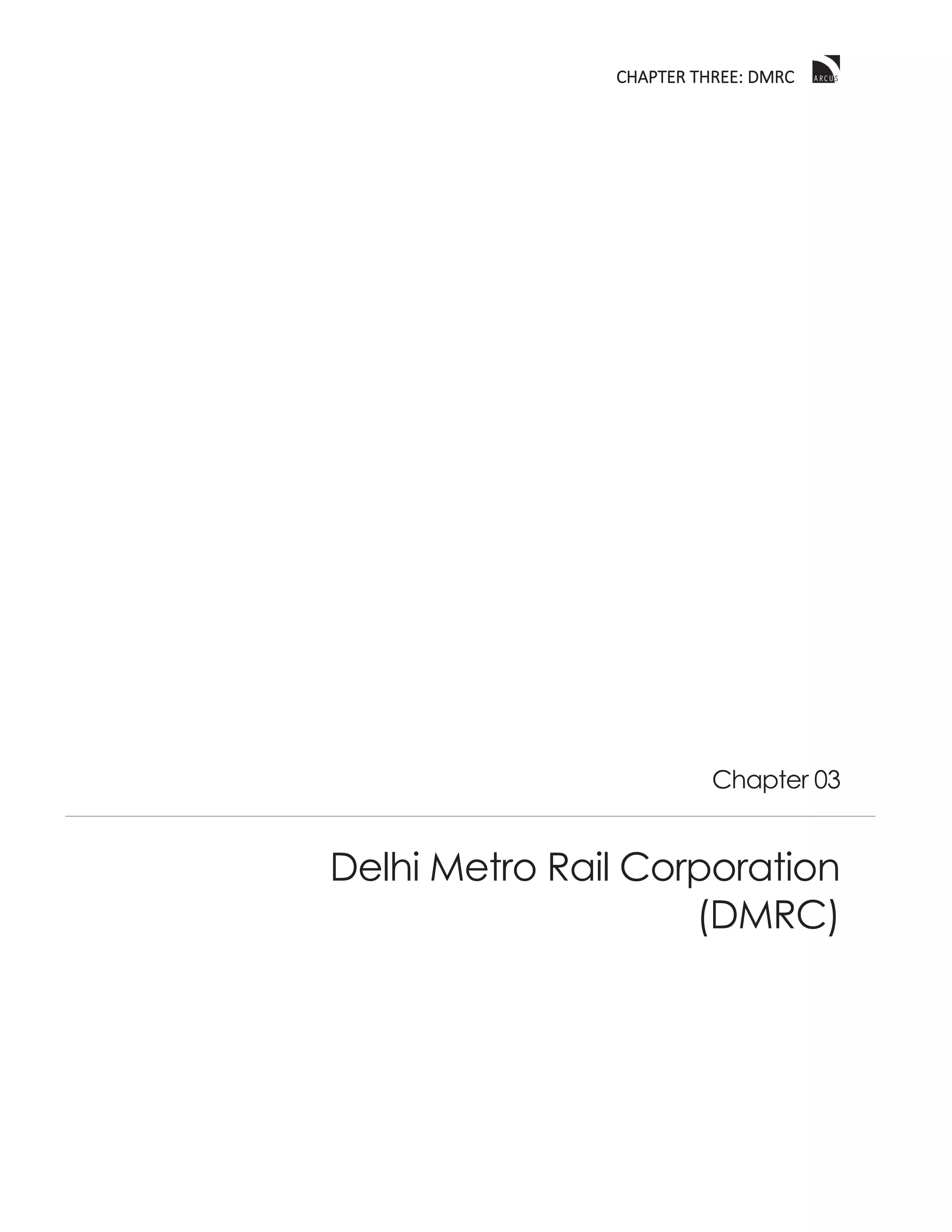
4. Design of Jain Temple Complex at Ranakpur
is an example of
(a) Unilateral symmetry
(b) Asymmetry
(c) Bilateral symmetry
(d) 3-dimensional symmetry
Answer: (c)
CCHAPTER THREE: DMRC
Chapter 03
Delhi Metro Rail Corporation
(DMRC)
DDMRC -2015
A Guidebook for Government Jobs in Architecture & Planning
98
27. Bricks before laying in a masonry course are
sprinkled with water. This is called:
(a) Washing
(b) Curing
(c) Soaking
(d) Moistening
Answer: (b)
28. Two way slab has to have length (l) to
breadth (b) ratio of room:
(a) L/b = 2
(b) L/b > 2
(c) L/b < 2
(d) None of these
Answer: (c)
If a slab is supported on all the four sides but
the ratio of longer span (l) to shorten span (b)
is greater than 2, then the slab will be
considered as one way slab.
29. Neoprene gasket is used to fix:
(a) Double glazing
(b) Make frameless glass shutters
shutter proof
(c) Make pivoted aluminium doors air
tight
(d) Make Z section window frame noise
proof
Answer: (b)
Neoprene gaskets offer resistance against
greases, waxes and oils, ozone and
oxidation, water immersion, and
weathering.
30. As per revised codal provisions the
dimension of an RD column has to be:
(a) Less than 300
(b) Not less than 450
(c) Less than 230
(d) Greater than 300
Answer: (d)
The minimum dimension of column shall not
be less than (a) 15 times the largest beam
bar diameter of the longitudinal
reinforcement in the beam passing through
or anchoring into the column joint, and (b)
300 mm
31. Air funnel is:
(a) An imaginary air space of the form of
a funnel were no structure can come
up on the ground.
(b) An imaginary air space of the form of
a funnel were only gardens can be
maintained on the ground.
(c) An actual air space where no fly zone
is announced.
(d) An imaginary air space of the form of
a funnel were no structure/tree or
part thereof should reach.
Answer: (d)
Air Funnel Zone is the controlled airspace
around an airport where high rise buildings/
trees or part of thereof are banned for the
safety of the aircrafts.
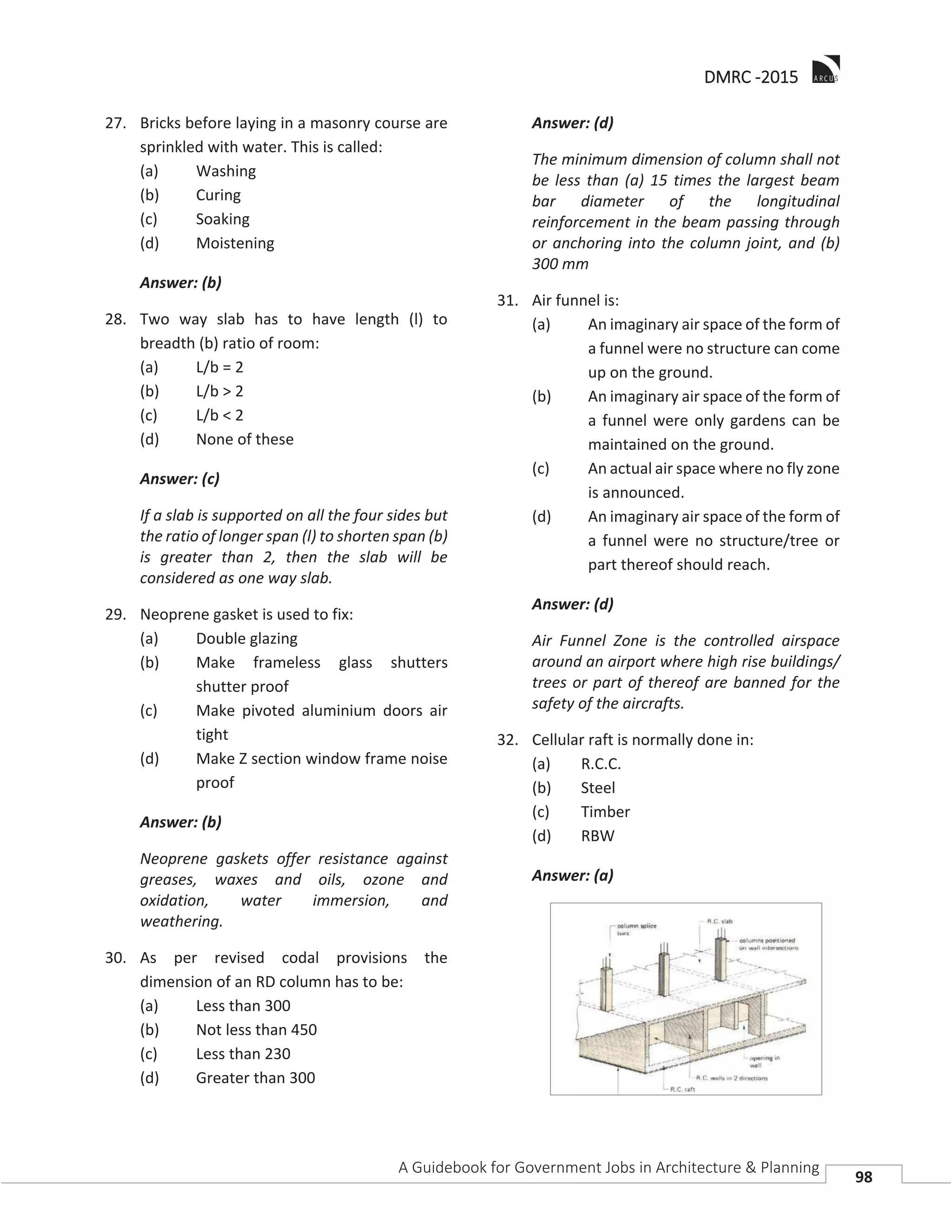
32. Cellular raft is normally done in:
(a) R.C.C.
(b) Steel
(c) Timber
(d) RBW
Answer: (a)
DDMRC -2014
A Guidebook for Government Jobs in Architecture & Planning
112
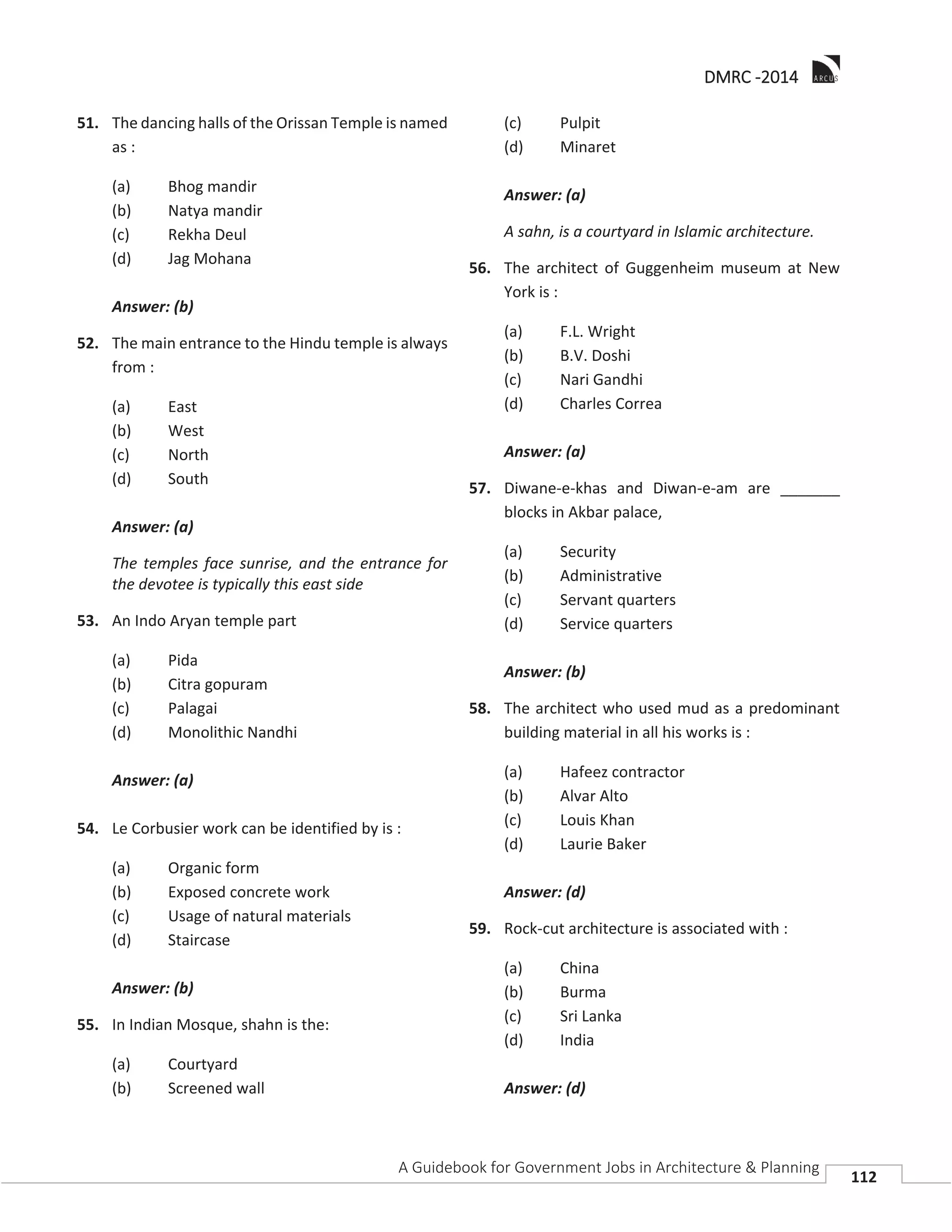
51. The dancing halls of the Orissan Temple is named
as :
(a) Bhog mandir
(b) Natya mandir
(c) Rekha Deul
(d) Jag Mohana
Answer: (b)
52. The main entrance to the Hindu temple is always
from :
(a) East
(b) West
(c) North
(d) South
Answer: (a)
The temples face sunrise, and the entrance for
the devotee is typically this east side
53. An Indo Aryan temple part
(a) Pida
(b) Citra gopuram
(c) Palagai
(d) Monolithic Nandhi
Answer: (a)
54. Le Corbusier work can be identified by is :
(a) Organic form
(b) Exposed concrete work
(c) Usage of natural materials
(d) Staircase
Answer: (b)
55. In Indian Mosque, shahn is the:
(a) Courtyard
(b) Screened wall
(c) Pulpit
(d) Minaret
Answer: (a)
A sahn, is a courtyard in Islamic architecture.
56. The architect of Guggenheim museum at New
York is :
(a) F.L. Wright
(b) B.V. Doshi
(c) Nari Gandhi
(d) Charles Correa
Answer: (a)
57. Diwane-e-khas and Diwan-e-am are _______
blocks in Akbar palace,
(a) Security
(b) Administrative
(c) Servant quarters
(d) Service quarters
Answer: (b)
58. The architect who used mud as a predominant
building material in all his works is :
(a) Hafeez contractor
(b) Alvar Alto
(c) Louis Khan
(d) Laurie Baker
Answer: (d)
59. Rock-cut architecture is associated with :
(a) China
(b) Burma
(c) Sri Lanka
(d) India
Answer: (d)
CCHAPTER FOUR: LMRC
Chapter 04
Lucknow Metro Rail Corporation
(LMRC)
LLMRC-2018
A Guidebook for Government Jobs in Architecture & Planning
138
23. In which year did India enact Biological
diversity act?
(a) 1995
(b) 2002
(c) 2010
(d) 2015
Answer: (b)
The Biological Diversity Act, 2002 is an Act of
the Parliament of India for preservation of
biological diversity in India, and provides
mechanism for equitable sharing of benefits
arising out of the use of traditional biological
resources and knowledge
24. The Pradhan Mantri Awas Yojana – Housing
for all will be implemented starting from
2015 and targets housing for all by:
(a) 2020
(b) 2022
(c) 2025
(d) 2027
Answer: (b)
Pradhan Mantri Awas Yojana (PMAY) is an
initiative by Government of India in which
affordable housing will be provided to the
urban poor with a target of building 20
million affordable houses by 31 March 2022.
25. Which of the following is an unacceptable
attribute of portable water?
(a) It should be clear, transparent,
odourless and colourless
(b) It should be warm
(c) It should not cause corrosion of
pipes and other fittings
(d) It should be free from disease
causing organisms
Answer: (b)
Best drinking water will have at least the first
three of the following qualities—and
optimally, all six:
Contaminant free.
Mineral rich.
Alkaline pH..
Micro-clustered.
Anti-oxidant.
Good taste
26. Which of the following is not a general
attribute of conservancy system for
collection and disposal of waste?
(a) Does not permit compact design of
structures
(b) There are no chances of
putrefaction
(c) There is presence of segregation
(d) It is laid above ground and is non-
hygienic
Answer: (b)
27. Which of the following is not a primary rating
systems for green buildings in India?
(a) NZEB
(b) BEE
(c) IGBC
(d) GRIHA
Answer: (a)
A zero-energy building, also known as a zero
net energy (ZNE) building, net-zero energy
building (NZEB), or net zero building, is a
building with zero net energy consumption,
meaning the total amount of energy used by
the building on an annual basis is roughly
equal to the amount of renewable energy
created on the site
CCHAPTER FIVE: NBCC
Chapter 05
National Buildings Construction
Corporation Ltd.
(NBCC)
NNBCC-2018
A Guidebook for Government Jobs in Architecture & Planning
154
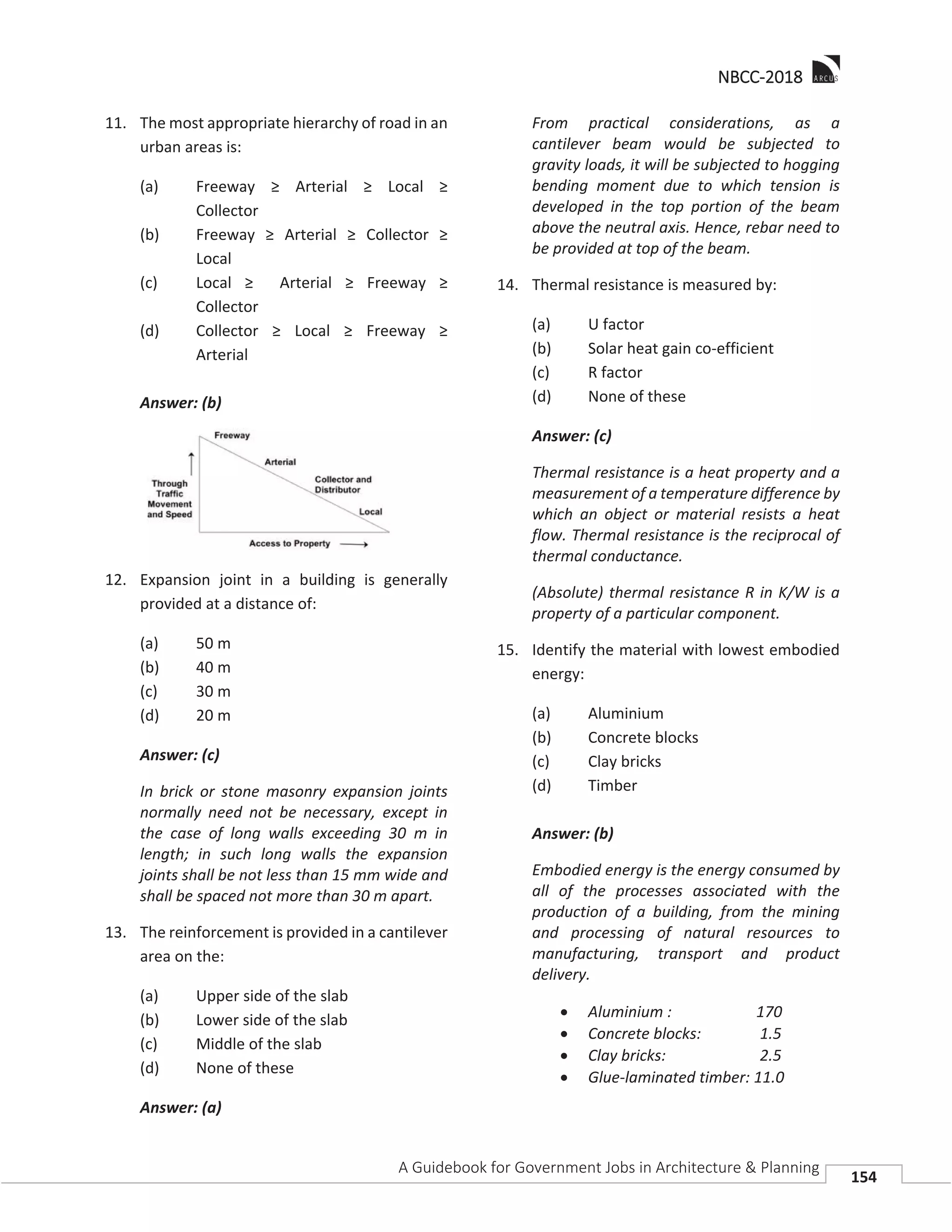
11. The most appropriate hierarchy of road in an
urban areas is:
(a) Freeway ≥ Arterial ≥ Local ≥
Collector
(b) Freeway ≥ Arterial ≥ Collector ≥
Local
(c) Local ≥ Arterial ≥ Freeway ≥
Collector
(d) Collector ≥ Local ≥ Freeway ≥
Arterial
Answer: (b)
12. Expansion joint in a building is generally
provided at a distance of:
(a) 50 m
(b) 40 m
(c) 30 m
(d) 20 m
Answer: (c)
In brick or stone masonry expansion joints
normally need not be necessary, except in
the case of long walls exceeding 30 m in
length; in such long walls the expansion
joints shall be not less than 15 mm wide and
shall be spaced not more than 30 m apart.
13. The reinforcement is provided in a cantilever
area on the:
(a) Upper side of the slab
(b) Lower side of the slab
(c) Middle of the slab
(d) None of these
Answer: (a)
From practical considerations, as a
cantilever beam would be subjected to
gravity loads, it will be subjected to hogging
bending moment due to which tension is
developed in the top portion of the beam
above the neutral axis. Hence, rebar need to
be provided at top of the beam.
14. Thermal resistance is measured by:
(a) U factor
(b) Solar heat gain co-efficient
(c) R factor
(d) None of these
Answer: (c)
Thermal resistance is a heat property and a
measurement of a temperature difference by
which an object or material resists a heat
flow. Thermal resistance is the reciprocal of
thermal conductance.
(Absolute) thermal resistance R in K/W is a
property of a particular component.
15. Identify the material with lowest embodied
energy:
(a) Aluminium
(b) Concrete blocks
(c) Clay bricks
(d) Timber
Answer: (b)
Embodied energy is the energy consumed by
all of the processes associated with the
production of a building, from the mining
and processing of natural resources to
manufacturing, transport and product
delivery.
Aluminium : 170
Concrete blocks: 1.5
Clay bricks: 2.5
Glue-laminated timber: 11.0
CCHAPTER SIX: GPSC
Chapter 06
Gujarat Public Service Commission
(GPSC)
GGPSC-2017
A Guidebook for Government Jobs in Architecture & Planning
172
GPSC-2017
1. A road having Right of Way 50-60 m
designated for intra-urban through traffic with
no frontage access is called:
(a) Collector road
(b) Arterial road
(c) Sub-arterial road
(d) Freeway
Answer: (b)
These roads have the maximum right of way
amongst the four categories and cater to a
speed limit of 50-60 km/h and a ROW of 50-80
m. They carry the largest volumes of traffic and
longest trips in a city. These roads are
characterized by mobility and cater to through
traffic with restricted access from carriageway
to the side.
2. A map showing all key features and
characteristics of an area and serving as
foundation for spatial planning is known as:
(a) Topo Sheet
(b) Mouza Map
(c) Base Map
(d) Cartographic Map
Answer: (c)
A basemap provides a user with context for a
map. You can add information to a basemap by
overlaying other information on top of it.
3. Which of the following is not included in Basic
Services in a developing country?
(a) Broadband
(b) Water supply
(c) Paved roads
(d) Drainage
Answer: (a)
The state plays a very important role in
providing basic services in developing
countries. Services like education, health, road,
water etc. are provided by state for sustaining
a comfortable life by people.
4. Which of the following is a charge imposed on
beneficiaries on the increment in property
value accruing as a result of given public
investment?
(a) Development charge
(b) Development tax
(c) Property tax
(d) Betterment levy
Answer: (d)
Betterment levies are a form of tax or a fee
levied on land that has gained in value because
of public infrastructure investments.
5. Consider the following statements about
cadastral maps:
1. It indicates property boundaries
2. It is prepared in a scale of 1:1000 or below
Which of the above statements is/are correct?
(a) 1 only
(b) 2 only
(c) Both 1 and 2
(d) Neither 1 nor 2
Answer: (c)
A cadastral map is a map that shows the
boundaries and ownership of land parcels.
Cadastral maps commonly range from scales
of 1:500 to 1:10,000
CCHAPTER SEVEN: MPSC
Chapter 07
Maharashtra Public Service Commission
(MPSC)
MMPSC-2013
A Guidebook for Government Jobs in Architecture & Planning
206
MPSC-2013
1. Regional Plan of Mumbai Metropolitan Region
(1991- 2011) was guided by the development
growth strategy of:
(a) Mono centric structure
(b) Poly-nucleated structure
(c) Axial structure
(d) Sector structure
Answer: (b)
Mumbai Metropolitan Region (MMR)
envisioned the metropolis as a poly-centric
development with successful growth centers at
significant junctions.
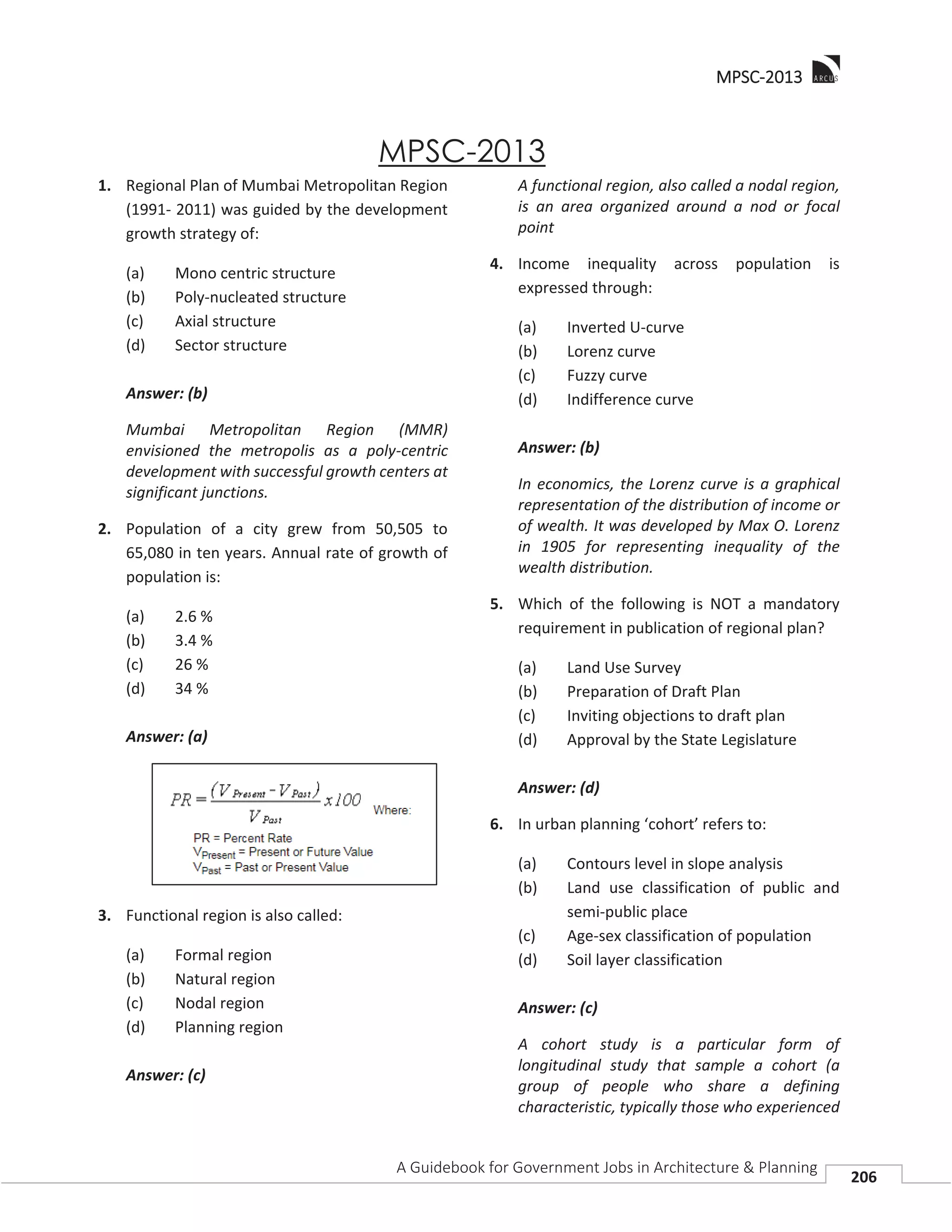
2. Population of a city grew from 50,505 to
65,080 in ten years. Annual rate of growth of
population is:
(a) 2.6 %
(b) 3.4 %
(c) 26 %
(d) 34 %
Answer: (a)
3. Functional region is also called:
(a) Formal region
(b) Natural region
(c) Nodal region
(d) Planning region
Answer: (c)
A functional region, also called a nodal region,
is an area organized around a nod or focal
point
4. Income inequality across population is
expressed through:
(a) Inverted U-curve
(b) Lorenz curve
(c) Fuzzy curve
(d) Indifference curve
Answer: (b)
In economics, the Lorenz curve is a graphical
representation of the distribution of income or
of wealth. It was developed by Max O. Lorenz
in 1905 for representing inequality of the
wealth distribution.
5. Which of the following is NOT a mandatory
requirement in publication of regional plan?
(a) Land Use Survey
(b) Preparation of Draft Plan
(c) Inviting objections to draft plan
(d) Approval by the State Legislature
Answer: (d)
6. In urban planning ‘cohort’ refers to:
(a) Contours level in slope analysis
(b) Land use classification of public and
semi-public place
(c) Age-sex classification of population
(d) Soil layer classification
Answer: (c)
A cohort study is a particular form of
longitudinal study that sample a cohort (a
group of people who share a defining
characteristic, typically those who experienced
CCHAPTER EIGHT: RPSC
Chapter 08
Rajasthan Public Service Commission
(RPSC)
RRPSC-2011
A Guidebook for Government Jobs in Architecture & Planning
222
16. ITPI stands for
(a) Indian Town Planners Institute
(b) International Town Planners Institute
(c) Institute of Town Planners, India
(d) Institute of Town Planning, India
Answer: (c)
The Institute of Town Planners, India, owes
its origin to a small group of Town Planners
of Delhi, who in 1947 decided to set up a
professional Town Planning Institute on the
lines similar to the Royal Town Planning
Institute, London.
17. ‘Alexander the Great’ Invaded India in
(a) Second Cent. B.C.
(b) Fourth Cent. B.C.
(c) Fourth Cent. A.D.
(d) Second Cent. A.D.
Answer: (b)
The Indian campaign of Alexander began in
326 BC
18. Ancient town planning text of India is
(a) Prastara
(b) Mansara
(c) Vastushastra
(d) Padmaka
Answer: (b)
Manasara Silpa Sastram is a definitive Indian
treatise on Vastu Sasthram, an ancient
building code which was used for designing
houses, planning cities and communities.
19. The first ‘Garden City’ was
(a) Welwyn
(b) Letch worth
(c) Edinburgh
(d) None of the above
Answer: (b)
20. The disadvantages of ‘Ribbon Development’
is
(a) Increase of cost of various Utility
services
(b) The houses face heavy traffic and
noise
(c) The interior parts of the city are left
undeveloped
(d) All of the above
Answer: (d)
21. ‘Decumanus’ means
(a) Two cross roads
(b) Roads running east – west
(c) Roads running north-south
(d) City square
Answer: (b)
In Roman city planning, a Decumanus was
an east-west-oriented road in a Roman city
22. Density of population is expressed as
(a) Houses per unit area
(b) Number of persons per unit area
(c) Number of families per unit area
(d) All of the above
Answer: (b)
Density is usually expressed as the number
of individuals per unit area or volume
23. The concept of ‘The Garden City’ was given
by
(a) Ebenezer Howard
(b) Sir Christopher Wren
(c) Barry Parker
(d) Raymond Unwin
Answer: (a)
Garden Cities were underpinned by a strong
vision developed by Ebenezer Howard
RRPSC-2015
A Guidebook for Government Jobs in Architecture & Planning
238
RPSC-2015
1. Major roads in Indus Valley Cities were laid in :
(a) Concentric Pattern
(b) Grid Iron Pattern
(c) Zig-Zag Pattern
(d) None of the above
Answer: (b)
Mohenjo-daro and Harappa, major cities of
the Indus Valley Civilization (in what is now
Pakistan), were built with blocks divided by a
grid of straight streets, running north-south
and east-west.
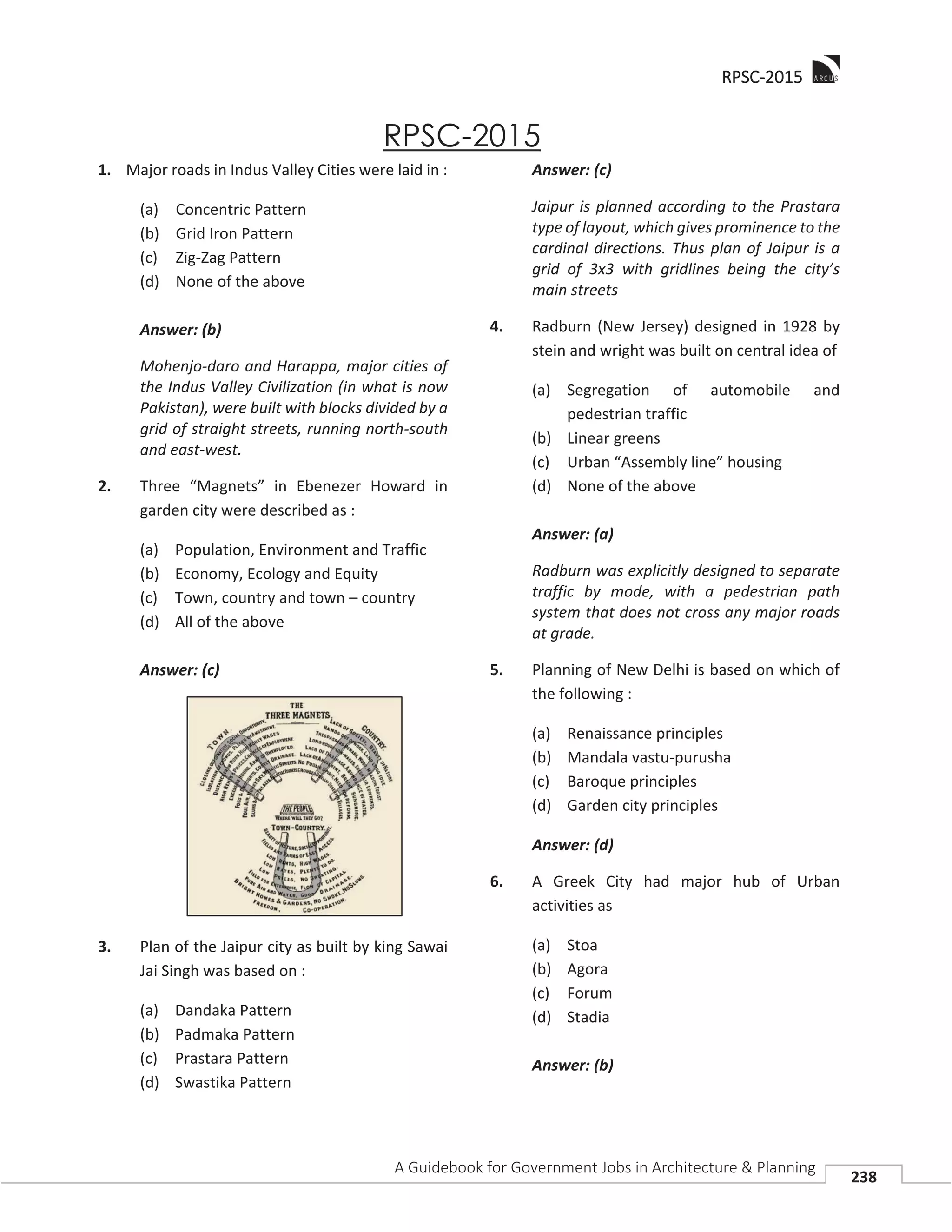
2. Three “Magnets” in Ebenezer Howard in
garden city were described as :
(a) Population, Environment and Traffic
(b) Economy, Ecology and Equity
(c) Town, country and town – country
(d) All of the above
Answer: (c)
3. Plan of the Jaipur city as built by king Sawai
Jai Singh was based on :
(a) Dandaka Pattern
(b) Padmaka Pattern
(c) Prastara Pattern
(d) Swastika Pattern
Answer: (c)
Jaipur is planned according to the Prastara
type of layout, which gives prominence to the
cardinal directions. Thus plan of Jaipur is a
grid of 3x3 with gridlines being the city’s
main streets
4. Radburn (New Jersey) designed in 1928 by
stein and wright was built on central idea of
(a) Segregation of automobile and
pedestrian traffic
(b) Linear greens
(c) Urban “Assembly line” housing
(d) None of the above
Answer: (a)
Radburn was explicitly designed to separate
traffic by mode, with a pedestrian path
system that does not cross any major roads
at grade.
5. Planning of New Delhi is based on which of
the following :
(a) Renaissance principles
(b) Mandala vastu-purusha
(c) Baroque principles
(d) Garden city principles
Answer: (d)
6. A Greek City had major hub of Urban
activities as
(a) Stoa
(b) Agora
(c) Forum
(d) Stadia
Answer: (b)
CCHAPTER NINE: PPSC
Chapter 09
Punjab Public Service Commission
(PPSC)
PPPSC-2016
A Guidebook for Government Jobs in Architecture & Planning
260
PPSC-2016
1. A low value of ‘U’ in glass indicates:
(a) Bad Thermal performance of the
Building envelope
(b) Heat loss from any building
component
(c) Good insulation of the Building
envelope
(d) Heat absorption by the Building
envelope
Answer: (c)
2. The art of building rests on three
foundations of Utilitas, Firmatas and
venustas- was given by:
(a) Marcus Vitruvius
(b) Le-Corbusier
(c) Ebenezer Howard
(d) FL Wright
Answer: (a)
The Roman architect Vitruvius in his treatise
on architecture, De Architectura, asserted
that there were three principles of good
architecture:
Firmatis (Durability) – It should
stand up robustly and remain in
good condition.
Utilitas (Utility) – It should be useful
and function well for the people
using it.
Venustatis (Beauty) – It should
delight people and raise their spirits.
3. Normally, the angle of roof truss, with
asbestos sheet should not be less than:
(a) 26.50
(b) 300
(c) 350
(d) 450
Answer: (b)
Normally, the angle of roof truss with
asbestos sheets should not be less than 30
degrees.
4. The water content of soil which represents
the boundary between plastic state and
liquid state is:
(a) Liquid limit
(b) Plastic limit
(c) Shrinkage limit
(d) Plasticity index
Answer: (a)
5. An approach which draws upon multiple
theories, styles or ideas is:
(a) Classicism
(b) Realism
(c) Eclecticism
(d) Romanticism
Answer: (c)
Eclecticism is a conceptual approach that
does not hold rigidly to a single paradigm or
set of assumptions, but instead draws upon
multiple theories, styles, or ideas
6. Art Nouveau style is characterized by:
(a) Geometrical motifs
(b) Artistic and undulating motifs
(c) Organization of the planes
(d) Dominance of Technology
Answer: (b)
Art Nouveau is an international style of art,
architecture and design that is characterised
by highly-stylised, flowing, curvilinear
designs often incorporating floral and other
plant-inspired motifs.
PPPSC-2013
A Guidebook for Government Jobs in Architecture & Planning
277
PPSC-2013
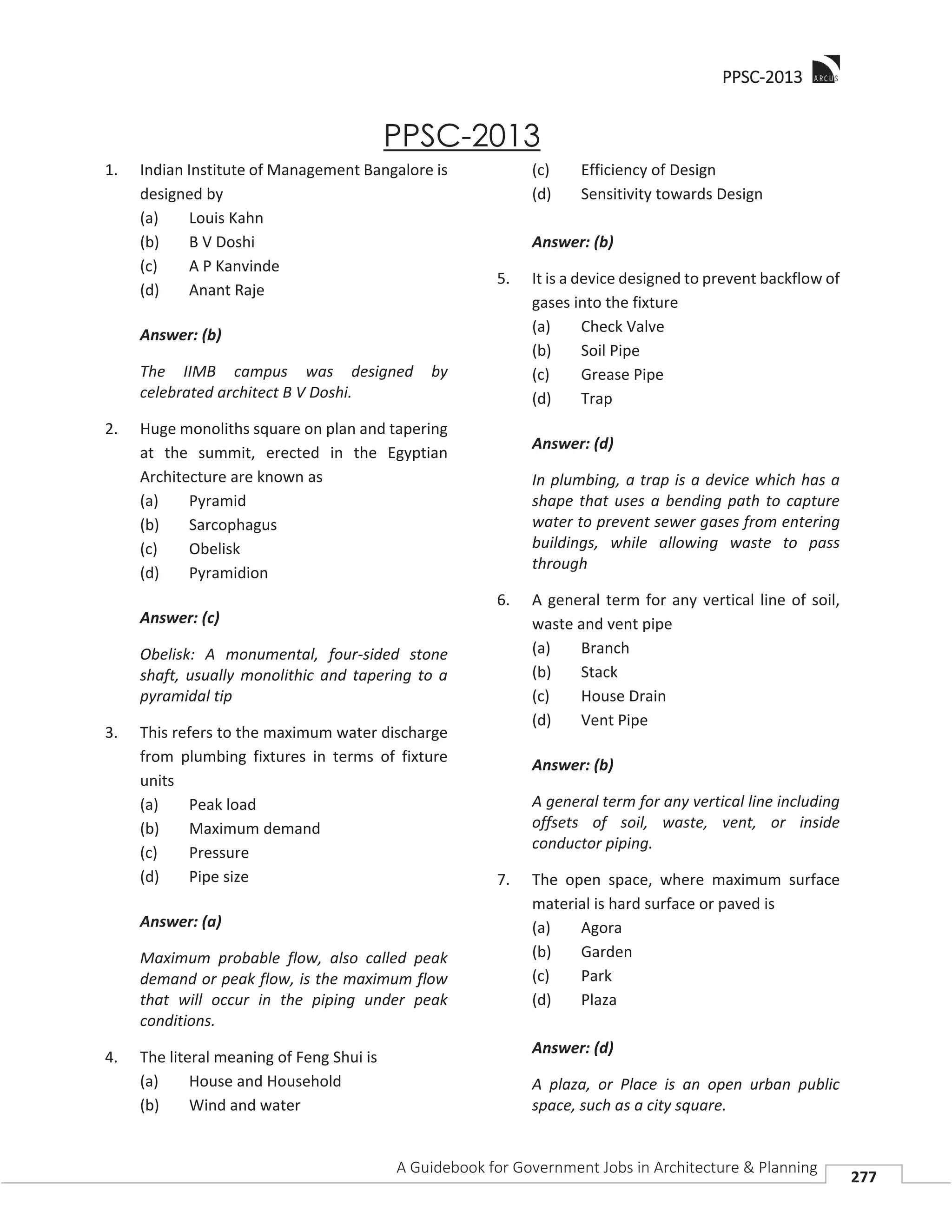
1. Indian Institute of Management Bangalore is
designed by
(a) Louis Kahn
(b) B V Doshi
(c) A P Kanvinde
(d) Anant Raje
Answer: (b)
The IIMB campus was designed by
celebrated architect B V Doshi.
2. Huge monoliths square on plan and tapering
at the summit, erected in the Egyptian
Architecture are known as
(a) Pyramid
(b) Sarcophagus
(c) Obelisk
(d) Pyramidion
Answer: (c)
Obelisk: A monumental, four-sided stone
shaft, usually monolithic and tapering to a
pyramidal tip
3. This refers to the maximum water discharge
from plumbing fixtures in terms of fixture
units
(a) Peak load
(b) Maximum demand
(c) Pressure
(d) Pipe size
Answer: (a)
Maximum probable flow, also called peak
demand or peak flow, is the maximum flow
that will occur in the piping under peak
conditions.
4. The literal meaning of Feng Shui is
(a) House and Household
(b) Wind and water
(c) Efficiency of Design
(d) Sensitivity towards Design
Answer: (b)
5. It is a device designed to prevent backflow of
gases into the fixture
(a) Check Valve
(b) Soil Pipe
(c) Grease Pipe
(d) Trap
Answer: (d)
In plumbing, a trap is a device which has a
shape that uses a bending path to capture
water to prevent sewer gases from entering
buildings, while allowing waste to pass
through
6. A general term for any vertical line of soil,
waste and vent pipe
(a) Branch
(b) Stack
(c) House Drain
(d) Vent Pipe
Answer: (b)
A general term for any vertical line including
offsets of soil, waste, vent, or inside
conductor piping.
7. The open space, where maximum surface
material is hard surface or paved is
(a) Agora
(b) Garden
(c) Park
(d) Plaza
Answer: (d)
A plaza, or Place is an open urban public
space, such as a city square.
CCHAPTER TEN: PUDA
Chapter 10
Punjab Urban Planning and
Development Authority
(PUDA)
PPUDA-2013
A Guidebook for Government Jobs in Architecture & Planning
297
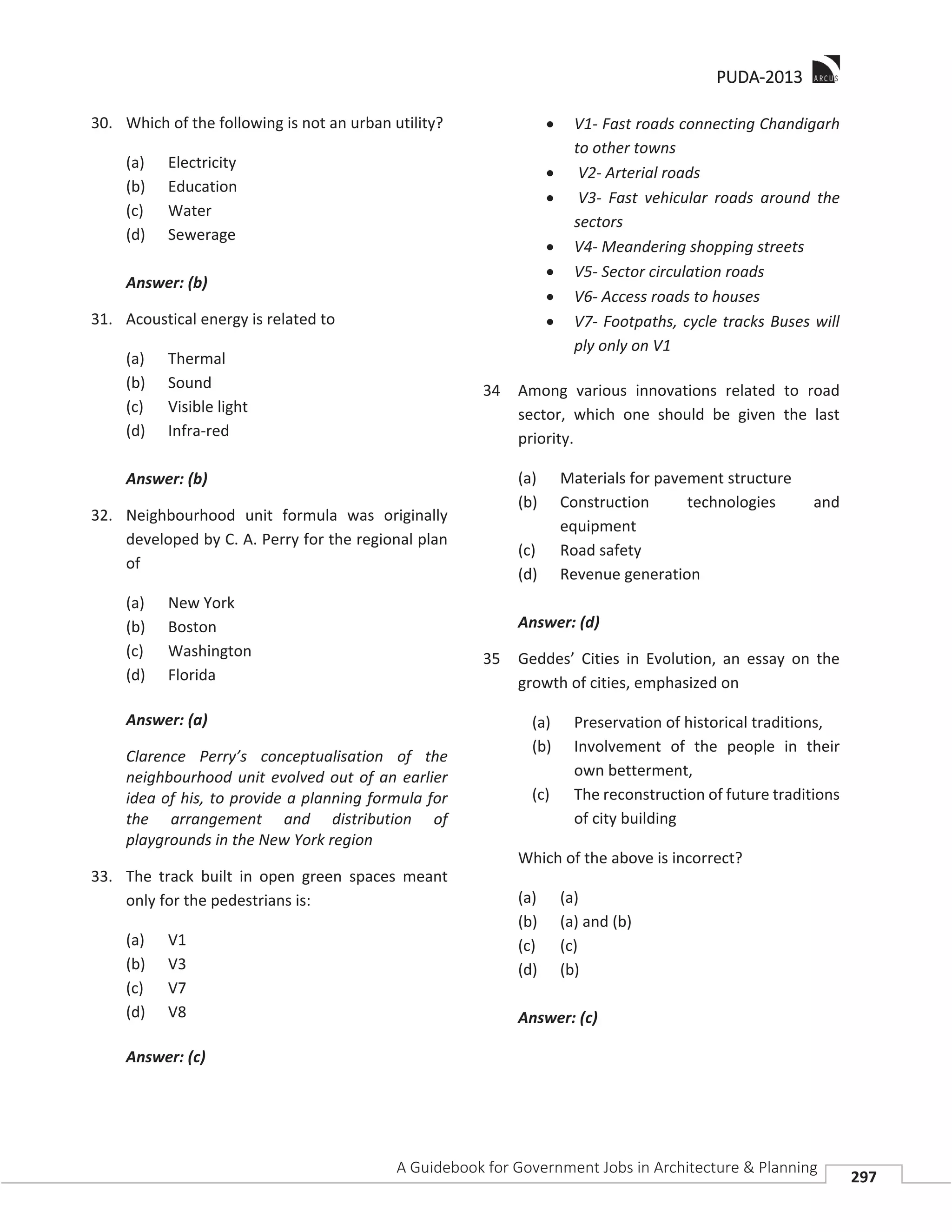
30. Which of the following is not an urban utility?
(a) Electricity
(b) Education
(c) Water
(d) Sewerage
Answer: (b)
31. Acoustical energy is related to
(a) Thermal
(b) Sound
(c) Visible light
(d) Infra-red
Answer: (b)
32. Neighbourhood unit formula was originally
developed by C. A. Perry for the regional plan
of
(a) New York
(b) Boston
(c) Washington
(d) Florida
Answer: (a)
Clarence Perry’s conceptualisation of the
neighbourhood unit evolved out of an earlier
idea of his, to provide a planning formula for
the arrangement and distribution of
playgrounds in the New York region
33. The track built in open green spaces meant
only for the pedestrians is:
(a) V1
(b) V3
(c) V7
(d) V8
Answer: (c)
V1- Fast roads connecting Chandigarh
to other towns
V2- Arterial roads
V3- Fast vehicular roads around the
sectors
V4- Meandering shopping streets
V5- Sector circulation roads
V6- Access roads to houses
V7- Footpaths, cycle tracks Buses will
ply only on V1
34 Among various innovations related to road
sector, which one should be given the last
priority.
(a) Materials for pavement structure
(b) Construction technologies and
equipment
(c) Road safety
(d) Revenue generation
Answer: (d)
35 Geddes’ Cities in Evolution, an essay on the
growth of cities, emphasized on
(a) Preservation of historical traditions,
(b) Involvement of the people in their
own betterment,
(c) The reconstruction of future traditions
of city building
Which of the above is incorrect?
(a) (a)
(b) (a) and (b)
(c) (c)
(d) (b)
Answer: (c)
A Guidebook for Government Jobs in Architecture and Planning

  • 2.
    ii Acknowledgement First and foremost,thanks to Almighty God, without whose blessings this book wouldn’t be possible. The idea behind this book came surely during the immense amount of time that we got from our unemployment. Thanks to everyone for not hiring us during this period. A fair share of greetings to our students too, who let us believe during our teaching days that we can do much better in life than to teach them. We would also like to thank Ar. Faisal Husaini, because of his absence only we could complete this book in time, thanks for not being here and supporting us virtually. We would also like to extend our thanks to Mr. Aman Zarar and Ar. Moh’d Shoeb for dancing day and night in formatting of the book, so that words don’t dance here and there on the pages. Ar. Shadab Razvi’s efforts in promoting our page ARCUS, with the same intensity as he posts his display pictures on Facebook is worth appreciating too. Also, we would like to extend our sincere gratitude to Ar. Anand Khatri Sir for his endless support and guidance throughout the process. Thanking you Arcus 2018
  • 3.
    iii About Arcus Arcus, aninitiative of the few Architects from Jamia Millia Islamia, has been formed with an intent of providing academic assistance to Architecture and Planning Students all over the country. Arcus helps students in clearing doubts regarding Gate examination, Government jobs examination and any other doubt in the academics. Arcus has been doing this job effectively since 2017. Arcus launched its first book named ‘Jamia M. Arch. 2018’ for the preparation of Master of architecture entrance of Jamia Millia, this year and got huge appreciation from the students around the country preparing for it. Inspired by this success, Arcus is presenting another much needed book ‘A guidebook for Government jobs in Architecture and Planning’. We hope you shall like and appreciate the effort even more. Thanking you Arcus 2018
  • 4.
    iv Preface This book inyour hand is an honest attempt to minimize the confusion that many students have regarding various government jobs examination within the country. A decent amount of effort has been done in collecting various Central level and State level examination’s questions, and in solving them with explanation. This guidebook would certainly let us all aware of the various examinations, its pattern of asking questions and a brief idea of the syllabi to be covered. The book covers 10 different chapters, each chapter denoting different examination conducted in recent years. Solution of each and every question is provided. Detailed explanation and suitable examples for all questions have also been incorporated. Extreme care has been taken so as to eliminate any sort of discrepancy, anywhere in the book. In case, if you find some, do let us know. We are always open for suggestions at: www.facebook.com/arcus.education www.youtube.com/arcus.education
  • 5.
    Table of Contents FORTHE POST OF ARCHITECT Chapter 01: Indian Space Research Organisation (ISRO)................................................................ 1 ISRO-2018........................................................................................................................................................2 ISRO-2017......................................................................................................................................................17 ISRO-2015......................................................................................................................................................32 Chapter 02: Union Public Service Commission (UPSC) ................................................................ 49 UPSC-2015.....................................................................................................................................................50 UPSC-2016.....................................................................................................................................................70 Chapter 03: Delhi Metro Rail Corporation (DMRC) ..................................................................... 93 DMRC-2015....................................................................................................................................................94 DMRC-2014..................................................................................................................................................105 Chapter 04: Lucknow Metro Rail Corporation (LMRC) ...............................................................133 LMRC-2018 ..................................................................................................................................................134 Chapter 05: National Buildings Construction Corporation Ltd. (NBCC)........................................151 NBCC-2018...................................................................................................................................................152 FOR THE POST OF TOWN PLANNER Chapter 06: Gujarat Public Service Commission (GPSC).............................................................171 GPSC-2017 ...................................................................................................................................................172 Chapter 07: Maharashtra Public Service Commission (MPSC)....................................................205 MPSC-2013 ..................................................................................................................................................206 Chapter 08: Rajasthan Public Service Commission (RPSC)..........................................................219 RPSC-2011 ...................................................................................................................................................220 RPSC-2015 ...................................................................................................................................................238 Chapter 09: Punjab Public Service Commission (PPSC) ..............................................................259 PPSC-2016....................................................................................................................................................260 PPSC-2013....................................................................................................................................................277 Chapter 10: Punjab Urban Planning and Development Authority (PUDA)..................................291 PUDA-2013 ..................................................................................................................................................292
  • 6.
    CCHAPTER ONE: ISRO Chapter01 Indian Space Research Organisation (ISRO)
  • 7.
    IISRO-2018 A Guidebook forGovernment Jobs in Architecture & Planning 2 ISRO-2018 1. In how many different ways can the letters of the word OPTICAL be arranged, so that the vowels always come together? (a) 2160 (b) 720 (c) 120 (d) 100 Answer: (b) The word 'OPTICAL' contains 7 different letters. When the vowels OIA are always together, they can be supposed to form one letter. Then, we have to arrange the letters PTCL (OIA). Now, 5 letters can be arranged in 5! = 120 ways. The vowels (OIA) can be arranged among themselves in 3! = 6 ways. Therefore, required number of ways = (120 x 6) = 720. 2. A can contains a mixture of two liquids A&B in the ratio 7:5. When 9 litres of the mixture are drawn off and the can is filled with B, the ratio of A&B becomes 7:9. How many litres of liquid A was contained by the can initially? (a) 20 (b) 21 (c) 25 (d) 10 Answer: (b) 3. When the art work is experienced through reflected light, we are looking at (a) Reflective colour (b) Natural colour (c) Additive colour (d) Subtractive colour Answer: (d) 4. The colour wheel, conceived by bending the colours of the spectrum and adding purple, was first conceived by (a) Copernicus (b) Michelangelo (c) Isaac Newton (d) Plato Answer: (c) 5. The illumination level in houses is in the range (a) 100-140 lumen/m2 (b) 40-75 lumen/m2 (c) 200-250 lumen/m2 (d) 300-400 lumen/m2 Answer: (a)
  • 8.
    IISRO-2017 A Guidebook forGovernment Jobs in Architecture & Planning 17 ISRO-2017 1. As per NBC 2005, under requirements of parts of buildings, what is the minimum area and width of a habitable room, when there is only one room? (a) Area 7.5 sqm, width 2.5 m (b) Area 9.5 sqm, width 2.4 m (c) Area 10 sqm, width 3 m (d) Area 12 sqm, width 2.5 Answer: (b) 2. As per NBC 2005, what is the minimum and maximum height of the ceiling of any basement above the average surrounding ground level? (a) Minimum 0.9 m and maximum 1.2 m (b) Minimum 1.0 m and maximum 1.2 m (c) Minimum 0.9 m and maximum 1.5 m (d) Minimum 1.0 m and maximum 1.5 m Answer: (a) The minimum height of the ceiling of any basement shall be 0.9 m. and maximum of 1.2 mt. above the average road level on the front side of the building. 3. What is the minimum width and height of the passage way required as per NBC 2005 for the fire fighting vehicles to enter the premises at the main entrance? (a) Width 6.0 m and height 6.5 m (b) Width 4.5 m and height 6.0 m (c) Width 6.0 m and height 5.0 m (d) Width 4.5 m and height 5.0 m Answer: (d) Every High rise building should have at least 2 means of access, one remote to the other, of minimum width 4.5m. with height clearance of 5m. 4. As per NBC 2005, what is the minimum fire resistance rating for glass façade in high rise buildings? (a) 2 hours (b) 1.5 hours (c) 1 hour (d) 0.5 hour Answer: (c) Glass of facade for high rise buildings etc. shall be of minimum one hr. fire resistance rating 5. As per NBC 2005, automatic sprinklers shall be installed in basements used as car parks or storage occupancy, if the area exceeds (a) 200 sqm (b) 300 sqm (c) 400 sqm (d) 500 sqm Answer: (a) 6. The climatic factors that influence the optimum orientation of the building from the point of view of lighting and ventilation are (a) Prevailing winds (b) Relative humidity (c) Solar radiation and temperature (d) All of the above Answer: (d)
  • 9.
    IISRO-2015 A Guidebook forGovernment Jobs in Architecture & Planning 32 ISRO-2015 1. Match the temples in Group I with their distinguishing features in Group II. Group I P. Sun Temple Q. Madurai Meenakshi Amman Temple R. Chennakesava Temple, Somnathpura S. Lingaraj Temple, Bhubhanesvar Group II 1. Kalinga Architecture style 2. Hoysala Architecture 3. Thousand Pillared hall 4. Ornamented Chariot 5. Badami Chalukya Architecture (a) P-4, Q-3, R-2, S-1 (b) P-5, Q-3, R-4, S-2 (c) P-4, Q-2, R-5, S-1 (d) P-1, Q-2, R-4, S-3 Answer: (a) 2. Mark wrong statement (a) CPM uses activity oriented network (b) In PERT deterministic concept is used (c) CPM is extensively used in construction projects (d) In PERT, estimate of time for activities are not so accurate and definite Answer: (b) PERT concept is probabilistic in nature. The difference between CPM and PERT are 3. Dummy activity in PERT/ CPM network is necessary when (a) Two activities have same ending node (b) Two activities have same starting node (c) When two activities share the same starting and ending node (d) None of the above Answer: (c) Dummy Activity is used in two situations: when two or more activities start and end at the same nodes & when two or more activities share the same precedence activity but not all the precedence are shared. 4. While estimating, centre line method is specially adopted for (a) Hexagonal buildings (b) Circular buildings (c) Rectangular buildings (d) All of the above Answer: (d) CENTER LINE METHOD: In this method of estimation, the total center line length of walls in a building is first calculated, then the center line length is multiplied with the breadth and depth of respective item to get the total quantity of any item.
  • 10.
    CCHAPTER TWO: UPSC Chapter02 Union Public Service Commission (UPSC)
  • 11.
    UUPSC-2015 A Guidebook forGovernment Jobs in Architecture & Planning 50 UPSC-2015 1. A screen, usually of louvers, placed on the outside of a building to shield the windows from direct sunlight is (a) Drum wall (b) Solarium (c) Brise-soleil (d) Trombe-wall Answer: (c) Brise Soliel: A screen, usually louvered, placed on the outside of a building to shield the windows from direct sunlight. 2. A vertical diaphragm acting as a thin, deep cantilever beam in transferring lateral loads to the foundation is (a) Pneumatic structure (b) Shell (c) Membrane (d) Shear wall Answer: (d) 3. A glass unit consisting of two or more sheets of glass separated by a hermetically sealed air space, to provide thermal insulation and restrict condensation is (a) Reflective glass (b) Heat-absorbing glass (c) Low emissivity (Low-E) glass (d) Insulating glass Answer: (d) 4. ‘Sky Component’ is an element of (a) Earthquake resistant design (b) Daylight factor (c) Rainwater harvesting (d) Thermal performance analysis Answer: (b) The sum of the three components gives the daylight factor: DF = SC + ERC + IRC SC – Sky Component ERC – Externally Reflected Component IRC – Internally Reflected Component 5. Architectural design today need not address (a) Climatic considerations (b) Energy efficiency (c) Stylistic affiliations (d) User response Answer: (c) 6. Designing responsive architectural spaces requires consideration given to (a) Passive cooling systems (b) Innovation in structural systems (c) Smart building systems (d) User satisfaction Answer: (d) Responsive architectures distinguish themselves from other forms of interactive design by incorporating intelligent and responsive technologies into the core elements of a building's fabric 7. Creating architectural design proposals may not include (a) Formulating an area programme (b) Evolving design alternatives (c) Incorporating structure and services into finalized proposal (d) Design detail of interior furniture Answer: (d)
  • 12.
    UUPSC-2016 A Guidebook forGovernment Jobs in Architecture & Planning 70 UPSC-2016 1. Anti-static tiles are usually specified in areas having (a) Chemical spillage (b) High dampness (c) Several electrical equipment (d) Movement of heavy machineries Answer: (d) Anti-static floors help by taking the static electricity that builds up due to movement of vehicles or heavy equipment through the floor to ground. Anti-static flooring, however, is capable of capturing all those charges and grounding them before they cause reactions. 2. The project ‘HABITAT’ Montreal Canada, designed by renowned architect ‘Moshe Safdie’, is an example of (a) Prefabricated housing (b) Low-rise detached dwellings (c) High-rise apartments (d) Organic architecture Answer: (a) Habitat 67, designed by the Israeli-Canadian architect Moshe Safdie as the Canadian Pavilion for the World Exposition of 1967, was originally intended as an experimental solution for high-quality housing in dense urban environments. Habitat ‘67 is really two ideas in one. One is about prefabrication, and the other is about rethinking apartment-building design in the new paradigm. 3. ‘Logical Process’ and ‘Magical Abstraction’ are two aspects of (a) Architectural design methodology (b) Structural analysis of a building (c) Physical planning process (d) Urban design methodology Answer: (a) Design methodology has two parts. One is logical process and the other is magical abstraction; first is functional and second is intuitive; first is easy to reason and explain and the second is easy to philosophise and pronounce. 4. Design of Jain Temple Complex at Ranakpur is an example of (a) Unilateral symmetry (b) Asymmetry (c) Bilateral symmetry (d) 3-dimensional symmetry Answer: (c)
  • 13.
    CCHAPTER THREE: DMRC Chapter03 Delhi Metro Rail Corporation (DMRC)
  • 14.
    DDMRC -2015 A Guidebookfor Government Jobs in Architecture & Planning 98 27. Bricks before laying in a masonry course are sprinkled with water. This is called: (a) Washing (b) Curing (c) Soaking (d) Moistening Answer: (b) 28. Two way slab has to have length (l) to breadth (b) ratio of room: (a) L/b = 2 (b) L/b > 2 (c) L/b < 2 (d) None of these Answer: (c) If a slab is supported on all the four sides but the ratio of longer span (l) to shorten span (b) is greater than 2, then the slab will be considered as one way slab. 29. Neoprene gasket is used to fix: (a) Double glazing (b) Make frameless glass shutters shutter proof (c) Make pivoted aluminium doors air tight (d) Make Z section window frame noise proof Answer: (b) Neoprene gaskets offer resistance against greases, waxes and oils, ozone and oxidation, water immersion, and weathering. 30. As per revised codal provisions the dimension of an RD column has to be: (a) Less than 300 (b) Not less than 450 (c) Less than 230 (d) Greater than 300 Answer: (d) The minimum dimension of column shall not be less than (a) 15 times the largest beam bar diameter of the longitudinal reinforcement in the beam passing through or anchoring into the column joint, and (b) 300 mm 31. Air funnel is: (a) An imaginary air space of the form of a funnel were no structure can come up on the ground. (b) An imaginary air space of the form of a funnel were only gardens can be maintained on the ground. (c) An actual air space where no fly zone is announced. (d) An imaginary air space of the form of a funnel were no structure/tree or part thereof should reach. Answer: (d) Air Funnel Zone is the controlled airspace around an airport where high rise buildings/ trees or part of thereof are banned for the safety of the aircrafts. 32. Cellular raft is normally done in: (a) R.C.C. (b) Steel (c) Timber (d) RBW Answer: (a)
  • 15.
    DDMRC -2014 A Guidebookfor Government Jobs in Architecture & Planning 112 51. The dancing halls of the Orissan Temple is named as : (a) Bhog mandir (b) Natya mandir (c) Rekha Deul (d) Jag Mohana Answer: (b) 52. The main entrance to the Hindu temple is always from : (a) East (b) West (c) North (d) South Answer: (a) The temples face sunrise, and the entrance for the devotee is typically this east side 53. An Indo Aryan temple part (a) Pida (b) Citra gopuram (c) Palagai (d) Monolithic Nandhi Answer: (a) 54. Le Corbusier work can be identified by is : (a) Organic form (b) Exposed concrete work (c) Usage of natural materials (d) Staircase Answer: (b) 55. In Indian Mosque, shahn is the: (a) Courtyard (b) Screened wall (c) Pulpit (d) Minaret Answer: (a) A sahn, is a courtyard in Islamic architecture. 56. The architect of Guggenheim museum at New York is : (a) F.L. Wright (b) B.V. Doshi (c) Nari Gandhi (d) Charles Correa Answer: (a) 57. Diwane-e-khas and Diwan-e-am are _______ blocks in Akbar palace, (a) Security (b) Administrative (c) Servant quarters (d) Service quarters Answer: (b) 58. The architect who used mud as a predominant building material in all his works is : (a) Hafeez contractor (b) Alvar Alto (c) Louis Khan (d) Laurie Baker Answer: (d) 59. Rock-cut architecture is associated with : (a) China (b) Burma (c) Sri Lanka (d) India Answer: (d)
  • 16.
    CCHAPTER FOUR: LMRC Chapter04 Lucknow Metro Rail Corporation (LMRC)
  • 17.
    LLMRC-2018 A Guidebook forGovernment Jobs in Architecture & Planning 138 23. In which year did India enact Biological diversity act? (a) 1995 (b) 2002 (c) 2010 (d) 2015 Answer: (b) The Biological Diversity Act, 2002 is an Act of the Parliament of India for preservation of biological diversity in India, and provides mechanism for equitable sharing of benefits arising out of the use of traditional biological resources and knowledge 24. The Pradhan Mantri Awas Yojana – Housing for all will be implemented starting from 2015 and targets housing for all by: (a) 2020 (b) 2022 (c) 2025 (d) 2027 Answer: (b) Pradhan Mantri Awas Yojana (PMAY) is an initiative by Government of India in which affordable housing will be provided to the urban poor with a target of building 20 million affordable houses by 31 March 2022. 25. Which of the following is an unacceptable attribute of portable water? (a) It should be clear, transparent, odourless and colourless (b) It should be warm (c) It should not cause corrosion of pipes and other fittings (d) It should be free from disease causing organisms Answer: (b) Best drinking water will have at least the first three of the following qualities—and optimally, all six: Contaminant free. Mineral rich. Alkaline pH.. Micro-clustered. Anti-oxidant. Good taste 26. Which of the following is not a general attribute of conservancy system for collection and disposal of waste? (a) Does not permit compact design of structures (b) There are no chances of putrefaction (c) There is presence of segregation (d) It is laid above ground and is non- hygienic Answer: (b) 27. Which of the following is not a primary rating systems for green buildings in India? (a) NZEB (b) BEE (c) IGBC (d) GRIHA Answer: (a) A zero-energy building, also known as a zero net energy (ZNE) building, net-zero energy building (NZEB), or net zero building, is a building with zero net energy consumption, meaning the total amount of energy used by the building on an annual basis is roughly equal to the amount of renewable energy created on the site
  • 18.
    CCHAPTER FIVE: NBCC Chapter05 National Buildings Construction Corporation Ltd. (NBCC)
  • 19.
    NNBCC-2018 A Guidebook forGovernment Jobs in Architecture & Planning 154 11. The most appropriate hierarchy of road in an urban areas is: (a) Freeway ≥ Arterial ≥ Local ≥ Collector (b) Freeway ≥ Arterial ≥ Collector ≥ Local (c) Local ≥ Arterial ≥ Freeway ≥ Collector (d) Collector ≥ Local ≥ Freeway ≥ Arterial Answer: (b) 12. Expansion joint in a building is generally provided at a distance of: (a) 50 m (b) 40 m (c) 30 m (d) 20 m Answer: (c) In brick or stone masonry expansion joints normally need not be necessary, except in the case of long walls exceeding 30 m in length; in such long walls the expansion joints shall be not less than 15 mm wide and shall be spaced not more than 30 m apart. 13. The reinforcement is provided in a cantilever area on the: (a) Upper side of the slab (b) Lower side of the slab (c) Middle of the slab (d) None of these Answer: (a) From practical considerations, as a cantilever beam would be subjected to gravity loads, it will be subjected to hogging bending moment due to which tension is developed in the top portion of the beam above the neutral axis. Hence, rebar need to be provided at top of the beam. 14. Thermal resistance is measured by: (a) U factor (b) Solar heat gain co-efficient (c) R factor (d) None of these Answer: (c) Thermal resistance is a heat property and a measurement of a temperature difference by which an object or material resists a heat flow. Thermal resistance is the reciprocal of thermal conductance. (Absolute) thermal resistance R in K/W is a property of a particular component. 15. Identify the material with lowest embodied energy: (a) Aluminium (b) Concrete blocks (c) Clay bricks (d) Timber Answer: (b) Embodied energy is the energy consumed by all of the processes associated with the production of a building, from the mining and processing of natural resources to manufacturing, transport and product delivery. Aluminium : 170 Concrete blocks: 1.5 Clay bricks: 2.5 Glue-laminated timber: 11.0
  • 20.
    CCHAPTER SIX: GPSC Chapter06 Gujarat Public Service Commission (GPSC)
  • 21.
    GGPSC-2017 A Guidebook forGovernment Jobs in Architecture & Planning 172 GPSC-2017 1. A road having Right of Way 50-60 m designated for intra-urban through traffic with no frontage access is called: (a) Collector road (b) Arterial road (c) Sub-arterial road (d) Freeway Answer: (b) These roads have the maximum right of way amongst the four categories and cater to a speed limit of 50-60 km/h and a ROW of 50-80 m. They carry the largest volumes of traffic and longest trips in a city. These roads are characterized by mobility and cater to through traffic with restricted access from carriageway to the side. 2. A map showing all key features and characteristics of an area and serving as foundation for spatial planning is known as: (a) Topo Sheet (b) Mouza Map (c) Base Map (d) Cartographic Map Answer: (c) A basemap provides a user with context for a map. You can add information to a basemap by overlaying other information on top of it. 3. Which of the following is not included in Basic Services in a developing country? (a) Broadband (b) Water supply (c) Paved roads (d) Drainage Answer: (a) The state plays a very important role in providing basic services in developing countries. Services like education, health, road, water etc. are provided by state for sustaining a comfortable life by people. 4. Which of the following is a charge imposed on beneficiaries on the increment in property value accruing as a result of given public investment? (a) Development charge (b) Development tax (c) Property tax (d) Betterment levy Answer: (d) Betterment levies are a form of tax or a fee levied on land that has gained in value because of public infrastructure investments. 5. Consider the following statements about cadastral maps: 1. It indicates property boundaries 2. It is prepared in a scale of 1:1000 or below Which of the above statements is/are correct? (a) 1 only (b) 2 only (c) Both 1 and 2 (d) Neither 1 nor 2 Answer: (c) A cadastral map is a map that shows the boundaries and ownership of land parcels. Cadastral maps commonly range from scales of 1:500 to 1:10,000
  • 22.
    CCHAPTER SEVEN: MPSC Chapter07 Maharashtra Public Service Commission (MPSC)
  • 23.
    MMPSC-2013 A Guidebook forGovernment Jobs in Architecture & Planning 206 MPSC-2013 1. Regional Plan of Mumbai Metropolitan Region (1991- 2011) was guided by the development growth strategy of: (a) Mono centric structure (b) Poly-nucleated structure (c) Axial structure (d) Sector structure Answer: (b) Mumbai Metropolitan Region (MMR) envisioned the metropolis as a poly-centric development with successful growth centers at significant junctions. 2. Population of a city grew from 50,505 to 65,080 in ten years. Annual rate of growth of population is: (a) 2.6 % (b) 3.4 % (c) 26 % (d) 34 % Answer: (a) 3. Functional region is also called: (a) Formal region (b) Natural region (c) Nodal region (d) Planning region Answer: (c) A functional region, also called a nodal region, is an area organized around a nod or focal point 4. Income inequality across population is expressed through: (a) Inverted U-curve (b) Lorenz curve (c) Fuzzy curve (d) Indifference curve Answer: (b) In economics, the Lorenz curve is a graphical representation of the distribution of income or of wealth. It was developed by Max O. Lorenz in 1905 for representing inequality of the wealth distribution. 5. Which of the following is NOT a mandatory requirement in publication of regional plan? (a) Land Use Survey (b) Preparation of Draft Plan (c) Inviting objections to draft plan (d) Approval by the State Legislature Answer: (d) 6. In urban planning ‘cohort’ refers to: (a) Contours level in slope analysis (b) Land use classification of public and semi-public place (c) Age-sex classification of population (d) Soil layer classification Answer: (c) A cohort study is a particular form of longitudinal study that sample a cohort (a group of people who share a defining characteristic, typically those who experienced
  • 24.
    CCHAPTER EIGHT: RPSC Chapter08 Rajasthan Public Service Commission (RPSC)
  • 25.
    RRPSC-2011 A Guidebook forGovernment Jobs in Architecture & Planning 222 16. ITPI stands for (a) Indian Town Planners Institute (b) International Town Planners Institute (c) Institute of Town Planners, India (d) Institute of Town Planning, India Answer: (c) The Institute of Town Planners, India, owes its origin to a small group of Town Planners of Delhi, who in 1947 decided to set up a professional Town Planning Institute on the lines similar to the Royal Town Planning Institute, London. 17. ‘Alexander the Great’ Invaded India in (a) Second Cent. B.C. (b) Fourth Cent. B.C. (c) Fourth Cent. A.D. (d) Second Cent. A.D. Answer: (b) The Indian campaign of Alexander began in 326 BC 18. Ancient town planning text of India is (a) Prastara (b) Mansara (c) Vastushastra (d) Padmaka Answer: (b) Manasara Silpa Sastram is a definitive Indian treatise on Vastu Sasthram, an ancient building code which was used for designing houses, planning cities and communities. 19. The first ‘Garden City’ was (a) Welwyn (b) Letch worth (c) Edinburgh (d) None of the above Answer: (b) 20. The disadvantages of ‘Ribbon Development’ is (a) Increase of cost of various Utility services (b) The houses face heavy traffic and noise (c) The interior parts of the city are left undeveloped (d) All of the above Answer: (d) 21. ‘Decumanus’ means (a) Two cross roads (b) Roads running east – west (c) Roads running north-south (d) City square Answer: (b) In Roman city planning, a Decumanus was an east-west-oriented road in a Roman city 22. Density of population is expressed as (a) Houses per unit area (b) Number of persons per unit area (c) Number of families per unit area (d) All of the above Answer: (b) Density is usually expressed as the number of individuals per unit area or volume 23. The concept of ‘The Garden City’ was given by (a) Ebenezer Howard (b) Sir Christopher Wren (c) Barry Parker (d) Raymond Unwin Answer: (a) Garden Cities were underpinned by a strong vision developed by Ebenezer Howard
  • 26.
    RRPSC-2015 A Guidebook forGovernment Jobs in Architecture & Planning 238 RPSC-2015 1. Major roads in Indus Valley Cities were laid in : (a) Concentric Pattern (b) Grid Iron Pattern (c) Zig-Zag Pattern (d) None of the above Answer: (b) Mohenjo-daro and Harappa, major cities of the Indus Valley Civilization (in what is now Pakistan), were built with blocks divided by a grid of straight streets, running north-south and east-west. 2. Three “Magnets” in Ebenezer Howard in garden city were described as : (a) Population, Environment and Traffic (b) Economy, Ecology and Equity (c) Town, country and town – country (d) All of the above Answer: (c) 3. Plan of the Jaipur city as built by king Sawai Jai Singh was based on : (a) Dandaka Pattern (b) Padmaka Pattern (c) Prastara Pattern (d) Swastika Pattern Answer: (c) Jaipur is planned according to the Prastara type of layout, which gives prominence to the cardinal directions. Thus plan of Jaipur is a grid of 3x3 with gridlines being the city’s main streets 4. Radburn (New Jersey) designed in 1928 by stein and wright was built on central idea of (a) Segregation of automobile and pedestrian traffic (b) Linear greens (c) Urban “Assembly line” housing (d) None of the above Answer: (a) Radburn was explicitly designed to separate traffic by mode, with a pedestrian path system that does not cross any major roads at grade. 5. Planning of New Delhi is based on which of the following : (a) Renaissance principles (b) Mandala vastu-purusha (c) Baroque principles (d) Garden city principles Answer: (d) 6. A Greek City had major hub of Urban activities as (a) Stoa (b) Agora (c) Forum (d) Stadia Answer: (b)
  • 27.
    CCHAPTER NINE: PPSC Chapter09 Punjab Public Service Commission (PPSC)
  • 28.
    PPPSC-2016 A Guidebook forGovernment Jobs in Architecture & Planning 260 PPSC-2016 1. A low value of ‘U’ in glass indicates: (a) Bad Thermal performance of the Building envelope (b) Heat loss from any building component (c) Good insulation of the Building envelope (d) Heat absorption by the Building envelope Answer: (c) 2. The art of building rests on three foundations of Utilitas, Firmatas and venustas- was given by: (a) Marcus Vitruvius (b) Le-Corbusier (c) Ebenezer Howard (d) FL Wright Answer: (a) The Roman architect Vitruvius in his treatise on architecture, De Architectura, asserted that there were three principles of good architecture: Firmatis (Durability) – It should stand up robustly and remain in good condition. Utilitas (Utility) – It should be useful and function well for the people using it. Venustatis (Beauty) – It should delight people and raise their spirits. 3. Normally, the angle of roof truss, with asbestos sheet should not be less than: (a) 26.50 (b) 300 (c) 350 (d) 450 Answer: (b) Normally, the angle of roof truss with asbestos sheets should not be less than 30 degrees. 4. The water content of soil which represents the boundary between plastic state and liquid state is: (a) Liquid limit (b) Plastic limit (c) Shrinkage limit (d) Plasticity index Answer: (a) 5. An approach which draws upon multiple theories, styles or ideas is: (a) Classicism (b) Realism (c) Eclecticism (d) Romanticism Answer: (c) Eclecticism is a conceptual approach that does not hold rigidly to a single paradigm or set of assumptions, but instead draws upon multiple theories, styles, or ideas 6. Art Nouveau style is characterized by: (a) Geometrical motifs (b) Artistic and undulating motifs (c) Organization of the planes (d) Dominance of Technology Answer: (b) Art Nouveau is an international style of art, architecture and design that is characterised by highly-stylised, flowing, curvilinear designs often incorporating floral and other plant-inspired motifs.
  • 29.
    PPPSC-2013 A Guidebook forGovernment Jobs in Architecture & Planning 277 PPSC-2013 1. Indian Institute of Management Bangalore is designed by (a) Louis Kahn (b) B V Doshi (c) A P Kanvinde (d) Anant Raje Answer: (b) The IIMB campus was designed by celebrated architect B V Doshi. 2. Huge monoliths square on plan and tapering at the summit, erected in the Egyptian Architecture are known as (a) Pyramid (b) Sarcophagus (c) Obelisk (d) Pyramidion Answer: (c) Obelisk: A monumental, four-sided stone shaft, usually monolithic and tapering to a pyramidal tip 3. This refers to the maximum water discharge from plumbing fixtures in terms of fixture units (a) Peak load (b) Maximum demand (c) Pressure (d) Pipe size Answer: (a) Maximum probable flow, also called peak demand or peak flow, is the maximum flow that will occur in the piping under peak conditions. 4. The literal meaning of Feng Shui is (a) House and Household (b) Wind and water (c) Efficiency of Design (d) Sensitivity towards Design Answer: (b) 5. It is a device designed to prevent backflow of gases into the fixture (a) Check Valve (b) Soil Pipe (c) Grease Pipe (d) Trap Answer: (d) In plumbing, a trap is a device which has a shape that uses a bending path to capture water to prevent sewer gases from entering buildings, while allowing waste to pass through 6. A general term for any vertical line of soil, waste and vent pipe (a) Branch (b) Stack (c) House Drain (d) Vent Pipe Answer: (b) A general term for any vertical line including offsets of soil, waste, vent, or inside conductor piping. 7. The open space, where maximum surface material is hard surface or paved is (a) Agora (b) Garden (c) Park (d) Plaza Answer: (d) A plaza, or Place is an open urban public space, such as a city square.
  • 30.
    CCHAPTER TEN: PUDA Chapter10 Punjab Urban Planning and Development Authority (PUDA)
  • 31.
    PPUDA-2013 A Guidebook forGovernment Jobs in Architecture & Planning 297 30. Which of the following is not an urban utility? (a) Electricity (b) Education (c) Water (d) Sewerage Answer: (b) 31. Acoustical energy is related to (a) Thermal (b) Sound (c) Visible light (d) Infra-red Answer: (b) 32. Neighbourhood unit formula was originally developed by C. A. Perry for the regional plan of (a) New York (b) Boston (c) Washington (d) Florida Answer: (a) Clarence Perry’s conceptualisation of the neighbourhood unit evolved out of an earlier idea of his, to provide a planning formula for the arrangement and distribution of playgrounds in the New York region 33. The track built in open green spaces meant only for the pedestrians is: (a) V1 (b) V3 (c) V7 (d) V8 Answer: (c) V1- Fast roads connecting Chandigarh to other towns V2- Arterial roads V3- Fast vehicular roads around the sectors V4- Meandering shopping streets V5- Sector circulation roads V6- Access roads to houses V7- Footpaths, cycle tracks Buses will ply only on V1 34 Among various innovations related to road sector, which one should be given the last priority. (a) Materials for pavement structure (b) Construction technologies and equipment (c) Road safety (d) Revenue generation Answer: (d) 35 Geddes’ Cities in Evolution, an essay on the growth of cities, emphasized on (a) Preservation of historical traditions, (b) Involvement of the people in their own betterment, (c) The reconstruction of future traditions of city building Which of the above is incorrect? (a) (a) (b) (a) and (b) (c) (c) (d) (b) Answer: (c)