IJRET: International Journal of Research in Engineering and Technology eISSN: 2319-1163 | pISSN: 2321-7308 
_______________________________________________________________________________________ 
Volume: 03 Special Issue: 12 | ICAESA - 2014 | Jun-2014, Available @ http://www.ijret.org 6 
A FUZZY LOGIC CONTROLLED DC-DC CONVERTER FOR AN 
ELECTROLYZER APPLICATION WITH A VOLTAGE DOUBLER 
K.Shanthi1, U. Rajesh2, A. Mallikarjuna Prasad3 
1EEE Department, St John’s College of Engineering and Technology, Yemmiganur, India 
2EEE Department, St John’s College of Engineering and Technology, Yemmiganur, India 
3EEE Department, St John’s College of Engineering and Technology, Yemmiganur, India 
Abstract 
This paper develops a fuzzy logic controlled dc-dc converter for an electrolyzer application with a voltage doubler. In general day 
by day usage of power is increasing rapidly but the available resources are exhausting in the near future. Hence we are going for 
the renewable energy system (RES). It converts the energy into heat or electricity. Electrolyzer is a part of a renewable energy 
system which converters source power available into hydrogen for fuel cell. But electrolyzer lacks the ability to control the power 
over rapid changes in input and load , hence a power conditioning system is required to connect the electrolyzer to a system dc bus 
. Usually a dc-dc converter is used in the most of application .This project deals with the comparison of three soft switched dc-dc 
converter configurations for an electrolyzer and design of two stage (ZVT boost followed by LCL series resonant converter) with 
fuzzy logic control. The proposed model has a Zero Voltage switching(ZVS) technique which maintain the soft switching for 
complete load range. This proposed model is developed and analyzed using MATLAB/Simulink Software and the simulation results 
obtained justify the accuracy of proposed control technique. 
Keywords: DC-DC converter, electrolyzer, fuzzy logic controller PI controller, SRC, ZVS, ZVT. 
---------------------------------------------------------------------***----------------------------------------------------------------- 
1. INTRODUCTION 
The main drawback of the electrical system is storage .RES 
in the form of hydrogen storage overcome the weakness of 
battery based system. Hence an electrolyzer is needed to 
convert the electricity into hydrogen. The ability to store 
energy at times when the supply exceeds demands will be a 
key to the effective utilization of renewable energy. Because 
many renewable sources (e.g. wind, solar, tidal) are 
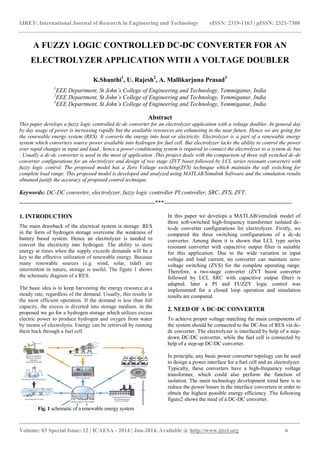
intermittent in nature, storage is useful. The figure 1 shows 
the schematic diagram of a RES. 
The basic idea is to keep harvesting the energy resource at a 
steady rate, regardless of the demand. Usually, this results in 
the most efficient operation. If the demand is less than full 
capacity, the excess is diverted into storage medium. in the 
proposed we go for a hydrogen storage which utilizes excess 
electric power to produce hydrogen and oxygen from water 
by means of electrolysis. Energy can be retrieved by running 
them back through a fuel cell. 
Fig. 1 schematic of a renewable energy system 
In this paper we develops a MATLAB/simulink model of 
three soft-switched high-frequency transformer isolated dc-to- 
dc converter configurations for electrolyzer. Firstly, we 
compared the three switching configurations of a dc-dc 
converter. Among them it is shown that LCL type series 
resonant converter with capacitive output filter is suitable 
for this application. Due to the wide variation in input 
voltage and load current, no converter can maintain zero-voltage 
switching (ZVS) for the complete operating range. 
Therefore, a two-stage converter (ZVT boost converter 
followed by LCL SRC with capacitive output filter) is 
adapted. later a PI and FUZZY logic control was 
implemented for a closed loop operation and simulation 
results are compared. 
2. NEED OF A DC-DC CONVERTER 
To achieve proper voltage matching the main components of 
the system should be connected to the DC-bus of RES via dc-dc 
converter. The electrolyzer is interfaced by help of a step-down 
DC/DC converter, while the fuel cell is connected by 
help of a step-up DC/DC converter. 
In principle, any basic power converter topology can be used 
to design a power interface for a fuel cell and an electrolyzer. 
Typically, these converters have a high-frequency voltage 
transformer, which could also perform the function of 
isolation. The main technology development trend here is to 
reduce the power losses in the interface converters in order to 
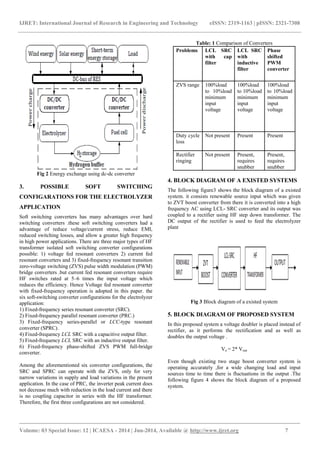
obtain the highest possible energy efficiency .The following 
figure2 shows the need of a DC-DC converter.
IJRET: International Journal of Research in Engineering and Technology eISSN: 2319-1163 | pISSN: 2321-7308 
_______________________________________________________________________________________ 
Volume: 03 Special Issue: 12 | ICAESA - 2014 | Jun-2014, Available @ http://www.ijret.org 7 
Fig 2 Energy exchange using dc-dc converter 
3. POSSIBLE SOFT SWITCHING 
CONFIGARATIONS FOR THE ELECTROLYZER 
APPLICATION 
Soft switching converters has many advantages over hard 
switching converters .these soft switching converters had a 
advantage of reduce voltage/current stress, reduce EMI, 
reduced switching losses, and allow a greater high frequency 
in high power applications. There are three major types of HF 
transformer isolated soft switching converter configurations 
possible: 1) voltage fed resonant converters 2) current fed 
resonant converters and 3) fixed-frequency resonant transition 
zero-voltage switching (ZVS) pulse width modulation (PWM) 
bridge converters .but current fed resonant converters require 
HF switches rated at 5–6 times the input voltage which 
reduces the efficiency. Hence Voltage fed resonant converter 
with fixed-frequency operation is adopted in this paper. the 
six soft-switching converter configurations for the electrolyzer 
application: 
1) Fixed-frequency series resonant converter (SRC). 
2) Fixed-frequency parallel resonant converter (PRC.) 
3) Fixed-frequency series-parallel or LCC-type resonant 
converter (SPRC). 
4) Fixed-frequency LCL SRC with a capacitive output filter. 
5) Fixed-frequency LCL SRC with an inductive output filter. 
6) Fixed-frequency phase-shifted ZVS PWM full-bridge 
converter. 
Among the aforementioned six converter configurations, the 
SRC and SPRC can operate with the ZVS, only for very 
narrow variations in supply and load variations in the present 
application. In the case of PRC, the inverter peak current does 
not decrease much with reduction in the load current and there 
is no coupling capacitor in series with the HF transformer. 
Therefore, the first three configurations are not considered. 
Table: 1 Comparison of Converters 
Problems LCL SRC 
with cap 
filter 
LCL SRC 
with 
inductive 
filter 
Phase 
shifted 
PWM 
converter 
ZVS range 100%load 
to 10%load 
minimum 
input 
voltage 
100%load 
to 10%load 
minimum 
input 
voltage 
100%load 
to 10%load 
minimum 
input 
voltage 
Duty cycle 
loss 
Not present Present Present 
Rectifier 
ringing 
Not present Present, 
requires 
snubber 
Present, 
requires 
snubber 
4. BLOCK DIAGRAM OF A EXISTED SYSTEMS 
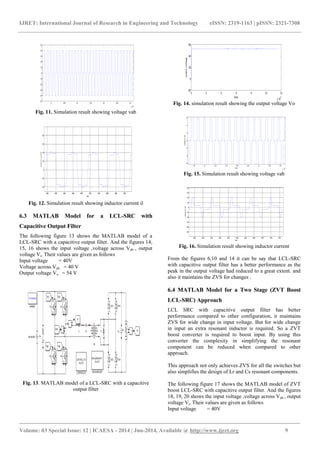
The following figure3 shows the block diagram of a existed 
system. it consists renewable source input which was given 
to ZVT boost converter from there it is converted into a high 
frequency AC using LCL- SRC converter and its output was 
coupled to a rectifier using HF step down transformer. The 
DC output of the rectifier is used to feed the electrolyzer 
plant 
Fig 3 Block diagram of a existed system 
5. BLOCK DIAGRAM OF PROPOSED SYSTEM 
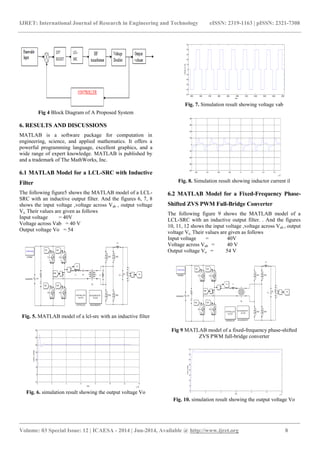
In this proposed system a voltage doubler is placed instead of 
rectifier, as it performs the rectification and as well as 
doubles the output voltage . 
Vo = 2* Vout 
Even though existing two stage boost converter system is 
operating accurately ,for a wide changing load and input 
sources time to time there is fluctuations in the output .The 
following figure 4 shows the block diagram of a proposed 
system.
IJRET: International Journal of Research in Engineering and Technology eISSN: 2319-1163 | pISSN: 2321-7308 
_______________________________________________________________________________________ 
Volume: 03 Special Issue: 12 | ICAESA - 2014 | Jun-2014, Available @ http://www.ijret.org 8 
Fig 4 Block Diagram of A Proposed System 
6. RESULTS AND DISCUSSIONS 
MATLAB is a software package for computation in 
engineering, science, and applied mathematics. It offers a 
powerful programming language, excellent graphics, and a 
wide range of expert knowledge. MATLAB is published by 
and a trademark of The MathWorks, Inc. 
6.1 MATLAB Model for a LCL-SRC with Inductive 
Filter 
The following figure5 shows the MATLAB model of a LCL-SRC 
with an inductive output filter. And the figures 6, 7, 8 
shows the input voltage ,voltage across Vab , output voltage 
Vo .Their values are given as follows 
Input voltage = 40V 
Voltage across Vab = 40 V 
Output voltage Vo = 54 
Fig. 5. MATLAB model of a lcl-src with an inductive filter 
0 2 4 6 8 10 12 14 
x 10 
4 
-10 
0 
10 
20 
30 
40 
50 
60 
time 
output voltage 
Fig. 6. simulation result showing the output voltage Vo 
9500 9600 9700 9800 9900 10000 10100 10200 10300 10400 10500 
-50 
-40 
-30 
-20 
-10 
0 
10 
20 
30 
40 
50 
time 
voltage at vab 
Fig. 7. Simulation result showing voltage vab 
2.06 2.07 2.08 2.09 2.1 2.11 2.12 2.13 
x 10 
4 
-400 
-300 
-200 
-100 
0 
100 
200 
300 
400 
Fig. 8. Simulation result showing inductor current il 
6.2 MATLAB Model for a Fixed-Frequency Phase- 
Shifted ZVS PWM Full-Bridge Converter 
The following figure 9 shows the MATLAB model of a 
LCL-SRC with an inductive output filter. . And the figures 
10, 11, 12 shows the input voltage ,voltage across Vab , output 
voltage Vo .Their values are given as follows 
Input voltage = 40V 
Voltage across Vab = 40 V 
Output voltage Vo = 54 V 
Fig 9 MATLAB model of a fixed-frequency phase-shifted 
ZVS PWM full-bridge converter 
0 2 4 6 8 10 12 
x 10 
4 
0 
5 
10 
15 
20 
25 
30 
35 
40 
time 
output voltage 
Fig. 10. simulation result showing the output voltage Vo
IJRET: International Journal of Research in Engineering and Technology eISSN: 2319-1163 | pISSN: 2321-7308 
_______________________________________________________________________________________ 
Volume: 03 Special Issue: 12 | ICAESA - 2014 | Jun-2014, Available @ http://www.ijret.org 9 
6 6.05 6.1 6.15 6.2 6.25 6.3 
x 10 
4 
-50 
-40 
-30 
-20 
-10 
0 
10 
20 
30 
40 
50 
Fig. 11. Simulation result showing voltage vab 
3450 3500 3550 3600 3650 3700 3750 3800 3850 3900 
-40 
-20 
0 
20 
40 
60 
80 
time 
inductor current 
Fig. 12. Simulation result showing inductor current il 
6.3 MATLAB Model for a LCL-SRC with 
Capacitive Output Filter 
The following figure 13 shows the MATLAB model of a 
LCL-SRC with a capacitive output filter. And the figures 14, 
15, 16 shows the input voltage ,voltage across Vab , output 
voltage Vo .Their values are given as follows 
Input voltage = 40V 
Voltage across Vab = 40 V 
Output voltage Vo = 54 V 
Fig. 13. MATLAB model of a LCL-SRC with a capacitive 
output filter 
0 2 4 6 8 10 12 
x 10 
4 
-20 
0 
20 
40 
60 
time 
output voltage 
Fig. 14. simulation result showing the output voltage Vo 
1.18 1.2 1.22 1.24 1.26 1.28 1.3 1.32 1.34 
x 10 
4 
-6 
-4 
-2 
0 
2 
4 
6 
time 
voltage at vab 
Fig. 15. Simulation result showing voltage vab 
2250 2300 2350 2400 2450 2500 2550 2600 2650 2700 2750 
-250 
-200 
-150 
-100 
-50 
0 
50 
100 
150 
200 
time 
voltage at vab 
Fig. 16. Simulation result showing inductor current 
From the figures 6,10 and 14 it can be say that LCL-SRC 
with capacitive output filter has a better performance as the 
peak in the output voltage had reduced to a great extent. and 
also it maintains the ZVS for changes . 
6.4 MATLAB Model for a Two Stage (ZVT Boost 
LCL-SRC) Approach 
LCL SRC with capacitive output filter has better 
performance compared to other configuration, it maintains 
ZVS for wide change in input voltage. But for wide change 
in input an extra resonant inductor is required. So a ZVT 
boost converter is required to boost input. By using this 
converter the complexity in simplifying the resonant 
component can be reduced when compared to other 
approach. 
This approach not only achieves ZVS for all the switches but 
also simplifies the design of Lr and Cs resonant components. 
The following figure 17 shows the MATLAB model of ZVT 
boost LCL-SRC with capacitive output filter. And the figures 
18, 19, 20 shows the input voltage ,voltage across Vab , output 
voltage Vo .Their values are given as follows 
Input voltage = 40V
IJRET: International Journal of Research in Engineering and Technology eISSN: 2319-1163 | pISSN: 2321-7308 
_______________________________________________________________________________________ 
Volume: 03 Special Issue: 12 | ICAESA - 2014 | Jun-2014, Available @ http://www.ijret.org 10 
Voltage across Vab = 40 V 
Output voltage Vo = 60 V 
Fig. 17. MATLAB model of a LCL-SRC with a capacitive 
output filter 
3.25 3.3 3.35 3.4 3.45 3.5 3.55 
x 10 
4 
-150 
-100 
-50 
0 
50 
100 
150 
time 
vab 
Fig. 18. Simulation result showing voltage vab 
2.46 2.48 2.5 2.52 2.54 2.56 2.58 2.6 2.62 2.64 
x 10 
4 
-400 
-300 
-200 
-100 
0 
100 
200 
300 
400 
time 
inductor current 
Fig. 19. Simulation result showing inductor current 
0 0.5 1 1.5 2 2.5 3 
x 10 
5 
0 
20 
40 
60 
80 
100 
120 
140 
160 
180 
200 
time 
output voltage 
Fig. 20. Simulation result showing output voltage Vo 
From the above figure 20 it can observe that smoot output 
voltage is observed .hence by adopting the ZVT boost at the 
input side the input is maintained to a constant value hence 
there by reducing the swithing losses at the inverter 
6.5 MATLAB Model for a PI Controller with 
Voltage Doubler 
The following figure 21 shows the two stage(ZVT boost 
LCL-SRC ) with an voltage doubler and a PI controller. At 
the input side a FUEL cell stack taken as the input source. 
And the figures 23, 24, 25 shows the input voltage ,voltage 
across Vab , output voltage Vo .Their values are given as 
follows 
Input voltage = 40V 
Voltage across Vab = 100 V 
Output voltage Vo = 120V 
Fig. 21. MATLAB model of a pi controller with voltage 
doubler 
Fig. 22. MATLAB model of a subsystem of a PI controller 
2000 4000 6000 8000 10000 12000 14000 16000 18000 
-150 
-100 
-50 
0 
50 
100 
time 
vab 
Fig. 23. Simulation result showing voltage Vab
IJRET: International Journal of Research in Engineering and Technology eISSN: 2319-1163 | pISSN: 2321-7308 
_______________________________________________________________________________________ 
Volume: 03 Special Issue: 12 | ICAESA - 2014 | Jun-2014, Available @ http://www.ijret.org 11 
0 2 4 6 8 10 12 
x 10 
4 
-20 
0 
20 
40 
60 
80 
100 
120 
140 
time 
vo 
Fig. 24. Simulation result showing output voltage Vo 
0 2 4 6 8 10 12 
x 10 
4 
-600 
-400 
-200 
0 
200 
400 
600 
time 
inductor current 
Fig. 26. Simulation result showing inductor current 
6.6 MATLAB Model of a Fuzzy Logic System 
The use of fuzzy logic is attractive for control systems since 
it enables the use of multiple inputs. Fuzzy logic also enables 
the description of the behavior of the controller using several 
rules defined by a set of linguistic variables. Hence, FLC is a 
promising tool for controlling complex, linguistic based 
systems. The steps to implement the fuzzy logic controller is 
1. Create the membership values (fuzzify). 
2. Specify the rule table. 
3. Determine your procedure for defuzzifying the result. 
First we have to fuzzify the data or create membership values 
for the data and put them into fuzzy sets. simply, we have to 
divide each set of data into ranges. 
The following figure 27 shows the two stage(ZVT boost 
LCL-SRC ) with an voltage doubler and a Ffuzzy logic 
controller. At the input side a FUEL cell stack taken as the 
input source. And the figures 29, 30, 31 shows the input 
voltage ,voltage across Vab , output voltage Vo . 
Fig. 27. MATLAB model of a FUZZY controller with 
voltage doubler 
Fig. 28. MATLAB model of a subsystem of a FUZZY 
controller 
Fig. 29. fuzzy surface system 
1000 2000 3000 4000 5000 6000 7000 8000 
-100 
-50 
0 
50 
100 
time 
voltage across ab 
Fig. 30. Simulation result showing voltage Vab 
0 2 4 6 8 10 12 
x 10 
4 
-20 
0 
20 
40 
60 
80 
100 
120 
time 
output voltage vo 
Fig. 31. Simulation result showing voltage Vab
IJRET: International Journal of Research in Engineering and Technology eISSN: 2319-1163 | pISSN: 2321-7308 
_______________________________________________________________________________________ 
Volume: 03 Special Issue: 12 | ICAESA - 2014 | Jun-2014, Available @ http://www.ijret.org 12 
0 2 4 6 8 10 12 
x 10 
4 
-500 
-400 
-300 
-200 
-100 
0 
100 
200 
300 
400 
Fig. 32. Simulation result showing voltage Vab 
In the above figure 27 a fuzzy logic controller was 
implemented with mamdani fuzzy inference type.when 
compared the results of PI and fuzzy controller from the 
figures 24and 30 it can be shown that even low voltage 
application also the fuzzy controller can reduce the output 
distortions.And also it maintains the ZVS for all switches 
reducing the switching losses. 
fuell stack rating = 6KW-45V DC 
no of cells = 65 
voltage at Vab = 100 v 
output voltage = 120 V 
7. CONCLUSIONS 
In this paper a fuzzy logic controlled DC-DC converter for an 
electrolyzer application has been implemented using 
MATLAB/simulink. Among available converter 
configurations it is shown that the a ZVT BOOST along with 
LCL –SRC converter is best one for the electrolyzer. To 
reduce the output distortions a PI controller was kept in order 
to reduce the steady state error. A voltage doubler introduced 
in the circuit acts as both rectifier and as voltage doubler .the 
simulation results are checked for both fuzzy and PI 
controller. It is shown that by using fuzzy logic controlled 
converter the conversion can be operated smoothly and 
efficiently for electrolyzer application compared to the other 
converters. And the output voltage range also doubled . 
REFERENCES 
[1] D. Shapiro, J. Duffy, M. Kimble, and M. Pien, “Solar-powered 
regenerative PEM electrolyzer/fuel cell 
system,” J. Solar Energy, vol. 79, pp. 544–550, 2005. 
[2] X. Zhang, H. S.-H. Chung, X. Ruan, and A. Ioinovici, 
“A ZCS full-bridge converter without voltage 
overstress on the switches,” IEEE Trans. 
PowerElectron., vol. 25, no. 3, pp. 686–698, Mar. 201 
[3] D. S. Gautam and A. K. S. Bhat, “A two-stage soft-switched 
converter for electrolyser application,” in 
Proc. Nat. Power Syst. Conf., Mumbai, India, 2008, 
pp. 524–528. 
[4] A.K.S. Bhat, "Analysis and design of LCL-type 
resonant converter", IEEE Trans. on Industrial 
Electronics, vol. 41, no. 1, pp. 118-124, Feb. 1994. 
[5] A.K.S. Bhat, "Analysis and design of a fixed 
frequency LCL-type series resonant converter," IEEE 
Trans. on Aerospace and Electronic Systems,vol. 31, 
no. 1, Jan. 1995, 125-137. 
[6] Ahmadi, P., Dincer, I., Rosen, M.A., 2013. Energy 
and exergy analyses of hydrogen production via solar-boosted 
ocean thermal energy conversion and PEM 
electrolysis. International Journal of Hydrogen 
Energy, 38 (4) : 1795- 1805. 
[doi:10.1016/j.ijhydene.2012.11.025] 
[7] Arriaga, L.G., Martinez, W., Cano, U., Blud, H., 
2007. Direct coupling of a solar-hydrogen system in 
Mexico. International Journal of Hydrogen Energy, 
32 (13): 2247- 2252. 
[doi:10.1016/j.ijhydene.2006.10.067] 
[8] Y. Jang and M. M. Jovanovic, “A new family of full-bridge 
ZVS converters,” IEEE Trans. Power 
Electron., vol. 19, no. 3, pp. 701–708, May 2004. 
[9] H. Bodur and A. F. Bakan, “A new ZVT-PWM DC-DC 
converter,” IEEE Trans. on Power Electr., vol. 
17, no. 1, Jan. 2002, pp. 40-47. 
[10] R. Streit and D. Tollik, “High efficiency telecom 
rectifier using a novel soft-switched boost based input 
current shaper”, IEEE INTELC Conf. Record, 1991, 
pp.720-726. 
[11] Ferraro, “An overview of low-loss snubber 
technology for transistor converters,” in Proc. IEEE 
Power Electron. Spec. Conf., 1982, pp.466–477. 
[12] G. Hua, C. S. Leu, Y. Jiang, and F. C. Y. Lee, “Novel 
zero-voltagetransition PWM converters,” IEEE Trans. 
Power Electron., vol. 9, pp. 213–219, Mar. 1994. 
601–606, Nov. 1994. 
[13] D. S. Gautam and A. K. S. Bhat, “A two-stage soft-switched 
converter for electrolyser application,” in 
Proc. Nat. Power Syst. Conf., Mumbai, India, 2008, 
pp. 524–528.

A fuzzy logic controlled dc dc converter for an

  • 1.
    IJRET: International Journalof Research in Engineering and Technology eISSN: 2319-1163 | pISSN: 2321-7308 _______________________________________________________________________________________ Volume: 03 Special Issue: 12 | ICAESA - 2014 | Jun-2014, Available @ http://www.ijret.org 6 A FUZZY LOGIC CONTROLLED DC-DC CONVERTER FOR AN ELECTROLYZER APPLICATION WITH A VOLTAGE DOUBLER K.Shanthi1, U. Rajesh2, A. Mallikarjuna Prasad3 1EEE Department, St John’s College of Engineering and Technology, Yemmiganur, India 2EEE Department, St John’s College of Engineering and Technology, Yemmiganur, India 3EEE Department, St John’s College of Engineering and Technology, Yemmiganur, India Abstract This paper develops a fuzzy logic controlled dc-dc converter for an electrolyzer application with a voltage doubler. In general day by day usage of power is increasing rapidly but the available resources are exhausting in the near future. Hence we are going for the renewable energy system (RES). It converts the energy into heat or electricity. Electrolyzer is a part of a renewable energy system which converters source power available into hydrogen for fuel cell. But electrolyzer lacks the ability to control the power over rapid changes in input and load , hence a power conditioning system is required to connect the electrolyzer to a system dc bus . Usually a dc-dc converter is used in the most of application .This project deals with the comparison of three soft switched dc-dc converter configurations for an electrolyzer and design of two stage (ZVT boost followed by LCL series resonant converter) with fuzzy logic control. The proposed model has a Zero Voltage switching(ZVS) technique which maintain the soft switching for complete load range. This proposed model is developed and analyzed using MATLAB/Simulink Software and the simulation results obtained justify the accuracy of proposed control technique. Keywords: DC-DC converter, electrolyzer, fuzzy logic controller PI controller, SRC, ZVS, ZVT. ---------------------------------------------------------------------***----------------------------------------------------------------- 1. INTRODUCTION The main drawback of the electrical system is storage .RES in the form of hydrogen storage overcome the weakness of battery based system. Hence an electrolyzer is needed to convert the electricity into hydrogen. The ability to store energy at times when the supply exceeds demands will be a key to the effective utilization of renewable energy. Because many renewable sources (e.g. wind, solar, tidal) are intermittent in nature, storage is useful. The figure 1 shows the schematic diagram of a RES. The basic idea is to keep harvesting the energy resource at a steady rate, regardless of the demand. Usually, this results in the most efficient operation. If the demand is less than full capacity, the excess is diverted into storage medium. in the proposed we go for a hydrogen storage which utilizes excess electric power to produce hydrogen and oxygen from water by means of electrolysis. Energy can be retrieved by running them back through a fuel cell. Fig. 1 schematic of a renewable energy system In this paper we develops a MATLAB/simulink model of three soft-switched high-frequency transformer isolated dc-to- dc converter configurations for electrolyzer. Firstly, we compared the three switching configurations of a dc-dc converter. Among them it is shown that LCL type series resonant converter with capacitive output filter is suitable for this application. Due to the wide variation in input voltage and load current, no converter can maintain zero-voltage switching (ZVS) for the complete operating range. Therefore, a two-stage converter (ZVT boost converter followed by LCL SRC with capacitive output filter) is adapted. later a PI and FUZZY logic control was implemented for a closed loop operation and simulation results are compared. 2. NEED OF A DC-DC CONVERTER To achieve proper voltage matching the main components of the system should be connected to the DC-bus of RES via dc-dc converter. The electrolyzer is interfaced by help of a step-down DC/DC converter, while the fuel cell is connected by help of a step-up DC/DC converter. In principle, any basic power converter topology can be used to design a power interface for a fuel cell and an electrolyzer. Typically, these converters have a high-frequency voltage transformer, which could also perform the function of isolation. The main technology development trend here is to reduce the power losses in the interface converters in order to obtain the highest possible energy efficiency .The following figure2 shows the need of a DC-DC converter.
  • 2.
    IJRET: International Journalof Research in Engineering and Technology eISSN: 2319-1163 | pISSN: 2321-7308 _______________________________________________________________________________________ Volume: 03 Special Issue: 12 | ICAESA - 2014 | Jun-2014, Available @ http://www.ijret.org 7 Fig 2 Energy exchange using dc-dc converter 3. POSSIBLE SOFT SWITCHING CONFIGARATIONS FOR THE ELECTROLYZER APPLICATION Soft switching converters has many advantages over hard switching converters .these soft switching converters had a advantage of reduce voltage/current stress, reduce EMI, reduced switching losses, and allow a greater high frequency in high power applications. There are three major types of HF transformer isolated soft switching converter configurations possible: 1) voltage fed resonant converters 2) current fed resonant converters and 3) fixed-frequency resonant transition zero-voltage switching (ZVS) pulse width modulation (PWM) bridge converters .but current fed resonant converters require HF switches rated at 5–6 times the input voltage which reduces the efficiency. Hence Voltage fed resonant converter with fixed-frequency operation is adopted in this paper. the six soft-switching converter configurations for the electrolyzer application: 1) Fixed-frequency series resonant converter (SRC). 2) Fixed-frequency parallel resonant converter (PRC.) 3) Fixed-frequency series-parallel or LCC-type resonant converter (SPRC). 4) Fixed-frequency LCL SRC with a capacitive output filter. 5) Fixed-frequency LCL SRC with an inductive output filter. 6) Fixed-frequency phase-shifted ZVS PWM full-bridge converter. Among the aforementioned six converter configurations, the SRC and SPRC can operate with the ZVS, only for very narrow variations in supply and load variations in the present application. In the case of PRC, the inverter peak current does not decrease much with reduction in the load current and there is no coupling capacitor in series with the HF transformer. Therefore, the first three configurations are not considered. Table: 1 Comparison of Converters Problems LCL SRC with cap filter LCL SRC with inductive filter Phase shifted PWM converter ZVS range 100%load to 10%load minimum input voltage 100%load to 10%load minimum input voltage 100%load to 10%load minimum input voltage Duty cycle loss Not present Present Present Rectifier ringing Not present Present, requires snubber Present, requires snubber 4. BLOCK DIAGRAM OF A EXISTED SYSTEMS The following figure3 shows the block diagram of a existed system. it consists renewable source input which was given to ZVT boost converter from there it is converted into a high frequency AC using LCL- SRC converter and its output was coupled to a rectifier using HF step down transformer. The DC output of the rectifier is used to feed the electrolyzer plant Fig 3 Block diagram of a existed system 5. BLOCK DIAGRAM OF PROPOSED SYSTEM In this proposed system a voltage doubler is placed instead of rectifier, as it performs the rectification and as well as doubles the output voltage . Vo = 2* Vout Even though existing two stage boost converter system is operating accurately ,for a wide changing load and input sources time to time there is fluctuations in the output .The following figure 4 shows the block diagram of a proposed system.
  • 3.
    IJRET: International Journalof Research in Engineering and Technology eISSN: 2319-1163 | pISSN: 2321-7308 _______________________________________________________________________________________ Volume: 03 Special Issue: 12 | ICAESA - 2014 | Jun-2014, Available @ http://www.ijret.org 8 Fig 4 Block Diagram of A Proposed System 6. RESULTS AND DISCUSSIONS MATLAB is a software package for computation in engineering, science, and applied mathematics. It offers a powerful programming language, excellent graphics, and a wide range of expert knowledge. MATLAB is published by and a trademark of The MathWorks, Inc. 6.1 MATLAB Model for a LCL-SRC with Inductive Filter The following figure5 shows the MATLAB model of a LCL-SRC with an inductive output filter. And the figures 6, 7, 8 shows the input voltage ,voltage across Vab , output voltage Vo .Their values are given as follows Input voltage = 40V Voltage across Vab = 40 V Output voltage Vo = 54 Fig. 5. MATLAB model of a lcl-src with an inductive filter 0 2 4 6 8 10 12 14 x 10 4 -10 0 10 20 30 40 50 60 time output voltage Fig. 6. simulation result showing the output voltage Vo 9500 9600 9700 9800 9900 10000 10100 10200 10300 10400 10500 -50 -40 -30 -20 -10 0 10 20 30 40 50 time voltage at vab Fig. 7. Simulation result showing voltage vab 2.06 2.07 2.08 2.09 2.1 2.11 2.12 2.13 x 10 4 -400 -300 -200 -100 0 100 200 300 400 Fig. 8. Simulation result showing inductor current il 6.2 MATLAB Model for a Fixed-Frequency Phase- Shifted ZVS PWM Full-Bridge Converter The following figure 9 shows the MATLAB model of a LCL-SRC with an inductive output filter. . And the figures 10, 11, 12 shows the input voltage ,voltage across Vab , output voltage Vo .Their values are given as follows Input voltage = 40V Voltage across Vab = 40 V Output voltage Vo = 54 V Fig 9 MATLAB model of a fixed-frequency phase-shifted ZVS PWM full-bridge converter 0 2 4 6 8 10 12 x 10 4 0 5 10 15 20 25 30 35 40 time output voltage Fig. 10. simulation result showing the output voltage Vo
  • 4.
    IJRET: International Journalof Research in Engineering and Technology eISSN: 2319-1163 | pISSN: 2321-7308 _______________________________________________________________________________________ Volume: 03 Special Issue: 12 | ICAESA - 2014 | Jun-2014, Available @ http://www.ijret.org 9 6 6.05 6.1 6.15 6.2 6.25 6.3 x 10 4 -50 -40 -30 -20 -10 0 10 20 30 40 50 Fig. 11. Simulation result showing voltage vab 3450 3500 3550 3600 3650 3700 3750 3800 3850 3900 -40 -20 0 20 40 60 80 time inductor current Fig. 12. Simulation result showing inductor current il 6.3 MATLAB Model for a LCL-SRC with Capacitive Output Filter The following figure 13 shows the MATLAB model of a LCL-SRC with a capacitive output filter. And the figures 14, 15, 16 shows the input voltage ,voltage across Vab , output voltage Vo .Their values are given as follows Input voltage = 40V Voltage across Vab = 40 V Output voltage Vo = 54 V Fig. 13. MATLAB model of a LCL-SRC with a capacitive output filter 0 2 4 6 8 10 12 x 10 4 -20 0 20 40 60 time output voltage Fig. 14. simulation result showing the output voltage Vo 1.18 1.2 1.22 1.24 1.26 1.28 1.3 1.32 1.34 x 10 4 -6 -4 -2 0 2 4 6 time voltage at vab Fig. 15. Simulation result showing voltage vab 2250 2300 2350 2400 2450 2500 2550 2600 2650 2700 2750 -250 -200 -150 -100 -50 0 50 100 150 200 time voltage at vab Fig. 16. Simulation result showing inductor current From the figures 6,10 and 14 it can be say that LCL-SRC with capacitive output filter has a better performance as the peak in the output voltage had reduced to a great extent. and also it maintains the ZVS for changes . 6.4 MATLAB Model for a Two Stage (ZVT Boost LCL-SRC) Approach LCL SRC with capacitive output filter has better performance compared to other configuration, it maintains ZVS for wide change in input voltage. But for wide change in input an extra resonant inductor is required. So a ZVT boost converter is required to boost input. By using this converter the complexity in simplifying the resonant component can be reduced when compared to other approach. This approach not only achieves ZVS for all the switches but also simplifies the design of Lr and Cs resonant components. The following figure 17 shows the MATLAB model of ZVT boost LCL-SRC with capacitive output filter. And the figures 18, 19, 20 shows the input voltage ,voltage across Vab , output voltage Vo .Their values are given as follows Input voltage = 40V
  • 5.
    IJRET: International Journalof Research in Engineering and Technology eISSN: 2319-1163 | pISSN: 2321-7308 _______________________________________________________________________________________ Volume: 03 Special Issue: 12 | ICAESA - 2014 | Jun-2014, Available @ http://www.ijret.org 10 Voltage across Vab = 40 V Output voltage Vo = 60 V Fig. 17. MATLAB model of a LCL-SRC with a capacitive output filter 3.25 3.3 3.35 3.4 3.45 3.5 3.55 x 10 4 -150 -100 -50 0 50 100 150 time vab Fig. 18. Simulation result showing voltage vab 2.46 2.48 2.5 2.52 2.54 2.56 2.58 2.6 2.62 2.64 x 10 4 -400 -300 -200 -100 0 100 200 300 400 time inductor current Fig. 19. Simulation result showing inductor current 0 0.5 1 1.5 2 2.5 3 x 10 5 0 20 40 60 80 100 120 140 160 180 200 time output voltage Fig. 20. Simulation result showing output voltage Vo From the above figure 20 it can observe that smoot output voltage is observed .hence by adopting the ZVT boost at the input side the input is maintained to a constant value hence there by reducing the swithing losses at the inverter 6.5 MATLAB Model for a PI Controller with Voltage Doubler The following figure 21 shows the two stage(ZVT boost LCL-SRC ) with an voltage doubler and a PI controller. At the input side a FUEL cell stack taken as the input source. And the figures 23, 24, 25 shows the input voltage ,voltage across Vab , output voltage Vo .Their values are given as follows Input voltage = 40V Voltage across Vab = 100 V Output voltage Vo = 120V Fig. 21. MATLAB model of a pi controller with voltage doubler Fig. 22. MATLAB model of a subsystem of a PI controller 2000 4000 6000 8000 10000 12000 14000 16000 18000 -150 -100 -50 0 50 100 time vab Fig. 23. Simulation result showing voltage Vab
  • 6.
    IJRET: International Journalof Research in Engineering and Technology eISSN: 2319-1163 | pISSN: 2321-7308 _______________________________________________________________________________________ Volume: 03 Special Issue: 12 | ICAESA - 2014 | Jun-2014, Available @ http://www.ijret.org 11 0 2 4 6 8 10 12 x 10 4 -20 0 20 40 60 80 100 120 140 time vo Fig. 24. Simulation result showing output voltage Vo 0 2 4 6 8 10 12 x 10 4 -600 -400 -200 0 200 400 600 time inductor current Fig. 26. Simulation result showing inductor current 6.6 MATLAB Model of a Fuzzy Logic System The use of fuzzy logic is attractive for control systems since it enables the use of multiple inputs. Fuzzy logic also enables the description of the behavior of the controller using several rules defined by a set of linguistic variables. Hence, FLC is a promising tool for controlling complex, linguistic based systems. The steps to implement the fuzzy logic controller is 1. Create the membership values (fuzzify). 2. Specify the rule table. 3. Determine your procedure for defuzzifying the result. First we have to fuzzify the data or create membership values for the data and put them into fuzzy sets. simply, we have to divide each set of data into ranges. The following figure 27 shows the two stage(ZVT boost LCL-SRC ) with an voltage doubler and a Ffuzzy logic controller. At the input side a FUEL cell stack taken as the input source. And the figures 29, 30, 31 shows the input voltage ,voltage across Vab , output voltage Vo . Fig. 27. MATLAB model of a FUZZY controller with voltage doubler Fig. 28. MATLAB model of a subsystem of a FUZZY controller Fig. 29. fuzzy surface system 1000 2000 3000 4000 5000 6000 7000 8000 -100 -50 0 50 100 time voltage across ab Fig. 30. Simulation result showing voltage Vab 0 2 4 6 8 10 12 x 10 4 -20 0 20 40 60 80 100 120 time output voltage vo Fig. 31. Simulation result showing voltage Vab
  • 7.
    IJRET: International Journalof Research in Engineering and Technology eISSN: 2319-1163 | pISSN: 2321-7308 _______________________________________________________________________________________ Volume: 03 Special Issue: 12 | ICAESA - 2014 | Jun-2014, Available @ http://www.ijret.org 12 0 2 4 6 8 10 12 x 10 4 -500 -400 -300 -200 -100 0 100 200 300 400 Fig. 32. Simulation result showing voltage Vab In the above figure 27 a fuzzy logic controller was implemented with mamdani fuzzy inference type.when compared the results of PI and fuzzy controller from the figures 24and 30 it can be shown that even low voltage application also the fuzzy controller can reduce the output distortions.And also it maintains the ZVS for all switches reducing the switching losses. fuell stack rating = 6KW-45V DC no of cells = 65 voltage at Vab = 100 v output voltage = 120 V 7. CONCLUSIONS In this paper a fuzzy logic controlled DC-DC converter for an electrolyzer application has been implemented using MATLAB/simulink. Among available converter configurations it is shown that the a ZVT BOOST along with LCL –SRC converter is best one for the electrolyzer. To reduce the output distortions a PI controller was kept in order to reduce the steady state error. A voltage doubler introduced in the circuit acts as both rectifier and as voltage doubler .the simulation results are checked for both fuzzy and PI controller. It is shown that by using fuzzy logic controlled converter the conversion can be operated smoothly and efficiently for electrolyzer application compared to the other converters. And the output voltage range also doubled . REFERENCES [1] D. Shapiro, J. Duffy, M. Kimble, and M. Pien, “Solar-powered regenerative PEM electrolyzer/fuel cell system,” J. Solar Energy, vol. 79, pp. 544–550, 2005. [2] X. Zhang, H. S.-H. Chung, X. Ruan, and A. Ioinovici, “A ZCS full-bridge converter without voltage overstress on the switches,” IEEE Trans. PowerElectron., vol. 25, no. 3, pp. 686–698, Mar. 201 [3] D. S. Gautam and A. K. S. Bhat, “A two-stage soft-switched converter for electrolyser application,” in Proc. Nat. Power Syst. Conf., Mumbai, India, 2008, pp. 524–528. [4] A.K.S. Bhat, "Analysis and design of LCL-type resonant converter", IEEE Trans. on Industrial Electronics, vol. 41, no. 1, pp. 118-124, Feb. 1994. [5] A.K.S. Bhat, "Analysis and design of a fixed frequency LCL-type series resonant converter," IEEE Trans. on Aerospace and Electronic Systems,vol. 31, no. 1, Jan. 1995, 125-137. [6] Ahmadi, P., Dincer, I., Rosen, M.A., 2013. Energy and exergy analyses of hydrogen production via solar-boosted ocean thermal energy conversion and PEM electrolysis. International Journal of Hydrogen Energy, 38 (4) : 1795- 1805. [doi:10.1016/j.ijhydene.2012.11.025] [7] Arriaga, L.G., Martinez, W., Cano, U., Blud, H., 2007. Direct coupling of a solar-hydrogen system in Mexico. International Journal of Hydrogen Energy, 32 (13): 2247- 2252. [doi:10.1016/j.ijhydene.2006.10.067] [8] Y. Jang and M. M. Jovanovic, “A new family of full-bridge ZVS converters,” IEEE Trans. Power Electron., vol. 19, no. 3, pp. 701–708, May 2004. [9] H. Bodur and A. F. Bakan, “A new ZVT-PWM DC-DC converter,” IEEE Trans. on Power Electr., vol. 17, no. 1, Jan. 2002, pp. 40-47. [10] R. Streit and D. Tollik, “High efficiency telecom rectifier using a novel soft-switched boost based input current shaper”, IEEE INTELC Conf. Record, 1991, pp.720-726. [11] Ferraro, “An overview of low-loss snubber technology for transistor converters,” in Proc. IEEE Power Electron. Spec. Conf., 1982, pp.466–477. [12] G. Hua, C. S. Leu, Y. Jiang, and F. C. Y. Lee, “Novel zero-voltagetransition PWM converters,” IEEE Trans. Power Electron., vol. 9, pp. 213–219, Mar. 1994. 601–606, Nov. 1994. [13] D. S. Gautam and A. K. S. Bhat, “A two-stage soft-switched converter for electrolyser application,” in Proc. Nat. Power Syst. Conf., Mumbai, India, 2008, pp. 524–528.