
Fall Protection on a
Construction Site
Falls are the leading cause of deaths in the construction industry.
Most fatalities occur when employees fall from open-sided
floors and through floor openings.
Falls from as little as 4 to 6 feet can cause serious lost-time
accidents and sometimes death.
Open-sided floors and platforms 6 feet or more in height must
be guarded.
Falls in Construction
This presentation will discuss:
• The working conditions that prompt
use of fall protection
• Options that are available to protect
workers from falls
Fall Protection
Upon completion of the course, the participants will be
able to:
1. List at least three methods of fall protection.
2. State the main criteria that prompt use of fall protection
for construction workers.
3. List or describe at least four safety guidelines or
requirements that reduce or eliminate slipping, tripping or
falling hazards on stairs in use at a construction site.
4. List or describe at least four safety practices or
requirements that reduce or eliminate slipping, tripping or
falling hazards when ladders are in use at a construction site
Fall Protection
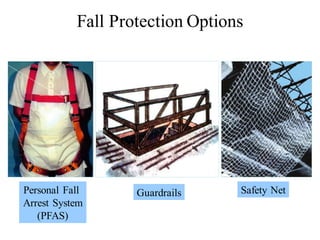
Personal Fall
Arrest System
(PFAS)
Guardrails Safety Net
Fall Protection Options
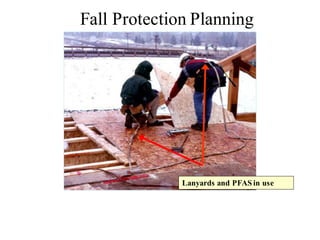
Fall protection systems and work practices
must be in place before you start work.
Lanyards and PFAS in use
Fall Protection Planning
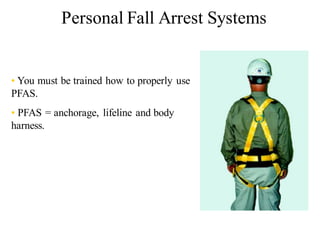
Personal Fall Arrest Systems
• You must be trained how to properly use
PFAS.
• PFAS = anchorage, lifeline and body
harness.
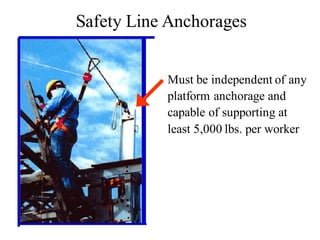
Must be independent of any
platform anchorage and
capable of supporting at
least 5,000 lbs. per worker
Safety Line Anchorages
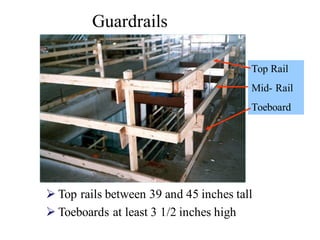
➢ Top rails between 39 and 45 inches tall
➢ Toeboards at least 3 1/2 inches high
Top Rail
Mid- Rail
Toeboard
Guardrails
When Fall Protection is Needed
➢ Walkways & ramps
➢ Open sides & edges
➢ Holes
➢ Concrete forms & rebar
➢ Excavations
➢ Roofs
➢ Wall openings
➢ Bricklaying
➢ Residential
Construction
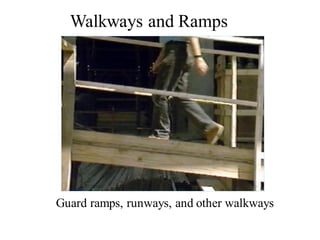
Guard ramps, runways, and other walkways
Walkways and Ramps
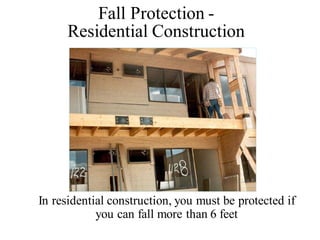
In residential construction, you must be protected if
you can fall more than 6 feet
Fall Protection -
Residential Construction
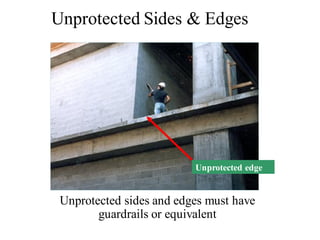
Unprotected edge
Unprotected Sides & Edges
Unprotected sides and edges must have
guardrails or equivalent
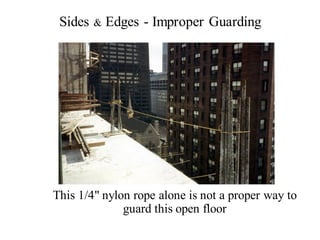
Sides & Edges - Improper Guarding
This 1/4" nylon rope alone is not a proper way to
guard this open floor
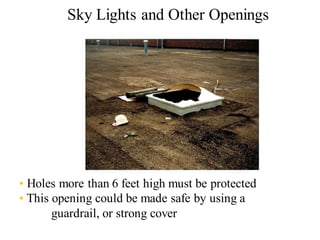
Sky Lights and Other Openings
• Holes more than 6 feet high must be protected
• This opening could be made safe by using a
guardrail, or strong cover
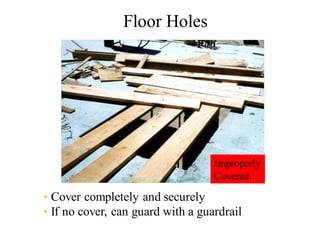
• Cover completely and securely
• If no cover, can guard with a guardrail
Floor Holes
Improperly
Covered
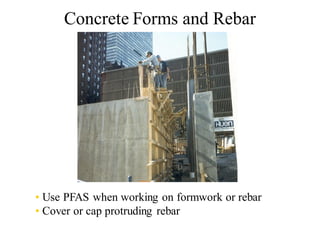
• Use PFAS when working on formwork or rebar
• Cover or cap protruding rebar
Concrete Forms and Rebar
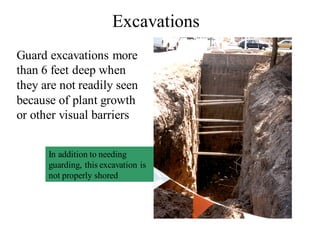
Guard excavations more
than 6 feet deep when
they are not readily seen
because of plant growth
or other visual barriers
Excavations
In addition to needing
guarding, this excavation is
not properly shored
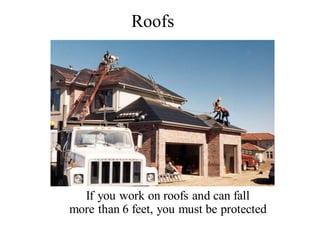
If you work on roofs and can fall
more than 6 feet, you must be protected
Roofs
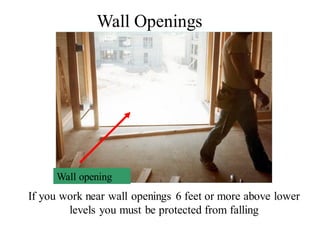
If you work near wall openings 6 feet or more above lower
levels you must be protected from falling
Wall opening
Wall Openings
Summary
➢ If you can fall more than 6 feet, you must be
protected
➢ Use fall protection on:
➢walkways & ramps, open sides & edges, holes,
concrete forms & rebar, excavations, roofs, wall
openings, bricklaying, residential construction
➢ Protective measures include guardrails, covers,
safety nets, and Personal Fall Arrest Systems
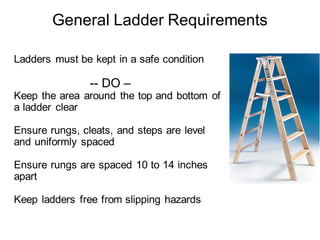
Ladders must be kept in a safe condition
-- DO –
Keep the area around the top and bottom of
a ladder clear
Ensure rungs, cleats, and steps are level
and uniformly spaced
Ensure rungs are spaced 10 to 14 inches
apart
Keep ladders free from slipping hazards
General Ladder Requirements
(#)
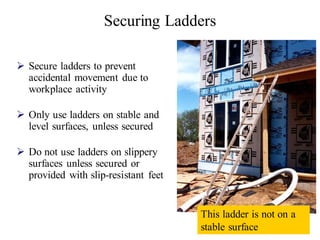
Securing Ladders
➢ Secure ladders to prevent
accidental movement due to
workplace activity
➢ Only use ladders on stable and
level surfaces, unless secured
➢ Do not use ladders on slippery
surfaces unless secured or
provided with slip-resistant feet
This ladder is not on a
stable surface
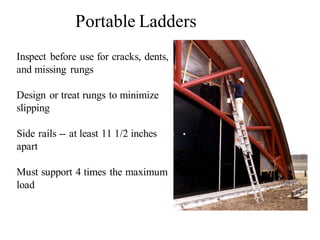
Inspect before use for cracks, dents,
and missing rungs
Design or treat rungs to minimize
slipping
Side rails -- at least 11 1/2 inches
apart
Must support 4 times the maximum
load
Portable Ladders
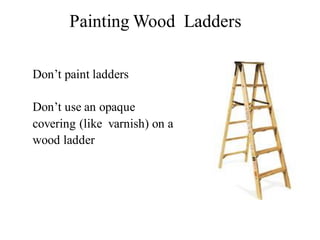
Don’t paint ladders
Don’t use an opaque
covering (like varnish) on a
wood ladder
Painting Wood Ladders
SCD- 2006 HSE-P-FPR-00 (#)
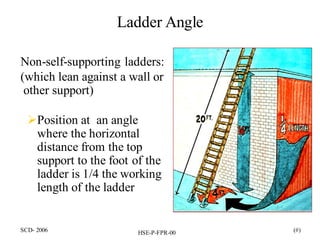
Ladder Angle
Non-self-supporting ladders:
(which lean against a wall or
other support)
➢Position at an angle
where the horizontal
distance from the top
support to the foot of the
ladder is 1/4 the working
length of the ladder
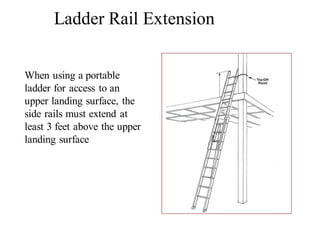
When using a portable
ladder for access to an
upper landing surface, the
side rails must extend at
least 3 feet above the upper
landing surface
Ladder Rail Extension
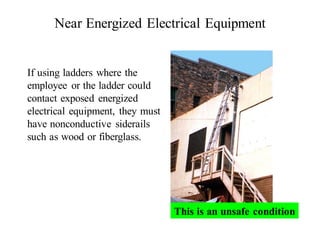
Near Energized Electrical Equipment
If using ladders where the
employee or the ladder could
contact exposed energized
electrical equipment, they must
have nonconductive siderails
such as wood or fiberglass.
This is an unsafe condition
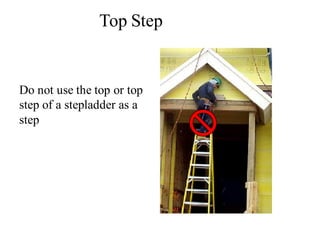
Do not use the top or top
step of a stepladder as a
step
Top Step
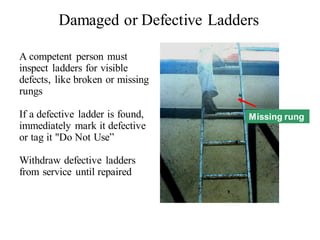
A competent person must
inspect ladders for visible
defects, like broken or missing
rungs
If a defective ladder is found,
immediately mark it defective
or tag it "Do Not Use”
Withdraw defective ladders
from service until repaired
Damaged or Defective Ladders
Missing rung
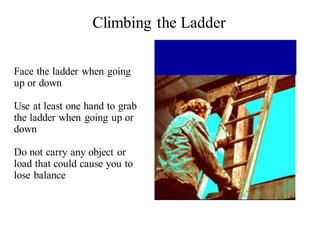
Face the ladder when going
up or down
Use at least one hand to grab
the ladder when going up or
down
Do not carry any object or
load that could cause you to
lose balance
Climbing the Ladder
Summary
Key Components for Ladder Safety
• A competent person must inspect
• Use the correct ladder for the job
• Use the correct angle, supports, treads, cross braces
and rails
• Don’t overload
• Your employer must train you in proper use of a
ladder
Thank you…

Fall Protection System | Gaurav Singh Rajput

  • 1.
    Fall Protection ona Construction Site
  • 2.
    Falls are theleading cause of deaths in the construction industry. Most fatalities occur when employees fall from open-sided floors and through floor openings. Falls from as little as 4 to 6 feet can cause serious lost-time accidents and sometimes death. Open-sided floors and platforms 6 feet or more in height must be guarded. Falls in Construction
  • 3.
    This presentation willdiscuss: • The working conditions that prompt use of fall protection • Options that are available to protect workers from falls Fall Protection
  • 4.
    Upon completion ofthe course, the participants will be able to: 1. List at least three methods of fall protection. 2. State the main criteria that prompt use of fall protection for construction workers. 3. List or describe at least four safety guidelines or requirements that reduce or eliminate slipping, tripping or falling hazards on stairs in use at a construction site. 4. List or describe at least four safety practices or requirements that reduce or eliminate slipping, tripping or falling hazards when ladders are in use at a construction site Fall Protection
  • 5.
    Personal Fall Arrest System (PFAS) GuardrailsSafety Net Fall Protection Options
  • 6.
    Fall protection systemsand work practices must be in place before you start work. Lanyards and PFAS in use Fall Protection Planning
  • 7.
    Personal Fall ArrestSystems • You must be trained how to properly use PFAS. • PFAS = anchorage, lifeline and body harness.
  • 8.
    Must be independentof any platform anchorage and capable of supporting at least 5,000 lbs. per worker Safety Line Anchorages
  • 9.
    ➢ Top railsbetween 39 and 45 inches tall ➢ Toeboards at least 3 1/2 inches high Top Rail Mid- Rail Toeboard Guardrails
  • 10.
    When Fall Protectionis Needed ➢ Walkways & ramps ➢ Open sides & edges ➢ Holes ➢ Concrete forms & rebar ➢ Excavations ➢ Roofs ➢ Wall openings ➢ Bricklaying ➢ Residential Construction
  • 11.
    Guard ramps, runways,and other walkways Walkways and Ramps
  • 12.
    In residential construction,you must be protected if you can fall more than 6 feet Fall Protection - Residential Construction
  • 13.
    Unprotected edge Unprotected Sides& Edges Unprotected sides and edges must have guardrails or equivalent
  • 14.
    Sides & Edges- Improper Guarding This 1/4" nylon rope alone is not a proper way to guard this open floor
  • 15.
    Sky Lights andOther Openings • Holes more than 6 feet high must be protected • This opening could be made safe by using a guardrail, or strong cover
  • 16.
    • Cover completelyand securely • If no cover, can guard with a guardrail Floor Holes Improperly Covered
  • 17.
    • Use PFASwhen working on formwork or rebar • Cover or cap protruding rebar Concrete Forms and Rebar
  • 18.
    Guard excavations more than6 feet deep when they are not readily seen because of plant growth or other visual barriers Excavations In addition to needing guarding, this excavation is not properly shored
  • 19.
    If you workon roofs and can fall more than 6 feet, you must be protected Roofs
  • 20.
    If you worknear wall openings 6 feet or more above lower levels you must be protected from falling Wall opening Wall Openings
  • 21.
    Summary ➢ If youcan fall more than 6 feet, you must be protected ➢ Use fall protection on: ➢walkways & ramps, open sides & edges, holes, concrete forms & rebar, excavations, roofs, wall openings, bricklaying, residential construction ➢ Protective measures include guardrails, covers, safety nets, and Personal Fall Arrest Systems
  • 22.
    Ladders must bekept in a safe condition -- DO – Keep the area around the top and bottom of a ladder clear Ensure rungs, cleats, and steps are level and uniformly spaced Ensure rungs are spaced 10 to 14 inches apart Keep ladders free from slipping hazards General Ladder Requirements
  • 23.
    (#) Securing Ladders ➢ Secureladders to prevent accidental movement due to workplace activity ➢ Only use ladders on stable and level surfaces, unless secured ➢ Do not use ladders on slippery surfaces unless secured or provided with slip-resistant feet This ladder is not on a stable surface
  • 24.
    Inspect before usefor cracks, dents, and missing rungs Design or treat rungs to minimize slipping Side rails -- at least 11 1/2 inches apart Must support 4 times the maximum load Portable Ladders
  • 25.
    Don’t paint ladders Don’tuse an opaque covering (like varnish) on a wood ladder Painting Wood Ladders
  • 26.
    SCD- 2006 HSE-P-FPR-00(#) Ladder Angle Non-self-supporting ladders: (which lean against a wall or other support) ➢Position at an angle where the horizontal distance from the top support to the foot of the ladder is 1/4 the working length of the ladder
  • 27.
    When using aportable ladder for access to an upper landing surface, the side rails must extend at least 3 feet above the upper landing surface Ladder Rail Extension
  • 28.
    Near Energized ElectricalEquipment If using ladders where the employee or the ladder could contact exposed energized electrical equipment, they must have nonconductive siderails such as wood or fiberglass. This is an unsafe condition
  • 29.
    Do not usethe top or top step of a stepladder as a step Top Step
  • 30.
    A competent personmust inspect ladders for visible defects, like broken or missing rungs If a defective ladder is found, immediately mark it defective or tag it "Do Not Use” Withdraw defective ladders from service until repaired Damaged or Defective Ladders Missing rung
  • 31.
    Face the ladderwhen going up or down Use at least one hand to grab the ladder when going up or down Do not carry any object or load that could cause you to lose balance Climbing the Ladder
  • 32.
    Summary Key Components forLadder Safety • A competent person must inspect • Use the correct ladder for the job • Use the correct angle, supports, treads, cross braces and rails • Don’t overload • Your employer must train you in proper use of a ladder
  • 33.