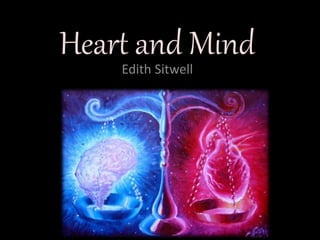
Heart and Mind
Edith Sitwell
Edith Sitwell
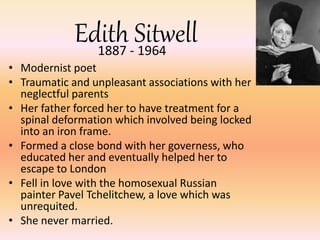
• Modernist poet
• Traumatic and unpleasant associations with her
neglectful parents
• Her father forced her to have treatment for a
spinal deformation which involved being locked
into an iron frame.
• Formed a close bond with her governess, who
educated her and eventually helped her to
escape to London
• Fell in love with the homosexual Russian
painter Pavel Tchelitchew, a love which was
unrequited.
• She never married.
1887 - 1964
Style & Influences
• Edith Sitwell wrote poetry in a dramatic mock
nursery rhyme style.
• She is famous for war poetry that mourns the
death of an entire generation of young men and
wasted swathes of country side in Europe.
• In this poem, the additional influences of her
unrequited love, the death of her governess, and
her ideas about the futility of war, may also
colour the images she creates.
What’s the poem about?
• Love & mortality expressed through allegorical
figures
• Physical existence and spiritual existence
• Whether the heart and mind function in
opposition to each other, or work together to
create a lasting legacy
• The destructive power of love in the form of
lust and obsession, or unrequited love
*Allegory - a story, poem, or picture that can be interpreted to reveal a hidden
meaning, typically a moral or political one. E.g. Animal Farm
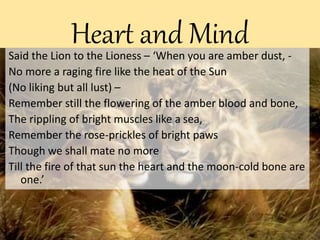
Heart and MindSaid the Lion to the Lioness – ‘When you are amber dust, -
No more a raging fire like the heat of the Sun
(No liking but all lust) –
Remember still the flowering of the amber blood and bone,
The rippling of bright muscles like a sea,
Remember the rose-prickles of bright paws
Though we shall mate no more
Till the fire of that sun the heart and the moon-cold bone are
one.’
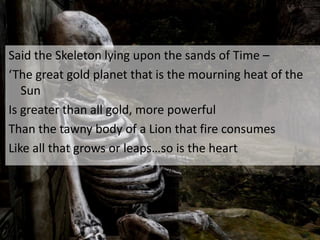
Said the Skeleton lying upon the sands of Time –
‘The great gold planet that is the mourning heat of the
Sun
Is greater than all gold, more powerful
Than the tawny body of a Lion that fire consumes
Like all that grows or leaps…so is the heart
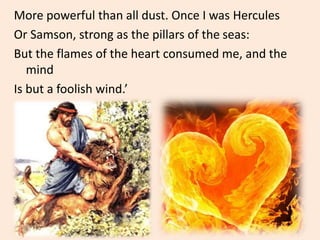
More powerful than all dust. Once I was Hercules
Or Samson, strong as the pillars of the seas:
But the flames of the heart consumed me, and the
mind
Is but a foolish wind.’
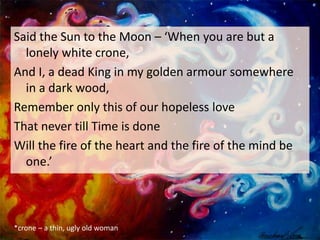
Said the Sun to the Moon – ‘When you are but a
lonely white crone,
And I, a dead King in my golden armour somewhere
in a dark wood,
Remember only this of our hopeless love
That never till Time is done
Will the fire of the heart and the fire of the mind be
one.’
*crone – a thin, ugly old woman
Form & Structure
• 4 stanzas (8, 5, 4, and 5 lines respectively)
• No particular rhyme scheme, however rhyme
can be found in certain lines
• Enjambment
• Allegorical figures (lion, lioness & skeleton)
Tone, Mood & Figurative Language
• Tone – grandiose but jaded view of love’s power
• Mood – surreal & fantastical (as if the reader is
being immersed into a legend)
• Focus on colour throughout the poem (esp. gold,
white & black)
• Highly sensual imagery
• In summary: The heart is more powerful and the
mind can only be an observer in affairs of the
heart.
Check out more resources here…
• https://www.youtube.com/watch?v=L-D73ikRqHI (a
great interview!)
• https://prezi.com/akt3qsyo8wby/sitting-well-with-
sitwell/
• http://www.enotes.com/topics/edith-sitwell/critical-
essays/sitwell-edith-1887-1964
• http://www.poetryfoundation.org/bio/edith-sitwell
• http://www.slideshare.net/madihahabeeb5/modernis
m-and-modern-poetry
• http://www.thehellenictimes.com/hercules.html
• http://www.whatchristianswanttoknow.com/samson-
and-delilah-bible-story-summary/
Essay Questions
1. How does Sitwell present the similarities and
differences of the heart and mind within the poem?
2. How has Edith Sitwell expressed her views about the
importance of the heart and the mind in her poem
‘Heart & Mind’ ?
3. Explore how Edith Sitwell has mesmerized her reader
with the belief about the wide chasm between
emotion and intellect in her poem ‘Heart & Mind’?
4. How does Edith Sitwell use language to present a
picture of vitality, strength and energy on one hand
and death, decay and ‘our hopeless love’ on the other
hand in her poem ‘Heart and Mind’ ?
Samson & Hercules (parallels)
• The parallel between Samson and Hercules is in many respects very remarkable, and has been
drawn out by Serdrius and others. The supernatural strength of each, the slavery to women (“Quem
non mille for, quem non Sthenellius hostis, Non potuit Mayors vincere, vicit amor.” Ovid), the
tearing asunder of the lion, the violent death of each, partly voluntary and partly forced, are all
points of strong general resemblance.
But one of the most remarkable is the connection of Hercules with two pillars. The “pillars of
Hercules” on each side the straits of Gibraltar, Mount Abila and Mount Calpe, were said to have
been rent asunder by the strength of Hercules’ arms. And Herodotus relates that in the temple of
Hercules at Tyre were two remarkable pillars, one of refined gold, the other of smaragdus, some
green stone like an emerald (2:44). But the account given of a visit of Hercules to Egypt is still more
remarkable, as compared with the history of the binding of Samson and the slaughter of the
Philistines, as related in ch. 15.
The following are the words of Herodotus: — “The Greeks say that when Hercules went down to
Egypt, the Egyptians surrounded him, and led him in a procession to sacrifice him to Jupiter; that he
kept quite still for a time, but that when they were commencing the sacrifice at the altar” (the first
act of which was cutting off the hair) “he turned in self-defence, and by his prowess slew them all.”
On which Herodotus remarks, “How was it possible for him, being but one, and being only a man,
to slay many myriads?”
The prevalence of the worship of Hercules among the Phoenicians, as, e.g., at Tyre and Thasos, a
Phoenician colony, and the close connection of Egypt with Gaza, where the prowess of Samson was
so well known, are points not to be omitted in considering the probability of some of the legends of
Hercules being drawn from the history of Samson. So also is the title of the Phoenician Hercules,
the saviour or deliverer, as compared with Judges 2:16, 18; 13:5.

Heart and mind

  • 1.
  • 2.
    Edith Sitwell • Modernistpoet • Traumatic and unpleasant associations with her neglectful parents • Her father forced her to have treatment for a spinal deformation which involved being locked into an iron frame. • Formed a close bond with her governess, who educated her and eventually helped her to escape to London • Fell in love with the homosexual Russian painter Pavel Tchelitchew, a love which was unrequited. • She never married. 1887 - 1964
  • 3.
    Style & Influences •Edith Sitwell wrote poetry in a dramatic mock nursery rhyme style. • She is famous for war poetry that mourns the death of an entire generation of young men and wasted swathes of country side in Europe. • In this poem, the additional influences of her unrequited love, the death of her governess, and her ideas about the futility of war, may also colour the images she creates.
  • 4.
    What’s the poemabout? • Love & mortality expressed through allegorical figures • Physical existence and spiritual existence • Whether the heart and mind function in opposition to each other, or work together to create a lasting legacy • The destructive power of love in the form of lust and obsession, or unrequited love *Allegory - a story, poem, or picture that can be interpreted to reveal a hidden meaning, typically a moral or political one. E.g. Animal Farm
  • 5.
    Heart and MindSaidthe Lion to the Lioness – ‘When you are amber dust, - No more a raging fire like the heat of the Sun (No liking but all lust) – Remember still the flowering of the amber blood and bone, The rippling of bright muscles like a sea, Remember the rose-prickles of bright paws Though we shall mate no more Till the fire of that sun the heart and the moon-cold bone are one.’
  • 6.
    Said the Skeletonlying upon the sands of Time – ‘The great gold planet that is the mourning heat of the Sun Is greater than all gold, more powerful Than the tawny body of a Lion that fire consumes Like all that grows or leaps…so is the heart
  • 7.
    More powerful thanall dust. Once I was Hercules Or Samson, strong as the pillars of the seas: But the flames of the heart consumed me, and the mind Is but a foolish wind.’
  • 8.
    Said the Sunto the Moon – ‘When you are but a lonely white crone, And I, a dead King in my golden armour somewhere in a dark wood, Remember only this of our hopeless love That never till Time is done Will the fire of the heart and the fire of the mind be one.’ *crone – a thin, ugly old woman
  • 9.
    Form & Structure •4 stanzas (8, 5, 4, and 5 lines respectively) • No particular rhyme scheme, however rhyme can be found in certain lines • Enjambment • Allegorical figures (lion, lioness & skeleton)
  • 10.
    Tone, Mood &Figurative Language • Tone – grandiose but jaded view of love’s power • Mood – surreal & fantastical (as if the reader is being immersed into a legend) • Focus on colour throughout the poem (esp. gold, white & black) • Highly sensual imagery • In summary: The heart is more powerful and the mind can only be an observer in affairs of the heart.
  • 11.
    Check out moreresources here… • https://www.youtube.com/watch?v=L-D73ikRqHI (a great interview!) • https://prezi.com/akt3qsyo8wby/sitting-well-with- sitwell/ • http://www.enotes.com/topics/edith-sitwell/critical- essays/sitwell-edith-1887-1964 • http://www.poetryfoundation.org/bio/edith-sitwell • http://www.slideshare.net/madihahabeeb5/modernis m-and-modern-poetry • http://www.thehellenictimes.com/hercules.html • http://www.whatchristianswanttoknow.com/samson- and-delilah-bible-story-summary/
  • 12.
    Essay Questions 1. Howdoes Sitwell present the similarities and differences of the heart and mind within the poem? 2. How has Edith Sitwell expressed her views about the importance of the heart and the mind in her poem ‘Heart & Mind’ ? 3. Explore how Edith Sitwell has mesmerized her reader with the belief about the wide chasm between emotion and intellect in her poem ‘Heart & Mind’? 4. How does Edith Sitwell use language to present a picture of vitality, strength and energy on one hand and death, decay and ‘our hopeless love’ on the other hand in her poem ‘Heart and Mind’ ?
  • 13.
    Samson & Hercules(parallels) • The parallel between Samson and Hercules is in many respects very remarkable, and has been drawn out by Serdrius and others. The supernatural strength of each, the slavery to women (“Quem non mille for, quem non Sthenellius hostis, Non potuit Mayors vincere, vicit amor.” Ovid), the tearing asunder of the lion, the violent death of each, partly voluntary and partly forced, are all points of strong general resemblance. But one of the most remarkable is the connection of Hercules with two pillars. The “pillars of Hercules” on each side the straits of Gibraltar, Mount Abila and Mount Calpe, were said to have been rent asunder by the strength of Hercules’ arms. And Herodotus relates that in the temple of Hercules at Tyre were two remarkable pillars, one of refined gold, the other of smaragdus, some green stone like an emerald (2:44). But the account given of a visit of Hercules to Egypt is still more remarkable, as compared with the history of the binding of Samson and the slaughter of the Philistines, as related in ch. 15. The following are the words of Herodotus: — “The Greeks say that when Hercules went down to Egypt, the Egyptians surrounded him, and led him in a procession to sacrifice him to Jupiter; that he kept quite still for a time, but that when they were commencing the sacrifice at the altar” (the first act of which was cutting off the hair) “he turned in self-defence, and by his prowess slew them all.” On which Herodotus remarks, “How was it possible for him, being but one, and being only a man, to slay many myriads?” The prevalence of the worship of Hercules among the Phoenicians, as, e.g., at Tyre and Thasos, a Phoenician colony, and the close connection of Egypt with Gaza, where the prowess of Samson was so well known, are points not to be omitted in considering the probability of some of the legends of Hercules being drawn from the history of Samson. So also is the title of the Phoenician Hercules, the saviour or deliverer, as compared with Judges 2:16, 18; 13:5.