EDUC9707 SUMMARY
Based on the work of:
Schmoker, M. (2004): Tipping Point:
From Feckless Reform to Substantive Instructional
Improvement. Phil Delta Kappan, 85(6), pp.424-
432
Presented by Jan Carey
Week 7
This article presents the view that the most promising
strategy for achieving school improvement is
‘building the capacity of the school personnel to
function as a professional learning community’
It presents this view through:
1. Evidence against conventional reform and
improvement methods
2. Evidence for the use of learning communities
Overview of main points
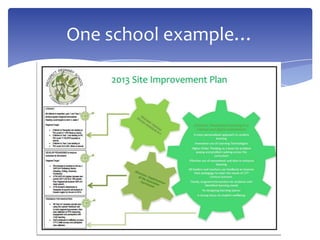
In 1980’s Strategic Plans were : comprehensive,
systemic plans including : vision, mission, belief
statements, setting goals, action steps, objectives,
resources needed, people responsible, evaluation,
timelines… etc (pg 426)
Resulting in overwhelming difficulty to monitor or control
Difficulty with clarity and coherence of plan
Outcomes often based around activities rather than student
learning
Too many goals - unachievable
Evolution of strategic plans
One school example …
…cont
‘Looking back, it is clearer to me now that these
plans – for all their seemingly tight, logical
connections between mission, goals, actions,
responsibilities and evaluation – were like
beautiful but badly leaking boats.’
Schmoker, Pg 426
Looking back…
Promotes a focus on hasty commitment to long term
goals, initiatives & projects rather than thoughtful, smart,
short-term cycles of action, assessment and adjustment.
That initiatives often selected for political or personal
reasons (trends) rather than due to their direct proven
success (pg 427)
Often presumes thinking is done by ‘planners’ in the school
before the year starts rather than by practitioners
throughout the year
Why does strategic planning fail?
Most productive thinking is continuous, targeted,
short term cycles of improvement.
The ‘Magic of momentum’ and ‘win small, win early,
win often’ …keeps engagement of teachers high &
leads to greater success over a year
Importance of systematic recognition and celebration
Focus on creating conditions for teachers (in teams)
to continuously achieve short term wins (pg 427)
Short term vs annual plans...
Planning can impact on staff morale, creativity and
enthusiasm
‘overload’, ‘too much to do’, disjointed’ (pg 428)
Too much involvement of parents & community can
dilute and complicate the improvement effort & use
precious time of principals
Under the illusion we can affect ‘whole school
reform’ through planning (pg 429)
Impacts of planning…
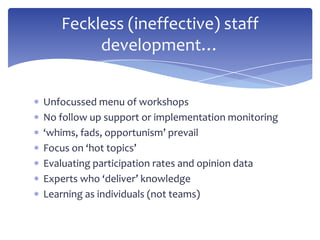
Unfocussed menu of workshops
No follow up support or implementation monitoring
‘whims, fads, opportunism’ prevail
Focus on ‘hot topics’
Evaluating participation rates and opinion data
Experts who ‘deliver’ knowledge
Learning as individuals (not teams)
Feckless (ineffective) staff
development…
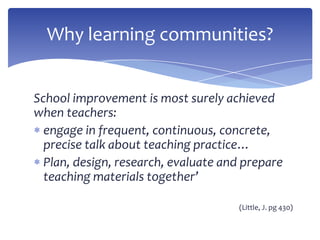
School improvement is most surely achieved
when teachers:
engage in frequent, continuous, concrete,
precise talk about teaching practice…
Plan, design, research, evaluate and prepare
teaching materials together’
(Little, J. pg 430)
Why learning communities?
Higher quality solutions to teaching problems
Increased confidence
Greater ability to support each other and improve
More supportive for beginning teachers
Access to a greater pool of ideas and practices
= ‘remarkable gains in achievement’ (pg 431)
Benefits of PLCs…
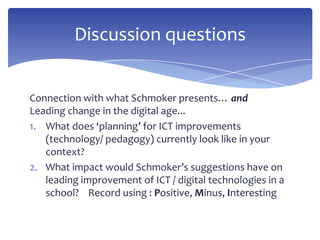
Connection with what Schmoker presents… and
Leading change in the digital age...
1. What does ‘planning’ for ICT improvements
(technology/ pedagogy) currently look like in your
context?
2. What impact would Schmoker’s suggestions have on
leading improvement of ICT / digital technologies in a
school? Record using : Positive, Minus, Interesting
Discussion questions
Despite the evidence and consensus about the
effectiveness of learning communities …they are still
rarely used / or to their full effect
Momentum in schools needs to reach a ‘tipping point’
where the value and use of PLCs is identified as more
effective than using plans
Conclusion… the tipping point
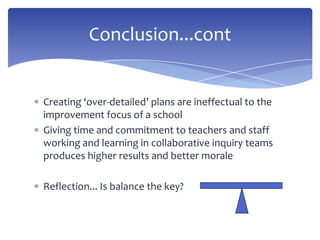
Creating ‘over-detailed’ plans are ineffectual to the
improvement focus of a school
Giving time and commitment to teachers and staff
working and learning in collaborative inquiry teams
produces higher results and better morale
Reflection... Is balance the key?
Conclusion...cont
One school example…
Schmoker, M. (2004): Tipping Point:
From Feckless Reform to Substantive Instructional
Improvement. Phil Delta Kappan, 85(6), pp.424-432
Prospect Primary School – Site Improvement Plan
(slide 15)
References
Thank you

Please add a comment to the
Slideshare

Schmoker article

  • 1.
    EDUC9707 SUMMARY Based onthe work of: Schmoker, M. (2004): Tipping Point: From Feckless Reform to Substantive Instructional Improvement. Phil Delta Kappan, 85(6), pp.424- 432 Presented by Jan Carey Week 7
  • 2.
    This article presentsthe view that the most promising strategy for achieving school improvement is ‘building the capacity of the school personnel to function as a professional learning community’ It presents this view through: 1. Evidence against conventional reform and improvement methods 2. Evidence for the use of learning communities Overview of main points
  • 3.
    In 1980’s StrategicPlans were : comprehensive, systemic plans including : vision, mission, belief statements, setting goals, action steps, objectives, resources needed, people responsible, evaluation, timelines… etc (pg 426) Resulting in overwhelming difficulty to monitor or control Difficulty with clarity and coherence of plan Outcomes often based around activities rather than student learning Too many goals - unachievable Evolution of strategic plans
  • 4.
  • 5.
  • 6.
    ‘Looking back, itis clearer to me now that these plans – for all their seemingly tight, logical connections between mission, goals, actions, responsibilities and evaluation – were like beautiful but badly leaking boats.’ Schmoker, Pg 426 Looking back…
  • 7.
    Promotes a focuson hasty commitment to long term goals, initiatives & projects rather than thoughtful, smart, short-term cycles of action, assessment and adjustment. That initiatives often selected for political or personal reasons (trends) rather than due to their direct proven success (pg 427) Often presumes thinking is done by ‘planners’ in the school before the year starts rather than by practitioners throughout the year Why does strategic planning fail?
  • 8.
    Most productive thinkingis continuous, targeted, short term cycles of improvement. The ‘Magic of momentum’ and ‘win small, win early, win often’ …keeps engagement of teachers high & leads to greater success over a year Importance of systematic recognition and celebration Focus on creating conditions for teachers (in teams) to continuously achieve short term wins (pg 427) Short term vs annual plans...
  • 9.
    Planning can impacton staff morale, creativity and enthusiasm ‘overload’, ‘too much to do’, disjointed’ (pg 428) Too much involvement of parents & community can dilute and complicate the improvement effort & use precious time of principals Under the illusion we can affect ‘whole school reform’ through planning (pg 429) Impacts of planning…
  • 10.
    Unfocussed menu ofworkshops No follow up support or implementation monitoring ‘whims, fads, opportunism’ prevail Focus on ‘hot topics’ Evaluating participation rates and opinion data Experts who ‘deliver’ knowledge Learning as individuals (not teams) Feckless (ineffective) staff development…
  • 11.
    School improvement ismost surely achieved when teachers: engage in frequent, continuous, concrete, precise talk about teaching practice… Plan, design, research, evaluate and prepare teaching materials together’ (Little, J. pg 430) Why learning communities?
  • 12.
    Higher quality solutionsto teaching problems Increased confidence Greater ability to support each other and improve More supportive for beginning teachers Access to a greater pool of ideas and practices = ‘remarkable gains in achievement’ (pg 431) Benefits of PLCs…
  • 13.
    Connection with whatSchmoker presents… and Leading change in the digital age... 1. What does ‘planning’ for ICT improvements (technology/ pedagogy) currently look like in your context? 2. What impact would Schmoker’s suggestions have on leading improvement of ICT / digital technologies in a school? Record using : Positive, Minus, Interesting Discussion questions
  • 14.
    Despite the evidenceand consensus about the effectiveness of learning communities …they are still rarely used / or to their full effect Momentum in schools needs to reach a ‘tipping point’ where the value and use of PLCs is identified as more effective than using plans Conclusion… the tipping point
  • 15.
    Creating ‘over-detailed’ plansare ineffectual to the improvement focus of a school Giving time and commitment to teachers and staff working and learning in collaborative inquiry teams produces higher results and better morale Reflection... Is balance the key? Conclusion...cont
  • 16.
  • 17.
    Schmoker, M. (2004):Tipping Point: From Feckless Reform to Substantive Instructional Improvement. Phil Delta Kappan, 85(6), pp.424-432 Prospect Primary School – Site Improvement Plan (slide 15) References
  • 18.
    Thank you  Please adda comment to the Slideshare