A CROSS-LINGUAL ANNOTATION PROJECTION
APPROACH FOR RELATION DETECTION

   The 23rd International Conference on Computational Linguistics (COLING 2010)
                              August 24th, 2010, Beijing

                       Seokhwan Kim (POSTECH)
                     Minwoo Jeong (Saarland University)
                         Jonghoon Lee (POSTECH)
                       Gary Geunbae Lee (POSTECH)
Contents
• Introduction
• Methods
    Cross-lingual Annotation Projection for Relation Detection
    Noise Reduction Strategies
• Evaluation
• Conclusion


                                                                  2
Contents
• Introduction
• Methods
    Cross-lingual Annotation Projection for Relation Detection
    Noise Reduction Strategies
• Evaluation
• Conclusion


                                                                  3
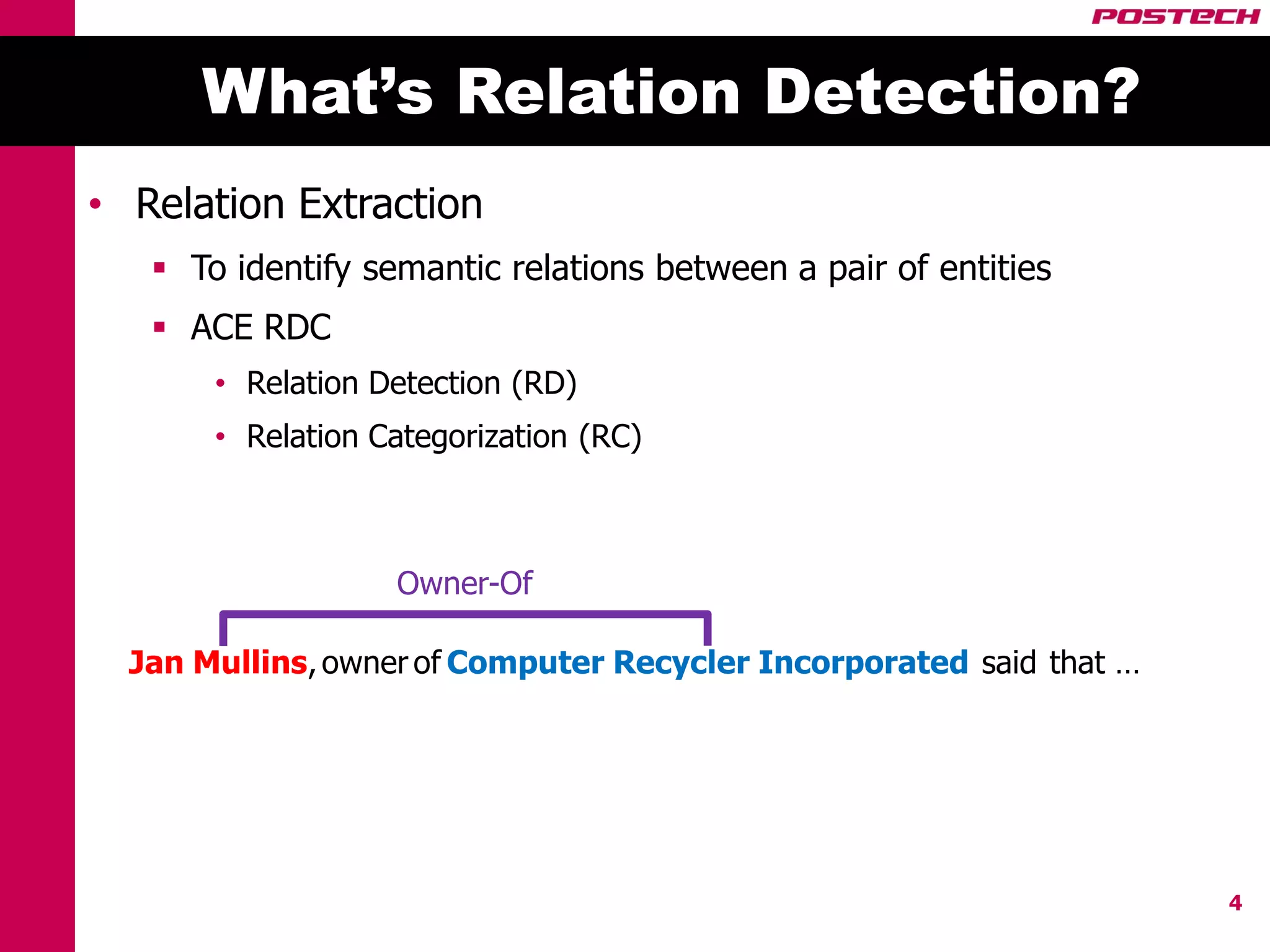
What’s Relation Detection?
• Relation Extraction
    To identify semantic relations between a pair of entities
    ACE RDC
       • Relation Detection (RD)
       • Relation Categorization (RC)


                   Owner-Of

  Jan Mullins, owner of Computer Recycler Incorporated said that …


                                                                     4
What’s the Problem?
• Many supervised machine learning approaches have been
  successfully applied to the RDC task
    (Kambhatla, 2004; Zhou et al., 2005; Zelenko et al., 2003; Culotta
     and Sorensen, 2004; Bunescu and Mooney, 2005; Zhang et al.,
     2006)
• Datasets for relation detection
    Labeled corpora for supervised learning
    Available for only a few languages
       • English, Chinese, Arabic
    No resources for other languages
       • Korean


                                                                          5
Contents
• Introduction
• Methods
    Cross-lingual Annotation Projection for Relation Detection
    Noise Reduction Strategies
• Evaluation
• Conclusion


                                                                  6
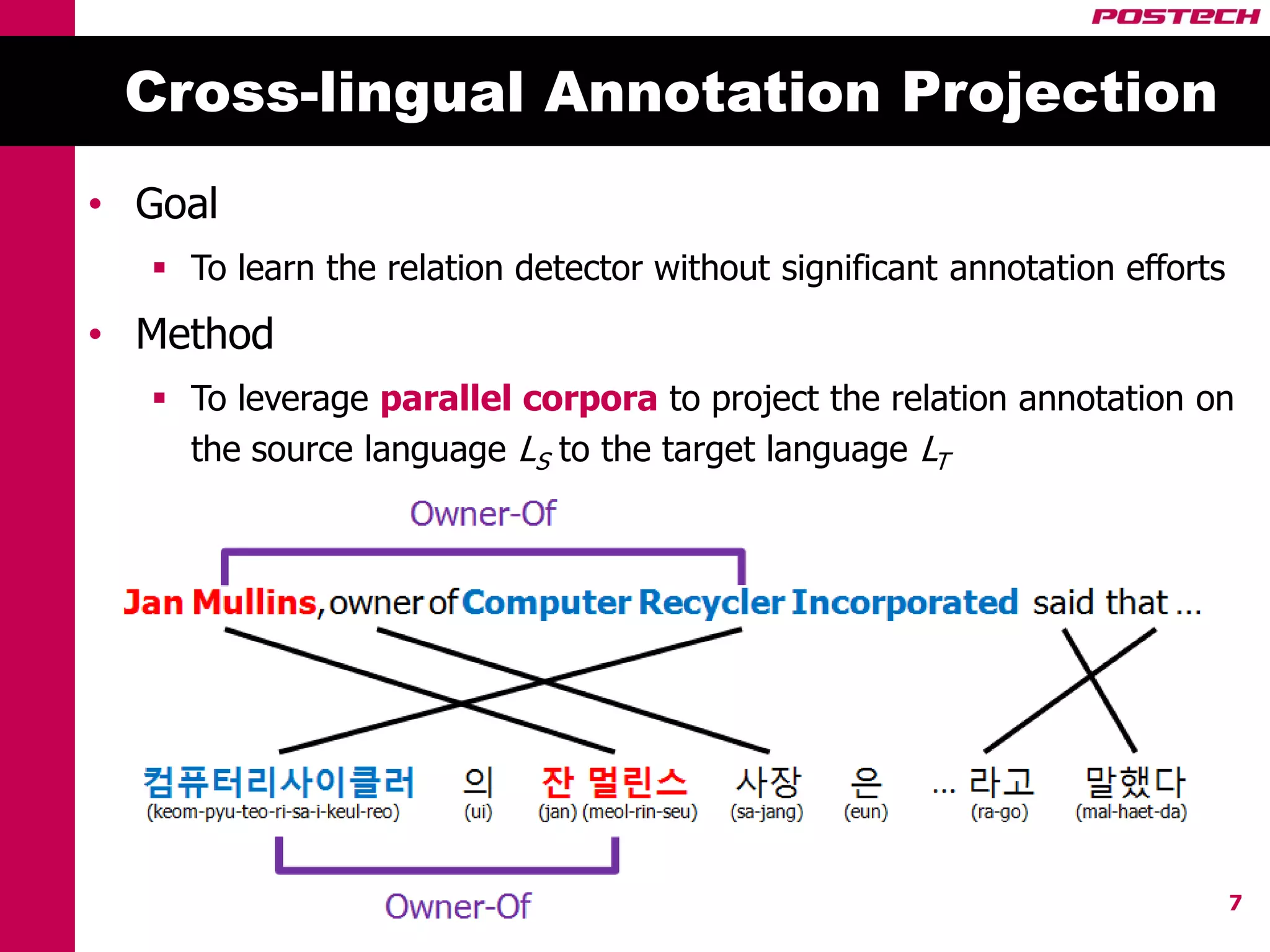
Cross-lingual Annotation Projection
• Goal
   To learn the relation detector without significant annotation efforts
• Method
   To leverage parallel corpora to project the relation annotation on
    the source language LS to the target language LT


                                                                            7
Cross-lingual Annotation Projection
• Previous Work
    Part-of-speech tagging (Yarowsky and Ngai, 2001)
    Named-entity tagging (Yarowsky et al., 2001)
    Verb classification (Merlo et al., 2002)
    Dependency parsing (Hwa et al., 2005)
    Mention detection (Zitouni and Florian, 2008)
    Semantic role labeling (Pado and Lapata, 2009)
• To the best of our knowledge, no work has reported on the
  RDC task


                                                          8
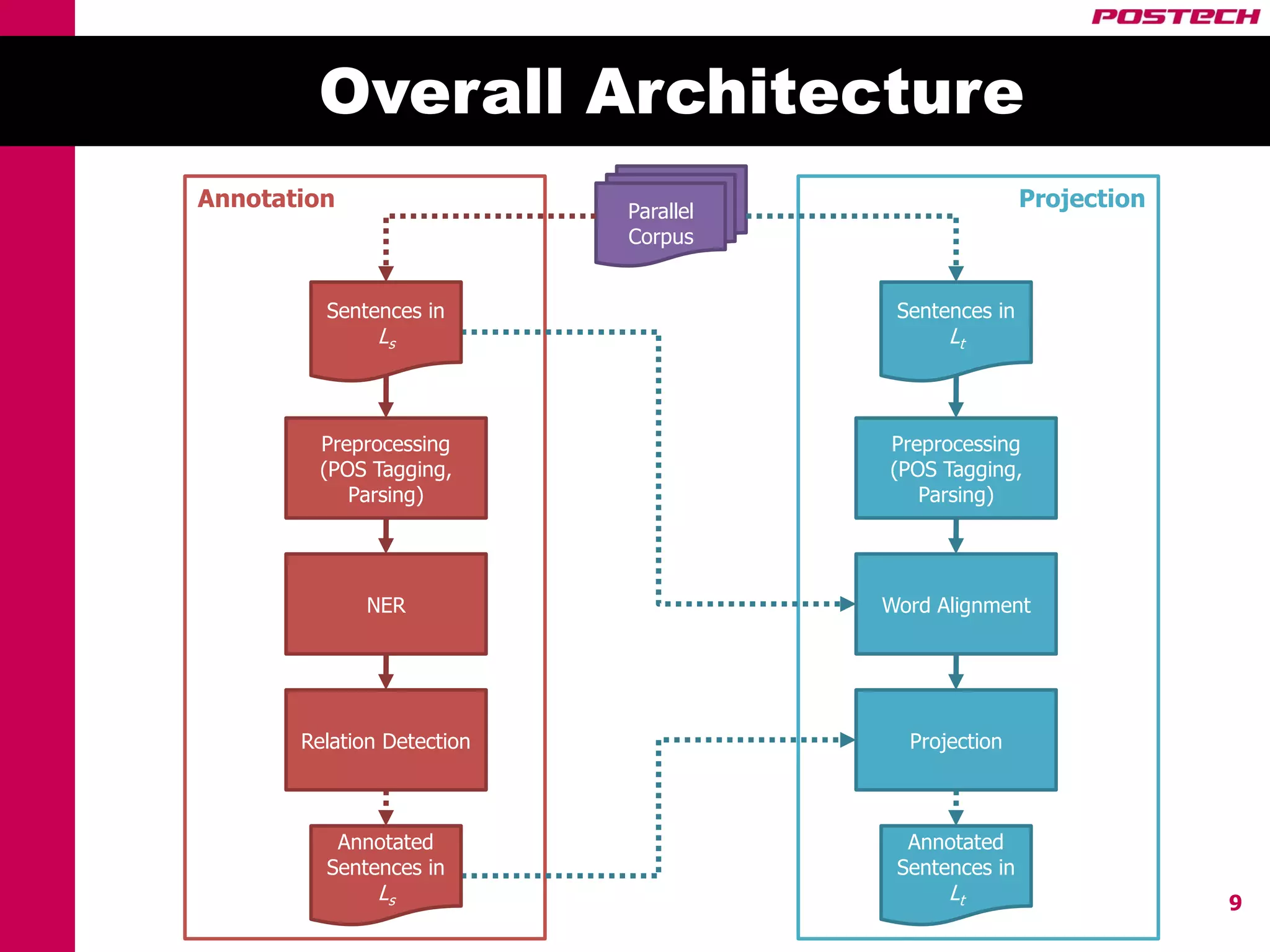
Overall Architecture
Annotation                  Parallel
                                                       Projection
                            Corpus


         Sentences in                   Sentences in
               Ls                            Lt


         Preprocessing                 Preprocessing
         (POS Tagging,                 (POS Tagging,
            Parsing)                      Parsing)


             NER                       Word Alignment


       Relation Detection                Projection


          Annotated                      Annotated
         Sentences in                   Sentences in
               Ls                            Lt                     9
How to Reduce Noise?
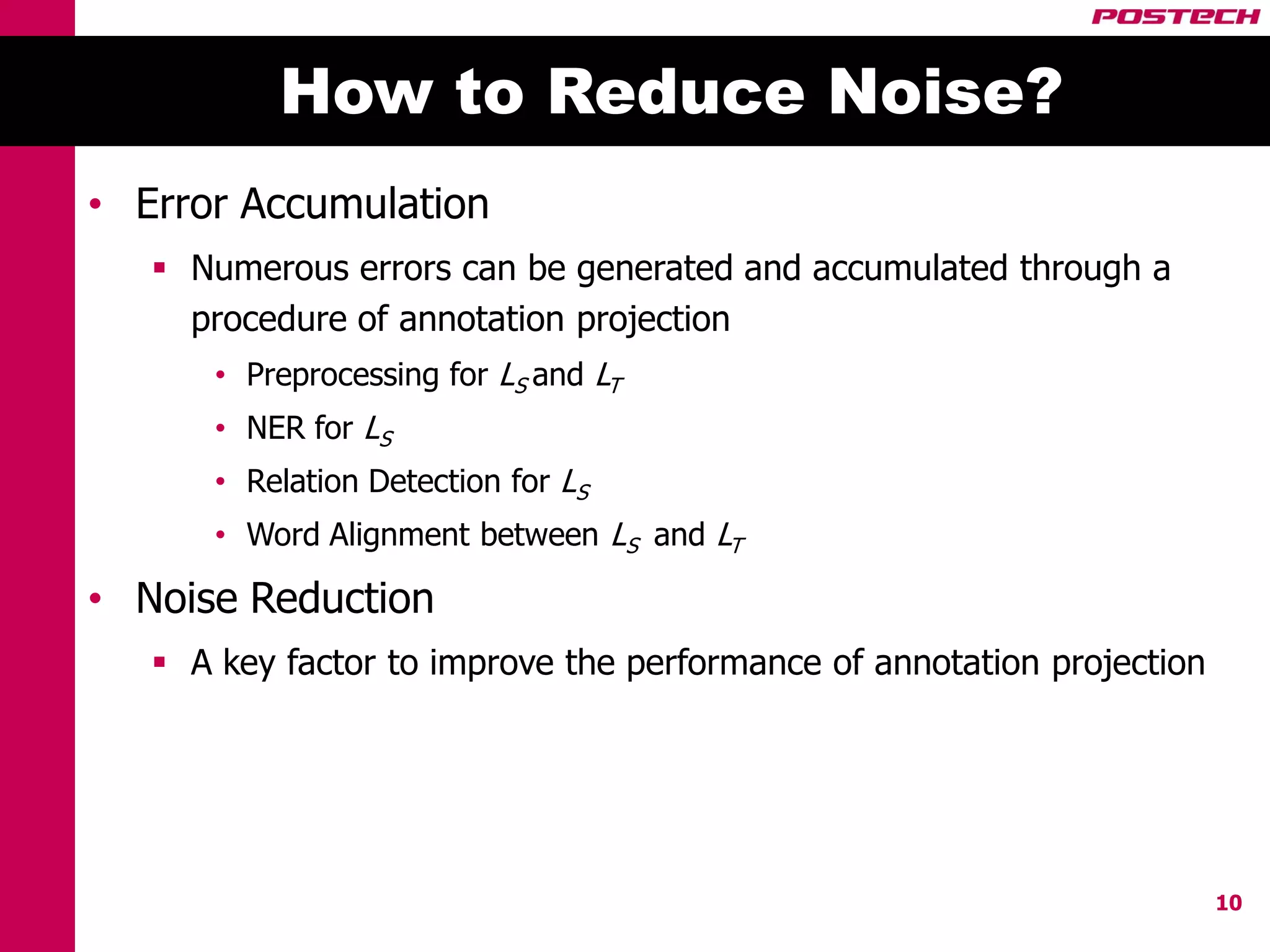
• Error Accumulation
    Numerous errors can be generated and accumulated through a
     procedure of annotation projection
      • Preprocessing for LS and LT
      • NER for LS
      • Relation Detection for LS
      • Word Alignment between LS and LT

• Noise Reduction
    A key factor to improve the performance of annotation projection


                                                                        10
How to Reduce Noise?
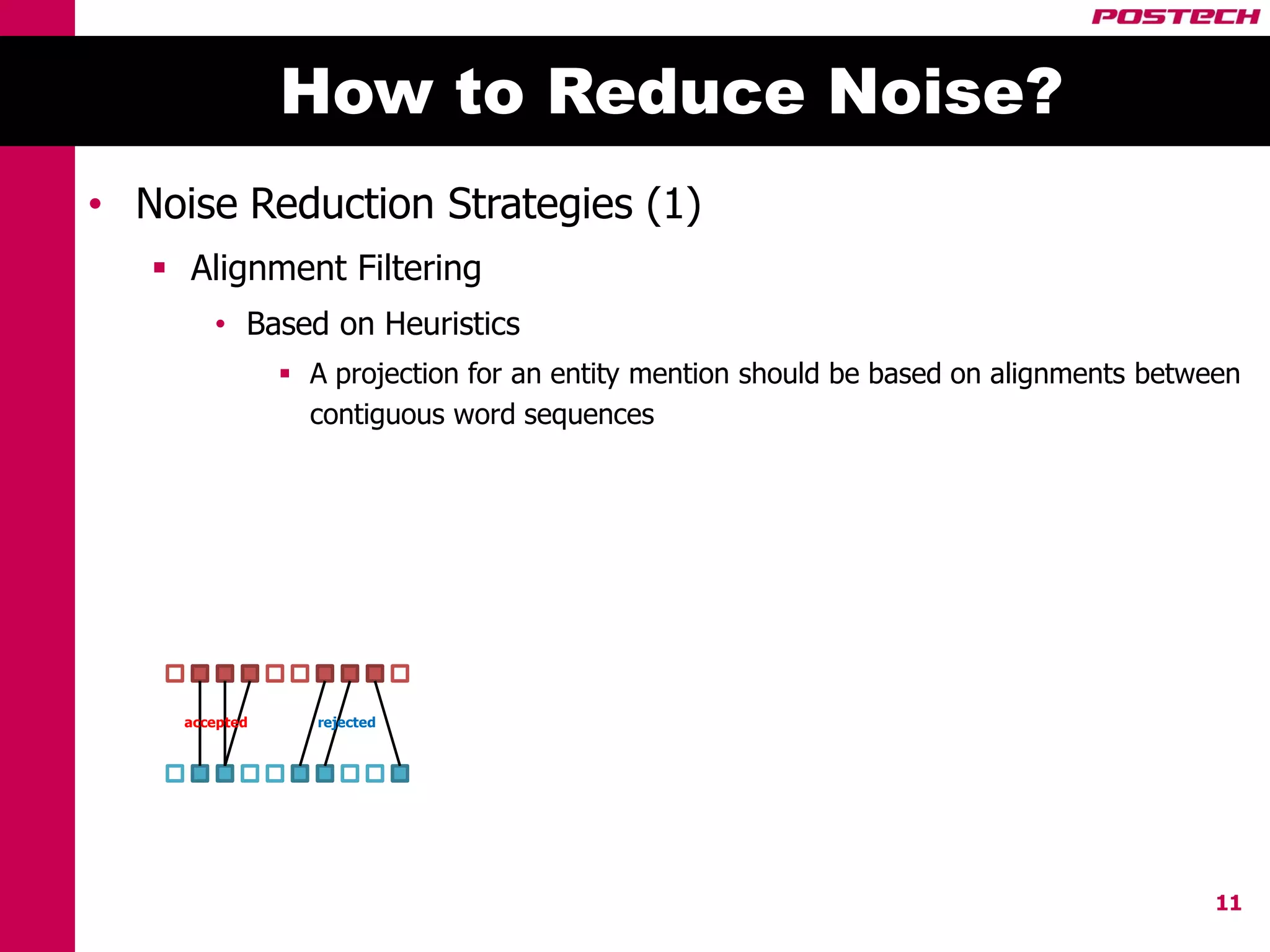
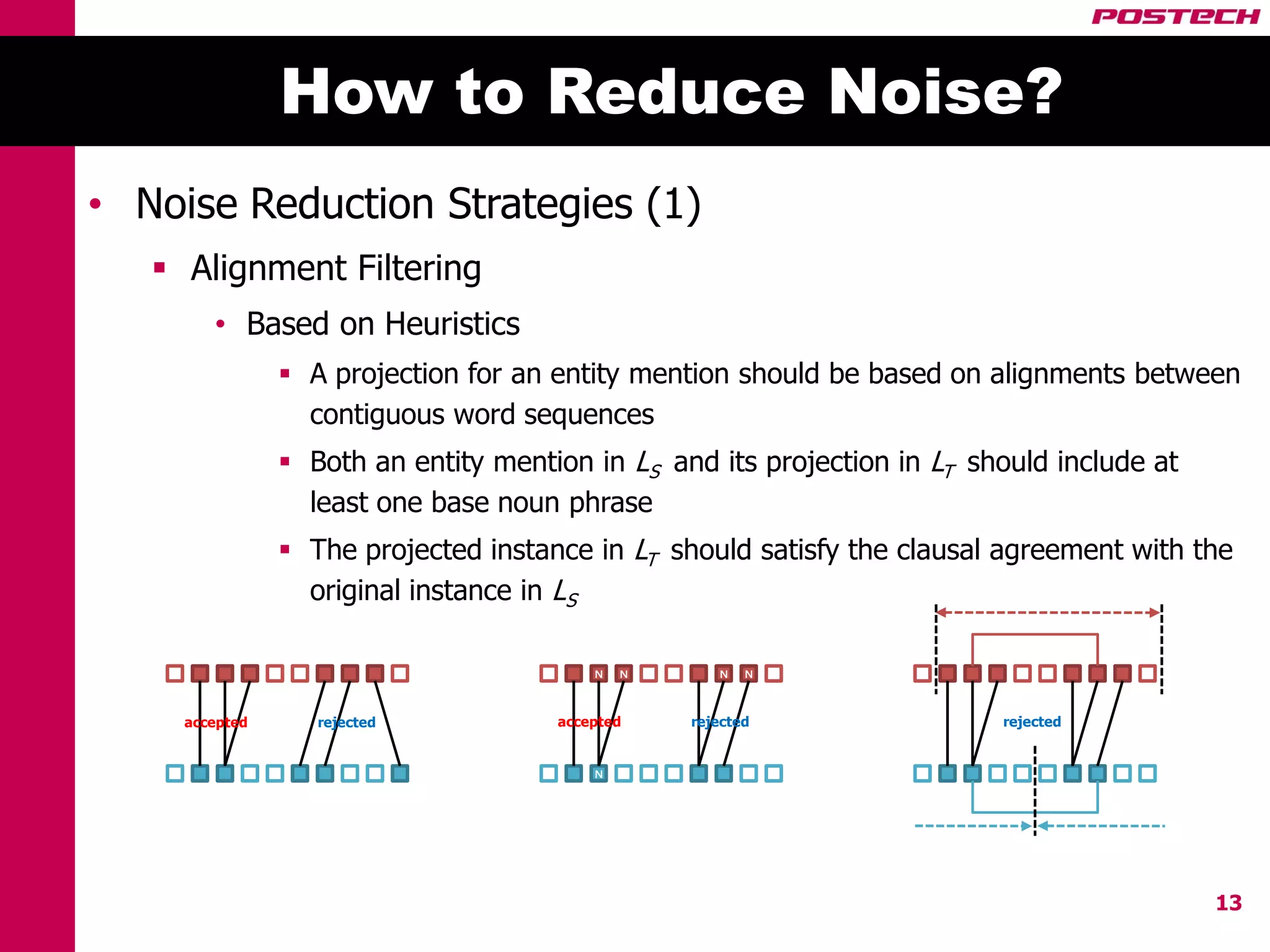
• Noise Reduction Strategies (1)
    Alignment Filtering
        • Based on Heuristics
                 A projection for an entity mention should be based on alignments between
                  contiguous word sequences


     accepted      rejected


                                                                                        11
How to Reduce Noise?
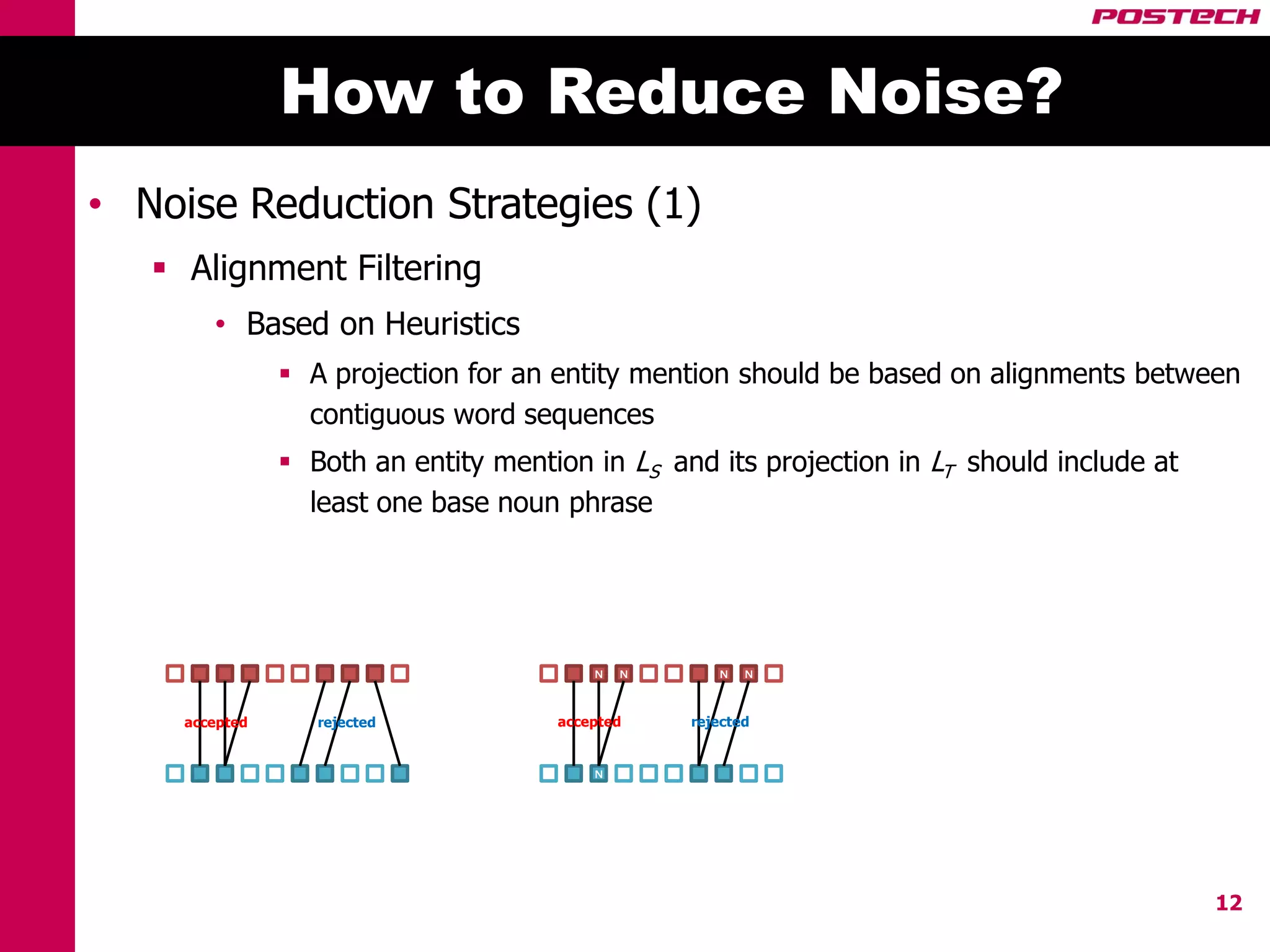
• Noise Reduction Strategies (1)
    Alignment Filtering
        • Based on Heuristics
                 A projection for an entity mention should be based on alignments between
                  contiguous word sequences
                 Both an entity mention in LS and its projection in LT should include at
                  least one base noun phrase


                                          N   N      N   N


     accepted      rejected           accepted    rejected


                                          N


                                                                                            12
How to Reduce Noise?
• Noise Reduction Strategies (1)
    Alignment Filtering
        • Based on Heuristics
                 A projection for an entity mention should be based on alignments between
                  contiguous word sequences
                 Both an entity mention in LS and its projection in LT should include at
                  least one base noun phrase
                 The projected instance in LT should satisfy the clausal agreement with the
                  original instance in LS

                                          N   N      N   N


     accepted      rejected           accepted    rejected                rejected


                                          N


                                                                                            13
How to Reduce Noise?
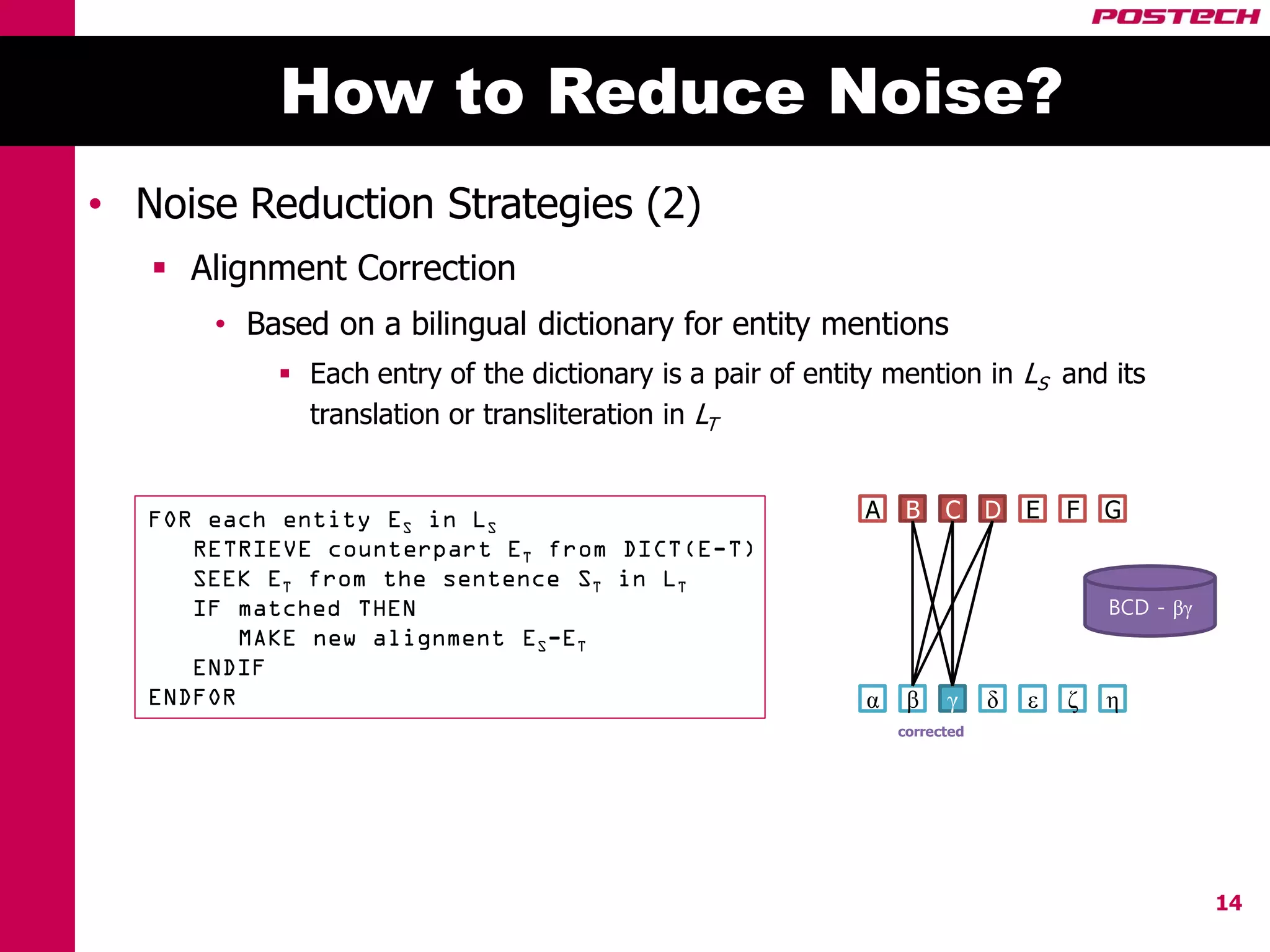
• Noise Reduction Strategies (2)
    Alignment Correction
       • Based on a bilingual dictionary for entity mentions
            Each entry of the dictionary is a pair of entity mention in LS and its
             translation or transliteration in LT


   FOR each entity ES in LS                                A    B    C D       E   F   G
      RETRIEVE counterpart ET from DICT(E-T)
      SEEK ET from the sentence ST in LT
      IF matched THEN                                                                  BCD - βγ
          MAKE new alignment ES-ET
      ENDIF
   ENDFOR                                                  α    β    γ     δ   ε   δ   ε
                                                               corrected


                                                                                                  14
How to Reduce Noise?
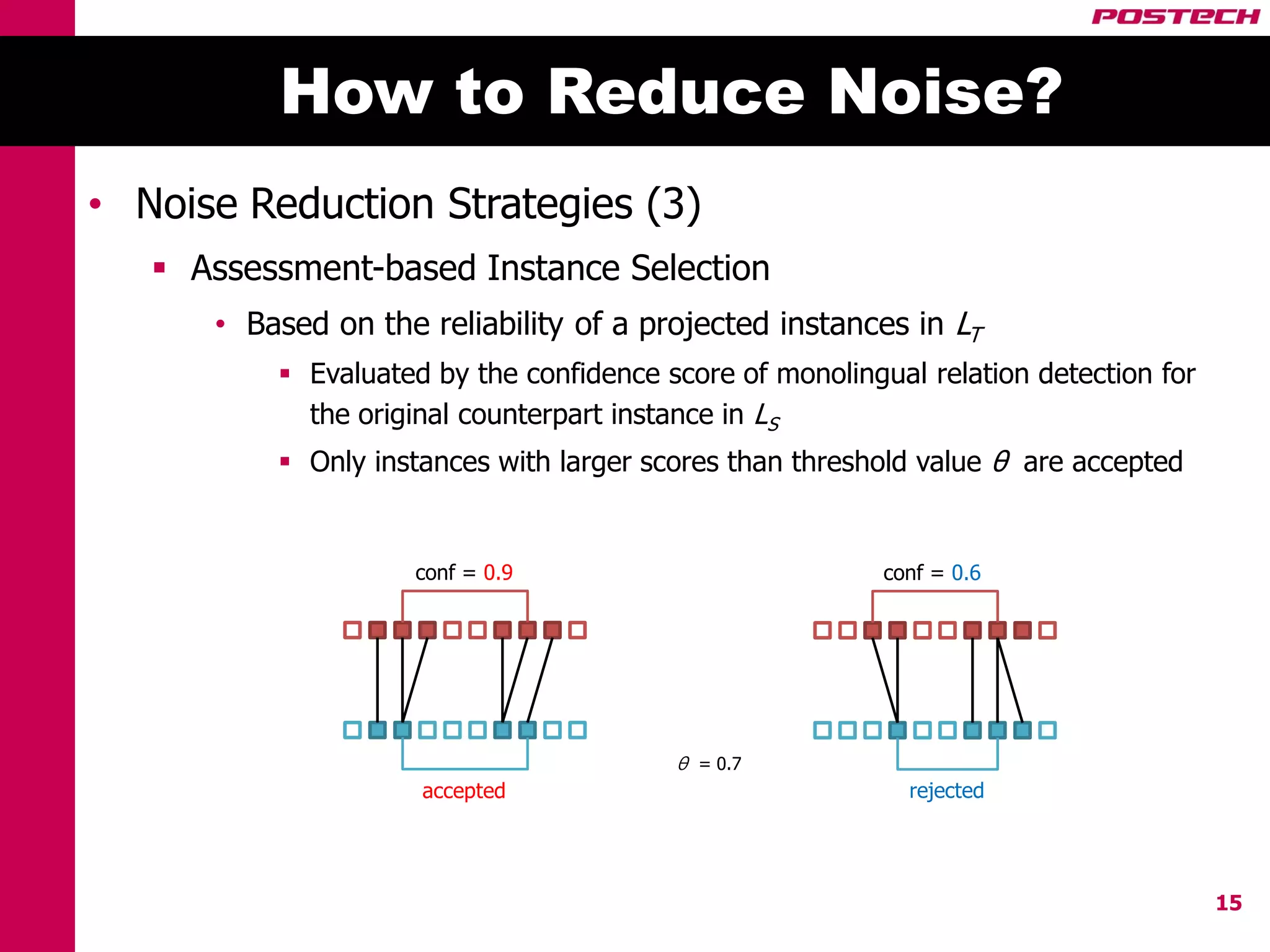
• Noise Reduction Strategies (3)
    Assessment-based Instance Selection
      • Based on the reliability of a projected instances in LT
           Evaluated by the confidence score of monolingual relation detection for
            the original counterpart instance in LS
           Only instances with larger scores than threshold value θ are accepted


                    conf = 0.9                            conf = 0.6


                                         θ = 0.7
                     accepted                               rejected


                                                                                      15
Contents
• Introduction
• Methods
    Cross-lingual Annotation Projection for Relation Detection
    Noise Reduction Strategies
• Evaluation
• Conclusion


                                                                  16
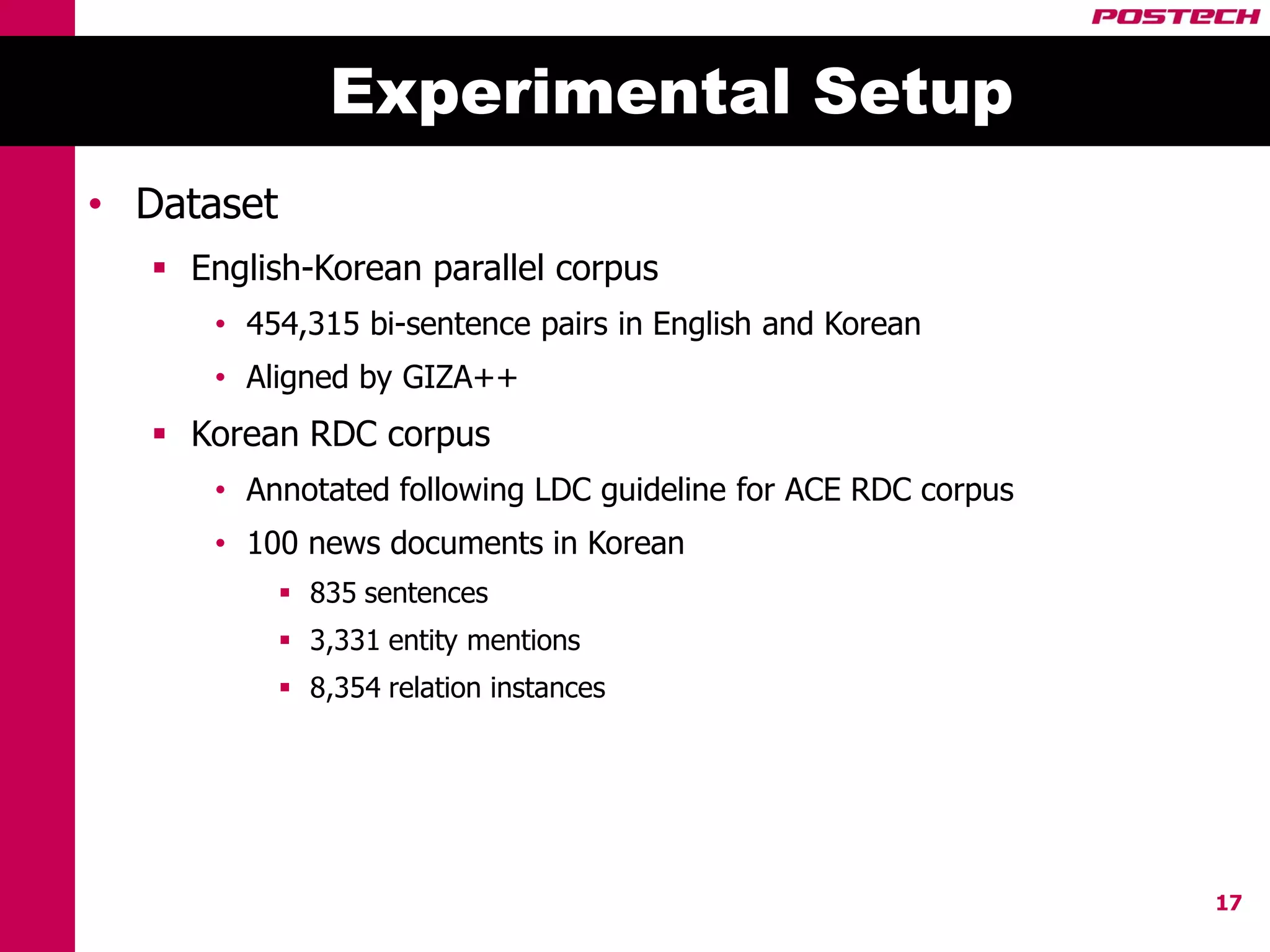
Experimental Setup
• Dataset
    English-Korean parallel corpus
       • 454,315 bi-sentence pairs in English and Korean
       • Aligned by GIZA++
    Korean RDC corpus
       • Annotated following LDC guideline for ACE RDC corpus
       • 100 news documents in Korean
             835 sentences
             3,331 entity mentions
             8,354 relation instances


                                                                17
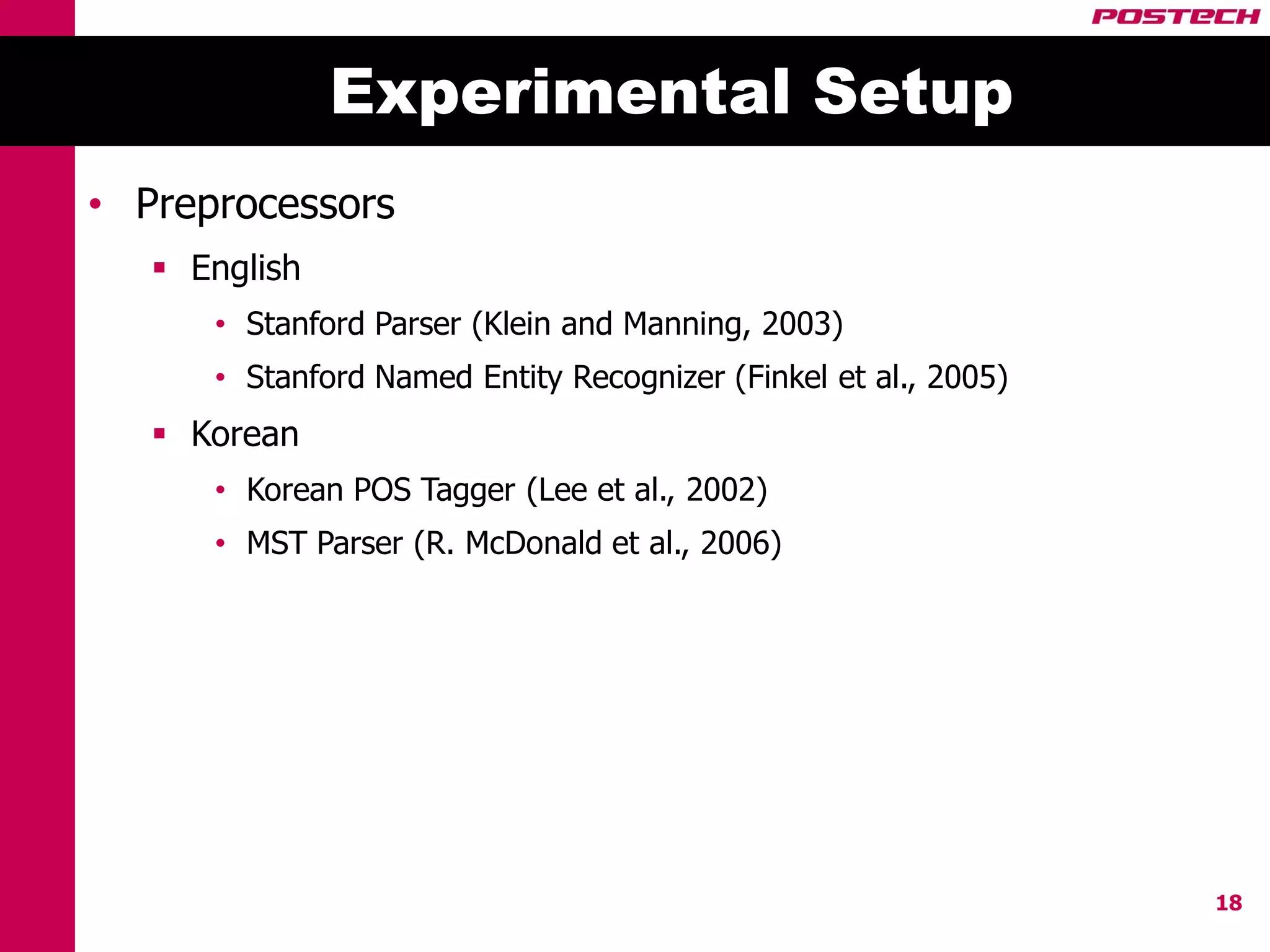
Experimental Setup
• Preprocessors
    English
      • Stanford Parser (Klein and Manning, 2003)
      • Stanford Named Entity Recognizer (Finkel et al., 2005)
    Korean
      • Korean POS Tagger (Lee et al., 2002)
      • MST Parser (R. McDonald et al., 2006)


                                                                 18
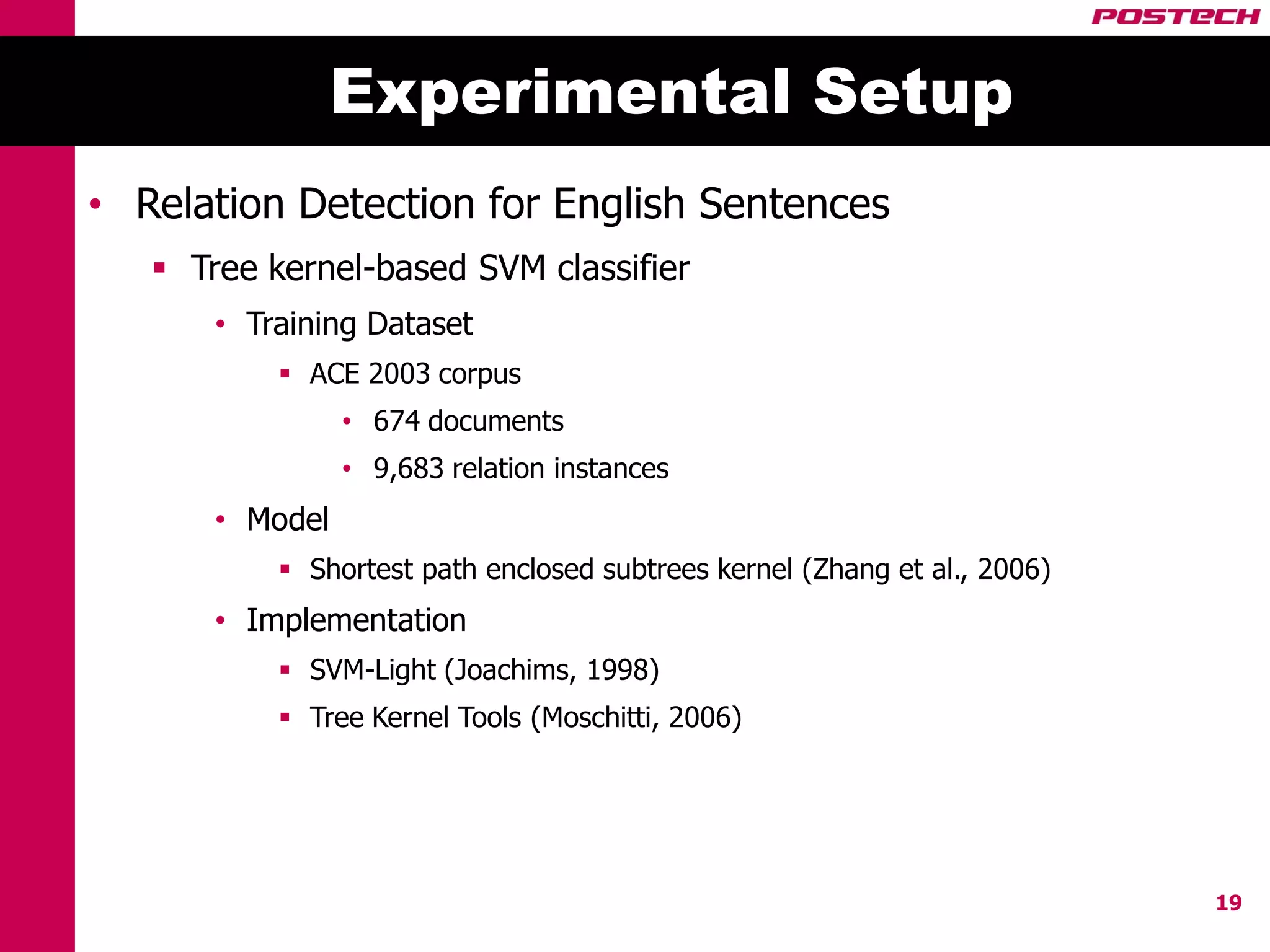
Experimental Setup
• Relation Detection for English Sentences
    Tree kernel-based SVM classifier
       • Training Dataset
            ACE 2003 corpus
                 • 674 documents
                 • 9,683 relation instances
       • Model
            Shortest path enclosed subtrees kernel (Zhang et al., 2006)
       • Implementation
            SVM-Light (Joachims, 1998)
            Tree Kernel Tools (Moschitti, 2006)


                                                                           19
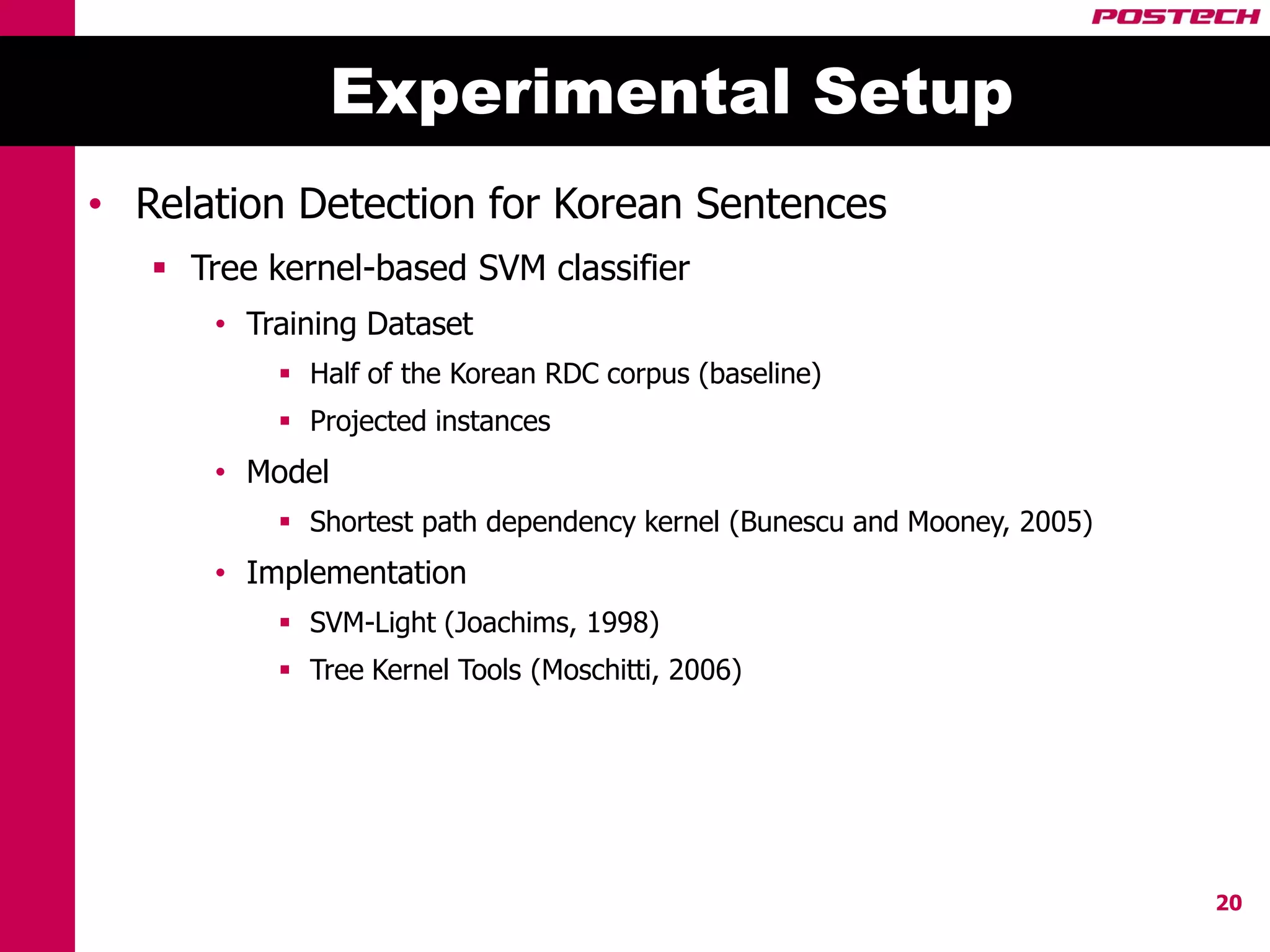
Experimental Setup
• Relation Detection for Korean Sentences
    Tree kernel-based SVM classifier
       • Training Dataset
            Half of the Korean RDC corpus (baseline)
            Projected instances
       • Model
            Shortest path dependency kernel (Bunescu and Mooney, 2005)
       • Implementation
            SVM-Light (Joachims, 1998)
            Tree Kernel Tools (Moschitti, 2006)


                                                                          20
Experimental Setup
• Experimental Sets
    Combinations of noise reduction strategies
      • (S1: Heuristic, S2: Dictionary, S3: Assessment)
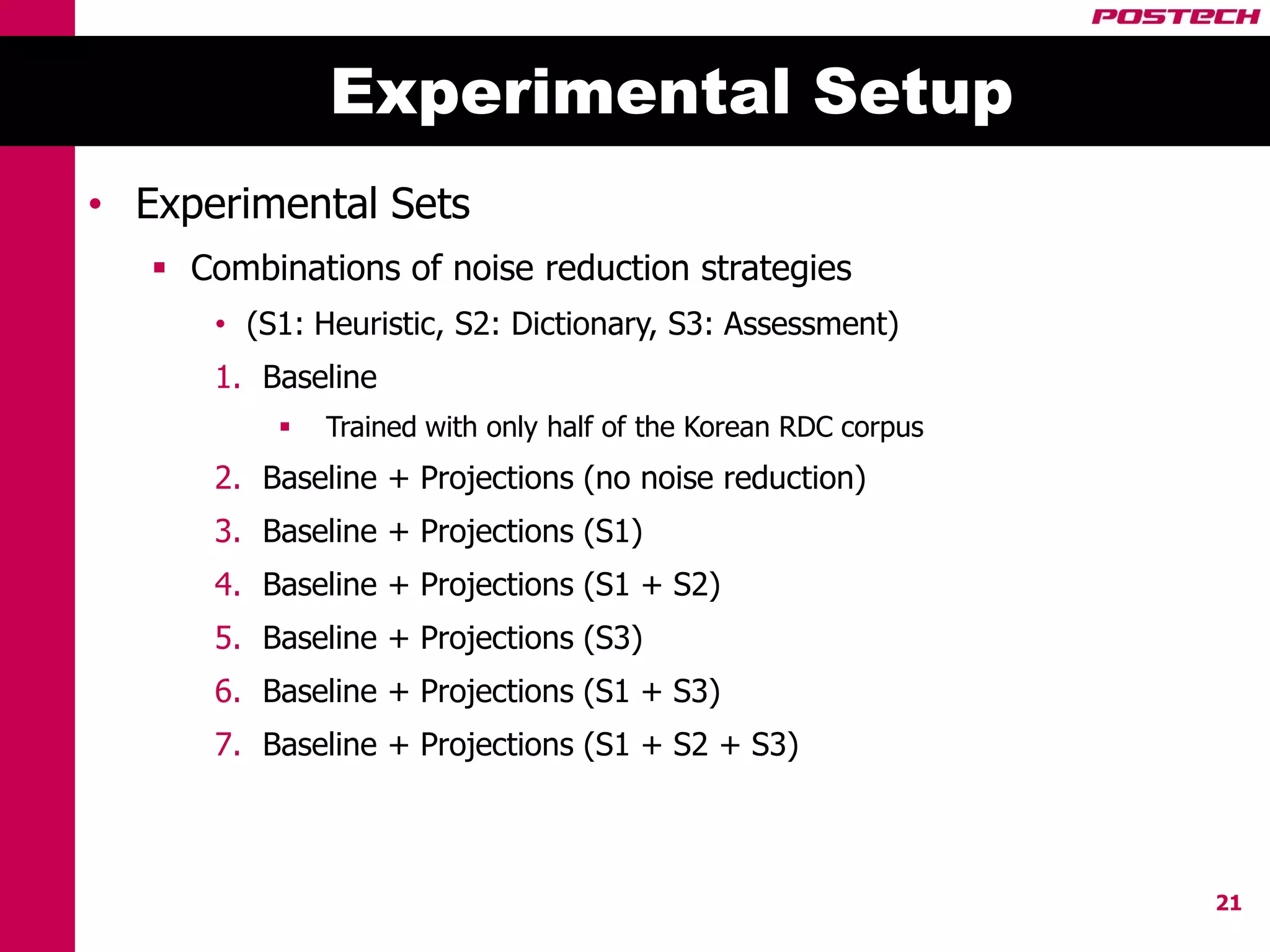
      1. Baseline
             Trained with only half of the Korean RDC corpus
      2. Baseline + Projections (no noise reduction)
      3. Baseline + Projections (S1)
      4. Baseline + Projections (S1 + S2)
      5. Baseline + Projections (S3)
      6. Baseline + Projections (S1 + S3)
      7. Baseline + Projections (S1 + S2 + S3)


                                                                21
Experimental Setup
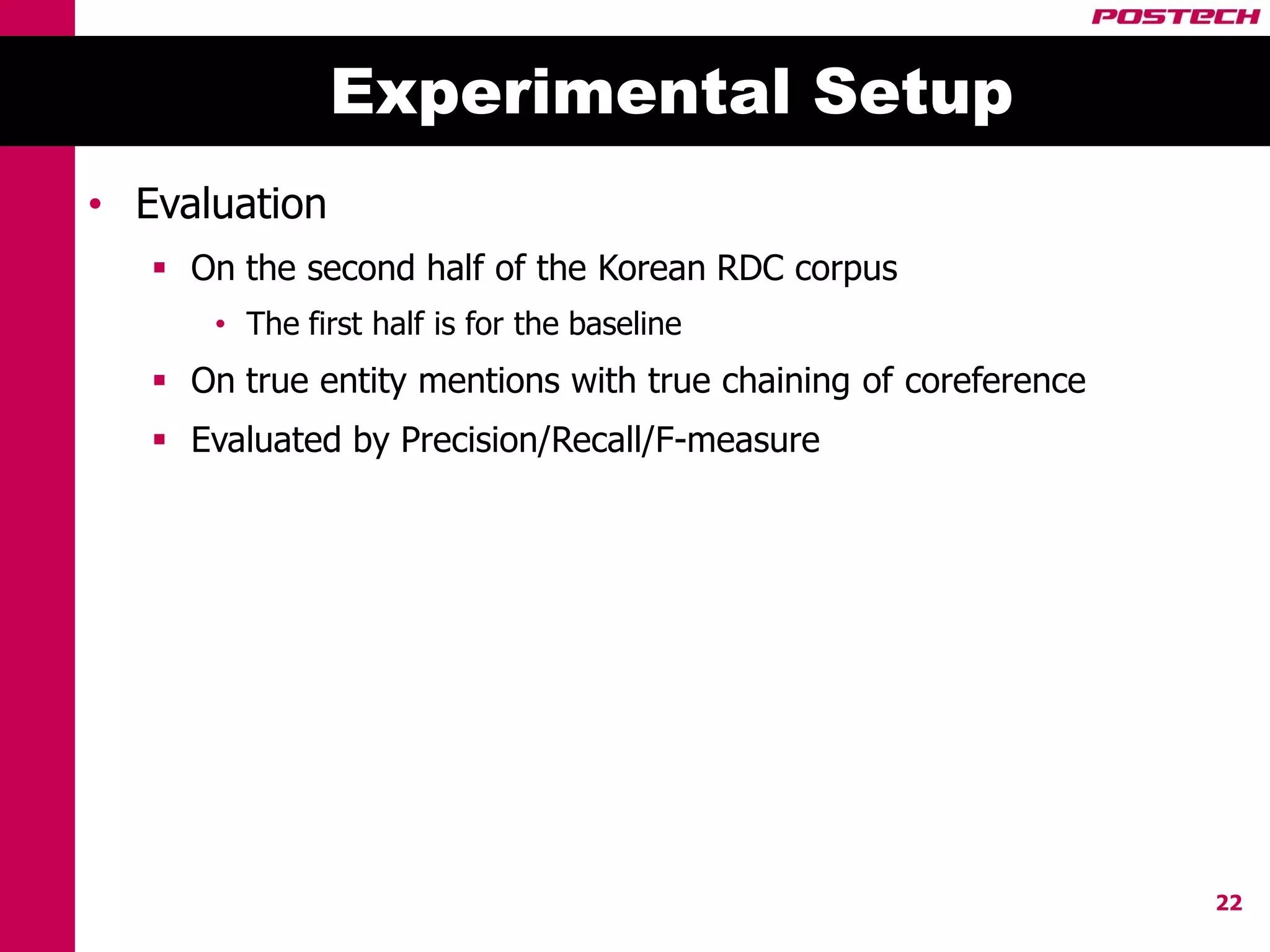
• Evaluation
    On the second half of the Korean RDC corpus
       • The first half is for the baseline
    On true entity mentions with true chaining of coreference
    Evaluated by Precision/Recall/F-measure


                                                                 22
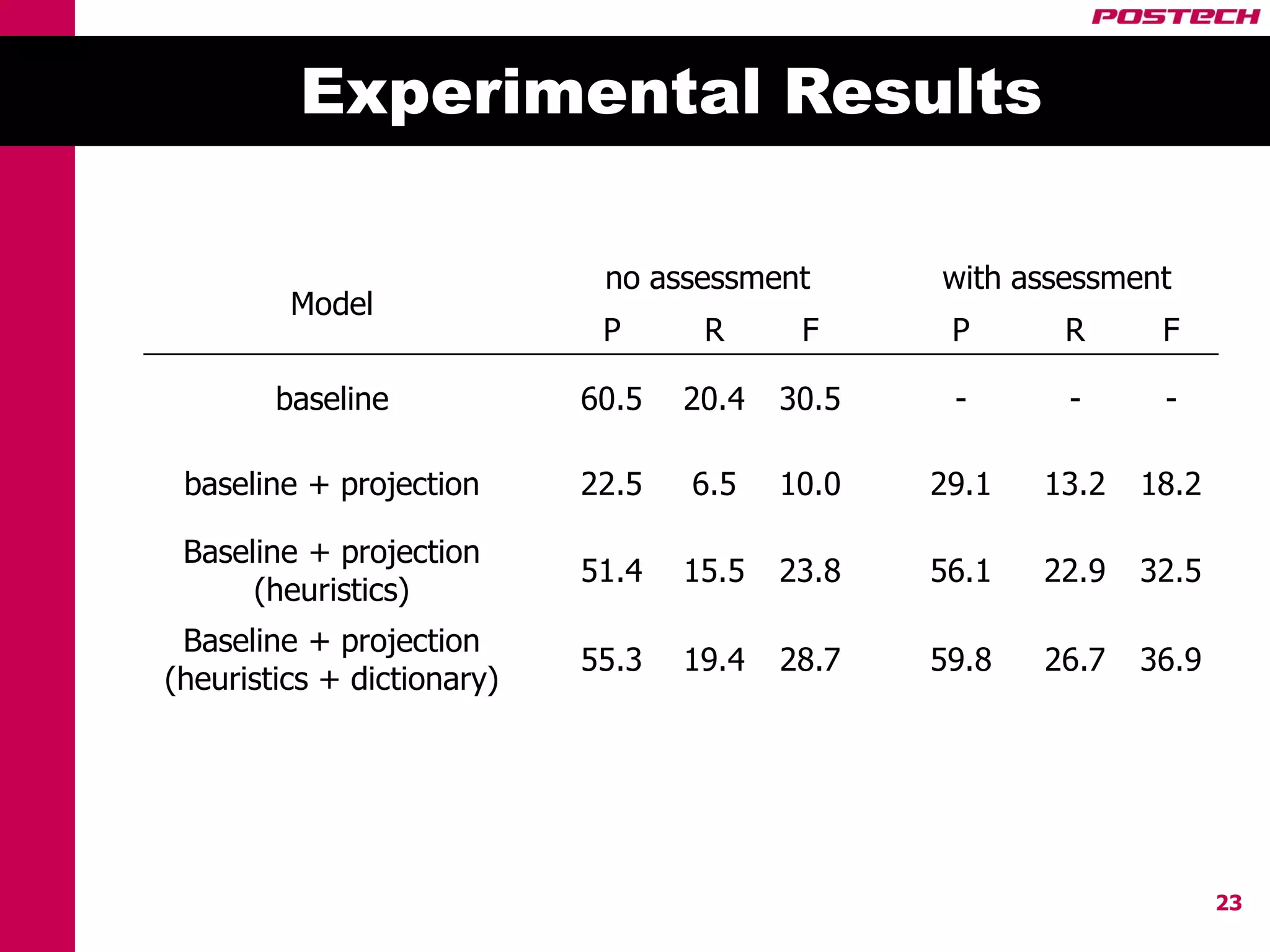
Experimental Results

                             no assessment       with assessment
         Model
                             P      R      F      P      R      F

        baseline            60.5   20.4   30.5    -      -      -

 baseline + projection      22.5   6.5    10.0   29.1   13.2   18.2

 Baseline + projection
                            51.4   15.5   23.8   56.1   22.9   32.5
      (heuristics)
 Baseline + projection
                            55.3   19.4   28.7   59.8   26.7   36.9
(heuristics + dictionary)


                                                                      23
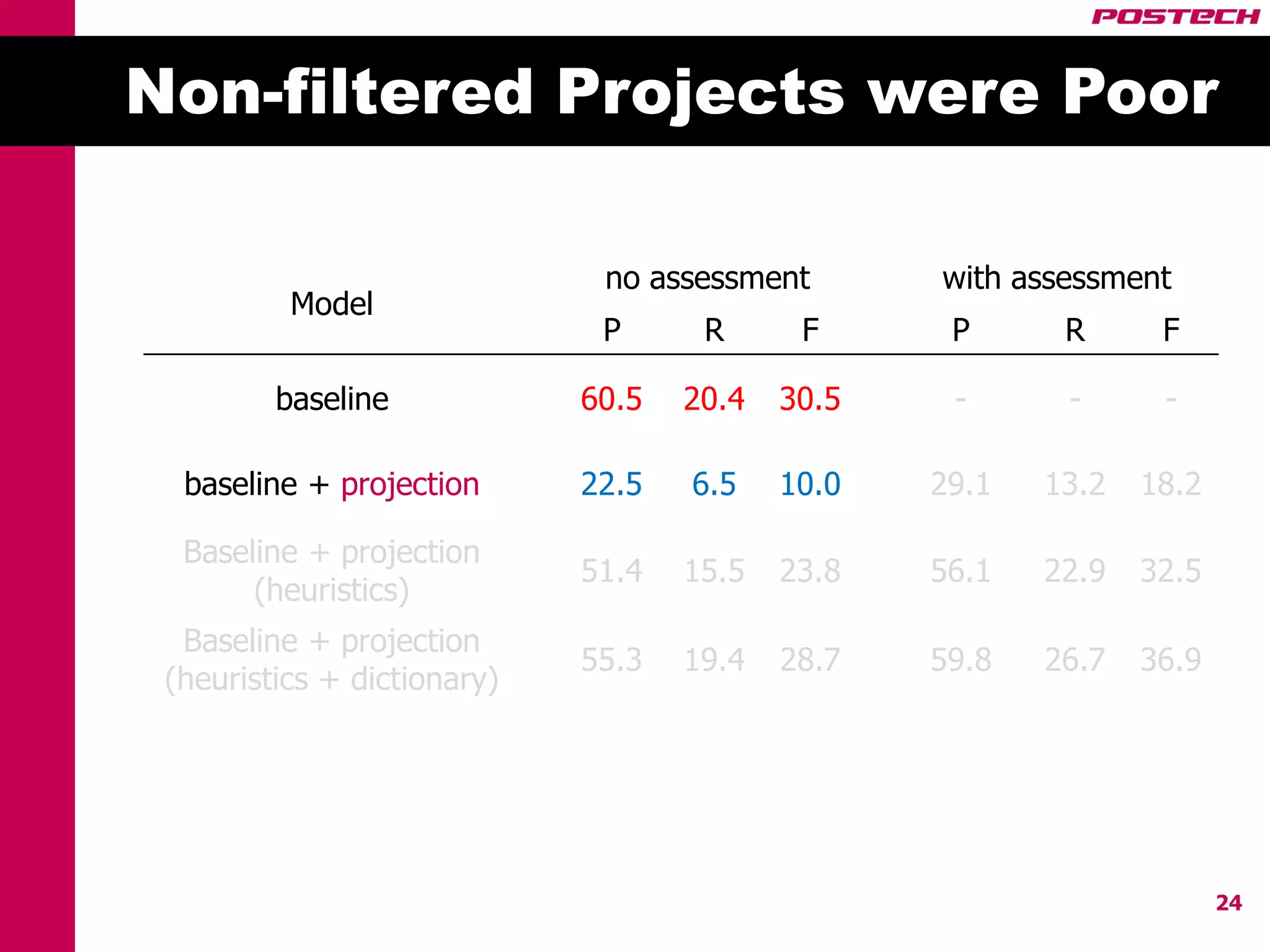
Non-filtered Projects were Poor

                              no assessment       with assessment
          Model
                              P      R      F      P      R      F

         baseline            60.5   20.4   30.5    -      -      -

  baseline + projection      22.5   6.5    10.0   29.1   13.2   18.2

  Baseline + projection
                             51.4   15.5   23.8   56.1   22.9   32.5
       (heuristics)
  Baseline + projection
                             55.3   19.4   28.7   59.8   26.7   36.9
 (heuristics + dictionary)


                                                                       24
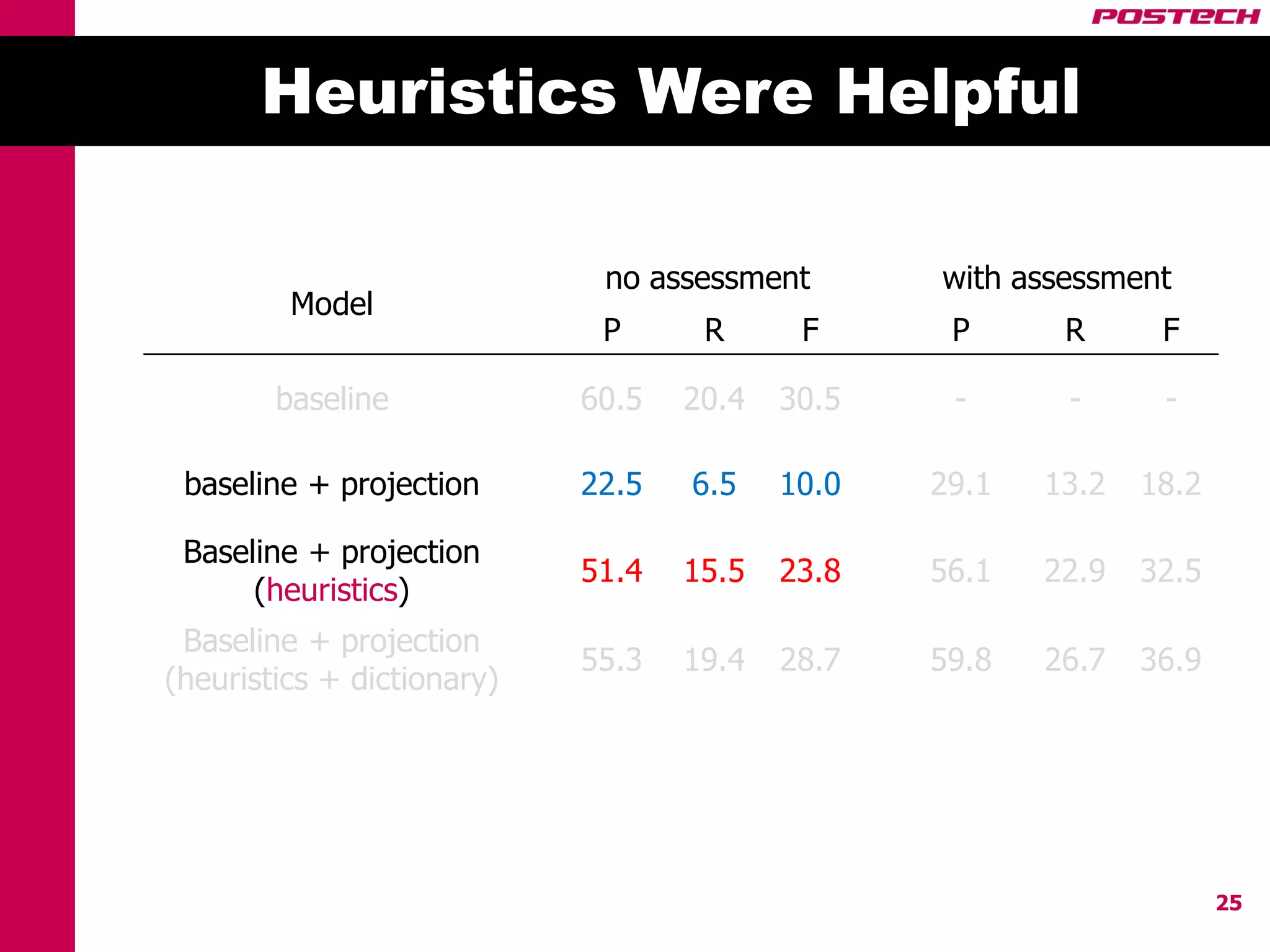
Heuristics Were Helpful

                             no assessment       with assessment
         Model
                             P      R      F      P      R      F

        baseline            60.5   20.4   30.5    -      -      -

 baseline + projection      22.5   6.5    10.0   29.1   13.2   18.2

 Baseline + projection
                            51.4   15.5   23.8   56.1   22.9   32.5
      (heuristics)
 Baseline + projection
                            55.3   19.4   28.7   59.8   26.7   36.9
(heuristics + dictionary)


                                                                      25
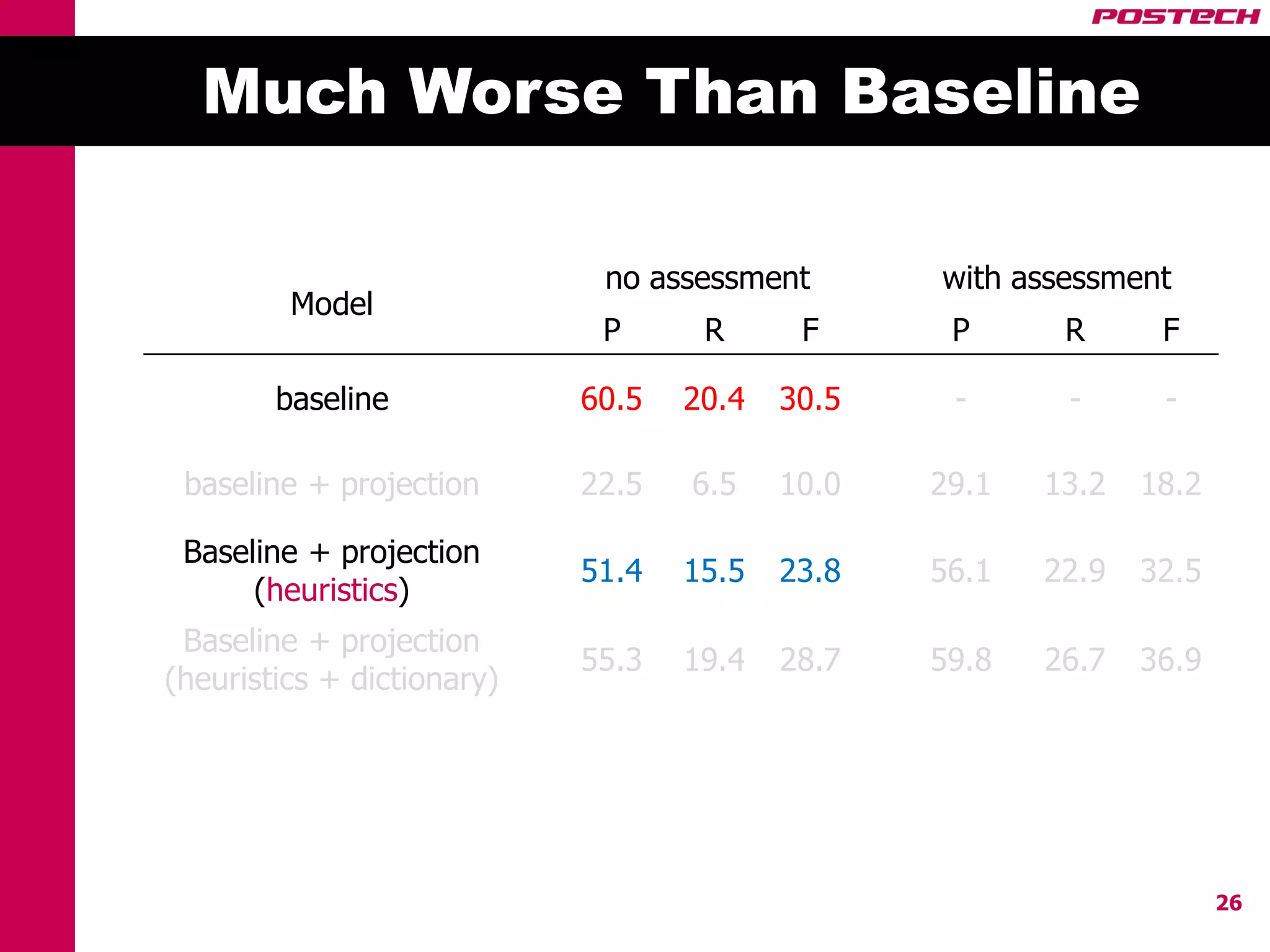
Much Worse Than Baseline

                             no assessment       with assessment
         Model
                             P      R      F      P      R      F

        baseline            60.5   20.4   30.5    -      -      -

 baseline + projection      22.5   6.5    10.0   29.1   13.2   18.2

 Baseline + projection
                            51.4   15.5   23.8   56.1   22.9   32.5
      (heuristics)
 Baseline + projection
                            55.3   19.4   28.7   59.8   26.7   36.9
(heuristics + dictionary)


                                                                      26
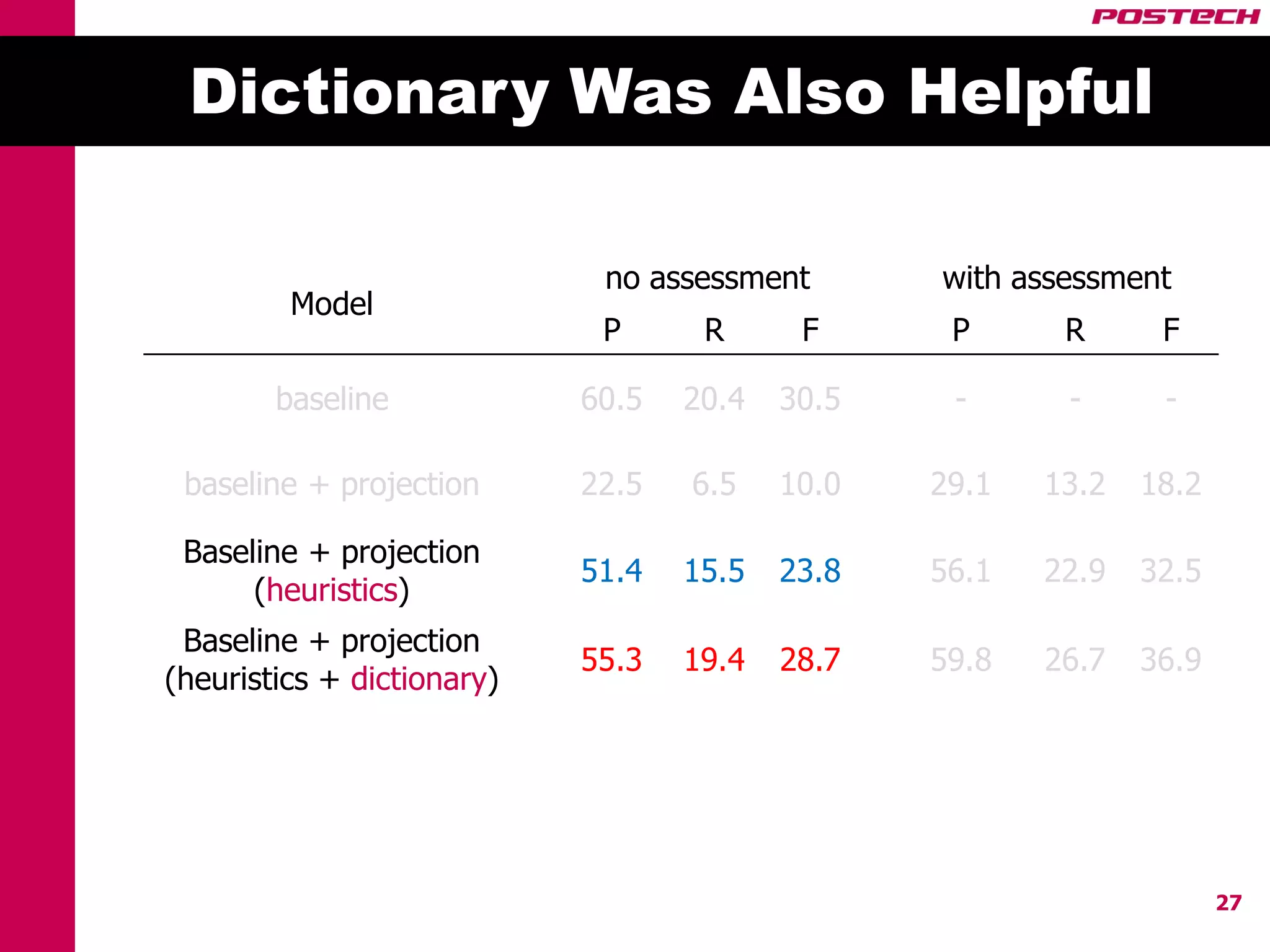
Dictionary Was Also Helpful

                             no assessment       with assessment
         Model
                             P      R      F      P      R      F

        baseline            60.5   20.4   30.5    -      -      -

 baseline + projection      22.5   6.5    10.0   29.1   13.2   18.2

 Baseline + projection
                            51.4   15.5   23.8   56.1   22.9   32.5
      (heuristics)
 Baseline + projection
                            55.3   19.4   28.7   59.8   26.7   36.9
(heuristics + dictionary)


                                                                      27
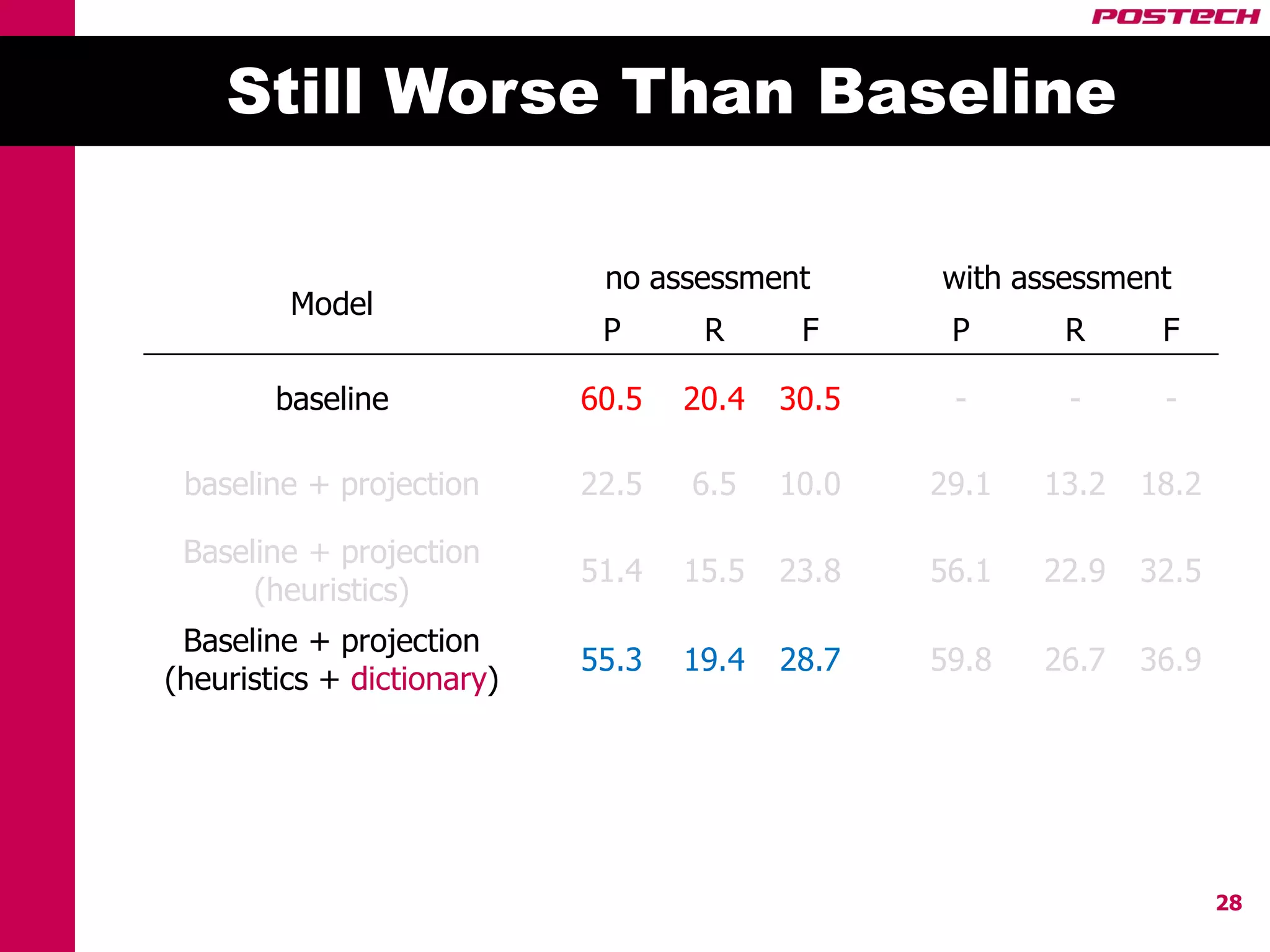
Still Worse Than Baseline

                             no assessment       with assessment
         Model
                             P      R      F      P      R      F

        baseline            60.5   20.4   30.5    -      -      -

 baseline + projection      22.5   6.5    10.0   29.1   13.2   18.2

 Baseline + projection
                            51.4   15.5   23.8   56.1   22.9   32.5
      (heuristics)
 Baseline + projection
                            55.3   19.4   28.7   59.8   26.7   36.9
(heuristics + dictionary)


                                                                      28
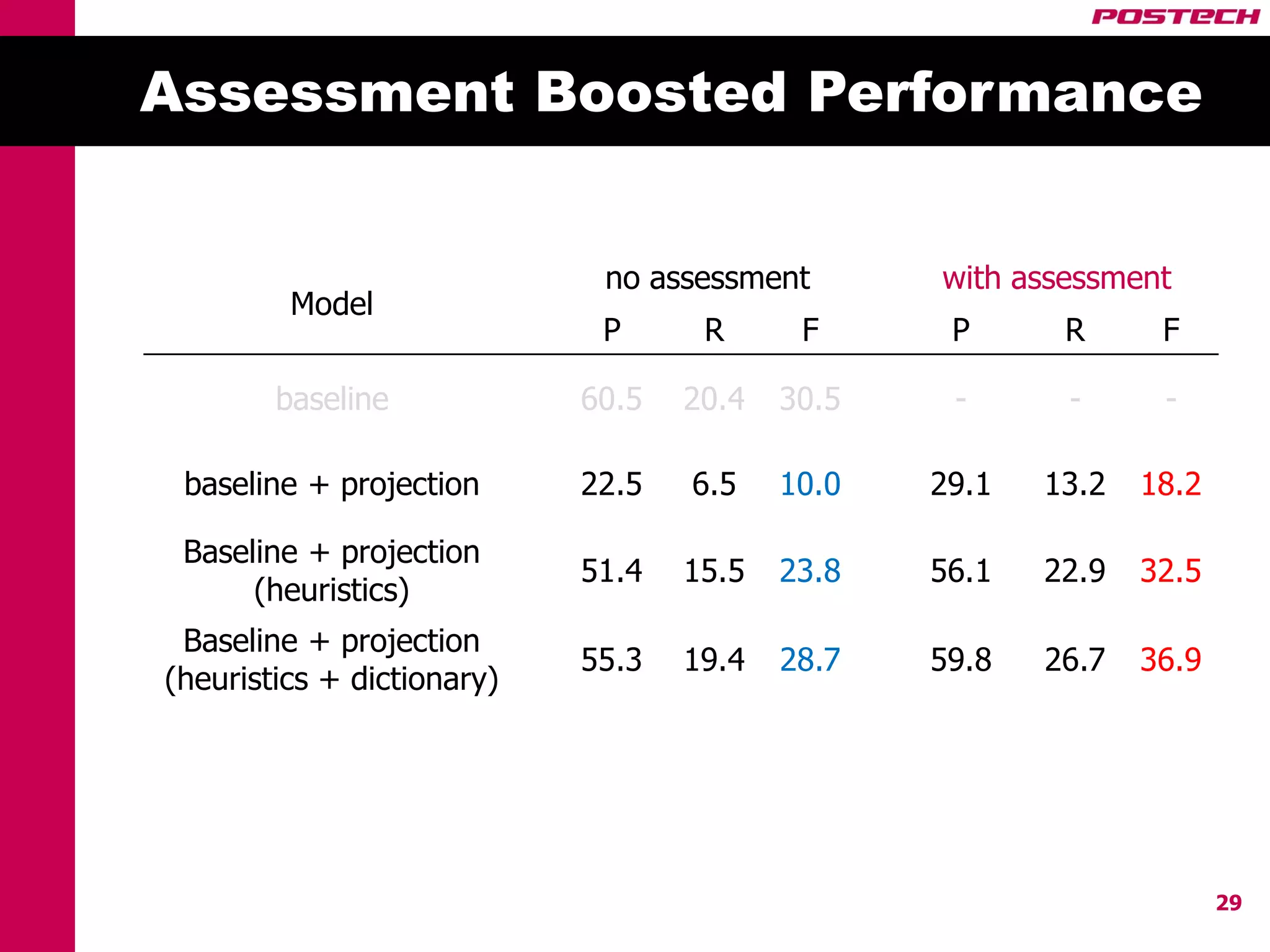
Assessment Boosted Performance


                             no assessment       with assessment
         Model
                             P      R      F      P      R      F

        baseline            60.5   20.4   30.5    -      -      -

 baseline + projection      22.5   6.5    10.0   29.1   13.2   18.2

 Baseline + projection
                            51.4   15.5   23.8   56.1   22.9   32.5
      (heuristics)
 Baseline + projection
                            55.3   19.4   28.7   59.8   26.7   36.9
(heuristics + dictionary)


                                                                      29
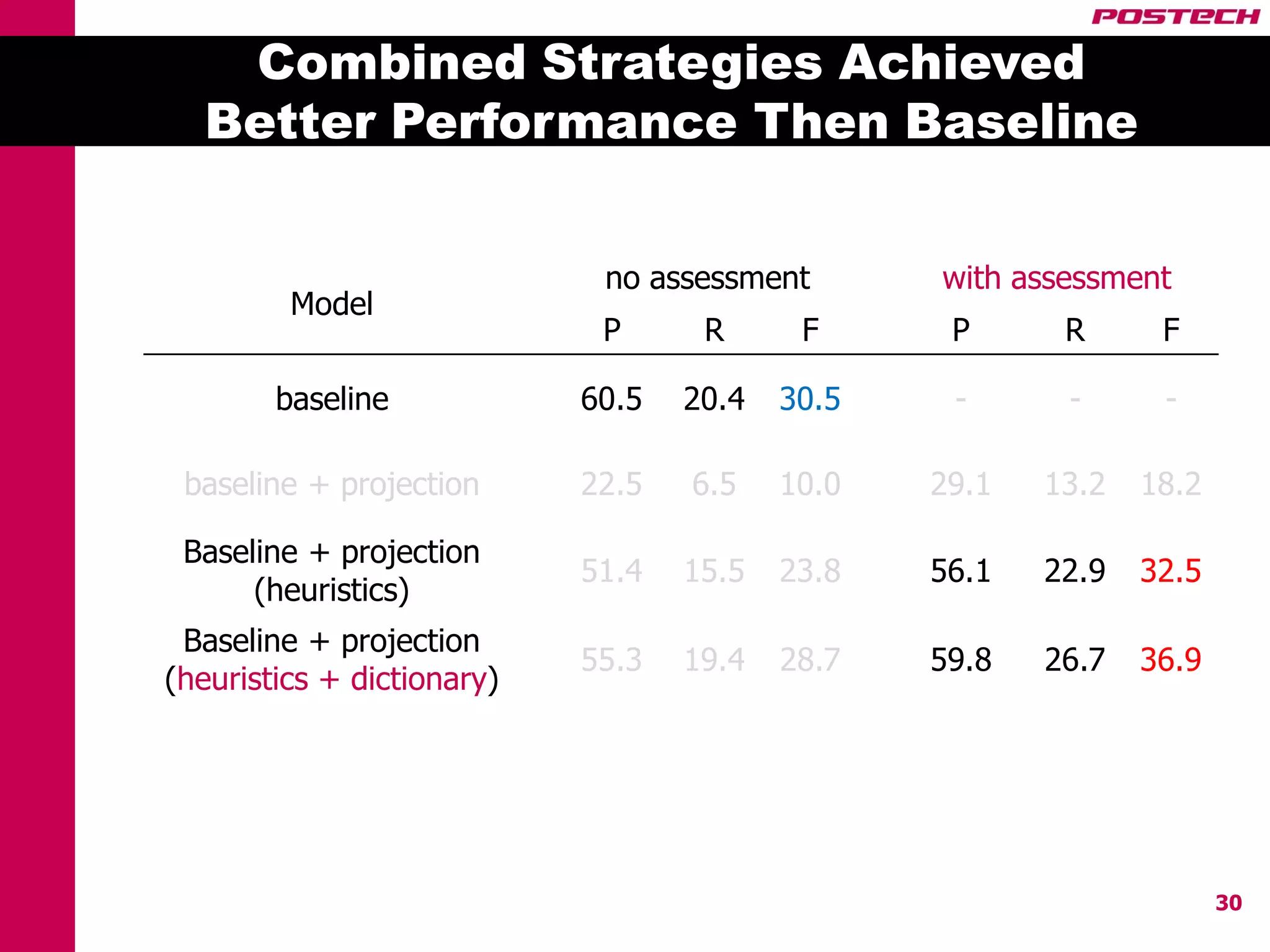
Combined Strategies Achieved
  Better Performance Then Baseline


                             no assessment       with assessment
         Model
                             P      R      F      P      R      F

        baseline            60.5   20.4   30.5    -      -      -

 baseline + projection      22.5   6.5    10.0   29.1   13.2   18.2

 Baseline + projection
                            51.4   15.5   23.8   56.1   22.9   32.5
      (heuristics)
 Baseline + projection
                            55.3   19.4   28.7   59.8   26.7   36.9
(heuristics + dictionary)


                                                                      30
Contents
• Introduction
• Methods
    Cross-lingual Annotation Projection for Relation Detection
    Noise Reduction Strategies
• Evaluation
• Conclusion


                                                                  31
Conclusion
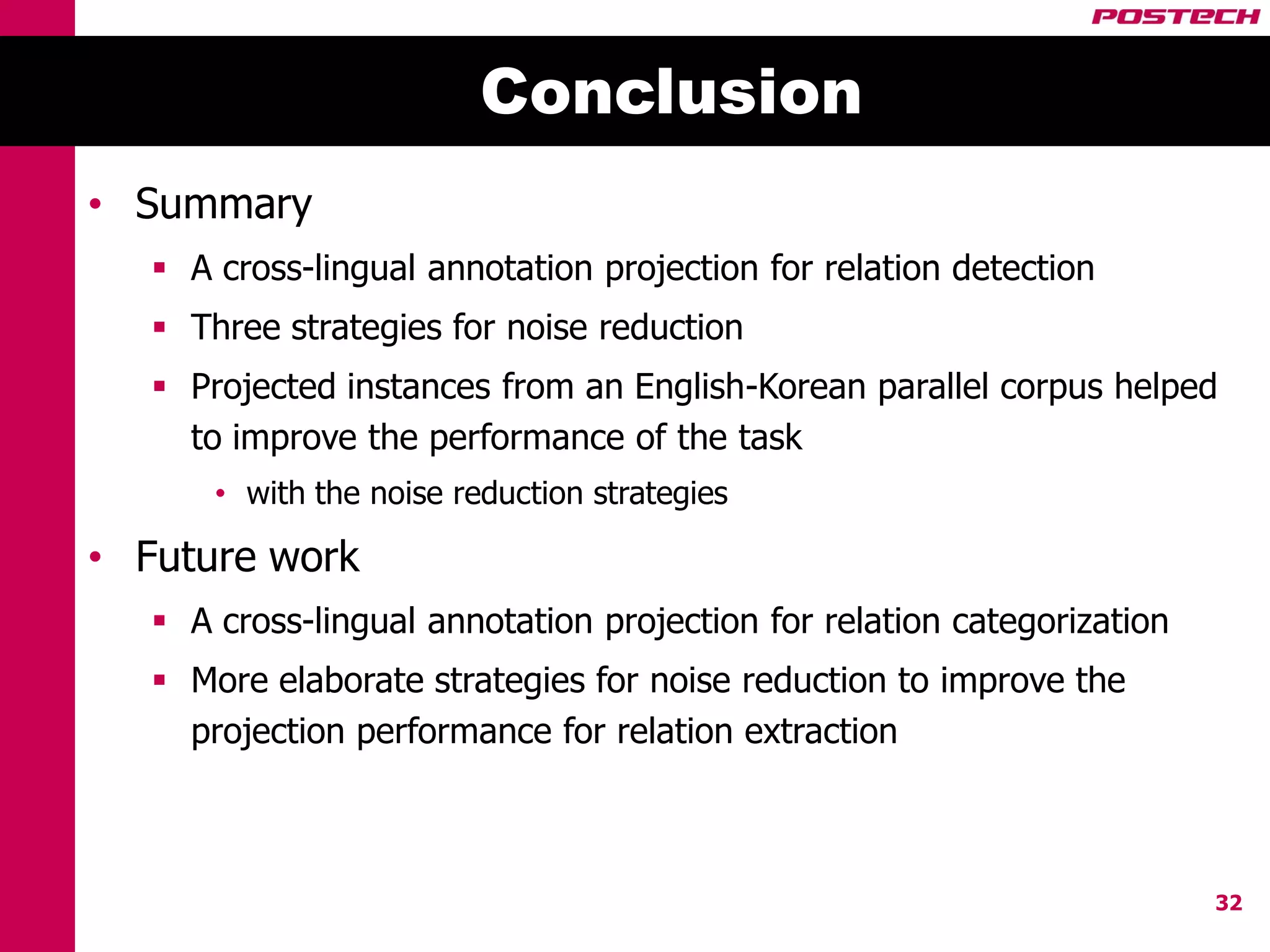
• Summary
    A cross-lingual annotation projection for relation detection
    Three strategies for noise reduction
    Projected instances from an English-Korean parallel corpus helped
     to improve the performance of the task
       • with the noise reduction strategies

• Future work
    A cross-lingual annotation projection for relation categorization
    More elaborate strategies for noise reduction to improve the
     projection performance for relation extraction


                                                                         32
Q&A

A Cross-Lingual Annotation Projection Approach for Relation Detection

  • 1.
    A CROSS-LINGUAL ANNOTATIONPROJECTION APPROACH FOR RELATION DETECTION The 23rd International Conference on Computational Linguistics (COLING 2010) August 24th, 2010, Beijing Seokhwan Kim (POSTECH) Minwoo Jeong (Saarland University) Jonghoon Lee (POSTECH) Gary Geunbae Lee (POSTECH)
  • 2.
    Contents • Introduction • Methods  Cross-lingual Annotation Projection for Relation Detection  Noise Reduction Strategies • Evaluation • Conclusion 2
  • 3.
    Contents • Introduction • Methods  Cross-lingual Annotation Projection for Relation Detection  Noise Reduction Strategies • Evaluation • Conclusion 3
  • 4.
    What’s Relation Detection? •Relation Extraction  To identify semantic relations between a pair of entities  ACE RDC • Relation Detection (RD) • Relation Categorization (RC) Owner-Of Jan Mullins, owner of Computer Recycler Incorporated said that … 4
  • 5.
    What’s the Problem? •Many supervised machine learning approaches have been successfully applied to the RDC task  (Kambhatla, 2004; Zhou et al., 2005; Zelenko et al., 2003; Culotta and Sorensen, 2004; Bunescu and Mooney, 2005; Zhang et al., 2006) • Datasets for relation detection  Labeled corpora for supervised learning  Available for only a few languages • English, Chinese, Arabic  No resources for other languages • Korean 5
  • 6.
    Contents • Introduction • Methods  Cross-lingual Annotation Projection for Relation Detection  Noise Reduction Strategies • Evaluation • Conclusion 6
  • 7.
    Cross-lingual Annotation Projection •Goal  To learn the relation detector without significant annotation efforts • Method  To leverage parallel corpora to project the relation annotation on the source language LS to the target language LT 7
  • 8.
    Cross-lingual Annotation Projection •Previous Work  Part-of-speech tagging (Yarowsky and Ngai, 2001)  Named-entity tagging (Yarowsky et al., 2001)  Verb classification (Merlo et al., 2002)  Dependency parsing (Hwa et al., 2005)  Mention detection (Zitouni and Florian, 2008)  Semantic role labeling (Pado and Lapata, 2009) • To the best of our knowledge, no work has reported on the RDC task 8
  • 9.
    Overall Architecture Annotation Parallel Projection Corpus Sentences in Sentences in Ls Lt Preprocessing Preprocessing (POS Tagging, (POS Tagging, Parsing) Parsing) NER Word Alignment Relation Detection Projection Annotated Annotated Sentences in Sentences in Ls Lt 9
  • 10.
    How to ReduceNoise? • Error Accumulation  Numerous errors can be generated and accumulated through a procedure of annotation projection • Preprocessing for LS and LT • NER for LS • Relation Detection for LS • Word Alignment between LS and LT • Noise Reduction  A key factor to improve the performance of annotation projection 10
  • 11.
    How to ReduceNoise? • Noise Reduction Strategies (1)  Alignment Filtering • Based on Heuristics  A projection for an entity mention should be based on alignments between contiguous word sequences accepted rejected 11
  • 12.
    How to ReduceNoise? • Noise Reduction Strategies (1)  Alignment Filtering • Based on Heuristics  A projection for an entity mention should be based on alignments between contiguous word sequences  Both an entity mention in LS and its projection in LT should include at least one base noun phrase N N N N accepted rejected accepted rejected N 12
  • 13.
    How to ReduceNoise? • Noise Reduction Strategies (1)  Alignment Filtering • Based on Heuristics  A projection for an entity mention should be based on alignments between contiguous word sequences  Both an entity mention in LS and its projection in LT should include at least one base noun phrase  The projected instance in LT should satisfy the clausal agreement with the original instance in LS N N N N accepted rejected accepted rejected rejected N 13
  • 14.
    How to ReduceNoise? • Noise Reduction Strategies (2)  Alignment Correction • Based on a bilingual dictionary for entity mentions  Each entry of the dictionary is a pair of entity mention in LS and its translation or transliteration in LT FOR each entity ES in LS A B C D E F G RETRIEVE counterpart ET from DICT(E-T) SEEK ET from the sentence ST in LT IF matched THEN BCD - βγ MAKE new alignment ES-ET ENDIF ENDFOR α β γ δ ε δ ε corrected 14
  • 15.
    How to ReduceNoise? • Noise Reduction Strategies (3)  Assessment-based Instance Selection • Based on the reliability of a projected instances in LT  Evaluated by the confidence score of monolingual relation detection for the original counterpart instance in LS  Only instances with larger scores than threshold value θ are accepted conf = 0.9 conf = 0.6 θ = 0.7 accepted rejected 15
  • 16.
    Contents • Introduction • Methods  Cross-lingual Annotation Projection for Relation Detection  Noise Reduction Strategies • Evaluation • Conclusion 16
  • 17.
    Experimental Setup • Dataset  English-Korean parallel corpus • 454,315 bi-sentence pairs in English and Korean • Aligned by GIZA++  Korean RDC corpus • Annotated following LDC guideline for ACE RDC corpus • 100 news documents in Korean  835 sentences  3,331 entity mentions  8,354 relation instances 17
  • 18.
    Experimental Setup • Preprocessors  English • Stanford Parser (Klein and Manning, 2003) • Stanford Named Entity Recognizer (Finkel et al., 2005)  Korean • Korean POS Tagger (Lee et al., 2002) • MST Parser (R. McDonald et al., 2006) 18
  • 19.
    Experimental Setup • RelationDetection for English Sentences  Tree kernel-based SVM classifier • Training Dataset  ACE 2003 corpus • 674 documents • 9,683 relation instances • Model  Shortest path enclosed subtrees kernel (Zhang et al., 2006) • Implementation  SVM-Light (Joachims, 1998)  Tree Kernel Tools (Moschitti, 2006) 19
  • 20.
    Experimental Setup • RelationDetection for Korean Sentences  Tree kernel-based SVM classifier • Training Dataset  Half of the Korean RDC corpus (baseline)  Projected instances • Model  Shortest path dependency kernel (Bunescu and Mooney, 2005) • Implementation  SVM-Light (Joachims, 1998)  Tree Kernel Tools (Moschitti, 2006) 20
  • 21.
    Experimental Setup • ExperimentalSets  Combinations of noise reduction strategies • (S1: Heuristic, S2: Dictionary, S3: Assessment) 1. Baseline  Trained with only half of the Korean RDC corpus 2. Baseline + Projections (no noise reduction) 3. Baseline + Projections (S1) 4. Baseline + Projections (S1 + S2) 5. Baseline + Projections (S3) 6. Baseline + Projections (S1 + S3) 7. Baseline + Projections (S1 + S2 + S3) 21
  • 22.
    Experimental Setup • Evaluation  On the second half of the Korean RDC corpus • The first half is for the baseline  On true entity mentions with true chaining of coreference  Evaluated by Precision/Recall/F-measure 22
  • 23.
    Experimental Results no assessment with assessment Model P R F P R F baseline 60.5 20.4 30.5 - - - baseline + projection 22.5 6.5 10.0 29.1 13.2 18.2 Baseline + projection 51.4 15.5 23.8 56.1 22.9 32.5 (heuristics) Baseline + projection 55.3 19.4 28.7 59.8 26.7 36.9 (heuristics + dictionary) 23
  • 24.
    Non-filtered Projects werePoor no assessment with assessment Model P R F P R F baseline 60.5 20.4 30.5 - - - baseline + projection 22.5 6.5 10.0 29.1 13.2 18.2 Baseline + projection 51.4 15.5 23.8 56.1 22.9 32.5 (heuristics) Baseline + projection 55.3 19.4 28.7 59.8 26.7 36.9 (heuristics + dictionary) 24
  • 25.
    Heuristics Were Helpful no assessment with assessment Model P R F P R F baseline 60.5 20.4 30.5 - - - baseline + projection 22.5 6.5 10.0 29.1 13.2 18.2 Baseline + projection 51.4 15.5 23.8 56.1 22.9 32.5 (heuristics) Baseline + projection 55.3 19.4 28.7 59.8 26.7 36.9 (heuristics + dictionary) 25
  • 26.
    Much Worse ThanBaseline no assessment with assessment Model P R F P R F baseline 60.5 20.4 30.5 - - - baseline + projection 22.5 6.5 10.0 29.1 13.2 18.2 Baseline + projection 51.4 15.5 23.8 56.1 22.9 32.5 (heuristics) Baseline + projection 55.3 19.4 28.7 59.8 26.7 36.9 (heuristics + dictionary) 26
  • 27.
    Dictionary Was AlsoHelpful no assessment with assessment Model P R F P R F baseline 60.5 20.4 30.5 - - - baseline + projection 22.5 6.5 10.0 29.1 13.2 18.2 Baseline + projection 51.4 15.5 23.8 56.1 22.9 32.5 (heuristics) Baseline + projection 55.3 19.4 28.7 59.8 26.7 36.9 (heuristics + dictionary) 27
  • 28.
    Still Worse ThanBaseline no assessment with assessment Model P R F P R F baseline 60.5 20.4 30.5 - - - baseline + projection 22.5 6.5 10.0 29.1 13.2 18.2 Baseline + projection 51.4 15.5 23.8 56.1 22.9 32.5 (heuristics) Baseline + projection 55.3 19.4 28.7 59.8 26.7 36.9 (heuristics + dictionary) 28
  • 29.
    Assessment Boosted Performance no assessment with assessment Model P R F P R F baseline 60.5 20.4 30.5 - - - baseline + projection 22.5 6.5 10.0 29.1 13.2 18.2 Baseline + projection 51.4 15.5 23.8 56.1 22.9 32.5 (heuristics) Baseline + projection 55.3 19.4 28.7 59.8 26.7 36.9 (heuristics + dictionary) 29
  • 30.
    Combined Strategies Achieved Better Performance Then Baseline no assessment with assessment Model P R F P R F baseline 60.5 20.4 30.5 - - - baseline + projection 22.5 6.5 10.0 29.1 13.2 18.2 Baseline + projection 51.4 15.5 23.8 56.1 22.9 32.5 (heuristics) Baseline + projection 55.3 19.4 28.7 59.8 26.7 36.9 (heuristics + dictionary) 30
  • 31.
    Contents • Introduction • Methods  Cross-lingual Annotation Projection for Relation Detection  Noise Reduction Strategies • Evaluation • Conclusion 31
  • 32.
    Conclusion • Summary  A cross-lingual annotation projection for relation detection  Three strategies for noise reduction  Projected instances from an English-Korean parallel corpus helped to improve the performance of the task • with the noise reduction strategies • Future work  A cross-lingual annotation projection for relation categorization  More elaborate strategies for noise reduction to improve the projection performance for relation extraction 32
  • 33.