1Samsung Open Source Group
A closer look at ARM code size
Tilmann Scheller
Principal Compiler Engineer
t.scheller@samsung.com
Samsung Open Source Group
Samsung Research UK
EuroLLVM 2016
Barcelona, Spain, March 17 – 18, 2016
2Samsung Open Source Group
Overview
●
Introduction
●
ARM architecture
●
Case study
●
Summary
3Samsung Open Source Group
Introduction
4Samsung Open Source Group
Introduction
● Code size matters in the embedded space
● Find out how we are doing on ARM
● Comparison against GCC
● Focus on a specific application and compare the
generated assembly code
● Try to find out what we need to change in LLVM to get
better code size
5Samsung Open Source Group
ARM architecture
6Samsung Open Source Group
ARM architecture
● 32-bit/64-bit RISC architecture
● Load-store architecture
● Barrel shifter: add r4, r3, r6, lsl #4
● Powerful indexed addressing modes: ldr r0, [r1, #4]!
● Predication: ldreq r3, [r4]
● Family of 32-bit instruction sets evolved over time: ARM, Thumb, Thumb-2
● Focus on the Thumb-2 instruction set in this talk
● Instruction set extensions:
– VFP
– Advanced SIMD (NEON)
7Samsung Open Source Group
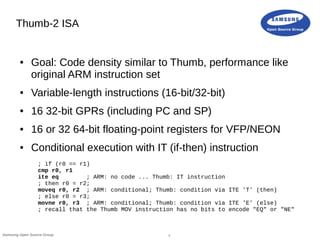
Thumb-2 ISA
● Goal: Code density similar to Thumb, performance like
original ARM instruction set
● Variable-length instructions (16-bit/32-bit)
● 16 32-bit GPRs (including PC and SP)
● 16 or 32 64-bit floating-point registers for VFP/NEON
● Conditional execution with IT (if-then) instruction
; if (r0 == r1)
cmp r0, r1
ite eq ; ARM: no code ... Thumb: IT instruction
; then r0 = r2;
moveq r0, r2 ; ARM: conditional; Thumb: condition via ITE 'T' (then)
; else r0 = r3;
movne r0, r3 ; ARM: conditional; Thumb: condition via ITE 'E' (else)
; recall that the Thumb MOV instruction has no bits to encode "EQ" or "NE"
8Samsung Open Source Group
Case study
9Samsung Open Source Group
JerryScript
●
A really lightweight JavaScript engine
●
Has a base footprint of 10KB of RAM
●
Optimized for microcontrollers
●
Written in C99
●
Supports all of ECMAScript 5.1
●
Open source (Apache 2.0 license)
●
Developed by Samsung
●
Goal: Want to compile with Clang but code size significantly
higher
10Samsung Open Source Group
Target hardware
● STM32F4 developer board
● Cortex-M4F clocked at 168 MHz
● 192KB of RAM
● 1MB of flash memory
11Samsung Open Source Group
Code size
● Compiling with a Clang trunk snapshot (r262611, March
3, 2016)
● Using GCC 5.2.1 (Linaro bare-metal toolchain)
● JerryScript trunk snapshot (afa7b78, March 4, 2016)
● Release build of JerryScript
● Optimizing for the Cortex-M4F
● Building with -Os
● Static build, running bare-metal on the STM32F4 board
12Samsung Open Source Group
Code size
-Os -mthumb -mcpu=cortex-m4 -mfpu=fpv4-sp-d16
JerryScript
0
50
100
150
200
250
231
208
190
Clang r262611
GCC 5.2.1
GCC 5.2.1 LTO
CodesizeinKB(lowerisbetter)
13Samsung Open Source Group
Code size - LTO
● GCC in LTO mode produces the smallest binary
● Clang has no support for building in -Os -flto
● LTO optimization pipeline not tuned for size
14Samsung Open Source Group
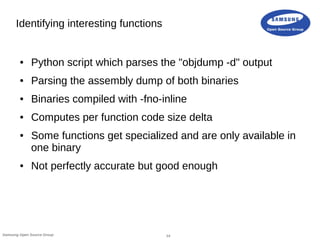
Identifying interesting functions
● Python script which parses the "objdump -d" output
● Parsing the assembly dump of both binaries
● Binaries compiled with -fno-inline
● Computes per function code size delta
● Some functions get specialized and are only available in
one binary
● Not perfectly accurate but good enough
15Samsung Open Source Group
Code size
Clang
<jerry_api_create_null_value>:
b083 sub sp, #12
2102 movs r1, #2
f840 1b04 str.w r1, [r0], #4
4669 mov r1, sp
e891 100c ldmia.w r1, {r2, r3, ip}
e880 100c stmia.w r0, {r2, r3, ip}
b003 add sp, #12
4770 bx lr
GCC
<jerry_api_create_null_value>:
2302 movs r3, #2
7003 strb r3, [r0, #0]
4770 bx lr
typedef struct jerry_api_value_t
{
jerry_api_data_type_t type;
union
{
bool v_bool;
double v_float64;
uint32_t v_uint32;
...
} u;
} jerry_api_value_t;
/**
* Creates and returns a jerry_api_value_t
* with type JERRY_API_DATA_TYPE_NULL.
*/
jerry_api_value_t
jerry_api_create_null_value (void)
{
jerry_api_value_t jerry_val;
jerry_val.type = JERRY_API_DATA_TYPE_NULL;
return jerry_val;
}
16Samsung Open Source Group
Code size
Clang
<lit_magic_strings_ex_set>:
f240 0340 movw r3, #64 ; 0x40
f2c2 0300 movt r3, #8192 ; 0x2000
6018 str r0, [r3, #0]
f240 0044 movw r0, #68 ; 0x44
f2c2 0000 movt r0, #8192 ; 0x2000
6001 str r1, [r0, #0]
f240 0048 movw r0, #72 ; 0x48
f2c2 0000 movt r0, #8192 ; 0x2000
6002 str r2, [r0, #0]
4770 bx lr
GCC
<lit_magic_strings_ex_set>:
4b01 ldr r3, [pc, #4] ; (base)
e883 0007 stmia.w r3, {r0, r1, r2}
4770 bx lr
base: 20000074 .word 0x20000074
void
lit_magic_strings_ex_set (const lit_utf8_byte_t **ex_str_items,
uint32_t count,
const lit_utf8_size_t *ex_str_sizes)
{
lit_magic_string_ex_array = ex_str_items;
lit_magic_string_ex_count = count;
lit_magic_string_ex_sizes = ex_str_sizes;
}
17Samsung Open Source Group
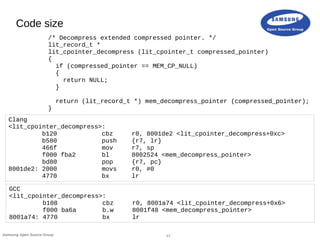
Code size
Clang
<lit_cpointer_decompress>:
b120 cbz r0, 8001de2 <lit_cpointer_decompress+0xc>
b580 push {r7, lr}
466f mov r7, sp
f000 fba2 bl 8002524 <mem_decompress_pointer>
bd80 pop {r7, pc}
8001de2: 2000 movs r0, #0
4770 bx lr
GCC
<lit_cpointer_decompress>:
b108 cbz r0, 8001a74 <lit_cpointer_decompress+0x6>
f000 ba6a b.w 8001f48 <mem_decompress_pointer>
8001a74: 4770 bx lr
/* Decompress extended compressed pointer. */
lit_record_t *
lit_cpointer_decompress (lit_cpointer_t compressed_pointer)
{
if (compressed_pointer == MEM_CP_NULL)
{
return NULL;
}
return (lit_record_t *) mem_decompress_pointer (compressed_pointer);
}
18Samsung Open Source Group
Code size
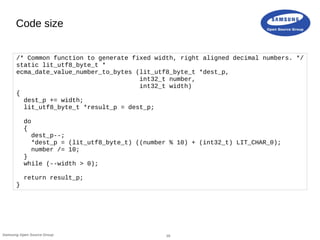
/* Common function to generate fixed width, right aligned decimal numbers. */
static lit_utf8_byte_t *
ecma_date_value_number_to_bytes (lit_utf8_byte_t *dest_p,
int32_t number,
int32_t width)
{
dest_p += width;
lit_utf8_byte_t *result_p = dest_p;
do
{
dest_p--;
*dest_p = (lit_utf8_byte_t) ((number % 10) + (int32_t) LIT_CHAR_0);
number /= 10;
}
while (--width > 0);
return result_p;
}
19Samsung Open Source Group
Code size
Clang
<ecma_date_value_number_to_bytes>:
b510 push {r4, lr}
4686 mov lr, r0
f246 6c67 movw ip, 0x6667
eb0e 0002 add.w r0, lr, r2
3a01 subs r2, #1
f2c6 6c66 movt ip, 0x6666
loop: fb51 f30c smmul r3, r1, ip
109c asrs r4, r3, #2
eb04 73d3 add.w r3, r4, r3, lsr #31
eb03 0483 add.w r4, r3, r3, lsl #2
eba1 0144 sub.w r1, r1, r4, lsl #1
3130 adds r1, #48 ; 0x30
f80e 1002 strb.w r1, [lr, r2]
1e51 subs r1, r2, #1
3201 adds r2, #1
2a01 cmp r2, #1
460a mov r2, r1
4619 mov r1, r3
dced bgt.n loop
bd10 pop {r4, pc}
bf00 nop
GCC
<ecma_date_value_number_to_bytes>:
4410 add r0, r2
b530 push {r4, r5, lr}
4603 mov r3, r0
250a movs r5, #10
1a12 subs r2, r2, r0
loop: fb91 f4f5 sdiv r4, r1, r5
fb05 1114 mls r1, r5, r4, r1
3130 adds r1, #48 ; 0x30
f803 1d01 strb.w r1, [r3, #-1]!
4621 mov r1, r4
189c adds r4, r3, r2
2c00 cmp r4, #0
dcf4 bgt.n loop
bd30 pop {r4, r5, pc}
/* Common function to generate fixed width, right aligned decimal numbers. */
static lit_utf8_byte_t *
ecma_date_value_number_to_bytes (lit_utf8_byte_t *dest_p,
int32_t number,
int32_t width) {
dest_p += width;
lit_utf8_byte_t *result_p = dest_p;
do
{
dest_p--;
*dest_p = (lit_utf8_byte_t) ((number % 10) + (int32_t) LIT_CHAR_0);
number /= 10;
}
while (--width > 0);
return result_p;
}
20Samsung Open Source Group
Code size
Clang
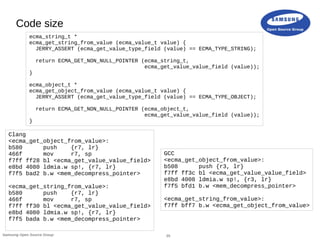
<ecma_get_object_from_value>:
b580 push {r7, lr}
466f mov r7, sp
f7ff ff28 bl <ecma_get_value_value_field>
e8bd 4080 ldmia.w sp!, {r7, lr}
f7f5 bad2 b.w <mem_decompress_pointer>
<ecma_get_string_from_value>:
b580 push {r7, lr}
466f mov r7, sp
f7ff ff30 bl <ecma_get_value_value_field>
e8bd 4080 ldmia.w sp!, {r7, lr}
f7f5 bada b.w <mem_decompress_pointer>
GCC
<ecma_get_object_from_value>:
b508 push {r3, lr}
f7ff ff3c bl <ecma_get_value_value_field>
e8bd 4008 ldmia.w sp!, {r3, lr}
f7f5 bfd1 b.w <mem_decompress_pointer>
<ecma_get_string_from_value>:
f7ff bff7 b.w <ecma_get_object_from_value>
ecma_string_t *
ecma_get_string_from_value (ecma_value_t value) {
JERRY_ASSERT (ecma_get_value_type_field (value) == ECMA_TYPE_STRING);
return ECMA_GET_NON_NULL_POINTER (ecma_string_t,
ecma_get_value_value_field (value));
}
ecma_object_t *
ecma_get_object_from_value (ecma_value_t value) {
JERRY_ASSERT (ecma_get_value_type_field (value) == ECMA_TYPE_OBJECT);
return ECMA_GET_NON_NULL_POINTER (ecma_object_t,
ecma_get_value_value_field (value));
}
21Samsung Open Source Group
Code size
Clang
<lit_literal_equal_type_utf8>:
7883 ldrb r3, [r0, #2]
f043 0304 orr.w r3, r3, #4
b2db uxtb r3, r3
2b04 cmp r3, #4
bf04 itt eq
2000 moveq r0, #0
4770 bxeq lr
b580 push {r7, lr}
466f mov r7, sp
f7ff ff17 bl 8001fac <lit_literal_equal_utf8>
bd80 pop {r7, pc}
GCC
<lit_literal_equal_type_utf8>:
7883 ldrb r3, [r0, #2]
f013 03fb ands.w r3, r3, #251 ; 0xfb
d001 beq.n exit
f7ff bfa6 b.w 8001c3a <lit_literal_equal_utf8>
exit: 4618 mov r0, r3
4770 bx lr
bool
lit_literal_equal_type_utf8 (lit_literal_t lit,
const lit_utf8_byte_t *str_p,
lit_utf8_size_t str_size)
{
const lit_record_type_t type = (const lit_record_type_t) lit->type;
if (type == LIT_RECORD_TYPE_NUMBER || type == LIT_RECORD_TYPE_FREE)
{
return false;
}
return lit_literal_equal_utf8 (lit, str_p, str_size);
}
22Samsung Open Source Group
Code size
Clang
<libc_fatal>:
b580 push {r7, lr}
466f mov r7, sp
b082 sub sp, #8
468c mov ip, r1
4601 mov r1, r0
b161 cbz r1, L1
f1bc 0f00 cmp.w ip, #0
bf18 it ne
2a00 cmpne r2, #0
d007 beq.n L1
f24a 405d movw r0, #42077
9300 str r3, [sp, #0]
4663 mov r3, ip
f6c0 0003 movt r0, #2051
f7ff fee4 bl 802d57e <printf>
L1: f000 f804 bl 802d7c2 <abort>
GCC
<libc_fatal>:
b507 push {r0, r1, r2, lr}
b138 cbz r0, L1
b131 cbz r1, L1
b12a cbz r2, L1
9300 str r3, [sp, #0]
460b mov r3, r1
4601 mov r1, r0
4802 ldr r0, [pc, #8] ; L2
f7ff fe74 bl 802855c <printf>
L1: f000 f805 bl 8028882 <abort>
L2: 0803515a .word 0x0803515a
void libc_fatal (const char *msg,
const char *file_name,
const char *function_name,
const unsigned int line_number) {
if (msg != NULL
&& file_name != NULL
&& function_name != NULL)
{
printf ("Assertion '%s' failed at %s (%s:%u).n",
msg, function_name, file_name, line_number);
}
abort ();
}
23Samsung Open Source Group
Code size
Clang
<lit_char_is_hex_digit>:
f1a0 0130 sub.w r1, r0, #48 ; 0x30
b289 uxth r1, r1
290a cmp r1, #10
bf22 ittt cs
f1a0 0161 subcs.w r1, r0, #97 ; 0x61
b289 uxthcs r1, r1
2906 cmpcs r1, #6
d306 bcc.n L1
3841 subs r0, #65 ; 0x41
b281 uxth r1, r0
2000 movs r0, #0
2906 cmp r1, #6
bf38 it cc
2001 movcc r0, #1
4770 bx lr
L1: 2001 movs r0, #1
4770 bx lr
GCC
<lit_char_is_hex_digit>:
f1a0 0330 sub.w r3, r0, #48 ; 0x30
2b09 cmp r3, #9
d907 bls.n L1
f020 0020 bic.w r0, r0, #32
3841 subs r0, #65 ; 0x41
2805 cmp r0, #5
bf8c ite hi
2000 movhi r0, #0
2001 movls r0, #1
4770 bx lr
L1: 2001 movs r0, #1
4770 bx lr
bool
lit_char_is_hex_digit (ecma_char_t c)
{
return ((c >= '0' && c <= '9')
|| (c >= 'a' && c <= 'f')
|| (c >= 'A' && c <= 'F'));
}
24Samsung Open Source Group
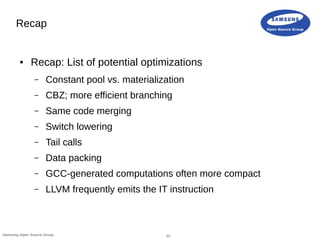
Recap
● Recap: List of potential optimizations
– Constant pool vs. materialization
– CBZ; more efficient branching
– Same code merging
– Switch lowering
– Tail calls
– Data packing
– GCC-generated computations often more compact
– LLVM frequently emits the IT instruction
25Samsung Open Source Group
Summary
26Samsung Open Source Group
Summary
● Clang-generated code about 10% bigger
● Lots of code size-related low-hanging fruit
● Future work: Enable LTO + -Os in Clang
● Specific optimization passes for code size
Thank you.
27Samsung Open Source Group

A Close Look at ARM Code Size

  • 1.
    1Samsung Open SourceGroup A closer look at ARM code size Tilmann Scheller Principal Compiler Engineer t.scheller@samsung.com Samsung Open Source Group Samsung Research UK EuroLLVM 2016 Barcelona, Spain, March 17 – 18, 2016
  • 2.
    2Samsung Open SourceGroup Overview ● Introduction ● ARM architecture ● Case study ● Summary
  • 3.
    3Samsung Open SourceGroup Introduction
  • 4.
    4Samsung Open SourceGroup Introduction ● Code size matters in the embedded space ● Find out how we are doing on ARM ● Comparison against GCC ● Focus on a specific application and compare the generated assembly code ● Try to find out what we need to change in LLVM to get better code size
  • 5.
    5Samsung Open SourceGroup ARM architecture
  • 6.
    6Samsung Open SourceGroup ARM architecture ● 32-bit/64-bit RISC architecture ● Load-store architecture ● Barrel shifter: add r4, r3, r6, lsl #4 ● Powerful indexed addressing modes: ldr r0, [r1, #4]! ● Predication: ldreq r3, [r4] ● Family of 32-bit instruction sets evolved over time: ARM, Thumb, Thumb-2 ● Focus on the Thumb-2 instruction set in this talk ● Instruction set extensions: – VFP – Advanced SIMD (NEON)
  • 7.
    7Samsung Open SourceGroup Thumb-2 ISA ● Goal: Code density similar to Thumb, performance like original ARM instruction set ● Variable-length instructions (16-bit/32-bit) ● 16 32-bit GPRs (including PC and SP) ● 16 or 32 64-bit floating-point registers for VFP/NEON ● Conditional execution with IT (if-then) instruction ; if (r0 == r1) cmp r0, r1 ite eq ; ARM: no code ... Thumb: IT instruction ; then r0 = r2; moveq r0, r2 ; ARM: conditional; Thumb: condition via ITE 'T' (then) ; else r0 = r3; movne r0, r3 ; ARM: conditional; Thumb: condition via ITE 'E' (else) ; recall that the Thumb MOV instruction has no bits to encode "EQ" or "NE"
  • 8.
    8Samsung Open SourceGroup Case study
  • 9.
    9Samsung Open SourceGroup JerryScript ● A really lightweight JavaScript engine ● Has a base footprint of 10KB of RAM ● Optimized for microcontrollers ● Written in C99 ● Supports all of ECMAScript 5.1 ● Open source (Apache 2.0 license) ● Developed by Samsung ● Goal: Want to compile with Clang but code size significantly higher
  • 10.
    10Samsung Open SourceGroup Target hardware ● STM32F4 developer board ● Cortex-M4F clocked at 168 MHz ● 192KB of RAM ● 1MB of flash memory
  • 11.
    11Samsung Open SourceGroup Code size ● Compiling with a Clang trunk snapshot (r262611, March 3, 2016) ● Using GCC 5.2.1 (Linaro bare-metal toolchain) ● JerryScript trunk snapshot (afa7b78, March 4, 2016) ● Release build of JerryScript ● Optimizing for the Cortex-M4F ● Building with -Os ● Static build, running bare-metal on the STM32F4 board
  • 12.
    12Samsung Open SourceGroup Code size -Os -mthumb -mcpu=cortex-m4 -mfpu=fpv4-sp-d16 JerryScript 0 50 100 150 200 250 231 208 190 Clang r262611 GCC 5.2.1 GCC 5.2.1 LTO CodesizeinKB(lowerisbetter)
  • 13.
    13Samsung Open SourceGroup Code size - LTO ● GCC in LTO mode produces the smallest binary ● Clang has no support for building in -Os -flto ● LTO optimization pipeline not tuned for size
  • 14.
    14Samsung Open SourceGroup Identifying interesting functions ● Python script which parses the "objdump -d" output ● Parsing the assembly dump of both binaries ● Binaries compiled with -fno-inline ● Computes per function code size delta ● Some functions get specialized and are only available in one binary ● Not perfectly accurate but good enough
  • 15.
    15Samsung Open SourceGroup Code size Clang <jerry_api_create_null_value>: b083 sub sp, #12 2102 movs r1, #2 f840 1b04 str.w r1, [r0], #4 4669 mov r1, sp e891 100c ldmia.w r1, {r2, r3, ip} e880 100c stmia.w r0, {r2, r3, ip} b003 add sp, #12 4770 bx lr GCC <jerry_api_create_null_value>: 2302 movs r3, #2 7003 strb r3, [r0, #0] 4770 bx lr typedef struct jerry_api_value_t { jerry_api_data_type_t type; union { bool v_bool; double v_float64; uint32_t v_uint32; ... } u; } jerry_api_value_t; /** * Creates and returns a jerry_api_value_t * with type JERRY_API_DATA_TYPE_NULL. */ jerry_api_value_t jerry_api_create_null_value (void) { jerry_api_value_t jerry_val; jerry_val.type = JERRY_API_DATA_TYPE_NULL; return jerry_val; }
  • 16.
    16Samsung Open SourceGroup Code size Clang <lit_magic_strings_ex_set>: f240 0340 movw r3, #64 ; 0x40 f2c2 0300 movt r3, #8192 ; 0x2000 6018 str r0, [r3, #0] f240 0044 movw r0, #68 ; 0x44 f2c2 0000 movt r0, #8192 ; 0x2000 6001 str r1, [r0, #0] f240 0048 movw r0, #72 ; 0x48 f2c2 0000 movt r0, #8192 ; 0x2000 6002 str r2, [r0, #0] 4770 bx lr GCC <lit_magic_strings_ex_set>: 4b01 ldr r3, [pc, #4] ; (base) e883 0007 stmia.w r3, {r0, r1, r2} 4770 bx lr base: 20000074 .word 0x20000074 void lit_magic_strings_ex_set (const lit_utf8_byte_t **ex_str_items, uint32_t count, const lit_utf8_size_t *ex_str_sizes) { lit_magic_string_ex_array = ex_str_items; lit_magic_string_ex_count = count; lit_magic_string_ex_sizes = ex_str_sizes; }
  • 17.
    17Samsung Open SourceGroup Code size Clang <lit_cpointer_decompress>: b120 cbz r0, 8001de2 <lit_cpointer_decompress+0xc> b580 push {r7, lr} 466f mov r7, sp f000 fba2 bl 8002524 <mem_decompress_pointer> bd80 pop {r7, pc} 8001de2: 2000 movs r0, #0 4770 bx lr GCC <lit_cpointer_decompress>: b108 cbz r0, 8001a74 <lit_cpointer_decompress+0x6> f000 ba6a b.w 8001f48 <mem_decompress_pointer> 8001a74: 4770 bx lr /* Decompress extended compressed pointer. */ lit_record_t * lit_cpointer_decompress (lit_cpointer_t compressed_pointer) { if (compressed_pointer == MEM_CP_NULL) { return NULL; } return (lit_record_t *) mem_decompress_pointer (compressed_pointer); }
  • 18.
    18Samsung Open SourceGroup Code size /* Common function to generate fixed width, right aligned decimal numbers. */ static lit_utf8_byte_t * ecma_date_value_number_to_bytes (lit_utf8_byte_t *dest_p, int32_t number, int32_t width) { dest_p += width; lit_utf8_byte_t *result_p = dest_p; do { dest_p--; *dest_p = (lit_utf8_byte_t) ((number % 10) + (int32_t) LIT_CHAR_0); number /= 10; } while (--width > 0); return result_p; }
  • 19.
    19Samsung Open SourceGroup Code size Clang <ecma_date_value_number_to_bytes>: b510 push {r4, lr} 4686 mov lr, r0 f246 6c67 movw ip, 0x6667 eb0e 0002 add.w r0, lr, r2 3a01 subs r2, #1 f2c6 6c66 movt ip, 0x6666 loop: fb51 f30c smmul r3, r1, ip 109c asrs r4, r3, #2 eb04 73d3 add.w r3, r4, r3, lsr #31 eb03 0483 add.w r4, r3, r3, lsl #2 eba1 0144 sub.w r1, r1, r4, lsl #1 3130 adds r1, #48 ; 0x30 f80e 1002 strb.w r1, [lr, r2] 1e51 subs r1, r2, #1 3201 adds r2, #1 2a01 cmp r2, #1 460a mov r2, r1 4619 mov r1, r3 dced bgt.n loop bd10 pop {r4, pc} bf00 nop GCC <ecma_date_value_number_to_bytes>: 4410 add r0, r2 b530 push {r4, r5, lr} 4603 mov r3, r0 250a movs r5, #10 1a12 subs r2, r2, r0 loop: fb91 f4f5 sdiv r4, r1, r5 fb05 1114 mls r1, r5, r4, r1 3130 adds r1, #48 ; 0x30 f803 1d01 strb.w r1, [r3, #-1]! 4621 mov r1, r4 189c adds r4, r3, r2 2c00 cmp r4, #0 dcf4 bgt.n loop bd30 pop {r4, r5, pc} /* Common function to generate fixed width, right aligned decimal numbers. */ static lit_utf8_byte_t * ecma_date_value_number_to_bytes (lit_utf8_byte_t *dest_p, int32_t number, int32_t width) { dest_p += width; lit_utf8_byte_t *result_p = dest_p; do { dest_p--; *dest_p = (lit_utf8_byte_t) ((number % 10) + (int32_t) LIT_CHAR_0); number /= 10; } while (--width > 0); return result_p; }
  • 20.
    20Samsung Open SourceGroup Code size Clang <ecma_get_object_from_value>: b580 push {r7, lr} 466f mov r7, sp f7ff ff28 bl <ecma_get_value_value_field> e8bd 4080 ldmia.w sp!, {r7, lr} f7f5 bad2 b.w <mem_decompress_pointer> <ecma_get_string_from_value>: b580 push {r7, lr} 466f mov r7, sp f7ff ff30 bl <ecma_get_value_value_field> e8bd 4080 ldmia.w sp!, {r7, lr} f7f5 bada b.w <mem_decompress_pointer> GCC <ecma_get_object_from_value>: b508 push {r3, lr} f7ff ff3c bl <ecma_get_value_value_field> e8bd 4008 ldmia.w sp!, {r3, lr} f7f5 bfd1 b.w <mem_decompress_pointer> <ecma_get_string_from_value>: f7ff bff7 b.w <ecma_get_object_from_value> ecma_string_t * ecma_get_string_from_value (ecma_value_t value) { JERRY_ASSERT (ecma_get_value_type_field (value) == ECMA_TYPE_STRING); return ECMA_GET_NON_NULL_POINTER (ecma_string_t, ecma_get_value_value_field (value)); } ecma_object_t * ecma_get_object_from_value (ecma_value_t value) { JERRY_ASSERT (ecma_get_value_type_field (value) == ECMA_TYPE_OBJECT); return ECMA_GET_NON_NULL_POINTER (ecma_object_t, ecma_get_value_value_field (value)); }
  • 21.
    21Samsung Open SourceGroup Code size Clang <lit_literal_equal_type_utf8>: 7883 ldrb r3, [r0, #2] f043 0304 orr.w r3, r3, #4 b2db uxtb r3, r3 2b04 cmp r3, #4 bf04 itt eq 2000 moveq r0, #0 4770 bxeq lr b580 push {r7, lr} 466f mov r7, sp f7ff ff17 bl 8001fac <lit_literal_equal_utf8> bd80 pop {r7, pc} GCC <lit_literal_equal_type_utf8>: 7883 ldrb r3, [r0, #2] f013 03fb ands.w r3, r3, #251 ; 0xfb d001 beq.n exit f7ff bfa6 b.w 8001c3a <lit_literal_equal_utf8> exit: 4618 mov r0, r3 4770 bx lr bool lit_literal_equal_type_utf8 (lit_literal_t lit, const lit_utf8_byte_t *str_p, lit_utf8_size_t str_size) { const lit_record_type_t type = (const lit_record_type_t) lit->type; if (type == LIT_RECORD_TYPE_NUMBER || type == LIT_RECORD_TYPE_FREE) { return false; } return lit_literal_equal_utf8 (lit, str_p, str_size); }
  • 22.
    22Samsung Open SourceGroup Code size Clang <libc_fatal>: b580 push {r7, lr} 466f mov r7, sp b082 sub sp, #8 468c mov ip, r1 4601 mov r1, r0 b161 cbz r1, L1 f1bc 0f00 cmp.w ip, #0 bf18 it ne 2a00 cmpne r2, #0 d007 beq.n L1 f24a 405d movw r0, #42077 9300 str r3, [sp, #0] 4663 mov r3, ip f6c0 0003 movt r0, #2051 f7ff fee4 bl 802d57e <printf> L1: f000 f804 bl 802d7c2 <abort> GCC <libc_fatal>: b507 push {r0, r1, r2, lr} b138 cbz r0, L1 b131 cbz r1, L1 b12a cbz r2, L1 9300 str r3, [sp, #0] 460b mov r3, r1 4601 mov r1, r0 4802 ldr r0, [pc, #8] ; L2 f7ff fe74 bl 802855c <printf> L1: f000 f805 bl 8028882 <abort> L2: 0803515a .word 0x0803515a void libc_fatal (const char *msg, const char *file_name, const char *function_name, const unsigned int line_number) { if (msg != NULL && file_name != NULL && function_name != NULL) { printf ("Assertion '%s' failed at %s (%s:%u).n", msg, function_name, file_name, line_number); } abort (); }
  • 23.
    23Samsung Open SourceGroup Code size Clang <lit_char_is_hex_digit>: f1a0 0130 sub.w r1, r0, #48 ; 0x30 b289 uxth r1, r1 290a cmp r1, #10 bf22 ittt cs f1a0 0161 subcs.w r1, r0, #97 ; 0x61 b289 uxthcs r1, r1 2906 cmpcs r1, #6 d306 bcc.n L1 3841 subs r0, #65 ; 0x41 b281 uxth r1, r0 2000 movs r0, #0 2906 cmp r1, #6 bf38 it cc 2001 movcc r0, #1 4770 bx lr L1: 2001 movs r0, #1 4770 bx lr GCC <lit_char_is_hex_digit>: f1a0 0330 sub.w r3, r0, #48 ; 0x30 2b09 cmp r3, #9 d907 bls.n L1 f020 0020 bic.w r0, r0, #32 3841 subs r0, #65 ; 0x41 2805 cmp r0, #5 bf8c ite hi 2000 movhi r0, #0 2001 movls r0, #1 4770 bx lr L1: 2001 movs r0, #1 4770 bx lr bool lit_char_is_hex_digit (ecma_char_t c) { return ((c >= '0' && c <= '9') || (c >= 'a' && c <= 'f') || (c >= 'A' && c <= 'F')); }
  • 24.
    24Samsung Open SourceGroup Recap ● Recap: List of potential optimizations – Constant pool vs. materialization – CBZ; more efficient branching – Same code merging – Switch lowering – Tail calls – Data packing – GCC-generated computations often more compact – LLVM frequently emits the IT instruction
  • 25.
    25Samsung Open SourceGroup Summary
  • 26.
    26Samsung Open SourceGroup Summary ● Clang-generated code about 10% bigger ● Lots of code size-related low-hanging fruit ● Future work: Enable LTO + -Os in Clang ● Specific optimization passes for code size
  • 27.