
ASSIGNMENT -2
ECO-TOURISM
CASE STUDY
SUBMITTED BY
ADIBA
M. ARCH (3rd SEMESTER)
SUBMITTED TO
SHRILA GUPTA MA’AM
CONCEPTS & PARADIGMS
COMPONENTS OF
ECOTOURISM
• Natural areas
• Contains educational
and interpretive features
• Minimizes negative
impacts
• Supports the protection of
natural areas by
generating economic
benefits for host
communities,
organizations and
authorities managing
natural areas with
conservation purposes

 Ulagalla resort design based on COMPONENTS OF ECO-
TOURISM.
 Based on a large bungalow of over 100 years old.
 It is located at Tirappane, 40 km north of Dambulla –
Anuradhapura road.
 The property has an area of 58 acres.
 Planning based on sustainability :
1. Concept used :
 “Go Green”
 50% energy generated through solar power;
 The resort has the largest solar farm in the Sri Lanka at
present with a capacity of 125 KVA.
 Use of renewable materials for Chalets (house) and various
water and energy saving measures.
 1600 trees have been planted to restore the natural habitat.
2. Design based on:
• Energy efficient material
• Renewable energy & rainwater Harvesting
• Wastewater treatment
• Solid waste management
• Organic Paddy , Vegetable and Fruit Garden
• Based on economic and sustainability to the
society.
• Use of pollution free transportation service, hence
saving energy
ECO-TOURISM
CASE STUDY AT ULAGALLA RESORT, Srilanka.

ECO-TOURISM
CASE STUDY AT ULAGALLA RESORT, Srilanka
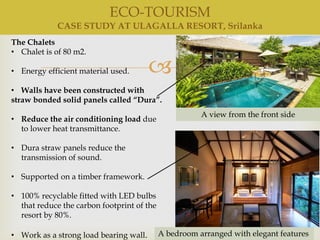
A view from the front side
A bedroom arranged with elegant features
The Chalets
• Chalet is of 80 m2.
• Energy efficient material used.
• Walls have been constructed with
straw bonded solid panels called “Dura”.
• Reduce the air conditioning load due
to lower heat transmittance.
• Dura straw panels reduce the
transmission of sound.
• Supported on a timber framework.
• 100% recyclable fitted with LED bulbs
that reduce the carbon footprint of the
resort by 80%.
• Work as a strong load bearing wall.

ECO-TOURISM
CASE STUDY AT ULAGALLA RESORT, Srilanka
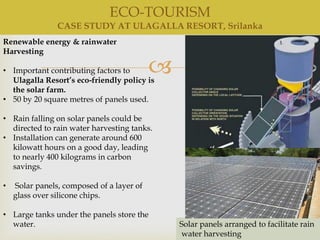
Solar panels arranged to facilitate rain
water harvesting
Renewable energy & rainwater
Harvesting
• Important contributing factors to
Ulagalla Resort’s eco-friendly policy is
the solar farm.
• 50 by 20 square metres of panels used.
• Rain falling on solar panels could be
directed to rain water harvesting tanks.
• Installation can generate around 600
kilowatt hours on a good day, leading
to nearly 400 kilograms in carbon
savings.
• Solar panels, composed of a layer of
glass over silicone chips.
• Large tanks under the panels store the
water.

ECO-TOURISM
CASE STUDY AT ULAGALLA RESORT
Wastewater treatment
flow-chart that indicates the process used
at the waste water treatment plant
In order to re-use the waste-
water, a very efficient treatment
plant has been installed. It is a
Sequencing Batch reactor (SBR)
type biological treatment plant
that contain the following
operations:
i. Equalizing
ii. Filling
iii. Aeration
iv. Settling
v. Decanting
vi. Sludge Removal

ECO-TOURISM
CASE STUDY AT ULAGALLA RESORT, Srilanka
Solid waste management
Plots with organic farming
• All recyclable solid waste such as
polythene, plastic, glass, paper and
metal being collected separately and
dispatched to recycling centres
periodically.
• Biodegradable waste is being
composted and used as organic
fertilizer.
Organic Paddy , Vegetable and Fruit Garden
• The resort includes over 20 acres of lush
paddy fields, vegetable and fruit
gardens.
• The paddy fields produce the entire
resort’s rice requirement
Mixed cultivation with organic farming

 Another feature that is actively
promoted at this resort is the use of
electric cars to transport guest and
also to provide other services.
ECO-TOURISM
CASE STUDY AT ULAGALLA RESORT, Srilanka
Use of Electric Cars to avoid pollution
Electric car service at the resort
Conclusion
• Ulagalla Resort is a well planned
project where many innovative
features have been included that
would give economic benefits either
short or long term.
• sustainable built environments and
development.

THANK YOU

Eco tourism Case Study

  • 1.
     ASSIGNMENT -2 ECO-TOURISM CASE STUDY SUBMITTEDBY ADIBA M. ARCH (3rd SEMESTER) SUBMITTED TO SHRILA GUPTA MA’AM CONCEPTS & PARADIGMS COMPONENTS OF ECOTOURISM • Natural areas • Contains educational and interpretive features • Minimizes negative impacts • Supports the protection of natural areas by generating economic benefits for host communities, organizations and authorities managing natural areas with conservation purposes
  • 3.
      Ulagalla resortdesign based on COMPONENTS OF ECO- TOURISM.  Based on a large bungalow of over 100 years old.  It is located at Tirappane, 40 km north of Dambulla – Anuradhapura road.  The property has an area of 58 acres.  Planning based on sustainability : 1. Concept used :  “Go Green”  50% energy generated through solar power;  The resort has the largest solar farm in the Sri Lanka at present with a capacity of 125 KVA.  Use of renewable materials for Chalets (house) and various water and energy saving measures.  1600 trees have been planted to restore the natural habitat. 2. Design based on: • Energy efficient material • Renewable energy & rainwater Harvesting • Wastewater treatment • Solid waste management • Organic Paddy , Vegetable and Fruit Garden • Based on economic and sustainability to the society. • Use of pollution free transportation service, hence saving energy ECO-TOURISM CASE STUDY AT ULAGALLA RESORT, Srilanka.
  • 4.
     ECO-TOURISM CASE STUDY ATULAGALLA RESORT, Srilanka A view from the front side A bedroom arranged with elegant features The Chalets • Chalet is of 80 m2. • Energy efficient material used. • Walls have been constructed with straw bonded solid panels called “Dura”. • Reduce the air conditioning load due to lower heat transmittance. • Dura straw panels reduce the transmission of sound. • Supported on a timber framework. • 100% recyclable fitted with LED bulbs that reduce the carbon footprint of the resort by 80%. • Work as a strong load bearing wall.
  • 5.
     ECO-TOURISM CASE STUDY ATULAGALLA RESORT, Srilanka Solar panels arranged to facilitate rain water harvesting Renewable energy & rainwater Harvesting • Important contributing factors to Ulagalla Resort’s eco-friendly policy is the solar farm. • 50 by 20 square metres of panels used. • Rain falling on solar panels could be directed to rain water harvesting tanks. • Installation can generate around 600 kilowatt hours on a good day, leading to nearly 400 kilograms in carbon savings. • Solar panels, composed of a layer of glass over silicone chips. • Large tanks under the panels store the water.
  • 6.
     ECO-TOURISM CASE STUDY ATULAGALLA RESORT Wastewater treatment flow-chart that indicates the process used at the waste water treatment plant In order to re-use the waste- water, a very efficient treatment plant has been installed. It is a Sequencing Batch reactor (SBR) type biological treatment plant that contain the following operations: i. Equalizing ii. Filling iii. Aeration iv. Settling v. Decanting vi. Sludge Removal
  • 7.
     ECO-TOURISM CASE STUDY ATULAGALLA RESORT, Srilanka Solid waste management Plots with organic farming • All recyclable solid waste such as polythene, plastic, glass, paper and metal being collected separately and dispatched to recycling centres periodically. • Biodegradable waste is being composted and used as organic fertilizer. Organic Paddy , Vegetable and Fruit Garden • The resort includes over 20 acres of lush paddy fields, vegetable and fruit gardens. • The paddy fields produce the entire resort’s rice requirement Mixed cultivation with organic farming
  • 8.
      Another featurethat is actively promoted at this resort is the use of electric cars to transport guest and also to provide other services. ECO-TOURISM CASE STUDY AT ULAGALLA RESORT, Srilanka Use of Electric Cars to avoid pollution Electric car service at the resort Conclusion • Ulagalla Resort is a well planned project where many innovative features have been included that would give economic benefits either short or long term. • sustainable built environments and development.
  • 9.