P. G. CENTER IN CIVIL ENGINEERING DEPARTMENT
SARVAJANIK COLLEGE OF ENGINEERING & TECHNOLOGY, SURAT
MASTER OF TECHNOLOGY CIVIL(TOWN AND COUNTRY PLANNING)
TOURISM PLANNING AND MANAGEMENT (MTTC14204)
“CONCEPT OF ECO-TOURISM”
Presented by:
Hardik Patel
Enrollment No: ET22MTTC009
M. Tech Civil (T&CP), Semester – II
Academic year: 2022-23
Prof. Zarana H. Gandhi
Adhoc Associate Professor
CED, SCET
Affiliated with
SARVAJANIK UNIVERSITY
Content
• Tourism
• Different types of tourism in India
• What is ecotourism ?
• History of ecotourism
• Principal of ecotourism
• Major ecotourism destination in India
• Major ecotourism destination in Abroad
• Case study of Thenmala Eco tourism (Kerala)
• The Challenges (issues)
• The Solution
• Concluding Remark
Tourism
• Tourism is the activities of persons traveling to and staying in places outside their
usual environment for not more than one consecutive year for leisure, business
and other purposes not related to the exercise of an activity remunerated from
within the place visited.
• Due to tourism there is an employment generation and also it creates foreign
exchange in various countries. Tourism is traveling for recreational or leisure
purposes and it can also nurture a sense of pride among the people.
Different types of tourism in India
• Adventure Tourism
• Beach Tourism
• Cultural Tourism
• Eco-Tourism
• Medical tourism
• Wildlife Tourism
• Business Tourism
• Heritage Tourism
• Film Tourism
• Educational Tourism
(Source: myindiatravel.co.in)
What is Ecotourism?
• Ecotourism is responsible travel to natural areas that conserves the environment
and improves the well-being of local people.
(Ministry of Tourism – GOI)
• Tourism that involves traveling to relatively undisturbed natural areas within the
specialized object of studying, admiring and enjoying the scenery and its wild
plants and animals, as well as any existing cultural aspects (both of the past or the
present) found in these areas is defined as eco-tourism.
(WTO – World Tourism Organization)
History of Ecotourism
• Claus-Dieter Helzer, in 1965 first used the term ecotourism. He described four
pillars of ecotourism or environment-friendly tourism.
• These are reducing the extent of environmental effects of ecotourism, respecting
host cultures, improving the benefits of local communities, and accelerating
traveler's satisfaction.
Principal of Ecotourism
• Minimize impact.
• Build environmental and cultural awareness and respect.
• The local community should be involved leading to the overall economic
development of the area.
• Provide financial benefits and empowerment for local people.
• The likely conflicts between resource use for eco-tourism and the livelihood of
local inhabitants should be identified and attempts made to minimize the same.
Cont…
• Provide positive experiences for both visitors and hosts.
• The type and scale of eco-tourism development should be compatible with the
environment and socio-cultural characteristics of the local community, and
• Provide direct financial benefits for conservation.
• Raise sensitivity to host countries' political, environmental, and social climate.
• Support international human rights and labor agreements.
Major Eco-Tourism Destinations in India
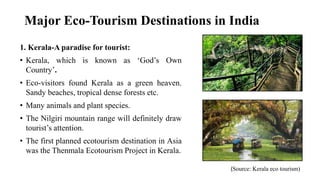
1. Kerala-A paradise for tourist:
• Kerala, which is known as ‘God’s Own
Country’.
• Eco-visitors found Kerala as a green heaven.
Sandy beaches, tropical dense forests etc.
• Many animals and plant species.
• The Nilgiri mountain range will definitely draw
tourist’s attention.
• The first planned ecotourism destination in Asia
was the Thenmala Ecotourism Project in Kerala.
(Source: Kerala eco tourism)
Cont…
2. Himalaya:
• The whole mountain range of North India
will give the tourists a perfect picture of an
eco-tour.
• Several places like Kulu, Manali, Ladak,
Dharmashala, Dalhosi etc.
• In different colours, shapes and heights,
valleys of mountains impress the
ecovisitors by their inherent qualities.
(Source: Himachal tourism)
Cont…
3. Andaman and Nicobar Islands:
• The Andaman and Nicobar Islands are the
garden of natural beauties.
• The animals, marine life, plants make
themselves alive in the deep water of the
Bay of Bengal.
• The fresh and clean environment, well-
maintained road attract all the eco tourists
from all over the world to this place.
• These Islands are covered by dense jungles
and surrounded by several coconut trees.
(Source: Andamanislands.com)
Major Eco-Tourism Destinations in Abroad
1. Costa Rica:
• Ecotourism is a key component of the
tourism industry in Costa Rica.
• It’s a tropical destination
boasting rainforests, cloud forests,
countless beaches, volcanoes and
mountains.
• Evidenced by the fact that over 25%
of the country is made up of national
parks, wildlife reserves and protected
lands.
• Corcovado National Park is almost
the epitome of ecotourism.
(Source: Travelmarket.com)
Cont...
2. Kenya:
• Kenya is arguably one of the best
ecotourism examples in Africa. The
government even created an organization
called ‘Ecotourism Kenya’.
• Their work involves promoting
sustainable tourism that will conserve
Kenya’s natural environment and improve
the livelihoods of local communities.
• Being home to 54 national parks, over 1
million tourists every year visit Kenya.
(Source: worldpackers.com)
Case study of Thenmala Eco tourism (Kerala)
• Thenmala is the first planned eco-tourism destination in India.
• The Thenmala Project imagines three components: Eco-friendly general
tourism, Eco-tourism and Pilgrimage tourism.
• The major activities undertaken for the promotion of eco-tourism in Thenmala
are cultural zone.
• Located in Kollam district of Kerala, Then’ means Honey and ‘Mala’ means
Hillock.
• Thenmala is a small village at the foothills of Western Ghats and for the most
part, a forest area with a lot of human interferences at the edge.
• Peppara dam of Kallada irrigation projects of the State is located here, the water
spread area of this basin is 22 sq. km
• Attractions and Activities are Holiday seekers paradise, Lush green forest Park,
Adventure Park, Children's Park, Butterfly Safari, Musical Dancing Fountain,
Boating, Trekking, Hiking, Night Camping, Ayurvedic Centers etc. Fig. Thenmala Eco-Tourism
(Source: keralatourism.org)
The Challenges (issues)
 Graveyard issue
 Migration of fauna
 Degradation of environment by throwing waste materials
 Deforestation
 Lack of coordination between the departments
 Minimum Job opportunities for local people
 Overnight program (Camp Fire)
The Solution
 Ensure full participation from the local community
 Needs to be a focused effort towards the preservation of the environment and the prevention of ecological
degradation
 Limits the number of visitors in each eco-tourism spots
 Ensure an efficient coordination between the governing bodies
 Garbage wastes can be transformed into Bio Gas plants
 Zoning of destination became a model for other eco-tourism destinations
 But, Thenmala fails to qualify as a major eco-tourism destination due to some weakness
 Local participation, employment participation, political involvement, lack of proper waste management, etc.
Concluding Remark
• Tourism has emerged as the largest global industry of 20th century. It has also the potential to create
maximum number of employments.
• Tourism industry is depending upon the geographical, social, and cultural factor. Hence it is related to
geographic as an important activity of human being.
• Tourism can act as pivot vehicle for economic development. Today, tourism has been acknowledged as
the biggest component of the tertiary sector.
• It constitutes a major portion in the world trade, and its growth rate is faster than that of the tangible
goods. Tourism provides millions of jobs and it enhances opportunity in the formal/informal sector.
Thank you

Eco-Tourim.pptx

  • 1.
    P. G. CENTERIN CIVIL ENGINEERING DEPARTMENT SARVAJANIK COLLEGE OF ENGINEERING & TECHNOLOGY, SURAT MASTER OF TECHNOLOGY CIVIL(TOWN AND COUNTRY PLANNING) TOURISM PLANNING AND MANAGEMENT (MTTC14204) “CONCEPT OF ECO-TOURISM” Presented by: Hardik Patel Enrollment No: ET22MTTC009 M. Tech Civil (T&CP), Semester – II Academic year: 2022-23 Prof. Zarana H. Gandhi Adhoc Associate Professor CED, SCET Affiliated with SARVAJANIK UNIVERSITY
  • 2.
    Content • Tourism • Differenttypes of tourism in India • What is ecotourism ? • History of ecotourism • Principal of ecotourism • Major ecotourism destination in India • Major ecotourism destination in Abroad • Case study of Thenmala Eco tourism (Kerala) • The Challenges (issues) • The Solution • Concluding Remark
  • 3.
    Tourism • Tourism isthe activities of persons traveling to and staying in places outside their usual environment for not more than one consecutive year for leisure, business and other purposes not related to the exercise of an activity remunerated from within the place visited. • Due to tourism there is an employment generation and also it creates foreign exchange in various countries. Tourism is traveling for recreational or leisure purposes and it can also nurture a sense of pride among the people.
  • 4.
    Different types oftourism in India • Adventure Tourism • Beach Tourism • Cultural Tourism • Eco-Tourism • Medical tourism • Wildlife Tourism • Business Tourism • Heritage Tourism • Film Tourism • Educational Tourism (Source: myindiatravel.co.in)
  • 5.
    What is Ecotourism? •Ecotourism is responsible travel to natural areas that conserves the environment and improves the well-being of local people. (Ministry of Tourism – GOI) • Tourism that involves traveling to relatively undisturbed natural areas within the specialized object of studying, admiring and enjoying the scenery and its wild plants and animals, as well as any existing cultural aspects (both of the past or the present) found in these areas is defined as eco-tourism. (WTO – World Tourism Organization)
  • 6.
    History of Ecotourism •Claus-Dieter Helzer, in 1965 first used the term ecotourism. He described four pillars of ecotourism or environment-friendly tourism. • These are reducing the extent of environmental effects of ecotourism, respecting host cultures, improving the benefits of local communities, and accelerating traveler's satisfaction.
  • 7.
    Principal of Ecotourism •Minimize impact. • Build environmental and cultural awareness and respect. • The local community should be involved leading to the overall economic development of the area. • Provide financial benefits and empowerment for local people. • The likely conflicts between resource use for eco-tourism and the livelihood of local inhabitants should be identified and attempts made to minimize the same.
  • 8.
    Cont… • Provide positiveexperiences for both visitors and hosts. • The type and scale of eco-tourism development should be compatible with the environment and socio-cultural characteristics of the local community, and • Provide direct financial benefits for conservation. • Raise sensitivity to host countries' political, environmental, and social climate. • Support international human rights and labor agreements.
  • 9.
    Major Eco-Tourism Destinationsin India 1. Kerala-A paradise for tourist: • Kerala, which is known as ‘God’s Own Country’. • Eco-visitors found Kerala as a green heaven. Sandy beaches, tropical dense forests etc. • Many animals and plant species. • The Nilgiri mountain range will definitely draw tourist’s attention. • The first planned ecotourism destination in Asia was the Thenmala Ecotourism Project in Kerala. (Source: Kerala eco tourism)
  • 10.
    Cont… 2. Himalaya: • Thewhole mountain range of North India will give the tourists a perfect picture of an eco-tour. • Several places like Kulu, Manali, Ladak, Dharmashala, Dalhosi etc. • In different colours, shapes and heights, valleys of mountains impress the ecovisitors by their inherent qualities. (Source: Himachal tourism)
  • 11.
    Cont… 3. Andaman andNicobar Islands: • The Andaman and Nicobar Islands are the garden of natural beauties. • The animals, marine life, plants make themselves alive in the deep water of the Bay of Bengal. • The fresh and clean environment, well- maintained road attract all the eco tourists from all over the world to this place. • These Islands are covered by dense jungles and surrounded by several coconut trees. (Source: Andamanislands.com)
  • 12.
    Major Eco-Tourism Destinationsin Abroad 1. Costa Rica: • Ecotourism is a key component of the tourism industry in Costa Rica. • It’s a tropical destination boasting rainforests, cloud forests, countless beaches, volcanoes and mountains. • Evidenced by the fact that over 25% of the country is made up of national parks, wildlife reserves and protected lands. • Corcovado National Park is almost the epitome of ecotourism. (Source: Travelmarket.com)
  • 13.
    Cont... 2. Kenya: • Kenyais arguably one of the best ecotourism examples in Africa. The government even created an organization called ‘Ecotourism Kenya’. • Their work involves promoting sustainable tourism that will conserve Kenya’s natural environment and improve the livelihoods of local communities. • Being home to 54 national parks, over 1 million tourists every year visit Kenya. (Source: worldpackers.com)
  • 14.
    Case study ofThenmala Eco tourism (Kerala) • Thenmala is the first planned eco-tourism destination in India. • The Thenmala Project imagines three components: Eco-friendly general tourism, Eco-tourism and Pilgrimage tourism. • The major activities undertaken for the promotion of eco-tourism in Thenmala are cultural zone. • Located in Kollam district of Kerala, Then’ means Honey and ‘Mala’ means Hillock. • Thenmala is a small village at the foothills of Western Ghats and for the most part, a forest area with a lot of human interferences at the edge. • Peppara dam of Kallada irrigation projects of the State is located here, the water spread area of this basin is 22 sq. km • Attractions and Activities are Holiday seekers paradise, Lush green forest Park, Adventure Park, Children's Park, Butterfly Safari, Musical Dancing Fountain, Boating, Trekking, Hiking, Night Camping, Ayurvedic Centers etc. Fig. Thenmala Eco-Tourism (Source: keralatourism.org)
  • 15.
    The Challenges (issues) Graveyard issue  Migration of fauna  Degradation of environment by throwing waste materials  Deforestation  Lack of coordination between the departments  Minimum Job opportunities for local people  Overnight program (Camp Fire)
  • 16.
    The Solution  Ensurefull participation from the local community  Needs to be a focused effort towards the preservation of the environment and the prevention of ecological degradation  Limits the number of visitors in each eco-tourism spots  Ensure an efficient coordination between the governing bodies  Garbage wastes can be transformed into Bio Gas plants  Zoning of destination became a model for other eco-tourism destinations  But, Thenmala fails to qualify as a major eco-tourism destination due to some weakness  Local participation, employment participation, political involvement, lack of proper waste management, etc.
  • 17.
    Concluding Remark • Tourismhas emerged as the largest global industry of 20th century. It has also the potential to create maximum number of employments. • Tourism industry is depending upon the geographical, social, and cultural factor. Hence it is related to geographic as an important activity of human being. • Tourism can act as pivot vehicle for economic development. Today, tourism has been acknowledged as the biggest component of the tertiary sector. • It constitutes a major portion in the world trade, and its growth rate is faster than that of the tangible goods. Tourism provides millions of jobs and it enhances opportunity in the formal/informal sector.
  • 18.