Presentation
On
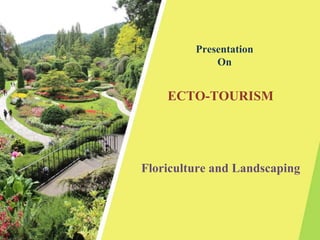
ECTO-TOURISM
Floriculture and Landscaping
The term “ecotourism” was coined in 1987 and is used to describe a wide range of activities. The word itself is a
blend of “ecology” and “tourism.” The term ‘ecotourism’ covers aspects of tourism that draws upon natural, human-made
and cultural environments. It is often used to describe any type of travel which focuses on natural environments or settings.
Additionally, ecotourism adds social responsibilities to make travel to natural areas purposeful and attempts to increase
understanding of cultural and natural history of the environment. The local people benefit economically from conservation
and the overall goal is to preserve the natural environment despite the human pressures of tourism.
Ecotourism involves travelling to relatively undisturbed areas with specified objects of studying, admiring and/or
enjoying the scenery and its wild plants and animals as well as any existing cultural aspects found in these areas.
Ecotourism is a form of tourism involving visiting fragile, pristine, and relatively undisturbed natural areas, intended as
a low-impact and often small scale alternative to standard commercial mass tourism.
It means responsible travel to natural areas
conserving the environment and improving the
well-being of the local people. Its purpose may be
to educate the traveler, to provide funds for
ecological conservation, to directly benefit the
economic development and political empowerment
of local communities, or to foster respect for
different cultures and for human rights. The
International Ecotourism Society (TIES, 2015)
defines ecotourism as "responsible travel to
natural areas that conserves the environment,
sustains the well-being of local people, and
involves interpretation and education".
Generally, ecotourism deals with interaction with biotic components of the natural environments. It focuses on
socially responsible travel, personal growth, and environmental sustainability. Ecotourism typically involves travel to
destinations where flora, fauna, and cultural heritage are the primary attractions. It is intended to offer tourists an insight
into the impact of human beings on the environment and to foster a greater appreciation of our natural habitats.
Responsible ecotourism programs include those that minimize the negative aspects of conventional tourism on the
environment and enhance the cultural integrity of local people. Therefore, in addition to evaluating environmental and
cultural factors, an integral part of ecotourism is the promotion of recycling, energy efficiency, water conservation, and
creation of economic opportunities for local communities. For these reasons, ecotourism often appeals to advocates of
environmental and social responsibility.
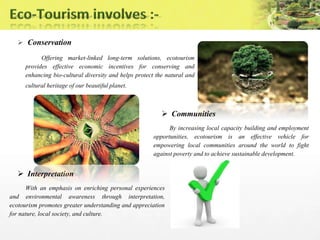
 Conservation
Offering market-linked long-term solutions, ecotourism
provides effective economic incentives for conserving and
enhancing bio-cultural diversity and helps protect the natural and
cultural heritage of our beautiful planet.
 Communities
By increasing local capacity building and employment
opportunities, ecotourism is an effective vehicle for
empowering local communities around the world to fight
against poverty and to achieve sustainable development.
 Interpretation
With an emphasis on enriching personal experiences
and environmental awareness through interpretation,
ecotourism promotes greater understanding and appreciation
for nature, local society, and culture.
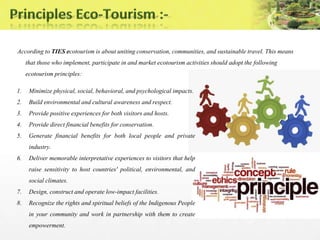
According to TIES ecotourism is about uniting conservation, communities, and sustainable travel. This means
that those who implement, participate in and market ecotourism activities should adopt the following
ecotourism principles:
1. Minimize physical, social, behavioral, and psychological impacts.
2. Build environmental and cultural awareness and respect.
3. Provide positive experiences for both visitors and hosts.
4. Provide direct financial benefits for conservation.
5. Generate financial benefits for both local people and private
industry.
6. Deliver memorable interpretative experiences to visitors that help
raise sensitivity to host countries' political, environmental, and
social climates.
7. Design, construct and operate low-impact facilities.
8. Recognize the rights and spiritual beliefs of the Indigenous People
in your community and work in partnership with them to create
empowerment.
Founded in 1990, TIES is the largest and oldest ecotourism organization in the
world dedicated to promoting and disseminating information about ecotourism
and sustainable tourism. TIES currently has members in over 90 countries
including tour operators, lodge owners and managers, academics, consultants,
conservation professionals, governments, architects, development experts,
NGO’s, the media, and travelers. As a non-governmental organization, TIES is
unique in its efforts to provide guidelines and standards, training, technical
assistance, research and publications to foster sound ecotourism development.
Travel and tourism in India has always been a thriving
industry. And it is on an exponential rise, primarily because of
the vast knowledge sharing on social media platforms. In 2013
alone, tourism contributed USD 113.3 billion to the Indian GDP.
Factors like better transport connectivity, a rise in luxury budget
hotels have also supported the growth.
The concept of ecotourism has been already introduced in
India and some planned approaches have been taken up for the
establishment. Government has also taken initiatives for the
promotion of ecotourism in India. India, the land of varied
geography offers several tourist destinations that not just de-
stress but also rejuvenate you. There are several ways to enjoy
Mother Nature in most pristine way. The few places like the
Himalayan Region, Kerala, the northeast India, Andaman &
Nicobar Islands and the Lakshadweep islands are some of the
places where you can enjoy the treasured wealth of the Mother
Nature. Thenmala in Kerala is the first planned ecotourism
destination in India created to cater to the Eco-tourists and
THENMALA
HANGING BRIDGE
The India topography boasts an abundant source of flora &
fauna. India has numerous rare and endangered species in its
surroundings. The declaration of several wildlife areas and national
parks has encouraged the growth of the wildlife resource, which
reduced due to the wildlife hunt by several kings in the past. Today,
India has many wildlife sanctuaries and protection laws. Currently,
there are about 80 national parks and 441 sanctuaries in India,
which works for the protection and conservation of wildlife
resource in India.
There are numerous Botanical and Zoological Gardens in
India, which are working towards the enhancement of the
Ecosystem. Poaching has stopped to large extent. There are severe
punishments for poachers, hunters and illegal traders of animals
and trees. Tree plantations are taking place in several places. There
are several animal & plant rights organization, which fight for the
rights of the animals and plants. Numerous organizations and
NGOs are coming forward to provide environmental education to
the common people at the grass root level.
The geographical diversity of India is a wealth of ecosystem, which are well protected and preserved. The
ecosystem has become the major resource for tourism in India. They are as follows:
1.Biosphere
reserves
1.Mangroves 1.Coral reefs 1.Deserts
1.Mountains and
forests
1.Flora and fauna 1.Sea. lakes,
beaches and rivers
1.Caves
Thenmala Ecotourism,
District Kollam, Kerela (1st
planned ecotourism in
India)
1.The Camp Rapid Fire-
Rishikesh, Uttarakhand
1.The Camp Bodhi Satva-
Rajgarh, Himachal Pradesh
1.The Himalayan Trout
House- Tirthan, Himachal
Pradesh
1.The Saat-tal Camp,
Nainital
1.The Camp, Kyari (The
finest models of ecotourism
in India), Village Kyari,
Ramnagar
It aims to give details about the inter relationships between tourism, tourists, horticulture and gardening. It
includes bio aesthetic planning which is the proper utilization of available flora and fauna in the
beautification of the surroundings
1. It provides pollution and noise free sites for travel and
tourism in rural backgrounds.
2. The cost of food, accommodation, recreation and travel
is less in horticultural tourism.
3. It satisfies the curiosity of urban people about sources of
food, plants, animals and industrial agricultural raw
materials.
4. It provides information about the rural handicrafts,
languages, culture, tradition, dresses, lifestyle, etc.
5. Horticulture tourists can also participate in
horticultural activities and experience the farming.
6. It provides combination of both horticulture and wildlife
for blissful tourism experience.
7. It creates awareness about horticulture.
8. It also provides opportunity for education.
It includes fruit orchard, spices, herbal gardens, botanical gardens, flower valley, various historical gardens,
etc.
Kalahasti Falls: it
has a cascade of
water surrounded by
dense forests and
coffee plantations in
Chikmagalur dist. of
Kerela.
1.Sudarshan Fern
hills (Karnataka
Horticulture
Department): the
department is
maintaining the
ornamental gardens,
lawns, nurseries and
fruit orchard.
1.The grape
crushing and
vineyard: for the
wine connoisseurs,
the vast orchards by
the countryside of
Nasik, Satara, Beed,
Latur and Sholapur
are a delight. Sula
vineyards, a very
famous winery in
Nasik, regularly
conducts visits to its
vineyards.
1.Apple orchards:
Himalayan
Mountains besides
their beauty also
serve as great hub
of apple orchards.
The breathtaking
views and fruit
picking experience
make the sites best
among horticulture
tourism. Trip can be
planned between
June and September
for an enthralling
experience.
1.Orange orchard,
Punjab: Jayani
Natural Farms in
Kathera village is an
amazing place to
visit.
THANK
YOU

EcoTourism.pptx

  • 1.
  • 3.
    The term “ecotourism”was coined in 1987 and is used to describe a wide range of activities. The word itself is a blend of “ecology” and “tourism.” The term ‘ecotourism’ covers aspects of tourism that draws upon natural, human-made and cultural environments. It is often used to describe any type of travel which focuses on natural environments or settings. Additionally, ecotourism adds social responsibilities to make travel to natural areas purposeful and attempts to increase understanding of cultural and natural history of the environment. The local people benefit economically from conservation and the overall goal is to preserve the natural environment despite the human pressures of tourism. Ecotourism involves travelling to relatively undisturbed areas with specified objects of studying, admiring and/or enjoying the scenery and its wild plants and animals as well as any existing cultural aspects found in these areas. Ecotourism is a form of tourism involving visiting fragile, pristine, and relatively undisturbed natural areas, intended as a low-impact and often small scale alternative to standard commercial mass tourism. It means responsible travel to natural areas conserving the environment and improving the well-being of the local people. Its purpose may be to educate the traveler, to provide funds for ecological conservation, to directly benefit the economic development and political empowerment of local communities, or to foster respect for different cultures and for human rights. The International Ecotourism Society (TIES, 2015) defines ecotourism as "responsible travel to natural areas that conserves the environment, sustains the well-being of local people, and involves interpretation and education".
  • 4.
    Generally, ecotourism dealswith interaction with biotic components of the natural environments. It focuses on socially responsible travel, personal growth, and environmental sustainability. Ecotourism typically involves travel to destinations where flora, fauna, and cultural heritage are the primary attractions. It is intended to offer tourists an insight into the impact of human beings on the environment and to foster a greater appreciation of our natural habitats. Responsible ecotourism programs include those that minimize the negative aspects of conventional tourism on the environment and enhance the cultural integrity of local people. Therefore, in addition to evaluating environmental and cultural factors, an integral part of ecotourism is the promotion of recycling, energy efficiency, water conservation, and creation of economic opportunities for local communities. For these reasons, ecotourism often appeals to advocates of environmental and social responsibility.
  • 5.
     Conservation Offering market-linkedlong-term solutions, ecotourism provides effective economic incentives for conserving and enhancing bio-cultural diversity and helps protect the natural and cultural heritage of our beautiful planet.  Communities By increasing local capacity building and employment opportunities, ecotourism is an effective vehicle for empowering local communities around the world to fight against poverty and to achieve sustainable development.  Interpretation With an emphasis on enriching personal experiences and environmental awareness through interpretation, ecotourism promotes greater understanding and appreciation for nature, local society, and culture.
  • 6.
    According to TIESecotourism is about uniting conservation, communities, and sustainable travel. This means that those who implement, participate in and market ecotourism activities should adopt the following ecotourism principles: 1. Minimize physical, social, behavioral, and psychological impacts. 2. Build environmental and cultural awareness and respect. 3. Provide positive experiences for both visitors and hosts. 4. Provide direct financial benefits for conservation. 5. Generate financial benefits for both local people and private industry. 6. Deliver memorable interpretative experiences to visitors that help raise sensitivity to host countries' political, environmental, and social climates. 7. Design, construct and operate low-impact facilities. 8. Recognize the rights and spiritual beliefs of the Indigenous People in your community and work in partnership with them to create empowerment.
  • 7.
    Founded in 1990,TIES is the largest and oldest ecotourism organization in the world dedicated to promoting and disseminating information about ecotourism and sustainable tourism. TIES currently has members in over 90 countries including tour operators, lodge owners and managers, academics, consultants, conservation professionals, governments, architects, development experts, NGO’s, the media, and travelers. As a non-governmental organization, TIES is unique in its efforts to provide guidelines and standards, training, technical assistance, research and publications to foster sound ecotourism development.
  • 8.
    Travel and tourismin India has always been a thriving industry. And it is on an exponential rise, primarily because of the vast knowledge sharing on social media platforms. In 2013 alone, tourism contributed USD 113.3 billion to the Indian GDP. Factors like better transport connectivity, a rise in luxury budget hotels have also supported the growth. The concept of ecotourism has been already introduced in India and some planned approaches have been taken up for the establishment. Government has also taken initiatives for the promotion of ecotourism in India. India, the land of varied geography offers several tourist destinations that not just de- stress but also rejuvenate you. There are several ways to enjoy Mother Nature in most pristine way. The few places like the Himalayan Region, Kerala, the northeast India, Andaman & Nicobar Islands and the Lakshadweep islands are some of the places where you can enjoy the treasured wealth of the Mother Nature. Thenmala in Kerala is the first planned ecotourism destination in India created to cater to the Eco-tourists and THENMALA HANGING BRIDGE
  • 9.
    The India topographyboasts an abundant source of flora & fauna. India has numerous rare and endangered species in its surroundings. The declaration of several wildlife areas and national parks has encouraged the growth of the wildlife resource, which reduced due to the wildlife hunt by several kings in the past. Today, India has many wildlife sanctuaries and protection laws. Currently, there are about 80 national parks and 441 sanctuaries in India, which works for the protection and conservation of wildlife resource in India. There are numerous Botanical and Zoological Gardens in India, which are working towards the enhancement of the Ecosystem. Poaching has stopped to large extent. There are severe punishments for poachers, hunters and illegal traders of animals and trees. Tree plantations are taking place in several places. There are several animal & plant rights organization, which fight for the rights of the animals and plants. Numerous organizations and NGOs are coming forward to provide environmental education to the common people at the grass root level.
  • 10.
    The geographical diversityof India is a wealth of ecosystem, which are well protected and preserved. The ecosystem has become the major resource for tourism in India. They are as follows: 1.Biosphere reserves 1.Mangroves 1.Coral reefs 1.Deserts 1.Mountains and forests 1.Flora and fauna 1.Sea. lakes, beaches and rivers 1.Caves
  • 11.
    Thenmala Ecotourism, District Kollam,Kerela (1st planned ecotourism in India) 1.The Camp Rapid Fire- Rishikesh, Uttarakhand 1.The Camp Bodhi Satva- Rajgarh, Himachal Pradesh 1.The Himalayan Trout House- Tirthan, Himachal Pradesh 1.The Saat-tal Camp, Nainital 1.The Camp, Kyari (The finest models of ecotourism in India), Village Kyari, Ramnagar
  • 12.
    It aims togive details about the inter relationships between tourism, tourists, horticulture and gardening. It includes bio aesthetic planning which is the proper utilization of available flora and fauna in the beautification of the surroundings
  • 13.
    1. It providespollution and noise free sites for travel and tourism in rural backgrounds. 2. The cost of food, accommodation, recreation and travel is less in horticultural tourism. 3. It satisfies the curiosity of urban people about sources of food, plants, animals and industrial agricultural raw materials. 4. It provides information about the rural handicrafts, languages, culture, tradition, dresses, lifestyle, etc. 5. Horticulture tourists can also participate in horticultural activities and experience the farming. 6. It provides combination of both horticulture and wildlife for blissful tourism experience. 7. It creates awareness about horticulture. 8. It also provides opportunity for education.
  • 14.
    It includes fruitorchard, spices, herbal gardens, botanical gardens, flower valley, various historical gardens, etc.
  • 15.
    Kalahasti Falls: it hasa cascade of water surrounded by dense forests and coffee plantations in Chikmagalur dist. of Kerela. 1.Sudarshan Fern hills (Karnataka Horticulture Department): the department is maintaining the ornamental gardens, lawns, nurseries and fruit orchard. 1.The grape crushing and vineyard: for the wine connoisseurs, the vast orchards by the countryside of Nasik, Satara, Beed, Latur and Sholapur are a delight. Sula vineyards, a very famous winery in Nasik, regularly conducts visits to its vineyards. 1.Apple orchards: Himalayan Mountains besides their beauty also serve as great hub of apple orchards. The breathtaking views and fruit picking experience make the sites best among horticulture tourism. Trip can be planned between June and September for an enthralling experience. 1.Orange orchard, Punjab: Jayani Natural Farms in Kathera village is an amazing place to visit.
  • 16.