A case study on Mumbai Dabbawala
Submitted in partial fulfillment of the requirements
for the award of the degree of
Master of Business Administration(MBA)
Semester-IV (Paper Code-MGT402
To
Dr. Shakuntala Misra National Rehabilitation University,Lucknow
Submitted To :-
Dr. Anu Ma’am
Name:- Sanjay Yadav
Roll No:- 192110021
Batch: 2019-2021
Submitted By :-
A Case Study on Mumbai
Dabbawala
INTRODUCTION
The Dabbawala, (one who carries the box), in the Indian city of Mumbai.
Carries and delivers freshly made food from customer’s home in a lunch box (Dabba) and
deliver it to offices.
It may sound simple, but it’s not . It is actually a highly specialized trade that has evolved in
its current form over a century and has become integral to Mumbai’s culture.
There are employees about 5000 in number and deliver approximately 200,000 Tiffin boxes
every day.
It all started about 125 years back when a Parasi banker wanted to have home cooked food
regularly in office and gave this responsibility to the first ever Dabbawala. Other people also
liked the idea and the demand for Dabba delivery soared.
It was all informal and individual effort in the beginning, but visionary Mahadeo Havaji
Bachche saw the opportunity and started the lunch delivery service in its present team-
delivery format with 100 Dabbawalas.
As the city grew, the demand for dabba delivery grew too. Forefathers had the vision to
create the Dabba coding system that’s going on strong even today.
The Coding system evolved through various stages with time. In the beginning it was simple
colour coding. Now Mumbai is a widely spread metro with 3 local train routes. Our coding
has also evolved into alpha numeric characters.
History of Mumbai Dabbawala
History Started in 1880
Charitable trust Registered in 1956
Avg. Literacy Rate 8th Grade Schooling
Total area coverage 60 kms
Employee Strength 5000
Number of Tiffin’s 2,00,000 Tiffin Boxes
i.e. 4,00,000 transactions every day
Time Taken 3 hrs
(Nutan Mumbai Tiffin Box Suppliers Association)
HR PRACTICES OF THE ASSOCIATION
• FLAT ORGANIZATION:
The president, Vice president, General Secretary, Treasurer & 9 no. of Directors
formed 13 members of board under which Macadam& other Dabbawallaswork. So
due to such Flat kind of organization structure decisions are taken on the spot.
Even the president & other higher categories members also work.
NO HIRE & FIRE RULE:
Everyone is shareholder of the association. Whatever profits they can equally distributed
within itself. It is democratic type of organization HR Practices.
• COMMUNITY BASED RECRITMENT:
Those who have capacity to job they can apply for the Dabbawala post. There is no any
kind of basis happens related to recruitment process.
• SHARING COMMON BELIEFS, VALUES & ETHICS:
All the Dabbawallas are from poor background, the aim of the organization is mutual
benefit to all members so they follow certain values, belief & ethics to run business
effectively.
• FOLLOWING OF STRICT DRESS CODES:
All Dabbawallas must wear white cap which is called as Gandhian cap on duty. Also wear
white samara&pajama (shirts & pants). All Dabbawala must carry their Identity card on
duty. All these rules are binding on all cadres of the Dabbawala.
HR PRACTICES OF THE ASSOCIATION
• LOYALTY & TRUST IS THEIR MONOPOLY:
All Dabbawallas are loyal& hard working in nature. They follow their norms & promise which
they made their customers.
• TRAINING PROVIDED TO NEW EMPLOYEES:
After recruitment they provide complete process training to new joiner under the observation
of Macadam or any senior member. When they feel that new employees are capable to work,
that time training will completed.
• OWNER + EMPLOYEE IS THE DESIGNATION OF ALL:
Everyone is the shareholder of the Association. All disciplinary rules & other ethics
follow by all members. So there is no any employee & employer relationship
between each other. All are owners of the business.
SIX SIGMA
• HRM System of NMTBSA :
 They achieved six sigma in following aspects.
 Simplified coding system
 High conformity to the system
 Buffer in the lead time
 Confirmed by the limits of the human capabilities
•LOGISTICS & SUPPLY CHAIN MANAGEMENT :
By using their own logistic methods they deliver lacks
of Tiffin boxes through many dabbawalas hand: but the
final goal is to reach Tiffin box before 12 pm. At
customer’s office everyday they achieve their goal.
 THE SYSTEM OF SERVICE NETWORK HOW THEY OPERATE:
The dabbawallas are the whole & soul of the entire system of these
operations. For these dabbawallas to be able to provide prompt &
efficient service, it is very much important & necessary to be always on
time. So you will not see any Dabbawala moving ahead road taking his
own sweet time! They are always in hurry pushing through the crowd
carefully to deliver lunches on time for lacks of mumbaiities!
The entire system involves carefully planned, organized & implemented
activities around the hour timings, but they do it with excellent
associated teamwork.
We now take look in the routine course of action Dabbawallas i.e. from
the time they leave their home in the morning till the time they deliver
the Tiffin box back to the customers’ home in the evening.
This cycle of operations of delivery takes them nearly 8 hrs a day very
similar to the office timings, as these takes time normally from 9 a.m. to
5 p.m. the day starts around 8.00-8.30 am in the morning.
SIX SIGMA
Leaving Home for the work:
•The Dabbawala leave there homes in the morning between 7.50 am to 8.30 am
depending upon from which areas they have to pick up tiffin boxes.
•The Dabbawala reaches the customers’ homes according to the timing fixed between
two of them.
•The day in home then hands over the prepared & packed tiffin box to the Dabbawala.
•Collecting 30-35 tiffin boxes (from area specified to him) is the responsibility of each
Dabbawala, but there were we can see that number of Dabbas picked up is also
dependent upon the age of the Dabbawala. Where a young person picks even 40 tiffin’s
each, an elder person might pick pick 30!
•Also collecting tiffin is not an easy task. Because, Dabbawala have to pick up tiffin
boxes from various distant location in his area. These locations may be far from each
other located on higher floors of the building where sometimes elevator may not be
available.
•These tiffin boxes are then taken to the nearest local station by vehicle. Usually a
bicycle or in long wooden creates carried on the head! E.g. If a Dabbawala a collecting
Tffin boxes from area of Ghatkopar then he will carry them to Ghatkopar or Vikhroli
railway station whichever is nearer from his area of collecting Tiffins.
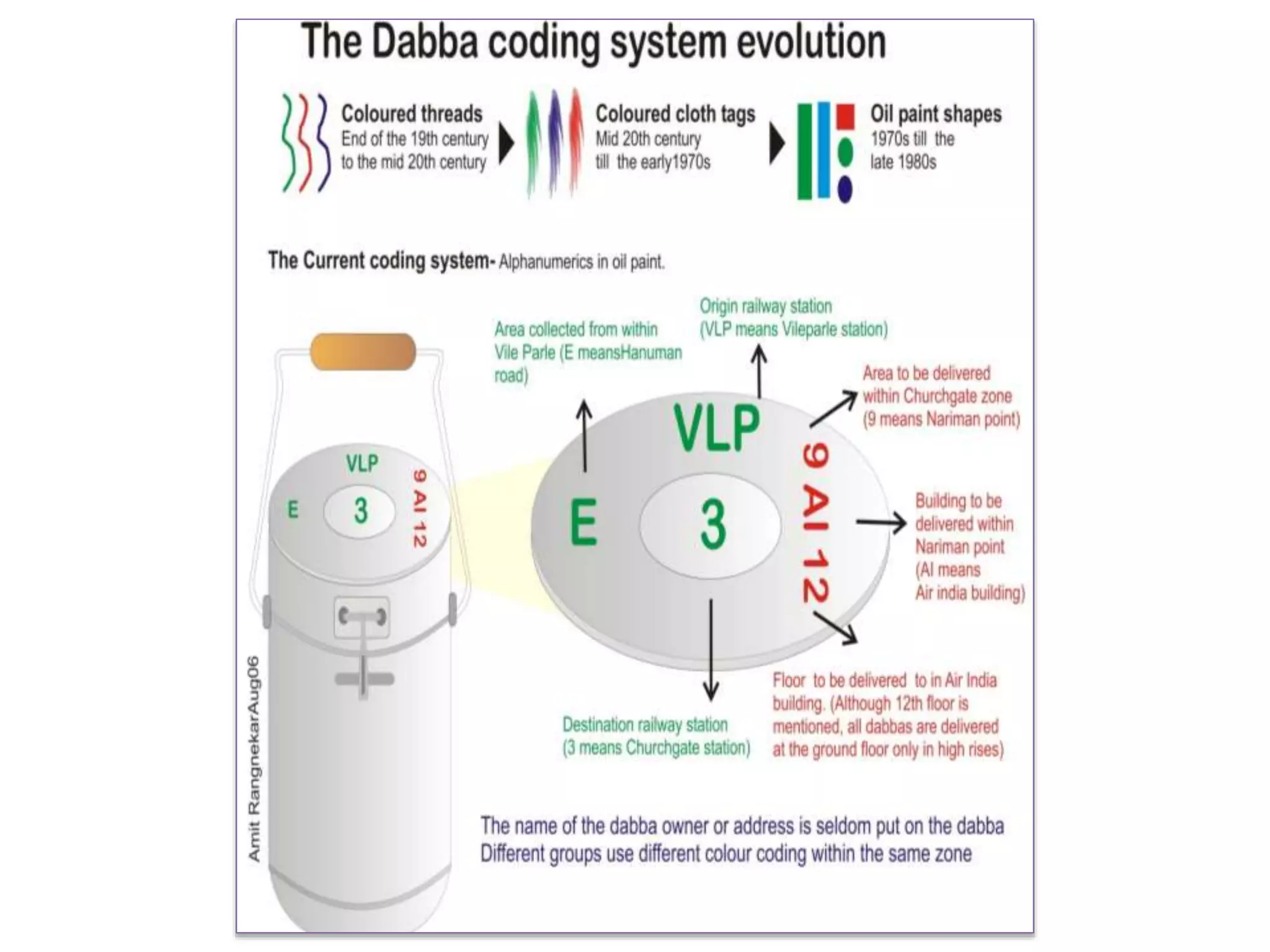
•Initial Coding System used colored threads to mark
7 Islands
• Then Utilized thrown away cotton waste from
tailors
• Now using color markers:
•E :: Code for Dabbawala Street
at residential station
VLP :: Residential Station Ville Parle
3 :: Code for Destination station.
E.G :: Church gate
9 :: Code for Dabbawala at Destination.
Ex :: Express towers ( Building name)
12 :: Floor no. in the building.
CODING SYSTEM
JOURNEY OF DABBAWALA
SIX SIGMA CERTIFICATION
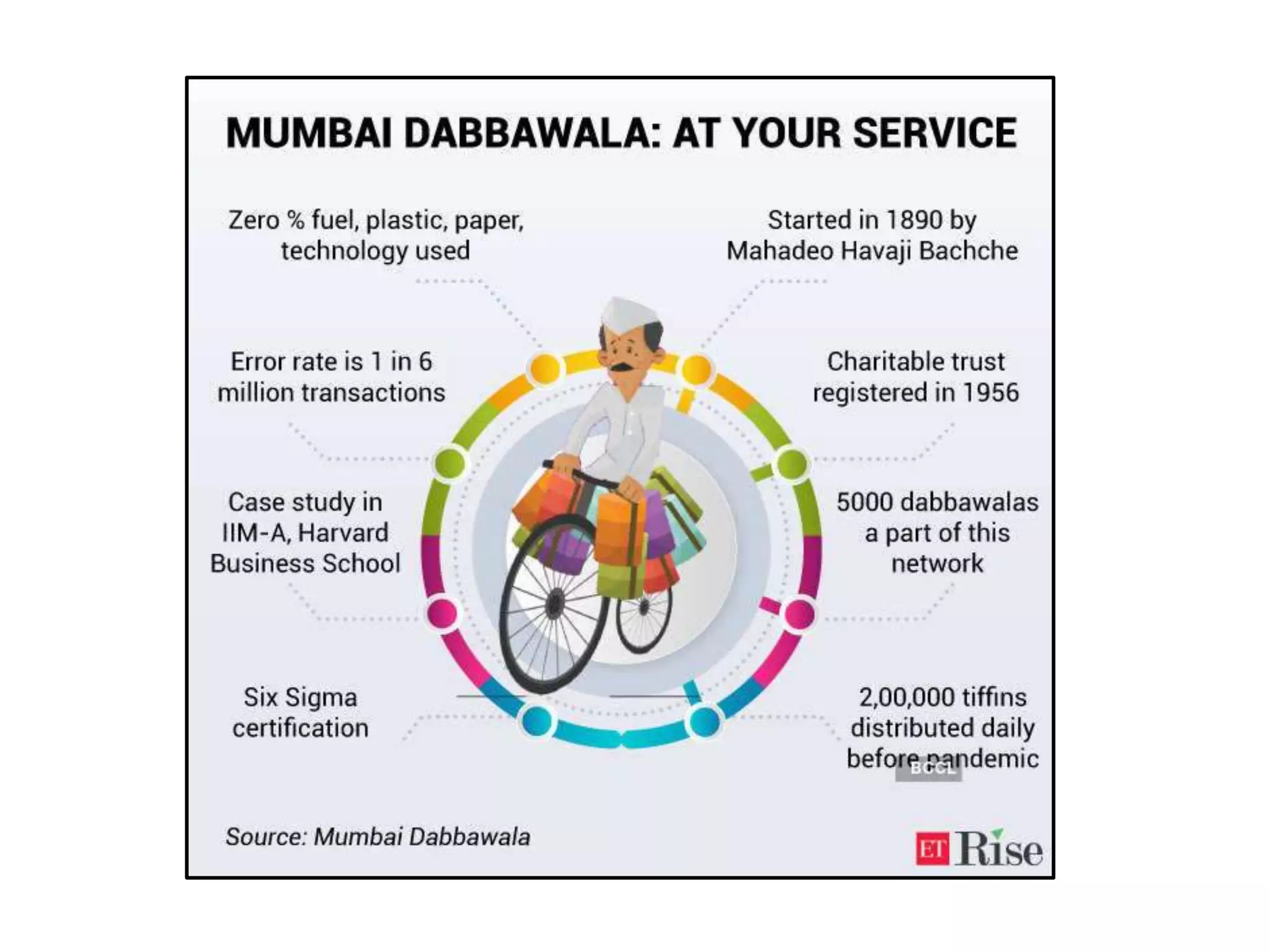
In 1998, Forbes Global magazine conducted
A quality assurance study on the Dabbawallas'
Operations
 Gave Rating of 99.999999
 Dabbawallas made one error in six million transactions.
 Stood High along with MNC’s like Motorola, GE etc.
 Dabbawallas got ISO 9001- 2000 for Excellence in service
FINANCIALS
5,000 dabbawalas make about 400,000
transactions per
day for a cost of Rs.300 per month, per dabba.
Cost of service -Rs. 300/month
Earnings - 5000 to 6000 p.m.
Diwali bonus: one month’s from customers.
Zero % fuel
Zero % investment
Zero % modern technology
Covid-19 impact of Mumbai's dabbawalas
• After being out of job for more than six months due to novel coronavirus pandemic and
subsequent lockdowns that hit the country's economy hard, Mumbai's Dabbawalas (lunch-box
carriers) services are now struggling and facing financial problems as they resume work from
today.
Under the fresh guidelines, the government also allowed the 130-year-old service
provided by the Dabbawalas in the Mumbai Metropolitan Region (MMR) region to
travel in the local trains after procuring of the QR codes from the office of the
Commissioner of Police, Mumbai.
Before Unlock 5 orders by the state government, dabbawalas who could reach south
Mumbai area on their cycles were able to deliver food to offices only.
Earlier, experiencing a tough time due to financial stress, the lunch-box carriers urged
the Maharashtra government to permit them to travel in local trains.
Access to local trains will enable dabbawalas to resume their business with full
capacity, said Subhash Talekar, president of Mumbai Dabbawala Association.
In the last six months, social organizations and volunteers have supported
the association financially, because of which dabbawalas, who have been
out of work, were given money and essentials during the lockdown period,
Talekar added.
There are about 4,500 to 5,000 dabbawalas who deliver two lakh tiffins
every day from suburban areas to the heart of the city.
Covid-19 impact of Mumbai's dabbawalas
'We've been out of work for the last 6 months and had to take loans to run our
households,' says one Dabbawala
Under the fresh guidelines, Maharashtra govt. has allowed the Dabbawalas in
Mumbai Metropolitan Region (MMR) region in the local trains
A Case Study of Mumbai Dabbawala

A Case Study of Mumbai Dabbawala

  • 1.
    A case studyon Mumbai Dabbawala Submitted in partial fulfillment of the requirements for the award of the degree of Master of Business Administration(MBA) Semester-IV (Paper Code-MGT402 To Dr. Shakuntala Misra National Rehabilitation University,Lucknow Submitted To :- Dr. Anu Ma’am Name:- Sanjay Yadav Roll No:- 192110021 Batch: 2019-2021 Submitted By :-
  • 2.
    A Case Studyon Mumbai Dabbawala INTRODUCTION The Dabbawala, (one who carries the box), in the Indian city of Mumbai. Carries and delivers freshly made food from customer’s home in a lunch box (Dabba) and deliver it to offices. It may sound simple, but it’s not . It is actually a highly specialized trade that has evolved in its current form over a century and has become integral to Mumbai’s culture. There are employees about 5000 in number and deliver approximately 200,000 Tiffin boxes every day. It all started about 125 years back when a Parasi banker wanted to have home cooked food regularly in office and gave this responsibility to the first ever Dabbawala. Other people also liked the idea and the demand for Dabba delivery soared. It was all informal and individual effort in the beginning, but visionary Mahadeo Havaji Bachche saw the opportunity and started the lunch delivery service in its present team- delivery format with 100 Dabbawalas. As the city grew, the demand for dabba delivery grew too. Forefathers had the vision to create the Dabba coding system that’s going on strong even today. The Coding system evolved through various stages with time. In the beginning it was simple colour coding. Now Mumbai is a widely spread metro with 3 local train routes. Our coding has also evolved into alpha numeric characters.
  • 3.
    History of MumbaiDabbawala History Started in 1880 Charitable trust Registered in 1956 Avg. Literacy Rate 8th Grade Schooling Total area coverage 60 kms Employee Strength 5000 Number of Tiffin’s 2,00,000 Tiffin Boxes i.e. 4,00,000 transactions every day Time Taken 3 hrs (Nutan Mumbai Tiffin Box Suppliers Association)
  • 4.
    HR PRACTICES OFTHE ASSOCIATION • FLAT ORGANIZATION: The president, Vice president, General Secretary, Treasurer & 9 no. of Directors formed 13 members of board under which Macadam& other Dabbawallaswork. So due to such Flat kind of organization structure decisions are taken on the spot. Even the president & other higher categories members also work. NO HIRE & FIRE RULE: Everyone is shareholder of the association. Whatever profits they can equally distributed within itself. It is democratic type of organization HR Practices. • COMMUNITY BASED RECRITMENT: Those who have capacity to job they can apply for the Dabbawala post. There is no any kind of basis happens related to recruitment process. • SHARING COMMON BELIEFS, VALUES & ETHICS: All the Dabbawallas are from poor background, the aim of the organization is mutual benefit to all members so they follow certain values, belief & ethics to run business effectively. • FOLLOWING OF STRICT DRESS CODES: All Dabbawallas must wear white cap which is called as Gandhian cap on duty. Also wear white samara&pajama (shirts & pants). All Dabbawala must carry their Identity card on duty. All these rules are binding on all cadres of the Dabbawala.
  • 5.
    HR PRACTICES OFTHE ASSOCIATION • LOYALTY & TRUST IS THEIR MONOPOLY: All Dabbawallas are loyal& hard working in nature. They follow their norms & promise which they made their customers. • TRAINING PROVIDED TO NEW EMPLOYEES: After recruitment they provide complete process training to new joiner under the observation of Macadam or any senior member. When they feel that new employees are capable to work, that time training will completed. • OWNER + EMPLOYEE IS THE DESIGNATION OF ALL: Everyone is the shareholder of the Association. All disciplinary rules & other ethics follow by all members. So there is no any employee & employer relationship between each other. All are owners of the business.
  • 6.
    SIX SIGMA • HRMSystem of NMTBSA :  They achieved six sigma in following aspects.  Simplified coding system  High conformity to the system  Buffer in the lead time  Confirmed by the limits of the human capabilities •LOGISTICS & SUPPLY CHAIN MANAGEMENT : By using their own logistic methods they deliver lacks of Tiffin boxes through many dabbawalas hand: but the final goal is to reach Tiffin box before 12 pm. At customer’s office everyday they achieve their goal.
  • 7.
     THE SYSTEMOF SERVICE NETWORK HOW THEY OPERATE: The dabbawallas are the whole & soul of the entire system of these operations. For these dabbawallas to be able to provide prompt & efficient service, it is very much important & necessary to be always on time. So you will not see any Dabbawala moving ahead road taking his own sweet time! They are always in hurry pushing through the crowd carefully to deliver lunches on time for lacks of mumbaiities! The entire system involves carefully planned, organized & implemented activities around the hour timings, but they do it with excellent associated teamwork. We now take look in the routine course of action Dabbawallas i.e. from the time they leave their home in the morning till the time they deliver the Tiffin box back to the customers’ home in the evening. This cycle of operations of delivery takes them nearly 8 hrs a day very similar to the office timings, as these takes time normally from 9 a.m. to 5 p.m. the day starts around 8.00-8.30 am in the morning. SIX SIGMA
  • 8.
    Leaving Home forthe work: •The Dabbawala leave there homes in the morning between 7.50 am to 8.30 am depending upon from which areas they have to pick up tiffin boxes. •The Dabbawala reaches the customers’ homes according to the timing fixed between two of them. •The day in home then hands over the prepared & packed tiffin box to the Dabbawala. •Collecting 30-35 tiffin boxes (from area specified to him) is the responsibility of each Dabbawala, but there were we can see that number of Dabbas picked up is also dependent upon the age of the Dabbawala. Where a young person picks even 40 tiffin’s each, an elder person might pick pick 30! •Also collecting tiffin is not an easy task. Because, Dabbawala have to pick up tiffin boxes from various distant location in his area. These locations may be far from each other located on higher floors of the building where sometimes elevator may not be available. •These tiffin boxes are then taken to the nearest local station by vehicle. Usually a bicycle or in long wooden creates carried on the head! E.g. If a Dabbawala a collecting Tffin boxes from area of Ghatkopar then he will carry them to Ghatkopar or Vikhroli railway station whichever is nearer from his area of collecting Tiffins.
  • 9.
    •Initial Coding Systemused colored threads to mark 7 Islands • Then Utilized thrown away cotton waste from tailors • Now using color markers: •E :: Code for Dabbawala Street at residential station VLP :: Residential Station Ville Parle 3 :: Code for Destination station. E.G :: Church gate 9 :: Code for Dabbawala at Destination. Ex :: Express towers ( Building name) 12 :: Floor no. in the building. CODING SYSTEM
  • 11.
  • 13.
    SIX SIGMA CERTIFICATION In1998, Forbes Global magazine conducted A quality assurance study on the Dabbawallas' Operations  Gave Rating of 99.999999  Dabbawallas made one error in six million transactions.  Stood High along with MNC’s like Motorola, GE etc.  Dabbawallas got ISO 9001- 2000 for Excellence in service FINANCIALS 5,000 dabbawalas make about 400,000 transactions per day for a cost of Rs.300 per month, per dabba. Cost of service -Rs. 300/month Earnings - 5000 to 6000 p.m. Diwali bonus: one month’s from customers. Zero % fuel Zero % investment Zero % modern technology
  • 14.
    Covid-19 impact ofMumbai's dabbawalas • After being out of job for more than six months due to novel coronavirus pandemic and subsequent lockdowns that hit the country's economy hard, Mumbai's Dabbawalas (lunch-box carriers) services are now struggling and facing financial problems as they resume work from today. Under the fresh guidelines, the government also allowed the 130-year-old service provided by the Dabbawalas in the Mumbai Metropolitan Region (MMR) region to travel in the local trains after procuring of the QR codes from the office of the Commissioner of Police, Mumbai. Before Unlock 5 orders by the state government, dabbawalas who could reach south Mumbai area on their cycles were able to deliver food to offices only. Earlier, experiencing a tough time due to financial stress, the lunch-box carriers urged the Maharashtra government to permit them to travel in local trains. Access to local trains will enable dabbawalas to resume their business with full capacity, said Subhash Talekar, president of Mumbai Dabbawala Association.
  • 15.
    In the lastsix months, social organizations and volunteers have supported the association financially, because of which dabbawalas, who have been out of work, were given money and essentials during the lockdown period, Talekar added. There are about 4,500 to 5,000 dabbawalas who deliver two lakh tiffins every day from suburban areas to the heart of the city. Covid-19 impact of Mumbai's dabbawalas 'We've been out of work for the last 6 months and had to take loans to run our households,' says one Dabbawala Under the fresh guidelines, Maharashtra govt. has allowed the Dabbawalas in Mumbai Metropolitan Region (MMR) region in the local trains