Introduction
to Python
Language
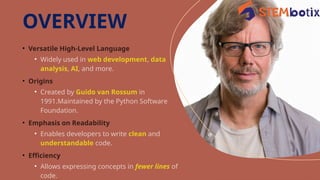
• Versatile High-Level Language
• Widely used in web development, data
analysis, AI, and more.
• Origins
• Created by Guido van Rossum in
1991.Maintained by the Python Software
Foundation.
• Emphasis on Readability
• Enables developers to write clean and
understandable code.
• Efficiency
• Allows expressing concepts in fewer lines of
code.
OVERVIEW
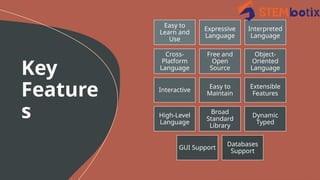
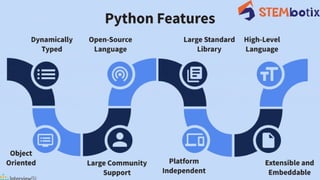
Key
Feature
s
Easy to
Learn and
Use
Expressive
Language
Interpreted
Language
Cross-
Platform
Language
Free and
Open
Source
Object-
Oriented
Language
Interactive
Easy to
Maintain
Extensible
Features
High-Level
Language
Broad
Standard
Library
Dynamic
Typed
GUI Support
Databases
Support
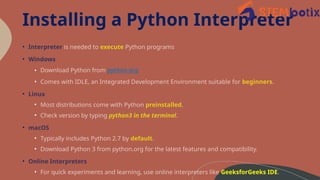
Installing a Python Interpreter
• Interpreter is needed to execute Python programs
• Windows
• Download Python from python.org
• Comes with IDLE, an Integrated Development Environment suitable for beginners.
• Linux
• Most distributions come with Python preinstalled.
• Check version by typing python3 in the terminal.
• macOS
• Typically includes Python 2.7 by default.
• Download Python 3 from python.org for the latest features and compatibility.
• Online Interpreters
• For quick experiments and learning, use online interpreters like GeeksforGeeks IDE.
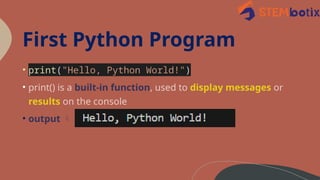
First Python Program
• print("Hello, Python World!")
• print() is a built-in function, used to display messages or
results on the console
• output 
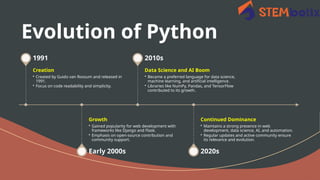
Evolution of Python
Creation
• Created by Guido van Rossum and released in
1991.
• Focus on code readability and simplicity.
1991
Growth
• Gained popularity for web development with
frameworks like Django and Flask.
• Emphasis on open-source contribution and
community support.
Early 2000s
Data Science and AI Boom
• Became a preferred language for data science,
machine learning, and artificial intelligence.
• Libraries like NumPy, Pandas, and TensorFlow
contributed to its growth.
2010s
Continued Dominance
• Maintains a strong presence in web
development, data science, AI, and automation.
• Regular updates and active community ensure
its relevance and evolution.
2020s
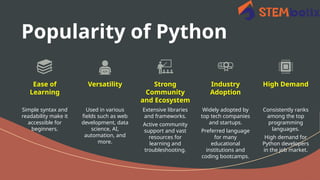
Popularity of Python
Ease of
Learning
Simple syntax and
readability make it
accessible for
beginners.
Versatility
Used in various
fields such as web
development, data
science, AI,
automation, and
more.
Strong
Community
and Ecosystem
Extensive libraries
and frameworks.
Active community
support and vast
resources for
learning and
troubleshooting.
Industry
Adoption
Widely adopted by
top tech companies
and startups.
Preferred language
for many
educational
institutions and
coding bootcamps.
High Demand
Consistently ranks
among the top
programming
languages.
High demand for
Python developers
in the job market.
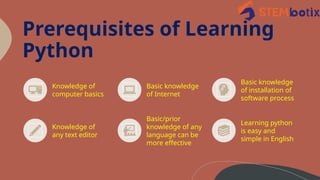
Prerequisites of Learning
Python
Knowledge of
computer basics
Basic knowledge
of Internet
Basic knowledge
of installation of
software process
Knowledge of
any text editor
Basic/prior
knowledge of any
language can be
more effective
Learning python
is easy and
simple in English
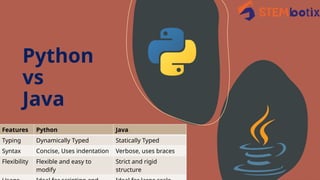
Python
vs
Java
Features Python Java
Typing Dynamically Typed Statically Typed
Syntax Concise, Uses indentation Verbose, uses braces
Flexibility Flexible and easy to
modify
Strict and rigid
structure
Python vs Java Codes:
• Python
print("Hello, world!")
• Java
public class HelloWorld {
public static void main(String[] args) {
System.out.println("Hello, world!");
}
}
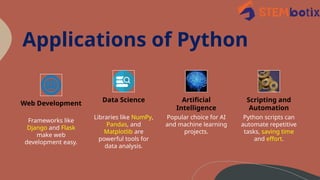
Applications of Python
Web Development
Frameworks like
Django and Flask
make web
development easy.
Data Science
Libraries like NumPy,
Pandas, and
Matplotlib are
powerful tools for
data analysis.
Artificial
Intelligence
Popular choice for AI
and machine learning
projects.
Scripting and
Automation
Python scripts can
automate repetitive
tasks, saving time
and effort.
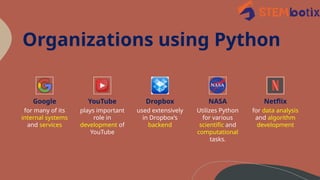
Organizations using Python
Google
for many of its
internal systems
and services
YouTube
plays important
role in
development of
YouTube
Dropbox
used extensively
in Dropbox’s
backend
NASA
Utilizes Python
for various
scientific and
computational
tasks.
Netflix
for data analysis
and algorithm
development
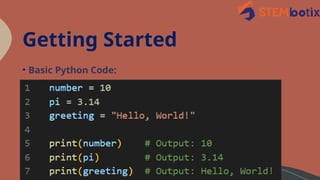
Getting Started
• Basic Python Code:
Variables in Python
• Dynamic Typing
• No need for explicit variable declarations.
• Type is determined by the value assigned.
• Naming Conventions
• Variable names should be descriptive.
• Use underscores to separate words (e.g., my_variable).
• Assignment
• Use the = operator to assign values.
• Multiple assignments are possible (e.g., x, y = 5, 10).
Comments in Python
• Single-line comment
• use #
• Multi-line comment
• use “”” your comment “””
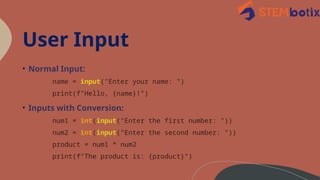
User Input
• Normal Input:
name = input("Enter your name: ")
print(f"Hello, {name}!")
• Inputs with Conversion:
num1 = int(input("Enter the first number: "))
num2 = int(input("Enter the second number: "))
product = num1 * num2
print(f"The product is: {product}")
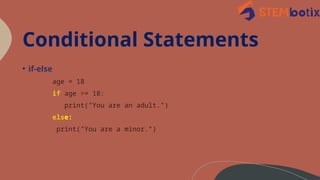
Conditional Statements
• if-else
age = 18
if age >= 18:
print("You are an adult.")
else:
print("You are a minor.")
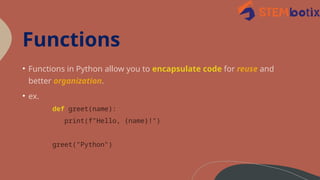
Functions
• Functions in Python allow you to encapsulate code for reuse and
better organization.
• ex.
def greet(name):
print(f"Hello, {name}!")
greet("Python")
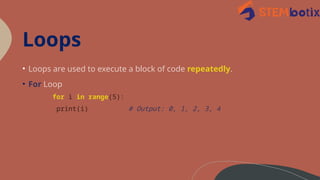
Loops
• Loops are used to execute a block of code repeatedly.
• For Loop
for i in range(5):
print(i) # Output: 0, 1, 2, 3, 4
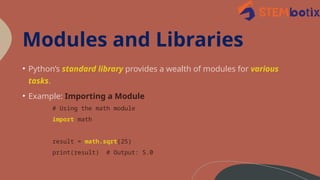
Modules and Libraries
• Python’s standard library provides a wealth of modules for various
tasks.
• Example: Importing a Module
# Using the math module
import math
result = math.sqrt(25)
print(result) # Output: 5.0
Thank You

A Brief Introduction to Python - English

  • 1.
  • 2.
    • Versatile High-LevelLanguage • Widely used in web development, data analysis, AI, and more. • Origins • Created by Guido van Rossum in 1991.Maintained by the Python Software Foundation. • Emphasis on Readability • Enables developers to write clean and understandable code. • Efficiency • Allows expressing concepts in fewer lines of code. OVERVIEW
  • 3.
    Key Feature s Easy to Learn and Use Expressive Language Interpreted Language Cross- Platform Language Freeand Open Source Object- Oriented Language Interactive Easy to Maintain Extensible Features High-Level Language Broad Standard Library Dynamic Typed GUI Support Databases Support
  • 4.
    Installing a PythonInterpreter • Interpreter is needed to execute Python programs • Windows • Download Python from python.org • Comes with IDLE, an Integrated Development Environment suitable for beginners. • Linux • Most distributions come with Python preinstalled. • Check version by typing python3 in the terminal. • macOS • Typically includes Python 2.7 by default. • Download Python 3 from python.org for the latest features and compatibility. • Online Interpreters • For quick experiments and learning, use online interpreters like GeeksforGeeks IDE.
  • 5.
    First Python Program •print("Hello, Python World!") • print() is a built-in function, used to display messages or results on the console • output 
  • 6.
    Evolution of Python Creation •Created by Guido van Rossum and released in 1991. • Focus on code readability and simplicity. 1991 Growth • Gained popularity for web development with frameworks like Django and Flask. • Emphasis on open-source contribution and community support. Early 2000s Data Science and AI Boom • Became a preferred language for data science, machine learning, and artificial intelligence. • Libraries like NumPy, Pandas, and TensorFlow contributed to its growth. 2010s Continued Dominance • Maintains a strong presence in web development, data science, AI, and automation. • Regular updates and active community ensure its relevance and evolution. 2020s
  • 7.
    Popularity of Python Easeof Learning Simple syntax and readability make it accessible for beginners. Versatility Used in various fields such as web development, data science, AI, automation, and more. Strong Community and Ecosystem Extensive libraries and frameworks. Active community support and vast resources for learning and troubleshooting. Industry Adoption Widely adopted by top tech companies and startups. Preferred language for many educational institutions and coding bootcamps. High Demand Consistently ranks among the top programming languages. High demand for Python developers in the job market.
  • 8.
    Prerequisites of Learning Python Knowledgeof computer basics Basic knowledge of Internet Basic knowledge of installation of software process Knowledge of any text editor Basic/prior knowledge of any language can be more effective Learning python is easy and simple in English
  • 10.
    Python vs Java Features Python Java TypingDynamically Typed Statically Typed Syntax Concise, Uses indentation Verbose, uses braces Flexibility Flexible and easy to modify Strict and rigid structure
  • 11.
    Python vs JavaCodes: • Python print("Hello, world!") • Java public class HelloWorld { public static void main(String[] args) { System.out.println("Hello, world!"); } }
  • 12.
    Applications of Python WebDevelopment Frameworks like Django and Flask make web development easy. Data Science Libraries like NumPy, Pandas, and Matplotlib are powerful tools for data analysis. Artificial Intelligence Popular choice for AI and machine learning projects. Scripting and Automation Python scripts can automate repetitive tasks, saving time and effort.
  • 13.
    Organizations using Python Google formany of its internal systems and services YouTube plays important role in development of YouTube Dropbox used extensively in Dropbox’s backend NASA Utilizes Python for various scientific and computational tasks. Netflix for data analysis and algorithm development
  • 14.
  • 15.
    Variables in Python •Dynamic Typing • No need for explicit variable declarations. • Type is determined by the value assigned. • Naming Conventions • Variable names should be descriptive. • Use underscores to separate words (e.g., my_variable). • Assignment • Use the = operator to assign values. • Multiple assignments are possible (e.g., x, y = 5, 10).
  • 16.
    Comments in Python •Single-line comment • use # • Multi-line comment • use “”” your comment “””
  • 17.
    User Input • NormalInput: name = input("Enter your name: ") print(f"Hello, {name}!") • Inputs with Conversion: num1 = int(input("Enter the first number: ")) num2 = int(input("Enter the second number: ")) product = num1 * num2 print(f"The product is: {product}")
  • 18.
    Conditional Statements • if-else age= 18 if age >= 18: print("You are an adult.") else: print("You are a minor.")
  • 19.
    Functions • Functions inPython allow you to encapsulate code for reuse and better organization. • ex. def greet(name): print(f"Hello, {name}!") greet("Python")
  • 20.
    Loops • Loops areused to execute a block of code repeatedly. • For Loop for i in range(5): print(i) # Output: 0, 1, 2, 3, 4
  • 21.
    Modules and Libraries •Python’s standard library provides a wealth of modules for various tasks. • Example: Importing a Module # Using the math module import math result = math.sqrt(25) print(result) # Output: 5.0
  • 22.