International Journal of Research in Engineering, Science and Management
Volume-2, Issue-7, July-2019
www.ijresm.com | ISSN (Online): 2581-5792
391
Abstract: Mobile ad-hoc network (MANET) is a collection of
autonomous nodes, which have the properties like mobility,
wireless. MANETs have dynamic network topology and self-
configuring so that nodes in network can move independently in
any direction and change their links to other nodes in network
frequently. Mobile ad-hoc networks are more vulnerable to
security attacks due to their unique characteristics such as
dynamic topology, no fixed infrastructure, resource limitations
and multi-hop scenario. In MANETs one the dangerous attack is
packet dropping attack. This packet dropping attack is two types:
1. Black hole and 2. Gray hole. In both the attacks, an attacker
sends the false reply to source node that it is having the shortest
route to the destination. In black hole attack, attackers drops all
the packets received from source node and in packet dropping
attack, attacker drops packets selectively or forwards packets
selectively or forwarding packets but not data packets. In this
paper, we have proposed mechanism to detect and isolate these
attacks in network. To evaluate the performance of our proposed
method we used the same scenarios and simulation parameters
that are used for simulating the attack. In the proposed solution,
the sender sends the packets until the attack is detected and after
the attack is detected, it blocks the route and chooses another route
for data transmission.
Keywords: MANET
1. Introduction
A. Ad-hoc networks
Ad-Hoc networks have no organization where the nodes are
free to join and left the network. The nodes are interconnected
with each other via a wireless link. A node can serve as a router
to forward the data to the neighbours’ nodes. Therefore, this
type of network is also recognised as infrastructure less
networks. These networks have no centralized consolidate
administration. Ad-Hoc networks have the abilities to handle
any malfunctioning in the nodes or any variations that its know-
how due to topology changes. Whenever a node in the network
is down or leaves the network that causes the link among other
nodes is broken. The affected nodes in the network simply
request for new routes and new links are established Ad-Hoc
network can be considered in to static Ad-Hoc network
(SANET) and Mobile Ad-Hoc network (MANET).
B. Static ad-hoc networks
In static Ad-Hoc networks the geographic location of the
nodes or the stations are fixed. There is no flexibility in the
nodes of the networks, that’s why they are known as static Ad-
Hoc networks.
2. Mobile ad-hoc networks
Mobile Ad-Hoc network is an independent system, where
nodes/stations are connected with each other through wireless
links. There are no limitations on the nodes to join or leave the
network, therefore the nodes join or leave spontaneously.
Mobile Ad-Hoc network topology is dynamic that can
change swiftly because the nodes move freely and can organize
themselves arbitrarily. This property of the nodes makes the
mobile Ad-Hoc networks random from the point of view of
scalability and topology. Mobile Ad-Hoc network topology is
active that can change rapidly because the nodes move freely
and can organize themselves randomly. This possessions of the
nodes makes the mobile Ad-Hoc networks unpredictable from
the point of view of scalability and topology.
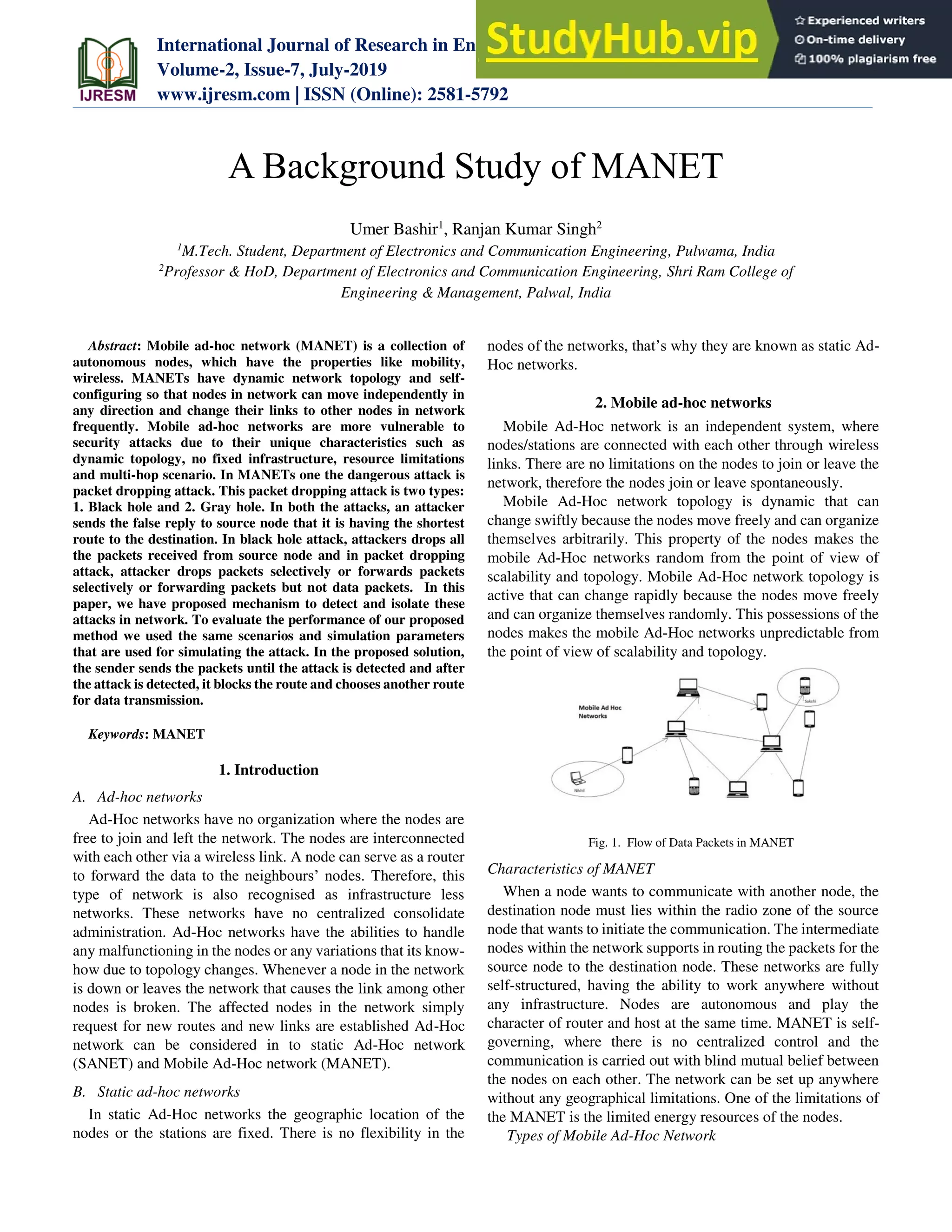
Fig. 1. Flow of Data Packets in MANET
Characteristics of MANET
When a node wants to communicate with another node, the
destination node must lies within the radio zone of the source
node that wants to initiate the communication. The intermediate
nodes within the network supports in routing the packets for the
source node to the destination node. These networks are fully
self-structured, having the ability to work anywhere without
any infrastructure. Nodes are autonomous and play the
character of router and host at the same time. MANET is self-
governing, where there is no centralized control and the
communication is carried out with blind mutual belief between
the nodes on each other. The network can be set up anywhere
without any geographical limitations. One of the limitations of
the MANET is the limited energy resources of the nodes.
Types of Mobile Ad-Hoc Network
A Background Study of MANET
Umer Bashir1
, Ranjan Kumar Singh2
1
M.Tech. Student, Department of Electronics and Communication Engineering, Pulwama, India
2
Professor & HoD, Department of Electronics and Communication Engineering, Shri Ram College of
Engineering & Management, Palwal, India
International Journal of Research in Engineering, Science and Management
Volume-2, Issue-7, July-2019
www.ijresm.com | ISSN (Online): 2581-5792
392
 Vehicular Ad-Hoc Networks (VANET’s)
 Intelligent Vehicular Ad-Hoc Networks (In
VANET’s)
 Internet Based Mobile Ad-Hoc Networks
(iMANET’s)
 Vehicular Ad-Hoc Networks (VANET’s)
It is a type of Mobile Ad-Hoc network where vehicles are
fortified with wireless and form a network without help of any
infrastructure. The equipment is located inside vehicles as well
as on the road for providing access to other vehicles in order to
establish a network and interconnect to communicate.
 Intelligent Vehicular Ad-Hoc Networks (In-
VANET’s): Vehicles that form Mobile Ad-Hoc
Network for communication via WiMAX IEEE
802.16 and WiFi 802.11. The main objective of
designing In-VANET’s is to ignore vehicle collision
so as to retain passengers as safe as possible. This also
help drivers to retain protected distance among the
vehicles as well as contribution them at how much
speed other vehicles are approaching. In-VANET’s
applications are also active for military purposes to
communicate with each other.
 Internet Based Mobile Ad-Hoc Networks (i-
MANET’s): These are used for connecting up the
mobile nodes and fixed internet gateways. In these
networks the normal routing algorithms does not apply
[2].
Applications of MANET
The properties of MANET make it so much positive that
would bring so many aids. There are so many research areas in
MANET which is under studies now. The most significant area
is vehicle to vehicle communication where the vehicle would
communicate with each other, keeping a secure distance
between them as well as collision notices to the drivers.
MANET can be used for automated battlefield and war games.
One of the most important area where MANETs are applied is
emergency services such as disaster recovery and relief
activities, where out-dated wired network is already destroyed.
There are so many other application areas for instance
entertainment, education and commercial where MANETs are
playing their vital character for connecting people.
Short comings of Mobile Ad-Hoc Networks
Certain drawbacks of MANETs are as follows.
 Limited Resources.
 Scalability issues.
 No dominant check on the network.
 Dynamic topology, where it is hard to find out
malevolent nodes.
MANET’s Routing Protocols
Mobile Ad-Hoc Network is the swiftly rising technology
from the past 20 years. The advancement in their reputation is
because of the ease of deployment, infrastructure less and their
dynamic nature. MANETs fashioned a new set of demands to
be implemented and to provide effective improved end-to-end
communication. MANETs mechanism on TCP/IP structure to
provide the means of communication between communicating
work stations. Work stations are portable and they have limited
resources, therefore the traditional TCP/IP model needs to be
overhauled or modified, in order to recompense the MANETs
mobility to provide efficient functionality. Therefore, the
crucial research area for the researchers is routing in any
network. Routing protocols in MANETs are a challenging and
striking tasks, researchers are giving marvelous amount of
attention to this key area.
Classification of MANETs Routing Protocols
Routing protocols in MANETs are categorized into three
different categories according to their functionality
A. Reactive protocols
B. Proactive protocols
C. Hybrid protocols
The order of these protocols is shown below in the figure.
Fig. 2. Manet routing protocols
A. Reactive protocols
Reactive protocols also recognized as on demand driven
reactive protocols. The fact they are identified as reactive
protocols is, they do not pledge route discovery by themselves,
till they are wished, when a source node request to discover a
route. These protocols setup routes when required [3], [4].
When a node desires to communicate with another node in the
network, and the source node does not have a route to the node
it wants to communicate with, reactive routing protocols will
establish a route for the source to destination node. Typically,
reactive protocols.
 Don’t find route until needed
 When tries to discover the destination “on demand”, it
uses flooding technique to broadcast the request.
 Do not consume bandwidth for sending information.
 As soon as the node start transmitting the data to the
destination node, they consume bandwidth only.
Ad-Hoc On Demand Distance Vector Protocol (AODV):
AODV is defined in RFC 3561 [5]. It’s reactive protocol, when
a node needs to start transmission with another node in the
network to which it has no route; AODV will deliver topology
information for the node. AODV use control messages to find
a route to the destination node in the network. Since there are
International Journal of Research in Engineering, Science and Management
Volume-2, Issue-7, July-2019
www.ijresm.com | ISSN (Online): 2581-5792
393
three types of control messages in AODV which are conversed
bellow.
 Route Request Message (RREQ) Source node that
desires to communicate with another node in the
network conveys RREQ message. AODV floods
RREQ message, using expanding ring technique.
There is a time to aware (TTL) value in every RREQ
message, the value of TTL describes the number of
hops the RREQ should be communicated.
 Route Reply Message (RREP) A node having a
demanded uniqueness or any intermediate node that
has a route to the demanded node generates a route
reply RREP message back to the instigator node.
 Route Error Message (RERR) Each node in the
network keeps monitoring the link status to its
neighbour’s nodes during active routes. As soon as the
node notices a link crack in an active route, (RERR)
message is generated by the node in order to notify
other nodes that the link is down.
 Route Discovery Mechanism in AODV: When a node “A”
wants to pledge broadcast with another node “G” as shown
in the Fig. 2.4, it will produce a route request message
(RREQ). This message is broadcasted through a limited
flooding to other nodes. This control message is promoted
to the neighbours, and those node advancing the control
message to their neighbours’ nodes. This procedure of
finding destination node goes on until it finds a node that
has a new enough route to the destination or destination
node is situated itself. As soon as the destination node is
located or an intermediate node with enough fresh routes is
located, they start generating control message route reply
message (RREP) towards the source node. When RREP
ranges the source node, a route is established between the
source node “A” and destination node “G”. Once the route
is recognized among “A” and “G”, node “A” and “G” can
communicate with each other. Fig3. signifies the exchange
of control messages between source node and destination
node.
Fig. 3. AODV route discovery
Once there is a link down or a link between destinations is
broken that causes one or more than one links unreachable from
the source node or from the neighbours nodes, the RERR
message is directed towards the source node. When RREQ
message is broadcasted for finding the destination node i.e.
from the node “A” to the neighbours nodes, at node “E” the link
is broken between “E” and “G”, so a route error RERR message
is generated at node “E” and transmitted to the source node
informing the source node a route fault, where “A” is source
node and “G” is the destination node. The structure is shown in
the Fig. below.
Fig. 4. Route error message in AODV
B. Dynamic Source Routing Protocol
Dynamic source routing protocol abbreviated by means of
DSR is also a reactive protocol. DSR use to update its route
caches by finding new routes. It keep informed its cache with
new route discovered or when there exist a direct route between
source and destination node. When a node wants to transmit
data, it describes a route for the transmission and then starts
transmitting data through the defined route. There are two
procedures for route discovery and maintenance which are
described below.
C. Route discovery process
Once a source node wants to start data transmission with
another node in the network, it checks its routing cache. Once
there is no route available to the destination in its cache or a
route is expired, it broadcast RREQ. When the destination is
located or any middle node that has fresh enough route to the
destination node, RREP is generated [15]. Once the source node
accepts the RREP it updates its caches and the traffic is routed
through the route.
D. Route maintenance process
When the transmission of data started, it is the duty of the
node that is transmitting data to confirm the next hop
acknowledged the data along with source route. The node
generates a route error message, if it does not receive any
authorization to the originator node. The originator node again
performs new route discovery process.
E. Proactive protocols
Proactive routing protocols works as compared to reactive
routing protocols. These protocols continuously preserve the
updated topology of the network. Every node in the network
recognizes about the other node in advance, in other words the
whole network is acknowledged to all the nodes making that
network. All the routing information is usually reserved in
tables [6]. Each time there is a change in the network topology,
these tables are updated according to the change. The nodes
interchange topology information with each other; they can
have route information any time when they required [6].
 Optimized Link State Routing Protocol (OLSR): The
Optimized Link State Routing (OLSR) protocol is
termed in RFC3626 [7]. OLSR is proactive routing
protocol that is also called as table driven protocol by
International Journal of Research in Engineering, Science and Management
Volume-2, Issue-7, July-2019
www.ijresm.com | ISSN (Online): 2581-5792
394
the detail that it updates its routing tables. OLSR has
also three types of control messages which are detailed
bellow.
 Hello: This control message is communicated for
sensing the neighbour and for Multi Point Distribution
Relays (MPR) calculations.
 Topology Control (TC): These are connection state
signalling that is achieved by OLSR. MPRs are used
to enhance theses messaging.
 Multiple Interface Declaration (MID): MID messages
comprehends the list of all IP addresses used through
any node in the network. All the nodes running OLSR
spread these messages on more than one interface.
 OLSR Working Multi Point Relaying (MPR): OLSR
disperses the network topology information by
flooding the packets throughout the network. The
flooding is done in such technique that each node that
received the packets retransmits the received packets.
These packets contain a sequence number so as to
evade loops. The receiver nodes record this sequence
number making sure that the packet is retransmitted
after. The simple concept of MPR is to reduce the
duplication or loops of retransmissions of the packets.
Individual MPR nodes broadcast route packets. The nodes
inside the network keep a list of MPR nodes. MPR nodes are
nominated with in the vicinity of the source node. The
assortment of MPR is based on HELLO message sent between
the neighbour nodes. The selection of MPR is such that, a path
exist to each of its 2 hop neighbours via MPR node. Routes are
established, once it is done the source node that wants to initiate
communication can start sending data.
Fig. 5. Flooding packets using MPR
The whole process can be understand through looking into
the Fig6. below. The nodes shown in the figure are neighbours.
“A” transmits a HELLO message to the neighbour node “B”.
As soon as node B receives this message, the link is distorted.
The similar is the case when B send HELLO message to A.
When there is two way communications between both of the
nodes we call the link as symmetric link. HELLO message has
all the information about the neighbours. MPR node transmits
topology control (TC) message, along through link status
information at a predetermined TC interval.
Fig. 6. Hello message exchange
F. Hybrid protocols
It exploits the strengths of both reactive and proactive
protocols, and combine them together to get better results. The
network is distributed into zones, and use different protocols in
two different zones i.e. one protocol is used within zone, and
the other protocol is used among them. Zone Routing Protocol
(ZRP) is the example of Hybrid Routing Protocol. ZRP
practices proactive mechanism for route establishment within
the nodes neighborhood, and for communication between the
neighborhood it takes the benefit of reactive protocols. These
local neighborhoods are known as zones, and the protocol is
named for the same motive as zone routing protocol. Each zone
can have different size and each node may be within numerous
overlapping zones. The size of zone is given by radius of length
P, where P is number of hops to the perimeter of the zone [8].
3. Basic security concepts
To understand security issues it is vital to know the attribute
or basic concepts on which a network security is judged. These
attribute associated to security are the desired objectives of
Cryptographic mechanism. Cryptography can be defined in
several ways, it is defined as Cryptography terminologies, key
concepts, types are summarized. Following are the attributes or
security services on which the security of the networks is
evaluated.
Non-Repudiation
Non-repudiation ensures that an entity in a dispute cannot
falsely deny its action or reject the validity of the contact. For
example, during a transmission non repudiation service
prevents the sender from denying sending a message which he
sent earlier, or a receiver cannot claim to have received the
message falsely.
A. Availability
Availability is another very important attribute, referring to
ensuring that system resources and services are available for use
by authorized users of the system. It is imperative to make sure
all the network services remain available for its users given that
an intruder can attempt to deny services in the network through
denial of service attacks, and that a network without desired
services is as bad as having no network. MANETs are
especially vulnerable to different types of denial of service
attacks due to their inherent characteristics. To achieve these
security attributes or services in fixed networks several
cryptographic mechanism are proposed using trusted third party
(TIP). TIP is an entity in the network trusted by all users in the
system for example Certificate Authority (CA) or Key
Distribution Centers (KDC). They are mainly used to provide
key management services such as creating, distributing,
updating and revoking keying material for both symmetric
(involve the use of single key) and asymmetric key (involve the
use of two keys) systems. Security mechanisms developed
using TIP are not directly implantable in MANETs because
they lack a trusted infrastructure and absence of centralized
International Journal of Research in Engineering, Science and Management
Volume-2, Issue-7, July-2019
www.ijresm.com | ISSN (Online): 2581-5792
395
control. However, some proposals based on modified
approaches of key management for MANETs can be found in
the literature for example approaches in [15] suggest use of
identity-based public key management systems for MANETS.
In [12] authors use identity based signcryption (combines the
functionality of digital signature and symmetric key encryption)
and threshold secret sharing (allows sharing of secret
information among group of entities) to provide various
security services in MANETs. Recently the concept of
threshold cryptography i.e. protecting secret information by
distributing it among a set of nodes or entities has proven to be
an effective scheme for key management in MANETs.
MANETs are vulnerable in their functionality: intruders can
compromise the network operations by either attacking at
physical, MAC or network layer. MANETs are susceptible to
eavesdropping, active interfering and frequency jamming
attacks because of wireless links. Frequency jamming is a
common physical layer attack on MANETs. Researchers have
looked at MAC layer misbehavior in MANETs in a presence of
compromised or selfish nodes. However, this thesis focuses on
network layer vulnerabilities. Network layer especially routing
protocols for MANETs are more vulnerable in their routing
operations because of the following:
 Use of cooperative routing algorithm: Because each
node in MANETs has to act as a router i.e. forward
packets for other nodes, participate in route discovery
and route maintenance procedures. Nodes with
harmful intention can cause severe disruption
exploiting this property of routing protocols.
 Rely on exhaustible batteries: most nodes in ad hoc
network rely on exhaustible batteries; hence, their
processing capabilities are limited. Intruder can
exploit this property by forcing a node to process
unnecessary packets in an attempt to exhaust their
batteries within the rules of routing protocols. Any
service offered by the victim nodes can be denied
through this intrusive activity.
 Limited computational ability: nodes in such networks
generally have limited computational capabilities
having low processing frequencies and smaller
memory size which also adds to the existing
vulnerabilities.
 Easy theft of nodes: location of nodes in such networks
is not permanent as they are allowed to move
arbitrarily which makes them vulnerable to being
physically captured. From a routing perspective, this
means that a node can be compromised easily.
 Transient nature of services: because the topology of
the network is dynamic as nodes move frequently,
therefore any specific service provided by nodes is
transient, this adds to the uncertainty in these
networks. This makes it difficult to distinguish
between acceptable or malicious behavior.
cryptography key management scheme for MAENTs
and their simulation results show the advantages and
suitability of the idea in manets. vulnerability of manet
routing protocols
Vulnerability, threat, and attacks are the terms used often in
computer network security. We begin this subsection with
defining these terms:
B. Confidentiality
Confidentiality is also known as secrecy or privacy.
Confidentiality is the process of concealing information on the
network, i.e. it ensures that information content cannot be
revealed by unauthorized entities that are normally known as
internal or external attacker or intruders. It can also be described
as a security service that ensures only intended receivers could
interpret the information transmitted on the network.
Confidentiality is very important security service in MANETs
considering wireless links in such networks are easily
susceptible to eavesdropping. A security protocol for reliable
data delivery is proposed to improve the confidentiality service
in MANETs. They propose to split the encrypted message into
separate shares and these shares should be transmitted through
independent multiple paths so making it difficult for the
attacker because now he has to eavesdrop all pieces of message
and has to decrypt all of them successfully to understand the
message. Seng et.al propose secure routing mechanism which
provide data confidentiality using shared secret key.
C. Integrity
Integrity ensures that data packets are unaltered during
transition from source to destination i.e. unauthorized user
could not manipulate data through insertion, substitution,
deletion or forging data. To maintain integrity, data is usually
signed by the source and the receiver verifies the digital
signature to be assured of integrity of the data. Such mechanism
will incur extra overhead for nodes in MANETs with limited
processing abilities and also because nodes relay data for other
nodes, so integrity cheeks needs to carried out at every hop.
Gavidia et. al. realize the cost of guaranteeing data integrity
mechanism for MANETs and proposed a solution based on
probabilistic integrity checks and traffic analysis. They prove
that probabilistic verification is an effective method to restrict
the amount of corrupted content and their spread i.e. ensures
data integrity in MANETs.
D. Authentication
Authentication is a process that allows node to verify the
identity of the other nodes with it is communicating. Two types
of authentication are entity and data authentication [36]. Entity
authentication ensures that other communicating parties are
who they claim to be and data authentication is focused on
providing a guarantee as to the origin of the data.
4. Conclusion
Mobile Ad Hoc Networks has the ability to deploy a network
where a traditional network infrastructure environment cannot
International Journal of Research in Engineering, Science and Management
Volume-2, Issue-7, July-2019
www.ijresm.com | ISSN (Online): 2581-5792
396
possibly be deployed. With the importance of MANET
comparative to its vast potential it has still many challenges left
in order to overcome. Security of MANET is one of the
important features for its deployment. In our research work we
proposed a feasible solution for the AODV protocol. The main
concern of this work to show the performance of AODV under
normal surroundings, under Packet Dropping attack and
performance after elimination of Packet Dropping attack in
term of delay, throughput and traffic received. The network
performance with Packet Dropping attack in term of throughput
decreases around bits per second. By our proposed approach,
we have recovered around in throughput. The network
performance with Packet Dropping attack in term of end to end
delay increases around % and with our proposed approach, we
have recovered around % in delay. Concept has shown
improved results after elimination of the gray-hole attack in the
simulation. Elimination of malicious nodes takes place on
Network layer by broadcasting the information of malicious
nodes. Overall, elimination of Packet Dropping attack has been
done so that ad-hoc communication can be normalized as
normal communication. It will be very useful in saving a lot of
resources for mobile ad-hoc communication as we have used
unicasting process instead of broadcasting which saves
resources as malicious nodes are only detected through partial
multicasting process. In nutshell, elimination of Packet
Dropping attack has been done so that ad-hoc communication
can be normalized as normal communication.
References
[1] Abedi, O.; Berangi, R.; Azgomi, M.A., "Improving Route Stability and
Overhead on AODV Routing Protocol and Make it Usable for MANET,"
in Proceedings of 29th IEEE International Conference on Mobile Ad Hoc
Networks, June 2009, pp.464,467.
[2] Robert E. Chandler, Robert Herman, Elliott W. Montroll, “Traffic
Dynamics.”
[3] Balon N., and J. Guo, “Increasing Broadcast Reliability in Mobile Ad Hoc
Networks(MANET),” in Proceeding of the 3rd ACM International
Workshop on Mobile Ad Hoc Networks MANET, NY, USA, 2006, pp.
104-105.
[4] Bernsen, J. Manivannan, “Routing Protocols for Mobile Ad Hoc
Networks That Ensure Quality of Service” In Proceedings of the fourth
international conference on Wireless and Mobile Communications, Aug.
2008, pp.1-6.
[5] Blum J., Eskandarian A., and HoffmanL. "Performance Characteristics of
Inter- Vehicle Ad Hoc Networks". In Proceedings of IEEE 6th
International Conference on Intelligent Transportation Systems,
Shanghai, China,2004, Pp. 115-119.
[6] Brian D. Noble, Jungkeun Yoon, Mingyan Liu, Minkyong Kim,
“Building realistic mobility models in MANET”, in Proceeding of the
ACM International Conference On Mobile Systems, Applications and
Services, pp. 177-190, 2006.
[7] David B. Johnson, David A. Maltz, and Josh Broch, “The Dynamic
Source Routing Protocol for Multi-Hop Wireless Ad Hoc Networks”, in
Ad Hoc Networking, Editor: Charles E. Perkins, Addison-Wesley,
Chapter 5, 2001, pp. 139-172.
[8] Deepali A. Lokare, A. M Kanthe, Dina Simunic, “Cooperative Packet
Dropping Attack Discovery and Elimination using Credit based
Technique in Manet,” in Proceeding of International Journal of Computer
Applications, Vol. 88, February,2014, pp. 13-22.
[9] Dirk Reichardt, Maurizio Miglietta, and Wolfgang Schulz “CARTALK
2000 Safe and Comfortable Driving Based Inter-Vehicle-Communication
in MANET”, in proceedings of IEEE Intelligent Vehicle Symposium,
June 2002, pp. 145-147.
[10] Dharmendra Mishra, Deepak, Sukheja,Sunil, Patel,” A Review on Packet
DroppingAttack in Wireless Sensor Network”, International Journal of
Computer Applications, Volume 122, No. 2, July 2015, pp. 0975 – 8887.
[11] Fan Li and Yu Wang; “Survey of Routing in Mobile Ad Hoc Networks”,
in Proceedings of IEEE Mobile Technology Magazine, Volume 2, Issue
2, June 2007; pp. 12-22.
[12] Garima Neekhra, Sharda Patel, “Effect of Packet Dropping Attack with
IDS Techniques for AODV Routing Protocol using Network Simulator”,
in Proceeding of International Journal of Advanced Research in Computer
Engineering & Technology, Vol. 3, December 2014, pp. 4184-4190.
[13] Goel A., Ramakrishnan K. G., D. Kataria, and D. Logothetis, “Efficient
computation of delay-sensitive routes from one source to all destinations,”
in Proceedings of IEEE Conference on Computer Communications, 2001,
pp. 854-858.
[14] Heissenbüttel M., T. Braun, M. Wälchli, and T. Bernoulli, “Optimized
stateless broadcasting in wireless multi-hop networks,” in proceeding of
4th IEEE international conference on Infocom Barcelona, 2006, pp. 234-
250.
[15] H.P. Glathe, L. Karlsson, G.P. Brusaglino, L. Calandrino, “The
PROMETHEUS Programme– Objectives, Concepts and Technology for
Future Road Traffic”, in Proceedings of 12th conference of networking,
May 1990, pp. 477-484.
[16] H. Safa, H. Artail, and R. Shibli, “An interoperability model for
supporting reliability and power-efficient routing in mobile ad hoc
network,” International Journal of Ad Hoc and Ubiquitous Computing,
Vol. 4, 2009, pp. 74-83.

A Background Study Of MANET

  • 1.
    International Journal ofResearch in Engineering, Science and Management Volume-2, Issue-7, July-2019 www.ijresm.com | ISSN (Online): 2581-5792 391 Abstract: Mobile ad-hoc network (MANET) is a collection of autonomous nodes, which have the properties like mobility, wireless. MANETs have dynamic network topology and self- configuring so that nodes in network can move independently in any direction and change their links to other nodes in network frequently. Mobile ad-hoc networks are more vulnerable to security attacks due to their unique characteristics such as dynamic topology, no fixed infrastructure, resource limitations and multi-hop scenario. In MANETs one the dangerous attack is packet dropping attack. This packet dropping attack is two types: 1. Black hole and 2. Gray hole. In both the attacks, an attacker sends the false reply to source node that it is having the shortest route to the destination. In black hole attack, attackers drops all the packets received from source node and in packet dropping attack, attacker drops packets selectively or forwards packets selectively or forwarding packets but not data packets. In this paper, we have proposed mechanism to detect and isolate these attacks in network. To evaluate the performance of our proposed method we used the same scenarios and simulation parameters that are used for simulating the attack. In the proposed solution, the sender sends the packets until the attack is detected and after the attack is detected, it blocks the route and chooses another route for data transmission. Keywords: MANET 1. Introduction A. Ad-hoc networks Ad-Hoc networks have no organization where the nodes are free to join and left the network. The nodes are interconnected with each other via a wireless link. A node can serve as a router to forward the data to the neighbours’ nodes. Therefore, this type of network is also recognised as infrastructure less networks. These networks have no centralized consolidate administration. Ad-Hoc networks have the abilities to handle any malfunctioning in the nodes or any variations that its know- how due to topology changes. Whenever a node in the network is down or leaves the network that causes the link among other nodes is broken. The affected nodes in the network simply request for new routes and new links are established Ad-Hoc network can be considered in to static Ad-Hoc network (SANET) and Mobile Ad-Hoc network (MANET). B. Static ad-hoc networks In static Ad-Hoc networks the geographic location of the nodes or the stations are fixed. There is no flexibility in the nodes of the networks, that’s why they are known as static Ad- Hoc networks. 2. Mobile ad-hoc networks Mobile Ad-Hoc network is an independent system, where nodes/stations are connected with each other through wireless links. There are no limitations on the nodes to join or leave the network, therefore the nodes join or leave spontaneously. Mobile Ad-Hoc network topology is dynamic that can change swiftly because the nodes move freely and can organize themselves arbitrarily. This property of the nodes makes the mobile Ad-Hoc networks random from the point of view of scalability and topology. Mobile Ad-Hoc network topology is active that can change rapidly because the nodes move freely and can organize themselves randomly. This possessions of the nodes makes the mobile Ad-Hoc networks unpredictable from the point of view of scalability and topology. Fig. 1. Flow of Data Packets in MANET Characteristics of MANET When a node wants to communicate with another node, the destination node must lies within the radio zone of the source node that wants to initiate the communication. The intermediate nodes within the network supports in routing the packets for the source node to the destination node. These networks are fully self-structured, having the ability to work anywhere without any infrastructure. Nodes are autonomous and play the character of router and host at the same time. MANET is self- governing, where there is no centralized control and the communication is carried out with blind mutual belief between the nodes on each other. The network can be set up anywhere without any geographical limitations. One of the limitations of the MANET is the limited energy resources of the nodes. Types of Mobile Ad-Hoc Network A Background Study of MANET Umer Bashir1 , Ranjan Kumar Singh2 1 M.Tech. Student, Department of Electronics and Communication Engineering, Pulwama, India 2 Professor & HoD, Department of Electronics and Communication Engineering, Shri Ram College of Engineering & Management, Palwal, India
  • 2.
    International Journal ofResearch in Engineering, Science and Management Volume-2, Issue-7, July-2019 www.ijresm.com | ISSN (Online): 2581-5792 392  Vehicular Ad-Hoc Networks (VANET’s)  Intelligent Vehicular Ad-Hoc Networks (In VANET’s)  Internet Based Mobile Ad-Hoc Networks (iMANET’s)  Vehicular Ad-Hoc Networks (VANET’s) It is a type of Mobile Ad-Hoc network where vehicles are fortified with wireless and form a network without help of any infrastructure. The equipment is located inside vehicles as well as on the road for providing access to other vehicles in order to establish a network and interconnect to communicate.  Intelligent Vehicular Ad-Hoc Networks (In- VANET’s): Vehicles that form Mobile Ad-Hoc Network for communication via WiMAX IEEE 802.16 and WiFi 802.11. The main objective of designing In-VANET’s is to ignore vehicle collision so as to retain passengers as safe as possible. This also help drivers to retain protected distance among the vehicles as well as contribution them at how much speed other vehicles are approaching. In-VANET’s applications are also active for military purposes to communicate with each other.  Internet Based Mobile Ad-Hoc Networks (i- MANET’s): These are used for connecting up the mobile nodes and fixed internet gateways. In these networks the normal routing algorithms does not apply [2]. Applications of MANET The properties of MANET make it so much positive that would bring so many aids. There are so many research areas in MANET which is under studies now. The most significant area is vehicle to vehicle communication where the vehicle would communicate with each other, keeping a secure distance between them as well as collision notices to the drivers. MANET can be used for automated battlefield and war games. One of the most important area where MANETs are applied is emergency services such as disaster recovery and relief activities, where out-dated wired network is already destroyed. There are so many other application areas for instance entertainment, education and commercial where MANETs are playing their vital character for connecting people. Short comings of Mobile Ad-Hoc Networks Certain drawbacks of MANETs are as follows.  Limited Resources.  Scalability issues.  No dominant check on the network.  Dynamic topology, where it is hard to find out malevolent nodes. MANET’s Routing Protocols Mobile Ad-Hoc Network is the swiftly rising technology from the past 20 years. The advancement in their reputation is because of the ease of deployment, infrastructure less and their dynamic nature. MANETs fashioned a new set of demands to be implemented and to provide effective improved end-to-end communication. MANETs mechanism on TCP/IP structure to provide the means of communication between communicating work stations. Work stations are portable and they have limited resources, therefore the traditional TCP/IP model needs to be overhauled or modified, in order to recompense the MANETs mobility to provide efficient functionality. Therefore, the crucial research area for the researchers is routing in any network. Routing protocols in MANETs are a challenging and striking tasks, researchers are giving marvelous amount of attention to this key area. Classification of MANETs Routing Protocols Routing protocols in MANETs are categorized into three different categories according to their functionality A. Reactive protocols B. Proactive protocols C. Hybrid protocols The order of these protocols is shown below in the figure. Fig. 2. Manet routing protocols A. Reactive protocols Reactive protocols also recognized as on demand driven reactive protocols. The fact they are identified as reactive protocols is, they do not pledge route discovery by themselves, till they are wished, when a source node request to discover a route. These protocols setup routes when required [3], [4]. When a node desires to communicate with another node in the network, and the source node does not have a route to the node it wants to communicate with, reactive routing protocols will establish a route for the source to destination node. Typically, reactive protocols.  Don’t find route until needed  When tries to discover the destination “on demand”, it uses flooding technique to broadcast the request.  Do not consume bandwidth for sending information.  As soon as the node start transmitting the data to the destination node, they consume bandwidth only. Ad-Hoc On Demand Distance Vector Protocol (AODV): AODV is defined in RFC 3561 [5]. It’s reactive protocol, when a node needs to start transmission with another node in the network to which it has no route; AODV will deliver topology information for the node. AODV use control messages to find a route to the destination node in the network. Since there are
  • 3.
    International Journal ofResearch in Engineering, Science and Management Volume-2, Issue-7, July-2019 www.ijresm.com | ISSN (Online): 2581-5792 393 three types of control messages in AODV which are conversed bellow.  Route Request Message (RREQ) Source node that desires to communicate with another node in the network conveys RREQ message. AODV floods RREQ message, using expanding ring technique. There is a time to aware (TTL) value in every RREQ message, the value of TTL describes the number of hops the RREQ should be communicated.  Route Reply Message (RREP) A node having a demanded uniqueness or any intermediate node that has a route to the demanded node generates a route reply RREP message back to the instigator node.  Route Error Message (RERR) Each node in the network keeps monitoring the link status to its neighbour’s nodes during active routes. As soon as the node notices a link crack in an active route, (RERR) message is generated by the node in order to notify other nodes that the link is down.  Route Discovery Mechanism in AODV: When a node “A” wants to pledge broadcast with another node “G” as shown in the Fig. 2.4, it will produce a route request message (RREQ). This message is broadcasted through a limited flooding to other nodes. This control message is promoted to the neighbours, and those node advancing the control message to their neighbours’ nodes. This procedure of finding destination node goes on until it finds a node that has a new enough route to the destination or destination node is situated itself. As soon as the destination node is located or an intermediate node with enough fresh routes is located, they start generating control message route reply message (RREP) towards the source node. When RREP ranges the source node, a route is established between the source node “A” and destination node “G”. Once the route is recognized among “A” and “G”, node “A” and “G” can communicate with each other. Fig3. signifies the exchange of control messages between source node and destination node. Fig. 3. AODV route discovery Once there is a link down or a link between destinations is broken that causes one or more than one links unreachable from the source node or from the neighbours nodes, the RERR message is directed towards the source node. When RREQ message is broadcasted for finding the destination node i.e. from the node “A” to the neighbours nodes, at node “E” the link is broken between “E” and “G”, so a route error RERR message is generated at node “E” and transmitted to the source node informing the source node a route fault, where “A” is source node and “G” is the destination node. The structure is shown in the Fig. below. Fig. 4. Route error message in AODV B. Dynamic Source Routing Protocol Dynamic source routing protocol abbreviated by means of DSR is also a reactive protocol. DSR use to update its route caches by finding new routes. It keep informed its cache with new route discovered or when there exist a direct route between source and destination node. When a node wants to transmit data, it describes a route for the transmission and then starts transmitting data through the defined route. There are two procedures for route discovery and maintenance which are described below. C. Route discovery process Once a source node wants to start data transmission with another node in the network, it checks its routing cache. Once there is no route available to the destination in its cache or a route is expired, it broadcast RREQ. When the destination is located or any middle node that has fresh enough route to the destination node, RREP is generated [15]. Once the source node accepts the RREP it updates its caches and the traffic is routed through the route. D. Route maintenance process When the transmission of data started, it is the duty of the node that is transmitting data to confirm the next hop acknowledged the data along with source route. The node generates a route error message, if it does not receive any authorization to the originator node. The originator node again performs new route discovery process. E. Proactive protocols Proactive routing protocols works as compared to reactive routing protocols. These protocols continuously preserve the updated topology of the network. Every node in the network recognizes about the other node in advance, in other words the whole network is acknowledged to all the nodes making that network. All the routing information is usually reserved in tables [6]. Each time there is a change in the network topology, these tables are updated according to the change. The nodes interchange topology information with each other; they can have route information any time when they required [6].  Optimized Link State Routing Protocol (OLSR): The Optimized Link State Routing (OLSR) protocol is termed in RFC3626 [7]. OLSR is proactive routing protocol that is also called as table driven protocol by
  • 4.
    International Journal ofResearch in Engineering, Science and Management Volume-2, Issue-7, July-2019 www.ijresm.com | ISSN (Online): 2581-5792 394 the detail that it updates its routing tables. OLSR has also three types of control messages which are detailed bellow.  Hello: This control message is communicated for sensing the neighbour and for Multi Point Distribution Relays (MPR) calculations.  Topology Control (TC): These are connection state signalling that is achieved by OLSR. MPRs are used to enhance theses messaging.  Multiple Interface Declaration (MID): MID messages comprehends the list of all IP addresses used through any node in the network. All the nodes running OLSR spread these messages on more than one interface.  OLSR Working Multi Point Relaying (MPR): OLSR disperses the network topology information by flooding the packets throughout the network. The flooding is done in such technique that each node that received the packets retransmits the received packets. These packets contain a sequence number so as to evade loops. The receiver nodes record this sequence number making sure that the packet is retransmitted after. The simple concept of MPR is to reduce the duplication or loops of retransmissions of the packets. Individual MPR nodes broadcast route packets. The nodes inside the network keep a list of MPR nodes. MPR nodes are nominated with in the vicinity of the source node. The assortment of MPR is based on HELLO message sent between the neighbour nodes. The selection of MPR is such that, a path exist to each of its 2 hop neighbours via MPR node. Routes are established, once it is done the source node that wants to initiate communication can start sending data. Fig. 5. Flooding packets using MPR The whole process can be understand through looking into the Fig6. below. The nodes shown in the figure are neighbours. “A” transmits a HELLO message to the neighbour node “B”. As soon as node B receives this message, the link is distorted. The similar is the case when B send HELLO message to A. When there is two way communications between both of the nodes we call the link as symmetric link. HELLO message has all the information about the neighbours. MPR node transmits topology control (TC) message, along through link status information at a predetermined TC interval. Fig. 6. Hello message exchange F. Hybrid protocols It exploits the strengths of both reactive and proactive protocols, and combine them together to get better results. The network is distributed into zones, and use different protocols in two different zones i.e. one protocol is used within zone, and the other protocol is used among them. Zone Routing Protocol (ZRP) is the example of Hybrid Routing Protocol. ZRP practices proactive mechanism for route establishment within the nodes neighborhood, and for communication between the neighborhood it takes the benefit of reactive protocols. These local neighborhoods are known as zones, and the protocol is named for the same motive as zone routing protocol. Each zone can have different size and each node may be within numerous overlapping zones. The size of zone is given by radius of length P, where P is number of hops to the perimeter of the zone [8]. 3. Basic security concepts To understand security issues it is vital to know the attribute or basic concepts on which a network security is judged. These attribute associated to security are the desired objectives of Cryptographic mechanism. Cryptography can be defined in several ways, it is defined as Cryptography terminologies, key concepts, types are summarized. Following are the attributes or security services on which the security of the networks is evaluated. Non-Repudiation Non-repudiation ensures that an entity in a dispute cannot falsely deny its action or reject the validity of the contact. For example, during a transmission non repudiation service prevents the sender from denying sending a message which he sent earlier, or a receiver cannot claim to have received the message falsely. A. Availability Availability is another very important attribute, referring to ensuring that system resources and services are available for use by authorized users of the system. It is imperative to make sure all the network services remain available for its users given that an intruder can attempt to deny services in the network through denial of service attacks, and that a network without desired services is as bad as having no network. MANETs are especially vulnerable to different types of denial of service attacks due to their inherent characteristics. To achieve these security attributes or services in fixed networks several cryptographic mechanism are proposed using trusted third party (TIP). TIP is an entity in the network trusted by all users in the system for example Certificate Authority (CA) or Key Distribution Centers (KDC). They are mainly used to provide key management services such as creating, distributing, updating and revoking keying material for both symmetric (involve the use of single key) and asymmetric key (involve the use of two keys) systems. Security mechanisms developed using TIP are not directly implantable in MANETs because they lack a trusted infrastructure and absence of centralized
  • 5.
    International Journal ofResearch in Engineering, Science and Management Volume-2, Issue-7, July-2019 www.ijresm.com | ISSN (Online): 2581-5792 395 control. However, some proposals based on modified approaches of key management for MANETs can be found in the literature for example approaches in [15] suggest use of identity-based public key management systems for MANETS. In [12] authors use identity based signcryption (combines the functionality of digital signature and symmetric key encryption) and threshold secret sharing (allows sharing of secret information among group of entities) to provide various security services in MANETs. Recently the concept of threshold cryptography i.e. protecting secret information by distributing it among a set of nodes or entities has proven to be an effective scheme for key management in MANETs. MANETs are vulnerable in their functionality: intruders can compromise the network operations by either attacking at physical, MAC or network layer. MANETs are susceptible to eavesdropping, active interfering and frequency jamming attacks because of wireless links. Frequency jamming is a common physical layer attack on MANETs. Researchers have looked at MAC layer misbehavior in MANETs in a presence of compromised or selfish nodes. However, this thesis focuses on network layer vulnerabilities. Network layer especially routing protocols for MANETs are more vulnerable in their routing operations because of the following:  Use of cooperative routing algorithm: Because each node in MANETs has to act as a router i.e. forward packets for other nodes, participate in route discovery and route maintenance procedures. Nodes with harmful intention can cause severe disruption exploiting this property of routing protocols.  Rely on exhaustible batteries: most nodes in ad hoc network rely on exhaustible batteries; hence, their processing capabilities are limited. Intruder can exploit this property by forcing a node to process unnecessary packets in an attempt to exhaust their batteries within the rules of routing protocols. Any service offered by the victim nodes can be denied through this intrusive activity.  Limited computational ability: nodes in such networks generally have limited computational capabilities having low processing frequencies and smaller memory size which also adds to the existing vulnerabilities.  Easy theft of nodes: location of nodes in such networks is not permanent as they are allowed to move arbitrarily which makes them vulnerable to being physically captured. From a routing perspective, this means that a node can be compromised easily.  Transient nature of services: because the topology of the network is dynamic as nodes move frequently, therefore any specific service provided by nodes is transient, this adds to the uncertainty in these networks. This makes it difficult to distinguish between acceptable or malicious behavior. cryptography key management scheme for MAENTs and their simulation results show the advantages and suitability of the idea in manets. vulnerability of manet routing protocols Vulnerability, threat, and attacks are the terms used often in computer network security. We begin this subsection with defining these terms: B. Confidentiality Confidentiality is also known as secrecy or privacy. Confidentiality is the process of concealing information on the network, i.e. it ensures that information content cannot be revealed by unauthorized entities that are normally known as internal or external attacker or intruders. It can also be described as a security service that ensures only intended receivers could interpret the information transmitted on the network. Confidentiality is very important security service in MANETs considering wireless links in such networks are easily susceptible to eavesdropping. A security protocol for reliable data delivery is proposed to improve the confidentiality service in MANETs. They propose to split the encrypted message into separate shares and these shares should be transmitted through independent multiple paths so making it difficult for the attacker because now he has to eavesdrop all pieces of message and has to decrypt all of them successfully to understand the message. Seng et.al propose secure routing mechanism which provide data confidentiality using shared secret key. C. Integrity Integrity ensures that data packets are unaltered during transition from source to destination i.e. unauthorized user could not manipulate data through insertion, substitution, deletion or forging data. To maintain integrity, data is usually signed by the source and the receiver verifies the digital signature to be assured of integrity of the data. Such mechanism will incur extra overhead for nodes in MANETs with limited processing abilities and also because nodes relay data for other nodes, so integrity cheeks needs to carried out at every hop. Gavidia et. al. realize the cost of guaranteeing data integrity mechanism for MANETs and proposed a solution based on probabilistic integrity checks and traffic analysis. They prove that probabilistic verification is an effective method to restrict the amount of corrupted content and their spread i.e. ensures data integrity in MANETs. D. Authentication Authentication is a process that allows node to verify the identity of the other nodes with it is communicating. Two types of authentication are entity and data authentication [36]. Entity authentication ensures that other communicating parties are who they claim to be and data authentication is focused on providing a guarantee as to the origin of the data. 4. Conclusion Mobile Ad Hoc Networks has the ability to deploy a network where a traditional network infrastructure environment cannot
  • 6.
    International Journal ofResearch in Engineering, Science and Management Volume-2, Issue-7, July-2019 www.ijresm.com | ISSN (Online): 2581-5792 396 possibly be deployed. With the importance of MANET comparative to its vast potential it has still many challenges left in order to overcome. Security of MANET is one of the important features for its deployment. In our research work we proposed a feasible solution for the AODV protocol. The main concern of this work to show the performance of AODV under normal surroundings, under Packet Dropping attack and performance after elimination of Packet Dropping attack in term of delay, throughput and traffic received. The network performance with Packet Dropping attack in term of throughput decreases around bits per second. By our proposed approach, we have recovered around in throughput. The network performance with Packet Dropping attack in term of end to end delay increases around % and with our proposed approach, we have recovered around % in delay. Concept has shown improved results after elimination of the gray-hole attack in the simulation. Elimination of malicious nodes takes place on Network layer by broadcasting the information of malicious nodes. Overall, elimination of Packet Dropping attack has been done so that ad-hoc communication can be normalized as normal communication. It will be very useful in saving a lot of resources for mobile ad-hoc communication as we have used unicasting process instead of broadcasting which saves resources as malicious nodes are only detected through partial multicasting process. In nutshell, elimination of Packet Dropping attack has been done so that ad-hoc communication can be normalized as normal communication. References [1] Abedi, O.; Berangi, R.; Azgomi, M.A., "Improving Route Stability and Overhead on AODV Routing Protocol and Make it Usable for MANET," in Proceedings of 29th IEEE International Conference on Mobile Ad Hoc Networks, June 2009, pp.464,467. [2] Robert E. Chandler, Robert Herman, Elliott W. Montroll, “Traffic Dynamics.” [3] Balon N., and J. Guo, “Increasing Broadcast Reliability in Mobile Ad Hoc Networks(MANET),” in Proceeding of the 3rd ACM International Workshop on Mobile Ad Hoc Networks MANET, NY, USA, 2006, pp. 104-105. [4] Bernsen, J. Manivannan, “Routing Protocols for Mobile Ad Hoc Networks That Ensure Quality of Service” In Proceedings of the fourth international conference on Wireless and Mobile Communications, Aug. 2008, pp.1-6. [5] Blum J., Eskandarian A., and HoffmanL. "Performance Characteristics of Inter- Vehicle Ad Hoc Networks". In Proceedings of IEEE 6th International Conference on Intelligent Transportation Systems, Shanghai, China,2004, Pp. 115-119. [6] Brian D. Noble, Jungkeun Yoon, Mingyan Liu, Minkyong Kim, “Building realistic mobility models in MANET”, in Proceeding of the ACM International Conference On Mobile Systems, Applications and Services, pp. 177-190, 2006. [7] David B. Johnson, David A. Maltz, and Josh Broch, “The Dynamic Source Routing Protocol for Multi-Hop Wireless Ad Hoc Networks”, in Ad Hoc Networking, Editor: Charles E. Perkins, Addison-Wesley, Chapter 5, 2001, pp. 139-172. [8] Deepali A. Lokare, A. M Kanthe, Dina Simunic, “Cooperative Packet Dropping Attack Discovery and Elimination using Credit based Technique in Manet,” in Proceeding of International Journal of Computer Applications, Vol. 88, February,2014, pp. 13-22. [9] Dirk Reichardt, Maurizio Miglietta, and Wolfgang Schulz “CARTALK 2000 Safe and Comfortable Driving Based Inter-Vehicle-Communication in MANET”, in proceedings of IEEE Intelligent Vehicle Symposium, June 2002, pp. 145-147. [10] Dharmendra Mishra, Deepak, Sukheja,Sunil, Patel,” A Review on Packet DroppingAttack in Wireless Sensor Network”, International Journal of Computer Applications, Volume 122, No. 2, July 2015, pp. 0975 – 8887. [11] Fan Li and Yu Wang; “Survey of Routing in Mobile Ad Hoc Networks”, in Proceedings of IEEE Mobile Technology Magazine, Volume 2, Issue 2, June 2007; pp. 12-22. [12] Garima Neekhra, Sharda Patel, “Effect of Packet Dropping Attack with IDS Techniques for AODV Routing Protocol using Network Simulator”, in Proceeding of International Journal of Advanced Research in Computer Engineering & Technology, Vol. 3, December 2014, pp. 4184-4190. [13] Goel A., Ramakrishnan K. G., D. Kataria, and D. Logothetis, “Efficient computation of delay-sensitive routes from one source to all destinations,” in Proceedings of IEEE Conference on Computer Communications, 2001, pp. 854-858. [14] Heissenbüttel M., T. Braun, M. Wälchli, and T. Bernoulli, “Optimized stateless broadcasting in wireless multi-hop networks,” in proceeding of 4th IEEE international conference on Infocom Barcelona, 2006, pp. 234- 250. [15] H.P. Glathe, L. Karlsson, G.P. Brusaglino, L. Calandrino, “The PROMETHEUS Programme– Objectives, Concepts and Technology for Future Road Traffic”, in Proceedings of 12th conference of networking, May 1990, pp. 477-484. [16] H. Safa, H. Artail, and R. Shibli, “An interoperability model for supporting reliability and power-efficient routing in mobile ad hoc network,” International Journal of Ad Hoc and Ubiquitous Computing, Vol. 4, 2009, pp. 74-83.