Applying Project Management to the Cultural and Creative Industries:  A tool for developing Countries Ian W. Walcott VP for Education, Bridgetown Chapter of the Project Management Institute
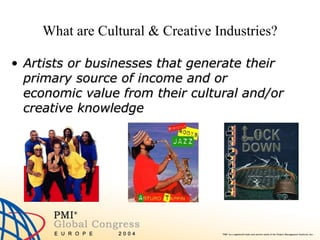
What are Cultural & Creative Industries? Artists or businesses that generate their primary source of income and or economic value from their cultural and/or creative knowledge
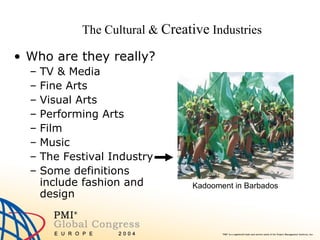
The Cultural &  Creative  Industries Who are they really? TV & Media Fine Arts Visual Arts  Performing Arts Film Music The Festival Industry Some definitions include fashion and design Kadooment in Barbados
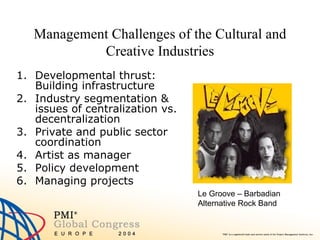
Management Challenges of the Cultural and Creative Industries Developmental thrust: Building infrastructure Industry segmentation & issues of centralization vs. decentralization Private and public sector coordination Artist as manager Policy development Managing projects Le Groove – Barbadian Alternative Rock Band
Who will foot the bill? The donor countries also exploiting their own cultural industry – limited financing There is still a dependency relationship Who pays for the technology?
What are the solutions? Do not reinvent the wheel   Enable creativity Enhance Cooperation Build on existing infrastructure Managing Time & Information Work on the elements we can control first
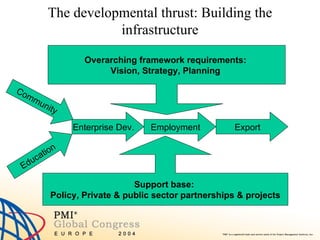
The developmental thrust: Building the infrastructure Community Education Enterprise Dev. Employment Export Support base:  Policy, Private & public sector partnerships & projects Overarching framework requirements:  Vision, Strategy, Planning
The developmental thrust:  Building the infrastructure The existing infrastructure Applying technology at every level: – enabling e-business and Internet technologies e.g. Add a technology dimension to ART – Examine the Australian Model  http://www.anat.org.au/   Degree programs needed urgently Modernizing existing venues – no need for new facilities School facilities sponsored by companies Open air theatres and other open spaces
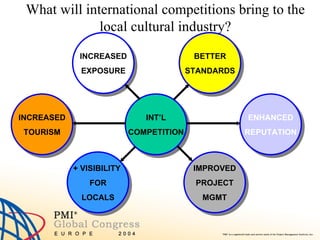
What will international competitions bring to the local cultural industry? INT’L COMPETITION INCREASED TOURISM ENHANCED REPUTATION IMPROVED PROJECT MGMT + VISIBILITY  FOR LOCALS BETTER STANDARDS INCREASED EXPOSURE
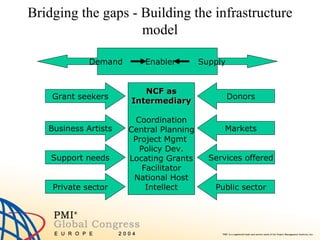
Bridging the gaps - Building the infrastructure model Grant seekers Services offered NCF as Intermediary Coordination Central Planning Project Mgmt  Policy Dev. Locating Grants Facilitator National Host Intellect Business Artists Private sector Support needs Donors Markets Public sector Demand  Enabler  Supply
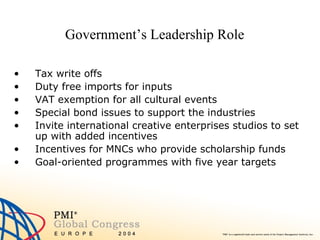
Government’s Leadership Role Tax write offs  Duty free imports for inputs VAT exemption for all cultural events  Special bond issues to support the industries Invite international creative enterprises studios to set up with added incentives  Incentives for MNCs who provide scholarship funds  Goal-oriented programmes with five year targets
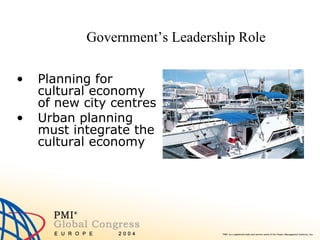
Government’s Leadership Role Planning for cultural economy of new city centres Urban planning must integrate the cultural economy
How will the model work? Project Management is the answer Suggested Project Approaches Logical Framework Approach for Program Planning Project Approach and Standardized Methods for Project Financing and Grants Application of Project Management to all sectors of the cultural industries (National Events) A centralized Cultural Project Management Office (CPMO)
Contact Information Contact Information:Ian W. Walcott Email:  [email_address]

Project Management In The Cultural Industries

  • 1.
    Applying Project Managementto the Cultural and Creative Industries: A tool for developing Countries Ian W. Walcott VP for Education, Bridgetown Chapter of the Project Management Institute
  • 2.
    What are Cultural& Creative Industries? Artists or businesses that generate their primary source of income and or economic value from their cultural and/or creative knowledge
  • 3.
    The Cultural & Creative Industries Who are they really? TV & Media Fine Arts Visual Arts Performing Arts Film Music The Festival Industry Some definitions include fashion and design Kadooment in Barbados
  • 4.
    Management Challenges ofthe Cultural and Creative Industries Developmental thrust: Building infrastructure Industry segmentation & issues of centralization vs. decentralization Private and public sector coordination Artist as manager Policy development Managing projects Le Groove – Barbadian Alternative Rock Band
  • 5.
    Who will footthe bill? The donor countries also exploiting their own cultural industry – limited financing There is still a dependency relationship Who pays for the technology?
  • 6.
    What are thesolutions? Do not reinvent the wheel Enable creativity Enhance Cooperation Build on existing infrastructure Managing Time & Information Work on the elements we can control first
  • 7.
    The developmental thrust:Building the infrastructure Community Education Enterprise Dev. Employment Export Support base: Policy, Private & public sector partnerships & projects Overarching framework requirements: Vision, Strategy, Planning
  • 8.
    The developmental thrust: Building the infrastructure The existing infrastructure Applying technology at every level: – enabling e-business and Internet technologies e.g. Add a technology dimension to ART – Examine the Australian Model http://www.anat.org.au/ Degree programs needed urgently Modernizing existing venues – no need for new facilities School facilities sponsored by companies Open air theatres and other open spaces
  • 9.
    What will internationalcompetitions bring to the local cultural industry? INT’L COMPETITION INCREASED TOURISM ENHANCED REPUTATION IMPROVED PROJECT MGMT + VISIBILITY FOR LOCALS BETTER STANDARDS INCREASED EXPOSURE
  • 10.
    Bridging the gaps- Building the infrastructure model Grant seekers Services offered NCF as Intermediary Coordination Central Planning Project Mgmt Policy Dev. Locating Grants Facilitator National Host Intellect Business Artists Private sector Support needs Donors Markets Public sector Demand Enabler Supply
  • 11.
    Government’s Leadership RoleTax write offs Duty free imports for inputs VAT exemption for all cultural events Special bond issues to support the industries Invite international creative enterprises studios to set up with added incentives Incentives for MNCs who provide scholarship funds Goal-oriented programmes with five year targets
  • 12.
    Government’s Leadership RolePlanning for cultural economy of new city centres Urban planning must integrate the cultural economy
  • 13.
    How will themodel work? Project Management is the answer Suggested Project Approaches Logical Framework Approach for Program Planning Project Approach and Standardized Methods for Project Financing and Grants Application of Project Management to all sectors of the cultural industries (National Events) A centralized Cultural Project Management Office (CPMO)
  • 14.
    Contact Information ContactInformation:Ian W. Walcott Email: [email_address]