Newsletter
Spring 2008
School of Education
Enriching Education Globally and Locally
Jennifer Randall, Assistant Professor
in the School of Education’s
Department of Educational Policy,
Research, and Administration (EPRA),
has joined the concentration in
Research and Evaluation Methods.
“I look forward to mentoring graduate
students and enjoying New England’s
unique culture,” said Randall, who
comes to the School of Education having completed a Ph.D.
at Emory University’s Division of Educational Studies. At
Emory, she focused on educational measurement, with
interests including teacher grading practices and social
studies education.
“My motivation for coming to UMass Amherst was
the opportunity to work with the most well-respected
psychometricians in the nation,” she said. “I hope to both
learn from and contribute to the great body of research
here.”
Christina Ortmeier-Hooper, Assistant
Professor in the Department of Teacher
Education and Curriculum Studies
(TECS), graduated from UMass
Amherst in 1995 with a B.A. in
Comparative Literature. She believes
that her educational experiences at
UMass Amherst laid the foundation for
her subsequent research in literacy
education at the University of New
Hampshire, from which she holds a master’s degree in
Secondary English and English as a Second Language, and a
Ph.D. in English. Her research to date has included work on
adolescent literacy, theories of identity and writing,
composition studies, and second language writing.
UMass Amherst fueled her commitment to schools and
teachers, she said.
“I’m delighted to be part of the School of Education
at UMass Amherst. As a new faculty member, I am
looking forward to working closely with colleagues
committed to public education, school improvement, and
teachers,” she said. “I hope to pursue school-university
partnerships, particularly in the areas of literacy and writing
development.”
Laura A. Valdiviezo, Assistant
Professor in the Department of Teacher
Education and Curriculum Studies
(TECS) is looking forward to “working
collaboratively with excellent
colleagues and contributing to the
faculty diversity and its commitment to
social justice.”
She was drawn to the School of
Education’s strong tradition of
commitment to multicultural education. Her professional
interests include indigenous education; sociocultural
approaches to language policy; teacher’s cultural and
linguistic practices in multilingual settings; and intercultural
and multicultural education.
Valdiviezo says that she enjoys working with students from
different cultural and linguistic backgrounds and working
in an environment where there are opportunities to practice
and develop a pedagogy which is critical and open to
change.
For Assistant Professor Cristine Smith,
a position at the School of Education’s
Department of Educational Policy,
Research, and Administration (EPRA)
is a return home.
She comes back after almost 20 years
as a senior program officer for World
Education, a Boston-based nonprofit
in part devoted to global adult literacy
programs and research. Smith received her doctorate in
1997, focusing on adult literacy programs for women in
South Asia.
“I anticipate staying at UMass Amherst through the end of
my career and learning from my colleagues and students,
as well as doing international work and research that
contributes to people’s education and choices in life,” she
said. “I’m thrilled to be working with graduate students
from a wide variety of countries on the design of literacy and
non-formal education programs, on designing training and
development projects, and on research.”
“My passion is pretty much everything to do with how
to help adults learn to acquire and improve their reading,
writing and numeracy skills in ways that help them do what
they need and want to do as workers, community members
and family members,” she said. “I specialize in women’s
non-formal literacy, integrated with health and livelihood
improvement, and in professional development for adult
literacy teachers here in the U.S.”
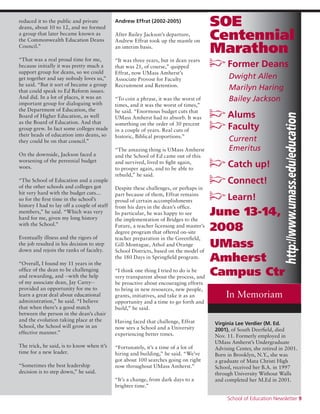
SOE Welcomes New Faculty
2 University of Massachusetts Amherst
Greetingsfrom the Dean
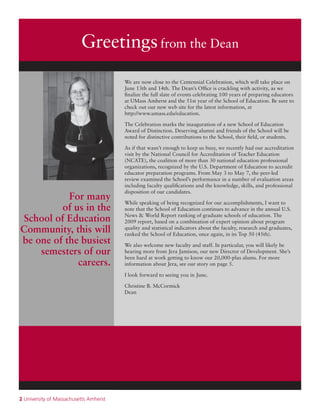
We are now close to the Centennial Celebration, which will take place on
June 13th and 14th. The Dean’s Office is crackling with activity, as we
finalize the full slate of events celebrating 100 years of preparing educators
at UMass Amherst and the 51st year of the School of Education. Be sure to
check out our new web site for the latest information, at
http://www.umass.edu/education.
The Celebration marks the inauguration of a new School of Education
Award of Distinction. Deserving alumni and friends of the School will be
noted for distinctive contributions to the School, their field, or students.
As if that wasn’t enough to keep us busy, we recently had our accreditation
visit by the National Council for Accreditation of Teacher Education
(NCATE), the coalition of more than 30 national education professional
organizations, recognized by the U.S. Department of Education to accredit
educator preparation programs. From May 3 to May 7, the peer-led
review examined the School’s performance in a number of evaluation areas
including faculty qualifications and the knowledge, skills, and professional
disposition of our candidates.
While speaking of being recognized for our accomplishments, I want to
note that the School of Education continues to advance in the annual U.S.
News & World Report ranking of graduate schools of education. The
2009 report, based on a combination of expert opinion about program
quality and statistical indicators about the faculty, research and graduates,
ranked the School of Education, once again, in its Top 50 (45th).
We also welcome new faculty and staff. In particular, you will likely be
hearing more from Jera Jamison, our new Director of Development. She’s
been hard at work getting to know our 20,000-plus alums. For more
information about Jera, see our story on page 5.
I look forward to seeing you in June.
Christine B. McCormick
Dean
For many
of us in the
School of Education
Community, this will
be one of the busiest
semesters of our
careers.
School of Education Newsletter 3
Looking Back
The View
From the
Dean’s Office
In honor of a century of preparing
educators at UMass Amherst and
the 51st birthday of the School of
Education, we asked four past deans
to share insights about their time at
the helm. It’s been quite a ride for the
School over the last 40 years.
Dwight W. Allen (1968-1976)
More than three decades since his
tenure as Dean of the School of
Education, Dwight Allen remains the
committed visionary and individualist
that made him the stuff of legend. All
these years later, he still insists the
system isn’t getting it right, a point
that he campaigns for in “American
Schools: The 100 Billion Dollar
Challenge,” which he wrote in 2000
with Dr. William H. Cosby, Jr., whose
doctoral degree dates from Allen’s
deanship.
“We keep putting new frosting on the
cake and stirring it around, but we
refuse to bake the new cake,” Allen
said.
Allen looked back with some fondness
at his time at the School, a period he’d
characterize as one in which he got
close to baking the new cake. Brought
to UMass from Stanford in 1968, Allen
raised hackles in some quarters for his
revolutionary recasting of the School.
“What we were doing was so
innovative…the faculty senate was in
a constant uproar,” he said. “I could
sympathize with them. From their
point of view, this was a very messy
process.”
Upon taking the deanship, “I
announced that 18 months later
every course, degree, program, and
requirement in the school would be
hereby discontinued, and we’d spend
the next 18 months figuring out what
to replace it with,” he said. Starting
with the intention of hiring 15 new
faculty, that number mushroomed to
34.
“[At the time,] the University assumed
they had to offer 2 or 3 positions for
every position that was accepted…they
weren’t expecting everybody to say
yes,” he said.
Another of Allen’s noteworthy
innovations was attracting those with
nontraditional backgrounds.
“The greatest challenge was to
overturn a culture of complacency or
tradition, and put new things on the
table, and get people to really create an
environment where new alternatives
were able to be genuinely considered
and implemented,” he said. “And we
considered them and we implemented
them.”
During this first planning year, “I’d
anticipated 15 doctoral students that
we would designate as special doctoral
students, who’d be given status of
faculty for planning purposes, they
would be considered faculty with full
voting rights,” he said. By the time the
dean finished with this plan, the School
had 90 doctoral students, not 15.
“So we had 90 doctoral students and
a total faculty of 51, of whom 34 were
new,” he recalled. “The new faculty
already outvoted the old faculty, and
then we gave all these 90 doctoral
students votes, so theoretically any
vote during the planning year, the
students could outvote the faculty if
they wanted to.”
“During those two years of our
planning and implementation, we
never ever had a vote that was student
versus faculty. Ever.”
Allen takes pride in the fact that the
School under his watch sent out a very
diverse batch of qualified graduates.
“We had 24 different programs of
teacher education,” he said. “We
had the fill-in-the-blanks list of 185
competencies, which, as soon as you
checked off all 185, you were a teacher.
We had clinical programs, we had all
these different styles, and you had the
philosophers and the bean-counters
and the psychologists… we allowed
each of these models to succeed on its
own terms.”
“I was very proud of the fact that at
the end of the day, we demonstrated
--anecdotally—that the graduates from
all 24 programs were hot candidates
for many, many positions,” he said.
“They had no trouble getting jobs
whatsoever.”
Still, Allen’s School had its critics,
which he feels resulted in the
controversy that ended with his
departure from the deanship.
“You had all this resentment in the tall
grass, so when I went on leave in 1972,
all the people came out of the tall grass
and piled on,” he said.
In 1972, as Allen went on leave to go
to work for UNESCO on a project
in Africa, scandal brewed at UMass
Amherst. Allegations of financial
mismanagement, involving supposedly
millions of dollars in grant funds,
brought in federal agents.
continued on page 7
4 University of Massachusetts Amherst
News from the School of Education
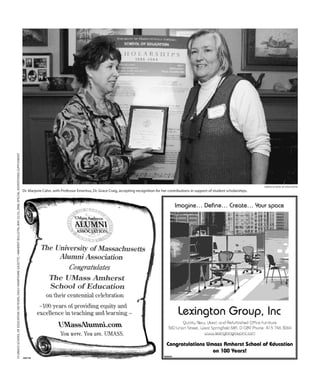
About 35 people, representing past donors to the School of
Education’s scholarship program and scholarship recipients,
gathered at the Nov. 2 School of Education Centennial
Scholarship Celebration at the University Club. Organizers hope
that this is just the first in a series of receptions honoring this
important relationship between funders and students who have
benefited from their gifts.
The Nov. 2 program included both donors and recipients of
some of the School of Education’s endowed scholarships.
Anne E. Talley, a M.Ed. student in Secondary Education
and 2007-2008 recipient of a Meline Kasparian Endowed
Scholarship, presented honorary plaques to two sponsors of the
scholarship: Jane Miller, former president of the Massachusetts
Society of Professors, and Catherine Boudreau, former President
and current Board Member of the Massachusetts Teacher’s
Association.
“The [Meline Kasparian] scholarship I received has allowed me
to focus more intently on my studies,” said Talley, who is doing
her prepracticum at Great Falls Middle School in Montague.
“I am truly appreciative to be able to make my education here
at UMass Amherst my number one priority and I am able to do
that thanks to the scholarship I received.”
Scott Tyner, a doctoral student in Child and Family Studies,
presented a congratulatory plaque to Marjorie Cahn (Ed.D,
1982), founding donor of the Early Childhood Education
Endowed Scholarship. Tyner’s studies are being supported by
that scholarship and the Joseph W. Keilty Endowed Scholarship.
“This support enabled me to transition from my 20-year career
in early childhood special education, to my current life as a
full time doctoral candidate in child and family studies,” Tyner
said. “By acknowledging the worthiness of my work, these
awards were powerful confidence boosters. The laptop computer
that I was able to purchase with scholarship funds is a daily
reminder of the important practical value that these financial
opportunities can provide to people just like me.”
The School boasts over $1 million in endowments geared for
scholarships.
“Scholarships support students while they pursue their
educational goals, but scholarships are also important to the
School,” said Dean Christine B. McCormick, speaking at the
reception. “By offering scholarships, we can compete with the
Harvards, Berkeleys, and dare I say it, UConns out there and
attract top graduate students.”
“Scholarships help us to retain students by giving them the
resources and peace of mind to focus their time and energy
on those things that help them to succeed as education
professionals,” McCormick said.
Professor John J. Clement, (Ed. D., 1976), of Teacher
Education and Curriculum Studies, was among the
select few (8 in all) to receive an Award for Outstanding
Accomplishments in Research and Creative Activity at the
2007 UMass Amherst Faculty Convocation.
Clement’s research focuses on designing effective
instructional strategies, meaningful curriculum, and creative
programs in science.
Professor Stephen G. Sireci, Codirector of the School of
Education’s Center for Educational Assessment, received
the Chancellor’s Medal, the highest honor given by UMass
Amherst to individuals for exemplary and extraordinary
service to the campus. The award followed Sireci’s lecture
“Are Educational Tests Inherently Evil?” at the Distinguished
Faculty Lecture Series.
A member of the Research and Evaluation Methods
concentration in the Department of Educational Policy,
Research, and Administration, Sireci has been a member of
the faculty since 1995.
Jerri Willett, Professor and Chair of the Department of
Teacher Education and Curriculum Studies in the School of
Education, was recently awarded the Distinguished Outreach
Teaching Award. Professor Willett and colleagues established
the ACCELA (Access through Critical Content and English
Language Acquisition) Alliance, and is presently working
with the Massachusetts Department of Education to move
ACCELA to a statewide initiative.
Faculty Awards
Scholars Meet the Donors
School of Education Newsletter 5
Meet Jera Jamison
We are pleased to announce that Jera S. Jamison, MSSW,
has joined the School of Education as our Director
of Development. Jera was most recently the Director
of Development in the Office of Outreach for UMass
Amherst, where she helped design and implement the
first-ever comprehensive development program for UMass
Amherst Extensions and University Without Walls.
Prior to entering the realm of higher education, Jera
served as Executive Director of several organizations
working with at-risk families and youth.
“My direct social work experiences have been
instrumental in creating and building relationships
that will work for the best interest of the mission
and goals of the School of Education,” She said.
Jera has an impressive list of goals for next year, such as:
	 • engaging alumni
	 • connecting alumni with faculty
	 • developing a capital campaign plan, and
	 • advocating for the School.
She says that it is essential to help others to understand
that “while ‘fund-raising’ is about raising money, more
importantly it is about offering others the opportunity to
make commitments that are meaningful in their lives. ”
“We are delighted to have Jera on board, and excited
about being able to more fully engage our alumni and
friends to keep in touch in a sustained fashion,” said
Dean Christine McCormick. “One of Jera’s leading
initiatives during this Centennial Celebration year will
be to arrange in-person meetings to update alumni and
friends about the exciting developments in the School
of Education and to get your feedback about the types
of initiatives you would like to see in the future.”
Drop by and say hi to Jera at 126 Furcolo Hall or contact
her at (413) 545-1112 or jjamison@educ.umass.edu.
Alumni, Friends, Faculty, Students and Staff are
invited to the School of Education Centennial
Marathon, Friday and Saturday, June 13 and 14, and
Celebration Dinner, June 13.
We’ll be taking over the first floor of the Campus
Center for all the festivities.
The Marathon brings together faculty, emeritus
faculty, students, alumni, and friends to exchange
ideas, share innovative educational practices,
strengthen connections, and honor the School’s legacy
of supporting excellence and equity in education.
Festivities kick off Friday afternoon with registration
starting at noon, followed by the opening sessions.
At 4:30, School of Education faculty will host
individual receptions open to all participants.
The Celebration Dinner on Friday evening will
feature former deans, distinguished alumni, emeritus
faculty, and the first School of Education Awards of
Distinction presentation. The Marathon continues
Saturday with breakfast and sessions until noon.
The Center for International Education is hosting a
40th Reunion Dinner on Saturday evening.
Please visit our website for updated information
about registration, special guests, session topics,
and events: http://www.umass.edu/education/news/
centennial.shtml. For more information please call
(413) 545-0897.
Join Us Now, We’re on a Marathon
6 University of Massachusetts Amherst
A Recipe For Stone Soup
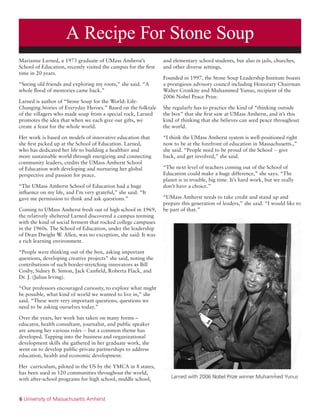
Larned with 2006 Nobel Prize winner Muhammed Yunus
Marianne Larned, a 1973 graduate of UMass Amherst’s
School of Education, recently visited the campus for the first
time in 20 years.
“Seeing old friends and exploring my roots,” she said. “A
whole flood of memories came back.”
Larned is author of “Stone Soup for the World: Life-
Changing Stories of Everyday Heroes.” Based on the folktale
of the villagers who made soup from a special rock, Larned
promotes the idea that when we each give our gifts, we
create a feast for the whole world.
Her work is based on models of innovative education that
she first picked up at the School of Education. Larned,
who has dedicated her life to building a healthier and
more sustainable world through energizing and connecting
community leaders, credits the UMass Amherst School
of Education with developing and nurturing her global
perspective and passion for peace.
“The UMass Amherst School of Education had a huge
influence on my life, and I’m very grateful,” she said. “It
gave me permission to think and ask questions.”
Coming to UMass Amherst fresh out of high school in 1969,
the relatively sheltered Larned discovered a campus teeming
with the kind of social ferment that rocked college campuses
in the 1960s. The School of Education, under the leadership
of Dean Dwight W. Allen, was no exception, she said: It was
a rich learning environment.
“People were thinking out of the box, asking important
questions, developing creative projects” she said, noting the
contributions of such border-stretching innovators as Bill
Cosby, Sidney B. Simon, Jack Canfield, Roberta Flack, and
Dr. J. (Julius Irving).
“Our professors encouraged curiosity, to explore what might
be possible, what kind of world we wanted to live in,” she
said. “These were very important questions, questions we
need to be asking ourselves today.”
Over the years, her work has taken on many forms –
educator, health consultant, journalist, and public speaker
are among her various roles -- but a common theme has
developed. Tapping into the business and organizational
development skills she gathered in her graduate work, she
went on to develop public-private partnerships to address
education, health and economic development.
Her curriculum, piloted in the US by the YMCA in 8 states,
has been used in 120 communities throughout the world,
with after-school programs for high school, middle school,
and elementary school students, but also in jails, churches,
and other diverse settings.
Founded in 1997, the Stone Soup Leadership Institute boasts
a prestigious advisory council including Honorary Chairman
Walter Cronkite and Muhammed Yunus, recipient of the
2006 Nobel Peace Prize.
She regularly has to practice the kind of “thinking outside
the box” that she first saw at UMass Amherst, and it’s this
kind of thinking that she believes can seed peace throughout
the world.
“I think the UMass Amherst system is well-positioned right
now to be at the forefront of education in Massachusetts.,”
she said. “People need to be proud of the School -- give
back, and get involved,” she said.
“The next level of teachers coming out of the School of
Education could make a huge difference,” she says. “The
planet is in trouble, big time. It’s hard work, but we really
don’t have a choice.”
“UMass Amherst needs to take credit and stand up and
prepare this generation of leaders,” she said. “I would like to
be part of that.”
School of Education Newsletter 7
“There was a huge brouhaha and the
FBI came in and sealed the records of
the School,” remembered Allen. The
administration wanted him back from
Africa, “but I had made a commitment
to the government in Lesotho to open a
college…building the college, designing
the curriculum, training the staff,
recruiting the students and everything
would come to a big bang…I didn’t feel
I could walk out in the middle of that.”
“I went ahead and resigned to make
it easier for them,” a decision he later
regretted. “The media took this as
evidence that the whole thing was even
worse than anticipated.”
At the end of the day, an assistant
professor pleaded nolo contendere to
misusing $18,000. Allen would stay
on as a member of the faculty for two
years more, leaving in 1978. He would
take a professorship at Old Dominion
University, where he has remained
through the years. He retires at the
end of this academic year, having
continued to break new ground, with
innovations such as having students
write their own textbook for his course
in Educational Foundations. He now
lives in Denver, Colorado.
“The greatest achievement (at UMass
Amherst) was that we created an
innovative culture that really was able
to test the edges of the envelope,”
Allen said. “People kept predicting our
demise, and it just didn’t happen.”
Despite the scandal, Allen says he
would do it all over again, if given the
chance.
“I’d love to come back there or
someplace else and have another
round,” he said. “Bill (Cosby) and I
say that unless the country is willing to
treat education as a matter of national
security, we’re not going to get the job
done.”
Marilyn J. Haring (1988-1991)
With the position of dean vacant in
the wake of Dean Mario Fantini’s
failing health, the School of Education
turned to Marilyn Haring-Hidore
(as she was called during her term at
UMass, and who now uses the name
Marilyn Haring). She had been serving
as associate dean for graduate studies
at the University of North Carolina at
Greensboro’s School of Education.
Haring’s three-year term started with
an immediate crisis. The School’s
accrediting agency, the National
Council for the Accreditation of
Teacher Education (NCATE), notified
the new dean that, based on the
findings of an earlier visit, NCATE was
denying accreditation of the School’s
programs that prepared educational
personnel.
“I immediately made a trip to
Washington to interact with NCATE
officials and began a three-year
dialogue that resulted in an agreement
that was very satisfactory to me,” she
said. NCATE agreed that if UMass
Amherst made improvements notable
on a return visit in three years, it
would be listed as continuously
accredited, with no gap of the benefits
that would accrue to graduates.
Mario D. Fantini (1976-1987)
The late Dr. Mario D. Fantini came to take the mantle at the School of
Education having had a major role in the decentralization of New York
City’s public schools.
In the late 1960’s, he was among a group involved in establishing an
experimental local school district in the Ocean Hill-Brownsville section
of Brooklyn, which became a leading player in the city’s decentralized
districts. He spent his career as an education reformer, advocating school
systems with greater community participation and schools that were better
adapted to urban students’ needs.
While at UMass Amherst, Fantini worked to position the School of
Education at the center of national discussions about education, hosting
annual spring forums “in keeping with our role as a major school of
education to educate the public and educators.”
“When I think about your service to our University as Dean of the School
of Education, I am especially impressed by the energy, imagination, and
foresight which you brought to the task,” wrote then-Chancellor Joseph
Duffey in a letter read at a 1987 celebration honoring Fantini, “Your
vision of emerging issues often anticipated developments which occurred
later at the state and nation level.”
“Your leadership also helped this campus to develop greater sensitivity to
the public concerns expressed by our legislature. Finally, you strengthened
and enhanced the School of Education’s commitment to access and
achievement for women and minorities,” Duffey wrote.
Fantini was the author of many books, and while at UMass Amherst wrote
“Regaining Excellence in Education,”(Charles Merrill, 1986). He resigned
because of illness but remained on the faculty until his death in 1987.
View from the Dean’s Office,
continued from page 3
8 University of Massachusetts Amherst
“There was little enthusiasm in the
School to do the very hard work of
preparing for a second visit, and
making some important adjustments in
programs,” she said. “However, I was
convinced the only way for the School
of Education to survive during the very
difficult times that hit UMass Amherst
in the late 80s was to regain NCATE
accreditation and demonstrate the high
quality of professional education on
campus.”
It was a matter of life and death for the
School, she decided.
“The Commonwealth of
Massachusetts was in desperate need
of funds, which resulted in many
budget cuts at the University. I
was determined that the School of
Education would not be sacrificed
to that end,” she said. With the able
assistance of Associate Dean Richard
Clark, Division Heads, and personnel,
this Herculean effort reaped success,
she said. NCATE noted “only three
weaknesses, and every standard was
passed,” Haring said.
“I have never been prouder of a school
of education,” she said.
Haring also grappled with a dwindling
budget. The School of Education lost
15% of its budget during the three
years of her deanship, and the School
only hired one new faculty member
during that period.
“It was a time of ensuring the survival
of a proud School of Education,” she
said. “During this time, I needed to
be a fierce advocate for the School of
Education within the University and
state and also nationally.”
“My characterization of those years,
then, is a time of successful transition
to the future that was achieved by a
great deal of hard work by faculty,
staff, and School of Education
administration,” she said.
Haring left UMass Amherst in 1991
to take the position of dean for the
Purdue School of Education. She
helmed that school for a decade,
overseeing a revamping of the
curriculum to include field experiences
in each of the four years of professional
preparation, developing a doctoral
program in Northwest Indiana
utilizing interactive video instruction,
and adding to the diversity of faculty.
She retired from the deanship in
2001, taking her first sabbatical leave
ever, and returned as a half-time
faculty member in Higher Education
Administration. She retired for good in
2007.
She credits her time at UMass Amherst
with teaching her how to fight for her
school.
“Often on campuses, education
schools are viewed as less important
than science, math, engineering, and
business enterprises, to name a few,”
she said. “At UMass Amherst I learned
the value of such advocacy and that it
requires enormous energy and constant
commitment.”
“Most of us underestimate the
challenges inherent in any kind of
change,” she said.
Bailey W. Jackson (1991-2002)
“I said it’s about time I got honest
here and do the job, and find out why
all these pearls of wisdom I’d been
giving to these people haven’t been
followed,” says Bailey Jackson, a wry
tone shading his voice. “I did find out,
and after 11 years, I’m still reflecting
on that.”
“I had an advantage in some respects.
I had relationship capital with some of
the faculty. I was a part of the School
of Education family before I came in.”
he said.
Bailey Jackson served as dean from
1991 through 2002, the first years
of his tenure marked by the 1993
Education Reform Act, which would
radically change the face –and
funding— of education in the state.
Jackson makes no bones about
characterizing the Act as being
motivated by politicians interested in
privatizing education and demonizing
public education. That said, he feels
the reforms and subsequent budget
trimmings required the School to
streamline its focus through a tough
decade, and fight back against some
attacks on its reputation.
“There was a sense on campus that
the school lacked a lot of rigor,” he
said. “There was a sense that it was
mostly catering to social issues and not
enough around academic issues. There
was concern that the school didn’t
engage in enough research to be really
credible. And some of these things
are not just about the School, but are
about schools of education in general.”
“I came wanting to see what it was, if
anything, I could do to help strengthen,
improve, or correct the misconceptions
that were out there about the School
and what it is about,” he said.
“Ed Reform helped in the sense that
it helped me make my case with my
colleagues, that we weren’t getting out
there and letting people know what’s
going on in the world of education,” he
said. “I don’t think that we collected
the kind of data necessary to justify
the things that we were doing, and so
when critics came in challenging us,
‘show us the proof that your pedagogy
is in fact working,’ we didn’t have the
necessary data.”
“It was kind of a wake-up call. There
were a number of people in the field
who I think took on the challenge,
but I think we were trying to fight
off a kind of right-wing perspective,
and at the same time trying to do our
homework,” he said.
Jackson is particularly proud of
how he turned this challenge into an
opportunity for advocacy. Challenged
by the state Commissioner of
Education to improve connections
between the state hierarchy and the
schools of education, Jackson set out to
assemble a council of deans.
“At the time I didn’t quite know the
size of that task. I didn’t know
there were 62 programs in the
commonwealth,” he said. “So I
School of Education Newsletter 9
SOE
Centennial
Marathon
p Former Deans
	 Dwight Allen
	 Marilyn Haring
	 Bailey Jackson
p Alums
p Faculty
	 Current
	 Emeritus
p Catch up!
p Connect!
p Learn!
June 13-14,
2008
UMass
Amherst
Campus Ctr
reduced it to the public and private
deans, about 10 to 12, and we formed
a group that later became known as
the Commonwealth Education Deans
Council.”
“That was a real proud time for me,
because initially it was pretty much a
support group for deans, so we could
get together and say nobody loves us,”
he said. “But it sort of became a group
that could speak to Ed Reform issues.
And did. In a lot of places, it was an
important group for dialoguing with
the Department of Education, the
Board of Higher Education, as well
as the Board of Education. And that
group grew. In fact some colleges made
their heads of education into deans, so
they could be on that council.”
On the downside, Jackson faced a
worsening of the perennial budget
woes.
“The School of Education and a couple
of the other schools and colleges got
hit very hard with the budget cuts…
so for the first time in the school’s
history I had to lay off a couple of staff
members,” he said. “Which was very
hard for me, given my long history
with the School.”
Eventually illness and the rigors of
the job resulted in his decision to step
down and rejoin the ranks of faculty.
“Overall, I found my 11 years in the
office of the dean to be challenging
and rewarding, and --with the help
of my associate dean, Jay Carey--
provided an opportunity for me to
learn a great deal about educational
administration,” he said. “I believe
that when there’s a good match
between the person in the dean’s chair
and the evolution taking place at the
School, the School will grow in an
effective manner.”
The trick, he said, is to know when it’s
time for a new leader.
“Sometimes the best leadership
decision is to step down,” he said.
Andrew Effrat (2002-2005)
After Bailey Jackson’s departure,
Andrew Effrat took up the mantle on
an interim basis.
“It was three years, but in dean years
that was 21, of course,” quipped
Effrat, now UMass Amherst’s
Associate Provost for Faculty
Recruitment and Retention.
“To coin a phrase, it was the worst of
times, and it was the worst of times,”
he said. “Enormous budget cuts that
UMass Amherst had to absorb. It was
something on the order of 30 percent
in a couple of years. Real cuts of
historic, Biblical proportions.”
“The amazing thing is UMass Amherst
and the School of Ed came out of this
and survived, lived to fight again,
to prosper again, and to be able to
rebuild,” he said.
Despite these challenges, or perhaps in
part because of them, Effrat remains
proud of certain accomplishments
from his days in the dean’s office.
In particular, he was happy to see
the implementation of Bridges to the
Future, a teacher licensing and master’s
degree program that offered on-site
teacher preparation in the Greenfield,
Gill-Montague, Athol and Orange
School Districts, based on the model of
the 180 Days in Springfield program.
“I think one thing I tried to do is be
very transparent about the process, and
be proactive about encouraging efforts
to bring in new resources, new people,
grants, initiatives, and take it as an
opportunity and a time to go forth and
build,” he said.
Having faced that challenge, Effrat
now sees a School and a University
experiencing better times.
“Fortunately, it’s a time of a lot of
hiring and building,” he said. “We’ve
got about 100 searches going on right
now throughout UMass Amherst.”
“It’s a change, from dark days to a
brighter time.”
Virginia Lee Verdier (M. Ed.
2001), of South Deerfield, died
Nov. 11. Formerly employed in
UMass Amherst’s Undergraduate
Advising Center, she retired in 2001.
Born in Brooklyn, N.Y., she was
a graduate of Mata Christi High
School, received her B.A. in 1997
through University Without Walls
and completed her M.Ed in 2001.
In Memoriamhttp://www.umass.edu/education
10 University of Massachusetts Amherst
Alumnae/i News
1970s
Richard P. Santeusanio (Ed. D.
1972) was named Associate Clinical
Professor and Coordinator of
the Reading Certificate Program
by the MGH Institute of Health
Professions, an academic affiliate
of Massachusetts General Hospital
in Boston. He will work with
the Institute’s Graduate Program
in Communication Sciences and
Disorders, which is designed
for educators, pathologists, and
administrators. Dr. Santeusanio
served 26 years as a public
school administrator in Danvers,
MA, including thirteen years as
Superintendent, and has been
an adjunct professor at Suffolk
University, Salem State College, and
Endicott College.
Peter Graham
Peter J. Graham (Ed.D 1975), a
professor of Sport and
Entertainment Management at the
University of South Carolina for the
past 20 years, has been honored
with an Academic Achievement in
Sport and Entertainment Award
from the International Conference
on Sport and Entertainment
Business. Dr. Graham is co-founder
of USC’s Sport and Entertainment
Management program and the
International Sport and
Entertainment Business Conference.
The award recognizes a scholar
whose research and/or teaching has
made a significant positive impact in
the fields of sport, entertainment, or
venue management.
Sonia Nieto (Ed.D. 1975), Professor
Emerita of Language, Literacy, and
Culture at the School of Education,
has been named this year’s recipient
of the American Educational
Research Association’s Social Justice
in Education Award. Nieto was
honored at AERA’s Annual Meeting
in New York City, March 24. The
award celebrates educators who
have made an extraordinary impact
on social justice through research,
policy, and practice.
1980s
Robert F.L. MacDonald (M.Ed.
1980), a member of the West
Springfield Rotary Club, was
presented the Rotary Foundation’s
Distinguished Service Award at the
recent Rotary International District
Conference. He joined the West
Springfield Rotary Club in 1982 and
was the club’s president in 1986.
He was elected district governor for
western Massachusetts and northern
Connecticut in 1998.
1990s
Jill Givler (Ed.D. 1990) was recently
named Department Chair of the
Human Kinetics Department at
Kutztown University, Pennsylvania.
She has been a professor there since
1995, and was the 2007 recipient of
the Pennsylvania State Professional
Honor Award for contributions to
the disciplines of Health, Physical
Education, Recreation, and Dance.
2000s
Michael J. Sidoti (M.Ed. 2000)
reports that he is enjoying a
rewarding career as Assistant
Director and Coordinator of
Learning Disability Services
at Northeastern University in
Boston. Mike has presented at the
Association on Higher Education
and Disability (AHEAD) and
the National Association for
Multicultural Education (NAME),
and taught undergraduate courses on
diversity. He is currently delivering
an online professional development
course through AHEAD.
Khyati Joshi (Ed.D. 2001) the
author of New Roots in America’s
Sacred Ground: Religion, Race,
and Ethnicity in Indian America,
has been awarded the 2007 Phillip
C. Chinn Book Award from the
Multicultural Program Awards
Committee of the National
Association for Multicultural
Education (NAME).
Melda N. Yildiz (Ed.D. 2002)
received an Excellence in Teaching
Award from William Paterson
University in May. She was honored
for her outstanding achievements
during the University’s fourth annual
Faculty Recognition Luncheon.
Yildiz was honored for her work
in secondary and middle school
education, and received a plaque
and a $1,000 award for professional
development.
School of Education Newsletter 11
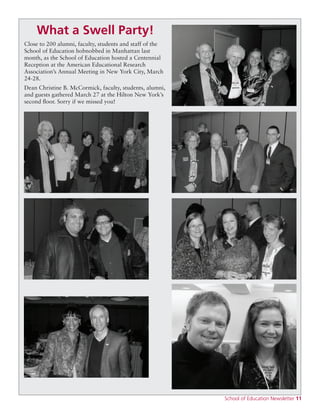
What a Swell Party!
Close to 200 alumni, faculty, students and staff of the
School of Education hobnobbed in Manhattan last
month, as the School of Education hosted a Centennial
Reception at the American Educational Research
Association’s Annual Meeting in New York City, March
24-28.
Dean Christine B. McCormick, faculty, students, alumni,
and guests gathered March 27 at the Hilton New York’s
second floor. Sorry if we missed you!
Non Profit Org
U.S. Postage
PAID
Amherst MA
Permit No. 2
School of Education
Furcolo Hall
813 North Pleasant St.
University of Massachusetts Amherst
Amherst, MA 01003
Yes,IwouldliketomakeagifttotheUMassAmherstSchoolofEducationCentennialFundtoday.
__$50		__$100		__$250		__$500		__$1000	__Other$_____________________
__Mygiftwillbematched.Manyemployerswillmatchcharitablecontributions.Ifyouremployerdoes,askforamatchinggiftform.
Name____________________________________________________________________________________________________________________________
Address___________________________________________________________________________________________________________________________
City____________________________________________________State_____________________________________Zip____________________________
E-mail________________________________________________________________________Telephone(	)_____________________________________
Pleasemakeyourcheckpayableto:SchoolofEducationCentennialFund,andsendto
Dean’sOffice											Todonatebycreditcard,pleaseselectone:
124FurcoloHall										__MasterCard		__Visa
SchoolofEducation										Card#__________________________Exp.Date_________
813N.PleasantSt.,Amherst,MA01003.							Signature___________________________________________
Becomeapartoftheexcitementandsupporttheresearch
andteachingofourfacultyandstudentsthroughyourgift
totheSchoolofEducationCentennialFund.Yourgiftisan
investmentintheaspirationsandopportunitiesthenext100
yearswillbring.
Newsletter
Fall 2008
The entire first floor of Lincoln Campus Center buzzed
with activity June 13 and 14 as old friends recognized each
other with happy “hellos,” and students, faculty and alumni
converged for the School of Education’s two-day Centennial
Marathon and Celebration
Dinner.
White balloons,
emblazoned with the
message “School is Cool,”
bobbed as new students,
new, former and emeritus
faculty, SOE staff and
friends registered for more
than 90 Marathon sessions
that ranged in topic from
“Factors that Influence
Secondary Teachers’
Proficiency With and Use of
Educational Technology”
to “The Many Faces of
Cinderella.”
In the middle of the
Campus Center’s concourse,
students and faculty pinned
posters to corkboards, engaging in animated conversation
about their research and community service projects with
interested passersby. Presenters of Marathon sessions
stopped to talk with colleagues or smile for photographs
as they hurried toward their next sessions. Groups knotted
here and there to discuss plans for attending the afternoon
receptions and the evening’s Celebration Dinner or to tell
stories from their days at the School to the videographers
who filmed reminiscences for archives and to post on the
School’s website. All told,
more than 400 people
participated in the events
that marked a century of
preparing educators at
UMass Amherst.
“It’s exciting, this whole 100
years,” said April Holmes of
Glendale, California, who
is preparing to receive her
teaching license through
the Bridges to the Future
program while teaching in
Greenfield, Mass. schools.
She and fellow Bridges
teachers shared their
experiences in a presentation
during the Marathon.
“It’s a little intense, but I
knew it was going to be
intense,” Holmes said. “The amount of work you’re doing
at school, you’re teaching a full day and then after school
you have classes. It was intense, but it was worth it, to get it
done.”
At the Centennial Celebration Dinner, the School
of Education inaugurated a new tradition: granting
Awards of Distinction to deserving alumni, friends, and
emeriti faculty. Recipients are selected who have made
significant contributions to the School, its students and
their field. The awards will be presented annually.
“It being the Centennial Celebration year, we decided to
award ten --one per decade-- to catch up a bit,” said Dean
Christine B. McCormick.
Department Chairs Joseph Berger, Richard Lapan and
Jerri Willett presented the 2008 Awards of Distinction to:
Mary Cowhey, (M.Ed. 2001) Elementary School
Teacher, Jackson Street School, Northampton. A
graduate of the Bilingual, English as a Second Language
and Multicultural Education Master’s program of the
School of Education, Mary took into the classroom what
she had learned during her 14-year career as an award-
winning community organizer. In 2001, she was a delegate
to the United Nations World Conference Against Racism.
She is currently collaborating with another colleague and
UMass Amherst alum, Kim Gerould, on Families With
Power, which organizes low-income parents of color in
Educators of Distinction
Continued on page 8
Deans McCormick, Haring, Allen, and Jackson at the Centennial Celebration.
Continued on page 11
Celebrating a Century
2 University of Massachusetts Amherst
Greetingsfrom the Dean
Our culminating Centennial Celebration on June 13 and 14 was
wonderful! We planned for it for more than a year, and now that it is
over, I feel certain that it was the meaningful event that we all had in
mind when the Dean’s Leadership Council suggested it last summer.
Ninety Marathon sessions on topics ranging from research on work with
immigrant children to using video to increase language performance
created a buzz of conversation in the Campus Center. That excitement
continued into the evening when I had the pleasure of hosting a very
festive dinner program with remarks by Chancellor Thomas W. Cole,
Jr., Provost Charlena M. Seymour and reminiscences by former Deans
Dwight Allen, Marilyn Haring and Bailey Jackson.
During the program, State Representative Ellen Story
and State Senator Stan Rosenberg both stepped up to the
podium. Rep. Story read a Proclamation from Governor
Deval Patrick naming June 13 UMass Amherst School
of Education Day. Sen. Rosenberg noted a citation from
the State Senate and then read Gertrude Stein’s poetic
observation about Education in New England that made
the audience laugh out loud. Department Chairs Joe Berger,
Rich Lapan and Jerri Willett presented the School’s first
annual Awards of Distinction to ten noted educators to
standing ovations. It was that kind of night.
With more than 400 of us gathered in honor of 100 years
of preparing educators, I could not help but wonder what
those educators of 1907 would think about our practice of
education today.
And what will educators in 2107 think about us and our
work? Let’s hope that they find reason to honor us as we
honored those who led us to this place, this School, this
University today.
We look forward to a new academic year, the 101st
year of preparing
educators on campus. In the meantime, I encourage you to check the
Centennial photo galleries on our website to relive Centennial moments
or to see what the excitement was about if you were not able to be with
us as we closed this historic year.
Christine B. McCormick
Dean
For more about the Marathon,
including sessions, materials,
and videos of participants,
log on to
www.umass.edu/education.
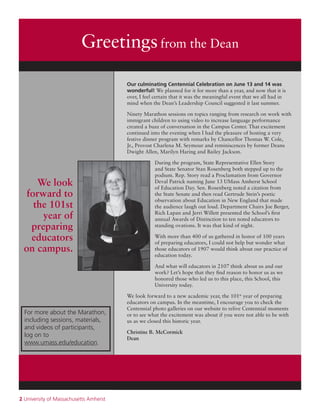
We look
forward to
the 101st
year of
preparing
educators
on campus.
School of Education Newsletter 3
News from the School of Education
The School of Education was honored this year to be the
only American university accepted for membership in a
working group convened by the Inter-Agency Network for
Education in Emergencies (INEE).
As a representative of the UMass Amherst School of
Education’s Center for International Education (CIE),
Assistant Professor Jacqui Mosselson will work with the
INEE’s Working Group on Education in Fragility to help
ensure all people the right to education in nations and regions
in emergency situations and post-crisis reconstruction.
The INEE is a global network of non-governmental
organizations, United Nations agencies, researchers
and individuals from crisis spots throughout the world.
Representative organizations include USAID and The World
Bank, and multilateral and bilateral agencies such as Save
the Children, UNICEF and Reach Out to Asia. Only two
academic institutions are represented: UMass Amherst and
the University of Ulster in Coleraine, Northern Ireland.
During the next two years, members of the Working Group
will determine the best practices to mitigate state fragility
through education and ensure equal access to education, and
work to support programs that promote the development
of alternative means of education. The goal is to help these
countries and regions to shift from being recipients of
emergency humanitarian aid to becoming stable enough to
receive long-term development assistance and manage their
own education systems.
The Working Group held its first meeting April 14-16 in
Istanbul, Turkey. The next meeting will take place at the
end of October in Brussels, Belgium.
Members of CIE will craft a paper on education and fragility
that maps the existing research in the field, and identify
research gaps as well as lessons learned.
In addition, the School of Education's course “Education
in Post-Conflict Settings” has been restructured to reflect
this new relationship. The Director of the INEE has
offered to travel to UMass Amherst to present to students,
and Mosselson and group members have discussed other
possible links. •
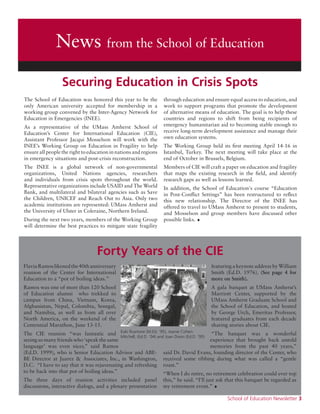
FlaviaRamoslikenedthe40thanniversary
reunion of the Center for International
Education to a “pot of boiling ideas.”
Ramos was one of more than 120 School
of Education alumni who trekked to
campus from China, Vietnam, Korea,
Afghanistan, Nepal, Colombia, Senegal,
and Namibia, as well as from all over
North America, on the weekend of the
Centennial Marathon, June 13-15.
The CIE reunion “was fantastic and
seeing so many friends who ‘speak the same
language’ was even nicer,” said Ramos
(Ed.D. 1999), who is Senior Education Advisor and ABE-
BE Director at Juarez & Associates, Inc., in Washington,
D.C. “I have to say that it was rejuvenating and refreshing
to be back into that pot of boiling ideas.”
The three days of reunion activities included panel
discussions, interactive dialogs, and a plenary presentation
featuring a keynote address by William
Smith (Ed.D. 1976). (See page 4 for
more on Smith).
A gala banquet at UMass Amherst’s
Marriott Center, supported by the
UMass Amherst Graduate School and
the School of Education, and hosted
by George Urch, Emeritus Professor,
featured graduates from each decade
sharing stories about CIE.
“The banquet was a wonderful
experience that brought back untold
memories from the past 40 years,”
said Dr. David Evans, founding director of the Center, who
received some ribbing during what was called a “gentle
roast.”
“When I do retire, no retirement celebration could ever top
this,” he said. “I’ll just ask that this banquet be regarded as
my retirement event.” •
Kaki Rusmore (M.Ed. ‘95), Joanie Cohen-
Mitchell, (Ed.D. ‘04) and Joan Dixon (Ed.D. ‘95)
Forty Years of the CIE
Securing Education in Crisis Spots
4 University of Massachusetts Amherst
What was the School of Education like in the early 1970s
for William A. Smith, fresh out of the Peace Corps? Was it
all he expected?
“It was much better,” said Smith, a 1976 graduate of the
School, who received a doctorate in non-formal adult
education, and who is now Executive Vice President of the
Academy for Educational Development. “It was really a
cool place.”
Founded in 1961, the Washington,
D.C.–based Academy is an
independent nonprofit organization
dedicated to solving critical
social problems and empowering
communities, institutions, and
individuals to be more self-sufficient.
It does this through improving
education, health, and economic
opportunities for the poor in the U.S.
and abroad.
Smith has been with the Academy
for 26 years, overseeing programs
in education, health, transportation
safety, the environment, and social
issues.
He entered the School of Education
at a pivotal time in his life, he said. Having earned a
bachelor’s degree in art history at the University of South
Florida in the mid-1960s, he was among a demographic
not on the track to become teachers. Still, he wanted “to
learn,” he said.
“I’d just come out of the Peace Corps and was looking
to take the next step,” he said. “A doctorate looked very
attractive.”
At UMass Amherst he became an acolyte of Brazilian
educator Paulo Freire, author of “Pedagogy of the
Oppressed” (1968), which revolutionized models of
education in the third world and introduced a less top-
down style of education.
“Poor people know a lot…they have their own solutions,”
said Smith. For example, he said, farmers were being
bamboozled by middle men purchasing their products,
and they responded by encouraging their children to learn
basic math skills in order to handle negotiations.
Smith recalled the motto “Let Jorge Do It,” a reference
to the School’s Nonformal Education Project work with
Ecuadorian campesinos during his time at the School in
the early 1970s. The project, which included a Monopoly-
like board game and role playing, concluded that rural
areas lacking the standard resources for literacy education
can fill that need with non-professional educators using
materials promoting participation and dialogue.
Smith credits the School with his
pioneering the use of social marketing,
which transfers ideas used in commercial
marketing into the realm of improving
society. Pretty good for someone who had
come to UMass Amherst with the almost
standard “marketers are evil, companies
are awful” mantra, admits Smith. But it
works, he said.
“The commercial marketplace offers you
something in order to get your money. It
tells you that you’ve got to get the product,
and why,” he said. “If you don’t get what
they promise, you don’t buy it twice.”
Those in the social services need to provide
the same kind of added value to get results,
he said.
“For instance, immunization…we spend all this time
talking about how bad measles are,” he said, noting that
this message can fall on deaf ears in developing countries.
“Instead, let’s have a big party, and immunize the kids
while we have the party.”
“It’s a non-patronizing way of helping folks,” an approach
which has been used effectively to distribute condoms,
malarial bed nets, and anti-tobacco material to previously
hard-to-reach populations, he said. Indeed, more young
people have quit smoking, not through decades of health
warnings, but because of messages that smoking isn’t cool
anymore.
Smith said the School of Education helped provide
the laboratory to test ideas that he now uses to benefit
community after community.
“The School was a perfect place to try new ideas,” Smith
said. “It pretty much shaped the fundamental perspective I
have.” •
William A. Smith
William Smith and the AED
Letting Jorge Do It
School of Education Newsletter 5
In the Lamoureaux household, education is a tradition.
Five members of this family have been drawn to careers in
education.
“All of them have had a positive experience of school,” said
Gary Lamoureaux of Pittsfield, Mass., attempting to explain
why his children took up the teaching baton. “They just
heard about education continually.”
Gary Lamoureaux holds a doctorate in Higher Education
Administration from the University of Massachusetts
Amherst School of Education. The son of a nurse and a
plant manager, Lamoureaux retired in 2002 after 30 years
at Berkshire Community College, 13 years as its Dean of
Student Affairs and Enrollment Services.
His wife, Nancy, (M.Ed.,
North Adams State College)
has been a physical education
teacher in Dalton, Mass. for
33 years, and retires this year.
His daughter, Nicole, taught
preschool in Winchester,
Mass. for three years, and
sons Michael and Eric both
teach in the Pittsfield, Mass.,
school system.
Younger son Eric graduated
with a Master’s degree from
the UMass Amherst School
of Education in 2004, twenty
years after his father earned
his doctorate. Eric is now Interim Community Coordinator
and Vice Principal for Pittsfield’s Silvio O. Conte School,
while Michael (M.Ed., Cambridge College) is in his third
year as a fifth grade teacher at the Morningside Community
School in Pittsfield.
A Vietnam-era veteran, Gary Lamoureaux first arrived
at UMass Amherst in the late 1960s as a 25-year-old
undergraduate. It was a little bit of a culture-shock, said the
Turners Falls, Mass., native, witnessing the full flower of the
antiwar protests on campus. Having worked for the town of
Greenfield’s park department, he hoped to continue in that
vein at UMass Amherst.
“When I was at UMass Amherst, I was focused on the
direction of recreational services,” he said.
Working with campus recreation turned into a rewarding
gig for him, which included such highlights as bringing
television entertainer Johnny Carson’s crew to UMass
Amherst. He later relocated out west, where he spent a
year as housing and activities advisor at Cochise College in
Douglas, Arizona. He became interested in education and
earned a Master’s degree in Education at Northern Arizona
University while serving as director of student activities
at the university’s South Academic Center. He returned to
western Massachusetts to take a student activities position at
Berkshire Community College
But thanks to the School of Education, the story doesn’t
end there. Lamoureaux in part credits an experimental
program at the School of Education with improving the
lot of nontraditional students such as himself. He returned
to UMass Amherst in the early
1980s to participate in Charlotte
Rahaim’s Field-Based Doctoral
Program for Community College
Personnel. The program offered
community college faculty and
administrators the opportunity
to work on their doctorates
while at their own institutions.
Participants included staff from
Holyoke Community College and
institutions in Springfield and
Connecticut.
“We had two classes at BCC…
it was a kind of six-hour class,”
said Lamoureaux. In three years, he had earned a doctorate
in Higher Education Administration which helped open
the door to his becoming a dean at Berkshire Community
College.
“If it hadn’t been for that program, I don’t know if I’d have
had the ability to go down (to Amherst) by myself,” he said.
“It was a wonderful opportunity.”
At the time of his retirement in 2002, BCC’s Foundation
established a scholarship in Lamoureaux’s name. Two
hundred twenty-seven alumni, colleagues, and friends from
around the country raised $11,352 in one month. It was the
largest amount of money generated through scholarship in
the shortest period of time in the Foundation’s history.
Teaching Runs in the Family
Traditions
Continued on page 10
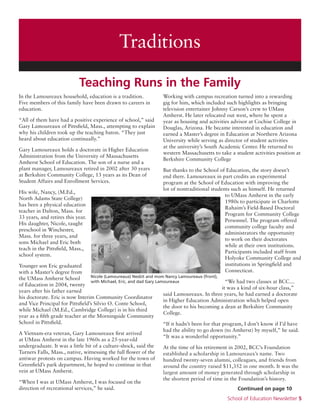
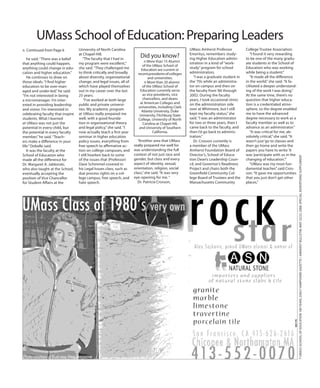
Nicole (Lamoureaux) Nesbit and mom Nancy Lamoureaux (front),
with Michael, Eric, and dad Gary Lamoureaux
6 University of Massachusetts Amherst
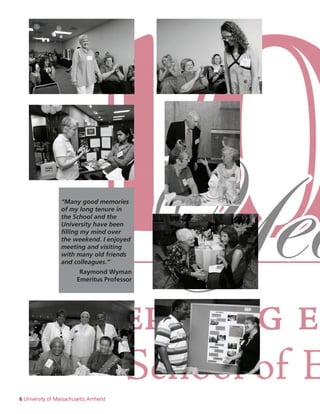
“Many good memories
of my long tenure in
the School and the
University have been
filling my mind over
the weekend. I enjoyed
meeting and visiting
with many old friends
and colleagues.”
Raymond Wyman
Emeritus Professor
School of Education Newsletter 7
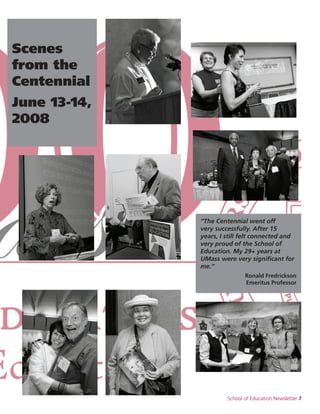
“The Centennial went off
very successfully. After 15
years, I still felt connected and
very proud of the School of
Education. My 29+ years at
UMass were very significant for
me.”
Ronald Fredrickson
Emeritus Professor
Scenes
from the
Centennial
June 13-14,
2008
8 University of Massachusetts Amherst
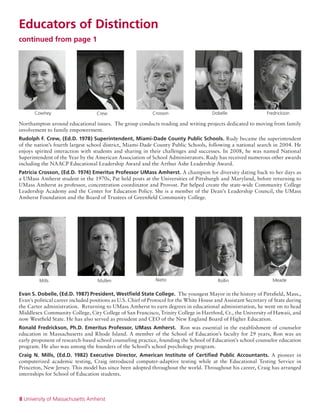
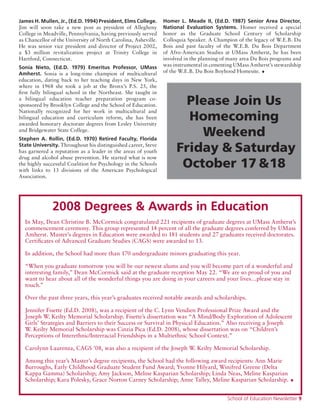
MeadeRollinNietoMullenMills
Cowhey CrossonCrew Dobelle Fredrickson
Northampton around educational issues. The group conducts reading and writing projects dedicated to moving from family
involvement to family empowerment.
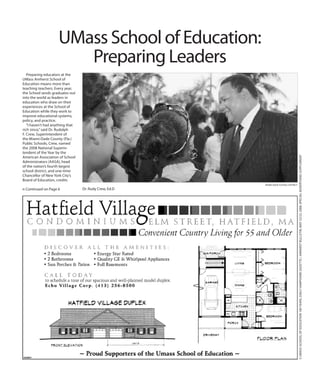
Rudolph F. Crew, (Ed.D. 1978) Superintendent, Miami-Dade County Public Schools. Rudy became the superintendent
of the nation’s fourth largest school district, Miami-Dade County Public Schools, following a national search in 2004. He
enjoys spirited interaction with students and sharing in their challenges and successes. In 2008, he was named National
Superintendent of the Year by the American Association of School Administrators. Rudy has received numerous other awards
including the NAACP Educational Leadership Award and the Arthur Ashe Leadership Award.
Patricia Crosson, (Ed.D. 1974) Emeritus Professor UMass Amherst. A champion for diversity dating back to her days as
a UMass Amherst student in the 1970s, Pat held posts at the Universities of Pittsburgh and Maryland, before returning to
UMass Amherst as professor, concentration coordinator and Provost. Pat helped create the state-wide Community College
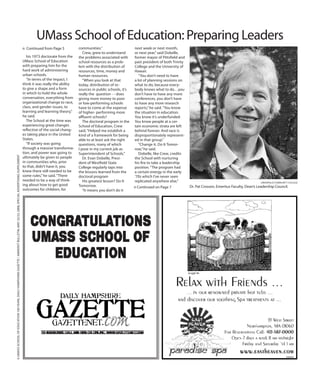
Leadership Academy and the Center for Education Policy. She is a member of the Dean’s Leadership Council, the UMass
Amherst Foundation and the Board of Trustees of Greenfield Community College.
Evan S. Dobelle, (Ed.D. 1987) President, Westfield State College. The youngest Mayor in the history of Pittsfield, Mass.,
Evan's political career included positions as U.S. Chief of Protocol for the White House and Assistant Secretary of State during
the Carter administration. Returning to UMass Amherst to earn degrees in educational administration, he went on to head
Middlesex Community College, City College of San Francisco, Trinity College in Hartford, Ct., the University of Hawaii, and
now Westfield State. He has also served as president and CEO of the New England Board of Higher Education.
Ronald Fredrickson, Ph.D. Emeritus Professor, UMass Amherst. Ron was essential in the establishment of counselor
education in Massachusetts and Rhode Island. A member of the School of Education’s faculty for 29 years, Ron was an
early proponent of research-based school counseling practice, founding the School of Education’s school counselor education
program. He also was among the founders of the School’s school psychology program.
Craig N. Mills, (Ed.D. 1982) Executive Director, American Institute of Certified Public Accountants. A pioneer in
computerized academic testing, Craig introduced computer-adaptive testing while at the Educational Testing Service in
Princeton, New Jersey. This model has since been adopted throughout the world. Throughout his career, Craig has arranged
internships for School of Education students.
Educators of Distinction
continued from page 1
School of Education Newsletter 9
2008 Degrees & Awards in Education
In May, Dean Christine B. McCormick congratulated 221 recipients of graduate degrees at UMass Amherst’s
commencement ceremony. This group represented 14 percent of all the graduate degrees conferred by UMass
Amherst. Master’s degrees in Education were awarded to 181 students and 27 graduates received doctorates.
Certificates of Advanced Graduate Studies (CAGS) were awarded to 13.
In addition, the School had more than 170 undergraduate minors graduating this year.
“When you graduate tomorrow you will be our newest alums and you will become part of a wonderful and
interesting family,” Dean McCormick said at the graduate reception May 22. “We are so proud of you and
want to hear about all of the wonderful things you are doing in your careers and your lives…please stay in
touch.”
Over the past three years, this year’s graduates received notable awards and scholarships.
Jennifer Fisette (Ed.D. 2008), was a recipient of the C. Lynn Vendien Professional Prize Award and the
Joseph W. Keilty Memorial Scholarship. Fisette’s dissertation was “A Mind/Body Exploration of Adolescent
Girls’ Strategies and Barriers to their Success or Survival in Physical Education.” Also receiving a Joseph
W. Keilty Memorial Scholarship was Cinzia Pica (Ed.D. 2008), whose dissertation was on “Children’s
Perceptions of Interethnic/Interracial Friendships in a Multiethnic School Context.”
Carolynn Laurenza, CAGS ’08, was also a recipient of the Joseph W. Keilty Memorial Scholarship.
Among this year’s Master’s degree recipients, the School had the following award recipients: Ann Marie
Burroughs, Early Childhood Graduate Student Fund Award; Yvonne Hilyard, Winifred Greene (Delta
Kappa Gamma) Scholarship; Amy Jackson, Meline Kasparian Scholarship; Linda Neas, Meline Kasparian
Scholarship; Kara Polesky, Grace Norton Carney Scholarship; Anne Talley, Meline Kasparian Scholarship. •
James H. Mullen, Jr., (Ed.D. 1994) President, Elms College.
Jim will soon take a new post as president of Allegheny
College in Meadville, Pennsylvania, having previously served
as Chancellor of the University of North Carolina, Asheville.
He was senior vice president and director of Project 2002,
a $3 million revitalization project at Trinity College in
Hartford, Connecticut.
Sonia Nieto, (Ed.D. 1979) Emeritus Professor, UMass
Amherst. Sonia is a long-time champion of multicultural
education, dating back to her teaching days in New York,
where in 1968 she took a job at the Bronx’s P.S. 25, the
first fully bilingual school in the Northeast. She taught in
a bilingual education teacher preparation program co-
sponsored by Brooklyn College and the School of Education.
Nationally recognized for her work in multicultural and
bilingual education and curriculum reform, she has been
awarded honorary doctorate degrees from Lesley University
and Bridgewater State College.
Stephen A. Rollin, (Ed.D. 1970) Retired Faculty, Florida
State University. Throughout his distinguished career, Steve
has garnered a reputation as a leader in the areas of youth
drug and alcohol abuse prevention. He started what is now
the highly successful Coalition for Psychology in the Schools
with links to 13 divisions of the American Psychological
Association.
Homer L. Meade II, (Ed.D. 1987) Senior Area Director,
National Evaluation Systems. Homer received a special
honor as the Graduate School Century of Scholarship
Colloquia Speaker. A Champion of the legacy of W.E.B. Du
Bois and past faculty of the W.E.B. Du Bois Department
of Afro-American Studies at UMass Amherst, he has been
involved in the planning of many area Du Bois programs and
was instrumental in cementing UMass Amherst’s stewardship
of the W.E.B. Du Bois Boyhood Homesite. •
Please Join Us
Homecoming
Weekend
Friday & Saturday
October 17 &18
10 University of Massachusetts Amherst
Alumnae/i News
Contact us with your news at goodnews@educ.umass.edu, (413) 545-2705 or www.umass.edu/education
1970s
Heriberto Flores (Ed.D. 1973) has
been named the chair of the board
of trustees at Holyoke Community
College. Flores, a former UMass
trustee, has been a trustee at HCC
since 2002. He is the executive
director of the New England Farm
Workers’ Council.
1980s
Shirley L. Handler (Ed.D. 1989) has
received the 5th Annual Honorary
Lifetime Achievement Award from
the Coalition Organized for Health
Education in Schools (COHES).
Handler, the developer and
coordinator of the Health/Family
and Consumer Sciences Program at
Cambridge College, was honored in
recognition of her work in promoting
comprehensive health education in
Massachusetts.
1990s
Felice Yeskel (Ed.D. 1991) has been
selected by Equity & Excellence
in Education, a leading journal in
examining inequalities in classroom
settings, as guest editor of a special
issue on “Class in Education.” Dr.
Yeskel is co-founder and executive
director of Class Action, a national,
non-profit group based in Hadley,
Mass. devoted to raising awareness,
facilitating cross-class dialogue,
supporting cross-class alliances, and
promoting economic justice.
Marisa Suhm (Ed.D. 1999) is the
Assistant Director for the Department
of Multicultural Services at Texas
A&M University. She recently was
involved in managing a large diversity
conference at the university, and
she is working on creating an inter-
disciplinary, campus-wide diversity
certificate program, as well as a new
course on Social Justice for a Global
Society, which she will be teaching
this coming semester. Her husband
Grant Suhm (Ed.D. 1996) is a private
consultant, formerly with Texas
A&M. For years, the couple directed
Peace Corps Pre-service trainings in
Micronesia, where their son Morgan
was born.
2000s
Samson MacJessie-Mbewe (Ed.D.
2004) is teaching Educational Policy
Issues and Sociology of Education
at the University of Malawi’s
Chancellor College. A Malawian
citizen, Dr. MacJessie-Mbewe is
a Senior Lecturer in Educational
Policy and Leadership, coordinator
of postgraduate studies in the
college’s department of Educational
Foundations, and examiner for
Master of Education theses. He
coordinates the college’s Fredskorpset
Youth Exchange program with Volda
University College in Norway, and
serves on the boards for the Creative
Center for Community Mobilization
(CRECCOM), a non-governmental
organization, and Leaders Academy, a
private secondary school.
Dwaine Lee (M.Ed. 2001; Ed.D.
2007) became the director of a
merged Democracy, Governance
and Education Office with USAID/
Macedonia in June. He has been
with the group since 2006, when
he started out as the director of its
Education Office. His work includes
judicial reform, anti-corruption, and
decentralization activities, as well
as primary education reform and
workforce development, all in support
of Macedonia’s aspirations for EU
and NATO membership. He and his
family - Naoma and boys Connor, 6,
and Erik, 4 - will be there through
2010. •
Over this past winter,
Lamoureaux was tapped to
oversee an “intermodal center”
that is being jointly operated by
the Massachusetts College of
Liberal Arts in North Adams,
Mass., and Berkshire Community
College. Located in Pittsfield, the
center will serve as an additional
satellite campus.
He was also recently named
a member of the School of
Education’s Deans Leadership
Council.
For Lamoureaux, his long-time
interest in education has been
held by one thing: the students.
“What keeps you going? It’s like
a perfect golf shot after about
150 long ones,” he said. “You
see the difference that you can
make, and that makes you want
to come back…all you need is
just a few of those to crank you
up.”
These values have successfully
spread through another
generation, thanks to the pro-
education household of Gary and
Nancy Lamoureaux.
“We joke about it because they
would hear stories around
the dinner table, about both
the good and bad sides of
education,” he said. “Apparently
the positive side rubbed off.”•
In the Family
continued from page 5
School of Education Newsletter 11
Celebrating a Century
continued from page 1
The first floor concourse emptied and filled throughout
the day with tides of Centennial participants between
Marathon sessions. People nibbled refreshments while
milling about exhibits that included maps showing the
locations of School of Education alumni in over 120
countries throughout the world and posters about the
School and its history. A display of black and white
photographs of alumni and faculty taken over the decades
generated laughter and jovial comments.
“I think that was the last time I wore a jacket and a
tie…I was an assistant professor then,” said William
Matthews, professor in the School’s Department of
Student Development and Pupil Personnel Services, eyeing
a picture of himself taken about 30 years ago when he
sported a much more sizable amount of hair. “You have to
remember, ‘fro’s were popular then.”
“I think it’s great that all this is happening,” said alumna
Ruth Hook. “I’ve just witnessed two seminars, and they
were great.” The Marathon reminded Hook of her early
days at the School, when such events were the order of the
day. “It’s déjà vu all over again,” she said.
By the time the Centennial receptions began late in the
afternoon, the air filled with the festive sounds of a family
reunion while everyone mixed and mingled.
“I spent a very short time in education and a whole bunch
of time in business, so this is sort of a chance to come
back and see some old friends and get reintroduced to a
little bit of the academic environment in education,” said
Steven M. Gluckstern, Ed. D. ’74. “I’m excited by some
of the things I see here. I hope Dwight Allen’s going to be
here. He was on my thesis committee, and he’s a longtime
friend.”
Allen did indeed come out for the Marathon, heaping
praise on the School all the while expressing the
philosophy that made his tenure at the School the stuff
of legend and controversy. “We had a lot of fun while I
was here, created a lot of mischief,” Allen said. “We’re
delighted to have stirred things up.”
“I think the School is on the edge of a new epoch,” he
added. “The advice I would give the School is, dare to be
different. Get outside the box. Make mistakes. You have
the right to be wrong.”
Following the receptions, more than 200 Centennial
attendees entered the auditorium for an elegant Centennial
Celebration Dinner. Dean Christine B. McCormick
welcomed the crowd. Chancellor Thomas W. Cole, Jr.
commented on the School’s legacy and Provost Charlena
M. Seymour spoke to its future, issuing a hearty cheer,
“Go, School of Education, GO!” Former deans Dr.
Dwight W. Allen, Dr. Marilyn J. Haring and Dr. Bailey W.
Jackson, took to the podium to share stories about their
times of Deanery.
“It was certainly a learning experience…it was wild and
it was wonderful, for the most part,” said former Dean
Haring (1988-1991.)
“The School has a wonderful history, but we had to move
forward in ways that would help the School prosper,”
she recalled, turning to praise Dean McCormick. “I think
this School is extremely flexible and able to adapt to the
changing world…it’s a world that’s changing so rapidly,
education has to be new to meet those needs.”
The evening featured the presentation of the Awards of
Distinction to honored alumni and emeriti faculty (See
related story page 1).
“It’s been nice after all these years to receive an award
from the School of Ed,” said emeritus professor Patricia
Crosson (Ed.D. ’74), one of the ten awardees. “I feel like
I should be giving them something for having been so
wonderful to me.”
Award of Distinction-winner and emeritus professor Ron
Frederickson, Ph.D., and his wife, Patricia (Ed.D. ’74),
trekked back to Amherst from the family farm in Kansas
to meet old friends.
“Oh, I think (the Marathon) is a wonderful idea because it
gives us a chance to find out what the School of Education
is doing, how the programs have changed,” Fredrickson
said, noting the new challenges of No Child Left Behind
and increased measures of educator accountability. “If
you look at all of the (Marathon) programs, you will find
that most of them are responding to things that are critical
issues, right today. We can’t ignore them.”
Karen Ross attended the Centennial as a way of honoring
the School that helped her find her life’s work. A 1972
graduate whose graduate work involved teaching Native
Americans in South Carolina, Ross now teaches high
school in Worcester, Mass.
“I think being at the School was a life-changing experience
for me,” she said. “I wasn’t sure I really wanted to be
a teacher, but the programs were so innovative and so
interesting that it really made me think. At the School,
teaching became my passion. It’s my life,” she said. “It has
been for 25 years.”
Former Dean Jackson (1991-2002) expressed hope that
the Centennial Marathon would lay the groundwork for
the return of more such marathons.
“A lot more people would have enjoyed this,” he said. “I
think it’s going to take a little while, but it could be really
great to do this from year to year.”
Dean McCormick agreed that such a celebration is
invigorating for the School.
“Now that we know how to host these celebrations, you
can believe that we will be checking the archives for more
dates to celebrate,” she said. •
Non Profit Org
U.S. Postage
PAID
Amherst MA
Permit No. 2
THANK YOU, SPONSORS!
The School of Education wishes to thank all the sponsors
that made our Centennial Marathon a great success.
School of Education
Furcolo Hall
813 North Pleasant St.
University of Massachusetts Amherst
Amherst, MA 01003
Yes,IwouldliketomakeagifttotheUMassAmherstSchoolofEducationCentennialFundtoday.
__$1,000	__$500		__$250		__$100		__$50		__Other$_____________________
__Mygiftwillbematched.Manyemployerswillmatchcharitablecontributions.Ifyouremployerdoes,askforamatchinggiftform.
Name____________________________________________________________________________________________________________________________
Address___________________________________________________________________________________________________________________________
City____________________________________________________State_____________________________________Zip____________________________
E-mail________________________________________________________________________Telephone(	)_____________________________________
Pleasemakeyourcheckpayableto:SchoolofEducationCentennialFund,andsendto:
Dean’sOffice											Todonatebycreditcard,pleaseselectone:
124FurcoloHall										__MasterCard		__Visa
SchoolofEducation										Card#__________________________Exp.Date_________
UniversityofMassachusettsAmherst								Signature___________________________________________
813N.PleasantSt.,Amherst,MA01003
(413)545-2705
Becomeapartoftheexcitementandsupporttheresearch
andteachingofourfacultyandstudentsthroughyourgift
totheSchoolofEducationCentennialFund.Yourgiftisan
investmentintheaspirationsandopportunitiesthenext100
yearswillbring.
www.umass.edu/education/development/how.shtml
2UMASSSCHOOLOFEDUCATION100YEARS,DailyHampshireGazette/AmherstBulletin,May22/23,2008,specialadvertisingsupplement
UMASS SCHOOL OF EDUCATION
Dr. Christine B. McCormick, Dean, School of Education.
The School of Education is
going on a Marathon. Not the
26-mile variety, but a two-day
event, bringing together alum-
ni, faculty, friends, students
and staff to exchange ideas and
share innovative practices.
“Celebrating 100 years of
preparing educators at UMass
Amherst is an incredible
opportunity for the School
of Education community to
come together and honor the
School’s legacy of support-
ing excellence and equity in
education,”said School of
Education Dean Christine B.
McCormick.
“We take great pride in the
fact that, not only have we
endured and grown through a
century of incredible change,
we remain a forward-thinking
institution that continues to
build its broad-based commu-
nity of scholars while strength-
ening public education,”she
said. In addition to a number
of individual receptions being
held by the School during
the Marathon weekend, the
Center for International Educa-
tion is hosting a 40th Reunion
The Centennial Marathon
Did You Know?
n School of Education
graduate, Dr. William A.
Burke, founded the City of
Los Angeles Marathon, the
third largest in the world.
n School of Education
graduate, Dr. Charles
Lamont Jenkins, won two
gold medals for the U.S.
track team in the 1956
Summer Olympics.
n Ken Blanchard, author
ofthebest-selling“TheOne-
Minute Manager,”taught
at the School of Education
between 1970 and 1974.
Dinner on Saturday evening,
June 14.
The School will take over
the first floor of the Campus
Center for all the festivities,
which are open to the public.
Opening sessions kick off
Friday afternoon followed by
receptions open to all partici-
pants. The Celebration Dinner
on Friday evening will feature
former deans, distinguished
alumni, and the first School of
Education Awards of Distinction
presentation.
The Marathon continues
Saturday with breakfast and ses-
sions until noon.
The School’s long history of
preparing educators dates back
to when William Richard Hart
was tapped in 1907 to head
the Massachusetts Agricultural
College’s new program to pre-
pare agricultural teachers.
Dean McCormick said she
looks forward to the Centennial
Celebration weekend. “Given
the legacy of our storied past,
and the first-rate school that we
are today, I am confident that
100 years from now the School
would be as astounding to me
as today’s School would be to
William Richard Hart,”she said.
For information about
registering for the Centennial
Marathon and Celebration Din-
ner, registration, special guests,
session topics, and events:
http://www.umass.edu/educa-
tion/news/centennial.shtml. For
information call (413) 545-
0897.
3UMASSSCHOOLOFEDUCATION100YEARS,DailyHampshireGazette/AmherstBulletin,May22/23,2008,specialadvertisingsupplement
The School of Education prepares
educators for all the roles necessary
in the operation of schools, be they
teachers of students with disabilities,
special education administrators, or
school counselors. In an increasing
number of settings stretching beyond
the UMass Amherst campus, the
School is preparing school psycholo-
gists who intern in local schools, assist-
ing teachers with effective instruction
for students new to English, and help-
ing those striving to become principals
and superintendents increase their
leadership skills.
The School’s programs make sig-
nificant contributions to the people in
our local communities. For instance,
the Access through Critical Content
and English Language Acquisition
(ACCELA) Alliance in Springfield and
Holyoke offers a Master’s Degree in
Education. This partnership supports
the academic literacy development
of linguistically and culturally diverse
students attending public schools by
providing comprehensive professional
development to local teachers and
administrators.
Another case in point is Anthony
Davila, M.Ed. 1997, acting principal of
Springfield’s Chestnut Middle School.
When Davila left Chestnut Middle
School to go to high school, he
thought he would never return. After a
successful internship tutoring students
there while he was an undergraduate
psychology major at UMass, he signed
up for the School of Education’s 180
Days in Springfield program to pre-
pare to become a teacher at Chestnut
Hill. Initially hesitant, it was with the
urging of School of Education instruc-
tor Robert W. Malloy that Davila finally
chose a career in teaching.
“It was perfect for me, working in
a school that I had already been at,
where I’d been as an intern,”Davila
said.“It’s an awesome opportunity, so
I jumped on it.”
180 Days in Springfield is a more
than ten-year old partnership be-
tween the UMass Amherst School of
Education and the Springfield Public
Schools. This intensive, yearlong stint
in urban middle and high schools
nets participants a Master’s degree
in Education and a Massachusetts
initial teacher license. As part of the
program’s community outreach and
service learning components, teacher
candidates develop“legacy”projects.
The School of Education:
ServingWestern Massachusetts
Anthony Davila is the acting principal at Springfield’s Chestnut Middle School.
n Continued on Page 4
4UMASSSCHOOLOFEDUCATION100YEARS,DailyHampshireGazette/AmherstBulletin,May22/23,2008,specialadvertisingsupplement
“My project was pretty
much an intensive English-as-
a-second-language course,”
Davila said. His students prac-
ticed their English in informal
settings, like playing chess,
and interacted with leaders of
the local Latino community.
“I was able to get people
to come in, people that had
positions of prestige in the
community, who were English
language learners themselves,”
he said.“They could tell their
success stories. These students
need that kind of encourage-
ment.“
“I saw kids that were strug-
gling, that were intelligent,”
Davila said.“A lot of these kids
were coming from their native
countries as honor students,
and then coming here and
struggling. They were pigeon-
holed, they were marginal-
ized, and I thought they were
the best students in the entire
school. And I thought no one
else saw it.”
Davila stayed on at Chest-
nut Hill eventually seeking
Did You Know?
School of Education
alumni head a number of
Massachusetts colleges
and universities, including
Westfield State College,
Bridgewater State College,
UniversityofMassachusetts
Dartmouth,Quinsigamond
Community College in
Worcester, and
Middlesex Community
College in Bedford.
Did You Know?
The School of Education
isconsistentlyrankedinthe
Top50GraduateSchoolsof
Education by US News and
WorldReport—movingup
in the rankings every year
since 2005.
licensure as a principal, where
he feels he can effect even
more change for his students.
Davila credits the intense
workload of 180 Days with
preparing him for the rigors of
becoming a principal.
Like Davila, Ruth-Ellen
Verock-O’Loughlin has been
able to operate in her home
turf, in this case Athol. Be-
cause of her experience as a
doctoral candidate working
with 180 Days in Springfield,
she was later tapped to lead
Bridges to the Future, a pro-
gram which prepares elemen-
tary, middle and high school
teachers while serving the ru-
ral school districts of Orange,
Greenfield, and Turners Falls.
The program was inspired by
School of Education alum Bill
Cosby’s calls to reach out to
underserved rural areas and
Cosby lent his spotlight for the
launch of the program in Athol
in 2004.
“Having a close connec-
tion with the community,
having been raised in Athol
and working at a school in
Orange, when Cosby came on
the scene, I was right in the
middle of all that,”she said.
In communities that have
seen much of industry gone
by the wayside, educators face
challenges different from those
facing urban schools.“Isola-
tion is one of the trickiest,”
Verock-O’Loughlin said.
Like 180 Days, Bridges tries
to avoid dictating to the local
teachers, who serve as men-
tors to the student teachers.
“The students don’t go into
the work saying I’m parachut-
ing in to save a community,”
she said.“They keep their ears
open to listen to the teach-
ers and students they work
with. And mentor teachers are
always continually looking to
share ideas.”
Still, the student teachers
may be surprised by what they
find, she said.“They’re sur-
prised that they don’t have all
the answers,”she said.“Some
of these districts are labeled
high-need, and sometimes
they come thinking this is
because the teachers and the
students maybe haven’t tried
hard enough.
“They quickly see that it
involves more than trying,”
she said.“They’re surprised
at how much energy and
thought it takes to actually
lead a group of kids and do
it in a way that matches what
the research is saying is good
practice.”
Projects conducted by
students in the Community
Service Learning component
of Bridges include Family
Math Night, After-School Mu-
sic Club, a Community Mural
project, a fifty-member Jump
Roping Club and the e-pals
group
“The e-pals group consists
of fourth grade students talk-
ing to students in Turkmeni-
stan,”she said.“We learn we
can use technology to facili-
tate talking to other people,
and then be critical consumers
of this technology.”
One of the greatest values of
the program is working along-
side the mentor teachers. It’s
a good example of the mixing
of generations and disciplines
that goes on at the School of
Education.
“The interns see that the
learning never stops,”she
said.“You don’t go out and
get your first teaching job and
stop thinking about what it
means to be a good teacher.“
n Continued from Page 3
School of Education: ServingWestern Massachusetts
Preparing educators at the
UMass Amherst School of
Education means more than
teaching teachers. Every year,
the School sends graduates out
into the world as leaders in
education who draw on their
experiences at the School of
Education while they work to
improve educational systems,
policy, and practice.
“I haven’t had anything that
rich since,”said Dr. Rudolph
F. Crew, Superintendent of
the Miami-Dade County (Fla.)
Public Schools, Crew, named
the 2008 National Superin-
tendent of the Year by the
American Association of School
Administrators (AASA), head
of the nation’s fourth largest
school district, and one-time
Chancellor of New York City’s
Board of Education, credits
5UMASSSCHOOLOFEDUCATION100YEARS,DailyHampshireGazette/AmherstBulletin,May22/23,2008,specialadvertisingsupplement
n Continued on Page 6
UMass School of Education:
Preparing Leaders
Miami Dade School District
Dr. Rudy Crew, Ed.D
his 1973 doctorate from the
UMass School of Education
with preparing him for the
hard work of administering
urban schools.
“In terms of the impact, I
think it was really the ability
to give a shape and a form
in which to hold the whole
conversation, everything from
organizational change to race,
class, and gender issues, to
learning and learning theory,”
he said.
The School at the time was
experiencing great changes
reflective of the social chang-
es taking place in the United
States.
“If society was going
through a massive transforma-
tion, and power was going to
ultimately be given to people
in communities who, prior
to that, didn’t have it, you
knew there still needed to be
some rules,”he said.“There
needed to be a way of think-
ing about how to get good
outcomes for children, for
communities.”
Crew, grew to understand
the problems associated with
school resources as a prob-
lem with the distribution of
resources, time, money and
human resources.
“When you look at that
today, distribution of re-
sources in public schools, it’s
really the question - - does
giving more money to poor
or low-performing schools
have to come at the expense
of higher- performing more
affluent schools?
The doctoral program in the
School of Education, Crew
said,“Helped me establish a
kind of a framework for being
able to at least ask the right
questions, many of which
I pose in my current job as
Superintendent of Schools.”
Dr. Evan Dobelle, Presi-
dent of Westfield State
College regularly taps into
the lessons learned from the
doctoral program
His greatest lesson? Do It
Tomorrow.
“It means you don’t do it
next week or next month,
or next year,”said Dobelle,
former mayor of Pittsfield and
past president of both Trinity
College and the University of
Hawaii.
“You don’t need to have
a lot of planning sessions on
what to do, because every-
body knows what to do…you
don’t have to have any more
conferences, you don’t have
to have any more research
reports,”he said.“You know
the situation in education.
You know it’s underfunded.
You know people at a cer-
tain economic strata are left
behind forever. And race is
disproportionately represent-
ed in that group.”
“Change it. Do It Tomor-
row,”he said.
Dobelle, like Crew, credits
the School with nurturing
his fire to take a leadership
position.“The program had
a certain energy in the early
‘70s which I’ve never seen
replicated anywhere else,”
6UMASSSCHOOLOFEDUCATION100YEARS,DailyHampshireGazette/AmherstBulletin,May22/23,2008,specialadvertisingsupplement
n Continued from Page 5
n Continued on Page 7
UMass School of Education: Preparing Leaders
GREENFIELD COMMUNITY COLLEGE
Dr. Pat Crosson, Emeritus Faculty, Dean’s Leadership Council.
he said.“There was a belief
that anything could happen,
anything could change in edu-
cation and higher education.”
He continues to draw on
those ideals.“I find higher
education to be over-man-
aged and under-led,”he said.
“I’m not interested in being
a micromanager. I’m inter-
ested in providing leadership
and vision. I’m interested in
celebrating faculty that inspire
students. What I learned
at UMass was not just the
potential in every child, but
the potential in every faculty
member,”he said.“Teach-
ers make a difference in your
life.”Dobelle said.
It was the faculty at the
School of Education who
made all the difference for
Dr. Margaret A. Jablonski,
who also taught at the School,
eventually accepting the
position of Vice Chancellor
for Student Affairs at the
University of North Carolina
at Chapel Hill.
“The faculty that I had in
my program were excellent,”
she said.“They challenged me
to think critically and broadly
about diversity, organizational
change, and legal issues, all of
which have played themselves
out in my career over the last
25 years.
“I’ve worked at both large
public and private universi-
ties. My academic program
at UMass really prepared me
well, with a good founda-
tion in organizational theory
and legal policy,”she said.“I
now actually teach a first year
seminar in higher education
policy issues, everything from
free speech to affirmative ac-
tion on college campuses, and
I still hearken back to some
of the issues that (Professor)
Dave Schimmel covered in
his Legal Issues class, such as
due process rights on a col-
lege campus, free speech, and
hate speech.
7UMASSSCHOOLOFEDUCATION100YEARS,DailyHampshireGazette/AmherstBulletin,May22/23,2008,specialadvertisingsupplement
n Continued from Page 6
Did you know?
n More than 15 Alumni
of the UMass School of
Education are current or
recentpresidentsofcolleges
and universities.
n More than 20 alumni
of the UMass School of
Education currently serve
as vice presidents, vice
chancellors, and deans
at American Colleges and
universities, including Clark
Atlanta University, Duke
University, Fitchburg State
College, University of North
Carolina at Chapel Hill,
and University of Southern
California.
UMass School of Education: Preparing Leaders
“Another area that UMass
really prepared me well for
was understanding the full
context of not just race and
gender, but class and every
aspect of identity, sexual,
orientation, religion, social
class,”she said.“It was very
eye-opening for me.“
Dr. Patricia Crosson,
UMass Amherst Professor
Emeritus, remembers study-
ing Higher Education admin-
istration in a kind of“work-
study”program for school
administrators.
“I was a graduate student in
the‘70s while an administra-
tor on campus and then on
the faculty from‘86 through
2002. During the faculty
years, I took occasional stints
on the administration side
over at Whitmore, but I still
kept my faculty status,”she
said.“I was an administrator
for two or three years, then I
came back to the faculty, and
then I’d go back to adminis-
tration.”
Dr. Crosson currently is
a member of the UMass
Amherst Foundation Board of
Director’s, School of Educa-
tion Dean’s Leadership Coun-
cil, and Governor’s Readiness
Project and chairs both the
Greenfield Community Col-
lege Board of Trustees and the
Massachusetts Community
College Trustee Association.
“I found it very rewarding
to be one of the many gradu-
ate students in the School of
Education who was working
while being a student.”
“It made all the difference
in the world,”she said.“It fa-
cilitated a deeper understand-
ing of the work I was doing.”
At the same time, there’s no
question that higher educa-
tion is a credentialed atmo-
sphere, so the degree enabled
me to have the advanced
degree necessary to work as a
faculty member as well as to
advance as an administrator.”
“It was critical for me, ab-
solutely critical,”she said.“It
wasn’t just‘go to classes and
then go home and write the
papers you have to write.’It
was‘participate with us in the
changing of education.’”
“UMass was my most fun-
damental teacher,”said Cros-
son.“It gave me opportunities
that you just don’t get other
places.”
The School of Education
possesses an impressive set
of tools to meet the chal-
lenges of its second century of
preparing educators at UMass
Amherst.
More than one third of its
67 full-time faculty are new
to the School since 2001
with expertise in such diverse
areas as literacy, research and
evaluation methods, reading
and writing, special education,
educational technology, and
mathematics education.
The School has more than
1,000 graduate students and
attracts high-quality students
from diverse backgrounds in-
cluding an increasing number
of international students. In
2007, more than 200 people
completed licensure programs
as teachers and other educa-
tors. The School can boast a
family of over 20,000 alumni
from every state in the U.S.
and more than 100 nations
who are compelling spokes-
people for educational reform
and revitalization. Whether
they work as traditional edu-
cators, policy makers, or in the
private sector, they are widely
acclaimed scholars, profes-
sional leaders, and dynamic
agents for change.
The School continues to be
ranked in the Top 50 among
graduate schools of educa-
tion by U.S. News and World
Report, and is accredited by
the National Council for the
Accreditation of Teacher Edu-
cation and the Massachusetts
Department of Education. The
Ph.D. in School Psychology is
accredited by the American
Psychological Association and
is approved by the National
Association of School Psy-
chologists.
Research Grants: This
influx of new faculty and a
growing student population
has resulted in a renewed
sense of growth and energy,
which translates into an in-
creasing number of research
initiatives with more than $53
million in sponsored grants
and contracts awarded to the
School and its faculty since
2000. These interdisciplin-
ary collaborations provide
opportunities for students to
participate in critical research
and innovative outreach initia-
tives. There are four research
centers in the School.
The Center for Educational
Assessment conducts scien-
tific analysis of methods for as-
sessing education systems and
practices. For example, the
Center provides its expertise
to improve large-scale assess-
ment programs such as the
Massachusetts Comprehensive
Assessment System (MCAS),
the National Assessment of
8UMASSSCHOOLOFEDUCATION100YEARS,DailyHampshireGazette/AmherstBulletin,May22/23,2008,specialadvertisingsupplement
n Continued on Page 10
State of the School today
9UMASSSCHOOLOFEDUCATION100YEARS,DailyHampshireGazette/AmherstBulletin,May22/23,2008,specialadvertisingsupplement
Educational Progress (NAEP), known
as the“nation’s report-card”, and
Massachusetts Adult Basic Education
(ABE) programs. http://www.umass.
edu/remp/remp7.htm
The Center for Education Policy
was created to study key education
policy issues in Massachusetts, other
New England states, and beyond.
Faculty and students in the Center
have authored reports on the impact
of the School Choice program in Mas-
sachusetts, the effects of the Education
Reform Act, and intervention options
for failing schools. http://www.umass.
edu/education/cep/
The Center for International Edu-
cation (CIE) brings in students from
all over the globe for research and
professional experience in interna-
tional development and education,
adult education outside the tradi-
tional classroom, and to introduce a
global perspective into U.S. education
systems. For more about CIE see the
story on Page 11. http://www.umass.
edu/cie/
The Center for School Counsel-
ing Outcome Research (CSCOR) is
dedicated to researching and improv-
10UMASSSCHOOLOFEDUCATION100YEARS,DailyHampshireGazette/AmherstBulletin,May22/23,2008,specialadvertisingsupplement
n Continued from Page 8
The state of the School of Education today
Did You Know?
The UMass School of Education
has more than 23,000 alumni, with
23,260 in all 50 states and Puerto
Rico, and Island Areas, and 468
alumni in 103 countries
throughout the world.
Did You Know
n Fat Albert”was the subject of Dr.
William H. Cosby Jr.’s 1977 doctoral
thesis studying elementary school
childrenlearningthroughvisualmedia.
n Dr. Camille Olivia Cosby is also
a School of Education alum, whose
dissertationwasaboutthe“influenceof
television imagery
on selected African-American
young adults’self-perceptions.”ing school counseling practices in the
Commonwealth and across the U.S.
Recent research projects include stud-
ies on how to deal with bullying and
school violence, the role counselors
can play in assisting students with dis-
abilities, and interventions to reduce
dropout rates. http://www.umass.
edu/schoolcounseling/
In the Community: For decades,
the School of Education has been a
major presence in the Pioneer Valley
through its outreach to community
schools. Its programs also impact edu-
cation on the national front.
The Off-Campus Program in Science
Education is a collaboration with the
College of Natural Sciences and Math-
ematics, the School of Public Health
and Health Sciences, and the Univer-
sity of Massachusetts Lowell, offering
a graduate degree in science educa-
tion for elementary and middle school
teachers. Funded by a $1.2 million
grant from the National Science Foun-
dation, courses in this program expose
elementary and middle school science
teachers to new content and teaching
methods.
The program is online, making it
available to teachers nationally and
internationally as well.
Project LEAD: In 2002, the Spring-
field school district selected the School
of Education as its partner in Project
Lead. Springfield is one of twelve dis-
tricts throughout the nation to receive
funding from the Wallace Reader’s
Digest Foundation’s Project Lead
Program. Project Lead’s goal is to
develop better administrators, through
research and a leadership training
program and to increase the numbers
of minority administrators within the
Springfield School system.
Making Diversity Count: The
School of Education is working with
the Anti-Defamation League to de-
velop, pilot, and evaluate an online
interactive video- based course that
will be offered to K-12 educators
through its WORLD OF DIFFERENCE
Institute to help them build respectful
classroom learning environments.
This preceding outline is just a
portion of the offerings currently on
the School of Education’s menu for
preparing new educators, arming
seasoned professionals with new skills,
and blazing new trails in education
research, policy, and advocacy. For
more on the School and all its offer-
ings, see the rest of this publication
and be sure to check out the School’s
new website at http://www.umass.
edu/education.
11UMASSSCHOOLOFEDUCATION100YEARS,dailyHampshireGazette/AmherstBulletin,May22/23,2008,specialadvertisingsupplement
Nearly every Tuesday morn-
ing throughout the academic
year, people from countries as
far-flung as Bhutan, Colombia,
Afghanistan and Peru confer
at the University of Massa-
chusetts. No UN-style postur-
ing here: these are members
of the School of Education’s
Center For International Edu-
cation, which brings together
educators from all over the
globe to learn the best ways
to teach people, whether they
speak Thai, Arabic, or English.
At these Tuesday meetings,
during classes, and at the
annual retreat, participants
share observations about their
projects, and pick up skills
from each other.
“You have students from
Africa, you have students
from Asia, India, Pakistan,
and from Palestine, so you get
enough opportunity to talk
to them and then share your
experiences,” said Habibul-
lah Wajdi, a current doctoral
candidate, who will return
to his native Afghanistan to
help rehabilitate the country’s
educational system.
“We need more educa-
tional leaders at all levels,” he
said.
Together with the School’s
Master’s and doctoral pro-
grams in International Educa-
tion, the Center offers gradu-
ate level professional training,
service and research opportu-
nities.
“The Center, in our percep-
tion, is a participatory learning
community,” said Professor
David R. Evans, founding
director of CIE. “Our task is
creating a learning environ-
ment for faculty and students.
To do that, we have a variety
of mechanisms to create and
maintain community, one of
The Center for International Education;
The School of Education and theWorld
n Continued on Page 12
CENTER FOR INTERNATIONAL EDUCATION
Students in Afghanistan attend a class.
them being the weekly Tuesday
meeting. In October of 06, we cele-
brated our 1,000th Tuesday meeting.”
As the School of Education cel-
ebrates a century of preparing educa-
tors at the UMass Amherst campus,
the international family of the School’s
Center for International Education is
preparing to celebrate its 40th re-
union.
During the past four decades, the
School’s academic program in interna-
tional education has produced about
250 Doctoral degrees and nearly 300
Master’s degrees. Graduates come
from over 100 different countries
including about half from the United
States, almost a quarter from Africa
and about 20 percent from Asia.
Having managed projects funded by
over $40 million in grants and con-
tracts, the Center has most recently
been involved in multi-year projects
in Afghanistan, Sudan, Malawi, India,
Uganda, and Nepal.
Not all of the Center’s initiatives are
overseas. The Adult Transitions Longi-
tudinal Study (ATLAS) is a $1 million,
five-year research project funded
by the Nellie Mae Foundation. The
ATLAS study will follow a group of
about 250 students in the New Eng-
land Adult Basic Education-to-College
Transition Project over five years in
order to better understand the factors
that contribute to or stand in the way
of participant success in post-second-
ary education. 
The creation of the Center dates
back to the boundary-breaking
changes made at the School of Educa-
tion during the tenure of former Dean
Dwight Allen.
He had a strong interest in interna-
tional education,” said Evans. It was
during that period that the School,
and by extension the Center, became
committed to the cause of social
12UMASSSCHOOLOFEDUCATION100YEARS,DailyHampshireGazette/AmherstBulletin,May22/23,2008,specialadvertisingsupplement
n Continued from Page 11
CIE:The School of Education and theWorld
UMASS SCHOOL OF INTERNATIONAL EDUCATION
The Community School in Southern Sudan.
Did You Know?
n Cynthia Shepard Perry (Ed.D,
1972) was the US Ambassador to
Sierra Leone from 1986 to 1989 and to
Burundi, 1989-1993.
n The Superintendent of Schools
forMiami-DadeCountyPublicSchools
is a School of Education alum,
Dr. Rudolph F. Crew, who previously
servedaschancellorofNewYorkCity’s
Board of Education.
n Jack Canfield, the creator of the
incredibly popular“Chicken Soup for
the Soul”Series, earned his Master’s
degree from the School of Education.
justice. That spirit has endured, Evans
said.
For instance, “we spend a lot of
time dealing with girls’ education,
gender and education, strategies and
mechanisms for providing better ac-
cess for girls to school, and keeping
them in school,” he said.
“In today’s world, any respectable
university has to have an international
dimension,” said Evans. “The interna-
tional is here: it’s in our schools, it’s in
our country, whether we like it or not.
You can’t be a functioning professional
in almost any field today, without
some understanding and knowledge
of what’s going on outside the borders
of the United States.”
“We’re training people who are
working with educational systems, not
just schools, in what used to be called
the developing world…people who
are going to work with the interna-
tional development organizations,
with Non Government Organiza-
tions, and civic groups,” Evans said.
“Or they go to work in the multilat-
eral organizations, the World Bank,
UNESCO, or UNICEF...some of the
Americans stay home, and they work
on bringing an international dimen-
sion to our curriculum here, working
for a variety of agencies.”
“So where does USAID or the
World Bank or UNICEF get the staff
that it uses to do educational pro-
gramming? Who trains those? We
do,” said Evans. “This is where they
come from. That’s the target, that’s
why we’re here.”
13UMASSSCHOOLOFEDUCATION100YEARS,DailyHampshireGazette/AmherstBulletin,May22/23,2008,specialadvertisingsupplement
The UMass
School of Edu-
cation’s Furcolo
Hall, at left, as it
appeared in the
1950s. Above,
another view of
the building.
14UMASSSCHOOLOFEDUCATION100YEARS,DailyHampshireGazette/AmherstBulletin,May22/23,2008,specialadvertisingsupplement
UMASS SCHOOL OF EDUCATION
Dr. Marjorie Cahn, with Professor Emeritus, Dr. Grace Craig, accepting recognition for her contributions in support of student scholarships.
15UMASSSCHOOLOFEDUCATION100YEARS,DailyHampshireGazette/AmherstBulletin,May22/23,2008,specialadvertisingsupplement
16UMASSSCHOOLOFEDUCATION100YEARS,DailyHampshireGazette/AmherstBulletin,May22/23,2008,specialadvertisingsupplement
Spanish American Union
My name is Maria Oquendo. When I
was diagnosed with breast cancer four
years ago, I wasn’t surprised. I had lost
my mother, my father, and my older
brother to cancer.
I could have given up. But I didn’t.
I’d made sure to get a regular exam, and
the doctor caught it in time.
I have a normal life: I take care of my
house, and I work as a volunteer. I
don’t feel sick, and I’m here for my
grandchildren.
The exam can save your life.
If you have been diagnosed, don’t lose
hope. Don’t stay in your house. Tell
people what you’ve got. There are many
women like us. Survivors.
Prevention
is the Best
Protection!
To find out more about breast
cancer detection and treatment, and
how you can have a health educator
come speak in your home, church,
or community center, call Jeanette
Rodriguez or Martha Rivera at
(413) 734-7381 ext.132.
In today’s fast-paced world it is hard keeping sight of what matters most.
Parents are expected to juggle heavy schedules, fall school activities and
Jewish holiday preparation without a break. How can you and your family stay
balanced and connected to the meaning and activity of this time of year?
Please join us as guest speaker Julie B. Rosenshein, LICSW leads us in an
exploration of these issues, showing us how to find balance in these hectic
times.
This talk is for adults and is free and open to the public.
Julie Rosenshein, LICSW specializes in families with ADHD, Bipolar and Highly Sensitive
Children. She is the author of The Highly Sensitive Kids Guide and lectures throughout
the New York and New England areas.
Keeping Family Balance
When Life is TOO MUCH and TOO FAST
Two Locations!
Wed. Sept. 24
7:00-8:30 p.m.
Lander-Grinspoon
Academy
257ProspectStreet
Northampton
Thu. Sept. 25
7:00-8:30 p.m.
SpringfieldJCC
1160DickinsonStreet
Springfield
For more information, or to register, call Jewish Family Service at
(413) 737-2601 or e-mail JewishLife@jfswm.org.
This is a Jewish Life Enrichment program, sponsored in part through
a grant from the Family and Teen Initiative of the Harold Grinspoon
Foundation. For our complete Fall schedule, check out our website at
www.jfswm.org.
STRETCHED TOO THIN:
AcollaborativeprojectoftheMassachusettsTobaccoControlProgramandtheOfficeoftheAttorneyGeneralwithfundingbytheMassachusettsDepartmentofPublicHealth
Fall 2008
WEST SPRINGFIELD – When it comes down to it, the
greatest protection between the public and the dangers of
tobacco lies in the hands of the local Health Department
and Board of Health.
In West Springfield, Health Director Jeanne Galloway
feels that protecting people from second-hand smoke and
breaking the cycle of teen tobacco addiction are issues of
vital importance.
Unfortunately, there are only so many hours in a week, and
so much else that a health department needs to get done.
“We have a three-member board with two positions full
at this point,” she said. In terms of staff, Galloway has a
sanitarian, two nurses, a code enforcement officer, and an
office administrator.
“Food service is our number one, that’s what we spend
over 50 percent of our time on,” she said. With 200
establishments serving food –not just restaurants but also
schools and other facilities with kitchens—they have their
hands full.
After food service enforcement, they handle
immunizations, septic systems, and rabies control.
The trick is to double-up when they can, she said.
“We have a lot of our tobacco sellers also selling food, so
we do check them when we go in to do the food visits,” she
said. “If we get complaints, we’ll go in and check on them
as well. But we don’t get a lot of complaints.”
Tom Fitzgerald, the health inspector for Southwick,
tells a similar story. Also answerable to a three-person
volunteer board, he’s the town’s only person in the field
when it comes to protecting the public health. And at 26
hours per week, there’s only so much time he can devote
to tobacco control. The greatest time-consumer for him is
state-mandated percolation tests, required in the proper
maintenance of septic systems. Fitzgerald says that eats up
about a third of his hours.
EnforcementisMyJob
David buys dozens of packs of cigarettes at a time. At 16,
this would make him out to be quite the addict.
But it’s not so. It’s just his job.
“I’ve been doing this for 2 years now,” said David (not his
real name), a Springfield teen who assists with compliance
checks for the Gandara Center.
For $9 an hour, it’s a pretty good job, with the extra incen-
tive that you are doing something to benefit your peers.
“I’m trying to get something happening,” David said.
“People smoke everywhere.”
The Gandara Center, funded through a state Department
of Public Health grant, oversees youth tobacco compli-
ance checks in Agawam, Chicopee, Hampden, Westfield
and West Springfield, as well as the surrounding
OntheBeatwiththe
BoardofHealth
Next Page 
Last Page 
AcollaborativeprojectoftheMassachusettsTobaccoControlProgramandtheOfficeoftheAttorneyGeneralwithfundingbytheMassachusettsDepartmentofPublicHealth
SmokeFreeattheBigE
Families got to breathe easier
at this year’s Eastern States
Exposition in West Springfield,
thanks to a new collaboration
between fair organizers and the
Gandara Center.
Kiddieland, which takes up
about a fifth of the midway at the
Big E, was declared a Smoke-Free
Zone. This is just the start of the
Gandara Center and the Big E
working together to develop and
implement sensible second-hand
smoke policies.
Thanks, Big E!
After that, “we have to investigate all sorts of complaints,
housing complaints, complaints of trash, unregistered
vehicles,” he said. Southwick has about 20 restaurants, with
three new ones, which have to be checked for proper food-
handling and preparation.
When in comes to tobacco control, he says that the
compliance checks and merchant education provided by
Gandara were a welcome addition.
“That would have unfortunately been a lower priority,” he
said.
While tobacco control is admittedly a small part of what
the town’s health department does, they do take it seriously.
Southwick’s Board of Health, like some communities, added
a layer to the state ban on smoking, extending the rule to
private clubs which had previously slipped between the
cracks.
“We had two places, the American Legion and the VFW,
and they were exempt under the Massachusetts law,” he
said. Officials felt regulations “should be uniform, and they
thought that was a loophole.”
“The law says it’s a workplace law, and it’s a workplace,” he
added. “It makes sense that the people employed there as
well as customers who don’t smoke, shouldn’t have to suffer
the ill effects of smoke in their lungs.”
It was only fair, Fitzgerald said.
“When they were exempt, it was tough to police, because
they were letting in people that weren’t members,” he said.
Fitzgerald said Southwick has benefitted from Gandara’s
work with compliance checks. He said he’s done follow-up
enforcement with the few establishments that have sold
tobacco to minors, and things have gone smoothly. The
town fines offender $100 first offense, and $200 on the
second.
“We may consider taking the license after the third
offense, but we haven’t come close to that yet,” he said.
“We’ve had one or two fines in the last 5-6 years. That’s
very good.”
Program director Michael Pease “has done a real good
job educating the people… he has a real good rapport,”
he said. This has made enforcement much less of a hassle.
Chicopee has similarly extended its smoking ban to
private clubs, though in their case there is only one that
falls under that category.
For full-time health inspectors Tammy Szlachetka and
Michael Suckua, their time is pretty much dominated by the
291 food service permits they have to check on.
“That’s restaurants, convenience stores, grocery stores,
everything that serves food in Chicopee,” said Szlachetka.
“It’s a good thing there’s two of us.”
Tobacco usually comes into play when they are doing food
service inspections at establishments that also sell cigarettes
and other such products. She said Gandara helped her
department get a leg up on all the state requirements.
“We can thank Mike for giving us the training on it…now
we’re a lot more aware of the things we need to look out for
when we are going into places,” she said, noting things such
as signage and display requirements.
“Obviously we try to make sure people are not selling to the
youth,” she said. “For a lot of those things, we actually went
to West Springfield, we went to Gandara Center. He gave us
a class on it, and I thought that it was very helpful.”
Galloway said that it’s a matter of finding the time, not the
interest.
Teens buying cigarettes is “something they’d like to see
change,” she said. “The last Board of Health meeting was
devoted to the youth sale of tobacco, and one of the board
members mentioned that the sale to youth, even the use of
tobacco by youth, has greatly diminished in his lifetime.
We’d like to see it be even lower.
“It’s something we need to do, but it needs to be done within
the parameters that we have, working within our means,” she
said.
AcollaborativeprojectoftheMassachusettsTobaccoControlProgramandtheOfficeoftheAttorneyGeneralwithfundingbytheMassachusettsDepartmentofPublicHealth
The U.S. Centers for Disease
Control (CDC) recently reported
that Massachusetts now has one of
the lowest adult smoking rates in
the U.S. The 2007 adult smoking
rate of 16.4% is the lowest ever
recorded for the Commonwealth,
and ranks 4th nationally behind
only California, Utah and
Connecticut. The drop in
Massachusetts’adultsmoking
rate between 2006 and 2007
was the largest single year
decrease in the state in more
than a decade.
This comes on the heels of a
report published early this
year which found that, after
remaining level for the past
several years, smoking rates
among Massachusetts high
school students fell from
20.5% in 2005 to 17.7% in
2007. The rate of smoking
among high school students
in the state has been cut in
half since 1995.
Health officials cited a number of
factors contributing to the decline,
including the state’s smoke-free
workplace ban and increased
fundingforDPH’sTobaccoControl
Program. That additional funding
allowedDPHtolaunchseveralnew
initiatives including the first public
awareness campaign in six years,
additional tobacco enforcement
grants to cities and towns, and
renewed efforts to lower youth
smoking rates.
The drop in teen smoking in
particular was credited to the
work of the Massachusetts
Tobacco Control Program, which
has launched an intensive effort
to educate tobacco retailers
about selling tobacco products to
minors. Illegal sales of tobacco to
minors decreased by more than
50% statewide, (from 22.7% in
FY06 to 10.3% in FY07) when the
retailer education campaign was
conducted.
A total of 10,959 Massachusetts
smokers have taken advantage of a
nicotine patch giveaway sponsored
by the Massachusetts Department
ofPublicHealth.Officialsextended
the program through the end of
August due to overwhelming
demand.
Tobacco Resources:
The Campaign for■■
Tobacco-Free Kids at
www.tobaccofreekids.
org has information on
issues relating to youth
and tobacco, including
news reports, publications,
resources and opportunities
for advocacy.
Want to quit ? Click on■■
www.trytostop.org for
success stories from former
smokers, create your own
action plan, and tap into
theTryToSTOP community
where, every day, people just
like you are helping each
other quit. Best of all, it’s
free!
The American Legacy■■
Foundation has information
about youth prevention and
community initiatives at
www.americanlegacy.org
Centers for Disease■■
Control and Prevention, at
www.cdc.gov/tobacco
offers Surgeon General’s
reports on tobacco, fact
sheets, educational materials,
and recent national statistics.
The American Cancer■■
Society www.cancer.org
offers information about
cancer, opportunities to
raise awareness and referral
information.
Since 1977, the Gandara Center, a private,
non-profit, multi-cultural organization, has
provided mental health, substance abuse, HIV/
AIDS, and tobacco prevention services in the
greater Springfield area.
The mission of the Gandara Center is to promote
the well being of Hispanics, African-Americans
and other culturally diverse populations, through
innovative, culturally competent behavioral
health, prevention and educational services.
Gandara is dedicated to offering culturally com-
petent education, prevention, treatment, residen-
tial and supportive services in the community.
Gandara Center Prevention Services
147 Norman Street
West Springfield, MA 01089
Phone: (413) 736-8329
email:AJones@gandaracenter.org
SnuffingOutTobacco
intheBayState
AcollaborativeprojectoftheMassachusettsTobaccoControlProgramandtheOfficeoftheAttorneyGeneralwithfundingbytheMassachusettsDepartmentofPublicHealth
Place
Stamp
Here
Gandara Center Prevention Services
147 Norman Street
West Springfield, MA 01089
communities of Blandford, Chester, Granville, Holland,
Southwick, Tolland, and Wales.
Under the supervision of program director Michael
Pease, David was a part of the team of local teens that
have spent two months traveling throughout the area,
visiting over 260 merchants that sell tobacco products.
Teens attempt to purchase cigarettes; unfortunately in
many cases, some store clerks are still ready to comply.
David last did checks in the fall, largely in the Chicopee
and Hampden area.
“I was fairly successful,” he said. “In Chicopee, I had
about 25 sales.
The goal of the program is not to entrap merchants,
but educate them about the state’s tobacco regulations,
which are geared at curbing youth addiction to tobacco
and reduce smoking rates, Pease said. Smoking is the
leading cause of preventable disease and fatal illness
in Massachusetts, killing more people each year than
automobile accidents, AIDS, murder, suicides and
poisonings combined, according to state Department of
Public Health figures.
Pease starts the process months beforehand with a
round of merchant education. Then, after the first
round of compliance checks, he will go on another
education tour of the merchants that previously sold to
David and other minors.
For the checks themselves, the team makes sure they
are doing nothing to mislead the merchants about the
students’ actual age, Pease said.
“There’s a whole bunch of documentation we’ll do. I’ll
take pictures of the kid, up front to show what they
look like, so people won’t think like we’re trying to bait
them,” he said.
David said he makes sure to avoid the issue, and never
deliberately misrepresents himself. He said he has some
twinges of guilt about the matter, but ultimately knows
it’s all for a good cause.
“I know it’s illegal to sell to minors, but I didn’t want
(merchants) to get in trouble,” he said. “But I had to, it’s
my job.”
EnforcementisMyJobcontinuedfrompage1
William Sweet Page 1 10/5/2008
Eugenics leader saw proof of theory in WMass towns
By William Sweet
Source: Sunday Republican (Springfield)
Sunday, January 26, 2003
Edition: ALL, Section: News, Page A01
"In summer we raise blueberries; in winter we raise hell," said a Shutesbury resident in
Leon F. Whitney's "A Case for Sterilization."
Leon F. Whitney never abandoned his faith in eugenics, the discredited science of
breeding better humans, but he was always embarrassed by the fan letter bearing the
signature of Adolf Hitler.
Whitney, a veterinarian and author of many books on breeding and raising animals, was
the lead researcher of a 1928 eugenics study which judged some Western Massachusetts
human residents as poor breeding stock.
The study, publicized in the December issue of Boston Magazine, shocked locals with its
tale of Leverett and Shutesbury residents being deemed genetically inferior. The report
also told of epileptic teen-age boys being sterilized at what is now the Monson
Developmental Center.
"I'm disgusted," said Barbara Goodhind, chairwoman of Shutesbury's Historical
Commission. "I didn't like the story at all."
Today's townspeople don't remember the secret study, conducted for the American
Eugenics Society by Whitney, a 1916 graduate of the Massachusetts College of
Agriculture, now the University of Massachusetts at Amherst. Whitney died in 1973.
"It was chilling," said Roberta Hunting, whose father-in-law, Ward Hunting, was
Shutesbury's town clerk from 1911-1961.
"Oh my God, that's outrageous," said Rebecca Torres, who serves on the Board of
Selectmen. "That's unbelievable."
Funded with a $1,000 donation from a Philadelphia philanthropist, Whitney enlisted the
aid of students from Smith College in Northampton and his alma mater to scrutinize
residents of Leverett, Pelham, Shutesbury and Sunderland. They also interviewed and
examined family histories of residents in Prescott, one of the towns later submerged in
the creation of the Quabbin Reservoir.
Unbeknownst to the subjects, the researchers would ultimately characterize the
population as unintelligent and slothful, dependent on charity and in trouble with the law,
the products of inbreeding after the "cream" of the population had left for greener
pastures.
William Sweet Page 2 10/5/2008
George Whitney, a retired veterinarian who today lives just outside of New Haven,
Conn., remembers his father's work and defends it.
"We use genetics to improve all kinds of creatures," he said. "Why not use it to improve
people?"
According to the Boston Magazine report, the deceased Whitney's group sponsored a
competition to determine the best-bred humans, alongside cattle competitions at the
Eastern States Exposition in 1925. They called it "Fitter Families For Future Firesides."
"The Case for Sterilization" earned the elder Whitney a letter of praise from German
dictator Adolf Hitler, whose regime translated eugenics into murder. Where eugenics in
this country led to the sterilization of the handicapped and people considered morally
defective, the Nazis took it a step further, euthanizing people considered "subnormal" as
they carried out the Holocaust of World War II.
George Whitney said the terse yet respectful note bearing Hitler's name, sent in July
1934, caused his family some embarrassment. Some in the family suggested he destroy it,
but the younger Whitney has held onto the historical artifact, storing it at an undisclosed
location.
It is unfortunate that the Nazi application of genetic theory has tainted his father's work,
he said. His father would never favor the euthanasia or involuntary sterilization of
anyone, he said.
The theory of eugenics, which reduced virtually all human behavior down to heredity,
was embraced by many scientists during the infancy of genetics in the 19th century and
wasn't abandoned until after the 1930s and later. Locally, it was embraced by professors
at colleges including the Massachusetts College of Agriculture and Mount Holyoke
College.
Upon graduation from the agricultural college in 1916, Whitney had an unsuccessful
attempt at farming in Hadley, and in the 1920s moved his young family to Northampton,
where he worked at a number of jobs, including waiting tables and a stint at a fruit
grower's supply company.
"My father was an absolute bear for working," George Whitney said.
He left Massachusetts in 1930 to take a job teaching eugenics at Yale University. It was
in New Haven that he would write his 1934 book "The Case for Sterilization," which
advocates sterilizing the "feeble-minded."
William Sweet Page 3 10/5/2008
"There was a widespread belief that behavior was determined by heredity," said Brian W.
Ogilvie, assistant professor of history at UMass. Ogilvie teaches a history of science
course.
Unlike current gene theory, which ascribes only some traits to DNA, eugenics gave a
moralistic twist to its conclusions, Ogilvie said. Eugenics led to laws in many states
allowing sterilization of the "feeble-minded" or those judged morally deficient.
The theory was dismissed as a pseudo-science in later decades, largely out of horror at its
use as an excuse for genocide by the Nazis, but also because of a growing realization that
heredity doesn't hold all the cards.
"With the rise of anthropology and sociology, people began to look for social
explanations," Ogilvie said.
A child at the time of the 1928 study, the younger Whitney remembers his father debating
nature vs. nurture with famed lawyer Clarence Darrow.
"Clarence Darrow thought it was 100 percent environment," he said. "My father said 'I
can prove you wrong.'"
To settle the gentlemanly disagreement and prove that some faults are simply inbred,
Whitney took Darrow on a field trip to Shutesbury. The trip convinced Darrow that
genetics play a part in development, Whitney said. The two would maintain a friendship
through Darrow's last years. Whitney, a strict Presbyterian, would eventually abandon his
faith, partially because of Darrow's influence, said the son.
A newspaper photograph of the two exists; Leon Whitney, who submitted the
photograph, lied and said it was taken in New York state to avoid trouble with
Shutesbury, said George Whitney.
In an unpublished biography written decades later - after Whitney had joined his son as
an animal doctor - he identifies the towns of the 1928 study, noting they had fallen on
hard times, with the loss of factories along the Swift River and regular trains.
"Those with the most gumption had gradually moved away and left the least ambitious
behind . . . there was no way to earn a good living," Whitney wrote. "Many of the houses
still standing had the kitchen floors eaten up by porcupines . . . there was no evidence of
village pride."
Whitney cited the court testimony of a Carry Pratt, from an undated trial. Pratt was asked
by a judge, "What do you raise in Shutesbury?"
"Judge, in summer we raise blueberries; in winter we raise hell," was the reply.
William Sweet Page 4 10/5/2008
It wasn't clear from accounts of the study why Whitney set his sights on the towns, said
Welling Savo, who wrote the Boston Magazine article. However, it wasn't the first time
they would receive such scrutiny: A 1912 study described Shutesbury as "so uniformly
decadent that a normal comparison was lacking."
"A lot of class prejudice went into those judgments," said Ogilvie. The UMass and Smith
students enlisted as field workers, who interviewed the residents about their families and
habits, likely carried prejudices about the rural inhabitants, he said.
"I'm saddened about that," said Leslie Bracebridge, Shutesbury's town clerk, who could
find no evidence of the study in town records.
"I've done oral interviews and heard nothing but how fastidious and hard-working these
people were," she said.
William Sweet Page 5 10/5/2008
Milk inspectors now rare breed
By William Sweet
Source: Union-News (Springfield, Mass.)
Saturday, March 16, 2002
Edition: All, Section: NEWS, Page A01
Dateline: MONTAGUE
With state budget cutbacks, the once-familiar gadfly and friend of farmers is becoming as
hard to find as a dairy farm itself.
MONTAGUE - Where there's milk, there's manure.
It's Ralmon J. Black's job to keep the two apart.
Armed with a bucket of bleach, a brush to sanitize his rubber boots and a clipboard to
bear his observations, Black is part of a tiny and threatened force of regulators keeping an
eye on the state's milk supply.
As one of the state's four dairy inspectors, he must trek to about 150 farms throughout
Franklin, Hampshire, Hampden and Worcester counties.
By mid-April, when Black and two of his co-workers have retired, the state will be left
with only one dairy inspector and no plans to replace the ones who are gone. The
situation contributed to the recent resignation of Agriculture Commissioner Jonathan L.
Healy. Not keeping up with inspections could threaten sales of Massachusetts milk in
other states, agriculture officials say.
At 62, Black lets others do the more strenuous tests on cows for mastitis, an inflammation
of the udder which can seriously reduce milk production. He hurt his back a few years
ago doing the moves needed to avoid getting kicked by cows.
"You need to know a little 'Kung Moo,'" Black said.
He still manages to keep busy, clocking as many as 350 miles a day to visit farms ranging
from one in Ludlow where five cows are milked by an elderly woman to a herd of 300 in
Hadley.
His days begin at 6 in the morning to observe the farmers at milking time. The
inspections are always unannounced, but, after 30 years on the job, Black has developed
a cordial relationship with his sometimes wary constituency.
On March 6, 30 years to the day since he began as an inspector, Black spent the morning
at five farms in Sunderland and Northfield. Usually unaccompanied since the farmers
William Sweet Page 6 10/5/2008
were too busy to greet him, he peeked into the parlors where cows stood in line at the
milking machines. He strolled into offices laden with gestation charts ticking off points
on his checklist.
"Some farmers don't deal well with the regulators. They will see me coming and go the
other way," Black said. "Some get their wives to follow me around. But I've had a good
rapport with 99 percent of them."
He's known farming since childhood - both his father and grandfather had dairy farms in
Williamsburg where he makes his home today - and agriculture has been a continuing
interest throughout his life. He studied animal husbandry at the University of
Massachusetts, and his college years included a stint out west harvesting wheat.
He worked on farms in Ireland and Scotland, and his agricultural pursuits took him to the
Balkans in the 1960s to examine collective farming.
When Black started with the state's dairy services in 1972, it had more than three times as
many inspectors because it inspected farms across New England which sent milk here.
Since a decade ago when inspections became more standardized, the agency has limited
its work to Massachusetts dairy farms.
Five decades ago there were some 4,000 dairy farms in the state. Now there are about
240. The average age of a dairy farmer in Black's district is 60, and he has a number in
their 80s. But while the number of farms is dwindling, the ones left are bigger, he said.
And the milk is still excellent, he said.
Black will retire on his birthday, April 12, leaving an inspection department with an
uncertain future. Clifford S. Thayer, who inspects dairy farms in Berkshire and Franklin
counties, and William A. Vasquez, who supervises the inspection service, opted to take
advantage of an early retirement plan offered by the state and departed yesterday.
When Healy announced Feb. 15 that he would be stepping down, he cited acting Gov.
Jane M. Swift's plans to cut his department's budget by 35 percent and criticized the
reduction in dairy inspectors. "It's too scary," Healy said. "Especially now, with all the
concerns about bioterrorism and the safety of our food."
"Our department has experienced such significant budget cuts that we cannot maintain
the standard of excellence that I demand of our personnel and myself," Healy said at the
time of his resignation.
The retirements of Black and the others will leave eastern Massachusetts inspector
Catherine Kaszowski the lone regulator, a clearly untenable arrangement, said James G.
Hines, director of the animal health and dairy service for the Agriculture Department. In
addition to the manpower loss, the state has also shut down a lab that conducted tests for
mastitis.
William Sweet Page 7 10/5/2008
Hines said his department is trying to arrange an alternative. They've asked to hire at least
one additional person and have floated a proposal to bring back the retirees on a part-time
basis.
The inspections, done at individual farms three times a year, involve a detailed checklist
of standards to ensure milk is gathered and stored in surroundings allowing for as little
contamination as possible. If an infraction is found, the inspector will come back for a
repeat visit.
Repeated infractions can imperil a farm's license to sell milk. Black will also return to
take milk samples and visit farms outside his district to check on other inspections.
Inspections may include making sure a door is kept shut and a screen is repaired. Or it
might mean bugging a farmer to keep old newspapers out of a sink used by workers to
wash their hands or shooing a budding family of cats from the milking parlor.
Mostly, the infractions are quite minor, Black said.
"Once in a while you get irritated," said James Williams of Mount Toby Farm in
Sunderland. "But they're good to you."
Black enjoys genealogy, and it proves a good conversation-starter with farmers keen on
learning their roots. Williams, for instance, has a grandson who is the eighth generation
to work their farm.
Farmers say they largely appreciate Black's role, which can include giving them tips on
battling disease and helping production.
"People are doing a good job, but it never hurts to have a little checking up," said
Jeannette Fellows, who has a farm in Warwick. "It keeps us on the ball."
Concerns about such infectious conditions as mastitis has led to dairy farms being home
to small pharmacies, which Black must also check. A farm will get demerits for
promiscuity, which in Black's book means shelving drugs for milking cows alongside
drugs for other cattle, which could lead to confusion.
"If there's beer and schnapps in here, you're probably on a bad farm," he said, indicating a
refrigerator laden with bovine medication and Gatorade.
Inspectors are particularly keen on keeping antibiotics out of the milk supply. Since the
mid-1980s, the state has had zero tolerance for antibiotics in food, for fear that diseases
resistant to the drugs could develop.
While farmers are allowed to provide cows with these drugs, they have to wait days for
the drug to work through the animals' systems before milking again. If a milk truck's load
William Sweet Page 8 10/5/2008
is found to contain antibiotics, the last farm to supply the truck is forced to purchase the
tainted milk, a $4,000 to $8,000 cost.
The tests are very sensitive, Black said.
"If you swish an olive from your martini in the swimming pool, the tests we are using can
detect the alcohol in the pool," he said. Antibiotics are found in a milk batch about once a
month, he said.
Black is prepared to return to duty if needed following his retirement.
"I told them my pen and my sword would be available on special arrangement," he said.
"But hopefully they'll see the light and hire two people."
Currently, the state scores well with federal standards-checkers, Black said.
"We really don't know what's going to happen, but if they don't replace, sooner or later
producers, the industry and consumers would be all over them," he said.
William Sweet Page 9 10/5/2008
FOR IMMEDIATE RELEASE
July 1, 2007
Contact: Michael Pease, program coordinator, Youth Tobacco
Prevention
Phone: (413) 454-5674
Local Compliance Checks Uncover Cigarette Sales To Teens
WEST SPRINGFIELD, Mass. – Local teens under 18 looking to illegally
purchase tobacco have a one-in-five chance of succeeding, according to a
recent batch of compliance checks performed by youth investigators with the
Gandara Center.
“It’s 20 percent…one in five is selling to kids,” said Michael Pease, program
coordinator for Gandara Center’s Youth Tobacco Prevention program.
This year Pease and a team of local teens spent two months traveling
throughout the area, visiting over 260 merchants that sell tobacco products.
Teens would attempt to purchase cigarettes, and in many cases, store clerks
were ready to comply. It’s a disturbing statistic, and one that Pease and
Gandara hope to reduce.
One of the teens, a 16-year-old Agawam girl, said she was surprised at their
success rate in buying the cigarettes.
“It’s not hard,” she said.
The West Springfield-based Gandara Center was awarded a $70,000 state
Department of Public Health grant to oversee youth tobacco compliance
checks in Agawam, Chicopee, Hampden, Westfield and West Springfield, as
well as the surrounding communities of Blandford, Chester, Granville,
Holland, Southwick, Tolland, and Wales. Pease and his team are poised to do
a follow-up round of compliance checks this month, and start a new round in
the fall.
The goal of the program is not to entrap merchants, but educate them about
the state’s tobacco regulations, which are geared at curbing youth addiction
to tobacco and reduce smoking rates, Pease said. Smoking is the leading
cause of preventable disease and fatal illness in Massachusetts, killing more
William Sweet Page 10 10/5/2008
people each year than automobile accidents, AIDS, murder, suicides and
poisonings combined, according to state Department of Public Health figures.
According to state figures tobacco use costs Massachusetts residents $3.46
billion in direct healthcare costs from smoking-related diseases.
Pease started the process months beforehand with a round of merchant
education, followed months later by the first round of checks. Later, he will
go on another education tour, and return to do compliance checks at stores
that previously sold to the minors. Armed with a packet of information about
state laws relative to tobacco sales to minors, he becomes a traveling
salesman for public health, visiting the over 260 stores in the dozen
communities.
“I spend anywhere between 15 minutes and 30 minutes each time I visit one
of these places, so in the course of the day I may visit somewhere between
eight and fifteen,” he said. “It’s going to take a while. This is the most time-
intensive aspect of what I do.”
The students, who currently earn $9 per hour for the task, are briefed on the
job, and each check is documented in detail minutes after it is performed.
“We hop in the car, and we have a route that we’ve chosen, a certain
community to visit, a certain number of merchants to visit during that time,”
he said. “We’ll go to a place and establish a bit of a plan as we pull up …over
and over we do the same exact thing so there’s no deviation.”
“The kids know upfront that we’re not to lie,” he said. “I’m not trying to find
a kid that looks like he’s 26, or go in there and lie with a fake ID to buy
tobacco…these people go in with only the money I give them and nothing
else. No identification, no anything.”
“It’s up to the merchants to do whatever they do from there,” Pease said.
If they are successful and make a purchase, “I make a note of where the
tobacco came from, throw it in a bag --it’s kind of like an evidence bag--
date and time, how much it was, and move on to the next place,” he said. “If
the community does anything with it, then we have it to produce as
evidence.”
“Then it’s up to the community to decide what they want to do,” Pease said.
“They can do nothing, they can notify people and warn them on what had
occurred, or they can fine people if they choose.”
State law allows towns to fine $100 for the first offense, then $200, and
finally $300. Towns can make the law more stringent, but none of the towns
in Gandara’s region have as of yet, he said.
William Sweet Page 11 10/5/2008
When he comes back in to do education, Pease doesn’t exactly get the red
carpet treatment at some establishments, he said.
“I think sometimes people perceive me as an element of the government, so
they’re suspicious and don’t want to talk to me,” he said. “Some people are
angry because I’m sort of contrary to what they represent. And some people
I think are just genuinely disinterested.”
But it’s shown that apathy on the part of adults has led to resurgence in
youth smoking. Before 2002, when the state cut the previous local
compliance check program, youth purchases were down to eight percent. In
the time since then, the rate has zoomed up to 20 percent, and as high as 50
percent in some communities, Pease said.
Since the cutbacks, the state has continued to conduct its own compliance
checks to keep statistics and federal tobacco control funds, but the return of
the local compliance checks gives local boards of health another tool in
enforcing health regulations, Pease said.
#####
   
 
For Immediate Release
October 5, 2008
Contact: Denise Schwartz
Phone: (413) 545-4345
Email: dms@educ.umass.edu
UMass Amherst School of Education
Celebrates a Century
of Preparing Educators, June 13 & 14
Amherst, MA – Leading educators from throughout the nation and the world will converge upon
the UMass Amherst campus June 13 & 14, as the UMass Amherst School of Education
celebrates a Centennial of educator preparation here.
A two-day Centennial Marathon has been planned, and organizers anticipate that several
hundred alumni, faculty, friends, students and staff will attend. The Marathon features a full
slate of programming allowing participants to exchange ideas and share innovative practices, as
well as celebrate the School’s accomplishments and catch up with old friends.
“Celebrating 100 years of preparing educators at UMass Amherst is an incredible opportunity
for the School of Education community to come together and honor the School’s legacy of
supporting excellence and equity in education,” said School of Education Dean Christine B.
McCormick.
The UMass Amherst School of Education has more than 23,000 alumni in the United States and
103 countries throughout the world.
Attendees of note will include former School of Education Dean Dr. Dwight W. Allen, who
served the school from 1968 to 1976. Allen, who recently retired from a professorship at Old
Dominion University in Norfolk, Va., is the co-author, with Dr. William H. Cosby, Jr. (a School
of Education alum) of “American Schools: The 100 Billion Dollar Challenge.”
Former School of Education Deans Dr. Marilyn J. Haring (who served 1988-1991), and Dr.
Bailey W. Jackson (1991-2002), join Allen among the list of notable leaders.
UNIVERSITY OF MASSACHUSETTS AMHERST
   
Soup for the Mother & Daughter Soul”; Dr. Rudolph F. Crew, Superintendent of the Miami-
Dade County (Fla.) Public Schools and former Chancellor of New York City’s Board of
Education; Dr. Pat Crosson, Emeritus Faculty and Chair of the Greenfield Community College
Board of Trustees; Dr. Evan Dobelle, Presi¬dent of Westfield State College; Dr. Steven M.
Gluckstern, CEO of the Ajax Group and noted philanthropist; and Dr. Cynthia Shepard Perry,
US Ambassador to Sierra Leone (1986-1989) and Burundi (1989-1993).
UMass Amherst’s long history of preparing educators dates back to 1907, when the University,
then the Massachusetts Agricultural College, established a new program to prepare teachers of
agriculture. The School of Education was established five decades later, as a response to the
urgent need for teachers after World War II.
On June 13 and 14, the School will take over the first floor of the Lincoln Campus Center for all
the festivities, which are open to the general public. Events kick off Friday with registration at
noon. Presentations by faculty, alumni, and students take place 1 p.m. – 4 p.m.
Topics of the more than 90 presentations include “Teachers Talk: Work with Immigrant
Children and Their Families,” “Greetings as Culturally-Grounded Communication Practices: A
Comparative Study of Chinese Greetings,” “Making ‘Green’ Multicultural: Diversity, the
Environment, and Social Justice Education,” “Sharing in the Capacity of Building an
Afghanistan Educational System,” and “The Misfits – an Example for Using Multicultural
Adolescent Literature to Address Social Problems in Schools.”
A host of departmental receptions, open to all participants, follow at 4 p.m. Friday. A
Celebration Dinner Friday at 6 p.m. will feature former deans, distinguished alumni, and the first
School of Education Awards of Distinction presentation.
The Marathon continues Saturday with breakfast at 8 a.m. and sessions 9 a.m. – noon. In
addition, the School’s Center for International Education is hosting a 40th Reunion Dinner on
Saturday evening, June 14.
“We take great pride in the fact that, not only have we endured and grown through a century of
incredible change, we remain a forward-thinking institution that continues to build its broad-
based community of scholars while strengthening public education,” McCormick said.
For more information about the Centennial special guests, session topics, and events, visit
http://www.umass.edu/education/news/centennial.shtml.
# # #

Portfolio

  • 1.
    Newsletter Spring 2008 School ofEducation Enriching Education Globally and Locally Jennifer Randall, Assistant Professor in the School of Education’s Department of Educational Policy, Research, and Administration (EPRA), has joined the concentration in Research and Evaluation Methods. “I look forward to mentoring graduate students and enjoying New England’s unique culture,” said Randall, who comes to the School of Education having completed a Ph.D. at Emory University’s Division of Educational Studies. At Emory, she focused on educational measurement, with interests including teacher grading practices and social studies education. “My motivation for coming to UMass Amherst was the opportunity to work with the most well-respected psychometricians in the nation,” she said. “I hope to both learn from and contribute to the great body of research here.” Christina Ortmeier-Hooper, Assistant Professor in the Department of Teacher Education and Curriculum Studies (TECS), graduated from UMass Amherst in 1995 with a B.A. in Comparative Literature. She believes that her educational experiences at UMass Amherst laid the foundation for her subsequent research in literacy education at the University of New Hampshire, from which she holds a master’s degree in Secondary English and English as a Second Language, and a Ph.D. in English. Her research to date has included work on adolescent literacy, theories of identity and writing, composition studies, and second language writing. UMass Amherst fueled her commitment to schools and teachers, she said. “I’m delighted to be part of the School of Education at UMass Amherst. As a new faculty member, I am looking forward to working closely with colleagues committed to public education, school improvement, and teachers,” she said. “I hope to pursue school-university partnerships, particularly in the areas of literacy and writing development.” Laura A. Valdiviezo, Assistant Professor in the Department of Teacher Education and Curriculum Studies (TECS) is looking forward to “working collaboratively with excellent colleagues and contributing to the faculty diversity and its commitment to social justice.” She was drawn to the School of Education’s strong tradition of commitment to multicultural education. Her professional interests include indigenous education; sociocultural approaches to language policy; teacher’s cultural and linguistic practices in multilingual settings; and intercultural and multicultural education. Valdiviezo says that she enjoys working with students from different cultural and linguistic backgrounds and working in an environment where there are opportunities to practice and develop a pedagogy which is critical and open to change. For Assistant Professor Cristine Smith, a position at the School of Education’s Department of Educational Policy, Research, and Administration (EPRA) is a return home. She comes back after almost 20 years as a senior program officer for World Education, a Boston-based nonprofit in part devoted to global adult literacy programs and research. Smith received her doctorate in 1997, focusing on adult literacy programs for women in South Asia. “I anticipate staying at UMass Amherst through the end of my career and learning from my colleagues and students, as well as doing international work and research that contributes to people’s education and choices in life,” she said. “I’m thrilled to be working with graduate students from a wide variety of countries on the design of literacy and non-formal education programs, on designing training and development projects, and on research.” “My passion is pretty much everything to do with how to help adults learn to acquire and improve their reading, writing and numeracy skills in ways that help them do what they need and want to do as workers, community members and family members,” she said. “I specialize in women’s non-formal literacy, integrated with health and livelihood improvement, and in professional development for adult literacy teachers here in the U.S.” SOE Welcomes New Faculty
  • 2.
    2 University ofMassachusetts Amherst Greetingsfrom the Dean We are now close to the Centennial Celebration, which will take place on June 13th and 14th. The Dean’s Office is crackling with activity, as we finalize the full slate of events celebrating 100 years of preparing educators at UMass Amherst and the 51st year of the School of Education. Be sure to check out our new web site for the latest information, at http://www.umass.edu/education. The Celebration marks the inauguration of a new School of Education Award of Distinction. Deserving alumni and friends of the School will be noted for distinctive contributions to the School, their field, or students. As if that wasn’t enough to keep us busy, we recently had our accreditation visit by the National Council for Accreditation of Teacher Education (NCATE), the coalition of more than 30 national education professional organizations, recognized by the U.S. Department of Education to accredit educator preparation programs. From May 3 to May 7, the peer-led review examined the School’s performance in a number of evaluation areas including faculty qualifications and the knowledge, skills, and professional disposition of our candidates. While speaking of being recognized for our accomplishments, I want to note that the School of Education continues to advance in the annual U.S. News & World Report ranking of graduate schools of education. The 2009 report, based on a combination of expert opinion about program quality and statistical indicators about the faculty, research and graduates, ranked the School of Education, once again, in its Top 50 (45th). We also welcome new faculty and staff. In particular, you will likely be hearing more from Jera Jamison, our new Director of Development. She’s been hard at work getting to know our 20,000-plus alums. For more information about Jera, see our story on page 5. I look forward to seeing you in June. Christine B. McCormick Dean For many of us in the School of Education Community, this will be one of the busiest semesters of our careers.
  • 3.
    School of EducationNewsletter 3 Looking Back The View From the Dean’s Office In honor of a century of preparing educators at UMass Amherst and the 51st birthday of the School of Education, we asked four past deans to share insights about their time at the helm. It’s been quite a ride for the School over the last 40 years. Dwight W. Allen (1968-1976) More than three decades since his tenure as Dean of the School of Education, Dwight Allen remains the committed visionary and individualist that made him the stuff of legend. All these years later, he still insists the system isn’t getting it right, a point that he campaigns for in “American Schools: The 100 Billion Dollar Challenge,” which he wrote in 2000 with Dr. William H. Cosby, Jr., whose doctoral degree dates from Allen’s deanship. “We keep putting new frosting on the cake and stirring it around, but we refuse to bake the new cake,” Allen said. Allen looked back with some fondness at his time at the School, a period he’d characterize as one in which he got close to baking the new cake. Brought to UMass from Stanford in 1968, Allen raised hackles in some quarters for his revolutionary recasting of the School. “What we were doing was so innovative…the faculty senate was in a constant uproar,” he said. “I could sympathize with them. From their point of view, this was a very messy process.” Upon taking the deanship, “I announced that 18 months later every course, degree, program, and requirement in the school would be hereby discontinued, and we’d spend the next 18 months figuring out what to replace it with,” he said. Starting with the intention of hiring 15 new faculty, that number mushroomed to 34. “[At the time,] the University assumed they had to offer 2 or 3 positions for every position that was accepted…they weren’t expecting everybody to say yes,” he said. Another of Allen’s noteworthy innovations was attracting those with nontraditional backgrounds. “The greatest challenge was to overturn a culture of complacency or tradition, and put new things on the table, and get people to really create an environment where new alternatives were able to be genuinely considered and implemented,” he said. “And we considered them and we implemented them.” During this first planning year, “I’d anticipated 15 doctoral students that we would designate as special doctoral students, who’d be given status of faculty for planning purposes, they would be considered faculty with full voting rights,” he said. By the time the dean finished with this plan, the School had 90 doctoral students, not 15. “So we had 90 doctoral students and a total faculty of 51, of whom 34 were new,” he recalled. “The new faculty already outvoted the old faculty, and then we gave all these 90 doctoral students votes, so theoretically any vote during the planning year, the students could outvote the faculty if they wanted to.” “During those two years of our planning and implementation, we never ever had a vote that was student versus faculty. Ever.” Allen takes pride in the fact that the School under his watch sent out a very diverse batch of qualified graduates. “We had 24 different programs of teacher education,” he said. “We had the fill-in-the-blanks list of 185 competencies, which, as soon as you checked off all 185, you were a teacher. We had clinical programs, we had all these different styles, and you had the philosophers and the bean-counters and the psychologists… we allowed each of these models to succeed on its own terms.” “I was very proud of the fact that at the end of the day, we demonstrated --anecdotally—that the graduates from all 24 programs were hot candidates for many, many positions,” he said. “They had no trouble getting jobs whatsoever.” Still, Allen’s School had its critics, which he feels resulted in the controversy that ended with his departure from the deanship. “You had all this resentment in the tall grass, so when I went on leave in 1972, all the people came out of the tall grass and piled on,” he said. In 1972, as Allen went on leave to go to work for UNESCO on a project in Africa, scandal brewed at UMass Amherst. Allegations of financial mismanagement, involving supposedly millions of dollars in grant funds, brought in federal agents. continued on page 7
  • 4.
    4 University ofMassachusetts Amherst News from the School of Education About 35 people, representing past donors to the School of Education’s scholarship program and scholarship recipients, gathered at the Nov. 2 School of Education Centennial Scholarship Celebration at the University Club. Organizers hope that this is just the first in a series of receptions honoring this important relationship between funders and students who have benefited from their gifts. The Nov. 2 program included both donors and recipients of some of the School of Education’s endowed scholarships. Anne E. Talley, a M.Ed. student in Secondary Education and 2007-2008 recipient of a Meline Kasparian Endowed Scholarship, presented honorary plaques to two sponsors of the scholarship: Jane Miller, former president of the Massachusetts Society of Professors, and Catherine Boudreau, former President and current Board Member of the Massachusetts Teacher’s Association. “The [Meline Kasparian] scholarship I received has allowed me to focus more intently on my studies,” said Talley, who is doing her prepracticum at Great Falls Middle School in Montague. “I am truly appreciative to be able to make my education here at UMass Amherst my number one priority and I am able to do that thanks to the scholarship I received.” Scott Tyner, a doctoral student in Child and Family Studies, presented a congratulatory plaque to Marjorie Cahn (Ed.D, 1982), founding donor of the Early Childhood Education Endowed Scholarship. Tyner’s studies are being supported by that scholarship and the Joseph W. Keilty Endowed Scholarship. “This support enabled me to transition from my 20-year career in early childhood special education, to my current life as a full time doctoral candidate in child and family studies,” Tyner said. “By acknowledging the worthiness of my work, these awards were powerful confidence boosters. The laptop computer that I was able to purchase with scholarship funds is a daily reminder of the important practical value that these financial opportunities can provide to people just like me.” The School boasts over $1 million in endowments geared for scholarships. “Scholarships support students while they pursue their educational goals, but scholarships are also important to the School,” said Dean Christine B. McCormick, speaking at the reception. “By offering scholarships, we can compete with the Harvards, Berkeleys, and dare I say it, UConns out there and attract top graduate students.” “Scholarships help us to retain students by giving them the resources and peace of mind to focus their time and energy on those things that help them to succeed as education professionals,” McCormick said. Professor John J. Clement, (Ed. D., 1976), of Teacher Education and Curriculum Studies, was among the select few (8 in all) to receive an Award for Outstanding Accomplishments in Research and Creative Activity at the 2007 UMass Amherst Faculty Convocation. Clement’s research focuses on designing effective instructional strategies, meaningful curriculum, and creative programs in science. Professor Stephen G. Sireci, Codirector of the School of Education’s Center for Educational Assessment, received the Chancellor’s Medal, the highest honor given by UMass Amherst to individuals for exemplary and extraordinary service to the campus. The award followed Sireci’s lecture “Are Educational Tests Inherently Evil?” at the Distinguished Faculty Lecture Series. A member of the Research and Evaluation Methods concentration in the Department of Educational Policy, Research, and Administration, Sireci has been a member of the faculty since 1995. Jerri Willett, Professor and Chair of the Department of Teacher Education and Curriculum Studies in the School of Education, was recently awarded the Distinguished Outreach Teaching Award. Professor Willett and colleagues established the ACCELA (Access through Critical Content and English Language Acquisition) Alliance, and is presently working with the Massachusetts Department of Education to move ACCELA to a statewide initiative. Faculty Awards Scholars Meet the Donors
  • 5.
    School of EducationNewsletter 5 Meet Jera Jamison We are pleased to announce that Jera S. Jamison, MSSW, has joined the School of Education as our Director of Development. Jera was most recently the Director of Development in the Office of Outreach for UMass Amherst, where she helped design and implement the first-ever comprehensive development program for UMass Amherst Extensions and University Without Walls. Prior to entering the realm of higher education, Jera served as Executive Director of several organizations working with at-risk families and youth. “My direct social work experiences have been instrumental in creating and building relationships that will work for the best interest of the mission and goals of the School of Education,” She said. Jera has an impressive list of goals for next year, such as: • engaging alumni • connecting alumni with faculty • developing a capital campaign plan, and • advocating for the School. She says that it is essential to help others to understand that “while ‘fund-raising’ is about raising money, more importantly it is about offering others the opportunity to make commitments that are meaningful in their lives. ” “We are delighted to have Jera on board, and excited about being able to more fully engage our alumni and friends to keep in touch in a sustained fashion,” said Dean Christine McCormick. “One of Jera’s leading initiatives during this Centennial Celebration year will be to arrange in-person meetings to update alumni and friends about the exciting developments in the School of Education and to get your feedback about the types of initiatives you would like to see in the future.” Drop by and say hi to Jera at 126 Furcolo Hall or contact her at (413) 545-1112 or jjamison@educ.umass.edu. Alumni, Friends, Faculty, Students and Staff are invited to the School of Education Centennial Marathon, Friday and Saturday, June 13 and 14, and Celebration Dinner, June 13. We’ll be taking over the first floor of the Campus Center for all the festivities. The Marathon brings together faculty, emeritus faculty, students, alumni, and friends to exchange ideas, share innovative educational practices, strengthen connections, and honor the School’s legacy of supporting excellence and equity in education. Festivities kick off Friday afternoon with registration starting at noon, followed by the opening sessions. At 4:30, School of Education faculty will host individual receptions open to all participants. The Celebration Dinner on Friday evening will feature former deans, distinguished alumni, emeritus faculty, and the first School of Education Awards of Distinction presentation. The Marathon continues Saturday with breakfast and sessions until noon. The Center for International Education is hosting a 40th Reunion Dinner on Saturday evening. Please visit our website for updated information about registration, special guests, session topics, and events: http://www.umass.edu/education/news/ centennial.shtml. For more information please call (413) 545-0897. Join Us Now, We’re on a Marathon
  • 6.
    6 University ofMassachusetts Amherst A Recipe For Stone Soup Larned with 2006 Nobel Prize winner Muhammed Yunus Marianne Larned, a 1973 graduate of UMass Amherst’s School of Education, recently visited the campus for the first time in 20 years. “Seeing old friends and exploring my roots,” she said. “A whole flood of memories came back.” Larned is author of “Stone Soup for the World: Life- Changing Stories of Everyday Heroes.” Based on the folktale of the villagers who made soup from a special rock, Larned promotes the idea that when we each give our gifts, we create a feast for the whole world. Her work is based on models of innovative education that she first picked up at the School of Education. Larned, who has dedicated her life to building a healthier and more sustainable world through energizing and connecting community leaders, credits the UMass Amherst School of Education with developing and nurturing her global perspective and passion for peace. “The UMass Amherst School of Education had a huge influence on my life, and I’m very grateful,” she said. “It gave me permission to think and ask questions.” Coming to UMass Amherst fresh out of high school in 1969, the relatively sheltered Larned discovered a campus teeming with the kind of social ferment that rocked college campuses in the 1960s. The School of Education, under the leadership of Dean Dwight W. Allen, was no exception, she said: It was a rich learning environment. “People were thinking out of the box, asking important questions, developing creative projects” she said, noting the contributions of such border-stretching innovators as Bill Cosby, Sidney B. Simon, Jack Canfield, Roberta Flack, and Dr. J. (Julius Irving). “Our professors encouraged curiosity, to explore what might be possible, what kind of world we wanted to live in,” she said. “These were very important questions, questions we need to be asking ourselves today.” Over the years, her work has taken on many forms – educator, health consultant, journalist, and public speaker are among her various roles -- but a common theme has developed. Tapping into the business and organizational development skills she gathered in her graduate work, she went on to develop public-private partnerships to address education, health and economic development. Her curriculum, piloted in the US by the YMCA in 8 states, has been used in 120 communities throughout the world, with after-school programs for high school, middle school, and elementary school students, but also in jails, churches, and other diverse settings. Founded in 1997, the Stone Soup Leadership Institute boasts a prestigious advisory council including Honorary Chairman Walter Cronkite and Muhammed Yunus, recipient of the 2006 Nobel Peace Prize. She regularly has to practice the kind of “thinking outside the box” that she first saw at UMass Amherst, and it’s this kind of thinking that she believes can seed peace throughout the world. “I think the UMass Amherst system is well-positioned right now to be at the forefront of education in Massachusetts.,” she said. “People need to be proud of the School -- give back, and get involved,” she said. “The next level of teachers coming out of the School of Education could make a huge difference,” she says. “The planet is in trouble, big time. It’s hard work, but we really don’t have a choice.” “UMass Amherst needs to take credit and stand up and prepare this generation of leaders,” she said. “I would like to be part of that.”
  • 7.
    School of EducationNewsletter 7 “There was a huge brouhaha and the FBI came in and sealed the records of the School,” remembered Allen. The administration wanted him back from Africa, “but I had made a commitment to the government in Lesotho to open a college…building the college, designing the curriculum, training the staff, recruiting the students and everything would come to a big bang…I didn’t feel I could walk out in the middle of that.” “I went ahead and resigned to make it easier for them,” a decision he later regretted. “The media took this as evidence that the whole thing was even worse than anticipated.” At the end of the day, an assistant professor pleaded nolo contendere to misusing $18,000. Allen would stay on as a member of the faculty for two years more, leaving in 1978. He would take a professorship at Old Dominion University, where he has remained through the years. He retires at the end of this academic year, having continued to break new ground, with innovations such as having students write their own textbook for his course in Educational Foundations. He now lives in Denver, Colorado. “The greatest achievement (at UMass Amherst) was that we created an innovative culture that really was able to test the edges of the envelope,” Allen said. “People kept predicting our demise, and it just didn’t happen.” Despite the scandal, Allen says he would do it all over again, if given the chance. “I’d love to come back there or someplace else and have another round,” he said. “Bill (Cosby) and I say that unless the country is willing to treat education as a matter of national security, we’re not going to get the job done.” Marilyn J. Haring (1988-1991) With the position of dean vacant in the wake of Dean Mario Fantini’s failing health, the School of Education turned to Marilyn Haring-Hidore (as she was called during her term at UMass, and who now uses the name Marilyn Haring). She had been serving as associate dean for graduate studies at the University of North Carolina at Greensboro’s School of Education. Haring’s three-year term started with an immediate crisis. The School’s accrediting agency, the National Council for the Accreditation of Teacher Education (NCATE), notified the new dean that, based on the findings of an earlier visit, NCATE was denying accreditation of the School’s programs that prepared educational personnel. “I immediately made a trip to Washington to interact with NCATE officials and began a three-year dialogue that resulted in an agreement that was very satisfactory to me,” she said. NCATE agreed that if UMass Amherst made improvements notable on a return visit in three years, it would be listed as continuously accredited, with no gap of the benefits that would accrue to graduates. Mario D. Fantini (1976-1987) The late Dr. Mario D. Fantini came to take the mantle at the School of Education having had a major role in the decentralization of New York City’s public schools. In the late 1960’s, he was among a group involved in establishing an experimental local school district in the Ocean Hill-Brownsville section of Brooklyn, which became a leading player in the city’s decentralized districts. He spent his career as an education reformer, advocating school systems with greater community participation and schools that were better adapted to urban students’ needs. While at UMass Amherst, Fantini worked to position the School of Education at the center of national discussions about education, hosting annual spring forums “in keeping with our role as a major school of education to educate the public and educators.” “When I think about your service to our University as Dean of the School of Education, I am especially impressed by the energy, imagination, and foresight which you brought to the task,” wrote then-Chancellor Joseph Duffey in a letter read at a 1987 celebration honoring Fantini, “Your vision of emerging issues often anticipated developments which occurred later at the state and nation level.” “Your leadership also helped this campus to develop greater sensitivity to the public concerns expressed by our legislature. Finally, you strengthened and enhanced the School of Education’s commitment to access and achievement for women and minorities,” Duffey wrote. Fantini was the author of many books, and while at UMass Amherst wrote “Regaining Excellence in Education,”(Charles Merrill, 1986). He resigned because of illness but remained on the faculty until his death in 1987. View from the Dean’s Office, continued from page 3
  • 8.
    8 University ofMassachusetts Amherst “There was little enthusiasm in the School to do the very hard work of preparing for a second visit, and making some important adjustments in programs,” she said. “However, I was convinced the only way for the School of Education to survive during the very difficult times that hit UMass Amherst in the late 80s was to regain NCATE accreditation and demonstrate the high quality of professional education on campus.” It was a matter of life and death for the School, she decided. “The Commonwealth of Massachusetts was in desperate need of funds, which resulted in many budget cuts at the University. I was determined that the School of Education would not be sacrificed to that end,” she said. With the able assistance of Associate Dean Richard Clark, Division Heads, and personnel, this Herculean effort reaped success, she said. NCATE noted “only three weaknesses, and every standard was passed,” Haring said. “I have never been prouder of a school of education,” she said. Haring also grappled with a dwindling budget. The School of Education lost 15% of its budget during the three years of her deanship, and the School only hired one new faculty member during that period. “It was a time of ensuring the survival of a proud School of Education,” she said. “During this time, I needed to be a fierce advocate for the School of Education within the University and state and also nationally.” “My characterization of those years, then, is a time of successful transition to the future that was achieved by a great deal of hard work by faculty, staff, and School of Education administration,” she said. Haring left UMass Amherst in 1991 to take the position of dean for the Purdue School of Education. She helmed that school for a decade, overseeing a revamping of the curriculum to include field experiences in each of the four years of professional preparation, developing a doctoral program in Northwest Indiana utilizing interactive video instruction, and adding to the diversity of faculty. She retired from the deanship in 2001, taking her first sabbatical leave ever, and returned as a half-time faculty member in Higher Education Administration. She retired for good in 2007. She credits her time at UMass Amherst with teaching her how to fight for her school. “Often on campuses, education schools are viewed as less important than science, math, engineering, and business enterprises, to name a few,” she said. “At UMass Amherst I learned the value of such advocacy and that it requires enormous energy and constant commitment.” “Most of us underestimate the challenges inherent in any kind of change,” she said. Bailey W. Jackson (1991-2002) “I said it’s about time I got honest here and do the job, and find out why all these pearls of wisdom I’d been giving to these people haven’t been followed,” says Bailey Jackson, a wry tone shading his voice. “I did find out, and after 11 years, I’m still reflecting on that.” “I had an advantage in some respects. I had relationship capital with some of the faculty. I was a part of the School of Education family before I came in.” he said. Bailey Jackson served as dean from 1991 through 2002, the first years of his tenure marked by the 1993 Education Reform Act, which would radically change the face –and funding— of education in the state. Jackson makes no bones about characterizing the Act as being motivated by politicians interested in privatizing education and demonizing public education. That said, he feels the reforms and subsequent budget trimmings required the School to streamline its focus through a tough decade, and fight back against some attacks on its reputation. “There was a sense on campus that the school lacked a lot of rigor,” he said. “There was a sense that it was mostly catering to social issues and not enough around academic issues. There was concern that the school didn’t engage in enough research to be really credible. And some of these things are not just about the School, but are about schools of education in general.” “I came wanting to see what it was, if anything, I could do to help strengthen, improve, or correct the misconceptions that were out there about the School and what it is about,” he said. “Ed Reform helped in the sense that it helped me make my case with my colleagues, that we weren’t getting out there and letting people know what’s going on in the world of education,” he said. “I don’t think that we collected the kind of data necessary to justify the things that we were doing, and so when critics came in challenging us, ‘show us the proof that your pedagogy is in fact working,’ we didn’t have the necessary data.” “It was kind of a wake-up call. There were a number of people in the field who I think took on the challenge, but I think we were trying to fight off a kind of right-wing perspective, and at the same time trying to do our homework,” he said. Jackson is particularly proud of how he turned this challenge into an opportunity for advocacy. Challenged by the state Commissioner of Education to improve connections between the state hierarchy and the schools of education, Jackson set out to assemble a council of deans. “At the time I didn’t quite know the size of that task. I didn’t know there were 62 programs in the commonwealth,” he said. “So I
  • 9.
    School of EducationNewsletter 9 SOE Centennial Marathon p Former Deans Dwight Allen Marilyn Haring Bailey Jackson p Alums p Faculty Current Emeritus p Catch up! p Connect! p Learn! June 13-14, 2008 UMass Amherst Campus Ctr reduced it to the public and private deans, about 10 to 12, and we formed a group that later became known as the Commonwealth Education Deans Council.” “That was a real proud time for me, because initially it was pretty much a support group for deans, so we could get together and say nobody loves us,” he said. “But it sort of became a group that could speak to Ed Reform issues. And did. In a lot of places, it was an important group for dialoguing with the Department of Education, the Board of Higher Education, as well as the Board of Education. And that group grew. In fact some colleges made their heads of education into deans, so they could be on that council.” On the downside, Jackson faced a worsening of the perennial budget woes. “The School of Education and a couple of the other schools and colleges got hit very hard with the budget cuts… so for the first time in the school’s history I had to lay off a couple of staff members,” he said. “Which was very hard for me, given my long history with the School.” Eventually illness and the rigors of the job resulted in his decision to step down and rejoin the ranks of faculty. “Overall, I found my 11 years in the office of the dean to be challenging and rewarding, and --with the help of my associate dean, Jay Carey-- provided an opportunity for me to learn a great deal about educational administration,” he said. “I believe that when there’s a good match between the person in the dean’s chair and the evolution taking place at the School, the School will grow in an effective manner.” The trick, he said, is to know when it’s time for a new leader. “Sometimes the best leadership decision is to step down,” he said. Andrew Effrat (2002-2005) After Bailey Jackson’s departure, Andrew Effrat took up the mantle on an interim basis. “It was three years, but in dean years that was 21, of course,” quipped Effrat, now UMass Amherst’s Associate Provost for Faculty Recruitment and Retention. “To coin a phrase, it was the worst of times, and it was the worst of times,” he said. “Enormous budget cuts that UMass Amherst had to absorb. It was something on the order of 30 percent in a couple of years. Real cuts of historic, Biblical proportions.” “The amazing thing is UMass Amherst and the School of Ed came out of this and survived, lived to fight again, to prosper again, and to be able to rebuild,” he said. Despite these challenges, or perhaps in part because of them, Effrat remains proud of certain accomplishments from his days in the dean’s office. In particular, he was happy to see the implementation of Bridges to the Future, a teacher licensing and master’s degree program that offered on-site teacher preparation in the Greenfield, Gill-Montague, Athol and Orange School Districts, based on the model of the 180 Days in Springfield program. “I think one thing I tried to do is be very transparent about the process, and be proactive about encouraging efforts to bring in new resources, new people, grants, initiatives, and take it as an opportunity and a time to go forth and build,” he said. Having faced that challenge, Effrat now sees a School and a University experiencing better times. “Fortunately, it’s a time of a lot of hiring and building,” he said. “We’ve got about 100 searches going on right now throughout UMass Amherst.” “It’s a change, from dark days to a brighter time.” Virginia Lee Verdier (M. Ed. 2001), of South Deerfield, died Nov. 11. Formerly employed in UMass Amherst’s Undergraduate Advising Center, she retired in 2001. Born in Brooklyn, N.Y., she was a graduate of Mata Christi High School, received her B.A. in 1997 through University Without Walls and completed her M.Ed in 2001. In Memoriamhttp://www.umass.edu/education
  • 10.
    10 University ofMassachusetts Amherst Alumnae/i News 1970s Richard P. Santeusanio (Ed. D. 1972) was named Associate Clinical Professor and Coordinator of the Reading Certificate Program by the MGH Institute of Health Professions, an academic affiliate of Massachusetts General Hospital in Boston. He will work with the Institute’s Graduate Program in Communication Sciences and Disorders, which is designed for educators, pathologists, and administrators. Dr. Santeusanio served 26 years as a public school administrator in Danvers, MA, including thirteen years as Superintendent, and has been an adjunct professor at Suffolk University, Salem State College, and Endicott College. Peter Graham Peter J. Graham (Ed.D 1975), a professor of Sport and Entertainment Management at the University of South Carolina for the past 20 years, has been honored with an Academic Achievement in Sport and Entertainment Award from the International Conference on Sport and Entertainment Business. Dr. Graham is co-founder of USC’s Sport and Entertainment Management program and the International Sport and Entertainment Business Conference. The award recognizes a scholar whose research and/or teaching has made a significant positive impact in the fields of sport, entertainment, or venue management. Sonia Nieto (Ed.D. 1975), Professor Emerita of Language, Literacy, and Culture at the School of Education, has been named this year’s recipient of the American Educational Research Association’s Social Justice in Education Award. Nieto was honored at AERA’s Annual Meeting in New York City, March 24. The award celebrates educators who have made an extraordinary impact on social justice through research, policy, and practice. 1980s Robert F.L. MacDonald (M.Ed. 1980), a member of the West Springfield Rotary Club, was presented the Rotary Foundation’s Distinguished Service Award at the recent Rotary International District Conference. He joined the West Springfield Rotary Club in 1982 and was the club’s president in 1986. He was elected district governor for western Massachusetts and northern Connecticut in 1998. 1990s Jill Givler (Ed.D. 1990) was recently named Department Chair of the Human Kinetics Department at Kutztown University, Pennsylvania. She has been a professor there since 1995, and was the 2007 recipient of the Pennsylvania State Professional Honor Award for contributions to the disciplines of Health, Physical Education, Recreation, and Dance. 2000s Michael J. Sidoti (M.Ed. 2000) reports that he is enjoying a rewarding career as Assistant Director and Coordinator of Learning Disability Services at Northeastern University in Boston. Mike has presented at the Association on Higher Education and Disability (AHEAD) and the National Association for Multicultural Education (NAME), and taught undergraduate courses on diversity. He is currently delivering an online professional development course through AHEAD. Khyati Joshi (Ed.D. 2001) the author of New Roots in America’s Sacred Ground: Religion, Race, and Ethnicity in Indian America, has been awarded the 2007 Phillip C. Chinn Book Award from the Multicultural Program Awards Committee of the National Association for Multicultural Education (NAME). Melda N. Yildiz (Ed.D. 2002) received an Excellence in Teaching Award from William Paterson University in May. She was honored for her outstanding achievements during the University’s fourth annual Faculty Recognition Luncheon. Yildiz was honored for her work in secondary and middle school education, and received a plaque and a $1,000 award for professional development.
  • 11.
    School of EducationNewsletter 11 What a Swell Party! Close to 200 alumni, faculty, students and staff of the School of Education hobnobbed in Manhattan last month, as the School of Education hosted a Centennial Reception at the American Educational Research Association’s Annual Meeting in New York City, March 24-28. Dean Christine B. McCormick, faculty, students, alumni, and guests gathered March 27 at the Hilton New York’s second floor. Sorry if we missed you!
  • 12.
    Non Profit Org U.S.Postage PAID Amherst MA Permit No. 2 School of Education Furcolo Hall 813 North Pleasant St. University of Massachusetts Amherst Amherst, MA 01003
  • 13.
    Yes,IwouldliketomakeagifttotheUMassAmherstSchoolofEducationCentennialFundtoday. __$50 __$100 __$250 __$500 __$1000 __Other$_____________________ __Mygiftwillbematched.Manyemployerswillmatchcharitablecontributions.Ifyouremployerdoes,askforamatchinggiftform. Name____________________________________________________________________________________________________________________________ Address___________________________________________________________________________________________________________________________ City____________________________________________________State_____________________________________Zip____________________________ E-mail________________________________________________________________________Telephone( )_____________________________________ Pleasemakeyourcheckpayableto:SchoolofEducationCentennialFund,andsendto Dean’sOffice Todonatebycreditcard,pleaseselectone: 124FurcoloHall __MasterCard __Visa SchoolofEducation Card#__________________________Exp.Date_________ 813N.PleasantSt.,Amherst,MA01003. Signature___________________________________________
  • 14.
  • 15.
    Newsletter Fall 2008 The entirefirst floor of Lincoln Campus Center buzzed with activity June 13 and 14 as old friends recognized each other with happy “hellos,” and students, faculty and alumni converged for the School of Education’s two-day Centennial Marathon and Celebration Dinner. White balloons, emblazoned with the message “School is Cool,” bobbed as new students, new, former and emeritus faculty, SOE staff and friends registered for more than 90 Marathon sessions that ranged in topic from “Factors that Influence Secondary Teachers’ Proficiency With and Use of Educational Technology” to “The Many Faces of Cinderella.” In the middle of the Campus Center’s concourse, students and faculty pinned posters to corkboards, engaging in animated conversation about their research and community service projects with interested passersby. Presenters of Marathon sessions stopped to talk with colleagues or smile for photographs as they hurried toward their next sessions. Groups knotted here and there to discuss plans for attending the afternoon receptions and the evening’s Celebration Dinner or to tell stories from their days at the School to the videographers who filmed reminiscences for archives and to post on the School’s website. All told, more than 400 people participated in the events that marked a century of preparing educators at UMass Amherst. “It’s exciting, this whole 100 years,” said April Holmes of Glendale, California, who is preparing to receive her teaching license through the Bridges to the Future program while teaching in Greenfield, Mass. schools. She and fellow Bridges teachers shared their experiences in a presentation during the Marathon. “It’s a little intense, but I knew it was going to be intense,” Holmes said. “The amount of work you’re doing at school, you’re teaching a full day and then after school you have classes. It was intense, but it was worth it, to get it done.” At the Centennial Celebration Dinner, the School of Education inaugurated a new tradition: granting Awards of Distinction to deserving alumni, friends, and emeriti faculty. Recipients are selected who have made significant contributions to the School, its students and their field. The awards will be presented annually. “It being the Centennial Celebration year, we decided to award ten --one per decade-- to catch up a bit,” said Dean Christine B. McCormick. Department Chairs Joseph Berger, Richard Lapan and Jerri Willett presented the 2008 Awards of Distinction to: Mary Cowhey, (M.Ed. 2001) Elementary School Teacher, Jackson Street School, Northampton. A graduate of the Bilingual, English as a Second Language and Multicultural Education Master’s program of the School of Education, Mary took into the classroom what she had learned during her 14-year career as an award- winning community organizer. In 2001, she was a delegate to the United Nations World Conference Against Racism. She is currently collaborating with another colleague and UMass Amherst alum, Kim Gerould, on Families With Power, which organizes low-income parents of color in Educators of Distinction Continued on page 8 Deans McCormick, Haring, Allen, and Jackson at the Centennial Celebration. Continued on page 11 Celebrating a Century
  • 16.
    2 University ofMassachusetts Amherst Greetingsfrom the Dean Our culminating Centennial Celebration on June 13 and 14 was wonderful! We planned for it for more than a year, and now that it is over, I feel certain that it was the meaningful event that we all had in mind when the Dean’s Leadership Council suggested it last summer. Ninety Marathon sessions on topics ranging from research on work with immigrant children to using video to increase language performance created a buzz of conversation in the Campus Center. That excitement continued into the evening when I had the pleasure of hosting a very festive dinner program with remarks by Chancellor Thomas W. Cole, Jr., Provost Charlena M. Seymour and reminiscences by former Deans Dwight Allen, Marilyn Haring and Bailey Jackson. During the program, State Representative Ellen Story and State Senator Stan Rosenberg both stepped up to the podium. Rep. Story read a Proclamation from Governor Deval Patrick naming June 13 UMass Amherst School of Education Day. Sen. Rosenberg noted a citation from the State Senate and then read Gertrude Stein’s poetic observation about Education in New England that made the audience laugh out loud. Department Chairs Joe Berger, Rich Lapan and Jerri Willett presented the School’s first annual Awards of Distinction to ten noted educators to standing ovations. It was that kind of night. With more than 400 of us gathered in honor of 100 years of preparing educators, I could not help but wonder what those educators of 1907 would think about our practice of education today. And what will educators in 2107 think about us and our work? Let’s hope that they find reason to honor us as we honored those who led us to this place, this School, this University today. We look forward to a new academic year, the 101st year of preparing educators on campus. In the meantime, I encourage you to check the Centennial photo galleries on our website to relive Centennial moments or to see what the excitement was about if you were not able to be with us as we closed this historic year. Christine B. McCormick Dean For more about the Marathon, including sessions, materials, and videos of participants, log on to www.umass.edu/education. We look forward to the 101st year of preparing educators on campus.
  • 17.
    School of EducationNewsletter 3 News from the School of Education The School of Education was honored this year to be the only American university accepted for membership in a working group convened by the Inter-Agency Network for Education in Emergencies (INEE). As a representative of the UMass Amherst School of Education’s Center for International Education (CIE), Assistant Professor Jacqui Mosselson will work with the INEE’s Working Group on Education in Fragility to help ensure all people the right to education in nations and regions in emergency situations and post-crisis reconstruction. The INEE is a global network of non-governmental organizations, United Nations agencies, researchers and individuals from crisis spots throughout the world. Representative organizations include USAID and The World Bank, and multilateral and bilateral agencies such as Save the Children, UNICEF and Reach Out to Asia. Only two academic institutions are represented: UMass Amherst and the University of Ulster in Coleraine, Northern Ireland. During the next two years, members of the Working Group will determine the best practices to mitigate state fragility through education and ensure equal access to education, and work to support programs that promote the development of alternative means of education. The goal is to help these countries and regions to shift from being recipients of emergency humanitarian aid to becoming stable enough to receive long-term development assistance and manage their own education systems. The Working Group held its first meeting April 14-16 in Istanbul, Turkey. The next meeting will take place at the end of October in Brussels, Belgium. Members of CIE will craft a paper on education and fragility that maps the existing research in the field, and identify research gaps as well as lessons learned. In addition, the School of Education's course “Education in Post-Conflict Settings” has been restructured to reflect this new relationship. The Director of the INEE has offered to travel to UMass Amherst to present to students, and Mosselson and group members have discussed other possible links. • FlaviaRamoslikenedthe40thanniversary reunion of the Center for International Education to a “pot of boiling ideas.” Ramos was one of more than 120 School of Education alumni who trekked to campus from China, Vietnam, Korea, Afghanistan, Nepal, Colombia, Senegal, and Namibia, as well as from all over North America, on the weekend of the Centennial Marathon, June 13-15. The CIE reunion “was fantastic and seeing so many friends who ‘speak the same language’ was even nicer,” said Ramos (Ed.D. 1999), who is Senior Education Advisor and ABE- BE Director at Juarez & Associates, Inc., in Washington, D.C. “I have to say that it was rejuvenating and refreshing to be back into that pot of boiling ideas.” The three days of reunion activities included panel discussions, interactive dialogs, and a plenary presentation featuring a keynote address by William Smith (Ed.D. 1976). (See page 4 for more on Smith). A gala banquet at UMass Amherst’s Marriott Center, supported by the UMass Amherst Graduate School and the School of Education, and hosted by George Urch, Emeritus Professor, featured graduates from each decade sharing stories about CIE. “The banquet was a wonderful experience that brought back untold memories from the past 40 years,” said Dr. David Evans, founding director of the Center, who received some ribbing during what was called a “gentle roast.” “When I do retire, no retirement celebration could ever top this,” he said. “I’ll just ask that this banquet be regarded as my retirement event.” • Kaki Rusmore (M.Ed. ‘95), Joanie Cohen- Mitchell, (Ed.D. ‘04) and Joan Dixon (Ed.D. ‘95) Forty Years of the CIE Securing Education in Crisis Spots
  • 18.
    4 University ofMassachusetts Amherst What was the School of Education like in the early 1970s for William A. Smith, fresh out of the Peace Corps? Was it all he expected? “It was much better,” said Smith, a 1976 graduate of the School, who received a doctorate in non-formal adult education, and who is now Executive Vice President of the Academy for Educational Development. “It was really a cool place.” Founded in 1961, the Washington, D.C.–based Academy is an independent nonprofit organization dedicated to solving critical social problems and empowering communities, institutions, and individuals to be more self-sufficient. It does this through improving education, health, and economic opportunities for the poor in the U.S. and abroad. Smith has been with the Academy for 26 years, overseeing programs in education, health, transportation safety, the environment, and social issues. He entered the School of Education at a pivotal time in his life, he said. Having earned a bachelor’s degree in art history at the University of South Florida in the mid-1960s, he was among a demographic not on the track to become teachers. Still, he wanted “to learn,” he said. “I’d just come out of the Peace Corps and was looking to take the next step,” he said. “A doctorate looked very attractive.” At UMass Amherst he became an acolyte of Brazilian educator Paulo Freire, author of “Pedagogy of the Oppressed” (1968), which revolutionized models of education in the third world and introduced a less top- down style of education. “Poor people know a lot…they have their own solutions,” said Smith. For example, he said, farmers were being bamboozled by middle men purchasing their products, and they responded by encouraging their children to learn basic math skills in order to handle negotiations. Smith recalled the motto “Let Jorge Do It,” a reference to the School’s Nonformal Education Project work with Ecuadorian campesinos during his time at the School in the early 1970s. The project, which included a Monopoly- like board game and role playing, concluded that rural areas lacking the standard resources for literacy education can fill that need with non-professional educators using materials promoting participation and dialogue. Smith credits the School with his pioneering the use of social marketing, which transfers ideas used in commercial marketing into the realm of improving society. Pretty good for someone who had come to UMass Amherst with the almost standard “marketers are evil, companies are awful” mantra, admits Smith. But it works, he said. “The commercial marketplace offers you something in order to get your money. It tells you that you’ve got to get the product, and why,” he said. “If you don’t get what they promise, you don’t buy it twice.” Those in the social services need to provide the same kind of added value to get results, he said. “For instance, immunization…we spend all this time talking about how bad measles are,” he said, noting that this message can fall on deaf ears in developing countries. “Instead, let’s have a big party, and immunize the kids while we have the party.” “It’s a non-patronizing way of helping folks,” an approach which has been used effectively to distribute condoms, malarial bed nets, and anti-tobacco material to previously hard-to-reach populations, he said. Indeed, more young people have quit smoking, not through decades of health warnings, but because of messages that smoking isn’t cool anymore. Smith said the School of Education helped provide the laboratory to test ideas that he now uses to benefit community after community. “The School was a perfect place to try new ideas,” Smith said. “It pretty much shaped the fundamental perspective I have.” • William A. Smith William Smith and the AED Letting Jorge Do It
  • 19.
    School of EducationNewsletter 5 In the Lamoureaux household, education is a tradition. Five members of this family have been drawn to careers in education. “All of them have had a positive experience of school,” said Gary Lamoureaux of Pittsfield, Mass., attempting to explain why his children took up the teaching baton. “They just heard about education continually.” Gary Lamoureaux holds a doctorate in Higher Education Administration from the University of Massachusetts Amherst School of Education. The son of a nurse and a plant manager, Lamoureaux retired in 2002 after 30 years at Berkshire Community College, 13 years as its Dean of Student Affairs and Enrollment Services. His wife, Nancy, (M.Ed., North Adams State College) has been a physical education teacher in Dalton, Mass. for 33 years, and retires this year. His daughter, Nicole, taught preschool in Winchester, Mass. for three years, and sons Michael and Eric both teach in the Pittsfield, Mass., school system. Younger son Eric graduated with a Master’s degree from the UMass Amherst School of Education in 2004, twenty years after his father earned his doctorate. Eric is now Interim Community Coordinator and Vice Principal for Pittsfield’s Silvio O. Conte School, while Michael (M.Ed., Cambridge College) is in his third year as a fifth grade teacher at the Morningside Community School in Pittsfield. A Vietnam-era veteran, Gary Lamoureaux first arrived at UMass Amherst in the late 1960s as a 25-year-old undergraduate. It was a little bit of a culture-shock, said the Turners Falls, Mass., native, witnessing the full flower of the antiwar protests on campus. Having worked for the town of Greenfield’s park department, he hoped to continue in that vein at UMass Amherst. “When I was at UMass Amherst, I was focused on the direction of recreational services,” he said. Working with campus recreation turned into a rewarding gig for him, which included such highlights as bringing television entertainer Johnny Carson’s crew to UMass Amherst. He later relocated out west, where he spent a year as housing and activities advisor at Cochise College in Douglas, Arizona. He became interested in education and earned a Master’s degree in Education at Northern Arizona University while serving as director of student activities at the university’s South Academic Center. He returned to western Massachusetts to take a student activities position at Berkshire Community College But thanks to the School of Education, the story doesn’t end there. Lamoureaux in part credits an experimental program at the School of Education with improving the lot of nontraditional students such as himself. He returned to UMass Amherst in the early 1980s to participate in Charlotte Rahaim’s Field-Based Doctoral Program for Community College Personnel. The program offered community college faculty and administrators the opportunity to work on their doctorates while at their own institutions. Participants included staff from Holyoke Community College and institutions in Springfield and Connecticut. “We had two classes at BCC… it was a kind of six-hour class,” said Lamoureaux. In three years, he had earned a doctorate in Higher Education Administration which helped open the door to his becoming a dean at Berkshire Community College. “If it hadn’t been for that program, I don’t know if I’d have had the ability to go down (to Amherst) by myself,” he said. “It was a wonderful opportunity.” At the time of his retirement in 2002, BCC’s Foundation established a scholarship in Lamoureaux’s name. Two hundred twenty-seven alumni, colleagues, and friends from around the country raised $11,352 in one month. It was the largest amount of money generated through scholarship in the shortest period of time in the Foundation’s history. Teaching Runs in the Family Traditions Continued on page 10 Nicole (Lamoureaux) Nesbit and mom Nancy Lamoureaux (front), with Michael, Eric, and dad Gary Lamoureaux
  • 20.
    6 University ofMassachusetts Amherst “Many good memories of my long tenure in the School and the University have been filling my mind over the weekend. I enjoyed meeting and visiting with many old friends and colleagues.” Raymond Wyman Emeritus Professor
  • 21.
    School of EducationNewsletter 7 “The Centennial went off very successfully. After 15 years, I still felt connected and very proud of the School of Education. My 29+ years at UMass were very significant for me.” Ronald Fredrickson Emeritus Professor Scenes from the Centennial June 13-14, 2008
  • 22.
    8 University ofMassachusetts Amherst MeadeRollinNietoMullenMills Cowhey CrossonCrew Dobelle Fredrickson Northampton around educational issues. The group conducts reading and writing projects dedicated to moving from family involvement to family empowerment. Rudolph F. Crew, (Ed.D. 1978) Superintendent, Miami-Dade County Public Schools. Rudy became the superintendent of the nation’s fourth largest school district, Miami-Dade County Public Schools, following a national search in 2004. He enjoys spirited interaction with students and sharing in their challenges and successes. In 2008, he was named National Superintendent of the Year by the American Association of School Administrators. Rudy has received numerous other awards including the NAACP Educational Leadership Award and the Arthur Ashe Leadership Award. Patricia Crosson, (Ed.D. 1974) Emeritus Professor UMass Amherst. A champion for diversity dating back to her days as a UMass Amherst student in the 1970s, Pat held posts at the Universities of Pittsburgh and Maryland, before returning to UMass Amherst as professor, concentration coordinator and Provost. Pat helped create the state-wide Community College Leadership Academy and the Center for Education Policy. She is a member of the Dean’s Leadership Council, the UMass Amherst Foundation and the Board of Trustees of Greenfield Community College. Evan S. Dobelle, (Ed.D. 1987) President, Westfield State College. The youngest Mayor in the history of Pittsfield, Mass., Evan's political career included positions as U.S. Chief of Protocol for the White House and Assistant Secretary of State during the Carter administration. Returning to UMass Amherst to earn degrees in educational administration, he went on to head Middlesex Community College, City College of San Francisco, Trinity College in Hartford, Ct., the University of Hawaii, and now Westfield State. He has also served as president and CEO of the New England Board of Higher Education. Ronald Fredrickson, Ph.D. Emeritus Professor, UMass Amherst. Ron was essential in the establishment of counselor education in Massachusetts and Rhode Island. A member of the School of Education’s faculty for 29 years, Ron was an early proponent of research-based school counseling practice, founding the School of Education’s school counselor education program. He also was among the founders of the School’s school psychology program. Craig N. Mills, (Ed.D. 1982) Executive Director, American Institute of Certified Public Accountants. A pioneer in computerized academic testing, Craig introduced computer-adaptive testing while at the Educational Testing Service in Princeton, New Jersey. This model has since been adopted throughout the world. Throughout his career, Craig has arranged internships for School of Education students. Educators of Distinction continued from page 1
  • 23.
    School of EducationNewsletter 9 2008 Degrees & Awards in Education In May, Dean Christine B. McCormick congratulated 221 recipients of graduate degrees at UMass Amherst’s commencement ceremony. This group represented 14 percent of all the graduate degrees conferred by UMass Amherst. Master’s degrees in Education were awarded to 181 students and 27 graduates received doctorates. Certificates of Advanced Graduate Studies (CAGS) were awarded to 13. In addition, the School had more than 170 undergraduate minors graduating this year. “When you graduate tomorrow you will be our newest alums and you will become part of a wonderful and interesting family,” Dean McCormick said at the graduate reception May 22. “We are so proud of you and want to hear about all of the wonderful things you are doing in your careers and your lives…please stay in touch.” Over the past three years, this year’s graduates received notable awards and scholarships. Jennifer Fisette (Ed.D. 2008), was a recipient of the C. Lynn Vendien Professional Prize Award and the Joseph W. Keilty Memorial Scholarship. Fisette’s dissertation was “A Mind/Body Exploration of Adolescent Girls’ Strategies and Barriers to their Success or Survival in Physical Education.” Also receiving a Joseph W. Keilty Memorial Scholarship was Cinzia Pica (Ed.D. 2008), whose dissertation was on “Children’s Perceptions of Interethnic/Interracial Friendships in a Multiethnic School Context.” Carolynn Laurenza, CAGS ’08, was also a recipient of the Joseph W. Keilty Memorial Scholarship. Among this year’s Master’s degree recipients, the School had the following award recipients: Ann Marie Burroughs, Early Childhood Graduate Student Fund Award; Yvonne Hilyard, Winifred Greene (Delta Kappa Gamma) Scholarship; Amy Jackson, Meline Kasparian Scholarship; Linda Neas, Meline Kasparian Scholarship; Kara Polesky, Grace Norton Carney Scholarship; Anne Talley, Meline Kasparian Scholarship. • James H. Mullen, Jr., (Ed.D. 1994) President, Elms College. Jim will soon take a new post as president of Allegheny College in Meadville, Pennsylvania, having previously served as Chancellor of the University of North Carolina, Asheville. He was senior vice president and director of Project 2002, a $3 million revitalization project at Trinity College in Hartford, Connecticut. Sonia Nieto, (Ed.D. 1979) Emeritus Professor, UMass Amherst. Sonia is a long-time champion of multicultural education, dating back to her teaching days in New York, where in 1968 she took a job at the Bronx’s P.S. 25, the first fully bilingual school in the Northeast. She taught in a bilingual education teacher preparation program co- sponsored by Brooklyn College and the School of Education. Nationally recognized for her work in multicultural and bilingual education and curriculum reform, she has been awarded honorary doctorate degrees from Lesley University and Bridgewater State College. Stephen A. Rollin, (Ed.D. 1970) Retired Faculty, Florida State University. Throughout his distinguished career, Steve has garnered a reputation as a leader in the areas of youth drug and alcohol abuse prevention. He started what is now the highly successful Coalition for Psychology in the Schools with links to 13 divisions of the American Psychological Association. Homer L. Meade II, (Ed.D. 1987) Senior Area Director, National Evaluation Systems. Homer received a special honor as the Graduate School Century of Scholarship Colloquia Speaker. A Champion of the legacy of W.E.B. Du Bois and past faculty of the W.E.B. Du Bois Department of Afro-American Studies at UMass Amherst, he has been involved in the planning of many area Du Bois programs and was instrumental in cementing UMass Amherst’s stewardship of the W.E.B. Du Bois Boyhood Homesite. • Please Join Us Homecoming Weekend Friday & Saturday October 17 &18
  • 24.
    10 University ofMassachusetts Amherst Alumnae/i News Contact us with your news at goodnews@educ.umass.edu, (413) 545-2705 or www.umass.edu/education 1970s Heriberto Flores (Ed.D. 1973) has been named the chair of the board of trustees at Holyoke Community College. Flores, a former UMass trustee, has been a trustee at HCC since 2002. He is the executive director of the New England Farm Workers’ Council. 1980s Shirley L. Handler (Ed.D. 1989) has received the 5th Annual Honorary Lifetime Achievement Award from the Coalition Organized for Health Education in Schools (COHES). Handler, the developer and coordinator of the Health/Family and Consumer Sciences Program at Cambridge College, was honored in recognition of her work in promoting comprehensive health education in Massachusetts. 1990s Felice Yeskel (Ed.D. 1991) has been selected by Equity & Excellence in Education, a leading journal in examining inequalities in classroom settings, as guest editor of a special issue on “Class in Education.” Dr. Yeskel is co-founder and executive director of Class Action, a national, non-profit group based in Hadley, Mass. devoted to raising awareness, facilitating cross-class dialogue, supporting cross-class alliances, and promoting economic justice. Marisa Suhm (Ed.D. 1999) is the Assistant Director for the Department of Multicultural Services at Texas A&M University. She recently was involved in managing a large diversity conference at the university, and she is working on creating an inter- disciplinary, campus-wide diversity certificate program, as well as a new course on Social Justice for a Global Society, which she will be teaching this coming semester. Her husband Grant Suhm (Ed.D. 1996) is a private consultant, formerly with Texas A&M. For years, the couple directed Peace Corps Pre-service trainings in Micronesia, where their son Morgan was born. 2000s Samson MacJessie-Mbewe (Ed.D. 2004) is teaching Educational Policy Issues and Sociology of Education at the University of Malawi’s Chancellor College. A Malawian citizen, Dr. MacJessie-Mbewe is a Senior Lecturer in Educational Policy and Leadership, coordinator of postgraduate studies in the college’s department of Educational Foundations, and examiner for Master of Education theses. He coordinates the college’s Fredskorpset Youth Exchange program with Volda University College in Norway, and serves on the boards for the Creative Center for Community Mobilization (CRECCOM), a non-governmental organization, and Leaders Academy, a private secondary school. Dwaine Lee (M.Ed. 2001; Ed.D. 2007) became the director of a merged Democracy, Governance and Education Office with USAID/ Macedonia in June. He has been with the group since 2006, when he started out as the director of its Education Office. His work includes judicial reform, anti-corruption, and decentralization activities, as well as primary education reform and workforce development, all in support of Macedonia’s aspirations for EU and NATO membership. He and his family - Naoma and boys Connor, 6, and Erik, 4 - will be there through 2010. • Over this past winter, Lamoureaux was tapped to oversee an “intermodal center” that is being jointly operated by the Massachusetts College of Liberal Arts in North Adams, Mass., and Berkshire Community College. Located in Pittsfield, the center will serve as an additional satellite campus. He was also recently named a member of the School of Education’s Deans Leadership Council. For Lamoureaux, his long-time interest in education has been held by one thing: the students. “What keeps you going? It’s like a perfect golf shot after about 150 long ones,” he said. “You see the difference that you can make, and that makes you want to come back…all you need is just a few of those to crank you up.” These values have successfully spread through another generation, thanks to the pro- education household of Gary and Nancy Lamoureaux. “We joke about it because they would hear stories around the dinner table, about both the good and bad sides of education,” he said. “Apparently the positive side rubbed off.”• In the Family continued from page 5
  • 25.
    School of EducationNewsletter 11 Celebrating a Century continued from page 1 The first floor concourse emptied and filled throughout the day with tides of Centennial participants between Marathon sessions. People nibbled refreshments while milling about exhibits that included maps showing the locations of School of Education alumni in over 120 countries throughout the world and posters about the School and its history. A display of black and white photographs of alumni and faculty taken over the decades generated laughter and jovial comments. “I think that was the last time I wore a jacket and a tie…I was an assistant professor then,” said William Matthews, professor in the School’s Department of Student Development and Pupil Personnel Services, eyeing a picture of himself taken about 30 years ago when he sported a much more sizable amount of hair. “You have to remember, ‘fro’s were popular then.” “I think it’s great that all this is happening,” said alumna Ruth Hook. “I’ve just witnessed two seminars, and they were great.” The Marathon reminded Hook of her early days at the School, when such events were the order of the day. “It’s déjà vu all over again,” she said. By the time the Centennial receptions began late in the afternoon, the air filled with the festive sounds of a family reunion while everyone mixed and mingled. “I spent a very short time in education and a whole bunch of time in business, so this is sort of a chance to come back and see some old friends and get reintroduced to a little bit of the academic environment in education,” said Steven M. Gluckstern, Ed. D. ’74. “I’m excited by some of the things I see here. I hope Dwight Allen’s going to be here. He was on my thesis committee, and he’s a longtime friend.” Allen did indeed come out for the Marathon, heaping praise on the School all the while expressing the philosophy that made his tenure at the School the stuff of legend and controversy. “We had a lot of fun while I was here, created a lot of mischief,” Allen said. “We’re delighted to have stirred things up.” “I think the School is on the edge of a new epoch,” he added. “The advice I would give the School is, dare to be different. Get outside the box. Make mistakes. You have the right to be wrong.” Following the receptions, more than 200 Centennial attendees entered the auditorium for an elegant Centennial Celebration Dinner. Dean Christine B. McCormick welcomed the crowd. Chancellor Thomas W. Cole, Jr. commented on the School’s legacy and Provost Charlena M. Seymour spoke to its future, issuing a hearty cheer, “Go, School of Education, GO!” Former deans Dr. Dwight W. Allen, Dr. Marilyn J. Haring and Dr. Bailey W. Jackson, took to the podium to share stories about their times of Deanery. “It was certainly a learning experience…it was wild and it was wonderful, for the most part,” said former Dean Haring (1988-1991.) “The School has a wonderful history, but we had to move forward in ways that would help the School prosper,” she recalled, turning to praise Dean McCormick. “I think this School is extremely flexible and able to adapt to the changing world…it’s a world that’s changing so rapidly, education has to be new to meet those needs.” The evening featured the presentation of the Awards of Distinction to honored alumni and emeriti faculty (See related story page 1). “It’s been nice after all these years to receive an award from the School of Ed,” said emeritus professor Patricia Crosson (Ed.D. ’74), one of the ten awardees. “I feel like I should be giving them something for having been so wonderful to me.” Award of Distinction-winner and emeritus professor Ron Frederickson, Ph.D., and his wife, Patricia (Ed.D. ’74), trekked back to Amherst from the family farm in Kansas to meet old friends. “Oh, I think (the Marathon) is a wonderful idea because it gives us a chance to find out what the School of Education is doing, how the programs have changed,” Fredrickson said, noting the new challenges of No Child Left Behind and increased measures of educator accountability. “If you look at all of the (Marathon) programs, you will find that most of them are responding to things that are critical issues, right today. We can’t ignore them.” Karen Ross attended the Centennial as a way of honoring the School that helped her find her life’s work. A 1972 graduate whose graduate work involved teaching Native Americans in South Carolina, Ross now teaches high school in Worcester, Mass. “I think being at the School was a life-changing experience for me,” she said. “I wasn’t sure I really wanted to be a teacher, but the programs were so innovative and so interesting that it really made me think. At the School, teaching became my passion. It’s my life,” she said. “It has been for 25 years.” Former Dean Jackson (1991-2002) expressed hope that the Centennial Marathon would lay the groundwork for the return of more such marathons. “A lot more people would have enjoyed this,” he said. “I think it’s going to take a little while, but it could be really great to do this from year to year.” Dean McCormick agreed that such a celebration is invigorating for the School. “Now that we know how to host these celebrations, you can believe that we will be checking the archives for more dates to celebrate,” she said. •
  • 26.
    Non Profit Org U.S.Postage PAID Amherst MA Permit No. 2 THANK YOU, SPONSORS! The School of Education wishes to thank all the sponsors that made our Centennial Marathon a great success. School of Education Furcolo Hall 813 North Pleasant St. University of Massachusetts Amherst Amherst, MA 01003
  • 27.
    Yes,IwouldliketomakeagifttotheUMassAmherstSchoolofEducationCentennialFundtoday. __$1,000 __$500 __$250 __$100 __$50 __Other$_____________________ __Mygiftwillbematched.Manyemployerswillmatchcharitablecontributions.Ifyouremployerdoes,askforamatchinggiftform. Name____________________________________________________________________________________________________________________________ Address___________________________________________________________________________________________________________________________ City____________________________________________________State_____________________________________Zip____________________________ E-mail________________________________________________________________________Telephone( )_____________________________________ Pleasemakeyourcheckpayableto:SchoolofEducationCentennialFund,andsendto: Dean’sOffice Todonatebycreditcard,pleaseselectone: 124FurcoloHall __MasterCard __Visa SchoolofEducation Card#__________________________Exp.Date_________ UniversityofMassachusettsAmherst Signature___________________________________________ 813N.PleasantSt.,Amherst,MA01003 (413)545-2705
  • 28.
  • 30.
    2UMASSSCHOOLOFEDUCATION100YEARS,DailyHampshireGazette/AmherstBulletin,May22/23,2008,specialadvertisingsupplement UMASS SCHOOL OFEDUCATION Dr. Christine B. McCormick, Dean, School of Education. The School of Education is going on a Marathon. Not the 26-mile variety, but a two-day event, bringing together alum- ni, faculty, friends, students and staff to exchange ideas and share innovative practices. “Celebrating 100 years of preparing educators at UMass Amherst is an incredible opportunity for the School of Education community to come together and honor the School’s legacy of support- ing excellence and equity in education,”said School of Education Dean Christine B. McCormick. “We take great pride in the fact that, not only have we endured and grown through a century of incredible change, we remain a forward-thinking institution that continues to build its broad-based commu- nity of scholars while strength- ening public education,”she said. In addition to a number of individual receptions being held by the School during the Marathon weekend, the Center for International Educa- tion is hosting a 40th Reunion The Centennial Marathon Did You Know? n School of Education graduate, Dr. William A. Burke, founded the City of Los Angeles Marathon, the third largest in the world. n School of Education graduate, Dr. Charles Lamont Jenkins, won two gold medals for the U.S. track team in the 1956 Summer Olympics. n Ken Blanchard, author ofthebest-selling“TheOne- Minute Manager,”taught at the School of Education between 1970 and 1974. Dinner on Saturday evening, June 14. The School will take over the first floor of the Campus Center for all the festivities, which are open to the public. Opening sessions kick off Friday afternoon followed by receptions open to all partici- pants. The Celebration Dinner on Friday evening will feature former deans, distinguished alumni, and the first School of Education Awards of Distinction presentation. The Marathon continues Saturday with breakfast and ses- sions until noon. The School’s long history of preparing educators dates back to when William Richard Hart was tapped in 1907 to head the Massachusetts Agricultural College’s new program to pre- pare agricultural teachers. Dean McCormick said she looks forward to the Centennial Celebration weekend. “Given the legacy of our storied past, and the first-rate school that we are today, I am confident that 100 years from now the School would be as astounding to me as today’s School would be to William Richard Hart,”she said. For information about registering for the Centennial Marathon and Celebration Din- ner, registration, special guests, session topics, and events: http://www.umass.edu/educa- tion/news/centennial.shtml. For information call (413) 545- 0897.
  • 31.
    3UMASSSCHOOLOFEDUCATION100YEARS,DailyHampshireGazette/AmherstBulletin,May22/23,2008,specialadvertisingsupplement The School ofEducation prepares educators for all the roles necessary in the operation of schools, be they teachers of students with disabilities, special education administrators, or school counselors. In an increasing number of settings stretching beyond the UMass Amherst campus, the School is preparing school psycholo- gists who intern in local schools, assist- ing teachers with effective instruction for students new to English, and help- ing those striving to become principals and superintendents increase their leadership skills. The School’s programs make sig- nificant contributions to the people in our local communities. For instance, the Access through Critical Content and English Language Acquisition (ACCELA) Alliance in Springfield and Holyoke offers a Master’s Degree in Education. This partnership supports the academic literacy development of linguistically and culturally diverse students attending public schools by providing comprehensive professional development to local teachers and administrators. Another case in point is Anthony Davila, M.Ed. 1997, acting principal of Springfield’s Chestnut Middle School. When Davila left Chestnut Middle School to go to high school, he thought he would never return. After a successful internship tutoring students there while he was an undergraduate psychology major at UMass, he signed up for the School of Education’s 180 Days in Springfield program to pre- pare to become a teacher at Chestnut Hill. Initially hesitant, it was with the urging of School of Education instruc- tor Robert W. Malloy that Davila finally chose a career in teaching. “It was perfect for me, working in a school that I had already been at, where I’d been as an intern,”Davila said.“It’s an awesome opportunity, so I jumped on it.” 180 Days in Springfield is a more than ten-year old partnership be- tween the UMass Amherst School of Education and the Springfield Public Schools. This intensive, yearlong stint in urban middle and high schools nets participants a Master’s degree in Education and a Massachusetts initial teacher license. As part of the program’s community outreach and service learning components, teacher candidates develop“legacy”projects. The School of Education: ServingWestern Massachusetts Anthony Davila is the acting principal at Springfield’s Chestnut Middle School. n Continued on Page 4
  • 32.
    4UMASSSCHOOLOFEDUCATION100YEARS,DailyHampshireGazette/AmherstBulletin,May22/23,2008,specialadvertisingsupplement “My project waspretty much an intensive English-as- a-second-language course,” Davila said. His students prac- ticed their English in informal settings, like playing chess, and interacted with leaders of the local Latino community. “I was able to get people to come in, people that had positions of prestige in the community, who were English language learners themselves,” he said.“They could tell their success stories. These students need that kind of encourage- ment.“ “I saw kids that were strug- gling, that were intelligent,” Davila said.“A lot of these kids were coming from their native countries as honor students, and then coming here and struggling. They were pigeon- holed, they were marginal- ized, and I thought they were the best students in the entire school. And I thought no one else saw it.” Davila stayed on at Chest- nut Hill eventually seeking Did You Know? School of Education alumni head a number of Massachusetts colleges and universities, including Westfield State College, Bridgewater State College, UniversityofMassachusetts Dartmouth,Quinsigamond Community College in Worcester, and Middlesex Community College in Bedford. Did You Know? The School of Education isconsistentlyrankedinthe Top50GraduateSchoolsof Education by US News and WorldReport—movingup in the rankings every year since 2005. licensure as a principal, where he feels he can effect even more change for his students. Davila credits the intense workload of 180 Days with preparing him for the rigors of becoming a principal. Like Davila, Ruth-Ellen Verock-O’Loughlin has been able to operate in her home turf, in this case Athol. Be- cause of her experience as a doctoral candidate working with 180 Days in Springfield, she was later tapped to lead Bridges to the Future, a pro- gram which prepares elemen- tary, middle and high school teachers while serving the ru- ral school districts of Orange, Greenfield, and Turners Falls. The program was inspired by School of Education alum Bill Cosby’s calls to reach out to underserved rural areas and Cosby lent his spotlight for the launch of the program in Athol in 2004. “Having a close connec- tion with the community, having been raised in Athol and working at a school in Orange, when Cosby came on the scene, I was right in the middle of all that,”she said. In communities that have seen much of industry gone by the wayside, educators face challenges different from those facing urban schools.“Isola- tion is one of the trickiest,” Verock-O’Loughlin said. Like 180 Days, Bridges tries to avoid dictating to the local teachers, who serve as men- tors to the student teachers. “The students don’t go into the work saying I’m parachut- ing in to save a community,” she said.“They keep their ears open to listen to the teach- ers and students they work with. And mentor teachers are always continually looking to share ideas.” Still, the student teachers may be surprised by what they find, she said.“They’re sur- prised that they don’t have all the answers,”she said.“Some of these districts are labeled high-need, and sometimes they come thinking this is because the teachers and the students maybe haven’t tried hard enough. “They quickly see that it involves more than trying,” she said.“They’re surprised at how much energy and thought it takes to actually lead a group of kids and do it in a way that matches what the research is saying is good practice.” Projects conducted by students in the Community Service Learning component of Bridges include Family Math Night, After-School Mu- sic Club, a Community Mural project, a fifty-member Jump Roping Club and the e-pals group “The e-pals group consists of fourth grade students talk- ing to students in Turkmeni- stan,”she said.“We learn we can use technology to facili- tate talking to other people, and then be critical consumers of this technology.” One of the greatest values of the program is working along- side the mentor teachers. It’s a good example of the mixing of generations and disciplines that goes on at the School of Education. “The interns see that the learning never stops,”she said.“You don’t go out and get your first teaching job and stop thinking about what it means to be a good teacher.“ n Continued from Page 3 School of Education: ServingWestern Massachusetts
  • 33.
    Preparing educators atthe UMass Amherst School of Education means more than teaching teachers. Every year, the School sends graduates out into the world as leaders in education who draw on their experiences at the School of Education while they work to improve educational systems, policy, and practice. “I haven’t had anything that rich since,”said Dr. Rudolph F. Crew, Superintendent of the Miami-Dade County (Fla.) Public Schools, Crew, named the 2008 National Superin- tendent of the Year by the American Association of School Administrators (AASA), head of the nation’s fourth largest school district, and one-time Chancellor of New York City’s Board of Education, credits 5UMASSSCHOOLOFEDUCATION100YEARS,DailyHampshireGazette/AmherstBulletin,May22/23,2008,specialadvertisingsupplement n Continued on Page 6 UMass School of Education: Preparing Leaders Miami Dade School District Dr. Rudy Crew, Ed.D
  • 34.
    his 1973 doctoratefrom the UMass School of Education with preparing him for the hard work of administering urban schools. “In terms of the impact, I think it was really the ability to give a shape and a form in which to hold the whole conversation, everything from organizational change to race, class, and gender issues, to learning and learning theory,” he said. The School at the time was experiencing great changes reflective of the social chang- es taking place in the United States. “If society was going through a massive transforma- tion, and power was going to ultimately be given to people in communities who, prior to that, didn’t have it, you knew there still needed to be some rules,”he said.“There needed to be a way of think- ing about how to get good outcomes for children, for communities.” Crew, grew to understand the problems associated with school resources as a prob- lem with the distribution of resources, time, money and human resources. “When you look at that today, distribution of re- sources in public schools, it’s really the question - - does giving more money to poor or low-performing schools have to come at the expense of higher- performing more affluent schools? The doctoral program in the School of Education, Crew said,“Helped me establish a kind of a framework for being able to at least ask the right questions, many of which I pose in my current job as Superintendent of Schools.” Dr. Evan Dobelle, Presi- dent of Westfield State College regularly taps into the lessons learned from the doctoral program His greatest lesson? Do It Tomorrow. “It means you don’t do it next week or next month, or next year,”said Dobelle, former mayor of Pittsfield and past president of both Trinity College and the University of Hawaii. “You don’t need to have a lot of planning sessions on what to do, because every- body knows what to do…you don’t have to have any more conferences, you don’t have to have any more research reports,”he said.“You know the situation in education. You know it’s underfunded. You know people at a cer- tain economic strata are left behind forever. And race is disproportionately represent- ed in that group.” “Change it. Do It Tomor- row,”he said. Dobelle, like Crew, credits the School with nurturing his fire to take a leadership position.“The program had a certain energy in the early ‘70s which I’ve never seen replicated anywhere else,” 6UMASSSCHOOLOFEDUCATION100YEARS,DailyHampshireGazette/AmherstBulletin,May22/23,2008,specialadvertisingsupplement n Continued from Page 5 n Continued on Page 7 UMass School of Education: Preparing Leaders GREENFIELD COMMUNITY COLLEGE Dr. Pat Crosson, Emeritus Faculty, Dean’s Leadership Council.
  • 35.
    he said.“There wasa belief that anything could happen, anything could change in edu- cation and higher education.” He continues to draw on those ideals.“I find higher education to be over-man- aged and under-led,”he said. “I’m not interested in being a micromanager. I’m inter- ested in providing leadership and vision. I’m interested in celebrating faculty that inspire students. What I learned at UMass was not just the potential in every child, but the potential in every faculty member,”he said.“Teach- ers make a difference in your life.”Dobelle said. It was the faculty at the School of Education who made all the difference for Dr. Margaret A. Jablonski, who also taught at the School, eventually accepting the position of Vice Chancellor for Student Affairs at the University of North Carolina at Chapel Hill. “The faculty that I had in my program were excellent,” she said.“They challenged me to think critically and broadly about diversity, organizational change, and legal issues, all of which have played themselves out in my career over the last 25 years. “I’ve worked at both large public and private universi- ties. My academic program at UMass really prepared me well, with a good founda- tion in organizational theory and legal policy,”she said.“I now actually teach a first year seminar in higher education policy issues, everything from free speech to affirmative ac- tion on college campuses, and I still hearken back to some of the issues that (Professor) Dave Schimmel covered in his Legal Issues class, such as due process rights on a col- lege campus, free speech, and hate speech. 7UMASSSCHOOLOFEDUCATION100YEARS,DailyHampshireGazette/AmherstBulletin,May22/23,2008,specialadvertisingsupplement n Continued from Page 6 Did you know? n More than 15 Alumni of the UMass School of Education are current or recentpresidentsofcolleges and universities. n More than 20 alumni of the UMass School of Education currently serve as vice presidents, vice chancellors, and deans at American Colleges and universities, including Clark Atlanta University, Duke University, Fitchburg State College, University of North Carolina at Chapel Hill, and University of Southern California. UMass School of Education: Preparing Leaders “Another area that UMass really prepared me well for was understanding the full context of not just race and gender, but class and every aspect of identity, sexual, orientation, religion, social class,”she said.“It was very eye-opening for me.“ Dr. Patricia Crosson, UMass Amherst Professor Emeritus, remembers study- ing Higher Education admin- istration in a kind of“work- study”program for school administrators. “I was a graduate student in the‘70s while an administra- tor on campus and then on the faculty from‘86 through 2002. During the faculty years, I took occasional stints on the administration side over at Whitmore, but I still kept my faculty status,”she said.“I was an administrator for two or three years, then I came back to the faculty, and then I’d go back to adminis- tration.” Dr. Crosson currently is a member of the UMass Amherst Foundation Board of Director’s, School of Educa- tion Dean’s Leadership Coun- cil, and Governor’s Readiness Project and chairs both the Greenfield Community Col- lege Board of Trustees and the Massachusetts Community College Trustee Association. “I found it very rewarding to be one of the many gradu- ate students in the School of Education who was working while being a student.” “It made all the difference in the world,”she said.“It fa- cilitated a deeper understand- ing of the work I was doing.” At the same time, there’s no question that higher educa- tion is a credentialed atmo- sphere, so the degree enabled me to have the advanced degree necessary to work as a faculty member as well as to advance as an administrator.” “It was critical for me, ab- solutely critical,”she said.“It wasn’t just‘go to classes and then go home and write the papers you have to write.’It was‘participate with us in the changing of education.’” “UMass was my most fun- damental teacher,”said Cros- son.“It gave me opportunities that you just don’t get other places.”
  • 36.
    The School ofEducation possesses an impressive set of tools to meet the chal- lenges of its second century of preparing educators at UMass Amherst. More than one third of its 67 full-time faculty are new to the School since 2001 with expertise in such diverse areas as literacy, research and evaluation methods, reading and writing, special education, educational technology, and mathematics education. The School has more than 1,000 graduate students and attracts high-quality students from diverse backgrounds in- cluding an increasing number of international students. In 2007, more than 200 people completed licensure programs as teachers and other educa- tors. The School can boast a family of over 20,000 alumni from every state in the U.S. and more than 100 nations who are compelling spokes- people for educational reform and revitalization. Whether they work as traditional edu- cators, policy makers, or in the private sector, they are widely acclaimed scholars, profes- sional leaders, and dynamic agents for change. The School continues to be ranked in the Top 50 among graduate schools of educa- tion by U.S. News and World Report, and is accredited by the National Council for the Accreditation of Teacher Edu- cation and the Massachusetts Department of Education. The Ph.D. in School Psychology is accredited by the American Psychological Association and is approved by the National Association of School Psy- chologists. Research Grants: This influx of new faculty and a growing student population has resulted in a renewed sense of growth and energy, which translates into an in- creasing number of research initiatives with more than $53 million in sponsored grants and contracts awarded to the School and its faculty since 2000. These interdisciplin- ary collaborations provide opportunities for students to participate in critical research and innovative outreach initia- tives. There are four research centers in the School. The Center for Educational Assessment conducts scien- tific analysis of methods for as- sessing education systems and practices. For example, the Center provides its expertise to improve large-scale assess- ment programs such as the Massachusetts Comprehensive Assessment System (MCAS), the National Assessment of 8UMASSSCHOOLOFEDUCATION100YEARS,DailyHampshireGazette/AmherstBulletin,May22/23,2008,specialadvertisingsupplement n Continued on Page 10 State of the School today
  • 37.
  • 38.
    Educational Progress (NAEP),known as the“nation’s report-card”, and Massachusetts Adult Basic Education (ABE) programs. http://www.umass. edu/remp/remp7.htm The Center for Education Policy was created to study key education policy issues in Massachusetts, other New England states, and beyond. Faculty and students in the Center have authored reports on the impact of the School Choice program in Mas- sachusetts, the effects of the Education Reform Act, and intervention options for failing schools. http://www.umass. edu/education/cep/ The Center for International Edu- cation (CIE) brings in students from all over the globe for research and professional experience in interna- tional development and education, adult education outside the tradi- tional classroom, and to introduce a global perspective into U.S. education systems. For more about CIE see the story on Page 11. http://www.umass. edu/cie/ The Center for School Counsel- ing Outcome Research (CSCOR) is dedicated to researching and improv- 10UMASSSCHOOLOFEDUCATION100YEARS,DailyHampshireGazette/AmherstBulletin,May22/23,2008,specialadvertisingsupplement n Continued from Page 8 The state of the School of Education today Did You Know? The UMass School of Education has more than 23,000 alumni, with 23,260 in all 50 states and Puerto Rico, and Island Areas, and 468 alumni in 103 countries throughout the world. Did You Know n Fat Albert”was the subject of Dr. William H. Cosby Jr.’s 1977 doctoral thesis studying elementary school childrenlearningthroughvisualmedia. n Dr. Camille Olivia Cosby is also a School of Education alum, whose dissertationwasaboutthe“influenceof television imagery on selected African-American young adults’self-perceptions.”ing school counseling practices in the Commonwealth and across the U.S. Recent research projects include stud- ies on how to deal with bullying and school violence, the role counselors can play in assisting students with dis- abilities, and interventions to reduce dropout rates. http://www.umass. edu/schoolcounseling/ In the Community: For decades, the School of Education has been a major presence in the Pioneer Valley through its outreach to community schools. Its programs also impact edu- cation on the national front. The Off-Campus Program in Science Education is a collaboration with the College of Natural Sciences and Math- ematics, the School of Public Health and Health Sciences, and the Univer- sity of Massachusetts Lowell, offering a graduate degree in science educa- tion for elementary and middle school teachers. Funded by a $1.2 million grant from the National Science Foun- dation, courses in this program expose elementary and middle school science teachers to new content and teaching methods. The program is online, making it available to teachers nationally and internationally as well. Project LEAD: In 2002, the Spring- field school district selected the School of Education as its partner in Project Lead. Springfield is one of twelve dis- tricts throughout the nation to receive funding from the Wallace Reader’s Digest Foundation’s Project Lead Program. Project Lead’s goal is to develop better administrators, through research and a leadership training program and to increase the numbers of minority administrators within the Springfield School system. Making Diversity Count: The School of Education is working with the Anti-Defamation League to de- velop, pilot, and evaluate an online interactive video- based course that will be offered to K-12 educators through its WORLD OF DIFFERENCE Institute to help them build respectful classroom learning environments. This preceding outline is just a portion of the offerings currently on the School of Education’s menu for preparing new educators, arming seasoned professionals with new skills, and blazing new trails in education research, policy, and advocacy. For more on the School and all its offer- ings, see the rest of this publication and be sure to check out the School’s new website at http://www.umass. edu/education.
  • 39.
    11UMASSSCHOOLOFEDUCATION100YEARS,dailyHampshireGazette/AmherstBulletin,May22/23,2008,specialadvertisingsupplement Nearly every Tuesdaymorn- ing throughout the academic year, people from countries as far-flung as Bhutan, Colombia, Afghanistan and Peru confer at the University of Massa- chusetts. No UN-style postur- ing here: these are members of the School of Education’s Center For International Edu- cation, which brings together educators from all over the globe to learn the best ways to teach people, whether they speak Thai, Arabic, or English. At these Tuesday meetings, during classes, and at the annual retreat, participants share observations about their projects, and pick up skills from each other. “You have students from Africa, you have students from Asia, India, Pakistan, and from Palestine, so you get enough opportunity to talk to them and then share your experiences,” said Habibul- lah Wajdi, a current doctoral candidate, who will return to his native Afghanistan to help rehabilitate the country’s educational system. “We need more educa- tional leaders at all levels,” he said. Together with the School’s Master’s and doctoral pro- grams in International Educa- tion, the Center offers gradu- ate level professional training, service and research opportu- nities. “The Center, in our percep- tion, is a participatory learning community,” said Professor David R. Evans, founding director of CIE. “Our task is creating a learning environ- ment for faculty and students. To do that, we have a variety of mechanisms to create and maintain community, one of The Center for International Education; The School of Education and theWorld n Continued on Page 12 CENTER FOR INTERNATIONAL EDUCATION Students in Afghanistan attend a class.
  • 40.
    them being theweekly Tuesday meeting. In October of 06, we cele- brated our 1,000th Tuesday meeting.” As the School of Education cel- ebrates a century of preparing educa- tors at the UMass Amherst campus, the international family of the School’s Center for International Education is preparing to celebrate its 40th re- union. During the past four decades, the School’s academic program in interna- tional education has produced about 250 Doctoral degrees and nearly 300 Master’s degrees. Graduates come from over 100 different countries including about half from the United States, almost a quarter from Africa and about 20 percent from Asia. Having managed projects funded by over $40 million in grants and con- tracts, the Center has most recently been involved in multi-year projects in Afghanistan, Sudan, Malawi, India, Uganda, and Nepal. Not all of the Center’s initiatives are overseas. The Adult Transitions Longi- tudinal Study (ATLAS) is a $1 million, five-year research project funded by the Nellie Mae Foundation. The ATLAS study will follow a group of about 250 students in the New Eng- land Adult Basic Education-to-College Transition Project over five years in order to better understand the factors that contribute to or stand in the way of participant success in post-second- ary education.  The creation of the Center dates back to the boundary-breaking changes made at the School of Educa- tion during the tenure of former Dean Dwight Allen. He had a strong interest in interna- tional education,” said Evans. It was during that period that the School, and by extension the Center, became committed to the cause of social 12UMASSSCHOOLOFEDUCATION100YEARS,DailyHampshireGazette/AmherstBulletin,May22/23,2008,specialadvertisingsupplement n Continued from Page 11 CIE:The School of Education and theWorld UMASS SCHOOL OF INTERNATIONAL EDUCATION The Community School in Southern Sudan. Did You Know? n Cynthia Shepard Perry (Ed.D, 1972) was the US Ambassador to Sierra Leone from 1986 to 1989 and to Burundi, 1989-1993. n The Superintendent of Schools forMiami-DadeCountyPublicSchools is a School of Education alum, Dr. Rudolph F. Crew, who previously servedaschancellorofNewYorkCity’s Board of Education. n Jack Canfield, the creator of the incredibly popular“Chicken Soup for the Soul”Series, earned his Master’s degree from the School of Education. justice. That spirit has endured, Evans said. For instance, “we spend a lot of time dealing with girls’ education, gender and education, strategies and mechanisms for providing better ac- cess for girls to school, and keeping them in school,” he said. “In today’s world, any respectable university has to have an international dimension,” said Evans. “The interna- tional is here: it’s in our schools, it’s in our country, whether we like it or not. You can’t be a functioning professional in almost any field today, without some understanding and knowledge of what’s going on outside the borders of the United States.” “We’re training people who are working with educational systems, not just schools, in what used to be called the developing world…people who are going to work with the interna- tional development organizations, with Non Government Organiza- tions, and civic groups,” Evans said. “Or they go to work in the multilat- eral organizations, the World Bank, UNESCO, or UNICEF...some of the Americans stay home, and they work on bringing an international dimen- sion to our curriculum here, working for a variety of agencies.” “So where does USAID or the World Bank or UNICEF get the staff that it uses to do educational pro- gramming? Who trains those? We do,” said Evans. “This is where they come from. That’s the target, that’s why we’re here.”
  • 41.
    13UMASSSCHOOLOFEDUCATION100YEARS,DailyHampshireGazette/AmherstBulletin,May22/23,2008,specialadvertisingsupplement The UMass School ofEdu- cation’s Furcolo Hall, at left, as it appeared in the 1950s. Above, another view of the building.
  • 42.
    14UMASSSCHOOLOFEDUCATION100YEARS,DailyHampshireGazette/AmherstBulletin,May22/23,2008,specialadvertisingsupplement UMASS SCHOOL OFEDUCATION Dr. Marjorie Cahn, with Professor Emeritus, Dr. Grace Craig, accepting recognition for her contributions in support of student scholarships.
  • 43.
  • 44.
  • 45.
    Spanish American Union Myname is Maria Oquendo. When I was diagnosed with breast cancer four years ago, I wasn’t surprised. I had lost my mother, my father, and my older brother to cancer. I could have given up. But I didn’t. I’d made sure to get a regular exam, and the doctor caught it in time. I have a normal life: I take care of my house, and I work as a volunteer. I don’t feel sick, and I’m here for my grandchildren. The exam can save your life. If you have been diagnosed, don’t lose hope. Don’t stay in your house. Tell people what you’ve got. There are many women like us. Survivors. Prevention is the Best Protection! To find out more about breast cancer detection and treatment, and how you can have a health educator come speak in your home, church, or community center, call Jeanette Rodriguez or Martha Rivera at (413) 734-7381 ext.132.
  • 46.
    In today’s fast-pacedworld it is hard keeping sight of what matters most. Parents are expected to juggle heavy schedules, fall school activities and Jewish holiday preparation without a break. How can you and your family stay balanced and connected to the meaning and activity of this time of year? Please join us as guest speaker Julie B. Rosenshein, LICSW leads us in an exploration of these issues, showing us how to find balance in these hectic times. This talk is for adults and is free and open to the public. Julie Rosenshein, LICSW specializes in families with ADHD, Bipolar and Highly Sensitive Children. She is the author of The Highly Sensitive Kids Guide and lectures throughout the New York and New England areas. Keeping Family Balance When Life is TOO MUCH and TOO FAST Two Locations! Wed. Sept. 24 7:00-8:30 p.m. Lander-Grinspoon Academy 257ProspectStreet Northampton Thu. Sept. 25 7:00-8:30 p.m. SpringfieldJCC 1160DickinsonStreet Springfield For more information, or to register, call Jewish Family Service at (413) 737-2601 or e-mail JewishLife@jfswm.org. This is a Jewish Life Enrichment program, sponsored in part through a grant from the Family and Teen Initiative of the Harold Grinspoon Foundation. For our complete Fall schedule, check out our website at www.jfswm.org. STRETCHED TOO THIN:
  • 47.
    AcollaborativeprojectoftheMassachusettsTobaccoControlProgramandtheOfficeoftheAttorneyGeneralwithfundingbytheMassachusettsDepartmentofPublicHealth Fall 2008 WEST SPRINGFIELD– When it comes down to it, the greatest protection between the public and the dangers of tobacco lies in the hands of the local Health Department and Board of Health. In West Springfield, Health Director Jeanne Galloway feels that protecting people from second-hand smoke and breaking the cycle of teen tobacco addiction are issues of vital importance. Unfortunately, there are only so many hours in a week, and so much else that a health department needs to get done. “We have a three-member board with two positions full at this point,” she said. In terms of staff, Galloway has a sanitarian, two nurses, a code enforcement officer, and an office administrator. “Food service is our number one, that’s what we spend over 50 percent of our time on,” she said. With 200 establishments serving food –not just restaurants but also schools and other facilities with kitchens—they have their hands full. After food service enforcement, they handle immunizations, septic systems, and rabies control. The trick is to double-up when they can, she said. “We have a lot of our tobacco sellers also selling food, so we do check them when we go in to do the food visits,” she said. “If we get complaints, we’ll go in and check on them as well. But we don’t get a lot of complaints.” Tom Fitzgerald, the health inspector for Southwick, tells a similar story. Also answerable to a three-person volunteer board, he’s the town’s only person in the field when it comes to protecting the public health. And at 26 hours per week, there’s only so much time he can devote to tobacco control. The greatest time-consumer for him is state-mandated percolation tests, required in the proper maintenance of septic systems. Fitzgerald says that eats up about a third of his hours. EnforcementisMyJob David buys dozens of packs of cigarettes at a time. At 16, this would make him out to be quite the addict. But it’s not so. It’s just his job. “I’ve been doing this for 2 years now,” said David (not his real name), a Springfield teen who assists with compliance checks for the Gandara Center. For $9 an hour, it’s a pretty good job, with the extra incen- tive that you are doing something to benefit your peers. “I’m trying to get something happening,” David said. “People smoke everywhere.” The Gandara Center, funded through a state Department of Public Health grant, oversees youth tobacco compli- ance checks in Agawam, Chicopee, Hampden, Westfield and West Springfield, as well as the surrounding OntheBeatwiththe BoardofHealth Next Page  Last Page 
  • 48.
    AcollaborativeprojectoftheMassachusettsTobaccoControlProgramandtheOfficeoftheAttorneyGeneralwithfundingbytheMassachusettsDepartmentofPublicHealth SmokeFreeattheBigE Families got tobreathe easier at this year’s Eastern States Exposition in West Springfield, thanks to a new collaboration between fair organizers and the Gandara Center. Kiddieland, which takes up about a fifth of the midway at the Big E, was declared a Smoke-Free Zone. This is just the start of the Gandara Center and the Big E working together to develop and implement sensible second-hand smoke policies. Thanks, Big E! After that, “we have to investigate all sorts of complaints, housing complaints, complaints of trash, unregistered vehicles,” he said. Southwick has about 20 restaurants, with three new ones, which have to be checked for proper food- handling and preparation. When in comes to tobacco control, he says that the compliance checks and merchant education provided by Gandara were a welcome addition. “That would have unfortunately been a lower priority,” he said. While tobacco control is admittedly a small part of what the town’s health department does, they do take it seriously. Southwick’s Board of Health, like some communities, added a layer to the state ban on smoking, extending the rule to private clubs which had previously slipped between the cracks. “We had two places, the American Legion and the VFW, and they were exempt under the Massachusetts law,” he said. Officials felt regulations “should be uniform, and they thought that was a loophole.” “The law says it’s a workplace law, and it’s a workplace,” he added. “It makes sense that the people employed there as well as customers who don’t smoke, shouldn’t have to suffer the ill effects of smoke in their lungs.” It was only fair, Fitzgerald said. “When they were exempt, it was tough to police, because they were letting in people that weren’t members,” he said. Fitzgerald said Southwick has benefitted from Gandara’s work with compliance checks. He said he’s done follow-up enforcement with the few establishments that have sold tobacco to minors, and things have gone smoothly. The town fines offender $100 first offense, and $200 on the second. “We may consider taking the license after the third offense, but we haven’t come close to that yet,” he said. “We’ve had one or two fines in the last 5-6 years. That’s very good.” Program director Michael Pease “has done a real good job educating the people… he has a real good rapport,” he said. This has made enforcement much less of a hassle. Chicopee has similarly extended its smoking ban to private clubs, though in their case there is only one that falls under that category. For full-time health inspectors Tammy Szlachetka and Michael Suckua, their time is pretty much dominated by the 291 food service permits they have to check on. “That’s restaurants, convenience stores, grocery stores, everything that serves food in Chicopee,” said Szlachetka. “It’s a good thing there’s two of us.” Tobacco usually comes into play when they are doing food service inspections at establishments that also sell cigarettes and other such products. She said Gandara helped her department get a leg up on all the state requirements. “We can thank Mike for giving us the training on it…now we’re a lot more aware of the things we need to look out for when we are going into places,” she said, noting things such as signage and display requirements. “Obviously we try to make sure people are not selling to the youth,” she said. “For a lot of those things, we actually went to West Springfield, we went to Gandara Center. He gave us a class on it, and I thought that it was very helpful.” Galloway said that it’s a matter of finding the time, not the interest. Teens buying cigarettes is “something they’d like to see change,” she said. “The last Board of Health meeting was devoted to the youth sale of tobacco, and one of the board members mentioned that the sale to youth, even the use of tobacco by youth, has greatly diminished in his lifetime. We’d like to see it be even lower. “It’s something we need to do, but it needs to be done within the parameters that we have, working within our means,” she said.
  • 49.
    AcollaborativeprojectoftheMassachusettsTobaccoControlProgramandtheOfficeoftheAttorneyGeneralwithfundingbytheMassachusettsDepartmentofPublicHealth The U.S. Centersfor Disease Control (CDC) recently reported that Massachusetts now has one of the lowest adult smoking rates in the U.S. The 2007 adult smoking rate of 16.4% is the lowest ever recorded for the Commonwealth, and ranks 4th nationally behind only California, Utah and Connecticut. The drop in Massachusetts’adultsmoking rate between 2006 and 2007 was the largest single year decrease in the state in more than a decade. This comes on the heels of a report published early this year which found that, after remaining level for the past several years, smoking rates among Massachusetts high school students fell from 20.5% in 2005 to 17.7% in 2007. The rate of smoking among high school students in the state has been cut in half since 1995. Health officials cited a number of factors contributing to the decline, including the state’s smoke-free workplace ban and increased fundingforDPH’sTobaccoControl Program. That additional funding allowedDPHtolaunchseveralnew initiatives including the first public awareness campaign in six years, additional tobacco enforcement grants to cities and towns, and renewed efforts to lower youth smoking rates. The drop in teen smoking in particular was credited to the work of the Massachusetts Tobacco Control Program, which has launched an intensive effort to educate tobacco retailers about selling tobacco products to minors. Illegal sales of tobacco to minors decreased by more than 50% statewide, (from 22.7% in FY06 to 10.3% in FY07) when the retailer education campaign was conducted. A total of 10,959 Massachusetts smokers have taken advantage of a nicotine patch giveaway sponsored by the Massachusetts Department ofPublicHealth.Officialsextended the program through the end of August due to overwhelming demand. Tobacco Resources: The Campaign for■■ Tobacco-Free Kids at www.tobaccofreekids. org has information on issues relating to youth and tobacco, including news reports, publications, resources and opportunities for advocacy. Want to quit ? Click on■■ www.trytostop.org for success stories from former smokers, create your own action plan, and tap into theTryToSTOP community where, every day, people just like you are helping each other quit. Best of all, it’s free! The American Legacy■■ Foundation has information about youth prevention and community initiatives at www.americanlegacy.org Centers for Disease■■ Control and Prevention, at www.cdc.gov/tobacco offers Surgeon General’s reports on tobacco, fact sheets, educational materials, and recent national statistics. The American Cancer■■ Society www.cancer.org offers information about cancer, opportunities to raise awareness and referral information. Since 1977, the Gandara Center, a private, non-profit, multi-cultural organization, has provided mental health, substance abuse, HIV/ AIDS, and tobacco prevention services in the greater Springfield area. The mission of the Gandara Center is to promote the well being of Hispanics, African-Americans and other culturally diverse populations, through innovative, culturally competent behavioral health, prevention and educational services. Gandara is dedicated to offering culturally com- petent education, prevention, treatment, residen- tial and supportive services in the community. Gandara Center Prevention Services 147 Norman Street West Springfield, MA 01089 Phone: (413) 736-8329 email:AJones@gandaracenter.org SnuffingOutTobacco intheBayState
  • 50.
    AcollaborativeprojectoftheMassachusettsTobaccoControlProgramandtheOfficeoftheAttorneyGeneralwithfundingbytheMassachusettsDepartmentofPublicHealth Place Stamp Here Gandara Center PreventionServices 147 Norman Street West Springfield, MA 01089 communities of Blandford, Chester, Granville, Holland, Southwick, Tolland, and Wales. Under the supervision of program director Michael Pease, David was a part of the team of local teens that have spent two months traveling throughout the area, visiting over 260 merchants that sell tobacco products. Teens attempt to purchase cigarettes; unfortunately in many cases, some store clerks are still ready to comply. David last did checks in the fall, largely in the Chicopee and Hampden area. “I was fairly successful,” he said. “In Chicopee, I had about 25 sales. The goal of the program is not to entrap merchants, but educate them about the state’s tobacco regulations, which are geared at curbing youth addiction to tobacco and reduce smoking rates, Pease said. Smoking is the leading cause of preventable disease and fatal illness in Massachusetts, killing more people each year than automobile accidents, AIDS, murder, suicides and poisonings combined, according to state Department of Public Health figures. Pease starts the process months beforehand with a round of merchant education. Then, after the first round of compliance checks, he will go on another education tour of the merchants that previously sold to David and other minors. For the checks themselves, the team makes sure they are doing nothing to mislead the merchants about the students’ actual age, Pease said. “There’s a whole bunch of documentation we’ll do. I’ll take pictures of the kid, up front to show what they look like, so people won’t think like we’re trying to bait them,” he said. David said he makes sure to avoid the issue, and never deliberately misrepresents himself. He said he has some twinges of guilt about the matter, but ultimately knows it’s all for a good cause. “I know it’s illegal to sell to minors, but I didn’t want (merchants) to get in trouble,” he said. “But I had to, it’s my job.” EnforcementisMyJobcontinuedfrompage1
  • 51.
    William Sweet Page1 10/5/2008 Eugenics leader saw proof of theory in WMass towns By William Sweet Source: Sunday Republican (Springfield) Sunday, January 26, 2003 Edition: ALL, Section: News, Page A01 "In summer we raise blueberries; in winter we raise hell," said a Shutesbury resident in Leon F. Whitney's "A Case for Sterilization." Leon F. Whitney never abandoned his faith in eugenics, the discredited science of breeding better humans, but he was always embarrassed by the fan letter bearing the signature of Adolf Hitler. Whitney, a veterinarian and author of many books on breeding and raising animals, was the lead researcher of a 1928 eugenics study which judged some Western Massachusetts human residents as poor breeding stock. The study, publicized in the December issue of Boston Magazine, shocked locals with its tale of Leverett and Shutesbury residents being deemed genetically inferior. The report also told of epileptic teen-age boys being sterilized at what is now the Monson Developmental Center. "I'm disgusted," said Barbara Goodhind, chairwoman of Shutesbury's Historical Commission. "I didn't like the story at all." Today's townspeople don't remember the secret study, conducted for the American Eugenics Society by Whitney, a 1916 graduate of the Massachusetts College of Agriculture, now the University of Massachusetts at Amherst. Whitney died in 1973. "It was chilling," said Roberta Hunting, whose father-in-law, Ward Hunting, was Shutesbury's town clerk from 1911-1961. "Oh my God, that's outrageous," said Rebecca Torres, who serves on the Board of Selectmen. "That's unbelievable." Funded with a $1,000 donation from a Philadelphia philanthropist, Whitney enlisted the aid of students from Smith College in Northampton and his alma mater to scrutinize residents of Leverett, Pelham, Shutesbury and Sunderland. They also interviewed and examined family histories of residents in Prescott, one of the towns later submerged in the creation of the Quabbin Reservoir. Unbeknownst to the subjects, the researchers would ultimately characterize the population as unintelligent and slothful, dependent on charity and in trouble with the law, the products of inbreeding after the "cream" of the population had left for greener pastures.
  • 52.
    William Sweet Page2 10/5/2008 George Whitney, a retired veterinarian who today lives just outside of New Haven, Conn., remembers his father's work and defends it. "We use genetics to improve all kinds of creatures," he said. "Why not use it to improve people?" According to the Boston Magazine report, the deceased Whitney's group sponsored a competition to determine the best-bred humans, alongside cattle competitions at the Eastern States Exposition in 1925. They called it "Fitter Families For Future Firesides." "The Case for Sterilization" earned the elder Whitney a letter of praise from German dictator Adolf Hitler, whose regime translated eugenics into murder. Where eugenics in this country led to the sterilization of the handicapped and people considered morally defective, the Nazis took it a step further, euthanizing people considered "subnormal" as they carried out the Holocaust of World War II. George Whitney said the terse yet respectful note bearing Hitler's name, sent in July 1934, caused his family some embarrassment. Some in the family suggested he destroy it, but the younger Whitney has held onto the historical artifact, storing it at an undisclosed location. It is unfortunate that the Nazi application of genetic theory has tainted his father's work, he said. His father would never favor the euthanasia or involuntary sterilization of anyone, he said. The theory of eugenics, which reduced virtually all human behavior down to heredity, was embraced by many scientists during the infancy of genetics in the 19th century and wasn't abandoned until after the 1930s and later. Locally, it was embraced by professors at colleges including the Massachusetts College of Agriculture and Mount Holyoke College. Upon graduation from the agricultural college in 1916, Whitney had an unsuccessful attempt at farming in Hadley, and in the 1920s moved his young family to Northampton, where he worked at a number of jobs, including waiting tables and a stint at a fruit grower's supply company. "My father was an absolute bear for working," George Whitney said. He left Massachusetts in 1930 to take a job teaching eugenics at Yale University. It was in New Haven that he would write his 1934 book "The Case for Sterilization," which advocates sterilizing the "feeble-minded."
  • 53.
    William Sweet Page3 10/5/2008 "There was a widespread belief that behavior was determined by heredity," said Brian W. Ogilvie, assistant professor of history at UMass. Ogilvie teaches a history of science course. Unlike current gene theory, which ascribes only some traits to DNA, eugenics gave a moralistic twist to its conclusions, Ogilvie said. Eugenics led to laws in many states allowing sterilization of the "feeble-minded" or those judged morally deficient. The theory was dismissed as a pseudo-science in later decades, largely out of horror at its use as an excuse for genocide by the Nazis, but also because of a growing realization that heredity doesn't hold all the cards. "With the rise of anthropology and sociology, people began to look for social explanations," Ogilvie said. A child at the time of the 1928 study, the younger Whitney remembers his father debating nature vs. nurture with famed lawyer Clarence Darrow. "Clarence Darrow thought it was 100 percent environment," he said. "My father said 'I can prove you wrong.'" To settle the gentlemanly disagreement and prove that some faults are simply inbred, Whitney took Darrow on a field trip to Shutesbury. The trip convinced Darrow that genetics play a part in development, Whitney said. The two would maintain a friendship through Darrow's last years. Whitney, a strict Presbyterian, would eventually abandon his faith, partially because of Darrow's influence, said the son. A newspaper photograph of the two exists; Leon Whitney, who submitted the photograph, lied and said it was taken in New York state to avoid trouble with Shutesbury, said George Whitney. In an unpublished biography written decades later - after Whitney had joined his son as an animal doctor - he identifies the towns of the 1928 study, noting they had fallen on hard times, with the loss of factories along the Swift River and regular trains. "Those with the most gumption had gradually moved away and left the least ambitious behind . . . there was no way to earn a good living," Whitney wrote. "Many of the houses still standing had the kitchen floors eaten up by porcupines . . . there was no evidence of village pride." Whitney cited the court testimony of a Carry Pratt, from an undated trial. Pratt was asked by a judge, "What do you raise in Shutesbury?" "Judge, in summer we raise blueberries; in winter we raise hell," was the reply.
  • 54.
    William Sweet Page4 10/5/2008 It wasn't clear from accounts of the study why Whitney set his sights on the towns, said Welling Savo, who wrote the Boston Magazine article. However, it wasn't the first time they would receive such scrutiny: A 1912 study described Shutesbury as "so uniformly decadent that a normal comparison was lacking." "A lot of class prejudice went into those judgments," said Ogilvie. The UMass and Smith students enlisted as field workers, who interviewed the residents about their families and habits, likely carried prejudices about the rural inhabitants, he said. "I'm saddened about that," said Leslie Bracebridge, Shutesbury's town clerk, who could find no evidence of the study in town records. "I've done oral interviews and heard nothing but how fastidious and hard-working these people were," she said.
  • 55.
    William Sweet Page5 10/5/2008 Milk inspectors now rare breed By William Sweet Source: Union-News (Springfield, Mass.) Saturday, March 16, 2002 Edition: All, Section: NEWS, Page A01 Dateline: MONTAGUE With state budget cutbacks, the once-familiar gadfly and friend of farmers is becoming as hard to find as a dairy farm itself. MONTAGUE - Where there's milk, there's manure. It's Ralmon J. Black's job to keep the two apart. Armed with a bucket of bleach, a brush to sanitize his rubber boots and a clipboard to bear his observations, Black is part of a tiny and threatened force of regulators keeping an eye on the state's milk supply. As one of the state's four dairy inspectors, he must trek to about 150 farms throughout Franklin, Hampshire, Hampden and Worcester counties. By mid-April, when Black and two of his co-workers have retired, the state will be left with only one dairy inspector and no plans to replace the ones who are gone. The situation contributed to the recent resignation of Agriculture Commissioner Jonathan L. Healy. Not keeping up with inspections could threaten sales of Massachusetts milk in other states, agriculture officials say. At 62, Black lets others do the more strenuous tests on cows for mastitis, an inflammation of the udder which can seriously reduce milk production. He hurt his back a few years ago doing the moves needed to avoid getting kicked by cows. "You need to know a little 'Kung Moo,'" Black said. He still manages to keep busy, clocking as many as 350 miles a day to visit farms ranging from one in Ludlow where five cows are milked by an elderly woman to a herd of 300 in Hadley. His days begin at 6 in the morning to observe the farmers at milking time. The inspections are always unannounced, but, after 30 years on the job, Black has developed a cordial relationship with his sometimes wary constituency. On March 6, 30 years to the day since he began as an inspector, Black spent the morning at five farms in Sunderland and Northfield. Usually unaccompanied since the farmers
  • 56.
    William Sweet Page6 10/5/2008 were too busy to greet him, he peeked into the parlors where cows stood in line at the milking machines. He strolled into offices laden with gestation charts ticking off points on his checklist. "Some farmers don't deal well with the regulators. They will see me coming and go the other way," Black said. "Some get their wives to follow me around. But I've had a good rapport with 99 percent of them." He's known farming since childhood - both his father and grandfather had dairy farms in Williamsburg where he makes his home today - and agriculture has been a continuing interest throughout his life. He studied animal husbandry at the University of Massachusetts, and his college years included a stint out west harvesting wheat. He worked on farms in Ireland and Scotland, and his agricultural pursuits took him to the Balkans in the 1960s to examine collective farming. When Black started with the state's dairy services in 1972, it had more than three times as many inspectors because it inspected farms across New England which sent milk here. Since a decade ago when inspections became more standardized, the agency has limited its work to Massachusetts dairy farms. Five decades ago there were some 4,000 dairy farms in the state. Now there are about 240. The average age of a dairy farmer in Black's district is 60, and he has a number in their 80s. But while the number of farms is dwindling, the ones left are bigger, he said. And the milk is still excellent, he said. Black will retire on his birthday, April 12, leaving an inspection department with an uncertain future. Clifford S. Thayer, who inspects dairy farms in Berkshire and Franklin counties, and William A. Vasquez, who supervises the inspection service, opted to take advantage of an early retirement plan offered by the state and departed yesterday. When Healy announced Feb. 15 that he would be stepping down, he cited acting Gov. Jane M. Swift's plans to cut his department's budget by 35 percent and criticized the reduction in dairy inspectors. "It's too scary," Healy said. "Especially now, with all the concerns about bioterrorism and the safety of our food." "Our department has experienced such significant budget cuts that we cannot maintain the standard of excellence that I demand of our personnel and myself," Healy said at the time of his resignation. The retirements of Black and the others will leave eastern Massachusetts inspector Catherine Kaszowski the lone regulator, a clearly untenable arrangement, said James G. Hines, director of the animal health and dairy service for the Agriculture Department. In addition to the manpower loss, the state has also shut down a lab that conducted tests for mastitis.
  • 57.
    William Sweet Page7 10/5/2008 Hines said his department is trying to arrange an alternative. They've asked to hire at least one additional person and have floated a proposal to bring back the retirees on a part-time basis. The inspections, done at individual farms three times a year, involve a detailed checklist of standards to ensure milk is gathered and stored in surroundings allowing for as little contamination as possible. If an infraction is found, the inspector will come back for a repeat visit. Repeated infractions can imperil a farm's license to sell milk. Black will also return to take milk samples and visit farms outside his district to check on other inspections. Inspections may include making sure a door is kept shut and a screen is repaired. Or it might mean bugging a farmer to keep old newspapers out of a sink used by workers to wash their hands or shooing a budding family of cats from the milking parlor. Mostly, the infractions are quite minor, Black said. "Once in a while you get irritated," said James Williams of Mount Toby Farm in Sunderland. "But they're good to you." Black enjoys genealogy, and it proves a good conversation-starter with farmers keen on learning their roots. Williams, for instance, has a grandson who is the eighth generation to work their farm. Farmers say they largely appreciate Black's role, which can include giving them tips on battling disease and helping production. "People are doing a good job, but it never hurts to have a little checking up," said Jeannette Fellows, who has a farm in Warwick. "It keeps us on the ball." Concerns about such infectious conditions as mastitis has led to dairy farms being home to small pharmacies, which Black must also check. A farm will get demerits for promiscuity, which in Black's book means shelving drugs for milking cows alongside drugs for other cattle, which could lead to confusion. "If there's beer and schnapps in here, you're probably on a bad farm," he said, indicating a refrigerator laden with bovine medication and Gatorade. Inspectors are particularly keen on keeping antibiotics out of the milk supply. Since the mid-1980s, the state has had zero tolerance for antibiotics in food, for fear that diseases resistant to the drugs could develop. While farmers are allowed to provide cows with these drugs, they have to wait days for the drug to work through the animals' systems before milking again. If a milk truck's load
  • 58.
    William Sweet Page8 10/5/2008 is found to contain antibiotics, the last farm to supply the truck is forced to purchase the tainted milk, a $4,000 to $8,000 cost. The tests are very sensitive, Black said. "If you swish an olive from your martini in the swimming pool, the tests we are using can detect the alcohol in the pool," he said. Antibiotics are found in a milk batch about once a month, he said. Black is prepared to return to duty if needed following his retirement. "I told them my pen and my sword would be available on special arrangement," he said. "But hopefully they'll see the light and hire two people." Currently, the state scores well with federal standards-checkers, Black said. "We really don't know what's going to happen, but if they don't replace, sooner or later producers, the industry and consumers would be all over them," he said.
  • 59.
    William Sweet Page9 10/5/2008 FOR IMMEDIATE RELEASE July 1, 2007 Contact: Michael Pease, program coordinator, Youth Tobacco Prevention Phone: (413) 454-5674 Local Compliance Checks Uncover Cigarette Sales To Teens WEST SPRINGFIELD, Mass. – Local teens under 18 looking to illegally purchase tobacco have a one-in-five chance of succeeding, according to a recent batch of compliance checks performed by youth investigators with the Gandara Center. “It’s 20 percent…one in five is selling to kids,” said Michael Pease, program coordinator for Gandara Center’s Youth Tobacco Prevention program. This year Pease and a team of local teens spent two months traveling throughout the area, visiting over 260 merchants that sell tobacco products. Teens would attempt to purchase cigarettes, and in many cases, store clerks were ready to comply. It’s a disturbing statistic, and one that Pease and Gandara hope to reduce. One of the teens, a 16-year-old Agawam girl, said she was surprised at their success rate in buying the cigarettes. “It’s not hard,” she said. The West Springfield-based Gandara Center was awarded a $70,000 state Department of Public Health grant to oversee youth tobacco compliance checks in Agawam, Chicopee, Hampden, Westfield and West Springfield, as well as the surrounding communities of Blandford, Chester, Granville, Holland, Southwick, Tolland, and Wales. Pease and his team are poised to do a follow-up round of compliance checks this month, and start a new round in the fall. The goal of the program is not to entrap merchants, but educate them about the state’s tobacco regulations, which are geared at curbing youth addiction to tobacco and reduce smoking rates, Pease said. Smoking is the leading cause of preventable disease and fatal illness in Massachusetts, killing more
  • 60.
    William Sweet Page10 10/5/2008 people each year than automobile accidents, AIDS, murder, suicides and poisonings combined, according to state Department of Public Health figures. According to state figures tobacco use costs Massachusetts residents $3.46 billion in direct healthcare costs from smoking-related diseases. Pease started the process months beforehand with a round of merchant education, followed months later by the first round of checks. Later, he will go on another education tour, and return to do compliance checks at stores that previously sold to the minors. Armed with a packet of information about state laws relative to tobacco sales to minors, he becomes a traveling salesman for public health, visiting the over 260 stores in the dozen communities. “I spend anywhere between 15 minutes and 30 minutes each time I visit one of these places, so in the course of the day I may visit somewhere between eight and fifteen,” he said. “It’s going to take a while. This is the most time- intensive aspect of what I do.” The students, who currently earn $9 per hour for the task, are briefed on the job, and each check is documented in detail minutes after it is performed. “We hop in the car, and we have a route that we’ve chosen, a certain community to visit, a certain number of merchants to visit during that time,” he said. “We’ll go to a place and establish a bit of a plan as we pull up …over and over we do the same exact thing so there’s no deviation.” “The kids know upfront that we’re not to lie,” he said. “I’m not trying to find a kid that looks like he’s 26, or go in there and lie with a fake ID to buy tobacco…these people go in with only the money I give them and nothing else. No identification, no anything.” “It’s up to the merchants to do whatever they do from there,” Pease said. If they are successful and make a purchase, “I make a note of where the tobacco came from, throw it in a bag --it’s kind of like an evidence bag-- date and time, how much it was, and move on to the next place,” he said. “If the community does anything with it, then we have it to produce as evidence.” “Then it’s up to the community to decide what they want to do,” Pease said. “They can do nothing, they can notify people and warn them on what had occurred, or they can fine people if they choose.” State law allows towns to fine $100 for the first offense, then $200, and finally $300. Towns can make the law more stringent, but none of the towns in Gandara’s region have as of yet, he said.
  • 61.
    William Sweet Page11 10/5/2008 When he comes back in to do education, Pease doesn’t exactly get the red carpet treatment at some establishments, he said. “I think sometimes people perceive me as an element of the government, so they’re suspicious and don’t want to talk to me,” he said. “Some people are angry because I’m sort of contrary to what they represent. And some people I think are just genuinely disinterested.” But it’s shown that apathy on the part of adults has led to resurgence in youth smoking. Before 2002, when the state cut the previous local compliance check program, youth purchases were down to eight percent. In the time since then, the rate has zoomed up to 20 percent, and as high as 50 percent in some communities, Pease said. Since the cutbacks, the state has continued to conduct its own compliance checks to keep statistics and federal tobacco control funds, but the return of the local compliance checks gives local boards of health another tool in enforcing health regulations, Pease said. #####
  • 62.
          For ImmediateRelease October 5, 2008 Contact: Denise Schwartz Phone: (413) 545-4345 Email: dms@educ.umass.edu UMass Amherst School of Education Celebrates a Century of Preparing Educators, June 13 & 14 Amherst, MA – Leading educators from throughout the nation and the world will converge upon the UMass Amherst campus June 13 & 14, as the UMass Amherst School of Education celebrates a Centennial of educator preparation here. A two-day Centennial Marathon has been planned, and organizers anticipate that several hundred alumni, faculty, friends, students and staff will attend. The Marathon features a full slate of programming allowing participants to exchange ideas and share innovative practices, as well as celebrate the School’s accomplishments and catch up with old friends. “Celebrating 100 years of preparing educators at UMass Amherst is an incredible opportunity for the School of Education community to come together and honor the School’s legacy of supporting excellence and equity in education,” said School of Education Dean Christine B. McCormick. The UMass Amherst School of Education has more than 23,000 alumni in the United States and 103 countries throughout the world. Attendees of note will include former School of Education Dean Dr. Dwight W. Allen, who served the school from 1968 to 1976. Allen, who recently retired from a professorship at Old Dominion University in Norfolk, Va., is the co-author, with Dr. William H. Cosby, Jr. (a School of Education alum) of “American Schools: The 100 Billion Dollar Challenge.” Former School of Education Deans Dr. Marilyn J. Haring (who served 1988-1991), and Dr. Bailey W. Jackson (1991-2002), join Allen among the list of notable leaders. UNIVERSITY OF MASSACHUSETTS AMHERST
  • 63.
        Soup forthe Mother & Daughter Soul”; Dr. Rudolph F. Crew, Superintendent of the Miami- Dade County (Fla.) Public Schools and former Chancellor of New York City’s Board of Education; Dr. Pat Crosson, Emeritus Faculty and Chair of the Greenfield Community College Board of Trustees; Dr. Evan Dobelle, Presi¬dent of Westfield State College; Dr. Steven M. Gluckstern, CEO of the Ajax Group and noted philanthropist; and Dr. Cynthia Shepard Perry, US Ambassador to Sierra Leone (1986-1989) and Burundi (1989-1993). UMass Amherst’s long history of preparing educators dates back to 1907, when the University, then the Massachusetts Agricultural College, established a new program to prepare teachers of agriculture. The School of Education was established five decades later, as a response to the urgent need for teachers after World War II. On June 13 and 14, the School will take over the first floor of the Lincoln Campus Center for all the festivities, which are open to the general public. Events kick off Friday with registration at noon. Presentations by faculty, alumni, and students take place 1 p.m. – 4 p.m. Topics of the more than 90 presentations include “Teachers Talk: Work with Immigrant Children and Their Families,” “Greetings as Culturally-Grounded Communication Practices: A Comparative Study of Chinese Greetings,” “Making ‘Green’ Multicultural: Diversity, the Environment, and Social Justice Education,” “Sharing in the Capacity of Building an Afghanistan Educational System,” and “The Misfits – an Example for Using Multicultural Adolescent Literature to Address Social Problems in Schools.” A host of departmental receptions, open to all participants, follow at 4 p.m. Friday. A Celebration Dinner Friday at 6 p.m. will feature former deans, distinguished alumni, and the first School of Education Awards of Distinction presentation. The Marathon continues Saturday with breakfast at 8 a.m. and sessions 9 a.m. – noon. In addition, the School’s Center for International Education is hosting a 40th Reunion Dinner on Saturday evening, June 14. “We take great pride in the fact that, not only have we endured and grown through a century of incredible change, we remain a forward-thinking institution that continues to build its broad- based community of scholars while strengthening public education,” McCormick said. For more information about the Centennial special guests, session topics, and events, visit http://www.umass.edu/education/news/centennial.shtml. # # #