SUPPLEMENT TO THE
UNIVERSITY OF VIRGINIA MAGAZINE
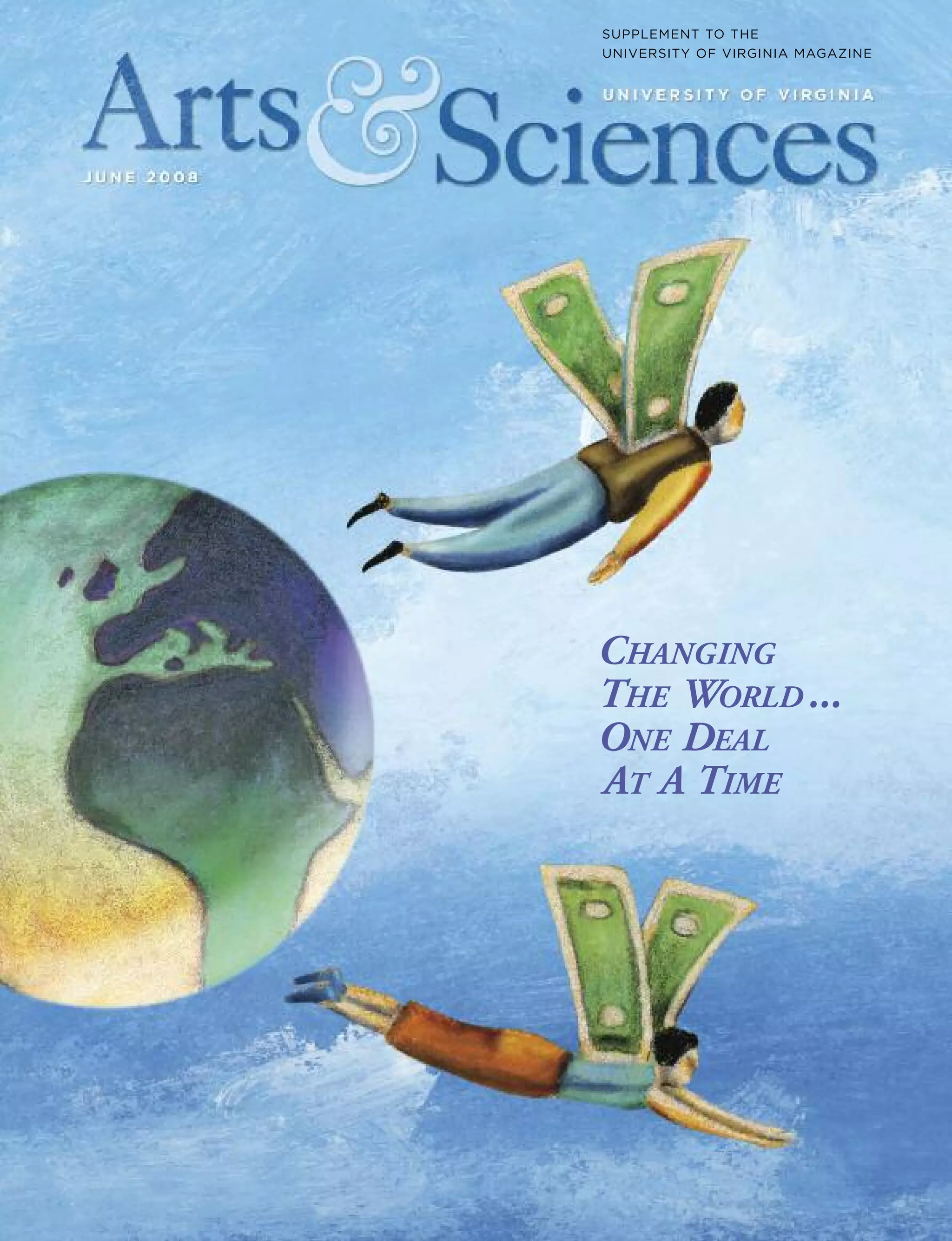
CHANGING
THE WORLD ...
ONE DEAL
AT A TIME
College Foundation
Board of Trustees
John B. Morse, Jr. ’68
President
Locke W. Ogens ’76
Vice President
Sheryl W.Wilbon ’88
Secretary
Peter Brundage ’75
Treasurer
Jeffrey D. Nuechterlein ’79, Law ’86
Past President
Juliana Schulte O’Reilly ’86
Chair, Emeritus Society
Beverley W. Armstrong ’64,
Darden ’66
Peter Barris, Parent Trustee
Paul B. Barringer II ’52
Margaret Saer Beer ’80
Gordon C. Burris, Curry ’67
Marvin P. Bush ’79
Susan S. Bram ’85
Frank K. Bynum, Jr. ’85
Robert G. Byron ’73, Law ’76
Charles R. Cory ’77, Darden ’82,
Law ’82
Phyllis S. Coulter ’82
David M. Crowe ’75
Allen de Olazarra ’81
Everette L. Doffermyre, Jr. ’70,
Law ’73
William B. Fryer ’71, Law ’74
Amy M. Griffin ’98
Raymond Harbert, Parent Trustee
Lee Burleigh Harper ’85
David Harrison IV ’67, Law ’71
R. Philip Herget III ’85
M. Mansoor Ijaz ’83
Lemuel E. Lewis ’69, Darden ’72
Charles Longley ’65
Mary Bland Love ’74, Law ’78
Thaderine D. MacFarlane, Parent Trustee
Brian T. McAnaney ’68
Robert L. Mettler ’62
P. Clarke Murphy ’84
Tammy Snyder-Murphy ’87
Timothy B. Robertson ’77
Christian D. Searcy ’70
Kathy Thornton-Bias ’88
Elizabeth A.Tilney ’79
John L.Walker III ’83
Mallory Walker ’62
Frederick W.Whitridge ’54
E
veryone has a voice, and with the help of our teach-
ing assistants, the professors can hear our voices
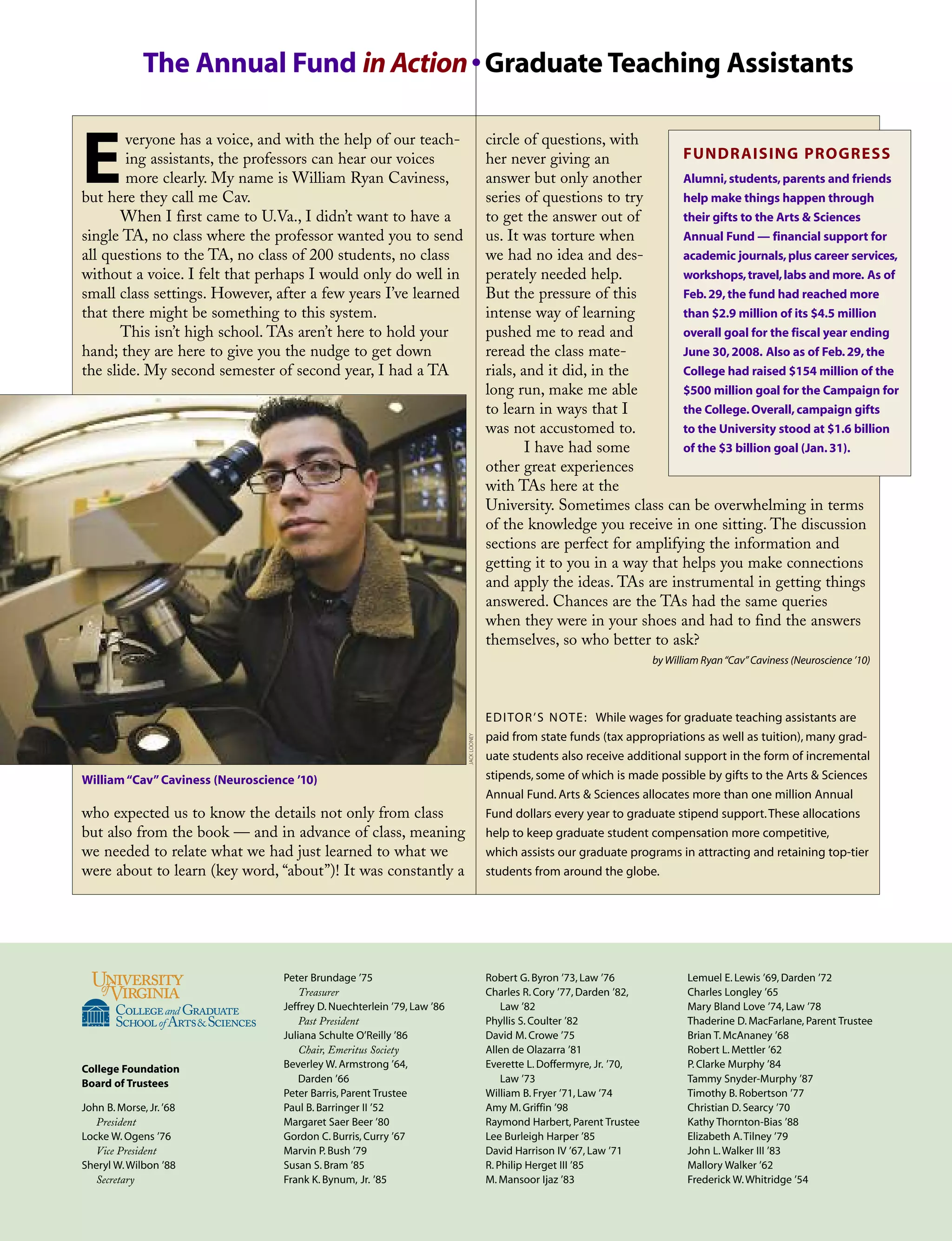
more clearly. My name is William Ryan Caviness,
but here they call me Cav.
When I first came to U.Va., I didn’t want to have a
single TA, no class where the professor wanted you to send
all questions to the TA, no class of 200 students, no class
without a voice. I felt that perhaps I would only do well in
small class settings. However, after a few years I’ve learned
that there might be something to this system.
This isn’t high school. TAs aren’t here to hold your
hand; they are here to give you the nudge to get down
the slide. My second semester of second year, I had a TA
who expected us to know the details not only from class
but also from the book — and in advance of class, meaning
we needed to relate what we had just learned to what we
were about to learn (key word, “about”)! It was constantly a
circle of questions, with
her never giving an
answer but only another
series of questions to try
to get the answer out of
us. It was torture when
we had no idea and des-
perately needed help.
But the pressure of this
intense way of learning
pushed me to read and
reread the class mate-
rials, and it did, in the
long run, make me able
to learn in ways that I
was not accustomed to.
I have had some
other great experiences
with TAs here at the
University. Sometimes class can be overwhelming in terms
of the knowledge you receive in one sitting. The discussion
sections are perfect for amplifying the information and
getting it to you in a way that helps you make connections
and apply the ideas. TAs are instrumental in getting things
answered. Chances are the TAs had the same queries
when they were in your shoes and had to find the answers
themselves, so who better to ask?
by William Ryan“Cav”Caviness (Neuroscience ’10)
EDITOR’S NOTE: While wages for graduate teaching assistants are
paid from state funds (tax appropriations as well as tuition), many grad-
uate students also receive additional support in the form of incremental
stipends, some of which is made possible by gifts to the Arts & Sciences
Annual Fund. Arts & Sciences allocates more than one million Annual
Fund dollars every year to graduate stipend support.These allocations
help to keep graduate student compensation more competitive,
which assists our graduate programs in attracting and retaining top-tier
students from around the globe.
FUNDRAISING PROGRESS
Alumni,students,parents and friends
help make things happen through
their gifts to the Arts & Sciences
Annual Fund — financial support for
academic journals,plus career services,
workshops,travel,labs and more. As of
Feb.29,the fund had reached more
than $2.9 million of its $4.5 million
overall goal for the fiscal year ending
June 30,2008. Also as of Feb.29,the
College had raised $154 million of the
$500 million goal for the Campaign for
the College.Overall,campaign gifts
to the University stood at $1.6 billion
of the $3 billion goal (Jan.31).
The Annual Fund in Action•Graduate Teaching Assistants
William“Cav”Caviness (Neuroscience ’10)
JACKLOONEY
6 Changing the World … One Deal at a Time
Armed with liberal arts degrees, College alumni are
investing in innovative entrepreneurs who are
transforming all aspects of life, all over the world.
10 Immoral Immigration
Professor of Art History Malcolm Bell III brings together
Italian government representatives and museum
professionals to discuss collection policies and returning
looted artifacts.
13 Hopeful Alchemist
James Erickson (Studio Art ’08) makes the invisible visible
by blurring the lines between art and life.
DEPARTMENTS
2 Letters et cetera
3 Around Grounds
14 ’Hoos News
17 Last Look
ON THE COVER
Great ideas financed by visionary
College alumni are making
a difference around the world.
Cover art by Alberto Ruggieri/
Illustration Works/Corbis
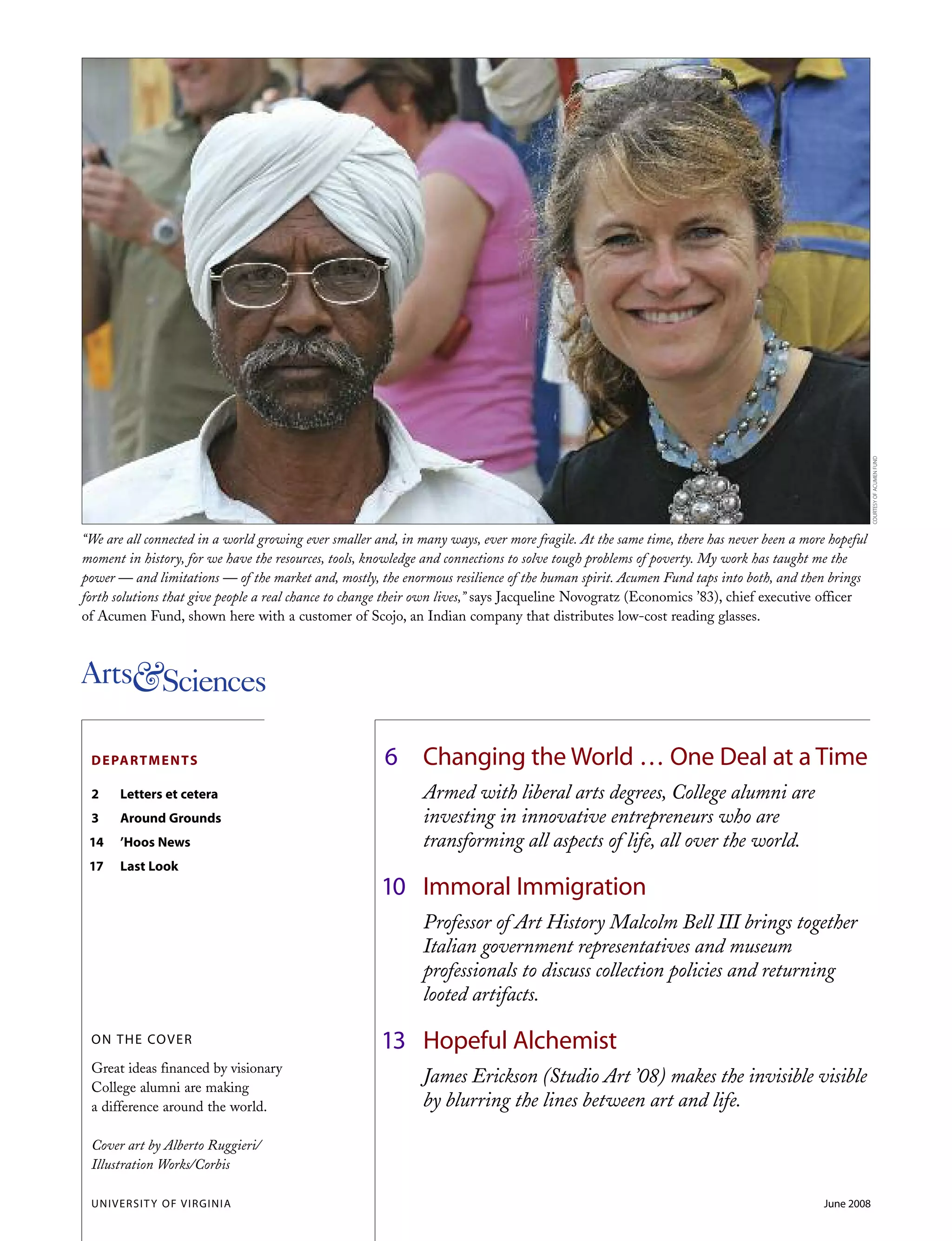
“We are all connected in a world growing ever smaller and, in many ways, ever more fragile. At the same time, there has never been a more hopeful
moment in history, for we have the resources, tools, knowledge and connections to solve tough problems of poverty. My work has taught me the
power — and limitations — of the market and, mostly, the enormous resilience of the human spirit. Acumen Fund taps into both, and then brings
forth solutions that give people a real chance to change their own lives,” says Jacqueline Novogratz (Economics ’83), chief executive officer
of Acumen Fund, shown here with a customer of Scojo, an Indian company that distributes low-cost reading glasses.
UNIVERSITY OF VIRGINIA June 2008
COURTESYOFACUMENFUND
June 2008 Vol. 26, No. 3
DEAN
Meredith Jung-En Woo
DIRECTOR OF COMMUNICATIONS
Kennedy Kipps
EDITOR
Sally Ruth Bourrie
PRODUCTION MANAGER
Crystal Detamore
CONTRIBUTING EDITORS
Jeff Hill,Anita Holmes (English ’82),
Hilary Swinson
GRAPHIC DESIGN
Communication Design, Inc.
Richmond,Va.
CONTRIBUTING WRITERS
Karen Doss Bowman,Catherine
Conkle,Jeff Hanna,John Kelly,
Melanie Rehak
CONTRIBUTING PHOTOGRAPHERS
Michael Bailey,Tom Cogill,Blake
Fitch,Stephanie Gross,Jane
Haley,Jack Looney,Moïse
Mwaku,Sandro Scalia,Leslye
Smith,Michael Stewart
Photography,Vicente Villanueva
Special thanks to Acumen Fund,the
Arts & Sciences Annual Fund and
Benefactors Society,Arts & Sciences
Development,Malcolm Bell,The
College Foundation,Jennifer Mays,
The New York Times/Redux,Jeff
Rusinow,Soprintendenza Archeolog-
ica della Puglia,David Summers of
the McIntire
Department of
Art,U.S.Supreme
Court,U.Va.
Media Relations,
Inside UVA,
Strategic
Communications,
the U.Va.Alumni
Association and
Melanie Price.
Arts & Sciences is
published for the
alumni,students,
faculty and
friends of the
College and
Graduate School
of Arts & Sciences
at the University
of Virginia.It is
paid for with
private funds.
Copyright 2008,
University of
Virginia.
Arts & Sciences
Welcomes Editorial
Advisory Board
Arts & Sciences gratefully
announces its new Editorial
Advisory Board,composed of
alumni who are volunteering
their time and expertise to help
move the magazine forward.
Members are:
Bruce Brandfon (English
Language and Literature ’69),
publisher,Scientific American
Gene DeRose (English
Language and Literature ’86),
founder and chairman,House
Party; founder,CEO and chair-
man, Jupiter Communications
Beth Kseniak (Government ’79),
executive director of public rela-
tions, Vanity Fair
John (Jay) Morse Jr. (College
’68),vice president,finance and
chief financial officer,The Wash-
ington Post Company,and
president,the College Founda-
tion of the University of Virginia
Alexis Ohanian (History and
Commerce ’05),founder of Reddit
Matt Paco (Foreign Affairs ’95),
reporter for MTV and on-air pro-
mos producer for Nickelodeon
Kristin van Ogtrop (English
Language and Literature ’86),
managing editor,Real Simple
Julia Wilkinson-Gallagher
(English Language and
Literature ’87),author; and
former writer/manager,AOL
Letters et cetera
Can’t Get Enough of
Arts & Sciences?
Check out our website for“Online Extras,”
subscription opportunities and more:
Magazine.Clas.Virginia.edu
Visit A&S Online for new stories monthly and
subscribe to our monthly e-newsletter:
AandS.Virginia.edu
Learn about the latest U.Va.research and
subscribe to our monthly research e-newsletter:
Oscar.Virginia.edu
Find alumni or update your profile:
HoosOnline.Virginia.edu
Give to the College:
ArtsandSciences.Virginia.edu/give
Visit the College online:
ArtsandSciences.Virginia.edu
Write us:
AandS@Virginia.edu
ProQuest Medical Library
combines full text for more
than 800 medical titles with
abstracts and indexing from
the well-known Medline data-
base. The journals cover all
major clinical and health-care
disciplines,including cardio-
vascular diseases,pediatrics,
neurology,respiratory dis-
eases, dentistry, anesthesiology
and others.
ProQuest ABI Complete
features nearly 4,000 journals,
including nearly 3,000 full-text
titles on business and economic
conditions,corporate strategies
and management techniques
as well as competitive and
product information.
“We’re pleased to provide
this lifelong educational
resource to our alumni,”says
Cindy Frederick,assistant vice
president of the U.Va.Office
of Engagement.
To access these databases,
please visit“Online Extras”at
Magazine.Clas.Virginia.edu.
2 June 2008 ARTS & SCIENCES
Find It Here
U.Va.alumni gain new
online research tools.
Through HoosOnline,
University of Virginia
alumni now have access to
three vast research databases.
From business and political
science to literature and psy-
chology, ProQuest Research
Library includes more than
3,820 titles — more than 2,550
in full text — from 1971 for-
ward. It features a diversified
mix of scholarly journals,trade
publications,magazines and
newspapers.
The Big
Question:
You
Spoke
Thank you for your many
responses to“The Big Question.”
We’ve received lots of food for
thought as we plan our editorial
line-up for the coming year.Many
of your responses fall under the
umbrella of environmental con-
cerns, along with globalization,
health care,economic well-being
and character.
One of the most provocative
responses came from a current
student,Benjamin Radburn Mayo
(College ’10):
The Big Question facing society
today is whether the society is
a group of individuals,or a thing
unto itself,and what each of
those answers means in its full
consequence.
You’ll find your responses at:
AandS.Virginia.edu/x12676.xml.
Write To Us!
Arts & Sciences welcomes letters
at AandS@Virginia.edu or at
P.O.Box 400804,Charlottesville,
VA 22904.We reserve the right
to edit letters for length,style
and appropriateness.
UNIVERSITY OF VIRGINIA June 2008 3
The 2008–2009 academic year
marks the 25th anniversary
of the University of Virginia
Hispanic Studies Program in
Valencia.All program alumni and
their loved ones are invited to
Silver Celebration festivities in
Valencia Oct.9–11.U.Va.Presi-
dent John T.Casteen III will
attend,along with full program
staff.“We sincerely hope we
can count on seeing all of our
alumni in Valencia this fall,”says
program director Fernando
Operé.“It will be a wonderful
opportunity for us to be together
and for our alumni to relive
memories of their study abroad
experience,see their former class-
mates and the Spanish friends
they made in Valencia,too.”
For more information or to
register and book travel and
accommodations,go to“Online
Extras”at Magazine. Clas.
Virginia.edu.
Best known as“La Peineta”
(“side comb”) for its resem-
blance to the Spanish ornamen-
tal comb,the Calatrava Bridge
was designed by world-
renowned Valencia architect
Santiago Calatrava.
¡Vámonos!Valencia Program celebrates 25 years in Spain.
Around Grounds
VICENTEVILLANUEVA
Julian Bond, professor of history and national chairman of the
NAACP, recently interviewed U.S. Supreme Court Justice Clarence
Thomas as part of the University of Virginia’s Explorations in Black
Leadership project.The Explorations in Black Leadership website
features a collection of interviews with black leaders from a wide
variety of fields,all focusing on issues of black leadership and
the transformational role of the civil rights movement in America.
JANEHALEY
Meredith Jung-En Woo
was named dean of the
College and Graduate School
of Arts & Sciences,effective
June 1.
University President John
T.Casteen III praised Woo as a
“remarkably accomplished
teacher,scholar and fundraiser
who will provide strong leader-
ship for the College and
Graduate School of Arts &
Sciences as it looks to improve
its standing in the sciences,
while at the same time
expanding and enriching the
College’s programs in the fine
and performing arts.”
Previously,Woo was asso-
ciate dean for social sciences
in the College of Literature,
Science and the Arts and
professor of political science
at the University of Michigan.
Author of numerous articles,
books and an award-winning
documentary film,Woo raised
more than $8 million for
Korean Studies at U-M,and
brought an important Korean
ceramic art collection to its
art museum.
In 1996,President Bill
Clinton appointed her to the
Presidential Commission on
U.S.-Pacific Trade and Invest-
ment Policy.She has consulted
for the World Bank,the United
States Trade Representative,
Asian Development Bank Insti-
tute,the Asia Foundation and
the MacArthur Foundation.
EducatedinKoreaandJapan
through high school,Woo
received her B.A.at Bowdoin
College (English Literature and
History),and two M.A.s (Inter-
national Affairs and Latin
American Studies) and a Ph.D.
(Political Science) from Colum-
bia University.Fluent in English,
Korean and Japanese,Woo
also taught at Northwestern
University,Colgate University
and Columbia University.
“The University of Virginia
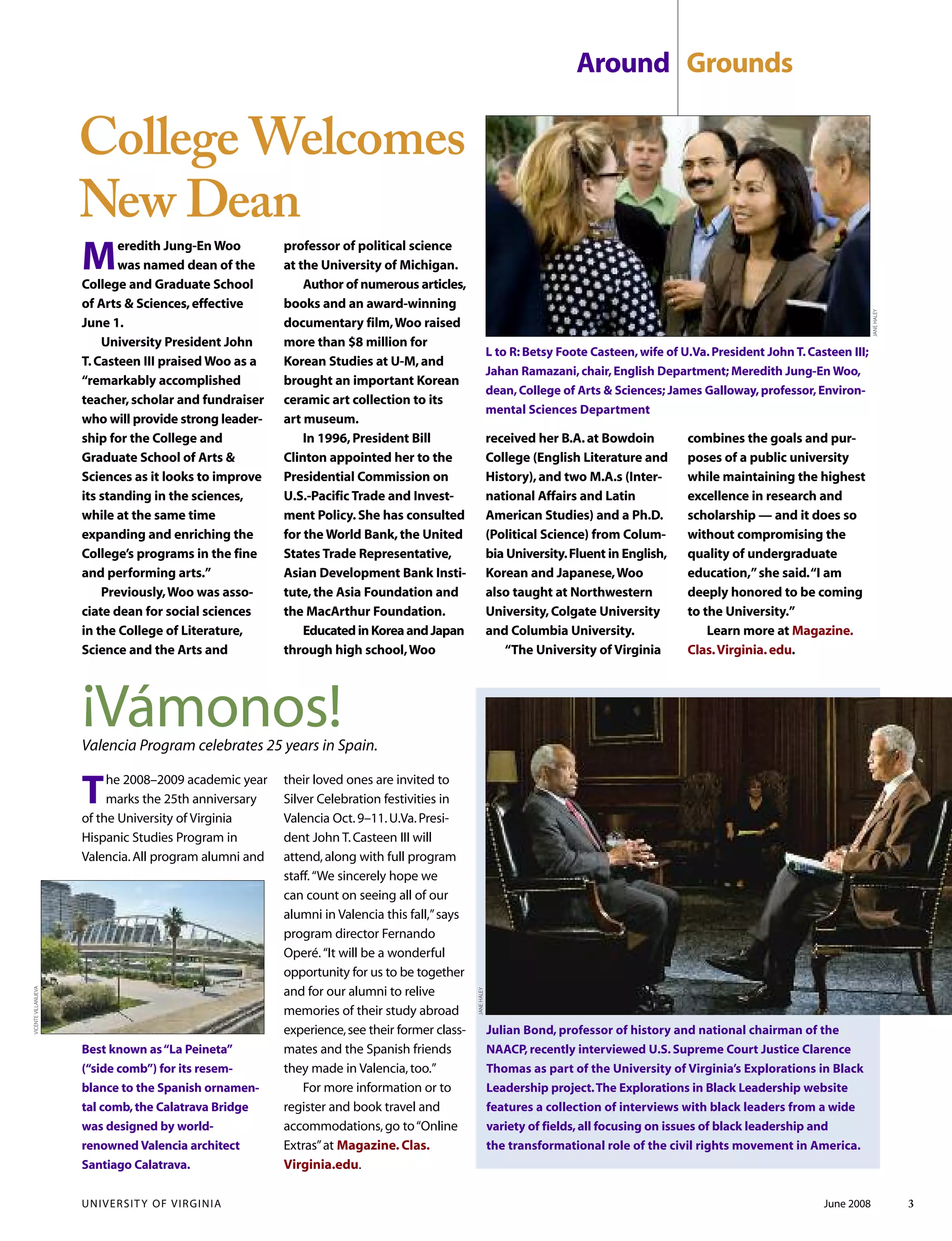
L to R: Betsy Foote Casteen,wife of U.Va.President John T.Casteen III;
Jahan Ramazani,chair,English Department; Meredith Jung-En Woo,
dean,College of Arts & Sciences; James Galloway,professor,Environ-
mental Sciences Department
College Welcomes
New Dean
combines the goals and pur-
poses of a public university
while maintaining the highest
excellence in research and
scholarship — and it does so
without compromising the
quality of undergraduate
education,”she said.“I am
deeply honored to be coming
to the University.”
Learn more at Magazine.
Clas.Virginia.edu.
JANEHALEY
HERITAGE RETURNS
This summer Heritage Repertory Theatre,the University of
Virginia’s summer professional theater,returns from a
construction-induced one-year hiatus as the Heritage Theatre
Festival.Theatergoers will also find a new parking structure with
ample — and free — parking for the first time.
“We could not be happier to be returning,”says Robert
Chapel,Heritage Repertory Theatre’s producing artistic director.
“It’s been extremely gratifying to hear from people throughout
the year who expressed how much they missed Heritage last
summer and how excited they
are to come back this year.”
The 2008 season features
five shows that collectively
captured 17 Tony Awards:
• The 1940s,film-noir-themed musical City of Angels (book,Larry
Gelbart; music,Cy Coleman; lyrics,David Zippel;Tony Award
for Best Musical)
• I Am My Own Wife,a one-person show with 30 characters based
on the story of German transvestite Charlotte Von Mahlsdorf
(DougWright;Pulitzer Prize for Drama;Tony Award for Best Play)
• Master Class,about opera legend Maria Callas (Terence McNally;
Tony Award for Best Play)
• The Light in the Piazza,a romantic tale set in Tuscany (book,
Craig Lucas; music and lyrics,Adam Guettel,Richard Rodgers’
grandson)
• Forever Plaid,a nostalgic tribute to 1950s close-harmony
“guy groups”(Stuart Ross)
The box office opens June 2.
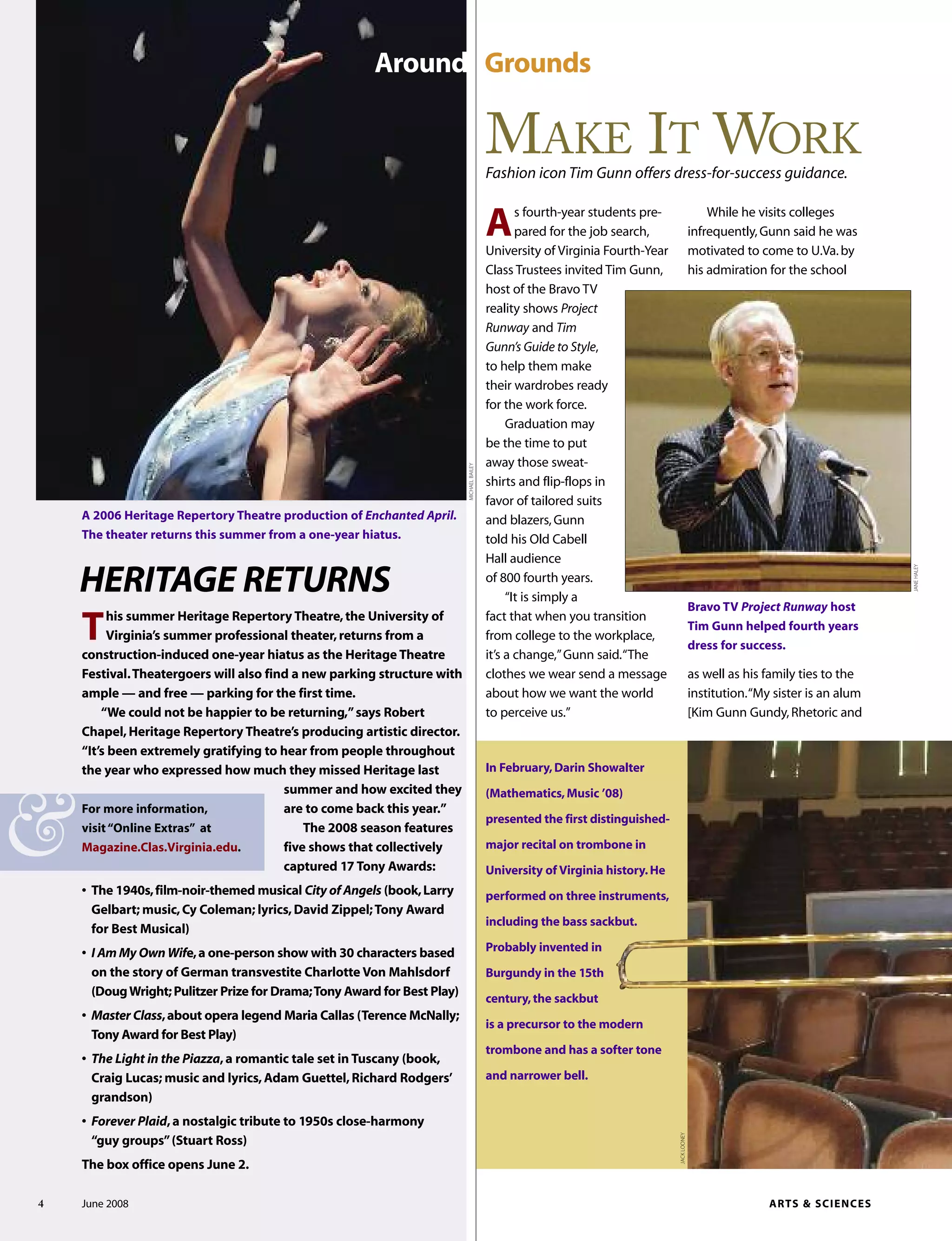
A 2006 Heritage Repertory Theatre production of Enchanted April.
The theater returns this summer from a one-year hiatus.
For more information,
visit“Online Extras” at
Magazine.Clas.Virginia.edu.
4 June 2008 ARTS & SCIENCES
As fourth-year students pre-
pared for the job search,
University of Virginia Fourth-Year
Class Trustees invited Tim Gunn,
host of the Bravo TV
reality shows Project
Runway and Tim
Gunn’s Guide to Style,
to help them make
their wardrobes ready
for the work force.
Graduation may
be the time to put
away those sweat-
shirts and flip-flops in
favor of tailored suits
and blazers,Gunn
told his Old Cabell
Hall audience
of 800 fourth years.
“It is simply a
fact that when you transition
from college to the workplace,
it’s a change,”Gunn said.“The
clothes we wear send a message
about how we want the world
to perceive us.”
While he visits colleges
infrequently,Gunn said he was
motivated to come to U.Va.by
his admiration for the school
as well as his family ties to the
institution.“My sister is an alum
[Kim Gunn Gundy,Rhetoric and
Around Grounds
JACKLOONEY
Bravo TV Project Runway host
Tim Gunn helped fourth years
dress for success.
MAKE IT WORK
Fashion icon Tim Gunn offers dress-for-success guidance.
MICHAELBAILEY
&
JANEHALEY
In February,Darin Showalter
(Mathematics,Music ’08)
presented the first distinguished-
major recital on trombone in
University of Virginia history.He
performed on three instruments,
including the bass sackbut.
Probably invented in
Burgundy in the 15th
century,the sackbut
is a precursor to the modern
trombone and has a softer tone
and narrower bell.
UNIVERSITY OF VIRGINIA June 2008 5
On the eve of the Virginia primary, presidential candidate Sen. Hillary Clinton (D-NY) attended Politics
Professor Larry Sabato’s“An Introduction to American Politics”class (held with an audience of 1,000 in
the Old Cabell Hall auditorium). Clinton stayed well beyond the 60-minute class period, fielding some-
times-pointed student questions.“I took [this class] because I was hoping something like this would
happen during the primaries,”said self-described Republican Henry Ponton (Sociology ’09). Sabato’s
staff at the Center for Politics invited all presidential candidates; Clinton’s campaign was the first to
respond.The event ended with Clinton and Sabato swaying arm-in-arm on stage as the University
Singers led the audience in“The Good Ol’Song.”
For more information and an audio slide show, visit“Online Extras”at Magazine.Clas.Virginia.edu.
JANEHALEY
Honors for Arts & Sciences
James Galloway,professor of environmental sciences,
has been awarded the 2008 Tyler Prize for Environ-
mental Achievement,considered by many in the environ-
mental science field to be the equivalent of a Nobel
Prize.Professor Galloway also was elected a Fellow of the American
Geophysical Union,an honor conferred upon scientists who,in the
eyes of the AGU,have“attained acknowledged eminence in the
geophysical sciences.”Galloway is a leader in the study of the“nitro-
gen cascade,”the flow of reactive nitrogen that seriously damages
the environment.
?’HooKnew
Celebrating 100 years
in Old Cabell Hall, U.Va.’s
E.M. Skinner pipe organ is
the oldest surviving Skinner
organ in original condition
and in its original site.
Source: UVA Today and Joseph Vitacco
Communication Studies ’78].
My brother-in-law is vice presi-
dent of the Darden Foundation
[Vice President of Development
Jay Gundy,MA Rhetoric and
Communication Studies ’79].
My niece is in the class of ’08
[Wallace Gibb Gundy,Classics
’08],”Gunn said.“I love this
university.I am a huge fan of
Thomas Jefferson,and I love stu-
dents. I am thrilled to be here
and I am honored.”
Gunn also answered ques-
tions about business suits,shop-
ping on a budget and dressing
in a sophisticated,age-appropri-
ate manner.U.Va.students are
better prepared than students at
other universities,he said:“There
is that preppiness that happens
here,but it’s authentic.I think
that the transition for students
from U.Va.into the working
world will be less of a challenge
than it will be for students at a
lot of other campuses.”
About Uggs and Crocs,he
said,“I flatter them to call them
footwear.”
Catherine Conkle
(History,Religious Studies ’08)
Brian Nosek,assistant professor
of psychology,has received the
International Social Cognition
Network Early Career Award and
the Society for the Psychological
Study of Social Issues’Michele
Alexander Early Career Award for
Scholarship and Service.
6 June 2008 ARTS & SCIENCES
CHANGING THE WORLDCHANGING THE WORLD
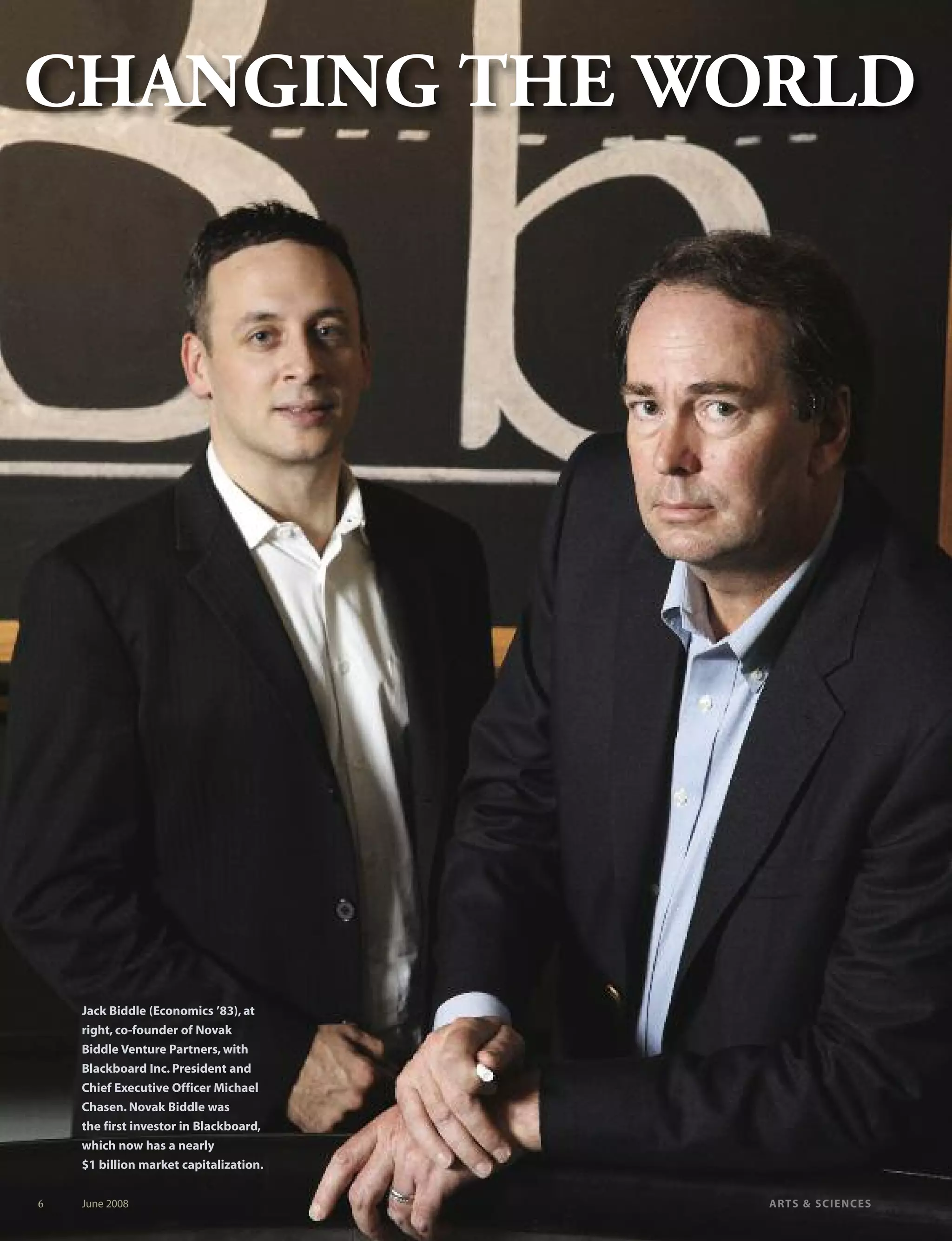
Jack Biddle (Economics ’83), at
right, co-founder of Novak
Biddle Venture Partners, with
Blackboard Inc. President and
Chief Executive Officer Michael
Chasen. Novak Biddle was
the first investor in Blackboard,
which now has a nearly
$1 billion market capitalization.
ASCINATED BY TECHNOLOGY
entrepreneurs since childhood, Jack
Biddle (Economics ’83), co-founder of
Washington, D.C.-based Novak Biddle
Venture Partners, had a front-row
seat: His father headed the Computer
& Communications Industry
Association, a Washington, D.C.-based
lobbying group, for decades.
“I was just fascinated by how these incredibly brilliant
people were able to find each other and create new indus-
tries from nothing,” he says. “For me it’s a little bit like being
a patron of the symphony. I can’t write a symphony, but I
can recognize people who can. And that is really what I do.”
Biddle joined a venture capital firm directly out of
college but soon concluded he needed another kind of
experience: “You have no right to sit on a board and tell
people how to run a company if you
haven’t run a company yourself.”
So he did just that, first working at
technology consulting giant the Gartner
Group, then leading two software com-
panies (one in turnaround) followed by
four years as CEO of a venture-backed
software company he sold in 1995.
That was all the education he
needed; he still has no advanced degrees.
“I got my degree in economics because
it sounded credible to the business
world, but I wanted to be in the College
of Arts & Sciences because it was so
loose. … I took a lot of astronomy, a
lot of computer science, a lot of history,
and I spent a lot of time in the stacks
just reading stuff for fun. I think a
liberal arts education is the best
preparation for just about anything
short of doing stress calculations on a
bridge design.
“My partner and I talk about the
one thing that makes people really
good at this business is pattern recog-
nition, being able to see something
that has never been done before but to
recognize an analog to something you
are familiar with. That is basically what
a liberal arts education is, learning
to see patterns and studying history.”
Novak Biddle accepts funding only from “people doing
things [we] care about,” says Biddle. Its roster of limited
partners is primarily universities, including U.Va. “Most of
the top firms are almost exclusively backed by universities.
They want to work for nonprofits where the returns they
generate are going to do more than line somebody’s pockets.”
Novak Biddle manages more than $580 million and
focuses on mid-Atlantic-based information technology
companies in the very early stage through first-round
investments. It was the first investor in Blackboard Inc.,
with an $850,000 seed investment in 1997 — when Black-
board was just two 24-year-old entrepreneurs in a brown-
stone basement with a passion to bring learning online.
With users in more than 60 countries, today Blackboard is
the world leader in online course management systems. Its
2007 revenues reached more than $239 million.
“My partner and I both care a lot about education,
from a public policy standpoint and
personally,” says Biddle, “and this is a
deal where 20 million students are
benefiting from this company that I
don’t think would have made it with-
out us.”
For these venture capitalists, the
fun is more than the “ka-ching” pay-
off, it’s a passion for helping people to
realize their dreams. Biddle describes
it this way: “I have two to three hours
a day with really bright people who
are tackling really interesting problems
that I hadn’t thought of before. You
get to learn a lot about a lot and that’s
just fun.
“The other cool thing is working
with these people and seeing patterns
and helping them off the rocks, help-
ing to keep them from making the fatal
mistake or not getting taken advantage
of by a large corporation. Keeping
them out of trouble so their creativity
can blossom.”
LIFELONG LEARNER
Jeff Rusinow (College ’77, MA
Rhetoric and Communication Studies
’79) had the entrepreneurial bug
almost from the day he arrived on
VENTURE CAPITALISM is a subset
of private equity, or investment-own-
ership. Usually, the funding game
begins with angel investors. Angels
range from wealthy individuals to
organized groups that pool resources
and expertise to provide start-up
entrepreneurs with their first boost,
usually at the earliest and riskiest
time in the venture’s life cycle, just
after family and friends have invested.
Next up the chain are venture-capi-
tal firms specializing in“seed”stage
companies that have no track record
of success, little — if any — income
and need substantially larger invest-
ment than angels provide.Then come
venture firms focusing on“expansion
stage”companies and, finally, those
specializing in corporate buyouts.
What unites these organizations is
a common goal: either a lucrative
purchase by another company or an
initial public offering.To get there,
angels generally look for four- to
seven-year involvement while some
later stage firms are in it for the
shorter haul.
BY JOHN KELLY
... ONE DEAL AT A TIME
UNIVERSITY OF VIRGINIA June 2008 7
TOMCOGILL
F
Grounds. He left school twice to satisfy this urge, then
rose through the retail ranks with Macy’s, Gimbel’s and
Hudson’s Bay department stores before running his own
business. He returned to retail one last time, landing at
Milwaukee, Wis.- based Kohl’s Department Stores, from
which he cashed out in 2000 after three stock splits.
Soon after, Rusinow began hosting high-net-worth
individuals at his home to discuss angel-investing opportu-
nities. The result was Milwaukee’s first angel group, Silicon
Pastures (a tongue-in-cheek nod to its geographic roots).
In its first three years, the group saw hundreds of deals and
invested in 15.
“For every 10 deals that an angel gets involved in,
three go bankrupt, three are basically treading water
forever, and two or three do OK, with an internal rate of
return of between 20 and 25 percent,” says Rusinow. “But
one out of 10 has to be a home run. And when I say home
run, you’ve got to run around the bases a couple of times.
It needs to be a 10-bagger because if it is not and you blend
all that, it’s not a reasonable ROI [return on investment]
for the risk you are taking.”
Rusinow glimpsed one of his biggest 10-baggers when
he met — on his front lawn — two 20-somethings who
had a plan to sell costumes on the Internet. The Internet
bubble had popped and caught them well short of their
lofty start-up capital goals. They had been looking for $5
million in capitalization from bankers, but Rusinow had
a different deal. He would take 25 percent of the company
and provide significantly less capital (from him and later
from some two dozen other investors) but throw something
else into the deal: his expertise, stepping in as chairman.
BuySeasons Inc. (known for its website, BuyCostumes.
com) went from zero to $50 million in revenues in its first
seven years. After ranking No. 75 on Inc.’s 2005 list of the
top 500 fastest-growing private United States companies,
it sold for $60 million to Liberty Media Corp. in 2006. A
“nice hit,” says Rusinow.
Rusinow’s subsequent successes found him stepping
outside his retail comfort zone. He has been actively
involved in the strategy and operations of several successful
health-care-related start-ups, including ModernMed,
whose mission is to deliver a patient-centered, primary-
care experience. Rusinow is lead investor and chairman.
“There is a recommendation that as an angel you
should only invest in businesses and technologies you are
familiar with,” he says. “I took a different tack. I like to get
involved in things that I know nothing about. It is fasci-
nating for me, furthering my education in that you just
learn so much about things going on in other industries
and technologies you never would have even thought
about. It is really fun.”
ANGELS IN VIRGINIA
Dick Crawford (College ’67, Darden ’74, Law ’74) and
Letitia Hickman Green (Spanish ’84) founded the Virginia
Active Angel Network. Crawford took a traditional route,
packing up a briefcase full of advanced degrees and head-
ing to banking. He found himself at the epicenter of the
technology revolution in Silicon Valley and became fasci-
nated by the challenges of financing emerging knowledge-
based companies. “One of the problems that you had then
and that you still have today is that the traditional financial
system, banks, typically do not fund the types of companies
that are being spun out of universities and that we talk
about as being angel investment or venture capital invest-
ment opportunities,” he says.
Green supplemented her U.Va. degree with an M.B.A.
from Pepperdine University. After a stint at Oppenheimer
& Co. Inc. in New York, she became the fourth hire at a
8 June 2008 ARTS & SCIENCES
Dick Crawford (College ’67, Darden ’74, Law ’74) and Letitia Hickman
Green (Spanish ’84) founded the Virginia Active Angel Network.
“Angel investors are typically current or cashed-out entrepreneurs
who invest in other entrepreneurs and are comfortable with the
higher risks associated with doing so,”says Green.“This‘cycle’ of
entrepreneurship is the economic engine of the United States and
what differentiates our economy from all other countries’.”
Jeff Rusinow (College ’77, MA Rhetoric and Communication Studies
’79) invests in fields he is unfamiliar with, which he says furthers his
education. “It is fascinating for me.”
COURTESYOFJEFFRUSINOW
TOMCOGILL
UNIVERSITY OF VIRGINIA June 2008 9
spartan midtown start-up private-equity firm: the Black-
stone Group. Now legendary, the Blackstone Group
manages assets of about $100 billion. Green followed
Blackstone with investment-banking leadership positions
on the West Coast and her own mergers-and-acquisitions
consulting firm.
Soon after arriving in Virginia as a cashed-out entre-
preneur in 2005, Green met Crawford. He instantly knew
that she would be a perfect partner for the angel venture he
had been developing at U.Va.’s Darden School.
“Typically, angels invest individually,” says Crawford.
“We provide a mechanism for bringing [entrepreneurs and
angels] together efficiently and therefore actually helping
the business succeed.”
They officially launched VAAN that October. Today,
the group has 28 members with chapters in Charlottesville,
Blacksburg and Richmond. They have viewed some 300
presentations and fund two to three each year.
Proposals are considered by a committee that includes
Darden students, and two are chosen for monthly presen-
tations. Presentations with positive feedback are put
through an exhaustive due-diligence process headed by
Green that results in a final, comprehensive analysis. If
four or more members will make the minimum $25,000
commitment, the group moves forward. Recently, VAAN
invested $250,000 in Charlotte, N.C.-based ESP Systems
LLC, whose wireless technology connects waiters and
kitchen with restaurant patrons — a deal reported in The
Wall Street Journal.
VAAN also helps entrepreneurs move to the next
funding stage. Because venture-capital firms often look at
4,000 to 5,000 business plans annually, the best an entre-
preneur often can hope for is a quick review from a junior
associate. “But,” says Crawford, “if I e-mail a V.C. [venture
capital] contact and say we’ve done this work and made
this investment, it is much more likely that the entrepreneur
will get a meeting, which is precisely what he or she needs.”
THE SOCIAL
ENTREPRENEUR
Right after graduating, fate landed Jacqueline Novogratz
(Economics ’83) at Chase Manhattan Bank, where she
worked in 40 countries and learned about the bank’s
money portfolio. In 2001, Novogratz founded Acumen
Fund, a nonprofit venture fund that raises philanthropic
capital to support entrepreneurs who fight global poverty
by delivering critical goods and services such as health care,
housing, energy and clean water to people living on less
than $4 a day. Fast Company magazine recently named
Acumen Fund among its “45 Social Entrepreneurs Who
Are Changing the World.”
“At Chase, I really fell in love with banking, which
leveraged my liberal arts education because the work
drew on the intersection of economics, politics and what
I quickly became interested in, which was the whole anthro-
pological aspect of sociology, class and culture,” she says.
After Chase, Novogratz opened Rwanda’s first micro-
finance bank, then founded and directed The Philanthropy
Workshop and the Next Generation Leadership program
at the Rockefeller Foundation before bringing together all
she had learned in a new model of philanthropy.
“It was time to break all the existing rules and focus
on contributing to a new model for philanthropy,” says
Novogratz. “What I’ve
realized since then
is that instead, we’re
focused even more on
the best use of all of our
resources toward solving
tough problems of
poverty by starting with
the market as our best
listening device.”
Incorporated with
seed capital from the
Rockefeller Foundation,
Cisco Systems
Foundation and three
individuals, New York
City-based Acumen
Fund is built around
the idea of “patient
capital,” providing loans
or equity (not grants) that yield both financial and social
returns. Financial returns are recycled into new investments.
“Poor people seek dignity, not dependence,” is one of
the fund’s core beliefs, whether as entrepreneur delivering
services and creating jobs or as paying customer.
In India, where more than 450 million people still
lack access to affordable, clean water, Acumen Fund has
already made a difference, says Novogratz. “We are investing
in one water entrepreneur in India and supporting the
business with a great deal of management assistance. We’ve
been able to leverage our philanthropic dollars so that our
$600,000 investment helped leverage another $12 million
capital through additional equity to the company, which
now operates in over 100 villages and serves 300,000 paying
customers.”
Whether eliminating world poverty, improving health
care or just making restaurant service faster, these venture
capitalists are in it to make the world a better place. “At
the end of a six- or eight- or 10-year journey together with
an entrepreneur,” says Biddle, the fulfillment comes in
watching “the company go public or be acquired for hundreds
of millions of dollars. And for the team to share in that, for
the stock options to change lives, to watch the CEO become
a philanthropist. … That is really cool. … And to know it
wouldn’t have happened without your patronage.” .
Jacqueline Novogratz (Economics,
’83) founded Acumen Fund, which
Fast Company magazine named
among its“45 Social Entrepreneurs
Who Are Changing the World.”
COURTESYOFACUMENFUND
10 June 2008 ARTS & SCIENCES
T
he past decade has seen a sea change in the
world’s view of looted antiquities. Since the
1970s, the antiquities trade had burgeoned;
as prices soared, annual sales were estimated
to reach up to $2 billion. The market was
almost entirely — about 90 percent — dependent on illegally
excavated and exported artifacts, often broken or damaged,
wrenched from the context of ancient lives and communi-
ties. Thanks to modern technology — bulldozers, dynamite
and power tools — homes, tombs and even cities were
pillaged by a sophisticated and completely illicit global
network feeding the demand of private collectors, auction
houses, galleries and museums. The
destruction is so widespread that many
archaeologists believe our understand-
ing of the past, our world cultural her-
itage, is seriously threatened.
In the 1990s, Italy emerged as a
leader in enforcing export laws on
antiquities: What’s below ground in
Italy belongs to Italy, and if objects
without history of ownership or origin
(provenance) materialize, they are con-
sidered stolen — and Italy will do
whatever it takes to get them back.
“We are now at the moment
that a country has the right to possess
its own cultural roots and to keep
objects that document those cultural
roots,” said Beatrice Basile, superin-
tendent for art and archaeology for
the province of Enna.
So, what’s a museum to do?
The University of Virginia Art Museum gives the
objects back. In February, archaeologist Malcolm Bell III,
professor of art history and one of the United States’
foremost voices on archaeological repatriation, organized
“The Goddesses Return” symposium. The event marked
U.Va.’s repatriation of acroliths (marble heads, hands and
feet originally attached to wooden bodies) thought to rep-
resent Demeter and Persephone and believed clandestinely
stolen from Morgantina, the ancient Greek city in Enna,
Sicily, where Bell has directed excavations sponsored by
the University for the past 28 years. In 2002, the University
BY SALLY RUTH BOURRIE
University of Virginia Professor of Art History Malcolm Bell III, Princeton University Art
Museum Director Susan Taylor, Nasher Museum of Art at Duke University Director
Kimerly Rorschach, Cornell University Assistant Anthropology Professor Magnus Fiskejö,
Jeannette Papadopoulos of Rome’s Ministry of Cultural Properties and Associate Professor
of Art History Francesca Fiorani discuss museum policies regarding looted antiquities.
MICHAELBAILEY
IMMORAL IMMIGRATION
“Before things are illicit,
they are immoral.”
BEATRICE BASILE
SUPERINTENDENT OF CULTURAL PROPERTIES
ENNA, ITALY
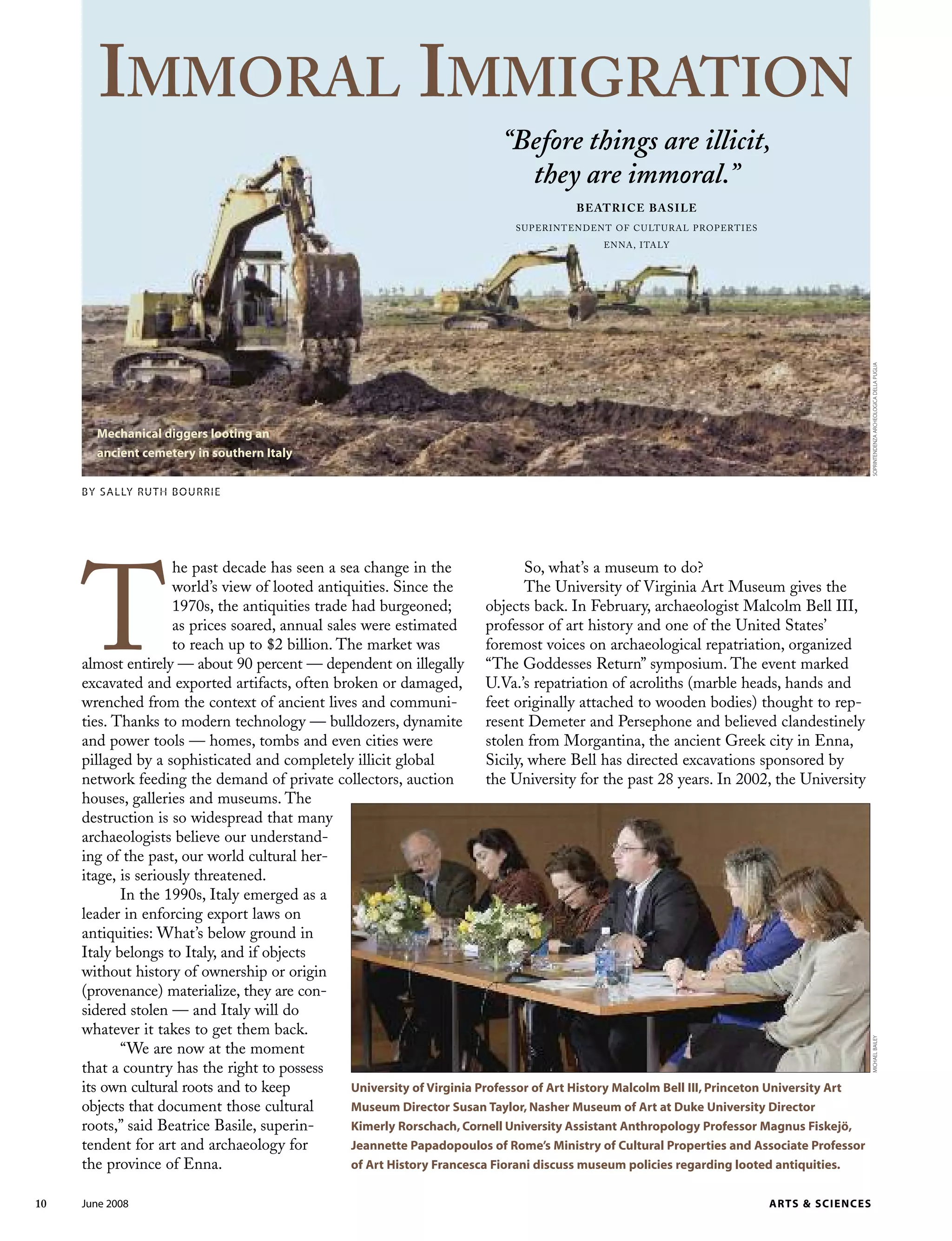
Mechanical diggers looting an
ancient cemetery in southern Italy
SOPRINTENDENZAARCHEOLOGICADELLAPUGLIA
UNIVERSITY OF VIRGINIA June 2008 11
“Antiquities may have their own rights,
a moral claim of their own to wholeness
that may be fulfilled by repatriation.”
MALCOLM BELL III
PROFESSOR OF ART HISTORY
Professor of Art History Malcolm Bell III and Sandra K. Lucore, who oversees the baths excavation, amid the ruined vaults of the baths at
Morgantina, in Sicily. For 28 years, Bell has directed the University’s excavations at Morgantina, which includes multiple sites.
“Antiquities may have their own rights,
a moral claim of their own to wholeness
that may be fulfilled by repatriation.”
MALCOLM BELL III
PROFESSOR OF ART HISTORY
SANDROSCALIA/THENEWYORKTIMES/REDUX
accepted the donation of the acroliths with the understand-
ing that they would be returned home, only the second
time a U.S. nonprofit has accepted a donation with the
intention of its repatriation.
In addition to showcasing current scholarship on the
pieces, the symposium was one of the first times museum
professionals and Italian government representatives have
been assembled to discuss how to handle artifacts whose illicit
origins may be identified years after purchase or donation.
The event came after a year in which the Italian
government and U.S. museums moved from adversarial roles
toward partnership and collaboration. In 2007, the J. Paul
Getty Museum in Los Angeles, New York’s Metropolitan
Museum of Art and Boston’s Museum of Fine Arts agreed
to return to Italy objects said to have
been looted, to make reciprocal loans
— 40 Bernini sculptures will go to the
Getty in an exhibition to open in
August and objects from American
collections will continue to be lent
abroad — and to cooperate on archae-
ological digs and other research.
“The origin of works of art is
important, particularly works of art
that are excavated. The issue is
whether they should be deprived of
that history and that information,”
said Bell, setting the agenda. “The
question to consider now is repatria-
tion of substantial works of art in
existing collections we can assume
were looted in recent times.”
For Italians, who are attempting to stop the looting
by discouraging market demand, the position is unequivocal:
“We are obligated to ask for [archaeological works] back,”
Jeannette Papadopoulos of Rome’s Ministry of Cultural
Properties told those assembled.
The question of antiquities repatriation cuts directly
to the identity and role of the public museum. The public
museum developed about 200 years ago with the noble
intention of bringing the world under one roof to educate
everyone. It was called the “universal museum” and consid-
ered an important institution for a civil society, an idea
expressed by panelist Susan Taylor, director of the Princeton
University Art Museum: “To understand other cultures,
we must see their works of art.”
IN PRAISE OF EXCAVATIONS
One of the first victims of relentless ransacking, Sicily is now a center
of restitution. In the early 1980s, Professor of Art History Malcolm
Bell III and his team often camped at their digs to protect them from
looters. Tombaroli, or tomb robbers, earn pennies on the dollar of an object’s
final sale price, but in a poor economy such as the town of Aidone near
Morgantina, it may have seemed a profitable vocation. But U.S. excava-
tions began to change local attitudes, said Beatrice Basile, the local art
superintendent. “They saw themselves through the eyes of others, and the
objects became a treasure to study and present to the public.” Aidone is
now a leader in defending its artistic patrimony, and citizens pressured the
Italian government to ask the Getty Museum to return a major sculpture.
“There is great respect for Professor Malcolm Bell, his sensibility and
work done there,” said Basile.
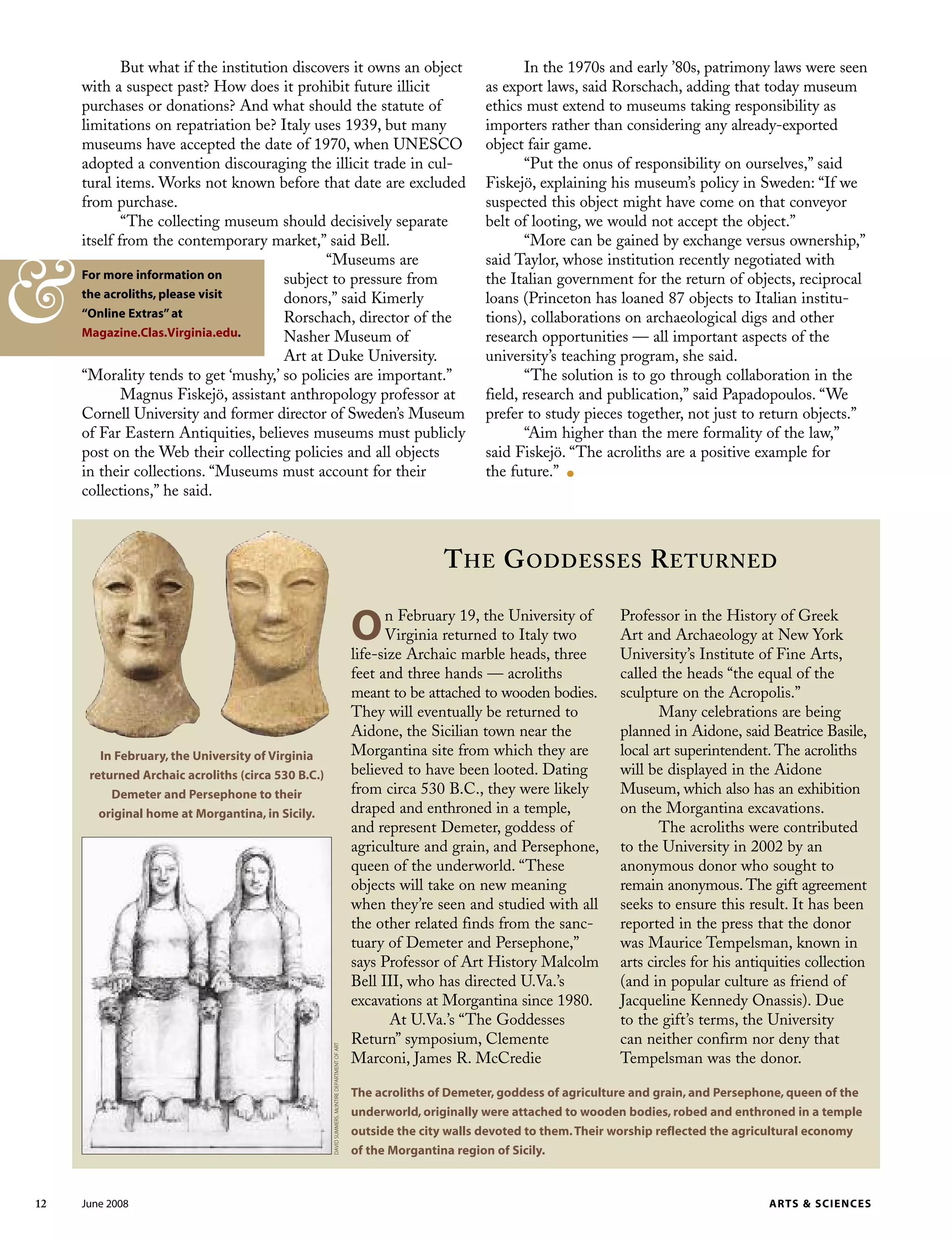
On February 19, the University of
Virginia returned to Italy two
life-size Archaic marble heads, three
feet and three hands — acroliths
meant to be attached to wooden bodies.
They will eventually be returned to
Aidone, the Sicilian town near the
Morgantina site from which they are
believed to have been looted. Dating
from circa 530 B.C., they were likely
draped and enthroned in a temple,
and represent Demeter, goddess of
agriculture and grain, and Persephone,
queen of the underworld. “These
objects will take on new meaning
when they’re seen and studied with all
the other related finds from the sanc-
tuary of Demeter and Persephone,”
says Professor of Art History Malcolm
Bell III, who has directed U.Va.’s
excavations at Morgantina since 1980.
At U.Va.’s “The Goddesses
Return” symposium, Clemente
Marconi, James R. McCredie
But what if the institution discovers it owns an object
with a suspect past? How does it prohibit future illicit
purchases or donations? And what should the statute of
limitations on repatriation be? Italy uses 1939, but many
museums have accepted the date of 1970, when UNESCO
adopted a convention discouraging the illicit trade in cul-
tural items. Works not known before that date are excluded
from purchase.
“The collecting museum should decisively separate
itself from the contemporary market,” said Bell.
“Museums are
subject to pressure from
donors,” said Kimerly
Rorschach, director of the
Nasher Museum of
Art at Duke University.
“Morality tends to get ‘mushy,’ so policies are important.”
Magnus Fiskejö, assistant anthropology professor at
Cornell University and former director of Sweden’s Museum
of Far Eastern Antiquities, believes museums must publicly
post on the Web their collecting policies and all objects
in their collections. “Museums must account for their
collections,” he said.
Professor in the History of Greek
Art and Archaeology at New York
University’s Institute of Fine Arts,
called the heads “the equal of the
sculpture on the Acropolis.”
Many celebrations are being
planned in Aidone, said Beatrice Basile,
local art superintendent. The acroliths
will be displayed in the Aidone
Museum, which also has an exhibition
on the Morgantina excavations.
The acroliths were contributed
to the University in 2002 by an
anonymous donor who sought to
remain anonymous. The gift agreement
seeks to ensure this result. It has been
reported in the press that the donor
was Maurice Tempelsman, known in
arts circles for his antiquities collection
(and in popular culture as friend of
Jacqueline Kennedy Onassis). Due
to the gift’s terms, the University
can neither confirm nor deny that
Tempelsman was the donor.
THE GODDESSES RETURNED
12 June 2008 ARTS & SCIENCES
In February, the University of Virginia
returned Archaic acroliths (circa 530 B.C.)
Demeter and Persephone to their
original home at Morgantina, in Sicily.
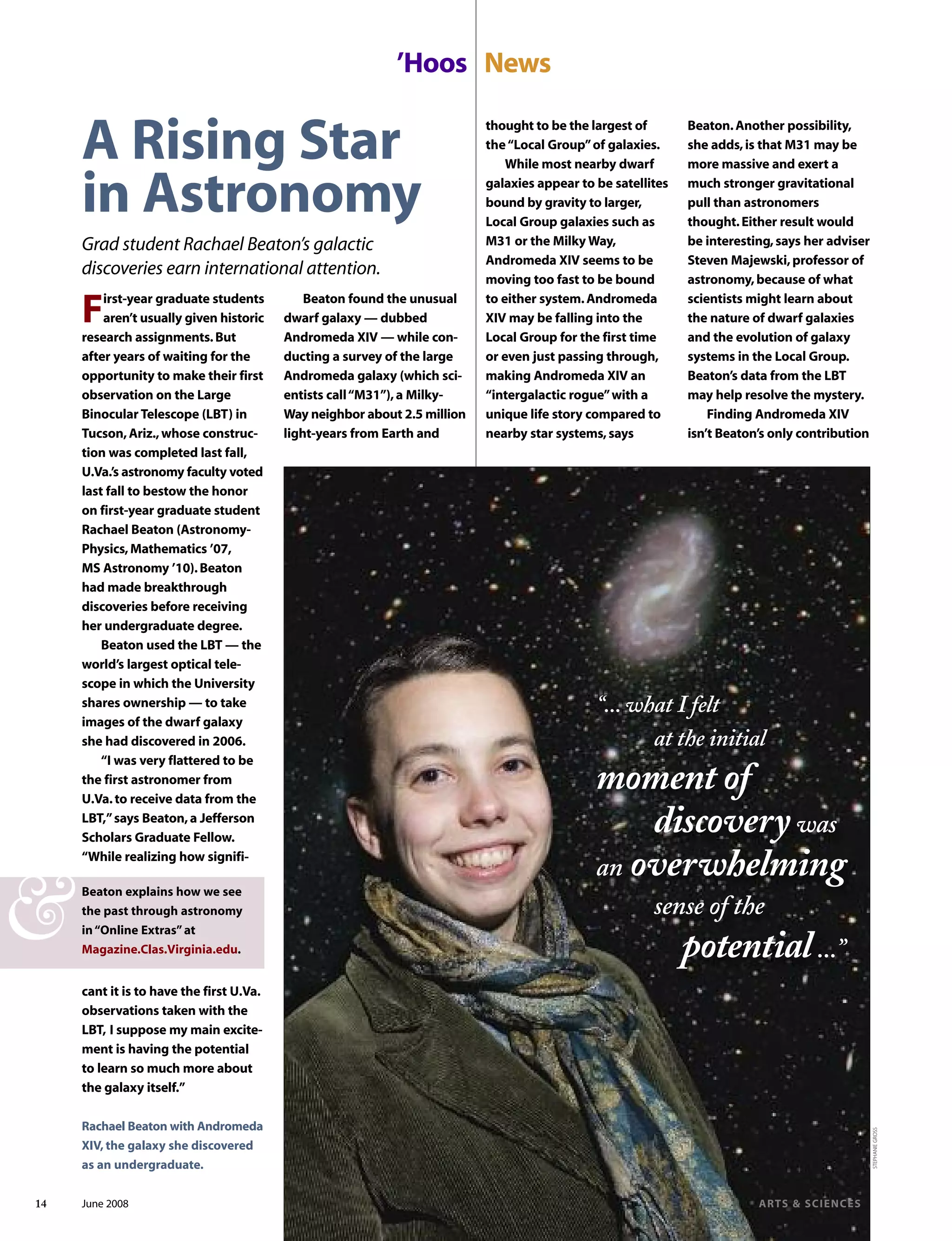
The acroliths of Demeter, goddess of agriculture and grain, and Persephone, queen of the
underworld, originally were attached to wooden bodies, robed and enthroned in a temple
outside the city walls devoted to them.Their worship reflected the agricultural economy
of the Morgantina region of Sicily.
DAVIDSUMMERS,McINTIREDEPARTMENTOFART
In the 1970s and early ’80s, patrimony laws were seen
as export laws, said Rorschach, adding that today museum
ethics must extend to museums taking responsibility as
importers rather than considering any already-exported
object fair game.
“Put the onus of responsibility on ourselves,” said
Fiskejö, explaining his museum’s policy in Sweden: “If we
suspected this object might have come on that conveyor
belt of looting, we would not accept the object.”
“More can be gained by exchange versus ownership,”
said Taylor, whose institution recently negotiated with
the Italian government for the return of objects, reciprocal
loans (Princeton has loaned 87 objects to Italian institu-
tions), collaborations on archaeological digs and other
research opportunities — all important aspects of the
university’s teaching program, she said.
“The solution is to go through collaboration in the
field, research and publication,” said Papadopoulos. “We
prefer to study pieces together, not just to return objects.”
“Aim higher than the mere formality of the law,”
said Fiskejö. “The acroliths are a positive example for
the future.” .
For more information on
the acroliths, please visit
“Online Extras”at
Magazine.Clas.Virginia.edu.
&
UNIVERSITY OF VIRGINIA June 2008 13
For a full story and slide show,please visit“Online Extras”at
Magazine.Clas.Virginia.edu.
A product of Detroit’s roughest neighborhoods,
delivered from suicide, jail time and other horrors
by what he calls “forgiveness and grace,” James
Erickson (Studio Art ’08) explores art as a vehicle
for his faith. What he’s discovered is an edgy art-
making that nevertheless blurs the line between
art and life.
“I do not sit in a studio and naively paint
blissful images of angels and heaven,” he says.
“I wake up each morning in our broken world and
make a leap of faith.”
Still, Erickson balances public art events
with the restorative of painting in the studio: “I
believe in painting — the objective, tangible object
of painting. I think that’s powerful.”
At the College, Erickson has gained an
underpinning for his inclinations, an understand-
ing of those who came before and how he fits in
— among them German artists Joseph Beuys and
Anselm Kiefer, who used humble materials and
believed art could heal a traumatized nation. In
addition, Associate Professor of Contemporary
Art and Theory Howard Singerman introduced Erickson to sculptor
John Ahearn, who has made the poverty-stricken South Bronx his home
and its people his subjects, completely integrating his art and his life.
“I don’t think the idea of [his paintings] lasting forever and being
in a museum is what’s
important to James,”
says Art Professor
Megan Marlatt.
“I think that they’re
about taking art to
the streets.” .
Erickson at work in his
studio.
BY SALLY RUTH BOURRIE
Jay, 8 feet by 10 feet, cardboard, spray paint,
acrylic, pastels, soy sauce, chocolate sauce
Last year, following a tradition of public
artistic expression, Erickson began to meet
Charlottesville’s homeless people through
events he created. He invited some into his
home, connected them with community
organizations — and started painting those
he considered friends.“It’s a huge step in
the relationship when someone takes the
time to paint you,”says Erickson, whose
high school art teacher/coach/father figure
had depicted him and hung the portrait in
the school library. “Him painting me and
the experience I had — I realized it was an
act of love,”says Erickson.
“I’m working towards a change in how
we look at and judge these people in our
community.”&
HHOOPPEEFFUULL
AAllcchheemmiisstt
BLAKEFITCH
BLAKEFITCH
Beaton.Another possibility,
she adds,is that M31 may be
more massive and exert a
much stronger gravitational
pull than astronomers
thought.Either result would
be interesting,says her adviser
Steven Majewski,professor of
astronomy,because of what
scientists might learn about
the nature of dwarf galaxies
and the evolution of galaxy
systems in the Local Group.
Beaton’s data from the LBT
may help resolve the mystery.
Finding Andromeda XIV
isn’t Beaton’s only contribution
’Hoos News
First-year graduate students
aren’t usually given historic
research assignments.But
after years of waiting for the
opportunity to make their first
observation on the Large
Binocular Telescope (LBT) in
Tucson,Ariz.,whose construc-
tion was completed last fall,
U.Va.’s astronomy faculty voted
last fall to bestow the honor
on first-year graduate student
Rachael Beaton (Astronomy-
Physics,Mathematics ’07,
MS Astronomy ’10).Beaton
had made breakthrough
discoveries before receiving
her undergraduate degree.
Beaton used the LBT — the
world’s largest optical tele-
scope in which the University
shares ownership — to take
images of the dwarf galaxy
she had discovered in 2006.
“I was very flattered to be
the first astronomer from
U.Va.to receive data from the
LBT,”says Beaton,a Jefferson
Scholars Graduate Fellow.
“While realizing how signifi-
cant it is to have the first U.Va.
observations taken with the
LBT, I suppose my main excite-
ment is having the potential
to learn so much more about
the galaxy itself.”
Beaton found the unusual
dwarf galaxy — dubbed
Andromeda XIV — while con-
ducting a survey of the large
Andromeda galaxy (which sci-
entists call“M31”),a Milky-
Way neighbor about 2.5 million
light-years from Earth and
Beaton explains how we see
the past through astronomy
in“Online Extras”at
Magazine.Clas.Virginia.edu.
&
A Rising Star
in Astronomy
Grad student Rachael Beaton’s galactic
discoveries earn international attention.
thought to be the largest of
the“Local Group”of galaxies.
While most nearby dwarf
galaxies appear to be satellites
bound by gravity to larger,
Local Group galaxies such as
M31 or the Milky Way,
Andromeda XIV seems to be
moving too fast to be bound
to either system.Andromeda
XIV may be falling into the
Local Group for the first time
or even just passing through,
making Andromeda XIV an
“intergalactic rogue”with a
unique life story compared to
nearby star systems,says
STEPHANIEGROSS
“... what I felt
at the initial
moment of
discoverywas
an overwhelming
sense of the
potential...”
14 June 2008 ARTS & SCIENCES
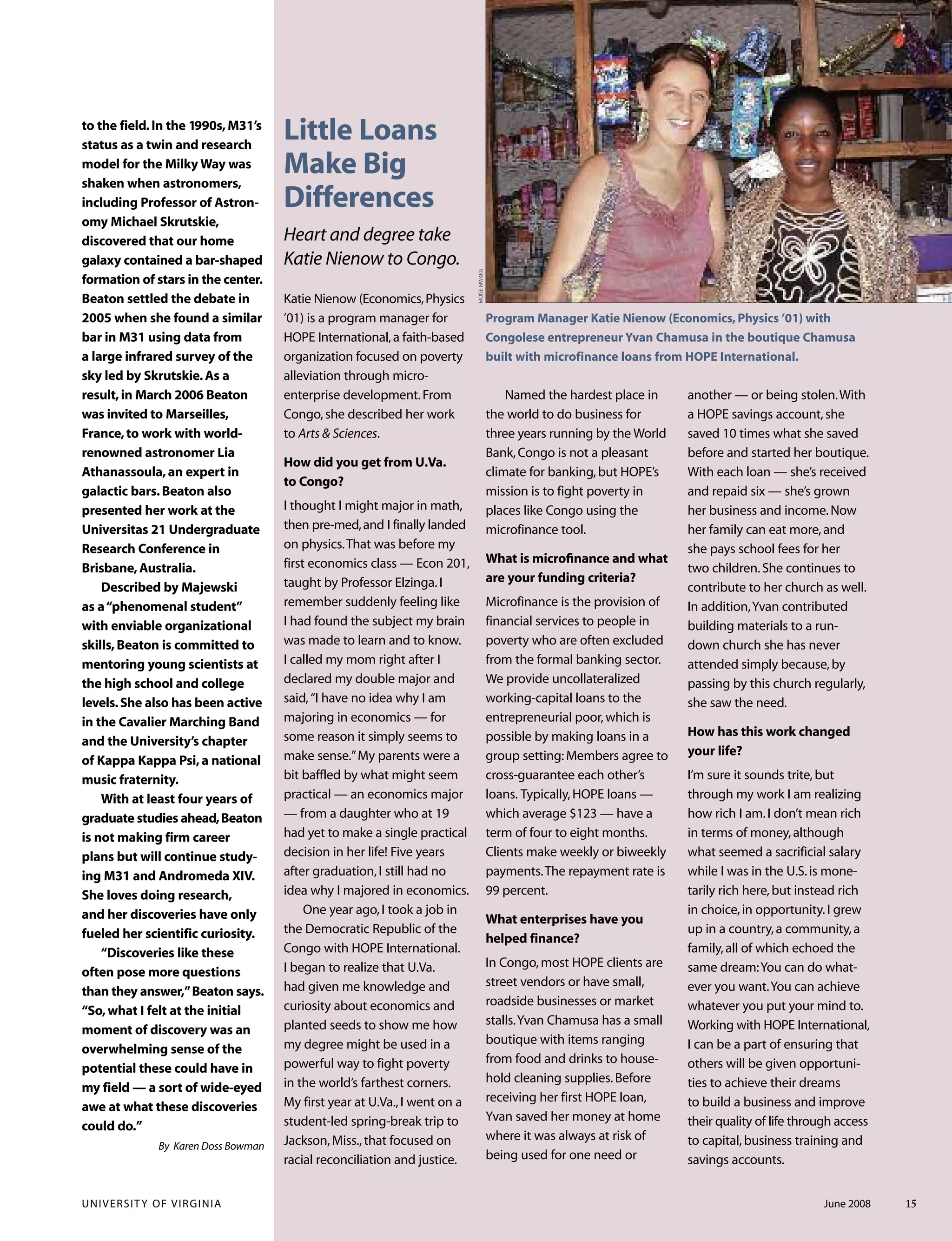
Rachael Beaton with Andromeda
XIV, the galaxy she discovered
as an undergraduate.
to the field.In the 1990s,M31’s
status as a twin and research
model for the Milky Way was
shaken when astronomers,
including Professor of Astron-
omy Michael Skrutskie,
discovered that our home
galaxy contained a bar-shaped
formation of stars in the center.
Beaton settled the debate in
2005 when she found a similar
bar in M31 using data from
a large infrared survey of the
sky led by Skrutskie.As a
result,in March 2006 Beaton
was invited to Marseilles,
France,to work with world-
renowned astronomer Lia
Athanassoula,an expert in
galactic bars.Beaton also
presented her work at the
Universitas 21 Undergraduate
Research Conference in
Brisbane,Australia.
Described by Majewski
as a“phenomenal student”
with enviable organizational
skills,Beaton is committed to
mentoring young scientists at
the high school and college
levels.She also has been active
in the Cavalier Marching Band
and the University’s chapter
of Kappa Kappa Psi,a national
music fraternity.
With at least four years of
graduate studies ahead,Beaton
is not making firm career
plans but will continue study-
ing M31 and Andromeda XIV.
She loves doing research,
and her discoveries have only
fueled her scientific curiosity.
“Discoveries like these
often pose more questions
than they answer,”Beaton says.
“So,what I felt at the initial
moment of discovery was an
overwhelming sense of the
potential these could have in
my field — a sort of wide-eyed
awe at what these discoveries
could do.”
By Karen Doss Bowman
UNIVERSITY OF VIRGINIA June 2008 15
Little Loans
Make Big
Differences
Heart and degree take
Katie Nienow to Congo.
Katie Nienow (Economics,Physics
’01) is a program manager for
HOPE International,a faith-based
organization focused on poverty
alleviation through micro-
enterprise development.From
Congo,she described her work
to Arts & Sciences.
How did you get from U.Va.
to Congo?
I thought I might major in math,
then pre-med,and I finally landed
on physics.That was before my
first economics class — Econ 201,
taught by Professor Elzinga.I
remember suddenly feeling like
I had found the subject my brain
was made to learn and to know.
I called my mom right after I
declared my double major and
said,“I have no idea why I am
majoring in economics — for
some reason it simply seems to
make sense.”My parents were a
bit baffled by what might seem
practical — an economics major
— from a daughter who at 19
had yet to make a single practical
decision in her life! Five years
after graduation,I still had no
idea why I majored in economics.
One year ago,I took a job in
the Democratic Republic of the
Congo with HOPE International.
I began to realize that U.Va.
had given me knowledge and
curiosity about economics and
planted seeds to show me how
my degree might be used in a
powerful way to fight poverty
in the world’s farthest corners.
My first year at U.Va.,I went on a
student-led spring-break trip to
Jackson,Miss.,that focused on
racial reconciliation and justice.
MOÏSEMWAKU
Named the hardest place in
the world to do business for
three years running by the World
Bank,Congo is not a pleasant
climate for banking,but HOPE’s
mission is to fight poverty in
places like Congo using the
microfinance tool.
What is microfinance and what
are your funding criteria?
Microfinance is the provision of
financial services to people in
poverty who are often excluded
from the formal banking sector.
We provide uncollateralized
working-capital loans to the
entrepreneurial poor,which is
possible by making loans in a
group setting:Members agree to
cross-guarantee each other’s
loans. Typically,HOPE loans —
which average $123 — have a
term of four to eight months.
Clients make weekly or biweekly
payments.The repayment rate is
99 percent.
What enterprises have you
helped finance?
In Congo,most HOPE clients are
street vendors or have small,
roadside businesses or market
stalls.Yvan Chamusa has a small
boutique with items ranging
from food and drinks to house-
hold cleaning supplies.Before
receiving her first HOPE loan,
Yvan saved her money at home
where it was always at risk of
being used for one need or
another — or being stolen.With
a HOPE savings account,she
saved 10 times what she saved
before and started her boutique.
With each loan — she’s received
and repaid six — she’s grown
her business and income.Now
her family can eat more,and
she pays school fees for her
two children.She continues to
contribute to her church as well.
In addition,Yvan contributed
building materials to a run-
down church she has never
attended simply because,by
passing by this church regularly,
she saw the need.
How has this work changed
your life?
I’m sure it sounds trite,but
through my work I am realizing
how rich I am.I don’t mean rich
in terms of money,although
what seemed a sacrificial salary
while I was in the U.S.is mone-
tarily rich here,but instead rich
in choice,in opportunity.I grew
up in a country,a community,a
family,all of which echoed the
same dream:You can do what-
ever you want.You can achieve
whatever you put your mind to.
Working with HOPE International,
I can be a part of ensuring that
others will be given opportuni-
ties to achieve their dreams
to build a business and improve
their quality of life through access
to capital,business training and
savings accounts.
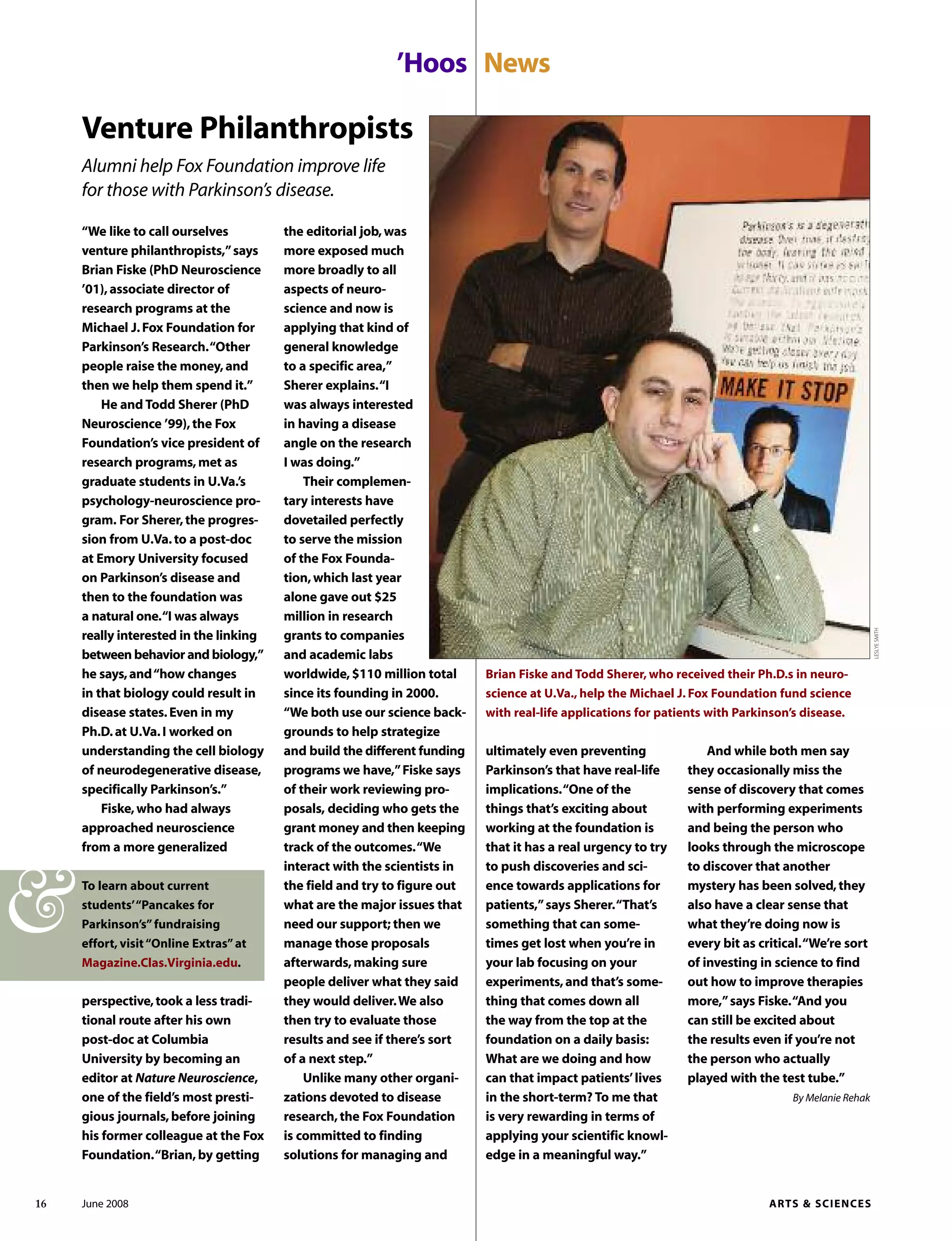
Program Manager Katie Nienow (Economics, Physics ’01) with
Congolese entrepreneur Yvan Chamusa in the boutique Chamusa
built with microfinance loans from HOPE International.
“We like to call ourselves
venture philanthropists,”says
Brian Fiske (PhD Neuroscience
’01),associate director of
research programs at the
Michael J.Fox Foundation for
Parkinson’s Research.“Other
people raise the money,and
then we help them spend it.”
He and Todd Sherer (PhD
Neuroscience ’99),the Fox
Foundation’s vice president of
research programs,met as
graduate students in U.Va.’s
psychology-neuroscience pro-
gram. For Sherer,the progres-
sion from U.Va.to a post-doc
at Emory University focused
on Parkinson’s disease and
then to the foundation was
a natural one.“I was always
really interested in the linking
between behavior and biology,”
he says,and“how changes
in that biology could result in
disease states.Even in my
Ph.D.at U.Va.I worked on
understanding the cell biology
of neurodegenerative disease,
specifically Parkinson’s.”
Fiske,who had always
approached neuroscience
from a more generalized
the editorial job,was
more exposed much
more broadly to all
aspects of neuro-
science and now is
applying that kind of
general knowledge
to a specific area,”
Sherer explains.“I
was always interested
in having a disease
angle on the research
I was doing.”
Their complemen-
tary interests have
dovetailed perfectly
to serve the mission
of the Fox Founda-
tion,which last year
alone gave out $25
million in research
grants to companies
and academic labs
worldwide,$110 million total
since its founding in 2000.
“We both use our science back-
grounds to help strategize
and build the different funding
programs we have,”Fiske says
of their work reviewing pro-
posals, deciding who gets the
grant money and then keeping
track of the outcomes.“We
interact with the scientists in
the field and try to figure out
what are the major issues that
need our support; then we
manage those proposals
afterwards,making sure
people deliver what they said
they would deliver.We also
then try to evaluate those
results and see if there’s sort
of a next step.”
Unlike many other organi-
zations devoted to disease
research,the Fox Foundation
is committed to finding
solutions for managing and
And while both men say
they occasionally miss the
sense of discovery that comes
with performing experiments
and being the person who
looks through the microscope
to discover that another
mystery has been solved,they
also have a clear sense that
what they’re doing now is
every bit as critical.“We’re sort
of investing in science to find
out how to improve therapies
more,”says Fiske.“And you
can still be excited about
the results even if you’re not
the person who actually
played with the test tube.”
By Melanie Rehak
’Hoos News
ultimately even preventing
Parkinson’s that have real-life
implications.“One of the
things that’s exciting about
working at the foundation is
that it has a real urgency to try
to push discoveries and sci-
ence towards applications for
patients,”says Sherer.“That’s
something that can some-
times get lost when you’re in
your lab focusing on your
experiments,and that’s some-
thing that comes down all
the way from the top at the
foundation on a daily basis:
What are we doing and how
can that impact patients’lives
in the short-term? To me that
is very rewarding in terms of
applying your scientific knowl-
edge in a meaningful way.”
Venture Philanthropists
Alumni help Fox Foundation improve life
for those with Parkinson’s disease.
Brian Fiske and Todd Sherer, who received their Ph.D.s in neuro-
science at U.Va., help the Michael J. Fox Foundation fund science
with real-life applications for patients with Parkinson’s disease.
perspective,took a less tradi-
tional route after his own
post-doc at Columbia
University by becoming an
editor at Nature Neuroscience,
one of the field’s most presti-
gious journals,before joining
his former colleague at the Fox
Foundation.“Brian,by getting
LESLYESMITH
To learn about current
students’“Pancakes for
Parkinson’s”fundraising
effort, visit“Online Extras”at
Magazine.Clas.Virginia.edu.
&
16 June 2008 ARTS & SCIENCES
Last Look
UNIVERSITY OF VIRGINIA June 2008 17
Living and Leading
With Just Enough Anxiety
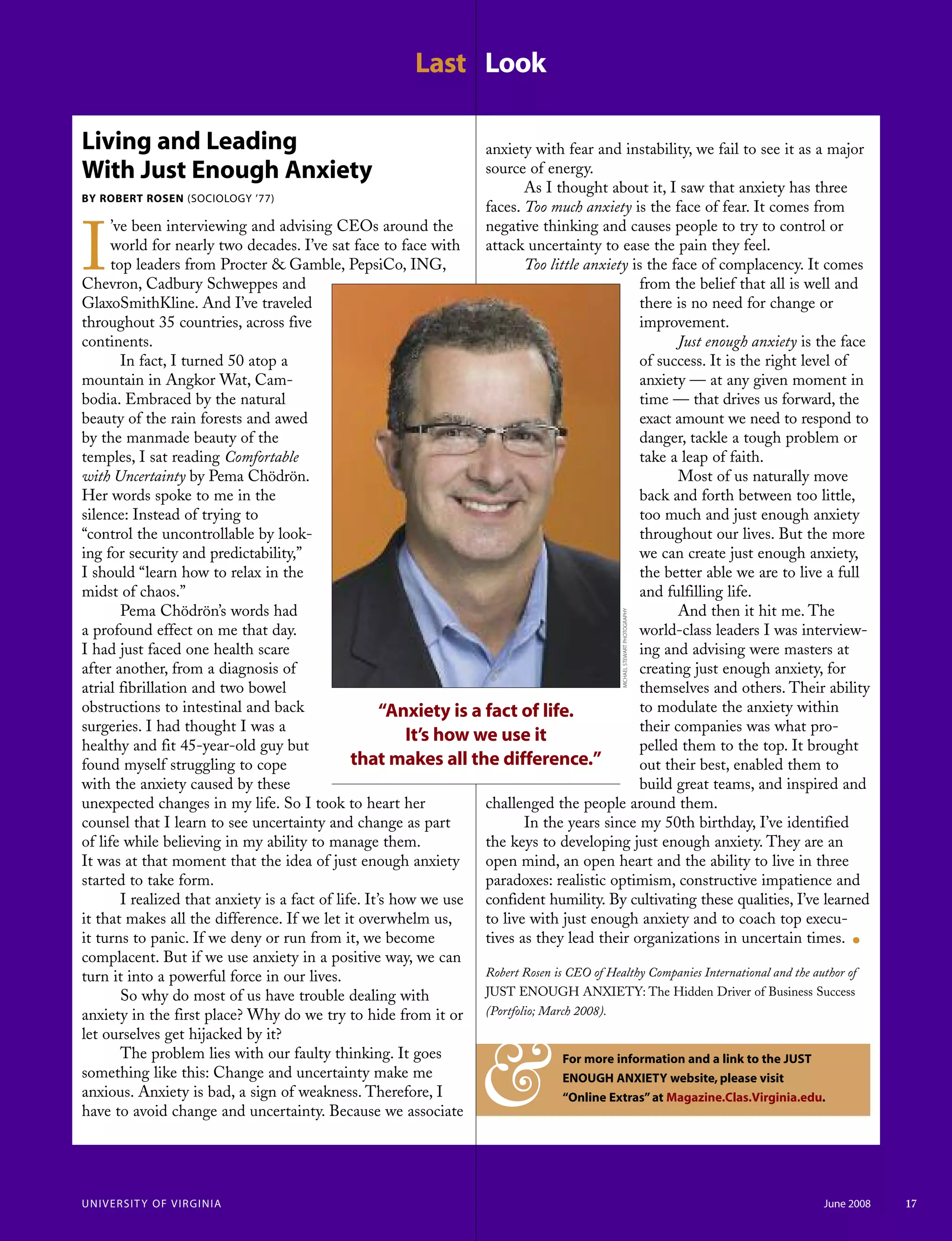
BY ROBERT ROSEN (SOCIOLOGY ’77)
I
’ve been interviewing and advising CEOs around the
world for nearly two decades. I’ve sat face to face with
top leaders from Procter & Gamble, PepsiCo, ING,
Chevron, Cadbury Schweppes and
GlaxoSmithKline. And I’ve traveled
throughout 35 countries, across five
continents.
In fact, I turned 50 atop a
mountain in Angkor Wat, Cam-
bodia. Embraced by the natural
beauty of the rain forests and awed
by the manmade beauty of the
temples, I sat reading Comfortable
with Uncertainty by Pema Chödrön.
Her words spoke to me in the
silence: Instead of trying to
“control the uncontrollable by look-
ing for security and predictability,”
I should “learn how to relax in the
midst of chaos.”
Pema Chödrön’s words had
a profound effect on me that day.
I had just faced one health scare
after another, from a diagnosis of
atrial fibrillation and two bowel
obstructions to intestinal and back
surgeries. I had thought I was a
healthy and fit 45-year-old guy but
found myself struggling to cope
with the anxiety caused by these
unexpected changes in my life. So I took to heart her
counsel that I learn to see uncertainty and change as part
of life while believing in my ability to manage them.
It was at that moment that the idea of just enough anxiety
started to take form.
I realized that anxiety is a fact of life. It’s how we use
it that makes all the difference. If we let it overwhelm us,
it turns to panic. If we deny or run from it, we become
complacent. But if we use anxiety in a positive way, we can
turn it into a powerful force in our lives.
So why do most of us have trouble dealing with
anxiety in the first place? Why do we try to hide from it or
let ourselves get hijacked by it?
The problem lies with our faulty thinking. It goes
something like this: Change and uncertainty make me
anxious. Anxiety is bad, a sign of weakness. Therefore, I
have to avoid change and uncertainty. Because we associate
anxiety with fear and instability, we fail to see it as a major
source of energy.
As I thought about it, I saw that anxiety has three
faces. Too much anxiety is the face of fear. It comes from
negative thinking and causes people to try to control or
attack uncertainty to ease the pain they feel.
Too little anxiety is the face of complacency. It comes
from the belief that all is well and
there is no need for change or
improvement.
Just enough anxiety is the face
of success. It is the right level of
anxiety — at any given moment in
time — that drives us forward, the
exact amount we need to respond to
danger, tackle a tough problem or
take a leap of faith.
Most of us naturally move
back and forth between too little,
too much and just enough anxiety
throughout our lives. But the more
we can create just enough anxiety,
the better able we are to live a full
and fulfilling life.
And then it hit me. The
world-class leaders I was interview-
ing and advising were masters at
creating just enough anxiety, for
themselves and others. Their ability
to modulate the anxiety within
their companies was what pro-
pelled them to the top. It brought
out their best, enabled them to
build great teams, and inspired and
challenged the people around them.
In the years since my 50th birthday, I’ve identified
the keys to developing just enough anxiety. They are an
open mind, an open heart and the ability to live in three
paradoxes: realistic optimism, constructive impatience and
confident humility. By cultivating these qualities, I’ve learned
to live with just enough anxiety and to coach top execu-
tives as they lead their organizations in uncertain times. .
Robert Rosen is CEO of Healthy Companies International and the author of
JUST ENOUGH ANXIETY: The Hidden Driver of Business Success
(Portfolio; March 2008).
MICHAELSTEWARTPHOTOGRAPHY
“Anxiety is a fact of life.
It’s how we use it
that makes all the difference.”
For more information and a link to the JUST
ENOUGH ANXIETY website, please visit
“Online Extras”at Magazine.Clas.Virginia.edu.&
J U N E 2 0 0 8
IN THIS ISSUE:
Liberal-arts grads invest in world-changing entrepreneurship
Symposium focuses on looted antiquities and museum policy
Alumni at Michael J. Fox Foundation fight Parkinson’s disease
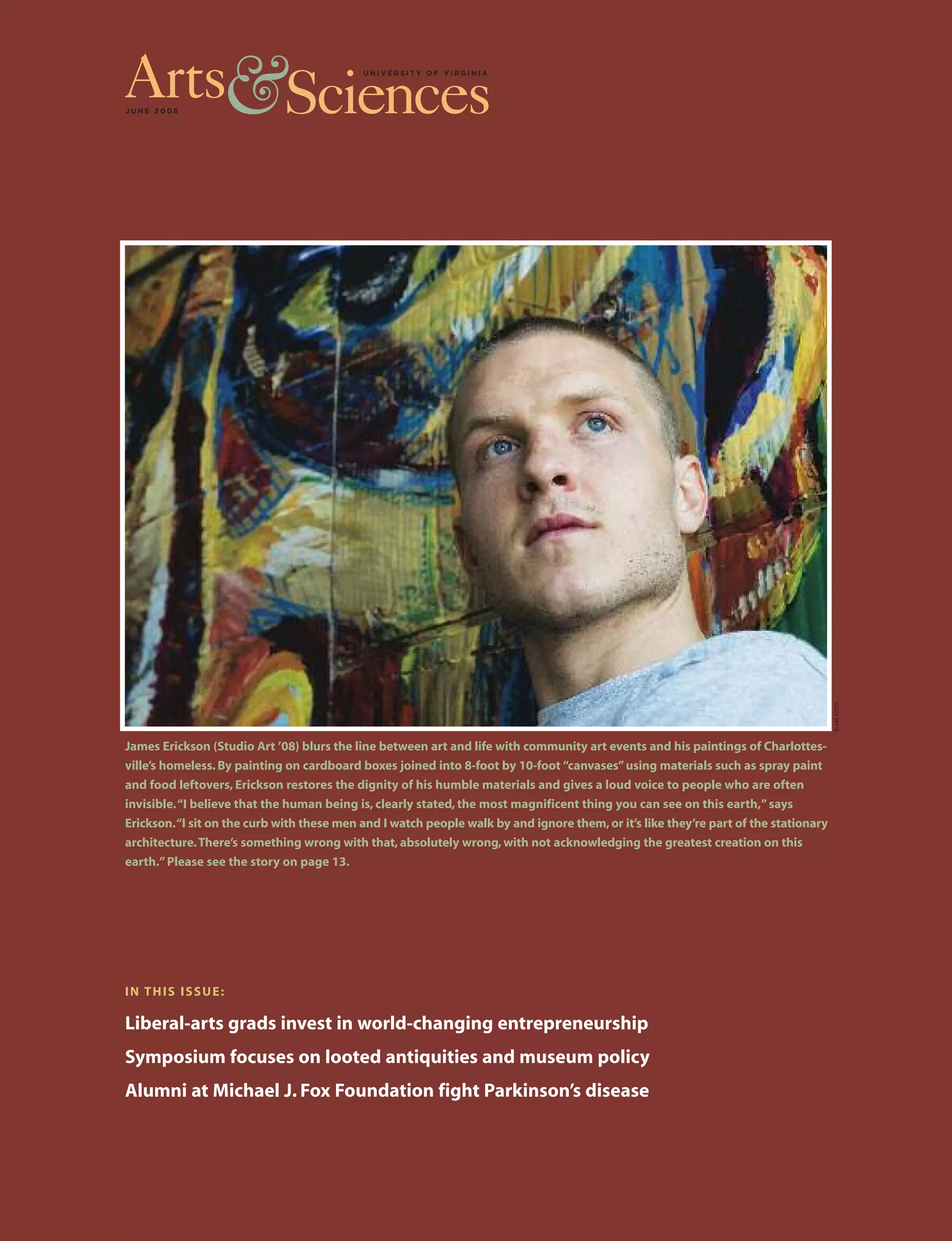
James Erickson (Studio Art ’08) blurs the line between art and life with community art events and his paintings of Charlottes-
ville’s homeless. By painting on cardboard boxes joined into 8-foot by 10-foot “canvases”using materials such as spray paint
and food leftovers, Erickson restores the dignity of his humble materials and gives a loud voice to people who are often
invisible.“I believe that the human being is, clearly stated, the most magnificent thing you can see on this earth,”says
Erickson.“I sit on the curb with these men and I watch people walk by and ignore them,or it’s like they’re part of the stationary
architecture.There’s something wrong with that, absolutely wrong, with not acknowledging the greatest creation on this
earth.”Please see the story on page 13.
BLAKEFITCH

ASMagJune08

  • 1.
    SUPPLEMENT TO THE UNIVERSITYOF VIRGINIA MAGAZINE CHANGING THE WORLD ... ONE DEAL AT A TIME
  • 2.
    College Foundation Board ofTrustees John B. Morse, Jr. ’68 President Locke W. Ogens ’76 Vice President Sheryl W.Wilbon ’88 Secretary Peter Brundage ’75 Treasurer Jeffrey D. Nuechterlein ’79, Law ’86 Past President Juliana Schulte O’Reilly ’86 Chair, Emeritus Society Beverley W. Armstrong ’64, Darden ’66 Peter Barris, Parent Trustee Paul B. Barringer II ’52 Margaret Saer Beer ’80 Gordon C. Burris, Curry ’67 Marvin P. Bush ’79 Susan S. Bram ’85 Frank K. Bynum, Jr. ’85 Robert G. Byron ’73, Law ’76 Charles R. Cory ’77, Darden ’82, Law ’82 Phyllis S. Coulter ’82 David M. Crowe ’75 Allen de Olazarra ’81 Everette L. Doffermyre, Jr. ’70, Law ’73 William B. Fryer ’71, Law ’74 Amy M. Griffin ’98 Raymond Harbert, Parent Trustee Lee Burleigh Harper ’85 David Harrison IV ’67, Law ’71 R. Philip Herget III ’85 M. Mansoor Ijaz ’83 Lemuel E. Lewis ’69, Darden ’72 Charles Longley ’65 Mary Bland Love ’74, Law ’78 Thaderine D. MacFarlane, Parent Trustee Brian T. McAnaney ’68 Robert L. Mettler ’62 P. Clarke Murphy ’84 Tammy Snyder-Murphy ’87 Timothy B. Robertson ’77 Christian D. Searcy ’70 Kathy Thornton-Bias ’88 Elizabeth A.Tilney ’79 John L.Walker III ’83 Mallory Walker ’62 Frederick W.Whitridge ’54 E veryone has a voice, and with the help of our teach- ing assistants, the professors can hear our voices more clearly. My name is William Ryan Caviness, but here they call me Cav. When I first came to U.Va., I didn’t want to have a single TA, no class where the professor wanted you to send all questions to the TA, no class of 200 students, no class without a voice. I felt that perhaps I would only do well in small class settings. However, after a few years I’ve learned that there might be something to this system. This isn’t high school. TAs aren’t here to hold your hand; they are here to give you the nudge to get down the slide. My second semester of second year, I had a TA who expected us to know the details not only from class but also from the book — and in advance of class, meaning we needed to relate what we had just learned to what we were about to learn (key word, “about”)! It was constantly a circle of questions, with her never giving an answer but only another series of questions to try to get the answer out of us. It was torture when we had no idea and des- perately needed help. But the pressure of this intense way of learning pushed me to read and reread the class mate- rials, and it did, in the long run, make me able to learn in ways that I was not accustomed to. I have had some other great experiences with TAs here at the University. Sometimes class can be overwhelming in terms of the knowledge you receive in one sitting. The discussion sections are perfect for amplifying the information and getting it to you in a way that helps you make connections and apply the ideas. TAs are instrumental in getting things answered. Chances are the TAs had the same queries when they were in your shoes and had to find the answers themselves, so who better to ask? by William Ryan“Cav”Caviness (Neuroscience ’10) EDITOR’S NOTE: While wages for graduate teaching assistants are paid from state funds (tax appropriations as well as tuition), many grad- uate students also receive additional support in the form of incremental stipends, some of which is made possible by gifts to the Arts & Sciences Annual Fund. Arts & Sciences allocates more than one million Annual Fund dollars every year to graduate stipend support.These allocations help to keep graduate student compensation more competitive, which assists our graduate programs in attracting and retaining top-tier students from around the globe. FUNDRAISING PROGRESS Alumni,students,parents and friends help make things happen through their gifts to the Arts & Sciences Annual Fund — financial support for academic journals,plus career services, workshops,travel,labs and more. As of Feb.29,the fund had reached more than $2.9 million of its $4.5 million overall goal for the fiscal year ending June 30,2008. Also as of Feb.29,the College had raised $154 million of the $500 million goal for the Campaign for the College.Overall,campaign gifts to the University stood at $1.6 billion of the $3 billion goal (Jan.31). The Annual Fund in Action•Graduate Teaching Assistants William“Cav”Caviness (Neuroscience ’10) JACKLOONEY
  • 3.
    6 Changing theWorld … One Deal at a Time Armed with liberal arts degrees, College alumni are investing in innovative entrepreneurs who are transforming all aspects of life, all over the world. 10 Immoral Immigration Professor of Art History Malcolm Bell III brings together Italian government representatives and museum professionals to discuss collection policies and returning looted artifacts. 13 Hopeful Alchemist James Erickson (Studio Art ’08) makes the invisible visible by blurring the lines between art and life. DEPARTMENTS 2 Letters et cetera 3 Around Grounds 14 ’Hoos News 17 Last Look ON THE COVER Great ideas financed by visionary College alumni are making a difference around the world. Cover art by Alberto Ruggieri/ Illustration Works/Corbis “We are all connected in a world growing ever smaller and, in many ways, ever more fragile. At the same time, there has never been a more hopeful moment in history, for we have the resources, tools, knowledge and connections to solve tough problems of poverty. My work has taught me the power — and limitations — of the market and, mostly, the enormous resilience of the human spirit. Acumen Fund taps into both, and then brings forth solutions that give people a real chance to change their own lives,” says Jacqueline Novogratz (Economics ’83), chief executive officer of Acumen Fund, shown here with a customer of Scojo, an Indian company that distributes low-cost reading glasses. UNIVERSITY OF VIRGINIA June 2008 COURTESYOFACUMENFUND
  • 4.
    June 2008 Vol.26, No. 3 DEAN Meredith Jung-En Woo DIRECTOR OF COMMUNICATIONS Kennedy Kipps EDITOR Sally Ruth Bourrie PRODUCTION MANAGER Crystal Detamore CONTRIBUTING EDITORS Jeff Hill,Anita Holmes (English ’82), Hilary Swinson GRAPHIC DESIGN Communication Design, Inc. Richmond,Va. CONTRIBUTING WRITERS Karen Doss Bowman,Catherine Conkle,Jeff Hanna,John Kelly, Melanie Rehak CONTRIBUTING PHOTOGRAPHERS Michael Bailey,Tom Cogill,Blake Fitch,Stephanie Gross,Jane Haley,Jack Looney,Moïse Mwaku,Sandro Scalia,Leslye Smith,Michael Stewart Photography,Vicente Villanueva Special thanks to Acumen Fund,the Arts & Sciences Annual Fund and Benefactors Society,Arts & Sciences Development,Malcolm Bell,The College Foundation,Jennifer Mays, The New York Times/Redux,Jeff Rusinow,Soprintendenza Archeolog- ica della Puglia,David Summers of the McIntire Department of Art,U.S.Supreme Court,U.Va. Media Relations, Inside UVA, Strategic Communications, the U.Va.Alumni Association and Melanie Price. Arts & Sciences is published for the alumni,students, faculty and friends of the College and Graduate School of Arts & Sciences at the University of Virginia.It is paid for with private funds. Copyright 2008, University of Virginia. Arts & Sciences Welcomes Editorial Advisory Board Arts & Sciences gratefully announces its new Editorial Advisory Board,composed of alumni who are volunteering their time and expertise to help move the magazine forward. Members are: Bruce Brandfon (English Language and Literature ’69), publisher,Scientific American Gene DeRose (English Language and Literature ’86), founder and chairman,House Party; founder,CEO and chair- man, Jupiter Communications Beth Kseniak (Government ’79), executive director of public rela- tions, Vanity Fair John (Jay) Morse Jr. (College ’68),vice president,finance and chief financial officer,The Wash- ington Post Company,and president,the College Founda- tion of the University of Virginia Alexis Ohanian (History and Commerce ’05),founder of Reddit Matt Paco (Foreign Affairs ’95), reporter for MTV and on-air pro- mos producer for Nickelodeon Kristin van Ogtrop (English Language and Literature ’86), managing editor,Real Simple Julia Wilkinson-Gallagher (English Language and Literature ’87),author; and former writer/manager,AOL Letters et cetera Can’t Get Enough of Arts & Sciences? Check out our website for“Online Extras,” subscription opportunities and more: Magazine.Clas.Virginia.edu Visit A&S Online for new stories monthly and subscribe to our monthly e-newsletter: AandS.Virginia.edu Learn about the latest U.Va.research and subscribe to our monthly research e-newsletter: Oscar.Virginia.edu Find alumni or update your profile: HoosOnline.Virginia.edu Give to the College: ArtsandSciences.Virginia.edu/give Visit the College online: ArtsandSciences.Virginia.edu Write us: AandS@Virginia.edu ProQuest Medical Library combines full text for more than 800 medical titles with abstracts and indexing from the well-known Medline data- base. The journals cover all major clinical and health-care disciplines,including cardio- vascular diseases,pediatrics, neurology,respiratory dis- eases, dentistry, anesthesiology and others. ProQuest ABI Complete features nearly 4,000 journals, including nearly 3,000 full-text titles on business and economic conditions,corporate strategies and management techniques as well as competitive and product information. “We’re pleased to provide this lifelong educational resource to our alumni,”says Cindy Frederick,assistant vice president of the U.Va.Office of Engagement. To access these databases, please visit“Online Extras”at Magazine.Clas.Virginia.edu. 2 June 2008 ARTS & SCIENCES Find It Here U.Va.alumni gain new online research tools. Through HoosOnline, University of Virginia alumni now have access to three vast research databases. From business and political science to literature and psy- chology, ProQuest Research Library includes more than 3,820 titles — more than 2,550 in full text — from 1971 for- ward. It features a diversified mix of scholarly journals,trade publications,magazines and newspapers. The Big Question: You Spoke Thank you for your many responses to“The Big Question.” We’ve received lots of food for thought as we plan our editorial line-up for the coming year.Many of your responses fall under the umbrella of environmental con- cerns, along with globalization, health care,economic well-being and character. One of the most provocative responses came from a current student,Benjamin Radburn Mayo (College ’10): The Big Question facing society today is whether the society is a group of individuals,or a thing unto itself,and what each of those answers means in its full consequence. You’ll find your responses at: AandS.Virginia.edu/x12676.xml. Write To Us! Arts & Sciences welcomes letters at AandS@Virginia.edu or at P.O.Box 400804,Charlottesville, VA 22904.We reserve the right to edit letters for length,style and appropriateness.
  • 5.
    UNIVERSITY OF VIRGINIAJune 2008 3 The 2008–2009 academic year marks the 25th anniversary of the University of Virginia Hispanic Studies Program in Valencia.All program alumni and their loved ones are invited to Silver Celebration festivities in Valencia Oct.9–11.U.Va.Presi- dent John T.Casteen III will attend,along with full program staff.“We sincerely hope we can count on seeing all of our alumni in Valencia this fall,”says program director Fernando Operé.“It will be a wonderful opportunity for us to be together and for our alumni to relive memories of their study abroad experience,see their former class- mates and the Spanish friends they made in Valencia,too.” For more information or to register and book travel and accommodations,go to“Online Extras”at Magazine. Clas. Virginia.edu. Best known as“La Peineta” (“side comb”) for its resem- blance to the Spanish ornamen- tal comb,the Calatrava Bridge was designed by world- renowned Valencia architect Santiago Calatrava. ¡Vámonos!Valencia Program celebrates 25 years in Spain. Around Grounds VICENTEVILLANUEVA Julian Bond, professor of history and national chairman of the NAACP, recently interviewed U.S. Supreme Court Justice Clarence Thomas as part of the University of Virginia’s Explorations in Black Leadership project.The Explorations in Black Leadership website features a collection of interviews with black leaders from a wide variety of fields,all focusing on issues of black leadership and the transformational role of the civil rights movement in America. JANEHALEY Meredith Jung-En Woo was named dean of the College and Graduate School of Arts & Sciences,effective June 1. University President John T.Casteen III praised Woo as a “remarkably accomplished teacher,scholar and fundraiser who will provide strong leader- ship for the College and Graduate School of Arts & Sciences as it looks to improve its standing in the sciences, while at the same time expanding and enriching the College’s programs in the fine and performing arts.” Previously,Woo was asso- ciate dean for social sciences in the College of Literature, Science and the Arts and professor of political science at the University of Michigan. Author of numerous articles, books and an award-winning documentary film,Woo raised more than $8 million for Korean Studies at U-M,and brought an important Korean ceramic art collection to its art museum. In 1996,President Bill Clinton appointed her to the Presidential Commission on U.S.-Pacific Trade and Invest- ment Policy.She has consulted for the World Bank,the United States Trade Representative, Asian Development Bank Insti- tute,the Asia Foundation and the MacArthur Foundation. EducatedinKoreaandJapan through high school,Woo received her B.A.at Bowdoin College (English Literature and History),and two M.A.s (Inter- national Affairs and Latin American Studies) and a Ph.D. (Political Science) from Colum- bia University.Fluent in English, Korean and Japanese,Woo also taught at Northwestern University,Colgate University and Columbia University. “The University of Virginia L to R: Betsy Foote Casteen,wife of U.Va.President John T.Casteen III; Jahan Ramazani,chair,English Department; Meredith Jung-En Woo, dean,College of Arts & Sciences; James Galloway,professor,Environ- mental Sciences Department College Welcomes New Dean combines the goals and pur- poses of a public university while maintaining the highest excellence in research and scholarship — and it does so without compromising the quality of undergraduate education,”she said.“I am deeply honored to be coming to the University.” Learn more at Magazine. Clas.Virginia.edu. JANEHALEY
  • 6.
    HERITAGE RETURNS This summerHeritage Repertory Theatre,the University of Virginia’s summer professional theater,returns from a construction-induced one-year hiatus as the Heritage Theatre Festival.Theatergoers will also find a new parking structure with ample — and free — parking for the first time. “We could not be happier to be returning,”says Robert Chapel,Heritage Repertory Theatre’s producing artistic director. “It’s been extremely gratifying to hear from people throughout the year who expressed how much they missed Heritage last summer and how excited they are to come back this year.” The 2008 season features five shows that collectively captured 17 Tony Awards: • The 1940s,film-noir-themed musical City of Angels (book,Larry Gelbart; music,Cy Coleman; lyrics,David Zippel;Tony Award for Best Musical) • I Am My Own Wife,a one-person show with 30 characters based on the story of German transvestite Charlotte Von Mahlsdorf (DougWright;Pulitzer Prize for Drama;Tony Award for Best Play) • Master Class,about opera legend Maria Callas (Terence McNally; Tony Award for Best Play) • The Light in the Piazza,a romantic tale set in Tuscany (book, Craig Lucas; music and lyrics,Adam Guettel,Richard Rodgers’ grandson) • Forever Plaid,a nostalgic tribute to 1950s close-harmony “guy groups”(Stuart Ross) The box office opens June 2. A 2006 Heritage Repertory Theatre production of Enchanted April. The theater returns this summer from a one-year hiatus. For more information, visit“Online Extras” at Magazine.Clas.Virginia.edu. 4 June 2008 ARTS & SCIENCES As fourth-year students pre- pared for the job search, University of Virginia Fourth-Year Class Trustees invited Tim Gunn, host of the Bravo TV reality shows Project Runway and Tim Gunn’s Guide to Style, to help them make their wardrobes ready for the work force. Graduation may be the time to put away those sweat- shirts and flip-flops in favor of tailored suits and blazers,Gunn told his Old Cabell Hall audience of 800 fourth years. “It is simply a fact that when you transition from college to the workplace, it’s a change,”Gunn said.“The clothes we wear send a message about how we want the world to perceive us.” While he visits colleges infrequently,Gunn said he was motivated to come to U.Va.by his admiration for the school as well as his family ties to the institution.“My sister is an alum [Kim Gunn Gundy,Rhetoric and Around Grounds JACKLOONEY Bravo TV Project Runway host Tim Gunn helped fourth years dress for success. MAKE IT WORK Fashion icon Tim Gunn offers dress-for-success guidance. MICHAELBAILEY & JANEHALEY In February,Darin Showalter (Mathematics,Music ’08) presented the first distinguished- major recital on trombone in University of Virginia history.He performed on three instruments, including the bass sackbut. Probably invented in Burgundy in the 15th century,the sackbut is a precursor to the modern trombone and has a softer tone and narrower bell.
  • 7.
    UNIVERSITY OF VIRGINIAJune 2008 5 On the eve of the Virginia primary, presidential candidate Sen. Hillary Clinton (D-NY) attended Politics Professor Larry Sabato’s“An Introduction to American Politics”class (held with an audience of 1,000 in the Old Cabell Hall auditorium). Clinton stayed well beyond the 60-minute class period, fielding some- times-pointed student questions.“I took [this class] because I was hoping something like this would happen during the primaries,”said self-described Republican Henry Ponton (Sociology ’09). Sabato’s staff at the Center for Politics invited all presidential candidates; Clinton’s campaign was the first to respond.The event ended with Clinton and Sabato swaying arm-in-arm on stage as the University Singers led the audience in“The Good Ol’Song.” For more information and an audio slide show, visit“Online Extras”at Magazine.Clas.Virginia.edu. JANEHALEY Honors for Arts & Sciences James Galloway,professor of environmental sciences, has been awarded the 2008 Tyler Prize for Environ- mental Achievement,considered by many in the environ- mental science field to be the equivalent of a Nobel Prize.Professor Galloway also was elected a Fellow of the American Geophysical Union,an honor conferred upon scientists who,in the eyes of the AGU,have“attained acknowledged eminence in the geophysical sciences.”Galloway is a leader in the study of the“nitro- gen cascade,”the flow of reactive nitrogen that seriously damages the environment. ?’HooKnew Celebrating 100 years in Old Cabell Hall, U.Va.’s E.M. Skinner pipe organ is the oldest surviving Skinner organ in original condition and in its original site. Source: UVA Today and Joseph Vitacco Communication Studies ’78]. My brother-in-law is vice presi- dent of the Darden Foundation [Vice President of Development Jay Gundy,MA Rhetoric and Communication Studies ’79]. My niece is in the class of ’08 [Wallace Gibb Gundy,Classics ’08],”Gunn said.“I love this university.I am a huge fan of Thomas Jefferson,and I love stu- dents. I am thrilled to be here and I am honored.” Gunn also answered ques- tions about business suits,shop- ping on a budget and dressing in a sophisticated,age-appropri- ate manner.U.Va.students are better prepared than students at other universities,he said:“There is that preppiness that happens here,but it’s authentic.I think that the transition for students from U.Va.into the working world will be less of a challenge than it will be for students at a lot of other campuses.” About Uggs and Crocs,he said,“I flatter them to call them footwear.” Catherine Conkle (History,Religious Studies ’08) Brian Nosek,assistant professor of psychology,has received the International Social Cognition Network Early Career Award and the Society for the Psychological Study of Social Issues’Michele Alexander Early Career Award for Scholarship and Service.
  • 8.
    6 June 2008ARTS & SCIENCES CHANGING THE WORLDCHANGING THE WORLD Jack Biddle (Economics ’83), at right, co-founder of Novak Biddle Venture Partners, with Blackboard Inc. President and Chief Executive Officer Michael Chasen. Novak Biddle was the first investor in Blackboard, which now has a nearly $1 billion market capitalization.
  • 9.
    ASCINATED BY TECHNOLOGY entrepreneurssince childhood, Jack Biddle (Economics ’83), co-founder of Washington, D.C.-based Novak Biddle Venture Partners, had a front-row seat: His father headed the Computer & Communications Industry Association, a Washington, D.C.-based lobbying group, for decades. “I was just fascinated by how these incredibly brilliant people were able to find each other and create new indus- tries from nothing,” he says. “For me it’s a little bit like being a patron of the symphony. I can’t write a symphony, but I can recognize people who can. And that is really what I do.” Biddle joined a venture capital firm directly out of college but soon concluded he needed another kind of experience: “You have no right to sit on a board and tell people how to run a company if you haven’t run a company yourself.” So he did just that, first working at technology consulting giant the Gartner Group, then leading two software com- panies (one in turnaround) followed by four years as CEO of a venture-backed software company he sold in 1995. That was all the education he needed; he still has no advanced degrees. “I got my degree in economics because it sounded credible to the business world, but I wanted to be in the College of Arts & Sciences because it was so loose. … I took a lot of astronomy, a lot of computer science, a lot of history, and I spent a lot of time in the stacks just reading stuff for fun. I think a liberal arts education is the best preparation for just about anything short of doing stress calculations on a bridge design. “My partner and I talk about the one thing that makes people really good at this business is pattern recog- nition, being able to see something that has never been done before but to recognize an analog to something you are familiar with. That is basically what a liberal arts education is, learning to see patterns and studying history.” Novak Biddle accepts funding only from “people doing things [we] care about,” says Biddle. Its roster of limited partners is primarily universities, including U.Va. “Most of the top firms are almost exclusively backed by universities. They want to work for nonprofits where the returns they generate are going to do more than line somebody’s pockets.” Novak Biddle manages more than $580 million and focuses on mid-Atlantic-based information technology companies in the very early stage through first-round investments. It was the first investor in Blackboard Inc., with an $850,000 seed investment in 1997 — when Black- board was just two 24-year-old entrepreneurs in a brown- stone basement with a passion to bring learning online. With users in more than 60 countries, today Blackboard is the world leader in online course management systems. Its 2007 revenues reached more than $239 million. “My partner and I both care a lot about education, from a public policy standpoint and personally,” says Biddle, “and this is a deal where 20 million students are benefiting from this company that I don’t think would have made it with- out us.” For these venture capitalists, the fun is more than the “ka-ching” pay- off, it’s a passion for helping people to realize their dreams. Biddle describes it this way: “I have two to three hours a day with really bright people who are tackling really interesting problems that I hadn’t thought of before. You get to learn a lot about a lot and that’s just fun. “The other cool thing is working with these people and seeing patterns and helping them off the rocks, help- ing to keep them from making the fatal mistake or not getting taken advantage of by a large corporation. Keeping them out of trouble so their creativity can blossom.” LIFELONG LEARNER Jeff Rusinow (College ’77, MA Rhetoric and Communication Studies ’79) had the entrepreneurial bug almost from the day he arrived on VENTURE CAPITALISM is a subset of private equity, or investment-own- ership. Usually, the funding game begins with angel investors. Angels range from wealthy individuals to organized groups that pool resources and expertise to provide start-up entrepreneurs with their first boost, usually at the earliest and riskiest time in the venture’s life cycle, just after family and friends have invested. Next up the chain are venture-capi- tal firms specializing in“seed”stage companies that have no track record of success, little — if any — income and need substantially larger invest- ment than angels provide.Then come venture firms focusing on“expansion stage”companies and, finally, those specializing in corporate buyouts. What unites these organizations is a common goal: either a lucrative purchase by another company or an initial public offering.To get there, angels generally look for four- to seven-year involvement while some later stage firms are in it for the shorter haul. BY JOHN KELLY ... ONE DEAL AT A TIME UNIVERSITY OF VIRGINIA June 2008 7 TOMCOGILL F
  • 10.
    Grounds. He leftschool twice to satisfy this urge, then rose through the retail ranks with Macy’s, Gimbel’s and Hudson’s Bay department stores before running his own business. He returned to retail one last time, landing at Milwaukee, Wis.- based Kohl’s Department Stores, from which he cashed out in 2000 after three stock splits. Soon after, Rusinow began hosting high-net-worth individuals at his home to discuss angel-investing opportu- nities. The result was Milwaukee’s first angel group, Silicon Pastures (a tongue-in-cheek nod to its geographic roots). In its first three years, the group saw hundreds of deals and invested in 15. “For every 10 deals that an angel gets involved in, three go bankrupt, three are basically treading water forever, and two or three do OK, with an internal rate of return of between 20 and 25 percent,” says Rusinow. “But one out of 10 has to be a home run. And when I say home run, you’ve got to run around the bases a couple of times. It needs to be a 10-bagger because if it is not and you blend all that, it’s not a reasonable ROI [return on investment] for the risk you are taking.” Rusinow glimpsed one of his biggest 10-baggers when he met — on his front lawn — two 20-somethings who had a plan to sell costumes on the Internet. The Internet bubble had popped and caught them well short of their lofty start-up capital goals. They had been looking for $5 million in capitalization from bankers, but Rusinow had a different deal. He would take 25 percent of the company and provide significantly less capital (from him and later from some two dozen other investors) but throw something else into the deal: his expertise, stepping in as chairman. BuySeasons Inc. (known for its website, BuyCostumes. com) went from zero to $50 million in revenues in its first seven years. After ranking No. 75 on Inc.’s 2005 list of the top 500 fastest-growing private United States companies, it sold for $60 million to Liberty Media Corp. in 2006. A “nice hit,” says Rusinow. Rusinow’s subsequent successes found him stepping outside his retail comfort zone. He has been actively involved in the strategy and operations of several successful health-care-related start-ups, including ModernMed, whose mission is to deliver a patient-centered, primary- care experience. Rusinow is lead investor and chairman. “There is a recommendation that as an angel you should only invest in businesses and technologies you are familiar with,” he says. “I took a different tack. I like to get involved in things that I know nothing about. It is fasci- nating for me, furthering my education in that you just learn so much about things going on in other industries and technologies you never would have even thought about. It is really fun.” ANGELS IN VIRGINIA Dick Crawford (College ’67, Darden ’74, Law ’74) and Letitia Hickman Green (Spanish ’84) founded the Virginia Active Angel Network. Crawford took a traditional route, packing up a briefcase full of advanced degrees and head- ing to banking. He found himself at the epicenter of the technology revolution in Silicon Valley and became fasci- nated by the challenges of financing emerging knowledge- based companies. “One of the problems that you had then and that you still have today is that the traditional financial system, banks, typically do not fund the types of companies that are being spun out of universities and that we talk about as being angel investment or venture capital invest- ment opportunities,” he says. Green supplemented her U.Va. degree with an M.B.A. from Pepperdine University. After a stint at Oppenheimer & Co. Inc. in New York, she became the fourth hire at a 8 June 2008 ARTS & SCIENCES Dick Crawford (College ’67, Darden ’74, Law ’74) and Letitia Hickman Green (Spanish ’84) founded the Virginia Active Angel Network. “Angel investors are typically current or cashed-out entrepreneurs who invest in other entrepreneurs and are comfortable with the higher risks associated with doing so,”says Green.“This‘cycle’ of entrepreneurship is the economic engine of the United States and what differentiates our economy from all other countries’.” Jeff Rusinow (College ’77, MA Rhetoric and Communication Studies ’79) invests in fields he is unfamiliar with, which he says furthers his education. “It is fascinating for me.” COURTESYOFJEFFRUSINOW TOMCOGILL
  • 11.
    UNIVERSITY OF VIRGINIAJune 2008 9 spartan midtown start-up private-equity firm: the Black- stone Group. Now legendary, the Blackstone Group manages assets of about $100 billion. Green followed Blackstone with investment-banking leadership positions on the West Coast and her own mergers-and-acquisitions consulting firm. Soon after arriving in Virginia as a cashed-out entre- preneur in 2005, Green met Crawford. He instantly knew that she would be a perfect partner for the angel venture he had been developing at U.Va.’s Darden School. “Typically, angels invest individually,” says Crawford. “We provide a mechanism for bringing [entrepreneurs and angels] together efficiently and therefore actually helping the business succeed.” They officially launched VAAN that October. Today, the group has 28 members with chapters in Charlottesville, Blacksburg and Richmond. They have viewed some 300 presentations and fund two to three each year. Proposals are considered by a committee that includes Darden students, and two are chosen for monthly presen- tations. Presentations with positive feedback are put through an exhaustive due-diligence process headed by Green that results in a final, comprehensive analysis. If four or more members will make the minimum $25,000 commitment, the group moves forward. Recently, VAAN invested $250,000 in Charlotte, N.C.-based ESP Systems LLC, whose wireless technology connects waiters and kitchen with restaurant patrons — a deal reported in The Wall Street Journal. VAAN also helps entrepreneurs move to the next funding stage. Because venture-capital firms often look at 4,000 to 5,000 business plans annually, the best an entre- preneur often can hope for is a quick review from a junior associate. “But,” says Crawford, “if I e-mail a V.C. [venture capital] contact and say we’ve done this work and made this investment, it is much more likely that the entrepreneur will get a meeting, which is precisely what he or she needs.” THE SOCIAL ENTREPRENEUR Right after graduating, fate landed Jacqueline Novogratz (Economics ’83) at Chase Manhattan Bank, where she worked in 40 countries and learned about the bank’s money portfolio. In 2001, Novogratz founded Acumen Fund, a nonprofit venture fund that raises philanthropic capital to support entrepreneurs who fight global poverty by delivering critical goods and services such as health care, housing, energy and clean water to people living on less than $4 a day. Fast Company magazine recently named Acumen Fund among its “45 Social Entrepreneurs Who Are Changing the World.” “At Chase, I really fell in love with banking, which leveraged my liberal arts education because the work drew on the intersection of economics, politics and what I quickly became interested in, which was the whole anthro- pological aspect of sociology, class and culture,” she says. After Chase, Novogratz opened Rwanda’s first micro- finance bank, then founded and directed The Philanthropy Workshop and the Next Generation Leadership program at the Rockefeller Foundation before bringing together all she had learned in a new model of philanthropy. “It was time to break all the existing rules and focus on contributing to a new model for philanthropy,” says Novogratz. “What I’ve realized since then is that instead, we’re focused even more on the best use of all of our resources toward solving tough problems of poverty by starting with the market as our best listening device.” Incorporated with seed capital from the Rockefeller Foundation, Cisco Systems Foundation and three individuals, New York City-based Acumen Fund is built around the idea of “patient capital,” providing loans or equity (not grants) that yield both financial and social returns. Financial returns are recycled into new investments. “Poor people seek dignity, not dependence,” is one of the fund’s core beliefs, whether as entrepreneur delivering services and creating jobs or as paying customer. In India, where more than 450 million people still lack access to affordable, clean water, Acumen Fund has already made a difference, says Novogratz. “We are investing in one water entrepreneur in India and supporting the business with a great deal of management assistance. We’ve been able to leverage our philanthropic dollars so that our $600,000 investment helped leverage another $12 million capital through additional equity to the company, which now operates in over 100 villages and serves 300,000 paying customers.” Whether eliminating world poverty, improving health care or just making restaurant service faster, these venture capitalists are in it to make the world a better place. “At the end of a six- or eight- or 10-year journey together with an entrepreneur,” says Biddle, the fulfillment comes in watching “the company go public or be acquired for hundreds of millions of dollars. And for the team to share in that, for the stock options to change lives, to watch the CEO become a philanthropist. … That is really cool. … And to know it wouldn’t have happened without your patronage.” . Jacqueline Novogratz (Economics, ’83) founded Acumen Fund, which Fast Company magazine named among its“45 Social Entrepreneurs Who Are Changing the World.” COURTESYOFACUMENFUND
  • 12.
    10 June 2008ARTS & SCIENCES T he past decade has seen a sea change in the world’s view of looted antiquities. Since the 1970s, the antiquities trade had burgeoned; as prices soared, annual sales were estimated to reach up to $2 billion. The market was almost entirely — about 90 percent — dependent on illegally excavated and exported artifacts, often broken or damaged, wrenched from the context of ancient lives and communi- ties. Thanks to modern technology — bulldozers, dynamite and power tools — homes, tombs and even cities were pillaged by a sophisticated and completely illicit global network feeding the demand of private collectors, auction houses, galleries and museums. The destruction is so widespread that many archaeologists believe our understand- ing of the past, our world cultural her- itage, is seriously threatened. In the 1990s, Italy emerged as a leader in enforcing export laws on antiquities: What’s below ground in Italy belongs to Italy, and if objects without history of ownership or origin (provenance) materialize, they are con- sidered stolen — and Italy will do whatever it takes to get them back. “We are now at the moment that a country has the right to possess its own cultural roots and to keep objects that document those cultural roots,” said Beatrice Basile, superin- tendent for art and archaeology for the province of Enna. So, what’s a museum to do? The University of Virginia Art Museum gives the objects back. In February, archaeologist Malcolm Bell III, professor of art history and one of the United States’ foremost voices on archaeological repatriation, organized “The Goddesses Return” symposium. The event marked U.Va.’s repatriation of acroliths (marble heads, hands and feet originally attached to wooden bodies) thought to rep- resent Demeter and Persephone and believed clandestinely stolen from Morgantina, the ancient Greek city in Enna, Sicily, where Bell has directed excavations sponsored by the University for the past 28 years. In 2002, the University BY SALLY RUTH BOURRIE University of Virginia Professor of Art History Malcolm Bell III, Princeton University Art Museum Director Susan Taylor, Nasher Museum of Art at Duke University Director Kimerly Rorschach, Cornell University Assistant Anthropology Professor Magnus Fiskejö, Jeannette Papadopoulos of Rome’s Ministry of Cultural Properties and Associate Professor of Art History Francesca Fiorani discuss museum policies regarding looted antiquities. MICHAELBAILEY IMMORAL IMMIGRATION “Before things are illicit, they are immoral.” BEATRICE BASILE SUPERINTENDENT OF CULTURAL PROPERTIES ENNA, ITALY Mechanical diggers looting an ancient cemetery in southern Italy SOPRINTENDENZAARCHEOLOGICADELLAPUGLIA
  • 13.
    UNIVERSITY OF VIRGINIAJune 2008 11 “Antiquities may have their own rights, a moral claim of their own to wholeness that may be fulfilled by repatriation.” MALCOLM BELL III PROFESSOR OF ART HISTORY Professor of Art History Malcolm Bell III and Sandra K. Lucore, who oversees the baths excavation, amid the ruined vaults of the baths at Morgantina, in Sicily. For 28 years, Bell has directed the University’s excavations at Morgantina, which includes multiple sites. “Antiquities may have their own rights, a moral claim of their own to wholeness that may be fulfilled by repatriation.” MALCOLM BELL III PROFESSOR OF ART HISTORY SANDROSCALIA/THENEWYORKTIMES/REDUX accepted the donation of the acroliths with the understand- ing that they would be returned home, only the second time a U.S. nonprofit has accepted a donation with the intention of its repatriation. In addition to showcasing current scholarship on the pieces, the symposium was one of the first times museum professionals and Italian government representatives have been assembled to discuss how to handle artifacts whose illicit origins may be identified years after purchase or donation. The event came after a year in which the Italian government and U.S. museums moved from adversarial roles toward partnership and collaboration. In 2007, the J. Paul Getty Museum in Los Angeles, New York’s Metropolitan Museum of Art and Boston’s Museum of Fine Arts agreed to return to Italy objects said to have been looted, to make reciprocal loans — 40 Bernini sculptures will go to the Getty in an exhibition to open in August and objects from American collections will continue to be lent abroad — and to cooperate on archae- ological digs and other research. “The origin of works of art is important, particularly works of art that are excavated. The issue is whether they should be deprived of that history and that information,” said Bell, setting the agenda. “The question to consider now is repatria- tion of substantial works of art in existing collections we can assume were looted in recent times.” For Italians, who are attempting to stop the looting by discouraging market demand, the position is unequivocal: “We are obligated to ask for [archaeological works] back,” Jeannette Papadopoulos of Rome’s Ministry of Cultural Properties told those assembled. The question of antiquities repatriation cuts directly to the identity and role of the public museum. The public museum developed about 200 years ago with the noble intention of bringing the world under one roof to educate everyone. It was called the “universal museum” and consid- ered an important institution for a civil society, an idea expressed by panelist Susan Taylor, director of the Princeton University Art Museum: “To understand other cultures, we must see their works of art.” IN PRAISE OF EXCAVATIONS One of the first victims of relentless ransacking, Sicily is now a center of restitution. In the early 1980s, Professor of Art History Malcolm Bell III and his team often camped at their digs to protect them from looters. Tombaroli, or tomb robbers, earn pennies on the dollar of an object’s final sale price, but in a poor economy such as the town of Aidone near Morgantina, it may have seemed a profitable vocation. But U.S. excava- tions began to change local attitudes, said Beatrice Basile, the local art superintendent. “They saw themselves through the eyes of others, and the objects became a treasure to study and present to the public.” Aidone is now a leader in defending its artistic patrimony, and citizens pressured the Italian government to ask the Getty Museum to return a major sculpture. “There is great respect for Professor Malcolm Bell, his sensibility and work done there,” said Basile.
  • 14.
    On February 19,the University of Virginia returned to Italy two life-size Archaic marble heads, three feet and three hands — acroliths meant to be attached to wooden bodies. They will eventually be returned to Aidone, the Sicilian town near the Morgantina site from which they are believed to have been looted. Dating from circa 530 B.C., they were likely draped and enthroned in a temple, and represent Demeter, goddess of agriculture and grain, and Persephone, queen of the underworld. “These objects will take on new meaning when they’re seen and studied with all the other related finds from the sanc- tuary of Demeter and Persephone,” says Professor of Art History Malcolm Bell III, who has directed U.Va.’s excavations at Morgantina since 1980. At U.Va.’s “The Goddesses Return” symposium, Clemente Marconi, James R. McCredie But what if the institution discovers it owns an object with a suspect past? How does it prohibit future illicit purchases or donations? And what should the statute of limitations on repatriation be? Italy uses 1939, but many museums have accepted the date of 1970, when UNESCO adopted a convention discouraging the illicit trade in cul- tural items. Works not known before that date are excluded from purchase. “The collecting museum should decisively separate itself from the contemporary market,” said Bell. “Museums are subject to pressure from donors,” said Kimerly Rorschach, director of the Nasher Museum of Art at Duke University. “Morality tends to get ‘mushy,’ so policies are important.” Magnus Fiskejö, assistant anthropology professor at Cornell University and former director of Sweden’s Museum of Far Eastern Antiquities, believes museums must publicly post on the Web their collecting policies and all objects in their collections. “Museums must account for their collections,” he said. Professor in the History of Greek Art and Archaeology at New York University’s Institute of Fine Arts, called the heads “the equal of the sculpture on the Acropolis.” Many celebrations are being planned in Aidone, said Beatrice Basile, local art superintendent. The acroliths will be displayed in the Aidone Museum, which also has an exhibition on the Morgantina excavations. The acroliths were contributed to the University in 2002 by an anonymous donor who sought to remain anonymous. The gift agreement seeks to ensure this result. It has been reported in the press that the donor was Maurice Tempelsman, known in arts circles for his antiquities collection (and in popular culture as friend of Jacqueline Kennedy Onassis). Due to the gift’s terms, the University can neither confirm nor deny that Tempelsman was the donor. THE GODDESSES RETURNED 12 June 2008 ARTS & SCIENCES In February, the University of Virginia returned Archaic acroliths (circa 530 B.C.) Demeter and Persephone to their original home at Morgantina, in Sicily. The acroliths of Demeter, goddess of agriculture and grain, and Persephone, queen of the underworld, originally were attached to wooden bodies, robed and enthroned in a temple outside the city walls devoted to them.Their worship reflected the agricultural economy of the Morgantina region of Sicily. DAVIDSUMMERS,McINTIREDEPARTMENTOFART In the 1970s and early ’80s, patrimony laws were seen as export laws, said Rorschach, adding that today museum ethics must extend to museums taking responsibility as importers rather than considering any already-exported object fair game. “Put the onus of responsibility on ourselves,” said Fiskejö, explaining his museum’s policy in Sweden: “If we suspected this object might have come on that conveyor belt of looting, we would not accept the object.” “More can be gained by exchange versus ownership,” said Taylor, whose institution recently negotiated with the Italian government for the return of objects, reciprocal loans (Princeton has loaned 87 objects to Italian institu- tions), collaborations on archaeological digs and other research opportunities — all important aspects of the university’s teaching program, she said. “The solution is to go through collaboration in the field, research and publication,” said Papadopoulos. “We prefer to study pieces together, not just to return objects.” “Aim higher than the mere formality of the law,” said Fiskejö. “The acroliths are a positive example for the future.” . For more information on the acroliths, please visit “Online Extras”at Magazine.Clas.Virginia.edu. &
  • 15.
    UNIVERSITY OF VIRGINIAJune 2008 13 For a full story and slide show,please visit“Online Extras”at Magazine.Clas.Virginia.edu. A product of Detroit’s roughest neighborhoods, delivered from suicide, jail time and other horrors by what he calls “forgiveness and grace,” James Erickson (Studio Art ’08) explores art as a vehicle for his faith. What he’s discovered is an edgy art- making that nevertheless blurs the line between art and life. “I do not sit in a studio and naively paint blissful images of angels and heaven,” he says. “I wake up each morning in our broken world and make a leap of faith.” Still, Erickson balances public art events with the restorative of painting in the studio: “I believe in painting — the objective, tangible object of painting. I think that’s powerful.” At the College, Erickson has gained an underpinning for his inclinations, an understand- ing of those who came before and how he fits in — among them German artists Joseph Beuys and Anselm Kiefer, who used humble materials and believed art could heal a traumatized nation. In addition, Associate Professor of Contemporary Art and Theory Howard Singerman introduced Erickson to sculptor John Ahearn, who has made the poverty-stricken South Bronx his home and its people his subjects, completely integrating his art and his life. “I don’t think the idea of [his paintings] lasting forever and being in a museum is what’s important to James,” says Art Professor Megan Marlatt. “I think that they’re about taking art to the streets.” . Erickson at work in his studio. BY SALLY RUTH BOURRIE Jay, 8 feet by 10 feet, cardboard, spray paint, acrylic, pastels, soy sauce, chocolate sauce Last year, following a tradition of public artistic expression, Erickson began to meet Charlottesville’s homeless people through events he created. He invited some into his home, connected them with community organizations — and started painting those he considered friends.“It’s a huge step in the relationship when someone takes the time to paint you,”says Erickson, whose high school art teacher/coach/father figure had depicted him and hung the portrait in the school library. “Him painting me and the experience I had — I realized it was an act of love,”says Erickson. “I’m working towards a change in how we look at and judge these people in our community.”& HHOOPPEEFFUULL AAllcchheemmiisstt BLAKEFITCH BLAKEFITCH
  • 16.
    Beaton.Another possibility, she adds,isthat M31 may be more massive and exert a much stronger gravitational pull than astronomers thought.Either result would be interesting,says her adviser Steven Majewski,professor of astronomy,because of what scientists might learn about the nature of dwarf galaxies and the evolution of galaxy systems in the Local Group. Beaton’s data from the LBT may help resolve the mystery. Finding Andromeda XIV isn’t Beaton’s only contribution ’Hoos News First-year graduate students aren’t usually given historic research assignments.But after years of waiting for the opportunity to make their first observation on the Large Binocular Telescope (LBT) in Tucson,Ariz.,whose construc- tion was completed last fall, U.Va.’s astronomy faculty voted last fall to bestow the honor on first-year graduate student Rachael Beaton (Astronomy- Physics,Mathematics ’07, MS Astronomy ’10).Beaton had made breakthrough discoveries before receiving her undergraduate degree. Beaton used the LBT — the world’s largest optical tele- scope in which the University shares ownership — to take images of the dwarf galaxy she had discovered in 2006. “I was very flattered to be the first astronomer from U.Va.to receive data from the LBT,”says Beaton,a Jefferson Scholars Graduate Fellow. “While realizing how signifi- cant it is to have the first U.Va. observations taken with the LBT, I suppose my main excite- ment is having the potential to learn so much more about the galaxy itself.” Beaton found the unusual dwarf galaxy — dubbed Andromeda XIV — while con- ducting a survey of the large Andromeda galaxy (which sci- entists call“M31”),a Milky- Way neighbor about 2.5 million light-years from Earth and Beaton explains how we see the past through astronomy in“Online Extras”at Magazine.Clas.Virginia.edu. & A Rising Star in Astronomy Grad student Rachael Beaton’s galactic discoveries earn international attention. thought to be the largest of the“Local Group”of galaxies. While most nearby dwarf galaxies appear to be satellites bound by gravity to larger, Local Group galaxies such as M31 or the Milky Way, Andromeda XIV seems to be moving too fast to be bound to either system.Andromeda XIV may be falling into the Local Group for the first time or even just passing through, making Andromeda XIV an “intergalactic rogue”with a unique life story compared to nearby star systems,says STEPHANIEGROSS “... what I felt at the initial moment of discoverywas an overwhelming sense of the potential...” 14 June 2008 ARTS & SCIENCES Rachael Beaton with Andromeda XIV, the galaxy she discovered as an undergraduate.
  • 17.
    to the field.Inthe 1990s,M31’s status as a twin and research model for the Milky Way was shaken when astronomers, including Professor of Astron- omy Michael Skrutskie, discovered that our home galaxy contained a bar-shaped formation of stars in the center. Beaton settled the debate in 2005 when she found a similar bar in M31 using data from a large infrared survey of the sky led by Skrutskie.As a result,in March 2006 Beaton was invited to Marseilles, France,to work with world- renowned astronomer Lia Athanassoula,an expert in galactic bars.Beaton also presented her work at the Universitas 21 Undergraduate Research Conference in Brisbane,Australia. Described by Majewski as a“phenomenal student” with enviable organizational skills,Beaton is committed to mentoring young scientists at the high school and college levels.She also has been active in the Cavalier Marching Band and the University’s chapter of Kappa Kappa Psi,a national music fraternity. With at least four years of graduate studies ahead,Beaton is not making firm career plans but will continue study- ing M31 and Andromeda XIV. She loves doing research, and her discoveries have only fueled her scientific curiosity. “Discoveries like these often pose more questions than they answer,”Beaton says. “So,what I felt at the initial moment of discovery was an overwhelming sense of the potential these could have in my field — a sort of wide-eyed awe at what these discoveries could do.” By Karen Doss Bowman UNIVERSITY OF VIRGINIA June 2008 15 Little Loans Make Big Differences Heart and degree take Katie Nienow to Congo. Katie Nienow (Economics,Physics ’01) is a program manager for HOPE International,a faith-based organization focused on poverty alleviation through micro- enterprise development.From Congo,she described her work to Arts & Sciences. How did you get from U.Va. to Congo? I thought I might major in math, then pre-med,and I finally landed on physics.That was before my first economics class — Econ 201, taught by Professor Elzinga.I remember suddenly feeling like I had found the subject my brain was made to learn and to know. I called my mom right after I declared my double major and said,“I have no idea why I am majoring in economics — for some reason it simply seems to make sense.”My parents were a bit baffled by what might seem practical — an economics major — from a daughter who at 19 had yet to make a single practical decision in her life! Five years after graduation,I still had no idea why I majored in economics. One year ago,I took a job in the Democratic Republic of the Congo with HOPE International. I began to realize that U.Va. had given me knowledge and curiosity about economics and planted seeds to show me how my degree might be used in a powerful way to fight poverty in the world’s farthest corners. My first year at U.Va.,I went on a student-led spring-break trip to Jackson,Miss.,that focused on racial reconciliation and justice. MOÏSEMWAKU Named the hardest place in the world to do business for three years running by the World Bank,Congo is not a pleasant climate for banking,but HOPE’s mission is to fight poverty in places like Congo using the microfinance tool. What is microfinance and what are your funding criteria? Microfinance is the provision of financial services to people in poverty who are often excluded from the formal banking sector. We provide uncollateralized working-capital loans to the entrepreneurial poor,which is possible by making loans in a group setting:Members agree to cross-guarantee each other’s loans. Typically,HOPE loans — which average $123 — have a term of four to eight months. Clients make weekly or biweekly payments.The repayment rate is 99 percent. What enterprises have you helped finance? In Congo,most HOPE clients are street vendors or have small, roadside businesses or market stalls.Yvan Chamusa has a small boutique with items ranging from food and drinks to house- hold cleaning supplies.Before receiving her first HOPE loan, Yvan saved her money at home where it was always at risk of being used for one need or another — or being stolen.With a HOPE savings account,she saved 10 times what she saved before and started her boutique. With each loan — she’s received and repaid six — she’s grown her business and income.Now her family can eat more,and she pays school fees for her two children.She continues to contribute to her church as well. In addition,Yvan contributed building materials to a run- down church she has never attended simply because,by passing by this church regularly, she saw the need. How has this work changed your life? I’m sure it sounds trite,but through my work I am realizing how rich I am.I don’t mean rich in terms of money,although what seemed a sacrificial salary while I was in the U.S.is mone- tarily rich here,but instead rich in choice,in opportunity.I grew up in a country,a community,a family,all of which echoed the same dream:You can do what- ever you want.You can achieve whatever you put your mind to. Working with HOPE International, I can be a part of ensuring that others will be given opportuni- ties to achieve their dreams to build a business and improve their quality of life through access to capital,business training and savings accounts. Program Manager Katie Nienow (Economics, Physics ’01) with Congolese entrepreneur Yvan Chamusa in the boutique Chamusa built with microfinance loans from HOPE International.
  • 18.
    “We like tocall ourselves venture philanthropists,”says Brian Fiske (PhD Neuroscience ’01),associate director of research programs at the Michael J.Fox Foundation for Parkinson’s Research.“Other people raise the money,and then we help them spend it.” He and Todd Sherer (PhD Neuroscience ’99),the Fox Foundation’s vice president of research programs,met as graduate students in U.Va.’s psychology-neuroscience pro- gram. For Sherer,the progres- sion from U.Va.to a post-doc at Emory University focused on Parkinson’s disease and then to the foundation was a natural one.“I was always really interested in the linking between behavior and biology,” he says,and“how changes in that biology could result in disease states.Even in my Ph.D.at U.Va.I worked on understanding the cell biology of neurodegenerative disease, specifically Parkinson’s.” Fiske,who had always approached neuroscience from a more generalized the editorial job,was more exposed much more broadly to all aspects of neuro- science and now is applying that kind of general knowledge to a specific area,” Sherer explains.“I was always interested in having a disease angle on the research I was doing.” Their complemen- tary interests have dovetailed perfectly to serve the mission of the Fox Founda- tion,which last year alone gave out $25 million in research grants to companies and academic labs worldwide,$110 million total since its founding in 2000. “We both use our science back- grounds to help strategize and build the different funding programs we have,”Fiske says of their work reviewing pro- posals, deciding who gets the grant money and then keeping track of the outcomes.“We interact with the scientists in the field and try to figure out what are the major issues that need our support; then we manage those proposals afterwards,making sure people deliver what they said they would deliver.We also then try to evaluate those results and see if there’s sort of a next step.” Unlike many other organi- zations devoted to disease research,the Fox Foundation is committed to finding solutions for managing and And while both men say they occasionally miss the sense of discovery that comes with performing experiments and being the person who looks through the microscope to discover that another mystery has been solved,they also have a clear sense that what they’re doing now is every bit as critical.“We’re sort of investing in science to find out how to improve therapies more,”says Fiske.“And you can still be excited about the results even if you’re not the person who actually played with the test tube.” By Melanie Rehak ’Hoos News ultimately even preventing Parkinson’s that have real-life implications.“One of the things that’s exciting about working at the foundation is that it has a real urgency to try to push discoveries and sci- ence towards applications for patients,”says Sherer.“That’s something that can some- times get lost when you’re in your lab focusing on your experiments,and that’s some- thing that comes down all the way from the top at the foundation on a daily basis: What are we doing and how can that impact patients’lives in the short-term? To me that is very rewarding in terms of applying your scientific knowl- edge in a meaningful way.” Venture Philanthropists Alumni help Fox Foundation improve life for those with Parkinson’s disease. Brian Fiske and Todd Sherer, who received their Ph.D.s in neuro- science at U.Va., help the Michael J. Fox Foundation fund science with real-life applications for patients with Parkinson’s disease. perspective,took a less tradi- tional route after his own post-doc at Columbia University by becoming an editor at Nature Neuroscience, one of the field’s most presti- gious journals,before joining his former colleague at the Fox Foundation.“Brian,by getting LESLYESMITH To learn about current students’“Pancakes for Parkinson’s”fundraising effort, visit“Online Extras”at Magazine.Clas.Virginia.edu. & 16 June 2008 ARTS & SCIENCES
  • 19.
    Last Look UNIVERSITY OFVIRGINIA June 2008 17 Living and Leading With Just Enough Anxiety BY ROBERT ROSEN (SOCIOLOGY ’77) I ’ve been interviewing and advising CEOs around the world for nearly two decades. I’ve sat face to face with top leaders from Procter & Gamble, PepsiCo, ING, Chevron, Cadbury Schweppes and GlaxoSmithKline. And I’ve traveled throughout 35 countries, across five continents. In fact, I turned 50 atop a mountain in Angkor Wat, Cam- bodia. Embraced by the natural beauty of the rain forests and awed by the manmade beauty of the temples, I sat reading Comfortable with Uncertainty by Pema Chödrön. Her words spoke to me in the silence: Instead of trying to “control the uncontrollable by look- ing for security and predictability,” I should “learn how to relax in the midst of chaos.” Pema Chödrön’s words had a profound effect on me that day. I had just faced one health scare after another, from a diagnosis of atrial fibrillation and two bowel obstructions to intestinal and back surgeries. I had thought I was a healthy and fit 45-year-old guy but found myself struggling to cope with the anxiety caused by these unexpected changes in my life. So I took to heart her counsel that I learn to see uncertainty and change as part of life while believing in my ability to manage them. It was at that moment that the idea of just enough anxiety started to take form. I realized that anxiety is a fact of life. It’s how we use it that makes all the difference. If we let it overwhelm us, it turns to panic. If we deny or run from it, we become complacent. But if we use anxiety in a positive way, we can turn it into a powerful force in our lives. So why do most of us have trouble dealing with anxiety in the first place? Why do we try to hide from it or let ourselves get hijacked by it? The problem lies with our faulty thinking. It goes something like this: Change and uncertainty make me anxious. Anxiety is bad, a sign of weakness. Therefore, I have to avoid change and uncertainty. Because we associate anxiety with fear and instability, we fail to see it as a major source of energy. As I thought about it, I saw that anxiety has three faces. Too much anxiety is the face of fear. It comes from negative thinking and causes people to try to control or attack uncertainty to ease the pain they feel. Too little anxiety is the face of complacency. It comes from the belief that all is well and there is no need for change or improvement. Just enough anxiety is the face of success. It is the right level of anxiety — at any given moment in time — that drives us forward, the exact amount we need to respond to danger, tackle a tough problem or take a leap of faith. Most of us naturally move back and forth between too little, too much and just enough anxiety throughout our lives. But the more we can create just enough anxiety, the better able we are to live a full and fulfilling life. And then it hit me. The world-class leaders I was interview- ing and advising were masters at creating just enough anxiety, for themselves and others. Their ability to modulate the anxiety within their companies was what pro- pelled them to the top. It brought out their best, enabled them to build great teams, and inspired and challenged the people around them. In the years since my 50th birthday, I’ve identified the keys to developing just enough anxiety. They are an open mind, an open heart and the ability to live in three paradoxes: realistic optimism, constructive impatience and confident humility. By cultivating these qualities, I’ve learned to live with just enough anxiety and to coach top execu- tives as they lead their organizations in uncertain times. . Robert Rosen is CEO of Healthy Companies International and the author of JUST ENOUGH ANXIETY: The Hidden Driver of Business Success (Portfolio; March 2008). MICHAELSTEWARTPHOTOGRAPHY “Anxiety is a fact of life. It’s how we use it that makes all the difference.” For more information and a link to the JUST ENOUGH ANXIETY website, please visit “Online Extras”at Magazine.Clas.Virginia.edu.&
  • 20.
    J U NE 2 0 0 8 IN THIS ISSUE: Liberal-arts grads invest in world-changing entrepreneurship Symposium focuses on looted antiquities and museum policy Alumni at Michael J. Fox Foundation fight Parkinson’s disease James Erickson (Studio Art ’08) blurs the line between art and life with community art events and his paintings of Charlottes- ville’s homeless. By painting on cardboard boxes joined into 8-foot by 10-foot “canvases”using materials such as spray paint and food leftovers, Erickson restores the dignity of his humble materials and gives a loud voice to people who are often invisible.“I believe that the human being is, clearly stated, the most magnificent thing you can see on this earth,”says Erickson.“I sit on the curb with these men and I watch people walk by and ignore them,or it’s like they’re part of the stationary architecture.There’s something wrong with that, absolutely wrong, with not acknowledging the greatest creation on this earth.”Please see the story on page 13. BLAKEFITCH