2013–2014
Catalog
Academic Calendar
Summer Semester 2013
Apr. 22 	 Monday 	 Registration for all 2013 summer sessions begins for all students
May 25–27	 Saturday–Monday 	 COLLEGE CLOSED—Memorial Day observed
May 31	 Friday 	 Registration ends for first 5-week and 10-week sessions
June 3	 Monday 	 Classes begin for first 5-week and 10-week sessions
July 4	 Thursday 	 COLLEGE CLOSED—Independence Day observed
July 5	 Friday 	 Last day of first 5-week session
July 5	 Friday 	 Registration ends for second 5-week session
July 8	 Monday	 Second 5-week session begins
Aug. 9	 Friday 	 Last day of second 5-week and 10-week sessions
Fall Semester 2013
Apr. 29–May 3	 Monday–Friday	 Advance registration for fall 2013 begins for returning students
May 6	 Monday	 Registration for fall 2013 begins for all students
Aug. 23	 Friday	 Regular registration ends
Aug. 24	 Saturday	 Classes begin for fall 2013
Aug. 31–Sept. 2	 Saturday–Monday	 COLLEGE CLOSED—Labor Day observed
Oct. 16	 Wednesday	 Midterm; end of first half-semester classes
Oct. 17	 Thursday	 Begin second half-semester classes
Oct. 28	 Monday	 Registration for Intersession 2014 begins for all students
Oct. 29	 Tuesday	 College Enrichment Day—No classes, except Laurel College Center
Nov. 27	 Wednesday	 College open;—No classes
Nov. 28–Dec. 1	 Thursday–Sunday	 COLLEGE CLOSED—Thanksgiving break
Dec. 2	 Monday	 College re-opens and classes resume
Dec. 2	 Monday	 Advance registration for spring 2014 begins for returning students
Dec. 8	 Sunday	 Last day of regular classes for fall semester
Dec. 9	 Monday	 Registration for spring 2014 begins for all students
Dec. 9–15	 Monday–Sunday	 Final examination period; last week of classes
Dec. 16	 Monday	 Intersession registration ends. In-person registration closes for spring;
		 resumes Monday, Jan. 6
Dec. 19–Jan. 1	 Thursday-Wednesday	 COLLEGE CLOSED—Winter break
Jan. 2	 Thursday	 College re-opens
Intersession and Spring Semester 2014
Oct. 28	 Monday	 Registration for Intersession 2014 begins for all students
Dec. 2–6	 Monday–Friday	 Advance registration for spring 2014 begins for returning students
Dec. 9	 Monday	 Registration for spring 2014 begins for all students
Dec. 16	 Monday	 Intersession registration ends. In-person registration closes for spring;
		 resumes Monday, Jan. 6
Dec. 19–Jan. 1	 Thursday–Wednesday	 COLLEGE CLOSED—Winter break
Jan. 2	 Thursday	 College re-opens
Jan. 6	 Monday	 Intersession 2014 begins. In person, peak registration begins
Jan. 17	 Friday	 Intersession 2014 ends
Jan. 18	 Saturday	 Regular registration ends for spring at 1 p.m.
Jan. 20	 Monday	 COLLEGE CLOSED—Martin Luther King, Jr. holiday observed
Jan. 21	 Tuesday	 Classes begin for spring 2014
Feb. 17	 Monday	 COLLEGE CLOSED—Presidents’ Day observed
Mar. 12	 Wednesday	 Midterm; End of first half-semester classes
Mar. 13	 Thursday	 Begin second half-semester classes
Apr. 14–20	 Monday–Sunday	 COLLEGE CLOSED—Spring break
Apr. 21	 Monday	 College re-opens and classes resume
Apr. 21	 Monday 	 Registration for 2014 summer sessions begins for all students
Apr. 28–May 2	 Monday–Friday	 Advance registration for fall 2014 begins for returning students
May 5	 Monday	 Registration for fall 2014 begins for all students
May 5	 Monday	 Last day of regular classes for the spring semester
May 6–12**	 Tuesday–Monday	 Final examination period; last week of classes
May 22	 Thursday	 Commencement
**Possible snow make-up days
This one-year catalog (fall 2013–summer 2014) contains a listing of programs of study, courses, and other important information.
However, it does not contain a complete statement of all procedures, policies, rules, and regulations. The college has the right to change
any academic or other requirements, tuition, fees or other charges, course offerings, course content, programs, procedures, policies, rules,
and regulations from time to time and without notice. Important information updates will appear in credit schedules of classes.
Departmental policies and procedures may still apply, even if they are not printed in this catalog. Meeting graduation requirements and
determining transferability to other institutions are the student’s responsibility, even though advisors may assist.
2013–2014
Prince George’s
Community College
Catalog
2 2013–2014 PRINCE GEORGE’S COMMUNITY COLLEGE CATALOG
VISION
Prince George’s Community College will be the community’s first choice for innovative, high quality learning opportunities.
MISSION
Prince George’s Community College transforms students’ lives. The college exists to educate, train, and serve its diverse
populations through accessible, affordable, and rigorous learning experiences.
STRATEGIC GOALS FY2011–2013
These strategic goals will expire June 30, 2013. At the time of the printing of this catalog, the college is finalizing new
strategic goals, which will be implemented July 1, 2013–June 2017. The new goals will be posted on the web at
http://www.pgcc.edu/About_PGCC/Mission___Vision.aspx
STRATEGIC GOAL 1
Respond to and anticipate the learning needs of a diverse student population by creating and expanding educational opportunities
and support services.
STRATEGIC GOAL 2
Create and expand educational opportunities and support services that respond to and anticipate evolving workforce demands.
STRATEGIC GOAL 3
Secure mission-compatible alternative funding, build mutually beneficial partnerships, and strategically allocate financial resources.
STRATEGIC GOAL 4
Create and expand technology-based educational offerings, support services, and professional development opportunities.
STRATEGIC GOAL 5
Emphasize and promote, both internally and within the region, the college’s role as an agent of change.
PHILOSOPHY OF EDUCATION
WE BELIEVE:
•	 Education is valuable in and of itself.
•	 Learning is a lifelong commitment that transforms lives and promotes responsible citizenship.
•	 General education courses expose all degree-seeking students to a common body of skills, knowledge, and values that form
the basis for lifelong learning.
•	 Learning occurs inside and outside the classroom, including co-curricular and service activities.
•	 Higher order reasoning and effective decision-making are essential to a sound education.
•	 Intellectual expression requires effective reading, writing, and communication skills.
•	 Education serves practical and creative needs that are both individual and communal.
•	 Learning requires a forum wherein the free consideration of ideas, values, and informed points of view is encouraged,
and where diversity of thought is valued.
•	 Instructional methods should be developed by qualified full and part-time professionals. Instruction should be dynamic,
current, and effective, using a variety of learning technologies. It should engage students as active partners who are responsible
for their learning and adapt to an increasingly multicultural, global, and technologically driven society.
•	 Access to education should be available to meet diverse student needs, ranging from adult basic education to honors offerings.
•	 Student success is the responsibility of all members of the college community. It requires that high expectations are set
and standards of excellence are maintained.
•	 Improving learning requires the continual assessment of student success.
2013–2014 Prince George’s Community College 3
Message from the president
Welcome to Prince George’s Community College. Our mission is to provide you
with an academically rich and pedagogically sound learning experience that will prepare
you to realize your goals, pursue meaningful work, and leave a lasting impact on
your communities.
The 2013–2014 Catalog is a tool you can use to gain exposure to exciting educational
opportunities. When combined with individual and group advising, it will guide you
in making the choices necessary to achieve your higher education aspirations. Take
the time to browse and learn the contents of the catalog. Knowing the requirements
for your program of study will save you time, lead you to the best courses for your
academic needs, and help you achieve your educational pursuits.
Being aware of the choices that exist can help you plan and select the best options.
If you have questions about your course of study, talk to your advisor, your professors
and your department chair. They are here to facilitate learning and guide you in ensuring that you are on the right track.
To help you remain focused, the 2013-2014 Catalog has been redesigned to assist you in course selections that are required for
your major. As you explore the catalog, you will notice that the publication is interactive. Students will now be able to quickly find
the information and utilize it to make informed decisions.
You will find during your time here that our students are achieving some spectacular feats. You will see that your potential here
is limitless, too. The faculty and staff share their passions and are nurturing students so that they succeed.
You should be aware that educational options exist to allow you the opportunity to make wise decisions about your academic
pursuits. As you consider them, know that one of the most important factors to consider is commitment to your goal. At Prince
George’s Community College, you’ve found a place committed to what’s most important—you.
When you need support, you will get it. When you need encouragement, you will find it. Prince George’s Community College
believes that through providing support and proper motivation students will be better prepared for continuing their education and
choosing careers that will impact the people and communities where they live.
During your time at Prince George’s Community College, please take advantage of all that we have to offer. Use your time to
build upon what you already know and be open to exploring new frontiers.
Here’s to a great future!
Charlene M. Dukes
Charlene M. Dukes
President
Prince George's Community College
4 2013–2014 Prince George’s Community College Catalog
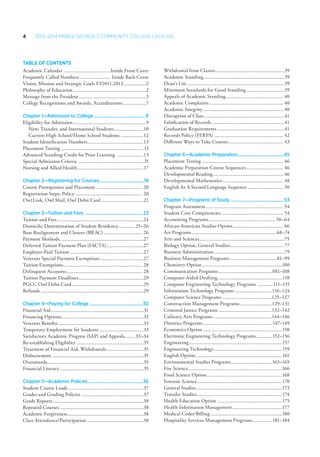
Table of Contents
Academic Calendar......................................Inside Front Cover
Frequently Called Numbers......................... Inside Back Cover
Vision, Mission and Strategic Goals FY2011-2013...................2
Philosophy of Education..........................................................2
Message from the President......................................................3
College Recognitions and Awards, Accreditations...................7
Chapter 1—Admission to College...........................................8
Eligibility for Admission..........................................................9
	 New, Transfer, and International Students........................10
	 Current High School/Home School Students...................12
Student Identification Numbers.............................................13
Placement Testing.................................................................. l3
Advanced Standing-Credit for Prior Learning ......................13
Special Admission Criteria .....................................................l5
Nursing and Allied Health.....................................................17
Chapter 2—Registering for Courses......................................19
Course Prerequisites and Placement...................................... 20
Registration Steps, Policy...................................................... 20
Ow1Link, Owl Mail, Owl Debit Card .................................21
Chapter 3—Tuition and Fees ................................................23
Tuition and Fees.....................................................................24
Domicile: Determination of Student Residency............. 25–26
Base Realignment and Closure (BRAC)............................... 26
Payment Methods...................................................................27
Deferred Tuition Payment Plan (FACTS)..............................27
Employer-Paid Tuition...........................................................27
Veterans Special Payment Exemptions...................................27
Tuition Exemptions............................................................... 28
Delinquent Accounts............................................................. 28
Tuition Payment Deadlines....................................................29
PGCC Owl Debit Card.........................................................29
Refunds..................................................................................29
Chapter 4—Paying for College.............................................30
Financial Aid..........................................................................31
Financing Options.................................................................32
Veterans Benefits....................................................................33
Temporary Employment for Students....................................33
Satisfactory Academic Progress (SAP) and Appeals........ 33–34
Re-establishing Eligibility .....................................................35
Treatment of Financial Aid, Withdrawals..............................35
Disbursement.........................................................................35
Overawards.............................................................................35
Financial Literacy...................................................................35
Chapter 5—Academic Policies..............................................36
Student Course Loads............................................................37
Grades and Grading Policies..................................................37
Grade Reports........................................................................38
Repeated Courses...................................................................38
Academic Forgiveness.............................................................38
Class Attendance/Participation..............................................38
Withdrawal from Classes.......................................................39
Academic Standing.................................................................39
Dean’s List..............................................................................39
Minimum Standards for Good Standing...............................39
Appeals of Academic Standing.............................................. 40
Academic Complaints........................................................... 40
Academic Integrity................................................................ 40
Disruption of Class.................................................................41
Falsification of Records..........................................................41
Graduation Requirements......................................................41
Records Policy (FERPA)....................................................... 42
Different Ways to Take Courses............................................ 43
Chapter 6—Academic Preparation.......................................45
Placement Testing................................................................. 46
Academic Preparation Course Sequences.............................. 46
Developmental Reading........................................................ 46
Developmental Mathematics................................................. 48
English As A Second Language Sequence..............................50
Chapter 7—Programs of Study.............................................53
Program Assessment.............................................................. 54
Student Core Competencies.................................................. 54
Accounting Programs......................................................58–64
African-American Studies Option........................................ 66
Art Programs....................................................................68–74
Arts and Sciences....................................................................75
Biology Option, General Studies........................................... 77
Business Administration........................................................79
Business Management Programs......................................81–99
Chemistry Option................................................................100
Communication Programs...........................................102–108
Computer-Aided Drafting....................................................110
Computer Engineering Technology Programs .............111–115
Information Technology Programs..............................116–124
Computer Science Programs........................................125–127
Construction Management Programs..........................129–131
Criminal Justice Programs...........................................132–142
Culinary Arts Programs...............................................144–146
Dietetics Programs....................................................... 147–149
Economics Option...............................................................150
Electronic Engineering Technology Programs.............152–156
Engineering..........................................................................157
Engineering Technology......................................................159
English Option.....................................................................161
Environmental Studies Programs.................................163–165
Fire Science...........................................................................166
Food Science Option............................................................168
Forensic Science....................................................................170
General Studies....................................................................172
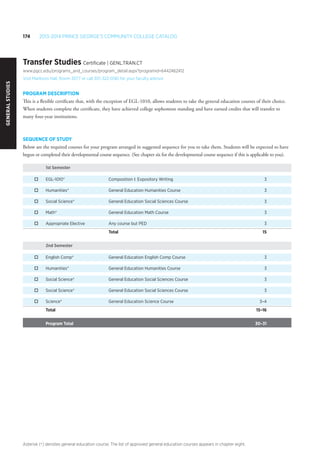
Transfer Studies....................................................................174
Health Education Option....................................................175
Health Information Management........................................177
Medical Coder/Billing.........................................................180
Hospitality Services Management Programs................181–184
2013–2014 Prince George’s Community College 5
Table of Contents
Human Services...................................................................185
Information Security Programs....................................187–190
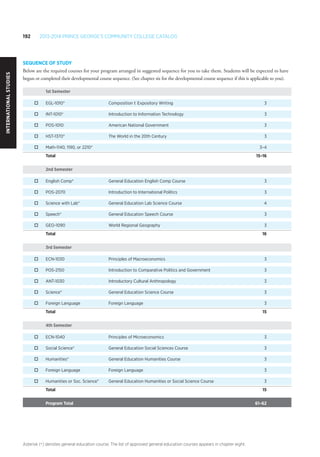
International Studies Option...............................................191
Marketing Management Programs...............................193–195
Mathematics Option............................................................196
Medical Assisting.................................................................198
Media Production................................................................ 200
Meeting and Event Management Programs.................201–203
Music Option...................................................................... 204
Nuclear Medicine Technology............................................ 206
Nursing (RN).......................................................................210
Nursing (LPN).....................................................................213
Paramedic to RN Transition Option....................................214
LPN to RN Transition.........................................................216
Ornamental Horticulture.....................................................218
Paralegal/Legal Assistant Programs..............................219–223
Emergency Medical Technician-Paramedic........................ 224
Paramedic.............................................................................225
Emergency Medical Technician-Intermediate..................... 227
Philosophy Option.............................................................. 229
Physical Education Option...................................................231
Pre-Law Option....................................................................233
Psychology Option...............................................................235
Radiography.........................................................................237
Respiratory Therapy.............................................................239
Sociology Option.................................................................241
Early Childhood Education Programs........................ 243–253
Elementary Education/Elementary Special Education.........255
Secondary Education Programs...................................257–265
Professional Education Courses
	 for Maryland Certification/Recertification.....................267
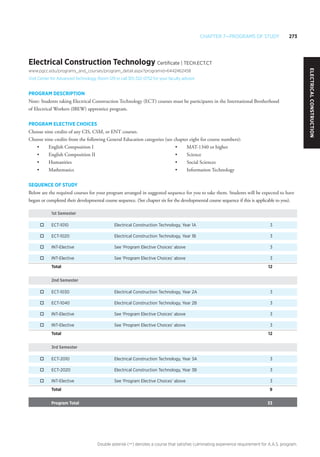
Electrical Construction Technology Programs............271–274
Theatre Arts Option.............................................................276
Theatre and Entertainment Technology...............................278
Women’s Studies Programs......................................... 279–280
Chapter 8—General Studies................................................282
Associate of Arts (A.A.), Associate of Science (A.S.)
	 and Associate of Science in Engineering (A.S.E.)............283
Associate of Applied Science (A.A.S.)................................. 284
Associate of Arts in Teaching (A.A.T.).................................285
General Education List........................................................ 286
Emerging Issues................................................................... 286
English Composition........................................................... 286
Humanities.......................................................................... 286
	 Foreign Languages......................................................... 287
	Literature........................................................................ 287
	Speech............................................................................. 287
Mathematics........................................................................ 287
Science................................................................................. 288
Social Sciences..................................................................... 289
History................................................................................ 289
Student Core Competencies................................................ 290
Chapter 9—Course Descriptions.........................................291
Definitional Terms...............................................................292
Accounting (ACC)...............................................................293
African-American Studies (AFA).........................................295
Anthropology (ANT)...........................................................295
Arabic (ARB)....................................................................... 296
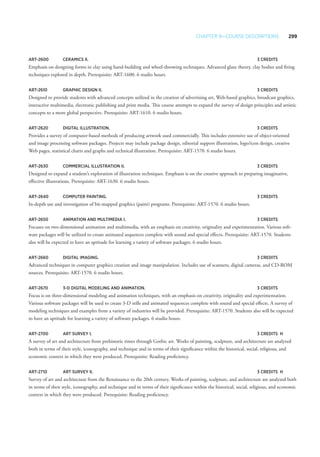
Art (ART)........................................................................... 296
Biology (BIO).......................................................................301
Business Law (BUS).............................................................303
Business Management (BMT)............................................ 304
Business Marketing (BMK)................................................ 308
Business Property Management (BPM).............................. 309
Business Real Estate (BRE)................................................. 309
Career Assessment and Planning (CAP)..............................310
Chemistry (CHM)...............................................................310
Chinese (CHN)....................................................................311
College Learning Skills (CLS)..............................................312
Construction Management (CSM)......................................312
Correctional Services (COR)...............................................314
Criminal Justice (CJT).........................................................314
Culinary Arts (CUL)............................................................316
Developmental English (DVE)............................................317
Developmental Learning Support (DLS).............................317
Developmental Math (DVM)..............................................317
Developmental Reading (DVR)...........................................318
Economics (ECN)................................................................319
Electrical Construction Technology (ECT).........................319
Emergency Medical Technician (EMT)...............................321
Engineering (EGR)..............................................................322
Engineering Technology (ENT)..........................................324
English (EGL)......................................................................327
English as a Second Language (ESL)....................................330
Forensic Science (FOS).........................................................331
Fire Science (FSC)................................................................334
Geography (GEO)................................................................334
Health Education (HLE).....................................................335
Health Information Management (HIM)............................336
History (HST).....................................................................337
Honors..................................................................................339
Horticulture (HRT).............................................................339
Hospitality Services Management (HSM).......................... 340
Human Services (HUS).......................................................345
Humanities (HUM).............................................................347
Information Technology (INT)...........................................347
Mathematics (MAT)............................................................355
Medical Assisting (MAS).....................................................357
Multi-Disciplinary English/History (MLD)........................358
Music (MUS).......................................................................359
Nuclear Medicine Technology (NUM)................................361
Nursing (NUR)....................................................................362
Nutrition (NTR)..................................................................365
Paralegal (PAR)....................................................................365
Paramedic (PMD)................................................................367
Planning for Academic Success (PAS)..................................369
Philosophy (PHL)................................................................369
Physical Education (PED)...................................................370
Physical Science (PSC).........................................................371
Physics (PHY)......................................................................372
6 2013–2014 Prince George’s Community College Catalog
Table of Contents
	Political Science (POS).........................................................373
Psychology (PSY).................................................................374
Public Relations and Journalism (PRJ)................................376
Radiography (RAD)............................................................ 377
Respiratory Therapy (RST)................................................. 380
Service-Learning (SLN).......................................................381
Sociology (SOC)..................................................................381
Spanish (SPN)......................................................................382
Speech Communication (SPH)............................................383
Teacher Education (TED)....................................................385
Television, Radio and Film (TRF)...................................... 390
Theatre (THE).....................................................................391
Women’s Studies (WMS).....................................................393
Work-Based Learning (WBL)..............................................393
Chapter 10—Transfer Opportunities...................................394
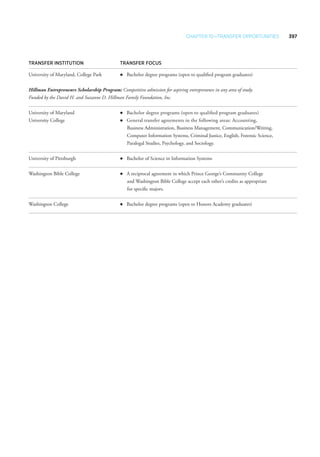
Articulation Agreements......................................................395
Chapter 11—Student Opportunities and Resources.........398
Academic Support Services and Programs...........................399
African-American Studies Institute......................................399
Collegian Centers.................................................................399
Computer Labs.................................................................... 400
Developmental Studies Program......................................... 400
Developmental Math Redesign............................................401
International Education Center...........................................401
International Student Services and Programs...................... 402
Library................................................................................. 402
Marlboro Learning Lab....................................................... 403
Mentoring Program............................................................. 403
Service-Learning................................................................. 403
Tutoring Center....................................................................403
Writing Center.....................................................................403
Campus Life and Activities................................................. 404
Alumni Association............................................................. 404
Bookstore............................................................................ 404
Campus Activities Board..................................................... 404
Child Care Services............................................................. 404
Intercollegiate Athletics....................................................... 405
Student Governance Association......................................... 405
Student Publications............................................................ 405
Honors Programs and Organizations..........................406–408
Psi Beta................................................................................ 408
Scholarship Programs.......................................................... 408
Hillman Entrepreneurs Program......................................... 408
Student Services and Special Programs............................... 408
Advising and Transfer Services............................................ 408
Owl Link and the Academic Advising Process.....................410
My Education Plan...............................................................410
Air Force ROTC..................................................................410
Career Services.....................................................................410
Internship Options...............................................................411
Cashier’s Office.....................................................................411
Counseling Services.............................................................411
Disability Support Services..................................................411
Enrollment Support Services................................................412
Health Education Center.....................................................412
Owl Success Track, First-Year Experience............................412
Prior Learning Assessment Network (PLAN)......................412
Servicemember’s Opportunity College................................413
Student Assessment Services Center.....................................413
Student Support Services (TRiO)........................................413
Transfer Center....................................................................413
Upward Bound (TRiO).......................................................413
Veterans Services..................................................................413
Vocational Support Services.................................................413
Chapter 12—Workforce Development
and Continuing Education................................................... 415
Licensure and Certification..................................................416
Workforce Development Institutes......................................416
Center for Business and Industry Training (CBIT).............416
Community Education........................................................417
Courses and Programs..........................................................418
Adult Education.................................................................. 420
GED Exam Preparation and Adult Basic Education........... 420
National External Diploma Program.................................. 420
English for Speakers of Other Languages........................... 420
Skilled Trades Center.......................................................... 420
Westphalia Training Center................................................ 420
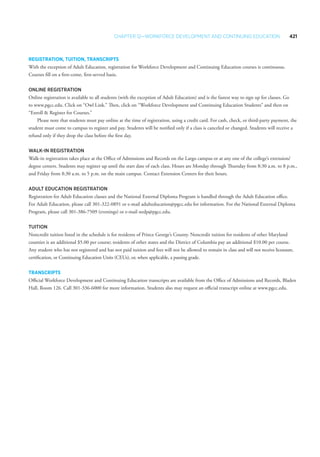
Registration..........................................................................421
Transcripts............................................................................421
Chapter 13—lmportant Policies..........................................422
Emergency College Closings/Delayed Openings................ 423
Student Residency Policy.................................................... 423
Special Admission Policy: Nursing and Allied Health........ 424
Statewide General Education and Transfer Policy...............425
Nondiscrimination Policy....................................................431
Title IX.................................................................................431
Chapter 14—College Employees.........................................432
Administration.....................................................................433
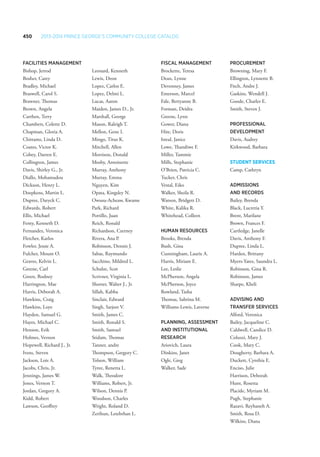
Full-time Faculty and Administrative Staff......................... 434
Emeritus Faculty................................................................. 448
Full-time Staff..................................................................... 449
Chapter 15—Campus Overview..........................................453
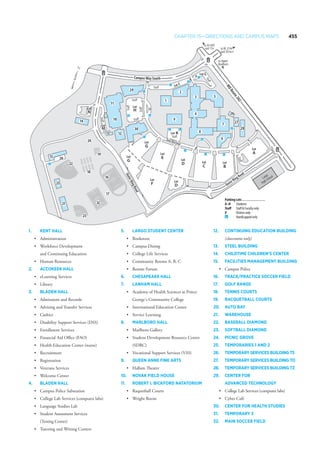
Directions and Campus Maps..................................... 454–455
John Eager Howard Community Center.............................456
Joint Base Andrews/Naval Air Facility (Andrews AFB).......457
Laurel College Center...........................................................458
Skilled Trades Center...........................................................459
University Town Center...................................................... 460
Westphalia Training Center.................................................461
Chapter 16—Appendix......................................................... 462
Glossary of Academic Terms............................................... 463
Index................................................................................... 469
Program Codes.....................................................................481
2013–2014 Prince George’s Community College 7
College Recognitions and Awards
National Center of Academic Excellence in Information Assurance Two-year Education
The National Security Agency and the Department of Homeland Security certified Prince George’s Community College as the lead insti-
tution in Maryland and one of only six community colleges and 100 four-year academic institutions for this certification (2010–2015).
White House Champion of Change
Prince George’s Community College is the only college in Maryland to be selected as a White House Champion of Change for its
commitment to improving completion rates, especially among disadvantaged students, and for its sector-based partnerships.
CyberWatch Awarded Supplemental Grant from the National Science Foundation
CyberWatch, Prince George’s Community College’s Advanced Technological Education Center, has been awarded a supplementary grant
of $676,690 by The National Science Foundation (NSF). To date, the current three-year CyberWatch funding total from NSF is nearly
$3.5 million.
Achieving the Dream College
Selected as one of only 30 community colleges nationwide, Prince George’s Community College was recognized for its dedication to
increasing the number of students who complete and graduate.
Top 25 Associate Degree Producer Among African-Americans
Prince George’s Community College awards the most associate degrees to African-Americans of any college in Maryland, according to
Diverse Issues In Higher Education. The college was ranked number 21 among all colleges in the country for African-American graduates
based on the 2010–2011 U.S. Department of Education’s National Center for Education Statistics.
Accreditations
Prince George’s Community College is accredited by the Middle States Commission on Higher Education, 3624 Market Street,
Philadelphia, PA 19104. Several degree and certificate programs hold accreditations and certifications from academic and professional
organizations as follows:
	 Program of Study	 Accrediting or Certifying Agency
	 Early Childhood Education A.A.S. and A.A.T.	 National Association for the Education of Young Children (NAEYC)
	 Emergency Medical Technician-Paramedic A.A.S. and Certificate	 Maryland Institute for Emergency Medical Services Systems (MIEMSS),
		 The Emergency Medical Services Board
	 Health Information Management A.A.S.	 Commission on Accreditation for Health Informatics
		 and Information Management Education (CAHIIM)
	 Information Security A.A.S. and Certificates	 Committee on National Security Systems
		 and the National Security Agency
	 Nuclear Medicine A.A.S and Certificate	 Joint Review Committee on Educational Programs
		 in Nuclear Medicine Technology (JRCNMT)
	 Nursing LPN Certificate	 The Maryland Board of Nursing
	 Nursing RN A.A.S.	 The National League for Nursing Accrediting Commission (NLNAC)
		 Approved by The Maryland Board of Nursing
	 Radiography A.A.S.	 Joint Review Committee on Education in Radiologic Technology (JRCERT)
	 Respiratory Therapy A.A.S.	 Committee on Accreditation for Respiratory Care (CoARC)
8 2013-2014 Prince George’s Community College Catalog
Chapter 1
Admission to College
Chapter 1—Admissions 9
Office of Admissions and Records
Bladen Hall, Room 126 | 301-336-6000 | admissions@pgcc.edu
www.pgcc.edu/admissions_and_registration/admissions___registration.aspx
No matter what the goal may be or how many times a student has previously attended college, the first step toward enrollment for
credit classes at Prince George’s Community College is to complete and submit an application for admission with a nonrefundable
$25.00 application fee. Students planning to enroll in Workforce Development and Continuing Education classes should not follow
the steps outlined in this chapter. Instead, refer to the procedures found for WDCE students in Chapter 12.
Eligibility for Admission
It is the policy of the Board of Trustees of Prince George’s Community College that admission to the college (though not necessarily
to a specific program or course) shall be open to:
•	 All high school graduates
•	 Holders of high school equivalency certificates or equivalency diplomas
•	 Completers of Maryland state-approved home school programs
•	 Persons 16 years of age or older who have permanently left elementary or secondary school according to the policies
set forth by the Prince George’s County Board of Education
•	 Other high school junior and senior students who have attained the age of 16 and who meet criteria for concurrent
or dual enrollment, as established by the college in coordination with the Prince George’s County Board of Education
•	 Other home school students who have attained the age of 16 and who can document current participation in a
Maryland state-approved home school program and also meet the criteria for concurrent enrollment
•	 Students under the age of 16 identified as Talented and Gifted in accordance with state law and college procedure.
Such applicants are not guaranteed admission and must contact the director of Admissions and Records to review
the special admission criteria and documentation required prior to enrollment.
Students under the age of 16 who claim completion of high school must provide proof of graduation from an accredited United States
high school. In the case of graduation from an online high school program, applicants must supply both proof of graduation and proof
of accreditation of the program attended.
All applicants must complete an application for admission. The college prefers that this be done over the Web by going to the col-
lege’s website, www.pgcc.edu and following the link for Admission & Registration. Printed applications also may be submitted at any of
the college’s locations in the county. The forms are available at all of these locations.
After the application has been submitted the next steps vary depending on the student’s previous academic background. The various
procedures follow. Note: Students who need an F-1 “student” visa must complete a separate application from other students. This application is
also available online or in person, along with a list of all other documents required before the required Form I-20 can be issued.
All prospective students must complete the following steps:
1.	 Submit an Application for Admission either online at www.pgcc.edu or in person at any of the college’s sites—
Largo, Joint Base Andrews, Laurel College Center, University Town Center. Note: The application form for students seeking an F-1
student visa is different from the one used by other applicants.
2.	 Pay a nonrefundable $25.00 application fee. Applicants requesting a fee waiver must apply in person, and must submit docu-
mentation of eligibility for the waiver along with the application. It will not be awarded retroactively.
3.	 Upon receipt of an e-mail from the college regarding Owl Link, the college’s Web-based student system, sign in to
Owl Link and become familiar with the services accessible through this system. The e-mail will contain full instructions.
4.	 Upon receipt of a second e-mail from the college regarding Owl Mail, the secure student e-mail system, follow the instructions
given to activate the assigned Owl Mail account.
10 2013-2014 Prince George’s Community College Catalog
New Students: First time to any college
In addition to the steps required of all students, first-time college students must do the following:
1.	 Submit an official high school transcript or GED (General Education Diploma) score report if a graduate in the past two years.
2.	 Take the college’s placement tests. In some cases, appropriately high SAT or ACT scores may be used to waive these tests.
3.	 Upon receipt of notification either by mail or e-mail, make arrangements to participate in the Owl Success Track Program,
required of all first-year students.
4.	 Meet with a college advisor to review results of the tests and to discuss registration for classes in an upcoming semester.
Readmitted Students: Returning after two or more years
Students who have not attended the college for two or more years must apply for readmission. Readmitted students are encouraged to
meet with an advisor to determine how the program of interest to them may have changed since their last enrollment. They are expected
to follow the curriculum requirements in the catalog in effect at the time of readmission.
Transfer Students: Those coming after prior attendance at another college
Students who have earned credit at another college may be able to use that credit toward a degree at Prince George’s Community Col-
lege regardless of the age of the courses taken. Students also may earn transfer credit from nontraditional sources, such as military or
job training. See the section entitled Advanced Standing later in this chapter for more complete information. In addition to the steps
required of all applicants listed above, transfer students should also do the following:
1.	 Complete and submit a Request for Transfer Evaluation form available online or from the Office of Admissions and Records on
the Largo campus or from any college extension locations
2.	 In addition to or instead of placement testing:
•	 Contact all previous institutions to have official copies of transcripts sent directly to the Office of Admissions
and Records for evaluation. This includes official records of other credit sources such as examinations or military
experience as well a previous colleges. Documents reaching the college 6 weeks or more prior to the start of the
semester will receive processing priority.
•	 Provide unofficial copies of grade reports or transcripts to the academic advisor assisting with the first semester’s
registration if an official evaluation has not yet been completed.
3.	 Students with fewer than 18 prior college credits will be required to participate in the Owl Success Track program for first-year
students and may be required to take all or part of the placement tests prior to registration.
Note: Transcripts from non-United States colleges must be evaluated by an external evaluation service recognized by the college. See the “Transfer
Credit for Work at Other Colleges and Universities”, later In this chapter.
Students with Prior Degrees
Transfer students who wish to take classes at the college but who have already earned an associate degree or higher from an accredited
United States college or university are exempt from all placement tests. They also are free to enroll in a wide variety of courses without
presenting proof of completion of course prerequisites. Students who enroll in a course or courses on the basis of their prior degree as-
sume full responsibility for possession of the background skills and knowledge required for success in the course. Use of this prerequisite
exemption may not be used later as grounds for an exceptional refund or as the basis for challenging a grade. The college reserves the
right to limit the number of courses for which students may enroll using this exemption. Otherwise, students with prior degrees must
follow the same steps as other transfer students.
International Students
Permanent Residents and International Students (non-F-1 Visa holders)
While more than 10 percent of the college’s students are non-citizens, most of them are already living in the community and would be
asked to follow the procedures for new students or transfer students given above. The only additional step for such students is the
requirement to present a visa, passport, or permanent residence card, before their first registration so that their entitlement to in-county
status for tuition purposes may be determined. Those who fail to do this will still be admitted but will be classified as out-of-state
residents for tuition purposes until such time as the documents are provided and a final determination is made. If the applicant’s native
Chapter 1—Admissions 11
language is not English they must also take placement tests for non-native speakers of English and follow any English as a Second
Language (ESL) course recommendations which result. Otherwise, applicants should follow the procedures in place for other applicants
with similar academic backgrounds (first-time student or transfer student).
Students Requesting an F-1 Student Visa
Students requesting admission and the granting of a Form I-20 in order to obtain a student visa must complete a different application
form and must meet additional requirements before admission is granted. Requirements include proof of financial support, housing
and English proficiency as required by the Department of Homeland Security. Early deadlines for admission for F-1 students are May 1
for fall semester admission and October 1 for the spring semester. The college reserves the right to deny an I-20 to any applicant who,
in the college’s judgment, fails to meet the academic, English language proficiency, or financial criteria or who fails to supply requested
information in a timely manner.
F-1 Admission Procedures
1.	 Apply for admission as a degree-seeking student using the special application form for F-1 students. This special application may
be found online at the college’s website, www.pgcc.edu, through the link for Admissions & Registration or through e-mail. A
printed copy can be obtained from the Office of Admissions and Records. The non-refundable $25.00 application fee is required
as well as a $25.00 nonrefundable processing fee. Only applications signed and submitted by the prospective student directly to
the college will be honored. The college will not accept applications mailed or brought to us by anyone other than the student.
2.	 Submit all previous school documents (transcripts), financial certification forms and results of the Test of English as a Foreign
Language (TOEFL) by May 1 for fall or by October 1 for spring. There is no admission of F-1 students Intersession or for the
summer terms.
3.	 Have international documents translated prior to submission to the college. Transcripts from colleges outside the United States
must be submitted to a college-recognized evaluation service for translation and transfer credit recommendations. E-mail inter-
nationalgroup@pgcc.edu for a list of Providers of this service.
4.	 Achieve a minimum score of 450 or better on the paper-based TOEFL, 133 or better on the computer-based TOEFL, or 46 or
better on the Internet-based TOEFL. Applicants admitted on the basis of TOEFL scores are required to take a college-required
examination for course placement prior to registration unless they achieve a score of 550 or higher on the paper-based TOEFL
or 213 or higher on the computer-based TOEFL or a score of 99 or higher on the Internet-based TOEFL.
5.	 Meet with an International Student Services advisor prior to each registration and anytime during a semester when problems
or concerns arise. Students who fail to maintain full-time student status will be terminated from the college and reported to the
Department of Homeland Security.
Note: Applications cannot be accepted from anyone other than the applicant. The printed International Application for Admission must be com-
pleted, signed and returned directly to the college by the applicant in person, through the U.S. Postal Service, or by independent courier service
(UPS, Federal Express, DHL) from the applicant’s current address, without third-party intervention. Sponsors, relatives, friends or others cannot
submit the application on the student’s behalf, though they may provide all other documents.
F-1 students who wish to have money sent directly to the college for payment of tuition and fees are limited to a per-semester amount
of $4,300. (Checks with a total amount higher than this will not be accepted.) Any refund due the student will be issued in accordance
with the refund time lines in effect for that semester.
Each F-1 student admitted to Prince George’s Community College will receive a letter of admission as well as a form I-20.
Documents will indicate the date by which the student is to report to the college. Students who do not abide by the listed dates may be
denied admission/registration and have their I-20 canceled in SEVIS, the automated tracking system used by the Department of
Homeland Security.
Students, by accepting the I-20 form, agree to maintain full-time status during their studies in the United States and to inform the
Office of Admissions and Records of any change of address, program of study, or other pertinent information within 15 days after the
change has occurred. Note: Acceptance of the I-20 form from Prince George’s Community College to use for the receipt of an F-1 visa precludes
any residency classification other than out-of-state for tuition purposes.
12 2013-2014 Prince George’s Community College Catalog
Undocumented Students
Undocumented students are welcome to attend the college. Students should follow the admission procedures above that match their
academic situation—first-time college, transfer student, etc. Undocumented students will be classified as out-of-state residents for tuition
purposes unless they qualify for lower rates under the Dream Act.
Current High School/Home School Students
Students who are still in high school or involved in a state-recognized home school program may be eligible to take college courses
as follows:
Concurrent or Dual Enrollment—AGE 16 or Older
The Concurrent Enrollment Program and the Dual Enrollment Program are for those 16 or older who wish to take courses from the col-
lege while still enrolled in high school or an approved home school program. Students must be high school seniors or, if in an approved
home school program, provide documentation of the completion of junior-level work. High school juniors may be eligible for partici-
pation provided they are 16 years of age and have completed all high school coursework in a particular field with a 2.50 cumulative
grade-point average and a 3.00 in the field in question. Students should speak with their high school counselor before deciding whether
to participate in the Concurrent Enrollment or the Dual Enrollment Program, since there are some important differences between them.
In addition, each student must:
1.	 Have a cumulative grade-point average of 2.50 or the equivalent;
2.	 Be certified by the school principal or equivalent authority as approved for participation;
3.	 Identify themselves as concurrent enrollment or dual enrollment students under “Program of Study”;
4.	 Take relevant college placement tests, achieving college-level placement scores, prior to registration;
5.	 Take no more than two courses each semester; and
6.	 Abide by all college policies, procedures and regulations while on campus or in the classroom.
Students who wish to attend the college full time in place of their senior year of high school or home study should contact their principal
or comparable home study coordinator during the 10th grade to learn more about this Early Admission option.
Underage Students—Talented and Gifted Program
The Talented and Gifted program (TAG) is for students under 16 years of age who do not yet have a high school diploma or GED
and who cannot meet the grade-level or age requirements for concurrent enrollment. Such students must meet one or more of the
following criteria:
7.	 Identification by the student’s public school Board of Education or private school governing board as talented and gifted accord-
ing to their published criteria.
Completion of at least the seventh grade and a standardized test score of 1200 on the SAT (with no
less than 500 in either the verbal or math portion) or 22 on the ACT. Designation as a PSAT/NMSQT finalist or semifinalist
also will suffice.
8.	 Admission to a recognized TAG program in the state of Maryland or identification by local professionally qualified individu-
als or entities as having outstanding abilities in a particular field that would qualify them for advanced study in that area. The
college reserves the right to determine whether or not it will recognize a program or professional entity as meeting this criterion
prior to accepting the recommendation.
9.	 Students who are home schooled may, in lieu of the first two criteria listed, be assessed by a psychometrist or other professional
qualified to administer and interpret the results of one of the following tests: Comprehensive Test of Basic Skills, Test of Cogni-
tive Skills, or WISC-III. The student must score in the 95th percentile or higher by age.
In addition to the preceding, any student who wishes to enroll under this program must:
1.	 Take the college’s placement test battery and achieve scores indicative of readiness for college-level work in all three areas—
reading, English and mathematics.
2.	 Attend an interview with the director of Admissions and Records to review program requirements. One or both parents/guardians
also must be present. In no instance can this interview be held in the absence of the student.
3.	 Enroll in no more than two daytime courses per semester with continuance dependent upon satisfactory performance in all
previous semesters.
Chapter 1—Admissions 13
For necessary forms and more information on this special admission program, contact the Office of Admissions and Records,
301-336-6000.
Student Identification Numbers
Every student who applies for admission to the college will be immediately issued a unique, randomly selected student ID number.
This identification number will be the student’s unique identifier in the college’s computer system. Students must take care to learn and
remember this ID number in order to interact with the college’s Web services and in order to request and obtain documents such as
transcripts or enrollment verifications.
Current students and new students who applied in person will receive their ID numbers at the time of application. Students apply-
ing over the Web will see their ID numbers within an e-mail sent by the college within two working days after the application is submit-
ted. This e-mail also will give instructions on activation of the student’s Prince George’s Community College Web account in Owl Link.
It is the student’s responsibility to protect their unique number from use by other individuals. The college takes every precaution to
protect students’ identities from unauthorized access but will assume no responsibility for security violations which occur as a result of
the student sharing his or her ID number with another individual.
Placement Testing
Student Assessment Services | Bladen Hall, Room 100 | 301-322-0147
To ensure a foundation for college-level instruction, students seeking enrollment in credit courses for the first time will be required to
demonstrate basic academic skills—proficiency in reading, written expression and mathematics—through placement testing or through
completion of developmental coursework.
Students who earn a minimum SAT critical reading or math score of 550, or an ACT composite score of 21 may have all or part of
the placement test waived. Official SAT or ACT score reports should be sent to the Student Assessment Services Center so that scores
can be posted to the student’s record.
Basic skills (placement) testing for new students must be completed after the admissions application is submitted but before course
registration. Following the test, students must arrange to meet with academic advisors to discuss examination results, course placements
and future educational plans. Students transferring from other institutions may be exempt from all or part of this test battery, provided
they bring proof of successful completion of prerequisite courses with them for advisor or departmental approval prior to their first
registration and provided that an official evaluation of previous college work has been completed prior to any subsequent registration.
Students who hold degrees from other United States colleges or universities are exempt from all placement testing requirements.
Placement tests are given at Prince George’s Community College at Joint Base Andrews, Laurel College Center and Prince George’s
Community College at University Town Center, as well as on the Largo campus.
Students whose native language is not English and whose English skills are limited will be asked to take an appropriate alternative test
designed to assess their level of English proficiency prior to their first registration.
In cases where a student’s basic academic skills as measured by the placement test do not meet the minimum standards as established
by the instructional departments, successful completion of prescribed developmental courses will be mandatory before enrollment in
related courses can be accomplished.
Advanced Standing—Credit for Prior Learning
Students may be awarded credit for prior educational experiences in which college-level learning may be verified through documentation
or assessment. A maximum of 45 credit hours may be transferred for any one associate degree, of which not more than 30 credits may
have been earned through nontraditional or noncollegiate sources.
Transfer Credit for Work at Other Colleges and Universities
Students who enroll at Prince George’s Community College after completing one or more semesters at another college or university
may be eligible to receive credit toward their community college degree without regard to the age of the prior credits. The following
guidelines apply:
•	 The student must request an evaluation by completing a Request for Transfer Evaluation form available online or from the
Office of Admissions and Records or at any extension center. The student must clearly indicate the curriculum to which the
incoming credits are to be applied and all institutions from which transcripts will be coming.
14 2013-2014 Prince George’s Community College Catalog
•	 The student must arrange to have official transcripts from United States colleges previously attended sent to the Office of
Admissions and Records. No evaluation of transfer credits will be done until official transcripts are received from each source
from which credits are to be transferred. Transcripts should be mailed to Prince George’s Community College, Transfer
Evaluator, 301 Largo Road, Largo, MD 20774.
•	 Transcripts from colleges and universities outside the United States must be sent to a college-recognized evaluation service such
as World Education Service for translation and credit recommendations. E-mail transfercredit@pgcc.edu for more information.
•	 All credits earned previously with passing grades are transferable provided they are applicable to the student’s program of study
at Prince George’s Community College (refer to program requirements in Chapter 5). However, the overall grade point average
for the courses transferred must be at least 2.00. Note: No grade below a C will transfer from any out-of-state institution when the
student’s cumulative GPA at that institution was below a 2.00.
Prince George’s Community College will honor waivers of required courses by the sending institution due to the student’s demonstrated
proficiency, but an equal number of credits must be earned in other coursework.
Credit for Nontraditional Learning:
Work and Military Experience
A maximum of 30 college credits may be awarded for various educational and training activities conducted by such noncollegiate
organizations as the military, businesses and government agencies, and proprietary schools. In general, the college conforms to the credit
recommendations of the American Council on Education (ACE), which has undertaken the evaluation of noncollegiate learning experi-
ences available through industry and various government agencies as published in The National Guide, available through ACE. The col-
lege also will grant credit for military training that has been evaluated by the Office of Educational Credit and Credentials of ACE. For
further information or assistance, contact the Office of Admissions and Records, e-mail transfercredit@pgcc.edu if you have questions.
Credit for Military Training
To receive credit for military training, students must complete the Request for Transfer Evaluation form, attach a copy of the DD-214
and have military transcripts (AARTS, SMARTS, CCAF) sent to the Office of Admissions and Records. Note: Students receiving veterans
educational benefits are required by the Department of Veterans Affairs to do this before the end of their second semester of attendance to avoid
interruption of benefit payments.
Prior Learning Assessment Network (PLAN)
Students whose personal and professional experiences provide evidence of mastery of college-level subjects may find portfolio assess-
ment an appropriate method of gaining credit for their knowledge and skills. Students who wish to apply for credit through portfolio
assessment are required to attend an orientation, meet with a PLAN advisor and petition to register for a three-credit hour course,
CAP-1050—Portfolio Development. The purpose of this course is to guide students through the process of assembling the necessary
documentation and evidence for learning experiences worthy of credit. The completed portfolio is reviewed and evaluated by faculty in the
appropriate subject matter areas who determine if credit is to be awarded. A 15-credit limit per degree exists for portfolio or challenge ex-
ams. Since writing skills are critical in this process, students must test as eligible for EGL-1010 or have completed at least the equivalent
college-level writing course prior to registration in CAP-1050. For further assistance or to sign up for an orientation, contact the Prior
Learning Assessment Network (PLAN) Office, Bladen Hall, Room 124, or call 301-322-0151.
Credit through Examination
AP, IB and CLEP Examinations
Students may earn nontraditional credit through three national testing programs. The College Board’s Advanced Placement program
(AP), available to high school students, gives the opportunity to enter college with credit already earned toward a degree. The Interna-
tional Baccalaureate (IB) accomplishes the same thing. The College-Level Examination Program (CLEP) affords that same opportunity
to adults who have expertise in a subject.
Students who wish to have their AP, IB or CLEP results evaluated for transfer credit should have official score reports sent directly to
the college’s Office of Admissions and Records and complete a Request for Transfer Evaluation form, also available from that office.
For more information, including a current listing of AP, IB or CLEP exams honored by the college for award of credit, contact the
Office of Admissions and Records, Bladen Hall, Room 126, Or e-mail transfercredit@pgcc.edu.
Chapter 1—Admissions 15
Challenge Examinations
Students who wish to earn college credit by demonstrating their prior mastery of the content of certain courses may participate in the
college’s Challenge Examination Program. Challenge examinations are prepared and graded by college faculty members and adminis-
tered by Student Assessment Services. If a passing score is obtained, credit is granted for the course, although no grade is assigned and
the credit awarded is designated on the student’s transcript as having been earned by examination. A 15-credit limit per degree exists for
portfolio and challenge exams. For further information, including a list of available examinations, contact Student Assessment Services,
Bladen Hall, Room 100, or call 301-322-0147.
Credit through Examination/Portfolio Restrictions
A student may not use a credit-through-examination procedure, which includes CLEP, challenge or competency examinations, or portfo-
lio assessment, for the purpose of improving a grade or removing a withdrawal or incomplete from the academic record. A 15-credit limit
per degree exists for any combination of portfolio or challenge exams.
Prince George’s County Tech-Prep
Prince George’s Community College, Prince George’s County Public Schools, Prince George’s County Chamber of Commerce and
Prince George’s County Economic Development Corporation participate in a consortium designed to ensure that high school students
acquire more rigorous academic and technical competencies. A coordinated sequence of courses prepares students for lifelong learning
and provides a choice of career options including employment, advanced study at Prince George’s Community College and transfer to
four-year colleges and universities.
Students who have completed an approved Tech-Prep program in high school may be eligible for credit at the college, provided
they enroll within two years of graduation, enter a program directly related to the high school program and submit their high school
transcript and Tech-Prep certificate of completion for evaluation.
Special Admission Criteria
Health Sciences Programs
Admission to the college does not guarantee admission into any of the health science clinical programs. The programs listed below
have limited enrollment capacity and rigorous academic standards. Each requires additional procedures for selective admission, initial
enrollment and continuation in the program. Therefore, there is a special process, called petitioning, associated with admission into each
program. Interested students must contact an advisor to discuss the petitioning process and the minimum requirements in place for each
clinical program.
•	 Paramedic*†
•	 Health Information Management†
•	 Medical Assisting†
•	 Medical Coder/Billing Specialist Certificate†
•	 Nuclear Medicine Technology—A.A.S. and Certificate†
•	 Respiratory Therapy†
•	 Nursing (LPN) Certificate Program†
•	 Nursing (RN) Degree Program†
•	 LPN to RN Transition Program†
•	 Radiography†
* Employees of the Prince George’s County Fire/EMS Department will receive priority admission.
† Designated as either Health Manpower Shortage or Statewide Instructional Programs. Out-of-county Maryland residents should
review the information about these programs in chapter 3.
Priority will be given to admission of Prince George’s County residents when possible. However, in programs designated as Statewide
Instructional Programs, 10 percent of the available seats will be reserved for residents of other Maryland counties until a priority registra-
tion deadline published in the schedule of classes has passed. Remaining seats will then be made available without regard to county of
residence. Per the articulation agreement with the College of Southern Maryland (CSM), the Radiography and Respiratory Therapy
programs reserve 25 percent of their seats for transfer students from CSM until the priority registration deadline published in the sched-
16 2013-2014 Prince George’s Community College Catalog
ule of classes has passed. At that time, any remaining seats become available to the best qualified petitioners still in the pool, regardless of
county residence.
Out-of-state residents will be accepted only if remaining seats exist after all qualified Maryland residents have been admitted. Students
attending the college on a non-domiciliary visa, as determined by the college, will not be considered for admission to any of these programs.
Students petitioning these programs must submit a copy of their social security card as part of their petition.
Students interested in petitioning for admission to any of these programs must first meet with an advisor to obtain a list of admis-
sion criteria and prerequisite coursework. The petition for program admission should not be completed until all criteria have been met
or the student is enrolled in and attending the last prerequisite course. Students currently enrolled in one health science clinical program
may not petition for admission to another clinical program. Students who wish to enroll in a different clinical program must officially
graduate or withdraw from the current program before filing a petition for a new clinical program. Advisors’ offices are located in Bladen
Hall, Room 124. Call 301-322-0151 for more information.
A criminal background check and drug screen are required of all students in the health science clinical programs. Continued
participation in each program is contingent upon a satisfactory response on the background check and drug screen. All information on
the background check and drug screen remains confidential and is only shared with the requesting clinical agencies. If a clinical agency
denies clinical placement for a student because of the background check or drug screen, that student may not be able to complete the
clinical program. The cost of the criminal background check and drug screen are the responsibility of the student. Specific information
related to the process used for obtaining a criminal background check and drug screen will be discussed with students at orientation. For
a current price of the criminal background check and drug screen, please contact AlliedHealthandNursingOffice@pgcc.edu. Students,
at their own expense, may also be required to submit to random urine drug testing at clinical sites. Results of random urine drug testing
may result in the student not being able to complete the clinical program.
All students in health science clinical programs are required to submit a completed health assessment form, verifying general health,
immunization status, and ability to meet the program’s technical standards. Students with incomplete health records on file with the
College will not be able to complete the clinical program. It is highly recommended that clinical health sciences students carry health in-
surance. At the request of a clinical agency, students may be required to show proof of health insurance. If a clinical agency denies clinical
placement for a student because of lack of health insurance, that student may not be able to complete the clinical program.
Students should be aware that the courses and grades indicated on the following page are the minimum standard to be met for
program consideration. If there are more petitioners than seats in a class, then students will be ranked according to their cumulative GPA
in all general education courses required by the program in question, not just those which are required to petition. Students with the best
GPAs for the greatest number of required general education courses will be admitted first, followed by those with lower GPAs and fewer
completed courses, until the class is filled.
For details regarding entry to these limited enrollment programs, contact an academic advisor, 301-322-0151. Advisors’ offices are
located in Bladen Hall, Room 124.
Associate Degree Progression Policy Addendum for Graduates
of the Prince George’s Community College Practical Nursing Program
Graduates of the Prince George’s Community College Practical Nursing (LPN) certificate program who have an active, unencumbered
Maryland LPN license and have successfully completed the required prerequisite courses for the associate degree in nursing (including
BIO-2010 and MAT-1120) with a grade of C or better may petition for direct admission into the second year of the nursing program
without taking the LPN-RN transition course (NUR-1060). To be eligible, LPN graduates must have completed the certificate program
within the five-year period prior to taking the first course in the second year of the RN program. Those LPN graduates who finished the
program more than five years before beginning the RN courses must successfully complete NUR-1060 in order to be admitted to the
second year.
The petition deadlines for students who fall within the five-year window for admission to the second year are March 1 for the fall
semester and October 1 for the spring semester.
Petitioners must provide written evidence of recent clinical practice and experience for at least six months following receipt of the
Maryland LPN license and prior to petitioning. Employment verification forms may be obtained in the Advising Office, Bladen Hall,
Room 124, or the Department of Nursing, Center for Health Studies, Room 1402.
Successful petitioners will be admitted into the third semester of the associate degree program (RN).
Chapter 1—Admissions 17
Nursing and Allied Health—Prerequisite Courses
Each health science clinical program requires that students complete certain prerequisite courses, listed below, with grades of C or higher,
maintain a specified GPA and meet program-specific requirements prior to petitioning for admission to that program. In some cases,
students may petition while currently enrolled in their final prerequisite courses. Students may repeat a prerequisite course only once
to achieve the required grade. Please note that the criteria listed below are the minimum requirements for consideration. There is no
guarantee of admission to any of these programs based solely upon meeting the minimum standard.
Paramedic (A.A.S. and Certificate)
•	 Deadline for petitioning is August 1 for the A.A.S and May 1 for the Certificate
•	 Eligibility for EGL-1010 and MAT-0104 (formerly MAT-1040)
EMT-B Certification
•	 Completion of an approved EMT-I curriculum or EMT-I licensure
A.A.S.–Health Information Management Certificate–Medical Coder/Billing Specialist
•	 Deadline for petitioning is July 1. If seats remain, petitions will be accepted through the end of the summer term.
•	 INT-1010, BIO-1010, BIO-2050
•	 Eligibility for EGL-1010
•	 Eligibility for MAT-1140 (A.A.S.)
•	 Eligibility for MAT-0104 (formerly MAT-1040) (Certificate)
•	 An average GPA of 2.00 or better for the three courses listed with no grade below a C
Nursing (RN and LPN)
•	 Deadline for petitioning for LPN is April 1 only.
•	 Deadline for petitioning for RN is April 1 for fall and November 1 for spring.
•	 EGL-1010, PSY-1010, BIO-1010, BIO-2050, and BIO-2060
•	 RN only: NUR-1010 and MAT-1120 or higher
•	 LPN only: NUR-1000 and eligibility for MAT-1120 or higher
•	 An average GPA of 2.50 or higher for all courses listed with no grade below a C
Nursing Transition (LPN to RN and EMT/Paramedic to RN)
•	 The following courses must be completed prior to petitioning:
EGL-1010, MAT-1120 or higher, PSY-1010, BIO-1010, BIO-2050, BIO-2060, and BIO-2010
•	 Students are strongly encouraged to complete all other general education courses prior to enrollment in the transition course,
NUR-1060 (LPN to RN) or NUR-1070 (EMT to RN).
•	 An average GPA of 2.50 or higher for the seven courses listed with no grade below a C
LPN to RN also requires:
•	 Petitioning deadline of March 1 for fall and October 1 for spring.
•	 Current Maryland LPN License (or Compact License from another state) see page 16 for special requirements for
graduates of the Prince George’s Community College LPN program.
Paramedic–RN also requires:
•	 Petitioning deadline of February 1 for summer.
•	 Current Maryland license as a paramedic and National Board of Registry Certification (NREMT)
•	 Must be a graduate from an accredited program.
18 2013-2014 Prince George’s Community College Catalog
Medical Assisting (A.A.S.)
•	 The deadline for petition is June 1.
•	 An average GPA of 2.00 or higher
•	 Eligibility for EGL-1010 and MAT-0104 is required
Nuclear Medicine Technology (A.A.S. and Certificate)
•	 This program begins only in the spring semester. Deadline for petitioning is November 1.
•	 BIO-1010, BIO-2050, MAT-1350, CHM-1010, PHY-1010, HIM-1800, PSY-1010, EGL-1010, EGL-1020, and SPH-1090
•	 An average GPA of 2.50 or higher for the nine courses listed with no grade below a C
Note: License or certification in Radiography, Respiratory Therapy, Medical Technology, Radiation Therapy,
or Nursing required for admission to the certificate program.
Radiography
•	 This program begins only in the fall semester. Deadline for petitioning is May 1.
•	 EGL-1010, BIO-1010, BIO-2050, BIO-2060, MAT-1120 or higher, HIM-1800 (formerly MHE-2000)
•	 An average GPA of 2.50 or higher for the five courses listed
Respiratory Therapy
•	 This program begins only in the fall semester. Deadline for petitioning is May 1.
•	 BIO-1010, MAT-1120, BIO-2050, BIO-2060, and PSC-1150 or CHM-1010
•	 Eligibility for EGL-1010
•	 An average GPA of 2.50 or higher for the four courses listed with no grade below a “C”
Chapter 2—Registering for Courses 19
Chapter 2
Registering for Courses
20 2013-2014 Prince George’s Community College Catalog
While students apply for admission only once during a period of attendance at the college, they must register for classes every semester
they wish to attend. Registration involves selecting courses each semester that meet the student’s academic needs and are offered in a
manner consistent with each student’s time and place requirements.
The process can be found online at www.pgcc.edu/admissions_and_registration/registration_information.aspx
Course Prerequisites and Placement
Most courses require a student to possess a certain level of prior knowledge or proficiency in order to be successful in mastering the
subject content of the course. These prescribed levels of prior knowledge or proficiency are known as course prerequisites. Most introduc-
tory level courses do not require other courses to precede them but do require certain levels of proficiency in reading, writing and/or
mathematics. Such basic skills prerequisites are indicated in the course description as “reading proficiency level,” “writing proficiency
level” and/or “mathematics proficiency level” prerequisites. Other courses may require that certain specific courses precede them. In such
cases, the course description will contain a reference to one or more prerequisite courses.
Basic skills in all three areas are assessed using placement tests, which are required of all new college students. Students who do not
achieve satisfactory placement test scores will be required to complete prescribed developmental courses before enrolling in credit courses.
Placement test prerequisites for course enrollment are waived for students who:
•	 Already hold a U.S. college degree (Associate degree or higher)
•	 Have sufficiently high SAT or ACT scores
•	 Have previously completed 12 or more credits of college-level courses having substantially equivalent skills requirements
•	 Have background or work experience, which, in the judgment of the appropriate dean or designee, indicates a reasonable
capability for success in the course(s) in question
First-time college students are expected to take PAS-1010, Planning for Academic Success (3 credits). The course is a required corequisite
for students who must take DVR-0061, College Reading and Study Skills. The PAS-1010 requirement will be waived for students who
completed DVR-0051, Developmental Reading, before the fall 2007 semester. For more information about PAS-1010, see Chapter 9,
under Course Descriptions.
Registration Steps
Classes are filled on a first-come, first-served basis. Students who wait to register until late in the designated period may be forced to take
classes at less than ideal times or places since first-choice classes may be full or otherwise unavailable. The college is committed to using
every available class meeting to further the learning experience. Students are therefore required to be registered for classes prior to their
start and expected to be present on the first meeting day. The registration deadline of 11:59 p.m. the day before a class begins is strictly
enforced regardless of whether or not seats remain available in the course. Consult each semester’s schedule of classes for registration
information and special instructions for enrollment in classes which begin later in the semester. Registration involves the following steps:
•	 Studying a schedule of classes that lists all offerings for a particular semester. The schedule is available online several weeks
before registration begins. Limited quantities of printed copies are also available at each of the college’s locations.
•	 Selecting classes consistent with an academic program, prior coursework and/or placement test scores
•	 Consulting with an academic advisor as needed or required by the college. Students also may determine what courses they need
to take by going to Owl Link and completing the steps needed to create a program evaluation in their current program of study
•	 Registering for classes in person or over the Web, as described in the next section
•	 Paying a tuition bill. Students who register in person will be given a bill at the time they register. Those registering over the
Web may access and pay their bills online as soon as their selection of courses is completed. No registration is considered final
until the bill has been paid.
Registration Policy
Students must register for courses by 11:59 p.m. the day before the class begins. Students who fail to meet the registration deadline may
still enroll in later-starting, accelerated course sections. These offerings may be found in the class schedules. Students also may search for
later starting courses using Owl Link at www.pgcc.edu.
For fall semesters:
•	 By July 15, students must have paid or made arrangements with the college to pay their tuition bills. Any student who has not
done so will be dropped from the courses for which they registered.
Chapter 2—Registering for Courses 21
•	 July 16, and every succeeding registration day, students must make payment for their tuition bill by 11:59 PM or make
arrangement with the college to pay the tuition bill. Any student who has not done so will be dropped from the courses for
which they registered.
For spring semesters:
•	 Two days after the college re-opens from winter break, students must have paid or made arrangements to pay their tuition
bills. Any student who has not done so will be dropped from the courses for which they registered.
•	 Beginning on the third day after the college re-opens and every succeeding registration day, students must make payment for
their tuition bill by 11:59 PM or make arrangement with the college to pay the tuition bill. Any student who has not done so
will be dropped from the courses for which they registered.
Different Ways to Register for Courses
New and newly readmitted students must register in person for their first semester. Returning students may register each semester in any
one of the following ways:
•	 Over the Web using Owl Link, the college’s online registration system at www.pgcc.edu
•	 In person at the main campus in Largo at the Office of Admissions and Records, Bladen Hall, Room 126 or with an Academic
Advisor in Bladen Hall, Room 124.
•	 In person at the Laurel College Center in Laurel, Prince George’s Community College at University Town Center in Hyattsville,
and (for those who have a military ID) at Prince George’s Community College at Joint Base Andrews.
Owl Link
Owl Link is the name of the Web student system at Prince George’s Community College. It empowers the college’s students to access
important online services. Using Owl Link, students are able to register and pay for classes, view the status of financial aid and make ad-
justments to their schedule, Students also can print unofficial transcripts and class schedules, submit address and e-mail address changes
and request official transcripts to be sent to other colleges. Students also are able to interact with an advisor, run program evaluations,
and run “what if” scenarios to see how courses already taken might fit into another degree program. Continuing Education students also
may use Owl Link to, register for classes and pay tuition charges. To access Owl Link, students at Prince George’s Community College
must have a current, working e-mail address on file. Virtually all Owl Link transactions are acknowledged by e-mail, as are responses to
any questions submitted. Current credit students who have not received a User ID and password can get them by contacting the technol-
ogy Help Desk Office located in Bladen Hall, Room 106, on the Largo campus, or by e-mailing that office at helpdesk@pgcc.edu.
Owl Mail
Prince George’s Community College assigns all students a secure student e-mail account, called Owl Mail. Students will receive e-mail
notification to their personal e-mail addresses regarding the availability of their Owl Mail accounts. Upon receipt of that e-mail, stu-
dents should immediately follow the instructions given to activate the Owl Mail account. Failure to do so within 30 days will result
in the account being disabled. Owl Mail is the only e-mail address faculty and staff will use to interact electronically with students. It is
also required in order to participate in online courses and to receive important, timely notices and announcements from the college. It is
critical that students activate their Owl Mail accounts immediately upon receipt of the notice of its availability. Complete instructions on
how to activate the account are included in the notice and available on the Owl Link page.
PGCC Owl Debit Cards
All credit students will receive a PGCC Owl Debit Card issued through Higher One Bank. It will be mailed to the address of record at
the college. This card is very important and must be activated in order to set up a preference for the way refunds from the college to the
student will be delivered. This includes financial aid rebates and VA reimbursements. Students may choose to have refunds and rebates
processed as deposits to their PGCC Owl Debit Card or they may choose to have refunds electronically deposited in another bank ac-
count specified on the Higher One/PGCC Owl Debit Card activation site. The college no longer issues paper checks.
Student ID Cards
Every credit student is required to obtain a Prince George’s Community College photo ID card and to wear it visibly at all times they are
on campus or at any extension center. Students must be able to provide proper identification upon request and to access college programs
and facilities. Such identification must include a properly validated college photo ID card and one other form of photo identification—
22 2013-2014 Prince George’s Community College Catalog
a current driver’s license, a Maryland Motor Vehicle Identification Card, a military ID card or a current passport/work authorization
card/permanent resident card. New students may obtain an ID card from the Library or from the Office of Admissions and Records after they
have registered for classes for their first semester. A paid tuition receipt and another photo ID card or a current passport/work authorization
card/permanent resident card must be presented before obtaining an ID card. Hours of operation are published in the credit class schedules
and are available online. Returning students should go to the Office of Admissions and Records in Bladen Hall or to the Library to have
their ID cards validated for each semester after their first one. Photo ID cards and validation stickers also are available at University Town
Center, Laurel College Center and the Joint Base Andrews degree centers. The photo ID will allow access to various college departments
and services, including but not limited to the Library, computer labs, testing center, natatorium, campus special events and as identifica-
tion at the college’s bookstore. Students who lose their ID card must pay a $10 reissue fee.
Student Code of Conduct
The Prince George’s Community College Code of Conduct, adopted by the Board of Trustees, defines the rights and responsibilities of
students and establishes a system of procedures for dealing with students charged with violations of the code and other rules and regula-
tions of the college. Copies of the code may be obtained from College Life Services Office which is located on first floor of the Largo
Student Center.
Transcripts and Enrollment Verifications
Official copies of transcripts may be obtained upon written request from the Office of Admissions and Records, Bladen Hall, Room 126.
“While you wait” service is usually available during regular business hours. Transcripts may be requested in one of three ways: in person,
by mail, via the Internet (www.pgcc.edu). No transcript will be issued for students with an outstanding debt to the college. Students may
print unofficial copies of their own transcripts through Owl Link, the college’s online student system, provided there is no outstanding
debt. Go to www.pgcc.edu or to my.pgcc.edu for more information.
Enrollment verifications are available free of charge upon written request or upon receipt of a properly signed release form
through an external agency or organization. Such verifications are not done on a while-you-wait basis. All external agency forms are
sent directly to the agency involved. Verification letters may be picked up by the student or mailed to the receiving party.
No enrollment verifications will be issued for a given semester until courses have begun and the refund period for the courses
has passed. The college is a member of the National Student Clearinghouse and reports the enrollment status of all registered students
several times during each semester. The college relies of the Clearinghouse to verify the enrollment and degree attainment of students
to lenders and other external agencies.
The college reserves the right to withhold transcripts or enrollment verifications for any student or former student who has an out-
standing debt to the college, including but not limited to tuition, fees, returned check fees, parking fines, and library charges.
Changes of Program/Not Applicable Courses
Students must designate a program of study or curriculum at the time they apply for admission to the college. The choice of a
program of study is an important one since it dictates what degree requirements a student must meet so long as they are enrolled in that
curriculum. Students who realize that another curriculum is more appropriate to their goals should change the curriculum rather than
continue in one no longer relevant. Students may change a program of study by completing a curriculum change form, available from
the Office of Advising and Transfer Services, Bladen Hall, Room 124. Student interested in changing a program of study will also be
referred to the Career Center to see an advisor before the curriculum change process is completed.
Sometimes when a curriculum is changed, certain courses that were taken in connection with the old program of study may not be
relevant to the new program. A student may request that such inapplicable courses not be counted within the new program of study.
Such requests must be sent to the director of Admissions and Records as part of the proper completion of a curriculum change form.
Courses that are determined to be not applicable to the new program will receive the designation N/A (not applicable) and will no
longer affect the student’s grade point average or be counted toward meeting graduation requirements.
The N/A designation will be applied to courses that were specifically required in the former program of study and that are not ap-
plicable to the new program as required courses or recommended electives. Courses that satisfy a general education requirement are not
eligible for the N/A designation unless the new program of study lists specific general education courses as required courses and courses
taken previously may not be used as approved substitutes for the required courses.
Students requesting this evaluation of their academic record should be aware that all such nonapplicable courses will receive the N/A
designation regardless of the grade earned. Normally, this treatment may be requested only once.
Chapter 3—Tuition and Fees 23
Chapter 3
Tuition and Fees
24 2013-2014 Prince George’s Community College Catalog
Tuition and Fees
Tuition (Subject to Change)
Tuition is charged per credit hour or credit hour equivalent (CEU). The rate varies according to a student’s legal residence.
Prince George’s County residents	 $100.00
Maryland residents, other counties	 $185.00
Out-of-state residents		 $280.00
These rates are subject to change without notice.
Note: Except as otherwise provided, students must pay or otherwise provide for all tuition and applicable fees on the day of registration. If
payment in full is not received the student’s registration will be canceled. Payment should be in the form of cash, personal check, certified check,
money order or approved credit card (Visa, MasterCard, or Discover). Use of financial aid, scholarships, veterans benefits and any other sponsor-
ship which provides payment directly to the college is equally acceptable.
Instructional Services Fee
The instructional services fee is a mandatory per-credit fee for all credit and developmental studies courses offered at the college. The
college annually conducts a discipline cost analysis to determine the costs of the academic disciplines offered at the college and adjusts
the fee accordingly. Beginning with the fall 2013 semester, the Instructional Services Fee is $45.00 per credit.
Other Fees
Fees are charges assessed in addition to tuition. They may be per credit or they may be flat, per-semester or per-course fees. As used in
this section, the word “semester” includes intersession and the summer term as well as the traditional fall or spring semester. Like tuition,
fees are subject to change.
Academic Transcript Fee
Students pay either $6.00 or $8.00 per copy for transcripts. Requests made in person or by mail cost $6.00. Those made over the Inter-
net cost $8.00 per copy.
Application Fee
Any student who applies to the college, either for the first time or after an absence of two or more years, must pay a nonrefundable $25.00
application fee at the time the application is submitted. The college will not bill an employer or other third party for the application fee.
Applied Music Fee (per course)
Students pay a 15-clock-hours per semester fee of $250.00.
Challenge Exam Fee
Students pay a standard $35.00 fee. Some examinations requiring a lab component will cost an additional $15.00. Contact the college’s
Testing Center, 301-322-0147, for details.
Check Stop Payment and Reissue Fees
If a student loses a check or does not receive it due to an incorrect address on file, a $25.00 stop payment fee and a $10.00 check reissue
fee will be assessed. If a check is not cashed within its 90-day validity period, a $10.00 check reissue fee will be assessed.
F-1 Visa Processing Fee
Applicants seeking enrollment at the college under an F-1 student visa will be charged a $25.00 F-1 visa processing fee as part of the
admission process. This fee is in addition to the $25.00 application fee charged to all students.
NBS/FACTS Processing Fee
A student who participates in the college’s deferred tuition payment plan (NBS/FACTS) will be charged a $35.00 processing fee each
semester of participation.
Chapter 3—Tuition and Fees 25
Graduation Fee
A $25.00 graduation fee is payable by each student at the time of application for an associate degree or a certificate. A single graduation
fee is payable by a student receiving more than one degree or certificate in the same academic year. A student receiving one or more
degrees/certificates in different academic years is required to pay a graduation fee in each academic year in which one or more degrees/
certificates is received.
Information Technology Certification Fee
Information Technology (INT) courses leading to CCNA certification, along with several advanced level courses taught through Infor-
mation Technology (INT), assess a special fee of $32.00 per credit to cover costs associated with offering these specialized courses.
Portfolio Evaluation Fee
All students enrolled in CAP-1050 will be charged a $15.00 per credit hour fee for each course submitted for evaluation through the
portfolio assessment process (PLAN).
Registration Fee
Students are charged a $25.00 registration fee for each semester of enrollment in credit courses. This fee is refundable only if all of a
student’s classes are canceled by the college.
Returned Check Service Fee
A $25.00 service charge will be assessed on all checks returned unpaid by the bank. This includes payments stopped by student
or account holder.
Domicile: Determination of Student Residency for Tuition Purposes
While tuition at Prince George’s Community College is charged by the credit hour, the amount charged per credit is determined by a
student’s official place of residence, referred to as “domicile.” A student’s domicile must fall into one of three categories: Prince George’s
County resident; Maryland resident in a county other than Prince George’s County; out-of-state (including out-of-country). In all
instances, a student or the person upon whom the student is dependent must have been a resident of the state and the county for a
minimum period of three months to qualify for in-state or in-county tuition rates.
The full residency policy is given in chapter 13 of this catalog, but several things are worth noting:
•	 Underage students and students who have graduated from high school in the past two years are automatically considered to
be dependents of their parents/legal guardians. They will be considered residents of the county or state in which their parents
reside, unless legal documentation dictates otherwise.
•	 Students in the above category who lived with one parent out of the county or state but who are now living with the noncusto-
dial parent in Prince George’s County or in Maryland may be considered residents of the county or state upon presentation of
a birth certificate containing the appropriate information.
•	 Students claiming residency in Prince George’s County but who graduated from a non-county high school in the past two
years must provide proof of legal dependency on a Prince George’s County resident during the most recently completed tax
year. In addition, if the high school was in another country, proof of citizenship or visa status also must be provided.
•	 Undocumented students are considered non-Maryland residents for tuition purposes unless they qualify for lower rates under
the Maryland Dream Act. Go to www.pgcc.edu and follow the link for International Students to learn more about the criteria
for Dream Act eligibility. Or e-mail admissions@pgcc.edu.
•	 All students should be prepared to document living in the county or state for a minimum period of three months. The college
will use the dates on documents presented as verification of the three-month requirement.
•	 International students must present their visas or other documents in order for a residency classification to be made. Not
all visa holders are able to establish legal domicile in the United States and would therefore be ineligible for county or state
residency status.
•	 It is the student’s responsibility to report a change of address within 30 days of its occurrence. Failure to do so may result in a
hold being placed on the student’s record until satisfactory proof of legal residence is given.
26 2013-2014 Prince George’s Community College Catalog
•	 Post office boxes cannot be used as legal addresses. They may be used as mailing addresses if proof of a legal address has been
provided.
•	 While the college will make every effort to fairly determine a student’s place of legal residence, a lack of acceptable documenta-
tion on the part of the student will result in the student being classified as out-of-state for tuition purposes.
•	 Appeals for change of residence status should be directed to the Office of Admissions and Records. Appeals must be submitted
and resolved prior to the end of the third week of classes. Any changes processed after the third week of the semester will be
effective the following semester.
Exceptions to the Residency/Tuition Policy
Health Manpower Shortage Programs
Maryland residents who do not live in Prince George’s County but who enroll in one of the college’s designated Health Manpower
Shortage Programs (HMSP) are eligible for in-county tuition rates so long as they remain enrolled in that program. This is true regardless
of whether the student’s county of residence also offers the program. Residents from other states do not qualify for this lowered tuition
rate. The following programs currently have the HMSP designation:
•	 Paramedic (A.A.S. and Certificate)
•	 Health Information Management (A.A.S.)
•	 Medical Coder/Billing Specialist (Certificate)
•	 Nuclear Medicine (A.A.S. and Certificate)
•	 Nursing (A.S. and Certificate)
•	 Radiography (A.A.S.)
•	 Respiratory Therapy (A.A.S.)
The state of Maryland will periodically review the needed manpower in these areas, so there is no guarantee that this special designation
will continue to apply to these programs. However, students who have begun one of these programs during the time it is recognized as an
HMSP will be allowed to continue at the reduced tuition rate so long as there is no interruption in enrollment.
To receive the lower rate, students must be formally admitted in an appropriate curriculum and must be taking credit-bearing
courses that count toward graduation in that program. In addition, students may be required to furnish proof of legal residency in the
Maryland county that is listed on their application for admission. And they must provide a copy of their social security card during the
petitioning process. The director of Admissions and Records reserves the right to deny the tuition reduction upon discovery that courses
being taken are irrelevant to the designated program of study.
It is the student’s responsibility to contact the Office of Admissions and Records, 301-336-6000, upon enrollment in an HMSP
program to verify eligibility for and receipt of tuition reductions. Failure to do so by the end of the third week of any semester will forfeit
the reduced rate for that semester.
Base Realignment and Closure (BRAC)
Any individual relocating to Prince George’s County or to the state as a result of a BRAC initiative will have the three-month residency
requirement waived, provided that a copy of the official notice of reassignment or relocation is submitted to the Office of Admissions
and Records, Bladen Hall, Room 126 prior to the start of their first semester.
Chapter 3—Tuition and Fees 27
Payment Methods
Full payment of tuition and fees is expected the day of registration. The college accepts cash, personal checks, money orders, and credit
cards (Visa, MasterCard or Discover) as methods of payment. Other payment options are described below.
Deferred Tuition Payment Plan through NelNet Business Solutions (FACTS)
The college offers a tuition payment plan for credit students for the fall, spring, and summer semesters that allows tuition to be paid in
either four, three, or two installments, depending on the date the plan is activated. Payments are set up under an automatic payment
system from a checking or savings account, Visa or MasterCard with payments being deducted according to the plan’s due dates for the
semester. A $35.00 processing fee is charged each semester.
Arrangements to participate in NBS/FACTS must be made through the Internet by accessing the college’s website (www.pgcc.edu)
and selecting Paying for College, then the Payment Options link to get to the deferred tuition payment plan. Students must be fully
enrolled in the deferred payment plan prior to their tuition due date to avoid being dropped from their classes.
For more information, visit the college’s website or pick up a NBS/FACTS brochure from the Cashier’s Office or the Financial Aid
Office. Both are located in Bladen Hall.
Employer-Paid Tuition
Many students receive assistance from their employers with the payment of tuition and fees. Certain procedures must be followed for
this aid to be properly applied to the student’s tuition bill.
1.	 It is the responsibility of the student to present the purchase order, tuition assistance form or letter of intent at the time of
tuition bill payment.
2.	 The purchase order, tuition assistance form or letter of intent must state the student’s name, social security number, amount to
be paid, billing address, and original signature of person(s) authorizing payment. The bookstore is an independent entity from
the college and is paid directly by the employer. If a student is entitled to a reimbursement for books, he or she must obtain a
separate purchase order, tuition assistance form, or letter of intent addressed to Prince George’s Community College Bookstore.
3.	 The purchase order, tuition assistance form, or letter of intent will not be accepted after payment has been made by the student.
Students paying their own tuition must be reimbursed by the employer or agency. The college will not bill in order to reimburse
the student.
4.	 In the event an employer refuses to pay after receipt of a bill, the student immediately becomes responsible for all tuition
and fees.
Veterans Special Payment Exemptions
Veterans certified to be eligible for the Post 9/11 GI Bill are exempt from the immediate payment of tuition and fees. Those with 100%
eligibility under this program will have all in-county and in-state tuition and fees paid by the Department of Veterans Affairs. Those
eligible at less than 100 percent or those being charged as non-Maryland residents will be held in their classes and then billed for the
amount not paid by the VA. It is important that veterans in this program drop classes they do not wish to take since they will not be
dropped for nonpayment during the registration period as other students are. Failure to neither drop an unwanted course nor attend it
will result in an overpayment situation with the VA and a negative impact on future benefits.
All veterans enrolling through the Post 9/11 GI Bill must provide the college’s Office of Veterans Services with a copy of their letter
or certificate of eligibility by the end of their first semester of enrollment to continue the payment exemption.
Veterans participating in the VA Vocational Rehabilitation program also will have all tuition and fees paid by the Department of
Veterans Affairs provided they have had the proper forms submitted to the college’s Veterans Services Office on their behalf. A tuition bill
and a copy of the VA form authorizing payment must be presented in person to the Cashier’s Office for this benefit to be applied.
If there are any questions regarding this procedure, please contact the Veterans Services Office in Bladen Hall, Room 122 or call
301-583-5282.
28 2013-2014 Prince George’s Community College Catalog
Tuition Exemptions
College Employees
A full- or part-time regular employee who enrolls during his or her nonworking hours in any Prince George’s Community College class
that has at least 10 regularly enrolled students is exempt from payment of tuition. However, all related fees are the responsibility of the
employee, including the Instructional Services Fees.
Senior Citizens
Maryland residents who are age 60 or older at the start of the semester are exempt from the payment of tuition for courses for which
state funding is received. In addition, they are exempt from payment of instructional services fees, but not application fees, registration
fees, and special instructional fees, e.g., applied music fees or telecredit fees.
Notwithstanding the provisions for exemption contained herein, the college reserves the right to cancel classes for reasonable cause,
which may include insufficient enrollment of regularly enrolled (nonexempt) students.
Note: Textbooks, course supplies, and materials are not covered by this exemption. For more information, contact the Office of Admissions and
Records, 301-336-6000.
Maryland Disabled Persons
Any Maryland resident who is out of the workforce because of a permanent disability as designated by the Social Security Act, the
Railroad Retirement Act, or the Office of Personnel Management (in the case of former federal employees) may be eligible for a waiver
of tuition, but not fees, upon enrollment in courses which normally have at least 10 regularly enrolled students. This waiver applies
for up to six credits for non-degree seeking students in credit courses and up to 12 credits per semester for those enrolled in a degree
program or a credit certificate program that leads to employment. It also covers tuition for continuing education instruction designed
to lead to employment, including life skills instruction.
In order to qualify for the waiver, students who wish to take credit courses must apply for financial aid for the appropriate academic
year using the Free Application for Federal Student Aid (FAFSA) prior to requesting the waiver and must present confirmation of that
fact with the waiver application. If awarded, the tuition waiver will be in effect for one academic year, commencing with the fall semester.
It will cover tuition charges remaining after all other forms of financial aid have been applied (excluding loans). Students must re-apply
for the waiver every academic year.
Contact the Office of Admissions and Records, Bladen Hall, Room 126, to obtain the necessary forms to apply for this waiver and
to get a full description of this benefit. Or e-mail your full name and address to enroll@pgcc.edu to have the forms mailed to you. Be
sure to put “Tuition Waiver Forms” in the subject line of your e-mail.
For those who will need accommodations arranged through the college’s Disability Services Office, all documentation supporting the
application for this waiver must be on file three weeks prior to the start of the semester in question. Failure to meet this deadline may result
in the college’s inability to provide the necessary services in time for the start of the semester.
Notwithstanding the provisions for exemption contained herein, the college reserves the right to cancel classes for reasonable cause,
which may include insufficient enrollment of regularly enrolled (nonexempt) students. Note: Textbooks, course supplies, and materials
are not covered by this exemption. For more information, contact the Office of Admissions and Records, 301-336-6000.
Delinquent Accounts
Delinquency in payment of any amount due from a student or former student to the college or under any loan program administered by
the college or failure of financial aid recipients to complete an exit interview before leaving the college will result in denial of registration,
exclusion from classes, withholding of grades, transcripts, degrees, or certificates. The college employs the services of the State Central
Collection Unit (SCCU). One of the SCCU measures is to refer delinquent accounts to the credit bureau. It will remain on the credit
report for the next seven years. If the delinquent account is referred to a collection agency, the student will be held liable for all collection
costs incurred, in addition to the delinquent amount due. These collection costs can add up to one-third additional expense to a student’s
indebtedness to the college.
Chapter 3—Tuition and Fees 29
Tuition Payment Deadlines
Students are to settle the full amount of their tuition bills by deadlines published in each semester’s class schedule, normally the same
day they register, either by payment in full, enrollment in the Deferred Tuition Payment Plan, or through the application of approved
financial aid. Failure to do so will result in all classes being dropped. Students should carefully consult each semester’s schedule of classes
for information regarding deadlines for payment and drops for nonpayment. Students who register and pay for a set of courses and then
later add other courses to their schedule for that term will only be dropped from the added courses if payment for them is not made
the same day. Students who have a remaining balance of $150 or less after all payments and financial aid have been applied will not be
dropped but will be held in their classes and billed for the remaining balance.
PGCC Owl Debit Card
All credit students will receive a PGCC Owl Debit Card issued through Higher One Bank. It will be mailed to the address of record at
the college. This card is very important and must be activated in order to set up a preference for the way refunds from the college to the
student will be delivered. This includes financial aid rebates and VA reimbursements.
Students may choose to have refunds and rebates processed as deposits to their PGCC Owl Debit Card or they may choose to have
refunds electronically deposited in another bank account specified on the Higher One/PGCC Owl Debit Card activation site. The
college no longer issues paper checks.
Refunds
The effective date for the calculation of a refund for a credit course shall be the date the drop/withdrawal form is filed in the Office of
Admissions and Records, or the date the transaction is completed through Owl Link. In the event a course fails to meet the published
number of days prior to the refund deadline, the deadline will be adjusted accordingly.
Effective with the fall 2011 semester, the following schedule for refunds of tuition and fees will apply:
•	 No refund of registration and late registration fee unless all of a student’s courses are canceled by the college.
•	 One hundred percent (100%) tuition and related fees (except registration fees) refunded if courses are dropped before
classes begin
•	 For courses longer than five weeks in length, a 100 percent refund of tuition and fees will be granted through midnight of the
day after the first class meeting day, regardless of the day of the week that may fall on. A 75 percent refund will be granted if
the class is officially dropped by midnight of the third through the ninth calendar day to include the first class day and week-
ends. Students who officially drop a class during calendar days 10 through 14 will receive a 50 percent refund of tuition and
fees. No refunds will be granted after the 14th calendar day. Students are expected to use Owl Link to drop classes on “days
when college administrative offices are closed.
•	 For courses shorter than 5 weeks in length, a 100 percent refund of tuition and fees will be granted through the calendar day
after the first class meeting, regardless of the day of the week that may fall on. A 75 percent refund will be granted if the class
is officially dropped by midnight of the third calendar day, to include the first day of class. No refunds will be granted after
that time. Students are expected to use Owl Link to drop classes on days when the college’s administrative offices are closed.
•	 No refunds after the refund deadlines outlined above. Refunds of payments made by credit card will be refunded to the card
as a credit. Note: This does not apply to credit card payments made against the deferred payment plan.
All other refunds will be issued electronically according to the preference set by the student when activating their PGCC Owl Debit
Card. No paper checks will be issued. Failure to receive reimbursement from an anticipated funding source will not be grounds for
a refund after the deadlines.
30 2013-2014 Prince George’s Community College Catalog
Chapter 4
Paying for College
Chapter 4—Paying for college 31
Financial Aid
What Is Financial Aid?
Simply stated, financial aid is any grant, scholarship, or loan offered for the express purpose of helping a student meet education-related
expenses. Grants/scholarships are regarded as gift assistance and generally need not be repaid. Loans are borrowed money, offered at
various interest rates, which must be repaid over an extended period after the student leaves college or drops to less than half-time
enrollment. Funding for financial aid programs is provided by the Federal government, state government and private organizations and
individuals. More detailed information is available at www.pgcc.edu/Paying_for_College. The Financial Aid Office is located in Bladen
Hall, Room 121 and is open between 8:30 a.m. and 8 p.m., Monday through Thursday and from 8:30 a.m. until 5 p.m. on Friday.
Students also may call 301-322-0822 during these hours. Extended hours are available during peak registration periods for the fall and
spring semesters. Also, more information is available at www.pgcc.edu/paying_for_college/paying_for_college.aspx
What Is Financial Need?
Many financial programs, most notably, federal student financial aid programs, are awarded to students based on their financial need.
Financial need is the difference between the expected cost of attendance at Prince George’s Community College and the student’s or fam-
ily’s expected ability to pay based on the FAFSA results. (Cost of attendance may include tuition, fees, books and supplies, transportation,
and miscellaneous expenses.) The information reported on the application for aid is used in a formula established by the United States
Congress that calculates Expected Family Contribution, an amount the student or family is expected to pay toward the student’s education.
Who Is Eligible for Financial Aid?
To be potentially eligible, a student must:
•	 Be a U.S. citizen or eligible noncitizen.
•	 Have a valid Social Security Number (unless you’re from the Republic of the Marshall Islands, the Federated States of
Micronesia, or the Republic of Palau).
•	 Be registered with Selective Service if you are male and 18 to 25 years of age (go to www.sss.gov for more information).
•	 Have a high school diploma or a General Education Development (GED) Certificate or have completed a high school
program in an approved home school setting.
•	 Be enrolled or accepted for enrollment as a regular student working toward a degree or certificate in an eligible program.
•	 Not have a drug conviction for an offense that occurred while you were receiving federal student aid (such as grants,
loans, or work-study).
•	 Not owe a refund on a federal grant or be in default on a federal student loan.
•	 Demonstrate financial need (except for unsubsidized Stafford Loans).
How to Apply for Financial Aid
The first step in applying for financial aid is to complete the Free Application for Federal Student Aid (FAFSA). The application may be
completed electronically at www.fafsa.ed.gov. Follow the steps and instructions on the website. Be sure to secure your PIN number. This
will provide you with the speediest processing of your application. Be sure to list Prince George’s Community College’s code (002089)
on your FAFSA. If selected for verification, you will have to select the IRS data retrieval option on your FAFSA. If you do not select this
option or are unable to use the retrieval option, you will be required to obtain an official tax transcript from the IRS. No copies will be
accepted. New for 2013–2014, some students will be selected to show up in person to sign another statement of educational purpose and
show a government issued ID.
The FAFSA must be completed once each academic year for which financial aid is requested. In addition to completing the FAFSA,
the student (and his or her parents, if dependent) may be required to provide additional information to verify their eligibility to receive
financial aid. The additional information can include official tax transcripts as well other documentation such as proof of citizenship,
high school graduation, or other proof to show that the student meets all eligibility requirements.
32 2013-2014 Prince George’s Community College Catalog
Financial Aid Application Deadlines
Students who want to be assured that their paperwork will be processed for timely use in a given semester must have all applications and
required documents on file in the Financial Aid Office by the following priority deadlines:
March 1	 For Maryland State Scholarships (Maryland residents only)
March 1	 For aid beginning in the fall semester
November 1	 For aid beginning in the spring semester
To meet these priority deadlines, students should complete and file the FAFSA by March 1 for the fall semester and by November 1
for the spring semester. Students whose complete paperwork fails to reach the Financial Aid Office by the priority deadlines should be
prepared to pay tuition and fees themselves. Such payments may later be reimbursed once eligibility for aid has been determined and aid
has been authorized.
Financing Options
Federal Financial Aid Programs
Federal financial aid programs offered at Prince George’s Community College include the Federal Pell Grant, Federal Supplemental
Educational Opportunity Grant (FSEOG), Federal Work-Study Program, and Federal Direct Student Loan Program. More detailed
information about the federal financial aid programs is available on the Student Aid on the Web, www.studentaid.ed.gov. Choose the
“Funding Your Education” Option under “Applying for Financial Aid” to get current, comprehensive information on these Federal
student financial aid programs.
Maryland State Scholarship/Grant Programs
Scholarship awards are made by the Maryland Higher Education Commission to eligible Maryland residents who show academic
promise and demonstrate financial need. The deadline for filing the FAFSA is March 1 for the upcoming academic year. Information and
applications may be obtained from high schools, the college, or the Maryland Higher Education Commission at 1-800-974-0203 or visit
their website at www.mhec.state.md.us. Maryland Part-Time grants may be awarded to part-time, degree seeking Maryland students who
are enrolled in six to 11 credits during the fall or spring semester.
Prince George’s Community College/Foundation Scholarships
Scholarships at Prince George’s Community College are available for new and returning students. Many competitive scholarships are
awarded annually to both full- and part-time students. Please contact the Financial Aid Office for a scholarship booklet and application
forms in the spring semester for the upcoming academic year.
District of Columbia Assistance Programs
Students who are residents of the District of Columbia may qualify for financial assistance from the District Financial Assistance
programs available. These include D.C. Tuition Assistance (TAG) and D.C. Leveraging Educational Assistance Partnership Program
(LEAP). Students may apply for either program using the D.C. OneApp which is located at www.seo.dc.gov. The application is available
on January 1 and must be filed by June 30 each year. Students must apply and meet the program specifications on an annual basis.
AOBA Scholarship Program
A number of full-tuition scholarships are available for Prince George’s County high school seniors or high school graduates within the
last three years, who have been accepted for admission or are enrolled in Prince George’s Community College. Students must have a
minimum 2.5 cumulative high school/college grade point average and demonstrate financial need. Students should ask their guidance
counselors for applications or request applications from the Financial Aid Office.
Honors Academy Scholarships
Students who are academically outstanding and are interested in a rigorous program of study, college and community service, and
leadership compete for admission to the Honors Academy. Students admitted to the Honors Academy and who maintain their eligibility
receive full tuition and fees scholarships at Prince George’s Community College and financial assistance when they transfer to one of the
college’s Honors Academy partnering four-year institutions. For more information about the Honors Academy, see chapter 11.
Chapter 4—Paying for college 33
Legacy Scholarships
The Prince George’s Community College Board of Trustees annually awards a predetermined number of scholarships to Prince George’s
County high school graduates who demonstrate high academic ability. Beyond the minimum academic criteria of an outstanding student
record, students must possess excellent leadership and service-oriented skills. A scholarship selection committee selects eligible students
from among those graduates who meet the eligibility requirements and will be attending Prince George’s Community College. For more
information, graduating seniors should contact their high school guidance counselors or call the Office of Recruitment or the Financial
Aid Office at the college.
Health Manpower Shortage—Tuition Reduction for Nonresident Nursing Students
Students from outside the state who are formally admitted and enrolled in an education program leading to licensure in nursing shall be
considered residents for tuition purposes as established under Section 16-407 of the Education Article of the Maryland Annotated Code.
There are detailed criteria and conditions for this tuition reduction. They are available from the Financial Aid Office, Bladen Hall,
Room 121, as is the paperwork required for acceptance into this program.
Hillman Entrepreneurs Program
Students who have a passionate desire to start or run a business or nonprofit organization may apply for admission to the Hillman En-
trepreneurs Program. Admission is competitive and students in any transferable major except pre-law can apply. The program, which is a
collaboration with University of Maryland, College Park (UMCP), develops students’ entrepreneurial abilities while supporting academic
success. Students who are admitted receive a full scholarship while at Prince George’s Community College. Once they complete their
associate degrees, students transfer to UMCP to earn their bachelor’s degree. At UMCP, the Hillman Entrepreneurs will have up to 60
percent of their tuition paid and will receive a merit scholarship of $1,000. Applicants must be U.S. citizens or permanent residents and
Maryland residents. For more information, call 301-322-0700.
Veterans Benefits
Veteran students who are eligible for educational benefits should contact Veterans Services Office located in Bladen Hall, Room 122, for
more information. Students who are the spouses or children of deceased or disabled veterans should contact the Veterans Administration
(VA) at 1-888-442-4551 for information concerning their eligibility and regulations governing their benefits. Benefit information also is
available on the VA website: www.gibill.va.gov.
Students planning to use their VA benefits must be aware that the monthly benefits are paid retroactively at the end of each month
of attendance in classes. Veterans in programs other than the Post 9/11 GI Bill or the VA Vocational Rehabilitation Program should
therefore plan some other way to pay the tuition for their first semester in order to allow ample time (8–10 weeks) for the VA to authorize
and award benefits.
Temporary Employment for Students
Contact the Career and Job Services Center, Marlboro Hall, Room 2102, 301-322-0109, to learn more about temporary employment
available in the surrounding metropolitan area. Temporary employment is not guaranteed as the number of positions available varies
depending on the needs of prospective employers.
Satisfactory Academic Progress Requirements for Financial Aid
Students who apply for or receive federal and state financial aid must make satisfactory academic progress toward the completion of
course requirements in their degree or certificate programs. Federal and state aid includes grants, loans, and scholarships. Satisfactory
academic progress encompasses two measures of academic progress: completion rate and grade point average (GPA). “Satisfactory
academic progress” means that a student must pass and earn the required percentage of all the credit hours, equivalent hours, or combi-
nation of both, that he or she is registered for during any term in which aid is received.
Satisfactory Academic Progress Standard for Financial Aid
Students who do not meet the criteria below will be notified via e-mail through the Owl Mail system. Clear step-by-step instructions will
be included in this e-mail. It is important that all students pay close attention to the deadlines in the e-mail.
34 2013-2014 Prince George’s Community College Catalog
Minimum Standards for All Financial Aid Students
Students who are receiving federal student financial aid are required to maintain satisfactory academic progress (SAP) in their program of
study. To maintain SAP students must meet all three of the following standards:
Maintain a cumulative grade point average (GPA) as follows:
	 Total Credits Attempted	 Minimum Cumulative GPA
	 1 to 18			 1.50
	 19 to 31			 1.75
	 32 to 44			 1.85
	 45 or above		 2.00
Complete two-thirds (67%) of all cumulative attempted credits with grades of A, B, C, D, or P. Note: Attempted credits include credits
for withdrawn, repeated, transfer, audited, failed, incomplete courses, developmental, and all courses taken at Prince George’s Community Col-
lege, regardless of year taken.
Complete their program of study within 150 percent of the published time frame.
For example, if your program of study requires 60 credits in order to earn your degree, your maximum time frame is 90 attempted cred-
its. Once you have attempted 90 credits, you will no longer be eligible to receive financial aid. See number 2, above, to see what counts
as attempted credits.
Evaluation Process
SAP will be evaluated for all students at the conclusion of the spring semester with the exception of the Police Academy. Students who do
not meet the three standards described above will be placed on Financial Aid suspension. Students who are suspended from financial aid
eligibility due to SAP issues may follow the SAP appeal process to request reconsideration.
SAP Appeal Process
Students who wish to appeal their SAP suspension must meet with an academic advisor to complete an academic plan. The completed
academic plan, along with a written appeal, is to be submitted to the Financial Aid Appeals Committee. The appeal must include a
detailed explanation of the circumstances which led to the poor academic performance or additional time needed to complete the degree.
It is recommended that students appealing suspension carefully review their academic transcript to ensure that the overall performance is
explained in the written appeal.
All appeals must include:
•	 a copy of the completed academic plan;
•	 an explanation of why the student failed to meet SAP standards, accompanied by documentation;
•	 an explanation of what has changed that will allow the student to meet SAP standards at the next evaluation period.
Appeals must be received by July 1 for fall enrollment. Advising appointments will begin on April 1 for fall. Appeals must be received by
November 1 for spring only enrollment. Advising appointments will begin on October 1 for spring only enrollment.
Approved Appeals
Students whose appeals are successful will be placed on financial aid probation and must adhere to the terms of their academic plan. The
Office of Financial Aid will monitor progress. Students must alert their academic advisor if they feel that they cannot meet the terms of
the academic plan as outlined. Student scan revise their academic plans only once.
Denied Appeals
Students whose appeals are denied will remain on financial aid suspension. Students who are on financial aid suspension are not eligible
to receive federal student financial aid but are allowed to continue attending the college at their own expense if they are academically
eligible to do so.
Chapter 4—Paying for college 35
Re-establishing Eligibility
Reinstatement of aid eligibility after financial aid suspension is not automatic when students improve their GPA or completion rate.
However, students who improve to the point of meeting SAP criteria at any point before the stated end of the academic plan will again
be eligible.
Treatment of Financial Aid When a Student Withdraws
Students who are awarded Title IV financial aid must earn their aid by attending classes. Federal regulations require that when students
withdraw from the college or stop attending classes during a payment period (such as a semester) that the amount of the federal student
financial assistance received be adjusted to the amount that has been “earned” up to the point the student withdraws or stops attending
classes. The amount of assistance earned is determined based on the portion of the payment period that the student completed. For ex-
ample, if a student withdraws from the college after attending 30 percent of the semester, they have “earned” 30 percent of their financial
aid. If the student has received less than the aid “earned,” the funds are released; if the student has received more than the aid “earned,”
the excess funds must be returned. Once the student has completed 60 percent or more of the payment period, they have “earned” all of
the assistance awarded.
If the student must return funds, the funds are returned to the financial aid programs from which the student received them. Funds
are returned in the following order: Federal Stafford, PLUS Loan Program, Federal Pell Grants, Federal ACG Grants, Federal SEOG
awards, and other Title IV student assistance.
Other Standards
Financial aid can only be received for a maximum of one year of developmental coursework (30 Equivalent Hours). Developmental
course grades are considered in calculating students’ cumulative GPA’s for SAP purposes; ESL credit courses are considered in determin-
ing students’ cumulative GPA, completion rate, and program completion percentage.
Police Academy and Cosmetology financial aid recipients must maintain continuous enrollment in each term to remain eligible for
financial aid. Continued eligibility will be based on the number of clock hours completed.
Scholarship recipients must maintain the GPA required by the scholarship provider in order to receive the scholarship funds.
Disbursement
Students who have been awarded financial aid and have completed all necessary steps to receive funds will have their accounts credited
toward the cost of tuition and fees. Any remaining funds after tuition, fees, and bookstore charges (if applicable) will be refunded to the
student by Student Accounts.
Overawards
Students may not receive more federal student financial assistance than they “need.” Students who receive federal financial aid awards in
excess of their financial need will have their assistance adjusted or reduced until they are no longer receiving an over award. The student
is responsible for repayment to the college of the over awarded amount. Students also should be aware that they cannot receive federal
financial aid at two institutions which they may be simultaneously attending during the same semester.
Financial Literacy
Prince George’s Community College is committed to promoting the financial health and well-being of our students, faculty, staff, and
surrounding community. Financial literacy covers many things: budgeting, use of credit cards, insurance, tips on money management, and
much more. Use the following links to find help in making good financial decisions.
FATv		 www.pgcc.edu/paying_for_college.aspx
LifeSkills	www.pgcc.edu
36 2013-2014 Prince George’s Community College Catalog
Chapter 5
Academic Policies
Chapter 5—Academic Policies and Information 37
Student Course Loads
Students are classified as full-time (12 or more credit hours in a semester), half-time (six to 11 credits in a semester), or part-time (fewer than
six credit hours in a semester). Developmental course Equivalent Hours (EH) count as the equivalent of credit hours when determining a
student’s full-time, half-time, or part-time status. Audited courses do not count in this determination nor do classes from which a student
has withdrawn. Students may not register for more than 18 credits without advisor approval.
Grades and Grading Policies
At the end of each semester or term, the semester grade point average and cumulative grade point average (GPA) are calculated. Both GPAs
are shown on the official transcript. Grades earned in courses awarded in transfer from other institutions are not used in the calculation of
the cumulative GPA and are not reflected in total credits earned.
The following grades earned at the college are used in the calculation of the GPA:
	Grade 		Grade Meaning				Quality Points
	A		Excellent; well above average			4
	B		Good; above average				3
	C		Average					2
	D		Minimum passing; below average			1
	F		Failure					0
	 F*		 Failure as a result of academic dishonesty		 0
The grades listed above are those that are used to calculate a student’s GPA. However, certain courses may not use all of the grades listed
above to evaluate student performance at the end of the semester. Specifically, faculty in certain courses may determine that some of the
grades listed above are inappropriate for the particular course.
The following grade designations are not used in the calculation of the grade point average:
	 H	 Audit (not for credit)
Signifies that a course was not taken for credit. The tuition and fee charges for auditing a course are the same as
if the course were taken for credit, but auditing students are not evaluated and do not receive a grade.
	 I	Incomplete
A grade that is normally assigned if a student has satisfactorily completed 75 percent or more of a course’s require-
ments but cannot finish on time due to extenuating circumstances. To receive this grade, an Incomplete Contract
must be signed by the student, faculty member, and appropriate department chair or dean and submitted to the
Office of Admissions and Records when final grades for the course are submitted. Any incomplete grade must
be made up prior to the end of the subsequent semester or the I grade is changed to F. Students should not re-
register for a course in which they have an I grade. It is the responsibility of the student to contact the instructor
who assigned the I grade and arrange to complete the work required for a regular grade to be assigned.
	 P	Passing
Signifies a passing grade in a nongraded course.
	 Q	 Withdrawn for nonattendance
Assigned by the instructor to a student who either never attended a course or who ceased attendance during
the first 20 percent of the course. The Q is a final grade and is treated as a withdrawal for GPA purposes. Once
assigned, the Q will not be replaced with a W at a later time.
	 TP	 Toward Passing
A deferred grade used to signify that the student was progressing but was unable to achieve the necessary level
of proficiency prior to the end of the semester. A student receiving the TP grade was asked to reregister for the
course in a subsequent semester. The last semester for use of the TP grade was the fall 2008 semester.
38 2013-2014 Prince George’s Community College Catalog
	 W	Withdrawal
Indicates that the student voluntarily withdrew from the course prior to the twelfth week of classes
or the equivalent.
	 N	 No grade
No grade submitted at the time grades were being processed.
Grade Reports
Students may view their grades online as soon as a course has ended and grades have been processed. Grade reports are no longer mailed
to students. No grades will be available to students who have an outstanding debt with the college until the Student Accounting Office
certifies that the debt has been paid in full.
Repeated Courses
Students may repeat any course in which a grade lower than A was received and may be required to do so if a grade of D or F was earned.
When a course is repeated, the original grade remains on the student’s permanent record but no longer contributes to total credits at-
tempted or cumulative GPA. The new grade is entered for the appropriate semester of work and, unless a grade of W or Q was earned,
the new grade becomes the one used in the calculation of the student’s grade point average for that course.
Students who, after receiving a D or an F grade in a course at Prince George’s Community College, successfully complete a compa-
rable course at another college, may use the transfer credit awarded for that course as a repeat of the course taken at this college. Students
must be re-enrolled at the college and must request this treatment as soon as an official transfer evaluation is received by contacting the
transfer evaluator in the Office of Admissions and Records, 301-322-0803. In such cases, the grade earned at Prince George’s Commu-
nity College is flagged as repeated and the impact of the grade on the GPA is eliminated. The college reserves the right to determine the
comparability of another institution’s course to the one taken here before applying this treatment.
Students may attempt a course twice without special permission. Permission to attempt any course a third time must be granted
by an advisor or the appropriate department chairperson. Permission to attempt a course a fourth time (third repeat) must be granted by the
academic dean of the division offering the course and is granted only in exceptional circumstances.
Academic Forgiveness
Students readmitted to the college after an absence of at least five calendar years may request that up to 16 credit hours of previous
coursework be made nonapplicable to their current program of study, above and beyond the provisions of the Changes of Program/
Not Applicable Courses section above. The returning student, with the assistance and approval of an academic advisor, determines
which courses taken before the break in enrollment are to be forgiven. Upon the approval of the vice president for academic affairs,
these courses are marked N/A on the student’s academic record and are no longer counted toward determining the student’s grade point
average or total credits earned. Students who wish to request this privilege must be officially enrolled during the semester in which the
request is made.
Class Attendance/Participation
While each faculty member has the authority to set attendance and participation requirements for his/her classes, the college in general
expects that students will regularly attend the classes for which they are registered from the first day onward. In the case of distance
learning courses, the expectation is for participation through timely completion of assignments, involvement in online discussion groups,
contact with the instructor, and other such indicators of engagement with the course.
Faculty are required to administratively withdraw any student who fails to attend or participate in a class during the first 20 percent
of its meeting dates. This withdrawal is recorded as a Q grade and an effective date of last attendance must be assigned. It is treated the
same as a student-initiated withdrawal in terms of its impact on the GPA.
Administrative withdrawals take priority over student-initiated withdrawals. Students who have been given a Q by the instructor
may not, therefore, change this grade to a W at a later time in the semester.
Chapter 5—Academic Policies and Information 39
Withdrawal from Classes
Students may withdraw from a class up until the published withdrawal deadline. This may be done online or in person. Students should
determine the impact of a withdrawal from one or more courses on financial aid prior to completing the withdrawal, especially in cases
where the withdrawal will result in a change from full-time to half-time status or from half-time to less-than-half-time status. The college
recommends that any student withdrawing from all classes for a given semester meet with an advisor to discuss options prior to process-
ing the withdrawal. Students may not continue to attend any course from which they have withdrawn.
Students should check their schedules in Owl Link 24 hours after withdrawing from a class to make certain the withdrawal was
processed. Students who withdraw in person also should keep their copy of the withdrawal form until they can see that the grade of
“W” has been recorded.
The last day to withdraw from a full-semester class is shown in the schedule of classes each semester and is normally at the end of
the twelfth week of the semester. Students enrolled in classes that end earlier than the traditional length courses or that meet for a shorter
period of time should ask the instructor for the withdrawal deadline. No student may withdraw after a course has ended or after a Q
grade has been submitted by the instructor. The official withdrawal date is the date the Office of Admissions and Records receives the
proper, signed withdrawal form or the date the withdrawal is successfully completed in Owl Link.
Students who follow this withdrawal procedure will receive a grade of W. A grade of W has no impact on the student’s grade point
average (GPA) but does count as one attempt at the course.
Academic Standing
At the end of each fall, spring, and summer semester each student’s cumulative grade point average (GPA) is recomputed to determine
that individual’s academic standing. The cumulative GPA is computed by dividing the total number of quality points for all credits (A =
4 points, B = 3 points, C = 2 points, D = 1 point, and F = 0 points) by the number of semester credit hours attempted. Developmental
education courses do not contribute to the grade point average. A student remains in good academic standing provided he or she main-
tains the minimum grade point average standards set by the college.
Dean’s List
Each semester the Dean’s List is published to recognize students who have achieved academic distinction. To be eligible, a student may be full
time or part time and must have completed at least twelve credit hours of college-level classes at Prince George’s Community College with
a GPA of 3.50 or above. Dean’s List eligibility is determined after the student completes 12, 24, 36, 48, and 60 hours of college-level work.
Minimum Standards for Good Standing
Standards for students who have attempted 20 credit hours/equivalent hours/continuing education units or less, including one or
more developmental education courses:
	 Courses Attempted		 Completion Standard
	 2 or more			 50 percent passing
Standards for students who have enrolled in only credit courses or have attempted more than 20 credit hours overall:
	 Credits Attempted		 Minimum GPA
	6–18			1.50
	19–31			1.75
	32–44			1.85
	 45 or more			 2.00
Students failing to maintain these standards are placed in the following categories:
•	 Academic Warning
A student who, at any point after six credits (or two developmental courses) are attempted, falls below the prescribed mini-
mum standards for good academic standing is placed on academic warning. Students on academic warning may not register
for more than 13 credit hours during any semester in this status. A student on academic warning must achieve a 2.00 semester
GPA every period enrolled. A student on academic warning who fails to reach the prescribed minimum standard is placed on
academic restriction.
40 2013-2014 Prince George’s Community College Catalog
•	 Academic Restriction
Academic restriction results when a student on academic warning fails to achieve a 2.00 semester GPA and/or reach
the minimum cumulative GPA. Students on academic restriction, with the approval of an academic advisor, may
register for no more than two courses. Courses must be selected from those that an academic advisor has prescribed
to prepare for academic success. Students must achieve the minimum required GPA during the current enrollment
period to return to academic warning status or, if applicable, to good standing. Students who fail to achieve the
minimum required cumulative GPA but who achieve a 2.00 term GPA will remain on academic restriction. Those
who fail to meet this requirement are dismissed.
•	 Academic Dismissal
Academic dismissal results when a student on academic restriction fails to achieve at least a 2.00 GPA during the current
enrollment period. Academic dismissal precludes registration for any courses for a period of at least one semester unless
the student has previously been dismissed from the college. A student dismissed for academic reasons a second or
subsequent time is not permitted to register for any courses for one full calendar year.
Appeals of Academic Standing
To be readmitted following academic dismissal or restriction, regardless of when it occurred, students must meet with an academic advi-
sor to complete an “Application for Reinstatement After Suspension or Dismissal” form and submit the completed form with all required
supporting documents to the Office of Admissions and Records. The applications will be reviewed by a Reinstatement Committee,
which will meet monthly. Students will receive notification of the committee’s decision within three business days after the meeting date,
provided no additional information is needed.
Academic Complaints
Students who want to contest a final course grade must indicate their intent to appeal within 30 days of the electronic posting of the
grade. Appeals that are filed after 30 days of the electronic posting of the grade will not be considered. The appeal must be submitted by
e-mail or hard copy to the department chair or departmental office and must be accompanied by a completed Student Complaint Form.
This form is located on mypgcc.edu.
Complaints of an academic nature are generally resolved within the division offering the course in which the complaint occurs.
Questions about grades and performance in class should normally be discussed first with the instructor. Complaints that are not resolved
in this fashion, or that are not suitable for resolution in this way, should be referred to the department chair or to the dean who is admin-
istratively responsible for the department. Appeals of decisions in academic matters may be directed to the vice president for Academic
Affairs or her designee.
Academic Integrity
The college is an institution of higher learning that holds academic integrity as its highest principle. In the pursuit of knowledge, the
college community expects that all students, faculty, and staff will share responsibility for adhering to the values of honesty and un-
questionable integrity. To support a community committed to academic achievement and scholarship, the Code of Academic Integrity
advances the principle of honest representation in the work that is produced by students seeking to engage fully in the learning process.
It is the responsibility of all faculty members at the beginning of every semester to call all students’ attention to the Code of Academic
Integrity as part of the college’s commitment to academic honesty. It is the student’s responsibility to know, understand, and be conver-
sant in the tenets and sanctions associated with the violation of the Code of Academic Integrity. However, lack of awareness of this policy
on the part of students shall not be considered a defense against charges of plagiarism or cheating. The definitions and policies regarding
plagiarism contained in the Student Handbook and other college publications in no way preclude an individual faculty member or any
academic unit from issuing supplemental guidelines on academic dishonesty.
A charge of cheating or plagiarism may result in failing the assignment and/or failing the course in addition to other disciplinary
sanctions. Failing a course due to a violation of the Code of Academic Integrity will be recorded as such on the permanent academic
transcript with a grade of F*.
Chapter 5—Academic Policies and Information 41
The college shall maintain responsibility for providing information about the Code of Academic Integrity through its admissions
and faculty appointment procedures and programs. The entire document is available on the college’s website at www.pgcc.edu; in the
offices of the vice presidents for academic affairs and student services located in Kent Hall; the offices of the academic deans; and College
Life Services.
Disruption of Class
Willful disruption of the instructional process both inside and outside the classroom, for whatever reason, will not be tolerated. Instruc-
tors will take appropriate actions to remove disruptive students from their classes. Students charged with disruptive behavior are subject
to appropriate disciplinary action, which may lead to suspension or expulsion.
Falsification of Records
Intentional falsification of academic records, which includes but is not limited to grade reports, official and unofficial transcripts, enroll-
ment verification forms and letters, transcripts from any college, demographic information reported on the application and residency
documents is subject to appropriate disciplinary action and may lead to suspension or expulsion.
Graduation Requirements
Students who wish to graduate from Prince George’s Community College, either in an associate degree program or a certificate program,
must successfully complete a prescribed group of courses called a curriculum, which differs for each program of study. Within any one
curriculum, courses fall into one of three categories—program concentration courses, general education courses, and elective courses.
Program concentration courses are those required to specialize in the field the curriculum represents (i.e., management, criminal justice,
art, etc.). General education courses are those required to fulfill college and state requirements for documentable learning in broad
academic categories, such as science, mathematics, or the humanities. Elective courses may be chosen by the student and allow the tailor-
ing of a curriculum to the student’s career or transfer objectives. Some curricula have few or no electives. Certificate programs consist
primarily of program concentration courses but also may have a few general education or elective courses listed. Students should follow
requirements for the curriculum in which they plan to graduate exactly as it appears in the catalog in effect the semester in which they
first officially entered that curriculum.
Additionally, PAS-1010, Principles and Strategies of Successful Learning, is required for students when they take DVR-0061
College Reading and Study Skills. For more information about PAS-1010, see Chapter 2, Registering for Classes and Chapter 6,
Course Descriptions.
Requirements for the Associate of Arts, Associate of Science, Associate of Science in Engineering,
Associate of Applied Science and Associate of Arts in Teaching Degrees
The overall requirements for the Associate of Arts, Associate of Science, Associate of Science in Engineering, Associate of Applied Science,
and Associate of Arts in Teaching degrees are as follows:
•	 A minimum of 60 credit hours in academic courses; at least 15 credit hours of this total must be earned at Prince George’s
Community College. No more than 30 hours may be earned through nontraditional learning modes and of those no more
than 15 may be earned through portfolio assessment and/or challenge exams.
•	 Completion of the degree requirements of the specific curriculum in which the degree is to be awarded, including the general
education requirements, as described in the college catalog issued for the academic year in which study in that curriculum
began, or which was in effect during the academic year of the most recent readmission to the college. Students in Health
Sciences curricula must complete the program concentration requirements in place at the time of enrollment in the first
course in the concentration.
•	 An overall grade point average (GPA) of at least 2.00 for all courses taken at this college.
•	 The filing of a formal application for graduation prior to the deadline published in the academic calendar. The Office of
Admissions and Records checks for completion of all degree requirements and verifies degree eligibility. The application
is available online as well as from the Office of Admissions and Records, Bladen Hall, Room 126. A $25.00 Graduation Fee
must be paid prior to the time the application is submitted.
42 2013-2014 Prince George’s Community College Catalog
Graduation with Honors
The college recognizes high academic achievement by awarding the following Honors designations to associate degree recipients based on
overall grade point average. These standards are:
With Honor		 GPA from 3.50 to 3.69
With High Honor		 GPA from 3.70 to 3.94
With Highest Honor	 GPA of 3.95 or higher
Requirements for Additional Associate Degrees
Students may earn additional associate degrees at Prince George’s Community College either by concurrent completion of the require-
ments of the several degrees or by subsequent study after the first degree is received. The requirements for earning additional degrees are
as follows:
•	 Complete all requirements of each program of study including general education requirements.
•	 Earn a minimum of 15 credit hours at the college in addition to those required for the initial degree for each additional degree.
•	 Maintain a minimum grade point average of 2.00 for all courses completed in addition to the initial degree.
Certificate Requirements
The overall requirements for the award of a certificate of program completion are as follows:
•	 Complete the course and credit requirements of the certificate program of study as specified in the college catalog in effect for
the academic year in which study toward the certificate began or in effect for the academic year of the most recent readmission
to the college.
•	 Earn at least 15 credit hours at this college, which are applicable to the certificate, except where special permission is granted
by the vice president for instruction.
•	 In cases where a certificate program requires fewer than 15 credits, half of the required credits must have been earned
at this college.
•	 Maintain an overall grade point average of at least 2.00 for all courses taken at the college.
•	 File a formal application for graduation at the time of the final semester’s registration. The application is available online as
well as from the Office of Admissions and Records, Bladen Hall, Room 126. A $25.00 Graduation Fee must be paid before
the application can be submitted.
Letter of Recognition Requirements
The college offers within many of its occupational programs of study the opportunity for students to earn a letter of recognition, signify-
ing successful completion of a cluster of courses that together provide specific skills or areas of competency. The letter of recognition is
awarded for the completion of a prescribed cluster of courses of less than 12 credit hours with a 2.00 cumulative GPA for the courses
required. At least one required course must have been completed at Prince George’s Community College. To request a letter of recogni-
tion, contact the Office of Admissions and Records.
Records Policy (FERPA)
Notification of Rights under FERPA for Postsecondary Institutions
The Family Educational Rights and Privacy Act (FERPA) affords the following student rights with respect to education records:
1.	 The right to inspect and review the education records within 45 days of the day the college receives a request for access. The stu-
dent must submit to the director of Admissions and Records a written request that identifies the record(s) they wish to inspect.
The director will make arrangements for access and send notice of the time and place where the records may be inspected. If the
records are not maintained by the Office of Admissions and Records, the director will advise the student of the college official to
whom the request should be addressed.
2.	 The right to request the amendment of education records believed to be inaccurate or misleading.
3.	 The student must write the college official responsible for the record, clearly identify the part of the record in question and
specify why it is inaccurate or misleading.
Chapter 5—Academic Policies and Information 43
4.	 If the college decides not to amend the record as requested, the college will send notice of the decision and advise the student
of the right to a hearing regarding the request for amendment. Additional information regarding the hearing procedures will be
provided at that time.
5.	 The right to consent to disclosures of nondirectory, personally identifiable information contained in education records, except to
the extent that FERPA authorizes disclosure without consent. One exception which permits disclosure without consent is disclo-
sure to school officials with legitimate educational interests. A school official is a person employed by the college in an adminis-
trative, supervisory, academic, research, or support staff position (including law enforcement unit personnel and health staff); a
person or company with whom the college has contracted (such as an attorney, auditor, or collection agent); a person serving on
the Board of Trustees. A school official has a legitimate educational interest if the official needs to review an education record in
order to fulfill his or her professional responsibility. Directory information is information which may be released to a third party
without written consent of the student. Directory information includes, but is not limited to, name, address, telephone number,
e-mail address, dates of attendance, degrees earned, and previous colleges attended. While the college does not routinely release
such information to everyone who inquires, it may legally do so if the third party demonstrates a legitimate need to know such
information. Students may refuse to permit such disclosure without written consent by notifying the director of Admissions and
Records in writing of their wish to be excluded from such a release of information.
6.	 The right to file a complaint with the U.S. Department of Education concerning alleged failures by the college to comply with
the requirements of FERPA. The name and address of the office that administers FERPA is:
	 Family Policy Compliance Office
	 U.S. Department of Education
	 400 Maryland Avenue, SW
	 Washington, DC 20202-4605
Different Ways to Take Courses
Classroom Instruction
Most students at the college take their courses in a traditional classroom setting. Courses may meet three or four days per week for an
hour, two days a week for 90 minutes, or once a week for two-and-a-half hours or more. Classes also are scheduled in a variety of other
formats, from intensive one-week workshops to Sunday afternoon sessions. Students may choose days and times that best fit their schedules.
Weekend College | Marlboro Hall, Room 2141 | 301-322-0785
The Weekend College serves the needs of those who may not be able to participate in college credit courses during the week. It offers
students a wide variety of courses in alternative formats. A student may choose to enroll in weekender courses that meet on three or four
alternating weekends. The weekender (Friday evening and all day Saturday) schedule permits a student to enroll in three courses within
one semester. Students must register for these courses two weeks prior to their first face-to-face meeting. In addition, the college offers
a wide range of Saturday-only or Sunday-only courses that meet over a 15-week period on Saturday and/or Sunday mornings
or afternoons.
For all weekend classes, it is recommended that students register at least two to three weeks prior to the beginning of a weekend
course to receive a detailed syllabus and complete any assignments that need to be accomplished prior to the first class session. Registra-
tion deadlines are published in the class schedule and appear on Owl Link. While most weekend courses meet at the Largo campus,
additional weekend courses are offered at Prince George’s Community College at Joint Base Andrews, Laurel College Center, and Prince
George’s Community College at University Town Center.
eLearning Services | Accokeek Hall, Room 346 | 301-322-0463 | www.pgcconline.com
As an alternative to the traditional, face-to-face learning environment, the college offers a wide variety of courses that use interactive Web-
based applications, interactive video, and multimedia computer applications in varied combinations to deliver instruction. Students who
enroll in eLearning courses typically seek added convenience, greater independence, and more autonomy in pursuing their coursework.
Students may elect to take a combination of traditional and eLearning courses to help them earn a degree, or students may elect to
participate in one of the degree programs that are offered primarily through an online format.
44 2013-2014 Prince George’s Community College Catalog
Online (Web-based) Courses
Online courses are a convenient way to earn college credit at Prince George’s Community College. Students can access interactive course-
work via a computer and the Internet without the need to be physically present in a classroom at a specific time. Online courses are
delivered through a course management system which allows students to receive and review course materials online. In addition, students
are able to interact and communicate with instructors and fellow students, complete assignments and assessments, and conduct research.
Students can use a computer with Internet access anytime, anywhere to participate in their online courses. For information about non-
credit online courses, visit www.pgcconline.com/coned or call 301-322-0463.
Video Enhanced Online Courses
Some online courses use commercially produced video material as a supplement to online instruction. The course activities are
conducted online, while the video programs are delivered via cablecast on PGCC-TV (Comcast Channel 75 and Verizon FIOS
Channel 44), the college’s educational access channels. Some video programs also are available in DVD format or video-streamed
over the Internet for added convenience.
Hybrid Courses
Hybrid courses combine classroom meetings and online instruction. Students come to campus at a scheduled time and meet
face-to-face with their instructors and fellow students; other coursework, assignments, and group work are accomplished online.
Maryland Online (MOL) Courses
Maryland Online (MOL) is a consortium of Maryland colleges and universities that offer eLearning courses. MOL provides an op-
portunity for students to participate in courses offered by any of the member institutions while receiving credit from Prince George’s
Community College.
Additional Locations to Take Courses (Extension and Degree Centers)
For those unable to travel to the Largo campus, the college provides four additional locations, called extension and degree centers. Three
of the locations, Prince George’s Community College at Joint Base Andrews, Laurel College Center, and Prince George’s Community
College at University Town Center in Hyattsville, offer a wide range of credit courses and opportunities for degree attainment. Courses
at these three locations are identical in title, number, course content, and credit to those available at the Largo campus. Some noncredit
continuing education courses are also offered. In most cases, these locations are open the same hours as are student services offices on the
Largo campus (8:30 a.m.–8:00 p.m., Monday–Thursday and 8:30 a.m.–5:00 p.m. on Friday). The fourth location, Skilled Trades Center,
offers noncredit continuing education courses in a variety of formats in the skilled construction trades, while the newest location, Prince
George’s Community College at John Eager Howard Community Center holds the college’s Culinary Center.
All college policies and academic regulations in effect on the Largo campus also apply at the other locations. While the college makes
every effort to provide a full range of services at each location, some services, due to their specialized or complex nature, are unavailable
anywhere but the main campus in Largo.
See chapter 15 for an overview, contact information, directions, and maps of each campus.
Chapter 6—Academic Preparation 45
Chapter 6
Academic Preparation
46 2013-2014 Prince George’s Community College Catalog
In order to prepare students for success, the college provides students with opportunities to develop any academic skills that may be
needed before enrolling in certain credit-level courses. Credit courses have prerequisites that are fulfilled by academic preparation courses
in reading, writing, mathematics, English as a Second Language (ESL), or speech. This chapter describes the various academic prepara-
tion courses at the college and their placement policies and assessment.
Placement Testing
Placement tests often determine the courses into which students are initially placed. The scores on these tests determine the courses in
which students are allowed to enroll; as such it is important that students prepare for these tests and take them seriously.
The Accuplacer placement test is an untimed, computer-based test with several sections. The reading and writing portions of the
Accuplacer placement test evaluate reading comprehension and sentence skills. The mathematics placement tests consist of arithmetic,
elementary algebra, and college-level mathematics.
The Michigan test is designed for non-native English speakers. This paper test includes grammar, vocabulary, reading comprehen-
sion, and a writing sample.
Scores from the Accuplacer and Michigan tests are used to determine college readiness in mathematics, reading, writing, ESL, and
speech. Placement may be determined by a combination of test scores and other factors such as a writing sample or other courses the
student is eligible to take. Placement tests may be taken twice during a two year period. The higher score from either test will be used.
Placement tests can only be taken before enrolling in a preparatory course or sequence.
For entering students who have completed the ACT or SAT these scores may be used in lieu of the Accuplacer and the Michigan test
to determine initial course placement. For more information on how scores on these tests may impact initial placement, see Chapter 1.
Academic Preparation Course Sequences
Students who successfully progress through the academic preparation sequence earn equivalent hours (EH) rather than credit hours. The
EH is the college’s method for documenting completion of these preparation courses. Grades in these courses will affect financial aid
eligibility but will not be counted toward graduation. Equivalent Hours permit the accumulation, updating, and transfer of student’s
academic records.
Developmental Reading
The Developmental Reading (DVR) sequence includes up to two courses, depending on a student’s initial placement. These courses
enable students to become more effective and efficient readers of their college textbooks. The courses in this sequence develop the basic
reading skills necessary for reading at the college level. These skills include vocabulary, comprehension, critical thinking, and study skills.
When this sequence is completed, students will have met the reading proficiency prerequisite required for many college courses.
The following table provides an overview of the sequence and the order of reading courses leading to college-level courses. Note that
the guidelines below are for students who place into only one developmental course. If students place into more than one developmental
course, their initial placements may not reflect what is in the table. The starting point for the sequence varies by initial course placement.
Students who test into any of the Developmental Reading courses are required to enroll in them in their first semester of attendance,
and remain in the developmental reading sequence until it is completed.
Developmental Reading (DVR) Placement and Courses
Accuplacer Reading Test Score		Course Placement
	 Reading 20–53		 DVR-0051
	 Reading 54–78		 DVR-0061
	 Reading 70–78 (optional, only offered in summer)	 DVR-0071
Chapter 6—Academic Preparation 47
Additional DVR sequence information
Brief course descriptions
For more detailed course descriptions, see Chapter 9.
Attendance Requirements and Course Lab
Students are expected to attend all regularly scheduled class meetings. Poor attendance may significantly impact the overall grade in
the course. In addition to the regular class meetings, all developmental reading students are required to complete 15 clock hours of lab
activities in the Marlboro Learning Lab. Ten additional lab hours will be given to students by instructors.
Possible Grades and When Students Need to Repeat a Course
Content mastery is important for student success. Students earning less than 70 percent must repeat the course.
Department contact information
For more information on the DVR sequence, contact the department chair or academic dean.
Mirian Torain, Department Chair 			 Dr. Beverly Reed, Dean
Developmental English and Reading 		 Learning Foundations
Marlboro Hall, Room 2145			 Marlboro Hall, Room 2118
301-583-5259				301-322-0495
Developmental English
The Developmental English (DVE) sequence includes up to three courses, depending on initial placement, that enable students to
become more effective and efficient in written communication. The courses in this sequence develop the basic grammar and composition
skills necessary for writing at the college level. These skills include sentence and paragraph structure and short essay writing skills. When
this sequence is completed, students will have met the prerequisite required for college-level English courses.
The courses in the DVE sequence span two departments, the Developmental English and Reading department and the English
department. The following table provides an overview of the sequence and the order of courses leading up to college-level courses. Note
that the starting point for the sequence varies by initial course placement.
Developmental English (DVE) Placement and Courses
Accuplacer Sentence Structure Test Score	Course Placement
	 Sentence 20–43		 DVE-0009
	 Sentence 44–68		 DVE-0011
	 Sentence 69–89 		 EGL-0100
Important: Students who test into any of the courses in the Developmental English sequence must enroll in the courses in their
first 15 billable credits at the college and remain in the developmental English sequence in each successive semester until EGL-0100
is completed.
48 2013-2014 Prince George’s Community College Catalog
Additional DVE sequence information
Brief course descriptions
For more detailed course descriptions, see Chapter 9.
Attendance Requirements and Course Lab
Students are expected to attend all regularly scheduled class meetings. Poor attendance may significantly impact the overall grade in the
course. In addition to the regular class meetings, all developmental reading students are required to complete 15 clock hours of lab activities
in the Marlboro Learning Lab. Ten additional lab hours will be given to students by instructors.
Possible Grades and When Students Need to Repeat a Course
Content mastery is important for student success. Students earning less than 70 percent must repeat the course.
Department contact information
For more information on the DVE sequence, contact the department chair or academic dean.
Mirian Torain, Department Chair 			 Dr. Beverly Reed, Dean
Developmental English and Reading 		 Learning Foundations
Marlboro Hall, Room 2145			 Marlboro Hall, Room 2118
301-583-5259				301-322-0495
Department Chair 				 Dr. Carolyn Hoffman, Dean
English (for EGL-0100)			 Liberal Arts
Marlboro Hall, Room 3078			 Marlboro Hall, Room 3077
301-322-0578				301-341-3040
Developmental Mathematics
The Developmental Mathematics Sequence (DMS) includes up to four courses, depending on initial placement, that prepare students
for success in college-level mathematics courses. The courses in this sequence develop the basic quantitative and problem-solving skills
necessary for mathematics at the college level. These skills include basic arithmetic operations, algebra skills including expressions, func-
tions and the solution of equations, and applications. When this sequence is completed, students will have met the prerequisite required
for college-level mathematics courses.
The courses in the DMS span two departments, the Developmental Mathematics department and the Mathematics department.
The following table provides an overview of the sequence and the order of courses leading to college-level courses. Note that the
starting point for the sequence varies by initial course placement.
Students who test into any of the Developmental Mathematics sequences courses must enroll in them in their first semester
of attendance, and remain in the developmental mathematics sequence until it is completed.
Developmental Math Sequence (DMS) Placement and Courses
Accuplacer Test Score		Course Placement
	 Arithmetic 20 and Elementary Algebra below 42	 DLS-0011
	 Arithmetic 26+ or Elementary Algebra 42–54	 DVM-0031	
	 Elementary Algebra 55+ or Elementary Algebra 42–54 and Arithmetic 80+	 DVM-0071
	 Elementary Algebra 82+ 		 MAT-0104
Important: Students who test into any of the courses in the Developmental Mathematics sequence must enroll in the courses in their
first 15 billable credits at the college and remain in the developmental mathematics sequence in each successive semester until MAT-0104
is completed.
Chapter 6—Academic Preparation 49
Additional DVM sequence information
Brief Course Descriptions
For more detailed course descriptions, see Chapter 9.
Developmental Mathematics Sequence Redesign
The Developmental Mathematics Sequence (DMS) has been redesigned toward the goal of helping students to complete the DMS and
be successful in credit-level mathematics courses needed to earn a degree. The redesigned DVM-0031, DVM-0071, and MAT-0104
classes are very different from traditional mathematics classes. They meet in modular computer classrooms featuring an individualized
computer-based program of study using a sequence of modules. Students must master the content of one module before moving to
the next module. An instructor-tutor team is assigned to each class and provides students with guidance, facilitates mini-lessons, and
provides students with supplemental learning activities as needed. This newly designed model offers students the opportunity to take
an active role in the learning process and to progress more rapidly through the course sequence, possibly reducing the time required to
complete developmental coursework.
Attendance Requirements and Course Lab
Students are expected to attend all regularly scheduled class meetings. Poor attendance may significantly impact concept mastery and the
overall grade in the course. Marlboro Learning Lab and Math Learning Center are available for students to work independently or with
tutor assistance outside of class, though lab attendance is not a course requirement.
Possible Grades and When Students Need to Repeat a Course
Content mastery is important for student success. Students earning less than 80 percent must repeat the course.
Review or Accelerated Courses Alternatives
Students often need a refresher or review course prior to enrolling in developmental mathematics. The following courses are available
depending on placement criteria.
DVM-0021, Arithmetic and Algebra Review, is not part of the DMS. This course reviews material from DVM-0031 and
DVM-0071. The Accuplacer math placement exam is taken on the last day of the course, and the exam score determines placement
in the appropriate DVM or MAT course.
DVM-0081, Elementary and Intermediate Algebra Review, is not part of the DMS. This course review includes material from
DVM-0071 and MAT-0104. The Accuplacer math placement exam is taken on the last day of the course, and the exam score determines
placement in the appropriate DVM or MAT course.
Department contact information
For more information on the DMS sequence, contact the department chair or academic dean.
Dr. Brenda Teal, Department Chair 		 Dr. Beverly Reed, Dean		
Developmental Mathematics 			 Learning Foundations			
Marlboro Hall, Room 3127			 Marlboro Hall, Room 2118		
301-322-0657				301-322-0495			
Department Chair 				 Dr. Christine Barrow, Dean		
Mathematics (MAT-0104)			 Sciences, Technology, Engineering, and Mathematics (STEM) 	
Marlboro Hall, Room 3042			 Chesapeake Hall, Room 215
301-322-0421				301-322-0419
50 2013-2014 Prince George’s Community College Catalog
English as a Second Language Sequence
The English as a Second Language (ESL) sequence includes up to nine courses, depending on initial placement, that enable students
to participate successfully in college courses. These courses help English language learners at all levels of proficiency, from those whose
Michigan test scores indicate they need basic courses in reading or writing to those who would benefit from advanced courses in
academic English.
The courses in this sequence develop the basic reading, writing, and vocabulary necessary for effective communication in all
settings and success in courses at the college level. These skills include American English grammar, sentence and paragraph structure,
and academic vocabulary.
There are two types of courses in the ESL sequence: writing/grammar and reading/vocabulary. Six classes focus on writing skills and
grammar: ESL-0082, ESL-0100, ESL-0101, ESL-0102, ESL-0201, and ESL-0202. Reading comprehension and vocabulary are taught
in ESL-0081, ESL-0105, and ESL-0106.
The ESL-0081, ESL-0082 and ESL-0100 courses comprise the basic level. The intermediate level consists of ESL-0101, ESL-0102,
and ESL-0105. The ESL-0106, ESL-0201, and ESL-0202 courses are the advanced level, with ESL-0202 and ESL-0106 leading directly
to EGL-1010. Once students pass ESL-0105, they are eligible for and encouraged to take the math placement test. Students who are
successful in ESL-0106 will have met the prerequisite required for college-level English courses and courses requiring reading proficiency.
The following table provides an overview of the sequence and the order of courses leading up to college-level courses. These courses follow
two tracks, the ESL Grammar/Writing track and the ESL Reading/Vocabulary track. Note that the starting point for the sequence varies
by initial course placement.
	ESL Grammar/Writing	ESL Reading/Vocabulary	Important Notes
Basic
Level 1	 ESL-0082	 ESL-0081
Level 2	 ESL-0100*		 *complete before ESL-0105
Intermediate
Level 1		 ESL-0105*	 **when both completed then ready for math placement
Level 2	 ESL-0102†		 †complete before ESL-0106
Advanced
Level 1	 ESL-0201	 ESL-0106††	 ††when both completed then ready for EGL-1010
Level 2	 ESL-0202††
College-level
	 EGL-1010		 Any course with reading prerequisite
Additional ESL sequence information
Brief course descriptions
For more detailed course descriptions, see Chapter 9.
Attendance Requirements and Course Lab
Students are expected to attend all regularly scheduled class meetings. Poor attendance may significantly impact the overall grade in the
course. In addition to the regular class meetings, all ESL students are required to complete 15 clock hours of lab activities.
Possible Grades and When Students Need to Repeat a Course
Content mastery is important for student success. Students earning less than 70 percent must repeat the course.
Chapter 6—Academic Preparation 51
Review or Accelerated Courses Alternatives
There are no review courses for the English as a Second Language sequence.
Department contact information
For more information on the ESL sequence, contact the department chair or academic dean.
Esther Robbins, Department Chair 		 Dr. Carolyn Hoffman, Dean
Language Studies		 		 Liberal Arts
Bladen Hall, Room 308G			 Marlboro Hall, Room 3077
301-322-0942				301-341-3040
Speech
The Speech (SPH) sequence includes up to two courses, depending on initial placement, that enable non-native English-speaking
students to become effective communicators. The courses in this sequence develop the basic speaking and listening skills necessary for
communication. When this sequence is completed, students will be prepared for any college speech course.
The following table provides an overview of the sequence and the order of courses leading up to college-level courses. Note that the
starting point for the sequence varies by initial course placement.
Speech (SPH)
Intermediate
SPH-0951
Advanced
SPH-0955††
College-level
Any SPH course
Additional SPH sequence information
Brief course descriptions
For more detailed course descriptions, see Chapter 9.
Attendance Requirements and Course Lab
Students are expected to attend all regularly scheduled class meetings. Poor attendance may significantly impact the overall grade in the
course. In addition to the regular class meetings, all speech students are required to complete 15 clock hours of lab activities.
Possible Grades and When Students Need to Repeat a Course
Content mastery is important for student success. Students earning less than 70 percent must repeat the course.
Review or Accelerated Courses Alternatives
There are no review courses for the speech sequence.
52 2013-2014 Prince George’s Community College Catalog
Department contact information
For more information on the SPH sequence, contact the department chair or academic dean.
Tammy O’Donnell, Department Chair 		 Dr. Carolyn Hoffman, Dean
Communication and Theatre 		 	 Liberal Arts
Queen Anne Fine Arts, Room 113			 Marlboro Hall, Room 3077
301-322-0926				301-341-3040
Other Considerations
Academic preparation courses may be available in several different formats. These formats include condensed courses taught in 5-weeks
to 10-weeks, 12-weeks to 15-weeks, one-day-a-week, and online and hybrid formats. Selecting the right format is important as not all
formats are right for every student. Summer classes are usually offered in a five-week format, meeting four days per week. Students who
can concentrate on their academic workload with minimal job responsibilities tend to do well in this format. Students should expect to
spend significant time on homework each day the class meets.
Most course sections are 12–15 weeks. These formats usually meet twice or more per week. This allows students a maximum amount
of time to process the content and complete assignments. These formats are appropriate for most students, providing that they select a
section appropriate for their work/life schedule.
Eight-week and 10-week classes are condensed and intensive. Classes in these formats usually meet for more time per session or
more days per week. This requires students to grasp content quickly. Students who have received a B or higher in prerequisite courses or
students with a strong academic background should consider this format.
Classes that meet once a week require students to be self-directed learners and schedule frequent study time between class meetings.
Similarly, online and hybrid classes require students to be self-directed learners. Adherence to deadlines and proficiency with computers
are critical to success in these course formats.
For all courses in the academic preparation sequences, starting with solid time management will build a firm foundation for success
in college-level courses.
Chapter 7—Programs of Study 53
Double asterisk (**) denotes a course that satisfies culminating experience requirement for A.A.S. program.
group
Chapter 7
Programs of STudy
54 2013-2014 Prince George’s Community College Catalog
Asterisk (*) denotes general education course. The list of approved general education courses appears in chapter eight.
Assessment
Prince George’s Community College (PGCC) is dedicated to helping our students achieve their educational goals. To ensure that PGCC
students will experience the best learning environment possible, the entire college is engaged in a rigorous assessment process. The college
continuously measures, reviews, and improves both courses and programs to meet institutional learning goals. Through this process,
PGCC ensures that all of our students have the opportunity to achieve their academic goals.
Course Assessment
Every course at PGCC has an identified set of learning outcomes that describes the knowledge, skills, and/or values which will be the
focus of the course. Defining clear and specific course learning outcomes ensures that students experience a consistent learning environ-
ment across different sections of a course. The degree to which students grasp the intended learning outcomes is evaluated in every course
through an analysis of selected assignments and other projects. In addition to monitoring the degree to which course learning outcomes
are being met, PGCC also assesses the validity of course sequences, e.g. Introduction to Psychology followed by a more focused course in
adolescent behavior, provides the necessary foundation to enable a student to succeed in a higher level course. This “scaffold approach”
helps ensure that courses are building upon program learning outcomes and a core set of competencies for all students. This is accom-
plished by having every learning outcome in a course carefully “mapped”/connected to learning outcomes for the program of study and/
or to institutional learning outcomes (“student core competencies”).
Program Assessment
Every program at PGCC has an identified set of learning outcomes which describe the knowledge, skills, and values that every graduate
of the program will possess upon completion. Program specific courses have learning outcomes that have been mapped to the program
outcomes. As a result, every assignment, project, or activity completed in a program specific course is directly building the knowledge,
skills, and values needed to be successful in the field of study.
Student Core Competencies
While each program of study requires students to master specific skills necessary to be successful in the field, there are also a set of
“core competencies” which PGCC has established as a necessary foundation of skills for every graduate. PGCC has identified six
core competencies (below) which every graduate of a two-year program will possess. These student core competencies are specifically
addressed in the General Education coursework and also appear throughout the curriculum at PGCC. The core competencies are
measured by 17 measurable outcomes (MOs), which are also our Institutional Learning Outcomes; statements that are fully defined
so that these MOs can be easily integrated into classroom assignments and grading/rubric expectations. All students graduating with
an associate degree will have obtained these competencies as defined.
Chapter 7—Programs of Study 55
Double asterisk (**) denotes a course that satisfies culminating experience requirement for A.A.S. program.
Student Core Competencies Measurable Outcome Measurable Outcome Definition
MO1.1: Write in standard
English at the college level
Students’ writing will contain clear and concise sentences; unified,
coherent, and well-developed paragraphs; and a logical organi-
zational structure. Their writing should also reflect an awareness
of audience and be appropriate for the assignment’s rhetorical
situation. Grammar and usage rules should be applied correctly,
and appropriate diction should be used.
MO1.2: Speak in standard
English at the college level
Students will communicate effectively using Standard English by
adhering to standard grammar and usage rules, using appropriate
diction and non-verbal cues, taking into account audience and
rhetorical situation and organizing ideas logically.
MO 1.3: Read and comprehend
college-level materials
While reading, students will identify the main idea and the
details/evidence of the text and understand or infer the meaning
of the language in the text.
MO 1.4: Read and analyze
college-level materials
When analyzing college-level materials, students will identify the
purpose, point of view, tone, and main points of the text and draw
conclusions and infer meaning. Students will also assess the qual-
ity of the evidence presented and its relevance to their purpose.
Student Core Competencies Measurable Outcome Measurable Outcome Definition
MO 2.1: Comprehend
mathematical concepts
and methods
Students will calculate and solve mathematical problems, explain
mathematical concepts and processes, and recognize or identify
situations for which a particular method or process is appropriate.
MO 2.2: Engage in qualitative
and quantitative reasoning to
interpret, analyze, and solve
problems
Students will select the appropriate approach(s) (e.g., numerical,
graphical, symbolic, and verbal) and use multiple problem solving
tools (e.g., symbolic/algebraic notation, graphs, and tables) to
identify, analyze, and solve problems.
MO 2.3: Explain natural
processes and analyze issues
using appropriate evidence,
employing the principles of
the biological, physical, and/or
behavioral sciences
Students will apply the scientific method of inquiry to draw
conclusions, use scientific theories to explain physical phenom-
ena or occurrences, and explain the impact of scientific theories,
discoveries, and technological changes on society.
MO 2.4: Apply the principles
of the social sciences
Students will use theories, concepts, and principles to analyze
human behavior (e.g., individual or group), social institutions (e.g.,
corporations, the family, educational institutions, courts of law)
political institutions (e.g., government), and global institutions
(e.g., United Nations, International Monetary Fund).
56 2013-2014 Prince George’s Community College Catalog
Asterisk (*) denotes general education course. The list of approved general education courses appears in chapter eight.
Student Core Competencies Measurable Outcome Measurable Outcome Definition
MO 3.1: Reason abstractly and
think critically
Students will demonstrate their critical thinking through answer-
ing questions and making statements and then defend the valid-
ity of these responses and statements. Students will argue a point
of view, both verbally and in writing, in a succinct, well-organized
and logical manner. Students will produce well-reasoned argu-
ments on topics and ideas based on evidence.
Student Core Competencies Measurable Outcome Measurable Outcome Definition
MO 4.1: Recognize the need for
information
Students will identify key concepts and terms that describe the
information necessary for course work and identifies various
sources of information available for course work.
MO 4.2: Locate, evaluate, and
effectively synthesize needed
information
Students will use various sources, including textbooks and online
databases, to access needed information, to gather information,
and to evaluate the quality of the information obtained. Students
will use the information gathered to support writing, speaking,
and other requirements in courses.
MO 4.3:-Utilize computer
software and other technolo-
gies to enhance college-level
learning, communication, and
visual literacy
Students will communicate electronically with faculty, peers, and
others in appropriate and effective ways. Students will also use
and explain visual information, such as charts, graphs, and other
visual representations of information.
Student Core Competencies Measurable Outcome Measurable Outcome Definition
MO 5.1: Compare and contrast
the core values and traditions
of various cultures within the
global environment
Students will analyze and communicate similarities and differ-
ences among customs, manners, beliefs, and traditions of multiple
cultures around the world. Students will use this ability to address
core issues from the perspective of different cultures, political
orders or technological contexts and explain how these different
perspectives contribute to outcomes that depart from current
norms or dominant cultural assumptions.
MO 5.2: Comprehend the
nature and value of the fine,
literary, and performing arts
Students will recognize the concepts that form the foundation
of imaginative, aesthetic, and intellectual approaches used in
the formulation and execution of the visual, written, aural, and
performing arts.
MO 5.3: Relate fine, literary,
and performing arts to human
experiences
Students will connect the distinctive life experiences and view-
points of the originators of visual, written, aural, and performing
arts with the originators’ creations. Students will compare and
contrast their own unique life experiences and the originators’
viewpoints and experiences.
Chapter 7—Programs of Study 57
Double asterisk (**) denotes a course that satisfies culminating experience requirement for A.A.S. program.
Student Core Competencies Measurable Outcome Measurable Outcome Definition
MO 6.1: Evaluate ethical
principles
Students will identify and evaluate ethical concepts, issues,
and cases in the context of their particular disciplines.
MO 6.2: Apply ethical prin-
ciples in professional and
personal decision-making
Students will uphold academic integrity, demonstrating an under-
standing of the forms of academic dishonesty, such as plagiarism,
as well as the consequences of academic dishonesty and effective
prevention strategies. In applying ethical principles in academic
contexts, students will engage source materials responsibly, rep-
resenting viewpoints accurately through summaries, paraphrases,
and quotations; students will use appropriate, discipline-specific
documentation styles to attribute source materials explicitly
and directly. Students will also apply ethical principles and/or
discipline-specific rules to solve actual or hypothetical problems
relevant to their discipline.
Continuous Improvement
Every semester, PGCC works to identify ways to improve student performance and to hold itself to the highest standards of academic
rigor. This is accomplished through a process of collecting data from the classroom, having faculty examine those data, and identifying
areas where students’ performance on course learning outcomes could be improved. Faculty make adjustments to the course to enrich the
experience of our students and then measure the course performance again to ensure that these adjustments indeed result in improved
academic performance. Through this cycle of continuous improvement in which data are regularly analyzed and acted upon, PGCC is
ensuring that students are being offered the best learning environment possible and thus ensuring that all students have the opportunity
to achieve their academic goals. Information about each program of study, including required program and general education courses,
follows in this chapter.
58 2013-2014 Prince George’s Community College Catalog
Asterisk (*) denotes general education course. The list of approved general education courses appears in chapter eight.
Accounting Professional Associate of Applied Science | ACCT.PROF.AAS
www.pgcc.edu/programs_and_courses/program_detail.aspx?programid=6442462322
Visit Bladen Hall, Room 210 or call 301-322-0080 for your faculty advisor
PROGRAM DESCRIPTION
The Accounting Professional Associate of Applied Science degree helps prepare the student for employment in entry-level accounting
positions, such as accounting assistant, accounting clerk or accounting technician. Graduates of the Accounting Professional, Associate
of Applied Science will be able to:
•	 Identify essential business concepts
•	 Process financial transactions through the accounting cycle in accordance with GAAP
•	 Perform cost accounting preparation, reporting, and analysis tasks
•	 Analyze individual tax transactions
•	 Evaluate internal controls to reduce risk
•	 Identify basic legal concepts and their impacts on business operations
•	 Develop informed decisions about the operating performance and financial position of a company
PROGRAM ELECTIVE CHOICES
•	 ACC-1030
•	 ACC-1050–1100
•	 ACC-2040
•	 ACC-2070–2080
•	 ACC-2120
•	 ACC-2230
•	 ACC-2910–2930
•	 BMK-2510
•	 BMT-1500
•	 BMT-1570
•	 BMT-1600–1620
•	 BMT-2610
•	 BMT-2720
•	 BRE-1030
•	 ECN-1040
•	 PAS-1010
•	 PHL-1400
TRANSFERABILITY
Students entering the workforce after obtaining the Accounting Professional A.A.S. degree may subsequently continue their education
by pursuing a bachelor’s degree at University of Maryland University College. University of Maryland University College will accept the
transfer of all courses within the Accounting Professional degree up to a maximum of 60 credits. A transfer student will be required to
take at least 18 credit hours of upper-level accounting courses at University of Maryland University College.
Credit earned at any public institution in the state shall be transferable to any other institution if the:
•	 Credit is from a college or university parallel course or program;
•	 Grades in the block of courses transferred average 2.00 or higher; and
•	 Acceptance of the credit is consistent with the policies of the receiving institution governing students following the same program.
Refer to ARTSYS at artweb.usmd.edu and the receiving institution’s catalog to select transferable courses.
Accounting
Chapter 7—Programs of Study 59
Double asterisk (**) denotes a course that satisfies culminating experience requirement for A.A.S. program.
Accounting
SEQUENCE OF STUDY
Below are the required courses for your program arranged in suggested sequence for you to take them. Students will be expected to have
begun or completed their developmental course sequence. (See chapter six for the developmental course sequence if this is applicable to you).
1st Semester
o	 ACC-1010	 Principles of Accounting I	 4
o	 INT-1010*	 Introduction to Information Technology	 3
o	 BMT-1010	 Introduction to Business	 3
o	 EGL-1010*	 Composition I: Expository Writing	 3
o	 Math-1120*	 Finite Mathematics	 3–4
Total 	 	 16–17
2nd Semester
o	 ACC-1020	 Principles of Accounting II	 4
o	 ACC-1040	 Microcomputer Applications in Accounting	 3
o	 BUS-1220	 Business Law I	 3
o	 English Comp*	 EGL-1020 recommended	 3
o	 Math*	 MAT-1140, 1190, or higher	 3–4
Total 	 	 16–17
3rd Semester
o	 ACC-2010	 Intermediate Accounting I	 3
o	 ACC-2210	 Federal Income Tax	 3
o	 BUS-1240	 Business Law II	 3
o	 Science*	 General Education Science Course	 3
o	 Speech*	 General Education Speech Course	 3
Total 	 	 15
4th Semester
o	 ACC-2020**	 Intermediate Accounting II	 3
o	 ACC-2030	 Cost Accounting	 3
o	 ACC-2250	 Business Finance	 3
o	 Social Science*	 General Education Social Sciences Course	 3
o	 ACC-Electives	 Choose one course from ‘Program Electives’ above	 4
Total 	 	 16
Program Total	 	 63–64
60 2013-2014 Prince George’s Community College Catalog
Asterisk (*) denotes general education course. The list of approved general education courses appears in chapter eight.
Accounting Certificate | ACCT.CT
www.pgcc.edu/programs_and_courses/program_detail.aspx?programid=6442462306
Visit Bladen Hall, Room 210 or call 301-322-0080 for your faculty advisor
PROGRAM OUTCOMES
Graduates of the Accounting Certificate will be able to:
•	 Record basic financial transactions in accordance with GAAP
•	 Prepare external financial statements
•	 Analyze external financial statements
•	 Identify the ethical and professional responsibilities of an accountant
PROGRAM ELECTIVE CHOICES
Any of these courses will count toward the program requirements in the Accounting Professional A.A.S.
•	 ACC-1040
•	 ACC-2010
•	 ACC-2020
•	 ACC-2030
•	 ACC-2210
•	 ACC-2250
•	 BMT-1010
•	 BUS-1220
•	 BUS-1240
•	 INT-1010
•	 EGL-1010
•	 MAT-1120 or higher
Maximum of four credits from this list will count toward the Program Electives requirements in the Accounting Professional A.A.S.
•	 ACC-1030
•	 ACC-1050–1100
•	 ACC-2040
•	 ACC-2070–2080
•	 ACC-2120
•	 ACC-2220
•	 ACC-2230
•	 ACC-2910–2930
•	 BMT-1570
•	 PHL-1400
SEQUENCE OF STUDY
Below are the required courses for your program arranged in suggested sequence for you to take them. Students will be expected to have begun
or completed their developmental course sequence. (See chapter six for the developmental course sequence if this is applicable to you).
1st Semester
o	 ACC-1010	 Principles of Accounting I	 4
o	 ACC-Elective	 See ‘Program Elective Choices’ above	 3
o	 ACC-Elective	 See ‘Program Elective Choices’ above	 4
Total 	 	 14
2nd Semester
o	 ACC-1020	 Principles of Accounting II	 4
o	 ACC-Elective	 See ‘Program Elective Choices’ above	 3
Total 	 	 10
Program Total 	 	 24
Accounting
Chapter 7—Programs of Study 61
Double asterisk (**) denotes a course that satisfies culminating experience requirement for A.A.S. program.
groupAccounting
Accounting Letter of Recognition | ACCT.LOR
www.pgcc.edu/programs_and_courses/program_detail.aspx?programid=6442462307
Visit Bladen Hall, Room 210 or call 301-322-0080 for your faculty advisor
SEQUENCE OF STUDY
Below are the required courses for your program arranged in suggested sequence for you to take them. Students will be expected to have
begun or completed their developmental course sequence. (See chapter six for the developmental course sequence if this is applicable to you).
o	 ACC-1010	 Principles of Accounting I	 4
o	 ACC-1040	 Microcomputer Applications in Accounting	 3
o	 ACC-1070	QuickBooks I	 1
o	 INT-1010*	 Introduction to Information Technology	 3
Total 	 	 11
Program Total 	 	 11
Accounting and Taxation Letter of Recognition | ACCT.TAX.LOR
www.pgcc.edu/programs_and_courses/program_detail.aspx?programid=6442462308
For your faculty advisor, contact Bladen Hall, Room 210 | 301-322-0080 
SEQUENCE OF STUDY
Below are the required courses for your program arranged in suggested sequence for you to take them. Students will be expected to have
begun or completed their developmental course sequence. (See chapter six for the developmental course sequence if this is applicable to you).
1st Semester
o	 ACC-1010	 Principles of Accounting I	 4
o	 ACC-1020	 Principles of Accounting II	 4
o	 ACC-2210	 Federal Income Tax	 3
Total 	 	 11
Program Total 	 	 11
62 2013-2014 Prince George’s Community College Catalog
Asterisk (*) denotes general education course. The list of approved general education courses appears in chapter eight.
Accounting Transfer Option Associate of Science | ACCT.TRANSFR.AS
www.pgcc.edu/programs_and_courses/program_detail.aspx?programid=6442462329
Visit Bladen Hall, Room 210 or call 301-322-0080 for your faculty advisor
PROGRAM DESCRIPTION
The Accounting Transfer Option is for students who plan to obtain an associate degree and then transfer into an accounting program at
a four-year college or university. This option of the Business Administration A.S. degree program is designed to maximize the number of
credits students can transfer. Transfer students should obtain approval from their prospective four-year school or consult with a Prince
George’s Community College advisor before registering for any 2000-level accounting course. Graduates of the Accounting Transfer
Option will be able to:
•	 Communicate effectively, both orally and in writing
•	 Utilize computer applications
•	 Work effectively in teams
GENERAL EDUCATION COURSES
The list of General Education courses appears in chapter eight.
TRANSFERABILITY
Credit earned at any public institution in the state shall be transferable to any other institution if the:
•	 Credit is from a college or university parallel course or program;
•	 Grades in the block of courses transferred average 2.00 or higher; and
•	 Acceptance of the credit is consistent with the policies of the receiving institution governing students following the same program.
Refer to ARTSYS at artweb.usmd.edu and the receiving institution’s catalog to select transferable courses.
Need Help?
For help selecting an academic program or courses, consider using Career Coach, available at www.pgcc.edu/go/careercoach.
Accounting
Chapter 7—Programs of Study 63
Double asterisk (**) denotes a course that satisfies culminating experience requirement for A.A.S. program.
Accounting
SEQUENCE OF STUDY
Below are the required courses for your program arranged in suggested sequence for you to take them. Students will be expected to have
begun or completed their developmental course sequence. (See chapter six for the developmental course sequence if this is applicable to you).
1st Semester
o	 BMT-1010	 Introduction to Business	 3
o	 INT-1010*	 Introduction to Information Technology	 3
o	 EGL-1010*	 Composition I: Expository Writing	 3
o	 MAT-1350*	 College Algebra	 3
Total 	 	 12
2nd Semester
o	 Speech*	 General Education Speech Course	 3
o	 Science*	 General Education Science Course	 3–4
o	 EGL-1020*	 Composition ll: Writing About Literature	 3
o	 MAT-2160	 Applied Calculus I	 3
o	 Gen Ed Elective*	 Any General Education Course	 3
Total 	 	 15–16
3rd Semester
o	 ACC-1010	 Principles of Accounting I	 4
o	 ECN-1030	 Principles of Macroeconomics	 3
o	 MAT-2210	 Statistics	 3
o	 Gen Ed Elective*	 Any General Education Course	 3
o	 Science with Lab*	 General Education Lab Science Course	 4
Total 	 	 17
4th Semester
o	 ACC-1020	 Principles of Accounting II	 4
o	 Humanities*	 General Education Humanities Course	 3
o	 ECN-1040	 Principles of Microeconomics	 3
o	 Social Science*	 General Education Social Sciences Course	 3
o	 Gen Ed Elective*	 Any General Education Course	 3
Total 	 	 16
Program Total 	 	 60-61
64 2013-2014 Prince George’s Community College Catalog
Asterisk (*) denotes general education course. The list of approved general education courses appears in chapter eight.
CPA Preparation Certificate | ACCT.CPA.CT
www.pgcc.edu/programs_and_courses/program_detail.aspx?programid=6442462313
Visit Bladen Hall, Room 210 or call 301-322-0080 for your faculty advisor
PROGRAM DESCRIPTION
The CPA Preparation Certificate is for those individuals who hold a bachelor’s degree in some area other than accounting and need to
meet the current education requirements of 57 credit hours in business and accounting to sit for the Uniform CPA Examination in
Maryland. CPA candidates must have completed a total of 150 credit hours. Applicants for the CPA Examination must have satisfactorily
completed 150 semester hours including the attainment of a bachelor’s degree in any discipline. Included within their 150 hours of
college credits, students must have 57 specific credits of accounting and business courses. The CPA Preparation Certificate is designed
to support students with bachelor’s degrees in any non-accounting area in obtaining the accounting and business courses approved and
required by the Maryland State Board of Public Accountancy so that they can sit for the CPA Examination in the state of Maryland.
The following Prince George’s Community College courses have been specifically approved by the Maryland State Board of Public
Accountancy. Any substitution of courses transferred from other institutions is subject to the approval of the Maryland Board of Public
Accountancy. CPA candidates are advised to periodically check with the Maryland State Board of Public Accountancy for any updates
or changes to the exam requirements (410-230-6258). Graduates of the CPA Preparation Certificate will be able to:
•	 Prepare financial documents that meet regulatory requirements as well as the needs of business clients or owners
•	 Analyze complex financial information to make recommendations for action
•	 Integrate accounting knowledge with business to make informed decisions
•	 Identify basic legal concepts and their impacts on business operations
•	 Identify essential business and economic concepts
Other Accounting Choices
Complete nine credits by selecting courses from the following list:
•	 ACC-1040	 Microcomputer Applications in Accounting
•	 ACC-1050	 Payroll Accounting
•	 ACC-1030	 Accounting for Managers
•	 ACC-2070	 Governmental and Nonprofit Accounting
•	 ACC-2080	 Spreadsheet Accounting
•	 ACC-2220	 Advanced Tax Accounting
Accounting
Program Concentration: Accounting	 27 Credits
Financial Accounting (ACC-1010, 1020, and 2010)
 All three courses must be taken
 to satisfy the Board requirement.	9
Auditing (ACC-2040)	 3
Cost Accounting (ACC-2030)	 3
Federal Income Tax (ACC-2210)	 3
Other Accounting Courses	 9
Choose 9 credits from the following:
 ACC-1030, ACC-1040, ACC-1050, ACC-2020,
 ACC-2070, ACC-2080, ACC-2220
Program Concentration: Business	 30 Credits
Statistics (MAT-1140)	 3
Economics (ECN-1030 and ECN-1040)	 6
Corporate or Business Finance (ACC-2250)	 3
Management (BMT-1600)	 3
U.S. Business Law (BUS-1220 or BUS-1240)	 3
Marketing (BMK-2510)	 3
Oral Communication (SPH-1010)	 3
Written Communication (EGL-1320 or 1340)	 3
Business Ethics (PHL-1400)	 3
Total Required for Certificate	 57 Credits
Chapter 7—Programs of Study 65
Double asterisk (**) denotes a course that satisfies culminating experience requirement for A.A.S. program.
Accounting
SEQUENCE OF STUDY
Below are the required courses for your program arranged in suggested sequence for you to take them. Students will be expected to have
begun or completed their developmental course sequence. (See chapter six for the developmental course sequence if this is applicable to you).
o	 ACC-1010	 Principles of Accounting I (Financial Accounting Requirement)	 3
o	 ECN-1030	 Principles of Macroeconomics	 3
o	 BMT-1600	 Principles of Management	 3
o	 EGL-1320 or 1340	 Composition II: Writing for Business (Written Communication)	 3
o	 BUS-1220 or 1240		 3
Total		 16
o	 ACC-1020	 Financial Accounting Requirement	 3
o	 ECN-1040	 Principles of Economics II (Economics)	 3
o	 BMK-2510	 Introduction to Marketing (Marketing)	 3
o	 SPH-1010	 Introduction to Speech Communication (Oral Communication)	 3
o	 MAT-1140	 Introduction to Statistics (Statistics)	 3
Total		 16
o	 ACC-2010	 Intermediate Accounting I (Must be taken to fulfill Board Requirement)	 3
o	 ACC-2030	 Cost Accounting (Cost Accounting)	 3
o	 ACC	 Choose one course from ‘Other Accounting Choices’ above	 3
o	 ACC-Elective	 Choose one course from ‘Program Elective Choices’ above	 3
o	 PHL-1400	 Introduction to Business Ethics (Ethics)	 3
Total		 15
o	 ACC-2040	 Auditing	 3
o	 ACC-2210	 Federal Income Tax	 3
o	 ACC-2250	 Business Finance (Corporate or Business Finance)	 3
o	 ACC-Elective	 Choose one course from ‘Other Accounting Choices’ above	 3
Total		 12
Program Total 		 57
66 2013-2014 Prince George’s Community College Catalog
Asterisk (*) denotes general education course. The list of approved general education courses appears in chapter eight.
African-American Studies Option Associate of Arts | AFRI.AMER.AA
www.pgcc.edu/programs_and_courses/program_detail.aspx?programid=6442462331
Visit Marlboro Hall, Room 2018 or call 301-322-0527 for your faculty advisor
PROGRAM DESCRIPTION
The African-American Studies Option of the General Studies A.A. degree emphasizes the interdisciplinary nature of African-American
research and study. The option provides a broad foundation in various disciplines and prepares transfer students to move into arts and
sciences or African-American Studies curriculum at a four-year institution. African-American Studies focuses on the study of people of
African descent in the United States and the African Diaspora, particularly in the United States.
Graduates of the African-American Studies Option will be able to:
•	 Identify and analyze the interrelations between Africa and the African Diaspora as well as between Africa and the African
Diaspora and other peoples throughout the world
•	 Identify and analyze different contributions of African Americans
•	 Describe and explain the cultural heritage, interdependence and diversity of African Americans
•	 Pursue a bachelor’s degree in arts and sciences or African-American studies at a four-year institution
GENERAL EDUCATION COURSES
The list of General Education courses appears in chapter eight.
TRANSFERABILITY
Credit earned at any public institution in the state shall be transferable to any other institution if the:
•	 Credit is from a college or university parallel course or program;
•	 Grades in the block of courses transferred average 2.00 or higher; and
•	 Acceptance of the credit is consistent with the policies of the receiving institution governing students following the same program.
Refer to ARTSYS at artweb.usmd.edu and the receiving institution’s catalog to select transferable courses.
Need Help?
For help selecting an academic program or courses, consider using Career Coach, available at www.pgcc.edu/go/careercoach.
AfricanAmericanStudies
Chapter 7—Programs of Study 67
Double asterisk (**) denotes a course that satisfies culminating experience requirement for A.A.S. program.
AfricanAmericanStudies
SEQUENCE OF STUDY
Below are the required courses for your program arranged in suggested sequence for you to take them. Students will be expected to have
begun or completed their developmental course sequence. (See chapter six for the developmental course sequence if this is applicable to you).
1st Semester
o	 EGL-1010*	 Composition I: Expository Writing	 3
o	 Speech*	 General Education Speech Course 	 3
o	 INT-1010*	 Introduction to Information Technology	 3
o	 Math*	 General Education, MAT-1120 or higher	 3–4
o	 HST-1510*	 History of African Americans I 	 3
Total 	 	 15–16
2nd Semester
o	 English Comp*	 EGL-1020 recommended	 3
o	 Humanities*	 General Education Humanities Course	 3
o	 HST-2470	 African History 	 3
o	 Science*	 General Education Science Course 	 3
o	 ART-2720	 African-American Art	 3
Total 	 	 15
3rd Semester
o	 EGL-2130*	 African-American Literature: Pre-1800 to 1920 	 3
o	 AFA-2010	 Introduction to the African and Black Diaspora 	 3
o	 Science with Lab*	 General Education Lab Science Course	 4
o	 AFA-1010	 Introduction to African-American Studies	 3
o	 Appropriate Electives	 Appropriate Electives 	 3
Total 	 	 16
4th Semester
o	 EGL-2140	 African-American Literature: 1920 to the Present	 3
o	 Humanities or Social Science*	 General Education Humanities or Social Science Course	 3
o	 Social Science*	 General Education Social Science Course	 3
o	 Appropriate Elective	 Any course but PED 	 3
o	 HST-1530*	 History of African Americans II 	 3
Total 	 	 15
Program Total 	 	 61–62
68 2013-2014 Prince George’s Community College Catalog
Asterisk (*) denotes general education course. The list of approved general education courses appears in chapter eight.
Art Option Associate of Arts | A.A.ARTS.AA
www.pgcc.edu/programs_and_courses/program_detail.aspx?programid=6442462336 |
Visit Marlboro Hall, Room 1034 or call 301-322-0966 for your faculty advisor
PROGRAM DESCRIPTION
The Art Option prepares students to transfer into a bachelor’s degree program in fine or digital/graphic arts. The program introduces
students to the theories, history and practices associated with the visual arts through its foundation courses and stresses critical thinking
and a commitment to the highest ethical and professional standards. The program allows students to concentrate in the areas of tradi-
tional studio media and/or digital/graphics media. A primary goal of the program is to develop students’ understanding and appreciation
of how art impacts and enriches their everyday lives. As a result, both art and non-art majors benefit from the professional art instruc-
tion and creative learning environment provided in the studio courses. Prior art experience is not necessary. Note: Transferability: The
students should become familiar with the program requirements of the transfer institution. Graduates of the Art Option will be able to:
•	 Use the vocabulary of visual art and design correctly
•	 Create original two-dimensional or three-dimensional works of art using the Elements of Art and Principles of Design
•	 Apply traditional and/or digital materials, media, techniques, and equipment to the creation of art and design
•	 Create works of art using various conceptual and perceptual sources
•	 Identify art from different time periods and explain the significance of art within historical, cultural, social,
and economic contexts
•	 Evaluate works of art doing formal analysis
•	 Transfer into a bachelor’s degree program in Art at a four-year institution
GENERAL EDUCATION COURSES
The list of General Education courses appears in chapter eight.
PROGRAM Emphasis CHOICES
Fine Art Emphasis
•	 ART-1550
•	 ART-1560
•	 ART-1580
•	 ART-1590
•	 ART-1600
•	 ART-2510
•	 ART-2530
•	 ART-2540
•	 ART-2550
•	 ART-2560
•	 ART-2590
•	 ART-2600
•	 ART-2640
•	 ART-2720
•	 ART-2730
•	 ART-2740
Digital/Graphic Art Emphasis
•	 ART-1570
•	 ART-1580
•	 ART-1610
•	 ART-1620
•	 ART-1630
•	 ART-2570
•	 ART-2580
•	 ART-2610
•	 ART-2620
•	 ART-2630
•	 ART-2650
•	 ART-2660
•	 ART-2670
•	 ART-2740
•	 ART-2750
•	 ART-2780
TRANSFERABILITY
Credit earned at any public institution in the state shall be transferable to any other institution if the:
•	 Credit is from a college or university parallel course or program;
•	 Grades in the block of courses transferred average 2.00 or higher; and
•	 Acceptance of the credit is consistent with the policies of the receiving institution governing students following the same program.
Refer to ARTSYS at artweb.usmd.edu and the receiving institution’s catalog to select transferable courses.
Need Help?
For help selecting an academic program or courses, consider using Career Coach, available at www.pgcc.edu/go/careercoach.
art
Chapter 7—Programs of Study 69
Double asterisk (**) denotes a course that satisfies culminating experience requirement for A.A.S. program.
art
SEQUENCE OF STUDY
Below are the required courses for your program arranged in suggested sequence for you to take them. Students will be expected to have
begun or completed their developmental course sequence. (See chapter six for the developmental course sequence if this is applicable to you).
1st Semester
o	 EGL-1010*	 Composition I: Expository Writing	 3
o	 ART-1510	 Two-Dimensional Design	 3
o	 ART-1530	 Drawing I	 3
o	 Math*	 General Education, MAT-1120 or higher	 3–4
o	 INT-1010*	 Introduction to Information Technology	 3
Total 	 	 15–16
2nd Semester
o	 ART-1640	 Color Theory and Application	 3
o	 ART-Elective	 See ‘Program Emphasis Choices’ above	 3
o	 Speech*	 General Education Speech Course	 3
o	 ART-2700*	 Art Survey I	 3
o	 English Comp*	 EGL-1020 recommended	 3
Total 	 	 15
3rd Semester
o	 ART-1540	 Painting I	 3
o	 ART-Elective	 See ‘Program Emphasis Choices’ above	 3
o	 Social Science*	 General Education Social Sciences Course	 3
o	 Science with Lab*	 General Education Lab Science Course	 4
o	 ART-2710*	 Art Survey II	 3
Total 	 	 16
4th Semester
o	 Science*	 General Education Science Course	 3
o	 History*	 General Education History Course	 3
o	 ART-Elective	 See ‘Program Emphasis Choices’ above	 3
o	 Humanities/Social Science*	 General Education Humanities or Social Sciences Course	 3
Total 	 	 15
Program Total 	 	 61–62
70 2013-2014 Prince George’s Community College Catalog
Asterisk (*) denotes general education course. The list of approved general education courses appears in chapter eight.
Visual Communication/Graphic Design Associate of Applied Science | ARTS.GRAPHD.AAS
www.pgcc.edu/programs_and_courses/program_detail.aspx?programid=6442462334
Visit Marlboro Hall, Room 1034 or call 301-322-0966 for your faculty advisor
PROGRAM DESCRIPTION
The Visual Communication (VisComm) A.A.S. degree program prepares students in the production methods, digital media and tra-
ditional design related to the visual communications field. Students learn to apply a variety of media to a range of audiences. Students
acquire professional skills to be competitive in the visual communications industries, to include design for print, screen, and motion
graphics. Visual Communication/Graphic Design is a Workforce Development program, which prepares students for entry-level job
positions. Non-degree-seeking students may upgrade and enrich their basic computer skill sets. Some of its courses transfer to four-year
institutions. Students are encouraged to consult with an academic advisor to consider specific transfer goals. Graduates of the Visual
Communication/Graphic Design program will be able to:
•	 Use the vocabulary of the elements of art, principles of design, and visual communication terminology correctly.
•	 Apply traditional and digital methods to student-created works of visual communication
•	 Identify the evolving practices and emerging technologies of the visual communication industry and demonstrate
the stages of developing a visual product.
•	 Evaluate client/project goals.
•	 Demonstrate ethical standards within the standards of professional practice.
•	 Assemble a portfolio suitable for workforce entry or professional advancement.
GENERAL EDUCATION COURSES
The list of General Education courses appears in chapter eight.
Need Help?
For help selecting an academic program or courses, consider using Career Coach, available at www.pgcc.edu/go/careercoach.
art
Chapter 7—Programs of Study 71
Double asterisk (**) denotes a course that satisfies culminating experience requirement for A.A.S. program.
art
SEQUENCE OF STUDY
Below are the required courses for your program arranged in suggested sequence for you to take them. Students will be expected to have
begun or completed their developmental course sequence. (See chapter six for the developmental course sequence if this is applicable to you).
1st Semester
o	 EGL-1010*	 Composition I: Expository Writing	 3
o	 Math*	 General Education Math Course	 3–4
o	 ART-1510	 Two-Dimensional Design	 3
o	 ART-1570	 Introduction to Computer Graphics	 3
o	 ART-1530	 Drawing I	 3
Total 		 15–16
2nd Semester
o	 Composition II*	 English 1340 recommended	 3
o	 ART-2620	 Digital Illustration	 3
o	 ART-2650 or 2670	 Animation and Multimedia or 3-D Digital Modeling and Animation	 3
o	 ART-2700, 2710, 2720, or 2740	 Art Survey I or II or African American Art or Contemporary Art	 3
o	 Speech*	 General Education Speech Course 	 3
Total 		 15
3rd Semester
o	 ART-1610	 Graphic Design I	 3
o	 ART-2730	 Integrated Arts	 3
o	 ART-1620	 Digital Publication Design	 3
o	 ART-1640	 Color Theory and Application	 3
o	 Science*	 General Education Science Course	 3
Total 		 15
4th Semester
o	 ART-1580**	 Portfolio Development for Visual Art	 1
o	 ART-2610	 Graphic Design II	 3
o	 ART-2570	 Lettering, Typography, and Layout	 3
o	 Art Studio Elective 	 Any Art Studio Course	 3
o	 Social Science*	 General Education Social Sciences Course	 3
o	 Appropriate Elective	 Any course but PED	 3
Total 		 16
Program Total 	 	 61–62
72 2013-2014 Prince George’s Community College Catalog
Asterisk (*) denotes general education course. The list of approved general education courses appears in chapter eight.
Graphic Design Certificate Certificate | ARTS.GRAPHD.CT
www.pgcc.edu/programs_and_courses/program_detail.aspx?programid=6442462311
Visit Marlboro Hall, Room 1034 or call 301-322-0966 for your faculty advisor
PROGRAM DESCRIPTION
Students who complete the Graphic Design Certificate will have the ability to produce print and screen-based graphics for commercial
purposes using traditional and digital tools. Students will be able to assemble a portfolio suitable for workforce entry or professional
advancement. Graduates of the Graphic Design Certificate will be able to:
•	 Use the vocabulary of visual communication, elements of art, and principles of design
•	 Apply traditional and digital methods to student-created projects
•	 Demonstrate the stages of developing a visual product
•	 Assemble a portfolio suitable for workforce entry or professional development applicable to graphic design
SEQUENCE OF STUDY
Below are the required courses for your program arranged in suggested sequence for you to take them. Students will be expected to have
begun or completed their developmental course sequence. (See chapter six for the developmental course sequence if this is applicable to you).
1st Semester
o	 EGL-1010*	 Composition I: Expository Writing	 3
o	 ART-1510	 Two-Dimensional Design	 3
o	 ART-1570	 Introduction to Computer Graphics	 3
o	 ART-1530	 Drawing I	 3
o	 Art History Course	 ART-2700, 2710, 2720, or 2740	 3
Total 		 15
2nd Semester
o	 ART-2650 or 2670	 Animation and Multimedia I or 3-D Digital Modeling and Animation	 3
o	 ART-2570	 Lettering, Typography, and Layout	 3
o	 ART-1620	 Publication Design Using Computers	 3
o	 ART-1610	 Graphic Design I	 3
Total 		 12
3rd Semester
o	 ART-2610 or 2620 	 Graphic Design II or Digital Illustration	 3
o	 ART-1580	 Portfolio Development	 1
Total 		 4
Program Total 	 	 31
art
Chapter 7—Programs of Study 73
Double asterisk (**) denotes a course that satisfies culminating experience requirement for A.A.S. program.
art
Animation and Screen-Based Design Certificate | ARTS.ANIM.CT
www.pgcc.edu/programs_and_courses/program_detail.aspx?programid=6442465116
Visit Marlboro Hall, Room 1034 or call 301-322-0966 for your faculty advisor
PROGRAM DESCRIPTION
Students who complete the Animation and Screen-Based Design Certificate will be able to create 3-D modeling, animation, interactive
multimedia projects, and digital video for output to the screen and Web, using animation concepts and methods. Students will be able
to assemble a portfolio suitable for workforce entry or professional advancement. Graduates of the Animation and Screen-Based Design
Certificate will be able to:
•	 Use the vocabulary of visual communication, animation, elements of art, and principles of design correctly
•	 Apply traditional and/or digital methods to student-created still and time-based compositions
•	 Demonstrate the stages of developing an animation
•	 Assemble a portfolio suitable for workforce entry or professional advancement applicable to animation and multimedia
SEQUENCE OF STUDY
Below are the required courses for your program arranged in suggested sequence for you to take them. Students will be expected to have
begun or completed their developmental course sequence. (See chapter six for the developmental course sequence if this is applicable to you).
1st Semester
o	 EGL-1010*	 Composition I: Expository Writing	 3
o	 ART-1510	 Two-Dimensional Design 	 3
o	 ART-1530	 Drawing I 	 3
o	 ART-1570	 Introduction to Computer Graphics	 3
o	 ART-2700, 2710, 2720, or 2740	 Art Survey I or II or African American Art or Contemporary Art	 3
Total 		 15
2nd Semester
o	 ART-2650	 Animation and Multimedia I 	 3
o	 ART-1610	 Graphic Design I 	 3
o	 ART-2670	 3-D Digital Modeling and Animation	 3
o	 INT-1800	 Internet and Web Technology 	 3
o	 ART-1580	 Portfolio Development for Visual Art	 1
o	 ART-2730 or Elective	 Integrated Arts or Art Studio Elective	 3
Total 		 16
Program Total 		 31
74 2013-2014 Prince George’s Community College Catalog
Asterisk (*) denotes general education course. The list of approved general education courses appears in chapter eight.
Illustration Certificate Certificate | ARTS.ILLUS.CT
www.pgcc.edu/programs_and_courses/program_detail.aspx?programid=6442462312
Visit Marlboro Hall, Room 1034 or call 301-322-0966 for your faculty advisor
PROGRAM DESCRIPTION
Students who complete the Illustration Certificate will have the ability to produce original illustrations using traditional and digital tools,
which are applicable to technical, editorial and information graphics; advertising; or visual narrative. Students will be able to assemble a
portfolio suitable for workforce entry or professional advancement. Graduates of the Illustration Certificate will be able to:
•	 Use the vocabulary of visual communication, elements of art, and principles of design correctly
•	 Apply traditional and/or digital methods to student-created projects
•	 Demonstrate the stages of developing a visual product
•	 Assemble a portfolio suitable for workforce entry or professional advancement applicable to illustration
SEQUENCE OF STUDY
Below are the required courses for your program arranged in suggested sequence for you to take them. Students will be expected to have
begun or completed their developmental course sequence. (See chapter six for the developmental course sequence if this is applicable to you).
1st Semester
o	 EGL-1010*	 Composition I: Expository Writing	 3
o	 ART-1510	 Two-Dimensional Design	 3
o	 ART-1530	 Drawing I	 3
o	 ART-1570	 Introduction to Computer Graphics	 3
o	 ART-2700, 2710, 2720, or 2740	 Art Survey I or II or African American Art or Contemporary Art	 3
Total		 15
2nd Semester
o	 ART-1540 or 1590 or Elective	 Painting I or Watercolor or Art Studio Elective	 3
o	 ART-1610 or 2620 or 2640	 Graphic Design I or Digital Illustration or Computer Painting 	 3
o	 ART-1630	 Commercial Illustration I	 3
o	 ART-2580 or 2660	 Digital Photography I or Digital Imaging	 3
Total		 12
3rd Semester
o	 ART-1580	 Portfolio Development for Visual Art	 3
o	 ART-2630 or 2530	 Commercial Illustration II or Drawing II	 3
Program Total 	 	 31
1
art
Chapter 7—Programs of Study 75
Double asterisk (**) denotes a course that satisfies culminating experience requirement for A.A.S. program.
art
Arts and Sciences Associate of Arts | ARSC.AA
www.pgcc.edu/programs_and_courses/program_detail.aspx?programid=6442462333
Visit Marlboro Hall, Room 1034 or call 301-322-0966 for your faculty advisor
PROGRAM DESCRIPTION
For students interested in transferring to an institution with a foreign language requirement, this program introduces a broad range
of the liberal arts and sciences while providing a thorough preparation in verbal, mathematical and critical-thinking skills. As much as
possible, this curriculum meets the general requirements for the first two years of bachelor’s degree work in most programs offered at
four-year institutions in the Washington–Baltimore metropolitan area. Transferability: Credits earned in this program transfer to most
four-year public and private colleges or universities. Students should, however, consult with an advisor for the specific requirements of
the four-year institution to which they plan to transfer. Graduates of the Arts and Sciences, Associate of Arts will be able to:
•	 Challenge assumptions, analyze oral and written material, synthesize the material and reach logical conclusions
•	 Develop speaking and listening skills such that one can communicate effectively in interpersonal, small groups
(including both nonverbal and verbal language usage) and in larger, impersonal forums
•	 Write, edit and proofread using correct standard grammar and punctuation
•	 Apply the scientific method to problems in the physical world
•	 Understand the nature and value of the fine, literary and performing arts
•	 Use appropriate methods of quantitative reasoning to understand, interpret and manipulate numerical data
•	 Demonstrate informational literacy and apply technological competencies to enhance and accelerate communication
through word processing on the computer
•	 Apply what they have learned from significant historical events since colonial times in the United States to current
political and social problems today
•	 Speak with some proficiency a language other than English and understand the political and social values of that culture
•	 Display an understanding of the diversity of cultures in a global environment
GENERAL EDUCATION COURSES
The list of General Education courses appears in chapter eight.
TRANSFERABILITY
Credit earned at any public institution in the state shall be transferable to any other institution if the:
•	 Credit is from a college or university parallel course or program;
•	 Grades in the block of courses transferred average 2.00 or higher; and
•	 Acceptance of the credit is consistent with the policies of the receiving institution governing students following the same program.
Refer to ARTSYS at artweb.usmd.edu and the receiving institution’s catalog to select transferable courses.
Need Help?
For help selecting an academic program or courses, consider using Career Coach, available at www.pgcc.edu/go/careercoach.
76 2013-2014 Prince George’s Community College Catalog
Asterisk (*) denotes general education course. The list of approved general education courses appears in chapter eight.
SEQUENCE OF STUDY
Below are the required courses for your program arranged in suggested sequence for you to take them. Students will be expected to have
begun or completed their developmental course sequence. (See chapter six for the developmental course sequence if this is applicable to you).
1st Semester
o	 EGL-1010*	 Composition I: Expository Writing	 3
o	 INT-1010*	 Introduction to Information Technology	 3
o	 MAT-1120	 Finite Mathematics	 3
o	 Humanities*	 General Education Humanities Course	 3
o	 Foreign Language	 Foreign Language	 3
Total 		 15
2nd Semester
o	 EGL-1020*	 Composition ll: Writing About Literature	 3
o	 Speech*	 General Education Speech Course	 3
o	 Science with Lab*	 General Education Lab Science Course	 4
o	 Appropriate Electives 	 Select Courses Appropriate for Transfer Program	 3
o	 Foreign Language	 Foreign Language	 3
Total 		 16
3rd Semester
o	 Social Science*	 General Education Social Sciences Course	 3
o	 Literature*	 General Education Literature Course	 3
o	 Science*	 General Education Science Course	 3–4
o	 Appropriate Electives	 Select Courses Appropriate for Transfer Program	 3
o	 Foreign Language	 Foreign Language	 3
Total 		 15–16
4th Semester
o	 Appropriate Electives	 Select Courses Appropriate for Transfer Program	 3
o	 Appropriate Electives 	 Select Courses Appropriate for Transfer Program	 3
o	 Social Science*	 General Education Social Sciences Course	 3
o	 Foreign Language	 Foreign Language	 3
o	 History*	 General Education History Course	 3
Total 		 15
Program Total 	 	 61–62
art
Chapter 7—Programs of Study 77
Double asterisk (**) denotes a course that satisfies culminating experience requirement for A.A.S. program.
Biology
Biology Option Associate of Arts | BIOL.AA
www.pgcc.edu/programs_and_courses/program_detail.aspx?programid=6442462330
Visit Chesapeake Hall, Room 100 or call 301-322-0422 for your faculty advisor
PROGRAM DESCRIPTION
This is a recommended program of study for students planning to pursue a bachelor’s degree in biology. Graduates of the Biology
Option will be able to:
•	 Apply the scientific method and basic experimental design to interpret information and draw conclusions
•	 Use critical thinking and abstract reasoning to synthesize biological concepts
•	 Demonstrate an understanding of the relationship between biological structure and function and the biological
hierarchy of organization
•	 Apply key concepts from chemistry and mathematics to solving biological problems.
•	 Communicate effectively using basic scientific terminology
GENERAL EDUCATION COURSES
The list of General Education courses appears in chapter eight.
Transferability
Credit earned at any public institution in the state shall be transferable to any other institution if the:
•	 Credit is from a college or university parallel course or program;
•	 Grades in the block of courses transferred average 2.00 or higher; and
•	 Acceptance of the credit is consistent with the policies of the receiving institution governing students following the same program.
Refer to ARTSYS at artweb.usmd.edu and the receiving institution’s catalog to select transferable courses.
Need Help?
For help selecting an academic program or courses, consider using Career Coach, available at www.pgcc.edu/go/careercoach.
78 2013-2014 Prince George’s Community College Catalog
Asterisk (*) denotes general education course. The list of approved general education courses appears in chapter eight.
Biology
SEQUENCE OF STUDY
Below are the required courses for your program arranged in suggested sequence for you to take them. Students will be expected to have
begun or completed their developmental course sequence. (See chapter six for the developmental course sequence if this is applicable to you).
1st Semester
o	 BIO-1130	 Principles of Biology: Evolution, Ecology, and Behavior	 4
o	 CHM-1010	 General Chemistry I	 4
o	 EGL-1010*	 Composition I: Expository Writing	 3
o	 INT-1010*	 Introduction to Information Technology	 3
Total 		 14
2nd Semester
o	 BIO-1140	 Principles of Biology: Cellular and Molecular Biology	 4
o	 CHM-1020	 General Chemistry II	 3
o	 CHM-1030	 General Chemistry II Laboratory	 2
o	 English Comp*	 EGL-1020 recommended	 3
o	 Math*	 MAT-1350 or higher	 3–4
Total 		 15–16
3rd Semester
o	 BIO-Elective	 BIO-2010, 2030, or 2050	 4
o	 Humanities or Soc. Science*	 General Education Humanities or Social Science Course	 3
o	 Math*	 MAT-1360 or higher, or statistics	 4
o	 CHM- 2010 or PHY- 1010	 Organic Chemistry I or Introductory Physics I	 4
o	 Social Science*	 General Education Social Sciences Course	 3
Total 		 18
4th Semester
o	 Speech*	 General Education Speech Course	 3
o	 CHM-2020 and CHM-2040, or PHY-1020 	 4–5
o	 History*	 General Education History Course	 3
o	 Humanities*	 General Education Humanities Course	 3
Total 		 13–14
Program Total 		 60–62
Chapter 7—Programs of Study 79
Double asterisk (**) denotes a course that satisfies culminating experience requirement for A.A.S. program.
BusinessAdministration
Business Administration Associate of Science | BUAD.AS
www.pgcc.edu/programs_and_courses/program_detail.aspx?programid=6442462363
Visit Bladen Hall, Room 210 or call 301-322-0080 for your faculty advisor
PROGRAM DESCRIPTION
The Business Administration A.S. degree program provides the first half of a bachelor’s degree in business and related disciplines.
It includes an interdisciplinary and holistic approach to developing skills and knowledge in decision making, problem solving, and
leadership. The curriculum establishes a foundation in business, accounting, economics, statistics, communications, and management
theory. This program provides excellent transferability to four-year institutions. Graduates of the Business Administration Program
will be able to:
•	 Practice the application of general business management principles in business scenarios
•	 Identify broad economic concepts and governmental impacts on economic enterprises
•	 Effectively evaluate and synthesize business information
•	 Prepare financial statements in accordance with GAAP
•	 Analyze financial accounting information
•	 Explain business processes
GENERAL EDUCATION COURSES
The list of General Education courses appears in chapter eight.
Transferability
Credit earned at any public institution in the state shall be transferable to any other institution if the:
•	 Credit is from a college or university parallel course or program;
•	 Grades in the block of courses transferred average 2.00 or higher; and
•	 Acceptance of the credit is consistent with the policies of the receiving institution governing students following the same program.
Refer to ARTSYS at artweb.usmd.edu and the receiving institution’s catalog to select transferable courses.
Need Help?
For help selecting an academic program or courses, consider using Career Coach, available at www.pgcc.edu/go/careercoach.
80 2013-2014 Prince George’s Community College Catalog
Asterisk (*) denotes general education course. The list of approved general education courses appears in chapter eight.
BusinessAdministration
SEQUENCE OF STUDY
Below are the required courses for your program arranged in suggested sequence for you to take them. Students will be expected to have
begun or completed their developmental course sequence. (See chapter six for the developmental course sequence if this is applicable to you).
1st Semester
o	 BMT-1010	 Introduction to Business	 3
o	 MAT-1350	 College Algebra	 3
o	 Science*	 General Education Science Course	 3–4
o	 EGL-1010*	 Composition I: Expository Writing	 3
o	 INT-1010*	 Introduction to Information Technology	 3
Total 		 15–16
2nd Semester
o	 English Comp*	 EGL-1020 recommended	 3
o	 BMT-Elective	 Any course appropriate for transfer	 3
o	 Social Science*	 General Education Social Sciences Course	 3
o	 ACC-1010	 Principles of Accounting I	 4
o	 Science with Lab*	 General Education Lab Science Course	 4
Total 		 17
3rd Semester
o	 Humanities*	 General Education Humanities Course	 3
o	 ACC-1020	 Principles of Accounting II	 4
o	 Speech*	 General Education Speech Course	 3
o	 ECN-1030	 Principles of Macroeconomics	 3
o	 MAT-2160	 Applied Calculus I	 3
Total 		 16
4th Semester
o	 ECN-1040	 Principles of Microeconomics	 3
o	 BMT-Elective	 Any course appropriate for transfer	 3
o	 MAT-2210	 Statistics	 3
Total 		 12
Program Total 		 60–61
Chapter 7—Programs of Study 81
Double asterisk (**) denotes a course that satisfies culminating experience requirement for A.A.S. program.
groupBusinessManagement
Business Management Associate of Applied Science | BMGT.AAS
www.pgcc.edu/programs_and_courses/program_detail.aspx?programid=6442462320
Visit Bladen Hall, Room 210 or call 301-322-0080 for your faculty advisor
PROGRAM DESCRIPTION
The Business Management A.A.S. degree curriculum provides the skills and knowledge necessary for a successful career in business and
management. As part of the program, students can choose from a wide range of business courses and a variety of certificates that interests
them. Students who complete the Business Management A.A.S. degree are prepared for careers in for-profit and not-for-profit organiza-
tions, and the public sector. Graduates of the Business Management Program will be able to:
•	 Identify essential business and economic concepts
•	 Explain the functions of management
•	 Differentiate the major functions of Human Resource Management
•	 Compare alternative competitive strategies used in domestic and international business
•	 Analyze financial accounting information
•	 Identify basic legal concepts and their impacts on business operations
GENERAL EDUCATION COURSES
The list of General Education courses appears in chapter eight.
Concentration CHOICES
Choose 12 credits from the following program concentrations:
Accounting
•	 ACC-1020 Principles of Accounting II
•	 ACC-1040 Microcomputer Applications in Accounting
•	 ACC-1050 Payroll Accounting
•	 ACC-2210 Federal Income Tax
Entrepreneurship
•	 BMK-2510 Introduction to Marketing
•	 BMT-1570 Small Business Management
•	 BMT-1650 Customer Service
•	 BMT-1710 The Business Plan
•	 BMT-2400 Strategic Management
•	 BMT-2520 Principles of Negotiations
•	 BMT-2680 Entrepreneurship
Health Care Management
•	 BMT-1960 Public Service Management
•	 BMT-2882 Health Care Management
•	 HIM-1530 Medical Terminology
•	 SOC-2400 Introduction to Public Health
and Health Care Policy
82 2013-2014 Prince George’s Community College Catalog
Asterisk (*) denotes general education course. The list of approved general education courses appears in chapter eight.
Human Resource Management
•	 BMT-2580	 Compensation and Benefits Management
•	 BMT-2590 	 Employee Training and Development
•	 BMT-2660 	 Conflict Management
•	 BMT-2700 	 Stress Management in the Workplace
•	 BMT-2720	 Managing Workplace Diversity
•	 BMT-2960 	 Emotional Intelligence in the
		 Workplace
•	 BMT-2400	 Strategic Management
•	 BMT-2630 	 International Management
•	 BMT-2960 	 Emotional Intelligence in the
		 Workplace Management
•	 BMK-2510 	Introduction to Marketing
•	 BMT-1570 	 Small Business Management
•	 BMT-1650 	 Customer Service
•	 BMT-1800 	 Microcomputer Applications
		 for the Business Manager
•	 BMT-2520 	 Principles of Negotiations
•	 BMT-2580 	 Compensation and Benefits Management
•	 BMT-2590 	 Employee Training and Development
•	 BMT-2650 	 Purchasing, Contracting and Materials
•	 BMT-2660 	 Conflict Management
•	 BMT-2670 	 Sports Management
•	 BMT-2700 	 Stress Management in the Workplace
•	 BMT-2720 	 Managing Workplace Diversity
•	 BMT-2750	 Leadership Development
•	 BMT-2880	 Disaster Recovery and Risk Management
•	 BMT-2910-2930  Cooperative Education Marketing
•	 BMK-2510	 Introduction to Marketing
•	 BMK-2600	 Sports Marketing
•	 BMK-2630 	International Marketing
•	 BMK-2710 	Salesmanship
•	 BMK-2730	 Retail Business Management
•	 BMK-2770 	Advertising Public Sector Management
Residential Property Management
•	 BMK-2510 	Introduction to Marketing
•	 BPM-1010 	 Introduction to Residential Property
		 Management
•	 BPM-1020 	 Maintenance for Residential Property
		 Management
•	 BRE-1030 	 Real Estate Principles and Practices
		 for Salespersons
•	 BRE-2030 	 Real Estate Finance and Investment
Supervisory Management
•	 BMT-1550 	 Elements of Supervision
•	 BMT-2700 	 Stress Management in the Workplace
•	 BMT-2660 	 Conflict Management
•	 BMT-2720 	 Managing Workplace Diversity
•	 BMT-2960 	 Emotional Intelligence in the Workplace
Retail Business Management
•	 BMT-1900 	 Introduction to Public Administration
•	 BMT-1960 	 Public Service Management
•	 BMT-2400 	 Strategic Management
PuRCHASING AND CONTRACTING
•	 BMT-2500 	 Introduction to Federal Contracting
•	 BMT-2510 	 Introduction to Source Selection
•	 BMT-2520 	 Principles of Negotiations
•	 BMT-2530 	 Procurement Law
•	 BMT-2540 	 Contract Administration
•	 BMT-2550 	 Cost and Price Analysis
TRANSFERABILITY
Credit earned at any public institution in the state shall be transferable to any other institution if the:
•	 Credit is from a college or university parallel course or program;
•	 Grades in the block of courses transferred average 2.00 or higher; and
•	 Acceptance of the credit is consistent with the policies of the receiving institution governing students following the same program.
Refer to ARTSYS at artweb.usmd.edu and the receiving institution’s catalog to select transferable courses.
Need Help?
For help selecting an academic program or courses, consider using Career Coach, available at www.pgcc.edu/go/careercoach.
BusinessManagement
Chapter 7—Programs of Study 83
Double asterisk (**) denotes a course that satisfies culminating experience requirement for A.A.S. program.
groupBusinessManagement
SEQUENCE OF STUDY
Below are the required courses for your program arranged in suggested sequence for you to take them. Students will be expected to have
begun or completed their developmental course sequence. (See chapter six for the developmental course sequence if this is applicable to you).
1st Semester
o	 BMT-1010	 Introduction to Business	 3
o	 MAT-1350	 College Algebra	 3
o	 EGL-1010*	 Composition I: Expository Writing	 3
o	 INT-1010*	 Introduction to Information Technology	 3
o	 BMT-Elective	 Choose courses from ‘Concentration Choices’ above	 3
Total 	 	 15
2nd Semester
o	 BMT-1600	 Principles of Management	 3
o	 MAT-2210	 Statistics	 3
o	 ACC-1010	 Principles of Accounting I	 4
o	 ECN-1030	 Principles of Macroeconomics	 3
o	 EGL-1020*	 Composition ll: Writing About Literature	 3
Total 	 	 16
3rd Semester
o	 BMT-1620	 Financial Planning and Investments	 3
o	 BMT-Elective	 Choose courses from ‘Concentration Choices’ above	 3
o	 BUS-1220	 Business Law I	 3
o	 SPH-1010	 Introduction to Speech Communication	 3
o	 Science*	 General Education Science Course	 3–4
Total 	 	 15–16
4th Semester
o	 BMT-Elective	 Choose courses from ‘Concentration Choices’ above	 3
o	 BMT-2610	 Human Resource Management	 3
o	 BMT-2630	 International Management	 3
o	 BMT-2400**	 Strategic Management	 3
Total 	 	 15
Program Total 	 	 61– 62
84 2013-2014 Prince George’s Community College Catalog
Asterisk (*) denotes general education course. The list of approved general education courses appears in chapter eight.
Disaster Recovery and Risk Management Certificate | BMGT.RISK.CT
www.pgcc.edu/programs_and_courses/program_detail.aspx?programid=6442462328
Visit Bladen Hall, Room 210 or call 301-322-0080 for your faculty advisor
PROGRAM DESCRIPTION
This program provides individuals and organizations with tools to prepare for and recover from both natural and man-made disasters.
Students will gain an understanding of risk and crisis management, the need for business continuity, and information assurance planning,
as well as addressing the leadership, human organizational, and public policy components of managing disasters. Graduates of the
Disaster Recovery and Risk Management, Certificate will be able to:
•	 Recognize, prioritize, and analyze emergency management scenarios in the workplace
•	 Determine creative responses for resolving emergency management situations in the workplace
•	 Characterize the role of the organizational leader in emergency situations
•	 Evaluate a disaster recovery management plan
•	 Identify the stages of change and stress management techniques required to develop and implement
an effective emergency management plan
SEQUENCE OF STUDY
Below are the required courses for your program arranged in suggested sequence for you to take them. Students will be expected to have
begun or completed their developmental course sequence. (See chapter six for the developmental course sequence if this is applicable to you).
1st Semester
o	 BMT-2700	 Stress Management in Workplace	 3
o	 BMT-2880	 Emergency Management	 3
o	 BMT-1010 or 1090		 3
Total 	 	 9
2nd Semester
o	 BMT-1420	 Organizational Management	 3
o	 BMT-1600	 Principles of Management	 3
o	 BMT-2400	 Strategic Management	 3
Total 		 9
Program Total 	 	 18
Disaster Recovery and Risk Management Letter of Recognition | BMGT.RISK.LOR
www.pgcc.edu/programs_and_courses/program_detail.aspx?programid=6442462335
Visit Bladen Hall, Room 210 or call 301-322-0080 for your faculty advisor
SEQUENCE OF STUDY
Below are the required courses for your program arranged in suggested sequence for you to take them. Students will be expected to have
begun or completed their developmental course sequence. (See chapter six for the developmental course sequence if this is applicable to you).
1st Semester
o	 BMT-1010 or 1900	 Introduction to Business or Business Administration 	 3
o	 BMT-2700	 Stress Management in Workplace 	 3
o	 BMT-2880	 Emergency Management	 3
Total 		 9
Program Total 	 	 9
BusinessManagement
Chapter 7—Programs of Study 85
Double asterisk (**) denotes a course that satisfies culminating experience requirement for A.A.S. program.
groupBusinessManagement
Entrepreneurship Management Certificate | BMGT.ENTPRN.CT
www.pgcc.edu/programs_and_courses/program_detail.aspx?programid=6442462310
Visit Bladen Hall, Room 210 or call 301-322-0080 for your faculty advisor
PROGRAM DESCRIPTION
Students earning the Entrepreneurship Management Certificate learn certain basic skills that every aspiring entrepreneur needs. The cer-
tificate provides information that will help students assess entrepreneurial opportunities. All management coursework for the certificate
and letter of recognition may be completed online. Graduates of the Entrepreneurship Management Certificate will be able to:
•	 Plan a shared vision for the organization that will drive business and customer service, entrepreneurial and accounting
strategy, assist with decision making, and position the organization in the business environment
•	 Describe techniques to manage people, time and resources by utilizing effective employment practices, and encouraging
customer service team building and mentoring junior members to the staff
•	 Use a scenario to apply the functions of management to an a entrepreneurial effort
•	 Prepare a balance sheet and income statement and evaluate financial ratios
PROGRAM ELECTIVE CHOICES
•	 BMK-2510 Introduction to Marketing
•	 BMT-2400 Strategic Management
•	 BMT-2520 Negotiations
•	 BUS-1220 Business Law I
•	 EGL-1320 Composition II: Writing for Business
•	 SPH-1010 Introduction to Speech Communication
SEQUENCE OF STUDY
Below are the required courses for your program arranged in suggested sequence for you to take them. Students will be expected to have
begun or completed their developmental course sequence. (See chapter six for the developmental course sequence if this is applicable to you).
1st Semester
o	 BMT-1010	 Introduction to Business	 3
o	 BMT-1570	 Small Business Management	 3
o	 BMT-2400	 Strategic Management	 3
o	 BMT-1650	 Customer Service	 3
Total 	 	 12
2nd Semester
o	 ACC-1010	 Principles of Accounting I	 4
o	 BMT-Elective	 Choose one course from ‘Program Elective Choices’ above 	 3
Total 	 	 7
Program Total 	 	 19
86 2013-2014 Prince George’s Community College Catalog
Asterisk (*) denotes general education course. The list of approved general education courses appears in chapter eight.
Entrepreneurship Management Letter of Recognition | BMGT.ENTPRN.LOR
www.pgcc.edu/programs_and_courses/program_detail.aspx?programid=6442462314
Visit Bladen Hall, Room 210 or call 301-322-0080 for your faculty advisor
SEQUENCE OF STUDY
Below are the required courses for your program arranged in suggested sequence for you to take them. Students will be expected to have
begun or completed their developmental course sequence. (See chapter six for the developmental course sequence if this is applicable to you).
o	 BMT-1010	 Introduction to Business	 3
o	 BMT-1570	 Small Business Management	 3
o	 BMT-2680	 Entrepreneurship Management	 3
Total 	 	 9
Program Total	 	 9
Health Care Management Certificate | BMGT.HLTHCARE.CT
www.pgcc.edu/programs_and_courses/program_detail.aspx?programid=6442462315
Visit Bladen Hall, Room 210 or call 301-322-0080 for your faculty advisor
PROGRAM DESCRIPTION
The Health Care Management Certificate provides a core of critical health care management skills. Calls for health care reform, changing
demographics, technological advances, and rising health care costs require professionals with a better understanding of managerial and
technological advances that may help improve the quality of the health care system. This certificate is appropriate for private and public
sector employees as well as students who may wish to pursue careers in the expanding field of health care. Graduates of the Health Care
Management Certificate will be able to:
•	 Use a scenario to apply functions of management as related to today’s health care environment
•	 Identify strategic alternatives and their benefits for health care organizations
•	 Identify the major general and industry environmental trends affecting health care organizations
•	 Analyze the service area concept for a health care organization
•	 Analyze financial reports to aid in decision making
SEQUENCE OF STUDY
Below are the required courses for your program arranged in suggested sequence for you to take them. Students will be expected to have
begun or completed their developmental course sequence. (See chapter six for the developmental course sequence if this is applicable to you).
1st Semester
o	 ACC-1030	 Accounting for Managers	 3
o	 BMT-1010 or 1960	 Introduction to Business or Public Service Management	 3
o	 HIM-1530	 Medical Terminology	 4
o	 EGL-1010*	 Composition I: Expository Writing	 3
Total 	 	 13
2nd Semester
o	 BMT-2882	 Health Care Management	 3
o	 SOC-2400	 Introduction to Public Health and Health Care Policy	 3
Total 	 	 6
Program Total 	 	 19
BusinessManagement
Chapter 7—Programs of Study 87
Double asterisk (**) denotes a course that satisfies culminating experience requirement for A.A.S. program.
groupBusinessManagement
Health Care Management Letter of Recognition | BMGT.HLTHCARE.LOR
www.pgcc.edu/programs_and_courses/program_detail.aspx?programid=6442462316
Visit Bladen Hall, Room 210 or call 301-322-0080 for your faculty advisor
SEQUENCE OF STUDY
Below are the required courses for your program arranged in suggested sequence for you to take them. Students will be expected to have
begun or completed their developmental course sequence. (See chapter six for the developmental course sequence if this is applicable to you).
o	 BMT-2882	 Health Care Management	 3
o	 HIM-1530	 Medical Terminology	 4
o	 BMT-1010 or 1960	 Introduction to Business or Public Service Management	 3
Total 	 	 10
Program Total 	 	 10
Human Resources Management Certificate | BMGT.HR.CT
www.pgcc.edu/programs_and_courses/program_detail.aspx?programid=6442462317
Visit Bladen Hall, Room 210 or call 301-322-0080 for your faculty advisor
PROGRAM DESCRIPTION
The Human Resource Management Certificate provides opportunities for supervisors and human resource (HR) professionals to obtain
a core set of critical human resource management skills. This certificate is appropriate for supervisors who would like to gain a better
understanding of human resource management as well as for HR professionals who recognize the need to enhance their understanding
of this increasingly complex field. Graduates of the Human Resources Management Certificate will be able to:
•	 Identify compensation and benefit options for a variety of organizations
•	 Determine training and development options for organizations
•	 Differentiate the major functions of Human Resource Management and the importance to organizational effectiveness
•	 Identify the interpersonal skills necessary to effectively manage diversity in the workplace
•	 Explore major demographic and regulatory trends affecting Human Resource management
PROGRAM ELECTIVE CHOICES
•	 BMT-2720 Managing Workplace Diversity
•	 BMT-1650 Customer Service
•	 BMT-1600 Principles of Management
•	 BMT-2660 Conflict Management
•	 BMT-2700 Stress Management
•	 BMT-2960 Emotional Intelligence in the Workplace
SEQUENCE OF STUDY
Below are the required courses for your program arranged in suggested sequence for you to take them. Students will be expected to have
begun or completed their developmental course sequence. (See chapter six for the developmental course sequence if this is applicable to you).
1st Semester
o	 BMT-1010	 Introduction to Business	 3
o	 BMT-2580	 Compensation and Benefits Management	 3
o	 BMT-2590	 Employee Training and Development	 3
Total 	 	 9
2nd Semester
o	 BMT-2610	 Human Resource Management	 3
o	 BMT-Elective	 Choose one course from ‘Program Elective Choices’ above	 3
o	 BMT-2720	 Managing Workplace Diversity	 3
Total 	 	 9
Program Total 	 	 18
88 2013-2014 Prince George’s Community College Catalog
Asterisk (*) denotes general education course. The list of approved general education courses appears in chapter eight.
Human Resources Management Letter of Recognition | BMGT.HR.LOR
www.pgcc.edu/programs_and_courses/program_detail.aspx?programid=6442462318
Visit Bladen Hall, Room 210 or call 301-322-0080 for your faculty advisor
SEQUENCE OF STUDY
Below are the required courses for your program arranged in suggested sequence for you to take them. Students will be expected to have
begun or completed their developmental course sequence. (See chapter six for the developmental course sequence if this is applicable to you).
1st Semester
o	 BMT-1010	 Introduction to Business	 3
o	 BMT-2610	 Human Resource Management	 3
o	 BMT-2720 or 1650	 See course titles under ‘Program Elective Choices’ above	 3
Total 	 	 9
Program Total 	 	 9
International Management Certificate | BMGT.INTL.CT
www.pgcc.edu/programs_and_courses/program_detail.aspx?programid=6442462319
Visit Bladen Hall, Room 210 or call 301-322-0080 for your faculty advisor
PROGRAM DESCRIPTION
Students earning the International Management Certificate learn a core set of critical international management skills that will help them
understand management in a global economy. All management coursework for the certificate and letter of recognition may be completed
online. Graduates of the International Management Certificate will be able to:
•	 Using a scenario, apply knowledge of other cultures’ values, perception, manners, and social structures to effectively
communicate, work, and negotiate in a global marketplace
•	 Identify how the components of emotional intelligence relate to global business management
•	 Determine how changes in the marketing mix affect each other, sales, and other profit variables in international marketing
•	 Identify the strategies, policies, and norms necessary to conduct business in a variety of international markets
PROGRAM ELECTIVE CHOICES
•	 ACC-1000	 Fundamentals of Accounting
•	 ECN-1030	 Principles of Macroeconomics
•	 GEO-1090	 World Regional Geography
•	 HST-1370	 The World in the 20th Century
•	 SOC-2090	 The Sociology of Minorities
•	 SPH-1230	 Intercultural Communication
SEQUENCE OF STUDY
Below are the required courses for your program arranged in suggested sequence for you to take them. Students will be expected to have
begun or completed their developmental course sequence. (See chapter six for the developmental course sequence if this is applicable to you).
1st Semester
o	 BMT-1010	 Introduction to Business	 3
o	 BMT-2400	 Strategic Management	 3
o	 BMT-2630	 International Management	 3
Total 	 	 9
2nd Semester
o	 BMT-2960	 Emotional Intelligence in the Workplace	 3
o	 BMK-2630	 International Marketing	 3
o	 BMT-Elective	 Choose one course ‘Program Elective Choices’ above	 3
Total 	 	 9
Program Total 	 	 18
BusinessManagement
Chapter 7—Programs of Study 89
Double asterisk (**) denotes a course that satisfies culminating experience requirement for A.A.S. program.
groupBusinessManagement
International Management Letter of Recognition | BMGT.INTL.LOR
www.pgcc.edu/programs_and_courses/program_detail.aspx?programid=6442462321
Visit Bladen Hall, Room 210 or call 301-322-0080 for your faculty advisor
PROGRAM DESCRIPTION
Students earning the International Management Letter of Recognition learn a core set of critical international management skills that
will help them understand management in a global economy. All management coursework for the certificate and letter of recognition
may be completed online.
SEQUENCE OF STUDY
Below are the required courses for your program arranged in suggested sequence for you to take them. Students will be expected to have
begun or completed their developmental course sequence. (See chapter six for the developmental course sequence if this is applicable to you).
o	 BMT-1010	 Introduction to Business	 3
o	 BMT-2400	 Strategic Management	 3
o	 BMT-2630	 International Management	 3
Total 	 	 9
Program Total 	 	 9
90 2013-2014 Prince George’s Community College Catalog
Asterisk (*) denotes general education course. The list of approved general education courses appears in chapter eight.
Public Administration Certificate | BMGT.PUBADM.CT
www.pgcc.edu/programs_and_courses/program_detail.aspx?programid=6442462324
Visit Bladen Hall, Room 210 or call 301-322-0080 for your faculty advisor
PROGRAM DESCRIPTION
The Public Administration Certificate is essential for individuals who are working or plan to work in federal, state or local governments.
Students completing the certificate will have an understanding of good management practices and how they apply to the administration
of public offices and programs. The Public Administration Letter of Recognition provides students with a foundation in basic public
administration management. Graduates of the Public Administration Certificate will be able to:
•	 Through use of a scenario, apply functions of management to administering in the public sector
•	 Differentiate the management and accounting practices of private and public sector entities
•	 Analyze the role of managers in local, state, and federal government
•	 Analyze the ethical issues in the public sector environment
PROGRAM ELECTIVE CHOICES
•	 BMT-1420 Organizational Management
•	 ECN-1030 Principles of Macroeconomics
•	 EGL-1320 Composition II: Writing for Business
•	 PHL-1400 Introduction to Business Ethics
•	 POS-1010 American National Government
•	 SPH-1010 Introduction to Speech Communication
SEQUENCE OF STUDY
Below are the required courses for your program arranged in suggested sequence for you to take them. Students will be expected to have
begun or completed their developmental course sequence. (See chapter six for the developmental course sequence if this is applicable to you).
1st Semester
o	 BMT-1010	 Introduction to Business	 3
o	 BMT-1900	 Introduction to Public Administration	 3
o	 BMT-1960	 Public Service Management	 3
o	 EGL-1010*	 Composition I: Expository Writing	 3
Total 	 	 12
2nd Semester
o	 BMT-2400	 Strategic Management	 3
o	 ACC-Elective	 Choose from ACC-1030 or 1010	 3–4
o	 Elective	 Choose one course from ‘Program Elective Choices’ above 	 3
Total 	 	 9–10
Program Total 	 	 21–22
BusinessManagement
Chapter 7—Programs of Study 91
Double asterisk (**) denotes a course that satisfies culminating experience requirement for A.A.S. program.
groupBusinessManagement
Public Administration Letter of Recognition | BMGT.PUBADM.LOR
www.pgcc.edu/programs_and_courses/program_detail.aspx?programid=6442462323
Visit Bladen Hall, Room 210 or call 301-322-0080 for your faculty advisor
PROGRAM DESCRIPTION
The Public Administration Letter of Recognition is essential for individuals who are working or plan to work in federal, state or local
governments. Students completing the certificate will have an understanding of good management practices and how they apply to the
administration of public offices and programs. The Public Administration Letter of Recognition provides students with a foundation in
basic public administration management.
SEQUENCE OF STUDY
Below are the required courses for your program arranged in suggested sequence for you to take them. Students will be expected to have
begun or completed their developmental course sequence. (See chapter six for the developmental course sequence if this is applicable to you).
o	 BMT-1010	 Introduction to Business	 3
o	 BMT-1900	 Introduction to Public Administration	 3
o	 BMT-1960	 Public Service Management	 3
Total 	 	 9
Program Total 	 	 9
92 2013-2014 Prince George’s Community College Catalog
Asterisk (*) denotes general education course. The list of approved general education courses appears in chapter eight.
Purchasing and Contracting Certificate | BMGT.PURCON.CT
www.pgcc.edu/programs_and_courses/program_detail.aspx?programid=6442462326
Visit Bladen Hall, Room 210 or call 301-322-0080 for your faculty advisor
PROGRAM DESCRIPTION
The Purchasing and Contracting Letter of Recognition was developed in response to the requirements of federal, state and local govern-
ments and private industry for a highly trained professional workforce. This certificate enables students to pursue advanced knowledge
and degrees in the procurement field. Individuals who wish to continue their education may apply the credits earned for the certificate
toward the Business Management A.A.S. degree. Graduates of the Purchasing and Contracting Certificate will be able to:
•	 Apply the terminology, concepts, principles, analytic techniques and theories of procurement
•	 Use math and computer technology to determine the cost and price of goods and services
•	 Identify legal standards involved when making ethical decisions involving procurement
•	 Use scenario-based approaches, apply project management tools and processes for on-time and on-budget completion of projects
•	 Identify contract administration and negotiation activities to procurement practices
PROGRAM ELECTIVE CHOICES
•	 BMT-1010	 Introduction to Business
•	 BMT-2650	 Purchasing, Contracting
		 and Materials Management
•	 EGL-1320	 Composition II: Writing for Business
•	 BMT-1650	 Customer Service
•	 BMT-2610	 Human Resources
•	 BMT-2660	 Conflict Management
•	 INT-1010*	 Introduction to Information Technology
SEQUENCE OF STUDY
Below are the required courses for your program arranged in suggested sequence for you to take them. Students will be expected to have
begun or completed their developmental course sequence. (See chapter six for the developmental course sequence if this is applicable to you).
1st Semester
o	 BMT-2500	 Introduction to Federal Contracting	 3
o	 BMT-2510	 Introduction to Source Selection	 3
o	 BMT-2520	 Principles of Negotiation	 3
Total 	 	 9
2nd Semester
o	 BMT-2530	 Procurement Law	 3
o	 BMT-2540	 Contract Administration	 3
o	 BMT-2550	 Cost and Price Analysis	 3
Total 	 	 9
3rd Semester
o	 BMT-Elective	 Choose one course from ‘Program Elective Choices’ above	 3
Total 	 	 6
Program Total 	 	 24
BusinessManagement
Chapter 7—Programs of Study 93
Double asterisk (**) denotes a course that satisfies culminating experience requirement for A.A.S. program.
groupBusinessManagement
Purchasing and Contracting Letter of Recognition | BMGT.PURCON.LOR
www.pgcc.edu/programs_and_courses/program_detail.aspx?programid=6442462327
Visit Bladen Hall, Room 210 or call 301-322-0080 for your faculty advisor
PROGRAM DESCRIPTION
The Purchasing and Contracting Certificate was developed in response to the requirements of federal, state and local governments and
private industry for a highly trained professional workforce. This certificate enables students to pursue advanced knowledge and degrees
in the procurement field. Individuals who wish to continue their education may apply the credits earned for the certificate toward the
Business Management A.A.S. degree.
SEQUENCE OF STUDY
Below are the required courses for your program arranged in suggested sequence for you to take them. Students will be expected to have
begun or completed their developmental course sequence. (See chapter six for the developmental course sequence if this is applicable to you).
o	 BMT-2500	 Introduction to Federal Contracting	 3
o	 BMT-2510	 Introduction to Source Selection	 3
o	 BMT-2520	 Principles of Negotiation	 3
Total 	 	 9
Program Total 	 	 9
Real Estate Letter of Recognition | BMGT.RLEST.LOR
www.pgcc.edu/programs_and_courses/program_detail.aspx?programid=6442462332
Visit Bladen Hall, Room 210 or call 301-322-0080 for your faculty advisor
PROGRAM DESCRIPTION
The Real Estate Letter of Recognition provides students with the knowledge necessary to take the real estate salesperson licensing
examination and the ability to analyze potential real estate investments. Students passing the Real Estate Principles and Practices course
(BRE-1030) may apply to take the Maryland Real Estate Salesperson Licensing Examination. BRE-1030 is 60 classroom hours in length.
The Real Estate Finance and Investment course (BRE-2030) includes cash-flow forecasting, financing, tax implications and timing of
property disposal as related to investing in real estate. BRE-2030 is 45 classroom hours in length. Credits earned for the Real Estate
Letter of Recognition may be applied as electives to the Business Management Associate of Applied Science degree.
SEQUENCE OF STUDY
Below are the required courses for your program arranged in suggested sequence for you to take them. Students will be expected to have
begun or completed their developmental course sequence. (See chapter six for the developmental course sequence if this is applicable to you).
1st Semester
o	 BRE-1030	 Real Estate Principles and Practices for Salespersons	 4
o	 BRE-2030	 Real Estate Finance and Investment	 3
Program Total 	 	 7
94 2013-2014 Prince George’s Community College Catalog
Asterisk (*) denotes general education course. The list of approved general education courses appears in chapter eight.
Residential Property Management Associate of Applied Science | BMGT.RPM.AAS
www.pgcc.edu/programs_and_courses/program_detail.aspx?programid=6442462347
Visit Bladen Hall, Room 210 or call 301-322-0080 for your faculty advisor
PROGRAM DESCRIPTION
The Residential Property Management program was developed at the request of and in cooperation with the Apartment and Office
Building Association (AOBA) property managers. Individuals who complete the Residential Property Management Option of the
Business Management Associate of Applied Science (A.A.S.) degree will have a well-rounded business education that will qualify them
for employment as residential property managers. Individuals who complete the Residential Property Management Certificate will
have a basic understanding of residential property management components. Graduates of the Residential Property Management
Option Program will be able to:
•	 Explain the essential characteristics and functions of property leasing, forms of ownership, property operations,
attracting tenants, and resident policies
•	 Demonstrate the ability to develop and implement maintenance systems for residential properties
•	 Develop effective maintenance plans for residential properties, including inspections, budgeting, energy
management, and customer service policies
•	 Explain the relevant government codes and regulations and how they can be met
•	 Develop security plans for various residential properties
•	 Develop budgets and financial plans for residential properties
GENERAL EDUCATION COURSES
The list of General Education courses appears in chapter eight.
TRANSFERABILITY
Credit earned at any public institution in the state shall be transferable to any other institution if the:
•	 Credit is from a college or university parallel course or program;
•	 Grades in the block of courses transferred average 2.00 or higher; and
•	 Acceptance of the credit is consistent with the policies of the receiving institution governing students following the same program.
Refer to ARTSYS at artweb.usmd.edu and the receiving institution’s catalog to select transferable courses.
Need Help?
For help selecting an academic program or courses, consider using Career Coach, available at www.pgcc.edu/go/careercoach.
BusinessManagement
Chapter 7—Programs of Study 95
Double asterisk (**) denotes a course that satisfies culminating experience requirement for A.A.S. program.
groupBusinessManagement
SEQUENCE OF STUDY
Below are the required courses for your program arranged in suggested sequence for you to take them. Students will be expected to have
begun or completed their developmental course sequence. (See chapter six for the developmental course sequence if this is applicable to you).
1st Semester
o	 BMT-1010	 Introduction to Business	 3
o	 ACC-1010 	 Principles of Accounting I	 4
o	 EGL-1010*	 Composition I: Expository Writing	 3
o	 Math*	 General Education, MAT-1120 or higher	 3–4
o	 INT-1010*	 Introduction to Information Technology	 3
Total 		 16–17
2nd Semester
o	 BMT-1600	 Principles of Management	 3
o	 BMT-2720	 Managing Workplace Diversity	 3
o	 BMT-1620	 Financial Planning and Investments	 3
o	 Science*	 General Education Science Course 	 3–4
o	 English Comp*	 EGL-1020 recommended	 3
Total 		 15–16
3rd Semester
o	 BMT-2610	 Human Resource Management	 3
o	 BUS-1220	 Business Law I	 3
o	 ECN-1030	 Principles of Macroeconomics	 3
o	 BPM-1010	 Introduction to Residential Property Management	 3
o	 BMK-2510	 Introduction to Marketing	 3
Total 		 15
4th Semester
o	 BMT-1650	 Customer Service	 3
o	 BPM-1020	 Maintenance for Residential Property Management	 3
o	 BUS-1240	 Business Law II	 3
o	 Speech*	 General Education Speech Course 	 3
o	 BPM-2920**	 Cooperative Education	 2
Total 		 14
Program Total 		 60–62
96 2013-2014 Prince George’s Community College Catalog
Asterisk (*) denotes general education course. The list of approved general education courses appears in chapter eight.
Residential Property Management Certificate | BMGT.RPM.CT
www.pgcc.edu/programs_and_courses/program_detail.aspx?programid=6442462337
Visit Bladen Hall, Room 210 or call 301-322-0080 for your faculty advisor
PROGRAM DESCRIPTION
The Residential Property Management program was developed at the request of and in cooperation with the Apartment and Office
Building Association (AOBA) property managers. Individuals who complete the Residential Property Management Option of the Busi-
ness Management Associate of Applied Science (A.A.S.) degree will have a well-rounded business education that will qualify them for
employment as residential property managers. Individuals who complete the Residential Property Management Certificate will have a
basic understanding of residential property management components. Graduates of the Residential Property Management Certificate
will be able to:
•	 Relate the functions of management to the management of rental properties
•	 Develop effective maintenance plans for residential properties, including inspections, budgeting, energy management,
and customer service
•	 Explain the relevant government codes and regulations affecting property management and how they can be met
•	 Develop safety and security plans for various residential properties
SEQUENCE OF STUDY
Below are the required courses for your program arranged in suggested sequence for you to take them. Students will be expected to have
begun or completed their developmental course sequence. (See chapter six for the developmental course sequence if this is applicable to you).
1st Semester
o	 BMT-1010	 Introduction to Business	 3
o	 BMT-1600	 Principles of Management	 3
o	 BPM-1010	 Introduction to Residential Property Management	 3
Total 	 	 9
2nd Semester
o	 BUS-1220	 Business Law I	 3
o	 BPM-1020	 Maintenance for Residential Property Management	 3
o	 EGL-1010*	 Composition I: Expository Writing	 3
o	 BPM-2930	 Cooperative Education	 3
Total 	 	 12
Program Total 	 	 21
BusinessManagement
Chapter 7—Programs of Study 97
Double asterisk (**) denotes a course that satisfies culminating experience requirement for A.A.S. program.
groupBusinessManagement
Small Business Management Certificate | BMGT.SMLBUS.CT
www.pgcc.edu/programs_and_courses/program_detail.aspx?programid=6442462339
Visit Bladen Hall, Room 210 or call 301-322-0080 for your faculty advisor
PROGRAM DESCRIPTION
The Small Business Management Certificate is designed to prepare students to own, operate and successfully manage small businesses.
Students are given the opportunity to develop a business plan that includes provisions for financing, site selection, marketing, budgeting,
record keeping, physical facilities, incorporation, insurance, inventory control and franchising. Individuals who wish to continue their
education may apply the credits earned in the certificate toward the Business Management Associate of Applied Science degree.
Graduates of the Small Business Management Certificate will be able to:
•	 Prepare a comprehensive business plan using a standard business plan format
•	 Identify the key elements of gaining and sustaining a competitive advantage through strategic planning
•	 Explain the rewards and drawbacks of entrepreneurship
•	 Describe the issues central to small business marketing including research, promotion, advertising, and public relations
•	 Through a scenario-based approach, apply the functions of management to the small business enterprise
•	 Prepare a balance sheet and income statement and evaluate related financial ratios
PROGRAM ELECTIVE CHOICES
•	 ACC-1030–1050
•	 BMK-2710
•	 BMK-2730
•	 BMK-2770
•	 BMT-1010
•	 BMT-1500
•	 BMT-1600
•	 BMT-1620
•	 BMT-1650
•	 BMT-2500–2550
•	 BMT-2580–2590
•	 BMT-2610
•	 BMT-2650–2660
•	 BMT-2700
•	 BMT-2720
•	 BMT-2750
•	 BMT-2910–2930
•	 BPM-1010–1020
•	 BRE-1030
•	 BRE-2030
•	 BRE-2910–2930
•	 BUS-1240
•	 CAP-1310
•	 INT-1010
•	 HSM-1510
•	 HSM-1550–1560
•	 HSM-1620–1630
•	 HSM-1700–1760
•	 HSM-1800–1890
•	 HSM-2530
•	 HSM-2630
•	 HSM-2910–2930
•	 PHL-1400
•	 SPH-1010
SEQUENCE OF STUDY
Below are the required courses for your program arranged in suggested sequence for you to take them. Students will be expected to have
begun or completed their developmental course sequence. (See chapter six for the developmental course sequence if this is applicable to you).
1st Semester
o	 ACC-1010	 Principles of Accounting I	 4
o	 BMT-1550	 Elements of Supervision	 3
o	 BMK-2510	 Introduction to Marketing	 3
o	 BMT-Elective	 Choose one course from ‘Program Elective Choices’ above	 3
o	 Appropriate Electives	 Any course associated with your business interest	 3
Total 	 	 16
2nd Semester
o	 BMT-1570	 Small Business Management	 3
o	 BMK-2630	 International Marketing	 3
o	 BUS-1220	 Business Law I	 3
o	 Appropriate Electives	 Any course associated with your business interest	 3
o	 BMT-Elective	 Choose one course from ‘Program Elective Choices’ above	 3
Total 		 15
Program Total 		 31
98 2013-2014 Prince George’s Community College Catalog
Asterisk (*) denotes general education course. The list of approved general education courses appears in chapter eight.
Sports Management Certificate | BMGT.SPORT.MGT.CT
www.pgcc.edu/programs_and_courses/program_detail.aspx?programid=6442462338
Visit Bladen Hall, Room 210 or call 301-322-0080 for your faculty advisor
PROGRAM DESCRIPTION
This certificate provides a foundation of sports management and marketing functions that are applicable worldwide. It prepares
professionals to apply communication, leadership, managerial, and marketing skills in a variety of sports management career positions.
Students will develop knowledge, skills, and processes applicable in collegiate, professional, and private sports environments. Graduates
of the Sports Management Certificate will be able to:
•	 Apply the functions of management to the sports management industry
•	 Identify the skills, roles, and functions of sports managers
•	 Characterize sport as a product and the behavior of the sport consumer
•	 Apply basic marketing concepts to the sports industry through the use of practice scenarios
•	 Determine the effects of social values, diversity, cultural traditions, and social experiences on the field of sports management
SEQUENCE OF STUDY
Below are the required courses for your program arranged in suggested sequence for you to take them. Students will be expected to have
begun or completed their developmental course sequence. (See chapter six for the developmental course sequence if this is applicable to you).
1st Semester
o	 BMT-1010	 Introduction to Business	 3
o	 BMT-1600	 Principles of Management	 3
o	 BMT-1650	 Customer Service	 3
o	 BMT-2630	 International Management	 3
o	 BMT-2670	 Sports Management	 3
o	 BMK-2600	 Sports Marketing	 3
Total 		 18
Program Total 		 18
BusinessManagement
Chapter 7—Programs of Study 99
Double asterisk (**) denotes a course that satisfies culminating experience requirement for A.A.S. program.
groupBusinessManagement
Supervisory Management Certificate | BMGT.SUPVS.CT
www.pgcc.edu/programs_and_courses/program_detail.aspx?programid=6442462340
Visit Bladen Hall, Room 210 or call 301-322-0080 for your faculty advisor
PROGRAM DESCRIPTION
Because the composition of the workforce is changing, effective supervisors must have strong interpersonal skills. The Supervisory
Management Certificate is appropriate for both first-time supervisors as well as experienced supervisors who recognize that they need to
enhance their supervisory skills. This certificate provides opportunities for supervisors to obtain a core set of critical supervisory manage-
ment skills. The Supervisory Management Certificate provides a foundation in supervisory management. Graduates of the Supervisory
Management Certificate will be able to:
•	 Identify the major supervisory functions and skills
•	 Use supervisory management approaches to maximize organizational efficiency in practice scenarios
•	 Relate supervision to management of work groups and diversity
•	 Select appropriate strategies for resolving conflict among employees
PROGRAM ELECTIVE CHOICES
•	 BMT-2700	 Stress Management
•	 EGL-1320	 Composition II: Writing for Business
•	 SPH-1010	 Introduction to Speech Communication
SEQUENCE OF STUDY
Below are the required courses for your program arranged in suggested sequence for you to take them. Students will be expected to have
begun or completed their developmental course sequence. (See chapter six for the developmental course sequence if this is applicable to you).
1st Semester
o	 BMT-1010	 Introduction to Business	 3
o	 BMT-1550	 Elements of Supervision	 3
o	 BMT-2660	 Conflict Management	 3
Total 	 	 9
2nd Semester
o	 BMT-2720	 Managing Workplace Diversity	 3
o	 BMT-2960	 Emotional Intelligence in the Workplace	 3
o	 BMT-Elective	 Choose one course from ‘Program Elective Choices’ above	 3
Total 		 9
Program Total 		 18
100 2013-2014 Prince George’s Community College Catalog
Asterisk (*) denotes general education course. The list of approved general education courses appears in chapter eight.
Chemistry
Supervisory Management Letter of Recognition | BMGT.SUPVS.LOR
www.pgcc.edu/programs_and_courses/program_detail.aspx?programid=6442462341
Visit Bladen Hall, Room 210 or call 301-322-0080 for your faculty advisor
PROGRAM DESCRIPTION
The Supervisory Management Letter of Recognition provides a foundation in supervisory management.
SEQUENCE OF STUDY
Below are the required courses for your program arranged in suggested sequence for you to take them. Students will be expected to have
begun or completed their developmental course sequence. (See chapter six for the developmental course sequence if this is applicable to you).
o	 BMT-1010	 Introduction to Business	 3
o	 BMT-1550	 Elements of Supervision	 3
o	 BMT-2720	 Managing Workplace Diversity	 3
Total 	 	 9
Program Total 	 	 9
Chemistry Option Associate of Arts | CHEM.AA
www.pgcc.edu/programs_and_courses/program_detail.aspx?programid=6442462362
Visit Chesapeake Hall, Room 100G or call 301-341-3023 for your faculty advisor
PROGRAM DESCRIPTION
This is a recommended program of study for students planning to pursue a bachelor’s degree in chemistry. Graduates of the Chemistry
Program will be able to:
•	 Reason abstractly and think critically
•	 Use appropriate methods of quantitative reasoning to understand, interpret, and manipulate numerical data
•	 Understand and apply the scientific method
GENERAL EDUCATION COURSES
The list of General Education courses appears in chapter eight.
TRANSFERABILITY
Credit earned at any public institution in the state shall be transferable to any other institution if the:
•	 Credit is from a college or university parallel course or program;
•	 Grades in the block of courses transferred average 2.00 or higher; and
•	 Acceptance of the credit is consistent with the policies of the receiving institution governing students following the same program.
Refer to ARTSYS at artweb.usmd.edu and the receiving institution’s catalog to select transferable courses.
Need Help?
For help selecting an academic program or courses, consider using Career Coach, available at www.pgcc.edu/go/careercoach.
Chapter 7—Programs of Study 101
Double asterisk (**) denotes a course that satisfies culminating experience requirement for A.A.S. program.
SEQUENCE OF STUDY
Below are the required courses for your program arranged in suggested sequence for you to take them. Students will be expected to have
begun or completed their developmental course sequence. (See chapter six for the developmental course sequence if this is applicable to you).
Also, this is a calculus-based program. Students may require prerequisite math courses prior to beginning course work in the program.
1st Semester
o	 CHM-1010*	 General Chemistry I	 4
o	 MAT-2410	 Calculus I	 4
o	 EGL-1010*	 Composition I: Expository Writing	 3
o	 INT-1010*	 Introduction to Information Technology	 3
o	 Humanities*	 General Education Humanities Course	 3
Total 	 	 17
2nd Semester
o	 CHM-1020	 General Chemistry II	 3
o	 CHM-1030	 General Chemistry II Laboratory	 2
o	 MAT-2420	 Calculus II	 4
o	 English Comp*	 EGL-1020 recommended	 3
o	 BIO-1140*	 Principles of Biology: Cellular and Molecular Biology	 4
Total 	 	 16
3rd Semester
o	 CHM-2010	 Organic Chemistry I	 4
o	 BIO-1130, 2010, 2030, 2050, or 2060	 3–4
o	 History*	 General Education History Course	 3
o	 Social Science*	 General Education Social Sciences Course	 3
Total 	 	 13–14
4th Semester
o	 CHM-2020	 Organic Chemistry II	 3
o	 CHM-2040	 Organic Chemistry II Laboratory 	 2
o	 Humanities or Soc. Science*	 General Education Humanities or Social Science Course	 3
o	 Speech*	 General Education Speech Course	 3
o	 PHY-1010 or 1020		 3–4
Total 	 	 14–15
Program Total 	 	 60–62
Chemistry
102 2013-2014 Prince George’s Community College Catalog
Asterisk (*) denotes general education course. The list of approved general education courses appears in chapter eight.
Communication/Public Relations and Journalism OptionAssociate of Arts | COMM.PR.AA
www.pgcc.edu/programs_and_courses/program_detail.aspx?programid=6442462369
Visit Queen Anne Fine Arts, Room 112 or call 301-583-1587 for your faculty advisor
PROGRAM DESCRIPTION
This program of study is recommended for students planning to pursue a bachelor’s degree in journalism or public relations. Students are
encouraged to consult with an academic advisor for recommended courses to take and specific transfer requirements. Graduates of the
Public Relations and Journalism program will be able to:
•	 Apply communication theory
•	 Develop and execute basic public relations plans
•	 Communicate with diverse audiences
•	 Execute varied communication techniques
•	 Explain how public relations supports organizations and individuals
GENERAL EDUCATION COURSES
The list of General Education courses appears in chapter eight.
TRANSFERABILITY
Credit earned at any public institution in the state shall be transferable to any other institution if the:
•	 Credit is from a college or university parallel course or program;
•	 Grades in the block of courses transferred average 2.00 or higher; and
•	 Acceptance of the credit is consistent with the policies of the receiving institution governing students following the same program.
Refer to ARTSYS at artweb.usmd.edu and the receiving institution’s catalog to select transferable courses.
Need Help?
For help selecting an academic program or courses, consider using Career Coach, available at www.pgcc.edu/go/careercoach.
Communication
Chapter 7—Programs of Study 103
Double asterisk (**) denotes a course that satisfies culminating experience requirement for A.A.S. program.
groupCommunication
SEQUENCE OF STUDY
Below are the required courses for your program arranged in suggested sequence for you to take them. Students will be expected to have
begun or completed their developmental course sequence. (See chapter six for the developmental course sequence if this is applicable to you).
1st Semester
o	 EGL-1010*	 Composition I: Expository Writing	 3
o	 Math*	 MAT-1120 or higher	 3
o	 INT-1010*	 Introduction to Information Technology	 3
o	 PRJ-1210	 Public Relations Techniques	 3
o	 Speech*	 General Education Speech Course	 3
Total 	 	 15
2nd Semester
o	 EGL-1020*	 Composition ll: Writing About Literature	 3
o	 TRF-1310	 Introduction to Mass Communication Film	 3
o	 SPH-1230	 Intercultural Communication	 3
o	 Science*	 General Education Science Course	 3
o	 Appropriate Electives	 Appropriate Electives	 3–4
Total 	 	 15–16
3rd Semester
o	 SPH-1130	 Interviewing	 3
o	 PRJ-2000	 News Writing for Public Relations	 3
o	 Humanities or Soc. Science*	 General Education Humanities or Social Science Course	 3
o	 Social Science*	 General Education Social Sciences Course	 3
o	 Appropriate Electives	 Appropriate Electives	 3–4
Total 	 	 15–16
4th Semester
o	 SPH-1110	 Public Speaking	 3
o	 PRJ-2210	 Introduction to Communication Theory	 3
o	 Science with Lab*	 General Education Lab Science Course	 4
o	 History*	 General Education History Course 	 3
o	 Humanities*	 General Education Humanities Course	 3
Total 	 	 16
Program Total 	 	 61–63
104 2013-2014 Prince George’s Community College Catalog
Asterisk (*) denotes general education course. The list of approved general education courses appears in chapter eight.
Communication/Speech Option Associate of Arts | COMM.SPEECH.AA
www.pgcc.edu/programs_and_courses/program_detail.aspx?programid=6442462368
Visit Queen Anne Fine Arts, Room 112 or call 301-583-1587 for your faculty advisor
PROGRAM DESCRIPTION
The Communication/Speech Option is recommended for students planning to pursue a bachelor’s degree in communication/speech.
This program of study provides the foundation for upper-level classes at four-year institutions. Students should consider the program re-
quirements of their desired transfer institution when choosing elective courses. Some four-year institutions may require foreign language
courses. Graduates of the Communication/Speech program will be able to:
•	 Speak and listen effectively using correct Standard American English
•	 Listen carefully by postponing judgment and demonstrating openness to understanding
•	 Demonstrate knowledge of history, process, and effects of human communication through speech and related courses
•	 Analyze audiences to make appropriate public speaking and interpersonal communication decisions
•	 Know and demonstrate ethical communication behavior
•	 Demonstrate ability to work effectively in teams and groups
•	 Demonstrate some familiarity with the many forms and uses of communication in day-to-day interactions
GENERAL EDUCATION COURSES
The list of General Education courses appears in chapter eight.
TRANSFERABILITY
Credit earned at any public institution in the state shall be transferable to any other institution if the:
•	 Credit is from a college or university parallel course or program;
•	 Grades in the block of courses transferred average 2.00 or higher; and
•	 Acceptance of the credit is consistent with the policies of the receiving institution governing students following the same program.
Refer to ARTSYS at artweb.usmd.edu and the receiving institution’s catalog to select transferable courses.
Need Help?
For help selecting an academic program or courses, consider using Career Coach, available at www.pgcc.edu/go/careercoach.
Communication
Chapter 7—Programs of Study 105
Double asterisk (**) denotes a course that satisfies culminating experience requirement for A.A.S. program.
groupCommunication
SEQUENCE OF STUDY
Below are the required courses for your program arranged in suggested sequence for you to take them. Students will be expected to have
begun or completed their developmental course sequence. (See chapter six for the developmental course sequence if this is applicable to you).
1st Semester
o	 SPH-1010	 Introduction to Speech Communication	 3
o	 EGL-1010*	 Composition I: Expository Writing	 3
o	 Math*	 MAT-1120 or higher	 3
o	 INT-1010*	 Introduction to Information Technology	 3
o	 Appropriate Elective	 Any course but PED	 3–4
Total 	 	 15–16
2nd Semester
o	 EGL-1020*	 Composition ll: Writing About Literature	 3
o	 Social Science*	 General Education Social Science Course	 3
o	 SPH-1090	 Interpersonal Communication	 3
o	 Science*	 General Education Science Course	 3
o	 Humanities or Soc. Science*	 General Education Humanities or Social Science Course	 3
Total 	 	 15
3rd Semester
o	 SPH-1070	 Voice and Diction	 3
o	 SPH-1110	 Public Speaking	 3
o	 Science with Lab*	 General Education Lab Science Course	 4
o	 History*	 General Education History Course	 3
o	 Humanities*	 General Education Humanities Course	 3
Total 	 	 16
4th Semester
o	 SPH-1050	 Group Communication and Leadership	 3
o	 SPH-1130	 Interviewing	 3
o	 PRJ-1210	 Public Relations Techniques	 3
o	 SPH-1230	 Intercultural Communication	 3
o	 Speech*	 General Education Speech Course	 3
Total 	 	 15
Program Total 	 	 61–62
106 2013-2014 Prince George’s Community College Catalog
Asterisk (*) denotes general education course. The list of approved general education courses appears in chapter eight.
Communication/Writing Option Associate of Arts | COMM.WRIT.AA
www.pgcc.edu/programs_and_courses/program_detail.aspx?programid=6442462366
Visit Marlboro Hall 3078 or call 301-322-0561 for your faculty advisor
PROGRAM DESCRIPTION
The Communication/Writing Option provides an excellent foundation for students who want to become professional writers for the
mass media, business, government, scientific or technical fields, or who are interested in careers in public relations, editing and publish-
ing, or website content. In addition to writing and communication courses, the program includes twelve credits of electives that enable
students to explore subjects that might become an area of expertise, such as business, politics, health issues, or fine arts. Most students
who complete this program go on to four-year colleges and universities to earn a bachelor’s degree. The Communication/Writing Option
transfers seamlessly to University of Maryland University College (UMUC). Please check with academic advisors for transferability to
University of Maryland, College Park (UMCP). Graduates of the Communication/Writing Option will be able to:
•	 Produce written information in formats appropriate for journalistic, business and technical documents
•	 Analyze audiences to make appropriate content and stylistic choices
•	 Speak, write, edit, and proofread using correct standard grammar and punctuation
•	 Demonstrate the ability to use style manuals and apply the documentation requirements in a given field
•	 Understand and apply the ethical principles and behaviors that govern information gathering, interviewing,
and writing in a given field
GENERAL EDUCATION COURSES
The list of General Education courses appears in chapter eight.
TRANSFERABILITY
Credit earned at any public institution in the state shall be transferable to any other institution if the:
•	 Credit is from a college or university parallel course or program;
•	 Grades in the block of courses transferred average 2.00 or higher; and
•	 Acceptance of the credit is consistent with the policies of the receiving institution governing students following the same program.
Refer to ARTSYS at artweb.usmd.edu and the receiving institution’s catalog to select transferable courses.
Need Help?
For help selecting an academic program or courses, consider using Career Coach, available at www.pgcc.edu/go/careercoach.
Communication
Chapter 7—Programs of Study 107
Double asterisk (**) denotes a course that satisfies culminating experience requirement for A.A.S. program.
groupCommunication
SEQUENCE OF STUDY
Below are the required courses for your program arranged in suggested sequence for you to take them. Students will be expected to have
begun or completed their developmental course sequence. (See chapter six for the developmental course sequence if this is applicable to you).
1st Semester
o	 INT-1010*	 Introduction to Information Technology	 3
o	 Math*	 MAT-1120 or higher	 3
o	 SPH-1010*	 Introduction to Speech Communication	 3
o	 History*	 General Education History Course	 3
o	 EGL-1010*	 Composition I: Expository Writing	 3
o	 Science with Lab*	 General Education Lab Science Course	 4
Total 	 	 19
2nd Semester
o	 EGL-1320*	 Composition II: Writing for Business	 3
o	 Speech*	 General Education Speech Course	 3
o	 Humanities*	 General Education Humanities Course	 3
o	 Science*	 General Education Science Course	 3
o	 SPH-1130	 Interviewing	 3
Total 	 	 15
3rd Semester
o	 EGL-1040	 Media Writing	 3
o	 Literature*	 General Education Literature Course	 3
o	 Appropriate Elective	 Any course but PED; EGL-2150 recommended	 3
o	 Appropriate Elective	 Any course but PED; EGL-2150, EGL-2160 recommended	 3
o	 Social Science*	 General Education Social Sciences Course	 3
Total 	 	 15
4th Semester
o	 EGL-1360	 Principles of Editing	 3
o	 Literature*	 General Education Literature Course	 3
o	 Appropriate Elective	 Any course but PED; EGL-2150, EGL-2160 recommended	 3
o	 Humanities or Soc. Science*	 General Education Humanities or Social Science Course	 3
Total 	 	 12
Program Total 	 	 61
108 2013-2014 Prince George’s Community College Catalog
Asterisk (*) denotes general education course. The list of approved general education courses appears in chapter eight.
Mass Communication Option Associate of Arts | COMM.MASS.AA
www.pgcc.edu/programs_and_courses/program_detail.aspx?programid=6442462365
Visit Queen Anne Fine Arts, Room 112 or call 301-583-1587 for your faculty advisor
PROGRAM DESCRIPTION
The Mass Communication Option prepares students for career positions in film, television, video, radio, and other digital and mass
media industries. Most students who complete this program transfer to four-year colleges and universities to earn a bachelor’s degree
in one of a wide range of communications and media programs. Students should be acquainted with the program requirements of their
desired transfer institution when making course selections. Students should consult with academic advisors and mass communication
faculty for transfer opportunities. Graduates of the Mass Communication Option degree program will be able to:
•	 Think critically about how mass media influence society
•	 Communicate effectively using visual, written, spoken, and non-verbal methods
•	 Understand how the various fields in mass communication are structured and function
•	 Have an understanding of how technologies associated with mass communication are used
GENERAL EDUCATION COURSES
The list of General Education courses appears in chapter eight.
TRANSFERABILITY
Credit earned at any public institution in the state shall be transferable to any other institution if the:
•	 Credit is from a college or university parallel course or program;
•	 Grades in the block of courses transferred average 2.00 or higher; and
•	 Acceptance of the credit is consistent with the policies of the receiving institution governing students following the same program.
Refer to ARTSYS at artweb.usmd.edu and the receiving institution’s catalog to select transferable courses.
Need Help?
For help selecting an academic program or courses, consider using Career Coach, available at www.pgcc.edu/go/careercoach.
Communication
Chapter 7—Programs of Study 109
Double asterisk (**) denotes a course that satisfies culminating experience requirement for A.A.S. program.
groupCommunication
SEQUENCE OF STUDY
Below are the required courses for your program arranged in suggested sequence for you to take them. Students will be expected to have
begun or completed their developmental course sequence. (See chapter six for the developmental course sequence if this is applicable to you).
1st Semester
o	 EGL-1010*	 Composition I: Expository Writing	 3
o	 INT-1010*	 Introduction to Information Technology	 3
o	 Math*	 MAT-1120 or higher	 3
o	 SPH-1010*	 Introduction to Speech Communication	 3
o	 TRF-1300	 Introduction to Mass Communication Film	 3
Total 	 	 15
2nd Semester
o	 EGL-1040	 Media Writing	 3
o	 SPH-1230	 Intercultural Communication	 3
o	 TRF-2310*	 Introduction to Film	 3
o	 Science with Lab*	 General Education Lab Science Course	 4
o	 Humanities*	 General Education Humanities Course	 3
Total 	 	 16
3rd Semester
o	 TRF-1410*	 Introduction to Radio	 3
o	 EGL-1020*	 Writing About Literature	 3
o	 History*	 General Education History Course	 3
o	 THE-1150	 Theatrical Theatre	 3
o	 SPH-1070	 Voice and Diction	 3
Total 	 	 15
4th Semester
o	 TRF-1330	 Television Production	 3
o	 Social Science*	 General Education Social Sciences Course	 3
o	 SPH-1130	 Interviewing	 3
o	 Humanities or Soc. Science*	 General Education Humanities or Social Science Course	 3
o	 Science*	 General Education Science Course	 3
Total 	 	 15
Program Total 	 	 61
110 2013-2014 Prince George’s Community College Catalog
Asterisk (*) denotes general education course. The list of approved general education courses appears in chapter eight.
Computer-AidedDrafting
Computer-Aided Drafting Certificate | COMP.CAD.CT
www.pgcc.edu/programs_and_courses/program_detail.aspx?programid=6442462346 |
Visit Center for Advanced Technology, Room 129 or call 301-322-0752 for your faculty advisor
PROGRAM DESCRIPTION
The Computer-Aided Drafting certificate program provides students with the background required to obtain entry-level employment in
the computer-aided drafting (CAD) field. Students will learn to create complex mechanical and architectural drawings using industry-
standard AutoCAD software. All courses within this program can be used in the Engineering Technology A.A.S. degree. For more
information about the Computer-Aided Drafting program, call 301-322-0751. Graduates of the Computer-Aided Drafting program
will be able to:
•	 Use the AutoCAD command prompt and menus to create and edit complete two-dimensional AutoCAD drawings
that use multiple layers and dimensioning techniques
•	 Use AutoCAD software to create three-dimensional drawings using wireframe and solid models
•	 Create automated AutoCAD drawings by using scripts and AutoLISP
•	 After taking a set of initial measurements for a complex mechanical part or building, produce a complete set
of working drawings
SEQUENCE OF STUDY
Below are the required courses for your program arranged in suggested sequence for you to take them. Students will be expected to have com-
pleted or begun, their developmental course sequence. (See chapter six for the developmental course sequence if this is applicable to you).
1st Semester
o	 INT-1010*	 Introduction to Information Technology	 3
o	 ENT-1600	 Introduction to CAD with AutoCAD	 3
o	 Any INT, ENT, ART, or other course approved by the program coordinator	 3
o	 ENT-1640	 Three-Dimensional CAD with AutoCAD	 3
Total 		 12
2nd Semester
o	 ENT-2660	 Customizing AutoCAD	 3
o	 ENT-2680	 CAD Portfolio Development	 3
o	 Any INT, ENT, ART, or other course approved by the program coordinator 	 3
Total 		 9
Program Total 	 	 21
Chapter 7—Programs of Study 111
Double asterisk (**) denotes a course that satisfies culminating experience requirement for A.A.S. program.
ComputerEngineeringTech
Computer Engineering Technology Associate of Applied Science | COMP.ENGR.AAS
www.pgcc.edu/programs_and_courses/program_detail.aspx?programid=6442462360
Visit Center for Advanced Technology, Room 129 or call 301-322-0752 for your faculty advisor
PROGRAM DESCRIPTION
The Computer Engineering Technology programs prepare students for immediate employment as computer and network technicians.
Students receive a general background in electronics, software, computer networks and data communication in addition to specialized
training in the assembly, configuration, diagnosis and repair of IBM-class personal computers. By proper choice of electives, mathemat-
ics and science courses, A.A.S. graduates may transfer into the B.S. in Computer Engineering Technology program at Capitol College.
The certificate programs, with fewer credit requirements, lead into the A.A.S. program without loss of credit. Some students may wish
to take courses within this program to prepare for industry certifications, such as the CompTIA A+, Network+, Security+, and the Cisco
CCNA. For the CompTIA A+ certification, take INT-1550. For the A+ certification, take INT-1540 and INT-2540. For the Network+
certification, take INT-1550. For the Security+ certification, take INT-1620. For the CCNA certification, take INT-1450, 1460, 2450,
and 2460. Graduates of the Computer Engineering Technology program will be able to:
•	 Use operating systems such as Windows and Linux that are currently used on personal computers
•	 Use word processors, spreadsheets and web browsers to solve technical problems and present the solutions
•	 Solve technical problems by writing user-friendly, well-documented programs in a high-level programming language
such as Visual Basic, C++, or LabVIEW
•	 Analyze and troubleshoot computer hardware and software by understanding system organization, data representation,
memory management and interrupts
•	 Upgrade and repair personal computers
•	 Design, build, and manage local area networks using basic telecommunications systems and protocols
•	 Design, build, and test basic analog and digital electronic circuits that can be used as part of a computer system or
interface to a computer system
•	 Use critical thinking techniques and the student’s general technical body of knowledge to research a problem and provide a cre-
ative, well-documented solution for a computer- or network-related problem in which the student has no specific background
•	 Produce a comprehensive written report and oral presentation describing a research project
GENERAL EDUCATION COURSES
The list of General Education courses appears in chapter eight.
PROGRAM ELECTIVE CHOICES
Choose from the following:
•	 INT-1450
•	 INT-1460
•	 INT-2450
•	 INT-2460
•	 INT-2530
•	 INT-2560
•	 INT-1560
•	 INT-1620
•	 INT-1630
•	 INT-2300
•	 ENT-2960
•	 ENT-2970
•	 ENT-2980
Note: Students who wish to achieve CCNA certification should take INT-1450 and INT-1460 as technical electives and substitute
INT-2450 and 2460 for INT-1700 and ENT-1780.
TRANSFERABILITY
Credit earned at any public institution in the state shall be transferable to any other institution if the:
•	 Credit is from a college or university parallel course or program;
•	 Grades in the block of courses transferred average 2.00 or higher; and
•	 Acceptance of the credit is consistent with the policies of the receiving institution governing students following the same program.
Refer to ARTSYS at artweb.usmd.edu and the receiving institution’s catalog to select transferable courses.
Need Help?
For help selecting an academic program or courses, consider using Career Coach, available at www.pgcc.edu/go/careercoach.
112 2013-2014 Prince George’s Community College Catalog
Asterisk (*) denotes general education course. The list of approved general education courses appears in chapter eight.
SEQUENCE OF STUDY
Below are the required courses for your program arranged in suggested sequence for you to take them. Students will be expected to have
begun or completed their developmental course sequence. (See chapter six for the developmental course sequence if this is applicable to you).
This is a calculus-based program. Some credit-level math courses may be necessary prior to beginning your program.
1st Semester
o	 ENT-1710	 Circuits and Measurement Techniques	 3
o	 INT-1010*	 Introduction to Information Technology	 3
o	 EGL-1010*	 Composition I: Expository Writing	 3
o	 ENT-1770	 Introduction to Computing for Technology	 3
o	 INT-1540	 Computer Hardware I: A+ Preparation	 3
o	 MAT-1340*	 Trigonometry with Applications to Technology	 3
Total 	 	 18
2nd Semester
o	 INT-2540	 Computer Hardware II: A+ Preparation	 4
o	 ENT-1800	 Digital Circuits	 4
o	 PHY-1570	 Technical Physics for Engineering Technology	 4
o	 SPH-1010*	 Introduction to Speech Communication	 3
o	 EGL-1020*	 Writing About Literature	 3
Total 	 	 18
3rd Semester
o	 INT-1700	Understanding Operating Systems	 3
o	 INT-1500	 Introduction to Networks: Network+ Preparation	 3
o	 ENT-1720	 Circuit Analysis and Design	 3
o	 ENT-Elective	 Choose one course from ‘Program Elective Choices’ above	 4
o	 ENT-2810	 CPU Architecture	 4
o	 INT-Elective	 Choose one course from ‘Program Elective Choices’ above	 3
Total 	 	 20
4th Semester
o	 ENT-1850	 Circuit Evaluation and Repair	 2
o	 ENT-1780	 Analog Circuits	 4
o	 ENT 2900**	 Systems Analysis Project	 3
o	 Social Science* 	 General Education Social Science	 3
Total 	 	 12
Program Total 	 	 68
ComputerEngineeringTech
Chapter 7—Programs of Study 113
Double asterisk (**) denotes a course that satisfies culminating experience requirement for A.A.S. program.
ComputerEngineeringTech
A+ Preparation Certificate | COMP.APLUS.CT
www.pgcc.edu/programs_and_courses/program_detail.aspx?programid=6442462467
Visit Center for Advanced Technology, Room 129 or call 301-322-0752 for your faculty advisor
PROGRAM DESCRIPTION
Students who complete this program should be able to repair and upgrade personal computers. They also should be prepared to take the
CompTIA A+ certification examination in personal computer hardware and operating systems. All courses in this program can be used
in the Computer Engineering Technology A.A.S. program and the Information Technology A.A.S. degree. Graduates of the A+ Prepara-
tion certificate will be able to:
•	 Use operating systems such as Windows and Linux that are currently used in personal computers
•	 Upgrade and repair personal computers
SEQUENCE OF STUDY
Below are the required courses for your program arranged in suggested sequence for you to take them. Students will be expected to have
begun or completed their developmental course sequence. (See chapter six for the developmental course sequence if this is applicable to you).
1st Semester
o	 INT-1010*	 Introduction to Information Technology	 3
o	 INT-1540	 Computer Hardware I: A+ Preparation	 3
Total 	 	 6
2nd Semester
o	 INT-2540	 Computer Hardware II: A+ Preparation	 4
o	 INT-1700	Understanding Operating Systems	 3
Total 	 	 7
Program Total 	 	 13
114 2013-2014 Prince George’s Community College Catalog
Asterisk (*) denotes general education course. The list of approved general education courses appears in chapter eight.
Computer Service Technology Certificate | COMP.SERV.CT
www.pgcc.edu/programs_and_courses/program_detail.aspx?programid=6442462357
Visit Center for Advanced Technology, Room 129 or call 301-322-0752 for your faculty advisor
PROGRAM DESCRIPTION
This program prepares students for computer support careers. It also prepares students for the CompTIA A+ computer support certifica-
tion, the CompTIA Network+ certification, and the CompTIA Security+ certification. All courses in this program can be used in the
Computer Engineering Technology A.A.S. degree and the Information Technology A.A.S. degree. Graduates of the Computer Service
Technology Certificate will be able to:
•	 Use operating systems word processors, spreadsheets, and Web browsers to solve technical problems and present the solutions
•	 Upgrade and repair personal computers
•	 Design, build, and manage local area networks using basic telecommunications systems and protocols
•	 Apply information security methods to protect information and programs stored on a computer
•	 Analyze and troubleshoot computer hardware and software by understanding system organization, data representation,
memory management, and interrupts
PROGRAM ELECTIVE CHOICES
•	 Five to six credits of: INT-1450, 1460, 2450, 2460, 2530, 1560, 1630, 2300, 2720; ENT-1880, 2960, 2970, 2980
SEQUENCE OF STUDY
Below are the required courses for your program arranged in suggested sequence for you to take them. Students will be expected to have
begun or completed their developmental course sequence. (See chapter six for the developmental course sequence if this is applicable to you).
1st Semester
o	 INT-1010*	 Introduction to Information Technology	 3
o	 INT-1540	 Computer Hardware I: A+ Preparation	 3
Total 	 	 6
2nd Semester
o	 INT-2540	 Computer Hardware II: A+ Preparation	 4
o	 INT-1550	 Introduction to Networks: Network+ Preparation	 3
o	 INT-1700	Understanding Operating Systems	 3
Total 	 	 10
3rd Semester
o	 INT-2560	 Advanced PC Configuration and Repair	 4
o	 INT-1620	 Computer Security: Security and Preparation	 3
o	 ENT-Electives	 Choose one or more courses from ‘Program Elective Choices’ above	 5–6
Total 		 12–13
Program Total 		 28–29
ComputerEngineeringTech
Chapter 7—Programs of Study 115
Double asterisk (**) denotes a course that satisfies culminating experience requirement for A.A.S. program.
group
Cisco CCNA Preparation Certificate | COMP.CISCO.CT
www.pgcc.edu/programs_and_courses/program_detail.aspx?programid=6442462348
Visit Center for Advanced Technology, Room 129 or call 301-322-0752 for your faculty advisor
PROGRAM DESCRIPTION
This program prepares students to take the Cisco CCNA (Cisco Certified Network Associate) and CompTIA Network+ examinations.
All courses within the program can be used as part of the Computer Engineering Technology A.A.S. degree, the Information Security
A.A.S. degree, and the Information Technology A.A.S. degree. Graduates of the Cisco CCNA Preparation Certificate will be able to:
•	 Design, configure, and troubleshoot local area networks using Cisco routers and switches
•	 Design, configure, and troubleshoot wide area networks using Cisco routers and switches
•	 Use network and telecommunications systems and protocols
SEQUENCE OF STUDY
Below are the required courses for your program arranged in suggested sequence for you to take them. Students will be expected to have
begun or completed their developmental course sequence. (See chapter six for the developmental course sequence if this is applicable to you).
1st Semester
o	 INT-1450	 CCNA 1: Network Fundamentals	 4
o	 INT-1460	 CCNA 2: Routing Protocols	 4
Total 	 	 8
2nd Semester
o	 INT-2450	 CCNA 3: LAN Switching and Wireless	 4
o	 INT-2460	 CCNA 4: Accessing the WAN	 4
Total 	 	 8
Program Total 	 	 16
ComputerEngineeringTech
116 2013-2014 Prince George’s Community College Catalog
Asterisk (*) denotes general education course. The list of approved general education courses appears in chapter eight.
Information Technology Associate of Applied Science | COMP.INFO.TECH.AAS
www.pgcc.edu/programs_and_courses/program_detail.aspx?programid=6442465117
Visit Center for Advanced Technology, Room 129 or call 301-322-0752 for your faculty advisor
PROGRAM DESCRIPTION
The Information Technology A.A.S. degree enables students to study systematic approaches to problem solving within the environ-
ment of computer hardware and software systems. In the course of this study, students develop the practice of clear thinking and logical
reasoning while learning to analyze, design, and program utilizing information processing tools, application packages, and software
languages. The available courses cover a wide array of the computing discipline, including programming languages, systems analysis and
design, operating systems, networking, Web technology, technical support, computer graphics, and applications software. In addition
to the A.A.S. degree, there are seven certificates which may be earned and applied toward the degree. Graduates of the Information
Technology program will be able to:
•	 Demonstrate understanding of fundamental information technology concepts
•	 Demonstrate proficiency in the use of essential computer applications such as word processing, spreadsheets,
database management, and presentations
•	 Conceptualize, design, and diagram possible solutions to logical problems, focusing on those problems which
are amenable to a computer-based solution
•	 Analyze, design, and develop a computer information system in a real-world scenario
•	 Communicate effectively and professionally in the information technology environment
GENERAL EDUCATION COURSES
The list of General Education courses appears in chapter eight.
PROGRAM ELECTIVE CHOICES
At least 26 credits from a combination of INT and selected ART (computer graphics), BMT, and FOS courses. The approved
courses are: All INT courses not already listed in Program Concentration. ART-1570, ART-1620, ART-2620, ART-2650, ART-2660,
ART-2670, BMT-1650, BMT-2860, BMT-2880, FOS-2600, FOS-2610 and INT-1250 Emerging Technologies (optional),
INT-1250 Keyboarding (optional).
Students also may take coursework directed to a particular specialty area by beginning with any of the certificates listed the Information
Technology section. All coursework taken toward a certificate may be counted toward the Information Technology A.A.S. degree.
Need Help?
For help selecting an academic program or courses, consider using Career Coach, available at www.pgcc.edu/go/careercoach.
InformationTechnology
Chapter 7—Programs of Study 117
Double asterisk (**) denotes a course that satisfies culminating experience requirement for A.A.S. program.
InformationTechnology
SEQUENCE OF STUDY
Below are the required courses for your program arranged in suggested sequence for you to take them. Students will be expected to have
begun or completed their developmental course sequence. (See chapter six for the developmental course sequence if this is applicable to you).
1st Semester
o	 INT-1010*	 Introduction to Information Technology	 3
o	 MAT-1120	 Finite Mathematics	 3
o	 EGL-1010*	 Composition I: Expository Writing	 3
o	 SPH-1010	 Introduction to Speech Communication	 3
o	 Science*	 General Education Science Course	 3–4
Total 	 	 15–16
2nd Semester
o	 INT-1330	 Integrated Software Applications	 3
o	 INT-1111	 Programming Logic and Design 	 3
o	 INT-Elective	 Choose one course from ‘Program Elective Choices’ above	 4
o	 EGL-1020*	 Composition ll: Writing About Literature	 3
o	 Social Science*	 General Education Social Sciences Course	 3
Total 	 	 16
3rd Semester
o	 INT-Elective	 Choose one course from ‘Program Elective Choices’ above	 3
Total 	 	 15
4th Semester
o	 INT-2840**	 Systems Analysis and Project Management	 4
o	 INT-Elective	 Choose one course from ‘Program Elective Choices’ above	 3
o	 Appropriate Elective	 Any course but PED 	 3–4
Total 	 	 16–17
Program Total 	 	 62–64
118 2013-2014 Prince George’s Community College Catalog
Asterisk (*) denotes general education course. The list of approved general education courses appears in chapter eight.
Computer Graphics Certificate | COMP.GRAPH.CT
www.pgcc.edu/programs_and_courses/program_detail.aspx?programid=6442462350
Visit Center for Advanced Technology, Room 129 or call 301-322-0752 for your faculty advisor
PROGRAM DESCRIPTION
This certificate provides an introduction to computer graphics and how that is applied in a Web development environment. Students
wishing to pursue the A.A.S. degree may apply these credits to the Information Technology degree. Graduates of the Computer Graphics
Certificate will be able to:
•	 Demonstrate understanding of fundamental information technology concepts
•	 Apply Web technology concepts and tools to design and maintain a professional website
•	 Articulate visual communication concepts in written, verbal, and visual form
SEQUENCE OF STUDY
Below are the required courses for your program arranged in suggested sequence for you to take them. Students will be expected to have
begun or completed their developmental course sequence. (See chapter six for the developmental course sequence if this is applicable to you).
1st Semester
o	 INT-1010*	 Introduction to Information Technology	 3
Total 	 	 3
2nd Semester
o	 INT-1800	 Internet and Web Technology	 3
o	 ART-1510	 Basic Design	 3
o	 ART-1570	 Introduction to Computer Graphics	 3
Total 		 9
3rd Semester
o	 INT-1850	 Client-Side Web Development	 3
o	 ART-1620, 2650, or 2660		 3
Total 		 6
Program Total 	 	 18
InformationTechnology
Chapter 7—Programs of Study 119
Double asterisk (**) denotes a course that satisfies culminating experience requirement for A.A.S. program.
Computer Programming Certificate | COMP.PROG.CT
www.pgcc.edu/programs_and_courses/program_detail.aspx?programid=6442462351
Visit Center for Advanced Technology, Room 129 or call 301-322-0752 for your faculty advisor
PROGRAM DESCRIPTION
This certificate provides an introduction to programming concepts, programming languages and databases. Students wishing to pursue
the A.A.S. degree may apply these credits to the Information Technology degree. Graduates of the Computer Programming Certificate
will be able to:
•	 Demonstrate understanding of fundamental information technology concepts
•	 Conceptualize, design and diagram possible solutions to logical problems, focusing
on those problems which are amenable to a computer-based solution
•	 Demonstrate proficiency in the use of database management software
SEQUENCE OF STUDY
Below are the required courses for your program arranged in suggested sequence for you to take them. Students will be expected to have
begun or completed their developmental course sequence. (See chapter six for the developmental course sequence if this is applicable to you).
1st Semester
o	 INT-1010*	 Introduction to Information Technology	 3
Total 	 	 3
2nd Semester
o	 INT-1111	 Programming Logic and Design 	 3
o	 INT-2081	 Introduction to Oracle	 4
Total 	 	 7
3rd Semester
o	 INT-2030 or 2130	 Programming in Visual Basic or Programming in C++	 4
o	 INT-2200 or 2720	 Programming in Java or UNIX/Linux Operating System	 4
Total 	 	 8
Program Total		 18
InformationTechnology
120 2013-2014 Prince George’s Community College Catalog
Asterisk (*) denotes general education course. The list of approved general education courses appears in chapter eight.
Database Systems Certificate | COMP.DBAS.CT
www.pgcc.edu/programs_and_courses/program_detail.aspx?programid=6442462349
Visit Center for Advanced Technology, Room 129 or call 301-322-0752 for your faculty advisor
PROGRAM DESCRIPTION
This certificate provides an introduction to programming concepts, database management systems, and database query languages.
Students wishing to pursue the A.A.S. degree may apply these credits to the Information Technology degree. Graduates of the Database
Systems Certificate will be able to:
•	 Demonstrate understanding of fundamental information technology concepts
•	 Conceptualize, design and diagram possible solutions to logical problems, focusing
on those problems which are amenable to a computer-based solution
•	 Demonstrate proficiency in the use of database management software
SEQUENCE OF STUDY
Below are the required courses for your program arranged in suggested sequence for you to take them. Students will be expected to have
begun or completed their developmental course sequence. (See chapter six for the developmental course sequence if this is applicable to you).
1st Semester
o	 INT-1010*	 Introduction to Information Technology	 3
Total 	 	 3
2nd Semester
o	 INT-1111	 Programming and Logic Design 	 3
o	 INT-1150	 Introduction to Database Management Systems	 3
Total 	 	 7
3rd Semester
o	 INT-2081	 Introduction to Oracle	 4
o	 INT-2082	 Advanced Oracle and PL/SQL	 4
Total 	 	 8
Program Total 	 	 17
InformationTechnology
Chapter 7—Programs of Study 121
Double asterisk (**) denotes a course that satisfies culminating experience requirement for A.A.S. program.
Network Systems Administrator Certificate | COMP.NETADM.CT
www.pgcc.edu/programs_and_courses/program_detail.aspx?programid=6442463464
Visit Center for Advanced Technology, Room 129 or call 301-322-0752 for your faculty advisor
PROGRAM DESCRIPTION
This certificate program includes courses to prepare students for entering the field of network systems administration. Students wishing
to pursue the A.A.S. degree may apply these credits to the Information Technology degree, which may include additional courses
for Microsoft Certification exams. Graduates of the Network Systems Administrator Certificate will be able to:
•	 Demonstrate understanding of fundamental information technology concepts
•	 Conceptualize, design and diagram possible solutions to logical problems, focusing
on those problems which are amenable to a computer-based solution
•	 Perform basic network and operating system administration, configuration, and system security tasks
PROGRAM ELECTIVE CHOICES
•	 INT-1620	 Computer Security: Security+ Preparation
•	 INT-2312	 Windows Active Directory
•	 INT-2314	 Windows Network Infrastructure
•	 INT-2760	 UNIX/Linux System Administration
SEQUENCE OF STUDY
Below are the required courses for your program arranged in suggested sequence for you to take them. Students will be expected to have
begun or completed their developmental course sequence. (See chapter six for the developmental course sequence if this is applicable to you).
1st Semester
o	 INT-1010*	 Introduction to Information Technology	 3
o	 INT-1111	 Programming Logic and Design 	 3
o	 INT-1550	 Introduction to Networks: Network+ Preparation	 3
o	 INT-1700	Understanding Operating Systems	 3
Total 	 	 12
2nd Semester
o	 INT-2300	 Windows Desktop Client	 3
o	 INT-2310	 Windows Server Administration	 3
o	 INT-Elective	 Choose one course from ‘Program Elective Choices’ above	 3–4
Total 	 	 9–10
Program Total 	 	 21–22
InformationTechnology
122 2013-2014 Prince George’s Community College Catalog
Asterisk (*) denotes general education course. The list of approved general education courses appears in chapter eight.
Technical Support Certificate | COMP.TECHSUP.CT
www.pgcc.edu/programs_and_courses/program_detail.aspx?programid=6442462358
Visit Center for Advanced Technology, Room 129 or call 301-322-0752 for your faculty advisor
PROGRAM DESCRIPTION
This certificate program includes courses to prepare students for Microsoft Office Specialist (MOS) certifications, as well as A+ certifica-
tion. Students wishing to pursue the A.A.S. degree may apply these credits to the Information Technology degree. Graduates of the
Technical Support Certificate will be able to:
•	 Demonstrate understanding of fundamental information technology concepts
•	 Demonstrate proficiency in the use of essential computer applications such as word processing,
spreadsheets, database management, presentations, and desktop publishing
•	 Carry out preventative hardware and software maintenance
•	 Troubleshoot and correct computer hardware and software problems
•	 Assemble, reconfigure, and upgrade personal computers
SEQUENCE OF STUDY
Below are the required courses for your program arranged in suggested sequence for you to take them. Students will be expected to have
begun or completed their developmental course sequence. (See chapter six for the developmental course sequence if this is applicable to you).
1st Semester
o	 INT-1010*	 Introduction to Information Technology	 3
o	 INT-1330	 Integrated Software Applications	 3
o	 BMT-1650	 Customer Service	 3
o	 INT-1370	 Introduction to Help Desk Tools and Procedures 	 3
Total 	 	 12
2nd Semester
o	 INT-1700	Understanding Operating Systems 	 3
o	 INT-1540	 Computer Hardware I: A+ Preparation Hardware	 3
o	 INT-2540	 Computer Hardware II: A+ Preparation	 4
Total 	 	 10
	 Program Total 	 22
InformationTechnology
Chapter 7—Programs of Study 123
Double asterisk (**) denotes a course that satisfies culminating experience requirement for A.A.S. program.
Technology Core Concepts Certificate | COMP.TECH.CORE.CT
www.pgcc.edu/programs_and_courses/program_detail.aspx?programid=6442462359
Visit Center for Advanced Technology, Room 129 or call 301-322-0752 for your faculty advisor
PROGRAM DESCRIPTION
This certificate provides students with a selection of courses that cover fundamental information technology concepts. Students wishing
to pursue the A.A.S. degree may apply these credits to the Information Technology degree. Graduates of the Technology Core Concepts
Certificate will be able to:
•	 Demonstrate understanding of fundamental information technology concepts
•	 Demonstrate proficiency in the use of essential computer applications such as word processing,
database management, and presentations.
•	 Conceptualize, design and diagram possible solutions to logical problems, focusing on those
problems which are amenable to a computer-based solution
PROGRAM ELECTIVE CHOICES
Choose two of the following courses based on specialty pursuit: INT-1150 Introduction to Database Management Systems, INT-1550
Introduction to Networks: Network + Preparation, INT-1370 Introduction to Help Desk Tools and Procedures, INT-1620 Computer
Security: Security+ Preparation, INT-1800 Introduction to Internet and Web Technology, INT-2081 Introduction to Oracle
SEQUENCE OF STUDY
Below are the required courses for your program arranged in suggested sequence for you to take them. Students will be expected to have
begun or completed their developmental course sequence. (See chapter six for the developmental course sequence if this is applicable to you).
1st Semester
o	 INT-1010*	 Introduction to Information Technology	 3
Total 	 	 3
2nd Semester
o	 INT-1330	 Integrated Software Applications	 3
o	 INT-1111	 Programming Logic and Design 	 3
o	 INT-1700	Understanding Operating Systems	 3
Total 	 	 9
3rd Semester
o	 INT-Elective	 Choose one course from ‘Program Elective Choices’ above	 3–4
Total 	 	 6–8
Program Total 	 	 18–20
InformationTechnology
124 2013-2014 Prince George’s Community College Catalog
Asterisk (*) denotes general education course. The list of approved general education courses appears in chapter eight.
Web Technology Certificate | COMP.WEB.CT
www.pgcc.edu/programs_and_courses/program_detail.aspx?programid=6442462361 |
Visit Center for Advanced Technology, Room 129 or call 301-322-0752 for your faculty advisor
PROGRAM DESCRIPTION
This certificate is designed for the student who wishes to enter the field of Internet and World Wide Web-based environments. Students
wishing to pursue the A.A.S. degree may apply these credits to the Information Technology degree. Graduates of the Web Technology
Certificate will be able to:
•	 Demonstrate understanding of fundamental information technology concepts
•	 Apply Web technology concepts and tools to design and maintain a professional website.
•	 Conceptualize, design and diagram possible solutions to logical problems, focusing on those
problems which are amenable to a computer-based solution
SEQUENCE OF STUDY
Below are the required courses for your program arranged in suggested sequence for you to take them. Students will be expected to have
begun or completed their developmental course sequence. (See chapter six for the developmental course sequence if this is applicable to you).
1st Semester
o	 INT-1010*	 Introduction to Information Technology	 3
Total 		 3
2nd Semester
o	 INT-1111	 Programming Logic and Design 	 3
o	 INT-1800	 Internet and Web Technology	 3
o	 INT-1901	 Emerging Technologies I	 1
Total 	 	 7
3rd Semester
o	 INT-1850	 Client-Side Web Development	 3
o	 INT-1860	 Server-Side Web Development	 3
o	 INT-2200 or 2720	 Programming in Java or UNIX/Linux Operating System	 4
Total 		 10
Program Total 		 20
InformationTechnology
Chapter 7—Programs of Study 125
Double asterisk (**) denotes a course that satisfies culminating experience requirement for A.A.S. program.
Computer Science Associate of Science | COMP.SCI.AS
www.pgcc.edu/programs_and_courses/program_detail.aspx?programid=6442462381
Visit Center for Advanced Technology, Room 129 or call 301-322-0752 for your faculty advisor
PROGRAM DESCRIPTION
The Computer Science transfer program includes two A.S. degree choices—Computer Science and the Information Science Option.
Students are encouraged to see an advisor to select correct transfer courses because transfer requirements change periodically. Graduates
of the Computer Science program will be able to:
•	 Analyze user requirements to do problem solving
•	 Design algorithms to solve complex mathematical or scientific problems
•	 Select algorithms based on a comparison of their time and space complexity requirements
•	 Implement those algorithms in a high-level programming language, such as Java
•	 Utilize object-oriented methodology to write efficient code
GENERAL EDUCATION COURSES
The list of General Education courses appears in chapter eight.
TRANSFERABILITY
Credit earned at any public institution in the state shall be transferable to any other institution if the:
•	 Credit is from a college or university parallel course or program;
•	 Grades in the block of courses transferred average 2.00 or higher; and
•	 Acceptance of the credit is consistent with the policies of the receiving institution governing students following the same program.
Refer to ARTSYS at artweb.usmd.edu and the receiving institution’s catalog to select transferable courses.
Need Help?
For help selecting an academic program or courses, consider using Career Coach, available at www.pgcc.edu/go/careercoach.
ComputerScience
126 2013-2014 Prince George’s Community College Catalog
Asterisk (*) denotes general education course. The list of approved general education courses appears in chapter eight.
SEQUENCE OF STUDY
Below are the required courses for your program arranged in suggested sequence for you to take them. Students will be expected to have
begun or completed their developmental course sequence. (See chapter six for the developmental course sequence if this is applicable to you).
Also, this is a calculus-based program. Students may require prerequisite math courses prior to beginning course work in the program.
1st Semester
o	 INT-1111	 Programming Logic and Design 	 3
o	 EGL-1010*	 Composition I: Expository Writing	 3
o	 Science with Lab*	 General Education Lab Science Course	 4
o	 MAT-2420	 Calculus II for Science and Engineering	 4
Total 	 	 14
2nd Semester
o	 INT-Elective	 2200 or 2270 recommended	 3
o	 INT-2200	 Programming in Java	 3
o	 EGL-1020*	 Composition ll: Writing About Literature	 3
o	 SPH-1010*	 Introduction to Speech Communication	 3
Total 	 	 12
3rd Semester
o	 INT-1210	 Computer Science I	 4
o	 MAT-2430, 2450, or 2460	 Check with faculty advisor for which course	 4
o	 Humanities*	 General Education Humanities Course	 3
o	 Literature*	 General Education Literature Course	 3
o	 Social Science*	 General Education Social Sciences Course	 3
Total 	 	 17
4th Semester
o	 INT-1220	 Computer Science II	 4
o	 INT-2200	 Programming in Java	 4
o	 Science*	 General Education Science Course	 3
o	 Appropriate Elective	 Any course but PED	 3-4
o	 Appropriate Elective	 Any course but PED	 3–4
Total 	 	 17–19
Program Total 	 	 60–62
ComputerScience
Chapter 7—Programs of Study 127
Double asterisk (**) denotes a course that satisfies culminating experience requirement for A.A.S. program.
Information Science Option of Computer Science Associate of Science
www.pgcc.edu/programs_and_courses/program_detail.aspx?programid=6442462373
Visit Center for Advanced Technology, Room 129 or call 301-322-0752 for your faculty advisor
PROGRAM DESCRIPTION
This program of study can be used by students transferring to the University of Maryland Robert H. Smith School of Business as Infor-
mation Systems majors. Mathematics, general education, and elective courses must be chosen carefully to ensure application prerequisites
are met. Students should meet with an advisor and should check the University of Maryland’s Limited Enrollment Program website
(www.lep.umd.edu) prior to applying to be sure all current requirements for transfer enrollment have been met. Graduates of the Infor-
mation Science Option of Computer Science will be able to:
•	 Read construction drawings, estimate material and labor costs, and schedule a construction project
•	 Use knowledge of the organizational structure of a construction company and its legal relationships
with the designer, subcontractors, and suppliers to successfully manage a construction project
•	 Establish proper safety procedures and a quality assurance plan for a construction project
•	 Effectively use proper communication, decision-making principles, and leadership qualities to both
avoid and solve problems on the job site
GENERAL EDUCATION COURSES
The list of General Education courses appears in chapter eight.
TRANSFERABILITY
Credit earned at any public institution in the state shall be transferable to any other institution if the:
•	 Credit is from a college or university parallel course or program;
•	 Grades in the block of courses transferred average 2.00 or higher; and
•	 Acceptance of the credit is consistent with the policies of the receiving institution governing students following the same program.
Refer to ARTSYS at artweb.usmd.edu and the receiving institution’s catalog to select transferable courses.
Need Help?
For help selecting an academic program or courses, consider using Career Coach, available at www.pgcc.edu/go/careercoach.
ComputerScience
128 2013-2014 Prince George’s Community College Catalog
Asterisk (*) denotes general education course. The list of approved general education courses appears in chapter eight.
SEQUENCE OF STUDY
Below are the required courses for your program arranged in suggested sequence for you to take them. Students will be expected to have
begun or completed their developmental course sequence. (See chapter six for the developmental course sequence if this is applicable to you).
1st Semester
o	 INT-1010*	 Introduction to Information Technology	 3
o	 MAT-1350*	 College Algebra	 3
o	 EGL-1010*	 Composition I: Expository Writing	 3
o	 Social Science*	 General Education Social Sciences Course	 3
o	 Science with Lab*	 General Education Lab Science Course	 4
Total 	 	 16
2nd Semester
o	 INT-1111	 Programming Logic and Design 	 3
o	 MAT-1360	 Trigonometry and Analytic Geometry	 4
o	 EGL-1020*	 Composition ll: Writing About Literature	 3
o	 SPH-1010*	 Introduction to Speech Communication	 3
o	 Social Science*	 General Education Social Sciences Course	 3
Total 	 	 16
3rd Semester
o	 INT-2130	 Programming in C++	 4
o	 MAT-2410	 Calculus I for Science and Engineering	 4
o	 Appropriate Electives	 INT, MGT, or ACC course, see advisor for transferability	 4
o	 Humanities*	 General Education Humanities Course	 3
Total 	 	 15
4th Semester
o	 INT-2840	 System Analysis and Project Management	 4
o	 Appropriate Electives	 INT, MGT, or ACC course, see advisor for transferability	 3
o	 Science Lab*	 General Education Science Course	 3
o	 Appropriate Elective	 Any course but PED	 3
Total 	 	 13
Program Total 	 	 60
ComputerScience
Chapter 7—Programs of Study 129
Double asterisk (**) denotes a course that satisfies culminating experience requirement for A.A.S. program.
Construction Management Associate of Applied Science | CNST.AAS
www.pgcc.edu/programs_and_courses/program_detail.aspx?programid=6442462355
Visit Center for Advanced Technology, Room 129 or call 301-322-0752 for your faculty advisor
PROGRAM DESCRIPTION
The Construction Management program acquaints students with management/business operations and knowledge of the practices and
procedures related to construction technologies. Technical coursework will acquaint students with various building materials, codes and
regulations, types of fabrication, and methods of construction. Technical problem solving will be stressed. Business and management
coursework will teach basic business structures and concepts as well as contemporary management practices. Avenues for employment
include general contracting, specialty contracting, construction supervision, equipment and material suppliers, construction services,
and/or regulatory agencies. Graduates of the program are prepared to earn a bachelor’s degree in Construction Management programs
at four-year institutions such as the University of Maryland Eastern Shore. All credits earned in the certificate and letter of recognition
programs can be applied to the A.A.S. program. Graduates of the Construction Management program will be able to:
•	 Interpret plans and specifications for a construction project
•	 Estimate material and labor costs for a construction project
•	 Schedule a construction project
•	 Use knowledge of the organizational structure of a construction company and its legal relationships with the designer,
subcontractors, and suppliers to successfully manage a construction project
•	 Effectively use proper communication, decision-making principles and leadership qualities to both avoid and solve
problems on the job site
GENERAL EDUCATION COURSES
The list of General Education courses appears in chapter eight.
PROGRAM ELECTIVE CHOICES
•	 CSM-1410 Construction Math
•	 CSM-1500 Construction Surveying
•	 CSM-1510 Residential Construction Management
•	 CSM-1600 Construction Safety
•	 CSM-1850 Construction Quality Control
•	 CSM-1860 Construction Codes
•	 CSM-2310 Construction Entrepreneurship
•	 CSM-2450 Construction Management II
•	 CSM-2610 Mech. and Elec. Systems in Construction
•	 CSM-2850 Leadership in Construction
•	 CSM-2910–2930 Cooperative Education
•	 ENT-1600 Introduction to CAD with AutoCAD
•	 Approved MAT elective
•	 ENT-1680 Revit Architecture and BIM
TRANSFERABILITY
Credit earned at any public institution in the state shall be transferable to any other institution if the:
•	 Credit is from a college or university parallel course or program;
•	 Grades in the block of courses transferred average 2.00 or higher; and
•	 Acceptance of the credit is consistent with the policies of the receiving institution governing students following the same program.
Refer to ARTSYS at artweb.usmd.edu and the receiving institution’s catalog to select transferable courses.
Need Help?
For help selecting an academic program or courses, consider using Career Coach, available at www.pgcc.edu/go/careercoach.
ConstructionManagement
130 2013-2014 Prince George’s Community College Catalog
Asterisk (*) denotes general education course. The list of approved general education courses appears in chapter eight.
SEQUENCE OF STUDY
Below are the required courses for your program arranged in suggested sequence for you to take them. Students will be expected to have
begun or completed their developmental course sequence. (See chapter six for the developmental course sequence if this is applicable to you).
1st Semester
o	 CSM-1450	 Construction Management I	 3
o	 CSM-1460	 Construction Methods and Materials	 3
o	 CSM-1830	 Construction Print Reading	 3
o	 EGL-1010*	 Composition I: Expository Writing	 3
o	 INT-1010*	 Introduction to Information Technology	 3
Total 	 	 15
2nd Semester
o	 CSM-1470	 Construction Planning and Scheduling	 3
o	 CSM-1480	 Construction Estimating I	 3
o	 MAT-1120	 Finite Mathematics	 3
o	 ACC-1030	 Accounting for Managers	 3
o	 EGL-1020*	 Composition ll: Writing About Literature	 3
Total 	 	 15
3rd Semester
o	 CSM-2410	 Communication and Computers in Construction	 3
o	 CSM-Elective	 Choose one course from ‘Program Elective Choices’ above	 3
o	 SPH-1010*	 Introduction to Speech Communication	 3
Total 	 	 15
4th Semester
o	 CSM-2900**	 Construction Enterprise Project	 3
o	 CSM-Elective	 Choose one course from ‘Program Elective Choices’ above	 3
o	 Science*	 General Education Science Course	 3–4
o	 Social Science*	 General Education Social Sciences Course	 3
Total 	 	 15–16
Program Total 	 	 60–61
ConstructionManagement
Chapter 7—Programs of Study 131
Double asterisk (**) denotes a course that satisfies culminating experience requirement for A.A.S. program.
Construction Management Certificate Certificate | CNST.CT
www.pgcc.edu/programs_and_courses/program_detail.aspx?programid=6442462342
Visit Center for Advanced Technology, Room 129 or call 301-322-0752 for your faculty advisor
PROGRAM DESCRIPTION
Graduates of the Construction Management Certificate will be able to:
•	 Interpret plans and specifications for a construction project
•	 Estimate material and labor costs for a construction project
•	 Schedule a construction project
SEQUENCE OF STUDY
Below are the required courses for your program arranged in suggested sequence for you to take them. Students will be expected to have
begun or completed their developmental course sequence. (See chapter six for the developmental course sequence if this is applicable to you).
1st Semester
o	 CSM-1450	 Construction Management I	 3
o	 CSM-1460	 Construction Methods and Materials	 3
o	 CSM-1830	 Construction Print Reading	 3
Total 	 	 9
2nd Semester
o	 CSM-1470	 Construction Planning and Scheduling	 3
o	 CSM-1480	 Construction Estimating I	 3
o	 CSM-Elective	 Choose one Construction Management course 	 3
Total 	 	 12
Program Total 	 	 21
Construction Technology Letter of Recognition | CNST.LOR
www.pgcc.edu/programs_and_courses/program_detail.aspx?programid=6442462343
Center for Advanced Technology, Room 129 | 301-322-0752 
SEQUENCE OF STUDY
Below are the required courses for your program arranged in suggested sequence for you to take them. Students will be expected to have
begun or completed their developmental course sequence. (See chapter six for the developmental course sequence if this is applicable to you).
o	 CSM-1450	 Construction Management I	 3
o	 CSM-1460	 Construction Methods and Materials	 3
o	 CSM-1830	 Construction Print Reading	 3
Total 	 	 9
Program Total 	 	 9
ConstructionManagement
132 2013-2014 Prince George’s Community College Catalog
Asterisk (*) denotes general education course. The list of approved general education courses appears in chapter eight.
Correctional Services, Criminal Justice Option Associate of Applied Science | CORR.AAS
www.pgcc.edu/programs_and_courses/program_detail.aspx?programid=6442462376
Visit Center for Advanced Technology, Room 208F or call 301-322-0553 for your faculty advisor
PROGRAM DESCRIPTION
Correctional Services involve the operation of jails and detention facilities, probation and intermediate sanctions, prisons and parole and
prisoner reentry into society. The Correctional Services Option provides students with a strong criminal justice curriculum, combined
with coursework and practical applications that emphasize current correctional practices and approaches. Students are prepared for
careers as correctional case managers, correctional officers, counselors working with juveniles and prerelease/offender transition. Prince
George’s Community College has a partnership with the Prince George’s County Department of Corrections. Graduates who complete
their training at the county’s Correctional Training Academy may receive up to nine college credits toward their associate degree when
they enroll at the college. Graduates of the Correctional Services Option program will be able to:
•	 Communicate effectively and professionally in both oral and written forms
•	 Read critically and use written material to support logical reasoning and solve problems
•	 Explain the history of the criminal justice, court and corrections systems in the United States
•	 Develop a working knowledge of the United States criminal justice system, criminal law, and the rules of evidence
•	 Apply critical thinking skills for appropriate decision making in law enforcement and corrections-related fields
•	 Apply basic theories of corrections operations and management
•	 Demonstrate appropriate skills in communication, observation, investigation, evaluation, and personal safety in
correctional services situations
•	 Demonstrate appropriate professional standards, ethics, and leadership skills
•	 Pursue a bachelor’s degree in Criminal Justice at a four-year college or university
GENERAL EDUCATION COURSES
The list of General Education courses appears in chapter eight.
TRANSFERABILITY
Credit earned at any public institution in the state shall be transferable to any other institution if the:
•	 Credit is from a college or university parallel course or program;
•	 Grades in the block of courses transferred average 2.00 or higher; and
•	 Acceptance of the credit is consistent with the policies of the receiving institution governing students following the same program.
Refer to ARTSYS at artweb.usmd.edu and the receiving institution’s catalog to select transferable courses.
Need Help?
For help selecting an academic program or courses, consider using Career Coach, available at www.pgcc.edu/go/careercoach.
CriminalJustice
Chapter 7—Programs of Study 133
Double asterisk (**) denotes a course that satisfies culminating experience requirement for A.A.S. program.
CriminalJustice
SEQUENCE OF STUDY
Below are the required courses for your program arranged in suggested sequence for you to take them. Students will be expected to have
begun or completed their developmental course sequence. (See chapter six for the developmental course sequence if this is applicable to you).
1st Semester
o	 COR-1510	 Introduction to Corrections	 3
o	 EGL-1010*	 Composition I: Expository Writing	 3
o	 SOC-1010*	 Introduction to Sociology	 3
o	 INT-1010*	 Introduction to Information Technology	 3
o	 Math*	 General Education, MAT-1120 or higher	 3–4
Total 	 	 15–16
2nd Semester
o	 Science*	 General Education Science Course	 3
o	 CJT-2510	 Criminal Law	 3
o	 EGL-1020*	 Composition ll: Writing About Literature	 3
o	 PSY-1010	 General Psychology	 3
o	 CJT-1530	 Community Policing	 3
Total 	 	 15
3rd Semester
o	 CJT-1550	 Juvenile Delinquency	 3
o	 COR-1530	 Corrections Management	 3
o	 PHL-1010	 Introduction to Philosophy: The Art of Questioning	 3
o	 SPH-1010	 Introduction to Speech Communication	 3
o	 SOC-2010 or 2030 	 Social Problems or Criminology	 3
Total 	 	 15
4th Semester
o	 CJT-2530	 Criminal Investigation	 3
o	 CJT-2540	 Criminal Evidence and Procedure	 3
o	 CJT-2560	 Terrorism and Biosecurity	 3
o	 COR-2510	 Probation, Parole, and Community-based Corrections	 3
o	 CJT-2900**	 Capstone Seminar in Criminal Justice	 3
Total 	 	 15
Program Total 	 	 60–61
134 2013-2014 Prince George’s Community College Catalog
Asterisk (*) denotes general education course. The list of approved general education courses appears in chapter eight.
Criminal Justice Transfer Option Associate of Arts | CRJU.AA
www.pgcc.edu/programs_and_courses/program_detail.aspx?programid=6442462395
Visit Bladen Hall, Room 208F or call 301-322-0553 for your faculty advisor
PROGRAM DESCRIPTION
The field of criminal justice encompasses law enforcement, investigations, court and administrative services, corrections, private security,
and juvenile justice. Each area requires individuals who can speak and write well and who can work well with colleagues and the com-
munity. The individuals need to be skilled in management, investigative techniques, analysis of data, and critical thinking. Students who
choose one of the programs develop these abilities and are prepared for successful careers in a variety of positions in federal, state, and
local law enforcement agencies as police, corrections or security officers, or a number of administrative positions. The A.A. degree option
readily transfers to four-year colleges and universities that offer a bachelor’s degree in criminal justice. Prince George’s Community Col-
lege has a partnership with the Prince George’s County Police Department. Graduates who complete their training at the county’s Police
Academy may receive up to 18 college credits toward their associate degree when they enroll at the college. Graduates of the Criminal
Justice Transfer Option will be able to:
•	 Communicate effectively and professionally in both oral and written forms
•	 Read critically and use written material to support logical reasoning and solve problems
•	 Explain the history of the criminal justice, court and corrections systems in the United States
•	 Develop a working knowledge of the United States criminal justice system, criminal law, and the rules of evidence
•	 Apply critical thinking skills for appropriate decision making in law enforcement-related fields
•	 Apply basic theories of police operations and management
•	 Demonstrate appropriate skills in communication, observation, investigation, evaluation, and personal safety in law
enforcement situations
•	 Demonstrate the documentation, collection, and preservation of physical evidence from a crime scene
•	 Apply concepts of community-oriented policing
•	 Demonstrate appropriate professional standards, ethics and leadership skills
•	 Pursue a bachelor’s degree in Criminal Justice at a four-year college or university
GENERAL EDUCATION COURSES
The list of General Education courses appears in chapter eight.
CJT ELECTIVES
Choose three courses from the following:
•	 CJT-1520 Police Operations
•	 CJT-1540 Police Management
•	 CJT-1550 Juvenile Delinquency
•	 CJT-2510 Criminal Law
•	 CJT-2530 Criminal Investigation
•	 CJT-2540 Criminal Evidence and Procedure
General ELECTIVE Choices
Choose two courses from the following:
•	 SOC-2010 Social Problems
•	 POS-1020 State and Local Government
•	 PSY-2130 Forensic Psychology
TRANSFERABILITY
Credit earned at any public institution in the state shall be transferable to any other institution if the:
•	 Credit is from a college or university parallel course or program;
•	 Grades in the block of courses transferred average 2.00 or higher; and
•	 Acceptance of the credit is consistent with the policies of the receiving institution governing students following the same program.
Refer to ARTSYS at artweb.usmd.edu and the receiving institution’s catalog to select transferable courses.
Need Help?
For help selecting an academic program or courses, consider using Career Coach, available at www.pgcc.edu/go/careercoach.
CriminalJustice
Chapter 7—Programs of Study 135
Double asterisk (**) denotes a course that satisfies culminating experience requirement for A.A.S. program.
SEQUENCE OF STUDY
Below are the required courses for your program arranged in suggested sequence for you to take them. Students will be expected to have
begun or completed their developmental course sequence. (See chapter six for the developmental course sequence if this is applicable to you).
1st Semester
o	 INT-1010*	 Introduction to Information Technology	 3
o	 CJT-1510	 Introduction to Criminal Justice	 3
o	 CJT-1530	 Community Policing	 3
o	 EGL-1010*	 Composition I: Expository Writing	 3
o	 Math*	 General Education, MAT-1120 or higher	 3–4
Total 	 	 15–16
2nd Semester
o	 English Comp*	 EGL-1020 recommended	 3
o	 CJT-Elective	 Select a course from ‘CJT Electives’ above	 3
o	 Humanities*	 General Education Humanities Course	 3
o	 CJT-Elective*	 Select a course from ‘CJT Electives’ above	 3
o	 SPH-1010*	 Introduction to Speech Communication	 3
Total 	 	 15
3rd Semester
o	 CJT-Elective	 Select a course from ‘CJT Electives’ above	 3
o	 Science*	 General Education Science Course	 3
o	 History*	 General Education History Course	 3
o	 PSY-1010* 	 General Psychology	 3
o	 CJT-2800	 Professional Ethics in Criminal Justice	 3
Total 	 	 15
4th Semester
o	 Social Science or Humanities*	 Any Soc. Sci. or Humanities General Education Course	 3
o	 Science with Lab*	 General Education Lab Science Course	 4
o	 SOC-1010	 Introduction to Sociology	 3
o	 General-Elective	 Choose one course from ‘General Elective Choices’ above	 3
Total 	 	 16
Program Total 	 	 61–62
CriminalJustice
136 2013-2014 Prince George’s Community College Catalog
Asterisk (*) denotes general education course. The list of approved general education courses appears in chapter eight.
Criminal Justice Associate of Applied Science | CRJU.AAS
www.pgcc.edu/programs_and_courses/program_detail.aspx?programid=6442462384
Visit Bladen Hall, Room 208F or call 301-322-0553 for your faculty advisor
PROGRAM DESCRIPTION
The field of criminal justice encompasses law enforcement, investigations, court and administrative services, corrections, private security
and juvenile justice. Each area requires individuals who can speak and write well and who can work well with colleagues and the com-
munity. The individuals need to be skilled in management, investigative techniques, analysis of data and critical thinking. Students who
choose one of the following programs develop these abilities and are prepared for successful careers in a variety of positions in federal,
state and local law enforcement agencies as police, corrections or security officers or a number of administrative positions. The A.A.
degree option readily transfers to four-year colleges and universities that offer a bachelor’s degree in criminal justice. The A.A.S. degree
prepares students to directly enter the workforce and also satisfies most of the requirements for transfer to four-year institutions. Prince
George’s Community College has a partnership with the Prince George’s County Police Department. Graduates who complete their
training at the county’s Police Academy may receive up to eighteen college credits toward their associate degree when they enroll at the
college. Graduates of the Criminal Justice program will be able to:
•	 Communicate effectively and professionally in both oral and written forms
•	 Read critically and use written material to support logical reasoning and solve problems
•	 Explain the history of the criminal justice, court and corrections systems in the United States
•	 Develop a working knowledge of the United States criminal justice system, criminal law, and the rules of evidence
•	 Apply critical thinking skills for appropriate decision making in law enforcement-related fields
•	 Apply basic theories of police operations and management
•	 Demonstrate appropriate skills in communication, observation, investigation, evaluation, and personal safety in law
enforcement situations
•	 Demonstrate the documentation, collection, and preservation of physical evidence from a crime scene
•	 Apply concepts of community-oriented policing
•	 Demonstrate appropriate professional standards, ethics, and leadership skills
•	 Pursue a bachelor’s degree in Criminal Justice at a four-year college or university
GENERAL EDUCATION COURSES
The list of General Education courses appears in chapter eight.
PROGRAM ELECTIVE CHOICES
Cooperative Education/Internship	CJT-2910–2930
Correctional Services 	 COR-1510, COR-1530, COR-2510, COR-2530
Criminal Justice 	 CJT-1540, CJT-1620, CJT-1700, CJT-1730, CJT-1740, CJT-2560
Forensic Science 	 FOS-2500, FOS-2600, FOS-2610
Other	 CAP-1310, INT-1620, INT-1700, BMT-2860, PAR-1510–2610,
	 PSY-2120, PSY-2130, SPN-1010
TRANSFERABILITY
Credit earned at any public institution in the state shall be transferable to any other institution if the:
•	 Credit is from a college or university parallel course or program;
•	 Grades in the block of courses transferred average 2.00 or higher; and
•	 Acceptance of the credit is consistent with the policies of the receiving institution governing students following the same program.
Refer to ARTSYS at artweb.usmd.edu and the receiving institution’s catalog to select transferable courses.
Need Help?
For help selecting an academic program or courses, consider using Career Coach, available at www.pgcc.edu/go/careercoach.
CriminalJustice
Chapter 7—Programs of Study 137
Double asterisk (**) denotes a course that satisfies culminating experience requirement for A.A.S. program.
SEQUENCE OF STUDY
Below are the required courses for your program arranged in suggested sequence for you to take them. Students will be expected to have
begun or completed their developmental course sequence. (See chapter six for the developmental course sequence if this is applicable to you).
1st Semester
o	 INT-1010*	 Introduction to Information Technology	 3
o	 CJT-1510	 Introduction to Criminal Justice	 3
o	 CJT-1530	 Community Policing	 3
o	 EGL-1010*	 Composition I: Expository Writing	 3
o	 Math*	 General Education, MAT-1120 or higher	 3–4
Total 		 15–16
2nd Semester
o	 CJT-1520	 Police Operations 	 3
o	 CJT-2510	 Criminal Law	 3
o	 English Comp*	 EGL-1020 recommended	 3
o	 PHL-1010*	 Introduction to Philosophy: The Art of Questioning	 3
o	 SPH-1010*	 Introduction to Speech Communication	 3
Total 		 15
3rd Semester
o	 CJT-1550	 Juvenile Delinquency	 3
o	 Science*	 General Education Science Course	 3
o	 PSY-1010	 General Psychology	 3
o	 SOC-1010*	 Introduction to Sociology	 3
o	 CJT-2800	 Professional Ethics in Criminal Justice	 3
Total 		 15
4th Semester
o	 CJT-2530	 Criminal Investigation	 3
o	 CJT-2540	 Criminal Evidence and Procedure	 3
o	 SOC-2010, 2030, or POS-1020 		 3
o	 CJT-Elective	 Select a course from ‘Program Elective Choices’ above	 3
o	 CJT-2900**	 Capstone Seminar in Criminal Justice	 3
Total 		 15
Program Total 	 	 60–61
CriminalJustice
138 2013-2014 Prince George’s Community College Catalog
Asterisk (*) denotes general education course. The list of approved general education courses appears in chapter eight.
Criminal Justice Technology Certificate | CRJU.CT
www.pgcc.edu/programs_and_courses/program_detail.aspx?programid=6442462367
Visit Bladen Hall, Room 208F or call 301-322-0553 for your faculty advisor
SEQUENCE OF STUDY
Below are the required courses for your program arranged in suggested sequence for you to take them. Students will be expected to have
begun or completed their developmental course sequence. (See chapter six for the developmental course sequence if this is applicable to you).
1st Semester
o	 CJT-1510	 Introduction to Criminal Justice	 3
o	 CJT-1530	 Community Policing	 3
o	 EGL-1010*	 Composition I: Expository Writing	 3
o	 MAT-1120	 Finite Mathematics	 3
o	 PSY-1010	 General Psychology	 3
Total 	 	 15
2nd Semester
o	 CJT-1520	 Police Operations	 3
o	 CJT-2510	 Criminal Law	 3
o	 CJT-2530	 Criminal Investigation	 3
o	 PSY-2130	 Forensic Psychology	 3
o	 SPH-1010	 Introduction to Speech Communication	 3
Total 	 	 15
Program Total 	 	 30
CriminalJustice
Chapter 7—Programs of Study 139
Double asterisk (**) denotes a course that satisfies culminating experience requirement for A.A.S. program.
Cybercrime Investigation Option Associate of Applied Science | CRJU.CYBER.AAS
www.pgcc.edu/programs_and_courses/program_detail.aspx?programid=6442462383
Visit Bladen Hall, Room 208F or call 301-322-0553 for your faculty advisor
PROGRAM DESCRIPTION
Cybercrime investigation involves the application of computer forensics examination and analysis techniques, in order to properly
preserve electronic and digital evidence, so that it may be presented in a court of law. Both the associate degree and the certificate in
Cybercrime Investigation combine criminal justice, forensic science, and computer courses and are designed for students who plan to
pursue entry-level careers in the field of computer forensics. Graduates with a Cybercrime Investigation Option A.A.S. degree also may
decide to pursue a bachelor’s degree in Criminal Justice at a four-year college or university. Graduates of the Cybercrime Investigation
program will be able to:
•	 Communicate effectively and professionally in both oral and written forms
•	 Read critically and use written material to support logical reasoning and solve problems
•	 Explain the history the criminal justice, court and corrections systems, as well as the investigation of computer crimes
in the United States
•	 Develop a working knowledge of the United States criminal justice system, criminal law, and the rules of evidence
•	 Apply critical thinking skills for appropriate decision making in law enforcement and computer-related fields
•	 Demonstrate appropriate skills in the usage of computers, networks, and operating systems
•	 Demonstrate the documentation, collection and preservation of computer forensic evidence
•	 Apply concepts of systems security and cybercrime detection techniques
•	 Demonstrate appropriate professional standards, ethics, and leadership skills
GENERAL EDUCATION COURSES
The list of General Education courses appears in chapter eight.
TRANSFERABILITY
Credit earned at any public institution in the state shall be transferable to any other institution if the:
•	 Credit is from a college or university parallel course or program;
•	 Grades in the block of courses transferred average 2.00 or higher; and
•	 Acceptance of the credit is consistent with the policies of the receiving institution governing students following the same program.
Refer to ARTSYS at artweb.usmd.edu and the receiving institution’s catalog to select transferable courses.
Need Help?
For help selecting an academic program or courses, consider using Career Coach, available at www.pgcc.edu/go/careercoach.
CriminalJustice
140 2013-2014 Prince George’s Community College Catalog
Asterisk (*) denotes general education course. The list of approved general education courses appears in chapter eight.
SEQUENCE OF STUDY
Below are the required courses for your program arranged in suggested sequence for you to take them. Students will be expected to have
begun or completed their developmental course sequence. (See chapter six for the developmental course sequence if this is applicable to you).
1st Semester
o	 INT-1010*	 Introduction to Information Technology	 3
o	 CJT-1510	 Introduction to Criminal Justice	 3
o	 EGL-1010*	 Composition I: Expository Writing	 3
o	 FOS-2500	 Forensic Science	 3
o	 Math*	 General Education, MAT-1120 or higher	 3–4
Total 		 15–16
2nd Semester
o	 INT-1700	 Understanding Operating Systems	 3
o	 CJT-2510	 Criminal Law	 3
o	 English Comp*	 EGL-1020 recommended	 3
o	 FOS-2600	 Computer Forensics I Computer-Related Crime 	 3
o	 Science*	 General Education Science Course	 3
Total 	 	 15
3rd Semester
o	 INT-1620	 Computer Security: Security+ Preparation	 3
o	 CJT-2530	 Criminal Investigation	 3
o	 FOS-2610	 Computer Forensics II Computer-Related Crime	 3
o	 SOC-1010	 Introduction to Sociology	 3
o	 SPH-1010	 Introduction to Speech Communication	 3
Total 		 15
4th Semester
o	 BMT-2860	 Cyber Law	 3
o	 PHL-1010	 Introduction to Philosophy: The Art of Questioning	 3
o	 PSY-1010	 General Psychology	 3
o	 CJT-2900**	 Capstone Seminar in Criminal Justice	 3
o	 SOC-2010, 2030, or POS-1020*		 3
Total 		 15
Program Total 		 60–61
CriminalJustice
Chapter 7—Programs of Study 141
Double asterisk (**) denotes a course that satisfies culminating experience requirement for A.A.S. program.
Cybercrime Investigation Certificate | CRJU.CYBER.CT
www.pgcc.edu/programs_and_courses/program_detail.aspx?programid=6442462364
Visit Bladen Hall, Room 208F or call 301-322-0553 for your faculty advisor
SEQUENCE OF STUDY
Below are the required courses for your program arranged in suggested sequence for you to take them. Students will be expected to have
begun or completed their developmental course sequence. (See chapter six for the developmental course sequence if this is applicable to you).
1st Semester
o	 INT-1010*	 Introduction to Information Technology	 3
o	 CJT-2510	 Criminal Law	 3
o	 FOS-2500	 Forensic Science	 3
Total 	 	 9
2nd Semester
o	 INT-1700	Understanding Operating Systems	 3
o	 CJT-2540	 Criminal Evidence and Procedure	 3
o	 FOS-2600	 Computer Forensics I Computer-Related Crime	 3
Total 	 	 9
3rd Semester
o	 BMT-2860	 Cyber Law	 3
o	 INT-1620	 Computer Security: Security+ Preparation	 3
o	 FOS-2610	 Computer Forensics II Computer-Related Crime	 3
Total 	 	 9
Program Total 	 	 27
CriminalJustice
142 2013-2014 Prince George’s Community College Catalog
Asterisk (*) denotes general education course. The list of approved general education courses appears in chapter eight.
PoliceScienceOptionforPoliceAcademyGraduatesAssociate of Applied Science | CRJU.ACAD.AAS
www.pgcc.edu/programs_and_courses/program_detail.aspx?programid=6442462375
Visit Bladen Hall, Room 208F or call 301-322-0553 for your faculty advisor
PROGRAM DESCRIPTION
Police Science is a partnership between Prince George’s Community College and the Prince George’s Municipal Police Academy, located
on the Largo campus. The Police Science Option degree program prepares graduates for entry-level police officer positions with local and
municipal law enforcement agencies. In accordance with the Maryland Police and Correctional Training Commission (the regulatory
agency for police training and certification and instructor certification), Academy recruits complete the equivalent of 30 general educa-
tion credits and 30 criminal justice program credits. The Police Science Option also provides a bridge for law enforcement personnel
wishing to continue their higher education for personal and/or professional career advancement.
GENERAL EDUCATION COURSES
The list of General Education courses appears in chapter eight.
TRANSFERABILITY
Credit earned at any public institution in the state shall be transferable to any other institution if the:
•	 Credit is from a college or university parallel course or program;
•	 Grades in the block of courses transferred average 2.00 or higher; and
•	 Acceptance of the credit is consistent with the policies of the receiving institution governing students following the same program.
Refer to ARTSYS at artweb.usmd.edu and the receiving institution’s catalog to select transferable courses.
Need Help?
For help selecting an academic program or courses, consider using Career Coach, available at www.pgcc.edu/go/careercoach.
CriminalJustice
Chapter 7—Programs of Study 143
Double asterisk (**) denotes a course that satisfies culminating experience requirement for A.A.S. program.
SEQUENCE OF STUDY
Below are the required courses for your program arranged in suggested sequence for you to take them. Students will be expected to have
begun or completed their developmental course sequence. (See chapter six for the developmental course sequence if this is applicable to you).
1st Semester
o	 CJT-1520	 Police Operations 	 3
o	 CJT-1530	 Community Policing	 3
o	 CJT-2510	 Criminal Law	 3
o	 FOS-2580	 Basic Accident Investigation	 3
o	 CJT-2530	 Criminal Investigation	 3
o	 HLE-2130	 First Aid—Responding to Emergencies/CPR FPR	 3
Total 	 	 18
2nd Semester
o	 CJT-1510	 Introduction to Criminal Justice	 3
o	 EGL-1010*	 Composition I: Expository Writing	 3
o	 SPH-1090	 Interpersonal Communication	 3
o	 INT-1010*	 Introduction to Information Technology	 3
o	 Math*	 General Education, MAT-1120 or higher	 3–4
Total 	 	 15–16
3rd Semester
o	 EGL-1320	 Composition II: Writing for Business	 3
o	 CJT-1550	 Juvenile Delinquency	 3
o	 PSY-1010	 General Psychology	 3
o	 SOC-1010	 Introduction to Sociology	 3
o	 NTR-1010	 Introductory Nutrition	 3
Total 	 	 15
4th Semester
o	 SPN-1010	 Spanish for Beginners	 3
o	 CJT-2540	 Criminal Evidence and Procedure	 3
o	 SOC-2030	 Criminology	 3
o	 FOS-2500	 Forensic Science	 3
Total 	 	 12
Program Total 	 	 60–61
CriminalJustice
144 2013-2014 Prince George’s Community College Catalog
Asterisk (*) denotes general education course. The list of approved general education courses appears in chapter eight.
Culinary Arts Associate of Applied Science | FOOD.CULIN.AAS
www.pgcc.edu/programs_and_courses/program_detail.aspx?programid=6442462386
Visit Chesapeake Hall, Room 100 or call 301-341-3090 for your faculty advisor
PROGRAM DESCRIPTION
The Culinary Arts program introduces students to the range of skills and credentials required for a successful career in the culinary arts.
Cooking, baking, and management courses are featured. Graduates of the Culinary Arts program will be able to:
•	 Enter the workforce as management trainees
•	 Transfer into related bachelor’s degree programs at four-year institutions
GENERAL EDUCATION COURSES
The list of General Education courses appears in chapter eight.
TRANSFERABILITY
Credit earned at any public institution in the state shall be transferable to any other institution if the:
•	 Credit is from a college or university parallel course or program;
•	 Grades in the block of courses transferred average 2.00 or higher; and
•	 Acceptance of the credit is consistent with the policies of the receiving institution governing students following the same program.
Refer to ARTSYS at artweb.usmd.edu and the receiving institution’s catalog to select transferable courses.
Need Help?
For help selecting an academic program or courses, consider using Career Coach, available at www.pgcc.edu/go/careercoach.
CulinaryArts
Chapter 7—Programs of Study 145
Double asterisk (**) denotes a course that satisfies culminating experience requirement for A.A.S. program.
SEQUENCE OF STUDY
Below are the required courses for your program arranged in suggested sequence for you to take them. Students will be expected to have
begun or completed their developmental course sequence. (See chapter six for the developmental course sequence if this is applicable to you).
1st Semester
o	 CUL-1100	 Introduction to Culinary Arts	 3
o	 EGL-1010*	 Composition I: Expository Writing	 3
o	 HSM-1550	 Food Service Manager Training and Certification in Sanitation	 1
o	 Speech*	 General Education Humanities Course	 3
o	 Math*	 General Education, MAT-1120 or higher	 3–4
Total 	 	 13–14
2nd Semester
o	 CUL-1150	 Food Production I	 3
o	 CUL-1300	 Baking Skills	 3
o	 EGL-1320	 Composition II: Writing for Business	 3
o	 HSM-1580	Using Technology in the Hospitality Industry	 3
o	 Social Science*	 General Education Social Sciences Course	 3
Total 	 	 15
3rd Semester
o	 CUL-2150	 Food Production II	 3
o	 CUL-2300	 Advanced Baking and Pastry	 3
o	 CUL-2760	 Internship	 3
o	 HSM-2020	 Food and Beverage Purchasing and Cost Control	 3
o	 NRT-1010 or NTR-1100*	 General Education Lab Science Course	 4
o	 HSM-1630	 Food Service Ops	 3
Total 	 	 19
4th Semester
o	 ACC-1030	 Accounting for Managers	 3
o	 CUL-2200	 Garde Manger and Catering	 3
o	 CUL-2450	 International Cuisine	 3
o	 Social Science* 	 Social Science Humanities	 3
o	 HSM-1560	 Catering and Banquet Planning	 3
Total 		 15
Program Total 	 	 62–63
CulinaryArts
146 2013-2014 Prince George’s Community College Catalog
Asterisk (*) denotes general education course. The list of approved general education courses appears in chapter eight.
Culinary Arts Certificate | FOOD.CULIN.CT
www.pgcc.edu/programs_and_courses/program_detail.aspx?programid=6442462386
Visit Chesapeake Hall, Room 100 or call 301-341-3090 for your faculty advisor
SEQUENCE OF STUDY
Below are the required courses for your program arranged in suggested sequence for you to take them. Students will be expected to have
begun or completed their developmental course sequence. (See chapter six for the developmental course sequence if this is applicable to you).
1st Semester
o	 CUL-1100	 Introduction to Culinary Arts	 3
o	 CUL-1300	 Baking Skills	 3
o	 HSM-1550	 Food Service Manager Training and Certification in Sanitation 	 1
Total 		 7
2nd Semester
o	 CUL-1150	 Food Production I	 3
o	 CUL-2300	 Advanced Baking and Pastry	 3
o	 HSM-1580	Using Technology in the Hospitality Industry	 3
Total 		 9
3rd Semester
o	 CUL-2150	 Food Production II	 3
o	 HSM-1630	 Food Service Operations	 3
o	 HSM-2071	 Managing Staff and Service in Hospitality	 3
Total 		 9
4th Semester
o	 CUL-2200	 Garde Manger and Catering	 3
o	 CUL-2450	 International Cuisine	 3
Total 		 6
Program Total 		 31
CulinaryArts
Chapter 7—Programs of Study 147
Double asterisk (**) denotes a course that satisfies culminating experience requirement for A.A.S. program.
Dietetics
Dietetics Option Associate of Arts | FOOD.DIET.AA
www.pgcc.edu/programs_and_courses/program_detail.aspx?programid=6442462410
Visit Novak Field House, Room 104 or call 301-322-0504 for your faculty advisor
PROGRAM DESCRIPTION
This is the recommended program of study for students planning to pursue a B.S. in Dietetics. Working closely with the department
chair and Advising is strongly recommended, because both program concentration and general education requirements vary among
receiving institutions. Graduates of the Dietetics Option program will be able to:
•	 Apply the principles of food and nutrition to promote healthy eating patterns
•	 Demonstrate an understanding of the relationships between diet and disease/wellness
•	 Apply critical thinking and abstract reasoning to current issues in nutrition
•	 Communicate effectively using basic nutrition terminology
•	 Pursue a bachelor’s degree at a four-year institution.
GENERAL EDUCATION COURSES
The list of General Education courses appears in chapter eight.
TRANSFERABILITY
Credit earned at any public institution in the state shall be transferable to any other institution if the:
•	 Credit is from a college or university parallel course or program;
•	 Grades in the block of courses transferred average 2.00 or higher; and
•	 Acceptance of the credit is consistent with the policies of the receiving institution governing students following the same program.
Refer to ARTSYS at artweb.usmd.edu and the receiving institution’s catalog to select transferable courses.
Need Help?
For help selecting an academic program or courses, consider using Career Coach, available at www.pgcc.edu/go/careercoach.
148 2013-2014 Prince George’s Community College Catalog
Asterisk (*) denotes general education course. The list of approved general education courses appears in chapter eight.
SEQUENCE OF STUDY
Below are the required courses for your program arranged in suggested sequence for you to take them. Students will be expected to have
begun or completed their developmental course sequence. (See chapter six for the developmental course sequence if this is applicable to you).
1st Semester
o	 EGL-1010*	 Composition I: Expository Writing	 3
o	 BIO-1140*	 Principles of Biology: Cellular and Molecular Biology	 4
o	 MAT-1350*	 College Algebra	 3
o	 INT-1010*	 Introduction to Information Technology	 3
o	 NTR-1010*	 Introductory Nutrition	 3
Total 	 	 16
2nd Semester
o	 English Comp*	 EGL-1020 recommended	 3
o	 Speech*	 General Education Speech Course	 3
o	 SOC-1010*	 Introduction to Sociology	 3
o	 CHM-1010	 General Chemistry	 4
Total 	 	 13
3rd Semester
o	 Humanities*	 General Education Humanities Course	 3
o	 NTR-1100	 Introduction to Food Science	 3
o	 History*	 General Education History Course	 3
o	 CHM-1020	 General Chemistry II	 3
o	 CHM-1030	 General Chemistry II Lab	 2
Total 	 	 14
4th Semester
o	 CHM-2010	 Organic Chemistry I	 4
o	 CHM-2020	 Organic Chemistry II	 3
o	 CHM-2040	 Organic Chemistry II Laboratory	 2
o	 PSY-1010	 General Psychology	 3
o	 Humanities or Soc. Science*	 General Education Humanities or Social Science Course	 3
o	 BIO-2010	 Microbiology	 4
Total 	 	 19
Program Total 	 	 62
Dietetics
Chapter 7—Programs of Study 149
Double asterisk (**) denotes a course that satisfies culminating experience requirement for A.A.S. program.
Dietetics
Dietetics Certificate | FOOD.DIET.CT
www.pgcc.edu/programs_and_courses/program_detail.aspx?programid=6442462387
Visit Novak Field House, Room 104 or call 301-322-0504 for your faculty advisor
PROGRAM DESCRIPTION
The Dietetics Certificate is designed as the first 29 credits of the Dietetics Option. It also may be used to transfer into the A.A.S. in
Dietetic Technology at Baltimore City Community College, provided the student maintains a C average or better. Dietetic technicians,
part of allied health and food service management teams, work independently or under the supervision of a registered dietitian in various
settings, including hospitals, schools and universities, public health agencies, the armed forces, and research laboratories.
SEQUENCE OF STUDY
Below are the required courses for your program arranged in suggested sequence for you to take them. Students will be expected to have
begun or completed their developmental course sequence. (See chapter six for the developmental course sequence if this is applicable to you).
1st Semester
o	 EGL-1010*	 Composition I: Expository Writing	 3
o	 BIO-1010	 General Biology	 4
o	 MAT-1350	 College Algebra	 3
o	 SOC-1010	 Introduction to Sociology	 3
Total 	 	 13
2nd Semester
o	 NTR-1010	 Introductory Nutrition	 3
o	 BIO-2050	 Human Anatomy and Physiology I	 4
o	 PSY-1010	 General Psychology	 3
o	 SPH-Elective	 Speech Elective	 3
Total 	 	 13
3rd Semester
o	 NTR-1100	 Introduction to Food Science	 3
o	 BIO-2060	 Human Anatomy and Physiology II	 4
Total 	 	 7
Program Total 	 	 33
150 2013-2014 Prince George’s Community College Catalog
Asterisk (*) denotes general education course. The list of approved general education courses appears in chapter eight.
Economics Option Associate of Arts | ECON.AA
www.pgcc.edu/programs_and_courses/program_detail.aspx?programid=6442462397
Visit Bladen Hall, Room 210 or call 301-322-0080 for your faculty advisor
PROGRAM DESCRIPTION
This is a recommended program of study for students interested in pursuing a bachelor’s degree in economics. Graduates of the
Economics Option program will be able to:
•	 Explain the functional relationships between economic variables such as price and demand, scarcity and choice,
and consumption and national income
•	 Model economic principles such as: aggregate demand and aggregate supply; changes in supply, demand, and market
equilibrium; production possibility curve; and maximization for a competitive firm
•	 Identify the different economic systems and how they address normative economic objectives, the basic determinants
of choice made by consumers and firms
•	 Explain the rationale underlying federal bond rates, federal discount rates, and reserve requirements in controlling
inflation and recession to an audience
•	 Evaluate data related to national income accounts
GENERAL EDUCATION COURSES
The list of General Education courses appears in chapter eight.
TRANSFERABILITY
Credit earned at any public institution in the state shall be transferable to any other institution if the:
•	 Credit is from a college or university parallel course or program;
•	 Grades in the block of courses transferred average 2.00 or higher; and
•	 Acceptance of the credit is consistent with the policies of the receiving institution governing students following the same program.
Refer to ARTSYS at artweb.usmd.edu and the receiving institution’s catalog to select transferable courses.
Need Help?
For help selecting an academic program or courses, consider using Career Coach, available at www.pgcc.edu/go/careercoach.
Economics
Chapter 7—Programs of Study 151
Double asterisk (**) denotes a course that satisfies culminating experience requirement for A.A.S. program.
Economics
SEQUENCE OF STUDY
Below are the required courses for your program arranged in suggested sequence for you to take them. Students will be expected to have
begun or completed their developmental course sequence. (See chapter six for the developmental course sequence if this is applicable to you).
1st Semester
o	 ACC-1010	 Principles of Accounting I	 4
o	 EGL-1010*	 Composition I: Expository Writing	 3
o	 MAT-1350	 College Algebra	 3
o	 Speech*	 General Education Speech Course	 3
o	 INT-1010*	 Introduction to Information Technology	 3
Total 	 	 16
2nd Semester
o	 Appropriate Elective	 Any course but PED	 3
o	 BMT-1010	 Introduction to Business	 3
o	 Humanities*	 General Education Humanities Course	 3
o	 English Comp*	 EGL-1020 recommended	 3
o	 Social Science*	 General Education Social Sciences Course	 3
Total 	 	 15
3rd Semester
o	 ECN-1030	 Principles of Macroeconomics	 3
o	 Science with Lab*	 General Education Lab Science Course	 4
o	 History*	 General Education History Course	 3
o	 Appropriate Elective	 Any course but PED	 3
o	 MAT-2160 or MAT-2410 	 Applied Calculus I or Calculus I	 4
Total 	 	 17
4th Semester
o	 ECN-1040	 Principles of Microeconomics	 3
o	 Science*	 General Education Science Course	 3–4
o	 MAT-2210	 Statistics	 3
o	 Humanities or Soc. Science*	 General Education Humanities or Social Science Course	 3
Total 		 12–13
Program Total 	 	 60–61
152 2013-2014 Prince George’s Community College Catalog
Asterisk (*) denotes general education course. The list of approved general education courses appears in chapter eight.
Electronic Engineering Technology Associate of Applied Science | ELEC.TECH.AAS
www.pgcc.edu/programs_and_courses/program_detail.aspx?programid=6442462390
Visit Center for Advanced Technology, Room 129 or call 301-322-0752 for your faculty advisor
PROGRAM DESCRIPTION
Electronic technologists are needed by organizations that develop, manufacture and service electronic and electrical equipment and
systems. Graduates may work on communications equipment, radar and sonar units, industrial and medical monitoring and con-
trol devices, navigation equipment, and computer systems. The degree programs emphasize understanding electronics principles and
troubleshooting concepts rather than how to repair specific equipment. With this background, students should be able to repair, modify,
and design a wide variety of electronic equipment. Depending upon their eventual career goals, students can choose among two degree
program options and a certificate. Students who wish to continue their studies toward a four-year Bachelor of Science in Electronic Engi-
neering Technology (BSEET) degree should take the Electronic Engineering Technology A.A.S. Graduates of the Electronic Engineering
Technology Option typically transfer to Capitol College, Old Dominion University, or the University of Maryland Eastern Shore. Addi-
tionally, graduates of this technology program can transfer into the engineering program at Capitol College with minimal loss of credits
by carefully choosing mathematics and science courses. Students who wish to work directly after graduation should pursue the Electronic
Service Technology Option of the Electronic Engineering Technology A.A.S. degree program, which has fewer mathematics requirements
and more hands-on courses. Students interested in this program also should consider the Computer Engineering Technology A.A.S. pro-
gram described elsewhere in this chapter. The certificate program is composed of technical courses without the general education courses
required for a degree and leads into the degrees without loss of credits. Graduates of the Electronic Engineering Technology program will
be able to:
•	 Analyze all types of ac and dc circuits using various methods of network analysis, circuit simplification, and approximation
•	 Design, analyze, and troubleshoot standard digital circuits
•	 Use standard electronics instrumentation such as VOMs, DVMs, complex oscilloscopes, and function generators
•	 Create successful programs for a microprocessor or microcontroller
•	 Use critical thinking techniques and the student’s general technical body of knowledge to research a problem and provide
a creative, well-documented solution for a technical problem in which the student has no specific background
•	 Produce a comprehensive written report and oral presentation describing a research project
GENERAL EDUCATION COURSES
The list of General Education courses appears in chapter eight.
PROGRAM ELECTIVE CHOICES
Consult with electronics faculty for selection of elective courses.
Need Help?
For help selecting an academic program or courses, consider using Career Coach, available at www.pgcc.edu/go/careercoach.
ElectronicEngineeringTechnology
Chapter 7—Programs of Study 153
Double asterisk (**) denotes a course that satisfies culminating experience requirement for A.A.S. program.
ElectronicEngineeringTechnology
SEQUENCE OF STUDY
Below are the required courses for your program arranged in suggested sequence for you to take them. Students will be expected to have
begun or completed their developmental course sequence. (See chapter six for the developmental course sequence if this is applicable to you).
1st Semester
o	 ENT-1710	 Circuits and Measurement Techniques	 3
o	 ENT-1770	 Introduction to Computing for Technology	 3
o	 PHY-1570	 Technical Physics for Engineering Technology	 4
o	 MAT-1350	 College Algebra	 3
o	 EGL-1010*	 Composition I: Expository Writing	 3
Total 		 16
2nd Semester
o	 ENT-1720	 Circuit Analysis and Design	 3
o	 ENT-1780	 Analog Circuits	 4
o	 ENT-1800	 Digital Circuits	 4
o	 MAT-1360	 Trigonometry and Analytic Geometry	 4
Total 		 15
3rd Semester
o	 ENT-2810	 CPU Architecture	 4
o	 English Comp*	 EGL-1020 recommended	 3
o	 MAT-2410	 Calculus I for Science and Engineering	 4
o	 SPH-1010	 Introduction to Speech Communication	 3
o	 ENT-Elective	 Engineering Technology Elective	 3–4
Total 		 17–18
4th Semester
o	 ENT-2900**	 Systems Analysis Project	 3
o	 ENT-1850	 Circuit Evaluation and Repair 	 2
o	 ENT-Elective	 Engineering Technology Elective	 4
o	 Social Science*	 General Education Social Sciences Course	 3
o	 Science with Lab*	 General Education Lab Science Course	 4
Total 		 16
Program Total 		 64–65
154 2013-2014 Prince George’s Community College Catalog
Asterisk (*) denotes general education course. The list of approved general education courses appears in chapter eight.
Electronic Service Technology Option Associate of Applied Science | ELEC.SVCOPT.AAS
www.pgcc.edu/programs_and_courses/program_detail.aspx?programid=6442462388
Visit Center for Advanced Technology, Room 129 or call 301-322-0752 for your faculty advisor
PROGRAM DESCRIPTION
Electronic technologists are needed by organizations that develop, manufacture and service electronic and electrical equipment and
systems. Graduates may work on communications equipment, radar and sonar units, industrial and medical monitoring and con-
trol devices, navigation equipment, and computer systems. The degree programs emphasize understanding electronics principles and
troubleshooting concepts rather than how to repair specific equipment. With this background, students should be able to repair, modify,
and design a wide variety of electronic equipment. Depending upon their eventual career goals, students can choose among two degree
program options and a certificate. Students who wish to continue their studies toward a four-year Bachelor of Science in Electronic En-
gineering Technology (BSEET) degree should take the Electronic Engineering Technology A.A.S. Graduates of the Electronic Engineer-
ing Technology Option typically transfer to Capitol College, Old Dominion University, or the University of Maryland Eastern Shore.
Additionally, graduates of this technology program can transfer into the engineering program at Capitol College with minimal loss of
credits by carefully choosing mathematics and science courses. Students who wish to work directly after graduation should pursue the
Electronic Service Technology Option of the Electronic Engineering Technology A.A.S. degree program, which has fewer mathematics
requirements and more hands-on courses. Students interested in this program also should consider the Computer Engineering Technol-
ogy A.A.S. program described elsewhere in this chapter. The certificate program is composed of technical courses without the general
education courses required for a degree and leads into the degrees without loss of credits. Graduates of the Electronic Service Technology
Option will be able to:
•	 Analyze all types of ac and dc circuits using various methods of network analysis, circuit simplification, and approximation
•	 Design, build, and test basic analog and digital electronics circuits
•	 Use standards electronics instrumentation such as VOMs, DVMs, complex oscilloscopes, and function generators
•	 Solve technical problems by writing user-friendly, well-documented programs in a high-level programming language
such as Visual Basic, C++, or LabVIEW
•	 Use industry-standard methods to fabricate electronics circuits and devices
•	 Use critical thinking and the student’s general body of knowledge to research a problem and provide creative,
well-documented solutions for a technical problem in which the student has no specific background
•	 Produce a comprehensive written report and oral presentation describing a research project
GENERAL EDUCATION COURSES
The list of General Education courses appears in chapter eight.
PROGRAM ELECTIVE CHOICES
Consult with electronics faculty for selection of electives.
Need Help?
For help selecting an academic program or courses, consider using Career Coach, available at www.pgcc.edu/go/careercoach.
ElectronicEngineeringTechnology
Chapter 7—Programs of Study 155
Double asterisk (**) denotes a course that satisfies culminating experience requirement for A.A.S. program.
SEQUENCE OF STUDY
Below are the required courses for your program arranged in suggested sequence for you to take them. Students will be expected to have
begun or completed their developmental course sequence. (See chapter six for the developmental course sequence if this is applicable to you).
1st Semester
o	 ENT-1710	 Circuits and Measurement Techniques	 3
o	 ENT-1770	 Introduction to Computing for Technology	 3
o	 Program Elective	 Consult with electronics faculty for selection of electives	 4
o	 MAT-1340	 Trigonometry with Applications to Technology	 3
o	 EGL-1010*	 Composition I: Expository Writing	 3
Total 	 	 16
2nd Semester
o	 ENT-1720	 Circuit Analysis and Design	 3
o	 ENT-1780	 Analog Circuits	 4
o	 ENT-1800	 Digital Circuits	 4
o	 ENT-2200	 High Reliability Soldering and Fabrication	 2
Total 	 	 13
3rd Semester
o	 ENT-2810	 CPU Architecture 	 4
o	 English Comp*	 EGL-1020 recommended	 3
o	 Program Elective	 Consult with electronics faculty for selection of electives	 3–4
o	 Program Elective	 Consult with electronics faculty for selection of electives	 3
o	 SPH-1010*	 Introduction to Speech Communication	 3
Total 	 	 16–17
4th Semester
o	 ENT-2900**	 Systems Analysis Project	 3
o	 ENT-1850	 Circuit Evaluation and Repair	 2
o	 PHY-1570	 Technical Physics for Engineering	 4
o	 Science with Lab*	 General Education Lab Science Course	 4
o	 Social Science*	 General Education Social Sciences Course	 3
Total 		 16
Program Total 		 61–62
ElectronicEngineeringTechnology
156 2013-2014 Prince George’s Community College Catalog
Asterisk (*) denotes general education course. The list of approved general education courses appears in chapter eight.
Electronics Analysis and Repair Certificate Certificate | ELEC.ANREP.CT
www.pgcc.edu/programs_and_courses/program_detail.aspx?programid=6442462370
Visit Center for Advanced Technology, Room 129 or call 301-322-0752 for your faculty advisor
PROGRAM DESCRIPTION
Students who complete this program should have the ability to analyze complex electronics systems, both analog and digital. They also
should have the hands-on skills needed to repair electronic devices.
SEQUENCE OF STUDY
Below are the required courses for your program arranged in suggested sequence for you to take them. Students will be expected to have
begun or completed their developmental course sequence. (See chapter six for the developmental course sequence if this is applicable to you).
1st Semester
o	 ENT-1710	 Circuits and Measurement Techniques	 3
o	 ENT-2200	 High Reliability Soldering and Fabrication	 2
o	 MAT-1340	 Trigonometry with Applications to Technology	 4
Total 		 9
2nd Semester
o	 ENT-1720	 Circuit Analysis and Design	 3
o	 ENT-1780	 Analog Circuits	 4
o	 ENT-1800	 Digital Circuits	 4
o	 ENT-1850	 Circuit Evaluation and Repair	 2
Total 		 13
Program Total 		 22
ElectronicEngineeringTechnology
Chapter 7—Programs of Study 157
Double asterisk (**) denotes a course that satisfies culminating experience requirement for A.A.S. program.
Engineering
EngineeringAssociate of Science | ENGR.AS
www.pgcc.edu/programs_and_courses/program_detail.aspx?programid=6442462394
Visit Chesapeake Hall, Room 100G or call 301-341-3023 for your faculty advisor
PROGRAM DESCRIPTION
Engineers need to think logically, communicate effectively, and be well-grounded in science and mathematics. The Engineering A.S.
program provides the engineering, mathematics, science, and general education courses that are taken by all engineering students in
their freshman and sophomore years. Graduates of the Engineering program will be able to:
•	 Read, write, and speak English at a scientific level
•	 Reason abstractly and think critically
•	 Engage in qualitative and quantitative reasoning to interpret, analyze, and solve problems
•	 Use appropriate methods of quantitative reasoning to understand, interpret, and manipulate numerical data
•	 Understand and apply the scientific methods
•	 Locate, evaluate, and effectively synthesize technical information
•	 Use computers and other technology at a professional level
•	 Apply ethical principles in professional and personal decision-making
GENERAL EDUCATION COURSES
The list of General Education courses appears in chapter eight.
Program Elective Choices
•	 EGR-2030, 2200, 2210, 2220, 2440, 2450, 2300
TRANSFERABILITY
Credit earned at any public institution in the state shall be transferable to any other institution if the:
•	 Credit is from a college or university parallel course or program;
•	 Grades in the block of courses transferred average 2.00 or higher; and
•	 Acceptance of the credit is consistent with the policies of the receiving institution governing students following the same program.
Refer to ARTSYS at artweb.usmd.edu and the receiving institution’s catalog to select transferable courses.
Need Help?
For help selecting an academic program or courses, consider using Career Coach, available at www.pgcc.edu/go/careercoach.
158 2013-2014 Prince George’s Community College Catalog
Asterisk (*) denotes general education course. The list of approved general education courses appears in chapter eight.
SEQUENCE OF STUDY
Below are the required courses for your program arranged in suggested sequence for you to take them. Students will be expected to have
begun or completed their developmental course sequence. (See chapter six for the developmental course sequence if this is applicable to you).
This is a calculus-based program. Mathematics courses may be required prior to beginning your program of study.
1st Semester
o	 EGR-1010	 Introductory Engineering	 3
o	 EGR-1140	 Computer Programming for Engineers and Scientists	 3
o	 CHM-1010*	 General Chemistry I	 4
o	 MAT-2410*	 Calculus I	 4
o	 EGL-1010*	 Composition I: Expository Writing	 3
Total 	 	 17
2nd Semester
o	 English Comp*	 General Education English Comp Course	 3
o	 PHY-1030*	 General Physics I	 3
o	 CHM-1020	 General Chemistry II	 3
o	 CHM-1030	 General Chemistry II Laboratory	 2
o	 MAT-2420	 Calculus II	 4
o	 PHL-1090*	 Introduction to Logic	 3
Total 	 	 18
3rd Semester
o	 SPH-1090*	 Interpersonal Communication	 3
o	 EGR-Elective	 See ‘Program Elective Choices’ above	 3
o	 PHY-2030	 General Physics II	 4
o	 MAT-2430	 Calculus III	 4
o	 POS-1000*	 Introduction to Politics	 3
Total 	 	 17
4th Semester
o	 EGR-Elective	 See ‘Program Elective Choices’ above 	 3
o	 EGR-2050	 Signals and Systems: Modeling, Computation, and Analysis	 4
o	 PHY-2040	 General Physics III	 4
o	 MAT-2460	 Differential Equations	 4
o	 ECN-1040*	 Principles of Microeconomics	 3
Total 	 	 18
Program Total 	 	 70
Engineering
Chapter 7—Programs of Study 159
Double asterisk (**) denotes a course that satisfies culminating experience requirement for A.A.S. program.
EngineeringTechnology
Engineering Technology Associate of Applied Science | ENGR.TECH.AAS
www.pgcc.edu/programs_and_courses/program_detail.aspx?programid=6442462396
Visit Chesapeake Hall, Room 100G or call 301-341-3023 for your faculty advisor
PROGRAM DESCRIPTION
Engineering Technology at Prince George’s Community College includes electronic engineering technology and computer engineer-
ing technology. All of these areas offer opportunities for immediate employment after graduation or transfer to a four-year engineering
technology program. Students choosing to concentrate in the electronics area receive a background in general principles and troubleshooting
concepts, rather than training on how to repair specific equipment. They should find employment working with communication systems,
medical electronics, and consumer and industrial systems. Students who choose to concentrate on computer engineering technology can
be employed as computer hardware technicians, help desk technicians, and network technicians. The coursework also prepares students
to take and pass CompTIA’s A+ computer hardware technician certification and Network+ certification exams. Students who choose
to concentrate in the networking/Internet working field will be prepared for the Cisco CCNA certification exam. Students who choose
the transfer concentration are ready to transfer into the BSEET programs at Capitol College, Old Dominion University, and University
of Maryland Eastern Shore. Graduates who substitute higher-level math and science courses also may transfer into the Engineering
programs at Capitol College. Graduates of the Engineering Technology program will be able to:
•	 Use operating systems, word processors, spreadsheets, and Web browsers to solve technical problems and present solutions.
•	 Solve technical problems by writing use-friendly, well-documented programs in a high-level programming
language such as Visual Basic, C++, or LabVIEW
•	 Upgrade and repair personal computers
•	 Design, build, and test basic analog and digital electronic circuits
•	 Design, build, and manage local area networks using basic telecommunications systems and protocols
•	 Use critical thinking techniques and the student’s general body of knowledge to research a problem and provide
a well-documented solution for a technical problem in which the student has no specific background
•	 Produce a comprehensive written report and oral presentation describing a research project
PROGRAM ELECTIVE CHOICES
Appropriate electives fulfill the lab science general education requirement and include PHY-1010 or PSC-1010/1020. Students may
choose any course from any of the suggested program concentrations listed below or any INT, ENT, MAT, or science course approved
by the department chair or coordinator. The concentrations are suggestions only; students do not have to follow a suggested program
concentration in its entirety and may choose courses from among different concentrations.
Computer Engineering Technology: INT-1560, INT-2560, INT-1700, INT-2720, ENT-1720
Electronics Engineering Technology: ENT-1780, ENT-2200, ENT-2810
Networking/Internetworking: INT-1450, INT-1460, INT-2450, INT-2460
Space Engineering Technology: ENT-1720 ENT-1860, ENT-1900, ENT-1920, ENT-2200
Transfer to Bachelor of Science in Engineering Technology (BSET) Program: MAT-1350, MAT-1360, MAT-2410
TRANSFERABILITY
Credit earned at any public institution in the state shall be transferable to any other institution if the:
•	 Credit is from a college or university parallel course or program;
•	 Grades in the block of courses transferred average 2.00 or higher; and
•	 Acceptance of the credit is consistent with the policies of the receiving institution governing students following the same program.
Refer to ARTSYS at artweb.usmd.edu and the receiving institution’s catalog to select transferable courses.
Need Help?
For help selecting an academic program or courses, consider using Career Coach, available at www.pgcc.edu/go/careercoach.
160 2013-2014 Prince George’s Community College Catalog
Asterisk (*) denotes general education course. The list of approved general education courses appears in chapter eight.
SEQUENCE OF STUDY
Below are the required courses for your program arranged in suggested sequence for you to take them. Students will be expected to have
begun or completed their developmental course sequence. (See chapter six for the developmental course sequence if this is applicable to you).
1st Semester
o	 ENT-1710	 Circuits and Measurement Techniques	 3
o	 ENT-1770	 Introduction to Computing for Technology	 3
o	 INT-1540	 Computer Hardware I: A+ Preparation	 3
o	 MAT-1340	 Trigonometry with Applications to Technology	 3
o	 EGL-1010*	 Composition I: Expository Writing	 3
Total 	 	 15
2nd Semester
o	 INT-2540	 Computer Hardware II: A+ Preparation	 4
o	 ENT-1800	 Digital Circuits	 4
o	 PHY-1570	 Technical Physics for Engineering Technology	 4
o	 English Comp*	 General Education English Comp Course	 3
Total 	 	 15
3rd Semester
o	 INT-1550	 Introduction to Networks: Network+ Preparation	 3
o	 INT-2530	 Telecommunications	 3
o	 ENT-Elective	 See ‘Program Elective Choices’ above	 3–4
o	 Speech*	 General Education Speech Course	 3
Total 	 	 15–17
4th Semester
o	 ENT-2900**	 Systems Analysis Project	 3
o	 ENT-1850	 Circuit Evaluation and Repair	 2
o	 ENT-Elective	 See ‘Program Elective Choices’ above	 4
o	 Social Science*	 General Education Social Sciences Course	 3
o	 ENT-Elective	 See ‘Program Elective Choices’ above	 3
Total 	 	 15
Program Total 	 	 60-62
EngineeringTechnology
Chapter 7—Programs of Study 161
Double asterisk (**) denotes a course that satisfies culminating experience requirement for A.A.S. program.
English
English Option, General Studies Associate of Arts | ENGL.AA
www.pgcc.edu/programs_and_courses/program_detail.aspx?programid=6442462408
Visit Marlboro Hall, Room 3078 or call 301-322-0561 for your faculty advisor
PROGRAM DESCRIPTION
The English Option is recommended for students planning to pursue a bachelor’s degree in English. The American, British, and world
literature survey courses and electives in this option provide the foundation for the upper-level literature classes students will take when
they transfer to a four-year college or university. To build an understanding of the cultural context for the works of literature, the option
also includes history and humanities courses. Students should consider the program requirements of their desired transfer institution
as they make their course selections. Some colleges may require courses in a foreign language. Graduates of the English Option will be
able to:
•	 Identify major authors, titles, and literary trends of the periods studied
•	 Produce written and oral analysis of characters, themes, plots, symbolism, and language of works in American, British, and
world literature
•	 Explain how the works studied reflect the social and intellectual climate of the historical period when they were written
•	 Demonstrate some familiarity with literary criticism and its application
•	 Work with primary and secondary sources, attributing and documenting them ethically in Modern Language Association style
•	 Demonstrate knowledge of the history and development of English grammar and usage
•	 Pursue a bachelor’s degree in English at a four-year institution
PROGRAM Concentration CHOICES
Choose three courses from the following literature: British, American, or African-American survey courses:
•	 EGL-2010 British Literature from the Anglo-Saxon Period Through the 18th Century
•	 EGL-2030 British Literature of the 19th and 20th Centuries
•	 EGL-2050 American Literature from the Beginnings to the Late 19th Century
•	 EGL-2070 American Literature from the Late 19th Century to the Present
•	 EGL-2130 African-American Literature Pre-1800 to 1920
•	 EGL-2140 African-American Literature 1920 to the Present
Choose one course from the following:
•	 EGL-2090 World Literature from Ancient Times Through the Middle Ages
•	 EGL-2110 World Literature from the Renaissance to the Present
Choose two history courses that compliment the survey courses selected:
•	 HST-1310 Ancient and Medieval History
•	 HST-1320 Modern History
•	 HST-1370 The World in the Twentieth Century
•	 HST-1410 History of the United States I
•	 HST-1430 History of the United States II
TRANSFERABILITY
Credit earned at any public institution in the state shall be transferable to any other institution if the:
•	 Credit is from a college or university parallel course or program;
•	 Grades in the block of courses transferred average 2.00 or higher; and
•	 Acceptance of the credit is consistent with the policies of the receiving institution governing students following the same program.
Refer to ARTSYS at artweb.usmd.edu and the receiving institution’s catalog to select transferable courses.
Need Help?
For help selecting an academic program or courses, consider using Career Coach, available at www.pgcc.edu/go/careercoach
162 2013-2014 Prince George’s Community College Catalog
Asterisk (*) denotes general education course. The list of approved general education courses appears in chapter eight.
SEQUENCE OF STUDY
Below are the required courses for your program arranged in suggested sequence for you to take them. Students will be expected to have
begun or completed their developmental course sequence. (See chapter six for the developmental course sequence if this is applicable to you).
1st Semester
o	 EGL-1010*	 Composition I: Expository Writing	 3
o	 Humanities or Soc. Science*	 General Education Humanities or Social Science Course	 3
o	 Science*	 General Education Science Course	 3
o	 INT-1010*	 Introduction to Information Technology	 3
o	 Speech*	 General Education Speech Course	 3
Total 	 	 15
2nd Semester
o	 Math*	 General Education, MAT-1120 or higher	 3–4
o	 EGL-1020*	 Composition ll: Writing About Literature	 3
o	 Science with Lab*	 General Education Lab Science Course	 4
o	 Social Science*	 General Education Social Sciences Course	 3
o	 Humanities*	 General Education Humanities Course	 3
Total 	 	 16–17
3rd Semester
o	 EGL-2270	 Applied Grammar	 3
o	 Literature*	 British, American, or African-American Literature Course	 3
o	 History*	 HST must compliment EGL Survey taken	 3
o	 Literature*	 British, American, or African-American Literature Course	 3
o	 Appropriate Elective	 Any course but PED; Literature or Creative Writing recommended	 3
Total 	 	 15
4th Semester
o	 Literature*	 British, American, or African-American Literature Course	 3
o	 History*	 HST must compliment EGL Survey taken	 3
o	 Humanities or Soc. Science*	 World Literature Course	 3
o	 History*	 General Education History Course	 3
o	 Literature*	 Choose any course listed in Program Concentration	 3
Total 	 	 15
Program Total 	 	 61–62
English
Chapter 7—Programs of Study 163
Double asterisk (**) denotes a course that satisfies culminating experience requirement for A.A.S. program.
EnvironmentalScience
Environmental Studies Associate of Science | ENVR.STUD.AS
www.pgcc.edu/programs_and_courses/program_detail.aspx?programid=6442465761
Visit Chesapeake Hall, Room 100H or call 301-322-0422 for your faculty advisor
PROGRAM DESCRIPTION
The Environmental Studies Program is recommended for students planning to pursue a bachelor’s degree in environmental studies,
environmental science, environmental policy, or related fields. The Environmental Studies Program requires fundamental biology,
chemistry, and mathematics courses integral to the study of the environment, with additional course options in areas of economics,
health, and policy. Students in this program are encouraged to consider the program requirements of their desired transfer institution
as they make their course selections. Graduates of the Environmental Studies program will be able to:
•	 Describe key environmental principles in the discipline of biology, including the areas of ecology, evolutionary
biology, cell biology, and molecular biology
•	 Describe key principles in the disciplines of chemistry, geography, and economics
•	 Demonstrate scientific laboratory skills
•	 Demonstrate written and oral communication skills
•	 Apply the scientific method and basic experimental design to interpret information and draw conclusions
•	 Apply principles of mathematics to problems in environmental studies
•	 Evaluate relationships among the various disciplines in the program
•	 Evaluate the impacts of policy decisions on the environment
•	 Identify positions on contemporary societal issues in environmental studies, including sustainability
GENERAL EDUCATION COURSES
The list of General Education courses appears in chapter eight.
TRANSFERABILITY
Credit earned at any public institution in the state shall be transferable to any other institution if the:
•	 Credit is from a college or university parallel course or program;
•	 Grades in the block of courses transferred average 2.00 or higher; and
•	 Acceptance of the credit is consistent with the policies of the receiving institution governing students following the same program.
Refer to ARTSYS at artweb.usmd.edu and the receiving institution’s catalog to select transferable courses.
Need Help?
For help selecting an academic program or courses, consider using Career Coach, available at www.pgcc.edu/go/careercoach
164 2013-2014 Prince George’s Community College Catalog
Asterisk (*) denotes general education course. The list of approved general education courses appears in chapter eight.
SEQUENCE OF STUDY
Below are the required courses for your program arranged in suggested sequence for you to take them. Students will be expected to have
begun or completed their developmental course sequence. (See chapter six for the developmental course sequence if this is applicable to you).
1st Semester
o	 BIO-1130	 Principles of Biology: Evolution, Ecology, and Behavior	 4
o	 CHM-1010	 General Chemistry I	 4
o	 EGL-1010*	 Composition I: Expository Writing	 3
o	 Math*	 MAT-1350 or higher	 3–4
Total		 14–15
2nd Semester
o	 INT-1010*	 Introduction to Information Technology	 3
o	 BIO-1140	 Principles of Biology: Cellular and Molecular Biology	 4
o	 CHM-1020	 General Chemistry II	 3
o	 CHM-1030	 General Chemistry II Laboratory	 2
o	 EGL-1020*	 Composition ll: Writing About Literature	 3
Total		 15
3rd Semester
o	 BIO-1110	 Environmental Biology	 3
o	 CHM-2010	 Organic Chemistry I	 4
o	 GEO-1010	 Physical Geography	 3
o	 GEO-1020	 Physical Geography Laboratory	 1
o	 Humanities*	 General Education Humanities Course	 3
Total		 14
4th Semester
o	 BIO-2300 or POS-1400	 Intro. to Environmental Health or Intro. to Environmental Policy	 3
o	 BIO-2330	 Fundamentals of Soil Science	 4
o	 BIO-2010, PHY-1010, or MAT-2420	 4
o	 ECN-1040	 Principles of Microeconomics	 3
o	 Speech*	 General Education Speech Course	 3
Total		 17
Program Total 		 60–61
EnvironmentalScience
Chapter 7—Programs of Study 165
Double asterisk (**) denotes a course that satisfies culminating experience requirement for A.A.S. program.
Environmental Studies Certificate | ENVR.STUD.CT
www.pgcc.edu/programs_and_courses/program_detail.aspx?programid=6442465760
Visit Chesapeake Hall, Room 100H or call 301-322-0422 for your faculty advisor
PROGRAM DESCRIPTION
This certificate program provides a core set of skills and knowledge that may lead to or advance careers in fields involving sustainable
technologies and resources. Such fields include natural resources conservation and management, soil and watershed science, ecological
technology design, and environmental health. The certificate program includes fundamental biology, chemistry, and mathematics
courses integral to the study of the environment.
PROGRAM ELECTIVE CHOICES
Take one of the following:
•	 ECN-1040 Principles of Microeconomics
•	 PHY-1010 Introductory Physics
•	 BIO-2010 Microbiology
•	 GEO-1010 Physical Geography and GEO-1020 Physical Geography Laboratory
SEQUENCE OF STUDY
Below are the required courses for your program arranged in suggested sequence for you to take them. Students will be expected to have
begun or completed their developmental course sequence. (See chapter six for the developmental course sequence if this is applicable to you).
1st Semester
o	 BIO-1110	 Environmental Biology	 3
o	 BIO-1130	 Principles of Biology: Evolution, Ecology, and Behavior	 4
o	 CHM-1010	 General Chemistry I	 4
o	 Math*	 MAT-1350 or higher	 3–4
Total 	 	 14–15
2nd Semester
o	 BIO-1140	 Principles of Biology: Cellular and Molecular Biology	 4
o	 POS-1400 or BIO-2300	 Intro. to Environmental Policy or Intro. to Environmental Health	 3
o	 BIO-2330	 Fundamentals of Soil Science	 4
o	 Elective	 Choose one course from ‘Program Elective Choices’ above	 3–4
Total 	 	 14–15
Program Total 	 	 28–30
EnvironmentalScience
166 2013-2014 Prince George’s Community College Catalog
Asterisk (*) denotes general education course. The list of approved general education courses appears in chapter eight.
Fire Science Associate of Applied Science | FIRE.AAS
www.pgcc.edu/programs_and_courses/program_detail.aspx?programid=6442462406
Visit Bladen Hall, Room 208F or call 301-322-0553 for your faculty advisor
PROGRAM DESCRIPTION
The Fire Science A.A.S. program prepares graduates to function as entry-level fire service personnel and emergency service providers and
provides a pathway to professional advancement within the fire department for career personnel currently employed as fire fighters. The
curriculum is a partnership between Prince George’s Community College, the Prince George’s County Fire/EMS Department, and the
Maryland Fire and Rescue Institute (MFRI). Students will complete 18 credits of required state/nationally-mandated Fire/EMS Depart-
ment Career Recruit School courses, which are taught by MFRI at various locations within the state of Maryland and are restricted to
employees and volunteers of the Fire/EMS Department. Credits for the MFRI courses will be transferred into the college based upon the
recommendation of the American Council of Education (ACE) as published in the current edition of the National Guide to Educational
Credit for Training Programs. Graduates of the Fire Science program will be able to:
•	 Communicate effectively and professionally in both oral and written forms
•	 Read critically and use written material to support logical reasoning and solve problems
•	 Effectively perform basic fire fighting operations and hazardous materials first response as part of a fire fighting team
•	 Effectively perform emergency medical care in a pre-hospital environment at the basic life support level
•	 Apply knowledge about the classification system of buildings which affects emergency operations
•	 Demonstrate sensible and safe emergency vehicle driving procedures and collision avoidance in the operation of fire
and rescue service apparatus and truck company operations
•	 Explain the fundamentals of arson investigation and the documentation, collection and preservation of physical
evidence as it relates to fire scenes
•	 Demonstrate skills needed to become a journeyman firefighter
•	 Demonstrate appropriate professional standards, ethics, and leadership skills
•	 Pursue a bachelor’s degree in Fire Science at a four-year college or university
GENERAL EDUCATION COURSES
The list of General Education courses appears in chapter eight.
PROGRAM ELECTIVE CHOICES
•	 BMT-1010 Introduction to Business
•	 BMT-1900 Introduction to Public Administration
•	 BMT-1960 Public Service Management
•	 FSC-2930 Work-Based Experience
TRANSFERABILITY
Credit earned at any public institution in the state shall be transferable to any other institution if the:
•	 Credit is from a college or university parallel course or program;
•	 Grades in the block of courses transferred average 2.00 or higher; and
•	 Acceptance of the credit is consistent with the policies of the receiving institution governing students following the same program.
Refer to ARTSYS at artweb.usmd.edu and the receiving institution’s catalog to select transferable courses.
Need Help?
For help selecting an academic program or courses, consider using Career Coach, available at www.pgcc.edu/go/careercoach
FireScience
Chapter 7—Programs of Study 167
Double asterisk (**) denotes a course that satisfies culminating experience requirement for A.A.S. program.
FireScience
SEQUENCE OF STUDY
Below are the required courses for your program arranged in suggested sequence for you to take them. Students will be expected to have
begun or completed their developmental course sequence. (See chapter six for the developmental course sequence if this is applicable to you).
Must Complete Before Graduation
o	 FSC-1010	 Firefighter I	 3
o	 FSC-1020	 Emergency Medical Technician Basic	 6
o	 FSC-1030	 Hazardous Materials Operations	 1
o	 FSC-1200	 Principles of Building Construction (combustible)	 1
o	 FSC-1210	 Principles of Building Construction (non-combustible)	 1
o	 FSC-1300	 Emergency Vehicle Operator	 2
o	 FSC-2010	 Firefighter II	 2
o	 FSC-2020	 Truck Company Fireground Operations	 1
o	 FSC-2060	 Firefighter Survival and Rescue	 1
Total 		 18
1st Semester
o	 INT-1010*	 Introduction to Information Technology	 3
o	 EGL-1010*	 Composition I: Expository Writing	 3
o	 FOS-2500	 Forensic Science	 3
o	 BMT-1010 or 1900	 Introduction to Business or Introduction to Public Administration	 3
o	 Speech*	 General Education Speech Course	 3
Total 		 15
2nd Semester
o	 FOS-2530	 Fire and Arson Investigation	 3
o	 Math*	 General Education, MAT-1120 or higher	 3–4
o	 EGL-1340*	 Writing about Technical Topics	 3
o	 Social Science*	 General Education Social Science Course	 3
Total 		 12–13
3rd Semester
o	 Science*	 General Education Science Course	 3
o	 BMT-1960 or FSC-2930**		 3–4
o	 Appropriate Elective	 Any course but PED	 3
Total 		 15–16
Program Total 	 	 60–62
168 2013-2014 Prince George’s Community College Catalog
Asterisk (*) denotes general education course. The list of approved general education courses appears in chapter eight.
Food Science Option Associate of Arts | FOOD.SCI.AA
www.pgcc.edu/programs_and_courses/program_detail.aspx?programid=6442462411
Visit Novak Field House, Room 104 or call 301-322-0504 for your faculty advisor
PROGRAM DESCRIPTION
This is the recommended program of study for students planning to pursue a B.S. in Food Science at the University of Maryland,
College Park (UMCP). Working closely with the department chair and Advising is strongly recommended in order to meet UMCP’s
CORE requirements. Graduates of the Food Science Option programwill be able to:
•	 Apply the principles of chemical, physical, and microbiological sciences to foods
•	 Demonstrate an understanding of the relationships between food complexity and food processing
•	 Apply critical thinking and abstract reasoning to current research in food manufacture and safety
•	 Communicate effectively using basic scientific and nutrition terminology
•	 Transfer into a bachelor’s degree program at a four-year institution
GENERAL EDUCATION COURSES
The list of General Education courses appears in chapter eight.
TRANSFERABILITY
Credit earned at any public institution in the state shall be transferable to any other institution if the:
•	 Credit is from a college or university parallel course or program;
•	 Grades in the block of courses transferred average 2.00 or higher; and
•	 Acceptance of the credit is consistent with the policies of the receiving institution governing students following the same program.
Refer to ARTSYS at artweb.usmd.edu and the receiving institution’s catalog to select transferable courses.
Need Help?
For help selecting an academic program or courses, consider using Career Coach, available at www.pgcc.edu/go/careercoach
FoodScience
Chapter 7—Programs of Study 169
Double asterisk (**) denotes a course that satisfies culminating experience requirement for A.A.S. program.
FoodScience
SEQUENCE OF STUDY
Below are the required courses for your program arranged in suggested sequence for you to take them. Students will be expected to have
begun or completed their developmental course sequence. (See chapter six for the developmental course sequence if this is applicable to you).
1st Semester
o	 EGL-1010*	 Composition I: Expository Writing	 3
o	 BIO-1140	 Principles of Biology: Cellular and Molecular Biology	 4
o	 MAT-1350	 College Algebra	 3
o	 INT-1010*	 Introduction to Information Technology	 3
o	 NTR-1010	 Introductory Nutrition	 3
Total 	 	 16
2nd Semester
o	 English Comp*	 EGL-1020 recommended	 3
o	 Speech*	 General Education Speech Course	 3
o	 CHM-1010	 General Chemistry I	 4
o	 History*	 General Education History Course	 3
o	 NTR-1100	 Introduction to Food Science	 3
Total 	 	 16
Summer
o	 CHM-1020	 General Chemistry II	 3
o	 CHM-1030	 General Chemistry II Laboratory	 2
Total 	 	 5
3rd Semester
o	 Humanities*	 General Education Humanities Course	 3
o	 CHM-2010	 Organic Chemistry I	 4
o	 PSY-1010	 General Psychology	 3
o	 Social Science*	 General Education Social Sciences Course	 3
Total 	 	 13
4th Semester
o	 MAT-2160	 Applied Calculus I	 3
o	 CHM-2020	 Organic Chemistry II	 3
o	 CHM-2040	 Organic Chemistry II Laboratory	 2
o	 BIO-2010	 Microbiology	 4
Total 	 	 12
Program Total 	 	 62
170 2013-2014 Prince George’s Community College Catalog
Asterisk (*) denotes general education course. The list of approved general education courses appears in chapter eight.
Forensic Science Associate of Science | FORS.AS
www.pgcc.edu/programs_and_courses/program_detail.aspx?programid=6442462405
Visit Bladen Hall, Room 208F or call 301-322-0553 for your faculty advisor
PROGRAM DESCRIPTION
The Forensic Science Associate of Science (A.S.) degree provides the foundation for students who plan to pursue a bachelor’s or a
master’s degree in forensic science. The program combines a science curriculum with hands-on experience in the collection, processing,
and analysis of physical evidence in criminal cases. The incorporation of physical science, criminal investigation, and the law provides a
comprehensive understanding of the evidentiary process. Students learn investigative techniques and data analysis coupled with critical-
thinking, verbal, and written communication skills that are essential for the constantly evolving forensic science disciplines. The Forensic
Science A.S. degree program articulates with the University of Baltimore and the University of Maryland University College. Before reg-
istering for forensic science courses, students, including those with bachelor’s or advanced degrees, should consult with program faculty
or an academic advisor and also should check with the four-year institution to which they plan to transfer. Individuals with a bachelor’s
degree may work as crime scene technicians or laboratory examiners for federal, state, or local law enforcement agencies or private crime
laboratories. Graduates of the Forensic Science program will be able to:
•	 Communicate effectively and professionally in both oral and written forms
•	 Read critically and use written material to support logical reasoning and solve problems
•	 Develop a working knowledge of the criminal justice system and the rules of evidence
•	 Demonstrate the documentation, collection and preservation of physical evidence from a crime scene
•	 Apply the scientific method and basic principles of the biological and physical sciences in the analysis
of evidence and to legal concepts and cases
•	 Demonstrate appropriate professional standards, ethics, and leadership skills
•	 Pursue a bachelor’s degree in Forensic Science at a four-year college or university
GENERAL EDUCATION COURSES
The list of General Education courses appears in chapter eight.
PROGRAM ELECTIVE CHOICES
Choose one of these courses:
•	 PSY-2130 	 Forensic Psychology
•	 FOS-2510 	 Forensic Aspects of Death Investigation
•	 FOS-2520 	 Forensic Aspects of Drug Identification
		 and Abuse
•	 FOS-2530 	 Fire and Arson Investigation
		 (Offered spring only)
•	 FOS-2540 Physical Identifiers
(Fingerprinting Techniques) (Offered fall only)
•	 FOS-2570 Firearms and Tool Marks Identification
(Offered fall only)
•	 FOS-2580 Basic Accident Investigation
(Offered spring only)
•	 FOS-2600 Computer Forensics I
•	 FOS-2910–2930 Cooperative Education
TRANSFERABILITY
Credit earned at any public institution in the state shall be transferable to any other institution if the:
•	 Credit is from a college or university parallel course or program;
•	 Grades in the block of courses transferred average 2.00 or higher; and
•	 Acceptance of the credit is consistent with the policies of the receiving institution governing students following the same program.
Refer to ARTSYS at artweb.usmd.edu and the receiving institution’s catalog to select transferable courses.
Need Help?
For help selecting an academic program or courses, consider using Career Coach, available at www.pgcc.edu/go/careercoach
ForensicScience
Chapter 7—Programs of Study 171
Double asterisk (**) denotes a course that satisfies culminating experience requirement for A.A.S. program.
ForensicScience
SEQUENCE OF STUDY
Below are the required courses for your program arranged in suggested sequence for you to take them. Students will be expected to have
begun or completed their developmental course sequence. (See chapter six for the developmental course sequence if this is applicable to you).
1st Semester
o	 INT-1010*	 Introduction to Information Technology	 3
o	 CJT-1510	 Introduction to Criminal Justice	 3
o	 EGL-1010*	 Composition I: Expository Writing	 3
o	 FOS-2500	 Forensic Science	 3
o	 MAT-1350*	 College Algebra	 3
Total 	 	 15
2nd Semester
o	 CHM-1010*	 General Chemistry I	 4
o	 EGL-1340	 Composition II: Writing About Technical Topics	 3
o	 FOS-2550	 Photography in the Forensic Sciences	 3
o	 FOS-2590	 Crime Scene Investigation	 3
o	 PSY-1010	 General Psychology	 3
Total 	 	 16
3rd Semester
o	 BIO-1140*	 Principles of Biology: Cellular and Molecular Biology	 4
o	 CHM-1020	 General Chemistry II	 3
o	 CHM-1030	 General Chemistry II Laboratory	 2
o	 SOC-1010	 Introduction to Sociology	 3
o	 SPH-1010	 Introduction to Speech Communication	 3
Total 	 	 15
4th Semester
o	 BIO-2500	 Biological Principles of Forensic Science	 4
o	 CJT-2510	 Criminal Law	 3
o	 PHL-1010	 Introduction to Philosophy: The Art of Questioning	 3
o	 PHY-1010 or CHM-2050	 Introduction to Physics or Instrumental Analysis	 4
o	 FOS-Elective	 Choose one course from ‘Program Elective Choices’ above	 3
Total 	 	 17
Program Total 	 	 63
172 2013-2014 Prince George’s Community College Catalog
Asterisk (*) denotes general education course. The list of approved general education courses appears in chapter eight.
General Studies Associate of Arts | GENL.STUDIES.AA
www.pgcc.edu/programs_and_courses/program_detail.aspx?programid=6442462413
Visit Marlboro Hall, Room 3077 or call 301-322-0561 for your faculty advisor
PROGRAM DESCRIPTION
This program is for students interested in transferring to institutions without a foreign language requirement. The program introduces a
broad range of the liberal arts and sciences while providing a thorough preparation in verbal, mathematical, and critical-thinking skills.
General studies include courses in humanities, social sciences, English, science, and math, which enable students to sample various sub-
ject matters and methodologies so they can make informed educational and career choices. This program transfers to four-year colleges or
universities. The various options of the General Studies A.A. degree are listed in the index and are located alphabetically in this chapter.
Students should consult with an advisor about transfer requirements. Graduates of the General Studies, Associate of Arts will be able to:
•	 Analyze oral and written material to reach logical conclusions
•	 Communicate effectively in interpersonal and groups settings
•	 Write in standard English at the college level
•	 Apply the scientific method to problems in the physical world
•	 Relate fine, literary, and performing arts to human experiences
•	 Use appropriate methods of quantitative reasoning to understand, interpret, and manipulate numerical data
•	 Demonstrate informational literacy and apply technological competencies to enhance and accelerate communication
•	 Relate historical events to current political and social problems today
GENERAL EDUCATION COURSES
The list of General Education courses appears in chapter eight.
PROGRAM ELECTIVE CHOICES
Select 26–27 credits appropriate for planned transfer program.
TRANSFERABILITY
Credit earned at any public institution in the state shall be transferable to any other institution if the:
•	 Credit is from a college or university parallel course or program;
•	 Grades in the block of courses transferred average 2.00 or higher; and
•	 Acceptance of the credit is consistent with the policies of the receiving institution governing students following the same program.
Refer to ARTSYS at artweb.usmd.edu and the receiving institution’s catalog to select transferable courses.
Need Help?
For help selecting an academic program or courses, consider using Career Coach, available at www.pgcc.edu/go/careercoach
GeneralStudies
Chapter 7—Programs of Study 173
Double asterisk (**) denotes a course that satisfies culminating experience requirement for A.A.S. program.
GeneralStudies
SEQUENCE OF STUDY
Below are the required courses for your program arranged in suggested sequence for you to take them. Students will be expected to have
begun or completed their developmental course sequence. (See chapter six for the developmental course sequence if this is applicable to you).
1st Semester
o	 EGL-1010*	 Composition I: Expository Writing	 3
o	 Speech*	 General Education Speech Course	 3
o	 INT-1010*	 Introduction to Information Technology	 3
o	 Math*	 General Education, MAT-1120 or higher	 3–4
o	 Appropriate Electives	 Appropriate Electives for transfer	 3
Total 	 	 15–16
2nd Semester
o	 EGL-1020*	 Composition ll: Writing About Literature	 3
o	 History*	 General Education History Course	 3
o	 Appropriate Electives	 Appropriate Electives for transfer	 3
o	 Humanities or Soc. Science*	 General Education Humanities or Social Science Course	 3
o	 Science*	 General Education Science Course	 3
Total 	 	 15
3rd Semester
o	 Humanities*	 General Education Humanities Course	 3
o	 Social Science*	 General Education Social Sciences Course	 3
o	 Science with Lab*	 General Education Lab Science Course	 4
o	 Appropriate Electives	 Appropriate Electives for transfer	 3
Total 	 	 16
4th Semester
o	 Appropriate Electives	 Appropriate Electives for transfer	 2–3
o	 Appropriate Electives	 Appropriate Electives for transfer	 3
Total 	 	 14–15
Program Total 	 	 60–62
174 2013-2014 Prince George’s Community College Catalog
Asterisk (*) denotes general education course. The list of approved general education courses appears in chapter eight.
Transfer Studies Certificate | GENL.TRAN.CT
www.pgcc.edu/programs_and_courses/program_detail.aspx?programid=6442462412
Visit Marlboro Hall, Room 3077 or call 301-322-0561 for your faculty advisor
PROGRAM DESCRIPTION
This is a flexible certificate that, with the exception of EGL-1010, allows students to take the general education courses of their choice.
When students complete the certificate, they have achieved college sophomore standing and have earned credits that will transfer to
many four-year institutions.
SEQUENCE OF STUDY
Below are the required courses for your program arranged in suggested sequence for you to take them. Students will be expected to have
begun or completed their developmental course sequence. (See chapter six for the developmental course sequence if this is applicable to you).
1st Semester
o	 EGL-1010*	 Composition I: Expository Writing	 3
o	 Humanities*	 General Education Humanities Course	 3
o	 Social Science*	 General Education Social Sciences Course	 3
o	 Math*	 General Education Math Course	 3
o	 Appropriate Elective	 Any course but PED	 3
	Total 	 15
2nd Semester
o	 English Comp*	 General Education English Comp Course	 3
o	 Humanities*	 General Education Humanities Course	 3
o	 Social Science*	 General Education Social Sciences Course	 3
o	 Science*	 General Education Science Course	 3–4
Total 		 15–16
Program Total		 30–31
GeneralStudies
Chapter 7—Programs of Study 175
Double asterisk (**) denotes a course that satisfies culminating experience requirement for A.A.S. program.
HealthEducation
Health Education Option Associate of Science | HLTH.ED.AA
www.pgcc.edu/programs_and_courses/program_detail.aspx?programid=6442462421
Visit Novak Field House, Room 104 or call 301-322-0504 for your faculty advisor
PROGRAM DESCRIPTION
Graduates of the Health Education program will be able to:
•	 Apply critical thinking skills to assess health, wellness, and physical fitness
•	 Demonstrate use of interpersonal skills using verbal and written communication
•	 Use technology to research consumer-related health information and changing health-related trends
•	 Provide First Aid and CPR
•	 Evaluate health issues from a multicultural perspective
•	 Analyze issues related to individual and community health
•	 Pursue a bachelor’s degree at a four-year college or university that offers Health Education as a teaching option
or other health-related program
GENERAL EDUCATION COURSES
The list of General Education courses appears in chapter eight.
PROGRAM ELECTIVE CHOICES
•	 HLE-2010	 Health Issues in a Culturally Diverse Society
•	 HLE-2150	 Introduction to Child Health
•	 HLE-2250	 Health Issues for Women
TRANSFERABILITY
Credit earned at any public institution in the state shall be transferable to any other institution if the:
•	 Credit is from a college or university parallel course or program;
•	 Grades in the block of courses transferred average 2.00 or higher; and
•	 Acceptance of the credit is consistent with the policies of the receiving institution governing students following the same program.
Refer to ARTSYS at artweb.usmd.edu and the receiving institution’s catalog to select transferable courses.
Need Help?
For help selecting an academic program or courses, consider using Career Coach, available at www.pgcc.edu/go/careercoach
176 2013-2014 Prince George’s Community College Catalog
Asterisk (*) denotes general education course. The list of approved general education courses appears in chapter eight.
SEQUENCE OF STUDY
Below are the required courses for your program arranged in suggested sequence for you to take them. Students will be expected to have
begun or completed their developmental course sequence. (See chapter six for the developmental course sequence if this is applicable to you).
1st Semester
o	 CHM-1010*	 General Chemistry I	 4
o	 EGL-1010*	 Composition I: Expository Writing	 3
o	 HLE-1150	 Personal and Community Health	 3
o	 NTR-1010	 Introductory Nutrition	 3
o	 INT-1010*	 Introduction to Information Technology	 3
o	 BIO-1140 or BIO-1010	 General Biology or Principles of Biology	 4
Total 		 20
2nd Semester
o	 English Comp*	 EGL-1020 recommended	 3
o	 Humanities*	 General Education Humanities Course	 3
o	 History*	 General Education History Course	 3
o	 HLE-2210	 Human Sexuality	 3
o	 Math*	 General Education, MAT-1120 or higher	 3–4
Total 		 15–16
3rd Semester
o	 BIO-2050	 Human Anatomy and Physiology I	 4
o	 Humanities or Soc. Science*	 General Education Humanities or Social Science Course	 3
o	 HLE-Elective	 Health Education Elective	 3
o	 Speech*	 General Education Speech Course	 3
Total 		 13
4th Semester
o	 BIO-2060	 Human Anatomy and Physiology II	 4
o	 Social Science*	 General Education Social Science Course	 3
o	 HLE-2000	 Application of Concepts for Fitness and Wellness	 3
o	 HLE-2130	 First Aid—Responding to Emergencies/CPR FPR	 3
Total 		 13
Program Total 		 61–62
HealthEducation
Chapter 7—Programs of Study 177
Double asterisk (**) denotes a course that satisfies culminating experience requirement for A.A.S. program.
HealthscienceclinicalInformation
Health Science Clinical Information
One of the most rapidly growing career paths is in health care. In response to the need for highly skilled health care workers, Prince
George’s Community College continues to offer state-of-the-art health science programs. As the health care delivery system changes,
health personnel find employment opportunities in hospitals and community agencies designed to provide different types of care,
including intensive, chronic, and ambulatory.
All health science programs have state approval and specialized accreditation. Both nursing programs are approved by the Maryland
Board of Nursing and the RN program is accredited by the National League for Nursing Accrediting Commission. All allied health
programs have state approval and are accredited by the applicable accrediting body:
•	 Commission on Accreditation for Health Informatics and Information Management Education (CAHIIM)
•	 Committee on Accreditation for Respiratory Care (CoARC)
•	 Joint Review Committee on Education in Radiologic Technology (JRCERT)
•	 Joint Review Committee on Educational Programs in Nuclear Medicine Technology (JRCNMT)
Although graduates are eligible to take the licensure/certification examinations upon program completion, there are restrictions
about sitting for the examination if an applicant has been convicted of a felony or a misdemeanor. See program coordinator for
additional information.
Satisfactory completion of a health sciences career program prepares the graduate to:
•	 Perform the cognitive, technical, and psychomotor skills necessary for a beginning health care practitioner
in his/her respective program
•	 Demonstrate ethical behaviors and a professional demeanor consistent with the profession’s code of ethics
•	 Sit for the certification/licensing examination appropriate to the field of study
Students interested in one of the health career programs must meet the eligibility criteria for admission. For more information about
these programs, call 301-322-0151 (Advising), or 301-322-0733 (Allied Health), or 301-322-0731 (Nursing). The programs of study
for the following health science clinical areas are included alphabetically throughout this chapter:
•	 Emergency Medical Technician–Intermediate
•	 Emergency Medical Technician–Paramedic
•	 Health Information Management
•	 Nuclear Medicine Technology
•	 Nursing
•	 Radiography
•	 Respiratory Therapy
178 2013-2014 Prince George’s Community College Catalog
Asterisk (*) denotes general education course. The list of approved general education courses appears in chapter eight.
Health Information Management Associate of Applied Science | HLTH.INFO.PETIT
www.pgcc.edu/programs_and_courses/program_detail.aspx?programid=6442462409
Visit Center for Health Studies, Room 1405 or call 301-322-0738 for your faculty advisor
PROGRAM DESCRIPTION
Designed for the dynamic field of health information management, this program integrates the disciplines of medicine, computer tech-
nology, and business management. Students who are interested in studying diseases and treatments but are not interested in hands-on
patient care will find this a challenging career path. The graduate is prepared to perform technical and supervisory duties in organizing,
analyzing, and generating health data for reimbursement, planning, quality improvement, research, and the legal issues surrounding the
release of health information. Employment opportunities exist in a broad range of settings, such as hospitals, home health care, nursing
homes, health maintenance organizations (HMOs), physicians’ offices, consulting, computer software companies, and government
agencies. The program is accredited by the Commission on Accreditation for Health Informatics and Information Management Educa-
tion (CAHIIM), in cooperation with the American Health Information Management Association (AHIMA). Graduates of the Health
Information program will be able to:
•	 Apply skills in releasing medical information according to legal, regulatory, and facility policies
•	 Apply knowledge of anatomy and physiology, medical terminology, and disease processes to the classification
of diagnoses and procedures to meet statistical and reimbursement requirements
•	 Analyze clinical information needed for decision support, research, and performance improvement
•	 Use technology, including hardware and software, to ensure data collection, storage, retrieval, and reporting
of information; protect data integrity, security, and confidentiality of patient health records
•	 Demonstrate effective oral and written communication skills
•	 Maintain behaviors consistent with the professional Code of Ethics of the AHIMA
•	 Apply for the American Health Information Management Association’s national certifying examination for Registered
Health Information Technicians (RHIT); passing this examination entitles the graduate to use the RHIT credential
GENERAL EDUCATION COURSES
The list of General Education courses appears in chapter eight.
TRANSFERABILITY
Credit earned at any public institution in the state shall be transferable to any other institution if the:
•	 Credit is from a college or university parallel course or program;
•	 Grades in the block of courses transferred average 2.00 or higher; and
•	 Acceptance of the credit is consistent with the policies of the receiving institution governing students following the same program.
Refer to ARTSYS at artweb.usmd.edu and the receiving institution’s catalog to select transferable courses.
Need Help?
For help selecting an academic program or courses, consider using Career Coach, available at www.pgcc.edu/go/careercoach
SEQUENCE OF STUDY
Below are the required courses for your program arranged in suggested sequence for you to take them. Students will be expected to have
begun or completed their developmental course sequence. (See chapter six for the developmental course sequence if this is applicable to you).
Prerequisites
o	 INT-1010*	 Introduction to Information Technology	 3
o	 BIO-1010	 General Biology	 4
o	 BIO-2050	 Human Anatomy and Physiology I	 4
Total 	 	 11
HealthInformationManagement
Chapter 7—Programs of Study 179
Double asterisk (**) denotes a course that satisfies culminating experience requirement for A.A.S. program.
1st Semester
o	 EGL-1010*	 Composition I	 3
o	 BIO-2060	 Human Anatomy and Physiology	 4
o	 HIM-1530	 Medical Terminology	 4
o	 HIM-1500	 Fundamentals of Health Information	 4
Total 		 1
2nd Semester
o	 MAT-1140	 Introduction to Statistics	 3
o	 EGL-1320*	 Composition II: Writing for Business	 3
o	 HIM-1581	 Principles and Applications of ICD Coding	 4
o	 HIM-1540	 Directed Clinical Practice I	 1
o	 HIM-1550	 Disease Processes	 4
Total 		 15
Summer
o	 HIM-1600	 Principles and Applications of CPT	 2
Total 		 2
3rd Semester
o	 BMT-1550	 Elements of Supervision	 3
o	 HIM-2600	 Medical Reimbursement and Billing	 3
o	 HIM-2510	 Health Information Statistics and Quality Improvement	 4
o	 HIM-2560	 Directed Clinical Practice II	 3
o	 SPH-1010 or 1090	 Intro. to Speech Comm. or Group Comm. and Leadership	 3
Total 		 16
4th Semester
o	 PSY-1010	 General Psychology	 3
o	 HIM-2550	 Health Information in Alternative Care	 2
o	 HIM-2530	 Health Information Management	 3
o	 HIM-2580**	 Directed Clinical Practice III	 2
Total 		 10
Program Total 	 	 69
HealthInformationManagement
180 2013-2014 Prince George’s Community College Catalog
Asterisk (*) denotes general education course. The list of approved general education courses appears in chapter eight.
Medical Coder/Billing Certificate | HLTH.BILL.PETIT
www.pgcc.edu/programs_and_courses/program_detail.aspx?programid=6442462400
Visit Center for Health Studies, Room 1405 or call 301-322-0738 for your faculty advisor
PROGRAM DESCRIPTION
This certificate prepares students for employment in hospitals, physicians’ offices, and other health care settings as medical coders, abstractors,
and medical billers of clinical patient information using the International Classification of Diseases (ICD) as modified for use in the
United States and the HCPCS/CPT coding systems. In addition, students will learn about other related classification systems, clinical
documentation requirements, prospective payment systems, e.g., diagnosis related groups (DRGs), reimbursement strategies, and the
processing of medical claims. The program incorporates classroom instruction and a practicum covering a wide variety of medical special-
ties in both ambulatory and inpatient care. Graduates of the Medical Coder/Billing program will be able to:
•	 Apply knowledge of anatomy and physiology, medical terminology, and diseases processes to the classification
of diagnoses and procedures to meet statistical and reimbursement requirements
•	 Demonstrate effective oral and written communication skills as a medical coder/billing specialist
•	 Apply to take one of three national certifying examinations administered by the American Health Information Management
Association to become a certified coding associate, certified coding specialist, or certified coding specialist-physician
•	 Apply to take the national certifying examinations administered by the American Academy of Professional Coders
SEQUENCE OF STUDY
Below are the required courses for your program arranged in suggested sequence for you to take them. Students will be expected to have
begun or completed their developmental course sequence. (See chapter six for the developmental course sequence if this is applicable to you).
Prerequisites
o	 BIO-1010	 General Biology	 4
o	 BIO-2050	 Human Anatomy and Physiology I	 4
o	 INT-1010*	 Introduction to Information Technology	 3
Total 		 11
1st Semester
o	 BIO-2060	 Human Anatomy and Physiology II	 4
o	 HIM-1530	 Medical Terminology	 4
o	 HIM-1500	 Fundamentals of Health Information	 4
Total 		 12
2nd Semester
o	 EGL-1010*	 Composition I: Expository Writing	 3
o	 HIM-1550	 Disease Processes	 4
o	 HIM-1581	 Principles and Applications of ICD Coding	 4
Total 		 11
Summer
o	 HIM-1600	 Principles and Applications of CPT	 2
Total 		 2
3rd Semester
o	 HIM-2560	 Directed Clinical Practice II	 3
o	 HIM-2600	 Medical Reimbursement and Billing	 3
Program Total 	 	 42
HealthInformationManagement
Chapter 7—Programs of Study 181
Double asterisk (**) denotes a course that satisfies culminating experience requirement for A.A.S. program.
Hospitality Services Management Associate of Applied Science | HOSP.SERV.AAS
www.pgcc.edu/programs_and_courses/program_detail.aspx?programid=6442462427
Visit Chesapeake Hall, Room 100 or call 301-341-3090 for your faculty advisor
PROGRAM DESCRIPTION
The A.A.S. in Hospitality Services Management is a flexible degree designed to introduce students to the key skills and concepts required
for a successful career in the expanding field of hospitality services. The core courses provide a strong background in aspects of the
hospitality industry that cut across all segments with an emphasis on real world applications and experiential learning. The curriculum
is designed with adequate credits allotted to electives within the department, thus allowing students the opportunity to pursue more
specialized training in industry segments of their particular interest. These areas include restaurants and food service, hotels and resorts,
meetings and conventions, special events, tourism, entrepreneurship, and more. Graduates of the Hospitality Services Management
program will be able to:
•	 Communicate effectively both verbally and in writing
•	 Use appropriate technologies including Microsoft Office, industry specific software, and social media for marketing
•	 Describe industry standards of performance, career progressions, and quality guest service
•	 Discuss the essential role of interpersonal skills in the hospitality industry, including leadership, professionalism,
ethics including the work ethic, networking, and cross-cultural awareness.
GENERAL EDUCATION COURSES
The list of General Education courses appears in chapter eight.
PROGRAM ELECTIVE CHOICES
Choose 8–9 credits from the following list
•	 HSM-1520	 Convention Management and Service
•	 HSM-1560	 Catering and Banquet Planning
•	 HSM-1640	 Special Event Planning
•	 HSM-1740	 Bed and Breakfasts
•	 HSM-1750	 Wines and Spirits
•	 HSM-1810	 Introduction to Travel and Tourism
•	 HSM-2020	 Food and Beverage Purchasing and Cost Control
•	 HSM-2040	 Bar and Beverage Management
•	 HSM-2640	 Security and Loss Prevention Management
TRANSFERABILITY
Credit earned at any public institution in the state shall be transferable to any other institution if the:
•	 Credit is from a college or university parallel course or program;
•	 Grades in the block of courses transferred average 2.00 or higher; and
•	 Acceptance of the credit is consistent with the policies of the receiving institution governing students following the same program.
Refer to ARTSYS at artweb.usmd.edu and the receiving institution’s catalog to select transferable courses.
Need Help?
For help selecting an academic program or courses, consider using Career Coach, available at www.pgcc.edu/go/careercoach
HospitalityServicesManagement
182 2013-2014 Prince George’s Community College Catalog
Asterisk (*) denotes general education course. The list of approved general education courses appears in chapter eight.
SEQUENCE OF STUDY
Below are the required courses for your program arranged in suggested sequence for you to take them. Students will be expected to have
begun or completed their developmental course sequence. (See chapter six for the developmental course sequence if this is applicable to you).
1st Semester
o	 EGL-1010*	 Composition I: Expository Writing	 3
o	 HSM-1510	 Introduction to the Hospitality Industry	 3
o	 HSM-1580	Using Technology in the Hospitality Industry	 3
o	 Humanities*	 General Education Humanities Course	 3
o	 Math*	 General Education, MAT-1120 or higher	 3–4
Total 	 	 15–16
2nd Semester
o	 ACC-1030	 Accounting for Managers	 3
o	 Social Science*	 General Education Social Sciences Course	 3
o	 HSM-1550	 Food Service Manager Training and Certification in Sanitation	 1
o	 HSM-1621 or 1630	 Hotel Operations or Food Service Operations	 3
o	 English Comp*	 EGL-1320 recommended	 3
o	 HSM-2071	 Managing Staff and Service in Hospitality	 3
Total 	 	 16
3rd Semester
o	 Gen Ed Elective*	 Any General Education Course	 3
o	 Science*	 General Education Science Course	 3
o	 HSM-2050	 Human Resource Management and Training for Hospitality and Tourism	 3
o	 HSM-2550	Understanding Hospitality Law	 3
o	 HSM-Elective	 Choose one course from ‘Program Elective Choices’ above	 3
Total 	 	 15
4th Semester
o	 HSM-2530	 Hospitality Sales and Marketing	 3
o	 HSM-Elective	 Choose one course from ‘Program Elective Choices’ above	 3
o	 HSM-1515	 Leadership and Interpersonal Dynamics 	 3
o	 HSM-2760	 Hospitality Seminar	 3
o	 Humanities*	 General Education Humanities Course	 3
Total 	 	 15
Program Total 	 	 61–62
HospitalityServicesManagement
Chapter 7—Programs of Study 183
Double asterisk (**) denotes a course that satisfies culminating experience requirement for A.A.S. program.
group
Hospitality Services Management Certificate | HOSP.SERV.CT
www.pgcc.edu/programs_and_courses/program_detail.aspx?programid=6442462407
Visit Chesapeake Hall, Room 100 or call 301-341-3090
PROGRAM ELECTIVE CHOICES
Choose 5–6 credits from the following list
•	 HSM-1520 	Convention Management and Service
•	 HSM-1560 	Catering and Banquet Planning
•	 HSM-1640 	Special Event Planning
•	 HSM-1740	 Bed and Breakfasts
•	 HSM-1750 	Wines and Spirits
•	 HSM-1810 	Introduction to Travel and Tourism
•	 HSM-2020 	Food and Beverage Purchasing and Cost Control
•	 HSM-2040 	Bar and Beverage Management
•	 HSM-2640 	Security and Loss Prevention Management
SEQUENCE OF STUDY
Below are the required courses for your program arranged in suggested sequence for you to take them. Students will be expected to have
begun or completed their developmental course sequence. (See chapter six for the developmental course sequence if this is applicable to you).
1st Semester
o	 HSM-1510	 Introduction to the Hospitality Industry	 3
o	 HSM-1550	 Food Service Manager Training and Certification in Sanitation	 1
o	 HSM-1580	Using Technology in the Hospitality Industry	 3
o	 HSM-1621 or 1630	 Hotel Operations or Food Service Operations	 3
Total 		 10
2nd Semester
o	 HSM-2050	 Human Resource Management and Training for Hospitality and Tourism	 3
o	 HSM-2530	 Hospitality Sales and Marketing	 3
o	 HSM-2550	Understanding Hospitality Law	 3
o	 HSM-Elective	 Choose one course from ‘Program Elective Choices’ above	 3
Total 		 12
3rd Semester
o	 HSM-1575	 Leadership and Interpersonal Dynamics	 3
o	 HSM-Elective	 Choose one course from ‘Program Elective Choices’ above	 1–3
Total 		 9–11
Program Total 		 31–33
HospitalityServicesManagement
184 2013-2014 Prince George’s Community College Catalog
Asterisk (*) denotes general education course. The list of approved general education courses appears in chapter eight.
Food Service Management Letter of Recognition | FOOD.SERV.LOR
www.pgcc.edu/programs_and_courses/program_detail.aspx?programid=6442462393
Visit Chesapeake Hall, Room 100 or call 301-341-3090
SEQUENCE OF STUDY
Below are the required courses for your program arranged in suggested sequence for you to take them. Students will be expected to have
begun or completed their developmental course sequence. (See chapter six for the developmental course sequence if this is applicable to you).
1st Semester
o	 HSM-1550	 Food Service Manager Training and Certification in Sanitation	 1
o	 HSM-1560	 Catering and Banquet Operations	 3
o	 HSM-1630	 Food Service Operations	 3
o	 HSM-2020	 Food and Beverage Purchasing and Cost Control	 3
Total 		 10
Program Total 	 	 10
Lodging Management Letter of Recognition | HOSP.LODGE.MGT.LOR
www.pgcc.edu/programs_and_courses/program_detail.aspx?programid=6442462404
Visit Chesapeake Hall, Room 100 or call 301-341-3090
SEQUENCE OF STUDY
Below are the required courses for your program arranged in suggested sequence for you to take them. Students will be expected to have
begun or completed their developmental course sequence. (See chapter six for the developmental course sequence if this is applicable to you).
1st Semester
o	 HSM-1621	 Hotel Operations Management	 3
o	 HSM-1520 or 2530	 Convention Management or Hospitality Sales and Marketing 	 3
o	 HSM-2640	 Security and Loss Prevention Management	 3
Total 		 9
Program Total 	 	 9
HospitalityServicesManagement
Chapter 7—Programs of Study 185
Double asterisk (**) denotes a course that satisfies culminating experience requirement for A.A.S. program.
HumanServices
Human Services Associate of Applied Science | HUMN.SERV.AAS
www.pgcc.edu/programs_and_courses/program_detail.aspx?programid=6442462420
Visit Marlboro Hall, Room 2054 or call 301-322-0526 for your faculty advisor
PROGRAM DESCRIPTION
The Human Services program provides students with training in both theory and practice required to work in the broad and growing
field of human services, which includes assisting professionals in social work, mental health, counseling, rehabilitation, nursing, and
gerontology. Two structured internships give students direct experience in applied work settings. After completing this program, students
will be qualified to work as paraprofessionals helping people with developmental disabilities, mental illness, chemical dependency, physi-
cal limitations, and other challenges. Students also may choose to continue their education by entering bachelor’s degree programs in
human services or social work. Graduates of the Human Services program will be able to:
•	 Demonstrate knowledge of the major concepts, theoretical perspectives, empirical findings, and historical trends in human services
•	 Interact professionally with people from diverse backgrounds
•	 Apply human services principles to personal, social, and organizational issues
•	 Use appropriate computer technology to complete relevant projects and assignments
•	 Demonstrate social responsibility, civic engagement, and advocacy through participation in community and human service
organizations and activities
•	 Describe the process of screening, examining, evaluating, and diagnosing individuals with impairments, functional limitations,
and disabilities related to movement, physical dysfunction, and health and explain the importance and function of each step
in the process
•	 Describe ethical standards outlined by the National Organization for Human Services and the Council for Standards in
Human Service Education and apply them to hypothetical situations
GENERAL EDUCATION COURSES
The list of General Education courses appears in chapter eight.
PROGRAM ELECTIVE CHOICES
•	 PSY-1150 Death and Dying
•	 PSY-2030 Child Psychology
•	 PSY-2040 Adolescent Psychology
•	 PSY-2010 Personality and Adjustment
•	 PSY-2090 The Psychology of Aging
•	 PSY-2100 Psychology of Women
•	 PSY-2110 Psychology of African Americans
•	 PSY-2190 Social Psychology
•	 SOC-1020 Marriage and Family
•	 SOC-2010 Social Problems
•	 SOC-2040 Introduction to Social Work
•	 SOC-2090 The Sociology of Minorities
TRANSFERABILITY
Credit earned at any public institution in the state shall be transferable to any other institution if the:
•	 Credit is from a college or university parallel course or program;
•	 Grades in the block of courses transferred average 2.00 or higher; and
•	 Acceptance of the credit is consistent with the policies of the receiving institution governing students following the same program.
Refer to ARTSYS at artweb.usmd.edu and the receiving institution’s catalog to select transferable courses.
Need Help?
For help selecting an academic program or courses, consider using Career Coach, available at www.pgcc.edu/go/careercoach
186 2013-2014 Prince George’s Community College Catalog
Asterisk (*) denotes general education course. The list of approved general education courses appears in chapter eight.
SEQUENCE OF STUDY
Below are the required courses for your program arranged in suggested sequence for you to take them. Students will be expected to have
begun or completed their developmental course sequence. (See chapter six for the developmental course sequence if this is applicable to you).
1st Semester
o	 EGL-1010*	 Composition I: Expository Writing	 3
o	 INT-1010*	 Introduction to Information Technology	 3
o	 MAT-1140 or MAT-1160	 Introduction to Statistics	 3
o	 HUS-1010	 Introduction to Human Services	 3
o	 HUS-1020	 Professional Ethics in Human Services	 1
o	 HUS-2010	 Counseling, Assessment, and Behavior Modification Techniques	 3
Total 		 16
2nd Semester
o	 HUS-2020	 Group and Family Counseling Skills	 3
o	 HUS-2200	 Developmental Disabilities	 3
o	 BIO-1010*	 General Biology	 4
o	 PSY-1010*	 General Psychology	 3
o	 EGL-1020*	 Composition ll: Writing About Literature	 3
Total 		 16
3rd Semester
o	 HUS-Elective	 Choose one course from ‘Program Elective Choices’ above	 3
o	 SPH-1090	 Interpersonal Communication	 3
o	 HUS-2400	 Therapeutic Recreation	 3
o	 HUS-2810	 Human Services Internship I	 3
o	 HUS-2300	 Chemical Dependency Counseling	 3
Total 		 15
4th Semester
o	 PSY-2070	 Human Growth and Development	 3
o	 PSY-2080	 Abnormal Psychology	 3
o	 PSY-2120	 Drugs and Behavior	 3
o	 SOC-1010*	 Introduction to Sociology	 3
o	 HUS-2820**	 Human Services Internship II	 3
Total 		 15
Program Total 		 62
HumanServices
Chapter 7—Programs of Study 187
Double asterisk (**) denotes a course that satisfies culminating experience requirement for A.A.S. program.
InformationSecurity
Information Security Associate of Applied Science | COMP.SECUR.AAS
www.pgcc.edu/programs_and_courses/program_detail.aspx?programid=6442462380
Visit Center for Advanced Technology, Room 129 or call 301-322-0752 for your faculty advisor
PROGRAM DESCRIPTION
The Information Security Program provides the skills for students to become highly skilled computer systems security professionals and
to train individuals for entry-level positions as data security analyst, systems security administrators, and network security administra-
tors. In this program, students will master the latest security technologies and will examine the issues of information security awareness,
network security hardware, systems and network security planning and defense, network security organization, and the legal and ethical
issues associated with information systems security. Students also will complete a capstone project and will design information security
systems and implement a security strategy for a network. Students completing this degree program will be able to use the curriculum
fundamentals learned to prepare for the A+, CCNA, Network+, Security+, and SCNP industry certification exams. Students planning
to pursue a bachelor’s degree in Information Assurance, Information Security, or related programs at area four-year institutions should
work closely with the Information and Engineering Technology Department chair and Advising in order to meet the requirements of the
transfer institution. Graduates of the Information Security program will be able to:
•	 Plan and implement network router and switch configurations
•	 Monitor the security infrastructure to analyze network problems and traffic flow
•	 Identify and remove network security vulnerabilities and threats
•	 Monitor and enforce an organizational security policy including contingency plans
•	 Install, configure, and manage Windows and UNIX/Linux network operating systems
•	 Install, configure, and monitor a firewall
GENERAL EDUCATION COURSES
The list of General Education courses appears in chapter eight.
PROGRAM ELECTIVE CHOICES
•	 BMT-1900	 Introduction to Public Administration
•	 BMT-2860	 Cyber Law
•	 BMT-2880	 Emergency Management
•	 INT-1680	 Ethical Hacking and Network Defense
•	 INT-2300	 Windows Desktop Client
•	 INT-2760	 UNIX/Linux System Administration
•	 INT-2690	 CISSP Preparation
TRANSFERABILITY
Credit earned at any public institution in the state shall be transferable to any other institution if the:
•	 Credit is from a college or university parallel course or program;
•	 Grades in the block of courses transferred average 2.00 or higher; and
•	 Acceptance of the credit is consistent with the policies of the receiving institution governing students following the same program.
Refer to ARTSYS at artweb.usmd.edu and the receiving institution’s catalog to select transferable courses.
Need Help?
For help selecting an academic program or courses, consider using Career Coach, available at www.pgcc.edu/go/careercoach
188 2013-2014 Prince George’s Community College Catalog
Asterisk (*) denotes general education course. The list of approved general education courses appears in chapter eight.
SEQUENCE OF STUDY
Below are the required courses for your program arranged in suggested sequence for you to take them. Students will be expected to have
begun or completed their developmental course sequence. (See chapter six for the developmental course sequence if this is applicable to you).
1st Semester
o	 INT-1010*	 Introduction to Information Technology	 3
o	 INT-1700	 Understanding Operating Systems	 3
o	 EGL-1010*	 Composition I: Expository Writing	 3
o	 Math*	 General Education, MAT-1120 or higher	 3
o	 Science*	 General Education Science Course	 3–4
Total 		 15–16
2nd Semester
o	 INT-1620	 Computer Security: Security+ Preparation	 3
o	 INT-1630	 Tactical Perimeter Defense	 3
o	 INT-1450	 CCNA 1: Network Fundamentals	 4
o	 INT-1460	 CCNA 2: Routing Protocols	 4
o	 English Comp*	 EGL-1020 recommended	 3
Total 		 17
3rd Semester
o	 INT-2450	 CCNA 3: LAN Switching and Wireless	 4
o	 INT-2460	 CCNA 4: Accessing the WAN	 4
o	 Social Science*	 General Education Social Sciences Course	 3
o	 INT-Elective	 Choose one course from ‘Program Elective Choices’ above	 3–4
Total 		 14–15
4th Semester
o	 INT-1660	 Strategic Infrastructure Security	 3
o	 INT-2310	 Windows Server Administration	 3
o	 INT-2840	 Systems Analysis and Project Management	 4
o	 Appropriate Elective	 Any course but PED	 3
o	 Humanities*	 General Education Humanities Course	 3
Total 		 16
Program Total 	 	 62–64
InformationSecurity
Chapter 7—Programs of Study 189
Double asterisk (**) denotes a course that satisfies culminating experience requirement for A.A.S. program.
InformationSecurity
Information Security Certificate | COMP.SECUR.CT
www.pgcc.edu/programs_and_courses/program_detail.aspx?programid=6442462380
Visit Center for Advanced Technology, Room 129 or call 301-322-0752 for your faculty advisor
PROGRAM DESCRIPTION
This certificate will help to prepare students for an entry-level position in the field of information security. Upon completion of course-
work, students will have the foundation needed to pursue CompTIA’s Security+ certification. Students wishing to pursue an A.A.S.
degree may apply these credits to the Information Security A.A.S. degree. Students are also encouraged to obtain the Cisco CCNA
Preparation Certificate, which also may be applied to the Information Security A.A.S. degree program. Graduates of the Information
Security Certificate will be able to:
•	 Identify and remove network security vulnerabilities and threats
•	 Monitor the security infrastructure to analyze network problems and traffic flow
•	 Create and enforce an organizational security policy including contingency plans
PROGRAM ELECTIVE CHOICES
•	 FOS-2600	 Computer Forensics I Computer-Related Crime
•	 INT-2690	 CISSP Preparation
•	 INT-2760	 UNIX/Linux System Administration
•	 INT-1680	 Ethical Hacking and Network Defense
•	 INT-2300	 Windows Desktop Client
Refer to ARTSYS at artweb.usmd.edu and the receiving institution’s catalog to select transferable courses.
SEQUENCE OF STUDY
Below are the required courses for your program arranged in suggested sequence for you to take them. Students will be expected to have
begun or completed their developmental course sequence. (See chapter six for the developmental course sequence if this is applicable to you).
1st Semester
o	 INT-1010*	 Introduction to Information Technology	 3
o	 INT-1630	 Tactical Perimeter Defense	 3
Total 		 6
2nd Semester
o	 INT-1700	Understanding Operating Systems	 3
o	 INT-1620	 Computer Security: Security+ Preparation	 3
o	 INT-1660	 Strategic Infrastructure Security	 3
Total 		 9
3rd Semester
o	 INT-Elective	 Choose one course from ‘Program Elective Choices’ above	 3–4
Total 		 3–4
Program Total		 18–19
190 2013-2014 Prince George’s Community College Catalog
Asterisk (*) denotes general education course. The list of approved general education courses appears in chapter eight.
Information Security Management Certificate | COMP.SECUR.MGT.CT
www.pgcc.edu/programs_and_courses/program_detail.aspx?programid=6442462353
Visit the Center for Advanced Technology, Room 129 or call 301-322-0752 for your faculty advisor
PROGRAM DESCRIPTION
This certificate will help meet the needs of technical and security staff for both managing and implementing information security proj-
ects. Coursework may include basic computer operations, operating systems, security, cyber law, disaster recovery, project management,
and systems analysis. Students wishing to continue may apply these credits to the Information Security A.A.S. degree. Students are also
encouraged to complete the Information Security Certificate and the Cisco CCNA Preparation Certificate. All three certificates may be
applied to the Information Security A.A.S. degree program. Support for this certificate program was obtained via the Maryland Higher
Education Commission BRAC initiative. Graduates of the Information Security Management Certificate will be able to:
•	 Demonstrate understanding of fundamental information technology concepts
•	 Analyze, design, and develop a computer information system in a real-world scenario
•	 Create and enforce an organizational security policy including contingency plans
SEQUENCE OF STUDY
Below are the required courses for your program arranged in suggested sequence for you to take them. Students will be expected to have
begun or completed their developmental course sequence. (See chapter six for the developmental course sequence if this is applicable to you).
1st Semester
o	 INT-1010*	 Introduction to Information Technology	 3
o	 INT-1700	Understanding Operating Systems	 3
o	 BMT-2860, 1900, or 2880		 3–4
Total 	 	 9–10
2nd Semester
o	 INT-1620	 Computer Security: Security+ Preparation	 3
o	 INT-2840	 System Analysis and Project Management	 4
Total 		 7
Program Total 		 16–17
InformationSecurity
Chapter 7—Programs of Study 191
Double asterisk (**) denotes a course that satisfies culminating experience requirement for A.A.S. program.
InternationalStudies
International Studies Option Associate of Arts | INTL.AA
www.pgcc.edu/programs_and_courses/program_detail.aspx?programid=6442462433
Visit Marlboro Hall, Room 2018 or call 301-322-0527 for your faculty advisor
PROGRAM DESCRIPTION
The International Studies Option, an interdisciplinary program, prepares students to pursue a bachelor’s degree program in International
Studies at a four-year institution, which will prepare them for employment in international organizations, government agencies, business,
or teaching. Graduates of the International Studies program will be able to:
•	 Identify social differences and similarities in countries outside the United States
•	 Analyze political, economic, and diplomatic relations among nations
GENERAL EDUCATION COURSES
The list of General Education courses appears in chapter eight.
TRANSFERABILITY
Credit earned at any public institution in the state shall be transferable to any other institution if the:
•	 Credit is from a college or university parallel course or program;
•	 Grades in the block of courses transferred average 2.00 or higher; and
•	 Acceptance of the credit is consistent with the policies of the receiving institution governing students following the same program.
Refer to ARTSYS at artweb.usmd.edu and the receiving institution’s catalog to select transferable courses.
Need Help?
For help selecting an academic program or courses, consider using Career Coach, available at www.pgcc.edu/go/careercoach
192 2013-2014 Prince George’s Community College Catalog
Asterisk (*) denotes general education course. The list of approved general education courses appears in chapter eight.
SEQUENCE OF STUDY
Below are the required courses for your program arranged in suggested sequence for you to take them. Students will be expected to have
begun or completed their developmental course sequence. (See chapter six for the developmental course sequence if this is applicable to you).
1st Semester
o	 EGL-1010*	 Composition I: Expository Writing	 3
o	 INT-1010*	 Introduction to Information Technology	 3
o	 POS-1010	 American National Government	 3
o	 HST-1370*	 The World in the 20th Century	 3
o	 Math-1140, 1190, or 2210*		 3–4
Total 		 15–16
2nd Semester
o	 English Comp*	 General Education English Comp Course	 3
o	 POS-2070	 Introduction to International Politics	 3
o	 Science with Lab*	 General Education Lab Science Course	 4
o	 Speech*	 General Education Speech Course	 3
o	 GEO-1090	 World Regional Geography	 3
Total 		 16
3rd Semester
o	 ECN-1030	 Principles of Macroeconomics	 3
o	 POS-2150	 Introduction to Comparative Politics and Government	 3
o	 ANT-1030	 Introductory Cultural Anthropology	 3
o	 Science*	 General Education Science Course	 3
o	 Foreign Language	 Foreign Language	 3
Total 		 15
4th Semester
o	 ECN-1040	 Principles of Microeconomics	 3
o	 Social Science*	 General Education Social Sciences Course	 3
o	 Humanities*	 General Education Humanities Course	 3
o	 Foreign Language	 Foreign Language	 3
o	 Humanities or Soc. Science*	 General Education Humanities or Social Science Course	 3
Total 		 15
Program Total		 61–62
InternationalStudies
Chapter 7—Programs of Study 193
Double asterisk (**) denotes a course that satisfies culminating experience requirement for A.A.S. program.
MarketingManagement
Marketing Management Associate of Applied Science | MKTG.AAS
www.pgcc.edu/programs_and_courses/program_detail.aspx?programid=6442462428
Visit Bladen Hall, Room 210 or call 301-322-0080 for your faculty advisor
PROGRAM DESCRIPTION
The Marketing Management program at Prince George’s Community College helps students develop the methods, tools, techniques,
and management skills needed for success in marketing, which involves the distribution of goods and services. These skills have broad
applications in private organizations as well as in government and nonprofit organizations. Graduates may get jobs in retailing, inventory
control, transportation, warehousing, advertising, or selling. The courses required for the Marketing Management Certificate may be
applied to the Associate of Applied Science degree in Marketing Management. Graduates of the Marketing Management, Associate of
Applied Science will be able to:
•	 Develop strategic marketing plans to include a target market analysis, product/service mix, pricing strategy, distribution
strategy, and promotional plan
•	 Analyze marketing information for effective decision-making
•	 Analyze the basic service of managing a retail business
•	 Evaluate the interpersonal determinants of consumer behavior and decision processes
•	 Articulate an understanding of e-business, B2B e-marketing, B2C e-marketing, and how the Internet has changed and
challenged the traditional methods of doing business
•	 Analyze competitive domestic and international strategies for creating unique brands for different product categories
•	 Analyze the effects of a business evolving from a local, to a national, to a global marketplace
•	 Demonstrate sales techniques
•	 Illustrate how the product life-cycle affects the development of new products and the management of existing products
GENERAL EDUCATION COURSES
The list of General Education courses appears in chapter eight.
PROGRAM ELECTIVE CHOICES
Choose two from:
•	 ACC-1020–1040
•	 BMT-1500
•	 BMT-1550
•	 BMT-1570
•	 BMT-1600
•	 BMT-1800
•	 BMT-2500–2550
•	 BMT-2580–2590
•	 BMT-2610
•	 BMT-2630
•	 BMT-2650–2660
•	 BMT-2700
•	 BMT-2750
•	 BMT-2910–2930
•	 BRE-1030
•	 BUS-1240
•	 CAP-1310
•	 PHL-1400
TRANSFERABILITY
Credit earned at any public institution in the state shall be transferable to any other institution if the:
•	 Credit is from a college or university parallel course or program;
•	 Grades in the block of courses transferred average 2.00 or higher; and
•	 Acceptance of the credit is consistent with the policies of the receiving institution governing students following the same program.
Refer to ARTSYS at artweb.usmd.edu and the receiving institution’s catalog to select transferable courses.
NEED HELP?
For help selecting an academic program or courses, consider using Career Coach, available at www.pgcc.edu/go/careercoach.
194 2013-2014 Prince George’s Community College Catalog
Asterisk (*) denotes general education course. The list of approved general education courses appears in chapter eight.
SEQUENCE OF STUDY
Below are the required courses for your program arranged in suggested sequence for you to take them. Students will be expected to have
begun or completed their developmental course sequence. (See chapter six for the developmental course sequence if this is applicable to you).
1st Semester
o	 BMT-1010	 Introduction to Business	 3
o	 Science*	 General Education Science Course	 3-4
o	 EGL-1010*	 Composition I: Expository Writing	 3
o	 INT-1010*	 Introduction to Information Technology	 3
o	 Math*	 General Education, MAT-1120 or higher	 3–4
Total 		 15–17
2nd Semester
o	 English Comp*	 General Education English Comp Course	 3
o	 MAT-2210	 Statistics	 3
o	 BMK-2510	 Introduction to Marketing	 3
o	 BMK-2630	 International Marketing	 3
o	 BMT-1620	 Financial Planning and Investments	 3
Total 		 15
3rd Semester
o	 ACC-1010 or 1030	 Principles of Accounting or Accounting for Managers	 3
o	 BUS-1220	 Business Law I	 3
o	 BMK-2710	 Salesmanship	 3
o	 ECN-1030	 Principles of Macroeconomics	 3
o	 Speech*	 General Education Speech Course	 3
Total 		 15
4th Semester
o	 BMT-Elective	 Choose one course from ‘Program Elective Choices’ above	 3
o	 BMK-2730	 Retail Business Management	 3
o	 BMK-2770	 Advertising	 3
o	 BMT-2400**	 Strategic Management	 3
Total 		 15
Program Total 		 60–62
MarketingManagement
Chapter 7—Programs of Study 195
Double asterisk (**) denotes a course that satisfies culminating experience requirement for A.A.S. program.
Marketing Management Certificate | MKTG.CT
www.pgcc.edu/programs_and_courses/program_detail.aspx?programid=6442462415
Visit Bladen Hall, Room 210 or call 301-322-0080 for your faculty advisor
PROGRAM DESCRIPTION
Graduates of the Marketing Management Certificate Program will be able to:
•	 Design strategic marketing plans to include target market analysis, product/services mix, pricing,
and distribution strategy and promotion plan
•	 Analyze marketing information for effective decision-making
•	 Use technology in marketing and marketing information systems
•	 Demonstrate sales techniques
•	 Design a promotional plan
•	 Identify principles of E-commerce and web marketing
PROGRAM ELECTIVE CHOICES
•	 ACC-1010	 Principles of Accounting I
•	 BMT-1550	 Elements of Supervision
•	 BUS-1220	 Business Law I
•	 ACC-1030	 Accounting for Managers
•	 BMT-1500	 Developing a Professional Image
•	 BMT-1570	 Small Business Management
•	 BMT-1620	 Financial Planning and Investments
•	 MAT-1120	 Finite Mathematics
SEQUENCE OF STUDY
Below are the required courses for your program arranged in suggested sequence for you to take them. Students will be expected to have
begun or completed their developmental course sequence. (See chapter six for the developmental course sequence if this is applicable to you).
1st Semester
o	 BMK-2510	 Introduction to Marketing	 3
o	 BMK-2630	 International Marketing	 3
o	 BMK-2710	 Salesmanship	 3
o	 BMK-Elective	 Choose one course from ‘Program Elective Choices’ above	 3
o	 BMK-2730	 Retail Business Management	 3
Total 		 18
2nd Semester
o	 BMK-2770	 Advertising	 3
o	 BMT-1010	 Introduction to Business	 3
o	 BMT-1800	 Microcomputer Applications for the Business Manager	 3
o	 BMT-Elective	 Choose one course from ‘Program Elective Choices’ above	 3
Total 		 12
Program Total 	 	 30
MarketingManagement
196 2013-2014 Prince George’s Community College Catalog
Asterisk (*) denotes general education course. The list of approved general education courses appears in chapter eight.
Mathematics Option Associate of Arts | MATH.AA
www.pgcc.edu/programs_and_courses/program_detail.aspx?programid=6442462426
Visit Marlboro Hall, Room 3040 or call 301-322-0421 for your faculty advisor
PROGRAM DESCRIPTION
The Mathematics Option of the General Studies Associate of Arts degree prepares students to pursue a bachelor’s degree in mathematics
or statistics at a four-year institution. The Mathematics Option of the General Studies Associate of Arts degree also is recommended for
students planning to pursue a bachelor’s degree in economics, physics, or astronomy—all of which rely heavily on mathematical methods
and critical thinking. In the Mathematics Option program, students develop their ability to think critically, solve problems, explore ap-
plications of technology to mathematics, and apply mathematical skills to other fields. Students also learn to apply quantitative reasoning
and mathematical concepts to interpret, analyze, and represent real world situations. Graduates of the Mathematics Option will be able to:
•	 Work with mathematical abstractions and analyze mathematical relationships
•	 Apply numerical, graphical, and symbolic techniques and models to solve problems and analyze functions
•	 Apply appropriate mathematical notation and terminology to communicate mathematics formally
•	 Identify and execute appropriate algorithms to solve problems that are amenable to mathematical solutions
•	 Apply technological tools to explore mathematical concepts and to solve mathematical problems that cannot
be solved efficiently by other means
•	 Make plausible conjectures and arguments to prove mathematical results inductively and deductively
•	 Pursue a bachelor’s degree in mathematics or a related field at a four-year college or university
GENERAL EDUCATION COURSES
The list of General Education courses appears in chapter eight.
TRANSFERABILITY
Credit earned at any public institution in the state shall be transferable to any other institution if the:
•	 Credit is from a college or university parallel course or program;
•	 Grades in the block of courses transferred average 2.00 or higher; and
•	 Acceptance of the credit is consistent with the policies of the receiving institution governing students following the same program.
Refer to ARTSYS at artweb.usmd.edu and the receiving institution’s catalog to select transferable courses.
NEED HELP?
For help selecting an academic program or courses, consider using Career Coach, available at www.pgcc.edu/go/careercoach.
Mathematics
Chapter 7—Programs of Study 197
Double asterisk (**) denotes a course that satisfies culminating experience requirement for A.A.S. program.
Mathematics
SEQUENCE OF STUDY
Below are the required courses for your program arranged in suggested sequence for you to take them. Students will be expected to have
begun or completed their developmental course sequence. (See chapter six for the developmental course sequence if this is applicable to you).
1st Semester
o	 INT-1010*	 Introduction to Information Technology	 3
o	 EGL-1010*	 Composition I: Expository Writing	 3
o	 MAT-2210	 Statistics	 3
o	 MAT-2410	 Calculus I	 4
Total 		 13
2nd Semester
o	 CHM-1010	 General Chemistry I	 4
o	 English Comp*	 General Education English Comp Course	 3
o	 Speech* 	 General Education Speech Course	 3
o	 MAT-2420 	 Calculus II	 4
o	 MAT-2500	 Mathematics of Discrete Structures	 3
Total 		 17
3rd Semester
o	 MAT-2430	 Calculus III	 4
o	 MAT-2450	 Linear Algebra	 4
o	 PHY-1030	 General Physics I	 3
o	 Social Science*	 General Education Social Science Course	 3
Total 		 14
4th Semester
o	 MAT-2460	 Differential Equations	 4
o	 PHY-2030	 General Physics II	 4
o	 Humanities*	 General Education Humanities Course	 3
o	 History*	 General Education History Course	 3
o	 Humanities or Soc. Science*	 General Education Humanities or Social Science Course	 3
Total 		 17
Program Total 	 	 61
198 2013-2014 Prince George’s Community College Catalog
Asterisk (*) denotes general education course. The list of approved general education courses appears in chapter eight.
Medical Assisting Associate of Applied Science | (Pending MHEC Approval)
PROGRAM DESCRIPTION
The Medical Assisting program prepares students for employment and career in health care industries, such as physician’s offices, out-
patient clinics, in-patient administration, government, and health insurance industries. The curriculum is designed to provide didactic,
laboratory, and externship learning experiences where students develop the knowledge, skills, and abilities to perform medical billing
and coding, patient scheduling, data entry into the electronic medical record, electrocardiogram and cardiology diagnostic testing,
phlebotomy procedures, basic laboratory tests, and maintain overall daily operations in a clinical setting. Medical assistants are the only
multi-skilled allied health professional that is professionally trained to work in ambulatory settings.
Graduates of the Medical Assisting Program will be able to:
•	 Demonstrate professional and therapeutic communication skills
•	 Utilize medical terminology as related to body functions
•	 Perform administrative functions in an outpatient setting
•	 Perform clinical functions/procedures in the outpatient setting
•	 Describe the implications of health law in the clinical setting
•	 Describe the standards of care for the medical assisting profession
GENERAL EDUCATION COURSES
The list of General Education courses appears in chapter eight.
TRANSFERABILITY
Credit earned at any public institution in the state shall be transferable to any other institution if the:
•	 Credit is from a college or university parallel course or program;
•	 Grades in the block of courses transferred average 2.00 or higher; and
•	 Acceptance of the credit is consistent with the policies of the receiving institution governing students following the same program.
Refer to ARTSYS at artweb.usmd.edu and the receiving institution’s catalog to select transferable courses.
NEED HELP?
For help selecting an academic program or courses, consider using Career Coach, available at www.pgcc.edu/go/careercoach.
SEQUENCE OF STUDY
Below are the required courses for your program arranged in suggested sequence for you to take them. Students will be expected to have
begun or completed their developmental course sequence. (See chapter six for the developmental course sequence if this is applicable to you).
Prerequisites
o	 BIO-1010	 General Biology	 4
o	 BIO-2050*	 Human Anatomy and Physiology I	 4
Total 		 8
MedicalAssisting
Chapter 7—Programs of Study 199
Double asterisk (**) denotes a course that satisfies culminating experience requirement for A.A.S. program.
MedicalAssisting
1st Semester, Fall
o	 MAT-1120*	 Finite Math	 3
o	 BIO-2060	 Human Anatomy and Physiology II	 4
o	 INT-1010	 Computer Literacy	 3
o	 EGL-1010*	 Composition I: Expository Writing	 3
o	 HIM-1530	 Medical Terminology	 4
Total 		 17
2nd Semester, Spring
o	 HIM 1500	 Fundamentals of Health Information	 4
o	 CHM-1010	 General Chemistry I	 4
o	 HIM-1550	 Disease Processes	 4
o	 HIM-1581	 Principles and Applications of ICD Coding	 4
o	 Composition II*	 Composition II, EGL-1340 recommended	 3
Total 		 17
3rd Semester, Summer
o	 HIM-1600	 Principles of CPT	 2
Total 		 2
4th Semester, Fall
o	 MAS-2010	 Administrative Medical Assisting	 3
o	 PSY-1010*	 General Psychology	 3
o	 SPH-1090*	 Interpersonal Communication	 3
o	 MAS-2020	 Clinical Procedures I	 4
o	 MAS-2030	 Pharmacology for Medical Assistants	 3
o	 SPH-1090*	 Interpersonal Communication	 3
Total 		 16
5th Semester, Spring
o	 MAS-2040	 Professional Seminar 	 1
o	 MAS-2050	 Clinical Procedures II	 3
o	 MAS-2060	 Medical Assisting Practicum	 3
Total 		 7
Program Total 		 67
200 2013-2014 Prince George’s Community College Catalog
Asterisk (*) denotes general education course. The list of approved general education courses appears in chapter eight.
Media Production Certificate | COMM.MEDIA.CT
www.pgcc.edu/programs_and_courses/program_detail.aspx?programid=6442462344
Visit Queen Anne Fine Arts, Room 112 or call 301-583-1587 for your faculty advisor
PROGRAM DESCRIPTION
The Media Production Certificate program prepares students to utilize current technology to produce, shoot, and edit video and multi-
media productions. It is geared toward people who may need to gain production skills for their current position or to those pursuing a
career change. Students will gain technical knowledge and training with a background in mass media history and trends.
SEQUENCE OF STUDY
Below are the required courses for your program arranged in suggested sequence for you to take them. Students will be expected to have
begun or completed their developmental course sequence. (See chapter six for the developmental course sequence if this is applicable to you).
1st Semester
o	 TRF-1310	 Introduction to Mass Communication Film	 3
o	 TRF-1330	 Television Production I	 3
o	 ART-1570	 Introduction to Computer Graphics	 3
Total 	 	 9
2nd Semester
o	 TRF-2040	 Introduction to Broadcast News	 3
o	 THE-1150	 Theatrical Theatre	 3
o	 ART-2650	 Animation and Multimedia I	 3
Total 	 	 9
3rd Semester
o	 TRF-2310	 Introduction to Film	 3
o	 THE-2040	 Event and Conference Multimedia Production	 3
o	 ART-2750	 Animation and Multimedia II	 3
Total 	 	 9
4th Semester
o	 TRF-2330	 Television Production II and Editing	 3
o	 THE-2120	 Film and Studio Mechanics	 3
Total 	 	 6
Program Total 	 	 33
MediaProduction
Chapter 7—Programs of Study 201
Double asterisk (**) denotes a course that satisfies culminating experience requirement for A.A.S. program.
MeetingandEventManagement
Meeting and Event Management Associate of Applied Science | HOSP.MTG.EVENT.AAS
www.pgcc.edu/programs_and_courses/program_detail.aspx?programid=6442465120
Visit Chesapeake Hall, Room 100 or call 301-341-3090 for your faculty advisor
PROGRAM DESCRIPTION
This program is designed to prepare students for careers in the expanding fields of event and meeting management. The curriculum
includes a strong core of courses that introduce students to the fundamentals of convention and meeting planning, as well as to more
specialized aspects of the industry: trade show and exposition management, event sponsorship, association and special interest meeting
management, and social event planning. Finally, the curriculum presents concepts related to the wider world of hospitality management
sales and marketing, the law, hotel operations, and sustainability issues. Graduates of the Meeting and Event Management Program will
be able to:
•	 Create a plan for a successful meeting or event
•	 Explain how to adjust meeting and event management skills based on the venue and/or context in which it would be held
•	 Demonstrate the critical skills of the professional meeting and event manager
•	 Demonstrate leadership in group setting
GENERAL EDUCATION COURSES
The list of General Education courses appears in chapter eight.
TRANSFERABILITY
Credit earned at any public institution in the state shall be transferable to any other institution if the:
•	 Credit is from a college or university parallel course or program;
•	 Grades in the block of courses transferred average 2.00 or higher; and
•	 Acceptance of the credit is consistent with the policies of the receiving institution governing students following the same program.
Refer to ARTSYS at artweb.usmd.edu and the receiving institution’s catalog to select transferable courses.
NEED HELP?
For help selecting an academic program or courses, consider using Career Coach, available at www.pgcc.edu/go/careercoach.
202 2013-2014 Prince George’s Community College Catalog
Asterisk (*) denotes general education course. The list of approved general education courses appears in chapter eight.
group
SEQUENCE OF STUDY
Below are the required courses for your program arranged in suggested sequence for you to take them. Students will be expected to have
begun or completed their developmental course sequence. (See chapter six for the developmental course sequence if this is applicable to you).
1st Semester
o	 HSM-1510	 Introduction to the Hospitality Industry	 3
o	 HSM-1580	Using Technology in the Hospitality Industry	 3
o	 HSM-1520	 Fundamentals of Meeting, Convention, and Event Management	 3
o	 EGL-1010*	 Composition I: Expository Writing	 3
o	 Math*	 General Education, MAT-1120 or higher	 3–4
o	 INT-1010*	 Introduction to Information Technology	 3
Total 		 18–19
2nd Semester
o	 HSM-1640	 Special Event Management	 3
o	 EGL-1320*	 Writing for Business	 3
o	 HSM-2071	 Managing Staff and Service in Hospitality	 3
o	 HSM-1810	 Introduction to Travel and Tourism	 3
o	 Humanities*	 General Education Humanities Course	 3
Total 		 15
3rd Semester
o	 HSM-2530	 Hospitality Sales and Marketing	 3
o	 HSM-2050	 Human Resource Management and Training for Hospitality and Tourism	 3
o	 HSM-1650 or 1660	 Planning for Events or Planning for SMERF Events	 1
o	 HSM-1670 or 1860	 Trade Shows and Expositions or Weddings and Social Events	 1
o	 HSM-1680	 Event Sponsorship	 1
o	 Social Science*	 General Education Social Sciences Course	 3
Total 		 12
4th Semester
o	 HSM-2700	 Sustainability in Hospitality	 3
o	 HSM-1621	 Hotel Operations Management	 3
o	 HSM-2550	Understanding Hospitality Law	 3
o	 HSM-2760**	 Hospitality Seminar	 3
o	 Science*	 General Education Science Course	 3
Total 		 15
Program Total 	 	 60–61
MeetingandEventManagement
Chapter 7—Programs of Study 203
Double asterisk (**) denotes a course that satisfies culminating experience requirement for A.A.S. program.
group
Meeting and Event Management Certificate | HOSP.MTG.EVENT.CT
www.pgcc.edu/programs_and_courses/program_detail.aspx?programid=6442465119
Visit Chesapeake Hall, Room 100 or call 301-341-3090 for your faculty advisor
SEQUENCE OF STUDY
Below are the required courses for your program arranged in suggested sequence for you to take them. Students will be expected to have
begun or completed their developmental course sequence. (See chapter six for the developmental course sequence if this is applicable to you).
1st Semester
o	 HSM-1510	 Introduction to the Hospitality Industry	 3
o	 HSM-1520	 Fundamentals of Meeting, Convention, and Event Management	 3
o	 HSM-1580	Using Technology in the Hospitality Industry	 3
o	 HSM-1810	 Introduction to Travel and Tourism	 3
Total 		 12
2nd Semester
o	 HSM-1640	 Special Event Management	 3
o	 HSM-1621	 Hotel Operations Management	 3
o	 HSM-2530	 Hospitality Sales and Marketing	 3
o	 HSM-1680	 Event Sponsorship	 1
Total 		 10
3rd Semester
o	 HSM-2700	 Sustainability in Hospitality	 3
o	 HSM-1650	 Planning for Association Events	 1
o	 HSM-2550	 Hospitality Law	 3
o	 HSM-2760	 Hospitality Seminar	 3
o	 HSM-1670 or 1860	 Trade Shows and Expositions or Weddings and Social Events	 1
Total 		 11
Program Total 		 33
Meeting and Event Management Letter of Recognition | HOSP.MTG.MGT.LOR
www.pgcc.edu/programs_and_courses/program_detail.aspx?programid=6442462402
Visit Chesapeake Hall, Room 100 or call 301-341-3090 for your faculty advisor
SEQUENCE OF STUDY
1st Semester
o	 HSM-1520	 Fundamentals of Meeting, Convention, and Event Management	 3
o	 HSM-1560	 Catering and Banquet Operations	 3
o	 HSM-1640	 Special Event Planning	 3
Total 		 9
Program Total 	 	 9
MeetingandEventManagement
204 2013-2014 Prince George’s Community College Catalog
Asterisk (*) denotes general education course. The list of approved general education courses appears in chapter eight.
Music Option Associate of Arts | MUSI.AA
academic.pgcc.edu/music
Visit Marlboro Hall, Room 1068 or call 301-322-0955 for your faculty advisor
PROGRAM DESCRIPTION
The Music Option Program prepares students to transfer into a bachelor’s program in music at a four-year college or university.
Graduates of the Music Option, Associate of Arts in General Studies will be able to:
•	 Apply principles of music theory to the evaluation and interpretation of musical scores
•	 Describe the historical evolution of Western music as it relates to stylistic periods, performance practices,
and representative composers and their works
•	 Utilize current technologies in performance, composition, notation, and distribution of music
•	 Demonstrate through performance technical proficiency and stylistic grasp at the sophomore level
•	 Work collaboratively to apply technical and stylistic knowledge and skills to an ensemble performance
•	 Transfer into a bachelor’s degree program in music at a four-year institution
GENERAL EDUCATION COURSES
The list of General Education courses appears in chapter eight.
Applied Music CHOICES
Students must take two semesters in an instrument (or voice) from the following: MUS-1290 through MUS-1400. (Course number
depends on instrument chosen).
Advanced Applied Music CHOICES
Students must take two semesters in the same instrument (or voice) in applied music from the following: MUS-2290 through MUS-2400
(Course number depends on instrument chosen).
TRANSFERABILITY
Credit earned at any public institution in the state shall be transferable to any other institution if the:
•	 Credit is from a college or university parallel course or program;
•	 Grades in the block of courses transferred average 2.00 or higher; and
•	 Acceptance of the credit is consistent with the policies of the receiving institution governing students following the same program.
Refer to ARTSYS at artweb.usmd.edu and the receiving institution’s catalog to select transferable courses.
NEED HELP?
For help selecting an academic program or courses, consider using Career Coach, available at www.pgcc.edu/go/careercoach.
SEQUENCE OF STUDY
Below are the required courses for your program arranged in suggested sequence for you to take them. Students will be expected to have
begun or completed their developmental course sequence. (See chapter six for the developmental course sequence if this is applicable to you).
1st Semester
o	 Applied Music 	 See ‘Applied Music Choices’ above	 2
o	 MUS-1150	 Theory I	 3
o	 MUS-1030 or MUS-1110	 Concert Choir or Jazz Ensemble	 1
o	 MUS-1210 or 1230	 Class Piano I or Class Voice I	 1
o	 EGL-1010*	 Composition I: Expository Writing	 3
Music
Chapter 7—Programs of Study 205
Double asterisk (**) denotes a course that satisfies culminating experience requirement for A.A.S. program.
Music
o	 Math*	 General Education Math Course	 3
o	 Humanities*	 General Education Humanities Course	 3
Total 	 	 16
2nd Semester
o	 Applied Music	 See ‘Applied Music Choices’ above	 2
o	 MUS-1160	 Theory II	 3
o	 MUS-1030 or MUS-1110	 Concert Choir or Jazz Ensemble	 1
o	 MUS-1250	 Sight Singing and Ear Training	 1
o	 MUS-1500	 Introduction to Music Technology	 3
o	 English Comp*	 General Education English Comp Course	 3
o	 History*	 General Education History Course	 3
Total 	 	 16
3rd Semester
o	 Advanced Applied Music	 See ‘Advanced Applied Music Choices’ above	 2
o	 MUS-2150	 Theory III	 3
o	 MUS-1030 or MUS-1110	 Concert Choir or Jazz Ensemble	 1
o	 MUS-1510, 1520, or 1600	 Digital Notation, Digital Audio, or MIDI Sequencing I	 3
o	 Science*	 General Education Science Course	 3
o	 Social Science*	 General Education Social Sciences Course	 3
Total 	 	 15
4th Semester
o	 Advanced Applied Music	 See ‘Advanced Applied Music Choices’ above	 2
o	 MUS-2160	 Theory IV	 3
o	 MUS-1030 or MUS-1110	 Concert Choir or Jazz Ensemble	 1
o	 MUS-1050	 Survey of Music Literature	 3
o	 Humanities or Soc. Science*	 General Education Humanities or Social Science Course	 3
o	 Science with Lab*	 General Education Lab Science Course	 4
Total 	 	 16
Program Total 	 	 63
206 2013-2014 Prince George’s Community College Catalog
Asterisk (*) denotes general education course. The list of approved general education courses appears in chapter eight.
Nuclear Medicine Technology Associate of Applied Science | NUCL.AAS.PETIT
www.pgcc.edu/programs_and_courses/program_detail.aspx?programid=6442462425
Visit Center for Health Studies, Room 1405 or call 301-322-0738 for your faculty advisor
PROGRAM DESCRIPTION
The Nuclear Medicine Technology program prepares students to practice as professional, capable technologists in a variety of diverse
health care settings. Through a structured curriculum comprised of both academic and directed clinical experience, students progress
from novice to proficient health care practitioners and graduate with the skills necessary to perform high-quality nuclear medicine
procedures.
The Nuclear Medicine Technology program provides two options: a certificate option for students who have current licensure or
certification in radiography, nursing, respiratory therapy, radiation therapy, or medical lab technology; and an Associate of Applied
Science (A.A.S.) degree. Both options require evidence of successful completion of prerequisite courses and current certification in basic
cardiac life support (CPR for health care professionals). The Nuclear Medicine Technology program is accredited by the Joint Review
Committee on Educational Programs in Nuclear Medicine Technology (JRCNMT), 2000 W. Danforth Road, Suite 130 #203, Edmond,
Oklahoma 73003; telephone: 405-285-0546; fax: 405-285-0579; e-mail: jrcnmt@coxinet.net.
Graduates of the program are eligible to take the Nuclear Medicine Technology Certification Board (NMTCB) exam and to use the
credential CNMT upon successful completion of the exam. Graduates are also eligible to take the American Registry of Radiologic Tech-
nologists (ARRT) exam and to use the credential RT(N) when successfully completing the exam. Graduates of the Nuclear Medicine
Technology program will be able to:
•	 Integrate principles of fundamental science and demonstrate entry-level skills in the performance of diagnostic nuclear
medicine procedures, radiopharmaceutical preparation and administration, and instrumentation quality control.
•	 Demonstrate effective oral and written communication skills during patient care and in the practice of nuclear medicine
technology.
•	 Assess the effects of culture and the environment on the practice of nuclear medicine technology and patient care.
•	 Employ appropriate radiation safety techniques and safe-handling of radiopharmaceuticals to protect patients, self, and others.
•	 Exhibit critical thinking and problem solving skills during the practice of nuclear medicine.
•	 Maintain professional, ethical, and moral standards consistent with the Society of Nuclear Medicine, Technologist Section,
Code of Ethics.
•	 Apply the principles of the social sciences in the practice of nuclear medicine technology and patient care.
•	 Prepare to take the Nuclear Medicine Technology Certification Board and/or the American Registry of Radiologic Technolo-
gists’ examination. Successful completion of one of these exams is required for practice in the state of Maryland
NuclearMedicineTechnology
Chapter 7—Programs of Study 207
Double asterisk (**) denotes a course that satisfies culminating experience requirement for A.A.S. program.
SEQUENCE OF STUDY
Below are the required courses for your program arranged in suggested sequence for you to take them. Students will be expected to have
begun or completed their developmental course sequence. (See chapter six for the developmental course sequence if this is applicable to you).
Prerequisites
o	 BIO-1010	 General Biology	 4
o	 BIO-2050	 Human Anatomy and Physiology I	 4
o	 EGL-1010*	 Composition I	 3
o	 MAT-1350*	 College Algebra	 3
o	 CHM-1010	 General Chemistry I	 4
o	 PSY-1010	 General Psychology	 3
o	 PHY-1010	 Introduction to Physics	 4
o	 HIM-1800	 Medical Terminology	 1
o	 EGL-1020*	 Writing About Literature	 3
o	 SPH-1090*	 Interpersonal Communication	 3
Total 		 32
1st Semester
o	 NUM-1550	 Introduction to Nuclear Medicine Technology	 4
o	 NUM-1560	 Introduction to Nuclear Medicine Technology II 	 4
o	 BIO-2060	 Human Anatomy and Physiology II	 4
Total 		 12
Summer
o	 NUM-2530	 Clinical Nuclear Medicine Technology I	 3
Total 	 	 3
2nd Semester
o	 NUM-2510	 Nuclear Medicine Techniques I	 3
o	 NUM-2550	 Radiopharmacy and Radiation Chemistry	 2
o	 NUM-2540	 Clinical Nuclear Medicine Technology	 6
Total 		 11
3rd Semester
o	 NUM-2520	 Nuclear Medicine Techniques II	 3
o	 NUM-2600**	 Clinical Nuclear Medicine Technology III	 6
Total 		 9
Program Total 		 67
NuclearMedicineTechnology
208 2013-2014 Prince George’s Community College Catalog
Asterisk (*) denotes general education course. The list of approved general education courses appears in chapter eight.
Nuclear Medicine Technology Certificate | NUCL.CT.PETIT
www.pgcc.edu/programs_and_courses/program_detail.aspx?programid=6442462417
For your faculty advisor, contact Center for Health Studies, Room 1405 | 301-322-0738
PROGRAM DESCRIPTION
Students planning to petition for admission to the Nuclear Medicine Certificate Program must apply to the college using this program.
The Nuclear Medicine Technology program prepares students to practice as professional, capable technologists in a variety of diverse
health care settings. Through a structured curriculum comprised of both academic and directed clinical experience, students progress
from novice to proficient health care practitioners and graduate with the skills necessary to perform high-quality nuclear medicine
procedures.
The Nuclear Medicine Technology program provides two options: a certificate option for students who have current licensure or
certification in radiography, nursing, respiratory therapy, radiation therapy, or medical lab technology; and an Associate of Applied
Science (A.A.S.) degree. Both options require evidence of successful completion of prerequisite courses and current certification in basic
cardiac life support (CPR for health care professionals). The Nuclear Medicine Technology program is accredited by the Joint Review
Committee on Educational Programs in Nuclear Medicine Technology (JRCNMT), 2000 W. Danforth Road, Suite 130 #203, Edmond,
Oklahoma 73003; telephone: 405-285-0546; fax: 405-285-0579; e-mail: jrcnmt@coxinet.net.
Graduates of the program are eligible to take the Nuclear Medicine Technology Certification Board (NMTCB) exam and to use the
credential CNMT upon successful completion of the exam. Graduates are also eligible to take the American Registry of Radiologic Tech-
nologists (ARRT) exam and to use the credential RT(N) when successfully completing the exam. Graduates of the Nuclear Medicine
Technology Certificate will be able to:
•	 Integrate principles of fundamental science and demonstrate entry-level skills in the performance of diagnostic nuclear
medicine procedures, radiopharmaceutical preparation and administration, and instrumentation quality control.
•	 Demonstrate effective oral and written communication skills during patient care and in the practice of nuclear medicine
technology.
•	 Assess the effects of culture and the environment on the practice of nuclear medicine technology and patient care.
•	 Employ appropriate radiation safety techniques and safe-handling of radiopharmaceuticals to protect patients, self, and others.
•	 Exhibit critical thinking and problem solving skills during the practice of nuclear medicine.
•	 Maintain professional, ethical, and moral standards consistent with the Society of Nuclear Medicine, Technologist Section,
Code of Ethics.
•	 Apply the principles of the social sciences in the practice of nuclear medicine technology and patient care.
•	 Prepare to take the Nuclear Medicine Technology Certification Board and/or the American Registry of Radiologic
Technologists’ examination. Successful completion of one of these exams is required for practice in the state of Maryland.
NuclearMedicineTechnology
Chapter 7—Programs of Study 209
Double asterisk (**) denotes a course that satisfies culminating experience requirement for A.A.S. program.
SEQUENCE OF STUDY
Below are the required courses for your program arranged in suggested sequence for you to take them. Students will be expected to have
begun or completed their developmental course sequence. (See chapter six for the developmental course sequence if this is applicable to you).
Prerequisites
o	 BIO-1010	 General Biology	 4
o	 BIO-2050	 Human Anatomy and Physiology I	 4
o	 BIO-2060	 Human Anatomy and Physiology II	 4
o	 MAT-1350*	 College Algebra	 3
o	 CHM-1010	 General Chemistry I	 4
o	 PSY-1010	 General Psychology	 3
o	 HIM-1800	 Medical Terminology	 1
Total 		 23
1st Semester
o	 NUM-1550	 Introduction to Nuclear Medicine Technology	 4
o	 NUM-1560	 Introduction to Nuclear Medicine Technology II 	 4
Total 		 8
Summer
o	 NUM-2530	 Clinical Nuclear Medicine Technology I	 3
Total 	 	 3
2nd Semester
o	 NUM-2510	 Nuclear Medicine Techniques I	 3
o	 NUM-2550	 Radiopharmacy and Radiation Chemistry	 2
o	 NUM-2540	 Clinical Nuclear Medicine Technology	 6
Total 		 11
3rd Semester
o	 NUM-2520	 Nuclear Medicine Techniques II	 3
o	 NUM-2600	 Clinical Nuclear Medicine Technology III	 6
Total 		 9
Program Total 		 54
NuclearMedicineTechnology
210 2013-2014 Prince George’s Community College Catalog
Asterisk (*) denotes general education course. The list of approved general education courses appears in chapter eight.
Nursing (RN) Associate of Science | NURS.RN.PETIT
www.pgcc.edu/programs_and_courses/program_detail.aspx?programid=6442462431
Visit Center for Health Studies, Room 1402 or call 301-322-0731 for your faculty advisor
PROGRAM DESCRIPTION
The Nursing Program prepares graduates to provide direct client care in a safe, effective manner across multiple settings. To achieve this
goal, three educational options exist in the program: registered nurse (RN), licensed practical nurse (LPN), and LPN to RN. The regis-
tered nurse (RN) is prepared to manage the care of clients in any setting to achieve an optimal state of health. The RN uses the nursing
process to assess and analyze the health needs and/or problems of clients, plan and implement appropriate actions based upon nursing
diagnosis or identified client needs, and evaluate the extent to which expected outcomes are achieved. Graduates of the associate degree
Registered Nurse program earn an Associate of Science degree (A.S.) and are eligible to sit for the RN licensure examination (NCLEX-
RN). The RN program articulates with bachelor’s degree nursing programs allowing graduates to transfer or challenge credits. Under a
special articulation agreement with Stevenson University, RNs are able to complete all requirements for the Bachelor of Science degree,
except upper-level nursing courses, through Prince George’s Community College. Stevenson University’s upper-level nursing courses
also are offered at Prince George’s Community College, allowing all requirements to be completed in the county. For more information,
contact Stevenson University at 877-468-6852 or www.vjc.edu.
The Licensed Practical Nurse (LPN) program prepares students to use the nursing process to collect and organize relevant health
care data and assist in the identification of the health needs/problems of clients throughout their life span and in a variety of settings.
The entry-level licensed practical nurse (LPN), under appropriate supervision, is prepared to coordinate and provide care, while contrib-
uting to the plan for nursing interventions to meet the needs of clients with commonly occurring health problems having predictable
outcomes. Graduates of the Licensed Practical Nurse program earn a certificate and are eligible to sit for the LPN licensure examination
(NCLEX-PN). The LPN program articulates with associate degree RN programs providing graduates with advanced standing.
The LPN to RN Transition Option permits LPNs to enter the second year of the RN program in the fall and spring semesters after
completing prerequisites and coursework. Selected classes, labs, and clinical experiences for this option may only be available during
evenings and weekends. The Paramedic to RN Transition Option permits paramedics to enter the second year of the RN program in the
summer semester after completing prerequisites and coursework. Selected classes, labs, and clinical experiences for this option may only
be available during evenings and weekends. The ratio of credit to clock hours is consistent throughout both nursing programs and is
based on a 15-week semester. The credit-clock allocation in all NUR courses is as follows:
•	 Lecture—one credit hour = one clock hour
•	 Campus Nursing Skills Laboratory—one credit hour = three clock hours
•	 Clinical Laboratory Experience­—one credit hour = three clock hours
A grade of C or higher is required in all NUR courses. No NUR course may be repeated more than once. A cumulative grade point
average of 2.0 is required for continuation in the nursing course sequence in both nursing programs.
Nursing
Chapter 7—Programs of Study 211
Double asterisk (**) denotes a course that satisfies culminating experience requirement for A.A.S. program.
Nursing
Both Nursing programs are approved by the Maryland Board of Nursing and the RN program is accredited by the National League
for Nursing Accrediting Commission, 3343 Peachtree Road, N.E., Atlanta, Georgia 30326; telephone 404-075-5000.
Students seeking admission to the Nursing (RN) Program should select this petitioner program for admission to the college.
Graduates of the Nursing (RN) will be able to:
•	 Prescribe nursing activities within an environment which reflects ethical and legal standards of nursing practice.
•	 Manage the patient care environment in a variety of settings with regard to factors affecting safety across the lifespan.
•	 Evaluate the patient’s adaptation to developmental changes across the lifespan
•	 Evaluate the patient’s ability for self-care and initiate activities that promote optimal functioning.
•	 Develop a therapeutic plan for patients, families/significant others with psychosocial health alterations in a variety of settings.
•	 Evaluate the effects of culture, values, and the environment, to develop a plan of care that facilitates coping of patients/family
members/significant others.
•	 Evaluate therapeutic nursing interventions to reduce risks of patients’ health alteration within a variety of settings.
•	 Collaborate with member of the health care team to modify the plan of care and promote optimal physiologic function for
patients within a variety of settings.
•	 Document and analyze care-related information using knowledge of computer hardware and software to manage patient care.
GENERAL EDUCATION COURSES
The list of General Education courses appears in chapter eight.
TRANSFERABILITY
Credit earned at any public institution in the state shall be transferable to any other institution if the:
•	 Credit is from a college or university parallel course or program;
•	 Grades in the block of courses transferred average 2.00 or higher; and
•	 Acceptance of the credit is consistent with the policies of the receiving institution governing students following the same program.
Refer to ARTSYS at artweb.usmd.edu and the receiving institution’s catalog to select transferable courses.
NEED HELP?
For help selecting an academic program or courses, consider using Career Coach, available at www.pgcc.edu/go/careercoach.
SEQUENCE OF STUDY
Below are the required courses for your program arranged in suggested sequence for you to take them. Students will be expected to have
begun or completed their developmental course sequence. (See chapter six for the developmental course sequence if this is applicable to you).
Prerequisites
o	 Math*	 General Education, MAT-1120 or higher, 1350 or 1140 recommended	 3
o	 BIO-1010	 General Biology	 4
o	 BIO-2050 	 Human Anatomy and Physiology I	 4
o	 EGL-1010*	 Introduction to Composition	 3
Total 		 14
212 2013-2014 Prince George’s Community College Catalog
Asterisk (*) denotes general education course. The list of approved general education courses appears in chapter eight.
1st Semester
o	 BIO-2060	 Human Anatomy and Physiology II	 4
o	 PSY-1010	 General Psychology	 3
o	 NUR-1010	 Introduction to Nursing (RN)	 1
Total 		 8
2nd Semester
o	 NUR-1020	 Foundations of Nursing Practice	 7
o	 BIO-2010	 Microbiology	 4
Total 		 11
3rd Semester
o	 Composition II*	 EGL-1320 or 1340 recommended	 3
o	 NUR-1030	 Reproductive Health	 3
o	 NUR-1040	 Physiological Integrity I: Nursing the Client with Acute and…	 5
o	 SOC-1010*	 Introduction to Sociology	 3
Total 		 14
4th Semester
o	 NUR-2010	 Nursing Care of Children and Families	 3
o	 NUR-2020	 Physiological Integrity II 	 5
o	 Humanities*	 General Education Humanities Course	 3
o	 Speech*	 SPH-1010, 1050, 1090, or 1110	 3
Total 	 	 14
5th Semester
o	 NUR-2031	 Psychosocial Integrity	 3
o	 NUR-2032	 Physiological Integrity III	 3
o	 NUR-2040	 Management of Care and Professional Issues	 3
Total 		 9
Program Total	 	 70
Nursing
Chapter 7—Programs of Study 213
Double asterisk (**) denotes a course that satisfies culminating experience requirement for A.A.S. program.
Nursing (LPN) Certificate | NURS.LPN.PETIT
www.pgcc.edu/programs_and_courses/program_detail.aspx?programid=6442462418
Visit Center for Health Studies, Room 1402 or call 301-322-0731 for your faculty advisor
PROGRAM DESCRIPTION
Those seeking admission to the Licensed Practical Nursing program should select this petitioner category as their program for admission
to the college. Graduates of the Nursing (LPN) Certificate program will be able to:
•	 Use the nursing process to collect and organize relevant health care data
•	 Assist in the identification of the health needs/problems of clients throughout their life span and in a variety of settings
•	 Under appropriate supervision, coordinate and provide care of clients with commonly occurring health problems
•	 Under appropriate supervision, contribute to the plan for nursing interventions to meet the needs of clients with
commonly occurring health problems with predictable outcomes
•	 Sit for the LPN licensure examination (NCLEX-PN)
SEQUENCE OF STUDY
Below are the required courses for your program arranged in suggested sequence for you to take them. Students will be expected to have
begun or completed their developmental course sequence. (See chapter six for the developmental course sequence if this is applicable to you).
Prerequisites
o	 BIO-1010	 General Biology	 4
o	 BIO-2050	 Human Anatomy and Physiology I	 4
o	 EGL-1010*	 Composition I: Expository Writing	 3
o	 PSY-1010	 General Psychology	 3
o	 NUR 1000	 Introduction to Practical Nursing (spring only)	 3
Total 		 17
1st Semester, Fall
o	 BIO-2060	 Human Anatomy and Physiology II	 4
o	 NUR-1020	 Foundations of Nursing Practice	 7
Total 		 11
2nd Semester, Spring
o	 NUR-1030	 Reproductive Health	 3
o	 NUR-1040	 Physiological Integrity I: Nursing the Client With Acute and	 5
o	 Speech*	 SPH-1010, 1050, 1090, 1110	 3
Total 		 11
3rd Semester, Summer only
o	 NUR-1050	 Adaptation and Practices (PN)	 8
Total 		 8
Program Total 		 47
Nursing
214 2013-2014 Prince George’s Community College Catalog
Asterisk (*) denotes general education course. The list of approved general education courses appears in chapter eight.
EMT to RN Transition Option Associate of Science | NURS.EMT.PETIT
www.pgcc.edu/programs_and_courses/program_detail.aspx?programid=6442462435
Visit Center for Health Studies, Room 1402 or call 301-322-0731 for your faculty advisor
PROGRAM DESCRIPTION
Paramedics who wish to obtain licensure as a registered nurse should select this petitioner program for admission to the college.
This course of study facilitates educational and career nursing mobility from a paramedic to the Nursing (RN) Associate of Science
(A.S.) degree program. The paramedic must have three years of employment as a paramedic and hold a valid, active Maryland license
as a paramedic and National Board of Registry Certification (NREMT). (Students must be graduates of an accredited program.)
Upon satisfactory completion of the transition course, NUR-1070, the student can progress to the second year of the Nursing (RN)
A.S. degree program. Eight additional credits are awarded to the student upon completion of NUR-1070, for a total of 16 credits
accumulated. The total number of credits required for graduation is 70. Graduates of the EMT to RN transition will be able to:
•	 Prescribe nursing activities within an environment which reflects ethical and legal standards of nursing practice
•	 Manage the patient care environment in a variety of settings with regard to factors affecting safety across the lifespan
•	 Evaluate the patient’s adaptation to developmental changes across the lifespan
•	 Evaluate the patient’s ability for self-care and initiate activities that promote optimal functioning
•	 Develop a therapeutic plan for patients, families/significant others with psychosocial health alterations in a variety of settings
•	 Evaluate the effects of culture, values, and the environment, to develop a plan of care that facilitates coping of patients/family
members/significant others
•	 Evaluate therapeutic nursing interventions to reduce risks of patients’ health alteration within a variety of settings
•	 Collaborate with member of the health care team to modify the plan of care and promote optimal physiologic function
for patients within a variety of settings
•	 Document and analyze care-related information using knowledge of computer hardware and software to manage patient care
GENERAL EDUCATION COURSES
The list of General Education courses appears in chapter eight.
TRANSFERABILITY
Credit earned at any public institution in the state shall be transferable to any other institution if the:
•	 Credit is from a college or university parallel course or program;
•	 Grades in the block of courses transferred average 2.00 or higher; and
•	 Acceptance of the credit is consistent with the policies of the receiving institution governing students following the same program.
Refer to ARTSYS at artweb.usmd.edu and the receiving institution’s catalog to select transferable courses.
NEED HELP?
For help selecting an academic program or courses, consider using Career Coach, available at www.pgcc.edu/go/careercoach.
Nursing
Chapter 7—Programs of Study 215
Double asterisk (**) denotes a course that satisfies culminating experience requirement for A.A.S. program.
SEQUENCE OF STUDY
Below are the required courses for your program arranged in suggested sequence for you to take them. Students will be expected to have
begun or completed their developmental course sequence. (See chapter six for the developmental course sequence if this is applicable to you).
1st Semester, Summer only
o	 NUR-1070	 Paramedic to RN Transition (credits awarded upon successful completion)	 8
Total 		 16
2nd Semester, Fall
o	 BIO-1010	 General Biology	 4
o	 BIO-2050	 Human Anatomy and Physiology I	 4
o	 EGL-1010*	 Composition I: Expository Writing	 3
o	 Math*	 General Education, MAT-1120 or higher, 1140 or 1350 recommended	 3
o	 PSY-1010	 General Psychology 	 3
Total 		 17
3rd Semester, Spring
o	 BIO-2010	Microbiology	 4
o	 BIO-2060	 Human Anatomy and Physiology II	 4
o	 Composition II*	 EGL-1320 or 1340 recommended	 3
o	 Speech*	 SPH-1010, 1050, 1090, or 1111	 3
Total 		 14
4th Semester, Fall
o	 NUR-2010	 Nursing Care of Children and Families	 3
o	 NUR-2020	 Physiological Integrity II: 	 5
o	 SOC-1010*	 Introduction to Sociology	 3
o	 Humanities*	 General Education Humanities Course	 3
Total 		 14
5th Semester, Spring
o	 NUR-2040	 Management of Care and Professional Issues	 3
o	 NUR-2031	 Psychosocial Integrity	 3
o	 NUR-2032	 Physiological Integrity III	 3
Total 		 9
Program Total (with a 2.0 GPA or higher)	 70
Nursing
216 2013-2014 Prince George’s Community College Catalog
Asterisk (*) denotes general education course. The list of approved general education courses appears in chapter eight.
LPN to RN Transition Associate of Science (A.S.)
www.pgcc.edu/programs_and_courses/program_detail.aspx?programid=6442462423
Visit Center for Health Studies, Room 1402 or call 301-322-0731 for your faculty advisor
PROGRAM DESCRIPTION
This course of study facilitates educational and career nursing mobility from the LPN level to the Nursing (RN) Associate of Science
(A.S.) degree program. The LPN who holds a valid, active Maryland license and has completed all of the prerequisites for the RN
program with a grade point average of 2.5 or higher may be granted advanced placement. Upon satisfactory completion of the transition
course, NUR-1060, the student can progress to the second year of the Nursing (RN) A.S. degree program. Ten credits on top of the six
course credits are awarded upon completion of NUR-1060. The total number of credits required for graduation is 70. Graduates of the
LPN to RN transition will be able to:
•	 Prescribe nursing activities within an environment which reflects ethical and legal standards of nursing practice
•	 Manage the patient care environment in a variety of settings with regard to factors affecting safety across the lifespan
•	 Evaluate the patient’s adaptation to developmental changes across the lifespan
•	 Evaluate the patient’s ability for self-care and initiate activities that promote optimal functioning
•	 Develop a therapeutic plan for patients, families/significant others with psychosocial health alterations in a variety of settings.
•	 Evaluate the effects of culture, values, and the environment, to develop a plan of care that facilitates coping of patients/family
members/significant others.
•	 Evaluate therapeutic nursing interventions to reduce risks of patients’ health alteration within a variety of settings.
•	 Collaborate with member of the health care team to modify the plan of care and promote optimal physiologic function
for patients within a variety of settings.
•	 Document and analyze care-related information using knowledge of computer hardware and software to manage patient care.
GENERAL EDUCATION COURSES
The list of General Education courses appears in chapter eight.
TRANSFERABILITY
Credit earned at any public institution in the state shall be transferable to any other institution if the:
•	 Credit is from a college or university parallel course or program;
•	 Grades in the block of courses transferred average 2.00 or higher; and
•	 Acceptance of the credit is consistent with the policies of the receiving institution governing students following the same program.
Refer to ARTSYS at artweb.usmd.edu and the receiving institution’s catalog to select transferable courses.
NEED HELP?
For help selecting an academic program or courses, consider using Career Coach, available at www.pgcc.edu/go/careercoach.
Nursing
Chapter 7—Programs of Study 217
Double asterisk (**) denotes a course that satisfies culminating experience requirement for A.A.S. program.
SEQUENCE OF STUDY
Below are the required courses for your program arranged in suggested sequence for you to take them. Students will be expected to have
begun or completed their developmental course sequence. (See chapter six for the developmental course sequence if this is applicable to you).
Prerequisites
o	 Math*	 General Education, MAT-1120 or higher, 1140 or 1350 recommended	 3
o	 BIO-1010	 General Biology	 4
o	 BIO-2010	Microbiology	 4
o	 BIO-2050 	 Human Anatomy and Physiology I	 4
o	 BIO-2060	 Human Anatomy and Physiology II	 4
o	 EGL-1010*	 Introduction to Composition I: Expository Writing	 3
o	 PSY-1010*	 General Psychology	 3
Total 		 25
Fall or Spring Admission
o	 Composition II* 	 EGL-1320 or 1340 recommended	 3
o	 NUR-1060 	 LPN to RN Transition (additional 10 credits awarded upon completion)	 6
Total 		 9
3rd Semester
o	 NUR-2010	 Nursing Care of Children and Families	 3
o	 NUR-2020	 Physiological Integrity II	 5
o	 Speech*	 General Education Speech, 1010, 1050, 1090, or 1110 recommended)	 3
o	 Humanities*	 General Education Humanities Course	 3
Total 		 14
4th Semester
o	 NUR 2031	 Physiological Integrity I	 3
o	 SOC-1010	 Introduction to Sociology	 3
o	 NUR-2032	 Physiological Integrity III	 3
o	 NUR-2040	 Management of Care and Professional Issues	 3
Total 		 12
Program Total 		 70
Nursing
218 2013-2014 Prince George’s Community College Catalog
Asterisk (*) denotes general education course. The list of approved general education courses appears in chapter eight.
Ornamental Horticulture Letter of Recognition | HORT.LOR
www.pgcc.edu/programs_and_courses/program_detail.aspx?programid=6442462403
Visit Chesapeake Hall, Room 100H or call 301-322-0422 for your faculty advisor
PROGRAM DESCRIPTION
The letter of recognition is for students who desire training in exterior landscaping or nursery and garden center management. Students
learn to identify plants, recognize diseases and pests, and initiate proper control methods for infestations. Proper plant installation and
maintenance is also covered. Practical work experience through cooperative education provides on-the-job exposure. After satisfying the
employment hours required by the Maryland Nurserymen’s Association, the student can take the exam to become a certified horticultur-
ist in the state. Courses in the program meet requirements to take the Maryland and D.C. Pesticide Applicator Certification exams.
SEQUENCE OF STUDY
Below are the required courses for your program arranged in suggested sequence for you to take them. Students will be expected to have
begun or completed their developmental course sequence. (See chapter six for the developmental course sequence if this is applicable to you).
o	 HRT-1010	 Principles of Ornamental Horticulture	 4
o	 HRT-1030	 Principles of Landscape Contracting and Design	 3
o	 HRT-1050 or 1080	 Principles of Greenhouse Mgmt. or Introduction to Turfgrass Mgmt.	 3
o	 HRT-2910	 Cooperative Education	 1
Total 		 11
Program Total		 11
OrnamentalHorticulture
Chapter 7—Programs of Study 219
Double asterisk (**) denotes a course that satisfies culminating experience requirement for A.A.S. program.
Paralegal/LegalAssistant
Paralegal/Legal Assistant Associate of Applied Science | PARA.AAS
www.pgcc.edu/programs_and_courses/program_detail.aspx?programid=6442462437
Visit Bladen Hall, Room 208F or call 301-322-0553 for your faculty advisor
PROGRAM DESCRIPTION
The Paralegal/Legal Assistant Associate of Applied Science degree helps students qualify as legal assistants aiding lawyers with procedural
activities in the practice of law. These activities include research, alternative dispute resolution, interviewing witnesses, and drafting mo-
tions, interrogatories, and pleadings. Legal assistants may work in government agencies, in corporations that have in-house attorneys, and
in private law firms, or they may prefer to freelance. The paralegal profession is one of the fastest growing occupations in Maryland and
the demand for legal assistants in the Washington Metropolitan Area is high. The Paralegal/Legal Assistant A.A.S. is a career degree that
enables a student to directly enter the workforce. However, the credits earned do transfer to a number of four-year institutions, including
Excelsior College and the University of Maryland University College. The certificate is well-suited for individuals who want to upgrade
their skills or get a promotion, and credits earned may be applied toward the A.A.S. degree. Graduates of the Paralegal/Legal Assistant,
Associate of Applied Science will be able to:
•	 Communicate effectively and professionally in both oral and written forms
•	 Read critically and use written material to support logical reasoning and solve problems
•	 Develop a working knowledge of the law and its impact on the legal system and society
•	 Utilize a law library, computer software, and online research tools to effectively locate, analyze, and evaluate
legal resources, data, and information
•	 Utilize investigative techniques to gather information from clients, witnesses, and other sources
•	 Draft and organize legal documents, pleadings, motions, and other writings typically assigned to paralegals
•	 Analyze and ethically solve legal problems and synthesize legal concepts
•	 Demonstrate appropriate professional standards, ethics, and leadership skills
GENERAL EDUCATION COURSES
The list of General Education courses appears in chapter eight.
PROGRAM ELECTIVE CHOICES
Choose one of the following:
•	 BUS-1220
•	 BUS-1240
•	 CAP-1310
•	 Any CJT or COR
•	 FOS-2500
•	 PAR-2550 (Offered fall only)
•	 PAR 2560
•	 PAR-2570 (Offered spring only)
•	 PAR-2580 (Offered fall only)
•	 PAR-2590 (Offered spring only)
•	 PAR-2910–2930 Cooperative Education/Internship**
•	 PSY-2010
•	 SPN-1010
TRANSFERABILITY
Credit earned at any public institution in the state shall be transferable to any other institution if the:
•	 Credit is from a college or university parallel course or program;
•	 Grades in the block of courses transferred average 2.00 or higher; and
•	 Acceptance of the credit is consistent with the policies of the receiving institution governing students following the same program.
Refer to ARTSYS at artweb.usmd.edu and the receiving institution’s catalog to select transferable courses.
NEED HELP?
For help selecting an academic program or courses, consider using Career Coach, available at www.pgcc.edu/go/careercoach.
220 2013-2014 Prince George’s Community College Catalog
Asterisk (*) denotes general education course. The list of approved general education courses appears in chapter eight.
SEQUENCE OF STUDY
Below are the required courses for your program arranged in suggested sequence for you to take them. Students will be expected to have
begun or completed their developmental course sequence. (See chapter six for the developmental course sequence if this is applicable to you).
1st Semester
o	 SOC-1010* or PSY-1010	 Introduction to Sociology or Introduction to Psychology	 3
o	 EGL-1010*	 Composition I: Expository Writing	 3
o	 PAR-1510	 Introduction to Law for the Paralegal	 3
o	 Math*	 General Education, MAT-1120 or higher	 3–4
o	 INT-1010*	 Introduction to Information Technology	 3
Total 		 15–16
2nd Semester
o	 CJT-2510	 Criminal Law	 3
o	 English Comp*	 General Education English Comp Course	 3
o	 Science*	 General Education Science Course	 3
o	 PAR-1550	 Techniques of Legal Research	 3
o	 PAR-2530	 Torts	 3
Total 		 15
3rd Semester
o	 CJT-2540	 Criminal Evidence and Procedure	 3
o	 PAR-2510	 Legal Writing and Documents	 3
o	 PAR-2540	 Contracts	 3
o	 PHL-1010	 Introduction to Philosophy: The Art of Questioning	 3
o	 PSY-1010 or POS-1020	 General Psychology	 3
Total 		 15
4th Semester
o	 PAR-Elective	 Choose one course from ‘Program Elective Choices’ above	 3
o	 PAR-2610	 Legal Ethics for Paralegals	 3
o	 PAR-2650**	 Civil Litigation	 3
o	 SPH-1010*	 Introduction to Speech Communication	 3
o	 POS-1010 or 1020	 American National Government or State and Local Government	 3
Total 		 15
Program Total 	 	 60–61
Paralegal/LegalAssistant
Chapter 7—Programs of Study 221
Double asterisk (**) denotes a course that satisfies culminating experience requirement for A.A.S. program.
Paralegal/Legal Assistant Certificate | PARA.CT
www.pgcc.edu/programs_and_courses/program_detail.aspx?programid=6442462432
Visit Bladen Hall, Room 208F or call 301-322-0553 for your faculty advisor
PROGRAM ELECTIVE CHOICES
•	 BUS-1220
•	 BUS-1240
•	 CAP-1310
•	 Any CJT or COR
•	 FOS-2500
•	 PAR-2550 (Offered fall only)
•	 PAR 2560
•	 PAR-2570 (Offered spring only)
•	 PAR-2580 (Offered fall only)
•	 PAR-2590 (Offered spring only)
•	 PAR-2610
•	 PAR-2910–2930 Cooperative Education/Internship
•	 PSY-2010
•	 SPN-1010
SEQUENCE OF STUDY
Below are the required courses for your program arranged in suggested sequence for you to take them. Students will be expected to have
begun or completed their developmental course sequence. (See chapter six for the developmental course sequence if this is applicable to you).
1st Semester
o	 CJT-2510	 Criminal Law	 3
o	 EGL-1010*	 Composition I: Expository Writing	 3
o	 PAR-1510	 Introduction to Law for the Paralegal	 3
o	 PAR-1550	 Techniques of Legal Research	 3
o	 PAR-2540	 Contracts	 3
Total 		 15
2nd Semester
o	 PAR-2510	 Legal Writing	 3
o	 PAR-2530	 Torts	 3
o	 PAR-2650	 Civil Litigation	 3
o	 POS-1010	 American National Government	 3
o	 PAR-Elective	 See ‘Program Elective Choices’ above	 3
Total 		 15
Program Total 		 30
Paralegal/LegalAssistant
222 2013-2014 Prince George’s Community College Catalog
Asterisk (*) denotes general education course. The list of approved general education courses appears in chapter eight.
Paramedic Certificate | PMD.CT | (To replace EMT-I and EMT-P pending MHEC approval)
www.pgcc.edu/programs_and_courses/program_detail.aspx?programid=6442462377
Visit Center for Health Studies, Room 1405 or call 301-322-0738 for your faculty advisor
PROGRAM DESCRIPTION
The paramedic is a professional provider of emergency care to acutely ill or injured patients. The Paramedic Program provides students
with the skills, knowledge, and clinical experience required to provide safe and effective pre-hospital care. Students may elect to take
courses leading to completion of the Associate of Applied Science degree or certificate options. The program integrates classroom, labora-
tory, and applied clinical practice following the national standard curriculum of the Department of Transportation. The program col-
laborates with local fire departments and nationally recognized hospitals and emergency departments for medical, trauma, and speciality
rotations. The program is approved by the Maryland Institute for Emergency Medical Service Systems, The Emergency Medical Services
Board, and nationally by the Committee on Accreditation (CoAEMSP) through the Commission on Accreditation of Allied Health
Education Programs (CAAHEP). Upon successful completion of the program, graduates are eligible to take the national certifying
examination. Graduates of the Paramedic Program will be able to:
•	 Evaluate the clinical information of patients who are ill or injured relative to their role as an entry-level paramedic
•	 Perform skills necessary to fulfill the role of an entry-level paramedic
•	 Operate equipment necessary to perform as an entry-level paramedic
•	 Demonstrate personal behaviors consistent with professional and employer expectations for an entry-level paramedic
•	 Communicate effectively using verbal and nonverbal communication methods
•	 Appreciate cultural diversity
•	 Apply to take the national certifying paramedic
SEQUENCE OF STUDY
Below are the required courses for your program arranged in suggested sequence for you to take them. Students will be expected to have
begun or completed their developmental course sequence. (See chapter six for the developmental course sequence if this is applicable to you).
1st Semester
o	 PMD-1000	 Introduction to Paramedic	 4
o	 PMD-1010	 Advance Airway Management	 3
o	 PMD-1020	 Pharmacology, IV Therapy, and Med Math	 3
o	 PMD-1100	 Paramedic Clinical Experience	 4
o	 PMD-1030	 Cardiology and EKG Preparation	 3
Total 	 	 17
Intersession
o	 PMD-2000	 Study of Human Systems	 4
2nd Semester
o	 PMD-2010	 Special Patient Populations	 4
o	 PMD-2020	 Medical Emergencies II	 3
o	 PMD-2030	 Shock and Trauma	 4
o	 PMD-2040	 Preparation for Paramedic Licensing	 3
o	 PMD-2200	 Summative Clinical Experiences	 4
Total 	 	 17
Program Total 	 	 38
Paramedic
Chapter 7—Programs of Study 223
Double asterisk (**) denotes a course that satisfies culminating experience requirement for A.A.S. program.
Paramedic
Emergency Medical Technical-Intermediate Certificate | EMTI.CT
(To be discontinued pending MHEC approval and replaced by Paramedic Certificate)
www.pgcc.edu/programs_and_courses/program_detail.aspx?programid=6442462377 |
Visit Center for Health Studies, Room 1405 or call 301-322-0738 for your faculty advisor
PROGRAM DESCRIPTION
Students interested in this profession should enroll in the paramedic programs, as enrollment in this program will discontinue fall 2013.
Students already in this program should follow the sequence below. The EMT-I is a professional provider of emergency care to acutely ill
or injured patients. The Emergency Medical Technician-Paramedic program provides students with the skills, knowledge, and clinical ex-
perience required to provide safe and effective pre-hospital care. Students may elect to take courses leading to completion of the Associate
of Applied Science degree or certificate options. The program integrates classroom, laboratory, and applied clinical practice following the
national standard curriculum of the Department of Transportation. The program collaborates with local fire departments and nationally
recognized hospitals and emergency departments for medical, trauma, and speciality rotations. The program is approved by the Maryland
Institute for Emergency Medical Service Systems, The Emergency Medical Services Board, and nationally by the Committee on Ac-
creditation (CoAEMSP) through the Commission on Accreditation of Allied Health Education Programs (CAAHEP). Upon successful
completion of the program, graduates are eligible to take the national certifying examination. Graduates of the Paramedic Program will
be able to:
•	 Evaluate the clinical information of patients who are ill or injured relative to their role as an entry-level paramedic
•	 Perform skills necessary to fulfill the role of an entry-level paramedic
•	 Operate equipment necessary to perform as an entry-level paramedic
•	 Demonstrate personal behaviors consistent with professional and employer expectations for an entry-level paramedic
•	 Communicate effectively using verbal and nonverbal communication methods
•	 Appreciate cultural diversity
•	 Apply to take the national certifying paramedic
SEQUENCE OF STUDY
Below are the required courses for your program arranged in suggested sequence for you to take them. Students will be expected to have
begun or completed their developmental course sequence. (See chapter six for the developmental course sequence if this is applicable to you).
1st Semester
o	 EMT-1510	 Pre-hospital Environment	 2
o	 EMT-1520	 Patient Assessment and Medical Emergencies	 3
o	 EMT-1540	 Advanced Airway	 3
o	 EMT-1550	 Paramedic Practice I	 2
o	 EMT-1570	 Pharmacology and IV Therapy	 3
o	 EMT-1590	 Medical Math for Allied Health Professionals	 2
Total 	 	 1
2nd Semester
o	 EMT-1580	 Shock Trauma	 4
o	 EMT-1600	 Cardiology and EKG Interpretation	 3
o	 EMT-1620	 Paramedic Practice II	 3
o	 EMT-2510	 Special Patient Populations	 3
o	 EMT-2000	 Preparation for EMT-I Certifications	 2
Total 	 	 15
Program Total 	 	 30
224 2013-2014 Prince George’s Community College Catalog
Asterisk (*) denotes general education course. The list of approved general education courses appears in chapter eight.
Emergency Medical Technician-Paramedic Certificate | EMTI.C
(To be discontinued pending MHEC approval and replaced by Paramedic Certificate)
www.pgcc.edu/programs_and_courses/program_detail.aspx?programid=6442462377
Visit Center for Health Studies, Room 1405 or call 301-322-0738 for your faculty advisor
PROGRAM DESCRIPTION
Students interested in this profession should enroll in the Paramedic Programs, as enrollment in this program will discontinue fall 2013.
Students already in this program should follow the sequence below. The EMT-I is a professional provider of emergency care to acutely ill
or injured patients. The Emergency Medical Technician-Paramedic program provides students with the skills, knowledge, and clinical ex-
perience required to provide safe and effective pre-hospital care. Students may elect to take courses leading to completion of the Associate
of Applied Science degree or certificate options. The program integrates classroom, laboratory, and applied clinical practice following the
national standard curriculum of the Department of Transportation. The program collaborates with local fire departments and nationally
recognized hospitals and emergency departments for medical, trauma, and speciality rotations. The program is approved by the Maryland
Institute for Emergency Medical Service Systems, The Emergency Medical Services Board and nationally by the Committee on Ac-
creditation (CoAEMSP) through the Commission on Accreditation of Allied Health Education Programs (CAAHEP). Upon successful
completion of the program, graduates are eligible to take the national certifying examination. Graduates of the Paramedic Program will
be able to:
•	 Evaluate the clinical information of patients who are ill or injured relative to their role as an entry-level paramedic
•	 Perform skills necessary to fulfill the role of an entry-level paramedic
•	 Operate equipment necessary to perform as an entry-level paramedic
•	 Demonstrate personal behaviors consistent with professional and employer expectations for an entry-level paramedic
•	 Communicate effectively using verbal and nonverbal communication methods
•	 Appreciate cultural diversity
•	 Apply to take the national certifying paramedic
SEQUENCE OF STUDY
Below are the required courses for your program arranged in suggested sequence for you to take them. Students will be expected to have
begun or completed their developmental course sequence. (See chapter six for the developmental course sequence if this is applicable to you).
Prerequisites	 30 credits of EMT-I	 30
1st Semester
o	 EMT-2530	 Paramedic Practice III	 3
o	 EMT-2520	 Medical Emergencies Patient Assessment II	 3
o	 EMT-2540	 Paramedic Practice IV	 3
o	 EMT-2560	 Preparation for EMT-P Certification	 2
o	 EMT-2580	 Study of Human Systems for Paramedics	 4
Total 	 	 15
Program Total		 45
Paramedic
Chapter 7—Programs of Study 225
Double asterisk (**) denotes a course that satisfies culminating experience requirement for A.A.S. program.
Paramedic Associate of Applied Science | PMD.AAS | (To replace EMT Program pending MHEC approval)
www.pgcc.edu/programs_and_courses/program_detail.aspx?programid=6442462391
Visit Center for Health Studies, Room 1405 or call 301-322-0738 for your faculty advisor
PROGRAM DESCRIPTION
The paramedic is a professional provider of emergency care to acutely ill or injured patients. The Paramedic Program provides students
with the skills, knowledge, and clinical experience required to provide safe and effective pre-hospital care. Students may elect to take
courses leading to completion of the Associate of Applied Science degree or certificate options. The program integrates classroom, labora-
tory, and applied clinical practice following the national standard curriculum of the Department of Transportation. The program col-
laborates with local fire departments and nationally recognized hospitals and emergency departments for medical, trauma, and speciality
rotations. The program is approved by the Maryland Institute for Emergency Medical Service Systems, The Emergency Medical Services
Board, and nationally by the Committee on Accreditation (CoAEMSP) through the Commission on Accreditation of Allied Health
Education Programs (CAAHEP). Upon successful completion of the program, graduates are eligible to take the national certifying
examination. Graduates of the Paramedic A.A.S. Program will be able to:
•	 Evaluate the clinical information of patients who are ill or injured relative to their role as an entry-level paramedic provider
•	 Perform skills necessary to fulfill the role of an entry-level paramedic provider
•	 Operate equipment necessary to perform as an entry-level paramedic provider
•	 Demonstrate personal behaviors consistent with professional and employer expectations for an entry-level paramedic provider
•	 Communicate effectively using verbal and nonverbal communication methods
•	 Appreciate cultural diversity
•	 Apply to take the national certifying paramedic examination.
GENERAL EDUCATION COURSES
The list of General Education courses appears in chapter eight.
TRANSFERABILITY
Credit earned at any public institution in the state shall be transferable to any other institution if the:
•	 Credit is from a college or university parallel course or program;
•	 Grades in the block of courses transferred average 2.00 or higher; and
•	 Acceptance of the credit is consistent with the policies of the receiving institution governing students following the same program.
Refer to ARTSYS at artweb.usmd.edu and the receiving institution’s catalog to select transferable courses.
NEED HELP?
For help selecting an academic program or courses, consider using Career Coach, available at www.pgcc.edu/go/careercoach.
Paramedic
226 2013-2014 Prince George’s Community College Catalog
Asterisk (*) denotes general education course. The list of approved general education courses appears in chapter eight.
SEQUENCE OF STUDY
Below are the required courses for your program arranged in suggested sequence for you to take them. Students will be expected to have
begun or completed their developmental course sequence. (See chapter six for the developmental course sequence if this is applicable to you).
Summer
o	 BIO-1010	 Introduction to Biology	 4
Total 		 4
1st Semester
o	 BIO-2050 	 Anatomy and Physiology	 4
o	 EGL-1010*	 Composition I: Expository Writing	 3
o	 SPH-1090*	 Interpersonal Communications	 3
o	 PSY-1010*	 General Psychology	 3
Total 		 13
2nd Semester
o	 BIO-2060	 Anatomy and Physiology II	 4
o	 EGL-1020	 Composition II: Writing About Literature	 3
o	 MAT-1120*	 Finite Mathematics	 3
Total 		 10
3rd Semester
o	 PMD-1000	 Introduction to Paramedic	 4
o	 PMD-1010	 Advance Airway Management	 3
o	 PMD-1020	 Pharmacology, IV Therapy, and Med Math 	 3
o	 PMD-1100	 Paramedic Clinical Experience	 4
o	 PMD-1030	 Cardiology and EKG Preparation	 3
Total 		 17
Intersession
o	 PMD-2000	 Study of Human Systems	 4
Total 		 4
4th Semester
o	 PMD-2010	 Special Patient Populations	 3
o	 PMD-2020	 Medical Emergencies II	 3
o	 PMD-2030	 Shock and Trauma	 4
o	 PMD-2040	 Preparation for Paramedic Licensing	 3
o	 PMD-2200	 Summative Clinical Experiences	 4
Total 		 17
Program Total 		 65
Paramedic
Chapter 7—Programs of Study 227
Double asterisk (**) denotes a course that satisfies culminating experience requirement for A.A.S. program.
Emergency Medical Technical-Intermediate Certificate | EMTP.AA
(To be discontinued and replaced by Paramedic Associate pending MHEC approval)
www.pgcc.edu/programs_and_courses/program_detail.aspx?programid=6442462377
Visit Center for Health Studies, Room 1405 or call 301-322-0738 for your faculty advisor
PROGRAM DESCRIPTION
Students interested in this profession should enroll in the Paramedic Programs, as enrollment in this program will discontinue fall 2013.
Students already in this program should follow the sequence below. The EMT-Paramedic is a professional provider of emergency care
to acutely ill or injured patients. The EMT-Paramedic Program provides students with the skills, knowledge, and clinical experience
required to provide safe and effective pre-hospital care. Students may elect to take courses leading to completion of the Associate of
Applied Science degree or certificate options. The program integrates classroom, laboratory, and applied clinical practice following the
national standard curriculum of the Department of Transportation. The program collaborates with local fire departments and nation-
ally recognized hospitals and emergency departments for medical, trauma, and speciality rotations. The program is approved by the
Maryland Institute for Emergency Medical Service Systems, The Emergency Medical Services Board, and nationally by the Committee
on Accreditation (CoAEMSP) through the Commission on Accreditation of Allied Health Education Programs (CAAHEP). Upon suc-
cessful completion of the program, graduates are eligible to take the national certifying examination. Graduates of the Paramedic A.A.S.
Program will be able to:
•	 Evaluate the clinical information of patients who are ill or injured relative to their role as an entry-level paramedic
•	 Perform skills necessary to fulfill the role of an entry-level paramedic
•	 Operate equipment necessary to perform as an entry-level paramedic
•	 Demonstrate personal behaviors consistent with professional and employer expectations for an entry-level paramedic
•	 Communicate effectively using verbal and nonverbal communication methods
•	 Appreciate cultural diversity
•	 Apply to take the national certifying paramedic
SEQUENCE OF STUDY
Below are the required courses for your program arranged in suggested sequence for you to take them. Students will be expected to have
begun or completed their developmental course sequence. (See chapter six for the developmental course sequence if this is applicable to you).
1st Semester
o	 EMT-1510	 Pre-hospital Environment	 2
o	 EMT-1520	 Patient Assessment and Medical Emergencies	 3
o	 EMT-1540	 Advanced Airway	 3
o	 EMT-1550	 Paramedic Practice I	 2
o	 EMT-1570	 Pharmacology and IV Therapy	 3
o	 EMT-1590	 Medical Math for Allied Health Professionals	 2
Total 	 	 15
Paramedic
228 2013-2014 Prince George’s Community College Catalog
Asterisk (*) denotes general education course. The list of approved general education courses appears in chapter eight.
2nd Semester
o	 EMT-1580	 Shock Trauma	 4
o	 EMT-1600	 Cardiology and EKG Interpretation	 3
o	 EMT-1620	 Paramedic Practice II	 3
o	 EMT-2000	 Preparation for EMT-I Certifications	 2
o	 EMT-2510	 Special Patient Populations	 3
Total 	 	 15
3rd Semester
o	 EMT-2530	 Paramedic Practice II	 2
o	 EMT-2520	 Medical Emergencies and Patient Assessment	 3
o	 EMT-2540	 Paramedic Practice IV	 3
o	 EMT-2560	 Preparation for EMT-P Certifications	 2
o	 BIO-2050	 Anatomy and Physiology I	 4
o	 BIO-2060	 Anatomy and Physiology II	 4
Total 	 	 19
4th Semester
o	 EGL-1010	 Composition I: Expository Writing	 3
o	 EGL-1020	 Composition II: Writing About Literature	 3
o	 SPH-1090	 Interpersonal Communications	 3
o	 PSY-1010	 General Psychology	 3
o	 MAT-1120	 Finite Math	 3
o	 INT-1010	 Introduction to Information Technology	 3
o	 Humanities* 		 3
Total 	 	 21
Program Total 	 	 70
Paramedic
Chapter 7—Programs of Study 229
Double asterisk (**) denotes a course that satisfies culminating experience requirement for A.A.S. program.
Philosophy Option Associate of Arts | PHIL.AA
www.pgcc.edu/programs_and_courses/program_detail.aspx?programid=6442462454
Visit Marlboro Hall, Room 1034 or call 301-322-0966 for your faculty advisor
PROGRAM DESCRIPTION
This degree is for students planning to transfer to four-year institutions to earn bachelor’s degrees in philosophy or in disciplines in which
a major or minor in philosophy would be useful, such as liberal arts, law, allied health, community organizing, social sciences, and busi-
ness. Graduates of the Philosophy Option will be able to:
•	 Differentiate between philosophical and other kinds of questions
•	 Conduct clear logical analyses of problems and questions within philosophy
•	 Write coherent and comprehensive philosophical essays
•	 Understand the major traditions and trends of philosophical development
•	 Apply philosophical principles to contemporary issues
GENERAL EDUCATION COURSES
The list of General Education courses appears in chapter eight.
TRANSFERABILITY
Credit earned at any public institution in the state shall be transferable to any other institution if the:
•	 Credit is from a college or university parallel course or program;
•	 Grades in the block of courses transferred average 2.00 or higher; and
•	 Acceptance of the credit is consistent with the policies of the receiving institution governing students following the same program.
Refer to ARTSYS at artweb.usmd.edu and the receiving institution’s catalog to select transferable courses.
NEED HELP?
For help selecting an academic program or courses, consider using Career Coach, available at www.pgcc.edu/go/careercoach.
philosophy
230 2013-2014 Prince George’s Community College Catalog
Asterisk (*) denotes general education course. The list of approved general education courses appears in chapter eight.
SEQUENCE OF STUDY
Below are the required courses for your program arranged in suggested sequence for you to take them. Students will be expected to have
begun or completed their developmental course sequence. (See chapter six for the developmental course sequence if this is applicable to you).
1st Semester
o	 EGL-1010*	 Composition I: Expository Writing	 3
o	 Appropriate Electives	 Select Courses Appropriate for Transfer Program	 3
o	 Speech*	 General Education Speech Course	 3
o	 INT-1010*	 Introduction to Information Technology	 3
o	 PHL-1090*	 Introduction to Logic	 3
Total 		 15
2nd Semester
o	 PHL-1010	 Introduction to Philosophy: The Art of Questioning	 3
o	 Math*	 General Education, MAT-1120 or higher	 3–4
o	 English Comp*	 EGL-1020 recommended	 3
o	 Humanities*	 Humanities General Education Course	 3
o	 Social Science*	 General Education Social Science Course	 3
Total 		 15–16
3rd Semester
o	 PHL-1330	 Ethics	 3
o	 Science with Lab*	 General Education Lab Science Course	 4
o	 History*	 HST-1310 recommended	 3
o	 Appropriate Electives	 Select Courses Appropriate for Transfer Program	 3
Total 		 15
4th Semester
o	 PHL-Elective*	 PHL-1190 or 1270	 3
o	 Science*	 General Education Science Course	 3
o	 Humanities/Social Science*	 General Education Humanities or Social Science Course	 3
o	 Appropriate Electives	 Select Courses Appropriate for Transfer Program	 3
Total 		 15
Program Total 	 	 61–62
Philosophy
Chapter 7—Programs of Study 231
Double asterisk (**) denotes a course that satisfies culminating experience requirement for A.A.S. program.
PhysicalEducation
Physical Education Option Associate of Arts | PHYS.EDUC.AA
www.pgcc.edu/programs_and_courses/program_detail.aspx?programid=6442462439
Visit Novak Field House, Room 104 or call 301-322-0504 for your faculty advisor
PROGRAM DESCRIPTION
The Physical Education Option program prepares students to pursue a bachelor’s degree at four-year institutions that offer physical
education as a teaching option or other fitness related programs. Graduates of the Physical Education Option will be able to:
•	 Apply critical thinking skills to assess health, wellness, and physical fitness
•	 Use technology to research consumer-related fitness information and changes in fitness trends and products
•	 Incorporate skills and techniques into sport, physical fitness, and recreation activities
•	 Analyze issues related to individual and community health
•	 Provide First Aid and CPR
GENERAL EDUCATION COURSES
The list of General Education courses appears in chapter eight.
PROGRAM ELECTIVE CHOICES
•	 BIO-1010	 General Biology
•	 BIO-1140	 Principles of Biology: Cellular and Molecular Biology
•	 NTR-1010	 Introductory Nutrition
TRANSFERABILITY
Credit earned at any public institution in the state shall be transferable to any other institution if the:
•	 Credit is from a college or university parallel course or program;
•	 Grades in the block of courses transferred average 2.00 or higher; and
•	 Acceptance of the credit is consistent with the policies of the receiving institution governing students following the same program.
Refer to ARTSYS at artweb.usmd.edu and the receiving institution’s catalog to select transferable courses.
NEED HELP?
For help selecting an academic program or courses, consider using Career Coach, available at www.pgcc.edu/go/careercoach.
232 2013-2014 Prince George’s Community College Catalog
Asterisk (*) denotes general education course. The list of approved general education courses appears in chapter eight.
SEQUENCE OF STUDY
Below are the required courses for your program arranged in suggested sequence for you to take them. Students will be expected to have
begun or completed their developmental course sequence. (See chapter six for the developmental course sequence if this is applicable to you).
1st Semester
o	 CHM-1010	 General Chemistry I	 4
o	 EGL-1010*	 Composition I: Expository Writing	 3
o	 Math*	 General Education, MAT-1120 or higher	 3–4
o	 PED-1110	 Introduction to Physical Education	 2
o	 INT-1010*	 Introduction to Information Technology	 3
Total 		 15–16
2nd Semester
o	 Science with Lab*	 General Education Lab Science Course	 4
o	 HLE-1150	 Personal and Community Health	 3
o	 HLE-2000	 Application of Concepts for Fitness and Wellness	 3
o	 PED-1130	 Rhythmic Activities	 2
o	 PED-1670	 Basketball	 1
o	 PED-1730	 Tennis	 1
o	 EGL-1020*	 Composition ll: Writing About Literature	 3
o	 Humanities/Social Science*	 General Education Humanities or Social Sciences Course	 3
Total 		 20
3rd Semester
o	 BIO-2050	 Human Anatomy and Physiology I	 4
o	 Speech*	 General Education Speech Course	 3
o	 History*	 General Education History Course	 3
o	 PED-1790	 Golf	 1
o	 PED-1570	 Swimming	 1
o	 PED-1650	 Baseball	 1
Total 		 13
4th Semester
o	 BIO-2060	 Human Anatomy and Physiology II	 4
o	 Humanities*	 General Education Humanities Course	 3
o	 Social Science*	 General Education Social Sciences Course	 3
o	 HLE-2130	 First Aid—Responding to Emergencies/CPR FPR	 3
o	 PED-1810	 Weight Training/Physical Fitness 	 1
Total 		 14
Program Total 	 	 62–63
PhysicalEducation
Chapter 7—Programs of Study 233
Double asterisk (**) denotes a course that satisfies culminating experience requirement for A.A.S. program.
Pre-Law
Pre-Law Option Associate of Arts | PREP.LAW.AA
www.pgcc.edu/programs_and_courses/program_detail.aspx?programid=6442462457
Visit Bladen Hall, Room 208F or call 301-322-0553 for your faculty advisor
PROGRAM DESCRIPTION
The Pre-Law Option of the General Studies Associate of Arts degree provides a well-rounded liberal education structured to develop
students’ critical thinking and communication skills. Students who earn the degree transfer to four-year institutions to complete their
bachelor’s degrees in preparation for the LSAT and admission to law school. Graduates of the Pre-Law Option, General Studies A.A.
will be able to:
•	 Communicate effectively and professionally in both oral and written forms
•	 Read critically and use written material to support logical reasoning and solve problems
•	 Think critically, analytically and logically
•	 Comprehend the structure of the United States system of government and the primary sources of law
•	 Analyze human behavior and social interaction
•	 Utilize computer-based legal research software and other technologies to enhance research, writing, and communication skills
•	 Demonstrate appropriate professional standards, ethics and leadership skills
•	 Pursue a bachelor’s degree in a related area at a four-year college or university
GENERAL EDUCATION COURSES
The list of General Education courses appears in chapter eight.
PROGRAM ELECTIVE CHOICES
Select five courses from the following:
•	 CJT-1510 Introduction to Criminal Justice
•	 CJT-2510 Criminal Law
•	 FOS-2500 Forensic Science
•	 PAR-1510 Introduction to Law for the Paralegal
•	 PAR-1550 Techniques of Legal Research
•	 PHL-1150 Law and Values
•	 SPH-1110 Public Speaking
TRANSFERABILITY
Credit earned at any public institution in the state shall be transferable to any other institution if the:
•	 Credit is from a college or university parallel course or program;
•	 Grades in the block of courses transferred average 2.00 or higher; and
•	 Acceptance of the credit is consistent with the policies of the receiving institution governing students following the same program.
Refer to ARTSYS at artweb.usmd.edu and the receiving institution’s catalog to select transferable courses.
NEED HELP?
For help selecting an academic program or courses, consider using Career Coach, available at www.pgcc.edu/go/careercoach.
234 2013-2014 Prince George’s Community College Catalog
Asterisk (*) denotes general education course. The list of approved general education courses appears in chapter eight.
SEQUENCE OF STUDY
Below are the required courses for your program arranged in suggested sequence for you to take them. Students will be expected to have
begun or completed their developmental course sequence. (See chapter six for the developmental course sequence if this is applicable to you).
1st Semester
o	 EGL-1010*	 Composition I: Expository Writing	 3
o	 Program-Elective	 Choose one course from ‘Program Elective Choices’ above	 3
o	 HST-1410	 History of the United States I	 3
o	 INT-1010*	 Introduction to Information Technology	 3
o	 Math*	 General Education, MAT-1120 or higher	 3–4
Total 		 15–16
2nd Semester
o	 SOC-1010	 Introduction to Sociology	 3
o	 EGL-1020*	 Composition ll: Writing About Literature	 3
o	 Program-Elective	 Choose one course from ‘Program Elective Choices’ above	 3
o	 HST-1430	 History of the United States II	 3
o	 PHL-1010	 Introduction to Philosophy: The Art of Questioning	 3
Total 		 15
3rd Semester
o	 Program-Elective	 Choose one course from ‘Program Elective Choices’ above	 3
o	 Humanities*	 General Education Humanities Course	 3
o	 POS-1010	 American National Government	 3
o	 Speech*	 General Education Speech Course	 3
Total 		 15
4th Semester
o	 Science*	 General Education Science Course	 3
o	 Program-Elective	 Choose one course from ‘Program Elective Choices’ above	 3
o	 Science with Lab*	 General Education Lab Science Course	 4
o	 General Education Elective*	 Any Gen Ed Course	 3
o	 POS-1020	 State and Local Government	 3
Total 		 16
Program Total 	 	 61–62
Pre-Law
Chapter 7—Programs of Study 235
Double asterisk (**) denotes a course that satisfies culminating experience requirement for A.A.S. program.
Psychology
Psychology Option Associate of Arts | PSYCH.AA
www.pgcc.edu/programs_and_courses/program_detail.aspx?programid=6442462459
Visit Marlboro Hall, Room 2054 or call 301-322-0526 for your faculty advisor
PROGRAM DESCRIPTION
This is a recommended program of study for students planning to pursue a bachelor’s degree in psychology. Graduates
of the Psychology Option, General Studies A.A. will be able to:
•	 Demonstrate familiarity with the major concepts, theoretical perspectives, empirical findings, and historical
trends in psychology
•	 Use the scientific method as a primary basis for engaging in critical thinking
•	 Use appropriately the technical language of the science of psychology in oral and written communication
•	 Use appropriate computer technology to complete relevant projects and assignments
•	 Interact effectively and work productively with people from diverse backgrounds
•	 Apply psychological principles to personal, social and organizational issues
•	 Pursue a bachelor’s degree in psychology or a related field at a four-year institution
GENERAL EDUCATION COURSES
The list of General Education courses appears in chapter eight.
TRANSFERABILITY
Credit earned at any public institution in the state shall be transferable to any other institution if the:
•	 Credit is from a college or university parallel course or program;
•	 Grades in the block of courses transferred average 2.00 or higher; and
•	 Acceptance of the credit is consistent with the policies of the receiving institution governing students following the same program.
Refer to ARTSYS at artweb.usmd.edu and the receiving institution’s catalog to select transferable courses.
NEED HELP?
For help selecting an academic program or courses, consider using Career Coach, available at www.pgcc.edu/go/careercoach.
236 2013-2014 Prince George’s Community College Catalog
Asterisk (*) denotes general education course. The list of approved general education courses appears in chapter eight.
SEQUENCE OF STUDY
Below are the required courses for your program arranged in suggested sequence for you to take them. Students will be expected to have
begun or completed their developmental course sequence. (See chapter six for the developmental course sequence if this is applicable to you).
1st Semester
o	 INT-1010*	 Introduction to Information Technology	 3
o	 EGL-1010*	 Composition I: Expository Writing	 3
o	 PSY-1010*	 General Psychology	 3
o	 MAT-1140, 1190, or 1350		 3
o	 BIO-1010	 General Biology	 4
Total 		 16
2nd Semester
o	 PSY-2030	 Child Psychology	 3
o	 SPH-1110*	 Public Speaking	 3
o	 SOC-1010*	 Introduction to Sociology	 4
o	 PSY-2010*	 Personality and Adjustment	 3
o	 EGL-1100*	 Writing About Issues, Ideas, and Words	 3
Total 		 16
3rd Semester
o	 PSY-2080	 Abnormal Psychology	 3
o	 HST-1410	 History of the United States I	 3
o	 PSY-2110 or 2100	 Psychology and African-Americans or Psychology of Women	 3
o	 PSY-2190	 Social Psychology	 3
o	 BIO-1130	 Principles of Biology, Evolution, Ecology, and Behavior	 4
Total 		 16
4th Semester
o	 Appropriate Elective	 Any HLE course	 4
o	 Humanities*	 General Education Humanities Course	 3
o	 PSY-2250	 Business Psychology	 3
o	 PSY-2120	 Drugs and Behavior	 3
Total 		 13
Program Total 	 	 61
Psychology
Chapter 7—Programs of Study 237
Double asterisk (**) denotes a course that satisfies culminating experience requirement for A.A.S. program.
Radiography
Radiography Associate of Applied Science | RADI.AAS.PETIT
www.pgcc.edu/programs_and_courses/program_detail.aspx?programid=6442462441
Visit Center for Health Studies, Room 1405 or call 301-322-0738 for your faculty advisor
PROGRAM DESCRIPTION
The Radiography Program prepares students to practice as a proficient, professional radiographer in culturally diverse health care settings.
Through courses in patient care and education, radiographic procedures, radiation protection, equipment operation and quality control,
image production and evaluation, and clinical practice, students progress from the learning phase to the multi-skilled, practitioner phase.
Students will be prepared with the skills necessary to perform radiologic examinations that produce high-quality diagnostic images to be
used in the diagnosis and treatment of patient disease. The program is structured to allow students to earn an Associate of Applied Sci-
ence (A.A.S.) degree and qualify and prepare them for the American Registry of Radiologic Technologists (ARRT) board exam upon suc-
cessful completion of all required courses. The Radiography Program is fully accredited by the Joint Review Committee on Education in
Radiologic Technology (JRCERT); 20 N. Wacker Drive, Suite 2850, Chicago, Illinois 60606; telephone 312-704-5300; mail@jrcert.org.
One of the necessary standards for admission is for the student to submit evidence of physical examination and immunizations as out-
lined on the Radiography Program Health Assessment form. The health assessment must indicate with reasonable accommodation that
the applicant can:
•	 Work eight to ten hours per day performing physical tasks such as sitting, lifting, bending, turning, carrying,
and moving around the physical environment
•	 Perform fine motor movements needed to manipulate instruments and equipment
•	 Communicate effectively, both orally and in writing, with peers, patients, and physicians
•	 Monitor and assess patients’ needs using auditory and visual skills
•	 Monitor radiation exposure by visual and auditory mode
•	 Work safely with patients who are susceptible or are in the contagious stage(s) of communicable diseases
•	 Establish and work toward goals in a responsible manner
•	 Work as a member of the health care team to care for patients while delivering ionizing radiation
and maintaining high standards of professionalism
Graduates of the Radiography Program will be able to:
•	 Properly position patients
•	 Select correct exposure factors
•	 Apply radiation protection principals
•	 Modify positioning based upon patient condition
•	 Critique radiographic images
•	 Explain the importance of continued
professional development
•	 Demonstrate professional behavior
•	 Demonstrate effective oral communication skills
GENERAL EDUCATION COURSES
The list of General Education courses appears in chapter eight.
TRANSFERABILITY
Credit earned at any public institution in the state shall be transferable to any other institution if the:
•	 Credit is from a college or university parallel course or program;
•	 Grades in the block of courses transferred average 2.00 or higher; and
•	 Acceptance of the credit is consistent with the policies of the receiving institution governing students following the same program.
Refer to ARTSYS at artweb.usmd.edu and the receiving institution’s catalog to select transferable courses.
NEED HELP?
For help selecting an academic program or courses, consider using Career Coach, available at www.pgcc.edu/go/careercoach.
SEQUENCE OF STUDY
Below are the required courses for your program arranged in suggested sequence for you to take them. Students will be expected to have
begun or completed their developmental course sequence. (See chapter six for the developmental course sequence if this is applicable to you).
238 2013-2014 Prince George’s Community College Catalog
Asterisk (*) denotes general education course. The list of approved general education courses appears in chapter eight.
Prerequisites
o	 BIO-1010 	 General Biology	 4
o	 BIO-2050	 Human Anatomy and Physiology I	 4
o	 EGL-1010*	 Composition I: Expository Writing	 3
o	 MAT-1120	 Finite Mathematics	 3
o	 BIO-2060	 Human Anatomy and Physiology II	 4
Total 		 18
1st Semester
o	 RAD-1410	 Radiographic Procedures I	 3
o	 RAD-1500	 Image Production & Imaging Equip I	 3
o	 RAD-1510	 Patient Care and Management	 2
o	 RAD-1530	 Clinical Radiography I	 2
o	 HIM-1800	 Introduction to Medical Terms for Health Professionals	 1
Total 		 11
2nd Semester
o	 RAD-1420	 Radiographic Procedures II	 3
o	 RAD-1540	 Clinical Radiography II	 4
o	 RAD-1580	 Image Production and Image Equipment II	 3
o	 EGL-1020*	 Composition ll: Writing About Literature	 3
Total 		 13
Summer
o	 RAD-1550	 Clinical Radiography III	 4
Total 		 4
3rd Semester
o	 PSY-1010	 General Psychology	 3
o	 RAD-1430	 Radiation Biology/Protection	 3
o	 RAD-2410	 Radiographic Procedures III	 3
o	 RAD-2530	 Clinical Radiography IV	 4
Total 		 13
4th Semester
o	 RAD-2420	 Radiographic Procedures IV	 3
o	 SPH-1090	 Interpersonal Communication	 3
o	 RAD-2540**	 Clinical Radiography IV	 4
Total 		 10
Program Total 		 69
Radiography
Chapter 7—Programs of Study 239
Double asterisk (**) denotes a course that satisfies culminating experience requirement for A.A.S. program.
RespiratoryTherapy
Respiratory Therapy Associate of Applied Science
www.pgcc.edu/programs_and_courses/program_detail.aspx?programid=6442462447
Visit Center for Health Studies, Room 1405 or call 301-322-0738 for your faculty advisor
PROGRAM DESCRIPTION
The Respiratory Therapy Program prepares students to work in a variety of health care settings, to care for patients with acute and
chronic respiratory disease, to assist in the treatment of trauma patients, and to provide life support to critically ill newborn, pediatric,
and adult patients. Students receive a solid foundation in principles of cardiopulmonary physiology and respiratory care practices prior to
providing hands-on care within actual clinical settings. Clinical experiences begin with basic general care and progress to extensive experi-
ence in adult medical and surgical intensive care and neonatal/pediatric intensive care units. Throughout the curriculum, students are
expected to develop a caring commitment to the patient along with safe and effective respiratory care. Students rotate through renowned
and respected clinical sites, including Prince George’s Hospital Center, Washington Hospital Center, Children’s National Medical Center,
Washington Adventist Hospital, and Anne Arundel Medical Center. The Respiratory Therapy Program is fully accredited by the Com-
mittee on Accreditation for Respiratory Care (CoARC); 1248 Harwood Road, Bedford, Texas 76021-4244; telephone 817-283-2835;
fax 817-354-8519. Upon graduation, students are awarded an Associate of Applied Science (A.A.S.) degree and are eligible to take both
the entry-level and advanced practitioner exams and to use the credential CRT (entry-level exam) and RRT (advanced practitioner exam)
upon successful completion of the respective exam. Graduates of the Respiratory Therapy Program will be able to:
•	 Work in a variety of health care settings
•	 Assess and treat patients with acute and chronic respiratory diseases
•	 Assist in the treatment of trauma patients
•	 Provide life support to critically ill newborn, pediatric, and adult patients
•	 Achieve success on the National Board for Respiratory Care Examination system
•	 Demonstrate satisfaction with the preparation provided by the program at Prince George’s Community College
•	 Maintain behaviors consistent with professional practice and the ethical and moral standards consistent with the American
Association for Respiratory Care as demonstrated by meeting the needs and standards of employers
GENERAL EDUCATION COURSES
The list of General Education courses appears in chapter eight.
TRANSFERABILITY
Credit earned at any public institution in the state shall be transferable to any other institution if the:
•	 Credit is from a college or university parallel course or program;
•	 Grades in the block of courses transferred average 2.00 or higher; and
•	 Acceptance of the credit is consistent with the policies of the receiving institution governing students following the same program.
Refer to ARTSYS at artweb.usmd.edu and the receiving institution’s catalog to select transferable courses.
NEED HELP?
For help selecting an academic program or courses, consider using Career Coach, available at www.pgcc.edu/go/careercoach.
240 2013-2014 Prince George’s Community College Catalog
Asterisk (*) denotes general education course. The list of approved general education courses appears in chapter eight.
SEQUENCE OF STUDY
Below are the required courses for your program arranged in suggested sequence for you to take them. Students will be expected to have
begun or completed their developmental course sequence. (See chapter six for the developmental course sequence if this is applicable to you).
Prerequisites
o	 MAT-1120	 Finite Mathematics	 3
o	 BIO-1010	 General Biology	 4
o	 BIO-2050	 Human Anatomy and Physiology I	 4
o	 BIO-2060	 Human Anatomy and Physiology II	 4
o	 CHM-1010 or PSC-1150	 General Chemistry or Fundamentals of Chemistry and Physics	 4
Total 		 19
1st Semester
o	 EGL-1010*	 Composition I: Expository Writing	 3
o	 RST-1530	 Principles and Practice of Respiratory Therapy I	 3
o	 RST-1570	 Cardiopulmonary Physiology	 4
Total 		 10
2nd Semester
o	 RST-1600	 Principles of Ventilatory Diseases	 3
o	 RST-1630	 Principles and Practice of Respiratory Therapy II	 5
o	 EGL-1020	 Composition II: Writing About Literature	 3
Total 		 11
Summer Semester
o	 RST-1730	 Clinical Practice in Respiratory Therapy III	 3
o	 RST-1740	 Ventilators and Introduction to Critical Care 	 3
Total 		 6
3rd Semester
o	 RST-2490	 Neonatal and Pediatric Respiratory Care	 3
o	 RST-2500	 Pharmacology for Respiratory Therapy	 3
o	 RST-2530	 Clinical Practice in Critical Care I	 5
Total 		 11
4th Semester
o	 SPH-1090*	 Interpersonal Communication	 3
o	 PSY-1010*	 General Psychology	 3
o	 RST-2620	 Trends in Respiratory Therapy	 2
o	 RST-2630**	 Clinical Practice in Critical Care II	 5
Total 	 	 13
Program Total 	 	 70
RespiratoryTherapy
Chapter 7—Programs of Study 241
Double asterisk (**) denotes a course that satisfies culminating experience requirement for A.A.S. program.
Sociology
Sociology Option Associate of Arts | SOCI.AA
www.pgcc.edu/programs_and_courses/program_detail.aspx?programid=6442462462
For your faculty advisor, contact Marlboro Hall, Room 2054 | 301-322-0526
PROGRAM DESCRIPTION
The Sociology Option of the General Studies A.A. degree program is a recommended program of study for students interested
in pursuing a bachelor’s degree in sociology. Graduates of the Sociology Option, General Studies A.A. will be able to:
•	 Demonstrate familiarity with the major concepts, theoretical perspectives, empirical findings,
and historical trends in society
•	 Use the scientific method as a primary basis for engaging in critical thinking
•	 Use appropriately the technical language of the science of sociology in oral and written communication
•	 Use appropriately technology to complete relevant projects and assignments
•	 Interact effectively and work productively with people from diverse backgrounds
•	 Apply sociological principles and ethics to personal, social, organizational issues, and research
•	 Pursue a bachelor’s degree in sociology or a related field at a four-year institution
GENERAL EDUCATION COURSES
The list of General Education courses appears in chapter eight.
TRANSFERABILITY
Credit earned at any public institution in the state shall be transferable to any other institution if the:
•	 Credit is from a college or university parallel course or program;
•	 Grades in the block of courses transferred average 2.00 or higher; and
•	 Acceptance of the credit is consistent with the policies of the receiving institution governing students following the same program.
Refer to ARTSYS at artweb.usmd.edu and the receiving institution’s catalog to select transferable courses.
NEED HELP?
For help selecting an academic program or courses, consider using Career Coach, available at www.pgcc.edu/go/careercoach.
242 2013-2014 Prince George’s Community College Catalog
Asterisk (*) denotes general education course. The list of approved general education courses appears in chapter eight.
Sociology
SEQUENCE OF STUDY
Below are the required courses for your program arranged in suggested sequence for you to take them. Students will be expected to have
begun or completed their developmental course sequence. (See chapter six for the developmental course sequence if this is applicable to you).
1st Semester
o	 INT-1010*	 Introduction to Information Technology	 3
o	 EGL-1010*	 Composition I: Expository Writing	 3
o	 PHL-1010*	 Introduction to Philosophy: The Art of Questioning	 3
o	 SOC-1010*	 Introduction to Sociology	 3
o	 MAT-1140, 1190, or 1350*		 3–4
Total 		 15–16
2nd Semester
o	 SOC-1020	 Marriage and Family	 3
o	 BIO-1010*	 General Biology with Lab	 4
o	 SOC-2010	 Social Problems	 3
o	 EGL-1100*	 Writing About Issues, Ideas, and Words	 3
o	 HST-1410*	 History of the United States	 3
Total 		 16
3rd Semester
o	 SOC-2030	 Criminology	 3
o	 BIO-1100*	 Environmental Biology	 3
o	 PSY-1010*	 Introduction to Psychology	 3
o	 SPH-1110*	 Public Speaking	 3
o	 Elective	 Appropriate Elective	 3
Total 		 15
4th Semester
o	 SOC-2040	 Introduction to Social Work	 3
o	 SOC-2090	 Introduction to Public Health/Policy	 3
o	 SOC-2400	 The Sociology of Minorities	 3
o	 Humanities*	 General Education Humanities Course	 3
o	 Humanities or Soc. Science*	 General Education Humanities or Social Sciences Course	 3
Total 		 15
Program Total 		 61–62
Chapter 7—Programs of Study 243
Double asterisk (**) denotes a course that satisfies culminating experience requirement for A.A.S. program.
TeacherEducation
Early Childhood Education Associate of Applied Science | TCHR.ECHILD.AAS
www.pgcc.edu/programs_and_courses/program_detail.aspx?programid=6442462456
Visit Marlboro Hall, Room 2011 or call 301-583-5250 for your faculty advisor
PROGRAM DESCRIPTION
The Early Childhood Education A.A.S. degree program provides the educational background to teach preschool children in private early
childhood centers and to direct early childhood centers. Graduates of the Early Childhood Education Associate of Applied Science will
be able to:
•	 Apply child development and learning theories when choosing developmentally appropriate practices
and curriculum for specific and groups of children
•	 Write effective and developmentally appropriate lesson plans
•	 Differentiate lessons and activities for a variety of purposes and groups of children
•	 Demonstrate the skills needed to be an effective part of an educational team
•	 Demonstrate the skills necessary to direct a large group child care facility
•	 Demonstrate the skills necessary to effectively communicate with families and the community
•	 Plan, implement, assess and evaluate student learning outcomes and behavioral objectives for a variety of purposes
•	 Apply multicultural principles and strategies to the planning, instruction, pedagogical and assessment processes
in a classroom
General Education Humanities Choices
Choose one of:
•	 ART-1010
•	 ART-2730
•	 MUS-1010
•	 THE-1010
•	 Any Foreign Language
•	 PHL-1010
Teacher Education Electives
Take nine credits of: TED-2100, 2115, 2400, 2750, 2751; ART-2730; BIO-1010; EGL-2230; GEO-1010; HST-1410;
HLE-2150, 1150, 2300; NTR-1010; MAT-1060, 1160; POS-1010; PSC-1200, 1210; PSY-2030 or 2060.
Note: These courses can only be taken as elective courses if not taken as required courses.
TRANSFERABILITY
Credit earned at any public institution in the state shall be transferable to any other institution if the:
•	 Credit is from a college or university parallel course or program;;
•	 Grades in the block of courses transferred average 2.00 or higher; and
•	 Acceptance of the credit is consistent with the policies of the receiving institution governing students following the same program.
Refer to ARTSYS at artweb.usmd.edu and the receiving institution’s catalog to select transferable courses.
NEED HELP?
For help selecting an academic program or courses, consider using Career Coach, available at www.pgcc.edu/go/careercoach.
244 2013-2014 Prince George’s Community College Catalog
Asterisk (*) denotes general education course. The list of approved general education courses appears in chapter eight.
TeacherEducation
SEQUENCE OF STUDY
Below are the required courses for your program arranged in suggested sequence for you to take them. Students will be expected to have
begun or completed their developmental course sequence. (See chapter six for the developmental course sequence if this is applicable to you).
1st Semester
o	 TED-1100	 Principles and Practices in Early Childhood Education	 3
o	 TED-1200	 Child Growth and Development	 3
o	 MATH*	 General Education Math course, MAT-1050 recommended	 4
o	 EGL-1010*	 Composition I: Expository Writing	 3
o	 INT-1010*	 Introduction to Information Technology	 3
Total 	 	 16
2nd Semester
o	 TED-1300	 Methods and Materials in Early Childhood Education	 3
o	 TED-1400	 Introduction to Multicultural Education	 3
o	 Science*	 General Education Science course, BIO-1010 recommended	 3–4
o	 EGL-1020*	 Composition ll: Writing About Literature	 3
o	 SPH-1010 or 1090	 Introduction to Speech Communication or Interpersonal Communication 	 3
Total 	 	 15–6
3rd Semester
o	 TED-2110	 Infant and Toddler Curriculum and Teaching	 3
o	 TED-2200	 Guiding Behavior in Educational Settings Education	 3
o	 TED-2350	 Early Childhood Special Education	 3
o	 ART, MUS, THE, PHL, LAN	 Choose one course from the ‘General Ed. Humanities’ above	 3
o	 PSY-1010	 General Psychology	 3
o	 TED-Elective	 Choose one course from ‘Teacher Education Electives’ above	 3
Total 		 18
4th Semester
o	 TED-2650	 Child Care Center Administration and Management	 3
o	 TED-2400 or 2100	 Language Arts in ECE or Processes and Acquisition of Reading	 3
o	 TED-2750 or 2751**	 Field Work in ECE or Field Work in Special Ed.	 3
o	 TED-Elective	 Choose one course from ‘Teacher Education Electives’ above	 3
Total 		 15
Program Total 		 63–65
Note: All TED courses must be passed with a grade of ‘C’ or better.
Chapter 7—Programs of Study 245
Double asterisk (**) denotes a course that satisfies culminating experience requirement for A.A.S. program.
TeacherEducation
Early Childhood Letter of Recognition | TCHR.ECHILD.LOR
www.pgcc.edu/programs_and_courses/program_detail.aspx?programid=6442465122
Visit Marlboro Hall, Room 2011 or call 301-583-5250 for your faculty advisor
PROGRAM DESCRIPTION
This nine-credit letter of recognition is designed for students to continue their studies in the field of early childhood education, either for
the A.A.S. in ECE degree or for employment of MD credentialing purposes. The courses listed below can be used for completion of the
90-hour certificate and/or the 120-hour coursework requirement for the CDA certificate. All courses transfer into the ECE A.A.S. degree
program and some courses are also transferable to the A.A.T. in ECE degree program.
SEQUENCE OF STUDY
Below are the required courses for your program arranged in suggested sequence for you to take them. Students will be expected to have
begun or completed their developmental course sequence. (See chapter six for the developmental course sequence if this is applicable to you).
o	 TED-1100	 Principles and Practices in Early Childhood Education	 3
o	 TED-1200	 Child Growth and Development	 3
o	 TED-1300	 Methods and Materials in Early Childhood Education	 3
Total 	 	 9
Program Total 	 	 9
Note: All TED courses must be passed with a grade of ‘C’ or better.
246 2013-2014 Prince George’s Community College Catalog
Asterisk (*) denotes general education course. The list of approved general education courses appears in chapter eight.
group
Mastery in Administration of Child Care Programs
Certificate TCHR.ADMIN.CHILDCARE.CT (Pending MHEC Approval)
www.pgcc.edu/programs_and_courses/program_detail.aspx?programid=6442462446
Visit Marlboro Hall, Room 2011 or call 301-583-5250 for your faculty advisor
PROGRAM DESCRIPTION
This 21-credit certificate is designed for students who desire to have the advanced skills and knowledge needed to run a successful child
care program. Students will focus on the programming and business management aspects of child care programs, as well as the skills
needed to communicate effectively with the public and clients. All courses can transfer into the ECE A.A.S. degree program and some
courses are also transferable to the A.A.T. in ECE degree program. For more information, call 301-583-5250. Graduates of the program
will be able to:
•	 Apply child development and learning theories when choosing developmentally appropriate practices
and curriculum for specific and groups of children/students
•	 Write effective and developmentally appropriate lesson plans
•	 Differentiate lessons and activities for a variety of purposes and groups of children
•	 Demonstrate the skills needed to be an effective part of an educational team
•	 Demonstrate the skills necessary to direct a large group child care facility
•	 Demonstrate the skills necessary to communicate effectively with families and the community
•	 Apply multicultural principles and strategies to the planning, instruction, pedagogical, and assessment
processes in a classroom
•	 Identify business practices related to directing a child care facility
Note: All TED courses must be passed with a grade of ‘C’ or better.
SEQUENCE OF STUDY
Below are the required courses for your program arranged in suggested sequence for you to take them. Students will be expected to have
begun or completed their developmental course sequence. (See chapter six for the developmental course sequence if this is applicable to you).
1st Semester
o	 TED-1200	 Introduction to Business	 3
o	 TED-1400	 Introduction to Multicultural Education	 3
o	 BMT-1010 	 Introduction to Business	 3
Total 		 9
2nd Semester
o	 TED-2650	 Child Care Center Administration and Management	 3
o	 BMT-1570	 Small Business Management	 3
o	 ACC-1000	 Fundamentals of Accounting	 3
o	 SPH-1010 or 1090	 Introduction to Speech Communication or Interpersonal Communication	 3
Total 		 12
Program Total 		 21
TeacherEducation
Chapter 7—Programs of Study 247
Double asterisk (**) denotes a course that satisfies culminating experience requirement for A.A.S. program.
group
Mastery in Early Childhood Education Certificate Certificate | TCHR.MASTERY.CT
PROGRAM DESCRIPTION
This 27-credit certificate is designed for students who desire to enhance their credentials for working in a child care center as a lead
teacher, senior staff or assistant director. All courses transfer into the ECE A.A.S. degree and some courses are also applicable to the ECE
A.A.T. degree program. Graduates of the Mastery in Early Childhood Education Certificate will be able to:
Apply child development and learning theories when choosing developmentally appropriate practices and curriculum for specific and
groups of children/students.
•	 Apply child development and learning theories when choosing developmentally appropriate practices and curriculum for
specific groups of children
•	 Write effective and developmentally appropriate lesson plans.
•	 Differentiate lessons and activities for a variety of purposes and groups of children.
•	 Demonstrate the skills needed to be an effective part of an educational team.
•	 Demonstrate the skills necessary to communicate effectively with families and the community.
•	 Plan, implement, assess and evaluate student learning outcomes and behavioral objectives for a variety of purposes
•	 Apply multicultural principles and strategies to the planning, instruction, pedagogical and assessment processes in a classroom
Note: All TED courses must be passed with a grade of ‘C’ or better.
SEQUENCE OF STUDY
Below are the required courses for your program arranged in suggested sequence for you to take them. Students will be expected to have
begun or completed their developmental course sequence. (See chapter six for the developmental course sequence if this is applicable to you).
1st Semester
o	 TED-1100	 Principles and Practices in Early Childhood Education	 3
o	 TED-1200	 Child Growth and Development	 3
o	 TED-1300	 Methods and Materials in Early Childhood Education	 3
o	 TED-1400	 Introduction to Multicultural Education	 3
Total 		 12
2nd Semester
o	 TED-2100 or 2400	 Processes of Acquisition of Reading or Language Arts in ECE	 3
o	 TED-2110	 Infant and Toddler Curriculum and Teaching 	 3
o	 TED-2200	 Guiding Behavior in Educational Settings Education	 3
Total 		 9
3rd Semester
o	 TED-2350	 Early Childhood Special Education	 3
o	 TED-Elective	 Teacher Education Elective	 3
Total 		 6
Program Total 		 27
TeacherEducation
248 2013-2014 Prince George’s Community College Catalog
Asterisk (*) denotes general education course. The list of approved general education courses appears in chapter eight.
ProficiencyinDiverseStudentPopulationsCertificate (Pending MHEC Approval) TCHR.DIVERSE.POPS.CT
PROGRAM DESCRIPTION
This 18-credit certificate is designed for students who desire to have additional proficiency for including diverse populations in classroom
or child care settings. This certificate provides students with the skills, strategies, and knowledge needed to more effectively work with
children from diverse populations in their classrooms or child care settings, including English Language Learners, children identified
with special needs, and students whose cultural backgrounds are different from those of the teacher. All courses can transfer into the
ECE A.A.S. degree program and some courses are also transferable to the A.A.T. in ECE degree program. Graduates of the Certificate
of Diverse Student Populations will be able to:
•	 Apply child development and learning theories when choosing developmentally appropriate practices and curriculum for
specific and groups of children/students
•	 Write effective and developmentally appropriate lesson plans
•	 Differentiate lessons and activities for a variety of purposes and groups of children
•	 Demonstrate the skills necessary to communicate effectively with families and the community
•	 Plan, implement, assess, and evaluate student learning outcomes and behavioral objectives for a variety of purposes
•	 Apply multicultural principles and strategies to the planning, instruction, pedagogical, and assessment processes in a classroom
Program Concentration Choices
Growth and Development Courses (choose one):
•	 PSY-2040 Adolescent Psychology for those students with a secondary education focus (3 credits)
•	 TED-1200 Child Growth and Development if elementary or secondary education focus (3 credits)
•	 PSY-2030 Child Psychology if elementary or secondary education focus (3 credits)
Methods Course (choose one):
•	 TED-1300 Methods and Materials in Early Childhood Education if early childhood focus
•	 TED-2840 Elementary Methods if elementary education focus
•	 TED-2850 Secondary Methods if secondary education focus
Note: All TED courses must be passed with a grade of ‘C’ or better.
SEQUENCE OF STUDY
Below are the required courses for your program arranged in suggested sequence for you to take them. Students will be expected to have
begun or completed their developmental course sequence. (See chapter six for the developmental course sequence if this is applicable to you).
1st Semester
o	 TED-1400	 Introduction to Multicultural Education	 3
o	 TED-Concentration	 One Growth and Development course from ‘Concentrations’ above	 3
o	 TED-Concentration	 Choose Methods course from ‘Concentrations’ above	 3
Total 		 9
2nd Semester
o	 TED-2355	 Inclusive Practices for Classrooms	 3
o	 TED-2300 or 2350	 Introduction to Special Education or Early Childhood Special Education	 3
o	 TED-2510	 Classroom Strategies for English Language Learners	 3
Total 		 9
Program Total		 1
TeacherEducation
Chapter 7—Programs of Study 249
Double asterisk (**) denotes a course that satisfies culminating experience requirement for A.A.S. program.
ECE Mathematics and Science Certificate | TCHR.ECE.MATHSCI.CT (Pending MHEC Approval)
PROGRAM DESCRIPTION
This 18–21-credit certificate is designed for students who desire to have additional proficiency in infusing mathematics and science con-
cepts and skills into the early childhood education curriculum and classroom. This certificate provides students with skills and knowledge
both in the content areas of mathematics and science and in the pedagogical strategies for effectively teaching math and science to young
children. All courses can transfer into the ECE A.A.S. degree program and some courses are also transferable to the A.A.T. in ECE degree
program. Graduates of the Certificate of Diverse Student Populations will be able to:.
•	 Apply child development and learning theories when choosing developmentally appropriate practices
and curriculum for specific and groups of children
•	 Write effective and developmentally appropriate lesson plans
•	 Differentiate lessons and activities for a variety of purposes and groups of children
•	 Demonstrate the skills necessary to communicate effectively with families and the community
•	 Plan, implement, assess, and evaluate student learning outcomes and behavioral objectives in a variety
of instructional settings
•	 Relate science and mathematical concepts to early childhood curriculum
Note: All TED courses must be passed with a grade of ‘C’ or better.
SEQUENCE OF STUDY
Below are the required courses for your program arranged in suggested sequence for you to take them. Students will be expected to have
begun or completed their developmental course sequence. (See chapter six for the developmental course sequence if this is applicable to you).
1st Semester
o	 TED-1200	 Child Growth and Development	 3
o	 TED-1300	 Methods and Materials in Early Childhood Education	 3
o	 MAT-1050*	 Elements of Mathematics	 4
Total 	 	 10
2nd Semester
o	 TED-2515	 Mathematics and Science Strategies for Young Children	 3
o	 Science*	 General Education Science Course, BIO-1010 recommended	 3–4
o	 Gen Ed Math or Science Course	 See General Education list in chapter eight	 3–4
Total 	 	 9–11
Program Total 		 19–21
TeacherEducation
250 2013-2014 Prince George’s Community College Catalog
Asterisk (*) denotes general education course. The list of approved general education courses appears in chapter eight.
Early Childhood Special Education Certificate | TCHR.SPECED.CT
www.pgcc.edu/programs_and_courses/program_detail.aspx?programid=6442462448
Visit Marlboro Hall, Room 2011 or call 301-583-5250 for your faculty advisor
PROGRAM DESCRIPTION
This 18-credit certificate is for students who want to have additional proficiency in working with children with special needs. This certifi-
cate does not meet the MSDE requirements for teacher certification. All courses transfer into the ECE A.A.S. degree and some courses
are also applicable to the ECE A.A.T. degree program. Graduates of the Certificate of ECE Special Education will be able to:
•	 Apply child development and learning theories when choosing developmentally appropriate practices and curriculum for
specific and groups of children
•	 Write effective and developmentally appropriate lesson plans
•	 Differentiate lessons and activities for a variety of purposes and groups of children
•	 Demonstrate the skills necessary to communicate effectively with families and the community
•	 Demonstrate the skills needed to be an effective part of an educational team
•	 Plan, implement, assess, and evaluate student learning outcomes and behavioral objectives in a variety of instructional settings
•	 Relate science and mathematical concepts to early childhood curriculum
•	 Apply multicultural principles and strategies to the planning, instruction, pedagogical, and assessment processes in a classroom
Note: All TED courses must be passed with a grade of ‘C’ or better.
SEQUENCE OF STUDY
Below are the required courses for your program arranged in suggested sequence for you to take them. Students will be expected to have
begun or completed their developmental course sequence. (See chapter six for the developmental course sequence if this is applicable to you).
1st Semester
o	 TED-1200	 Child Growth and Development	 3
o	 TED-1300	 Methods and Materials in Early Childhood Education	 3
o	 TED-1400	 Introduction to Multicultural Education	 3
Total 		 9
2nd Semester
o	 TED-2200	 Guiding Behavior in Educational Settings Education	 3
o	 TED-2350	 Early Childhood Special Education	 3
Total 		 6
3rd Semester
o	 TED-2751	 Field Work in Early Childhood Special Education	 3
Total 		 3
Program Total 		 18
TeacherEducation
Chapter 7—Programs of Study 251
Double asterisk (**) denotes a course that satisfies culminating experience requirement for A.A.S. program.
Proficiency in Infant/Toddler Development Certificate | TCHR.INFANT.TOD.CT
www.pgcc.edu/programs_and_courses/program_detail.aspx?programid=6442465123
Visit Marlboro Hall, Room 2011 or call 301-583-5250 for your faculty advisor
PROGRAM DESCRIPTION
This 18-credit certificate is designed for students who desire to have additional proficiency in the area of infant and toddler care and
curriculum. All courses transfer into the ECE A.A.S. degree program and some courses are also transferable to the A.A.T. in ECE degree
program. Graduates of the Certificate of Proficiency in Infant/Toddler Development will be able to:
•	 Apply child development and learning theories when choosing developmentally appropriate practices
for specific groups of children
•	 Write effective and developmentally appropriate lesson plans
•	 Differentiate lessons and activities for a variety of purposes and groups of children
•	 Demonstrate the skills needed to be an effective part of an educational team
•	 Demonstrate the skills needed to communicate effectively with families and the community
•	 Plan, implement, assess, and evaluate student learning outcomes and behavioral objectives in a variety
of instructional settings
•	 Identify the components of a nutritional diet for infants and toddlers and its relationship to the cognitive
and physical development of infants and toddlers
Note: All TED courses must be passed with a grade of ‘C’ or better.
SEQUENCE OF STUDY
Below are the required courses for your program arranged in suggested sequence for you to take them. Students will be expected to have
begun or completed their developmental course sequence. (See chapter six for the developmental course sequence if this is applicable to you).
1st Semester
o	 TED-1100	 Principles and Practices in Early Childhood Education	 3
o	 TED-1200	 Child Growth and Development	 3
o	 TED-1300	 Methods and Materials in Early Childhood Education	 3
Total 		 9
2nd Semester
o	 TED-2110	 Infant and Toddler Teaching and Curriculum	 3
o	 TED-2400	 Language Arts in Early Childhood Education	 3
o	 HLE-2150, NTR-1200, or NTR-1010	 3
Total 		 9
Program Total 		 18
TeacherEducation
252 2013-2014 Prince George’s Community College Catalog
Asterisk (*) denotes general education course. The list of approved general education courses appears in chapter eight.
Proficiency in School Age Care/Management Certificate | TCHR.SCHOOLAGE.CT
www.pgcc.edu/programs_and_courses/program_detail.aspx?programid=6442465124
Visit Marlboro Hall, Room 2011 or call 301-583-5250 for your faculty advisor
PROGRAM DESCRIPTION
This 18-credit certificate is designed for students who desire to have the academic credentials to manage and/or teach in before and after
care for school age children. All courses transfer into the ECE A.A.S. degree program and some courses are also transferable to the A.A.T.
in ECE degree program. Graduates of the Certificate of Proficiency in School Age Care/Management will be able to:
•	 Apply child development and learning theories when choosing developmentally appropriate practices for specific groups
of children
•	 Write effective and developmentally appropriate lesson plans
•	 Differentiate lessons and activities for a variety of purposes and groups of children
•	 Demonstrate the skills needed to be an effective part of an educational team
•	 Demonstrate the skills necessary to direct a large group child care facility
•	 Demonstrate the skills needed to communicate effectively with families and the community
•	 Plan, implement, assess, and evaluate student learning outcomes and behavioral objectives in a variety of instructional settings
•	 Apply multicultural principles and strategies to the planning, instruction, pedagogical, and assessment processes in a classroom
Note: All TED courses must be passed with a grade of ‘C’ or better.
SEQUENCE OF STUDY
Below are the required courses for your program arranged in suggested sequence for you to take them. Students will be expected to have
begun or completed their developmental course sequence. (See chapter six for the developmental course sequence if this is applicable to you).
1st Semester
o	 TED-1200	 Child Growth and Development	 3
o	 TED-1300	 Methods and Materials in Early Childhood Education	 3
o	 TED-1400	 Introduction to Multicultural Education	 3
Total 		 9
2nd Semester
o	 TED-2115	 School-Age Child Care: Curriculum And Teaching	 3
o	 TED-2200	 Guiding Behavior in Educational Settings Education	 3
o	 TED-2650	 Child Care Center Administration and Management	 3
Total 		 9
Program Total 		 18
TeacherEducation
Chapter 7—Programs of Study 253
Double asterisk (**) denotes a course that satisfies culminating experience requirement for A.A.S. program.
Early Childhood Education/Early Childhood Special Education
Associate of Arts in Teaching | TCHR.ECHILD.SPEC.A.A.T.
www.pgcc.edu/programs_and_courses/program_detail.aspx?programid=6442462450
Visit Marlboro Hall, Room 2011 or call 301-583-5250 for your faculty advisor
PROGRAM DESCRIPTION
This is a recommended program of study for students planning to pursue a bachelor’s degree with the goal of teaching early childhood
education (pre-K to grade 3) or Early Childhood Special Education (B–3rd grade). Graduates of the Early Childhood Education,
Associate of Arts in Teaching will be able to:
•	 Apply child development and learning theories when choosing developmentally appropriate practices and curriculum for
specific and groups of children
•	 Differentiate lessons and activities for a variety of purposes and groups of children
•	 Demonstrate the skills needed to be an effective part of an educational team
•	 Demonstrate the skill necessary to communicate effectively with families and the community
•	 Plan, implement, assess, and evaluate student learning outcomes and behavioral objectives for a variety of purposes
•	 Apply multicultural principles and strategies to the planning, instruction, pedagogical, and assessment processes in a classroom
•	 Pursue a bachelor’s degree at a four-year institution
Graduation Information: 2.75 GPA, 45 hours of supervised field experience and passing grade on PRAXIS I exam or equivalent SAT or
ACT score are required. Students may be required to take additional courses including special education courses as part of the require-
ments for a bachelor’s degree and teacher certification at four-year institutions.
Note: All TED courses must be passed with a grade of ‘C’ or better.
GENERAL EDUCATION COURSES
The list of General Education courses appears in chapter eight.
TRANSFERABILITY
Credit earned at any public institution in the state shall be transferable to any other institution if the:
•	 Credit is from a college or university parallel course or program;;
•	 Grades in the block of courses transferred average 2.00 or higher; and
•	 Acceptance of the credit is consistent with the policies of the receiving institution governing students following the same program.
Refer to ARTSYS at artweb.usmd.edu and the receiving institution’s catalog to select transferable courses.
NEED HELP?
For help selecting an academic program or courses, consider using Career Coach, available at www.pgcc.edu/go/careercoach.
TeacherEducation
254 2013-2014 Prince George’s Community College Catalog
Asterisk (*) denotes general education course. The list of approved general education courses appears in chapter eight.
SEQUENCE OF STUDY
Below are the required courses for your program arranged in suggested sequence for you to take them. Students will be expected to have
begun or completed their developmental course sequence. (See chapter six for the developmental course sequence if this is applicable to you).
1st Semester
o	 TED-1100	 Principles and Practices in Early Childhood Education	 3
o	 TED-1200	 Child Growth and Development	 3
o	 EGL-1010*	 Composition I: Expository Writing	 3
o	 MAT-1050*	 Elements of Mathematics	 4
o	 PSY-1010*	 General Psychology	 3
Total 		 16
2nd Semester
o	 TED-1300	 Methods and Materials in Early Childhood Education	 3
o	 TED-1400	 Introduction to Multicultural Education	 3
o	 EGL-1020*	 Composition ll: Writing About Literature	 3
o	 MAT-1060*	 Elements of Geometry and Logic	 4
o	 BIO-1010*	 General Biology	 4
Total 		 17
3rd Semester
o	 TED-2100	 Processes and Acquisition of Reading	 3
o	 TED-2350	 Early Childhood Special Education	 3
o	 EGL-2230	 Children’s Literature	 3
o	 MAT-1160	 Elements of Probability and Statistics	 4
o	 PSC-1200*	 Exploring Chemistry and Physics Concepts	 4
Total 		 17
4th Semester
o	 TED-2750 or 2751	 Fieldwork in ECE or Fieldwork in ECE Special Education	 3
o	 HST-1410*	 History of the United States I	 3
o	 GEO-1010*	 Physical Geography	 3
o	 ART-2730*	 Integrated Arts	 3
o	 PSC-1210*	 Exploring Earth and Space Science Concepts	 4
Total 		 16
Program Total 		 66
TeacherEducation
Chapter 7—Programs of Study 255
Double asterisk (**) denotes a course that satisfies culminating experience requirement for A.A.S. program.
Elementary Education/Elementary Special Education
Associate of Arts in Teaching | TCHR.ELEM.SPECED.A.A.T.
PROGRAM DESCRIPTION
This is a recommended program of study for students planning to pursue a bachelor’s degree with the goal of teaching elementary educa-
tion, grades 1–6 or generic special education, grades 1–12. Graduates of the Elementary Ed/Generic Spec. Ed, will be able to:
•	 Apply child development and learning theories when choosing developmentally appropriate practices and curriculum for
specific and groups of children
•	 Differentiate instruction for a variety of purposes and groups of children
•	 Demonstrate the skills needed to be an effective part of an educational team
•	 Demonstrate the skills necessary to communicate effectively with families and the community
•	 Plan, implement, assess, and evaluate student learning outcomes and behavioral objectives for a variety of purposes
•	 Apply multicultural principles and strategies to the planning, instruction, pedagogical and assessment processes in a classroom
•	 Pursue a bachelor’s degree at a four-year institution
Note: 2.75 GPA, 45 hours of supervised field experience and passing grade on PRAXIS I exam or equivalent SAT or ACT score are required.
Students may be required to take additional courses including special educations courses as part of the requirements for a bachelor’s degree and
teacher certification at four-year institutions.
Note: All TED courses must be passed with a grade of ‘C’ or better.
GENERAL EDUCATION COURSES
The list of General Education courses appears in chapter eight.
TRANSFERABILITY
Credit earned at any public institution in the state shall be transferable to any other institution if the:
•	 Credit is from a college or university parallel course or program;;
•	 Grades in the block of courses transferred average 2.00 or higher; and
•	 Acceptance of the credit is consistent with the policies of the receiving institution governing students following the same program.
Refer to ARTSYS at artweb.usmd.edu and the receiving institution’s catalog to select transferable courses.
NEED HELP?
For help selecting an academic program or courses, consider using Career Coach, available at www.pgcc.edu/go/careercoach.
TeacherEducation
256 2013-2014 Prince George’s Community College Catalog
Asterisk (*) denotes general education course. The list of approved general education courses appears in chapter eight.
SEQUENCE OF STUDY
Below are the required courses for your program arranged in suggested sequence for you to take them. Students will be expected to have
begun or completed their developmental course sequence. (See chapter six for the developmental course sequence if this is applicable to you).
1st Semester
o	 TED-1200	 Child Growth and Development	 3
o	 TED-2000	 Foundations of Education	 3
o	 TED-2001	 Field Experience for Foundations of Education	 1
o	 EGL-1010*	 Composition I: Expository Writing	 3
o	 MAT-1050*	 Elements of Mathematics	 4
o	 PSY-1010*	 General Psychology	 3
Total 		 17
2nd Semester
o	 TED-2300	 Introduction to Special Education	 3
o	 TED-2301	 Field Experience for Introduction to Special Education	 1
o	 EGL-1020*	 Composition ll: Writing About Literature	 3
o	 MAT-1060	 Elements of Geometry and Logic	 4
o	 BIO-1010*	 General Biology	 4
Total 		 15
3rd Semester
o	 PSY-2060	 Educational Psychology	 3
o	 TED-2061	 Field Experience for Educational Psychology	 1
o	 ART-2730*	 Integrated Arts	 3
o	 SPH-1090*	 Interpersonal Communication	 3
o	 MAT-1160*	 Elements of Probability and Statistics	 4
o	 PSC-1200*	 Exploring Chemistry and Physics Concepts	 4
Total 		 18
4th Semester
o	 TED-2100	 Processes and Acquisition of Reading	 3
o	 HLE-2300*	 Integrated Health and Physical Education	 3
o	 POS-1010*	 American National Government	 3
o	 HST-1410*	 History of the United States I	 3
o	 PSC-1210*	 Exploring Earth and Space Science Concepts	 4
Total 		 16
Program Total 	 	 66
TeacherEducation
Chapter 7—Programs of Study 257
Double asterisk (**) denotes a course that satisfies culminating experience requirement for A.A.S. program.
Secondary Education—Chemistry Associate of Arts in Teaching | TCHR.CHEM.A.A.T.
www.pgcc.edu/programs_and_courses/program_detail.aspx?programid=6442462449
Visit Marlboro Hall, Room 2011 or call 301-583-5250 for your faculty advisor
PROGRAM DESCRIPTION
This is a recommended program of study for students planning to pursue a bachelor’s degree with the goal of teaching chemistry at the
secondary level. Graduates of the Secondary Education—Chemistry, A.A.T. will be able to:
•	 Apply adolescent development and learning theories when choosing developmentally appropriate curriculum
and strategies for specific and groups of students
•	 Differentiate instruction for a variety of purposes and groups of children
•	 Demonstrate the skills needed to be an effective part of an educational team
•	 Demonstrate the skills necessary to communicate effectively with families and the community
•	 Design and evaluate student learning outcomes and behavioral objectives for a variety students and purposes
•	 Use the major concepts and principles of their content area to create effective learning experiences for specific
and groups of students in a variety of educational settings
•	 Pursue a bachelor’s degree at a four-year institution
GENERAL EDUCATION COURSES
The list of General Education courses appears in chapter eight.
PROGRAM Sequences
Choose one of the following physics or chemistry sequences based on your transfer plans and complete both courses shown:
Sequence 1
•	 PHY-1030 General Physics I
•	 PHY-2030 General Physics II
(Two semesters of calculus-based physics will transfer to all institutions offering chemistry and secondary teacher certification.)
Sequence 2
•	 PHY-1010 Introductory Physics I
•	 PHY-1020 Introductory Physics II
(Two semesters of algebra-based physics will transfer to Towson University, Hood College, Washington Adventist University,
Goucher College, or Frostburg State University.)
Note: 2.75 GPA, 45 hours of supervised field experience and passing grade on PRAXIS I exam or equivalent SAT or ACT score are
required. Students may be required to take additional courses including special education courses as part of the requirements for
a bachelor’s degree and teacher certification at four-year institutions.
Note: All TED courses must be passed with a grade of ‘C’ or better.
TRANSFERABILITY
Credit earned at any public institution in the state shall be transferable to any other institution if the:
•	 Credit is from a college or university parallel course or program;;
•	 Grades in the block of courses transferred average 2.00 or higher; and
•	 Acceptance of the credit is consistent with the policies of the receiving institution governing students following the same program.
Refer to ARTSYS at artweb.usmd.edu and the receiving institution’s catalog to select transferable courses.
NEED HELP?
For help selecting an academic program or courses, consider using Career Coach, available at www.pgcc.edu/go/careercoach.
TeacherEducation
258 2013-2014 Prince George’s Community College Catalog
Asterisk (*) denotes general education course. The list of approved general education courses appears in chapter eight.
SEQUENCE OF STUDY
Below are the required courses for your program arranged in suggested sequence for you to take them. Students will be expected to have
begun or completed their developmental course sequence. (See chapter six for the developmental course sequence if this is applicable to you).
1st Semester
o	 EGL-1010*	 Composition I: Expository Writing	 3
o	 CHM-1010*	 General Chemistry I	 4
o	 TED-2000	 Foundations of Education	 3
o	 TED-2001	 Field Experience for Foundations of Education	 1
o	 MAT-2410*	 Calculus I	 4
o	 PSY-1010*	 General Psychology	 3
Total 	 	 18
2nd Semester
o	 TED-2300	 Introduction to Special Education	 3
o	 TED-2301	 Field Experience for Introduction to Special Education	 1
o	 MAT-2420	 Calculus II	 4
o	 EGL-1020*	 Writing about Literature	 3
o	 CHM-1020	 General Chemistry II	 3
o	 CHM-1030	 General Chemistry II Laboratory	 2
Total 	 	 16
3rd Semester
o	 PSY-2060	 Educational Psychology	 3
o	 TED-2061	 Field Experience for Educational Psychology	 1
o	 ART-2730	 Integrated Arts	 3
o	 CHM-2010	 Organic Chemistry I	 4
o	 PHY-1030 or 1010	 Choose course based on sequence under ‘Program Sequences’ above	 3
Total 	 	 14–15
4th Semester
o	 PSY-2040	 Adolescent Psychology	 3
o	 CHM-2020	 Organic Chemistry II	 3
o	 CHM-2040	 Organic Chemistry II Laboratory	 2
o	 SPH-1090	 Interpersonal Communication	 3
o	 PHY-1020 or 2030	 Choose course based on sequence under ‘Program Sequences’ above	 3
Total 	 	 14
Program Total 	 	 62
TeacherEducation
Chapter 7—Programs of Study 259
Double asterisk (**) denotes a course that satisfies culminating experience requirement for A.A.S. program.
Secondary Education—English Associate of Arts in Teaching | TCHR.ENGLISH.A.A.T.
www.pgcc.edu/programs_and_courses/program_detail.aspx?programid=6442462461
Visit Marlboro Hall, Room 2011 or call 301-583-5250 for your faculty advisor
PROGRAM DESCRIPTION
This is a recommended program of study for students planning to pursue a bachelor’s degree with the goal of teaching English at the
secondary level. Graduates of the Secondary Education—English, A.A.T. will be able to:
•	 Apply adolescent development and learning theories when choosing developmentally appropriate curriculum
and strategies for specific and groups of students
•	 Differentiate instructions for a variety of purposes and groups of children
•	 Demonstrate the skills needed to be an effective part of an educational team
•	 Demonstrate the skills necessary to communicate effectively with families and the community
•	 Design and evaluate student learning outcomes and behavioral objectives for a variety of students and purposes
•	 Use the major concepts and principles of their content area to create effective learning experiences for specific
and groups of students in a variety of educational settings
•	 Pursue a bachelor’s degree at a four-year institution
GENERAL EDUCATION COURSES
The list of General Education courses appears in chapter eight.
PROGRAM ELECTIVE CHOICES
British Literature Choices (Choose one)
•	 EGL-2010 British Literature from the Anglo-Saxon Period Through the 18th Century
•	 EGL-2030 British Literature of the 19th and 20th Centuries
American Literature Choices (Choose one)
•	 EGL-2050 American Literature from the Beginnings to the Late 19th Century
•	 EGL-2070 American Literature from the Late 19th Century to the Present
World Literature/Mythology Courses (Choose one)
•	 EGL-2090 World Literature from Ancient Times Through the Middle Ages
•	 EGL-2110 World Literature from the Renaissance to the Present
•	 EGL-2410 Mythology, Legend, and Folklore
Choose two courses from the following that complement the literature surveys selected:
•	 HST-1410 History of the United States I
•	 HST-1430 History of the United States II
•	 HST-1310 Ancient and Medieval History
•	 HST-1320 Modern History
•	 HST-1370 The World in the Twentieth Century
Graduation Information: 2.75 GPA, 45 hours of supervised field experience and passing grade on PRAXIS I exam or equivalent
SAT or ACT score are required. Students may be required to take additional courses including special education courses as part
of the requirements for a bachelor’s degree and teacher certification at four-year institutions.
Note: All TED courses must be passed with a grade of ‘C’ or better.
NEED HELP?
For help selecting an academic program or courses, consider using Career Coach, available at www.pgcc.edu/go/careercoach.
TeacherEducation
260 2013-2014 Prince George’s Community College Catalog
Asterisk (*) denotes general education course. The list of approved general education courses appears in chapter eight.
SEQUENCE OF STUDY
Below are the required courses for your program arranged in suggested sequence for you to take them. Students will be expected to have
begun or completed their developmental course sequence. (See chapter six for the developmental course sequence if this is applicable to you).
1st Semester
o	 Science with Lab*	 General Education Lab Science Course	 4
o	 TED-2000	 Foundations of Education	 3
o	 TED-2001	 Field Experience for Foundations of Education	 1
o	 EGL-1010*	 Composition I: Expository Writing	 3
o	 PSY-1010*	 General Psychology	 3
Total 		 14
2nd Semester
o	 TED-2300	 Introduction to Special Education	 3
o	 TED-2301	 Field Experience for Introduction to Special Education	 1
o	 SPH-1090	 Interpersonal Communication	 3
o	 EGL-1020*	 Composition ll: Writing About Literature	 3
o	 Science*	 General Education Science Course	 3
o	 Math*	 General Education, MAT-1120 or higher	 3
Total 		 16
3rd Semester
o	 PSY-2060	 Educational Psychology	 3
o	 TED-2061	 Field Experience for Educational Psychology	 1
o	 EGL-2270	 Applied Grammar	 3
o	 Social Science*	 General Education Social Sciences Course	 3
o	 History*	 HST must compliment EGL Survey taken	 3
o	 Literature*	 British (see program concentration above)	 3
Total 		 16
4th Semester
o	 PSY-2040*	 Adolescent Psychology	 3
o	 ART-2730*	 Integrated Arts	 3
o	 Literature*	 American Literature (see program concentration above)	 3
o	 History* 	 HST must match EGL Survey taken	 3
o	 Literature*	 World Literature or Mythology (see program concentration above)	 3
Total 		 15
Program Total 	 	 61
TeacherEducation
Chapter 7—Programs of Study 261
Double asterisk (**) denotes a course that satisfies culminating experience requirement for A.A.S. program.
Secondary Education—Mathematics Associate of Arts in Teaching | TCHR.MATH.A.A.T.
www.pgcc.edu/programs_and_courses/program_detail.aspx?programid=6442462460
Visit Marlboro Hall, Room 2011 or call 301-583-5250 for your faculty advisor
PROGRAM DESCRIPTION
This is a recommended program of study for students planning to pursue a bachelor’s degree with the goal of teaching mathematics at
the secondary level. Graduates of the Secondary Education—Mathematics, A.A.T. will be able to:
•	 Apply adolescent development and learning theories when choosing developmentally appropriate curriculum
and strategies for specific and groups of students
•	 Differentiate lessons and activities for a variety of purposes and groups of children
•	 Demonstrate the skills needed to be an effective part of an educational team
•	 Demonstrate the skills necessary to communicate effectively with families and the community
•	 Plan, implement, assess, and evaluate student learning outcomes and behavioral objectives for a variety of purposes
•	 Use the major concepts and principles of their content area to create effective learning experiences for specific and
groups of students in a variety of educational settings
•	 Pursue a bachelor’s degree at a four-year institution
GENERAL EDUCATION COURSES
The list of General Education courses appears in chapter eight.
PROGRAM Sequence CHOICES
Students should complete one of the following sequences. These sequences fulfill general education science requirements.
Sequence 1
•	 PHY-1030 General Physics I
•	 PHY-2030 General Physics II (Two semesters of calculus-based physics will transfer to all institutions offering chemistry
and secondary teacher certification.)
Sequence 2
•	 PHY-1010 Introductory Physics I
•	 PHY-1020 Introductory Physics II (Two semesters of algebra-based physics will transfer to Towson University, Hood College,
Washington Adventist University, Goucher College, or Frostburg State University.)
Sequence 3
•	 CHM-1010 General Chemistry I
•	 CHM-1020 General Chemistry II)
Graduation Information: 2.75 GPA, 45 hours of supervised field experience and passing grade on PRAXIS I exam or equivalent SAT or
ACT score are required. Students may be required to take additional courses including special education courses as part of the require-
ments for a bachelor’s degree and teacher certification at four-year institutions.
Note: All TED courses must be passed with a grade of ‘C’ or better.
TRANSFERABILITY
Credit earned at any public institution in the state shall be transferable to any other institution if the:
•	 Credit is from a college or university parallel course or program;
•	 Grades in the block of courses transferred average 2.00 or higher; and
•	 Acceptance of the credit is consistent with the policies of the receiving institution governing students following the same program.
Refer to ARTSYS at artweb.usmd.edu and the receiving institution’s catalog to select transferable courses.
NEED HELP?
For help selecting an academic program or courses, consider using Career Coach, available at www.pgcc.edu/go/careercoach.
TeacherEducation
262 2013-2014 Prince George’s Community College Catalog
Asterisk (*) denotes general education course. The list of approved general education courses appears in chapter eight.
SEQUENCE OF STUDY
Below are the required courses for your program arranged in suggested sequence for you to take them. Students will be expected to have
begun or completed their developmental course sequence. (See chapter six for the developmental course sequence if this is applicable to you).
1st Semester
o	 TED-2000	 Foundations of Education	 3
o	 TED-2001	 Field Experience for Foundations of Education	 1
o	 MAT-2410*	 Calculus I	 4
o	 PSY-1010*	 General Psychology	 3
o	 Program Sequence Choice	 See ‘Program Sequences,’ choose a course based on transfer	 4
Total 		 15
2nd Semester
o	 TED-2300	 Introduction to Special Education	 3
o	 TED-2301	 Field Experience for Introduction to Special Education	 1
o	 MAT-2420	 Calculus II	 4
o	 EGL-1010*	 Composition I: Expository Writing	 3
o	 Program Sequence Choice	 See ‘Program Sequences,’ choose a course based on transfer	 3–4
Total 		 14–15
3rd Semester
o	 PSY-2060	 Educational Psychology	 3
o	 TED-2061	 Field Experience for Educational Psychology	 1
o	 MAT-2430	 Calculus III	 4
o	 EGL-1020*	 Composition ll: Writing About Literature	 3
o	 ART-2730*	 Integrated Arts	 3
o	 History*	 General Education History Course	 3
o	 General Education Course*	 Any Gen Ed course, PHL-1010, 1090 recommended	 3
Total 		 17
4th Semester
o	 PSY-2040	 Adolescent Psychology	 3
o	 Social Science*	 General Education Social Sciences Course	 3
o	 MAT-2450	 Linear Algebra	 4
o	 Humanities*	 General Education Humanities Course	 3
o	 SPH-1090*	 Interpersonal Communication	 3
Total 		 16
Program Total 		 62–63
TeacherEducation
Chapter 7—Programs of Study 263
Double asterisk (**) denotes a course that satisfies culminating experience requirement for A.A.S. program.
Secondary Education—Physics Associate of Arts in Teaching | TCHR.PHYSICS.A.A.T.
www.pgcc.edu/programs_and_courses/program_detail.aspx?programid=6442462455
Visit Marlboro Hall, Room 2011 or call 301-583-5250 for your faculty advisor
PROGRAM DESCRIPTION
This is a recommended program of study for students planning to pursue a bachelor’s degree with the goal of teaching physics at the
secondary level. Graduates of the Secondary Education—Physics, A.A.T. will be able to:
•	 Apply adolescent development and learning theories when choosing developmentally appropriate curriculum
and strategies for specific and groups of students
•	 Differentiate instruction for a variety of purposes and groups of children
•	 Demonstrate the skills needed to be an effective part of an educational team
•	 Demonstrate the skills necessary to communicate effectively with families and the community
•	 Design and evaluate student learning outcomes for a variety of students and purposes.
•	 Use the major concepts and principles of their content area to create effective learning experiences
for specific and groups of students in a variety of educational settings
•	 Pursue a bachelor’s degree at a four-year institution
Graduation Information: 2.75 GPA, 45 hours of supervised field experience and passing grade on PRAXIS I exam or equivalent SAT
or ACT score are required. Students may be required to take additional courses including special education courses as part of the require-
ments for a bachelor’s degree and teacher certification at four-year institutions.
Note: All TED courses must be passed with a grade of ‘C’ or better.
GENERAL EDUCATION COURSES
The list of General Education courses appears in chapter eight.
Need Help?
For help selecting an academic program or courses, consider using Career Coach, available at www.pgcc.edu/go/careercoach.
TeacherEducation
264 2013-2014 Prince George’s Community College Catalog
Asterisk (*) denotes general education course. The list of approved general education courses appears in chapter eight.
SEQUENCE OF STUDY
Below are the required courses for your program arranged in suggested sequence for you to take them. Students will be expected to have
begun or completed their developmental course sequence. (See chapter six for the developmental course sequence if this is applicable to you).
1st Semester
o	 CHM-1010	 General Chemistry I	 4
o	 TED-2000	 Foundations of Education	 3
o	 TED-2001	 Field Experience for Foundations of Education	 1
o	 MAT-2410*	 Calculus I	 4
o	 PSY-1010*	 General Psychology	 3
Total 		 18
2nd Semester
o	 EGL-1010*	 Composition I: Expository Writing	 3
o	 TED-2300	 Introduction to Special Education	 3
o	 TED-2301	 Field Experience for Introduction to Special Education	 1
o	 MAT-2420	 Calculus II	 4
o	 PHY-1030*	 General Physics I	 3
o	 BIO-1010	 General Biology	 4
Total 		 15
3rd Semester
o	 PSY-2060	 Educational Psychology	 3
o	 TED-2061	 Field Experience for Educational Psychology	 1
o	 MAT-2460	 Differential Equations	 4
o	 EGL-1020*	 Composition ll: Writing About Literature	 3
o	 PHY-2030*	 General Physics II	 4
o	 History*	 General Education History Course	 3
Total 		 18
4th Semester
o	 PSY-2040	 Adolescent Psychology	 3
o	 Social Science*	 General Education Social Sciences Course	 3
o	 PHY-2040	 General Physics III	 4
o	 ART-2730*	 Integrated Arts	 3
o	 SPH-1090*	 Interpersonal Communication	 3
Total 		 16
Program Total 	 	 67
TeacherEducation
Chapter 7—Programs of Study 265
Double asterisk (**) denotes a course that satisfies culminating experience requirement for A.A.S. program.
Secondary Education—Spanish Associate of Arts in Teaching | TCHR.SPAN.A.A.T.
www.pgcc.edu/programs_and_courses/program_detail.aspx?programid=6442462464
Visit Marlboro Hall, Room 2011 or call 301-583-5250 for your faculty advisor
PROGRAM DESCRIPTION
This is a recommended program of study for students planning to pursue a bachelor’s degree with the goal of teaching Spanish at the
secondary level. Graduates of the Secondary Education—Spanish, A.A.T. will be able to:
•	 Apply adolescent development and learning theories when choosing developmentally appropriate curriculum
and strategies for specific and groups of students
•	 Differentiate instruction for a variety of purposes and groups of children
•	 Demonstrate the skills needed to be an effective part of an educational team
•	 Demonstrate the skills to communicate effectively with families and the community
•	 Design and evaluate student learning outcomes and behavioral objectives for a variety of students and purposes
•	 Use the major concepts and principles of their content area to create effective learning experiences for specific
and groups of students in a variety of educational settings
•	 Pursue a bachelor’s degree at a four-year institution
GENERAL EDUCATION COURSES
The list of General Education courses appears in chapter eight.
Graduation Information: 2.75 GPA, 45 hours of supervised field experience and passing grade on PRAXIS I exam or equivalent SAT
or ACT score are required. Students may be required to take additional courses including special education courses as part of the require-
ments for a bachelor’s degree and teacher certification at four-year institutions.
Note: All TED courses must be passed with a grade of ‘C’ or better.
TRANSFERABILITY
Credit earned at any public institution in the state shall be transferable to any other institution if the:
•	 Credit is from a college or university parallel course or program;
•	 Grades in the block of courses transferred average 2.00 or higher; and
•	 Acceptance of the credit is consistent with the policies of the receiving institution governing students following the same program.
Refer to ARTSYS at artweb.usmd.edu and the receiving institution’s catalog to select transferable courses.
NEED HELP?
For help selecting an academic program or courses, consider using Career Coach, available at www.pgcc.edu/go/careercoach.
TeacherEducation
266 2013-2014 Prince George’s Community College Catalog
SEQUENCE OF STUDY
Below are the required courses for your program arranged in suggested sequence for you to take them. Students will be expected to have
begun or completed their developmental course sequence. (See chapter six for the developmental course sequence if this is applicable to you).
1st Semester
o	 TED-2000	 Foundations of Education	 3
o	 Math*	 General Education, MAT-1120 or higher	 3–4
o	 EGL-1010*	 Composition I: Expository Writing	 3
o	 TED-2001	 Field Experience for Foundations of Education	 1
o	 SPN-1020	 Spanish for Advanced Beginners	 3
o	 PSY-1010	 General Psychology	 3
Total 		 16–17
2nd Semester
o	 TED-2300	 Introduction to Special Education	 3
o	 TED-2301	 Field Experience for Introduction to Special Education	 1
o	 SPN-2010	 Intermediate Spanish I	 3
o	 History*	 General Education History Course	 3
o	 Science with Lab*	 General Education Lab Science Course	 4
Total 		 13
3rd Semester
o	 PSY-2060	 Educational Psychology	 3
o	 TED-2061	 Field Experience for Educational Psychology	 1
o	 SPN-2020	 Intermediate Spanish II	 3
o	 EGL-1020*	 Composition ll: Writing About Literature	 3
o	 Humanities*	 General Education Humanities Course	 3
o	 Science*	 General Education Science Course	 3
Total 		 16
4th Semester
o	 PSY-2040	 Adolescent Psychology	 3
o	 Social Science*	 General Education Social Sciences Course	 3
o	 SPN-2040	 Advanced Conversation	 3
o	 ART-2730	 Integrated Arts	 3
o	 SPH-1090	 Interpersonal Communication	 3
Total 		 15
Program Total 	 	 62
TeacherEducation
Chapter 7—Programs of Study 267
Double asterisk (**) denotes a course that satisfies culminating experience requirement for A.A.S. program.
Professional Education Courses for Maryland Certification/Recertification
(only for individuals who already have a bachelor’s degree)
These courses are for persons who already have a bachelor’s degree and wish to become a certified teacher in Maryland. Teachers who are
already certified also may complete these courses for recertification requirements. Four areas are required to become certified in Maryland
for any certification area.
1.	 All certification areas require Maryland passing scores on one of the basic skills tests: Praxis I, SAT. or ACT. Check with
www.ets.org or www.marylandpublicschools.org for required Maryland Praxis I tests and scores, and scores for alternative
basic skills tests. Check with www.ets.org for registration information for Praxis I. Praxis I is usually taken early in a student’s
academic career and must be passed prior to transcript submission to MSDE.
2.	 Certification courses: Students may enroll in these courses, prior to, concurrently with, or after submission of all college
transcripts to Maryland State Department of Education (MSDE), Division of Certification for transcript evaluation. Students
must contact MSDE by logging on to www.marylandpublicschools.org or by calling the MSDE Certification Assistance Line
at 410-767-0412 to learn about the transcript evaluation process.* The courses listed below will satisfy most, if not all, of the
coursework requirements on the MSDE Evaluation Form for Certification. However, there may be additional Professional
Development Education courses required for some certifications and/or for some students. Using the MSDE transcript evalu-
ation and the charts below, students can determine what courses Prince George’s Community College offers that meet the
MSDE Professional Development course requirements. Most certification areas require Maryland passing scores on the Praxis
II: Subject Assessments. Check www.ets.org for required Maryland Praxis II tests and scores. Check www.ets.org for registration
information for Praxis II. Praxis II is usually taken after completing methods courses. Praxis II content knowledge tests should
also be taken early in a student’s career and must be passed prior to transcript submission to MSDE.
3.	 Submission of all academic transcripts and passing Praxis scores for PRAXIS I (or alternative accepted basic skills tests) and
content knowledge PRAXIS II scores to Maryland State Department of Education (MSDE), Division of Certification.
4.	 All certification areas require documented teaching experience before an initial certificate is awarded. Prince George’s Com-
munity College does not provide this documented teaching experience or offer a student teaching course which meets the
requirement for Teacher Certificate Candidates. Students should contact Prince George’s County Public Schools or MSDE for
additional information regarding this requirement.
The options below alone do not provide a complete certificate program.
Early Childhood Certification (Pre-K–Grade 3)
PGCC Course Equivalent MSDE Course Requirement
TED-1200 Child Growth and Development or
PSY-2030 Child Psychology
Child Development (3 Credits)
PSY-2060 Educational Psychology Human Learning (3 Credits)
TED-1300 Methods and Materials in ECE Teaching Methodology (3 Credits)
TED-2300 Introduction to Special Education or
TED-2350 Early Childhood Education Special Education
Inclusion of Special Needs Student Populations (3 Credits)
TED-2830 Assessment of Students Assessment of Students (3 Credits)
TED-2100 Processes and Acquisition of Reading
TED-2800 Materials for Teaching Reading
TED-2801 Instruction of Reading
TED-2802 Assessment of Reading
Reading (12 Credits)
TeacherEducation
268 2013-2014 Prince George’s Community College Catalog
Asterisk (*) denotes general education course. The list of approved general education courses appears in chapter eight.
Elementary certification (Grades 1–6)
PGCC Course Equivalent MSDE Course Requirement
TED-1200 Child Growth and Development or
PSY-2030 Child Psychology
Child Development (3 Credits)
PSY-2060 Educational Psychology Human Learning (3 Credits)
TED-2840 Elementary Methods Teaching Methods (3 Credits)
TED-2300 Introduction to Special Education Inclusion of Special Needs Student Populations (3 Credits)
TED-2830 Assessment of Students Assessment of Students (3 Credits)
TED-2100 Processes and Acquisition of Reading
TED-2800 Materials for Teaching Reading
TED-2801 Instruction of Reading
TED-2802 Assessment of Reading
Reading (12 Credits)
Academic Subjects (N–12), Middle School (Grades 4–9), Secondary (Grades 7–12) Certification
PGCC Course Equivalent MSDE Course Requirement
PSY-2040 Adolescent Psychology Adolescent Development (3 Credits)
PSY-2060 Educational Psychology Human Learning (3 Credits)
TED-2850 Secondary Methods Teaching Methods (3 Credits)
TED-2300 Introduction to Special Education Inclusion of Special Needs Student Populations (3 Credits)
TED-2830 Assessment of Students Assessment of Students (3 Credits)
TED-2820 Teaching Reading in the Content Areas: Part I
TED-2821 Teaching Reading in the Content Areas: Part II
Reading (6 Credits)
TeacherEducation
Chapter 7—Programs of Study 269
Double asterisk (**) denotes a course that satisfies culminating experience requirement for A.A.S. program.
Generic Special Education Infant/Primary Certification (Birth–Grade 3)
PGCC Course Equivalent MSDE Course Requirement
TED-2300 Introduction to Special Education Historical, Philosophical, and Legal Foundations
of Special Education (3 Credits)
PSY-2070 Human Growth and Development and
TED-1200 Child Growth and Development or
PSY-2030 Child Psychology
Human Growth and Development (6 Credits)
TED-2830 Assessment of Students
TED-2950 Special Ed Assessment: Part I
TED-2951 Special Ed Assessment: Part II
Assessment, Diagnosis, and Prescriptive Techniques
(9 Credits)
TED-2900 Special Ed Methods: Birth–12th Grade
TED-2901 Special Ed Methods: Birth–6th Grade
Curriculum and Methodology of Instruction (6 Credits)
TED-2100 Processes and Acquisition of Reading
TED-2800 Materials for Teaching Reading
TED-2801 Instruction of Reading
TED-2802 Assessment of Reading
Reading (12 Credits)
SPH-1090 Interpersonal Communication Communication Skills (3 Credits)
Generic Special Education Elementary/Middle School Certification (Grades 1–8)
PGCC Course Equivalent MSDE Course Requirement
TED-2300 Introduction to Special Education Historical, Philosophical, and Legal Foundations
of Special Education (3 Credits)
PSY-2070 Human Growth and Development and
TED-1200 Child Growth and Development or
PSY-2030 Child Psychology
Human Growth and Development (6 Credits)
TED-2830 Assessment of Students
TED-2950 Special Ed Assessment: Part I
TED-2951 Special Ed Assessment: Part II
Assessment, Diagnosis, and Prescriptive Techniques
(9 Credits)
TED-2900 Special Ed Methods: Birth–12th Grade
TED-2901 Special Ed Methods: Birth–6th Grade
Curriculum and Methodology of Instruction (6 Credits)
TED-2100 Processes and Acquisition of Reading
TED-2800 Materials for Teaching Reading
TED-2801 Instruction of Reading
TED-2802 Assessment of Reading
Reading (12 Credits)
SPH-1090 Interpersonal Communication Communication Skills (3 Credits)
TeacherEducation
270 2013-2014 Prince George’s Community College Catalog
Asterisk (*) denotes general education course. The list of approved general education courses appears in chapter eight.
Generic Special Education Secondary/Adult Certification (Grades 6–12 and Adult)
PGCC Course Equivalent MSDE Course Requirement
TED-2300 Introduction to Special Education Historical, Philosophical, and Legal Foundations
of Special Education (3 Credits)
PSY-2070 Human Growth and Development and
PSY-2040 Adolescent Psychology
Human Growth and Development (6 Credits)
TED-2830 Assessment of Students
TED-2950 Special Ed Assessment: Part I
TED-2951 Special Ed Assessment: Part II
Assessment, Diagnosis, and Prescriptive Techniques
(9 Credits)
TED-2900 Special Ed Methods: Birth–12th Grade
TED-2902 Special Ed Methods: Grade 6–Age 21
Curriculum and Methodology of Instruction (6 Credits)
TED-2820 Teaching Reading in the Content Areas: Part I Essentials of the Reading Process (3 Credits)
TED-2821 Teaching Reading in the Content Areas: Part II Teaching Students to Learn From Text (3 Credits)
SPH-1090 Interpersonal Communication Communication Skills (3 Credits)
TeacherEducation
Chapter 7—Programs of Study 271
Double asterisk (**) denotes a course that satisfies culminating experience requirement for A.A.S. program.
ElectricalConstruction
Electrical Construction Technology Associate of Applied Science | TECH.ECT.A.A.S.
www.pgcc.edu/programs_and_courses/program_detail.aspx?programid=6442462463
Visit Center for Advanced Technology, Room 129 or call 301-322-0752 for your faculty advisor
PROGRAM DESCRIPTION
The Technical Studies A.A.S. degree program provides a means for students to earn an associate degree using education obtained outside
of the traditional college environment. Apprenticeship programs leading to journeyman status can provide this learning through pro-
grams sponsored by businesses, labor unions, and professional and trade associations. The technical core for each degree option consists
of 30 credit hours obtained through the specific approved apprenticeship program for that option and transferred in to the college. The
technical electives and general studies courses are the same for all options. The program currently has one option, Electrical Construction
Technology, with additional options pending. Graduates of the Electrical Construction Technology option will be able to:
•	 Identify safety hazards in electrical equipment
•	 Fabricate electrical conduit properly
•	 Read electrical blueprint drawings
•	 Perform appropriate electrical calculations for voltage, current and power in series, parallel, and series-parallel circuits,
for AC and DC circuits, including three-phase AC circuits
•	 Use diagnostic equipment, such as multimeters and oscilloscopes, properly
•	 Design, build, and test semiconductor circuits using diodes, transistors, amplifiers, and SCRs
•	 Demonstrate proper grounding and bonding techniques for equipment enclosures and buildings, including ground-fault
protection devices
•	 Demonstrate proper design, operation and installation of a complete three-phase motor control system
•	 Demonstrate competency in an area of chosen specialization, such as motor control, programmable controllers (PLCs),
fire alarm systems, instrumentation, structured cabling, or high voltage power distribution
GENERAL EDUCATION COURSES
The list of General Education courses appears in chapter eight.
PROGRAM ELECTIVE CHOICES
Choose nine credits from any INT, CSM, or ENT courses.
TRANSFERABILITY
Credit earned at any public institution in the state shall be transferable to any other institution if the:
•	 Credit is from a college or university parallel course or program;
•	 Grades in the block of courses transferred average 2.00 or higher; and
•	 Acceptance of the credit is consistent with the policies of the receiving institution governing students following the same program.
Refer to ARTSYS at artweb.usmd.edu and the receiving institution’s catalog to select transferable courses.
Need Help?
For help selecting an academic program or courses, consider using Career Coach, available at www.pgcc.edu/go/careercoach.
SEQUENCE OF STUDY
Below are the required courses for your program arranged in suggested sequence for you to take them. Students will be expected to have
begun or completed their developmental course sequence. (See chapter six for the developmental course sequence if this is applicable to you).
Semester 1
o	 ECT-1010	 Electrical Construction Technology, Year 1A	 3
o	 EGL-1010*	 Composition I: Expository Writing	 3
272 2013-2014 Prince George’s Community College Catalog
Asterisk (*) denotes general education course. The list of approved general education courses appears in chapter eight.
o	 INT-1010*	 Introduction to Information Technology	 3
o	 MAT-1340	 Trigonometry with Applications to Technology	 3
o	 Speech*	 General Education Speech Course	 3
Total 	 	 15
Semester 2
o	 ECT-1020	 Electrical Construction Technology, Year 1B	 3
o	 EGL-1020*	 Composition ll: Writing About Literature	 3
o	 INT-Elective	 See ‘Program Elective Choices’ above	 3
o	 Science*	 General Education Science Course	 3
o	 Social Science*	 General Education Social Sciences Course	 3
Total 		 15
Semester 3
o	 ECT-1040	 Electrical Construction Technology, Year 2B	 3
o	 Humanities*	 General Education Humanities Course	 3
Total 		 6
Semester 4
o	 ECT-2010	 Electrical Construction Technology, Year 3A	 3
o	 ECT-2020	 Electrical Construction Technology, Year 3B	 3
Total 		 6
Semester 5
o	 ECT-2040	 Electrical Construction Technology: Year 4B	 3
o	 ECT-2030	 Electrical Construction Technology: Year 4A	 3
o	 INT-Elective	 See ‘Program Elective Choices’ above	 3
Total 		 12
Semester 6
o	 ECT-2050	 Electrical Construction Technology Year 5A	 3
o	 ECT-2060	 Electrical Construction Technology Year 5B	 3
o	 INT-Elective	 See ‘Program Elective Choices’ above	 3
Total 		 9
Program Total 		 63
ElectricalConstruction
Chapter 7—Programs of Study 273
Double asterisk (**) denotes a course that satisfies culminating experience requirement for A.A.S. program.
Electrical Construction Technology Certificate | TECH.ECT.CT
www.pgcc.edu/programs_and_courses/program_detail.aspx?programid=6442462458
Visit Center for Advanced Technology, Room 129 or call 301-322-0752 for your faculty advisor
PROGRAM DESCRIPTION
Note: Students taking Electrical Construction Technology (ECT) courses must be participants in the International Brotherhood
of Electrical Workers (IBEW) apprentice program.
PROGRAM ELECTIVE CHOICES
Choose nine credits of any CIS, CSM, or ENT courses.
Choose nine credits from the following General Education categories (see chapter eight for course numbers):
•	 English Composition I
•	 English Composition II
•	 Humanities
•	 Mathematics
•	 MAT-1340 or higher
•	 Science
•	 Social Sciences
•	 Information Technology
SEQUENCE OF STUDY
Below are the required courses for your program arranged in suggested sequence for you to take them. Students will be expected to have
begun or completed their developmental course sequence. (See chapter six for the developmental course sequence if this is applicable to you).
1st Semester
o	 ECT-1010	 Electrical Construction Technology, Year 1A	 3
o	 ECT-1020	 Electrical Construction Technology, Year 1B	 3
o	 INT-Elective	 See ‘Program Elective Choices’ above	 3
Total 		 12
2nd Semester
o	 ECT-1030	 Electrical Construction Technology, Year 2A	 3
o	 ECT-1040	 Electrical Construction Technology, Year 2B	 3
o	 INT-Elective	 See ‘Program Elective Choices’ above	 3
Total 		 12
3rd Semester
o	 ECT-2010	 Electrical Construction Technology, Year 3A	 3
o	 ECT-2020	 Electrical Construction Technology, Year 3B	 3
o	 INT-Elective	 See ‘Program Elective Choices’ above	 3
Total 		 9
Program Total 		 33
ElectricalConstruction
274 2013-2014 Prince George’s Community College Catalog
Asterisk (*) denotes general education course. The list of approved general education courses appears in chapter eight.
Technical Studies Associate of Applied Science | TECH.STUDY.A.A.S.
PROGRAM DESCRIPTION
The Technical Studies A.A.S. degree program provides a means for students to earn an associate degree using education obtained outside
of the traditional college environment. Apprenticeship programs leading to journeyman status can provide this learning through pro-
grams sponsored by businesses, labor unions, and professional and trade associations. The technical core for each degree option consists
of 30 credit hours obtained through the specific approved apprenticeship program for that option and transferred in to the college. The
technical electives and general studies courses are the same for all options. The program currently has one option, Electrical Construction
Technology, with additional options pending.
GENERAL EDUCATION COURSES
The list of General Education courses appears in chapter eight.
PROGRAM ELECTIVE CHOICES
Choose nine credits of any INT, CSM, or ENT courses.
Choose 30 credits based on program concentration after meeting with your faculty member.
TRANSFERABILITY
Credit earned at any public institution in the state shall be transferable to any other institution if the:
•	 Credit is from a college or university parallel course or program;
•	 Grades in the block of courses transferred average 2.00 or higher; and
•	 Acceptance of the credit is consistent with the policies of the receiving institution governing students following the same program.
Refer to ARTSYS at artweb.usmd.edu and the receiving institution’s catalog to select transferable courses.
Need Help?
For help selecting an academic program or courses, consider using Career Coach, available at www.pgcc.edu/go/careercoach.
TechnicalStudies
Chapter 7—Programs of Study 275
Double asterisk (**) denotes a course that satisfies culminating experience requirement for A.A.S. program.
SEQUENCE OF STUDY
Below are the required courses for your program arranged in suggested sequence for you to take them. Students will be expected to have
begun or completed their developmental course sequence. (See chapter six for the developmental course sequence if this is applicable to you).
1st Semester
o	 EGL-1010*	 Composition I: Expository Writing	 3
o	 MAT-1340	 Trigonometry with Applications to Technology	 3
o	 INT-1010*	 Introduction to Information Technology	 3
o	 INT-Elective	 See ‘Program Elective Choices’ above	 3
Total 		 15
2nd Semester
o	 Social Science*	 General Education Social Sciences Course	 3
o	 EGL-1020*	 Composition ll: Writing About Literature	 3
o	 INT-Elective	 See ‘Program Elective Choices’ above 	 3
o	 INT-Elective	 See ‘Program Elective Choices’ above	 3
o	 Science*	 General Education Science Course 	 3
Total 		 15
3rd Semester
o	 Speech*	 General Education Speech Course 	 3
o	 INT-Elective	 See ‘Program Elective Choices’ above	 3
Total 		 15
4th Semester
o	 INT-Elective	 See ‘Program Elective Choices’ above	 3
Total 		 15
Program Total 		 60
TechnicalStudies
276 2013-2014 Prince George’s Community College Catalog
Asterisk (*) denotes general education course. The list of approved general education courses appears in chapter eight.
Theatre Arts Option Associate of Arts | THTR.AA
www.pgcc.edu/programs_and_courses/program_detail.aspx?programid=6442462466
Visit Queen Anne Fine Arts, Room 112 or call 301-583-1587 for your faculty advisor
PROGRAM DESCRIPTION
Graduates of the Theatre Arts Option of the General Studies Associate of Arts (A.A.) degree program will be prepared to pursue a
bachelor’s degree in theatre performance or theatre foundations at a four-year college or university. Graduates of the Theatre Arts Option
will be able to:
•	 Identify the personnel and their fundamental functions central to the production of a theatre performance
•	 Produce written and oral assessments of the themes, styles, dramatic structure, metaphors, and production
requirements within theatre scripts and performance material
•	 Apply a working knowledge of acting and performance skills required for the stage
•	 Demonstrate the ability to interpret and make use of theatre specific lexicon
•	 Identify an awareness of significant works of dramatic literature and performance
•	 Engage in the skills needed to work successfully in an atmosphere of collaboration
•	 Describe the key components of a performance space and their function
GENERAL EDUCATION COURSES
The list of General Education courses appears in chapter eight.
PROGRAM Tracks
Theatre Foundations Track
•	 THE-1110 	 Introduction to Stage Makeup
•	 THE-1130 	 Fundamentals of Design
•	 THE-1150 	 Technical Theatre
•	 THE-2010 	 Principles of Acting It
•	 THE-2030 	 Fundamentals of Script Analysis
•	 THE-2050 	 Fundamentals of Theatre History
Theatre Performance Track
•	 THE-1050 	 Play Production
•	 THE-1110 	 Introduction to Stage Makeup
•	 THE-1150 	 Technical Theatre
•	 THE-2010 	 Principles of Acting It
•	 THE-2030 	 Fundamentals of Script Analysis
•	 THE-1090 	 Fundamentals of Movement
•	 THE-2020 	 Principles of Acting II
•	 SPH-1070 	 Voice and Diction
PROGRAM Electives
Choose one course from the following:
•	 SPH-1070 	 Voice and Diction
•	 SPH-1170 	 Oral Interpretation of Literature
•	 THE-1090 	 Fundamentals of Movement
•	 THE-2020 	 Principles of Acting II
•	 TRF-1310 	 Introduction to Mass Communication
•	 PAS-1010 	 Principles and Strategies
		 of Successful Learning
TRANSFERABILITY
Credit earned at any public institution in the state shall be transferable to any other institution if the:
•	 Credit is from a college or university parallel course or program;
•	 Grades in the block of courses transferred average 2.00 or higher; and
•	 Acceptance of the credit is consistent with the policies of the receiving institution governing students following the same program.
Refer to ARTSYS at artweb.usmd.edu and the receiving institution’s catalog to select transferable courses.
Need Help?
For help selecting an academic program or courses, consider using Career Coach, available at www.pgcc.edu/go/careercoach.
Theatre
Chapter 7—Programs of Study 277
Double asterisk (**) denotes a course that satisfies culminating experience requirement for A.A.S. program.
Theatre
SEQUENCE OF STUDY
Below are the required courses for your program arranged in suggested sequence for you to take them. Students will be expected to have
begun or completed their developmental course sequence. (See chapter six for the developmental course sequence if this is applicable to you).
1st Semester
o	 Math*	 General Education, MAT-1120 or higher	 3–4
o	 THE-1010*	 Introduction to Theatre	 3
o	 EGL-1010*	 Composition I: Expository Writing	 3
o	 INT-1010*	 Introduction to Information Technology	 3
Total 		 15–16
2nd Semester
o	 THE-Elective	 Choose one course from the ‘Program Electives’ section above	 3
o	 THE-2030	 Fundamentals of Script Analysis	 3
o	 THE-Track	 Choose one course from one track listed above	 3
o	 THE-Track	 Choose one course from the same track listed above	 3
o	 English Comp*	 EGL-1020 recommended	 3
Total 		 15
3rd Semester
o	 THE-1150	 Theatrical Theatre 	 3
o	 THE-1110	 Introduction to Stage Makeup	 2
o	 Speech*	 General Education Speech Course	 3
o	 Science with Lab*	 General Education Lab Science Course	 4
o	 History*	 General Education History Course	 3
Total 		 15
4th Semester
o	 THE-Elective	 Choose one course from the ‘Program Electives’ section above	 3
o	 Humanities or Soc. Science*	 General Education Humanities or Social Sciences Course	 3
o	 Social Science*	 General Education Social Sciences Course	 3
o	 Science*	 General Education Science Course	 3
o	 THE-Elective	 Theatre Elective (Choose courses from one track listed above)	 3
Total 		 15
Program Total 		 60–61
278 2013-2014 Prince George’s Community College Catalog
Asterisk (*) denotes general education course. The list of approved general education courses appears in chapter eight.
Theatre and Entertainment Technology Certificate | THTR.CT
www.pgcc.edu/programs_and_courses/program_detail.aspx?programid=6442462452
Visit Queen Anne Fine Arts, Room 112 or call 301-583-1587 for your faculty advisor
PROGRAM DESCRIPTION
The Theatre and Entertainment Technology Program is a cooperative venture between Prince George’s Community College and the
International Alliance of Theatrical Stage Employees (IATSE) in Washington, D.C. The college and IATSE have designed the Theatre
and Entertainment Technology Certificate Program for students interested in this field. The program has two goals. The first is to provide
students with the specialized skills needed to attain employment in the entertainment technology field. The second goal is to upgrade
and enrich the skills of existing IATSE members. For more information on the Theatre and Entertainment Technology Program, call
301-322-0926.
SEQUENCE OF STUDY
Below are the required courses for your program arranged in suggested sequence for you to take them. Students will be expected to have
begun or completed their developmental course sequence. (See chapter six for the developmental course sequence if this is applicable to you).
1st Semester
o	 THE-1040 or 1150	 Introduction to Event Staging or Technical Theatre	 3–4
o	 THE-1080	 Lighting for the Stage	 4
o	 THE-1100	 Concert and Stage Sound Reinforcement	 4
o	 THE-1060	 Theatrical Rigging	 4
Total		 15–16
2nd Semester
o	 THE-2040	 Event and Conference Multimedia Production	 3
o	 THE-2060	 Theatre Computer Automation and Control	 3
o	 THE-2080	 Stage Scenery Construction	 4
o	 THE-2100	 Concert and Stage Special Effects	 3
o	 THE-2120	 Film and Studio Mechanics	 3
Total		 16
Program Total		 31–32
Theatre
Chapter 7—Programs of Study 279
Double asterisk (**) denotes a course that satisfies culminating experience requirement for A.A.S. program.
Women’sStudies
Women’s Studies Option Associate of Arts | WMST.STUDIES.AA
www.pgcc.edu/programs_and_courses/program_detail.aspx?programid=6442462465
Visit Marlboro Hall, Room 2018 or call 301-322-0527 for your faculty advisor
PROGRAM DESCRIPTION
The Women’s Studies Option of General Studies A.A. degree program gives students the opportunity to study the perspectives and
contributions of women while promoting an understanding of and respect for gender differences and interdependence. This option
emphasizes the interdisciplinary nature of research and data in women’s issues and provides a broad foundation in various disciplines.
Graduates of the Women’s Studies Option will be able to:
•	 Analyze the social construction of gender roles
•	 Explain the ways that race, class, gender, and sexual orientation intersect with gender
•	 Identify the issues facing women across cultures
•	 Analyze the significance of gender in multiple areas of study, including literature, health,
psychology, history, and sociology; and to explore their many career options
•	 Write research papers using proper documentation
GENERAL EDUCATION COURSES
The list of General Education courses appears in chapter eight.
TRANSFERABILITY
Credit earned at any public institution in the state shall be transferable to any other institution if the:
•	 Credit is from a college or university parallel course or program;
•	 Grades in the block of courses transferred average 2.00 or higher; and
•	 Acceptance of the credit is consistent with the policies of the receiving institution governing students following the same program.
Refer to ARTSYS at artweb.usmd.edu and the receiving institution’s catalog to select transferable courses.
Need Help?
For help selecting an academic program or courses, consider using Career Coach, available at www.pgcc.edu/go/careercoach.
280 2013-2014 Prince George’s Community College Catalog
Asterisk (*) denotes general education course. The list of approved general education courses appears in chapter eight.
Women’sStudies
SEQUENCE OF STUDY
Below are the required courses for your program arranged in suggested sequence for you to take them. Students will be expected to have
begun or completed their developmental course sequence. (See chapter six for the developmental course sequence if this is applicable to you).
1st Semester
o	 EGL-1010*	 Composition I: Expository Writing	 3
o	 Speech*	 General Education Speech Course	 3
o	 INT-1010*	 Introduction to Information Technology	 3
o	 WMS-1010	 Introduction to Women’s Studies	 3
o	 History*	 General Education History Course	 3
Total 		 15
2nd Semester
o	 English Comp II*	 English Composition II, EGL-1100 recommended	 3
o	 Math*	 General Education, MAT-1120 or higher	 3–4
o	 PSY-1010	 General Psychology	 3
o	 Science*	 General Education Science Course	 3
o	 Humanities*	 General Education Humanities Course	 3
Total 		 15–16
3rd Semester
o	 EGL-2500	 Women in Literature	 3
o	 HST-2100	 History of Women in America	 3
o	 Science with Lab*	 General Education Lab Science Course	 4
o	 Appropriate Elective	 Any course but PED	 3–4
o	 PSY-2100	 Psychology of Women	 3
Total 		 16–17
4th Semester
o	 HLE-2250	 Health Issues for Women	 3
o	 SOC-1020	 Marriage and Family	 3
o	 Appropriate Elective	 Any course but PED	 3–4
o	 Appropriate Elective	 Any course but PED	 3
o	 Humanities or Soc. Science*	 General Education Humanities or Social Science Course	 3
Total 		 15–16
Program Total 		 61–64
Chapter 7—Programs of Study 281
Double asterisk (**) denotes a course that satisfies culminating experience requirement for A.A.S. program.
Women’sStudies
Women’s Studies Letter of Recognition | WMST.LOR
www.pgcc.edu/programs_and_courses/program_detail.aspx?programid=6442465125
Visit Marlboro Hall, Room 2018 or call 301-322-0527 for your faculty advisor
PROGRAM DESCRIPTION
The Letter of Recognition in Women’s Studies is offered for students who desire evidence of concentrated study in the field of Women’s
Studies for career reasons, personal enrichment, or to prepare for a more advanced degree in Women’s Studies or a related field
PROGRAM ELECTIVE CHOICES
•	 HST-2100	 History of Women in America
•	 EGL-2500	 Women in Literature
•	 HLE-2250	 Health Issues for Women
•	 SOC-1020	 Marriage and Family
SEQUENCE OF STUDY
Below are the required courses for your program arranged in suggested sequence for you to take them. Students will be expected to have
begun or completed their developmental course sequence. (See chapter six for the developmental course sequence if this is applicable to you).
1st Semester
o	 WMS-1010	 Introduction to Women’s Studies	 3
o	 WMS-Elective	 Sociology Elective	 3
o	 WMS-Elective	 Women’s Studies Elective	 3
Total 		 9
Program Total 		 9
282 2013-2014 Prince George’s Community College Catalog
Chapter 8
General Education
Chapter 8—General Education 283
All Prince George’s Community College degree recipients have satisfied the requirements of their programs of study. The require-
ments include transferable general education courses that are specified for each program of study and provide the academic background
that every student receiving an associate degree should have. If a student changes his or her program of study, the required general
education courses also may change, in which case previously taken general education courses may not satisfy the requirements for the
new program of study (The approved courses for each category are listed on pages 286–289.)
Associate of Arts (A.A.), Associate of Science (A.S.),
and Associate of Science in Engineering (A.S.E.)
The A.A., A.S., and A.S.E. degrees parallel the first two years of bachelor’s degree study and transfer to four-year colleges and universities.
Students who plan to transfer are urged to meet with a Prince George’s Community College advisor as early as possible to ensure that
all or most of their course credits will transfer to the four-year institution of their choice. For more information about transfer opportu-
nities, see Chapter 10. In addition to the courses in their major area of study, students need to take a minimum of 31 credit hours of
general education courses that include the following:
English . . . . . . . . . . . . . . . . . . . .. . . . . . . . . . . . . . . . . . . . . . . . . . . .. . . . . . . . . . . . . . . . . . . . . . . . . . . .. . . . . . . . . . 6 credits
•	 Two English composition courses
Humanities. . . . . . . . . . . . . . . . .. . . . . . . . . . . . . . . . . . . . . . . . . . . .. . . . . . . . . . . . . . . . . . . . . . . . . . . .. . . . . . . . . . 6 credits
•	 One specified speech course
•	 One course, other than speech, selected from approved Humanities general education list
Mathematics. . . . . . . . . . . . . . .. . . . . . . . . . . . . . . . . . . . . . . . . . . .. . . . . . . . . . . . . . . . . . . . . . . . . . . .. . . . . . . . . . 3 credits
•	 One specified mathematics course
Science. . . . . . . . . . . . . . . . . . . . .. . . . . . . . . . . . . . . . . . . . . . . . . . . .. . . . . . . . . . . . . . . . . . . . . . . . . . . .. . . . . . . . . . 7 credits
•	 Two science courses, one of which must carry laboratory credit
Social Sciences. . . . . . . . . . . .. . . . . . . . . . . . . . . . . . . . . . . . . . . .. . . . . . . . . . . . . . . . . . . . . . . . . . . .. . . . . . . . . . 6 credits
•	 Two courses from two different Social Science disciplines
Computer Literacy. . . . . . . . . . . . . . . . . . . . . . . . . . .. . . . . . . . . . . . . . . . . . .. . . . . . . . . . . . . . . . . . . . . . . . . . . . .0–3 credits
•	 INT-1010 or exemption if not required for program of study
Total minimum general education course credit hours needed	 28–31 credits
284 2013-2014 Prince George’s Community College Catalog
Associate of Applied Science (A.A.S.)
Programs of study for an A.A.S. degree are designed for employment and career advancement within a particular area of study. These
programs are not designed to parallel the first two years of study for a bachelor’s degree, but many of the courses in A.A.S. programs
will transfer to four-year institutions. Students should consult with a Prince George’s Community College advisor to determine which
courses transfer. For more information about transfer opportunities, see Chapter 7. In addition to the courses in their major area of
study, students need to take a minimum of 21 to 25 credit hours of general education courses that include the following:
English. Composition. . . . . . . . . . . . . . . . . . . . . . . .. . . . . . . . . . . . . . . . . . .. . . . . . . . . . . . . . . . . . . . . . . . . . . . .6 credits
•	 Two English composition courses
Humanities. . . . . . . . . . . . . . . . .. . . . . . . . . . . . . . . . . . . . . . . . . . . .. . . . . . . . . . . . . . . . . . . . . . . . . . . .. . . . . . . . . . 3 credits
•	 One 3-credit course from approved Humanities general education list
Mathematics. . . . . . . . . . . . . . .. . . . . . . . . . . . . . . . . . . . . . . . . . . .. . . . . . . . . . . . . . . . . . . . . . . . . . . .. . . . . . . . . . 3 credits
•	 One from approved Mathematics general education list
Science. . . . . . . . . . . . . . . . . . . . .. . . . . . . . . . . . . . . . . . . . . . . . . . . .. . . . . . . . . . . . . . . . . . . . . . . . . . . .. . . . . . . . . . 3–4 credits
•	 One 3- or 4-credit course from approved Science general education list
Social Sciences. . . . . . . . . . . .. . . . . . . . . . . . . . . . . . . . . . . . . . . .. . . . . . . . . . . . . . . . . . . . . . . . . . . .. . . . . . . . . . 3 credits
•	 One 3-credit course from approved Social Sciences general education list
Computer Literacy. . . . . . . . . . . . . . . . . . . . . . . . . . .. . . . . . . . . . . . . . . . . . .. . . . . . . . . . . . . . . . . . . . . . . . . . . . .0–3 credits
•	 INT-1010 or exemption if not required for the program of study
Total minimum general education course credit hours needed	 21–25 credits
Chapter 8—General Education 285
Associate of Arts in Teaching (A.A.T.)
A.A.T. degrees are offered in early childhood education, elementary education and secondary education. An A.A.T. degree provides the
first two years of courses and other qualifications that a student needs to meet the entrance requirements to colleges of education in the
State of Maryland. For more information about transfer opportunities, see Chapter 7. A 2.75 GPA and a passing score (State of Mary-
land criteria) on the PRAXIS I exam are required for this degree. Following is the list of required general education courses and credits:
English Composition. . . . . . . . . . . . . . . . . . . . . . . . .. . . . . . . . . . . . . . . . . . .. . . . . . . . . . . . . . . . . . . . . . . . . . . . .6 credits
Humanities. . . . . . . . . . . . . . . . .. . . . . . . . . . . . . . . . . . . . . . . . . . . .. . . . . . . . . . . . . . . . . . . . . . . . . . . .. . . . . . . . . . 6 credits
•	 One eligible integrated arts course
•	 Interpersonal Communication
Mathematics. . . . . . . . . . . . . . .. . . . . . . . . . . . . . . . . . . . . . . . . . . .. . . . . . . . . . . . . . . . . . . . . . . . . . . .. . . . . . . . . . 3–12 credits
•	 Elementary education A.A.T. requires 12 credits
•	 Secondary education A.A.T. requires 3–6 credits
Science. . . . . . . . . . . . . . . . . . . . .. . . . . . . . . . . . . . . . . . . . . . . . . . . .. . . . . . . . . . . . . . . . . . . . . . . . . . . .. . . . . . . . . . 7–12 credits
•	 Elementary education A.A.T. requires 12 credits
•	 Secondary education A.A.T. requires 7–8 credits
Social Sciences. . . . . . . . . . . .. . . . . . . . . . . . . . . . . . . . . . . . . . . .. . . . . . . . . . . . . . . . . . . . . . . . . . . .. . . . . . . . . . 9 credits
•	 American History
•	 General Psychology
•	 United States Government
Computer Literacy. . . . . . . . . . . . . . . . . . . . . . . . . . .. . . . . . . . . . . . . . . . . . .. . . . . . . . . . . . . . . . . . . . . . . . . . . . .0–3 credits
•	 INT-1010 or exemption if not required for the program of study
Health/Physical Education. . . . . . . . . . . . . . . . . .. . . . . . . . . . . . . . . . . . .. . . . . . . . . . . . . . . . . . . . . . . . . . . . .3 credits
Total minimum general education course credit hours needed	 34–51 credits
286 2013-2014 Prince George’s Community College Catalog
General Education List
General education courses are sufficiently broad in nature and scope to fulfill the intent of the general education requirements. The
approved courses for general education are listed here for easy reference. Courses that are not approved for general education use will
not be counted toward satisfying the general education requirements. Note: If a student changes his or her program of study, some general
education courses may not be applicable to the new program of study. A student must consult the Required General Education Courses section
in his or her new program of study to determine which general education courses are required or recommended.
Emerging Issues
Information Technology
•	 INT-1010 	 Introduction to Information Technology		 3
Composition
English Composition I
•	 EGL-1010 	 Composition I: Expository Writing		 3
English Composition II
Students may select only one of the following courses to meet the general education requirement for Composition II.
•	 EGL-1020 	 Composition II: Writing About Literature		 3
•	 EGL-1100 	 Composition II: Writing About Issues and Ideas	 3
•	 EGL-1320 	 Composition II: Writing for Business		 3
•	 EGL-1340 	 Composition II: Writing About Technical Topics	 3
Humanities
Courses in this list fulfill ‘General Education Humanities’ requirements listed in your program of study. They also may fulfill ‘General Education
Social Science or Humanities’ requirements.
•	 ART-1010 	 Introduction to Art				 3
•	 ART-2700 	 Art Survey I				 3
•	 ART-2710 	 Art Survey II				 3
•	 ART-2720 	 African American Art 				 3
•	 ART-2730 	Integrated Arts				3
•	 BMT-2750 	 Leadership Development			 3
•	 MUS-1010 	Music Appreciation				3
•	 MUS-1050 	Survey of Music Literature			 3
•	 PHL-1010 	 Introduction to Philosophy: The Art of Questioning	 3
•	 PHL-1090 	 Introduction to Logic				 3
•	 PHL-1330 	Ethics					3
•	 THE-1010 	 Introduction to the Theatre			 3
Chapter 8—General Education 287
Foreign Languages
•	 ARB-1000 	 Arabic for Beginners				 3
•	 ARB-1010 	Elementary Arabic				3
•	 CHN-1000 	Chinese for Beginners				 3
•	 CHN-1010 	Elementary Chinese				3
•	 FRN-1010 	 French for Beginners				 3
•	 FRN-1020 	 French for Advanced Beginners			 3
•	 FRN-2010 	 Intermediate French I				 3
•	 FRN-2020 	 Intermediate French II				 3
•	 FRN-2040 	 Advanced Conversation			 3
•	 SPN-1010	Spanish for Beginners				3
•	 SPN-1020	 Spanish for Advanced Beginners			 3
•	 SPN-2010	Intermediate Spanish I				3
•	 SPN-2020 	 Intermediate Spanish II			 3
•	 SPN-2040 	 Advanced Conversation			 3
Literature
Literature courses must be selected from among the following:
EGL-2010, 2030, 2050, 2070, 2090, 2110, 2120, 2130, 2140, 2170, 2210, 2230, 2250, 2320, 2330, 2370, 2390, 2410, 2430, 2440,
2500, 2600
Speech
Courses in this list fulfill ‘General Education Speech’ requirements listed in your program of study.
•	 SPH-1010 	 Introduction to Speech Communication		 3
•	 SPH-1050 	 Group Communication and Leadership		 3
•	 SPH-1090 	 Interpersonal Communication			 3
•	 SPH-1110 	Public Speaking				3
•	 SPH-2750 	 Leadership Development			 3
Mathematics
Courses in this list fulfill ‘General Education Math’ requirements listed in your program of study.
•	 MAT-1050 	 Elements of Mathematics			 4
•	 MAT-1120	Finite Mathematics				3
•	 MAT-1130 	 Mathematics for the Liberal Arts			 3
•	 MAT-1140	 Introduction to Statistics			 3
•	 MAT-1160 	 Elements of Probability and Statistics		 4
•	 MAT-1190 	Probability					3
•	 MAT-1340	 Trigonometry with Applications to Technology	 3
•	 MAT-1350 	College Algebra				3
•	 MAT-1360 	 Trigonometry and Analytic Geometry		 4
•	 MAT-1370 	Precalculus					5
•	 MAT-2160 	 Applied Calculus I				 3
•	 MAT-2210 	Statistics					3
•	 MAT-2410	Calculus I 					4
•	 MAT-2420	Calculus II					4
•	 MAT-2450	Linear Algebra				4
288 2013-2014 Prince George’s Community College Catalog
Science
with lab
Courses in this list fulfill ‘General Education Lab Science Requirements’ in your program of study. Any of these courses may also be taken to fulfill
‘General Education Science’ Requirements.
•	 BIO-1010 	 General Biology	 	 	 	 4
•	 BIO-1020 	 General Plant Biology	 	 	 	 4
•	 BIO-1080 	 Reproduction Biology	 	 	 	 4
•	 BIO-1100 	 Forensic Biology	 	 	 	 4
•	 BIO-1110 	 Environmental Biology	 	 	 3
	 	 with BIO-1120 Environmental Biology Laboratory	 1
•	 BIO-1130 	 Principles of Biology: Evolution, Ecology and Behavior	 4
•	 BIO-1140 	 Principles of Biology: Cellular and Molecular Biology 	 4
•	 BIO-2050 	 Human Anatomy and Physiology I	 	 4
•	 BIO-2060 	 Human Anatomy and Physiology II	 	 4
•	 CHM-1010 	General Chemistry I	 	 	 	 4
•	 CHM-1020 	General Chemistry II	 	 	 	 3
•	 GEO-1010 	Physical Geography	 	 	 	 3
	 	 with GEO-1020 Physical Geography Laboratory 	 1
•	 HRT-1010 	 Principles of Ornamental Horticulture	 	 4
•	 PHY-1010 	 Introductory Physics I		 	 	 4
•	 PHY-1020 	 Introductory Physics II		 	 	 4
•	 PHY-1570 	 Technical Physics for Engineering Technology		 4
•	 PSC-1010 	 Introduction to Astronomy	 	 	 3
	 	 with PSC-1020 Introduction to Astronomy Laboratory	 1
•	 PSC-1050 	 Introduction to Physical Geology	 	 	 3
	 	 with PSC-1060 Physical Geology Laboratory	 	 1
•	 PSC-1150 	 Fundamentals of Chemistry and Physics	 	 4
•	 PSC-1200 	 Exploring Chemistry and Physics Concepts	 	 4
•	 PSC-1210 	 Exploring Earth and Space Science Concepts	 	 4
without lab
This list contains the selections for ‘General Education Science Requirements’.
•	 BIO-1110	 Environmental Biology	 	 	 3
•	 CHM-1020 	General Chemistry II	 	 	 	 3
•	 GEO-1010 	Physical Geography	 	 	 	 3
•	 PSC-1050 	 Introduction to Physical Geology	 	 	 3
•	 NTR-1010 	 Introductory Nutrition		 	 	 3
•	 NTR-1100 	 Introduction to Food Science	 	 	 3
•	 PHY-1030 	 General Physics I	 	 	 	 3
Chapter 8—General Education 289
social sciences
Courses in this list fulfill ‘General Education Social Science’ requirements in your program of study. They also may fulfill ‘General Education
Social Science or Humanities’ requirements.
•	 ANT-1010 	 Introductory Physical Anthropology		 3
•	 ANT-1030 	 Introductory Cultural Anthropology		 3
•	 ECN-1010 	 Economic Development			 3
•	 ECN-1030 	 Principles of Macroeconomics			 3
•	 ECN-1040	 Principles of Microeconomics			 3
•	 GEO-1000	 Introduction to Geography as a Social Science	3
•	 GEO-1010	Physical Geography				3
•	 POS-1000 	 Introduction to Politics			 3
•	 POS-1010 	 American National Government			 3
•	 POS-1020 	 State and Local Government			 3
•	 PSY-1010 	General Psychology				3
•	 PSY-2010 	 Personality and Adjustment			 3
•	 PSY-2030 	Child Psychology				3
•	 PSY-2040 	Adolescent Psychology				3
•	 PSY-2070	 Human Growth and Development			 3
•	 PSY-2080 	Abnormal Psychology				3
•	 PSY-2130 	Forensic Psychology				3
•	 PSY-2190	Social Psychology				3
•	 SOC-1010 	 Introduction to Sociology			 3
•	 SOC-2010 	Social Problems				3
•	 WMS-1010 	Introduction to Women’s Studies			 3
History
Courses in this list fulfill ‘General Education History Requirements’ listed in your program of study.
•	 HST-1310 	 Ancient and Medieval History			 3
•	 HST-1320 	Modern History				3
•	 HST-1370 	 The World in the Twentieth Century		 3
•	 HST-1410	 History of the United States I			 3
•	 HST-1430 	 History of the United States II			 3
•	 HST-1510 	 African American History: Colonial to 1877		 3
•	 HST-1530 	 African American History: 1877 to the Present	 3
•	 HST-2160 	 The Modern Middle East			 3
•	 HST-2230	 History of Latin America and the Caribbean		 3
•	 HST-2470 	African History				3
290 2013-2014 Prince George’s Community College Catalog
Student Core Competencies
General education courses support the outcomes of specific degree programs and demonstrate the college’s commitment to ensuring that
all graduates of these programs have met the Student Core Competencies. Attaining these knowledge, skills, and values identifies an indi-
vidual as a college graduate. Students who successfully complete degree programs (A.A., A.S., A.S.E., A.A.T. or A.A.S.) at Prince George’s
Community College will demonstrate college level competency in:
	 			 			
	 			 			
These six Student Core Competencies are measured by seventeen measurable outcomes which are embedded in courses across the cur-
riculum, and are directly addressed in general education courses. These measurable outcomes also are our Institutional Learning Goals.
For a complete explanation of the Student Core Competencies and measurable objectives see pages 55–57.
Chapter 9—Course Descriptions 291
Chapter 9
Course Descriptions
292 2013-2014 Prince George’s Community College Catalog
Course Numbering Information
0001–0999	 Developmental courses intended for students who need further preparation before enrolling in college-level
courses. These courses award Equivalent Hours(EHs) rather than academic credit hours and do not satisfy degree
or certificate requirements.
1000–2999	 College-level courses offered for credit and applicable to the Associate of Arts, Associate of Science, Associate of Science
in Engineering, Associate of Applied Science, and Associate of Arts in Teaching degrees, as well as all certificate programs.
Prerequisites
Many courses require prior satisfactory completion of another course to equip students with the knowledge and skills needed to succeed
in the course. For example, English (EGL) 1020 Composition II, cannot be taken unless EGL-1010 (the prerequisite) has been satisfac-
torily completed. In addition, for a number of introductory-level credit courses, a minimum level of proficiency in reading, writing, and
mathematics, as determined by the college’s placement tests, is required as a prerequisite. In such cases, satisfactory completion of the
appropriate developmental studies course (see ESL, DVE, DVM, and DVR listings) will satisfy the prerequisite as well. Students should
be certain to check for prerequisites in the course listings that follow. Except when specifically authorized by the department chairperson
or dean, registration will not be permitted if prerequisites have not been fully satisfied.
Course Contact Hours
At the end of some course descriptions is a phrase such as “3 studio hours” or “3 class/2 lab hours.” This indicates the actual time a student
should expect to spend per week in a course, broken down by the type of contact—classroom/lecture, laboratory, studio, or clinical. If
there is no such indicator for a course, students may assume there will be one class hour per week for each credit awarded for completion
of the course. (Courses which meet in an accelerated or nontraditional format rather than in the usual full-semester, 15-week format will
meet more than the hours indicated per week in order to reach the same number of total contact hours for the semester.)
Chapter 9—Course Descriptions 293
Accounting (ACC) | Business Studies Department
Bladen Hall, Room 210 | 301-322-0713
ACC-1000 	 Fundamentals of Accounting. 	 3 Credits
Preparation for ACC-1010 for students lacking background in accounting. Enroll in ACC-1000 directly or transfer from ACC-1010
during the first five weeks of a semester. Note: Does not satisfy program concentration requirement in business-related curricula; may
not be taken for credit if credit has previously been received for ACC-1010 or higher.
ACC-1010 	Principles of Accounting I. 	 4 Credits
University-parallel introductory accounting sequence. Covers major accounting theories, principles and applications. Regular classroom
and online formats available. Students should have had previous accounting or have completed ACC-1000 or ACC-1030. Prerequisites:
Math (DVM-0071 or appropriate test score) and Reading proficiency or ACC-1000 or ACC-1030 with C or higher.
ACC-1020 	Principles of Accounting II. 	 4 Credits
Second semester of sequence. Continues focus on accounting theories, principles and applications. Regular classroom and online formats
available. Prerequisite: ACC-1010. (Honors version available, spring only.)
ACC-1030 	Accounting for Managers. 	 3 Credits
Focuses on sources of accounting information and the meaning of financial reports as an aid to decision-making. This course adopts
a user’s approach and does not emphasize the technical aspects of record maintenance. Prerequisite: Reading proficiency.
ACC-1040 	Microcomputer Applications in Accounting. 	 3 Credits
A hands-on course in the use of microcomputers to process accounting data. Knowledge of programming is not necessary. Projects
emphasize accounting applications. Prerequisite: ACC-1000 or ACC-1010.
ACC-1050 	Payroll Accounting. 	 1 Credit
Covers payroll preparation, payroll rules, record keeping and payroll tax reporting. Prerequisite: Reading proficiency.
ACC-1070	QuickBooks I. 	 1 Credit
Students will learn to establish a chart of accounts, vendor, customer and payroll records, entering typical transactions and preparing
standard financial reports for service firms using QuickBooks software. Prerequisites: ACC-1000 or ACC-1010 or ACC-1030.
ACC-1080 	 Introduction to Spreadsheet Accounting. 	 1 Credit
Basic spreadsheet applications in accounting. Use of spreadsheets for record keeping, computation, analysis and presentation of account-
ing data is covered. Prerequisites: Reading proficiency, ACC-1010 or ACC-1030 and INT-1010.
ACC-1090	QuickBooks II. 	 1 Credit
Students will learn to establish a chart of accounts, vendor, customer and inventory records, entering typical transactions and preparing
standard financial reports for merchandising firms using QuickBooks software. Prerequisites: ACC-1000 or ACC-1010 or ACC-1030.
ACC-1100	QuickBooks III. 	 1 Credit
Students will learn budgeting, job costing and nonprofit accounting using QuickBooks software. Prerequisites: ACC-1070 or ACC-1090.
ACC-2010 	 Intermediate Accounting I. 	 3 Credits
Intermediate-level accounting covering cash, investments, receivables, inventories, plant assets and measurement of financial income in
accordance with accounting principles (GAAP). Prerequisite: ACC-1020 with C or higher. (Classroom sections offered fall semester only.
Online sections offered spring semester only.)
294 2013-2014 Prince George’s Community College Catalog
ACC-2020	 Intermediate Accounting II. 	 3 Credits
Accounting principles applied to corporations, including stockholders’ equity and liability sections of the balance sheet. Prerequisite:
ACC-2010 with C or higher. Capstone Course: In addition to completing the prerequisite course, students must complete a minimum
of 47 credits prior to enrolling in this course. A minimum cumulative GPA of 2.00 or better is also required. (Classroom sections offered
spring semester only. Online sections offered fall semester only.)
ACC-2030 	 Cost Accounting. 	 3 Credits
Basic concepts of cost accounting functions within a manufacturing organization, including measurement of material costs, labor costs,
manufacturing overhead and marketing costs. Prerequisite: ACC-1020. (Classroom sections offered fall semester only. Online sections
offered all semesters.)
ACC-2040 	Principles of Auditing. 	 3 Credits
Analysis of audit functions and responsibilities. Emphasis on examining accounting records and drawing valid audit conclusions.
Prerequisites: ACC-2020; MAT-1140 completed or concurrent.
ACC-2070 	Governmental and Nonprofit Accounting. 	 3 Credits
Accounting applied to local, state and federal agencies or schools, hospitals and other nonprofit organizations. Covers general, special
revenue, enterprise and fiduciary funds and cash planning and control. Prerequisite: ACC-1020. (Offered fall semester only.)
ACC-2080 	 Spreadsheet Accounting.	 3 Credits
Applies spreadsheet skills to financial and managerial accounting applications, analysis and problem solving. Prerequisites: ACC-1020
and INT-1010 (formerly CIS-1010). Three class hours with open lab.
ACC-2120 	Accounting Information Systems. 	 3 Credits
This course examines accounting information systems, both manual and computerized. The course includes information on current
technologies in information systems including hardware, software, networks, databases and data communications. Internal controls
and security issues are examined. Prerequisite: ACC-1020.
ACC-2210 	 Federal Income Tax. 	 3 Credits
Study of the federal tax system includes survey of tax legislation, court rulings, and their application to individuals. Prerequisite: ACC-1010.
ACC-2220 	Advanced Tax Accounting. 	 3 Credits
A second course in taxation, which examines the tax consequences of operating a business. The course emphasizes the federal income
tax treatment of corporations and partnerships with some coverage of estates and trusts. Prerequisites: ACC-1020 and ACC-2210.
ACC-2230 	 Individual Income Tax Preparation (VITA). 	 3 Credits
Students will learn to prepare basic and intermediate income tax returns for both Federal and local taxes. Successful students will obtain
IRS volunteer tax preparer certification and will participate as tax preparers at the Prince George’s Community College Volunteer Income
Tax Assistance (VITA) Site during the spring tax season. This service learning course begins during the January Intersession and contin-
ues through the close of tax season. Prerequisite: Reading proficiency.
ACC-2250	Business Finance. 	 3 Credits
Capital markets and the banking system, including financial analysis and planning, working-capital management, capital budgeting
and long-term financing. Prerequisite: ACC-1020 and MAT-1120.
Chapter 9—Course Descriptions 295
ACC-2890H 	Honors Colloquium in Accounting.	 3 Credits
This honors colloquium will examine special topics in the field of accounting and its relevance across disciplinary perspectives. The issues
to be addressed in each colloquium will vary from semester to semester. These courses are designed for students in the Honors program,
but are open to others with the approval of the honors coordinator or the instructor. Prerequisites: Reading proficiency and permission
of instructor or honors coordinator.
ACC-2910–2930 	 Cooperative Education.	 1-3 Credits
A maximum of six credits of cooperative education and internship experiences may be applied to any degree. These credits may not
transfer to all four-year institutions. Contact the Career Services Office, Marlboro Hall, Room 2102, 301-322-0109, for more complete
information.
African-American Studies (AFA)
History, Political Science, Geography, and Anthropology Department | Marlboro Hall, Room 2018 | 301-322-0527
AFA-1010 	 Introduction to African-American Studies. 	 3 Credits
An introduction to the interdisciplinary study of the life and culture of persons of African heritage in the United States. Explores the
cultural and historic ties to various African peoples and the multicultural context. Prerequisite: Reading proficiency.
AFA-2010 	 Introduction to the African and Black Diaspora.	 3 Credits
A comparative analysis of African and black communities around the globe, with emphasis on the United States South, the Caribbean,
Central and South America. Attention will be given to the awakening sense of political interrelatedness that undergirds contemporary
Pan-African movements, collaborative struggle against oppression and the renewal of traditional African culture and values in Diaspora.
Prerequisite: Reading proficiency. (Offered fall semester only)
AFA-2890H 	Honors Colloquium in African-American Studies.	 3 Credits
This honors colloquium will examine special topics in the field of African-American Studies and their relevance across disciplinary
perspectives. The issues to be addressed in each colloquium will vary from semester to semester. These courses are designed for students
in the Honors program, but are open to others with the approval of the honors coordinator or the instructor. Prerequisites: Reading
proficiency and permission of the instructor or honors coordinator.
Anthropology (ANT)
History, Political Science, Geography and Anthropology Department | Marlboro Hall, Room 2018 | 301-322-0527
ANT-1010	 Introductory Physical Anthropology. 	 3 Credits	 SS
Humans’ place in nature, including genetics, evolutionary theory, primate behavior, human physical variations and culture. Prerequisite:
Reading proficiency.
ANT-1030 	 Introductory Cultural Anthropology. 	 3 Credits	 SS
Anthropological approaches to culture, language and social organization, including religious belief, gender role, family form and
economic life. Prerequisite: Reading proficiency. (Honors version available.)
ANT-2010	 Introduction to Archaeology. 	 3 Credits
Survey of archaeology, including its development in America and an overview of archaeological methodologies. Prerequisite: Reading
proficiency.
ANT-2030 	Language and Culture. 	 3 Credits
Theories of language dealing with learning, diversity, creativity and change. Relation of language to perception, ethnic identity, occupation
and social class. Prerequisite: One of the following courses: ANT-1010, ANT-1030, PSY-1010, SOC-1010, SPH-1010, or SPH-1090.
296 2013-2014 Prince George’s Community College Catalog
ANT-2050 	Peoples and Cultures. 	 3 Credits
Cultures of a major world region. The region studied varies and may include one of the following: Sub-Saharan Africa, India, Circum-
Mediterranean, Middle East, Far East, and the Americas. Prerequisite: One of the following courses—ANT-1010, ANT-1030,
ANT-2030, HST-2470, or SOC-1010.
ANT-2130	Magic, Witchcraft, and Religion: An Anthropological Interpretation. 	 3 Credits
A survey of religion and related phenomena in a variety of societies around the world. Considers the relationship of religion to other
aspects of culture. Prerequisite: ANT-1030, PSY-1010, or SOC-1010. (Offered fall semester only)
ANT-2890H 	Honors Colloquium in Anthropology. 	 3 Credits
This honors colloquium will examine special topics in the field of anthropology and its relevance across disciplinary perspectives. The
issues to be addressed in each Colloquium will vary from semester to semester. These courses are designed for students in the Honors
program, but are open to others with the approval of the honors coordinator or the instructor. Prerequisites: Reading proficiency and
permission of the instructor or honors coordinator.
Arabic (ARB)
Language Studies Department | Bladen Hall, Room 309 | 301-322-0946
ARB-1000 	Arabic for Beginners. 	 3 Credits 	H
Designed for students who are true beginners without any background knowledge of the Arabic language. The course focuses on the four
skills of listening, speaking, reading, and writing. 3 class/1 lab hour or equivalent.
ARB-1010 	Elementary Arabic. 	 3 Credits	H
Continues to focus on the four skills of listening, speaking, reading and writing. Students will be studying Modern Standard Arabic,
which is close to classical Arabic. (It is the language used for reading and writing Arabic today.) Students will advance their knowledge
of grammar, pronunciation, vocabulary, and reading and writing of Arabic. 3 class/1 lab hour or equivalent. Prerequisite: ARB-1000
or permission of the instructor.
Art (ART)
Art, Music, and Philosophy Department | Marlboro Hall, Room 1034 | 301-322-0966
ART-1010	 Introduction to Art. 	 3 Credits	H
Introduces students to the visual arts. Through lecture, demonstration and hands-on activities, students develop an appreciation for art
and an understanding of the elements and principles of design, artistic styles, specific art techniques, and major historical movements
in art. Artistic ability or experience is not required. Prerequisite: Reading proficiency. (Honors version available.)
ART-1510 	Two-Dimensional Design. 	 3 Credits
This course introduces the organization of visual elements on a two-dimensional plane. The elements of art and principles of design
are examined through lectures, demonstrations, and related studio problems for students to explore and solve. Students will develop
techniques for handling a variety of art materials. 6 studio hours.
ART-1530 	Drawing I. 	 3 Credits
Introduction to basic drawing techniques through the exploration of the human figure and natural and man-made forms. A variety
of drawing tools and materials are introduced. 6 studio hours.
ART-1540 	Painting I. 	 3 Credits
An introduction to basic techniques and theories of painting. Emphasis is on learning the skill of painting and application of materials.
Students explore the basic elements of two-dimensional art as a means to create interesting compositions, manipulate space, and develop
solid forms. The course is designed for beginners with little or no experience in painting. Proficiency in drawing is beneficial but not
critical to successful completion of this course. 6 studio hours.
Chapter 9—Course Descriptions 297
ART-1550 	 Sculpture I. 	 3 Credits
Introduction to basic sculptural techniques. Elements and principles of 3-D art are emphasized through practice in bronze casting,
welding, carving and fabrication. Development of ideas will be encouraged through critique of and historic references to specific
sculptures and artists. 6 studio hours.
ART-1560 	Photography I. 	 3 Credits
Contemporary principles and terminologies are introduced by developing basic skills with camera operation and handling, photographing,
black and white film processing, black and white darkroom techniques, and print finishing and presentation. The students are exposed
to a brief history, color theory, and the aesthetics of the photographic vision. No prior experience required. 6 studio hours.
ART-1570 	 Introduction to Computer Graphics. 	 3 Credits
Designed to provide a survey of the role of the computer in visual communication design. Students will receive basic training on the
primary types of software and peripherals with which designers must be familiar. This includes painting-type (raster) software as well as
structured graphics (vector) applications. Students will be encouraged to develop creative approaches to projects coupled with increased
technical proficiency. 6 studio hours.
ART-1580 	Portfolio Development for Visual Art. 	 1 Credit
A studio course which provides a structured approach to portfolio development. It will enable students to assemble a coherent body of
artwork for academic transfer or employment opportunities. Students will prepare a portfolio in their area of specialization in a variety of
formats. Prerequisites: ART-1510, ART-1530, completion of a 2000-level studio art course and a second 2000-level studio course com-
pleted or concurrent. Culminating experience course: In addition to completing prerequisite courses, students must also have completed
a minimum of 46 credits before enrolling in this course. Certificate students, see advisor. A minimum cumulative GPA of 2.00 or better
is also required. 3 studio hours.
ART-1590 	 Watercolor I. 	 3 Credits
An introductory course in basic watercolor painting. Emphasis is on techniques and traditional watercolor materials used by today’s
watercolorists. Includes composition, color concepts and history of watercolor painting. Students will attend lecture and demonstration
classes and create their own paintings. 6 studio hours.
ART-1600 	 Ceramics I. 	 3 Credits
A beginner’s studio course designed to teach ceramics as a creative craft and art form. The student is encouraged to explore ceramics
as a form of three-dimensional expression and to be actively engaged in the complex cycle of ceramic production; production of clay,
construction of forms, decoration, and firing. Students are expected to acquire knowledge of and to test various glazes. 6 studio hours
ART-1610 	Graphic Design I. 	 3 Credits
Provides a survey of the design principles and artistic concepts that produce quality commercial art. Students will acquire hands-on
experience in taking a variety of projects from concept development to final output. Training will be provided in the various production
skills and techniques used by graphic design professionals. Prerequisite: ART-1510 and ART-1570. 6 studio hours.
ART-1620 	Digital Publication Design. 	 3 Credits
Designed to acquaint the student with the fundamentals of publication and print media design. Hands-on training will be provided
using a variety of digital media and hardware current to the graphic design profession. Students will gain experience in taking a print
media project from concept to page layout and production. Prerequisite: ART-1570. 6 studio hours.
ART-1630 	 Commercial Illustration I. 	 3 Credits
Investigates the various media, techniques, and artistic concepts that produce quality commercial illustration. Prerequisite: ART-1530.
6 studio hours.
298 2013-2014 Prince George’s Community College Catalog
ART-1640 	 Color Theory and Application. 	 3 Credits
Introduces students to the history, psychology, and physics of color by building on concepts introduced in ART-1510, Basic Design.
In all disciplines, a working knowledge of color principles is vital in creating effective, successful works of art. Through lectures, studio
projects, and museum visits, students will develop a vocabulary of color and a working understanding of various color systems. In the
studio, students will create original artworks that explore aesthetic color relationships and the psychological application of color. Through
class critiques and written assignments, students will learn how to evaluate and discuss their own work as well as the work of their peers.
Prerequisite: ART-1510. 6 studio hours.
ART-2510 	Three-Dimensional Design. 	 3 Credits
A continuation of ART-1510, Basic Design. The visual elements and principles of three-dimensional design will be explored with an
emphasis on visual and critical thinking. Students will be introduced to materials and methods for developing a work of art in three-
dimensional space and they will learn how to apply the principles of design to work that has multiple points of view. Students also will
learn how to consider aesthetic and conceptual issues as well as solve technical problems in the creation of original art work. Through
class critiques, students will gain experience in written and verbal analysis of their own work and the work of their peers. Prerequisite:
ART-1510. 6 studio hours.
ART-2530 	Drawing II. 	 3 Credits
An advanced studio course that emphasizes further development of individual drawing skills, a thorough understanding of drawing
principles and a greater exploration of the various drawing materials and techniques. The human figure, landscape and man-made
objects are the source of investigation. Prerequisite: ART-1530. 6 studio hours.
ART-2540 	Painting II. 	 3 Credits
An advanced studio course that stresses further development of individual painting skills and techniques and a broader understanding
of color theory. Students are encouraged to explore complex issues and to develop greater understanding of the medium. Prerequisite:
ART-1540. 6 studio hours.
ART-2550 	 Sculpture II. 	 3 Credits
This course offers the student the opportunity to more thoroughly explore concepts of three-dimensional art. Emphasis is placed on
independent selection of materials and their aesthetic implications and how they relate to contemporary sculptural images. Prerequisite:
ART-1550. 6 studio hours.
ART-2560 	Photography II. 	 3 Credits
Continues the exploration of the photographic vision. Under the supervision of the instructor, the student defines and completes a
personal project by using advanced camera handling and lighting techniques, darkroom manipulation and altered processes including
electronic scanning and printing. Prerequisite: ART-1560. 6 studio hours.
ART-2570 	Lettering, Typography and Layout. 	 3 Credits
Designed to deepen the student’s understanding of fundamental publication and presentation design. The overall goal of the course is
to expand the student’s ability to explore creative solutions for text based visual information. Prerequisite: ART-1620. 6 studio hours.
ART-2580 	Digital Photography I. 	 3 Credits
This course is a general introduction to the terms and technologies employed in digital photography. Students will utilize digital cameras,
scan film and photographs, manipulate images and produce finished prints with laser and inkjet printers. Students must have access to
a 35mm or digital camera for use in this course. 6 studio hours.
ART-2590 	 Watercolor II. 	 3 Credits
This advanced course will cover watercolor techniques in depth. Students work with more refined techniques of the medium: large paper
format and watercolor monoprints and a more independent approach to their own work. Prerequisite: ART-1590. 6 studio hours.
Chapter 9—Course Descriptions 299
ART-2600 	 Ceramics II. 	 3 Credits
Emphasis on designing forms in clay using hand-building and wheel-throwing techniques. Advanced glaze theory, clay bodies and firing
techniques explored in depth. Prerequisite: ART-1600. 6 studio hours.
ART-2610 	Graphic Design II. 	 3 Credits
Designed to provide students with advanced concepts utilized in the creation of advertising art, Web-based graphics, broadcast graphics,
interactive multimedia, electronic publishing and print media. This course attempts to expand the survey of design principles and artistic
concepts to a more global perspective. Prerequisite: ART-1610. 6 studio hours.
ART-2620 	Digital Illustration. 	 3 Credits
Provides a survey of computer-based methods of producing artwork used commercially. This includes extensive use of object-oriented
and image processing software packages. Projects may include package design, editorial support illustration, logo/icon design, creative
Web pages, statistical charts and graphs and technical illustration. Prerequisite: ART-1570. 6 studio hours.
ART-2630 	 Commercial Illustration II. 	 3 Credits
Designed to expand a student’s exploration of illustration techniques. Emphasis is on the creative approach to preparing imaginative,
effective illustrations. Prerequisite: ART-1630. 6 studio hours.
ART-2640 	 Computer Painting. 	 3 Credits
In-depth use and investigation of bit-mapped graphics (paint) programs. Prerequisite: ART-1570. 6 studio hours.
ART-2650 	Animation and Multimedia I. 	 3 Credits
Focuses on two-dimensional animation and multimedia, with an emphasis on creativity, originality and experimentation. Various soft-
ware packages will be utilized to create animated sequences complete with sound and special effects. Prerequisite: ART-1570. Students
also will be expected to have an aptitude for learning a variety of software packages. 6 studio hours.
ART-2660 	Digital Imaging. 	 3 Credits
Advanced techniques in computer graphics creation and image manipulation. Includes use of scanners, digital cameras, and CD-ROM
sources. Prerequisite: ART-1570. 6 studio hours.
ART-2670 	 3-D Digital Modeling and Animation. 	 3 Credits
Focus is on three-dimensional modeling and animation techniques, with an emphasis on creativity, originality and experimentation.
Various software packages will be used to create 3-D stills and animated sequences complete with sound and special effects. A survey of
modeling techniques and examples from a variety of industries will be provided. Prerequisite: ART-1570. Students also will be expected
to have an aptitude for learning a variety of software packages. 6 studio hours.
ART-2700 	Art Survey I. 	 3 Credits	H
A survey of art and architecture from prehistoric times through Gothic art. Works of painting, sculpture, and architecture are analyzed
both in terms of their style, iconography, and technique and in terms of their significance within the historical, social, religious, and
economic context in which they were produced. Prerequisite: Reading proficiency.
ART-2710 	Art Survey II. 	 3 Credits	H
Survey of art and architecture from the Renaissance to the 20th century. Works of painting, sculpture, and architecture are analyzed both
in terms of their style, iconography, and technique and in terms of their significance within the historical, social, religious, and economic
context in which they were produced. Prerequisite: Reading proficiency.
300 2013-2014 Prince George’s Community College Catalog
ART-2720 	African-American Art. 	 3 Credits	H
Beginning with the West and Central African cultures, this course traces the artistic exploration and achievements of African-American
artists from the seventeenth-century artisans through the prolific period of the Harlem Renaissance to post modern and contemporary
fine arts. The course examines the historical, economic, social, and cultural trends that have influenced African-American art. Students
investigate the African-American artists’ visual voice through the historical Black experience that propels it. The assignments within the
course advance the development of college-level reading, writing, and critical thinking skills through the examination and interpretation
of the crafts and fine arts presented throughout the course. Prerequisite: Reading proficiency.
ART-2730 	 Integrated Arts. 	 3 Credits	H
Introduces students to the areas of visual arts, dance, music, theater and film through an exploration of representative works in these
disciplines. The student will experience a variety of artistic performances and exhibitions that will enhance self-expression and develop
a better understanding of the human experience. The assignments within the course advance the development of college-level reading,
writing, and critical thinking skills through the integration, analysis, and appreciation of the arts. The course meets part of the Maryland
State integrative arts requirement for the Associate of Arts in Teaching degree. Prerequisite: Reading proficiency.
ART-2740 	 Contemporary Art. 	 3 Credits
Introduction to art and architecture from the late 19th century to the present. Visual arts from traditional works to conceptual forms,
installation, video and performance art are analyzed both in terms of style, technique and philosophy and their political, social and
economic significance. The history and philosophy of the various movements and their relationship to contemporary thought and
culture will be explored. Prerequisites: Reading proficiency.
ART-2750 	Animation and Multimedia II. 	 3 Credits
A continuation of ART-2650. Student will explore advanced vector drawing, computer animation techniques, Web interface design,
interactivity and digital and video/audio production. Course exercises will include 2-D animations, screen-based graphics and digital
video presentations. Prerequisite: ART-2650. 6 studio hours.
ART-2780 	Digital Photography II. 	 3 Credits
This course is a continuation of ART-2580, Digital Photography I. Students will explore complex techniques and contemporary concerns
associated with advanced electronic imaging. The students will utilize digital cameras; film and flatbed scanners to digitize negatives,
slides, and photographs; manipulate images; and produce finished prints with laser and inkjet printers. Students must have access to a
35mm or digital camera for use in the course. Prerequisite: ART-2580.
ART-2890H 	Honors Colloquium in Art. 	 3 Credits
This honors colloquium will examine special topics in the field of art and their relevance across disciplinary perspectives. The issues to be
addressed in each colloquium will vary from semester to semester. These courses are designed for students in the Honors program, but
are open to others with the approval of the honors coordinator or the instructor. Prerequisites: Reading proficiency and permission of
instructor or honors coordinator.
ART-2910–2930 	 Cooperative Education. 	 1–3 Credits
A maximum of six credits of cooperative education and internship experiences may be applied to any degree. These credits may not
transfer to all four-year institutions. Contact the Career Services Office, Marlboro Hall, Room 2102, 301-322-0109, for more complete
information.
Chapter 9—Course Descriptions 301
Biology (BIO)
Biological Sciences Department | Chesapeake Hall, Room 100 | 301-322-0420
BIO-1010 	General Biology. 	 4 Credits 	Sc
An introduction to biology for non-science majors with both lecture and laboratory components. Surveys ecology, chemistry of life,
cell physiology, human organ systems, genetics, and molecular genetics. The ability to think critically and to draw conclusions based
on evidence will be emphasized. Credit may not be earned for both BIO-1010 and BIO-1030 or BIO-1140 toward the same degree.
Prerequisite: Reading proficiency. 3 class/3 lab hours. (Honors version available.)
BIO-1020 	General Plant Biology. 	 4 Credits 	Sc
University-parallel introductory plant biology course. Topics covered will include but are not limited to plant classification, structure,
function, and growth and development. Practical application of plant use in our daily life also will be presented. Prerequisite: Reading
proficiency. 3 class/3 lab hours.
BIO-1080 	Reproduction Biology. 	 4 Credits 	Sc
An examination of biological principles and contemporary issues in reproductive biology. Demonstration of critical thinking, reasoning,
and writing skills is expected. Prerequisite: Reading proficiency. 3 class/3 lab hours.
BIO-1100 	 Forensic Biology. 	 4 Credits	 Sc
An introduction to the principles and concepts of the biological aspects of forensic science. An examination of the role of the labora-
tory in criminal investigation and human identification using forensic pathology, serology, anthropology, molecular biology, and other
specializations. Prerequisite: Reading proficiency.
BIO-1110 	Environmental Biology. 	 3 Credits	 Sc
Survey of basic scientific principles needed to understand current environmental problems and evaluate alternatives for solving those
problems. Prerequisite: Reading proficiency. Note: Periodically, linked sections of BIO-1110 and BIO-1120 are offered, featuring local
field trips and in the travel study format, featuring a trip to Florida or the Rocky Mountains. Any student who registers for a linked
section of BIO-1110 also must register for the corresponding BIO-1120 section.
BIO-1120 	Environmental Biology Laboratory. 	 1 Credit	 Sc
Supplements BIO-1110, providing laboratory and field experiences relevant to environmental issues. Prerequisite: BIO-1110 completed
or concurrent. 3 lab hours.
BIO-1130 	Principles of Biology: Evolution, Ecology, and Behavior. 	 4 Credits	 Sc
Evolution, ecology, and behavior, including Mendelian genetics, population genetics, natural selection, coevolutionary relationships,
ethology, and contemporary issues. Students may receive credit for only one of the following BIO-1130, BIO-1010. Prerequisite:
Reading proficiency and completion of DVM-0071 or equivalent score on math placement test. 3 class/3 lab hours.
BIO-1140 	Principles of Biology: Cellular and Molecular Biology. 	 4 Credits	 Sc
University-parallel biology sequence for science/health majors. Cellular and biochemical emphasis, including cell anatomy and physiol-
ogy, energy processes, and the molecular biology of gene expression. Students may not receive credit for both BIO-1010 and BIO-1140
toward the same degree.) Prerequisite: CHM-1010. (Honors version available.). 3 class/3 lab hours.
BIO-1210 	 Sustainability in Health care. 	 4 Credits
A survey course in sustainability in the health care environment including communication, leadership, environmental sustainability,
systems and processes, and organizational knowledge. Of particular relevance to those interested in Environmental Services, Building
Services, Waste Management, Hospital Facilities, or Dietary Services. Prerequisite: Instructor permission.
302 2013-2014 Prince George’s Community College Catalog
BIO-1250 	Biology of Aging. 	 3 Credits
Lecture/seminar course designed for major or non-major students. Examines the aging process on the molecular, cellular, and organismic
levels. Emphasizes alterations during the aging process in cells. Examination of various pathological disorders in relationship to aging
is also emphasized. Students are required to read original articles and be prepared to discuss current topics in workshop settings.
Prerequisites: Reading and English proficiency.
BIO-2010 	Microbiology. 	 4 Credits
Structure and function of microorganisms and their role in pathology. Laboratory includes culture methods, staining, and identification
of bacteria. Prerequisite: BIO-1010 or BIO-1140 or BIO-2050. DVM- 0071 completed or appropriate score on math placement test.
2 class/4 lab/1 recitation hours.
BIO-2030 	Genetics. 	 4 Credits
Genetics and heredity. Analysis of classical and molecular genetics, emphasizing contemporary issues. Prerequisite: BIO-1140.
3 class/2 recitation hours. (Offered spring only.)
BIO-2050 	Human Anatomy and Physiology I. 	 4 Credits	 Sc
University-parallel sequence. Structure and function of human body systems with emphasis on cells, tissues, transport mechanisms, and
skeletal, muscular and nervous systems. Prerequisites: BIO-1010 or BIO-1140. DVM-0071 completed or appropriate score on math
placement test. 3 class/3 lab/1 recitation hours.
BIO-2060 	Human Anatomy and Physiology II. 	 4 Credits	 Sc
Continuation of Human Anatomy and Physiology sequence. Structure and function of circulatory, lymphatic/immune, respiratory,
digestive, urinary, reproductive, and endocrine systems. Laboratory includes vertebrate dissection. Prerequisite: BIO-2050.
3 class/1 recitation/3 lab hours.
BIO-2090 	 Cell Biology. 	 4 Credits
An examination of the structure and function of cells with particular emphasis on metabolism, reproduction and the molecular aspects
of cell communication and regulation. Credit may not be received for both FOS-2090 and BIO-2090. Prerequisites: BIO-1140 and
CHM-1010. 3 class/3 lab hours.
BIO-2100 	Marine Biology. 	 4 Credits	 Sc
An introduction to marine ecosystems. Principles and processes common to all forms of life in the sea. Includes field trips to marine
habitats, such as the Chesapeake Bay and Atlantic beaches and to local exhibits at the National Zoo and the National Aquarium in
Baltimore. Prerequisite: BIO-1010 or equivalent. Note: This course also may be offered in the travel study format, featuring a trip
to a tropical marine location, such as Florida, Mexico, Jamaica, or Belize.
BIO-2250 	 Introduction to Biotechnology. 	 4 Credits
Introduction to the basic principles and techniques of the science of biotechnology and the ways in which these are applied to agricul-
ture, forensic science, medicine and microbiology. Course will examine current knowledge concerning nucleic acids and their role in the
functions of living cells and viruses and how the manipulation of genetic material can be utilized in industries ranging from medicine
to ecology. Laboratory includes principles of genetic manipulation, bacterial culture techniques, DNA restriction analysis, recombina-
tion and transformation of DNA, immunological detection of disease, the polymerase chain reaction (PCR), and randomly amplified
polymorphism detection (RAPD). Prerequisite: BIO-1140. 2 class/4 lab/1 recitation hours.
BIO-2300 	 Introduction to Environmental Health. 	 3 Credits
An introduction to how humans affect and are affected by the quality of water, air, soil, and food resources. Provides an overview of
pollution issues that impact human health; emphasizes types and sources of pollutants and their consequences with respect to human
health. Also explores the impact of the growing human population on environmental quality and on health issues. Prerequisites:
BIO-1130, BIO-1140, and MAT-0104 (formerly MAT-1040) with grades of C or better.
Chapter 9—Course Descriptions 303
BIO-2330 	 Fundamentals of Soil Science. 	 4 Credits
A lecture/laboratory course introducing the study and management of soils as ecosystem components and media for the growth of plants
and other organisms. Includes soil morphology, composition, formation, and conservation; emphasizes the physical, chemical, and bio-
logical properties of soils as they relate to plant biology, nutrient cycles, the hydrologic cycle, engineering uses of soils, and environmental
quality issues. Prerequisites: BIO-1130, BIO-1140, CHM-1010, and MAT-0104 with grades of C or better. 3 lecture/3 lab hours per week.
BIO-2500 	Biological Principles of Forensic Science. 	 4 Credits
An introduction to the principles governing the application of biology and biological statistics that are used to analyze evidence from
crime scenes. Topics will include evidence examination and preservation; presumptive and confirmatory biological testing; blood, urine,
semen, hair and fiber comparisons; generation and statistical analysis of mitochondrial and nuclear DNA profiles; understanding the
modern forensic crime laboratory; the role of the forensic scientist within the Criminal and Civil United States Court system. Prerequi-
sites: BIO-1140 and CHM-1010. 3 class/3 lab hours.
BIO-2890H 	Honors Colloquium in Biology. 	 3 Credits
This honors colloquium will examine special topics in the field of biology and their relevance across disciplinary perspectives. The issues
to be addressed in each colloquium will vary from semester to semester. These courses are designed for students in the Honors program,
but are open to others with the approval of the honors coordinator or the instructor. Prerequisites: Reading proficiency and permission of
the instructor or honors coordinator.
BIO-2910–2930 	 Cooperative Education. 	 1–3 Credits
A maximum of six credits of cooperative education and internship experiences may be applied to any degree. These credits may not transfer
to all four-year institutions. Contact the Career Services Office, Marlboro Hall, Room 2102, 301-322-0109, for more complete information.
BIO-2990H 	Honors Seminar in Engineering and Science (Special Topics).	 1 Credit
Seminar course that introduces and studies emerging issues in science, engineering, technology, and mathematics. Topics vary by semester.
Also offered as CHM-2990H and EGR-2990H. Prerequisites: A 3.00 GPA, completion of a minimum of 18 credits in courses offered by
the division of Science, Technology, Engineering, and Mathematics, and permission of the instructor or the honors program coordinator.
Business Law (BUS)
Public Safety and Law Department | Bladen Hall, Room 208 | 301-322-0553
BUS-1220 	Business Law I. 	 3 Credits
An introduction to the principles and theory of American law, as applied in the business environment. Covers sources of law, courts and
alternative dispute resolution systems, tort law, business crimes and business ethics, contract law, and other related topics. Prerequisite:
Reading proficiency.
BUS-1240 	Business Law II. 	 3 Credits
An advanced study of theory and applications of business law and commercial business transactions in a domestic and international envi-
ronment. Topics will cover the Uniform Commercial Code (UCC), bankruptcy, basic business organizations and corporations, securities
law, antitrust law, and personal property. Prerequisite: BUS-1220.
Business Management (BMT)
Business Studies Department | Bladen Hall, Room 210 | 301-322-0080
BMT-1010	 Introduction to Business. 	 3 Credits
Basic characteristics of the business enterprise, its organization and role in a free society. Formerly offered as MGT-1010. Students may
not receive credit for both MGT-1010 and BMT-1010. Prerequisite: Reading proficiency.
304 2013-2014 Prince George’s Community College Catalog
BMT-1420 	Organizational Management.	 3 Credits
The rapidly changing business environment forces managers and entrepreneurs to adapt or exit the organization/market. Even if a man-
ager possesses strong strategic management skills, without the ability to manage change and exert the leadership necessary to implement
change, the organization will fail. This course is designed to provide an understanding of the forces behind organizational development
(OD), the managerial tools used to implement OD, and the managerial skills that will enable the manager to effectively introduce
change into the organization. Formerly offered as MGT-1420. Students may not receive credit for both MGT-1420 and BMT-1420.
Prerequisite: Reading proficiency.
BMT-1500 	Developing a Professional Image.	 1 Credit
Techniques for developing a professional image. Attire, nuances of nonverbal communication and office etiquette. Formerly offered as
MGT-1500. Students may not receive credit for both MGT-1500 and BMT-1500.
BMT-1550 	Elements of Supervision. 	 3 Credits
The supervisory function of the first-line supervisor. Emphasis on decision making and problem solving using case studies and role
playing. Formerly offered as MGT-1550. Students may not receive credit for both MGT-1550 and BMT-1550. Prerequisite: Reading
proficiency.
BMT-1570 	 Small Business Management. 	 3 Credits
The basics of establishing and managing a small business. Developing a business plan, financing, managing employees and marketing.
Formerly offered as MGT-1570. Students may not receive credit for both MGT-1570 and BMT-1570. Prerequisite: Reading proficiency.
BMT-1600 	Principles of Management. 	 3 Credits
The business organization, the functions of management and the role of the manager in the decision-making process. Formerly offered
as MGT-1600. Students may not receive credit for both MGT-1600 and BMT-1600. Prerequisite: Reading proficiency.
BMT-1620 	 Financial Planning and Investments. 	 3 Credits
Financial planning concepts, their application and the risk factor in the management of finances. Formerly offered as MGT-1620.
Students may not receive credit for both MGT-1620 and BMT-1620. Prerequisite: Reading proficiency.
BMT-1650 	 Customer Service. 	 3 Credits
Examines the dynamics of exceptional customer service. Develops skills necessary in dealing with customers effectively, using creative
techniques to improve communication skills to achieve customer satisfaction. Formerly offered as MGT-1650. Students may not receive
credit for both MGT-1650 and BMT-1650. Prerequisite: Reading proficiency.
BMT-1710 	The Business Plan. 	 3 Credits
Students develop professional business plans for the businesses they are interested in starting. The plans may be reviewed by business
persons or bankers. Formerly offered as MGT-1710. Students may not receive credit for both MGT-1710 and BMT-1710. Prerequisite:
Reading proficiency.
BMT-1800 	Microcomputer Applications for the Business Manager. 	 3 Credits
Introduction to computer business applications: word processing, spreadsheets, databases, graphics and communications. Formerly
offered as MGT-1800. Students may not receive credit for both MGT-1800 and BMT-1800. Prerequisite: Reading proficiency.
BMT-1900 	 Introduction to Public Administration. 	 3 Credits
An overview of public administration and its principles, evolution and current issues. Examine the role of government and nonprofit
organizations in society. Formerly offered as MGT-1900. Students may not receive credit for both MGT-1900 and BMT-1900.
Chapter 9—Course Descriptions 305
BMT-1960 	Public Service Management. 	 3 Credits
Introduction to the public sector. Application of management principles to federal, state and local governments. Examines the role of
management in government, public responsibility and trends in the public management sector. Formerly offered as MGT-1960. Students
my not receive credit for both MGT-1960 and BMT-1960. Prerequisite: Reading proficiency.
BMT-1980 	Business Startup Analysis. 	 1 Credit
Provides an investigation into a business idea, creating and starting the venture, the marketing and organization plans of a business
in a logical manner, and researching how companies organize, lead, and manage the opportunity of entrepreneurship. Prerequisite:
Reading proficiency.
BMT-1990 	 Special Topics: Money and Banking I. 	 3 Credits
Provides an in-depth study of the Federal Reserve System, financial institutions and the nature and effectiveness of the Federal Reserve’s
use of monetary policy tools. This course is the first of two that prepare students to make a presentation before officials at the Federal
Reserve Bank in Baltimore. Formerly offered as MGT-1990. Students may not receive credit for both MGT-1990 and BMT-1990.
(Also offered as ECN-1990. Students may not receive credit for both ECN-1990 and BMT-1990.) Prerequisite: ECN-1030 with B
or higher and math proficiency.
BMT-2400 	 Strategic Management. 	 3 Credits
The increasing complexity of the global market requires managers to possess strong conceptual, strategic and tactical skills. This course
provides an introduction to the strategic management process: strategy formation, strategy implementation, and strategy evaluation.
Application of strategic management concepts to case studies and projects will be used to reinforce students’ mastery of the strategic
management process. Formerly offered as MGT-2400. Students may not receive credit for both MGT-2400 and BMT-2400. Prereq-
uisite: BMT-1010 or equivalent. Capstone Course: In addition to the prerequisite courses, students must complete a minimum of 47
credits prior to enrolling in this course. A minimum cumulative GPA of 2.00 or better is also required.
BMT-2500 	 Introduction to Federal Contracting. 	 3 Credits
Fundamental concepts and principles of the federal procurement system and use of the Federal Acquisition Regulation (FAR). Topics
include the background of federal contracting, careers in contracting, types of contracting, competition, federal acquisition process, small
purchase procedures, bids and proposals, and the award/protest process. Formerly offered as MGT-2500. Students may not receive credit
for both MGT-2500 and BMT-2500. Prerequisite: Reading proficiency.
BMT-2510 	 Introduction to Source Selection. 	 3 Credits
Experiencing the source selection process, developing a source selection plan, proposal preparation and evaluation. Content of course
includes best and final offer (BAFO), contract format, proposal design, request for proposals (RFP), invitation for bid (IFB), types of
source selection, cooperative purchasing, performance base contracting, best value procurement, and open solicitations. Formerly offered
as MGT-2510. Students may not receive credit for both MGT-2510 and BMT-2510. Prerequisite: Reading proficiency.
BMT-2520 	Principles of Negotiations. 	 3 Credits
Negotiation skills, strategies and tactics to effectively prepare, conduct and document a successful negotiated contract using the
negotiation process. Formerly offered as MGT-2520. Students may not receive credit for both MGT-2520 and BMT-2520. Prerequisite:
Reading proficiency.
BMT-2530 	Procurement Law. 	 3 Credits
The fundamental rules, regulations, policies and laws pertaining to procurement, changes in the law, remedies for bidders, procurement
integrity and ethics. Formerly offered as MGT-2530. Students may not receive credit for both MGT-2530 and BMT-2530. Prerequisite:
Reading proficiency.
306 2013-2014 Prince George’s Community College Catalog
BMT-2540 	 Contract Administration. 	 3 Credits
Management of the contract from beginning to the end to comply with the guidelines of the government rules and standards of the
contract. Role of the contract officer and the agreement to complete the terms of the contract. Formerly offered as MGT-2540. Students
may not receive credit for both MGT-2540 and BMT-2540. Prerequisite: Reading proficiency.
BMT-2550 	 Cost and Price Analysis. 	 3 Credits
Application of fundamental concepts and evaluation of contract price and cost principles. Formerly offered as MGT-2550. Students may
not receive credit for both MGT-2550 and BMT-2550. Prerequisites: Reading and math proficiencies.
BMT-2580 	 Compensation and Benefits Management. 	 3 Credits
Fundamental concepts of compensation management, theory of organizational reward systems, and methods of compensating employees.
Topics include compensation objectives, employee benefits options, internal and pay structures, incentive programs, performance
appraisals, union and government roles in compensation, and international pay systems. Formerly offered as MGT-2580. Students may
not receive credit for both MGT-2580 and BMT-2580. Prerequisite: Reading proficiency.
BMT-2590 	Employee Training and Development. 	 3 Credits
Introduction to organizational training and development through the assessment of training needs in the workplace. Topics include
designing and implementing training and development programs; methods of evaluating the effectiveness of these programs; and use
of media and technology. Formerly offered as MGT-2590. Students may not receive credit for both MGT-2590 and BMT-2590.
Prerequisite: Reading proficiency.
BMT-2610 	Human Resource Management. 	 3 Credits
Principles and practices of human resource management in the business organization. Formerly offered as MGT-2610. Students may not
receive credit for both MGT-2610 and BMT-2610. Prerequisite: Reading proficiency.
BMT-2620 	Human Resource Information Systems. 	 3 Credits
An overview and analysis of various ways human resource professionals keep and monitor confidential information, examine the systems
required, justifications of needs, system costs, and implementation. Outsourcing will be examined as a viable alternative to implementing
technological infrastructures. Prerequisite: BMT-1010 and INT-1010 (formerly CIS-1010).
BMT-2630 	 International Management. 	 3 Credits
This course provides future managers with the basic skills and knowledge necessary for transition into the world of international business.
Formerly offered as MGT-2630. Students may not receive credit for both MGT-2630 and BMT-2630. Prerequisite: Reading proficiency.
BMT-2650 	Purchasing, Contracting and Materials Management.	 3 Credits
Procurement and materials management, including specifications, source selection, pricing, contracting and inventory control. Formerly
offered as MGT-2650. Students may not receive credit for both MGT-2650 and BMT-2650. Prerequisite: Reading proficiency.
BMT-2660 	 Conflict Management. 	 3 Credits
Powerful techniques for dealing effectively and confidently with difficult situations. Building and strengthening more cooperative and
productive working relationships. Formerly offered as MGT-2660. Students may not receive credit for both MGT-2660 and BMT-2660.
Prerequisite: Reading proficiency.
BMT-2670 	 Sports Management. 	 3 Credits
Focuses on the foundations of the sports management function, preparation of professionals to apply communication, leadership and
managerial skills in a variety of career positions in the sports management field. Students will develop knowledge, skills, and application
processes to become effective in various positions. Prerequisite: BMT-1010.
Chapter 9—Course Descriptions 307
BMT-2680 	Entrepreneurship. 	 3 Credits
Coverage of the basic characteristics of entrepreneurship and the free enterprise system. The course is designed to acquaint students with
the many diverse areas of entrepreneurship, from beginning to end, including but not limited to: identifying a viable product or service,
target markets, financing and ethics. It is designed to provide further understanding of the vital role of business ownership in a free soci-
ety. Formerly offered as MGT-2680. Students may not receive credit for both MGT-2680 and BMT-2680. Capstone Course: Students
must complete a minimum of 47 credits prior to enrolling in this course. A minimum cumulative GPA of 2.00 or better is also required.
BMT-2700 	 Stress Management in the Workplace. 	 3 Credits
Designed to provide a comprehensive approach to stress management. Through a combination of lectures, experiential learning and self
assessment, students will have an opportunity to develop their own strategy for stress management. Formerly offered as MGT-2700.
Students may not receive credit for both MGT-2700 and BMT-2700. Prerequisite: Reading proficiency.
BMT-2720 	Managing Workplace Diversity. 	 3 Credits
This course examines diversity in the workplace and the resulting challenges to corporate culture in developing an understanding of
diversity. Formerly offered as MGT-2720. Students may not receive credit for both MGT-2720 and BMT-2720. Prerequisite: Reading
proficiency; MGT-1600 recommended.
BMT-2750 	Leadership Development. 	 3 Credits	H
Development of practical, effective workplace leadership skills through study, observation and application. Integrates readings from
humanities, experiential exercises, films and contemporary readings on leadership. (Credit may not be received for both SPH-2750
and BMT-2750.) Formerly offered as MGT-2750. Students may not receive credit for both MGT-2750 and BMT-2750. Prerequisites:
Reading and oral proficiency. (Honors version available.)
BMT-2860 	 Cyber Law. 	 3 Credits
Examines current and emerging cyber law issues that are critical to business, government and individuals. Students will examine jurisdic-
tion; protection of intellectual property; contracts and licensing agreements; sales tax; raising equity capital online; privacy; obscenity in
cyberspace; defamation; Internet and information security; computer crime; and ethics. The goal is to address these issues in a practical,
business-oriented manner and to advance sophistication in the field. As this is a dynamic discipline, subject areas and course materials
may vary, as needed, with future developments in the field. Formerly offered as MGT-2860. Students may not receive credit for both
MGT-2860 and BMT-2860. Prerequisite: Reading proficiency. BUS-1220 recommended.
BMT-2880 	Emergency Management. 	 3 Credits
Provides individuals and organizations with tools to prepare for and recover from both natural and man-made disasters. Students will
gain an understanding of risk and crisis management, the need for business continuity and information assurance planning, as well as
addressing the leadership, human, organizational and public policy components of disasters. The final project will be a disaster recovery
management plan. Formerly offered as MGT-2880. Students may not receive credit for both MGT-2880 and BMT-2880. Prerequisite:
Reading proficiency.
BMT-2882 	Health Care Management. 	 3 Credits
Explores basic concepts of management theory as applied to health care. Students will examine the structure of the health care delivery
system and management functions such as planning, organizing, directing and controlling. They also will approach health care from a
systems and efficiency perspective. Emphasis also will be placed on the need for cost controls as a way of ensuring quality health care.
Prerequisite: Reading proficiency.
308 2013-2014 Prince George’s Community College Catalog
BMT-2890H 	Honors Colloquium in Management. 	 3 Credits
This honors colloquium will examine special topics in the field of management and their relevance across disciplinary perspectives. The
issues to be addressed in each colloquium will vary from semester to semester. These courses are designed for students in the Honors
program, but are open to others with the approval of the honors coordinator and the instructor. Formerly offered as MGT-2890H.
Students may not receive credit for both MGT-2890H and BMT-2890H. Prerequisites: Reading proficiency and permission of
instructor or honors coordinator.
BMT-2910–2930 	Cooperative Education. 	 1–3 Credits
A maximum of six credits of cooperative education and internship experiences may be applied to any degree. These credits may not
transfer to all four-year institutions. Contact the Career Services Office, Marlboro Hall, Room 2102, 301-322-0109, for more complete
information.
BMT-2960 	Emotional Intelligence in the Workplace. 	 3 Credits
Superior performance requires both intellectual and emotional intelligence. This course provides a fundamental understanding of how
emotional intelligence (EI) impacts communication, leadership, and decision-making styles as well as how to better utilize EI in manag-
ing cross-functional teams and overall workforce productivity. Formerly offered as MGT-2960. Students may not receive credit for both
MGT-2960 and BMT-2960. Prerequisite: Reading Proficiency.
BMT-2990 	 Special Topics: Money and Banking II. 	 1 Credit
Uses the concepts learned in BMT-1990 to develop a presentation on monetary policy that a team of students will deliver to Federal
Reserve Officials at the Federal Reserve Bank in Baltimore. (Also offered as ECN-2990. Students may not receive credit for both
ECN-2990 and BMT-2990.) Formerly offered as MGT-2990. Students may not receive credit for both MGT-2990 and BMT-2990.
Prerequisite: BMT-1990.
Business Marketing (BMK)
Business Studies Department | Bladen Hall, Room 210 | 301-322-0080
BMK-2510 	 Introduction to Marketing. 	 3 Credits
Principles and techniques of marketing goods and services, including advertising, sales promotion, retailing, and wholesaling. Formerly
offered as MKG-2510. Students may not receive credit for both MKG-2510 and BMK-2510. Prerequisite: Reading proficiency.
BMK-2600 	 Sports Marketing. 	 3 Credits
Investigates basic foundations, marketing strategies and promotion techniques related to sports marketing. Students will explore the four
domains of sports marketing, an introduction to sponsorship, licensing, endorsements, distribution, and emerging issues and careers in
sports marketing. Prerequisite: BMT-1010.
BMK-2630 	 International Marketing. 	 3 Credits
An understanding of the principles of marketing within the context of the international market. Formerly offered as MKG-2630. Students
may not receive credit for both MKG-2630 and BMK-2630. Prerequisite: Reading proficiency.
BMK-2710 	 Salesmanship. 	 3 Credits
Ideas and techniques used in selling and their relationship to specific products and services. Development and maintenance of a sales
organization and its personnel. Formerly offered as MKG-2710. Students may not receive credit for both MKG-2710 and BMK-2710.
Prerequisite: Reading proficiency.
BMK-2730	Retail Business Management. 	 3 Credits
Overview of retail business, including types of businesses, their organization, retail buying, selling, advertising, and merchandising. For-
merly offered as MKG-2730. Students may not receive credit for both MKG-2730 and BMK-2730. Prerequisite: Reading proficiency.
Chapter 9—Course Descriptions 309
BMK-2770 	Advertising. 	 3 Credits
Overview of the advertising world, including use of media, research and development of ideas, writing copy, and producing radio and
television commercials. Formerly offered as MKG-2770. Students may not receive credit for both MKG-2770 and BMK-2770.
Prerequisite: Reading proficiency.
BMK-2910–2930 	Cooperative Education. 	 1–3 Credits
A maximum of six credits of cooperative education and internship experiences may be applied to any degree. These credits may not
transfer to all four-year institutions. Contact the Career Services Office, Marlboro Hall, Room 2102, 301-322-0109, for more complete
information.
Business Property Management (BPM)
Business Studies Department | Bladen Hall, Room 210 | 301-322-0080
BPM-1010 	 Introduction to Residential Property Management.	 3 Credits
This course is designed to prepare students to manage multi-­family properties. The management of rental property (apartments) is
emphasized, but common interest realty associations (CIRA) and other residential property (manufactured and senior housing and single
family homes) are also covered. Course topics include: Forms and goals of ownership, leasing, human resource management, property
operations, resident policies, marketing, budgeting and planning, legal and risk management, and government regulations. Prepares
students for entry-level positions as leasing consultants or assistant property managers, as well as for further professional training and
certification. Formerly offered as RPM-1010. Students may not receive credit for both RPM-1010 and BPM-1010. Prerequisites:
Reading, English, and mathematics proficiency.
BPM-1020 	Maintenance for Residential Property Management.	 3 Credits
Designed to prepare students to develop and implement maintenance systems for residential properties. Course topics include: The
property manager’s role in maintenance; conducting inspections; developing and scheduling maintenance programs; budgeting for
maintenance; staffing and contracting; energy management; customer service; government codes and regulations; and safety and security.
Formerly offered as RPM-1020. Students may not receive credit for both RPM-1020 and BPM-1020. Prerequisite: BPM-1010.
BPM-2910–2930 	Cooperative Education. 	 1–3 Credits
Capstone Courses: Students must complete a minimum of 47 credits prior to enrolling in these courses. A minimum cumulative GPA
of 2.00 or better is also required. A maximum of six credits of cooperative education and internship experiences may be applied to any
degree. These credits may not transfer to all four-year institutions. Contact the Career Services Office, Marlboro Hall, Room 2102,
301-322-0109, for more complete information.
Business Real Estate (BRE)
Business Studies Department | Bladen Hall, Room 210 | 301-322-0080
All real estate courses are offered in both credit and noncredit modes. Noncredit CEUs in RES-329 may be converted to academic credit
through examination. RES-368 and RES-369 can be converted to BRE-2030. Consult program coordinator for details.
BRE-1030 	Real Estate Principles and Practices for Salespersons.	 4 Credits
Satisfies the 60-hour educational requirement for real estate salesperson licensure. Introduces concepts of property type, various interests
in real estate and how they are held, property description, agency, real estate mathematics, property valuation, finance, settlement com-
putations, contract law, real estate finance, transfer of title and taxation. It also presents details of Maryland real estate license law and
relevant sections of real property and other statutes that affect the delivery of real estate brokerage services dealing with agency, property
disclosure, Fair Housing, real estate ethics, and environmental concerns. Formerly offered as RLS-1030. Students may not earn credit for
both RLS-1030 and BRE-1030. Prerequisite: Reading proficiency.
310 2013-2014 Prince George’s Community College Catalog
BRE-2030 	Real Estate Finance and Investment. 	 3 Credits
Decision-making analysis for real estate investment based on both the characteristics of the investment property and the availability and
cost of funds appropriate for the project. Cash-flow forecasting, arranging financing, creative financing, tax implications and timing of
disposal of property. Uses spreadsheets and financial calculators. Formerly offered as RLS-2030. Students may not earn credit for both
RLS-2030 and BRE-2030. Prerequisites: Reading and arithmetic proficiency.
BRE-2910–2930 	 Cooperative Education. 	 1–3 Credits
A maximum of six credits of cooperative education and internship experiences may be applied to any degree. These credits may not
transfer to all four-year institutions. Contact the Career Services Office, Marlboro Hall, Room 2102, 301-322-0109, for more complete
information.
Career assessment and planning (cap)
Career Services | Marlboro Hall, Room 2129 | 301-322-0109
CAP-1050 	Portfolio Development. 	 3 Credits
Students develop a portfolio that documents college-level learning acquired from life/work experience including business, the military,
and volunteer/community involvement. Required for Prior Learning Assessment (PLAN) credit through the portfolio assessment pro-
cess. Prerequisite: Reading and English proficiency and permission of PLAN coordinator.
CAP-1310 	 Career Assessment and Planning. 	 3 Credits
An intensive, comprehensive exploration of students’ marketable skills, interests, abilities, and values. Follows a career decision-making
process that results in clear career goals and implementation plans.
CAP-1320 	Getting a Job and Keeping It. 	 1 Credit
This course is designed for students who are in the process of searching for a job. It will help the student begin to understand their most
valuable career asset—their unique talent—in the form of marketable skills. The student will learn procedures designed to develop skills
that will match their talents with a job, help them acquire that “dream” job, and help them grow in their job/career.
Chemistry (CHM)
Physical Sciences and Engineering Department | Chesapeake Hall, Room 100 | 301-322-0420
CHM-1010 	General Chemistry I. 	 4 Credits	 Sc
University-parallel introductory chemistry sequence. Structure of matter, bonding, reactions and changes of state. Prerequisite: MAT-
0104 or appropriate test score. 3 class/3 lab/1 rec hours.
CHM-1020 	General Chemistry II. 	 3 Credits	 Sc
Continuation of university-parallel sequence. Systems in equilibrium, thermodynamics, electrochemistry, kinetics, and nuclear chemistry.
Prerequisite: CHM-1010.
CHM-1030 	General Chemistry II Laboratory. 	 2 Credits
Introduction to quantitative, qualitative and instrumental analysis with applications to a broad range of chemical systems. Prerequisite:
CHM-1010; CHM-1020 completed or concurrent. 1 class/3 lab hours.
CHM-1120	Essentials of Organic and Biochemistry. 	 4 Credits
A one-semester survey of organic chemistry. Introduction to organic nomenclature and reactions, characteristics of biochemical com-
pounds with biological applications, and basic laboratory procedures. Prerequisite: CHM-1010. 3 class/4 lab hours.
Chapter 9—Course Descriptions 311
CHM-2010 	Organic Chemistry I. 	 4 Credits
University-parallel organic chemistry sequence. Classes of organic compounds and their reactions, stereochemistry and reaction mecha-
nisms, and basic laboratory techniques for synthesis and analysis. Prerequisite: CHM-1020. 3 class/4 lab hours.
CHM-2020 	Organic Chemistry II. 	 3 Credits
Continuation of CHM-2010 with emphasis on reaction mechanisms, synthesis, and spectroscopy of organic compounds. Prerequisite:
CHM-2010.
CHM-2040 	Organic Chemistry II Laboratory. 	 2 Credits
Experiments in organic synthesis and analysis of compounds from CHM-2020 with emphasis on microscale and instrumental tech-
niques, including spectroscopy. Prerequisite: CHM-2020 completed or concurrent. 4 lab hours.
CHM-2050 	 Instrumental Analysis. 	 4 Credits
The use of scientific instruments in forensic testing is the focus of this course. Lectures and laboratories cover instrumentation theory,
data systems, method development and qualitative and quantitative analytical techniques. Techniques discussed with laboratory activi-
ties include gas chromatography (GC), infrared spectrometry (IR), ultraviolet-visible spectrometry (UV-Vis), high-performance liquid
chromatography (HPLC), and gas chromatography-mass spectrometry (GC-MS). (Credit will not be given for both FOS-2050 and
CHM-2050). Prerequisites: CHM-1020 and CHM-1030. 3 class/4 lab hours. (Offered spring only.)
CHM-2070	 Survey of Biochemistry. 	 3 Credits
An interdisciplinary examination of living systems at the chemical level. Topics include structure and function of macromolecules, with an
emphasis on protein structure and enzyme function, cellular energetics, and cellular respiration. Prerequisites: BIO-1140 and CHM-2010.
CHM-2890H 	Honors Colloquium in Chemistry. 	 3 Credits
This Honors Colloquium will examine special topics in the field of chemistry and its relevance across disciplinary perspectives. The issues
to be addressed in each colloquium will vary from semester to semester. These courses are designed for students in the Honors program,
but are open to others with the approval of the honors coordinator or the instructor. Prerequisites: Reading proficiency and permission
of the instructor or honors coordinator.
CHM-2910–2930 	Cooperative Education. 	 1–3 Credits
A maximum of six credits of cooperative education and internship experiences may be applied to any degree. These credits may not
transfer to all four-year institutions. Contact the Career Services Office, Marlboro Hall, Room 2102, 301-322-0109, for more complete
information.
CHM-2990H 	Honors Seminar in Engineering and Science (Special Topics). 	 1 Credit
Seminar course that introduces and studies emerging issues in science, engineering, technology, and mathematics. Topics vary by
semester. Also offered as BIO-2990H and EGR-2990H. Prerequisites: A 3.00 GPA, completion of a minimum of 18 credits in
courses offered by the division of Science, Technology, Engineering, and Mathematics, and permission of the instructor or the honors
program coordinator.
Chinese (CHN)
Language Studies Department | Bladen Hall, Room 309 | 301-322-0946
CHN-1000 	 Chinese for Beginners. 	 3 Credits	H
Designed for students who are true beginners without any background knowledge of the Chinese language. This course will focus on the
four skills of listening, speaking, reading, and writing. Students will learn Mandarin pronunciation, grammar, and Chinese characters.
3 class/1 lab hour or equivalent.
312 2013-2014 Prince George’s Community College Catalog
CHN-1010 	Elementary Chinese.	 3 Credits H
A continuation of CHN-1000 which will focus on the four skills of listening, speaking, reading, and writing. Students will learn
Mandarin pronunciation, grammar, and Chinese characters. Prerequisite: CHN-1000. 3 class/1 lab hour or equivalent.
College Learning Skills (CLS)
Career Assessment and Planning Department | Bladen Hall, Room 122 | 301-322-0886
CLS-1030 	Learning to Learn: A Problem-Solving Approach.	 3 Credits
This course covers problem solving, personal learning styles, motivation, concentration, time management, test taking and vocabulary
development. Students will apply the skills and strategies in content area courses. Prerequisite: Reading proficiency.
cONSTRUCTION MANAGEMENT (CSM)
Information and Engineering Technology Department| Center for Advanced Technology, Room 129 | 301-322-0752
CSM-1410 	 Construction Math. 	 3 Credits
Specialized mathematics for the construction industry. Useful for success in core construction management courses and required for
estimating. Includes dimensional conversions, basic computations of areas and volumes, comparison of estimations and exact
calculations, and cost calculations. (May also be taken as a noncredit course, CST-337 Construction Math.)
CSM-1450 	 Construction Management I. 	 3 Credits
Construction contracting and the workings of the construction industry with an emphasis on responsibilities of middle management
in a construction project. (May also be taken as a noncredit course, CST- 335 Construction Management I.)
CSM-1460 	 Construction Methods and Materials. 	 3 Credits
Introduction to the materials and techniques used in the construction of commercial wood, steel, and concrete buildings. Covers site-
work, structure, building exterior, finishes, mechanical systems, and electrical systems. (Credit may not be received for both CSM-1460
and ENT-161.) (May also be taken as a noncredit course, CST-382 Construction Methods and Materials.)
CSM-1470 	 Construction Planning and Scheduling. 	 3 Credits
Comprehensive overview and analysis of the requirements and use of planning and scheduling as an effective management tool.
Includes the use of Microsoft Project with special emphasis on the planning process. (May also be taken as a noncredit course,
CST-354 Construction Planning and Scheduling.)
CSM-1480 	 Construction Estimating. 	 3 Credits
Introduction to construction estimating, including its purpose, methods of preparing estimates, types of estimates and handling of
construction trades. (May also be taken as a noncredit course, CST-383 Construction Estimating I.) Prerequisite: CSM-1410.
CSM-1500 	 Construction Surveying. 	 3 Credits
A course designed for construction personnel who must implement and lay out a site development plan. Lectures and hands-on field
work help the student develop an understanding and use of the builder transit/level in all phases of construction. Recommended:
MAT-1120, completed or concurrent.
CSM-1510 	Residential Construction Management. 	 3 Credits
An overview of the residential construction process, from concept through design, finance and construction, to turnover. This course is
aimed at the owner/builder and is designed to explain his/her role in each step of the process. (May also be taken as a noncredit course,
CST-346 Build Your Own House.)
Chapter 9—Course Descriptions 313
CSM-1600 	 Construction Safety. 	 3 Credits
OSHA policies, procedures, standards, and safety and health principles, including the scope and application of the 29 CFR-1926.
Students successfully completing the course will receive OSHA 30-hour construction safety cards. (May also be taken as a noncredit
course, CST-311 Construction Safety.)
CSM-1830 	 Construction Print Reading. 	 3 Credits
Covers reading and interpreting construction drawings and specifications of residential and light commercial buildings. Emphasis is on
the architectural, mechanical, and site aspects of working drawings. Topics include plan and elevation views, symbols and notations, scal-
ing and dimensional practices, structural information, detail drawings, plot plans, and reading drawings for trade information. (May also
be taken as a noncredit course, CST-345 Construction Print Reading.)
CSM-1850 	 Construction Quality Control. 	 3 Credits
General overview of the contractor’s quality control (QC) as it pertains to each trade on the job. Includes documentation, support and
the interaction between construction and QC. (May also be taken as a noncredit course, CST-309 Construction Quality Control.)
CSM-1860 	 Construction Codes. 	 3 Credits
Overview, basis, and structure of the International Building Code, with emphasis on commercial construction. Provides students with
the ability to conduct a code compliance inspection.
CSM-2310 	 Construction Entrepreneurship. 	 3 Credits
The initial considerations and decisions needed to successfully start a construction company, plus the business and regulatory require-
ments that must be met during the startup phase of a construction business. (May also be taken as a noncredit course, CST-389 Start
Your Own Construction Company.)
CSM-2410 	 Communication and Computers in Construction.	 3 Credits
This course combines the everyday communications that are a vital part of the construction process with the use of computers as their
main tool. The communication side covers the four main avenues (speaking, listening, reading, writing) with clarity and focus. The
computer side covers spreadsheets, word processing, scheduling, and money control.
CSM-2450 	 Construction Management II. 	 3 Credits
Contracting requirements of the construction project. Requirements stated in contract documents incorporate the scope of work and
terms and conditions between the client and constructor. Course emphasizes the importance of economics and legal ramifications of
the project documents. Prerequisite: CSM-1450. (May also be taken as a noncredit course, CST-396 Construction Management II.)
CSM-2610 	Building Mechanical and Electrical Systems. 	 3 Credits
Overview of the systems in a commercial building—plumbing, HVAC, sprinkler, elevator, electrical (power, fire alarm, communications,
and security), and their controls. Emphasis is on understanding system function and interconnection, rather than design. (May also be
taken as a noncredit course, CST-415, Mechanical and Electrical Systems in Construction)
CSM-2850 	Leadership in Construction. 	 3 Credits
Principles of effective leadership as they apply to the construction industry, both in the field and in the office. Directed to all levels of
responsibility from field foreman to upper management.
314 2013-2014 Prince George’s Community College Catalog
CSM-2900 	 Construction Enterprise Project. 	 3 Credits
Working in teams, students will use the knowledge gained in previous courses to manage a multi-million-dollar construction project
from start to finish. The teams will be presented with an initial design and create bids and schedules to run the job. Supervising faculty
will present the teams with problems, disputes, and conflicts that must be dealt with to successfully complete a quality product on time
and within budget. The teams also will produce written reports and oral presentations during the project. Prerequisites: CSM-1450,
CSM-1460, CSM-1470, CSM-1480, and CSM-1830. Capstone Course: In addition to all prerequisites, students must complete a
minimum of 46 credits of courses relevant to the major prior to enrolling in this course. A minimum cumulative GPA of 2.00 or better
is also required.
CSM-2910–2930 	Cooperative Education. 	 1-3 Credits
A maximum of six credits of cooperative education and internship experiences may be applied to any degree. These credits may not
transfer to all four-year institutions. Contact the Career Services Office, Marlboro Hall, Room 2102, 301-322-0109, for more complete
information.
Correctional Services (COR)
Public Safety and Law Department | Bladen Hall, Room 208 | 301-322-0553
COR-1510 	 Introduction to Corrections. 	 3 Credits
A survey of the corrections field, including courts, detention, sentencing, adult institutions, probation, parole, and staffing and personnel
issues. The history and philosophy of corrections will be examined with the purpose of building a framework for understanding current
sentencing and correctional practices. Prerequisite: Reading proficiency.
COR-1530 	 Corrections Management. 	 3 Credits
A study of the concepts, planning considerations, management theory and operational implications for staffing, security, safety, and
treatment in the effective management of prisons, jails and detention facilities. Prerequisite: Reading proficiency.
COR-2510 	PROBATION, PAROLE AND Community-Based Corrections. 	 3 Credits
A study of the philosophy and functioning of community-based corrections organizations, specifically probation and parole. Emphasis
is placed on the historical development of community-based practices, analysis of potential alternatives to current parole and probation
procedures, including restorative justice measures and discussion of important issues and problems currently facing community-based
corrections. Prerequisite: Reading proficiency.
Criminal Justice (CJT)
Public Safety and Law Department | Bladen Hall, Room 208 | 301-322-0553
CJT-1510 	 Introduction to Criminal Justice. 	 3 Credits
A survey of the history, philosophy, and social development of police, courts, and corrections in a democratic society. Identification and
operations of local, state, and federal agencies will be covered with criminal justice career orientation. Prerequisite: Reading proficiency.
CJT-1520 	Police Operations. 	 3 Credits
An exploration of the field of law enforcement, to include the duties, authority, responsibilities, and rights of the uniformed police
officer. Emphasis is placed upon the function of patrol officers as it relates to the foundations of policing in America. Prerequisite:
Reading proficiency.
CJT-1530 	 Community Policing. 	 3 Credits
A study of the relationship between police and the community with recommendations for ways of working together to reduce crime.
Emphasis is placed on policing in a culturally diverse society. (Credit may not be received for both SOC-1530 and CJT-1530.)
Prerequisite: Reading proficiency.
Chapter 9—Course Descriptions 315
CJT-1540 	Police Management. 	 3 Credits
A study of the administration of police to include the organizational structure, function, and theory related to the practice of police
management. Prerequisite: Reading proficiency.
CJT-1550 	Juvenile Delinquency. 	 3 Credits
A study of the causes and trends of youth crime. The prediction, prevention, treatment, and control of juvenile delinquency by social
control agencies is examined relative to social policies needed to reduce its incidence. The organization and procedures of the juvenile
justice system will be explored. Prerequisite: Reading proficiency.
CJT-1620 	Victimology. 	 3 Credits
The study of the victims of crime and their impact on the administration of justice. Prerequisite: Reading proficiency. (Offered spring
semester only.)
CJT-1700 	Domestic Violence. 	 3 Credits
The study of domestic violence and the ways in which the criminal justice system deals with this problem. Prerequisite: Reading
proficiency. (Offered only in the fall semester.)
CJT-1730 	 Introduction to Security. 	 3 Credits
An introduction to the basic principles and concepts of security and asset protection, from historical and modern-day points of view.
Emphasis is on the protection of assets, personnel, and facilities involving both private and government entities.
CJT 1740 	 Security Operations. 	 3 Credits
An examination of the increasing role private security plays in crime prevention, detection and investigation. Emphasis is on physical and
procedural operations.
CJT-2510 	 Criminal Law. 	 3 Credits
A study of substantive criminal law, including elements of state and federal crimes. Constitutional limitations on the types of conduct
that can be criminalized, affirmative defenses to criminal liability, appropriate criminal statutes, and interpretive court decisions will be
examined. Prerequisite: Reading proficiency.
CJT-2530 	 Criminal Investigation. 	 3 Credits
A study of the fundamental principles and procedures employed in the investigation of crime. Emphasis is placed on the investigation
of specific crimes, the identification of sources of information and the procedures necessary for the proper handling of evidence. The
course is designed to develop a working knowledge of the steps of investigation beginning with the initial security of the crime scene and
concluding with the presentation of evidence and proper testimony in court. Prerequisite: Reading proficiency.
CJT-2540 	 Criminal Evidence and Procedure. 	 3 Credits
An examination of the principles and techniques of criminal procedure employed during trials to determine the admissibility of physical
and testimonial evidence. An analysis of laws and court decisions relating to admissibility is emphasized. Prerequisite: Reading proficiency.
CJT-2560 	Terrorism and Biosecurity. 	 3 Credits
A survey of historical, current and future acts of foreign and domestic terrorism. Emphasis is placed on the threat of terrorism, both
nationally and Internationally, weapons of mass destruction, and biological, chemical, nuclear and cyber agents. Includes investigative
methods and procedures and the development of response plans.. Prerequisite: Reading proficiency.
316 2013-2014 Prince George’s Community College Catalog
CJT-2800 	Professional Ethics in Criminal Justice. 	 3 Credits
Examines the decision-making process of those involved in the field of public safety, including law enforcement and corrections, as it
relates to morals, values, integrity, discretion and authority. The course queries ethics relating to the fair and equal treatment of those
involved in the criminal justice process to include criminal justice personnel, victims, and criminals. Topics relating to the history, defini-
tion, categories, and theories of ethics; lying and deception as it relates to the field of criminal justice; prejudice and discrimination in the
field of criminal justice; and abuse of authority specific to the field of criminal justice will be examined. Prerequisite: Reading proficiency.
CJT-2900 	 Capstone Seminar in Criminal Justice. 	 3 Credits
This course is the culmination of the criminal justice students’ academic experience. It serves to synthesize the knowledge gained from
courses taken within the criminal justice curriculum and better prepare the graduate to progress to upper-level studies in the discipline,
or for entry-level career positions in the criminal justice field. Among other requirements, the student will develop and prepare an indi-
vidual research project that will be presented to the class, as well as an external audience. The course also includes a comprehensive final
examination based on the programs’ learning outcomes. Capstone Course: In addition to completing prerequisite courses, students must
also have completed a minimum of 45 credits and all required criminal justice (CJT) courses before enrolling in this course. A minimum
GPA of 2.00 is also required. Prerequisites: CJT-1510, CJT-1520, CJT-1530, CJT-1540, CJT-1550, CJT-2510, CJT-2530, CJT-2540,
and CJT-2800.
CJT-2910–2930 	 CJT Internship. 	 1–3 Credits
The internship is a practicum with measurable learning objectives designed to broaden the educational experience. Students are assigned
to appropriate governmental and private criminal justice agencies. A maximum of six credits of cooperative education and internship
experiences may be applied to any degree. These credits may not transfer to all four-year institutions. Contact the Career Services Office,
Marlboro Hall, Room 2102, 301-322-0109, for more complete information.
Culinary Arts (CUL)
Hospitality, Tourism, and Culinary Arts Department | Chesapeake Hall, Room 100 | 301-341-3090
CUL-1100 	 Introduction to Culinary Arts. 	 3 Credits
Introductory food production class for culinary students. Topics include the theories and methods of cooking, vocabulary, and the
development of safe and sanitary kitchen practices. Production items will include vegetable and starch preparation, stocks and soups,
and egg cookery. Prerequisite: HSM-1550 completed or concurrent. 2 class/2 lab hours.
CUL-1150 	 Food Production I. 	 3 Credits
A continuation of CUL-1100. Topics include stocks, soups, sauces, beef, pork and poultry items, vegetables, and starches. Utilizing
recipes and techniques as presented in class, students will prepare a number of buffets. Prerequisite: CUL-1100. 1 class/4 lab hours
CUL-1300 	Baking Skills. 	 3 Credits
An introductory course in the principles of baking, with emphasis on bakeshop ingredients, their function, measurement, and scaling.
Scratch baked items to include quick breads and muffins, yeast breads, cookies, Danish pastries, and assorted pies. Prerequisite:
CUL-1100. 1 class/4 lab hours
CUL-2150 	 Food Production II. 	 3 Credits
An advanced food production class. Production topics will include principles of plate presentation, entrée, starch, vegetables, seafood,
veal, and lamb cookery. Additional topics will include menu construction, pricing, and production. Prerequisite: CUL-1150.
1 class/4 lab hours
Chapter 9—Course Descriptions 317
CUL-2200 	Garde Manger and Catering. 	 3 Credits
This course focuses on cold food preparation and presentation in buffet and catering applications, including appetizers, hors d’oeuvres,
canapés, pates, sausages, terrines and buffet salads, buffet design, layout and execution, and menu planning. Prerequisite: CUL-2150.
1 class/4 lab hours
CUL-2300 	Advanced Baking and Pastry. 	 3 Credits
A continuation of CUL-1300. Topics include tarts, cakes, and restaurant-style desserts, production and use of sauces, and plate presenta-
tions. Students will be required to create a dessert menu and demonstrate baking proficiency through production of selected menu items.
Prerequisites: CUL-1100 and CUL-1300. 1 class/4 lab hours
CUL-2450 	 International Cuisine. 	 3 Credits
A continuation of CUL-2150. Production will include French, Italian, Asian, and other ethnic and regional cuisines. Discussion topics
will include indigenous ingredients, flavors, cooking methods, and techniques. Prerequisite: CUL-2150. 1 class/4 lab hours.
CUL-2760 	 Internship. 	 3 Credits
This course is a 600-hour paid work internship in a food production environment (two 300-hour internships). Student will prepare
a report detailing their experience. Students are required to have the internship approved by the program coordinator. Prerequisite:
CUL-1150 and permission of the program coordinator.
Developmental English (DVE) Courses meet for 3 class hours and 2 open-lab hours per week or equivalent.
Developmental English and Reading Department | Marlboro Hall, Room 2118 | 301-322-0495
DVE-0009 	 Fundamental Language Skills. 	 0 Credits (4 EHs)
Preparation for DVE-0011. This course helps students write various types of clear, concise sentences and coherent paragraphs. It empha-
sizes basic sentence structure and includes practice with subjects and verbs, fragments and run-on sentences, and sequence of tenses. Four
equivalent hours (EHs) awarded for successful completion. (Formerly DLS-0031. Students who have passed DLS-0031 should not take
this course.)
DVE-0011 	Developmental Composition. 	 0 Credits (4 EHs)
Preparation for credit-level English. This course develops basic English skills and familiarizes students with the fundamental principles of
written communication. It emphasizes writing clear, effective paragraphs ,and correcting weaknesses in sentence structure, grammar, and
usage. Four equivalent hours (EHs) awarded for successful completion.
Developmental Learning Support (DLS)
Learning Foundations Division | Marlboro Hall, Room 2118 | 301-322-0495
DLS-0011 	 Fundamental Arithmetic Skills. 	 0 Credits (2 EHs)
Preparation for DVM-0031. Review of basic arithmetic operations on whole numbers, fractions and decimals, including number proper-
ties. Two equivalent hours (EHs) awarded for successful completion.
Developmental Math (DVM)
Developmental Mathematics Department | Marlboro Hall, Room 2118 | 301-322-0495
The Developmental Mathematics courses prepare students for programs that require MAT-0104 as a prerequisite. All students enrolling
in their first DVM course must take PAS-1030 Math Confidence Building (1 Credit) or PAS-1010 Principles and Strategies of Successful
Learning (3 Credits) during that same semester.
The Developmental Mathematics Sequence (DMS), which includes DVM-0031, DVM-0071, and MAT-0104, has been redesigned.
The DMS is being introduced in the fall 2012 semester (in sections ending with the letter “M”), with full implementation in the spring,
318 2013-2014 Prince George’s Community College Catalog
2013 semester. These newly formatted classes will be very different from traditional mathematics classes. They will be scheduled in mod-
ern computer classrooms featuring an individual computer-based study using a sequence of modules. Students must master the content
of one module before moving to the next module. An instructor-tutor team will be assigned to each class and will provide students
guidance and mini-lessons when needed and will include supplemental learning activities. This new design model offers students the
opportunity to work and progress more rapidly through the developmental mathematics sequence, possibly reducing the time required to
complete developmental coursework. The goal is for students to complete the DMS and to then be successful in credit-level mathematics
courses needed to earn a degree.
DVM-0021 	Arithmetic and Algebra Review. 	 0 Credits (1 EH)
This is not a regular class in the DVM sequence. This is a review course only. Includes all content of DVM-0031 and DVM-0071. The
math placement exam must be taken on the last day of the course. This exam score will determine actual placement in the appropriate
DVM or MAT class. One equivalent hour (EH) awarded for successful completion. 1 class/1 lab hour per week.
DVM-0031 	Prealgebra. 	 0 Credits (4 EHs)
Preparation for DVM-0071. Review of basic arithmetic operations; applications including ratio and proportion, percent, geometry, mea-
surement and statistics; signed numbers; and equations. Four equivalent hours (EHs) awarded for successful completion. Prerequisites:
Reading proficiency or concurrent enrollment in DVR-0051 and satisfactory basic mathematics placement test score. 4 class/1 lab hour
per week.
DVM-0071 	 Introductory Algebra. 	 0 Credits (4 EHs)
Preparation for MAT-0104. Linear equations and inequalities, graphing, polynomials, algebraic fractions, radicals, quadratic equations,
and applications. Four credit-hour load equivalent. Four equivalent hours (EHs) awarded for successful completion. Prerequisite: Read-
ing proficiency or concurrent enrollment in DVR-0061 and satisfactory placement test score or completion of DVM-0031 with grade
of C or better is required. 4 class/1 lab hour per week.
DVM-0081 	Elementary and Intermediate Algebra Review. 	 0 Credits (1 EH)
This is not a regular class in the DVM sequence. This is a review course only. Includes all content from DVM-0071 and MAT-0104. The
math placement exam must be taken on the last day of the course. This exam score will determine actual placement in the appropriate
DVM or MAT class. One equivalent hour (EH) awarded for successful completion. Prerequisite: Satisfactory placement score or success-
ful completion of DVM-0031. 1 class/1 lab hour per week.
Developmental Reading (DVR)
Developmental English and Reading Department | Marlboro Hall, Room 2118 | 301-322-0495
DVR-0051 	Developmental Reading. 	 0 Credits (4 EHs)
This course develops basic reading skills including vocabulary, comprehension and study skills. It emphasizes using phonics and structure
to analyze unfamiliar words, acquiring general vocabulary through context clues and affixes, and comprehending sentences and paragraphs
through main ideas, details, inferences and fact and opinion. Four equivalent hours (EHs) awarded for successful completion. 3 class/
2 lab hours.
DVR-0061 	 College Reading and Study Skills. 	 0 Credits (4 EHs)
This course improves students’ skills in vocabulary, comprehension, and studying. Application of these skills will enable a student to
read his/her college textbooks more effectively and efficiently. Topics include topic, main idea, details, writing patterns, critical reading,
and note taking. Four equivalent hours (EHs) awarded for successful completion. Successful completion meets the Reading proficiency
required for enrollment in credit courses. 3 class/2 lab hours. Students enrolled in DVR-0061 must take PAS-1010 in the same semester.
Chapter 9—Course Descriptions 319
DVR-0071 	Accelerated College Reading and Study Skills. 	 0 Credits (2 EHs)
Preparation for credit courses requiring the reading prerequisite. A fast-paced course with emphasis on critical reading and thinking,
summarizing, paraphrasing as well as the basic reading elements—main ideas, supporting details, inferences, and patterns of organiza-
tion. Two equivalent hours (EHs) awarded for successful completion. Students must enroll in DVR-0061 if this course is failed.
Prerequisite: Reading Placement Test score of 70–78.
Economics (ECN)
Business Studies Department | Marlboro Hall, Room 2054 | 301-322-0525
ECN-1010 	Economic Development. 	 3 Credits	 SS
Development of American capitalism, including evolution of the capitalistic system and roles of agriculture, manufacturing, trade,
transportation, communication, money and banking, government and international trade. Prerequisite: Reading proficiency.
ECN-1030 	Principles of Macroeconomics. 	 3 Credits	 SS
First semester of university-parallel sequence. Introduction to economic macroanalysis, emphasizing gross national product, national
income, consumption, investment, taxation, government spending, and monetary and fiscal policies. Prerequisites: Reading and math-
ematics proficiencies or DVM-0071 completed or concurrent.
ECN-1040 	Principles of Microeconomics. 	 3 Credits	 SS
Second semester of university-parallel sequence. Introduction to economic microanalysis, focusing on the role of the individual
consumer, and the behavior of businesses under different market conditions. Prerequisites: Reading and mathematics proficiencies or
DVM-0071 completed or concurrent.
ECN-1990 	 Special Topics: Money and Banking I. 	 3 Credits
This special topics course provides an in-depth study of the Federal Reserve System, financial institutions, and the nature and effective-
ness of the Federal Reserve’s use of monetary policy tools. This course is the first of two that prepare students to make a presentation
before the Federal Reserve Bank in Baltimore. (Also offered as BMT-1990. Students may not receive credit for both ECN-1990 and
BMT-1990.) Prerequisites: Math proficiency; ECN-1030 with a B or higher.
ECN-2890H 	Honors Colloquium in Economics. 	 3 Credits
This honors colloquium will examine special topics in the field of economics and its relevance across disciplinary perspectives. The issues
to be addressed in each colloquium will vary from semester to semester. These courses are designed for students in the Honors program,
but are open to others with the approval of the honors coordinator or the instructor. Prerequisite: Reading proficiency and permission of
instructor or honors coordinator.
ECN-2910–2930 	Cooperative Education. 	 1–3 Credits
A maximum of six credits of cooperative education and internship experiences may be applied to any degree. These credits may not
transfer to all four-year institutions. Contact the Career Services Office, Marlboro Hall ,Room 2102, 301-322-0109, for more complete
information.
ECN-2990 	 Special Topics: Money and Banking II. 	 1 Credit
Uses the concepts learned in ECN-1990 to develop a presentation on monetary policy that a team of students will deliver to the
Federal Reserve officials at the Federal Reserve Bank in Baltimore. (Also offered as BMT-2990. Students may not receive credit for
both ECN-2990 and BMT-2990.) Prerequisite: ECN-1990 or BMT-1990.
320 2013-2014 Prince George’s Community College Catalog
Electrical Construction Technology (ECT)
Construction and Energy Institute | 301-322-0964
ECT course enrollment is restricted to participants in the IBEW Local 26 apprenticeship program, 301-429-2575.
ECT-1010 	Electrical Construction Technology, Year 1A. 	 3 Credits
Study of conductor types, conduit, electrical symbols, and blueprint reading. Basic electrical circuit calculations using voltage, current,
resistance, and power. The combination of ECT-1010 and 1020 equates to ACE’s 0001NJAT course. Prerequisite: member of the IBEW
Local 26 apprenticeship program. 2 class/2 lab hours.
ECT-1020 	Electrical Construction Technology, Year 1B. 	 3 Credits
Study of parallel and series DC circuits, superposition, Kirchoff’s voltage and current laws; Thevenin and Norton equivalent circuits and
three-wire, single-phase circuits with grounding. The combination of ECT-1010 and 1020 equates to ACE’s 0001NJAT. Prerequisites:
ECT-1010, member of the IBEW Local 26 apprenticeship program. 2 class/2 lab hours.
ECT-1030 	Electrical Construction Technology, Year 2A. 	 3 Credits
Study of multimeter and oscilloscope use and AC circuits, including series and parallel capacitive and inductive circuits. The combina-
tion of ECT-1030 and 1040 equates to ACE’s 0002NJAT. Prerequisites: ECT-1020, member of the IBEW Local 26 apprenticeship
program. 2 class/2 lab hours.
ECT-1040 	Electrical Construction Technology, Year 2B. 	 3 Credits
Analysis of series and parallel RC, RL and RLC circuits. Includes series and parallel resonance, filters, power factor, transformers, and
three-phase systems. The combination of ECT-1030 and 1040 equates to ACE’s 0002NJAT. Prerequisites: ECT-1030, member of the
IBEW Local 26 apprenticeship program. 2 class/2 lab hours.
ECT-2010 	Electrical Construction Technology, Year 3A. 	 3 Credits
Analysis and measurement of semiconductor circuits—diodes, transistors, rectifier circuits, amplifiers, operational amplifiers and SCRs.
The combination of ECT-2010 and 2020 equates to ACE’s 0003NJAT. Prerequisites: ECT-1040, member of the IBEW Local 26
apprenticeship program. 2 class/2 lab hours.
ECT-2020 	Electrical Construction Technology, Year 3B. 	 3 Credits
Study of the complete electrical system, including grounding and overcurrent protection systems, three-phase transformers using WYE
and DELTA connections, motor control circuits, and protection. The combination of ECT-2010 and 2020 equates to ACE’s 0003NJAT.
Prerequisites: ECT-2010, member of the IBEW Local 26 apprenticeship program. 2 class/2 lab hours.
ECT-2030 	Electrical Construction Technology, Year 4A. 	 3 Credits
In both classroom and field experience, students learn basic theory and demonstration skills in HVAC, motor controls, electronics,
and industrial electronics. The combination of ECT-2030 and 2040 equates to ACE’s 0004NJAT. Note: This course is restricted to
participants of the IBEW Local 26 apprenticeship program.
ECT-2040 	Electrical Construction Technology, Year 4B. 	 3 Credits
In both classroom and field experience, students expand skills learned in ECT-2030 and will demonstrate mastery of HVAC, motor
controls, electronics, and industrial electronics. Students are also introduced to basic digital logic circuits and fiber optics theory. The
combination of ECT-2030 and 2040 equates to ACE’s 0004NJAT. Note: This course is restricted to participants of the IBEW Local 26
apprenticeship program.
Chapter 9—Course Descriptions 321
ECT-2050 	Electrical Construction Technology, Year 5A. 	 3 Credits
In both classroom and field experience, students learn basic theory and demonstrate skills in the use of national electrical codes, security
and fire alarm systems, sensors, instrumentation testing techniques and equipment. Students also learn theory of flow, pressure, level
temperature, and pneumatics. The combination of ECT-2050 and 2060 equates to ACE’s 0005NJAT. Note: This course is restricted to
participants of the IBEW Local 26 apprenticeship program.
ECT-2060 	Electrical Construction Technology, Year 5B. 	 3 Credits
In both classroom and field experience, students expand skills learned in ECT-2050 and will demonstrate mastery of national electrical
codes, instrumentation and control techniques and equipment, build networking cable systems, install and inspect fire alarm systems,
install security and telephone monitoring systems, use distributed power generation systems, supervise field experience in electrical
construction, apply instrumentation and testing techniques and complete all NJATC examinations (written, demonstration, and field
competency) with a passing grade. The combination of ECT-2050 and 2060 equates to ACE’s 0005NJAT. Note: This course is restricted
to participants of the IBEW Local 26 apprenticeship program.
Emergency Medical Technician/Emergency Medical Technician (EMT)
Many former EMT courses are now located under a new subject heading, Paramedic (PMD), to be found later in this chapter
EMT-1000 	Emergency Medical Technician (EMT) Theory. 	 6 Credits
Prepares student in basic medical pre-hospital emergency care, following the standards and guidelines set by the Maryland Institute of
Emergency Medical Services Systems (MIEMSS), the accrediting agency for EMT programs in Maryland. Lecture topics include anato-
my and physiology of the chest, abdomen, and head; patient assessment; basic life support, trauma and medical emergencies; immobili-
zation techniques; and childbirth. Lab sessions focus on skill mastery in caring for these patients, including the continued development
of critical thinking skills and the development and implementation of treat plans for patients with various disease and traumatic states
encountered in the pre-hospital environment. Continued attention is given to preparation for a role as an EMT team leader, patient
advocate and for entry-level practice as an Emergency Medical Technician professional in the pre-hospital environment. Prerequisites:
Reading proficiency and minimum age of 18. Co-requisite: EMT-1100. (4 class/4 lab hours)
EMT-1100 	Emergency Medical Technician (EMT) Clinical. 	 4 Credits
Provides the Emergency Medical Technician student with an opportunity to integrate and apply knowledge and skills introduced in
EMT-1000. Precepted patient care experiences are facilitated through ride-alongs on basic ambulances in the Prince George’s County
Fire/EMS Department, a field clinical affiliate of the program. Prerequisites: Reading proficiency and minimum age of 18. Co-requisite:
EMT-1100. (8 clinical hours)
EMT-2520 	MEDICAL EMERGENCIES AND PATIENT ASSESSMENT II. 	 3 Credits
Emphasizes advanced pathological concepts and principles in caring for patients experiencing medical emergencies in the pre-hospital
environment related to respiratory, cardiac, neurological, endocrinological, allergic, gastroenterological, urological and nephrological,
hematological, obstetrical and gynecological, and psychiatric and behavioral issues. Lab focuses on advanced skill mastery in caring for
these patients, including the continued development of critical thinking skills and the development and implementation of treatment
plans for patients with various disease states encountered in the pre-hospital environment. Continued attention is given to preparation
for a role of EMS team leader, patient advocate and for entry level practice as a paramedic professional in the pre-hospital environment.
Prerequisites: EMT-I Certification and program admission. Co-requisite: EMT-2530. (2 class/2 lab hours)
EMT-2530 	PARAMEDIC PRACTICE III. 	 3 Credits
Supervised experience provided correlating knowledge and skills presented in EMT-2510. Experience will be focused on the emergency
department, operating room, obstetric and pediatric units, and paramedic units in the region. Prerequisites: EMT-I Certification and
program admission. Co-requisite: EMT-2520. (16 clinical hours/week)
322 2013-2014 Prince George’s Community College Catalog
EMT-2540 	PARAMEDIC PRACTICE IV. 	 3 Credits
Practice of comprehensive patient assessment and intervention in specialty facilities on advanced life support units. Includes a final writ-
ten review examination, advanced practical skills review and mock practical exam. Final cumulative program course. Prerequisites: EMT-
2520 and EMT-2530. Co-requisite: EMT-2560. Capstone Course: Students must have completed a minimum of 53 credits, including
the prerequisite courses, prior to enrolling in this course. (16 clinical hours/week)
EMT-2560 	PREPARATION FOR EMT-P CERTIFICATION. 	 2 Credits
Provides students with a comprehensive review and synthesis of the knowledge base of the paramedic. Integration and application of
assessment, information-gathering skills, and decision-making will be employed through computer-assisted and scenario-based exercises.
Prerequisites: EMT-2520 and EMT-2530. Co-requisites: EMT-2580* and EMT-2540. (4 lab hours)
EMT-2580 	 STUDY OF HUMAN SYSTEMS FOR PARAMEDICS	 4 Credits
This course is a co-requisite for the EMT-Paramedic Program, following the DOT EMT-Paramedic program guidelines. It utilizes a
systematic approach, beginning by formulating a basic picture of the human body and then moving into more anatomic detail. Lectures
and labs discuss body systems, both how they function individually and together as a unit. In addition to the overall picture of each
system, this course presents the gross anatomy and the microscopic anatomy of vital structures, with special emphasis on how these
structures function in diseased states during medical emergencies encountered by the paramedic in the pre-hospital environment.
Prerequisites: EMT-2530 and EMT-2520 with grades of C or better. Prerequisites: EMT-2540 and EMT-2560. (3 class/2 lab hours)
Engineering (EGR)
Physical Sciences and Engineering Department | Chesapeake Hall, Room 100 | 301-322-0420
A grade of C or higher is required for any course used to satisfy a prerequisite for any other course.
EGR-1010 	 Introductory Engineering. 	 3 Credits
Introduces the student to the theory and practice of engineering. The course has four main parts, each part covering important aspects of
engineering, giving the student a full picture of the career they are about to embark upon. The first part will help the student understand
what an engineer is and what type of work they would be expected to perform in society. Included in this will be discussions of ethics
and group dynamics. The second part will deal with higher level engineering concepts. This will be developed in an application area
such as a research laboratory giving students exposure to professional practices common in all engineering disciplines. A number of
professional papers will be reviewed leading to the creation of a hypothetical laboratory emphasizing the interaction common to all
engineering disciplines. The third part will cover fundamental aspects of engineering including drawing, modeling, problem solving,
design, and laboratory experimentation. Basic computer skills will be developed using MATLAB, Fortran, C, or a similar high level
computer language. Finally a team project will constitute the fourth part. The teams will be expected to develop a product using a
number of engineering and software skills. Teamwork, along with communication skills (oral, written, and graphical), are exercised
throughout the course. Prerequisite: Reading and English proficiency; EGR-1140 with grade of C or better; MAT-1360 or MAT-1370
with grade of C or better; MAT-2410 and EGL-1010 completed or concurrent. 2 class/3 lab hours.
EGR-1140 	 Computer Programming for Engineers and Scientists. 	 2 Credits
This is a high-level introduction to computer tools and computer programming for the engineer and scientist. The goal is to develop
within the student sufficient knowledge to perform analysis using common engineering and science programming languages. Topics will
include algorithm analysis and solution, program structures, data structures, modular design and overviews of the computer hardware,
various computer tools available to solve real world problems, and object-oriented structure. A variety of languages will be introduced
such as MATLAB, Fortran, and C along with engineering specific languages such as Spice and VHDL. Prerequisite: MAT-1350 or higher
with grade of C or better.
Chapter 9—Course Descriptions 323
EGR-2030 	 Circuit Analysis. 	 3 Credits
Introduces the advanced student to the theory of circuit analysis by studying concepts using complex analysis techniques that apply to
the electrical engineering, general engineering, and advanced science student alike. Examines classical analysis techniques of AC/DC
circuits using Kirchoff’s laws, mesh and nodal methods, phasor notation, superposition, the application of Thevenin’s and Norton’s theo-
rem, etc. Other topics will include transient analysis of first- and second-order circuits, frequency response, polyphase circuits, two-port
networks, amplifiers, and digital logic. Different tools to aid in the solution of circuits will be performed such as Laplace transforma-
tions, transfer functions in the solution of transient analysis, and FFTs for signal analysis. Analysis using different computer simulation
techniques will be introduced for a variety of circuits to serve as a primer for more advanced courses in the junior and senior year of col-
lege. Since circuit analysis is a general concept in engineering, this course will examine throughout circuit elements (resistors,capacitors,
inductors, sources, etc.) and their underlying concepts extending circuit analysis to all the different scientific and engineering fields.
Prerequisites: MAT-2430, EGR-1010, and PHY-1030 with grades of C or better; MAT 2460 completed or concurrent.
EGR-2050 	 Introductory Numerical Methods. 	 3 Credits
Emphasis on case studies in a number of areas including mechanical, civil, environmental, electrical, aerospace, chemical and biologi-
cal engineering in order to enhance understanding of a variety of numerical methods crucial to solving most high-level applications in
engineering, physics, chemistry, and biology. Subjects to be studied include error analysis, roots of non-linear equations, systems of linear
equations, eigenvalues and eigenvectors, optimization, curve fitting including splines. Fourier analysis, modeling, numerical differentia-
tion and integration, and numerical solving of differential equations including, but not limited to, predictor-corrector methods and
finite element analysis. Extensive surveys of a number of advanced subjects include digital filters, molecular dynamics, percolation, and
Monte Carlo simulation methods. Some new mathematical concepts will be introduced in the class. A number of software packages and
languages important to engineering are surveyed with primary emphasis on mastering one high-level language such as MATLAB, C, or
Fortran. Prerequisite: EGR-1010 and MAT-2420 with grades of C or better.
EGR-2060 	Thermodynamics. 	 3 Credits
Principles of macroscopic thermodynamics, focusing on mass transport and energy, heat and work, the properties of pure substances and
mixtures, the first and second laws and reversible cycles. Prerequisites: MAT-2420 and PHY-2030.
EGR-2200 	Engineering Mechanics. 	 3 Credits
Principles of mechanics, including points, bodies, and assemblies in static equilibrium Areas examined will include trusses, frames,
beams, cables, machines, point and distributed loading, and moments of inertia, scalar, and vector analysis. More advanced topics will
include deformable bodies and stress, strain, torsion, shear, bending, and fracture. Introduction to kinetics, kinematics, and strength of
materials. (Formerly EGR 1020. Students may not receive credit for both EGR 1020 and EGR 2200.) Prerequisites: MAT-2410 and
EGR-1010 with grades of C or better; PHY-1030 and MAT-2420 completed or concurrent.
EGR-2210 	Advanced Engineering Mechanics I. 	 3 Credits
Kinematics and kinetics of particles, systems, and bodies. Topics include work and energy, impulse and momentum, rigid body motion,
and rotating bodies. More advanced topics will include the systems and the general theorems for systems of particles and the inertia
tensor. (Formerly EGR-2010. Students may not receive credit for both EGR-2010 and EGR-2210.) Prerequisites: EGR-1010 and EGR-
2200 with grades of C or better.
EGR-2220 	Advanced Engineering Mechanics II. 	 3 Credits
Topics in deformable bodies in axial, torsional, bending and combined loading. This course extends the introductory strength of materi-
als to intermediate continuum mechanics. Other topics include statically indeterminate and temperature effect analysis; beam, column
and pressure vessel configurations. More advanced topics include structural stability, analysis of one- and two-dimensional structures,
inelastic material behavior and energy methods. (Formerly EGR-2020. Students may not receive credit for both EGR-2020 and
EGR-2220.) Prerequisites: EGR-2200 with a grade of C or better.
324 2013-2014 Prince George’s Community College Catalog
EGR-2300 	Materials Science for Engineers and Scientists.	 3 Credits
Introduces the foundations of the chemistry and physics of materials used in engineering applications. Develops the relationship between
the atomic and molecular structure of materials and the macroscopic properties and performance of engineering material. In particular,
includes thorough discussion of the chemical and physical properties of metals, ceramics, polymers, semiconductors, superconductors,
and nanomaterials. Prerequisites: EGR-1010 and CHM-1020.
EGR-2440 	Digital Logic Design. 	 3 Credits
Introduction to the theory and practice of logic (digital) circuits in order to foster an understanding of modern electrical circuits.
Includes but is not limited to the following subjects: Number systems and base conversions; Boolean algebra, truth tables, logic circuits,
logic circuits synthesis and implementation, Karnaugh maps (and other strategies of minimization), sequential logic, flip-flops, registers,
counters, processors (simple), programmable logic devices and characteristics of logic families. Some physical hardware is discussed
including limitations. This course emphasizes the elements used to create logic circuits and the software (CAD/EDA) used to design
and simulate logic circuits. Prerequisites: EGR-1010, MAT-2420, and PHY-1030 with grades of C or better; PHY-2030 completed or
concurrent.
EGR-2450 	Electronic and Digital Circuit Laboratory. 	 2 Credits
Introduction to basic circuit measurement techniques and laboratory equipment (DMM, analog and digital oscilloscope, power supply,
function generator, Digital Logic Analyzers) including the limitations and inaccuracies inherent in any measurement device. Design,
construction and performance measurement of circuits containing passive elements, digital logic circuits, transformers, diodes and op-
erational amplifiers. In addition, simulation tools to design circuits and to analyze performance will be used extending work performed
in digital logic design and circuit analysis. Knowledge of both steady state response and transient response is required for a number of
experiments. Extensive analysis will be demonstrated in both laboratory books and laboratory reports. Knowledge of statistical analysis as
well as other methods of analysis will be required in this class. Prerequisites: EGR-2440 with grade of C or better; EGR-2030 completed
or concurrent. 2 class/3 lab hours.
EGR-2910–2930 	Cooperative Education. 	 1–3 Credits
A maximum of six credits of cooperative education and internship experiences may be applied to any degree. These credits may not
transfer to all four-year institutions. Contact the Career Services Office, Marlboro Hall, Room 2102, 301-322-0109, for more complete
information.
EGR-2990H 	Honors Seminar in Engineering and Science (Special Topics). 	 1 Credit
Seminar course that introduces and studies emerging issues in science, engineering, technology, and mathematics. Topics vary by
semester. Also offered as BIO-2990H and CHM-2990H. Prerequisites: A 3.00 GPA, completion of a minimum of 18 credits in courses
offered by the division of Sciences, Technology, Engineering and Mathematics, and permission of the instructor or the honors program
coordinator.
Engineering Technology (ENT)
Information and Engineering Technology Department | Center for Advanced Technology, Room 129 | 301-322-0751
ENT-1600 	 Introduction to CAD with AutoCAD. 	 3 Credits
Techniques for creating, editing and dimensioning two-dimensional CAD drawings. Prerequisite: Drafting background helpful but not
required. 2 class/3 lab hours.
ENT-1640 	Three-Dimensional CAD with AutoCAD. 	 3 Credits
Creation of three-dimensional AutoCAD drawings using wireframe models, surface models and solid models. Prerequisite: ENT-1600.
2 class/3 lab hours.
Chapter 9—Course Descriptions 325
ENT-1680 	Revit Architecture and BIM. 	 3 Credits
Students will create integrated architectural project models and document their designs with linked two-dimensional drawings using
Autodesk’s Revit Architecture. Introduction to the concepts of Building Information Modeling (BIM) and the tools for parametric build-
ing design and documentation. Using Revit to produce the schematic design, construction documentation, and design visualization. No
prerequisites, but architecture or drafting background helpful. 2 class/3 lab hours.
ENT-1710 	 Circuits and Measurement Techniques. 	 3 Credits
Analysis of linear electronic circuits and systems. Includes network theorems and hands-on use of electronic test equipment. Prerequisites:
MAT-0104 or MAT-1340, completed or concurrent. 1 class/1 recitation/5 lab hours (open-lab format).
ENT-1720 	 Circuit Analysis and Design. 	 3 Credits
Analysis and design of reactive circuits, including use of phasor and j-operator techniques. Covers capacitors, inductors, transformers and
filters, and use of electronic instrumentation. Prerequisites: ENT-1710; MAT-0104 or MAT-1340 or higher, completed or concurrent.
1 class/1 recitation/5 lab hours (open-lab format).
ENT-1770 	 Introduction to Computing for Technology. 	 3 Credits
Introduction to operating systems, such as Linux and Windows; introduction to a high-level programming language, such as Visual
Basic; introduction to a graphical and data acquisition language, such as LabVIEW. Prerequisite: ENT-1710 completed or concurrent or
permission of department chair. 2 class/3 lab hours.
ENT-1780 	Analog Circuits. 	 4 Credits
Diodes, transistors, simple amplifiers, power supplies, operational amplifiers, and integrated circuits. Prerequisites: ENT-1710 completed
and MAT-1340 or higher, completed or concurrent. 3 class/3 lab hours.
ENT-1800 	Digital Circuits. 	 4 Credits
Digital circuits from simple gates to complex gate arrays (FPGA). Encoders, multiplexers, adders, counters, and flip-flops. Number
systems, Boolean algebra and combinatorial logic. (Formerly ENT-2740; students may not receive credit for both ENT-1800 and
ENT-2740.) Prerequisite: ENT-1710, completed or concurrent. 3 class/3 lab hours.
ENT-1840 	 Introduction to Personal Computer Hardware.	 3 Credits
See INT-1540 Computer Hardware I: A+ Preparation.
ENT-1850 	 Circuit Evaluation and Repair. 	 2 Credits
Reverse engineering from circuit to schematic, troubleshooting techniques, test equipment and assembly techniques. Prerequisite:
ENT-1710. 1 class/3 lab hours (open-lab format).
ENT-1880 	Personal Computer Configuration and Assembly. 	 1 Credit
See INT-1560 Personal Computer Configuration and Assembly
ENT-1890 	Network Hardware. 	 3 Credits
See INT-1550 Introduction to Networks: Network+ Preparation
ENT-1900 	 Introduction to Space Technology. 	 3 Credits
Satellite technology, reliability, and testing. Includes propulsion and launch systems, spacecraft structures, power systems, telemetry,
tracking, and command/control/ communication operations. Prerequisites: MAT-0104 or MAT-1340 or higher, completed or
concurrent or permission of department chair.
326 2013-2014 Prince George’s Community College Catalog
ENT-1940 	Router Technology I: Network Fundamentals.
See INT-1450 CCNA 1: Network Fundamentals
ENT-1950 	Router Technology II: Routing Protocols. 	 4 Credits
See INT-1460 CCNA 2: Routing Protocols.
ENT-1960 	Router Technology III: LAN Switching and Wireless.	 4 Credits
See INT-2450 CCNA 3: LAN Switching and Wireless
ENT-1970 	Router Technology IV: Wide Area Networks. 	 4 Credits
See INT-2460 CCNA 4: Accessing the WAN
ENT-2200 	High-Reliability Soldering and Fabrication. 	 2 Credits
Hands-on application of industry standards to hand soldering of components to connectors and both through-hole and surface-mount
circuit boards. Includes relevant standards, safety and ESD requirements, and inspection techniques. Students who successfully complete
the course are eligible for IPC J-STD 001 certification. Prerequisite: ENT-1710 or permission of department chair. 1 class/2 lab hours.
ENT-2660 	 Customizing AutoCAD. 	 3 Credits
Customizing and maximizing AutoCAD via macros, scripts and slides. Students will create their own menus, icons and dialog boxes.
Introduction to AutoLISP. Prerequisite: ENT-1600. 2 class/3 lab hours.
ENT-2680 	 CAD Portfolio Development. 	 3 Credits
Students, working individually or in teams, will create a set of CAD drawings using techniques learned in earlier CAD courses.
Prerequisite: ENT-1600. Individual-study course equivalent to 2 class/ 3 lab hours.
ENT-2730 	Electronic Communication. 	 4 Credits
AM, FM, and SSB circuits using oscillators, modulators, audio/RF amplifiers, mixers, and detectors. Prerequisites: ENT-1780; and
MAT-1340 or higher, completed or concurrent. 3 class/3 lab hours.
ENT-2810 	 CPU Architecture. 	 4 Credits
Architecture and operation of the central processing unit (CPU) using 8- and 16-bit machines. Machine and assembly language
programming. Prerequisites: ENT-1770 and ENT-1800 or ENT-274. 3 class/3 lab hours.
ENT-2830 	Telecommunications. 	 3 Credits
See INT-2530 Telecommunications.
ENT-2840 	 Computer Repair. 	 4 Credits
See INT-2540 Computer Hardware II: A+ Preparation
ENT-2860 	Advanced PC Configuration and Repair. 	 4 Credits
See INT-2560 Advanced PC Configuration and Repair
ENT-2900 	 Systems Analysis Project. 	 3 Credits
Working individually or in teams, students will use standard design and troubleshooting methodologies to complete a major project in
an area of their choosing. The project will include either design, fabrication, testing of a new system or troubleshooting and repair of an
existing system, along with written reports and oral presentations. Prerequisite: ENT-1780 or ENT-1890 or ENT-2810 or ENT-2840.
Capstone Course: Students must complete a minimum of 46 credits, including any prerequisite courses, prior to enrolling in this course.
A minimum cumulative GPA of 2.00 or better is also required. 3 class/3 lab hours.
Chapter 9—Course Descriptions 327
ENT-2960–2980 	Cooperative Education. 	 1–3 Credits
A maximum of six credits of cooperative education and internship experiences may be applied to any degree. These credits may not
transfer to all four-year institutions. Contact the Career Services Office, Marlboro Hall, Room 2102, 301-322-0109, for more complete
information.
English (EGL)
English Department | Marlboro Hall, Room 3078 | 301-322-0561
EGL-0100 	 Introduction to Composition. 	 0 Credits (4 EH)
Preparation for EGL-1010. Grammar and punctuation, sentence construction, paragraph development, and short essay writing.
Prerequisite: Reading proficiency. May be taken concurrently with DVR-0061. (Formerly offered as EGL-1000. Students who have
successfully completed EGL-1000 may not take EGL-0100.) Not open to students who have completed EGL-1010. 4 class hours.
EGL-0110 	 Introduction to Composition (Accelerated Learning Program). 	 0 Credits (3 EH)
Workshop course for Accelerated Learning Program (ALP) students co-enrolled in EGL-1011, ALP Composition I. Includes grammar
and punctuation, sentence construction, paragraph development, and short essay writing. Does not fulfill English requirements for
graduation or transfer. Not open to students who have completed EGL-0100 or EGL-1000 or who have attempted EGL-1010.
Co-requisites: EGL-1011 required; DVR-0061 recommended.
EGL-1010 	 Composition I: Expository Writing. 	 3 Credits	E
University-parallel freshman English. Fundamentals of effective prose writing, including required essays and a research paper. Prerequi-
site: Reading proficiency and writing proficiency or C grade or higher in EGL-1000 or ESL-2020 or a grade of D in EGL-1000 with
acceptable writing sample. (Honors version available.)
EGL-1011 	 Composition I: Expository Writing (Accelerated Learning Program). 	 3 Credits	E
Special version of university-parallel freshman English. Fundamentals of effective prose writing, including required essays and a research
paper. Course is offered to Accelerated Learning Program (ALP) students only. Co-requisite: EGL-0110.
EGL-1020 	 Composition II: Writing About Literature. 	 3 Credits	E
Second semester composition using literature as the subject for discussion and writing. Study various kinds of literature (e.g., drama,
poetry, short story). EGL-1100, EGL-1320, or EGL-1340 also will fulfill the Composition II requirement. Prerequisite: EGL-1010 with
a grade of C or higher. (Honors version available.)
EGL-1040 	Media Writing. 	 3 Credits
History of mass media; study and writing of news articles, editorials, columns, reviews, radio, and TV scripts. Prerequisite: EGL-1010
(with a grade of C or higher or permission of instructor).
EGL-1100 	 Composition II: Writing About Issues and Ideas. 	 3 Credits	E
Second semester composition. Reading, analyzing and writing about contemporary issues, demonstrating clear reasoning, and persuasive
writing skills. EGL-1020, EGL-1320, or EGL-1340 also will fulfill the Composition II requirement. Prerequisite: EGL-1010 with a
grade of C or higher. (Honors version available.)
EGL-1320 	 Composition II: Writing for Business. 	 3 Credits	E
Second semester composition. Students develop and sharpen critical thinking and writing skills, applying them to materials from business
and the professions with an emphasis on evidence-based analysis, evaluation, interpretation, and persuasive presentation. EGL-1020,
EGL-1100 ,or EGL-1340 also will fulfill the Composition II requirement. Prerequisite: EGL-1010 with a grade of C or higher.
328 2013-2014 Prince George’s Community College Catalog
EGL-1340 	 Composition II: Writing About Technical Topics.	 3 Credits	E
Second semester composition. Includes preparation of various types of technical, business, government and scientific communications,
including resumes; progress, examination, and recommendation reports; proposals; and memoranda. EGL-1020, EGL-1100, or
EGL-1320 also will fulfill the Composition II requirement. Prerequisite: EGL-1010 with a grade of C or higher.
EGL-1360 	Principles of Editing. 	 3 Credits
Practice in editing manuscripts and evaluating publication formats. Prerequisite: EGL-1010.
EGL-2010 	British Literature from the Anglo-Saxon Period Through the 18th Century. 	 3 Credits	H
British literature to around 1800 and its historical and cultural background. Prerequisite: EGL-1020 or EGL-1100 or EGL-1320
or EGL-1340.
EGL-2030 	British Literature of the 19th and 20th Centuries. 	 3 Credits	H
British literature from the Romantic period to modern times and its historical and cultural background. Prerequisite: EGL-1020
or EGL-1100 or EGL-1320 or EGL-1340. (Offered every other year.)
EGL-2050 	American Literature from the Beginnings to the Late 19th Century. 	 3 Credits	H
American literature from the colonial period to the Civil War and its social and intellectual background. Prerequisite: EGL-1020
or EGL-1100 or EGL-1320 or EGL-1340. (Offered every other year.)
EGL-2070 	American Literature from the Late 19th Century to the Present. 	 3 Credits	H
American literature from the Civil War to the present and its social and intellectual background. Prerequisite: EGL-1020 or
EGL-1100 or EGL-1320 or EGL-1340.
EGL-2090 	 World Literature from Ancient Times Through the Middle Ages. 	 3 Credits	H
Study of world literary masterpieces from ancient times through the medieval period. Prerequisite: EGL-1020 or EGL-1100 or
EGL-1320 or EGL-1340.
EGL-2110 	 World Literature from the Renaissance to the Present. 	 3 Credits	H
Contemporary world literature in English from England and America and other countries such as Africa, India, France, and the
Caribbean. Prerequisite: EGL-1020 or EGL-1100 or EGL-1320 or EGL-1340.
EGL-2120 	 Introduction to African Literature. 	 3 Credits	H
A general introduction to the oral and written literatures of Africa, with emphasis on their formal and aesthetic properties and their
sociopolitical, cultural and linguistic significance for contemporary African societies, as well as the literature’s place within the canon
of literature of the African diaspora. Prerequisite: EGL-1020 or EGL-1100 or EGL-1320 or EGL-1340.
EGL-2130 	African-American Literature Pre-1800 to 1920. 	 3 Credits	H
Study of African-American folk tradition and literature from pre-1800s to 1920. Prerequisite: EGL-1020 or EGL-1100 or EGL-1320
or EGL-1340.
EGL-2140 	African-American Literature from 1920 to the Present. 	 3 Credits	H
A study of African-American literature from the early 1900s to the present. Prerequisite: EGL-1020 or EGL-1100 or EGL-1320
or EGL-1340.
EGL-2150 	 Introduction to Creative Writing.	 3 Credits
Techniques of writing fiction, poetry, and plays with critique of student work. Prerequisite: EGL-1010.
Chapter 9—Course Descriptions 329
EGL-2160 	Advanced Creative Writing. 	 3 Credits
An intensive, genre-specific workshop which aims to further the philosophies, issues, and possibilities of craft explored in its predecessor,
EGL-2150. This course will encourage the serious creative writing student to pursue more sophisticated and complex expression in a
selected genre (fiction, poetry, or drama). Although the course will contain reading and analysis of contemporary authors, the focus
will be on the creation of original work with constructive feedback from peers considered during the revision process. Prerequisites:
EGL-1020 or EGL-1100 or EGL-1320 or EGL-1340; and EGL-2150 or permission of instructor.
EGL-2170 	Major American Writers. 	 3 Credits	H
Study of major American writers, selected each semester from among: Poe and Hawthorne, Fitzgerald and Hemingway, Thoreau and
Twain, Hughes and Wright, and Toni Morrison and Zora Neale Hurston. Prerequisite: EGL-1020 or EGL-1100 or EGL-1320 or
EGL-1340. (Offered every other year.)
EGL-2210 	The Shakespeare Plays. 	 3 Credits	H
Introduction to the drama of Shakespeare using text and videos. Prerequisite: EGL-1020 or EGL-1100 or EGL-1320 or EGL-1340.
EGL-2230 	 Children’s Literature. 	 3 Credits	H
Study of various genres in children’s literature with focus on analysis of the content and quality of works from nursery level through
the elementary grades. Prerequisite: EGL-1020 or EGL-1100 or EGL-1320 or EGL-1340.
EGL-2250 	Literature for Teenagers. 	 3 Credits	H
Analysis of the content and quality of literature written for adolescents. Prerequisite: EGL-1020 or EGL-1100 or EGL-1320 or
EGL-1340. (Offered every other year.)
EGL-2270 	Applied Grammar. 	 3 Credits
Analysis of grammar, syntax, the history of the English language, and conventional usage. Application of principles through editing
texts, constructing teaching units and/or writing research papers. Prerequisites: EGL-1010; and EGL-1020, EGL-1100, EGL-1320,
or EGL-1340 with grades of C or better or permission of the instructor.
EGL-2320 	Literature and Film. 	 3 Credits 	H
A study of the various relationships between film and literature, examining such themes as self and society as well as relevant cinematic
and literary techniques. Prerequisite: EGL-1020 or EGL-1100 or EGL-1320 or EGL-1340. (Honors version available.)
EGL-2330 	Modern Literature. 	 3 Credits	H
Major writers, their themes and their views of the modern world. Prerequisite: EGL-1020 or EGL-1100 or EGL-1320 or EGL-1340.
(Offered every other year.)
EGL-2370 	 Studies in Biblical Literature: The Old Testament. 	 3 Credits	H
Analysis of the Bible as literature, emphasizing major ideas, characters, themes, and literary techniques of the Old Testament.
Prerequisite: EGL-1020 or EGL-1100 or EGL-1320 or EGL-1340.
EGL-2390	 Studies in Biblical Literature: The New Testament. 	 3 Credits	H
Analysis of the Bible as literature, emphasizing major ideas, characters, themes, and literary techniques of the New Testament.
Prerequisite: EGL-1020 or EGL-1100 or EGL-1320 or EGL-1340.
EGL-2410 	Mythology, Legend and Folklore. 	 3 Credits	H
Overview of myth, legend, and folklore, tracing themes and motifs common to Western and other literatures. Prerequisite: EGL-1020
or EGL-1100 or EGL-1320 or EGL-1340.
330 2013-2014 Prince George’s Community College Catalog
EGL-2430 	 Survey of Science Fiction. 	 3 Credits	H
European and American science fiction with emphasis on history, themes, forms, and relationship to Western culture and literature.
Prerequisite: EGL-1020 or EGL-1100 or EGL-1320 or EGL-1340. (Offered every other year.)
EGL-2440 	 Survey of Mystery and Detective Fiction. 	 3 Credits	H
Study of the literary genre of mystery and detective fiction, presenting an historical overview of the genre from its 19th century begin-
nings through the “golden age” of the early 20th century and the “hard boiled” detectives of the 1930s to contemporary writers as well as
ethnic, regional, and international authors. Students will read the fiction and also view selected films, analyzing the elements of mystery,
its literary roots, and its reflection of cultural contexts and issues. Prerequisite: EGL-1020 or EGL-1100 or EGL-1320 or EGL-1340.
(Offered every other year.)
EGL-2500 	 Women in Literature. 	 3 Credits	H
Women’s voices over the centuries expressed autobiographically and in short stories, plays, and poems. Prerequisite: EGL-1020 or
EGL-1100 or EGL-1320 or EGL-1340. (Offered every other year.)
EGL-2600 	 Introduction to the Novel. 	 3 Credits	H
An overview of the history, development, and form of the novel. This course examines novels from a variety of cultures, ranging from
the genre’s inception to the present, using introductory literary theory to better understand these works and their historical, cultural,
and literary contexts. Prerequisite: EGL-1020 or EGL-1100 or EGL-1320 or EGL-1340.
EGL-2890H 	Honors Colloquium in English. 	 3 Credits
This honors colloquium will examine special topics in the field of English and their relevance across disciplinary perspectives. The issues
to be addressed in each colloquium will vary from semester to semester. These courses are designed for students in the Honors program,
but are open to others with the approval of the honors coordinator or the instructor. Prerequisites: Reading proficiency and permission
of instructor or honors coordinator.
EGL-2910–2930 	 Cooperative Education. 	 1–3 Credits
A maximum of six credits of cooperative education and internship experiences may be applied to any degree. These credits may not
transfer to all four-year institutions. Contact the Career Services Office, Marlboro Hall, Room 2102, 301-322-0109, for more complete
information.
English as a Second Language (ESL)
Language Studies Department | Bladen Hall, Room 309 | 301-322-0946
All ESL courses meet for 3 class hours and 1 additional lab hour per week or equivalent. All courses award Equivalent Hours (EHs) upon
successful completion.
ESL-0081 	English as a Second Language: Basic Reading Skills.	 0 Credits (3 EH)
For nonnative speakers of English whose reading ability is minimal. Develops vocabulary and basic reading comprehension. Placement
by exam. (Formerly offered as ESL-0811. Students may not receive credit for both ESL-0811 and ESL-0081.)
ESL-0082 	English as a Second Language: Elementary I.	 0 Credits (3 EH)
For nonnative speakers whose English writing and speaking skills are minimal. Elementary grammar and English structures through writing
and speaking. Placement by exam. (Formerly offered as ESL-0821. Students may not receive credit for both ESL-0821 and ESL-0082.)
ESL-0100 	English as a Second Language: Elementary II. 	 0 Credits (3 EH)
For nonnative speakers whose English writing and speaking skills are limited. Practice in basic American English grammar and writing.
(Formerly ESL-1000. Students who completed ESL-1000 may not take ESL-0100.) Prerequisite: ESL-0082 (formerly ESL-0821) with
a grade of C or higher or placement by exam.
Chapter 9—Course Descriptions 331
ESL-0101 	English as a Second Language: Intermediate I. 	 0 Credits (3 EH)
For nonnative speakers whose writing and speaking skills are limited. Practice in low intermediate American English grammar, sentence
structure, and paragraph writing. (Formerly ESL-1010. Students who have completed ESL-1010 may not take ESL-0101.) Prerequisite:
ESL-0100 (formerly ESL-1000) with a grade of C or higher or placement by exam.
ESL-0102 	English as a Second Language: Intermediate II. 	 0 Credits (3 EH)
For nonnative speakers whose writing and speaking skills are at the intermediate level. Practice in higher intermediate American English
grammar, sentence structure, and paragraph writing. (Formerly offered as ESL-1020. Students who have completed ESL-1020 may not
take ESL-0102.) Prerequisite: ESL-0101 or 1010 with a grade of C or higher or placement by exam.
ESL-0105 	English as a Second Language: Intermediate Reading Skills. 	 0 Credits (3 EH)
Acquainting nonnative speakers with American culture and idiomatic American English through reading and vocabulary development.
(Formerly offered as ESL-1050. Students who have completed ESL-1050 may not take ESL-0105.) Prerequisite: ESL-0081 and
ESL-0100 (formerly ESL-0811 and ESL-1000) with grades of C or higher or placement by exam.
ESL-0106 	English as a Second Language: Advanced Reading Skills. 	 0 Credits (3 EH)
Continuation of ESL-0105. Focus on reading, word and study skills, vocabulary expansion, and summary writing. (Formerly offered as
ESL-1060. Students who have completed ESL-1060 may not take ESL-0106.) Prerequisites: ESL-0102 or ESL-1020 with a grade of C
or higher and ESL-0105 (formerly ESL-1050) with a grade of C or higher or placement by exam. Successful completion of ESL-0106
fulfills the college’s reading proficiency requirement.
ESL-0201 	English as a Second Language: Composition. 	 0 Credits (3 EH)
For nonnative speakers who have a good command of English. Focus on paragraph-length compositions and complex grammar and
sentence structures. (Formerly offered as ESL-2010. Students who have completed ESL-2010 may not take ESL-0201.) Prerequisite:
ESL-0102 (formerly ESL-1020) with a grade of C or higher or placement by exam.
ESL-0202 	English as a Second Language: Advanced Composition. 	 0 Credits (3 EH)
For nonnative speakers whose writing and speaking skills are at a high level. Focus on essay writing and advanced grammar. (Formerly
offered as ESL-2020. Students who have completed ESL-2020 may not take ESL-0202.) Prerequisite: ESL-0201 (formerly ESL-2010)
with a grade of C or higher or placement by exam.
Fire Science (FSC)
Public Safety and Law Department | Bladen Hall, Room 208 | 301-322-0553
Fire Science (FSC) courses are taught by the Maryland Fire and Rescue Institute (MFRI) at various locations within the state of Mary-
land and are restricted to employees and volunteers of the Fire/EMS Department. Credits for the MFRI courses will be transferred into
the college based upon the recommendation of the American Council of Education (ACE) as published in the current edition of the
National Guide to Educational Credit for Training Programs.
FSC-1010 	 Firefighter I. 	 3 Credits
Provides students with the knowledge and skills to safely and effectively perform basic firefighting operations as part of a firefighting
team. Restricted to employees and volunteers of the Fire/EMS Department.
FSC-1020 	Emergency Medical Technician Basic. 	 6 Credits
Provides students with the necessary knowledge and skills to perform emergency medical care in a pre-hospital environment at the basic
life support level. Restricted to employees and volunteers of the Fire/EMS Department.
332 2013-2014 Prince George’s Community College Catalog
FSC-1030 	Hazardous Materials Operations. 	 1 Credit
Provides the student with the knowledge and skills to perform hazardous materials first response. Restricted to employees and volunteers
of the Fire/EMS Department.
FSC-1200 	Principles of Building Construction (Combustible).	 1 Credit
Provides knowledge about the classification system of buildings; the importance of fire resistance for structural support elements;
and the risks associated with performing fire-suppression activities inside and around buildings involved in fire. Restricted to employees
and volunteers of the Fire/EMS Department.
FSC-1210 	Principles of Building Construction (Non-Combustible). 	 1 Credit
Enables students to cite key features of non-combustible or fire-resistive buildings which affect emergency operations. Fire and safety
concerns that exist in non-combustible and fire-resistive structures are studied. Restricted to employees and volunteers of the
Fire/EMS Department.
FSC-1300 	Emergency Vehicle Operator. 	 2 Credits
Provides students with information on sensible and safe emergency vehicle driving procedures and collision avoidance and will develop
basic skills in the operation of fire and rescue service apparatus. Restricted to employees and volunteers of the Fire/EMS Department.
FSC-2010 	 Firefighter II. 	 2 Credits
Provides students with the knowledge and skills needed to become a journeyman firefighter. Restricted to employees and volunteers
of the Fire/EMS Department. Prerequisite: FSC-1010.
FSC-2020 	Truck Company Fireground Operations. 	 1 Credit
Provides the student with the fundamental principles of truck company operations and how they are integrated during fireground
operations. Restricted to employees and volunteers of the Fire/EMS Department. Prerequisite: FSC-1010.
FSC-2060 	 Firefighter Survival and Rescue. 	 1 Credit
Provides students with the knowledge and skills needed to prevent death or injury by addressing concerns when operating on structural
fires. Restricted to employees and volunteers of the Fire/EMS Department. Prerequisite: FSC-1010.
FSC-2910–2930 	 Fire Science Internships. 	 1–3 Credits
The internship is a practicum with measurable learning objectives designed to broaden the educational experience. Restricted to employees
and volunteers of the Fire/EMS Department. A maximum of six credits of cooperative education and internship experiences may be
applied to any degree. These credits may not transfer to all four-year institutions. Contact the Career Services Office, Marlboro Hall,
Room 2102, 301-322-0109, for more complete information.
Forensic Science (FOS)
Public Safety and Law Department | Bladen Hall, Room 208 | 301-322-0553
FOS-2500 	 Forensic Science. 	 3 Credits
A survey of the scientific discipline directed at the recognition, identification, and evaluation of physical evidence through application of
the natural sciences to criminal investigation. Emphasis is placed on the role of the forensic scientist. Prerequisite: Reading proficiency.
FOS-2510 	 Forensic Aspects of Death Investigation. 	 3 Credits
A study of the medicolegal examination of death scenes by the medical examiner and other death investigators. Emphasis is on autopsy
procedures, post-mortem changes, unidentified remains, injuries, and investigative techniques. Prerequisites: FOS-2500. (Online version
offered only in the fall semester.)
Chapter 9—Course Descriptions 333
FOS-2520 	 Forensic Aspects of Drug Identification and Abuse.	 3 Credits
An understanding of the nature of poisoning, the pharmacokinetics of drug interaction on brain neurochemistry, and other organ
systems in the human body. This course is an overview of how the human cravings for illicit and licit drugs affect human behavior.
Prerequisite: FOS-2500. (Online and evening sections offered spring semester only.)
FOS-2530 	 Fire and Arson Investigation. 	 3 Credits
A study of the practical approach to basic fire scene investigation. Emphasis is on fire behavior, building construction, the scientific
method, origin and cause determination, and legal aspects of the fire scene. Prerequisite: FOS-2500. (Offered spring semester only.)
FOS-2540 	Physical Identifiers (Fingerprinting Techniques).	 3 Credits
An examination and application of the science of fingerprints, using current methods of detection, development, and preservation. This
course also will examine basic fingerprint identification theory, processing techniques, and the fingerprint identification role within
forensic science. Prerequisite: FOS-2500. (Offered fall semester only.)
FOS-2550 	Photography in the Forensic Sciences. 	 3 Credits
An introduction to the use of digital photography in the documentation of evidence associated with crime scenes. Prerequisite: FOS-2500.
FOS-2570 	 Firearms and Tool Marks Identification. 	 3 Credits
A study of firearms identification, ballistics, shot and powder patterns, cartridge casings, and tool marks. Prerequisite: FOS-2500.
(Offered fall semester only.)
FOS-2580 	Basic Accident Investigation. 	 3 Credits
A survey of the principles and techniques involved in traffic crash investigation. Emphasis is on the recognition, interpretation, docu-
mentation and collection of evidence, including skid, yaw, roadway and vehicle marks, and damages. Prerequisite: FOS-2500. (Offered
spring semester only.)
FOS-2590 	 Crime Scene Investigation. 	 3 Credits
A practical hands-on approach to evidence identification, documentation, collection, and handling from the crime scene to the crime
laboratory to presentation in court. A fixed lens 35 mm camera or digital camera is required by the student. Prerequisite: FOS-2500.
FOS-2600 	 Computer Forensics I. 	 3 Credits
	 (CyberWatch common course equivalent: CW 170)
A survey of computer forensic analysis and tools used to investigate crimes. Emphasis is on evidence analysis and data retrieval from
computer hardware and software applications. Students will have hands-on laboratory experience using various computer forensic tools,
evidence preservation techniques, and documentation. Prerequisites: INT-1010; FOS-2500 recommended.
FOS-2610 	 Computer Forensics II. 	 3 Credits
An examination of advanced concepts in computer forensic analysis and computer-related crime, including data hiding techniques,
encryption, electronic password cracking, and password recovery tools. Prerequisite: FOS-2600. 2 class/2 lab hours.
FOS-2910–2930 	 FOS Internship. 	 1–3 Credits
The internship is a practicum with measurable learning objectives designed to broaden the educational experience. Students are assigned
to appropriate governmental and private agencies. 3–9 practicum hours. A maximum of six credits of cooperative education and intern-
ship experiences may be applied to any degree. These credits may not transfer to all four-year institutions. Contact the Career Services
Office, Marlboro Hall, Room 2102, 301-322-0109, for more complete information.
334 2013-2014 Prince George’s Community College Catalog
French (FRN)
Language Studies Department | Bladen Hall, Room 309 | 301-322-0946
All French courses meet for 3 class hours and 1 additional lab hour per week or equivalent.
FRN-1010 	 French for Beginners. 	 3 Credits	H
Introduction to the language (reading, writing, understanding, and speaking) and to the culture of France and Francophone countries.
FRN-1020 	 French for Advanced Beginners. 	 3 Credits	H
Continued development of French language skills and cross-cultural understanding begun in FRN-1010. Prerequisite: FRN-1010 or
two years of high school French or equivalent.
FRN-2010 	 Intermediate French I. 	 3 Credits	H
Intermediate study of the French language and Francophone culture, building on the foundation of French for Beginners. Prerequisite:
FRN-1020 or three years of high school French or equivalent.
FRN-2020 	 Intermediate French II. 	 3 Credits	H
Continuation of FRN-2010 with emphasis on the culture of France and other Francophone countries. Prerequisite: FRN-2010 or four
years of high school French or equivalent.
FRN-2040	 Advanced Conversation. 	 3 Credits	H
Advanced preparation for students who wish to develop fluency and confidence in speaking French. Prerequisite: FRN-2010 or four
years of high school French or equivalent.
Geography (GEO)
History, Political Science, Geography, and Anthropology Department | Marlboro Hall, Room 2018 | 301-322-0527
GEO-1000 	 Introduction to Geography as a Social Science.	 3 Credits	 SS
The impact of human behavior on cultural and natural landscapes from a social science perspective. Prerequisite: Reading proficiency.
GEO-1010 	Physical Geography. 	 3 Credits	 SS Sc
Study of nature’s environment including the basic systems of the atmosphere, hydrosphere and lithosphere and how they interact.
Prerequisite: Reading proficiency.
GEO-1020 	Physical Geography Laboratory. 	 1 Credit	 Sc
Laboratory work complementary to theories and principles of GEO-1010. Climate, the biosphere and the earth’s landforms.
Prerequisites: GEO-1010 completed or concurrent and Reading proficiency. 3 lab hours.
GEO-1070 	Physical and Historical Geography of Maryland.	 3 Credits
Historical and natural evolution of landscapes in Maryland. Field trips to Baltimore and other Maryland locations. Prerequisite: Reading
proficiency. (Offered fall semester only)
GEO-1090 	 World Regional Geography. 	 3 Credits
Nations as components of regional environments. Politics, economics and ecology in the developed and developing worlds. Prerequisite:
Reading proficiency. (Offered spring semester only)
Chapter 9—Course Descriptions 335
Health Education (HLE)
Health, Nutrition, and Physical Education Department | Novak Field House, Room 104 | 301-322-0504
HLE-1150 	Personal and Community Health. 	 3 Credits
Provides health information related to personal and community health. Topics include but are not limited to: wellness, relationships and
communications, sexuality and reproduction, substance abuse, physical fitness and nutrition, diseases, conventional and complementary
medicine, and death and dying.
HLE-2000 	Application of Concepts for Fitness and Wellness.	 3 Credits
Includes the study and practical application of principles for optimizing wellness, including health, fitness, nutrition, weight control and
stress management. Individual fitness, nutrition and wellness will be evaluated and implemented through the use of labs, self-assessment
tools, weight training, and cardiorespiratory activities.
HLE-2010 	Health Issues in a Culturally Diverse Society. 	 3 Credits
Provides health information related to issues and problems affecting ethnic minorities in the United States (African American, Hispanic
American, Asian American, and Native American). Focus areas will include traditional health care, disparities in treatment, barriers in
health care, culture and nutrition, leading causes of death, healing and religion, current health problems. Prerequisite: Reading proficiency.
HLE-2130 	 First Aid—Responding to Emergencies/CPR FPR.	 3 Credits
Studies emergency care theory and skills including all CPR skills and AED (defibrillation) instruction for the professional rescuer. Two
Red Cross certifications awarded: First Aid—Responding to Emergencies and CPR for the Professional Rescuer.
HLE-2150 	 Introduction to Child Health. 	 3 Credits
Examines health, safety and nutritional needs of children between birth and eight years old and the role of the early childhood educator
in promoting children’s health. Includes developing activities designed to teach children healthy living habits. Red Cross Community
First Aid and Safety and CPR certificates awarded. Prerequisite: TED-1200 (formerly ECE-1510).
HLE-2210 	Human Sexuality. 	 3 Credits
Comprehensive study of the biological, physiological, developmental, and social aspects of human sexuality from a multicultural perspective.
Topics include male/female sexual physiology and response cycles, gender issues, contraception and abortion, conception/fertility issues,
relationship sexuality, sexually transmitted infections, sexual dysfunction and treatment, and sexual harassment and coercion issues.
HLE-2250 	Health Issues for Women. 	 3 Credits
Examines a broad range of health issues that are either unique to women or of special importance to women, including eating disorders,
abuse and rape, self-esteem related to appearance, and reproductive technology.
HLE-2300 	 Integrated Health and Physical Education. 	 3 Credits
This course focuses on foundational knowledge about the interrelationship of behavior and health. It incorporates the concepts of move-
ment to learning development of motor skills and concepts of leading a healthy lifestyle.
HLE-2890H 	Honors Colloquium in Health Education. 	 3 Credits
This honors colloquium will examine special topics in the field of health education and their relevance across disciplinary perspectives.
The issues to be addressed in each colloquium will vary from semester to semester. These courses are designed for students in the Honors
program but are open to others with the approval of the honors coordinator or the instructor. Prerequisites: Reading proficiency and
permission of instructor/coordinator.
336 2013-2014 Prince George’s Community College Catalog
Health Information Management (HIM)
Allied Health and Nursing | Center for Health Studies, Room 1402 | 301-322-0733
HIM courses are offered once per year in the fall or spring except for HIM-1530 which is offered every semester. A grade of C or higher
must be maintained in all core program and required science courses. Program prerequisites require a C or higher.
HIM-1500 	 Fundamentals of Health Information. 	 4 Credits
Organization of health care delivery; the health information management profession; emphasis on health record content, technology, the
accrediting/regulatory standards, retention, storage/retrieval systems, and the legal aspects of releasing health information. Prerequisites:
Program admission, INT-1010, BIO-1010, BIO-2050; HIM-1530 and BIO-2060 completed or concurrent. 3 class/3 lab hours.
(Offered fall only.)
HIM-1530 	Medical Terminology. 	 4 Credits
Usage, pronunciation, spelling, and plural formation as they relate to body systems. Emphasis is on roots, prefixes, suffixes, eponyms,
standard abbreviations, the use of medical terms in context and terminology related to cancer medicine, nuclear medicine, and pharmacology.
HIM-1540 	Directed Clinical Practice I. 	 1 Credit
Supervised student practice in simulated laboratory and clinical practice settings; emphasis on storage and retrieval systems, MPI, incom-
plete documentation policies and procedures and release of health information and the associated computer applications. Prerequisite:
HIM-1500. 4 clinical hours. (Offered spring only.)
HIM-1550 	Disease Processes. 	 4 Credits
Basic concepts of health and disease; causes, etiology, incidence and treatment of illnesses. Prerequisites: HIM-1530 and BIO-2050/2060.
(Offered spring only.)
HIM-1581 	Principles and Applications of ICD Coding. 	 4 Credits
In-depth focus on diagnosis and procedural coding using the International Classification of Diseases (ICD) as modified for use in the
United States. UHDDS data collection requirements for financial reporting and statistical research. (Formerly offered as HIM-1580.
Students may not receive credit for both HIM-1580 and HIM-1581.) Prerequisites: HIM-1500, HIM-1530, and BIO-2050/2060;
HIM-1550 completed or concurrent or permission of program director. 3 class/3 lab hours. (Offered spring only.)
HIM-1600 	Principles and Applications of CPT. 	 2 Credits
Orientation to the coding principles of HCPCS/CPT. Special emphasis on application in the ambulatory and acute care environments.
Prerequisites: HIM-1580 and HIM-1550 or permission of program director. 2 class/1 lab hours. (Offered summer only.)
HIM-1800 	 Introduction to Medical Terms for Health Professionals. 	 1 Credit
Introduces basic medical terminology to students preparing to enter a health care profession. Students will learn word elements, build
on and properly use medical language, thus enhancing their communication skills in the didactic and clinical settings. (HIM majors
may not take this course. This course cannot substitute for HIM-1530.) Formerly MHE-2000. Students cannot receive credit for both
MHE-2000 and HIM-1800. Note: This is a self-directed course using CD-ROM and e-mail communication.
HIM-1940 	Physician Office Billing. 	 2 Credits
Designed for physician office staff and others in health care who are interested in physician billing. Course includes diagnosis/procedure
coding principles and computer applications. This course cannot be substituted for a course in the Health Information Management
curriculum. Students should have basic computer skills and strong medical terminology background.
Chapter 9—Course Descriptions 337
HIM-2510 	Health Information Statistics and Quality Improvement. 	 4 Credits
Focuses on health data and vital statistics reporting, data presentation techniques, cancer programs and registries, quality assessment/
improvement, utilization review and risk management. Prerequisites: MAT-1140, HIM-1581, and HIM-1600. 3 class/3 lab hours.
(Offered fall only.)
HIM-2530 	Health Information Management. 	 3 Credits
Focuses on the management of a health information department and information technology. Prerequisites: HIM-2510 and MGT-1550.
Capstone Course: Students must complete a minimum of 50 credits, including any prerequisite courses, prior to enrolling in this course.
A cumulative GPA of 2.00 or better is also required. (Offered spring only.)
HIM-2550 	Health Information in Alternative Care. 	 2 Credits
Focus is on health information requirements in settings other than acute care. Content will include accreditation, federal regulations,
and reimbursement mechanisms as they relate to care settings such as hospice, home health, skilled and intermediate care, rehabilitation,
and mental health. Prerequisites: HIM-2510; HIM-2580 concurrent or permission of program director. (Offered spring only.)
HIM-2560 	Directed Clinical Practice II. 	 3 Credits
Supervised student practice in simulated laboratory and clinical practice settings; emphasis on inpatient and ambulatory coding with
ICD 10-CM/PCS and HCPCS/CPT coding systems using encoder and grouper software, data abstracting and data retrieval from indi-
ces. Prerequisites: HIM-1540, HIM-1550, HIM-1581, and HIM-1600; HIM-2510 and HIM-2600 concurrent or permission
of program director. 12 clinical hours. (Offered fall only.)
HIM-2580 	Directed Clinical Practice III. 	 2 Credits
Supervised student practice in simulated laboratory and clinical practice settings; emphasis on data access, analysis and data presentation,
research methodologies, cancer registry abstracting, quality assessment/improvement, utilization review functions and specialized care
facilities. Prerequisites: HIM-2510 and HIM-2560; HIM-2530 and HIM-2550 concurrent. 8 clinical hours. (Offered spring only.)
HIM-2600 	Medical Reimbursement and Billing 	 3 credits
Focus is on reimbursement and payment systems in acute and ambulatory care settings. Emphasis will be placed on prospective payment
systems, third-party payers, medical claims processing and regulatory compliance issues. Prerequisites: HIM-1580 and HIM-1600; or
HIM-1610 or permission of program director. 3 class/1 lab hours. (Offered fall only.)
History (HST)
History, Political Science, Geography, and Anthropology Department | Marlboro Hall, Room 2018 | 301-322-0527
HST-1310 	Ancient and Medieval History. 	 3 Credits	 SS
The history of ancient Egyptian, Near Eastern, Greek and Roman civilizations, and of the Middle Ages. Prerequisite: Reading proficiency.
(Honors version available.)
HST-1320 	Modern History. 	 3 Credits	 SS
A survey of the history of Europe and of Europe’s encounters with the rest of the world from the Renaissance to the First World War, fo-
cusing on those political, social, economic, and cultural developments that shaped and defined the modern Western world. Prerequisite:
Reading proficiency. (Honors version available.)
HST-1370 	The World in the Twentieth Century. 	 3 Credits	 SS
A comparative survey of the major developments in Europe, Asia, Africa, and the Americas during the past century that have led to the
formation of the contemporary world. Prerequisite: Reading proficiency.
338 2013-2014 Prince George’s Community College Catalog
HST-1410 	History of the United States I. 	 3 Credits	 SS
American history from the colonial period through the Civil War. Prerequisite: Reading proficiency. (Honors version available.)
HST-1430 	History of the United States II. 	 3 Credits	 SS
American history from the Civil War to the present. Prerequisite: Reading proficiency. (Honors version available.)
HST-1510 	History of African Americans I. 	 3 Credits	 SS
Surveys African American history from the beginnings of the Trans-Atlantic slave trade in the colonial era through the end of Recon-
struction in 1877. It examines the social, political, cultural, military, economic, and scientific triumphs and tribulations that African
Americans experienced. Particular emphasis is placed on describing and analyzing black Americans’ resistance to inequality, the
development of their institutions, the expansion of slavery, and the Civil War and Reconstruction. Prerequisite: Reading proficiency.
HST-1530 	History of African Americans II. 	 3 Credits	 SS
Surveys African American history from the end of Reconstruction through the present. Particular emphasis is placed on describing and
analyzing black Americans’ efforts to counteract the inequalities their communities experienced as a result of Jim Crow laws and racial
disenfranchisement. It examines the Great Migration, the Harlem and Chicago Renaissances, Post-World War II integrationist and black
Nationalists movements, and black political activism. Prerequisite: Reading proficiency.
HST-2100 	History of Women in America. 	 3 Credits
An introduction to the study of American women from colonial times to the present. Prerequisite: Reading proficiency.
HST-2160 	The Modern Middle East. 	 3 Credits	 SS
A survey of Middle Eastern history from the late 18th century to the present with emphasis on the 20th century. The areas covered in-
clude present day Iraq, Iran, Syria, Jordan, Lebanon, Israel, Turkey, Egypt, and the Arabian peninsula. Prerequisite: Reading proficiency.
(Offered spring semester only)
HST-2230 	History of Latin America and the Caribbean.	 3 Credits	 SS
Latin American history from independence to the present, with an overview of the colonial period. Prerequisite: Reading proficiency.
HST-2310 	History of American Foreign Policy. 	 3 Credits
Foreign policy of the U.S. from 1775 to the present; America as a world power in the 20th century. Prerequisite: Reading proficiency.
(Offered fall semester only)
HST-2330 	History of the American Civil War. 	 3 Credits
The American Civil War and its origins, emphasizing the major military campaigns and the impact of the war on American society
and culture. Prerequisite: Reading proficiency. (Offered fall semester only)
HST-2350 	History of Maryland. 	 3 Credits
The political, economic, social, and cultural history of Maryland from the colonial era to the present. Prerequisite: Reading proficiency.
(Offered spring semester only)
HST-2380 	History of Prince George’s County. 	 3 Credits
The socio-cultural and political history of the county from its inception in the 1600s to the present. Emphasis from the Civil War
forward. Prerequisite: Reading proficiency and permission of department chair.
HST-2470 	African History. 	 3 Credits	 SS
Survey of African history from early cultures through European colonialism to modern African nationhood. Prerequisite:
Reading proficiency.
Chapter 9—Course Descriptions 339
HST-2890H 	Honors Colloquium in History. 	 3 Credits
This honors colloquium will examine special topics in the field of history and their relevance across disciplinary perspectives. The issues
to be addressed in each colloquium will vary from semester to semester. These courses are designed for students in the Honors program
but are open to others with the approval of the honors coordinator or the instructor. Prerequisites: Reading proficiency and permission of
instructor/coordinator.
HST-2970 	Historic Sites Internship Experience. 	 3 Credits
Unpaid, supervised experience at historic sites in the state of Maryland. Provides an opportunity to assist in the creation of a project,
bibliography, or exhibit that expresses major themes in American history. Prerequisite: HST-1410 or HST-1430, HST-1510 or
HST-1530 and permission of department chair.
HST-2910–2930 	 Cooperative Education. 	 1–3 Credits
A maximum of six credits of cooperative education and internship experiences may be applied to any degree. These credits may not
transfer to all four-year institutions. Contact the Career Services Office, Marlboro Hall, Room 2102, 301-322-0109, for more complete
information.
Honors
Honors Program | Marlboro Hall, Room 1087 | 301-322-0433
Honors colloquia are interdisciplinary seminars which focus on varying subjects from semester to semester. These courses are designed for
students in the Honors program, but are open to others with the approval of the Honors program coordinator or the instructor. Honors
versions of standard courses are also offered. These colloquia are offered in most academic departments with the course number 2890
(e.g. EGL-2890H, POS-2890H).
Horticulture (HRT)
Biological Sciences Department | Chesapeake Hall, Room 100 | 301-322-0420
HRT-1010 	Principles of Ornamental Horticulture. 	 4 Credits	 Sc
Origins of horticulture and the classification, structure, growth, and development of horticultural plants. Practical applications of horti-
cultural principles and overview of the industry. 3 class/3 lab hours.
HRT-1030 	Principles of Landscape Contracting and Design.	 3 Credits
Organizational, financial, and managerial aspects of landscape contracting, including facilities, marketing, purchasing ,and quality
control. 2 class/2 lab hours.
HRT-1050 	Principles of Greenhouse Management. 	 3 Credits
Principles and practices of greenhouse operation and management, including considerations of environmental requirements, plant
response, and economic factors. 2 class/2 lab hours.
HRT-1080 	 Introduction to Turfgrass Management. 	 3 Credits
Identification and maintenance requirements of turfgrass species. Topics include growth and development, environmental and cultural
practices (including fertilization), disease control, and pesticide use. 2 class/2 lab hours.
HRT-1100 	Promoting Professionalism in Ornamental Horticulture. 	 2 Credits
Techniques for effective communication and positive professional relationships with business clientele.
HRT-1120 	 Identification of Tropical and Specialty Plants.	 2 Credits
Tropical and specialty plants used in interior plantscaping: identification, care, and utilization. 1 class/2 lab hours.
340 2013-2014 Prince George’s Community College Catalog
HRT-1140 	Annuals and Perennials. 	 2 Credits
Culture, maintenance, and identification of annual, biennial, and perennial herbaceous plants of the mid-Atlantic region and their use
in landscaping. 1 class/2 lab hours.
HRT-1160 	 Woody Ornamental Plants I. 	 3 Credits
Identification, landscape use, and maintenance of trees, shrubs, vines, and ground covers commonly found in the mid-Atlantic region.
Focus on evergreens and spring flowering trees. 2 class/2 lab hours.
HRT-1170 	 Woody Ornamental Plants II. 	 3 Credits
(See description for HRT-1160.) Class focus on deciduous trees. 2 class/2 lab hours.
HRT-1200 	Plant Diseases and Pests. 	 3 Credits
Insect pests and diseases of ornamental plants, including causes, diagnosis, and control procedures. 2 class/2 lab hours.
HRT-1210 	 Installation of Interior Plantings. 	 2 Credits
Interior landscaping in malls, building lobbies, and offices, including site evaluation, soils, drainage, mulches, lighting, and installation.
1 class/2 lab hours.
HRT-1230 	 Interior Plantscape Maintenance. 	 2 Credits
Indoor plant care and maintenance, including pest control and environmental requirements. 1 class/2 lab hours.
HRT-1250 	Landscape Installation. 	 2 Credits
Materials, methods, and construction elements of landscaping from site preparation to installation. Laboratory includes a class project.
1 class/2 lab hours.
HRT-1270 	Landscape Maintenance. 	 2 Credits
Horticulturally sound landscape management methods and practices, including pruning, weed control, bed care, and quality control.
1 class/2 lab hours.
HRT-1290 	Nursery and Garden Center Management. 	 2 Credits
Principles and techniques of nursery/garden center operation. 1 class/2 lab hours.
HRT-1300 	Basic Pesticide Use and Safety. 	 3 Credits
Fundamentals of basic pesticide use and safety as it relates to the production and maintenance of ornamental horticulture crops. This
represents one of two courses required by the Maryland Department of Agriculture (MDA) and the District of Columbia for individuals
applying to take the Commercial Pesticide Applicator or Consultant Exam.
HRT-2910–2930 	 Cooperative Education. 	 1–3 Credits
A maximum of six credits of cooperative education and internship experiences may be applied to any degree. These credits may not
transfer to all four-year institutions. Contact the Career Services Office, Marlboro Hall, Room 2102, 301-322-0109, for more complete
information.
Hospitality Services Management (HSM)
Hospitality, Tourism, and Culinary Arts Department | Chesapeake Hall, Room 100 | 301-341-3090
HSM-1510 	 Introduction to the Hospitality Industry. 	 3 Credits
Overview of hotel, food service, and travel/tourism management. Special projects, readings, guest lectures, and field trips are included.
Chapter 9—Course Descriptions 341
HSM-1515 	Leadership and Interpersonal Dynamics in the Hospitality Industry. 	 3 Credits
In the hospitality industry, quality service is a key component of every company’s success. Regardless of the venue, be it a cruise ship,
a restaurant, a professional meeting, or convention, the hospitality industry is in the business of creating positive human experiences.
Learning and managing oneself and maintaining positive team relationships at work is crucial. This course will focus on understanding
how each of our personalities affects the way we interact with others, as well as on methods for increasing our effectiveness at working
within groups, both as a leader and as a participant.
HSM-1520 	 Fundamentals of Meeting, Convention, and Event Management. 	 3 Credits
Addresses basic meeting, convention, and event management concepts and practical knowledge to assist in planning meetings like a
seasoned professional. The course provides important checklists and resources, and introduces the vocabulary necessary to succeed in
meeting planning. It is a must for anyone planning on entering the meeting management or event management profession.
HSM-1550 	 Food Service Manager Training and Certification in Sanitation. 	 1 Credit
Provides an overview of the principles of food microbiology, important food-borne diseases, standards that are enforced by food service
regulatory agencies, and applied measures for the prevention of food-borne diseases and other microbiological problems. It also describes
the Hazard Analysis Critical Control Point (HACCP) system and includes ServSafe certification. Note: Only Culinary Arts students
must take CUL-1100 concurrently.
HSM-1560 	 Catering and Banquet Operations. 	 3 Credits
Provides essential information needed to operate a successful catering business and manage various catering and banquet operations.
Both on- and off-premises catering will be covered in addition to business planning, menu development, pricing, purchasing, prepara-
tion, service details, sanitation, and management, 2 class/3 lab hours.
HSM-1580 	Using Technology in the Hospitality Industry.	 3 Credits
Provides an introduction to the principles of basic computer applications as used in both the hospitality industry and the college com-
munity. Lecture includes applications in property management, reservation systems, and social networking. Hands-on lab applications
for operational use in the industry will include point-of-sale systems, food service control systems, entrepreneurship applications, and
revenue and cost management, as well as extensive hands-on training in software critical to success while in college and as future manag-
ers, including Microsoft Excel, Word, PowerPoint, Outlook, and Access. (Formerly offered as HSM-2110. Students may not receive
credit for both HSM-2110 and HSM-1580.)
HSM-1621 	Hotel Operations Management. 	 3 Credits
Provides an overview of hotel and lodging operations, with a focus on rooms division management, including housekeeping and hotel
front office management. The course includes principles of revenue management, interdepartmental coordination, and issues facing
today’s lodging industry. (Formerly HSM-1620. Students may not receive credit for both HSM-1620 and HSM-1621.) Prerequisite:
HSM-1510 or permission of instructor.
HSM-1630 	 Food Service Operations. 	 3 Credits
A study of the principles required for successful food service management. Includes hands-on food preparation, quality control, and
management techniques. Prerequisite: Reading proficiency.
HSM-1640 	 Special Event Management. 	 3 Credits
Addresses major trends and successful business practices in Event Management such as event design basics, room set-up, event flow,
entertainment, food and beverage options, and communication. Students will be armed with tools to improve their effectiveness, success,
and profitability as event managers. Prerequisite: HSM-1520.
342 2013-2014 Prince George’s Community College Catalog
HSM-1645 	Budget Development for Special Events. 	 1 Credit
Examines the steps in developing a special event budget. Student learn techniques for projecting and managing budgets including
per-person methodology and break-even analysis. This course will also provide students with an understanding of re-forecasting and
comparing budgeted amounts to post-event actuals.
HSM-1650 	Planning for Association Events. 	 1 Credit
Exploration of the role and scope of the meetings and events departments in associations and affinity organizations. Topics include
annual conventions, mission and values of the organizations, organizational structures, board governance, typical association divisions,
member services, and employment opportunities. Prerequisite: Reading proficiency.
HSM-1660 	Planning for SMERF Events. 	 1 Credit
Provides guidance to those who plan and support SMERF events, which are events attended by persons who are members of social,
military, educational, religious, or fraternal organizations. Topics to be covered are the unique event needs that SMERF groups present,
venues, budgeting, vendor relationships, and seasonality of this target audience. Prerequisite: Reading proficiency.
HSM-1670 	Trade Shows and Expositions. 	 1 Credit
Studies management and sales of trade shows and expositions. Addresses the basic structure of exhibit halls, attendee and exhibitor needs,
purposes and types of shows, facilities, promotion, trends, and employment opportunities. Prerequisite: Reading proficiency.
HSM-1675 	Event Lighting, Production and Design. 	 1 Credit
An introduction to the fundamentals of the technical design of events, including the application of audio visual production, scenery,
lighting and props, and their importance in events. This will also cover the conceptualization of design disciplines of production and
design in various event venues.
HSM-1680 	Event Sponsorship. 	 1 Credit
Offers students basic insights into funding streams for events. Addresses formulating ticket and registration costs, reviews sponsorship
policy and strategy formulation for fund-raising events. Topics include researching and attracting a portfolio of sponsors, working with
sponsors as partners to leverage their investment, and evaluate event outcomes. Prerequisite: Reading proficiency.
HSM-1700 	Pastry Making. 	 1 Credit
Demonstration of tortes, tarts, and puff pastry. 1 class/2 lab hours for 5 weeks.
HSM-1710 	 Simplified Gourmet Cooking. 	 1 Credit
Regional American and classical European entrees are presented with time-saving techniques. 1 class/2 lab hours for 5 weeks.
HSM-1730 	Northern Italian Cuisine. 	 1 Credit
Seafood, veal, and poultry with specialty pastas and sauces will be prepared in the classical northern Italian tradition. 1 class/2 lab hours
for 5 weeks.
HSM-1740 	Bed and Breakfasts. 	 1 Credit
Introduction to bed and breakfast operations. Topics include concept development, capital requirements, marketing, legal issues, and
operations and procedures.
HSM-1750 	 Wines and Spirits—Mixology and Service. 	 1 Credit
A structured course of study designed to help students understand major wine types, major wine growing regions, the history of wine
growing, grape and wine production techniques, and the economic impact of wine industry. All students must be 21 years of age on the
first day of class.
Chapter 9—Course Descriptions 343
HSM-1760 	 International Cuisines. 	 1 Credit
Dishes from Greek and Middle Eastern cuisines. Entrees, desserts, and breads will be featured. 1 class/2 lab hours for 5 weeks.
HSM-1770 	 Chef’s Tour of Four Countries. 	 1 Credit
Become a world traveler as Chef Ernie teaches the tastes and techniques of French, North African, Spanish, and Southern Italian
cooking. 1 class/2 lab hours.
HSM-1780 	 Introduction to Chinese Cooking. 	 1 Credit
Experience the various types of cooking methods and delightful spices in a taste-travel through the four provinces of China.
1 class/ 2 lab hours.
HSM-1790 	Authentic Indian Cooking. 	 1 Credit
Become an expert on the tastes and techniques of Indian cooking in this course offering authentic Indian cuisine. 1 class/2 lab hours.
HSM-1800 	Professional Cake Decorating. 	 1 Credit
Learn professional techniques to transform cakes and pastries into works of art. The course includes basic flowers and borders, string
work, figure piping, and techniques for creating special occasion and seasonal cakes. 1 class/2 lab hours for 5 weeks.
HSM-1810 	 Introduction to Travel and Tourism. 	 3 Credits
Reviews the historical development of travel and tourism and how tourism planning and regulations affect the travel and hospitality
industry. Discusses the impact of hospitality and tourism from an environmental and social perspective. Analyzes why people travel
and how they select vacation destinations, and explains techniques to market and promote tourism businesses. Prerequisites: Reading
Proficiency and HSM-1510.
HSM-1815 	 Casino Management. 	 3 Credits
Provides an overview of casino management and casino hotel operations. Topics include gaming trends, casino hotel organizational struc-
ture, government regulations, consumer behavior, marketing strategies, economic impact, social and cultural concerns, and casino games.
HSM-1820 	Advanced Professional Cake Decorating. 	 1 Credit
An intensive course covering the design, construction, and decoration of various types of wedding cakes. 1 class/2 lab hours for 5 weeks.
HSM-1825 	Destination Marketing. 	 1 Credit
Explores the variety of organizations and strategies utilized to market a destination. Topics include the structures of destination marketing
organizations, an understanding of their funding sources, and a study of their operations. This course will also provide an understanding
of the various careers in destination marketing organizations.
HSM-1830 	Hors d’Oeuvres and Appetizers. 	 1 Credit
Catering and home entertaining take on new excitement. Learn from the experts how to create visually spectacular taste sensations. 1
class/ 2 lab hours for 5 weeks.
HSM-1840 	 Classy Southern Cooking. 	 1 Credit
Old-time southern favorites are updated for modern palates. Sensational spices and unusual condiments are combined with a contempo-
rary flair. 1 class/2 lab hours for 5 weeks.
HSM-1850 	 Fish and Shellfish Preparation. 	 1 Credit
This course will identify a large assortment of fish and shellfish as well as how to properly purchase and store them, prepare them for
cooking, and cook them by a variety of dry heat and moist heat methods. Seasonal and regional dishes will be highlighted when available.
344 2013-2014 Prince George’s Community College Catalog
HSM-1860 	 Weddings and Social Events. 	 1 Credit
A short course addressing business planning for the wedding planner as well as wedding and social event styles and themes. Also covered
are religious and cultural needs, vendors and contracts, stationery, attire, reception logistics, cakes and desserts, music, photography,
decorations, favors, pre- and post-celebrations, and expanding business revenue streams.
HSM-1870 	 Chef Selection, Series I. 	 1 Credit
Designed to introduce culinary students to a series of different culinary topics. It provides the student with the basic knowledge of the
foods, food styles, and methods used to prepare food. Sanitation, nutrition, and food costing will be introduced. Includes preparation
and techniques, recipe development, tools and equipment requirements, and presentation skills. This course includes appetizers, salads,
pasta, and desserts.
HSM-1880 	 Chef Selection, Series II. 	 1 Credit
Designed to introduce culinary students to a series of different culinary topics. It provides the student with the basic knowledge of the
foods, food styles, and methods used to prepare food. Sanitation, nutrition, and food costing will be introduced. Includes preparation
and techniques, recipe development, tools and equipment requirements, and presentation skills. This course includes entrees, sauces,
and soups.
HSM-1890 	 Chef Selection, Series III. 	 1 Credit
Designed to introduce culinary students to a series of different culinary topics. It provides the student with the basic knowledge of the
foods, food styles, and methods used to prepare food. Sanitation, nutrition, and food costing will be introduced. Includes preparation
and techniques, recipe development, tools and equipment requirements, and presentation skills. This course includes vegetables,
potatoes, fish, and shellfish.
HSM-2020 	 Food and Beverage Purchasing and Cost Control.	 3 Credits
Covers the principles and procedures involved in an effective food and beverage control system, including standards determination, the
operating budget, cost-volume-profit analysis, income and cost control, menu pricing, theft prevention, labor cost control and computer
applications. Honors version available.
HSM-2040 	Bar and Beverage Management. 	 3 Credits
Provides students with the practical knowledge needed to manage a bar or beverage operation. The course presents principles and theo-
ries to support and reinforce the practical aspects.
HSM-2045 	 Introduction to Bartending. 	 3 Credits
Explores the range of major products within the beverage industry, including juices, iced teas, Amaretto/Kahlua and other cream drinks,
Crème de Cacao, and Shots and Shooters. It will also cover the details of beverage control, bar management, inventory, cocktail bar,
opening/setup/closing procedures, fruit cutting, bartender responsibilities, cash register training and charge, state laws, customer service,
alcohol awareness, and private party set up, as well as liquor, cordial, beer, and wine lectures. The course requires 19.5 hours of hands-on
lab training as well as T.I.P.S. National Certification.
HSM-2050 	Human Resources Management AND TRAINING FOR HOSPITALITY AND TOURISM. 	 3 Credits
Provides a thorough look at training by addressing how to assess and analyze the training needs of new and established operations; look
upon training and development as an investment; use training tools and techniques; train with technology; measure and evaluate train-
ing; and use different training techniques when training employees, supervisors, and managers.
Chapter 9—Course Descriptions 345
HSM-2071 	Managing Staff and Service in Hospitality. 	 3 Credits
Introduces students to the fundamentals of supervision of personnel in the hospitality industry and to how those fundamentals lead to
great customer service. Students will learn to view both the staff and patrons as internal and external “customers,” focusing on the trian-
gular communicative relationship between employers, employees, and guests. (Formerly HSM-2070. Students may not receive credit for
both HSM-2070 and HSM-2071.)
HSM-2100 	Managing Service in Food & Beverage Operations.	 3 Credits
Explores the principles, concepts, and systems of professional table service. Topics include dining room organization and management
of dining room staff with the goal of providing excellent guest services while maintaining a financially sustainable business.
HSM-2530 	Hospitality Sales and Marketing. 	 3 Credits
Marketing principles for the hospitality industry. Marketing planning, property feasibility study, sales team functions, advertising, and
public relations.
HSM-2550 	Understanding Hospitality Law. 	 3 Credits
Provides an awareness of the rights and responsibilities that the law grants to or imposes upon a hotel keeper and illustrates the possible
consequences of failure to satisfy legal obligations.
HSM-2640 	Hotel Security and Loss Prevention . 	 1 Credit
Explains the issues surrounding the need for individualized security programs, examines a wide variety of security and safety equipment
and procedures, discusses guest protection and internal security for asset protection, explores risk management and loss prevention issues,
and outlines OSHA regulations that apply to lodging properties.
HSM-2700 	 Sustainability in Hospitality. 	 3 Credits
A multi-dimensional course reviewing the impact of the hospitality industry on the environment. Students will be introduced to how
sustainability trends in hotels, food and beverage operations, and the event planning industry can have not only a positive impact on
the environment but meet Corporate Social Responsibility (CSR) needs for a company or organization while spending less. Prerequisite:
Reading proficiency.
HSM-2750 	Hospitality Entrepreneurship. 	 3 Credits
Examines the creative, risk taking, and pragmatic nature of small business ownership within the hospitality field. Students will explore
the process of transforming a creative idea into a commercially viable business venture. Topics include creating a business plan, estimat-
ing start-up costs, marketing for small business start-ups, and special issues for hospitality ventures.
HSM-2760 	Hospitality Seminar. 	 3 Credits
Offers comprehensive coverage of topics taught in hospitality services management and an array of realistic operational and manage-
rial situations and cases students are bound to find on being hired by hospitality companies. Through case study investigation, group
discussion, and internship and practical learning experiences, students will engage in critical thinking and problem solving to shift from
scholastic mode into supervisory and managerial roles in the hospitality industry. Capstone Course: Students must complete a minimum
of 46 credits prior to enrolling in this course. A minimum cumulative GPA is also required.
HSM-2910–2930 	Cooperative Education. 	 1–3 Credits
Capstone Courses: Students must complete a minimum of 46 credits prior to enrolling in this course. A cumulative GPA or 2.00 or
better is also required. A maximum of six credits of cooperative education and internship experiences may be applied to any degree.
These credits may not transfer to all four-year institutions. Contact the Career Services Office, Marlboro Hall, Room 2102,
301-322-0109, for more complete information.
346 2013-2014 Prince George’s Community College Catalog
Human Services (HUS)
Psychological and Sociological Studies Department | Marlboro Hall, Room 2054 | 301-322-0525
HUS-1010 	 Introduction to Human Services. 	 3 Credits
Provides an introduction to the field of human services as preparation for advanced study or employment in the human services profes-
sion. Beginning with historical developments, the course will present issues encountered in the field as well as techniques and resources
for intervention. An overview of human services ethics, research, model programs, and policies will be covered. In addition, various
specializations including youth care, rehabilitation, criminal justice, and elder care services will be discussed. Students will develop funda-
mental active listening and response skills.
HUS-1020 	Professional Ethics in Human Services. 	 1 Credit
Prepares students for ethical decision making in the human services field. Includes the study of selected professional codes of ethics. Case
studies will be used for additional practices and integration.
HUS-2010 	 Counseling, Assessment, and Behavior Modification Techniques. 	 3 Credits
Provides an integrated approach to basic counseling with application to the field of human services. Students will have the opportunity
to develop basic counseling skills, utilize theories and/or practice, as well as explore and take action on case application in both
professional and paraprofessional settings. Specific behavioral modification principles and techniques will be discussed. Prerequisite:
HUS-1010.
HUS-2020 	Group and Family Counseling Skills. 	 3 Credits
An introduction to basic skills of group and family counseling for use with both mentally ill and chemically dependent clients. The
course will emphasize patterns of group dynamics, particularly as they relate to therapeutic group process. Traditional views of pathology
will be examined with a focus on the role of family dynamics in the formation, maintenance, and treatment of mental illness and
chemical dependency. Students will think diagnostically about families utilizing theories and techniques that are relevant to working
with families and groups. Prerequisite: HUS-1010.
HUS-2200 	Developmental Disabilities 	 3 Credits
Identifies the characteristics and causes of various developmental disabilities. Topics include a history of service provision, human rights,
legislation and litigation, advocacy, and accessing support services. Upon completion, students should be able to demonstrate an under-
standing of current and historical developmental disability definitions and support systems used throughout the life span. Prerequisite:
HUS-1010.
HUS-2300 	 Chemical Dependency Counseling. 	 3 Credits
Provides students with a foundation in the theories, causes, characteristics and treatment of chemical dependency and addictive disor-
ders. Students will explore social, family and mental health issues related to chemical dependency. Various treatment approaches, includ-
ing 12-step programs and group counseling, will be examined. Practice in basic assessment and counseling skills will be an integral part
of the course. Prerequisites: HUS-1010 and PSY-2120.
HUS-2400 	Therapeutic Recreation. 	 3 Credits
Explores various adaptive physical and recreational services designed to meet the needs of special populations in hospitals, recreation or
rehabilitation centers, schools, etc. Emphasis is placed on understanding the individual in terms of age, psychological and physical devel-
opment, handicaps, and their needs for recreation. The class will facilitate recreational activities at local agencies and venues, which may
include a swim program. Community involvement, lesson planning and periodic tests are required. Prerequisite: HUS-1010.
Chapter 9—Course Descriptions 347
HUS-2810 	Human Services Internship I. 	 3 Credits
Provides supervised, practical experience in a human service setting. In addition to the minimum of 90 hours of field experience,
participation in a weekly seminar is required. Topics covered will include professionalism in the workplace, establishing performance and
learning goals, and benefitting from supervision. Students must meet with the program coordinator to discuss appropriate internship
placement before registering for the course. Prerequisite: HUS-2010 and permission of the program coordinator.
HUS-2820 	Human Services Internship II. 	 3 Credits
Provides an opportunity for a second supervised, practical experience in a human service setting. In addition to the minimum of 90
hours of field experience, participation in a weekly seminar is required. Topics covered will build on those covered in HUS-2810 and
will include establishing performance and learning goals, recognizing and applying professional ethics, and career planning. Students
must meet with the program coordinator to discuss appropriate internship placement before registering for the course. Prerequisite:
HUS-2010 and permission of the program coordinator.
Humanities (HUM)
History, Political Science, Geography, and Anthropology Department | Marlboro Hall, Room 3078 | 301-322-0561
HUM-1980 	Artistic and Cultural Experiences. 	 1 Credit
Students earn college credit by independently attending plays, concerts, lectures, films, dance performances, and art exhibits. One
orientation session required. Course may be repeated for a maximum of two credit hours (Honors version available.)
Information Technology (INT)
Information and Engineering Technology Department | Center for Advanced Technology, Room 129 | 301-322-0752
Prince George’s Community College is a member of CyberWatch, a consortium of colleges, universities, and business and government
partners dedicated to increasing the quality and quantity of Information Security/Assurance professionals. CyberWatch course
numbering, which has been agreed to by member institutions, can assist students who may want to take a particular course at another
community college due to work schedules, availability of courses during a particular semester, or moving to another county. The
common numbering also is useful to institutions articulating with Prince George’s Community College by helping them quickly
determine that a course is based on a common CyberWatch model curriculum in Information Security. Each INT course included
in this program will show its CyberWatch common course equivalent immediately after the college’s course number and title. All
INT prerequisites must be passed with a grade of C or higher.
INT-1000 	Using a Personal Computer. 	 1 Credit
Preparation for students who lack fundamental computer skills and experience and designed to be taken prior to enrolling in INT-1010
or upon advice after screening on the first day of INT-1010. Students gain familiarity and comfort with using a personal computer and
are introduced to using a keyboard and a mouse to operate a personal computer, using the touch keying system. Topics include navigat-
ing the World Wide Web; using a word processor to enter text; saving, opening and modifying files using secondary storage media.
(Formerly offered as CIS-1000. Students may not receive credit for both CIS-1000 and INT-1000.) 1 class/1 lab hour. Note: Does not
satisfy program concentration requirement in INT-related curricula. May not be taken for credit if credit has previously been received for
INT-1010 or higher.
348 2013-2014 Prince George’s Community College Catalog
INT-1010 	 Introduction to Information Technology. 	 3 Credits	EI
	 (CyberWatch common course equivalent: CW 120)
A survey course in evolving computer technology and its relevance to individuals and society. The societal issues stressed include: privacy,
security, ergonomics, accessibility, intellectual property, pervasive computing, as well as other timely topics such as new laws impacting
computer use. Becoming fluent in necessary technology applications is integrated into the course and may include such topics as word
processing, use of e-mail and Web browsers, spreadsheets, course management systems, and others. Students possessing skills and knowl-
edge in this area may receive credit for INT-1010 by passing the department’s challenge exam (currently the three Internet and Comput-
ing Core Certification tests, known as IC3). Students who are already IC3 certified may receive credit for INT-1010 by presenting their
certificate to the transfer evaluator in the Office of Admissions and Records. (Formerly offered as CIS-1010. Students may not receive
credit for both CIS-1010 and INT-1010.) Prerequisite: Reading proficiency. 3 class hours with open lab. (Honors version available.)
Note: Students with little or no computer experience should consider taking INT-1000 Using a Personal Computer, to get the necessary
prerequisite skills. All students take a screening test during their first class in INT-1010. Results are used to advise students regarding
which course to take.
INT-1111 	Programming Logic and Design. 	 3 Credits
Introduction to computer programming concepts with emphasis on structured program logic and design. Procedural and object oriented
concepts are introduced. Design tools such as pseudo-code and flowcharting are covered. Students are introduced to several software
packages that may be used to develop flowcharts and pseudo-code. This course does not teach a particular programming language but
rather emphasizes problem solving techniques that can be applied to programming in any language. Examples from various program-
ming languages may be used to illustrate concepts. (Formerly offered as CIS-1111. Students may not receive credit for both CIS-1111
and INT-1111.) Prerequisite: INT-1010 with grade of “C” or better. 2 lecture/2 lab hours.
INT-1150 	 Introduction to Database Management Systems.	 4 Credits
Introduction to database management techniques using Microsoft Access. Includes fundamentals of database design and programming
with emphasis on relational file processing. (Formerly offered as CIS-1150. Students may not receive credit for both CIS-1150 and
INT-1150.) Prerequisite: INT-1010 with grade of “C” or better, INT-1330 recommended. 3 class/2 lab hours.
INT-1210 	 Computer Science I. 	 4 Credits
Computer science concepts studied from theoretical and practical viewpoints, including program analysis and life cycle design, formal
syntactics of the Java or other object oriented language, program control structures, subprograms, algorithm design and analysis, recur-
sion, computer architecture, number systems and data storage. Applications studied include numerical methods, creating libraries,
character processing, simulating logic circuits, sorting, searching, set operations and use of matrices. Object oriented programming intro-
duced. Structured programming and object design stressed. Java based. (Formerly offered as CIS-1210. Students may not receive credit
for both CIS-1210 and INT-1210.) Prerequisites: MAT-2410 and INT-1111 with grades of “C” or better. 3 class/3 lab hours.
INT-1220 	 Computer Science II. 	 4 Credits
Introduces theoretical and practical treatment of abstract data types and data structures including lists, strings, stacks, queues, search trees
and hash tables. Object oriented programming methodology and Java classes are used to implement ADT. Software life cycle is studied.
Formal topics include introduction to theory of computation including parsing context-free grammars, Finite State Machines, expression
evaluation and notation, program analysis and verification. (Formerly offered as CIS-1220. Students may not receive credit for both
CIS-1220 and INT-1220.) Prerequisites: INT-1210, MAT-2420 with grades of “C” or better. 3 class/ 3 lab hours.
INT-1290 	Beginning Microsoft Word. 	 1 Credit
An introductory course that emphasizes the effective use of word processing features to effectively create, format, and manage documents.
Together with INT-1390, this course prepares students for the Microsoft Office certification exam in Word 2010, (Formerly offered as
CIS-1290. Students may not receive credit for both CIS-1290 and INT-1290.) Prerequisite: Reading proficiency. 1 class/1 lab hour.
Chapter 9—Course Descriptions 349
INT-1330 	 Integrated Software Applications. 	 3 Credits
Provides in-depth coverage of a software suite. Includes a review of basic word processing and spreadsheets, as well as more advanced
features, introduction to fundamentals of presentation and database software, followed by the production of integrated documents
combining elements produced by the different suite applications. Emphasis is placed on data sharing through object linking and
embedding. (Formerly offered as CIS-1330. Students may not receive credit for both CIS-1330 and INT-1330.) Prerequisite:
INT-1010 or ENT-1770 or equivalent with a grade of “C” or better. 2 class/2 lab hours.
INT-1370 	 Introduction to Help Desk Tools and Procedures.	 3 Credits
Students will learn the basic help desk concepts, procedures and tools with emphasis on the team-oriented technical support environ-
ment. Students explore the features of software used in a support environment to collect knowledge, schedule and track repairs, such as
call logging and reporting. The proper use of telephone-based technology also is presented. (Formerly offered as CIS-1370. Students may
not receive credit for both CIS-1370 and INT-1370.) Prerequisite: INT-1010 with grade of “C” or better. 2 class/2 lab hours.
INT-1390 	 Intermediate Microsoft Word. 	 1 Credit
An introductory course that emphasizes the effective use of word processing features to effectively create, format, and manage documents,
using graphics and hyperlinks. Includes coverage of document tracking and referencing. Together with INT-1290, this course prepares
students for the Microsoft Office certification exam in Word 2010. (Formerly offered as CIS-1390. Students may not receive credit for
both CIS-1390 and INT-1390.) Prerequisite: Reading proficiency. 1 class/1 lab hour.
INT-1450 	 CCNA 1: Network Fundamentals.	 4 Credits
	 (CyberWatch common course equivalent: CW 150)
First of a four-course sequence to prepare for CCNA certification. TCP, UDP and IP protocols; Ethernet concepts and operation; net-
work subnetting; basic router configuration commands. This class charges an additional $32.00 per credit hour Information Technology
Certification fee. (Formerly offered as ENT-1940. Students may not receive credit for both ENT-1940 and INT-1450.) 3 class/2 lab hours.
INT-1460 	 CCNA 2: Routing Protocols. 	 4 Credits
	 (CyberWatch common course equivalent: CW 151)
Configuration of RIP, EIGRP, and OSPF routing protocols; configuration of static routes. Design, configuration, and troubleshooting of
VLSM networks. This course charges an additional $32.00 per credit hour Information Technology Certification fee. (Formerly offered
as ENT-1950. Students may not receive credit for both ENT-1950 and INT-1460.) Prerequisite: INT-1450 (formerly ENT-1940) with
a grade of “C” or better. 3 class/2 lab hours.
INT-1540 	 Computer Hardware I: A+ Preparation. 	 3 Credits
Hands-on assembly, configuration, and upgrades for IBM-class personal computers. Basic hardware and software fault isolation tech-
niques. First of a two-course sequence providing preparation for the CompTIA A+ computer repair certification. (Formerly offered as
ENT-1840. Students may not receive credit for both ENT-1840 and INT-1540.) 2 class/2 lab hours.
INT-1550 	 Introduction to Networks: Network+ Preparation.	 3 Credits
An overview of local area networks including installation and operation of a computer network from the physical as well as the software
and user perspective. Students will design, build and test working networks and associated wiring. Emphasis will be placed on LAN
hardware, software, standards and protocols. Helps prepare students for the CompTIA Network+ certification exam. (Replaces both CIS-
1400 and ENT-1890. Credit may not be earned for both INT-1550 and CIS-1400 or for both ENT-1890 and INT-1550. Students who
need either CIS-1400 or ENT-1890 should take INT-1550 instead.) Prerequisite: INT-1010 with grade of “C” or better, or permission
of department chair. 2 class/2 lab hours.
350 2013-2014 Prince George’s Community College Catalog
INT-1560 	Personal Computer Configuration and Assembly.	 1 Credit
Students will learn how to configure and assemble a personal computer, install software and optimize operation. (Formerly offered as
ENT-1880. Students may not receive credit for both ENT-1880 and INT-1560.) Prerequisite: INT-1540 (formerly ENT-1840) with
grade of “C” or better, or permission of department. Note: Students must purchase components necessary to assemble their own computers.
INT-1620 	 Computer Security: Security+ Preparation. 	 3 Credits
	 (CyberWatch common course equivalent: CW 160)
This introduction to security systems will give students a solid foundation of understanding in different computer security concepts,
functions, and applications. The course maps to CompTIA Security+ exam objectives which cover general security concepts, communi-
cation security, infrastructure security, basics of cryptography, and operations/organizational security. Upon completion of this course,
students will be prepared to take CompTIA’s vendor neutral Security+ exam. Security+ certification is globally recognized as equivalent
to an entry-level security specialist. The Security+ exam is accepted as one of the security certification exams by Microsoft toward its
MCSA and MCSE certification. (Formerly offered as CIS-1620. Students may not receive credit for both CIS-1620 and INT-1620.)
Prerequisite: INT-1010 with grade of “C” or better; INT-1700 recommended. 2 class/2 lab hours.
INT-1630 	Tactical Perimeter Defense. 	 3 Credits
	 (CyberWatch common course equivalent: CW 225)
Focuses on understanding the layers of hardware and software control measures required to control the flow of traffic into and out of
the network perimeter and provide an optimized perimeter defense. This course is designed to offer the student a solid foundation in
advanced network security fundamentals to include TCP/IP addressing, routing, packet filtering. and installing proxy servers, firewalls,
and virtual private networks (VPNs). This course prepares students to take the Strategic Infrastructure Security Exam (SCO 451) for
Security Certified Network Specialist (SCNS) certification. (Formerly offered as CIS-1630. Students may not receive credit for both
CIS-1630 and INT-1630.) Prerequisites: INT-1620 and INT 1700 with grades of “C” or better. 2 lecture/2 lab hours.
INT-1660 	 Strategic Infrastructure Security. 	 3 Credits
	 (CyberWatch common course equivalent: CW 235)
Focuses on understanding security policies, risk analysis, penetration testing, patching and upgrading systems, capturing and analyzing
packets, cryptography, and hardening operating systems focusing on internal systems, the interaction among them, and the pathways
that lead them outside the security perimeter. This course prepares students to take the Strategic Infrastructure Security Exam (SCO-
471) for Security Certified Network Professional (SCNP) certification. (Formerly offered as CIS-1660. Students may not receive credit
for both CIS-1660 and INT-1660.) Prerequisite: INT-1630 with grade of “C” or better. 2 lecture/2 lab hours.
INT-1680 	Ethical Hacking and Network Defense. 	 3 Credits
Provides an in-depth understanding of how to effectively protect computer networks. Students will learn the tools and penetration
testing methodologies used by ethical hackers. In addition, the course provides a thorough discussion of what and who an ethical hacker
is and how important they are in protecting corporate and government data from cyber attacks. Students will learn updated computer
security resources that describe new vulnerabilities and innovative methods to protect networks. Students will practice footprinting, scan-
ning, enumeration, exploitation, and post-exploitation. Also covered is a thorough update of federal and state computer crime laws, as
well as changes in penalties for illegal computer hacking. This course is designed for those interested in systems and application security
or who want to take the EC-Council’s Certified Ethical Hacker (CEH) exam (312-50). Prerequisites: INT-1700 and INT-1620 with
grades of “C” or better. 2 lecture/2 lab hours.
Chapter 9—Course Descriptions 351
INT-1700 	Understanding Operating Systems. 	 3 Credits
	 (CyberWatch common course equivalent: CW 130.)
Provides basic working knowledge of computer operating system commands, functions and management using the DOS, Windows,
Linux and Unix operating environments. Topics include: memory management, process management, device management, file manage-
ment, and operating system tools. Introduces command structures and explores operations using GUI and Command Line Interfaces.
Students will demonstrate proficiency by completing various task-related laboratory assignments. Focus also is on the main topics
covered in the A+ certification examination. (Formerly offered as CIS-1700. Students may not receive credit for both CIS-1700 and
INT-1700.) Prerequisites: Reading proficiency; INT-1010 or ENT-1770 with grade of “C” or better. 2 class/2 lab hours.
INT-1800 	 Internet and Web Technology. 	 3 Credits
Provides an overview of the Internet and the major applications, relevant standards and protocols, and ethical issues associated with it.
Students will learn to develop a website using storyboarding techniques and HTML and manage it via FTP. Hands-on projects that
utilize new and emerging communication technologies will be explored. (Formerly offered as CIS-1800. Students may not receive credit
for both CIS-1800 and INT-1800.) Prerequisite: Reading proficiency; INT-1010 recommended. 2 class/ 2 lab hours.
INT-1850 	 Client-Side Web Development. 	 3 Credits
As a continuation of INT-1800, HTML/XHTML and Cascading Style Sheets (CSS) are used to design and create Web pages. These
Web pages are further enhanced by including advanced elements of HTML, such as forms and frames and by adding multi-media ele-
ments, such as audio, video, and animation. JavaScript is further used to make HTML documents interactive. Other topics discussed
include the Document Object Model, the object-based features of JavaScript, and use of a debugger to debug JavaScript code. (Formerly
CIS-1850. Students may not receive credit for both CIS-1850 and INT-1850.) Prerequisite: INT-1800 with grade of “C” or better.
2 class/2 lab hours.
INT-1860 	 Server-Side Web Development. 	 3 Credits
Building on the knowledge gained in INT-1850 on how to develop Web pages on the client side, students learn how to do server-side
Web development using PHP, an open-source scripting language, and MYSQL, an open-source database system. Students learn to create
and modify Web pages dynamically by executing server-side PHP scripts. Additionally, student learn to set up queries to a relational
database system to provide data requested through HTML forms. (Formerly CIS-1860. Students may not receive credit for both
CIS-1860 and INT-1860.) Prerequisite: INT-1850 with grade of “C” or better. 2 class/2 lab hours.
INT-1901 	Emerging Technologies I. 	 1 Credit
Focuses on the development and application of emerging technologies (past, present, and future). Students will develop products, to
include (but not limited to): multimedia websites, animation, video, and computer programs using leading-edge technologies such as the
Adobe Creative Suite. Technologies utilized will vary as new ones emerge. During the course each student will develop a broad under-
standing of emerging technologies in general, while developing their knowledge/skill in the use of one particular technology. Learning
will be accomplished through assigned reading, class discussion, and hands-on use of state of the art technology. (Formerly offered as
CIS-1901. Students may not receive credit for both CIS-1901 and INT-1901.) Prerequisite: INT-1010 with grade of “C” or better.
1 class/1 lab hour.
INT-2030 	Programming in Visual Basic. 	 4 Credits
Students program in Visual Basic to create business applications featuring a graphical interface. Such programs incorporate multiple
simultaneous windows, graphical images, pull-down menus, dialog boxes, and similar objects, as well as event-driven modules and
procedures. Emphasizes structured, object-oriented programming. Focuses on advanced graphical controls (built-ins, third party, and
user-designed) data access using the ADO.NET technology, Web-based applications, error trapping and handling. (Formerly offered
as CIS-2030. Students may not receive credit for both CIS-2030 and INT-2030.) Prerequisite: INT-1111 with grade of “C” or better.
3 lecture/3 lab hours.
352 2013-2014 Prince George’s Community College Catalog
INT-2081 	 Introduction to Oracle. 	 4 Credits
Introduces students to data server technology. Covers the concepts of relational and object-oriented databases, with hands-on data mod-
eling and normalization. Introduces the powerful SQL language and uses SQL to teach hands-on concepts in Data Definition Language
(DDL) and Data Manipulation Language (DML). (Formerly offered as CIS-2081. Students may not receive credit for both CIS-2081
and INT-2081.) Prerequisite: INT-1111 with grade of “C” or better. 3 lecture/3 lab.
INT-2082 	Advanced Oracle and PL/SQL. 	 4 Credits
Builds on INT-2081, continuing with Oracle database operations and introducing programming with PL/SQL. Includes advanced pro-
gramming using procedures and functions, parameter passing, event driven programming. Includes an introduction to object oriented
concepts in database development as well as a discussion of the capabilities of SQL vs. PL/SQL. (Formerly offered as CIS-2082. Students
may not receive credit for both CIS-2082 and INT-2082.) Prerequisite: INT-2081 with grade of “C” or better. 3 class/3 lab hours.
INT-2130 	Programming in C++. 	 4 Credits
Using the C++ language, the course incorporates the concepts covered in INT-1111 and applies them specifically to the C++ program-
ming language. Topics include basic C++ control structures syntax, functions, arrays, pointers, and classes/objects. (Formerly offered as
CIS-2130. Students may not receive credit for both CIS-2130 and INT-2130.) Prerequisite: INT-1111 with grade of “C” or better.
3 class/3 lab hours.

INT-2200 	Programming in Java. 	 4 Credits
Comprehensive course in Java incorporating the concepts covered in CIS-1111 and applying them specifically to the Java programming
language. Topics include object-oriented programming (classes/objects), control structures, methods, arrays, polymorphism, inheritance,
recursion, exception handling, graphical user interfaces, file input/output. (Formerly offered as CIS-2200. Students may not receive
credit for both CIS-2200 and INT-2200.) Prerequisite: INT-1111 with grade of “C” or better. 3 class/3 lab hours.
INT-2300 	 Windows Desktop Client. 	 3 Credits
	 (CyberWatch common course equivalent: CW 232)
Students will learn basic Windows Desktop Operating System administration and configuration. Topics covered include installing/con-
figuring Windows Desktop Operating System, troubleshooting, network protocol implementation, and basic system security. This course
charges an additional $32.00 per credit hour Information Technology Certification fee. (Formerly offered as CIS-2300. Students may
not receive credit for both CIS-2300 and INT-2300.) Prerequisite: INT-1010 with grade of “C” or better or permission of department
chair. 2 class/2 lab hours.
INT-2310 	 Windows Server Administration. 	 3 Credits
	 (CyberWatch common course equivalent: CW 230)
Students will learn Windows Server administration and configuration. Topics covered include installing Windows Server operating
system, configuring network services, managing systems access, troubleshooting devices, monitoring and optimizing system performance,
implementation of virtual private networks (VPNs) and system security configuration. This course charges an additional $32.00 per
credit hour Information Technology Certification fee. (Formerly offered as CIS-2310. Students may not receive credit for both CIS-2310
and INT-2310.) Recommended prerequisite: INT-2300 with a grade of “C” or better, or familiarity with the Windows Client Desktop.
2 class/ 2 lab hours.
INT-2312 	 Windows Active Directory. 	 3 Credits
Students will analyze business and technical requirements, identifying current and future enterprise needs to design an Active Direc-
tory service infrastructure. Students will learn the fundamental skills necessary to install and administer an Active Directory service
infrastructure. Topics covered include assessing the impact of Active Directory services on existing systems and processes, creating and
implementing a forest model and schema modification plan, defining and naming domains, managing Active Directory users, computer
and group accounts, designing site topology, and developing the structure of organizational units. (This course replaces both CIS-2330
and CIS-2350. Students may not earn credit for INT-2312 if they have completed either CIS-2330 or CIS-2350. Students who need
one of those courses should take INT-2312 instead.) Prerequisite: INT-2310 with grade of “C” or better. 2 class/2 lab hours.
Chapter 9—Course Descriptions 353
INT-2314 	 Windows Network Infrastructure. 	 3 Credits
Students will analyze business and technical requirements, identifying current and future enterprise needs for supporting a Windows
platform Network Infrastructure. Students will learn the fundamental skills necessary to design, install and administer Windows Internet
Name Service (WINS), Domain Name System (DNS), Dynamic Host Configuration Protocol (DHCP), Public Key Infrastructure (PKI),
Fault tolerance clustering and load balancing, Remote Access Services (RAS) and Routing, Virtual Private Network (VPN), Internet
Protocol Security (IPSec) and Network Address Translation (NAT) services. Topics covered include the design and implementation
of network infrastructure services and assessing the impact of network infrastructure services on existing systems and networks. (This
course replaces both CIS-2320 and CIS-2370. Students may not earn credit for INT-2314 if they have completed either CIS-2320 or
CIS-2370. Students who need one of these courses should take INT-2314 instead.) Prerequisite: INT-2310 with grade of “C” or better.
2 class/2 lab hours.
INT-2316 	Microsoft Exchange Configuration. 	 3 Credits
Students will analyze business and technical requirements, identifying current and future enterprise needs to design and implement
Microsoft Messaging service infrastructure. Students will learn the fundamental skills necessary to install and configure Microsoft
Exchange Messaging service. Topics covered include assessing the impact of Microsoft Exchange Messaging service on existing Enterprise
systems and processes, installing and configuring Microsoft Exchange Messaging Service. Recommended prerequisite: INT-2312 with
grade of “C” or better. 2 class/2 lab hours.
INT-2318 	Microsoft Exchange Design and Deployment. 	 3 Credits
Students will analyze business and technical requirements, identifying current and future enterprise needs to design and implement
Microsoft Messaging service infrastructure. Students will learn the fundamental skills necessary to design, deploy, and maintain
Microsoft Exchange Messaging service. Topics covered include assessing the impact of Microsoft Exchange Messaging service on
existing Enterprise systems and processes, designing, deploying and maintaining Microsoft Exchange Messaging Service.
Recommended prerequisite: INT-2316 with grade of “C” or better. 2 class/2 lab hours.
INT-2450 	 CCNA 3: LAN Switching and Wireless. 	 4 Credits
	 (CyberWatch common course equivalent: CW 250)
Design, configuration, and troubleshooting of switched LANs, including virtual LANs, trunking and spanning tree. Design, configura-
tion, and troubleshooting of wireless networks, including security and privacy components. This course charges an additional $32.00
per credit hour Information Technology Certification fee. (Formerly offered as ENT-1960. Students may not receive credit for both
ENT-1960 and INT-2450.) Prerequisite: INT-1460 (formerly ENT-1950) with grade of “C” or better. 3 class/2 lab hours.
INT-2460 	 CCNA 4: Accessing the WAN. 	 4 Credits
	 (CyberWatch common course equivalent: CW 251)
Configuring NAT, PAT, and DHCP to increase usable addresses. Access lists and other security measures. Design, configuration, and
troubleshooting of wide area networks using PPP or frame relay. This course charges an additional $32.00 per credit hour Information
Technology Certification fee. (Formerly offered as ENT-1970. Students may not receive credit for both ENT-1970 and INT-2460.)
Prerequisite: INT-2450 (formerly ENT-1960) with grade of “C” or better. 3 class/2 lab hours.
INT-2530 	Telecommunications. 	 3 Credits
Operation of the U.S. telecommunications system, including the local loop, cellular system, the SS7 long distance system, and Voice
Over IP. Coding, compression, error-checking, and security systems used to ensure quality and performance. (Formerly offered as
ENT-2830. Students may not receive credit for both ENT-2830 and INT-2530.) Prerequisite: INT-1010 with grade of “C” or better
or permission of the department.
354 2013-2014 Prince George’s Community College Catalog
INT-2540 	 Computer Hardware II: A+ Preparation. 	 4 Credits
Diagnosis and troubleshooting techniques for personal computers, with emphasis on setup, configuration conflicts, and operating system
issues. Second course of a sequence that helps prepare students for the CompTIA A+ certification. (Formerly offered as ENT-2840.
Students may not receive credit for both ENT-2840 and INT-2540.) Prerequisite: INT-1540 (formerly ENT-1840) with grade of “C”
or better. 3 class/3 lab hours.
INT-2560 	Advanced PC Configuration and Repair. 	 4 Credits
Advanced personal computer troubleshooting and repair. Emphasis is on advanced setup issues, BIOS, registry, video, file systems, and
RAM issues. (Formerly offered as ENT-2860. Students may not receive credit for both ENT-2860 and INT-2560.) Prerequisite:
INT-2540 (formerly ENT-2840) wit grade of “C” or better. 3 class/3 lab hours.
INT-2690 	 CISSP Preparation. 	 3 Credits
	 (CyberWatch common course equivalent: CW 270)
Explores and reviews the domains of the CISSP Common Body of Knowledge (CBK) and can be used as partial preparation for the
Certified Information Systems Security Professional (CISSP) Exam or the Systems Security Certified Practitioner (SSCP) Exam as
administered by the International Information Systems Security Certification Consortium (ISC)2. (Formerly offered as CIS-2690.
Students may not receive credit for both CIS-2690 and INT-2690.) Prerequisite: INT-1620 with grade of “C” or better; INT-1660
recommended. 2 class/2 lab hours.
INT-2720 	UNIX/Linux Operating System. 	 4 Credits
	 (CyberWatch common course equivalent: CW 140)
An introduction to the features of the UNIX/Linux operating system, including the file system, with an emphasis on programming using
a UNIX/Linux shell. The course is conducted on an IBM System zSeries mainframe computer. (Formerly offered as CIS-2720. Students
may not receive credit for both CIS-2720 and INT-2720.) Prerequisite: INT-1111 with grade of “C” or better. 3 class/3 lab hours.
INT-2760 	UNIX/Linux System Administration. 	 4 Credits
	 (CyberWatch common course equivalent: CW-241)
An introduction to the procedures and concepts related to the functions of a UNIX/Linux system administrator. Topics include inter-
dependencies of file systems, backups and restores, management of user accounts, peripheral devices, troubleshooting, and security. The
course is conducted on an IBM System zSeries mainframe computer. (Formerly offered as CIS-2760. Students may not receive credit for
both CIS-2760 and INT-2760.) Prerequisite: INT-1700 with grade of “C” or better. 3 class/3 lab hours.
INT-2810 	 CCNP 1: IP Routing. 	 3 Credits
Students will learn how to plan, configure, and verify the implementation of complex enterprise LAN and WAN routing solutions, us-
ing a range of routing protocols in IPv4 and IPv6 environments. The course also covers the configuration of secure routing solutions to
support branch offices and mobile workers. This course prepares students to take the CCNP Implementing Cisco IP Routing (ROUTE)
certification exam. Prerequisite: INT-2460 with grade of “C” or better, or verification of CCNA certification to department coordinator.
2 class/3 lab hours.
INT-2820 	 CCNP 2: IP Switching. 	 3 Credits
Students will learn how to plan, configure, and verify the implementation of complex enterprise switching solutions. The course also
covers the secure integration of VLANs, WLANs, voice, and video into campus networks. This course prepares students to take the
CCNP Implementing Cisco IP Switched Networks (SWITCH) certification exam. Prerequisite: INT-2460 with grade of “C” or better,
or verification of CCNA certification to department coordinator. 2 class/3 lab hours.
Chapter 9—Course Descriptions 355
INT-2830 	 CCNP 3: Maintaining and Troubleshooting IP Networks. 	 3 Credits
Teaches students how to monitor and maintain complex enterprise routed and switched IP networks. Skills learned include the planning
and execution of regular network maintenance, plus best practices for diagnosing and resolving problems. Prepares students to take the
CCNP TSHOOT certification exam. Prerequisite: INT-2460 with grade of “C” or better, or verification of CCNA certification to the
department coordinator. 2 class/3 lab hours
INT-2840 	 Systems Analysis and Project Management. 	 4 Credits
A structured approach to analysis, design, and development of computer information systems, including a team project utilizing project
management concepts and tools. This capstone course in the Information Technology A.A.S., Information Science A.S., and Information
Security A.A.S. programs should be taken near the end of the student’s program of study. Capstone Course: Students must have com-
pleted a minimum of 18 credits of INT/CIS coursework and 45 credits overall prior to enrolling in this course. A minimum cumulative
GPA of 2.00 or better is also required. NOTE: Capstone course minimum credit requirements do not apply to the Information Security
Management Certificate, and students in that program should see the IET department chair to enroll. (Formerly offered as CIS-2840.
Students may not receive credit for both CIS-2840 and INT-2840.) 3 lecture/3 lab hours.
INT-2890H 	Honors Colloquium in Information Technology. 	 3 Credits
This honors colloquium will examine special topics in the field of Information Technology and their relevance across disciplinary
perspectives. The issues to be addressed in each colloquium will vary from semester to semester. These courses are designed for students
in the Honors program, but are open to others with the approval of the honors coordinator or the instructor. (Formerly offered as
CIS-2890H. Students may not receive credit for both CIS-2890H and INT-2890H.) Prerequisite: Reading proficiency and permission
of instructor or honors coordinator.
INT-2910–2930 	 Cooperative Education. 	 1–3 Credits
A maximum of six credits of cooperative education and internship experiences may be applied to any degree. These credits may not
transfer to all four-year institutions. Contact the Career Services Office, Marlboro Hall, Room 2102, 301-322-0109, for more complete
information.
Mathematics (MAT)
Mathematics Department | Marlboro Hall, Room 3046 | 301-322-0421
A grade of C or higher is required for any course used to satisfy a prerequisite for any other math course. All mathematics courses require
extensive use of a computer and/or a graphing calculator. Chapter six provides an overview of the sequences of courses offered by the
Mathematics Department. Course descriptions should be checked for specific prerequisites. In addition, all math courses have a prerequi-
site of Reading proficiency.
MAT-0104 	 Intermediate Algebra. 	 0 Credits (4 EH)
Continuing development and applications of algebraic, graphing, calculator and problem-solving skills, with emphasis on linear and
non-linear expressions, functions, equations and inequalities. (“Non-linear” includes absolute value, polynomial, rational, radical,
exponential and logarithmic.) Other topics include real and complex numbers, exponents and radicals. Prerequisites: Math placement
score or DVM-0071 completed with grade of C or better, or equivalent. Reading placement score or DVR-0061 completed or concur-
rent or equivalent. Student must have a graphing calculator.
MAT-1050 	Elements of Mathematics. 	 4 Credits	M
Designed for students preparing to teach at the preschool and elementary level. Overview of mathematical systems, including sets,
natural numbers, integers, rational and irrational numbers, algorithms, and computational methods. Prerequisite: Math placement
score or MAT-0104 (formerly MAT-1040) with grade of C or better. 3 class/2 lab hours.
356 2013-2014 Prince George’s Community College Catalog
MAT-1060 	Elements of Geometry and Logic. 	 4 Credits	M
Designed for students in elementary education. Review and analysis of geometrical principles, logic and the application of computer
methods to these topics. Prerequisite: MAT-1050 with grade of C or better. 3 class/2 lab hours.
MAT-1120 	 Finite Mathematics. 	 3 Credits	M
General overview of college-level mathematics with emphasis on applications to various fields. Use of functions, probability, statistics,
graphing, and computer techniques in problem-solving. Prerequisite: Math placement score or MAT-0104 (formerly MAT-1040) with
grade of C or better.
MAT-1130 	Mathematics for the Liberal Arts. 	 3 Credits	M
Survey of modern mathematics and applications, historical perspective, and calculator/computer applications with emphasis on the
liberal arts. Topics include: sets, probability and statistics, systems of numeration, modern algebraic structures, and modern geometries.
Prerequisite: Math placement score or MAT-0104 (formerly MAT-1040) with grade of C or better.
MAT-1140 	 Introduction to Statistics. 	 3 Credits	M
Basic statistical concepts and their applications in a variety of fields. (Credit may not be received for both MAT-1140 and MAT-1160.)
Prerequisite: Math placement score or MAT-0104 (formerly MAT-1040) with grade of C or better.
MAT-1160 	Elements of Probability and Statistics. 	 4 Credits	M
Basic concepts of probability and statistics with a variety of applications. Designed for students in elementary education; students in
other disciplines may tailor assignments to their interest. Credit may not be received for both MAT-1140 and MAT-1160 nor for both
MAT-1160 and MAT-1190. Prerequisite: MAT-1050 with grade of C or better.
MAT-1190 	Probability. 	 3 Credits	M
Probability and probability distributions. (Credit may not be received for both MAT-1190 and MAT-1160.) Prerequisite: Math place-
ment score or MAT-0104 (formerly MAT-1040) with grade of C or better.
MAT-1340 	Trigonometry with Applications to Technology.	 3 Credits	M
Introduction to problem solving with right-triangle trigonometry and review of geometrical concepts. Emphasis on problem-oriented
application of trigonometric functions and relationships. Intermediate algebra required. Prerequisite: Math placement score or
MAT-0104 (formerly MAT-1040) with grade of C or better. 3 class/1 lab hours.
MAT-1350 	 College Algebra. 	 3 Credits	M
Graphing and analysis of functions; study of absolute value, polynomial, rational, radical, exponential and logarithmic functions; systems
of equations and inequalities including algebra of matrices and linear programming. Prerequisite: Math placement score or MAT-0104
(formerly MAT-1040) or MAT-1340 with grade of C or better. 3 class/1 recitation hour.
MAT-1360 	Trigonometry and Analytic Geometry. 	 4 Credits	M
Trigonometric functions; analytic trigonometry; applications of trigonometry including right triangles, oblique triangles and vectors;
complex numbers and polar coordinates; conic sections and parametric equations; sequences and summation; induction and binomial
theorem. Preparation for calculus. Successful completion of high school geometry and trigonometry or MAT-1340 is strongly recom-
mended prior to this course. Prerequisite: Math placement score or MAT-1350 with grade of C or better. 4 class/1 recitation hours.
MAT-1370 	Precalculus. 	 5 Credits	M
Graphing and analysis of functions; study of absolute value, polynomial, rational, radical, exponential and logarithmic functions; systems
of equations and inequalities including algebra of matrices and linear programming; trigonometric functions; analytic trigonometry;
applications of trigonometry including right triangles, oblique triangles and vectors; complex numbers and polar coordinates; conic
sections and parametric equations; sequences and summation; induction and binomial theorem. Preparation for calculus. Alternative to
MAT-1350–1360 sequence for well-qualified students. Successful completion of high school level geometry and trigonometry is neces-
sary. Prerequisite: Math placement score or permission of mathematics department. 5 class/1 recitation hours.
Chapter 9—Course Descriptions 357
MAT-2160 	Applied Calculus I. 	 3 Credits	M
First course in a two-course sequence of applied calculus for business and social and life sciences majors. Topics include limits, differen-
tiation, integration, functions of several variables including partial derivatives, and applications. Prerequisite: Math placement score or
MAT-1350 with grade of C or better. )
MAT-2170 	Applied Calculus II. 	 3 Credits	M
Second course in a two-semester sequence of applied calculus for business and social and life sciences majors. Topics include differentia-
tion and integration of trigonometric functions, techniques of integration, improper integrals, functions of several variables, introduction
to differential equations, Taylor polynomials, infinite series and applications including probability theory. Offered spring semester only.
Prerequisite: MAT-2160 or MAT-2410 with grade of C or better.
MAT-2210 	 Statistics. 	 3 Credits	M
Introduction to statistical concepts and applications, including probability, random variables, sampling, hypothesis testing, regression
and ANOVA. Business applications are stressed. A statistical computer software package will be used. Prerequisites: Math placement
score or MAT-1350 with grade of C or better. 3 class/1 recitation hour.
MAT-2410 	 Calculus I. 	 4 Credits	M
First course in a three-semester sequence of university-level calculus for a variety of majors including, but not exclusive to, science,
engineering, and mathematics. It provides an introduction to single variable calculus; study of limits, continuity, differentiation and its
applications, definite and indefinite integrals and the Fundamental Theorem of Calculus. Prerequisite: Mathematics placement score or
MAT-1360 with grade of C or better or MAT-1370 with a grade of C or better.
MAT-2420 	 Calculus II. 	 4 Credits	M
Second course in a three-semester sequence of university-level calculus for a variety of majors including, but not exclusive to, science,
engineering, and mathematics. Includes the study of integration techniques for single variable functions, applications of integration,
improper integrals, and infinite series including Taylor series and their applications. Prerequisite: MAT-2410 with grade of C or better.
MAT-2430 	 Calculus III. 	 4 Credits	M
Third course in a three-semester sequence of university-level calculus for a variety of majors including, but not exclusive to, science,
engineering, and mathematics. Includes the study of analytic geometry in space, vector-valued functions with applications, differentia-
tion and integration of multi-variable functions with applications, integration in vector fields including line and surface integrals, and
Green’s, Gauss’s, and Stokes’ theorems. Prerequisite: MAT-2420 with grade of C or better.
MAT-2450 	Linear Algebra. 	 4 Credits	M
Concepts and applications of linear algebra, including vector spaces, theory of linear equations, matrices, determinants, linear transfor-
mations, basis and dimension, and eigenvalues and eigenvectors. Computer/calculator use will be extensive. Offered spring semester only.
Prerequisite: MAT-2410 with grade of C or better.
MAT-2460 	Differential Equations. 	 4 Credits	M
Study of first order differential equations, higher order linear equations and systems of differential equations and their applications.
Solution techniques include various analytical methods, Laplace transforms and numerical methods. The use of mathematical software
is an integral part of the course. Prerequisite: MAT-2420 with grade of C or better.
MAT-2500 	Mathematics of Discrete Structures. 	 3 Credits	M
For computer science majors. Sets, statements, algorithms, logic and proofs, relations, functions, induction, graphs, combinatorics,
probability, matrix algebra. Prerequisite: MAT-2160 or MAT-2410 with grades of C or better. 3 class/1 recitation hour
358 2013-2014 Prince George’s Community College Catalog
MAT-2550 	 Introduction to MATLAB. 	 1 Credit
Fundamentals of MATLAB, including working with MATLAB user interface, basic commands, variables and expressions of various
data types, solving equations, pre-calculus and calculus operations, matrices and vectors, functions, basic programming, and M-files.
Prerequisite: MAT-2410 or higher concurrently.
MAT-2910–2930 	 Cooperative Education. 	 1–3 Credits
A maximum of six credits of cooperative education and internship experiences may be applied to any degree. These credits may not
transfer to all four-year institutions. Contact the Career Services Office, Marlboro Hall, Room 2102, 301-322-0109, for more complete
information.
Medical Assisting (MAS)
Allied Health and Nursing Department | Center for Health Studies, Room 1402 | 301-322-0733
MAS-1050 	Law and Ethics for Medical Assistants and Allied Health. 	 2 Credits
An introduction to the legal and ethical responsibilities of a health care worker. Emphasis is placed on the laws and regulations governing
health care, including HIPAA, the Patient’s Bill of Rights, and federal and state legislation governing health care operations. The focus is
on professional ethics and standards of care. Prerequisites: BIO-1010 and BIO-2050; eligibility for EGL-1010 and MAT-1120.
MAS-2010 	Administrative Medical Assisting. 	 3 Credits
An introduction to daily office management operations, patient scheduling, basic accounting, banking procedures, and managing office
finances. Focuses on types of health insurance plans, managed care procedures and operations, third-party claims, managing patient
referrals, and processes for filing health insurance claims. Emphasis is placed on interpersonal, written, and oral communication in the
clinical setting. Prerequisites: HIM-1600 with grade of C or better; eligibility for EGL-1010 and MAT-1120. Co-requisites: MAS-2020
and MAS-2030
MAS-2020 	 Clinical Procedures I. 	 4 Credits
Theory and skills required to function in the clinical setting. Focus is on health, wellness, and health promotion for the entire life span.
Apply learned concepts in the clinical laboratory, including medication calculation and administration, sterile procedures and aseptic
technique, electrocardiogram, health measurements and metrics, and assisting with clinical procedures. Strong emphasis on clinical
documentation, infection control, and the guidelines pertaining to safe practice in the clinical setting. Students are required to perform
select procedures on each other during college laboratory. Prerequisites: HIM-1600 with grade of C or better; eligibility for EGL-1010
and MAT-1120. Co-requisites: MAS-2010 and MAS-2030. (3 class/3 lab hours)
MAS-2030 	Pharmacology for Medical Assistants. 	 3 Credits
Introduction to medication classifications according to body system. Emphasis is placed on pharmacokinetics, proper dosing and route
of administration, side effects, mechanism of action, and contraindications. Focuses on laws pertaining to Drug Enforcement Agency
(DEA), drug classifications and storage, medication dispensing, and proper disposal. Students learn pharmacy symbols and abbreviations,
and patient teaching related to medication compliance and achieving optimal efficacy. Prerequisites: HIM-1600 with grade of C or
better; eligibility for EGL-1010 and MAT-1120. Co-requisites: MAS-2010 and MAS-2020
MAS-2040 	Professional Seminar. 	 1 Credit
Prepares students for the externship experience. Focuses on the traits and behaviors of the professional medical assistant, and the impor-
tance of credentialing. This course is a review of the general, administrative, and clinical concepts and competencies based on national
guidelines for medical assisting graduates. Prerequisites: MAS-2010, MAS-2020 and MAS-2030 with grades of C or better and eligibility
for EGL-1010 and MAT-1120. Co-requisites: MAS-2050 and MAS-2060.
Chapter 9—Course Descriptions 359
MAS-2050 	 Clinical Procedures II. 	 3 Credits
Presentation of selected lab activities and responsibilities of the medical assistant in areas of hematology, immunology, microbiology,
chemistry, urinalysis, preparing body fluids for analysis, point of care testing and venipuncture. Focus is on the application of quality
assurance measures to ensure accurate testing. Emphasis is on the infection cycle and methods of prevention including Standard Precau-
tions, protective personal equipment, OSHA regulations, and Material Safety Data Sheets. Also teaches the role of the medical assistant
in maintaining a safe environment in the clinical laboratory as well as disaster preparedness. Prerequisites: MAS-2010, MAS-2020, and
MAS 2030 with grades of C or better and eligibility for EGL-1010 and MAT-1120. Co-requisites: MAS-2040 and MAS-2060.
(2 class/3 lab hours)
MAS-2060 	Medical Assisting Practicum 	 3 Credits
The concluding medical assisting course that provides practical applications and experiences. Students perform general, administrative
and clinical competencies in a supervised setting. The practicum is 160 hours of unpaid, supervised work in the clinical setting. Prerequi-
sites: MAS-2010, MAS-2020, MAS-2030 with grades of C or better, Co-requisites: MAS-2040 and MAS-2050. (20 clinical hours/week)
Multi-Disciplinary English/History (MLD)
History, Political Science, Geography, and Anthropology Department | Marlboro Hall, Room 3078 | 301-322-0561
MLD-1410 	Multi-Disciplinary EGL-1010/HST-1410.	 6 Credits 	E, SS
A dual, interdisciplinary course applying the techniques of expository writing to the content of American history from the colonial
period through the Civil War. Students will earn credit for both EGL-1010 and HST-1410. Prerequisites: Reading and writing
proficiency or C or higher in EGL-1000 or in ESL-2020.
MLD-1430	Multi-Disciplinary EGL-1020/HST-1430.	 6 Credits 	E, SS
A dual, interdisciplinary course using literature and literary analysis to augment the study of American history from the Civil War
through the present. The course incorporates university-parallel study of and writing about American literature by genre (e.g., fiction,
poetry, drama), including essays, a research paper, online/special projects, and a writing-lab component. Students will earn credit for
both EGL-1020 and HST-1430. Prerequisites: Reading and writing proficiency or EGL-1010 with a C or better. Six lecture hours.
Music (MUS)
Art, Music, and Philosophy Department | Marlboro Hall, Room 1068 | 301-322-0955
MUS-1000 	 Fundamentals of Music Theory. 	 3 Credits
Preparation for MUS-1150 for those lacking a strong background. Basic principles of music theory. Prerequisite: Reading proficiency.
2 class/2 lab hours.
MUS-1010 	Music Appreciation. 	 3 Credits 	H
Appraisal of the different styles of music from the Middle Ages to the present time. Not open to music majors. Prerequisite: Reading
proficiency.
MUS-1030 	 Concert Choir. 	 1 Credit
Mixed chorus performing music selected from the Renaissance to the present. Required for voice majors. May be repeated for up to
four credits. 3 lab hours.
MUS-1050 	 Survey of Music Literature. 	 3 Credits	H
Survey of musical repertoire. Prerequisites: Reading proficiency and MUS-1150 or permission of instructor.
MUS-1110 	Jazz Ensemble. 	 1 Credit
Group performance for instrumentalists. Required for students taking applied instrumental lessons. May be repeated for up to
four credits. 3 lab hours.
360 2013-2014 Prince George’s Community College Catalog
MUS-1150 	Theory I. 	 3 Credits
Principles of music theory. Primary triads and inversion, cadence, form, keyboard, solfege, dictation. Prerequisite: Placement exam or
MUS-1000. 2 class/4 lab hours.
MUS-1160 	Theory II. 	 3 Credits
Continuation of MUS-1150. Secondary triads, nonharmonic tones, dominant and supertonic seventh chords and inversions, keyboard,
solfege, dictation. Prerequisite: MUS-1150. 2 class/4 lab hours.
MUS-1210 	 Class Piano I. 	 1 Credit
Group piano instruction for beginners; music reading, scales, chords, repertory. Practice facilities available. Required of non-piano music
majors. 2 lab hours.
MUS-1220 	 Class Piano II. 	 1 Credit
Group instruction for advanced beginners. Practice facilities available. Prerequisite: MUS-1210 or referral. 2 lab hours.
MUS-1230 	 Class Voice I. 	 1 Credit
Training the singing voice, applying vocal principles to the preparation of songs. Required of non-voice music majors. 2 lab hours.
MUS-1240 	 Class Voice II. 	 1 Credit
English, Italian, German, and French pronunciation in song literature, stage presence, and recital planning. 2 lab hours.
MUS-1250 	 Sight Singing and Ear Training. 	 1 Credit
The study of aural skills, including sight singing of standard music scores with sofeggio, and dictation of harmonic, melodic, and
rhythmic materials. Prerequisite: MUS-1000 or MUS-1150 with a grade of C or better. 2 lab hours.
MUS-1290–1420 	Applied Music (Private Instruction).* 	 2 Credits
Grade of C or better in the first course plus permission of the Music Department, in order to enroll in the second course in the sequence.
One 60-minute private lesson per week plus assigned independent practice. *Special Fee: $250.00 for private instruction, one hour per
week per semester. Private lessons may be taken as a major emphasis toward a music degree, as a supplementary subject in the music
program or for personal enrichment. Students enrolling for credit must audition and are required to perform in two seminars, attend
eight seminars, enroll in an ensemble and take a jury exam.
•	 MUS-1290–1300 	 Voice
•	 MUS-1310–1320 	 Woodwind
•	 MUS-1330–1340 	 Brass
•	 MUS-1350–1360 	 Strings (including Jazz, Classical, and Bass Guitar)
•	 MUS-1370–1380 	 Percussion
•	 MUS-1390–1400 	 Piano
•	 MUS-1410–1420 	 Organ
MUS-1500 	 Introduction to Music Technology. 	 3 Credits
Covers various contemporary and historical technologies used in the composition, notation, performance, recording and distribution of
music. Students will explore the influence of technology upon music and musical culture. Prerequisite: Reading proficiency.
MUS-1510 	Digital Notation. 	 3 Credits
Covers the technologies utilized in creating and publishing printed music. Students produce printed vocal scores that include notation
and lyrics and instrumental scores that accommodate transposing instruments. Students will gain proficiency with state-of-the-art music
publishing techniques. Prerequisite: MUS-1000 or MUS-1150 with a grade of C or better.
Chapter 9—Course Descriptions 361
MUS-1520 	 Digital Audio. 	 3 Credits
Students learn various methods used in audio recording and distribution, utilizing computer systems and specialized hardware. Topics
include multi-track recording, audio editing and restoration, signal processing, dithering and format conversion, audio mastering and
MIDI. Prerequisite: Reading proficiency. 2 class/2 lab hours.
MUS-1600 	 MIDI Sequencing I. 	 3 Credits
Introductory Musical Instrument Digital Interface protocol (MIDI) and its applications. Topics include General MIDI components,
recording and data entry, file editing and synchronization. 2 class/2 lab hours
MUS-2150 	Theory III. 	 3 Credits
Continuation of MUS-1160. Modulation to closely related keys, all seventh chords, altered chords, analysis, keyboard, solfege and dicta-
tion. Prerequisite: MUS-1160. 6 lab hours.
MUS-2160 	Theory IV. 	 3 Credits
Continuation of MUS-2150. Augmented-sixth chords, foreign modulation and extended chords, musical analysis and composition.
Prerequisite: MUS-2150. 6 lab hours.
MUS-2290–2420 	Advanced Applied Music (Private Instruction).* 	 2 Credits
Enrollment in the first course in each two-course sequence requires a C or better in the 1000-level courses offered in the same medium.
Participation in the second semester of these two-course sequences requires a C or better in the first semester course and permission of
the Music Department. (For example, students must have earned a C or better in MUS-1290 and 1300 in order to enroll in MUS-2290.
They must then earn a C or better in MUS-2290, to qualify for enrollment in MUS-2300). One 60-minute private lesson per week plus
assigned independent practice. * Special Fee: $250.00 for private instruction, one hour per week per semester
•	 MUS-2290–2300 Voice
•	 MUS-2310–2320 Woodwind
•	 MUS-2330–2340 Brass
•	 MUS-2350–2360 Strings (including Jazz, Classical, and Bass Guitar)
•	 MUS-2370–2380 Percussion
•	 MUS-2390–2400 Piano
•	 MUS-2410–2420 Organ
MUS-2890H 	Honors Colloquium in Music. 	 3 Credits
This honors colloquium will examine special topics in the field of music and their relevance across disciplinary perspectives. The issues
to be addressed in each colloquium will vary from semester to semester. These courses are designed for students in the Honors program,
but are open to others with the approval of the honors coordinator or the instructor. Prerequisites: Reading proficiency and permission
of instructor or honors coordinator.
MUS-2910–2930 	Cooperative Education. 	 1–3 Credits
A maximum of six credits of cooperative education and internship experiences may be applied to any degree. These credits may not
transfer to all four-year institutions. Contact the Career Services Office, Marlboro Hall, Room 2102, 301-322-0109, for more complete
information.
362 2013-2014 Prince George’s Community College Catalog
Nuclear Medicine Technology (NUM)
Allied Health and Nursing Department | Center for Health Studies, Room 1402 | 301-322-0733
NUM courses are offered once per year in the fall, spring or summer. Prerequisites require a grade of C or higher.
NUM-1550 	 Introduction to Nuclear Medicine Technology I.	 4 Credits
Introduction to nuclear medicine. Topics include radiation physics, radiation detection and instrumentation, and clinical applications of
radionuclides. Prerequisites: Admission to the program, BIO-1010/2050, MAT-1350, CHM-1010, PHY-1010, HIM-1800 with grades
of C or higher. Co-requisite: NUM-1560. (Offered spring only.)
NUM-1560 	 Introduction to Nuclear Medicine Technology II.	 4 Credits
Continuation of NUM-1550. Orientation to clinical nuclear medicine, medical terminology, professional ethics and conduct, patient
care, and radiation safety. Co-requisite: NUM-1550. (Offered spring only.)
NUM-2510 	Nuclear Medicine Techniques I. 	 3 Credits
In-depth coverage of instrumentation, diagnostic computer systems, and advanced imaging techniques, including CT and MRI.
Prerequisites: NUM-1550, NUM-1560, NUM-2530. (Offered fall only.)
NUM-2520 	Nuclear Medicine Techniques II. 	 3 Credits
Continuation of NUM-2510. Clinical nuclear medicine including radionuclide therapy, department records and administration, and
research methods. Prerequisites: NUM-2510, NUM-2530, and NUM-2540. (Offered spring only.)
NUM-2530 	 Clinical Nuclear Medicine Technology I. 	 3 Credits
Directed practice in an affiliated hospital; emphasizes routine diagnostic and therapeutic procedures. Daily image critiques by a licensed/
certified technologist. On-site lectures by board-certified physicians supplement the clinical experience. Prerequisite: NUM-1560.
12 clinical hours. (Offered summer only.)
NUM-2540 	 Clinical Nuclear Medicine Technology II. 	 6 Credits
Continuation of the directed practice in an affiliated hospital. Students will develop their independent clinical techniques. On-site lec-
tures by board-certified physicians supplement the clinical experience. Prerequisite: NUM-2530. 24 clinical hours. (Offered fall only.)
NUM-2550 	Radiopharmacy and Radiation Chemistry. 	 2 Credits
Basic skills essential to the operation of a radiopharmacy. Production of radionuclides, radiopharmaceutical localization methods, radio-
labeling, quality control, adverse reactions; regulations for transport, use and disposal of radioactive materials and NRC/Agreement state
inspections; radiopharmacy design. Prerequisites: NUM-1550, NUM-1560. 2 class/1 lab hour. (Offered fall only.)
NUM-2600 	 Clinical Nuclear Medicine Technology III. 	 6 Credits
Continued practice in an affiliated hospital. The student will develop independent clinical techniques and create a clinical procedures
manual. Prerequisite: NUM-2540. Capstone Course: Students must complete a minimum of 53 credits, including any prerequisite
courses, prior to enrolling in this course. (24 clinical hours.) (Offered spring only.)
Nursing (NUR)
Allied Health and Nursing Department | Center for Health Studies, Room 1402 | 301-322-0731
RN Nursing Program prerequisites, EGL-1010, NUR-1010, BIO-1010, BIO-2050, BIO-2060, PSY-1010, and MAT-1120 or higher.
All require a grade of C or better. No RN Nursing Program prerequisite can be repeated more than once. LPN program prerequisites,
EGL-1010, NUR-1000, BIO-2050, BIO-2060, and PSY-1010 also require a grade of C or higher. No LPN program prerequisite can
be repeated more than once. Students must achieve a 2.50 GPA in the required prerequisites for either program.
Chapter 9—Course Descriptions 363
NUR-1000 	 Introduction to Practical Nursing (PN). 	 3 Credits
This is an introductory course with a focus on preparing the student for the rigorous study required for clinical nursing courses. The
patient-needs framework and nursing process concepts form the basis of the curriculum. Microbiology concepts related to nursing prac-
tices will be mastered by the students. Nursing history, dosage calculations, ethical and legal concepts, critical thinking, and test-taking
skills are content areas for this course. The student will be introduced to the socialization process of practical nurses. Upon satisfactory
completion of this course and other prerequisites the student is eligible to petition for admission into the Practical Nursing Program.
Prerequisites: EGL-1010, BIO-1010, BIO-2050, placement for college level algebra, officially enrolled as an LPN petitioner, BIO-2060
and PSY-1010 completed or concurrent. 3 class hours. (Offered spring only.)
NUR-1010 	 Introduction to Nursing (RN). 	 1 Credit
This is an introductory course which focuses on preparing the student for the rigorous study required for the clinical nursing courses. The
patient-needs framework of the curriculum and nursing process will be discussed. Ethical and legal issues, nursing history and discussion
of the health care system will be emphasized. Students are introduced to effective methods of stress management, test-taking skills and
critical thinking concepts. Cultural sensitivity and dosage calculations are among other concepts explored. Prerequisites: EGL-1010,
BIO-1010, BIO-2050, MAT-1120 or higher, BIO-2060 and PSY-1010 completed or concurrent. Upon successful completion of NUR-
1010 the student may petition for admission to the Nursing Program (RN). 7 weeks: 2 class hours.
NUR-1020 	 Foundations of Nursing Practice. 	 7 Credits
This course introduces students to concepts about the individual, environment, health, nursing and the learning process. The acquired
knowledge enables students to effectively meet patient needs across the lifespan. Introduction of nursing theory and practice that sup-
ports a safe, effective care environment, physiological and psychological integrity, as well as health promotion are emphasized. Guided
practice in various health care settings is correlated with classroom and campus lab experiences. Prerequisites: NUR-1000 or NUR-1010,
PSY-1010, BIO-2060, BIO-2010 completed or concurrent, admission into the Nursing Program (LPN or RN). 15 weeks/3.5 class/
8 clinical/2 lab hours.
NUR-1030 	Reproductive Health. 	 3 Credits
This course presents a holistic approach to the care of the childbearing family. Emphasis is on principles and application of theory when
using the nursing process in care of patients during all phases of the childbearing cycle. Disorders and diseases affecting the female and
male reproductive tract are included. Clinical settings include mother-baby units, labor and delivery, neonatal intensive care, health clinics,
and postpartum home visits. Prerequisites: NUR-1020, NUR-1040 concurrent. 15 weeks/1.5 class/5 clinical (for 9 weeks)/1.5 lab hours.
NUR-1040 	Physiological Integrity I: Nursing the Client with Acute and Chronic Health Alterations. 	 5 Credits
This course is designed to assist students to meet the health care needs of patients with commonly occurring acute and chronic health
disorders. Physiological and psychosocial adaptation, prevention and early detection and self-care will be emphasized with a focus on
maintaining a safe, effective care environment and the application of previously learned skills and information. Pharmacological concepts
will be integrated throughout the course content. Clinical experiences will be provided in supervised, structured health care settings.
Prerequisites: NUR-1020; NUR-1030 concurrent. 15 weeks/2.5 class/6 clinical/1.5 lab hours.
NUR-1050 	Adaptation and Practices—PN. 	 8 Credits
This course includes the multifaceted approach to health promotion of children and adults with complex health needs. Nursing inter­-
ventions for the patient with complex health problems in the areas of safe and effective care, psychosocial adaptation and physiological
adaptation are included. The nursing role is developed with emphasis on health maintenance, health promotion and disease prevention.
Selected clinical practices in the community and acute care settings allow the student to analyze and synthesize valuable skills and
knowledge. Content also includes transition into practice, issues of the nursing profession, roles of the practical nurse and NCLEX-PN
preparation. This is the culminating experience course for the PN program. Prerequisites: satisfactory completion of NUR-1000,
NUR-1020, NUR-1030, NUR-1040 and completion of all other general education requirements for LPN certificate. 10 weeks:
6 class/10 clinical (for six weeks)/3.5 lab hours. (Offered summer only.)
364 2013-2014 Prince George’s Community College Catalog
NUR-1060 	LPN to RN Transition. 	 6 Credits
This course is designed to prepare licensed practical nurses for entry into the second year of the Associate Degree Nursing Program. The
nursing role is differentiated with emphasis on health maintenance, health promotion, and disease prevention. Content will be presented
within the patient-needs framework and include topics such as role transitioning, nursing process, documentation, communication and
legal and ethical issues. The Prince George’s Community College curriculum framework will be explored. Selected content from the
first year of the associate degree program in physiological integrity, growth and development, and dosage calculation will be reviewed.
Supervised clinical practice in selected acute care and community settings will be provided. Independent study and review of previously
learned concepts of nursing care of the maternity and newborn patient will be required. Upon satisfactory completion of this course the
student is eligible to enroll in NUR-2010 and NUR-2020. Prerequisites: Admission to the Transition program.
4 class/5 clinical (for 12 weeks)/2 lab hours. (Offered fall and spring.)
NUR-1070 	EMT/Paramedic-RN Transition Option. 	 8 Credits
This 10-week course (offered in the summer only) is designed to prepare paramedics for entry into the second year of an Associate De-
gree Nursing program. Information from the first year nursing program courses is presented in a condensed format. The patient-needs
framework of the curriculum, as well as nursing processes will be explored. Students are presented with effective methods of stress man-
agement, test-taking skills and critical thinking concepts. The nursing role is discussed with emphasis on health maintenance, health
promotion, physiological and psychosocial integrity and adaptation. Pharmacological concepts will be integrated throughout the course
content. Topics also include role transition, nursing process, documentation, communication, legal and ethical issues. The Prince George’s
Community College framework will be examined. Selected content for the first year of the associate degree program include acute and
chronic health disorders, care of the patients during all phases of the child bearing cycle, disorders and diseases affecting the female and
male reproductive tract and dosage calculations. Supervised clinical practice in selected long-term and acute care settings is correlated
with classroom and campus laboratory experience. Upon successful completion of this course the student is eligible to enroll into the
second year courses of the RN program (NUR-2010 and NUR-2020).Prerequisite: Program admission and completion of EGL-1010,
MAT-1120 (or higher), BIO-1010, BIO-2050, BIO-2060, BIO-2010, and PSY-1010 with grades of C or better.
4 class/10 clinical (for six weeks)/3.5 lab hours (Offered summer only.)
NUR-2010 	Nursing Care of Children and Families. 	 3 Credits
This course is designed to prepare students to meet the healthcare needs of children and their families from infancy through adolescence.
Physiologic and psychosocial adaptation, safety and infection control, prevention and early detection of illness and health promotion and
maintenance will be emphasized. Pharmacological concepts will be integrated throughout the course. Clinical experience will be provided
in a variety of supervised healthcare settings and community sites. Prerequisites: NUR-1030, NUR-1040; NUR-2020 concurrent.
1.5 class/5 clinical (for nine weeks)/1.5 lab hours.
NUR-2020 	Physiological Integrity II: Nursing the Client with Multidimensional System Involvement. 	 5 Credits
This course is designed to assist students in the theoretical and practical application of the nursing process to meet the healthcare needs
of clients with complex, chronic disorders with multidimensional system involvement and rehabilitation needs. Physiologic and psycho-
social adaptation, prevention and early detection and self care will be emphasized, with a focus on outcome management and synthesis of
information. Pharmacological concepts will be integrated throughout the course content. Clinical experience will be provided in a variety
of supervised healthcare settings. Prerequisites: NUR-1030 and NUR-1040; NUR-2010 concurrent. 2.5 class/6 clinical/1.5 lab hours.
NUR-2031 	Psychosocial Integrity. 	 3 Credits
Emphasizes three levels of prevention and early detection of health problems related to psychosocial adaptation throughout the life span,
following the guidelines of the NCLEX Test Plan. Theory and practice include mental health concepts; therapeutic communications
and environment; crisis intervention; coping mechanisms; behavioral interventions; cultural diversity and spiritual influences on health;
sensory/perceptual alterations; chemical and other dependencies; family dynamics; psychopathology; safe, ethical practice; developmental
stages and transitions; and pharmacologic therapies. Prerequisites: NUR-2010 and NUR-2020; NUR-2032 and NUR-2040 concurrent.
1.5 class/5 clinical(for 9 weeks)/1.5 lab hours.
Chapter 9—Course Descriptions 365
NUR-2032 	 Physiological Integrity III. 	 3 Credits
Focuses in depth on the nursing care for clients and families experiencing serious threats to physiological integrity. Students synthesize
and integrate knowledge, skills, and abilities to evaluate and modify a plan of care; independently plan, implement, and evaluate the
delivery of safe, effective care; facilitate optimal physiological functioning to maximize health outcomes. Clinical experiences will be pro-
vided in a variety of specialized acute care settings. Prerequisites: NUR-2010 and NUR-2020; NUR-2031 and NUR-2040 concurrent.
1.5 lecture/1.5 lab/9 clinical (for 5 weeks).
NUR-2040 	 Management of Care and Professional Issues.	 3 Credits
The focus of this course will be on providing integrated, cost-effective care to clients through coordination, supervision and collabora-
tion with other members of the healthcare team. Students will analyze, synthesize and evaluate care for groups of patients in a variety of
healthcare settings. Professional practice issues will be applied to healthcare situations and NCLEX-RN readiness, the role of the nurse
and transition into the workforce. Prerequisites: NUR-2010 and NUR-2020; NUR-2031 and NUR-2032 concurrent. Capstone Course:
Students must complete a minimum of 53 credits, including any prerequisite courses, prior to enrolling in this course.
NUR-2890H 	Honors Colloquium in Nursing. 	 3 Credits
This honors colloquium will examine special topics in the field of nursing and their relevance across disciplinary perspectives. The issues
to be addressed in each colloquium will vary from semester to semester. These courses are designed for students in the Honors program,
but are open to others with the approval of the honors coordinator or the instructor. Prerequisites: Reading proficiency and permission
of instructor or honors coordinator.
Nutrition (NTR)
Health, Nutrition, and Physical Education Department | Novak Field House, Room 104 | 301-322-0504
NTR-1010 	Introductory Nutrition. 	 3 Credits	Sc
Addresses basic information about essential nutrients and their functions in the body as well as known and hypothesized relationships
between long-term diets and development of chronic diseases. The course addresses current issues in nutrition and food safety research.
Course content includes current issues in weight management, interactions between nutritional status and physical fitness and food
safety. (Formerly BIO-115. Students cannot receive credit for both BIO-115 and NTR-1010.) Prerequisite: Reading proficiency.
(Honors version available.)
NTR-1100 	Introduction to Food Science. 	 3 Credits	Sc
Introduction to basic chemical, physical, and microbiological aspects of food and the ways in which these sciences are integrated into the
food industry. Course will examine technical and practical aspects involved in harvest, storage, manufacture, preservation, packaging,
distribution, and marketing of food products. Current controversies in food science will be explored. (Formerly BIO-116. Students can-
not receive credit for both NTR-1100 and BIO-116.) Prerequisite: Reading proficiency.
NTR-1200 	 Nutrition for Infants and Young Children. 	 3 Credits
Addresses basic information about essential nutrients and their functions in the body with a special emphasis on the needs of the infant
and young child through age eight. The course also addresses topics relevant to current nutrition and food safety research. Students
develop knowledge and skills particularly appropriate for early childhood educators and program administrators, including the role of
nutrition in cognitive development, behavior, weight control, and long-term health. The course also addresses regulatory issues and
resources for continuing professional development. This course is open to and appropriate for non-early childhood education majors.
Prerequisite: Reading proficiency.
366 2013-2014 Prince George’s Community College Catalog
Paralegal (PAR)
Public Safety and Law Department | Bladen Hall, Room 208 | 301-322-0553
PAR-1510 	 Introduction to Law for the Paralegal. 	 3 Credits
An overview of the law, the court system and the role of the paralegal in preparing cases for trial and appeal. Prerequisite: Reading proficiency.
PAR-1550 	Techniques of Legal Research. 	 3 Credits
An organized approach to developing legal research skills. Students will utilize a law library, either actually or virtually, for preparing
legal research assignments.. Prerequisites: Reading proficiency and English proficiency or EGL-0100 (formerly EGL-1000).
PAR-2510 	Legal Writing. 	 3 Credits
A study of the style, format, content, principles and techniques of legal writing. Practice in drafting pleadings, agreements, contracts,
legal documents, trial briefs, and memoranda. Prerequisites: PAR-1550.
PAR-2530 	Torts. 	 3 Credits
A study of state and federal law treating civil injury or damage to person or property, including causes of action, defenses and remedies,
negligence, strict liability, and product liability in tort and personal injury litigation. Prerequisites: Reading proficiency. (Online section
offered fall semester only.)
PAR-2540 	 Contracts. 	 3 Credits
A survey of the law of contracts and sales. Emphasis Is placed on the elements of a contract, the types of sales, and the legal consequenc-
es, including breaches, defenses and remedies. Practice in drafting contracts and sales agreements. (Formerly PAR-1570. Students cannot
receive credit for both PAR-1570 and PAR-2540.) Prerequisite: Reading proficiency.
PAR-2550 	Real Estate Law. 	 3 Credits
A study of the law in relation to the sale and transfer of title in real estate transactions. This course is not designed to meet Maryland real
estate licensure requirements. Prerequisite: Reading proficiency. (Offered fall semester only.)
PAR-2560 	Basic Mediation. 	 3 Credits
A survey of the basic characteristics of facilitative mediation, in which a neutral third party helps people in disputes to communicate with
and understand one another and If possible, to help reach agreements that are mutually satisfactory. Topics will include theory, goals,
language, and application of mediation methodologies; techniques to overcome barriers in disputes; the roles of attorneys and clients in
mediation; the ethical responsibilities of mediators; and strategies to deal with difficult people, power imbalances, and cultural sensitivity.
Prerequisite: Reading proficiency.
PAR-2570 	 Wills Estate Planning and Probate. 	 3 Credits
A study of the rules governing the disposition of property upon death, procedures used to probate an estate, and principles of law gov-
erning other legal issues associated with aging, death, and dying. Focuses on estate planning, wills, trusts, joint ownership and insurance.
Prerequisite: Reading proficiency. (Offered spring semester only.)
PAR-2580 	Employment Law. 	 3 Credits
An examination of the rights and duties of employers and employees and the role of the paralegals as part of the team representing each.
Topics include the rights and duties of all parties when hiring, promoting, transferring, and terminating employees; privacy and discrimi-
nation issues; hour and wage laws; the role of government and labor unions; and workmen compensation issues for employment injuries.
(Formerly PAR-1580. Students cannot receive credit for both PAR-1580 and PAR-2580.) Prerequisite: Reading proficiency. (Offered fall
semester only.)
Chapter 9—Course Descriptions 367
PAR-2590 	Domestic Relations. 	 3 Credits
A study of the law and the practice of domestic relations, including prenuptial and separation agreements, divorce, alimony, child sup-
port, custody, and visitation. Emphasis is on the special pleadings and documents to be prepared for the courts, the agreements to be
drawn between the parties, the grounds for divorce and separation, and the defenses presented. (Formerly PAR-1590. Students cannot
receive credit for both PAR-1590 and PAR-2590.) Prerequisite: Reading proficiency.
PAR-2610 	Legal Ethics. 	 3 Credits
A study of ethical considerations which apply to both lawyers and paralegals when dealing with clients, the courts, and other parties to
legal disputes and litigation. (Formerly PAR-1610. Students may not receive credit for both PAR-1610 and PAR-2610.) Prerequisite:
Reading proficiency.
PAR-2650 	 Civil Litigation. 	 3 Credits
A survey of the rules regulating civil suits with practical exercises in interviewing clients and witnesses, analyzing documents, and draft-
ing pleadings. Students will develop and prepare an individual research project that will be presented to the class, as well as an external
audience. The course also includes a portfolio requirement which documents and demonstrates the student’s attainment of the skills
necessary to complete routine tasks assigned to a paralegal from the moment the new client enters the law office. This is the culminating
experience for the associate degree in Paralegal Studies. (Formerly PAR-1600. Students cannot receive credit for both PAR-1600 and
PAR-2650.) Prerequisite: Reading proficiency. Capstone Course: Students must complete a minimum of 47 credits prior to enrolling in
this course. A cumulative GPA of 2.00 or better is also required.
PAR-2910–2930 	PAR Internship. 	 1–3 Credits
The internship is a practicum with measurable learning objectives designed to broaden the educational experience. Students are assigned
to appropriate governmental and private agencies. 3–9 practicum hours. A maximum of six credits of cooperative education and intern-
ship experiences may be applied to any degree. These credits may not transfer to all four-year institutions. Contact the Career Services
Office, Marlboro Hall, Room 2102, 301-322-0109, for more complete information.
Paramedic (PMD) Note: All courses incorporate Statewide Protocols for EMT-Paramedic as applicable.
Allied Health and Nursing Department | Center for Health Studies, Room 1402 | 301-322-0733
PMD-1000 	 Introduction to Paramedicine and Medical Emergencies. 	 4 Credits.
Introduces the paramedic student to the roles and responsibilities central to the delivery of emergency pre-hospital advanced life support-
level care. Includes paramedic and technical report writing, laws governing practice, psychosocial issues and ethical considerations and
aspects of the pre-hospital EMT systems and emergency field communications. Provides knowledge and skills essential to advanced life
support care of patients with medical emergencies. Covers cardiovascular, respiratory, nervous system, abdominal cavity, endocrinol-
ogy, environmental emergencies, and allergies-anaphylaxis as a physiologic base for assessment and intervention. Prerequisites: EMT-B,
program admission, and departmental approval. (3 class/2 lab hours.)
PMD-1010 	Advanced Airway Management. 	 3 Credits
Provides knowledge and skills essential to advanced life support care of patients with respiratory emergencies. Advanced techniques of
airway management will be covered. College laboratory, computer-assisted education and cadaver experience will be used extensively.
Prerequisite: Admission to Paramedic program and departmental permission. Co-requisites: PMD-1000, PMD-1020, PMD-1030,
and PMD-1100.
PMD-1020 	Pharmacology, IV therapy, and Med Math. 	 3 Credits
Provides the paramedic student with the knowledge to be able to integrate pathophysiological principles of pharmacology and the assess-
ment findings to formulate a field impression and implement a pharmacological management plan. This will include a review of math-
ematical principles as they relate to the field of emergency medicine. At the completion of the course the student will be able to safely
and precisely access the venous circulation and administer medications by calculating correct drug dosages.. Prerequisite: Admissions to
the program and departmental permission. Co-requisites: PMD-1000, PMD-1010, PMD-1030, and PMD-1100. (2 class/2 lab hours.)
368 2013-2014 Prince George’s Community College Catalog
PMD-1030 	 Cardiology and EKG Interpretation. 	 3 Credits
An in-depth study of the pathophysiology, assessment and treatment of cardiac emergencies including basic and advanced EKG interpre-
tation. Extensive use of laboratory and computer-assisted instruction will be emphasized. Prerequisites: Program admissions and permis-
sion of the program director. Co-requisites: PMD-1000, PMD-1010, PMD-1020 and PMD-1100. ( 3 class/2 lab hours.)
PMD-1100 	Paramedic Clinical Experience I. 	 4 Credits
Supervised experience is provided in the hospital, field, intensive care, extended care, and surgical departments correlating with knowl-
edge, skills, and techniques presented in PMD-1000, PMD-1010, PMD-1020, PMD-1030, and PMD-1040. Emphasis is placed on
patient assessment, cardiac and respiratory emergencies, and shock and trauma. Prerequisites: Program admission and permission of
program director. Co-requisites: PMD-1000, PMD-1010, PMD-1020, and PMD-1030. (16 clinical hours/week.)
PMD-2000 	 Study of Human Systems. 	 3 Credits
Utilizes a systemic approach, beginning by formulating a basic picture of the human body then moving into more anatomic detail.
Lectures and labs discuss body systems, both how they function individually and together as a unit. In addition to the overall picture
of each system, this course presents the gross anatomy and the microscopic anatomy of vital structures, with special emphasis on how
these structure function in diseased states during medical emergencies encountered by the paramedic in the pre-hospital environment.
Prerequisites: PMD-1000, PMD-1010, PMD-1020, PMD-1030, and PMD-1100. Co-requisites: PMD-2010, PMD-2020, PMD-2030,
and PMD-2200. (3 class/2 lab hours.)
PMD-2010 	 Special Patient Populations . 	 3 Credits
Analysis of pediatric emergencies, geriatric emergencies, environmental emergencies, behavioral emergencies, substance abuse and
toxicology. Obstetric and gynecological disorders are reviewed as well as the management of the expectant mother, complications of
labor, and normal/abnormal delivery. Prerequisites: PMD-1000, PMD-1010, PMD-1020, PMD-1030, and PMD-1100. Co-requisites:
PMD-2000, PMD-2020, PMD-2030, and PMD-2200. (2 class/2 lab hours.)
PMD-2020 	Patient Assessment and Medical Emergencies II.	 3 Credits
Emphasizes advanced pathological concepts and principles in caring for patients experiencing medical emergencies in the pre-hospital
environment related to respiratory, cardiac, neurological, endocrinological, allergic, gastroenterological, urological and nephrological,
hematological, obstetrical and gynecological, and psychiatric and behavioral issues. Lab focuses on advanced skill mastery in caring for
these patients, including the continued development of critical thinking skills, and the development and implementation of treatment
plans for patients with various disease states encountered in the pre-hospital environment. Continued attention is given to preparation
for a role of EMS team leader, patient advocate and for entry level practice as a paramedic professional in the pre-hospital environment.
Prerequisites: PMD-1000, PMD-1010, PMD-1020, PMD-1030, and PMD-1100. Co-requisites: PMD-2000, PMD-2010, PMD-2030,
and PMD-2200. (2 class/2 lab hours.)
PMD-2030 	 Shock and Trauma. 	 4 Credits
An in-depth study of trauma, victim rescue theory and skills and pathophysiology of shock. Includes the study of fluid and electrolyte
balance and acute changes in body fluid space. Assessment and treatment of various types of shock and trauma for both the adult and
pediatric patient suffering head and facial, spinal, thoracic, abdominal, and musculoskeletal trauma. Prerequisites: PMD-1000,
PMD-1010, PMD-1020, and PMD-1100. Co-requisites: PMD-2010, PMD-2020, and PMD-2200. (3 class/2 lab hours.)
PMD-2040 	Preparation for EMT-I Certification and Preparation for EMT-P Certification. 	 3 Credits
Provides students with a comprehensive review and syntheses of the knowledge base of the paramedic. Integration and application of
assessment, information-gathering skills, and decision-making will be employed through computer-assisted and scenario-based exercises.
Includes a final written review examination, advanced practical skills review, and mock practical exam. This is the Capstone Course for
the Paramedic Program. Prerequisites: PMD-1000, PMD-1010, PMD-1030, and PMD-1100. (1 class/4 lab hours.)
PMD-2200 	Paramedic Practice III and IV. 	 4 Credits
Practice of comprehensive patient assessment, intervention, and patient management in specialty facilities, advanced life support units,
and In the hospital setting. Co-requisites: PMD-2000, PMD-2010, PMD-2020, and PMD-2030. (8 clinical hours.)
Chapter 9—Course Descriptions 369
Planning for Academic Success (PAS)
Academic Enrichment Department | Marlboro Hall, Room 2118 | 301-322-0495
PAS-1010 	Planning for Academic Success. 	 3 Credits
An introduction to knowledge and strategies designed to promote success in the college environment. The course focuses on developing
1) interpersonal and self-management skills and attitudes and 2) critical thinking and study skills needed to achieve academic success.
Students will acquire a working/practical knowledge of the college’s resources, services, procedures, and requirements. Self-assessments
serve as tools to identify values and goals for individual life planning and academic achievement. Co-requisite: DVR-0061.
PAS-1030 	Planning for Academic Success in Math. 	 1 Credit
Designed to introduce study skill strategies for success in mathematics. Encourages students to explore their feelings about math and to
develop strategies to overcome math avoidance and manage anxiety. Emphasis will be placed on note-taking, critical thinking, preparing
for, taking, and analyzing math tests. This course is open to students at all levels of mathematical skill. Co-requisite: Must be taken with
or prior to the first math course if placed into any DVM course or in MAT-0104 (formerly MAT-1040).
Philosophy (PHL)
Art, Music, and Philosophy Department | Bladen Hall, Room 310 | 301-322-0946
PHL courses require a satisfactory reading score on the placement test or satisfactory completion of appropriate DVR coursework.
PHL-1010	 Introduction to Philosophy: The Art of Questioning. 	 3 Credits	H
Asking and answering the basic and meaningful questions of life and clarifying one’s thinking in relation to self, others, laws, nature,
and God. Prerequisite: Reading proficiency. (Honors version available.)
PHL-1090 	 Introduction to Logic. 	 3 Credits 	H
The elements of logic; how to translate ordinary language into logical form and craft valid arguments. Prerequisite: Reading proficiency.
PHL-1150 	Law and Values. 	 3 Credits
Analysis of today’s social, political and economic issues from the viewpoint of representative philosophers from Plato to the moderns.
Prerequisite: Reading proficiency.
PHL-1170 	Eastern Philosophy. 	 3 Credits
Eastern philosophical and religious thoughts and their influence on relationships between East and West. Prerequisite: Reading proficiency.
PHL-1190 	Philosophic Ideas in Imaginative Literature. 	 3 Credits
Philosophic ideas in creative writings from Shakespeare to Sartre and from Job to Tolstoy. Prerequisite: Reading proficiency.
PHL-1270 	Thinking About Religion. 	 3 Credits
Philosophical foundations of religious thought and the response of humanity to religious claims. Prerequisite: Reading proficiency.
PHL-1330 	Ethics. 	 3 Credits 	H
Involves personal decisions each individual makes daily. The course will identify the various ethical/moral theories that affect those deci-
sions. It will involve current issues and concerns to strengthen a student’s own ethical deliberations and clarify how such deliberations
may be applied to the student’s designated career interests. Prerequisite: Reading proficiency. (Honors version available.)
PHL-1350 	Biomedical Ethics. 	 3 Credits
An examination and application of the ethical principles involved in biomedical decisions such as stem-cell research, termination of
treatment, genetic manipulation, and informed consent. Prerequisite: Reading proficiency.
370 2013-2014 Prince George’s Community College Catalog
PHL-1370 	Philosophy and Feminism. 	 3 Credits
A philosophical exploration of the feminist perspective, its foundation and its ramifications. Prerequisite: Reading proficiency.
PHL-1400 	 Introduction to Business Ethics. 	 3 Credits
Examination of ethical issues of the business world, including health on the job, consumerism, ecology and advertising. Prerequisite:
Reading proficiency.
PHL-2220 	Metaphysics. 	 3 Credits
Exploration of the basic criteria for determining what is real; the sensible versus the supersensible; the tangible versus the nonphysical;
the concrete versus the abstract. Prerequisite: Reading proficiency.
PHL-2890H 	Honors Colloquium in Philosophy. 	 3 Credits
This honors colloquium will examine special topics in the field of philosophy and their relevance across disciplinary perspectives. The
issues to be addressed in each colloquium will vary from semester to semester. These courses are designed for students in the Honors
program but are open to others with the approval of the honors coordinator or the instructor. Prerequisites: Reading proficiency and
permission of instructor or honors coordinator.
Physical Education (PED)
Health, Nutrition, and Physical Education Department | Novak Field House, Room 104 | 301-322-0504
PED-1000 	Lifetime Fitness and Leisure Activities. 	 1 Credit
Develops basic skill level in selected activities. These courses are one credit and can be used in combination with PED-1030 to transfer
to other institutions. These courses meet for half a semester or are late starting. Activities include aerobic workout, basketball, baseball,
swimming, weight training, and combination activities. 1 class/2 lab hours.
PED-1030 	Lifetime Fitness and Leisure Activities. 	 2 Credits
Develops athletic abilities from beginner through intermediate skill levels; explores how to experience wellness and stay active
throughout one’s life. Class also includes lectures and textbook information to help students stay healthier through the understanding
of total wellness.
•	 Weight Training:
•	 Circuit Weight Training— a series of strength and aerobic exercises using various weight machines and stationary cycles
•	 Weight Training and Conditioning—weight training programs designed for the individual student
•	 Weight Training and Water Workout—a combination of weight training and water exercise
•	 Sports: Baseball, Basketball, Bowling, Golf, Karate, Racquetball and Tennis. Courses are designed to introduce beginner and interme-
diate students to the skills, theories, fundamentals, strategies, etiquette, and safety considerations of these activities.
•	 Aerobic Base: Step Aerobics for beginning and intermediate students. Activities include other aerobic activities, muscle toning, use
of hand weights, and nutritional information. Cardio Kickboxing, Aerobic Dance, and Cardio Fitness are classes with an emphasis
on cardiorespiratory endurance.
•	 Swimming: Beginner, intermediate, and advanced swimming classes are offered. Courses include instruction on strokes, skills, and
water safety. Water exercise classes include water workout, aquatics, and a combination class that includes weight training and water
workout. Classes are taught in shallow water as well as deep water. Ability to swim is not necessary; buoyancy belts are provided for
individuals on request.
•	 Social Dance:
•	 Ballroom I—Basic skills associated with leading and following are introduced. Dances include Foxtrot, Waltz, Swing,
Cha-Cha, and Merengue.
•	 Ballroom II—More advanced figures in dances than level I. Dances include the Tango, Rhumba, Polka, Mambo, and Disco.
•	 Country Western—Basic steps are introduced for the Texas two-step, Country Waltz, Shuffle, and Cha-Cha. Various line
and circle dances are also introduced.
Chapter 9—Course Descriptions 371
•	 Hand Dancing—Basic steps are introduced, turns, start, release and not release turns, wraps, swings, along with history
and etiquette.
•	 Other classes available: Bowling, Walking, and Hiking.
PED-1110 	 Introduction to Physical Education. 	 2 Credits
Physical education as a profession, including its history, opportunities, and education requirements. Includes field trips and other
experiences. (Offered fall only.)
PED-1130 	Rhythmic Activities. 	 2 Credits
This course is for elementary teachers, physical education teachers and recreation leaders. It includes rhythmic skills for all age levels,
including folk and square dancing. Offered spring semester only.
PED-1530-1810 	 Skills Laboratories. 	 1 Credit Each
Basic skills and techniques in sport and physical activities for physical education majors. Recommended for youth league coaches.
3 lab hours.
•	 PED-1570 Swimming
•	 PED-1650 Baseball
•	 PED-1670 Basketball
•	 PED-1730 Tennis
•	 PED-1790 Golf
•	 PED-1810 Weight Training/Physical Fitness
PED-2400 	ACE Personal Trainer. 	 3 Credits
Encompasses theoretical knowledge and practical skills to prepare individuals interested in personal training. Topics include guidelines
for instructing safe and effective exercise, essentials of client/trainer relationships, designing and implementing appropriate exercise
programs. This course reviews material that prepares students to take the American Council for Exercise (ACE) Examination. Successful
completion of this exam is required for certification. 2 lecture/2 lab hours.
PED-2910–2930 	 Cooperative Education. 	 1–3 Credits
A maximum of six credits of cooperative education and internship experiences may be applied to any degree. These credits may not
transfer to all four-year institutions. Contact the Career Services Office, Marlboro Hall, Room 2102, 301-322-0109, for more complete
information.
Physical Science (PSC)
Physical Sciences and Engineering Department | Chesapeake Hall, Room 100 | 301-322-0420
PSC-1010 	 Introduction to Astronomy. 	 3 Credits	 Sc
For nonscience majors. Introduction to the extraterrestrial environment, including astronomical concepts and theories. Prerequisite:
Reading proficiency. (Honors version available.)
PSC-1020 	 Introduction to Astronomy Laboratory. 	 1 Credit	 Sc
Laboratory experience in astronomy, including astronomical observations and techniques for studying spectra, planetary characteristics,
stars and galaxies. Prerequisites: PSC-1010 completed or concurrent and Reading proficiency. 2 lab hours.
PSC-1050 	 Introduction to Physical Geology. 	 3 Credits	 Sc
Processes and forces involved in the evolution of the Earth, morphology and composition and evaluation of geologic hazards.
Prerequisite: Reading proficiency.
372 2013-2014 Prince George’s Community College Catalog
PSC-1060 	Physical Geology Laboratory. 	 1 Credit	 Sc
Rock and mineral identification and analysis and interpretation of geologic and topographic maps and aerial photographs. Prerequisites:
PSC-1050 completed or concurrent and Reading proficiency. 2 lab hours.
PSC-1070 	Oceanography. 	 3 Credits	 Sc
Examination of the physical, chemical, geological and biological aspects of the Earth’s oceans. Prerequisite: Reading proficiency.
PSC-1150 	 Fundamentals of Chemistry and Physics.	 4 Credits	 Sc
Chemistry and physics concepts essential for health technology with emphasis on human systems. (Formerly PSC-1510. Credit may not
be earned for both PSC-1150 and PSC-1510.) Prerequisites: MAT-0104 and Reading proficiency. 3 class/2 lab hours.
PSC-1200 	Exploring Chemistry and Physics Concepts.	 4 Credits	 Sc
Hands-on activity-based course is for students who plan to teach preschool through grade eight. Content is based on topics recom-
mended by National Science Education Content Standards and the K–8 Science Outcomes document of Prince George’s County Public
Schools. Emphasis is on building process skills and content understanding using a constructivist-based teaching methodology. Prerequi-
site: Reading proficiency. 3 class/2 lab hours.
PSC-1210 	Exploring Earth and Space Science Concepts.	 4 Credits	 Sc
Hands-on activity-based course covering topics in earth and space sciences for students who plan to teach preschool through grade eight.
Content is based on topics recommended by National Science Education Content Standards and the K–8 Science Outcomes document
of Prince George’s County Public Schools. Emphasis is on building process skills and content understanding using a constructivist-based
teaching methodology. Prerequisite: Reading proficiency. 3 class/2 lab hours.
PSC-2890H 	Honors Colloquium in Physical Sciences. 	 3 Credits
This honors colloquium will examine special topics in the field of physical science and their relevance across disciplinary perspectives.
The issues to be addressed in each colloquium will vary from semester to semester. These courses are designed for students in the Honors
program but are open to others with the approval of the honors coordinator or the instructor. Prerequisites: Reading proficiency and
permission of the instructor or honors coordinator.
PSC-2910–2930 	 Cooperative Education. 	 1–3 Credits
A maximum of six credits of cooperative education and internship experiences may be applied to any degree. These credits may not
transfer to all four-year institutions. Contact the Career Services Office, Marlboro Hall, Room 2102, 301-322-0109, for more complete
information.
Physics (PHY)
Physical Sciences and Engineering Department | Chesapeake Hall, Room 100 | 301-322-0420
PHY-1010 	 Introductory Physics I. 	 4 Credits	 Sc
Fundamental concepts and basic laws of mechanics, heat, and thermodynamics using a noncalculus approach. Not recommended for
science/engineering majors. Prerequisite: MAT-1040 or appropriate test score. 3 class/1 rec/2 lab hours.
PHY-1020 	 Introductory Physics II. 	 4 Credits	 Sc
Fundamental concepts of vibration and sound, electricity and magnetism, optics, and modern physics. Prerequisite: PHY-1010.
3 class/1 rec/2 lab hours. (Offered spring semester only)
PHY-1030 	General Physics I. 	 3 Credits	 Sc
First semester of three-semester sequence (PHY-1030/2030/2040) for science/engineering transfer students. Calculus-based study of clas-
sical mechanics, including laws of motion, force, energy, momentum, and gravitation. Prerequisites: MAT-2410; MAT-2420 completed
or concurrent. 3 class/1 rec hours.
Chapter 9—Course Descriptions 373
PHY-1570 	Technical Physics for Engineering Technology.	 4 Credits	 Sc
Concepts of energy and waves applied to sound, light, electricity, and magnetism. For transfer to Engineering Technology program only.
Prerequisite: MAT-1340 completed or concurrent. 3 class/3 lab hours.
PHY-2030 	General Physics II. 	 4 Credits	
Calculus-based survey of kinetic theory, thermodynamics, electricity, and magnetism and electromagnetic phenomena. For science/
engineering transfers. Prerequisites: PHY-1030 and MAT-2420. 3 class/1 rec/3 lab hours.
PHY-2040 	General Physics III. 	 4 Credits	
Calculus-based survey of simple harmonic motion, mechanical and electromagnetic waves, optics, relativity, and modern physics.
For science/engineering transfers. Prerequisite: PHY-2030. 3 class/1 rec/3 lab hours.
PHY-2890H 	Honors Colloquium in Physics. 	 3 Credits
This honors colloquium will examine special topics in the field of physics and their relevance across disciplinary perspectives. The issues
to be addressed in each colloquium will vary from semester to semester. These courses are designed for students in the Honors program
but are open to others with the approval of the honors coordinator or the instructor. Prerequisites: Reading proficiency and permission
of instructor or honors coordinator.
PHY-2910–2920 	 Independent Research. 	 1–2 Credits
A maximum of six credits of cooperative education, research and internship experiences may be applied to any degree. These credits may
not transfer to all four-year institutions. Contact the Physics Department for more complete information.
PHY-2930 	 Cooperative Education. 	 3 Credits
A maximum of six credits of cooperative education, research and internship experiences may be applied to any degree. These credits
may not transfer to all four-year institutions. Contact the Career Services Office, Marlboro Hall, Room 2102, 301-322-0109, for more
complete information.
Political Science (POS)
History, Political Science, Geography, and Anthropology Department | Marlboro Hall, Room 2018 | 301-322-0527
POS-1000 	 Introduction to Politics. 	 3 Credits 	SS
Introduction to terms, concepts, and theories of political science and their application to law, politics, and government. Prerequisite:
Reading proficiency.
POS-1010 	American National Government. 	 3 Credits	 SS
A study of the Constitution and the American political system, including how power and authority are acquired and applied. Emphasis
will be placed on the Congress, the Presidency, and the Supreme Court, as well as on voting dynamics, political parties, interest groups,
public opinion, and the media. Prerequisite: Reading proficiency. (Honors version available.)
POS-1020 	 State and Local Government. 	 3 Credits	 SS
Function, role, and responsibilities of state and local governments with emphasis on Maryland and Prince George’s County. Prerequisite:
Reading proficiency.
POS-1400 	 Introduction to Environmental Policy. 	 3 Credits
Provides an overview of the topics studied and methods employed in environmental policy, focusing on the process of formulating,
implementing, and evaluating policy responses to environmental problems. Emphasis is given to policy controversies related to scientific
uncertainty, risk assessment, resource distribution, and bioethical issues. Prerequisite: BIO-1110.
374 2013-2014 Prince George’s Community College Catalog
POS-2010 	Political Ideologies. 	 3 Credits
Survey of prominent political ideologies influencing 20th century history and politics: nationalism, socialism, communism, fascism, and
democracy. Prerequisite: Reading proficiency. (Offered fall semester only)
POS-2070 	 Introduction to International Politics. 	 3 Credits
Analysis of major factors influencing world politics and the conduct of foreign policy. Prerequisite: Reading proficiency. (Offered spring
semester only)
POS-2150 	 Introduction to Comparative Politics and Government. 	 3 Credits
This course is an introduction to the comparative study of how different polities approach problems of government and governing. Focus
will be placed on comparing and contrasting three models of government, democracies, communist regimes, and developing nations.
Prerequisite: Reading proficiency. (Offered fall semester only. Honors version available.)
POS-2890H 	Honors Colloquium in Political Science. 	 3 Credits
Team-taught by political science and psychology professors, this colloquium will examine the phenomenon of leadership by focusing
primarily on the scholarship and analysis of several modern approaches. Leadership theories of Harvard psychologist Howard Gardner
provide the framework for comparing leaders in a variety of fields. Political scientist James McGregor Burns’s psycho-political paradigm
of transforming leadership will be used to examine such leaders as Queen Elizabeth I, Gandhi, Franklin and Eleanor Roosevelt, Martin
Luther King, and Mikhail Gorbachev, all major contributors to political, military, scientific, and cultural aspects of our society. Prereq-
uisites: Minimum score of 95 of the college’s placement exam, 3.00 cumulative GPA, and permission of the instructors or the Honors
program coordinator.
POS-2910–2930 	Cooperative Education. 	 1–3 Credits
A maximum of six credits of cooperative education and internship experiences may be applied to any degree. These credits may not
transfer to all four-year institutions. Contact the Career Services Office, Marlboro Hall, Room 2102, 301-322-0109, for more complete
information.
Psychology (PSY)
Psychological and Sociological Sciences Department | Marlboro Hall, Room 2054 | 301-322-0525
PSY-1010 	General Psychology. 	 3 Credits	 SS
University-parallel introductory course which surveys the field of psychology, including the study of behavior, cognitive processes, the
concepts of memory, perception and sensation, consciousness, personality development, psychological disorders, psychotherapy, and
social behavior. Prerequisite: Reading proficiency level. (Honors version available.)
PSY-1150 	Death and Dying. 	 3 Credits
Historical and current concepts of death and dying, including implications of euthanasia and suicide. Prerequisite: Reading proficiency.
PSY-2010 	Personality and Adjustment. 	 3 Credits	 SS
Theories of personality and personality development, personal adjustment and mental health. Prerequisite: PSY-1010. (Honors
version available.)
PSY-2020 	 Industrial/Organizational Psychology. 	 3 Credits
Provides an overview of Industrial/Organizational Psychology. Sometimes called the “psychology of work,” it is an applied science that
uses psychological theories, applications and concepts to identify issues relevant to individual, group, and organizational issues. Those
issues include, but are not limited to: job decisions, work motivation, work attitudes, leadership, and occupational health. The ultimate
objective of this discipline is to maximize both employee well-being and organizational effectiveness. Prerequisite: PSY-1010. (Formerly
offered as PSY-2980 Industrial and Organizational Psychology and as PSY-2250, Business Psychology. Students may receive credit for
only one of these three courses: PSY-2020, PSY-2980, PSY-2250.)
Chapter 9—Course Descriptions 375
PSY-2030 	 Child Psychology. 	 3 Credits	 SS
Physical, cognitive, social, emotional, and moral development of the child from conception until adolescence. Prerequisite: PSY-1010.
PSY-2040 	Adolescent Psychology. 	 3 Credits	 SS
Physical, cognitive, social, emotional, and moral development of the adolescent, including discussion of different phases of adolescence.
Prerequisite: PSY-1010.
PSY-2060 	Educational Psychology. 	 3 Credits
Focus on the processes and theories of learning, individual differences, measurement, motivation, emotions and problem solving, as well
as thinking and communication in educational settings. Prerequisite: PSY-1010. A.A.T. students should take this course with TED-2061
(formerly EDU-2350).
PSY-2070 	Human Growth and Development. 	 3 Credits	 SS
Life-span psychology covers the physical, cognitive, social, emotional, and moral development of the individual from conception until
death. Prerequisite: PSY-1010. (Honors version available.)
PSY-2080 	Abnormal Psychology. 	 3 Credits	 SS
Focus on human behaviors and mental experiences that are unusual, unreasonable, and distinct from cultural norms. Appropriate psy-
chotherapeutic interventions as well as changing views of mental disorders are considered. Prerequisite: PSY-1010. (Honors
version available.)
PSY-2090 	The Psychology of Aging. 	 3 Credits
The biological, psychological, historical and cultural aspects of aging are presented in a multidisciplinary approach. Diversities in the
aging experience are discussed. Prerequisite: PSY-1010.
PSY-2100 	Psychology of Women. 	 3 Credits
An introductory course focusing on developmental, ecological, psychological and gender issues relevant to women. Prerequisite: PSY-1010.
PSY-2110 	Psychology and African-Americans. 	 3 Credits
Examines the psychology of African-Americans from Afrocentric, historical, behavioral, developmental, and humanistic perspectives.
Prerequisite: PSY-1010.
PSY-2120 	Drugs and Behavior. 	 3 Credits
Overview of the use of psychotropic drugs, including abused drugs as well as those used to treat mental disorders. Topics include legal
and scientific issues relating to psychopharmacology, as well as its historical context. Treatment, law enforcement, and educational
perspectives are also considered. Prerequisite: PSY-1010.
PSY-2130 	 Forensic Psychology. 	 3 Credits	 SS
Introduces concepts that unite psychology and the law and reviews statutes governing competency, insanity, and involuntary commit-
ment. Students will become acquainted with forensic assessment techniques, including the interview process, specialized training, and
the collection of collateral information. Also considered are the assessments of competency to stand trial, criminal responsibility, and
dangerousness. Pre-sentencing and child custody evaluations are discussed as well. Prerequisite: PSY-1010.
PSY-2190 	 Social Psychology. 	 3 Credits	 SS
Covers predominant theories and research strategies, focusing on social cognition, including beliefs, judgments, behaviors and attitudes;
social influence, including conformity, persuasion and group influence; and social relations, including the theories and research on
aggression, prejudice, attraction and intimacy, altruism, conflict, and peacemaking. Prerequisite: PSY-1010.
376 2013-2014 Prince George’s Community College Catalog
PSY-2200 	 Introduction to Sport and Exercise Psychology.	 3 Credits
Introduces the principles of psychology as they apply to sport and exercise, including ethics and problems in research methodology, mo-
tivation, learning, social behavior, performance enhancement, youth sports, gender issues, leadership, and exercise issues. Multicultural
and international views of the field are also considered. Prerequisite: PSY-1010.
PSY-2210 	 Introduction to Health Psychology. 	 3 Credits
Examines the research, theory and practice of health psychology. Focuses on the role lifestyle, diet, activity level, and behavior play in
the maintenance of health and in the etiology, treatment, and prevention of disease. In particular, cultural issues related to health will be
examined. Prerequisite: PSY-1010.
PSY-2890H 	Honors Colloquium in Psychology—
	 Special Topic: Political and Psychological Perspective on Leadership.	 3 Credits
Team-taught by political science and psychology professors, this colloquium will examine the phenomenon of leadership by focusing
primarily on the scholarship and analysis of several modern approaches. Leadership theories of Harvard psychologist Howard Gardner
provide the framework for comparing leaders in a variety of fields. Political scientist James McGregor Burns’s psycho-political paradigm
of transforming leadership will be used to examine such leaders as Queen Elizabeth I, Gandhi, Franklin and Eleanor Roosevelt, Martin
Luther King, and Mikhail Gorbachev, all major contributors to political, military, scientific, and cultural aspects of our society. Prereq-
uisites: Minimum score of 95 of the college’s placement exam, 3.00 cumulative GPA, and permission of the instructors or the Honors
program coordinator.
PSY-2910–2930	 Cooperative Education. 	 1–3 Credits
A maximum of six credits of cooperative education and internship experiences may be applied to any degree. These credits may not
transfer to all four-year institutions. Contact the Career Services Office, Marlboro Hall, Room 2102, 301-322-0109, for more complete
information.
Public Relations and Journalism (PRJ)
Communication and Theatre Department | Queen Anne Fine Arts, Room 113 | 301-322-0926
PRJ-1210 	Public Relations Techniques. 	 3 Credits
Exploration of techniques used in public relations message planning, designing, and dissemination. Formerly offered as SPH-1210.
Students may not receive credit for both SPH-1210 and PRJ-1210. Prerequisites: Reading and oral proficiencies or SPH-0955 and
ESL-0106 (formerly SPH-1000 and ESL-1060) with grades of C or higher. 2 class/2 lab hours.
PRJ-2000. 	News Writing for Public Relations. 	 3 Credits
Explores the practices, principles, and techniques of news writing for public relations practitioners. Provides instruction on how to write
a lead, bridge, and body of the hard news story, and introduces the basic structures most commonly used in news writing. Prerequisites:
Reading and oral proficiencies or SPH-0955 and ESL-0106 (formerly SPH-1000 and ESL-1060) with grades of C or higher.
PRJ-2210.	 Introduction to Communication Theory. 	 3 Credits
Designed to provide students with an introduction to the field of communication studies. Specifically, it introduces students to the study
of communication theory and provides them with the conceptual and theoretical foundation needed to succeed as communication schol-
ars. Concepts and theories learned in this course will be studied in greater detail in the upper level courses required for this major, Prereq-
uisites: Reading and oral proficiencies or SPH-0955 and ESL-0106 (formerly SPH-1000 and ESL-1060) with grades of C or higher.
Chapter 9—Course Descriptions 377
Radiography (RAD)
Allied Health and Nursing Department | Center for Health Studies, Room 1402 | 301-322-0733
RAD courses are offered in fall, spring and summer sessions. The program admits a new group of students every fall semester. A mini-
mum grade of C or higher must be achieved in all prerequisites and core courses to enter and remain in the program. The course content
within the Radiography Program is divided into the following modules:
•	 Module I: Radiation Protection
•	 Module II: Equipment Operation and Quality Control
•	 Module III: Image Production and Evaluation
•	 Module IV: Radiographic Procedures
•	 Module V: Patient Care and Education
•	 Module VI: Clinical Radiography
Each course encompasses a combination of modules designed to develop and expand the didactic and clinical knowledge base of radiography.
RAD-1410 	Radiographic Procedures I. 	 3 Credits
Introduction to standard terminology and general and patient considerations from routine radiographic positioning and projections. Re-
sponsibilities of the radiographer for radiation protection of patients, personnel and the public are discussed. Emphasis is on radiographic
procedures of the upper extremity and shoulder girdle, lower extremity, thorax, and abdomen incorporating related pathology and
consideration of mobile, surgical, pediatric, and geriatric patients. Prerequisites: Program admission; EGL-1010, MAT-1120, BIO-2050,
BIO-2060 and HIM-1800; RAD-1500, RAD-1510, and RAD-1530 concurrent. 2 lecture/3 lab hours. (Offered fall only.)
RAD-1420 	Radiographic Procedures II. 	 3 Credits
Emphasis is on radiographic procedures of the bony thorax, vertebral column, pelvis, and gastrointestinal system incorporating related
pathology and consideration of mobile, surgical, pediatric, and geriatric patients. Image intensified fluoroscopic equipment and use
of contrast media is included in course content. Special focus on surgical radiography. This course expands upon course content of
RAD-1410, to include application of radiation protection, equipment operation and quality control, image production and evaluation,
and patient care and education. Prerequisites: RAD-1410, RAD-1500, RAD-1510, and RAD-1530; RAD-1540 and RAD-1580
concurrent. 2 lecture/3 lab hours. (Offered spring only.)
RAD-1430 	Radiation Biology and Protection. 	 3 Credits
Interactions of radiation with matter and biological effects associated with the use of ionizing radiation are presented. Focus is
on radiation safety of patients and personnel based on the ALARA concept NCRP recommendations and NRC and COMAR regula-
tions. Health implications to present and future generations, radiosensitivity and manifestation and treatment of radiation sickness
are discussed. Prerequisites: RAD-1550; RAD-2410 and RAD-2530 concurrent. (Offered fall semester only.)
RAD-1500 	 Image Production and Imaging Equipment I.	 3 Credits
Introduction to radiographic imaging systems to include the X-ray tube, operating console, and high-voltage generator. X-ray produc-
tion, interactions of x-radiation with matter, and radiographic image formation are explored. Controlling and influencing factors of
radiographic image quality are studied in depth. This course prepares students for proper use of radiographic equipment to produce
and evaluate diagnostic radiographic images in the clinical setting. Prerequisites: MAT-1120, EGL-1010, BIO-2050, BIO-2060, and
MHE-2000; RAD-1410, RAD-1510, and RAD-1530 concurrent. (Offered fall only.)
RAD-1510 	Patient Care and Education I. 	 2 Credits
Introduction to principles of patient care as preparation for interactions in the clinical education setting. Focus on responsibilities to
patients, peers and the profession to include professional, medicolegal, and ethical issues. Infection control, aseptic techniques, vital
signs, medical emergencies, and pharmacology are included. Consideration of human diversity and cultural implications associated with
health care. Includes medical terminology. Prerequisites: MAT-1120, EGL-1010, BIO-2050, BIO-2060, and MHE-2000; RAD-1420,
RAD-1540 concurrent. 3 class/3 lab hours/8 weeks. (Offered fall only.)
378 2013-2014 Prince George’s Community College Catalog
RAD-1530 	 Clinical Radiography I. 	 2 Credits
First course in the clinical education component of the program. Supervised, competency-based clinical education with emphasis on
application of comprehensive didactic knowledge in clinical practice. Emphasis on radiographic procedures of the upper extremity and
shoulder girdle, lower extremity, thorax, and abdomen. Prerequisites: MAT-1120, EGL-1010, BIO-2050, BIO-2060, and MHE-2000;
RAD-1410, RAD-1500, RAD-1510 concurrent. 2 days/8 hours/8 weeks. (Offered fall only.)
RAD-1540	 Clinical Radiography II. 	 4 Credits
Second course in the clinical education component of the program. Expands upon knowledge and skills from previous clinical educa-
tion courses. Supervised, competency-based clinical education with emphasis on application of comprehensive didactic knowledge and
demonstration of proficiency in clinical practice. Emphasis on radiographic procedures of the bony thorax, pelvis, vertebral column, and
gastrointestinal system. Prerequisites: RAD-1410, RAD-1500, RAD-1510, RAD-1530; RAD-1420 and RAD-1580 concurrent.
2 days/8 hours. (Offered spring only.)
RAD-1550	 Clinical Radiography III. 	 4 Credits
Third course in the clinical education component of the program. Expands upon knowledge and skills from previous clinical educa-
tion courses. Supervised, competency-based clinical education with emphasis on application of comprehensive didactic knowledge and
demonstration of proficiency in clinical practice. Emphasis on radiographic procedures covered during RAD-1410 and RAD-1420.
Prerequisite: RAD-1420, RAD-1540, and RAD-1580. 4 days/8 hours. (Offered summer only.)
RAD-1580	 Image Production and Imaging Equipment II.	 3 Credits
Continuation of RAD-1500, exploring radiographic imaging systems in greater depth to include digital radiography. Quality control
of radiographic equipment and analysis of common equipment malfunctions are expanded upon. Image acquisition and processing
with both film/screen and digital radiography systems are included. Prerequisites: RAD-1410, RAD-1500, RAD-1510, and RAD-1530;
RAD-1420 and RAD-1540 concurrent. (Offered spring only.)
RAD-2410 	Radiographic Procedures III. 	 3 Credits
Emphasis on radiographic procedures of the cranium, computed tomography, cross-sectional anatomy, and special contrast procedures.
Includes consideration of mobile, surgical, pediatric and geriatric patients, incorporating related pathology. Expanded study of pediatric,
trauma and mobile and surgical radiography from previous semesters. This course expands upon course content of RAD-1420, to
include application of radiation protection, equipment operation and quality control, image production and evaluation, and patient
care and education. Prerequisites: RAD-1550; RAD-2530 and RAD-1430 concurrent. 2 lecture/3 lab hours. (Offered fall only.)
RAD-2420 	Radiographic Procedures IV. 	 3 Credits
The culmination of studies in radiographic procedures to include additional imaging modalities, patient care techniques, and profes-
sional growth and development. This course expands upon course content of RAD-2410, to include application of radiation protection,
equipment operation and quality control, image production and evaluation, and patient care and education. Emphasis is placed on
preparation for the ARRT certifying examination and skills related to resume writing and seeking an entry-level position in the field of
Radiography. Prerequisites: RAD-2410, RAD-2530, and RAD-1430. (Offered spring only.)
RAD-2530 	 Clinical Radiography IV. 	 4 Credits
Fourth course in the clinical education component of the program. Expands upon the knowledge and skills from previous clinical
education courses. Supervised, competency-based clinical education with emphasis on application of comprehensive didactic knowledge
and demonstration of proficiency in clinical practice. Emphasis on cranial and pediatric radiography. Re-enforcement of application of
radiation protection, equipment operation and quality control, image production and evaluation, patient care and education. Prerequi-
sites: RAD-1550; RAD-2410 and RAD-1430 concurrent. 2 days/8 hours.
Chapter 9—Course Descriptions 379
RAD-2540 	 Clinical Radiography V.	 4 Credits
Final course in the clinical education component of the program. Expands upon knowledge and skills from previous clinical education
courses. Supervised, competency-based clinical education with emphasis on application of comprehensive didactic knowledge and dem-
onstration of proficiency in clinical practice with emphasis on application of comprehensive didactic knowledge in clinical practice. This
course serves as the culminating experience for the program, ensuring that graduates are prepared for entry-level positions in the field of
radiography. Prerequisites: RAD-2410, RAD-2530, and RAD-1430; RAD-2420, RAD-2530, RAD-2000, and RAD-2570 concurrent.
Capstone Course: Students must complete a minimum of 51 credits, including all prerequisite courses, prior to enrolling in this course.
2 days/8 hours.
RAD-2960 	 Computed Tomography.	 3 Credits
Board preparatory course providing students with knowledge in cross-sectional anatomy, patient care, imaging protocols and physics,
and instrumentation as they prepare for the ARRT certification exam in CT. Prerequisite: ARRT certification in the appropriate
supporting discipline. (Offered fall and spring only.)
RAD-2970 	 Computed Tomography Clinical. 	 2 Credits
Designed for those students who want to transfer their didactic knowledge to the clinical setting. Students will work under the supervi-
sion of registered CT technologists and board-certified radiologists as they perform CT examinations. Provides a base for completing
competency requirements for the ARRT examination. Students are required to submit to a criminal background check, and provide
documentation of current health assessment and CPR certification prior to clinical placement. Prerequisite: RAD-2960 within the past
two years with grade of C or better.
RAD-2980 	Magnetic Resonance Imaging. 	 3 Credits
Board preparatory course providing students with knowledge in cross-sectional anatomy, patient care and safety, imaging protocols and
physics, and instrumentation as they prepare for the ARRT certification exam in MRI. Prerequisite: ARRT certification in appropriate
supporting discipline. (Offered fall and spring only.)
RAD-2990	 Clinical Magnetic Resonance Imaging. 	 2 Credits
Designed for those students who want to transfer their didactic knowledge to the clinical setting. Students will work under the supervi-
sion of registered MR technologists and board-certified radiologists as they perform MR examinations. Provides a base for completing
competency requirements for the ARRT examination. All students are required to submit to a criminal background check and to provide
documentation of current health assessment and CPR certification prior to clinical placement. Prerequisite: RAD-2980 within the past
two years with grade of C or better.
Respiratory Therapy (RST)
Allied Health and Nursing Department | Center for Health Studies, Room 1402 | 301-322-0733
RST courses are offered once per year in the fall, spring, and summer sessions I and II. A grade of C or better must be maintained in all
prerequisites, program courses, and required science courses.
RST-1530 	Principles and Practice of Respiratory Therapy I.	 3 Credits
Orientation to basic principles of respiratory care to include medical terminology, history, professional organizations and credentialing
system. Fundamentals of patient care will be introduced in didactic and laboratory arenas. Prerequisites: Admission to RST program and
completion of BIO-2050, BIO-2060, PSC-1150, or CHM-1010, and MAT-1120; RST-1570 concurrent. 2 class/3 lab hours. (Offered
fall only.)
RST-1570 	Principles of Cardiopulmonary Physiology. 	 4 Credits
Anatomy and physiology of the cardiopulmonary system with emphasis on developing very precise and in-depth understanding of
ventilation-perfusion, oxygen and carbon dioxide transport, acid-base balance, and chemical control of breathing. Prerequisites:
BIO-2050, BIO-2060, MAT-1120, and PSC-1150 or CHM-1010; RST-1530 concurrent. (Offered fall only.)
380 2013-2014 Prince George’s Community College Catalog
RST-1600 	 Principles of Ventilatory Diseases. 	 3 Credits
Designed to present the theoretical principles associated with the pathophysiology of cardiopulmonary disease entities, this course will
cover obstructive and restrictive lung diseases with emphasis on assessment, evaluation, treatment, and management protocols for the
respiratory care practitioner. Prerequisites: RST-1530 and RST-1570; RST-1630 concurrent. (Offered spring only.)
RST-1630 	 Principles and Practice of Respiratory Therapy II.	 5 Credits
This course is offered concurrently and integrated with clinical practice. It is designed to provide an in-depth study of all respiratory
therapy modalities utilized in general respiratory care practice. Labs are designed to teach the student about the function, capabilities
and limitations of respiratory therapy equipment as well as allow the student to acquire and perfect skills in the laboratory setting.
Prerequisites: RST-1530 and RST-1570; RST-1600 concurrent. 2 class/2 lab/10 clinical hours. (Offered spring only.)
RST-1730 	Clinical Practice in Respiratory Therapy III. 	 3 Credits
Continued clinical practicum with emphasis on applying cardiopulmonary physiology and principles of diseases for the assessment and
evaluation of procedures in general respiratory care with an introduction into the critical care arena. Prerequisites: RST-1600 and RST-
1630. 16 clinical hours for 10 weeks. (Offered summer only.)
RST-1740 	 Ventilators and Introduction to Critical Care.	 3 Credits
Concepts of mechanical ventilators and modes of ventilation with application to clinical practice. Prerequisite: RST-1730. 4 class/6 lab
hours for 10 weeks. (Offered summer only.)
RST-2490	Neonatal and Pediatric Respiratory Care. 	 3 Credits
Designed to prepare students with theoretical understanding of fetal cardiopulmonary development, disease states specific to neonatal
and pediatric patients, as well as implementation of physical assessment and adaptation of respiratory care modalities to meet the needs
of these unique groups of critically ill patients. Preparation for student entry into the neonatal/pediatric critical care clinical rotation.
Open to second-year respiratory therapy students. Prerequisites: RST-1740; RST-2500 and RST-2530 concurrent. (Offered fall only.)
2 lecture/3 lab hours.
RST-2500	 Pharmacology for Respiratory Therapy. 	 3 Credits
Describes classification of drugs as they relate to all organ systems with pertinent review of anatomy and physiology. Included are
concepts of pharmacology of analgesics, cardiovascular drugs, anesthetics, and all drugs utilized in the practice of respiratory therapy.
Includes EKG interpretation and ACLS preparation. Prerequisites: RST-1740; RST-2490 and RST-2530 concurrent. (Offered fall only.)
RST-2530 	Clinical Practice in Critical Care I. 	 5 Credits
Specialized clinical rotations in adult and neonatal critical care with application of mechanical ventilation, hemodynamics, and manage-
ment of the patient in the critical care setting. Prerequisites: RST-1740; RST-2490 and RST-2500 concurrent. 16 clinical hours.
(Offered fall only.)
RST-2620	 Trends in Respiratory Therapy. 	 2 Credits
Advanced principles of respiratory therapy with emphasis on critical care concepts. Computer-assisted instruction with clinical simula-
tions enhance student learning and preparation for NBRC Board Examinations. Prerequisites: RST-2500 and RST-2530; RST-2630
concurrent. (Offered spring only.)
RST-2630 	Clinical Practice in Critical Care II. 	 5 Credits
Specialized clinical rotations in adult and neonatal critical care. Prerequisites: RST-2500 and RST-2530; RST-2620 concurrent. Capstone
Course: Students must complete a minimum of 52 credits, including all prerequisite courses, prior to enrolling in this course. 15 clinical
hours. (Offered spring only.)
Chapter 9—Course Descriptions 381
Service-Learning (SLN)
Service-Learning Office | Bladen Hall, Room 210 | 301-322-0713
The Service-Learning Program encourages the development of civic responsibility through students’ participation in service projects
within the community which support their academic objectives. Service-Learning at Prince George’s Community College is an academic
component that can be integrated within the coursework of most disciplines and also is available as a separate independent credit course.
SLN-2010 	 Service-Learning. 	 1 Credit
An independent volunteer experience of a minimum of 50 hours with a community organization that meets academic objectives within
the student’s educational discipline. May be repeated for a combined total of six SLN Credits.
SLN-2020 	 Service-Learning. 	 2 Credits
An independent volunteer experience of a minimum of 100 hours with a community organization that meets academic objectives within
the student’s educational discipline. May be repeated for a combined total of six SLN Credits.
SLN-2030 	 Service-Learning.	 3 Credits
An independent volunteer experience of a minimum of 150 hours with a community organization that meets academic objectives within
the student’s educational discipline. May be repeated for a combined total of six SLN Credits.
Sociology (SOC)
Psychological and Sociological Sciences Department | Marlboro Hall, Room 2054 | 301-322-0525
SOC-1010	 Introduction to Sociology. 3 Credits	 SS
Survey of sociological concepts and their application to socialization, social organizations, and social change. Prerequisite: Reading
proficiency. (Honors version available.)
SOC-1020	Marriage and Family.	 3 Credits
Survey of modern marriage and family issues and related sociological trends in America. Prerequisite: SOC-1010, PSY-1010, or ANT-1030.
SOC-1030	 Sociology of Food.	 3 Credits
Provides content-specific sociology course that would interest students in nursing, biological sciences, and food and hospitality. The
growing ethnic diversity in the United States is implicated in the diet and health trends. The course will provide insights into the
correlation between culture, lifestyles, food preparation and consumption, and health. Prerequisites: Reading and writing proficiencies.
SOC-1150 	 Sociology of Death and Dying. 	 3 Credits
Survey course offering a broad overview of death and dying across cultures. Topics include the historical evolution of care and treat-
ment of the dying and the dead; attitudes toward death; the understanding of and care for terminally ill patients; funeral rituals; burial,
mourning and grief practices; grief counseling; and suicide and euthanasia. Prerequisites: Reading and writing proficiencies.
SOC-2010	 Social Problems.	 3 Credits	 SS
Review of problems facing American society and their sociological implications, including theories of social deviance and social
disorganization. Prerequisite: SOC-1010, PSY-1010, or POS-1010. (Honors version available.)
SOC-2030 	 Criminology. 	 3 Credits
Social and psychological concepts of criminal behavior and the chronic offender. Prerequisite: ANT-1010, SOC-1010, or PSY-1010.
382 2013-2014 Prince George’s Community College Catalog
SOC-2040 	 Introduction to Social Work. 	 3 Credits
Presentation of the ethics, value, knowledge and policy base, principles and purposes of the profession, including an examination of methods
of practice. Traditional and innovative social work settings are discussed. Socio-historical development of social work and its influence on
contemporary practice are reviewed. Prerequisite: SOC-1010 or PSY-1010 or POS-1010 or ANT-1010 with grade of C or better.
SOC-2090 	The Sociology of Minorities. 	 3 Credits
Outlines the establishment, maintenance, and breakdown of dominant processes between ethnic, racial, and religious groups with
emphasis on cross-cultural and cross-national patterns. Prerequisite: ANT-1030 or POS-1010 or SOC-1010 or PSY-1010.
SOC-2400 	 Introduction to Public Health and Health Care Policy. 	 3 Credits
An interdisciplinary course taught by leaders in the field focusing on the many areas contributing to public health and health policy.
The intent is to heighten awareness of learners as both citizens and voters in understanding the importance of public health and health
care policy development in the United States. Site visits to local and state health departments and government agencies will be included.
Prerequisites: Reading proficiency and EGL-1010.
SOC-2890H 	Honors Colloquium in Sociology. 	 3 Credits
This honors colloquium will examine special topics in the field of sociology and their relevance across disciplinary perspectives. The issues
to be addressed in each colloquium will vary from semester to semester. These courses are designed for students in the Honors program,
but are open to others with the approval of the honors coordinator or the instructor. Prerequisites: Reading proficiency and permission
of instructor or honors coordinator.
SOC-2910–2930 	Cooperative Education. 	 1–3 Credits
Spanish (SPN) SPN courses meet for 3 class hours and 1 additional lab hour per week or equivalent.
Language Studies Department | Bladen Hall, Room 309 | 301-322-0946
SPN-1010 	 Spanish for Beginners.	 3 Credits	H
Introduction to the language (reading, writing, understanding, and speaking) and to the culture of Spain and the Hispanic countries.
SPN-1020 	 Spanish for Advanced Beginners	 3 Credits	H
Continued development of Spanish language skills and cross-cultural understanding begun in SPN-1010. Prerequisite: SPN-1010
or two years of high school Spanish or equivalent.
SPN-2010 	 Intermediate Spanish I.	 3 Credits	H
Intermediate study of the Spanish language and culture building on the foundation of Spanish for Beginners. Prerequisite: SPN-1020
or three years of high school Spanish or equivalent.
SPN-2020	 Intermediate Spanish II. 	 3 Credits	H
Continuation of SPN-2010 with emphasis on the history and culture of Spain and Latin America. Prerequisite: SPN-2010 or four years
of high school Spanish or equivalent. Native Spanish speakers welcome with permission of the department.
SPN-2040 	Advanced Conversation. 	 3 Credits	H
Advanced preparation for students who wish to develop fluency and confidence in speaking Spanish. Prerequisite: SPN-2010 or four
years of high school Spanish or equivalent. Native Spanish speakers welcome with permission of the department.
SPN-2910–2930 	 Cooperative Education. 	 1–3 Credits
A maximum of six credits of cooperative education and internship experiences may be applied to any degree. These credits may not
transfer to all four-year institutions. Contact the Career Services Office, Marlboro Hall, Room 2102, 301-322-0109, for more complete
information.
Chapter 9—Course Descriptions 383
Speech Communication (SPH)
Communication and Theatre Department | Queen Anne Fine Arts, Room 113 | 301-322-0926
SPH-0951 	Oral U.S. English for the Non-native Speaker.	 0 Credits (3 EH)
U.S. English speaking skills for non-native speakers with limited English language skills. Prerequisites: ESL-0081 and ESL-0100
(formerly ESL-0811 and ESL-1000) with grades of C or higher or placement by exam. 3 class/1 recitation hour.
SPH-0955 	Oral U.S. Communication Skills for the Non-native Speaker. 	 0 Credits (3 EH)
Oral communication skills, emphasizing the ability to send clearly spoken messages and to listen accurately in U.S. English. (Formerly
offered as SPH-1000. Students may not receive credit for both SPH-1000 and SPH-0955.) Prerequisites: SPH-0951, ESL-0102, and
ESL-0105 (formerly ESL-1020 and 1050) with grades of C or higher or placement by exam. 3 class/1 recitation hour.
SPH-1010 	 Introduction to Speech Communication. 	 3 Credits	H
Oral communication theory and practice focusing on interpersonal, small group, and public speaking skills. Prerequisites: Reading and
oral proficiencies or SPH-0955 and ESL-0106 (formerly SPH-1000 and ESL-1060) with grades of C or higher. (Honors version available.)
SPH-1030 	Argumentation and Debate. 	 3 Credits
Principles, preparation, and practice of oral argumentation and debate. Prerequisite: Enrolled in Honors program or permission
of department.
SPH-1030H 	Honors Argumentation and Debate. 	 3 Credits
Principles, preparation, and practice of oral argumentation and debate. Prerequisite: SPH-1010, SPH-1050, SPH-1090, or SPH-1110
with a grade of A or B.
SPH-1050 	Group Communication and Leadership. 	 3 Credits	H
Fundamentals of small group communication, including structuring of groups and extensive practice in group discussion and meet-
ing management. Prerequisites: Reading and oral proficiencies or SPH-0955 and ESL-0106 (formerly SPH-1000 and ESL-1060) with
grades of C or higher.
SPH-1070 	Voice and Diction. 	 3 Credits
Development of vocal skills and articulation through the use of the International Phonetic Alphabet. Prerequisites: Reading and oral
proficiencies or SPH-0955 and ESL-0106 (formerly SPH-1000 and ESL-1060) with grades of C or higher.
SPH-1090 	 Interpersonal Communication. 	 3 Credits	H
Development of oral communication skills to enhance human interaction, including nonverbal and verbal language usage, listening,
conflict management and multicultural communication. Prerequisites: Reading and oral proficiencies or SPH-0955 and ESL-0106
(formerly SPH-1000 and ESL-1060) with grades of C or higher. (Honors version available.)
SPH-1110 	Public Speaking. 	 3 Credits	H
Development of public speaking skills. Prerequisites: Reading and oral proficiencies or SPH-0955 and ESL-0106 (formerly SPH-1000
and ESL-1060) with grades of C or higher.
SPH-1130 	 Interviewing. 	 3 Credits
Principles and procedures of interviewing, focusing on different types of interviews, their structures, and the roles of the interviewer and
interviewee. Prerequisites: Reading and oral proficiencies or SPH-0955 and ESL-0106 (formerly SPH-1000 and ESL-1060) with grades
of C or higher.
384 2013-2014 Prince George’s Community College Catalog
SPH-1200 	Gender and Communication. 	 3 Credits
Examines sex, gender, sexuality, and culture in relational situations. This course explores ways in which communication behavior affects
every facet of life in how gender and gender roles are perceived. Students will critically think and analyze issues of gender and com-
munication. This will be achieved by examining theoretical perspectives of socialization, stereotypes, and male and female interactions.
Prerequisites: Reading and oral proficiencies or SPH-0955 and ESL-0106 with grades of C or higher.
SPH-1230 	 Intercultural Communication. 	 3 Credits
Exploring communication differences and similarities when living and working with people of differing ethnicity, race, sex, age and/or
nationality. Prerequisites: Reading and oral proficiencies or SPH-0955 and ESL-0106 (formerly SPH-1000 and ESL-1060) with grades
of C or higher.
SPH-2090 	Advanced Interpersonal Communication. 	 3 Credits
Provides an in-depth understanding of human communication and social media theories from personal, cultural, social, and organiza-
tional perspectives. Designed to help students develop flexibility and competence in their communication skills while using social media,
and to better understand the advantages/disadvantages of social media in their interpersonal relationships. These acquired skills will help
students enhance their personal, social, and professional relationships, especially as they prepare for organizational advancement and
leadership roles. Prerequisite: SPH 1090
SPH-2210 	Applied Speech Communication and Theatre. 	 3 Credits
Group and individualized instruction in speech, mass media, and theatre. Prerequisite: Permission of department. 2 class/2 lab hours.
SPH-2890H 	Honors Colloquium in Speech. 	 3 Credits
This honors colloquium will examine special topics in the field of speech and their relevance across disciplinary perspectives. The issues
to be addressed in each colloquium will vary from semester to semester. These courses are designed for students in the Honors program,
but are open to others with the approval of the honors coordinator or the instructor. Prerequisites: Reading proficiency and permission of
instructor or honors coordinator.
SPH-2910–2930 	 Cooperative Education. 	 1–3 Credits
A maximum of six credits of cooperative education and internship experiences may be applied to any degree. These credits may not
transfer to all four-year institutions. Contact the Career Services Office, Marlboro Hall, Room 2102, 301-322-0109, for more complete
information.
Teacher Education (TED) All TED courses must be passed with a grade of ‘C’ or better.
Teacher Education Department | Marlboro Hall, Room 2011 | 301-322-0780 or 301-583-5250
TED-1100 	Principles and Practices in Early Childhood Education. 	 3 Credits
Develops an understanding of the roles and responsibilities of the early childhood education professional, and the history and current
practices of early childhood education in the field today. Includes the types of developmentally appropriate programs and related services
in the field and their theoretical foundations. (Formerly ECE-1050. Students may not receive credit for both TED-1100 and ECE-1050.)
Prerequisite: Reading proficiency
TED-1200 	 Child Growth and Development. 	 3 Credits
An introduction to the growth and development of children and adolescents. Emphasis is on physical, intelectual, and social/emotional
aspects of child development and techniques to foster optimum physical, cognitive, social, and emotional development in educational
settings. (Formerly offered as EDU-1510 and ECE-1510. Students may not receive credit for TED-1200 and ECE-1510 or EDU-1510.)
Prerequisite: Reading proficiency.
Chapter 9—Course Descriptions 385
TED-1300 	Methods and Materials in Early Childhood Education. 	 3 Credits
Focuses on the methods and proper use of materials for effectively teaching young children. Students will plan and implement develop-
mentally appropriate units, lessons, and activities for young children in variety of settings. (Formerly offered as ECE-2570. Students may
not receive credit for both ECE-2570 and TED-1300.) Prerequisite: Reading proficiency.
TED-1400 	 Introduction to Multicultural Education.	 3 Credits
An introduction to the principles, concepts, and strategies of multicultural education. Emphasis is on using this knowledge to be able
to create a classroom environment that is respectful of all students’ cultures, recognizes the complexity of the world in which they live,
and utilizes a variety of tools to foster multicultural awareness. (Formerly offered as ECE-1700. Students may not receive credit for both
ECE-1700 and TED-1400.) Prerequisite: Reading proficiency. (Honors version available.)
TED-1980 	Teaching and Learning in the 21st Century. 	 3 Credits
Intended for those students who wish to learn more about the teaching profession or those who may be thinking of changing their
majors or careers to the field of education. Students will learn about the different areas of education, the programs for teacher education
at the college, what it means to be an education professional, and an introduction to the basic concepts and skills in the field. The course
encompasses hands-on activities and out-of-class experiences for students to gain additional knowledge a
Prince Georges Community College

Prince Georges Community College

  • 1.
  • 2.
    Academic Calendar Summer Semester2013 Apr. 22 Monday Registration for all 2013 summer sessions begins for all students May 25–27 Saturday–Monday COLLEGE CLOSED—Memorial Day observed May 31 Friday Registration ends for first 5-week and 10-week sessions June 3 Monday Classes begin for first 5-week and 10-week sessions July 4 Thursday COLLEGE CLOSED—Independence Day observed July 5 Friday Last day of first 5-week session July 5 Friday Registration ends for second 5-week session July 8 Monday Second 5-week session begins Aug. 9 Friday Last day of second 5-week and 10-week sessions Fall Semester 2013 Apr. 29–May 3 Monday–Friday Advance registration for fall 2013 begins for returning students May 6 Monday Registration for fall 2013 begins for all students Aug. 23 Friday Regular registration ends Aug. 24 Saturday Classes begin for fall 2013 Aug. 31–Sept. 2 Saturday–Monday COLLEGE CLOSED—Labor Day observed Oct. 16 Wednesday Midterm; end of first half-semester classes Oct. 17 Thursday Begin second half-semester classes Oct. 28 Monday Registration for Intersession 2014 begins for all students Oct. 29 Tuesday College Enrichment Day—No classes, except Laurel College Center Nov. 27 Wednesday College open;—No classes Nov. 28–Dec. 1 Thursday–Sunday COLLEGE CLOSED—Thanksgiving break Dec. 2 Monday College re-opens and classes resume Dec. 2 Monday Advance registration for spring 2014 begins for returning students Dec. 8 Sunday Last day of regular classes for fall semester Dec. 9 Monday Registration for spring 2014 begins for all students Dec. 9–15 Monday–Sunday Final examination period; last week of classes Dec. 16 Monday Intersession registration ends. In-person registration closes for spring; resumes Monday, Jan. 6 Dec. 19–Jan. 1 Thursday-Wednesday COLLEGE CLOSED—Winter break Jan. 2 Thursday College re-opens Intersession and Spring Semester 2014 Oct. 28 Monday Registration for Intersession 2014 begins for all students Dec. 2–6 Monday–Friday Advance registration for spring 2014 begins for returning students Dec. 9 Monday Registration for spring 2014 begins for all students Dec. 16 Monday Intersession registration ends. In-person registration closes for spring; resumes Monday, Jan. 6 Dec. 19–Jan. 1 Thursday–Wednesday COLLEGE CLOSED—Winter break Jan. 2 Thursday College re-opens Jan. 6 Monday Intersession 2014 begins. In person, peak registration begins Jan. 17 Friday Intersession 2014 ends Jan. 18 Saturday Regular registration ends for spring at 1 p.m. Jan. 20 Monday COLLEGE CLOSED—Martin Luther King, Jr. holiday observed Jan. 21 Tuesday Classes begin for spring 2014 Feb. 17 Monday COLLEGE CLOSED—Presidents’ Day observed Mar. 12 Wednesday Midterm; End of first half-semester classes Mar. 13 Thursday Begin second half-semester classes Apr. 14–20 Monday–Sunday COLLEGE CLOSED—Spring break Apr. 21 Monday College re-opens and classes resume Apr. 21 Monday Registration for 2014 summer sessions begins for all students Apr. 28–May 2 Monday–Friday Advance registration for fall 2014 begins for returning students May 5 Monday Registration for fall 2014 begins for all students May 5 Monday Last day of regular classes for the spring semester May 6–12** Tuesday–Monday Final examination period; last week of classes May 22 Thursday Commencement **Possible snow make-up days
  • 3.
    This one-year catalog(fall 2013–summer 2014) contains a listing of programs of study, courses, and other important information. However, it does not contain a complete statement of all procedures, policies, rules, and regulations. The college has the right to change any academic or other requirements, tuition, fees or other charges, course offerings, course content, programs, procedures, policies, rules, and regulations from time to time and without notice. Important information updates will appear in credit schedules of classes. Departmental policies and procedures may still apply, even if they are not printed in this catalog. Meeting graduation requirements and determining transferability to other institutions are the student’s responsibility, even though advisors may assist. 2013–2014 Prince George’s Community College Catalog
  • 4.
    2 2013–2014 PRINCEGEORGE’S COMMUNITY COLLEGE CATALOG VISION Prince George’s Community College will be the community’s first choice for innovative, high quality learning opportunities. MISSION Prince George’s Community College transforms students’ lives. The college exists to educate, train, and serve its diverse populations through accessible, affordable, and rigorous learning experiences. STRATEGIC GOALS FY2011–2013 These strategic goals will expire June 30, 2013. At the time of the printing of this catalog, the college is finalizing new strategic goals, which will be implemented July 1, 2013–June 2017. The new goals will be posted on the web at http://www.pgcc.edu/About_PGCC/Mission___Vision.aspx STRATEGIC GOAL 1 Respond to and anticipate the learning needs of a diverse student population by creating and expanding educational opportunities and support services. STRATEGIC GOAL 2 Create and expand educational opportunities and support services that respond to and anticipate evolving workforce demands. STRATEGIC GOAL 3 Secure mission-compatible alternative funding, build mutually beneficial partnerships, and strategically allocate financial resources. STRATEGIC GOAL 4 Create and expand technology-based educational offerings, support services, and professional development opportunities. STRATEGIC GOAL 5 Emphasize and promote, both internally and within the region, the college’s role as an agent of change. PHILOSOPHY OF EDUCATION WE BELIEVE: • Education is valuable in and of itself. • Learning is a lifelong commitment that transforms lives and promotes responsible citizenship. • General education courses expose all degree-seeking students to a common body of skills, knowledge, and values that form the basis for lifelong learning. • Learning occurs inside and outside the classroom, including co-curricular and service activities. • Higher order reasoning and effective decision-making are essential to a sound education. • Intellectual expression requires effective reading, writing, and communication skills. • Education serves practical and creative needs that are both individual and communal. • Learning requires a forum wherein the free consideration of ideas, values, and informed points of view is encouraged, and where diversity of thought is valued. • Instructional methods should be developed by qualified full and part-time professionals. Instruction should be dynamic, current, and effective, using a variety of learning technologies. It should engage students as active partners who are responsible for their learning and adapt to an increasingly multicultural, global, and technologically driven society. • Access to education should be available to meet diverse student needs, ranging from adult basic education to honors offerings. • Student success is the responsibility of all members of the college community. It requires that high expectations are set and standards of excellence are maintained. • Improving learning requires the continual assessment of student success.
  • 5.
    2013–2014 Prince George’sCommunity College 3 Message from the president Welcome to Prince George’s Community College. Our mission is to provide you with an academically rich and pedagogically sound learning experience that will prepare you to realize your goals, pursue meaningful work, and leave a lasting impact on your communities. The 2013–2014 Catalog is a tool you can use to gain exposure to exciting educational opportunities. When combined with individual and group advising, it will guide you in making the choices necessary to achieve your higher education aspirations. Take the time to browse and learn the contents of the catalog. Knowing the requirements for your program of study will save you time, lead you to the best courses for your academic needs, and help you achieve your educational pursuits. Being aware of the choices that exist can help you plan and select the best options. If you have questions about your course of study, talk to your advisor, your professors and your department chair. They are here to facilitate learning and guide you in ensuring that you are on the right track. To help you remain focused, the 2013-2014 Catalog has been redesigned to assist you in course selections that are required for your major. As you explore the catalog, you will notice that the publication is interactive. Students will now be able to quickly find the information and utilize it to make informed decisions. You will find during your time here that our students are achieving some spectacular feats. You will see that your potential here is limitless, too. The faculty and staff share their passions and are nurturing students so that they succeed. You should be aware that educational options exist to allow you the opportunity to make wise decisions about your academic pursuits. As you consider them, know that one of the most important factors to consider is commitment to your goal. At Prince George’s Community College, you’ve found a place committed to what’s most important—you. When you need support, you will get it. When you need encouragement, you will find it. Prince George’s Community College believes that through providing support and proper motivation students will be better prepared for continuing their education and choosing careers that will impact the people and communities where they live. During your time at Prince George’s Community College, please take advantage of all that we have to offer. Use your time to build upon what you already know and be open to exploring new frontiers. Here’s to a great future! Charlene M. Dukes Charlene M. Dukes President Prince George's Community College
  • 6.
    4 2013–2014 PrinceGeorge’s Community College Catalog Table of Contents Academic Calendar......................................Inside Front Cover Frequently Called Numbers......................... Inside Back Cover Vision, Mission and Strategic Goals FY2011-2013...................2 Philosophy of Education..........................................................2 Message from the President......................................................3 College Recognitions and Awards, Accreditations...................7 Chapter 1—Admission to College...........................................8 Eligibility for Admission..........................................................9 New, Transfer, and International Students........................10 Current High School/Home School Students...................12 Student Identification Numbers.............................................13 Placement Testing.................................................................. l3 Advanced Standing-Credit for Prior Learning ......................13 Special Admission Criteria .....................................................l5 Nursing and Allied Health.....................................................17 Chapter 2—Registering for Courses......................................19 Course Prerequisites and Placement...................................... 20 Registration Steps, Policy...................................................... 20 Ow1Link, Owl Mail, Owl Debit Card .................................21 Chapter 3—Tuition and Fees ................................................23 Tuition and Fees.....................................................................24 Domicile: Determination of Student Residency............. 25–26 Base Realignment and Closure (BRAC)............................... 26 Payment Methods...................................................................27 Deferred Tuition Payment Plan (FACTS)..............................27 Employer-Paid Tuition...........................................................27 Veterans Special Payment Exemptions...................................27 Tuition Exemptions............................................................... 28 Delinquent Accounts............................................................. 28 Tuition Payment Deadlines....................................................29 PGCC Owl Debit Card.........................................................29 Refunds..................................................................................29 Chapter 4—Paying for College.............................................30 Financial Aid..........................................................................31 Financing Options.................................................................32 Veterans Benefits....................................................................33 Temporary Employment for Students....................................33 Satisfactory Academic Progress (SAP) and Appeals........ 33–34 Re-establishing Eligibility .....................................................35 Treatment of Financial Aid, Withdrawals..............................35 Disbursement.........................................................................35 Overawards.............................................................................35 Financial Literacy...................................................................35 Chapter 5—Academic Policies..............................................36 Student Course Loads............................................................37 Grades and Grading Policies..................................................37 Grade Reports........................................................................38 Repeated Courses...................................................................38 Academic Forgiveness.............................................................38 Class Attendance/Participation..............................................38 Withdrawal from Classes.......................................................39 Academic Standing.................................................................39 Dean’s List..............................................................................39 Minimum Standards for Good Standing...............................39 Appeals of Academic Standing.............................................. 40 Academic Complaints........................................................... 40 Academic Integrity................................................................ 40 Disruption of Class.................................................................41 Falsification of Records..........................................................41 Graduation Requirements......................................................41 Records Policy (FERPA)....................................................... 42 Different Ways to Take Courses............................................ 43 Chapter 6—Academic Preparation.......................................45 Placement Testing................................................................. 46 Academic Preparation Course Sequences.............................. 46 Developmental Reading........................................................ 46 Developmental Mathematics................................................. 48 English As A Second Language Sequence..............................50 Chapter 7—Programs of Study.............................................53 Program Assessment.............................................................. 54 Student Core Competencies.................................................. 54 Accounting Programs......................................................58–64 African-American Studies Option........................................ 66 Art Programs....................................................................68–74 Arts and Sciences....................................................................75 Biology Option, General Studies........................................... 77 Business Administration........................................................79 Business Management Programs......................................81–99 Chemistry Option................................................................100 Communication Programs...........................................102–108 Computer-Aided Drafting....................................................110 Computer Engineering Technology Programs .............111–115 Information Technology Programs..............................116–124 Computer Science Programs........................................125–127 Construction Management Programs..........................129–131 Criminal Justice Programs...........................................132–142 Culinary Arts Programs...............................................144–146 Dietetics Programs....................................................... 147–149 Economics Option...............................................................150 Electronic Engineering Technology Programs.............152–156 Engineering..........................................................................157 Engineering Technology......................................................159 English Option.....................................................................161 Environmental Studies Programs.................................163–165 Fire Science...........................................................................166 Food Science Option............................................................168 Forensic Science....................................................................170 General Studies....................................................................172 Transfer Studies....................................................................174 Health Education Option....................................................175 Health Information Management........................................177 Medical Coder/Billing.........................................................180 Hospitality Services Management Programs................181–184
  • 7.
    2013–2014 Prince George’sCommunity College 5 Table of Contents Human Services...................................................................185 Information Security Programs....................................187–190 International Studies Option...............................................191 Marketing Management Programs...............................193–195 Mathematics Option............................................................196 Medical Assisting.................................................................198 Media Production................................................................ 200 Meeting and Event Management Programs.................201–203 Music Option...................................................................... 204 Nuclear Medicine Technology............................................ 206 Nursing (RN).......................................................................210 Nursing (LPN).....................................................................213 Paramedic to RN Transition Option....................................214 LPN to RN Transition.........................................................216 Ornamental Horticulture.....................................................218 Paralegal/Legal Assistant Programs..............................219–223 Emergency Medical Technician-Paramedic........................ 224 Paramedic.............................................................................225 Emergency Medical Technician-Intermediate..................... 227 Philosophy Option.............................................................. 229 Physical Education Option...................................................231 Pre-Law Option....................................................................233 Psychology Option...............................................................235 Radiography.........................................................................237 Respiratory Therapy.............................................................239 Sociology Option.................................................................241 Early Childhood Education Programs........................ 243–253 Elementary Education/Elementary Special Education.........255 Secondary Education Programs...................................257–265 Professional Education Courses for Maryland Certification/Recertification.....................267 Electrical Construction Technology Programs............271–274 Theatre Arts Option.............................................................276 Theatre and Entertainment Technology...............................278 Women’s Studies Programs......................................... 279–280 Chapter 8—General Studies................................................282 Associate of Arts (A.A.), Associate of Science (A.S.) and Associate of Science in Engineering (A.S.E.)............283 Associate of Applied Science (A.A.S.)................................. 284 Associate of Arts in Teaching (A.A.T.).................................285 General Education List........................................................ 286 Emerging Issues................................................................... 286 English Composition........................................................... 286 Humanities.......................................................................... 286 Foreign Languages......................................................... 287 Literature........................................................................ 287 Speech............................................................................. 287 Mathematics........................................................................ 287 Science................................................................................. 288 Social Sciences..................................................................... 289 History................................................................................ 289 Student Core Competencies................................................ 290 Chapter 9—Course Descriptions.........................................291 Definitional Terms...............................................................292 Accounting (ACC)...............................................................293 African-American Studies (AFA).........................................295 Anthropology (ANT)...........................................................295 Arabic (ARB)....................................................................... 296 Art (ART)........................................................................... 296 Biology (BIO).......................................................................301 Business Law (BUS).............................................................303 Business Management (BMT)............................................ 304 Business Marketing (BMK)................................................ 308 Business Property Management (BPM).............................. 309 Business Real Estate (BRE)................................................. 309 Career Assessment and Planning (CAP)..............................310 Chemistry (CHM)...............................................................310 Chinese (CHN)....................................................................311 College Learning Skills (CLS)..............................................312 Construction Management (CSM)......................................312 Correctional Services (COR)...............................................314 Criminal Justice (CJT).........................................................314 Culinary Arts (CUL)............................................................316 Developmental English (DVE)............................................317 Developmental Learning Support (DLS).............................317 Developmental Math (DVM)..............................................317 Developmental Reading (DVR)...........................................318 Economics (ECN)................................................................319 Electrical Construction Technology (ECT).........................319 Emergency Medical Technician (EMT)...............................321 Engineering (EGR)..............................................................322 Engineering Technology (ENT)..........................................324 English (EGL)......................................................................327 English as a Second Language (ESL)....................................330 Forensic Science (FOS).........................................................331 Fire Science (FSC)................................................................334 Geography (GEO)................................................................334 Health Education (HLE).....................................................335 Health Information Management (HIM)............................336 History (HST).....................................................................337 Honors..................................................................................339 Horticulture (HRT).............................................................339 Hospitality Services Management (HSM).......................... 340 Human Services (HUS).......................................................345 Humanities (HUM).............................................................347 Information Technology (INT)...........................................347 Mathematics (MAT)............................................................355 Medical Assisting (MAS).....................................................357 Multi-Disciplinary English/History (MLD)........................358 Music (MUS).......................................................................359 Nuclear Medicine Technology (NUM)................................361 Nursing (NUR)....................................................................362 Nutrition (NTR)..................................................................365 Paralegal (PAR)....................................................................365 Paramedic (PMD)................................................................367 Planning for Academic Success (PAS)..................................369 Philosophy (PHL)................................................................369 Physical Education (PED)...................................................370 Physical Science (PSC).........................................................371 Physics (PHY)......................................................................372
  • 8.
    6 2013–2014 PrinceGeorge’s Community College Catalog Table of Contents Political Science (POS).........................................................373 Psychology (PSY).................................................................374 Public Relations and Journalism (PRJ)................................376 Radiography (RAD)............................................................ 377 Respiratory Therapy (RST)................................................. 380 Service-Learning (SLN).......................................................381 Sociology (SOC)..................................................................381 Spanish (SPN)......................................................................382 Speech Communication (SPH)............................................383 Teacher Education (TED)....................................................385 Television, Radio and Film (TRF)...................................... 390 Theatre (THE).....................................................................391 Women’s Studies (WMS).....................................................393 Work-Based Learning (WBL)..............................................393 Chapter 10—Transfer Opportunities...................................394 Articulation Agreements......................................................395 Chapter 11—Student Opportunities and Resources.........398 Academic Support Services and Programs...........................399 African-American Studies Institute......................................399 Collegian Centers.................................................................399 Computer Labs.................................................................... 400 Developmental Studies Program......................................... 400 Developmental Math Redesign............................................401 International Education Center...........................................401 International Student Services and Programs...................... 402 Library................................................................................. 402 Marlboro Learning Lab....................................................... 403 Mentoring Program............................................................. 403 Service-Learning................................................................. 403 Tutoring Center....................................................................403 Writing Center.....................................................................403 Campus Life and Activities................................................. 404 Alumni Association............................................................. 404 Bookstore............................................................................ 404 Campus Activities Board..................................................... 404 Child Care Services............................................................. 404 Intercollegiate Athletics....................................................... 405 Student Governance Association......................................... 405 Student Publications............................................................ 405 Honors Programs and Organizations..........................406–408 Psi Beta................................................................................ 408 Scholarship Programs.......................................................... 408 Hillman Entrepreneurs Program......................................... 408 Student Services and Special Programs............................... 408 Advising and Transfer Services............................................ 408 Owl Link and the Academic Advising Process.....................410 My Education Plan...............................................................410 Air Force ROTC..................................................................410 Career Services.....................................................................410 Internship Options...............................................................411 Cashier’s Office.....................................................................411 Counseling Services.............................................................411 Disability Support Services..................................................411 Enrollment Support Services................................................412 Health Education Center.....................................................412 Owl Success Track, First-Year Experience............................412 Prior Learning Assessment Network (PLAN)......................412 Servicemember’s Opportunity College................................413 Student Assessment Services Center.....................................413 Student Support Services (TRiO)........................................413 Transfer Center....................................................................413 Upward Bound (TRiO).......................................................413 Veterans Services..................................................................413 Vocational Support Services.................................................413 Chapter 12—Workforce Development and Continuing Education................................................... 415 Licensure and Certification..................................................416 Workforce Development Institutes......................................416 Center for Business and Industry Training (CBIT).............416 Community Education........................................................417 Courses and Programs..........................................................418 Adult Education.................................................................. 420 GED Exam Preparation and Adult Basic Education........... 420 National External Diploma Program.................................. 420 English for Speakers of Other Languages........................... 420 Skilled Trades Center.......................................................... 420 Westphalia Training Center................................................ 420 Registration..........................................................................421 Transcripts............................................................................421 Chapter 13—lmportant Policies..........................................422 Emergency College Closings/Delayed Openings................ 423 Student Residency Policy.................................................... 423 Special Admission Policy: Nursing and Allied Health........ 424 Statewide General Education and Transfer Policy...............425 Nondiscrimination Policy....................................................431 Title IX.................................................................................431 Chapter 14—College Employees.........................................432 Administration.....................................................................433 Full-time Faculty and Administrative Staff......................... 434 Emeritus Faculty................................................................. 448 Full-time Staff..................................................................... 449 Chapter 15—Campus Overview..........................................453 Directions and Campus Maps..................................... 454–455 John Eager Howard Community Center.............................456 Joint Base Andrews/Naval Air Facility (Andrews AFB).......457 Laurel College Center...........................................................458 Skilled Trades Center...........................................................459 University Town Center...................................................... 460 Westphalia Training Center.................................................461 Chapter 16—Appendix......................................................... 462 Glossary of Academic Terms............................................... 463 Index................................................................................... 469 Program Codes.....................................................................481
  • 9.
    2013–2014 Prince George’sCommunity College 7 College Recognitions and Awards National Center of Academic Excellence in Information Assurance Two-year Education The National Security Agency and the Department of Homeland Security certified Prince George’s Community College as the lead insti- tution in Maryland and one of only six community colleges and 100 four-year academic institutions for this certification (2010–2015). White House Champion of Change Prince George’s Community College is the only college in Maryland to be selected as a White House Champion of Change for its commitment to improving completion rates, especially among disadvantaged students, and for its sector-based partnerships. CyberWatch Awarded Supplemental Grant from the National Science Foundation CyberWatch, Prince George’s Community College’s Advanced Technological Education Center, has been awarded a supplementary grant of $676,690 by The National Science Foundation (NSF). To date, the current three-year CyberWatch funding total from NSF is nearly $3.5 million. Achieving the Dream College Selected as one of only 30 community colleges nationwide, Prince George’s Community College was recognized for its dedication to increasing the number of students who complete and graduate. Top 25 Associate Degree Producer Among African-Americans Prince George’s Community College awards the most associate degrees to African-Americans of any college in Maryland, according to Diverse Issues In Higher Education. The college was ranked number 21 among all colleges in the country for African-American graduates based on the 2010–2011 U.S. Department of Education’s National Center for Education Statistics. Accreditations Prince George’s Community College is accredited by the Middle States Commission on Higher Education, 3624 Market Street, Philadelphia, PA 19104. Several degree and certificate programs hold accreditations and certifications from academic and professional organizations as follows: Program of Study Accrediting or Certifying Agency Early Childhood Education A.A.S. and A.A.T. National Association for the Education of Young Children (NAEYC) Emergency Medical Technician-Paramedic A.A.S. and Certificate Maryland Institute for Emergency Medical Services Systems (MIEMSS), The Emergency Medical Services Board Health Information Management A.A.S. Commission on Accreditation for Health Informatics and Information Management Education (CAHIIM) Information Security A.A.S. and Certificates Committee on National Security Systems and the National Security Agency Nuclear Medicine A.A.S and Certificate Joint Review Committee on Educational Programs in Nuclear Medicine Technology (JRCNMT) Nursing LPN Certificate The Maryland Board of Nursing Nursing RN A.A.S. The National League for Nursing Accrediting Commission (NLNAC) Approved by The Maryland Board of Nursing Radiography A.A.S. Joint Review Committee on Education in Radiologic Technology (JRCERT) Respiratory Therapy A.A.S. Committee on Accreditation for Respiratory Care (CoARC)
  • 10.
    8 2013-2014 PrinceGeorge’s Community College Catalog Chapter 1 Admission to College
  • 11.
    Chapter 1—Admissions 9 Officeof Admissions and Records Bladen Hall, Room 126 | 301-336-6000 | admissions@pgcc.edu www.pgcc.edu/admissions_and_registration/admissions___registration.aspx No matter what the goal may be or how many times a student has previously attended college, the first step toward enrollment for credit classes at Prince George’s Community College is to complete and submit an application for admission with a nonrefundable $25.00 application fee. Students planning to enroll in Workforce Development and Continuing Education classes should not follow the steps outlined in this chapter. Instead, refer to the procedures found for WDCE students in Chapter 12. Eligibility for Admission It is the policy of the Board of Trustees of Prince George’s Community College that admission to the college (though not necessarily to a specific program or course) shall be open to: • All high school graduates • Holders of high school equivalency certificates or equivalency diplomas • Completers of Maryland state-approved home school programs • Persons 16 years of age or older who have permanently left elementary or secondary school according to the policies set forth by the Prince George’s County Board of Education • Other high school junior and senior students who have attained the age of 16 and who meet criteria for concurrent or dual enrollment, as established by the college in coordination with the Prince George’s County Board of Education • Other home school students who have attained the age of 16 and who can document current participation in a Maryland state-approved home school program and also meet the criteria for concurrent enrollment • Students under the age of 16 identified as Talented and Gifted in accordance with state law and college procedure. Such applicants are not guaranteed admission and must contact the director of Admissions and Records to review the special admission criteria and documentation required prior to enrollment. Students under the age of 16 who claim completion of high school must provide proof of graduation from an accredited United States high school. In the case of graduation from an online high school program, applicants must supply both proof of graduation and proof of accreditation of the program attended. All applicants must complete an application for admission. The college prefers that this be done over the Web by going to the col- lege’s website, www.pgcc.edu and following the link for Admission & Registration. Printed applications also may be submitted at any of the college’s locations in the county. The forms are available at all of these locations. After the application has been submitted the next steps vary depending on the student’s previous academic background. The various procedures follow. Note: Students who need an F-1 “student” visa must complete a separate application from other students. This application is also available online or in person, along with a list of all other documents required before the required Form I-20 can be issued. All prospective students must complete the following steps: 1. Submit an Application for Admission either online at www.pgcc.edu or in person at any of the college’s sites— Largo, Joint Base Andrews, Laurel College Center, University Town Center. Note: The application form for students seeking an F-1 student visa is different from the one used by other applicants. 2. Pay a nonrefundable $25.00 application fee. Applicants requesting a fee waiver must apply in person, and must submit docu- mentation of eligibility for the waiver along with the application. It will not be awarded retroactively. 3. Upon receipt of an e-mail from the college regarding Owl Link, the college’s Web-based student system, sign in to Owl Link and become familiar with the services accessible through this system. The e-mail will contain full instructions. 4. Upon receipt of a second e-mail from the college regarding Owl Mail, the secure student e-mail system, follow the instructions given to activate the assigned Owl Mail account.
  • 12.
    10 2013-2014 PrinceGeorge’s Community College Catalog New Students: First time to any college In addition to the steps required of all students, first-time college students must do the following: 1. Submit an official high school transcript or GED (General Education Diploma) score report if a graduate in the past two years. 2. Take the college’s placement tests. In some cases, appropriately high SAT or ACT scores may be used to waive these tests. 3. Upon receipt of notification either by mail or e-mail, make arrangements to participate in the Owl Success Track Program, required of all first-year students. 4. Meet with a college advisor to review results of the tests and to discuss registration for classes in an upcoming semester. Readmitted Students: Returning after two or more years Students who have not attended the college for two or more years must apply for readmission. Readmitted students are encouraged to meet with an advisor to determine how the program of interest to them may have changed since their last enrollment. They are expected to follow the curriculum requirements in the catalog in effect at the time of readmission. Transfer Students: Those coming after prior attendance at another college Students who have earned credit at another college may be able to use that credit toward a degree at Prince George’s Community Col- lege regardless of the age of the courses taken. Students also may earn transfer credit from nontraditional sources, such as military or job training. See the section entitled Advanced Standing later in this chapter for more complete information. In addition to the steps required of all applicants listed above, transfer students should also do the following: 1. Complete and submit a Request for Transfer Evaluation form available online or from the Office of Admissions and Records on the Largo campus or from any college extension locations 2. In addition to or instead of placement testing: • Contact all previous institutions to have official copies of transcripts sent directly to the Office of Admissions and Records for evaluation. This includes official records of other credit sources such as examinations or military experience as well a previous colleges. Documents reaching the college 6 weeks or more prior to the start of the semester will receive processing priority. • Provide unofficial copies of grade reports or transcripts to the academic advisor assisting with the first semester’s registration if an official evaluation has not yet been completed. 3. Students with fewer than 18 prior college credits will be required to participate in the Owl Success Track program for first-year students and may be required to take all or part of the placement tests prior to registration. Note: Transcripts from non-United States colleges must be evaluated by an external evaluation service recognized by the college. See the “Transfer Credit for Work at Other Colleges and Universities”, later In this chapter. Students with Prior Degrees Transfer students who wish to take classes at the college but who have already earned an associate degree or higher from an accredited United States college or university are exempt from all placement tests. They also are free to enroll in a wide variety of courses without presenting proof of completion of course prerequisites. Students who enroll in a course or courses on the basis of their prior degree as- sume full responsibility for possession of the background skills and knowledge required for success in the course. Use of this prerequisite exemption may not be used later as grounds for an exceptional refund or as the basis for challenging a grade. The college reserves the right to limit the number of courses for which students may enroll using this exemption. Otherwise, students with prior degrees must follow the same steps as other transfer students. International Students Permanent Residents and International Students (non-F-1 Visa holders) While more than 10 percent of the college’s students are non-citizens, most of them are already living in the community and would be asked to follow the procedures for new students or transfer students given above. The only additional step for such students is the requirement to present a visa, passport, or permanent residence card, before their first registration so that their entitlement to in-county status for tuition purposes may be determined. Those who fail to do this will still be admitted but will be classified as out-of-state residents for tuition purposes until such time as the documents are provided and a final determination is made. If the applicant’s native
  • 13.
    Chapter 1—Admissions 11 languageis not English they must also take placement tests for non-native speakers of English and follow any English as a Second Language (ESL) course recommendations which result. Otherwise, applicants should follow the procedures in place for other applicants with similar academic backgrounds (first-time student or transfer student). Students Requesting an F-1 Student Visa Students requesting admission and the granting of a Form I-20 in order to obtain a student visa must complete a different application form and must meet additional requirements before admission is granted. Requirements include proof of financial support, housing and English proficiency as required by the Department of Homeland Security. Early deadlines for admission for F-1 students are May 1 for fall semester admission and October 1 for the spring semester. The college reserves the right to deny an I-20 to any applicant who, in the college’s judgment, fails to meet the academic, English language proficiency, or financial criteria or who fails to supply requested information in a timely manner. F-1 Admission Procedures 1. Apply for admission as a degree-seeking student using the special application form for F-1 students. This special application may be found online at the college’s website, www.pgcc.edu, through the link for Admissions & Registration or through e-mail. A printed copy can be obtained from the Office of Admissions and Records. The non-refundable $25.00 application fee is required as well as a $25.00 nonrefundable processing fee. Only applications signed and submitted by the prospective student directly to the college will be honored. The college will not accept applications mailed or brought to us by anyone other than the student. 2. Submit all previous school documents (transcripts), financial certification forms and results of the Test of English as a Foreign Language (TOEFL) by May 1 for fall or by October 1 for spring. There is no admission of F-1 students Intersession or for the summer terms. 3. Have international documents translated prior to submission to the college. Transcripts from colleges outside the United States must be submitted to a college-recognized evaluation service for translation and transfer credit recommendations. E-mail inter- nationalgroup@pgcc.edu for a list of Providers of this service. 4. Achieve a minimum score of 450 or better on the paper-based TOEFL, 133 or better on the computer-based TOEFL, or 46 or better on the Internet-based TOEFL. Applicants admitted on the basis of TOEFL scores are required to take a college-required examination for course placement prior to registration unless they achieve a score of 550 or higher on the paper-based TOEFL or 213 or higher on the computer-based TOEFL or a score of 99 or higher on the Internet-based TOEFL. 5. Meet with an International Student Services advisor prior to each registration and anytime during a semester when problems or concerns arise. Students who fail to maintain full-time student status will be terminated from the college and reported to the Department of Homeland Security. Note: Applications cannot be accepted from anyone other than the applicant. The printed International Application for Admission must be com- pleted, signed and returned directly to the college by the applicant in person, through the U.S. Postal Service, or by independent courier service (UPS, Federal Express, DHL) from the applicant’s current address, without third-party intervention. Sponsors, relatives, friends or others cannot submit the application on the student’s behalf, though they may provide all other documents. F-1 students who wish to have money sent directly to the college for payment of tuition and fees are limited to a per-semester amount of $4,300. (Checks with a total amount higher than this will not be accepted.) Any refund due the student will be issued in accordance with the refund time lines in effect for that semester. Each F-1 student admitted to Prince George’s Community College will receive a letter of admission as well as a form I-20. Documents will indicate the date by which the student is to report to the college. Students who do not abide by the listed dates may be denied admission/registration and have their I-20 canceled in SEVIS, the automated tracking system used by the Department of Homeland Security. Students, by accepting the I-20 form, agree to maintain full-time status during their studies in the United States and to inform the Office of Admissions and Records of any change of address, program of study, or other pertinent information within 15 days after the change has occurred. Note: Acceptance of the I-20 form from Prince George’s Community College to use for the receipt of an F-1 visa precludes any residency classification other than out-of-state for tuition purposes.
  • 14.
    12 2013-2014 PrinceGeorge’s Community College Catalog Undocumented Students Undocumented students are welcome to attend the college. Students should follow the admission procedures above that match their academic situation—first-time college, transfer student, etc. Undocumented students will be classified as out-of-state residents for tuition purposes unless they qualify for lower rates under the Dream Act. Current High School/Home School Students Students who are still in high school or involved in a state-recognized home school program may be eligible to take college courses as follows: Concurrent or Dual Enrollment—AGE 16 or Older The Concurrent Enrollment Program and the Dual Enrollment Program are for those 16 or older who wish to take courses from the col- lege while still enrolled in high school or an approved home school program. Students must be high school seniors or, if in an approved home school program, provide documentation of the completion of junior-level work. High school juniors may be eligible for partici- pation provided they are 16 years of age and have completed all high school coursework in a particular field with a 2.50 cumulative grade-point average and a 3.00 in the field in question. Students should speak with their high school counselor before deciding whether to participate in the Concurrent Enrollment or the Dual Enrollment Program, since there are some important differences between them. In addition, each student must: 1. Have a cumulative grade-point average of 2.50 or the equivalent; 2. Be certified by the school principal or equivalent authority as approved for participation; 3. Identify themselves as concurrent enrollment or dual enrollment students under “Program of Study”; 4. Take relevant college placement tests, achieving college-level placement scores, prior to registration; 5. Take no more than two courses each semester; and 6. Abide by all college policies, procedures and regulations while on campus or in the classroom. Students who wish to attend the college full time in place of their senior year of high school or home study should contact their principal or comparable home study coordinator during the 10th grade to learn more about this Early Admission option. Underage Students—Talented and Gifted Program The Talented and Gifted program (TAG) is for students under 16 years of age who do not yet have a high school diploma or GED and who cannot meet the grade-level or age requirements for concurrent enrollment. Such students must meet one or more of the following criteria: 7. Identification by the student’s public school Board of Education or private school governing board as talented and gifted accord- ing to their published criteria.
Completion of at least the seventh grade and a standardized test score of 1200 on the SAT (with no less than 500 in either the verbal or math portion) or 22 on the ACT. Designation as a PSAT/NMSQT finalist or semifinalist also will suffice. 8. Admission to a recognized TAG program in the state of Maryland or identification by local professionally qualified individu- als or entities as having outstanding abilities in a particular field that would qualify them for advanced study in that area. The college reserves the right to determine whether or not it will recognize a program or professional entity as meeting this criterion prior to accepting the recommendation. 9. Students who are home schooled may, in lieu of the first two criteria listed, be assessed by a psychometrist or other professional qualified to administer and interpret the results of one of the following tests: Comprehensive Test of Basic Skills, Test of Cogni- tive Skills, or WISC-III. The student must score in the 95th percentile or higher by age. In addition to the preceding, any student who wishes to enroll under this program must: 1. Take the college’s placement test battery and achieve scores indicative of readiness for college-level work in all three areas— reading, English and mathematics. 2. Attend an interview with the director of Admissions and Records to review program requirements. One or both parents/guardians also must be present. In no instance can this interview be held in the absence of the student. 3. Enroll in no more than two daytime courses per semester with continuance dependent upon satisfactory performance in all previous semesters.
  • 15.
    Chapter 1—Admissions 13 Fornecessary forms and more information on this special admission program, contact the Office of Admissions and Records, 301-336-6000. Student Identification Numbers Every student who applies for admission to the college will be immediately issued a unique, randomly selected student ID number. This identification number will be the student’s unique identifier in the college’s computer system. Students must take care to learn and remember this ID number in order to interact with the college’s Web services and in order to request and obtain documents such as transcripts or enrollment verifications. Current students and new students who applied in person will receive their ID numbers at the time of application. Students apply- ing over the Web will see their ID numbers within an e-mail sent by the college within two working days after the application is submit- ted. This e-mail also will give instructions on activation of the student’s Prince George’s Community College Web account in Owl Link. It is the student’s responsibility to protect their unique number from use by other individuals. The college takes every precaution to protect students’ identities from unauthorized access but will assume no responsibility for security violations which occur as a result of the student sharing his or her ID number with another individual. Placement Testing Student Assessment Services | Bladen Hall, Room 100 | 301-322-0147 To ensure a foundation for college-level instruction, students seeking enrollment in credit courses for the first time will be required to demonstrate basic academic skills—proficiency in reading, written expression and mathematics—through placement testing or through completion of developmental coursework. Students who earn a minimum SAT critical reading or math score of 550, or an ACT composite score of 21 may have all or part of the placement test waived. Official SAT or ACT score reports should be sent to the Student Assessment Services Center so that scores can be posted to the student’s record. Basic skills (placement) testing for new students must be completed after the admissions application is submitted but before course registration. Following the test, students must arrange to meet with academic advisors to discuss examination results, course placements and future educational plans. Students transferring from other institutions may be exempt from all or part of this test battery, provided they bring proof of successful completion of prerequisite courses with them for advisor or departmental approval prior to their first registration and provided that an official evaluation of previous college work has been completed prior to any subsequent registration. Students who hold degrees from other United States colleges or universities are exempt from all placement testing requirements. Placement tests are given at Prince George’s Community College at Joint Base Andrews, Laurel College Center and Prince George’s Community College at University Town Center, as well as on the Largo campus. Students whose native language is not English and whose English skills are limited will be asked to take an appropriate alternative test designed to assess their level of English proficiency prior to their first registration. In cases where a student’s basic academic skills as measured by the placement test do not meet the minimum standards as established by the instructional departments, successful completion of prescribed developmental courses will be mandatory before enrollment in related courses can be accomplished. Advanced Standing—Credit for Prior Learning Students may be awarded credit for prior educational experiences in which college-level learning may be verified through documentation or assessment. A maximum of 45 credit hours may be transferred for any one associate degree, of which not more than 30 credits may have been earned through nontraditional or noncollegiate sources. Transfer Credit for Work at Other Colleges and Universities Students who enroll at Prince George’s Community College after completing one or more semesters at another college or university may be eligible to receive credit toward their community college degree without regard to the age of the prior credits. The following guidelines apply: • The student must request an evaluation by completing a Request for Transfer Evaluation form available online or from the Office of Admissions and Records or at any extension center. The student must clearly indicate the curriculum to which the incoming credits are to be applied and all institutions from which transcripts will be coming.
  • 16.
    14 2013-2014 PrinceGeorge’s Community College Catalog • The student must arrange to have official transcripts from United States colleges previously attended sent to the Office of Admissions and Records. No evaluation of transfer credits will be done until official transcripts are received from each source from which credits are to be transferred. Transcripts should be mailed to Prince George’s Community College, Transfer Evaluator, 301 Largo Road, Largo, MD 20774. • Transcripts from colleges and universities outside the United States must be sent to a college-recognized evaluation service such as World Education Service for translation and credit recommendations. E-mail transfercredit@pgcc.edu for more information. • All credits earned previously with passing grades are transferable provided they are applicable to the student’s program of study at Prince George’s Community College (refer to program requirements in Chapter 5). However, the overall grade point average for the courses transferred must be at least 2.00. Note: No grade below a C will transfer from any out-of-state institution when the student’s cumulative GPA at that institution was below a 2.00. Prince George’s Community College will honor waivers of required courses by the sending institution due to the student’s demonstrated proficiency, but an equal number of credits must be earned in other coursework. Credit for Nontraditional Learning: Work and Military Experience A maximum of 30 college credits may be awarded for various educational and training activities conducted by such noncollegiate organizations as the military, businesses and government agencies, and proprietary schools. In general, the college conforms to the credit recommendations of the American Council on Education (ACE), which has undertaken the evaluation of noncollegiate learning experi- ences available through industry and various government agencies as published in The National Guide, available through ACE. The col- lege also will grant credit for military training that has been evaluated by the Office of Educational Credit and Credentials of ACE. For further information or assistance, contact the Office of Admissions and Records, e-mail transfercredit@pgcc.edu if you have questions. Credit for Military Training To receive credit for military training, students must complete the Request for Transfer Evaluation form, attach a copy of the DD-214 and have military transcripts (AARTS, SMARTS, CCAF) sent to the Office of Admissions and Records. Note: Students receiving veterans educational benefits are required by the Department of Veterans Affairs to do this before the end of their second semester of attendance to avoid interruption of benefit payments. Prior Learning Assessment Network (PLAN) Students whose personal and professional experiences provide evidence of mastery of college-level subjects may find portfolio assess- ment an appropriate method of gaining credit for their knowledge and skills. Students who wish to apply for credit through portfolio assessment are required to attend an orientation, meet with a PLAN advisor and petition to register for a three-credit hour course, CAP-1050—Portfolio Development. The purpose of this course is to guide students through the process of assembling the necessary documentation and evidence for learning experiences worthy of credit. The completed portfolio is reviewed and evaluated by faculty in the appropriate subject matter areas who determine if credit is to be awarded. A 15-credit limit per degree exists for portfolio or challenge ex- ams. Since writing skills are critical in this process, students must test as eligible for EGL-1010 or have completed at least the equivalent college-level writing course prior to registration in CAP-1050. For further assistance or to sign up for an orientation, contact the Prior Learning Assessment Network (PLAN) Office, Bladen Hall, Room 124, or call 301-322-0151. Credit through Examination AP, IB and CLEP Examinations Students may earn nontraditional credit through three national testing programs. The College Board’s Advanced Placement program (AP), available to high school students, gives the opportunity to enter college with credit already earned toward a degree. The Interna- tional Baccalaureate (IB) accomplishes the same thing. The College-Level Examination Program (CLEP) affords that same opportunity to adults who have expertise in a subject. Students who wish to have their AP, IB or CLEP results evaluated for transfer credit should have official score reports sent directly to the college’s Office of Admissions and Records and complete a Request for Transfer Evaluation form, also available from that office. For more information, including a current listing of AP, IB or CLEP exams honored by the college for award of credit, contact the Office of Admissions and Records, Bladen Hall, Room 126, Or e-mail transfercredit@pgcc.edu.
  • 17.
    Chapter 1—Admissions 15 ChallengeExaminations Students who wish to earn college credit by demonstrating their prior mastery of the content of certain courses may participate in the college’s Challenge Examination Program. Challenge examinations are prepared and graded by college faculty members and adminis- tered by Student Assessment Services. If a passing score is obtained, credit is granted for the course, although no grade is assigned and the credit awarded is designated on the student’s transcript as having been earned by examination. A 15-credit limit per degree exists for portfolio and challenge exams. For further information, including a list of available examinations, contact Student Assessment Services, Bladen Hall, Room 100, or call 301-322-0147. Credit through Examination/Portfolio Restrictions A student may not use a credit-through-examination procedure, which includes CLEP, challenge or competency examinations, or portfo- lio assessment, for the purpose of improving a grade or removing a withdrawal or incomplete from the academic record. A 15-credit limit per degree exists for any combination of portfolio or challenge exams. Prince George’s County Tech-Prep Prince George’s Community College, Prince George’s County Public Schools, Prince George’s County Chamber of Commerce and Prince George’s County Economic Development Corporation participate in a consortium designed to ensure that high school students acquire more rigorous academic and technical competencies. A coordinated sequence of courses prepares students for lifelong learning and provides a choice of career options including employment, advanced study at Prince George’s Community College and transfer to four-year colleges and universities. Students who have completed an approved Tech-Prep program in high school may be eligible for credit at the college, provided they enroll within two years of graduation, enter a program directly related to the high school program and submit their high school transcript and Tech-Prep certificate of completion for evaluation. Special Admission Criteria Health Sciences Programs Admission to the college does not guarantee admission into any of the health science clinical programs. The programs listed below have limited enrollment capacity and rigorous academic standards. Each requires additional procedures for selective admission, initial enrollment and continuation in the program. Therefore, there is a special process, called petitioning, associated with admission into each program. Interested students must contact an advisor to discuss the petitioning process and the minimum requirements in place for each clinical program. • Paramedic*† • Health Information Management† • Medical Assisting† • Medical Coder/Billing Specialist Certificate† • Nuclear Medicine Technology—A.A.S. and Certificate† • Respiratory Therapy† • Nursing (LPN) Certificate Program† • Nursing (RN) Degree Program† • LPN to RN Transition Program† • Radiography† * Employees of the Prince George’s County Fire/EMS Department will receive priority admission. † Designated as either Health Manpower Shortage or Statewide Instructional Programs. Out-of-county Maryland residents should review the information about these programs in chapter 3. Priority will be given to admission of Prince George’s County residents when possible. However, in programs designated as Statewide Instructional Programs, 10 percent of the available seats will be reserved for residents of other Maryland counties until a priority registra- tion deadline published in the schedule of classes has passed. Remaining seats will then be made available without regard to county of residence. Per the articulation agreement with the College of Southern Maryland (CSM), the Radiography and Respiratory Therapy programs reserve 25 percent of their seats for transfer students from CSM until the priority registration deadline published in the sched-
  • 18.
    16 2013-2014 PrinceGeorge’s Community College Catalog ule of classes has passed. At that time, any remaining seats become available to the best qualified petitioners still in the pool, regardless of county residence. Out-of-state residents will be accepted only if remaining seats exist after all qualified Maryland residents have been admitted. Students attending the college on a non-domiciliary visa, as determined by the college, will not be considered for admission to any of these programs. Students petitioning these programs must submit a copy of their social security card as part of their petition. Students interested in petitioning for admission to any of these programs must first meet with an advisor to obtain a list of admis- sion criteria and prerequisite coursework. The petition for program admission should not be completed until all criteria have been met or the student is enrolled in and attending the last prerequisite course. Students currently enrolled in one health science clinical program may not petition for admission to another clinical program. Students who wish to enroll in a different clinical program must officially graduate or withdraw from the current program before filing a petition for a new clinical program. Advisors’ offices are located in Bladen Hall, Room 124. Call 301-322-0151 for more information. A criminal background check and drug screen are required of all students in the health science clinical programs. Continued participation in each program is contingent upon a satisfactory response on the background check and drug screen. All information on the background check and drug screen remains confidential and is only shared with the requesting clinical agencies. If a clinical agency denies clinical placement for a student because of the background check or drug screen, that student may not be able to complete the clinical program. The cost of the criminal background check and drug screen are the responsibility of the student. Specific information related to the process used for obtaining a criminal background check and drug screen will be discussed with students at orientation. For a current price of the criminal background check and drug screen, please contact AlliedHealthandNursingOffice@pgcc.edu. Students, at their own expense, may also be required to submit to random urine drug testing at clinical sites. Results of random urine drug testing may result in the student not being able to complete the clinical program. All students in health science clinical programs are required to submit a completed health assessment form, verifying general health, immunization status, and ability to meet the program’s technical standards. Students with incomplete health records on file with the College will not be able to complete the clinical program. It is highly recommended that clinical health sciences students carry health in- surance. At the request of a clinical agency, students may be required to show proof of health insurance. If a clinical agency denies clinical placement for a student because of lack of health insurance, that student may not be able to complete the clinical program. Students should be aware that the courses and grades indicated on the following page are the minimum standard to be met for program consideration. If there are more petitioners than seats in a class, then students will be ranked according to their cumulative GPA in all general education courses required by the program in question, not just those which are required to petition. Students with the best GPAs for the greatest number of required general education courses will be admitted first, followed by those with lower GPAs and fewer completed courses, until the class is filled. For details regarding entry to these limited enrollment programs, contact an academic advisor, 301-322-0151. Advisors’ offices are located in Bladen Hall, Room 124. Associate Degree Progression Policy Addendum for Graduates of the Prince George’s Community College Practical Nursing Program Graduates of the Prince George’s Community College Practical Nursing (LPN) certificate program who have an active, unencumbered Maryland LPN license and have successfully completed the required prerequisite courses for the associate degree in nursing (including BIO-2010 and MAT-1120) with a grade of C or better may petition for direct admission into the second year of the nursing program without taking the LPN-RN transition course (NUR-1060). To be eligible, LPN graduates must have completed the certificate program within the five-year period prior to taking the first course in the second year of the RN program. Those LPN graduates who finished the program more than five years before beginning the RN courses must successfully complete NUR-1060 in order to be admitted to the second year. The petition deadlines for students who fall within the five-year window for admission to the second year are March 1 for the fall semester and October 1 for the spring semester. Petitioners must provide written evidence of recent clinical practice and experience for at least six months following receipt of the Maryland LPN license and prior to petitioning. Employment verification forms may be obtained in the Advising Office, Bladen Hall, Room 124, or the Department of Nursing, Center for Health Studies, Room 1402. Successful petitioners will be admitted into the third semester of the associate degree program (RN).
  • 19.
    Chapter 1—Admissions 17 Nursingand Allied Health—Prerequisite Courses Each health science clinical program requires that students complete certain prerequisite courses, listed below, with grades of C or higher, maintain a specified GPA and meet program-specific requirements prior to petitioning for admission to that program. In some cases, students may petition while currently enrolled in their final prerequisite courses. Students may repeat a prerequisite course only once to achieve the required grade. Please note that the criteria listed below are the minimum requirements for consideration. There is no guarantee of admission to any of these programs based solely upon meeting the minimum standard. Paramedic (A.A.S. and Certificate) • Deadline for petitioning is August 1 for the A.A.S and May 1 for the Certificate • Eligibility for EGL-1010 and MAT-0104 (formerly MAT-1040) EMT-B Certification • Completion of an approved EMT-I curriculum or EMT-I licensure A.A.S.–Health Information Management Certificate–Medical Coder/Billing Specialist • Deadline for petitioning is July 1. If seats remain, petitions will be accepted through the end of the summer term. • INT-1010, BIO-1010, BIO-2050 • Eligibility for EGL-1010 • Eligibility for MAT-1140 (A.A.S.) • Eligibility for MAT-0104 (formerly MAT-1040) (Certificate) • An average GPA of 2.00 or better for the three courses listed with no grade below a C Nursing (RN and LPN) • Deadline for petitioning for LPN is April 1 only. • Deadline for petitioning for RN is April 1 for fall and November 1 for spring. • EGL-1010, PSY-1010, BIO-1010, BIO-2050, and BIO-2060 • RN only: NUR-1010 and MAT-1120 or higher • LPN only: NUR-1000 and eligibility for MAT-1120 or higher • An average GPA of 2.50 or higher for all courses listed with no grade below a C Nursing Transition (LPN to RN and EMT/Paramedic to RN) • The following courses must be completed prior to petitioning: EGL-1010, MAT-1120 or higher, PSY-1010, BIO-1010, BIO-2050, BIO-2060, and BIO-2010 • Students are strongly encouraged to complete all other general education courses prior to enrollment in the transition course, NUR-1060 (LPN to RN) or NUR-1070 (EMT to RN). • An average GPA of 2.50 or higher for the seven courses listed with no grade below a C LPN to RN also requires: • Petitioning deadline of March 1 for fall and October 1 for spring. • Current Maryland LPN License (or Compact License from another state) see page 16 for special requirements for graduates of the Prince George’s Community College LPN program. Paramedic–RN also requires: • Petitioning deadline of February 1 for summer. • Current Maryland license as a paramedic and National Board of Registry Certification (NREMT) • Must be a graduate from an accredited program.
  • 20.
    18 2013-2014 PrinceGeorge’s Community College Catalog Medical Assisting (A.A.S.) • The deadline for petition is June 1. • An average GPA of 2.00 or higher • Eligibility for EGL-1010 and MAT-0104 is required Nuclear Medicine Technology (A.A.S. and Certificate) • This program begins only in the spring semester. Deadline for petitioning is November 1. • BIO-1010, BIO-2050, MAT-1350, CHM-1010, PHY-1010, HIM-1800, PSY-1010, EGL-1010, EGL-1020, and SPH-1090 • An average GPA of 2.50 or higher for the nine courses listed with no grade below a C Note: License or certification in Radiography, Respiratory Therapy, Medical Technology, Radiation Therapy, or Nursing required for admission to the certificate program. Radiography • This program begins only in the fall semester. Deadline for petitioning is May 1. • EGL-1010, BIO-1010, BIO-2050, BIO-2060, MAT-1120 or higher, HIM-1800 (formerly MHE-2000) • An average GPA of 2.50 or higher for the five courses listed Respiratory Therapy • This program begins only in the fall semester. Deadline for petitioning is May 1. • BIO-1010, MAT-1120, BIO-2050, BIO-2060, and PSC-1150 or CHM-1010 • Eligibility for EGL-1010 • An average GPA of 2.50 or higher for the four courses listed with no grade below a “C”
  • 21.
    Chapter 2—Registering forCourses 19 Chapter 2 Registering for Courses
  • 22.
    20 2013-2014 PrinceGeorge’s Community College Catalog While students apply for admission only once during a period of attendance at the college, they must register for classes every semester they wish to attend. Registration involves selecting courses each semester that meet the student’s academic needs and are offered in a manner consistent with each student’s time and place requirements. The process can be found online at www.pgcc.edu/admissions_and_registration/registration_information.aspx Course Prerequisites and Placement Most courses require a student to possess a certain level of prior knowledge or proficiency in order to be successful in mastering the subject content of the course. These prescribed levels of prior knowledge or proficiency are known as course prerequisites. Most introduc- tory level courses do not require other courses to precede them but do require certain levels of proficiency in reading, writing and/or mathematics. Such basic skills prerequisites are indicated in the course description as “reading proficiency level,” “writing proficiency level” and/or “mathematics proficiency level” prerequisites. Other courses may require that certain specific courses precede them. In such cases, the course description will contain a reference to one or more prerequisite courses. Basic skills in all three areas are assessed using placement tests, which are required of all new college students. Students who do not achieve satisfactory placement test scores will be required to complete prescribed developmental courses before enrolling in credit courses. Placement test prerequisites for course enrollment are waived for students who: • Already hold a U.S. college degree (Associate degree or higher) • Have sufficiently high SAT or ACT scores • Have previously completed 12 or more credits of college-level courses having substantially equivalent skills requirements • Have background or work experience, which, in the judgment of the appropriate dean or designee, indicates a reasonable capability for success in the course(s) in question First-time college students are expected to take PAS-1010, Planning for Academic Success (3 credits). The course is a required corequisite for students who must take DVR-0061, College Reading and Study Skills. The PAS-1010 requirement will be waived for students who completed DVR-0051, Developmental Reading, before the fall 2007 semester. For more information about PAS-1010, see Chapter 9, under Course Descriptions. Registration Steps Classes are filled on a first-come, first-served basis. Students who wait to register until late in the designated period may be forced to take classes at less than ideal times or places since first-choice classes may be full or otherwise unavailable. The college is committed to using every available class meeting to further the learning experience. Students are therefore required to be registered for classes prior to their start and expected to be present on the first meeting day. The registration deadline of 11:59 p.m. the day before a class begins is strictly enforced regardless of whether or not seats remain available in the course. Consult each semester’s schedule of classes for registration information and special instructions for enrollment in classes which begin later in the semester. Registration involves the following steps: • Studying a schedule of classes that lists all offerings for a particular semester. The schedule is available online several weeks before registration begins. Limited quantities of printed copies are also available at each of the college’s locations. • Selecting classes consistent with an academic program, prior coursework and/or placement test scores • Consulting with an academic advisor as needed or required by the college. Students also may determine what courses they need to take by going to Owl Link and completing the steps needed to create a program evaluation in their current program of study • Registering for classes in person or over the Web, as described in the next section • Paying a tuition bill. Students who register in person will be given a bill at the time they register. Those registering over the Web may access and pay their bills online as soon as their selection of courses is completed. No registration is considered final until the bill has been paid. Registration Policy Students must register for courses by 11:59 p.m. the day before the class begins. Students who fail to meet the registration deadline may still enroll in later-starting, accelerated course sections. These offerings may be found in the class schedules. Students also may search for later starting courses using Owl Link at www.pgcc.edu. For fall semesters: • By July 15, students must have paid or made arrangements with the college to pay their tuition bills. Any student who has not done so will be dropped from the courses for which they registered.
  • 23.
    Chapter 2—Registering forCourses 21 • July 16, and every succeeding registration day, students must make payment for their tuition bill by 11:59 PM or make arrangement with the college to pay the tuition bill. Any student who has not done so will be dropped from the courses for which they registered. For spring semesters: • Two days after the college re-opens from winter break, students must have paid or made arrangements to pay their tuition bills. Any student who has not done so will be dropped from the courses for which they registered. • Beginning on the third day after the college re-opens and every succeeding registration day, students must make payment for their tuition bill by 11:59 PM or make arrangement with the college to pay the tuition bill. Any student who has not done so will be dropped from the courses for which they registered. Different Ways to Register for Courses New and newly readmitted students must register in person for their first semester. Returning students may register each semester in any one of the following ways: • Over the Web using Owl Link, the college’s online registration system at www.pgcc.edu • In person at the main campus in Largo at the Office of Admissions and Records, Bladen Hall, Room 126 or with an Academic Advisor in Bladen Hall, Room 124. • In person at the Laurel College Center in Laurel, Prince George’s Community College at University Town Center in Hyattsville, and (for those who have a military ID) at Prince George’s Community College at Joint Base Andrews. Owl Link Owl Link is the name of the Web student system at Prince George’s Community College. It empowers the college’s students to access important online services. Using Owl Link, students are able to register and pay for classes, view the status of financial aid and make ad- justments to their schedule, Students also can print unofficial transcripts and class schedules, submit address and e-mail address changes and request official transcripts to be sent to other colleges. Students also are able to interact with an advisor, run program evaluations, and run “what if” scenarios to see how courses already taken might fit into another degree program. Continuing Education students also may use Owl Link to, register for classes and pay tuition charges. To access Owl Link, students at Prince George’s Community College must have a current, working e-mail address on file. Virtually all Owl Link transactions are acknowledged by e-mail, as are responses to any questions submitted. Current credit students who have not received a User ID and password can get them by contacting the technol- ogy Help Desk Office located in Bladen Hall, Room 106, on the Largo campus, or by e-mailing that office at helpdesk@pgcc.edu. Owl Mail Prince George’s Community College assigns all students a secure student e-mail account, called Owl Mail. Students will receive e-mail notification to their personal e-mail addresses regarding the availability of their Owl Mail accounts. Upon receipt of that e-mail, stu- dents should immediately follow the instructions given to activate the Owl Mail account. Failure to do so within 30 days will result in the account being disabled. Owl Mail is the only e-mail address faculty and staff will use to interact electronically with students. It is also required in order to participate in online courses and to receive important, timely notices and announcements from the college. It is critical that students activate their Owl Mail accounts immediately upon receipt of the notice of its availability. Complete instructions on how to activate the account are included in the notice and available on the Owl Link page. PGCC Owl Debit Cards All credit students will receive a PGCC Owl Debit Card issued through Higher One Bank. It will be mailed to the address of record at the college. This card is very important and must be activated in order to set up a preference for the way refunds from the college to the student will be delivered. This includes financial aid rebates and VA reimbursements. Students may choose to have refunds and rebates processed as deposits to their PGCC Owl Debit Card or they may choose to have refunds electronically deposited in another bank ac- count specified on the Higher One/PGCC Owl Debit Card activation site. The college no longer issues paper checks. Student ID Cards Every credit student is required to obtain a Prince George’s Community College photo ID card and to wear it visibly at all times they are on campus or at any extension center. Students must be able to provide proper identification upon request and to access college programs and facilities. Such identification must include a properly validated college photo ID card and one other form of photo identification—
  • 24.
    22 2013-2014 PrinceGeorge’s Community College Catalog a current driver’s license, a Maryland Motor Vehicle Identification Card, a military ID card or a current passport/work authorization card/permanent resident card. New students may obtain an ID card from the Library or from the Office of Admissions and Records after they have registered for classes for their first semester. A paid tuition receipt and another photo ID card or a current passport/work authorization card/permanent resident card must be presented before obtaining an ID card. Hours of operation are published in the credit class schedules and are available online. Returning students should go to the Office of Admissions and Records in Bladen Hall or to the Library to have their ID cards validated for each semester after their first one. Photo ID cards and validation stickers also are available at University Town Center, Laurel College Center and the Joint Base Andrews degree centers. The photo ID will allow access to various college departments and services, including but not limited to the Library, computer labs, testing center, natatorium, campus special events and as identifica- tion at the college’s bookstore. Students who lose their ID card must pay a $10 reissue fee. Student Code of Conduct The Prince George’s Community College Code of Conduct, adopted by the Board of Trustees, defines the rights and responsibilities of students and establishes a system of procedures for dealing with students charged with violations of the code and other rules and regula- tions of the college. Copies of the code may be obtained from College Life Services Office which is located on first floor of the Largo Student Center. Transcripts and Enrollment Verifications Official copies of transcripts may be obtained upon written request from the Office of Admissions and Records, Bladen Hall, Room 126. “While you wait” service is usually available during regular business hours. Transcripts may be requested in one of three ways: in person, by mail, via the Internet (www.pgcc.edu). No transcript will be issued for students with an outstanding debt to the college. Students may print unofficial copies of their own transcripts through Owl Link, the college’s online student system, provided there is no outstanding debt. Go to www.pgcc.edu or to my.pgcc.edu for more information. Enrollment verifications are available free of charge upon written request or upon receipt of a properly signed release form through an external agency or organization. Such verifications are not done on a while-you-wait basis. All external agency forms are sent directly to the agency involved. Verification letters may be picked up by the student or mailed to the receiving party. No enrollment verifications will be issued for a given semester until courses have begun and the refund period for the courses has passed. The college is a member of the National Student Clearinghouse and reports the enrollment status of all registered students several times during each semester. The college relies of the Clearinghouse to verify the enrollment and degree attainment of students to lenders and other external agencies. The college reserves the right to withhold transcripts or enrollment verifications for any student or former student who has an out- standing debt to the college, including but not limited to tuition, fees, returned check fees, parking fines, and library charges. Changes of Program/Not Applicable Courses Students must designate a program of study or curriculum at the time they apply for admission to the college. The choice of a program of study is an important one since it dictates what degree requirements a student must meet so long as they are enrolled in that curriculum. Students who realize that another curriculum is more appropriate to their goals should change the curriculum rather than continue in one no longer relevant. Students may change a program of study by completing a curriculum change form, available from the Office of Advising and Transfer Services, Bladen Hall, Room 124. Student interested in changing a program of study will also be referred to the Career Center to see an advisor before the curriculum change process is completed. Sometimes when a curriculum is changed, certain courses that were taken in connection with the old program of study may not be relevant to the new program. A student may request that such inapplicable courses not be counted within the new program of study. Such requests must be sent to the director of Admissions and Records as part of the proper completion of a curriculum change form. Courses that are determined to be not applicable to the new program will receive the designation N/A (not applicable) and will no longer affect the student’s grade point average or be counted toward meeting graduation requirements. The N/A designation will be applied to courses that were specifically required in the former program of study and that are not ap- plicable to the new program as required courses or recommended electives. Courses that satisfy a general education requirement are not eligible for the N/A designation unless the new program of study lists specific general education courses as required courses and courses taken previously may not be used as approved substitutes for the required courses. Students requesting this evaluation of their academic record should be aware that all such nonapplicable courses will receive the N/A designation regardless of the grade earned. Normally, this treatment may be requested only once.
  • 25.
    Chapter 3—Tuition andFees 23 Chapter 3 Tuition and Fees
  • 26.
    24 2013-2014 PrinceGeorge’s Community College Catalog Tuition and Fees Tuition (Subject to Change) Tuition is charged per credit hour or credit hour equivalent (CEU). The rate varies according to a student’s legal residence. Prince George’s County residents $100.00 Maryland residents, other counties $185.00 Out-of-state residents $280.00 These rates are subject to change without notice. Note: Except as otherwise provided, students must pay or otherwise provide for all tuition and applicable fees on the day of registration. If payment in full is not received the student’s registration will be canceled. Payment should be in the form of cash, personal check, certified check, money order or approved credit card (Visa, MasterCard, or Discover). Use of financial aid, scholarships, veterans benefits and any other sponsor- ship which provides payment directly to the college is equally acceptable. Instructional Services Fee The instructional services fee is a mandatory per-credit fee for all credit and developmental studies courses offered at the college. The college annually conducts a discipline cost analysis to determine the costs of the academic disciplines offered at the college and adjusts the fee accordingly. Beginning with the fall 2013 semester, the Instructional Services Fee is $45.00 per credit. Other Fees Fees are charges assessed in addition to tuition. They may be per credit or they may be flat, per-semester or per-course fees. As used in this section, the word “semester” includes intersession and the summer term as well as the traditional fall or spring semester. Like tuition, fees are subject to change. Academic Transcript Fee Students pay either $6.00 or $8.00 per copy for transcripts. Requests made in person or by mail cost $6.00. Those made over the Inter- net cost $8.00 per copy. Application Fee Any student who applies to the college, either for the first time or after an absence of two or more years, must pay a nonrefundable $25.00 application fee at the time the application is submitted. The college will not bill an employer or other third party for the application fee. Applied Music Fee (per course) Students pay a 15-clock-hours per semester fee of $250.00. Challenge Exam Fee Students pay a standard $35.00 fee. Some examinations requiring a lab component will cost an additional $15.00. Contact the college’s Testing Center, 301-322-0147, for details. Check Stop Payment and Reissue Fees If a student loses a check or does not receive it due to an incorrect address on file, a $25.00 stop payment fee and a $10.00 check reissue fee will be assessed. If a check is not cashed within its 90-day validity period, a $10.00 check reissue fee will be assessed. F-1 Visa Processing Fee Applicants seeking enrollment at the college under an F-1 student visa will be charged a $25.00 F-1 visa processing fee as part of the admission process. This fee is in addition to the $25.00 application fee charged to all students. NBS/FACTS Processing Fee A student who participates in the college’s deferred tuition payment plan (NBS/FACTS) will be charged a $35.00 processing fee each semester of participation.
  • 27.
    Chapter 3—Tuition andFees 25 Graduation Fee A $25.00 graduation fee is payable by each student at the time of application for an associate degree or a certificate. A single graduation fee is payable by a student receiving more than one degree or certificate in the same academic year. A student receiving one or more degrees/certificates in different academic years is required to pay a graduation fee in each academic year in which one or more degrees/ certificates is received. Information Technology Certification Fee Information Technology (INT) courses leading to CCNA certification, along with several advanced level courses taught through Infor- mation Technology (INT), assess a special fee of $32.00 per credit to cover costs associated with offering these specialized courses. Portfolio Evaluation Fee All students enrolled in CAP-1050 will be charged a $15.00 per credit hour fee for each course submitted for evaluation through the portfolio assessment process (PLAN). Registration Fee Students are charged a $25.00 registration fee for each semester of enrollment in credit courses. This fee is refundable only if all of a student’s classes are canceled by the college. Returned Check Service Fee A $25.00 service charge will be assessed on all checks returned unpaid by the bank. This includes payments stopped by student or account holder. Domicile: Determination of Student Residency for Tuition Purposes While tuition at Prince George’s Community College is charged by the credit hour, the amount charged per credit is determined by a student’s official place of residence, referred to as “domicile.” A student’s domicile must fall into one of three categories: Prince George’s County resident; Maryland resident in a county other than Prince George’s County; out-of-state (including out-of-country). In all instances, a student or the person upon whom the student is dependent must have been a resident of the state and the county for a minimum period of three months to qualify for in-state or in-county tuition rates. The full residency policy is given in chapter 13 of this catalog, but several things are worth noting: • Underage students and students who have graduated from high school in the past two years are automatically considered to be dependents of their parents/legal guardians. They will be considered residents of the county or state in which their parents reside, unless legal documentation dictates otherwise. • Students in the above category who lived with one parent out of the county or state but who are now living with the noncusto- dial parent in Prince George’s County or in Maryland may be considered residents of the county or state upon presentation of a birth certificate containing the appropriate information. • Students claiming residency in Prince George’s County but who graduated from a non-county high school in the past two years must provide proof of legal dependency on a Prince George’s County resident during the most recently completed tax year. In addition, if the high school was in another country, proof of citizenship or visa status also must be provided. • Undocumented students are considered non-Maryland residents for tuition purposes unless they qualify for lower rates under the Maryland Dream Act. Go to www.pgcc.edu and follow the link for International Students to learn more about the criteria for Dream Act eligibility. Or e-mail admissions@pgcc.edu. • All students should be prepared to document living in the county or state for a minimum period of three months. The college will use the dates on documents presented as verification of the three-month requirement. • International students must present their visas or other documents in order for a residency classification to be made. Not all visa holders are able to establish legal domicile in the United States and would therefore be ineligible for county or state residency status. • It is the student’s responsibility to report a change of address within 30 days of its occurrence. Failure to do so may result in a hold being placed on the student’s record until satisfactory proof of legal residence is given.
  • 28.
    26 2013-2014 PrinceGeorge’s Community College Catalog • Post office boxes cannot be used as legal addresses. They may be used as mailing addresses if proof of a legal address has been provided. • While the college will make every effort to fairly determine a student’s place of legal residence, a lack of acceptable documenta- tion on the part of the student will result in the student being classified as out-of-state for tuition purposes. • Appeals for change of residence status should be directed to the Office of Admissions and Records. Appeals must be submitted and resolved prior to the end of the third week of classes. Any changes processed after the third week of the semester will be effective the following semester. Exceptions to the Residency/Tuition Policy Health Manpower Shortage Programs Maryland residents who do not live in Prince George’s County but who enroll in one of the college’s designated Health Manpower Shortage Programs (HMSP) are eligible for in-county tuition rates so long as they remain enrolled in that program. This is true regardless of whether the student’s county of residence also offers the program. Residents from other states do not qualify for this lowered tuition rate. The following programs currently have the HMSP designation: • Paramedic (A.A.S. and Certificate) • Health Information Management (A.A.S.) • Medical Coder/Billing Specialist (Certificate) • Nuclear Medicine (A.A.S. and Certificate) • Nursing (A.S. and Certificate) • Radiography (A.A.S.) • Respiratory Therapy (A.A.S.) The state of Maryland will periodically review the needed manpower in these areas, so there is no guarantee that this special designation will continue to apply to these programs. However, students who have begun one of these programs during the time it is recognized as an HMSP will be allowed to continue at the reduced tuition rate so long as there is no interruption in enrollment. To receive the lower rate, students must be formally admitted in an appropriate curriculum and must be taking credit-bearing courses that count toward graduation in that program. In addition, students may be required to furnish proof of legal residency in the Maryland county that is listed on their application for admission. And they must provide a copy of their social security card during the petitioning process. The director of Admissions and Records reserves the right to deny the tuition reduction upon discovery that courses being taken are irrelevant to the designated program of study. It is the student’s responsibility to contact the Office of Admissions and Records, 301-336-6000, upon enrollment in an HMSP program to verify eligibility for and receipt of tuition reductions. Failure to do so by the end of the third week of any semester will forfeit the reduced rate for that semester. Base Realignment and Closure (BRAC) Any individual relocating to Prince George’s County or to the state as a result of a BRAC initiative will have the three-month residency requirement waived, provided that a copy of the official notice of reassignment or relocation is submitted to the Office of Admissions and Records, Bladen Hall, Room 126 prior to the start of their first semester.
  • 29.
    Chapter 3—Tuition andFees 27 Payment Methods Full payment of tuition and fees is expected the day of registration. The college accepts cash, personal checks, money orders, and credit cards (Visa, MasterCard or Discover) as methods of payment. Other payment options are described below. Deferred Tuition Payment Plan through NelNet Business Solutions (FACTS) The college offers a tuition payment plan for credit students for the fall, spring, and summer semesters that allows tuition to be paid in either four, three, or two installments, depending on the date the plan is activated. Payments are set up under an automatic payment system from a checking or savings account, Visa or MasterCard with payments being deducted according to the plan’s due dates for the semester. A $35.00 processing fee is charged each semester. Arrangements to participate in NBS/FACTS must be made through the Internet by accessing the college’s website (www.pgcc.edu) and selecting Paying for College, then the Payment Options link to get to the deferred tuition payment plan. Students must be fully enrolled in the deferred payment plan prior to their tuition due date to avoid being dropped from their classes. For more information, visit the college’s website or pick up a NBS/FACTS brochure from the Cashier’s Office or the Financial Aid Office. Both are located in Bladen Hall. Employer-Paid Tuition Many students receive assistance from their employers with the payment of tuition and fees. Certain procedures must be followed for this aid to be properly applied to the student’s tuition bill. 1. It is the responsibility of the student to present the purchase order, tuition assistance form or letter of intent at the time of tuition bill payment. 2. The purchase order, tuition assistance form or letter of intent must state the student’s name, social security number, amount to be paid, billing address, and original signature of person(s) authorizing payment. The bookstore is an independent entity from the college and is paid directly by the employer. If a student is entitled to a reimbursement for books, he or she must obtain a separate purchase order, tuition assistance form, or letter of intent addressed to Prince George’s Community College Bookstore. 3. The purchase order, tuition assistance form, or letter of intent will not be accepted after payment has been made by the student. Students paying their own tuition must be reimbursed by the employer or agency. The college will not bill in order to reimburse the student. 4. In the event an employer refuses to pay after receipt of a bill, the student immediately becomes responsible for all tuition and fees. Veterans Special Payment Exemptions Veterans certified to be eligible for the Post 9/11 GI Bill are exempt from the immediate payment of tuition and fees. Those with 100% eligibility under this program will have all in-county and in-state tuition and fees paid by the Department of Veterans Affairs. Those eligible at less than 100 percent or those being charged as non-Maryland residents will be held in their classes and then billed for the amount not paid by the VA. It is important that veterans in this program drop classes they do not wish to take since they will not be dropped for nonpayment during the registration period as other students are. Failure to neither drop an unwanted course nor attend it will result in an overpayment situation with the VA and a negative impact on future benefits. All veterans enrolling through the Post 9/11 GI Bill must provide the college’s Office of Veterans Services with a copy of their letter or certificate of eligibility by the end of their first semester of enrollment to continue the payment exemption. Veterans participating in the VA Vocational Rehabilitation program also will have all tuition and fees paid by the Department of Veterans Affairs provided they have had the proper forms submitted to the college’s Veterans Services Office on their behalf. A tuition bill and a copy of the VA form authorizing payment must be presented in person to the Cashier’s Office for this benefit to be applied. If there are any questions regarding this procedure, please contact the Veterans Services Office in Bladen Hall, Room 122 or call 301-583-5282.
  • 30.
    28 2013-2014 PrinceGeorge’s Community College Catalog Tuition Exemptions College Employees A full- or part-time regular employee who enrolls during his or her nonworking hours in any Prince George’s Community College class that has at least 10 regularly enrolled students is exempt from payment of tuition. However, all related fees are the responsibility of the employee, including the Instructional Services Fees. Senior Citizens Maryland residents who are age 60 or older at the start of the semester are exempt from the payment of tuition for courses for which state funding is received. In addition, they are exempt from payment of instructional services fees, but not application fees, registration fees, and special instructional fees, e.g., applied music fees or telecredit fees. Notwithstanding the provisions for exemption contained herein, the college reserves the right to cancel classes for reasonable cause, which may include insufficient enrollment of regularly enrolled (nonexempt) students. Note: Textbooks, course supplies, and materials are not covered by this exemption. For more information, contact the Office of Admissions and Records, 301-336-6000. Maryland Disabled Persons Any Maryland resident who is out of the workforce because of a permanent disability as designated by the Social Security Act, the Railroad Retirement Act, or the Office of Personnel Management (in the case of former federal employees) may be eligible for a waiver of tuition, but not fees, upon enrollment in courses which normally have at least 10 regularly enrolled students. This waiver applies for up to six credits for non-degree seeking students in credit courses and up to 12 credits per semester for those enrolled in a degree program or a credit certificate program that leads to employment. It also covers tuition for continuing education instruction designed to lead to employment, including life skills instruction. In order to qualify for the waiver, students who wish to take credit courses must apply for financial aid for the appropriate academic year using the Free Application for Federal Student Aid (FAFSA) prior to requesting the waiver and must present confirmation of that fact with the waiver application. If awarded, the tuition waiver will be in effect for one academic year, commencing with the fall semester. It will cover tuition charges remaining after all other forms of financial aid have been applied (excluding loans). Students must re-apply for the waiver every academic year. Contact the Office of Admissions and Records, Bladen Hall, Room 126, to obtain the necessary forms to apply for this waiver and to get a full description of this benefit. Or e-mail your full name and address to enroll@pgcc.edu to have the forms mailed to you. Be sure to put “Tuition Waiver Forms” in the subject line of your e-mail. For those who will need accommodations arranged through the college’s Disability Services Office, all documentation supporting the application for this waiver must be on file three weeks prior to the start of the semester in question. Failure to meet this deadline may result in the college’s inability to provide the necessary services in time for the start of the semester. Notwithstanding the provisions for exemption contained herein, the college reserves the right to cancel classes for reasonable cause, which may include insufficient enrollment of regularly enrolled (nonexempt) students. Note: Textbooks, course supplies, and materials are not covered by this exemption. For more information, contact the Office of Admissions and Records, 301-336-6000. Delinquent Accounts Delinquency in payment of any amount due from a student or former student to the college or under any loan program administered by the college or failure of financial aid recipients to complete an exit interview before leaving the college will result in denial of registration, exclusion from classes, withholding of grades, transcripts, degrees, or certificates. The college employs the services of the State Central Collection Unit (SCCU). One of the SCCU measures is to refer delinquent accounts to the credit bureau. It will remain on the credit report for the next seven years. If the delinquent account is referred to a collection agency, the student will be held liable for all collection costs incurred, in addition to the delinquent amount due. These collection costs can add up to one-third additional expense to a student’s indebtedness to the college.
  • 31.
    Chapter 3—Tuition andFees 29 Tuition Payment Deadlines Students are to settle the full amount of their tuition bills by deadlines published in each semester’s class schedule, normally the same day they register, either by payment in full, enrollment in the Deferred Tuition Payment Plan, or through the application of approved financial aid. Failure to do so will result in all classes being dropped. Students should carefully consult each semester’s schedule of classes for information regarding deadlines for payment and drops for nonpayment. Students who register and pay for a set of courses and then later add other courses to their schedule for that term will only be dropped from the added courses if payment for them is not made the same day. Students who have a remaining balance of $150 or less after all payments and financial aid have been applied will not be dropped but will be held in their classes and billed for the remaining balance. PGCC Owl Debit Card All credit students will receive a PGCC Owl Debit Card issued through Higher One Bank. It will be mailed to the address of record at the college. This card is very important and must be activated in order to set up a preference for the way refunds from the college to the student will be delivered. This includes financial aid rebates and VA reimbursements. Students may choose to have refunds and rebates processed as deposits to their PGCC Owl Debit Card or they may choose to have refunds electronically deposited in another bank account specified on the Higher One/PGCC Owl Debit Card activation site. The college no longer issues paper checks. Refunds The effective date for the calculation of a refund for a credit course shall be the date the drop/withdrawal form is filed in the Office of Admissions and Records, or the date the transaction is completed through Owl Link. In the event a course fails to meet the published number of days prior to the refund deadline, the deadline will be adjusted accordingly. Effective with the fall 2011 semester, the following schedule for refunds of tuition and fees will apply: • No refund of registration and late registration fee unless all of a student’s courses are canceled by the college. • One hundred percent (100%) tuition and related fees (except registration fees) refunded if courses are dropped before classes begin • For courses longer than five weeks in length, a 100 percent refund of tuition and fees will be granted through midnight of the day after the first class meeting day, regardless of the day of the week that may fall on. A 75 percent refund will be granted if the class is officially dropped by midnight of the third through the ninth calendar day to include the first class day and week- ends. Students who officially drop a class during calendar days 10 through 14 will receive a 50 percent refund of tuition and fees. No refunds will be granted after the 14th calendar day. Students are expected to use Owl Link to drop classes on “days when college administrative offices are closed. • For courses shorter than 5 weeks in length, a 100 percent refund of tuition and fees will be granted through the calendar day after the first class meeting, regardless of the day of the week that may fall on. A 75 percent refund will be granted if the class is officially dropped by midnight of the third calendar day, to include the first day of class. No refunds will be granted after that time. Students are expected to use Owl Link to drop classes on days when the college’s administrative offices are closed. • No refunds after the refund deadlines outlined above. Refunds of payments made by credit card will be refunded to the card as a credit. Note: This does not apply to credit card payments made against the deferred payment plan. All other refunds will be issued electronically according to the preference set by the student when activating their PGCC Owl Debit Card. No paper checks will be issued. Failure to receive reimbursement from an anticipated funding source will not be grounds for a refund after the deadlines.
  • 32.
    30 2013-2014 PrinceGeorge’s Community College Catalog Chapter 4 Paying for College
  • 33.
    Chapter 4—Paying forcollege 31 Financial Aid What Is Financial Aid? Simply stated, financial aid is any grant, scholarship, or loan offered for the express purpose of helping a student meet education-related expenses. Grants/scholarships are regarded as gift assistance and generally need not be repaid. Loans are borrowed money, offered at various interest rates, which must be repaid over an extended period after the student leaves college or drops to less than half-time enrollment. Funding for financial aid programs is provided by the Federal government, state government and private organizations and individuals. More detailed information is available at www.pgcc.edu/Paying_for_College. The Financial Aid Office is located in Bladen Hall, Room 121 and is open between 8:30 a.m. and 8 p.m., Monday through Thursday and from 8:30 a.m. until 5 p.m. on Friday. Students also may call 301-322-0822 during these hours. Extended hours are available during peak registration periods for the fall and spring semesters. Also, more information is available at www.pgcc.edu/paying_for_college/paying_for_college.aspx What Is Financial Need? Many financial programs, most notably, federal student financial aid programs, are awarded to students based on their financial need. Financial need is the difference between the expected cost of attendance at Prince George’s Community College and the student’s or fam- ily’s expected ability to pay based on the FAFSA results. (Cost of attendance may include tuition, fees, books and supplies, transportation, and miscellaneous expenses.) The information reported on the application for aid is used in a formula established by the United States Congress that calculates Expected Family Contribution, an amount the student or family is expected to pay toward the student’s education. Who Is Eligible for Financial Aid? To be potentially eligible, a student must: • Be a U.S. citizen or eligible noncitizen. • Have a valid Social Security Number (unless you’re from the Republic of the Marshall Islands, the Federated States of Micronesia, or the Republic of Palau). • Be registered with Selective Service if you are male and 18 to 25 years of age (go to www.sss.gov for more information). • Have a high school diploma or a General Education Development (GED) Certificate or have completed a high school program in an approved home school setting. • Be enrolled or accepted for enrollment as a regular student working toward a degree or certificate in an eligible program. • Not have a drug conviction for an offense that occurred while you were receiving federal student aid (such as grants, loans, or work-study). • Not owe a refund on a federal grant or be in default on a federal student loan. • Demonstrate financial need (except for unsubsidized Stafford Loans). How to Apply for Financial Aid The first step in applying for financial aid is to complete the Free Application for Federal Student Aid (FAFSA). The application may be completed electronically at www.fafsa.ed.gov. Follow the steps and instructions on the website. Be sure to secure your PIN number. This will provide you with the speediest processing of your application. Be sure to list Prince George’s Community College’s code (002089) on your FAFSA. If selected for verification, you will have to select the IRS data retrieval option on your FAFSA. If you do not select this option or are unable to use the retrieval option, you will be required to obtain an official tax transcript from the IRS. No copies will be accepted. New for 2013–2014, some students will be selected to show up in person to sign another statement of educational purpose and show a government issued ID. The FAFSA must be completed once each academic year for which financial aid is requested. In addition to completing the FAFSA, the student (and his or her parents, if dependent) may be required to provide additional information to verify their eligibility to receive financial aid. The additional information can include official tax transcripts as well other documentation such as proof of citizenship, high school graduation, or other proof to show that the student meets all eligibility requirements.
  • 34.
    32 2013-2014 PrinceGeorge’s Community College Catalog Financial Aid Application Deadlines Students who want to be assured that their paperwork will be processed for timely use in a given semester must have all applications and required documents on file in the Financial Aid Office by the following priority deadlines: March 1 For Maryland State Scholarships (Maryland residents only) March 1 For aid beginning in the fall semester November 1 For aid beginning in the spring semester To meet these priority deadlines, students should complete and file the FAFSA by March 1 for the fall semester and by November 1 for the spring semester. Students whose complete paperwork fails to reach the Financial Aid Office by the priority deadlines should be prepared to pay tuition and fees themselves. Such payments may later be reimbursed once eligibility for aid has been determined and aid has been authorized. Financing Options Federal Financial Aid Programs Federal financial aid programs offered at Prince George’s Community College include the Federal Pell Grant, Federal Supplemental Educational Opportunity Grant (FSEOG), Federal Work-Study Program, and Federal Direct Student Loan Program. More detailed information about the federal financial aid programs is available on the Student Aid on the Web, www.studentaid.ed.gov. Choose the “Funding Your Education” Option under “Applying for Financial Aid” to get current, comprehensive information on these Federal student financial aid programs. Maryland State Scholarship/Grant Programs Scholarship awards are made by the Maryland Higher Education Commission to eligible Maryland residents who show academic promise and demonstrate financial need. The deadline for filing the FAFSA is March 1 for the upcoming academic year. Information and applications may be obtained from high schools, the college, or the Maryland Higher Education Commission at 1-800-974-0203 or visit their website at www.mhec.state.md.us. Maryland Part-Time grants may be awarded to part-time, degree seeking Maryland students who are enrolled in six to 11 credits during the fall or spring semester. Prince George’s Community College/Foundation Scholarships Scholarships at Prince George’s Community College are available for new and returning students. Many competitive scholarships are awarded annually to both full- and part-time students. Please contact the Financial Aid Office for a scholarship booklet and application forms in the spring semester for the upcoming academic year. District of Columbia Assistance Programs Students who are residents of the District of Columbia may qualify for financial assistance from the District Financial Assistance programs available. These include D.C. Tuition Assistance (TAG) and D.C. Leveraging Educational Assistance Partnership Program (LEAP). Students may apply for either program using the D.C. OneApp which is located at www.seo.dc.gov. The application is available on January 1 and must be filed by June 30 each year. Students must apply and meet the program specifications on an annual basis. AOBA Scholarship Program A number of full-tuition scholarships are available for Prince George’s County high school seniors or high school graduates within the last three years, who have been accepted for admission or are enrolled in Prince George’s Community College. Students must have a minimum 2.5 cumulative high school/college grade point average and demonstrate financial need. Students should ask their guidance counselors for applications or request applications from the Financial Aid Office. Honors Academy Scholarships Students who are academically outstanding and are interested in a rigorous program of study, college and community service, and leadership compete for admission to the Honors Academy. Students admitted to the Honors Academy and who maintain their eligibility receive full tuition and fees scholarships at Prince George’s Community College and financial assistance when they transfer to one of the college’s Honors Academy partnering four-year institutions. For more information about the Honors Academy, see chapter 11.
  • 35.
    Chapter 4—Paying forcollege 33 Legacy Scholarships The Prince George’s Community College Board of Trustees annually awards a predetermined number of scholarships to Prince George’s County high school graduates who demonstrate high academic ability. Beyond the minimum academic criteria of an outstanding student record, students must possess excellent leadership and service-oriented skills. A scholarship selection committee selects eligible students from among those graduates who meet the eligibility requirements and will be attending Prince George’s Community College. For more information, graduating seniors should contact their high school guidance counselors or call the Office of Recruitment or the Financial Aid Office at the college. Health Manpower Shortage—Tuition Reduction for Nonresident Nursing Students Students from outside the state who are formally admitted and enrolled in an education program leading to licensure in nursing shall be considered residents for tuition purposes as established under Section 16-407 of the Education Article of the Maryland Annotated Code. There are detailed criteria and conditions for this tuition reduction. They are available from the Financial Aid Office, Bladen Hall, Room 121, as is the paperwork required for acceptance into this program. Hillman Entrepreneurs Program Students who have a passionate desire to start or run a business or nonprofit organization may apply for admission to the Hillman En- trepreneurs Program. Admission is competitive and students in any transferable major except pre-law can apply. The program, which is a collaboration with University of Maryland, College Park (UMCP), develops students’ entrepreneurial abilities while supporting academic success. Students who are admitted receive a full scholarship while at Prince George’s Community College. Once they complete their associate degrees, students transfer to UMCP to earn their bachelor’s degree. At UMCP, the Hillman Entrepreneurs will have up to 60 percent of their tuition paid and will receive a merit scholarship of $1,000. Applicants must be U.S. citizens or permanent residents and Maryland residents. For more information, call 301-322-0700. Veterans Benefits Veteran students who are eligible for educational benefits should contact Veterans Services Office located in Bladen Hall, Room 122, for more information. Students who are the spouses or children of deceased or disabled veterans should contact the Veterans Administration (VA) at 1-888-442-4551 for information concerning their eligibility and regulations governing their benefits. Benefit information also is available on the VA website: www.gibill.va.gov. Students planning to use their VA benefits must be aware that the monthly benefits are paid retroactively at the end of each month of attendance in classes. Veterans in programs other than the Post 9/11 GI Bill or the VA Vocational Rehabilitation Program should therefore plan some other way to pay the tuition for their first semester in order to allow ample time (8–10 weeks) for the VA to authorize and award benefits. Temporary Employment for Students Contact the Career and Job Services Center, Marlboro Hall, Room 2102, 301-322-0109, to learn more about temporary employment available in the surrounding metropolitan area. Temporary employment is not guaranteed as the number of positions available varies depending on the needs of prospective employers. Satisfactory Academic Progress Requirements for Financial Aid Students who apply for or receive federal and state financial aid must make satisfactory academic progress toward the completion of course requirements in their degree or certificate programs. Federal and state aid includes grants, loans, and scholarships. Satisfactory academic progress encompasses two measures of academic progress: completion rate and grade point average (GPA). “Satisfactory academic progress” means that a student must pass and earn the required percentage of all the credit hours, equivalent hours, or combi- nation of both, that he or she is registered for during any term in which aid is received. Satisfactory Academic Progress Standard for Financial Aid Students who do not meet the criteria below will be notified via e-mail through the Owl Mail system. Clear step-by-step instructions will be included in this e-mail. It is important that all students pay close attention to the deadlines in the e-mail.
  • 36.
    34 2013-2014 PrinceGeorge’s Community College Catalog Minimum Standards for All Financial Aid Students Students who are receiving federal student financial aid are required to maintain satisfactory academic progress (SAP) in their program of study. To maintain SAP students must meet all three of the following standards: Maintain a cumulative grade point average (GPA) as follows: Total Credits Attempted Minimum Cumulative GPA 1 to 18 1.50 19 to 31 1.75 32 to 44 1.85 45 or above 2.00 Complete two-thirds (67%) of all cumulative attempted credits with grades of A, B, C, D, or P. Note: Attempted credits include credits for withdrawn, repeated, transfer, audited, failed, incomplete courses, developmental, and all courses taken at Prince George’s Community Col- lege, regardless of year taken. Complete their program of study within 150 percent of the published time frame. For example, if your program of study requires 60 credits in order to earn your degree, your maximum time frame is 90 attempted cred- its. Once you have attempted 90 credits, you will no longer be eligible to receive financial aid. See number 2, above, to see what counts as attempted credits. Evaluation Process SAP will be evaluated for all students at the conclusion of the spring semester with the exception of the Police Academy. Students who do not meet the three standards described above will be placed on Financial Aid suspension. Students who are suspended from financial aid eligibility due to SAP issues may follow the SAP appeal process to request reconsideration. SAP Appeal Process Students who wish to appeal their SAP suspension must meet with an academic advisor to complete an academic plan. The completed academic plan, along with a written appeal, is to be submitted to the Financial Aid Appeals Committee. The appeal must include a detailed explanation of the circumstances which led to the poor academic performance or additional time needed to complete the degree. It is recommended that students appealing suspension carefully review their academic transcript to ensure that the overall performance is explained in the written appeal. All appeals must include: • a copy of the completed academic plan; • an explanation of why the student failed to meet SAP standards, accompanied by documentation; • an explanation of what has changed that will allow the student to meet SAP standards at the next evaluation period. Appeals must be received by July 1 for fall enrollment. Advising appointments will begin on April 1 for fall. Appeals must be received by November 1 for spring only enrollment. Advising appointments will begin on October 1 for spring only enrollment. Approved Appeals Students whose appeals are successful will be placed on financial aid probation and must adhere to the terms of their academic plan. The Office of Financial Aid will monitor progress. Students must alert their academic advisor if they feel that they cannot meet the terms of the academic plan as outlined. Student scan revise their academic plans only once. Denied Appeals Students whose appeals are denied will remain on financial aid suspension. Students who are on financial aid suspension are not eligible to receive federal student financial aid but are allowed to continue attending the college at their own expense if they are academically eligible to do so.
  • 37.
    Chapter 4—Paying forcollege 35 Re-establishing Eligibility Reinstatement of aid eligibility after financial aid suspension is not automatic when students improve their GPA or completion rate. However, students who improve to the point of meeting SAP criteria at any point before the stated end of the academic plan will again be eligible. Treatment of Financial Aid When a Student Withdraws Students who are awarded Title IV financial aid must earn their aid by attending classes. Federal regulations require that when students withdraw from the college or stop attending classes during a payment period (such as a semester) that the amount of the federal student financial assistance received be adjusted to the amount that has been “earned” up to the point the student withdraws or stops attending classes. The amount of assistance earned is determined based on the portion of the payment period that the student completed. For ex- ample, if a student withdraws from the college after attending 30 percent of the semester, they have “earned” 30 percent of their financial aid. If the student has received less than the aid “earned,” the funds are released; if the student has received more than the aid “earned,” the excess funds must be returned. Once the student has completed 60 percent or more of the payment period, they have “earned” all of the assistance awarded. If the student must return funds, the funds are returned to the financial aid programs from which the student received them. Funds are returned in the following order: Federal Stafford, PLUS Loan Program, Federal Pell Grants, Federal ACG Grants, Federal SEOG awards, and other Title IV student assistance. Other Standards Financial aid can only be received for a maximum of one year of developmental coursework (30 Equivalent Hours). Developmental course grades are considered in calculating students’ cumulative GPA’s for SAP purposes; ESL credit courses are considered in determin- ing students’ cumulative GPA, completion rate, and program completion percentage. Police Academy and Cosmetology financial aid recipients must maintain continuous enrollment in each term to remain eligible for financial aid. Continued eligibility will be based on the number of clock hours completed. Scholarship recipients must maintain the GPA required by the scholarship provider in order to receive the scholarship funds. Disbursement Students who have been awarded financial aid and have completed all necessary steps to receive funds will have their accounts credited toward the cost of tuition and fees. Any remaining funds after tuition, fees, and bookstore charges (if applicable) will be refunded to the student by Student Accounts. Overawards Students may not receive more federal student financial assistance than they “need.” Students who receive federal financial aid awards in excess of their financial need will have their assistance adjusted or reduced until they are no longer receiving an over award. The student is responsible for repayment to the college of the over awarded amount. Students also should be aware that they cannot receive federal financial aid at two institutions which they may be simultaneously attending during the same semester. Financial Literacy Prince George’s Community College is committed to promoting the financial health and well-being of our students, faculty, staff, and surrounding community. Financial literacy covers many things: budgeting, use of credit cards, insurance, tips on money management, and much more. Use the following links to find help in making good financial decisions. FATv www.pgcc.edu/paying_for_college.aspx LifeSkills www.pgcc.edu
  • 38.
    36 2013-2014 PrinceGeorge’s Community College Catalog Chapter 5 Academic Policies
  • 39.
    Chapter 5—Academic Policiesand Information 37 Student Course Loads Students are classified as full-time (12 or more credit hours in a semester), half-time (six to 11 credits in a semester), or part-time (fewer than six credit hours in a semester). Developmental course Equivalent Hours (EH) count as the equivalent of credit hours when determining a student’s full-time, half-time, or part-time status. Audited courses do not count in this determination nor do classes from which a student has withdrawn. Students may not register for more than 18 credits without advisor approval. Grades and Grading Policies At the end of each semester or term, the semester grade point average and cumulative grade point average (GPA) are calculated. Both GPAs are shown on the official transcript. Grades earned in courses awarded in transfer from other institutions are not used in the calculation of the cumulative GPA and are not reflected in total credits earned. The following grades earned at the college are used in the calculation of the GPA: Grade Grade Meaning Quality Points A Excellent; well above average 4 B Good; above average 3 C Average 2 D Minimum passing; below average 1 F Failure 0 F* Failure as a result of academic dishonesty 0 The grades listed above are those that are used to calculate a student’s GPA. However, certain courses may not use all of the grades listed above to evaluate student performance at the end of the semester. Specifically, faculty in certain courses may determine that some of the grades listed above are inappropriate for the particular course. The following grade designations are not used in the calculation of the grade point average: H Audit (not for credit) Signifies that a course was not taken for credit. The tuition and fee charges for auditing a course are the same as if the course were taken for credit, but auditing students are not evaluated and do not receive a grade. I Incomplete A grade that is normally assigned if a student has satisfactorily completed 75 percent or more of a course’s require- ments but cannot finish on time due to extenuating circumstances. To receive this grade, an Incomplete Contract must be signed by the student, faculty member, and appropriate department chair or dean and submitted to the Office of Admissions and Records when final grades for the course are submitted. Any incomplete grade must be made up prior to the end of the subsequent semester or the I grade is changed to F. Students should not re- register for a course in which they have an I grade. It is the responsibility of the student to contact the instructor who assigned the I grade and arrange to complete the work required for a regular grade to be assigned. P Passing Signifies a passing grade in a nongraded course. Q Withdrawn for nonattendance Assigned by the instructor to a student who either never attended a course or who ceased attendance during the first 20 percent of the course. The Q is a final grade and is treated as a withdrawal for GPA purposes. Once assigned, the Q will not be replaced with a W at a later time. TP Toward Passing A deferred grade used to signify that the student was progressing but was unable to achieve the necessary level of proficiency prior to the end of the semester. A student receiving the TP grade was asked to reregister for the course in a subsequent semester. The last semester for use of the TP grade was the fall 2008 semester.
  • 40.
    38 2013-2014 PrinceGeorge’s Community College Catalog W Withdrawal Indicates that the student voluntarily withdrew from the course prior to the twelfth week of classes or the equivalent. N No grade No grade submitted at the time grades were being processed. Grade Reports Students may view their grades online as soon as a course has ended and grades have been processed. Grade reports are no longer mailed to students. No grades will be available to students who have an outstanding debt with the college until the Student Accounting Office certifies that the debt has been paid in full. Repeated Courses Students may repeat any course in which a grade lower than A was received and may be required to do so if a grade of D or F was earned. When a course is repeated, the original grade remains on the student’s permanent record but no longer contributes to total credits at- tempted or cumulative GPA. The new grade is entered for the appropriate semester of work and, unless a grade of W or Q was earned, the new grade becomes the one used in the calculation of the student’s grade point average for that course. Students who, after receiving a D or an F grade in a course at Prince George’s Community College, successfully complete a compa- rable course at another college, may use the transfer credit awarded for that course as a repeat of the course taken at this college. Students must be re-enrolled at the college and must request this treatment as soon as an official transfer evaluation is received by contacting the transfer evaluator in the Office of Admissions and Records, 301-322-0803. In such cases, the grade earned at Prince George’s Commu- nity College is flagged as repeated and the impact of the grade on the GPA is eliminated. The college reserves the right to determine the comparability of another institution’s course to the one taken here before applying this treatment. Students may attempt a course twice without special permission. Permission to attempt any course a third time must be granted by an advisor or the appropriate department chairperson. Permission to attempt a course a fourth time (third repeat) must be granted by the academic dean of the division offering the course and is granted only in exceptional circumstances. Academic Forgiveness Students readmitted to the college after an absence of at least five calendar years may request that up to 16 credit hours of previous coursework be made nonapplicable to their current program of study, above and beyond the provisions of the Changes of Program/ Not Applicable Courses section above. The returning student, with the assistance and approval of an academic advisor, determines which courses taken before the break in enrollment are to be forgiven. Upon the approval of the vice president for academic affairs, these courses are marked N/A on the student’s academic record and are no longer counted toward determining the student’s grade point average or total credits earned. Students who wish to request this privilege must be officially enrolled during the semester in which the request is made. Class Attendance/Participation While each faculty member has the authority to set attendance and participation requirements for his/her classes, the college in general expects that students will regularly attend the classes for which they are registered from the first day onward. In the case of distance learning courses, the expectation is for participation through timely completion of assignments, involvement in online discussion groups, contact with the instructor, and other such indicators of engagement with the course. Faculty are required to administratively withdraw any student who fails to attend or participate in a class during the first 20 percent of its meeting dates. This withdrawal is recorded as a Q grade and an effective date of last attendance must be assigned. It is treated the same as a student-initiated withdrawal in terms of its impact on the GPA. Administrative withdrawals take priority over student-initiated withdrawals. Students who have been given a Q by the instructor may not, therefore, change this grade to a W at a later time in the semester.
  • 41.
    Chapter 5—Academic Policiesand Information 39 Withdrawal from Classes Students may withdraw from a class up until the published withdrawal deadline. This may be done online or in person. Students should determine the impact of a withdrawal from one or more courses on financial aid prior to completing the withdrawal, especially in cases where the withdrawal will result in a change from full-time to half-time status or from half-time to less-than-half-time status. The college recommends that any student withdrawing from all classes for a given semester meet with an advisor to discuss options prior to process- ing the withdrawal. Students may not continue to attend any course from which they have withdrawn. Students should check their schedules in Owl Link 24 hours after withdrawing from a class to make certain the withdrawal was processed. Students who withdraw in person also should keep their copy of the withdrawal form until they can see that the grade of “W” has been recorded. The last day to withdraw from a full-semester class is shown in the schedule of classes each semester and is normally at the end of the twelfth week of the semester. Students enrolled in classes that end earlier than the traditional length courses or that meet for a shorter period of time should ask the instructor for the withdrawal deadline. No student may withdraw after a course has ended or after a Q grade has been submitted by the instructor. The official withdrawal date is the date the Office of Admissions and Records receives the proper, signed withdrawal form or the date the withdrawal is successfully completed in Owl Link. Students who follow this withdrawal procedure will receive a grade of W. A grade of W has no impact on the student’s grade point average (GPA) but does count as one attempt at the course. Academic Standing At the end of each fall, spring, and summer semester each student’s cumulative grade point average (GPA) is recomputed to determine that individual’s academic standing. The cumulative GPA is computed by dividing the total number of quality points for all credits (A = 4 points, B = 3 points, C = 2 points, D = 1 point, and F = 0 points) by the number of semester credit hours attempted. Developmental education courses do not contribute to the grade point average. A student remains in good academic standing provided he or she main- tains the minimum grade point average standards set by the college. Dean’s List Each semester the Dean’s List is published to recognize students who have achieved academic distinction. To be eligible, a student may be full time or part time and must have completed at least twelve credit hours of college-level classes at Prince George’s Community College with a GPA of 3.50 or above. Dean’s List eligibility is determined after the student completes 12, 24, 36, 48, and 60 hours of college-level work. Minimum Standards for Good Standing Standards for students who have attempted 20 credit hours/equivalent hours/continuing education units or less, including one or more developmental education courses: Courses Attempted Completion Standard 2 or more 50 percent passing Standards for students who have enrolled in only credit courses or have attempted more than 20 credit hours overall: Credits Attempted Minimum GPA 6–18 1.50 19–31 1.75 32–44 1.85 45 or more 2.00 Students failing to maintain these standards are placed in the following categories: • Academic Warning A student who, at any point after six credits (or two developmental courses) are attempted, falls below the prescribed mini- mum standards for good academic standing is placed on academic warning. Students on academic warning may not register for more than 13 credit hours during any semester in this status. A student on academic warning must achieve a 2.00 semester GPA every period enrolled. A student on academic warning who fails to reach the prescribed minimum standard is placed on academic restriction.
  • 42.
    40 2013-2014 PrinceGeorge’s Community College Catalog • Academic Restriction Academic restriction results when a student on academic warning fails to achieve a 2.00 semester GPA and/or reach the minimum cumulative GPA. Students on academic restriction, with the approval of an academic advisor, may register for no more than two courses. Courses must be selected from those that an academic advisor has prescribed to prepare for academic success. Students must achieve the minimum required GPA during the current enrollment period to return to academic warning status or, if applicable, to good standing. Students who fail to achieve the minimum required cumulative GPA but who achieve a 2.00 term GPA will remain on academic restriction. Those who fail to meet this requirement are dismissed. • Academic Dismissal Academic dismissal results when a student on academic restriction fails to achieve at least a 2.00 GPA during the current enrollment period. Academic dismissal precludes registration for any courses for a period of at least one semester unless the student has previously been dismissed from the college. A student dismissed for academic reasons a second or subsequent time is not permitted to register for any courses for one full calendar year. Appeals of Academic Standing To be readmitted following academic dismissal or restriction, regardless of when it occurred, students must meet with an academic advi- sor to complete an “Application for Reinstatement After Suspension or Dismissal” form and submit the completed form with all required supporting documents to the Office of Admissions and Records. The applications will be reviewed by a Reinstatement Committee, which will meet monthly. Students will receive notification of the committee’s decision within three business days after the meeting date, provided no additional information is needed. Academic Complaints Students who want to contest a final course grade must indicate their intent to appeal within 30 days of the electronic posting of the grade. Appeals that are filed after 30 days of the electronic posting of the grade will not be considered. The appeal must be submitted by e-mail or hard copy to the department chair or departmental office and must be accompanied by a completed Student Complaint Form. This form is located on mypgcc.edu. Complaints of an academic nature are generally resolved within the division offering the course in which the complaint occurs. Questions about grades and performance in class should normally be discussed first with the instructor. Complaints that are not resolved in this fashion, or that are not suitable for resolution in this way, should be referred to the department chair or to the dean who is admin- istratively responsible for the department. Appeals of decisions in academic matters may be directed to the vice president for Academic Affairs or her designee. Academic Integrity The college is an institution of higher learning that holds academic integrity as its highest principle. In the pursuit of knowledge, the college community expects that all students, faculty, and staff will share responsibility for adhering to the values of honesty and un- questionable integrity. To support a community committed to academic achievement and scholarship, the Code of Academic Integrity advances the principle of honest representation in the work that is produced by students seeking to engage fully in the learning process. It is the responsibility of all faculty members at the beginning of every semester to call all students’ attention to the Code of Academic Integrity as part of the college’s commitment to academic honesty. It is the student’s responsibility to know, understand, and be conver- sant in the tenets and sanctions associated with the violation of the Code of Academic Integrity. However, lack of awareness of this policy on the part of students shall not be considered a defense against charges of plagiarism or cheating. The definitions and policies regarding plagiarism contained in the Student Handbook and other college publications in no way preclude an individual faculty member or any academic unit from issuing supplemental guidelines on academic dishonesty. A charge of cheating or plagiarism may result in failing the assignment and/or failing the course in addition to other disciplinary sanctions. Failing a course due to a violation of the Code of Academic Integrity will be recorded as such on the permanent academic transcript with a grade of F*.
  • 43.
    Chapter 5—Academic Policiesand Information 41 The college shall maintain responsibility for providing information about the Code of Academic Integrity through its admissions and faculty appointment procedures and programs. The entire document is available on the college’s website at www.pgcc.edu; in the offices of the vice presidents for academic affairs and student services located in Kent Hall; the offices of the academic deans; and College Life Services. Disruption of Class Willful disruption of the instructional process both inside and outside the classroom, for whatever reason, will not be tolerated. Instruc- tors will take appropriate actions to remove disruptive students from their classes. Students charged with disruptive behavior are subject to appropriate disciplinary action, which may lead to suspension or expulsion. Falsification of Records Intentional falsification of academic records, which includes but is not limited to grade reports, official and unofficial transcripts, enroll- ment verification forms and letters, transcripts from any college, demographic information reported on the application and residency documents is subject to appropriate disciplinary action and may lead to suspension or expulsion. Graduation Requirements Students who wish to graduate from Prince George’s Community College, either in an associate degree program or a certificate program, must successfully complete a prescribed group of courses called a curriculum, which differs for each program of study. Within any one curriculum, courses fall into one of three categories—program concentration courses, general education courses, and elective courses. Program concentration courses are those required to specialize in the field the curriculum represents (i.e., management, criminal justice, art, etc.). General education courses are those required to fulfill college and state requirements for documentable learning in broad academic categories, such as science, mathematics, or the humanities. Elective courses may be chosen by the student and allow the tailor- ing of a curriculum to the student’s career or transfer objectives. Some curricula have few or no electives. Certificate programs consist primarily of program concentration courses but also may have a few general education or elective courses listed. Students should follow requirements for the curriculum in which they plan to graduate exactly as it appears in the catalog in effect the semester in which they first officially entered that curriculum. Additionally, PAS-1010, Principles and Strategies of Successful Learning, is required for students when they take DVR-0061 College Reading and Study Skills. For more information about PAS-1010, see Chapter 2, Registering for Classes and Chapter 6, Course Descriptions. Requirements for the Associate of Arts, Associate of Science, Associate of Science in Engineering, Associate of Applied Science and Associate of Arts in Teaching Degrees The overall requirements for the Associate of Arts, Associate of Science, Associate of Science in Engineering, Associate of Applied Science, and Associate of Arts in Teaching degrees are as follows: • A minimum of 60 credit hours in academic courses; at least 15 credit hours of this total must be earned at Prince George’s Community College. No more than 30 hours may be earned through nontraditional learning modes and of those no more than 15 may be earned through portfolio assessment and/or challenge exams. • Completion of the degree requirements of the specific curriculum in which the degree is to be awarded, including the general education requirements, as described in the college catalog issued for the academic year in which study in that curriculum began, or which was in effect during the academic year of the most recent readmission to the college. Students in Health Sciences curricula must complete the program concentration requirements in place at the time of enrollment in the first course in the concentration. • An overall grade point average (GPA) of at least 2.00 for all courses taken at this college. • The filing of a formal application for graduation prior to the deadline published in the academic calendar. The Office of Admissions and Records checks for completion of all degree requirements and verifies degree eligibility. The application is available online as well as from the Office of Admissions and Records, Bladen Hall, Room 126. A $25.00 Graduation Fee must be paid prior to the time the application is submitted.
  • 44.
    42 2013-2014 PrinceGeorge’s Community College Catalog Graduation with Honors The college recognizes high academic achievement by awarding the following Honors designations to associate degree recipients based on overall grade point average. These standards are: With Honor GPA from 3.50 to 3.69 With High Honor GPA from 3.70 to 3.94 With Highest Honor GPA of 3.95 or higher Requirements for Additional Associate Degrees Students may earn additional associate degrees at Prince George’s Community College either by concurrent completion of the require- ments of the several degrees or by subsequent study after the first degree is received. The requirements for earning additional degrees are as follows: • Complete all requirements of each program of study including general education requirements. • Earn a minimum of 15 credit hours at the college in addition to those required for the initial degree for each additional degree. • Maintain a minimum grade point average of 2.00 for all courses completed in addition to the initial degree. Certificate Requirements The overall requirements for the award of a certificate of program completion are as follows: • Complete the course and credit requirements of the certificate program of study as specified in the college catalog in effect for the academic year in which study toward the certificate began or in effect for the academic year of the most recent readmission to the college. • Earn at least 15 credit hours at this college, which are applicable to the certificate, except where special permission is granted by the vice president for instruction. • In cases where a certificate program requires fewer than 15 credits, half of the required credits must have been earned at this college. • Maintain an overall grade point average of at least 2.00 for all courses taken at the college. • File a formal application for graduation at the time of the final semester’s registration. The application is available online as well as from the Office of Admissions and Records, Bladen Hall, Room 126. A $25.00 Graduation Fee must be paid before the application can be submitted. Letter of Recognition Requirements The college offers within many of its occupational programs of study the opportunity for students to earn a letter of recognition, signify- ing successful completion of a cluster of courses that together provide specific skills or areas of competency. The letter of recognition is awarded for the completion of a prescribed cluster of courses of less than 12 credit hours with a 2.00 cumulative GPA for the courses required. At least one required course must have been completed at Prince George’s Community College. To request a letter of recogni- tion, contact the Office of Admissions and Records. Records Policy (FERPA) Notification of Rights under FERPA for Postsecondary Institutions The Family Educational Rights and Privacy Act (FERPA) affords the following student rights with respect to education records: 1. The right to inspect and review the education records within 45 days of the day the college receives a request for access. The stu- dent must submit to the director of Admissions and Records a written request that identifies the record(s) they wish to inspect. The director will make arrangements for access and send notice of the time and place where the records may be inspected. If the records are not maintained by the Office of Admissions and Records, the director will advise the student of the college official to whom the request should be addressed. 2. The right to request the amendment of education records believed to be inaccurate or misleading. 3. The student must write the college official responsible for the record, clearly identify the part of the record in question and specify why it is inaccurate or misleading.
  • 45.
    Chapter 5—Academic Policiesand Information 43 4. If the college decides not to amend the record as requested, the college will send notice of the decision and advise the student of the right to a hearing regarding the request for amendment. Additional information regarding the hearing procedures will be provided at that time. 5. The right to consent to disclosures of nondirectory, personally identifiable information contained in education records, except to the extent that FERPA authorizes disclosure without consent. One exception which permits disclosure without consent is disclo- sure to school officials with legitimate educational interests. A school official is a person employed by the college in an adminis- trative, supervisory, academic, research, or support staff position (including law enforcement unit personnel and health staff); a person or company with whom the college has contracted (such as an attorney, auditor, or collection agent); a person serving on the Board of Trustees. A school official has a legitimate educational interest if the official needs to review an education record in order to fulfill his or her professional responsibility. Directory information is information which may be released to a third party without written consent of the student. Directory information includes, but is not limited to, name, address, telephone number, e-mail address, dates of attendance, degrees earned, and previous colleges attended. While the college does not routinely release such information to everyone who inquires, it may legally do so if the third party demonstrates a legitimate need to know such information. Students may refuse to permit such disclosure without written consent by notifying the director of Admissions and Records in writing of their wish to be excluded from such a release of information. 6. The right to file a complaint with the U.S. Department of Education concerning alleged failures by the college to comply with the requirements of FERPA. The name and address of the office that administers FERPA is: Family Policy Compliance Office U.S. Department of Education 400 Maryland Avenue, SW Washington, DC 20202-4605 Different Ways to Take Courses Classroom Instruction Most students at the college take their courses in a traditional classroom setting. Courses may meet three or four days per week for an hour, two days a week for 90 minutes, or once a week for two-and-a-half hours or more. Classes also are scheduled in a variety of other formats, from intensive one-week workshops to Sunday afternoon sessions. Students may choose days and times that best fit their schedules. Weekend College | Marlboro Hall, Room 2141 | 301-322-0785 The Weekend College serves the needs of those who may not be able to participate in college credit courses during the week. It offers students a wide variety of courses in alternative formats. A student may choose to enroll in weekender courses that meet on three or four alternating weekends. The weekender (Friday evening and all day Saturday) schedule permits a student to enroll in three courses within one semester. Students must register for these courses two weeks prior to their first face-to-face meeting. In addition, the college offers a wide range of Saturday-only or Sunday-only courses that meet over a 15-week period on Saturday and/or Sunday mornings or afternoons. For all weekend classes, it is recommended that students register at least two to three weeks prior to the beginning of a weekend course to receive a detailed syllabus and complete any assignments that need to be accomplished prior to the first class session. Registra- tion deadlines are published in the class schedule and appear on Owl Link. While most weekend courses meet at the Largo campus, additional weekend courses are offered at Prince George’s Community College at Joint Base Andrews, Laurel College Center, and Prince George’s Community College at University Town Center. eLearning Services | Accokeek Hall, Room 346 | 301-322-0463 | www.pgcconline.com As an alternative to the traditional, face-to-face learning environment, the college offers a wide variety of courses that use interactive Web- based applications, interactive video, and multimedia computer applications in varied combinations to deliver instruction. Students who enroll in eLearning courses typically seek added convenience, greater independence, and more autonomy in pursuing their coursework. Students may elect to take a combination of traditional and eLearning courses to help them earn a degree, or students may elect to participate in one of the degree programs that are offered primarily through an online format.
  • 46.
    44 2013-2014 PrinceGeorge’s Community College Catalog Online (Web-based) Courses Online courses are a convenient way to earn college credit at Prince George’s Community College. Students can access interactive course- work via a computer and the Internet without the need to be physically present in a classroom at a specific time. Online courses are delivered through a course management system which allows students to receive and review course materials online. In addition, students are able to interact and communicate with instructors and fellow students, complete assignments and assessments, and conduct research. Students can use a computer with Internet access anytime, anywhere to participate in their online courses. For information about non- credit online courses, visit www.pgcconline.com/coned or call 301-322-0463. Video Enhanced Online Courses Some online courses use commercially produced video material as a supplement to online instruction. The course activities are conducted online, while the video programs are delivered via cablecast on PGCC-TV (Comcast Channel 75 and Verizon FIOS Channel 44), the college’s educational access channels. Some video programs also are available in DVD format or video-streamed over the Internet for added convenience. Hybrid Courses Hybrid courses combine classroom meetings and online instruction. Students come to campus at a scheduled time and meet face-to-face with their instructors and fellow students; other coursework, assignments, and group work are accomplished online. Maryland Online (MOL) Courses Maryland Online (MOL) is a consortium of Maryland colleges and universities that offer eLearning courses. MOL provides an op- portunity for students to participate in courses offered by any of the member institutions while receiving credit from Prince George’s Community College. Additional Locations to Take Courses (Extension and Degree Centers) For those unable to travel to the Largo campus, the college provides four additional locations, called extension and degree centers. Three of the locations, Prince George’s Community College at Joint Base Andrews, Laurel College Center, and Prince George’s Community College at University Town Center in Hyattsville, offer a wide range of credit courses and opportunities for degree attainment. Courses at these three locations are identical in title, number, course content, and credit to those available at the Largo campus. Some noncredit continuing education courses are also offered. In most cases, these locations are open the same hours as are student services offices on the Largo campus (8:30 a.m.–8:00 p.m., Monday–Thursday and 8:30 a.m.–5:00 p.m. on Friday). The fourth location, Skilled Trades Center, offers noncredit continuing education courses in a variety of formats in the skilled construction trades, while the newest location, Prince George’s Community College at John Eager Howard Community Center holds the college’s Culinary Center. All college policies and academic regulations in effect on the Largo campus also apply at the other locations. While the college makes every effort to provide a full range of services at each location, some services, due to their specialized or complex nature, are unavailable anywhere but the main campus in Largo. See chapter 15 for an overview, contact information, directions, and maps of each campus.
  • 47.
    Chapter 6—Academic Preparation45 Chapter 6 Academic Preparation
  • 48.
    46 2013-2014 PrinceGeorge’s Community College Catalog In order to prepare students for success, the college provides students with opportunities to develop any academic skills that may be needed before enrolling in certain credit-level courses. Credit courses have prerequisites that are fulfilled by academic preparation courses in reading, writing, mathematics, English as a Second Language (ESL), or speech. This chapter describes the various academic prepara- tion courses at the college and their placement policies and assessment. Placement Testing Placement tests often determine the courses into which students are initially placed. The scores on these tests determine the courses in which students are allowed to enroll; as such it is important that students prepare for these tests and take them seriously. The Accuplacer placement test is an untimed, computer-based test with several sections. The reading and writing portions of the Accuplacer placement test evaluate reading comprehension and sentence skills. The mathematics placement tests consist of arithmetic, elementary algebra, and college-level mathematics. The Michigan test is designed for non-native English speakers. This paper test includes grammar, vocabulary, reading comprehen- sion, and a writing sample. Scores from the Accuplacer and Michigan tests are used to determine college readiness in mathematics, reading, writing, ESL, and speech. Placement may be determined by a combination of test scores and other factors such as a writing sample or other courses the student is eligible to take. Placement tests may be taken twice during a two year period. The higher score from either test will be used. Placement tests can only be taken before enrolling in a preparatory course or sequence. For entering students who have completed the ACT or SAT these scores may be used in lieu of the Accuplacer and the Michigan test to determine initial course placement. For more information on how scores on these tests may impact initial placement, see Chapter 1. Academic Preparation Course Sequences Students who successfully progress through the academic preparation sequence earn equivalent hours (EH) rather than credit hours. The EH is the college’s method for documenting completion of these preparation courses. Grades in these courses will affect financial aid eligibility but will not be counted toward graduation. Equivalent Hours permit the accumulation, updating, and transfer of student’s academic records. Developmental Reading The Developmental Reading (DVR) sequence includes up to two courses, depending on a student’s initial placement. These courses enable students to become more effective and efficient readers of their college textbooks. The courses in this sequence develop the basic reading skills necessary for reading at the college level. These skills include vocabulary, comprehension, critical thinking, and study skills. When this sequence is completed, students will have met the reading proficiency prerequisite required for many college courses. The following table provides an overview of the sequence and the order of reading courses leading to college-level courses. Note that the guidelines below are for students who place into only one developmental course. If students place into more than one developmental course, their initial placements may not reflect what is in the table. The starting point for the sequence varies by initial course placement. Students who test into any of the Developmental Reading courses are required to enroll in them in their first semester of attendance, and remain in the developmental reading sequence until it is completed. Developmental Reading (DVR) Placement and Courses Accuplacer Reading Test Score Course Placement Reading 20–53 DVR-0051 Reading 54–78 DVR-0061 Reading 70–78 (optional, only offered in summer) DVR-0071
  • 49.
    Chapter 6—Academic Preparation47 Additional DVR sequence information Brief course descriptions For more detailed course descriptions, see Chapter 9. Attendance Requirements and Course Lab Students are expected to attend all regularly scheduled class meetings. Poor attendance may significantly impact the overall grade in the course. In addition to the regular class meetings, all developmental reading students are required to complete 15 clock hours of lab activities in the Marlboro Learning Lab. Ten additional lab hours will be given to students by instructors. Possible Grades and When Students Need to Repeat a Course Content mastery is important for student success. Students earning less than 70 percent must repeat the course. Department contact information For more information on the DVR sequence, contact the department chair or academic dean. Mirian Torain, Department Chair Dr. Beverly Reed, Dean Developmental English and Reading Learning Foundations Marlboro Hall, Room 2145 Marlboro Hall, Room 2118 301-583-5259 301-322-0495 Developmental English The Developmental English (DVE) sequence includes up to three courses, depending on initial placement, that enable students to become more effective and efficient in written communication. The courses in this sequence develop the basic grammar and composition skills necessary for writing at the college level. These skills include sentence and paragraph structure and short essay writing skills. When this sequence is completed, students will have met the prerequisite required for college-level English courses. The courses in the DVE sequence span two departments, the Developmental English and Reading department and the English department. The following table provides an overview of the sequence and the order of courses leading up to college-level courses. Note that the starting point for the sequence varies by initial course placement. Developmental English (DVE) Placement and Courses Accuplacer Sentence Structure Test Score Course Placement Sentence 20–43 DVE-0009 Sentence 44–68 DVE-0011 Sentence 69–89 EGL-0100 Important: Students who test into any of the courses in the Developmental English sequence must enroll in the courses in their first 15 billable credits at the college and remain in the developmental English sequence in each successive semester until EGL-0100 is completed.
  • 50.
    48 2013-2014 PrinceGeorge’s Community College Catalog Additional DVE sequence information Brief course descriptions For more detailed course descriptions, see Chapter 9. Attendance Requirements and Course Lab Students are expected to attend all regularly scheduled class meetings. Poor attendance may significantly impact the overall grade in the course. In addition to the regular class meetings, all developmental reading students are required to complete 15 clock hours of lab activities in the Marlboro Learning Lab. Ten additional lab hours will be given to students by instructors. Possible Grades and When Students Need to Repeat a Course Content mastery is important for student success. Students earning less than 70 percent must repeat the course. Department contact information For more information on the DVE sequence, contact the department chair or academic dean. Mirian Torain, Department Chair Dr. Beverly Reed, Dean Developmental English and Reading Learning Foundations Marlboro Hall, Room 2145 Marlboro Hall, Room 2118 301-583-5259 301-322-0495 Department Chair Dr. Carolyn Hoffman, Dean English (for EGL-0100) Liberal Arts Marlboro Hall, Room 3078 Marlboro Hall, Room 3077 301-322-0578 301-341-3040 Developmental Mathematics The Developmental Mathematics Sequence (DMS) includes up to four courses, depending on initial placement, that prepare students for success in college-level mathematics courses. The courses in this sequence develop the basic quantitative and problem-solving skills necessary for mathematics at the college level. These skills include basic arithmetic operations, algebra skills including expressions, func- tions and the solution of equations, and applications. When this sequence is completed, students will have met the prerequisite required for college-level mathematics courses. The courses in the DMS span two departments, the Developmental Mathematics department and the Mathematics department. The following table provides an overview of the sequence and the order of courses leading to college-level courses. Note that the starting point for the sequence varies by initial course placement. Students who test into any of the Developmental Mathematics sequences courses must enroll in them in their first semester of attendance, and remain in the developmental mathematics sequence until it is completed. Developmental Math Sequence (DMS) Placement and Courses Accuplacer Test Score Course Placement Arithmetic 20 and Elementary Algebra below 42 DLS-0011 Arithmetic 26+ or Elementary Algebra 42–54 DVM-0031 Elementary Algebra 55+ or Elementary Algebra 42–54 and Arithmetic 80+ DVM-0071 Elementary Algebra 82+ MAT-0104 Important: Students who test into any of the courses in the Developmental Mathematics sequence must enroll in the courses in their first 15 billable credits at the college and remain in the developmental mathematics sequence in each successive semester until MAT-0104 is completed.
  • 51.
    Chapter 6—Academic Preparation49 Additional DVM sequence information Brief Course Descriptions For more detailed course descriptions, see Chapter 9. Developmental Mathematics Sequence Redesign The Developmental Mathematics Sequence (DMS) has been redesigned toward the goal of helping students to complete the DMS and be successful in credit-level mathematics courses needed to earn a degree. The redesigned DVM-0031, DVM-0071, and MAT-0104 classes are very different from traditional mathematics classes. They meet in modular computer classrooms featuring an individualized computer-based program of study using a sequence of modules. Students must master the content of one module before moving to the next module. An instructor-tutor team is assigned to each class and provides students with guidance, facilitates mini-lessons, and provides students with supplemental learning activities as needed. This newly designed model offers students the opportunity to take an active role in the learning process and to progress more rapidly through the course sequence, possibly reducing the time required to complete developmental coursework. Attendance Requirements and Course Lab Students are expected to attend all regularly scheduled class meetings. Poor attendance may significantly impact concept mastery and the overall grade in the course. Marlboro Learning Lab and Math Learning Center are available for students to work independently or with tutor assistance outside of class, though lab attendance is not a course requirement. Possible Grades and When Students Need to Repeat a Course Content mastery is important for student success. Students earning less than 80 percent must repeat the course. Review or Accelerated Courses Alternatives Students often need a refresher or review course prior to enrolling in developmental mathematics. The following courses are available depending on placement criteria. DVM-0021, Arithmetic and Algebra Review, is not part of the DMS. This course reviews material from DVM-0031 and DVM-0071. The Accuplacer math placement exam is taken on the last day of the course, and the exam score determines placement in the appropriate DVM or MAT course. DVM-0081, Elementary and Intermediate Algebra Review, is not part of the DMS. This course review includes material from DVM-0071 and MAT-0104. The Accuplacer math placement exam is taken on the last day of the course, and the exam score determines placement in the appropriate DVM or MAT course. Department contact information For more information on the DMS sequence, contact the department chair or academic dean. Dr. Brenda Teal, Department Chair Dr. Beverly Reed, Dean Developmental Mathematics Learning Foundations Marlboro Hall, Room 3127 Marlboro Hall, Room 2118 301-322-0657 301-322-0495 Department Chair Dr. Christine Barrow, Dean Mathematics (MAT-0104) Sciences, Technology, Engineering, and Mathematics (STEM) Marlboro Hall, Room 3042 Chesapeake Hall, Room 215 301-322-0421 301-322-0419
  • 52.
    50 2013-2014 PrinceGeorge’s Community College Catalog English as a Second Language Sequence The English as a Second Language (ESL) sequence includes up to nine courses, depending on initial placement, that enable students to participate successfully in college courses. These courses help English language learners at all levels of proficiency, from those whose Michigan test scores indicate they need basic courses in reading or writing to those who would benefit from advanced courses in academic English. The courses in this sequence develop the basic reading, writing, and vocabulary necessary for effective communication in all settings and success in courses at the college level. These skills include American English grammar, sentence and paragraph structure, and academic vocabulary. There are two types of courses in the ESL sequence: writing/grammar and reading/vocabulary. Six classes focus on writing skills and grammar: ESL-0082, ESL-0100, ESL-0101, ESL-0102, ESL-0201, and ESL-0202. Reading comprehension and vocabulary are taught in ESL-0081, ESL-0105, and ESL-0106. The ESL-0081, ESL-0082 and ESL-0100 courses comprise the basic level. The intermediate level consists of ESL-0101, ESL-0102, and ESL-0105. The ESL-0106, ESL-0201, and ESL-0202 courses are the advanced level, with ESL-0202 and ESL-0106 leading directly to EGL-1010. Once students pass ESL-0105, they are eligible for and encouraged to take the math placement test. Students who are successful in ESL-0106 will have met the prerequisite required for college-level English courses and courses requiring reading proficiency. The following table provides an overview of the sequence and the order of courses leading up to college-level courses. These courses follow two tracks, the ESL Grammar/Writing track and the ESL Reading/Vocabulary track. Note that the starting point for the sequence varies by initial course placement. ESL Grammar/Writing ESL Reading/Vocabulary Important Notes Basic Level 1 ESL-0082 ESL-0081 Level 2 ESL-0100* *complete before ESL-0105 Intermediate Level 1 ESL-0105* **when both completed then ready for math placement Level 2 ESL-0102† †complete before ESL-0106 Advanced Level 1 ESL-0201 ESL-0106†† ††when both completed then ready for EGL-1010 Level 2 ESL-0202†† College-level EGL-1010 Any course with reading prerequisite Additional ESL sequence information Brief course descriptions For more detailed course descriptions, see Chapter 9. Attendance Requirements and Course Lab Students are expected to attend all regularly scheduled class meetings. Poor attendance may significantly impact the overall grade in the course. In addition to the regular class meetings, all ESL students are required to complete 15 clock hours of lab activities. Possible Grades and When Students Need to Repeat a Course Content mastery is important for student success. Students earning less than 70 percent must repeat the course.
  • 53.
    Chapter 6—Academic Preparation51 Review or Accelerated Courses Alternatives There are no review courses for the English as a Second Language sequence. Department contact information For more information on the ESL sequence, contact the department chair or academic dean. Esther Robbins, Department Chair Dr. Carolyn Hoffman, Dean Language Studies Liberal Arts Bladen Hall, Room 308G Marlboro Hall, Room 3077 301-322-0942 301-341-3040 Speech The Speech (SPH) sequence includes up to two courses, depending on initial placement, that enable non-native English-speaking students to become effective communicators. The courses in this sequence develop the basic speaking and listening skills necessary for communication. When this sequence is completed, students will be prepared for any college speech course. The following table provides an overview of the sequence and the order of courses leading up to college-level courses. Note that the starting point for the sequence varies by initial course placement. Speech (SPH) Intermediate SPH-0951 Advanced SPH-0955†† College-level Any SPH course Additional SPH sequence information Brief course descriptions For more detailed course descriptions, see Chapter 9. Attendance Requirements and Course Lab Students are expected to attend all regularly scheduled class meetings. Poor attendance may significantly impact the overall grade in the course. In addition to the regular class meetings, all speech students are required to complete 15 clock hours of lab activities. Possible Grades and When Students Need to Repeat a Course Content mastery is important for student success. Students earning less than 70 percent must repeat the course. Review or Accelerated Courses Alternatives There are no review courses for the speech sequence.
  • 54.
    52 2013-2014 PrinceGeorge’s Community College Catalog Department contact information For more information on the SPH sequence, contact the department chair or academic dean. Tammy O’Donnell, Department Chair Dr. Carolyn Hoffman, Dean Communication and Theatre Liberal Arts Queen Anne Fine Arts, Room 113 Marlboro Hall, Room 3077 301-322-0926 301-341-3040 Other Considerations Academic preparation courses may be available in several different formats. These formats include condensed courses taught in 5-weeks to 10-weeks, 12-weeks to 15-weeks, one-day-a-week, and online and hybrid formats. Selecting the right format is important as not all formats are right for every student. Summer classes are usually offered in a five-week format, meeting four days per week. Students who can concentrate on their academic workload with minimal job responsibilities tend to do well in this format. Students should expect to spend significant time on homework each day the class meets. Most course sections are 12–15 weeks. These formats usually meet twice or more per week. This allows students a maximum amount of time to process the content and complete assignments. These formats are appropriate for most students, providing that they select a section appropriate for their work/life schedule. Eight-week and 10-week classes are condensed and intensive. Classes in these formats usually meet for more time per session or more days per week. This requires students to grasp content quickly. Students who have received a B or higher in prerequisite courses or students with a strong academic background should consider this format. Classes that meet once a week require students to be self-directed learners and schedule frequent study time between class meetings. Similarly, online and hybrid classes require students to be self-directed learners. Adherence to deadlines and proficiency with computers are critical to success in these course formats. For all courses in the academic preparation sequences, starting with solid time management will build a firm foundation for success in college-level courses.
  • 55.
    Chapter 7—Programs ofStudy 53 Double asterisk (**) denotes a course that satisfies culminating experience requirement for A.A.S. program. group Chapter 7 Programs of STudy
  • 56.
    54 2013-2014 PrinceGeorge’s Community College Catalog Asterisk (*) denotes general education course. The list of approved general education courses appears in chapter eight. Assessment Prince George’s Community College (PGCC) is dedicated to helping our students achieve their educational goals. To ensure that PGCC students will experience the best learning environment possible, the entire college is engaged in a rigorous assessment process. The college continuously measures, reviews, and improves both courses and programs to meet institutional learning goals. Through this process, PGCC ensures that all of our students have the opportunity to achieve their academic goals. Course Assessment Every course at PGCC has an identified set of learning outcomes that describes the knowledge, skills, and/or values which will be the focus of the course. Defining clear and specific course learning outcomes ensures that students experience a consistent learning environ- ment across different sections of a course. The degree to which students grasp the intended learning outcomes is evaluated in every course through an analysis of selected assignments and other projects. In addition to monitoring the degree to which course learning outcomes are being met, PGCC also assesses the validity of course sequences, e.g. Introduction to Psychology followed by a more focused course in adolescent behavior, provides the necessary foundation to enable a student to succeed in a higher level course. This “scaffold approach” helps ensure that courses are building upon program learning outcomes and a core set of competencies for all students. This is accom- plished by having every learning outcome in a course carefully “mapped”/connected to learning outcomes for the program of study and/ or to institutional learning outcomes (“student core competencies”). Program Assessment Every program at PGCC has an identified set of learning outcomes which describe the knowledge, skills, and values that every graduate of the program will possess upon completion. Program specific courses have learning outcomes that have been mapped to the program outcomes. As a result, every assignment, project, or activity completed in a program specific course is directly building the knowledge, skills, and values needed to be successful in the field of study. Student Core Competencies While each program of study requires students to master specific skills necessary to be successful in the field, there are also a set of “core competencies” which PGCC has established as a necessary foundation of skills for every graduate. PGCC has identified six core competencies (below) which every graduate of a two-year program will possess. These student core competencies are specifically addressed in the General Education coursework and also appear throughout the curriculum at PGCC. The core competencies are measured by 17 measurable outcomes (MOs), which are also our Institutional Learning Outcomes; statements that are fully defined so that these MOs can be easily integrated into classroom assignments and grading/rubric expectations. All students graduating with an associate degree will have obtained these competencies as defined.
  • 57.
    Chapter 7—Programs ofStudy 55 Double asterisk (**) denotes a course that satisfies culminating experience requirement for A.A.S. program. Student Core Competencies Measurable Outcome Measurable Outcome Definition MO1.1: Write in standard English at the college level Students’ writing will contain clear and concise sentences; unified, coherent, and well-developed paragraphs; and a logical organi- zational structure. Their writing should also reflect an awareness of audience and be appropriate for the assignment’s rhetorical situation. Grammar and usage rules should be applied correctly, and appropriate diction should be used. MO1.2: Speak in standard English at the college level Students will communicate effectively using Standard English by adhering to standard grammar and usage rules, using appropriate diction and non-verbal cues, taking into account audience and rhetorical situation and organizing ideas logically. MO 1.3: Read and comprehend college-level materials While reading, students will identify the main idea and the details/evidence of the text and understand or infer the meaning of the language in the text. MO 1.4: Read and analyze college-level materials When analyzing college-level materials, students will identify the purpose, point of view, tone, and main points of the text and draw conclusions and infer meaning. Students will also assess the qual- ity of the evidence presented and its relevance to their purpose. Student Core Competencies Measurable Outcome Measurable Outcome Definition MO 2.1: Comprehend mathematical concepts and methods Students will calculate and solve mathematical problems, explain mathematical concepts and processes, and recognize or identify situations for which a particular method or process is appropriate. MO 2.2: Engage in qualitative and quantitative reasoning to interpret, analyze, and solve problems Students will select the appropriate approach(s) (e.g., numerical, graphical, symbolic, and verbal) and use multiple problem solving tools (e.g., symbolic/algebraic notation, graphs, and tables) to identify, analyze, and solve problems. MO 2.3: Explain natural processes and analyze issues using appropriate evidence, employing the principles of the biological, physical, and/or behavioral sciences Students will apply the scientific method of inquiry to draw conclusions, use scientific theories to explain physical phenom- ena or occurrences, and explain the impact of scientific theories, discoveries, and technological changes on society. MO 2.4: Apply the principles of the social sciences Students will use theories, concepts, and principles to analyze human behavior (e.g., individual or group), social institutions (e.g., corporations, the family, educational institutions, courts of law) political institutions (e.g., government), and global institutions (e.g., United Nations, International Monetary Fund).
  • 58.
    56 2013-2014 PrinceGeorge’s Community College Catalog Asterisk (*) denotes general education course. The list of approved general education courses appears in chapter eight. Student Core Competencies Measurable Outcome Measurable Outcome Definition MO 3.1: Reason abstractly and think critically Students will demonstrate their critical thinking through answer- ing questions and making statements and then defend the valid- ity of these responses and statements. Students will argue a point of view, both verbally and in writing, in a succinct, well-organized and logical manner. Students will produce well-reasoned argu- ments on topics and ideas based on evidence. Student Core Competencies Measurable Outcome Measurable Outcome Definition MO 4.1: Recognize the need for information Students will identify key concepts and terms that describe the information necessary for course work and identifies various sources of information available for course work. MO 4.2: Locate, evaluate, and effectively synthesize needed information Students will use various sources, including textbooks and online databases, to access needed information, to gather information, and to evaluate the quality of the information obtained. Students will use the information gathered to support writing, speaking, and other requirements in courses. MO 4.3:-Utilize computer software and other technolo- gies to enhance college-level learning, communication, and visual literacy Students will communicate electronically with faculty, peers, and others in appropriate and effective ways. Students will also use and explain visual information, such as charts, graphs, and other visual representations of information. Student Core Competencies Measurable Outcome Measurable Outcome Definition MO 5.1: Compare and contrast the core values and traditions of various cultures within the global environment Students will analyze and communicate similarities and differ- ences among customs, manners, beliefs, and traditions of multiple cultures around the world. Students will use this ability to address core issues from the perspective of different cultures, political orders or technological contexts and explain how these different perspectives contribute to outcomes that depart from current norms or dominant cultural assumptions. MO 5.2: Comprehend the nature and value of the fine, literary, and performing arts Students will recognize the concepts that form the foundation of imaginative, aesthetic, and intellectual approaches used in the formulation and execution of the visual, written, aural, and performing arts. MO 5.3: Relate fine, literary, and performing arts to human experiences Students will connect the distinctive life experiences and view- points of the originators of visual, written, aural, and performing arts with the originators’ creations. Students will compare and contrast their own unique life experiences and the originators’ viewpoints and experiences.
  • 59.
    Chapter 7—Programs ofStudy 57 Double asterisk (**) denotes a course that satisfies culminating experience requirement for A.A.S. program. Student Core Competencies Measurable Outcome Measurable Outcome Definition MO 6.1: Evaluate ethical principles Students will identify and evaluate ethical concepts, issues, and cases in the context of their particular disciplines. MO 6.2: Apply ethical prin- ciples in professional and personal decision-making Students will uphold academic integrity, demonstrating an under- standing of the forms of academic dishonesty, such as plagiarism, as well as the consequences of academic dishonesty and effective prevention strategies. In applying ethical principles in academic contexts, students will engage source materials responsibly, rep- resenting viewpoints accurately through summaries, paraphrases, and quotations; students will use appropriate, discipline-specific documentation styles to attribute source materials explicitly and directly. Students will also apply ethical principles and/or discipline-specific rules to solve actual or hypothetical problems relevant to their discipline. Continuous Improvement Every semester, PGCC works to identify ways to improve student performance and to hold itself to the highest standards of academic rigor. This is accomplished through a process of collecting data from the classroom, having faculty examine those data, and identifying areas where students’ performance on course learning outcomes could be improved. Faculty make adjustments to the course to enrich the experience of our students and then measure the course performance again to ensure that these adjustments indeed result in improved academic performance. Through this cycle of continuous improvement in which data are regularly analyzed and acted upon, PGCC is ensuring that students are being offered the best learning environment possible and thus ensuring that all students have the opportunity to achieve their academic goals. Information about each program of study, including required program and general education courses, follows in this chapter.
  • 60.
    58 2013-2014 PrinceGeorge’s Community College Catalog Asterisk (*) denotes general education course. The list of approved general education courses appears in chapter eight. Accounting Professional Associate of Applied Science | ACCT.PROF.AAS www.pgcc.edu/programs_and_courses/program_detail.aspx?programid=6442462322 Visit Bladen Hall, Room 210 or call 301-322-0080 for your faculty advisor PROGRAM DESCRIPTION The Accounting Professional Associate of Applied Science degree helps prepare the student for employment in entry-level accounting positions, such as accounting assistant, accounting clerk or accounting technician. Graduates of the Accounting Professional, Associate of Applied Science will be able to: • Identify essential business concepts • Process financial transactions through the accounting cycle in accordance with GAAP • Perform cost accounting preparation, reporting, and analysis tasks • Analyze individual tax transactions • Evaluate internal controls to reduce risk • Identify basic legal concepts and their impacts on business operations • Develop informed decisions about the operating performance and financial position of a company PROGRAM ELECTIVE CHOICES • ACC-1030 • ACC-1050–1100 • ACC-2040 • ACC-2070–2080 • ACC-2120 • ACC-2230 • ACC-2910–2930 • BMK-2510 • BMT-1500 • BMT-1570 • BMT-1600–1620 • BMT-2610 • BMT-2720 • BRE-1030 • ECN-1040 • PAS-1010 • PHL-1400 TRANSFERABILITY Students entering the workforce after obtaining the Accounting Professional A.A.S. degree may subsequently continue their education by pursuing a bachelor’s degree at University of Maryland University College. University of Maryland University College will accept the transfer of all courses within the Accounting Professional degree up to a maximum of 60 credits. A transfer student will be required to take at least 18 credit hours of upper-level accounting courses at University of Maryland University College. Credit earned at any public institution in the state shall be transferable to any other institution if the: • Credit is from a college or university parallel course or program; • Grades in the block of courses transferred average 2.00 or higher; and • Acceptance of the credit is consistent with the policies of the receiving institution governing students following the same program. Refer to ARTSYS at artweb.usmd.edu and the receiving institution’s catalog to select transferable courses. Accounting
  • 61.
    Chapter 7—Programs ofStudy 59 Double asterisk (**) denotes a course that satisfies culminating experience requirement for A.A.S. program. Accounting SEQUENCE OF STUDY Below are the required courses for your program arranged in suggested sequence for you to take them. Students will be expected to have begun or completed their developmental course sequence. (See chapter six for the developmental course sequence if this is applicable to you). 1st Semester o ACC-1010 Principles of Accounting I 4 o INT-1010* Introduction to Information Technology 3 o BMT-1010 Introduction to Business 3 o EGL-1010* Composition I: Expository Writing 3 o Math-1120* Finite Mathematics 3–4 Total 16–17 2nd Semester o ACC-1020 Principles of Accounting II 4 o ACC-1040 Microcomputer Applications in Accounting 3 o BUS-1220 Business Law I 3 o English Comp* EGL-1020 recommended 3 o Math* MAT-1140, 1190, or higher 3–4 Total 16–17 3rd Semester o ACC-2010 Intermediate Accounting I 3 o ACC-2210 Federal Income Tax 3 o BUS-1240 Business Law II 3 o Science* General Education Science Course 3 o Speech* General Education Speech Course 3 Total 15 4th Semester o ACC-2020** Intermediate Accounting II 3 o ACC-2030 Cost Accounting 3 o ACC-2250 Business Finance 3 o Social Science* General Education Social Sciences Course 3 o ACC-Electives Choose one course from ‘Program Electives’ above 4 Total 16 Program Total 63–64
  • 62.
    60 2013-2014 PrinceGeorge’s Community College Catalog Asterisk (*) denotes general education course. The list of approved general education courses appears in chapter eight. Accounting Certificate | ACCT.CT www.pgcc.edu/programs_and_courses/program_detail.aspx?programid=6442462306 Visit Bladen Hall, Room 210 or call 301-322-0080 for your faculty advisor PROGRAM OUTCOMES Graduates of the Accounting Certificate will be able to: • Record basic financial transactions in accordance with GAAP • Prepare external financial statements • Analyze external financial statements • Identify the ethical and professional responsibilities of an accountant PROGRAM ELECTIVE CHOICES Any of these courses will count toward the program requirements in the Accounting Professional A.A.S. • ACC-1040 • ACC-2010 • ACC-2020 • ACC-2030 • ACC-2210 • ACC-2250 • BMT-1010 • BUS-1220 • BUS-1240 • INT-1010 • EGL-1010 • MAT-1120 or higher Maximum of four credits from this list will count toward the Program Electives requirements in the Accounting Professional A.A.S. • ACC-1030 • ACC-1050–1100 • ACC-2040 • ACC-2070–2080 • ACC-2120 • ACC-2220 • ACC-2230 • ACC-2910–2930 • BMT-1570 • PHL-1400 SEQUENCE OF STUDY Below are the required courses for your program arranged in suggested sequence for you to take them. Students will be expected to have begun or completed their developmental course sequence. (See chapter six for the developmental course sequence if this is applicable to you). 1st Semester o ACC-1010 Principles of Accounting I 4 o ACC-Elective See ‘Program Elective Choices’ above 3 o ACC-Elective See ‘Program Elective Choices’ above 3 o ACC-Elective See ‘Program Elective Choices’ above 4 Total 14 2nd Semester o ACC-1020 Principles of Accounting II 4 o ACC-Elective See ‘Program Elective Choices’ above 3 o ACC-Elective See ‘Program Elective Choices’ above 3 Total 10 Program Total 24 Accounting
  • 63.
    Chapter 7—Programs ofStudy 61 Double asterisk (**) denotes a course that satisfies culminating experience requirement for A.A.S. program. groupAccounting Accounting Letter of Recognition | ACCT.LOR www.pgcc.edu/programs_and_courses/program_detail.aspx?programid=6442462307 Visit Bladen Hall, Room 210 or call 301-322-0080 for your faculty advisor SEQUENCE OF STUDY Below are the required courses for your program arranged in suggested sequence for you to take them. Students will be expected to have begun or completed their developmental course sequence. (See chapter six for the developmental course sequence if this is applicable to you). o ACC-1010 Principles of Accounting I 4 o ACC-1040 Microcomputer Applications in Accounting 3 o ACC-1070 QuickBooks I 1 o INT-1010* Introduction to Information Technology 3 Total 11 Program Total 11 Accounting and Taxation Letter of Recognition | ACCT.TAX.LOR www.pgcc.edu/programs_and_courses/program_detail.aspx?programid=6442462308 For your faculty advisor, contact Bladen Hall, Room 210 | 301-322-0080  SEQUENCE OF STUDY Below are the required courses for your program arranged in suggested sequence for you to take them. Students will be expected to have begun or completed their developmental course sequence. (See chapter six for the developmental course sequence if this is applicable to you). 1st Semester o ACC-1010 Principles of Accounting I 4 o ACC-1020 Principles of Accounting II 4 o ACC-2210 Federal Income Tax 3 Total 11 Program Total 11
  • 64.
    62 2013-2014 PrinceGeorge’s Community College Catalog Asterisk (*) denotes general education course. The list of approved general education courses appears in chapter eight. Accounting Transfer Option Associate of Science | ACCT.TRANSFR.AS www.pgcc.edu/programs_and_courses/program_detail.aspx?programid=6442462329 Visit Bladen Hall, Room 210 or call 301-322-0080 for your faculty advisor PROGRAM DESCRIPTION The Accounting Transfer Option is for students who plan to obtain an associate degree and then transfer into an accounting program at a four-year college or university. This option of the Business Administration A.S. degree program is designed to maximize the number of credits students can transfer. Transfer students should obtain approval from their prospective four-year school or consult with a Prince George’s Community College advisor before registering for any 2000-level accounting course. Graduates of the Accounting Transfer Option will be able to: • Communicate effectively, both orally and in writing • Utilize computer applications • Work effectively in teams GENERAL EDUCATION COURSES The list of General Education courses appears in chapter eight. TRANSFERABILITY Credit earned at any public institution in the state shall be transferable to any other institution if the: • Credit is from a college or university parallel course or program; • Grades in the block of courses transferred average 2.00 or higher; and • Acceptance of the credit is consistent with the policies of the receiving institution governing students following the same program. Refer to ARTSYS at artweb.usmd.edu and the receiving institution’s catalog to select transferable courses. Need Help? For help selecting an academic program or courses, consider using Career Coach, available at www.pgcc.edu/go/careercoach. Accounting
  • 65.
    Chapter 7—Programs ofStudy 63 Double asterisk (**) denotes a course that satisfies culminating experience requirement for A.A.S. program. Accounting SEQUENCE OF STUDY Below are the required courses for your program arranged in suggested sequence for you to take them. Students will be expected to have begun or completed their developmental course sequence. (See chapter six for the developmental course sequence if this is applicable to you). 1st Semester o BMT-1010 Introduction to Business 3 o INT-1010* Introduction to Information Technology 3 o EGL-1010* Composition I: Expository Writing 3 o MAT-1350* College Algebra 3 Total 12 2nd Semester o Speech* General Education Speech Course 3 o Science* General Education Science Course 3–4 o EGL-1020* Composition ll: Writing About Literature 3 o MAT-2160 Applied Calculus I 3 o Gen Ed Elective* Any General Education Course 3 Total 15–16 3rd Semester o ACC-1010 Principles of Accounting I 4 o ECN-1030 Principles of Macroeconomics 3 o MAT-2210 Statistics 3 o Gen Ed Elective* Any General Education Course 3 o Science with Lab* General Education Lab Science Course 4 Total 17 4th Semester o ACC-1020 Principles of Accounting II 4 o Humanities* General Education Humanities Course 3 o ECN-1040 Principles of Microeconomics 3 o Social Science* General Education Social Sciences Course 3 o Gen Ed Elective* Any General Education Course 3 Total 16 Program Total 60-61
  • 66.
    64 2013-2014 PrinceGeorge’s Community College Catalog Asterisk (*) denotes general education course. The list of approved general education courses appears in chapter eight. CPA Preparation Certificate | ACCT.CPA.CT www.pgcc.edu/programs_and_courses/program_detail.aspx?programid=6442462313 Visit Bladen Hall, Room 210 or call 301-322-0080 for your faculty advisor PROGRAM DESCRIPTION The CPA Preparation Certificate is for those individuals who hold a bachelor’s degree in some area other than accounting and need to meet the current education requirements of 57 credit hours in business and accounting to sit for the Uniform CPA Examination in Maryland. CPA candidates must have completed a total of 150 credit hours. Applicants for the CPA Examination must have satisfactorily completed 150 semester hours including the attainment of a bachelor’s degree in any discipline. Included within their 150 hours of college credits, students must have 57 specific credits of accounting and business courses. The CPA Preparation Certificate is designed to support students with bachelor’s degrees in any non-accounting area in obtaining the accounting and business courses approved and required by the Maryland State Board of Public Accountancy so that they can sit for the CPA Examination in the state of Maryland. The following Prince George’s Community College courses have been specifically approved by the Maryland State Board of Public Accountancy. Any substitution of courses transferred from other institutions is subject to the approval of the Maryland Board of Public Accountancy. CPA candidates are advised to periodically check with the Maryland State Board of Public Accountancy for any updates or changes to the exam requirements (410-230-6258). Graduates of the CPA Preparation Certificate will be able to: • Prepare financial documents that meet regulatory requirements as well as the needs of business clients or owners • Analyze complex financial information to make recommendations for action • Integrate accounting knowledge with business to make informed decisions • Identify basic legal concepts and their impacts on business operations • Identify essential business and economic concepts Other Accounting Choices Complete nine credits by selecting courses from the following list: • ACC-1040 Microcomputer Applications in Accounting • ACC-1050 Payroll Accounting • ACC-1030 Accounting for Managers • ACC-2070 Governmental and Nonprofit Accounting • ACC-2080 Spreadsheet Accounting • ACC-2220 Advanced Tax Accounting Accounting Program Concentration: Accounting 27 Credits Financial Accounting (ACC-1010, 1020, and 2010)  All three courses must be taken  to satisfy the Board requirement. 9 Auditing (ACC-2040) 3 Cost Accounting (ACC-2030) 3 Federal Income Tax (ACC-2210) 3 Other Accounting Courses 9 Choose 9 credits from the following:  ACC-1030, ACC-1040, ACC-1050, ACC-2020,  ACC-2070, ACC-2080, ACC-2220 Program Concentration: Business 30 Credits Statistics (MAT-1140) 3 Economics (ECN-1030 and ECN-1040) 6 Corporate or Business Finance (ACC-2250) 3 Management (BMT-1600) 3 U.S. Business Law (BUS-1220 or BUS-1240) 3 Marketing (BMK-2510) 3 Oral Communication (SPH-1010) 3 Written Communication (EGL-1320 or 1340) 3 Business Ethics (PHL-1400) 3 Total Required for Certificate 57 Credits
  • 67.
    Chapter 7—Programs ofStudy 65 Double asterisk (**) denotes a course that satisfies culminating experience requirement for A.A.S. program. Accounting SEQUENCE OF STUDY Below are the required courses for your program arranged in suggested sequence for you to take them. Students will be expected to have begun or completed their developmental course sequence. (See chapter six for the developmental course sequence if this is applicable to you). o ACC-1010 Principles of Accounting I (Financial Accounting Requirement) 3 o ECN-1030 Principles of Macroeconomics 3 o BMT-1600 Principles of Management 3 o EGL-1320 or 1340 Composition II: Writing for Business (Written Communication) 3 o BUS-1220 or 1240 3 Total 16 o ACC-1020 Financial Accounting Requirement 3 o ECN-1040 Principles of Economics II (Economics) 3 o BMK-2510 Introduction to Marketing (Marketing) 3 o SPH-1010 Introduction to Speech Communication (Oral Communication) 3 o MAT-1140 Introduction to Statistics (Statistics) 3 Total 16 o ACC-2010 Intermediate Accounting I (Must be taken to fulfill Board Requirement) 3 o ACC-2030 Cost Accounting (Cost Accounting) 3 o ACC Choose one course from ‘Other Accounting Choices’ above 3 o ACC-Elective Choose one course from ‘Program Elective Choices’ above 3 o PHL-1400 Introduction to Business Ethics (Ethics) 3 Total 15 o ACC-2040 Auditing 3 o ACC-2210 Federal Income Tax 3 o ACC-2250 Business Finance (Corporate or Business Finance) 3 o ACC-Elective Choose one course from ‘Other Accounting Choices’ above 3 Total 12 Program Total 57
  • 68.
    66 2013-2014 PrinceGeorge’s Community College Catalog Asterisk (*) denotes general education course. The list of approved general education courses appears in chapter eight. African-American Studies Option Associate of Arts | AFRI.AMER.AA www.pgcc.edu/programs_and_courses/program_detail.aspx?programid=6442462331 Visit Marlboro Hall, Room 2018 or call 301-322-0527 for your faculty advisor PROGRAM DESCRIPTION The African-American Studies Option of the General Studies A.A. degree emphasizes the interdisciplinary nature of African-American research and study. The option provides a broad foundation in various disciplines and prepares transfer students to move into arts and sciences or African-American Studies curriculum at a four-year institution. African-American Studies focuses on the study of people of African descent in the United States and the African Diaspora, particularly in the United States. Graduates of the African-American Studies Option will be able to: • Identify and analyze the interrelations between Africa and the African Diaspora as well as between Africa and the African Diaspora and other peoples throughout the world • Identify and analyze different contributions of African Americans • Describe and explain the cultural heritage, interdependence and diversity of African Americans • Pursue a bachelor’s degree in arts and sciences or African-American studies at a four-year institution GENERAL EDUCATION COURSES The list of General Education courses appears in chapter eight. TRANSFERABILITY Credit earned at any public institution in the state shall be transferable to any other institution if the: • Credit is from a college or university parallel course or program; • Grades in the block of courses transferred average 2.00 or higher; and • Acceptance of the credit is consistent with the policies of the receiving institution governing students following the same program. Refer to ARTSYS at artweb.usmd.edu and the receiving institution’s catalog to select transferable courses. Need Help? For help selecting an academic program or courses, consider using Career Coach, available at www.pgcc.edu/go/careercoach. AfricanAmericanStudies
  • 69.
    Chapter 7—Programs ofStudy 67 Double asterisk (**) denotes a course that satisfies culminating experience requirement for A.A.S. program. AfricanAmericanStudies SEQUENCE OF STUDY Below are the required courses for your program arranged in suggested sequence for you to take them. Students will be expected to have begun or completed their developmental course sequence. (See chapter six for the developmental course sequence if this is applicable to you). 1st Semester o EGL-1010* Composition I: Expository Writing 3 o Speech* General Education Speech Course 3 o INT-1010* Introduction to Information Technology 3 o Math* General Education, MAT-1120 or higher 3–4 o HST-1510* History of African Americans I 3 Total 15–16 2nd Semester o English Comp* EGL-1020 recommended 3 o Humanities* General Education Humanities Course 3 o HST-2470 African History 3 o Science* General Education Science Course 3 o ART-2720 African-American Art 3 Total 15 3rd Semester o EGL-2130* African-American Literature: Pre-1800 to 1920 3 o AFA-2010 Introduction to the African and Black Diaspora 3 o Science with Lab* General Education Lab Science Course 4 o AFA-1010 Introduction to African-American Studies 3 o Appropriate Electives Appropriate Electives 3 Total 16 4th Semester o EGL-2140 African-American Literature: 1920 to the Present 3 o Humanities or Social Science* General Education Humanities or Social Science Course 3 o Social Science* General Education Social Science Course 3 o Appropriate Elective Any course but PED 3 o HST-1530* History of African Americans II 3 Total 15 Program Total 61–62
  • 70.
    68 2013-2014 PrinceGeorge’s Community College Catalog Asterisk (*) denotes general education course. The list of approved general education courses appears in chapter eight. Art Option Associate of Arts | A.A.ARTS.AA www.pgcc.edu/programs_and_courses/program_detail.aspx?programid=6442462336 | Visit Marlboro Hall, Room 1034 or call 301-322-0966 for your faculty advisor PROGRAM DESCRIPTION The Art Option prepares students to transfer into a bachelor’s degree program in fine or digital/graphic arts. The program introduces students to the theories, history and practices associated with the visual arts through its foundation courses and stresses critical thinking and a commitment to the highest ethical and professional standards. The program allows students to concentrate in the areas of tradi- tional studio media and/or digital/graphics media. A primary goal of the program is to develop students’ understanding and appreciation of how art impacts and enriches their everyday lives. As a result, both art and non-art majors benefit from the professional art instruc- tion and creative learning environment provided in the studio courses. Prior art experience is not necessary. Note: Transferability: The students should become familiar with the program requirements of the transfer institution. Graduates of the Art Option will be able to: • Use the vocabulary of visual art and design correctly • Create original two-dimensional or three-dimensional works of art using the Elements of Art and Principles of Design • Apply traditional and/or digital materials, media, techniques, and equipment to the creation of art and design • Create works of art using various conceptual and perceptual sources • Identify art from different time periods and explain the significance of art within historical, cultural, social, and economic contexts • Evaluate works of art doing formal analysis • Transfer into a bachelor’s degree program in Art at a four-year institution GENERAL EDUCATION COURSES The list of General Education courses appears in chapter eight. PROGRAM Emphasis CHOICES Fine Art Emphasis • ART-1550 • ART-1560 • ART-1580 • ART-1590 • ART-1600 • ART-2510 • ART-2530 • ART-2540 • ART-2550 • ART-2560 • ART-2590 • ART-2600 • ART-2640 • ART-2720 • ART-2730 • ART-2740 Digital/Graphic Art Emphasis • ART-1570 • ART-1580 • ART-1610 • ART-1620 • ART-1630 • ART-2570 • ART-2580 • ART-2610 • ART-2620 • ART-2630 • ART-2650 • ART-2660 • ART-2670 • ART-2740 • ART-2750 • ART-2780 TRANSFERABILITY Credit earned at any public institution in the state shall be transferable to any other institution if the: • Credit is from a college or university parallel course or program; • Grades in the block of courses transferred average 2.00 or higher; and • Acceptance of the credit is consistent with the policies of the receiving institution governing students following the same program. Refer to ARTSYS at artweb.usmd.edu and the receiving institution’s catalog to select transferable courses. Need Help? For help selecting an academic program or courses, consider using Career Coach, available at www.pgcc.edu/go/careercoach. art
  • 71.
    Chapter 7—Programs ofStudy 69 Double asterisk (**) denotes a course that satisfies culminating experience requirement for A.A.S. program. art SEQUENCE OF STUDY Below are the required courses for your program arranged in suggested sequence for you to take them. Students will be expected to have begun or completed their developmental course sequence. (See chapter six for the developmental course sequence if this is applicable to you). 1st Semester o EGL-1010* Composition I: Expository Writing 3 o ART-1510 Two-Dimensional Design 3 o ART-1530 Drawing I 3 o Math* General Education, MAT-1120 or higher 3–4 o INT-1010* Introduction to Information Technology 3 Total 15–16 2nd Semester o ART-1640 Color Theory and Application 3 o ART-Elective See ‘Program Emphasis Choices’ above 3 o Speech* General Education Speech Course 3 o ART-2700* Art Survey I 3 o English Comp* EGL-1020 recommended 3 Total 15 3rd Semester o ART-1540 Painting I 3 o ART-Elective See ‘Program Emphasis Choices’ above 3 o Social Science* General Education Social Sciences Course 3 o Science with Lab* General Education Lab Science Course 4 o ART-2710* Art Survey II 3 Total 16 4th Semester o Science* General Education Science Course 3 o History* General Education History Course 3 o ART-Elective See ‘Program Emphasis Choices’ above 3 o ART-Elective See ‘Program Emphasis Choices’ above 3 o Humanities/Social Science* General Education Humanities or Social Sciences Course 3 Total 15 Program Total 61–62
  • 72.
    70 2013-2014 PrinceGeorge’s Community College Catalog Asterisk (*) denotes general education course. The list of approved general education courses appears in chapter eight. Visual Communication/Graphic Design Associate of Applied Science | ARTS.GRAPHD.AAS www.pgcc.edu/programs_and_courses/program_detail.aspx?programid=6442462334 Visit Marlboro Hall, Room 1034 or call 301-322-0966 for your faculty advisor PROGRAM DESCRIPTION The Visual Communication (VisComm) A.A.S. degree program prepares students in the production methods, digital media and tra- ditional design related to the visual communications field. Students learn to apply a variety of media to a range of audiences. Students acquire professional skills to be competitive in the visual communications industries, to include design for print, screen, and motion graphics. Visual Communication/Graphic Design is a Workforce Development program, which prepares students for entry-level job positions. Non-degree-seeking students may upgrade and enrich their basic computer skill sets. Some of its courses transfer to four-year institutions. Students are encouraged to consult with an academic advisor to consider specific transfer goals. Graduates of the Visual Communication/Graphic Design program will be able to: • Use the vocabulary of the elements of art, principles of design, and visual communication terminology correctly. • Apply traditional and digital methods to student-created works of visual communication • Identify the evolving practices and emerging technologies of the visual communication industry and demonstrate the stages of developing a visual product. • Evaluate client/project goals. • Demonstrate ethical standards within the standards of professional practice. • Assemble a portfolio suitable for workforce entry or professional advancement. GENERAL EDUCATION COURSES The list of General Education courses appears in chapter eight. Need Help? For help selecting an academic program or courses, consider using Career Coach, available at www.pgcc.edu/go/careercoach. art
  • 73.
    Chapter 7—Programs ofStudy 71 Double asterisk (**) denotes a course that satisfies culminating experience requirement for A.A.S. program. art SEQUENCE OF STUDY Below are the required courses for your program arranged in suggested sequence for you to take them. Students will be expected to have begun or completed their developmental course sequence. (See chapter six for the developmental course sequence if this is applicable to you). 1st Semester o EGL-1010* Composition I: Expository Writing 3 o Math* General Education Math Course 3–4 o ART-1510 Two-Dimensional Design 3 o ART-1570 Introduction to Computer Graphics 3 o ART-1530 Drawing I 3 Total 15–16 2nd Semester o Composition II* English 1340 recommended 3 o ART-2620 Digital Illustration 3 o ART-2650 or 2670 Animation and Multimedia or 3-D Digital Modeling and Animation 3 o ART-2700, 2710, 2720, or 2740 Art Survey I or II or African American Art or Contemporary Art 3 o Speech* General Education Speech Course 3 Total 15 3rd Semester o ART-1610 Graphic Design I 3 o ART-2730 Integrated Arts 3 o ART-1620 Digital Publication Design 3 o ART-1640 Color Theory and Application 3 o Science* General Education Science Course 3 Total 15 4th Semester o ART-1580** Portfolio Development for Visual Art 1 o ART-2610 Graphic Design II 3 o ART-2570 Lettering, Typography, and Layout 3 o Art Studio Elective Any Art Studio Course 3 o Social Science* General Education Social Sciences Course 3 o Appropriate Elective Any course but PED 3 Total 16 Program Total 61–62
  • 74.
    72 2013-2014 PrinceGeorge’s Community College Catalog Asterisk (*) denotes general education course. The list of approved general education courses appears in chapter eight. Graphic Design Certificate Certificate | ARTS.GRAPHD.CT www.pgcc.edu/programs_and_courses/program_detail.aspx?programid=6442462311 Visit Marlboro Hall, Room 1034 or call 301-322-0966 for your faculty advisor PROGRAM DESCRIPTION Students who complete the Graphic Design Certificate will have the ability to produce print and screen-based graphics for commercial purposes using traditional and digital tools. Students will be able to assemble a portfolio suitable for workforce entry or professional advancement. Graduates of the Graphic Design Certificate will be able to: • Use the vocabulary of visual communication, elements of art, and principles of design • Apply traditional and digital methods to student-created projects • Demonstrate the stages of developing a visual product • Assemble a portfolio suitable for workforce entry or professional development applicable to graphic design SEQUENCE OF STUDY Below are the required courses for your program arranged in suggested sequence for you to take them. Students will be expected to have begun or completed their developmental course sequence. (See chapter six for the developmental course sequence if this is applicable to you). 1st Semester o EGL-1010* Composition I: Expository Writing 3 o ART-1510 Two-Dimensional Design 3 o ART-1570 Introduction to Computer Graphics 3 o ART-1530 Drawing I 3 o Art History Course ART-2700, 2710, 2720, or 2740 3 Total 15 2nd Semester o ART-2650 or 2670 Animation and Multimedia I or 3-D Digital Modeling and Animation 3 o ART-2570 Lettering, Typography, and Layout 3 o ART-1620 Publication Design Using Computers 3 o ART-1610 Graphic Design I 3 Total 12 3rd Semester o ART-2610 or 2620 Graphic Design II or Digital Illustration 3 o ART-1580 Portfolio Development 1 Total 4 Program Total 31 art
  • 75.
    Chapter 7—Programs ofStudy 73 Double asterisk (**) denotes a course that satisfies culminating experience requirement for A.A.S. program. art Animation and Screen-Based Design Certificate | ARTS.ANIM.CT www.pgcc.edu/programs_and_courses/program_detail.aspx?programid=6442465116 Visit Marlboro Hall, Room 1034 or call 301-322-0966 for your faculty advisor PROGRAM DESCRIPTION Students who complete the Animation and Screen-Based Design Certificate will be able to create 3-D modeling, animation, interactive multimedia projects, and digital video for output to the screen and Web, using animation concepts and methods. Students will be able to assemble a portfolio suitable for workforce entry or professional advancement. Graduates of the Animation and Screen-Based Design Certificate will be able to: • Use the vocabulary of visual communication, animation, elements of art, and principles of design correctly • Apply traditional and/or digital methods to student-created still and time-based compositions • Demonstrate the stages of developing an animation • Assemble a portfolio suitable for workforce entry or professional advancement applicable to animation and multimedia SEQUENCE OF STUDY Below are the required courses for your program arranged in suggested sequence for you to take them. Students will be expected to have begun or completed their developmental course sequence. (See chapter six for the developmental course sequence if this is applicable to you). 1st Semester o EGL-1010* Composition I: Expository Writing 3 o ART-1510 Two-Dimensional Design 3 o ART-1530 Drawing I 3 o ART-1570 Introduction to Computer Graphics 3 o ART-2700, 2710, 2720, or 2740 Art Survey I or II or African American Art or Contemporary Art 3 Total 15 2nd Semester o ART-2650 Animation and Multimedia I 3 o ART-1610 Graphic Design I 3 o ART-2670 3-D Digital Modeling and Animation 3 o INT-1800 Internet and Web Technology 3 o ART-1580 Portfolio Development for Visual Art 1 o ART-2730 or Elective Integrated Arts or Art Studio Elective 3 Total 16 Program Total 31
  • 76.
    74 2013-2014 PrinceGeorge’s Community College Catalog Asterisk (*) denotes general education course. The list of approved general education courses appears in chapter eight. Illustration Certificate Certificate | ARTS.ILLUS.CT www.pgcc.edu/programs_and_courses/program_detail.aspx?programid=6442462312 Visit Marlboro Hall, Room 1034 or call 301-322-0966 for your faculty advisor PROGRAM DESCRIPTION Students who complete the Illustration Certificate will have the ability to produce original illustrations using traditional and digital tools, which are applicable to technical, editorial and information graphics; advertising; or visual narrative. Students will be able to assemble a portfolio suitable for workforce entry or professional advancement. Graduates of the Illustration Certificate will be able to: • Use the vocabulary of visual communication, elements of art, and principles of design correctly • Apply traditional and/or digital methods to student-created projects • Demonstrate the stages of developing a visual product • Assemble a portfolio suitable for workforce entry or professional advancement applicable to illustration SEQUENCE OF STUDY Below are the required courses for your program arranged in suggested sequence for you to take them. Students will be expected to have begun or completed their developmental course sequence. (See chapter six for the developmental course sequence if this is applicable to you). 1st Semester o EGL-1010* Composition I: Expository Writing 3 o ART-1510 Two-Dimensional Design 3 o ART-1530 Drawing I 3 o ART-1570 Introduction to Computer Graphics 3 o ART-2700, 2710, 2720, or 2740 Art Survey I or II or African American Art or Contemporary Art 3 Total 15 2nd Semester o ART-1540 or 1590 or Elective Painting I or Watercolor or Art Studio Elective 3 o ART-1610 or 2620 or 2640 Graphic Design I or Digital Illustration or Computer Painting 3 o ART-1630 Commercial Illustration I 3 o ART-2580 or 2660 Digital Photography I or Digital Imaging 3 Total 12 3rd Semester o ART-1580 Portfolio Development for Visual Art 3 o ART-2630 or 2530 Commercial Illustration II or Drawing II 3 Program Total 31 1 art
  • 77.
    Chapter 7—Programs ofStudy 75 Double asterisk (**) denotes a course that satisfies culminating experience requirement for A.A.S. program. art Arts and Sciences Associate of Arts | ARSC.AA www.pgcc.edu/programs_and_courses/program_detail.aspx?programid=6442462333 Visit Marlboro Hall, Room 1034 or call 301-322-0966 for your faculty advisor PROGRAM DESCRIPTION For students interested in transferring to an institution with a foreign language requirement, this program introduces a broad range of the liberal arts and sciences while providing a thorough preparation in verbal, mathematical and critical-thinking skills. As much as possible, this curriculum meets the general requirements for the first two years of bachelor’s degree work in most programs offered at four-year institutions in the Washington–Baltimore metropolitan area. Transferability: Credits earned in this program transfer to most four-year public and private colleges or universities. Students should, however, consult with an advisor for the specific requirements of the four-year institution to which they plan to transfer. Graduates of the Arts and Sciences, Associate of Arts will be able to: • Challenge assumptions, analyze oral and written material, synthesize the material and reach logical conclusions • Develop speaking and listening skills such that one can communicate effectively in interpersonal, small groups (including both nonverbal and verbal language usage) and in larger, impersonal forums • Write, edit and proofread using correct standard grammar and punctuation • Apply the scientific method to problems in the physical world • Understand the nature and value of the fine, literary and performing arts • Use appropriate methods of quantitative reasoning to understand, interpret and manipulate numerical data • Demonstrate informational literacy and apply technological competencies to enhance and accelerate communication through word processing on the computer • Apply what they have learned from significant historical events since colonial times in the United States to current political and social problems today • Speak with some proficiency a language other than English and understand the political and social values of that culture • Display an understanding of the diversity of cultures in a global environment GENERAL EDUCATION COURSES The list of General Education courses appears in chapter eight. TRANSFERABILITY Credit earned at any public institution in the state shall be transferable to any other institution if the: • Credit is from a college or university parallel course or program; • Grades in the block of courses transferred average 2.00 or higher; and • Acceptance of the credit is consistent with the policies of the receiving institution governing students following the same program. Refer to ARTSYS at artweb.usmd.edu and the receiving institution’s catalog to select transferable courses. Need Help? For help selecting an academic program or courses, consider using Career Coach, available at www.pgcc.edu/go/careercoach.
  • 78.
    76 2013-2014 PrinceGeorge’s Community College Catalog Asterisk (*) denotes general education course. The list of approved general education courses appears in chapter eight. SEQUENCE OF STUDY Below are the required courses for your program arranged in suggested sequence for you to take them. Students will be expected to have begun or completed their developmental course sequence. (See chapter six for the developmental course sequence if this is applicable to you). 1st Semester o EGL-1010* Composition I: Expository Writing 3 o INT-1010* Introduction to Information Technology 3 o MAT-1120 Finite Mathematics 3 o Humanities* General Education Humanities Course 3 o Foreign Language Foreign Language 3 Total 15 2nd Semester o EGL-1020* Composition ll: Writing About Literature 3 o Speech* General Education Speech Course 3 o Science with Lab* General Education Lab Science Course 4 o Appropriate Electives Select Courses Appropriate for Transfer Program 3 o Foreign Language Foreign Language 3 Total 16 3rd Semester o Social Science* General Education Social Sciences Course 3 o Literature* General Education Literature Course 3 o Science* General Education Science Course 3–4 o Appropriate Electives Select Courses Appropriate for Transfer Program 3 o Foreign Language Foreign Language 3 Total 15–16 4th Semester o Appropriate Electives Select Courses Appropriate for Transfer Program 3 o Appropriate Electives Select Courses Appropriate for Transfer Program 3 o Social Science* General Education Social Sciences Course 3 o Foreign Language Foreign Language 3 o History* General Education History Course 3 Total 15 Program Total 61–62 art
  • 79.
    Chapter 7—Programs ofStudy 77 Double asterisk (**) denotes a course that satisfies culminating experience requirement for A.A.S. program. Biology Biology Option Associate of Arts | BIOL.AA www.pgcc.edu/programs_and_courses/program_detail.aspx?programid=6442462330 Visit Chesapeake Hall, Room 100 or call 301-322-0422 for your faculty advisor PROGRAM DESCRIPTION This is a recommended program of study for students planning to pursue a bachelor’s degree in biology. Graduates of the Biology Option will be able to: • Apply the scientific method and basic experimental design to interpret information and draw conclusions • Use critical thinking and abstract reasoning to synthesize biological concepts • Demonstrate an understanding of the relationship between biological structure and function and the biological hierarchy of organization • Apply key concepts from chemistry and mathematics to solving biological problems. • Communicate effectively using basic scientific terminology GENERAL EDUCATION COURSES The list of General Education courses appears in chapter eight. Transferability Credit earned at any public institution in the state shall be transferable to any other institution if the: • Credit is from a college or university parallel course or program; • Grades in the block of courses transferred average 2.00 or higher; and • Acceptance of the credit is consistent with the policies of the receiving institution governing students following the same program. Refer to ARTSYS at artweb.usmd.edu and the receiving institution’s catalog to select transferable courses. Need Help? For help selecting an academic program or courses, consider using Career Coach, available at www.pgcc.edu/go/careercoach.
  • 80.
    78 2013-2014 PrinceGeorge’s Community College Catalog Asterisk (*) denotes general education course. The list of approved general education courses appears in chapter eight. Biology SEQUENCE OF STUDY Below are the required courses for your program arranged in suggested sequence for you to take them. Students will be expected to have begun or completed their developmental course sequence. (See chapter six for the developmental course sequence if this is applicable to you). 1st Semester o BIO-1130 Principles of Biology: Evolution, Ecology, and Behavior 4 o CHM-1010 General Chemistry I 4 o EGL-1010* Composition I: Expository Writing 3 o INT-1010* Introduction to Information Technology 3 Total 14 2nd Semester o BIO-1140 Principles of Biology: Cellular and Molecular Biology 4 o CHM-1020 General Chemistry II 3 o CHM-1030 General Chemistry II Laboratory 2 o English Comp* EGL-1020 recommended 3 o Math* MAT-1350 or higher 3–4 Total 15–16 3rd Semester o BIO-Elective BIO-2010, 2030, or 2050 4 o Humanities or Soc. Science* General Education Humanities or Social Science Course 3 o Math* MAT-1360 or higher, or statistics 4 o CHM- 2010 or PHY- 1010 Organic Chemistry I or Introductory Physics I 4 o Social Science* General Education Social Sciences Course 3 Total 18 4th Semester o Speech* General Education Speech Course 3 o CHM-2020 and CHM-2040, or PHY-1020 4–5 o History* General Education History Course 3 o Humanities* General Education Humanities Course 3 Total 13–14 Program Total 60–62
  • 81.
    Chapter 7—Programs ofStudy 79 Double asterisk (**) denotes a course that satisfies culminating experience requirement for A.A.S. program. BusinessAdministration Business Administration Associate of Science | BUAD.AS www.pgcc.edu/programs_and_courses/program_detail.aspx?programid=6442462363 Visit Bladen Hall, Room 210 or call 301-322-0080 for your faculty advisor PROGRAM DESCRIPTION The Business Administration A.S. degree program provides the first half of a bachelor’s degree in business and related disciplines. It includes an interdisciplinary and holistic approach to developing skills and knowledge in decision making, problem solving, and leadership. The curriculum establishes a foundation in business, accounting, economics, statistics, communications, and management theory. This program provides excellent transferability to four-year institutions. Graduates of the Business Administration Program will be able to: • Practice the application of general business management principles in business scenarios • Identify broad economic concepts and governmental impacts on economic enterprises • Effectively evaluate and synthesize business information • Prepare financial statements in accordance with GAAP • Analyze financial accounting information • Explain business processes GENERAL EDUCATION COURSES The list of General Education courses appears in chapter eight. Transferability Credit earned at any public institution in the state shall be transferable to any other institution if the: • Credit is from a college or university parallel course or program; • Grades in the block of courses transferred average 2.00 or higher; and • Acceptance of the credit is consistent with the policies of the receiving institution governing students following the same program. Refer to ARTSYS at artweb.usmd.edu and the receiving institution’s catalog to select transferable courses. Need Help? For help selecting an academic program or courses, consider using Career Coach, available at www.pgcc.edu/go/careercoach.
  • 82.
    80 2013-2014 PrinceGeorge’s Community College Catalog Asterisk (*) denotes general education course. The list of approved general education courses appears in chapter eight. BusinessAdministration SEQUENCE OF STUDY Below are the required courses for your program arranged in suggested sequence for you to take them. Students will be expected to have begun or completed their developmental course sequence. (See chapter six for the developmental course sequence if this is applicable to you). 1st Semester o BMT-1010 Introduction to Business 3 o MAT-1350 College Algebra 3 o Science* General Education Science Course 3–4 o EGL-1010* Composition I: Expository Writing 3 o INT-1010* Introduction to Information Technology 3 Total 15–16 2nd Semester o English Comp* EGL-1020 recommended 3 o BMT-Elective Any course appropriate for transfer 3 o Social Science* General Education Social Sciences Course 3 o ACC-1010 Principles of Accounting I 4 o Science with Lab* General Education Lab Science Course 4 Total 17 3rd Semester o Humanities* General Education Humanities Course 3 o ACC-1020 Principles of Accounting II 4 o Speech* General Education Speech Course 3 o ECN-1030 Principles of Macroeconomics 3 o MAT-2160 Applied Calculus I 3 Total 16 4th Semester o ECN-1040 Principles of Microeconomics 3 o BMT-Elective Any course appropriate for transfer 3 o BMT-Elective Any course appropriate for transfer 3 o MAT-2210 Statistics 3 Total 12 Program Total 60–61
  • 83.
    Chapter 7—Programs ofStudy 81 Double asterisk (**) denotes a course that satisfies culminating experience requirement for A.A.S. program. groupBusinessManagement Business Management Associate of Applied Science | BMGT.AAS www.pgcc.edu/programs_and_courses/program_detail.aspx?programid=6442462320 Visit Bladen Hall, Room 210 or call 301-322-0080 for your faculty advisor PROGRAM DESCRIPTION The Business Management A.A.S. degree curriculum provides the skills and knowledge necessary for a successful career in business and management. As part of the program, students can choose from a wide range of business courses and a variety of certificates that interests them. Students who complete the Business Management A.A.S. degree are prepared for careers in for-profit and not-for-profit organiza- tions, and the public sector. Graduates of the Business Management Program will be able to: • Identify essential business and economic concepts • Explain the functions of management • Differentiate the major functions of Human Resource Management • Compare alternative competitive strategies used in domestic and international business • Analyze financial accounting information • Identify basic legal concepts and their impacts on business operations GENERAL EDUCATION COURSES The list of General Education courses appears in chapter eight. Concentration CHOICES Choose 12 credits from the following program concentrations: Accounting • ACC-1020 Principles of Accounting II • ACC-1040 Microcomputer Applications in Accounting • ACC-1050 Payroll Accounting • ACC-2210 Federal Income Tax Entrepreneurship • BMK-2510 Introduction to Marketing • BMT-1570 Small Business Management • BMT-1650 Customer Service • BMT-1710 The Business Plan • BMT-2400 Strategic Management • BMT-2520 Principles of Negotiations • BMT-2680 Entrepreneurship Health Care Management • BMT-1960 Public Service Management • BMT-2882 Health Care Management • HIM-1530 Medical Terminology • SOC-2400 Introduction to Public Health and Health Care Policy
  • 84.
    82 2013-2014 PrinceGeorge’s Community College Catalog Asterisk (*) denotes general education course. The list of approved general education courses appears in chapter eight. Human Resource Management • BMT-2580 Compensation and Benefits Management • BMT-2590 Employee Training and Development • BMT-2660 Conflict Management • BMT-2700 Stress Management in the Workplace • BMT-2720 Managing Workplace Diversity • BMT-2960 Emotional Intelligence in the Workplace • BMT-2400 Strategic Management • BMT-2630 International Management • BMT-2960 Emotional Intelligence in the Workplace Management • BMK-2510 Introduction to Marketing • BMT-1570 Small Business Management • BMT-1650 Customer Service • BMT-1800 Microcomputer Applications for the Business Manager • BMT-2520 Principles of Negotiations • BMT-2580 Compensation and Benefits Management • BMT-2590 Employee Training and Development • BMT-2650 Purchasing, Contracting and Materials • BMT-2660 Conflict Management • BMT-2670 Sports Management • BMT-2700 Stress Management in the Workplace • BMT-2720 Managing Workplace Diversity • BMT-2750 Leadership Development • BMT-2880 Disaster Recovery and Risk Management • BMT-2910-2930  Cooperative Education Marketing • BMK-2510 Introduction to Marketing • BMK-2600 Sports Marketing • BMK-2630 International Marketing • BMK-2710 Salesmanship • BMK-2730 Retail Business Management • BMK-2770 Advertising Public Sector Management Residential Property Management • BMK-2510 Introduction to Marketing • BPM-1010 Introduction to Residential Property Management • BPM-1020 Maintenance for Residential Property Management • BRE-1030 Real Estate Principles and Practices for Salespersons • BRE-2030 Real Estate Finance and Investment Supervisory Management • BMT-1550 Elements of Supervision • BMT-2700 Stress Management in the Workplace • BMT-2660 Conflict Management • BMT-2720 Managing Workplace Diversity • BMT-2960 Emotional Intelligence in the Workplace Retail Business Management • BMT-1900 Introduction to Public Administration • BMT-1960 Public Service Management • BMT-2400 Strategic Management PuRCHASING AND CONTRACTING • BMT-2500 Introduction to Federal Contracting • BMT-2510 Introduction to Source Selection • BMT-2520 Principles of Negotiations • BMT-2530 Procurement Law • BMT-2540 Contract Administration • BMT-2550 Cost and Price Analysis TRANSFERABILITY Credit earned at any public institution in the state shall be transferable to any other institution if the: • Credit is from a college or university parallel course or program; • Grades in the block of courses transferred average 2.00 or higher; and • Acceptance of the credit is consistent with the policies of the receiving institution governing students following the same program. Refer to ARTSYS at artweb.usmd.edu and the receiving institution’s catalog to select transferable courses. Need Help? For help selecting an academic program or courses, consider using Career Coach, available at www.pgcc.edu/go/careercoach. BusinessManagement
  • 85.
    Chapter 7—Programs ofStudy 83 Double asterisk (**) denotes a course that satisfies culminating experience requirement for A.A.S. program. groupBusinessManagement SEQUENCE OF STUDY Below are the required courses for your program arranged in suggested sequence for you to take them. Students will be expected to have begun or completed their developmental course sequence. (See chapter six for the developmental course sequence if this is applicable to you). 1st Semester o BMT-1010 Introduction to Business 3 o MAT-1350 College Algebra 3 o EGL-1010* Composition I: Expository Writing 3 o INT-1010* Introduction to Information Technology 3 o BMT-Elective Choose courses from ‘Concentration Choices’ above 3 Total 15 2nd Semester o BMT-1600 Principles of Management 3 o MAT-2210 Statistics 3 o ACC-1010 Principles of Accounting I 4 o ECN-1030 Principles of Macroeconomics 3 o EGL-1020* Composition ll: Writing About Literature 3 Total 16 3rd Semester o BMT-1620 Financial Planning and Investments 3 o BMT-Elective Choose courses from ‘Concentration Choices’ above 3 o BUS-1220 Business Law I 3 o SPH-1010 Introduction to Speech Communication 3 o Science* General Education Science Course 3–4 Total 15–16 4th Semester o BMT-Elective Choose courses from ‘Concentration Choices’ above 3 o BMT-Elective Choose courses from ‘Concentration Choices’ above 3 o BMT-2610 Human Resource Management 3 o BMT-2630 International Management 3 o BMT-2400** Strategic Management 3 Total 15 Program Total 61– 62
  • 86.
    84 2013-2014 PrinceGeorge’s Community College Catalog Asterisk (*) denotes general education course. The list of approved general education courses appears in chapter eight. Disaster Recovery and Risk Management Certificate | BMGT.RISK.CT www.pgcc.edu/programs_and_courses/program_detail.aspx?programid=6442462328 Visit Bladen Hall, Room 210 or call 301-322-0080 for your faculty advisor PROGRAM DESCRIPTION This program provides individuals and organizations with tools to prepare for and recover from both natural and man-made disasters. Students will gain an understanding of risk and crisis management, the need for business continuity, and information assurance planning, as well as addressing the leadership, human organizational, and public policy components of managing disasters. Graduates of the Disaster Recovery and Risk Management, Certificate will be able to: • Recognize, prioritize, and analyze emergency management scenarios in the workplace • Determine creative responses for resolving emergency management situations in the workplace • Characterize the role of the organizational leader in emergency situations • Evaluate a disaster recovery management plan • Identify the stages of change and stress management techniques required to develop and implement an effective emergency management plan SEQUENCE OF STUDY Below are the required courses for your program arranged in suggested sequence for you to take them. Students will be expected to have begun or completed their developmental course sequence. (See chapter six for the developmental course sequence if this is applicable to you). 1st Semester o BMT-2700 Stress Management in Workplace 3 o BMT-2880 Emergency Management 3 o BMT-1010 or 1090 3 Total 9 2nd Semester o BMT-1420 Organizational Management 3 o BMT-1600 Principles of Management 3 o BMT-2400 Strategic Management 3 Total 9 Program Total 18 Disaster Recovery and Risk Management Letter of Recognition | BMGT.RISK.LOR www.pgcc.edu/programs_and_courses/program_detail.aspx?programid=6442462335 Visit Bladen Hall, Room 210 or call 301-322-0080 for your faculty advisor SEQUENCE OF STUDY Below are the required courses for your program arranged in suggested sequence for you to take them. Students will be expected to have begun or completed their developmental course sequence. (See chapter six for the developmental course sequence if this is applicable to you). 1st Semester o BMT-1010 or 1900 Introduction to Business or Business Administration 3 o BMT-2700 Stress Management in Workplace 3 o BMT-2880 Emergency Management 3 Total 9 Program Total 9 BusinessManagement
  • 87.
    Chapter 7—Programs ofStudy 85 Double asterisk (**) denotes a course that satisfies culminating experience requirement for A.A.S. program. groupBusinessManagement Entrepreneurship Management Certificate | BMGT.ENTPRN.CT www.pgcc.edu/programs_and_courses/program_detail.aspx?programid=6442462310 Visit Bladen Hall, Room 210 or call 301-322-0080 for your faculty advisor PROGRAM DESCRIPTION Students earning the Entrepreneurship Management Certificate learn certain basic skills that every aspiring entrepreneur needs. The cer- tificate provides information that will help students assess entrepreneurial opportunities. All management coursework for the certificate and letter of recognition may be completed online. Graduates of the Entrepreneurship Management Certificate will be able to: • Plan a shared vision for the organization that will drive business and customer service, entrepreneurial and accounting strategy, assist with decision making, and position the organization in the business environment • Describe techniques to manage people, time and resources by utilizing effective employment practices, and encouraging customer service team building and mentoring junior members to the staff • Use a scenario to apply the functions of management to an a entrepreneurial effort • Prepare a balance sheet and income statement and evaluate financial ratios PROGRAM ELECTIVE CHOICES • BMK-2510 Introduction to Marketing • BMT-2400 Strategic Management • BMT-2520 Negotiations • BUS-1220 Business Law I • EGL-1320 Composition II: Writing for Business • SPH-1010 Introduction to Speech Communication SEQUENCE OF STUDY Below are the required courses for your program arranged in suggested sequence for you to take them. Students will be expected to have begun or completed their developmental course sequence. (See chapter six for the developmental course sequence if this is applicable to you). 1st Semester o BMT-1010 Introduction to Business 3 o BMT-1570 Small Business Management 3 o BMT-2400 Strategic Management 3 o BMT-1650 Customer Service 3 Total 12 2nd Semester o ACC-1010 Principles of Accounting I 4 o BMT-Elective Choose one course from ‘Program Elective Choices’ above 3 Total 7 Program Total 19
  • 88.
    86 2013-2014 PrinceGeorge’s Community College Catalog Asterisk (*) denotes general education course. The list of approved general education courses appears in chapter eight. Entrepreneurship Management Letter of Recognition | BMGT.ENTPRN.LOR www.pgcc.edu/programs_and_courses/program_detail.aspx?programid=6442462314 Visit Bladen Hall, Room 210 or call 301-322-0080 for your faculty advisor SEQUENCE OF STUDY Below are the required courses for your program arranged in suggested sequence for you to take them. Students will be expected to have begun or completed their developmental course sequence. (See chapter six for the developmental course sequence if this is applicable to you). o BMT-1010 Introduction to Business 3 o BMT-1570 Small Business Management 3 o BMT-2680 Entrepreneurship Management 3 Total 9 Program Total 9 Health Care Management Certificate | BMGT.HLTHCARE.CT www.pgcc.edu/programs_and_courses/program_detail.aspx?programid=6442462315 Visit Bladen Hall, Room 210 or call 301-322-0080 for your faculty advisor PROGRAM DESCRIPTION The Health Care Management Certificate provides a core of critical health care management skills. Calls for health care reform, changing demographics, technological advances, and rising health care costs require professionals with a better understanding of managerial and technological advances that may help improve the quality of the health care system. This certificate is appropriate for private and public sector employees as well as students who may wish to pursue careers in the expanding field of health care. Graduates of the Health Care Management Certificate will be able to: • Use a scenario to apply functions of management as related to today’s health care environment • Identify strategic alternatives and their benefits for health care organizations • Identify the major general and industry environmental trends affecting health care organizations • Analyze the service area concept for a health care organization • Analyze financial reports to aid in decision making SEQUENCE OF STUDY Below are the required courses for your program arranged in suggested sequence for you to take them. Students will be expected to have begun or completed their developmental course sequence. (See chapter six for the developmental course sequence if this is applicable to you). 1st Semester o ACC-1030 Accounting for Managers 3 o BMT-1010 or 1960 Introduction to Business or Public Service Management 3 o HIM-1530 Medical Terminology 4 o EGL-1010* Composition I: Expository Writing 3 Total 13 2nd Semester o BMT-2882 Health Care Management 3 o SOC-2400 Introduction to Public Health and Health Care Policy 3 Total 6 Program Total 19 BusinessManagement
  • 89.
    Chapter 7—Programs ofStudy 87 Double asterisk (**) denotes a course that satisfies culminating experience requirement for A.A.S. program. groupBusinessManagement Health Care Management Letter of Recognition | BMGT.HLTHCARE.LOR www.pgcc.edu/programs_and_courses/program_detail.aspx?programid=6442462316 Visit Bladen Hall, Room 210 or call 301-322-0080 for your faculty advisor SEQUENCE OF STUDY Below are the required courses for your program arranged in suggested sequence for you to take them. Students will be expected to have begun or completed their developmental course sequence. (See chapter six for the developmental course sequence if this is applicable to you). o BMT-2882 Health Care Management 3 o HIM-1530 Medical Terminology 4 o BMT-1010 or 1960 Introduction to Business or Public Service Management 3 Total 10 Program Total 10 Human Resources Management Certificate | BMGT.HR.CT www.pgcc.edu/programs_and_courses/program_detail.aspx?programid=6442462317 Visit Bladen Hall, Room 210 or call 301-322-0080 for your faculty advisor PROGRAM DESCRIPTION The Human Resource Management Certificate provides opportunities for supervisors and human resource (HR) professionals to obtain a core set of critical human resource management skills. This certificate is appropriate for supervisors who would like to gain a better understanding of human resource management as well as for HR professionals who recognize the need to enhance their understanding of this increasingly complex field. Graduates of the Human Resources Management Certificate will be able to: • Identify compensation and benefit options for a variety of organizations • Determine training and development options for organizations • Differentiate the major functions of Human Resource Management and the importance to organizational effectiveness • Identify the interpersonal skills necessary to effectively manage diversity in the workplace • Explore major demographic and regulatory trends affecting Human Resource management PROGRAM ELECTIVE CHOICES • BMT-2720 Managing Workplace Diversity • BMT-1650 Customer Service • BMT-1600 Principles of Management • BMT-2660 Conflict Management • BMT-2700 Stress Management • BMT-2960 Emotional Intelligence in the Workplace SEQUENCE OF STUDY Below are the required courses for your program arranged in suggested sequence for you to take them. Students will be expected to have begun or completed their developmental course sequence. (See chapter six for the developmental course sequence if this is applicable to you). 1st Semester o BMT-1010 Introduction to Business 3 o BMT-2580 Compensation and Benefits Management 3 o BMT-2590 Employee Training and Development 3 Total 9 2nd Semester o BMT-2610 Human Resource Management 3 o BMT-Elective Choose one course from ‘Program Elective Choices’ above 3 o BMT-2720 Managing Workplace Diversity 3 Total 9 Program Total 18
  • 90.
    88 2013-2014 PrinceGeorge’s Community College Catalog Asterisk (*) denotes general education course. The list of approved general education courses appears in chapter eight. Human Resources Management Letter of Recognition | BMGT.HR.LOR www.pgcc.edu/programs_and_courses/program_detail.aspx?programid=6442462318 Visit Bladen Hall, Room 210 or call 301-322-0080 for your faculty advisor SEQUENCE OF STUDY Below are the required courses for your program arranged in suggested sequence for you to take them. Students will be expected to have begun or completed their developmental course sequence. (See chapter six for the developmental course sequence if this is applicable to you). 1st Semester o BMT-1010 Introduction to Business 3 o BMT-2610 Human Resource Management 3 o BMT-2720 or 1650 See course titles under ‘Program Elective Choices’ above 3 Total 9 Program Total 9 International Management Certificate | BMGT.INTL.CT www.pgcc.edu/programs_and_courses/program_detail.aspx?programid=6442462319 Visit Bladen Hall, Room 210 or call 301-322-0080 for your faculty advisor PROGRAM DESCRIPTION Students earning the International Management Certificate learn a core set of critical international management skills that will help them understand management in a global economy. All management coursework for the certificate and letter of recognition may be completed online. Graduates of the International Management Certificate will be able to: • Using a scenario, apply knowledge of other cultures’ values, perception, manners, and social structures to effectively communicate, work, and negotiate in a global marketplace • Identify how the components of emotional intelligence relate to global business management • Determine how changes in the marketing mix affect each other, sales, and other profit variables in international marketing • Identify the strategies, policies, and norms necessary to conduct business in a variety of international markets PROGRAM ELECTIVE CHOICES • ACC-1000 Fundamentals of Accounting • ECN-1030 Principles of Macroeconomics • GEO-1090 World Regional Geography • HST-1370 The World in the 20th Century • SOC-2090 The Sociology of Minorities • SPH-1230 Intercultural Communication SEQUENCE OF STUDY Below are the required courses for your program arranged in suggested sequence for you to take them. Students will be expected to have begun or completed their developmental course sequence. (See chapter six for the developmental course sequence if this is applicable to you). 1st Semester o BMT-1010 Introduction to Business 3 o BMT-2400 Strategic Management 3 o BMT-2630 International Management 3 Total 9 2nd Semester o BMT-2960 Emotional Intelligence in the Workplace 3 o BMK-2630 International Marketing 3 o BMT-Elective Choose one course ‘Program Elective Choices’ above 3 Total 9 Program Total 18 BusinessManagement
  • 91.
    Chapter 7—Programs ofStudy 89 Double asterisk (**) denotes a course that satisfies culminating experience requirement for A.A.S. program. groupBusinessManagement International Management Letter of Recognition | BMGT.INTL.LOR www.pgcc.edu/programs_and_courses/program_detail.aspx?programid=6442462321 Visit Bladen Hall, Room 210 or call 301-322-0080 for your faculty advisor PROGRAM DESCRIPTION Students earning the International Management Letter of Recognition learn a core set of critical international management skills that will help them understand management in a global economy. All management coursework for the certificate and letter of recognition may be completed online. SEQUENCE OF STUDY Below are the required courses for your program arranged in suggested sequence for you to take them. Students will be expected to have begun or completed their developmental course sequence. (See chapter six for the developmental course sequence if this is applicable to you). o BMT-1010 Introduction to Business 3 o BMT-2400 Strategic Management 3 o BMT-2630 International Management 3 Total 9 Program Total 9
  • 92.
    90 2013-2014 PrinceGeorge’s Community College Catalog Asterisk (*) denotes general education course. The list of approved general education courses appears in chapter eight. Public Administration Certificate | BMGT.PUBADM.CT www.pgcc.edu/programs_and_courses/program_detail.aspx?programid=6442462324 Visit Bladen Hall, Room 210 or call 301-322-0080 for your faculty advisor PROGRAM DESCRIPTION The Public Administration Certificate is essential for individuals who are working or plan to work in federal, state or local governments. Students completing the certificate will have an understanding of good management practices and how they apply to the administration of public offices and programs. The Public Administration Letter of Recognition provides students with a foundation in basic public administration management. Graduates of the Public Administration Certificate will be able to: • Through use of a scenario, apply functions of management to administering in the public sector • Differentiate the management and accounting practices of private and public sector entities • Analyze the role of managers in local, state, and federal government • Analyze the ethical issues in the public sector environment PROGRAM ELECTIVE CHOICES • BMT-1420 Organizational Management • ECN-1030 Principles of Macroeconomics • EGL-1320 Composition II: Writing for Business • PHL-1400 Introduction to Business Ethics • POS-1010 American National Government • SPH-1010 Introduction to Speech Communication SEQUENCE OF STUDY Below are the required courses for your program arranged in suggested sequence for you to take them. Students will be expected to have begun or completed their developmental course sequence. (See chapter six for the developmental course sequence if this is applicable to you). 1st Semester o BMT-1010 Introduction to Business 3 o BMT-1900 Introduction to Public Administration 3 o BMT-1960 Public Service Management 3 o EGL-1010* Composition I: Expository Writing 3 Total 12 2nd Semester o BMT-2400 Strategic Management 3 o ACC-Elective Choose from ACC-1030 or 1010 3–4 o Elective Choose one course from ‘Program Elective Choices’ above 3 Total 9–10 Program Total 21–22 BusinessManagement
  • 93.
    Chapter 7—Programs ofStudy 91 Double asterisk (**) denotes a course that satisfies culminating experience requirement for A.A.S. program. groupBusinessManagement Public Administration Letter of Recognition | BMGT.PUBADM.LOR www.pgcc.edu/programs_and_courses/program_detail.aspx?programid=6442462323 Visit Bladen Hall, Room 210 or call 301-322-0080 for your faculty advisor PROGRAM DESCRIPTION The Public Administration Letter of Recognition is essential for individuals who are working or plan to work in federal, state or local governments. Students completing the certificate will have an understanding of good management practices and how they apply to the administration of public offices and programs. The Public Administration Letter of Recognition provides students with a foundation in basic public administration management. SEQUENCE OF STUDY Below are the required courses for your program arranged in suggested sequence for you to take them. Students will be expected to have begun or completed their developmental course sequence. (See chapter six for the developmental course sequence if this is applicable to you). o BMT-1010 Introduction to Business 3 o BMT-1900 Introduction to Public Administration 3 o BMT-1960 Public Service Management 3 Total 9 Program Total 9
  • 94.
    92 2013-2014 PrinceGeorge’s Community College Catalog Asterisk (*) denotes general education course. The list of approved general education courses appears in chapter eight. Purchasing and Contracting Certificate | BMGT.PURCON.CT www.pgcc.edu/programs_and_courses/program_detail.aspx?programid=6442462326 Visit Bladen Hall, Room 210 or call 301-322-0080 for your faculty advisor PROGRAM DESCRIPTION The Purchasing and Contracting Letter of Recognition was developed in response to the requirements of federal, state and local govern- ments and private industry for a highly trained professional workforce. This certificate enables students to pursue advanced knowledge and degrees in the procurement field. Individuals who wish to continue their education may apply the credits earned for the certificate toward the Business Management A.A.S. degree. Graduates of the Purchasing and Contracting Certificate will be able to: • Apply the terminology, concepts, principles, analytic techniques and theories of procurement • Use math and computer technology to determine the cost and price of goods and services • Identify legal standards involved when making ethical decisions involving procurement • Use scenario-based approaches, apply project management tools and processes for on-time and on-budget completion of projects • Identify contract administration and negotiation activities to procurement practices PROGRAM ELECTIVE CHOICES • BMT-1010 Introduction to Business • BMT-2650 Purchasing, Contracting and Materials Management • EGL-1320 Composition II: Writing for Business • BMT-1650 Customer Service • BMT-2610 Human Resources • BMT-2660 Conflict Management • INT-1010* Introduction to Information Technology SEQUENCE OF STUDY Below are the required courses for your program arranged in suggested sequence for you to take them. Students will be expected to have begun or completed their developmental course sequence. (See chapter six for the developmental course sequence if this is applicable to you). 1st Semester o BMT-2500 Introduction to Federal Contracting 3 o BMT-2510 Introduction to Source Selection 3 o BMT-2520 Principles of Negotiation 3 Total 9 2nd Semester o BMT-2530 Procurement Law 3 o BMT-2540 Contract Administration 3 o BMT-2550 Cost and Price Analysis 3 Total 9 3rd Semester o BMT-Elective Choose one course from ‘Program Elective Choices’ above 3 o BMT-Elective Choose one course from ‘Program Elective Choices’ above 3 Total 6 Program Total 24 BusinessManagement
  • 95.
    Chapter 7—Programs ofStudy 93 Double asterisk (**) denotes a course that satisfies culminating experience requirement for A.A.S. program. groupBusinessManagement Purchasing and Contracting Letter of Recognition | BMGT.PURCON.LOR www.pgcc.edu/programs_and_courses/program_detail.aspx?programid=6442462327 Visit Bladen Hall, Room 210 or call 301-322-0080 for your faculty advisor PROGRAM DESCRIPTION The Purchasing and Contracting Certificate was developed in response to the requirements of federal, state and local governments and private industry for a highly trained professional workforce. This certificate enables students to pursue advanced knowledge and degrees in the procurement field. Individuals who wish to continue their education may apply the credits earned for the certificate toward the Business Management A.A.S. degree. SEQUENCE OF STUDY Below are the required courses for your program arranged in suggested sequence for you to take them. Students will be expected to have begun or completed their developmental course sequence. (See chapter six for the developmental course sequence if this is applicable to you). o BMT-2500 Introduction to Federal Contracting 3 o BMT-2510 Introduction to Source Selection 3 o BMT-2520 Principles of Negotiation 3 Total 9 Program Total 9 Real Estate Letter of Recognition | BMGT.RLEST.LOR www.pgcc.edu/programs_and_courses/program_detail.aspx?programid=6442462332 Visit Bladen Hall, Room 210 or call 301-322-0080 for your faculty advisor PROGRAM DESCRIPTION The Real Estate Letter of Recognition provides students with the knowledge necessary to take the real estate salesperson licensing examination and the ability to analyze potential real estate investments. Students passing the Real Estate Principles and Practices course (BRE-1030) may apply to take the Maryland Real Estate Salesperson Licensing Examination. BRE-1030 is 60 classroom hours in length. The Real Estate Finance and Investment course (BRE-2030) includes cash-flow forecasting, financing, tax implications and timing of property disposal as related to investing in real estate. BRE-2030 is 45 classroom hours in length. Credits earned for the Real Estate Letter of Recognition may be applied as electives to the Business Management Associate of Applied Science degree. SEQUENCE OF STUDY Below are the required courses for your program arranged in suggested sequence for you to take them. Students will be expected to have begun or completed their developmental course sequence. (See chapter six for the developmental course sequence if this is applicable to you). 1st Semester o BRE-1030 Real Estate Principles and Practices for Salespersons 4 o BRE-2030 Real Estate Finance and Investment 3 Program Total 7
  • 96.
    94 2013-2014 PrinceGeorge’s Community College Catalog Asterisk (*) denotes general education course. The list of approved general education courses appears in chapter eight. Residential Property Management Associate of Applied Science | BMGT.RPM.AAS www.pgcc.edu/programs_and_courses/program_detail.aspx?programid=6442462347 Visit Bladen Hall, Room 210 or call 301-322-0080 for your faculty advisor PROGRAM DESCRIPTION The Residential Property Management program was developed at the request of and in cooperation with the Apartment and Office Building Association (AOBA) property managers. Individuals who complete the Residential Property Management Option of the Business Management Associate of Applied Science (A.A.S.) degree will have a well-rounded business education that will qualify them for employment as residential property managers. Individuals who complete the Residential Property Management Certificate will have a basic understanding of residential property management components. Graduates of the Residential Property Management Option Program will be able to: • Explain the essential characteristics and functions of property leasing, forms of ownership, property operations, attracting tenants, and resident policies • Demonstrate the ability to develop and implement maintenance systems for residential properties • Develop effective maintenance plans for residential properties, including inspections, budgeting, energy management, and customer service policies • Explain the relevant government codes and regulations and how they can be met • Develop security plans for various residential properties • Develop budgets and financial plans for residential properties GENERAL EDUCATION COURSES The list of General Education courses appears in chapter eight. TRANSFERABILITY Credit earned at any public institution in the state shall be transferable to any other institution if the: • Credit is from a college or university parallel course or program; • Grades in the block of courses transferred average 2.00 or higher; and • Acceptance of the credit is consistent with the policies of the receiving institution governing students following the same program. Refer to ARTSYS at artweb.usmd.edu and the receiving institution’s catalog to select transferable courses. Need Help? For help selecting an academic program or courses, consider using Career Coach, available at www.pgcc.edu/go/careercoach. BusinessManagement
  • 97.
    Chapter 7—Programs ofStudy 95 Double asterisk (**) denotes a course that satisfies culminating experience requirement for A.A.S. program. groupBusinessManagement SEQUENCE OF STUDY Below are the required courses for your program arranged in suggested sequence for you to take them. Students will be expected to have begun or completed their developmental course sequence. (See chapter six for the developmental course sequence if this is applicable to you). 1st Semester o BMT-1010 Introduction to Business 3 o ACC-1010 Principles of Accounting I 4 o EGL-1010* Composition I: Expository Writing 3 o Math* General Education, MAT-1120 or higher 3–4 o INT-1010* Introduction to Information Technology 3 Total 16–17 2nd Semester o BMT-1600 Principles of Management 3 o BMT-2720 Managing Workplace Diversity 3 o BMT-1620 Financial Planning and Investments 3 o Science* General Education Science Course 3–4 o English Comp* EGL-1020 recommended 3 Total 15–16 3rd Semester o BMT-2610 Human Resource Management 3 o BUS-1220 Business Law I 3 o ECN-1030 Principles of Macroeconomics 3 o BPM-1010 Introduction to Residential Property Management 3 o BMK-2510 Introduction to Marketing 3 Total 15 4th Semester o BMT-1650 Customer Service 3 o BPM-1020 Maintenance for Residential Property Management 3 o BUS-1240 Business Law II 3 o Speech* General Education Speech Course 3 o BPM-2920** Cooperative Education 2 Total 14 Program Total 60–62
  • 98.
    96 2013-2014 PrinceGeorge’s Community College Catalog Asterisk (*) denotes general education course. The list of approved general education courses appears in chapter eight. Residential Property Management Certificate | BMGT.RPM.CT www.pgcc.edu/programs_and_courses/program_detail.aspx?programid=6442462337 Visit Bladen Hall, Room 210 or call 301-322-0080 for your faculty advisor PROGRAM DESCRIPTION The Residential Property Management program was developed at the request of and in cooperation with the Apartment and Office Building Association (AOBA) property managers. Individuals who complete the Residential Property Management Option of the Busi- ness Management Associate of Applied Science (A.A.S.) degree will have a well-rounded business education that will qualify them for employment as residential property managers. Individuals who complete the Residential Property Management Certificate will have a basic understanding of residential property management components. Graduates of the Residential Property Management Certificate will be able to: • Relate the functions of management to the management of rental properties • Develop effective maintenance plans for residential properties, including inspections, budgeting, energy management, and customer service • Explain the relevant government codes and regulations affecting property management and how they can be met • Develop safety and security plans for various residential properties SEQUENCE OF STUDY Below are the required courses for your program arranged in suggested sequence for you to take them. Students will be expected to have begun or completed their developmental course sequence. (See chapter six for the developmental course sequence if this is applicable to you). 1st Semester o BMT-1010 Introduction to Business 3 o BMT-1600 Principles of Management 3 o BPM-1010 Introduction to Residential Property Management 3 Total 9 2nd Semester o BUS-1220 Business Law I 3 o BPM-1020 Maintenance for Residential Property Management 3 o EGL-1010* Composition I: Expository Writing 3 o BPM-2930 Cooperative Education 3 Total 12 Program Total 21 BusinessManagement
  • 99.
    Chapter 7—Programs ofStudy 97 Double asterisk (**) denotes a course that satisfies culminating experience requirement for A.A.S. program. groupBusinessManagement Small Business Management Certificate | BMGT.SMLBUS.CT www.pgcc.edu/programs_and_courses/program_detail.aspx?programid=6442462339 Visit Bladen Hall, Room 210 or call 301-322-0080 for your faculty advisor PROGRAM DESCRIPTION The Small Business Management Certificate is designed to prepare students to own, operate and successfully manage small businesses. Students are given the opportunity to develop a business plan that includes provisions for financing, site selection, marketing, budgeting, record keeping, physical facilities, incorporation, insurance, inventory control and franchising. Individuals who wish to continue their education may apply the credits earned in the certificate toward the Business Management Associate of Applied Science degree. Graduates of the Small Business Management Certificate will be able to: • Prepare a comprehensive business plan using a standard business plan format • Identify the key elements of gaining and sustaining a competitive advantage through strategic planning • Explain the rewards and drawbacks of entrepreneurship • Describe the issues central to small business marketing including research, promotion, advertising, and public relations • Through a scenario-based approach, apply the functions of management to the small business enterprise • Prepare a balance sheet and income statement and evaluate related financial ratios PROGRAM ELECTIVE CHOICES • ACC-1030–1050 • BMK-2710 • BMK-2730 • BMK-2770 • BMT-1010 • BMT-1500 • BMT-1600 • BMT-1620 • BMT-1650 • BMT-2500–2550 • BMT-2580–2590 • BMT-2610 • BMT-2650–2660 • BMT-2700 • BMT-2720 • BMT-2750 • BMT-2910–2930 • BPM-1010–1020 • BRE-1030 • BRE-2030 • BRE-2910–2930 • BUS-1240 • CAP-1310 • INT-1010 • HSM-1510 • HSM-1550–1560 • HSM-1620–1630 • HSM-1700–1760 • HSM-1800–1890 • HSM-2530 • HSM-2630 • HSM-2910–2930 • PHL-1400 • SPH-1010 SEQUENCE OF STUDY Below are the required courses for your program arranged in suggested sequence for you to take them. Students will be expected to have begun or completed their developmental course sequence. (See chapter six for the developmental course sequence if this is applicable to you). 1st Semester o ACC-1010 Principles of Accounting I 4 o BMT-1550 Elements of Supervision 3 o BMK-2510 Introduction to Marketing 3 o BMT-Elective Choose one course from ‘Program Elective Choices’ above 3 o Appropriate Electives Any course associated with your business interest 3 Total 16 2nd Semester o BMT-1570 Small Business Management 3 o BMK-2630 International Marketing 3 o BUS-1220 Business Law I 3 o Appropriate Electives Any course associated with your business interest 3 o BMT-Elective Choose one course from ‘Program Elective Choices’ above 3 Total 15 Program Total 31
  • 100.
    98 2013-2014 PrinceGeorge’s Community College Catalog Asterisk (*) denotes general education course. The list of approved general education courses appears in chapter eight. Sports Management Certificate | BMGT.SPORT.MGT.CT www.pgcc.edu/programs_and_courses/program_detail.aspx?programid=6442462338 Visit Bladen Hall, Room 210 or call 301-322-0080 for your faculty advisor PROGRAM DESCRIPTION This certificate provides a foundation of sports management and marketing functions that are applicable worldwide. It prepares professionals to apply communication, leadership, managerial, and marketing skills in a variety of sports management career positions. Students will develop knowledge, skills, and processes applicable in collegiate, professional, and private sports environments. Graduates of the Sports Management Certificate will be able to: • Apply the functions of management to the sports management industry • Identify the skills, roles, and functions of sports managers • Characterize sport as a product and the behavior of the sport consumer • Apply basic marketing concepts to the sports industry through the use of practice scenarios • Determine the effects of social values, diversity, cultural traditions, and social experiences on the field of sports management SEQUENCE OF STUDY Below are the required courses for your program arranged in suggested sequence for you to take them. Students will be expected to have begun or completed their developmental course sequence. (See chapter six for the developmental course sequence if this is applicable to you). 1st Semester o BMT-1010 Introduction to Business 3 o BMT-1600 Principles of Management 3 o BMT-1650 Customer Service 3 o BMT-2630 International Management 3 o BMT-2670 Sports Management 3 o BMK-2600 Sports Marketing 3 Total 18 Program Total 18 BusinessManagement
  • 101.
    Chapter 7—Programs ofStudy 99 Double asterisk (**) denotes a course that satisfies culminating experience requirement for A.A.S. program. groupBusinessManagement Supervisory Management Certificate | BMGT.SUPVS.CT www.pgcc.edu/programs_and_courses/program_detail.aspx?programid=6442462340 Visit Bladen Hall, Room 210 or call 301-322-0080 for your faculty advisor PROGRAM DESCRIPTION Because the composition of the workforce is changing, effective supervisors must have strong interpersonal skills. The Supervisory Management Certificate is appropriate for both first-time supervisors as well as experienced supervisors who recognize that they need to enhance their supervisory skills. This certificate provides opportunities for supervisors to obtain a core set of critical supervisory manage- ment skills. The Supervisory Management Certificate provides a foundation in supervisory management. Graduates of the Supervisory Management Certificate will be able to: • Identify the major supervisory functions and skills • Use supervisory management approaches to maximize organizational efficiency in practice scenarios • Relate supervision to management of work groups and diversity • Select appropriate strategies for resolving conflict among employees PROGRAM ELECTIVE CHOICES • BMT-2700 Stress Management • EGL-1320 Composition II: Writing for Business • SPH-1010 Introduction to Speech Communication SEQUENCE OF STUDY Below are the required courses for your program arranged in suggested sequence for you to take them. Students will be expected to have begun or completed their developmental course sequence. (See chapter six for the developmental course sequence if this is applicable to you). 1st Semester o BMT-1010 Introduction to Business 3 o BMT-1550 Elements of Supervision 3 o BMT-2660 Conflict Management 3 Total 9 2nd Semester o BMT-2720 Managing Workplace Diversity 3 o BMT-2960 Emotional Intelligence in the Workplace 3 o BMT-Elective Choose one course from ‘Program Elective Choices’ above 3 Total 9 Program Total 18
  • 102.
    100 2013-2014 PrinceGeorge’s Community College Catalog Asterisk (*) denotes general education course. The list of approved general education courses appears in chapter eight. Chemistry Supervisory Management Letter of Recognition | BMGT.SUPVS.LOR www.pgcc.edu/programs_and_courses/program_detail.aspx?programid=6442462341 Visit Bladen Hall, Room 210 or call 301-322-0080 for your faculty advisor PROGRAM DESCRIPTION The Supervisory Management Letter of Recognition provides a foundation in supervisory management. SEQUENCE OF STUDY Below are the required courses for your program arranged in suggested sequence for you to take them. Students will be expected to have begun or completed their developmental course sequence. (See chapter six for the developmental course sequence if this is applicable to you). o BMT-1010 Introduction to Business 3 o BMT-1550 Elements of Supervision 3 o BMT-2720 Managing Workplace Diversity 3 Total 9 Program Total 9 Chemistry Option Associate of Arts | CHEM.AA www.pgcc.edu/programs_and_courses/program_detail.aspx?programid=6442462362 Visit Chesapeake Hall, Room 100G or call 301-341-3023 for your faculty advisor PROGRAM DESCRIPTION This is a recommended program of study for students planning to pursue a bachelor’s degree in chemistry. Graduates of the Chemistry Program will be able to: • Reason abstractly and think critically • Use appropriate methods of quantitative reasoning to understand, interpret, and manipulate numerical data • Understand and apply the scientific method GENERAL EDUCATION COURSES The list of General Education courses appears in chapter eight. TRANSFERABILITY Credit earned at any public institution in the state shall be transferable to any other institution if the: • Credit is from a college or university parallel course or program; • Grades in the block of courses transferred average 2.00 or higher; and • Acceptance of the credit is consistent with the policies of the receiving institution governing students following the same program. Refer to ARTSYS at artweb.usmd.edu and the receiving institution’s catalog to select transferable courses. Need Help? For help selecting an academic program or courses, consider using Career Coach, available at www.pgcc.edu/go/careercoach.
  • 103.
    Chapter 7—Programs ofStudy 101 Double asterisk (**) denotes a course that satisfies culminating experience requirement for A.A.S. program. SEQUENCE OF STUDY Below are the required courses for your program arranged in suggested sequence for you to take them. Students will be expected to have begun or completed their developmental course sequence. (See chapter six for the developmental course sequence if this is applicable to you). Also, this is a calculus-based program. Students may require prerequisite math courses prior to beginning course work in the program. 1st Semester o CHM-1010* General Chemistry I 4 o MAT-2410 Calculus I 4 o EGL-1010* Composition I: Expository Writing 3 o INT-1010* Introduction to Information Technology 3 o Humanities* General Education Humanities Course 3 Total 17 2nd Semester o CHM-1020 General Chemistry II 3 o CHM-1030 General Chemistry II Laboratory 2 o MAT-2420 Calculus II 4 o English Comp* EGL-1020 recommended 3 o BIO-1140* Principles of Biology: Cellular and Molecular Biology 4 Total 16 3rd Semester o CHM-2010 Organic Chemistry I 4 o BIO-1130, 2010, 2030, 2050, or 2060 3–4 o History* General Education History Course 3 o Social Science* General Education Social Sciences Course 3 Total 13–14 4th Semester o CHM-2020 Organic Chemistry II 3 o CHM-2040 Organic Chemistry II Laboratory 2 o Humanities or Soc. Science* General Education Humanities or Social Science Course 3 o Speech* General Education Speech Course 3 o PHY-1010 or 1020 3–4 Total 14–15 Program Total 60–62 Chemistry
  • 104.
    102 2013-2014 PrinceGeorge’s Community College Catalog Asterisk (*) denotes general education course. The list of approved general education courses appears in chapter eight. Communication/Public Relations and Journalism OptionAssociate of Arts | COMM.PR.AA www.pgcc.edu/programs_and_courses/program_detail.aspx?programid=6442462369 Visit Queen Anne Fine Arts, Room 112 or call 301-583-1587 for your faculty advisor PROGRAM DESCRIPTION This program of study is recommended for students planning to pursue a bachelor’s degree in journalism or public relations. Students are encouraged to consult with an academic advisor for recommended courses to take and specific transfer requirements. Graduates of the Public Relations and Journalism program will be able to: • Apply communication theory • Develop and execute basic public relations plans • Communicate with diverse audiences • Execute varied communication techniques • Explain how public relations supports organizations and individuals GENERAL EDUCATION COURSES The list of General Education courses appears in chapter eight. TRANSFERABILITY Credit earned at any public institution in the state shall be transferable to any other institution if the: • Credit is from a college or university parallel course or program; • Grades in the block of courses transferred average 2.00 or higher; and • Acceptance of the credit is consistent with the policies of the receiving institution governing students following the same program. Refer to ARTSYS at artweb.usmd.edu and the receiving institution’s catalog to select transferable courses. Need Help? For help selecting an academic program or courses, consider using Career Coach, available at www.pgcc.edu/go/careercoach. Communication
  • 105.
    Chapter 7—Programs ofStudy 103 Double asterisk (**) denotes a course that satisfies culminating experience requirement for A.A.S. program. groupCommunication SEQUENCE OF STUDY Below are the required courses for your program arranged in suggested sequence for you to take them. Students will be expected to have begun or completed their developmental course sequence. (See chapter six for the developmental course sequence if this is applicable to you). 1st Semester o EGL-1010* Composition I: Expository Writing 3 o Math* MAT-1120 or higher 3 o INT-1010* Introduction to Information Technology 3 o PRJ-1210 Public Relations Techniques 3 o Speech* General Education Speech Course 3 Total 15 2nd Semester o EGL-1020* Composition ll: Writing About Literature 3 o TRF-1310 Introduction to Mass Communication Film 3 o SPH-1230 Intercultural Communication 3 o Science* General Education Science Course 3 o Appropriate Electives Appropriate Electives 3–4 Total 15–16 3rd Semester o SPH-1130 Interviewing 3 o PRJ-2000 News Writing for Public Relations 3 o Humanities or Soc. Science* General Education Humanities or Social Science Course 3 o Social Science* General Education Social Sciences Course 3 o Appropriate Electives Appropriate Electives 3–4 Total 15–16 4th Semester o SPH-1110 Public Speaking 3 o PRJ-2210 Introduction to Communication Theory 3 o Science with Lab* General Education Lab Science Course 4 o History* General Education History Course 3 o Humanities* General Education Humanities Course 3 Total 16 Program Total 61–63
  • 106.
    104 2013-2014 PrinceGeorge’s Community College Catalog Asterisk (*) denotes general education course. The list of approved general education courses appears in chapter eight. Communication/Speech Option Associate of Arts | COMM.SPEECH.AA www.pgcc.edu/programs_and_courses/program_detail.aspx?programid=6442462368 Visit Queen Anne Fine Arts, Room 112 or call 301-583-1587 for your faculty advisor PROGRAM DESCRIPTION The Communication/Speech Option is recommended for students planning to pursue a bachelor’s degree in communication/speech. This program of study provides the foundation for upper-level classes at four-year institutions. Students should consider the program re- quirements of their desired transfer institution when choosing elective courses. Some four-year institutions may require foreign language courses. Graduates of the Communication/Speech program will be able to: • Speak and listen effectively using correct Standard American English • Listen carefully by postponing judgment and demonstrating openness to understanding • Demonstrate knowledge of history, process, and effects of human communication through speech and related courses • Analyze audiences to make appropriate public speaking and interpersonal communication decisions • Know and demonstrate ethical communication behavior • Demonstrate ability to work effectively in teams and groups • Demonstrate some familiarity with the many forms and uses of communication in day-to-day interactions GENERAL EDUCATION COURSES The list of General Education courses appears in chapter eight. TRANSFERABILITY Credit earned at any public institution in the state shall be transferable to any other institution if the: • Credit is from a college or university parallel course or program; • Grades in the block of courses transferred average 2.00 or higher; and • Acceptance of the credit is consistent with the policies of the receiving institution governing students following the same program. Refer to ARTSYS at artweb.usmd.edu and the receiving institution’s catalog to select transferable courses. Need Help? For help selecting an academic program or courses, consider using Career Coach, available at www.pgcc.edu/go/careercoach. Communication
  • 107.
    Chapter 7—Programs ofStudy 105 Double asterisk (**) denotes a course that satisfies culminating experience requirement for A.A.S. program. groupCommunication SEQUENCE OF STUDY Below are the required courses for your program arranged in suggested sequence for you to take them. Students will be expected to have begun or completed their developmental course sequence. (See chapter six for the developmental course sequence if this is applicable to you). 1st Semester o SPH-1010 Introduction to Speech Communication 3 o EGL-1010* Composition I: Expository Writing 3 o Math* MAT-1120 or higher 3 o INT-1010* Introduction to Information Technology 3 o Appropriate Elective Any course but PED 3–4 Total 15–16 2nd Semester o EGL-1020* Composition ll: Writing About Literature 3 o Social Science* General Education Social Science Course 3 o SPH-1090 Interpersonal Communication 3 o Science* General Education Science Course 3 o Humanities or Soc. Science* General Education Humanities or Social Science Course 3 Total 15 3rd Semester o SPH-1070 Voice and Diction 3 o SPH-1110 Public Speaking 3 o Science with Lab* General Education Lab Science Course 4 o History* General Education History Course 3 o Humanities* General Education Humanities Course 3 Total 16 4th Semester o SPH-1050 Group Communication and Leadership 3 o SPH-1130 Interviewing 3 o PRJ-1210 Public Relations Techniques 3 o SPH-1230 Intercultural Communication 3 o Speech* General Education Speech Course 3 Total 15 Program Total 61–62
  • 108.
    106 2013-2014 PrinceGeorge’s Community College Catalog Asterisk (*) denotes general education course. The list of approved general education courses appears in chapter eight. Communication/Writing Option Associate of Arts | COMM.WRIT.AA www.pgcc.edu/programs_and_courses/program_detail.aspx?programid=6442462366 Visit Marlboro Hall 3078 or call 301-322-0561 for your faculty advisor PROGRAM DESCRIPTION The Communication/Writing Option provides an excellent foundation for students who want to become professional writers for the mass media, business, government, scientific or technical fields, or who are interested in careers in public relations, editing and publish- ing, or website content. In addition to writing and communication courses, the program includes twelve credits of electives that enable students to explore subjects that might become an area of expertise, such as business, politics, health issues, or fine arts. Most students who complete this program go on to four-year colleges and universities to earn a bachelor’s degree. The Communication/Writing Option transfers seamlessly to University of Maryland University College (UMUC). Please check with academic advisors for transferability to University of Maryland, College Park (UMCP). Graduates of the Communication/Writing Option will be able to: • Produce written information in formats appropriate for journalistic, business and technical documents • Analyze audiences to make appropriate content and stylistic choices • Speak, write, edit, and proofread using correct standard grammar and punctuation • Demonstrate the ability to use style manuals and apply the documentation requirements in a given field • Understand and apply the ethical principles and behaviors that govern information gathering, interviewing, and writing in a given field GENERAL EDUCATION COURSES The list of General Education courses appears in chapter eight. TRANSFERABILITY Credit earned at any public institution in the state shall be transferable to any other institution if the: • Credit is from a college or university parallel course or program; • Grades in the block of courses transferred average 2.00 or higher; and • Acceptance of the credit is consistent with the policies of the receiving institution governing students following the same program. Refer to ARTSYS at artweb.usmd.edu and the receiving institution’s catalog to select transferable courses. Need Help? For help selecting an academic program or courses, consider using Career Coach, available at www.pgcc.edu/go/careercoach. Communication
  • 109.
    Chapter 7—Programs ofStudy 107 Double asterisk (**) denotes a course that satisfies culminating experience requirement for A.A.S. program. groupCommunication SEQUENCE OF STUDY Below are the required courses for your program arranged in suggested sequence for you to take them. Students will be expected to have begun or completed their developmental course sequence. (See chapter six for the developmental course sequence if this is applicable to you). 1st Semester o INT-1010* Introduction to Information Technology 3 o Math* MAT-1120 or higher 3 o SPH-1010* Introduction to Speech Communication 3 o History* General Education History Course 3 o EGL-1010* Composition I: Expository Writing 3 o Science with Lab* General Education Lab Science Course 4 Total 19 2nd Semester o EGL-1320* Composition II: Writing for Business 3 o Speech* General Education Speech Course 3 o Humanities* General Education Humanities Course 3 o Science* General Education Science Course 3 o SPH-1130 Interviewing 3 Total 15 3rd Semester o EGL-1040 Media Writing 3 o Literature* General Education Literature Course 3 o Appropriate Elective Any course but PED; EGL-2150 recommended 3 o Appropriate Elective Any course but PED; EGL-2150, EGL-2160 recommended 3 o Social Science* General Education Social Sciences Course 3 Total 15 4th Semester o EGL-1360 Principles of Editing 3 o Literature* General Education Literature Course 3 o Appropriate Elective Any course but PED; EGL-2150, EGL-2160 recommended 3 o Humanities or Soc. Science* General Education Humanities or Social Science Course 3 Total 12 Program Total 61
  • 110.
    108 2013-2014 PrinceGeorge’s Community College Catalog Asterisk (*) denotes general education course. The list of approved general education courses appears in chapter eight. Mass Communication Option Associate of Arts | COMM.MASS.AA www.pgcc.edu/programs_and_courses/program_detail.aspx?programid=6442462365 Visit Queen Anne Fine Arts, Room 112 or call 301-583-1587 for your faculty advisor PROGRAM DESCRIPTION The Mass Communication Option prepares students for career positions in film, television, video, radio, and other digital and mass media industries. Most students who complete this program transfer to four-year colleges and universities to earn a bachelor’s degree in one of a wide range of communications and media programs. Students should be acquainted with the program requirements of their desired transfer institution when making course selections. Students should consult with academic advisors and mass communication faculty for transfer opportunities. Graduates of the Mass Communication Option degree program will be able to: • Think critically about how mass media influence society • Communicate effectively using visual, written, spoken, and non-verbal methods • Understand how the various fields in mass communication are structured and function • Have an understanding of how technologies associated with mass communication are used GENERAL EDUCATION COURSES The list of General Education courses appears in chapter eight. TRANSFERABILITY Credit earned at any public institution in the state shall be transferable to any other institution if the: • Credit is from a college or university parallel course or program; • Grades in the block of courses transferred average 2.00 or higher; and • Acceptance of the credit is consistent with the policies of the receiving institution governing students following the same program. Refer to ARTSYS at artweb.usmd.edu and the receiving institution’s catalog to select transferable courses. Need Help? For help selecting an academic program or courses, consider using Career Coach, available at www.pgcc.edu/go/careercoach. Communication
  • 111.
    Chapter 7—Programs ofStudy 109 Double asterisk (**) denotes a course that satisfies culminating experience requirement for A.A.S. program. groupCommunication SEQUENCE OF STUDY Below are the required courses for your program arranged in suggested sequence for you to take them. Students will be expected to have begun or completed their developmental course sequence. (See chapter six for the developmental course sequence if this is applicable to you). 1st Semester o EGL-1010* Composition I: Expository Writing 3 o INT-1010* Introduction to Information Technology 3 o Math* MAT-1120 or higher 3 o SPH-1010* Introduction to Speech Communication 3 o TRF-1300 Introduction to Mass Communication Film 3 Total 15 2nd Semester o EGL-1040 Media Writing 3 o SPH-1230 Intercultural Communication 3 o TRF-2310* Introduction to Film 3 o Science with Lab* General Education Lab Science Course 4 o Humanities* General Education Humanities Course 3 Total 16 3rd Semester o TRF-1410* Introduction to Radio 3 o EGL-1020* Writing About Literature 3 o History* General Education History Course 3 o THE-1150 Theatrical Theatre 3 o SPH-1070 Voice and Diction 3 Total 15 4th Semester o TRF-1330 Television Production 3 o Social Science* General Education Social Sciences Course 3 o SPH-1130 Interviewing 3 o Humanities or Soc. Science* General Education Humanities or Social Science Course 3 o Science* General Education Science Course 3 Total 15 Program Total 61
  • 112.
    110 2013-2014 PrinceGeorge’s Community College Catalog Asterisk (*) denotes general education course. The list of approved general education courses appears in chapter eight. Computer-AidedDrafting Computer-Aided Drafting Certificate | COMP.CAD.CT www.pgcc.edu/programs_and_courses/program_detail.aspx?programid=6442462346 | Visit Center for Advanced Technology, Room 129 or call 301-322-0752 for your faculty advisor PROGRAM DESCRIPTION The Computer-Aided Drafting certificate program provides students with the background required to obtain entry-level employment in the computer-aided drafting (CAD) field. Students will learn to create complex mechanical and architectural drawings using industry- standard AutoCAD software. All courses within this program can be used in the Engineering Technology A.A.S. degree. For more information about the Computer-Aided Drafting program, call 301-322-0751. Graduates of the Computer-Aided Drafting program will be able to: • Use the AutoCAD command prompt and menus to create and edit complete two-dimensional AutoCAD drawings that use multiple layers and dimensioning techniques • Use AutoCAD software to create three-dimensional drawings using wireframe and solid models • Create automated AutoCAD drawings by using scripts and AutoLISP • After taking a set of initial measurements for a complex mechanical part or building, produce a complete set of working drawings SEQUENCE OF STUDY Below are the required courses for your program arranged in suggested sequence for you to take them. Students will be expected to have com- pleted or begun, their developmental course sequence. (See chapter six for the developmental course sequence if this is applicable to you). 1st Semester o INT-1010* Introduction to Information Technology 3 o ENT-1600 Introduction to CAD with AutoCAD 3 o Any INT, ENT, ART, or other course approved by the program coordinator 3 o ENT-1640 Three-Dimensional CAD with AutoCAD 3 Total 12 2nd Semester o ENT-2660 Customizing AutoCAD 3 o ENT-2680 CAD Portfolio Development 3 o Any INT, ENT, ART, or other course approved by the program coordinator 3 Total 9 Program Total 21
  • 113.
    Chapter 7—Programs ofStudy 111 Double asterisk (**) denotes a course that satisfies culminating experience requirement for A.A.S. program. ComputerEngineeringTech Computer Engineering Technology Associate of Applied Science | COMP.ENGR.AAS www.pgcc.edu/programs_and_courses/program_detail.aspx?programid=6442462360 Visit Center for Advanced Technology, Room 129 or call 301-322-0752 for your faculty advisor PROGRAM DESCRIPTION The Computer Engineering Technology programs prepare students for immediate employment as computer and network technicians. Students receive a general background in electronics, software, computer networks and data communication in addition to specialized training in the assembly, configuration, diagnosis and repair of IBM-class personal computers. By proper choice of electives, mathemat- ics and science courses, A.A.S. graduates may transfer into the B.S. in Computer Engineering Technology program at Capitol College. The certificate programs, with fewer credit requirements, lead into the A.A.S. program without loss of credit. Some students may wish to take courses within this program to prepare for industry certifications, such as the CompTIA A+, Network+, Security+, and the Cisco CCNA. For the CompTIA A+ certification, take INT-1550. For the A+ certification, take INT-1540 and INT-2540. For the Network+ certification, take INT-1550. For the Security+ certification, take INT-1620. For the CCNA certification, take INT-1450, 1460, 2450, and 2460. Graduates of the Computer Engineering Technology program will be able to: • Use operating systems such as Windows and Linux that are currently used on personal computers • Use word processors, spreadsheets and web browsers to solve technical problems and present the solutions • Solve technical problems by writing user-friendly, well-documented programs in a high-level programming language such as Visual Basic, C++, or LabVIEW • Analyze and troubleshoot computer hardware and software by understanding system organization, data representation, memory management and interrupts • Upgrade and repair personal computers • Design, build, and manage local area networks using basic telecommunications systems and protocols • Design, build, and test basic analog and digital electronic circuits that can be used as part of a computer system or interface to a computer system • Use critical thinking techniques and the student’s general technical body of knowledge to research a problem and provide a cre- ative, well-documented solution for a computer- or network-related problem in which the student has no specific background • Produce a comprehensive written report and oral presentation describing a research project GENERAL EDUCATION COURSES The list of General Education courses appears in chapter eight. PROGRAM ELECTIVE CHOICES Choose from the following: • INT-1450 • INT-1460 • INT-2450 • INT-2460 • INT-2530 • INT-2560 • INT-1560 • INT-1620 • INT-1630 • INT-2300 • ENT-2960 • ENT-2970 • ENT-2980 Note: Students who wish to achieve CCNA certification should take INT-1450 and INT-1460 as technical electives and substitute INT-2450 and 2460 for INT-1700 and ENT-1780. TRANSFERABILITY Credit earned at any public institution in the state shall be transferable to any other institution if the: • Credit is from a college or university parallel course or program; • Grades in the block of courses transferred average 2.00 or higher; and • Acceptance of the credit is consistent with the policies of the receiving institution governing students following the same program. Refer to ARTSYS at artweb.usmd.edu and the receiving institution’s catalog to select transferable courses. Need Help? For help selecting an academic program or courses, consider using Career Coach, available at www.pgcc.edu/go/careercoach.
  • 114.
    112 2013-2014 PrinceGeorge’s Community College Catalog Asterisk (*) denotes general education course. The list of approved general education courses appears in chapter eight. SEQUENCE OF STUDY Below are the required courses for your program arranged in suggested sequence for you to take them. Students will be expected to have begun or completed their developmental course sequence. (See chapter six for the developmental course sequence if this is applicable to you). This is a calculus-based program. Some credit-level math courses may be necessary prior to beginning your program. 1st Semester o ENT-1710 Circuits and Measurement Techniques 3 o INT-1010* Introduction to Information Technology 3 o EGL-1010* Composition I: Expository Writing 3 o ENT-1770 Introduction to Computing for Technology 3 o INT-1540 Computer Hardware I: A+ Preparation 3 o MAT-1340* Trigonometry with Applications to Technology 3 Total 18 2nd Semester o INT-2540 Computer Hardware II: A+ Preparation 4 o ENT-1800 Digital Circuits 4 o PHY-1570 Technical Physics for Engineering Technology 4 o SPH-1010* Introduction to Speech Communication 3 o EGL-1020* Writing About Literature 3 Total 18 3rd Semester o INT-1700 Understanding Operating Systems 3 o INT-1500 Introduction to Networks: Network+ Preparation 3 o ENT-1720 Circuit Analysis and Design 3 o ENT-Elective Choose one course from ‘Program Elective Choices’ above 4 o ENT-2810 CPU Architecture 4 o INT-Elective Choose one course from ‘Program Elective Choices’ above 3 Total 20 4th Semester o ENT-1850 Circuit Evaluation and Repair 2 o ENT-1780 Analog Circuits 4 o ENT 2900** Systems Analysis Project 3 o Social Science* General Education Social Science 3 Total 12 Program Total 68 ComputerEngineeringTech
  • 115.
    Chapter 7—Programs ofStudy 113 Double asterisk (**) denotes a course that satisfies culminating experience requirement for A.A.S. program. ComputerEngineeringTech A+ Preparation Certificate | COMP.APLUS.CT www.pgcc.edu/programs_and_courses/program_detail.aspx?programid=6442462467 Visit Center for Advanced Technology, Room 129 or call 301-322-0752 for your faculty advisor PROGRAM DESCRIPTION Students who complete this program should be able to repair and upgrade personal computers. They also should be prepared to take the CompTIA A+ certification examination in personal computer hardware and operating systems. All courses in this program can be used in the Computer Engineering Technology A.A.S. program and the Information Technology A.A.S. degree. Graduates of the A+ Prepara- tion certificate will be able to: • Use operating systems such as Windows and Linux that are currently used in personal computers • Upgrade and repair personal computers SEQUENCE OF STUDY Below are the required courses for your program arranged in suggested sequence for you to take them. Students will be expected to have begun or completed their developmental course sequence. (See chapter six for the developmental course sequence if this is applicable to you). 1st Semester o INT-1010* Introduction to Information Technology 3 o INT-1540 Computer Hardware I: A+ Preparation 3 Total 6 2nd Semester o INT-2540 Computer Hardware II: A+ Preparation 4 o INT-1700 Understanding Operating Systems 3 Total 7 Program Total 13
  • 116.
    114 2013-2014 PrinceGeorge’s Community College Catalog Asterisk (*) denotes general education course. The list of approved general education courses appears in chapter eight. Computer Service Technology Certificate | COMP.SERV.CT www.pgcc.edu/programs_and_courses/program_detail.aspx?programid=6442462357 Visit Center for Advanced Technology, Room 129 or call 301-322-0752 for your faculty advisor PROGRAM DESCRIPTION This program prepares students for computer support careers. It also prepares students for the CompTIA A+ computer support certifica- tion, the CompTIA Network+ certification, and the CompTIA Security+ certification. All courses in this program can be used in the Computer Engineering Technology A.A.S. degree and the Information Technology A.A.S. degree. Graduates of the Computer Service Technology Certificate will be able to: • Use operating systems word processors, spreadsheets, and Web browsers to solve technical problems and present the solutions • Upgrade and repair personal computers • Design, build, and manage local area networks using basic telecommunications systems and protocols • Apply information security methods to protect information and programs stored on a computer • Analyze and troubleshoot computer hardware and software by understanding system organization, data representation, memory management, and interrupts PROGRAM ELECTIVE CHOICES • Five to six credits of: INT-1450, 1460, 2450, 2460, 2530, 1560, 1630, 2300, 2720; ENT-1880, 2960, 2970, 2980 SEQUENCE OF STUDY Below are the required courses for your program arranged in suggested sequence for you to take them. Students will be expected to have begun or completed their developmental course sequence. (See chapter six for the developmental course sequence if this is applicable to you). 1st Semester o INT-1010* Introduction to Information Technology 3 o INT-1540 Computer Hardware I: A+ Preparation 3 Total 6 2nd Semester o INT-2540 Computer Hardware II: A+ Preparation 4 o INT-1550 Introduction to Networks: Network+ Preparation 3 o INT-1700 Understanding Operating Systems 3 Total 10 3rd Semester o INT-2560 Advanced PC Configuration and Repair 4 o INT-1620 Computer Security: Security and Preparation 3 o ENT-Electives Choose one or more courses from ‘Program Elective Choices’ above 5–6 Total 12–13 Program Total 28–29 ComputerEngineeringTech
  • 117.
    Chapter 7—Programs ofStudy 115 Double asterisk (**) denotes a course that satisfies culminating experience requirement for A.A.S. program. group Cisco CCNA Preparation Certificate | COMP.CISCO.CT www.pgcc.edu/programs_and_courses/program_detail.aspx?programid=6442462348 Visit Center for Advanced Technology, Room 129 or call 301-322-0752 for your faculty advisor PROGRAM DESCRIPTION This program prepares students to take the Cisco CCNA (Cisco Certified Network Associate) and CompTIA Network+ examinations. All courses within the program can be used as part of the Computer Engineering Technology A.A.S. degree, the Information Security A.A.S. degree, and the Information Technology A.A.S. degree. Graduates of the Cisco CCNA Preparation Certificate will be able to: • Design, configure, and troubleshoot local area networks using Cisco routers and switches • Design, configure, and troubleshoot wide area networks using Cisco routers and switches • Use network and telecommunications systems and protocols SEQUENCE OF STUDY Below are the required courses for your program arranged in suggested sequence for you to take them. Students will be expected to have begun or completed their developmental course sequence. (See chapter six for the developmental course sequence if this is applicable to you). 1st Semester o INT-1450 CCNA 1: Network Fundamentals 4 o INT-1460 CCNA 2: Routing Protocols 4 Total 8 2nd Semester o INT-2450 CCNA 3: LAN Switching and Wireless 4 o INT-2460 CCNA 4: Accessing the WAN 4 Total 8 Program Total 16 ComputerEngineeringTech
  • 118.
    116 2013-2014 PrinceGeorge’s Community College Catalog Asterisk (*) denotes general education course. The list of approved general education courses appears in chapter eight. Information Technology Associate of Applied Science | COMP.INFO.TECH.AAS www.pgcc.edu/programs_and_courses/program_detail.aspx?programid=6442465117 Visit Center for Advanced Technology, Room 129 or call 301-322-0752 for your faculty advisor PROGRAM DESCRIPTION The Information Technology A.A.S. degree enables students to study systematic approaches to problem solving within the environ- ment of computer hardware and software systems. In the course of this study, students develop the practice of clear thinking and logical reasoning while learning to analyze, design, and program utilizing information processing tools, application packages, and software languages. The available courses cover a wide array of the computing discipline, including programming languages, systems analysis and design, operating systems, networking, Web technology, technical support, computer graphics, and applications software. In addition to the A.A.S. degree, there are seven certificates which may be earned and applied toward the degree. Graduates of the Information Technology program will be able to: • Demonstrate understanding of fundamental information technology concepts • Demonstrate proficiency in the use of essential computer applications such as word processing, spreadsheets, database management, and presentations • Conceptualize, design, and diagram possible solutions to logical problems, focusing on those problems which are amenable to a computer-based solution • Analyze, design, and develop a computer information system in a real-world scenario • Communicate effectively and professionally in the information technology environment GENERAL EDUCATION COURSES The list of General Education courses appears in chapter eight. PROGRAM ELECTIVE CHOICES At least 26 credits from a combination of INT and selected ART (computer graphics), BMT, and FOS courses. The approved courses are: All INT courses not already listed in Program Concentration. ART-1570, ART-1620, ART-2620, ART-2650, ART-2660, ART-2670, BMT-1650, BMT-2860, BMT-2880, FOS-2600, FOS-2610 and INT-1250 Emerging Technologies (optional), INT-1250 Keyboarding (optional). Students also may take coursework directed to a particular specialty area by beginning with any of the certificates listed the Information Technology section. All coursework taken toward a certificate may be counted toward the Information Technology A.A.S. degree. Need Help? For help selecting an academic program or courses, consider using Career Coach, available at www.pgcc.edu/go/careercoach. InformationTechnology
  • 119.
    Chapter 7—Programs ofStudy 117 Double asterisk (**) denotes a course that satisfies culminating experience requirement for A.A.S. program. InformationTechnology SEQUENCE OF STUDY Below are the required courses for your program arranged in suggested sequence for you to take them. Students will be expected to have begun or completed their developmental course sequence. (See chapter six for the developmental course sequence if this is applicable to you). 1st Semester o INT-1010* Introduction to Information Technology 3 o MAT-1120 Finite Mathematics 3 o EGL-1010* Composition I: Expository Writing 3 o SPH-1010 Introduction to Speech Communication 3 o Science* General Education Science Course 3–4 Total 15–16 2nd Semester o INT-1330 Integrated Software Applications 3 o INT-1111 Programming Logic and Design 3 o INT-Elective Choose one course from ‘Program Elective Choices’ above 4 o EGL-1020* Composition ll: Writing About Literature 3 o Social Science* General Education Social Sciences Course 3 Total 16 3rd Semester o INT-Elective Choose one course from ‘Program Elective Choices’ above 3 o INT-Elective Choose one course from ‘Program Elective Choices’ above 3 o INT-Elective Choose one course from ‘Program Elective Choices’ above 3 o INT-Elective Choose one course from ‘Program Elective Choices’ above 3 o INT-Elective Choose one course from ‘Program Elective Choices’ above 3 Total 15 4th Semester o INT-2840** Systems Analysis and Project Management 4 o INT-Elective Choose one course from ‘Program Elective Choices’ above 3 o INT-Elective Choose one course from ‘Program Elective Choices’ above 3 o INT-Elective Choose one course from ‘Program Elective Choices’ above 3 o Appropriate Elective Any course but PED 3–4 Total 16–17 Program Total 62–64
  • 120.
    118 2013-2014 PrinceGeorge’s Community College Catalog Asterisk (*) denotes general education course. The list of approved general education courses appears in chapter eight. Computer Graphics Certificate | COMP.GRAPH.CT www.pgcc.edu/programs_and_courses/program_detail.aspx?programid=6442462350 Visit Center for Advanced Technology, Room 129 or call 301-322-0752 for your faculty advisor PROGRAM DESCRIPTION This certificate provides an introduction to computer graphics and how that is applied in a Web development environment. Students wishing to pursue the A.A.S. degree may apply these credits to the Information Technology degree. Graduates of the Computer Graphics Certificate will be able to: • Demonstrate understanding of fundamental information technology concepts • Apply Web technology concepts and tools to design and maintain a professional website • Articulate visual communication concepts in written, verbal, and visual form SEQUENCE OF STUDY Below are the required courses for your program arranged in suggested sequence for you to take them. Students will be expected to have begun or completed their developmental course sequence. (See chapter six for the developmental course sequence if this is applicable to you). 1st Semester o INT-1010* Introduction to Information Technology 3 Total 3 2nd Semester o INT-1800 Internet and Web Technology 3 o ART-1510 Basic Design 3 o ART-1570 Introduction to Computer Graphics 3 Total 9 3rd Semester o INT-1850 Client-Side Web Development 3 o ART-1620, 2650, or 2660 3 Total 6 Program Total 18 InformationTechnology
  • 121.
    Chapter 7—Programs ofStudy 119 Double asterisk (**) denotes a course that satisfies culminating experience requirement for A.A.S. program. Computer Programming Certificate | COMP.PROG.CT www.pgcc.edu/programs_and_courses/program_detail.aspx?programid=6442462351 Visit Center for Advanced Technology, Room 129 or call 301-322-0752 for your faculty advisor PROGRAM DESCRIPTION This certificate provides an introduction to programming concepts, programming languages and databases. Students wishing to pursue the A.A.S. degree may apply these credits to the Information Technology degree. Graduates of the Computer Programming Certificate will be able to: • Demonstrate understanding of fundamental information technology concepts • Conceptualize, design and diagram possible solutions to logical problems, focusing on those problems which are amenable to a computer-based solution • Demonstrate proficiency in the use of database management software SEQUENCE OF STUDY Below are the required courses for your program arranged in suggested sequence for you to take them. Students will be expected to have begun or completed their developmental course sequence. (See chapter six for the developmental course sequence if this is applicable to you). 1st Semester o INT-1010* Introduction to Information Technology 3 Total 3 2nd Semester o INT-1111 Programming Logic and Design 3 o INT-2081 Introduction to Oracle 4 Total 7 3rd Semester o INT-2030 or 2130 Programming in Visual Basic or Programming in C++ 4 o INT-2200 or 2720 Programming in Java or UNIX/Linux Operating System 4 Total 8 Program Total 18 InformationTechnology
  • 122.
    120 2013-2014 PrinceGeorge’s Community College Catalog Asterisk (*) denotes general education course. The list of approved general education courses appears in chapter eight. Database Systems Certificate | COMP.DBAS.CT www.pgcc.edu/programs_and_courses/program_detail.aspx?programid=6442462349 Visit Center for Advanced Technology, Room 129 or call 301-322-0752 for your faculty advisor PROGRAM DESCRIPTION This certificate provides an introduction to programming concepts, database management systems, and database query languages. Students wishing to pursue the A.A.S. degree may apply these credits to the Information Technology degree. Graduates of the Database Systems Certificate will be able to: • Demonstrate understanding of fundamental information technology concepts • Conceptualize, design and diagram possible solutions to logical problems, focusing on those problems which are amenable to a computer-based solution • Demonstrate proficiency in the use of database management software SEQUENCE OF STUDY Below are the required courses for your program arranged in suggested sequence for you to take them. Students will be expected to have begun or completed their developmental course sequence. (See chapter six for the developmental course sequence if this is applicable to you). 1st Semester o INT-1010* Introduction to Information Technology 3 Total 3 2nd Semester o INT-1111 Programming and Logic Design 3 o INT-1150 Introduction to Database Management Systems 3 Total 7 3rd Semester o INT-2081 Introduction to Oracle 4 o INT-2082 Advanced Oracle and PL/SQL 4 Total 8 Program Total 17 InformationTechnology
  • 123.
    Chapter 7—Programs ofStudy 121 Double asterisk (**) denotes a course that satisfies culminating experience requirement for A.A.S. program. Network Systems Administrator Certificate | COMP.NETADM.CT www.pgcc.edu/programs_and_courses/program_detail.aspx?programid=6442463464 Visit Center for Advanced Technology, Room 129 or call 301-322-0752 for your faculty advisor PROGRAM DESCRIPTION This certificate program includes courses to prepare students for entering the field of network systems administration. Students wishing to pursue the A.A.S. degree may apply these credits to the Information Technology degree, which may include additional courses for Microsoft Certification exams. Graduates of the Network Systems Administrator Certificate will be able to: • Demonstrate understanding of fundamental information technology concepts • Conceptualize, design and diagram possible solutions to logical problems, focusing on those problems which are amenable to a computer-based solution • Perform basic network and operating system administration, configuration, and system security tasks PROGRAM ELECTIVE CHOICES • INT-1620 Computer Security: Security+ Preparation • INT-2312 Windows Active Directory • INT-2314 Windows Network Infrastructure • INT-2760 UNIX/Linux System Administration SEQUENCE OF STUDY Below are the required courses for your program arranged in suggested sequence for you to take them. Students will be expected to have begun or completed their developmental course sequence. (See chapter six for the developmental course sequence if this is applicable to you). 1st Semester o INT-1010* Introduction to Information Technology 3 o INT-1111 Programming Logic and Design 3 o INT-1550 Introduction to Networks: Network+ Preparation 3 o INT-1700 Understanding Operating Systems 3 Total 12 2nd Semester o INT-2300 Windows Desktop Client 3 o INT-2310 Windows Server Administration 3 o INT-Elective Choose one course from ‘Program Elective Choices’ above 3–4 Total 9–10 Program Total 21–22 InformationTechnology
  • 124.
    122 2013-2014 PrinceGeorge’s Community College Catalog Asterisk (*) denotes general education course. The list of approved general education courses appears in chapter eight. Technical Support Certificate | COMP.TECHSUP.CT www.pgcc.edu/programs_and_courses/program_detail.aspx?programid=6442462358 Visit Center for Advanced Technology, Room 129 or call 301-322-0752 for your faculty advisor PROGRAM DESCRIPTION This certificate program includes courses to prepare students for Microsoft Office Specialist (MOS) certifications, as well as A+ certifica- tion. Students wishing to pursue the A.A.S. degree may apply these credits to the Information Technology degree. Graduates of the Technical Support Certificate will be able to: • Demonstrate understanding of fundamental information technology concepts • Demonstrate proficiency in the use of essential computer applications such as word processing, spreadsheets, database management, presentations, and desktop publishing • Carry out preventative hardware and software maintenance • Troubleshoot and correct computer hardware and software problems • Assemble, reconfigure, and upgrade personal computers SEQUENCE OF STUDY Below are the required courses for your program arranged in suggested sequence for you to take them. Students will be expected to have begun or completed their developmental course sequence. (See chapter six for the developmental course sequence if this is applicable to you). 1st Semester o INT-1010* Introduction to Information Technology 3 o INT-1330 Integrated Software Applications 3 o BMT-1650 Customer Service 3 o INT-1370 Introduction to Help Desk Tools and Procedures 3 Total 12 2nd Semester o INT-1700 Understanding Operating Systems 3 o INT-1540 Computer Hardware I: A+ Preparation Hardware 3 o INT-2540 Computer Hardware II: A+ Preparation 4 Total 10 Program Total 22 InformationTechnology
  • 125.
    Chapter 7—Programs ofStudy 123 Double asterisk (**) denotes a course that satisfies culminating experience requirement for A.A.S. program. Technology Core Concepts Certificate | COMP.TECH.CORE.CT www.pgcc.edu/programs_and_courses/program_detail.aspx?programid=6442462359 Visit Center for Advanced Technology, Room 129 or call 301-322-0752 for your faculty advisor PROGRAM DESCRIPTION This certificate provides students with a selection of courses that cover fundamental information technology concepts. Students wishing to pursue the A.A.S. degree may apply these credits to the Information Technology degree. Graduates of the Technology Core Concepts Certificate will be able to: • Demonstrate understanding of fundamental information technology concepts • Demonstrate proficiency in the use of essential computer applications such as word processing, database management, and presentations. • Conceptualize, design and diagram possible solutions to logical problems, focusing on those problems which are amenable to a computer-based solution PROGRAM ELECTIVE CHOICES Choose two of the following courses based on specialty pursuit: INT-1150 Introduction to Database Management Systems, INT-1550 Introduction to Networks: Network + Preparation, INT-1370 Introduction to Help Desk Tools and Procedures, INT-1620 Computer Security: Security+ Preparation, INT-1800 Introduction to Internet and Web Technology, INT-2081 Introduction to Oracle SEQUENCE OF STUDY Below are the required courses for your program arranged in suggested sequence for you to take them. Students will be expected to have begun or completed their developmental course sequence. (See chapter six for the developmental course sequence if this is applicable to you). 1st Semester o INT-1010* Introduction to Information Technology 3 Total 3 2nd Semester o INT-1330 Integrated Software Applications 3 o INT-1111 Programming Logic and Design 3 o INT-1700 Understanding Operating Systems 3 Total 9 3rd Semester o INT-Elective Choose one course from ‘Program Elective Choices’ above 3–4 o INT-Elective Choose one course from ‘Program Elective Choices’ above 3–4 Total 6–8 Program Total 18–20 InformationTechnology
  • 126.
    124 2013-2014 PrinceGeorge’s Community College Catalog Asterisk (*) denotes general education course. The list of approved general education courses appears in chapter eight. Web Technology Certificate | COMP.WEB.CT www.pgcc.edu/programs_and_courses/program_detail.aspx?programid=6442462361 | Visit Center for Advanced Technology, Room 129 or call 301-322-0752 for your faculty advisor PROGRAM DESCRIPTION This certificate is designed for the student who wishes to enter the field of Internet and World Wide Web-based environments. Students wishing to pursue the A.A.S. degree may apply these credits to the Information Technology degree. Graduates of the Web Technology Certificate will be able to: • Demonstrate understanding of fundamental information technology concepts • Apply Web technology concepts and tools to design and maintain a professional website. • Conceptualize, design and diagram possible solutions to logical problems, focusing on those problems which are amenable to a computer-based solution SEQUENCE OF STUDY Below are the required courses for your program arranged in suggested sequence for you to take them. Students will be expected to have begun or completed their developmental course sequence. (See chapter six for the developmental course sequence if this is applicable to you). 1st Semester o INT-1010* Introduction to Information Technology 3 Total 3 2nd Semester o INT-1111 Programming Logic and Design 3 o INT-1800 Internet and Web Technology 3 o INT-1901 Emerging Technologies I 1 Total 7 3rd Semester o INT-1850 Client-Side Web Development 3 o INT-1860 Server-Side Web Development 3 o INT-2200 or 2720 Programming in Java or UNIX/Linux Operating System 4 Total 10 Program Total 20 InformationTechnology
  • 127.
    Chapter 7—Programs ofStudy 125 Double asterisk (**) denotes a course that satisfies culminating experience requirement for A.A.S. program. Computer Science Associate of Science | COMP.SCI.AS www.pgcc.edu/programs_and_courses/program_detail.aspx?programid=6442462381 Visit Center for Advanced Technology, Room 129 or call 301-322-0752 for your faculty advisor PROGRAM DESCRIPTION The Computer Science transfer program includes two A.S. degree choices—Computer Science and the Information Science Option. Students are encouraged to see an advisor to select correct transfer courses because transfer requirements change periodically. Graduates of the Computer Science program will be able to: • Analyze user requirements to do problem solving • Design algorithms to solve complex mathematical or scientific problems • Select algorithms based on a comparison of their time and space complexity requirements • Implement those algorithms in a high-level programming language, such as Java • Utilize object-oriented methodology to write efficient code GENERAL EDUCATION COURSES The list of General Education courses appears in chapter eight. TRANSFERABILITY Credit earned at any public institution in the state shall be transferable to any other institution if the: • Credit is from a college or university parallel course or program; • Grades in the block of courses transferred average 2.00 or higher; and • Acceptance of the credit is consistent with the policies of the receiving institution governing students following the same program. Refer to ARTSYS at artweb.usmd.edu and the receiving institution’s catalog to select transferable courses. Need Help? For help selecting an academic program or courses, consider using Career Coach, available at www.pgcc.edu/go/careercoach. ComputerScience
  • 128.
    126 2013-2014 PrinceGeorge’s Community College Catalog Asterisk (*) denotes general education course. The list of approved general education courses appears in chapter eight. SEQUENCE OF STUDY Below are the required courses for your program arranged in suggested sequence for you to take them. Students will be expected to have begun or completed their developmental course sequence. (See chapter six for the developmental course sequence if this is applicable to you). Also, this is a calculus-based program. Students may require prerequisite math courses prior to beginning course work in the program. 1st Semester o INT-1111 Programming Logic and Design 3 o EGL-1010* Composition I: Expository Writing 3 o Science with Lab* General Education Lab Science Course 4 o MAT-2420 Calculus II for Science and Engineering 4 Total 14 2nd Semester o INT-Elective 2200 or 2270 recommended 3 o INT-2200 Programming in Java 3 o EGL-1020* Composition ll: Writing About Literature 3 o SPH-1010* Introduction to Speech Communication 3 Total 12 3rd Semester o INT-1210 Computer Science I 4 o MAT-2430, 2450, or 2460 Check with faculty advisor for which course 4 o Humanities* General Education Humanities Course 3 o Literature* General Education Literature Course 3 o Social Science* General Education Social Sciences Course 3 Total 17 4th Semester o INT-1220 Computer Science II 4 o INT-2200 Programming in Java 4 o Science* General Education Science Course 3 o Appropriate Elective Any course but PED 3-4 o Appropriate Elective Any course but PED 3–4 Total 17–19 Program Total 60–62 ComputerScience
  • 129.
    Chapter 7—Programs ofStudy 127 Double asterisk (**) denotes a course that satisfies culminating experience requirement for A.A.S. program. Information Science Option of Computer Science Associate of Science www.pgcc.edu/programs_and_courses/program_detail.aspx?programid=6442462373 Visit Center for Advanced Technology, Room 129 or call 301-322-0752 for your faculty advisor PROGRAM DESCRIPTION This program of study can be used by students transferring to the University of Maryland Robert H. Smith School of Business as Infor- mation Systems majors. Mathematics, general education, and elective courses must be chosen carefully to ensure application prerequisites are met. Students should meet with an advisor and should check the University of Maryland’s Limited Enrollment Program website (www.lep.umd.edu) prior to applying to be sure all current requirements for transfer enrollment have been met. Graduates of the Infor- mation Science Option of Computer Science will be able to: • Read construction drawings, estimate material and labor costs, and schedule a construction project • Use knowledge of the organizational structure of a construction company and its legal relationships with the designer, subcontractors, and suppliers to successfully manage a construction project • Establish proper safety procedures and a quality assurance plan for a construction project • Effectively use proper communication, decision-making principles, and leadership qualities to both avoid and solve problems on the job site GENERAL EDUCATION COURSES The list of General Education courses appears in chapter eight. TRANSFERABILITY Credit earned at any public institution in the state shall be transferable to any other institution if the: • Credit is from a college or university parallel course or program; • Grades in the block of courses transferred average 2.00 or higher; and • Acceptance of the credit is consistent with the policies of the receiving institution governing students following the same program. Refer to ARTSYS at artweb.usmd.edu and the receiving institution’s catalog to select transferable courses. Need Help? For help selecting an academic program or courses, consider using Career Coach, available at www.pgcc.edu/go/careercoach. ComputerScience
  • 130.
    128 2013-2014 PrinceGeorge’s Community College Catalog Asterisk (*) denotes general education course. The list of approved general education courses appears in chapter eight. SEQUENCE OF STUDY Below are the required courses for your program arranged in suggested sequence for you to take them. Students will be expected to have begun or completed their developmental course sequence. (See chapter six for the developmental course sequence if this is applicable to you). 1st Semester o INT-1010* Introduction to Information Technology 3 o MAT-1350* College Algebra 3 o EGL-1010* Composition I: Expository Writing 3 o Social Science* General Education Social Sciences Course 3 o Science with Lab* General Education Lab Science Course 4 Total 16 2nd Semester o INT-1111 Programming Logic and Design 3 o MAT-1360 Trigonometry and Analytic Geometry 4 o EGL-1020* Composition ll: Writing About Literature 3 o SPH-1010* Introduction to Speech Communication 3 o Social Science* General Education Social Sciences Course 3 Total 16 3rd Semester o INT-2130 Programming in C++ 4 o MAT-2410 Calculus I for Science and Engineering 4 o Appropriate Electives INT, MGT, or ACC course, see advisor for transferability 4 o Humanities* General Education Humanities Course 3 Total 15 4th Semester o INT-2840 System Analysis and Project Management 4 o Appropriate Electives INT, MGT, or ACC course, see advisor for transferability 3 o Science Lab* General Education Science Course 3 o Appropriate Elective Any course but PED 3 Total 13 Program Total 60 ComputerScience
  • 131.
    Chapter 7—Programs ofStudy 129 Double asterisk (**) denotes a course that satisfies culminating experience requirement for A.A.S. program. Construction Management Associate of Applied Science | CNST.AAS www.pgcc.edu/programs_and_courses/program_detail.aspx?programid=6442462355 Visit Center for Advanced Technology, Room 129 or call 301-322-0752 for your faculty advisor PROGRAM DESCRIPTION The Construction Management program acquaints students with management/business operations and knowledge of the practices and procedures related to construction technologies. Technical coursework will acquaint students with various building materials, codes and regulations, types of fabrication, and methods of construction. Technical problem solving will be stressed. Business and management coursework will teach basic business structures and concepts as well as contemporary management practices. Avenues for employment include general contracting, specialty contracting, construction supervision, equipment and material suppliers, construction services, and/or regulatory agencies. Graduates of the program are prepared to earn a bachelor’s degree in Construction Management programs at four-year institutions such as the University of Maryland Eastern Shore. All credits earned in the certificate and letter of recognition programs can be applied to the A.A.S. program. Graduates of the Construction Management program will be able to: • Interpret plans and specifications for a construction project • Estimate material and labor costs for a construction project • Schedule a construction project • Use knowledge of the organizational structure of a construction company and its legal relationships with the designer, subcontractors, and suppliers to successfully manage a construction project • Effectively use proper communication, decision-making principles and leadership qualities to both avoid and solve problems on the job site GENERAL EDUCATION COURSES The list of General Education courses appears in chapter eight. PROGRAM ELECTIVE CHOICES • CSM-1410 Construction Math • CSM-1500 Construction Surveying • CSM-1510 Residential Construction Management • CSM-1600 Construction Safety • CSM-1850 Construction Quality Control • CSM-1860 Construction Codes • CSM-2310 Construction Entrepreneurship • CSM-2450 Construction Management II • CSM-2610 Mech. and Elec. Systems in Construction • CSM-2850 Leadership in Construction • CSM-2910–2930 Cooperative Education • ENT-1600 Introduction to CAD with AutoCAD • Approved MAT elective • ENT-1680 Revit Architecture and BIM TRANSFERABILITY Credit earned at any public institution in the state shall be transferable to any other institution if the: • Credit is from a college or university parallel course or program; • Grades in the block of courses transferred average 2.00 or higher; and • Acceptance of the credit is consistent with the policies of the receiving institution governing students following the same program. Refer to ARTSYS at artweb.usmd.edu and the receiving institution’s catalog to select transferable courses. Need Help? For help selecting an academic program or courses, consider using Career Coach, available at www.pgcc.edu/go/careercoach. ConstructionManagement
  • 132.
    130 2013-2014 PrinceGeorge’s Community College Catalog Asterisk (*) denotes general education course. The list of approved general education courses appears in chapter eight. SEQUENCE OF STUDY Below are the required courses for your program arranged in suggested sequence for you to take them. Students will be expected to have begun or completed their developmental course sequence. (See chapter six for the developmental course sequence if this is applicable to you). 1st Semester o CSM-1450 Construction Management I 3 o CSM-1460 Construction Methods and Materials 3 o CSM-1830 Construction Print Reading 3 o EGL-1010* Composition I: Expository Writing 3 o INT-1010* Introduction to Information Technology 3 Total 15 2nd Semester o CSM-1470 Construction Planning and Scheduling 3 o CSM-1480 Construction Estimating I 3 o MAT-1120 Finite Mathematics 3 o ACC-1030 Accounting for Managers 3 o EGL-1020* Composition ll: Writing About Literature 3 Total 15 3rd Semester o CSM-2410 Communication and Computers in Construction 3 o CSM-Elective Choose one course from ‘Program Elective Choices’ above 3 o CSM-Elective Choose one course from ‘Program Elective Choices’ above 3 o CSM-Elective Choose one course from ‘Program Elective Choices’ above 3 o SPH-1010* Introduction to Speech Communication 3 Total 15 4th Semester o CSM-2900** Construction Enterprise Project 3 o CSM-Elective Choose one course from ‘Program Elective Choices’ above 3 o CSM-Elective Choose one course from ‘Program Elective Choices’ above 3 o Science* General Education Science Course 3–4 o Social Science* General Education Social Sciences Course 3 Total 15–16 Program Total 60–61 ConstructionManagement
  • 133.
    Chapter 7—Programs ofStudy 131 Double asterisk (**) denotes a course that satisfies culminating experience requirement for A.A.S. program. Construction Management Certificate Certificate | CNST.CT www.pgcc.edu/programs_and_courses/program_detail.aspx?programid=6442462342 Visit Center for Advanced Technology, Room 129 or call 301-322-0752 for your faculty advisor PROGRAM DESCRIPTION Graduates of the Construction Management Certificate will be able to: • Interpret plans and specifications for a construction project • Estimate material and labor costs for a construction project • Schedule a construction project SEQUENCE OF STUDY Below are the required courses for your program arranged in suggested sequence for you to take them. Students will be expected to have begun or completed their developmental course sequence. (See chapter six for the developmental course sequence if this is applicable to you). 1st Semester o CSM-1450 Construction Management I 3 o CSM-1460 Construction Methods and Materials 3 o CSM-1830 Construction Print Reading 3 Total 9 2nd Semester o CSM-1470 Construction Planning and Scheduling 3 o CSM-1480 Construction Estimating I 3 o CSM-Elective Choose one Construction Management course 3 o CSM-Elective Choose one Construction Management course 3 Total 12 Program Total 21 Construction Technology Letter of Recognition | CNST.LOR www.pgcc.edu/programs_and_courses/program_detail.aspx?programid=6442462343 Center for Advanced Technology, Room 129 | 301-322-0752  SEQUENCE OF STUDY Below are the required courses for your program arranged in suggested sequence for you to take them. Students will be expected to have begun or completed their developmental course sequence. (See chapter six for the developmental course sequence if this is applicable to you). o CSM-1450 Construction Management I 3 o CSM-1460 Construction Methods and Materials 3 o CSM-1830 Construction Print Reading 3 Total 9 Program Total 9 ConstructionManagement
  • 134.
    132 2013-2014 PrinceGeorge’s Community College Catalog Asterisk (*) denotes general education course. The list of approved general education courses appears in chapter eight. Correctional Services, Criminal Justice Option Associate of Applied Science | CORR.AAS www.pgcc.edu/programs_and_courses/program_detail.aspx?programid=6442462376 Visit Center for Advanced Technology, Room 208F or call 301-322-0553 for your faculty advisor PROGRAM DESCRIPTION Correctional Services involve the operation of jails and detention facilities, probation and intermediate sanctions, prisons and parole and prisoner reentry into society. The Correctional Services Option provides students with a strong criminal justice curriculum, combined with coursework and practical applications that emphasize current correctional practices and approaches. Students are prepared for careers as correctional case managers, correctional officers, counselors working with juveniles and prerelease/offender transition. Prince George’s Community College has a partnership with the Prince George’s County Department of Corrections. Graduates who complete their training at the county’s Correctional Training Academy may receive up to nine college credits toward their associate degree when they enroll at the college. Graduates of the Correctional Services Option program will be able to: • Communicate effectively and professionally in both oral and written forms • Read critically and use written material to support logical reasoning and solve problems • Explain the history of the criminal justice, court and corrections systems in the United States • Develop a working knowledge of the United States criminal justice system, criminal law, and the rules of evidence • Apply critical thinking skills for appropriate decision making in law enforcement and corrections-related fields • Apply basic theories of corrections operations and management • Demonstrate appropriate skills in communication, observation, investigation, evaluation, and personal safety in correctional services situations • Demonstrate appropriate professional standards, ethics, and leadership skills • Pursue a bachelor’s degree in Criminal Justice at a four-year college or university GENERAL EDUCATION COURSES The list of General Education courses appears in chapter eight. TRANSFERABILITY Credit earned at any public institution in the state shall be transferable to any other institution if the: • Credit is from a college or university parallel course or program; • Grades in the block of courses transferred average 2.00 or higher; and • Acceptance of the credit is consistent with the policies of the receiving institution governing students following the same program. Refer to ARTSYS at artweb.usmd.edu and the receiving institution’s catalog to select transferable courses. Need Help? For help selecting an academic program or courses, consider using Career Coach, available at www.pgcc.edu/go/careercoach. CriminalJustice
  • 135.
    Chapter 7—Programs ofStudy 133 Double asterisk (**) denotes a course that satisfies culminating experience requirement for A.A.S. program. CriminalJustice SEQUENCE OF STUDY Below are the required courses for your program arranged in suggested sequence for you to take them. Students will be expected to have begun or completed their developmental course sequence. (See chapter six for the developmental course sequence if this is applicable to you). 1st Semester o COR-1510 Introduction to Corrections 3 o EGL-1010* Composition I: Expository Writing 3 o SOC-1010* Introduction to Sociology 3 o INT-1010* Introduction to Information Technology 3 o Math* General Education, MAT-1120 or higher 3–4 Total 15–16 2nd Semester o Science* General Education Science Course 3 o CJT-2510 Criminal Law 3 o EGL-1020* Composition ll: Writing About Literature 3 o PSY-1010 General Psychology 3 o CJT-1530 Community Policing 3 Total 15 3rd Semester o CJT-1550 Juvenile Delinquency 3 o COR-1530 Corrections Management 3 o PHL-1010 Introduction to Philosophy: The Art of Questioning 3 o SPH-1010 Introduction to Speech Communication 3 o SOC-2010 or 2030 Social Problems or Criminology 3 Total 15 4th Semester o CJT-2530 Criminal Investigation 3 o CJT-2540 Criminal Evidence and Procedure 3 o CJT-2560 Terrorism and Biosecurity 3 o COR-2510 Probation, Parole, and Community-based Corrections 3 o CJT-2900** Capstone Seminar in Criminal Justice 3 Total 15 Program Total 60–61
  • 136.
    134 2013-2014 PrinceGeorge’s Community College Catalog Asterisk (*) denotes general education course. The list of approved general education courses appears in chapter eight. Criminal Justice Transfer Option Associate of Arts | CRJU.AA www.pgcc.edu/programs_and_courses/program_detail.aspx?programid=6442462395 Visit Bladen Hall, Room 208F or call 301-322-0553 for your faculty advisor PROGRAM DESCRIPTION The field of criminal justice encompasses law enforcement, investigations, court and administrative services, corrections, private security, and juvenile justice. Each area requires individuals who can speak and write well and who can work well with colleagues and the com- munity. The individuals need to be skilled in management, investigative techniques, analysis of data, and critical thinking. Students who choose one of the programs develop these abilities and are prepared for successful careers in a variety of positions in federal, state, and local law enforcement agencies as police, corrections or security officers, or a number of administrative positions. The A.A. degree option readily transfers to four-year colleges and universities that offer a bachelor’s degree in criminal justice. Prince George’s Community Col- lege has a partnership with the Prince George’s County Police Department. Graduates who complete their training at the county’s Police Academy may receive up to 18 college credits toward their associate degree when they enroll at the college. Graduates of the Criminal Justice Transfer Option will be able to: • Communicate effectively and professionally in both oral and written forms • Read critically and use written material to support logical reasoning and solve problems • Explain the history of the criminal justice, court and corrections systems in the United States • Develop a working knowledge of the United States criminal justice system, criminal law, and the rules of evidence • Apply critical thinking skills for appropriate decision making in law enforcement-related fields • Apply basic theories of police operations and management • Demonstrate appropriate skills in communication, observation, investigation, evaluation, and personal safety in law enforcement situations • Demonstrate the documentation, collection, and preservation of physical evidence from a crime scene • Apply concepts of community-oriented policing • Demonstrate appropriate professional standards, ethics and leadership skills • Pursue a bachelor’s degree in Criminal Justice at a four-year college or university GENERAL EDUCATION COURSES The list of General Education courses appears in chapter eight. CJT ELECTIVES Choose three courses from the following: • CJT-1520 Police Operations • CJT-1540 Police Management • CJT-1550 Juvenile Delinquency • CJT-2510 Criminal Law • CJT-2530 Criminal Investigation • CJT-2540 Criminal Evidence and Procedure General ELECTIVE Choices Choose two courses from the following: • SOC-2010 Social Problems • POS-1020 State and Local Government • PSY-2130 Forensic Psychology TRANSFERABILITY Credit earned at any public institution in the state shall be transferable to any other institution if the: • Credit is from a college or university parallel course or program; • Grades in the block of courses transferred average 2.00 or higher; and • Acceptance of the credit is consistent with the policies of the receiving institution governing students following the same program. Refer to ARTSYS at artweb.usmd.edu and the receiving institution’s catalog to select transferable courses. Need Help? For help selecting an academic program or courses, consider using Career Coach, available at www.pgcc.edu/go/careercoach. CriminalJustice
  • 137.
    Chapter 7—Programs ofStudy 135 Double asterisk (**) denotes a course that satisfies culminating experience requirement for A.A.S. program. SEQUENCE OF STUDY Below are the required courses for your program arranged in suggested sequence for you to take them. Students will be expected to have begun or completed their developmental course sequence. (See chapter six for the developmental course sequence if this is applicable to you). 1st Semester o INT-1010* Introduction to Information Technology 3 o CJT-1510 Introduction to Criminal Justice 3 o CJT-1530 Community Policing 3 o EGL-1010* Composition I: Expository Writing 3 o Math* General Education, MAT-1120 or higher 3–4 Total 15–16 2nd Semester o English Comp* EGL-1020 recommended 3 o CJT-Elective Select a course from ‘CJT Electives’ above 3 o Humanities* General Education Humanities Course 3 o CJT-Elective* Select a course from ‘CJT Electives’ above 3 o SPH-1010* Introduction to Speech Communication 3 Total 15 3rd Semester o CJT-Elective Select a course from ‘CJT Electives’ above 3 o Science* General Education Science Course 3 o History* General Education History Course 3 o PSY-1010* General Psychology 3 o CJT-2800 Professional Ethics in Criminal Justice 3 Total 15 4th Semester o Social Science or Humanities* Any Soc. Sci. or Humanities General Education Course 3 o Science with Lab* General Education Lab Science Course 4 o SOC-1010 Introduction to Sociology 3 o General-Elective Choose one course from ‘General Elective Choices’ above 3 o General-Elective Choose one course from ‘General Elective Choices’ above 3 Total 16 Program Total 61–62 CriminalJustice
  • 138.
    136 2013-2014 PrinceGeorge’s Community College Catalog Asterisk (*) denotes general education course. The list of approved general education courses appears in chapter eight. Criminal Justice Associate of Applied Science | CRJU.AAS www.pgcc.edu/programs_and_courses/program_detail.aspx?programid=6442462384 Visit Bladen Hall, Room 208F or call 301-322-0553 for your faculty advisor PROGRAM DESCRIPTION The field of criminal justice encompasses law enforcement, investigations, court and administrative services, corrections, private security and juvenile justice. Each area requires individuals who can speak and write well and who can work well with colleagues and the com- munity. The individuals need to be skilled in management, investigative techniques, analysis of data and critical thinking. Students who choose one of the following programs develop these abilities and are prepared for successful careers in a variety of positions in federal, state and local law enforcement agencies as police, corrections or security officers or a number of administrative positions. The A.A. degree option readily transfers to four-year colleges and universities that offer a bachelor’s degree in criminal justice. The A.A.S. degree prepares students to directly enter the workforce and also satisfies most of the requirements for transfer to four-year institutions. Prince George’s Community College has a partnership with the Prince George’s County Police Department. Graduates who complete their training at the county’s Police Academy may receive up to eighteen college credits toward their associate degree when they enroll at the college. Graduates of the Criminal Justice program will be able to: • Communicate effectively and professionally in both oral and written forms • Read critically and use written material to support logical reasoning and solve problems • Explain the history of the criminal justice, court and corrections systems in the United States • Develop a working knowledge of the United States criminal justice system, criminal law, and the rules of evidence • Apply critical thinking skills for appropriate decision making in law enforcement-related fields • Apply basic theories of police operations and management • Demonstrate appropriate skills in communication, observation, investigation, evaluation, and personal safety in law enforcement situations • Demonstrate the documentation, collection, and preservation of physical evidence from a crime scene • Apply concepts of community-oriented policing • Demonstrate appropriate professional standards, ethics, and leadership skills • Pursue a bachelor’s degree in Criminal Justice at a four-year college or university GENERAL EDUCATION COURSES The list of General Education courses appears in chapter eight. PROGRAM ELECTIVE CHOICES Cooperative Education/Internship CJT-2910–2930 Correctional Services COR-1510, COR-1530, COR-2510, COR-2530 Criminal Justice CJT-1540, CJT-1620, CJT-1700, CJT-1730, CJT-1740, CJT-2560 Forensic Science FOS-2500, FOS-2600, FOS-2610 Other CAP-1310, INT-1620, INT-1700, BMT-2860, PAR-1510–2610, PSY-2120, PSY-2130, SPN-1010 TRANSFERABILITY Credit earned at any public institution in the state shall be transferable to any other institution if the: • Credit is from a college or university parallel course or program; • Grades in the block of courses transferred average 2.00 or higher; and • Acceptance of the credit is consistent with the policies of the receiving institution governing students following the same program. Refer to ARTSYS at artweb.usmd.edu and the receiving institution’s catalog to select transferable courses. Need Help? For help selecting an academic program or courses, consider using Career Coach, available at www.pgcc.edu/go/careercoach. CriminalJustice
  • 139.
    Chapter 7—Programs ofStudy 137 Double asterisk (**) denotes a course that satisfies culminating experience requirement for A.A.S. program. SEQUENCE OF STUDY Below are the required courses for your program arranged in suggested sequence for you to take them. Students will be expected to have begun or completed their developmental course sequence. (See chapter six for the developmental course sequence if this is applicable to you). 1st Semester o INT-1010* Introduction to Information Technology 3 o CJT-1510 Introduction to Criminal Justice 3 o CJT-1530 Community Policing 3 o EGL-1010* Composition I: Expository Writing 3 o Math* General Education, MAT-1120 or higher 3–4 Total 15–16 2nd Semester o CJT-1520 Police Operations 3 o CJT-2510 Criminal Law 3 o English Comp* EGL-1020 recommended 3 o PHL-1010* Introduction to Philosophy: The Art of Questioning 3 o SPH-1010* Introduction to Speech Communication 3 Total 15 3rd Semester o CJT-1550 Juvenile Delinquency 3 o Science* General Education Science Course 3 o PSY-1010 General Psychology 3 o SOC-1010* Introduction to Sociology 3 o CJT-2800 Professional Ethics in Criminal Justice 3 Total 15 4th Semester o CJT-2530 Criminal Investigation 3 o CJT-2540 Criminal Evidence and Procedure 3 o SOC-2010, 2030, or POS-1020 3 o CJT-Elective Select a course from ‘Program Elective Choices’ above 3 o CJT-2900** Capstone Seminar in Criminal Justice 3 Total 15 Program Total 60–61 CriminalJustice
  • 140.
    138 2013-2014 PrinceGeorge’s Community College Catalog Asterisk (*) denotes general education course. The list of approved general education courses appears in chapter eight. Criminal Justice Technology Certificate | CRJU.CT www.pgcc.edu/programs_and_courses/program_detail.aspx?programid=6442462367 Visit Bladen Hall, Room 208F or call 301-322-0553 for your faculty advisor SEQUENCE OF STUDY Below are the required courses for your program arranged in suggested sequence for you to take them. Students will be expected to have begun or completed their developmental course sequence. (See chapter six for the developmental course sequence if this is applicable to you). 1st Semester o CJT-1510 Introduction to Criminal Justice 3 o CJT-1530 Community Policing 3 o EGL-1010* Composition I: Expository Writing 3 o MAT-1120 Finite Mathematics 3 o PSY-1010 General Psychology 3 Total 15 2nd Semester o CJT-1520 Police Operations 3 o CJT-2510 Criminal Law 3 o CJT-2530 Criminal Investigation 3 o PSY-2130 Forensic Psychology 3 o SPH-1010 Introduction to Speech Communication 3 Total 15 Program Total 30 CriminalJustice
  • 141.
    Chapter 7—Programs ofStudy 139 Double asterisk (**) denotes a course that satisfies culminating experience requirement for A.A.S. program. Cybercrime Investigation Option Associate of Applied Science | CRJU.CYBER.AAS www.pgcc.edu/programs_and_courses/program_detail.aspx?programid=6442462383 Visit Bladen Hall, Room 208F or call 301-322-0553 for your faculty advisor PROGRAM DESCRIPTION Cybercrime investigation involves the application of computer forensics examination and analysis techniques, in order to properly preserve electronic and digital evidence, so that it may be presented in a court of law. Both the associate degree and the certificate in Cybercrime Investigation combine criminal justice, forensic science, and computer courses and are designed for students who plan to pursue entry-level careers in the field of computer forensics. Graduates with a Cybercrime Investigation Option A.A.S. degree also may decide to pursue a bachelor’s degree in Criminal Justice at a four-year college or university. Graduates of the Cybercrime Investigation program will be able to: • Communicate effectively and professionally in both oral and written forms • Read critically and use written material to support logical reasoning and solve problems • Explain the history the criminal justice, court and corrections systems, as well as the investigation of computer crimes in the United States • Develop a working knowledge of the United States criminal justice system, criminal law, and the rules of evidence • Apply critical thinking skills for appropriate decision making in law enforcement and computer-related fields • Demonstrate appropriate skills in the usage of computers, networks, and operating systems • Demonstrate the documentation, collection and preservation of computer forensic evidence • Apply concepts of systems security and cybercrime detection techniques • Demonstrate appropriate professional standards, ethics, and leadership skills GENERAL EDUCATION COURSES The list of General Education courses appears in chapter eight. TRANSFERABILITY Credit earned at any public institution in the state shall be transferable to any other institution if the: • Credit is from a college or university parallel course or program; • Grades in the block of courses transferred average 2.00 or higher; and • Acceptance of the credit is consistent with the policies of the receiving institution governing students following the same program. Refer to ARTSYS at artweb.usmd.edu and the receiving institution’s catalog to select transferable courses. Need Help? For help selecting an academic program or courses, consider using Career Coach, available at www.pgcc.edu/go/careercoach. CriminalJustice
  • 142.
    140 2013-2014 PrinceGeorge’s Community College Catalog Asterisk (*) denotes general education course. The list of approved general education courses appears in chapter eight. SEQUENCE OF STUDY Below are the required courses for your program arranged in suggested sequence for you to take them. Students will be expected to have begun or completed their developmental course sequence. (See chapter six for the developmental course sequence if this is applicable to you). 1st Semester o INT-1010* Introduction to Information Technology 3 o CJT-1510 Introduction to Criminal Justice 3 o EGL-1010* Composition I: Expository Writing 3 o FOS-2500 Forensic Science 3 o Math* General Education, MAT-1120 or higher 3–4 Total 15–16 2nd Semester o INT-1700 Understanding Operating Systems 3 o CJT-2510 Criminal Law 3 o English Comp* EGL-1020 recommended 3 o FOS-2600 Computer Forensics I Computer-Related Crime 3 o Science* General Education Science Course 3 Total 15 3rd Semester o INT-1620 Computer Security: Security+ Preparation 3 o CJT-2530 Criminal Investigation 3 o FOS-2610 Computer Forensics II Computer-Related Crime 3 o SOC-1010 Introduction to Sociology 3 o SPH-1010 Introduction to Speech Communication 3 Total 15 4th Semester o BMT-2860 Cyber Law 3 o PHL-1010 Introduction to Philosophy: The Art of Questioning 3 o PSY-1010 General Psychology 3 o CJT-2900** Capstone Seminar in Criminal Justice 3 o SOC-2010, 2030, or POS-1020* 3 Total 15 Program Total 60–61 CriminalJustice
  • 143.
    Chapter 7—Programs ofStudy 141 Double asterisk (**) denotes a course that satisfies culminating experience requirement for A.A.S. program. Cybercrime Investigation Certificate | CRJU.CYBER.CT www.pgcc.edu/programs_and_courses/program_detail.aspx?programid=6442462364 Visit Bladen Hall, Room 208F or call 301-322-0553 for your faculty advisor SEQUENCE OF STUDY Below are the required courses for your program arranged in suggested sequence for you to take them. Students will be expected to have begun or completed their developmental course sequence. (See chapter six for the developmental course sequence if this is applicable to you). 1st Semester o INT-1010* Introduction to Information Technology 3 o CJT-2510 Criminal Law 3 o FOS-2500 Forensic Science 3 Total 9 2nd Semester o INT-1700 Understanding Operating Systems 3 o CJT-2540 Criminal Evidence and Procedure 3 o FOS-2600 Computer Forensics I Computer-Related Crime 3 Total 9 3rd Semester o BMT-2860 Cyber Law 3 o INT-1620 Computer Security: Security+ Preparation 3 o FOS-2610 Computer Forensics II Computer-Related Crime 3 Total 9 Program Total 27 CriminalJustice
  • 144.
    142 2013-2014 PrinceGeorge’s Community College Catalog Asterisk (*) denotes general education course. The list of approved general education courses appears in chapter eight. PoliceScienceOptionforPoliceAcademyGraduatesAssociate of Applied Science | CRJU.ACAD.AAS www.pgcc.edu/programs_and_courses/program_detail.aspx?programid=6442462375 Visit Bladen Hall, Room 208F or call 301-322-0553 for your faculty advisor PROGRAM DESCRIPTION Police Science is a partnership between Prince George’s Community College and the Prince George’s Municipal Police Academy, located on the Largo campus. The Police Science Option degree program prepares graduates for entry-level police officer positions with local and municipal law enforcement agencies. In accordance with the Maryland Police and Correctional Training Commission (the regulatory agency for police training and certification and instructor certification), Academy recruits complete the equivalent of 30 general educa- tion credits and 30 criminal justice program credits. The Police Science Option also provides a bridge for law enforcement personnel wishing to continue their higher education for personal and/or professional career advancement. GENERAL EDUCATION COURSES The list of General Education courses appears in chapter eight. TRANSFERABILITY Credit earned at any public institution in the state shall be transferable to any other institution if the: • Credit is from a college or university parallel course or program; • Grades in the block of courses transferred average 2.00 or higher; and • Acceptance of the credit is consistent with the policies of the receiving institution governing students following the same program. Refer to ARTSYS at artweb.usmd.edu and the receiving institution’s catalog to select transferable courses. Need Help? For help selecting an academic program or courses, consider using Career Coach, available at www.pgcc.edu/go/careercoach. CriminalJustice
  • 145.
    Chapter 7—Programs ofStudy 143 Double asterisk (**) denotes a course that satisfies culminating experience requirement for A.A.S. program. SEQUENCE OF STUDY Below are the required courses for your program arranged in suggested sequence for you to take them. Students will be expected to have begun or completed their developmental course sequence. (See chapter six for the developmental course sequence if this is applicable to you). 1st Semester o CJT-1520 Police Operations 3 o CJT-1530 Community Policing 3 o CJT-2510 Criminal Law 3 o FOS-2580 Basic Accident Investigation 3 o CJT-2530 Criminal Investigation 3 o HLE-2130 First Aid—Responding to Emergencies/CPR FPR 3 Total 18 2nd Semester o CJT-1510 Introduction to Criminal Justice 3 o EGL-1010* Composition I: Expository Writing 3 o SPH-1090 Interpersonal Communication 3 o INT-1010* Introduction to Information Technology 3 o Math* General Education, MAT-1120 or higher 3–4 Total 15–16 3rd Semester o EGL-1320 Composition II: Writing for Business 3 o CJT-1550 Juvenile Delinquency 3 o PSY-1010 General Psychology 3 o SOC-1010 Introduction to Sociology 3 o NTR-1010 Introductory Nutrition 3 Total 15 4th Semester o SPN-1010 Spanish for Beginners 3 o CJT-2540 Criminal Evidence and Procedure 3 o SOC-2030 Criminology 3 o FOS-2500 Forensic Science 3 Total 12 Program Total 60–61 CriminalJustice
  • 146.
    144 2013-2014 PrinceGeorge’s Community College Catalog Asterisk (*) denotes general education course. The list of approved general education courses appears in chapter eight. Culinary Arts Associate of Applied Science | FOOD.CULIN.AAS www.pgcc.edu/programs_and_courses/program_detail.aspx?programid=6442462386 Visit Chesapeake Hall, Room 100 or call 301-341-3090 for your faculty advisor PROGRAM DESCRIPTION The Culinary Arts program introduces students to the range of skills and credentials required for a successful career in the culinary arts. Cooking, baking, and management courses are featured. Graduates of the Culinary Arts program will be able to: • Enter the workforce as management trainees • Transfer into related bachelor’s degree programs at four-year institutions GENERAL EDUCATION COURSES The list of General Education courses appears in chapter eight. TRANSFERABILITY Credit earned at any public institution in the state shall be transferable to any other institution if the: • Credit is from a college or university parallel course or program; • Grades in the block of courses transferred average 2.00 or higher; and • Acceptance of the credit is consistent with the policies of the receiving institution governing students following the same program. Refer to ARTSYS at artweb.usmd.edu and the receiving institution’s catalog to select transferable courses. Need Help? For help selecting an academic program or courses, consider using Career Coach, available at www.pgcc.edu/go/careercoach. CulinaryArts
  • 147.
    Chapter 7—Programs ofStudy 145 Double asterisk (**) denotes a course that satisfies culminating experience requirement for A.A.S. program. SEQUENCE OF STUDY Below are the required courses for your program arranged in suggested sequence for you to take them. Students will be expected to have begun or completed their developmental course sequence. (See chapter six for the developmental course sequence if this is applicable to you). 1st Semester o CUL-1100 Introduction to Culinary Arts 3 o EGL-1010* Composition I: Expository Writing 3 o HSM-1550 Food Service Manager Training and Certification in Sanitation 1 o Speech* General Education Humanities Course 3 o Math* General Education, MAT-1120 or higher 3–4 Total 13–14 2nd Semester o CUL-1150 Food Production I 3 o CUL-1300 Baking Skills 3 o EGL-1320 Composition II: Writing for Business 3 o HSM-1580 Using Technology in the Hospitality Industry 3 o Social Science* General Education Social Sciences Course 3 Total 15 3rd Semester o CUL-2150 Food Production II 3 o CUL-2300 Advanced Baking and Pastry 3 o CUL-2760 Internship 3 o HSM-2020 Food and Beverage Purchasing and Cost Control 3 o NRT-1010 or NTR-1100* General Education Lab Science Course 4 o HSM-1630 Food Service Ops 3 Total 19 4th Semester o ACC-1030 Accounting for Managers 3 o CUL-2200 Garde Manger and Catering 3 o CUL-2450 International Cuisine 3 o Social Science* Social Science Humanities 3 o HSM-1560 Catering and Banquet Planning 3 Total 15 Program Total 62–63 CulinaryArts
  • 148.
    146 2013-2014 PrinceGeorge’s Community College Catalog Asterisk (*) denotes general education course. The list of approved general education courses appears in chapter eight. Culinary Arts Certificate | FOOD.CULIN.CT www.pgcc.edu/programs_and_courses/program_detail.aspx?programid=6442462386 Visit Chesapeake Hall, Room 100 or call 301-341-3090 for your faculty advisor SEQUENCE OF STUDY Below are the required courses for your program arranged in suggested sequence for you to take them. Students will be expected to have begun or completed their developmental course sequence. (See chapter six for the developmental course sequence if this is applicable to you). 1st Semester o CUL-1100 Introduction to Culinary Arts 3 o CUL-1300 Baking Skills 3 o HSM-1550 Food Service Manager Training and Certification in Sanitation 1 Total 7 2nd Semester o CUL-1150 Food Production I 3 o CUL-2300 Advanced Baking and Pastry 3 o HSM-1580 Using Technology in the Hospitality Industry 3 Total 9 3rd Semester o CUL-2150 Food Production II 3 o HSM-1630 Food Service Operations 3 o HSM-2071 Managing Staff and Service in Hospitality 3 Total 9 4th Semester o CUL-2200 Garde Manger and Catering 3 o CUL-2450 International Cuisine 3 Total 6 Program Total 31 CulinaryArts
  • 149.
    Chapter 7—Programs ofStudy 147 Double asterisk (**) denotes a course that satisfies culminating experience requirement for A.A.S. program. Dietetics Dietetics Option Associate of Arts | FOOD.DIET.AA www.pgcc.edu/programs_and_courses/program_detail.aspx?programid=6442462410 Visit Novak Field House, Room 104 or call 301-322-0504 for your faculty advisor PROGRAM DESCRIPTION This is the recommended program of study for students planning to pursue a B.S. in Dietetics. Working closely with the department chair and Advising is strongly recommended, because both program concentration and general education requirements vary among receiving institutions. Graduates of the Dietetics Option program will be able to: • Apply the principles of food and nutrition to promote healthy eating patterns • Demonstrate an understanding of the relationships between diet and disease/wellness • Apply critical thinking and abstract reasoning to current issues in nutrition • Communicate effectively using basic nutrition terminology • Pursue a bachelor’s degree at a four-year institution. GENERAL EDUCATION COURSES The list of General Education courses appears in chapter eight. TRANSFERABILITY Credit earned at any public institution in the state shall be transferable to any other institution if the: • Credit is from a college or university parallel course or program; • Grades in the block of courses transferred average 2.00 or higher; and • Acceptance of the credit is consistent with the policies of the receiving institution governing students following the same program. Refer to ARTSYS at artweb.usmd.edu and the receiving institution’s catalog to select transferable courses. Need Help? For help selecting an academic program or courses, consider using Career Coach, available at www.pgcc.edu/go/careercoach.
  • 150.
    148 2013-2014 PrinceGeorge’s Community College Catalog Asterisk (*) denotes general education course. The list of approved general education courses appears in chapter eight. SEQUENCE OF STUDY Below are the required courses for your program arranged in suggested sequence for you to take them. Students will be expected to have begun or completed their developmental course sequence. (See chapter six for the developmental course sequence if this is applicable to you). 1st Semester o EGL-1010* Composition I: Expository Writing 3 o BIO-1140* Principles of Biology: Cellular and Molecular Biology 4 o MAT-1350* College Algebra 3 o INT-1010* Introduction to Information Technology 3 o NTR-1010* Introductory Nutrition 3 Total 16 2nd Semester o English Comp* EGL-1020 recommended 3 o Speech* General Education Speech Course 3 o SOC-1010* Introduction to Sociology 3 o CHM-1010 General Chemistry 4 Total 13 3rd Semester o Humanities* General Education Humanities Course 3 o NTR-1100 Introduction to Food Science 3 o History* General Education History Course 3 o CHM-1020 General Chemistry II 3 o CHM-1030 General Chemistry II Lab 2 Total 14 4th Semester o CHM-2010 Organic Chemistry I 4 o CHM-2020 Organic Chemistry II 3 o CHM-2040 Organic Chemistry II Laboratory 2 o PSY-1010 General Psychology 3 o Humanities or Soc. Science* General Education Humanities or Social Science Course 3 o BIO-2010 Microbiology 4 Total 19 Program Total 62 Dietetics
  • 151.
    Chapter 7—Programs ofStudy 149 Double asterisk (**) denotes a course that satisfies culminating experience requirement for A.A.S. program. Dietetics Dietetics Certificate | FOOD.DIET.CT www.pgcc.edu/programs_and_courses/program_detail.aspx?programid=6442462387 Visit Novak Field House, Room 104 or call 301-322-0504 for your faculty advisor PROGRAM DESCRIPTION The Dietetics Certificate is designed as the first 29 credits of the Dietetics Option. It also may be used to transfer into the A.A.S. in Dietetic Technology at Baltimore City Community College, provided the student maintains a C average or better. Dietetic technicians, part of allied health and food service management teams, work independently or under the supervision of a registered dietitian in various settings, including hospitals, schools and universities, public health agencies, the armed forces, and research laboratories. SEQUENCE OF STUDY Below are the required courses for your program arranged in suggested sequence for you to take them. Students will be expected to have begun or completed their developmental course sequence. (See chapter six for the developmental course sequence if this is applicable to you). 1st Semester o EGL-1010* Composition I: Expository Writing 3 o BIO-1010 General Biology 4 o MAT-1350 College Algebra 3 o SOC-1010 Introduction to Sociology 3 Total 13 2nd Semester o NTR-1010 Introductory Nutrition 3 o BIO-2050 Human Anatomy and Physiology I 4 o PSY-1010 General Psychology 3 o SPH-Elective Speech Elective 3 Total 13 3rd Semester o NTR-1100 Introduction to Food Science 3 o BIO-2060 Human Anatomy and Physiology II 4 Total 7 Program Total 33
  • 152.
    150 2013-2014 PrinceGeorge’s Community College Catalog Asterisk (*) denotes general education course. The list of approved general education courses appears in chapter eight. Economics Option Associate of Arts | ECON.AA www.pgcc.edu/programs_and_courses/program_detail.aspx?programid=6442462397 Visit Bladen Hall, Room 210 or call 301-322-0080 for your faculty advisor PROGRAM DESCRIPTION This is a recommended program of study for students interested in pursuing a bachelor’s degree in economics. Graduates of the Economics Option program will be able to: • Explain the functional relationships between economic variables such as price and demand, scarcity and choice, and consumption and national income • Model economic principles such as: aggregate demand and aggregate supply; changes in supply, demand, and market equilibrium; production possibility curve; and maximization for a competitive firm • Identify the different economic systems and how they address normative economic objectives, the basic determinants of choice made by consumers and firms • Explain the rationale underlying federal bond rates, federal discount rates, and reserve requirements in controlling inflation and recession to an audience • Evaluate data related to national income accounts GENERAL EDUCATION COURSES The list of General Education courses appears in chapter eight. TRANSFERABILITY Credit earned at any public institution in the state shall be transferable to any other institution if the: • Credit is from a college or university parallel course or program; • Grades in the block of courses transferred average 2.00 or higher; and • Acceptance of the credit is consistent with the policies of the receiving institution governing students following the same program. Refer to ARTSYS at artweb.usmd.edu and the receiving institution’s catalog to select transferable courses. Need Help? For help selecting an academic program or courses, consider using Career Coach, available at www.pgcc.edu/go/careercoach. Economics
  • 153.
    Chapter 7—Programs ofStudy 151 Double asterisk (**) denotes a course that satisfies culminating experience requirement for A.A.S. program. Economics SEQUENCE OF STUDY Below are the required courses for your program arranged in suggested sequence for you to take them. Students will be expected to have begun or completed their developmental course sequence. (See chapter six for the developmental course sequence if this is applicable to you). 1st Semester o ACC-1010 Principles of Accounting I 4 o EGL-1010* Composition I: Expository Writing 3 o MAT-1350 College Algebra 3 o Speech* General Education Speech Course 3 o INT-1010* Introduction to Information Technology 3 Total 16 2nd Semester o Appropriate Elective Any course but PED 3 o BMT-1010 Introduction to Business 3 o Humanities* General Education Humanities Course 3 o English Comp* EGL-1020 recommended 3 o Social Science* General Education Social Sciences Course 3 Total 15 3rd Semester o ECN-1030 Principles of Macroeconomics 3 o Science with Lab* General Education Lab Science Course 4 o History* General Education History Course 3 o Appropriate Elective Any course but PED 3 o MAT-2160 or MAT-2410 Applied Calculus I or Calculus I 4 Total 17 4th Semester o ECN-1040 Principles of Microeconomics 3 o Science* General Education Science Course 3–4 o MAT-2210 Statistics 3 o Humanities or Soc. Science* General Education Humanities or Social Science Course 3 Total 12–13 Program Total 60–61
  • 154.
    152 2013-2014 PrinceGeorge’s Community College Catalog Asterisk (*) denotes general education course. The list of approved general education courses appears in chapter eight. Electronic Engineering Technology Associate of Applied Science | ELEC.TECH.AAS www.pgcc.edu/programs_and_courses/program_detail.aspx?programid=6442462390 Visit Center for Advanced Technology, Room 129 or call 301-322-0752 for your faculty advisor PROGRAM DESCRIPTION Electronic technologists are needed by organizations that develop, manufacture and service electronic and electrical equipment and systems. Graduates may work on communications equipment, radar and sonar units, industrial and medical monitoring and con- trol devices, navigation equipment, and computer systems. The degree programs emphasize understanding electronics principles and troubleshooting concepts rather than how to repair specific equipment. With this background, students should be able to repair, modify, and design a wide variety of electronic equipment. Depending upon their eventual career goals, students can choose among two degree program options and a certificate. Students who wish to continue their studies toward a four-year Bachelor of Science in Electronic Engi- neering Technology (BSEET) degree should take the Electronic Engineering Technology A.A.S. Graduates of the Electronic Engineering Technology Option typically transfer to Capitol College, Old Dominion University, or the University of Maryland Eastern Shore. Addi- tionally, graduates of this technology program can transfer into the engineering program at Capitol College with minimal loss of credits by carefully choosing mathematics and science courses. Students who wish to work directly after graduation should pursue the Electronic Service Technology Option of the Electronic Engineering Technology A.A.S. degree program, which has fewer mathematics requirements and more hands-on courses. Students interested in this program also should consider the Computer Engineering Technology A.A.S. pro- gram described elsewhere in this chapter. The certificate program is composed of technical courses without the general education courses required for a degree and leads into the degrees without loss of credits. Graduates of the Electronic Engineering Technology program will be able to: • Analyze all types of ac and dc circuits using various methods of network analysis, circuit simplification, and approximation • Design, analyze, and troubleshoot standard digital circuits • Use standard electronics instrumentation such as VOMs, DVMs, complex oscilloscopes, and function generators • Create successful programs for a microprocessor or microcontroller • Use critical thinking techniques and the student’s general technical body of knowledge to research a problem and provide a creative, well-documented solution for a technical problem in which the student has no specific background • Produce a comprehensive written report and oral presentation describing a research project GENERAL EDUCATION COURSES The list of General Education courses appears in chapter eight. PROGRAM ELECTIVE CHOICES Consult with electronics faculty for selection of elective courses. Need Help? For help selecting an academic program or courses, consider using Career Coach, available at www.pgcc.edu/go/careercoach. ElectronicEngineeringTechnology
  • 155.
    Chapter 7—Programs ofStudy 153 Double asterisk (**) denotes a course that satisfies culminating experience requirement for A.A.S. program. ElectronicEngineeringTechnology SEQUENCE OF STUDY Below are the required courses for your program arranged in suggested sequence for you to take them. Students will be expected to have begun or completed their developmental course sequence. (See chapter six for the developmental course sequence if this is applicable to you). 1st Semester o ENT-1710 Circuits and Measurement Techniques 3 o ENT-1770 Introduction to Computing for Technology 3 o PHY-1570 Technical Physics for Engineering Technology 4 o MAT-1350 College Algebra 3 o EGL-1010* Composition I: Expository Writing 3 Total 16 2nd Semester o ENT-1720 Circuit Analysis and Design 3 o ENT-1780 Analog Circuits 4 o ENT-1800 Digital Circuits 4 o MAT-1360 Trigonometry and Analytic Geometry 4 Total 15 3rd Semester o ENT-2810 CPU Architecture 4 o English Comp* EGL-1020 recommended 3 o MAT-2410 Calculus I for Science and Engineering 4 o SPH-1010 Introduction to Speech Communication 3 o ENT-Elective Engineering Technology Elective 3–4 Total 17–18 4th Semester o ENT-2900** Systems Analysis Project 3 o ENT-1850 Circuit Evaluation and Repair 2 o ENT-Elective Engineering Technology Elective 4 o Social Science* General Education Social Sciences Course 3 o Science with Lab* General Education Lab Science Course 4 Total 16 Program Total 64–65
  • 156.
    154 2013-2014 PrinceGeorge’s Community College Catalog Asterisk (*) denotes general education course. The list of approved general education courses appears in chapter eight. Electronic Service Technology Option Associate of Applied Science | ELEC.SVCOPT.AAS www.pgcc.edu/programs_and_courses/program_detail.aspx?programid=6442462388 Visit Center for Advanced Technology, Room 129 or call 301-322-0752 for your faculty advisor PROGRAM DESCRIPTION Electronic technologists are needed by organizations that develop, manufacture and service electronic and electrical equipment and systems. Graduates may work on communications equipment, radar and sonar units, industrial and medical monitoring and con- trol devices, navigation equipment, and computer systems. The degree programs emphasize understanding electronics principles and troubleshooting concepts rather than how to repair specific equipment. With this background, students should be able to repair, modify, and design a wide variety of electronic equipment. Depending upon their eventual career goals, students can choose among two degree program options and a certificate. Students who wish to continue their studies toward a four-year Bachelor of Science in Electronic En- gineering Technology (BSEET) degree should take the Electronic Engineering Technology A.A.S. Graduates of the Electronic Engineer- ing Technology Option typically transfer to Capitol College, Old Dominion University, or the University of Maryland Eastern Shore. Additionally, graduates of this technology program can transfer into the engineering program at Capitol College with minimal loss of credits by carefully choosing mathematics and science courses. Students who wish to work directly after graduation should pursue the Electronic Service Technology Option of the Electronic Engineering Technology A.A.S. degree program, which has fewer mathematics requirements and more hands-on courses. Students interested in this program also should consider the Computer Engineering Technol- ogy A.A.S. program described elsewhere in this chapter. The certificate program is composed of technical courses without the general education courses required for a degree and leads into the degrees without loss of credits. Graduates of the Electronic Service Technology Option will be able to: • Analyze all types of ac and dc circuits using various methods of network analysis, circuit simplification, and approximation • Design, build, and test basic analog and digital electronics circuits • Use standards electronics instrumentation such as VOMs, DVMs, complex oscilloscopes, and function generators • Solve technical problems by writing user-friendly, well-documented programs in a high-level programming language such as Visual Basic, C++, or LabVIEW • Use industry-standard methods to fabricate electronics circuits and devices • Use critical thinking and the student’s general body of knowledge to research a problem and provide creative, well-documented solutions for a technical problem in which the student has no specific background • Produce a comprehensive written report and oral presentation describing a research project GENERAL EDUCATION COURSES The list of General Education courses appears in chapter eight. PROGRAM ELECTIVE CHOICES Consult with electronics faculty for selection of electives. Need Help? For help selecting an academic program or courses, consider using Career Coach, available at www.pgcc.edu/go/careercoach. ElectronicEngineeringTechnology
  • 157.
    Chapter 7—Programs ofStudy 155 Double asterisk (**) denotes a course that satisfies culminating experience requirement for A.A.S. program. SEQUENCE OF STUDY Below are the required courses for your program arranged in suggested sequence for you to take them. Students will be expected to have begun or completed their developmental course sequence. (See chapter six for the developmental course sequence if this is applicable to you). 1st Semester o ENT-1710 Circuits and Measurement Techniques 3 o ENT-1770 Introduction to Computing for Technology 3 o Program Elective Consult with electronics faculty for selection of electives 4 o MAT-1340 Trigonometry with Applications to Technology 3 o EGL-1010* Composition I: Expository Writing 3 Total 16 2nd Semester o ENT-1720 Circuit Analysis and Design 3 o ENT-1780 Analog Circuits 4 o ENT-1800 Digital Circuits 4 o ENT-2200 High Reliability Soldering and Fabrication 2 Total 13 3rd Semester o ENT-2810 CPU Architecture 4 o English Comp* EGL-1020 recommended 3 o Program Elective Consult with electronics faculty for selection of electives 3–4 o Program Elective Consult with electronics faculty for selection of electives 3 o SPH-1010* Introduction to Speech Communication 3 Total 16–17 4th Semester o ENT-2900** Systems Analysis Project 3 o ENT-1850 Circuit Evaluation and Repair 2 o PHY-1570 Technical Physics for Engineering 4 o Science with Lab* General Education Lab Science Course 4 o Social Science* General Education Social Sciences Course 3 Total 16 Program Total 61–62 ElectronicEngineeringTechnology
  • 158.
    156 2013-2014 PrinceGeorge’s Community College Catalog Asterisk (*) denotes general education course. The list of approved general education courses appears in chapter eight. Electronics Analysis and Repair Certificate Certificate | ELEC.ANREP.CT www.pgcc.edu/programs_and_courses/program_detail.aspx?programid=6442462370 Visit Center for Advanced Technology, Room 129 or call 301-322-0752 for your faculty advisor PROGRAM DESCRIPTION Students who complete this program should have the ability to analyze complex electronics systems, both analog and digital. They also should have the hands-on skills needed to repair electronic devices. SEQUENCE OF STUDY Below are the required courses for your program arranged in suggested sequence for you to take them. Students will be expected to have begun or completed their developmental course sequence. (See chapter six for the developmental course sequence if this is applicable to you). 1st Semester o ENT-1710 Circuits and Measurement Techniques 3 o ENT-2200 High Reliability Soldering and Fabrication 2 o MAT-1340 Trigonometry with Applications to Technology 4 Total 9 2nd Semester o ENT-1720 Circuit Analysis and Design 3 o ENT-1780 Analog Circuits 4 o ENT-1800 Digital Circuits 4 o ENT-1850 Circuit Evaluation and Repair 2 Total 13 Program Total 22 ElectronicEngineeringTechnology
  • 159.
    Chapter 7—Programs ofStudy 157 Double asterisk (**) denotes a course that satisfies culminating experience requirement for A.A.S. program. Engineering EngineeringAssociate of Science | ENGR.AS www.pgcc.edu/programs_and_courses/program_detail.aspx?programid=6442462394 Visit Chesapeake Hall, Room 100G or call 301-341-3023 for your faculty advisor PROGRAM DESCRIPTION Engineers need to think logically, communicate effectively, and be well-grounded in science and mathematics. The Engineering A.S. program provides the engineering, mathematics, science, and general education courses that are taken by all engineering students in their freshman and sophomore years. Graduates of the Engineering program will be able to: • Read, write, and speak English at a scientific level • Reason abstractly and think critically • Engage in qualitative and quantitative reasoning to interpret, analyze, and solve problems • Use appropriate methods of quantitative reasoning to understand, interpret, and manipulate numerical data • Understand and apply the scientific methods • Locate, evaluate, and effectively synthesize technical information • Use computers and other technology at a professional level • Apply ethical principles in professional and personal decision-making GENERAL EDUCATION COURSES The list of General Education courses appears in chapter eight. Program Elective Choices • EGR-2030, 2200, 2210, 2220, 2440, 2450, 2300 TRANSFERABILITY Credit earned at any public institution in the state shall be transferable to any other institution if the: • Credit is from a college or university parallel course or program; • Grades in the block of courses transferred average 2.00 or higher; and • Acceptance of the credit is consistent with the policies of the receiving institution governing students following the same program. Refer to ARTSYS at artweb.usmd.edu and the receiving institution’s catalog to select transferable courses. Need Help? For help selecting an academic program or courses, consider using Career Coach, available at www.pgcc.edu/go/careercoach.
  • 160.
    158 2013-2014 PrinceGeorge’s Community College Catalog Asterisk (*) denotes general education course. The list of approved general education courses appears in chapter eight. SEQUENCE OF STUDY Below are the required courses for your program arranged in suggested sequence for you to take them. Students will be expected to have begun or completed their developmental course sequence. (See chapter six for the developmental course sequence if this is applicable to you). This is a calculus-based program. Mathematics courses may be required prior to beginning your program of study. 1st Semester o EGR-1010 Introductory Engineering 3 o EGR-1140 Computer Programming for Engineers and Scientists 3 o CHM-1010* General Chemistry I 4 o MAT-2410* Calculus I 4 o EGL-1010* Composition I: Expository Writing 3 Total 17 2nd Semester o English Comp* General Education English Comp Course 3 o PHY-1030* General Physics I 3 o CHM-1020 General Chemistry II 3 o CHM-1030 General Chemistry II Laboratory 2 o MAT-2420 Calculus II 4 o PHL-1090* Introduction to Logic 3 Total 18 3rd Semester o SPH-1090* Interpersonal Communication 3 o EGR-Elective See ‘Program Elective Choices’ above 3 o PHY-2030 General Physics II 4 o MAT-2430 Calculus III 4 o POS-1000* Introduction to Politics 3 Total 17 4th Semester o EGR-Elective See ‘Program Elective Choices’ above 3 o EGR-2050 Signals and Systems: Modeling, Computation, and Analysis 4 o PHY-2040 General Physics III 4 o MAT-2460 Differential Equations 4 o ECN-1040* Principles of Microeconomics 3 Total 18 Program Total 70 Engineering
  • 161.
    Chapter 7—Programs ofStudy 159 Double asterisk (**) denotes a course that satisfies culminating experience requirement for A.A.S. program. EngineeringTechnology Engineering Technology Associate of Applied Science | ENGR.TECH.AAS www.pgcc.edu/programs_and_courses/program_detail.aspx?programid=6442462396 Visit Chesapeake Hall, Room 100G or call 301-341-3023 for your faculty advisor PROGRAM DESCRIPTION Engineering Technology at Prince George’s Community College includes electronic engineering technology and computer engineer- ing technology. All of these areas offer opportunities for immediate employment after graduation or transfer to a four-year engineering technology program. Students choosing to concentrate in the electronics area receive a background in general principles and troubleshooting concepts, rather than training on how to repair specific equipment. They should find employment working with communication systems, medical electronics, and consumer and industrial systems. Students who choose to concentrate on computer engineering technology can be employed as computer hardware technicians, help desk technicians, and network technicians. The coursework also prepares students to take and pass CompTIA’s A+ computer hardware technician certification and Network+ certification exams. Students who choose to concentrate in the networking/Internet working field will be prepared for the Cisco CCNA certification exam. Students who choose the transfer concentration are ready to transfer into the BSEET programs at Capitol College, Old Dominion University, and University of Maryland Eastern Shore. Graduates who substitute higher-level math and science courses also may transfer into the Engineering programs at Capitol College. Graduates of the Engineering Technology program will be able to: • Use operating systems, word processors, spreadsheets, and Web browsers to solve technical problems and present solutions. • Solve technical problems by writing use-friendly, well-documented programs in a high-level programming language such as Visual Basic, C++, or LabVIEW • Upgrade and repair personal computers • Design, build, and test basic analog and digital electronic circuits • Design, build, and manage local area networks using basic telecommunications systems and protocols • Use critical thinking techniques and the student’s general body of knowledge to research a problem and provide a well-documented solution for a technical problem in which the student has no specific background • Produce a comprehensive written report and oral presentation describing a research project PROGRAM ELECTIVE CHOICES Appropriate electives fulfill the lab science general education requirement and include PHY-1010 or PSC-1010/1020. Students may choose any course from any of the suggested program concentrations listed below or any INT, ENT, MAT, or science course approved by the department chair or coordinator. The concentrations are suggestions only; students do not have to follow a suggested program concentration in its entirety and may choose courses from among different concentrations. Computer Engineering Technology: INT-1560, INT-2560, INT-1700, INT-2720, ENT-1720 Electronics Engineering Technology: ENT-1780, ENT-2200, ENT-2810 Networking/Internetworking: INT-1450, INT-1460, INT-2450, INT-2460 Space Engineering Technology: ENT-1720 ENT-1860, ENT-1900, ENT-1920, ENT-2200 Transfer to Bachelor of Science in Engineering Technology (BSET) Program: MAT-1350, MAT-1360, MAT-2410 TRANSFERABILITY Credit earned at any public institution in the state shall be transferable to any other institution if the: • Credit is from a college or university parallel course or program; • Grades in the block of courses transferred average 2.00 or higher; and • Acceptance of the credit is consistent with the policies of the receiving institution governing students following the same program. Refer to ARTSYS at artweb.usmd.edu and the receiving institution’s catalog to select transferable courses. Need Help? For help selecting an academic program or courses, consider using Career Coach, available at www.pgcc.edu/go/careercoach.
  • 162.
    160 2013-2014 PrinceGeorge’s Community College Catalog Asterisk (*) denotes general education course. The list of approved general education courses appears in chapter eight. SEQUENCE OF STUDY Below are the required courses for your program arranged in suggested sequence for you to take them. Students will be expected to have begun or completed their developmental course sequence. (See chapter six for the developmental course sequence if this is applicable to you). 1st Semester o ENT-1710 Circuits and Measurement Techniques 3 o ENT-1770 Introduction to Computing for Technology 3 o INT-1540 Computer Hardware I: A+ Preparation 3 o MAT-1340 Trigonometry with Applications to Technology 3 o EGL-1010* Composition I: Expository Writing 3 Total 15 2nd Semester o INT-2540 Computer Hardware II: A+ Preparation 4 o ENT-1800 Digital Circuits 4 o PHY-1570 Technical Physics for Engineering Technology 4 o English Comp* General Education English Comp Course 3 Total 15 3rd Semester o INT-1550 Introduction to Networks: Network+ Preparation 3 o INT-2530 Telecommunications 3 o ENT-Elective See ‘Program Elective Choices’ above 3–4 o ENT-Elective See ‘Program Elective Choices’ above 3–4 o Speech* General Education Speech Course 3 Total 15–17 4th Semester o ENT-2900** Systems Analysis Project 3 o ENT-1850 Circuit Evaluation and Repair 2 o ENT-Elective See ‘Program Elective Choices’ above 4 o Social Science* General Education Social Sciences Course 3 o ENT-Elective See ‘Program Elective Choices’ above 3 Total 15 Program Total 60-62 EngineeringTechnology
  • 163.
    Chapter 7—Programs ofStudy 161 Double asterisk (**) denotes a course that satisfies culminating experience requirement for A.A.S. program. English English Option, General Studies Associate of Arts | ENGL.AA www.pgcc.edu/programs_and_courses/program_detail.aspx?programid=6442462408 Visit Marlboro Hall, Room 3078 or call 301-322-0561 for your faculty advisor PROGRAM DESCRIPTION The English Option is recommended for students planning to pursue a bachelor’s degree in English. The American, British, and world literature survey courses and electives in this option provide the foundation for the upper-level literature classes students will take when they transfer to a four-year college or university. To build an understanding of the cultural context for the works of literature, the option also includes history and humanities courses. Students should consider the program requirements of their desired transfer institution as they make their course selections. Some colleges may require courses in a foreign language. Graduates of the English Option will be able to: • Identify major authors, titles, and literary trends of the periods studied • Produce written and oral analysis of characters, themes, plots, symbolism, and language of works in American, British, and world literature • Explain how the works studied reflect the social and intellectual climate of the historical period when they were written • Demonstrate some familiarity with literary criticism and its application • Work with primary and secondary sources, attributing and documenting them ethically in Modern Language Association style • Demonstrate knowledge of the history and development of English grammar and usage • Pursue a bachelor’s degree in English at a four-year institution PROGRAM Concentration CHOICES Choose three courses from the following literature: British, American, or African-American survey courses: • EGL-2010 British Literature from the Anglo-Saxon Period Through the 18th Century • EGL-2030 British Literature of the 19th and 20th Centuries • EGL-2050 American Literature from the Beginnings to the Late 19th Century • EGL-2070 American Literature from the Late 19th Century to the Present • EGL-2130 African-American Literature Pre-1800 to 1920 • EGL-2140 African-American Literature 1920 to the Present Choose one course from the following: • EGL-2090 World Literature from Ancient Times Through the Middle Ages • EGL-2110 World Literature from the Renaissance to the Present Choose two history courses that compliment the survey courses selected: • HST-1310 Ancient and Medieval History • HST-1320 Modern History • HST-1370 The World in the Twentieth Century • HST-1410 History of the United States I • HST-1430 History of the United States II TRANSFERABILITY Credit earned at any public institution in the state shall be transferable to any other institution if the: • Credit is from a college or university parallel course or program; • Grades in the block of courses transferred average 2.00 or higher; and • Acceptance of the credit is consistent with the policies of the receiving institution governing students following the same program. Refer to ARTSYS at artweb.usmd.edu and the receiving institution’s catalog to select transferable courses. Need Help? For help selecting an academic program or courses, consider using Career Coach, available at www.pgcc.edu/go/careercoach
  • 164.
    162 2013-2014 PrinceGeorge’s Community College Catalog Asterisk (*) denotes general education course. The list of approved general education courses appears in chapter eight. SEQUENCE OF STUDY Below are the required courses for your program arranged in suggested sequence for you to take them. Students will be expected to have begun or completed their developmental course sequence. (See chapter six for the developmental course sequence if this is applicable to you). 1st Semester o EGL-1010* Composition I: Expository Writing 3 o Humanities or Soc. Science* General Education Humanities or Social Science Course 3 o Science* General Education Science Course 3 o INT-1010* Introduction to Information Technology 3 o Speech* General Education Speech Course 3 Total 15 2nd Semester o Math* General Education, MAT-1120 or higher 3–4 o EGL-1020* Composition ll: Writing About Literature 3 o Science with Lab* General Education Lab Science Course 4 o Social Science* General Education Social Sciences Course 3 o Humanities* General Education Humanities Course 3 Total 16–17 3rd Semester o EGL-2270 Applied Grammar 3 o Literature* British, American, or African-American Literature Course 3 o History* HST must compliment EGL Survey taken 3 o Literature* British, American, or African-American Literature Course 3 o Appropriate Elective Any course but PED; Literature or Creative Writing recommended 3 Total 15 4th Semester o Literature* British, American, or African-American Literature Course 3 o History* HST must compliment EGL Survey taken 3 o Humanities or Soc. Science* World Literature Course 3 o History* General Education History Course 3 o Literature* Choose any course listed in Program Concentration 3 Total 15 Program Total 61–62 English
  • 165.
    Chapter 7—Programs ofStudy 163 Double asterisk (**) denotes a course that satisfies culminating experience requirement for A.A.S. program. EnvironmentalScience Environmental Studies Associate of Science | ENVR.STUD.AS www.pgcc.edu/programs_and_courses/program_detail.aspx?programid=6442465761 Visit Chesapeake Hall, Room 100H or call 301-322-0422 for your faculty advisor PROGRAM DESCRIPTION The Environmental Studies Program is recommended for students planning to pursue a bachelor’s degree in environmental studies, environmental science, environmental policy, or related fields. The Environmental Studies Program requires fundamental biology, chemistry, and mathematics courses integral to the study of the environment, with additional course options in areas of economics, health, and policy. Students in this program are encouraged to consider the program requirements of their desired transfer institution as they make their course selections. Graduates of the Environmental Studies program will be able to: • Describe key environmental principles in the discipline of biology, including the areas of ecology, evolutionary biology, cell biology, and molecular biology • Describe key principles in the disciplines of chemistry, geography, and economics • Demonstrate scientific laboratory skills • Demonstrate written and oral communication skills • Apply the scientific method and basic experimental design to interpret information and draw conclusions • Apply principles of mathematics to problems in environmental studies • Evaluate relationships among the various disciplines in the program • Evaluate the impacts of policy decisions on the environment • Identify positions on contemporary societal issues in environmental studies, including sustainability GENERAL EDUCATION COURSES The list of General Education courses appears in chapter eight. TRANSFERABILITY Credit earned at any public institution in the state shall be transferable to any other institution if the: • Credit is from a college or university parallel course or program; • Grades in the block of courses transferred average 2.00 or higher; and • Acceptance of the credit is consistent with the policies of the receiving institution governing students following the same program. Refer to ARTSYS at artweb.usmd.edu and the receiving institution’s catalog to select transferable courses. Need Help? For help selecting an academic program or courses, consider using Career Coach, available at www.pgcc.edu/go/careercoach
  • 166.
    164 2013-2014 PrinceGeorge’s Community College Catalog Asterisk (*) denotes general education course. The list of approved general education courses appears in chapter eight. SEQUENCE OF STUDY Below are the required courses for your program arranged in suggested sequence for you to take them. Students will be expected to have begun or completed their developmental course sequence. (See chapter six for the developmental course sequence if this is applicable to you). 1st Semester o BIO-1130 Principles of Biology: Evolution, Ecology, and Behavior 4 o CHM-1010 General Chemistry I 4 o EGL-1010* Composition I: Expository Writing 3 o Math* MAT-1350 or higher 3–4 Total 14–15 2nd Semester o INT-1010* Introduction to Information Technology 3 o BIO-1140 Principles of Biology: Cellular and Molecular Biology 4 o CHM-1020 General Chemistry II 3 o CHM-1030 General Chemistry II Laboratory 2 o EGL-1020* Composition ll: Writing About Literature 3 Total 15 3rd Semester o BIO-1110 Environmental Biology 3 o CHM-2010 Organic Chemistry I 4 o GEO-1010 Physical Geography 3 o GEO-1020 Physical Geography Laboratory 1 o Humanities* General Education Humanities Course 3 Total 14 4th Semester o BIO-2300 or POS-1400 Intro. to Environmental Health or Intro. to Environmental Policy 3 o BIO-2330 Fundamentals of Soil Science 4 o BIO-2010, PHY-1010, or MAT-2420 4 o ECN-1040 Principles of Microeconomics 3 o Speech* General Education Speech Course 3 Total 17 Program Total 60–61 EnvironmentalScience
  • 167.
    Chapter 7—Programs ofStudy 165 Double asterisk (**) denotes a course that satisfies culminating experience requirement for A.A.S. program. Environmental Studies Certificate | ENVR.STUD.CT www.pgcc.edu/programs_and_courses/program_detail.aspx?programid=6442465760 Visit Chesapeake Hall, Room 100H or call 301-322-0422 for your faculty advisor PROGRAM DESCRIPTION This certificate program provides a core set of skills and knowledge that may lead to or advance careers in fields involving sustainable technologies and resources. Such fields include natural resources conservation and management, soil and watershed science, ecological technology design, and environmental health. The certificate program includes fundamental biology, chemistry, and mathematics courses integral to the study of the environment. PROGRAM ELECTIVE CHOICES Take one of the following: • ECN-1040 Principles of Microeconomics • PHY-1010 Introductory Physics • BIO-2010 Microbiology • GEO-1010 Physical Geography and GEO-1020 Physical Geography Laboratory SEQUENCE OF STUDY Below are the required courses for your program arranged in suggested sequence for you to take them. Students will be expected to have begun or completed their developmental course sequence. (See chapter six for the developmental course sequence if this is applicable to you). 1st Semester o BIO-1110 Environmental Biology 3 o BIO-1130 Principles of Biology: Evolution, Ecology, and Behavior 4 o CHM-1010 General Chemistry I 4 o Math* MAT-1350 or higher 3–4 Total 14–15 2nd Semester o BIO-1140 Principles of Biology: Cellular and Molecular Biology 4 o POS-1400 or BIO-2300 Intro. to Environmental Policy or Intro. to Environmental Health 3 o BIO-2330 Fundamentals of Soil Science 4 o Elective Choose one course from ‘Program Elective Choices’ above 3–4 Total 14–15 Program Total 28–30 EnvironmentalScience
  • 168.
    166 2013-2014 PrinceGeorge’s Community College Catalog Asterisk (*) denotes general education course. The list of approved general education courses appears in chapter eight. Fire Science Associate of Applied Science | FIRE.AAS www.pgcc.edu/programs_and_courses/program_detail.aspx?programid=6442462406 Visit Bladen Hall, Room 208F or call 301-322-0553 for your faculty advisor PROGRAM DESCRIPTION The Fire Science A.A.S. program prepares graduates to function as entry-level fire service personnel and emergency service providers and provides a pathway to professional advancement within the fire department for career personnel currently employed as fire fighters. The curriculum is a partnership between Prince George’s Community College, the Prince George’s County Fire/EMS Department, and the Maryland Fire and Rescue Institute (MFRI). Students will complete 18 credits of required state/nationally-mandated Fire/EMS Depart- ment Career Recruit School courses, which are taught by MFRI at various locations within the state of Maryland and are restricted to employees and volunteers of the Fire/EMS Department. Credits for the MFRI courses will be transferred into the college based upon the recommendation of the American Council of Education (ACE) as published in the current edition of the National Guide to Educational Credit for Training Programs. Graduates of the Fire Science program will be able to: • Communicate effectively and professionally in both oral and written forms • Read critically and use written material to support logical reasoning and solve problems • Effectively perform basic fire fighting operations and hazardous materials first response as part of a fire fighting team • Effectively perform emergency medical care in a pre-hospital environment at the basic life support level • Apply knowledge about the classification system of buildings which affects emergency operations • Demonstrate sensible and safe emergency vehicle driving procedures and collision avoidance in the operation of fire and rescue service apparatus and truck company operations • Explain the fundamentals of arson investigation and the documentation, collection and preservation of physical evidence as it relates to fire scenes • Demonstrate skills needed to become a journeyman firefighter • Demonstrate appropriate professional standards, ethics, and leadership skills • Pursue a bachelor’s degree in Fire Science at a four-year college or university GENERAL EDUCATION COURSES The list of General Education courses appears in chapter eight. PROGRAM ELECTIVE CHOICES • BMT-1010 Introduction to Business • BMT-1900 Introduction to Public Administration • BMT-1960 Public Service Management • FSC-2930 Work-Based Experience TRANSFERABILITY Credit earned at any public institution in the state shall be transferable to any other institution if the: • Credit is from a college or university parallel course or program; • Grades in the block of courses transferred average 2.00 or higher; and • Acceptance of the credit is consistent with the policies of the receiving institution governing students following the same program. Refer to ARTSYS at artweb.usmd.edu and the receiving institution’s catalog to select transferable courses. Need Help? For help selecting an academic program or courses, consider using Career Coach, available at www.pgcc.edu/go/careercoach FireScience
  • 169.
    Chapter 7—Programs ofStudy 167 Double asterisk (**) denotes a course that satisfies culminating experience requirement for A.A.S. program. FireScience SEQUENCE OF STUDY Below are the required courses for your program arranged in suggested sequence for you to take them. Students will be expected to have begun or completed their developmental course sequence. (See chapter six for the developmental course sequence if this is applicable to you). Must Complete Before Graduation o FSC-1010 Firefighter I 3 o FSC-1020 Emergency Medical Technician Basic 6 o FSC-1030 Hazardous Materials Operations 1 o FSC-1200 Principles of Building Construction (combustible) 1 o FSC-1210 Principles of Building Construction (non-combustible) 1 o FSC-1300 Emergency Vehicle Operator 2 o FSC-2010 Firefighter II 2 o FSC-2020 Truck Company Fireground Operations 1 o FSC-2060 Firefighter Survival and Rescue 1 Total 18 1st Semester o INT-1010* Introduction to Information Technology 3 o EGL-1010* Composition I: Expository Writing 3 o FOS-2500 Forensic Science 3 o BMT-1010 or 1900 Introduction to Business or Introduction to Public Administration 3 o Speech* General Education Speech Course 3 Total 15 2nd Semester o FOS-2530 Fire and Arson Investigation 3 o Math* General Education, MAT-1120 or higher 3–4 o EGL-1340* Writing about Technical Topics 3 o Social Science* General Education Social Science Course 3 Total 12–13 3rd Semester o Science* General Education Science Course 3 o BMT-1960 or FSC-2930** 3–4 o Appropriate Elective Any course but PED 3 o Appropriate Elective Any course but PED 3 o Appropriate Elective Any course but PED 3 Total 15–16 Program Total 60–62
  • 170.
    168 2013-2014 PrinceGeorge’s Community College Catalog Asterisk (*) denotes general education course. The list of approved general education courses appears in chapter eight. Food Science Option Associate of Arts | FOOD.SCI.AA www.pgcc.edu/programs_and_courses/program_detail.aspx?programid=6442462411 Visit Novak Field House, Room 104 or call 301-322-0504 for your faculty advisor PROGRAM DESCRIPTION This is the recommended program of study for students planning to pursue a B.S. in Food Science at the University of Maryland, College Park (UMCP). Working closely with the department chair and Advising is strongly recommended in order to meet UMCP’s CORE requirements. Graduates of the Food Science Option programwill be able to: • Apply the principles of chemical, physical, and microbiological sciences to foods • Demonstrate an understanding of the relationships between food complexity and food processing • Apply critical thinking and abstract reasoning to current research in food manufacture and safety • Communicate effectively using basic scientific and nutrition terminology • Transfer into a bachelor’s degree program at a four-year institution GENERAL EDUCATION COURSES The list of General Education courses appears in chapter eight. TRANSFERABILITY Credit earned at any public institution in the state shall be transferable to any other institution if the: • Credit is from a college or university parallel course or program; • Grades in the block of courses transferred average 2.00 or higher; and • Acceptance of the credit is consistent with the policies of the receiving institution governing students following the same program. Refer to ARTSYS at artweb.usmd.edu and the receiving institution’s catalog to select transferable courses. Need Help? For help selecting an academic program or courses, consider using Career Coach, available at www.pgcc.edu/go/careercoach FoodScience
  • 171.
    Chapter 7—Programs ofStudy 169 Double asterisk (**) denotes a course that satisfies culminating experience requirement for A.A.S. program. FoodScience SEQUENCE OF STUDY Below are the required courses for your program arranged in suggested sequence for you to take them. Students will be expected to have begun or completed their developmental course sequence. (See chapter six for the developmental course sequence if this is applicable to you). 1st Semester o EGL-1010* Composition I: Expository Writing 3 o BIO-1140 Principles of Biology: Cellular and Molecular Biology 4 o MAT-1350 College Algebra 3 o INT-1010* Introduction to Information Technology 3 o NTR-1010 Introductory Nutrition 3 Total 16 2nd Semester o English Comp* EGL-1020 recommended 3 o Speech* General Education Speech Course 3 o CHM-1010 General Chemistry I 4 o History* General Education History Course 3 o NTR-1100 Introduction to Food Science 3 Total 16 Summer o CHM-1020 General Chemistry II 3 o CHM-1030 General Chemistry II Laboratory 2 Total 5 3rd Semester o Humanities* General Education Humanities Course 3 o CHM-2010 Organic Chemistry I 4 o PSY-1010 General Psychology 3 o Social Science* General Education Social Sciences Course 3 Total 13 4th Semester o MAT-2160 Applied Calculus I 3 o CHM-2020 Organic Chemistry II 3 o CHM-2040 Organic Chemistry II Laboratory 2 o BIO-2010 Microbiology 4 Total 12 Program Total 62
  • 172.
    170 2013-2014 PrinceGeorge’s Community College Catalog Asterisk (*) denotes general education course. The list of approved general education courses appears in chapter eight. Forensic Science Associate of Science | FORS.AS www.pgcc.edu/programs_and_courses/program_detail.aspx?programid=6442462405 Visit Bladen Hall, Room 208F or call 301-322-0553 for your faculty advisor PROGRAM DESCRIPTION The Forensic Science Associate of Science (A.S.) degree provides the foundation for students who plan to pursue a bachelor’s or a master’s degree in forensic science. The program combines a science curriculum with hands-on experience in the collection, processing, and analysis of physical evidence in criminal cases. The incorporation of physical science, criminal investigation, and the law provides a comprehensive understanding of the evidentiary process. Students learn investigative techniques and data analysis coupled with critical- thinking, verbal, and written communication skills that are essential for the constantly evolving forensic science disciplines. The Forensic Science A.S. degree program articulates with the University of Baltimore and the University of Maryland University College. Before reg- istering for forensic science courses, students, including those with bachelor’s or advanced degrees, should consult with program faculty or an academic advisor and also should check with the four-year institution to which they plan to transfer. Individuals with a bachelor’s degree may work as crime scene technicians or laboratory examiners for federal, state, or local law enforcement agencies or private crime laboratories. Graduates of the Forensic Science program will be able to: • Communicate effectively and professionally in both oral and written forms • Read critically and use written material to support logical reasoning and solve problems • Develop a working knowledge of the criminal justice system and the rules of evidence • Demonstrate the documentation, collection and preservation of physical evidence from a crime scene • Apply the scientific method and basic principles of the biological and physical sciences in the analysis of evidence and to legal concepts and cases • Demonstrate appropriate professional standards, ethics, and leadership skills • Pursue a bachelor’s degree in Forensic Science at a four-year college or university GENERAL EDUCATION COURSES The list of General Education courses appears in chapter eight. PROGRAM ELECTIVE CHOICES Choose one of these courses: • PSY-2130 Forensic Psychology • FOS-2510 Forensic Aspects of Death Investigation • FOS-2520 Forensic Aspects of Drug Identification and Abuse • FOS-2530 Fire and Arson Investigation (Offered spring only) • FOS-2540 Physical Identifiers (Fingerprinting Techniques) (Offered fall only) • FOS-2570 Firearms and Tool Marks Identification (Offered fall only) • FOS-2580 Basic Accident Investigation (Offered spring only) • FOS-2600 Computer Forensics I • FOS-2910–2930 Cooperative Education TRANSFERABILITY Credit earned at any public institution in the state shall be transferable to any other institution if the: • Credit is from a college or university parallel course or program; • Grades in the block of courses transferred average 2.00 or higher; and • Acceptance of the credit is consistent with the policies of the receiving institution governing students following the same program. Refer to ARTSYS at artweb.usmd.edu and the receiving institution’s catalog to select transferable courses. Need Help? For help selecting an academic program or courses, consider using Career Coach, available at www.pgcc.edu/go/careercoach ForensicScience
  • 173.
    Chapter 7—Programs ofStudy 171 Double asterisk (**) denotes a course that satisfies culminating experience requirement for A.A.S. program. ForensicScience SEQUENCE OF STUDY Below are the required courses for your program arranged in suggested sequence for you to take them. Students will be expected to have begun or completed their developmental course sequence. (See chapter six for the developmental course sequence if this is applicable to you). 1st Semester o INT-1010* Introduction to Information Technology 3 o CJT-1510 Introduction to Criminal Justice 3 o EGL-1010* Composition I: Expository Writing 3 o FOS-2500 Forensic Science 3 o MAT-1350* College Algebra 3 Total 15 2nd Semester o CHM-1010* General Chemistry I 4 o EGL-1340 Composition II: Writing About Technical Topics 3 o FOS-2550 Photography in the Forensic Sciences 3 o FOS-2590 Crime Scene Investigation 3 o PSY-1010 General Psychology 3 Total 16 3rd Semester o BIO-1140* Principles of Biology: Cellular and Molecular Biology 4 o CHM-1020 General Chemistry II 3 o CHM-1030 General Chemistry II Laboratory 2 o SOC-1010 Introduction to Sociology 3 o SPH-1010 Introduction to Speech Communication 3 Total 15 4th Semester o BIO-2500 Biological Principles of Forensic Science 4 o CJT-2510 Criminal Law 3 o PHL-1010 Introduction to Philosophy: The Art of Questioning 3 o PHY-1010 or CHM-2050 Introduction to Physics or Instrumental Analysis 4 o FOS-Elective Choose one course from ‘Program Elective Choices’ above 3 Total 17 Program Total 63
  • 174.
    172 2013-2014 PrinceGeorge’s Community College Catalog Asterisk (*) denotes general education course. The list of approved general education courses appears in chapter eight. General Studies Associate of Arts | GENL.STUDIES.AA www.pgcc.edu/programs_and_courses/program_detail.aspx?programid=6442462413 Visit Marlboro Hall, Room 3077 or call 301-322-0561 for your faculty advisor PROGRAM DESCRIPTION This program is for students interested in transferring to institutions without a foreign language requirement. The program introduces a broad range of the liberal arts and sciences while providing a thorough preparation in verbal, mathematical, and critical-thinking skills. General studies include courses in humanities, social sciences, English, science, and math, which enable students to sample various sub- ject matters and methodologies so they can make informed educational and career choices. This program transfers to four-year colleges or universities. The various options of the General Studies A.A. degree are listed in the index and are located alphabetically in this chapter. Students should consult with an advisor about transfer requirements. Graduates of the General Studies, Associate of Arts will be able to: • Analyze oral and written material to reach logical conclusions • Communicate effectively in interpersonal and groups settings • Write in standard English at the college level • Apply the scientific method to problems in the physical world • Relate fine, literary, and performing arts to human experiences • Use appropriate methods of quantitative reasoning to understand, interpret, and manipulate numerical data • Demonstrate informational literacy and apply technological competencies to enhance and accelerate communication • Relate historical events to current political and social problems today GENERAL EDUCATION COURSES The list of General Education courses appears in chapter eight. PROGRAM ELECTIVE CHOICES Select 26–27 credits appropriate for planned transfer program. TRANSFERABILITY Credit earned at any public institution in the state shall be transferable to any other institution if the: • Credit is from a college or university parallel course or program; • Grades in the block of courses transferred average 2.00 or higher; and • Acceptance of the credit is consistent with the policies of the receiving institution governing students following the same program. Refer to ARTSYS at artweb.usmd.edu and the receiving institution’s catalog to select transferable courses. Need Help? For help selecting an academic program or courses, consider using Career Coach, available at www.pgcc.edu/go/careercoach GeneralStudies
  • 175.
    Chapter 7—Programs ofStudy 173 Double asterisk (**) denotes a course that satisfies culminating experience requirement for A.A.S. program. GeneralStudies SEQUENCE OF STUDY Below are the required courses for your program arranged in suggested sequence for you to take them. Students will be expected to have begun or completed their developmental course sequence. (See chapter six for the developmental course sequence if this is applicable to you). 1st Semester o EGL-1010* Composition I: Expository Writing 3 o Speech* General Education Speech Course 3 o INT-1010* Introduction to Information Technology 3 o Math* General Education, MAT-1120 or higher 3–4 o Appropriate Electives Appropriate Electives for transfer 3 Total 15–16 2nd Semester o EGL-1020* Composition ll: Writing About Literature 3 o History* General Education History Course 3 o Appropriate Electives Appropriate Electives for transfer 3 o Humanities or Soc. Science* General Education Humanities or Social Science Course 3 o Science* General Education Science Course 3 Total 15 3rd Semester o Humanities* General Education Humanities Course 3 o Social Science* General Education Social Sciences Course 3 o Science with Lab* General Education Lab Science Course 4 o Appropriate Electives Appropriate Electives for transfer 3 o Appropriate Electives Appropriate Electives for transfer 3 Total 16 4th Semester o Appropriate Electives Appropriate Electives for transfer 2–3 o Appropriate Electives Appropriate Electives for transfer 3 o Appropriate Electives Appropriate Electives for transfer 3 o Appropriate Electives Appropriate Electives for transfer 3 o Appropriate Electives Appropriate Electives for transfer 3 Total 14–15 Program Total 60–62
  • 176.
    174 2013-2014 PrinceGeorge’s Community College Catalog Asterisk (*) denotes general education course. The list of approved general education courses appears in chapter eight. Transfer Studies Certificate | GENL.TRAN.CT www.pgcc.edu/programs_and_courses/program_detail.aspx?programid=6442462412 Visit Marlboro Hall, Room 3077 or call 301-322-0561 for your faculty advisor PROGRAM DESCRIPTION This is a flexible certificate that, with the exception of EGL-1010, allows students to take the general education courses of their choice. When students complete the certificate, they have achieved college sophomore standing and have earned credits that will transfer to many four-year institutions. SEQUENCE OF STUDY Below are the required courses for your program arranged in suggested sequence for you to take them. Students will be expected to have begun or completed their developmental course sequence. (See chapter six for the developmental course sequence if this is applicable to you). 1st Semester o EGL-1010* Composition I: Expository Writing 3 o Humanities* General Education Humanities Course 3 o Social Science* General Education Social Sciences Course 3 o Math* General Education Math Course 3 o Appropriate Elective Any course but PED 3 Total 15 2nd Semester o English Comp* General Education English Comp Course 3 o Humanities* General Education Humanities Course 3 o Social Science* General Education Social Sciences Course 3 o Social Science* General Education Social Sciences Course 3 o Science* General Education Science Course 3–4 Total 15–16 Program Total 30–31 GeneralStudies
  • 177.
    Chapter 7—Programs ofStudy 175 Double asterisk (**) denotes a course that satisfies culminating experience requirement for A.A.S. program. HealthEducation Health Education Option Associate of Science | HLTH.ED.AA www.pgcc.edu/programs_and_courses/program_detail.aspx?programid=6442462421 Visit Novak Field House, Room 104 or call 301-322-0504 for your faculty advisor PROGRAM DESCRIPTION Graduates of the Health Education program will be able to: • Apply critical thinking skills to assess health, wellness, and physical fitness • Demonstrate use of interpersonal skills using verbal and written communication • Use technology to research consumer-related health information and changing health-related trends • Provide First Aid and CPR • Evaluate health issues from a multicultural perspective • Analyze issues related to individual and community health • Pursue a bachelor’s degree at a four-year college or university that offers Health Education as a teaching option or other health-related program GENERAL EDUCATION COURSES The list of General Education courses appears in chapter eight. PROGRAM ELECTIVE CHOICES • HLE-2010 Health Issues in a Culturally Diverse Society • HLE-2150 Introduction to Child Health • HLE-2250 Health Issues for Women TRANSFERABILITY Credit earned at any public institution in the state shall be transferable to any other institution if the: • Credit is from a college or university parallel course or program; • Grades in the block of courses transferred average 2.00 or higher; and • Acceptance of the credit is consistent with the policies of the receiving institution governing students following the same program. Refer to ARTSYS at artweb.usmd.edu and the receiving institution’s catalog to select transferable courses. Need Help? For help selecting an academic program or courses, consider using Career Coach, available at www.pgcc.edu/go/careercoach
  • 178.
    176 2013-2014 PrinceGeorge’s Community College Catalog Asterisk (*) denotes general education course. The list of approved general education courses appears in chapter eight. SEQUENCE OF STUDY Below are the required courses for your program arranged in suggested sequence for you to take them. Students will be expected to have begun or completed their developmental course sequence. (See chapter six for the developmental course sequence if this is applicable to you). 1st Semester o CHM-1010* General Chemistry I 4 o EGL-1010* Composition I: Expository Writing 3 o HLE-1150 Personal and Community Health 3 o NTR-1010 Introductory Nutrition 3 o INT-1010* Introduction to Information Technology 3 o BIO-1140 or BIO-1010 General Biology or Principles of Biology 4 Total 20 2nd Semester o English Comp* EGL-1020 recommended 3 o Humanities* General Education Humanities Course 3 o History* General Education History Course 3 o HLE-2210 Human Sexuality 3 o Math* General Education, MAT-1120 or higher 3–4 Total 15–16 3rd Semester o BIO-2050 Human Anatomy and Physiology I 4 o Humanities or Soc. Science* General Education Humanities or Social Science Course 3 o HLE-Elective Health Education Elective 3 o Speech* General Education Speech Course 3 Total 13 4th Semester o BIO-2060 Human Anatomy and Physiology II 4 o Social Science* General Education Social Science Course 3 o HLE-2000 Application of Concepts for Fitness and Wellness 3 o HLE-2130 First Aid—Responding to Emergencies/CPR FPR 3 Total 13 Program Total 61–62 HealthEducation
  • 179.
    Chapter 7—Programs ofStudy 177 Double asterisk (**) denotes a course that satisfies culminating experience requirement for A.A.S. program. HealthscienceclinicalInformation Health Science Clinical Information One of the most rapidly growing career paths is in health care. In response to the need for highly skilled health care workers, Prince George’s Community College continues to offer state-of-the-art health science programs. As the health care delivery system changes, health personnel find employment opportunities in hospitals and community agencies designed to provide different types of care, including intensive, chronic, and ambulatory. All health science programs have state approval and specialized accreditation. Both nursing programs are approved by the Maryland Board of Nursing and the RN program is accredited by the National League for Nursing Accrediting Commission. All allied health programs have state approval and are accredited by the applicable accrediting body: • Commission on Accreditation for Health Informatics and Information Management Education (CAHIIM) • Committee on Accreditation for Respiratory Care (CoARC) • Joint Review Committee on Education in Radiologic Technology (JRCERT) • Joint Review Committee on Educational Programs in Nuclear Medicine Technology (JRCNMT) Although graduates are eligible to take the licensure/certification examinations upon program completion, there are restrictions about sitting for the examination if an applicant has been convicted of a felony or a misdemeanor. See program coordinator for additional information. Satisfactory completion of a health sciences career program prepares the graduate to: • Perform the cognitive, technical, and psychomotor skills necessary for a beginning health care practitioner in his/her respective program • Demonstrate ethical behaviors and a professional demeanor consistent with the profession’s code of ethics • Sit for the certification/licensing examination appropriate to the field of study Students interested in one of the health career programs must meet the eligibility criteria for admission. For more information about these programs, call 301-322-0151 (Advising), or 301-322-0733 (Allied Health), or 301-322-0731 (Nursing). The programs of study for the following health science clinical areas are included alphabetically throughout this chapter: • Emergency Medical Technician–Intermediate • Emergency Medical Technician–Paramedic • Health Information Management • Nuclear Medicine Technology • Nursing • Radiography • Respiratory Therapy
  • 180.
    178 2013-2014 PrinceGeorge’s Community College Catalog Asterisk (*) denotes general education course. The list of approved general education courses appears in chapter eight. Health Information Management Associate of Applied Science | HLTH.INFO.PETIT www.pgcc.edu/programs_and_courses/program_detail.aspx?programid=6442462409 Visit Center for Health Studies, Room 1405 or call 301-322-0738 for your faculty advisor PROGRAM DESCRIPTION Designed for the dynamic field of health information management, this program integrates the disciplines of medicine, computer tech- nology, and business management. Students who are interested in studying diseases and treatments but are not interested in hands-on patient care will find this a challenging career path. The graduate is prepared to perform technical and supervisory duties in organizing, analyzing, and generating health data for reimbursement, planning, quality improvement, research, and the legal issues surrounding the release of health information. Employment opportunities exist in a broad range of settings, such as hospitals, home health care, nursing homes, health maintenance organizations (HMOs), physicians’ offices, consulting, computer software companies, and government agencies. The program is accredited by the Commission on Accreditation for Health Informatics and Information Management Educa- tion (CAHIIM), in cooperation with the American Health Information Management Association (AHIMA). Graduates of the Health Information program will be able to: • Apply skills in releasing medical information according to legal, regulatory, and facility policies • Apply knowledge of anatomy and physiology, medical terminology, and disease processes to the classification of diagnoses and procedures to meet statistical and reimbursement requirements • Analyze clinical information needed for decision support, research, and performance improvement • Use technology, including hardware and software, to ensure data collection, storage, retrieval, and reporting of information; protect data integrity, security, and confidentiality of patient health records • Demonstrate effective oral and written communication skills • Maintain behaviors consistent with the professional Code of Ethics of the AHIMA • Apply for the American Health Information Management Association’s national certifying examination for Registered Health Information Technicians (RHIT); passing this examination entitles the graduate to use the RHIT credential GENERAL EDUCATION COURSES The list of General Education courses appears in chapter eight. TRANSFERABILITY Credit earned at any public institution in the state shall be transferable to any other institution if the: • Credit is from a college or university parallel course or program; • Grades in the block of courses transferred average 2.00 or higher; and • Acceptance of the credit is consistent with the policies of the receiving institution governing students following the same program. Refer to ARTSYS at artweb.usmd.edu and the receiving institution’s catalog to select transferable courses. Need Help? For help selecting an academic program or courses, consider using Career Coach, available at www.pgcc.edu/go/careercoach SEQUENCE OF STUDY Below are the required courses for your program arranged in suggested sequence for you to take them. Students will be expected to have begun or completed their developmental course sequence. (See chapter six for the developmental course sequence if this is applicable to you). Prerequisites o INT-1010* Introduction to Information Technology 3 o BIO-1010 General Biology 4 o BIO-2050 Human Anatomy and Physiology I 4 Total 11 HealthInformationManagement
  • 181.
    Chapter 7—Programs ofStudy 179 Double asterisk (**) denotes a course that satisfies culminating experience requirement for A.A.S. program. 1st Semester o EGL-1010* Composition I 3 o BIO-2060 Human Anatomy and Physiology 4 o HIM-1530 Medical Terminology 4 o HIM-1500 Fundamentals of Health Information 4 Total 1 2nd Semester o MAT-1140 Introduction to Statistics 3 o EGL-1320* Composition II: Writing for Business 3 o HIM-1581 Principles and Applications of ICD Coding 4 o HIM-1540 Directed Clinical Practice I 1 o HIM-1550 Disease Processes 4 Total 15 Summer o HIM-1600 Principles and Applications of CPT 2 Total 2 3rd Semester o BMT-1550 Elements of Supervision 3 o HIM-2600 Medical Reimbursement and Billing 3 o HIM-2510 Health Information Statistics and Quality Improvement 4 o HIM-2560 Directed Clinical Practice II 3 o SPH-1010 or 1090 Intro. to Speech Comm. or Group Comm. and Leadership 3 Total 16 4th Semester o PSY-1010 General Psychology 3 o HIM-2550 Health Information in Alternative Care 2 o HIM-2530 Health Information Management 3 o HIM-2580** Directed Clinical Practice III 2 Total 10 Program Total 69 HealthInformationManagement
  • 182.
    180 2013-2014 PrinceGeorge’s Community College Catalog Asterisk (*) denotes general education course. The list of approved general education courses appears in chapter eight. Medical Coder/Billing Certificate | HLTH.BILL.PETIT www.pgcc.edu/programs_and_courses/program_detail.aspx?programid=6442462400 Visit Center for Health Studies, Room 1405 or call 301-322-0738 for your faculty advisor PROGRAM DESCRIPTION This certificate prepares students for employment in hospitals, physicians’ offices, and other health care settings as medical coders, abstractors, and medical billers of clinical patient information using the International Classification of Diseases (ICD) as modified for use in the United States and the HCPCS/CPT coding systems. In addition, students will learn about other related classification systems, clinical documentation requirements, prospective payment systems, e.g., diagnosis related groups (DRGs), reimbursement strategies, and the processing of medical claims. The program incorporates classroom instruction and a practicum covering a wide variety of medical special- ties in both ambulatory and inpatient care. Graduates of the Medical Coder/Billing program will be able to: • Apply knowledge of anatomy and physiology, medical terminology, and diseases processes to the classification of diagnoses and procedures to meet statistical and reimbursement requirements • Demonstrate effective oral and written communication skills as a medical coder/billing specialist • Apply to take one of three national certifying examinations administered by the American Health Information Management Association to become a certified coding associate, certified coding specialist, or certified coding specialist-physician • Apply to take the national certifying examinations administered by the American Academy of Professional Coders SEQUENCE OF STUDY Below are the required courses for your program arranged in suggested sequence for you to take them. Students will be expected to have begun or completed their developmental course sequence. (See chapter six for the developmental course sequence if this is applicable to you). Prerequisites o BIO-1010 General Biology 4 o BIO-2050 Human Anatomy and Physiology I 4 o INT-1010* Introduction to Information Technology 3 Total 11 1st Semester o BIO-2060 Human Anatomy and Physiology II 4 o HIM-1530 Medical Terminology 4 o HIM-1500 Fundamentals of Health Information 4 Total 12 2nd Semester o EGL-1010* Composition I: Expository Writing 3 o HIM-1550 Disease Processes 4 o HIM-1581 Principles and Applications of ICD Coding 4 Total 11 Summer o HIM-1600 Principles and Applications of CPT 2 Total 2 3rd Semester o HIM-2560 Directed Clinical Practice II 3 o HIM-2600 Medical Reimbursement and Billing 3 Program Total 42 HealthInformationManagement
  • 183.
    Chapter 7—Programs ofStudy 181 Double asterisk (**) denotes a course that satisfies culminating experience requirement for A.A.S. program. Hospitality Services Management Associate of Applied Science | HOSP.SERV.AAS www.pgcc.edu/programs_and_courses/program_detail.aspx?programid=6442462427 Visit Chesapeake Hall, Room 100 or call 301-341-3090 for your faculty advisor PROGRAM DESCRIPTION The A.A.S. in Hospitality Services Management is a flexible degree designed to introduce students to the key skills and concepts required for a successful career in the expanding field of hospitality services. The core courses provide a strong background in aspects of the hospitality industry that cut across all segments with an emphasis on real world applications and experiential learning. The curriculum is designed with adequate credits allotted to electives within the department, thus allowing students the opportunity to pursue more specialized training in industry segments of their particular interest. These areas include restaurants and food service, hotels and resorts, meetings and conventions, special events, tourism, entrepreneurship, and more. Graduates of the Hospitality Services Management program will be able to: • Communicate effectively both verbally and in writing • Use appropriate technologies including Microsoft Office, industry specific software, and social media for marketing • Describe industry standards of performance, career progressions, and quality guest service • Discuss the essential role of interpersonal skills in the hospitality industry, including leadership, professionalism, ethics including the work ethic, networking, and cross-cultural awareness. GENERAL EDUCATION COURSES The list of General Education courses appears in chapter eight. PROGRAM ELECTIVE CHOICES Choose 8–9 credits from the following list • HSM-1520 Convention Management and Service • HSM-1560 Catering and Banquet Planning • HSM-1640 Special Event Planning • HSM-1740 Bed and Breakfasts • HSM-1750 Wines and Spirits • HSM-1810 Introduction to Travel and Tourism • HSM-2020 Food and Beverage Purchasing and Cost Control • HSM-2040 Bar and Beverage Management • HSM-2640 Security and Loss Prevention Management TRANSFERABILITY Credit earned at any public institution in the state shall be transferable to any other institution if the: • Credit is from a college or university parallel course or program; • Grades in the block of courses transferred average 2.00 or higher; and • Acceptance of the credit is consistent with the policies of the receiving institution governing students following the same program. Refer to ARTSYS at artweb.usmd.edu and the receiving institution’s catalog to select transferable courses. Need Help? For help selecting an academic program or courses, consider using Career Coach, available at www.pgcc.edu/go/careercoach HospitalityServicesManagement
  • 184.
    182 2013-2014 PrinceGeorge’s Community College Catalog Asterisk (*) denotes general education course. The list of approved general education courses appears in chapter eight. SEQUENCE OF STUDY Below are the required courses for your program arranged in suggested sequence for you to take them. Students will be expected to have begun or completed their developmental course sequence. (See chapter six for the developmental course sequence if this is applicable to you). 1st Semester o EGL-1010* Composition I: Expository Writing 3 o HSM-1510 Introduction to the Hospitality Industry 3 o HSM-1580 Using Technology in the Hospitality Industry 3 o Humanities* General Education Humanities Course 3 o Math* General Education, MAT-1120 or higher 3–4 Total 15–16 2nd Semester o ACC-1030 Accounting for Managers 3 o Social Science* General Education Social Sciences Course 3 o HSM-1550 Food Service Manager Training and Certification in Sanitation 1 o HSM-1621 or 1630 Hotel Operations or Food Service Operations 3 o English Comp* EGL-1320 recommended 3 o HSM-2071 Managing Staff and Service in Hospitality 3 Total 16 3rd Semester o Gen Ed Elective* Any General Education Course 3 o Science* General Education Science Course 3 o HSM-2050 Human Resource Management and Training for Hospitality and Tourism 3 o HSM-2550 Understanding Hospitality Law 3 o HSM-Elective Choose one course from ‘Program Elective Choices’ above 3 Total 15 4th Semester o HSM-2530 Hospitality Sales and Marketing 3 o HSM-Elective Choose one course from ‘Program Elective Choices’ above 3 o HSM-1515 Leadership and Interpersonal Dynamics 3 o HSM-2760 Hospitality Seminar 3 o Humanities* General Education Humanities Course 3 Total 15 Program Total 61–62 HospitalityServicesManagement
  • 185.
    Chapter 7—Programs ofStudy 183 Double asterisk (**) denotes a course that satisfies culminating experience requirement for A.A.S. program. group Hospitality Services Management Certificate | HOSP.SERV.CT www.pgcc.edu/programs_and_courses/program_detail.aspx?programid=6442462407 Visit Chesapeake Hall, Room 100 or call 301-341-3090 PROGRAM ELECTIVE CHOICES Choose 5–6 credits from the following list • HSM-1520 Convention Management and Service • HSM-1560 Catering and Banquet Planning • HSM-1640 Special Event Planning • HSM-1740 Bed and Breakfasts • HSM-1750 Wines and Spirits • HSM-1810 Introduction to Travel and Tourism • HSM-2020 Food and Beverage Purchasing and Cost Control • HSM-2040 Bar and Beverage Management • HSM-2640 Security and Loss Prevention Management SEQUENCE OF STUDY Below are the required courses for your program arranged in suggested sequence for you to take them. Students will be expected to have begun or completed their developmental course sequence. (See chapter six for the developmental course sequence if this is applicable to you). 1st Semester o HSM-1510 Introduction to the Hospitality Industry 3 o HSM-1550 Food Service Manager Training and Certification in Sanitation 1 o HSM-1580 Using Technology in the Hospitality Industry 3 o HSM-1621 or 1630 Hotel Operations or Food Service Operations 3 Total 10 2nd Semester o HSM-2050 Human Resource Management and Training for Hospitality and Tourism 3 o HSM-2530 Hospitality Sales and Marketing 3 o HSM-2550 Understanding Hospitality Law 3 o HSM-Elective Choose one course from ‘Program Elective Choices’ above 3 Total 12 3rd Semester o HSM-1575 Leadership and Interpersonal Dynamics 3 o HSM-Elective Choose one course from ‘Program Elective Choices’ above 1–3 o HSM-Elective Choose one course from ‘Program Elective Choices’ above 1–3 Total 9–11 Program Total 31–33 HospitalityServicesManagement
  • 186.
    184 2013-2014 PrinceGeorge’s Community College Catalog Asterisk (*) denotes general education course. The list of approved general education courses appears in chapter eight. Food Service Management Letter of Recognition | FOOD.SERV.LOR www.pgcc.edu/programs_and_courses/program_detail.aspx?programid=6442462393 Visit Chesapeake Hall, Room 100 or call 301-341-3090 SEQUENCE OF STUDY Below are the required courses for your program arranged in suggested sequence for you to take them. Students will be expected to have begun or completed their developmental course sequence. (See chapter six for the developmental course sequence if this is applicable to you). 1st Semester o HSM-1550 Food Service Manager Training and Certification in Sanitation 1 o HSM-1560 Catering and Banquet Operations 3 o HSM-1630 Food Service Operations 3 o HSM-2020 Food and Beverage Purchasing and Cost Control 3 Total 10 Program Total 10 Lodging Management Letter of Recognition | HOSP.LODGE.MGT.LOR www.pgcc.edu/programs_and_courses/program_detail.aspx?programid=6442462404 Visit Chesapeake Hall, Room 100 or call 301-341-3090 SEQUENCE OF STUDY Below are the required courses for your program arranged in suggested sequence for you to take them. Students will be expected to have begun or completed their developmental course sequence. (See chapter six for the developmental course sequence if this is applicable to you). 1st Semester o HSM-1621 Hotel Operations Management 3 o HSM-1520 or 2530 Convention Management or Hospitality Sales and Marketing 3 o HSM-2640 Security and Loss Prevention Management 3 Total 9 Program Total 9 HospitalityServicesManagement
  • 187.
    Chapter 7—Programs ofStudy 185 Double asterisk (**) denotes a course that satisfies culminating experience requirement for A.A.S. program. HumanServices Human Services Associate of Applied Science | HUMN.SERV.AAS www.pgcc.edu/programs_and_courses/program_detail.aspx?programid=6442462420 Visit Marlboro Hall, Room 2054 or call 301-322-0526 for your faculty advisor PROGRAM DESCRIPTION The Human Services program provides students with training in both theory and practice required to work in the broad and growing field of human services, which includes assisting professionals in social work, mental health, counseling, rehabilitation, nursing, and gerontology. Two structured internships give students direct experience in applied work settings. After completing this program, students will be qualified to work as paraprofessionals helping people with developmental disabilities, mental illness, chemical dependency, physi- cal limitations, and other challenges. Students also may choose to continue their education by entering bachelor’s degree programs in human services or social work. Graduates of the Human Services program will be able to: • Demonstrate knowledge of the major concepts, theoretical perspectives, empirical findings, and historical trends in human services • Interact professionally with people from diverse backgrounds • Apply human services principles to personal, social, and organizational issues • Use appropriate computer technology to complete relevant projects and assignments • Demonstrate social responsibility, civic engagement, and advocacy through participation in community and human service organizations and activities • Describe the process of screening, examining, evaluating, and diagnosing individuals with impairments, functional limitations, and disabilities related to movement, physical dysfunction, and health and explain the importance and function of each step in the process • Describe ethical standards outlined by the National Organization for Human Services and the Council for Standards in Human Service Education and apply them to hypothetical situations GENERAL EDUCATION COURSES The list of General Education courses appears in chapter eight. PROGRAM ELECTIVE CHOICES • PSY-1150 Death and Dying • PSY-2030 Child Psychology • PSY-2040 Adolescent Psychology • PSY-2010 Personality and Adjustment • PSY-2090 The Psychology of Aging • PSY-2100 Psychology of Women • PSY-2110 Psychology of African Americans • PSY-2190 Social Psychology • SOC-1020 Marriage and Family • SOC-2010 Social Problems • SOC-2040 Introduction to Social Work • SOC-2090 The Sociology of Minorities TRANSFERABILITY Credit earned at any public institution in the state shall be transferable to any other institution if the: • Credit is from a college or university parallel course or program; • Grades in the block of courses transferred average 2.00 or higher; and • Acceptance of the credit is consistent with the policies of the receiving institution governing students following the same program. Refer to ARTSYS at artweb.usmd.edu and the receiving institution’s catalog to select transferable courses. Need Help? For help selecting an academic program or courses, consider using Career Coach, available at www.pgcc.edu/go/careercoach
  • 188.
    186 2013-2014 PrinceGeorge’s Community College Catalog Asterisk (*) denotes general education course. The list of approved general education courses appears in chapter eight. SEQUENCE OF STUDY Below are the required courses for your program arranged in suggested sequence for you to take them. Students will be expected to have begun or completed their developmental course sequence. (See chapter six for the developmental course sequence if this is applicable to you). 1st Semester o EGL-1010* Composition I: Expository Writing 3 o INT-1010* Introduction to Information Technology 3 o MAT-1140 or MAT-1160 Introduction to Statistics 3 o HUS-1010 Introduction to Human Services 3 o HUS-1020 Professional Ethics in Human Services 1 o HUS-2010 Counseling, Assessment, and Behavior Modification Techniques 3 Total 16 2nd Semester o HUS-2020 Group and Family Counseling Skills 3 o HUS-2200 Developmental Disabilities 3 o BIO-1010* General Biology 4 o PSY-1010* General Psychology 3 o EGL-1020* Composition ll: Writing About Literature 3 Total 16 3rd Semester o HUS-Elective Choose one course from ‘Program Elective Choices’ above 3 o SPH-1090 Interpersonal Communication 3 o HUS-2400 Therapeutic Recreation 3 o HUS-2810 Human Services Internship I 3 o HUS-2300 Chemical Dependency Counseling 3 Total 15 4th Semester o PSY-2070 Human Growth and Development 3 o PSY-2080 Abnormal Psychology 3 o PSY-2120 Drugs and Behavior 3 o SOC-1010* Introduction to Sociology 3 o HUS-2820** Human Services Internship II 3 Total 15 Program Total 62 HumanServices
  • 189.
    Chapter 7—Programs ofStudy 187 Double asterisk (**) denotes a course that satisfies culminating experience requirement for A.A.S. program. InformationSecurity Information Security Associate of Applied Science | COMP.SECUR.AAS www.pgcc.edu/programs_and_courses/program_detail.aspx?programid=6442462380 Visit Center for Advanced Technology, Room 129 or call 301-322-0752 for your faculty advisor PROGRAM DESCRIPTION The Information Security Program provides the skills for students to become highly skilled computer systems security professionals and to train individuals for entry-level positions as data security analyst, systems security administrators, and network security administra- tors. In this program, students will master the latest security technologies and will examine the issues of information security awareness, network security hardware, systems and network security planning and defense, network security organization, and the legal and ethical issues associated with information systems security. Students also will complete a capstone project and will design information security systems and implement a security strategy for a network. Students completing this degree program will be able to use the curriculum fundamentals learned to prepare for the A+, CCNA, Network+, Security+, and SCNP industry certification exams. Students planning to pursue a bachelor’s degree in Information Assurance, Information Security, or related programs at area four-year institutions should work closely with the Information and Engineering Technology Department chair and Advising in order to meet the requirements of the transfer institution. Graduates of the Information Security program will be able to: • Plan and implement network router and switch configurations • Monitor the security infrastructure to analyze network problems and traffic flow • Identify and remove network security vulnerabilities and threats • Monitor and enforce an organizational security policy including contingency plans • Install, configure, and manage Windows and UNIX/Linux network operating systems • Install, configure, and monitor a firewall GENERAL EDUCATION COURSES The list of General Education courses appears in chapter eight. PROGRAM ELECTIVE CHOICES • BMT-1900 Introduction to Public Administration • BMT-2860 Cyber Law • BMT-2880 Emergency Management • INT-1680 Ethical Hacking and Network Defense • INT-2300 Windows Desktop Client • INT-2760 UNIX/Linux System Administration • INT-2690 CISSP Preparation TRANSFERABILITY Credit earned at any public institution in the state shall be transferable to any other institution if the: • Credit is from a college or university parallel course or program; • Grades in the block of courses transferred average 2.00 or higher; and • Acceptance of the credit is consistent with the policies of the receiving institution governing students following the same program. Refer to ARTSYS at artweb.usmd.edu and the receiving institution’s catalog to select transferable courses. Need Help? For help selecting an academic program or courses, consider using Career Coach, available at www.pgcc.edu/go/careercoach
  • 190.
    188 2013-2014 PrinceGeorge’s Community College Catalog Asterisk (*) denotes general education course. The list of approved general education courses appears in chapter eight. SEQUENCE OF STUDY Below are the required courses for your program arranged in suggested sequence for you to take them. Students will be expected to have begun or completed their developmental course sequence. (See chapter six for the developmental course sequence if this is applicable to you). 1st Semester o INT-1010* Introduction to Information Technology 3 o INT-1700 Understanding Operating Systems 3 o EGL-1010* Composition I: Expository Writing 3 o Math* General Education, MAT-1120 or higher 3 o Science* General Education Science Course 3–4 Total 15–16 2nd Semester o INT-1620 Computer Security: Security+ Preparation 3 o INT-1630 Tactical Perimeter Defense 3 o INT-1450 CCNA 1: Network Fundamentals 4 o INT-1460 CCNA 2: Routing Protocols 4 o English Comp* EGL-1020 recommended 3 Total 17 3rd Semester o INT-2450 CCNA 3: LAN Switching and Wireless 4 o INT-2460 CCNA 4: Accessing the WAN 4 o Social Science* General Education Social Sciences Course 3 o INT-Elective Choose one course from ‘Program Elective Choices’ above 3–4 Total 14–15 4th Semester o INT-1660 Strategic Infrastructure Security 3 o INT-2310 Windows Server Administration 3 o INT-2840 Systems Analysis and Project Management 4 o Appropriate Elective Any course but PED 3 o Humanities* General Education Humanities Course 3 Total 16 Program Total 62–64 InformationSecurity
  • 191.
    Chapter 7—Programs ofStudy 189 Double asterisk (**) denotes a course that satisfies culminating experience requirement for A.A.S. program. InformationSecurity Information Security Certificate | COMP.SECUR.CT www.pgcc.edu/programs_and_courses/program_detail.aspx?programid=6442462380 Visit Center for Advanced Technology, Room 129 or call 301-322-0752 for your faculty advisor PROGRAM DESCRIPTION This certificate will help to prepare students for an entry-level position in the field of information security. Upon completion of course- work, students will have the foundation needed to pursue CompTIA’s Security+ certification. Students wishing to pursue an A.A.S. degree may apply these credits to the Information Security A.A.S. degree. Students are also encouraged to obtain the Cisco CCNA Preparation Certificate, which also may be applied to the Information Security A.A.S. degree program. Graduates of the Information Security Certificate will be able to: • Identify and remove network security vulnerabilities and threats • Monitor the security infrastructure to analyze network problems and traffic flow • Create and enforce an organizational security policy including contingency plans PROGRAM ELECTIVE CHOICES • FOS-2600 Computer Forensics I Computer-Related Crime • INT-2690 CISSP Preparation • INT-2760 UNIX/Linux System Administration • INT-1680 Ethical Hacking and Network Defense • INT-2300 Windows Desktop Client Refer to ARTSYS at artweb.usmd.edu and the receiving institution’s catalog to select transferable courses. SEQUENCE OF STUDY Below are the required courses for your program arranged in suggested sequence for you to take them. Students will be expected to have begun or completed their developmental course sequence. (See chapter six for the developmental course sequence if this is applicable to you). 1st Semester o INT-1010* Introduction to Information Technology 3 o INT-1630 Tactical Perimeter Defense 3 Total 6 2nd Semester o INT-1700 Understanding Operating Systems 3 o INT-1620 Computer Security: Security+ Preparation 3 o INT-1660 Strategic Infrastructure Security 3 Total 9 3rd Semester o INT-Elective Choose one course from ‘Program Elective Choices’ above 3–4 Total 3–4 Program Total 18–19
  • 192.
    190 2013-2014 PrinceGeorge’s Community College Catalog Asterisk (*) denotes general education course. The list of approved general education courses appears in chapter eight. Information Security Management Certificate | COMP.SECUR.MGT.CT www.pgcc.edu/programs_and_courses/program_detail.aspx?programid=6442462353 Visit the Center for Advanced Technology, Room 129 or call 301-322-0752 for your faculty advisor PROGRAM DESCRIPTION This certificate will help meet the needs of technical and security staff for both managing and implementing information security proj- ects. Coursework may include basic computer operations, operating systems, security, cyber law, disaster recovery, project management, and systems analysis. Students wishing to continue may apply these credits to the Information Security A.A.S. degree. Students are also encouraged to complete the Information Security Certificate and the Cisco CCNA Preparation Certificate. All three certificates may be applied to the Information Security A.A.S. degree program. Support for this certificate program was obtained via the Maryland Higher Education Commission BRAC initiative. Graduates of the Information Security Management Certificate will be able to: • Demonstrate understanding of fundamental information technology concepts • Analyze, design, and develop a computer information system in a real-world scenario • Create and enforce an organizational security policy including contingency plans SEQUENCE OF STUDY Below are the required courses for your program arranged in suggested sequence for you to take them. Students will be expected to have begun or completed their developmental course sequence. (See chapter six for the developmental course sequence if this is applicable to you). 1st Semester o INT-1010* Introduction to Information Technology 3 o INT-1700 Understanding Operating Systems 3 o BMT-2860, 1900, or 2880 3–4 Total 9–10 2nd Semester o INT-1620 Computer Security: Security+ Preparation 3 o INT-2840 System Analysis and Project Management 4 Total 7 Program Total 16–17 InformationSecurity
  • 193.
    Chapter 7—Programs ofStudy 191 Double asterisk (**) denotes a course that satisfies culminating experience requirement for A.A.S. program. InternationalStudies International Studies Option Associate of Arts | INTL.AA www.pgcc.edu/programs_and_courses/program_detail.aspx?programid=6442462433 Visit Marlboro Hall, Room 2018 or call 301-322-0527 for your faculty advisor PROGRAM DESCRIPTION The International Studies Option, an interdisciplinary program, prepares students to pursue a bachelor’s degree program in International Studies at a four-year institution, which will prepare them for employment in international organizations, government agencies, business, or teaching. Graduates of the International Studies program will be able to: • Identify social differences and similarities in countries outside the United States • Analyze political, economic, and diplomatic relations among nations GENERAL EDUCATION COURSES The list of General Education courses appears in chapter eight. TRANSFERABILITY Credit earned at any public institution in the state shall be transferable to any other institution if the: • Credit is from a college or university parallel course or program; • Grades in the block of courses transferred average 2.00 or higher; and • Acceptance of the credit is consistent with the policies of the receiving institution governing students following the same program. Refer to ARTSYS at artweb.usmd.edu and the receiving institution’s catalog to select transferable courses. Need Help? For help selecting an academic program or courses, consider using Career Coach, available at www.pgcc.edu/go/careercoach
  • 194.
    192 2013-2014 PrinceGeorge’s Community College Catalog Asterisk (*) denotes general education course. The list of approved general education courses appears in chapter eight. SEQUENCE OF STUDY Below are the required courses for your program arranged in suggested sequence for you to take them. Students will be expected to have begun or completed their developmental course sequence. (See chapter six for the developmental course sequence if this is applicable to you). 1st Semester o EGL-1010* Composition I: Expository Writing 3 o INT-1010* Introduction to Information Technology 3 o POS-1010 American National Government 3 o HST-1370* The World in the 20th Century 3 o Math-1140, 1190, or 2210* 3–4 Total 15–16 2nd Semester o English Comp* General Education English Comp Course 3 o POS-2070 Introduction to International Politics 3 o Science with Lab* General Education Lab Science Course 4 o Speech* General Education Speech Course 3 o GEO-1090 World Regional Geography 3 Total 16 3rd Semester o ECN-1030 Principles of Macroeconomics 3 o POS-2150 Introduction to Comparative Politics and Government 3 o ANT-1030 Introductory Cultural Anthropology 3 o Science* General Education Science Course 3 o Foreign Language Foreign Language 3 Total 15 4th Semester o ECN-1040 Principles of Microeconomics 3 o Social Science* General Education Social Sciences Course 3 o Humanities* General Education Humanities Course 3 o Foreign Language Foreign Language 3 o Humanities or Soc. Science* General Education Humanities or Social Science Course 3 Total 15 Program Total 61–62 InternationalStudies
  • 195.
    Chapter 7—Programs ofStudy 193 Double asterisk (**) denotes a course that satisfies culminating experience requirement for A.A.S. program. MarketingManagement Marketing Management Associate of Applied Science | MKTG.AAS www.pgcc.edu/programs_and_courses/program_detail.aspx?programid=6442462428 Visit Bladen Hall, Room 210 or call 301-322-0080 for your faculty advisor PROGRAM DESCRIPTION The Marketing Management program at Prince George’s Community College helps students develop the methods, tools, techniques, and management skills needed for success in marketing, which involves the distribution of goods and services. These skills have broad applications in private organizations as well as in government and nonprofit organizations. Graduates may get jobs in retailing, inventory control, transportation, warehousing, advertising, or selling. The courses required for the Marketing Management Certificate may be applied to the Associate of Applied Science degree in Marketing Management. Graduates of the Marketing Management, Associate of Applied Science will be able to: • Develop strategic marketing plans to include a target market analysis, product/service mix, pricing strategy, distribution strategy, and promotional plan • Analyze marketing information for effective decision-making • Analyze the basic service of managing a retail business • Evaluate the interpersonal determinants of consumer behavior and decision processes • Articulate an understanding of e-business, B2B e-marketing, B2C e-marketing, and how the Internet has changed and challenged the traditional methods of doing business • Analyze competitive domestic and international strategies for creating unique brands for different product categories • Analyze the effects of a business evolving from a local, to a national, to a global marketplace • Demonstrate sales techniques • Illustrate how the product life-cycle affects the development of new products and the management of existing products GENERAL EDUCATION COURSES The list of General Education courses appears in chapter eight. PROGRAM ELECTIVE CHOICES Choose two from: • ACC-1020–1040 • BMT-1500 • BMT-1550 • BMT-1570 • BMT-1600 • BMT-1800 • BMT-2500–2550 • BMT-2580–2590 • BMT-2610 • BMT-2630 • BMT-2650–2660 • BMT-2700 • BMT-2750 • BMT-2910–2930 • BRE-1030 • BUS-1240 • CAP-1310 • PHL-1400 TRANSFERABILITY Credit earned at any public institution in the state shall be transferable to any other institution if the: • Credit is from a college or university parallel course or program; • Grades in the block of courses transferred average 2.00 or higher; and • Acceptance of the credit is consistent with the policies of the receiving institution governing students following the same program. Refer to ARTSYS at artweb.usmd.edu and the receiving institution’s catalog to select transferable courses. NEED HELP? For help selecting an academic program or courses, consider using Career Coach, available at www.pgcc.edu/go/careercoach.
  • 196.
    194 2013-2014 PrinceGeorge’s Community College Catalog Asterisk (*) denotes general education course. The list of approved general education courses appears in chapter eight. SEQUENCE OF STUDY Below are the required courses for your program arranged in suggested sequence for you to take them. Students will be expected to have begun or completed their developmental course sequence. (See chapter six for the developmental course sequence if this is applicable to you). 1st Semester o BMT-1010 Introduction to Business 3 o Science* General Education Science Course 3-4 o EGL-1010* Composition I: Expository Writing 3 o INT-1010* Introduction to Information Technology 3 o Math* General Education, MAT-1120 or higher 3–4 Total 15–17 2nd Semester o English Comp* General Education English Comp Course 3 o MAT-2210 Statistics 3 o BMK-2510 Introduction to Marketing 3 o BMK-2630 International Marketing 3 o BMT-1620 Financial Planning and Investments 3 Total 15 3rd Semester o ACC-1010 or 1030 Principles of Accounting or Accounting for Managers 3 o BUS-1220 Business Law I 3 o BMK-2710 Salesmanship 3 o ECN-1030 Principles of Macroeconomics 3 o Speech* General Education Speech Course 3 Total 15 4th Semester o BMT-Elective Choose one course from ‘Program Elective Choices’ above 3 o BMT-Elective Choose one course from ‘Program Elective Choices’ above 3 o BMK-2730 Retail Business Management 3 o BMK-2770 Advertising 3 o BMT-2400** Strategic Management 3 Total 15 Program Total 60–62 MarketingManagement
  • 197.
    Chapter 7—Programs ofStudy 195 Double asterisk (**) denotes a course that satisfies culminating experience requirement for A.A.S. program. Marketing Management Certificate | MKTG.CT www.pgcc.edu/programs_and_courses/program_detail.aspx?programid=6442462415 Visit Bladen Hall, Room 210 or call 301-322-0080 for your faculty advisor PROGRAM DESCRIPTION Graduates of the Marketing Management Certificate Program will be able to: • Design strategic marketing plans to include target market analysis, product/services mix, pricing, and distribution strategy and promotion plan • Analyze marketing information for effective decision-making • Use technology in marketing and marketing information systems • Demonstrate sales techniques • Design a promotional plan • Identify principles of E-commerce and web marketing PROGRAM ELECTIVE CHOICES • ACC-1010 Principles of Accounting I • BMT-1550 Elements of Supervision • BUS-1220 Business Law I • ACC-1030 Accounting for Managers • BMT-1500 Developing a Professional Image • BMT-1570 Small Business Management • BMT-1620 Financial Planning and Investments • MAT-1120 Finite Mathematics SEQUENCE OF STUDY Below are the required courses for your program arranged in suggested sequence for you to take them. Students will be expected to have begun or completed their developmental course sequence. (See chapter six for the developmental course sequence if this is applicable to you). 1st Semester o BMK-2510 Introduction to Marketing 3 o BMK-2630 International Marketing 3 o BMK-2710 Salesmanship 3 o BMK-Elective Choose one course from ‘Program Elective Choices’ above 3 o BMK-Elective Choose one course from ‘Program Elective Choices’ above 3 o BMK-2730 Retail Business Management 3 Total 18 2nd Semester o BMK-2770 Advertising 3 o BMT-1010 Introduction to Business 3 o BMT-1800 Microcomputer Applications for the Business Manager 3 o BMT-Elective Choose one course from ‘Program Elective Choices’ above 3 Total 12 Program Total 30 MarketingManagement
  • 198.
    196 2013-2014 PrinceGeorge’s Community College Catalog Asterisk (*) denotes general education course. The list of approved general education courses appears in chapter eight. Mathematics Option Associate of Arts | MATH.AA www.pgcc.edu/programs_and_courses/program_detail.aspx?programid=6442462426 Visit Marlboro Hall, Room 3040 or call 301-322-0421 for your faculty advisor PROGRAM DESCRIPTION The Mathematics Option of the General Studies Associate of Arts degree prepares students to pursue a bachelor’s degree in mathematics or statistics at a four-year institution. The Mathematics Option of the General Studies Associate of Arts degree also is recommended for students planning to pursue a bachelor’s degree in economics, physics, or astronomy—all of which rely heavily on mathematical methods and critical thinking. In the Mathematics Option program, students develop their ability to think critically, solve problems, explore ap- plications of technology to mathematics, and apply mathematical skills to other fields. Students also learn to apply quantitative reasoning and mathematical concepts to interpret, analyze, and represent real world situations. Graduates of the Mathematics Option will be able to: • Work with mathematical abstractions and analyze mathematical relationships • Apply numerical, graphical, and symbolic techniques and models to solve problems and analyze functions • Apply appropriate mathematical notation and terminology to communicate mathematics formally • Identify and execute appropriate algorithms to solve problems that are amenable to mathematical solutions • Apply technological tools to explore mathematical concepts and to solve mathematical problems that cannot be solved efficiently by other means • Make plausible conjectures and arguments to prove mathematical results inductively and deductively • Pursue a bachelor’s degree in mathematics or a related field at a four-year college or university GENERAL EDUCATION COURSES The list of General Education courses appears in chapter eight. TRANSFERABILITY Credit earned at any public institution in the state shall be transferable to any other institution if the: • Credit is from a college or university parallel course or program; • Grades in the block of courses transferred average 2.00 or higher; and • Acceptance of the credit is consistent with the policies of the receiving institution governing students following the same program. Refer to ARTSYS at artweb.usmd.edu and the receiving institution’s catalog to select transferable courses. NEED HELP? For help selecting an academic program or courses, consider using Career Coach, available at www.pgcc.edu/go/careercoach. Mathematics
  • 199.
    Chapter 7—Programs ofStudy 197 Double asterisk (**) denotes a course that satisfies culminating experience requirement for A.A.S. program. Mathematics SEQUENCE OF STUDY Below are the required courses for your program arranged in suggested sequence for you to take them. Students will be expected to have begun or completed their developmental course sequence. (See chapter six for the developmental course sequence if this is applicable to you). 1st Semester o INT-1010* Introduction to Information Technology 3 o EGL-1010* Composition I: Expository Writing 3 o MAT-2210 Statistics 3 o MAT-2410 Calculus I 4 Total 13 2nd Semester o CHM-1010 General Chemistry I 4 o English Comp* General Education English Comp Course 3 o Speech* General Education Speech Course 3 o MAT-2420 Calculus II 4 o MAT-2500 Mathematics of Discrete Structures 3 Total 17 3rd Semester o MAT-2430 Calculus III 4 o MAT-2450 Linear Algebra 4 o PHY-1030 General Physics I 3 o Social Science* General Education Social Science Course 3 Total 14 4th Semester o MAT-2460 Differential Equations 4 o PHY-2030 General Physics II 4 o Humanities* General Education Humanities Course 3 o History* General Education History Course 3 o Humanities or Soc. Science* General Education Humanities or Social Science Course 3 Total 17 Program Total 61
  • 200.
    198 2013-2014 PrinceGeorge’s Community College Catalog Asterisk (*) denotes general education course. The list of approved general education courses appears in chapter eight. Medical Assisting Associate of Applied Science | (Pending MHEC Approval) PROGRAM DESCRIPTION The Medical Assisting program prepares students for employment and career in health care industries, such as physician’s offices, out- patient clinics, in-patient administration, government, and health insurance industries. The curriculum is designed to provide didactic, laboratory, and externship learning experiences where students develop the knowledge, skills, and abilities to perform medical billing and coding, patient scheduling, data entry into the electronic medical record, electrocardiogram and cardiology diagnostic testing, phlebotomy procedures, basic laboratory tests, and maintain overall daily operations in a clinical setting. Medical assistants are the only multi-skilled allied health professional that is professionally trained to work in ambulatory settings. Graduates of the Medical Assisting Program will be able to: • Demonstrate professional and therapeutic communication skills • Utilize medical terminology as related to body functions • Perform administrative functions in an outpatient setting • Perform clinical functions/procedures in the outpatient setting • Describe the implications of health law in the clinical setting • Describe the standards of care for the medical assisting profession GENERAL EDUCATION COURSES The list of General Education courses appears in chapter eight. TRANSFERABILITY Credit earned at any public institution in the state shall be transferable to any other institution if the: • Credit is from a college or university parallel course or program; • Grades in the block of courses transferred average 2.00 or higher; and • Acceptance of the credit is consistent with the policies of the receiving institution governing students following the same program. Refer to ARTSYS at artweb.usmd.edu and the receiving institution’s catalog to select transferable courses. NEED HELP? For help selecting an academic program or courses, consider using Career Coach, available at www.pgcc.edu/go/careercoach. SEQUENCE OF STUDY Below are the required courses for your program arranged in suggested sequence for you to take them. Students will be expected to have begun or completed their developmental course sequence. (See chapter six for the developmental course sequence if this is applicable to you). Prerequisites o BIO-1010 General Biology 4 o BIO-2050* Human Anatomy and Physiology I 4 Total 8 MedicalAssisting
  • 201.
    Chapter 7—Programs ofStudy 199 Double asterisk (**) denotes a course that satisfies culminating experience requirement for A.A.S. program. MedicalAssisting 1st Semester, Fall o MAT-1120* Finite Math 3 o BIO-2060 Human Anatomy and Physiology II 4 o INT-1010 Computer Literacy 3 o EGL-1010* Composition I: Expository Writing 3 o HIM-1530 Medical Terminology 4 Total 17 2nd Semester, Spring o HIM 1500 Fundamentals of Health Information 4 o CHM-1010 General Chemistry I 4 o HIM-1550 Disease Processes 4 o HIM-1581 Principles and Applications of ICD Coding 4 o Composition II* Composition II, EGL-1340 recommended 3 Total 17 3rd Semester, Summer o HIM-1600 Principles of CPT 2 Total 2 4th Semester, Fall o MAS-2010 Administrative Medical Assisting 3 o PSY-1010* General Psychology 3 o SPH-1090* Interpersonal Communication 3 o MAS-2020 Clinical Procedures I 4 o MAS-2030 Pharmacology for Medical Assistants 3 o SPH-1090* Interpersonal Communication 3 Total 16 5th Semester, Spring o MAS-2040 Professional Seminar 1 o MAS-2050 Clinical Procedures II 3 o MAS-2060 Medical Assisting Practicum 3 Total 7 Program Total 67
  • 202.
    200 2013-2014 PrinceGeorge’s Community College Catalog Asterisk (*) denotes general education course. The list of approved general education courses appears in chapter eight. Media Production Certificate | COMM.MEDIA.CT www.pgcc.edu/programs_and_courses/program_detail.aspx?programid=6442462344 Visit Queen Anne Fine Arts, Room 112 or call 301-583-1587 for your faculty advisor PROGRAM DESCRIPTION The Media Production Certificate program prepares students to utilize current technology to produce, shoot, and edit video and multi- media productions. It is geared toward people who may need to gain production skills for their current position or to those pursuing a career change. Students will gain technical knowledge and training with a background in mass media history and trends. SEQUENCE OF STUDY Below are the required courses for your program arranged in suggested sequence for you to take them. Students will be expected to have begun or completed their developmental course sequence. (See chapter six for the developmental course sequence if this is applicable to you). 1st Semester o TRF-1310 Introduction to Mass Communication Film 3 o TRF-1330 Television Production I 3 o ART-1570 Introduction to Computer Graphics 3 Total 9 2nd Semester o TRF-2040 Introduction to Broadcast News 3 o THE-1150 Theatrical Theatre 3 o ART-2650 Animation and Multimedia I 3 Total 9 3rd Semester o TRF-2310 Introduction to Film 3 o THE-2040 Event and Conference Multimedia Production 3 o ART-2750 Animation and Multimedia II 3 Total 9 4th Semester o TRF-2330 Television Production II and Editing 3 o THE-2120 Film and Studio Mechanics 3 Total 6 Program Total 33 MediaProduction
  • 203.
    Chapter 7—Programs ofStudy 201 Double asterisk (**) denotes a course that satisfies culminating experience requirement for A.A.S. program. MeetingandEventManagement Meeting and Event Management Associate of Applied Science | HOSP.MTG.EVENT.AAS www.pgcc.edu/programs_and_courses/program_detail.aspx?programid=6442465120 Visit Chesapeake Hall, Room 100 or call 301-341-3090 for your faculty advisor PROGRAM DESCRIPTION This program is designed to prepare students for careers in the expanding fields of event and meeting management. The curriculum includes a strong core of courses that introduce students to the fundamentals of convention and meeting planning, as well as to more specialized aspects of the industry: trade show and exposition management, event sponsorship, association and special interest meeting management, and social event planning. Finally, the curriculum presents concepts related to the wider world of hospitality management sales and marketing, the law, hotel operations, and sustainability issues. Graduates of the Meeting and Event Management Program will be able to: • Create a plan for a successful meeting or event • Explain how to adjust meeting and event management skills based on the venue and/or context in which it would be held • Demonstrate the critical skills of the professional meeting and event manager • Demonstrate leadership in group setting GENERAL EDUCATION COURSES The list of General Education courses appears in chapter eight. TRANSFERABILITY Credit earned at any public institution in the state shall be transferable to any other institution if the: • Credit is from a college or university parallel course or program; • Grades in the block of courses transferred average 2.00 or higher; and • Acceptance of the credit is consistent with the policies of the receiving institution governing students following the same program. Refer to ARTSYS at artweb.usmd.edu and the receiving institution’s catalog to select transferable courses. NEED HELP? For help selecting an academic program or courses, consider using Career Coach, available at www.pgcc.edu/go/careercoach.
  • 204.
    202 2013-2014 PrinceGeorge’s Community College Catalog Asterisk (*) denotes general education course. The list of approved general education courses appears in chapter eight. group SEQUENCE OF STUDY Below are the required courses for your program arranged in suggested sequence for you to take them. Students will be expected to have begun or completed their developmental course sequence. (See chapter six for the developmental course sequence if this is applicable to you). 1st Semester o HSM-1510 Introduction to the Hospitality Industry 3 o HSM-1580 Using Technology in the Hospitality Industry 3 o HSM-1520 Fundamentals of Meeting, Convention, and Event Management 3 o EGL-1010* Composition I: Expository Writing 3 o Math* General Education, MAT-1120 or higher 3–4 o INT-1010* Introduction to Information Technology 3 Total 18–19 2nd Semester o HSM-1640 Special Event Management 3 o EGL-1320* Writing for Business 3 o HSM-2071 Managing Staff and Service in Hospitality 3 o HSM-1810 Introduction to Travel and Tourism 3 o Humanities* General Education Humanities Course 3 Total 15 3rd Semester o HSM-2530 Hospitality Sales and Marketing 3 o HSM-2050 Human Resource Management and Training for Hospitality and Tourism 3 o HSM-1650 or 1660 Planning for Events or Planning for SMERF Events 1 o HSM-1670 or 1860 Trade Shows and Expositions or Weddings and Social Events 1 o HSM-1680 Event Sponsorship 1 o Social Science* General Education Social Sciences Course 3 Total 12 4th Semester o HSM-2700 Sustainability in Hospitality 3 o HSM-1621 Hotel Operations Management 3 o HSM-2550 Understanding Hospitality Law 3 o HSM-2760** Hospitality Seminar 3 o Science* General Education Science Course 3 Total 15 Program Total 60–61 MeetingandEventManagement
  • 205.
    Chapter 7—Programs ofStudy 203 Double asterisk (**) denotes a course that satisfies culminating experience requirement for A.A.S. program. group Meeting and Event Management Certificate | HOSP.MTG.EVENT.CT www.pgcc.edu/programs_and_courses/program_detail.aspx?programid=6442465119 Visit Chesapeake Hall, Room 100 or call 301-341-3090 for your faculty advisor SEQUENCE OF STUDY Below are the required courses for your program arranged in suggested sequence for you to take them. Students will be expected to have begun or completed their developmental course sequence. (See chapter six for the developmental course sequence if this is applicable to you). 1st Semester o HSM-1510 Introduction to the Hospitality Industry 3 o HSM-1520 Fundamentals of Meeting, Convention, and Event Management 3 o HSM-1580 Using Technology in the Hospitality Industry 3 o HSM-1810 Introduction to Travel and Tourism 3 Total 12 2nd Semester o HSM-1640 Special Event Management 3 o HSM-1621 Hotel Operations Management 3 o HSM-2530 Hospitality Sales and Marketing 3 o HSM-1680 Event Sponsorship 1 Total 10 3rd Semester o HSM-2700 Sustainability in Hospitality 3 o HSM-1650 Planning for Association Events 1 o HSM-2550 Hospitality Law 3 o HSM-2760 Hospitality Seminar 3 o HSM-1670 or 1860 Trade Shows and Expositions or Weddings and Social Events 1 Total 11 Program Total 33 Meeting and Event Management Letter of Recognition | HOSP.MTG.MGT.LOR www.pgcc.edu/programs_and_courses/program_detail.aspx?programid=6442462402 Visit Chesapeake Hall, Room 100 or call 301-341-3090 for your faculty advisor SEQUENCE OF STUDY 1st Semester o HSM-1520 Fundamentals of Meeting, Convention, and Event Management 3 o HSM-1560 Catering and Banquet Operations 3 o HSM-1640 Special Event Planning 3 Total 9 Program Total 9 MeetingandEventManagement
  • 206.
    204 2013-2014 PrinceGeorge’s Community College Catalog Asterisk (*) denotes general education course. The list of approved general education courses appears in chapter eight. Music Option Associate of Arts | MUSI.AA academic.pgcc.edu/music Visit Marlboro Hall, Room 1068 or call 301-322-0955 for your faculty advisor PROGRAM DESCRIPTION The Music Option Program prepares students to transfer into a bachelor’s program in music at a four-year college or university. Graduates of the Music Option, Associate of Arts in General Studies will be able to: • Apply principles of music theory to the evaluation and interpretation of musical scores • Describe the historical evolution of Western music as it relates to stylistic periods, performance practices, and representative composers and their works • Utilize current technologies in performance, composition, notation, and distribution of music • Demonstrate through performance technical proficiency and stylistic grasp at the sophomore level • Work collaboratively to apply technical and stylistic knowledge and skills to an ensemble performance • Transfer into a bachelor’s degree program in music at a four-year institution GENERAL EDUCATION COURSES The list of General Education courses appears in chapter eight. Applied Music CHOICES Students must take two semesters in an instrument (or voice) from the following: MUS-1290 through MUS-1400. (Course number depends on instrument chosen). Advanced Applied Music CHOICES Students must take two semesters in the same instrument (or voice) in applied music from the following: MUS-2290 through MUS-2400 (Course number depends on instrument chosen). TRANSFERABILITY Credit earned at any public institution in the state shall be transferable to any other institution if the: • Credit is from a college or university parallel course or program; • Grades in the block of courses transferred average 2.00 or higher; and • Acceptance of the credit is consistent with the policies of the receiving institution governing students following the same program. Refer to ARTSYS at artweb.usmd.edu and the receiving institution’s catalog to select transferable courses. NEED HELP? For help selecting an academic program or courses, consider using Career Coach, available at www.pgcc.edu/go/careercoach. SEQUENCE OF STUDY Below are the required courses for your program arranged in suggested sequence for you to take them. Students will be expected to have begun or completed their developmental course sequence. (See chapter six for the developmental course sequence if this is applicable to you). 1st Semester o Applied Music See ‘Applied Music Choices’ above 2 o MUS-1150 Theory I 3 o MUS-1030 or MUS-1110 Concert Choir or Jazz Ensemble 1 o MUS-1210 or 1230 Class Piano I or Class Voice I 1 o EGL-1010* Composition I: Expository Writing 3 Music
  • 207.
    Chapter 7—Programs ofStudy 205 Double asterisk (**) denotes a course that satisfies culminating experience requirement for A.A.S. program. Music o Math* General Education Math Course 3 o Humanities* General Education Humanities Course 3 Total 16 2nd Semester o Applied Music See ‘Applied Music Choices’ above 2 o MUS-1160 Theory II 3 o MUS-1030 or MUS-1110 Concert Choir or Jazz Ensemble 1 o MUS-1250 Sight Singing and Ear Training 1 o MUS-1500 Introduction to Music Technology 3 o English Comp* General Education English Comp Course 3 o History* General Education History Course 3 Total 16 3rd Semester o Advanced Applied Music See ‘Advanced Applied Music Choices’ above 2 o MUS-2150 Theory III 3 o MUS-1030 or MUS-1110 Concert Choir or Jazz Ensemble 1 o MUS-1510, 1520, or 1600 Digital Notation, Digital Audio, or MIDI Sequencing I 3 o Science* General Education Science Course 3 o Social Science* General Education Social Sciences Course 3 Total 15 4th Semester o Advanced Applied Music See ‘Advanced Applied Music Choices’ above 2 o MUS-2160 Theory IV 3 o MUS-1030 or MUS-1110 Concert Choir or Jazz Ensemble 1 o MUS-1050 Survey of Music Literature 3 o Humanities or Soc. Science* General Education Humanities or Social Science Course 3 o Science with Lab* General Education Lab Science Course 4 Total 16 Program Total 63
  • 208.
    206 2013-2014 PrinceGeorge’s Community College Catalog Asterisk (*) denotes general education course. The list of approved general education courses appears in chapter eight. Nuclear Medicine Technology Associate of Applied Science | NUCL.AAS.PETIT www.pgcc.edu/programs_and_courses/program_detail.aspx?programid=6442462425 Visit Center for Health Studies, Room 1405 or call 301-322-0738 for your faculty advisor PROGRAM DESCRIPTION The Nuclear Medicine Technology program prepares students to practice as professional, capable technologists in a variety of diverse health care settings. Through a structured curriculum comprised of both academic and directed clinical experience, students progress from novice to proficient health care practitioners and graduate with the skills necessary to perform high-quality nuclear medicine procedures. The Nuclear Medicine Technology program provides two options: a certificate option for students who have current licensure or certification in radiography, nursing, respiratory therapy, radiation therapy, or medical lab technology; and an Associate of Applied Science (A.A.S.) degree. Both options require evidence of successful completion of prerequisite courses and current certification in basic cardiac life support (CPR for health care professionals). The Nuclear Medicine Technology program is accredited by the Joint Review Committee on Educational Programs in Nuclear Medicine Technology (JRCNMT), 2000 W. Danforth Road, Suite 130 #203, Edmond, Oklahoma 73003; telephone: 405-285-0546; fax: 405-285-0579; e-mail: jrcnmt@coxinet.net. Graduates of the program are eligible to take the Nuclear Medicine Technology Certification Board (NMTCB) exam and to use the credential CNMT upon successful completion of the exam. Graduates are also eligible to take the American Registry of Radiologic Tech- nologists (ARRT) exam and to use the credential RT(N) when successfully completing the exam. Graduates of the Nuclear Medicine Technology program will be able to: • Integrate principles of fundamental science and demonstrate entry-level skills in the performance of diagnostic nuclear medicine procedures, radiopharmaceutical preparation and administration, and instrumentation quality control. • Demonstrate effective oral and written communication skills during patient care and in the practice of nuclear medicine technology. • Assess the effects of culture and the environment on the practice of nuclear medicine technology and patient care. • Employ appropriate radiation safety techniques and safe-handling of radiopharmaceuticals to protect patients, self, and others. • Exhibit critical thinking and problem solving skills during the practice of nuclear medicine. • Maintain professional, ethical, and moral standards consistent with the Society of Nuclear Medicine, Technologist Section, Code of Ethics. • Apply the principles of the social sciences in the practice of nuclear medicine technology and patient care. • Prepare to take the Nuclear Medicine Technology Certification Board and/or the American Registry of Radiologic Technolo- gists’ examination. Successful completion of one of these exams is required for practice in the state of Maryland NuclearMedicineTechnology
  • 209.
    Chapter 7—Programs ofStudy 207 Double asterisk (**) denotes a course that satisfies culminating experience requirement for A.A.S. program. SEQUENCE OF STUDY Below are the required courses for your program arranged in suggested sequence for you to take them. Students will be expected to have begun or completed their developmental course sequence. (See chapter six for the developmental course sequence if this is applicable to you). Prerequisites o BIO-1010 General Biology 4 o BIO-2050 Human Anatomy and Physiology I 4 o EGL-1010* Composition I 3 o MAT-1350* College Algebra 3 o CHM-1010 General Chemistry I 4 o PSY-1010 General Psychology 3 o PHY-1010 Introduction to Physics 4 o HIM-1800 Medical Terminology 1 o EGL-1020* Writing About Literature 3 o SPH-1090* Interpersonal Communication 3 Total 32 1st Semester o NUM-1550 Introduction to Nuclear Medicine Technology 4 o NUM-1560 Introduction to Nuclear Medicine Technology II 4 o BIO-2060 Human Anatomy and Physiology II 4 Total 12 Summer o NUM-2530 Clinical Nuclear Medicine Technology I 3 Total 3 2nd Semester o NUM-2510 Nuclear Medicine Techniques I 3 o NUM-2550 Radiopharmacy and Radiation Chemistry 2 o NUM-2540 Clinical Nuclear Medicine Technology 6 Total 11 3rd Semester o NUM-2520 Nuclear Medicine Techniques II 3 o NUM-2600** Clinical Nuclear Medicine Technology III 6 Total 9 Program Total 67 NuclearMedicineTechnology
  • 210.
    208 2013-2014 PrinceGeorge’s Community College Catalog Asterisk (*) denotes general education course. The list of approved general education courses appears in chapter eight. Nuclear Medicine Technology Certificate | NUCL.CT.PETIT www.pgcc.edu/programs_and_courses/program_detail.aspx?programid=6442462417 For your faculty advisor, contact Center for Health Studies, Room 1405 | 301-322-0738 PROGRAM DESCRIPTION Students planning to petition for admission to the Nuclear Medicine Certificate Program must apply to the college using this program. The Nuclear Medicine Technology program prepares students to practice as professional, capable technologists in a variety of diverse health care settings. Through a structured curriculum comprised of both academic and directed clinical experience, students progress from novice to proficient health care practitioners and graduate with the skills necessary to perform high-quality nuclear medicine procedures. The Nuclear Medicine Technology program provides two options: a certificate option for students who have current licensure or certification in radiography, nursing, respiratory therapy, radiation therapy, or medical lab technology; and an Associate of Applied Science (A.A.S.) degree. Both options require evidence of successful completion of prerequisite courses and current certification in basic cardiac life support (CPR for health care professionals). The Nuclear Medicine Technology program is accredited by the Joint Review Committee on Educational Programs in Nuclear Medicine Technology (JRCNMT), 2000 W. Danforth Road, Suite 130 #203, Edmond, Oklahoma 73003; telephone: 405-285-0546; fax: 405-285-0579; e-mail: jrcnmt@coxinet.net. Graduates of the program are eligible to take the Nuclear Medicine Technology Certification Board (NMTCB) exam and to use the credential CNMT upon successful completion of the exam. Graduates are also eligible to take the American Registry of Radiologic Tech- nologists (ARRT) exam and to use the credential RT(N) when successfully completing the exam. Graduates of the Nuclear Medicine Technology Certificate will be able to: • Integrate principles of fundamental science and demonstrate entry-level skills in the performance of diagnostic nuclear medicine procedures, radiopharmaceutical preparation and administration, and instrumentation quality control. • Demonstrate effective oral and written communication skills during patient care and in the practice of nuclear medicine technology. • Assess the effects of culture and the environment on the practice of nuclear medicine technology and patient care. • Employ appropriate radiation safety techniques and safe-handling of radiopharmaceuticals to protect patients, self, and others. • Exhibit critical thinking and problem solving skills during the practice of nuclear medicine. • Maintain professional, ethical, and moral standards consistent with the Society of Nuclear Medicine, Technologist Section, Code of Ethics. • Apply the principles of the social sciences in the practice of nuclear medicine technology and patient care. • Prepare to take the Nuclear Medicine Technology Certification Board and/or the American Registry of Radiologic Technologists’ examination. Successful completion of one of these exams is required for practice in the state of Maryland. NuclearMedicineTechnology
  • 211.
    Chapter 7—Programs ofStudy 209 Double asterisk (**) denotes a course that satisfies culminating experience requirement for A.A.S. program. SEQUENCE OF STUDY Below are the required courses for your program arranged in suggested sequence for you to take them. Students will be expected to have begun or completed their developmental course sequence. (See chapter six for the developmental course sequence if this is applicable to you). Prerequisites o BIO-1010 General Biology 4 o BIO-2050 Human Anatomy and Physiology I 4 o BIO-2060 Human Anatomy and Physiology II 4 o MAT-1350* College Algebra 3 o CHM-1010 General Chemistry I 4 o PSY-1010 General Psychology 3 o HIM-1800 Medical Terminology 1 Total 23 1st Semester o NUM-1550 Introduction to Nuclear Medicine Technology 4 o NUM-1560 Introduction to Nuclear Medicine Technology II 4 Total 8 Summer o NUM-2530 Clinical Nuclear Medicine Technology I 3 Total 3 2nd Semester o NUM-2510 Nuclear Medicine Techniques I 3 o NUM-2550 Radiopharmacy and Radiation Chemistry 2 o NUM-2540 Clinical Nuclear Medicine Technology 6 Total 11 3rd Semester o NUM-2520 Nuclear Medicine Techniques II 3 o NUM-2600 Clinical Nuclear Medicine Technology III 6 Total 9 Program Total 54 NuclearMedicineTechnology
  • 212.
    210 2013-2014 PrinceGeorge’s Community College Catalog Asterisk (*) denotes general education course. The list of approved general education courses appears in chapter eight. Nursing (RN) Associate of Science | NURS.RN.PETIT www.pgcc.edu/programs_and_courses/program_detail.aspx?programid=6442462431 Visit Center for Health Studies, Room 1402 or call 301-322-0731 for your faculty advisor PROGRAM DESCRIPTION The Nursing Program prepares graduates to provide direct client care in a safe, effective manner across multiple settings. To achieve this goal, three educational options exist in the program: registered nurse (RN), licensed practical nurse (LPN), and LPN to RN. The regis- tered nurse (RN) is prepared to manage the care of clients in any setting to achieve an optimal state of health. The RN uses the nursing process to assess and analyze the health needs and/or problems of clients, plan and implement appropriate actions based upon nursing diagnosis or identified client needs, and evaluate the extent to which expected outcomes are achieved. Graduates of the associate degree Registered Nurse program earn an Associate of Science degree (A.S.) and are eligible to sit for the RN licensure examination (NCLEX- RN). The RN program articulates with bachelor’s degree nursing programs allowing graduates to transfer or challenge credits. Under a special articulation agreement with Stevenson University, RNs are able to complete all requirements for the Bachelor of Science degree, except upper-level nursing courses, through Prince George’s Community College. Stevenson University’s upper-level nursing courses also are offered at Prince George’s Community College, allowing all requirements to be completed in the county. For more information, contact Stevenson University at 877-468-6852 or www.vjc.edu. The Licensed Practical Nurse (LPN) program prepares students to use the nursing process to collect and organize relevant health care data and assist in the identification of the health needs/problems of clients throughout their life span and in a variety of settings. The entry-level licensed practical nurse (LPN), under appropriate supervision, is prepared to coordinate and provide care, while contrib- uting to the plan for nursing interventions to meet the needs of clients with commonly occurring health problems having predictable outcomes. Graduates of the Licensed Practical Nurse program earn a certificate and are eligible to sit for the LPN licensure examination (NCLEX-PN). The LPN program articulates with associate degree RN programs providing graduates with advanced standing. The LPN to RN Transition Option permits LPNs to enter the second year of the RN program in the fall and spring semesters after completing prerequisites and coursework. Selected classes, labs, and clinical experiences for this option may only be available during evenings and weekends. The Paramedic to RN Transition Option permits paramedics to enter the second year of the RN program in the summer semester after completing prerequisites and coursework. Selected classes, labs, and clinical experiences for this option may only be available during evenings and weekends. The ratio of credit to clock hours is consistent throughout both nursing programs and is based on a 15-week semester. The credit-clock allocation in all NUR courses is as follows: • Lecture—one credit hour = one clock hour • Campus Nursing Skills Laboratory—one credit hour = three clock hours • Clinical Laboratory Experience­—one credit hour = three clock hours A grade of C or higher is required in all NUR courses. No NUR course may be repeated more than once. A cumulative grade point average of 2.0 is required for continuation in the nursing course sequence in both nursing programs. Nursing
  • 213.
    Chapter 7—Programs ofStudy 211 Double asterisk (**) denotes a course that satisfies culminating experience requirement for A.A.S. program. Nursing Both Nursing programs are approved by the Maryland Board of Nursing and the RN program is accredited by the National League for Nursing Accrediting Commission, 3343 Peachtree Road, N.E., Atlanta, Georgia 30326; telephone 404-075-5000. Students seeking admission to the Nursing (RN) Program should select this petitioner program for admission to the college. Graduates of the Nursing (RN) will be able to: • Prescribe nursing activities within an environment which reflects ethical and legal standards of nursing practice. • Manage the patient care environment in a variety of settings with regard to factors affecting safety across the lifespan. • Evaluate the patient’s adaptation to developmental changes across the lifespan • Evaluate the patient’s ability for self-care and initiate activities that promote optimal functioning. • Develop a therapeutic plan for patients, families/significant others with psychosocial health alterations in a variety of settings. • Evaluate the effects of culture, values, and the environment, to develop a plan of care that facilitates coping of patients/family members/significant others. • Evaluate therapeutic nursing interventions to reduce risks of patients’ health alteration within a variety of settings. • Collaborate with member of the health care team to modify the plan of care and promote optimal physiologic function for patients within a variety of settings. • Document and analyze care-related information using knowledge of computer hardware and software to manage patient care. GENERAL EDUCATION COURSES The list of General Education courses appears in chapter eight. TRANSFERABILITY Credit earned at any public institution in the state shall be transferable to any other institution if the: • Credit is from a college or university parallel course or program; • Grades in the block of courses transferred average 2.00 or higher; and • Acceptance of the credit is consistent with the policies of the receiving institution governing students following the same program. Refer to ARTSYS at artweb.usmd.edu and the receiving institution’s catalog to select transferable courses. NEED HELP? For help selecting an academic program or courses, consider using Career Coach, available at www.pgcc.edu/go/careercoach. SEQUENCE OF STUDY Below are the required courses for your program arranged in suggested sequence for you to take them. Students will be expected to have begun or completed their developmental course sequence. (See chapter six for the developmental course sequence if this is applicable to you). Prerequisites o Math* General Education, MAT-1120 or higher, 1350 or 1140 recommended 3 o BIO-1010 General Biology 4 o BIO-2050 Human Anatomy and Physiology I 4 o EGL-1010* Introduction to Composition 3 Total 14
  • 214.
    212 2013-2014 PrinceGeorge’s Community College Catalog Asterisk (*) denotes general education course. The list of approved general education courses appears in chapter eight. 1st Semester o BIO-2060 Human Anatomy and Physiology II 4 o PSY-1010 General Psychology 3 o NUR-1010 Introduction to Nursing (RN) 1 Total 8 2nd Semester o NUR-1020 Foundations of Nursing Practice 7 o BIO-2010 Microbiology 4 Total 11 3rd Semester o Composition II* EGL-1320 or 1340 recommended 3 o NUR-1030 Reproductive Health 3 o NUR-1040 Physiological Integrity I: Nursing the Client with Acute and… 5 o SOC-1010* Introduction to Sociology 3 Total 14 4th Semester o NUR-2010 Nursing Care of Children and Families 3 o NUR-2020 Physiological Integrity II 5 o Humanities* General Education Humanities Course 3 o Speech* SPH-1010, 1050, 1090, or 1110 3 Total 14 5th Semester o NUR-2031 Psychosocial Integrity 3 o NUR-2032 Physiological Integrity III 3 o NUR-2040 Management of Care and Professional Issues 3 Total 9 Program Total 70 Nursing
  • 215.
    Chapter 7—Programs ofStudy 213 Double asterisk (**) denotes a course that satisfies culminating experience requirement for A.A.S. program. Nursing (LPN) Certificate | NURS.LPN.PETIT www.pgcc.edu/programs_and_courses/program_detail.aspx?programid=6442462418 Visit Center for Health Studies, Room 1402 or call 301-322-0731 for your faculty advisor PROGRAM DESCRIPTION Those seeking admission to the Licensed Practical Nursing program should select this petitioner category as their program for admission to the college. Graduates of the Nursing (LPN) Certificate program will be able to: • Use the nursing process to collect and organize relevant health care data • Assist in the identification of the health needs/problems of clients throughout their life span and in a variety of settings • Under appropriate supervision, coordinate and provide care of clients with commonly occurring health problems • Under appropriate supervision, contribute to the plan for nursing interventions to meet the needs of clients with commonly occurring health problems with predictable outcomes • Sit for the LPN licensure examination (NCLEX-PN) SEQUENCE OF STUDY Below are the required courses for your program arranged in suggested sequence for you to take them. Students will be expected to have begun or completed their developmental course sequence. (See chapter six for the developmental course sequence if this is applicable to you). Prerequisites o BIO-1010 General Biology 4 o BIO-2050 Human Anatomy and Physiology I 4 o EGL-1010* Composition I: Expository Writing 3 o PSY-1010 General Psychology 3 o NUR 1000 Introduction to Practical Nursing (spring only) 3 Total 17 1st Semester, Fall o BIO-2060 Human Anatomy and Physiology II 4 o NUR-1020 Foundations of Nursing Practice 7 Total 11 2nd Semester, Spring o NUR-1030 Reproductive Health 3 o NUR-1040 Physiological Integrity I: Nursing the Client With Acute and 5 o Speech* SPH-1010, 1050, 1090, 1110 3 Total 11 3rd Semester, Summer only o NUR-1050 Adaptation and Practices (PN) 8 Total 8 Program Total 47 Nursing
  • 216.
    214 2013-2014 PrinceGeorge’s Community College Catalog Asterisk (*) denotes general education course. The list of approved general education courses appears in chapter eight. EMT to RN Transition Option Associate of Science | NURS.EMT.PETIT www.pgcc.edu/programs_and_courses/program_detail.aspx?programid=6442462435 Visit Center for Health Studies, Room 1402 or call 301-322-0731 for your faculty advisor PROGRAM DESCRIPTION Paramedics who wish to obtain licensure as a registered nurse should select this petitioner program for admission to the college. This course of study facilitates educational and career nursing mobility from a paramedic to the Nursing (RN) Associate of Science (A.S.) degree program. The paramedic must have three years of employment as a paramedic and hold a valid, active Maryland license as a paramedic and National Board of Registry Certification (NREMT). (Students must be graduates of an accredited program.) Upon satisfactory completion of the transition course, NUR-1070, the student can progress to the second year of the Nursing (RN) A.S. degree program. Eight additional credits are awarded to the student upon completion of NUR-1070, for a total of 16 credits accumulated. The total number of credits required for graduation is 70. Graduates of the EMT to RN transition will be able to: • Prescribe nursing activities within an environment which reflects ethical and legal standards of nursing practice • Manage the patient care environment in a variety of settings with regard to factors affecting safety across the lifespan • Evaluate the patient’s adaptation to developmental changes across the lifespan • Evaluate the patient’s ability for self-care and initiate activities that promote optimal functioning • Develop a therapeutic plan for patients, families/significant others with psychosocial health alterations in a variety of settings • Evaluate the effects of culture, values, and the environment, to develop a plan of care that facilitates coping of patients/family members/significant others • Evaluate therapeutic nursing interventions to reduce risks of patients’ health alteration within a variety of settings • Collaborate with member of the health care team to modify the plan of care and promote optimal physiologic function for patients within a variety of settings • Document and analyze care-related information using knowledge of computer hardware and software to manage patient care GENERAL EDUCATION COURSES The list of General Education courses appears in chapter eight. TRANSFERABILITY Credit earned at any public institution in the state shall be transferable to any other institution if the: • Credit is from a college or university parallel course or program; • Grades in the block of courses transferred average 2.00 or higher; and • Acceptance of the credit is consistent with the policies of the receiving institution governing students following the same program. Refer to ARTSYS at artweb.usmd.edu and the receiving institution’s catalog to select transferable courses. NEED HELP? For help selecting an academic program or courses, consider using Career Coach, available at www.pgcc.edu/go/careercoach. Nursing
  • 217.
    Chapter 7—Programs ofStudy 215 Double asterisk (**) denotes a course that satisfies culminating experience requirement for A.A.S. program. SEQUENCE OF STUDY Below are the required courses for your program arranged in suggested sequence for you to take them. Students will be expected to have begun or completed their developmental course sequence. (See chapter six for the developmental course sequence if this is applicable to you). 1st Semester, Summer only o NUR-1070 Paramedic to RN Transition (credits awarded upon successful completion) 8 Total 16 2nd Semester, Fall o BIO-1010 General Biology 4 o BIO-2050 Human Anatomy and Physiology I 4 o EGL-1010* Composition I: Expository Writing 3 o Math* General Education, MAT-1120 or higher, 1140 or 1350 recommended 3 o PSY-1010 General Psychology 3 Total 17 3rd Semester, Spring o BIO-2010 Microbiology 4 o BIO-2060 Human Anatomy and Physiology II 4 o Composition II* EGL-1320 or 1340 recommended 3 o Speech* SPH-1010, 1050, 1090, or 1111 3 Total 14 4th Semester, Fall o NUR-2010 Nursing Care of Children and Families 3 o NUR-2020 Physiological Integrity II: 5 o SOC-1010* Introduction to Sociology 3 o Humanities* General Education Humanities Course 3 Total 14 5th Semester, Spring o NUR-2040 Management of Care and Professional Issues 3 o NUR-2031 Psychosocial Integrity 3 o NUR-2032 Physiological Integrity III 3 Total 9 Program Total (with a 2.0 GPA or higher) 70 Nursing
  • 218.
    216 2013-2014 PrinceGeorge’s Community College Catalog Asterisk (*) denotes general education course. The list of approved general education courses appears in chapter eight. LPN to RN Transition Associate of Science (A.S.) www.pgcc.edu/programs_and_courses/program_detail.aspx?programid=6442462423 Visit Center for Health Studies, Room 1402 or call 301-322-0731 for your faculty advisor PROGRAM DESCRIPTION This course of study facilitates educational and career nursing mobility from the LPN level to the Nursing (RN) Associate of Science (A.S.) degree program. The LPN who holds a valid, active Maryland license and has completed all of the prerequisites for the RN program with a grade point average of 2.5 or higher may be granted advanced placement. Upon satisfactory completion of the transition course, NUR-1060, the student can progress to the second year of the Nursing (RN) A.S. degree program. Ten credits on top of the six course credits are awarded upon completion of NUR-1060. The total number of credits required for graduation is 70. Graduates of the LPN to RN transition will be able to: • Prescribe nursing activities within an environment which reflects ethical and legal standards of nursing practice • Manage the patient care environment in a variety of settings with regard to factors affecting safety across the lifespan • Evaluate the patient’s adaptation to developmental changes across the lifespan • Evaluate the patient’s ability for self-care and initiate activities that promote optimal functioning • Develop a therapeutic plan for patients, families/significant others with psychosocial health alterations in a variety of settings. • Evaluate the effects of culture, values, and the environment, to develop a plan of care that facilitates coping of patients/family members/significant others. • Evaluate therapeutic nursing interventions to reduce risks of patients’ health alteration within a variety of settings. • Collaborate with member of the health care team to modify the plan of care and promote optimal physiologic function for patients within a variety of settings. • Document and analyze care-related information using knowledge of computer hardware and software to manage patient care. GENERAL EDUCATION COURSES The list of General Education courses appears in chapter eight. TRANSFERABILITY Credit earned at any public institution in the state shall be transferable to any other institution if the: • Credit is from a college or university parallel course or program; • Grades in the block of courses transferred average 2.00 or higher; and • Acceptance of the credit is consistent with the policies of the receiving institution governing students following the same program. Refer to ARTSYS at artweb.usmd.edu and the receiving institution’s catalog to select transferable courses. NEED HELP? For help selecting an academic program or courses, consider using Career Coach, available at www.pgcc.edu/go/careercoach. Nursing
  • 219.
    Chapter 7—Programs ofStudy 217 Double asterisk (**) denotes a course that satisfies culminating experience requirement for A.A.S. program. SEQUENCE OF STUDY Below are the required courses for your program arranged in suggested sequence for you to take them. Students will be expected to have begun or completed their developmental course sequence. (See chapter six for the developmental course sequence if this is applicable to you). Prerequisites o Math* General Education, MAT-1120 or higher, 1140 or 1350 recommended 3 o BIO-1010 General Biology 4 o BIO-2010 Microbiology 4 o BIO-2050 Human Anatomy and Physiology I 4 o BIO-2060 Human Anatomy and Physiology II 4 o EGL-1010* Introduction to Composition I: Expository Writing 3 o PSY-1010* General Psychology 3 Total 25 Fall or Spring Admission o Composition II* EGL-1320 or 1340 recommended 3 o NUR-1060 LPN to RN Transition (additional 10 credits awarded upon completion) 6 Total 9 3rd Semester o NUR-2010 Nursing Care of Children and Families 3 o NUR-2020 Physiological Integrity II 5 o Speech* General Education Speech, 1010, 1050, 1090, or 1110 recommended) 3 o Humanities* General Education Humanities Course 3 Total 14 4th Semester o NUR 2031 Physiological Integrity I 3 o SOC-1010 Introduction to Sociology 3 o NUR-2032 Physiological Integrity III 3 o NUR-2040 Management of Care and Professional Issues 3 Total 12 Program Total 70 Nursing
  • 220.
    218 2013-2014 PrinceGeorge’s Community College Catalog Asterisk (*) denotes general education course. The list of approved general education courses appears in chapter eight. Ornamental Horticulture Letter of Recognition | HORT.LOR www.pgcc.edu/programs_and_courses/program_detail.aspx?programid=6442462403 Visit Chesapeake Hall, Room 100H or call 301-322-0422 for your faculty advisor PROGRAM DESCRIPTION The letter of recognition is for students who desire training in exterior landscaping or nursery and garden center management. Students learn to identify plants, recognize diseases and pests, and initiate proper control methods for infestations. Proper plant installation and maintenance is also covered. Practical work experience through cooperative education provides on-the-job exposure. After satisfying the employment hours required by the Maryland Nurserymen’s Association, the student can take the exam to become a certified horticultur- ist in the state. Courses in the program meet requirements to take the Maryland and D.C. Pesticide Applicator Certification exams. SEQUENCE OF STUDY Below are the required courses for your program arranged in suggested sequence for you to take them. Students will be expected to have begun or completed their developmental course sequence. (See chapter six for the developmental course sequence if this is applicable to you). o HRT-1010 Principles of Ornamental Horticulture 4 o HRT-1030 Principles of Landscape Contracting and Design 3 o HRT-1050 or 1080 Principles of Greenhouse Mgmt. or Introduction to Turfgrass Mgmt. 3 o HRT-2910 Cooperative Education 1 Total 11 Program Total 11 OrnamentalHorticulture
  • 221.
    Chapter 7—Programs ofStudy 219 Double asterisk (**) denotes a course that satisfies culminating experience requirement for A.A.S. program. Paralegal/LegalAssistant Paralegal/Legal Assistant Associate of Applied Science | PARA.AAS www.pgcc.edu/programs_and_courses/program_detail.aspx?programid=6442462437 Visit Bladen Hall, Room 208F or call 301-322-0553 for your faculty advisor PROGRAM DESCRIPTION The Paralegal/Legal Assistant Associate of Applied Science degree helps students qualify as legal assistants aiding lawyers with procedural activities in the practice of law. These activities include research, alternative dispute resolution, interviewing witnesses, and drafting mo- tions, interrogatories, and pleadings. Legal assistants may work in government agencies, in corporations that have in-house attorneys, and in private law firms, or they may prefer to freelance. The paralegal profession is one of the fastest growing occupations in Maryland and the demand for legal assistants in the Washington Metropolitan Area is high. The Paralegal/Legal Assistant A.A.S. is a career degree that enables a student to directly enter the workforce. However, the credits earned do transfer to a number of four-year institutions, including Excelsior College and the University of Maryland University College. The certificate is well-suited for individuals who want to upgrade their skills or get a promotion, and credits earned may be applied toward the A.A.S. degree. Graduates of the Paralegal/Legal Assistant, Associate of Applied Science will be able to: • Communicate effectively and professionally in both oral and written forms • Read critically and use written material to support logical reasoning and solve problems • Develop a working knowledge of the law and its impact on the legal system and society • Utilize a law library, computer software, and online research tools to effectively locate, analyze, and evaluate legal resources, data, and information • Utilize investigative techniques to gather information from clients, witnesses, and other sources • Draft and organize legal documents, pleadings, motions, and other writings typically assigned to paralegals • Analyze and ethically solve legal problems and synthesize legal concepts • Demonstrate appropriate professional standards, ethics, and leadership skills GENERAL EDUCATION COURSES The list of General Education courses appears in chapter eight. PROGRAM ELECTIVE CHOICES Choose one of the following: • BUS-1220 • BUS-1240 • CAP-1310 • Any CJT or COR • FOS-2500 • PAR-2550 (Offered fall only) • PAR 2560 • PAR-2570 (Offered spring only) • PAR-2580 (Offered fall only) • PAR-2590 (Offered spring only) • PAR-2910–2930 Cooperative Education/Internship** • PSY-2010 • SPN-1010 TRANSFERABILITY Credit earned at any public institution in the state shall be transferable to any other institution if the: • Credit is from a college or university parallel course or program; • Grades in the block of courses transferred average 2.00 or higher; and • Acceptance of the credit is consistent with the policies of the receiving institution governing students following the same program. Refer to ARTSYS at artweb.usmd.edu and the receiving institution’s catalog to select transferable courses. NEED HELP? For help selecting an academic program or courses, consider using Career Coach, available at www.pgcc.edu/go/careercoach.
  • 222.
    220 2013-2014 PrinceGeorge’s Community College Catalog Asterisk (*) denotes general education course. The list of approved general education courses appears in chapter eight. SEQUENCE OF STUDY Below are the required courses for your program arranged in suggested sequence for you to take them. Students will be expected to have begun or completed their developmental course sequence. (See chapter six for the developmental course sequence if this is applicable to you). 1st Semester o SOC-1010* or PSY-1010 Introduction to Sociology or Introduction to Psychology 3 o EGL-1010* Composition I: Expository Writing 3 o PAR-1510 Introduction to Law for the Paralegal 3 o Math* General Education, MAT-1120 or higher 3–4 o INT-1010* Introduction to Information Technology 3 Total 15–16 2nd Semester o CJT-2510 Criminal Law 3 o English Comp* General Education English Comp Course 3 o Science* General Education Science Course 3 o PAR-1550 Techniques of Legal Research 3 o PAR-2530 Torts 3 Total 15 3rd Semester o CJT-2540 Criminal Evidence and Procedure 3 o PAR-2510 Legal Writing and Documents 3 o PAR-2540 Contracts 3 o PHL-1010 Introduction to Philosophy: The Art of Questioning 3 o PSY-1010 or POS-1020 General Psychology 3 Total 15 4th Semester o PAR-Elective Choose one course from ‘Program Elective Choices’ above 3 o PAR-2610 Legal Ethics for Paralegals 3 o PAR-2650** Civil Litigation 3 o SPH-1010* Introduction to Speech Communication 3 o POS-1010 or 1020 American National Government or State and Local Government 3 Total 15 Program Total 60–61 Paralegal/LegalAssistant
  • 223.
    Chapter 7—Programs ofStudy 221 Double asterisk (**) denotes a course that satisfies culminating experience requirement for A.A.S. program. Paralegal/Legal Assistant Certificate | PARA.CT www.pgcc.edu/programs_and_courses/program_detail.aspx?programid=6442462432 Visit Bladen Hall, Room 208F or call 301-322-0553 for your faculty advisor PROGRAM ELECTIVE CHOICES • BUS-1220 • BUS-1240 • CAP-1310 • Any CJT or COR • FOS-2500 • PAR-2550 (Offered fall only) • PAR 2560 • PAR-2570 (Offered spring only) • PAR-2580 (Offered fall only) • PAR-2590 (Offered spring only) • PAR-2610 • PAR-2910–2930 Cooperative Education/Internship • PSY-2010 • SPN-1010 SEQUENCE OF STUDY Below are the required courses for your program arranged in suggested sequence for you to take them. Students will be expected to have begun or completed their developmental course sequence. (See chapter six for the developmental course sequence if this is applicable to you). 1st Semester o CJT-2510 Criminal Law 3 o EGL-1010* Composition I: Expository Writing 3 o PAR-1510 Introduction to Law for the Paralegal 3 o PAR-1550 Techniques of Legal Research 3 o PAR-2540 Contracts 3 Total 15 2nd Semester o PAR-2510 Legal Writing 3 o PAR-2530 Torts 3 o PAR-2650 Civil Litigation 3 o POS-1010 American National Government 3 o PAR-Elective See ‘Program Elective Choices’ above 3 Total 15 Program Total 30 Paralegal/LegalAssistant
  • 224.
    222 2013-2014 PrinceGeorge’s Community College Catalog Asterisk (*) denotes general education course. The list of approved general education courses appears in chapter eight. Paramedic Certificate | PMD.CT | (To replace EMT-I and EMT-P pending MHEC approval) www.pgcc.edu/programs_and_courses/program_detail.aspx?programid=6442462377 Visit Center for Health Studies, Room 1405 or call 301-322-0738 for your faculty advisor PROGRAM DESCRIPTION The paramedic is a professional provider of emergency care to acutely ill or injured patients. The Paramedic Program provides students with the skills, knowledge, and clinical experience required to provide safe and effective pre-hospital care. Students may elect to take courses leading to completion of the Associate of Applied Science degree or certificate options. The program integrates classroom, labora- tory, and applied clinical practice following the national standard curriculum of the Department of Transportation. The program col- laborates with local fire departments and nationally recognized hospitals and emergency departments for medical, trauma, and speciality rotations. The program is approved by the Maryland Institute for Emergency Medical Service Systems, The Emergency Medical Services Board, and nationally by the Committee on Accreditation (CoAEMSP) through the Commission on Accreditation of Allied Health Education Programs (CAAHEP). Upon successful completion of the program, graduates are eligible to take the national certifying examination. Graduates of the Paramedic Program will be able to: • Evaluate the clinical information of patients who are ill or injured relative to their role as an entry-level paramedic • Perform skills necessary to fulfill the role of an entry-level paramedic • Operate equipment necessary to perform as an entry-level paramedic • Demonstrate personal behaviors consistent with professional and employer expectations for an entry-level paramedic • Communicate effectively using verbal and nonverbal communication methods • Appreciate cultural diversity • Apply to take the national certifying paramedic SEQUENCE OF STUDY Below are the required courses for your program arranged in suggested sequence for you to take them. Students will be expected to have begun or completed their developmental course sequence. (See chapter six for the developmental course sequence if this is applicable to you). 1st Semester o PMD-1000 Introduction to Paramedic 4 o PMD-1010 Advance Airway Management 3 o PMD-1020 Pharmacology, IV Therapy, and Med Math 3 o PMD-1100 Paramedic Clinical Experience 4 o PMD-1030 Cardiology and EKG Preparation 3 Total 17 Intersession o PMD-2000 Study of Human Systems 4 2nd Semester o PMD-2010 Special Patient Populations 4 o PMD-2020 Medical Emergencies II 3 o PMD-2030 Shock and Trauma 4 o PMD-2040 Preparation for Paramedic Licensing 3 o PMD-2200 Summative Clinical Experiences 4 Total 17 Program Total 38 Paramedic
  • 225.
    Chapter 7—Programs ofStudy 223 Double asterisk (**) denotes a course that satisfies culminating experience requirement for A.A.S. program. Paramedic Emergency Medical Technical-Intermediate Certificate | EMTI.CT (To be discontinued pending MHEC approval and replaced by Paramedic Certificate) www.pgcc.edu/programs_and_courses/program_detail.aspx?programid=6442462377 | Visit Center for Health Studies, Room 1405 or call 301-322-0738 for your faculty advisor PROGRAM DESCRIPTION Students interested in this profession should enroll in the paramedic programs, as enrollment in this program will discontinue fall 2013. Students already in this program should follow the sequence below. The EMT-I is a professional provider of emergency care to acutely ill or injured patients. The Emergency Medical Technician-Paramedic program provides students with the skills, knowledge, and clinical ex- perience required to provide safe and effective pre-hospital care. Students may elect to take courses leading to completion of the Associate of Applied Science degree or certificate options. The program integrates classroom, laboratory, and applied clinical practice following the national standard curriculum of the Department of Transportation. The program collaborates with local fire departments and nationally recognized hospitals and emergency departments for medical, trauma, and speciality rotations. The program is approved by the Maryland Institute for Emergency Medical Service Systems, The Emergency Medical Services Board, and nationally by the Committee on Ac- creditation (CoAEMSP) through the Commission on Accreditation of Allied Health Education Programs (CAAHEP). Upon successful completion of the program, graduates are eligible to take the national certifying examination. Graduates of the Paramedic Program will be able to: • Evaluate the clinical information of patients who are ill or injured relative to their role as an entry-level paramedic • Perform skills necessary to fulfill the role of an entry-level paramedic • Operate equipment necessary to perform as an entry-level paramedic • Demonstrate personal behaviors consistent with professional and employer expectations for an entry-level paramedic • Communicate effectively using verbal and nonverbal communication methods • Appreciate cultural diversity • Apply to take the national certifying paramedic SEQUENCE OF STUDY Below are the required courses for your program arranged in suggested sequence for you to take them. Students will be expected to have begun or completed their developmental course sequence. (See chapter six for the developmental course sequence if this is applicable to you). 1st Semester o EMT-1510 Pre-hospital Environment 2 o EMT-1520 Patient Assessment and Medical Emergencies 3 o EMT-1540 Advanced Airway 3 o EMT-1550 Paramedic Practice I 2 o EMT-1570 Pharmacology and IV Therapy 3 o EMT-1590 Medical Math for Allied Health Professionals 2 Total 1 2nd Semester o EMT-1580 Shock Trauma 4 o EMT-1600 Cardiology and EKG Interpretation 3 o EMT-1620 Paramedic Practice II 3 o EMT-2510 Special Patient Populations 3 o EMT-2000 Preparation for EMT-I Certifications 2 Total 15 Program Total 30
  • 226.
    224 2013-2014 PrinceGeorge’s Community College Catalog Asterisk (*) denotes general education course. The list of approved general education courses appears in chapter eight. Emergency Medical Technician-Paramedic Certificate | EMTI.C (To be discontinued pending MHEC approval and replaced by Paramedic Certificate) www.pgcc.edu/programs_and_courses/program_detail.aspx?programid=6442462377 Visit Center for Health Studies, Room 1405 or call 301-322-0738 for your faculty advisor PROGRAM DESCRIPTION Students interested in this profession should enroll in the Paramedic Programs, as enrollment in this program will discontinue fall 2013. Students already in this program should follow the sequence below. The EMT-I is a professional provider of emergency care to acutely ill or injured patients. The Emergency Medical Technician-Paramedic program provides students with the skills, knowledge, and clinical ex- perience required to provide safe and effective pre-hospital care. Students may elect to take courses leading to completion of the Associate of Applied Science degree or certificate options. The program integrates classroom, laboratory, and applied clinical practice following the national standard curriculum of the Department of Transportation. The program collaborates with local fire departments and nationally recognized hospitals and emergency departments for medical, trauma, and speciality rotations. The program is approved by the Maryland Institute for Emergency Medical Service Systems, The Emergency Medical Services Board and nationally by the Committee on Ac- creditation (CoAEMSP) through the Commission on Accreditation of Allied Health Education Programs (CAAHEP). Upon successful completion of the program, graduates are eligible to take the national certifying examination. Graduates of the Paramedic Program will be able to: • Evaluate the clinical information of patients who are ill or injured relative to their role as an entry-level paramedic • Perform skills necessary to fulfill the role of an entry-level paramedic • Operate equipment necessary to perform as an entry-level paramedic • Demonstrate personal behaviors consistent with professional and employer expectations for an entry-level paramedic • Communicate effectively using verbal and nonverbal communication methods • Appreciate cultural diversity • Apply to take the national certifying paramedic SEQUENCE OF STUDY Below are the required courses for your program arranged in suggested sequence for you to take them. Students will be expected to have begun or completed their developmental course sequence. (See chapter six for the developmental course sequence if this is applicable to you). Prerequisites 30 credits of EMT-I 30 1st Semester o EMT-2530 Paramedic Practice III 3 o EMT-2520 Medical Emergencies Patient Assessment II 3 o EMT-2540 Paramedic Practice IV 3 o EMT-2560 Preparation for EMT-P Certification 2 o EMT-2580 Study of Human Systems for Paramedics 4 Total 15 Program Total 45 Paramedic
  • 227.
    Chapter 7—Programs ofStudy 225 Double asterisk (**) denotes a course that satisfies culminating experience requirement for A.A.S. program. Paramedic Associate of Applied Science | PMD.AAS | (To replace EMT Program pending MHEC approval) www.pgcc.edu/programs_and_courses/program_detail.aspx?programid=6442462391 Visit Center for Health Studies, Room 1405 or call 301-322-0738 for your faculty advisor PROGRAM DESCRIPTION The paramedic is a professional provider of emergency care to acutely ill or injured patients. The Paramedic Program provides students with the skills, knowledge, and clinical experience required to provide safe and effective pre-hospital care. Students may elect to take courses leading to completion of the Associate of Applied Science degree or certificate options. The program integrates classroom, labora- tory, and applied clinical practice following the national standard curriculum of the Department of Transportation. The program col- laborates with local fire departments and nationally recognized hospitals and emergency departments for medical, trauma, and speciality rotations. The program is approved by the Maryland Institute for Emergency Medical Service Systems, The Emergency Medical Services Board, and nationally by the Committee on Accreditation (CoAEMSP) through the Commission on Accreditation of Allied Health Education Programs (CAAHEP). Upon successful completion of the program, graduates are eligible to take the national certifying examination. Graduates of the Paramedic A.A.S. Program will be able to: • Evaluate the clinical information of patients who are ill or injured relative to their role as an entry-level paramedic provider • Perform skills necessary to fulfill the role of an entry-level paramedic provider • Operate equipment necessary to perform as an entry-level paramedic provider • Demonstrate personal behaviors consistent with professional and employer expectations for an entry-level paramedic provider • Communicate effectively using verbal and nonverbal communication methods • Appreciate cultural diversity • Apply to take the national certifying paramedic examination. GENERAL EDUCATION COURSES The list of General Education courses appears in chapter eight. TRANSFERABILITY Credit earned at any public institution in the state shall be transferable to any other institution if the: • Credit is from a college or university parallel course or program; • Grades in the block of courses transferred average 2.00 or higher; and • Acceptance of the credit is consistent with the policies of the receiving institution governing students following the same program. Refer to ARTSYS at artweb.usmd.edu and the receiving institution’s catalog to select transferable courses. NEED HELP? For help selecting an academic program or courses, consider using Career Coach, available at www.pgcc.edu/go/careercoach. Paramedic
  • 228.
    226 2013-2014 PrinceGeorge’s Community College Catalog Asterisk (*) denotes general education course. The list of approved general education courses appears in chapter eight. SEQUENCE OF STUDY Below are the required courses for your program arranged in suggested sequence for you to take them. Students will be expected to have begun or completed their developmental course sequence. (See chapter six for the developmental course sequence if this is applicable to you). Summer o BIO-1010 Introduction to Biology 4 Total 4 1st Semester o BIO-2050 Anatomy and Physiology 4 o EGL-1010* Composition I: Expository Writing 3 o SPH-1090* Interpersonal Communications 3 o PSY-1010* General Psychology 3 Total 13 2nd Semester o BIO-2060 Anatomy and Physiology II 4 o EGL-1020 Composition II: Writing About Literature 3 o MAT-1120* Finite Mathematics 3 Total 10 3rd Semester o PMD-1000 Introduction to Paramedic 4 o PMD-1010 Advance Airway Management 3 o PMD-1020 Pharmacology, IV Therapy, and Med Math 3 o PMD-1100 Paramedic Clinical Experience 4 o PMD-1030 Cardiology and EKG Preparation 3 Total 17 Intersession o PMD-2000 Study of Human Systems 4 Total 4 4th Semester o PMD-2010 Special Patient Populations 3 o PMD-2020 Medical Emergencies II 3 o PMD-2030 Shock and Trauma 4 o PMD-2040 Preparation for Paramedic Licensing 3 o PMD-2200 Summative Clinical Experiences 4 Total 17 Program Total 65 Paramedic
  • 229.
    Chapter 7—Programs ofStudy 227 Double asterisk (**) denotes a course that satisfies culminating experience requirement for A.A.S. program. Emergency Medical Technical-Intermediate Certificate | EMTP.AA (To be discontinued and replaced by Paramedic Associate pending MHEC approval) www.pgcc.edu/programs_and_courses/program_detail.aspx?programid=6442462377 Visit Center for Health Studies, Room 1405 or call 301-322-0738 for your faculty advisor PROGRAM DESCRIPTION Students interested in this profession should enroll in the Paramedic Programs, as enrollment in this program will discontinue fall 2013. Students already in this program should follow the sequence below. The EMT-Paramedic is a professional provider of emergency care to acutely ill or injured patients. The EMT-Paramedic Program provides students with the skills, knowledge, and clinical experience required to provide safe and effective pre-hospital care. Students may elect to take courses leading to completion of the Associate of Applied Science degree or certificate options. The program integrates classroom, laboratory, and applied clinical practice following the national standard curriculum of the Department of Transportation. The program collaborates with local fire departments and nation- ally recognized hospitals and emergency departments for medical, trauma, and speciality rotations. The program is approved by the Maryland Institute for Emergency Medical Service Systems, The Emergency Medical Services Board, and nationally by the Committee on Accreditation (CoAEMSP) through the Commission on Accreditation of Allied Health Education Programs (CAAHEP). Upon suc- cessful completion of the program, graduates are eligible to take the national certifying examination. Graduates of the Paramedic A.A.S. Program will be able to: • Evaluate the clinical information of patients who are ill or injured relative to their role as an entry-level paramedic • Perform skills necessary to fulfill the role of an entry-level paramedic • Operate equipment necessary to perform as an entry-level paramedic • Demonstrate personal behaviors consistent with professional and employer expectations for an entry-level paramedic • Communicate effectively using verbal and nonverbal communication methods • Appreciate cultural diversity • Apply to take the national certifying paramedic SEQUENCE OF STUDY Below are the required courses for your program arranged in suggested sequence for you to take them. Students will be expected to have begun or completed their developmental course sequence. (See chapter six for the developmental course sequence if this is applicable to you). 1st Semester o EMT-1510 Pre-hospital Environment 2 o EMT-1520 Patient Assessment and Medical Emergencies 3 o EMT-1540 Advanced Airway 3 o EMT-1550 Paramedic Practice I 2 o EMT-1570 Pharmacology and IV Therapy 3 o EMT-1590 Medical Math for Allied Health Professionals 2 Total 15 Paramedic
  • 230.
    228 2013-2014 PrinceGeorge’s Community College Catalog Asterisk (*) denotes general education course. The list of approved general education courses appears in chapter eight. 2nd Semester o EMT-1580 Shock Trauma 4 o EMT-1600 Cardiology and EKG Interpretation 3 o EMT-1620 Paramedic Practice II 3 o EMT-2000 Preparation for EMT-I Certifications 2 o EMT-2510 Special Patient Populations 3 Total 15 3rd Semester o EMT-2530 Paramedic Practice II 2 o EMT-2520 Medical Emergencies and Patient Assessment 3 o EMT-2540 Paramedic Practice IV 3 o EMT-2560 Preparation for EMT-P Certifications 2 o BIO-2050 Anatomy and Physiology I 4 o BIO-2060 Anatomy and Physiology II 4 Total 19 4th Semester o EGL-1010 Composition I: Expository Writing 3 o EGL-1020 Composition II: Writing About Literature 3 o SPH-1090 Interpersonal Communications 3 o PSY-1010 General Psychology 3 o MAT-1120 Finite Math 3 o INT-1010 Introduction to Information Technology 3 o Humanities* 3 Total 21 Program Total 70 Paramedic
  • 231.
    Chapter 7—Programs ofStudy 229 Double asterisk (**) denotes a course that satisfies culminating experience requirement for A.A.S. program. Philosophy Option Associate of Arts | PHIL.AA www.pgcc.edu/programs_and_courses/program_detail.aspx?programid=6442462454 Visit Marlboro Hall, Room 1034 or call 301-322-0966 for your faculty advisor PROGRAM DESCRIPTION This degree is for students planning to transfer to four-year institutions to earn bachelor’s degrees in philosophy or in disciplines in which a major or minor in philosophy would be useful, such as liberal arts, law, allied health, community organizing, social sciences, and busi- ness. Graduates of the Philosophy Option will be able to: • Differentiate between philosophical and other kinds of questions • Conduct clear logical analyses of problems and questions within philosophy • Write coherent and comprehensive philosophical essays • Understand the major traditions and trends of philosophical development • Apply philosophical principles to contemporary issues GENERAL EDUCATION COURSES The list of General Education courses appears in chapter eight. TRANSFERABILITY Credit earned at any public institution in the state shall be transferable to any other institution if the: • Credit is from a college or university parallel course or program; • Grades in the block of courses transferred average 2.00 or higher; and • Acceptance of the credit is consistent with the policies of the receiving institution governing students following the same program. Refer to ARTSYS at artweb.usmd.edu and the receiving institution’s catalog to select transferable courses. NEED HELP? For help selecting an academic program or courses, consider using Career Coach, available at www.pgcc.edu/go/careercoach. philosophy
  • 232.
    230 2013-2014 PrinceGeorge’s Community College Catalog Asterisk (*) denotes general education course. The list of approved general education courses appears in chapter eight. SEQUENCE OF STUDY Below are the required courses for your program arranged in suggested sequence for you to take them. Students will be expected to have begun or completed their developmental course sequence. (See chapter six for the developmental course sequence if this is applicable to you). 1st Semester o EGL-1010* Composition I: Expository Writing 3 o Appropriate Electives Select Courses Appropriate for Transfer Program 3 o Speech* General Education Speech Course 3 o INT-1010* Introduction to Information Technology 3 o PHL-1090* Introduction to Logic 3 Total 15 2nd Semester o PHL-1010 Introduction to Philosophy: The Art of Questioning 3 o Math* General Education, MAT-1120 or higher 3–4 o English Comp* EGL-1020 recommended 3 o Humanities* Humanities General Education Course 3 o Social Science* General Education Social Science Course 3 Total 15–16 3rd Semester o PHL-1330 Ethics 3 o Science with Lab* General Education Lab Science Course 4 o History* HST-1310 recommended 3 o Appropriate Electives Select Courses Appropriate for Transfer Program 3 o Appropriate Electives Select Courses Appropriate for Transfer Program 3 Total 15 4th Semester o PHL-Elective* PHL-1190 or 1270 3 o Science* General Education Science Course 3 o Humanities/Social Science* General Education Humanities or Social Science Course 3 o Appropriate Electives Select Courses Appropriate for Transfer Program 3 o Appropriate Electives Select Courses Appropriate for Transfer Program 3 Total 15 Program Total 61–62 Philosophy
  • 233.
    Chapter 7—Programs ofStudy 231 Double asterisk (**) denotes a course that satisfies culminating experience requirement for A.A.S. program. PhysicalEducation Physical Education Option Associate of Arts | PHYS.EDUC.AA www.pgcc.edu/programs_and_courses/program_detail.aspx?programid=6442462439 Visit Novak Field House, Room 104 or call 301-322-0504 for your faculty advisor PROGRAM DESCRIPTION The Physical Education Option program prepares students to pursue a bachelor’s degree at four-year institutions that offer physical education as a teaching option or other fitness related programs. Graduates of the Physical Education Option will be able to: • Apply critical thinking skills to assess health, wellness, and physical fitness • Use technology to research consumer-related fitness information and changes in fitness trends and products • Incorporate skills and techniques into sport, physical fitness, and recreation activities • Analyze issues related to individual and community health • Provide First Aid and CPR GENERAL EDUCATION COURSES The list of General Education courses appears in chapter eight. PROGRAM ELECTIVE CHOICES • BIO-1010 General Biology • BIO-1140 Principles of Biology: Cellular and Molecular Biology • NTR-1010 Introductory Nutrition TRANSFERABILITY Credit earned at any public institution in the state shall be transferable to any other institution if the: • Credit is from a college or university parallel course or program; • Grades in the block of courses transferred average 2.00 or higher; and • Acceptance of the credit is consistent with the policies of the receiving institution governing students following the same program. Refer to ARTSYS at artweb.usmd.edu and the receiving institution’s catalog to select transferable courses. NEED HELP? For help selecting an academic program or courses, consider using Career Coach, available at www.pgcc.edu/go/careercoach.
  • 234.
    232 2013-2014 PrinceGeorge’s Community College Catalog Asterisk (*) denotes general education course. The list of approved general education courses appears in chapter eight. SEQUENCE OF STUDY Below are the required courses for your program arranged in suggested sequence for you to take them. Students will be expected to have begun or completed their developmental course sequence. (See chapter six for the developmental course sequence if this is applicable to you). 1st Semester o CHM-1010 General Chemistry I 4 o EGL-1010* Composition I: Expository Writing 3 o Math* General Education, MAT-1120 or higher 3–4 o PED-1110 Introduction to Physical Education 2 o INT-1010* Introduction to Information Technology 3 Total 15–16 2nd Semester o Science with Lab* General Education Lab Science Course 4 o HLE-1150 Personal and Community Health 3 o HLE-2000 Application of Concepts for Fitness and Wellness 3 o PED-1130 Rhythmic Activities 2 o PED-1670 Basketball 1 o PED-1730 Tennis 1 o EGL-1020* Composition ll: Writing About Literature 3 o Humanities/Social Science* General Education Humanities or Social Sciences Course 3 Total 20 3rd Semester o BIO-2050 Human Anatomy and Physiology I 4 o Speech* General Education Speech Course 3 o History* General Education History Course 3 o PED-1790 Golf 1 o PED-1570 Swimming 1 o PED-1650 Baseball 1 Total 13 4th Semester o BIO-2060 Human Anatomy and Physiology II 4 o Humanities* General Education Humanities Course 3 o Social Science* General Education Social Sciences Course 3 o HLE-2130 First Aid—Responding to Emergencies/CPR FPR 3 o PED-1810 Weight Training/Physical Fitness 1 Total 14 Program Total 62–63 PhysicalEducation
  • 235.
    Chapter 7—Programs ofStudy 233 Double asterisk (**) denotes a course that satisfies culminating experience requirement for A.A.S. program. Pre-Law Pre-Law Option Associate of Arts | PREP.LAW.AA www.pgcc.edu/programs_and_courses/program_detail.aspx?programid=6442462457 Visit Bladen Hall, Room 208F or call 301-322-0553 for your faculty advisor PROGRAM DESCRIPTION The Pre-Law Option of the General Studies Associate of Arts degree provides a well-rounded liberal education structured to develop students’ critical thinking and communication skills. Students who earn the degree transfer to four-year institutions to complete their bachelor’s degrees in preparation for the LSAT and admission to law school. Graduates of the Pre-Law Option, General Studies A.A. will be able to: • Communicate effectively and professionally in both oral and written forms • Read critically and use written material to support logical reasoning and solve problems • Think critically, analytically and logically • Comprehend the structure of the United States system of government and the primary sources of law • Analyze human behavior and social interaction • Utilize computer-based legal research software and other technologies to enhance research, writing, and communication skills • Demonstrate appropriate professional standards, ethics and leadership skills • Pursue a bachelor’s degree in a related area at a four-year college or university GENERAL EDUCATION COURSES The list of General Education courses appears in chapter eight. PROGRAM ELECTIVE CHOICES Select five courses from the following: • CJT-1510 Introduction to Criminal Justice • CJT-2510 Criminal Law • FOS-2500 Forensic Science • PAR-1510 Introduction to Law for the Paralegal • PAR-1550 Techniques of Legal Research • PHL-1150 Law and Values • SPH-1110 Public Speaking TRANSFERABILITY Credit earned at any public institution in the state shall be transferable to any other institution if the: • Credit is from a college or university parallel course or program; • Grades in the block of courses transferred average 2.00 or higher; and • Acceptance of the credit is consistent with the policies of the receiving institution governing students following the same program. Refer to ARTSYS at artweb.usmd.edu and the receiving institution’s catalog to select transferable courses. NEED HELP? For help selecting an academic program or courses, consider using Career Coach, available at www.pgcc.edu/go/careercoach.
  • 236.
    234 2013-2014 PrinceGeorge’s Community College Catalog Asterisk (*) denotes general education course. The list of approved general education courses appears in chapter eight. SEQUENCE OF STUDY Below are the required courses for your program arranged in suggested sequence for you to take them. Students will be expected to have begun or completed their developmental course sequence. (See chapter six for the developmental course sequence if this is applicable to you). 1st Semester o EGL-1010* Composition I: Expository Writing 3 o Program-Elective Choose one course from ‘Program Elective Choices’ above 3 o HST-1410 History of the United States I 3 o INT-1010* Introduction to Information Technology 3 o Math* General Education, MAT-1120 or higher 3–4 Total 15–16 2nd Semester o SOC-1010 Introduction to Sociology 3 o EGL-1020* Composition ll: Writing About Literature 3 o Program-Elective Choose one course from ‘Program Elective Choices’ above 3 o HST-1430 History of the United States II 3 o PHL-1010 Introduction to Philosophy: The Art of Questioning 3 Total 15 3rd Semester o Program-Elective Choose one course from ‘Program Elective Choices’ above 3 o Program-Elective Choose one course from ‘Program Elective Choices’ above 3 o Humanities* General Education Humanities Course 3 o POS-1010 American National Government 3 o Speech* General Education Speech Course 3 Total 15 4th Semester o Science* General Education Science Course 3 o Program-Elective Choose one course from ‘Program Elective Choices’ above 3 o Science with Lab* General Education Lab Science Course 4 o General Education Elective* Any Gen Ed Course 3 o POS-1020 State and Local Government 3 Total 16 Program Total 61–62 Pre-Law
  • 237.
    Chapter 7—Programs ofStudy 235 Double asterisk (**) denotes a course that satisfies culminating experience requirement for A.A.S. program. Psychology Psychology Option Associate of Arts | PSYCH.AA www.pgcc.edu/programs_and_courses/program_detail.aspx?programid=6442462459 Visit Marlboro Hall, Room 2054 or call 301-322-0526 for your faculty advisor PROGRAM DESCRIPTION This is a recommended program of study for students planning to pursue a bachelor’s degree in psychology. Graduates of the Psychology Option, General Studies A.A. will be able to: • Demonstrate familiarity with the major concepts, theoretical perspectives, empirical findings, and historical trends in psychology • Use the scientific method as a primary basis for engaging in critical thinking • Use appropriately the technical language of the science of psychology in oral and written communication • Use appropriate computer technology to complete relevant projects and assignments • Interact effectively and work productively with people from diverse backgrounds • Apply psychological principles to personal, social and organizational issues • Pursue a bachelor’s degree in psychology or a related field at a four-year institution GENERAL EDUCATION COURSES The list of General Education courses appears in chapter eight. TRANSFERABILITY Credit earned at any public institution in the state shall be transferable to any other institution if the: • Credit is from a college or university parallel course or program; • Grades in the block of courses transferred average 2.00 or higher; and • Acceptance of the credit is consistent with the policies of the receiving institution governing students following the same program. Refer to ARTSYS at artweb.usmd.edu and the receiving institution’s catalog to select transferable courses. NEED HELP? For help selecting an academic program or courses, consider using Career Coach, available at www.pgcc.edu/go/careercoach.
  • 238.
    236 2013-2014 PrinceGeorge’s Community College Catalog Asterisk (*) denotes general education course. The list of approved general education courses appears in chapter eight. SEQUENCE OF STUDY Below are the required courses for your program arranged in suggested sequence for you to take them. Students will be expected to have begun or completed their developmental course sequence. (See chapter six for the developmental course sequence if this is applicable to you). 1st Semester o INT-1010* Introduction to Information Technology 3 o EGL-1010* Composition I: Expository Writing 3 o PSY-1010* General Psychology 3 o MAT-1140, 1190, or 1350 3 o BIO-1010 General Biology 4 Total 16 2nd Semester o PSY-2030 Child Psychology 3 o SPH-1110* Public Speaking 3 o SOC-1010* Introduction to Sociology 4 o PSY-2010* Personality and Adjustment 3 o EGL-1100* Writing About Issues, Ideas, and Words 3 Total 16 3rd Semester o PSY-2080 Abnormal Psychology 3 o HST-1410 History of the United States I 3 o PSY-2110 or 2100 Psychology and African-Americans or Psychology of Women 3 o PSY-2190 Social Psychology 3 o BIO-1130 Principles of Biology, Evolution, Ecology, and Behavior 4 Total 16 4th Semester o Appropriate Elective Any HLE course 4 o Humanities* General Education Humanities Course 3 o PSY-2250 Business Psychology 3 o PSY-2120 Drugs and Behavior 3 Total 13 Program Total 61 Psychology
  • 239.
    Chapter 7—Programs ofStudy 237 Double asterisk (**) denotes a course that satisfies culminating experience requirement for A.A.S. program. Radiography Radiography Associate of Applied Science | RADI.AAS.PETIT www.pgcc.edu/programs_and_courses/program_detail.aspx?programid=6442462441 Visit Center for Health Studies, Room 1405 or call 301-322-0738 for your faculty advisor PROGRAM DESCRIPTION The Radiography Program prepares students to practice as a proficient, professional radiographer in culturally diverse health care settings. Through courses in patient care and education, radiographic procedures, radiation protection, equipment operation and quality control, image production and evaluation, and clinical practice, students progress from the learning phase to the multi-skilled, practitioner phase. Students will be prepared with the skills necessary to perform radiologic examinations that produce high-quality diagnostic images to be used in the diagnosis and treatment of patient disease. The program is structured to allow students to earn an Associate of Applied Sci- ence (A.A.S.) degree and qualify and prepare them for the American Registry of Radiologic Technologists (ARRT) board exam upon suc- cessful completion of all required courses. The Radiography Program is fully accredited by the Joint Review Committee on Education in Radiologic Technology (JRCERT); 20 N. Wacker Drive, Suite 2850, Chicago, Illinois 60606; telephone 312-704-5300; mail@jrcert.org. One of the necessary standards for admission is for the student to submit evidence of physical examination and immunizations as out- lined on the Radiography Program Health Assessment form. The health assessment must indicate with reasonable accommodation that the applicant can: • Work eight to ten hours per day performing physical tasks such as sitting, lifting, bending, turning, carrying, and moving around the physical environment • Perform fine motor movements needed to manipulate instruments and equipment • Communicate effectively, both orally and in writing, with peers, patients, and physicians • Monitor and assess patients’ needs using auditory and visual skills • Monitor radiation exposure by visual and auditory mode • Work safely with patients who are susceptible or are in the contagious stage(s) of communicable diseases • Establish and work toward goals in a responsible manner • Work as a member of the health care team to care for patients while delivering ionizing radiation and maintaining high standards of professionalism Graduates of the Radiography Program will be able to: • Properly position patients • Select correct exposure factors • Apply radiation protection principals • Modify positioning based upon patient condition • Critique radiographic images • Explain the importance of continued professional development • Demonstrate professional behavior • Demonstrate effective oral communication skills GENERAL EDUCATION COURSES The list of General Education courses appears in chapter eight. TRANSFERABILITY Credit earned at any public institution in the state shall be transferable to any other institution if the: • Credit is from a college or university parallel course or program; • Grades in the block of courses transferred average 2.00 or higher; and • Acceptance of the credit is consistent with the policies of the receiving institution governing students following the same program. Refer to ARTSYS at artweb.usmd.edu and the receiving institution’s catalog to select transferable courses. NEED HELP? For help selecting an academic program or courses, consider using Career Coach, available at www.pgcc.edu/go/careercoach. SEQUENCE OF STUDY Below are the required courses for your program arranged in suggested sequence for you to take them. Students will be expected to have begun or completed their developmental course sequence. (See chapter six for the developmental course sequence if this is applicable to you).
  • 240.
    238 2013-2014 PrinceGeorge’s Community College Catalog Asterisk (*) denotes general education course. The list of approved general education courses appears in chapter eight. Prerequisites o BIO-1010 General Biology 4 o BIO-2050 Human Anatomy and Physiology I 4 o EGL-1010* Composition I: Expository Writing 3 o MAT-1120 Finite Mathematics 3 o BIO-2060 Human Anatomy and Physiology II 4 Total 18 1st Semester o RAD-1410 Radiographic Procedures I 3 o RAD-1500 Image Production & Imaging Equip I 3 o RAD-1510 Patient Care and Management 2 o RAD-1530 Clinical Radiography I 2 o HIM-1800 Introduction to Medical Terms for Health Professionals 1 Total 11 2nd Semester o RAD-1420 Radiographic Procedures II 3 o RAD-1540 Clinical Radiography II 4 o RAD-1580 Image Production and Image Equipment II 3 o EGL-1020* Composition ll: Writing About Literature 3 Total 13 Summer o RAD-1550 Clinical Radiography III 4 Total 4 3rd Semester o PSY-1010 General Psychology 3 o RAD-1430 Radiation Biology/Protection 3 o RAD-2410 Radiographic Procedures III 3 o RAD-2530 Clinical Radiography IV 4 Total 13 4th Semester o RAD-2420 Radiographic Procedures IV 3 o SPH-1090 Interpersonal Communication 3 o RAD-2540** Clinical Radiography IV 4 Total 10 Program Total 69 Radiography
  • 241.
    Chapter 7—Programs ofStudy 239 Double asterisk (**) denotes a course that satisfies culminating experience requirement for A.A.S. program. RespiratoryTherapy Respiratory Therapy Associate of Applied Science www.pgcc.edu/programs_and_courses/program_detail.aspx?programid=6442462447 Visit Center for Health Studies, Room 1405 or call 301-322-0738 for your faculty advisor PROGRAM DESCRIPTION The Respiratory Therapy Program prepares students to work in a variety of health care settings, to care for patients with acute and chronic respiratory disease, to assist in the treatment of trauma patients, and to provide life support to critically ill newborn, pediatric, and adult patients. Students receive a solid foundation in principles of cardiopulmonary physiology and respiratory care practices prior to providing hands-on care within actual clinical settings. Clinical experiences begin with basic general care and progress to extensive experi- ence in adult medical and surgical intensive care and neonatal/pediatric intensive care units. Throughout the curriculum, students are expected to develop a caring commitment to the patient along with safe and effective respiratory care. Students rotate through renowned and respected clinical sites, including Prince George’s Hospital Center, Washington Hospital Center, Children’s National Medical Center, Washington Adventist Hospital, and Anne Arundel Medical Center. The Respiratory Therapy Program is fully accredited by the Com- mittee on Accreditation for Respiratory Care (CoARC); 1248 Harwood Road, Bedford, Texas 76021-4244; telephone 817-283-2835; fax 817-354-8519. Upon graduation, students are awarded an Associate of Applied Science (A.A.S.) degree and are eligible to take both the entry-level and advanced practitioner exams and to use the credential CRT (entry-level exam) and RRT (advanced practitioner exam) upon successful completion of the respective exam. Graduates of the Respiratory Therapy Program will be able to: • Work in a variety of health care settings • Assess and treat patients with acute and chronic respiratory diseases • Assist in the treatment of trauma patients • Provide life support to critically ill newborn, pediatric, and adult patients • Achieve success on the National Board for Respiratory Care Examination system • Demonstrate satisfaction with the preparation provided by the program at Prince George’s Community College • Maintain behaviors consistent with professional practice and the ethical and moral standards consistent with the American Association for Respiratory Care as demonstrated by meeting the needs and standards of employers GENERAL EDUCATION COURSES The list of General Education courses appears in chapter eight. TRANSFERABILITY Credit earned at any public institution in the state shall be transferable to any other institution if the: • Credit is from a college or university parallel course or program; • Grades in the block of courses transferred average 2.00 or higher; and • Acceptance of the credit is consistent with the policies of the receiving institution governing students following the same program. Refer to ARTSYS at artweb.usmd.edu and the receiving institution’s catalog to select transferable courses. NEED HELP? For help selecting an academic program or courses, consider using Career Coach, available at www.pgcc.edu/go/careercoach.
  • 242.
    240 2013-2014 PrinceGeorge’s Community College Catalog Asterisk (*) denotes general education course. The list of approved general education courses appears in chapter eight. SEQUENCE OF STUDY Below are the required courses for your program arranged in suggested sequence for you to take them. Students will be expected to have begun or completed their developmental course sequence. (See chapter six for the developmental course sequence if this is applicable to you). Prerequisites o MAT-1120 Finite Mathematics 3 o BIO-1010 General Biology 4 o BIO-2050 Human Anatomy and Physiology I 4 o BIO-2060 Human Anatomy and Physiology II 4 o CHM-1010 or PSC-1150 General Chemistry or Fundamentals of Chemistry and Physics 4 Total 19 1st Semester o EGL-1010* Composition I: Expository Writing 3 o RST-1530 Principles and Practice of Respiratory Therapy I 3 o RST-1570 Cardiopulmonary Physiology 4 Total 10 2nd Semester o RST-1600 Principles of Ventilatory Diseases 3 o RST-1630 Principles and Practice of Respiratory Therapy II 5 o EGL-1020 Composition II: Writing About Literature 3 Total 11 Summer Semester o RST-1730 Clinical Practice in Respiratory Therapy III 3 o RST-1740 Ventilators and Introduction to Critical Care 3 Total 6 3rd Semester o RST-2490 Neonatal and Pediatric Respiratory Care 3 o RST-2500 Pharmacology for Respiratory Therapy 3 o RST-2530 Clinical Practice in Critical Care I 5 Total 11 4th Semester o SPH-1090* Interpersonal Communication 3 o PSY-1010* General Psychology 3 o RST-2620 Trends in Respiratory Therapy 2 o RST-2630** Clinical Practice in Critical Care II 5 Total 13 Program Total 70 RespiratoryTherapy
  • 243.
    Chapter 7—Programs ofStudy 241 Double asterisk (**) denotes a course that satisfies culminating experience requirement for A.A.S. program. Sociology Sociology Option Associate of Arts | SOCI.AA www.pgcc.edu/programs_and_courses/program_detail.aspx?programid=6442462462 For your faculty advisor, contact Marlboro Hall, Room 2054 | 301-322-0526 PROGRAM DESCRIPTION The Sociology Option of the General Studies A.A. degree program is a recommended program of study for students interested in pursuing a bachelor’s degree in sociology. Graduates of the Sociology Option, General Studies A.A. will be able to: • Demonstrate familiarity with the major concepts, theoretical perspectives, empirical findings, and historical trends in society • Use the scientific method as a primary basis for engaging in critical thinking • Use appropriately the technical language of the science of sociology in oral and written communication • Use appropriately technology to complete relevant projects and assignments • Interact effectively and work productively with people from diverse backgrounds • Apply sociological principles and ethics to personal, social, organizational issues, and research • Pursue a bachelor’s degree in sociology or a related field at a four-year institution GENERAL EDUCATION COURSES The list of General Education courses appears in chapter eight. TRANSFERABILITY Credit earned at any public institution in the state shall be transferable to any other institution if the: • Credit is from a college or university parallel course or program; • Grades in the block of courses transferred average 2.00 or higher; and • Acceptance of the credit is consistent with the policies of the receiving institution governing students following the same program. Refer to ARTSYS at artweb.usmd.edu and the receiving institution’s catalog to select transferable courses. NEED HELP? For help selecting an academic program or courses, consider using Career Coach, available at www.pgcc.edu/go/careercoach.
  • 244.
    242 2013-2014 PrinceGeorge’s Community College Catalog Asterisk (*) denotes general education course. The list of approved general education courses appears in chapter eight. Sociology SEQUENCE OF STUDY Below are the required courses for your program arranged in suggested sequence for you to take them. Students will be expected to have begun or completed their developmental course sequence. (See chapter six for the developmental course sequence if this is applicable to you). 1st Semester o INT-1010* Introduction to Information Technology 3 o EGL-1010* Composition I: Expository Writing 3 o PHL-1010* Introduction to Philosophy: The Art of Questioning 3 o SOC-1010* Introduction to Sociology 3 o MAT-1140, 1190, or 1350* 3–4 Total 15–16 2nd Semester o SOC-1020 Marriage and Family 3 o BIO-1010* General Biology with Lab 4 o SOC-2010 Social Problems 3 o EGL-1100* Writing About Issues, Ideas, and Words 3 o HST-1410* History of the United States 3 Total 16 3rd Semester o SOC-2030 Criminology 3 o BIO-1100* Environmental Biology 3 o PSY-1010* Introduction to Psychology 3 o SPH-1110* Public Speaking 3 o Elective Appropriate Elective 3 Total 15 4th Semester o SOC-2040 Introduction to Social Work 3 o SOC-2090 Introduction to Public Health/Policy 3 o SOC-2400 The Sociology of Minorities 3 o Humanities* General Education Humanities Course 3 o Humanities or Soc. Science* General Education Humanities or Social Sciences Course 3 Total 15 Program Total 61–62
  • 245.
    Chapter 7—Programs ofStudy 243 Double asterisk (**) denotes a course that satisfies culminating experience requirement for A.A.S. program. TeacherEducation Early Childhood Education Associate of Applied Science | TCHR.ECHILD.AAS www.pgcc.edu/programs_and_courses/program_detail.aspx?programid=6442462456 Visit Marlboro Hall, Room 2011 or call 301-583-5250 for your faculty advisor PROGRAM DESCRIPTION The Early Childhood Education A.A.S. degree program provides the educational background to teach preschool children in private early childhood centers and to direct early childhood centers. Graduates of the Early Childhood Education Associate of Applied Science will be able to: • Apply child development and learning theories when choosing developmentally appropriate practices and curriculum for specific and groups of children • Write effective and developmentally appropriate lesson plans • Differentiate lessons and activities for a variety of purposes and groups of children • Demonstrate the skills needed to be an effective part of an educational team • Demonstrate the skills necessary to direct a large group child care facility • Demonstrate the skills necessary to effectively communicate with families and the community • Plan, implement, assess and evaluate student learning outcomes and behavioral objectives for a variety of purposes • Apply multicultural principles and strategies to the planning, instruction, pedagogical and assessment processes in a classroom General Education Humanities Choices Choose one of: • ART-1010 • ART-2730 • MUS-1010 • THE-1010 • Any Foreign Language • PHL-1010 Teacher Education Electives Take nine credits of: TED-2100, 2115, 2400, 2750, 2751; ART-2730; BIO-1010; EGL-2230; GEO-1010; HST-1410; HLE-2150, 1150, 2300; NTR-1010; MAT-1060, 1160; POS-1010; PSC-1200, 1210; PSY-2030 or 2060. Note: These courses can only be taken as elective courses if not taken as required courses. TRANSFERABILITY Credit earned at any public institution in the state shall be transferable to any other institution if the: • Credit is from a college or university parallel course or program;; • Grades in the block of courses transferred average 2.00 or higher; and • Acceptance of the credit is consistent with the policies of the receiving institution governing students following the same program. Refer to ARTSYS at artweb.usmd.edu and the receiving institution’s catalog to select transferable courses. NEED HELP? For help selecting an academic program or courses, consider using Career Coach, available at www.pgcc.edu/go/careercoach.
  • 246.
    244 2013-2014 PrinceGeorge’s Community College Catalog Asterisk (*) denotes general education course. The list of approved general education courses appears in chapter eight. TeacherEducation SEQUENCE OF STUDY Below are the required courses for your program arranged in suggested sequence for you to take them. Students will be expected to have begun or completed their developmental course sequence. (See chapter six for the developmental course sequence if this is applicable to you). 1st Semester o TED-1100 Principles and Practices in Early Childhood Education 3 o TED-1200 Child Growth and Development 3 o MATH* General Education Math course, MAT-1050 recommended 4 o EGL-1010* Composition I: Expository Writing 3 o INT-1010* Introduction to Information Technology 3 Total 16 2nd Semester o TED-1300 Methods and Materials in Early Childhood Education 3 o TED-1400 Introduction to Multicultural Education 3 o Science* General Education Science course, BIO-1010 recommended 3–4 o EGL-1020* Composition ll: Writing About Literature 3 o SPH-1010 or 1090 Introduction to Speech Communication or Interpersonal Communication 3 Total 15–6 3rd Semester o TED-2110 Infant and Toddler Curriculum and Teaching 3 o TED-2200 Guiding Behavior in Educational Settings Education 3 o TED-2350 Early Childhood Special Education 3 o ART, MUS, THE, PHL, LAN Choose one course from the ‘General Ed. Humanities’ above 3 o PSY-1010 General Psychology 3 o TED-Elective Choose one course from ‘Teacher Education Electives’ above 3 Total 18 4th Semester o TED-2650 Child Care Center Administration and Management 3 o TED-2400 or 2100 Language Arts in ECE or Processes and Acquisition of Reading 3 o TED-2750 or 2751** Field Work in ECE or Field Work in Special Ed. 3 o TED-Elective Choose one course from ‘Teacher Education Electives’ above 3 o TED-Elective Choose one course from ‘Teacher Education Electives’ above 3 Total 15 Program Total 63–65 Note: All TED courses must be passed with a grade of ‘C’ or better.
  • 247.
    Chapter 7—Programs ofStudy 245 Double asterisk (**) denotes a course that satisfies culminating experience requirement for A.A.S. program. TeacherEducation Early Childhood Letter of Recognition | TCHR.ECHILD.LOR www.pgcc.edu/programs_and_courses/program_detail.aspx?programid=6442465122 Visit Marlboro Hall, Room 2011 or call 301-583-5250 for your faculty advisor PROGRAM DESCRIPTION This nine-credit letter of recognition is designed for students to continue their studies in the field of early childhood education, either for the A.A.S. in ECE degree or for employment of MD credentialing purposes. The courses listed below can be used for completion of the 90-hour certificate and/or the 120-hour coursework requirement for the CDA certificate. All courses transfer into the ECE A.A.S. degree program and some courses are also transferable to the A.A.T. in ECE degree program. SEQUENCE OF STUDY Below are the required courses for your program arranged in suggested sequence for you to take them. Students will be expected to have begun or completed their developmental course sequence. (See chapter six for the developmental course sequence if this is applicable to you). o TED-1100 Principles and Practices in Early Childhood Education 3 o TED-1200 Child Growth and Development 3 o TED-1300 Methods and Materials in Early Childhood Education 3 Total 9 Program Total 9 Note: All TED courses must be passed with a grade of ‘C’ or better.
  • 248.
    246 2013-2014 PrinceGeorge’s Community College Catalog Asterisk (*) denotes general education course. The list of approved general education courses appears in chapter eight. group Mastery in Administration of Child Care Programs Certificate TCHR.ADMIN.CHILDCARE.CT (Pending MHEC Approval) www.pgcc.edu/programs_and_courses/program_detail.aspx?programid=6442462446 Visit Marlboro Hall, Room 2011 or call 301-583-5250 for your faculty advisor PROGRAM DESCRIPTION This 21-credit certificate is designed for students who desire to have the advanced skills and knowledge needed to run a successful child care program. Students will focus on the programming and business management aspects of child care programs, as well as the skills needed to communicate effectively with the public and clients. All courses can transfer into the ECE A.A.S. degree program and some courses are also transferable to the A.A.T. in ECE degree program. For more information, call 301-583-5250. Graduates of the program will be able to: • Apply child development and learning theories when choosing developmentally appropriate practices and curriculum for specific and groups of children/students • Write effective and developmentally appropriate lesson plans • Differentiate lessons and activities for a variety of purposes and groups of children • Demonstrate the skills needed to be an effective part of an educational team • Demonstrate the skills necessary to direct a large group child care facility • Demonstrate the skills necessary to communicate effectively with families and the community • Apply multicultural principles and strategies to the planning, instruction, pedagogical, and assessment processes in a classroom • Identify business practices related to directing a child care facility Note: All TED courses must be passed with a grade of ‘C’ or better. SEQUENCE OF STUDY Below are the required courses for your program arranged in suggested sequence for you to take them. Students will be expected to have begun or completed their developmental course sequence. (See chapter six for the developmental course sequence if this is applicable to you). 1st Semester o TED-1200 Introduction to Business 3 o TED-1400 Introduction to Multicultural Education 3 o BMT-1010 Introduction to Business 3 Total 9 2nd Semester o TED-2650 Child Care Center Administration and Management 3 o BMT-1570 Small Business Management 3 o ACC-1000 Fundamentals of Accounting 3 o SPH-1010 or 1090 Introduction to Speech Communication or Interpersonal Communication 3 Total 12 Program Total 21 TeacherEducation
  • 249.
    Chapter 7—Programs ofStudy 247 Double asterisk (**) denotes a course that satisfies culminating experience requirement for A.A.S. program. group Mastery in Early Childhood Education Certificate Certificate | TCHR.MASTERY.CT PROGRAM DESCRIPTION This 27-credit certificate is designed for students who desire to enhance their credentials for working in a child care center as a lead teacher, senior staff or assistant director. All courses transfer into the ECE A.A.S. degree and some courses are also applicable to the ECE A.A.T. degree program. Graduates of the Mastery in Early Childhood Education Certificate will be able to: Apply child development and learning theories when choosing developmentally appropriate practices and curriculum for specific and groups of children/students. • Apply child development and learning theories when choosing developmentally appropriate practices and curriculum for specific groups of children • Write effective and developmentally appropriate lesson plans. • Differentiate lessons and activities for a variety of purposes and groups of children. • Demonstrate the skills needed to be an effective part of an educational team. • Demonstrate the skills necessary to communicate effectively with families and the community. • Plan, implement, assess and evaluate student learning outcomes and behavioral objectives for a variety of purposes • Apply multicultural principles and strategies to the planning, instruction, pedagogical and assessment processes in a classroom Note: All TED courses must be passed with a grade of ‘C’ or better. SEQUENCE OF STUDY Below are the required courses for your program arranged in suggested sequence for you to take them. Students will be expected to have begun or completed their developmental course sequence. (See chapter six for the developmental course sequence if this is applicable to you). 1st Semester o TED-1100 Principles and Practices in Early Childhood Education 3 o TED-1200 Child Growth and Development 3 o TED-1300 Methods and Materials in Early Childhood Education 3 o TED-1400 Introduction to Multicultural Education 3 Total 12 2nd Semester o TED-2100 or 2400 Processes of Acquisition of Reading or Language Arts in ECE 3 o TED-2110 Infant and Toddler Curriculum and Teaching 3 o TED-2200 Guiding Behavior in Educational Settings Education 3 Total 9 3rd Semester o TED-2350 Early Childhood Special Education 3 o TED-Elective Teacher Education Elective 3 Total 6 Program Total 27 TeacherEducation
  • 250.
    248 2013-2014 PrinceGeorge’s Community College Catalog Asterisk (*) denotes general education course. The list of approved general education courses appears in chapter eight. ProficiencyinDiverseStudentPopulationsCertificate (Pending MHEC Approval) TCHR.DIVERSE.POPS.CT PROGRAM DESCRIPTION This 18-credit certificate is designed for students who desire to have additional proficiency for including diverse populations in classroom or child care settings. This certificate provides students with the skills, strategies, and knowledge needed to more effectively work with children from diverse populations in their classrooms or child care settings, including English Language Learners, children identified with special needs, and students whose cultural backgrounds are different from those of the teacher. All courses can transfer into the ECE A.A.S. degree program and some courses are also transferable to the A.A.T. in ECE degree program. Graduates of the Certificate of Diverse Student Populations will be able to: • Apply child development and learning theories when choosing developmentally appropriate practices and curriculum for specific and groups of children/students • Write effective and developmentally appropriate lesson plans • Differentiate lessons and activities for a variety of purposes and groups of children • Demonstrate the skills necessary to communicate effectively with families and the community • Plan, implement, assess, and evaluate student learning outcomes and behavioral objectives for a variety of purposes • Apply multicultural principles and strategies to the planning, instruction, pedagogical, and assessment processes in a classroom Program Concentration Choices Growth and Development Courses (choose one): • PSY-2040 Adolescent Psychology for those students with a secondary education focus (3 credits) • TED-1200 Child Growth and Development if elementary or secondary education focus (3 credits) • PSY-2030 Child Psychology if elementary or secondary education focus (3 credits) Methods Course (choose one): • TED-1300 Methods and Materials in Early Childhood Education if early childhood focus • TED-2840 Elementary Methods if elementary education focus • TED-2850 Secondary Methods if secondary education focus Note: All TED courses must be passed with a grade of ‘C’ or better. SEQUENCE OF STUDY Below are the required courses for your program arranged in suggested sequence for you to take them. Students will be expected to have begun or completed their developmental course sequence. (See chapter six for the developmental course sequence if this is applicable to you). 1st Semester o TED-1400 Introduction to Multicultural Education 3 o TED-Concentration One Growth and Development course from ‘Concentrations’ above 3 o TED-Concentration Choose Methods course from ‘Concentrations’ above 3 Total 9 2nd Semester o TED-2355 Inclusive Practices for Classrooms 3 o TED-2300 or 2350 Introduction to Special Education or Early Childhood Special Education 3 o TED-2510 Classroom Strategies for English Language Learners 3 Total 9 Program Total 1 TeacherEducation
  • 251.
    Chapter 7—Programs ofStudy 249 Double asterisk (**) denotes a course that satisfies culminating experience requirement for A.A.S. program. ECE Mathematics and Science Certificate | TCHR.ECE.MATHSCI.CT (Pending MHEC Approval) PROGRAM DESCRIPTION This 18–21-credit certificate is designed for students who desire to have additional proficiency in infusing mathematics and science con- cepts and skills into the early childhood education curriculum and classroom. This certificate provides students with skills and knowledge both in the content areas of mathematics and science and in the pedagogical strategies for effectively teaching math and science to young children. All courses can transfer into the ECE A.A.S. degree program and some courses are also transferable to the A.A.T. in ECE degree program. Graduates of the Certificate of Diverse Student Populations will be able to:. • Apply child development and learning theories when choosing developmentally appropriate practices and curriculum for specific and groups of children • Write effective and developmentally appropriate lesson plans • Differentiate lessons and activities for a variety of purposes and groups of children • Demonstrate the skills necessary to communicate effectively with families and the community • Plan, implement, assess, and evaluate student learning outcomes and behavioral objectives in a variety of instructional settings • Relate science and mathematical concepts to early childhood curriculum Note: All TED courses must be passed with a grade of ‘C’ or better. SEQUENCE OF STUDY Below are the required courses for your program arranged in suggested sequence for you to take them. Students will be expected to have begun or completed their developmental course sequence. (See chapter six for the developmental course sequence if this is applicable to you). 1st Semester o TED-1200 Child Growth and Development 3 o TED-1300 Methods and Materials in Early Childhood Education 3 o MAT-1050* Elements of Mathematics 4 Total 10 2nd Semester o TED-2515 Mathematics and Science Strategies for Young Children 3 o Science* General Education Science Course, BIO-1010 recommended 3–4 o Gen Ed Math or Science Course See General Education list in chapter eight 3–4 Total 9–11 Program Total 19–21 TeacherEducation
  • 252.
    250 2013-2014 PrinceGeorge’s Community College Catalog Asterisk (*) denotes general education course. The list of approved general education courses appears in chapter eight. Early Childhood Special Education Certificate | TCHR.SPECED.CT www.pgcc.edu/programs_and_courses/program_detail.aspx?programid=6442462448 Visit Marlboro Hall, Room 2011 or call 301-583-5250 for your faculty advisor PROGRAM DESCRIPTION This 18-credit certificate is for students who want to have additional proficiency in working with children with special needs. This certifi- cate does not meet the MSDE requirements for teacher certification. All courses transfer into the ECE A.A.S. degree and some courses are also applicable to the ECE A.A.T. degree program. Graduates of the Certificate of ECE Special Education will be able to: • Apply child development and learning theories when choosing developmentally appropriate practices and curriculum for specific and groups of children • Write effective and developmentally appropriate lesson plans • Differentiate lessons and activities for a variety of purposes and groups of children • Demonstrate the skills necessary to communicate effectively with families and the community • Demonstrate the skills needed to be an effective part of an educational team • Plan, implement, assess, and evaluate student learning outcomes and behavioral objectives in a variety of instructional settings • Relate science and mathematical concepts to early childhood curriculum • Apply multicultural principles and strategies to the planning, instruction, pedagogical, and assessment processes in a classroom Note: All TED courses must be passed with a grade of ‘C’ or better. SEQUENCE OF STUDY Below are the required courses for your program arranged in suggested sequence for you to take them. Students will be expected to have begun or completed their developmental course sequence. (See chapter six for the developmental course sequence if this is applicable to you). 1st Semester o TED-1200 Child Growth and Development 3 o TED-1300 Methods and Materials in Early Childhood Education 3 o TED-1400 Introduction to Multicultural Education 3 Total 9 2nd Semester o TED-2200 Guiding Behavior in Educational Settings Education 3 o TED-2350 Early Childhood Special Education 3 Total 6 3rd Semester o TED-2751 Field Work in Early Childhood Special Education 3 Total 3 Program Total 18 TeacherEducation
  • 253.
    Chapter 7—Programs ofStudy 251 Double asterisk (**) denotes a course that satisfies culminating experience requirement for A.A.S. program. Proficiency in Infant/Toddler Development Certificate | TCHR.INFANT.TOD.CT www.pgcc.edu/programs_and_courses/program_detail.aspx?programid=6442465123 Visit Marlboro Hall, Room 2011 or call 301-583-5250 for your faculty advisor PROGRAM DESCRIPTION This 18-credit certificate is designed for students who desire to have additional proficiency in the area of infant and toddler care and curriculum. All courses transfer into the ECE A.A.S. degree program and some courses are also transferable to the A.A.T. in ECE degree program. Graduates of the Certificate of Proficiency in Infant/Toddler Development will be able to: • Apply child development and learning theories when choosing developmentally appropriate practices for specific groups of children • Write effective and developmentally appropriate lesson plans • Differentiate lessons and activities for a variety of purposes and groups of children • Demonstrate the skills needed to be an effective part of an educational team • Demonstrate the skills needed to communicate effectively with families and the community • Plan, implement, assess, and evaluate student learning outcomes and behavioral objectives in a variety of instructional settings • Identify the components of a nutritional diet for infants and toddlers and its relationship to the cognitive and physical development of infants and toddlers Note: All TED courses must be passed with a grade of ‘C’ or better. SEQUENCE OF STUDY Below are the required courses for your program arranged in suggested sequence for you to take them. Students will be expected to have begun or completed their developmental course sequence. (See chapter six for the developmental course sequence if this is applicable to you). 1st Semester o TED-1100 Principles and Practices in Early Childhood Education 3 o TED-1200 Child Growth and Development 3 o TED-1300 Methods and Materials in Early Childhood Education 3 Total 9 2nd Semester o TED-2110 Infant and Toddler Teaching and Curriculum 3 o TED-2400 Language Arts in Early Childhood Education 3 o HLE-2150, NTR-1200, or NTR-1010 3 Total 9 Program Total 18 TeacherEducation
  • 254.
    252 2013-2014 PrinceGeorge’s Community College Catalog Asterisk (*) denotes general education course. The list of approved general education courses appears in chapter eight. Proficiency in School Age Care/Management Certificate | TCHR.SCHOOLAGE.CT www.pgcc.edu/programs_and_courses/program_detail.aspx?programid=6442465124 Visit Marlboro Hall, Room 2011 or call 301-583-5250 for your faculty advisor PROGRAM DESCRIPTION This 18-credit certificate is designed for students who desire to have the academic credentials to manage and/or teach in before and after care for school age children. All courses transfer into the ECE A.A.S. degree program and some courses are also transferable to the A.A.T. in ECE degree program. Graduates of the Certificate of Proficiency in School Age Care/Management will be able to: • Apply child development and learning theories when choosing developmentally appropriate practices for specific groups of children • Write effective and developmentally appropriate lesson plans • Differentiate lessons and activities for a variety of purposes and groups of children • Demonstrate the skills needed to be an effective part of an educational team • Demonstrate the skills necessary to direct a large group child care facility • Demonstrate the skills needed to communicate effectively with families and the community • Plan, implement, assess, and evaluate student learning outcomes and behavioral objectives in a variety of instructional settings • Apply multicultural principles and strategies to the planning, instruction, pedagogical, and assessment processes in a classroom Note: All TED courses must be passed with a grade of ‘C’ or better. SEQUENCE OF STUDY Below are the required courses for your program arranged in suggested sequence for you to take them. Students will be expected to have begun or completed their developmental course sequence. (See chapter six for the developmental course sequence if this is applicable to you). 1st Semester o TED-1200 Child Growth and Development 3 o TED-1300 Methods and Materials in Early Childhood Education 3 o TED-1400 Introduction to Multicultural Education 3 Total 9 2nd Semester o TED-2115 School-Age Child Care: Curriculum And Teaching 3 o TED-2200 Guiding Behavior in Educational Settings Education 3 o TED-2650 Child Care Center Administration and Management 3 Total 9 Program Total 18 TeacherEducation
  • 255.
    Chapter 7—Programs ofStudy 253 Double asterisk (**) denotes a course that satisfies culminating experience requirement for A.A.S. program. Early Childhood Education/Early Childhood Special Education Associate of Arts in Teaching | TCHR.ECHILD.SPEC.A.A.T. www.pgcc.edu/programs_and_courses/program_detail.aspx?programid=6442462450 Visit Marlboro Hall, Room 2011 or call 301-583-5250 for your faculty advisor PROGRAM DESCRIPTION This is a recommended program of study for students planning to pursue a bachelor’s degree with the goal of teaching early childhood education (pre-K to grade 3) or Early Childhood Special Education (B–3rd grade). Graduates of the Early Childhood Education, Associate of Arts in Teaching will be able to: • Apply child development and learning theories when choosing developmentally appropriate practices and curriculum for specific and groups of children • Differentiate lessons and activities for a variety of purposes and groups of children • Demonstrate the skills needed to be an effective part of an educational team • Demonstrate the skill necessary to communicate effectively with families and the community • Plan, implement, assess, and evaluate student learning outcomes and behavioral objectives for a variety of purposes • Apply multicultural principles and strategies to the planning, instruction, pedagogical, and assessment processes in a classroom • Pursue a bachelor’s degree at a four-year institution Graduation Information: 2.75 GPA, 45 hours of supervised field experience and passing grade on PRAXIS I exam or equivalent SAT or ACT score are required. Students may be required to take additional courses including special education courses as part of the require- ments for a bachelor’s degree and teacher certification at four-year institutions. Note: All TED courses must be passed with a grade of ‘C’ or better. GENERAL EDUCATION COURSES The list of General Education courses appears in chapter eight. TRANSFERABILITY Credit earned at any public institution in the state shall be transferable to any other institution if the: • Credit is from a college or university parallel course or program;; • Grades in the block of courses transferred average 2.00 or higher; and • Acceptance of the credit is consistent with the policies of the receiving institution governing students following the same program. Refer to ARTSYS at artweb.usmd.edu and the receiving institution’s catalog to select transferable courses. NEED HELP? For help selecting an academic program or courses, consider using Career Coach, available at www.pgcc.edu/go/careercoach. TeacherEducation
  • 256.
    254 2013-2014 PrinceGeorge’s Community College Catalog Asterisk (*) denotes general education course. The list of approved general education courses appears in chapter eight. SEQUENCE OF STUDY Below are the required courses for your program arranged in suggested sequence for you to take them. Students will be expected to have begun or completed their developmental course sequence. (See chapter six for the developmental course sequence if this is applicable to you). 1st Semester o TED-1100 Principles and Practices in Early Childhood Education 3 o TED-1200 Child Growth and Development 3 o EGL-1010* Composition I: Expository Writing 3 o MAT-1050* Elements of Mathematics 4 o PSY-1010* General Psychology 3 Total 16 2nd Semester o TED-1300 Methods and Materials in Early Childhood Education 3 o TED-1400 Introduction to Multicultural Education 3 o EGL-1020* Composition ll: Writing About Literature 3 o MAT-1060* Elements of Geometry and Logic 4 o BIO-1010* General Biology 4 Total 17 3rd Semester o TED-2100 Processes and Acquisition of Reading 3 o TED-2350 Early Childhood Special Education 3 o EGL-2230 Children’s Literature 3 o MAT-1160 Elements of Probability and Statistics 4 o PSC-1200* Exploring Chemistry and Physics Concepts 4 Total 17 4th Semester o TED-2750 or 2751 Fieldwork in ECE or Fieldwork in ECE Special Education 3 o HST-1410* History of the United States I 3 o GEO-1010* Physical Geography 3 o ART-2730* Integrated Arts 3 o PSC-1210* Exploring Earth and Space Science Concepts 4 Total 16 Program Total 66 TeacherEducation
  • 257.
    Chapter 7—Programs ofStudy 255 Double asterisk (**) denotes a course that satisfies culminating experience requirement for A.A.S. program. Elementary Education/Elementary Special Education Associate of Arts in Teaching | TCHR.ELEM.SPECED.A.A.T. PROGRAM DESCRIPTION This is a recommended program of study for students planning to pursue a bachelor’s degree with the goal of teaching elementary educa- tion, grades 1–6 or generic special education, grades 1–12. Graduates of the Elementary Ed/Generic Spec. Ed, will be able to: • Apply child development and learning theories when choosing developmentally appropriate practices and curriculum for specific and groups of children • Differentiate instruction for a variety of purposes and groups of children • Demonstrate the skills needed to be an effective part of an educational team • Demonstrate the skills necessary to communicate effectively with families and the community • Plan, implement, assess, and evaluate student learning outcomes and behavioral objectives for a variety of purposes • Apply multicultural principles and strategies to the planning, instruction, pedagogical and assessment processes in a classroom • Pursue a bachelor’s degree at a four-year institution Note: 2.75 GPA, 45 hours of supervised field experience and passing grade on PRAXIS I exam or equivalent SAT or ACT score are required. Students may be required to take additional courses including special educations courses as part of the requirements for a bachelor’s degree and teacher certification at four-year institutions. Note: All TED courses must be passed with a grade of ‘C’ or better. GENERAL EDUCATION COURSES The list of General Education courses appears in chapter eight. TRANSFERABILITY Credit earned at any public institution in the state shall be transferable to any other institution if the: • Credit is from a college or university parallel course or program;; • Grades in the block of courses transferred average 2.00 or higher; and • Acceptance of the credit is consistent with the policies of the receiving institution governing students following the same program. Refer to ARTSYS at artweb.usmd.edu and the receiving institution’s catalog to select transferable courses. NEED HELP? For help selecting an academic program or courses, consider using Career Coach, available at www.pgcc.edu/go/careercoach. TeacherEducation
  • 258.
    256 2013-2014 PrinceGeorge’s Community College Catalog Asterisk (*) denotes general education course. The list of approved general education courses appears in chapter eight. SEQUENCE OF STUDY Below are the required courses for your program arranged in suggested sequence for you to take them. Students will be expected to have begun or completed their developmental course sequence. (See chapter six for the developmental course sequence if this is applicable to you). 1st Semester o TED-1200 Child Growth and Development 3 o TED-2000 Foundations of Education 3 o TED-2001 Field Experience for Foundations of Education 1 o EGL-1010* Composition I: Expository Writing 3 o MAT-1050* Elements of Mathematics 4 o PSY-1010* General Psychology 3 Total 17 2nd Semester o TED-2300 Introduction to Special Education 3 o TED-2301 Field Experience for Introduction to Special Education 1 o EGL-1020* Composition ll: Writing About Literature 3 o MAT-1060 Elements of Geometry and Logic 4 o BIO-1010* General Biology 4 Total 15 3rd Semester o PSY-2060 Educational Psychology 3 o TED-2061 Field Experience for Educational Psychology 1 o ART-2730* Integrated Arts 3 o SPH-1090* Interpersonal Communication 3 o MAT-1160* Elements of Probability and Statistics 4 o PSC-1200* Exploring Chemistry and Physics Concepts 4 Total 18 4th Semester o TED-2100 Processes and Acquisition of Reading 3 o HLE-2300* Integrated Health and Physical Education 3 o POS-1010* American National Government 3 o HST-1410* History of the United States I 3 o PSC-1210* Exploring Earth and Space Science Concepts 4 Total 16 Program Total 66 TeacherEducation
  • 259.
    Chapter 7—Programs ofStudy 257 Double asterisk (**) denotes a course that satisfies culminating experience requirement for A.A.S. program. Secondary Education—Chemistry Associate of Arts in Teaching | TCHR.CHEM.A.A.T. www.pgcc.edu/programs_and_courses/program_detail.aspx?programid=6442462449 Visit Marlboro Hall, Room 2011 or call 301-583-5250 for your faculty advisor PROGRAM DESCRIPTION This is a recommended program of study for students planning to pursue a bachelor’s degree with the goal of teaching chemistry at the secondary level. Graduates of the Secondary Education—Chemistry, A.A.T. will be able to: • Apply adolescent development and learning theories when choosing developmentally appropriate curriculum and strategies for specific and groups of students • Differentiate instruction for a variety of purposes and groups of children • Demonstrate the skills needed to be an effective part of an educational team • Demonstrate the skills necessary to communicate effectively with families and the community • Design and evaluate student learning outcomes and behavioral objectives for a variety students and purposes • Use the major concepts and principles of their content area to create effective learning experiences for specific and groups of students in a variety of educational settings • Pursue a bachelor’s degree at a four-year institution GENERAL EDUCATION COURSES The list of General Education courses appears in chapter eight. PROGRAM Sequences Choose one of the following physics or chemistry sequences based on your transfer plans and complete both courses shown: Sequence 1 • PHY-1030 General Physics I • PHY-2030 General Physics II (Two semesters of calculus-based physics will transfer to all institutions offering chemistry and secondary teacher certification.) Sequence 2 • PHY-1010 Introductory Physics I • PHY-1020 Introductory Physics II (Two semesters of algebra-based physics will transfer to Towson University, Hood College, Washington Adventist University, Goucher College, or Frostburg State University.) Note: 2.75 GPA, 45 hours of supervised field experience and passing grade on PRAXIS I exam or equivalent SAT or ACT score are required. Students may be required to take additional courses including special education courses as part of the requirements for a bachelor’s degree and teacher certification at four-year institutions. Note: All TED courses must be passed with a grade of ‘C’ or better. TRANSFERABILITY Credit earned at any public institution in the state shall be transferable to any other institution if the: • Credit is from a college or university parallel course or program;; • Grades in the block of courses transferred average 2.00 or higher; and • Acceptance of the credit is consistent with the policies of the receiving institution governing students following the same program. Refer to ARTSYS at artweb.usmd.edu and the receiving institution’s catalog to select transferable courses. NEED HELP? For help selecting an academic program or courses, consider using Career Coach, available at www.pgcc.edu/go/careercoach. TeacherEducation
  • 260.
    258 2013-2014 PrinceGeorge’s Community College Catalog Asterisk (*) denotes general education course. The list of approved general education courses appears in chapter eight. SEQUENCE OF STUDY Below are the required courses for your program arranged in suggested sequence for you to take them. Students will be expected to have begun or completed their developmental course sequence. (See chapter six for the developmental course sequence if this is applicable to you). 1st Semester o EGL-1010* Composition I: Expository Writing 3 o CHM-1010* General Chemistry I 4 o TED-2000 Foundations of Education 3 o TED-2001 Field Experience for Foundations of Education 1 o MAT-2410* Calculus I 4 o PSY-1010* General Psychology 3 Total 18 2nd Semester o TED-2300 Introduction to Special Education 3 o TED-2301 Field Experience for Introduction to Special Education 1 o MAT-2420 Calculus II 4 o EGL-1020* Writing about Literature 3 o CHM-1020 General Chemistry II 3 o CHM-1030 General Chemistry II Laboratory 2 Total 16 3rd Semester o PSY-2060 Educational Psychology 3 o TED-2061 Field Experience for Educational Psychology 1 o ART-2730 Integrated Arts 3 o CHM-2010 Organic Chemistry I 4 o PHY-1030 or 1010 Choose course based on sequence under ‘Program Sequences’ above 3 Total 14–15 4th Semester o PSY-2040 Adolescent Psychology 3 o CHM-2020 Organic Chemistry II 3 o CHM-2040 Organic Chemistry II Laboratory 2 o SPH-1090 Interpersonal Communication 3 o PHY-1020 or 2030 Choose course based on sequence under ‘Program Sequences’ above 3 Total 14 Program Total 62 TeacherEducation
  • 261.
    Chapter 7—Programs ofStudy 259 Double asterisk (**) denotes a course that satisfies culminating experience requirement for A.A.S. program. Secondary Education—English Associate of Arts in Teaching | TCHR.ENGLISH.A.A.T. www.pgcc.edu/programs_and_courses/program_detail.aspx?programid=6442462461 Visit Marlboro Hall, Room 2011 or call 301-583-5250 for your faculty advisor PROGRAM DESCRIPTION This is a recommended program of study for students planning to pursue a bachelor’s degree with the goal of teaching English at the secondary level. Graduates of the Secondary Education—English, A.A.T. will be able to: • Apply adolescent development and learning theories when choosing developmentally appropriate curriculum and strategies for specific and groups of students • Differentiate instructions for a variety of purposes and groups of children • Demonstrate the skills needed to be an effective part of an educational team • Demonstrate the skills necessary to communicate effectively with families and the community • Design and evaluate student learning outcomes and behavioral objectives for a variety of students and purposes • Use the major concepts and principles of their content area to create effective learning experiences for specific and groups of students in a variety of educational settings • Pursue a bachelor’s degree at a four-year institution GENERAL EDUCATION COURSES The list of General Education courses appears in chapter eight. PROGRAM ELECTIVE CHOICES British Literature Choices (Choose one) • EGL-2010 British Literature from the Anglo-Saxon Period Through the 18th Century • EGL-2030 British Literature of the 19th and 20th Centuries American Literature Choices (Choose one) • EGL-2050 American Literature from the Beginnings to the Late 19th Century • EGL-2070 American Literature from the Late 19th Century to the Present World Literature/Mythology Courses (Choose one) • EGL-2090 World Literature from Ancient Times Through the Middle Ages • EGL-2110 World Literature from the Renaissance to the Present • EGL-2410 Mythology, Legend, and Folklore Choose two courses from the following that complement the literature surveys selected: • HST-1410 History of the United States I • HST-1430 History of the United States II • HST-1310 Ancient and Medieval History • HST-1320 Modern History • HST-1370 The World in the Twentieth Century Graduation Information: 2.75 GPA, 45 hours of supervised field experience and passing grade on PRAXIS I exam or equivalent SAT or ACT score are required. Students may be required to take additional courses including special education courses as part of the requirements for a bachelor’s degree and teacher certification at four-year institutions. Note: All TED courses must be passed with a grade of ‘C’ or better. NEED HELP? For help selecting an academic program or courses, consider using Career Coach, available at www.pgcc.edu/go/careercoach. TeacherEducation
  • 262.
    260 2013-2014 PrinceGeorge’s Community College Catalog Asterisk (*) denotes general education course. The list of approved general education courses appears in chapter eight. SEQUENCE OF STUDY Below are the required courses for your program arranged in suggested sequence for you to take them. Students will be expected to have begun or completed their developmental course sequence. (See chapter six for the developmental course sequence if this is applicable to you). 1st Semester o Science with Lab* General Education Lab Science Course 4 o TED-2000 Foundations of Education 3 o TED-2001 Field Experience for Foundations of Education 1 o EGL-1010* Composition I: Expository Writing 3 o PSY-1010* General Psychology 3 Total 14 2nd Semester o TED-2300 Introduction to Special Education 3 o TED-2301 Field Experience for Introduction to Special Education 1 o SPH-1090 Interpersonal Communication 3 o EGL-1020* Composition ll: Writing About Literature 3 o Science* General Education Science Course 3 o Math* General Education, MAT-1120 or higher 3 Total 16 3rd Semester o PSY-2060 Educational Psychology 3 o TED-2061 Field Experience for Educational Psychology 1 o EGL-2270 Applied Grammar 3 o Social Science* General Education Social Sciences Course 3 o History* HST must compliment EGL Survey taken 3 o Literature* British (see program concentration above) 3 Total 16 4th Semester o PSY-2040* Adolescent Psychology 3 o ART-2730* Integrated Arts 3 o Literature* American Literature (see program concentration above) 3 o History* HST must match EGL Survey taken 3 o Literature* World Literature or Mythology (see program concentration above) 3 Total 15 Program Total 61 TeacherEducation
  • 263.
    Chapter 7—Programs ofStudy 261 Double asterisk (**) denotes a course that satisfies culminating experience requirement for A.A.S. program. Secondary Education—Mathematics Associate of Arts in Teaching | TCHR.MATH.A.A.T. www.pgcc.edu/programs_and_courses/program_detail.aspx?programid=6442462460 Visit Marlboro Hall, Room 2011 or call 301-583-5250 for your faculty advisor PROGRAM DESCRIPTION This is a recommended program of study for students planning to pursue a bachelor’s degree with the goal of teaching mathematics at the secondary level. Graduates of the Secondary Education—Mathematics, A.A.T. will be able to: • Apply adolescent development and learning theories when choosing developmentally appropriate curriculum and strategies for specific and groups of students • Differentiate lessons and activities for a variety of purposes and groups of children • Demonstrate the skills needed to be an effective part of an educational team • Demonstrate the skills necessary to communicate effectively with families and the community • Plan, implement, assess, and evaluate student learning outcomes and behavioral objectives for a variety of purposes • Use the major concepts and principles of their content area to create effective learning experiences for specific and groups of students in a variety of educational settings • Pursue a bachelor’s degree at a four-year institution GENERAL EDUCATION COURSES The list of General Education courses appears in chapter eight. PROGRAM Sequence CHOICES Students should complete one of the following sequences. These sequences fulfill general education science requirements. Sequence 1 • PHY-1030 General Physics I • PHY-2030 General Physics II (Two semesters of calculus-based physics will transfer to all institutions offering chemistry and secondary teacher certification.) Sequence 2 • PHY-1010 Introductory Physics I • PHY-1020 Introductory Physics II (Two semesters of algebra-based physics will transfer to Towson University, Hood College, Washington Adventist University, Goucher College, or Frostburg State University.) Sequence 3 • CHM-1010 General Chemistry I • CHM-1020 General Chemistry II) Graduation Information: 2.75 GPA, 45 hours of supervised field experience and passing grade on PRAXIS I exam or equivalent SAT or ACT score are required. Students may be required to take additional courses including special education courses as part of the require- ments for a bachelor’s degree and teacher certification at four-year institutions. Note: All TED courses must be passed with a grade of ‘C’ or better. TRANSFERABILITY Credit earned at any public institution in the state shall be transferable to any other institution if the: • Credit is from a college or university parallel course or program; • Grades in the block of courses transferred average 2.00 or higher; and • Acceptance of the credit is consistent with the policies of the receiving institution governing students following the same program. Refer to ARTSYS at artweb.usmd.edu and the receiving institution’s catalog to select transferable courses. NEED HELP? For help selecting an academic program or courses, consider using Career Coach, available at www.pgcc.edu/go/careercoach. TeacherEducation
  • 264.
    262 2013-2014 PrinceGeorge’s Community College Catalog Asterisk (*) denotes general education course. The list of approved general education courses appears in chapter eight. SEQUENCE OF STUDY Below are the required courses for your program arranged in suggested sequence for you to take them. Students will be expected to have begun or completed their developmental course sequence. (See chapter six for the developmental course sequence if this is applicable to you). 1st Semester o TED-2000 Foundations of Education 3 o TED-2001 Field Experience for Foundations of Education 1 o MAT-2410* Calculus I 4 o PSY-1010* General Psychology 3 o Program Sequence Choice See ‘Program Sequences,’ choose a course based on transfer 4 Total 15 2nd Semester o TED-2300 Introduction to Special Education 3 o TED-2301 Field Experience for Introduction to Special Education 1 o MAT-2420 Calculus II 4 o EGL-1010* Composition I: Expository Writing 3 o Program Sequence Choice See ‘Program Sequences,’ choose a course based on transfer 3–4 Total 14–15 3rd Semester o PSY-2060 Educational Psychology 3 o TED-2061 Field Experience for Educational Psychology 1 o MAT-2430 Calculus III 4 o EGL-1020* Composition ll: Writing About Literature 3 o ART-2730* Integrated Arts 3 o History* General Education History Course 3 o General Education Course* Any Gen Ed course, PHL-1010, 1090 recommended 3 Total 17 4th Semester o PSY-2040 Adolescent Psychology 3 o Social Science* General Education Social Sciences Course 3 o MAT-2450 Linear Algebra 4 o Humanities* General Education Humanities Course 3 o SPH-1090* Interpersonal Communication 3 Total 16 Program Total 62–63 TeacherEducation
  • 265.
    Chapter 7—Programs ofStudy 263 Double asterisk (**) denotes a course that satisfies culminating experience requirement for A.A.S. program. Secondary Education—Physics Associate of Arts in Teaching | TCHR.PHYSICS.A.A.T. www.pgcc.edu/programs_and_courses/program_detail.aspx?programid=6442462455 Visit Marlboro Hall, Room 2011 or call 301-583-5250 for your faculty advisor PROGRAM DESCRIPTION This is a recommended program of study for students planning to pursue a bachelor’s degree with the goal of teaching physics at the secondary level. Graduates of the Secondary Education—Physics, A.A.T. will be able to: • Apply adolescent development and learning theories when choosing developmentally appropriate curriculum and strategies for specific and groups of students • Differentiate instruction for a variety of purposes and groups of children • Demonstrate the skills needed to be an effective part of an educational team • Demonstrate the skills necessary to communicate effectively with families and the community • Design and evaluate student learning outcomes for a variety of students and purposes. • Use the major concepts and principles of their content area to create effective learning experiences for specific and groups of students in a variety of educational settings • Pursue a bachelor’s degree at a four-year institution Graduation Information: 2.75 GPA, 45 hours of supervised field experience and passing grade on PRAXIS I exam or equivalent SAT or ACT score are required. Students may be required to take additional courses including special education courses as part of the require- ments for a bachelor’s degree and teacher certification at four-year institutions. Note: All TED courses must be passed with a grade of ‘C’ or better. GENERAL EDUCATION COURSES The list of General Education courses appears in chapter eight. Need Help? For help selecting an academic program or courses, consider using Career Coach, available at www.pgcc.edu/go/careercoach. TeacherEducation
  • 266.
    264 2013-2014 PrinceGeorge’s Community College Catalog Asterisk (*) denotes general education course. The list of approved general education courses appears in chapter eight. SEQUENCE OF STUDY Below are the required courses for your program arranged in suggested sequence for you to take them. Students will be expected to have begun or completed their developmental course sequence. (See chapter six for the developmental course sequence if this is applicable to you). 1st Semester o CHM-1010 General Chemistry I 4 o TED-2000 Foundations of Education 3 o TED-2001 Field Experience for Foundations of Education 1 o MAT-2410* Calculus I 4 o PSY-1010* General Psychology 3 Total 18 2nd Semester o EGL-1010* Composition I: Expository Writing 3 o TED-2300 Introduction to Special Education 3 o TED-2301 Field Experience for Introduction to Special Education 1 o MAT-2420 Calculus II 4 o PHY-1030* General Physics I 3 o BIO-1010 General Biology 4 Total 15 3rd Semester o PSY-2060 Educational Psychology 3 o TED-2061 Field Experience for Educational Psychology 1 o MAT-2460 Differential Equations 4 o EGL-1020* Composition ll: Writing About Literature 3 o PHY-2030* General Physics II 4 o History* General Education History Course 3 Total 18 4th Semester o PSY-2040 Adolescent Psychology 3 o Social Science* General Education Social Sciences Course 3 o PHY-2040 General Physics III 4 o ART-2730* Integrated Arts 3 o SPH-1090* Interpersonal Communication 3 Total 16 Program Total 67 TeacherEducation
  • 267.
    Chapter 7—Programs ofStudy 265 Double asterisk (**) denotes a course that satisfies culminating experience requirement for A.A.S. program. Secondary Education—Spanish Associate of Arts in Teaching | TCHR.SPAN.A.A.T. www.pgcc.edu/programs_and_courses/program_detail.aspx?programid=6442462464 Visit Marlboro Hall, Room 2011 or call 301-583-5250 for your faculty advisor PROGRAM DESCRIPTION This is a recommended program of study for students planning to pursue a bachelor’s degree with the goal of teaching Spanish at the secondary level. Graduates of the Secondary Education—Spanish, A.A.T. will be able to: • Apply adolescent development and learning theories when choosing developmentally appropriate curriculum and strategies for specific and groups of students • Differentiate instruction for a variety of purposes and groups of children • Demonstrate the skills needed to be an effective part of an educational team • Demonstrate the skills to communicate effectively with families and the community • Design and evaluate student learning outcomes and behavioral objectives for a variety of students and purposes • Use the major concepts and principles of their content area to create effective learning experiences for specific and groups of students in a variety of educational settings • Pursue a bachelor’s degree at a four-year institution GENERAL EDUCATION COURSES The list of General Education courses appears in chapter eight. Graduation Information: 2.75 GPA, 45 hours of supervised field experience and passing grade on PRAXIS I exam or equivalent SAT or ACT score are required. Students may be required to take additional courses including special education courses as part of the require- ments for a bachelor’s degree and teacher certification at four-year institutions. Note: All TED courses must be passed with a grade of ‘C’ or better. TRANSFERABILITY Credit earned at any public institution in the state shall be transferable to any other institution if the: • Credit is from a college or university parallel course or program; • Grades in the block of courses transferred average 2.00 or higher; and • Acceptance of the credit is consistent with the policies of the receiving institution governing students following the same program. Refer to ARTSYS at artweb.usmd.edu and the receiving institution’s catalog to select transferable courses. NEED HELP? For help selecting an academic program or courses, consider using Career Coach, available at www.pgcc.edu/go/careercoach. TeacherEducation
  • 268.
    266 2013-2014 PrinceGeorge’s Community College Catalog SEQUENCE OF STUDY Below are the required courses for your program arranged in suggested sequence for you to take them. Students will be expected to have begun or completed their developmental course sequence. (See chapter six for the developmental course sequence if this is applicable to you). 1st Semester o TED-2000 Foundations of Education 3 o Math* General Education, MAT-1120 or higher 3–4 o EGL-1010* Composition I: Expository Writing 3 o TED-2001 Field Experience for Foundations of Education 1 o SPN-1020 Spanish for Advanced Beginners 3 o PSY-1010 General Psychology 3 Total 16–17 2nd Semester o TED-2300 Introduction to Special Education 3 o TED-2301 Field Experience for Introduction to Special Education 1 o SPN-2010 Intermediate Spanish I 3 o History* General Education History Course 3 o Science with Lab* General Education Lab Science Course 4 Total 13 3rd Semester o PSY-2060 Educational Psychology 3 o TED-2061 Field Experience for Educational Psychology 1 o SPN-2020 Intermediate Spanish II 3 o EGL-1020* Composition ll: Writing About Literature 3 o Humanities* General Education Humanities Course 3 o Science* General Education Science Course 3 Total 16 4th Semester o PSY-2040 Adolescent Psychology 3 o Social Science* General Education Social Sciences Course 3 o SPN-2040 Advanced Conversation 3 o ART-2730 Integrated Arts 3 o SPH-1090 Interpersonal Communication 3 Total 15 Program Total 62 TeacherEducation
  • 269.
    Chapter 7—Programs ofStudy 267 Double asterisk (**) denotes a course that satisfies culminating experience requirement for A.A.S. program. Professional Education Courses for Maryland Certification/Recertification (only for individuals who already have a bachelor’s degree) These courses are for persons who already have a bachelor’s degree and wish to become a certified teacher in Maryland. Teachers who are already certified also may complete these courses for recertification requirements. Four areas are required to become certified in Maryland for any certification area. 1. All certification areas require Maryland passing scores on one of the basic skills tests: Praxis I, SAT. or ACT. Check with www.ets.org or www.marylandpublicschools.org for required Maryland Praxis I tests and scores, and scores for alternative basic skills tests. Check with www.ets.org for registration information for Praxis I. Praxis I is usually taken early in a student’s academic career and must be passed prior to transcript submission to MSDE. 2. Certification courses: Students may enroll in these courses, prior to, concurrently with, or after submission of all college transcripts to Maryland State Department of Education (MSDE), Division of Certification for transcript evaluation. Students must contact MSDE by logging on to www.marylandpublicschools.org or by calling the MSDE Certification Assistance Line at 410-767-0412 to learn about the transcript evaluation process.* The courses listed below will satisfy most, if not all, of the coursework requirements on the MSDE Evaluation Form for Certification. However, there may be additional Professional Development Education courses required for some certifications and/or for some students. Using the MSDE transcript evalu- ation and the charts below, students can determine what courses Prince George’s Community College offers that meet the MSDE Professional Development course requirements. Most certification areas require Maryland passing scores on the Praxis II: Subject Assessments. Check www.ets.org for required Maryland Praxis II tests and scores. Check www.ets.org for registration information for Praxis II. Praxis II is usually taken after completing methods courses. Praxis II content knowledge tests should also be taken early in a student’s career and must be passed prior to transcript submission to MSDE. 3. Submission of all academic transcripts and passing Praxis scores for PRAXIS I (or alternative accepted basic skills tests) and content knowledge PRAXIS II scores to Maryland State Department of Education (MSDE), Division of Certification. 4. All certification areas require documented teaching experience before an initial certificate is awarded. Prince George’s Com- munity College does not provide this documented teaching experience or offer a student teaching course which meets the requirement for Teacher Certificate Candidates. Students should contact Prince George’s County Public Schools or MSDE for additional information regarding this requirement. The options below alone do not provide a complete certificate program. Early Childhood Certification (Pre-K–Grade 3) PGCC Course Equivalent MSDE Course Requirement TED-1200 Child Growth and Development or PSY-2030 Child Psychology Child Development (3 Credits) PSY-2060 Educational Psychology Human Learning (3 Credits) TED-1300 Methods and Materials in ECE Teaching Methodology (3 Credits) TED-2300 Introduction to Special Education or TED-2350 Early Childhood Education Special Education Inclusion of Special Needs Student Populations (3 Credits) TED-2830 Assessment of Students Assessment of Students (3 Credits) TED-2100 Processes and Acquisition of Reading TED-2800 Materials for Teaching Reading TED-2801 Instruction of Reading TED-2802 Assessment of Reading Reading (12 Credits) TeacherEducation
  • 270.
    268 2013-2014 PrinceGeorge’s Community College Catalog Asterisk (*) denotes general education course. The list of approved general education courses appears in chapter eight. Elementary certification (Grades 1–6) PGCC Course Equivalent MSDE Course Requirement TED-1200 Child Growth and Development or PSY-2030 Child Psychology Child Development (3 Credits) PSY-2060 Educational Psychology Human Learning (3 Credits) TED-2840 Elementary Methods Teaching Methods (3 Credits) TED-2300 Introduction to Special Education Inclusion of Special Needs Student Populations (3 Credits) TED-2830 Assessment of Students Assessment of Students (3 Credits) TED-2100 Processes and Acquisition of Reading TED-2800 Materials for Teaching Reading TED-2801 Instruction of Reading TED-2802 Assessment of Reading Reading (12 Credits) Academic Subjects (N–12), Middle School (Grades 4–9), Secondary (Grades 7–12) Certification PGCC Course Equivalent MSDE Course Requirement PSY-2040 Adolescent Psychology Adolescent Development (3 Credits) PSY-2060 Educational Psychology Human Learning (3 Credits) TED-2850 Secondary Methods Teaching Methods (3 Credits) TED-2300 Introduction to Special Education Inclusion of Special Needs Student Populations (3 Credits) TED-2830 Assessment of Students Assessment of Students (3 Credits) TED-2820 Teaching Reading in the Content Areas: Part I TED-2821 Teaching Reading in the Content Areas: Part II Reading (6 Credits) TeacherEducation
  • 271.
    Chapter 7—Programs ofStudy 269 Double asterisk (**) denotes a course that satisfies culminating experience requirement for A.A.S. program. Generic Special Education Infant/Primary Certification (Birth–Grade 3) PGCC Course Equivalent MSDE Course Requirement TED-2300 Introduction to Special Education Historical, Philosophical, and Legal Foundations of Special Education (3 Credits) PSY-2070 Human Growth and Development and TED-1200 Child Growth and Development or PSY-2030 Child Psychology Human Growth and Development (6 Credits) TED-2830 Assessment of Students TED-2950 Special Ed Assessment: Part I TED-2951 Special Ed Assessment: Part II Assessment, Diagnosis, and Prescriptive Techniques (9 Credits) TED-2900 Special Ed Methods: Birth–12th Grade TED-2901 Special Ed Methods: Birth–6th Grade Curriculum and Methodology of Instruction (6 Credits) TED-2100 Processes and Acquisition of Reading TED-2800 Materials for Teaching Reading TED-2801 Instruction of Reading TED-2802 Assessment of Reading Reading (12 Credits) SPH-1090 Interpersonal Communication Communication Skills (3 Credits) Generic Special Education Elementary/Middle School Certification (Grades 1–8) PGCC Course Equivalent MSDE Course Requirement TED-2300 Introduction to Special Education Historical, Philosophical, and Legal Foundations of Special Education (3 Credits) PSY-2070 Human Growth and Development and TED-1200 Child Growth and Development or PSY-2030 Child Psychology Human Growth and Development (6 Credits) TED-2830 Assessment of Students TED-2950 Special Ed Assessment: Part I TED-2951 Special Ed Assessment: Part II Assessment, Diagnosis, and Prescriptive Techniques (9 Credits) TED-2900 Special Ed Methods: Birth–12th Grade TED-2901 Special Ed Methods: Birth–6th Grade Curriculum and Methodology of Instruction (6 Credits) TED-2100 Processes and Acquisition of Reading TED-2800 Materials for Teaching Reading TED-2801 Instruction of Reading TED-2802 Assessment of Reading Reading (12 Credits) SPH-1090 Interpersonal Communication Communication Skills (3 Credits) TeacherEducation
  • 272.
    270 2013-2014 PrinceGeorge’s Community College Catalog Asterisk (*) denotes general education course. The list of approved general education courses appears in chapter eight. Generic Special Education Secondary/Adult Certification (Grades 6–12 and Adult) PGCC Course Equivalent MSDE Course Requirement TED-2300 Introduction to Special Education Historical, Philosophical, and Legal Foundations of Special Education (3 Credits) PSY-2070 Human Growth and Development and PSY-2040 Adolescent Psychology Human Growth and Development (6 Credits) TED-2830 Assessment of Students TED-2950 Special Ed Assessment: Part I TED-2951 Special Ed Assessment: Part II Assessment, Diagnosis, and Prescriptive Techniques (9 Credits) TED-2900 Special Ed Methods: Birth–12th Grade TED-2902 Special Ed Methods: Grade 6–Age 21 Curriculum and Methodology of Instruction (6 Credits) TED-2820 Teaching Reading in the Content Areas: Part I Essentials of the Reading Process (3 Credits) TED-2821 Teaching Reading in the Content Areas: Part II Teaching Students to Learn From Text (3 Credits) SPH-1090 Interpersonal Communication Communication Skills (3 Credits) TeacherEducation
  • 273.
    Chapter 7—Programs ofStudy 271 Double asterisk (**) denotes a course that satisfies culminating experience requirement for A.A.S. program. ElectricalConstruction Electrical Construction Technology Associate of Applied Science | TECH.ECT.A.A.S. www.pgcc.edu/programs_and_courses/program_detail.aspx?programid=6442462463 Visit Center for Advanced Technology, Room 129 or call 301-322-0752 for your faculty advisor PROGRAM DESCRIPTION The Technical Studies A.A.S. degree program provides a means for students to earn an associate degree using education obtained outside of the traditional college environment. Apprenticeship programs leading to journeyman status can provide this learning through pro- grams sponsored by businesses, labor unions, and professional and trade associations. The technical core for each degree option consists of 30 credit hours obtained through the specific approved apprenticeship program for that option and transferred in to the college. The technical electives and general studies courses are the same for all options. The program currently has one option, Electrical Construction Technology, with additional options pending. Graduates of the Electrical Construction Technology option will be able to: • Identify safety hazards in electrical equipment • Fabricate electrical conduit properly • Read electrical blueprint drawings • Perform appropriate electrical calculations for voltage, current and power in series, parallel, and series-parallel circuits, for AC and DC circuits, including three-phase AC circuits • Use diagnostic equipment, such as multimeters and oscilloscopes, properly • Design, build, and test semiconductor circuits using diodes, transistors, amplifiers, and SCRs • Demonstrate proper grounding and bonding techniques for equipment enclosures and buildings, including ground-fault protection devices • Demonstrate proper design, operation and installation of a complete three-phase motor control system • Demonstrate competency in an area of chosen specialization, such as motor control, programmable controllers (PLCs), fire alarm systems, instrumentation, structured cabling, or high voltage power distribution GENERAL EDUCATION COURSES The list of General Education courses appears in chapter eight. PROGRAM ELECTIVE CHOICES Choose nine credits from any INT, CSM, or ENT courses. TRANSFERABILITY Credit earned at any public institution in the state shall be transferable to any other institution if the: • Credit is from a college or university parallel course or program; • Grades in the block of courses transferred average 2.00 or higher; and • Acceptance of the credit is consistent with the policies of the receiving institution governing students following the same program. Refer to ARTSYS at artweb.usmd.edu and the receiving institution’s catalog to select transferable courses. Need Help? For help selecting an academic program or courses, consider using Career Coach, available at www.pgcc.edu/go/careercoach. SEQUENCE OF STUDY Below are the required courses for your program arranged in suggested sequence for you to take them. Students will be expected to have begun or completed their developmental course sequence. (See chapter six for the developmental course sequence if this is applicable to you). Semester 1 o ECT-1010 Electrical Construction Technology, Year 1A 3 o EGL-1010* Composition I: Expository Writing 3
  • 274.
    272 2013-2014 PrinceGeorge’s Community College Catalog Asterisk (*) denotes general education course. The list of approved general education courses appears in chapter eight. o INT-1010* Introduction to Information Technology 3 o MAT-1340 Trigonometry with Applications to Technology 3 o Speech* General Education Speech Course 3 Total 15 Semester 2 o ECT-1020 Electrical Construction Technology, Year 1B 3 o EGL-1020* Composition ll: Writing About Literature 3 o INT-Elective See ‘Program Elective Choices’ above 3 o Science* General Education Science Course 3 o Social Science* General Education Social Sciences Course 3 Total 15 Semester 3 o ECT-1040 Electrical Construction Technology, Year 2B 3 o Humanities* General Education Humanities Course 3 Total 6 Semester 4 o ECT-2010 Electrical Construction Technology, Year 3A 3 o ECT-2020 Electrical Construction Technology, Year 3B 3 Total 6 Semester 5 o ECT-2040 Electrical Construction Technology: Year 4B 3 o ECT-2030 Electrical Construction Technology: Year 4A 3 o INT-Elective See ‘Program Elective Choices’ above 3 o INT-Elective See ‘Program Elective Choices’ above 3 Total 12 Semester 6 o ECT-2050 Electrical Construction Technology Year 5A 3 o ECT-2060 Electrical Construction Technology Year 5B 3 o INT-Elective See ‘Program Elective Choices’ above 3 Total 9 Program Total 63 ElectricalConstruction
  • 275.
    Chapter 7—Programs ofStudy 273 Double asterisk (**) denotes a course that satisfies culminating experience requirement for A.A.S. program. Electrical Construction Technology Certificate | TECH.ECT.CT www.pgcc.edu/programs_and_courses/program_detail.aspx?programid=6442462458 Visit Center for Advanced Technology, Room 129 or call 301-322-0752 for your faculty advisor PROGRAM DESCRIPTION Note: Students taking Electrical Construction Technology (ECT) courses must be participants in the International Brotherhood of Electrical Workers (IBEW) apprentice program. PROGRAM ELECTIVE CHOICES Choose nine credits of any CIS, CSM, or ENT courses. Choose nine credits from the following General Education categories (see chapter eight for course numbers): • English Composition I • English Composition II • Humanities • Mathematics • MAT-1340 or higher • Science • Social Sciences • Information Technology SEQUENCE OF STUDY Below are the required courses for your program arranged in suggested sequence for you to take them. Students will be expected to have begun or completed their developmental course sequence. (See chapter six for the developmental course sequence if this is applicable to you). 1st Semester o ECT-1010 Electrical Construction Technology, Year 1A 3 o ECT-1020 Electrical Construction Technology, Year 1B 3 o INT-Elective See ‘Program Elective Choices’ above 3 o INT-Elective See ‘Program Elective Choices’ above 3 Total 12 2nd Semester o ECT-1030 Electrical Construction Technology, Year 2A 3 o ECT-1040 Electrical Construction Technology, Year 2B 3 o INT-Elective See ‘Program Elective Choices’ above 3 o INT-Elective See ‘Program Elective Choices’ above 3 Total 12 3rd Semester o ECT-2010 Electrical Construction Technology, Year 3A 3 o ECT-2020 Electrical Construction Technology, Year 3B 3 o INT-Elective See ‘Program Elective Choices’ above 3 Total 9 Program Total 33 ElectricalConstruction
  • 276.
    274 2013-2014 PrinceGeorge’s Community College Catalog Asterisk (*) denotes general education course. The list of approved general education courses appears in chapter eight. Technical Studies Associate of Applied Science | TECH.STUDY.A.A.S. PROGRAM DESCRIPTION The Technical Studies A.A.S. degree program provides a means for students to earn an associate degree using education obtained outside of the traditional college environment. Apprenticeship programs leading to journeyman status can provide this learning through pro- grams sponsored by businesses, labor unions, and professional and trade associations. The technical core for each degree option consists of 30 credit hours obtained through the specific approved apprenticeship program for that option and transferred in to the college. The technical electives and general studies courses are the same for all options. The program currently has one option, Electrical Construction Technology, with additional options pending. GENERAL EDUCATION COURSES The list of General Education courses appears in chapter eight. PROGRAM ELECTIVE CHOICES Choose nine credits of any INT, CSM, or ENT courses. Choose 30 credits based on program concentration after meeting with your faculty member. TRANSFERABILITY Credit earned at any public institution in the state shall be transferable to any other institution if the: • Credit is from a college or university parallel course or program; • Grades in the block of courses transferred average 2.00 or higher; and • Acceptance of the credit is consistent with the policies of the receiving institution governing students following the same program. Refer to ARTSYS at artweb.usmd.edu and the receiving institution’s catalog to select transferable courses. Need Help? For help selecting an academic program or courses, consider using Career Coach, available at www.pgcc.edu/go/careercoach. TechnicalStudies
  • 277.
    Chapter 7—Programs ofStudy 275 Double asterisk (**) denotes a course that satisfies culminating experience requirement for A.A.S. program. SEQUENCE OF STUDY Below are the required courses for your program arranged in suggested sequence for you to take them. Students will be expected to have begun or completed their developmental course sequence. (See chapter six for the developmental course sequence if this is applicable to you). 1st Semester o EGL-1010* Composition I: Expository Writing 3 o MAT-1340 Trigonometry with Applications to Technology 3 o INT-1010* Introduction to Information Technology 3 o INT-Elective See ‘Program Elective Choices’ above 3 o INT-Elective See ‘Program Elective Choices’ above 3 Total 15 2nd Semester o Social Science* General Education Social Sciences Course 3 o EGL-1020* Composition ll: Writing About Literature 3 o INT-Elective See ‘Program Elective Choices’ above 3 o INT-Elective See ‘Program Elective Choices’ above 3 o Science* General Education Science Course 3 Total 15 3rd Semester o Speech* General Education Speech Course 3 o INT-Elective See ‘Program Elective Choices’ above 3 o INT-Elective See ‘Program Elective Choices’ above 3 o INT-Elective See ‘Program Elective Choices’ above 3 o INT-Elective See ‘Program Elective Choices’ above 3 Total 15 4th Semester o INT-Elective See ‘Program Elective Choices’ above 3 o INT-Elective See ‘Program Elective Choices’ above 3 o INT-Elective See ‘Program Elective Choices’ above 3 o INT-Elective See ‘Program Elective Choices’ above 3 o INT-Elective See ‘Program Elective Choices’ above 3 Total 15 Program Total 60 TechnicalStudies
  • 278.
    276 2013-2014 PrinceGeorge’s Community College Catalog Asterisk (*) denotes general education course. The list of approved general education courses appears in chapter eight. Theatre Arts Option Associate of Arts | THTR.AA www.pgcc.edu/programs_and_courses/program_detail.aspx?programid=6442462466 Visit Queen Anne Fine Arts, Room 112 or call 301-583-1587 for your faculty advisor PROGRAM DESCRIPTION Graduates of the Theatre Arts Option of the General Studies Associate of Arts (A.A.) degree program will be prepared to pursue a bachelor’s degree in theatre performance or theatre foundations at a four-year college or university. Graduates of the Theatre Arts Option will be able to: • Identify the personnel and their fundamental functions central to the production of a theatre performance • Produce written and oral assessments of the themes, styles, dramatic structure, metaphors, and production requirements within theatre scripts and performance material • Apply a working knowledge of acting and performance skills required for the stage • Demonstrate the ability to interpret and make use of theatre specific lexicon • Identify an awareness of significant works of dramatic literature and performance • Engage in the skills needed to work successfully in an atmosphere of collaboration • Describe the key components of a performance space and their function GENERAL EDUCATION COURSES The list of General Education courses appears in chapter eight. PROGRAM Tracks Theatre Foundations Track • THE-1110 Introduction to Stage Makeup • THE-1130 Fundamentals of Design • THE-1150 Technical Theatre • THE-2010 Principles of Acting It • THE-2030 Fundamentals of Script Analysis • THE-2050 Fundamentals of Theatre History Theatre Performance Track • THE-1050 Play Production • THE-1110 Introduction to Stage Makeup • THE-1150 Technical Theatre • THE-2010 Principles of Acting It • THE-2030 Fundamentals of Script Analysis • THE-1090 Fundamentals of Movement • THE-2020 Principles of Acting II • SPH-1070 Voice and Diction PROGRAM Electives Choose one course from the following: • SPH-1070 Voice and Diction • SPH-1170 Oral Interpretation of Literature • THE-1090 Fundamentals of Movement • THE-2020 Principles of Acting II • TRF-1310 Introduction to Mass Communication • PAS-1010 Principles and Strategies of Successful Learning TRANSFERABILITY Credit earned at any public institution in the state shall be transferable to any other institution if the: • Credit is from a college or university parallel course or program; • Grades in the block of courses transferred average 2.00 or higher; and • Acceptance of the credit is consistent with the policies of the receiving institution governing students following the same program. Refer to ARTSYS at artweb.usmd.edu and the receiving institution’s catalog to select transferable courses. Need Help? For help selecting an academic program or courses, consider using Career Coach, available at www.pgcc.edu/go/careercoach. Theatre
  • 279.
    Chapter 7—Programs ofStudy 277 Double asterisk (**) denotes a course that satisfies culminating experience requirement for A.A.S. program. Theatre SEQUENCE OF STUDY Below are the required courses for your program arranged in suggested sequence for you to take them. Students will be expected to have begun or completed their developmental course sequence. (See chapter six for the developmental course sequence if this is applicable to you). 1st Semester o Math* General Education, MAT-1120 or higher 3–4 o THE-1010* Introduction to Theatre 3 o EGL-1010* Composition I: Expository Writing 3 o INT-1010* Introduction to Information Technology 3 Total 15–16 2nd Semester o THE-Elective Choose one course from the ‘Program Electives’ section above 3 o THE-2030 Fundamentals of Script Analysis 3 o THE-Track Choose one course from one track listed above 3 o THE-Track Choose one course from the same track listed above 3 o English Comp* EGL-1020 recommended 3 Total 15 3rd Semester o THE-1150 Theatrical Theatre 3 o THE-1110 Introduction to Stage Makeup 2 o Speech* General Education Speech Course 3 o Science with Lab* General Education Lab Science Course 4 o History* General Education History Course 3 Total 15 4th Semester o THE-Elective Choose one course from the ‘Program Electives’ section above 3 o Humanities or Soc. Science* General Education Humanities or Social Sciences Course 3 o Social Science* General Education Social Sciences Course 3 o Science* General Education Science Course 3 o THE-Elective Theatre Elective (Choose courses from one track listed above) 3 Total 15 Program Total 60–61
  • 280.
    278 2013-2014 PrinceGeorge’s Community College Catalog Asterisk (*) denotes general education course. The list of approved general education courses appears in chapter eight. Theatre and Entertainment Technology Certificate | THTR.CT www.pgcc.edu/programs_and_courses/program_detail.aspx?programid=6442462452 Visit Queen Anne Fine Arts, Room 112 or call 301-583-1587 for your faculty advisor PROGRAM DESCRIPTION The Theatre and Entertainment Technology Program is a cooperative venture between Prince George’s Community College and the International Alliance of Theatrical Stage Employees (IATSE) in Washington, D.C. The college and IATSE have designed the Theatre and Entertainment Technology Certificate Program for students interested in this field. The program has two goals. The first is to provide students with the specialized skills needed to attain employment in the entertainment technology field. The second goal is to upgrade and enrich the skills of existing IATSE members. For more information on the Theatre and Entertainment Technology Program, call 301-322-0926. SEQUENCE OF STUDY Below are the required courses for your program arranged in suggested sequence for you to take them. Students will be expected to have begun or completed their developmental course sequence. (See chapter six for the developmental course sequence if this is applicable to you). 1st Semester o THE-1040 or 1150 Introduction to Event Staging or Technical Theatre 3–4 o THE-1080 Lighting for the Stage 4 o THE-1100 Concert and Stage Sound Reinforcement 4 o THE-1060 Theatrical Rigging 4 Total 15–16 2nd Semester o THE-2040 Event and Conference Multimedia Production 3 o THE-2060 Theatre Computer Automation and Control 3 o THE-2080 Stage Scenery Construction 4 o THE-2100 Concert and Stage Special Effects 3 o THE-2120 Film and Studio Mechanics 3 Total 16 Program Total 31–32 Theatre
  • 281.
    Chapter 7—Programs ofStudy 279 Double asterisk (**) denotes a course that satisfies culminating experience requirement for A.A.S. program. Women’sStudies Women’s Studies Option Associate of Arts | WMST.STUDIES.AA www.pgcc.edu/programs_and_courses/program_detail.aspx?programid=6442462465 Visit Marlboro Hall, Room 2018 or call 301-322-0527 for your faculty advisor PROGRAM DESCRIPTION The Women’s Studies Option of General Studies A.A. degree program gives students the opportunity to study the perspectives and contributions of women while promoting an understanding of and respect for gender differences and interdependence. This option emphasizes the interdisciplinary nature of research and data in women’s issues and provides a broad foundation in various disciplines. Graduates of the Women’s Studies Option will be able to: • Analyze the social construction of gender roles • Explain the ways that race, class, gender, and sexual orientation intersect with gender • Identify the issues facing women across cultures • Analyze the significance of gender in multiple areas of study, including literature, health, psychology, history, and sociology; and to explore their many career options • Write research papers using proper documentation GENERAL EDUCATION COURSES The list of General Education courses appears in chapter eight. TRANSFERABILITY Credit earned at any public institution in the state shall be transferable to any other institution if the: • Credit is from a college or university parallel course or program; • Grades in the block of courses transferred average 2.00 or higher; and • Acceptance of the credit is consistent with the policies of the receiving institution governing students following the same program. Refer to ARTSYS at artweb.usmd.edu and the receiving institution’s catalog to select transferable courses. Need Help? For help selecting an academic program or courses, consider using Career Coach, available at www.pgcc.edu/go/careercoach.
  • 282.
    280 2013-2014 PrinceGeorge’s Community College Catalog Asterisk (*) denotes general education course. The list of approved general education courses appears in chapter eight. Women’sStudies SEQUENCE OF STUDY Below are the required courses for your program arranged in suggested sequence for you to take them. Students will be expected to have begun or completed their developmental course sequence. (See chapter six for the developmental course sequence if this is applicable to you). 1st Semester o EGL-1010* Composition I: Expository Writing 3 o Speech* General Education Speech Course 3 o INT-1010* Introduction to Information Technology 3 o WMS-1010 Introduction to Women’s Studies 3 o History* General Education History Course 3 Total 15 2nd Semester o English Comp II* English Composition II, EGL-1100 recommended 3 o Math* General Education, MAT-1120 or higher 3–4 o PSY-1010 General Psychology 3 o Science* General Education Science Course 3 o Humanities* General Education Humanities Course 3 Total 15–16 3rd Semester o EGL-2500 Women in Literature 3 o HST-2100 History of Women in America 3 o Science with Lab* General Education Lab Science Course 4 o Appropriate Elective Any course but PED 3–4 o PSY-2100 Psychology of Women 3 Total 16–17 4th Semester o HLE-2250 Health Issues for Women 3 o SOC-1020 Marriage and Family 3 o Appropriate Elective Any course but PED 3–4 o Appropriate Elective Any course but PED 3 o Humanities or Soc. Science* General Education Humanities or Social Science Course 3 Total 15–16 Program Total 61–64
  • 283.
    Chapter 7—Programs ofStudy 281 Double asterisk (**) denotes a course that satisfies culminating experience requirement for A.A.S. program. Women’sStudies Women’s Studies Letter of Recognition | WMST.LOR www.pgcc.edu/programs_and_courses/program_detail.aspx?programid=6442465125 Visit Marlboro Hall, Room 2018 or call 301-322-0527 for your faculty advisor PROGRAM DESCRIPTION The Letter of Recognition in Women’s Studies is offered for students who desire evidence of concentrated study in the field of Women’s Studies for career reasons, personal enrichment, or to prepare for a more advanced degree in Women’s Studies or a related field PROGRAM ELECTIVE CHOICES • HST-2100 History of Women in America • EGL-2500 Women in Literature • HLE-2250 Health Issues for Women • SOC-1020 Marriage and Family SEQUENCE OF STUDY Below are the required courses for your program arranged in suggested sequence for you to take them. Students will be expected to have begun or completed their developmental course sequence. (See chapter six for the developmental course sequence if this is applicable to you). 1st Semester o WMS-1010 Introduction to Women’s Studies 3 o WMS-Elective Sociology Elective 3 o WMS-Elective Women’s Studies Elective 3 Total 9 Program Total 9
  • 284.
    282 2013-2014 PrinceGeorge’s Community College Catalog Chapter 8 General Education
  • 285.
    Chapter 8—General Education283 All Prince George’s Community College degree recipients have satisfied the requirements of their programs of study. The require- ments include transferable general education courses that are specified for each program of study and provide the academic background that every student receiving an associate degree should have. If a student changes his or her program of study, the required general education courses also may change, in which case previously taken general education courses may not satisfy the requirements for the new program of study (The approved courses for each category are listed on pages 286–289.) Associate of Arts (A.A.), Associate of Science (A.S.), and Associate of Science in Engineering (A.S.E.) The A.A., A.S., and A.S.E. degrees parallel the first two years of bachelor’s degree study and transfer to four-year colleges and universities. Students who plan to transfer are urged to meet with a Prince George’s Community College advisor as early as possible to ensure that all or most of their course credits will transfer to the four-year institution of their choice. For more information about transfer opportu- nities, see Chapter 10. In addition to the courses in their major area of study, students need to take a minimum of 31 credit hours of general education courses that include the following: English . . . . . . . . . . . . . . . . . . . .. . . . . . . . . . . . . . . . . . . . . . . . . . . .. . . . . . . . . . . . . . . . . . . . . . . . . . . .. . . . . . . . . . 6 credits • Two English composition courses Humanities. . . . . . . . . . . . . . . . .. . . . . . . . . . . . . . . . . . . . . . . . . . . .. . . . . . . . . . . . . . . . . . . . . . . . . . . .. . . . . . . . . . 6 credits • One specified speech course • One course, other than speech, selected from approved Humanities general education list Mathematics. . . . . . . . . . . . . . .. . . . . . . . . . . . . . . . . . . . . . . . . . . .. . . . . . . . . . . . . . . . . . . . . . . . . . . .. . . . . . . . . . 3 credits • One specified mathematics course Science. . . . . . . . . . . . . . . . . . . . .. . . . . . . . . . . . . . . . . . . . . . . . . . . .. . . . . . . . . . . . . . . . . . . . . . . . . . . .. . . . . . . . . . 7 credits • Two science courses, one of which must carry laboratory credit Social Sciences. . . . . . . . . . . .. . . . . . . . . . . . . . . . . . . . . . . . . . . .. . . . . . . . . . . . . . . . . . . . . . . . . . . .. . . . . . . . . . 6 credits • Two courses from two different Social Science disciplines Computer Literacy. . . . . . . . . . . . . . . . . . . . . . . . . . .. . . . . . . . . . . . . . . . . . .. . . . . . . . . . . . . . . . . . . . . . . . . . . . .0–3 credits • INT-1010 or exemption if not required for program of study Total minimum general education course credit hours needed 28–31 credits
  • 286.
    284 2013-2014 PrinceGeorge’s Community College Catalog Associate of Applied Science (A.A.S.) Programs of study for an A.A.S. degree are designed for employment and career advancement within a particular area of study. These programs are not designed to parallel the first two years of study for a bachelor’s degree, but many of the courses in A.A.S. programs will transfer to four-year institutions. Students should consult with a Prince George’s Community College advisor to determine which courses transfer. For more information about transfer opportunities, see Chapter 7. In addition to the courses in their major area of study, students need to take a minimum of 21 to 25 credit hours of general education courses that include the following: English. Composition. . . . . . . . . . . . . . . . . . . . . . . .. . . . . . . . . . . . . . . . . . .. . . . . . . . . . . . . . . . . . . . . . . . . . . . .6 credits • Two English composition courses Humanities. . . . . . . . . . . . . . . . .. . . . . . . . . . . . . . . . . . . . . . . . . . . .. . . . . . . . . . . . . . . . . . . . . . . . . . . .. . . . . . . . . . 3 credits • One 3-credit course from approved Humanities general education list Mathematics. . . . . . . . . . . . . . .. . . . . . . . . . . . . . . . . . . . . . . . . . . .. . . . . . . . . . . . . . . . . . . . . . . . . . . .. . . . . . . . . . 3 credits • One from approved Mathematics general education list Science. . . . . . . . . . . . . . . . . . . . .. . . . . . . . . . . . . . . . . . . . . . . . . . . .. . . . . . . . . . . . . . . . . . . . . . . . . . . .. . . . . . . . . . 3–4 credits • One 3- or 4-credit course from approved Science general education list Social Sciences. . . . . . . . . . . .. . . . . . . . . . . . . . . . . . . . . . . . . . . .. . . . . . . . . . . . . . . . . . . . . . . . . . . .. . . . . . . . . . 3 credits • One 3-credit course from approved Social Sciences general education list Computer Literacy. . . . . . . . . . . . . . . . . . . . . . . . . . .. . . . . . . . . . . . . . . . . . .. . . . . . . . . . . . . . . . . . . . . . . . . . . . .0–3 credits • INT-1010 or exemption if not required for the program of study Total minimum general education course credit hours needed 21–25 credits
  • 287.
    Chapter 8—General Education285 Associate of Arts in Teaching (A.A.T.) A.A.T. degrees are offered in early childhood education, elementary education and secondary education. An A.A.T. degree provides the first two years of courses and other qualifications that a student needs to meet the entrance requirements to colleges of education in the State of Maryland. For more information about transfer opportunities, see Chapter 7. A 2.75 GPA and a passing score (State of Mary- land criteria) on the PRAXIS I exam are required for this degree. Following is the list of required general education courses and credits: English Composition. . . . . . . . . . . . . . . . . . . . . . . . .. . . . . . . . . . . . . . . . . . .. . . . . . . . . . . . . . . . . . . . . . . . . . . . .6 credits Humanities. . . . . . . . . . . . . . . . .. . . . . . . . . . . . . . . . . . . . . . . . . . . .. . . . . . . . . . . . . . . . . . . . . . . . . . . .. . . . . . . . . . 6 credits • One eligible integrated arts course • Interpersonal Communication Mathematics. . . . . . . . . . . . . . .. . . . . . . . . . . . . . . . . . . . . . . . . . . .. . . . . . . . . . . . . . . . . . . . . . . . . . . .. . . . . . . . . . 3–12 credits • Elementary education A.A.T. requires 12 credits • Secondary education A.A.T. requires 3–6 credits Science. . . . . . . . . . . . . . . . . . . . .. . . . . . . . . . . . . . . . . . . . . . . . . . . .. . . . . . . . . . . . . . . . . . . . . . . . . . . .. . . . . . . . . . 7–12 credits • Elementary education A.A.T. requires 12 credits • Secondary education A.A.T. requires 7–8 credits Social Sciences. . . . . . . . . . . .. . . . . . . . . . . . . . . . . . . . . . . . . . . .. . . . . . . . . . . . . . . . . . . . . . . . . . . .. . . . . . . . . . 9 credits • American History • General Psychology • United States Government Computer Literacy. . . . . . . . . . . . . . . . . . . . . . . . . . .. . . . . . . . . . . . . . . . . . .. . . . . . . . . . . . . . . . . . . . . . . . . . . . .0–3 credits • INT-1010 or exemption if not required for the program of study Health/Physical Education. . . . . . . . . . . . . . . . . .. . . . . . . . . . . . . . . . . . .. . . . . . . . . . . . . . . . . . . . . . . . . . . . .3 credits Total minimum general education course credit hours needed 34–51 credits
  • 288.
    286 2013-2014 PrinceGeorge’s Community College Catalog General Education List General education courses are sufficiently broad in nature and scope to fulfill the intent of the general education requirements. The approved courses for general education are listed here for easy reference. Courses that are not approved for general education use will not be counted toward satisfying the general education requirements. Note: If a student changes his or her program of study, some general education courses may not be applicable to the new program of study. A student must consult the Required General Education Courses section in his or her new program of study to determine which general education courses are required or recommended. Emerging Issues Information Technology • INT-1010 Introduction to Information Technology 3 Composition English Composition I • EGL-1010 Composition I: Expository Writing 3 English Composition II Students may select only one of the following courses to meet the general education requirement for Composition II. • EGL-1020 Composition II: Writing About Literature 3 • EGL-1100 Composition II: Writing About Issues and Ideas 3 • EGL-1320 Composition II: Writing for Business 3 • EGL-1340 Composition II: Writing About Technical Topics 3 Humanities Courses in this list fulfill ‘General Education Humanities’ requirements listed in your program of study. They also may fulfill ‘General Education Social Science or Humanities’ requirements. • ART-1010 Introduction to Art 3 • ART-2700 Art Survey I 3 • ART-2710 Art Survey II 3 • ART-2720 African American Art 3 • ART-2730 Integrated Arts 3 • BMT-2750 Leadership Development 3 • MUS-1010 Music Appreciation 3 • MUS-1050 Survey of Music Literature 3 • PHL-1010 Introduction to Philosophy: The Art of Questioning 3 • PHL-1090 Introduction to Logic 3 • PHL-1330 Ethics 3 • THE-1010 Introduction to the Theatre 3
  • 289.
    Chapter 8—General Education287 Foreign Languages • ARB-1000 Arabic for Beginners 3 • ARB-1010 Elementary Arabic 3 • CHN-1000 Chinese for Beginners 3 • CHN-1010 Elementary Chinese 3 • FRN-1010 French for Beginners 3 • FRN-1020 French for Advanced Beginners 3 • FRN-2010 Intermediate French I 3 • FRN-2020 Intermediate French II 3 • FRN-2040 Advanced Conversation 3 • SPN-1010 Spanish for Beginners 3 • SPN-1020 Spanish for Advanced Beginners 3 • SPN-2010 Intermediate Spanish I 3 • SPN-2020 Intermediate Spanish II 3 • SPN-2040 Advanced Conversation 3 Literature Literature courses must be selected from among the following: EGL-2010, 2030, 2050, 2070, 2090, 2110, 2120, 2130, 2140, 2170, 2210, 2230, 2250, 2320, 2330, 2370, 2390, 2410, 2430, 2440, 2500, 2600 Speech Courses in this list fulfill ‘General Education Speech’ requirements listed in your program of study. • SPH-1010 Introduction to Speech Communication 3 • SPH-1050 Group Communication and Leadership 3 • SPH-1090 Interpersonal Communication 3 • SPH-1110 Public Speaking 3 • SPH-2750 Leadership Development 3 Mathematics Courses in this list fulfill ‘General Education Math’ requirements listed in your program of study. • MAT-1050 Elements of Mathematics 4 • MAT-1120 Finite Mathematics 3 • MAT-1130 Mathematics for the Liberal Arts 3 • MAT-1140 Introduction to Statistics 3 • MAT-1160 Elements of Probability and Statistics 4 • MAT-1190 Probability 3 • MAT-1340 Trigonometry with Applications to Technology 3 • MAT-1350 College Algebra 3 • MAT-1360 Trigonometry and Analytic Geometry 4 • MAT-1370 Precalculus 5 • MAT-2160 Applied Calculus I 3 • MAT-2210 Statistics 3 • MAT-2410 Calculus I 4 • MAT-2420 Calculus II 4 • MAT-2450 Linear Algebra 4
  • 290.
    288 2013-2014 PrinceGeorge’s Community College Catalog Science with lab Courses in this list fulfill ‘General Education Lab Science Requirements’ in your program of study. Any of these courses may also be taken to fulfill ‘General Education Science’ Requirements. • BIO-1010 General Biology 4 • BIO-1020 General Plant Biology 4 • BIO-1080 Reproduction Biology 4 • BIO-1100 Forensic Biology 4 • BIO-1110 Environmental Biology 3 with BIO-1120 Environmental Biology Laboratory 1 • BIO-1130 Principles of Biology: Evolution, Ecology and Behavior 4 • BIO-1140 Principles of Biology: Cellular and Molecular Biology 4 • BIO-2050 Human Anatomy and Physiology I 4 • BIO-2060 Human Anatomy and Physiology II 4 • CHM-1010 General Chemistry I 4 • CHM-1020 General Chemistry II 3 • GEO-1010 Physical Geography 3 with GEO-1020 Physical Geography Laboratory 1 • HRT-1010 Principles of Ornamental Horticulture 4 • PHY-1010 Introductory Physics I 4 • PHY-1020 Introductory Physics II 4 • PHY-1570 Technical Physics for Engineering Technology 4 • PSC-1010 Introduction to Astronomy 3 with PSC-1020 Introduction to Astronomy Laboratory 1 • PSC-1050 Introduction to Physical Geology 3 with PSC-1060 Physical Geology Laboratory 1 • PSC-1150 Fundamentals of Chemistry and Physics 4 • PSC-1200 Exploring Chemistry and Physics Concepts 4 • PSC-1210 Exploring Earth and Space Science Concepts 4 without lab This list contains the selections for ‘General Education Science Requirements’. • BIO-1110 Environmental Biology 3 • CHM-1020 General Chemistry II 3 • GEO-1010 Physical Geography 3 • PSC-1050 Introduction to Physical Geology 3 • NTR-1010 Introductory Nutrition 3 • NTR-1100 Introduction to Food Science 3 • PHY-1030 General Physics I 3
  • 291.
    Chapter 8—General Education289 social sciences Courses in this list fulfill ‘General Education Social Science’ requirements in your program of study. They also may fulfill ‘General Education Social Science or Humanities’ requirements. • ANT-1010 Introductory Physical Anthropology 3 • ANT-1030 Introductory Cultural Anthropology 3 • ECN-1010 Economic Development 3 • ECN-1030 Principles of Macroeconomics 3 • ECN-1040 Principles of Microeconomics 3 • GEO-1000 Introduction to Geography as a Social Science 3 • GEO-1010 Physical Geography 3 • POS-1000 Introduction to Politics 3 • POS-1010 American National Government 3 • POS-1020 State and Local Government 3 • PSY-1010 General Psychology 3 • PSY-2010 Personality and Adjustment 3 • PSY-2030 Child Psychology 3 • PSY-2040 Adolescent Psychology 3 • PSY-2070 Human Growth and Development 3 • PSY-2080 Abnormal Psychology 3 • PSY-2130 Forensic Psychology 3 • PSY-2190 Social Psychology 3 • SOC-1010 Introduction to Sociology 3 • SOC-2010 Social Problems 3 • WMS-1010 Introduction to Women’s Studies 3 History Courses in this list fulfill ‘General Education History Requirements’ listed in your program of study. • HST-1310 Ancient and Medieval History 3 • HST-1320 Modern History 3 • HST-1370 The World in the Twentieth Century 3 • HST-1410 History of the United States I 3 • HST-1430 History of the United States II 3 • HST-1510 African American History: Colonial to 1877 3 • HST-1530 African American History: 1877 to the Present 3 • HST-2160 The Modern Middle East 3 • HST-2230 History of Latin America and the Caribbean 3 • HST-2470 African History 3
  • 292.
    290 2013-2014 PrinceGeorge’s Community College Catalog Student Core Competencies General education courses support the outcomes of specific degree programs and demonstrate the college’s commitment to ensuring that all graduates of these programs have met the Student Core Competencies. Attaining these knowledge, skills, and values identifies an indi- vidual as a college graduate. Students who successfully complete degree programs (A.A., A.S., A.S.E., A.A.T. or A.A.S.) at Prince George’s Community College will demonstrate college level competency in: These six Student Core Competencies are measured by seventeen measurable outcomes which are embedded in courses across the cur- riculum, and are directly addressed in general education courses. These measurable outcomes also are our Institutional Learning Goals. For a complete explanation of the Student Core Competencies and measurable objectives see pages 55–57.
  • 293.
    Chapter 9—Course Descriptions291 Chapter 9 Course Descriptions
  • 294.
    292 2013-2014 PrinceGeorge’s Community College Catalog Course Numbering Information 0001–0999 Developmental courses intended for students who need further preparation before enrolling in college-level courses. These courses award Equivalent Hours(EHs) rather than academic credit hours and do not satisfy degree or certificate requirements. 1000–2999 College-level courses offered for credit and applicable to the Associate of Arts, Associate of Science, Associate of Science in Engineering, Associate of Applied Science, and Associate of Arts in Teaching degrees, as well as all certificate programs. Prerequisites Many courses require prior satisfactory completion of another course to equip students with the knowledge and skills needed to succeed in the course. For example, English (EGL) 1020 Composition II, cannot be taken unless EGL-1010 (the prerequisite) has been satisfac- torily completed. In addition, for a number of introductory-level credit courses, a minimum level of proficiency in reading, writing, and mathematics, as determined by the college’s placement tests, is required as a prerequisite. In such cases, satisfactory completion of the appropriate developmental studies course (see ESL, DVE, DVM, and DVR listings) will satisfy the prerequisite as well. Students should be certain to check for prerequisites in the course listings that follow. Except when specifically authorized by the department chairperson or dean, registration will not be permitted if prerequisites have not been fully satisfied. Course Contact Hours At the end of some course descriptions is a phrase such as “3 studio hours” or “3 class/2 lab hours.” This indicates the actual time a student should expect to spend per week in a course, broken down by the type of contact—classroom/lecture, laboratory, studio, or clinical. If there is no such indicator for a course, students may assume there will be one class hour per week for each credit awarded for completion of the course. (Courses which meet in an accelerated or nontraditional format rather than in the usual full-semester, 15-week format will meet more than the hours indicated per week in order to reach the same number of total contact hours for the semester.)
  • 295.
    Chapter 9—Course Descriptions293 Accounting (ACC) | Business Studies Department Bladen Hall, Room 210 | 301-322-0713 ACC-1000 Fundamentals of Accounting. 3 Credits Preparation for ACC-1010 for students lacking background in accounting. Enroll in ACC-1000 directly or transfer from ACC-1010 during the first five weeks of a semester. Note: Does not satisfy program concentration requirement in business-related curricula; may not be taken for credit if credit has previously been received for ACC-1010 or higher. ACC-1010 Principles of Accounting I. 4 Credits University-parallel introductory accounting sequence. Covers major accounting theories, principles and applications. Regular classroom and online formats available. Students should have had previous accounting or have completed ACC-1000 or ACC-1030. Prerequisites: Math (DVM-0071 or appropriate test score) and Reading proficiency or ACC-1000 or ACC-1030 with C or higher. ACC-1020 Principles of Accounting II. 4 Credits Second semester of sequence. Continues focus on accounting theories, principles and applications. Regular classroom and online formats available. Prerequisite: ACC-1010. (Honors version available, spring only.) ACC-1030 Accounting for Managers. 3 Credits Focuses on sources of accounting information and the meaning of financial reports as an aid to decision-making. This course adopts a user’s approach and does not emphasize the technical aspects of record maintenance. Prerequisite: Reading proficiency. ACC-1040 Microcomputer Applications in Accounting. 3 Credits A hands-on course in the use of microcomputers to process accounting data. Knowledge of programming is not necessary. Projects emphasize accounting applications. Prerequisite: ACC-1000 or ACC-1010. ACC-1050 Payroll Accounting. 1 Credit Covers payroll preparation, payroll rules, record keeping and payroll tax reporting. Prerequisite: Reading proficiency. ACC-1070 QuickBooks I. 1 Credit Students will learn to establish a chart of accounts, vendor, customer and payroll records, entering typical transactions and preparing standard financial reports for service firms using QuickBooks software. Prerequisites: ACC-1000 or ACC-1010 or ACC-1030. ACC-1080 Introduction to Spreadsheet Accounting. 1 Credit Basic spreadsheet applications in accounting. Use of spreadsheets for record keeping, computation, analysis and presentation of account- ing data is covered. Prerequisites: Reading proficiency, ACC-1010 or ACC-1030 and INT-1010. ACC-1090 QuickBooks II. 1 Credit Students will learn to establish a chart of accounts, vendor, customer and inventory records, entering typical transactions and preparing standard financial reports for merchandising firms using QuickBooks software. Prerequisites: ACC-1000 or ACC-1010 or ACC-1030. ACC-1100 QuickBooks III. 1 Credit Students will learn budgeting, job costing and nonprofit accounting using QuickBooks software. Prerequisites: ACC-1070 or ACC-1090. ACC-2010 Intermediate Accounting I. 3 Credits Intermediate-level accounting covering cash, investments, receivables, inventories, plant assets and measurement of financial income in accordance with accounting principles (GAAP). Prerequisite: ACC-1020 with C or higher. (Classroom sections offered fall semester only. Online sections offered spring semester only.)
  • 296.
    294 2013-2014 PrinceGeorge’s Community College Catalog ACC-2020 Intermediate Accounting II. 3 Credits Accounting principles applied to corporations, including stockholders’ equity and liability sections of the balance sheet. Prerequisite: ACC-2010 with C or higher. Capstone Course: In addition to completing the prerequisite course, students must complete a minimum of 47 credits prior to enrolling in this course. A minimum cumulative GPA of 2.00 or better is also required. (Classroom sections offered spring semester only. Online sections offered fall semester only.) ACC-2030 Cost Accounting. 3 Credits Basic concepts of cost accounting functions within a manufacturing organization, including measurement of material costs, labor costs, manufacturing overhead and marketing costs. Prerequisite: ACC-1020. (Classroom sections offered fall semester only. Online sections offered all semesters.) ACC-2040 Principles of Auditing. 3 Credits Analysis of audit functions and responsibilities. Emphasis on examining accounting records and drawing valid audit conclusions. Prerequisites: ACC-2020; MAT-1140 completed or concurrent. ACC-2070 Governmental and Nonprofit Accounting. 3 Credits Accounting applied to local, state and federal agencies or schools, hospitals and other nonprofit organizations. Covers general, special revenue, enterprise and fiduciary funds and cash planning and control. Prerequisite: ACC-1020. (Offered fall semester only.) ACC-2080 Spreadsheet Accounting. 3 Credits Applies spreadsheet skills to financial and managerial accounting applications, analysis and problem solving. Prerequisites: ACC-1020 and INT-1010 (formerly CIS-1010). Three class hours with open lab. ACC-2120 Accounting Information Systems. 3 Credits This course examines accounting information systems, both manual and computerized. The course includes information on current technologies in information systems including hardware, software, networks, databases and data communications. Internal controls and security issues are examined. Prerequisite: ACC-1020. ACC-2210 Federal Income Tax. 3 Credits Study of the federal tax system includes survey of tax legislation, court rulings, and their application to individuals. Prerequisite: ACC-1010. ACC-2220 Advanced Tax Accounting. 3 Credits A second course in taxation, which examines the tax consequences of operating a business. The course emphasizes the federal income tax treatment of corporations and partnerships with some coverage of estates and trusts. Prerequisites: ACC-1020 and ACC-2210. ACC-2230 Individual Income Tax Preparation (VITA). 3 Credits Students will learn to prepare basic and intermediate income tax returns for both Federal and local taxes. Successful students will obtain IRS volunteer tax preparer certification and will participate as tax preparers at the Prince George’s Community College Volunteer Income Tax Assistance (VITA) Site during the spring tax season. This service learning course begins during the January Intersession and contin- ues through the close of tax season. Prerequisite: Reading proficiency. ACC-2250 Business Finance. 3 Credits Capital markets and the banking system, including financial analysis and planning, working-capital management, capital budgeting and long-term financing. Prerequisite: ACC-1020 and MAT-1120.
  • 297.
    Chapter 9—Course Descriptions295 ACC-2890H Honors Colloquium in Accounting. 3 Credits This honors colloquium will examine special topics in the field of accounting and its relevance across disciplinary perspectives. The issues to be addressed in each colloquium will vary from semester to semester. These courses are designed for students in the Honors program, but are open to others with the approval of the honors coordinator or the instructor. Prerequisites: Reading proficiency and permission of instructor or honors coordinator. ACC-2910–2930 Cooperative Education. 1-3 Credits A maximum of six credits of cooperative education and internship experiences may be applied to any degree. These credits may not transfer to all four-year institutions. Contact the Career Services Office, Marlboro Hall, Room 2102, 301-322-0109, for more complete information. African-American Studies (AFA) History, Political Science, Geography, and Anthropology Department | Marlboro Hall, Room 2018 | 301-322-0527 AFA-1010 Introduction to African-American Studies. 3 Credits An introduction to the interdisciplinary study of the life and culture of persons of African heritage in the United States. Explores the cultural and historic ties to various African peoples and the multicultural context. Prerequisite: Reading proficiency. AFA-2010 Introduction to the African and Black Diaspora. 3 Credits A comparative analysis of African and black communities around the globe, with emphasis on the United States South, the Caribbean, Central and South America. Attention will be given to the awakening sense of political interrelatedness that undergirds contemporary Pan-African movements, collaborative struggle against oppression and the renewal of traditional African culture and values in Diaspora. Prerequisite: Reading proficiency. (Offered fall semester only) AFA-2890H Honors Colloquium in African-American Studies. 3 Credits This honors colloquium will examine special topics in the field of African-American Studies and their relevance across disciplinary perspectives. The issues to be addressed in each colloquium will vary from semester to semester. These courses are designed for students in the Honors program, but are open to others with the approval of the honors coordinator or the instructor. Prerequisites: Reading proficiency and permission of the instructor or honors coordinator. Anthropology (ANT) History, Political Science, Geography and Anthropology Department | Marlboro Hall, Room 2018 | 301-322-0527 ANT-1010 Introductory Physical Anthropology. 3 Credits SS Humans’ place in nature, including genetics, evolutionary theory, primate behavior, human physical variations and culture. Prerequisite: Reading proficiency. ANT-1030 Introductory Cultural Anthropology. 3 Credits SS Anthropological approaches to culture, language and social organization, including religious belief, gender role, family form and economic life. Prerequisite: Reading proficiency. (Honors version available.) ANT-2010 Introduction to Archaeology. 3 Credits Survey of archaeology, including its development in America and an overview of archaeological methodologies. Prerequisite: Reading proficiency. ANT-2030 Language and Culture. 3 Credits Theories of language dealing with learning, diversity, creativity and change. Relation of language to perception, ethnic identity, occupation and social class. Prerequisite: One of the following courses: ANT-1010, ANT-1030, PSY-1010, SOC-1010, SPH-1010, or SPH-1090.
  • 298.
    296 2013-2014 PrinceGeorge’s Community College Catalog ANT-2050 Peoples and Cultures. 3 Credits Cultures of a major world region. The region studied varies and may include one of the following: Sub-Saharan Africa, India, Circum- Mediterranean, Middle East, Far East, and the Americas. Prerequisite: One of the following courses—ANT-1010, ANT-1030, ANT-2030, HST-2470, or SOC-1010. ANT-2130 Magic, Witchcraft, and Religion: An Anthropological Interpretation. 3 Credits A survey of religion and related phenomena in a variety of societies around the world. Considers the relationship of religion to other aspects of culture. Prerequisite: ANT-1030, PSY-1010, or SOC-1010. (Offered fall semester only) ANT-2890H Honors Colloquium in Anthropology. 3 Credits This honors colloquium will examine special topics in the field of anthropology and its relevance across disciplinary perspectives. The issues to be addressed in each Colloquium will vary from semester to semester. These courses are designed for students in the Honors program, but are open to others with the approval of the honors coordinator or the instructor. Prerequisites: Reading proficiency and permission of the instructor or honors coordinator. Arabic (ARB) Language Studies Department | Bladen Hall, Room 309 | 301-322-0946 ARB-1000 Arabic for Beginners. 3 Credits H Designed for students who are true beginners without any background knowledge of the Arabic language. The course focuses on the four skills of listening, speaking, reading, and writing. 3 class/1 lab hour or equivalent. ARB-1010 Elementary Arabic. 3 Credits H Continues to focus on the four skills of listening, speaking, reading and writing. Students will be studying Modern Standard Arabic, which is close to classical Arabic. (It is the language used for reading and writing Arabic today.) Students will advance their knowledge of grammar, pronunciation, vocabulary, and reading and writing of Arabic. 3 class/1 lab hour or equivalent. Prerequisite: ARB-1000 or permission of the instructor. Art (ART) Art, Music, and Philosophy Department | Marlboro Hall, Room 1034 | 301-322-0966 ART-1010 Introduction to Art. 3 Credits H Introduces students to the visual arts. Through lecture, demonstration and hands-on activities, students develop an appreciation for art and an understanding of the elements and principles of design, artistic styles, specific art techniques, and major historical movements in art. Artistic ability or experience is not required. Prerequisite: Reading proficiency. (Honors version available.) ART-1510 Two-Dimensional Design. 3 Credits This course introduces the organization of visual elements on a two-dimensional plane. The elements of art and principles of design are examined through lectures, demonstrations, and related studio problems for students to explore and solve. Students will develop techniques for handling a variety of art materials. 6 studio hours. ART-1530 Drawing I. 3 Credits Introduction to basic drawing techniques through the exploration of the human figure and natural and man-made forms. A variety of drawing tools and materials are introduced. 6 studio hours. ART-1540 Painting I. 3 Credits An introduction to basic techniques and theories of painting. Emphasis is on learning the skill of painting and application of materials. Students explore the basic elements of two-dimensional art as a means to create interesting compositions, manipulate space, and develop solid forms. The course is designed for beginners with little or no experience in painting. Proficiency in drawing is beneficial but not critical to successful completion of this course. 6 studio hours.
  • 299.
    Chapter 9—Course Descriptions297 ART-1550 Sculpture I. 3 Credits Introduction to basic sculptural techniques. Elements and principles of 3-D art are emphasized through practice in bronze casting, welding, carving and fabrication. Development of ideas will be encouraged through critique of and historic references to specific sculptures and artists. 6 studio hours. ART-1560 Photography I. 3 Credits Contemporary principles and terminologies are introduced by developing basic skills with camera operation and handling, photographing, black and white film processing, black and white darkroom techniques, and print finishing and presentation. The students are exposed to a brief history, color theory, and the aesthetics of the photographic vision. No prior experience required. 6 studio hours. ART-1570 Introduction to Computer Graphics. 3 Credits Designed to provide a survey of the role of the computer in visual communication design. Students will receive basic training on the primary types of software and peripherals with which designers must be familiar. This includes painting-type (raster) software as well as structured graphics (vector) applications. Students will be encouraged to develop creative approaches to projects coupled with increased technical proficiency. 6 studio hours. ART-1580 Portfolio Development for Visual Art. 1 Credit A studio course which provides a structured approach to portfolio development. It will enable students to assemble a coherent body of artwork for academic transfer or employment opportunities. Students will prepare a portfolio in their area of specialization in a variety of formats. Prerequisites: ART-1510, ART-1530, completion of a 2000-level studio art course and a second 2000-level studio course com- pleted or concurrent. Culminating experience course: In addition to completing prerequisite courses, students must also have completed a minimum of 46 credits before enrolling in this course. Certificate students, see advisor. A minimum cumulative GPA of 2.00 or better is also required. 3 studio hours. ART-1590 Watercolor I. 3 Credits An introductory course in basic watercolor painting. Emphasis is on techniques and traditional watercolor materials used by today’s watercolorists. Includes composition, color concepts and history of watercolor painting. Students will attend lecture and demonstration classes and create their own paintings. 6 studio hours. ART-1600 Ceramics I. 3 Credits A beginner’s studio course designed to teach ceramics as a creative craft and art form. The student is encouraged to explore ceramics as a form of three-dimensional expression and to be actively engaged in the complex cycle of ceramic production; production of clay, construction of forms, decoration, and firing. Students are expected to acquire knowledge of and to test various glazes. 6 studio hours ART-1610 Graphic Design I. 3 Credits Provides a survey of the design principles and artistic concepts that produce quality commercial art. Students will acquire hands-on experience in taking a variety of projects from concept development to final output. Training will be provided in the various production skills and techniques used by graphic design professionals. Prerequisite: ART-1510 and ART-1570. 6 studio hours. ART-1620 Digital Publication Design. 3 Credits Designed to acquaint the student with the fundamentals of publication and print media design. Hands-on training will be provided using a variety of digital media and hardware current to the graphic design profession. Students will gain experience in taking a print media project from concept to page layout and production. Prerequisite: ART-1570. 6 studio hours. ART-1630 Commercial Illustration I. 3 Credits Investigates the various media, techniques, and artistic concepts that produce quality commercial illustration. Prerequisite: ART-1530. 6 studio hours.
  • 300.
    298 2013-2014 PrinceGeorge’s Community College Catalog ART-1640 Color Theory and Application. 3 Credits Introduces students to the history, psychology, and physics of color by building on concepts introduced in ART-1510, Basic Design. In all disciplines, a working knowledge of color principles is vital in creating effective, successful works of art. Through lectures, studio projects, and museum visits, students will develop a vocabulary of color and a working understanding of various color systems. In the studio, students will create original artworks that explore aesthetic color relationships and the psychological application of color. Through class critiques and written assignments, students will learn how to evaluate and discuss their own work as well as the work of their peers. Prerequisite: ART-1510. 6 studio hours. ART-2510 Three-Dimensional Design. 3 Credits A continuation of ART-1510, Basic Design. The visual elements and principles of three-dimensional design will be explored with an emphasis on visual and critical thinking. Students will be introduced to materials and methods for developing a work of art in three- dimensional space and they will learn how to apply the principles of design to work that has multiple points of view. Students also will learn how to consider aesthetic and conceptual issues as well as solve technical problems in the creation of original art work. Through class critiques, students will gain experience in written and verbal analysis of their own work and the work of their peers. Prerequisite: ART-1510. 6 studio hours. ART-2530 Drawing II. 3 Credits An advanced studio course that emphasizes further development of individual drawing skills, a thorough understanding of drawing principles and a greater exploration of the various drawing materials and techniques. The human figure, landscape and man-made objects are the source of investigation. Prerequisite: ART-1530. 6 studio hours. ART-2540 Painting II. 3 Credits An advanced studio course that stresses further development of individual painting skills and techniques and a broader understanding of color theory. Students are encouraged to explore complex issues and to develop greater understanding of the medium. Prerequisite: ART-1540. 6 studio hours. ART-2550 Sculpture II. 3 Credits This course offers the student the opportunity to more thoroughly explore concepts of three-dimensional art. Emphasis is placed on independent selection of materials and their aesthetic implications and how they relate to contemporary sculptural images. Prerequisite: ART-1550. 6 studio hours. ART-2560 Photography II. 3 Credits Continues the exploration of the photographic vision. Under the supervision of the instructor, the student defines and completes a personal project by using advanced camera handling and lighting techniques, darkroom manipulation and altered processes including electronic scanning and printing. Prerequisite: ART-1560. 6 studio hours. ART-2570 Lettering, Typography and Layout. 3 Credits Designed to deepen the student’s understanding of fundamental publication and presentation design. The overall goal of the course is to expand the student’s ability to explore creative solutions for text based visual information. Prerequisite: ART-1620. 6 studio hours. ART-2580 Digital Photography I. 3 Credits This course is a general introduction to the terms and technologies employed in digital photography. Students will utilize digital cameras, scan film and photographs, manipulate images and produce finished prints with laser and inkjet printers. Students must have access to a 35mm or digital camera for use in this course. 6 studio hours. ART-2590 Watercolor II. 3 Credits This advanced course will cover watercolor techniques in depth. Students work with more refined techniques of the medium: large paper format and watercolor monoprints and a more independent approach to their own work. Prerequisite: ART-1590. 6 studio hours.
  • 301.
    Chapter 9—Course Descriptions299 ART-2600 Ceramics II. 3 Credits Emphasis on designing forms in clay using hand-building and wheel-throwing techniques. Advanced glaze theory, clay bodies and firing techniques explored in depth. Prerequisite: ART-1600. 6 studio hours. ART-2610 Graphic Design II. 3 Credits Designed to provide students with advanced concepts utilized in the creation of advertising art, Web-based graphics, broadcast graphics, interactive multimedia, electronic publishing and print media. This course attempts to expand the survey of design principles and artistic concepts to a more global perspective. Prerequisite: ART-1610. 6 studio hours. ART-2620 Digital Illustration. 3 Credits Provides a survey of computer-based methods of producing artwork used commercially. This includes extensive use of object-oriented and image processing software packages. Projects may include package design, editorial support illustration, logo/icon design, creative Web pages, statistical charts and graphs and technical illustration. Prerequisite: ART-1570. 6 studio hours. ART-2630 Commercial Illustration II. 3 Credits Designed to expand a student’s exploration of illustration techniques. Emphasis is on the creative approach to preparing imaginative, effective illustrations. Prerequisite: ART-1630. 6 studio hours. ART-2640 Computer Painting. 3 Credits In-depth use and investigation of bit-mapped graphics (paint) programs. Prerequisite: ART-1570. 6 studio hours. ART-2650 Animation and Multimedia I. 3 Credits Focuses on two-dimensional animation and multimedia, with an emphasis on creativity, originality and experimentation. Various soft- ware packages will be utilized to create animated sequences complete with sound and special effects. Prerequisite: ART-1570. Students also will be expected to have an aptitude for learning a variety of software packages. 6 studio hours. ART-2660 Digital Imaging. 3 Credits Advanced techniques in computer graphics creation and image manipulation. Includes use of scanners, digital cameras, and CD-ROM sources. Prerequisite: ART-1570. 6 studio hours. ART-2670 3-D Digital Modeling and Animation. 3 Credits Focus is on three-dimensional modeling and animation techniques, with an emphasis on creativity, originality and experimentation. Various software packages will be used to create 3-D stills and animated sequences complete with sound and special effects. A survey of modeling techniques and examples from a variety of industries will be provided. Prerequisite: ART-1570. Students also will be expected to have an aptitude for learning a variety of software packages. 6 studio hours. ART-2700 Art Survey I. 3 Credits H A survey of art and architecture from prehistoric times through Gothic art. Works of painting, sculpture, and architecture are analyzed both in terms of their style, iconography, and technique and in terms of their significance within the historical, social, religious, and economic context in which they were produced. Prerequisite: Reading proficiency. ART-2710 Art Survey II. 3 Credits H Survey of art and architecture from the Renaissance to the 20th century. Works of painting, sculpture, and architecture are analyzed both in terms of their style, iconography, and technique and in terms of their significance within the historical, social, religious, and economic context in which they were produced. Prerequisite: Reading proficiency.
  • 302.
    300 2013-2014 PrinceGeorge’s Community College Catalog ART-2720 African-American Art. 3 Credits H Beginning with the West and Central African cultures, this course traces the artistic exploration and achievements of African-American artists from the seventeenth-century artisans through the prolific period of the Harlem Renaissance to post modern and contemporary fine arts. The course examines the historical, economic, social, and cultural trends that have influenced African-American art. Students investigate the African-American artists’ visual voice through the historical Black experience that propels it. The assignments within the course advance the development of college-level reading, writing, and critical thinking skills through the examination and interpretation of the crafts and fine arts presented throughout the course. Prerequisite: Reading proficiency. ART-2730 Integrated Arts. 3 Credits H Introduces students to the areas of visual arts, dance, music, theater and film through an exploration of representative works in these disciplines. The student will experience a variety of artistic performances and exhibitions that will enhance self-expression and develop a better understanding of the human experience. The assignments within the course advance the development of college-level reading, writing, and critical thinking skills through the integration, analysis, and appreciation of the arts. The course meets part of the Maryland State integrative arts requirement for the Associate of Arts in Teaching degree. Prerequisite: Reading proficiency. ART-2740 Contemporary Art. 3 Credits Introduction to art and architecture from the late 19th century to the present. Visual arts from traditional works to conceptual forms, installation, video and performance art are analyzed both in terms of style, technique and philosophy and their political, social and economic significance. The history and philosophy of the various movements and their relationship to contemporary thought and culture will be explored. Prerequisites: Reading proficiency. ART-2750 Animation and Multimedia II. 3 Credits A continuation of ART-2650. Student will explore advanced vector drawing, computer animation techniques, Web interface design, interactivity and digital and video/audio production. Course exercises will include 2-D animations, screen-based graphics and digital video presentations. Prerequisite: ART-2650. 6 studio hours. ART-2780 Digital Photography II. 3 Credits This course is a continuation of ART-2580, Digital Photography I. Students will explore complex techniques and contemporary concerns associated with advanced electronic imaging. The students will utilize digital cameras; film and flatbed scanners to digitize negatives, slides, and photographs; manipulate images; and produce finished prints with laser and inkjet printers. Students must have access to a 35mm or digital camera for use in the course. Prerequisite: ART-2580. ART-2890H Honors Colloquium in Art. 3 Credits This honors colloquium will examine special topics in the field of art and their relevance across disciplinary perspectives. The issues to be addressed in each colloquium will vary from semester to semester. These courses are designed for students in the Honors program, but are open to others with the approval of the honors coordinator or the instructor. Prerequisites: Reading proficiency and permission of instructor or honors coordinator. ART-2910–2930 Cooperative Education. 1–3 Credits A maximum of six credits of cooperative education and internship experiences may be applied to any degree. These credits may not transfer to all four-year institutions. Contact the Career Services Office, Marlboro Hall, Room 2102, 301-322-0109, for more complete information.
  • 303.
    Chapter 9—Course Descriptions301 Biology (BIO) Biological Sciences Department | Chesapeake Hall, Room 100 | 301-322-0420 BIO-1010 General Biology. 4 Credits Sc An introduction to biology for non-science majors with both lecture and laboratory components. Surveys ecology, chemistry of life, cell physiology, human organ systems, genetics, and molecular genetics. The ability to think critically and to draw conclusions based on evidence will be emphasized. Credit may not be earned for both BIO-1010 and BIO-1030 or BIO-1140 toward the same degree. Prerequisite: Reading proficiency. 3 class/3 lab hours. (Honors version available.) BIO-1020 General Plant Biology. 4 Credits Sc University-parallel introductory plant biology course. Topics covered will include but are not limited to plant classification, structure, function, and growth and development. Practical application of plant use in our daily life also will be presented. Prerequisite: Reading proficiency. 3 class/3 lab hours. BIO-1080 Reproduction Biology. 4 Credits Sc An examination of biological principles and contemporary issues in reproductive biology. Demonstration of critical thinking, reasoning, and writing skills is expected. Prerequisite: Reading proficiency. 3 class/3 lab hours. BIO-1100 Forensic Biology. 4 Credits Sc An introduction to the principles and concepts of the biological aspects of forensic science. An examination of the role of the labora- tory in criminal investigation and human identification using forensic pathology, serology, anthropology, molecular biology, and other specializations. Prerequisite: Reading proficiency. BIO-1110 Environmental Biology. 3 Credits Sc Survey of basic scientific principles needed to understand current environmental problems and evaluate alternatives for solving those problems. Prerequisite: Reading proficiency. Note: Periodically, linked sections of BIO-1110 and BIO-1120 are offered, featuring local field trips and in the travel study format, featuring a trip to Florida or the Rocky Mountains. Any student who registers for a linked section of BIO-1110 also must register for the corresponding BIO-1120 section. BIO-1120 Environmental Biology Laboratory. 1 Credit Sc Supplements BIO-1110, providing laboratory and field experiences relevant to environmental issues. Prerequisite: BIO-1110 completed or concurrent. 3 lab hours. BIO-1130 Principles of Biology: Evolution, Ecology, and Behavior. 4 Credits Sc Evolution, ecology, and behavior, including Mendelian genetics, population genetics, natural selection, coevolutionary relationships, ethology, and contemporary issues. Students may receive credit for only one of the following BIO-1130, BIO-1010. Prerequisite: Reading proficiency and completion of DVM-0071 or equivalent score on math placement test. 3 class/3 lab hours. BIO-1140 Principles of Biology: Cellular and Molecular Biology. 4 Credits Sc University-parallel biology sequence for science/health majors. Cellular and biochemical emphasis, including cell anatomy and physiol- ogy, energy processes, and the molecular biology of gene expression. Students may not receive credit for both BIO-1010 and BIO-1140 toward the same degree.) Prerequisite: CHM-1010. (Honors version available.). 3 class/3 lab hours. BIO-1210 Sustainability in Health care. 4 Credits A survey course in sustainability in the health care environment including communication, leadership, environmental sustainability, systems and processes, and organizational knowledge. Of particular relevance to those interested in Environmental Services, Building Services, Waste Management, Hospital Facilities, or Dietary Services. Prerequisite: Instructor permission.
  • 304.
    302 2013-2014 PrinceGeorge’s Community College Catalog BIO-1250 Biology of Aging. 3 Credits Lecture/seminar course designed for major or non-major students. Examines the aging process on the molecular, cellular, and organismic levels. Emphasizes alterations during the aging process in cells. Examination of various pathological disorders in relationship to aging is also emphasized. Students are required to read original articles and be prepared to discuss current topics in workshop settings. Prerequisites: Reading and English proficiency. BIO-2010 Microbiology. 4 Credits Structure and function of microorganisms and their role in pathology. Laboratory includes culture methods, staining, and identification of bacteria. Prerequisite: BIO-1010 or BIO-1140 or BIO-2050. DVM- 0071 completed or appropriate score on math placement test. 2 class/4 lab/1 recitation hours. BIO-2030 Genetics. 4 Credits Genetics and heredity. Analysis of classical and molecular genetics, emphasizing contemporary issues. Prerequisite: BIO-1140. 3 class/2 recitation hours. (Offered spring only.) BIO-2050 Human Anatomy and Physiology I. 4 Credits Sc University-parallel sequence. Structure and function of human body systems with emphasis on cells, tissues, transport mechanisms, and skeletal, muscular and nervous systems. Prerequisites: BIO-1010 or BIO-1140. DVM-0071 completed or appropriate score on math placement test. 3 class/3 lab/1 recitation hours. BIO-2060 Human Anatomy and Physiology II. 4 Credits Sc Continuation of Human Anatomy and Physiology sequence. Structure and function of circulatory, lymphatic/immune, respiratory, digestive, urinary, reproductive, and endocrine systems. Laboratory includes vertebrate dissection. Prerequisite: BIO-2050. 3 class/1 recitation/3 lab hours. BIO-2090 Cell Biology. 4 Credits An examination of the structure and function of cells with particular emphasis on metabolism, reproduction and the molecular aspects of cell communication and regulation. Credit may not be received for both FOS-2090 and BIO-2090. Prerequisites: BIO-1140 and CHM-1010. 3 class/3 lab hours. BIO-2100 Marine Biology. 4 Credits Sc An introduction to marine ecosystems. Principles and processes common to all forms of life in the sea. Includes field trips to marine habitats, such as the Chesapeake Bay and Atlantic beaches and to local exhibits at the National Zoo and the National Aquarium in Baltimore. Prerequisite: BIO-1010 or equivalent. Note: This course also may be offered in the travel study format, featuring a trip to a tropical marine location, such as Florida, Mexico, Jamaica, or Belize. BIO-2250 Introduction to Biotechnology. 4 Credits Introduction to the basic principles and techniques of the science of biotechnology and the ways in which these are applied to agricul- ture, forensic science, medicine and microbiology. Course will examine current knowledge concerning nucleic acids and their role in the functions of living cells and viruses and how the manipulation of genetic material can be utilized in industries ranging from medicine to ecology. Laboratory includes principles of genetic manipulation, bacterial culture techniques, DNA restriction analysis, recombina- tion and transformation of DNA, immunological detection of disease, the polymerase chain reaction (PCR), and randomly amplified polymorphism detection (RAPD). Prerequisite: BIO-1140. 2 class/4 lab/1 recitation hours. BIO-2300 Introduction to Environmental Health. 3 Credits An introduction to how humans affect and are affected by the quality of water, air, soil, and food resources. Provides an overview of pollution issues that impact human health; emphasizes types and sources of pollutants and their consequences with respect to human health. Also explores the impact of the growing human population on environmental quality and on health issues. Prerequisites: BIO-1130, BIO-1140, and MAT-0104 (formerly MAT-1040) with grades of C or better.
  • 305.
    Chapter 9—Course Descriptions303 BIO-2330 Fundamentals of Soil Science. 4 Credits A lecture/laboratory course introducing the study and management of soils as ecosystem components and media for the growth of plants and other organisms. Includes soil morphology, composition, formation, and conservation; emphasizes the physical, chemical, and bio- logical properties of soils as they relate to plant biology, nutrient cycles, the hydrologic cycle, engineering uses of soils, and environmental quality issues. Prerequisites: BIO-1130, BIO-1140, CHM-1010, and MAT-0104 with grades of C or better. 3 lecture/3 lab hours per week. BIO-2500 Biological Principles of Forensic Science. 4 Credits An introduction to the principles governing the application of biology and biological statistics that are used to analyze evidence from crime scenes. Topics will include evidence examination and preservation; presumptive and confirmatory biological testing; blood, urine, semen, hair and fiber comparisons; generation and statistical analysis of mitochondrial and nuclear DNA profiles; understanding the modern forensic crime laboratory; the role of the forensic scientist within the Criminal and Civil United States Court system. Prerequi- sites: BIO-1140 and CHM-1010. 3 class/3 lab hours. BIO-2890H Honors Colloquium in Biology. 3 Credits This honors colloquium will examine special topics in the field of biology and their relevance across disciplinary perspectives. The issues to be addressed in each colloquium will vary from semester to semester. These courses are designed for students in the Honors program, but are open to others with the approval of the honors coordinator or the instructor. Prerequisites: Reading proficiency and permission of the instructor or honors coordinator. BIO-2910–2930 Cooperative Education. 1–3 Credits A maximum of six credits of cooperative education and internship experiences may be applied to any degree. These credits may not transfer to all four-year institutions. Contact the Career Services Office, Marlboro Hall, Room 2102, 301-322-0109, for more complete information. BIO-2990H Honors Seminar in Engineering and Science (Special Topics). 1 Credit Seminar course that introduces and studies emerging issues in science, engineering, technology, and mathematics. Topics vary by semester. Also offered as CHM-2990H and EGR-2990H. Prerequisites: A 3.00 GPA, completion of a minimum of 18 credits in courses offered by the division of Science, Technology, Engineering, and Mathematics, and permission of the instructor or the honors program coordinator. Business Law (BUS) Public Safety and Law Department | Bladen Hall, Room 208 | 301-322-0553 BUS-1220 Business Law I. 3 Credits An introduction to the principles and theory of American law, as applied in the business environment. Covers sources of law, courts and alternative dispute resolution systems, tort law, business crimes and business ethics, contract law, and other related topics. Prerequisite: Reading proficiency. BUS-1240 Business Law II. 3 Credits An advanced study of theory and applications of business law and commercial business transactions in a domestic and international envi- ronment. Topics will cover the Uniform Commercial Code (UCC), bankruptcy, basic business organizations and corporations, securities law, antitrust law, and personal property. Prerequisite: BUS-1220. Business Management (BMT) Business Studies Department | Bladen Hall, Room 210 | 301-322-0080 BMT-1010 Introduction to Business. 3 Credits Basic characteristics of the business enterprise, its organization and role in a free society. Formerly offered as MGT-1010. Students may not receive credit for both MGT-1010 and BMT-1010. Prerequisite: Reading proficiency.
  • 306.
    304 2013-2014 PrinceGeorge’s Community College Catalog BMT-1420 Organizational Management. 3 Credits The rapidly changing business environment forces managers and entrepreneurs to adapt or exit the organization/market. Even if a man- ager possesses strong strategic management skills, without the ability to manage change and exert the leadership necessary to implement change, the organization will fail. This course is designed to provide an understanding of the forces behind organizational development (OD), the managerial tools used to implement OD, and the managerial skills that will enable the manager to effectively introduce change into the organization. Formerly offered as MGT-1420. Students may not receive credit for both MGT-1420 and BMT-1420. Prerequisite: Reading proficiency. BMT-1500 Developing a Professional Image. 1 Credit Techniques for developing a professional image. Attire, nuances of nonverbal communication and office etiquette. Formerly offered as MGT-1500. Students may not receive credit for both MGT-1500 and BMT-1500. BMT-1550 Elements of Supervision. 3 Credits The supervisory function of the first-line supervisor. Emphasis on decision making and problem solving using case studies and role playing. Formerly offered as MGT-1550. Students may not receive credit for both MGT-1550 and BMT-1550. Prerequisite: Reading proficiency. BMT-1570 Small Business Management. 3 Credits The basics of establishing and managing a small business. Developing a business plan, financing, managing employees and marketing. Formerly offered as MGT-1570. Students may not receive credit for both MGT-1570 and BMT-1570. Prerequisite: Reading proficiency. BMT-1600 Principles of Management. 3 Credits The business organization, the functions of management and the role of the manager in the decision-making process. Formerly offered as MGT-1600. Students may not receive credit for both MGT-1600 and BMT-1600. Prerequisite: Reading proficiency. BMT-1620 Financial Planning and Investments. 3 Credits Financial planning concepts, their application and the risk factor in the management of finances. Formerly offered as MGT-1620. Students may not receive credit for both MGT-1620 and BMT-1620. Prerequisite: Reading proficiency. BMT-1650 Customer Service. 3 Credits Examines the dynamics of exceptional customer service. Develops skills necessary in dealing with customers effectively, using creative techniques to improve communication skills to achieve customer satisfaction. Formerly offered as MGT-1650. Students may not receive credit for both MGT-1650 and BMT-1650. Prerequisite: Reading proficiency. BMT-1710 The Business Plan. 3 Credits Students develop professional business plans for the businesses they are interested in starting. The plans may be reviewed by business persons or bankers. Formerly offered as MGT-1710. Students may not receive credit for both MGT-1710 and BMT-1710. Prerequisite: Reading proficiency. BMT-1800 Microcomputer Applications for the Business Manager. 3 Credits Introduction to computer business applications: word processing, spreadsheets, databases, graphics and communications. Formerly offered as MGT-1800. Students may not receive credit for both MGT-1800 and BMT-1800. Prerequisite: Reading proficiency. BMT-1900 Introduction to Public Administration. 3 Credits An overview of public administration and its principles, evolution and current issues. Examine the role of government and nonprofit organizations in society. Formerly offered as MGT-1900. Students may not receive credit for both MGT-1900 and BMT-1900.
  • 307.
    Chapter 9—Course Descriptions305 BMT-1960 Public Service Management. 3 Credits Introduction to the public sector. Application of management principles to federal, state and local governments. Examines the role of management in government, public responsibility and trends in the public management sector. Formerly offered as MGT-1960. Students my not receive credit for both MGT-1960 and BMT-1960. Prerequisite: Reading proficiency. BMT-1980 Business Startup Analysis. 1 Credit Provides an investigation into a business idea, creating and starting the venture, the marketing and organization plans of a business in a logical manner, and researching how companies organize, lead, and manage the opportunity of entrepreneurship. Prerequisite: Reading proficiency. BMT-1990 Special Topics: Money and Banking I. 3 Credits Provides an in-depth study of the Federal Reserve System, financial institutions and the nature and effectiveness of the Federal Reserve’s use of monetary policy tools. This course is the first of two that prepare students to make a presentation before officials at the Federal Reserve Bank in Baltimore. Formerly offered as MGT-1990. Students may not receive credit for both MGT-1990 and BMT-1990. (Also offered as ECN-1990. Students may not receive credit for both ECN-1990 and BMT-1990.) Prerequisite: ECN-1030 with B or higher and math proficiency. BMT-2400 Strategic Management. 3 Credits The increasing complexity of the global market requires managers to possess strong conceptual, strategic and tactical skills. This course provides an introduction to the strategic management process: strategy formation, strategy implementation, and strategy evaluation. Application of strategic management concepts to case studies and projects will be used to reinforce students’ mastery of the strategic management process. Formerly offered as MGT-2400. Students may not receive credit for both MGT-2400 and BMT-2400. Prereq- uisite: BMT-1010 or equivalent. Capstone Course: In addition to the prerequisite courses, students must complete a minimum of 47 credits prior to enrolling in this course. A minimum cumulative GPA of 2.00 or better is also required. BMT-2500 Introduction to Federal Contracting. 3 Credits Fundamental concepts and principles of the federal procurement system and use of the Federal Acquisition Regulation (FAR). Topics include the background of federal contracting, careers in contracting, types of contracting, competition, federal acquisition process, small purchase procedures, bids and proposals, and the award/protest process. Formerly offered as MGT-2500. Students may not receive credit for both MGT-2500 and BMT-2500. Prerequisite: Reading proficiency. BMT-2510 Introduction to Source Selection. 3 Credits Experiencing the source selection process, developing a source selection plan, proposal preparation and evaluation. Content of course includes best and final offer (BAFO), contract format, proposal design, request for proposals (RFP), invitation for bid (IFB), types of source selection, cooperative purchasing, performance base contracting, best value procurement, and open solicitations. Formerly offered as MGT-2510. Students may not receive credit for both MGT-2510 and BMT-2510. Prerequisite: Reading proficiency. BMT-2520 Principles of Negotiations. 3 Credits Negotiation skills, strategies and tactics to effectively prepare, conduct and document a successful negotiated contract using the negotiation process. Formerly offered as MGT-2520. Students may not receive credit for both MGT-2520 and BMT-2520. Prerequisite: Reading proficiency. BMT-2530 Procurement Law. 3 Credits The fundamental rules, regulations, policies and laws pertaining to procurement, changes in the law, remedies for bidders, procurement integrity and ethics. Formerly offered as MGT-2530. Students may not receive credit for both MGT-2530 and BMT-2530. Prerequisite: Reading proficiency.
  • 308.
    306 2013-2014 PrinceGeorge’s Community College Catalog BMT-2540 Contract Administration. 3 Credits Management of the contract from beginning to the end to comply with the guidelines of the government rules and standards of the contract. Role of the contract officer and the agreement to complete the terms of the contract. Formerly offered as MGT-2540. Students may not receive credit for both MGT-2540 and BMT-2540. Prerequisite: Reading proficiency. BMT-2550 Cost and Price Analysis. 3 Credits Application of fundamental concepts and evaluation of contract price and cost principles. Formerly offered as MGT-2550. Students may not receive credit for both MGT-2550 and BMT-2550. Prerequisites: Reading and math proficiencies. BMT-2580 Compensation and Benefits Management. 3 Credits Fundamental concepts of compensation management, theory of organizational reward systems, and methods of compensating employees. Topics include compensation objectives, employee benefits options, internal and pay structures, incentive programs, performance appraisals, union and government roles in compensation, and international pay systems. Formerly offered as MGT-2580. Students may not receive credit for both MGT-2580 and BMT-2580. Prerequisite: Reading proficiency. BMT-2590 Employee Training and Development. 3 Credits Introduction to organizational training and development through the assessment of training needs in the workplace. Topics include designing and implementing training and development programs; methods of evaluating the effectiveness of these programs; and use of media and technology. Formerly offered as MGT-2590. Students may not receive credit for both MGT-2590 and BMT-2590. Prerequisite: Reading proficiency. BMT-2610 Human Resource Management. 3 Credits Principles and practices of human resource management in the business organization. Formerly offered as MGT-2610. Students may not receive credit for both MGT-2610 and BMT-2610. Prerequisite: Reading proficiency. BMT-2620 Human Resource Information Systems. 3 Credits An overview and analysis of various ways human resource professionals keep and monitor confidential information, examine the systems required, justifications of needs, system costs, and implementation. Outsourcing will be examined as a viable alternative to implementing technological infrastructures. Prerequisite: BMT-1010 and INT-1010 (formerly CIS-1010). BMT-2630 International Management. 3 Credits This course provides future managers with the basic skills and knowledge necessary for transition into the world of international business. Formerly offered as MGT-2630. Students may not receive credit for both MGT-2630 and BMT-2630. Prerequisite: Reading proficiency. BMT-2650 Purchasing, Contracting and Materials Management. 3 Credits Procurement and materials management, including specifications, source selection, pricing, contracting and inventory control. Formerly offered as MGT-2650. Students may not receive credit for both MGT-2650 and BMT-2650. Prerequisite: Reading proficiency. BMT-2660 Conflict Management. 3 Credits Powerful techniques for dealing effectively and confidently with difficult situations. Building and strengthening more cooperative and productive working relationships. Formerly offered as MGT-2660. Students may not receive credit for both MGT-2660 and BMT-2660. Prerequisite: Reading proficiency. BMT-2670 Sports Management. 3 Credits Focuses on the foundations of the sports management function, preparation of professionals to apply communication, leadership and managerial skills in a variety of career positions in the sports management field. Students will develop knowledge, skills, and application processes to become effective in various positions. Prerequisite: BMT-1010.
  • 309.
    Chapter 9—Course Descriptions307 BMT-2680 Entrepreneurship. 3 Credits Coverage of the basic characteristics of entrepreneurship and the free enterprise system. The course is designed to acquaint students with the many diverse areas of entrepreneurship, from beginning to end, including but not limited to: identifying a viable product or service, target markets, financing and ethics. It is designed to provide further understanding of the vital role of business ownership in a free soci- ety. Formerly offered as MGT-2680. Students may not receive credit for both MGT-2680 and BMT-2680. Capstone Course: Students must complete a minimum of 47 credits prior to enrolling in this course. A minimum cumulative GPA of 2.00 or better is also required. BMT-2700 Stress Management in the Workplace. 3 Credits Designed to provide a comprehensive approach to stress management. Through a combination of lectures, experiential learning and self assessment, students will have an opportunity to develop their own strategy for stress management. Formerly offered as MGT-2700. Students may not receive credit for both MGT-2700 and BMT-2700. Prerequisite: Reading proficiency. BMT-2720 Managing Workplace Diversity. 3 Credits This course examines diversity in the workplace and the resulting challenges to corporate culture in developing an understanding of diversity. Formerly offered as MGT-2720. Students may not receive credit for both MGT-2720 and BMT-2720. Prerequisite: Reading proficiency; MGT-1600 recommended. BMT-2750 Leadership Development. 3 Credits H Development of practical, effective workplace leadership skills through study, observation and application. Integrates readings from humanities, experiential exercises, films and contemporary readings on leadership. (Credit may not be received for both SPH-2750 and BMT-2750.) Formerly offered as MGT-2750. Students may not receive credit for both MGT-2750 and BMT-2750. Prerequisites: Reading and oral proficiency. (Honors version available.) BMT-2860 Cyber Law. 3 Credits Examines current and emerging cyber law issues that are critical to business, government and individuals. Students will examine jurisdic- tion; protection of intellectual property; contracts and licensing agreements; sales tax; raising equity capital online; privacy; obscenity in cyberspace; defamation; Internet and information security; computer crime; and ethics. The goal is to address these issues in a practical, business-oriented manner and to advance sophistication in the field. As this is a dynamic discipline, subject areas and course materials may vary, as needed, with future developments in the field. Formerly offered as MGT-2860. Students may not receive credit for both MGT-2860 and BMT-2860. Prerequisite: Reading proficiency. BUS-1220 recommended. BMT-2880 Emergency Management. 3 Credits Provides individuals and organizations with tools to prepare for and recover from both natural and man-made disasters. Students will gain an understanding of risk and crisis management, the need for business continuity and information assurance planning, as well as addressing the leadership, human, organizational and public policy components of disasters. The final project will be a disaster recovery management plan. Formerly offered as MGT-2880. Students may not receive credit for both MGT-2880 and BMT-2880. Prerequisite: Reading proficiency. BMT-2882 Health Care Management. 3 Credits Explores basic concepts of management theory as applied to health care. Students will examine the structure of the health care delivery system and management functions such as planning, organizing, directing and controlling. They also will approach health care from a systems and efficiency perspective. Emphasis also will be placed on the need for cost controls as a way of ensuring quality health care. Prerequisite: Reading proficiency.
  • 310.
    308 2013-2014 PrinceGeorge’s Community College Catalog BMT-2890H Honors Colloquium in Management. 3 Credits This honors colloquium will examine special topics in the field of management and their relevance across disciplinary perspectives. The issues to be addressed in each colloquium will vary from semester to semester. These courses are designed for students in the Honors program, but are open to others with the approval of the honors coordinator and the instructor. Formerly offered as MGT-2890H. Students may not receive credit for both MGT-2890H and BMT-2890H. Prerequisites: Reading proficiency and permission of instructor or honors coordinator. BMT-2910–2930 Cooperative Education. 1–3 Credits A maximum of six credits of cooperative education and internship experiences may be applied to any degree. These credits may not transfer to all four-year institutions. Contact the Career Services Office, Marlboro Hall, Room 2102, 301-322-0109, for more complete information. BMT-2960 Emotional Intelligence in the Workplace. 3 Credits Superior performance requires both intellectual and emotional intelligence. This course provides a fundamental understanding of how emotional intelligence (EI) impacts communication, leadership, and decision-making styles as well as how to better utilize EI in manag- ing cross-functional teams and overall workforce productivity. Formerly offered as MGT-2960. Students may not receive credit for both MGT-2960 and BMT-2960. Prerequisite: Reading Proficiency. BMT-2990 Special Topics: Money and Banking II. 1 Credit Uses the concepts learned in BMT-1990 to develop a presentation on monetary policy that a team of students will deliver to Federal Reserve Officials at the Federal Reserve Bank in Baltimore. (Also offered as ECN-2990. Students may not receive credit for both ECN-2990 and BMT-2990.) Formerly offered as MGT-2990. Students may not receive credit for both MGT-2990 and BMT-2990. Prerequisite: BMT-1990. Business Marketing (BMK) Business Studies Department | Bladen Hall, Room 210 | 301-322-0080 BMK-2510 Introduction to Marketing. 3 Credits Principles and techniques of marketing goods and services, including advertising, sales promotion, retailing, and wholesaling. Formerly offered as MKG-2510. Students may not receive credit for both MKG-2510 and BMK-2510. Prerequisite: Reading proficiency. BMK-2600 Sports Marketing. 3 Credits Investigates basic foundations, marketing strategies and promotion techniques related to sports marketing. Students will explore the four domains of sports marketing, an introduction to sponsorship, licensing, endorsements, distribution, and emerging issues and careers in sports marketing. Prerequisite: BMT-1010. BMK-2630 International Marketing. 3 Credits An understanding of the principles of marketing within the context of the international market. Formerly offered as MKG-2630. Students may not receive credit for both MKG-2630 and BMK-2630. Prerequisite: Reading proficiency. BMK-2710 Salesmanship. 3 Credits Ideas and techniques used in selling and their relationship to specific products and services. Development and maintenance of a sales organization and its personnel. Formerly offered as MKG-2710. Students may not receive credit for both MKG-2710 and BMK-2710. Prerequisite: Reading proficiency. BMK-2730 Retail Business Management. 3 Credits Overview of retail business, including types of businesses, their organization, retail buying, selling, advertising, and merchandising. For- merly offered as MKG-2730. Students may not receive credit for both MKG-2730 and BMK-2730. Prerequisite: Reading proficiency.
  • 311.
    Chapter 9—Course Descriptions309 BMK-2770 Advertising. 3 Credits Overview of the advertising world, including use of media, research and development of ideas, writing copy, and producing radio and television commercials. Formerly offered as MKG-2770. Students may not receive credit for both MKG-2770 and BMK-2770. Prerequisite: Reading proficiency. BMK-2910–2930 Cooperative Education. 1–3 Credits A maximum of six credits of cooperative education and internship experiences may be applied to any degree. These credits may not transfer to all four-year institutions. Contact the Career Services Office, Marlboro Hall, Room 2102, 301-322-0109, for more complete information. Business Property Management (BPM) Business Studies Department | Bladen Hall, Room 210 | 301-322-0080 BPM-1010 Introduction to Residential Property Management. 3 Credits This course is designed to prepare students to manage multi-­family properties. The management of rental property (apartments) is emphasized, but common interest realty associations (CIRA) and other residential property (manufactured and senior housing and single family homes) are also covered. Course topics include: Forms and goals of ownership, leasing, human resource management, property operations, resident policies, marketing, budgeting and planning, legal and risk management, and government regulations. Prepares students for entry-level positions as leasing consultants or assistant property managers, as well as for further professional training and certification. Formerly offered as RPM-1010. Students may not receive credit for both RPM-1010 and BPM-1010. Prerequisites: Reading, English, and mathematics proficiency. BPM-1020 Maintenance for Residential Property Management. 3 Credits Designed to prepare students to develop and implement maintenance systems for residential properties. Course topics include: The property manager’s role in maintenance; conducting inspections; developing and scheduling maintenance programs; budgeting for maintenance; staffing and contracting; energy management; customer service; government codes and regulations; and safety and security. Formerly offered as RPM-1020. Students may not receive credit for both RPM-1020 and BPM-1020. Prerequisite: BPM-1010. BPM-2910–2930 Cooperative Education. 1–3 Credits Capstone Courses: Students must complete a minimum of 47 credits prior to enrolling in these courses. A minimum cumulative GPA of 2.00 or better is also required. A maximum of six credits of cooperative education and internship experiences may be applied to any degree. These credits may not transfer to all four-year institutions. Contact the Career Services Office, Marlboro Hall, Room 2102, 301-322-0109, for more complete information. Business Real Estate (BRE) Business Studies Department | Bladen Hall, Room 210 | 301-322-0080 All real estate courses are offered in both credit and noncredit modes. Noncredit CEUs in RES-329 may be converted to academic credit through examination. RES-368 and RES-369 can be converted to BRE-2030. Consult program coordinator for details. BRE-1030 Real Estate Principles and Practices for Salespersons. 4 Credits Satisfies the 60-hour educational requirement for real estate salesperson licensure. Introduces concepts of property type, various interests in real estate and how they are held, property description, agency, real estate mathematics, property valuation, finance, settlement com- putations, contract law, real estate finance, transfer of title and taxation. It also presents details of Maryland real estate license law and relevant sections of real property and other statutes that affect the delivery of real estate brokerage services dealing with agency, property disclosure, Fair Housing, real estate ethics, and environmental concerns. Formerly offered as RLS-1030. Students may not earn credit for both RLS-1030 and BRE-1030. Prerequisite: Reading proficiency.
  • 312.
    310 2013-2014 PrinceGeorge’s Community College Catalog BRE-2030 Real Estate Finance and Investment. 3 Credits Decision-making analysis for real estate investment based on both the characteristics of the investment property and the availability and cost of funds appropriate for the project. Cash-flow forecasting, arranging financing, creative financing, tax implications and timing of disposal of property. Uses spreadsheets and financial calculators. Formerly offered as RLS-2030. Students may not earn credit for both RLS-2030 and BRE-2030. Prerequisites: Reading and arithmetic proficiency. BRE-2910–2930 Cooperative Education. 1–3 Credits A maximum of six credits of cooperative education and internship experiences may be applied to any degree. These credits may not transfer to all four-year institutions. Contact the Career Services Office, Marlboro Hall, Room 2102, 301-322-0109, for more complete information. Career assessment and planning (cap) Career Services | Marlboro Hall, Room 2129 | 301-322-0109 CAP-1050 Portfolio Development. 3 Credits Students develop a portfolio that documents college-level learning acquired from life/work experience including business, the military, and volunteer/community involvement. Required for Prior Learning Assessment (PLAN) credit through the portfolio assessment pro- cess. Prerequisite: Reading and English proficiency and permission of PLAN coordinator. CAP-1310 Career Assessment and Planning. 3 Credits An intensive, comprehensive exploration of students’ marketable skills, interests, abilities, and values. Follows a career decision-making process that results in clear career goals and implementation plans. CAP-1320 Getting a Job and Keeping It. 1 Credit This course is designed for students who are in the process of searching for a job. It will help the student begin to understand their most valuable career asset—their unique talent—in the form of marketable skills. The student will learn procedures designed to develop skills that will match their talents with a job, help them acquire that “dream” job, and help them grow in their job/career. Chemistry (CHM) Physical Sciences and Engineering Department | Chesapeake Hall, Room 100 | 301-322-0420 CHM-1010 General Chemistry I. 4 Credits Sc University-parallel introductory chemistry sequence. Structure of matter, bonding, reactions and changes of state. Prerequisite: MAT- 0104 or appropriate test score. 3 class/3 lab/1 rec hours. CHM-1020 General Chemistry II. 3 Credits Sc Continuation of university-parallel sequence. Systems in equilibrium, thermodynamics, electrochemistry, kinetics, and nuclear chemistry. Prerequisite: CHM-1010. CHM-1030 General Chemistry II Laboratory. 2 Credits Introduction to quantitative, qualitative and instrumental analysis with applications to a broad range of chemical systems. Prerequisite: CHM-1010; CHM-1020 completed or concurrent. 1 class/3 lab hours. CHM-1120 Essentials of Organic and Biochemistry. 4 Credits A one-semester survey of organic chemistry. Introduction to organic nomenclature and reactions, characteristics of biochemical com- pounds with biological applications, and basic laboratory procedures. Prerequisite: CHM-1010. 3 class/4 lab hours.
  • 313.
    Chapter 9—Course Descriptions311 CHM-2010 Organic Chemistry I. 4 Credits University-parallel organic chemistry sequence. Classes of organic compounds and their reactions, stereochemistry and reaction mecha- nisms, and basic laboratory techniques for synthesis and analysis. Prerequisite: CHM-1020. 3 class/4 lab hours. CHM-2020 Organic Chemistry II. 3 Credits Continuation of CHM-2010 with emphasis on reaction mechanisms, synthesis, and spectroscopy of organic compounds. Prerequisite: CHM-2010. CHM-2040 Organic Chemistry II Laboratory. 2 Credits Experiments in organic synthesis and analysis of compounds from CHM-2020 with emphasis on microscale and instrumental tech- niques, including spectroscopy. Prerequisite: CHM-2020 completed or concurrent. 4 lab hours. CHM-2050 Instrumental Analysis. 4 Credits The use of scientific instruments in forensic testing is the focus of this course. Lectures and laboratories cover instrumentation theory, data systems, method development and qualitative and quantitative analytical techniques. Techniques discussed with laboratory activi- ties include gas chromatography (GC), infrared spectrometry (IR), ultraviolet-visible spectrometry (UV-Vis), high-performance liquid chromatography (HPLC), and gas chromatography-mass spectrometry (GC-MS). (Credit will not be given for both FOS-2050 and CHM-2050). Prerequisites: CHM-1020 and CHM-1030. 3 class/4 lab hours. (Offered spring only.) CHM-2070 Survey of Biochemistry. 3 Credits An interdisciplinary examination of living systems at the chemical level. Topics include structure and function of macromolecules, with an emphasis on protein structure and enzyme function, cellular energetics, and cellular respiration. Prerequisites: BIO-1140 and CHM-2010. CHM-2890H Honors Colloquium in Chemistry. 3 Credits This Honors Colloquium will examine special topics in the field of chemistry and its relevance across disciplinary perspectives. The issues to be addressed in each colloquium will vary from semester to semester. These courses are designed for students in the Honors program, but are open to others with the approval of the honors coordinator or the instructor. Prerequisites: Reading proficiency and permission of the instructor or honors coordinator. CHM-2910–2930 Cooperative Education. 1–3 Credits A maximum of six credits of cooperative education and internship experiences may be applied to any degree. These credits may not transfer to all four-year institutions. Contact the Career Services Office, Marlboro Hall, Room 2102, 301-322-0109, for more complete information. CHM-2990H Honors Seminar in Engineering and Science (Special Topics). 1 Credit Seminar course that introduces and studies emerging issues in science, engineering, technology, and mathematics. Topics vary by semester. Also offered as BIO-2990H and EGR-2990H. Prerequisites: A 3.00 GPA, completion of a minimum of 18 credits in courses offered by the division of Science, Technology, Engineering, and Mathematics, and permission of the instructor or the honors program coordinator. Chinese (CHN) Language Studies Department | Bladen Hall, Room 309 | 301-322-0946 CHN-1000 Chinese for Beginners. 3 Credits H Designed for students who are true beginners without any background knowledge of the Chinese language. This course will focus on the four skills of listening, speaking, reading, and writing. Students will learn Mandarin pronunciation, grammar, and Chinese characters. 3 class/1 lab hour or equivalent.
  • 314.
    312 2013-2014 PrinceGeorge’s Community College Catalog CHN-1010 Elementary Chinese. 3 Credits H A continuation of CHN-1000 which will focus on the four skills of listening, speaking, reading, and writing. Students will learn Mandarin pronunciation, grammar, and Chinese characters. Prerequisite: CHN-1000. 3 class/1 lab hour or equivalent. College Learning Skills (CLS) Career Assessment and Planning Department | Bladen Hall, Room 122 | 301-322-0886 CLS-1030 Learning to Learn: A Problem-Solving Approach. 3 Credits This course covers problem solving, personal learning styles, motivation, concentration, time management, test taking and vocabulary development. Students will apply the skills and strategies in content area courses. Prerequisite: Reading proficiency. cONSTRUCTION MANAGEMENT (CSM) Information and Engineering Technology Department| Center for Advanced Technology, Room 129 | 301-322-0752 CSM-1410 Construction Math. 3 Credits Specialized mathematics for the construction industry. Useful for success in core construction management courses and required for estimating. Includes dimensional conversions, basic computations of areas and volumes, comparison of estimations and exact calculations, and cost calculations. (May also be taken as a noncredit course, CST-337 Construction Math.) CSM-1450 Construction Management I. 3 Credits Construction contracting and the workings of the construction industry with an emphasis on responsibilities of middle management in a construction project. (May also be taken as a noncredit course, CST- 335 Construction Management I.) CSM-1460 Construction Methods and Materials. 3 Credits Introduction to the materials and techniques used in the construction of commercial wood, steel, and concrete buildings. Covers site- work, structure, building exterior, finishes, mechanical systems, and electrical systems. (Credit may not be received for both CSM-1460 and ENT-161.) (May also be taken as a noncredit course, CST-382 Construction Methods and Materials.) CSM-1470 Construction Planning and Scheduling. 3 Credits Comprehensive overview and analysis of the requirements and use of planning and scheduling as an effective management tool. Includes the use of Microsoft Project with special emphasis on the planning process. (May also be taken as a noncredit course, CST-354 Construction Planning and Scheduling.) CSM-1480 Construction Estimating. 3 Credits Introduction to construction estimating, including its purpose, methods of preparing estimates, types of estimates and handling of construction trades. (May also be taken as a noncredit course, CST-383 Construction Estimating I.) Prerequisite: CSM-1410. CSM-1500 Construction Surveying. 3 Credits A course designed for construction personnel who must implement and lay out a site development plan. Lectures and hands-on field work help the student develop an understanding and use of the builder transit/level in all phases of construction. Recommended: MAT-1120, completed or concurrent. CSM-1510 Residential Construction Management. 3 Credits An overview of the residential construction process, from concept through design, finance and construction, to turnover. This course is aimed at the owner/builder and is designed to explain his/her role in each step of the process. (May also be taken as a noncredit course, CST-346 Build Your Own House.)
  • 315.
    Chapter 9—Course Descriptions313 CSM-1600 Construction Safety. 3 Credits OSHA policies, procedures, standards, and safety and health principles, including the scope and application of the 29 CFR-1926. Students successfully completing the course will receive OSHA 30-hour construction safety cards. (May also be taken as a noncredit course, CST-311 Construction Safety.) CSM-1830 Construction Print Reading. 3 Credits Covers reading and interpreting construction drawings and specifications of residential and light commercial buildings. Emphasis is on the architectural, mechanical, and site aspects of working drawings. Topics include plan and elevation views, symbols and notations, scal- ing and dimensional practices, structural information, detail drawings, plot plans, and reading drawings for trade information. (May also be taken as a noncredit course, CST-345 Construction Print Reading.) CSM-1850 Construction Quality Control. 3 Credits General overview of the contractor’s quality control (QC) as it pertains to each trade on the job. Includes documentation, support and the interaction between construction and QC. (May also be taken as a noncredit course, CST-309 Construction Quality Control.) CSM-1860 Construction Codes. 3 Credits Overview, basis, and structure of the International Building Code, with emphasis on commercial construction. Provides students with the ability to conduct a code compliance inspection. CSM-2310 Construction Entrepreneurship. 3 Credits The initial considerations and decisions needed to successfully start a construction company, plus the business and regulatory require- ments that must be met during the startup phase of a construction business. (May also be taken as a noncredit course, CST-389 Start Your Own Construction Company.) CSM-2410 Communication and Computers in Construction. 3 Credits This course combines the everyday communications that are a vital part of the construction process with the use of computers as their main tool. The communication side covers the four main avenues (speaking, listening, reading, writing) with clarity and focus. The computer side covers spreadsheets, word processing, scheduling, and money control. CSM-2450 Construction Management II. 3 Credits Contracting requirements of the construction project. Requirements stated in contract documents incorporate the scope of work and terms and conditions between the client and constructor. Course emphasizes the importance of economics and legal ramifications of the project documents. Prerequisite: CSM-1450. (May also be taken as a noncredit course, CST-396 Construction Management II.) CSM-2610 Building Mechanical and Electrical Systems. 3 Credits Overview of the systems in a commercial building—plumbing, HVAC, sprinkler, elevator, electrical (power, fire alarm, communications, and security), and their controls. Emphasis is on understanding system function and interconnection, rather than design. (May also be taken as a noncredit course, CST-415, Mechanical and Electrical Systems in Construction) CSM-2850 Leadership in Construction. 3 Credits Principles of effective leadership as they apply to the construction industry, both in the field and in the office. Directed to all levels of responsibility from field foreman to upper management.
  • 316.
    314 2013-2014 PrinceGeorge’s Community College Catalog CSM-2900 Construction Enterprise Project. 3 Credits Working in teams, students will use the knowledge gained in previous courses to manage a multi-million-dollar construction project from start to finish. The teams will be presented with an initial design and create bids and schedules to run the job. Supervising faculty will present the teams with problems, disputes, and conflicts that must be dealt with to successfully complete a quality product on time and within budget. The teams also will produce written reports and oral presentations during the project. Prerequisites: CSM-1450, CSM-1460, CSM-1470, CSM-1480, and CSM-1830. Capstone Course: In addition to all prerequisites, students must complete a minimum of 46 credits of courses relevant to the major prior to enrolling in this course. A minimum cumulative GPA of 2.00 or better is also required. CSM-2910–2930 Cooperative Education. 1-3 Credits A maximum of six credits of cooperative education and internship experiences may be applied to any degree. These credits may not transfer to all four-year institutions. Contact the Career Services Office, Marlboro Hall, Room 2102, 301-322-0109, for more complete information. Correctional Services (COR) Public Safety and Law Department | Bladen Hall, Room 208 | 301-322-0553 COR-1510 Introduction to Corrections. 3 Credits A survey of the corrections field, including courts, detention, sentencing, adult institutions, probation, parole, and staffing and personnel issues. The history and philosophy of corrections will be examined with the purpose of building a framework for understanding current sentencing and correctional practices. Prerequisite: Reading proficiency. COR-1530 Corrections Management. 3 Credits A study of the concepts, planning considerations, management theory and operational implications for staffing, security, safety, and treatment in the effective management of prisons, jails and detention facilities. Prerequisite: Reading proficiency. COR-2510 PROBATION, PAROLE AND Community-Based Corrections. 3 Credits A study of the philosophy and functioning of community-based corrections organizations, specifically probation and parole. Emphasis is placed on the historical development of community-based practices, analysis of potential alternatives to current parole and probation procedures, including restorative justice measures and discussion of important issues and problems currently facing community-based corrections. Prerequisite: Reading proficiency. Criminal Justice (CJT) Public Safety and Law Department | Bladen Hall, Room 208 | 301-322-0553 CJT-1510 Introduction to Criminal Justice. 3 Credits A survey of the history, philosophy, and social development of police, courts, and corrections in a democratic society. Identification and operations of local, state, and federal agencies will be covered with criminal justice career orientation. Prerequisite: Reading proficiency. CJT-1520 Police Operations. 3 Credits An exploration of the field of law enforcement, to include the duties, authority, responsibilities, and rights of the uniformed police officer. Emphasis is placed upon the function of patrol officers as it relates to the foundations of policing in America. Prerequisite: Reading proficiency. CJT-1530 Community Policing. 3 Credits A study of the relationship between police and the community with recommendations for ways of working together to reduce crime. Emphasis is placed on policing in a culturally diverse society. (Credit may not be received for both SOC-1530 and CJT-1530.) Prerequisite: Reading proficiency.
  • 317.
    Chapter 9—Course Descriptions315 CJT-1540 Police Management. 3 Credits A study of the administration of police to include the organizational structure, function, and theory related to the practice of police management. Prerequisite: Reading proficiency. CJT-1550 Juvenile Delinquency. 3 Credits A study of the causes and trends of youth crime. The prediction, prevention, treatment, and control of juvenile delinquency by social control agencies is examined relative to social policies needed to reduce its incidence. The organization and procedures of the juvenile justice system will be explored. Prerequisite: Reading proficiency. CJT-1620 Victimology. 3 Credits The study of the victims of crime and their impact on the administration of justice. Prerequisite: Reading proficiency. (Offered spring semester only.) CJT-1700 Domestic Violence. 3 Credits The study of domestic violence and the ways in which the criminal justice system deals with this problem. Prerequisite: Reading proficiency. (Offered only in the fall semester.) CJT-1730 Introduction to Security. 3 Credits An introduction to the basic principles and concepts of security and asset protection, from historical and modern-day points of view. Emphasis is on the protection of assets, personnel, and facilities involving both private and government entities. CJT 1740 Security Operations. 3 Credits An examination of the increasing role private security plays in crime prevention, detection and investigation. Emphasis is on physical and procedural operations. CJT-2510 Criminal Law. 3 Credits A study of substantive criminal law, including elements of state and federal crimes. Constitutional limitations on the types of conduct that can be criminalized, affirmative defenses to criminal liability, appropriate criminal statutes, and interpretive court decisions will be examined. Prerequisite: Reading proficiency. CJT-2530 Criminal Investigation. 3 Credits A study of the fundamental principles and procedures employed in the investigation of crime. Emphasis is placed on the investigation of specific crimes, the identification of sources of information and the procedures necessary for the proper handling of evidence. The course is designed to develop a working knowledge of the steps of investigation beginning with the initial security of the crime scene and concluding with the presentation of evidence and proper testimony in court. Prerequisite: Reading proficiency. CJT-2540 Criminal Evidence and Procedure. 3 Credits An examination of the principles and techniques of criminal procedure employed during trials to determine the admissibility of physical and testimonial evidence. An analysis of laws and court decisions relating to admissibility is emphasized. Prerequisite: Reading proficiency. CJT-2560 Terrorism and Biosecurity. 3 Credits A survey of historical, current and future acts of foreign and domestic terrorism. Emphasis is placed on the threat of terrorism, both nationally and Internationally, weapons of mass destruction, and biological, chemical, nuclear and cyber agents. Includes investigative methods and procedures and the development of response plans.. Prerequisite: Reading proficiency.
  • 318.
    316 2013-2014 PrinceGeorge’s Community College Catalog CJT-2800 Professional Ethics in Criminal Justice. 3 Credits Examines the decision-making process of those involved in the field of public safety, including law enforcement and corrections, as it relates to morals, values, integrity, discretion and authority. The course queries ethics relating to the fair and equal treatment of those involved in the criminal justice process to include criminal justice personnel, victims, and criminals. Topics relating to the history, defini- tion, categories, and theories of ethics; lying and deception as it relates to the field of criminal justice; prejudice and discrimination in the field of criminal justice; and abuse of authority specific to the field of criminal justice will be examined. Prerequisite: Reading proficiency. CJT-2900 Capstone Seminar in Criminal Justice. 3 Credits This course is the culmination of the criminal justice students’ academic experience. It serves to synthesize the knowledge gained from courses taken within the criminal justice curriculum and better prepare the graduate to progress to upper-level studies in the discipline, or for entry-level career positions in the criminal justice field. Among other requirements, the student will develop and prepare an indi- vidual research project that will be presented to the class, as well as an external audience. The course also includes a comprehensive final examination based on the programs’ learning outcomes. Capstone Course: In addition to completing prerequisite courses, students must also have completed a minimum of 45 credits and all required criminal justice (CJT) courses before enrolling in this course. A minimum GPA of 2.00 is also required. Prerequisites: CJT-1510, CJT-1520, CJT-1530, CJT-1540, CJT-1550, CJT-2510, CJT-2530, CJT-2540, and CJT-2800. CJT-2910–2930 CJT Internship. 1–3 Credits The internship is a practicum with measurable learning objectives designed to broaden the educational experience. Students are assigned to appropriate governmental and private criminal justice agencies. A maximum of six credits of cooperative education and internship experiences may be applied to any degree. These credits may not transfer to all four-year institutions. Contact the Career Services Office, Marlboro Hall, Room 2102, 301-322-0109, for more complete information. Culinary Arts (CUL) Hospitality, Tourism, and Culinary Arts Department | Chesapeake Hall, Room 100 | 301-341-3090 CUL-1100 Introduction to Culinary Arts. 3 Credits Introductory food production class for culinary students. Topics include the theories and methods of cooking, vocabulary, and the development of safe and sanitary kitchen practices. Production items will include vegetable and starch preparation, stocks and soups, and egg cookery. Prerequisite: HSM-1550 completed or concurrent. 2 class/2 lab hours. CUL-1150 Food Production I. 3 Credits A continuation of CUL-1100. Topics include stocks, soups, sauces, beef, pork and poultry items, vegetables, and starches. Utilizing recipes and techniques as presented in class, students will prepare a number of buffets. Prerequisite: CUL-1100. 1 class/4 lab hours CUL-1300 Baking Skills. 3 Credits An introductory course in the principles of baking, with emphasis on bakeshop ingredients, their function, measurement, and scaling. Scratch baked items to include quick breads and muffins, yeast breads, cookies, Danish pastries, and assorted pies. Prerequisite: CUL-1100. 1 class/4 lab hours CUL-2150 Food Production II. 3 Credits An advanced food production class. Production topics will include principles of plate presentation, entrée, starch, vegetables, seafood, veal, and lamb cookery. Additional topics will include menu construction, pricing, and production. Prerequisite: CUL-1150. 1 class/4 lab hours
  • 319.
    Chapter 9—Course Descriptions317 CUL-2200 Garde Manger and Catering. 3 Credits This course focuses on cold food preparation and presentation in buffet and catering applications, including appetizers, hors d’oeuvres, canapés, pates, sausages, terrines and buffet salads, buffet design, layout and execution, and menu planning. Prerequisite: CUL-2150. 1 class/4 lab hours CUL-2300 Advanced Baking and Pastry. 3 Credits A continuation of CUL-1300. Topics include tarts, cakes, and restaurant-style desserts, production and use of sauces, and plate presenta- tions. Students will be required to create a dessert menu and demonstrate baking proficiency through production of selected menu items. Prerequisites: CUL-1100 and CUL-1300. 1 class/4 lab hours CUL-2450 International Cuisine. 3 Credits A continuation of CUL-2150. Production will include French, Italian, Asian, and other ethnic and regional cuisines. Discussion topics will include indigenous ingredients, flavors, cooking methods, and techniques. Prerequisite: CUL-2150. 1 class/4 lab hours. CUL-2760 Internship. 3 Credits This course is a 600-hour paid work internship in a food production environment (two 300-hour internships). Student will prepare a report detailing their experience. Students are required to have the internship approved by the program coordinator. Prerequisite: CUL-1150 and permission of the program coordinator. Developmental English (DVE) Courses meet for 3 class hours and 2 open-lab hours per week or equivalent. Developmental English and Reading Department | Marlboro Hall, Room 2118 | 301-322-0495 DVE-0009 Fundamental Language Skills. 0 Credits (4 EHs) Preparation for DVE-0011. This course helps students write various types of clear, concise sentences and coherent paragraphs. It empha- sizes basic sentence structure and includes practice with subjects and verbs, fragments and run-on sentences, and sequence of tenses. Four equivalent hours (EHs) awarded for successful completion. (Formerly DLS-0031. Students who have passed DLS-0031 should not take this course.) DVE-0011 Developmental Composition. 0 Credits (4 EHs) Preparation for credit-level English. This course develops basic English skills and familiarizes students with the fundamental principles of written communication. It emphasizes writing clear, effective paragraphs ,and correcting weaknesses in sentence structure, grammar, and usage. Four equivalent hours (EHs) awarded for successful completion. Developmental Learning Support (DLS) Learning Foundations Division | Marlboro Hall, Room 2118 | 301-322-0495 DLS-0011 Fundamental Arithmetic Skills. 0 Credits (2 EHs) Preparation for DVM-0031. Review of basic arithmetic operations on whole numbers, fractions and decimals, including number proper- ties. Two equivalent hours (EHs) awarded for successful completion. Developmental Math (DVM) Developmental Mathematics Department | Marlboro Hall, Room 2118 | 301-322-0495 The Developmental Mathematics courses prepare students for programs that require MAT-0104 as a prerequisite. All students enrolling in their first DVM course must take PAS-1030 Math Confidence Building (1 Credit) or PAS-1010 Principles and Strategies of Successful Learning (3 Credits) during that same semester. The Developmental Mathematics Sequence (DMS), which includes DVM-0031, DVM-0071, and MAT-0104, has been redesigned. The DMS is being introduced in the fall 2012 semester (in sections ending with the letter “M”), with full implementation in the spring,
  • 320.
    318 2013-2014 PrinceGeorge’s Community College Catalog 2013 semester. These newly formatted classes will be very different from traditional mathematics classes. They will be scheduled in mod- ern computer classrooms featuring an individual computer-based study using a sequence of modules. Students must master the content of one module before moving to the next module. An instructor-tutor team will be assigned to each class and will provide students guidance and mini-lessons when needed and will include supplemental learning activities. This new design model offers students the opportunity to work and progress more rapidly through the developmental mathematics sequence, possibly reducing the time required to complete developmental coursework. The goal is for students to complete the DMS and to then be successful in credit-level mathematics courses needed to earn a degree. DVM-0021 Arithmetic and Algebra Review. 0 Credits (1 EH) This is not a regular class in the DVM sequence. This is a review course only. Includes all content of DVM-0031 and DVM-0071. The math placement exam must be taken on the last day of the course. This exam score will determine actual placement in the appropriate DVM or MAT class. One equivalent hour (EH) awarded for successful completion. 1 class/1 lab hour per week. DVM-0031 Prealgebra. 0 Credits (4 EHs) Preparation for DVM-0071. Review of basic arithmetic operations; applications including ratio and proportion, percent, geometry, mea- surement and statistics; signed numbers; and equations. Four equivalent hours (EHs) awarded for successful completion. Prerequisites: Reading proficiency or concurrent enrollment in DVR-0051 and satisfactory basic mathematics placement test score. 4 class/1 lab hour per week. DVM-0071 Introductory Algebra. 0 Credits (4 EHs) Preparation for MAT-0104. Linear equations and inequalities, graphing, polynomials, algebraic fractions, radicals, quadratic equations, and applications. Four credit-hour load equivalent. Four equivalent hours (EHs) awarded for successful completion. Prerequisite: Read- ing proficiency or concurrent enrollment in DVR-0061 and satisfactory placement test score or completion of DVM-0031 with grade of C or better is required. 4 class/1 lab hour per week. DVM-0081 Elementary and Intermediate Algebra Review. 0 Credits (1 EH) This is not a regular class in the DVM sequence. This is a review course only. Includes all content from DVM-0071 and MAT-0104. The math placement exam must be taken on the last day of the course. This exam score will determine actual placement in the appropriate DVM or MAT class. One equivalent hour (EH) awarded for successful completion. Prerequisite: Satisfactory placement score or success- ful completion of DVM-0031. 1 class/1 lab hour per week. Developmental Reading (DVR) Developmental English and Reading Department | Marlboro Hall, Room 2118 | 301-322-0495 DVR-0051 Developmental Reading. 0 Credits (4 EHs) This course develops basic reading skills including vocabulary, comprehension and study skills. It emphasizes using phonics and structure to analyze unfamiliar words, acquiring general vocabulary through context clues and affixes, and comprehending sentences and paragraphs through main ideas, details, inferences and fact and opinion. Four equivalent hours (EHs) awarded for successful completion. 3 class/ 2 lab hours. DVR-0061 College Reading and Study Skills. 0 Credits (4 EHs) This course improves students’ skills in vocabulary, comprehension, and studying. Application of these skills will enable a student to read his/her college textbooks more effectively and efficiently. Topics include topic, main idea, details, writing patterns, critical reading, and note taking. Four equivalent hours (EHs) awarded for successful completion. Successful completion meets the Reading proficiency required for enrollment in credit courses. 3 class/2 lab hours. Students enrolled in DVR-0061 must take PAS-1010 in the same semester.
  • 321.
    Chapter 9—Course Descriptions319 DVR-0071 Accelerated College Reading and Study Skills. 0 Credits (2 EHs) Preparation for credit courses requiring the reading prerequisite. A fast-paced course with emphasis on critical reading and thinking, summarizing, paraphrasing as well as the basic reading elements—main ideas, supporting details, inferences, and patterns of organiza- tion. Two equivalent hours (EHs) awarded for successful completion. Students must enroll in DVR-0061 if this course is failed. Prerequisite: Reading Placement Test score of 70–78. Economics (ECN) Business Studies Department | Marlboro Hall, Room 2054 | 301-322-0525 ECN-1010 Economic Development. 3 Credits SS Development of American capitalism, including evolution of the capitalistic system and roles of agriculture, manufacturing, trade, transportation, communication, money and banking, government and international trade. Prerequisite: Reading proficiency. ECN-1030 Principles of Macroeconomics. 3 Credits SS First semester of university-parallel sequence. Introduction to economic macroanalysis, emphasizing gross national product, national income, consumption, investment, taxation, government spending, and monetary and fiscal policies. Prerequisites: Reading and math- ematics proficiencies or DVM-0071 completed or concurrent. ECN-1040 Principles of Microeconomics. 3 Credits SS Second semester of university-parallel sequence. Introduction to economic microanalysis, focusing on the role of the individual consumer, and the behavior of businesses under different market conditions. Prerequisites: Reading and mathematics proficiencies or DVM-0071 completed or concurrent. ECN-1990 Special Topics: Money and Banking I. 3 Credits This special topics course provides an in-depth study of the Federal Reserve System, financial institutions, and the nature and effective- ness of the Federal Reserve’s use of monetary policy tools. This course is the first of two that prepare students to make a presentation before the Federal Reserve Bank in Baltimore. (Also offered as BMT-1990. Students may not receive credit for both ECN-1990 and BMT-1990.) Prerequisites: Math proficiency; ECN-1030 with a B or higher. ECN-2890H Honors Colloquium in Economics. 3 Credits This honors colloquium will examine special topics in the field of economics and its relevance across disciplinary perspectives. The issues to be addressed in each colloquium will vary from semester to semester. These courses are designed for students in the Honors program, but are open to others with the approval of the honors coordinator or the instructor. Prerequisite: Reading proficiency and permission of instructor or honors coordinator. ECN-2910–2930 Cooperative Education. 1–3 Credits A maximum of six credits of cooperative education and internship experiences may be applied to any degree. These credits may not transfer to all four-year institutions. Contact the Career Services Office, Marlboro Hall ,Room 2102, 301-322-0109, for more complete information. ECN-2990 Special Topics: Money and Banking II. 1 Credit Uses the concepts learned in ECN-1990 to develop a presentation on monetary policy that a team of students will deliver to the Federal Reserve officials at the Federal Reserve Bank in Baltimore. (Also offered as BMT-2990. Students may not receive credit for both ECN-2990 and BMT-2990.) Prerequisite: ECN-1990 or BMT-1990.
  • 322.
    320 2013-2014 PrinceGeorge’s Community College Catalog Electrical Construction Technology (ECT) Construction and Energy Institute | 301-322-0964 ECT course enrollment is restricted to participants in the IBEW Local 26 apprenticeship program, 301-429-2575. ECT-1010 Electrical Construction Technology, Year 1A. 3 Credits Study of conductor types, conduit, electrical symbols, and blueprint reading. Basic electrical circuit calculations using voltage, current, resistance, and power. The combination of ECT-1010 and 1020 equates to ACE’s 0001NJAT course. Prerequisite: member of the IBEW Local 26 apprenticeship program. 2 class/2 lab hours. ECT-1020 Electrical Construction Technology, Year 1B. 3 Credits Study of parallel and series DC circuits, superposition, Kirchoff’s voltage and current laws; Thevenin and Norton equivalent circuits and three-wire, single-phase circuits with grounding. The combination of ECT-1010 and 1020 equates to ACE’s 0001NJAT. Prerequisites: ECT-1010, member of the IBEW Local 26 apprenticeship program. 2 class/2 lab hours. ECT-1030 Electrical Construction Technology, Year 2A. 3 Credits Study of multimeter and oscilloscope use and AC circuits, including series and parallel capacitive and inductive circuits. The combina- tion of ECT-1030 and 1040 equates to ACE’s 0002NJAT. Prerequisites: ECT-1020, member of the IBEW Local 26 apprenticeship program. 2 class/2 lab hours. ECT-1040 Electrical Construction Technology, Year 2B. 3 Credits Analysis of series and parallel RC, RL and RLC circuits. Includes series and parallel resonance, filters, power factor, transformers, and three-phase systems. The combination of ECT-1030 and 1040 equates to ACE’s 0002NJAT. Prerequisites: ECT-1030, member of the IBEW Local 26 apprenticeship program. 2 class/2 lab hours. ECT-2010 Electrical Construction Technology, Year 3A. 3 Credits Analysis and measurement of semiconductor circuits—diodes, transistors, rectifier circuits, amplifiers, operational amplifiers and SCRs. The combination of ECT-2010 and 2020 equates to ACE’s 0003NJAT. Prerequisites: ECT-1040, member of the IBEW Local 26 apprenticeship program. 2 class/2 lab hours. ECT-2020 Electrical Construction Technology, Year 3B. 3 Credits Study of the complete electrical system, including grounding and overcurrent protection systems, three-phase transformers using WYE and DELTA connections, motor control circuits, and protection. The combination of ECT-2010 and 2020 equates to ACE’s 0003NJAT. Prerequisites: ECT-2010, member of the IBEW Local 26 apprenticeship program. 2 class/2 lab hours. ECT-2030 Electrical Construction Technology, Year 4A. 3 Credits In both classroom and field experience, students learn basic theory and demonstration skills in HVAC, motor controls, electronics, and industrial electronics. The combination of ECT-2030 and 2040 equates to ACE’s 0004NJAT. Note: This course is restricted to participants of the IBEW Local 26 apprenticeship program. ECT-2040 Electrical Construction Technology, Year 4B. 3 Credits In both classroom and field experience, students expand skills learned in ECT-2030 and will demonstrate mastery of HVAC, motor controls, electronics, and industrial electronics. Students are also introduced to basic digital logic circuits and fiber optics theory. The combination of ECT-2030 and 2040 equates to ACE’s 0004NJAT. Note: This course is restricted to participants of the IBEW Local 26 apprenticeship program.
  • 323.
    Chapter 9—Course Descriptions321 ECT-2050 Electrical Construction Technology, Year 5A. 3 Credits In both classroom and field experience, students learn basic theory and demonstrate skills in the use of national electrical codes, security and fire alarm systems, sensors, instrumentation testing techniques and equipment. Students also learn theory of flow, pressure, level temperature, and pneumatics. The combination of ECT-2050 and 2060 equates to ACE’s 0005NJAT. Note: This course is restricted to participants of the IBEW Local 26 apprenticeship program. ECT-2060 Electrical Construction Technology, Year 5B. 3 Credits In both classroom and field experience, students expand skills learned in ECT-2050 and will demonstrate mastery of national electrical codes, instrumentation and control techniques and equipment, build networking cable systems, install and inspect fire alarm systems, install security and telephone monitoring systems, use distributed power generation systems, supervise field experience in electrical construction, apply instrumentation and testing techniques and complete all NJATC examinations (written, demonstration, and field competency) with a passing grade. The combination of ECT-2050 and 2060 equates to ACE’s 0005NJAT. Note: This course is restricted to participants of the IBEW Local 26 apprenticeship program. Emergency Medical Technician/Emergency Medical Technician (EMT) Many former EMT courses are now located under a new subject heading, Paramedic (PMD), to be found later in this chapter EMT-1000 Emergency Medical Technician (EMT) Theory. 6 Credits Prepares student in basic medical pre-hospital emergency care, following the standards and guidelines set by the Maryland Institute of Emergency Medical Services Systems (MIEMSS), the accrediting agency for EMT programs in Maryland. Lecture topics include anato- my and physiology of the chest, abdomen, and head; patient assessment; basic life support, trauma and medical emergencies; immobili- zation techniques; and childbirth. Lab sessions focus on skill mastery in caring for these patients, including the continued development of critical thinking skills and the development and implementation of treat plans for patients with various disease and traumatic states encountered in the pre-hospital environment. Continued attention is given to preparation for a role as an EMT team leader, patient advocate and for entry-level practice as an Emergency Medical Technician professional in the pre-hospital environment. Prerequisites: Reading proficiency and minimum age of 18. Co-requisite: EMT-1100. (4 class/4 lab hours) EMT-1100 Emergency Medical Technician (EMT) Clinical. 4 Credits Provides the Emergency Medical Technician student with an opportunity to integrate and apply knowledge and skills introduced in EMT-1000. Precepted patient care experiences are facilitated through ride-alongs on basic ambulances in the Prince George’s County Fire/EMS Department, a field clinical affiliate of the program. Prerequisites: Reading proficiency and minimum age of 18. Co-requisite: EMT-1100. (8 clinical hours) EMT-2520 MEDICAL EMERGENCIES AND PATIENT ASSESSMENT II. 3 Credits Emphasizes advanced pathological concepts and principles in caring for patients experiencing medical emergencies in the pre-hospital environment related to respiratory, cardiac, neurological, endocrinological, allergic, gastroenterological, urological and nephrological, hematological, obstetrical and gynecological, and psychiatric and behavioral issues. Lab focuses on advanced skill mastery in caring for these patients, including the continued development of critical thinking skills and the development and implementation of treatment plans for patients with various disease states encountered in the pre-hospital environment. Continued attention is given to preparation for a role of EMS team leader, patient advocate and for entry level practice as a paramedic professional in the pre-hospital environment. Prerequisites: EMT-I Certification and program admission. Co-requisite: EMT-2530. (2 class/2 lab hours) EMT-2530 PARAMEDIC PRACTICE III. 3 Credits Supervised experience provided correlating knowledge and skills presented in EMT-2510. Experience will be focused on the emergency department, operating room, obstetric and pediatric units, and paramedic units in the region. Prerequisites: EMT-I Certification and program admission. Co-requisite: EMT-2520. (16 clinical hours/week)
  • 324.
    322 2013-2014 PrinceGeorge’s Community College Catalog EMT-2540 PARAMEDIC PRACTICE IV. 3 Credits Practice of comprehensive patient assessment and intervention in specialty facilities on advanced life support units. Includes a final writ- ten review examination, advanced practical skills review and mock practical exam. Final cumulative program course. Prerequisites: EMT- 2520 and EMT-2530. Co-requisite: EMT-2560. Capstone Course: Students must have completed a minimum of 53 credits, including the prerequisite courses, prior to enrolling in this course. (16 clinical hours/week) EMT-2560 PREPARATION FOR EMT-P CERTIFICATION. 2 Credits Provides students with a comprehensive review and synthesis of the knowledge base of the paramedic. Integration and application of assessment, information-gathering skills, and decision-making will be employed through computer-assisted and scenario-based exercises. Prerequisites: EMT-2520 and EMT-2530. Co-requisites: EMT-2580* and EMT-2540. (4 lab hours) EMT-2580 STUDY OF HUMAN SYSTEMS FOR PARAMEDICS 4 Credits This course is a co-requisite for the EMT-Paramedic Program, following the DOT EMT-Paramedic program guidelines. It utilizes a systematic approach, beginning by formulating a basic picture of the human body and then moving into more anatomic detail. Lectures and labs discuss body systems, both how they function individually and together as a unit. In addition to the overall picture of each system, this course presents the gross anatomy and the microscopic anatomy of vital structures, with special emphasis on how these structures function in diseased states during medical emergencies encountered by the paramedic in the pre-hospital environment. Prerequisites: EMT-2530 and EMT-2520 with grades of C or better. Prerequisites: EMT-2540 and EMT-2560. (3 class/2 lab hours) Engineering (EGR) Physical Sciences and Engineering Department | Chesapeake Hall, Room 100 | 301-322-0420 A grade of C or higher is required for any course used to satisfy a prerequisite for any other course. EGR-1010 Introductory Engineering. 3 Credits Introduces the student to the theory and practice of engineering. The course has four main parts, each part covering important aspects of engineering, giving the student a full picture of the career they are about to embark upon. The first part will help the student understand what an engineer is and what type of work they would be expected to perform in society. Included in this will be discussions of ethics and group dynamics. The second part will deal with higher level engineering concepts. This will be developed in an application area such as a research laboratory giving students exposure to professional practices common in all engineering disciplines. A number of professional papers will be reviewed leading to the creation of a hypothetical laboratory emphasizing the interaction common to all engineering disciplines. The third part will cover fundamental aspects of engineering including drawing, modeling, problem solving, design, and laboratory experimentation. Basic computer skills will be developed using MATLAB, Fortran, C, or a similar high level computer language. Finally a team project will constitute the fourth part. The teams will be expected to develop a product using a number of engineering and software skills. Teamwork, along with communication skills (oral, written, and graphical), are exercised throughout the course. Prerequisite: Reading and English proficiency; EGR-1140 with grade of C or better; MAT-1360 or MAT-1370 with grade of C or better; MAT-2410 and EGL-1010 completed or concurrent. 2 class/3 lab hours. EGR-1140 Computer Programming for Engineers and Scientists. 2 Credits This is a high-level introduction to computer tools and computer programming for the engineer and scientist. The goal is to develop within the student sufficient knowledge to perform analysis using common engineering and science programming languages. Topics will include algorithm analysis and solution, program structures, data structures, modular design and overviews of the computer hardware, various computer tools available to solve real world problems, and object-oriented structure. A variety of languages will be introduced such as MATLAB, Fortran, and C along with engineering specific languages such as Spice and VHDL. Prerequisite: MAT-1350 or higher with grade of C or better.
  • 325.
    Chapter 9—Course Descriptions323 EGR-2030 Circuit Analysis. 3 Credits Introduces the advanced student to the theory of circuit analysis by studying concepts using complex analysis techniques that apply to the electrical engineering, general engineering, and advanced science student alike. Examines classical analysis techniques of AC/DC circuits using Kirchoff’s laws, mesh and nodal methods, phasor notation, superposition, the application of Thevenin’s and Norton’s theo- rem, etc. Other topics will include transient analysis of first- and second-order circuits, frequency response, polyphase circuits, two-port networks, amplifiers, and digital logic. Different tools to aid in the solution of circuits will be performed such as Laplace transforma- tions, transfer functions in the solution of transient analysis, and FFTs for signal analysis. Analysis using different computer simulation techniques will be introduced for a variety of circuits to serve as a primer for more advanced courses in the junior and senior year of col- lege. Since circuit analysis is a general concept in engineering, this course will examine throughout circuit elements (resistors,capacitors, inductors, sources, etc.) and their underlying concepts extending circuit analysis to all the different scientific and engineering fields. Prerequisites: MAT-2430, EGR-1010, and PHY-1030 with grades of C or better; MAT 2460 completed or concurrent. EGR-2050 Introductory Numerical Methods. 3 Credits Emphasis on case studies in a number of areas including mechanical, civil, environmental, electrical, aerospace, chemical and biologi- cal engineering in order to enhance understanding of a variety of numerical methods crucial to solving most high-level applications in engineering, physics, chemistry, and biology. Subjects to be studied include error analysis, roots of non-linear equations, systems of linear equations, eigenvalues and eigenvectors, optimization, curve fitting including splines. Fourier analysis, modeling, numerical differentia- tion and integration, and numerical solving of differential equations including, but not limited to, predictor-corrector methods and finite element analysis. Extensive surveys of a number of advanced subjects include digital filters, molecular dynamics, percolation, and Monte Carlo simulation methods. Some new mathematical concepts will be introduced in the class. A number of software packages and languages important to engineering are surveyed with primary emphasis on mastering one high-level language such as MATLAB, C, or Fortran. Prerequisite: EGR-1010 and MAT-2420 with grades of C or better. EGR-2060 Thermodynamics. 3 Credits Principles of macroscopic thermodynamics, focusing on mass transport and energy, heat and work, the properties of pure substances and mixtures, the first and second laws and reversible cycles. Prerequisites: MAT-2420 and PHY-2030. EGR-2200 Engineering Mechanics. 3 Credits Principles of mechanics, including points, bodies, and assemblies in static equilibrium Areas examined will include trusses, frames, beams, cables, machines, point and distributed loading, and moments of inertia, scalar, and vector analysis. More advanced topics will include deformable bodies and stress, strain, torsion, shear, bending, and fracture. Introduction to kinetics, kinematics, and strength of materials. (Formerly EGR 1020. Students may not receive credit for both EGR 1020 and EGR 2200.) Prerequisites: MAT-2410 and EGR-1010 with grades of C or better; PHY-1030 and MAT-2420 completed or concurrent. EGR-2210 Advanced Engineering Mechanics I. 3 Credits Kinematics and kinetics of particles, systems, and bodies. Topics include work and energy, impulse and momentum, rigid body motion, and rotating bodies. More advanced topics will include the systems and the general theorems for systems of particles and the inertia tensor. (Formerly EGR-2010. Students may not receive credit for both EGR-2010 and EGR-2210.) Prerequisites: EGR-1010 and EGR- 2200 with grades of C or better. EGR-2220 Advanced Engineering Mechanics II. 3 Credits Topics in deformable bodies in axial, torsional, bending and combined loading. This course extends the introductory strength of materi- als to intermediate continuum mechanics. Other topics include statically indeterminate and temperature effect analysis; beam, column and pressure vessel configurations. More advanced topics include structural stability, analysis of one- and two-dimensional structures, inelastic material behavior and energy methods. (Formerly EGR-2020. Students may not receive credit for both EGR-2020 and EGR-2220.) Prerequisites: EGR-2200 with a grade of C or better.
  • 326.
    324 2013-2014 PrinceGeorge’s Community College Catalog EGR-2300 Materials Science for Engineers and Scientists. 3 Credits Introduces the foundations of the chemistry and physics of materials used in engineering applications. Develops the relationship between the atomic and molecular structure of materials and the macroscopic properties and performance of engineering material. In particular, includes thorough discussion of the chemical and physical properties of metals, ceramics, polymers, semiconductors, superconductors, and nanomaterials. Prerequisites: EGR-1010 and CHM-1020. EGR-2440 Digital Logic Design. 3 Credits Introduction to the theory and practice of logic (digital) circuits in order to foster an understanding of modern electrical circuits. Includes but is not limited to the following subjects: Number systems and base conversions; Boolean algebra, truth tables, logic circuits, logic circuits synthesis and implementation, Karnaugh maps (and other strategies of minimization), sequential logic, flip-flops, registers, counters, processors (simple), programmable logic devices and characteristics of logic families. Some physical hardware is discussed including limitations. This course emphasizes the elements used to create logic circuits and the software (CAD/EDA) used to design and simulate logic circuits. Prerequisites: EGR-1010, MAT-2420, and PHY-1030 with grades of C or better; PHY-2030 completed or concurrent. EGR-2450 Electronic and Digital Circuit Laboratory. 2 Credits Introduction to basic circuit measurement techniques and laboratory equipment (DMM, analog and digital oscilloscope, power supply, function generator, Digital Logic Analyzers) including the limitations and inaccuracies inherent in any measurement device. Design, construction and performance measurement of circuits containing passive elements, digital logic circuits, transformers, diodes and op- erational amplifiers. In addition, simulation tools to design circuits and to analyze performance will be used extending work performed in digital logic design and circuit analysis. Knowledge of both steady state response and transient response is required for a number of experiments. Extensive analysis will be demonstrated in both laboratory books and laboratory reports. Knowledge of statistical analysis as well as other methods of analysis will be required in this class. Prerequisites: EGR-2440 with grade of C or better; EGR-2030 completed or concurrent. 2 class/3 lab hours. EGR-2910–2930 Cooperative Education. 1–3 Credits A maximum of six credits of cooperative education and internship experiences may be applied to any degree. These credits may not transfer to all four-year institutions. Contact the Career Services Office, Marlboro Hall, Room 2102, 301-322-0109, for more complete information. EGR-2990H Honors Seminar in Engineering and Science (Special Topics). 1 Credit Seminar course that introduces and studies emerging issues in science, engineering, technology, and mathematics. Topics vary by semester. Also offered as BIO-2990H and CHM-2990H. Prerequisites: A 3.00 GPA, completion of a minimum of 18 credits in courses offered by the division of Sciences, Technology, Engineering and Mathematics, and permission of the instructor or the honors program coordinator. Engineering Technology (ENT) Information and Engineering Technology Department | Center for Advanced Technology, Room 129 | 301-322-0751 ENT-1600 Introduction to CAD with AutoCAD. 3 Credits Techniques for creating, editing and dimensioning two-dimensional CAD drawings. Prerequisite: Drafting background helpful but not required. 2 class/3 lab hours. ENT-1640 Three-Dimensional CAD with AutoCAD. 3 Credits Creation of three-dimensional AutoCAD drawings using wireframe models, surface models and solid models. Prerequisite: ENT-1600. 2 class/3 lab hours.
  • 327.
    Chapter 9—Course Descriptions325 ENT-1680 Revit Architecture and BIM. 3 Credits Students will create integrated architectural project models and document their designs with linked two-dimensional drawings using Autodesk’s Revit Architecture. Introduction to the concepts of Building Information Modeling (BIM) and the tools for parametric build- ing design and documentation. Using Revit to produce the schematic design, construction documentation, and design visualization. No prerequisites, but architecture or drafting background helpful. 2 class/3 lab hours. ENT-1710 Circuits and Measurement Techniques. 3 Credits Analysis of linear electronic circuits and systems. Includes network theorems and hands-on use of electronic test equipment. Prerequisites: MAT-0104 or MAT-1340, completed or concurrent. 1 class/1 recitation/5 lab hours (open-lab format). ENT-1720 Circuit Analysis and Design. 3 Credits Analysis and design of reactive circuits, including use of phasor and j-operator techniques. Covers capacitors, inductors, transformers and filters, and use of electronic instrumentation. Prerequisites: ENT-1710; MAT-0104 or MAT-1340 or higher, completed or concurrent. 1 class/1 recitation/5 lab hours (open-lab format). ENT-1770 Introduction to Computing for Technology. 3 Credits Introduction to operating systems, such as Linux and Windows; introduction to a high-level programming language, such as Visual Basic; introduction to a graphical and data acquisition language, such as LabVIEW. Prerequisite: ENT-1710 completed or concurrent or permission of department chair. 2 class/3 lab hours. ENT-1780 Analog Circuits. 4 Credits Diodes, transistors, simple amplifiers, power supplies, operational amplifiers, and integrated circuits. Prerequisites: ENT-1710 completed and MAT-1340 or higher, completed or concurrent. 3 class/3 lab hours. ENT-1800 Digital Circuits. 4 Credits Digital circuits from simple gates to complex gate arrays (FPGA). Encoders, multiplexers, adders, counters, and flip-flops. Number systems, Boolean algebra and combinatorial logic. (Formerly ENT-2740; students may not receive credit for both ENT-1800 and ENT-2740.) Prerequisite: ENT-1710, completed or concurrent. 3 class/3 lab hours. ENT-1840 Introduction to Personal Computer Hardware. 3 Credits See INT-1540 Computer Hardware I: A+ Preparation. ENT-1850 Circuit Evaluation and Repair. 2 Credits Reverse engineering from circuit to schematic, troubleshooting techniques, test equipment and assembly techniques. Prerequisite: ENT-1710. 1 class/3 lab hours (open-lab format). ENT-1880 Personal Computer Configuration and Assembly. 1 Credit See INT-1560 Personal Computer Configuration and Assembly ENT-1890 Network Hardware. 3 Credits See INT-1550 Introduction to Networks: Network+ Preparation ENT-1900 Introduction to Space Technology. 3 Credits Satellite technology, reliability, and testing. Includes propulsion and launch systems, spacecraft structures, power systems, telemetry, tracking, and command/control/ communication operations. Prerequisites: MAT-0104 or MAT-1340 or higher, completed or concurrent or permission of department chair.
  • 328.
    326 2013-2014 PrinceGeorge’s Community College Catalog ENT-1940 Router Technology I: Network Fundamentals. See INT-1450 CCNA 1: Network Fundamentals ENT-1950 Router Technology II: Routing Protocols. 4 Credits See INT-1460 CCNA 2: Routing Protocols. ENT-1960 Router Technology III: LAN Switching and Wireless. 4 Credits See INT-2450 CCNA 3: LAN Switching and Wireless ENT-1970 Router Technology IV: Wide Area Networks. 4 Credits See INT-2460 CCNA 4: Accessing the WAN ENT-2200 High-Reliability Soldering and Fabrication. 2 Credits Hands-on application of industry standards to hand soldering of components to connectors and both through-hole and surface-mount circuit boards. Includes relevant standards, safety and ESD requirements, and inspection techniques. Students who successfully complete the course are eligible for IPC J-STD 001 certification. Prerequisite: ENT-1710 or permission of department chair. 1 class/2 lab hours. ENT-2660 Customizing AutoCAD. 3 Credits Customizing and maximizing AutoCAD via macros, scripts and slides. Students will create their own menus, icons and dialog boxes. Introduction to AutoLISP. Prerequisite: ENT-1600. 2 class/3 lab hours. ENT-2680 CAD Portfolio Development. 3 Credits Students, working individually or in teams, will create a set of CAD drawings using techniques learned in earlier CAD courses. Prerequisite: ENT-1600. Individual-study course equivalent to 2 class/ 3 lab hours. ENT-2730 Electronic Communication. 4 Credits AM, FM, and SSB circuits using oscillators, modulators, audio/RF amplifiers, mixers, and detectors. Prerequisites: ENT-1780; and MAT-1340 or higher, completed or concurrent. 3 class/3 lab hours. ENT-2810 CPU Architecture. 4 Credits Architecture and operation of the central processing unit (CPU) using 8- and 16-bit machines. Machine and assembly language programming. Prerequisites: ENT-1770 and ENT-1800 or ENT-274. 3 class/3 lab hours. ENT-2830 Telecommunications. 3 Credits See INT-2530 Telecommunications. ENT-2840 Computer Repair. 4 Credits See INT-2540 Computer Hardware II: A+ Preparation ENT-2860 Advanced PC Configuration and Repair. 4 Credits See INT-2560 Advanced PC Configuration and Repair ENT-2900 Systems Analysis Project. 3 Credits Working individually or in teams, students will use standard design and troubleshooting methodologies to complete a major project in an area of their choosing. The project will include either design, fabrication, testing of a new system or troubleshooting and repair of an existing system, along with written reports and oral presentations. Prerequisite: ENT-1780 or ENT-1890 or ENT-2810 or ENT-2840. Capstone Course: Students must complete a minimum of 46 credits, including any prerequisite courses, prior to enrolling in this course. A minimum cumulative GPA of 2.00 or better is also required. 3 class/3 lab hours.
  • 329.
    Chapter 9—Course Descriptions327 ENT-2960–2980 Cooperative Education. 1–3 Credits A maximum of six credits of cooperative education and internship experiences may be applied to any degree. These credits may not transfer to all four-year institutions. Contact the Career Services Office, Marlboro Hall, Room 2102, 301-322-0109, for more complete information. English (EGL) English Department | Marlboro Hall, Room 3078 | 301-322-0561 EGL-0100 Introduction to Composition. 0 Credits (4 EH) Preparation for EGL-1010. Grammar and punctuation, sentence construction, paragraph development, and short essay writing. Prerequisite: Reading proficiency. May be taken concurrently with DVR-0061. (Formerly offered as EGL-1000. Students who have successfully completed EGL-1000 may not take EGL-0100.) Not open to students who have completed EGL-1010. 4 class hours. EGL-0110 Introduction to Composition (Accelerated Learning Program). 0 Credits (3 EH) Workshop course for Accelerated Learning Program (ALP) students co-enrolled in EGL-1011, ALP Composition I. Includes grammar and punctuation, sentence construction, paragraph development, and short essay writing. Does not fulfill English requirements for graduation or transfer. Not open to students who have completed EGL-0100 or EGL-1000 or who have attempted EGL-1010. Co-requisites: EGL-1011 required; DVR-0061 recommended. EGL-1010 Composition I: Expository Writing. 3 Credits E University-parallel freshman English. Fundamentals of effective prose writing, including required essays and a research paper. Prerequi- site: Reading proficiency and writing proficiency or C grade or higher in EGL-1000 or ESL-2020 or a grade of D in EGL-1000 with acceptable writing sample. (Honors version available.) EGL-1011 Composition I: Expository Writing (Accelerated Learning Program). 3 Credits E Special version of university-parallel freshman English. Fundamentals of effective prose writing, including required essays and a research paper. Course is offered to Accelerated Learning Program (ALP) students only. Co-requisite: EGL-0110. EGL-1020 Composition II: Writing About Literature. 3 Credits E Second semester composition using literature as the subject for discussion and writing. Study various kinds of literature (e.g., drama, poetry, short story). EGL-1100, EGL-1320, or EGL-1340 also will fulfill the Composition II requirement. Prerequisite: EGL-1010 with a grade of C or higher. (Honors version available.) EGL-1040 Media Writing. 3 Credits History of mass media; study and writing of news articles, editorials, columns, reviews, radio, and TV scripts. Prerequisite: EGL-1010 (with a grade of C or higher or permission of instructor). EGL-1100 Composition II: Writing About Issues and Ideas. 3 Credits E Second semester composition. Reading, analyzing and writing about contemporary issues, demonstrating clear reasoning, and persuasive writing skills. EGL-1020, EGL-1320, or EGL-1340 also will fulfill the Composition II requirement. Prerequisite: EGL-1010 with a grade of C or higher. (Honors version available.) EGL-1320 Composition II: Writing for Business. 3 Credits E Second semester composition. Students develop and sharpen critical thinking and writing skills, applying them to materials from business and the professions with an emphasis on evidence-based analysis, evaluation, interpretation, and persuasive presentation. EGL-1020, EGL-1100 ,or EGL-1340 also will fulfill the Composition II requirement. Prerequisite: EGL-1010 with a grade of C or higher.
  • 330.
    328 2013-2014 PrinceGeorge’s Community College Catalog EGL-1340 Composition II: Writing About Technical Topics. 3 Credits E Second semester composition. Includes preparation of various types of technical, business, government and scientific communications, including resumes; progress, examination, and recommendation reports; proposals; and memoranda. EGL-1020, EGL-1100, or EGL-1320 also will fulfill the Composition II requirement. Prerequisite: EGL-1010 with a grade of C or higher. EGL-1360 Principles of Editing. 3 Credits Practice in editing manuscripts and evaluating publication formats. Prerequisite: EGL-1010. EGL-2010 British Literature from the Anglo-Saxon Period Through the 18th Century. 3 Credits H British literature to around 1800 and its historical and cultural background. Prerequisite: EGL-1020 or EGL-1100 or EGL-1320 or EGL-1340. EGL-2030 British Literature of the 19th and 20th Centuries. 3 Credits H British literature from the Romantic period to modern times and its historical and cultural background. Prerequisite: EGL-1020 or EGL-1100 or EGL-1320 or EGL-1340. (Offered every other year.) EGL-2050 American Literature from the Beginnings to the Late 19th Century. 3 Credits H American literature from the colonial period to the Civil War and its social and intellectual background. Prerequisite: EGL-1020 or EGL-1100 or EGL-1320 or EGL-1340. (Offered every other year.) EGL-2070 American Literature from the Late 19th Century to the Present. 3 Credits H American literature from the Civil War to the present and its social and intellectual background. Prerequisite: EGL-1020 or EGL-1100 or EGL-1320 or EGL-1340. EGL-2090 World Literature from Ancient Times Through the Middle Ages. 3 Credits H Study of world literary masterpieces from ancient times through the medieval period. Prerequisite: EGL-1020 or EGL-1100 or EGL-1320 or EGL-1340. EGL-2110 World Literature from the Renaissance to the Present. 3 Credits H Contemporary world literature in English from England and America and other countries such as Africa, India, France, and the Caribbean. Prerequisite: EGL-1020 or EGL-1100 or EGL-1320 or EGL-1340. EGL-2120 Introduction to African Literature. 3 Credits H A general introduction to the oral and written literatures of Africa, with emphasis on their formal and aesthetic properties and their sociopolitical, cultural and linguistic significance for contemporary African societies, as well as the literature’s place within the canon of literature of the African diaspora. Prerequisite: EGL-1020 or EGL-1100 or EGL-1320 or EGL-1340. EGL-2130 African-American Literature Pre-1800 to 1920. 3 Credits H Study of African-American folk tradition and literature from pre-1800s to 1920. Prerequisite: EGL-1020 or EGL-1100 or EGL-1320 or EGL-1340. EGL-2140 African-American Literature from 1920 to the Present. 3 Credits H A study of African-American literature from the early 1900s to the present. Prerequisite: EGL-1020 or EGL-1100 or EGL-1320 or EGL-1340. EGL-2150 Introduction to Creative Writing. 3 Credits Techniques of writing fiction, poetry, and plays with critique of student work. Prerequisite: EGL-1010.
  • 331.
    Chapter 9—Course Descriptions329 EGL-2160 Advanced Creative Writing. 3 Credits An intensive, genre-specific workshop which aims to further the philosophies, issues, and possibilities of craft explored in its predecessor, EGL-2150. This course will encourage the serious creative writing student to pursue more sophisticated and complex expression in a selected genre (fiction, poetry, or drama). Although the course will contain reading and analysis of contemporary authors, the focus will be on the creation of original work with constructive feedback from peers considered during the revision process. Prerequisites: EGL-1020 or EGL-1100 or EGL-1320 or EGL-1340; and EGL-2150 or permission of instructor. EGL-2170 Major American Writers. 3 Credits H Study of major American writers, selected each semester from among: Poe and Hawthorne, Fitzgerald and Hemingway, Thoreau and Twain, Hughes and Wright, and Toni Morrison and Zora Neale Hurston. Prerequisite: EGL-1020 or EGL-1100 or EGL-1320 or EGL-1340. (Offered every other year.) EGL-2210 The Shakespeare Plays. 3 Credits H Introduction to the drama of Shakespeare using text and videos. Prerequisite: EGL-1020 or EGL-1100 or EGL-1320 or EGL-1340. EGL-2230 Children’s Literature. 3 Credits H Study of various genres in children’s literature with focus on analysis of the content and quality of works from nursery level through the elementary grades. Prerequisite: EGL-1020 or EGL-1100 or EGL-1320 or EGL-1340. EGL-2250 Literature for Teenagers. 3 Credits H Analysis of the content and quality of literature written for adolescents. Prerequisite: EGL-1020 or EGL-1100 or EGL-1320 or EGL-1340. (Offered every other year.) EGL-2270 Applied Grammar. 3 Credits Analysis of grammar, syntax, the history of the English language, and conventional usage. Application of principles through editing texts, constructing teaching units and/or writing research papers. Prerequisites: EGL-1010; and EGL-1020, EGL-1100, EGL-1320, or EGL-1340 with grades of C or better or permission of the instructor. EGL-2320 Literature and Film. 3 Credits H A study of the various relationships between film and literature, examining such themes as self and society as well as relevant cinematic and literary techniques. Prerequisite: EGL-1020 or EGL-1100 or EGL-1320 or EGL-1340. (Honors version available.) EGL-2330 Modern Literature. 3 Credits H Major writers, their themes and their views of the modern world. Prerequisite: EGL-1020 or EGL-1100 or EGL-1320 or EGL-1340. (Offered every other year.) EGL-2370 Studies in Biblical Literature: The Old Testament. 3 Credits H Analysis of the Bible as literature, emphasizing major ideas, characters, themes, and literary techniques of the Old Testament. Prerequisite: EGL-1020 or EGL-1100 or EGL-1320 or EGL-1340. EGL-2390 Studies in Biblical Literature: The New Testament. 3 Credits H Analysis of the Bible as literature, emphasizing major ideas, characters, themes, and literary techniques of the New Testament. Prerequisite: EGL-1020 or EGL-1100 or EGL-1320 or EGL-1340. EGL-2410 Mythology, Legend and Folklore. 3 Credits H Overview of myth, legend, and folklore, tracing themes and motifs common to Western and other literatures. Prerequisite: EGL-1020 or EGL-1100 or EGL-1320 or EGL-1340.
  • 332.
    330 2013-2014 PrinceGeorge’s Community College Catalog EGL-2430 Survey of Science Fiction. 3 Credits H European and American science fiction with emphasis on history, themes, forms, and relationship to Western culture and literature. Prerequisite: EGL-1020 or EGL-1100 or EGL-1320 or EGL-1340. (Offered every other year.) EGL-2440 Survey of Mystery and Detective Fiction. 3 Credits H Study of the literary genre of mystery and detective fiction, presenting an historical overview of the genre from its 19th century begin- nings through the “golden age” of the early 20th century and the “hard boiled” detectives of the 1930s to contemporary writers as well as ethnic, regional, and international authors. Students will read the fiction and also view selected films, analyzing the elements of mystery, its literary roots, and its reflection of cultural contexts and issues. Prerequisite: EGL-1020 or EGL-1100 or EGL-1320 or EGL-1340. (Offered every other year.) EGL-2500 Women in Literature. 3 Credits H Women’s voices over the centuries expressed autobiographically and in short stories, plays, and poems. Prerequisite: EGL-1020 or EGL-1100 or EGL-1320 or EGL-1340. (Offered every other year.) EGL-2600 Introduction to the Novel. 3 Credits H An overview of the history, development, and form of the novel. This course examines novels from a variety of cultures, ranging from the genre’s inception to the present, using introductory literary theory to better understand these works and their historical, cultural, and literary contexts. Prerequisite: EGL-1020 or EGL-1100 or EGL-1320 or EGL-1340. EGL-2890H Honors Colloquium in English. 3 Credits This honors colloquium will examine special topics in the field of English and their relevance across disciplinary perspectives. The issues to be addressed in each colloquium will vary from semester to semester. These courses are designed for students in the Honors program, but are open to others with the approval of the honors coordinator or the instructor. Prerequisites: Reading proficiency and permission of instructor or honors coordinator. EGL-2910–2930 Cooperative Education. 1–3 Credits A maximum of six credits of cooperative education and internship experiences may be applied to any degree. These credits may not transfer to all four-year institutions. Contact the Career Services Office, Marlboro Hall, Room 2102, 301-322-0109, for more complete information. English as a Second Language (ESL) Language Studies Department | Bladen Hall, Room 309 | 301-322-0946 All ESL courses meet for 3 class hours and 1 additional lab hour per week or equivalent. All courses award Equivalent Hours (EHs) upon successful completion. ESL-0081 English as a Second Language: Basic Reading Skills. 0 Credits (3 EH) For nonnative speakers of English whose reading ability is minimal. Develops vocabulary and basic reading comprehension. Placement by exam. (Formerly offered as ESL-0811. Students may not receive credit for both ESL-0811 and ESL-0081.) ESL-0082 English as a Second Language: Elementary I. 0 Credits (3 EH) For nonnative speakers whose English writing and speaking skills are minimal. Elementary grammar and English structures through writing and speaking. Placement by exam. (Formerly offered as ESL-0821. Students may not receive credit for both ESL-0821 and ESL-0082.) ESL-0100 English as a Second Language: Elementary II. 0 Credits (3 EH) For nonnative speakers whose English writing and speaking skills are limited. Practice in basic American English grammar and writing. (Formerly ESL-1000. Students who completed ESL-1000 may not take ESL-0100.) Prerequisite: ESL-0082 (formerly ESL-0821) with a grade of C or higher or placement by exam.
  • 333.
    Chapter 9—Course Descriptions331 ESL-0101 English as a Second Language: Intermediate I. 0 Credits (3 EH) For nonnative speakers whose writing and speaking skills are limited. Practice in low intermediate American English grammar, sentence structure, and paragraph writing. (Formerly ESL-1010. Students who have completed ESL-1010 may not take ESL-0101.) Prerequisite: ESL-0100 (formerly ESL-1000) with a grade of C or higher or placement by exam. ESL-0102 English as a Second Language: Intermediate II. 0 Credits (3 EH) For nonnative speakers whose writing and speaking skills are at the intermediate level. Practice in higher intermediate American English grammar, sentence structure, and paragraph writing. (Formerly offered as ESL-1020. Students who have completed ESL-1020 may not take ESL-0102.) Prerequisite: ESL-0101 or 1010 with a grade of C or higher or placement by exam. ESL-0105 English as a Second Language: Intermediate Reading Skills. 0 Credits (3 EH) Acquainting nonnative speakers with American culture and idiomatic American English through reading and vocabulary development. (Formerly offered as ESL-1050. Students who have completed ESL-1050 may not take ESL-0105.) Prerequisite: ESL-0081 and ESL-0100 (formerly ESL-0811 and ESL-1000) with grades of C or higher or placement by exam. ESL-0106 English as a Second Language: Advanced Reading Skills. 0 Credits (3 EH) Continuation of ESL-0105. Focus on reading, word and study skills, vocabulary expansion, and summary writing. (Formerly offered as ESL-1060. Students who have completed ESL-1060 may not take ESL-0106.) Prerequisites: ESL-0102 or ESL-1020 with a grade of C or higher and ESL-0105 (formerly ESL-1050) with a grade of C or higher or placement by exam. Successful completion of ESL-0106 fulfills the college’s reading proficiency requirement. ESL-0201 English as a Second Language: Composition. 0 Credits (3 EH) For nonnative speakers who have a good command of English. Focus on paragraph-length compositions and complex grammar and sentence structures. (Formerly offered as ESL-2010. Students who have completed ESL-2010 may not take ESL-0201.) Prerequisite: ESL-0102 (formerly ESL-1020) with a grade of C or higher or placement by exam. ESL-0202 English as a Second Language: Advanced Composition. 0 Credits (3 EH) For nonnative speakers whose writing and speaking skills are at a high level. Focus on essay writing and advanced grammar. (Formerly offered as ESL-2020. Students who have completed ESL-2020 may not take ESL-0202.) Prerequisite: ESL-0201 (formerly ESL-2010) with a grade of C or higher or placement by exam. Fire Science (FSC) Public Safety and Law Department | Bladen Hall, Room 208 | 301-322-0553 Fire Science (FSC) courses are taught by the Maryland Fire and Rescue Institute (MFRI) at various locations within the state of Mary- land and are restricted to employees and volunteers of the Fire/EMS Department. Credits for the MFRI courses will be transferred into the college based upon the recommendation of the American Council of Education (ACE) as published in the current edition of the National Guide to Educational Credit for Training Programs. FSC-1010 Firefighter I. 3 Credits Provides students with the knowledge and skills to safely and effectively perform basic firefighting operations as part of a firefighting team. Restricted to employees and volunteers of the Fire/EMS Department. FSC-1020 Emergency Medical Technician Basic. 6 Credits Provides students with the necessary knowledge and skills to perform emergency medical care in a pre-hospital environment at the basic life support level. Restricted to employees and volunteers of the Fire/EMS Department.
  • 334.
    332 2013-2014 PrinceGeorge’s Community College Catalog FSC-1030 Hazardous Materials Operations. 1 Credit Provides the student with the knowledge and skills to perform hazardous materials first response. Restricted to employees and volunteers of the Fire/EMS Department. FSC-1200 Principles of Building Construction (Combustible). 1 Credit Provides knowledge about the classification system of buildings; the importance of fire resistance for structural support elements; and the risks associated with performing fire-suppression activities inside and around buildings involved in fire. Restricted to employees and volunteers of the Fire/EMS Department. FSC-1210 Principles of Building Construction (Non-Combustible). 1 Credit Enables students to cite key features of non-combustible or fire-resistive buildings which affect emergency operations. Fire and safety concerns that exist in non-combustible and fire-resistive structures are studied. Restricted to employees and volunteers of the Fire/EMS Department. FSC-1300 Emergency Vehicle Operator. 2 Credits Provides students with information on sensible and safe emergency vehicle driving procedures and collision avoidance and will develop basic skills in the operation of fire and rescue service apparatus. Restricted to employees and volunteers of the Fire/EMS Department. FSC-2010 Firefighter II. 2 Credits Provides students with the knowledge and skills needed to become a journeyman firefighter. Restricted to employees and volunteers of the Fire/EMS Department. Prerequisite: FSC-1010. FSC-2020 Truck Company Fireground Operations. 1 Credit Provides the student with the fundamental principles of truck company operations and how they are integrated during fireground operations. Restricted to employees and volunteers of the Fire/EMS Department. Prerequisite: FSC-1010. FSC-2060 Firefighter Survival and Rescue. 1 Credit Provides students with the knowledge and skills needed to prevent death or injury by addressing concerns when operating on structural fires. Restricted to employees and volunteers of the Fire/EMS Department. Prerequisite: FSC-1010. FSC-2910–2930 Fire Science Internships. 1–3 Credits The internship is a practicum with measurable learning objectives designed to broaden the educational experience. Restricted to employees and volunteers of the Fire/EMS Department. A maximum of six credits of cooperative education and internship experiences may be applied to any degree. These credits may not transfer to all four-year institutions. Contact the Career Services Office, Marlboro Hall, Room 2102, 301-322-0109, for more complete information. Forensic Science (FOS) Public Safety and Law Department | Bladen Hall, Room 208 | 301-322-0553 FOS-2500 Forensic Science. 3 Credits A survey of the scientific discipline directed at the recognition, identification, and evaluation of physical evidence through application of the natural sciences to criminal investigation. Emphasis is placed on the role of the forensic scientist. Prerequisite: Reading proficiency. FOS-2510 Forensic Aspects of Death Investigation. 3 Credits A study of the medicolegal examination of death scenes by the medical examiner and other death investigators. Emphasis is on autopsy procedures, post-mortem changes, unidentified remains, injuries, and investigative techniques. Prerequisites: FOS-2500. (Online version offered only in the fall semester.)
  • 335.
    Chapter 9—Course Descriptions333 FOS-2520 Forensic Aspects of Drug Identification and Abuse. 3 Credits An understanding of the nature of poisoning, the pharmacokinetics of drug interaction on brain neurochemistry, and other organ systems in the human body. This course is an overview of how the human cravings for illicit and licit drugs affect human behavior. Prerequisite: FOS-2500. (Online and evening sections offered spring semester only.) FOS-2530 Fire and Arson Investigation. 3 Credits A study of the practical approach to basic fire scene investigation. Emphasis is on fire behavior, building construction, the scientific method, origin and cause determination, and legal aspects of the fire scene. Prerequisite: FOS-2500. (Offered spring semester only.) FOS-2540 Physical Identifiers (Fingerprinting Techniques). 3 Credits An examination and application of the science of fingerprints, using current methods of detection, development, and preservation. This course also will examine basic fingerprint identification theory, processing techniques, and the fingerprint identification role within forensic science. Prerequisite: FOS-2500. (Offered fall semester only.) FOS-2550 Photography in the Forensic Sciences. 3 Credits An introduction to the use of digital photography in the documentation of evidence associated with crime scenes. Prerequisite: FOS-2500. FOS-2570 Firearms and Tool Marks Identification. 3 Credits A study of firearms identification, ballistics, shot and powder patterns, cartridge casings, and tool marks. Prerequisite: FOS-2500. (Offered fall semester only.) FOS-2580 Basic Accident Investigation. 3 Credits A survey of the principles and techniques involved in traffic crash investigation. Emphasis is on the recognition, interpretation, docu- mentation and collection of evidence, including skid, yaw, roadway and vehicle marks, and damages. Prerequisite: FOS-2500. (Offered spring semester only.) FOS-2590 Crime Scene Investigation. 3 Credits A practical hands-on approach to evidence identification, documentation, collection, and handling from the crime scene to the crime laboratory to presentation in court. A fixed lens 35 mm camera or digital camera is required by the student. Prerequisite: FOS-2500. FOS-2600 Computer Forensics I. 3 Credits (CyberWatch common course equivalent: CW 170) A survey of computer forensic analysis and tools used to investigate crimes. Emphasis is on evidence analysis and data retrieval from computer hardware and software applications. Students will have hands-on laboratory experience using various computer forensic tools, evidence preservation techniques, and documentation. Prerequisites: INT-1010; FOS-2500 recommended. FOS-2610 Computer Forensics II. 3 Credits An examination of advanced concepts in computer forensic analysis and computer-related crime, including data hiding techniques, encryption, electronic password cracking, and password recovery tools. Prerequisite: FOS-2600. 2 class/2 lab hours. FOS-2910–2930 FOS Internship. 1–3 Credits The internship is a practicum with measurable learning objectives designed to broaden the educational experience. Students are assigned to appropriate governmental and private agencies. 3–9 practicum hours. A maximum of six credits of cooperative education and intern- ship experiences may be applied to any degree. These credits may not transfer to all four-year institutions. Contact the Career Services Office, Marlboro Hall, Room 2102, 301-322-0109, for more complete information.
  • 336.
    334 2013-2014 PrinceGeorge’s Community College Catalog French (FRN) Language Studies Department | Bladen Hall, Room 309 | 301-322-0946 All French courses meet for 3 class hours and 1 additional lab hour per week or equivalent. FRN-1010 French for Beginners. 3 Credits H Introduction to the language (reading, writing, understanding, and speaking) and to the culture of France and Francophone countries. FRN-1020 French for Advanced Beginners. 3 Credits H Continued development of French language skills and cross-cultural understanding begun in FRN-1010. Prerequisite: FRN-1010 or two years of high school French or equivalent. FRN-2010 Intermediate French I. 3 Credits H Intermediate study of the French language and Francophone culture, building on the foundation of French for Beginners. Prerequisite: FRN-1020 or three years of high school French or equivalent. FRN-2020 Intermediate French II. 3 Credits H Continuation of FRN-2010 with emphasis on the culture of France and other Francophone countries. Prerequisite: FRN-2010 or four years of high school French or equivalent. FRN-2040 Advanced Conversation. 3 Credits H Advanced preparation for students who wish to develop fluency and confidence in speaking French. Prerequisite: FRN-2010 or four years of high school French or equivalent. Geography (GEO) History, Political Science, Geography, and Anthropology Department | Marlboro Hall, Room 2018 | 301-322-0527 GEO-1000 Introduction to Geography as a Social Science. 3 Credits SS The impact of human behavior on cultural and natural landscapes from a social science perspective. Prerequisite: Reading proficiency. GEO-1010 Physical Geography. 3 Credits SS Sc Study of nature’s environment including the basic systems of the atmosphere, hydrosphere and lithosphere and how they interact. Prerequisite: Reading proficiency. GEO-1020 Physical Geography Laboratory. 1 Credit Sc Laboratory work complementary to theories and principles of GEO-1010. Climate, the biosphere and the earth’s landforms. Prerequisites: GEO-1010 completed or concurrent and Reading proficiency. 3 lab hours. GEO-1070 Physical and Historical Geography of Maryland. 3 Credits Historical and natural evolution of landscapes in Maryland. Field trips to Baltimore and other Maryland locations. Prerequisite: Reading proficiency. (Offered fall semester only) GEO-1090 World Regional Geography. 3 Credits Nations as components of regional environments. Politics, economics and ecology in the developed and developing worlds. Prerequisite: Reading proficiency. (Offered spring semester only)
  • 337.
    Chapter 9—Course Descriptions335 Health Education (HLE) Health, Nutrition, and Physical Education Department | Novak Field House, Room 104 | 301-322-0504 HLE-1150 Personal and Community Health. 3 Credits Provides health information related to personal and community health. Topics include but are not limited to: wellness, relationships and communications, sexuality and reproduction, substance abuse, physical fitness and nutrition, diseases, conventional and complementary medicine, and death and dying. HLE-2000 Application of Concepts for Fitness and Wellness. 3 Credits Includes the study and practical application of principles for optimizing wellness, including health, fitness, nutrition, weight control and stress management. Individual fitness, nutrition and wellness will be evaluated and implemented through the use of labs, self-assessment tools, weight training, and cardiorespiratory activities. HLE-2010 Health Issues in a Culturally Diverse Society. 3 Credits Provides health information related to issues and problems affecting ethnic minorities in the United States (African American, Hispanic American, Asian American, and Native American). Focus areas will include traditional health care, disparities in treatment, barriers in health care, culture and nutrition, leading causes of death, healing and religion, current health problems. Prerequisite: Reading proficiency. HLE-2130 First Aid—Responding to Emergencies/CPR FPR. 3 Credits Studies emergency care theory and skills including all CPR skills and AED (defibrillation) instruction for the professional rescuer. Two Red Cross certifications awarded: First Aid—Responding to Emergencies and CPR for the Professional Rescuer. HLE-2150 Introduction to Child Health. 3 Credits Examines health, safety and nutritional needs of children between birth and eight years old and the role of the early childhood educator in promoting children’s health. Includes developing activities designed to teach children healthy living habits. Red Cross Community First Aid and Safety and CPR certificates awarded. Prerequisite: TED-1200 (formerly ECE-1510). HLE-2210 Human Sexuality. 3 Credits Comprehensive study of the biological, physiological, developmental, and social aspects of human sexuality from a multicultural perspective. Topics include male/female sexual physiology and response cycles, gender issues, contraception and abortion, conception/fertility issues, relationship sexuality, sexually transmitted infections, sexual dysfunction and treatment, and sexual harassment and coercion issues. HLE-2250 Health Issues for Women. 3 Credits Examines a broad range of health issues that are either unique to women or of special importance to women, including eating disorders, abuse and rape, self-esteem related to appearance, and reproductive technology. HLE-2300 Integrated Health and Physical Education. 3 Credits This course focuses on foundational knowledge about the interrelationship of behavior and health. It incorporates the concepts of move- ment to learning development of motor skills and concepts of leading a healthy lifestyle. HLE-2890H Honors Colloquium in Health Education. 3 Credits This honors colloquium will examine special topics in the field of health education and their relevance across disciplinary perspectives. The issues to be addressed in each colloquium will vary from semester to semester. These courses are designed for students in the Honors program but are open to others with the approval of the honors coordinator or the instructor. Prerequisites: Reading proficiency and permission of instructor/coordinator.
  • 338.
    336 2013-2014 PrinceGeorge’s Community College Catalog Health Information Management (HIM) Allied Health and Nursing | Center for Health Studies, Room 1402 | 301-322-0733 HIM courses are offered once per year in the fall or spring except for HIM-1530 which is offered every semester. A grade of C or higher must be maintained in all core program and required science courses. Program prerequisites require a C or higher. HIM-1500 Fundamentals of Health Information. 4 Credits Organization of health care delivery; the health information management profession; emphasis on health record content, technology, the accrediting/regulatory standards, retention, storage/retrieval systems, and the legal aspects of releasing health information. Prerequisites: Program admission, INT-1010, BIO-1010, BIO-2050; HIM-1530 and BIO-2060 completed or concurrent. 3 class/3 lab hours. (Offered fall only.) HIM-1530 Medical Terminology. 4 Credits Usage, pronunciation, spelling, and plural formation as they relate to body systems. Emphasis is on roots, prefixes, suffixes, eponyms, standard abbreviations, the use of medical terms in context and terminology related to cancer medicine, nuclear medicine, and pharmacology. HIM-1540 Directed Clinical Practice I. 1 Credit Supervised student practice in simulated laboratory and clinical practice settings; emphasis on storage and retrieval systems, MPI, incom- plete documentation policies and procedures and release of health information and the associated computer applications. Prerequisite: HIM-1500. 4 clinical hours. (Offered spring only.) HIM-1550 Disease Processes. 4 Credits Basic concepts of health and disease; causes, etiology, incidence and treatment of illnesses. Prerequisites: HIM-1530 and BIO-2050/2060. (Offered spring only.) HIM-1581 Principles and Applications of ICD Coding. 4 Credits In-depth focus on diagnosis and procedural coding using the International Classification of Diseases (ICD) as modified for use in the United States. UHDDS data collection requirements for financial reporting and statistical research. (Formerly offered as HIM-1580. Students may not receive credit for both HIM-1580 and HIM-1581.) Prerequisites: HIM-1500, HIM-1530, and BIO-2050/2060; HIM-1550 completed or concurrent or permission of program director. 3 class/3 lab hours. (Offered spring only.) HIM-1600 Principles and Applications of CPT. 2 Credits Orientation to the coding principles of HCPCS/CPT. Special emphasis on application in the ambulatory and acute care environments. Prerequisites: HIM-1580 and HIM-1550 or permission of program director. 2 class/1 lab hours. (Offered summer only.) HIM-1800 Introduction to Medical Terms for Health Professionals. 1 Credit Introduces basic medical terminology to students preparing to enter a health care profession. Students will learn word elements, build on and properly use medical language, thus enhancing their communication skills in the didactic and clinical settings. (HIM majors may not take this course. This course cannot substitute for HIM-1530.) Formerly MHE-2000. Students cannot receive credit for both MHE-2000 and HIM-1800. Note: This is a self-directed course using CD-ROM and e-mail communication. HIM-1940 Physician Office Billing. 2 Credits Designed for physician office staff and others in health care who are interested in physician billing. Course includes diagnosis/procedure coding principles and computer applications. This course cannot be substituted for a course in the Health Information Management curriculum. Students should have basic computer skills and strong medical terminology background.
  • 339.
    Chapter 9—Course Descriptions337 HIM-2510 Health Information Statistics and Quality Improvement. 4 Credits Focuses on health data and vital statistics reporting, data presentation techniques, cancer programs and registries, quality assessment/ improvement, utilization review and risk management. Prerequisites: MAT-1140, HIM-1581, and HIM-1600. 3 class/3 lab hours. (Offered fall only.) HIM-2530 Health Information Management. 3 Credits Focuses on the management of a health information department and information technology. Prerequisites: HIM-2510 and MGT-1550. Capstone Course: Students must complete a minimum of 50 credits, including any prerequisite courses, prior to enrolling in this course. A cumulative GPA of 2.00 or better is also required. (Offered spring only.) HIM-2550 Health Information in Alternative Care. 2 Credits Focus is on health information requirements in settings other than acute care. Content will include accreditation, federal regulations, and reimbursement mechanisms as they relate to care settings such as hospice, home health, skilled and intermediate care, rehabilitation, and mental health. Prerequisites: HIM-2510; HIM-2580 concurrent or permission of program director. (Offered spring only.) HIM-2560 Directed Clinical Practice II. 3 Credits Supervised student practice in simulated laboratory and clinical practice settings; emphasis on inpatient and ambulatory coding with ICD 10-CM/PCS and HCPCS/CPT coding systems using encoder and grouper software, data abstracting and data retrieval from indi- ces. Prerequisites: HIM-1540, HIM-1550, HIM-1581, and HIM-1600; HIM-2510 and HIM-2600 concurrent or permission of program director. 12 clinical hours. (Offered fall only.) HIM-2580 Directed Clinical Practice III. 2 Credits Supervised student practice in simulated laboratory and clinical practice settings; emphasis on data access, analysis and data presentation, research methodologies, cancer registry abstracting, quality assessment/improvement, utilization review functions and specialized care facilities. Prerequisites: HIM-2510 and HIM-2560; HIM-2530 and HIM-2550 concurrent. 8 clinical hours. (Offered spring only.) HIM-2600 Medical Reimbursement and Billing 3 credits Focus is on reimbursement and payment systems in acute and ambulatory care settings. Emphasis will be placed on prospective payment systems, third-party payers, medical claims processing and regulatory compliance issues. Prerequisites: HIM-1580 and HIM-1600; or HIM-1610 or permission of program director. 3 class/1 lab hours. (Offered fall only.) History (HST) History, Political Science, Geography, and Anthropology Department | Marlboro Hall, Room 2018 | 301-322-0527 HST-1310 Ancient and Medieval History. 3 Credits SS The history of ancient Egyptian, Near Eastern, Greek and Roman civilizations, and of the Middle Ages. Prerequisite: Reading proficiency. (Honors version available.) HST-1320 Modern History. 3 Credits SS A survey of the history of Europe and of Europe’s encounters with the rest of the world from the Renaissance to the First World War, fo- cusing on those political, social, economic, and cultural developments that shaped and defined the modern Western world. Prerequisite: Reading proficiency. (Honors version available.) HST-1370 The World in the Twentieth Century. 3 Credits SS A comparative survey of the major developments in Europe, Asia, Africa, and the Americas during the past century that have led to the formation of the contemporary world. Prerequisite: Reading proficiency.
  • 340.
    338 2013-2014 PrinceGeorge’s Community College Catalog HST-1410 History of the United States I. 3 Credits SS American history from the colonial period through the Civil War. Prerequisite: Reading proficiency. (Honors version available.) HST-1430 History of the United States II. 3 Credits SS American history from the Civil War to the present. Prerequisite: Reading proficiency. (Honors version available.) HST-1510 History of African Americans I. 3 Credits SS Surveys African American history from the beginnings of the Trans-Atlantic slave trade in the colonial era through the end of Recon- struction in 1877. It examines the social, political, cultural, military, economic, and scientific triumphs and tribulations that African Americans experienced. Particular emphasis is placed on describing and analyzing black Americans’ resistance to inequality, the development of their institutions, the expansion of slavery, and the Civil War and Reconstruction. Prerequisite: Reading proficiency. HST-1530 History of African Americans II. 3 Credits SS Surveys African American history from the end of Reconstruction through the present. Particular emphasis is placed on describing and analyzing black Americans’ efforts to counteract the inequalities their communities experienced as a result of Jim Crow laws and racial disenfranchisement. It examines the Great Migration, the Harlem and Chicago Renaissances, Post-World War II integrationist and black Nationalists movements, and black political activism. Prerequisite: Reading proficiency. HST-2100 History of Women in America. 3 Credits An introduction to the study of American women from colonial times to the present. Prerequisite: Reading proficiency. HST-2160 The Modern Middle East. 3 Credits SS A survey of Middle Eastern history from the late 18th century to the present with emphasis on the 20th century. The areas covered in- clude present day Iraq, Iran, Syria, Jordan, Lebanon, Israel, Turkey, Egypt, and the Arabian peninsula. Prerequisite: Reading proficiency. (Offered spring semester only) HST-2230 History of Latin America and the Caribbean. 3 Credits SS Latin American history from independence to the present, with an overview of the colonial period. Prerequisite: Reading proficiency. HST-2310 History of American Foreign Policy. 3 Credits Foreign policy of the U.S. from 1775 to the present; America as a world power in the 20th century. Prerequisite: Reading proficiency. (Offered fall semester only) HST-2330 History of the American Civil War. 3 Credits The American Civil War and its origins, emphasizing the major military campaigns and the impact of the war on American society and culture. Prerequisite: Reading proficiency. (Offered fall semester only) HST-2350 History of Maryland. 3 Credits The political, economic, social, and cultural history of Maryland from the colonial era to the present. Prerequisite: Reading proficiency. (Offered spring semester only) HST-2380 History of Prince George’s County. 3 Credits The socio-cultural and political history of the county from its inception in the 1600s to the present. Emphasis from the Civil War forward. Prerequisite: Reading proficiency and permission of department chair. HST-2470 African History. 3 Credits SS Survey of African history from early cultures through European colonialism to modern African nationhood. Prerequisite: Reading proficiency.
  • 341.
    Chapter 9—Course Descriptions339 HST-2890H Honors Colloquium in History. 3 Credits This honors colloquium will examine special topics in the field of history and their relevance across disciplinary perspectives. The issues to be addressed in each colloquium will vary from semester to semester. These courses are designed for students in the Honors program but are open to others with the approval of the honors coordinator or the instructor. Prerequisites: Reading proficiency and permission of instructor/coordinator. HST-2970 Historic Sites Internship Experience. 3 Credits Unpaid, supervised experience at historic sites in the state of Maryland. Provides an opportunity to assist in the creation of a project, bibliography, or exhibit that expresses major themes in American history. Prerequisite: HST-1410 or HST-1430, HST-1510 or HST-1530 and permission of department chair. HST-2910–2930 Cooperative Education. 1–3 Credits A maximum of six credits of cooperative education and internship experiences may be applied to any degree. These credits may not transfer to all four-year institutions. Contact the Career Services Office, Marlboro Hall, Room 2102, 301-322-0109, for more complete information. Honors Honors Program | Marlboro Hall, Room 1087 | 301-322-0433 Honors colloquia are interdisciplinary seminars which focus on varying subjects from semester to semester. These courses are designed for students in the Honors program, but are open to others with the approval of the Honors program coordinator or the instructor. Honors versions of standard courses are also offered. These colloquia are offered in most academic departments with the course number 2890 (e.g. EGL-2890H, POS-2890H). Horticulture (HRT) Biological Sciences Department | Chesapeake Hall, Room 100 | 301-322-0420 HRT-1010 Principles of Ornamental Horticulture. 4 Credits Sc Origins of horticulture and the classification, structure, growth, and development of horticultural plants. Practical applications of horti- cultural principles and overview of the industry. 3 class/3 lab hours. HRT-1030 Principles of Landscape Contracting and Design. 3 Credits Organizational, financial, and managerial aspects of landscape contracting, including facilities, marketing, purchasing ,and quality control. 2 class/2 lab hours. HRT-1050 Principles of Greenhouse Management. 3 Credits Principles and practices of greenhouse operation and management, including considerations of environmental requirements, plant response, and economic factors. 2 class/2 lab hours. HRT-1080 Introduction to Turfgrass Management. 3 Credits Identification and maintenance requirements of turfgrass species. Topics include growth and development, environmental and cultural practices (including fertilization), disease control, and pesticide use. 2 class/2 lab hours. HRT-1100 Promoting Professionalism in Ornamental Horticulture. 2 Credits Techniques for effective communication and positive professional relationships with business clientele. HRT-1120 Identification of Tropical and Specialty Plants. 2 Credits Tropical and specialty plants used in interior plantscaping: identification, care, and utilization. 1 class/2 lab hours.
  • 342.
    340 2013-2014 PrinceGeorge’s Community College Catalog HRT-1140 Annuals and Perennials. 2 Credits Culture, maintenance, and identification of annual, biennial, and perennial herbaceous plants of the mid-Atlantic region and their use in landscaping. 1 class/2 lab hours. HRT-1160 Woody Ornamental Plants I. 3 Credits Identification, landscape use, and maintenance of trees, shrubs, vines, and ground covers commonly found in the mid-Atlantic region. Focus on evergreens and spring flowering trees. 2 class/2 lab hours. HRT-1170 Woody Ornamental Plants II. 3 Credits (See description for HRT-1160.) Class focus on deciduous trees. 2 class/2 lab hours. HRT-1200 Plant Diseases and Pests. 3 Credits Insect pests and diseases of ornamental plants, including causes, diagnosis, and control procedures. 2 class/2 lab hours. HRT-1210 Installation of Interior Plantings. 2 Credits Interior landscaping in malls, building lobbies, and offices, including site evaluation, soils, drainage, mulches, lighting, and installation. 1 class/2 lab hours. HRT-1230 Interior Plantscape Maintenance. 2 Credits Indoor plant care and maintenance, including pest control and environmental requirements. 1 class/2 lab hours. HRT-1250 Landscape Installation. 2 Credits Materials, methods, and construction elements of landscaping from site preparation to installation. Laboratory includes a class project. 1 class/2 lab hours. HRT-1270 Landscape Maintenance. 2 Credits Horticulturally sound landscape management methods and practices, including pruning, weed control, bed care, and quality control. 1 class/2 lab hours. HRT-1290 Nursery and Garden Center Management. 2 Credits Principles and techniques of nursery/garden center operation. 1 class/2 lab hours. HRT-1300 Basic Pesticide Use and Safety. 3 Credits Fundamentals of basic pesticide use and safety as it relates to the production and maintenance of ornamental horticulture crops. This represents one of two courses required by the Maryland Department of Agriculture (MDA) and the District of Columbia for individuals applying to take the Commercial Pesticide Applicator or Consultant Exam. HRT-2910–2930 Cooperative Education. 1–3 Credits A maximum of six credits of cooperative education and internship experiences may be applied to any degree. These credits may not transfer to all four-year institutions. Contact the Career Services Office, Marlboro Hall, Room 2102, 301-322-0109, for more complete information. Hospitality Services Management (HSM) Hospitality, Tourism, and Culinary Arts Department | Chesapeake Hall, Room 100 | 301-341-3090 HSM-1510 Introduction to the Hospitality Industry. 3 Credits Overview of hotel, food service, and travel/tourism management. Special projects, readings, guest lectures, and field trips are included.
  • 343.
    Chapter 9—Course Descriptions341 HSM-1515 Leadership and Interpersonal Dynamics in the Hospitality Industry. 3 Credits In the hospitality industry, quality service is a key component of every company’s success. Regardless of the venue, be it a cruise ship, a restaurant, a professional meeting, or convention, the hospitality industry is in the business of creating positive human experiences. Learning and managing oneself and maintaining positive team relationships at work is crucial. This course will focus on understanding how each of our personalities affects the way we interact with others, as well as on methods for increasing our effectiveness at working within groups, both as a leader and as a participant. HSM-1520 Fundamentals of Meeting, Convention, and Event Management. 3 Credits Addresses basic meeting, convention, and event management concepts and practical knowledge to assist in planning meetings like a seasoned professional. The course provides important checklists and resources, and introduces the vocabulary necessary to succeed in meeting planning. It is a must for anyone planning on entering the meeting management or event management profession. HSM-1550 Food Service Manager Training and Certification in Sanitation. 1 Credit Provides an overview of the principles of food microbiology, important food-borne diseases, standards that are enforced by food service regulatory agencies, and applied measures for the prevention of food-borne diseases and other microbiological problems. It also describes the Hazard Analysis Critical Control Point (HACCP) system and includes ServSafe certification. Note: Only Culinary Arts students must take CUL-1100 concurrently. HSM-1560 Catering and Banquet Operations. 3 Credits Provides essential information needed to operate a successful catering business and manage various catering and banquet operations. Both on- and off-premises catering will be covered in addition to business planning, menu development, pricing, purchasing, prepara- tion, service details, sanitation, and management, 2 class/3 lab hours. HSM-1580 Using Technology in the Hospitality Industry. 3 Credits Provides an introduction to the principles of basic computer applications as used in both the hospitality industry and the college com- munity. Lecture includes applications in property management, reservation systems, and social networking. Hands-on lab applications for operational use in the industry will include point-of-sale systems, food service control systems, entrepreneurship applications, and revenue and cost management, as well as extensive hands-on training in software critical to success while in college and as future manag- ers, including Microsoft Excel, Word, PowerPoint, Outlook, and Access. (Formerly offered as HSM-2110. Students may not receive credit for both HSM-2110 and HSM-1580.) HSM-1621 Hotel Operations Management. 3 Credits Provides an overview of hotel and lodging operations, with a focus on rooms division management, including housekeeping and hotel front office management. The course includes principles of revenue management, interdepartmental coordination, and issues facing today’s lodging industry. (Formerly HSM-1620. Students may not receive credit for both HSM-1620 and HSM-1621.) Prerequisite: HSM-1510 or permission of instructor. HSM-1630 Food Service Operations. 3 Credits A study of the principles required for successful food service management. Includes hands-on food preparation, quality control, and management techniques. Prerequisite: Reading proficiency. HSM-1640 Special Event Management. 3 Credits Addresses major trends and successful business practices in Event Management such as event design basics, room set-up, event flow, entertainment, food and beverage options, and communication. Students will be armed with tools to improve their effectiveness, success, and profitability as event managers. Prerequisite: HSM-1520.
  • 344.
    342 2013-2014 PrinceGeorge’s Community College Catalog HSM-1645 Budget Development for Special Events. 1 Credit Examines the steps in developing a special event budget. Student learn techniques for projecting and managing budgets including per-person methodology and break-even analysis. This course will also provide students with an understanding of re-forecasting and comparing budgeted amounts to post-event actuals. HSM-1650 Planning for Association Events. 1 Credit Exploration of the role and scope of the meetings and events departments in associations and affinity organizations. Topics include annual conventions, mission and values of the organizations, organizational structures, board governance, typical association divisions, member services, and employment opportunities. Prerequisite: Reading proficiency. HSM-1660 Planning for SMERF Events. 1 Credit Provides guidance to those who plan and support SMERF events, which are events attended by persons who are members of social, military, educational, religious, or fraternal organizations. Topics to be covered are the unique event needs that SMERF groups present, venues, budgeting, vendor relationships, and seasonality of this target audience. Prerequisite: Reading proficiency. HSM-1670 Trade Shows and Expositions. 1 Credit Studies management and sales of trade shows and expositions. Addresses the basic structure of exhibit halls, attendee and exhibitor needs, purposes and types of shows, facilities, promotion, trends, and employment opportunities. Prerequisite: Reading proficiency. HSM-1675 Event Lighting, Production and Design. 1 Credit An introduction to the fundamentals of the technical design of events, including the application of audio visual production, scenery, lighting and props, and their importance in events. This will also cover the conceptualization of design disciplines of production and design in various event venues. HSM-1680 Event Sponsorship. 1 Credit Offers students basic insights into funding streams for events. Addresses formulating ticket and registration costs, reviews sponsorship policy and strategy formulation for fund-raising events. Topics include researching and attracting a portfolio of sponsors, working with sponsors as partners to leverage their investment, and evaluate event outcomes. Prerequisite: Reading proficiency. HSM-1700 Pastry Making. 1 Credit Demonstration of tortes, tarts, and puff pastry. 1 class/2 lab hours for 5 weeks. HSM-1710 Simplified Gourmet Cooking. 1 Credit Regional American and classical European entrees are presented with time-saving techniques. 1 class/2 lab hours for 5 weeks. HSM-1730 Northern Italian Cuisine. 1 Credit Seafood, veal, and poultry with specialty pastas and sauces will be prepared in the classical northern Italian tradition. 1 class/2 lab hours for 5 weeks. HSM-1740 Bed and Breakfasts. 1 Credit Introduction to bed and breakfast operations. Topics include concept development, capital requirements, marketing, legal issues, and operations and procedures. HSM-1750 Wines and Spirits—Mixology and Service. 1 Credit A structured course of study designed to help students understand major wine types, major wine growing regions, the history of wine growing, grape and wine production techniques, and the economic impact of wine industry. All students must be 21 years of age on the first day of class.
  • 345.
    Chapter 9—Course Descriptions343 HSM-1760 International Cuisines. 1 Credit Dishes from Greek and Middle Eastern cuisines. Entrees, desserts, and breads will be featured. 1 class/2 lab hours for 5 weeks. HSM-1770 Chef’s Tour of Four Countries. 1 Credit Become a world traveler as Chef Ernie teaches the tastes and techniques of French, North African, Spanish, and Southern Italian cooking. 1 class/2 lab hours. HSM-1780 Introduction to Chinese Cooking. 1 Credit Experience the various types of cooking methods and delightful spices in a taste-travel through the four provinces of China. 1 class/ 2 lab hours. HSM-1790 Authentic Indian Cooking. 1 Credit Become an expert on the tastes and techniques of Indian cooking in this course offering authentic Indian cuisine. 1 class/2 lab hours. HSM-1800 Professional Cake Decorating. 1 Credit Learn professional techniques to transform cakes and pastries into works of art. The course includes basic flowers and borders, string work, figure piping, and techniques for creating special occasion and seasonal cakes. 1 class/2 lab hours for 5 weeks. HSM-1810 Introduction to Travel and Tourism. 3 Credits Reviews the historical development of travel and tourism and how tourism planning and regulations affect the travel and hospitality industry. Discusses the impact of hospitality and tourism from an environmental and social perspective. Analyzes why people travel and how they select vacation destinations, and explains techniques to market and promote tourism businesses. Prerequisites: Reading Proficiency and HSM-1510. HSM-1815 Casino Management. 3 Credits Provides an overview of casino management and casino hotel operations. Topics include gaming trends, casino hotel organizational struc- ture, government regulations, consumer behavior, marketing strategies, economic impact, social and cultural concerns, and casino games. HSM-1820 Advanced Professional Cake Decorating. 1 Credit An intensive course covering the design, construction, and decoration of various types of wedding cakes. 1 class/2 lab hours for 5 weeks. HSM-1825 Destination Marketing. 1 Credit Explores the variety of organizations and strategies utilized to market a destination. Topics include the structures of destination marketing organizations, an understanding of their funding sources, and a study of their operations. This course will also provide an understanding of the various careers in destination marketing organizations. HSM-1830 Hors d’Oeuvres and Appetizers. 1 Credit Catering and home entertaining take on new excitement. Learn from the experts how to create visually spectacular taste sensations. 1 class/ 2 lab hours for 5 weeks. HSM-1840 Classy Southern Cooking. 1 Credit Old-time southern favorites are updated for modern palates. Sensational spices and unusual condiments are combined with a contempo- rary flair. 1 class/2 lab hours for 5 weeks. HSM-1850 Fish and Shellfish Preparation. 1 Credit This course will identify a large assortment of fish and shellfish as well as how to properly purchase and store them, prepare them for cooking, and cook them by a variety of dry heat and moist heat methods. Seasonal and regional dishes will be highlighted when available.
  • 346.
    344 2013-2014 PrinceGeorge’s Community College Catalog HSM-1860 Weddings and Social Events. 1 Credit A short course addressing business planning for the wedding planner as well as wedding and social event styles and themes. Also covered are religious and cultural needs, vendors and contracts, stationery, attire, reception logistics, cakes and desserts, music, photography, decorations, favors, pre- and post-celebrations, and expanding business revenue streams. HSM-1870 Chef Selection, Series I. 1 Credit Designed to introduce culinary students to a series of different culinary topics. It provides the student with the basic knowledge of the foods, food styles, and methods used to prepare food. Sanitation, nutrition, and food costing will be introduced. Includes preparation and techniques, recipe development, tools and equipment requirements, and presentation skills. This course includes appetizers, salads, pasta, and desserts. HSM-1880 Chef Selection, Series II. 1 Credit Designed to introduce culinary students to a series of different culinary topics. It provides the student with the basic knowledge of the foods, food styles, and methods used to prepare food. Sanitation, nutrition, and food costing will be introduced. Includes preparation and techniques, recipe development, tools and equipment requirements, and presentation skills. This course includes entrees, sauces, and soups. HSM-1890 Chef Selection, Series III. 1 Credit Designed to introduce culinary students to a series of different culinary topics. It provides the student with the basic knowledge of the foods, food styles, and methods used to prepare food. Sanitation, nutrition, and food costing will be introduced. Includes preparation and techniques, recipe development, tools and equipment requirements, and presentation skills. This course includes vegetables, potatoes, fish, and shellfish. HSM-2020 Food and Beverage Purchasing and Cost Control. 3 Credits Covers the principles and procedures involved in an effective food and beverage control system, including standards determination, the operating budget, cost-volume-profit analysis, income and cost control, menu pricing, theft prevention, labor cost control and computer applications. Honors version available. HSM-2040 Bar and Beverage Management. 3 Credits Provides students with the practical knowledge needed to manage a bar or beverage operation. The course presents principles and theo- ries to support and reinforce the practical aspects. HSM-2045 Introduction to Bartending. 3 Credits Explores the range of major products within the beverage industry, including juices, iced teas, Amaretto/Kahlua and other cream drinks, Crème de Cacao, and Shots and Shooters. It will also cover the details of beverage control, bar management, inventory, cocktail bar, opening/setup/closing procedures, fruit cutting, bartender responsibilities, cash register training and charge, state laws, customer service, alcohol awareness, and private party set up, as well as liquor, cordial, beer, and wine lectures. The course requires 19.5 hours of hands-on lab training as well as T.I.P.S. National Certification. HSM-2050 Human Resources Management AND TRAINING FOR HOSPITALITY AND TOURISM. 3 Credits Provides a thorough look at training by addressing how to assess and analyze the training needs of new and established operations; look upon training and development as an investment; use training tools and techniques; train with technology; measure and evaluate train- ing; and use different training techniques when training employees, supervisors, and managers.
  • 347.
    Chapter 9—Course Descriptions345 HSM-2071 Managing Staff and Service in Hospitality. 3 Credits Introduces students to the fundamentals of supervision of personnel in the hospitality industry and to how those fundamentals lead to great customer service. Students will learn to view both the staff and patrons as internal and external “customers,” focusing on the trian- gular communicative relationship between employers, employees, and guests. (Formerly HSM-2070. Students may not receive credit for both HSM-2070 and HSM-2071.) HSM-2100 Managing Service in Food & Beverage Operations. 3 Credits Explores the principles, concepts, and systems of professional table service. Topics include dining room organization and management of dining room staff with the goal of providing excellent guest services while maintaining a financially sustainable business. HSM-2530 Hospitality Sales and Marketing. 3 Credits Marketing principles for the hospitality industry. Marketing planning, property feasibility study, sales team functions, advertising, and public relations. HSM-2550 Understanding Hospitality Law. 3 Credits Provides an awareness of the rights and responsibilities that the law grants to or imposes upon a hotel keeper and illustrates the possible consequences of failure to satisfy legal obligations. HSM-2640 Hotel Security and Loss Prevention . 1 Credit Explains the issues surrounding the need for individualized security programs, examines a wide variety of security and safety equipment and procedures, discusses guest protection and internal security for asset protection, explores risk management and loss prevention issues, and outlines OSHA regulations that apply to lodging properties. HSM-2700 Sustainability in Hospitality. 3 Credits A multi-dimensional course reviewing the impact of the hospitality industry on the environment. Students will be introduced to how sustainability trends in hotels, food and beverage operations, and the event planning industry can have not only a positive impact on the environment but meet Corporate Social Responsibility (CSR) needs for a company or organization while spending less. Prerequisite: Reading proficiency. HSM-2750 Hospitality Entrepreneurship. 3 Credits Examines the creative, risk taking, and pragmatic nature of small business ownership within the hospitality field. Students will explore the process of transforming a creative idea into a commercially viable business venture. Topics include creating a business plan, estimat- ing start-up costs, marketing for small business start-ups, and special issues for hospitality ventures. HSM-2760 Hospitality Seminar. 3 Credits Offers comprehensive coverage of topics taught in hospitality services management and an array of realistic operational and manage- rial situations and cases students are bound to find on being hired by hospitality companies. Through case study investigation, group discussion, and internship and practical learning experiences, students will engage in critical thinking and problem solving to shift from scholastic mode into supervisory and managerial roles in the hospitality industry. Capstone Course: Students must complete a minimum of 46 credits prior to enrolling in this course. A minimum cumulative GPA is also required. HSM-2910–2930 Cooperative Education. 1–3 Credits Capstone Courses: Students must complete a minimum of 46 credits prior to enrolling in this course. A cumulative GPA or 2.00 or better is also required. A maximum of six credits of cooperative education and internship experiences may be applied to any degree. These credits may not transfer to all four-year institutions. Contact the Career Services Office, Marlboro Hall, Room 2102, 301-322-0109, for more complete information.
  • 348.
    346 2013-2014 PrinceGeorge’s Community College Catalog Human Services (HUS) Psychological and Sociological Studies Department | Marlboro Hall, Room 2054 | 301-322-0525 HUS-1010 Introduction to Human Services. 3 Credits Provides an introduction to the field of human services as preparation for advanced study or employment in the human services profes- sion. Beginning with historical developments, the course will present issues encountered in the field as well as techniques and resources for intervention. An overview of human services ethics, research, model programs, and policies will be covered. In addition, various specializations including youth care, rehabilitation, criminal justice, and elder care services will be discussed. Students will develop funda- mental active listening and response skills. HUS-1020 Professional Ethics in Human Services. 1 Credit Prepares students for ethical decision making in the human services field. Includes the study of selected professional codes of ethics. Case studies will be used for additional practices and integration. HUS-2010 Counseling, Assessment, and Behavior Modification Techniques. 3 Credits Provides an integrated approach to basic counseling with application to the field of human services. Students will have the opportunity to develop basic counseling skills, utilize theories and/or practice, as well as explore and take action on case application in both professional and paraprofessional settings. Specific behavioral modification principles and techniques will be discussed. Prerequisite: HUS-1010. HUS-2020 Group and Family Counseling Skills. 3 Credits An introduction to basic skills of group and family counseling for use with both mentally ill and chemically dependent clients. The course will emphasize patterns of group dynamics, particularly as they relate to therapeutic group process. Traditional views of pathology will be examined with a focus on the role of family dynamics in the formation, maintenance, and treatment of mental illness and chemical dependency. Students will think diagnostically about families utilizing theories and techniques that are relevant to working with families and groups. Prerequisite: HUS-1010. HUS-2200 Developmental Disabilities 3 Credits Identifies the characteristics and causes of various developmental disabilities. Topics include a history of service provision, human rights, legislation and litigation, advocacy, and accessing support services. Upon completion, students should be able to demonstrate an under- standing of current and historical developmental disability definitions and support systems used throughout the life span. Prerequisite: HUS-1010. HUS-2300 Chemical Dependency Counseling. 3 Credits Provides students with a foundation in the theories, causes, characteristics and treatment of chemical dependency and addictive disor- ders. Students will explore social, family and mental health issues related to chemical dependency. Various treatment approaches, includ- ing 12-step programs and group counseling, will be examined. Practice in basic assessment and counseling skills will be an integral part of the course. Prerequisites: HUS-1010 and PSY-2120. HUS-2400 Therapeutic Recreation. 3 Credits Explores various adaptive physical and recreational services designed to meet the needs of special populations in hospitals, recreation or rehabilitation centers, schools, etc. Emphasis is placed on understanding the individual in terms of age, psychological and physical devel- opment, handicaps, and their needs for recreation. The class will facilitate recreational activities at local agencies and venues, which may include a swim program. Community involvement, lesson planning and periodic tests are required. Prerequisite: HUS-1010.
  • 349.
    Chapter 9—Course Descriptions347 HUS-2810 Human Services Internship I. 3 Credits Provides supervised, practical experience in a human service setting. In addition to the minimum of 90 hours of field experience, participation in a weekly seminar is required. Topics covered will include professionalism in the workplace, establishing performance and learning goals, and benefitting from supervision. Students must meet with the program coordinator to discuss appropriate internship placement before registering for the course. Prerequisite: HUS-2010 and permission of the program coordinator. HUS-2820 Human Services Internship II. 3 Credits Provides an opportunity for a second supervised, practical experience in a human service setting. In addition to the minimum of 90 hours of field experience, participation in a weekly seminar is required. Topics covered will build on those covered in HUS-2810 and will include establishing performance and learning goals, recognizing and applying professional ethics, and career planning. Students must meet with the program coordinator to discuss appropriate internship placement before registering for the course. Prerequisite: HUS-2010 and permission of the program coordinator. Humanities (HUM) History, Political Science, Geography, and Anthropology Department | Marlboro Hall, Room 3078 | 301-322-0561 HUM-1980 Artistic and Cultural Experiences. 1 Credit Students earn college credit by independently attending plays, concerts, lectures, films, dance performances, and art exhibits. One orientation session required. Course may be repeated for a maximum of two credit hours (Honors version available.) Information Technology (INT) Information and Engineering Technology Department | Center for Advanced Technology, Room 129 | 301-322-0752 Prince George’s Community College is a member of CyberWatch, a consortium of colleges, universities, and business and government partners dedicated to increasing the quality and quantity of Information Security/Assurance professionals. CyberWatch course numbering, which has been agreed to by member institutions, can assist students who may want to take a particular course at another community college due to work schedules, availability of courses during a particular semester, or moving to another county. The common numbering also is useful to institutions articulating with Prince George’s Community College by helping them quickly determine that a course is based on a common CyberWatch model curriculum in Information Security. Each INT course included in this program will show its CyberWatch common course equivalent immediately after the college’s course number and title. All INT prerequisites must be passed with a grade of C or higher. INT-1000 Using a Personal Computer. 1 Credit Preparation for students who lack fundamental computer skills and experience and designed to be taken prior to enrolling in INT-1010 or upon advice after screening on the first day of INT-1010. Students gain familiarity and comfort with using a personal computer and are introduced to using a keyboard and a mouse to operate a personal computer, using the touch keying system. Topics include navigat- ing the World Wide Web; using a word processor to enter text; saving, opening and modifying files using secondary storage media. (Formerly offered as CIS-1000. Students may not receive credit for both CIS-1000 and INT-1000.) 1 class/1 lab hour. Note: Does not satisfy program concentration requirement in INT-related curricula. May not be taken for credit if credit has previously been received for INT-1010 or higher.
  • 350.
    348 2013-2014 PrinceGeorge’s Community College Catalog INT-1010 Introduction to Information Technology. 3 Credits EI (CyberWatch common course equivalent: CW 120) A survey course in evolving computer technology and its relevance to individuals and society. The societal issues stressed include: privacy, security, ergonomics, accessibility, intellectual property, pervasive computing, as well as other timely topics such as new laws impacting computer use. Becoming fluent in necessary technology applications is integrated into the course and may include such topics as word processing, use of e-mail and Web browsers, spreadsheets, course management systems, and others. Students possessing skills and knowl- edge in this area may receive credit for INT-1010 by passing the department’s challenge exam (currently the three Internet and Comput- ing Core Certification tests, known as IC3). Students who are already IC3 certified may receive credit for INT-1010 by presenting their certificate to the transfer evaluator in the Office of Admissions and Records. (Formerly offered as CIS-1010. Students may not receive credit for both CIS-1010 and INT-1010.) Prerequisite: Reading proficiency. 3 class hours with open lab. (Honors version available.) Note: Students with little or no computer experience should consider taking INT-1000 Using a Personal Computer, to get the necessary prerequisite skills. All students take a screening test during their first class in INT-1010. Results are used to advise students regarding which course to take. INT-1111 Programming Logic and Design. 3 Credits Introduction to computer programming concepts with emphasis on structured program logic and design. Procedural and object oriented concepts are introduced. Design tools such as pseudo-code and flowcharting are covered. Students are introduced to several software packages that may be used to develop flowcharts and pseudo-code. This course does not teach a particular programming language but rather emphasizes problem solving techniques that can be applied to programming in any language. Examples from various program- ming languages may be used to illustrate concepts. (Formerly offered as CIS-1111. Students may not receive credit for both CIS-1111 and INT-1111.) Prerequisite: INT-1010 with grade of “C” or better. 2 lecture/2 lab hours. INT-1150 Introduction to Database Management Systems. 4 Credits Introduction to database management techniques using Microsoft Access. Includes fundamentals of database design and programming with emphasis on relational file processing. (Formerly offered as CIS-1150. Students may not receive credit for both CIS-1150 and INT-1150.) Prerequisite: INT-1010 with grade of “C” or better, INT-1330 recommended. 3 class/2 lab hours. INT-1210 Computer Science I. 4 Credits Computer science concepts studied from theoretical and practical viewpoints, including program analysis and life cycle design, formal syntactics of the Java or other object oriented language, program control structures, subprograms, algorithm design and analysis, recur- sion, computer architecture, number systems and data storage. Applications studied include numerical methods, creating libraries, character processing, simulating logic circuits, sorting, searching, set operations and use of matrices. Object oriented programming intro- duced. Structured programming and object design stressed. Java based. (Formerly offered as CIS-1210. Students may not receive credit for both CIS-1210 and INT-1210.) Prerequisites: MAT-2410 and INT-1111 with grades of “C” or better. 3 class/3 lab hours. INT-1220 Computer Science II. 4 Credits Introduces theoretical and practical treatment of abstract data types and data structures including lists, strings, stacks, queues, search trees and hash tables. Object oriented programming methodology and Java classes are used to implement ADT. Software life cycle is studied. Formal topics include introduction to theory of computation including parsing context-free grammars, Finite State Machines, expression evaluation and notation, program analysis and verification. (Formerly offered as CIS-1220. Students may not receive credit for both CIS-1220 and INT-1220.) Prerequisites: INT-1210, MAT-2420 with grades of “C” or better. 3 class/ 3 lab hours. INT-1290 Beginning Microsoft Word. 1 Credit An introductory course that emphasizes the effective use of word processing features to effectively create, format, and manage documents. Together with INT-1390, this course prepares students for the Microsoft Office certification exam in Word 2010, (Formerly offered as CIS-1290. Students may not receive credit for both CIS-1290 and INT-1290.) Prerequisite: Reading proficiency. 1 class/1 lab hour.
  • 351.
    Chapter 9—Course Descriptions349 INT-1330 Integrated Software Applications. 3 Credits Provides in-depth coverage of a software suite. Includes a review of basic word processing and spreadsheets, as well as more advanced features, introduction to fundamentals of presentation and database software, followed by the production of integrated documents combining elements produced by the different suite applications. Emphasis is placed on data sharing through object linking and embedding. (Formerly offered as CIS-1330. Students may not receive credit for both CIS-1330 and INT-1330.) Prerequisite: INT-1010 or ENT-1770 or equivalent with a grade of “C” or better. 2 class/2 lab hours. INT-1370 Introduction to Help Desk Tools and Procedures. 3 Credits Students will learn the basic help desk concepts, procedures and tools with emphasis on the team-oriented technical support environ- ment. Students explore the features of software used in a support environment to collect knowledge, schedule and track repairs, such as call logging and reporting. The proper use of telephone-based technology also is presented. (Formerly offered as CIS-1370. Students may not receive credit for both CIS-1370 and INT-1370.) Prerequisite: INT-1010 with grade of “C” or better. 2 class/2 lab hours. INT-1390 Intermediate Microsoft Word. 1 Credit An introductory course that emphasizes the effective use of word processing features to effectively create, format, and manage documents, using graphics and hyperlinks. Includes coverage of document tracking and referencing. Together with INT-1290, this course prepares students for the Microsoft Office certification exam in Word 2010. (Formerly offered as CIS-1390. Students may not receive credit for both CIS-1390 and INT-1390.) Prerequisite: Reading proficiency. 1 class/1 lab hour. INT-1450 CCNA 1: Network Fundamentals. 4 Credits (CyberWatch common course equivalent: CW 150) First of a four-course sequence to prepare for CCNA certification. TCP, UDP and IP protocols; Ethernet concepts and operation; net- work subnetting; basic router configuration commands. This class charges an additional $32.00 per credit hour Information Technology Certification fee. (Formerly offered as ENT-1940. Students may not receive credit for both ENT-1940 and INT-1450.) 3 class/2 lab hours. INT-1460 CCNA 2: Routing Protocols. 4 Credits (CyberWatch common course equivalent: CW 151) Configuration of RIP, EIGRP, and OSPF routing protocols; configuration of static routes. Design, configuration, and troubleshooting of VLSM networks. This course charges an additional $32.00 per credit hour Information Technology Certification fee. (Formerly offered as ENT-1950. Students may not receive credit for both ENT-1950 and INT-1460.) Prerequisite: INT-1450 (formerly ENT-1940) with a grade of “C” or better. 3 class/2 lab hours. INT-1540 Computer Hardware I: A+ Preparation. 3 Credits Hands-on assembly, configuration, and upgrades for IBM-class personal computers. Basic hardware and software fault isolation tech- niques. First of a two-course sequence providing preparation for the CompTIA A+ computer repair certification. (Formerly offered as ENT-1840. Students may not receive credit for both ENT-1840 and INT-1540.) 2 class/2 lab hours. INT-1550 Introduction to Networks: Network+ Preparation. 3 Credits An overview of local area networks including installation and operation of a computer network from the physical as well as the software and user perspective. Students will design, build and test working networks and associated wiring. Emphasis will be placed on LAN hardware, software, standards and protocols. Helps prepare students for the CompTIA Network+ certification exam. (Replaces both CIS- 1400 and ENT-1890. Credit may not be earned for both INT-1550 and CIS-1400 or for both ENT-1890 and INT-1550. Students who need either CIS-1400 or ENT-1890 should take INT-1550 instead.) Prerequisite: INT-1010 with grade of “C” or better, or permission of department chair. 2 class/2 lab hours.
  • 352.
    350 2013-2014 PrinceGeorge’s Community College Catalog INT-1560 Personal Computer Configuration and Assembly. 1 Credit Students will learn how to configure and assemble a personal computer, install software and optimize operation. (Formerly offered as ENT-1880. Students may not receive credit for both ENT-1880 and INT-1560.) Prerequisite: INT-1540 (formerly ENT-1840) with grade of “C” or better, or permission of department. Note: Students must purchase components necessary to assemble their own computers. INT-1620 Computer Security: Security+ Preparation. 3 Credits (CyberWatch common course equivalent: CW 160) This introduction to security systems will give students a solid foundation of understanding in different computer security concepts, functions, and applications. The course maps to CompTIA Security+ exam objectives which cover general security concepts, communi- cation security, infrastructure security, basics of cryptography, and operations/organizational security. Upon completion of this course, students will be prepared to take CompTIA’s vendor neutral Security+ exam. Security+ certification is globally recognized as equivalent to an entry-level security specialist. The Security+ exam is accepted as one of the security certification exams by Microsoft toward its MCSA and MCSE certification. (Formerly offered as CIS-1620. Students may not receive credit for both CIS-1620 and INT-1620.) Prerequisite: INT-1010 with grade of “C” or better; INT-1700 recommended. 2 class/2 lab hours. INT-1630 Tactical Perimeter Defense. 3 Credits (CyberWatch common course equivalent: CW 225) Focuses on understanding the layers of hardware and software control measures required to control the flow of traffic into and out of the network perimeter and provide an optimized perimeter defense. This course is designed to offer the student a solid foundation in advanced network security fundamentals to include TCP/IP addressing, routing, packet filtering. and installing proxy servers, firewalls, and virtual private networks (VPNs). This course prepares students to take the Strategic Infrastructure Security Exam (SCO 451) for Security Certified Network Specialist (SCNS) certification. (Formerly offered as CIS-1630. Students may not receive credit for both CIS-1630 and INT-1630.) Prerequisites: INT-1620 and INT 1700 with grades of “C” or better. 2 lecture/2 lab hours. INT-1660 Strategic Infrastructure Security. 3 Credits (CyberWatch common course equivalent: CW 235) Focuses on understanding security policies, risk analysis, penetration testing, patching and upgrading systems, capturing and analyzing packets, cryptography, and hardening operating systems focusing on internal systems, the interaction among them, and the pathways that lead them outside the security perimeter. This course prepares students to take the Strategic Infrastructure Security Exam (SCO- 471) for Security Certified Network Professional (SCNP) certification. (Formerly offered as CIS-1660. Students may not receive credit for both CIS-1660 and INT-1660.) Prerequisite: INT-1630 with grade of “C” or better. 2 lecture/2 lab hours. INT-1680 Ethical Hacking and Network Defense. 3 Credits Provides an in-depth understanding of how to effectively protect computer networks. Students will learn the tools and penetration testing methodologies used by ethical hackers. In addition, the course provides a thorough discussion of what and who an ethical hacker is and how important they are in protecting corporate and government data from cyber attacks. Students will learn updated computer security resources that describe new vulnerabilities and innovative methods to protect networks. Students will practice footprinting, scan- ning, enumeration, exploitation, and post-exploitation. Also covered is a thorough update of federal and state computer crime laws, as well as changes in penalties for illegal computer hacking. This course is designed for those interested in systems and application security or who want to take the EC-Council’s Certified Ethical Hacker (CEH) exam (312-50). Prerequisites: INT-1700 and INT-1620 with grades of “C” or better. 2 lecture/2 lab hours.
  • 353.
    Chapter 9—Course Descriptions351 INT-1700 Understanding Operating Systems. 3 Credits (CyberWatch common course equivalent: CW 130.) Provides basic working knowledge of computer operating system commands, functions and management using the DOS, Windows, Linux and Unix operating environments. Topics include: memory management, process management, device management, file manage- ment, and operating system tools. Introduces command structures and explores operations using GUI and Command Line Interfaces. Students will demonstrate proficiency by completing various task-related laboratory assignments. Focus also is on the main topics covered in the A+ certification examination. (Formerly offered as CIS-1700. Students may not receive credit for both CIS-1700 and INT-1700.) Prerequisites: Reading proficiency; INT-1010 or ENT-1770 with grade of “C” or better. 2 class/2 lab hours. INT-1800 Internet and Web Technology. 3 Credits Provides an overview of the Internet and the major applications, relevant standards and protocols, and ethical issues associated with it. Students will learn to develop a website using storyboarding techniques and HTML and manage it via FTP. Hands-on projects that utilize new and emerging communication technologies will be explored. (Formerly offered as CIS-1800. Students may not receive credit for both CIS-1800 and INT-1800.) Prerequisite: Reading proficiency; INT-1010 recommended. 2 class/ 2 lab hours. INT-1850 Client-Side Web Development. 3 Credits As a continuation of INT-1800, HTML/XHTML and Cascading Style Sheets (CSS) are used to design and create Web pages. These Web pages are further enhanced by including advanced elements of HTML, such as forms and frames and by adding multi-media ele- ments, such as audio, video, and animation. JavaScript is further used to make HTML documents interactive. Other topics discussed include the Document Object Model, the object-based features of JavaScript, and use of a debugger to debug JavaScript code. (Formerly CIS-1850. Students may not receive credit for both CIS-1850 and INT-1850.) Prerequisite: INT-1800 with grade of “C” or better. 2 class/2 lab hours. INT-1860 Server-Side Web Development. 3 Credits Building on the knowledge gained in INT-1850 on how to develop Web pages on the client side, students learn how to do server-side Web development using PHP, an open-source scripting language, and MYSQL, an open-source database system. Students learn to create and modify Web pages dynamically by executing server-side PHP scripts. Additionally, student learn to set up queries to a relational database system to provide data requested through HTML forms. (Formerly CIS-1860. Students may not receive credit for both CIS-1860 and INT-1860.) Prerequisite: INT-1850 with grade of “C” or better. 2 class/2 lab hours. INT-1901 Emerging Technologies I. 1 Credit Focuses on the development and application of emerging technologies (past, present, and future). Students will develop products, to include (but not limited to): multimedia websites, animation, video, and computer programs using leading-edge technologies such as the Adobe Creative Suite. Technologies utilized will vary as new ones emerge. During the course each student will develop a broad under- standing of emerging technologies in general, while developing their knowledge/skill in the use of one particular technology. Learning will be accomplished through assigned reading, class discussion, and hands-on use of state of the art technology. (Formerly offered as CIS-1901. Students may not receive credit for both CIS-1901 and INT-1901.) Prerequisite: INT-1010 with grade of “C” or better. 1 class/1 lab hour. INT-2030 Programming in Visual Basic. 4 Credits Students program in Visual Basic to create business applications featuring a graphical interface. Such programs incorporate multiple simultaneous windows, graphical images, pull-down menus, dialog boxes, and similar objects, as well as event-driven modules and procedures. Emphasizes structured, object-oriented programming. Focuses on advanced graphical controls (built-ins, third party, and user-designed) data access using the ADO.NET technology, Web-based applications, error trapping and handling. (Formerly offered as CIS-2030. Students may not receive credit for both CIS-2030 and INT-2030.) Prerequisite: INT-1111 with grade of “C” or better. 3 lecture/3 lab hours.
  • 354.
    352 2013-2014 PrinceGeorge’s Community College Catalog INT-2081 Introduction to Oracle. 4 Credits Introduces students to data server technology. Covers the concepts of relational and object-oriented databases, with hands-on data mod- eling and normalization. Introduces the powerful SQL language and uses SQL to teach hands-on concepts in Data Definition Language (DDL) and Data Manipulation Language (DML). (Formerly offered as CIS-2081. Students may not receive credit for both CIS-2081 and INT-2081.) Prerequisite: INT-1111 with grade of “C” or better. 3 lecture/3 lab. INT-2082 Advanced Oracle and PL/SQL. 4 Credits Builds on INT-2081, continuing with Oracle database operations and introducing programming with PL/SQL. Includes advanced pro- gramming using procedures and functions, parameter passing, event driven programming. Includes an introduction to object oriented concepts in database development as well as a discussion of the capabilities of SQL vs. PL/SQL. (Formerly offered as CIS-2082. Students may not receive credit for both CIS-2082 and INT-2082.) Prerequisite: INT-2081 with grade of “C” or better. 3 class/3 lab hours. INT-2130 Programming in C++. 4 Credits Using the C++ language, the course incorporates the concepts covered in INT-1111 and applies them specifically to the C++ program- ming language. Topics include basic C++ control structures syntax, functions, arrays, pointers, and classes/objects. (Formerly offered as CIS-2130. Students may not receive credit for both CIS-2130 and INT-2130.) Prerequisite: INT-1111 with grade of “C” or better. 3 class/3 lab hours.
 INT-2200 Programming in Java. 4 Credits Comprehensive course in Java incorporating the concepts covered in CIS-1111 and applying them specifically to the Java programming language. Topics include object-oriented programming (classes/objects), control structures, methods, arrays, polymorphism, inheritance, recursion, exception handling, graphical user interfaces, file input/output. (Formerly offered as CIS-2200. Students may not receive credit for both CIS-2200 and INT-2200.) Prerequisite: INT-1111 with grade of “C” or better. 3 class/3 lab hours. INT-2300 Windows Desktop Client. 3 Credits (CyberWatch common course equivalent: CW 232) Students will learn basic Windows Desktop Operating System administration and configuration. Topics covered include installing/con- figuring Windows Desktop Operating System, troubleshooting, network protocol implementation, and basic system security. This course charges an additional $32.00 per credit hour Information Technology Certification fee. (Formerly offered as CIS-2300. Students may not receive credit for both CIS-2300 and INT-2300.) Prerequisite: INT-1010 with grade of “C” or better or permission of department chair. 2 class/2 lab hours. INT-2310 Windows Server Administration. 3 Credits (CyberWatch common course equivalent: CW 230) Students will learn Windows Server administration and configuration. Topics covered include installing Windows Server operating system, configuring network services, managing systems access, troubleshooting devices, monitoring and optimizing system performance, implementation of virtual private networks (VPNs) and system security configuration. This course charges an additional $32.00 per credit hour Information Technology Certification fee. (Formerly offered as CIS-2310. Students may not receive credit for both CIS-2310 and INT-2310.) Recommended prerequisite: INT-2300 with a grade of “C” or better, or familiarity with the Windows Client Desktop. 2 class/ 2 lab hours. INT-2312 Windows Active Directory. 3 Credits Students will analyze business and technical requirements, identifying current and future enterprise needs to design an Active Direc- tory service infrastructure. Students will learn the fundamental skills necessary to install and administer an Active Directory service infrastructure. Topics covered include assessing the impact of Active Directory services on existing systems and processes, creating and implementing a forest model and schema modification plan, defining and naming domains, managing Active Directory users, computer and group accounts, designing site topology, and developing the structure of organizational units. (This course replaces both CIS-2330 and CIS-2350. Students may not earn credit for INT-2312 if they have completed either CIS-2330 or CIS-2350. Students who need one of those courses should take INT-2312 instead.) Prerequisite: INT-2310 with grade of “C” or better. 2 class/2 lab hours.
  • 355.
    Chapter 9—Course Descriptions353 INT-2314 Windows Network Infrastructure. 3 Credits Students will analyze business and technical requirements, identifying current and future enterprise needs for supporting a Windows platform Network Infrastructure. Students will learn the fundamental skills necessary to design, install and administer Windows Internet Name Service (WINS), Domain Name System (DNS), Dynamic Host Configuration Protocol (DHCP), Public Key Infrastructure (PKI), Fault tolerance clustering and load balancing, Remote Access Services (RAS) and Routing, Virtual Private Network (VPN), Internet Protocol Security (IPSec) and Network Address Translation (NAT) services. Topics covered include the design and implementation of network infrastructure services and assessing the impact of network infrastructure services on existing systems and networks. (This course replaces both CIS-2320 and CIS-2370. Students may not earn credit for INT-2314 if they have completed either CIS-2320 or CIS-2370. Students who need one of these courses should take INT-2314 instead.) Prerequisite: INT-2310 with grade of “C” or better. 2 class/2 lab hours. INT-2316 Microsoft Exchange Configuration. 3 Credits Students will analyze business and technical requirements, identifying current and future enterprise needs to design and implement Microsoft Messaging service infrastructure. Students will learn the fundamental skills necessary to install and configure Microsoft Exchange Messaging service. Topics covered include assessing the impact of Microsoft Exchange Messaging service on existing Enterprise systems and processes, installing and configuring Microsoft Exchange Messaging Service. Recommended prerequisite: INT-2312 with grade of “C” or better. 2 class/2 lab hours. INT-2318 Microsoft Exchange Design and Deployment. 3 Credits Students will analyze business and technical requirements, identifying current and future enterprise needs to design and implement Microsoft Messaging service infrastructure. Students will learn the fundamental skills necessary to design, deploy, and maintain Microsoft Exchange Messaging service. Topics covered include assessing the impact of Microsoft Exchange Messaging service on existing Enterprise systems and processes, designing, deploying and maintaining Microsoft Exchange Messaging Service. Recommended prerequisite: INT-2316 with grade of “C” or better. 2 class/2 lab hours. INT-2450 CCNA 3: LAN Switching and Wireless. 4 Credits (CyberWatch common course equivalent: CW 250) Design, configuration, and troubleshooting of switched LANs, including virtual LANs, trunking and spanning tree. Design, configura- tion, and troubleshooting of wireless networks, including security and privacy components. This course charges an additional $32.00 per credit hour Information Technology Certification fee. (Formerly offered as ENT-1960. Students may not receive credit for both ENT-1960 and INT-2450.) Prerequisite: INT-1460 (formerly ENT-1950) with grade of “C” or better. 3 class/2 lab hours. INT-2460 CCNA 4: Accessing the WAN. 4 Credits (CyberWatch common course equivalent: CW 251) Configuring NAT, PAT, and DHCP to increase usable addresses. Access lists and other security measures. Design, configuration, and troubleshooting of wide area networks using PPP or frame relay. This course charges an additional $32.00 per credit hour Information Technology Certification fee. (Formerly offered as ENT-1970. Students may not receive credit for both ENT-1970 and INT-2460.) Prerequisite: INT-2450 (formerly ENT-1960) with grade of “C” or better. 3 class/2 lab hours. INT-2530 Telecommunications. 3 Credits Operation of the U.S. telecommunications system, including the local loop, cellular system, the SS7 long distance system, and Voice Over IP. Coding, compression, error-checking, and security systems used to ensure quality and performance. (Formerly offered as ENT-2830. Students may not receive credit for both ENT-2830 and INT-2530.) Prerequisite: INT-1010 with grade of “C” or better or permission of the department.
  • 356.
    354 2013-2014 PrinceGeorge’s Community College Catalog INT-2540 Computer Hardware II: A+ Preparation. 4 Credits Diagnosis and troubleshooting techniques for personal computers, with emphasis on setup, configuration conflicts, and operating system issues. Second course of a sequence that helps prepare students for the CompTIA A+ certification. (Formerly offered as ENT-2840. Students may not receive credit for both ENT-2840 and INT-2540.) Prerequisite: INT-1540 (formerly ENT-1840) with grade of “C” or better. 3 class/3 lab hours. INT-2560 Advanced PC Configuration and Repair. 4 Credits Advanced personal computer troubleshooting and repair. Emphasis is on advanced setup issues, BIOS, registry, video, file systems, and RAM issues. (Formerly offered as ENT-2860. Students may not receive credit for both ENT-2860 and INT-2560.) Prerequisite: INT-2540 (formerly ENT-2840) wit grade of “C” or better. 3 class/3 lab hours. INT-2690 CISSP Preparation. 3 Credits (CyberWatch common course equivalent: CW 270) Explores and reviews the domains of the CISSP Common Body of Knowledge (CBK) and can be used as partial preparation for the Certified Information Systems Security Professional (CISSP) Exam or the Systems Security Certified Practitioner (SSCP) Exam as administered by the International Information Systems Security Certification Consortium (ISC)2. (Formerly offered as CIS-2690. Students may not receive credit for both CIS-2690 and INT-2690.) Prerequisite: INT-1620 with grade of “C” or better; INT-1660 recommended. 2 class/2 lab hours. INT-2720 UNIX/Linux Operating System. 4 Credits (CyberWatch common course equivalent: CW 140) An introduction to the features of the UNIX/Linux operating system, including the file system, with an emphasis on programming using a UNIX/Linux shell. The course is conducted on an IBM System zSeries mainframe computer. (Formerly offered as CIS-2720. Students may not receive credit for both CIS-2720 and INT-2720.) Prerequisite: INT-1111 with grade of “C” or better. 3 class/3 lab hours. INT-2760 UNIX/Linux System Administration. 4 Credits (CyberWatch common course equivalent: CW-241) An introduction to the procedures and concepts related to the functions of a UNIX/Linux system administrator. Topics include inter- dependencies of file systems, backups and restores, management of user accounts, peripheral devices, troubleshooting, and security. The course is conducted on an IBM System zSeries mainframe computer. (Formerly offered as CIS-2760. Students may not receive credit for both CIS-2760 and INT-2760.) Prerequisite: INT-1700 with grade of “C” or better. 3 class/3 lab hours. INT-2810 CCNP 1: IP Routing. 3 Credits Students will learn how to plan, configure, and verify the implementation of complex enterprise LAN and WAN routing solutions, us- ing a range of routing protocols in IPv4 and IPv6 environments. The course also covers the configuration of secure routing solutions to support branch offices and mobile workers. This course prepares students to take the CCNP Implementing Cisco IP Routing (ROUTE) certification exam. Prerequisite: INT-2460 with grade of “C” or better, or verification of CCNA certification to department coordinator. 2 class/3 lab hours. INT-2820 CCNP 2: IP Switching. 3 Credits Students will learn how to plan, configure, and verify the implementation of complex enterprise switching solutions. The course also covers the secure integration of VLANs, WLANs, voice, and video into campus networks. This course prepares students to take the CCNP Implementing Cisco IP Switched Networks (SWITCH) certification exam. Prerequisite: INT-2460 with grade of “C” or better, or verification of CCNA certification to department coordinator. 2 class/3 lab hours.
  • 357.
    Chapter 9—Course Descriptions355 INT-2830 CCNP 3: Maintaining and Troubleshooting IP Networks. 3 Credits Teaches students how to monitor and maintain complex enterprise routed and switched IP networks. Skills learned include the planning and execution of regular network maintenance, plus best practices for diagnosing and resolving problems. Prepares students to take the CCNP TSHOOT certification exam. Prerequisite: INT-2460 with grade of “C” or better, or verification of CCNA certification to the department coordinator. 2 class/3 lab hours INT-2840 Systems Analysis and Project Management. 4 Credits A structured approach to analysis, design, and development of computer information systems, including a team project utilizing project management concepts and tools. This capstone course in the Information Technology A.A.S., Information Science A.S., and Information Security A.A.S. programs should be taken near the end of the student’s program of study. Capstone Course: Students must have com- pleted a minimum of 18 credits of INT/CIS coursework and 45 credits overall prior to enrolling in this course. A minimum cumulative GPA of 2.00 or better is also required. NOTE: Capstone course minimum credit requirements do not apply to the Information Security Management Certificate, and students in that program should see the IET department chair to enroll. (Formerly offered as CIS-2840. Students may not receive credit for both CIS-2840 and INT-2840.) 3 lecture/3 lab hours. INT-2890H Honors Colloquium in Information Technology. 3 Credits This honors colloquium will examine special topics in the field of Information Technology and their relevance across disciplinary perspectives. The issues to be addressed in each colloquium will vary from semester to semester. These courses are designed for students in the Honors program, but are open to others with the approval of the honors coordinator or the instructor. (Formerly offered as CIS-2890H. Students may not receive credit for both CIS-2890H and INT-2890H.) Prerequisite: Reading proficiency and permission of instructor or honors coordinator. INT-2910–2930 Cooperative Education. 1–3 Credits A maximum of six credits of cooperative education and internship experiences may be applied to any degree. These credits may not transfer to all four-year institutions. Contact the Career Services Office, Marlboro Hall, Room 2102, 301-322-0109, for more complete information. Mathematics (MAT) Mathematics Department | Marlboro Hall, Room 3046 | 301-322-0421 A grade of C or higher is required for any course used to satisfy a prerequisite for any other math course. All mathematics courses require extensive use of a computer and/or a graphing calculator. Chapter six provides an overview of the sequences of courses offered by the Mathematics Department. Course descriptions should be checked for specific prerequisites. In addition, all math courses have a prerequi- site of Reading proficiency. MAT-0104 Intermediate Algebra. 0 Credits (4 EH) Continuing development and applications of algebraic, graphing, calculator and problem-solving skills, with emphasis on linear and non-linear expressions, functions, equations and inequalities. (“Non-linear” includes absolute value, polynomial, rational, radical, exponential and logarithmic.) Other topics include real and complex numbers, exponents and radicals. Prerequisites: Math placement score or DVM-0071 completed with grade of C or better, or equivalent. Reading placement score or DVR-0061 completed or concur- rent or equivalent. Student must have a graphing calculator. MAT-1050 Elements of Mathematics. 4 Credits M Designed for students preparing to teach at the preschool and elementary level. Overview of mathematical systems, including sets, natural numbers, integers, rational and irrational numbers, algorithms, and computational methods. Prerequisite: Math placement score or MAT-0104 (formerly MAT-1040) with grade of C or better. 3 class/2 lab hours.
  • 358.
    356 2013-2014 PrinceGeorge’s Community College Catalog MAT-1060 Elements of Geometry and Logic. 4 Credits M Designed for students in elementary education. Review and analysis of geometrical principles, logic and the application of computer methods to these topics. Prerequisite: MAT-1050 with grade of C or better. 3 class/2 lab hours. MAT-1120 Finite Mathematics. 3 Credits M General overview of college-level mathematics with emphasis on applications to various fields. Use of functions, probability, statistics, graphing, and computer techniques in problem-solving. Prerequisite: Math placement score or MAT-0104 (formerly MAT-1040) with grade of C or better. MAT-1130 Mathematics for the Liberal Arts. 3 Credits M Survey of modern mathematics and applications, historical perspective, and calculator/computer applications with emphasis on the liberal arts. Topics include: sets, probability and statistics, systems of numeration, modern algebraic structures, and modern geometries. Prerequisite: Math placement score or MAT-0104 (formerly MAT-1040) with grade of C or better. MAT-1140 Introduction to Statistics. 3 Credits M Basic statistical concepts and their applications in a variety of fields. (Credit may not be received for both MAT-1140 and MAT-1160.) Prerequisite: Math placement score or MAT-0104 (formerly MAT-1040) with grade of C or better. MAT-1160 Elements of Probability and Statistics. 4 Credits M Basic concepts of probability and statistics with a variety of applications. Designed for students in elementary education; students in other disciplines may tailor assignments to their interest. Credit may not be received for both MAT-1140 and MAT-1160 nor for both MAT-1160 and MAT-1190. Prerequisite: MAT-1050 with grade of C or better. MAT-1190 Probability. 3 Credits M Probability and probability distributions. (Credit may not be received for both MAT-1190 and MAT-1160.) Prerequisite: Math place- ment score or MAT-0104 (formerly MAT-1040) with grade of C or better. MAT-1340 Trigonometry with Applications to Technology. 3 Credits M Introduction to problem solving with right-triangle trigonometry and review of geometrical concepts. Emphasis on problem-oriented application of trigonometric functions and relationships. Intermediate algebra required. Prerequisite: Math placement score or MAT-0104 (formerly MAT-1040) with grade of C or better. 3 class/1 lab hours. MAT-1350 College Algebra. 3 Credits M Graphing and analysis of functions; study of absolute value, polynomial, rational, radical, exponential and logarithmic functions; systems of equations and inequalities including algebra of matrices and linear programming. Prerequisite: Math placement score or MAT-0104 (formerly MAT-1040) or MAT-1340 with grade of C or better. 3 class/1 recitation hour. MAT-1360 Trigonometry and Analytic Geometry. 4 Credits M Trigonometric functions; analytic trigonometry; applications of trigonometry including right triangles, oblique triangles and vectors; complex numbers and polar coordinates; conic sections and parametric equations; sequences and summation; induction and binomial theorem. Preparation for calculus. Successful completion of high school geometry and trigonometry or MAT-1340 is strongly recom- mended prior to this course. Prerequisite: Math placement score or MAT-1350 with grade of C or better. 4 class/1 recitation hours. MAT-1370 Precalculus. 5 Credits M Graphing and analysis of functions; study of absolute value, polynomial, rational, radical, exponential and logarithmic functions; systems of equations and inequalities including algebra of matrices and linear programming; trigonometric functions; analytic trigonometry; applications of trigonometry including right triangles, oblique triangles and vectors; complex numbers and polar coordinates; conic sections and parametric equations; sequences and summation; induction and binomial theorem. Preparation for calculus. Alternative to MAT-1350–1360 sequence for well-qualified students. Successful completion of high school level geometry and trigonometry is neces- sary. Prerequisite: Math placement score or permission of mathematics department. 5 class/1 recitation hours.
  • 359.
    Chapter 9—Course Descriptions357 MAT-2160 Applied Calculus I. 3 Credits M First course in a two-course sequence of applied calculus for business and social and life sciences majors. Topics include limits, differen- tiation, integration, functions of several variables including partial derivatives, and applications. Prerequisite: Math placement score or MAT-1350 with grade of C or better. ) MAT-2170 Applied Calculus II. 3 Credits M Second course in a two-semester sequence of applied calculus for business and social and life sciences majors. Topics include differentia- tion and integration of trigonometric functions, techniques of integration, improper integrals, functions of several variables, introduction to differential equations, Taylor polynomials, infinite series and applications including probability theory. Offered spring semester only. Prerequisite: MAT-2160 or MAT-2410 with grade of C or better. MAT-2210 Statistics. 3 Credits M Introduction to statistical concepts and applications, including probability, random variables, sampling, hypothesis testing, regression and ANOVA. Business applications are stressed. A statistical computer software package will be used. Prerequisites: Math placement score or MAT-1350 with grade of C or better. 3 class/1 recitation hour. MAT-2410 Calculus I. 4 Credits M First course in a three-semester sequence of university-level calculus for a variety of majors including, but not exclusive to, science, engineering, and mathematics. It provides an introduction to single variable calculus; study of limits, continuity, differentiation and its applications, definite and indefinite integrals and the Fundamental Theorem of Calculus. Prerequisite: Mathematics placement score or MAT-1360 with grade of C or better or MAT-1370 with a grade of C or better. MAT-2420 Calculus II. 4 Credits M Second course in a three-semester sequence of university-level calculus for a variety of majors including, but not exclusive to, science, engineering, and mathematics. Includes the study of integration techniques for single variable functions, applications of integration, improper integrals, and infinite series including Taylor series and their applications. Prerequisite: MAT-2410 with grade of C or better. MAT-2430 Calculus III. 4 Credits M Third course in a three-semester sequence of university-level calculus for a variety of majors including, but not exclusive to, science, engineering, and mathematics. Includes the study of analytic geometry in space, vector-valued functions with applications, differentia- tion and integration of multi-variable functions with applications, integration in vector fields including line and surface integrals, and Green’s, Gauss’s, and Stokes’ theorems. Prerequisite: MAT-2420 with grade of C or better. MAT-2450 Linear Algebra. 4 Credits M Concepts and applications of linear algebra, including vector spaces, theory of linear equations, matrices, determinants, linear transfor- mations, basis and dimension, and eigenvalues and eigenvectors. Computer/calculator use will be extensive. Offered spring semester only. Prerequisite: MAT-2410 with grade of C or better. MAT-2460 Differential Equations. 4 Credits M Study of first order differential equations, higher order linear equations and systems of differential equations and their applications. Solution techniques include various analytical methods, Laplace transforms and numerical methods. The use of mathematical software is an integral part of the course. Prerequisite: MAT-2420 with grade of C or better. MAT-2500 Mathematics of Discrete Structures. 3 Credits M For computer science majors. Sets, statements, algorithms, logic and proofs, relations, functions, induction, graphs, combinatorics, probability, matrix algebra. Prerequisite: MAT-2160 or MAT-2410 with grades of C or better. 3 class/1 recitation hour
  • 360.
    358 2013-2014 PrinceGeorge’s Community College Catalog MAT-2550 Introduction to MATLAB. 1 Credit Fundamentals of MATLAB, including working with MATLAB user interface, basic commands, variables and expressions of various data types, solving equations, pre-calculus and calculus operations, matrices and vectors, functions, basic programming, and M-files. Prerequisite: MAT-2410 or higher concurrently. MAT-2910–2930 Cooperative Education. 1–3 Credits A maximum of six credits of cooperative education and internship experiences may be applied to any degree. These credits may not transfer to all four-year institutions. Contact the Career Services Office, Marlboro Hall, Room 2102, 301-322-0109, for more complete information. Medical Assisting (MAS) Allied Health and Nursing Department | Center for Health Studies, Room 1402 | 301-322-0733 MAS-1050 Law and Ethics for Medical Assistants and Allied Health. 2 Credits An introduction to the legal and ethical responsibilities of a health care worker. Emphasis is placed on the laws and regulations governing health care, including HIPAA, the Patient’s Bill of Rights, and federal and state legislation governing health care operations. The focus is on professional ethics and standards of care. Prerequisites: BIO-1010 and BIO-2050; eligibility for EGL-1010 and MAT-1120. MAS-2010 Administrative Medical Assisting. 3 Credits An introduction to daily office management operations, patient scheduling, basic accounting, banking procedures, and managing office finances. Focuses on types of health insurance plans, managed care procedures and operations, third-party claims, managing patient referrals, and processes for filing health insurance claims. Emphasis is placed on interpersonal, written, and oral communication in the clinical setting. Prerequisites: HIM-1600 with grade of C or better; eligibility for EGL-1010 and MAT-1120. Co-requisites: MAS-2020 and MAS-2030 MAS-2020 Clinical Procedures I. 4 Credits Theory and skills required to function in the clinical setting. Focus is on health, wellness, and health promotion for the entire life span. Apply learned concepts in the clinical laboratory, including medication calculation and administration, sterile procedures and aseptic technique, electrocardiogram, health measurements and metrics, and assisting with clinical procedures. Strong emphasis on clinical documentation, infection control, and the guidelines pertaining to safe practice in the clinical setting. Students are required to perform select procedures on each other during college laboratory. Prerequisites: HIM-1600 with grade of C or better; eligibility for EGL-1010 and MAT-1120. Co-requisites: MAS-2010 and MAS-2030. (3 class/3 lab hours) MAS-2030 Pharmacology for Medical Assistants. 3 Credits Introduction to medication classifications according to body system. Emphasis is placed on pharmacokinetics, proper dosing and route of administration, side effects, mechanism of action, and contraindications. Focuses on laws pertaining to Drug Enforcement Agency (DEA), drug classifications and storage, medication dispensing, and proper disposal. Students learn pharmacy symbols and abbreviations, and patient teaching related to medication compliance and achieving optimal efficacy. Prerequisites: HIM-1600 with grade of C or better; eligibility for EGL-1010 and MAT-1120. Co-requisites: MAS-2010 and MAS-2020 MAS-2040 Professional Seminar. 1 Credit Prepares students for the externship experience. Focuses on the traits and behaviors of the professional medical assistant, and the impor- tance of credentialing. This course is a review of the general, administrative, and clinical concepts and competencies based on national guidelines for medical assisting graduates. Prerequisites: MAS-2010, MAS-2020 and MAS-2030 with grades of C or better and eligibility for EGL-1010 and MAT-1120. Co-requisites: MAS-2050 and MAS-2060.
  • 361.
    Chapter 9—Course Descriptions359 MAS-2050 Clinical Procedures II. 3 Credits Presentation of selected lab activities and responsibilities of the medical assistant in areas of hematology, immunology, microbiology, chemistry, urinalysis, preparing body fluids for analysis, point of care testing and venipuncture. Focus is on the application of quality assurance measures to ensure accurate testing. Emphasis is on the infection cycle and methods of prevention including Standard Precau- tions, protective personal equipment, OSHA regulations, and Material Safety Data Sheets. Also teaches the role of the medical assistant in maintaining a safe environment in the clinical laboratory as well as disaster preparedness. Prerequisites: MAS-2010, MAS-2020, and MAS 2030 with grades of C or better and eligibility for EGL-1010 and MAT-1120. Co-requisites: MAS-2040 and MAS-2060. (2 class/3 lab hours) MAS-2060 Medical Assisting Practicum 3 Credits The concluding medical assisting course that provides practical applications and experiences. Students perform general, administrative and clinical competencies in a supervised setting. The practicum is 160 hours of unpaid, supervised work in the clinical setting. Prerequi- sites: MAS-2010, MAS-2020, MAS-2030 with grades of C or better, Co-requisites: MAS-2040 and MAS-2050. (20 clinical hours/week) Multi-Disciplinary English/History (MLD) History, Political Science, Geography, and Anthropology Department | Marlboro Hall, Room 3078 | 301-322-0561 MLD-1410 Multi-Disciplinary EGL-1010/HST-1410. 6 Credits E, SS A dual, interdisciplinary course applying the techniques of expository writing to the content of American history from the colonial period through the Civil War. Students will earn credit for both EGL-1010 and HST-1410. Prerequisites: Reading and writing proficiency or C or higher in EGL-1000 or in ESL-2020. MLD-1430 Multi-Disciplinary EGL-1020/HST-1430. 6 Credits E, SS A dual, interdisciplinary course using literature and literary analysis to augment the study of American history from the Civil War through the present. The course incorporates university-parallel study of and writing about American literature by genre (e.g., fiction, poetry, drama), including essays, a research paper, online/special projects, and a writing-lab component. Students will earn credit for both EGL-1020 and HST-1430. Prerequisites: Reading and writing proficiency or EGL-1010 with a C or better. Six lecture hours. Music (MUS) Art, Music, and Philosophy Department | Marlboro Hall, Room 1068 | 301-322-0955 MUS-1000 Fundamentals of Music Theory. 3 Credits Preparation for MUS-1150 for those lacking a strong background. Basic principles of music theory. Prerequisite: Reading proficiency. 2 class/2 lab hours. MUS-1010 Music Appreciation. 3 Credits H Appraisal of the different styles of music from the Middle Ages to the present time. Not open to music majors. Prerequisite: Reading proficiency. MUS-1030 Concert Choir. 1 Credit Mixed chorus performing music selected from the Renaissance to the present. Required for voice majors. May be repeated for up to four credits. 3 lab hours. MUS-1050 Survey of Music Literature. 3 Credits H Survey of musical repertoire. Prerequisites: Reading proficiency and MUS-1150 or permission of instructor. MUS-1110 Jazz Ensemble. 1 Credit Group performance for instrumentalists. Required for students taking applied instrumental lessons. May be repeated for up to four credits. 3 lab hours.
  • 362.
    360 2013-2014 PrinceGeorge’s Community College Catalog MUS-1150 Theory I. 3 Credits Principles of music theory. Primary triads and inversion, cadence, form, keyboard, solfege, dictation. Prerequisite: Placement exam or MUS-1000. 2 class/4 lab hours. MUS-1160 Theory II. 3 Credits Continuation of MUS-1150. Secondary triads, nonharmonic tones, dominant and supertonic seventh chords and inversions, keyboard, solfege, dictation. Prerequisite: MUS-1150. 2 class/4 lab hours. MUS-1210 Class Piano I. 1 Credit Group piano instruction for beginners; music reading, scales, chords, repertory. Practice facilities available. Required of non-piano music majors. 2 lab hours. MUS-1220 Class Piano II. 1 Credit Group instruction for advanced beginners. Practice facilities available. Prerequisite: MUS-1210 or referral. 2 lab hours. MUS-1230 Class Voice I. 1 Credit Training the singing voice, applying vocal principles to the preparation of songs. Required of non-voice music majors. 2 lab hours. MUS-1240 Class Voice II. 1 Credit English, Italian, German, and French pronunciation in song literature, stage presence, and recital planning. 2 lab hours. MUS-1250 Sight Singing and Ear Training. 1 Credit The study of aural skills, including sight singing of standard music scores with sofeggio, and dictation of harmonic, melodic, and rhythmic materials. Prerequisite: MUS-1000 or MUS-1150 with a grade of C or better. 2 lab hours. MUS-1290–1420 Applied Music (Private Instruction).* 2 Credits Grade of C or better in the first course plus permission of the Music Department, in order to enroll in the second course in the sequence. One 60-minute private lesson per week plus assigned independent practice. *Special Fee: $250.00 for private instruction, one hour per week per semester. Private lessons may be taken as a major emphasis toward a music degree, as a supplementary subject in the music program or for personal enrichment. Students enrolling for credit must audition and are required to perform in two seminars, attend eight seminars, enroll in an ensemble and take a jury exam. • MUS-1290–1300 Voice • MUS-1310–1320 Woodwind • MUS-1330–1340 Brass • MUS-1350–1360 Strings (including Jazz, Classical, and Bass Guitar) • MUS-1370–1380 Percussion • MUS-1390–1400 Piano • MUS-1410–1420 Organ MUS-1500 Introduction to Music Technology. 3 Credits Covers various contemporary and historical technologies used in the composition, notation, performance, recording and distribution of music. Students will explore the influence of technology upon music and musical culture. Prerequisite: Reading proficiency. MUS-1510 Digital Notation. 3 Credits Covers the technologies utilized in creating and publishing printed music. Students produce printed vocal scores that include notation and lyrics and instrumental scores that accommodate transposing instruments. Students will gain proficiency with state-of-the-art music publishing techniques. Prerequisite: MUS-1000 or MUS-1150 with a grade of C or better.
  • 363.
    Chapter 9—Course Descriptions361 MUS-1520 Digital Audio. 3 Credits Students learn various methods used in audio recording and distribution, utilizing computer systems and specialized hardware. Topics include multi-track recording, audio editing and restoration, signal processing, dithering and format conversion, audio mastering and MIDI. Prerequisite: Reading proficiency. 2 class/2 lab hours. MUS-1600 MIDI Sequencing I. 3 Credits Introductory Musical Instrument Digital Interface protocol (MIDI) and its applications. Topics include General MIDI components, recording and data entry, file editing and synchronization. 2 class/2 lab hours MUS-2150 Theory III. 3 Credits Continuation of MUS-1160. Modulation to closely related keys, all seventh chords, altered chords, analysis, keyboard, solfege and dicta- tion. Prerequisite: MUS-1160. 6 lab hours. MUS-2160 Theory IV. 3 Credits Continuation of MUS-2150. Augmented-sixth chords, foreign modulation and extended chords, musical analysis and composition. Prerequisite: MUS-2150. 6 lab hours. MUS-2290–2420 Advanced Applied Music (Private Instruction).* 2 Credits Enrollment in the first course in each two-course sequence requires a C or better in the 1000-level courses offered in the same medium. Participation in the second semester of these two-course sequences requires a C or better in the first semester course and permission of the Music Department. (For example, students must have earned a C or better in MUS-1290 and 1300 in order to enroll in MUS-2290. They must then earn a C or better in MUS-2290, to qualify for enrollment in MUS-2300). One 60-minute private lesson per week plus assigned independent practice. * Special Fee: $250.00 for private instruction, one hour per week per semester • MUS-2290–2300 Voice • MUS-2310–2320 Woodwind • MUS-2330–2340 Brass • MUS-2350–2360 Strings (including Jazz, Classical, and Bass Guitar) • MUS-2370–2380 Percussion • MUS-2390–2400 Piano • MUS-2410–2420 Organ MUS-2890H Honors Colloquium in Music. 3 Credits This honors colloquium will examine special topics in the field of music and their relevance across disciplinary perspectives. The issues to be addressed in each colloquium will vary from semester to semester. These courses are designed for students in the Honors program, but are open to others with the approval of the honors coordinator or the instructor. Prerequisites: Reading proficiency and permission of instructor or honors coordinator. MUS-2910–2930 Cooperative Education. 1–3 Credits A maximum of six credits of cooperative education and internship experiences may be applied to any degree. These credits may not transfer to all four-year institutions. Contact the Career Services Office, Marlboro Hall, Room 2102, 301-322-0109, for more complete information.
  • 364.
    362 2013-2014 PrinceGeorge’s Community College Catalog Nuclear Medicine Technology (NUM) Allied Health and Nursing Department | Center for Health Studies, Room 1402 | 301-322-0733 NUM courses are offered once per year in the fall, spring or summer. Prerequisites require a grade of C or higher. NUM-1550 Introduction to Nuclear Medicine Technology I. 4 Credits Introduction to nuclear medicine. Topics include radiation physics, radiation detection and instrumentation, and clinical applications of radionuclides. Prerequisites: Admission to the program, BIO-1010/2050, MAT-1350, CHM-1010, PHY-1010, HIM-1800 with grades of C or higher. Co-requisite: NUM-1560. (Offered spring only.) NUM-1560 Introduction to Nuclear Medicine Technology II. 4 Credits Continuation of NUM-1550. Orientation to clinical nuclear medicine, medical terminology, professional ethics and conduct, patient care, and radiation safety. Co-requisite: NUM-1550. (Offered spring only.) NUM-2510 Nuclear Medicine Techniques I. 3 Credits In-depth coverage of instrumentation, diagnostic computer systems, and advanced imaging techniques, including CT and MRI. Prerequisites: NUM-1550, NUM-1560, NUM-2530. (Offered fall only.) NUM-2520 Nuclear Medicine Techniques II. 3 Credits Continuation of NUM-2510. Clinical nuclear medicine including radionuclide therapy, department records and administration, and research methods. Prerequisites: NUM-2510, NUM-2530, and NUM-2540. (Offered spring only.) NUM-2530 Clinical Nuclear Medicine Technology I. 3 Credits Directed practice in an affiliated hospital; emphasizes routine diagnostic and therapeutic procedures. Daily image critiques by a licensed/ certified technologist. On-site lectures by board-certified physicians supplement the clinical experience. Prerequisite: NUM-1560. 12 clinical hours. (Offered summer only.) NUM-2540 Clinical Nuclear Medicine Technology II. 6 Credits Continuation of the directed practice in an affiliated hospital. Students will develop their independent clinical techniques. On-site lec- tures by board-certified physicians supplement the clinical experience. Prerequisite: NUM-2530. 24 clinical hours. (Offered fall only.) NUM-2550 Radiopharmacy and Radiation Chemistry. 2 Credits Basic skills essential to the operation of a radiopharmacy. Production of radionuclides, radiopharmaceutical localization methods, radio- labeling, quality control, adverse reactions; regulations for transport, use and disposal of radioactive materials and NRC/Agreement state inspections; radiopharmacy design. Prerequisites: NUM-1550, NUM-1560. 2 class/1 lab hour. (Offered fall only.) NUM-2600 Clinical Nuclear Medicine Technology III. 6 Credits Continued practice in an affiliated hospital. The student will develop independent clinical techniques and create a clinical procedures manual. Prerequisite: NUM-2540. Capstone Course: Students must complete a minimum of 53 credits, including any prerequisite courses, prior to enrolling in this course. (24 clinical hours.) (Offered spring only.) Nursing (NUR) Allied Health and Nursing Department | Center for Health Studies, Room 1402 | 301-322-0731 RN Nursing Program prerequisites, EGL-1010, NUR-1010, BIO-1010, BIO-2050, BIO-2060, PSY-1010, and MAT-1120 or higher. All require a grade of C or better. No RN Nursing Program prerequisite can be repeated more than once. LPN program prerequisites, EGL-1010, NUR-1000, BIO-2050, BIO-2060, and PSY-1010 also require a grade of C or higher. No LPN program prerequisite can be repeated more than once. Students must achieve a 2.50 GPA in the required prerequisites for either program.
  • 365.
    Chapter 9—Course Descriptions363 NUR-1000 Introduction to Practical Nursing (PN). 3 Credits This is an introductory course with a focus on preparing the student for the rigorous study required for clinical nursing courses. The patient-needs framework and nursing process concepts form the basis of the curriculum. Microbiology concepts related to nursing prac- tices will be mastered by the students. Nursing history, dosage calculations, ethical and legal concepts, critical thinking, and test-taking skills are content areas for this course. The student will be introduced to the socialization process of practical nurses. Upon satisfactory completion of this course and other prerequisites the student is eligible to petition for admission into the Practical Nursing Program. Prerequisites: EGL-1010, BIO-1010, BIO-2050, placement for college level algebra, officially enrolled as an LPN petitioner, BIO-2060 and PSY-1010 completed or concurrent. 3 class hours. (Offered spring only.) NUR-1010 Introduction to Nursing (RN). 1 Credit This is an introductory course which focuses on preparing the student for the rigorous study required for the clinical nursing courses. The patient-needs framework of the curriculum and nursing process will be discussed. Ethical and legal issues, nursing history and discussion of the health care system will be emphasized. Students are introduced to effective methods of stress management, test-taking skills and critical thinking concepts. Cultural sensitivity and dosage calculations are among other concepts explored. Prerequisites: EGL-1010, BIO-1010, BIO-2050, MAT-1120 or higher, BIO-2060 and PSY-1010 completed or concurrent. Upon successful completion of NUR- 1010 the student may petition for admission to the Nursing Program (RN). 7 weeks: 2 class hours. NUR-1020 Foundations of Nursing Practice. 7 Credits This course introduces students to concepts about the individual, environment, health, nursing and the learning process. The acquired knowledge enables students to effectively meet patient needs across the lifespan. Introduction of nursing theory and practice that sup- ports a safe, effective care environment, physiological and psychological integrity, as well as health promotion are emphasized. Guided practice in various health care settings is correlated with classroom and campus lab experiences. Prerequisites: NUR-1000 or NUR-1010, PSY-1010, BIO-2060, BIO-2010 completed or concurrent, admission into the Nursing Program (LPN or RN). 15 weeks/3.5 class/ 8 clinical/2 lab hours. NUR-1030 Reproductive Health. 3 Credits This course presents a holistic approach to the care of the childbearing family. Emphasis is on principles and application of theory when using the nursing process in care of patients during all phases of the childbearing cycle. Disorders and diseases affecting the female and male reproductive tract are included. Clinical settings include mother-baby units, labor and delivery, neonatal intensive care, health clinics, and postpartum home visits. Prerequisites: NUR-1020, NUR-1040 concurrent. 15 weeks/1.5 class/5 clinical (for 9 weeks)/1.5 lab hours. NUR-1040 Physiological Integrity I: Nursing the Client with Acute and Chronic Health Alterations. 5 Credits This course is designed to assist students to meet the health care needs of patients with commonly occurring acute and chronic health disorders. Physiological and psychosocial adaptation, prevention and early detection and self-care will be emphasized with a focus on maintaining a safe, effective care environment and the application of previously learned skills and information. Pharmacological concepts will be integrated throughout the course content. Clinical experiences will be provided in supervised, structured health care settings. Prerequisites: NUR-1020; NUR-1030 concurrent. 15 weeks/2.5 class/6 clinical/1.5 lab hours. NUR-1050 Adaptation and Practices—PN. 8 Credits This course includes the multifaceted approach to health promotion of children and adults with complex health needs. Nursing inter­- ventions for the patient with complex health problems in the areas of safe and effective care, psychosocial adaptation and physiological adaptation are included. The nursing role is developed with emphasis on health maintenance, health promotion and disease prevention. Selected clinical practices in the community and acute care settings allow the student to analyze and synthesize valuable skills and knowledge. Content also includes transition into practice, issues of the nursing profession, roles of the practical nurse and NCLEX-PN preparation. This is the culminating experience course for the PN program. Prerequisites: satisfactory completion of NUR-1000, NUR-1020, NUR-1030, NUR-1040 and completion of all other general education requirements for LPN certificate. 10 weeks: 6 class/10 clinical (for six weeks)/3.5 lab hours. (Offered summer only.)
  • 366.
    364 2013-2014 PrinceGeorge’s Community College Catalog NUR-1060 LPN to RN Transition. 6 Credits This course is designed to prepare licensed practical nurses for entry into the second year of the Associate Degree Nursing Program. The nursing role is differentiated with emphasis on health maintenance, health promotion, and disease prevention. Content will be presented within the patient-needs framework and include topics such as role transitioning, nursing process, documentation, communication and legal and ethical issues. The Prince George’s Community College curriculum framework will be explored. Selected content from the first year of the associate degree program in physiological integrity, growth and development, and dosage calculation will be reviewed. Supervised clinical practice in selected acute care and community settings will be provided. Independent study and review of previously learned concepts of nursing care of the maternity and newborn patient will be required. Upon satisfactory completion of this course the student is eligible to enroll in NUR-2010 and NUR-2020. Prerequisites: Admission to the Transition program. 4 class/5 clinical (for 12 weeks)/2 lab hours. (Offered fall and spring.) NUR-1070 EMT/Paramedic-RN Transition Option. 8 Credits This 10-week course (offered in the summer only) is designed to prepare paramedics for entry into the second year of an Associate De- gree Nursing program. Information from the first year nursing program courses is presented in a condensed format. The patient-needs framework of the curriculum, as well as nursing processes will be explored. Students are presented with effective methods of stress man- agement, test-taking skills and critical thinking concepts. The nursing role is discussed with emphasis on health maintenance, health promotion, physiological and psychosocial integrity and adaptation. Pharmacological concepts will be integrated throughout the course content. Topics also include role transition, nursing process, documentation, communication, legal and ethical issues. The Prince George’s Community College framework will be examined. Selected content for the first year of the associate degree program include acute and chronic health disorders, care of the patients during all phases of the child bearing cycle, disorders and diseases affecting the female and male reproductive tract and dosage calculations. Supervised clinical practice in selected long-term and acute care settings is correlated with classroom and campus laboratory experience. Upon successful completion of this course the student is eligible to enroll into the second year courses of the RN program (NUR-2010 and NUR-2020).Prerequisite: Program admission and completion of EGL-1010, MAT-1120 (or higher), BIO-1010, BIO-2050, BIO-2060, BIO-2010, and PSY-1010 with grades of C or better. 4 class/10 clinical (for six weeks)/3.5 lab hours (Offered summer only.) NUR-2010 Nursing Care of Children and Families. 3 Credits This course is designed to prepare students to meet the healthcare needs of children and their families from infancy through adolescence. Physiologic and psychosocial adaptation, safety and infection control, prevention and early detection of illness and health promotion and maintenance will be emphasized. Pharmacological concepts will be integrated throughout the course. Clinical experience will be provided in a variety of supervised healthcare settings and community sites. Prerequisites: NUR-1030, NUR-1040; NUR-2020 concurrent. 1.5 class/5 clinical (for nine weeks)/1.5 lab hours. NUR-2020 Physiological Integrity II: Nursing the Client with Multidimensional System Involvement. 5 Credits This course is designed to assist students in the theoretical and practical application of the nursing process to meet the healthcare needs of clients with complex, chronic disorders with multidimensional system involvement and rehabilitation needs. Physiologic and psycho- social adaptation, prevention and early detection and self care will be emphasized, with a focus on outcome management and synthesis of information. Pharmacological concepts will be integrated throughout the course content. Clinical experience will be provided in a variety of supervised healthcare settings. Prerequisites: NUR-1030 and NUR-1040; NUR-2010 concurrent. 2.5 class/6 clinical/1.5 lab hours. NUR-2031 Psychosocial Integrity. 3 Credits Emphasizes three levels of prevention and early detection of health problems related to psychosocial adaptation throughout the life span, following the guidelines of the NCLEX Test Plan. Theory and practice include mental health concepts; therapeutic communications and environment; crisis intervention; coping mechanisms; behavioral interventions; cultural diversity and spiritual influences on health; sensory/perceptual alterations; chemical and other dependencies; family dynamics; psychopathology; safe, ethical practice; developmental stages and transitions; and pharmacologic therapies. Prerequisites: NUR-2010 and NUR-2020; NUR-2032 and NUR-2040 concurrent. 1.5 class/5 clinical(for 9 weeks)/1.5 lab hours.
  • 367.
    Chapter 9—Course Descriptions365 NUR-2032 Physiological Integrity III. 3 Credits Focuses in depth on the nursing care for clients and families experiencing serious threats to physiological integrity. Students synthesize and integrate knowledge, skills, and abilities to evaluate and modify a plan of care; independently plan, implement, and evaluate the delivery of safe, effective care; facilitate optimal physiological functioning to maximize health outcomes. Clinical experiences will be pro- vided in a variety of specialized acute care settings. Prerequisites: NUR-2010 and NUR-2020; NUR-2031 and NUR-2040 concurrent. 1.5 lecture/1.5 lab/9 clinical (for 5 weeks). NUR-2040 Management of Care and Professional Issues. 3 Credits The focus of this course will be on providing integrated, cost-effective care to clients through coordination, supervision and collabora- tion with other members of the healthcare team. Students will analyze, synthesize and evaluate care for groups of patients in a variety of healthcare settings. Professional practice issues will be applied to healthcare situations and NCLEX-RN readiness, the role of the nurse and transition into the workforce. Prerequisites: NUR-2010 and NUR-2020; NUR-2031 and NUR-2032 concurrent. Capstone Course: Students must complete a minimum of 53 credits, including any prerequisite courses, prior to enrolling in this course. NUR-2890H Honors Colloquium in Nursing. 3 Credits This honors colloquium will examine special topics in the field of nursing and their relevance across disciplinary perspectives. The issues to be addressed in each colloquium will vary from semester to semester. These courses are designed for students in the Honors program, but are open to others with the approval of the honors coordinator or the instructor. Prerequisites: Reading proficiency and permission of instructor or honors coordinator. Nutrition (NTR) Health, Nutrition, and Physical Education Department | Novak Field House, Room 104 | 301-322-0504 NTR-1010 Introductory Nutrition. 3 Credits Sc Addresses basic information about essential nutrients and their functions in the body as well as known and hypothesized relationships between long-term diets and development of chronic diseases. The course addresses current issues in nutrition and food safety research. Course content includes current issues in weight management, interactions between nutritional status and physical fitness and food safety. (Formerly BIO-115. Students cannot receive credit for both BIO-115 and NTR-1010.) Prerequisite: Reading proficiency. (Honors version available.) NTR-1100 Introduction to Food Science. 3 Credits Sc Introduction to basic chemical, physical, and microbiological aspects of food and the ways in which these sciences are integrated into the food industry. Course will examine technical and practical aspects involved in harvest, storage, manufacture, preservation, packaging, distribution, and marketing of food products. Current controversies in food science will be explored. (Formerly BIO-116. Students can- not receive credit for both NTR-1100 and BIO-116.) Prerequisite: Reading proficiency. NTR-1200 Nutrition for Infants and Young Children. 3 Credits Addresses basic information about essential nutrients and their functions in the body with a special emphasis on the needs of the infant and young child through age eight. The course also addresses topics relevant to current nutrition and food safety research. Students develop knowledge and skills particularly appropriate for early childhood educators and program administrators, including the role of nutrition in cognitive development, behavior, weight control, and long-term health. The course also addresses regulatory issues and resources for continuing professional development. This course is open to and appropriate for non-early childhood education majors. Prerequisite: Reading proficiency.
  • 368.
    366 2013-2014 PrinceGeorge’s Community College Catalog Paralegal (PAR) Public Safety and Law Department | Bladen Hall, Room 208 | 301-322-0553 PAR-1510 Introduction to Law for the Paralegal. 3 Credits An overview of the law, the court system and the role of the paralegal in preparing cases for trial and appeal. Prerequisite: Reading proficiency. PAR-1550 Techniques of Legal Research. 3 Credits An organized approach to developing legal research skills. Students will utilize a law library, either actually or virtually, for preparing legal research assignments.. Prerequisites: Reading proficiency and English proficiency or EGL-0100 (formerly EGL-1000). PAR-2510 Legal Writing. 3 Credits A study of the style, format, content, principles and techniques of legal writing. Practice in drafting pleadings, agreements, contracts, legal documents, trial briefs, and memoranda. Prerequisites: PAR-1550. PAR-2530 Torts. 3 Credits A study of state and federal law treating civil injury or damage to person or property, including causes of action, defenses and remedies, negligence, strict liability, and product liability in tort and personal injury litigation. Prerequisites: Reading proficiency. (Online section offered fall semester only.) PAR-2540 Contracts. 3 Credits A survey of the law of contracts and sales. Emphasis Is placed on the elements of a contract, the types of sales, and the legal consequenc- es, including breaches, defenses and remedies. Practice in drafting contracts and sales agreements. (Formerly PAR-1570. Students cannot receive credit for both PAR-1570 and PAR-2540.) Prerequisite: Reading proficiency. PAR-2550 Real Estate Law. 3 Credits A study of the law in relation to the sale and transfer of title in real estate transactions. This course is not designed to meet Maryland real estate licensure requirements. Prerequisite: Reading proficiency. (Offered fall semester only.) PAR-2560 Basic Mediation. 3 Credits A survey of the basic characteristics of facilitative mediation, in which a neutral third party helps people in disputes to communicate with and understand one another and If possible, to help reach agreements that are mutually satisfactory. Topics will include theory, goals, language, and application of mediation methodologies; techniques to overcome barriers in disputes; the roles of attorneys and clients in mediation; the ethical responsibilities of mediators; and strategies to deal with difficult people, power imbalances, and cultural sensitivity. Prerequisite: Reading proficiency. PAR-2570 Wills Estate Planning and Probate. 3 Credits A study of the rules governing the disposition of property upon death, procedures used to probate an estate, and principles of law gov- erning other legal issues associated with aging, death, and dying. Focuses on estate planning, wills, trusts, joint ownership and insurance. Prerequisite: Reading proficiency. (Offered spring semester only.) PAR-2580 Employment Law. 3 Credits An examination of the rights and duties of employers and employees and the role of the paralegals as part of the team representing each. Topics include the rights and duties of all parties when hiring, promoting, transferring, and terminating employees; privacy and discrimi- nation issues; hour and wage laws; the role of government and labor unions; and workmen compensation issues for employment injuries. (Formerly PAR-1580. Students cannot receive credit for both PAR-1580 and PAR-2580.) Prerequisite: Reading proficiency. (Offered fall semester only.)
  • 369.
    Chapter 9—Course Descriptions367 PAR-2590 Domestic Relations. 3 Credits A study of the law and the practice of domestic relations, including prenuptial and separation agreements, divorce, alimony, child sup- port, custody, and visitation. Emphasis is on the special pleadings and documents to be prepared for the courts, the agreements to be drawn between the parties, the grounds for divorce and separation, and the defenses presented. (Formerly PAR-1590. Students cannot receive credit for both PAR-1590 and PAR-2590.) Prerequisite: Reading proficiency. PAR-2610 Legal Ethics. 3 Credits A study of ethical considerations which apply to both lawyers and paralegals when dealing with clients, the courts, and other parties to legal disputes and litigation. (Formerly PAR-1610. Students may not receive credit for both PAR-1610 and PAR-2610.) Prerequisite: Reading proficiency. PAR-2650 Civil Litigation. 3 Credits A survey of the rules regulating civil suits with practical exercises in interviewing clients and witnesses, analyzing documents, and draft- ing pleadings. Students will develop and prepare an individual research project that will be presented to the class, as well as an external audience. The course also includes a portfolio requirement which documents and demonstrates the student’s attainment of the skills necessary to complete routine tasks assigned to a paralegal from the moment the new client enters the law office. This is the culminating experience for the associate degree in Paralegal Studies. (Formerly PAR-1600. Students cannot receive credit for both PAR-1600 and PAR-2650.) Prerequisite: Reading proficiency. Capstone Course: Students must complete a minimum of 47 credits prior to enrolling in this course. A cumulative GPA of 2.00 or better is also required. PAR-2910–2930 PAR Internship. 1–3 Credits The internship is a practicum with measurable learning objectives designed to broaden the educational experience. Students are assigned to appropriate governmental and private agencies. 3–9 practicum hours. A maximum of six credits of cooperative education and intern- ship experiences may be applied to any degree. These credits may not transfer to all four-year institutions. Contact the Career Services Office, Marlboro Hall, Room 2102, 301-322-0109, for more complete information. Paramedic (PMD) Note: All courses incorporate Statewide Protocols for EMT-Paramedic as applicable. Allied Health and Nursing Department | Center for Health Studies, Room 1402 | 301-322-0733 PMD-1000 Introduction to Paramedicine and Medical Emergencies. 4 Credits. Introduces the paramedic student to the roles and responsibilities central to the delivery of emergency pre-hospital advanced life support- level care. Includes paramedic and technical report writing, laws governing practice, psychosocial issues and ethical considerations and aspects of the pre-hospital EMT systems and emergency field communications. Provides knowledge and skills essential to advanced life support care of patients with medical emergencies. Covers cardiovascular, respiratory, nervous system, abdominal cavity, endocrinol- ogy, environmental emergencies, and allergies-anaphylaxis as a physiologic base for assessment and intervention. Prerequisites: EMT-B, program admission, and departmental approval. (3 class/2 lab hours.) PMD-1010 Advanced Airway Management. 3 Credits Provides knowledge and skills essential to advanced life support care of patients with respiratory emergencies. Advanced techniques of airway management will be covered. College laboratory, computer-assisted education and cadaver experience will be used extensively. Prerequisite: Admission to Paramedic program and departmental permission. Co-requisites: PMD-1000, PMD-1020, PMD-1030, and PMD-1100. PMD-1020 Pharmacology, IV therapy, and Med Math. 3 Credits Provides the paramedic student with the knowledge to be able to integrate pathophysiological principles of pharmacology and the assess- ment findings to formulate a field impression and implement a pharmacological management plan. This will include a review of math- ematical principles as they relate to the field of emergency medicine. At the completion of the course the student will be able to safely and precisely access the venous circulation and administer medications by calculating correct drug dosages.. Prerequisite: Admissions to the program and departmental permission. Co-requisites: PMD-1000, PMD-1010, PMD-1030, and PMD-1100. (2 class/2 lab hours.)
  • 370.
    368 2013-2014 PrinceGeorge’s Community College Catalog PMD-1030 Cardiology and EKG Interpretation. 3 Credits An in-depth study of the pathophysiology, assessment and treatment of cardiac emergencies including basic and advanced EKG interpre- tation. Extensive use of laboratory and computer-assisted instruction will be emphasized. Prerequisites: Program admissions and permis- sion of the program director. Co-requisites: PMD-1000, PMD-1010, PMD-1020 and PMD-1100. ( 3 class/2 lab hours.) PMD-1100 Paramedic Clinical Experience I. 4 Credits Supervised experience is provided in the hospital, field, intensive care, extended care, and surgical departments correlating with knowl- edge, skills, and techniques presented in PMD-1000, PMD-1010, PMD-1020, PMD-1030, and PMD-1040. Emphasis is placed on patient assessment, cardiac and respiratory emergencies, and shock and trauma. Prerequisites: Program admission and permission of program director. Co-requisites: PMD-1000, PMD-1010, PMD-1020, and PMD-1030. (16 clinical hours/week.) PMD-2000 Study of Human Systems. 3 Credits Utilizes a systemic approach, beginning by formulating a basic picture of the human body then moving into more anatomic detail. Lectures and labs discuss body systems, both how they function individually and together as a unit. In addition to the overall picture of each system, this course presents the gross anatomy and the microscopic anatomy of vital structures, with special emphasis on how these structure function in diseased states during medical emergencies encountered by the paramedic in the pre-hospital environment. Prerequisites: PMD-1000, PMD-1010, PMD-1020, PMD-1030, and PMD-1100. Co-requisites: PMD-2010, PMD-2020, PMD-2030, and PMD-2200. (3 class/2 lab hours.) PMD-2010 Special Patient Populations . 3 Credits Analysis of pediatric emergencies, geriatric emergencies, environmental emergencies, behavioral emergencies, substance abuse and toxicology. Obstetric and gynecological disorders are reviewed as well as the management of the expectant mother, complications of labor, and normal/abnormal delivery. Prerequisites: PMD-1000, PMD-1010, PMD-1020, PMD-1030, and PMD-1100. Co-requisites: PMD-2000, PMD-2020, PMD-2030, and PMD-2200. (2 class/2 lab hours.) PMD-2020 Patient Assessment and Medical Emergencies II. 3 Credits Emphasizes advanced pathological concepts and principles in caring for patients experiencing medical emergencies in the pre-hospital environment related to respiratory, cardiac, neurological, endocrinological, allergic, gastroenterological, urological and nephrological, hematological, obstetrical and gynecological, and psychiatric and behavioral issues. Lab focuses on advanced skill mastery in caring for these patients, including the continued development of critical thinking skills, and the development and implementation of treatment plans for patients with various disease states encountered in the pre-hospital environment. Continued attention is given to preparation for a role of EMS team leader, patient advocate and for entry level practice as a paramedic professional in the pre-hospital environment. Prerequisites: PMD-1000, PMD-1010, PMD-1020, PMD-1030, and PMD-1100. Co-requisites: PMD-2000, PMD-2010, PMD-2030, and PMD-2200. (2 class/2 lab hours.) PMD-2030 Shock and Trauma. 4 Credits An in-depth study of trauma, victim rescue theory and skills and pathophysiology of shock. Includes the study of fluid and electrolyte balance and acute changes in body fluid space. Assessment and treatment of various types of shock and trauma for both the adult and pediatric patient suffering head and facial, spinal, thoracic, abdominal, and musculoskeletal trauma. Prerequisites: PMD-1000, PMD-1010, PMD-1020, and PMD-1100. Co-requisites: PMD-2010, PMD-2020, and PMD-2200. (3 class/2 lab hours.) PMD-2040 Preparation for EMT-I Certification and Preparation for EMT-P Certification. 3 Credits Provides students with a comprehensive review and syntheses of the knowledge base of the paramedic. Integration and application of assessment, information-gathering skills, and decision-making will be employed through computer-assisted and scenario-based exercises. Includes a final written review examination, advanced practical skills review, and mock practical exam. This is the Capstone Course for the Paramedic Program. Prerequisites: PMD-1000, PMD-1010, PMD-1030, and PMD-1100. (1 class/4 lab hours.) PMD-2200 Paramedic Practice III and IV. 4 Credits Practice of comprehensive patient assessment, intervention, and patient management in specialty facilities, advanced life support units, and In the hospital setting. Co-requisites: PMD-2000, PMD-2010, PMD-2020, and PMD-2030. (8 clinical hours.)
  • 371.
    Chapter 9—Course Descriptions369 Planning for Academic Success (PAS) Academic Enrichment Department | Marlboro Hall, Room 2118 | 301-322-0495 PAS-1010 Planning for Academic Success. 3 Credits An introduction to knowledge and strategies designed to promote success in the college environment. The course focuses on developing 1) interpersonal and self-management skills and attitudes and 2) critical thinking and study skills needed to achieve academic success. Students will acquire a working/practical knowledge of the college’s resources, services, procedures, and requirements. Self-assessments serve as tools to identify values and goals for individual life planning and academic achievement. Co-requisite: DVR-0061. PAS-1030 Planning for Academic Success in Math. 1 Credit Designed to introduce study skill strategies for success in mathematics. Encourages students to explore their feelings about math and to develop strategies to overcome math avoidance and manage anxiety. Emphasis will be placed on note-taking, critical thinking, preparing for, taking, and analyzing math tests. This course is open to students at all levels of mathematical skill. Co-requisite: Must be taken with or prior to the first math course if placed into any DVM course or in MAT-0104 (formerly MAT-1040). Philosophy (PHL) Art, Music, and Philosophy Department | Bladen Hall, Room 310 | 301-322-0946 PHL courses require a satisfactory reading score on the placement test or satisfactory completion of appropriate DVR coursework. PHL-1010 Introduction to Philosophy: The Art of Questioning. 3 Credits H Asking and answering the basic and meaningful questions of life and clarifying one’s thinking in relation to self, others, laws, nature, and God. Prerequisite: Reading proficiency. (Honors version available.) PHL-1090 Introduction to Logic. 3 Credits H The elements of logic; how to translate ordinary language into logical form and craft valid arguments. Prerequisite: Reading proficiency. PHL-1150 Law and Values. 3 Credits Analysis of today’s social, political and economic issues from the viewpoint of representative philosophers from Plato to the moderns. Prerequisite: Reading proficiency. PHL-1170 Eastern Philosophy. 3 Credits Eastern philosophical and religious thoughts and their influence on relationships between East and West. Prerequisite: Reading proficiency. PHL-1190 Philosophic Ideas in Imaginative Literature. 3 Credits Philosophic ideas in creative writings from Shakespeare to Sartre and from Job to Tolstoy. Prerequisite: Reading proficiency. PHL-1270 Thinking About Religion. 3 Credits Philosophical foundations of religious thought and the response of humanity to religious claims. Prerequisite: Reading proficiency. PHL-1330 Ethics. 3 Credits H Involves personal decisions each individual makes daily. The course will identify the various ethical/moral theories that affect those deci- sions. It will involve current issues and concerns to strengthen a student’s own ethical deliberations and clarify how such deliberations may be applied to the student’s designated career interests. Prerequisite: Reading proficiency. (Honors version available.) PHL-1350 Biomedical Ethics. 3 Credits An examination and application of the ethical principles involved in biomedical decisions such as stem-cell research, termination of treatment, genetic manipulation, and informed consent. Prerequisite: Reading proficiency.
  • 372.
    370 2013-2014 PrinceGeorge’s Community College Catalog PHL-1370 Philosophy and Feminism. 3 Credits A philosophical exploration of the feminist perspective, its foundation and its ramifications. Prerequisite: Reading proficiency. PHL-1400 Introduction to Business Ethics. 3 Credits Examination of ethical issues of the business world, including health on the job, consumerism, ecology and advertising. Prerequisite: Reading proficiency. PHL-2220 Metaphysics. 3 Credits Exploration of the basic criteria for determining what is real; the sensible versus the supersensible; the tangible versus the nonphysical; the concrete versus the abstract. Prerequisite: Reading proficiency. PHL-2890H Honors Colloquium in Philosophy. 3 Credits This honors colloquium will examine special topics in the field of philosophy and their relevance across disciplinary perspectives. The issues to be addressed in each colloquium will vary from semester to semester. These courses are designed for students in the Honors program but are open to others with the approval of the honors coordinator or the instructor. Prerequisites: Reading proficiency and permission of instructor or honors coordinator. Physical Education (PED) Health, Nutrition, and Physical Education Department | Novak Field House, Room 104 | 301-322-0504 PED-1000 Lifetime Fitness and Leisure Activities. 1 Credit Develops basic skill level in selected activities. These courses are one credit and can be used in combination with PED-1030 to transfer to other institutions. These courses meet for half a semester or are late starting. Activities include aerobic workout, basketball, baseball, swimming, weight training, and combination activities. 1 class/2 lab hours. PED-1030 Lifetime Fitness and Leisure Activities. 2 Credits Develops athletic abilities from beginner through intermediate skill levels; explores how to experience wellness and stay active throughout one’s life. Class also includes lectures and textbook information to help students stay healthier through the understanding of total wellness. • Weight Training: • Circuit Weight Training— a series of strength and aerobic exercises using various weight machines and stationary cycles • Weight Training and Conditioning—weight training programs designed for the individual student • Weight Training and Water Workout—a combination of weight training and water exercise • Sports: Baseball, Basketball, Bowling, Golf, Karate, Racquetball and Tennis. Courses are designed to introduce beginner and interme- diate students to the skills, theories, fundamentals, strategies, etiquette, and safety considerations of these activities. • Aerobic Base: Step Aerobics for beginning and intermediate students. Activities include other aerobic activities, muscle toning, use of hand weights, and nutritional information. Cardio Kickboxing, Aerobic Dance, and Cardio Fitness are classes with an emphasis on cardiorespiratory endurance. • Swimming: Beginner, intermediate, and advanced swimming classes are offered. Courses include instruction on strokes, skills, and water safety. Water exercise classes include water workout, aquatics, and a combination class that includes weight training and water workout. Classes are taught in shallow water as well as deep water. Ability to swim is not necessary; buoyancy belts are provided for individuals on request. • Social Dance: • Ballroom I—Basic skills associated with leading and following are introduced. Dances include Foxtrot, Waltz, Swing, Cha-Cha, and Merengue. • Ballroom II—More advanced figures in dances than level I. Dances include the Tango, Rhumba, Polka, Mambo, and Disco. • Country Western—Basic steps are introduced for the Texas two-step, Country Waltz, Shuffle, and Cha-Cha. Various line and circle dances are also introduced.
  • 373.
    Chapter 9—Course Descriptions371 • Hand Dancing—Basic steps are introduced, turns, start, release and not release turns, wraps, swings, along with history and etiquette. • Other classes available: Bowling, Walking, and Hiking. PED-1110 Introduction to Physical Education. 2 Credits Physical education as a profession, including its history, opportunities, and education requirements. Includes field trips and other experiences. (Offered fall only.) PED-1130 Rhythmic Activities. 2 Credits This course is for elementary teachers, physical education teachers and recreation leaders. It includes rhythmic skills for all age levels, including folk and square dancing. Offered spring semester only. PED-1530-1810 Skills Laboratories. 1 Credit Each Basic skills and techniques in sport and physical activities for physical education majors. Recommended for youth league coaches. 3 lab hours. • PED-1570 Swimming • PED-1650 Baseball • PED-1670 Basketball • PED-1730 Tennis • PED-1790 Golf • PED-1810 Weight Training/Physical Fitness PED-2400 ACE Personal Trainer. 3 Credits Encompasses theoretical knowledge and practical skills to prepare individuals interested in personal training. Topics include guidelines for instructing safe and effective exercise, essentials of client/trainer relationships, designing and implementing appropriate exercise programs. This course reviews material that prepares students to take the American Council for Exercise (ACE) Examination. Successful completion of this exam is required for certification. 2 lecture/2 lab hours. PED-2910–2930 Cooperative Education. 1–3 Credits A maximum of six credits of cooperative education and internship experiences may be applied to any degree. These credits may not transfer to all four-year institutions. Contact the Career Services Office, Marlboro Hall, Room 2102, 301-322-0109, for more complete information. Physical Science (PSC) Physical Sciences and Engineering Department | Chesapeake Hall, Room 100 | 301-322-0420 PSC-1010 Introduction to Astronomy. 3 Credits Sc For nonscience majors. Introduction to the extraterrestrial environment, including astronomical concepts and theories. Prerequisite: Reading proficiency. (Honors version available.) PSC-1020 Introduction to Astronomy Laboratory. 1 Credit Sc Laboratory experience in astronomy, including astronomical observations and techniques for studying spectra, planetary characteristics, stars and galaxies. Prerequisites: PSC-1010 completed or concurrent and Reading proficiency. 2 lab hours. PSC-1050 Introduction to Physical Geology. 3 Credits Sc Processes and forces involved in the evolution of the Earth, morphology and composition and evaluation of geologic hazards. Prerequisite: Reading proficiency.
  • 374.
    372 2013-2014 PrinceGeorge’s Community College Catalog PSC-1060 Physical Geology Laboratory. 1 Credit Sc Rock and mineral identification and analysis and interpretation of geologic and topographic maps and aerial photographs. Prerequisites: PSC-1050 completed or concurrent and Reading proficiency. 2 lab hours. PSC-1070 Oceanography. 3 Credits Sc Examination of the physical, chemical, geological and biological aspects of the Earth’s oceans. Prerequisite: Reading proficiency. PSC-1150 Fundamentals of Chemistry and Physics. 4 Credits Sc Chemistry and physics concepts essential for health technology with emphasis on human systems. (Formerly PSC-1510. Credit may not be earned for both PSC-1150 and PSC-1510.) Prerequisites: MAT-0104 and Reading proficiency. 3 class/2 lab hours. PSC-1200 Exploring Chemistry and Physics Concepts. 4 Credits Sc Hands-on activity-based course is for students who plan to teach preschool through grade eight. Content is based on topics recom- mended by National Science Education Content Standards and the K–8 Science Outcomes document of Prince George’s County Public Schools. Emphasis is on building process skills and content understanding using a constructivist-based teaching methodology. Prerequi- site: Reading proficiency. 3 class/2 lab hours. PSC-1210 Exploring Earth and Space Science Concepts. 4 Credits Sc Hands-on activity-based course covering topics in earth and space sciences for students who plan to teach preschool through grade eight. Content is based on topics recommended by National Science Education Content Standards and the K–8 Science Outcomes document of Prince George’s County Public Schools. Emphasis is on building process skills and content understanding using a constructivist-based teaching methodology. Prerequisite: Reading proficiency. 3 class/2 lab hours. PSC-2890H Honors Colloquium in Physical Sciences. 3 Credits This honors colloquium will examine special topics in the field of physical science and their relevance across disciplinary perspectives. The issues to be addressed in each colloquium will vary from semester to semester. These courses are designed for students in the Honors program but are open to others with the approval of the honors coordinator or the instructor. Prerequisites: Reading proficiency and permission of the instructor or honors coordinator. PSC-2910–2930 Cooperative Education. 1–3 Credits A maximum of six credits of cooperative education and internship experiences may be applied to any degree. These credits may not transfer to all four-year institutions. Contact the Career Services Office, Marlboro Hall, Room 2102, 301-322-0109, for more complete information. Physics (PHY) Physical Sciences and Engineering Department | Chesapeake Hall, Room 100 | 301-322-0420 PHY-1010 Introductory Physics I. 4 Credits Sc Fundamental concepts and basic laws of mechanics, heat, and thermodynamics using a noncalculus approach. Not recommended for science/engineering majors. Prerequisite: MAT-1040 or appropriate test score. 3 class/1 rec/2 lab hours. PHY-1020 Introductory Physics II. 4 Credits Sc Fundamental concepts of vibration and sound, electricity and magnetism, optics, and modern physics. Prerequisite: PHY-1010. 3 class/1 rec/2 lab hours. (Offered spring semester only) PHY-1030 General Physics I. 3 Credits Sc First semester of three-semester sequence (PHY-1030/2030/2040) for science/engineering transfer students. Calculus-based study of clas- sical mechanics, including laws of motion, force, energy, momentum, and gravitation. Prerequisites: MAT-2410; MAT-2420 completed or concurrent. 3 class/1 rec hours.
  • 375.
    Chapter 9—Course Descriptions373 PHY-1570 Technical Physics for Engineering Technology. 4 Credits Sc Concepts of energy and waves applied to sound, light, electricity, and magnetism. For transfer to Engineering Technology program only. Prerequisite: MAT-1340 completed or concurrent. 3 class/3 lab hours. PHY-2030 General Physics II. 4 Credits Calculus-based survey of kinetic theory, thermodynamics, electricity, and magnetism and electromagnetic phenomena. For science/ engineering transfers. Prerequisites: PHY-1030 and MAT-2420. 3 class/1 rec/3 lab hours. PHY-2040 General Physics III. 4 Credits Calculus-based survey of simple harmonic motion, mechanical and electromagnetic waves, optics, relativity, and modern physics. For science/engineering transfers. Prerequisite: PHY-2030. 3 class/1 rec/3 lab hours. PHY-2890H Honors Colloquium in Physics. 3 Credits This honors colloquium will examine special topics in the field of physics and their relevance across disciplinary perspectives. The issues to be addressed in each colloquium will vary from semester to semester. These courses are designed for students in the Honors program but are open to others with the approval of the honors coordinator or the instructor. Prerequisites: Reading proficiency and permission of instructor or honors coordinator. PHY-2910–2920 Independent Research. 1–2 Credits A maximum of six credits of cooperative education, research and internship experiences may be applied to any degree. These credits may not transfer to all four-year institutions. Contact the Physics Department for more complete information. PHY-2930 Cooperative Education. 3 Credits A maximum of six credits of cooperative education, research and internship experiences may be applied to any degree. These credits may not transfer to all four-year institutions. Contact the Career Services Office, Marlboro Hall, Room 2102, 301-322-0109, for more complete information. Political Science (POS) History, Political Science, Geography, and Anthropology Department | Marlboro Hall, Room 2018 | 301-322-0527 POS-1000 Introduction to Politics. 3 Credits SS Introduction to terms, concepts, and theories of political science and their application to law, politics, and government. Prerequisite: Reading proficiency. POS-1010 American National Government. 3 Credits SS A study of the Constitution and the American political system, including how power and authority are acquired and applied. Emphasis will be placed on the Congress, the Presidency, and the Supreme Court, as well as on voting dynamics, political parties, interest groups, public opinion, and the media. Prerequisite: Reading proficiency. (Honors version available.) POS-1020 State and Local Government. 3 Credits SS Function, role, and responsibilities of state and local governments with emphasis on Maryland and Prince George’s County. Prerequisite: Reading proficiency. POS-1400 Introduction to Environmental Policy. 3 Credits Provides an overview of the topics studied and methods employed in environmental policy, focusing on the process of formulating, implementing, and evaluating policy responses to environmental problems. Emphasis is given to policy controversies related to scientific uncertainty, risk assessment, resource distribution, and bioethical issues. Prerequisite: BIO-1110.
  • 376.
    374 2013-2014 PrinceGeorge’s Community College Catalog POS-2010 Political Ideologies. 3 Credits Survey of prominent political ideologies influencing 20th century history and politics: nationalism, socialism, communism, fascism, and democracy. Prerequisite: Reading proficiency. (Offered fall semester only) POS-2070 Introduction to International Politics. 3 Credits Analysis of major factors influencing world politics and the conduct of foreign policy. Prerequisite: Reading proficiency. (Offered spring semester only) POS-2150 Introduction to Comparative Politics and Government. 3 Credits This course is an introduction to the comparative study of how different polities approach problems of government and governing. Focus will be placed on comparing and contrasting three models of government, democracies, communist regimes, and developing nations. Prerequisite: Reading proficiency. (Offered fall semester only. Honors version available.) POS-2890H Honors Colloquium in Political Science. 3 Credits Team-taught by political science and psychology professors, this colloquium will examine the phenomenon of leadership by focusing primarily on the scholarship and analysis of several modern approaches. Leadership theories of Harvard psychologist Howard Gardner provide the framework for comparing leaders in a variety of fields. Political scientist James McGregor Burns’s psycho-political paradigm of transforming leadership will be used to examine such leaders as Queen Elizabeth I, Gandhi, Franklin and Eleanor Roosevelt, Martin Luther King, and Mikhail Gorbachev, all major contributors to political, military, scientific, and cultural aspects of our society. Prereq- uisites: Minimum score of 95 of the college’s placement exam, 3.00 cumulative GPA, and permission of the instructors or the Honors program coordinator. POS-2910–2930 Cooperative Education. 1–3 Credits A maximum of six credits of cooperative education and internship experiences may be applied to any degree. These credits may not transfer to all four-year institutions. Contact the Career Services Office, Marlboro Hall, Room 2102, 301-322-0109, for more complete information. Psychology (PSY) Psychological and Sociological Sciences Department | Marlboro Hall, Room 2054 | 301-322-0525 PSY-1010 General Psychology. 3 Credits SS University-parallel introductory course which surveys the field of psychology, including the study of behavior, cognitive processes, the concepts of memory, perception and sensation, consciousness, personality development, psychological disorders, psychotherapy, and social behavior. Prerequisite: Reading proficiency level. (Honors version available.) PSY-1150 Death and Dying. 3 Credits Historical and current concepts of death and dying, including implications of euthanasia and suicide. Prerequisite: Reading proficiency. PSY-2010 Personality and Adjustment. 3 Credits SS Theories of personality and personality development, personal adjustment and mental health. Prerequisite: PSY-1010. (Honors version available.) PSY-2020 Industrial/Organizational Psychology. 3 Credits Provides an overview of Industrial/Organizational Psychology. Sometimes called the “psychology of work,” it is an applied science that uses psychological theories, applications and concepts to identify issues relevant to individual, group, and organizational issues. Those issues include, but are not limited to: job decisions, work motivation, work attitudes, leadership, and occupational health. The ultimate objective of this discipline is to maximize both employee well-being and organizational effectiveness. Prerequisite: PSY-1010. (Formerly offered as PSY-2980 Industrial and Organizational Psychology and as PSY-2250, Business Psychology. Students may receive credit for only one of these three courses: PSY-2020, PSY-2980, PSY-2250.)
  • 377.
    Chapter 9—Course Descriptions375 PSY-2030 Child Psychology. 3 Credits SS Physical, cognitive, social, emotional, and moral development of the child from conception until adolescence. Prerequisite: PSY-1010. PSY-2040 Adolescent Psychology. 3 Credits SS Physical, cognitive, social, emotional, and moral development of the adolescent, including discussion of different phases of adolescence. Prerequisite: PSY-1010. PSY-2060 Educational Psychology. 3 Credits Focus on the processes and theories of learning, individual differences, measurement, motivation, emotions and problem solving, as well as thinking and communication in educational settings. Prerequisite: PSY-1010. A.A.T. students should take this course with TED-2061 (formerly EDU-2350). PSY-2070 Human Growth and Development. 3 Credits SS Life-span psychology covers the physical, cognitive, social, emotional, and moral development of the individual from conception until death. Prerequisite: PSY-1010. (Honors version available.) PSY-2080 Abnormal Psychology. 3 Credits SS Focus on human behaviors and mental experiences that are unusual, unreasonable, and distinct from cultural norms. Appropriate psy- chotherapeutic interventions as well as changing views of mental disorders are considered. Prerequisite: PSY-1010. (Honors version available.) PSY-2090 The Psychology of Aging. 3 Credits The biological, psychological, historical and cultural aspects of aging are presented in a multidisciplinary approach. Diversities in the aging experience are discussed. Prerequisite: PSY-1010. PSY-2100 Psychology of Women. 3 Credits An introductory course focusing on developmental, ecological, psychological and gender issues relevant to women. Prerequisite: PSY-1010. PSY-2110 Psychology and African-Americans. 3 Credits Examines the psychology of African-Americans from Afrocentric, historical, behavioral, developmental, and humanistic perspectives. Prerequisite: PSY-1010. PSY-2120 Drugs and Behavior. 3 Credits Overview of the use of psychotropic drugs, including abused drugs as well as those used to treat mental disorders. Topics include legal and scientific issues relating to psychopharmacology, as well as its historical context. Treatment, law enforcement, and educational perspectives are also considered. Prerequisite: PSY-1010. PSY-2130 Forensic Psychology. 3 Credits SS Introduces concepts that unite psychology and the law and reviews statutes governing competency, insanity, and involuntary commit- ment. Students will become acquainted with forensic assessment techniques, including the interview process, specialized training, and the collection of collateral information. Also considered are the assessments of competency to stand trial, criminal responsibility, and dangerousness. Pre-sentencing and child custody evaluations are discussed as well. Prerequisite: PSY-1010. PSY-2190 Social Psychology. 3 Credits SS Covers predominant theories and research strategies, focusing on social cognition, including beliefs, judgments, behaviors and attitudes; social influence, including conformity, persuasion and group influence; and social relations, including the theories and research on aggression, prejudice, attraction and intimacy, altruism, conflict, and peacemaking. Prerequisite: PSY-1010.
  • 378.
    376 2013-2014 PrinceGeorge’s Community College Catalog PSY-2200 Introduction to Sport and Exercise Psychology. 3 Credits Introduces the principles of psychology as they apply to sport and exercise, including ethics and problems in research methodology, mo- tivation, learning, social behavior, performance enhancement, youth sports, gender issues, leadership, and exercise issues. Multicultural and international views of the field are also considered. Prerequisite: PSY-1010. PSY-2210 Introduction to Health Psychology. 3 Credits Examines the research, theory and practice of health psychology. Focuses on the role lifestyle, diet, activity level, and behavior play in the maintenance of health and in the etiology, treatment, and prevention of disease. In particular, cultural issues related to health will be examined. Prerequisite: PSY-1010. PSY-2890H Honors Colloquium in Psychology— Special Topic: Political and Psychological Perspective on Leadership. 3 Credits Team-taught by political science and psychology professors, this colloquium will examine the phenomenon of leadership by focusing primarily on the scholarship and analysis of several modern approaches. Leadership theories of Harvard psychologist Howard Gardner provide the framework for comparing leaders in a variety of fields. Political scientist James McGregor Burns’s psycho-political paradigm of transforming leadership will be used to examine such leaders as Queen Elizabeth I, Gandhi, Franklin and Eleanor Roosevelt, Martin Luther King, and Mikhail Gorbachev, all major contributors to political, military, scientific, and cultural aspects of our society. Prereq- uisites: Minimum score of 95 of the college’s placement exam, 3.00 cumulative GPA, and permission of the instructors or the Honors program coordinator. PSY-2910–2930 Cooperative Education. 1–3 Credits A maximum of six credits of cooperative education and internship experiences may be applied to any degree. These credits may not transfer to all four-year institutions. Contact the Career Services Office, Marlboro Hall, Room 2102, 301-322-0109, for more complete information. Public Relations and Journalism (PRJ) Communication and Theatre Department | Queen Anne Fine Arts, Room 113 | 301-322-0926 PRJ-1210 Public Relations Techniques. 3 Credits Exploration of techniques used in public relations message planning, designing, and dissemination. Formerly offered as SPH-1210. Students may not receive credit for both SPH-1210 and PRJ-1210. Prerequisites: Reading and oral proficiencies or SPH-0955 and ESL-0106 (formerly SPH-1000 and ESL-1060) with grades of C or higher. 2 class/2 lab hours. PRJ-2000. News Writing for Public Relations. 3 Credits Explores the practices, principles, and techniques of news writing for public relations practitioners. Provides instruction on how to write a lead, bridge, and body of the hard news story, and introduces the basic structures most commonly used in news writing. Prerequisites: Reading and oral proficiencies or SPH-0955 and ESL-0106 (formerly SPH-1000 and ESL-1060) with grades of C or higher. PRJ-2210. Introduction to Communication Theory. 3 Credits Designed to provide students with an introduction to the field of communication studies. Specifically, it introduces students to the study of communication theory and provides them with the conceptual and theoretical foundation needed to succeed as communication schol- ars. Concepts and theories learned in this course will be studied in greater detail in the upper level courses required for this major, Prereq- uisites: Reading and oral proficiencies or SPH-0955 and ESL-0106 (formerly SPH-1000 and ESL-1060) with grades of C or higher.
  • 379.
    Chapter 9—Course Descriptions377 Radiography (RAD) Allied Health and Nursing Department | Center for Health Studies, Room 1402 | 301-322-0733 RAD courses are offered in fall, spring and summer sessions. The program admits a new group of students every fall semester. A mini- mum grade of C or higher must be achieved in all prerequisites and core courses to enter and remain in the program. The course content within the Radiography Program is divided into the following modules: • Module I: Radiation Protection • Module II: Equipment Operation and Quality Control • Module III: Image Production and Evaluation • Module IV: Radiographic Procedures • Module V: Patient Care and Education • Module VI: Clinical Radiography Each course encompasses a combination of modules designed to develop and expand the didactic and clinical knowledge base of radiography. RAD-1410 Radiographic Procedures I. 3 Credits Introduction to standard terminology and general and patient considerations from routine radiographic positioning and projections. Re- sponsibilities of the radiographer for radiation protection of patients, personnel and the public are discussed. Emphasis is on radiographic procedures of the upper extremity and shoulder girdle, lower extremity, thorax, and abdomen incorporating related pathology and consideration of mobile, surgical, pediatric, and geriatric patients. Prerequisites: Program admission; EGL-1010, MAT-1120, BIO-2050, BIO-2060 and HIM-1800; RAD-1500, RAD-1510, and RAD-1530 concurrent. 2 lecture/3 lab hours. (Offered fall only.) RAD-1420 Radiographic Procedures II. 3 Credits Emphasis is on radiographic procedures of the bony thorax, vertebral column, pelvis, and gastrointestinal system incorporating related pathology and consideration of mobile, surgical, pediatric, and geriatric patients. Image intensified fluoroscopic equipment and use of contrast media is included in course content. Special focus on surgical radiography. This course expands upon course content of RAD-1410, to include application of radiation protection, equipment operation and quality control, image production and evaluation, and patient care and education. Prerequisites: RAD-1410, RAD-1500, RAD-1510, and RAD-1530; RAD-1540 and RAD-1580 concurrent. 2 lecture/3 lab hours. (Offered spring only.) RAD-1430 Radiation Biology and Protection. 3 Credits Interactions of radiation with matter and biological effects associated with the use of ionizing radiation are presented. Focus is on radiation safety of patients and personnel based on the ALARA concept NCRP recommendations and NRC and COMAR regula- tions. Health implications to present and future generations, radiosensitivity and manifestation and treatment of radiation sickness are discussed. Prerequisites: RAD-1550; RAD-2410 and RAD-2530 concurrent. (Offered fall semester only.) RAD-1500 Image Production and Imaging Equipment I. 3 Credits Introduction to radiographic imaging systems to include the X-ray tube, operating console, and high-voltage generator. X-ray produc- tion, interactions of x-radiation with matter, and radiographic image formation are explored. Controlling and influencing factors of radiographic image quality are studied in depth. This course prepares students for proper use of radiographic equipment to produce and evaluate diagnostic radiographic images in the clinical setting. Prerequisites: MAT-1120, EGL-1010, BIO-2050, BIO-2060, and MHE-2000; RAD-1410, RAD-1510, and RAD-1530 concurrent. (Offered fall only.) RAD-1510 Patient Care and Education I. 2 Credits Introduction to principles of patient care as preparation for interactions in the clinical education setting. Focus on responsibilities to patients, peers and the profession to include professional, medicolegal, and ethical issues. Infection control, aseptic techniques, vital signs, medical emergencies, and pharmacology are included. Consideration of human diversity and cultural implications associated with health care. Includes medical terminology. Prerequisites: MAT-1120, EGL-1010, BIO-2050, BIO-2060, and MHE-2000; RAD-1420, RAD-1540 concurrent. 3 class/3 lab hours/8 weeks. (Offered fall only.)
  • 380.
    378 2013-2014 PrinceGeorge’s Community College Catalog RAD-1530 Clinical Radiography I. 2 Credits First course in the clinical education component of the program. Supervised, competency-based clinical education with emphasis on application of comprehensive didactic knowledge in clinical practice. Emphasis on radiographic procedures of the upper extremity and shoulder girdle, lower extremity, thorax, and abdomen. Prerequisites: MAT-1120, EGL-1010, BIO-2050, BIO-2060, and MHE-2000; RAD-1410, RAD-1500, RAD-1510 concurrent. 2 days/8 hours/8 weeks. (Offered fall only.) RAD-1540 Clinical Radiography II. 4 Credits Second course in the clinical education component of the program. Expands upon knowledge and skills from previous clinical educa- tion courses. Supervised, competency-based clinical education with emphasis on application of comprehensive didactic knowledge and demonstration of proficiency in clinical practice. Emphasis on radiographic procedures of the bony thorax, pelvis, vertebral column, and gastrointestinal system. Prerequisites: RAD-1410, RAD-1500, RAD-1510, RAD-1530; RAD-1420 and RAD-1580 concurrent. 2 days/8 hours. (Offered spring only.) RAD-1550 Clinical Radiography III. 4 Credits Third course in the clinical education component of the program. Expands upon knowledge and skills from previous clinical educa- tion courses. Supervised, competency-based clinical education with emphasis on application of comprehensive didactic knowledge and demonstration of proficiency in clinical practice. Emphasis on radiographic procedures covered during RAD-1410 and RAD-1420. Prerequisite: RAD-1420, RAD-1540, and RAD-1580. 4 days/8 hours. (Offered summer only.) RAD-1580 Image Production and Imaging Equipment II. 3 Credits Continuation of RAD-1500, exploring radiographic imaging systems in greater depth to include digital radiography. Quality control of radiographic equipment and analysis of common equipment malfunctions are expanded upon. Image acquisition and processing with both film/screen and digital radiography systems are included. Prerequisites: RAD-1410, RAD-1500, RAD-1510, and RAD-1530; RAD-1420 and RAD-1540 concurrent. (Offered spring only.) RAD-2410 Radiographic Procedures III. 3 Credits Emphasis on radiographic procedures of the cranium, computed tomography, cross-sectional anatomy, and special contrast procedures. Includes consideration of mobile, surgical, pediatric and geriatric patients, incorporating related pathology. Expanded study of pediatric, trauma and mobile and surgical radiography from previous semesters. This course expands upon course content of RAD-1420, to include application of radiation protection, equipment operation and quality control, image production and evaluation, and patient care and education. Prerequisites: RAD-1550; RAD-2530 and RAD-1430 concurrent. 2 lecture/3 lab hours. (Offered fall only.) RAD-2420 Radiographic Procedures IV. 3 Credits The culmination of studies in radiographic procedures to include additional imaging modalities, patient care techniques, and profes- sional growth and development. This course expands upon course content of RAD-2410, to include application of radiation protection, equipment operation and quality control, image production and evaluation, and patient care and education. Emphasis is placed on preparation for the ARRT certifying examination and skills related to resume writing and seeking an entry-level position in the field of Radiography. Prerequisites: RAD-2410, RAD-2530, and RAD-1430. (Offered spring only.) RAD-2530 Clinical Radiography IV. 4 Credits Fourth course in the clinical education component of the program. Expands upon the knowledge and skills from previous clinical education courses. Supervised, competency-based clinical education with emphasis on application of comprehensive didactic knowledge and demonstration of proficiency in clinical practice. Emphasis on cranial and pediatric radiography. Re-enforcement of application of radiation protection, equipment operation and quality control, image production and evaluation, patient care and education. Prerequi- sites: RAD-1550; RAD-2410 and RAD-1430 concurrent. 2 days/8 hours.
  • 381.
    Chapter 9—Course Descriptions379 RAD-2540 Clinical Radiography V. 4 Credits Final course in the clinical education component of the program. Expands upon knowledge and skills from previous clinical education courses. Supervised, competency-based clinical education with emphasis on application of comprehensive didactic knowledge and dem- onstration of proficiency in clinical practice with emphasis on application of comprehensive didactic knowledge in clinical practice. This course serves as the culminating experience for the program, ensuring that graduates are prepared for entry-level positions in the field of radiography. Prerequisites: RAD-2410, RAD-2530, and RAD-1430; RAD-2420, RAD-2530, RAD-2000, and RAD-2570 concurrent. Capstone Course: Students must complete a minimum of 51 credits, including all prerequisite courses, prior to enrolling in this course. 2 days/8 hours. RAD-2960 Computed Tomography. 3 Credits Board preparatory course providing students with knowledge in cross-sectional anatomy, patient care, imaging protocols and physics, and instrumentation as they prepare for the ARRT certification exam in CT. Prerequisite: ARRT certification in the appropriate supporting discipline. (Offered fall and spring only.) RAD-2970 Computed Tomography Clinical. 2 Credits Designed for those students who want to transfer their didactic knowledge to the clinical setting. Students will work under the supervi- sion of registered CT technologists and board-certified radiologists as they perform CT examinations. Provides a base for completing competency requirements for the ARRT examination. Students are required to submit to a criminal background check, and provide documentation of current health assessment and CPR certification prior to clinical placement. Prerequisite: RAD-2960 within the past two years with grade of C or better. RAD-2980 Magnetic Resonance Imaging. 3 Credits Board preparatory course providing students with knowledge in cross-sectional anatomy, patient care and safety, imaging protocols and physics, and instrumentation as they prepare for the ARRT certification exam in MRI. Prerequisite: ARRT certification in appropriate supporting discipline. (Offered fall and spring only.) RAD-2990 Clinical Magnetic Resonance Imaging. 2 Credits Designed for those students who want to transfer their didactic knowledge to the clinical setting. Students will work under the supervi- sion of registered MR technologists and board-certified radiologists as they perform MR examinations. Provides a base for completing competency requirements for the ARRT examination. All students are required to submit to a criminal background check and to provide documentation of current health assessment and CPR certification prior to clinical placement. Prerequisite: RAD-2980 within the past two years with grade of C or better. Respiratory Therapy (RST) Allied Health and Nursing Department | Center for Health Studies, Room 1402 | 301-322-0733 RST courses are offered once per year in the fall, spring, and summer sessions I and II. A grade of C or better must be maintained in all prerequisites, program courses, and required science courses. RST-1530 Principles and Practice of Respiratory Therapy I. 3 Credits Orientation to basic principles of respiratory care to include medical terminology, history, professional organizations and credentialing system. Fundamentals of patient care will be introduced in didactic and laboratory arenas. Prerequisites: Admission to RST program and completion of BIO-2050, BIO-2060, PSC-1150, or CHM-1010, and MAT-1120; RST-1570 concurrent. 2 class/3 lab hours. (Offered fall only.) RST-1570 Principles of Cardiopulmonary Physiology. 4 Credits Anatomy and physiology of the cardiopulmonary system with emphasis on developing very precise and in-depth understanding of ventilation-perfusion, oxygen and carbon dioxide transport, acid-base balance, and chemical control of breathing. Prerequisites: BIO-2050, BIO-2060, MAT-1120, and PSC-1150 or CHM-1010; RST-1530 concurrent. (Offered fall only.)
  • 382.
    380 2013-2014 PrinceGeorge’s Community College Catalog RST-1600 Principles of Ventilatory Diseases. 3 Credits Designed to present the theoretical principles associated with the pathophysiology of cardiopulmonary disease entities, this course will cover obstructive and restrictive lung diseases with emphasis on assessment, evaluation, treatment, and management protocols for the respiratory care practitioner. Prerequisites: RST-1530 and RST-1570; RST-1630 concurrent. (Offered spring only.) RST-1630 Principles and Practice of Respiratory Therapy II. 5 Credits This course is offered concurrently and integrated with clinical practice. It is designed to provide an in-depth study of all respiratory therapy modalities utilized in general respiratory care practice. Labs are designed to teach the student about the function, capabilities and limitations of respiratory therapy equipment as well as allow the student to acquire and perfect skills in the laboratory setting. Prerequisites: RST-1530 and RST-1570; RST-1600 concurrent. 2 class/2 lab/10 clinical hours. (Offered spring only.) RST-1730 Clinical Practice in Respiratory Therapy III. 3 Credits Continued clinical practicum with emphasis on applying cardiopulmonary physiology and principles of diseases for the assessment and evaluation of procedures in general respiratory care with an introduction into the critical care arena. Prerequisites: RST-1600 and RST- 1630. 16 clinical hours for 10 weeks. (Offered summer only.) RST-1740 Ventilators and Introduction to Critical Care. 3 Credits Concepts of mechanical ventilators and modes of ventilation with application to clinical practice. Prerequisite: RST-1730. 4 class/6 lab hours for 10 weeks. (Offered summer only.) RST-2490 Neonatal and Pediatric Respiratory Care. 3 Credits Designed to prepare students with theoretical understanding of fetal cardiopulmonary development, disease states specific to neonatal and pediatric patients, as well as implementation of physical assessment and adaptation of respiratory care modalities to meet the needs of these unique groups of critically ill patients. Preparation for student entry into the neonatal/pediatric critical care clinical rotation. Open to second-year respiratory therapy students. Prerequisites: RST-1740; RST-2500 and RST-2530 concurrent. (Offered fall only.) 2 lecture/3 lab hours. RST-2500 Pharmacology for Respiratory Therapy. 3 Credits Describes classification of drugs as they relate to all organ systems with pertinent review of anatomy and physiology. Included are concepts of pharmacology of analgesics, cardiovascular drugs, anesthetics, and all drugs utilized in the practice of respiratory therapy. Includes EKG interpretation and ACLS preparation. Prerequisites: RST-1740; RST-2490 and RST-2530 concurrent. (Offered fall only.) RST-2530 Clinical Practice in Critical Care I. 5 Credits Specialized clinical rotations in adult and neonatal critical care with application of mechanical ventilation, hemodynamics, and manage- ment of the patient in the critical care setting. Prerequisites: RST-1740; RST-2490 and RST-2500 concurrent. 16 clinical hours. (Offered fall only.) RST-2620 Trends in Respiratory Therapy. 2 Credits Advanced principles of respiratory therapy with emphasis on critical care concepts. Computer-assisted instruction with clinical simula- tions enhance student learning and preparation for NBRC Board Examinations. Prerequisites: RST-2500 and RST-2530; RST-2630 concurrent. (Offered spring only.) RST-2630 Clinical Practice in Critical Care II. 5 Credits Specialized clinical rotations in adult and neonatal critical care. Prerequisites: RST-2500 and RST-2530; RST-2620 concurrent. Capstone Course: Students must complete a minimum of 52 credits, including all prerequisite courses, prior to enrolling in this course. 15 clinical hours. (Offered spring only.)
  • 383.
    Chapter 9—Course Descriptions381 Service-Learning (SLN) Service-Learning Office | Bladen Hall, Room 210 | 301-322-0713 The Service-Learning Program encourages the development of civic responsibility through students’ participation in service projects within the community which support their academic objectives. Service-Learning at Prince George’s Community College is an academic component that can be integrated within the coursework of most disciplines and also is available as a separate independent credit course. SLN-2010 Service-Learning. 1 Credit An independent volunteer experience of a minimum of 50 hours with a community organization that meets academic objectives within the student’s educational discipline. May be repeated for a combined total of six SLN Credits. SLN-2020 Service-Learning. 2 Credits An independent volunteer experience of a minimum of 100 hours with a community organization that meets academic objectives within the student’s educational discipline. May be repeated for a combined total of six SLN Credits. SLN-2030 Service-Learning. 3 Credits An independent volunteer experience of a minimum of 150 hours with a community organization that meets academic objectives within the student’s educational discipline. May be repeated for a combined total of six SLN Credits. Sociology (SOC) Psychological and Sociological Sciences Department | Marlboro Hall, Room 2054 | 301-322-0525 SOC-1010 Introduction to Sociology. 3 Credits SS Survey of sociological concepts and their application to socialization, social organizations, and social change. Prerequisite: Reading proficiency. (Honors version available.) SOC-1020 Marriage and Family. 3 Credits Survey of modern marriage and family issues and related sociological trends in America. Prerequisite: SOC-1010, PSY-1010, or ANT-1030. SOC-1030 Sociology of Food. 3 Credits Provides content-specific sociology course that would interest students in nursing, biological sciences, and food and hospitality. The growing ethnic diversity in the United States is implicated in the diet and health trends. The course will provide insights into the correlation between culture, lifestyles, food preparation and consumption, and health. Prerequisites: Reading and writing proficiencies. SOC-1150 Sociology of Death and Dying. 3 Credits Survey course offering a broad overview of death and dying across cultures. Topics include the historical evolution of care and treat- ment of the dying and the dead; attitudes toward death; the understanding of and care for terminally ill patients; funeral rituals; burial, mourning and grief practices; grief counseling; and suicide and euthanasia. Prerequisites: Reading and writing proficiencies. SOC-2010 Social Problems. 3 Credits SS Review of problems facing American society and their sociological implications, including theories of social deviance and social disorganization. Prerequisite: SOC-1010, PSY-1010, or POS-1010. (Honors version available.) SOC-2030 Criminology. 3 Credits Social and psychological concepts of criminal behavior and the chronic offender. Prerequisite: ANT-1010, SOC-1010, or PSY-1010.
  • 384.
    382 2013-2014 PrinceGeorge’s Community College Catalog SOC-2040 Introduction to Social Work. 3 Credits Presentation of the ethics, value, knowledge and policy base, principles and purposes of the profession, including an examination of methods of practice. Traditional and innovative social work settings are discussed. Socio-historical development of social work and its influence on contemporary practice are reviewed. Prerequisite: SOC-1010 or PSY-1010 or POS-1010 or ANT-1010 with grade of C or better. SOC-2090 The Sociology of Minorities. 3 Credits Outlines the establishment, maintenance, and breakdown of dominant processes between ethnic, racial, and religious groups with emphasis on cross-cultural and cross-national patterns. Prerequisite: ANT-1030 or POS-1010 or SOC-1010 or PSY-1010. SOC-2400 Introduction to Public Health and Health Care Policy. 3 Credits An interdisciplinary course taught by leaders in the field focusing on the many areas contributing to public health and health policy. The intent is to heighten awareness of learners as both citizens and voters in understanding the importance of public health and health care policy development in the United States. Site visits to local and state health departments and government agencies will be included. Prerequisites: Reading proficiency and EGL-1010. SOC-2890H Honors Colloquium in Sociology. 3 Credits This honors colloquium will examine special topics in the field of sociology and their relevance across disciplinary perspectives. The issues to be addressed in each colloquium will vary from semester to semester. These courses are designed for students in the Honors program, but are open to others with the approval of the honors coordinator or the instructor. Prerequisites: Reading proficiency and permission of instructor or honors coordinator. SOC-2910–2930 Cooperative Education. 1–3 Credits Spanish (SPN) SPN courses meet for 3 class hours and 1 additional lab hour per week or equivalent. Language Studies Department | Bladen Hall, Room 309 | 301-322-0946 SPN-1010 Spanish for Beginners. 3 Credits H Introduction to the language (reading, writing, understanding, and speaking) and to the culture of Spain and the Hispanic countries. SPN-1020 Spanish for Advanced Beginners 3 Credits H Continued development of Spanish language skills and cross-cultural understanding begun in SPN-1010. Prerequisite: SPN-1010 or two years of high school Spanish or equivalent. SPN-2010 Intermediate Spanish I. 3 Credits H Intermediate study of the Spanish language and culture building on the foundation of Spanish for Beginners. Prerequisite: SPN-1020 or three years of high school Spanish or equivalent. SPN-2020 Intermediate Spanish II. 3 Credits H Continuation of SPN-2010 with emphasis on the history and culture of Spain and Latin America. Prerequisite: SPN-2010 or four years of high school Spanish or equivalent. Native Spanish speakers welcome with permission of the department. SPN-2040 Advanced Conversation. 3 Credits H Advanced preparation for students who wish to develop fluency and confidence in speaking Spanish. Prerequisite: SPN-2010 or four years of high school Spanish or equivalent. Native Spanish speakers welcome with permission of the department. SPN-2910–2930 Cooperative Education. 1–3 Credits A maximum of six credits of cooperative education and internship experiences may be applied to any degree. These credits may not transfer to all four-year institutions. Contact the Career Services Office, Marlboro Hall, Room 2102, 301-322-0109, for more complete information.
  • 385.
    Chapter 9—Course Descriptions383 Speech Communication (SPH) Communication and Theatre Department | Queen Anne Fine Arts, Room 113 | 301-322-0926 SPH-0951 Oral U.S. English for the Non-native Speaker. 0 Credits (3 EH) U.S. English speaking skills for non-native speakers with limited English language skills. Prerequisites: ESL-0081 and ESL-0100 (formerly ESL-0811 and ESL-1000) with grades of C or higher or placement by exam. 3 class/1 recitation hour. SPH-0955 Oral U.S. Communication Skills for the Non-native Speaker. 0 Credits (3 EH) Oral communication skills, emphasizing the ability to send clearly spoken messages and to listen accurately in U.S. English. (Formerly offered as SPH-1000. Students may not receive credit for both SPH-1000 and SPH-0955.) Prerequisites: SPH-0951, ESL-0102, and ESL-0105 (formerly ESL-1020 and 1050) with grades of C or higher or placement by exam. 3 class/1 recitation hour. SPH-1010 Introduction to Speech Communication. 3 Credits H Oral communication theory and practice focusing on interpersonal, small group, and public speaking skills. Prerequisites: Reading and oral proficiencies or SPH-0955 and ESL-0106 (formerly SPH-1000 and ESL-1060) with grades of C or higher. (Honors version available.) SPH-1030 Argumentation and Debate. 3 Credits Principles, preparation, and practice of oral argumentation and debate. Prerequisite: Enrolled in Honors program or permission of department. SPH-1030H Honors Argumentation and Debate. 3 Credits Principles, preparation, and practice of oral argumentation and debate. Prerequisite: SPH-1010, SPH-1050, SPH-1090, or SPH-1110 with a grade of A or B. SPH-1050 Group Communication and Leadership. 3 Credits H Fundamentals of small group communication, including structuring of groups and extensive practice in group discussion and meet- ing management. Prerequisites: Reading and oral proficiencies or SPH-0955 and ESL-0106 (formerly SPH-1000 and ESL-1060) with grades of C or higher. SPH-1070 Voice and Diction. 3 Credits Development of vocal skills and articulation through the use of the International Phonetic Alphabet. Prerequisites: Reading and oral proficiencies or SPH-0955 and ESL-0106 (formerly SPH-1000 and ESL-1060) with grades of C or higher. SPH-1090 Interpersonal Communication. 3 Credits H Development of oral communication skills to enhance human interaction, including nonverbal and verbal language usage, listening, conflict management and multicultural communication. Prerequisites: Reading and oral proficiencies or SPH-0955 and ESL-0106 (formerly SPH-1000 and ESL-1060) with grades of C or higher. (Honors version available.) SPH-1110 Public Speaking. 3 Credits H Development of public speaking skills. Prerequisites: Reading and oral proficiencies or SPH-0955 and ESL-0106 (formerly SPH-1000 and ESL-1060) with grades of C or higher. SPH-1130 Interviewing. 3 Credits Principles and procedures of interviewing, focusing on different types of interviews, their structures, and the roles of the interviewer and interviewee. Prerequisites: Reading and oral proficiencies or SPH-0955 and ESL-0106 (formerly SPH-1000 and ESL-1060) with grades of C or higher.
  • 386.
    384 2013-2014 PrinceGeorge’s Community College Catalog SPH-1200 Gender and Communication. 3 Credits Examines sex, gender, sexuality, and culture in relational situations. This course explores ways in which communication behavior affects every facet of life in how gender and gender roles are perceived. Students will critically think and analyze issues of gender and com- munication. This will be achieved by examining theoretical perspectives of socialization, stereotypes, and male and female interactions. Prerequisites: Reading and oral proficiencies or SPH-0955 and ESL-0106 with grades of C or higher. SPH-1230 Intercultural Communication. 3 Credits Exploring communication differences and similarities when living and working with people of differing ethnicity, race, sex, age and/or nationality. Prerequisites: Reading and oral proficiencies or SPH-0955 and ESL-0106 (formerly SPH-1000 and ESL-1060) with grades of C or higher. SPH-2090 Advanced Interpersonal Communication. 3 Credits Provides an in-depth understanding of human communication and social media theories from personal, cultural, social, and organiza- tional perspectives. Designed to help students develop flexibility and competence in their communication skills while using social media, and to better understand the advantages/disadvantages of social media in their interpersonal relationships. These acquired skills will help students enhance their personal, social, and professional relationships, especially as they prepare for organizational advancement and leadership roles. Prerequisite: SPH 1090 SPH-2210 Applied Speech Communication and Theatre. 3 Credits Group and individualized instruction in speech, mass media, and theatre. Prerequisite: Permission of department. 2 class/2 lab hours. SPH-2890H Honors Colloquium in Speech. 3 Credits This honors colloquium will examine special topics in the field of speech and their relevance across disciplinary perspectives. The issues to be addressed in each colloquium will vary from semester to semester. These courses are designed for students in the Honors program, but are open to others with the approval of the honors coordinator or the instructor. Prerequisites: Reading proficiency and permission of instructor or honors coordinator. SPH-2910–2930 Cooperative Education. 1–3 Credits A maximum of six credits of cooperative education and internship experiences may be applied to any degree. These credits may not transfer to all four-year institutions. Contact the Career Services Office, Marlboro Hall, Room 2102, 301-322-0109, for more complete information. Teacher Education (TED) All TED courses must be passed with a grade of ‘C’ or better. Teacher Education Department | Marlboro Hall, Room 2011 | 301-322-0780 or 301-583-5250 TED-1100 Principles and Practices in Early Childhood Education. 3 Credits Develops an understanding of the roles and responsibilities of the early childhood education professional, and the history and current practices of early childhood education in the field today. Includes the types of developmentally appropriate programs and related services in the field and their theoretical foundations. (Formerly ECE-1050. Students may not receive credit for both TED-1100 and ECE-1050.) Prerequisite: Reading proficiency TED-1200 Child Growth and Development. 3 Credits An introduction to the growth and development of children and adolescents. Emphasis is on physical, intelectual, and social/emotional aspects of child development and techniques to foster optimum physical, cognitive, social, and emotional development in educational settings. (Formerly offered as EDU-1510 and ECE-1510. Students may not receive credit for TED-1200 and ECE-1510 or EDU-1510.) Prerequisite: Reading proficiency.
  • 387.
    Chapter 9—Course Descriptions385 TED-1300 Methods and Materials in Early Childhood Education. 3 Credits Focuses on the methods and proper use of materials for effectively teaching young children. Students will plan and implement develop- mentally appropriate units, lessons, and activities for young children in variety of settings. (Formerly offered as ECE-2570. Students may not receive credit for both ECE-2570 and TED-1300.) Prerequisite: Reading proficiency. TED-1400 Introduction to Multicultural Education. 3 Credits An introduction to the principles, concepts, and strategies of multicultural education. Emphasis is on using this knowledge to be able to create a classroom environment that is respectful of all students’ cultures, recognizes the complexity of the world in which they live, and utilizes a variety of tools to foster multicultural awareness. (Formerly offered as ECE-1700. Students may not receive credit for both ECE-1700 and TED-1400.) Prerequisite: Reading proficiency. (Honors version available.) TED-1980 Teaching and Learning in the 21st Century. 3 Credits Intended for those students who wish to learn more about the teaching profession or those who may be thinking of changing their majors or careers to the field of education. Students will learn about the different areas of education, the programs for teacher education at the college, what it means to be an education professional, and an introduction to the basic concepts and skills in the field. The course encompasses hands-on activities and out-of-class experiences for students to gain additional knowledge a