Information literate in 7 steps Blended Learning for Information Skills
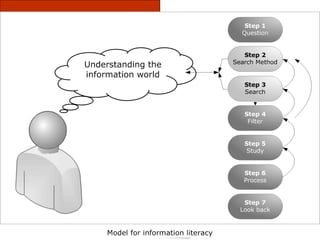
Program  Essence of Information literacy The 7 steps (Model for information literacy)) Course overview (Blended learning) Demonstration of the course
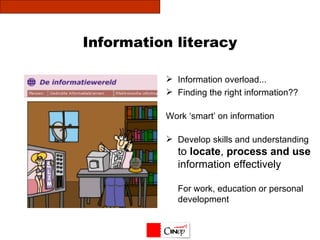
Information literacy Information overload... Finding the right information?? Work ‘smart’ on information Develop skills and understanding  to  locate ,  process and use information effectively For work, education or personal development
Information literacy Someone who is information literate:  A. Learns independently and manages his own learning process. B. Uses information processing strategies: acknowledge information gap, select+evaluate strategy,.. C. Uses information- and communication technology. D. Understands the ‘world of information’ and how to  use it:   books, magazines, newsgroups, websites, libraries,… E. Approaches information in a critical way. F. Has a personal style in using information.
Training of information literacy:  7 steps 7 steps in finding and using information effectively:  What is your question? define the problem and identify the information needed.  How are you going to search?   determine possible sources, select sources and search strategy.  Search the information   find specific information in one or more sources. Choose the usefull information define the value of the information found. Analyse the information   compare the information found with the information problem. Process the information   draw conclusions and communicate to others.  Look back evaluate the result and the strategy followed.
 
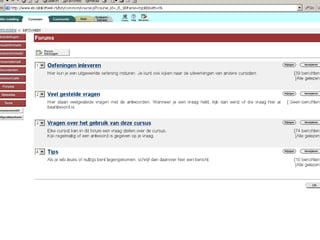
Blended learning  Classroom meetings (6 hours) to: Introduce the online course (workbook) and get to know the teacher and the other students Support the students in developing their skills  E-learning course (10 hours) to: Present interactive learning content, with cases Give each other feedback through Forum
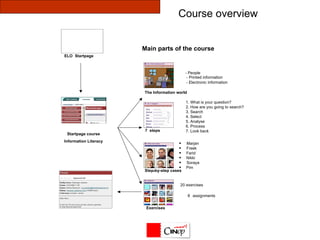
ELO  Startpage  Main parts of the course  - People  - Printed information  - Electronic information The Information world  Startpage course Information Literacy 7  steps 1. What is your question? 2. How are you going to search? 3. Search 4. Select 5. Analyse  6. Process 7. Look back Step-by-step cases -   Marjan   Freek   Farid   Nikki   Soraya   Pim 20 exercises 8 assignments Exercises Course overview
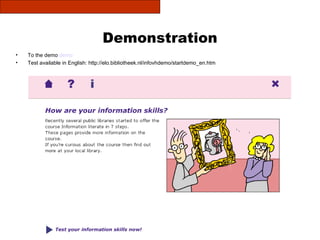
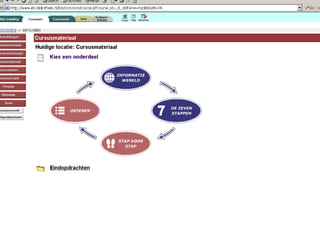
To the demo  demo Test available in English: http://elo.bibliotheek.nl/infovhdemo/startdemo_en.htm Demonstration
 
 
Why e-learning? Use interactivity and multimedia to make learning more  attractive  and  effective (learning by doing) -> authentic cases (animations, slides, audio) -> follow personal choices and interests, feedback Communication and feedback in Forum -> feedback student - student -> feedback from teacher/coach Interactive course is always available for student
Relevant Questions What is the relevance of integrating  information literacy in education for students and adults?  Are teachers information literate?
More information  CINOP  www.cinop.nl Frans van Hoek ,  [email_address]   Inge Reubzaet,  [email_address]

Informationliteracy

  • 1.
    Information literate in7 steps Blended Learning for Information Skills
  • 2.
    Program Essenceof Information literacy The 7 steps (Model for information literacy)) Course overview (Blended learning) Demonstration of the course
  • 3.
    Information literacy Informationoverload... Finding the right information?? Work ‘smart’ on information Develop skills and understanding to locate , process and use information effectively For work, education or personal development
  • 4.
    Information literacy Someonewho is information literate: A. Learns independently and manages his own learning process. B. Uses information processing strategies: acknowledge information gap, select+evaluate strategy,.. C. Uses information- and communication technology. D. Understands the ‘world of information’ and how to use it: books, magazines, newsgroups, websites, libraries,… E. Approaches information in a critical way. F. Has a personal style in using information.
  • 5.
    Training of informationliteracy: 7 steps 7 steps in finding and using information effectively: What is your question? define the problem and identify the information needed. How are you going to search? determine possible sources, select sources and search strategy. Search the information find specific information in one or more sources. Choose the usefull information define the value of the information found. Analyse the information compare the information found with the information problem. Process the information draw conclusions and communicate to others. Look back evaluate the result and the strategy followed.
  • 6.
  • 7.
    Blended learning Classroom meetings (6 hours) to: Introduce the online course (workbook) and get to know the teacher and the other students Support the students in developing their skills E-learning course (10 hours) to: Present interactive learning content, with cases Give each other feedback through Forum
  • 8.
    ELO Startpage Main parts of the course  - People  - Printed information  - Electronic information The Information world Startpage course Information Literacy 7 steps 1. What is your question? 2. How are you going to search? 3. Search 4. Select 5. Analyse 6. Process 7. Look back Step-by-step cases -   Marjan   Freek   Farid   Nikki   Soraya   Pim 20 exercises 8 assignments Exercises Course overview
  • 9.
    To the demo demo Test available in English: http://elo.bibliotheek.nl/infovhdemo/startdemo_en.htm Demonstration
  • 10.
  • 11.
  • 12.
    Why e-learning? Useinteractivity and multimedia to make learning more attractive and effective (learning by doing) -> authentic cases (animations, slides, audio) -> follow personal choices and interests, feedback Communication and feedback in Forum -> feedback student - student -> feedback from teacher/coach Interactive course is always available for student
  • 13.
    Relevant Questions Whatis the relevance of integrating information literacy in education for students and adults? Are teachers information literate?
  • 14.
    More information CINOP www.cinop.nl Frans van Hoek , [email_address] Inge Reubzaet, [email_address]