What are scholarly publishers good
                         for?


    Lynne Herndon
    President and CEO
    Cell Press


                    A short history of the journal
      •   Are the key drivers of scholarly
          communication still intact?
      •   Let’s take a look back at the origin of
          the learned journal, which evolved
          from books in the 17th century


2


                    Oldenburg and Boyle
      •   [We must be] very careful of registring as well the person and
          time of any new matter.., as the matter itselfe; whereby the
          honor of ye invention will be inviolably preserved to all
          posterity. [Oldenburg, 1664]
      •   all Ingenious men will be thereby incouraged to impart their
          knowledge and discoveryes. [Oldenburg, 1664]
      •   [I should not] neglect the opportunity of having some of my
          Memoirs preserv’d, by being incorporated into a Collection,
          that is like to be as lasting as usefull. [Boyle, 1665]
      •   [Phil. Trans. should be] licensed under the charter by the
          Council of the Society, being first reviewed by some of the
          members of the same. [R.Soc. Order in Council 1/3/1665]


3


                                                                           1
Core publishing values
    •   Certification = Peer acceptance
    •   Registration = The minutes of science
    •   Dissemination = Broadcasting
    •   Archive = Perpetual record


4


              Common ground
    •   Commercial and society publishers
        have upheld the tradition of scholarly
        communication
    •   We have developed new products and
        services beyond print
    •   Access and usage have increased
    •   However, if our mission is to move
        scholarly communication forward,
        what do we need to do next?
5


              The change model
    •   Driven by the Internet, scholarly
        publishing is undergoing a
        transformational shift from the
        aggregate, publish, then distribute
        model to a more user-driven, demand
        model
    •   It’s not about what I have to sell you,
        it’s about what you want and when
        you want it

6


                                                  2
Tomorrow’s key drivers
    •   Registration
    •   Dissemination
    •   Archive
    •   Certification
    •   Filtering and interpretation
    •   Serving communities
    •   Enhancing productivity


7


                Current challenges
    •   Filter and interpret
        –   How do we put content into context?
    •   Serve communities
        –   How can we help communities develop
            and share knowledge in a new way?
    •   Enhance productivity
        –   How can we deliver content to enable
            users to make an impact?


8


                Filter and interpret
    •   As the world of science grows more
        complex and collaborative, there is
        more need for interpretive content
    •   Our job is to have a view of all
        benchtops, to judge what is important,
        to publish it, and to gain trust


9


                                                   3
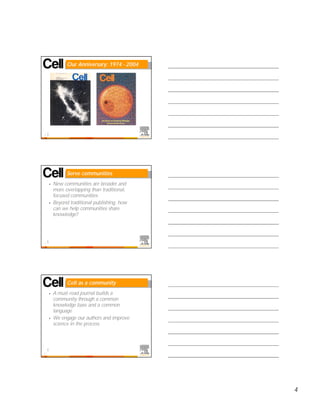
Our Anniversary: 1974 - 2004


10


               Serve communities
     •   New communities are broader and
         more overlapping than traditional,
         focused communities
     •   Beyond traditional publishing, how
         can we help communities share
         knowledge?


11


               Cell as a community
     •   A must-read journal builds a
         community through a common
         knowledge base and a common
         language
     •   We engage our authors and improve
         science in the process


12


                                              4
Other examples of community
     •   Los Alamos’ arXiv
     •   Signal Transduction Knowledge
         Environment
     •   High Wire Press
     •   Are these tired examples?


13


               Enhancing productivity

     •   We need to move from dissemination
         to comprehension and application:
         What you want, when you want it
     •   Do publishers understand enough
         about how their users’ workflow and
         information needs?
     •   Will publishers become suppliers to
         workflow software companies, or will
         they develop software competencies?
14


               MDL
     •   “Our mission is to become the leader
         in integrated information, information
         management and workflow solutions
         for the entire R&D value chain.”


15


                                                  5
Integrated medical records
     •   PDA delivery of “when you want it”
     •   Electronic medical records =
         –   Patient record +
         –   Dx and Rx protocols +
         –   Integrated evidence-based medical data


16


                 Tomorrow’s key drivers
     •   Registration
     •   Dissemination
     •   Archive
     •   Certification
     •   Filtering and interpretation
     •   Serving communities
     •   Enhancing productivity


17


                 The challenge
     •   Stay competent at traditional values
     •   Learn to add value in new ways
     •   Plan to spend, develop new skills,
         experiment and take risks
     •   Scholarly publishers, large and small,
         should heed the call
     •   Are new players new partners?


18


                                                      6

58 herndon

  • 1.
    What are scholarlypublishers good for? Lynne Herndon President and CEO Cell Press A short history of the journal • Are the key drivers of scholarly communication still intact? • Let’s take a look back at the origin of the learned journal, which evolved from books in the 17th century 2 Oldenburg and Boyle • [We must be] very careful of registring as well the person and time of any new matter.., as the matter itselfe; whereby the honor of ye invention will be inviolably preserved to all posterity. [Oldenburg, 1664] • all Ingenious men will be thereby incouraged to impart their knowledge and discoveryes. [Oldenburg, 1664] • [I should not] neglect the opportunity of having some of my Memoirs preserv’d, by being incorporated into a Collection, that is like to be as lasting as usefull. [Boyle, 1665] • [Phil. Trans. should be] licensed under the charter by the Council of the Society, being first reviewed by some of the members of the same. [R.Soc. Order in Council 1/3/1665] 3 1
  • 2.
    Core publishing values • Certification = Peer acceptance • Registration = The minutes of science • Dissemination = Broadcasting • Archive = Perpetual record 4 Common ground • Commercial and society publishers have upheld the tradition of scholarly communication • We have developed new products and services beyond print • Access and usage have increased • However, if our mission is to move scholarly communication forward, what do we need to do next? 5 The change model • Driven by the Internet, scholarly publishing is undergoing a transformational shift from the aggregate, publish, then distribute model to a more user-driven, demand model • It’s not about what I have to sell you, it’s about what you want and when you want it 6 2
  • 3.
    Tomorrow’s key drivers • Registration • Dissemination • Archive • Certification • Filtering and interpretation • Serving communities • Enhancing productivity 7 Current challenges • Filter and interpret – How do we put content into context? • Serve communities – How can we help communities develop and share knowledge in a new way? • Enhance productivity – How can we deliver content to enable users to make an impact? 8 Filter and interpret • As the world of science grows more complex and collaborative, there is more need for interpretive content • Our job is to have a view of all benchtops, to judge what is important, to publish it, and to gain trust 9 3
  • 4.
    Our Anniversary: 1974- 2004 10 Serve communities • New communities are broader and more overlapping than traditional, focused communities • Beyond traditional publishing, how can we help communities share knowledge? 11 Cell as a community • A must-read journal builds a community through a common knowledge base and a common language • We engage our authors and improve science in the process 12 4
  • 5.
    Other examples ofcommunity • Los Alamos’ arXiv • Signal Transduction Knowledge Environment • High Wire Press • Are these tired examples? 13 Enhancing productivity • We need to move from dissemination to comprehension and application: What you want, when you want it • Do publishers understand enough about how their users’ workflow and information needs? • Will publishers become suppliers to workflow software companies, or will they develop software competencies? 14 MDL • “Our mission is to become the leader in integrated information, information management and workflow solutions for the entire R&D value chain.” 15 5
  • 6.
    Integrated medical records • PDA delivery of “when you want it” • Electronic medical records = – Patient record + – Dx and Rx protocols + – Integrated evidence-based medical data 16 Tomorrow’s key drivers • Registration • Dissemination • Archive • Certification • Filtering and interpretation • Serving communities • Enhancing productivity 17 The challenge • Stay competent at traditional values • Learn to add value in new ways • Plan to spend, develop new skills, experiment and take risks • Scholarly publishers, large and small, should heed the call • Are new players new partners? 18 6