© 2013 CUI Inc
AMT203 Absolute Encoder
© 2012 CUI Inc
Contents
Purpose
The purpose of this training module is to familiarize you with rotary absolute
encoders and show the benefits of the AMT203.
Objectives
 Describe the functional theory of encoders; specifically absolute encoders
 Understand what makes the AMT203 revolutionary
 Explain the different components that make up the AMT203
 Describe the installation and assembly of the AMT203
 Illustrate the flexible options available with the AMT203
Content: 23 pages
Learning time: 15 minutes
© 2012 CUI Inc
What Is An Encoder?
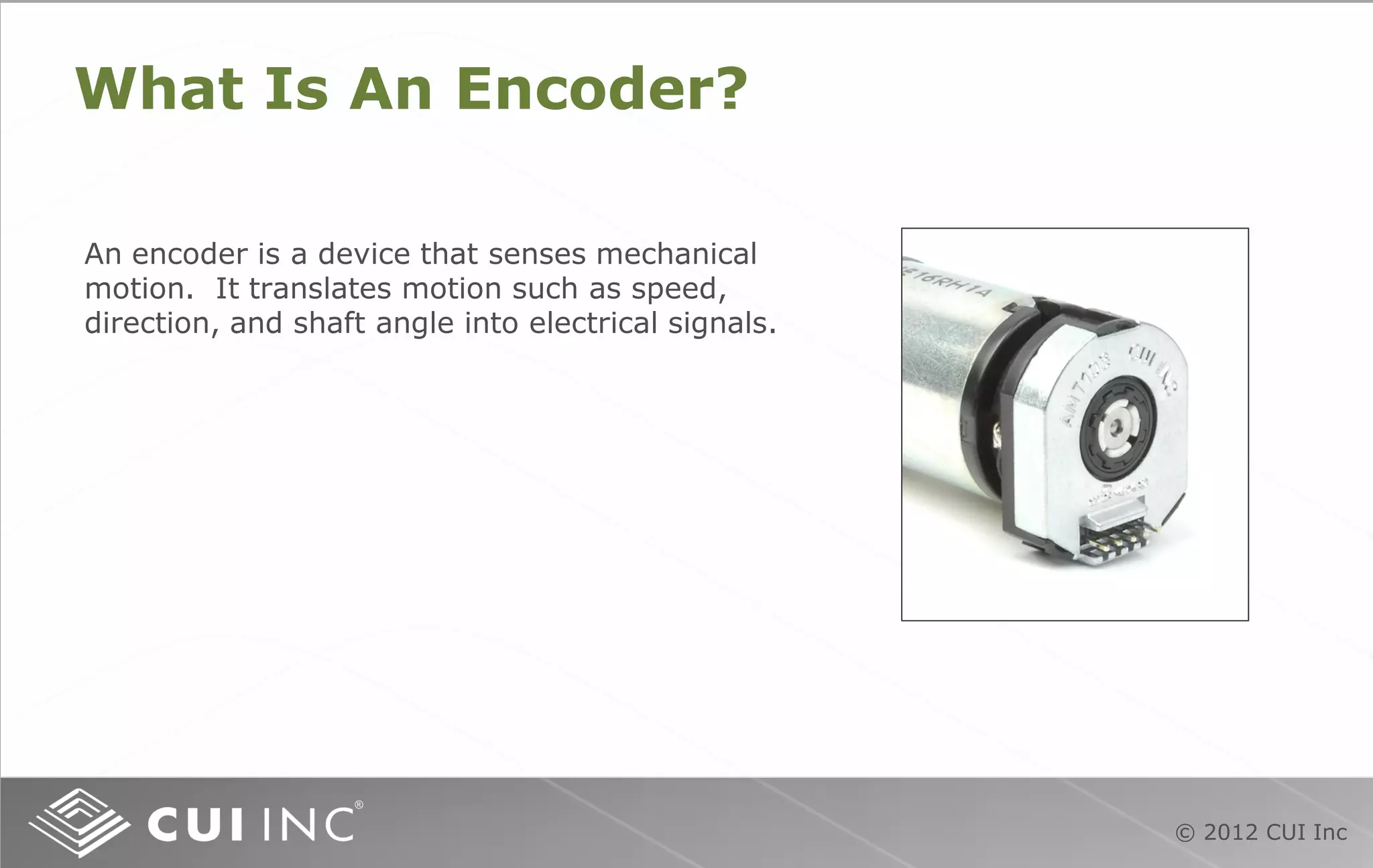
An encoder is a device that senses mechanical
motion. It translates motion such as speed,
direction, and shaft angle into electrical signals.
© 2012 CUI Inc
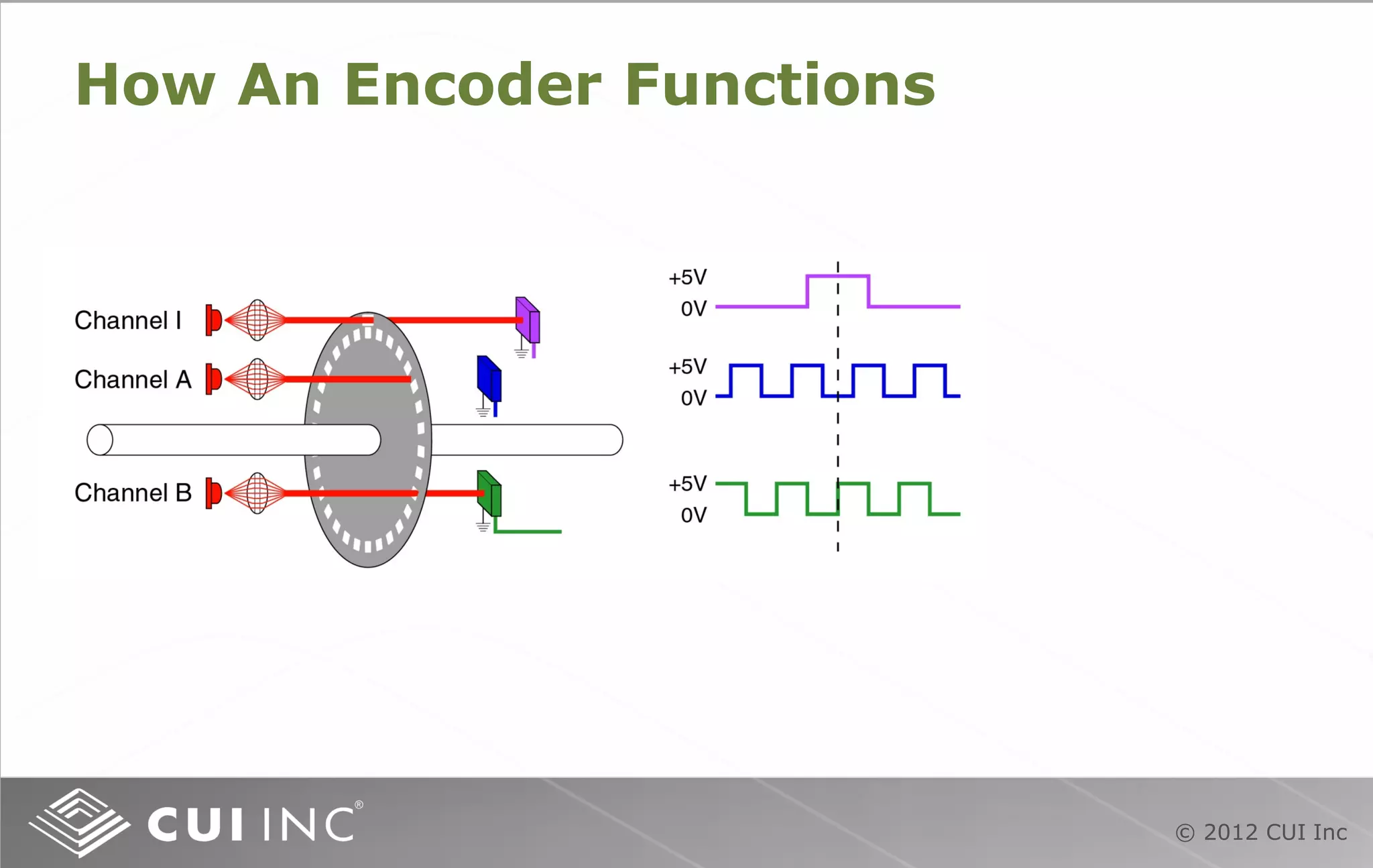
How An Encoder Functions
© 2012 CUI Inc
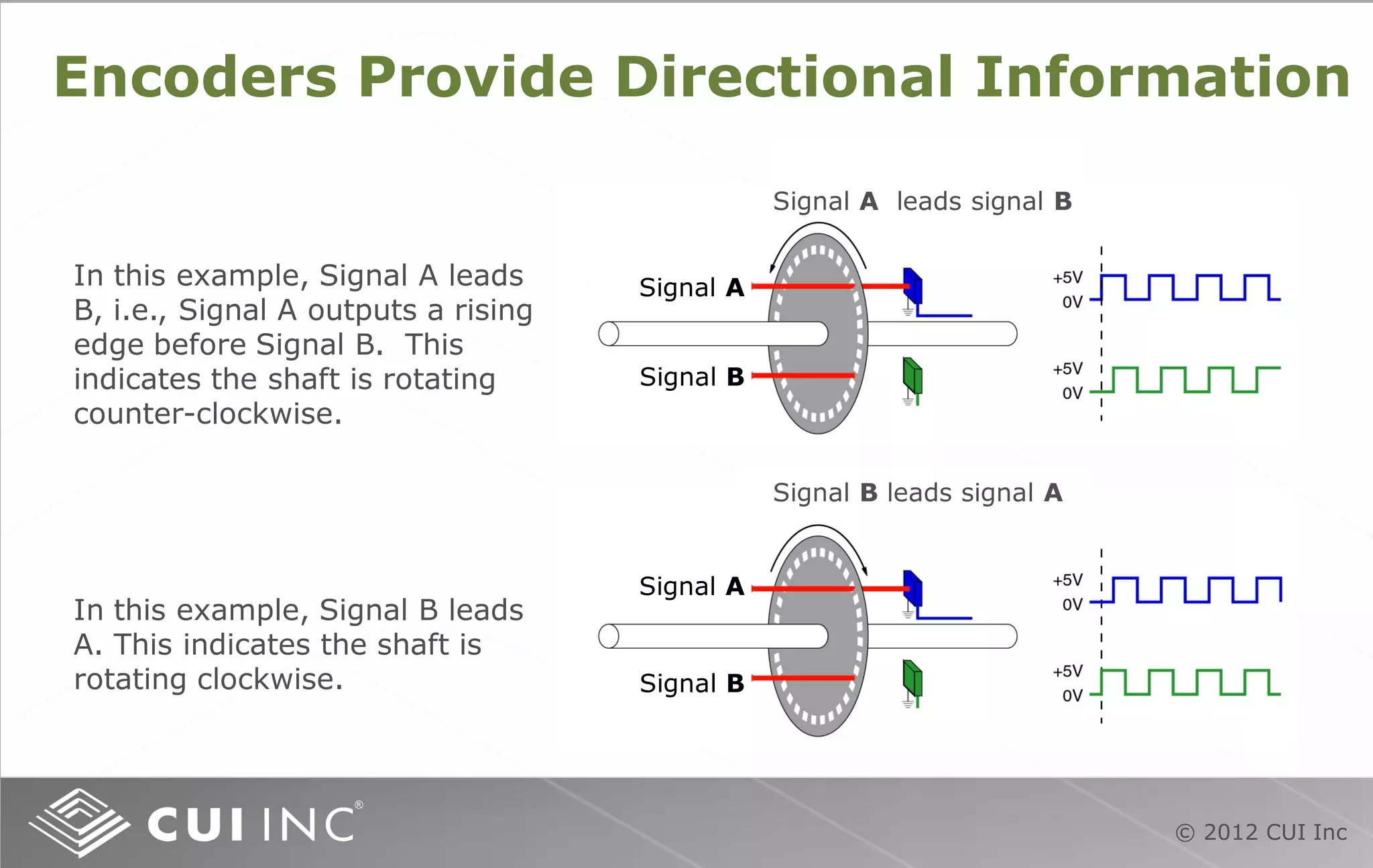
Encoders Provide Directional Information
In this example, Signal A leads
B, i.e., Signal A outputs a rising
edge before Signal B. This
indicates the shaft is rotating
counter-clockwise.
In this example, Signal B leads
A. This indicates the shaft is
rotating clockwise.
Signal A
Signal B
Signal A
Signal B
Signal A leads signal B
Signal B leads signal A
© 2012 CUI Inc
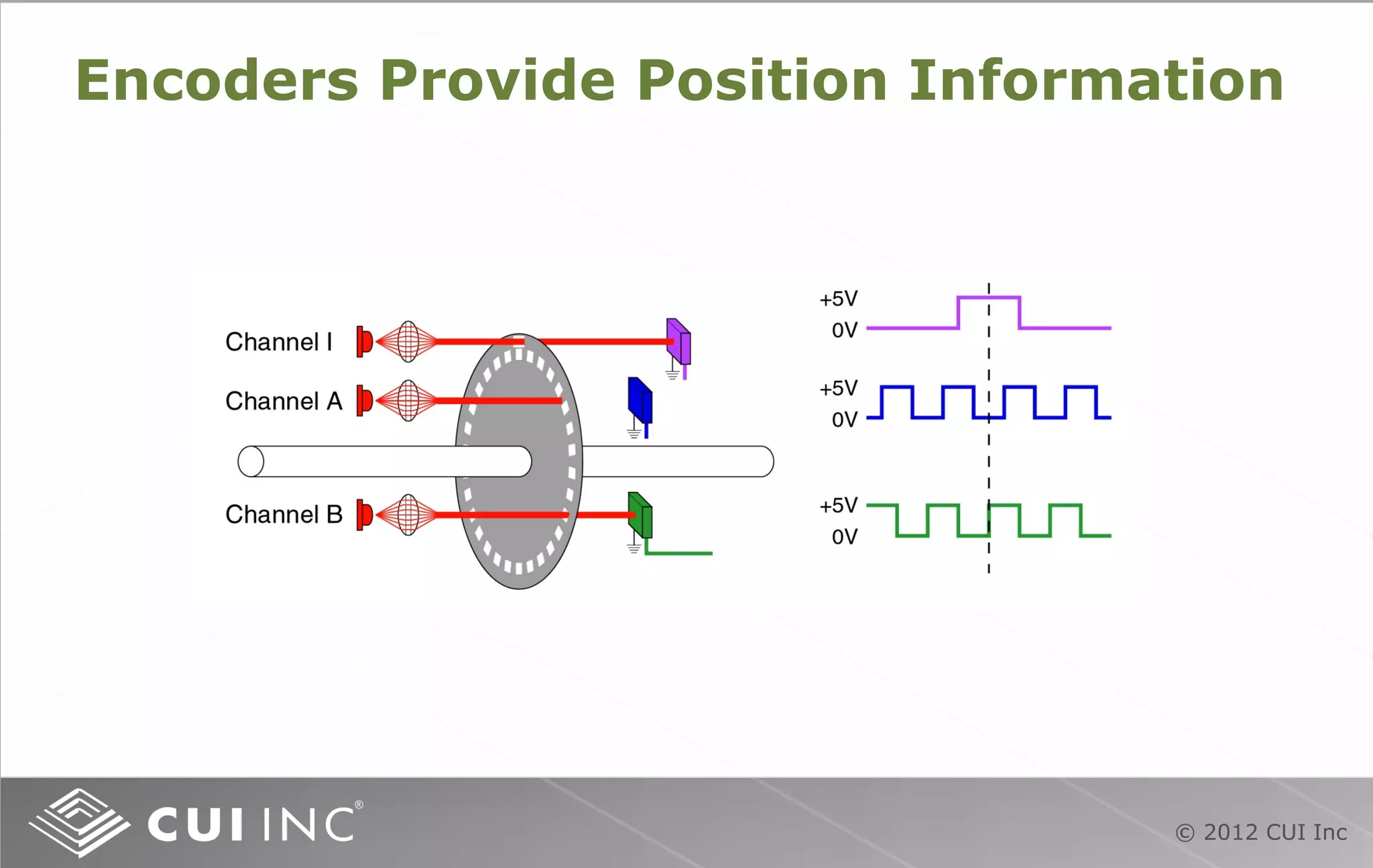
Encoders Provide Position Information
© 2012 CUI Inc
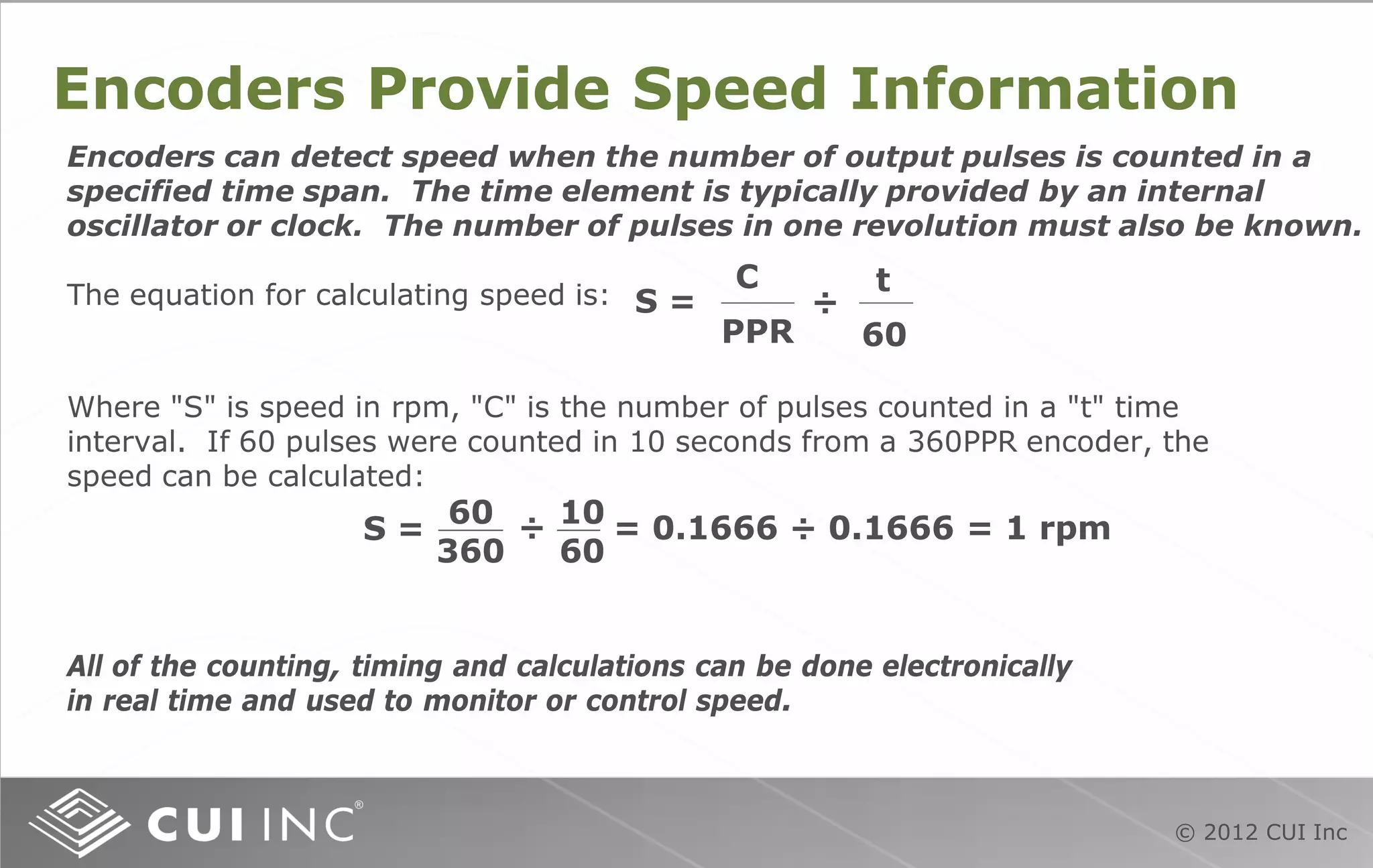
Encoders Provide Speed Information
Encoders can detect speed when the number of output pulses is counted in a
specified time span. The time element is typically provided by an internal
oscillator or clock. The number of pulses in one revolution must also be known.
The equation for calculating speed is:
C
PPR
S =
t
60
÷
Where "S" is speed in rpm, "C" is the number of pulses counted in a "t" time
interval. If 60 pulses were counted in 10 seconds from a 360PPR encoder, the
speed can be calculated:
S = = 0.1666 ÷ 0.1666 = 1 rpm
60
360
10
60
÷
All of the counting, timing and calculations can be done electronically
in real time and used to monitor or control speed.
© 2012 CUI Inc
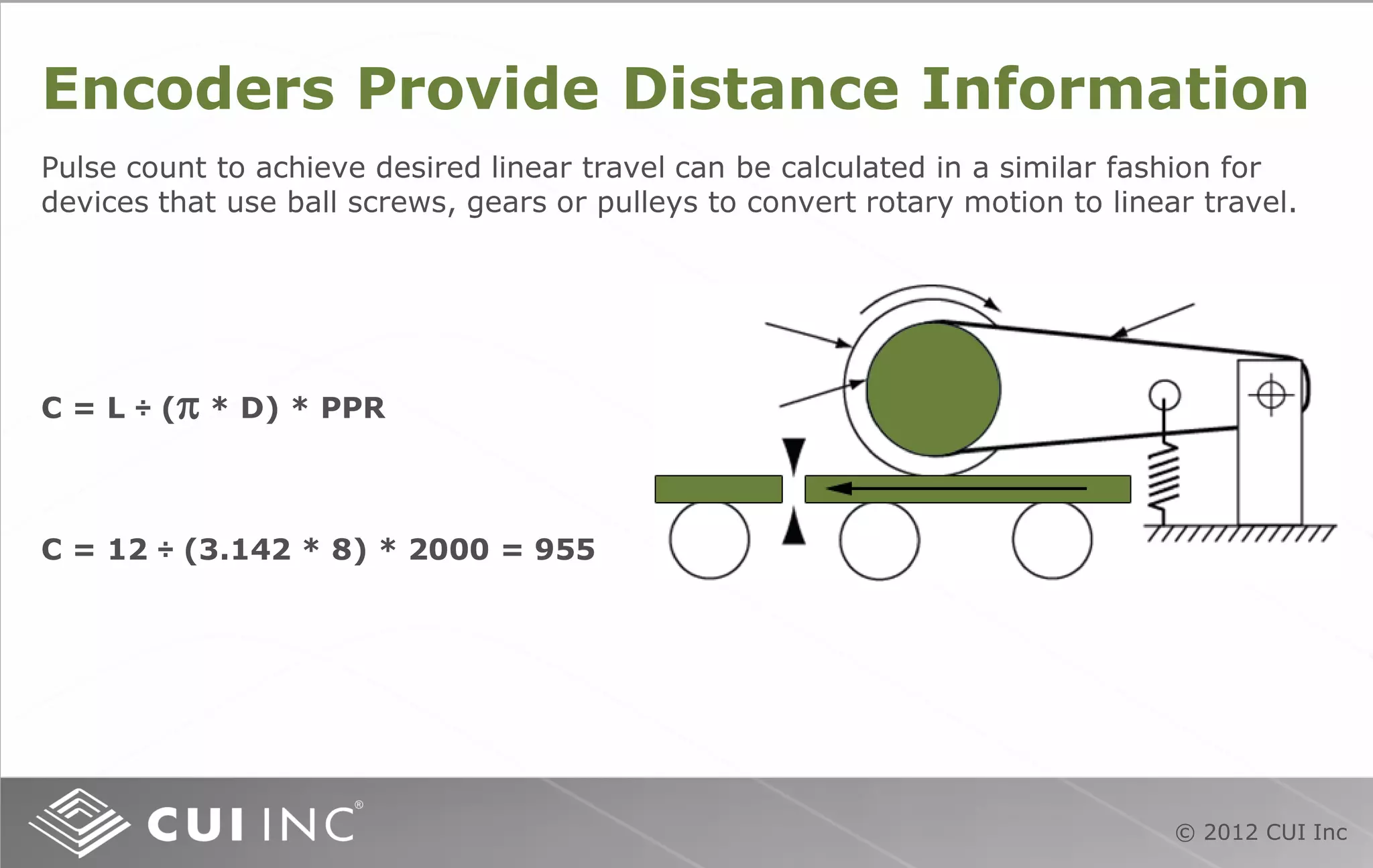
Encoders Provide Distance Information
C = L ÷ (π * D) * PPR
C = 12 ÷ (3.142 * 8) * 2000 = 955
Pulse count to achieve desired linear travel can be calculated in a similar fashion for
devices that use ball screws, gears or pulleys to convert rotary motion to linear travel.
© 2012 CUI Inc
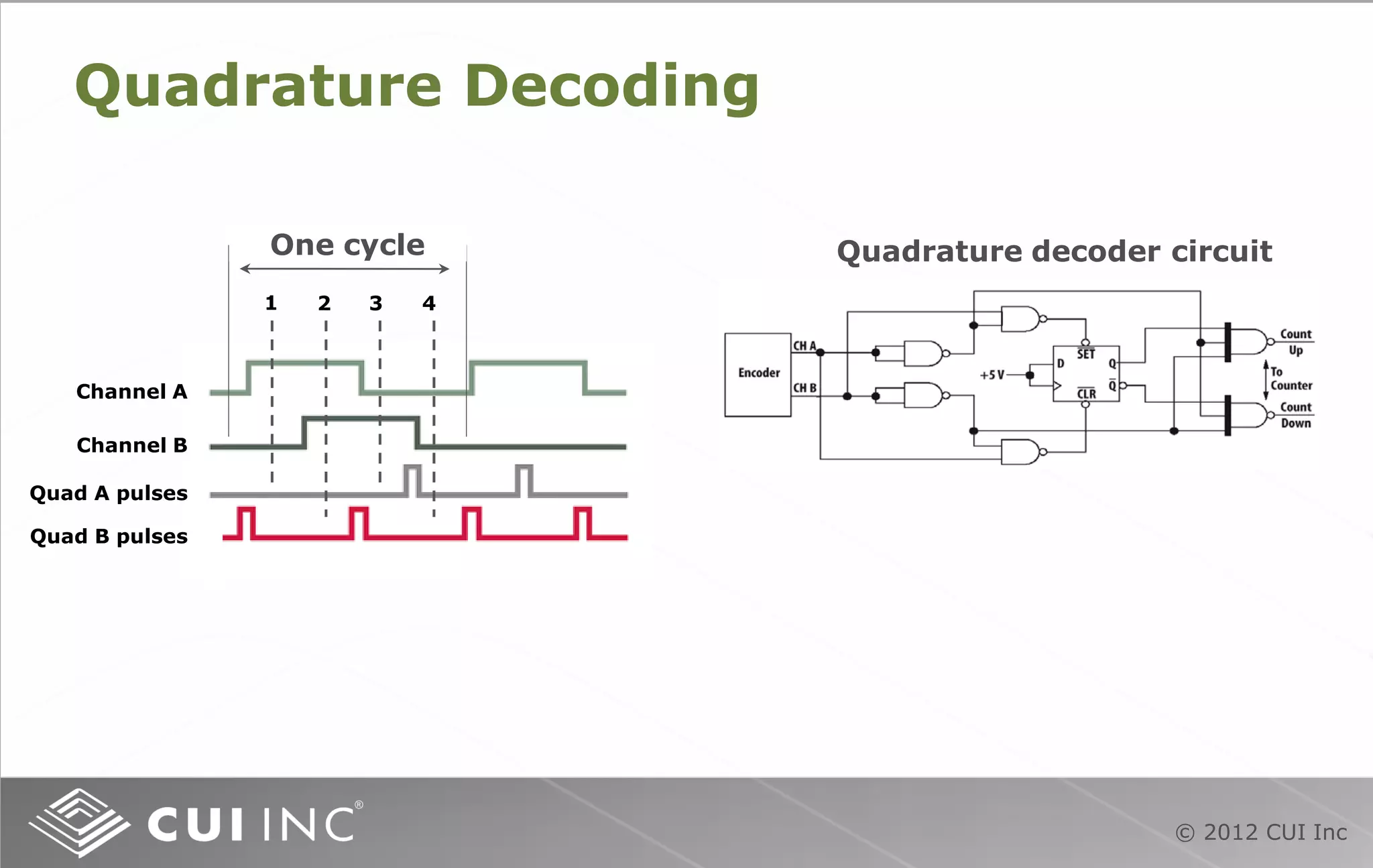
Quadrature Decoding
Quadrature decoder circuit
Channel A
Channel B
Quad A pulses
Quad B pulses
One cycle
1 4
2 3
© 2012 CUI Inc
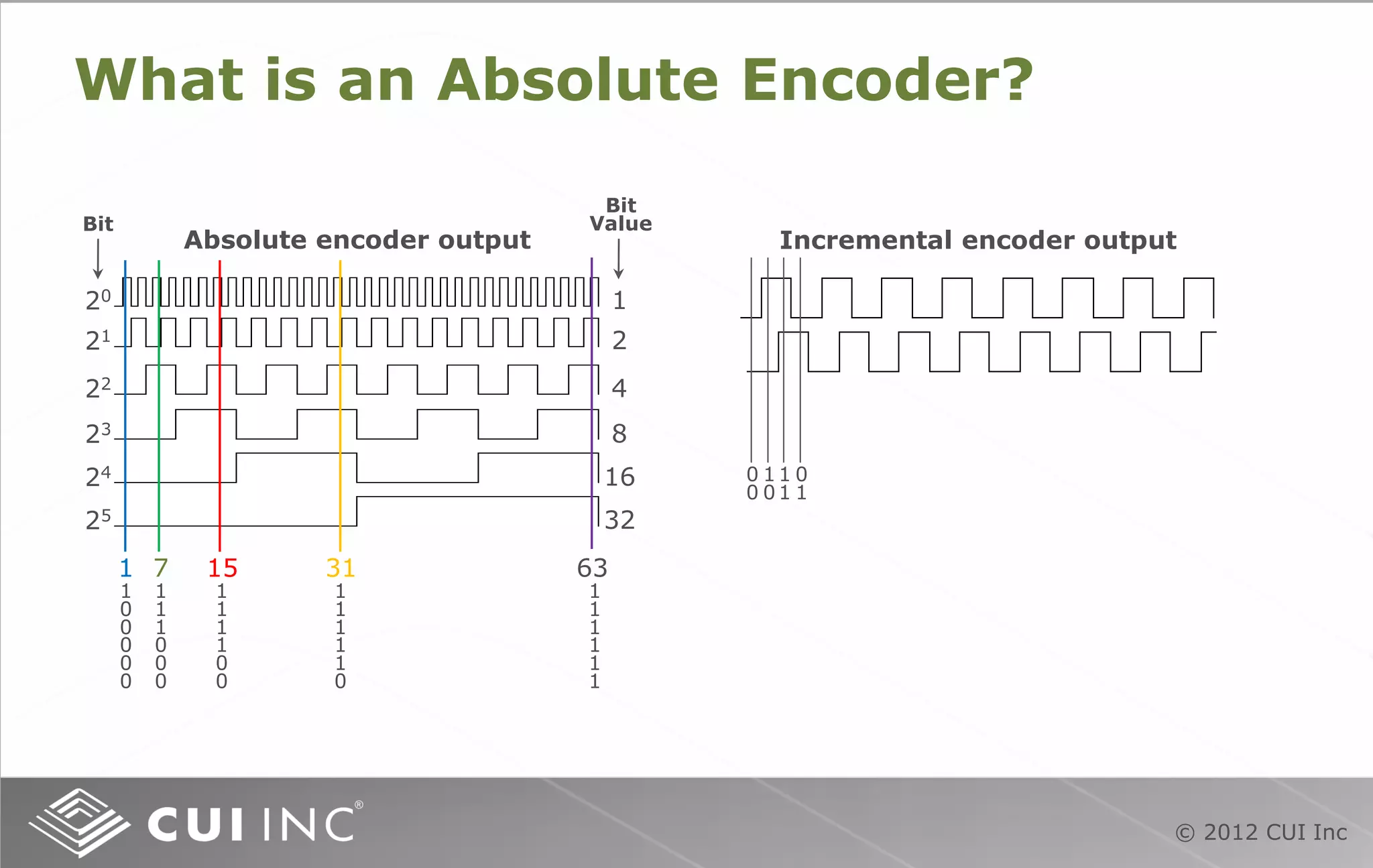
What is an Absolute Encoder?
Absolute encoder output
1 7 15 31 63
20
21
22
23
24
25
1
0
0
0
0
0
1
1
1
0
0
0
1
1
1
1
0
0
1
1
1
1
1
0
1
1
1
1
1
1
Incremental encoder output
1
2
4
8
16
32
0
0
1
0
1
1
0
1
Bit
Bit
Value
© 2012 CUI Inc
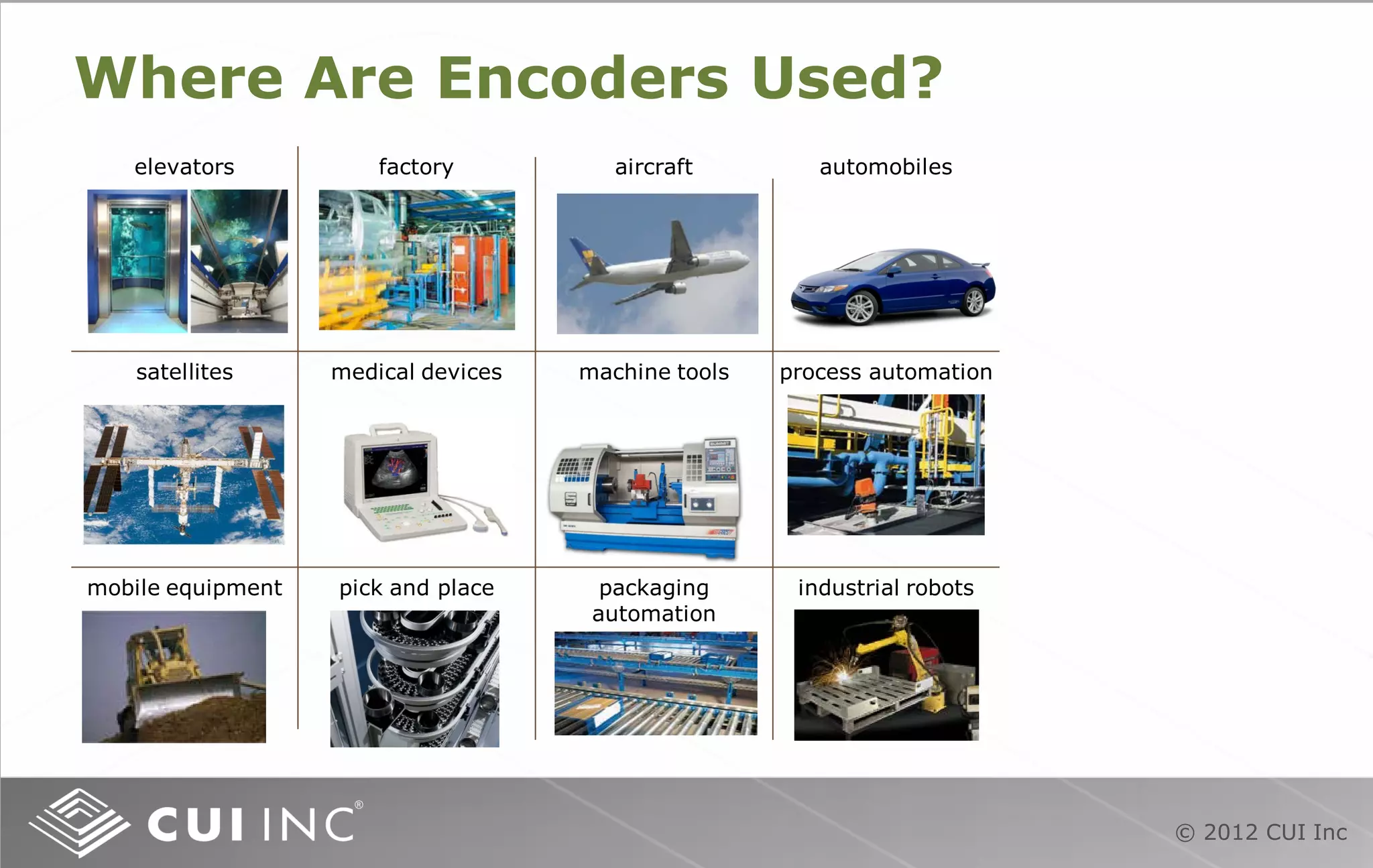
Where Are Encoders Used?
elevators factory aircraft automobiles
satellites
mobile equipment
medical devices machine tools
pick and place
process automation
packaging
automation
industrial robots
© 2012 CUI Inc
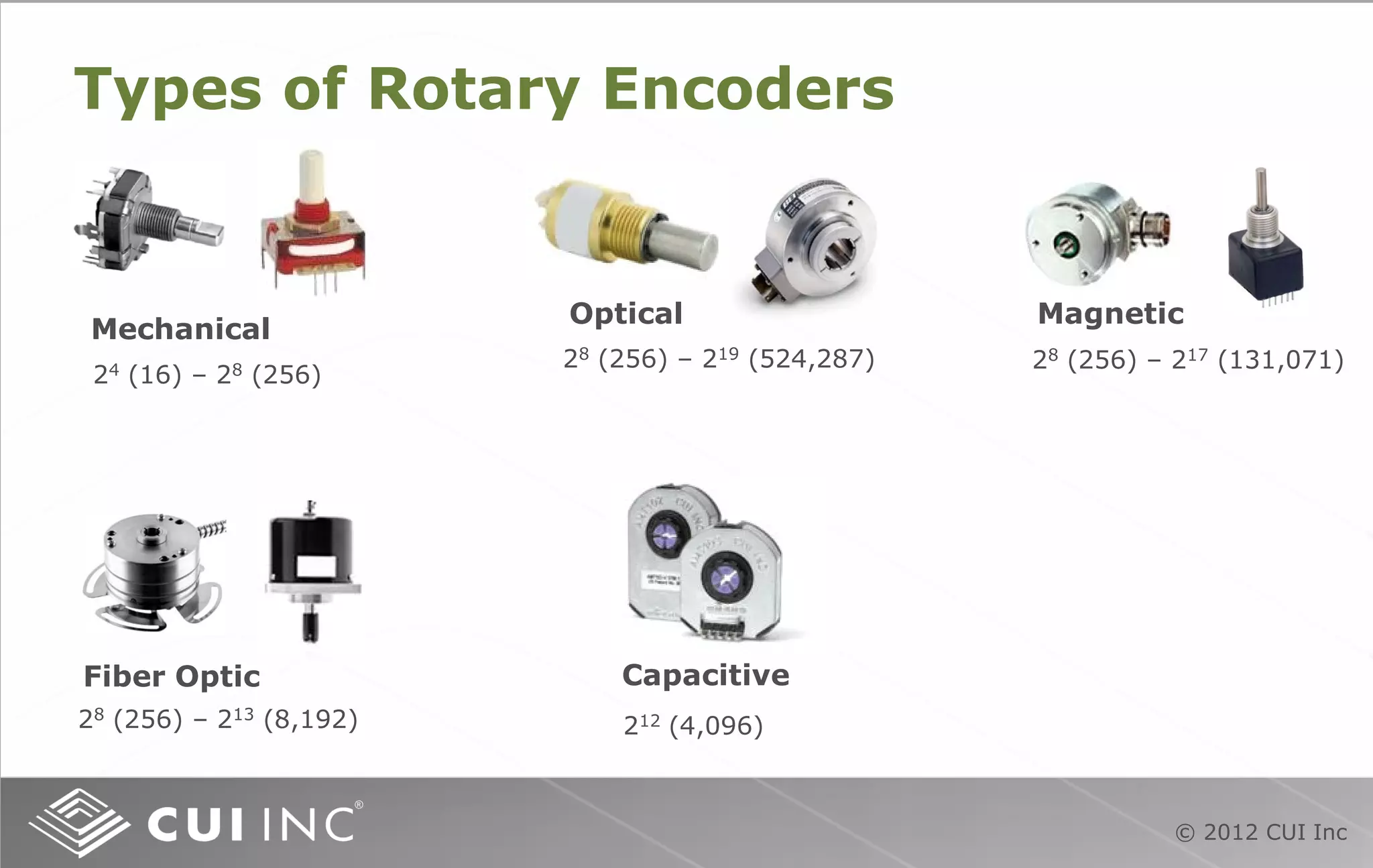
Types of Rotary Encoders
Mechanical
24 (16) – 28 (256)
Optical
28 (256) – 219 (524,287)
Magnetic
28 (256) – 217 (131,071)
28 (256) – 213 (8,192) 212 (4,096)
Fiber Optic Capacitive
© 2012 CUI Inc
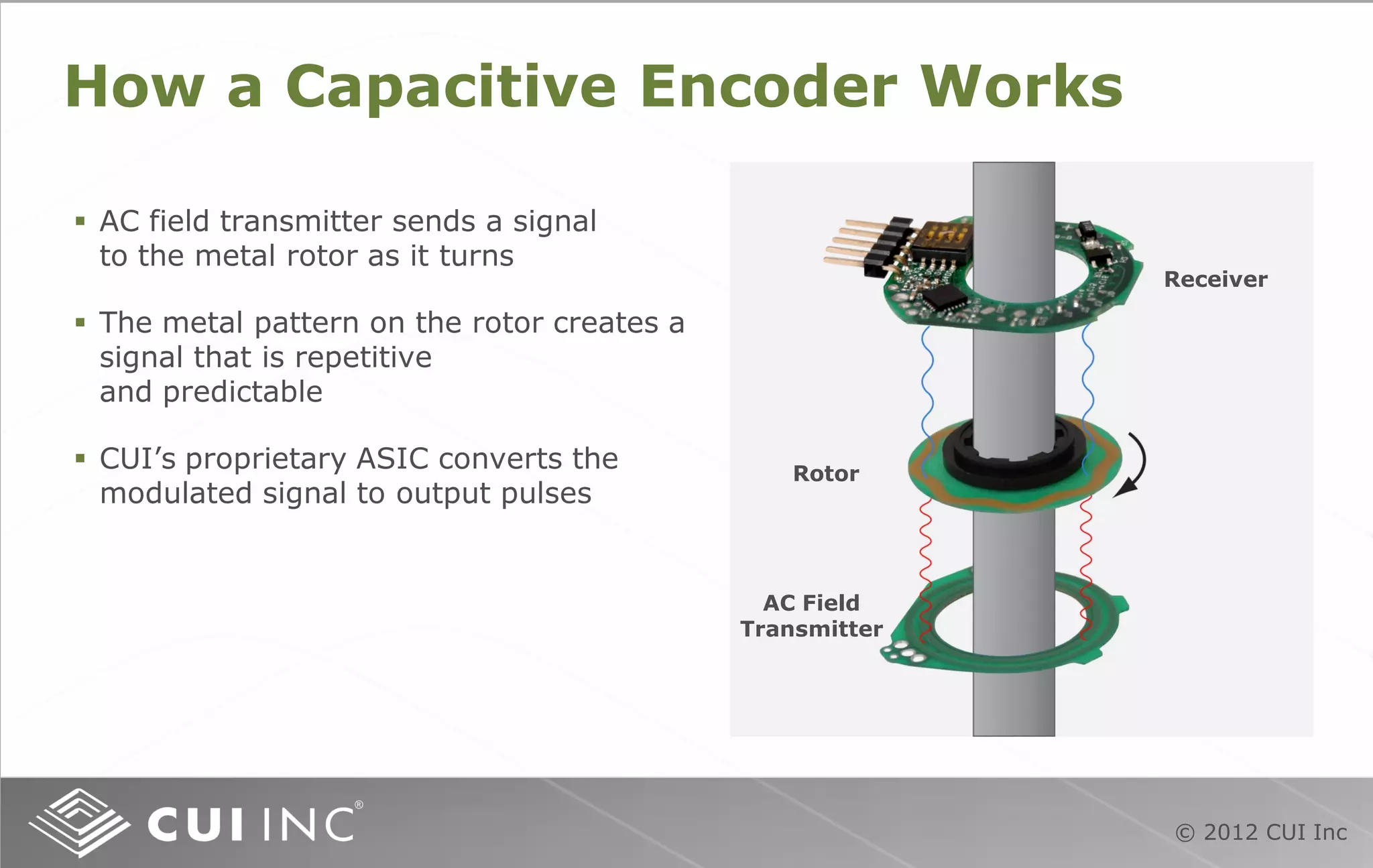
How a Capacitive Encoder Works
Receiver
Rotor
AC Field
Transmitter
 AC field transmitter sends a signal
to the metal rotor as it turns
 The metal pattern on the rotor creates a
signal that is repetitive
and predictable
 CUI’s proprietary ASIC converts the
modulated signal to output pulses
© 2012 CUI Inc
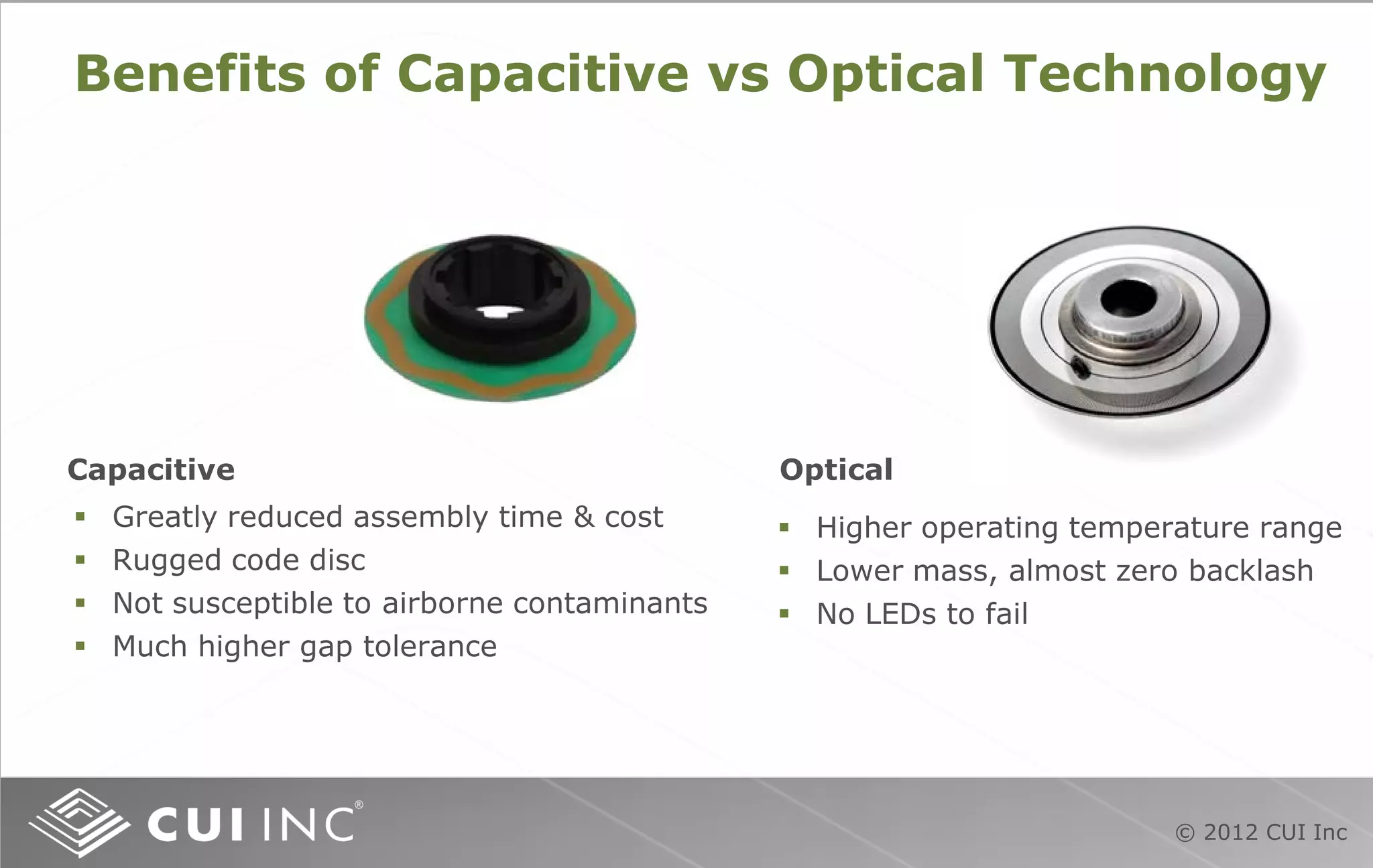
Benefits of Capacitive vs Optical Technology
Capacitive Optical
 Greatly reduced assembly time & cost
 Rugged code disc
 Not susceptible to airborne contaminants
 Much higher gap tolerance
 Higher operating temperature range
 Lower mass, almost zero backlash
 No LEDs to fail
© 2012 CUI Inc
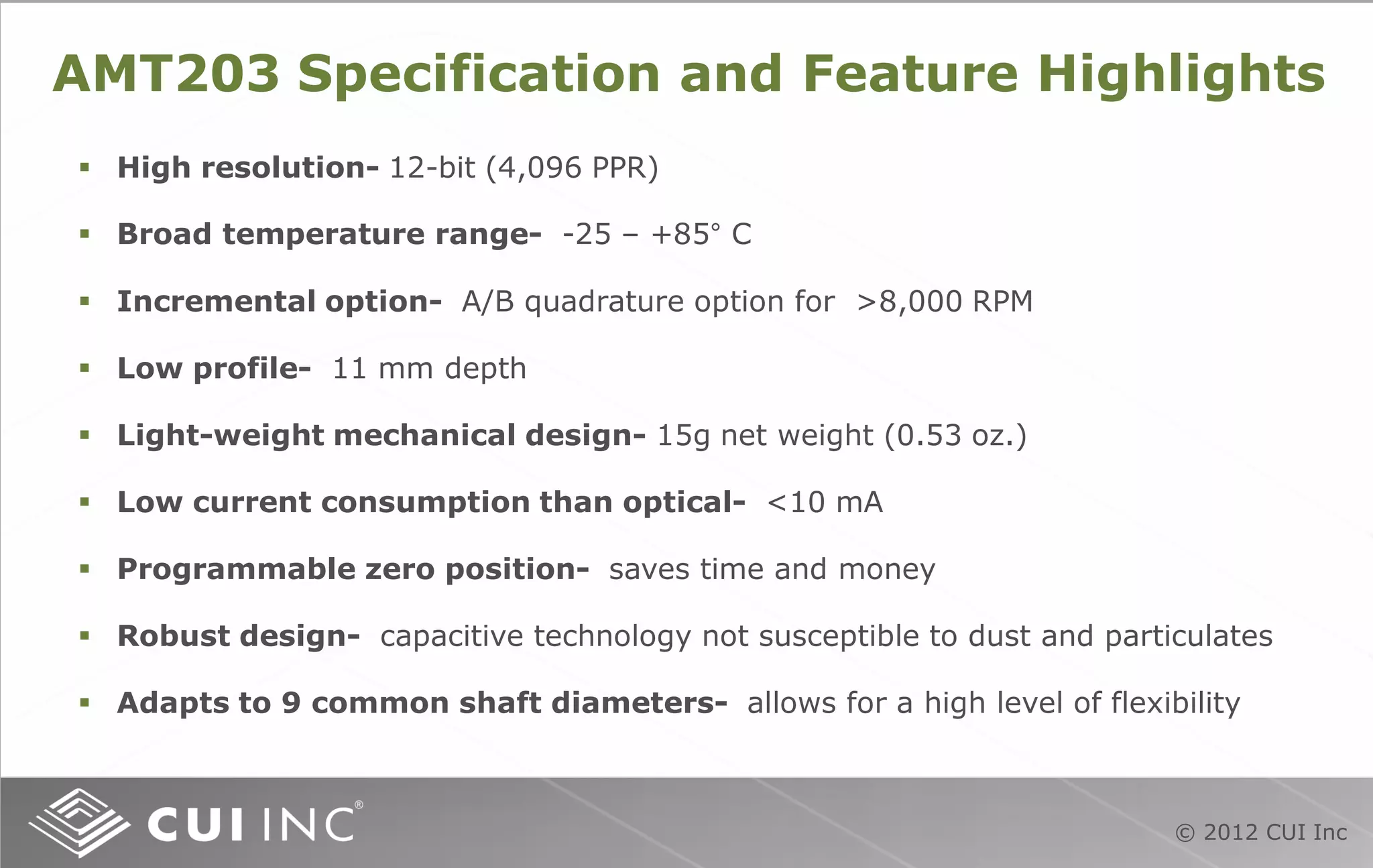
AMT203 Specification and Feature Highlights
 High resolution- 12-bit (4,096 PPR)
 Broad temperature range- -25 – +85° C
 Incremental option- A/B quadrature option for >8,000 RPM
 Low profile- 11 mm depth
 Light-weight mechanical design- 15g net weight (0.53 oz.)
 Low current consumption than optical- <10 mA
 Programmable zero position- saves time and money
 Robust design- capacitive technology not susceptible to dust and particulates
 Adapts to 9 common shaft diameters- allows for a high level of flexibility
© 2012 CUI Inc
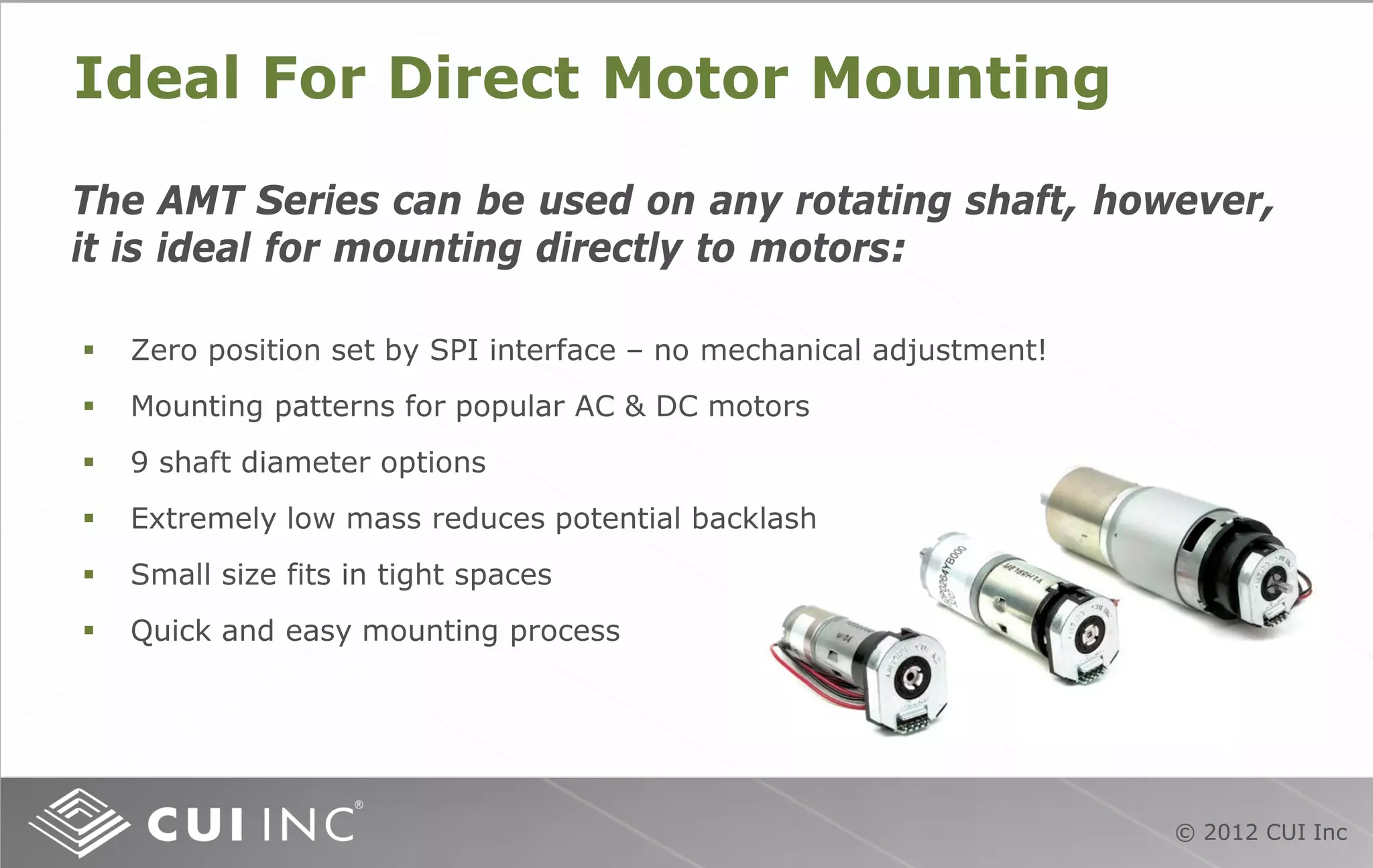
Ideal For Direct Motor Mounting
The AMT Series can be used on any rotating shaft, however,
it is ideal for mounting directly to motors:
 Zero position set by SPI interface – no mechanical adjustment!
 Mounting patterns for popular AC & DC motors
 9 shaft diameter options
 Extremely low mass reduces potential backlash
 Small size fits in tight spaces
 Quick and easy mounting process
© 2012 CUI Inc
Easy Assembly And Installation
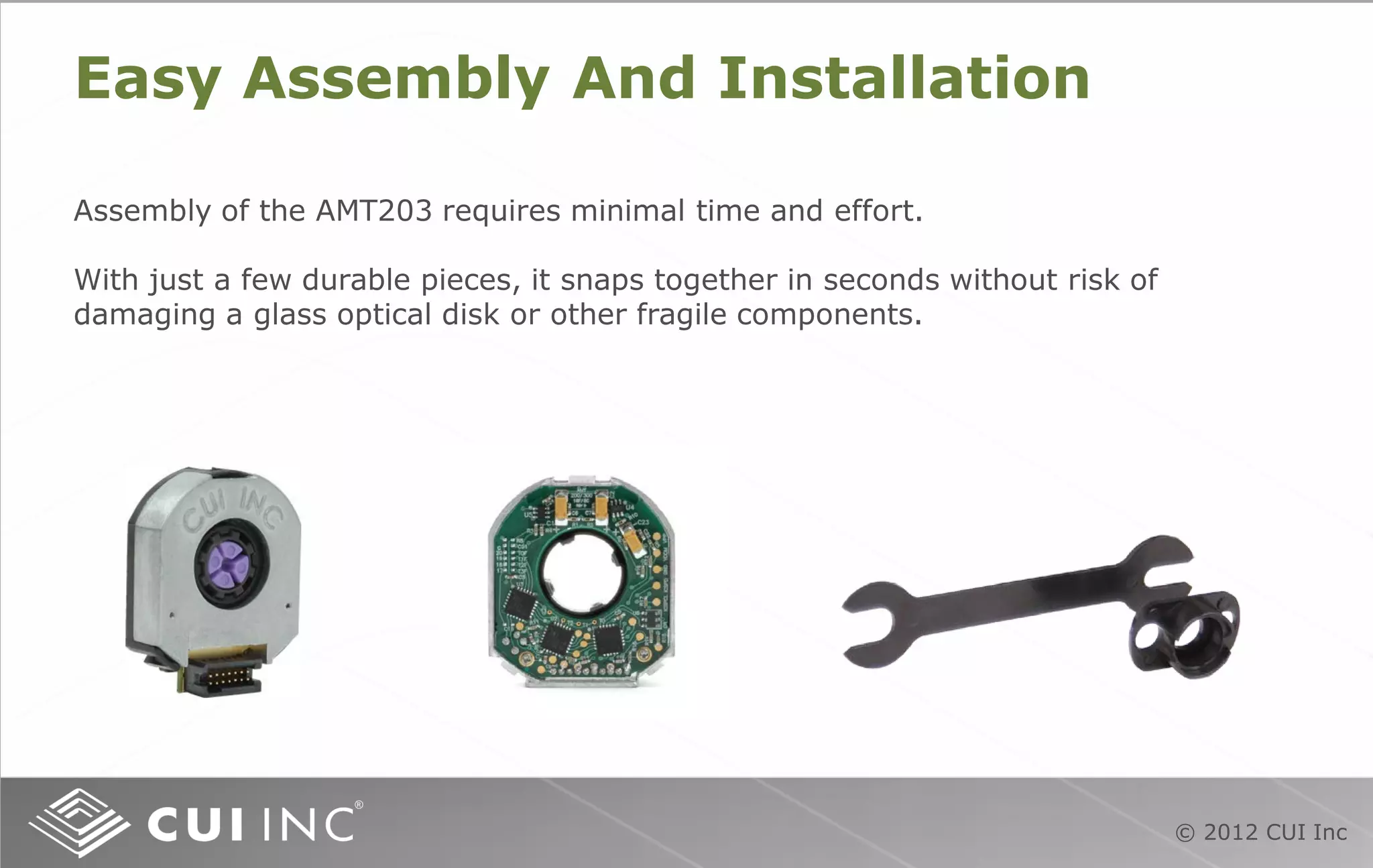
Assembly of the AMT203 requires minimal time and effort.
With just a few durable pieces, it snaps together in seconds without risk of
damaging a glass optical disk or other fragile components.
© 2012 CUI Inc
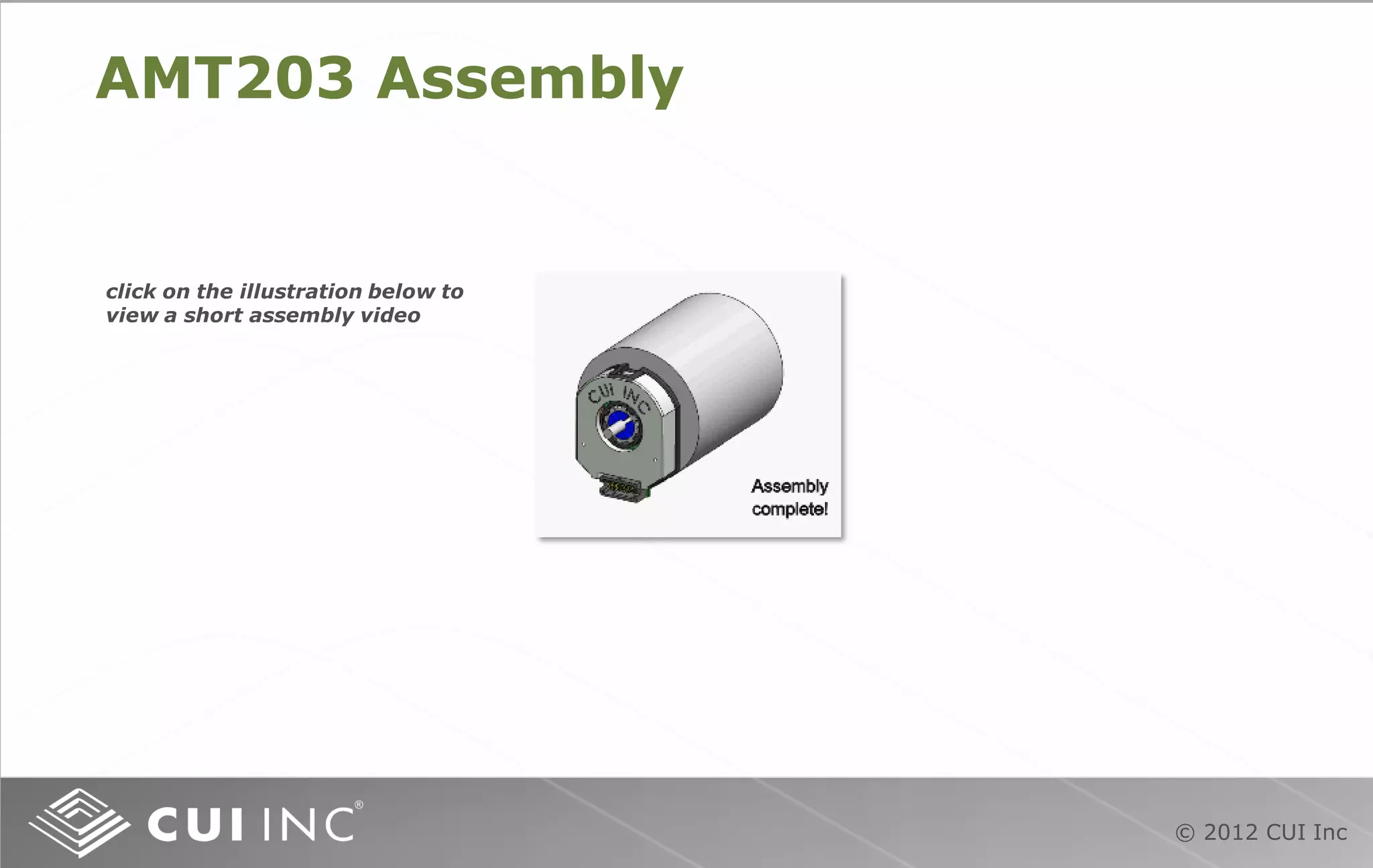
AMT203 Assembly
click on the illustration below to
view a short assembly video
© 2012 CUI Inc
Versatile Shaft And Mounting Options
mounting patterns
Using the shaft adapter and the 9 color-coded
sleeves, both the AMT203 can be adapted to 9
different motor shaft sizes.
This is done by snapping one of the sleeves into
the shaft adapter.
Shaft adapter & sleeves
hole pattern
mm/in
# of
holes
hole
size
Ø16/0.63 2 M1.6
Ø19.05/0.75 2 #4
Ø21.45/0.844 3 M1.6 or M2
Ø25.4/1.0 4 M1.6 or M2
Shaft Adapter
Sleeves
shaft sleeves
Ø2 mm
Ø3 mm
Ø1/8 in
Ø3/16 in
Ø4mm
Ø5 mm
Ø6 mm
Ø1/4 in
Ø8 mm
© 2012 CUI Inc
AMT203 Demo Board
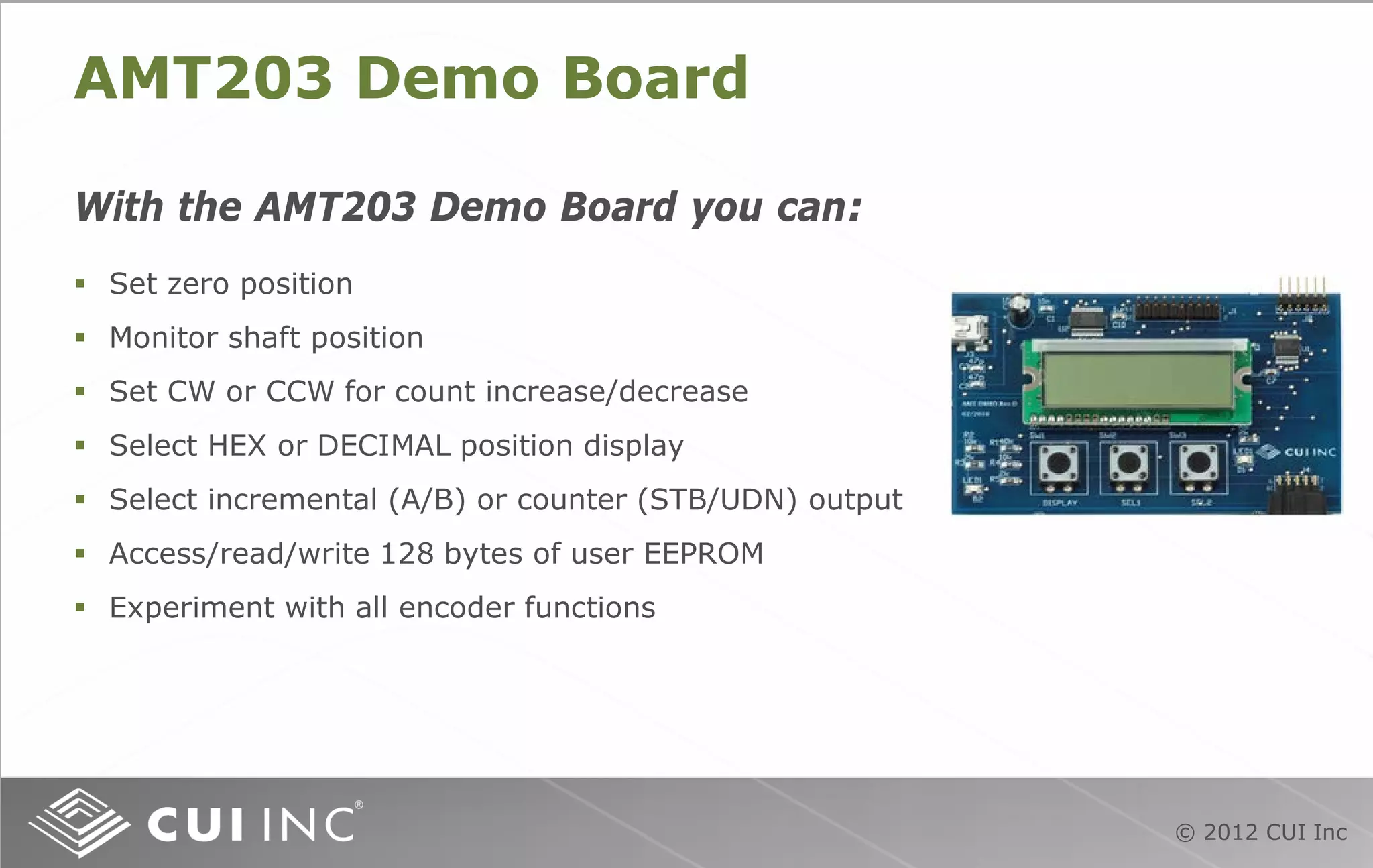
With the AMT203 Demo Board you can:
 Set zero position
 Monitor shaft position
 Set CW or CCW for count increase/decrease
 Select HEX or DECIMAL position display
 Select incremental (A/B) or counter (STB/UDN) output
 Access/read/write 128 bytes of user EEPROM
 Experiment with all encoder functions
© 2012 CUI Inc
Serial Peripheral Interface
SCLK
MOSI
MISO
SS
Master Slave
SCLK
MISO
MOSI
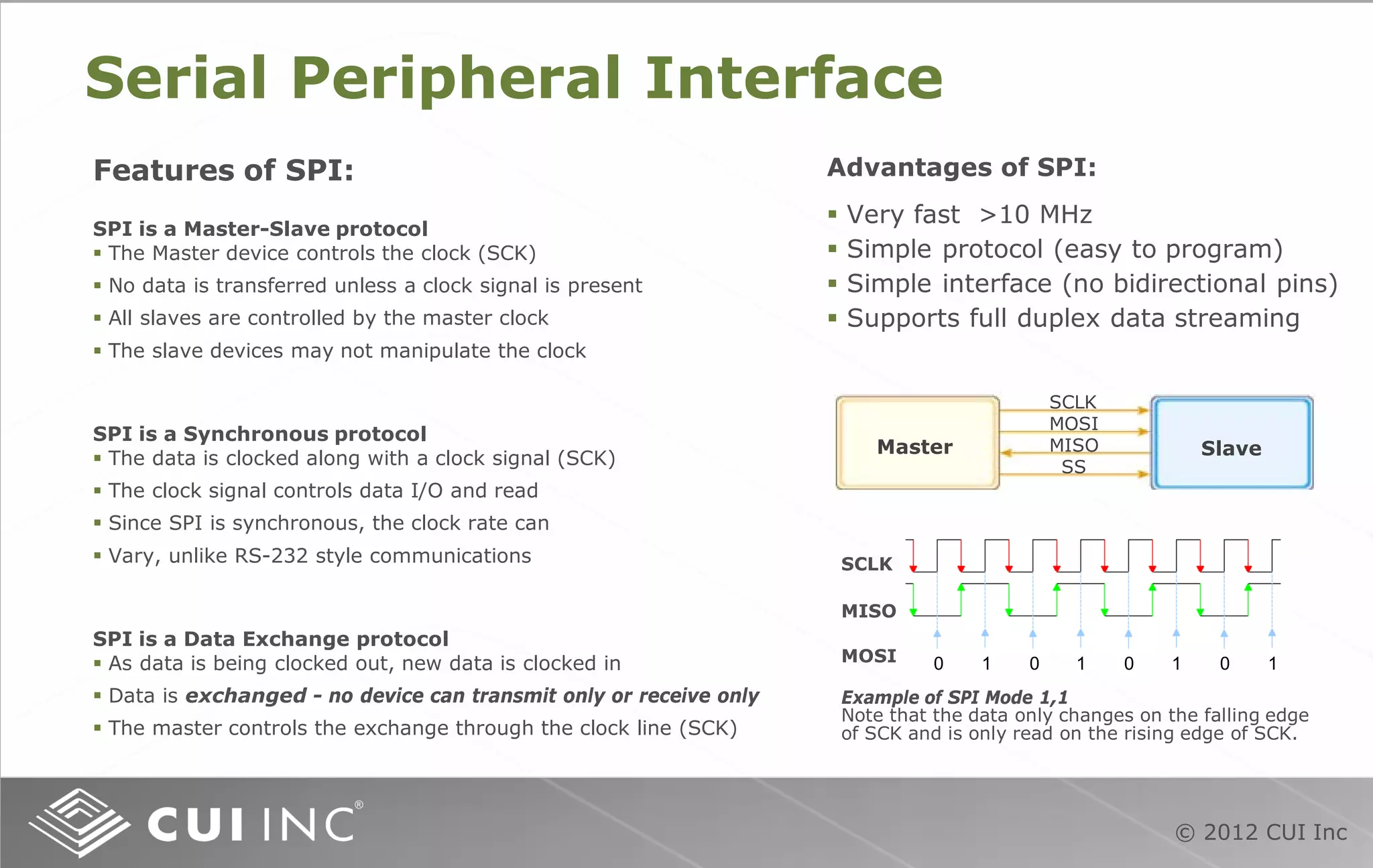
Example of SPI Mode 1,1
Note that the data only changes on the falling edge
of SCK and is only read on the rising edge of SCK.
0 0 0 0
1 1 1 1
Advantages of SPI:
 Very fast >10 MHz
 Simple protocol (easy to program)
 Simple interface (no bidirectional pins)
 Supports full duplex data streaming
SPI is a Master-Slave protocol
 The Master device controls the clock (SCK)
 No data is transferred unless a clock signal is present
 All slaves are controlled by the master clock
 The slave devices may not manipulate the clock
SPI is a Data Exchange protocol
 As data is being clocked out, new data is clocked in
 Data is exchanged - no device can transmit only or receive only
 The master controls the exchange through the clock line (SCK)
SPI is a Synchronous protocol
 The data is clocked along with a clock signal (SCK)
 The clock signal controls data I/O and read
 Since SPI is synchronous, the clock rate can
 Vary, unlike RS-232 style communications
Features of SPI:
© 2012 CUI Inc
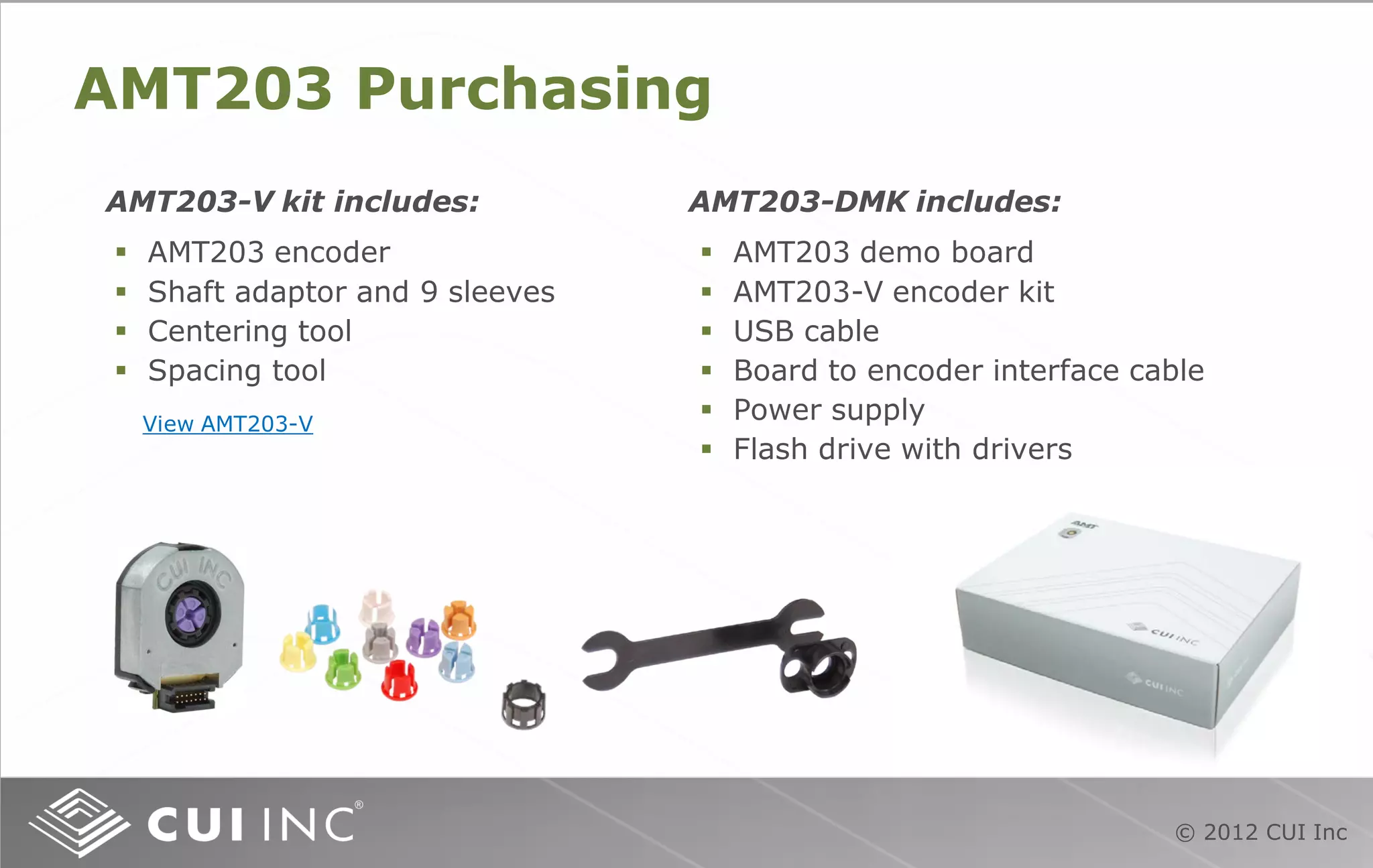
AMT203 Purchasing
 AMT203 encoder
 Shaft adaptor and 9 sleeves
 Centering tool
 Spacing tool
AMT203-V kit includes: AMT203-DMK includes:
 AMT203 demo board
 AMT203-V encoder kit
 USB cable
 Board to encoder interface cable
 Power supply
 Flash drive with drivers
View AMT203-V
© 2012 CUI Inc
www.cui.com

9346f1488e08c541a68f7542d4649dee4f4e37b5.pdf

  • 1.
    © 2013 CUIInc AMT203 Absolute Encoder
  • 2.
    © 2012 CUIInc Contents Purpose The purpose of this training module is to familiarize you with rotary absolute encoders and show the benefits of the AMT203. Objectives  Describe the functional theory of encoders; specifically absolute encoders  Understand what makes the AMT203 revolutionary  Explain the different components that make up the AMT203  Describe the installation and assembly of the AMT203  Illustrate the flexible options available with the AMT203 Content: 23 pages Learning time: 15 minutes
  • 3.
    © 2012 CUIInc What Is An Encoder? An encoder is a device that senses mechanical motion. It translates motion such as speed, direction, and shaft angle into electrical signals.
  • 4.
    © 2012 CUIInc How An Encoder Functions
  • 5.
    © 2012 CUIInc Encoders Provide Directional Information In this example, Signal A leads B, i.e., Signal A outputs a rising edge before Signal B. This indicates the shaft is rotating counter-clockwise. In this example, Signal B leads A. This indicates the shaft is rotating clockwise. Signal A Signal B Signal A Signal B Signal A leads signal B Signal B leads signal A
  • 6.
    © 2012 CUIInc Encoders Provide Position Information
  • 7.
    © 2012 CUIInc Encoders Provide Speed Information Encoders can detect speed when the number of output pulses is counted in a specified time span. The time element is typically provided by an internal oscillator or clock. The number of pulses in one revolution must also be known. The equation for calculating speed is: C PPR S = t 60 ÷ Where "S" is speed in rpm, "C" is the number of pulses counted in a "t" time interval. If 60 pulses were counted in 10 seconds from a 360PPR encoder, the speed can be calculated: S = = 0.1666 ÷ 0.1666 = 1 rpm 60 360 10 60 ÷ All of the counting, timing and calculations can be done electronically in real time and used to monitor or control speed.
  • 8.
    © 2012 CUIInc Encoders Provide Distance Information C = L ÷ (π * D) * PPR C = 12 ÷ (3.142 * 8) * 2000 = 955 Pulse count to achieve desired linear travel can be calculated in a similar fashion for devices that use ball screws, gears or pulleys to convert rotary motion to linear travel.
  • 9.
    © 2012 CUIInc Quadrature Decoding Quadrature decoder circuit Channel A Channel B Quad A pulses Quad B pulses One cycle 1 4 2 3
  • 10.
    © 2012 CUIInc What is an Absolute Encoder? Absolute encoder output 1 7 15 31 63 20 21 22 23 24 25 1 0 0 0 0 0 1 1 1 0 0 0 1 1 1 1 0 0 1 1 1 1 1 0 1 1 1 1 1 1 Incremental encoder output 1 2 4 8 16 32 0 0 1 0 1 1 0 1 Bit Bit Value
  • 11.
    © 2012 CUIInc Where Are Encoders Used? elevators factory aircraft automobiles satellites mobile equipment medical devices machine tools pick and place process automation packaging automation industrial robots
  • 12.
    © 2012 CUIInc Types of Rotary Encoders Mechanical 24 (16) – 28 (256) Optical 28 (256) – 219 (524,287) Magnetic 28 (256) – 217 (131,071) 28 (256) – 213 (8,192) 212 (4,096) Fiber Optic Capacitive
  • 13.
    © 2012 CUIInc How a Capacitive Encoder Works Receiver Rotor AC Field Transmitter  AC field transmitter sends a signal to the metal rotor as it turns  The metal pattern on the rotor creates a signal that is repetitive and predictable  CUI’s proprietary ASIC converts the modulated signal to output pulses
  • 14.
    © 2012 CUIInc Benefits of Capacitive vs Optical Technology Capacitive Optical  Greatly reduced assembly time & cost  Rugged code disc  Not susceptible to airborne contaminants  Much higher gap tolerance  Higher operating temperature range  Lower mass, almost zero backlash  No LEDs to fail
  • 15.
    © 2012 CUIInc AMT203 Specification and Feature Highlights  High resolution- 12-bit (4,096 PPR)  Broad temperature range- -25 – +85° C  Incremental option- A/B quadrature option for >8,000 RPM  Low profile- 11 mm depth  Light-weight mechanical design- 15g net weight (0.53 oz.)  Low current consumption than optical- <10 mA  Programmable zero position- saves time and money  Robust design- capacitive technology not susceptible to dust and particulates  Adapts to 9 common shaft diameters- allows for a high level of flexibility
  • 16.
    © 2012 CUIInc Ideal For Direct Motor Mounting The AMT Series can be used on any rotating shaft, however, it is ideal for mounting directly to motors:  Zero position set by SPI interface – no mechanical adjustment!  Mounting patterns for popular AC & DC motors  9 shaft diameter options  Extremely low mass reduces potential backlash  Small size fits in tight spaces  Quick and easy mounting process
  • 17.
    © 2012 CUIInc Easy Assembly And Installation Assembly of the AMT203 requires minimal time and effort. With just a few durable pieces, it snaps together in seconds without risk of damaging a glass optical disk or other fragile components.
  • 18.
    © 2012 CUIInc AMT203 Assembly click on the illustration below to view a short assembly video
  • 19.
    © 2012 CUIInc Versatile Shaft And Mounting Options mounting patterns Using the shaft adapter and the 9 color-coded sleeves, both the AMT203 can be adapted to 9 different motor shaft sizes. This is done by snapping one of the sleeves into the shaft adapter. Shaft adapter & sleeves hole pattern mm/in # of holes hole size Ø16/0.63 2 M1.6 Ø19.05/0.75 2 #4 Ø21.45/0.844 3 M1.6 or M2 Ø25.4/1.0 4 M1.6 or M2 Shaft Adapter Sleeves shaft sleeves Ø2 mm Ø3 mm Ø1/8 in Ø3/16 in Ø4mm Ø5 mm Ø6 mm Ø1/4 in Ø8 mm
  • 20.
    © 2012 CUIInc AMT203 Demo Board With the AMT203 Demo Board you can:  Set zero position  Monitor shaft position  Set CW or CCW for count increase/decrease  Select HEX or DECIMAL position display  Select incremental (A/B) or counter (STB/UDN) output  Access/read/write 128 bytes of user EEPROM  Experiment with all encoder functions
  • 21.
    © 2012 CUIInc Serial Peripheral Interface SCLK MOSI MISO SS Master Slave SCLK MISO MOSI Example of SPI Mode 1,1 Note that the data only changes on the falling edge of SCK and is only read on the rising edge of SCK. 0 0 0 0 1 1 1 1 Advantages of SPI:  Very fast >10 MHz  Simple protocol (easy to program)  Simple interface (no bidirectional pins)  Supports full duplex data streaming SPI is a Master-Slave protocol  The Master device controls the clock (SCK)  No data is transferred unless a clock signal is present  All slaves are controlled by the master clock  The slave devices may not manipulate the clock SPI is a Data Exchange protocol  As data is being clocked out, new data is clocked in  Data is exchanged - no device can transmit only or receive only  The master controls the exchange through the clock line (SCK) SPI is a Synchronous protocol  The data is clocked along with a clock signal (SCK)  The clock signal controls data I/O and read  Since SPI is synchronous, the clock rate can  Vary, unlike RS-232 style communications Features of SPI:
  • 22.
    © 2012 CUIInc AMT203 Purchasing  AMT203 encoder  Shaft adaptor and 9 sleeves  Centering tool  Spacing tool AMT203-V kit includes: AMT203-DMK includes:  AMT203 demo board  AMT203-V encoder kit  USB cable  Board to encoder interface cable  Power supply  Flash drive with drivers View AMT203-V
  • 23.
    © 2012 CUIInc www.cui.com