Teaching physics in context Elizabeth Swinbank Centre for Innovation and Research in Science Education University of York UK NZIP 2011
1 Research evidence Summary of research evidence on context-led science teaching 2 Salters Horners Advanced Physics A context-led course developed in the UK Key features of the development Some examples of activities for students 3 Responses to SHAP Views of students and teachers
Traditional approach Start with the physics principles  Students ask ‘why are we doing this?’ Later they might find out  Context-led (STS) Start with a context (story/problem/application)  Explore some relevant physics
Why use contexts? To increase student interest and motivation To provide a structure for teaching and learning To develop practical and other activities To illustrate possible career opportunities To generate a ‘spiral curriculum’
Why use contexts? To increase student interest and motivation To provide a structure for teaching and learning To develop practical and other activities To illustrate possible career opportunities To generate a ‘spiral curriculum’ Does it work?
The EPPI (Evidence, Policy and Practice Initiative) Reviews  (1) What evidence is there from controlled evaluation studies that context-based courses improve understanding of science ideas and the attitudes to science of 11 to 18-year-old pupils, and what are the implications of the evidence for initial teacher training courses?  Bennett, J., Lubben, F. and Hogarth, S.  (2003)  Bringing science to life: a synthesis of the research evidence on the effects of context-based and STS approaches to science teaching.  Science Education , 91 (3), 347-370.
The EPPI Reviews Systematic map of research studies: •  Most work has taken place in the USA, the UK, the Netherlands and Canada. •  Pupils in the 11 to16 age range are the target for the majority of the interventions. •  There are comparable levels of interest in the effects of such approaches on both understanding of ideas and attitudes to science or science lessons. •  A diversity of measures are used to assess effects on understanding and attitudes. •  26 studies have drawn on designs which use control groups.
The 2003 In-depth Review In-depth review focused on controlled evaluation studies which reported on both understanding and attitudes. •  There is some evidence to support the claim that context-based approaches  motivate pupils in their science lessons . •  There is evidence to support the claim that such approaches also  foster more positive attitudes to science more generally . •  There is good evidence to support the claim that context-based approaches  do not adversely affect pupils’ understanding  of scientific ideas.
The EPPI Reviews: two further in-depth reviews  (2) What is the evidence from evaluative studies of the effect of context-based or STS courses on the attitude to science and/or the understanding of science ideas of  boys and girls  in the 11 to 16 age range?  What is the evidence from evaluative studies of the effect of context-based or STS courses on the attitude to science and/or the understanding of science ideas of  lower-ability pupils  in the 11 to 16 age range?  Lubben F, Bennett J, Hogarth S, Robinson A (2005) A systematic review of the effects of context-based and Science-Technology-Society (STS) approaches in the teaching of secondary science on boys and girls, and on lower-ability pupils. In:  Research Evidence in Education Library . London: EPPI-Centre, Social Science Research Unit, Institute of Education, University of London.
The 2005 In-depth Reviews The small number of studies were of variable quality. There is  reasonable   evidence for the following: •  Both boys and girls using a context-based/STS approach held  significantly more positive attitudes to science  than their male/female peers using a traditional approach.  •  A context-based/STS approach to teaching science  narrowed the gap between boys and girls in their attitude  to science.  •  In cases when  boys enjoyed the materials significantly more  than girls, this was due to the nature of the  practical work •  In cases when  girls enjoyed materials significantly more  than boys, this was because of the  non-practical activities .
The EPPI Reviews To read the full reports go to http://eppi.ioe.ac.uk/cms/ evidence library reviews search curriculum topics science NB there are many other EPPI reviews of interest!
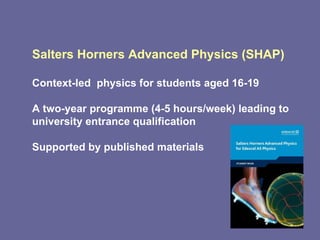
Salters Horners Advanced Physics (SHAP) Context-led  physics for students aged 16-19 A two-year programme (4-5 hours/week) leading to university entrance qualification Supported by published materials
Salters Horners Advanced Physics Key features Context led Practical and IT activities Scientific, mathematical and key skills Developed by teachers, academics and industrialists Materials for teachers, students and technicians Extension and revision materials On-going support for users
Developing the complete SHAP programme took two years and involved: teachers university academics physicists and engineers working in  industry publishers examination organisations sponsors
We researched a large number of contexts. We selected 11 for further development. Criteria for selecting contexts interest variety physics content at right level focus on 1-2 main areas of physics activities for students authentic data available
Principles for developing complete programme Progression in physics Progression in maths Variety and choice Activities for students Reliability Wider context
Progression in physics 1-3 main physics areas in each chapter Smooth progression Links between chapters Be selective. Do not try to cover all the physics relating to the context.
Progression in maths Include notes on basic maths Develop more advanced maths where needed Variety and choice Offer a range of activities Encourage teachers and students to select
Activities for students Use contexts are starting points Test activities to make sure they work Use authentic data Include simple activities
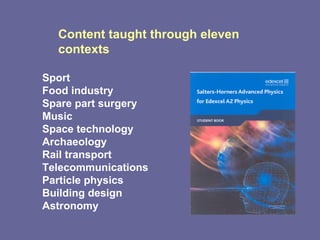
Content taught through eleven contexts  Sport Food industry Spare part surgery Music Space technology Archaeology Rail transport Telecommunications Particle physics Building design Astronomy
Good Enough to Eat What part does physics play in making  biscuits and sweets? How is food manufacture monitored  and controlled?
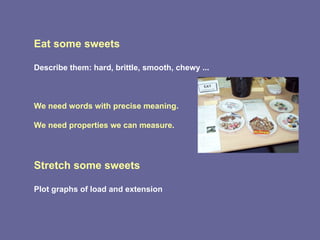
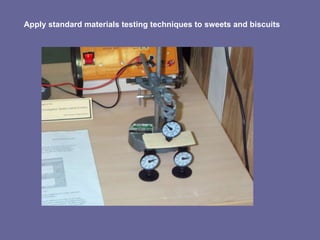
Eat some sweets Describe them: hard, brittle, smooth, chewy ...  We need words with precise meaning. We need properties we can measure. Stretch some sweets  Plot graphs of load and extension
Apply standard materials testing techniques to sweets and biscuits
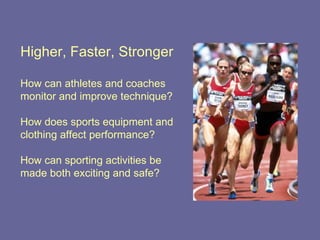
Higher, Faster, Stronger How can athletes and coaches monitor and improve technique? How does sports equipment and clothing affect performance? How can sporting activities be made both exciting and safe?
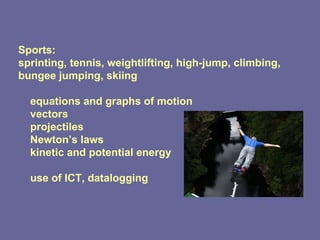
Sports:  sprinting, tennis, weightlifting, high-jump, climbing, bungee jumping, skiing equations and graphs of motion vectors projectiles Newton’s laws kinetic and potential energy use of ICT, datalogging
 
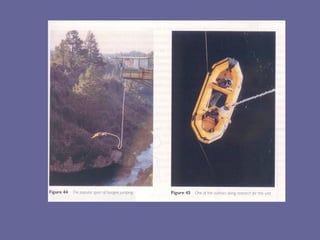
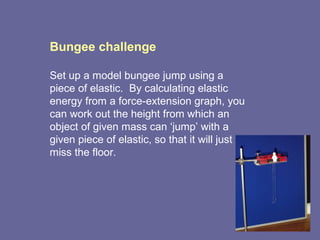
Bungee challenge Set up a model bungee jump using a piece of elastic.  By calculating elastic energy from a force-extension graph, you can work out the height from which an object of given mass can ‘jump’ with a given piece of elastic, so that it will just miss the floor.
The Bungee Challenge The model bungee jumper has mass 9.1g The elastic cord is 0.50 m long You have a graph showing energy and extension What is the best height for the launch platform?
Bungee challenge Self evaluation I/we predicted the correct height and achieved a drop that was both safe and exciting. I/we predicted too high. The jumper complained that s/he had not been scared enough.  I/we would not be hired as bungee operators.
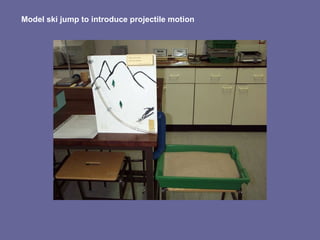
Model ski jump to introduce projectile motion
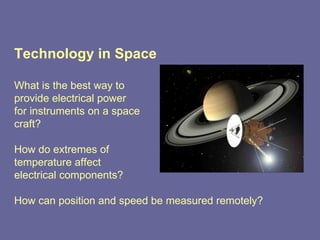
Technology in Space What is the best way to  provide electrical power  for instruments on a space  craft? How do extremes of  temperature affect  electrical components? How can position and speed be measured remotely?
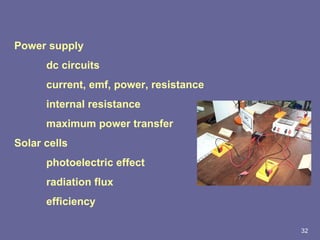
Power supply dc circuits current, emf, power, resistance internal resistance maximum power transfer Solar cells photoelectric effect radiation flux efficiency
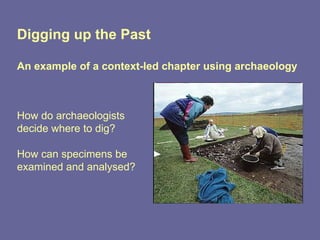
How do archaeologists  decide where to dig? How can specimens be  examined and analysed? Digging up the Past An example of a context-led chapter using archaeology
We researched several areas before deciding what to include Dating Thermoluminescence Carbon-14 Tree rings Artefact analysis X-rays Mass spectrometry Microscopy Spectroscopy Site surveying Geomagnetic survey Resistive survey Ground-based radar
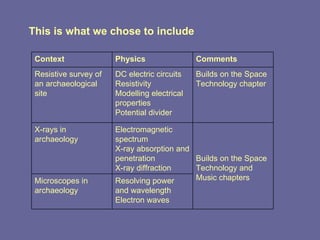
This is what we chose to include Resolving power and wavelength Electron waves Microscopes in archaeology Builds on the Space Technology and Music chapters Electromagnetic spectrum X-ray absorption and penetration X-ray diffraction X-rays in archaeology Builds on the Space Technology chapter DC electric circuits Resistivity Modelling electrical properties  Potential divider Resistive survey of an archaeological site Comments Physics Context
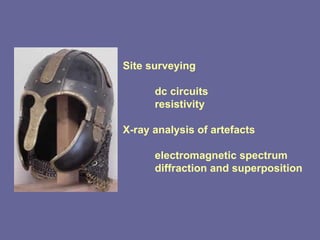
Site surveying dc circuits resistivity X-ray analysis of artefacts electromagnetic spectrum diffraction and superposition
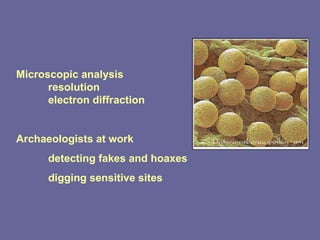
Microscopic analysis resolution electron diffraction Archaeologists at work detecting fakes and hoaxes digging sensitive sites
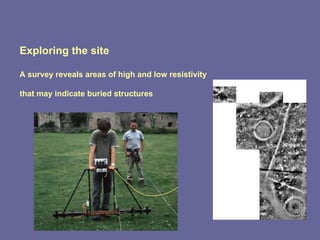
Exploring the site A survey reveals areas of high and low resistivity  that may indicate buried structures
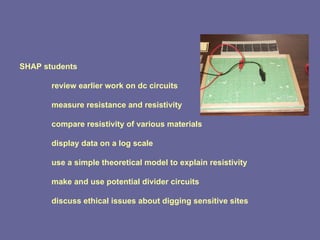
SHAP students review earlier work on dc circuits measure resistance and resistivity compare resistivity of various materials display data on a log scale use a simple theoretical model to explain resistivity make and use potential divider circuits discuss ethical issues about digging sensitive sites
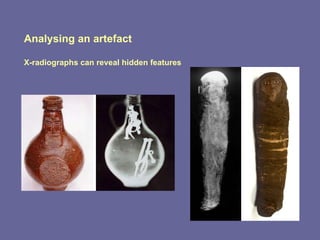
Analysing an artefact X-radiographs can reveal hidden features
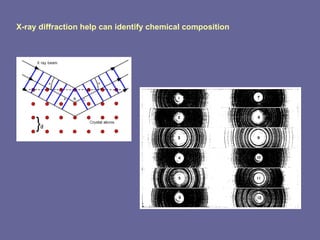
X-ray diffraction help can identify chemical composition
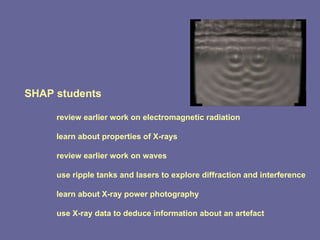
SHAP students review earlier work on electromagnetic radiation learn about properties of X-rays review earlier work on waves use ripple tanks and lasers to explore diffraction and interference learn about X-ray power photography use X-ray data to deduce information about an artefact
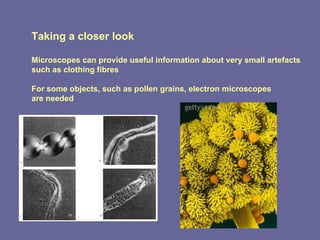
Taking a closer look Microscopes can provide useful information about very small artefacts  such as clothing fibres For some objects, such as pollen grains, electron microscopes  are needed
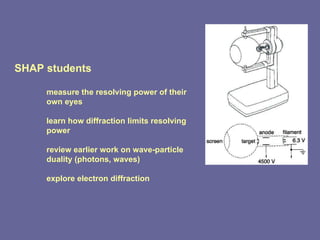
SHAP students measure the resolving power of their  own eyes learn how diffraction limits resolving  power review earlier work on wave-particle  duality (photons, waves) explore electron diffraction
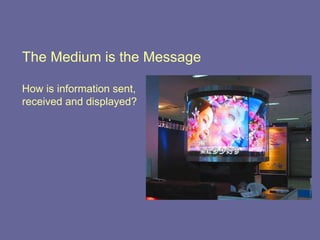
The Medium is the Message How is information sent,  received and displayed?
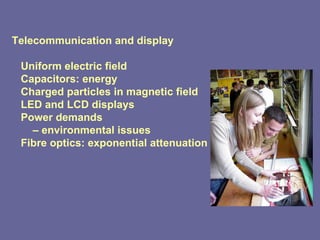
Telecommunication and display Uniform electric field Capacitors: energy Charged particles in magnetic field LED and LCD displays Power demands –  environmental issues Fibre optics: exponential attenuation
Analogue and digital signals Sampling an analogue signal What must be the lowest sampling frequency? What happens if the sampling frequency is too low?
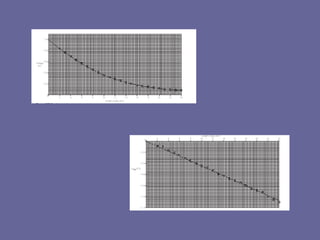
Model optical fibre system infrared emitting diode infrared detector jelly ‘fibre’ Plot a graph of signal strength against length of fibre. Use the results to explore exponential change
 
SHAP students say “ The compact disc player, that is obviously something we use quite a lot as teenagers.  You just take it out and just assume it plays.  It was interesting to learn about how.”  “ I do a lot of bungee jumping myself ... So when you actually do the physics of it and it is presented in a less than formal manner when the teaching starts off, then it can be quite entertaining.  It was just interesting to calculate.” “ I liked the Secrets of Resistance, because the topic would mean nothing without being able to apply it to something.  It made sense with this application.”
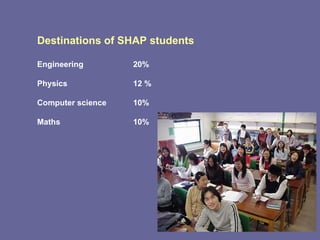
Destinations of SHAP students Engineering 20% Physics  12 % Computer science 10% Maths 10%
SHAP teachers say “ In all of our contacts with outside companies ... there has been a tremendous response in terms of wanting to help students understand physics and engineering in the real world, and to encourage students into careers in these areas.” “ Everything they have learnt so far has fallen into place and they can now explain new material for themselves.” “ This is physics in the real world, the world my students live in.  It is physics which is so obviously useful and interesting.”
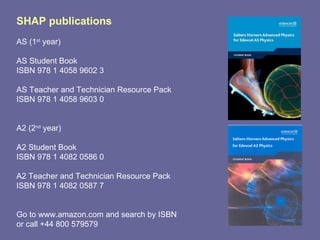
SHAP publications AS (1 st  year) AS Student Book  ISBN 978 1 4058 9602 3 AS Teacher and Technician Resource Pack  ISBN 978 1 4058 9603 0 A2 (2 nd  year) A2 Student Book ISBN 978 1 4082 0586 0 A2 Teacher and Technician Resource Pack ISBN 978 1 4082 0587 7 Go to www.amazon.com and search by ISBN or call +44 800 579579

9.00 k4 e swinbank

  • 1.
    Teaching physics incontext Elizabeth Swinbank Centre for Innovation and Research in Science Education University of York UK NZIP 2011
  • 2.
    1 Research evidenceSummary of research evidence on context-led science teaching 2 Salters Horners Advanced Physics A context-led course developed in the UK Key features of the development Some examples of activities for students 3 Responses to SHAP Views of students and teachers
  • 3.
    Traditional approach Startwith the physics principles Students ask ‘why are we doing this?’ Later they might find out Context-led (STS) Start with a context (story/problem/application) Explore some relevant physics
  • 4.
    Why use contexts?To increase student interest and motivation To provide a structure for teaching and learning To develop practical and other activities To illustrate possible career opportunities To generate a ‘spiral curriculum’
  • 5.
    Why use contexts?To increase student interest and motivation To provide a structure for teaching and learning To develop practical and other activities To illustrate possible career opportunities To generate a ‘spiral curriculum’ Does it work?
  • 6.
    The EPPI (Evidence,Policy and Practice Initiative) Reviews (1) What evidence is there from controlled evaluation studies that context-based courses improve understanding of science ideas and the attitudes to science of 11 to 18-year-old pupils, and what are the implications of the evidence for initial teacher training courses? Bennett, J., Lubben, F. and Hogarth, S. (2003) Bringing science to life: a synthesis of the research evidence on the effects of context-based and STS approaches to science teaching. Science Education , 91 (3), 347-370.
  • 7.
    The EPPI ReviewsSystematic map of research studies: • Most work has taken place in the USA, the UK, the Netherlands and Canada. • Pupils in the 11 to16 age range are the target for the majority of the interventions. • There are comparable levels of interest in the effects of such approaches on both understanding of ideas and attitudes to science or science lessons. • A diversity of measures are used to assess effects on understanding and attitudes. • 26 studies have drawn on designs which use control groups.
  • 8.
    The 2003 In-depthReview In-depth review focused on controlled evaluation studies which reported on both understanding and attitudes. • There is some evidence to support the claim that context-based approaches motivate pupils in their science lessons . • There is evidence to support the claim that such approaches also foster more positive attitudes to science more generally . • There is good evidence to support the claim that context-based approaches do not adversely affect pupils’ understanding of scientific ideas.
  • 9.
    The EPPI Reviews:two further in-depth reviews (2) What is the evidence from evaluative studies of the effect of context-based or STS courses on the attitude to science and/or the understanding of science ideas of boys and girls in the 11 to 16 age range? What is the evidence from evaluative studies of the effect of context-based or STS courses on the attitude to science and/or the understanding of science ideas of lower-ability pupils in the 11 to 16 age range? Lubben F, Bennett J, Hogarth S, Robinson A (2005) A systematic review of the effects of context-based and Science-Technology-Society (STS) approaches in the teaching of secondary science on boys and girls, and on lower-ability pupils. In: Research Evidence in Education Library . London: EPPI-Centre, Social Science Research Unit, Institute of Education, University of London.
  • 10.
    The 2005 In-depthReviews The small number of studies were of variable quality. There is reasonable evidence for the following: • Both boys and girls using a context-based/STS approach held significantly more positive attitudes to science than their male/female peers using a traditional approach. • A context-based/STS approach to teaching science narrowed the gap between boys and girls in their attitude to science. • In cases when boys enjoyed the materials significantly more than girls, this was due to the nature of the practical work • In cases when girls enjoyed materials significantly more than boys, this was because of the non-practical activities .
  • 11.
    The EPPI ReviewsTo read the full reports go to http://eppi.ioe.ac.uk/cms/ evidence library reviews search curriculum topics science NB there are many other EPPI reviews of interest!
  • 12.
    Salters Horners AdvancedPhysics (SHAP) Context-led physics for students aged 16-19 A two-year programme (4-5 hours/week) leading to university entrance qualification Supported by published materials
  • 13.
    Salters Horners AdvancedPhysics Key features Context led Practical and IT activities Scientific, mathematical and key skills Developed by teachers, academics and industrialists Materials for teachers, students and technicians Extension and revision materials On-going support for users
  • 14.
    Developing the completeSHAP programme took two years and involved: teachers university academics physicists and engineers working in industry publishers examination organisations sponsors
  • 15.
    We researched alarge number of contexts. We selected 11 for further development. Criteria for selecting contexts interest variety physics content at right level focus on 1-2 main areas of physics activities for students authentic data available
  • 16.
    Principles for developingcomplete programme Progression in physics Progression in maths Variety and choice Activities for students Reliability Wider context
  • 17.
    Progression in physics1-3 main physics areas in each chapter Smooth progression Links between chapters Be selective. Do not try to cover all the physics relating to the context.
  • 18.
    Progression in mathsInclude notes on basic maths Develop more advanced maths where needed Variety and choice Offer a range of activities Encourage teachers and students to select
  • 19.
    Activities for studentsUse contexts are starting points Test activities to make sure they work Use authentic data Include simple activities
  • 20.
    Content taught througheleven contexts Sport Food industry Spare part surgery Music Space technology Archaeology Rail transport Telecommunications Particle physics Building design Astronomy
  • 21.
    Good Enough toEat What part does physics play in making biscuits and sweets? How is food manufacture monitored and controlled?
  • 22.
    Eat some sweetsDescribe them: hard, brittle, smooth, chewy ... We need words with precise meaning. We need properties we can measure. Stretch some sweets Plot graphs of load and extension
  • 23.
    Apply standard materialstesting techniques to sweets and biscuits
  • 24.
    Higher, Faster, StrongerHow can athletes and coaches monitor and improve technique? How does sports equipment and clothing affect performance? How can sporting activities be made both exciting and safe?
  • 25.
    Sports: sprinting,tennis, weightlifting, high-jump, climbing, bungee jumping, skiing equations and graphs of motion vectors projectiles Newton’s laws kinetic and potential energy use of ICT, datalogging
  • 26.
  • 27.
    Bungee challenge Setup a model bungee jump using a piece of elastic. By calculating elastic energy from a force-extension graph, you can work out the height from which an object of given mass can ‘jump’ with a given piece of elastic, so that it will just miss the floor.
  • 28.
    The Bungee ChallengeThe model bungee jumper has mass 9.1g The elastic cord is 0.50 m long You have a graph showing energy and extension What is the best height for the launch platform?
  • 29.
    Bungee challenge Selfevaluation I/we predicted the correct height and achieved a drop that was both safe and exciting. I/we predicted too high. The jumper complained that s/he had not been scared enough. I/we would not be hired as bungee operators.
  • 30.
    Model ski jumpto introduce projectile motion
  • 31.
    Technology in SpaceWhat is the best way to provide electrical power for instruments on a space craft? How do extremes of temperature affect electrical components? How can position and speed be measured remotely?
  • 32.
    Power supply dccircuits current, emf, power, resistance internal resistance maximum power transfer Solar cells photoelectric effect radiation flux efficiency
  • 33.
    How do archaeologists decide where to dig? How can specimens be examined and analysed? Digging up the Past An example of a context-led chapter using archaeology
  • 34.
    We researched severalareas before deciding what to include Dating Thermoluminescence Carbon-14 Tree rings Artefact analysis X-rays Mass spectrometry Microscopy Spectroscopy Site surveying Geomagnetic survey Resistive survey Ground-based radar
  • 35.
    This is whatwe chose to include Resolving power and wavelength Electron waves Microscopes in archaeology Builds on the Space Technology and Music chapters Electromagnetic spectrum X-ray absorption and penetration X-ray diffraction X-rays in archaeology Builds on the Space Technology chapter DC electric circuits Resistivity Modelling electrical properties Potential divider Resistive survey of an archaeological site Comments Physics Context
  • 36.
    Site surveying dccircuits resistivity X-ray analysis of artefacts electromagnetic spectrum diffraction and superposition
  • 37.
    Microscopic analysis resolutionelectron diffraction Archaeologists at work detecting fakes and hoaxes digging sensitive sites
  • 38.
    Exploring the siteA survey reveals areas of high and low resistivity that may indicate buried structures
  • 39.
    SHAP students reviewearlier work on dc circuits measure resistance and resistivity compare resistivity of various materials display data on a log scale use a simple theoretical model to explain resistivity make and use potential divider circuits discuss ethical issues about digging sensitive sites
  • 40.
    Analysing an artefactX-radiographs can reveal hidden features
  • 41.
    X-ray diffraction helpcan identify chemical composition
  • 42.
    SHAP students reviewearlier work on electromagnetic radiation learn about properties of X-rays review earlier work on waves use ripple tanks and lasers to explore diffraction and interference learn about X-ray power photography use X-ray data to deduce information about an artefact
  • 43.
    Taking a closerlook Microscopes can provide useful information about very small artefacts such as clothing fibres For some objects, such as pollen grains, electron microscopes are needed
  • 44.
    SHAP students measurethe resolving power of their own eyes learn how diffraction limits resolving power review earlier work on wave-particle duality (photons, waves) explore electron diffraction
  • 45.
    The Medium isthe Message How is information sent, received and displayed?
  • 46.
    Telecommunication and displayUniform electric field Capacitors: energy Charged particles in magnetic field LED and LCD displays Power demands – environmental issues Fibre optics: exponential attenuation
  • 47.
    Analogue and digitalsignals Sampling an analogue signal What must be the lowest sampling frequency? What happens if the sampling frequency is too low?
  • 48.
    Model optical fibresystem infrared emitting diode infrared detector jelly ‘fibre’ Plot a graph of signal strength against length of fibre. Use the results to explore exponential change
  • 49.
  • 50.
    SHAP students say“ The compact disc player, that is obviously something we use quite a lot as teenagers. You just take it out and just assume it plays. It was interesting to learn about how.” “ I do a lot of bungee jumping myself ... So when you actually do the physics of it and it is presented in a less than formal manner when the teaching starts off, then it can be quite entertaining. It was just interesting to calculate.” “ I liked the Secrets of Resistance, because the topic would mean nothing without being able to apply it to something. It made sense with this application.”
  • 51.
    Destinations of SHAPstudents Engineering 20% Physics 12 % Computer science 10% Maths 10%
  • 52.
    SHAP teachers say“ In all of our contacts with outside companies ... there has been a tremendous response in terms of wanting to help students understand physics and engineering in the real world, and to encourage students into careers in these areas.” “ Everything they have learnt so far has fallen into place and they can now explain new material for themselves.” “ This is physics in the real world, the world my students live in. It is physics which is so obviously useful and interesting.”
  • 53.
    SHAP publications AS(1 st year) AS Student Book ISBN 978 1 4058 9602 3 AS Teacher and Technician Resource Pack ISBN 978 1 4058 9603 0 A2 (2 nd year) A2 Student Book ISBN 978 1 4082 0586 0 A2 Teacher and Technician Resource Pack ISBN 978 1 4082 0587 7 Go to www.amazon.com and search by ISBN or call +44 800 579579