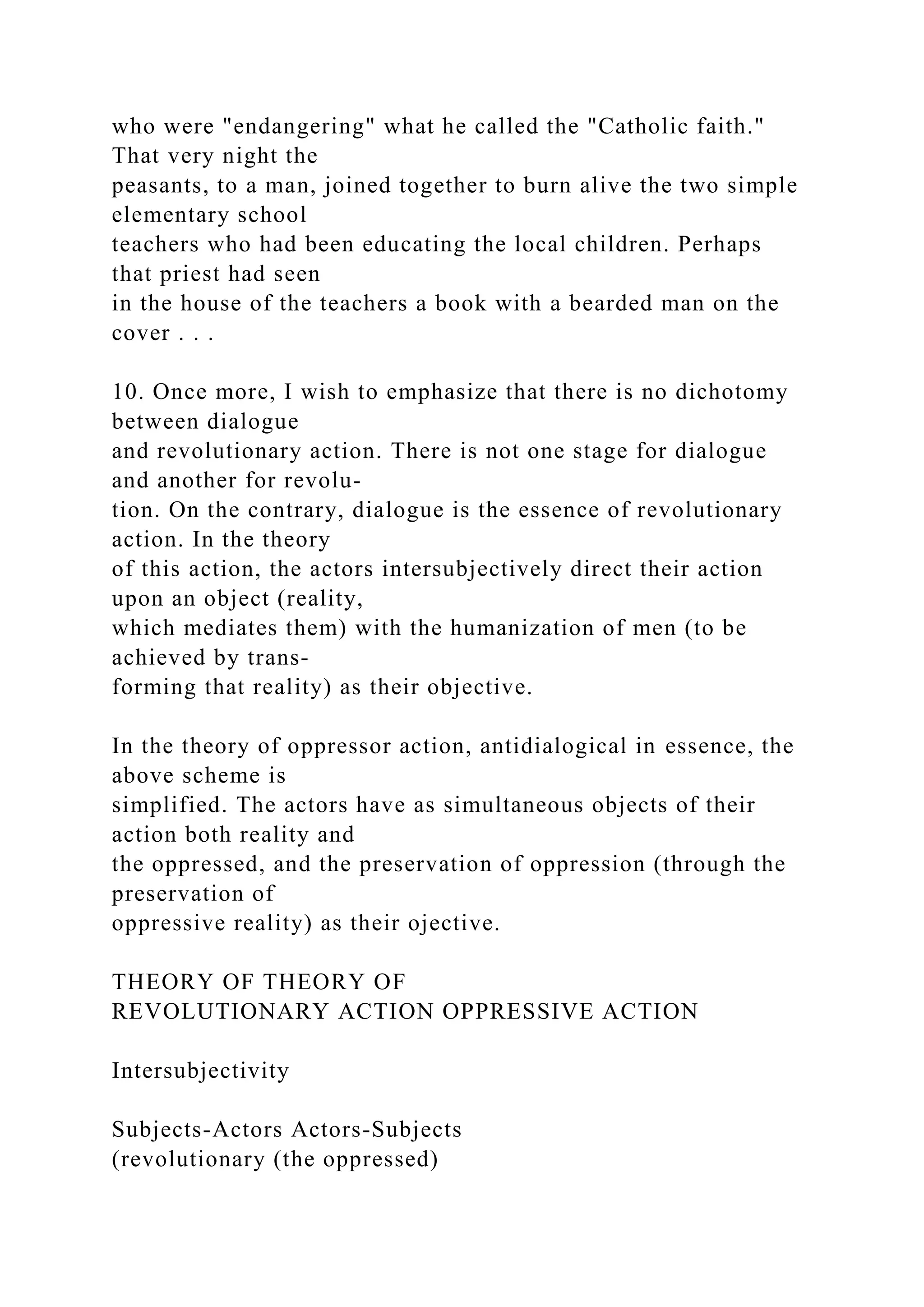
8
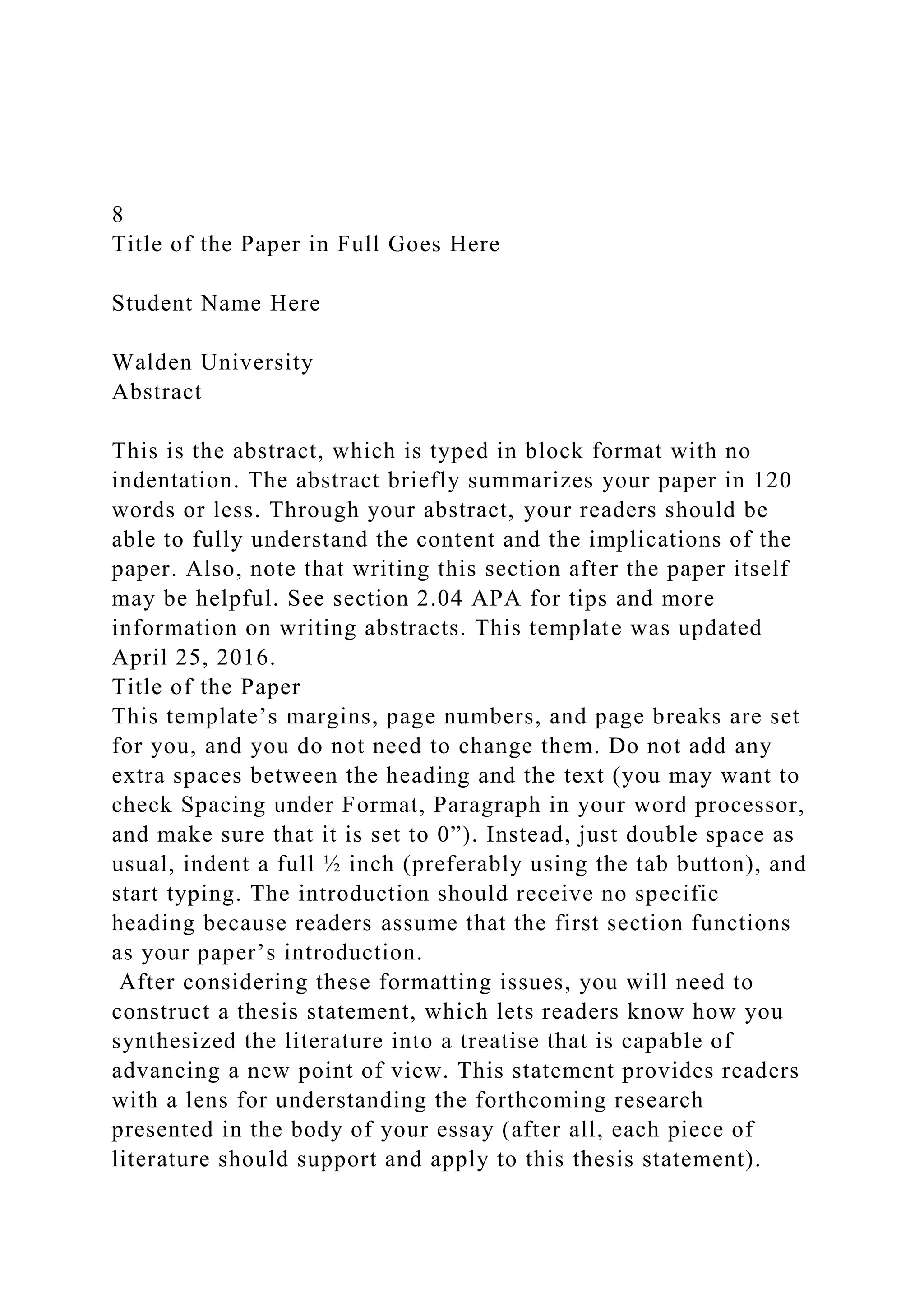
Title of the Paper in Full Goes Here
Student Name Here
Walden University
Abstract
This is the abstract, which is typed in block format with no
indentation. The abstract briefly summarizes your paper in 120
words or less. Through your abstract, your readers should be
able to fully understand the content and the implications of the
paper. Also, note that writing this section after the paper itself
may be helpful. See section 2.04 APA for tips and more
information on writing abstracts. This template was updated
April 25, 2016.
Title of the Paper
This template’s margins, page numbers, and page breaks are set
for you, and you do not need to change them. Do not add any
extra spaces between the heading and the text (you may want to
check Spacing under Format, Paragraph in your word processor,
and make sure that it is set to 0”). Instead, just double space as
usual, indent a full ½ inch (preferably using the tab button), and
start typing. The introduction should receive no specific
heading because readers assume that the first section functions
as your paper’s introduction.
After considering these formatting issues, you will need to
construct a thesis statement, which lets readers know how you
synthesized the literature into a treatise that is capable of
advancing a new point of view. This statement provides readers
with a lens for understanding the forthcoming research
presented in the body of your essay (after all, each piece of
literature should support and apply to this thesis statement).
Once you have established your thesis, begin constructing the
introduction. An easy template for writing an introduction
follows:
1.
Start with what has been said or done regarding the topic.
2.
Explain the problem with what has been said or done.
3.
Offer a solution in a concise thesis statement that can be
supported by the literature.
4.
Explain how the thesis brings about social change.
Level 1 Heading
This text will be the beginning of the body of the essay. Even
though this section has a new heading, make sure to connect
this section to the previous one so readers can follow along with
the ideas and research presented. The first sentence in each
paragraph should transition from the previous paragraph and
summarize the main point in the paragraph. Make sure each
paragraph contains only one topic, and when you see yourself
drifting to another idea, make sure you break into a new
paragraph. Also, avoid long paragraphs (more than three-fourths
of a page) to help hold readers’ attention; many shorter
paragraphs are better than a few long ones. In short, think this:
new idea, new paragraph.
Another Level 1 Heading
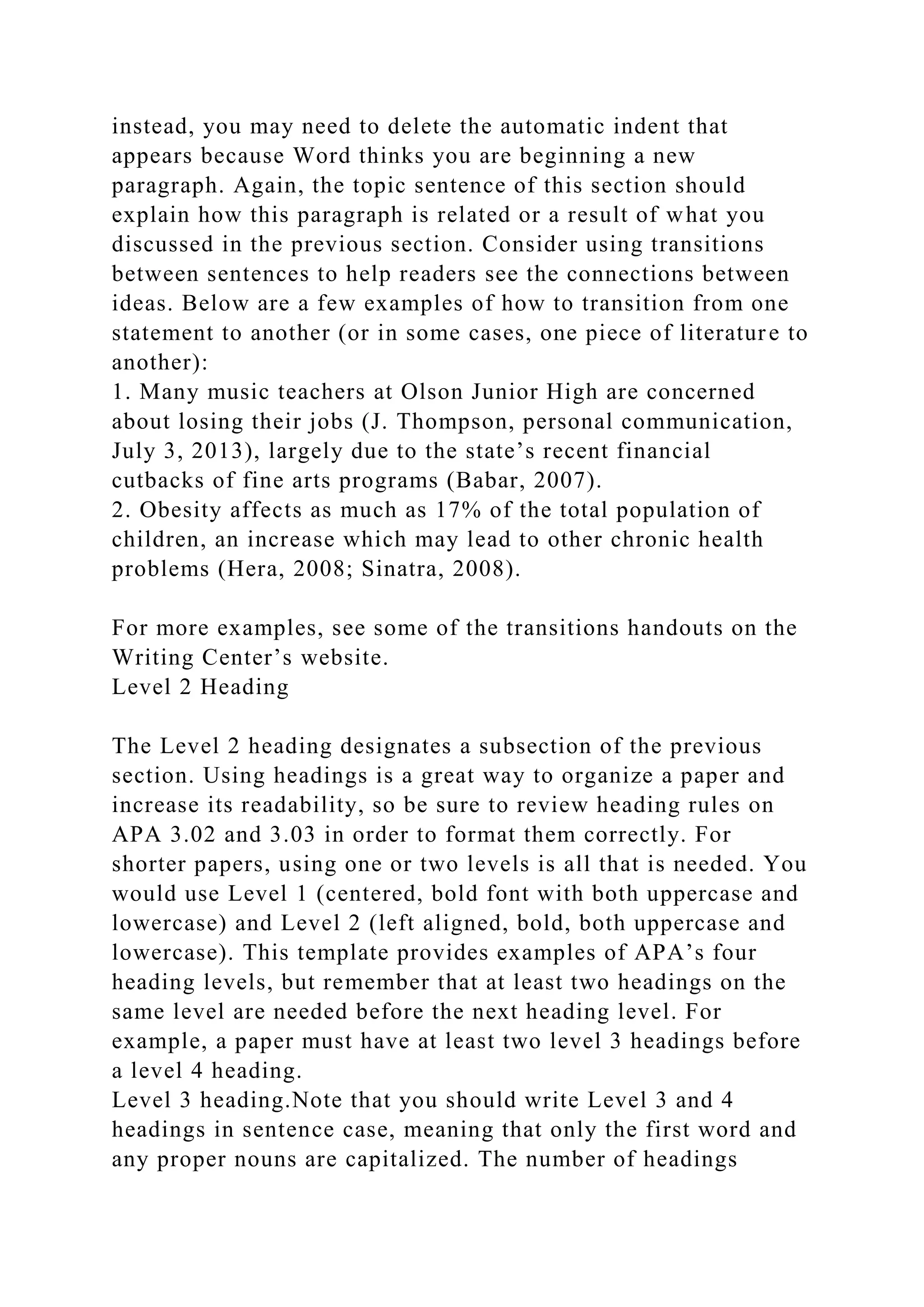
Here is another Level 1 heading. Note that, when you add
additional headings, you should use the APA levels available in
the Styles area of your toolbar. If you enter them manually
instead, you may need to delete the automatic indent that
appears because Word thinks you are beginning a new
paragraph. Again, the topic sentence of this section should
explain how this paragraph is related or a result of what you
discussed in the previous section. Consider using transitions
between sentences to help readers see the connections between
ideas. Below are a few examples of how to transition from one
statement to another (or in some cases, one piece of literature to
another):
1. Many music teachers at Olson Junior High are concerned
about losing their jobs (J. Thompson, personal communication,
July 3, 2013), largely due to the state’s recent financial
cutbacks of fine arts programs (Babar, 2007).
2. Obesity affects as much as 17% of the total population of
children, an increase which may lead to other chronic health
problems (Hera, 2008; Sinatra, 2008).
For more examples, see some of the transitions handouts on the
Writing Center’s website.
Level 2 Heading
The Level 2 heading designates a subsection of the previous
section. Using headings is a great way to organize a paper and
increase its readability, so be sure to review heading rules on
APA 3.02 and 3.03 in order to format them correctly. For
shorter papers, using one or two levels is all that is needed. You
would use Level 1 (centered, bold font with both uppercase and
lowercase) and Level 2 (left aligned, bold, both uppercase and
lowercase). This template provides examples of APA’s four
heading levels, but remember that at least two headings on the
same level are needed before the next heading level. For
example, a paper must have at least two level 3 headings before
a level 4 heading.
Level 3 heading.Note that you should write Level 3 and 4
headings in sentence case, meaning that only the first word and
any proper nouns are capitalized. The number of headings
needed in a particular paper is not set, but longer papers may
benefit from another heading level, such as this Level 3 heading
(which is an indented, bold, lowercase paragraph heading).
Level 4 heading. One crucial area in APA is learning how to
cite in academic work. Make sure to cite source information
throughout your paper to avoid plagiarism. This practice is
critical: you need to give credit to your sources and avoid
copying others’ work at all costs. Look at APA starting at 6.01
for guidelines on citing source information in your text.
Level 4 heading.You will want to include at least two of each
kind of heading in your paper, hence this additional paragraph
modeling effective heading usage. See below for further tips on
using headings effectively.
Level 3 heading.Again, if you choose to use Level 3 or 4
headings, at least two of each heading level should appear in the
paper. Otherwise, if only one heading appears, your readers may
question the need for a heading at all. If you find yourself
questioning whether or how to use headings, consider
consulting your instructor or committee chair for his or her
input.
Level 1 Heading
APA can seem difficult to master, but following the general
rules becomes easier with use. The Writing Center also offers
numerous resources on its website and by email to help.
And so forth until the conclusion…..
Level 1 Heading
The conclusion section should recap the major points of your
paper. However, perhaps more importantly, the conclusion
should also interpret what you have written and what it means
in the bigger picture. To help write your concluding remarks,
consider asking yourself these questions: What do you want to
happen with the information you have provided? What do you
want to change? What is your ultimate goal in using this
information? What would it mean if the suggestions in your
paper were taken and used?
References
(Please note that the following references are intended as
examples only. Also, these illustrate different types of
references but are not all cited in the text. In your paper, be
sure every reference entry matches a citation, and every citation
refers to an item in the reference list.)
Alexander, G., & Bonaparte, N. (2008). My way or the highway
that I built. Ancient Dictators, 25(7), 14–31.
doi:10.8220/CTCE.52.1.23-91
Babar, E. (2007). The art of being a French elephant.
Adventurous Cartoon Animals,19, 4319–4392. Retrieved from
http://www.elephants104.ace.org
Bumstead, D. (2009). The essentials: Sandwiches and sleep.
Journals of Famous Loafers, 5, 565–582.
doi:12.2847/CEDG.39.2.51-71
Hansel, G., & Gretel, D. (1973). Candied houses and unfriendly
occupants. Thousand Oaks, CA: Fairy Tale Publishing.
Hera, J. (2008). Why Paris was wrong. Journal of Greek
Goddess Sore Spots, 20(4), 19-21. doi: 15.555/GGE.64.1.76-82
Laureate Education, Inc. (Producer). (2007). How to cite a
video: The city is always Baltimore [DVD]. Baltimore, MD:
Author.
Laureate Education, Inc. (Producer). (2010). Name of program
[Video webcast]. Retrieved from http://www.courseurl.com
Sinatra, F. (2008). Zing! Went the strings of my heart. Making
Good Songs Great, 18(3), 31–22. Retrieved from
http://articlesextollingrecordingsofyore.192/fs.com
Smasfaldi, H., Wareumph, I., Aeoli, Q., Rickies, F., Furoush,
P., Aaegrade, V., … Fiiel, B. (2005). The art of correcting
surname mispronunciation. New York, NY: Supportive
Publisher Press. Retrieved from
http://www.onewaytociteelectronicbooksperAPA7.02.com
White, S., & Red, R. (2001). Stop and smell the what now?
Floral arranging for beginners (Research Report No. 40-921).
Retrieved from University of Wooded Glen, Center for
Aesthetic Improvements in Fairy Tales website:
http://www.uwg.caift/~40_921.pdf
PAULO FREIRE
PEDAGOGY
of the
OPPRESSED
;
• 30TH ANNIVERSARY EDITION •
Translated by Myra Bergman Ramos
With an Introduction by Donaldo Macedo
A continuum
• I f N E W Y O R K • L O N D O N
2005
The Continuum International Publishing Group Inc
15 East 26,h Street, New York, NY 10010
The Continuum International Publishing Group Ltd
The Tower Building, 11 York Road, London SE1 7NX
Copyright © 1970, 1993 by Paulo Freire
Introduction © 2000 by Donaldo Macedo
All rights reserved. No part of this book may be reproduced,
stored in a retrieval system, or transmitted, in any form or
by any means, electronic, mechanical, photocopying, recording,
or otherwise, without the written permission of
The Continuum International Publishing Group Inc.
Printed in the United States of America
Library of Congress Cataloging-in-Publication Data
Freire, Paulo, 1921-
[Pedagogia del oprimido. English]
Pedagogy of the oppressed / Paulo Freire ; translated by Myra
Bergman Ramos ; introduction by Donaldo Macedo.—30th
anniversary ed.
p. cm.
Includes bibliographical references.
ISBN 0-8264-1276-9 (alk. paper)
1. Freire, Paulo, 1921- 2. Education—Philosophy. 3. Popular
education—Philosophy. 4. Critical pedagogy. I. Title.
LB880.F73 P4313 2000
370.11*5—dc21 00-030304
To the oppressed,
and to those who suffer with them
and fight at their side
Contents
Publisher's Foreword 9
Introduction to t h e Anniversary Edition
b y DONALDO MACEDO 11
Foreword by RICHARD SHAULL 29
Preface ^ 35
Chapter 1 43
The justification for a pedagogy of the oppressed; the
contradiction
between the oppressors and the oppressed, and how it is
overcome;
oppression and the oppressors; oppression and the oppressed;
liberation: not a gift, not a self-achievement, but a mutual
process.
Chapter 2 71
The "banking" concept of education as an instrument of
oppression—
its presuppositions—a critique; the problem-posing concept of
education as an instrument for liberation—-its presuppositions;
the
"banking" concept and the teacher-student contradiction; the
problem-posing concept and the supersedence of the teacher-
student contradiction; education: a mutual process, world-
mediated;
people as uncompleted beings, conscious of their incompletion,
and
their attempt to be more fully human.
8 • C O N T E N T S
Chapter 3 87
Dialogics—the essence of education as the practice of freedom;
dialogics and dialogue; dialogue and the search for program
content; the human-world relationship, "generative themes," and
the program content of education as the practice of freedom; the
investigation of "generative themes" and its methodology; the
awakening of critical consciousness through the investigation of
"generative themes"; the various stages of the investigation.
Chapter 4 125
Antidialogics and dialogics as matrices of opposing theories of
cultural action: the former as an instrument of oppression and
the
latter as an instrument of liberation; the theory of antidialogical
action and its characteristics: conquest, divide and rule,
manipulation, and cultural invasion; the theory of dialogical
action and its characteristics: cooperation, unity, organization,
and
cultural synthesis.
Publisher's Foreword
This is the thirtieth anniversary of the publication in the United
States
of Pedagogy of the Oppressed. Since the original publication,
this rev-
olutionary work has gone into more than a score of printings
and sold
over 750,000 copies worldwide.
In his foreword to the first edition, which is included in this
one,
Richard Shaull wrote:
In this country, we are gradually becoming aware of the work of
Paulo Freire, but thuŝ far we have thought of it primarily in
terms
of its contribution to the education of illiterate adults in the
Third
World. If, however, we take a close look, we may discover that
his methodology as well as his educational philosophy are as
im-
portant for us as for the dispossessed in Latin America.... For
this reason, I consider the publication of Pedagogy of the Op-
pressed in an English edition to be something of an event.
These words have proved prophetic. Freire's books have since
taken
on a considerable relevance for educators in our own
technologically
advanced society, which to our detriment acts to program the
indi-
vidual—especially the disadvantaged—to a rigid conformity. A
new
underclass has been created, and it is everyone's responsibility
to react
thoughtfully and positively to the situation. This is the
underlying
message of Pedagogy of the Oppressed.
As times change so do attitudes and beliefs. The translation has
been modified—and the volume has been newly typeset—to
reflect
the connection between liberation and inclusive language. An
impor-
tant introduction by Donaldo Macedo has been added.
This revised thirtieth-anniversary edition of Pedagogy of the
Op-
pressed thus represents a fresh expression of a work that will
continue to
stimulate and shape the thought of educators and citizens
everywhere.
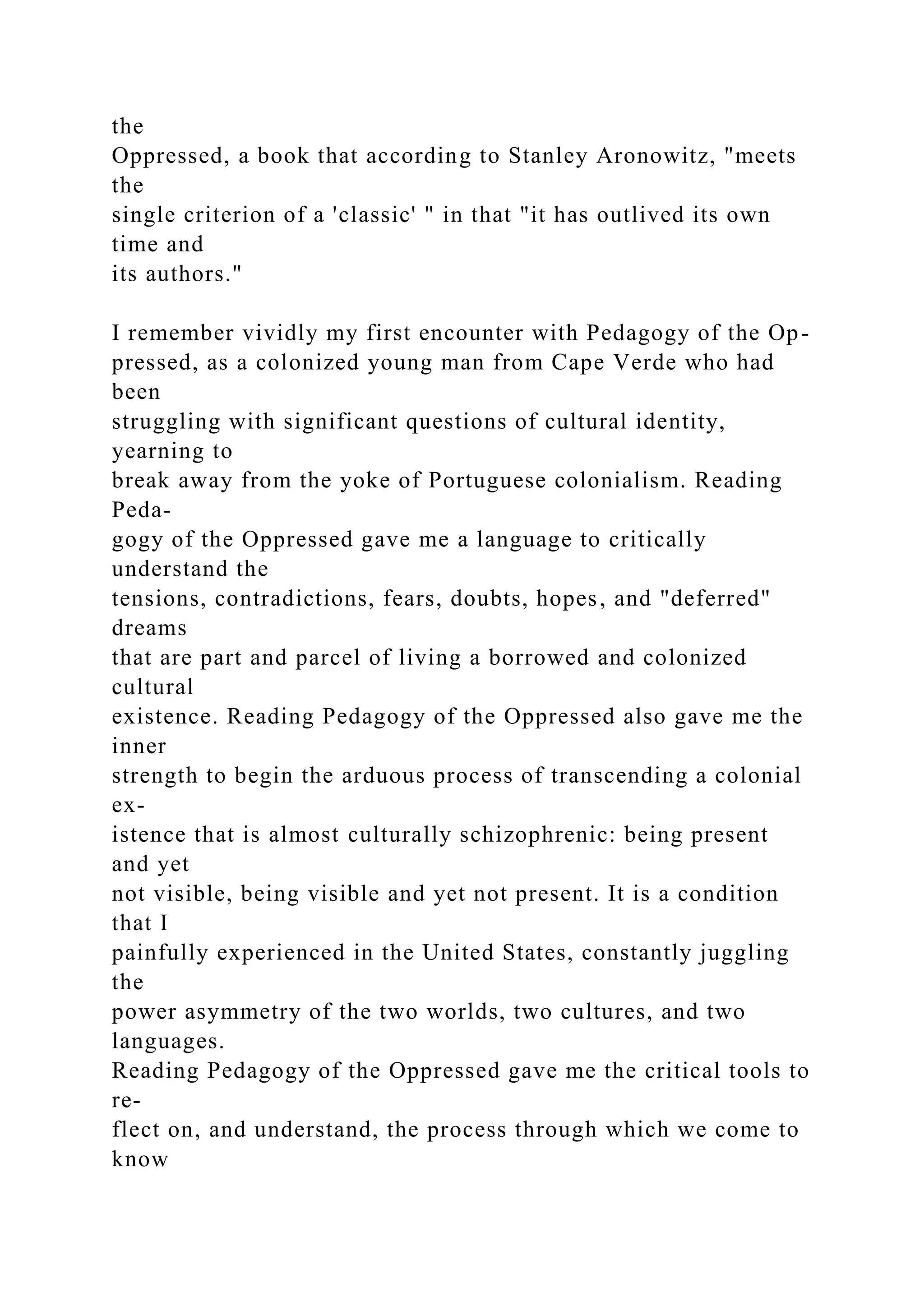
Introduction
Never in my wildest dreams would I have imagined when I first
read
Pedagogy of the Oppressed in 1971 that, a decade later, I would
be
engaged in a very close collaboration with its author, Paulo
Freire—
a collaboration that lasted sixteen years until his untimely death
on
May 2, 1997. Never in my wildest dreams would I have thought
that,
today, I would have the honor to write an introduction to
commem-
orate the thirtieth anniversary of the publication of Pedagogy of
the
Oppressed, a book that according to Stanley Aronowitz, "meets
the
single criterion of a 'classic' " in that "it has outlived its own
time and
its authors."
I remember vividly my first encounter with Pedagogy of the Op-
pressed, as a colonized young man from Cape Verde who had
been
struggling with significant questions of cultural identity,
yearning to
break away from the yoke of Portuguese colonialism. Reading
Peda-
gogy of the Oppressed gave me a language to critically
understand the
tensions, contradictions, fears, doubts, hopes, and "deferred"
dreams
that are part and parcel of living a borrowed and colonized
cultural
existence. Reading Pedagogy of the Oppressed also gave me the
inner
strength to begin the arduous process of transcending a colonial
ex-
istence that is almost culturally schizophrenic: being present
and yet
not visible, being visible and yet not present. It is a condition
that I
painfully experienced in the United States, constantly juggling
the
power asymmetry of the two worlds, two cultures, and two
languages.
Reading Pedagogy of the Oppressed gave me the critical tools to
re-
flect on, and understand, the process through which we come to
know
what it means to be at the periphery of the intimate yet fragile
rela-
tionship between the colonizer and the colonized.
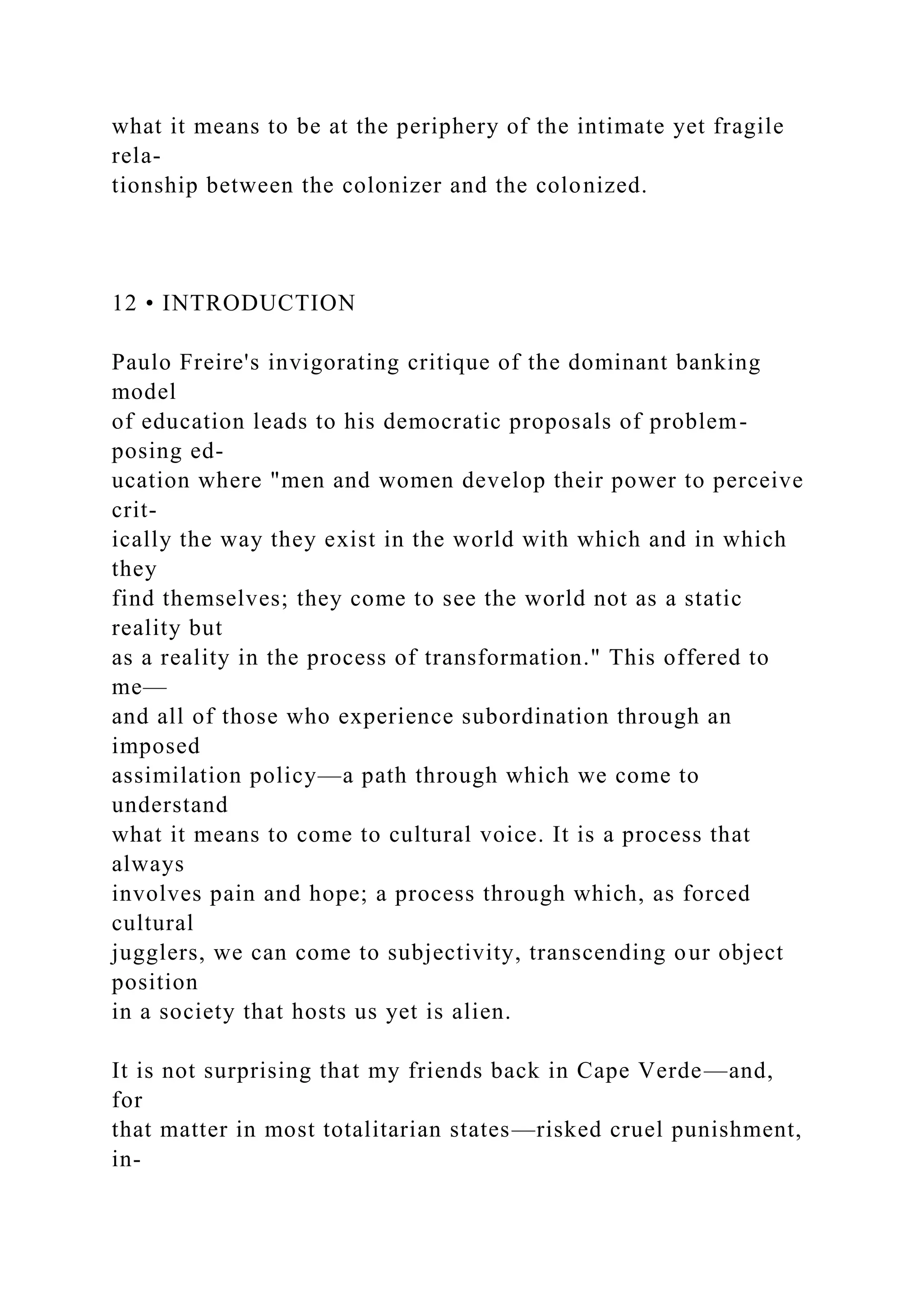
12 • INTRODUCTION
Paulo Freire's invigorating critique of the dominant banking
model
of education leads to his democratic proposals of problem-
posing ed-
ucation where "men and women develop their power to perceive
crit-
ically the way they exist in the world with which and in which
they
find themselves; they come to see the world not as a static
reality but
as a reality in the process of transformation." This offered to
me—
and all of those who experience subordination through an
imposed
assimilation policy—a path through which we come to
understand
what it means to come to cultural voice. It is a process that
always
involves pain and hope; a process through which, as forced
cultural
jugglers, we can come to subjectivity, transcending our object
position
in a society that hosts us yet is alien.
It is not surprising that my friends back in Cape Verde—and,
for
that matter in most totalitarian states—risked cruel punishment,
in-
cluding imprisonment, if they were caught reading Pedagogy of
the
Oppressed. I remember meeting a South African student in
Boston
who told me that students would photocopy chapters of
Pedagogy of
the Oppressed and share them with their classmates and peers.
Some-
times, given the long list of students waiting to read Freire, they
would have to wait for weeks before they were able to get their
hands
on a photocopied chapter. These students, and students like
them in
Central America, South America, Tanzania, Chile, Guinea-
Bissau and
other nations struggling to overthrow totalitarianism and
oppression,
passionately embraced Freire and his proposals for liberation. It
is no
wonder that his success in teaching Brazilian peasants how to
read
landed him in prison and led to a subsequent long and painful
exile.
Oppressed people all over the world identified with Paulo
Freire's
denunciation of the oppressive conditions that were choking
millions
of poor people, including a large number of middle-class
families that
had bitterly begun to experience the inhumanity of hunger in a
po-
tentially very rich and fertile country.
Freire's denunciation of oppression was not merely the
intellectual
exercise that we often find among many facile liberals and
pseudo-
critical educators. His intellectual brilliance and courage in
denounc-
ing the structures of oppression were rooted in a very real and
material experience, as he recounts in Letters to Cristina:
INTRODUCTION • 13
It was a real and concrete hunger that had no specific date of
departure. Even though it never reached the rigor of the hunger
experienced by some people I know, it was not the hunger ex-
perienced by those who undergo a tonsil operation or are
dieting.
On the contrary, our hunger was of the type that arrives unan-
nounced and unauthorized, making itself at home without an end
in sight. A hunger that, if it was not softened as ours was,
would
take over our bodies, molding them into angular shapes. Legs,
arms, and fingers become skinny. Eye sockets become deeper,
making the eyes almost disappear. Many of our classmates ex-
perienced this hunger and today it continues to afflict millions
of
Brazilians who die of its violence every year.1
Thus, Pedagogy of the Oppressed has its roots in Paulo Freire's
lived
experiences.
The experience of hunger as a child of a middle-class family
that
had lost its economic base enabled Freire to, on the one hand,
identify
and develop "solidarity with the children from the poor
outskirts of
town"2 and, on the other hand, to realize that "in spite of the
hunger
that gave us solidarity... in spite of the bond that united us in
our
search for ways to survive—our playtime, as far as the poor
children
were concerned, ranked us as people from another world who
hap-
pened to fall accidentally into their world."3 It is the realization
of
such class borders that led, invariably, to Freire's radical
rejection of
a class-based society.
Although some strands of postmodernism would dismiss Freire's
detailed class analysis in Pedagogy of the Oppressed, it is an
enormous
mistake, if not academic dishonesty, to pretend that we now live
in a
classless world. Although Freire understood very well that
"material
oppression and the affective investments that tie oppressed
groups to
the logic of domination cannot be grasped in all of their
complexity
within a singular logic of class struggle/'4 he consistently
argued that
a thorough understanding of oppression must always take a
detour
through some form of class analysis.
Until his death, he courageously denounced the neoliberal
position
that promotes the false notion of the end of history and the end
of
class. Freire always viewed history as possibility, "recognizing
that
History is time filled with possibility and not inexorably
determined—
14 • INTRODUCTION
that the future is problematic and not already decided,
fatalistically,"5
In like manner, Freire continued to reject any false claim to the
end
of class struggle. Whereas he continually revised his earlier
class anal-
yses, he never abandoned or devalued class as an important
theoret-
ical category in our search for a better comprehension of
conditions
of oppression. In a long dialogue we had during his last visit to
New
York—in fact, the last time we worked together—he again said
that
although one cannot reduce everything to class, class remains
an im-
portant factor in our understanding of multiple forms of
oppression.
While poststructuralists may want to proclaim the end of class
anal-
ysis, they still have to account for the horrendous human
conditions
that led, as Freire recounted, a family in Northeast Brazil to
scavenge
a landfill and take "pieces of an amputated human breast with
which
they prepared their Sunday lunch/'6
Freire also never accepted the ' poststructuralism tendency to
trans-
late diverse forms of class, race, and gender based oppression to
the
discursive space of subject positions/'7 He always appreciated
the the-
oretical complexity of multifactor analyses while never
underestimat-
ing the role of class. For example, he resisted the essentialist
approach
of reducing all analysis to one monolithic entity of race. For
instance,
African functionaries who assimilate to colonial cultural values
con-
stitute a distinct class with very different ideological cultural
values
and aspirations than the bulk of the population. Likewise, it
would be
a mistake to view all African Americans as one monolithic
cultural
group without marked differences: United States Supreme Court
Jus-
tice Clarence Thomas is black, after all (and conservative).
Somewhat
similar gulfs exist between the vast mass of African Americans
who
remain subordinated and reduced to ghettoes and middle-class
Afri-
can Americans who, in some sense, have also partly abandoned
the
subordinated mass of African Americans. I am reminded of a
discus-
sion I had with a personal friend of Dr. Martin Luther King, Jr.,
who
had joined him in the important struggle to end segregation and
op-
pression during the 1960s. During our discussion, King's friend
re-
marked, "Donaldo, you are right. We are using euphemisms
such as
Economically marginal' and avoid more pointed terms like
'oppres-
I N T R O D U C T I O N • 15
sion/ I confess that I often feel uneasy when I am invited to
discuss
at institutions issues pertaining to the community. In reality, I
haven't
been there in over twenty years." Having achieved great
personal
success and having moved to a middle-class reality, this African
Amer-
ican gentleman began to experience a distance from other
African
Americans who remain abandoned in ghettoes.
In a recent discussion with a group of students, a young African
American man who attends an Ivy League university told me
that his
parents usually vote with the white middle class, even if, in the
long
run, their vote is ̂ detrimental to the reality of most black
people. Thus,
we see again that race, itself, is not necessarily a unifying force.
Freire never abandoned his position with respect to class
analysis
as theorized in Pedagogy of the Oppressed. However, as he
continually
did, he reconstituted his earlier position throughout the years,
partic-
ularly in our co-authored book Ideology Matters. In it Freire
argues
that whereas, for example, "one cannot reduce the analysis of
racism
to social class, one cannot understand racism fully without a
class
analysis, for to do one at the expense of the other is to fall prey
into
a sectarianist position, which is as despicable as the racism that
we
need to reject."8 In essence, Freire's later works make it clear
that
what is important is to approach the analysis of oppression
through a
convergent theoretical framework where the object of
oppression is
cut across by such factors as race, class, gender, culture,
language,
and ethnicity. Thus, he would reject any theoretical analysis
that
would collapse the multiplicity of factors into a monolithic
entity, in-
cluding class.
Although Freire was readily embraced in societies struggling
against colonialism and other forms of totalitarianism, his
acceptance
in the so-called open and democratic societies, such as the
United
States and the nations of Western Europe, has been more prob-
lematic. Even though he has an international reputation and
follow-
ing, his work is, sadly, not central to the curricula of most
schools of
education whose major responsibility is to prepare the next
genera-
tion of teachers. This relative marginality of Freire's work in
the
school-of-education curricula is partly due to the fact that most
of
16 • I N T R O D U C T I O N
these schools are informed by the positivistic and management
models
that characterize the very culture of ideologies and practices to
which
Freire was in opposition all his life. For example, the Harvard
Grad-
uate School of Education sanctions a graduate course called
"Literacy
Politics and Policies" without requiring students to read,
critique, and
analyze the work of Freire. In fact, one can get a doctoral
degree
from this school, or from others, without ever learning about,
much
less reading, Paulo Freire. This is tantamount to getting a
doctoral
degree in Linguistics without ever reading Noam Chomsky, The
fol-
lowing illustrates my point. In a lecture at Harvard that
analyzed
Paulo Freire's theories, given by Professor Ramon Flecha from
the
University of Barcelona, a doctoral student approached me and
asked
the following: "I don't want to sound naive, but who is this
Paulo
Freire that Professor Flecha is citing so much?" I wonder, how
can
one expect this doctoral student to know the work of "perhaps
the
most significant educator in the world during the last half of the
cen-
tury" in the words of Herbert Kohl,9 when his graduate school
pre-
tends that Paulo Freire never existed?
Whereas students in the Third World and other nations
struggling
with totalitarian regimes would risk their freedom, if not their
lives,
to read Paulo Freire, in our so-called open societies his work
suffers
from a more sophisticated form of censorship: omission. This
"aca-
demic selective selection" of bodies of knowledge, which
borders on
censorship of critical educators, is partly to blame for the lack
of
knowledge of Paulo Freire's significant contributions to the
field of
education. Even many liberals who have embraced his ideas and
ed-
ucational practices often reduce his theoretical work and
leading phil-
osophical ideas to a mechanical methodology. I am reminded of
a
panel that was convened to celebrate Freire's life and work at
Harvard
after his death. In a large conference room filled to capacity and
with
people standing in hallways, a panelist who had obviously
reduced
Freire's leading ideas to a mechanized dialogical practice passed
a
note to the moderator of the panel suggesting that she give
everyone
in the room twenty seconds to say something in keeping with
the
spirit of Freire. This was the way not to engage Freire's belief
in
INTRODUCTION • 17
emancipation—unless one believes that his complex theory of
op-
pression can be reduced to a twenty-second sound bite. Part of
the
problem with this mechanization of Freire's leading
philosophical and
political ideas is that many psudocritical educators, in the name
of
liberation pedagogy, often sloganize Freire by straitjacketing
his rev-
olutionary politics to an empty cliche of the dialogical method.
Pseudo-Freirean educators not only strip him of the essence of
his
radical pedagogical proposals that go beyond the classroom
bound-
aries and effect significant changes in the society as well: these
edu-
cators also fail to understand the epistemological relationship of
dialogue. According to Freire,
In order to understand the meaning of dialogical practice, we
have to put aside the simplistic understanding of dialogue as a
mere technique. Dialogue does not represent a somewhat false
path that I attempt to elaborate on and realize in the sense of
involving the ingenuity of the other. On the contrary, dialogue
characterizes an epistemological relationship. Thus, in this
sense,
dialogue is a way of knowing and should never be viewed as a
mere tactic to involve students in a particular task. We have to
make this point very clear. I engage in dialogue not necessarily
because I like the other person. I engage in dialogue because I
recognize the social and not merely the individualistic character
of the process of knowing. In this sense, dialogue presents itself
as an indispensable component of the process of both learning
and knowing.10
Unfortunately, in the United States, many educators who claim
to
be Freirean in their pedagogical orientation mistakenly
transform Fre-
ire's notion of dialogue into a method, thus losing sight of the
fact
that the fundamental goal of dialogical teaching is to create a
process
of learning and knowing that invariably involves theorizing
about the
experiences shared in the dialogue process. Some strands of
critical
pedagogy engage in an overdose of experiential celebration that
offers
a reductionistic view of identity^ leading Henry Giroux to point
out
that such pedagogy leaves identity and experience removed
from the
problematics of power, agency, and history. By overindulging in
the
18 • INTRODUCTION
legacy and importance of their respective voices and
experiences,
these educators often fail to move beyond a notion of difference
struc-
tured in polarizing binarisms and uncritical appeals to the
discourse
of experience. I believe that it is for this reason that some of
these
educators invoke a romantic pedagogical mode that "exoticizes"
dis-
cussing lived experiences as a process of coming to voice. At
the same
time, educators who misinterpret Freire's notion of dialogical
teaching
also refuse to link experiences to the politics of culture and
critical
democracy, thus reducing their pedagogy to a form of middle-
class
narcissism. This creates, on the one hand, the transformation of
dia-
logical teaching into a method invoking conversation that
provides
participants with a group-therapy space for stating their
grievances.
On the other hand, it offers the teacher as facilitator a safe
pedagog-
ical zone to deal with his or her class guilt. It is a process that
bell
hooks characterizes as nauseating in that it brooks no dissent.
Simply
put, as Freire reminded us, "what these educators are calling
dialog-
ical is a process that hides the true nature of dialogue as a
process of
learning and knowing. . . .Understanding dialogue as a process
of
learning and knowing establishes a previous requirement that
always
involves an epistemological curiosity about the very elements of
the
dialogue."11 That is to say, dialogue must require an ever-
present cu-
riosity about the object of knowledge. Thus, dialogue is never
an end
in itself but a means to develop a better comprehension about
the
object of knowledge. Otherwise, one could end up with dialogue
as
conversation where individual lived experiences are given
primacy. I
have been in many contexts where the over-celebration of one's
own
location and history often eclipses the possibility of engaging
the ob-
ject of knowledge by refusing to struggle directly, for instance,
with
readings involving an object of knowledge, particularly if these
read-
ings involve theory.
As Freire himself decidedly argued,
Curiosity about the object of knowledge and the willingness and
openness to engage theoretical readings and discussions is fun-
damental. However, I am not suggesting an over-celebration of
I N T R O D U C T I O N • 19
theory. We must not negate practice for the sake of theory. To
do so would reduce theory to a pure verbalism or intellectual-
ism. By the same token, to negate theory for the sake of prac-
tice, as in the use of dialogue as conversation, is to run the risk
of losing oneself in the disconnectedness of practice. It is for
this reason that I never advocate either a theoretic elitism or a
practice ungrounded in theory, but the unity between theory
and practice. In order to achieve this unity, one must have an
epistemological curiosity—a curiosity that is often missing in
di-
alogue as conversation.12
That is, when students lack both the necessary epistemological
cu-
riosity and a certain conviviality with the object of knowledge
under
study, it is difficult to create conditions that increase their
epistemo-
logical curiosity in order to develop the necessary intellectual
tools
that will enable him or her to apprehend and comprehend the
object
of knowledge. If students are not able to transform their lived
expe-
riences into knowledge and to use the already acquired
knowledge as
a process to unveil new knowledge, they will never be able to
partic-
ipate rigorously in a dialogue as a process of learning and
knowing.
In truth, how can one dialogue without any prior apprenticeship
with
the object of knowledge and without any epistemological
curiosity?
For example, how can anyone dialogue about linguistics if the
teacher
refuses to create the pedagogical conditions that will apprentice
stu-
dents into the new body of knowledge? By this I do not mean
that
the apprenticeship process should be reduced to the
authoritarian
tradition of lecturing without student input and discussion.
What be-
comes very clear is that the bureaucratization of the dialogical
process
represents yet another mechanism used by even some
progressive
educators to diminish Freire's radical revolutionary and
transformative
proposals through a process that gives rise to politics without
content.
Thus, it is not surprising that some liberals join conservative
educators
to critique Freire for what they characterize as "radical ties."
For
example, Gregory Jay and Gerald Graff have argued that
Freire's pro-
posal in Pedagogy of the Oppressed to move students toward "a
crit-
ical perception of the world"—which "implies a correct method
of
approaching reality" so that they can get "a comprehension of
total
20 • INTRODUCTION
reality"—assumes that Freire already knows the identity of the
op-
pressed. As Jay and Graff point out, "Freire assumes that we
know
from the outset the identity of the Oppressed' ahd their
'oppressors/
Who the oppressors and the oppressed are is conceived not as an
open question that teachers and students might disagree about,
but
as a given of Freirean pedagogy."13 This form of critique
presupposes
that education should be nondirective and neutral, a posture that
Freire always opposed: "I must intervene in teaching the
peasants
that their hunger is socially constructed and work with them to
help
identify those responsible for this social construction, which is,
in my
view, a crime against humanity."14 Therefore, we need to
intervene
not only pedagogically but also ethically. Before any
intervention,
however, an educator must have political clarity—posture that
makes
many liberals like Graff very uncomfortable to the degree that
he
considers "Radical educational theorists such as Freire, Henry
Giroux,
and Stanley Aronowitz . . . [as having a] tunnel-vision style of.
. . writ-
ing . . . which speaks of but never to those who oppose its
premises."15
The assumption that Freire, Giroux, and Aronowitz engage in a
"tunnel-vision style of. . . writing" is not only false: it also
points to a
distorted notion that there is an a priori agreed-upon style of
writing
that is monolithic, available to all, and "free of jargon." This
blind
and facile call for writing clarity represents a pernicious
mechanism
used by academic liberals who suffocate discourses different
from
their own. Such a call often ignores how language is being used
to
make social inequality invisible. It also assumes that the only
way to
deconstruct ideologies of oppression is through a discourse that
in-
volves what these academics characterize as a language of
clarity.
When I was working with Freire on the book Literacy: Reading
the Word and the World, I asked a colleague whom I considered
to
be politically aggressive and to have a keen understanding of
Freire's
work to read the manuscript. Yet, during a discussion we had
about
this, she asked me, a bit irritably, "Why do you and Paulo insist
on
using Marxist jargon? Many readers who may enjoy reading
Paulo may
be put off by the jargon." I was at first taken aback, but
proceeded
to explain calmly to her that the equation of Marxism with
jargon did
INTRODUCTION ' 2 1
not fully capture the richness of Freire's analysis. In fact, I
reminded
her that Freire's language was the only means through which he
could
have done justice to the complexity of the various concepts
dealing
with oppression. For one thing, I reminded her, "Imagine that
instead
of writing Pedagogy of the Oppressed Freire had written
"Pedagogy
of the Disenfranchised.77 The first title utilizes a discourse that
names
the oppressor, whereas the second fails to do so. If you have an
"op-
pressed," you must have an "oppressor/' What would be the
coun-
terpart of disenfranchised? "Pedagogy of the Disenfranchised77
dislodges the agent of the action while leaving in doubt who
bears
the responsibility for such action. This leaves the ground wide
open
for blaming the victim of disenfranchisement for his or her own
dis-
enfranchisement. This example is a clear case in which the
object of
oppression can also be understood as the subject of oppression.
Lan-
guage like this distorts reality.
And yet, mainstream academics like Graff seldom object to
these
linguistic distortions that disfigure reality. I seldom hear
academics
on a crusade for "language clarity" equate mainstream terms
such as
"disenfranchised" or "ethnic cleansing," for example, to jargon
status.
On the one hand, they readily accept "ethnic cleansing," a
euphemism
for genocide, while, on the other hand, they will, with certain
autom-
atism, point to the jargon quality of terms such as "oppression/'
"sub-
ordination," and "praxis." If we were to deconstruct the term
"ethnic
cleansing" we would see that it prevents us from becoming
horrified
by Serbian brutality and horrendous crimes against Bosnian
Muslims.
The mass killing of women, children, and the elderly and the
rape of
women and girls as young as five years old take on the positive
at-
tribute of "cleansing," which leads us to conjure a reality of
"purifi-
cation" of the ethnic "filth" ascribed to Bosnian Muslims, in
particular, and to Muslims the world over, in general.
I also seldom heard any real protest from the same academics
who
want "language clarity" when, during the Gulf War, the horrific
blood
bath of the battlefield became a "theater of operation," and the
violent
killing of over one hundred thousand Iraqis, including innocent
women, children, and the elderly by our "smart bombs," was
sanitized
22 • INTRODUCTION
into a technical term: "collateral damage." I can go on with
examples
to point out how academics who argue for clarity of language
not only
seldom object to language that obfuscates reality, but often use
the
same language as part of the general acceptance that the
"standard"
discourse is given and should remain unproblematic. Although
these
academics accept the dominant standard discourse, they
aggressively
object to any discourse that both fractures the dominant
language
and bares the veiled reality in order to name it. Thus, a
discourse
that names it becomes, in their view, imprecise and unclear, and
wholesale euphemisms such as "disadvantaged,"
"disenfranchised,"
"educational mortality," "theater of operation," "collateral
damage,"
and "ethnic cleansing" remain unchallenged since they are part
of
the dominant social construction of images that are treated as
un-
problematic and clear.
I am often amazed to hear academics complain about the com-
plexity of a particular discourse because of its alleged lack of
clarity.
It is as if they have assumed that there is a mono-discourse that
is
characterized by its clarity and is also equally available to all.
If
one begins to probe the issue of clarity, we soon realize that it
is
class specific, thus favoring those of that class in the meaning-
making process.
The following two examples will bring the point home: Henry
Gi-
roux and I gave a speech at Massasoit Community College in
Mas-
sachusetts to approximately three hundred unwed mothers who
were
part of a GED (graduate-equivalency diploma) program. The
director
of the program later informed us that most of the students were
con-
sidered functionally illiterate. After Giroux's speech, during the
ques-
tion-and-answer period, a woman got up and eloquently said,
"Professor Giroux, all my life I felt the things you talked about.
I just
didn't have a language to express what I have felt. Today I have
come
to realize that I do have a language. Thank you." And Paulo
Freire
told me the story of what happened to him at the time he was
pre-
paring the English translation of Pedagogy of the Oppressed. He
gave
an African American student at Harvard a chapter of the book to
read
to see how she would receive it. A few days later when he asked
the
INTRODUCTION ' 2 3
woman if she had read it, she enthusiastically responded, "Yes.
Not
only did I read it, but I gave it to my sixteen-year-old son to
read.
He read the whole chapter that night and in the morning said, 'I
want
to meet the man who wrote this. He is talking about m e / " One
question that I have for all those "highly literate" academics
who find
Giroux's and Freire's discourse so difficult to understand is,
Why is it
that a sixteen-year-old boy and a poor, "semiliterate" woman
could so
easily understand and connect with the complexity of both
Freire and
Girouxs language and ideas, and the academics, who should be
the
most literate, find the language incomprehensible?
I believe that the answer has little to do with language and
every-
thing to do with ideology. That is, people often identify with
repre-
sentations that they are either comfortable with or that help
deepen
their understanding of themselves. The call for language clarity
is an
ideological issue, not merely a linguistic one. The sixteen-year-
old and
the semiliterate poor woman could readily connect with Freire's
ide-
ology, whereas the highly literate academics are "put o f f by
some
dimensions of the "same ideology. It is, perhaps, for this reason
that
a university professor I know failed to include Freire's work in
a grad-
uate course that she taught on literacy. When I raised the issue
with
her, she explained that students often find Freire's writing too
difficult
and cumbersome. It could also be the reason that the Divinity
School
at Harvard University offers a course entitled "Education for
Liber-
ation," in which students study Freire and James Cone
extensively,
whereas no such opportunities are available at Harvard's School
of
Education.
For me, the mundane call for a language of "simplicity and
clarity"
represents yet another mechanism to dismiss the complexity of
the-
oretical issues, particularly if these theoretical constructs
interrogate
the prevailing dominant ideology. It is for this very reason that
Gayatri
Spivak correctly points out that the call for "plain prose cheats."
I
would go a step further and say, "The call for plain prose not
only
cheats, it also bleaches."
For me, it is not only plain prose that bleaches. Gerald Graffs
pedagogy of "teaching the conflict" also bleaches to the extent
that it
24 • INTRODUCTION
robs students of the opportunity to access the critical discourses
that
will enable them not only to deconstruct the colonial and
hegemonic
paradigms, but will also help them realize that one cannot teach
con-
flict as if, all of a sudden, it fell from the sky. The conflict must
be
anchored in those competing histories and ideologies that
generated
the conflict in the first place. David Goldberg captures this
problem
when he argues that Graffs suggestion:
presupposes that educators—even the humanists of Graffs ad-
dress—occupy a neutral position, or at least can suspend their
prejudices, in presenting the conflicts, and that the conflicts are
fixed and immobile. One cannot teach the conflicts (or anything
else, for that matter) by assuming this neutral "view from no-
where," for it is no view at all. In other words, the Assumption
of a View from Nowhere is the projection of local values as
neu-
trally universal ones, the globalizing of ethnocentric values, as
Stam and Shohat put it.16
The problem with the teaching of the conflict is that the only re-
ferent for engaging authority is a methodological one. As a
result,
Graff demeans the ability of oppressed people to name their
oppres-
sion as a pedagogical necessity and, at the same time, he
dismisses
the politics of pedagogy that "could empower 'minorities' and
build
on privileged students' minimal experience of 'otherization' " to
help
them imagine alternative subject positions and divergent social
designs.17
As one can readily see, the mechanization of Freire's
revolutionary
pedagogical proposals not only leads to the depolitization of his
rad-
ically democratic work but also creates spaces for even those
liberals
who embrace Freire's proposals to confuse "the term he employs
to
summarize his approach to education, pedagogy' [which] is
often in-
terpreted as a 'teaching method rather than a philosophy or a
social
theory. Few who invoke his name make the distinction. To be
sure,
neither does The Oxford English Dictionary. "lH This seeming
lack of
distinction is conveniently adopted by those educators who
believe
that education is neutral as they engage in a social construction
of not
I N T R O D U C T I O N ' 2 5
seeing. That is, they willfully refuse to understand that the very
term
"pedagogy," as my good friend and colleague Panagiota Gounari
ex-
plains it, has Greek roots, meaning "to lead a child" (from pais:
child
and ago: to lead). Thus, as the term "pedagogy" illustrates,
education
is inherently directive and must always be transformative. As
Stanley
Aronowitz so succinctly argues, "Freire's pedagogy is grounded
in a
fully developed philosophical anthropology, that is, a theory of
human
nature, one might say a secular liberation theology, containing
its own
categories that are irreducible to virtually any other
philosophy."19
The misinterpretation of Freire's philosophical and
revolutionary ped-
agogical proposals in Pedagogy of the Oppressed and his
subsequent
books lies not only in the depolitization of his revolutionary
aim "to
transform what Frantz Fannon terms 'the wretched of the earth'
from
'being for others' to 'beings for themselves,' "20 but also in the
disar-
ticulation of Freire's thinking from his enormous debt to a
philo-
sophical tradition that included Marx, Gramsci, Hegel, and
Sartre
among others.
Although I was immobilized when I received the devastating
news
that Paulo Freire, my friend, my collaborator, my teacher, and
my
mentor, had died, I found comfort in the certainty that Pedagogy
of
the Oppressed had indeed "outlived its own time and its
author's." I
found comfort in the immeasurable hope that Paulo represented
for
those of us who are committed to imagine a world, in his own
words,
that is less ugly, more beautiful, less discriminatory, more
democratic,
less dehumanizing, and more humane. In his work and in his
life,
Paulo teaches us and the world—with his hallmark humility—
what it
means to be an intellectual who fights against the temptation of
be-
coming a populist intellectual. As always, he teaches us with his
pen-
etrating and unquiet mind the meaning of a profound
commitment
to fight sopial injustices in our struggle to recapture the loss of
our
dignity as human beings. In Paulo's own words:
We need to say no to the neoliberal fatalism that we are wit-
nessing at the end of this century, informed by the ethics of the
market, an ethics in which a minority makes most profits
against
26 • INTRODUCTION
the lives of the majority. In other words, those who cannot
compete, die. This is a perverse ethics that, in fact, lacks ethics.
I insist on saying that I continue to be human . . . I would
then remain the last educator in the world to say no: I do not
accept. . . history as determinism. I embrace history as pos-
sibility [where] we can demystify the evil in this perverse fa-
talism that characterizes the neoliberal discourse in the end of
this century.21
Paulo Freire did not realize his dream of entering the twenty-
first
century full of hope for "a world that is more round, less ugly,
and
more just." Although he did not hold our hands as we crossed
the
threshold of the twenty-first century, his words of wisdom, his
pen-
etrating and insightful ideas, his courage to denounce in order
to
announce, his courage to love and "to speak about love without
fear
of being called ascientific, if not antiscientific," his humility,
and his
humanity make him immortal—a forever-present force that
keeps
alive our understanding of history as possibility.
I always accepted with humility Paulo's challenge through the
co-
herence and humility he exemplified. With much sadness,
magoa, but
also with much affection and hope, I say, once more, thank you
Paulo:
for having been present in the world, for having given us
Pedagogy
of the Oppressed, for having taught us how to read the world
and for
challenging us to humanize the world.
DONALDO MACEDO
Distinguished Professor of Liberal Arts and Education
University of Massachusetts, Boston
I N T R O D U C T I O N - 2 7
N o t e s
1. Paulo Freire, Letters to Cristina. (New York: Routledge,
1996),
p. 15.
2. Ibid. p. 21.
3. Ibid.
4. Henry A. Giroux, "Radical Pedagogy and Educated Hope:
Remem-
bering Taulo Freire." Typewritten manuscript.
5. Ibid.
6. Paulo Freire and Donaldo Macedo, Ideology Matters (Boulder
CO.:
Rowman & Littlefield), forthcoming.
7. Henry A. Giroux, "Radical Pedagogy and Educated Hope."
8. Paulo Freire and Donaldo Macedo, Ideology Matters.
9. Herbert Kohl, "Paulo Freire: Liberation Pedagogy" in The
Nation,
May 26, 1997, p. 7.
10. Paulo Freire and Donaldo Macedo, "A Dialogue: Culture,
Language,
and Race" in Harvard Educational Review, vol. 65, no. 3, fall
1995, p. 379.
11. Ibid. p. 382.
12. Ibid.
13. Gregory Jay and Gerald Graff, "A Critique of Critical
Pedagogy,"
Higher Education under Fire, ed. Michael Barube and Gary
Nelson (New
York: Routledge, 1995), p. 203.
14. Paulo Freire and Donaldo Macedo, "A Dialogue: Culture,
Language,
and Race," p. 379.
15. Gerald Graff, "Academic Writing and the Uses of Bad
Publicity,"
Eloquent Obsessions, ed. Mariana Torgormick (Chapel Hill:
Duke University
Press, 1994), p. 215.
16., David Theo Goldberg, "Introduction," Multiculturalism: A
Critical
Reader, ed. David Theo Goldberg (Oxford, UK: Blackwell,
1994), p. 19.
17. Robert Stam and Ella Shohat, "Contested Histories?
Eurocentrism,
Multiculturalism, and the Media," Multiculturalism: A Critical
Reader,
p. 19.
18. Stanley Aronowitz, "Paulo Freire's Radical Democratic
Humanism"
in Peter McLaren and Peter Leonard, Paulo Freire: A Critical
Encounter
(London: Routledge, 1993), p. 8.
19. Ibid. p. 12.
20. Ibid. p. 13.
21. Paulo Freire and Donaldo Macedo, Ideology Matters.
Forewoid
Over the years, the thought and work of the Brazilian educator
Paulo Freire have spread from the North East of Brazil to an
entire
continent, and have made a profound impact not only in the
field of
education but also in the overall struggle for national
development.
At the precise moment when the disinherited masses in Latin
America are awakening from their traditional lethargy and are
anx-
ious to participate, as Subjects, in the development of their
coun-
tries, Paulo Freire has perfected a method for teaching
illiterates
that has contributed, in an extraordinary way, to that process. In
fact,
those who, in learning to read and write, come to a new
awareness of
selfhood and begin to look critically at the social situation in
which
they find themselves, often take the initiative in acting to
transform
the society that has denied them this opportunity of
participation.
Education is once again a subversive force.
In this country, we are gradually becoming aware of the work of
Paulo Freire, but thus far we have thought of it primarily in
terms
of its contribution to the education of illiterate adults in the
Third
World. If, however, we take a closer look, we may discover that
his
methodology as well as his educational philosophy are as
important
for us as for the dispossessed in Latin America. Their struggle
to
become free Subjects and to participate in the transformation of
their society is similar, in many ways, to the struggle not only
of
blacks and Mexican-Americans but also of middle-class young
peo-
ple in this country. And the sharpness and intensity of that
struggle
in the developing world may well provide us with new insight,
new
models, and a new hope as we face our own situation. For this
reason, I consider the publication of Pedagogy of the Oppressed
in
an English edition to be something of an event.
3 0 - P A U L O F R E I R E
Paulo Freire's thought represents the, response of a creative
mind
and sensitive conscience to the extraordinary misery and
suffering
of the oppressed around him. Born in 1921 in Recife, the center
of
one of the most extreme situations of poverty and
underdevelopment
in the Third World, he was soon forced to experience that
reality
directly. As the economic crisis in 1929 in the United States
began
to affect Brazil, the precarious stability of Freires middle-class
fam-
ily gave way and he found himself sharing the plight of the
"wretched
of the earth." This had a profound influence on his life as he
came
to know the gnawing pangs of hunger and fell behind in school
because of the listlessness it produced; it also led him to make a
vow, at age eleven, to dedicate his life to the struggle against
hunger,
so that other children would not have to know the agony he was
then experiencing.
His early sharing of the life of the poor also led him to the
discov-
ery of what he describes as the "culture of silence" of the
dispos-
sessed. He came to realize that their ignorance and lethargy
were
the direct product of the whole situation of economic, social,
and
political domination—and of the paternalism—of which they
were
victims. Rather than being encouraged and equipped to know
and
respond to the concrete realities of their world, they were kept
"submerged" in a situation in which such critical awareness and
response were practically impossible. And it became clear to
him
that the whole educational system was one of the major
instruments
for the maintenance of this culture of silence.
Confronted by this problem in a very existential way, Freire
turned his attention to the field of education and began to work
on
it. Over the years, he has engaged in a process of study and
reflec-
tion that has produced something quite new and creative in
educa-
tional philosophy. From a situation of direct engagement in the
struggle to liberate men and women for the creation of a new
world,
he has reached out to the thought and experience of those in
many
different situations and of diverse philosophical positions: in
his
words, to "Sartre and Mounier, Erich Fromm and Louis
Althusser,
Ortega y Gasset and Mao, Martin Luther King and Che Guevara,
P E D A G O G Y OF TH E O P P R E S S E D ' 3 1
Unamuno and Marcuse." He has made use of the insights of
these
men to develop a perspective on education which is
authentically
his own and which seeks to respond to the concrete realities of
Latin
America.
His thought on the philosophy of education was first expressed
in
1959 in his doctoral dissertation at the University of Recife, and
later
in his wbrk as Professor of the History and Philosophy of
Education
in the same university, as well as in his early experiments with
the
teaching of illiterates in that same city. The methodology he
devel-
oped was widely used by Catholics and others in literacy
campaigns
throughout the North East of Brazil, and was considered such a
threat to the old order that Freire was jailed immediately after
the
military coup in 1964. Released seventy days later and
encouraged
to leave the country, Freire went to Chile, where he spent five
years working with UNESCO and the Chilean Institute for
Agrarian
Reform in programs of adult education. He then acted as a
consult-
ant at Harvard University's School of Education, and worked in
close
association with a number of groups engaged in new educational
experiments in rural and urban areas. He is presently serving as
Special Consultant to the Office of Education of the World
Council
of Churches in Geneva.
Freire has written many articles in Portuguese and Spanish, and
his first book, Educagdo como Prdtica da Liberdade, was
published
in Brazil in 1967. His latest and most complete work, Pedagogy
of
the Oppressed, is the first of his writings to be published in this
country.
In this brief introduction, there is no point in attempting to sum
up, in a few paragraphs, what the author develops in a number
of
pages. That would be an offense to the richness, depth, and
com-
plexity of his thought. But perhaps a word of witness has its
place
here—a personal witness as to why I find a dialogue with the
thought of Paulo Freire an exciting adventure. Fed up as I am
with
the abstractness and sterility of so much intellectual work in
aca-
demic circles today, I am excited by a process of reflection
which is
set in a thoroughly historical context, which is carried on in the
3 2 ' P A U L O F R E I R E
midst of a struggle to create a new social order and thus
represents
a new unity of theory and praxis. And I am encouraged when a
man of the stature of Paulo Freire incarnates a rediscovery of
the
humanizing vocation of the intellectual, and demonstrates the
power
of thought to negate accepted limits and open the way to a new
future.
Freire is able to do this because he operates on one basic
assump-
tion: that mans ontological vocation (as he calls it) is to be a
Subject
who acts upon and transforms his world, and in so doing moves
toward ever new possibilities of fuller and richer life
individually
and collectively. This world to which he relates is not a static
and
closed order, a given reality which man must accept and to
which
he must adjust; rather, it is a problem to be worked on and
solved.
It is the material used by man to create history, a task which he
performs as he overcomes that which is dehumanizing at any
par-
ticular time and place and dares to create the qualitatively new.
For
Freire, the resources for that task at the present time are
provided
by the advanced technology of our Western world, but the social
vision which impels us to negate the present order and
demonstrate
that history has not ended comes primarily from the suffering
and
struggle of the people of the Third World.
Coupled with this is Freires conviction (now supported by a
wide
background of experience) that every human being, no matter
how
"ignorant" or submerged in the "culture of silence" he or she
may
be, is capable of looking critically at the world in a dialogical
encoun-
ter with others. Provided with the proper tools for such
encounter,
the individual can gradually perceive personal and social reality
as
well as the contradictions in it, become conscious of his or her
own
perception of that reality, and deal critically with it. In this
process,
the old, paternalistic teacher-student relationship is overcome.
A
peasant can facilitate this process for a neighbor more
effectively
than a "teacher" brought in from outside. "People educate each
other through the mediation of the world."
As this happens, the word takes on new power. It is no longer
an
abstraction or magic but a means by which people discover
them-
PEDAGOGY OF THE OPPRESSED ' 3 3
selves and their potential as they give names to things around
them.
As Freire puts it, each individual wins back the right to say his
or
her own wordy to name the world.
When an illiterate peasant participates in this sort of
educational
experience, he or she comes to a new awareness of self, has a
new
sense of dignity, and is stirred by a new hope. Time and again,
peasants have expressed these discoveries in striking ways after
a
few hours of class: "I now realize I am a person, an educated
person."
"We were blind, now our eyes have been opened." "Before this,
words meant nothing to me; now they speak to me and I can
make
them speak." "Now we will no longer be a dead weight on the
cooperative farm." When this happens in the process of learning
to
read, men and women discover that they are creators of culture,
and
that all their work can be creative. "I work, and working I
transform
the world." And as those who have been completely
marginalized
are so radically transformed, they are no longer willing to be
mere
objects, responding to changes occurring around them; they are
more likely to decide to take upon themselves the struggle to
change
the structures of society, which until now have served to
oppress
them. For this reason, a distinguished Brazilian student of
national
development recently affirmed that this type of educational
work
among the people represents a new factor in social change and
devel-
opment, "a new instrument of conduct for the Third World, by
which it can overcome traditional structures and enter the
modern
world."
At first sight, Paulo Freire's method of teaching illiterates in
Latin
America seems to belong to a different world from that in which
we
find ourselves in this country. Certainly, it would be absurd to
claim
that it should be copied here. But there are certain parallels in
the two situations that should not be overlooked. Our advanced
technological society is rapidly making objects of most of us
and
subtly programming us into conformity to the logic of its
system. To
the degree that this happens, we are also becoming submerged
in
a new "culture of silence."
The paradox is that the same technology that does this to us also
3 4 ' P A U L O F R E I R E
creates a new sensitivity to what is happening. Especially
among
young people, the new media together with the erosion of old
con-
cepts of authority open the way to acute awareness of this new
bond-
age. The young perceive that their right to say their own word
has
been stolen from them, and that few things are more important
than
the struggle to win it back. And they also realize that the
educational
system today—from kindergarten to university—is their enemy.
There is no such thing as a neutral educational process.
Education
either functions as an instrument that is used to facilitate the
integra-
tion of the younger generation into the logic of the present
system
and bring about conformity to it, or it becomes "the practice of
freedom," the means by which men and women deal critically
and
creatively with reality and discover how to participate in the
transfor-
mation of their world. The development of an educational
methodol-
ogy that facilitates this process will inevitably lead to tension
and
conflict within our society. But it could also contribute to the
forma-
tion of a new man and mark the beginning of a new era in
Western
history For those who are committed to that task and are
searching
for concepts and tools for experimentation, Paulo Freires
thought
will make a significant contribution in the years ahead.
RICHARD SHAULL
Preface
These pages, which introduce Pedagogy of the Oppressed, result
from my observations during six years of political exile,
observations
which have enriched those previously afforded by my
educational
activities in Brazil.
I have encountered, both in training courses which analyze the
role of conscientizagao1 and in actual experimentation with a
truly
liberating education, the "fear of freedom" discussed in the first
chapter of this book. Not infrequently, training course
participants
call attention to "the danger of conscientizagao" in a way that
reveals
their own fear of freedom. Critical consciousness, they say, is
anar-
chic. Others add that critical consciousness may lead to
disorder.
Some, however, confess: Why deny it? I was afraid of freedom.
I am
no longer afraid!
In one of these discussions, the group was debating whether the
conscientizagao of men and women to a specific situation of
injustice
might not lead them to "destructive fanaticism" or to a
"sensation
of total collapse of their world." In the midst of the argument, a
person who previously had been a factory worker for many
years
spoke out: "Perhaps I am the only one here of working-class
origin.
I cani say that I've understood everything you've said just now,
but
I can say one thing—when I began this course I was naive, and
when I found out how naive I was, I started to get critical. But
this
discovery hasn't made me a fanatic, and I don't feel any collapse
either."
1. The term consctentizagdo refers to learning to perceive
social, political and
economic contradictions, and to take action against the
oppressive elements of
reality. See chapter 3.—Translator s note.
3 6 - P A U L O F R E I R E
Doubt regarding the possible effects of conscientizagdo implies
a
premise which the doubter does not always make explicit: It is
better
for the victims of injustice not to recognize themselves as such.
In
fact, however, conscientizagdo does not lead people to
"destructive
fanaticism." On the contrary, by making it possible for people
to
enter the historical process as responsible Subjects,2
conscientizagdo
enrolls them in the search for self-affirmation and thus avoids
fa-
naticism,
The awakening of critical consciousness leads the way to the
expression of social discontents precisely because these discon-
tents are real components of an oppressive situation.3
Fear of freedom, of which its possessor is not necessarily
aware,
makes him see ghosts. Such an individual is actually taking
refuge
in an attempt to achieve security, which he or she prefers to the
risks of liberty. As Hegel testifies:
It is solely by risking life that freedom is obtained; . . . the
individual who has not staked his or her life may, no doubt, be
recognized as a Person; but he or she has not attained the truth
of this recognition as an independent self-consciousness.4
Men and women rarely admit their fear of freedom openly,
however,
tending rather to camouflage it—sometimes unconsciously—by
pre-
senting themselves as defenders of freedom. They give their
doubts
and misgivings an air of profound sobriety, as befitting
custodians of
freedom. But they confuse freedom with the maintenance of the
status quo; so that if conscientizagdo threatens to place that
status
quo in question, it thereby seems to constitute a threat to
freedom
itself.
2. The term Subjects denotes those who know and act, in
contrast to objects,
which are known and acted upon.—Translator's note.
3. Francisco Weffort, in the preface to Paulo Freire, Educagdo
como Prdtica da
Liberdade (Rio de Janeiro, 1967).
4. Georg Hegel, The Phenomenology of Mind (New York,
1967), p. 233.
P E D A G O G Y OF T H E O P P R E S S E D ' 3 7
Thought and study alone did not produce Pedagogy of the Op-
pressed; it is rooted in concrete situations and describes the
reac-
tions of laborers (peasant or urban) and of middle-class persons
whom I have observed directly or indirectly during the course
of
my educative work. Continued observation will afford me an
oppor-
tunity to modify or to corroborate in later studies the points
pro-
posed in this introductory work.
This volume will probably arouse negative reactions in a
number
of readers. Some will regard my position vis-a-vis the problem
of
human liberation as purely idealistic, or may even consider
discus-
sion of ontological vocation, love, dialogue, hope, humility, and
sym-
pathy as so much reactionary "blah." Others will not (or will not
wish to) accept my denunciation of a state of oppression that
gratifies
the oppressors. Accordingly, this admittedly tentative work is
for
radicals. I am certain that Christians and Marxists, though they
may
disagree with me in part or in whole, will continue reading to
the
end. But the reader who dogmatically assumes closed,
"irrational"
positions will reject the dialogue I hope this book will open.
Sectarianism, fed by fanaticism, is always castrating.
Radicaliza-
tion, nourished by a critical spirit, is always creative.
Sectarianism
mythicizes and thereby alienates; radicalization criticizes and
thereby liberates. Radicalization involves increased commitment
to
the position one has chosen, and thus ever greater engagement
in
the effort to transform concrete, objective reality. Conversely,
sectar-
ianism, because it is mythicizing and irrational, turns reality
into a
false (and therefore unchangeable) "reality."
Sectarianism in any quarter is an obstacle to the emancipation
of
mankind. The rightist version thereof does not always, unfortu-
nately, call forth its natural counterpart: radicalization of the
revolu-
tionary. Not infrequently, revolutionaries themselves become
reactionary by falling into sectarianism in the process of
responding
to the sectarianism of the Right. This possibility, however,
should
not lead the radical to become a docile pawn of the elites.
Engaged
in the process of liberation, he or she cannot remain passive in
the
face of the oppressors violence.
3 8 ' P A U L O F R E I R E
On the other hand, the radical is never a subjectivist. For this
individual the subjective aspect exists only in relation to the
objec-
tive aspect (the concrete reality, which is the object of
analysis).
Subjectivity and objectivity thus join in a dialectical unity
producing
knowledge in solidarity with action, and vice versa.
For his or her part, the sectarian of whatever persuasion,
blinded
by irrationality, does not (or cannot) perceive the dynamic of
reali-
ty—or else misinterprets it. Should this person think
dialectically,
it is with a "domesticated dialectic." The rightist sectarian
(whom I
have previously termed a born sectarian5) wants to slow down
the
historical process, to "domesticate" time and thus to
domesticate
men and women. The leftist-turned-sectarian goes totally astray
when he or she attempts to interpret reality and history
dialectically,
and falls into essentially fatalistic positions.
The rightist sectarian differs from his or her leftist counterpart
in that the former attempts to domesticate the present so that (he
or she hopes) the future will reproduce this domesticated
present,
while the latter considers the future pre-established—a kind of
in-
evitable fate, fortune, or destiny. For the rightist sectarian,
"today,"
linked to the past, is something given and immutable; for the
leftist
sectarian, "tomorrow" is decreed beforehand, is inexorably
preor-
dained. This rightist and this leftist are both reactionary
because,
starting from their respectively false views of history, both
develop
forms of action that negate freedom. The fact that one person
imag-
ines a "well-behaved" present and the other a predetermined
future
does not mean that they therefore fold their arms and become
spec-
tators (the former expecting that the present will continue, the
latter
waiting for the already "known" future to come to pass). On the
contrary, closing themselves into "circles of certainty" from
which
they cannot escape, these individuals "make" their own truth. It
is
not the truth of men and women who struggle to build the
future,
running the risks involved in this very construction. Nor is it
the
truth of men and women who fight side by side and learn
together
5. In Educagdo como Prdtica da Liberdade.
PEDAGOGY OF T H E O P P R E S S E D - 3 9
how to build this future—which is not something given to be re-
ceived by people, but is rather something to be created by them.
Both types of sectarian, treating history in an equally
proprietary
fashion, end up without the people—which is another way of
being
against them.
Whereas the rightist sectarian, closing himself in "his" truth,
does
no more than fulfill a natural role, the leftist who becomes
sectarian
and rigid negates his or her very nature. Each, however, as he
re-
volves about "his" truth, feels threatened if that truth is
questioned.
Thus, each considers anything that is not "his" truth a lie. As
the
journalist Marcio Moreira Alves once told me, "They both
suffer
from an absence of doubt." *
The radical, committed to human liberation, does not become
the prisoner of a "circle of certainty' within which reality is also
imprisoned. On the contrary, the more radical the person is, the
more fully he or she enters into reality so that, knowing it
better,
he or she can better transform it. This individual is not afraid to
confront, to listen, to see the world unveiled. This person is not
afraid to meet the people or to enter into dialogue with them.6
This
person does not consider himself or herself the proprietor of
history
or of all people, or the liberator of the oppressed; but he or she
does
commit himself or herself, within history, to fight at their side.
The pedagogy of the oppressed, the introductory outlines of
which are presented in the following pages, is a task for
radicals; it
cannot be carried out by sectarians.
I will be satisfied if among the readers of this work there are
those
sufficiently critical to correct mistakes and misunderstandings,
to
deepen affirmations and to point out aspects I have not
perceived. It
is possible that some may question my right to discuss
revolutionary
cultural action, a subject of which I have no concrete
experience.
The fact that I have not personally participated in revolutionary
action, however, does not negate the possibility of my reflecting
on
6. "As long as theoretic knowledge remains the privilege of a
handful of 'academi-
cians* in the Party, the latter will face the danger of going
astray." Rosa Luxembourg,
Reform or Revolution, cited in C. Wright Mills, The Marxists
(New York, 1963).
4 0 - P A U L O F R E I R E
this theme. Furthermore, in my experience as an educator with
the people, using a dialogical and problem-posing education, I
have
accumulated a comparative wealth of material that challenged
me
to run the risk of making the affirmations contained in this
work.
From these pages I hope at least the following will endure: my
trust in the people, and my faith in men and women, and in the
creation of a world in which it will be easier to love.
Here I would like to express my gratitude to Elza, my wife and
"first reader," for the understanding and encouragement she has
shown my work, which belongs to her as well I would also like
to
extend my thanks to a group of friends for their comments on
my
manuscript. At the risk of omitting some names, I must mention
Joao da Veiga Coutinho, Richard Shaull, Jim Lamb, Myra and
Jove-
lino Ramos, Paulo de Tarso, Almino Affonso, Plinio Sampaio,
Ernani
Maria Fiori, Marcela Gajardo, Jose Luis Fiori, and Joao
Zacarioti.
The responsibility for the affirmations made herein is, of
course,
mine alone.
PAULO F R E I R E
PEDAGOGY
of the
OPPRESSED
CHAPTER
1
While the problem of humanization has always, from an
axiological point of view, been humankind's central problem, it
now takes on the character of an inescapable
concern.l Concern for humanization leads at once to the
recognition
of dehumanization, not only as an ontological possibility but as
an
historical reality And as an individual perceives the extent of
dehu-
manization, he or she rtiay ask if humanization is a viable
possibility.
Within history^ in concrete, objective contexts, both
humanization
and dehumanization are possibilities for a person as an
uncompleted
being conscious of their incompletion.
But while both humanization and dehumanization are real alter-
natives, only the first is the people's vocation. This vocation is
con-
stantly negated, yet it is affirmed by that very negation. It is
1. The current movements of rebellion, especially those of
youth, while they
necessarily reflect the peculiarities of their respective settings,
manifest in their
essence this preoccupation with people as beings in the world
and with the world—
preoccupation with what and how they are "being." As they
place consumer civiliza-
tion in judgment, denounce bureaucracies of all types, demand
the transformation
of the universities (changing the rigid nature of the teacher-
student relationship and
placing that relationship within the context of reality), propose
the transformation of
reality itself so that universities can be renewed, attack old
orders and established
institutions in the attempt to affirm human beings as the
Subjects of decision, all
these movements reflect the style of our age, which is more
anthropological than
anthropocentric.
4 4 - P A U L O F R E I R E
thwarted by injustice, exploitation, oppression, and the violence
of
the oppressors; it is affirmed by the yearning of the oppressed
for
freedom and justice, and by their struggle to recover their lost
hu-
manity.
Dehumanization, which marks not only those whose humanity
has been stolen, but also (though in a different way) those who
have
stolen it, is a distortion of the vocation of becoming more fully
human. This distortion occurs within history; but it is not an
histori-
cal vocation. Indeed, to admit of dehumanization as an
historical
vocation would lead either to cynicism or total despair. The
struggle
for humanization, for the emancipation of labor, for the
overcoming
of alienation, for the affirmation of men and women as persons
would
be meaningless. This struggle is possible only because
dehumaniza-
tion, although a concrete historical fact, is not a given destiny
but
the result of an unjust order that engenders violence in the
oppres-
sors, which in turn dehumanizes the oppressed.
Because it is a distortion of being more fully human, sooner or
later being less human leads the oppressed to struggle against
those
who made them so. In order for this struggle to have meaning,
the
oppressed must not, in seeking to regain their humanity (which
is
a way to create it), become in turn oppressors of the oppressors,
but
rather restorers of the humanity of both.
This, then, is the great humanistic and historical task of the op-
pressed: to liberate themselves and their oppressors as well. The
oppressors, who oppress, exploit, and rape by virtue of their
power,
cannot find in this power the strength to liberate either the op-
pressed or themselves. Only power that springs from the
weakness
of the oppressed will be sufficiently strong to free both. Any
attempt
to "soften" the power of the oppressor in deference to the
weakness
of the oppressed almost always manifests itself in the form of
false
generosity; indeed, the attempt never goes beyond this. In order
to
have the continued opportunity to express their "generosity,"
the
oppressors must perpetuate injustice as well. An unjust social
order
is the permanent fount of this "generosity," which is nourished
by
death, despair, and poverty. That is why the dispensers of false
gen-
erosity become desperate at the slightest threat to its source.
P E D A G O G Y OF TH E O P P R E S S E D • 4 5
True generosity consists precisely in fighting to destroy the
causes
which nourish false charity. False charity constrains the fearful
and
subdued, the "rejects of life," to extend their trembling hands.
True
generosity lies in striving so that these hands—whether of
individ-
uals or entire peoples—need be extended less and less in
supplica-
tion, so that more and more they become human hands which
work
and, working, transform the world.
This lesson and this apprenticeship must come, however, from
the
oppressed themselves and from those who are truly solidary
with
them. As individuals or as peoples, by fighting for the
restoration
of their humanity they will be attempting the restoration of true
generosity. Who are better prepared than the oppressed to
under-
stand the terrible significance of an oppressive society? Who
suffer
the eflFects of oppression more than the oppressed? Who can
better
understand the necessity of liberation? They will not gain this
libera-
tion by chance but through the praxis of their quest for it,
through
their recognition of the necessity to fight for it. And this fight,
be-
cause of the purpose given it by the oppressed, will actually
consti-
tute an act of love opposing the lovelessness which lies at the
heart
of the oppressors violence, lovelessness even when clothed in
false
generosity.
But almost always, during the initial stage of the struggle, the
oppressed, instead of striving for liberation, tend themselves to
be-
come oppressors, or "sub-oppressors." The very structure of
their
thought has been conditioned by the contradictions of the
concrete,
existential situation by which they were shaped. Their ideal is
to be
men; but for them, to be men is to be oppressors. This is their
model of humanity. This phenomenon derives from the fact that
the
oppressed, at a certain moment of their existential experience,
adopt
an attitude of "adhesion" to the oppressor. Under these circum-
stances they cannot "consider" him sufficiently clearly to
objectivize
him—to discover him "outside" themselves. This does not
necessar-
ily mean that the oppressed are unaware that they are
downtrodden.
But their perception of themselves as oppressed is impaired by
their submersion in the reality of oppression. At this level, their
perception of themselves as opposites of the oppressor does not
yet
4 6 - P A U L O F R E I R E
signify engagement in a struggle to overcome the
contradiction;2 the
one pole aspires not to liberation, but to identification with its
oppo-
site pole.
In this situation the oppressed do not see the "new man" as the
person to be born from the resolution of this contradiction, as
op-
pression gives way to liberation. For them, the new man or
woman
themselves become oppressors. Their vision of the new man or
woman is individualistic; because of their identification with
the
oppressor, they have no consciousness of themselves as persons
or
as members of an oppressed class. It is not to become free that
they
want agrarian reform, but in order to acquire land and thus
become
landowners—or, more precisely, bosses over other workers. It is
a
rare peasant who, once "promoted" to overseer, does not become
more of a tyrant towards his former comrades than the owner
him-
self. This is because the context of the peasant's situation, that
is,
oppression, remains unchanged. In this example, the overseer,
in
order to make sure of his job, must be as tough as the owner—
and
more so. Thus is illustrated our previous assertion that during
the
initial stage of their struggle the oppressed find in the oppressor
their model of "manhood."
Even revolution, which transforms a concrete situation of
oppres-
sion by establishing the process of liberation, must confront this
phenomenon. Many of the oppressed who directly or indirectly
par-
ticipate in revolution intend—conditioned by the myths of the
old
order—to make it their private revolution. The shadow of their
for-
mer oppressor is still cast over them.
The "fear of freedom" which afflicts the oppressed,3 a fear
which
may equally well lead them to desire the role of oppressor or
bind
them to the role of oppressed, should be examined. One of the
basic
elements of the relationship between oppressor and oppressed is
2. As used throughout this book, the term "contradiction"
denotes the dialectical
conflict between opposing social forces.—Translator s note.
3. This fear of freedom is also to be found in the oppressors,
though, obviously,
in a different form. The oppressed are afraid to embrace
freedom; the oppressors
are afraid of losing the "freedom" to oppress.
PEDAGOGY OF THE OPPRESSED - 4 7
prescription. Every prescription represents the imposition of
one
individual's choice upon another, transforming the
consciousness of
the person prescribed to into one that conforms with the pre-
servers consciousness. Thus, the behavior of the oppressed is a
prescribed behavior, following as it does the guidelines of the
op-
pressor.
The oppressed, having internalized the image of the oppressor
and adopted his guidelines, are fearful of freedom. Freedom
would
require them to eject this image and replace it with autonomy
and
responsibility. Freedom is acquired by conquest, not by gift. It
must
be pursued constantly and responsibly. Freedom is not an ideal
located outside of man; nor is it an idea which becomes myth. It
is
rather the indispensable condition for the quest for human com-
pletion.
To surmount the situation of oppression, people must first criti-
cally recognize its causes, so that through transforming action
they
can create a new situation, one which makes possible the pursuit
of
a fuller humanity. But the struggle to be more fully human has
already begun in the authentic struggle to transform the
situation.
Although the situation of oppression is a dehumanized and
dehu-
manizing totality affecting both the oppressors and those whom
they
oppress, it is the latter who must, from their stifled humanity,
wage
for both the struggle for a fuller humanity; the oppressor, who
is
himself dehumanized because he dehumanizes others, is unable
to
lead this struggle.
However, the oppressed, who have adapted to the structure of
domination in which they are immersed, and have become
resigned
to it, are inhibited from waging the struggle for freedom so long
as
they feel incapable of running the risks it requires. Moreover,
their
struggle for freedom threatens not only the oppressor, but also
their
own oppressed comrades who are fearful of still greater
repression.
When they discover within themselves the yearning to be free,
they
perceive that this yearning can be transformed into reality only
when the same yearning is aroused in their comrades. But while
dominated by the fear of freedom they refuse to appeal to
others,
4 8 - P A U L O F R E I R E
or to listen to the appeals of others, or even to the appeals of
their
own conscience. They prefer gregariousness to authentic
comrade-
ship; they prefer the security of conformity with their state of
unfree-
dom to the creative communion produced by freedom and even
the
very pursuit of freedom.
The oppressed suffer from the duality which has established
itself
in their innermost being. They discover that without freedom
they
cannot exist authentically. Yet, although they desire authentic
exis-
tence, they fear it. They are at one and the same time
themselves
and the oppressor whose consciousness they have internalized
The
conflict lies in the choice between being wholly themselves or
being
divided; between ejecting the oppressor within or not ejecting
them; between human solidarity or alienation; between
following
prescriptions or having choices; between being spectators or
actors;
between acting or having the illusion of acting through the
action of
the oppressors; between speaking out or being silent, castrated
in
their power to create and re-create, in their power to transform
the world. This is the tragic dilemma of the oppressed which
their
education must take into account.
This book will present some aspects of what the writer has
termed
the pedagogy of the oppressed, a pedagogy which must be
forged
with, not for, the oppressed (whether individuals or peoples) in
the
incessant struggle to regain their humanity. This pedagogy
makes
oppression and its causes objects of reflection by the oppressed,
and
from that reflection will come their necessary engagement in the
struggle for their liberation. And in the struggle this pedagogy
will
be made and remade.
The central problem is this: How can the oppressed, as divided,
unauthentic beings, participate in developing the pedagogy of
their
liberation? Only as they discover themselves to be "hosts" of
the
oppressor can they contribute to the midwifery of their
liberating
pedagogy. As long as they live in the duality in which to be is
to be
like, and to be like is to be like the oppressor, this contribution
is
impossible. The pedagogy of the oppressed is an instrument for
their critical discovery that both they and their oppressors are
mani-
festations of dehumanization.
P E D A G O G Y OF T H E O P P R E S S E D - 4 9
Liberation is thus a childbirth, and a painful one. The man or
woman who emerges is a new person, viable only as the
oppressor-
oppressed contradiction is superseded by the humanization of
all
people. Or to put it another way, the solution of this
contradiction
is born in the labor which brings into the world this new being:
no
longer oppressor nor longer oppressed, but human in the process
of achieving freedom.
This solution cannot be achieved in idealistic terms. In order for
the oppressed to be able to wage the struggle for their
liberation,
they must perceive the reality of oppression not as a closed
world
from which there is no exit, but as a limiting situation which
they
can transform. This perception is a necessary but not a
sufficient
condition foi* liberation; it must become the motivating force
for
liberating action. Nor does the discovery by the oppressed that
they
exist in dialectical relationship to the oppressor, as his
antithesis—
that without them the oppressor could not exist4—in itself
constitute
liberation. The oppressed can overcome the contradiction in
which
they are caught only when this perception enlists them in the
strug-
gle to free themselves.
The same is true with respect to the individual oppressor as a
person. Discovering himself to be an oppressor may cause
consider-
able anguish, but it does not necessarily lead to solidarity with
the
oppressed. Rationalizing his guilt through paternalistic
treatment
of the oppressed, all the while holding them fast in a position of
dependence, will not do. Solidarity requires that one enter into
the
situation of those with whom one is solidary; it is a radical
posture.
If what characterizes the oppressed is their subordination to the
consciousness of the master, as Hegel affirms,5 true solidarity
with
the oppressed means fighting at their side to transform the
objective
reality which has made them these "beings for another." The
oppres-
4. See Hegel, op. cit.y pp. 236-237.
5. Analyzing the dialectical relationship between the
consciousness of the master
and the consciousness of the oppressed, Hegel states: "The one
is independent,
and its essential nature is to be for itself; the other is dependent,
and its essence
is life or existence for another. The former is the Master, or
Lord, the latter the
Bondsman." Ibid., p. 234.
5 0 - P A U L O F R E I R E
sor is solidary with the oppressed only when he stops regarding
the
oppressed as an abstract category and sees them as persons who
have been unjustly dealt with, deprived of their voice, cheated
in
the sale of their labor—when he stops making pious,
sentimental,
and individualistic gestures and risks an act of love. True
solidarity
is found only in the plenitude of this act of love, in its
existentiality,
in its praxis. To affirm that men and women are persons and as
persons should be free, and yet to do nothing tangible to make
this
affirmation a reality, is a farce.
Since it is a concrete situation that the oppressor-oppressed
con-
tradiction is established, the resolution of this contradiction
must
be objectively verifiable. Hence, the radical requirement—both
for
the individual who discovers himself or herself to be an
oppressor
and for the oppressed—that the concrete situation which begets
oppression must be transformed.
To present this radical demand for the objective transformation
of
reality, to combat subjectivist immobility which would divert
the
recognition of oppression into patient waiting for oppression to
dis-
appear by itself, is not to dismiss the role of subjectivity in the
struggle to change structures. On the contrary, one cannot
conceive
of objectivity without subjectivity. Neither can exist without the
other, nor can they be dichotomized. The separation of
objectivity
from subjectivity, the denial of the latter when analyzing reality
or
acting upon it, is objectivism. On the other hand, the denial of
objectivity in analysis or action, resulting in a subjectivism
which
leads to solipsistic positions, denies action itself by denying
objec-
tive reality. Neither objectivism nor subjectivism, nor yet
psycholo-
gism is propounded here, but rather subjectivity and objectivity
in
constant dialectical relationship.
To deny the importance of subjectivity in the process of trans-
forming the world and history is naive and simplistic. It is to
admit
the impossible: a world without people. This objectivistic
position
is as ingenuous as that of subjectivism, which postulates people
without a world. World and human beings do not exist apart
from
each other, they exist in constant interaction. Marx does not
espouse
P E D A G O G Y OF T H E O P P R E S S E D - 5 1
such a dichotomy, nor does any other critical, realistic thinker.
What
Marx criticized and scientifically destroyed was not
subjectivity, but
subjectivism and psychologism. Just as objective social reality
exists
not by chance, but as the product of human action, so it is not
transformed by chance. If humankind produce social reality
(which
in the "inversion of the praxis" turns back upon them and
conditions
them), then transforming that reality is an historical task, a task
for
humanity.
Reality which becomes oppressive results in the
contradistinction
of men as oppressors and oppressed. The latter, whose task it is
to struggle for their liberation together with those who show
true
solidarity, must acquire a critical awareness of oppression
through
the praxis of this struggle. One of the gravest obstacles to the
achievement of liberation is that oppressive reality absorbs
those
within it and thereby acts to submerge human beings
consiousness.6
Functionally, oppression is domesticating. To no longer be prey
to
its force, one must emerge from it and turn upon it. This can be
done only by means of the praxis: reflection and action upon the
world in order to transform it.
i Hay que hacer al opresion real todavia mas opresiva anadiendo
a aquella la conciencia de la opresion haciendo la infamia
todavia
mas infamante, al pregonarla.7
Making "real oppression more oppressive still by adding to it
the realization of oppression" corresponds to the dialectical
relation
between the subjective and the objective. Only in this
interdepen-
dence is an authentic praxis possible, without which it is
impossible
6. "Liberating action necessarily involves a moment of
perception and volition.
This action both precedes and follows that moment, to which it
first acts as a
prologue and which it subsequently serves to effect and
continue within history.
The action of domination, however, does not necessarily imply
this dimension; for
the structure of domination is maintained by its own mechanical
and unconscious
functionality." From an unpublished work by Jose Luiz Fiori,
who has kindly
granted permission to quote him.
7. Karl Marx and Friedrich Engels, La Sagrada Familia y otros
Escritos (Mexico,
1962), p. 6. Emphasis added.
5 2 - P A U L O F R E I R E
to resolve the oppressor-oppressed contradiction. To achieve
this
goal, the oppressed must confront reality critically,
simultaneously
objectifying and acting upon that reality. A mere perception of
real-
ity not followed by this critical intervention will not lead to a
trans-
formation of objective reality—precisely because it is not a true
perception. This is the case of a purely subjectivist perception
by
someone who forsakes objective reality and creates a false
substitute.
A different type of false perception occurs when a change in
objec-
tive reality would threaten the individual or class interests of
the
perceiver. In the first instance, there is no critical intervention
in
reality because that reality is fictitious; there is none in the
second
instance because intervention would contradict the class
interests of
the perceiver. In the latter case the tendency of the perceiver is
to
behave "neurotically." The fact exists; but both the fact and
what
may result from it may be prejudicial to the person. Thus it
becomes
necessary, not precisely to deny the fact, but to "see it
differently."
This rationalization as a defense mechanism coincides in the
end
with subjectivism. A fact which is not denied but whose truths
are
rationalized loses its objective base. It ceases to be concrete and
becomes a myth created in defense of the class of the perceiver.
Herein lies one of the reasons for the prohibitions and the diffi-
culties (to be discussed at length in Chapter 4) designed to
dissuade
the people from critical intervention in reality. The oppressor
knows
full well that this intervention would not be to his interest.
What is
to his interest is for the people to continue in a state of
submersion,
impotent in the face of oppressive reality. Of relevance here is
Lu-
kacs warning to the revolutionary party:
. . . il doit, pour employer les mots de Marx, expliquer aux
masses leur propre action non seulement afin d'assurer la conti-
nuity des experiences revolutionnaires du proletariat, mais aussi
d'activer consciemment le developpement ulterieur de ces expe-
riences.8
In affirming this necessity, Lukacs is unquestionably posing the
8. Georg Lukacs, Lenine (Paris, 1965), p. 62.
P E D A G O G Y OF TH E O P P R E S S E D - 5 3
problem of critical intervention. "To explain to the masses their
own
action" is to clarify and illuminate that action, both regarding
its
relationship to the objective facts by which it was prompted,
and
regarding its purposes. The more the people unveil this
challenging
reality which is to be the object of their transforming action, the
more critically they enter that reality. In this way they are "con-
sciously activating the subsequent development of their experi-
ences." There would be no human action if there were no
objective
reality, no world to be the "not I" of the person and to challenge
them; just as there would be no human action if humankind
were
not a "project," if he or she were not able to transcend himself
or
herself, if one, were not able to perceive reality and understand
it
in order to transform it.
In dialectical thought, world and action are intimately
interdepen-
dent. But action is human only when it is not merely an
occupation
but also a preoccupation, that is, when it is not dichotomized
from
reflection. Reflection, which is essential to action, is implicit in
Lu-
k£cs' requirement of "explaining to the masses their own
action,"
just as it is implicit in the purpose he attributes to this
explanation:
that of "consciously activating the subsequent development of
expe-
rience."
For us, however, the requirement is seen not in terms of ex-
plaining to, but rather dialoguing with the people about their ac-
tions. In any event, no reality transforms itself,9 and the duty
which
Lukacs ascribes to the revolutionary party of "explaining to the
masses their own action" coincides with our affirmation of the
need
for the critical intervention of the people in reality through the
praxis. The pedagogy of the oppressed, which is the pedagogy
of
people engaged in the fight for their own liberation, has its
roots
here. And those who recognize, or begin to recognize,
themselves
9. "The materialist doctrine that men are products of
circumstances and up-
bringing, and that, therefore, changed men are products of other
circumstances
and changed upbringing, forgets that it is men that change
circumstances and that
the educator himself needs educating." Karl Marx and Friedrich
Engels, Selected
Works (New York, 1968), p. 28.
5 4 - P A U L O F R E I R E
as oppressed must be among the developers of this pedagogy.
No
pedagogy which is truly liberating can remain distant from the
op-
pressed by treating them as unfortunates and by presenting for
their
emulation models from among the oppressors. The oppressed
must
be their own example in the struggle for their redemption.
The pedagogy of the oppressed, animated by authentic,
humanist
(not humanitarian) generosity, presents itself as a pedagogy of
humankind. Pedagogy which begins with the egoistic interests
of
the oppressors (an egoism cloaked in the false generosity of
paternal-
ism) and makes of the oppressed the objects of its
humanitarianism,
itself maintains and embodies oppression. It is an instrument of
dehumanization. This is why, as we affirmed earlier, the
pedagogy
of the oppressed cannot be developed or practiced by the
oppres-
sors. It would be a contradiction in terms if the oppressors not
only
defended but actually implemented a liberating education.
But if the implementation of a liberating education requires
politi-
cal power and the oppressed have none, how then is it possible
to
carry out the pedagogy of the oppressed prior to the revolution?
This is a question of the greatest importance, the reply to which
is
at least tentatively outlined in Chapter 4. One aspect of the
reply
is to be found in the distinction between systematic education,
which can only be changed by political power, and educational
proj-
ects, which should be carried out with the oppressed in the
process
of organizing them.
The pedagogy of the oppressed, as a humanist and libertarian
pedagogy, has two distinct stages. In the first, the oppressed
unveil
the world of oppression and through the praxis commit
themselves
to its transformation. In the second stage, in which the reality of
oppression has already been transformed, this pedagogy ceases
to
belong to the oppressed and becomes a pedagogy of all people
in
the process of permanent liberation. In both stages, it is always
through action in depth that the culture of domination is
culturally
confronted.10 In the first stage this confrontation occurs
through the
10. This appears to be the fundamental aspect of Mao's Cultural
Revolution.
PEDAGOGY OF THE OPPRESSED - 5 5
change in the way the oppressed perceive the world of
oppression;
in the second stage, through the expulsion of the myths created
and developed in the old order, which like specters haunt the
new
structure emerging from the revolutionary transformation.
The pedagogy of the first stage must deal with the problem of
the oppressed consciousness and the oppressor consciousness,
the
problem of men and women who oppress and men and women
who
suffer oppression. It must take into account their behavior, their
view of the world, and their ethics. A particular problem is the
duality of the oppressed: they are contradictory, divided beings,
shaped by and existing in a concrete situation of oppression and
violence. ^
Any situation in which "A" objectively exploits "B" or hinders
his
and her pursuit of self-affirmation as a responsible person is
one of
oppression. Such a situation in itself constitutes violence, even
when
sweetened by false generosity, because it interferes with the
individ-
ual's ontological and historical vocation to be more fully
human.
With the establishment of a relationship of oppression, violence
has
already begun. Never in history has violence been initiated by
the
oppressed. How could they be the initiators, if they themselves
are
the result of violence? How could they be the sponsors of
something
whose objective inauguration called forth their existence as op-
pressed? There would be no oppressed had there been no prior
situation of violence to establish their subjugation.
Violence is initiated by those who oppress, who exploit, who
fail
to recognize others as persons—not by those who are oppressed,
exploited, and unrecognized. It is not the unloved who initiate
disaf-
fection, but those who cannot love because they love only them-
selves. It is not the helpless, subject to terror, who initiate
terror,
but the violent, who with their power create the concrete
situation
which begets the "rejects of life." It is not the tyrannized who
initiate
despotism, but the tyrants. It is not the despised who initiate
hatred,
but those who despise. It is not those whose humanity is denied
them who negate humankind, but those who denied that
humanity
(thus negating their own as well). Force is used not by those
who
5 6 ' P A U L O F R E I R E
have become weak under the preponderance of the strong, but
by
the strong who have emasculated them.
For the oppressors, however, it is always the oppressed (whom
they obviously never call "the oppressed" but—depending on
whether they are fellow countrymen or not—"those people" or
"the
blind and envious masses" or "savages" or "natives" or
"subversives")
who are disaffected, who are "violent," "barbaric," "wicked," or
"fe-
rocious" when they react to the violence of the oppressors.
Yet it is—paradoxical though it may seem—precisely in the re-
sponse of the oppressed to the violence of their oppressors that
a
gesture of love may be found. Consciously or unconsciously,
the act
of rebellion by the oppressed (an act which is always, or neafly
always, as violent as the initial violence of the oppressors) can
initiate
love. Whereas the violence of the oppressors prevents the
oppressed
from being fully human, the response of the latter to this
violence
is grounded in the desire to pursue the right to be human. As the
oppressors dehumanize others and violate their rights, they
them-
selves also become dehumanized. As the oppressed, fighting to
be
human, take away the oppressors power to dominate and
suppress,
they restore to the oppressors the humanity they had lost in the
exercise of oppression.
It is only the oppressed who, by freeing themselves, can free
their
oppressors. The latter, as an oppressive class, can free neither
others
nor themselves. It is therefore essential that the oppressed wage
the
struggle to resolve the contradiction in which they are caught;
and
the contradiction will be resolved by the appearance of the new
man: neither oppressor nor oppressed, but man in the process of
liberation. If the goal of the oppressed is to becomS fully
human,
they will not achieve their goal by merely reversing the terms of
the
contradiction, by simply changing poles.
This may seem simplistic; it is not. Resolution of the oppressor-
oppressed contradiction indeed implies the disappearance of the
oppressors as a dominant class. However, the restraints imposed
by
the former oppressed on their oppressors, so that the latter
cannot
reassume their former position, do not constitute oppression. An
act
P E D A G O G Y OF TH E O P P R E S S E D - 5 7
is oppressive only when it prevents people from being more
fully
human. Accordingly, these necessary restraints do not in
themselves
signify that yesterdays oppressed have become today's
oppressors.
Acts which prevent the restoration of the oppressive regime
cannot
be compared with those which create and maintain it, cannot be
compared with those by which a few men and women deny the
majority their right to be human*,
However, the moment the new regime hardens into a dominating
"bureaucracy"11 the humanist dimension of the struggle is lost
and
it is no longer possible to speak of liberation. Hence our
insistence
that the authentic solution of the oppressor-oppressed
contradiction
does not lie in a mere reversal of position, in moving from one
pole to the other. Nor does it lie in the replacement of the
former
oppressors with new ones who continue to subjugate the op-
pressed—all in the name of their liberation.
But even when the contradiction is resolved authentically by a
new situation established by the liberated laborers, the former
op-
pressors do not feel liberated. On the contrary, they genuinely
con-
sider themselves to be oppressed. Conditioned by the experience
of oppressing others, any situation other than their former
seems to
them like oppression. Formerly, they could eat, dress, wear
shoes,
be educated, travel, and hear Beethoven; while millions did not
eat,
had no clothes or shoes, neither studied nor traveled, much less
listened to Beethoven. Any restriction on this way of life, in the
name of the rights of the community, appears to the former
oppres-
sors as a profound violation of their individual rights—although
they
had no respect for the millions who suffered and died of hunger,
pain, sorrow, and despair. For the oppressors, "human beings"
refers
only to themselves; other people are "things." For the
oppressors,
there exists only one right: their right to live in peace, over
against
11. This rigidity should not be identified with the restraints that
must be im-
posed on the former oppressors so they cannot restore the
oppressive order. Rather,
it refers to the revolution which becomes stagnant and turns
against the people,
using the old repressive, bureaucratic State apparatus (which
should have been
drastically suppressed, as Marx so often emphasized).
5 8 - P A U L O F R E I R E
the right, not always even recognized, but simply conceded, of
the
oppressed to survival. And they make this concession only
because
the existence of the oppressed is necessary to their own
existence.
This behavior, this way of understanding the world and people
(which necessarily makes the oppressors resist the installation
of a
new regime) is explained by their experience as a dominant
class.
Once a situation of violence and oppression has been
established, it
engenders an entire way of life and behavior for those caught up
in
it—oppressors and oppressed alike. Both are submerged in this
situation, and both bear the marks of oppression. Analysis of
existen-
tial situations of oppression reveals that their inception lay
in^an act
of violence—initiated by those with power. This violence, as a
proc-
ess, is perpetuated from generation to generation of oppressors,
who become its heirs and are shaped in its climate. This climate
creates in the oppressor a strongly possessive consciousness—
possessive of the world and of men and women. Apart from
direct,
concrete, material possession of the world and of people, the
oppres-
sor consciousness could not understand itself—could not even
exist.
Fromm said of this consciousness that, without such possession,
"it
would lose contact with the world." The oppressor
consciousness
tends to transform everything surrounding it into an object of its
domination. The earth, property, production, the creations of
peo-
ple, people themselves, time—everything is reduced to the
status
of objects at its disposal.
In their unrestrained eagerness to possess, the oppressors de-
velop the conviction that it is possible for them to transform
every-
thing into objects of their purchasing power; hence their strictly
materialistic concept of existence. Money is the measure of all
things, and profit the primary goal. For the oppressors, what is
worthwhile is to have more—always more—even at the cost of
the
oppressed having less or having nothing. For them, to be is to
have
and to be the class of the "haves."
As beneficiaries of a situation of oppression, the oppressors
cannot
perceive that if having is a condition of being, it is a necessary
condition for all women and men. This is why their generosity
is
P E D A G O G Y OF T H E O P P R E S S E D - 5 9
false. Humanity is a "thing," and they possess it as an exclusive
right, as inherited property. To the oppressor consciousness, the
humanization of the "others," of the people, appears not as the
pur-
suit of full humanity, but as subversion.
The oppressors do not perceive their monopoly on having more
as a privilege which dehumanizes others and themselves. They
can-
not see that, in the egoistic pursuit of having as a possessing
class,
they suffocate in their own possessions and no longer are; they
merely have. For them, having more is an inalienable right, a
right
they acquired through their own "effort," with their "courage to
take
risks." If others do not have more, it is because they are
incompetent
and lazy, and worst of all is their unjustifiable ingratitude
towards
the "generous gestures" of the dominant class. Precisely because
they are "ungrateful" and "envious," the oppressed are regarded
as
potential enemies who must be watched.
It could not be otherwise. If the humanization of the oppressed
signifies subversion, so also does their freedom; hence the
necessity
for constant control. And the more the oppressors control the
op-
pressed, the more they change them into apparently inanimate
"things." This tendency of the oppressor consciousness to "in-
ani-
mate" everything and everyone it encounters, in its eagerness to
possess, unquestionably corresponds with a tendency to sadism.
The pleasure in complete domination over another person (or
other animate creature) is the very essence of the sadistic drive.
Another way of formulating the same thought is to say that the
aim of sadism is to transform a man into a thing, something
animate into something inanimate, since by complete and abso-
lute control the living loses one essential quality of life—
freedom.12
Sadistic love is a perverted love—a love of death, not of life.
One of
the characteristics of the oppressor consciousness and its
necrophilic
view of the world is thus sadism. As the oppressor
consciousness,
12. Erich Fromm, The Heart of Man (New York, 1966), p. 32.
6 0 - P A U L O F R E I R E
in order to dominate, tries to deter the drive to search, the
restless-
ness, and the creative power which characterize life, it kills life.
More and more, the oppressors are using science and technology
as
unquestionably powerful instruments for their purpose: the
mainte-
nance of the oppressive order through manipulation and repres-
sion.13 The oppressed, as objects, as "things," have no purposes
except those their oppressors prescribe for them.
Given the preceding context, another issue of indubitable
impor-
tance arises: the fact that certain members of the oppressor class
join the oppressed in their struggle for liberation, thus moving
from
one pole of the contradiction to the other. Theirs is a
fundamental
role, and has been so throughout the history of this struggle. It
happens, however, that as they cease to be exploiters or
indifferent
spectators or simply the heirs of exploitation and move to the
side
of the exploited, they almost always bring with them the marks
of
their origin: their prejudices and their deformations, which
include
a lack of confidence in the peoples ability to think, to want, and
to
know. Accordingly, these adherents to the people's cause
constantly
run the risk of falling into a type of generosity as malefic as
that of
the oppressors. The generosity of the oppressors is nourished by
an
unjust order, which must be maintained in order to justify that
generosity. Our converts, on the other hand, truly desire to
trans-
form the unjust order; but because of their background they
believe
that they must be the executors of the transformation. They talk
about the people, but they do not trust them; and trusting the
people is the indispensable precondition for revolutionary
change.
A real humanist can be identified more by his trust in the
people,
which engages him in their struggle, than by a thousand actions
in
their favor without that trust.
Those who authentically commit themselves to the people must
re-examine themselves constantly. This conversion is so radical
as
not to allow of ambiguous behavior. To affirm this commitment
but
to consider oneself the proprietor of revolutionary wisdom—
which
13. Regarding the "dominant forms of social control," see
Herbert Marcuse,
One-Dimensional Man (Boston, 1964) and Eros and Civilization
(Boston, 1955).
P E D A G O G Y OF T H E O P P R E S S E D - 6 1
must then be given to (or imposed on) the people—is to retain
the
old ways. The man or woman who proclaims devotion to the
cause
of liberation yet is unable to enter into communion with the
people,
whom he or she continues to regard as totally ignorant, is
grievously
self-deceived. The convert who approaches the people but feels
alarm at each sfelp they take, each doubt they express, and each
suggestion they offer, and attempts to impose his "status,"
remains
nostalgic towards his origins.
Conversion to the people requires a profound rebirth. Those
who
undergo it must take on a new form of existence; they can no
longer
remain as they were. Only through comradeship with the
oppressed
can the converts understand their characteristic ways of living
and
behaving, which in diverse moments reflect the structure of
domina-
tion. One of these characteristics is the previously mentioned
exis-
tential duality of the oppressed, who are at the same time
themselves and the oppressor whose image they have
internalized.
Accordingly, until they concretely "discover" their oppressor
and in
turn their own consciousness, they nearly always express
fatalistic
attitudes towards their situation.
The peasant begins to get courage to overcome his dependence
when he realizes that he is dependent. Until then, he goes along
with the boss and says "What can I do? I'm only a peasant."14
When superficially analyzed, this fatalism is sometimes
interpreted
as a docility that is a trait of national character. Fatalism in the
guise
of docility is the fruit of an historical and sociological situation,
not
an essential characteristic of a people's behavior. It almost
always is
related to the power of destiny or fate or fortune—inevitable
forc-
es—or to a distorted view of God. Under the sway of magic and
myth, the oppressed (especially the peasants, who are almost
sub-
merged in nature)15 see their suffering, the fruit of
exploitation,
14. Words of a peasant during an interview with the author.
15. See Candido Mendes, Memento dos vivos—A Esquerda
catdlica no Brasil
(Rio, 1966).
6 2 - P A U L O F R E I R E
as the will of God—as if God were the creator of this
"organized
disorder."
Submerged in reality, the oppressed cannot perceive clearly the
"order" which serves the interests of the oppressors whose
image
they have internalized. Chafing under the restrictions of this
order,
they often manifest a type of horizontal violence, striking out at
their
own comrades for the pettiest reasons.
The colonized man will first manifest this aggressiveness which
has been deposited in his bones against his own people. This is
the period when the niggers beat each other up, and the police
and magistrates do not know which way to turn when faced with
the astonishing waves of crime in North Africa. . . . While the
settler or the policeman has the right the livelong day to strike
the native, to insult him and to make him crawl to them, you
will see the native reaching for his knife at the slightest hostile
or aggressive glance cast on him by another native; for the last
resort of the native is to defend his personality vis-a-vis his
brother.16
It is possible that in this behavior they are once more
manifesting
their duality. Because the oppressor exists within their
oppressed
comrades, when they attack those comrades they are indirectly
at-
tacking the oppressor as well.
On the other hand, at a certain point in their existential experi-
ence the oppressed feel an irresistible attraction towards the
oppres-
sors and their way of life. Sharing this way of life becomes an
overpowering aspiration. In their alienation, the oppressed want
at
any cost to resemble the oppressors, to imitate them, to follow
them.
This phenomenon is especially prevalent in the middle-class op-
pressed, who yearn to be equal to the "eminent" men and women
of the upper class. Albert Memmi, in an exceptional analysis of
the
"colonized mentality," refers to the contempt he felt towards the
colonizer, mixed with "passionate" attraction towards him.
16. Frantz Fanon, The Wretched of the Earth (New York, 1968),
p. 52.
P E D A G O G Y OF THE O P P R E S S E D • 6 3
How could the colonizer look after his workers while
periodically
gunning down a crowd of colonized? How could the colonized
deny himself so cruelly yet make such excessive demands? How
could he hate the colonizers and yet admire them so passion-
ately? (I too felt this admiration in spite of myself.)17
Self-depreciation is another characteristic of the oppressed,
which
derives from their internalization of the opinion the oppressors
hold
of them. So often do they hear that they are good for nothing,
know
nothing and are incapable of learning anything—that they are
sick,
lazy, and unproductive—that in the end they become convinced
of
their own unfitness.
The peasant feels inferior to the boss because the boss seems to
be the only one who knows things and is able to run things.18
They call themselves ignorant and say the "professor" is the one
who has knowledge and to whom they should listen. The criteria
of
knowledge imposed upon them are the conventional ones. "Why
don't you," said a peasant participating in a culture circle,19
"explain
the pictures first? That way it'll take less time and wont give us
a
headache."
Almost never do they realize that they, too, "know things" they
have learned in their relations with the world and with other
women
and men. Given the circumstances which have produced their
dual-
ity, it is only natural that they distrust themselves.
Not infrequently, peasants in educational projects begin to
discuss
a generative theme in a lively manner, then stop suddenly and
say
to the educator: "Excuse us, we ought to keep quiet and let you
talk. You are the one who knows, we don't know anything."
They
often insist that there is no difference between them and the ani-
mals; when they do admit a difference, it favors the animals.
"They
are freer than we are."
17. The Colonizer and the Colonized (Boston, 1967), p. x.
18. Words of a peasant during an interview with the author.
19. See chapter 3, p. 113 ff.—Translators note.
6 4 - P A U L O F R E I R E
It is striking, however, to observe how this self-depreciation
changes with the first changes in the situation of oppression. I
heard
a peasant leader say in an asentamiento20 meeting, "They used
to
say we were unproductive because we were lazy and drunkards.
All
lies. Now that we are respected as men, were going to show
every-
one that we were never drunkards or lazy. We were exploited!"
As long as their ambiguity persists, the oppressed are reluctant
to resist, and totally lack confidence in themselves. They have a
diffuse, magical belief in the invulnerability and power of the
oppres-
sor.21 The magical force of the landowners power holds
particular
sway in the rural areas. A sociologist friend of mine tells of a
group
of armed peasants in a Latin American country who recently
took
over a latifundium. For tactical reasons, they planned to hold
the
landowner as a hostage. But not one peasant had the courage to
guard him; his very presence was terrifying. It is also possible
that
the act of opposing the boss provoked guilt feelings. In truth,
the
boss was "inside" them.
The oppressed must see examples of the vulnerability of the op-
pressor so that a contrary conviction can begin to grow within
them.
Until this occurs, they will continue disheartened, fearful, and
beaten.22 As long as the oppressed remain unaware of the
causes of
their condition, they fatalistically "accept" their exploitation.
Fur-
ther, they are apt to react in a passive and alienated manner
when
confronted with the necessity to struggle for their freedom and
self-
affirmation. Little by little, however, they tend to try out forms
of
rebellious action. In working towards liberation, one must
neither
lose sight of this passivity nor overlook the moment of
awakening.
Within their unauthentic view of the world and of themselves,
the
oppressed feel like "things" owned by the oppressor. For the
latter,
to be is to have, almost always at the expense of those who have
20. Asentamiento refers to a production unit of the Chilean
agrarian reform
experiment.—Translators note.
21. "The peasant has an almost instinctive fear of the boss."
Interview with a
peasant.
22. See Regis Debray, Revolution in the Revolution? (New
York, 1967).
P E D A G O G Y OF THE O P P R E S S E D ' 6 5
nothing. For the oppressed, at a certain point in their existential
experience, to be is not to resemble the oppressor, but to be
under
him, to depend on him. Accordingly, the oppressed are
emotionally
dependent.
The peasant is a dependent. He cant say what he wants. Before
he discovers his dependence, he suffers. He lets off steam at
home, where he shouts at his children, beats them, and despairs.
He complains about his wife and thinks everything is dreadful.
He doesn't let off steam with the boss because he thinks the
boss
is a superior being. Lots of times, the peasant gives vent to his
sorrows by drinking.23
This total emotional dependence can lead the oppressed to what
Fromm calls necrophilic behavior: the destruction of life—their
own
or that of their oppressed fellows.
It is only when the oppressed find the oppressor out and become
involved in the organized struggle for their liberation that they
begin
to believe in themselves. This discovery cannot be purely
intellec-
tual but must involve action; nor can it be limited to mere
activism,
but must include serious reflection: only then will it be a praxis.
Critical and liberating dialogue, which presupposes action, must
be carried on with the oppressed at whatever the stage of their
struggle for liberation.24 The content of that dialogue can and
should
vary in accordance with historical conditions and the level at
which
the oppressed perceive reality. But to substitute monologue, slo-
gans, and communiques for dialogue is to attempt to liberate the
oppressed with the instruments of domestication. Attempting to
liberate the oppressed without their reflective participation in
the
act of liberation is to treat them as objects which must be saved
from a burning building; it is to lead them into the populist
pitfall
and transform them into masses which can be manipulated.
At all stages of their liberation, the oppressed must see them-
23. Interview with a peasant.
24. Not in the open, of course; that would only provoke the fury
of the oppressor
and lead to still greater repression.
6 6 - P A U L O F R E I R E
selves as women and men engaged in the ontological and
historical
vocation of becoming more fully human. Reflection and action
be-
come imperative when one does not erroneously attempt to
dichoto-
mize the content of humanity from its historical forms.
The insistence that the oppressed engage in reflection on their
concrete situation is not a call to armchair revolution. On the
con-
trary, reflection—true reflection—leads to action. On the other
hand, when the situation calls for action, that action will
constitute
an authentic praxis only if its consequences become the object
of
critical reflection. In this sense, the praxis is the new raison
d'etre of
the oppressed; and the revolution, which inaugurates the
historical
moment of this raison d'etre, is not viable apart from their
concomi-
tant conscious involvement. Otherwise, action is pure activism.
To achieve this praxis, however, it is necessary to trust in the
oppressed and in their ability to reason. Whoever lacks this
trust
will fail to initiate (or will abandon) dialogue, reflection, and
commu-
nication, and will fall into using slogans, communiques,
monologues,
and instructions. Superficial conversions to the cause of
liberation
carry this danger.
Political action on the side of the oppressed must be
pedagogical
action in the authentic sense of the word, and, therefore, action
with the oppressed. Those who work for liberation must not take
advantage of the emotional dependence of the oppressed—
dependence that is the fruit of the concrete situation of
domination
which surrounds them and which engendered their unauthentic
view of the world. Using their dependence to create still greater
dependence is an oppressor tactic.
Libertarian action must recognize this dependence as a weak
point and must attempt through reflection and action to
transform
it into independence. However, not even the best-intentioned
lead-
ership can bestow independence as a gift. The liberation of the
oppressed is a liberation of women and men, not things.
Accordingly,
while no one liberates himself by his own efforts alone, neither
is
he liberated by others. Liberation, a human phenomenon, cannot
be achieved by semihumans. Any attempt to treat people as
semihu-
P E D A G O G Y OF T H E O P P R E S S E D ' 6 7
mans only dehumanizes them. When people are already
dehuman-
ized, due to the oppression they suffer, the process of their
liberation
must not employ the methods of dehumanization.
The correct method for a revolutionary leadership to employ in
the task of liberation is, therefore, not "libertarian propaganda."
Nor
can the leadership merely "implant" in the oppressed a belief in
freedom, thus thinking to win their trust. The correct method
lies
in dialogue. The conviction of the oppressed that they must
fight
for their liberation is not a gift bestowed by the revolutionary
leader-
ship, but the result of their own conscientizagdo.
The revolutionary leaders must realize that their own conviction
of the necessity for struggle (an indispensable dimension of
revolu-
tionary wisdom) was not given to them by anyone else—if it is
authentic. This conviction cannot be packaged and sold; it is
reached, rather, by means of a totality of reflection and action.
Only
the leaders own involvement in reality, within an historical
situation,
led them to criticize this situation and to wish to change it.
Likewise, the oppressed (who do not commit themselves to the
struggle unless they are convinced, and who, if they do not
make
such a commitment, withhold the indispensable conditions for
this
struggle) must reach this conviction as Subjects, not as objects.
They
also must intervene critically in the situation which surrounds
them
and whose mark they bear; propaganda cannot achieve this.
While
the conviction of the necessity for struggle (without which the
strug-
gle is unfeasible) is indispensable to the revolutionary
leadership
(indeed, it was this conviction which constituted that
leadership), it
is also necessary for the oppressed. It is necessary, that is,
unless
one intends to carry out the transformation for the oppressed
rather
than with them. It is my belief that only the latter form of
transfor-
mation is valid.25
The object in presenting these considerations is to defend the
eminently pedagogical character of the revolution. The
revolutionary
leaders of every epoch who have affirmed that the oppressed
must
25. These points will be discussed at length in chapter 4.
68-PAULO FREIRE
accept the struggle for their liberation—an obvious point—have
also
thereby implicitly recognized the pedagogical aspect of this
strug-
gle. Many of these leaders, however (perhaps due to natural and
understandable biases against pedagogy), have ended up using
the
"educational" methods employed by the oppressor. They deny
peda-
gogical action in the liberation process, but they use propaganda
to
convince.
It is essential for the oppressed to realize that when they accept
the struggle for humanization they also accept, from that
moment,
their total responsibility for the struggle. They must realize that
they are fighting not merely for freedom from hunger, but for
. . . freedom to create and to construct, to wonder and to ven-
ture. Such freedom requires that the individual be active and
responsible, not a slave or a well-fed cog in the machine. . . . It
is not enough that men are not slaves; if social conditions
further
the existence of automatons, the result will not be love of life,
but love of death.26
The oppressed, who have been shaped by the death-affirming
cli-
mate of oppression, must find through their struggle the way to
life-
affirming humanization, which does not lie simply in having
more
to eat (although it does involve having more to eat and cannot
fail
to include this aspect). The oppressed have been destroyed
precisely
because their situation has reduced them to things. In order to
regain their humanity they must cease to be things and fight as
men
and women. This is a radical requirement. They cannot enter the
struggle as objects in order later to become human beings.
The struggle begins with men's recognition that they have been
destroyed. Propaganda, management, manipulation—all arms of
domination—cannot be the instruments of their rehumanization.
The only effective instrument is a humanizing pedagogy in
which
the revolutionary leadership establishes a permanent
relationship of
dialogue with the oppressed. In a humanizing pedagogy the
method
26. Fromm, op. cit., pp. 52-53.
P E D A G O G Y OF T H E O P P R E S S E D - 6 9
ceases to be an instrument by which the teachers (in this
instance,
the revolutionary leadership) can manipulate the students (in
this
instance, the oppressed), because it expresses the consciousness
of
the students themselves.
The method is, in fact, the external form of consciousness mani-
fest in acts, which takes on the fundamental property of con-
sciousness—its intentionality. The essence of consciousness is
being with the world, and this behavior is permanent and un-
avoidable. Accordingly, consciousness is in essence a 4way to-
wards something apart from itself, outside itself, which
surrounds it and which it apprehends by means of its ideational
capacity. Consciousness is thus by definition a method, in the
most general sense of the word.27
A revolutionary leadership must accordingly practice co-inten-
tional education. Teachers and students (leadership and people),
co-
intent on reality, are both Subjects, not only in the task of
unveiling
that reality, and thereby coming to know it critically, but in the
task
of re-creating that knowledge. As they attain this knowledge of
real-
ity through common reflection and action, they discover
themselves
as it£ permanent re-creators. In this way, the presence of the op-
pressed in the struggle for their liberation will be what it should
be: not pseudo-participation, but committed involvement.
27. Alvaro Vieira Pinto, from a work in preparation on the
philosophy of science.
I consider the quoted portion of great importance for the
understanding of a prob-
lem-posing pedagogy (to be presented in chapter 2), and wish to
thank Professor
Vieira Pinto for permission to cite his work prior to publication.
CHAPTER
2
A careful analysis of the teacher-student relationship at any
level, inside or outside the school, reveals its fundamen-tally
narrative character. This relationship involves a nar-
rating Subject (the teacher) and patient, listening objects (the
students). The contents, whether values or empirical dimensions
of
reality, tend in the process of being narrated to become lifeless
and
petrified. Education is suffering from narration sickness.
The teacher talks about reality as if it were motionless, static,
compartmentalized, and predictable. Or else he expounds on a
topic
completely alien to the existential experience of the students.
His
task is to "fill" the students with the contents of his narration—
contents which are detached from reality, disconnected from the
totality that engendered them and could give them significance.
Words are emptied of their concreteness and become a hollow,
alien-
ated, and alienating verbosity.
The outstanding characteristic of this narrative education, then,
is the sonority of words, not their transforming power. "Four
times
four is sixteen; the capital of Para is Belem." The student
records,
memorizes, and repeats these phrases without perceiving what
four
times four really means, or realizing the true significance of
"capital"
in the affirmation "the capital of Para is Belem," that is, what
Belem
means for Pard and what Para means for Brazil.
Narration (with the teacher as narrator) leads the students to
7 2 ' P A U L O F R E I R E
memorize mechanically the narrated content. Worse yet, it turns
them into "containers," into "receptacles" to be "filled" by the
teacher. The more completely she fills the receptacles, the
better a
teacher she is. The more meekly the receptacles permit
themselves
to be filled, the better students they are.
Education thus becomes an act of depositing, in which the stu-
dents are the depositories and the teacher is the depositor.
Instead
of communicating, the teacher issues communiques and makes
de-
posits which the students patiently receive, memorize, and
repeat.
This is the "banking" concept of education, in which the scope
of
action allowed to the students extends only as far as receiving,
filing,
and storing the deposits. They do, it is true, have the
opportunity
to become collectors or cataloguers of the things they store. But
in
the last analysis, it is the people themselves who are filed away
through the lack of creativity, transformation, and knowledge in
this
(at best) misguided system. For apart from inquiry, apart from
the
praxis, individuals cannot be truly human. Knowledge emerges
only
through invention and re-invention, through the restless,
impatient,
continuing, hopeful inquiry human beings pursue in the world,
with
the world, and with each other.
In the banking concept of education, knowledge is a gift
bestowed
by those who consider themselves knowledgeable upon those
whom
they consider to know nothing. Projecting an absolute ignorance
onto others, a characteristic of the ideology)of oppression,
negates
education and knowledge as processes of inquiry. The teacher
pre-
sents himself to his students as their necessary opposite; by
consid-
ering their ignorance absolute, he- justifies his own existence.
The
students, alienated like the slave in the Hegelian dialectic,
accept
their ignorance as justifying the teachers existence—but, unlike
the
slave, they never discover that they educate the teacher.
The raison d'etre of libertarian education, on the other hand, lies
in its drive towards reconciliation. Education must begin with
the
solution of the teacher-student contradiction, by reconciling the
poles of the contradiction so that both are simultaneously
teachers
and students.
PEDAGOGY OF THE OPPRESSED ' 7 3
This solution is not (nor can it be) found in the banking
concept.
On the contrary, banking education maintains and even
stimulates
the contradiction through the following attitudes and practices,
which mirrOr oppressive society as a whole:
(a) the teacher teaches and the students are taught;
(b) the teacher knows everything and the students know
nothing;
(c) the teacher thinks and the students are thought about;
(d) the teacher talks and the students listen—meekly;
(e) the teacher disciplines and the students are disciplined;
(f) the teacher chooses and enforces his choice, and the students
comply;
(g) the teacher acts and the students have the illusion of acting
through the action of the teacher;
(h) the teacher chooses the program content, and the students
(who were not consulted) adapt to it;
(i) the teacher confuses the authority of knowledge with his or
her own professional authority, which she and he sets in oppo-
sition to the freedom of the students;
(j) the teacher is the Subject of the learning process, while the
pupils are mere objects.
It is not surprising that the banking concept of education
regards
men as adaptable, manageable beings. The more students work
at
storing the deposits entrusted to them, the less they develop the
critical consciousness which would result from their
intervention in
the world as transformers of that world. The more completely
they
accept the passive role imposed on them, the more they tend
simply
to adapt to the world as it is and to the fragmented view of
reality
deposited in them.
The capability of banking education to minimize or annul the
students creative power and to stimulate their credulity serves
the
interests of the oppressors, who care neither to have the world
re-
vealed nor to see it transformed. The oppressors use their
"humani-
tarianism" to preserve a profitable situation. Thus they react
almost
instinctively against any experiment in education which
stimulates
7 4 - P A U L O F R E I R E
the critical faculties and is not content with a partial view of
reality
but always seeks out the ties which link one point to another
and
one problem to another.
Indeed, the interests of the oppressors lie in "changing the con-
sciousness of the oppressed, not the situation which oppresses
them";1 for the more the oppressed can be led to adapt to that
situation, the more easily they can be dominated. To achieve
this
end, the oppressors use the banking concept of education in
con-
junction with a paternalistic social action apparatus, within
which
the oppressed receive the euphemistic title of "welfare
recipients."
They are treated as individual cases, as marginal persons who
devi-
ate from the general configuration of a "good, organized, and
just"
society. The oppressed are regarded as the pathology of the
healthy
society, which must therefore adjust these "incompetent and
lazy"
folk to its own patterns by changing their mentality. These
marginals
need to be "integrated," "incorporated" into the healthy society
that
they have "forsaken."
The truth is, however, that the oppressed are not "marginals,"
are
not people living "outside" society. They have always been
"inside"—inside the structure which made them "beings for
others."
The solution is not to "integrate" them into the structure of
oppres-
sion, but to transform that structure so that they can become
"beings
for themselves." Such transformation, of course, would
undermine
the oppressors purposes; hence their utilization of the banking
con-
cept of education to avoid the threat of student cpnscientizagdo.
The banking approach to adult education, for example, will
never
propose to students that they critically consider reality. It will
deal
instead with such vital questions as whether Roger gave green
grass
to the goat, and insist upon the importance of learning that, on
the
contrary, floger gave green grass to the rabbit. The "humanism"
of
the banking approach masks the effort to turn women and men
into
automatons—the very negation of their ontological vocation to
be
more fully human.
1. Simone de Beauvoir, La Pensee de Droite, Aujord'hui (Paris);
ST, El Pensami-
ento politico de la Derecha (Buenos Aires, 1963), p. 34.
PEDAGOGY OF THE OPPRESSED ' 7 5
Those who use the banking approach, knowingly or
unknowingly
(for there are innumerable well-intentioned bank-clerk teachers
who
do not realize that they are serving only to dehumanize), fail to
perceive that the deposits themselves contain contradictions
about
reality. But, sooner or later, these contradictions may lead
formerly
passive students to turn against their domestication and the
attempt
to domesticate reality. They may discover through existential
experi-
ence that their present way of life is irreconcilable with their
voca-
tion to become fully human. They may perceive through their
relations with reality that reality is really a process, undergoing
constant transformation. If men and women are searchers and
their
ontological vocation is humanization, sooner or later they may
per-
ceive the contradiction in which banking education seeks to
main-
tain them, and then engage themselves in the struggle for their
liberation.
But the humanist, revolutionary educator cannot wait for this
pos-
sibility to materialize. From the outset, her efforts must
coincide
with those of the students to engage in critical thinking and the
quest for mutual humanization. His efforts must be imbued with
a
profqund trust in people and their creative power. To achieve
this,
they must be partners of the students in their relations with
them.
The banking concept does not admit to such partnership—and
necessarily so. To resolve the teacher-student contradiction, to
ex-
change the role of depositor, prescriber, domesticator, for the
role
of student among students would be to undermine the power of
oppression and serve the cause of liberation.
Implicit in the banking concept is Uie assumption of a
dichotomy
between human beings and the world: a person is merely in the
world, not with the world or with others; the individual is
spectator,
not re-creator. In this view, the person is not a conscious being
(corpo consciente); he or she is rather the possessor of a
conscious-
ness: an empty "mind" passively open to the reception of
deposits
of reality from the world outside. For example, my desk, my
books,
my coffee cup, all the objects before me—as bits of the world
which
surround me—would be "inside" me, exactly as I am inside my
7 6 - P A U L O F R E I R E
study right now. This view makes no distinction between being
ac-
cessible to consciousness and entering consciousness. The
distinc-
tion, however, is essential: the objects which surround me are
simply
accessible to my consciousness, not located within it. I am
aware of
them, but they are not inside me.
It follows logically from the banking notion of consciousness
that
the educator s role is to regulate the way the world "enters into"
the
students. The teachers task is to organise a process which
already
occurs spontaneously, to "fill" the students by making deposits
of
information which he or she considers to constitute true
knowledge.2
And since people "receive" the world as passive entities,
education
should make them more passive still, and adapt them to the
world.
The educated individual is the adapted person, because she or
he
is better "fit" for the world. Translated into practice, this
concept is
well suited to the purposes of the oppressors, whose tranquility
rests
on how well people fit the world the oppressors have created,
and
how little they question it.
The more completely the majority adapt to the purposes which
the dominant minority prescribe for them (thereby depriving
them
of the right to their own purposes), the more easily the minority
can
continue to prescribe. The theory and practice of banking
education
serve this end quite efficiently. Verbalistic lessons, reading
require-
ments,3 the methods for evaluating "knowledge," the distance
be-
tween the teacher and the taught, the criteria, for promotion:
everything in this ready-to-wear approach serves to obviate
thinking.
The bank-clerk educator does not realize that there is no true
security in his hypertrophied role, that one must seek to live
with
others in solidarity. One cannot impose oneself, nor even
merely
2. This concept corresponds to what Sartre calls the "digestive"
or "nutritive"
concept of education, in which knowledge is "fed" by the
teacher to the students
to "fill them out." See Jean-Paul Sartre, "Une idee fundamentale
de la phenomeno-
logie de Husserl: L'intentionalite," Situations I (Paris, 1947).
3. For example, some professors specify in their reading lists
that a book should
be read from pages 10 to 15—and do this to "help" their
students!
P E D A G O G Y OF TH E O P P R E S S E D • 7 7
co-exist with one's students. Solidarity requires true
communica-
tion, and the concept by which such an educator is guided fears
and
proscribes< communication.
Yet only through communication can human life hold meaning.
The teachers thinking is authenticated only by the authenticity
of
the students thinking. The teacher cannot think for her students,
nor can she impose her thought on them. Authentic thinking,
think-
ing that is concerned about reality, does not take place in ivory
tower isolation, but only in communication. If it is true that
thought
has meaning only when generated by action upon the world, the
subordination of students to teachers becomes impossible.
Because banking education begins with a false understanding of
men and women as objects, it cannot promote the development
of what Fromm calls "biophily," but instead produces its
opposite:
"necrophily."
While life is characterized by growth in a structured, functional
manner, the necrophilous person loves all that does not grow,
all
that is mechanical. The necrophilous person is driven by the
desire to transform the organic into the inorganic, to approach
life mechanically, as if all living persons were things. . . . Mem-
ory, rather than experience; having, rather than being, is what
counts. The necrophilous person can relate to an object—a
flower or a person—only if he possesses it; hence a threat to his
possession is a threat to himself; if he loses possession he loses
contact with the world. . . . He loves control, and in the act of
controlling he kills life.4
Oppression—overwhelming control—is necrophilic; it is nour-
ished by love of death, not life. The banking concept of
education,
which serves the interests of oppression, is also necrophilic.
Based
on a mechanistic, static, naturalistic, spatialized view of
conscious-
ness, it transforms students into receiving objects. It attempts to
control thinking and action, leads women and men to adjust to
the
world, and inhibits their creative power.
4. Fromm, op. cit.y p. 41.
7 8 - P A U L O F R E I R E
When their efforts to act responsibly are frustrated, when they
find themselves unable to use their faculties, people suffer.
"This
suffering due to impotence is rooted in the very fact that the
human
equilibrium has been disturbed/'5 But the inability to act which
causes people's anguish also causes them to reject their
impotence,
by attempting
. . . to restore [their] capacity to act. But can [they], and how?
One way is to submit to and identify with a person or group
having power. By this symbolic participation in another persons
life, [men have] the illusion of acting, when in reality [they]
only
submit to and become a part of those who act.6
Populist manifestations perhaps best exemplify this type of
behav-
ior by the oppressed, who, by identifying with charismatic
leaders,
come to feel that they themselves are active and effective. The
rebel-
lion they express as they emerge in the historical process is
moti-
vated by that desire to act effectively. The dominant elites
consider
the remedy to be more domination and repression, carried out in
the name of freedom, order, and social peace (that is, the peace
of
the elites). Thus they can condemn-—logically, from their point
of
view—"the violence of a strike by workers and [can] call upon
the
state in the same breath to use violence in putting down the
strike."7
Education as the exercise of domination stimulates the credulity
of students, with the ideological intent (often not perceived by
edu-
cators) of indoctrinating them to adapt to the world of
oppression.
This accusation is not made in the naive hope that the dominant
elites will thereby simply abandon the practice. Its objective is
to
call the attention of true humanists to the fact that they cannot
use
banking educational methods in the pursuit of liberation, for
they
would only negate that very pursuit. Nor may a revolutionary
society
inherit these methods from an oppressor society. The
revolutionary
society which practices banking education is either misguided
or
5. Ibid., p. 31.
6. Ibid.
1. Reinhold Niebuhr, Moral Man and Immoral Society (New
York, 1960), p. 130.
P E D A G O G Y OF T H E O P P R E S S E D - 7 9
mistrusting of people. In either event, it is threatened by the
specter
of reaction.
Unfortunately, those who espouse the cause of liberation are
themselves surrounded and influenced by the climate which
gener-
ates the banking concept, and often do not perceive its true
signifi-
cance or its dehumanizing power. Paradoxically, then, they
utilize
this same instrument of alienation in what they consider an
effort
to liberate. Indeed, some "revolutionaries" brand as "innocents,"
"dreamers," or even "reactionaries" those who would challenge
this
educational practice. But one does not liberate people by
alienating
them. Authentic liberation—the process of humanization—is not
another deposit to be made in men. Liberation is a praxis: the
action
and reflection of men and women upon their world in order to
transform it. Those truly committed to the cause of liberation
can
accept neither the mechanistic concept of consciousness as an
empty
vessel to be filled, nor the use of banking methods of
domination
(propaganda, slogans—deposits) in the name of liberation.
Those truly committed to liberation must reject the banking
con-
cept in its entirety, adopting instead a concept of women and
men
as conscious beings, and consciousness as consciousness intent
upon
the world. They must abandon the educational goal of deposit-
mak-
ing and replace it with the posing of the problems of human
beings
in their relations with the world. "Problem-posing" education,
re-
sponding to the essence of consciousness—intentionality—
rejects
communiques and embodies communication. It epitomizes the
spe-
cial characteristic of consciousness: being conscious of, not
only as
intent on objects but as turned in upon itself in a Jasperian
"split"—consciousness as consciousness of consciousness.
Liberating education consists in acts of cognition, not
transferrals
of information. It is a learning situation in which the cognizable
object (far from being the end of the cognitive act)
intermediates
the cognitive actors—teacher on the one hand and students on
the
other. Accordingly, the practice of problem-posing education
entails
at the outset that the teacher-student contradiction to be
resolved.
Dialogical relations—indispensable to the capacity of cognitive
8 0 - P A U L O F R E I R E
actors to cooperate in perceiving the same cognizable object—
are
otherwise impossible.
Indeed, problem-posing education, which breaks with the
vertical
patterns characteristic of banking education, can fulfill its
function
as the practice of freedom only if it can overcome the above
contra-
diction. Through dialogue, the teacher-of-the-students and the
stu-
dents-of-the-teacher cease to exist and a new term emerges:
teacher-
student with students-teachers. The te&her is no longer merely
the-one-who-teaches, but one who is himself taught in dialogue
with
the students, who in turn while being taught also teach. They
be-
come jointly responsible for a process in which all grow. In this
process, arguments based on "authority" are no longer valid; in
order
to function, authority must be on the side of freedom, not
against
it. Here, no one teaches another, nor is anyone self-taught.
People
teach each other, mediated by the world, by the cognizable
objects
which in banking education are "owned" by the teacher.
The banking concept (with its tendency to dichotomize every-
thing) distinguishes two stages in the action of the educator.
During
the first, he cognizes a cognizable object while he prepares his
les-
sons in his study or his laboratory; during the second, he
expounds
to his students about that object. The students are not called
upon
to know, but to memorize the contents narrated by the teacher.
Nor
do the students practice any act of cognition, since the object
to-
wards which that act should be directed is the property of the
teacher rather than a medium evoking the critical reflection of
both
teacher and students. Hence in the name of the "preservation of
culture and knowledge" we have a system which achieves
neither
true knowledge nor true culture.
The problem-posing method does not dichotomize the activity
of
the teacher-student: she is not "cognitive" at one point and
"narra-
tive" at another. She is always "cognitive," whether preparing a
proj-
ect or engaging in dialogue with the students. He does not
regard
cognizable objects as his private property, but as the object of
re-
flection by himself and the students. In this way, the problem-
posing
educator constantly re-forms his reflections in the reflection of
the
P E D A G O G Y OF T H E O P P R E S S E D - 8 1
students. The students—no longer docile listeners—are now
critical
co-investigators in dialogue with the teacher. The teacher
presents
the material to the students for their consideration, and re-
considers
her earlier considerations as the students express their own. The
role of the problem-posing educator is to create; together with
the
students, the conditions under which knowledge at the level of
the
doxa is superseded by true knowledge, at the level of the logos,
Whereas banking education anesthetizes and inhibits creative
power, problem-posing education involves a constant unveiling
of
reality. The former attempts to maintain the submersion of con-
sciousness; the latter strives for the emergence of consciousness
and
critical intervention in reality.
Students, as they are increasingly posed with problems relating
to themselves in the world and with the world, will feel
increasingly
challenged and obliged to respond to that challenge. Because
they
apprehend the challenge as interrelated to other problems within
a
total context, not as a theoretical question, the resulting
comprehen-
sion tends to be increasingly critical and thus constantly less
alien-
ated. Their response to the challenge evokes new challenges,
followed by new understandings; and gradually the students
come
to regard themselves as committed.
Education as the practice of freedom—as opposed to education
as the practice of domination—denies that man is abstract,
isolated,
independent, and unattached to the world; it also denies that the
world exists as a reality apart from people. Authentic reflection
con-
siders neither abstract man nor the world without people, but
peo-
ple in their relations with the world. In these relations
consciousness
and world are simultaneous: consciousness neither precedes the
world nor follows it.
La conscience et le monde sont donnes d'un meme coup: exte-
rieur par essence a la conscience, le monde est, par essence re-
latif a elle.8
8. Sartre; op. cit., p. 32.
8 2 • P A U L O F R E I R E
In one of our culture circles in Chile, t h e group was discussing
(based on a codification9) the anthropological concept of
culture. In
the midst of t h e discussion, a peasant who by banking
standards was
completely ignorant said: "Now I see that without man t h e r e
is no
world." W h e n the educator responded: "Let's say, for t h e
sake of
argument, that all t h e m e n on earth w e r e t o die, b u t that t
h e earth
itself remained, together with trees, birds, animals, rivers, seas,
t h e
stars . . , wouldn't all this b e a world?" "Oh no," the peasant
replied
emphatically. "There would b e no one to say: T h i s is a
world'."
T h e peasant wished to express the idea that there would b e
lack-
ing the consciousness of the world which necessarily implies
the
world of consciousness. 7 cannot exist without a non-I. In turn,
t h e
not-I depends on that existence. T h e world which brings
conscious-
ness into existence becomes the world of that consciousness. H
e n c e ,
the previously cited affirmation of Sartre: "La conscience et le
monde
sont donnes dun meme coup."
As women and men, simultaneously reflecting on themselves
and
on the world, increase the scope of their perception, they begin
to
direct their observations towards previously inconspicuous p h e
-
nomena:
In perception properly so-called, as an explicit awareness
[Gewahren], I am turned towards the object, to &e paper, for
instance. I apprehend it as being this here and now; The appre-
hension is a singling out, every object having a background in
experience. Around and about the paper lie books, pencils, ink-
well, and so forth, and these in a certain sense are also "per-
ceived", perceptually there, in the "field of intuition"; but
whilst
I was turned towards the paper there was no turning in their
direction, nor any apprehending of them, not even in a second-
ary sense. They appeared and yet were not singled out, were
not posited on their own account. Every perception of a thing
has such a zone of background intuitions or background aware-
ness, if "intuiting" already includes the state of being turned
towards, and this also is a "conscious experience", or more
briefly
9. See chapter 3.—Translator's note.
P E D A G O G Y OF T H E O P P R E S S E D • 8 3
a "consciousness of* all indeed that in point of fact lies in the
co-perceived objective background.10
That which had existed objectively but had not been perceived
in
its deeper implications (if indeed it was perceived at all) begins
to
"stand out," assuming the character of a problem and therefore
of
challenge. Thus, men and women begin to single out elements
from
their "background awareness" and to reflect upon them. These
ele-
ments are now objects of their consideration, and, as such,
objects
of their action and cognition.
In problem-posing education, people develop their power to per-
ceive critically the way they exist in the world with which and
in
which they find themselves; they come to see the world not as a
static reality, but as a reality in process, in transformation.
Although
the dialectical relations of women and men with the world exist
independently of how these relations are perceived (or whether
or
not they are perceived at all), it is also true that the form of
action
they adopt is to a large extent a function of how they perceive
them-
selves in the world. Hence, the teacher-student and the students-
teachers reflect simultaneously on themselves and the world
without
dichotomizing this reflection from action, and thus establish an
au-
thentic form of thought and action.
Once again, the two educational concepts and practices under
analysis come into conflict. Banking education (for obvious
reasons)
attempts, by mythicizing reality, to conceal certain facts which
ex-
plain the way human beings exist in the world; problem-posing
edu-
cation sets itself the task of demythologizing. Banking
education
resists dialogue; problem-posing education regards dialogue as
in-
dispensable to the act of cognition which unveils reality.
Banking
education treats students as objects of assistance; problem-
posing
education makes them critical thinkers. Banking education
inhibits
creativity and domesticates (although it cannot completely
destroy)
the intentionality of consciousness by isolating consciousness
from
10. Edmund Husserl, Ideas—General Introduction to Pure
Phenomenology
(London, 1969), pp. 105-106.
8 4 - P A U L O F R E I R E
the world, thereby denying people their ontological and
historical
vocation of becoming more fully human. Problem-posing
education
bases itself on creativity and stimulates true reflection and
action
upon reality, thereby responding to the vocation of persons as
beings
who are authentic only when engaged in inquiry and creative
trans-
formation. In sum: banking theory and practice, as immobilizing
and fixating forces, fail to acknowledge men and women as
historical
beings; problem-posing theory and practice take the peoples
histo-
ricity as their starting point.
Problem-posing education affirms men and women as beings in
the process of becoming—as unfinished, uncompleted beings in
and
with a likewise unfinished reality. Indeed, in contrast to other
ani-
mals who are unfinished, but not historical, people know
themselves
to be unfinished; they are aware of their incompletion. In this
incom-
pletion and this awareness lie the very roots of education as an
exclusively human manifestation. The unfinished character of
hu-
man beings and the transformational character of reality
necessitate
that education be an ongoing activity.
Education is thus constantly remade in the praxis. In order to
be,
it must become. Its "duration" (in the Bergsonian meaning of
the
word) is found in the interplay of the opposites permanence and
change. The banking method emphasizes permanence and
becomes
reactionary; problem-posing education—which accepts neither a
"well-behaved" present nor a predetermined future—roots itself
in
the dynamic present and becomes revolutionary.
Problem-posing education is revolutionary futurity. Hence it is
prophetic (and, as such, hopeful). Hence, it corresponds to the
his-
torical nature of humankind. Hence, it affirms women and men
as
beings who transcend themselves, who move forward and look
ahead, for whom immobility represents a fatal threat, for whom
looking at the past must only be a means of understanding more
clearly what and who they are so that they can more wisely
build
the future. Hence, it identifies with the movement which
engages
people as beings aware of their incompletion—an historical
move-
ment which has its point of departure, its Subjects and its
objective.
P E D A G O G Y OF T H E O P P R E S S E D - 8 5
The point of departure of the movement lies in the people them-
selves. But since people do not exist apart from the world, apart
from reality, the movement must begin with the human-world
rela-
tionship. Accordingly, the point of departure must always be
with
men and women in the "here and now," which constitutes the
situ-
ation within which they are submerged, from which they
emerge,
and in which they intervene. Only by starting from this
situation—
which determines their perception of it—can they begin to
move.
To do this authentically they must perceive their state not as
fated
and unalterable, but merely as limiting—and therefore
challenging.
Whereas the banking method directly or indirectly reinforces
men's fatalistic perception of their situation, the problem-posing
method presents this very situation to them as a problem. As the
situation becomes the object of their cognition, the naive or
magical
perception which produced their fatalism gives way to
perception
which is able to perceive itself even as it perceives reality, and
can
thus be critically objective about that reality.
A deepened consciousness of their situation leads people to ap-
prehend that situation as an historical reality susceptible of
transfor-
mation. Resignation gives way to the drive for transformation
and
inquiry, over which men feel themselves to be in control. If
people,
as historical beings necessarily engaged with other people in a
move-
ment of inquiry, did not control that movement, it would be
(and
is) a violation of their humanity. Any situation in which some
indi-
viduals prevent others from engaging in the process of inquiry
is
one of violence. The means used are not important; to alienate
human beings from their own decision-making is to change
them
into objects.
This movement of inquiry must be directed towards humaniza-
tion—the people's historical vocation. The pursuit of full
humanity,
however, cannot be carried out in isolation or individualism, but
only in fellowship and solidarity; therefore it cannot unfold in
the
antagonistic relations between oppressors and oppressed. No
one
can be authentically human while he prevents others from being
so.
Attempting to be more human, individualistically, leads to
having
8 6 ' P A U L O F R E I R E
more, egotistically, a form of dehumanization. Not that it is not
fundamental to have in order to be Human. Precisely because it
is
necessary, some men's having must not be allowed to constitute
an
obstacle to others having, must not consolidate the power of the
former to crush the latter.
Problem-posing education, as a humanist and liberating praxis,
posits as fundamental that the people subjected to domination
must
fight for their emancipation. To that end, it enables teachers and
students to become Subjects of the educational process by
overcom-
ing authoritarianism and an alienating intellectualism; it also
enables
people to overcome their false perception of reality. The
world—no
longer something to be described with deceptive words—
becomes
the object of that transforming action by men and women which
results in their humanization.
Problem-posing education does not and cannot serve the
interests
of the oppressor. No oppressive order could permit the
oppressed
to begin to question: Why? While only a revolutionary society
can
carry out this education in systematic terms, the revolutionary
lead-
ers need not take full power before they can employ the method.
In
the revolutionary process, the leaders cannot utilize the banking
method as an interim measure, justified on grounds of
expediency,
with the intention of later behaving in a genuinely revolutionary
fashion. They must be revolutionary—that is to say,
dialogical—from
the outset.
CHAPTER
3
As we attempt to analyze dialogue as a human phenomenon, we
discover something which is the essence of dialogue itself: the
word. But the word is more than just an instru-
ment which makes dialogue possible; accordingly, we must seek
its
constitutive elements. Within the word we find two dimensions,
reflection and action, in such radical interaction that if one is
sac-
rificed—even in part—the other immediately suffers. There is
no
true word that is not at the same time a praxis.1 Thus, to speak
a
true word is to transform the world.2
An unauthentic word, one which is unable to transform reality,
results when dichotomy is imposed upon its constitutive
elements.
When a word is deprived of its dimension of action, reflection
auto-
matically suffers as well; and the word is changed into idle
chatter,
into verbalism, into an alienated and alienating "blah." It
becomes
an empty word, one which cannot denounce the world, for
denuncia-
tion is impossible without a commitment to transform, and there
is
no transformation without action.
1. Action 1 J I
Reflection ) ^ d = ^ k = praxis
Sacrifice of action = verbalism
Sacrifice of reflection = activism
2. Some of these reflections emerged as a result of
conversations with Professor
Ernani Maria Fiori.
8 8 - P A U L O F R E I R E
On the other hand, if action is emphasized exclusively, to the
detriment of reflection, the word is converted into activism. The
latter—action for action s sake—negates the true praxis and
makes
dialogue impossible. Either dichotomy, by creating unauthentic
forms of existence, creates also unauthentic forms of thought,
which
reinforce the original dichotomy.
Human existence cannot be Silent, nor can it be nourished by
false words, but only by true words, with which men and women
transform the world. To exist, humanly, is to name the world, to
change it. Once named, the world in its turn reappears to the
nam-
ers as a problem and requires of them a new naming. Human
beings
are not built in silence,3 but in word, in work, in action-
reflection.
But while to say the true word—which is work, which is
praxis—is
to transform the world, saying that word is not the privilege of
some
few persons, but the right of everyone. Consequently, no one
can
say a true word alone—nor can she say it for another, in a
prescrip-
tive act which robs others of their words.
Dialogue is the encounter between men, mediated by the world,
in order to name the world. Hence, dialogue cannot occur
between
those who want to name the world and those who do not wish
this
naming—between those who deny others the right to speak their
word and those whose right to speak has been denied them.
Those
who have been denied their primordial right to speak their word
must first reclaim this right and prevent the continuation of this
dehumanizing aggression.
If it is in speaking their word that people, by naming the world,
transform it, dialogue imposes itself as the way by which they
achieve
significance as human beings. Dialogue is thus an existential
neces-
sity. And since dialogue is the encounter in which the united
reflec-
tion and action of the dialoguers are addressed to the world
which
3. I obviously do not refer to the silence of profound
meditation, in which men
only apparently leave the world, withdrawing from it in order to
consider it in its
totality, and thus remaining with it. But this type of retreat is
only authentic when
the meditator is "bathed" in reality; not when the retreat
signifies contempt for the
world and flight from it, in a type of "historical schizophrenia."
P E D A G O G Y OF THE O P P R E S S E D - 8 9
is to be transformed and humanized, this dialogue cannot be re-
duced to the act of one persons "depositing" ideas in another,
nor
can it become a simple exchange of ideas to be "consumed" by
the
discussants. Nor yet is it a hostile, polemical argument between
those who are committed neither to the naming of the world, nor
to the search for truth, but rather to the imposition of their own
truth. Because dialogue is an encounter among women and men
who name the world, it must not be a situation where some
name
on behalf of others. It is an act of creation; it must not serve as
a
crafty instrument for the domination of one person by another.
The
domination implicit in dialogue is that of the world by the dia-
logues; it is conquest of the world for the liberation of
humankind.
Dialogue cannot exist, however, in the absence of a profound
love
for the world and for people. The naming of the world, which is
an
act of creation and re-creation, is not possible if it is not
infused
with love.4 Love is at the same time the foundation of dialogue
and
dialogue itself. It is thus necessarily the task of responsible
Subjects
and cannot exist in a relation of domination. Domination reveals
the
pathology of love: sadism in the dominator and masochism in
the
dominated. Because love is an act of courage, not of fear, love
is
commitment to others. No matter where the oppressed are
found,
the act of love is commitment to their cause—the cause of
liberation.
And this commitment, because it is loving, is dialogical. As an
act
4. I am more and more convinced that true revolutionaries must
perceive the
revolution, because of its creative and liberating nature, as an
act of love. For me,
the revolution, which is not possible without a theory of
revolution—and therefore
science—is not irreconcilable with love. On the contrary: the
revolution is made
by people to achieve their humanization. What, indeed, is the
deeper motive which
moves individuals to become revolutionaries, but the
dehumanization of people?
The distortion imposed on the word "love" by the capitalist
world cannot prevent
the revolution from being essentially loving in character, nor
can it prevent the
revolutionaries from affirming their love of life. Guevara (while
admitting the "risk
of seeming ridiculous") was not afraid to affirm it: "Let me say,
with the risk of
appearing ridiculous, that the true revolutionary is guided by
strong feelings of
love. It is impossible to think of an authentic revolutionary
without this quality.**
Venceremos—The Speeches and Writings of Che Guevaray
edited by John Gerassi
(New York, 1969), p. 398.
9 0 ' P A U L O F R E I R E
of bravery, love cannot be sentimental; as an act of freedom, it
must
not serve as a pretext for manipulation. It must generate other
acts
of freedom; otherwise, it is not love. Only by abolishing the
situation
of oppression is it possible to restore the love which that
situation
made impossible. If I do not love the world—if I do not love
life—if
I do not love people—I cannot enter into dialogue.
On the other hand, dialogue cannot°exist without humility. The
naming of the world, through which people constantly re-create
that
world, cannot be an act of arrogance. Dialogue, as the encounter
of
those addressed to the common task of learning and acting, is
bro-
ken if the parties (or one of them) lack humility. How can I
dialogue
if I always project ignorance onto others and never perceive my
own? How can I dialogue if I regard myself as a case apart from
others—mere "its" in whom I cannot recognize other "I"s? How
can
I dialogue if I consider myself a member of the in-group of
"pure"
men, the owners of truth and knowledge, for whom all non-
members
are "these people" or "the great unwashed"? How can I dialogue
if
I start from the premise that naming the world is the task of an
elite
and that the presence of the people in history is a sign of
deteriora-
tion, thus to be avoided? How can I dialogue if I am closed to—
and
even offended by—the contribution of others? How can I
dialogue
if I am afraid of being displaced, the mere possibility causing
me
torment and weakness? Self-sufficiency is incompatible with
dia-
logue. Men and women who lack humility (or have lost it)
cannot
come to the people, cannot be their partners in naming the
world.
Someone who cannot acknowledge himself to be as mortal as
every-
one else still has a long way to go before he can reach the point
of
encounter. At the point of encounter there are neither utter
ignora-
muses nor perfect sages; there are only people who are
attempting,
together, to learn more than they now know
Dialogue further requires an intense faith in humankind, faith in
their power to make and remake, to create and re-create, faith in
their vocation to be more fully human (which is not the
privilege of
an elite, but the birthright of all). Faith in people is an a priori
requirement for dialogue; the "dialogical man" believes in
others
P E D A G O G Y O F T H E O P P R E S S E D - 9 1
even before he meets them face to face. His faith, however, is
not
naive. The "dialogical man" is critical and knows that although
it is
within the power of humans to create and transform, in a
concrete
situation of alienation individuals may be impaired in the use of
that
power. Far from destroying his faith in the people, however,
this
possibility-strikes him as a challenge to which he must respond
He
is convinced that the power to create and transform, even when
thwarted in concrete situations, tends to be reborn. And that
rebirth
can occur—not gratuitously, but in and through the struggle for
liberation—in the supersedence of slave labor by emancipated
labor
which gives zest to life. Without this faith in people, dialogue is
a
farce which inevitably degenerates into paternalistic
manipulation.
Founding itself upon love, humility, and faith, dialogue
becomes
a horizontal relationship of which mutual trust between the dia-
logues is the logical consequence. It would be a contradiction in
terms if dialogue—loving, humble, and full of faith—did not
pro-
duce this climate of mutual trust, which leads the dialoguers
into
ever closer partnership in the naming of the world. Conversely,
such
trust is obviously absent in the anti-dialogics of the banking
method
of education. Whereas faith in humankind is an a priori
requirement
for dialogue, trust is established by dialogue. Should it founder,
it
will be seen that the preconditions were lacking. False love,
false
humility, and feeble faith in others cannot create trust. Trust is
contingent on the evidence which one party provides the others
of
his true, concrete intentions; it cannot exist if that party's words
do
not coincide with their actions. To say one thing and do
another—to
take one's own word lightly—cannot inspire trust. To glorify
democ-
racy and to silence the people is a farce; to discourse on
humanism
and to negate people is a lie.
Nor yet can dialogue exist without hope. Hope is rooted in
men's
incompletion, from which they move out in constant search—a
search which can be carried out only in communion with others.
Hopelessness is a form of silence, of denying the world and
fleeing
from it. The dehumanization resulting from an unjust order is
not
a cause for despair but for hope, leading to the incessant pursuit
of
9 2 - P A U L O F R E I R E
the humanity denied by injustice. Hope, however, does not
consist
in crossing ones arms and waiting. As long as I fight, I am
moved
by hope; and if I fight with hope, then I can wait. As the
encounter
of women and men seeking to be more fully human, dialogue
cannot
be carried on in a climate of hopelessness. If the dialoguers
expect
nothing to come of their efforts, their encounter will be empty
and
sterile, bureaucratic and tedious. -
Finally, true dialogue cannot exist unless the dialoguers engage
in
critical thinking—thinking which discerns an indivisible
solidarity
between the world and the people and admits of no dichotomy
between them—thinking which perceives reality as process, as
transformation, rather than as a static entity—thinking which
does
not separate itself from action, but constantly immerses itself in
temporality without fear of the risks involved. Critical thinking
con-
trasts with naive thinking, which sees "historical time as a
weight,
a stratification of the acquisitions and experiences of the past,"5
from
which the present should emerge normalized and "well-
behaved."
For the naive thinker, the important thing is accommodation to
this normalized "today." For the critic, the important thing is
the
continuing transformation of reality, in behalf of the continuing
hu-
manization of men. In the words of Pierre Furter:
The goal will no longer be to eliminate the risks of temporality
by clutching to guaranteed space, but rather to temporalize
space . . . The universe is revealed to me not as space, imposing
a massive presence to which I can but adapt, but as a scope, a
domain which takes shape as I act upon it.6
For naive thinking, the goal is precisely to hold fast to this
guaran-
teed space and adjust to it. By thus denying temporality, it
denies
itself as well.
Only dialogue, which requires critical thinking, is also capable
of
generating critical thinking. Without dialogue there is no
communi-
5. From the letter of a friend.
6. Pierre Furter, Educagdo e Vida (Rio, 1966), pp. 26-27.
PEDAGOGY OF THE OPPRESSED - 9 3
cation, and without communication there can be no true
education.
Education which is able to resolve the contradiction between
teacher and student takes place in a situation in which both
address
their act of cognition to the object by which they are mediated.
Thus, the dialogical character of education as the practice of
freedom
does not begin when the teacher-student meets with the
students-
teachers in a pedagogical situation, but rather when the former
first
asks herself or himself what she or he will dialogue with the
latter
about. And preoccupation with the content of dialogue is really
preoccupation with the program content of education.
For the anti-dialogical banking educator, the question of content
simply concerns the program about which he will discourse to
his
students; and he answers his own question, by organizing his
own
program. For the dialogical, problem-posing teacher-student,
the
program content of education is neither a gift nor an
imposition—
bits of information to be deposited in the students—but rather
the
organized, systematized, and developed "re-presentation" to
indi-
viduals of the things about which they want to know more.7
Authentic education is not carried on by "A" for "B" or by "A"
about "B," but rather by "A" with "B," mediated by the world—
a
world which impresses and challenges both parties, giving rise
to
views or opinions about it. These views, impregnated with
anxieties,
doubts, hopes, or hopelessness, imply significant themes on the
basis of which the program content of education can be built. In
its
desire to create an ideal model of the "good man," a naively
con-
ceived humanism often overlooks the concrete, existential,
present
situation of real people. Authentic humanism, in Pierre Furter s
words, "consists in permitting the emergence of the awareness
of
our full humanity, as a condition and as an obligation, as a
situation
7. In a long conversation with Malraux, Mao-Tse-Tung
declared, "You know Tve
proclaimed for a long time: we must teach the masses clearly
what we have received
from them confusedly." AndrS Malraux, Anti-Memoirs (New
York, 1968), pp. 361-
362. This affirmation contains an entire dialogical theory of
how to construct the
program content of education, which cannot be elaborated
according to what the
educator thinks best for the students.
9 4 - P A U L O F R E I R E
and as a project. "8 We simply cannot go to the laborers—urban
or
peasant9—in the banking style, to give them "knowledge" or to
im-
pose upon them the model of the "good man" contained in a pro-
gram whose content we have ourselves organized. Many
political
and educational plans have failed because their authors
designed
them according to their own personal views of reality, never
once
taking into account (except as mere objects of their actions) the
men-
in-a-situation to whom their program was ostensibly directed.
For the truly humanist educator and the authentic revolutionary,
the object of action is the reality to be transformed by them
together
with other people—not other men and women themselves. The
oppressors are the ones who act upon the people to indoctrinate
them and adjust them to a reality which must remain untouched.
Unfortunately, however, in their desire to obtain the support of
the
people for revolutionary action, revolutionary leaders often fall
for
the banking line of planning program content from the top
down.
They approach the peasant or urban masses with projects which
may correspond to their own view of the world, but not to that
of
the people.10 They forget that their fundamental objective is to
fight
8. Furter, op. cit., p. 165.
9. The latter, usually submerged in a colonial context, are
almost umbilically
linked to the world of nature, in relation to which they feel
themselves to be
component parts rather than shapers.
10. "Our cultural workers must serve the people with great
enthusiasm and
devotion, and they must link themselves with the masses, not
divorce themselves
from the masses. In order to do so, they must act in accordance
with the needs
and wishes of the masses. All work done for the masses must
start from their
needs and not from the desire of any individual, however well-
intentioned. It often
happens that objectively the masses need a certain change, but
subjectively they
are not yet conscious of the need, not yet willing or determined
to make the change.
In such cases, we should wait patiently. We should not make the
change until,
through our work, most of the masses have become conscious of
the need and are
willing and determined to carry it out. Otherwise we shall
isolate ourselves from
the masses. . . . There are two principles here: one is the actual
needs of the
masses rather than what we fancy they need, and the other is the
wishes of the
masses, who must make up their own minds instead of our
making up their minds
for them." From the Selected Works of Mao-Tse-Tung, Vol. III.
"The United Front
in Cultural Work" (October 30, 1944) (Peking, 1967), pp. 186-
187.
P E D A G O G Y OF TH E O P P R E S S E D - 9 5
alongside the people for the recovery of the people's stolen
human-
ity, not to ' Avin the people over" to their side. Such a phrase
does
not belong in the vocabulary of revolutionary leaders, but in
that of
the oppressor. The revolutionary's role is to liberate, and be
liber-
ated, with the people—not to win them over.
In their political activity, the dominant elites utilize the banking
concept to encourage passivity in the oppressed, corresponding
with
the latter s "submerged" state of consciousness, and take
advantage
of that passivity to "fill" that consciousness with slogans which
create
even more fear of freedom. This practice is incompatible with a
truly liberating course of action, which, by presenting the
oppres-
sors slogans as a problem, helps the oppressed to "eject" those
slogans from within themselves. After all, the task of the
humanists
is surely not that of pitting their slogans against the slogans of
the
oppressors, with the oppressed as the testing ground, "housing"
the slogans of first one group and then the other. On the
contrary,
the task of the humanists is to see that the oppressed become
aware
of the fact that as dual beings, "housing" the oppressors within
them-
selves, they cannot be truly human.
This task implies that revolutionary leaders do not go to the
peo-
ple in order to bring them a message of "salvation," but in order
to
come to know through dialogue with them both their objective
situ-
ation and their awareness of that situation—the various levels of
perception of themselves and of the world in which and with
which
they exist. One cannot expect positive results from an
educational
or political action program which fails to respect the particular
view
of the world held by the people. Such a program constitutes
cultural
invasion,11 good intentions notwithstanding.
The starting point for organizing the program content of
education
or political action must be the present, existential, concrete
situ-
ation, reflecting the aspirations of the people. Utilizing certain
basic
contradictions, we must pose this existential, concrete, present
situ-
ation to the people as a problem which challenges them and
requires
11. This point will be analyzed in detail in chapter 4.
9 6 - P A U L O F R E I R E
a response—not just at the intellectual level, but at the level of
action.12
We must never merely discourse on the present situation, must
never provide the people with programs which have little or
nothing
to do with their own preoccupations, doubts, hopes, and fears—
programs which at times in fact increase the fears of the
oppressed
consciousness. It is not our role to speak to the people about our
own view of the world, nor to attempt to impose that view on
them,
but rather to dialogue with the people about their view and ours.
We must realize that their view of the world, manifested
variously
in their action, reflects their situation in the world. Educational
and
political action which is not critically aware of this situation
runs the
risk either of "banking" or of preaching in the desert.
Often, educators and politicians speak and are not understood
because their language is not attuned to the concrete situation of
the people they address. Accordingly, their talk is just alienated
and
alienating rhetoric. The language of the educator or the
politician
(and it seems more and more clear that the latter must also
become
an educator, in the broadest sense of the word), like the
language
of the people, cannot exist without thought; and neither
language
nor thought can exist without a structure to which they refer. In
order to communicate effectively, educator and politician must
understand the structural conditions in which the thought and
lan-
guage of the people are dialectically framed.
It is to the reality which mediates men, and to the perception of
that reality held by educators and people, that we must go to
find
the program content of education. The investigation of what I
have
termed the people s "thematic universe"13—the complex of
their
"generative themes"—inaugurates the dialogue of education as
the
practice of freedom. The methodology of that investigation must
likewise be dialogical, affording the opportunity both to
discover
12. It is as self-contradictory for true humanists to use the
banking method as
it would be for rightists to engage in problem-posing education.
(The latter are
always consistent—they never use a problem-posing pedagogy.)
13. The expression "meaningful thematics" is used with the
same connotation.
PEDAGOGY OF THE OPPRESSED - 9 7
generative themes and to stimulate people's awareness in regard
to
these themes. Consistent with the liberating purpose of
dialogical
education, the object of the investigation is not persons (as if
they
were anatomical fragments), but rather the thought-language
with
which men and women refer to reality, the levels at which they
perceive that reality, and their view of the world, in which their
generative themes are found.
Before describing a "generative theme" more precisely, which
will
also clarify what is meant by a "minimum thematic universe," it
seems to me indispensable to present a few preliminary
reflections.
The concept of a generative theme is neither an arbitrary
invention
nor a working hypothesis to be proved. If it were a hypothesis
to be
proved, the initial investigation would seek not to ascertain the
na-
ture of the theme, but rather the very existence or non-existence
of
themes themselves. In that event, before attempting to
understand
the theme in its richness, its significance, its plurality, its
transforma-
tions, and its0 historical composition, we would first have to
verify
whether or not it is an objective fact; only then could we
proceed
to apprehend it. Although an attitude of critical doubt is
legitimate,
it does appear possible to verify the reality of the generative
theme—not only through one's own existential experience, but
also
through critical reflection on the human-world relationship and
on
the relationships between people implicit in the former.
This point deserves more attention. One may well remember—
trite as it seems—that, of the uncompleted beings, man is the
only
one to treat not only his actions but his very self as the object of
his
reflection; this capacity distinguishes him from the animals,
which
are unable to separate themselves from their activity and thus
are
unable to reflect upon it. In this apparently superficial
distinction
lie the boundaries which delimit the action of each in his life
space.
Because the animals' activity is an extension of themselves, the
re-
sults of that activity are also inseparable from themselves:
animals
can neither set objectives nor infuse their transformation of
nature
with any significance beyond itself. Moreover, the "decision" to
per-
form this activity belongs not to them but to their species.
Animals
are, accordingly, fundamentally "beings in themselves."
9 8 ' P A U L O F R E I R E
Unable to decide for themselves, unable to objectify either
them-
selves or their activity, lacking objectives which they
themselves
have set, living "submerged" in a world to which they can give
no
meaning, lacking a "tomorrow" and a "today" because they exist
in
an overwhelming present, animals are ahistorical. Their
ahistorical
life does not occur in the "world," taken in its strict meaning;
for
the animal, the world does not constitute a "not-I" which could
set
him apart as an "I." The human world, which is historical,
serves as
a mere prop for the "being in itself." Animals are not challenged
by
the configuration which confronts them; they are merely
stimulated.
Their life is not one of risk-taking, for they are not aware of
taking
risks. Risks are not challenges perceived upon reflection, but
merely
"noted" by the signs which indicate them; they accordingly do
not
require decision-making responses.
Consequently, animals cannot commit themselves. Their ahis-
torical condition does not permit them to "take on" life. Because
they do not "take it on," they cannot construct it; and if they do
not
construct it, they cannot transform its configuration. Nor can
they
know themselves to be destroyed by life, for they cannot expand
their "prop" world into a meaningful, symbolic world which
includes
culture and history. As a result, animals do not "animalize"
their
configuration in order to animalize themselves—nor do they
"de-
animalize" themselves. Even in the forest, they remain "beings-
in-
themselves," as animal-like there as in the zoo.
In contrast, the people—aware of their activity and the world in
which they are situated, acting in function of the objectives
which
they propose, having the seat of their decisions located in
themselves
and in their relations with the world and with others, infusing
the
world with their creative presence by means of the
transformation
they effect upon it—unlike animals, not only live but exist;14
and
their existence is historical. Animals live out their lives on an
atemp-
oral, flat, uniform "prop"; humans exist in a world which they
are
14. In the English language, the terms "live" and "exist" have
assumed implica-
tions opposite to their etymological origins. As used here, "live"
is the more basic
term, implying only survival; "exist" implies a deeper
involvement in the process
of "becoming."
P E D A G O G Y OF TH E O P P R E S S E D - 9 9
constantly re-creating and transforming. For animals, "here" is
only
a habitat with which they enter into contact; for people, "here"
signifies not merely a physical space, but also an historical
space.
Strictly speaking, "here," "now," "there," "tomorrow," and
"yester-
day" do not exist for the animal, whose life, lacking self-
conscious-
ness, is totally determined. Animals cannot surmount the limits
imposed by the "here," the "now," or the "there."
Humans, however, because they are aware of themselves and
thus
of the world—because they are conscious beings—exist in a
dialecti-
cal relationship between the determination of limits and their
own
freedom. As they separate themselves from the world, which
they
objectify, as they separate themselves from their own activity,
as they
locate the seat of their decisions in themselves and in their
relations
with the world and others, people overcome the situations which
limit them: the "limit-situations."15 Once perceived by
individuals
as fetters, as obstacles to their liberation, these situations stand
out
in relief from the background, revealing their true nature as
concrete
historical dimensions of a given reality. Men and women
respond to
the challenge with actions which Vieira Pinto calls "limit-acts":
those
directed at negating and overcoming, rather than passively ac-
cepting, the "given,"
Thus, it is not the limit-situations in and of themselves which
create a climate of hopelessness, but rather how they are
perceived
by women and men at a given historical moment: whether they
appear as fetters or as insurmountable barriers. As critical
percep-
tion is embodied in action, a climate of hope and confidence
devel-
ops which leads men to attempt to overcome the limit-
situations.
This objective can be achieved only through action upon the
con-
15. Professor Alvaro Vieira Pinto analyzes with clarity the
problem of "limit-
situations, w using the concept without the pessimistic aspect
originally found in
Jaspers. For Vieira Pinto, the "limit-situations" are not "the
impassable boundaries
where possibilities end, but the real boundaries where all
possibilities begin**; they
are not "the frontier which separates being from nothingness,
but the frontier
which separates being from nothingness but the frontier which
separates being
from being more." Alvaro Vieira Pinto, Consciencia e Realidade
Nacional (Rio de
Janeiro, 1960), Vol. II, p. 284.
100-PAULO FREIRE
crete, historical reality in which limit-situations historically are
found. As reality is transformed and these situations are
superseded,
new ones will appear, which in turn will evoke new limit-acts.
The prop world of animals contains no limit-situations, due to
its
ahistorical character. Similarly, animals lack the ability to
exercise
limit-acts, which require a decisive attitude towards the world:
sepa-
ration from and objectification of the world in order to
transform it,
Organically bound to their prop, animals do not distinguish
between
themselves and the world. Accordingly, animals are not limited
by
limit-situations—which are historical—but rather by the entire
prop. And the appropriate role for animals is not to relate to
their
prop (in that event, the prop would be a world), but to adapt to
it.
Thus, when animals "produce" a nest, a hive, or a burrow, they
are not creating products which result from "limit-acts," that is,
transforming responses. Their productive activity is
subordinated to
the satisfaction of a physical necessity which is simply
stimulating,
rather than challenging. "An animal's product belongs
immediately
to its physical body, whilst man freely confronts his product."16
Only products which result from the activity of a being but do
not belong to its physical body (though these products may bear
its
seal), can give a dimension of meaning to the context, which
thus
becomes a world. A being capable of such production (who
thereby
is necessarily aware of himself, is a "being for himself") could
no
longer be if she or he were not in the process of being in the
world
with which he or she relates; just as the world would no longer
exist
if this being did not exist.
The difference between animals—who (because their activity
does
not constitute limit-acts) cannot create products detached from
themselves—and humankind—who through their action upon the
world create the realm of culture and history—is that only the
latter
are beings of the praxis. Only human beings are praxis—the
praxis
which, as the reflection and action which truly transform
reality, is
16. Karl Marx, Economic and Philosophical Manuscripts of
1844, Dirk Struik,
e d (New York, 1964), p. 113.
P E D A G O G Y OF T H E O P P R E S S E D • 101
the source of knowledge and creation. Animal activity, which
occurs
without a praxis, is not creative; peoples transforming activity
is.
It is as transforming and creative beings that humans, in their
permanent relations with reality, produce not only material
goods—
tangible objects—but also social institutions, ideas, and
concepts.17
Through their continuing praxis, men and women
simultaneously
create history and become historical-social beings. Because—in
con-
trast to animals—people can tri-dimensionalize time into the
past,
the present, and the future, their history, in function of their
own
creations, develops as a constant process of transformation
within
which epochal units materialize. These epochal units are not
closed
periods of time, static compartments within which people are
con-
fined. Were this the case, a fundamental condition of history—
its
continuity—would disappear. On the contrary, epochal units
inter-
relate in the dynamics of historical continuity.18
An epoch is characterized by a complex of ideas, concepts,
hopes,
doubts, values, and challenges in dialectical interaction with
their
opposites, striving towards plenitude. The concrete
representation
of many of these ideas, values, concepts, and hopes, as well as
the
obstacles which impede the people's full humanization,
constitute
the themes of that epoch. These themes imply others which are
opposing or even antithetical; they also indicate tasks to be
carried
out and fulfilled. Thus, historical themes are never isolated,
inde-
pendent, disconnected, or static; they are always interacting
dialecti-
cally with their opposites. Nor can these themes be found
anywhere
except in the human-world relationship. The complex of
interacting
themes of an epoch constitutes its "thematic universe."
Confronted by this "universe of themes" in dialectical
contradic-
tion, persons take equally contradictory positions: some work to
maintain the structures, others to change them. As antagonism
deepens between themes which are the expression of reality,
there
17. Regarding this point, see Karel Kosik, DiaUtica de lo
Concreto (Mexico,
1967).
18. On the question of historical epochs, see Hans Freyer,
Teoria de la tpoca
atual (Mexico).
1 0 2 - P A U L O F R E I R E
is a tendency for the themes and for reality itself to be
mythicized,
establishing a climate of irrationality and sectarianism. This
climate
threatens to drain the themes of their deeper significance and to
deprive them of their characteristically dynamic aspect. In such
a
situation, myth-creating irrationality itself becomes a
fundamental
theme. Its opposing theme, the critical and dynamic view of the
world, strives to unveil reality, unmask its mythicization, and
achieve
a full realization of the human task: the permanent
transformation
of reality in favor of the liberation of people.
In the last analysis, the themes19 both contain and are contained
in limit-situations; the tasks they imply require limit-acts. When
the
themes are concealed by the limit-situations and thus are not
clearly
perceived, the corresponding tasks—people s responses in the
form
of historical action—can be neither authentically nor critically
ful-
filled. In this situation, humans are unable to transcend the
limit-
situations to discover that beyond these situations—and in
contradic-
tion to them—lies an untested feasibility.
In sum, limit-situations imply the existence of persons who are
directly or indirectly served by these situations,, and of those
who
are negated and curbed by them. Once the latter come to
perceive
these situations as the frontier between being and being more
hu-
man, rather than the frontier between being and nothingness,
they
begin to direct their increasingly critical actions towards
achieving
the untested feasibility implicit in that perception. On the other
hand, those who are served by the present limit-situation regard
the untested feasibility as a threatening limit-situation which
must
not be allowed to materialize, and act to maintain the status
quo.
Consequently, liberating actions upon an historical milieu must
cor-
respond not only to the generative themes but to the Way in
which
these themes are perceived. This requirement in turn implies an-
other: the investigation of meaningful thematics.
19. I have termed these themes "generative" because (however
they are compre-
hended and whatever action they may evoke) they contain the
possibility of un-
folding into again as many themes, which in their turn call for
new tasks to be
fulfilled.
P E D A G O G Y OF T H E O P P R E S S E D • 103
Generative themes can be located in concentric circles, moving
from the general to the particular. The broadest epochal unit,
which
includes a diversified range of units and sub-units—continental,
re-
gional, national, and so forth—contains themes of a universal
charac-
ter. I consider the fundamental theme of our epoch to be that of
domination—which implies its opposite, the theme of liberation,
as
the objective to be achieved. It is this tormenting theme which
gives
our epoch the anthropological character mentioned earlier. In
order
to achieve humanization, which presupposes the elimination of
de-
humanizing oppression, it is absolutely necessary to surmount
the
limit-situations in which people are reduced to things.
Within the smaller circles, we find themes and limit-situations
characteristic of societies (on the same continent or on different
continents) Avhich through these themes and limit-situations
share
historical similarities. For example, underdevelopment, which
can-
not be understood apart from the relationship of dependency,
repre-
sents a limit-situation characteristic of societies of the Third
World.
The task implied by this limit-situation is to overcome the
contradic-
tory relation of these "objects-societies to the metropolitan
societies;
this task constitutes the untested feasibility for the Third World
Any given society within the broader epochal unit contains, in
addition to the universal, continental, or historically similar
themes,
its own particular themes, its own limit-situations. Within yet
smaller circles, thematic diversifications can be found within
the
same society, divided into areas and sub-areas, all of which are
re-
lated to the societal whole. These constitute epochal sub-units.
For
example, within the same national unit one can find the
contradic-
tion of the "coexistence of the non-contemporaneous."
Within these sub-units, national themes may or may not be per-
ceived in their true significance. They may simply be felt—
sometimes not even that. But the nonexistence of themes within
the
sub-units is absolutely impossible. The fact that individuals in a
certain area do not perceive a generative theme, or perceive it in
a
distorted way, may only reveal a limit-situation of oppression in
which people are still submerged.
1 0 4 - P A U L O F R E I R E
In general, a dominated consciousness which has not yet per-
ceived a limit-situation in its totality apprehends only its
epiphe-
nomena and transfers to the latter the inhibiting force which is
the
property of the limit-situation.20 This fact is of great
importance for
the investigation of generative themes. When people lack a
critical
understanding of their reality, apprehending it in fragments
which
they do not perceive as interacting constituent elements of the
whole, they cannot truly know that reality. To truly know it,
they
would have to reverse their starting point: they would need to
have
a total vision of the context in order subsequently to separate
and
isolate its constituent elements and by means of this analysis
achieve
a clearer perception of the whole.
Equally appropriate for the methodology of thematic
investigation
and for problem-posing education is this effort to present
significant
dimensions of an individual's contextual reality, the analysis of
which
will make it possible for him to recognize the interaction of the
various components. Meanwhile, the significant dimensions,
which
in their turn are constituted of parts in interaction, should be
per-
ceived as dimensions of total reality. In this way, k critical
analysis
of a significant existential dimension makes possible a new,
critical
attitude towards the limit-situations. The perception and
compre-
hension of reality are rectified and acquire new depth. When
carried
out with a methodology of conscientizagdo the investigation of
the
generative theme contained in the minimum thematic universe
(the
generative themes in interaction) thus introduces or begins to
intro-
duce women and men to a critical form of thinking about their
world.
20. Individuals of the middle class often demonstrate this type
of behavior, al-
though in a different way from the peasant. Their fear of
freedom leads them to
erect defense mechanisms and rationalizations which conceal
the fundamental,
emphasize the fortuitous, and deny concrete reality. In the face
of a problem whose
analysis would lead to the uncomfortable perception of a limit-
situation, their ten-
dency is to remain on the periphery of the discussion and resist
any attempt to
reach the heart of the question. They are even annoyed when
someone points out
a fundamental proposition which explains the fortuitous or
secondary matters to
which they had been assigning primary importance.
P E D A G O G Y OF THE O P P R E S S E D • 105
In the events however, that human beings perceive reality as
dense, impenetrable, and enveloping, it is indispensable to
proceed
with the investigation by means of abstraction. This method
does
not involve reducing the concrete to the abstract (which would
sig-
nify the negation of its dialectical nature), but rather
maintaining
both elements as opposites which interrelate dialectically in the
act
of reflection. This dialectical movement of thought is
exemplified
perfectly in the analysis of a concrete existential, "coded"
situation.21
Its "decoding" requires moving from the abstract to the
concrete;
this requires moving from the part to the whole and then
returning
to the parts; this in turn requires that the Subject recognize
himself
in the object (the coded concrete existential situation) and
recognize
the object as a situation in which he finds himself, together with
other Subjects. If the decoding is well done, this movement of
flux
and reflux from the abstrct to the concrete which occurs in the
analysis of a coded situation leads to the supersedence of the
abstrac-
tion by the critical perception of the concrete, which has already
ceased to be a dense, impenetrable reality.
When an individual is presented with a coded existential
situation
(a sketch or photograph which leads by abstraction to the
concrete-
ness of existential reality), his tendency is to "split" that coded
situ-
ation. In the process of decoding, this separation corresponds to
the
stage we call the "description of the situation," and facilitates
the
discovery of the interaction among the parts of the disjoined
whole.
This whole (the coded situation), which previously had been
only
diffusely apprehended, begins to acquire meaning as thought
flows
back to it from the various dimensions. Since, however, the
coding
is the representation of an existential situation, the decoder
tends
to take the step from the representation to the very concrete
situ-
ation in which and with which she finds herself. It is thus
possible
to explain conceptually why individuals begin to behave
differently
with regard to objective reality, once that reality has ceased to
look
21. The coding of an existential situation is the representation
of that situation,
showing some of its constituent elements in interaction.
Decoding is the critical
analysis of the coded situation.
1 0 6 - P A U L O F R E I R E
like a blind alley and has taken on its true aspect: a challenge
which
human beings must meet.
In all the stages of decoding, people exteriorize their view of
the
world. And in the way they think about ancb face the world—
fatalistically, dynamically, or statically—their generative
themes may
be found. A group which does not concretely express a
generative
thematics—a fact which might appear to imply the nonexistence
of
themes—is, on the contrary, suggesting a very dramatic theme:
the
theme of silence. The theme of silence suggests a structure of
mut-
ism in face of the overwhelming force of the limit-situations.
I must re-emphasize that the generative theme cannot be found
in people, divorced from reality; nor yet in reality, divorced
from
people; much less in "no man's land." It can only be
apprehended
in the human-world relationship. To investigate the generative
theme is to investigate peoples thinking about reality and
peoples
action upon reality, which is their praxis. For precisely this
reason,
the methodology proposed requires that the investigators and
the
people (who would normally be considered objects of that
investiga-
tion) should act as co-investigators. The more active an attitude
men
and women take in regard to the exploration of their thematics,
the
more they deepen their critical awareness of reality and, in
spelling
out those thematics, take possession of that reality.
Some may think it inadvisable to include the people as
investiga-
tors in the search for their own meaningful thematics: that their
intrusive influence (n.b., the "intrusion" of those who are most
inter-
ested—or ought to be—in their own education) will "adulterate"
the
findings and thereby sacrifice the objectivity of the
investigation.
This view mistakenly presupposes that themes exist, in their
original
objective purity, outside people—as if themes were things.
Actually,
themes exist in people in their relations with the world, with
refer-
ence to concrete facts. The same objective fact could evoke
different
complexes of generative themes in different epochal sub-units.
There is, therefore, a relation between the given objective fact,
the
perception women and men have of this fact, and the generative
themes.
P E D A G O G Y OF THE O P P R E S S E D • 107
A meaningful thematics is expressed by people, and a given mo-
ment of expression will differ from an earlier moment, if they
have
changed their perception of the objective facts to which the
themes
refer. From the investigator s point of view, the important thing
is
to detect the starting point at which the people visualize the
"given"
and to verify whether or not during the process of investigation
any transformation has occurred in their way of perceiving
reality.
(Objective reality, of course, remains unchanged If the
perception
of that reality changes in the course of the investigation, that
fact
does not impair the validity of the investigation.)
We must realize that the aspirations, the motives, and the objec-
tives implicit in the meaningful thematics are human
aspirations,
motives, and objectives. They do not exist "out there"
somewhere,
as static entities; they are occurring. They are as historical as
human
beings themselves; consequently, they cannot be apprehended
apart
from them. To apprehend these themes and to understand them
is
to understand both the people who embody them and the reality
to which they refer. But—precisely because it is not possible to
understand these themes apart from people—it is necessary that
those concerned understand them as well. Thematic
investigation
thus becomes a common striving towards awareness of reality
and
towards self-awareness, which makes this investigation a
starting
point for the educational process or for cultural action of a
liberating
character.
The real danger of the investigation is not that the supposed
objects of the investigation, discovering themselves to be co-
investi-
gators, might "adulterate" the analytical results. On the
contrary,
the danger lies in the risk of shifting the focus of the
investigation
from the meaningful themes to the people themselves, thereby
treating the people as objects of the investigation. Since this
investi-
gation is to serve as a basis for developing an educational
program
in which teacher-student and students-teachers combine their
cog-
nitions of the same object, the investigation itself must likewise
be
based on reciprocity of action.
Thematic investigation, which occurs in the realm of the human,
108-PAULO FREIRE
cannot be reduced to a mechanical act. As a process of search,
of
knowledge, and thus of creation, it requires the investigators to
discover the interpenetration of problems, in th^linking of
meaning-
ful themes. The investigation will be most educational when it
is
most critical, and most critical when it avoids the narrow
outlines
of partial or "focalized" views of reality, and sticks to the
comprehen-
sion of total reality. Thus, the process of searching for the
meaningful
thematics should include a concern for the links between
themes,
a concern to pose these themes as problems, and a concern for
their
historical-cultural context.
Just as the educator may not elaborate a program to present to
the people, neither may the investigator elaborate "itineraries"
for
researching the thematic universe, starting from points which he
has predetermined. Both education and the investigation
designed
to support it must be "sympathetic" activities, in the
etymological
sense of the word. That is, they must consist of communication
and
of the common experience of a reality perceived in the
complexity
of its constant "becoming."
The investigator who, in the name of scientific objectivity,
trans-
forms the organic into something inorganic, what is becoming
into
what is, life into death, is a person who fears change. He or she
sees
in change (which is not denied, but neither is it desired) not a
sign
of life, but a sign of death and decay. He or she does want to
study
change—but in order to stop it, not in order to stimulate or
deepen
it. However, in seeing change as a sign of death and in making
people the passive objects of investigation in order to arrive at
rigid
models, one betrays their own character as a killer of life.
I repeat: the investigation of thematics involves the
investigation
of the people's thinking—thinking which occurs only in and
among
people together seeking out reality. I cannot think for others or
without others, nor can others think for me. Even if the people's
thinking is superstitious or naive, it is only as they rethink their
assumptions in action that they can change. Producing and
acting
upon their own ideas—not consuming those of others—must
consti-
tute that process.
P E D A G O G Y OF TH E O P P R E S S E D • 109
People, as beings "in a situation," find themselves rooted in
tem-
poral-spatial conditions which mark them and which they also
mark.
They will tend to reflect on their own "situatipnality" to the
extent
that they are challenged by it to act upon it. Human beings are
because they are in a situation. And they will be more the more
they not only critically reflect upon their existence but critically
act
upon it.
Reflection upon situationality is reflection about the very condi-
tion of existence: critical thinking by means of which people
discover
each other to be "in a situation." Only as this situation ceases to
present itself as a dense, enveloping reality or a tormenting
blind
alley, and they can come to perceive it as an objective-
problematic
situation—only then can commitment exist. Humankind emerge
from their submersion and acquire the ability to intervene in
reality
as it is unveiled. Intervention in reality—historical awareness
it-
self—thus represents a step forward from emergence, and
results
from the cdnscientizagao of the situation. Conscientizagao is
the
deepening of the attitude of awareness characteristic of all
emer-
gence.
Every thematic investigation which deepens historical
awareness
is thus really educational, while all authentic education
investigates
thinking. The more educators and the people investigate the
peo-
ple s thinking, and are thus jointly educated, the more they
continue
to investigate. Education and thematic investigation, in the
prob-
lem-posing concept of education, are simply different moments
of
the same process.
In contrast with the antidialogical and non-communicative "de-
posits" of the banking method of education, the program content
of
the problem-posing method—dialogical par excellence—is
consti-
tuted and organized by the students' view of the world, where
their
own generative themes are found. The content thus constantly
ex-
pands and renews itself. The task of the dialogical teacher in an
interdisciplinary team working on the thematic universe
revealed
by their investigation is to "re-present" that universe to the
people
from whom she or he first received it—and "re-present" it not as
a
lecture, but as a problem.
1 1 0 - P A U L O F R E I R E
Let us say, for example, that a group has the responsibility of
coordinating a plan for adult education in a peasant area with a
high
percentage of illiteracy. The plan includes l i t e r a c y
campaign and
a post-literacy phase. During the former stage, problem-posing
edu-
cation seeks out and investigates the "generative word"; in the
post-
literacy stage, it seeks out and investigates the "generative
theme."
Let us here, however, consider only the investigation of the
gen-
erative themes or the meaningful thematics.22 Once the
investigators
have determined the area in which they will work and have
acquired
a preliminary acquaintance with the area through secondary
sources, they initiate the first stage of the investigation. This
begin-
ning (like any beginning in any human activity) involves
difficulties
and risks which are to a certain point normal, although they are
not
always evident in the first contact with the individuals of the
area.
In this first contact, the investigators need to get a significant
num-
ber of persons to agree to an informal meeting during which
they
can talk about the objectives of their presence in the area. In
this
meeting they explain the reason for the investigation, how it is
to
be carried out, and to what use it will be put; they further
explain
that the investigation will be impossible without a relation of
mutual
understanding and trust. If the participants agree both to the
inves-
tigation and to the subsequent process,23 the investigators
should
call for volunteers among the participants to serve as assistants.
These volunteers will gather a series of necessary data about the
life of the area. Of even greater importance, however, is the
active
presence of these volunteers in the investigation.
Meanwhile, the investigators begin their own visits to the area,
never forcing themselves, but acting as sympathetic observers
with
an attitude of understanding towards what they see. While it is
normal for investigators to come to the area with values which
influ-
22. Regarding the investigation and use of "generative words,"
see my Educagdo
como Prdtica da Liberdade.
23. According to the Brazilian sociologist Maria Edy Ferreira
(in an unpublished
work), thematic investigation is only justified to the extent that
it returns to the
people what truly belongs to them; to the extent that it
represents, not an attempt
to learn about the people, but to come to know with them the
reality which chal-
lenges them.
P E D A G O G Y OF T H E O P P R E S S E D • 111
ence their perceptions, this does not mean that they may
transform
the thematic investigation into a means of imposing these
values.
The only dimension of these values which it is hoped the people
whose thematics are being investigated will come to share (it is
presumed that the investigators possess this quality) is a critical
perception of the world, which implies a correct method of ap-
proaching reality in order to unveil it. And critical perception
cannot
be imposed. Thus, from the very beginning, thematic
investigation
is expressed as an educational pursuit, as cultural action.
During their visits, the investigators set their critical "aim" on
the area under study, as if it were for them an enormous,
unique,
living "code" to be deciphered. They regard the area as a
totality,
and visit upon visit attempt to "split" it by analyzing the partial
dimensions which impress them. Through this process they
expand
their understanding of how the various parts interact, which will
later help them penetrate the totality itself.
During this decoding stage, the investigators observe certain
mo-
ments of the life of the area—sometimes directly, sometimes by
means of informal conversations with the inhabitants. They
register
everything in their notebooks, including apparently unimportant
items: the way the people talk, their style of life, their behavior
at
church and at work. They record the idiom of the people: their
expressions, their vocabulary, and their syntax (not their
incorrect
pronunciation, but rather the way they construct their
thought).24
It is essential that the investigators observe the area under
varying
circumstances: labor in the fields, meetings of a local
association
(noting the behavior of the participants, the language used, and
the
24. The Brazilian novelist Guimaraes Rosa is a brilliant
example of how a writer
can capture authentically, not the pronunciation or the
grammatical corruptions of
the people, but their syntax: the very structure of their thought.
Indeed (and this
is not to disparage his exceptional value as a writer), Guimaraes
Rosa was the
investigator par excellence of the "meaningful thematics" of the
inhabitants of the
Brazilian hinterland. Professor Paulo de Tarso is currently
preparing an essay which
analyzes this little-considered aspect of the work of the author
of Grande Sertdo—
Veredas [in English translation: The Devil to Pay in the
Backlands (New York,
1963)].
112-PAULO F R E I R E
relations between the officers and the members), the role played
by women and by young people, leisure hour§, games and
sports,
conversations with people in their homes (noting examples of
hus-
band-wife and parent-child relationships). No activity must
escape
the attention of the investigators during the initial survey of the
area.
After each observation visit, the investigator should draw up
a brief report to be discussed by the entire team, in order to
eval-
uate the preliminary findings of both the professional
investigators
and the local assistants. To facilitate the participation of the
assist-
ants, the evaluation meetings should be held in the area itself.
The evaluation meetings represent a second stage in the
decoding
of the unique living code. As each person, in his decoding
essay,
relates how he perceived or felt a certain occurrence or
situation,
his exposition challenges all the other decoders by re-presenting
to
them the same reality upon which they have themselves been
intent.
At this moment they "re-consider," through the "considerations"
of
others, their own previous "consideration." Thus the analysis of
real-
ity made by each individual decoder sends them all back,
dialogi-
cally, to the disjoined whole which once more becomes a
totality
evoking a new analysis by the investigators, following which a
new
evaluative and critical meeting will be held. Representatives of
the
inhabitants participate in all activities as members of the
investigat-
ing team.
The more the group divide and reintegrate the whole, the more
closely they approach the nuclei of the principal and secondary
contradictions which involve the inhabitants of the area. By
locating
these nuclei of contradictions, the investigators might even at
this
stage be able to organize the program content of their
educational
action. Indeed, if the content reflected these contradictions, it
would
undoubtedly contain the meaningful thematics of the area. And
one
can safely affirm that action based on these observations would
be
much more likely to succeed than that based on "decisions from
the
top." The investigators should not, however, be tempted by this
possibility. The basic thing, starting from the initial perception
of
P E D A G O G Y OF THE O P P R E S S E D • 113
these nuclei of contradictions (which include the principal
contradic-
tion of society as a larger epochal unit) is to study the
inhabitants'
level of awareness of these contradictions.
Intrinsically, these contradictions constitute limit-situations, in-
volve themes, and indicate tasks. If individuals are caught up in
and
are unable to separate themselves from these limit-situations,
their
theme in reference to these situations is fatalism, and the task
im-
plied by the theme is the lack of a task. Thus, although the
limit-
situations are objective realities which call forth needs in
individ-
uals, one must investigate with these individuals their level of
aware-
ness of these situations.
A limit-situation as a concrete reality can call forth from
persons
in different areas (and even in sub-areas of the same area) quite
opposite themes and tasks. Thus, the basic concern of the
investiga-
tors should be to concentrate on the knowledge of what
Goldman
calls "real consciousness" and the "potential consciousness."
Real consciousness [is] the result of the multiple obstacles and
deviations that the different factors of empirical reality put into
opposition and submit for realization by [the] potential con-
sciousness.25
Real consciousness implies the impossibility of perceiving the
"un-
tested feasibility" which lies beyond the limit-situations. But
whereas the untested feasibility cannot be achieved at the level
of
"real [or present] consciousness," it can be realized through
"testing
action" which reveals its hitherto unperceived viability. The un-
tested feasibility and real consciousness are related, as are
testing
action and potential consciousness. Goldman's concept of
"potential
consciousness" is similar to what Nicolai terms "unperceived
pratica-
ble solutions"26 (our "untested feasibility"), in contrast to
"perceived
practicable solutions" and "presently practiced solutions,"
which
25. Lucien Goldman, The Human Sciences and Philosophy
(London, 1969), p.
118.
26. See Andre Nicolai, Comportment Economique et Structures
Sociales (Paris,
1960).
1 1 4 - P A U L O F R E I R E
correspond to Goldman's "real consciousness." Accordingly, the
fact
that the investigators may in the first stage of tjje investigation
ap-
proximately apprehend the complex of contradictions does not
au-
thorize them to begin to structure the program content of
educational action. This perception of reality is still their own,
not
that of the people.
It is with the apprehension of the complex of contradictions that
the second stage of the investigation begins. Always acting as a
team, the investigators will select some of these contradictions
to
develop the codifications to be used in the thematic
investigation.
Since the codifications (sketches or photographs)27 are the
objects
which mediate the decoders in their critical analysis, the
prepara-
tion of these codifications must be guided by certain principles
other
than the usual ones for making visual aids.
The first requirement is that these codifications must
necessarily
represent situations familiar to the individuals whose thematics
are
being examined, so that they can easily recognize the situations
(and
thus their own relation to them). It is inadmissible (whether
during
the process of investigation or in the following stage, when the
mean-
ingful thematics are presented as program content) to present
pic-
tures of reality unfamiliar to the participants. The latter
procedure
(although dialectical, because individuals analyzing an
unfamiliar re-
ality could compare it with their own and discover the
limitations of
each) cannot precede the more basic one dictated by the partici-
pants' state of submersion, that is, the process in which
individuals
analyzing their own reality become aware of their prior,
distorted
perceptions and thereby come to have a new perception of that
reality.
An equally fundamental requirement for the preparation of the
codifications is that their thematic nucleus be neither overly
explicit
nor overly enigmatic. The former may degenerate into mere
propa-
27. The codifications may also be oral. In this case they consist
of a few words
presenting an existential problem, followed by decoding. The
team of the Instituto
de Desarrollo Agropecuario (Institute for Agrarian
Development) in Chile has used
this method successfully in thematic investigations.
P E D A G O G Y OF TH E O P P R E S S E D • 115
ganda, with no real decoding to be done beyond stating the
obvi-
ously predetermined content. The latter runs the risk of
appearing
to be a puzzle or a guessing game. Since they represent
existential
situations, the codifications should be simple in their
complexity
and offer various decoding possibilities in order to avoid the
brain-
washing tendencies of propaganda. Codifications are not
slogans;
they are cognizable objects, challenges towards which the
critical
reflection of the decoders should be directed.
In order to offer various possibilities of analysis in the decoding
process, the codifications should be organized as a "thematic
fan."
As the decoders reflect on the codifications, the codifications
should
open up in the direction of other themes. This opening up
(which
does not occur if the thematic content is either too explicit or
too
enigmatic) is indispensable to the perception of the dialectical
rela-
tions which exist between the themes and their opposites.
Accord-
ingly, the codifications reflecting an existential situation must
objectively constitute a totality. Its elements must interact in
the
makeup of the whole.
In the process of decoding, the participants externalize their
the-
matics and thereby make explicit their "real consciousness" of
the
world. As they do this, they begin to see how they themselves
acted
while actually experiencing the situation they are now
analyzing,
and thus reach a "perception of their previous perception." By
achieving this awareness, they come to perceive reality
differently;
by broadening the horizon of their perception, they discover
more
easily in their "background awareness" the dialectical relations
be-
tween the two dimensions of reality.
By stimulating "perception of the previous perception" and
"knowledge of the previous knowledge," decoding stimulates
the
appearance of a new perception and the development of new
know-
ledge. The new perception and knowledge are systematically
contin-
ued with the inauguration of the educational plan, which
transforms
the untested feasibility into testing action, as potential
consciousness
supersedes real consciousness.
Preparing the codifications further requires that insofar as
possi-
1 1 6 - P A U L O F R E I R E
ble they should represent contradictions "incisive" of others
which
constitute the system of contradictions of the #rea under study2
8 As
each of these "inclusive" codifications is prepared, the other
contra-
dictions "contained" therein should also be codified. The
decoding
of the former will be dialectically clarified by the decoding of
the
latter.
In this connection, a very valuable contribution to our method
has been made by Gabriel Bode, a young Chilean civil servant
in
one of the most significant Chilean governmental institutions:
the
Instituto de Desarrollo Agropecuario (INDAP).29 During his
use of
this method in the post-literacy stage, Bode observed that the
peas-
ants became interested in the discussion only when the
codification
related directly to their felt needs. Any deviation in the
codification,
as well as any attempt by the educator to guide the decoding
discus-
sion into other areas, produced silence and indifference. On the
other hand, he observed that even when the codification30
centered
on their felt needs the peasants could not manage to concentrate
systematically on the discussion, which often digressed to the
point
of never reaching a synthesis. Also, they almost never perceived
the
relationship of their felt needs to the direct and indirect causes
of
these needs. One might say that they failed to perceive the
untested
feasibility lying beyond the limit-situations which engendered
their
needs.
Bode then decided to experiment with the simultaneous projec-
tion of different situations; in this technique lies the value of
his
contribution. Initially, he projects a very simple codification of
an
existential situation. He terms his first codification "essential";
it
represents the basic nucleus and opens up into a thematic fan
ex-
tending to "auxiliary" codifications. After the essential
codification
is decoded, the educator maintains its projected image as a
reference
28. This recommendation is made by Jos£ Luis Fiori, in an
unpublished manu-
script.
29. Until recently, IN DAP was directed by the economist and
authentic human-
ist Jacques Chonchol.
30. These codifications were not "inclusive," in Fiori's
definition.
P E D A G O G Y OF. T H E O P P R E S S E D • 117
for the participants and successively projects alongside it the
auxil-
iary codifications. By means of the latter, which are directly
related
to the essential codification, he sustains the vivid interest of the
participants, who are thereby enabled to reach a synthesis.
The great achievement of Gabriel Bode is that, by means of the
dialectics between the essential and the auxiliary codifications,
he
has managed to communicate to the participants a sense of
totality.
Individuals who were submerged in reality, merely feeling their
needs, emerge from reality and perceive the causes of their
needs.
In this way, they can go beyond the level of real consciousness
to
that of potential consciousness much more rapidly
Once the codifications have been prepared and all their possible
thematic facets have been studied by the interdisciplinary team,
the
investigators begin the third stage of the investigation by
returning
to the area to initiate decoding dialogues in the "thematic
investiga-
tion circles."31 These discussions, which decode the material
pre-
pared in the preceding stage, are taped for subequent analysis
by
the interdisciplinary team.32 In addition to the investigator
acting
as decoding co-ordinator, two other specialists—a psychologist
and
a sociologist—attend the meetings. Their task is to note and
record
the significant (and apparently insignificant) reactions of the
de-
coders.
During the decoding process, the co-ordinator must not only lis-
31. Each "investigation circle** should have a maximum of
twenty persons. There
should be as many circles as necessary to involve, as
participants, ten percent of
the area or sub-area being studied.
32. These subsequent meetings of analysis should include the
volunteers from
the area who assisted in the investigation, and some participants
of the "thematic
investigation circles.** Their contribution is both a right to
which they are entitled
and an indispensable aid to the analysis of the specialists. As
co-investigators of the
specialists, they will rectify and/or ratify the interpretations the
latter make of
the findings. From the methodological point of view, their
participation gives the
investigation (which from the beginning is based on a
"sympathetic" relationship)
an additional safeguard: the critical presence of representatives
of the people from
the beginning until the final phase, that of thematic analysis,
continued in the
organization of the program content of educational action as
liberating cultural
action.
1 1 8 - P A U L O F R E I R E
ten to the individuals but must challenge them, posing as
problems
both the codified existential situation and tlieir own answers.
Due
to the cathartic force of the methodology, the participants of the
thematic investigation circles externalize a series of sentiments
and
opinions about themselves, the world, and others, that perhaps
they
would not express under different circumstances.
In one of the thematic investigations33 carried out in Santiago,
a
group of tenement residents discussed a scene showing a
drunken
man walking on the street and three young men conversing on
the
corner. The group participants commented that "the only one
there
who is productive and useful to his country is the souse who is
returning home after working all day for low wages and who is
wor-
ried about his family because he cant take care of their needs.
He
is the only worker. He is a decent worker and a souse like us."
The investigator34 had intended to study aspects of alcoholism.
He probably would not have elicited the above responses if he
had
presented the participants with a questionnaire he had
elaborated
himself. If asked directly, they might even have denied ever
taking
a drink themselves. But in their comments on the codification of
an
existential situation they could recognize, and in which they
could
recognize themselves, they said what they really felt.
There are two important aspects to these declarations. On the
one hand, they verbalize the connection between earning low
wages,
feeling exploited, and getting drunk—getting drunk as a flight
from
reality, as an attempt to overcome the frustration of inaction, as
an
ultimately self-destructive solution. On the other hand, they
mani-
fest the need to rate the drunkard highly. He is the "only one
useful
to his country, because he works, while the others only gab."
After
praising the drunkard, the participants then identify themselves
with him, as workers who also drink—"decent workers."
In contrast, imagine the failure of a moralistic educator,35
sermoniz-
33. This particular investigation was, unfortunately, not
completed.
34. The psychiatrist Patricio Lopes, whose work is described in
Educagdo como
Prdtica da Liberdade.
35. See Niebuhr, op cit.
P E D A G O G Y OF THE O P P R E S S E D • 119
ing against alcoholism and presenting as an example of virtue
some-
thing which for these men is not a manifestation of virtue. In
this and
in other cases, the only sound procedure is the conscientizagdo
of the
situation, which should be attempted from the start of the
thematic
investigation. (Obviously, conscientizagdo does not stop at the
level of
mere subjective perception of a situation, but through action
prepares
men for the struggle against the obstacles to their
humanization.)
In another experience, this time with peasants, I observed that
the unchanging motif during an entire discussion of a situation
de-
picting work in the fields was the demand for an increase in
wages
and the necessity of joining together to create a union to obtain
this particular demand. Three situations were discussed during
the
session, and the motif was always the same.
Now imagine an educator who has organized his educational
pro-
gram for these men, consisting of reading "wholesome" texts in
which one learns that "the water is in the well." But precisely
this
type of thing happens all the time in both education and
politics,
because it is not realized that the dialogical nature of education
begins with thematic investigation.
Once the decoding in the circles has been completed, the last
stage of the investigation begins, as the investigators undertake
a
systematic interdisciplinary study of their findings. Listening to
the
tapes recorded during the decoding sessions and studying the
notes
taken by the psychologists and the sociologist, the investigators
be-
gin to list the themes explicit or implicit in the affirmations
made
during the sessions. These themes should be classified
according to
the various social sciences. Classification does not mean that
when
the program is elaborated the themes will be seen as belonging
to
isolated categories, but only that a theme is viewed in a specific
manner by each of the social sciences to which it is related The
theme of development, for example, is especially appropriate to
the
field of economics, but not exclusively so. This theme would
also be
focalized by sociology, anthropology, and social psychology
(fields
concerned with cultural change and with the modification of
atti-
120-PAULO F R E I R E
tudes and values—questions which are equally relevant to a
philoso-
phy of development). It would be focalized by political science
(a
field concerned with the decisions which involve development),
by
education, and so forth. In this way, the themes which
characterize
a totality will never be approached rigidly. It would indeed be a
pity if the themes, after being investigated in the richness of
their
interpenetration with other aspects of reality, were subsequently
to
be handled in such a way as to sacrifice their richness (and
hence
their force) to the strictures of specialties.
Once the thematic demarcation is completed, each specialist
pre-
sents to the interdisciplinary team a project for the "breakdown"
of
his theme. In breaking down the theme, the specialist looks for
the
fundamental nuclei which, comprising learning units and
establish-
ing a sequence, give a general view of the theme. As each
specific
project is discussed, the other specialists make suggestions.
These
may be incorporated into the project and/or may be included in
the
brief essays to be written on the theme, These essays, to which
bibliographic suggestions are annexed, are valuable aids in
training
the teacher-students who will work in the "culture circles."
During this effort to break down the meaningful thematics, the
team will recognize the need to include some fundamental
themes
which were not directly suggested by the people during the
preced-
ing investigation. The introduction of these themes has proved
to
be necessary, and also corresponds to the dialogical character of
education. If educational programming is dialogical, the
teacher-
students also have the right to participate by including themes
not
previously suggested. I call the latter type of theme "hinged
themes," due to their function. They may either facilitate the
con-
nection between two themes in the program unit, filling a
possible
gap between the two; or they may illustrate the relations
between
the general program content and the view of the world held by
the
people. Hence, one of these themes may be located at the
beginning
of thematic units.
The anthropological concept of culture is one of these hinged
PEDAGOGY OF TH E O P P R E S S E D • 121
themes. It clarifies the role of people in the world and with the
world as transforming rather than adaptive beings.36
Once the breakdown of the thematics is completed,37 there
follows
the stage of its "codification": choosing the best channel of
communi-
cation for each theme and its representation. A codification may
be
simple or compound. The former utilizes either the visual
(pictorial
or graphic), the tactile, or the auditive channel; the latter
utilizes
various channels.38 The selection of the pictorial or graphic
channel
depends not only on the material to be codified, but also on
whether
or not the individuals with whom one wishes to communicate
are
literate. ^
After the thematics has been codified, the didactic material
(pho-
tographs, slides, film strips, posters, reading texts, and so forth)
is
prepared. The team may propose some themes or aspects of
some
themes to outside specialists as topics for recorded interviews.
Let us take the theme of development as an example. The team
36. With regard to the importance of the anthropological
analysis of culture, see
Educagdo como Prdtica da Liberdade.
37. Note that the entire program is a totality made up of
interrelated units which
in themselves are also totalities.
The themes are totalities in themselves but are also elements
which in interaction
constitute the thematic units of the entire program.
The thematic breakdown splits the total themes in search of
their fundamental
nuclei, which are the partial elements.
The codification process attempts to re-totalize the disjoined
theme in the repre-
sentation of existential situations.
In decoding, individuals split the codification to apprehend its
implicit theme
or themes. The dialectical decoding process does not end there,
but is completed
in the re-totalization of the disjoined whole which is thus more
clearly understood
(as are also its relations to other codified situations, all of
which represent existential
situations).
38. CODIFICATION
a) Simple:
visual channel
pictorial
graphic
tactile channel
auditive channel
b) Compound: simultaneity of channels
1 2 2 - P A U L O F R E I R E
approaches two or more economists of varying schools of
thought,
tells them about the program, and invites them to contribute an
interview on the subject in language comprehensible to the
audi-
ence. If the specialists accept, an interview of fifteen to twenty
min-
utes is taped. A photograph may be taken of each specialist
while
he is speaking.
When the taped interview is presented to the culttire circle, an
introductory statement indicates who each speaker is, what she
or
he has written, done, and doing now; meanwhile, the speaker s
pho-
tograph is projected on a screen. If, for instance, the speaker is
a university professor, the introduction could include a
discussion
regarding what the participants think of universities and what
they
expect of them. The group has already been told that the
recorded
interview will be followed by a discussion of its contents
(which
function as an auditive codification). The team subsequently
reports
to the specialist the reaction of the participants during the
discus-
sion. This technique links intellectuals, often well-intentioned
but
not infrequently alienated from the reality of the people, to that
reality. It also gives the people an opportunity to hear and
criticize
the thought of intellectuals.
Some themes or nuclei may be presented by means of brief dra-
matizations, containing the theme only—no "solutions"! The
drama-
tization acts as a codification, as a problem-posing situation to
be
discussed.
Another didactic resource—as long as it is carried out within a
problem-posing rather than a banking approach to education—is
the
reading and discussion of magazine articles, newspapers, and
book
chapters (beginning with passages). As in the case of the
recorded
interviews, the author is introduced before the group begins,
and
the contents are discussed afterward.
Along the same lines, it is indispensable to analyze the contents
of newspaper editorials following any given event: "Why do
different
newspapers have such different interpretations of the same
fact?"
This practice helps develop a sense of criticism, so that people
will
react to newspapers or news broadcasts not as passive objects of
P E D A G O G Y OF T H E O P P R E S S E D • 123
the "communiques" directed at them, but rather as
consciousnesses
seeking to be free.
With all the didactic material prepared, to which should be
added
small introductory manuals, the team of educators is ready to
re-
present to the people their own thematics, in systematized and
amplified form. The thematics which have come from the people
return to them—not as contents to be deposited, but as problems
to be solved.
The first task of the basic-education teachers is to present the
general program of the educational campaign. The people will
find
themselves in this program; it will not seem strange to them,
since
it originated with them. The educators will also explain (based
on
the dialogical character of education) the presence in the
program
of the hinged themes, and their significance.
If the educators lack sufficient funds to carry out the
preliminary
thematic investigation as described above, they can—with a
mini-
mum knowledge of the situation—select some basic themes to
serve
as "codifications to be investigated." Accordingly, they can
begin
with introductory themes and simultaneously initiate further
the-
matic investigation.
One of these basic themes (and one which I consider central and
indispensable) is the anthropological concept of culture.
Whether
men and women are peasants or urban workers, learning to read
or
enrolled in a post-literacy program, the starting point of their
search
to know more (in the instrumental meaning of the term) is the
debate of the concept. As they discuss the world of culture, they
express their level of awareness of reality, in which various
themes
are implicit. Their discussion touches upon other aspects of
reality,
which comes to be perceived in an increasingly critical manner.
These aspects in turn involve many other themes.
With the experience now behind me, I can affirm that the
concept
of culture, discussed imaginatively in all or most of its
dimensions,
can provide various aspects of an educational program. In
addition,
after several days of dialogue with the culture circle
participants,
the educators can ask the participants directly: "What other
themes
1 2 4 - P A U L O F R E I R E
or subjects could we discuss besides these?" As each person
replies,
the answer is noted down and is immediately proposed to the
group
as a problem.
One of the group members may say, for example: "I'd like to
talk
abut nationalism." "Very well," says the educator, noting down
the
suggestion, and adds: "What does nationalism mean? Why is a
dis-
cussion about nationalism of any interest to us?" My experience
shows that when a suggestion is posed as a problem to the
group,
new themes appear. If, in an area where (for example) thirty
culture
circles meet on the same night, all the "co-ordinators"
(educators)
proceed in this fashion, the central team will have a rich variety
of
thematic material for study.
The important thing, from the point of view of libertarian edu-
cation, is for the people to come to feel like masters of their
thinking
by discussing the thinking and views of the world explicitly or
im-
plicitly manifest in their own suggestions and those of their
com-
rades. Because this view of education starts with the conviction
that
it cannot present its own program but must search for this
program
dialogically with the people, it serves to introduce the pedagogy
of the oppressed, in the elaboration of which the oppressed must
participate.
CHAPTER
4
This chapter, which analyses the theories of cultural action
which develop from antidialogical and dialogical matrices, will
make frequent reference to points presented in the
previous chapters, either to expand these points or to clarify
new
affirmations.
I shall start by reaffirming that humankind, as beings of the
praxis, differ from animals, which are beings of pure activity.
Ani-
mals do not consider the world; they are immersed in it. In
contrast,
human beings emerge from the world, objectify it, and in so
doing
can understand it and transform it with their labor.
Animals, which do not labor, live in a setting which they cannot
transcend. Hence, each animal species lives in the context
appro-
priate to it, and these contexts, while open to humans, cannot
com-
municate among themselves.
But human activity consists of action and reflection: it is praxis;
it is transformation of the world. And as praxis, it requires
theory
to illuminate it. Human activity is theory and practice; it is
reflection
and action. It cannot, as I stressed in chapter 2, be reduced to
either
verbalism or activism.
Lenin's famous statement: "Without a revolutionary theory there
can be no revolutionary movement"1 means that a revolution is
1. Vladimir Lenin, "What is to be Done," in Essential Works of
Lenin, Henry
M. Christman, e d (New York, 1966), p. 69.
1 2 6 ' P A U L O F R E I R E
achieved with neither verbalism nor adtivism, but rather with
praxis,
that is, with reflection and action directed at the structures to be
transformed. The revolutionary effort to transform these
structures
radically cannot designate its leaders as its thinkers and the op-
pressed as mere doers.
If true commitment to the people, involving the transformation
of the reality by which they are oppressed, requires a theory of
transforming action, this theory cannot fail to assign the people
a
fundamental role in the transformation process. The leaders
cannot
treat the oppressed as mere activists to be denied the
opportunity
of reflection and allowed merely the illusion of acting, whereas
in
fact they would continue to be manipulated—and in this case by
the
presumed foes of manipulation.
The leaders do bear the responsibility for coordination and, at
times, direction—but leaders who deny praxis to the oppressed
thereby invalidate their own praxis. By imposing their word on
others, they falsify that word and establish a contradiction
between
their methods and their objectives. If they are truly committed
to
liberation, their action and reflection cannot proceed without
the
action and reflection of others.
Revolutionary praxis must stand opposed to the praxis of the
dominant elites, for they are by nature antithetical.
Revolutionary
praxis cannot tolerate an absurd dichotomy in which the praxis
of
the people is merely that of following the leaders decisions—a
di-
chotomy reflecting the prescriptive methods of the dominant
elites.
Revolutionary praxis is a unity, and the leaders cannot treat the
oppressed as their possession.
Manipulation, sloganizing, "depositing," regimentation, and
pre-
scription cannot be components of revolutionary praxis,
precisely
because they are components of the praxis of domination. In
order
to dominate, the dominator has no choice but to deny true praxis
to the people, deny them the right to say their own word and
think
their own thoughts. He and she cannot act dialogically; for to do
so
would mean either that they had relinquished their power to
domi-
nate and joined the cause of the oppressed, or had lost that
power
through miscalculation.
P E D A G O G Y OF THE O P P R E S S E D • 1 2 7
Obversely, revolutionary leaders who do not act dialogically in
their relations with the people either have retained
characteristics
of the dominator and are not truly revolutionary; or they are
totally
misguided in their conception of their role, and, prisoners of
their
own sectarianism, are equally non-revolutionary. They may
even
reach power But the validity of any revolution resulting from
antidia-
logical action is thoroughly doubtful.
It is absolutely essential that the oppressed participate in the
revolutionary process with an increasingly critical awareness of
their
role as Subjects of the transformation. If they are drawn into the
process as ambiguous beings, partly themselves and partly the
op-
pressors housed within them—and if they come to power still
em-
bodying that ambiguity imposed on them by the situation of
oppression—it is my contention that they will merely imagine
they
have reached power.2 Their existential duality may even
facilitate the
rise of a sectarian climate leading to the installation of
bureaucracies
which undermine the revolution. If the oppressed do not become
aware of this ambiguity during the course of the revolutionary
proc-
ess, they may participate in that process with a spirit more
revanch-
ist than revolutionary.3 They may aspire to revolution as a
means of
domination, rather than as a road to liberation.
If revolutionary leaders who incarnate a genuine humanism have
difficulties and problems, the difficulties and problems will be
far
greater for a group of leaders who try (even with the best of
inten-
tions) to carry out the revolution for the people. To attempt this
is
equivalent to carrying out a revolution without the people,
because
2. This danger further requires the revolutionary leaders to
resist imitating the
procedures of the oppressors, who "enter" the oppressed and are
"housed" by the
latter. The revolutionaries, in their praxis with the oppressed,
cannot try to "reside"
in the latter. On the contrary, when they try (with the
oppressed) to "throw out"
the oppressors, they do this in order to live with the
oppressed—not to live within
them.
3. Although the oppressed, who have always been subject to a
regime of exploita-
tion, may understandably impart a revanchist dimension to the
revolutionary strug-
gle, the revolution must not exhaust its forces in this dimension.
1 2 8 - P A U L O F R E I R E
the people are drawn into the process by the same methods and
procedures used to oppress them.
Dialogue with the people is radically necessary to every
authentic
revolution. This is what makes it a revolution, as distinguished
from
a military coup. One does not expect dialogue from a coup—
only
deceit (in order to achieve "legitimacy") or force (in order to
repress).
Sooner or later, a true revolution must initiate a courageous
dialogue
with the people. Its very legitimacy lies in that dialogue.4 It
cannot
fear the people, their expression, their effective participation in
power. It must be accountable to them, must speak frankly to
them
of its achievements, its mistakes, its miscalculations, and its
diffi-
culties.
The earlier dialogue begins, the more truly revolutionary will
the
movement be. The dialogue which is radically necessary to
revolu-
tion corresponds to another radical need: that of women and
men
as beings who cannot be truly human apart from
communication,
for they are essentially communicative creatures. To impede
com-
munication is to reduce men to the status of "things"—and this
is a
job for oppressors, not for revolutionaries.
Let me emphasize that my defense of the praxis implies no
dichot-
omy by which this praxis could be divided into a prior stage of
reflection and a subsequent stage of action. Action and
reflection
occur simultaneously. A critical analysis of reality may,
however, re-
veal that a particular form of action is impossible or
inappropriate
at the present time. Those who through reflection perceive the
infea-
sibility or inappropriateness of one or another form of action
(which
should accordingly be postponed or substituted) cannot thereby
be
accused of inaction. Critical reflection is also action.
I previously stated that in education the attempt of the teacher-
student to understand a cognizable object is not exhausted in
that
object, because this act extends to other students-teachers in
such
4. "While we might obtain some benefit from doubt," said Fidel
Castro to the
Cuban people as he confirmed the death of Guevara, "lies, fear
of the truth, com-
plicity with false illusions, and complicity with lies have never
been weapons of the
revolution." Quoted in Gramma. October 17, 1967. Emphasis
added.
P E D A G O G Y OF T H E O P P R E S S E D • 129
a way that the cognizable object mediates their capacity for
under-
standing. The same is true of revolutionary action. That is, the
oppressed and the leaders are equally the Subjects of
revolutionary
action, and reality serves as the medium for the transforming
action
of both groups. In this theory of action one cannot speak of an
actor,
nor simply of actors, but rather of actors in intercommunication.
■» This affirmation might appear to imply division, dichotomy,
rup-
ture of the revolutionary forces; in fact, it signifies exactly the
oppo-
site: their communion. Apart from this communion, we do see
dichotomy: leaders on one side and people on the other, in a
replica
of the relations of oppression. Denial of communion in the
revolu-
tionary process, avoidance of dialogue with the people under
the
pretext of organizing them, of strengthening revolutionary
power, or
of ensuring a united front, is really a fear of freedom. It is fear
of or
lack of faith in the people. But if the people cannot be trusted,
there
is no reason for liberation; in this case the revolution is not
even
carried out for the people, but "by" the people for the leaders: a
complete self-negation.
The revolution is made neither by the leaders for the people,
nor by the people for the leaders, but by both acting together in
unshakable solidarity. This solidarity is born only when the
leaders
witness to it by their humble, loving, and courageous encounter
with the people. Not all men and women have sufficient courage
for this encounter—but when they avoid encounter they become
inflexible and treat others as mere objects; instead of nurturing
life,
they kill life; instead of searching for life, they flee from it.
And
these are oppressor characteristics.
Some may think that to affirm dialogue—the encounter of
women
and men in the world in order to transform the world—is
naively
and subjectively idealistic.5 There is nothing, however, more
real or
concrete than people in the world and with the world, than
humans
with other humans—and some people against others, as
oppressing
and oppressed classes.
5. Once more, let me repeat that this dialogical encounter
cannot take place
between antagonists.
1 3 0 - P A U L O F R E I R E
Authentic revolution attempts to transform the reality which be-
gets this dehumanizing state of affairs. Those whose interests
are
served by that reality cannot carry out this transformation; it
must
be achieved by the tyrannized, with their leaders. This truth,
how-
ever, must become radically consequential; that is, the leaders
must
incarnate it, through communion with the people. In this
commun-
ion both groups grow together, and the leaders, instead of being
simply self-appointed, are installed or authenticated in their
praxis
with the praxis of the people.
Many persons, bound to a mechanistic view of reality, do not
perceive that the concrete situation of individuals conditions
their
consciousness of the world, and that in turn this consciousness
con-
ditions their attitudes and their ways of dealing with reality.
They
think that reality can be transformed mechanistically,6 without
pos-
ing the persons false consciousness of reality as a problem or,
through revolutionary action, developing a consciousness which
is
less and less false. There is no historical reality which is not
human.
There is no history without humankind, and no history for
human
beings; there is only history of humanity, made by people and
(as
Marx pointed out) in turn making them. It is when the
majorities
are denied their right to participate in history as Subjects that
they
become dominated and alienated. Thus, to supersede their
condi-
tion as objects by the status of Subjects—the objective of any
true
revolution—requires that the people act, as well as reflect, upon
the
reality to be transformed.
It would indeed be idealistic to affirm that, by merely reflecting
on oppressive reality and discovering their status as objects,
persons
have thereby already become Subjects. But while this
perception in
and of itself does not mean that thinkers have become Subjects,
it
6. 'The epochs during which the dominant classes are stable,
epochs in which
the workers* movement must defend itself against a powerful
adversary which is
occasionally threatening and is in every case solidly seated in
power, produces
naturally a socialist literature which emphasizes the 'material'
element of reality, the
obstacles to be overcome, and the scant efficacy of human
awareness and action."
Goldman, op. cit., pp. 80-81.
P E D A G O G Y OF T H E O P P R E S S E D • 131
does mean, as one of my co-investigators7 affirmed, that they
are
"Subjects in expectancy*—an expectancy which leads them to
seek
to solidify their new status.
On the other hand, it would be a false premise to believe that
activism (which is not true action) is the road to revolution.
People
will be truly critical if they live the plenitude of the praxis, that
is,
if their action encompasses a critical reflection which
increasingly
organizes their thinking and thus leads them to move from a
purely
naive knowledge of reality to a higher level, one which enables
them
to perceive the causes of reality. If revolutionary leaders deny
this
right to the people, they impair their own capacity to think—or
at
least to think correctly. Revolutionary leaders cannot think
without
the people, nor for the people, but only with the people.
The dominant elites, on the other hand, can—and do—think
without the people—although they do not permit themselves the
luxury of failing to think about the people in order to know
them
better and thus dominate them more efficiently. Consequently,
any
apparent dialogue or communication between the elites and the
masses is really the depositing of "communiques," whose
contents
are intended to exercise a domesticating influence.
Why do the dominant elites not become debilitated when they
do not think with the people? Because the latter constitute their
antithesis, their very reason for existence. If the elites were to
think
with the people, the contradiction would be superseded and they
could no longer dominate. From the point of view of the
dominators
in any epoch, correct thinking presupposes the non-thinking of
the
people.
A Mr. Giddy, later President of the Royal Society raised objec-
tions which could be matched in every country: "However spe-
cious in theory the project might be of giving education to the
laboring classes of the poor, it would be prejudicial to their
mor-
als and happiness; it would teach them to despise their lot in
7. Fernando Garcia, a Honduran, in a course for Latin
Americans (Santiago,
1967).
132-PAULO FREIRE
life instead of making them good servants in agricultural and
other laborious employments; instead of teaching them subordi-
nation it would render them fractious and refractory as was evi-
dent in the manufacturing counties; Jt would enable them to
read seditious pamphlets, vicious books and publications
against
Christianity; it would render them insolent to their superiors
and in a few years the legislature would find it necessary to
direct the strong arm of power against them.8
What Mr. Giddy really wanted (and what the elites of today
want,
although they do not denounce popular education so cynically
and
openly) was for the people not to think. Since the Mr. Giddys of
all
epochs, as an oppressor class, cannot think with the people,
neither
can they let the people think for themselves.
The same is not true, however, of revolutionary leaders; if they
do
not think with the people, they become devitalized. The people
are
their constituent matrix, not mere objects thought of. Although
revolutionary leaders may also have to think about the people in
order to understand them better, this thinking differs from that
of
the elite; for in thinking about the people in order to liberate
(rather
than dominate) them, the leaders give of themselves to the
thinking
of the people. One is the thinking of the master; the other is the
thinking of the comrade.
Domination, by its very nature, requires only a dominant pole
and a dominated pole in antithetical contradiction; revolutionary
liberation, which attempts to resolve this contradiction, implies
the
existence not only of these poles but also of a leadership group
which
emerges during this attempt. This leadership group either
identifies
itself with the oppressed state of the people, or it is not
revolution-
ary. To simply think about the people, as the dominators do,
without
any self-giving in that thought, to fail to think with the people,
is a
sure way to cease being revolutionary leaders.
In the process of oppression the elites subsist on the "living
death"
of the oppressed and find their authentication in the vertical
rela-
tionship between themselves and the latter; in the revolutionary
8. Niebuhr, op. cit.t pp. 117-118.
P E D A G O G Y OF T H E O P P R E S S E D • 1 3 3
process there is only one way for the emerging leaders to
achieve
authenticity: they must "die," in order to be reborn through and
with the oppressed.
We can legitimately say that in the process of oppression
someone
oppresses someone else; we cannot say that in the process of
revolu-
tion someone liberates someone else, nor yet that someone
liberates
himself, but rather that human beings in communion liberate
each
other. This affirmation is not meant to undervalue the
importance
of revolutionary leaders but, on the contrary, to emphasize their
value. What could be more important than to live and work with
the oppressed, with the "rejects of life," with the "wretched of
the
earth"? In this communion, the revolutionary leaders should
find
not only their raison d'etre but a motive for rejoicing. By their
very
nature, revolutionary leaders can do what the dominant elites—
by
their very nature—are unable to do in authentic terms.
Every approach to the oppressed by the elites, as a class, is
couched in terms of the false generosity described in chapter 1.
But
the revolutionary leaders cannot be falsely generous, nor can
they
manipulate/Whereas the oppressor elites flourish by trampling
the
people underfoot, the revolutionary leaders can flourish only in
communion with the people. Thus it is that the activity of the
op-
pressor cannot be humanist, while that of the revolutionary is
neces-
sarily so.
The inhumanity of the oppressors and revolutionary humanism
both make use of science. But science and technology at the
service
of the former are used to reduce the oppressed to the status of
"things"; at the service of the latter, they are used to promote
hu-
manization. The oppressed must become Subjects of the latter
pro-
cess, however, lest they continue to be seen as mere objects of
scientific interest.
Scientific revolutionary humanism cannot, in the name of
revolu-
tion, treat the oppressed as objects to be analyzed and (based on
that analysis) presented with prescriptions for behavior. To do
this
would be to fall into one of the myths of the oppressor
ideology:
the absolutizing of ignorance. This myth implies the existence
of
134-PAULO F R E I R E
someone who decrees the ignorance of someone else. The one
who
is doing the decreeing defines himself and the class to which he
belongs as those who know or were born to, know; he thereby
defines
others as alien entities. The words of his own class come to be
the
"true" words, which he imposes or attempts to impose on the
others:
the oppressed, whose words have been stolen from them. Those
who steal the words of others develop a deep doubt in the
abilities
of the others and consider them incompetent. Each time they say
their word without hearing the word of those whom they have
for-
bidden to speak, they grow more accustomed to power and
acquire
a taste for guiding, ordering, and commanding. They can no
longer
live without having someone to give orders to. Under these
circum-
stances, dialogue is impossible.
Scientific and humanist revolutionary leaders, on the other
hand,
cannot believe in the myth of the ignorance of the people. They
do
not have the right to doubt for a single moment that it is only a
myth. They cannot believe that they, and only they, know
anything—
for this means to doubt the people. Although they may
legitimately
recognize themselves as having, due to fheir revolutionary con-
sciousness, a level of revolutionary knowledge different from
the
level of empirical knowledge held by the people, they cannot
impose
themselves and their knowledge on the people. They cannot slo-
ganize the people, but must enter into dialogue with them, so
that
the peoples empirical knowledge of reality, nourished by the
lead-
ers critical knowledge, gradually becomes transformed into
know-
ledge of the causes of reality.
It would be naive to expect oppressor elites to denounce the
myth which absolutizes the ignorance of the people; it would be
a
contradiction in terms if revolutionary leaders were not to do
so,
and more contradictory still were they to act in accordance with
that
myth. The task of revolutionary leaders is to pose as problems
not
only this myth, but all the other myths used by the oppressor
elites
to oppress. If, instead, revolutionary leaders persist in imitating
the
oppressors methods of domination, the people may respond in
either of two ways. In certain historical circumstances, they
may
P E D A G O G Y OF T H E O P P R E S S E D • 135
become domesticated by the new contents which the leaders
deposit
in them. In other circumstances, they may become frightened by
a
"word" which threatens the oppressor housed within them.9 In
nei-
ther event do they become revolutionary. In the first case, the
revo-
lution is an illusion; in the second case, an impossibility.
Some well-intentioned but misguided persons suppose that since
he dialogical process is prolonged10 (which, incidentally, is
not true),
they ought to carry out the revolution without communication,
by
means of "communiques," and that once the revolution is won,
they
will then develop a thoroughgoing educational effort. They
further
justify this procedure by saying that it is not possible to carry
out
education—liberating education—before taking power.
It is worth analyzing some fundamental points of the above
asser-
9. Sometimes this "word" is not even spoken. The presence of
someone (not
necessarily belonging to a revolutionary group) who can
threaten the oppressor
"housed" in the people is sufficient for the latter to assume
destructive positions.
A student once told me how; in a certain Latin American
peasant community, a
fanatical priest had denounced the presence in the community of
two "communists"
who were "endangering" what he called the "Catholic faith."
That very night the
peasants, to a man, joined together to burn alive the two simple
elementary school
teachers who had been educating the local children. Perhaps
that priest had seen
in the house of the teachers a book with a bearded man on the
cover . . .
10. Once more, I wish to emphasize that there is no dichotomy
between dialogue
and revolutionary action. There is not one stage for dialogue
and another for revolu-
tion. On the contrary, dialogue is the essence of revolutionary
action. In the theory
of this action, the actors intersubjectively direct their action
upon an object (reality,
which mediates them) with the humanization of men (to be
achieved by trans-
forming that reality) as their objective.
In the theory of oppressor action, antidialogical in essence, the
above scheme is
simplified. The actors have as simultaneous objects of their
action both reality and
the oppressed, and the preservation of oppression (through the
preservation of
oppressive reality) as their ojective.
THEORY OF THEORY OF
REVOLUTIONARY ACTION OPPRESSIVE ACTION
Intersubjectivity
Subjects-Actors Actors-Subjects
(revolutionary (the oppressed)
leaders)
Actors-Subjects
(dominant elites)
136-PAULO F R E I R E
tions. These men and women (or most of them) believe in the
neces-
sity for dialogue with the people, but do not believe this
dialogue is
feasible prior to taking power. When they deny the possibility
that
the leaders can behave in a critically educational fashion before
tak-
ing power, they deny the revolutions educational quality as
cultural
action preparing to become cultural revolution. On the other
hand,
they confuse cultural action with the new education to be
inaugu-
rated once power is taken.
I have already affirmed that it would indeed be naive to expect
the oppressor elites to carry out a liberating education. But
because
the revolution undeniably has an educational nature, in the
sense
that unless it liberates it is not revolution, the taking of power
is
only one moment—no matter how decisive—in the
revolutionary
process. As process, the "before" of the revolution is located
within
the oppressor society and is apparent only to the revolutionary
con-
sciousness.
The revolution is born as a social entity within the oppressor
society; to the extent that it is cultural action, it cannot fail to
corre-
spond to the potentialities of the social entity in which it
originated.
Every entity develops (or is transformed) within itself, through
the
interplay of its contradictions. External conditioners, while
neces-
sary, are effective only if they coincide with those
potentialities.11
The newness of the revolution is generated within the old,
oppres-
sive society; the taking of power constitutes only a decisive
moment
Interaction
Object Reality to Object Object—the Object—the
which be trans- which reality to be oppressed (as
mediates formed mediates preserved part of reality)
for for
Objective Humaniza- Objective Objective—the
tion as a preservation of
permanent oppression
process
11. See Mao Tse Tung, op. cit.
P E D A G O G Y OF THE O P P R E S S E D • 137
of the continuing revolutionary process. In a dynamic, rather
than
static, view of revolution, there is no absolute "before" or
"after,"
with the taking of power as the dividing line.
Originating in objective conditions, revolution seeks to
supersede
the situation of oppression by inaugurating a society of women
and
men in the process of continuing liberation. The educational,
dia-
logical quality of revolution, which makes it a "cultural
revolution"
as well, must be present in all its stages. This educational
quality is
one of the most effective instruments for keeping the revolution
from
becoming institutionalized and stratified in a counter-
revolutionary
bureaucracy; for counter-revolution is carried out by
revolutionaries
who become reactionary.
Were it not possible to dialogue with the people before power is
taken, because they have no experience with dialogue, neither
would
it be possible for the people to come to power, for they are
equally
inexperienced in the use of power. The revolutionary process is
dynamic, and it is in this continuing dynamics, in the praxis of
the
people with the revolutionary leaders, that the people and the
lead-
ers will learn both dialogue and the use of power. (This is as
obvious
as affirming that a person learns to swim in the water, not in a
library.)
Dialogue with the people is neither a concession nor a gift,
much
less a tactic to be used for domination. Dialogue, as the
encounter
among men to "name" the world, is a fundamental precondition
for
their true humanization. In the words of Gajo Petrovic:
A free action can only be one by which a man changes his world
and himself... A positive condition of freedom is the know-
ledge of the limits of necessity, the awareness of human
creative
possibilities . . . The struggle for a free society is not a struggle
for a free society unless through it an ever greater degree of
individual freedom is created.12
12. Gajo Petrovic, "Man and Freedom," in Socialist Humanism,
edited by Erich
Fromm (New York, 1965), pp. 274-276. By the same author, see
Marx in the Mid-
Twentieth Century (New York, 1967).
1 3 8 - P A U L O F R E I R E
If this view be true, the revolutionary process is eminently
educa-
tional in character. Thus the road to revolution involves
openness to
the people, not imperviousness to them; it involves communion
with
the people, not mistrust. And, as Lenin "pointed out, the more a
revolution requires theory, the more its leaders must be with the
people in order to stand against the power of oppression.
Based on these general propositions, let us undertake a more
lengthy analysis of the theories of antidialogical and dialogical
action.
Conquest
The first characteristic of antidialogical action is the necessity
for
conquest. The antidialogical individual, in his relations with
others,
aims at conquering them—increasingly and by every means,
from
the toughest to the most refined, from the most repressive to the
most solicitous (paternalism).
Every act of conquest implies a conqueror and someone or
some-
thing which is conquered. The conqueror imposes his objectives
on
the vanquished, and makes of them his possession. He imposes
his
own contours on the vanquished, who internalize this shape and
become ambiguous beings "housing" another. From the first, the
act of conquest, which reduces persons to the status of things, is
necrophilic.
Just as antidialogical action is a concomitant of the real,
concrete
situation of oppression, dialogical action is indispensable to the
revo-
lutionary supersedence of that situation. An individual is not
antidia-
logical or dialogical in the abstract, but in the world. He or she
is
not first antidialogical, then oppressor; but both,
simultaneously.
Within an objective situation of oppression, antidialogue is
neces-
sary to the oppressor as a means of further oppression—not only
economic, but cultural: the vanquished are dispossessed of their
word, their expressiveness, their culture. Further, once a
situation
of oppression has been initiated, antidialogue becomes
indispensa-
ble to its preservation.
P E D A G O G Y OF TH E O P P R E S S E D • 139
Because liberating action is dialogical in nature, dialogue
cannot
be a posteriori to that action, but must be concomitant with it.
And
since liberation must be a permanent condition, dialogue
becomes
a continuing aspect of liberating action.13
The desire for conquest (or rather the necessity of conquest) is
at
all times present in antidialogical action. To this end the
oppressors
attempt to destroy in the oppressed their quality as
"considerers" of
the world. Since the oppressors cannot totally achieve this
destruc-
tion, they must mythicize the world. In order to present for the
consideration of the oppressed and subjugated a world of deceit
designed to increase their alienation and passivity, the
oppressors
develop a series of methods precluding any presentation of the
world
as a problem and showing it rather as a fixed entity, as
something
given—something to which people, as mere spectators, must
adapt.
It is necessary for the oppressors to approach the people in
order,
via subjugation, to keep them passive. This approximation,
however,
does not involve being with the people, or require true
communica-
tion. It is accomplished by the oppressors depositing myths
indis-
pensable to the preservation of the status quo: for example, the
myth
that the oppressive order is a "free society"; the myth that all
persons
are free to work where they wish, that if they dont like their
boss
they can leave him and look for another job; the myth that this
order
respects human rights and is therefore worthy of esteem; the
myth
that anyone who is industrious can become an entrepreneur—
worse
yet, the myth that the street vendor is as much an entrepreneur
as
the owner of a large factory; the myth of the universal right of
education, when of all the Brazilian children who enter primary
schools only a tiny fraction ever reach the university; the myth
of
the equality of all individuals, when the question: "Do you
know
who you're talking to?" is still current among us; the myth of
the
13. Once a popular revolution has come to power, the fact that
the new power
has the ethical duty to repress any attempt to restore the old
oppressive power by
no means signifies that the revolution is contradicting its
dialogical character. Dia-
logue between the former oppressors and the oppressed as
antagonistic classes was
not possible before the revolution; it continues to be impossible
afterward.
140-PAULO FREIRE
heroism of the oppressor classes as defenders of "Western
Christian
civilization" against "materialist barbarism"; the myth of the
charity
and generosity of the elites, when what they really do as a class
is
to foster selective "good deeds" (subsequently^ elaborated into
the
myth of "disinterested aid," which on the international level was
severely criticized by Pope John XXIII);14 the myth that~the
domi-
nant elites, "recognizing their duties," promote the advancement
of
the people, so that the people, in a gesture of gratitude, should
accept the words of the elites and be conformed to them; the
myth
that rebellion is a sin against God; the myth of private property
as
fundamental to personal human development (so long as
oppressors
are the only true human beings); the myth of the industriousness
of the oppressors and the laziness and dishonesty of the
oppressed,
as well as the myth of the natural inferiority of the latter and
the
superiority of the former.15
All these myths (and others the reader could list), the
internaliza-
tion of which is essential to the subjugation of the oppressed,
are
presented to them by well-organized propaganda and slogans,
via
the mass "communications" media—as if such'alienation
constituted
real communication!16
In sum, there is no oppressive reality which is not at the same
time necessarily antidialogical, just as there is no antidialogue
in
which the oppressors do not untiringly dedicate themselves to
the
14. "Moreover, economically developed countries should take
particular care
lest, in giving aid to poorer countries, they endeavor to turn the
prevailing political
situation to their own advantage, and seek to dominate them.
Should perchance such attempts be made, this clearly would be
but another
form of colonialism which, although disguised in name, merely
reflects their earlier
but outdated dominion, now abandoned by many countries.
When international
relations are thus obstructed, the orderly progress of all peoples
is endangered/*
Pope John XXIII, "Christianity and Social Progress/' from the
Encyclical Letter
Mater et Magistra, articles 171 and 172.
15. Memmi refers to the image the colonizer constructs of the
colonized: "By
his accusation the colonizer establishes the colonized as being
lazy. He decides that
laziness is constitutional in the very nature of the colonized/'
Memmi, op. cit.t
p. 81.
16. It is not the media themselves which I criticize, but the way
they are used.
P E D A G O G Y OF T H E O P P R E S S E D • 141
constant conquest of the oppressed In ancient Rome, the
dominant
elites spoke of the need to give "bread and circus" to the people
in
order to "soften them up" and to secure their own tranquility.
The
dominant elites of today, like those of any epoch, continue (in a
version of'original sin") to need to conquer others—with or
without
bread and circus. The content and methods of conquest vary
histori-
cally; what does not vary (as long as dominant elites exist) is
the
necrophilic passion to oppress.
Divide and Rule
This is another fundamental dimension of the theory of
oppressive
action which is as old as oppression itself. As the oppressor
minority
subordinates and dominates the majority, it must divide it and
keep
it divided in order to remain in power. The minority cannot
permit
itself the luxury of tolerating the unification of the people,
which
would undoubtedly signify a serious threat to their own
hegemony.
Accordingly, the oppressors halt by any method (including
violence)
any action which in even incipient fashion could awaken the op-
pressed to the need for unity. Concepts such as unity,
organization,
and struggle are immediately labeled as dangerous. In fact, of
course, these concepts are dangerous—to the oppressors—for
their
realization is necessary to actions of liberation.
It is in the interest of the oppressor to weaken the oppressed
still
farther, to isolate them, to create and deepen rifts among themi
This is done by varied means, from the repressive methods of
the
government bureaucracy to the forms of cultural action with
which
they manipulate the people by giving them the impression that
they
are being helped.
One of the characteristics of oppressive cultural action which is
almost never perceived by the dedicated but naive professionals
who
are involved is the emphasis on a focalized view of problems
rather
than on seeing them as dimensions of a totality. In "community
development" projects the more a region or area is broken down
142-PAULO FREIRE
into "local communities," without the study of these
communities
both as totalities in themselves and as parts of another totality
(the
area, region, and so forth)—which in its turn is part of a still
larger
totality (the nation, as part of the continental totality)—the
more
alienation is intensified. And the more alienated people are, the
easier it is to divide them and keep them divided. These
focalized
forms of action, by intensifying the focalized way of life of the
op-
pressed (especially in rural areas), hamper the oppressed from
per-
ceiving reality critically and keep them isolated from the
problems
of oppressed women and men in other areas.17
The same divisive effect occurs in connection with the so-called
"leadership training courses," which are (although carried out
with-
out any such intention by many of their organizers) in the last
analy-
sis alienating. These courses are based on the naive assumption
that
one can promote the community by training its leaders—as if it
were the parts that promote the whole and not the whole which,
in
being promoted, promotes the parts. Those members of the
commu-
nities who show sufficient leadership capacities to be chosen for
these courses necessarily reflect and express the aspirations of
the
individuals of their community. They are in harmony with the
way of
living and thinking about reality which characterizes their
comrades,
even though they reveal special abilities which give them the
status
of "leaders." As soon as they complete the course and return to
the
community with resources they did not formerly possess, they
either
use these resources to control the submerged and dominated
con-
sciousness of their comrades, or they become strangers in their
own
communities and their former leadership position is thus threat-
ened. In order not to lose their leadership status, they will
probably
17. This criticism of course does not apply to actions within a
dialectical perspec-
tive, based on the understanding of the local community both as
a totality in itself
and as part of a larger totality. It is directed at those who do not
realize that the
development of the local community cannot occur except in the
total context of
which it is a part, in interaction with other parts. This
requirement implies the
consciousness of unity in diversification, of organization which
channels forces in
dispersion, and a clear awareness of the necessity to transform
reality. This (under-
standably) is what frightens the oppressors.
P E D A G O G Y OF T H E O P P R E S S E D • 1 4 3
tend to continue manipulating the community, but in a more
effi-
cient manner.
When cultural action, as a totalized and totalizing process, ap-
proaches an entire community and not merely its leaders, the
oppo-
site process occurs. Either the former leaders grow along with
everyone else, or they are replaced by new leaders who emerge
as
a result of the new social consciousness of the community.
The oppressors do not favor promoting the community as a
whole,
but rather selected leaders. The latter course, by preserving a
state
of alienation, hinders the emergence of consciousness and
critical
intervention in a total reality. And without this critical
intervention,
it is always difficult to achieve the unity of the oppressed as a
class.
Class conflict is another concept which upsets the oppressors,
since they do not wish to consider themselves an oppressive
class.
Unable to deny, try as they may, the existence of social classes,
they
preach the need for understanding and harmony between those
who
buy and those who are obliged to sell their labor.18 However,
the
unconcealable antagonism which exists between the two classes
makes this "harmony" impossible.19 The elites call for harmony
be-
18. Bishop Franic Split refers eloquently to this point: "If the
workers do not
become in some way the owners of their labor, all structural
reforms will be ineffec-
tive. [This is true] even if the workers receive a higher salary in
an economic system
but are not content with these raises. They want to be owners,
not sellers, of their
labor. . . . At present the workers are increasingly aware that
labor represents a
part of the human person. A person, however cannot be bought;
neither can he
sell himself. Any purchase or sale of labor is a type of slavery.
The evolution of
human society in this respect is clearly progressing within a
system said to be less
responsive than our own to the question of human dignity, i.e.,
Marxism." "15
Obispos hablan en prol del Tercer Mundo." CIDOC Informa
(Mexico, 1967), Doc.
67/35, pp. 1-11.
19. With respect to social classes and the struggle between them
(which Karl
Marx is often accused of inventing), see Marx's letter to J.
Weydemeyer dated March
1, 1852: ". . . no credit is due to me for discovering the
existence of classes in
modern society or the struggle between them. Long before me
bourgeois historians
had described the historical development of this class struggle
and bourgeois econo-
mists the economic anatomy of the classes. What I did that was
new was to prove:
(1) that the existence of classes is only bound up with particular
historical phases
in the development of production; (2) that the class struggle
necessarily leads to
the dictatorship of the proletariat; (3) that this dictatorship
itself only constitutes
1 4 4 ' P A U L O F R E I R E
tween classes as if classes were fortuitous agglomerations of
individ-
uals curiously looking at a shop window on a Sunday afternoon.
The
only harmony which is viable and demonstrable is that found
among
the oppressors themselves. Although they may diverge and upon
occasion even clash over group interests, they unite
immediately at
a threat to the class. Similarly, the harmony of the oppressed is
only
possible when its members are engaged in the struggle for
libera-
tion. Only in exceptional cases is it not only possible but
necessary
for both classes to unite and act in harmony; but when the emer-
gency which united them has passed they willreturn to the
contra-
diction which defines their existence and^ which never really
disappeared.
All the actions of the dominant class manifest its need to divide
in order to facilitate the preservation of the oppressor state. Its
interference in the unions, favoring certain "representatives" of
the
dominated classes (who actually represent the oppressor, not
their
own comrades); its promotion of individuals who reveal
leadership
capacity and could signify a threat if they were not "softened
up" in
this way; its distribution of benefits to some and penalties to
others:
all these are ways of dividing in order to preserve the system
which
favors the elite. They are forms of action which exploit, directly
or indirectly, one of the weak points of the oppressed: their
basic
insecurity. The oppressed are insecure in their duality as beings
which "house" the oppressor. On the one hand, they resist her or
him; on the other hand, at a certain stage in their relationship,
they are attracted by him or her. Under these circumstances, the
oppressors easily obtain positive results from divisive action.
In addition, the oppressed know from experience the price of
not
accepting an "invitation" offered with the purpose of preventing
their unity as a class: losing their jobs and finding their names
on a
"black list" signifying closed doors to other jobs is the least that
can happen. Their basic insecurity is thus directly linked to the
the transition to the abolition of all classes and to classless
society . . . " Karl Marx
and Frederick Engels, Selected Works (New York, 1968), p.
679.
P E D A G O G Y OF TH E O P P R E S S E D • 145
enslavement of their labor (which really implies the
enslavement of
their person, as Bishop Split emphasized).
People are fulfilled only to the extent that they create their
world
(which is a human world), and create it with their transforming
labor
The fulfillment of humankind as human beings lies, then, in the
fulfillment of the world. If for a person to be in the world of
work
is to be totally dependent, insecure, and permanently
threatened—
if their work does not belong to them—the person cannot be ful-
filled. Work that is not free ceases to be a fulfilling pursuit and
becomes an effective means of dehumanization.
Every move by the oppressed towards unity points towards
other
actions; it means that sooner or later the oppressed will perceive
their state of depersonalization and discover that as long as they
are
divided they will always be easy prey for manipulation and
domina-
tion. Unity and organization can enable them to change their
weak-
ness into a transforming force with which they can re-create the
world and make it more human.20 The more human world to
which
they justly aspire, however, is the antithesis of the "human
world"
of the oppressors—a world which is the exclusive possession of
the
oppressors, who preach an impossible harmony between
themselves
(who dehumanize) and the oppressed (who are dehumanized).
Since
oppressors and oppressed are antithetical, what serves the
interests
of one group disserves the interests of the others.
Dividing in order to preserve the status quo, then, is necessarily
a fundamental objective of the theory of antidialogical action.
In
addition, the dominators try to present themselves as saviors of
the
women and men they dehumanize and divide. This messianism,
however, cannot conceal their true intention: to save
themselves.
20. For this reason it is indispensable for the oppressors to keep
the peasants
isolated from the urban workers, just as it is indispensable to
keep both groups
isolated from the students. The testimony of rebellion of the
latter (although they
do not sociologically constitute a class) makes them dangerous
in the event they
join the people. It is thus necessary to convince the lower
classes that students are
irresponsible and disorderly, that their testimony is false
because as students they
should be studying, just as the factory workers and the peasants
should be working
towards the "nation's progress."
1 4 6 - P A U L O F R E I R E
They want to save their riches, their power, their way of life:
the
things that enable them to subjugate others. Their mistake is
that
men cannot save themselves (no matter how one understands
"salva-
tion"), either as individuals or as an oppressor class. Salvation
can
be achieved only with others. To the extent, however, that the
elites
oppress, they cannot be with the oppressed; for being against
them
is the essence of oppression.
A psychoanalysis of oppressive action might reveal the "false
gen-
erosity" of the oppressor (described in chapter 1) as a dimension
of
the latters sense of guilt. With this false generosity, he attempts
not
only to preserve an unjust and necrophilic order, but to "buy"
peace
for himself. It happens that peace cannot be bought; peace is
experi-
enced in solidary and loving acts, which cannot be incarnated in
oppression. Hence, the messianic element of the theory of
antidia-
logical action reinforces the first characteristic of this action:
the
necessity for conquest.
Since it is necessary to divide the people in order to preserve
the
status quo and (thereby) the power of the dominators, it is
essential
for the oppressors to keep the oppressed from perceiving their
strat-
egy. So the former must convince the latter that they are being
"defended" against the demonic action of "marginals, rowdies,
and
enemies of God" (for these are the epithets directed at men who
lived and are living the brave pursuit of mans humanization). In
order to divide and confuse the people, the destroyers call them-
selves builders, and accuse the true builders of being
destructive.
History, however, always takes it upon itself to modify these
designa-
tions. Today, although the official terminology continues to call
Ti-
radentes21 a conspirator ("Inconfidente") and the libertarian
movement which he led a conspiracy ("Inconjidencia"), the
national
hero is not the man22 who called Tiradentes a "bandit," ordered
him
21. Tiradentes was leader of an abortive revolt for the
independence of Brazil
from Portugal in 1789 in Ouro Preto, State of Minas Gerais.
This movement is
historically called the Inconjidencia Mineira.—Translator's
note.
22. Visconde de Barbacena, royal administrator of the
province.—Translators
note.
P E D A G O G Y OF T H E O P P R E S S E D • 147
hanged and quartered, and had pieces of the bloody corpse
strewn
through the streets of the neighboring villages as an example. It
is
Tiradentes who is the hero. History tore up the "title" given him
by
the elites, and recognized his action for what it was. It is the
men
who in their own time sought unity for liberation who are the
he-
roes—-not those who used their power to divide and rule.
Manipulation
Manipulation is another dimension of the theory of
antidialogical
action, and, like the strategy of division, is an instrument of
con-
quest: the objective around which all the dimensions of the
theory
revolve. By means of manipulation, the dominant elites try to
con-
form the masses to their objectives. And the greater the political
immaturity of these people (rural or urban) the more easily the
latter can be manipulated by those who do not wish to lose their
power.
The people are manipulated by the series of myths described
earlier in this chapter, and by yet another myth: the model of
itself
which the bourgeoisie presents to the people as the possibility
for
their own ascent. In order for these myths to function, however,
the
people must accept the word of the bourgeoisie.
Within certain historical conditions, manipulation is accom-
plished by means of pacts between the dominant and the
dominated
classes—pacts which, if considered superficially, might give the
im-
pression of a dialogue between the classes. In reality, however,
these
pacts are not dialogue, because their true objectives are
determined
by the unequivocal interest of the dominant elites. In the last
analy-
sis, pacts are used by the dominators to achieve their own
ends.23
The support given by the people to the so-called "national
bourgeoi-
sie" in defense of so-called "national capitalism" is an example
in
23. Pacts are only valid for the masses (and in this case they are
no longer pacts)
when the objectives of the action in process or to be developed
are subject to their
decision.
1 4 8 - P A U L O F R E I R E
point. Sooner or later, these pacts always increase the
subjugation
of the people. They are proposed @nly when the people begin
(even
naively) to emerge from the historical process and by this emer-
gence to threaten the dominant elites. The presence of the
people
in the historical process, no longer as mere spectators, but with
the
first signs of aggressivity, is sufficiently disquieting to frighten
the
dominant elites into doubling the tactics of manipulation.
In this historical phase, manipulation becomes a fundamental
in-
strument for the preservation of domination. Prior to the
emergence
of the people there is no manipulation (precisely speaking), but
rather total suppression. When the oppressed are almost
completely
submerged in reality, it is unnecessary to manipulate them. In
the
antidialogical theory of action, manipulation is the response of
the
oppressor to the new concrete conditions of the historical
process.
Through manipulation, the dominant elites can lead the people
into
an unauthentic type of "organization," and can thus avoid the
threat-
ening alternative: the true organization of the emerged and
emerg-
ing people.24 The latter have only two possibilities as they
enter the
historical process: either they must organize authentically for
their
liberation, or they will be manipulated by the elites. Authentic
organization is obviously not going to be stimulated by the
domi-
nators; it is the task of the revolutionary leaders.
It happens, however, that large sectors of the oppressed form an
urban proletariat, especially in the more industrialized centers
of
the country. Although these sectors are occasionally restive,
they
lack revolutionary consciousness and consider themselves privi-
leged. Manipulation, with its series of deceits and promises,
usually
finds fertile ground here.
The antidote to manipulation lies in a critically conscious
revolu-
24. In the "organization" which results from acts of
manipulation, the people—
mere guided objects—are adapted to the objectives of the
manipulators. In true
organization, the individuals are active in the organizing
process, and the objectives
of the organization are not imposed by others. In the first case,
the organization is a
means of "massification," in the second, a means of liberation.
[In Brazilian political
terminology, "massification" is the process of reducing the
people to a manageable,
unthinking agglomeration.—Translator]
P E D A G O G Y OF T H E O P P R E S S E D • 149
tionary organization, which will pose to the people as problems
their
position in the historical process, the national reality, and
manipula-
tion itself. In the words of Francisco Weffert:
All the policies of the Left are based on the masses and depend
on. the consciousness of the latter. If that consciousness is con-
fused, the Left will lose its roots and certain downfall will be
imminent, although (as in the Brazilian case) the Left may be
deluded into thinking it can achieve the revolution by means of
a quick return to power.25
In a situation of manipulation, the Left is almost always
tempted by
a "quick return to power," forgets the necessity of joining with
the
oppressed to forge an organization, and strays into an
impossible
"dialogue" with the dominant elites. It ends by being
manipulated
by these elites, and not infrequently itself falls into an elitist
game,
which it calls "realism."
Manipulation, like the conquest whose objectives it serves, at-
tempts to anesthetize the people so they will not think. For if
the
people join to their presence in the historical process critical
think-
ing about that process, the threat of their emergence
materializes
in revolution. Whether one calls this correct thinking
"revolutionary
consciousness" or "class consciousness," it is an indispensable
pre-
condition of revolution. The dominant elites are so well aware
of this
fact that they instinctively use all means, including physical
violence,
to keep the people from thinking. They have a shrewd intuition
of
the ability of dialogue to develop a capacity for criticism. While
some revolutionary leaders consider dialogue with the people a
"bourgeois and reactionary" activity, the bourgeoisie regard
dialogue
between the oppressed and the revolutionary leaders as a very
real
danger to be avoided.
One of the methods of manipulation is to inoculate individuals
with the bourgeois appetite for personal success. This
manipulation
is sometimes carried out directly by the elites and sometimes
indi-
25. Francisco Weffert, "Politica de massas," Politico e
Revolugao social no Brasil
(Rio de Janeiro, 1967), p. 187.
150-PAULO FREIRE
rectly, through populist leaders. As Weffert points out, these
leaders
serve as intermediaries between the oligarchical elites and the
peo-
ple. The emergence of populism as a style of political action
thus
coincides causally with the emergence of the oppressed. The
popu-
list leader who rises from this process is an ambiguous being,
an
"amphibian" who lives in two elements. Shuttling back and
forth
between the people and the dominant oligarchies, he bears the
marks of both groups.
Since the populist leader simply manipulates, instead of fighting
for authentic popular organization, this type of leader serves the
revolution little if at all. Only by abandoning his ambiguous
charac-
ter and dual action and by opting decisively for the people (thus
ceasing to be populist) does he renounce manipulation and
dedicate
himself to the revolutionary task of organization. At this point
he
ceases to be an intermediary between the people and the elites,
and
becomes a contradiction of the latter; thereupon the elites
immedi-
ately join forces to curb him. Observe the dramatic and finally
un-
equivocal terms in which Getulio Vargas26 spoke to the
workers at
a May 1 celebration during his last period as head of state:
I want to tell you that the gigantic work of renewal which my
Administration is beginning to carry out cannot be completed
successfully without the support and the daily, steadfast
coopera-
tion of the workers.27
Vargas then spoke of his first ninety days in office, which he
called
"an estimate of the difficulties and obstacles which, here and
there,
are being raised in opposition to the actions of the government."
He
spoke directly to the people about how deeply he felt "the help-
lessness, poverty, the high cost of living, low salaries . . . the
hope-
26. Getulio Vargas led the revolution which overthrew Brazilian
President Wash-
ington Luis in 1930. He remained in power as a dictator until
1945. In 1950 he
returned to power as elected president. In August 1954, when
the opposition was
about to overthrow him, he committed suicide.—Translator's
note.
27. Speech given in Vasco da Gama Stadium on May 1, 1950, O
Governo TrabaU
hista no Brasil (Rio), pp. 322-324.
P E D A G O G Y OF THE O P P R E S S E D • 151
lessness of the unfortunate and the demands of the majority who
live iri hope of better days."
His appeal to the workers then took on more objective tones:
I have come to say that at this moment the Administration does
not yet have the laws or the concrete instruments for immediate
action to defend the peoples economy. It is thus necessary for
the people to organize—not only to defend their own interests,
but also to give the government the base of support it requires
to carry out its objectives . . . I need your unity. I need for you,
in solidarity, to organize yourselves in unions. I need for you to
form a strong and cohesive bloc to stand beside the government
so that it will have all the force it needs to solve your problems.
I need your unity so you can fight against saboteurs, so you
do not fall prey to the interests of speculators and rapacious
scoundrels in detriment of the interests of the people. . . . The
hour has come to appeal to the workers; unite in your unions as
free and organized forces . . . at the present time no Administra-
tion can survive or dispose of sufficient force to achieve its
social
ends if it does not have the support of the laboring organiza-
tions.28
In sum, in this speech Vargas appealed vehemently to the
people
to organize and to unite in defense of their rights; and he told
them, as Chief of State, of the obstacles, the hindrances, and the
innumerable difficulties involved in governing with them. From
that
moment on his Administration encountered increasing
difficulties,
until the tragic climax of August 1954. If Vargas had not in his
last
term shown such open encouragement to the organization of the
people, subsequently linked to a series of measures in defense
of
the national interest, possibly the reactionary elites would not
have
taken the extreme measures they did.
Any populist leader who moves (even discreetly) towards the
peo-
ple in any way other than as the intermediary of the oligarchies
will
be curbed by the latter—if they have sufficient force to stop
him.
But as long as the leader restricts himself to paternalism and
social
28. Ibid. Emphasis added.
152vPAULO F R E I R E
welfare activities, although there may be occasional
divergencies
between him and groups of oligarchies whose interests have
been
touched, deep differences are rare. This is because welfare
programs
as instruments of manipulation ultimately serve the end of
conquest.
They act as an anesthetic, distracting the oppressed from the
true
causes of their problems and from the concrete solution of these
problems. They splinter the oppressed into groups of individuals
hoping to get a few more benefits for themselves. This situation
contains, however, a positive element: the individuals who
receive
some aid always want more; those who do not receive aid,
seeing
the example of those who do, grow envious and also want
assistance.
Since the dominant elites cannot "aid" everyone, they end by in-
creasing the restiveness of the oppressed.
The revolutionary leaders should take advantage of the
contradic-
tions of manipulation by posing it as a problem to the
oppressed,
with the objective of organizing them.
Cultural Invasion
The theory of antidialogical action has one last fundamental
charac-
teristic: cultural invasion, which like divisive tactics and
manipula-
tion also serves the ends of conquest. In this phenomenon, the
invaders penetrate the cultural context of another group, in
disre-
spect of the latters potentialities; they impose their own view of
the
world upon those they invade and inhibit the creativity of the
in-
vaded by curbing their expression.
Whether urbane or harsh, cultural invasion is thus always an act
of violence against the persons of the invaded culture, who lose
their
originality or face the threat of losing it. In cultural invasion (as
in
all the modalities of antidialogical action) the invaders are the
au-
thors of, and actors in, the process; those they invade are the
objects.
The invaders mold; those they invade are molded The invaders
choose; those they invade follow that choice—or are expected
to
follow it. The invaders act; those they invade have only the
illusion
of acting, through the action of the invaders.
P E D A G O G Y OF TH E O P P R E S S E D • 153
All domination involves invasion—at times physical and overt,
at
times camouflaged, with the invader assuming the role of a
helping
friend. In the last analysis, invasion is a form of economic and
cul-
tural domination. Invasion may be practiced by a metropolitan
soci-
ety upon a dependent society, or it may be implicit in the
domination
of one class over another within the same society.
Cultural conquest leads to the cultural inauthenticity of those
who
are invaded; they begin to respond to the values, the standards,
and
the goals of the invaders. In their passion to dominate, to mold
others to their patterns and their way of life, the invaders desire
to
know how those they have invaded apprehend reality—but only
so
they can dominate the latter more effectively.29 In cultural
invasion
it is essential that those who are invaded come to see their
reality
with the outlook of the invaders rather than their own; for the
more
they mimic the invaders, the more stable the position of the
latter
becomes.
For cultural invasion to succeed, it is essential that those
invaded
become convinced of their intrinsic inferiority. Since everything
has
its opposite, if those who are invaded consider themselves
inferior,
they must necessarily recognize the superiority of the invaders.
The
values of the latter thereby become the pattern for the former.
The
more invasion is accentuated and those invaded are alienated
from
the spirit of their own culture and from themselves, the more
the
latter want to be like the invaders: to walk like them, dress like
them, talk like them.
The social / of the invaded person, like every social /, is formed
in the socio-cultural relations of the social stucture, and
therefore
reflects the duality of the invaded culture. This duality (which
was
described earlier) explains why invaded and dominated
individuals,
29. To this end, the invaders are making increasing use of the
social sciences
and technology, and to some extent the physical sciences as
well, to improve and
refine their action. It is indispensable for the invaders to know
the past and present
of those invaded in order to discern the alternatives of the latter
s future and
thereby attempt to guide the evolution of that future along lines
that will favor their
own interests.
1 5 4 ' P A U L O F R E I R E
at a certain moment of their existential experience, almost
"adhere"
to the oppressor Thou. The oppressed / must break with this
near
adhesion to the oppressor Thou, drawing away from the latter in
order to see him more objectively, at which point she critically
recognizes herself to be in contradiction with the oppressor. In
so
doing, he "considers" as a dehumanizing reality the structure in
which he is being oppressed. This qualitative change in the
percep-
tion of the world can only be achieved in the praxis.
Cultural invasion is on the one hand an instrument of
domination,
and on the other, the result of domination. Thus, cultural action
of
a dominating character (like other forms of antidialogical
action), in
addition to being deliberate and planned, is in another sense
simply
a product of oppressive reality.
For example, a rigid and oppressive social structure necessarily
influences the institutions of child rearing and education within
that
structure. These institutions pattern their action after the style
of
the structure, and transmit the myths of the latter. Homes and
schools (from nurseries to universities) exist not in the abstract,
but
in time and space. Within the structures of domination they
function
largely as agencies which prepare the invaders of the future.
The parent-child relationship in the home usually reflects the
objective cultural conditions of the surrounding social structure.
If
the conditions which penetrate the home are authoritarian, rigid,
and dominating, the home will increase the climate of
oppression.30
As these authoritarian relations between parents and children
inten-
sify, children in their infancy increasingly internalize the
paternal
authority.
30. Young people increasingly view parent and teacher
authoritarianism as inimi-
cal to their own freedom. For this very reason, they increasingly
oppose forms of
action which minimize their expressiveness and hinder their
self-affirmation. This
very positive phenomenon is not accidental. It is actually a
symptom of the histori-
cal climate which (as mentioned in chapter 1) characterizes our
epoch as an anthro-
pological one. For this reason one cannot (unless he has a
personal interest in doing
so) see the youth rebellion as a mere example of the traditional
differences between
generations. Something deeper is involved here. Young people
in their rebellion
are denouncing and condemning the unjust model of a society of
domination. This
PEDAGOGY OF TH E OPPRE S S E D • 155
Presenting (with his customary clarity) the problem of
necrophilia
and biophilia, Fromm analyzes the objective conditions which
gen-
erate each condition, whether in the home (parent-child
relations
in a climate of indifference and oppression or of love and
freedom),
or in a sociocultural context. If children reared in an atmosphere
of lovelessness and oppression, children whose potency has
been
frustrated, do not manage during their youth to take the path of
authentic rebellion, they will either drift into total indifference,
alienated from reality by the authorities and the myths the latter
have used to "shape" them; or they may engage in forms of
destruc-
tive action.
The atmosphere of the home is prolonged in the school, where
the students soon discover that (as in the home) in order to
achieve
some satisfaction they must adapt to the precepts which have
been
set from above. One of these precepts is not to think.
Internalizing paternal authority through the rigid relationship
structure emphasized by the school, these young people tend
when
they become professionals (because of the very fear of freedom
in-
stilled by these relationships) to repeat the rigid patterns in
which
they were miseducated. This phenomenon, in addition to their
class
position, perhaps explains why so many professionals adhere to
anti-
dialogical action.31 Whatever the specialty that brings them
into con-
tact with the people, they are almost unshakably convinced that
it
is their mission to "give" the latter their knowledge and
techniques.
They see themselves as "promotors" of the people. Their
programs
of action (which might have been prescribed by any good
theorist
of oppressive action) include their own objectives, their own
convic-
tions, and their own preoccupations. They do not listen to the
peo-
ple, but instead plan to teach them how to "cast off the laziness
rebellion with its special dimension, however, is very recent;
society continues to
be authoritarian in character.
31. It perhaps also explains the antidialogical behavior of
persons who, although
convinced of their revolutionary commitment, continue to
mistrust the people and
fear communion with them. Unconsciously, such persons retain
the oppressor
within themselves; and because they "house" the master, they
fear freedom.
156'PAULO FREIRE
which creates underdevelopment." To these professionals, it
seems
absurd to consider the necessity of respecting the "view of the
world"
held by the people. The professionals are the ones with a "world
view." They regard as equally absurd the affirmation that one
must
necessarily consult the people when organizing the program
content
of educational action. They feel that the ignorance of the people
is
so complete that they are unfit for anything except to receive
the
teachings of the professionals.
When, however, at a certain point of their existential
experience,
those who have been invaded begin in one way or another to
reject
this invasion (to which they might earlier have adapted), the
profes-
sionals, in order to justify their failure, say that the members of
the
invaded group are "inferior" because they are "ingrates,"
shiftless,"
"diseased," or of "mixed blood."
Well-intentioned professionals (those who use "invasion" not as
deliberate ideology but as the expression of their own
upbringing)
eventually discover that certain of their educational failures
must be
ascribed, not to the intrinsic inferiority of the "simple men of
the
people," but to the violence of their own act of invasion. Those
who
make this discovery face a difficult alternative: they feel the
need to
renounce invasion, but patterns of domination are so entrenched
within them that this renunciation would become a threat to
their
own identities. To renounce invasion would mean ending their
dual
status as dominated and dominators. It would mean abandoning
all
the myths which nourish invasion, and starting to incarnate
dialogi-
cal action. For this very reason, it would mean to cease being
over
or inside (as foreigners) in order to be with (as comrades). And
so
the fear of freedom takes hold of these men. During this
traumatic
process, they naturally tend to rationalize their fear with a
series of
evasions.
The fear of freedom is greater still in professionals who have
not
yet discovered for themselves the invasive nature of their
action, and
who are told that their action is dehumanizing. Not infrequently,
especially at the point of decoding concrete situations, training
course participants ask the coordinator in an irritated manner:
P E D A G O G Y OF TH E O P P R E S S E D • 1 5 7
"Whqre do you think you re steering us, anyway?" The
coordinator
isn't trying to "steer" them anywhere; it is just that in facing a
con-
crete Situation as a problem, the participants begin to realize
that
if their analysis of the situation goes any deeper they will either
have
to divest themselves of their myths, or reaffirm them. Divesting
themselves of and renouncing their myths represents, at that
mo-
ment, an act of self-violence. On the other hand, to reaffirm
those
myths is to reveal themselves. The only way out (which
functions as
a defense mechanism) is to project onto the coordinator their
own
usual practices: steering, conquering, and invading?2
This same retreat occurs, though on a smaller scale, among men
of the people who have been ground down by the concrete
situation
of oppression and domesticated by charity. One of the teachers
of
"Full Circle,"33 which carried out a valuable educational
program in
New York City under the coordination of Robert Fox, relates
the
following incident. A group in a New York ghetto was
presented a
coded situation showing a big pile of garbage on a street
corner—the
vei;y same street where the group was meeting. One of the
partici-
pants said at once, "I see a street in Africa or Latin America."
"And
why not in New York?" asked the teacher. "Because we are the
United States and that cant happen here." Beyond a doubt this
man
and some of his comrades who agreed with him were retreating
from a reality so oflFensive to them that even to acknowledge
that
reality was threatening. For an alienated person, conditioned by
a
culture of achievement and personal success, to recognize his
situ-
ation as objectively unfavorable seems to hinder his own
possibilities
of success.
In the case cited, and in that of the professionals, the
determining
force of the culture which develops the myths men subsequently
internalize is evident. In both cases, the culture of the dominant
class hinders the affirmation of men as beings of decision.
Neither
32. See my "Extensao ou Comunicacao?" in Introduccidn a la
Accidn Cultural
(Santiago, 1969).
33. Regarding the activities of this institution, see Mary Cole,
Summer in the
City (New York, 1968).
158-PAULO FREIRE
the professionals nor the discussion participants in the New
York
slums talk and act for themselves as active Subjects of the
historical
process. None of them are theoreticians or ideologues of
domina-
tion. On the contrary, they are effects which in turn become
causes
of domination. This is one of the most serious problems the
revolu-
tion must confront when it reaches power. This stage demands
maxi-
mum political wisdom, decision, and courage from the leaders,
who
for this very reason must have sufficient judgment not to fall
into
irrationally sectarian positions.
Professional women and men of any specialty, university
graduates
or not, are individuals who have been "determined from
above"34 by
a culture of domination which has constituted them as dual
beings.
(If they had come from the lower classes this miseducation
would
be the same, if not worse.) These professionals, however, are
neces-
sary to the reorganization of the new society. And since many
among
them—even though "afraid of freedom" and reluctant to engage
in
humanizing action—are in truth more misguided than anything
else, they not only could be, but ought to be, reclaimed by the
revolution.
This reclamation requires that the revolutionary leaders, pro-
gressing from what was previously dialogical cultural action,
initiate
the "cultural revolution." At this point, revolutionary power
moves
beyond its role as a necessary obstacle confronting those who
wish
to negate humanity, and assumes a new and bolder position,
with a
clear invitation to all who wish to participate in the
reconstruction
of society. In this sense, "cultural revolution" is a necessary
continu-
ation of the dialogical cultural action which must be carried out
before the revolution reaches power.
"Cultural revolution" takes the total society to be reconstructed,
including all human activities, as the object of its remolding
action.
Society cannot be reconstructed in a mechanistic fashion; the
culture
which is culturally recreated through revolution is the
fundamental
instrument for this reconstruction. "Cultural revolution" is the
revo-
34. See Louis Althusser, Pour Marx (Paris, 1967), in which he
dedicates an entire
chapter to "la dialectique de la surdttermination"
P E D A G O G Y OF TH E O P P R E S S E D • 159
lutionary regime's maximum effort at conscientizagdo—it
should
reach everyone, regardless of their personal path.
Cohsequently, this effort at conscientizagdo cannot rest content
with the technical or scientific training of intended specialists.
The
new society becomes qualitatively distinct from the old35 in
more
than a partial way. Revolutionary society cannot attribute to
technol-
o g y the same ends attributed by the previous society;
accordingly,
the training of people in the two societies must also differ.
Technical
and scientific training need not be inimical to humanistic
education
as long as science and technology in the revolutionary society
are at
the service of permanent liberation, of humanization.
From this point of view, the training of individuals for any
occupa-
tion (since all occupations occur in time and space) requires the
understanding of (a) culture as a superstructure which can
maintain
"remnants" of the past36 alive in the substructure undergoing
revolu-
tionary transformation and (b) the occupation itself as an
instrument
for the transformation of culture. As the cultural revolution
deepens
conscientizagdo in the creative praxis of the new society,
people will
begin to perceive why mythical remnants of the old society
survive
in the new. And they will then be able to free themselves more
rapidly of these specters, which by hindering the edification of
a
new society have always constituted a serious problem for every
revolution. Through these cultural remnants the oppressor
society
continues to invade—this time invading the revolutionary
society
itself.
This invasion is especially terrible because it is carried out not
by the dominant elite reorganized as such, but by those who
have
participated in the revolution. As men who "house" the
oppressor,
they resist as might the latter themselves the further basic steps
which the revolution must take. And as dual beings they also
accept
(still due to the remnants) power which becomes bureaucratized
and
which violently represses them. In turn, this violently repressive
35. This process, however, does not occur suddenly, as
mechanistic thinkers
naiVely assume.
36. Althusser, op. cit.
1 6 0 ; P A U L O F R E I R E
bureaucratic power can be explained by what Althusser calls the
"reactivation of old elements"3^in the new society each time
special
circumstances permit.
For all the above reasons, I interpret the revolutionary process
as
dialogical cultural action which is prolonged in "cultural
revolution"
once power is taken. In both stages a serious and profound
effort at
conscientizagdo—by means of which the people, through a true
praxis, leave behind the status of objects to assume the status of
historical Subjects—is necessary. ,
Finally, cultural revolution develops the practice of permanent
dialogue between leaders and people, and consolidates the
partici-
pation of the people in power. In this way, as both leaders and
people
continue their critical activity, the revolution will more easily
be
able to defend itself against bureaucratic tendencies (which lead
to
new forms of oppression) and against "invasion" (which is
always the
same). The invadur—whether in a bpurgeois or in a
revolutionary
society—may be an agronomist or a sociologist, an economist or
a
public health engineer, a priest or a pastor, an educator or a
social
worker—or a revolutionary.
Cultural invasion, which serves the ends of conquest and the
preservation of oppression, always involves a parochial view of
real-
ity, a static perception of the world, and the imposition of one
world
view upon another. It implies the "superiority" of the invader
and
the "inferiority" of those who are invaded, as well as the
imposition
of values by the former, who possess the latter and are afraid of
losing them.
Cultural invasion further signifies that the ultimate seat of deci-
sion regarding the action of those who are invaded lies not with
them but with the invaders. And when the power of decision is
located outside rather than within the one who should decide,
the
latter has only the illusion of deciding. This is why there can be
no
socio-economic development in a dual, "reflex," invaded
society. For
37. On this matter, Althusser comments "Cette reactivation
serait proprement
inconcevable dans une dialectique depourvue de
sur'determination" Althusser, op.
cit., p. 116.
P E D A G O G Y OF T H E O P P R E S S E D • 161
development to occur it is necessary: a) that there be a
movement
of search and creativity having its seat of decision in the
searcher;
b) that1 this movement occur not only in space, but in the
existential
time of the conscious searcher.
Thus, while all development is transformation, not all
transforma-
tion is development. The transformation occurring in a seed
which
under favorable conditions germinates and sprouts, is not
develop-
ment. In the same way, the transformation of an animal is not
devel-
opment. The transformations of seeds and animals are
determined
by the species to which they belong; and they occur in a time
which
does not belong to them, for time belongs to humankind
Women and men, among the uncompleted beings, are the only
ones which develop. As historical, autobiographical, "beings for
themselves," their transformation (development) occurs in their
own
existential time, never outside it. Men who are submitted to
con-
crete conditions of oppression in which they become alienated
"be-
ings for another" of the false "being for himself" on whom they
depend, are not able to develop authentically. Deprived of their
own
power of decision, which is located in the oppressor, they
follow the
prescriptions of the latter. The oppressed only begin to develop
when, surmounting the contradiction in which they are caught,
they
become "beings for themselves."
If we consider society as a being, it is obvious that only a
society
which is a "being for itself" can develop. Societies which are
dual,
"reflex," invaded, and dependent on the metropolitan society
cannot
develop because they are alienated; their political, economic,
and
cultural decision-making power is located outside themselves,
in the
invader society. In the last analysis, the latter determines the
destiny
of the former: mere transformation; for it is their
transformation—
not their development—that is to the interest of the
metropolitan
society.
It is essential not to confuse modernization with development.
The former, although it may affect certain groups in the
"satellite
society," is almost always induced; and it is the metropolitan
society
which derives the true benefits therefrom. A society which is
merely
modernized without developing will continue—even if it takes
over
162-PAULO F R E I R E
some minimal delegated powers of decision—to depend on the
out-
side country. This is the fate of any dependent society, as long
as it
remains dependent.
In order to determine whether or not a society is developing,
one
must go beyond criteria based on indices of "per capita" income
(which, expressed in statistical form, are misleading) as well as
those
which concentrate on the study of gross income. The basic,
elemen-
tary criterion is whether or not the society is a "being for
itself."
If it is not, the other criteria indicate modernization rather than
development.
The principal contradiction of dual societies is the relationship
of
dependency between them and the metropolitan society. Once
the
contradiction has been superseded, the transformation hitherto
ef-
fected through "aid," which has primarily benefitted the
metropoli-
tan society, becomes true development, which benefits the
"being
for itself."
For the above reasons, the purely reformist solutions attempted
by these societies (even though some of the reforms may
frighten
and even panic the more reactionary members of the elite
groups)
do not resolve their external and internal contradictions. Almost
always the metropolitan society induces these reformist
solutions in
response to the demands of the historical process, as a new way
of
preserving its hegemony. It is as if the metropolitan society
were
saying: "Let us carry out reforms before the people carry out a
revolution." And in order to achieve this goal, the metropolitan
soci-
ety has no options other than conquest, manipulation, economic
and cultural (and sometimes military) invasion of the dependent
society—an invasion in which the elite leaders of the dominated
society to a large extent act as mere brokers for the leaders of
the
metropolitan society.
To close this tentative analysis of the theory of antidialogical
ac-
tion, I wish to reaffirm that revolutionary leaders must not use
the
same antidialogical procedures used by the oppressors; on the
con-
trary, revolutionary leaders must follow the path of dialogue
and of
communication.
Before proceeding to analyze the theory of dialogical action, it
is
PEDAGOGY OF TH E O P P R E S S E D • 163
essential to discuss briefly how the revolutionary leadership
group
is formed, and some of the historical and sociological
consequences
for the revolutionary process. Usually this leadership group is
made
up of men and women who in one way or another have belonged
to
the social strata of the dominators. At a certain point in their
existen-
tial experience, under certain historical conditions, these
leaders
renounce the class to which they belong and join the oppressed,
in
an act of true solidarity (or so one would hope). Whether or not
this
adherence results from a scientific analysis of reality, it
represents
(when authentic) an act of love and true commitment.38 Joining
the
oppressed requires going to them and communicating with them.
The people must find themselves in the emerging leaders, and
the
latter must find themselves in the people.
The leaders who have emerged necessarily reflect the contradic-
tion of the dominant elites communicated to them by the
oppressed,
who may not yet, however, clearly perceive their own state of
oppres-
sion or critically recognize their relationship of antagonism to
the
oppressors.39 They may still be in the position previously
termed
"adhesion" to the oppressor. On the other hand, it is possible
that
due to certain objective historical conditions they have already
reached a relatively clear perception of their state of
oppression.
In the first case, the adhesion—or partial adhesion—of the
people
to the oppressor makes it impossible for them (to repeat Fanon s
point) to locate him outside themselves. In the second case, they
can locate the oppressor and can thus critically recognize their
rela-
tionship of antagonism to him.
In the first case, the oppressor is "housed" within the people,
and
their resulting ambiguity makes them fearful of freedom. They
re-
sort (stimulated by the oppressor) to magical explanations or a
false
38. The thoughts of Guevara on this subject are cited in the
preceding chapter,
German Guzman says of Camilo Torres: ". . . he gave
everything. At all times he
maintained a vital posture of commitment to the people—as a
priest, as a Christian,
and as a revolutionary." Translated from German Guzman,
Camilo—El Cura Guer-
rillero (Bogata 1967), p. 5.
39. "Class necessity" is one thing; "class consciousness" is
another.
164-PAULO F R E I R E
view of God, to whom they fatalistically transfer the
responsibility
for their oppressed state.40 It is extremely unlikely that these
self-
mistrustful, downtrodden, hopeless people will seek their own
lib-
eration—an act of rebellion which they may view as a
disobedient
violation of the will of God, as an unwarranted confrontation
with
destiny. (Hence, the oft-emphasized necessity of posing as
problems
the myths fed to the people by the oppressors.) In the second
case,
when the people have reached a relatively clear picture of
oppres-
sion which leads them to localize the oppressor outside
themselves,
they take up the struggle to surmount the contradiction in which
they are caught. At this moment they overcome the distance be-
tween "class necessity" and "class consciousness,"
In the first case, the revolutionary leaders unfortunately and
invol-
untarily become the contradiction of the people. In the second
case,
the emerging leaders receive from the people sympathetic and
al-
most instantaneous support, which tends to increase during the
process of revolutionary action. The leaders go to the people in
a spontaneously dialogical manner. There is an almost
immediate
empathy between the people and the revolutionary leaders: their
mutual commitment is almost instantly sealed. In fellowship,
they
consider themselves co-equal contradictions of the dominant
elites.
From this point on, the established practice of dialogue between
people and leaders is nearly unshakable. That dialogue will
continue
when power is reached; and the people will know that they have
come to power.
This sharing in no way diminishes the spirit of struggle,
courage,
capacity for love, or daring required of the revolutionary
leaders.
Fidel Castro and his comrades (whom many at the time termed
"irresponsible adventurers"), an eminently dialogical leadership
group, identified with the people who endured the brutal
violence
40. A Chilean priest of high intellectual and moral caliber
visiting Recife in 1966
told me: "When a Pernambucan colleague and I went to see
several families living
in shanties [mocambos] in indescribable poverty, I asked them
how they could bear
to live like that, and the answer was always the same: 'What can
I do? It is the will
of God and I must accept it'."
P E D A G O G Y OF T H E O P P R E S S E D • 165
of the Batista dictatorship. This adherence was not easy; it
required
bravery on the part of the leaders to love the people sufficiently
to
be willing to sacrifice themselves for them. It required
courageous
witness by the leaders to recommence after each disaster, moved
by
undying hope in a future victory which (because forged together
with the people) would belong not to the leaders alone, but to
the
leaders and the people—or to the people, including the leaders.
Fidel gradually polarized the adherence of the Cuban people,
who due to their historical experience had already begun to
break
their adhesion to the oppressor. This "drawing away" from the
op-
pressor led the people to objectify him, and to see themselves as
his contradiction. So it was that Fidel never entered into
contradic-
tion with the people. (The occasional desertions or betrayals
regis-
tered by Guevara in his Relato de la Guerra Rewlucionaria—in
which he also refers to the many who adhered—were to be ex-
pected.)
Thus, due to certain historical conditions, the movement by the
revolutionary leaders to the people is either horizontal—so that
leaders and people form one body in contradiction to the
oppres-
sor—or it is triangular, with the revolutionary leaders
occupying the
vertex of the triangle in contradiction to the oppressors and to
the
oppressed as well. As we have seen, the latter situation is forced
on
the leaders when the people have not yet achieved a critical
percep-
tion of oppressive reality.
Almost never, however, does a revolutionary leadership group
per-
ceive that it constitutes a contradiction to the people. Indeed,
this
perception is painful, and the resistance may serve as a defense
mechanism. After all, it is not easy for leaders who have
emerged
through adherence to the oppressed to recognize themselves as
be-
ing in contradiction with those to whom they adhered It is im-
portant to recognize this reluctance when analyzing certain
forms
of behavior on the part of revolutionary leaders who
involuntarily
become a contradiction (although not antagonists) of the people.
In order to carry out the revolution, revolutionary leaders un-
doubtedly require the adherence of the people. When leaders
who
166-PAULO F R E I R E
constitute a contradiction to the people seek this adherence, and
find rather a certain aloofness and mistrust, they often regard
this
reaction as indicating an inherent defect on the part of the
people.
They interpret a certain historical moment of the peoples
conscious-
ness as evidence of their intrinsic deficiency. Since the leaders
need
the adherence of the people so that the revolution can be
achieved
(but at the same time mistrust the mistrustful people), they are
tempted to utilize the same procedures used by the dominant
elites
to oppress. Rationalizing theiir lack of confidence in the people,
the
leaders say that it is impossible to dialogue with the people
before
taking power, thus opting for the antidialogical theory of action.
Thenceforward—just like the dominant elites:—they try to
conquer
the people: they become messianic; they use manipulation and
carry
out cultural invasion. By advancing along these paths, the paths
of
oppression, they will not achieve revolution; or if they do, it
will not
be authentic revolution.
The role of revolutionary leadership (under any circumstances,
but especially so in those described) is to consider seriously,
even
as they act, the reasons for any attitude of mistrust on the part
of
the people, and to seek out true avenues of communion with
them,
ways of helping the people to help themselves critically
perceive
the reality which oppresses them.
The dominated consciousness is dual, ambiguous, full of fear
and
mistrust.41 In his diary about the struggle in Bolivia, Guevara
refers
several times to the lack of peasant participation:
The peasant mobilization does not exist, except for informative
duties which annoy us somewhat. They are neither very rapid
nor very efficient; they can be neutralized. . . . Complete lack
of incorporation of the peasants, although they are losing their
fear of us and we are succeeding in winning their admiration. It
is a slow and patient task.42
41. On this point, see Erich Fromm, 'The Application of
Humanist Psychoanaly-
sis to Marxist Theory/' in Socialist Humanism (New York,
1966); and Reuben Os-
born, Marxism and Psychoanalysis (London, 1965).
42. Che Guevara, The Secret Papers of a Revolutionary: The
Diary of Che
Guevara (The Ramparts Edition, 1968), pp. 105-106, 120.
P E D A G O G Y OF THE O P P R E S S E D • 167
The internalization of the oppressor by. the dominated
consciousness
of the peasants explains their fear and their inefficiency.
The behavior and reactions of the oppressed, which lead the op-
pressor to practice cultural invasion, should evoke from the
revolu-
tionary a different theory of action. What distinguishes
revolutionary
leaders from the dominant elite is not only their objectives, but
their procedures. If they act in the same way, the objectives
become
identical. It is as self-contradictory for the dominant elites to
pose
human-world relations as problems to the people as it is for the
revolutionary leaders not to do so.
Let us now analyze the theory of dialogical cultural action and
attempt to apprehend its constituent elements.
J
Cooperation
In the theory of antidialogical action, conquest (as its primary
char-
acteristic) involves a Subject who conquers another person and
transforms her or him into a "thing." In the dialogical theory of
action, Subjects meet in cooperation in order to transform the
world.
The antidialogical, dominating / transforms the dominated, con-
quered thou into a mere if.43 The dialogical /, however, knows
that
it is precisely the thou ("not-/") which has called forth his or
her
own existence. He also knows that the thou which calls forth his
own
existence in turn constitutes an / which has in his / its thou. The
/
and the thou thus become, in the dialectic of these relationships,
two thous which become two Vs.
The dialogical theory of action does not involve a Subject, who
dominates by virtue of conquest, and a dominated object.
Instead,
there are Subjects who meet to name the world in order to
transform
it. If at a certain historical moment the oppressed, for the
reasons
previously described, are unable to fulfill their vocation as
Subjects,
the posing of their very oppression as a problem (which always
in-
volves some form of action) will help them achieve this
vocation.
43. See Martin Buber, / and Thou (New York, 1958).
1 6 8 ' P A U L O F R E I R E
The above does not mean that in the dialogical task there is no
role for revolutionary leadership. It means merely that the,
leaders—
in spite of their important, fundamental, and indispensable
role—do
not own the people and have no right to steer the people blindly
towards their salvation. Such a salvation would be a mere gift
from
the leaders to the people—a breaking of the dialogical bond be-
tween them, and a reducing of the people from co-authors of
liberat-
ing action into the objects of this action.
Cooperation, as a characteristic of dialogical action—which
occurs
only among Subjects (who may, however, have diverse levels of
func-
tions and thus of responsibility)—can only be achieved through
com-
munication. Dialogue, as essential communication, must
underlie
any cooperation. In the theory of dialogical action, there is no
place
for conquering the people on behalf of the revolutionary cause,
but
only for gaining their adherence. Dialogue does not impose,
does
not manipulate, does not domesticate, does not "sloganize."
This
does not mean, however, that the theory of dialogical action
leads
nowhere; nor does it mean that the dialogical human does not
have
a clear idea of what she wants, or of the objectives to which she
is
committed
The commitment of the revolutionary leaders to the oppressed is
at the same time a commitment to freedom. And because of that
commitment, the leaders cannot attempt to conquer the
oppressed,
but must achieve their adherence to liberation. Conquered
adher-
ence is not adherence; it is "adhesion" of the vanquished to the
conqueror, who prescribes the options open to the former.
Authen-
tic adherence is the free coincidence of choices; it cannot occur
apart from communication among people, mediated by reality.
Thus cooperation leads dialogical Subjects to focus their
attention
on the reality which mediates them and which—posed as a
problem
—challenges them. The response to that challenge is the action
of
dialogical Subjects upon reality in order to transform it. Let me
re-
emphasize that posing reality as a problem does not mean
sloganiz-
ing: it means critical analysis of a problematic reality.
As opposed to the mythicizing practices of the dominant elites,
P E D A G O G Y OF TH E O P P R E S S E D • 169
dialogical theory requires that the world be unveiled No one
can,
however, unveil the world for another. Although one Subject
may
initiate the unveiling on behalf of others, the others must also
be-
come Subjects of this act. The adherence of the people is made
possible by this unveiling of the world and of themselves, in
authen-
tic praxis.
This adherence coincides with the trust the people begin to
place
in themselves and in the revolutionary leaders, as the former
per-
ceive the dedication and authenticity of the latter. The trust of
the
people in the leaders reflects the confidence of the leaders in
the
people.
This confidence should not, however, be naive. The leaders
must
believe in the potentialities of the people, whom they cannot
treat
as mere objects of their own action; they must believe that the
people are capable of participating in the pursuit of liberation.
But
they must always mistrust the ambiguity of oppressed people,
mis-
trust the oppressor "housed" in the latter. Accordingly, when
Guev-
ara exhorts the revolutionary to be always mistrustful,44 he is
not
disregarding the fundamental condition of the theory of
dialogical
action. He is merely being a realist.
Although trust is basic to dialogue, it is not an a priori
condition
of the latter; it results from the encounter in which persons are
co-
Subjects in denouncing the world, as part of the world's
transforma-
tion. But as long as the oppressor "within" the oppressed is
stronger
than they themselves are, their natural fear of freedom may lead
them to denounce the revolutionary leaders instead! The leaders
cannot be credulous, but must be alert for these possibilities.
Guev-
ara's Episodes confirms these risks: not only desertions, but
even
betrayal of the cause. At times in this document, while
recognizing
the necessity of punishing the deserter in order to preserve the
44. Guevara to El Patojoy a young Guatemalan leaving Cuba to
engage in guer-
rilla activity in his own country: "Mistrust: at the beginning, do
not trust your own
shadow; never trust friendly peasants, informers, guides, or
contact men. Do not
trust anything or anybody until a zone is completely liberated."
Che Guevara,
Episodes of the Revolutionary War (New York, 1968), p. 102.
1 7 0 - P A U L O F R E I R E
cohesion and discipline of the group, Guevara also recognizes
cer-
tain factors which explain the desertion. One of them, perhaps
the
most important, is the deserters ambiguity.
Another portion of Guevara s document, which refers to his
pres-
ence (not only as a guerrilla but as a medical doctor) in a
peasant
community in the Sierra Maestra and relates to our discussion
of
cooperation, is quite striking:
As a result of daily contact with these people and their problems
we became firmly convinced of the need for a complete change
in the life of our people. The idea of an agrarian reform became
crystal-clear. Communion with the people ceased to be a mere
theory, to become an integral part of ourselves.
Guerrillas and peasants began to merge into a solid mass. No
one can say exactly when, in this long process, the ideas became
reality and we became a part of the peasantry. As far as I am
concerned, the contact with my patients in the Sierra turned a
spontaneous and somewhat lyrical decision into a more serene
force, one of an entirely different value. Those poor, suffering,
loyal inhabitants of the Sierra cannot even imagine what a great
contribution they made to the forging of our revolutionary ide-
ology*5
Note Guevara's emphasis that communion with the people was
decisive for the transformation of a "spontaneous and somewhat
lyri-
cal decision into a more serene force, one of an entirely
different
value." It was, then, in dialogue with the peasants that Guevaras
revolutionary praxis became definitive. What Guevara did not
say,
perhaps due to humility, is that it was his own humility and
capacity
to love that made possible his communion with the people. And
this
indisputably dialogical communion became cooperation. Note
that
Guevara twho did not climb the Sierra Maestra with Fidel and
his
comrades as a frustrated youth in search of adventure)
recognizes
that his "communion with the people ceased to be a mere
theory, to
become an integral part of [himself]." He stresses how from the
45. Ibid., pp. 56-57. Emphasis added.
P E D A G O G Y OF TH E O P P R E S S E D • 171
moment of that communion the peasants became "forgers" of his
guerrillas' "revolutionary ideology."
Even Guevara's unmistakable style of narrating his and his com-
rades experiences, of describing his contacts with the "poor,
loyal"
peasants in almost evangelical language, reveals this remarkable
mans deep capacity for love and communication. Thence
emerges
the force of his ardent testimony to the work of another loving
man:
Camilo Torres, "the guerrilla priest."
Without the communion which engenders true cooperation, the
Cuban people would have been mere objects of the
revolutionary
activity of the men of the Sierra Maestra, and as objects, their
adher-
ence would have been impossible. At the most, there might have
been "adhesion," but that is a component of domination, not
revo-
lution.
In dialogical theory, at no stage can revolutionary action forgo
communion with the people. Communion in turn elicits coopera-
tion, which brings leaders and people to the fusion described by
Guevara. This fusion can exist only if revolutionary action is
really
human, empathetic, loving, communicative, and humble, in
order
to be liberating,
The revolution loves and creates life; and in order to create life
it
may be obliged to prevent some men from circumscribing life.
In
addition to the life-death cycle basic to nature, there is almost
an
unnatural living death: life which is denied its fullness.46
It should not be necessary here to cite statistics to show how
many
Brazilians (and Latin Americans in general) are "living
corpses,"
"shadows" of human beings, hopeless men, women, and children
victimized by an endless "invisible war"47 in which their
remnants
46. With regard to man's defenses against his own death,
following the "death
of God," in current thought, see Mikel Dufrenne, Pour LHomme
(Paris, 1968).
47. "Many [peasants] sell themselves or members of their
families into slavery
to escape [starvation]. One Belo Horizonte newspaper
discovered as many as 50,000
victims (sold for $1,500,000), and one reporter, to prove it,
bought a man and his
wife for $30. 'I have seen many a good man starve,' explained
the slave; 4that is
why I did not mind being sold.' When one slave dealer was
arrested in Sao Paulo
in 1959, he admitted having contacts with Sao Paulo ranchers,
coffee plantations,
1 7 2 - P A U L O F R E I R E
of life are devoured by tuberculosis, schistosomiasis, infant
diarrhea
. . . by the myriad diseases of poverty (most of which, in the
termi-
nology of the oppressors, are called "tropical diseases").
Father Chenu makes the following comments regarding possible
reactions to situations as extreme as the above:
Many, both among the, priests attending the Council and the
informed laymen, fear that in facing the needs and suffering of
the world we may simply adopt an emotional protest in favor of
palliating the manifestations and symptoms of poverty and in-
justice without going on to analyze the causes of the latter, to
denounce a regime which encompasses this injustice and engen-
ders 'his poverty.48
Unity for Liberation
Whereas in the antidialogical theory of action the dominators
are
compelled by necessity to divide the oppressed, the more easily
to
preserve the state of oppression, in the dialogical theory the
leaders
must dedicate themselves to an untiring effort for unity among
the
oppressed—and unity of the leaders with the oppressed—in
order
to achieve liberation.
The difficulty is that this category of dialogical action (like the
others) cannot occur apart from the praxis. The praxis of
oppression
is easy (or at least not difficult) for the dominant elite; but it is
not
easy for the revolutionary leaders to carry out a liberating
praxis.
The former group can rely on using the instruments of power;
the
latter group has this power directed against it. The former group
can organize itself freely, and though it may undergo fortuitous
and
momentary divisions, it unites rapidly in the face of any threat
to
its fundamental interests. The latter group cannot exist without
the
and construction projects for his commodity—except teenage
girls who were sold
to brothels." John Gerassi, The Great Fear (New York, 1963).
48. M.-D. Chenu, Temoignage Chretien, April 1964, as cited by
Andre Moine,
in Christianos y Marxistas despue's del Concilio (Bueno Aires,
1965), p. 167.
P E D A G O G Y OF T H E O P P R E S S E D • 173
people, and this very condition constitutes the first obstacle to
its
efforts at organization.
It would indeed be inconsistent of the dominant elite to allow
the
revolutionary leaders to organize. The internal unity of the
dominant
elite, which reinforces and organizes its power, requires that the
people be divided; the unity of the revolutionary leaders only
exists
in the unity of the people among themselves and in turn with
them.
The unity of the elite derives from its antagonism with the
people;
the unity of the revolutionary leadership group grows out of
com-
munion with the (united) people. The concrete situation of
oppres-
sion—which dualizes the I of the oppressed, thereby making the
oppressed person ambiguous, emotionally unstable, and fearful
of
freedom—facilitates the divisive action of the dominator by
hinder-
ing the unifying action indispensable to liberation.
Further, domination is itself objectively divisive. It maintains
the
oppressed I in a position of "adhesion" to a reality which seems
all-
powerful and overwhelming, and then alienates by presenting
myste-
rious forces to explain this power. Part of the oppressed / is
located in
the reality to which it "adheres"; part is located outside the self,
in the
mysterious forces which are regarded as responsible for a
reality about
which nothing can be done. The individual is divided between
an
identical past and present, and a future without hope. He or she
is a
person who does not perceive himself or herself as becoming;
hence
cannot have a future to be built in unity with others. But as he
or she
breaks this "adhesion" and objectifies the reality from which he
or she
starts to emerge, the person begins to integrate as a Subject (an
/)
confronting an object (reality). At this moment, sundering the
false
unity of the divided self, one becomes a true individual.
To divide the oppressed, an ideology of oppression is
indispensa-
ble. In contrast, achieving their unity requires a form of cultural
action through which they come to know the why and how of
their
adhesion to reality—it requires de-ideologizing. Hence, the
effort
to unify the oppressed does not call for mere ideological
"sloganiz-
ing." The latter, by distorting the authentic relation between the
Subject and objective reality, also separates the cognitive, the
af-
fective, and the active aspects of the total, indivisible
personality.
1 7 4 - P A U L O F R E I R E
The object of dialpgical-libertarian action is not to "dislodge"
the oppressed from a mythological reality in order to "bind"
them
to another reality. On the contrary, the object of dialogical
action
is to make it possible for the oppressed, by perceiving their
adhe-
sion, to opt to transform an unjust reality.
Since the unity of the oppressed involves solidarity among
them,
regardless of their exact status, ths unity unquestionably
requires
class consciousness. However, the submersion in reality which
char-
acterizes the peasants of Latin America means that
consciousness of
being an oppressed class must be preceded (or at least
accompanied)
by achieving consciousness of being oppressed individuals.49
Proposing as a problem, to a European peasant, the fact that he
or she is a person might strike them as strange. This is not true
of
Latin-American peasants, whose world usually ends at the
bound-
aries of the latifundium, whose gestures to some extent simulate
those of the animals and the trees, and who often consider them-
selves equal to the latter.
Men who are bound to nature and to the oppressor in this way
must come to discern themselves as persons prevented from
being.
And discovering themselves means in the first instance
discovering
themselves as Pedro, as Antonio, or asjosefa. This discovery
implies
a different perception of the meaning of designations: the words
"world," "men," "culture," "tree," "work," "animal," reassume
their
true significance. The peasants now see themselves as
transformers
of reality (previously a mysterious entity) through their creative
la-
bor. They discover that—as people—they can no longer
continue to
be "things" possessed by others; and they can move from
conscious-
ness of themselves as oppressed individuals to the
consciousness of
an oppressed class.
Any attempt to unify the peasants based on activist methods
49. For someone to achieve critical consciousness of his status
as an oppressed
man requires recognition of his reality as an oppressive reality.
For this very reason,
it requires reaching the "comprehension de Xessence de la
society," which is for
Lukacs "un facteur de puissance de tout premier ordre, pouquoi
cest meme sans
doute Varme purement et simplement divisive . . . " Georg
Lukacs, Histoire et Con-
science de Classe (Paris, 1960), p. 93.
P E D A G O G Y OF T H E O P P R E S S E D • 175
which rely on "slogans" and do not deal with these fundamental
aspects produces a mere juxtaposition of individuals, giving a
purely
rfiechanistic character to their action. The unity of the
oppressed
occurs at the human level, not at the level of things. It occurs in
a
reality which is only authentically comprehended in the
dialectic
between the sub- and superstructure.
In order for the oppressed to unite, they must first cut the
umbili-
cal cord of magic and myth which binds them to the world of
oppres-
sion; the unity which links them to each other must be of a
different
j nature. To achieve this indispensable unity the revolutionary
process
must be, from the beginning, cultural action. The methods used
to
achieve the unity of the oppressed will depend on the latters
histori-
cal and existential experience within the social structure.
Peasants live in a "closed" reality with a single, compact center
of
oppressive decision; the urban oppressed live in an expanding
con-
text in which the oppressive command center is plural and
complex.
Peasants are under the control of a dominant figure who
incarnates
the oppressive system; in urban areas, the oppressed are
subjected
to an "oppressive impersonality." In both cases the oppressive
power
is to a certain extent "invisible": in the rural zone, because of
its
proximity to the oppressed; in the cities, because of its
dispersion.
Forms of cultural action in such different situations as these
have
nonetheless the same objective: to clarify to the oppressed the
ob-
jective situation which binds them to the oppressors, visible or
not.
Only forms of action which avoid mere speech-making and
ineffec-
tive "blah" on the one hand, and mechanistic activism on the
other,
can also oppose the divisive action of the dominant elites and
move
towards the unity of the oppressed.
Organization
In the theory of antidialogical action, manipulation is
indispensable
to conquest and domination; in the dialogical theory of action
the
organization of the people presents the antagonistic opposite of
this
1 7 6 ' P A U L O F R E I R E
manipulation. Organization i$ not only directly linked to unity,
but
is a natural development of that unity. Accordingly, the leaders
pur-
suit of unity is necessarily also an attempt to organize the
people,
requiring witness to the fact that the struggle for liberation is a
common task. This constant, humble, and courageous witness
emerging from cooperation in a shared effort—the liberation of
women and men—avoids thejdanger of antidialogical control.
The
form of witness may vary, depending on the historical
conditions of
any society; witness itself, however, is an indispensable element
of
revolutionary action.
In order to determine the what and how of that witness, it is
therefore essential to have an increasingly critical knowledge of
the
current historical context, the view of the world held by the
people,
the principal contradiction of society, and the principal aspect
of
that contradiction. Since these dimensions of witness are
historical,
dialogical, and therefore dialectical, witness cannot simply
import
them from other contexts without previously analyzing its own.
To
do otherwise is to absolutize and mythologize the relative;
alienation
then becomes unavoidable. Witness, in the dialogical theory of
ac-
tion, is one of the principal expressions of the cultural and
educa-
tional character of the revolution.
The essential elements of witness which do not vary historically
include: consistency between words and actions; boldness which
urges the witnesses to confront existence as a permanent risk;
radi-
calization (not sectarianism) leading both the witnesses and the
ones
receiving that witness to increasing action; courage to love
(which,
far from being accommodation to an unjust world, is rather the
transformation of that world in behalf of the increasing
liberation of
humankind); and faith in the people, since it is to them that
witness
is made—although witness to the people, because of their
dialectical
relations with the dominant elites, also affects the latter (who
re-
spond to that witness in their customary way).
All authentic (that is, critical) witness involves the daring to
run
risks, including the possibility that the leaders will not always
win
the immediate adherence of the people. Witness which has not
P E D A G O G Y OF TH E O P P R E S S E D • 177
borne fruit at a certain moment and under certain conditions is
not
thereby rendered incapable of bearing fruit tomorrow. Since
witness
is not an abstract gesture, but an action—a confrontation with
the
torld and with people—it is not static. It is a dynamic element
which becomes part of the societal context in which it occurred;
from that moment, it does not cease to affect that context.50
In antidialogical action, manipulation anesthetizes the people
and
facilitates their domination; in dialogical action manipulation is
su-
perseded by authentic organization. In antidialogical action, ma-
nipulation serves the ends of conquest; in dialogical action,
daring
and loving witness serve the ends of organization.
For the dominant elites, organization means organizing them-
selves. For the revolutionary leaders, organization means
organizing
themselves with the people. In the first event, the dominant elite
increasingly structures its power so that it can more efficiently
domi-
nate and depersonalize; in the second, organization only corre-
sponds to its nature and objective if in itself it constitutes the
practice of freedom. Accordingly, the discipline necessary to
any
organization must not be confused with regimentation. It is
quite
true that without leadership, discipline, determination, and
objec-
tives—without tasks to fulfill and accounts to be rendered—an
organization cannot survive, and revolutionary action is thereby
di-
luted. This fact, however, can never justify treating the people
as
things to be used. The people are already depersonalized by
oppres-
sion—if the revolutionary leaders manipulate them, instead of
work-
ing towards their conscientizagdo, the very objective of
organization
(that is, liberation) is thereby negated.
Organizing the people is the process in which the revolutionary
leaders, who are also prevented from saying their own word,51
initi-
50. Regarded as process, authentic witness which does not bear
immediate fruit
cannot Be judged an absolute failure. The men who butchered
Tiradentes could
quarter his body, but they could not erase his witness.
51. Dr. Orlando Aguirre Ortiz, Director of a Medical School at
a Cuban univer-
sity, once told me: "The revolution involves three "P's":
palavra, povo, e pdlvora
[word, people, and gunpowder]. The explosion of the
gunpowder clears the people s
perception of their concrete situation, in pursuit, through action,
of their libera-
file:///torld
1 7 8 ' P A U L O F R E I R E
ate the experience of learning how to name the world. This is
true
learning experience, and therefore dialogical. So it is that the
leaders
cannot say their word alone; they must say it with the people.
Lead-
ers who do not act dialogically, but insist on imposing their
deci-
sions, do not organize the people—they manipulate them. They
do
not liberate, nor are they liberated: they oppress.
The fact that the leaders who organize the people do not have
the
right to arbitrarily impose their word does not mean that they
must
therefore take a liberalist position which would encourage
license
among the people, who are accustomed to oppression. The
dialogi-
cal theory of action opposes both authoritarianism and license,
and
thereby affirms authority and freedom. There is no freedom
without
authority, but there is also no authority without freedom. All
free-
dom contains the possibility that under special circumstances
(and
at different existential levels) it may become authority. Freedom
and
authority cannot be isolated, but must be considered in
relationship
to each other.52
Authentic authority is not affirmed as such by a mere transfer
of power, but through delegation or in sympathetic adherence. If
authority is merely transferred from one group to another, or is
imposed upon the majority, it degenerates into authoritarianism.
Authority can avoid conflict with freedom only if it is
"freedom-
become-authority." Hypertrophy of the one provokes atrophy of
the
other. Just as authority cannot exist without freedom, and vice
versa,
authoritarianism cannot exist without denying freedom, nor
license
without denying authority.
In the theory of dialogical action, organization requires
authority,
so it cannot be authoritarian; it requires freedom, so it cannot be
licentious. Organization is, rather, a highly educational process
in
which leaders and people together experience true authority and
tion." It was interesting to observe how this revolutionary
physician stressed the
word in the sense it has been used in this essay: as action and
reflection, as praxis.
52. This relationship will be conflictive if the objective
situation is one of oppres-
sion or of license.
P E D A G O G Y OF THE O P P R E S S E D • 179
freedom, which they then seek to establish in society by trans-
forming the reality which mediates them.
Cultural Synthesis
Cultural action is always a systematic and deliberate form of
action
which operates upon the social structure, either with the
objective
of preserving that structure or of transforming it. As a form of
delib-
erate and systematic action, all cultural action has its theory
which
determines its ends and thereby defines its methods. Cultural
action
either serves domination (consciously or unconsciously) or it
serves
the liberation of men and women. As these dialectically opposed
types of cultural action operate in and upon the social structure,
they create dialectical relations of permanence and change,
The social structure, in order to be, must become; in other
words,
becoming is the way the social structure expresses "duration,"
in the
Bergsonian sense of the term.53
Dialogical cultural action does not have as its aim the
disappear-
ance of the permanence-change dialectic (an impossible aim,
since
disappearance of the dialectic would require the disappearance
of
the social structure itself and thus of men); it aims, rather, at
sur-
mounting the antagonistic contradictions of the social structure,
thereby achieving the liberation of human beings.
Antidialogical cultural action, on the other hand, aims at
mythiciz-
ing such contradictions, thereby hoping to avoid (or hinder
insofar
as possible) the radical transformation of reality. Antidialogical
action
explicitly or implicitly aims to preserve, within the social
structure,
situations which favor its own agents. While the latter would
never
accept a transformation of the structure sufficiently radical to
over-
come its antagonistic contradictions, they may accept reforms
which
53. What makes a structure a social structure (and thus
historical-cultural) is
neither permanence nor change, taken absolutely, but the
dialectical relations be-
tween the two. In the last analysis, what endures in the social
structure is neither
permanence nor change; it is the permanence-change dialectic
itself.
1 8 0 - P A U L O F R E I R E
do not affect their power of decision over the oppressed. Hence,
this
modality of action involves the conquest of the people, their
division,
their manipulation, and cultural invasion. It is necessarily and
fun-
damentally an induced action. Dialogical action, however, is
charac-
terized by the supersedence of any induced aspect. The
incapacity
of antidialogical cultural action to supersede its induced
character
results from its objective: domination; the capacity of dialogical
cul-
tural action to do this lies in its objective: liberation.
In cultural invasion, the actors draw the thematic content of
their
action from their own values and ideology; their starting point
is
their own world, from which they enter the world of those they
invade. In cultural synthesis, the actors who come from "another
world" to the world of the people do so not as invaders. They do
not
come to teach or to transmit or to give anything, but rather to
learn,
with the people, about the peoples world.
In cultural invasion the actors (who need not even go personally
to the invaded culture; increasingly, their action is carried out
by
technological instruments) superimpose themselves on the
people,
who are assigned the role of spectators, of objects. In cultural
syn-
thesis, the actors become integrated with the people, who are
co-
authors of the action that both perform upon the world.
In cultural invasion, both the spectators and the reality to be
preserved are objects of the actors' action. In cultural synthesis,
there are no spectators; the object of the actors action is the
reality
to be transformed for the liberation of men.
Cultural synthesis is thus a mode of action for confronting
culture
itself, as the preserver of the very structures by which it was
formed.
Cultural action, as historical action, is an instrument for
superseding
the dominant alienated and alienating culture. In this sense,
every
authentic revolution is a cultural revolution.
The investigation of the peoples generative themes or
meaningful
thematics described in chapter 3 constitutes the starting point
for
the process of action as cultural synthesis. Indeed, it is not
really
possible to divide this process into two separate steps; first,
thematic
investigation, and then action as cultural synthesis. Such a
dichot-
P E D A G O G Y O F T H E O P P R E S S E D • 181
omy would imply an initial phase in which the people, as
passive
objects, would be studied, analyzed, and investigated by the
investi-
gators—a procedure congruent with antidialogical action. Such
divi-
sion would lead to the naive conclusion that action as synthesis
follows from action as invasion,
In dialogical theory, this division cannot occur. The Subjects of
thematic investigation are not only the professional
investigators but
also the men and women of the people whose thematic universe
is
being sought. Investigation—the first moment of action as
cultural
synthesis—establishes a climate of creativity which will tend to
de-
velop in the subsequent stages of action. Such a climate does
not
exist in cultural invasion, which through alienation kills the
creative
enthusiasm of those who are invaded, leaving them hopeless and
fearful of risking experimentation, without which there is no
true
creativity.
Those who are invaded, whatever their level, rarely go beyond
the models which the invaders prescribe for them. In cultural
syn-
thesis there are no invaders; hence, there are no imposed
models.
In their stead, there are actors who critically analyze reality
(never
separating this analysis from action) and intervene as Subjects
in the
historical process.
Instead of following predetermined plans, leaders and people,
mutually identified, together create the guidelines of their
action.
In this synthesis, leaders and people are somehow reborn in new
knowledge and new action. Knowledge of the alienated culture
leads
to transforming action resulting in a culture which is being
freed
from alienation. The more sophisticated knowledge of the
leaders is
remade in the empirical knowledge of the people, while the
latter
is refined by the former.
In cultural synthesis—and only in cultural synthesis—it is
possi-
ble to resolve the contradiction between the world view of the
lead-
ers and that of the people, to the enrichment of both. Cultural
synthesis does not deny the differences between the two views;
indeed, it is based on these differences. It does deny the
invasion
of one by the other, but affirms the undeniable support each
gives
to the other.
1 8 2 - P A U L O F R E I R E
Revolutionary leaders must avoid organizing themselves apart
from the people; whatever contradiction to the people may
occur
fortuitously, due to certain historical conditions, must be
solved—
not augmented by the cultural invasion of an imposed
relationship.
Cultural synthesis is the only way.
Revolutionary leaders cofrimit many errors and miscalculations
by
not taking into account something so real as the peoples view of
the
world: a view which explicitly and implicitly contains their
concerns,
their doubts, their hopes, their way of seeing the leaders, their
perceptions of themselves and of the oppressors, their religious
be-
liefs (almost always syncretic), their fatalism, their rebellious
reac-
tions. None of these elements can be seen separately, for in
interaction all of them compose a totality. The oppressor is
inter-
ested in knowing this totality only as an aid to his action of
invasion
in order to dominate or preserve domination. For the
revolutionary
leaders, the knowledge of this totality is indispensable to their
action
as cultural synthesis.
Cultural synthesis (precisely because it is a synthesis) does not
mean that the objectives of revolutionary action should be
limited
by the aspirations expressed in the world view of the people. If
this
were to happen (in the guise of respect for that view), the
revolution-
ary leaders would be passively bound to that vision. Neither
invasion
by the leaders of the people's world view nor mere adaptation
by the
leaders to the (often naive) aspirations of the people is
acceptable.
To be concrete: if at a given historical moment the basic
aspiration
of the people goes no further than a demand for salary
increases,
the leaders can commit one of two errors. They can limit their
action
to stimulating this one demand54 or they can overrule this
popular
aspiration and substitute something more far-reaching—but
some-
thing which has not yet come to the forefront of the peoples
atten-
tion. In the first case, the revolutionary leaders follow a line of
54. Lenin severely attacked the tendency of the Russian Social
Democratic Party
to emphasize economic demands of the proletariat as an
instrument of the revolu-
tionary struggle, a practice he termed "economic spontaneity."
"What is to be
Done?" in On Politics and Revolution, Selected Writings (New
York, 1968).
P E D A G O G Y O F T H E O P P R E S S E D • 183
adaptation to the people's demands. In the second case, by
disre-
specting the aspirations of the people, they fall into cultural
invasion.
v The solution lies in synthesis: the leaders must on the one
hand
identify with the peoples demand for higher salaries, while on
the
other they must pose the meaning of that very demand as a
problem.
By doing this, the leaders pose as a problem a real, concrete,
histori-
cal situation of which the salary demand is one dimension. It
will
thereby become clear that salary demands alone cannot
comprise a
definitive solution. The essence of this solution can be found in
the
previously cited statement by bishops of the Third World that
"if
the workers do not somehow come to be owners of their own
labor,
all structural reforms will be ineffective . . . they [must] be
owners,
not sellers, of their labor . . . [for] any purchase or sale of labor
is
f a type of slavery"
To achieve critical consciousness of the facts that it is
necessary
to be the "owner of one's own labor," that labor "constitutes part
of
the human person," and that "a human being can neither be sold
nor can he sell himself" is to go a step beyond the deception of
palliative solutions. It is to engage in authentic transformation
of
reality in order, by humanizing that reality, to humanize women
and
men.
In the antidialogical theory of action, cultural invasion serves
the
ends of manipulation, which in turn serves the ends of conquest,
and conquest the ends of domination. Cultural synthesis serves
the
ends of organization; organization serves the ends of liberation.
This work deals with a very obvious truth: just as the oppressor,
in order to oppress, needs a theory of oppressive action, so the
oppressed, in order to become free, also need a theory of action.
The oppressor elaborates his theory of action without the
people,
for he stands against them. Nor can the people—as long as they
are
crushed and oppressed, internalizing the image of the
oppressor—
construct by themselves the theory of their liberating action.
Only
in the encounter of the people with the revolutionary leaders—
in
their communion, in their praxis—can this theory be built.

8Title of the Paper in Full Goes HereStudent Name Here.docx

  • 1.
    8 Title of thePaper in Full Goes Here Student Name Here Walden University Abstract This is the abstract, which is typed in block format with no indentation. The abstract briefly summarizes your paper in 120 words or less. Through your abstract, your readers should be able to fully understand the content and the implications of the paper. Also, note that writing this section after the paper itself may be helpful. See section 2.04 APA for tips and more information on writing abstracts. This template was updated April 25, 2016. Title of the Paper This template’s margins, page numbers, and page breaks are set for you, and you do not need to change them. Do not add any extra spaces between the heading and the text (you may want to check Spacing under Format, Paragraph in your word processor, and make sure that it is set to 0”). Instead, just double space as usual, indent a full ½ inch (preferably using the tab button), and start typing. The introduction should receive no specific heading because readers assume that the first section functions as your paper’s introduction. After considering these formatting issues, you will need to construct a thesis statement, which lets readers know how you synthesized the literature into a treatise that is capable of advancing a new point of view. This statement provides readers with a lens for understanding the forthcoming research presented in the body of your essay (after all, each piece of literature should support and apply to this thesis statement).
  • 2.
    Once you haveestablished your thesis, begin constructing the introduction. An easy template for writing an introduction follows: 1. Start with what has been said or done regarding the topic. 2. Explain the problem with what has been said or done. 3. Offer a solution in a concise thesis statement that can be supported by the literature. 4. Explain how the thesis brings about social change. Level 1 Heading This text will be the beginning of the body of the essay. Even though this section has a new heading, make sure to connect this section to the previous one so readers can follow along with the ideas and research presented. The first sentence in each paragraph should transition from the previous paragraph and summarize the main point in the paragraph. Make sure each paragraph contains only one topic, and when you see yourself drifting to another idea, make sure you break into a new paragraph. Also, avoid long paragraphs (more than three-fourths of a page) to help hold readers’ attention; many shorter paragraphs are better than a few long ones. In short, think this: new idea, new paragraph. Another Level 1 Heading Here is another Level 1 heading. Note that, when you add additional headings, you should use the APA levels available in the Styles area of your toolbar. If you enter them manually
  • 3.
    instead, you mayneed to delete the automatic indent that appears because Word thinks you are beginning a new paragraph. Again, the topic sentence of this section should explain how this paragraph is related or a result of what you discussed in the previous section. Consider using transitions between sentences to help readers see the connections between ideas. Below are a few examples of how to transition from one statement to another (or in some cases, one piece of literature to another): 1. Many music teachers at Olson Junior High are concerned about losing their jobs (J. Thompson, personal communication, July 3, 2013), largely due to the state’s recent financial cutbacks of fine arts programs (Babar, 2007). 2. Obesity affects as much as 17% of the total population of children, an increase which may lead to other chronic health problems (Hera, 2008; Sinatra, 2008). For more examples, see some of the transitions handouts on the Writing Center’s website. Level 2 Heading The Level 2 heading designates a subsection of the previous section. Using headings is a great way to organize a paper and increase its readability, so be sure to review heading rules on APA 3.02 and 3.03 in order to format them correctly. For shorter papers, using one or two levels is all that is needed. You would use Level 1 (centered, bold font with both uppercase and lowercase) and Level 2 (left aligned, bold, both uppercase and lowercase). This template provides examples of APA’s four heading levels, but remember that at least two headings on the same level are needed before the next heading level. For example, a paper must have at least two level 3 headings before a level 4 heading. Level 3 heading.Note that you should write Level 3 and 4 headings in sentence case, meaning that only the first word and any proper nouns are capitalized. The number of headings
  • 4.
    needed in aparticular paper is not set, but longer papers may benefit from another heading level, such as this Level 3 heading (which is an indented, bold, lowercase paragraph heading). Level 4 heading. One crucial area in APA is learning how to cite in academic work. Make sure to cite source information throughout your paper to avoid plagiarism. This practice is critical: you need to give credit to your sources and avoid copying others’ work at all costs. Look at APA starting at 6.01 for guidelines on citing source information in your text. Level 4 heading.You will want to include at least two of each kind of heading in your paper, hence this additional paragraph modeling effective heading usage. See below for further tips on using headings effectively. Level 3 heading.Again, if you choose to use Level 3 or 4 headings, at least two of each heading level should appear in the paper. Otherwise, if only one heading appears, your readers may question the need for a heading at all. If you find yourself questioning whether or how to use headings, consider consulting your instructor or committee chair for his or her input. Level 1 Heading APA can seem difficult to master, but following the general rules becomes easier with use. The Writing Center also offers numerous resources on its website and by email to help. And so forth until the conclusion….. Level 1 Heading The conclusion section should recap the major points of your paper. However, perhaps more importantly, the conclusion should also interpret what you have written and what it means in the bigger picture. To help write your concluding remarks,
  • 5.
    consider asking yourselfthese questions: What do you want to happen with the information you have provided? What do you want to change? What is your ultimate goal in using this information? What would it mean if the suggestions in your paper were taken and used? References (Please note that the following references are intended as examples only. Also, these illustrate different types of references but are not all cited in the text. In your paper, be sure every reference entry matches a citation, and every citation refers to an item in the reference list.) Alexander, G., & Bonaparte, N. (2008). My way or the highway that I built. Ancient Dictators, 25(7), 14–31. doi:10.8220/CTCE.52.1.23-91 Babar, E. (2007). The art of being a French elephant. Adventurous Cartoon Animals,19, 4319–4392. Retrieved from http://www.elephants104.ace.org Bumstead, D. (2009). The essentials: Sandwiches and sleep. Journals of Famous Loafers, 5, 565–582. doi:12.2847/CEDG.39.2.51-71 Hansel, G., & Gretel, D. (1973). Candied houses and unfriendly occupants. Thousand Oaks, CA: Fairy Tale Publishing. Hera, J. (2008). Why Paris was wrong. Journal of Greek Goddess Sore Spots, 20(4), 19-21. doi: 15.555/GGE.64.1.76-82 Laureate Education, Inc. (Producer). (2007). How to cite a video: The city is always Baltimore [DVD]. Baltimore, MD: Author. Laureate Education, Inc. (Producer). (2010). Name of program [Video webcast]. Retrieved from http://www.courseurl.com Sinatra, F. (2008). Zing! Went the strings of my heart. Making Good Songs Great, 18(3), 31–22. Retrieved from http://articlesextollingrecordingsofyore.192/fs.com
  • 6.
    Smasfaldi, H., Wareumph,I., Aeoli, Q., Rickies, F., Furoush, P., Aaegrade, V., … Fiiel, B. (2005). The art of correcting surname mispronunciation. New York, NY: Supportive Publisher Press. Retrieved from http://www.onewaytociteelectronicbooksperAPA7.02.com White, S., & Red, R. (2001). Stop and smell the what now? Floral arranging for beginners (Research Report No. 40-921). Retrieved from University of Wooded Glen, Center for Aesthetic Improvements in Fairy Tales website: http://www.uwg.caift/~40_921.pdf PAULO FREIRE PEDAGOGY of the OPPRESSED ; • 30TH ANNIVERSARY EDITION • Translated by Myra Bergman Ramos With an Introduction by Donaldo Macedo A continuum • I f N E W Y O R K • L O N D O N 2005
  • 7.
    The Continuum InternationalPublishing Group Inc 15 East 26,h Street, New York, NY 10010 The Continuum International Publishing Group Ltd The Tower Building, 11 York Road, London SE1 7NX Copyright © 1970, 1993 by Paulo Freire Introduction © 2000 by Donaldo Macedo All rights reserved. No part of this book may be reproduced, stored in a retrieval system, or transmitted, in any form or by any means, electronic, mechanical, photocopying, recording, or otherwise, without the written permission of The Continuum International Publishing Group Inc. Printed in the United States of America Library of Congress Cataloging-in-Publication Data Freire, Paulo, 1921- [Pedagogia del oprimido. English] Pedagogy of the oppressed / Paulo Freire ; translated by Myra Bergman Ramos ; introduction by Donaldo Macedo.—30th anniversary ed. p. cm. Includes bibliographical references. ISBN 0-8264-1276-9 (alk. paper) 1. Freire, Paulo, 1921- 2. Education—Philosophy. 3. Popular education—Philosophy. 4. Critical pedagogy. I. Title. LB880.F73 P4313 2000 370.11*5—dc21 00-030304
  • 8.
    To the oppressed, andto those who suffer with them and fight at their side Contents Publisher's Foreword 9 Introduction to t h e Anniversary Edition b y DONALDO MACEDO 11 Foreword by RICHARD SHAULL 29 Preface ^ 35 Chapter 1 43 The justification for a pedagogy of the oppressed; the contradiction between the oppressors and the oppressed, and how it is overcome; oppression and the oppressors; oppression and the oppressed; liberation: not a gift, not a self-achievement, but a mutual process. Chapter 2 71 The "banking" concept of education as an instrument of oppression— its presuppositions—a critique; the problem-posing concept of
  • 9.
    education as aninstrument for liberation—-its presuppositions; the "banking" concept and the teacher-student contradiction; the problem-posing concept and the supersedence of the teacher- student contradiction; education: a mutual process, world- mediated; people as uncompleted beings, conscious of their incompletion, and their attempt to be more fully human. 8 • C O N T E N T S Chapter 3 87 Dialogics—the essence of education as the practice of freedom; dialogics and dialogue; dialogue and the search for program content; the human-world relationship, "generative themes," and the program content of education as the practice of freedom; the investigation of "generative themes" and its methodology; the awakening of critical consciousness through the investigation of "generative themes"; the various stages of the investigation. Chapter 4 125 Antidialogics and dialogics as matrices of opposing theories of cultural action: the former as an instrument of oppression and the latter as an instrument of liberation; the theory of antidialogical action and its characteristics: conquest, divide and rule, manipulation, and cultural invasion; the theory of dialogical action and its characteristics: cooperation, unity, organization, and cultural synthesis.
  • 10.
    Publisher's Foreword This isthe thirtieth anniversary of the publication in the United States of Pedagogy of the Oppressed. Since the original publication, this rev- olutionary work has gone into more than a score of printings and sold over 750,000 copies worldwide. In his foreword to the first edition, which is included in this one, Richard Shaull wrote: In this country, we are gradually becoming aware of the work of Paulo Freire, but thuŝ far we have thought of it primarily in terms of its contribution to the education of illiterate adults in the Third World. If, however, we take a close look, we may discover that his methodology as well as his educational philosophy are as im- portant for us as for the dispossessed in Latin America.... For this reason, I consider the publication of Pedagogy of the Op- pressed in an English edition to be something of an event. These words have proved prophetic. Freire's books have since taken on a considerable relevance for educators in our own technologically advanced society, which to our detriment acts to program the indi- vidual—especially the disadvantaged—to a rigid conformity. A new underclass has been created, and it is everyone's responsibility to react thoughtfully and positively to the situation. This is the
  • 11.
    underlying message of Pedagogyof the Oppressed. As times change so do attitudes and beliefs. The translation has been modified—and the volume has been newly typeset—to reflect the connection between liberation and inclusive language. An impor- tant introduction by Donaldo Macedo has been added. This revised thirtieth-anniversary edition of Pedagogy of the Op- pressed thus represents a fresh expression of a work that will continue to stimulate and shape the thought of educators and citizens everywhere. Introduction Never in my wildest dreams would I have imagined when I first read Pedagogy of the Oppressed in 1971 that, a decade later, I would be engaged in a very close collaboration with its author, Paulo Freire— a collaboration that lasted sixteen years until his untimely death on May 2, 1997. Never in my wildest dreams would I have thought that, today, I would have the honor to write an introduction to commem- orate the thirtieth anniversary of the publication of Pedagogy of
  • 12.
    the Oppressed, a bookthat according to Stanley Aronowitz, "meets the single criterion of a 'classic' " in that "it has outlived its own time and its authors." I remember vividly my first encounter with Pedagogy of the Op- pressed, as a colonized young man from Cape Verde who had been struggling with significant questions of cultural identity, yearning to break away from the yoke of Portuguese colonialism. Reading Peda- gogy of the Oppressed gave me a language to critically understand the tensions, contradictions, fears, doubts, hopes, and "deferred" dreams that are part and parcel of living a borrowed and colonized cultural existence. Reading Pedagogy of the Oppressed also gave me the inner strength to begin the arduous process of transcending a colonial ex- istence that is almost culturally schizophrenic: being present and yet not visible, being visible and yet not present. It is a condition that I painfully experienced in the United States, constantly juggling the power asymmetry of the two worlds, two cultures, and two languages. Reading Pedagogy of the Oppressed gave me the critical tools to re- flect on, and understand, the process through which we come to know
  • 13.
    what it meansto be at the periphery of the intimate yet fragile rela- tionship between the colonizer and the colonized. 12 • INTRODUCTION Paulo Freire's invigorating critique of the dominant banking model of education leads to his democratic proposals of problem- posing ed- ucation where "men and women develop their power to perceive crit- ically the way they exist in the world with which and in which they find themselves; they come to see the world not as a static reality but as a reality in the process of transformation." This offered to me— and all of those who experience subordination through an imposed assimilation policy—a path through which we come to understand what it means to come to cultural voice. It is a process that always involves pain and hope; a process through which, as forced cultural jugglers, we can come to subjectivity, transcending our object position in a society that hosts us yet is alien. It is not surprising that my friends back in Cape Verde—and, for that matter in most totalitarian states—risked cruel punishment, in-
  • 14.
    cluding imprisonment, ifthey were caught reading Pedagogy of the Oppressed. I remember meeting a South African student in Boston who told me that students would photocopy chapters of Pedagogy of the Oppressed and share them with their classmates and peers. Some- times, given the long list of students waiting to read Freire, they would have to wait for weeks before they were able to get their hands on a photocopied chapter. These students, and students like them in Central America, South America, Tanzania, Chile, Guinea- Bissau and other nations struggling to overthrow totalitarianism and oppression, passionately embraced Freire and his proposals for liberation. It is no wonder that his success in teaching Brazilian peasants how to read landed him in prison and led to a subsequent long and painful exile. Oppressed people all over the world identified with Paulo Freire's denunciation of the oppressive conditions that were choking millions of poor people, including a large number of middle-class families that had bitterly begun to experience the inhumanity of hunger in a po- tentially very rich and fertile country. Freire's denunciation of oppression was not merely the intellectual exercise that we often find among many facile liberals and
  • 15.
    pseudo- critical educators. Hisintellectual brilliance and courage in denounc- ing the structures of oppression were rooted in a very real and material experience, as he recounts in Letters to Cristina: INTRODUCTION • 13 It was a real and concrete hunger that had no specific date of departure. Even though it never reached the rigor of the hunger experienced by some people I know, it was not the hunger ex- perienced by those who undergo a tonsil operation or are dieting. On the contrary, our hunger was of the type that arrives unan- nounced and unauthorized, making itself at home without an end in sight. A hunger that, if it was not softened as ours was, would take over our bodies, molding them into angular shapes. Legs, arms, and fingers become skinny. Eye sockets become deeper, making the eyes almost disappear. Many of our classmates ex- perienced this hunger and today it continues to afflict millions of Brazilians who die of its violence every year.1 Thus, Pedagogy of the Oppressed has its roots in Paulo Freire's lived experiences. The experience of hunger as a child of a middle-class family that had lost its economic base enabled Freire to, on the one hand, identify and develop "solidarity with the children from the poor outskirts of
  • 16.
    town"2 and, onthe other hand, to realize that "in spite of the hunger that gave us solidarity... in spite of the bond that united us in our search for ways to survive—our playtime, as far as the poor children were concerned, ranked us as people from another world who hap- pened to fall accidentally into their world."3 It is the realization of such class borders that led, invariably, to Freire's radical rejection of a class-based society. Although some strands of postmodernism would dismiss Freire's detailed class analysis in Pedagogy of the Oppressed, it is an enormous mistake, if not academic dishonesty, to pretend that we now live in a classless world. Although Freire understood very well that "material oppression and the affective investments that tie oppressed groups to the logic of domination cannot be grasped in all of their complexity within a singular logic of class struggle/'4 he consistently argued that a thorough understanding of oppression must always take a detour through some form of class analysis. Until his death, he courageously denounced the neoliberal position that promotes the false notion of the end of history and the end of class. Freire always viewed history as possibility, "recognizing
  • 17.
    that History is timefilled with possibility and not inexorably determined— 14 • INTRODUCTION that the future is problematic and not already decided, fatalistically,"5 In like manner, Freire continued to reject any false claim to the end of class struggle. Whereas he continually revised his earlier class anal- yses, he never abandoned or devalued class as an important theoret- ical category in our search for a better comprehension of conditions of oppression. In a long dialogue we had during his last visit to New York—in fact, the last time we worked together—he again said that although one cannot reduce everything to class, class remains an im- portant factor in our understanding of multiple forms of oppression. While poststructuralists may want to proclaim the end of class anal- ysis, they still have to account for the horrendous human conditions that led, as Freire recounted, a family in Northeast Brazil to scavenge a landfill and take "pieces of an amputated human breast with which they prepared their Sunday lunch/'6
  • 18.
    Freire also neveraccepted the ' poststructuralism tendency to trans- late diverse forms of class, race, and gender based oppression to the discursive space of subject positions/'7 He always appreciated the the- oretical complexity of multifactor analyses while never underestimat- ing the role of class. For example, he resisted the essentialist approach of reducing all analysis to one monolithic entity of race. For instance, African functionaries who assimilate to colonial cultural values con- stitute a distinct class with very different ideological cultural values and aspirations than the bulk of the population. Likewise, it would be a mistake to view all African Americans as one monolithic cultural group without marked differences: United States Supreme Court Jus- tice Clarence Thomas is black, after all (and conservative). Somewhat similar gulfs exist between the vast mass of African Americans who remain subordinated and reduced to ghettoes and middle-class Afri- can Americans who, in some sense, have also partly abandoned the subordinated mass of African Americans. I am reminded of a discus- sion I had with a personal friend of Dr. Martin Luther King, Jr., who had joined him in the important struggle to end segregation and
  • 19.
    op- pression during the1960s. During our discussion, King's friend re- marked, "Donaldo, you are right. We are using euphemisms such as Economically marginal' and avoid more pointed terms like 'oppres- I N T R O D U C T I O N • 15 sion/ I confess that I often feel uneasy when I am invited to discuss at institutions issues pertaining to the community. In reality, I haven't been there in over twenty years." Having achieved great personal success and having moved to a middle-class reality, this African Amer- ican gentleman began to experience a distance from other African Americans who remain abandoned in ghettoes. In a recent discussion with a group of students, a young African American man who attends an Ivy League university told me that his parents usually vote with the white middle class, even if, in the long run, their vote is ̂ detrimental to the reality of most black people. Thus, we see again that race, itself, is not necessarily a unifying force. Freire never abandoned his position with respect to class analysis as theorized in Pedagogy of the Oppressed. However, as he
  • 20.
    continually did, he reconstitutedhis earlier position throughout the years, partic- ularly in our co-authored book Ideology Matters. In it Freire argues that whereas, for example, "one cannot reduce the analysis of racism to social class, one cannot understand racism fully without a class analysis, for to do one at the expense of the other is to fall prey into a sectarianist position, which is as despicable as the racism that we need to reject."8 In essence, Freire's later works make it clear that what is important is to approach the analysis of oppression through a convergent theoretical framework where the object of oppression is cut across by such factors as race, class, gender, culture, language, and ethnicity. Thus, he would reject any theoretical analysis that would collapse the multiplicity of factors into a monolithic entity, in- cluding class. Although Freire was readily embraced in societies struggling against colonialism and other forms of totalitarianism, his acceptance in the so-called open and democratic societies, such as the United States and the nations of Western Europe, has been more prob- lematic. Even though he has an international reputation and follow- ing, his work is, sadly, not central to the curricula of most
  • 21.
    schools of education whosemajor responsibility is to prepare the next genera- tion of teachers. This relative marginality of Freire's work in the school-of-education curricula is partly due to the fact that most of 16 • I N T R O D U C T I O N these schools are informed by the positivistic and management models that characterize the very culture of ideologies and practices to which Freire was in opposition all his life. For example, the Harvard Grad- uate School of Education sanctions a graduate course called "Literacy Politics and Policies" without requiring students to read, critique, and analyze the work of Freire. In fact, one can get a doctoral degree from this school, or from others, without ever learning about, much less reading, Paulo Freire. This is tantamount to getting a doctoral degree in Linguistics without ever reading Noam Chomsky, The fol- lowing illustrates my point. In a lecture at Harvard that analyzed Paulo Freire's theories, given by Professor Ramon Flecha from the University of Barcelona, a doctoral student approached me and asked
  • 22.
    the following: "Idon't want to sound naive, but who is this Paulo Freire that Professor Flecha is citing so much?" I wonder, how can one expect this doctoral student to know the work of "perhaps the most significant educator in the world during the last half of the cen- tury" in the words of Herbert Kohl,9 when his graduate school pre- tends that Paulo Freire never existed? Whereas students in the Third World and other nations struggling with totalitarian regimes would risk their freedom, if not their lives, to read Paulo Freire, in our so-called open societies his work suffers from a more sophisticated form of censorship: omission. This "aca- demic selective selection" of bodies of knowledge, which borders on censorship of critical educators, is partly to blame for the lack of knowledge of Paulo Freire's significant contributions to the field of education. Even many liberals who have embraced his ideas and ed- ucational practices often reduce his theoretical work and leading phil- osophical ideas to a mechanical methodology. I am reminded of a panel that was convened to celebrate Freire's life and work at Harvard after his death. In a large conference room filled to capacity and with
  • 23.
    people standing inhallways, a panelist who had obviously reduced Freire's leading ideas to a mechanized dialogical practice passed a note to the moderator of the panel suggesting that she give everyone in the room twenty seconds to say something in keeping with the spirit of Freire. This was the way not to engage Freire's belief in INTRODUCTION • 17 emancipation—unless one believes that his complex theory of op- pression can be reduced to a twenty-second sound bite. Part of the problem with this mechanization of Freire's leading philosophical and political ideas is that many psudocritical educators, in the name of liberation pedagogy, often sloganize Freire by straitjacketing his rev- olutionary politics to an empty cliche of the dialogical method. Pseudo-Freirean educators not only strip him of the essence of his radical pedagogical proposals that go beyond the classroom bound- aries and effect significant changes in the society as well: these edu- cators also fail to understand the epistemological relationship of dialogue. According to Freire, In order to understand the meaning of dialogical practice, we
  • 24.
    have to putaside the simplistic understanding of dialogue as a mere technique. Dialogue does not represent a somewhat false path that I attempt to elaborate on and realize in the sense of involving the ingenuity of the other. On the contrary, dialogue characterizes an epistemological relationship. Thus, in this sense, dialogue is a way of knowing and should never be viewed as a mere tactic to involve students in a particular task. We have to make this point very clear. I engage in dialogue not necessarily because I like the other person. I engage in dialogue because I recognize the social and not merely the individualistic character of the process of knowing. In this sense, dialogue presents itself as an indispensable component of the process of both learning and knowing.10 Unfortunately, in the United States, many educators who claim to be Freirean in their pedagogical orientation mistakenly transform Fre- ire's notion of dialogue into a method, thus losing sight of the fact that the fundamental goal of dialogical teaching is to create a process of learning and knowing that invariably involves theorizing about the experiences shared in the dialogue process. Some strands of critical pedagogy engage in an overdose of experiential celebration that offers a reductionistic view of identity^ leading Henry Giroux to point out that such pedagogy leaves identity and experience removed from the problematics of power, agency, and history. By overindulging in the
  • 25.
    18 • INTRODUCTION legacyand importance of their respective voices and experiences, these educators often fail to move beyond a notion of difference struc- tured in polarizing binarisms and uncritical appeals to the discourse of experience. I believe that it is for this reason that some of these educators invoke a romantic pedagogical mode that "exoticizes" dis- cussing lived experiences as a process of coming to voice. At the same time, educators who misinterpret Freire's notion of dialogical teaching also refuse to link experiences to the politics of culture and critical democracy, thus reducing their pedagogy to a form of middle- class narcissism. This creates, on the one hand, the transformation of dia- logical teaching into a method invoking conversation that provides participants with a group-therapy space for stating their grievances. On the other hand, it offers the teacher as facilitator a safe pedagog- ical zone to deal with his or her class guilt. It is a process that bell hooks characterizes as nauseating in that it brooks no dissent. Simply put, as Freire reminded us, "what these educators are calling dialog-
  • 26.
    ical is aprocess that hides the true nature of dialogue as a process of learning and knowing. . . .Understanding dialogue as a process of learning and knowing establishes a previous requirement that always involves an epistemological curiosity about the very elements of the dialogue."11 That is to say, dialogue must require an ever- present cu- riosity about the object of knowledge. Thus, dialogue is never an end in itself but a means to develop a better comprehension about the object of knowledge. Otherwise, one could end up with dialogue as conversation where individual lived experiences are given primacy. I have been in many contexts where the over-celebration of one's own location and history often eclipses the possibility of engaging the ob- ject of knowledge by refusing to struggle directly, for instance, with readings involving an object of knowledge, particularly if these read- ings involve theory. As Freire himself decidedly argued, Curiosity about the object of knowledge and the willingness and openness to engage theoretical readings and discussions is fun- damental. However, I am not suggesting an over-celebration of
  • 27.
    I N TR O D U C T I O N • 19 theory. We must not negate practice for the sake of theory. To do so would reduce theory to a pure verbalism or intellectual- ism. By the same token, to negate theory for the sake of prac- tice, as in the use of dialogue as conversation, is to run the risk of losing oneself in the disconnectedness of practice. It is for this reason that I never advocate either a theoretic elitism or a practice ungrounded in theory, but the unity between theory and practice. In order to achieve this unity, one must have an epistemological curiosity—a curiosity that is often missing in di- alogue as conversation.12 That is, when students lack both the necessary epistemological cu- riosity and a certain conviviality with the object of knowledge under study, it is difficult to create conditions that increase their epistemo- logical curiosity in order to develop the necessary intellectual tools that will enable him or her to apprehend and comprehend the object of knowledge. If students are not able to transform their lived expe- riences into knowledge and to use the already acquired knowledge as a process to unveil new knowledge, they will never be able to partic- ipate rigorously in a dialogue as a process of learning and knowing. In truth, how can one dialogue without any prior apprenticeship with the object of knowledge and without any epistemological curiosity?
  • 28.
    For example, howcan anyone dialogue about linguistics if the teacher refuses to create the pedagogical conditions that will apprentice stu- dents into the new body of knowledge? By this I do not mean that the apprenticeship process should be reduced to the authoritarian tradition of lecturing without student input and discussion. What be- comes very clear is that the bureaucratization of the dialogical process represents yet another mechanism used by even some progressive educators to diminish Freire's radical revolutionary and transformative proposals through a process that gives rise to politics without content. Thus, it is not surprising that some liberals join conservative educators to critique Freire for what they characterize as "radical ties." For example, Gregory Jay and Gerald Graff have argued that Freire's pro- posal in Pedagogy of the Oppressed to move students toward "a crit- ical perception of the world"—which "implies a correct method of approaching reality" so that they can get "a comprehension of total 20 • INTRODUCTION reality"—assumes that Freire already knows the identity of the
  • 29.
    op- pressed. As Jayand Graff point out, "Freire assumes that we know from the outset the identity of the Oppressed' ahd their 'oppressors/ Who the oppressors and the oppressed are is conceived not as an open question that teachers and students might disagree about, but as a given of Freirean pedagogy."13 This form of critique presupposes that education should be nondirective and neutral, a posture that Freire always opposed: "I must intervene in teaching the peasants that their hunger is socially constructed and work with them to help identify those responsible for this social construction, which is, in my view, a crime against humanity."14 Therefore, we need to intervene not only pedagogically but also ethically. Before any intervention, however, an educator must have political clarity—posture that makes many liberals like Graff very uncomfortable to the degree that he considers "Radical educational theorists such as Freire, Henry Giroux, and Stanley Aronowitz . . . [as having a] tunnel-vision style of. . . writ- ing . . . which speaks of but never to those who oppose its premises."15 The assumption that Freire, Giroux, and Aronowitz engage in a "tunnel-vision style of. . . writing" is not only false: it also points to a distorted notion that there is an a priori agreed-upon style of
  • 30.
    writing that is monolithic,available to all, and "free of jargon." This blind and facile call for writing clarity represents a pernicious mechanism used by academic liberals who suffocate discourses different from their own. Such a call often ignores how language is being used to make social inequality invisible. It also assumes that the only way to deconstruct ideologies of oppression is through a discourse that in- volves what these academics characterize as a language of clarity. When I was working with Freire on the book Literacy: Reading the Word and the World, I asked a colleague whom I considered to be politically aggressive and to have a keen understanding of Freire's work to read the manuscript. Yet, during a discussion we had about this, she asked me, a bit irritably, "Why do you and Paulo insist on using Marxist jargon? Many readers who may enjoy reading Paulo may be put off by the jargon." I was at first taken aback, but proceeded to explain calmly to her that the equation of Marxism with jargon did INTRODUCTION ' 2 1
  • 31.
    not fully capturethe richness of Freire's analysis. In fact, I reminded her that Freire's language was the only means through which he could have done justice to the complexity of the various concepts dealing with oppression. For one thing, I reminded her, "Imagine that instead of writing Pedagogy of the Oppressed Freire had written "Pedagogy of the Disenfranchised.77 The first title utilizes a discourse that names the oppressor, whereas the second fails to do so. If you have an "op- pressed," you must have an "oppressor/' What would be the coun- terpart of disenfranchised? "Pedagogy of the Disenfranchised77 dislodges the agent of the action while leaving in doubt who bears the responsibility for such action. This leaves the ground wide open for blaming the victim of disenfranchisement for his or her own dis- enfranchisement. This example is a clear case in which the object of oppression can also be understood as the subject of oppression. Lan- guage like this distorts reality. And yet, mainstream academics like Graff seldom object to these linguistic distortions that disfigure reality. I seldom hear academics on a crusade for "language clarity" equate mainstream terms such as
  • 32.
    "disenfranchised" or "ethniccleansing," for example, to jargon status. On the one hand, they readily accept "ethnic cleansing," a euphemism for genocide, while, on the other hand, they will, with certain autom- atism, point to the jargon quality of terms such as "oppression/' "sub- ordination," and "praxis." If we were to deconstruct the term "ethnic cleansing" we would see that it prevents us from becoming horrified by Serbian brutality and horrendous crimes against Bosnian Muslims. The mass killing of women, children, and the elderly and the rape of women and girls as young as five years old take on the positive at- tribute of "cleansing," which leads us to conjure a reality of "purifi- cation" of the ethnic "filth" ascribed to Bosnian Muslims, in particular, and to Muslims the world over, in general. I also seldom heard any real protest from the same academics who want "language clarity" when, during the Gulf War, the horrific blood bath of the battlefield became a "theater of operation," and the violent killing of over one hundred thousand Iraqis, including innocent women, children, and the elderly by our "smart bombs," was sanitized 22 • INTRODUCTION
  • 33.
    into a technicalterm: "collateral damage." I can go on with examples to point out how academics who argue for clarity of language not only seldom object to language that obfuscates reality, but often use the same language as part of the general acceptance that the "standard" discourse is given and should remain unproblematic. Although these academics accept the dominant standard discourse, they aggressively object to any discourse that both fractures the dominant language and bares the veiled reality in order to name it. Thus, a discourse that names it becomes, in their view, imprecise and unclear, and wholesale euphemisms such as "disadvantaged," "disenfranchised," "educational mortality," "theater of operation," "collateral damage," and "ethnic cleansing" remain unchallenged since they are part of the dominant social construction of images that are treated as un- problematic and clear. I am often amazed to hear academics complain about the com- plexity of a particular discourse because of its alleged lack of clarity. It is as if they have assumed that there is a mono-discourse that is characterized by its clarity and is also equally available to all. If one begins to probe the issue of clarity, we soon realize that it
  • 34.
    is class specific, thusfavoring those of that class in the meaning- making process. The following two examples will bring the point home: Henry Gi- roux and I gave a speech at Massasoit Community College in Mas- sachusetts to approximately three hundred unwed mothers who were part of a GED (graduate-equivalency diploma) program. The director of the program later informed us that most of the students were con- sidered functionally illiterate. After Giroux's speech, during the ques- tion-and-answer period, a woman got up and eloquently said, "Professor Giroux, all my life I felt the things you talked about. I just didn't have a language to express what I have felt. Today I have come to realize that I do have a language. Thank you." And Paulo Freire told me the story of what happened to him at the time he was pre- paring the English translation of Pedagogy of the Oppressed. He gave an African American student at Harvard a chapter of the book to read to see how she would receive it. A few days later when he asked the INTRODUCTION ' 2 3
  • 35.
    woman if shehad read it, she enthusiastically responded, "Yes. Not only did I read it, but I gave it to my sixteen-year-old son to read. He read the whole chapter that night and in the morning said, 'I want to meet the man who wrote this. He is talking about m e / " One question that I have for all those "highly literate" academics who find Giroux's and Freire's discourse so difficult to understand is, Why is it that a sixteen-year-old boy and a poor, "semiliterate" woman could so easily understand and connect with the complexity of both Freire and Girouxs language and ideas, and the academics, who should be the most literate, find the language incomprehensible? I believe that the answer has little to do with language and every- thing to do with ideology. That is, people often identify with repre- sentations that they are either comfortable with or that help deepen their understanding of themselves. The call for language clarity is an ideological issue, not merely a linguistic one. The sixteen-year- old and the semiliterate poor woman could readily connect with Freire's ide- ology, whereas the highly literate academics are "put o f f by some dimensions of the "same ideology. It is, perhaps, for this reason that a university professor I know failed to include Freire's work in
  • 36.
    a grad- uate coursethat she taught on literacy. When I raised the issue with her, she explained that students often find Freire's writing too difficult and cumbersome. It could also be the reason that the Divinity School at Harvard University offers a course entitled "Education for Liber- ation," in which students study Freire and James Cone extensively, whereas no such opportunities are available at Harvard's School of Education. For me, the mundane call for a language of "simplicity and clarity" represents yet another mechanism to dismiss the complexity of the- oretical issues, particularly if these theoretical constructs interrogate the prevailing dominant ideology. It is for this very reason that Gayatri Spivak correctly points out that the call for "plain prose cheats." I would go a step further and say, "The call for plain prose not only cheats, it also bleaches." For me, it is not only plain prose that bleaches. Gerald Graffs pedagogy of "teaching the conflict" also bleaches to the extent that it 24 • INTRODUCTION
  • 37.
    robs students ofthe opportunity to access the critical discourses that will enable them not only to deconstruct the colonial and hegemonic paradigms, but will also help them realize that one cannot teach con- flict as if, all of a sudden, it fell from the sky. The conflict must be anchored in those competing histories and ideologies that generated the conflict in the first place. David Goldberg captures this problem when he argues that Graffs suggestion: presupposes that educators—even the humanists of Graffs ad- dress—occupy a neutral position, or at least can suspend their prejudices, in presenting the conflicts, and that the conflicts are fixed and immobile. One cannot teach the conflicts (or anything else, for that matter) by assuming this neutral "view from no- where," for it is no view at all. In other words, the Assumption of a View from Nowhere is the projection of local values as neu- trally universal ones, the globalizing of ethnocentric values, as Stam and Shohat put it.16 The problem with the teaching of the conflict is that the only re- ferent for engaging authority is a methodological one. As a result, Graff demeans the ability of oppressed people to name their oppres- sion as a pedagogical necessity and, at the same time, he dismisses the politics of pedagogy that "could empower 'minorities' and build on privileged students' minimal experience of 'otherization' " to
  • 38.
    help them imagine alternativesubject positions and divergent social designs.17 As one can readily see, the mechanization of Freire's revolutionary pedagogical proposals not only leads to the depolitization of his rad- ically democratic work but also creates spaces for even those liberals who embrace Freire's proposals to confuse "the term he employs to summarize his approach to education, pedagogy' [which] is often in- terpreted as a 'teaching method rather than a philosophy or a social theory. Few who invoke his name make the distinction. To be sure, neither does The Oxford English Dictionary. "lH This seeming lack of distinction is conveniently adopted by those educators who believe that education is neutral as they engage in a social construction of not I N T R O D U C T I O N ' 2 5 seeing. That is, they willfully refuse to understand that the very term "pedagogy," as my good friend and colleague Panagiota Gounari ex- plains it, has Greek roots, meaning "to lead a child" (from pais: child and ago: to lead). Thus, as the term "pedagogy" illustrates,
  • 39.
    education is inherently directiveand must always be transformative. As Stanley Aronowitz so succinctly argues, "Freire's pedagogy is grounded in a fully developed philosophical anthropology, that is, a theory of human nature, one might say a secular liberation theology, containing its own categories that are irreducible to virtually any other philosophy."19 The misinterpretation of Freire's philosophical and revolutionary ped- agogical proposals in Pedagogy of the Oppressed and his subsequent books lies not only in the depolitization of his revolutionary aim "to transform what Frantz Fannon terms 'the wretched of the earth' from 'being for others' to 'beings for themselves,' "20 but also in the disar- ticulation of Freire's thinking from his enormous debt to a philo- sophical tradition that included Marx, Gramsci, Hegel, and Sartre among others. Although I was immobilized when I received the devastating news that Paulo Freire, my friend, my collaborator, my teacher, and my mentor, had died, I found comfort in the certainty that Pedagogy of the Oppressed had indeed "outlived its own time and its author's." I
  • 40.
    found comfort inthe immeasurable hope that Paulo represented for those of us who are committed to imagine a world, in his own words, that is less ugly, more beautiful, less discriminatory, more democratic, less dehumanizing, and more humane. In his work and in his life, Paulo teaches us and the world—with his hallmark humility— what it means to be an intellectual who fights against the temptation of be- coming a populist intellectual. As always, he teaches us with his pen- etrating and unquiet mind the meaning of a profound commitment to fight sopial injustices in our struggle to recapture the loss of our dignity as human beings. In Paulo's own words: We need to say no to the neoliberal fatalism that we are wit- nessing at the end of this century, informed by the ethics of the market, an ethics in which a minority makes most profits against 26 • INTRODUCTION the lives of the majority. In other words, those who cannot compete, die. This is a perverse ethics that, in fact, lacks ethics. I insist on saying that I continue to be human . . . I would then remain the last educator in the world to say no: I do not accept. . . history as determinism. I embrace history as pos- sibility [where] we can demystify the evil in this perverse fa- talism that characterizes the neoliberal discourse in the end of
  • 41.
    this century.21 Paulo Freiredid not realize his dream of entering the twenty- first century full of hope for "a world that is more round, less ugly, and more just." Although he did not hold our hands as we crossed the threshold of the twenty-first century, his words of wisdom, his pen- etrating and insightful ideas, his courage to denounce in order to announce, his courage to love and "to speak about love without fear of being called ascientific, if not antiscientific," his humility, and his humanity make him immortal—a forever-present force that keeps alive our understanding of history as possibility. I always accepted with humility Paulo's challenge through the co- herence and humility he exemplified. With much sadness, magoa, but also with much affection and hope, I say, once more, thank you Paulo: for having been present in the world, for having given us Pedagogy of the Oppressed, for having taught us how to read the world and for challenging us to humanize the world. DONALDO MACEDO Distinguished Professor of Liberal Arts and Education University of Massachusetts, Boston
  • 42.
    I N TR O D U C T I O N - 2 7 N o t e s 1. Paulo Freire, Letters to Cristina. (New York: Routledge, 1996), p. 15. 2. Ibid. p. 21. 3. Ibid. 4. Henry A. Giroux, "Radical Pedagogy and Educated Hope: Remem- bering Taulo Freire." Typewritten manuscript. 5. Ibid. 6. Paulo Freire and Donaldo Macedo, Ideology Matters (Boulder CO.: Rowman & Littlefield), forthcoming. 7. Henry A. Giroux, "Radical Pedagogy and Educated Hope." 8. Paulo Freire and Donaldo Macedo, Ideology Matters. 9. Herbert Kohl, "Paulo Freire: Liberation Pedagogy" in The Nation, May 26, 1997, p. 7. 10. Paulo Freire and Donaldo Macedo, "A Dialogue: Culture, Language, and Race" in Harvard Educational Review, vol. 65, no. 3, fall 1995, p. 379. 11. Ibid. p. 382. 12. Ibid. 13. Gregory Jay and Gerald Graff, "A Critique of Critical
  • 43.
    Pedagogy," Higher Education underFire, ed. Michael Barube and Gary Nelson (New York: Routledge, 1995), p. 203. 14. Paulo Freire and Donaldo Macedo, "A Dialogue: Culture, Language, and Race," p. 379. 15. Gerald Graff, "Academic Writing and the Uses of Bad Publicity," Eloquent Obsessions, ed. Mariana Torgormick (Chapel Hill: Duke University Press, 1994), p. 215. 16., David Theo Goldberg, "Introduction," Multiculturalism: A Critical Reader, ed. David Theo Goldberg (Oxford, UK: Blackwell, 1994), p. 19. 17. Robert Stam and Ella Shohat, "Contested Histories? Eurocentrism, Multiculturalism, and the Media," Multiculturalism: A Critical Reader, p. 19. 18. Stanley Aronowitz, "Paulo Freire's Radical Democratic Humanism" in Peter McLaren and Peter Leonard, Paulo Freire: A Critical Encounter (London: Routledge, 1993), p. 8. 19. Ibid. p. 12. 20. Ibid. p. 13. 21. Paulo Freire and Donaldo Macedo, Ideology Matters.
  • 44.
    Forewoid Over the years,the thought and work of the Brazilian educator Paulo Freire have spread from the North East of Brazil to an entire continent, and have made a profound impact not only in the field of education but also in the overall struggle for national development. At the precise moment when the disinherited masses in Latin America are awakening from their traditional lethargy and are anx- ious to participate, as Subjects, in the development of their coun- tries, Paulo Freire has perfected a method for teaching illiterates that has contributed, in an extraordinary way, to that process. In fact, those who, in learning to read and write, come to a new awareness of selfhood and begin to look critically at the social situation in which they find themselves, often take the initiative in acting to transform the society that has denied them this opportunity of participation. Education is once again a subversive force. In this country, we are gradually becoming aware of the work of Paulo Freire, but thus far we have thought of it primarily in terms
  • 45.
    of its contributionto the education of illiterate adults in the Third World. If, however, we take a closer look, we may discover that his methodology as well as his educational philosophy are as important for us as for the dispossessed in Latin America. Their struggle to become free Subjects and to participate in the transformation of their society is similar, in many ways, to the struggle not only of blacks and Mexican-Americans but also of middle-class young peo- ple in this country. And the sharpness and intensity of that struggle in the developing world may well provide us with new insight, new models, and a new hope as we face our own situation. For this reason, I consider the publication of Pedagogy of the Oppressed in an English edition to be something of an event. 3 0 - P A U L O F R E I R E Paulo Freire's thought represents the, response of a creative mind and sensitive conscience to the extraordinary misery and suffering of the oppressed around him. Born in 1921 in Recife, the center of one of the most extreme situations of poverty and underdevelopment in the Third World, he was soon forced to experience that reality
  • 46.
    directly. As theeconomic crisis in 1929 in the United States began to affect Brazil, the precarious stability of Freires middle-class fam- ily gave way and he found himself sharing the plight of the "wretched of the earth." This had a profound influence on his life as he came to know the gnawing pangs of hunger and fell behind in school because of the listlessness it produced; it also led him to make a vow, at age eleven, to dedicate his life to the struggle against hunger, so that other children would not have to know the agony he was then experiencing. His early sharing of the life of the poor also led him to the discov- ery of what he describes as the "culture of silence" of the dispos- sessed. He came to realize that their ignorance and lethargy were the direct product of the whole situation of economic, social, and political domination—and of the paternalism—of which they were victims. Rather than being encouraged and equipped to know and respond to the concrete realities of their world, they were kept "submerged" in a situation in which such critical awareness and response were practically impossible. And it became clear to him that the whole educational system was one of the major instruments for the maintenance of this culture of silence. Confronted by this problem in a very existential way, Freire
  • 47.
    turned his attentionto the field of education and began to work on it. Over the years, he has engaged in a process of study and reflec- tion that has produced something quite new and creative in educa- tional philosophy. From a situation of direct engagement in the struggle to liberate men and women for the creation of a new world, he has reached out to the thought and experience of those in many different situations and of diverse philosophical positions: in his words, to "Sartre and Mounier, Erich Fromm and Louis Althusser, Ortega y Gasset and Mao, Martin Luther King and Che Guevara, P E D A G O G Y OF TH E O P P R E S S E D ' 3 1 Unamuno and Marcuse." He has made use of the insights of these men to develop a perspective on education which is authentically his own and which seeks to respond to the concrete realities of Latin America. His thought on the philosophy of education was first expressed in 1959 in his doctoral dissertation at the University of Recife, and later in his wbrk as Professor of the History and Philosophy of Education in the same university, as well as in his early experiments with
  • 48.
    the teaching of illiteratesin that same city. The methodology he devel- oped was widely used by Catholics and others in literacy campaigns throughout the North East of Brazil, and was considered such a threat to the old order that Freire was jailed immediately after the military coup in 1964. Released seventy days later and encouraged to leave the country, Freire went to Chile, where he spent five years working with UNESCO and the Chilean Institute for Agrarian Reform in programs of adult education. He then acted as a consult- ant at Harvard University's School of Education, and worked in close association with a number of groups engaged in new educational experiments in rural and urban areas. He is presently serving as Special Consultant to the Office of Education of the World Council of Churches in Geneva. Freire has written many articles in Portuguese and Spanish, and his first book, Educagdo como Prdtica da Liberdade, was published in Brazil in 1967. His latest and most complete work, Pedagogy of the Oppressed, is the first of his writings to be published in this country. In this brief introduction, there is no point in attempting to sum up, in a few paragraphs, what the author develops in a number of pages. That would be an offense to the richness, depth, and com-
  • 49.
    plexity of histhought. But perhaps a word of witness has its place here—a personal witness as to why I find a dialogue with the thought of Paulo Freire an exciting adventure. Fed up as I am with the abstractness and sterility of so much intellectual work in aca- demic circles today, I am excited by a process of reflection which is set in a thoroughly historical context, which is carried on in the 3 2 ' P A U L O F R E I R E midst of a struggle to create a new social order and thus represents a new unity of theory and praxis. And I am encouraged when a man of the stature of Paulo Freire incarnates a rediscovery of the humanizing vocation of the intellectual, and demonstrates the power of thought to negate accepted limits and open the way to a new future. Freire is able to do this because he operates on one basic assump- tion: that mans ontological vocation (as he calls it) is to be a Subject who acts upon and transforms his world, and in so doing moves toward ever new possibilities of fuller and richer life individually and collectively. This world to which he relates is not a static and closed order, a given reality which man must accept and to which
  • 50.
    he must adjust;rather, it is a problem to be worked on and solved. It is the material used by man to create history, a task which he performs as he overcomes that which is dehumanizing at any par- ticular time and place and dares to create the qualitatively new. For Freire, the resources for that task at the present time are provided by the advanced technology of our Western world, but the social vision which impels us to negate the present order and demonstrate that history has not ended comes primarily from the suffering and struggle of the people of the Third World. Coupled with this is Freires conviction (now supported by a wide background of experience) that every human being, no matter how "ignorant" or submerged in the "culture of silence" he or she may be, is capable of looking critically at the world in a dialogical encoun- ter with others. Provided with the proper tools for such encounter, the individual can gradually perceive personal and social reality as well as the contradictions in it, become conscious of his or her own perception of that reality, and deal critically with it. In this process, the old, paternalistic teacher-student relationship is overcome. A peasant can facilitate this process for a neighbor more effectively
  • 51.
    than a "teacher"brought in from outside. "People educate each other through the mediation of the world." As this happens, the word takes on new power. It is no longer an abstraction or magic but a means by which people discover them- PEDAGOGY OF THE OPPRESSED ' 3 3 selves and their potential as they give names to things around them. As Freire puts it, each individual wins back the right to say his or her own wordy to name the world. When an illiterate peasant participates in this sort of educational experience, he or she comes to a new awareness of self, has a new sense of dignity, and is stirred by a new hope. Time and again, peasants have expressed these discoveries in striking ways after a few hours of class: "I now realize I am a person, an educated person." "We were blind, now our eyes have been opened." "Before this, words meant nothing to me; now they speak to me and I can make them speak." "Now we will no longer be a dead weight on the cooperative farm." When this happens in the process of learning to read, men and women discover that they are creators of culture, and that all their work can be creative. "I work, and working I
  • 52.
    transform the world." Andas those who have been completely marginalized are so radically transformed, they are no longer willing to be mere objects, responding to changes occurring around them; they are more likely to decide to take upon themselves the struggle to change the structures of society, which until now have served to oppress them. For this reason, a distinguished Brazilian student of national development recently affirmed that this type of educational work among the people represents a new factor in social change and devel- opment, "a new instrument of conduct for the Third World, by which it can overcome traditional structures and enter the modern world." At first sight, Paulo Freire's method of teaching illiterates in Latin America seems to belong to a different world from that in which we find ourselves in this country. Certainly, it would be absurd to claim that it should be copied here. But there are certain parallels in the two situations that should not be overlooked. Our advanced technological society is rapidly making objects of most of us and subtly programming us into conformity to the logic of its system. To the degree that this happens, we are also becoming submerged in a new "culture of silence."
  • 53.
    The paradox isthat the same technology that does this to us also 3 4 ' P A U L O F R E I R E creates a new sensitivity to what is happening. Especially among young people, the new media together with the erosion of old con- cepts of authority open the way to acute awareness of this new bond- age. The young perceive that their right to say their own word has been stolen from them, and that few things are more important than the struggle to win it back. And they also realize that the educational system today—from kindergarten to university—is their enemy. There is no such thing as a neutral educational process. Education either functions as an instrument that is used to facilitate the integra- tion of the younger generation into the logic of the present system and bring about conformity to it, or it becomes "the practice of freedom," the means by which men and women deal critically and creatively with reality and discover how to participate in the transfor- mation of their world. The development of an educational methodol- ogy that facilitates this process will inevitably lead to tension and
  • 54.
    conflict within oursociety. But it could also contribute to the forma- tion of a new man and mark the beginning of a new era in Western history For those who are committed to that task and are searching for concepts and tools for experimentation, Paulo Freires thought will make a significant contribution in the years ahead. RICHARD SHAULL Preface These pages, which introduce Pedagogy of the Oppressed, result from my observations during six years of political exile, observations which have enriched those previously afforded by my educational activities in Brazil. I have encountered, both in training courses which analyze the role of conscientizagao1 and in actual experimentation with a truly liberating education, the "fear of freedom" discussed in the first chapter of this book. Not infrequently, training course participants call attention to "the danger of conscientizagao" in a way that reveals their own fear of freedom. Critical consciousness, they say, is anar- chic. Others add that critical consciousness may lead to disorder. Some, however, confess: Why deny it? I was afraid of freedom.
  • 55.
    I am no longerafraid! In one of these discussions, the group was debating whether the conscientizagao of men and women to a specific situation of injustice might not lead them to "destructive fanaticism" or to a "sensation of total collapse of their world." In the midst of the argument, a person who previously had been a factory worker for many years spoke out: "Perhaps I am the only one here of working-class origin. I cani say that I've understood everything you've said just now, but I can say one thing—when I began this course I was naive, and when I found out how naive I was, I started to get critical. But this discovery hasn't made me a fanatic, and I don't feel any collapse either." 1. The term consctentizagdo refers to learning to perceive social, political and economic contradictions, and to take action against the oppressive elements of reality. See chapter 3.—Translator s note. 3 6 - P A U L O F R E I R E Doubt regarding the possible effects of conscientizagdo implies a premise which the doubter does not always make explicit: It is better for the victims of injustice not to recognize themselves as such.
  • 56.
    In fact, however, conscientizagdodoes not lead people to "destructive fanaticism." On the contrary, by making it possible for people to enter the historical process as responsible Subjects,2 conscientizagdo enrolls them in the search for self-affirmation and thus avoids fa- naticism, The awakening of critical consciousness leads the way to the expression of social discontents precisely because these discon- tents are real components of an oppressive situation.3 Fear of freedom, of which its possessor is not necessarily aware, makes him see ghosts. Such an individual is actually taking refuge in an attempt to achieve security, which he or she prefers to the risks of liberty. As Hegel testifies: It is solely by risking life that freedom is obtained; . . . the individual who has not staked his or her life may, no doubt, be recognized as a Person; but he or she has not attained the truth of this recognition as an independent self-consciousness.4 Men and women rarely admit their fear of freedom openly, however, tending rather to camouflage it—sometimes unconsciously—by pre- senting themselves as defenders of freedom. They give their doubts and misgivings an air of profound sobriety, as befitting custodians of freedom. But they confuse freedom with the maintenance of the
  • 57.
    status quo; sothat if conscientizagdo threatens to place that status quo in question, it thereby seems to constitute a threat to freedom itself. 2. The term Subjects denotes those who know and act, in contrast to objects, which are known and acted upon.—Translator's note. 3. Francisco Weffort, in the preface to Paulo Freire, Educagdo como Prdtica da Liberdade (Rio de Janeiro, 1967). 4. Georg Hegel, The Phenomenology of Mind (New York, 1967), p. 233. P E D A G O G Y OF T H E O P P R E S S E D ' 3 7 Thought and study alone did not produce Pedagogy of the Op- pressed; it is rooted in concrete situations and describes the reac- tions of laborers (peasant or urban) and of middle-class persons whom I have observed directly or indirectly during the course of my educative work. Continued observation will afford me an oppor- tunity to modify or to corroborate in later studies the points pro- posed in this introductory work. This volume will probably arouse negative reactions in a number of readers. Some will regard my position vis-a-vis the problem
  • 58.
    of human liberation aspurely idealistic, or may even consider discus- sion of ontological vocation, love, dialogue, hope, humility, and sym- pathy as so much reactionary "blah." Others will not (or will not wish to) accept my denunciation of a state of oppression that gratifies the oppressors. Accordingly, this admittedly tentative work is for radicals. I am certain that Christians and Marxists, though they may disagree with me in part or in whole, will continue reading to the end. But the reader who dogmatically assumes closed, "irrational" positions will reject the dialogue I hope this book will open. Sectarianism, fed by fanaticism, is always castrating. Radicaliza- tion, nourished by a critical spirit, is always creative. Sectarianism mythicizes and thereby alienates; radicalization criticizes and thereby liberates. Radicalization involves increased commitment to the position one has chosen, and thus ever greater engagement in the effort to transform concrete, objective reality. Conversely, sectar- ianism, because it is mythicizing and irrational, turns reality into a false (and therefore unchangeable) "reality." Sectarianism in any quarter is an obstacle to the emancipation of mankind. The rightist version thereof does not always, unfortu-
  • 59.
    nately, call forthits natural counterpart: radicalization of the revolu- tionary. Not infrequently, revolutionaries themselves become reactionary by falling into sectarianism in the process of responding to the sectarianism of the Right. This possibility, however, should not lead the radical to become a docile pawn of the elites. Engaged in the process of liberation, he or she cannot remain passive in the face of the oppressors violence. 3 8 ' P A U L O F R E I R E On the other hand, the radical is never a subjectivist. For this individual the subjective aspect exists only in relation to the objec- tive aspect (the concrete reality, which is the object of analysis). Subjectivity and objectivity thus join in a dialectical unity producing knowledge in solidarity with action, and vice versa. For his or her part, the sectarian of whatever persuasion, blinded by irrationality, does not (or cannot) perceive the dynamic of reali- ty—or else misinterprets it. Should this person think dialectically, it is with a "domesticated dialectic." The rightist sectarian (whom I have previously termed a born sectarian5) wants to slow down the
  • 60.
    historical process, to"domesticate" time and thus to domesticate men and women. The leftist-turned-sectarian goes totally astray when he or she attempts to interpret reality and history dialectically, and falls into essentially fatalistic positions. The rightist sectarian differs from his or her leftist counterpart in that the former attempts to domesticate the present so that (he or she hopes) the future will reproduce this domesticated present, while the latter considers the future pre-established—a kind of in- evitable fate, fortune, or destiny. For the rightist sectarian, "today," linked to the past, is something given and immutable; for the leftist sectarian, "tomorrow" is decreed beforehand, is inexorably preor- dained. This rightist and this leftist are both reactionary because, starting from their respectively false views of history, both develop forms of action that negate freedom. The fact that one person imag- ines a "well-behaved" present and the other a predetermined future does not mean that they therefore fold their arms and become spec- tators (the former expecting that the present will continue, the latter waiting for the already "known" future to come to pass). On the contrary, closing themselves into "circles of certainty" from which they cannot escape, these individuals "make" their own truth. It is
  • 61.
    not the truthof men and women who struggle to build the future, running the risks involved in this very construction. Nor is it the truth of men and women who fight side by side and learn together 5. In Educagdo como Prdtica da Liberdade. PEDAGOGY OF T H E O P P R E S S E D - 3 9 how to build this future—which is not something given to be re- ceived by people, but is rather something to be created by them. Both types of sectarian, treating history in an equally proprietary fashion, end up without the people—which is another way of being against them. Whereas the rightist sectarian, closing himself in "his" truth, does no more than fulfill a natural role, the leftist who becomes sectarian and rigid negates his or her very nature. Each, however, as he re- volves about "his" truth, feels threatened if that truth is questioned. Thus, each considers anything that is not "his" truth a lie. As the journalist Marcio Moreira Alves once told me, "They both suffer from an absence of doubt." * The radical, committed to human liberation, does not become
  • 62.
    the prisoner ofa "circle of certainty' within which reality is also imprisoned. On the contrary, the more radical the person is, the more fully he or she enters into reality so that, knowing it better, he or she can better transform it. This individual is not afraid to confront, to listen, to see the world unveiled. This person is not afraid to meet the people or to enter into dialogue with them.6 This person does not consider himself or herself the proprietor of history or of all people, or the liberator of the oppressed; but he or she does commit himself or herself, within history, to fight at their side. The pedagogy of the oppressed, the introductory outlines of which are presented in the following pages, is a task for radicals; it cannot be carried out by sectarians. I will be satisfied if among the readers of this work there are those sufficiently critical to correct mistakes and misunderstandings, to deepen affirmations and to point out aspects I have not perceived. It is possible that some may question my right to discuss revolutionary cultural action, a subject of which I have no concrete experience. The fact that I have not personally participated in revolutionary action, however, does not negate the possibility of my reflecting on 6. "As long as theoretic knowledge remains the privilege of a handful of 'academi- cians* in the Party, the latter will face the danger of going
  • 63.
    astray." Rosa Luxembourg, Reformor Revolution, cited in C. Wright Mills, The Marxists (New York, 1963). 4 0 - P A U L O F R E I R E this theme. Furthermore, in my experience as an educator with the people, using a dialogical and problem-posing education, I have accumulated a comparative wealth of material that challenged me to run the risk of making the affirmations contained in this work. From these pages I hope at least the following will endure: my trust in the people, and my faith in men and women, and in the creation of a world in which it will be easier to love. Here I would like to express my gratitude to Elza, my wife and "first reader," for the understanding and encouragement she has shown my work, which belongs to her as well I would also like to extend my thanks to a group of friends for their comments on my manuscript. At the risk of omitting some names, I must mention Joao da Veiga Coutinho, Richard Shaull, Jim Lamb, Myra and Jove- lino Ramos, Paulo de Tarso, Almino Affonso, Plinio Sampaio, Ernani Maria Fiori, Marcela Gajardo, Jose Luis Fiori, and Joao Zacarioti. The responsibility for the affirmations made herein is, of course, mine alone.
  • 64.
    PAULO F RE I R E PEDAGOGY of the OPPRESSED CHAPTER 1 While the problem of humanization has always, from an axiological point of view, been humankind's central problem, it now takes on the character of an inescapable concern.l Concern for humanization leads at once to the recognition of dehumanization, not only as an ontological possibility but as an historical reality And as an individual perceives the extent of dehu- manization, he or she rtiay ask if humanization is a viable possibility. Within history^ in concrete, objective contexts, both humanization and dehumanization are possibilities for a person as an uncompleted being conscious of their incompletion. But while both humanization and dehumanization are real alter-
  • 65.
    natives, only thefirst is the people's vocation. This vocation is con- stantly negated, yet it is affirmed by that very negation. It is 1. The current movements of rebellion, especially those of youth, while they necessarily reflect the peculiarities of their respective settings, manifest in their essence this preoccupation with people as beings in the world and with the world— preoccupation with what and how they are "being." As they place consumer civiliza- tion in judgment, denounce bureaucracies of all types, demand the transformation of the universities (changing the rigid nature of the teacher- student relationship and placing that relationship within the context of reality), propose the transformation of reality itself so that universities can be renewed, attack old orders and established institutions in the attempt to affirm human beings as the Subjects of decision, all these movements reflect the style of our age, which is more anthropological than anthropocentric. 4 4 - P A U L O F R E I R E thwarted by injustice, exploitation, oppression, and the violence of the oppressors; it is affirmed by the yearning of the oppressed for freedom and justice, and by their struggle to recover their lost hu-
  • 66.
    manity. Dehumanization, which marksnot only those whose humanity has been stolen, but also (though in a different way) those who have stolen it, is a distortion of the vocation of becoming more fully human. This distortion occurs within history; but it is not an histori- cal vocation. Indeed, to admit of dehumanization as an historical vocation would lead either to cynicism or total despair. The struggle for humanization, for the emancipation of labor, for the overcoming of alienation, for the affirmation of men and women as persons would be meaningless. This struggle is possible only because dehumaniza- tion, although a concrete historical fact, is not a given destiny but the result of an unjust order that engenders violence in the oppres- sors, which in turn dehumanizes the oppressed. Because it is a distortion of being more fully human, sooner or later being less human leads the oppressed to struggle against those who made them so. In order for this struggle to have meaning, the oppressed must not, in seeking to regain their humanity (which is a way to create it), become in turn oppressors of the oppressors, but rather restorers of the humanity of both. This, then, is the great humanistic and historical task of the op-
  • 67.
    pressed: to liberatethemselves and their oppressors as well. The oppressors, who oppress, exploit, and rape by virtue of their power, cannot find in this power the strength to liberate either the op- pressed or themselves. Only power that springs from the weakness of the oppressed will be sufficiently strong to free both. Any attempt to "soften" the power of the oppressor in deference to the weakness of the oppressed almost always manifests itself in the form of false generosity; indeed, the attempt never goes beyond this. In order to have the continued opportunity to express their "generosity," the oppressors must perpetuate injustice as well. An unjust social order is the permanent fount of this "generosity," which is nourished by death, despair, and poverty. That is why the dispensers of false gen- erosity become desperate at the slightest threat to its source. P E D A G O G Y OF TH E O P P R E S S E D • 4 5 True generosity consists precisely in fighting to destroy the causes which nourish false charity. False charity constrains the fearful and subdued, the "rejects of life," to extend their trembling hands. True generosity lies in striving so that these hands—whether of individ-
  • 68.
    uals or entirepeoples—need be extended less and less in supplica- tion, so that more and more they become human hands which work and, working, transform the world. This lesson and this apprenticeship must come, however, from the oppressed themselves and from those who are truly solidary with them. As individuals or as peoples, by fighting for the restoration of their humanity they will be attempting the restoration of true generosity. Who are better prepared than the oppressed to under- stand the terrible significance of an oppressive society? Who suffer the eflFects of oppression more than the oppressed? Who can better understand the necessity of liberation? They will not gain this libera- tion by chance but through the praxis of their quest for it, through their recognition of the necessity to fight for it. And this fight, be- cause of the purpose given it by the oppressed, will actually consti- tute an act of love opposing the lovelessness which lies at the heart of the oppressors violence, lovelessness even when clothed in false generosity. But almost always, during the initial stage of the struggle, the oppressed, instead of striving for liberation, tend themselves to be-
  • 69.
    come oppressors, or"sub-oppressors." The very structure of their thought has been conditioned by the contradictions of the concrete, existential situation by which they were shaped. Their ideal is to be men; but for them, to be men is to be oppressors. This is their model of humanity. This phenomenon derives from the fact that the oppressed, at a certain moment of their existential experience, adopt an attitude of "adhesion" to the oppressor. Under these circum- stances they cannot "consider" him sufficiently clearly to objectivize him—to discover him "outside" themselves. This does not necessar- ily mean that the oppressed are unaware that they are downtrodden. But their perception of themselves as oppressed is impaired by their submersion in the reality of oppression. At this level, their perception of themselves as opposites of the oppressor does not yet 4 6 - P A U L O F R E I R E signify engagement in a struggle to overcome the contradiction;2 the one pole aspires not to liberation, but to identification with its oppo- site pole. In this situation the oppressed do not see the "new man" as the person to be born from the resolution of this contradiction, as op-
  • 70.
    pression gives wayto liberation. For them, the new man or woman themselves become oppressors. Their vision of the new man or woman is individualistic; because of their identification with the oppressor, they have no consciousness of themselves as persons or as members of an oppressed class. It is not to become free that they want agrarian reform, but in order to acquire land and thus become landowners—or, more precisely, bosses over other workers. It is a rare peasant who, once "promoted" to overseer, does not become more of a tyrant towards his former comrades than the owner him- self. This is because the context of the peasant's situation, that is, oppression, remains unchanged. In this example, the overseer, in order to make sure of his job, must be as tough as the owner— and more so. Thus is illustrated our previous assertion that during the initial stage of their struggle the oppressed find in the oppressor their model of "manhood." Even revolution, which transforms a concrete situation of oppres- sion by establishing the process of liberation, must confront this phenomenon. Many of the oppressed who directly or indirectly par- ticipate in revolution intend—conditioned by the myths of the old order—to make it their private revolution. The shadow of their for-
  • 71.
    mer oppressor isstill cast over them. The "fear of freedom" which afflicts the oppressed,3 a fear which may equally well lead them to desire the role of oppressor or bind them to the role of oppressed, should be examined. One of the basic elements of the relationship between oppressor and oppressed is 2. As used throughout this book, the term "contradiction" denotes the dialectical conflict between opposing social forces.—Translator s note. 3. This fear of freedom is also to be found in the oppressors, though, obviously, in a different form. The oppressed are afraid to embrace freedom; the oppressors are afraid of losing the "freedom" to oppress. PEDAGOGY OF THE OPPRESSED - 4 7 prescription. Every prescription represents the imposition of one individual's choice upon another, transforming the consciousness of the person prescribed to into one that conforms with the pre- servers consciousness. Thus, the behavior of the oppressed is a prescribed behavior, following as it does the guidelines of the op- pressor. The oppressed, having internalized the image of the oppressor and adopted his guidelines, are fearful of freedom. Freedom
  • 72.
    would require them toeject this image and replace it with autonomy and responsibility. Freedom is acquired by conquest, not by gift. It must be pursued constantly and responsibly. Freedom is not an ideal located outside of man; nor is it an idea which becomes myth. It is rather the indispensable condition for the quest for human com- pletion. To surmount the situation of oppression, people must first criti- cally recognize its causes, so that through transforming action they can create a new situation, one which makes possible the pursuit of a fuller humanity. But the struggle to be more fully human has already begun in the authentic struggle to transform the situation. Although the situation of oppression is a dehumanized and dehu- manizing totality affecting both the oppressors and those whom they oppress, it is the latter who must, from their stifled humanity, wage for both the struggle for a fuller humanity; the oppressor, who is himself dehumanized because he dehumanizes others, is unable to lead this struggle. However, the oppressed, who have adapted to the structure of domination in which they are immersed, and have become resigned to it, are inhibited from waging the struggle for freedom so long as
  • 73.
    they feel incapableof running the risks it requires. Moreover, their struggle for freedom threatens not only the oppressor, but also their own oppressed comrades who are fearful of still greater repression. When they discover within themselves the yearning to be free, they perceive that this yearning can be transformed into reality only when the same yearning is aroused in their comrades. But while dominated by the fear of freedom they refuse to appeal to others, 4 8 - P A U L O F R E I R E or to listen to the appeals of others, or even to the appeals of their own conscience. They prefer gregariousness to authentic comrade- ship; they prefer the security of conformity with their state of unfree- dom to the creative communion produced by freedom and even the very pursuit of freedom. The oppressed suffer from the duality which has established itself in their innermost being. They discover that without freedom they cannot exist authentically. Yet, although they desire authentic exis- tence, they fear it. They are at one and the same time themselves and the oppressor whose consciousness they have internalized
  • 74.
    The conflict lies inthe choice between being wholly themselves or being divided; between ejecting the oppressor within or not ejecting them; between human solidarity or alienation; between following prescriptions or having choices; between being spectators or actors; between acting or having the illusion of acting through the action of the oppressors; between speaking out or being silent, castrated in their power to create and re-create, in their power to transform the world. This is the tragic dilemma of the oppressed which their education must take into account. This book will present some aspects of what the writer has termed the pedagogy of the oppressed, a pedagogy which must be forged with, not for, the oppressed (whether individuals or peoples) in the incessant struggle to regain their humanity. This pedagogy makes oppression and its causes objects of reflection by the oppressed, and from that reflection will come their necessary engagement in the struggle for their liberation. And in the struggle this pedagogy will be made and remade. The central problem is this: How can the oppressed, as divided, unauthentic beings, participate in developing the pedagogy of their liberation? Only as they discover themselves to be "hosts" of
  • 75.
    the oppressor can theycontribute to the midwifery of their liberating pedagogy. As long as they live in the duality in which to be is to be like, and to be like is to be like the oppressor, this contribution is impossible. The pedagogy of the oppressed is an instrument for their critical discovery that both they and their oppressors are mani- festations of dehumanization. P E D A G O G Y OF T H E O P P R E S S E D - 4 9 Liberation is thus a childbirth, and a painful one. The man or woman who emerges is a new person, viable only as the oppressor- oppressed contradiction is superseded by the humanization of all people. Or to put it another way, the solution of this contradiction is born in the labor which brings into the world this new being: no longer oppressor nor longer oppressed, but human in the process of achieving freedom. This solution cannot be achieved in idealistic terms. In order for the oppressed to be able to wage the struggle for their liberation, they must perceive the reality of oppression not as a closed world from which there is no exit, but as a limiting situation which they can transform. This perception is a necessary but not a
  • 76.
    sufficient condition foi* liberation;it must become the motivating force for liberating action. Nor does the discovery by the oppressed that they exist in dialectical relationship to the oppressor, as his antithesis— that without them the oppressor could not exist4—in itself constitute liberation. The oppressed can overcome the contradiction in which they are caught only when this perception enlists them in the strug- gle to free themselves. The same is true with respect to the individual oppressor as a person. Discovering himself to be an oppressor may cause consider- able anguish, but it does not necessarily lead to solidarity with the oppressed. Rationalizing his guilt through paternalistic treatment of the oppressed, all the while holding them fast in a position of dependence, will not do. Solidarity requires that one enter into the situation of those with whom one is solidary; it is a radical posture. If what characterizes the oppressed is their subordination to the consciousness of the master, as Hegel affirms,5 true solidarity with the oppressed means fighting at their side to transform the objective reality which has made them these "beings for another." The oppres- 4. See Hegel, op. cit.y pp. 236-237.
  • 77.
    5. Analyzing thedialectical relationship between the consciousness of the master and the consciousness of the oppressed, Hegel states: "The one is independent, and its essential nature is to be for itself; the other is dependent, and its essence is life or existence for another. The former is the Master, or Lord, the latter the Bondsman." Ibid., p. 234. 5 0 - P A U L O F R E I R E sor is solidary with the oppressed only when he stops regarding the oppressed as an abstract category and sees them as persons who have been unjustly dealt with, deprived of their voice, cheated in the sale of their labor—when he stops making pious, sentimental, and individualistic gestures and risks an act of love. True solidarity is found only in the plenitude of this act of love, in its existentiality, in its praxis. To affirm that men and women are persons and as persons should be free, and yet to do nothing tangible to make this affirmation a reality, is a farce. Since it is a concrete situation that the oppressor-oppressed con- tradiction is established, the resolution of this contradiction must be objectively verifiable. Hence, the radical requirement—both
  • 78.
    for the individual whodiscovers himself or herself to be an oppressor and for the oppressed—that the concrete situation which begets oppression must be transformed. To present this radical demand for the objective transformation of reality, to combat subjectivist immobility which would divert the recognition of oppression into patient waiting for oppression to dis- appear by itself, is not to dismiss the role of subjectivity in the struggle to change structures. On the contrary, one cannot conceive of objectivity without subjectivity. Neither can exist without the other, nor can they be dichotomized. The separation of objectivity from subjectivity, the denial of the latter when analyzing reality or acting upon it, is objectivism. On the other hand, the denial of objectivity in analysis or action, resulting in a subjectivism which leads to solipsistic positions, denies action itself by denying objec- tive reality. Neither objectivism nor subjectivism, nor yet psycholo- gism is propounded here, but rather subjectivity and objectivity in constant dialectical relationship. To deny the importance of subjectivity in the process of trans- forming the world and history is naive and simplistic. It is to admit the impossible: a world without people. This objectivistic position
  • 79.
    is as ingenuousas that of subjectivism, which postulates people without a world. World and human beings do not exist apart from each other, they exist in constant interaction. Marx does not espouse P E D A G O G Y OF T H E O P P R E S S E D - 5 1 such a dichotomy, nor does any other critical, realistic thinker. What Marx criticized and scientifically destroyed was not subjectivity, but subjectivism and psychologism. Just as objective social reality exists not by chance, but as the product of human action, so it is not transformed by chance. If humankind produce social reality (which in the "inversion of the praxis" turns back upon them and conditions them), then transforming that reality is an historical task, a task for humanity. Reality which becomes oppressive results in the contradistinction of men as oppressors and oppressed. The latter, whose task it is to struggle for their liberation together with those who show true solidarity, must acquire a critical awareness of oppression through the praxis of this struggle. One of the gravest obstacles to the achievement of liberation is that oppressive reality absorbs those within it and thereby acts to submerge human beings
  • 80.
    consiousness.6 Functionally, oppression isdomesticating. To no longer be prey to its force, one must emerge from it and turn upon it. This can be done only by means of the praxis: reflection and action upon the world in order to transform it. i Hay que hacer al opresion real todavia mas opresiva anadiendo a aquella la conciencia de la opresion haciendo la infamia todavia mas infamante, al pregonarla.7 Making "real oppression more oppressive still by adding to it the realization of oppression" corresponds to the dialectical relation between the subjective and the objective. Only in this interdepen- dence is an authentic praxis possible, without which it is impossible 6. "Liberating action necessarily involves a moment of perception and volition. This action both precedes and follows that moment, to which it first acts as a prologue and which it subsequently serves to effect and continue within history. The action of domination, however, does not necessarily imply this dimension; for the structure of domination is maintained by its own mechanical and unconscious functionality." From an unpublished work by Jose Luiz Fiori, who has kindly granted permission to quote him. 7. Karl Marx and Friedrich Engels, La Sagrada Familia y otros
  • 81.
    Escritos (Mexico, 1962), p.6. Emphasis added. 5 2 - P A U L O F R E I R E to resolve the oppressor-oppressed contradiction. To achieve this goal, the oppressed must confront reality critically, simultaneously objectifying and acting upon that reality. A mere perception of real- ity not followed by this critical intervention will not lead to a trans- formation of objective reality—precisely because it is not a true perception. This is the case of a purely subjectivist perception by someone who forsakes objective reality and creates a false substitute. A different type of false perception occurs when a change in objec- tive reality would threaten the individual or class interests of the perceiver. In the first instance, there is no critical intervention in reality because that reality is fictitious; there is none in the second instance because intervention would contradict the class interests of the perceiver. In the latter case the tendency of the perceiver is to behave "neurotically." The fact exists; but both the fact and what may result from it may be prejudicial to the person. Thus it
  • 82.
    becomes necessary, not preciselyto deny the fact, but to "see it differently." This rationalization as a defense mechanism coincides in the end with subjectivism. A fact which is not denied but whose truths are rationalized loses its objective base. It ceases to be concrete and becomes a myth created in defense of the class of the perceiver. Herein lies one of the reasons for the prohibitions and the diffi- culties (to be discussed at length in Chapter 4) designed to dissuade the people from critical intervention in reality. The oppressor knows full well that this intervention would not be to his interest. What is to his interest is for the people to continue in a state of submersion, impotent in the face of oppressive reality. Of relevance here is Lu- kacs warning to the revolutionary party: . . . il doit, pour employer les mots de Marx, expliquer aux masses leur propre action non seulement afin d'assurer la conti- nuity des experiences revolutionnaires du proletariat, mais aussi d'activer consciemment le developpement ulterieur de ces expe- riences.8 In affirming this necessity, Lukacs is unquestionably posing the 8. Georg Lukacs, Lenine (Paris, 1965), p. 62. P E D A G O G Y OF TH E O P P R E S S E D - 5 3
  • 83.
    problem of criticalintervention. "To explain to the masses their own action" is to clarify and illuminate that action, both regarding its relationship to the objective facts by which it was prompted, and regarding its purposes. The more the people unveil this challenging reality which is to be the object of their transforming action, the more critically they enter that reality. In this way they are "con- sciously activating the subsequent development of their experi- ences." There would be no human action if there were no objective reality, no world to be the "not I" of the person and to challenge them; just as there would be no human action if humankind were not a "project," if he or she were not able to transcend himself or herself, if one, were not able to perceive reality and understand it in order to transform it. In dialectical thought, world and action are intimately interdepen- dent. But action is human only when it is not merely an occupation but also a preoccupation, that is, when it is not dichotomized from reflection. Reflection, which is essential to action, is implicit in Lu- k£cs' requirement of "explaining to the masses their own action," just as it is implicit in the purpose he attributes to this explanation: that of "consciously activating the subsequent development of
  • 84.
    expe- rience." For us, however,the requirement is seen not in terms of ex- plaining to, but rather dialoguing with the people about their ac- tions. In any event, no reality transforms itself,9 and the duty which Lukacs ascribes to the revolutionary party of "explaining to the masses their own action" coincides with our affirmation of the need for the critical intervention of the people in reality through the praxis. The pedagogy of the oppressed, which is the pedagogy of people engaged in the fight for their own liberation, has its roots here. And those who recognize, or begin to recognize, themselves 9. "The materialist doctrine that men are products of circumstances and up- bringing, and that, therefore, changed men are products of other circumstances and changed upbringing, forgets that it is men that change circumstances and that the educator himself needs educating." Karl Marx and Friedrich Engels, Selected Works (New York, 1968), p. 28. 5 4 - P A U L O F R E I R E as oppressed must be among the developers of this pedagogy. No pedagogy which is truly liberating can remain distant from the op-
  • 85.
    pressed by treatingthem as unfortunates and by presenting for their emulation models from among the oppressors. The oppressed must be their own example in the struggle for their redemption. The pedagogy of the oppressed, animated by authentic, humanist (not humanitarian) generosity, presents itself as a pedagogy of humankind. Pedagogy which begins with the egoistic interests of the oppressors (an egoism cloaked in the false generosity of paternal- ism) and makes of the oppressed the objects of its humanitarianism, itself maintains and embodies oppression. It is an instrument of dehumanization. This is why, as we affirmed earlier, the pedagogy of the oppressed cannot be developed or practiced by the oppres- sors. It would be a contradiction in terms if the oppressors not only defended but actually implemented a liberating education. But if the implementation of a liberating education requires politi- cal power and the oppressed have none, how then is it possible to carry out the pedagogy of the oppressed prior to the revolution? This is a question of the greatest importance, the reply to which is at least tentatively outlined in Chapter 4. One aspect of the reply is to be found in the distinction between systematic education, which can only be changed by political power, and educational proj-
  • 86.
    ects, which shouldbe carried out with the oppressed in the process of organizing them. The pedagogy of the oppressed, as a humanist and libertarian pedagogy, has two distinct stages. In the first, the oppressed unveil the world of oppression and through the praxis commit themselves to its transformation. In the second stage, in which the reality of oppression has already been transformed, this pedagogy ceases to belong to the oppressed and becomes a pedagogy of all people in the process of permanent liberation. In both stages, it is always through action in depth that the culture of domination is culturally confronted.10 In the first stage this confrontation occurs through the 10. This appears to be the fundamental aspect of Mao's Cultural Revolution. PEDAGOGY OF THE OPPRESSED - 5 5 change in the way the oppressed perceive the world of oppression; in the second stage, through the expulsion of the myths created and developed in the old order, which like specters haunt the new structure emerging from the revolutionary transformation. The pedagogy of the first stage must deal with the problem of the oppressed consciousness and the oppressor consciousness,
  • 87.
    the problem of menand women who oppress and men and women who suffer oppression. It must take into account their behavior, their view of the world, and their ethics. A particular problem is the duality of the oppressed: they are contradictory, divided beings, shaped by and existing in a concrete situation of oppression and violence. ^ Any situation in which "A" objectively exploits "B" or hinders his and her pursuit of self-affirmation as a responsible person is one of oppression. Such a situation in itself constitutes violence, even when sweetened by false generosity, because it interferes with the individ- ual's ontological and historical vocation to be more fully human. With the establishment of a relationship of oppression, violence has already begun. Never in history has violence been initiated by the oppressed. How could they be the initiators, if they themselves are the result of violence? How could they be the sponsors of something whose objective inauguration called forth their existence as op- pressed? There would be no oppressed had there been no prior situation of violence to establish their subjugation. Violence is initiated by those who oppress, who exploit, who fail to recognize others as persons—not by those who are oppressed, exploited, and unrecognized. It is not the unloved who initiate disaf-
  • 88.
    fection, but thosewho cannot love because they love only them- selves. It is not the helpless, subject to terror, who initiate terror, but the violent, who with their power create the concrete situation which begets the "rejects of life." It is not the tyrannized who initiate despotism, but the tyrants. It is not the despised who initiate hatred, but those who despise. It is not those whose humanity is denied them who negate humankind, but those who denied that humanity (thus negating their own as well). Force is used not by those who 5 6 ' P A U L O F R E I R E have become weak under the preponderance of the strong, but by the strong who have emasculated them. For the oppressors, however, it is always the oppressed (whom they obviously never call "the oppressed" but—depending on whether they are fellow countrymen or not—"those people" or "the blind and envious masses" or "savages" or "natives" or "subversives") who are disaffected, who are "violent," "barbaric," "wicked," or "fe- rocious" when they react to the violence of the oppressors. Yet it is—paradoxical though it may seem—precisely in the re- sponse of the oppressed to the violence of their oppressors that a
  • 89.
    gesture of lovemay be found. Consciously or unconsciously, the act of rebellion by the oppressed (an act which is always, or neafly always, as violent as the initial violence of the oppressors) can initiate love. Whereas the violence of the oppressors prevents the oppressed from being fully human, the response of the latter to this violence is grounded in the desire to pursue the right to be human. As the oppressors dehumanize others and violate their rights, they them- selves also become dehumanized. As the oppressed, fighting to be human, take away the oppressors power to dominate and suppress, they restore to the oppressors the humanity they had lost in the exercise of oppression. It is only the oppressed who, by freeing themselves, can free their oppressors. The latter, as an oppressive class, can free neither others nor themselves. It is therefore essential that the oppressed wage the struggle to resolve the contradiction in which they are caught; and the contradiction will be resolved by the appearance of the new man: neither oppressor nor oppressed, but man in the process of liberation. If the goal of the oppressed is to becomS fully human, they will not achieve their goal by merely reversing the terms of the contradiction, by simply changing poles. This may seem simplistic; it is not. Resolution of the oppressor-
  • 90.
    oppressed contradiction indeedimplies the disappearance of the oppressors as a dominant class. However, the restraints imposed by the former oppressed on their oppressors, so that the latter cannot reassume their former position, do not constitute oppression. An act P E D A G O G Y OF TH E O P P R E S S E D - 5 7 is oppressive only when it prevents people from being more fully human. Accordingly, these necessary restraints do not in themselves signify that yesterdays oppressed have become today's oppressors. Acts which prevent the restoration of the oppressive regime cannot be compared with those which create and maintain it, cannot be compared with those by which a few men and women deny the majority their right to be human*, However, the moment the new regime hardens into a dominating "bureaucracy"11 the humanist dimension of the struggle is lost and it is no longer possible to speak of liberation. Hence our insistence that the authentic solution of the oppressor-oppressed contradiction does not lie in a mere reversal of position, in moving from one pole to the other. Nor does it lie in the replacement of the former oppressors with new ones who continue to subjugate the op- pressed—all in the name of their liberation.
  • 91.
    But even whenthe contradiction is resolved authentically by a new situation established by the liberated laborers, the former op- pressors do not feel liberated. On the contrary, they genuinely con- sider themselves to be oppressed. Conditioned by the experience of oppressing others, any situation other than their former seems to them like oppression. Formerly, they could eat, dress, wear shoes, be educated, travel, and hear Beethoven; while millions did not eat, had no clothes or shoes, neither studied nor traveled, much less listened to Beethoven. Any restriction on this way of life, in the name of the rights of the community, appears to the former oppres- sors as a profound violation of their individual rights—although they had no respect for the millions who suffered and died of hunger, pain, sorrow, and despair. For the oppressors, "human beings" refers only to themselves; other people are "things." For the oppressors, there exists only one right: their right to live in peace, over against 11. This rigidity should not be identified with the restraints that must be im- posed on the former oppressors so they cannot restore the oppressive order. Rather, it refers to the revolution which becomes stagnant and turns against the people, using the old repressive, bureaucratic State apparatus (which should have been drastically suppressed, as Marx so often emphasized).
  • 92.
    5 8 -P A U L O F R E I R E the right, not always even recognized, but simply conceded, of the oppressed to survival. And they make this concession only because the existence of the oppressed is necessary to their own existence. This behavior, this way of understanding the world and people (which necessarily makes the oppressors resist the installation of a new regime) is explained by their experience as a dominant class. Once a situation of violence and oppression has been established, it engenders an entire way of life and behavior for those caught up in it—oppressors and oppressed alike. Both are submerged in this situation, and both bear the marks of oppression. Analysis of existen- tial situations of oppression reveals that their inception lay in^an act of violence—initiated by those with power. This violence, as a proc- ess, is perpetuated from generation to generation of oppressors, who become its heirs and are shaped in its climate. This climate creates in the oppressor a strongly possessive consciousness— possessive of the world and of men and women. Apart from direct, concrete, material possession of the world and of people, the oppres- sor consciousness could not understand itself—could not even
  • 93.
    exist. Fromm said ofthis consciousness that, without such possession, "it would lose contact with the world." The oppressor consciousness tends to transform everything surrounding it into an object of its domination. The earth, property, production, the creations of peo- ple, people themselves, time—everything is reduced to the status of objects at its disposal. In their unrestrained eagerness to possess, the oppressors de- velop the conviction that it is possible for them to transform every- thing into objects of their purchasing power; hence their strictly materialistic concept of existence. Money is the measure of all things, and profit the primary goal. For the oppressors, what is worthwhile is to have more—always more—even at the cost of the oppressed having less or having nothing. For them, to be is to have and to be the class of the "haves." As beneficiaries of a situation of oppression, the oppressors cannot perceive that if having is a condition of being, it is a necessary condition for all women and men. This is why their generosity is P E D A G O G Y OF T H E O P P R E S S E D - 5 9 false. Humanity is a "thing," and they possess it as an exclusive right, as inherited property. To the oppressor consciousness, the
  • 94.
    humanization of the"others," of the people, appears not as the pur- suit of full humanity, but as subversion. The oppressors do not perceive their monopoly on having more as a privilege which dehumanizes others and themselves. They can- not see that, in the egoistic pursuit of having as a possessing class, they suffocate in their own possessions and no longer are; they merely have. For them, having more is an inalienable right, a right they acquired through their own "effort," with their "courage to take risks." If others do not have more, it is because they are incompetent and lazy, and worst of all is their unjustifiable ingratitude towards the "generous gestures" of the dominant class. Precisely because they are "ungrateful" and "envious," the oppressed are regarded as potential enemies who must be watched. It could not be otherwise. If the humanization of the oppressed signifies subversion, so also does their freedom; hence the necessity for constant control. And the more the oppressors control the op- pressed, the more they change them into apparently inanimate "things." This tendency of the oppressor consciousness to "in- ani- mate" everything and everyone it encounters, in its eagerness to possess, unquestionably corresponds with a tendency to sadism. The pleasure in complete domination over another person (or other animate creature) is the very essence of the sadistic drive.
  • 95.
    Another way offormulating the same thought is to say that the aim of sadism is to transform a man into a thing, something animate into something inanimate, since by complete and abso- lute control the living loses one essential quality of life— freedom.12 Sadistic love is a perverted love—a love of death, not of life. One of the characteristics of the oppressor consciousness and its necrophilic view of the world is thus sadism. As the oppressor consciousness, 12. Erich Fromm, The Heart of Man (New York, 1966), p. 32. 6 0 - P A U L O F R E I R E in order to dominate, tries to deter the drive to search, the restless- ness, and the creative power which characterize life, it kills life. More and more, the oppressors are using science and technology as unquestionably powerful instruments for their purpose: the mainte- nance of the oppressive order through manipulation and repres- sion.13 The oppressed, as objects, as "things," have no purposes except those their oppressors prescribe for them. Given the preceding context, another issue of indubitable impor- tance arises: the fact that certain members of the oppressor class join the oppressed in their struggle for liberation, thus moving from one pole of the contradiction to the other. Theirs is a
  • 96.
    fundamental role, and hasbeen so throughout the history of this struggle. It happens, however, that as they cease to be exploiters or indifferent spectators or simply the heirs of exploitation and move to the side of the exploited, they almost always bring with them the marks of their origin: their prejudices and their deformations, which include a lack of confidence in the peoples ability to think, to want, and to know. Accordingly, these adherents to the people's cause constantly run the risk of falling into a type of generosity as malefic as that of the oppressors. The generosity of the oppressors is nourished by an unjust order, which must be maintained in order to justify that generosity. Our converts, on the other hand, truly desire to trans- form the unjust order; but because of their background they believe that they must be the executors of the transformation. They talk about the people, but they do not trust them; and trusting the people is the indispensable precondition for revolutionary change. A real humanist can be identified more by his trust in the people, which engages him in their struggle, than by a thousand actions in their favor without that trust. Those who authentically commit themselves to the people must re-examine themselves constantly. This conversion is so radical as
  • 97.
    not to allowof ambiguous behavior. To affirm this commitment but to consider oneself the proprietor of revolutionary wisdom— which 13. Regarding the "dominant forms of social control," see Herbert Marcuse, One-Dimensional Man (Boston, 1964) and Eros and Civilization (Boston, 1955). P E D A G O G Y OF T H E O P P R E S S E D - 6 1 must then be given to (or imposed on) the people—is to retain the old ways. The man or woman who proclaims devotion to the cause of liberation yet is unable to enter into communion with the people, whom he or she continues to regard as totally ignorant, is grievously self-deceived. The convert who approaches the people but feels alarm at each sfelp they take, each doubt they express, and each suggestion they offer, and attempts to impose his "status," remains nostalgic towards his origins. Conversion to the people requires a profound rebirth. Those who undergo it must take on a new form of existence; they can no longer remain as they were. Only through comradeship with the oppressed can the converts understand their characteristic ways of living and
  • 98.
    behaving, which indiverse moments reflect the structure of domina- tion. One of these characteristics is the previously mentioned exis- tential duality of the oppressed, who are at the same time themselves and the oppressor whose image they have internalized. Accordingly, until they concretely "discover" their oppressor and in turn their own consciousness, they nearly always express fatalistic attitudes towards their situation. The peasant begins to get courage to overcome his dependence when he realizes that he is dependent. Until then, he goes along with the boss and says "What can I do? I'm only a peasant."14 When superficially analyzed, this fatalism is sometimes interpreted as a docility that is a trait of national character. Fatalism in the guise of docility is the fruit of an historical and sociological situation, not an essential characteristic of a people's behavior. It almost always is related to the power of destiny or fate or fortune—inevitable forc- es—or to a distorted view of God. Under the sway of magic and myth, the oppressed (especially the peasants, who are almost sub- merged in nature)15 see their suffering, the fruit of exploitation, 14. Words of a peasant during an interview with the author. 15. See Candido Mendes, Memento dos vivos—A Esquerda catdlica no Brasil
  • 99.
    (Rio, 1966). 6 2- P A U L O F R E I R E as the will of God—as if God were the creator of this "organized disorder." Submerged in reality, the oppressed cannot perceive clearly the "order" which serves the interests of the oppressors whose image they have internalized. Chafing under the restrictions of this order, they often manifest a type of horizontal violence, striking out at their own comrades for the pettiest reasons. The colonized man will first manifest this aggressiveness which has been deposited in his bones against his own people. This is the period when the niggers beat each other up, and the police and magistrates do not know which way to turn when faced with the astonishing waves of crime in North Africa. . . . While the settler or the policeman has the right the livelong day to strike the native, to insult him and to make him crawl to them, you will see the native reaching for his knife at the slightest hostile or aggressive glance cast on him by another native; for the last resort of the native is to defend his personality vis-a-vis his brother.16 It is possible that in this behavior they are once more manifesting their duality. Because the oppressor exists within their oppressed
  • 100.
    comrades, when theyattack those comrades they are indirectly at- tacking the oppressor as well. On the other hand, at a certain point in their existential experi- ence the oppressed feel an irresistible attraction towards the oppres- sors and their way of life. Sharing this way of life becomes an overpowering aspiration. In their alienation, the oppressed want at any cost to resemble the oppressors, to imitate them, to follow them. This phenomenon is especially prevalent in the middle-class op- pressed, who yearn to be equal to the "eminent" men and women of the upper class. Albert Memmi, in an exceptional analysis of the "colonized mentality," refers to the contempt he felt towards the colonizer, mixed with "passionate" attraction towards him. 16. Frantz Fanon, The Wretched of the Earth (New York, 1968), p. 52. P E D A G O G Y OF THE O P P R E S S E D • 6 3 How could the colonizer look after his workers while periodically gunning down a crowd of colonized? How could the colonized deny himself so cruelly yet make such excessive demands? How could he hate the colonizers and yet admire them so passion- ately? (I too felt this admiration in spite of myself.)17 Self-depreciation is another characteristic of the oppressed, which derives from their internalization of the opinion the oppressors
  • 101.
    hold of them. Sooften do they hear that they are good for nothing, know nothing and are incapable of learning anything—that they are sick, lazy, and unproductive—that in the end they become convinced of their own unfitness. The peasant feels inferior to the boss because the boss seems to be the only one who knows things and is able to run things.18 They call themselves ignorant and say the "professor" is the one who has knowledge and to whom they should listen. The criteria of knowledge imposed upon them are the conventional ones. "Why don't you," said a peasant participating in a culture circle,19 "explain the pictures first? That way it'll take less time and wont give us a headache." Almost never do they realize that they, too, "know things" they have learned in their relations with the world and with other women and men. Given the circumstances which have produced their dual- ity, it is only natural that they distrust themselves. Not infrequently, peasants in educational projects begin to discuss a generative theme in a lively manner, then stop suddenly and say to the educator: "Excuse us, we ought to keep quiet and let you talk. You are the one who knows, we don't know anything." They
  • 102.
    often insist thatthere is no difference between them and the ani- mals; when they do admit a difference, it favors the animals. "They are freer than we are." 17. The Colonizer and the Colonized (Boston, 1967), p. x. 18. Words of a peasant during an interview with the author. 19. See chapter 3, p. 113 ff.—Translators note. 6 4 - P A U L O F R E I R E It is striking, however, to observe how this self-depreciation changes with the first changes in the situation of oppression. I heard a peasant leader say in an asentamiento20 meeting, "They used to say we were unproductive because we were lazy and drunkards. All lies. Now that we are respected as men, were going to show every- one that we were never drunkards or lazy. We were exploited!" As long as their ambiguity persists, the oppressed are reluctant to resist, and totally lack confidence in themselves. They have a diffuse, magical belief in the invulnerability and power of the oppres- sor.21 The magical force of the landowners power holds particular sway in the rural areas. A sociologist friend of mine tells of a group of armed peasants in a Latin American country who recently took over a latifundium. For tactical reasons, they planned to hold the
  • 103.
    landowner as ahostage. But not one peasant had the courage to guard him; his very presence was terrifying. It is also possible that the act of opposing the boss provoked guilt feelings. In truth, the boss was "inside" them. The oppressed must see examples of the vulnerability of the op- pressor so that a contrary conviction can begin to grow within them. Until this occurs, they will continue disheartened, fearful, and beaten.22 As long as the oppressed remain unaware of the causes of their condition, they fatalistically "accept" their exploitation. Fur- ther, they are apt to react in a passive and alienated manner when confronted with the necessity to struggle for their freedom and self- affirmation. Little by little, however, they tend to try out forms of rebellious action. In working towards liberation, one must neither lose sight of this passivity nor overlook the moment of awakening. Within their unauthentic view of the world and of themselves, the oppressed feel like "things" owned by the oppressor. For the latter, to be is to have, almost always at the expense of those who have 20. Asentamiento refers to a production unit of the Chilean agrarian reform experiment.—Translators note.
  • 104.
    21. "The peasanthas an almost instinctive fear of the boss." Interview with a peasant. 22. See Regis Debray, Revolution in the Revolution? (New York, 1967). P E D A G O G Y OF THE O P P R E S S E D ' 6 5 nothing. For the oppressed, at a certain point in their existential experience, to be is not to resemble the oppressor, but to be under him, to depend on him. Accordingly, the oppressed are emotionally dependent. The peasant is a dependent. He cant say what he wants. Before he discovers his dependence, he suffers. He lets off steam at home, where he shouts at his children, beats them, and despairs. He complains about his wife and thinks everything is dreadful. He doesn't let off steam with the boss because he thinks the boss is a superior being. Lots of times, the peasant gives vent to his sorrows by drinking.23 This total emotional dependence can lead the oppressed to what Fromm calls necrophilic behavior: the destruction of life—their own or that of their oppressed fellows. It is only when the oppressed find the oppressor out and become involved in the organized struggle for their liberation that they begin to believe in themselves. This discovery cannot be purely
  • 105.
    intellec- tual but mustinvolve action; nor can it be limited to mere activism, but must include serious reflection: only then will it be a praxis. Critical and liberating dialogue, which presupposes action, must be carried on with the oppressed at whatever the stage of their struggle for liberation.24 The content of that dialogue can and should vary in accordance with historical conditions and the level at which the oppressed perceive reality. But to substitute monologue, slo- gans, and communiques for dialogue is to attempt to liberate the oppressed with the instruments of domestication. Attempting to liberate the oppressed without their reflective participation in the act of liberation is to treat them as objects which must be saved from a burning building; it is to lead them into the populist pitfall and transform them into masses which can be manipulated. At all stages of their liberation, the oppressed must see them- 23. Interview with a peasant. 24. Not in the open, of course; that would only provoke the fury of the oppressor and lead to still greater repression. 6 6 - P A U L O F R E I R E selves as women and men engaged in the ontological and historical vocation of becoming more fully human. Reflection and action
  • 106.
    be- come imperative whenone does not erroneously attempt to dichoto- mize the content of humanity from its historical forms. The insistence that the oppressed engage in reflection on their concrete situation is not a call to armchair revolution. On the con- trary, reflection—true reflection—leads to action. On the other hand, when the situation calls for action, that action will constitute an authentic praxis only if its consequences become the object of critical reflection. In this sense, the praxis is the new raison d'etre of the oppressed; and the revolution, which inaugurates the historical moment of this raison d'etre, is not viable apart from their concomi- tant conscious involvement. Otherwise, action is pure activism. To achieve this praxis, however, it is necessary to trust in the oppressed and in their ability to reason. Whoever lacks this trust will fail to initiate (or will abandon) dialogue, reflection, and commu- nication, and will fall into using slogans, communiques, monologues, and instructions. Superficial conversions to the cause of liberation carry this danger. Political action on the side of the oppressed must be pedagogical action in the authentic sense of the word, and, therefore, action with the oppressed. Those who work for liberation must not take
  • 107.
    advantage of theemotional dependence of the oppressed— dependence that is the fruit of the concrete situation of domination which surrounds them and which engendered their unauthentic view of the world. Using their dependence to create still greater dependence is an oppressor tactic. Libertarian action must recognize this dependence as a weak point and must attempt through reflection and action to transform it into independence. However, not even the best-intentioned lead- ership can bestow independence as a gift. The liberation of the oppressed is a liberation of women and men, not things. Accordingly, while no one liberates himself by his own efforts alone, neither is he liberated by others. Liberation, a human phenomenon, cannot be achieved by semihumans. Any attempt to treat people as semihu- P E D A G O G Y OF T H E O P P R E S S E D ' 6 7 mans only dehumanizes them. When people are already dehuman- ized, due to the oppression they suffer, the process of their liberation must not employ the methods of dehumanization. The correct method for a revolutionary leadership to employ in the task of liberation is, therefore, not "libertarian propaganda." Nor can the leadership merely "implant" in the oppressed a belief in freedom, thus thinking to win their trust. The correct method
  • 108.
    lies in dialogue. Theconviction of the oppressed that they must fight for their liberation is not a gift bestowed by the revolutionary leader- ship, but the result of their own conscientizagdo. The revolutionary leaders must realize that their own conviction of the necessity for struggle (an indispensable dimension of revolu- tionary wisdom) was not given to them by anyone else—if it is authentic. This conviction cannot be packaged and sold; it is reached, rather, by means of a totality of reflection and action. Only the leaders own involvement in reality, within an historical situation, led them to criticize this situation and to wish to change it. Likewise, the oppressed (who do not commit themselves to the struggle unless they are convinced, and who, if they do not make such a commitment, withhold the indispensable conditions for this struggle) must reach this conviction as Subjects, not as objects. They also must intervene critically in the situation which surrounds them and whose mark they bear; propaganda cannot achieve this. While the conviction of the necessity for struggle (without which the strug- gle is unfeasible) is indispensable to the revolutionary leadership (indeed, it was this conviction which constituted that leadership), it is also necessary for the oppressed. It is necessary, that is,
  • 109.
    unless one intends tocarry out the transformation for the oppressed rather than with them. It is my belief that only the latter form of transfor- mation is valid.25 The object in presenting these considerations is to defend the eminently pedagogical character of the revolution. The revolutionary leaders of every epoch who have affirmed that the oppressed must 25. These points will be discussed at length in chapter 4. 68-PAULO FREIRE accept the struggle for their liberation—an obvious point—have also thereby implicitly recognized the pedagogical aspect of this strug- gle. Many of these leaders, however (perhaps due to natural and understandable biases against pedagogy), have ended up using the "educational" methods employed by the oppressor. They deny peda- gogical action in the liberation process, but they use propaganda to convince. It is essential for the oppressed to realize that when they accept the struggle for humanization they also accept, from that moment, their total responsibility for the struggle. They must realize that
  • 110.
    they are fightingnot merely for freedom from hunger, but for . . . freedom to create and to construct, to wonder and to ven- ture. Such freedom requires that the individual be active and responsible, not a slave or a well-fed cog in the machine. . . . It is not enough that men are not slaves; if social conditions further the existence of automatons, the result will not be love of life, but love of death.26 The oppressed, who have been shaped by the death-affirming cli- mate of oppression, must find through their struggle the way to life- affirming humanization, which does not lie simply in having more to eat (although it does involve having more to eat and cannot fail to include this aspect). The oppressed have been destroyed precisely because their situation has reduced them to things. In order to regain their humanity they must cease to be things and fight as men and women. This is a radical requirement. They cannot enter the struggle as objects in order later to become human beings. The struggle begins with men's recognition that they have been destroyed. Propaganda, management, manipulation—all arms of domination—cannot be the instruments of their rehumanization. The only effective instrument is a humanizing pedagogy in which the revolutionary leadership establishes a permanent relationship of dialogue with the oppressed. In a humanizing pedagogy the method
  • 111.
    26. Fromm, op.cit., pp. 52-53. P E D A G O G Y OF T H E O P P R E S S E D - 6 9 ceases to be an instrument by which the teachers (in this instance, the revolutionary leadership) can manipulate the students (in this instance, the oppressed), because it expresses the consciousness of the students themselves. The method is, in fact, the external form of consciousness mani- fest in acts, which takes on the fundamental property of con- sciousness—its intentionality. The essence of consciousness is being with the world, and this behavior is permanent and un- avoidable. Accordingly, consciousness is in essence a 4way to- wards something apart from itself, outside itself, which surrounds it and which it apprehends by means of its ideational capacity. Consciousness is thus by definition a method, in the most general sense of the word.27 A revolutionary leadership must accordingly practice co-inten- tional education. Teachers and students (leadership and people), co- intent on reality, are both Subjects, not only in the task of unveiling that reality, and thereby coming to know it critically, but in the task of re-creating that knowledge. As they attain this knowledge of real- ity through common reflection and action, they discover themselves as it£ permanent re-creators. In this way, the presence of the op-
  • 112.
    pressed in thestruggle for their liberation will be what it should be: not pseudo-participation, but committed involvement. 27. Alvaro Vieira Pinto, from a work in preparation on the philosophy of science. I consider the quoted portion of great importance for the understanding of a prob- lem-posing pedagogy (to be presented in chapter 2), and wish to thank Professor Vieira Pinto for permission to cite his work prior to publication. CHAPTER 2 A careful analysis of the teacher-student relationship at any level, inside or outside the school, reveals its fundamen-tally narrative character. This relationship involves a nar- rating Subject (the teacher) and patient, listening objects (the students). The contents, whether values or empirical dimensions of reality, tend in the process of being narrated to become lifeless and petrified. Education is suffering from narration sickness. The teacher talks about reality as if it were motionless, static, compartmentalized, and predictable. Or else he expounds on a topic completely alien to the existential experience of the students. His task is to "fill" the students with the contents of his narration— contents which are detached from reality, disconnected from the
  • 113.
    totality that engenderedthem and could give them significance. Words are emptied of their concreteness and become a hollow, alien- ated, and alienating verbosity. The outstanding characteristic of this narrative education, then, is the sonority of words, not their transforming power. "Four times four is sixteen; the capital of Para is Belem." The student records, memorizes, and repeats these phrases without perceiving what four times four really means, or realizing the true significance of "capital" in the affirmation "the capital of Para is Belem," that is, what Belem means for Pard and what Para means for Brazil. Narration (with the teacher as narrator) leads the students to 7 2 ' P A U L O F R E I R E memorize mechanically the narrated content. Worse yet, it turns them into "containers," into "receptacles" to be "filled" by the teacher. The more completely she fills the receptacles, the better a teacher she is. The more meekly the receptacles permit themselves to be filled, the better students they are. Education thus becomes an act of depositing, in which the stu- dents are the depositories and the teacher is the depositor. Instead of communicating, the teacher issues communiques and makes
  • 114.
    de- posits which thestudents patiently receive, memorize, and repeat. This is the "banking" concept of education, in which the scope of action allowed to the students extends only as far as receiving, filing, and storing the deposits. They do, it is true, have the opportunity to become collectors or cataloguers of the things they store. But in the last analysis, it is the people themselves who are filed away through the lack of creativity, transformation, and knowledge in this (at best) misguided system. For apart from inquiry, apart from the praxis, individuals cannot be truly human. Knowledge emerges only through invention and re-invention, through the restless, impatient, continuing, hopeful inquiry human beings pursue in the world, with the world, and with each other. In the banking concept of education, knowledge is a gift bestowed by those who consider themselves knowledgeable upon those whom they consider to know nothing. Projecting an absolute ignorance onto others, a characteristic of the ideology)of oppression, negates education and knowledge as processes of inquiry. The teacher pre- sents himself to his students as their necessary opposite; by consid- ering their ignorance absolute, he- justifies his own existence.
  • 115.
    The students, alienated likethe slave in the Hegelian dialectic, accept their ignorance as justifying the teachers existence—but, unlike the slave, they never discover that they educate the teacher. The raison d'etre of libertarian education, on the other hand, lies in its drive towards reconciliation. Education must begin with the solution of the teacher-student contradiction, by reconciling the poles of the contradiction so that both are simultaneously teachers and students. PEDAGOGY OF THE OPPRESSED ' 7 3 This solution is not (nor can it be) found in the banking concept. On the contrary, banking education maintains and even stimulates the contradiction through the following attitudes and practices, which mirrOr oppressive society as a whole: (a) the teacher teaches and the students are taught; (b) the teacher knows everything and the students know nothing; (c) the teacher thinks and the students are thought about; (d) the teacher talks and the students listen—meekly; (e) the teacher disciplines and the students are disciplined; (f) the teacher chooses and enforces his choice, and the students comply; (g) the teacher acts and the students have the illusion of acting
  • 116.
    through the actionof the teacher; (h) the teacher chooses the program content, and the students (who were not consulted) adapt to it; (i) the teacher confuses the authority of knowledge with his or her own professional authority, which she and he sets in oppo- sition to the freedom of the students; (j) the teacher is the Subject of the learning process, while the pupils are mere objects. It is not surprising that the banking concept of education regards men as adaptable, manageable beings. The more students work at storing the deposits entrusted to them, the less they develop the critical consciousness which would result from their intervention in the world as transformers of that world. The more completely they accept the passive role imposed on them, the more they tend simply to adapt to the world as it is and to the fragmented view of reality deposited in them. The capability of banking education to minimize or annul the students creative power and to stimulate their credulity serves the interests of the oppressors, who care neither to have the world re- vealed nor to see it transformed. The oppressors use their "humani- tarianism" to preserve a profitable situation. Thus they react
  • 117.
    almost instinctively against anyexperiment in education which stimulates 7 4 - P A U L O F R E I R E the critical faculties and is not content with a partial view of reality but always seeks out the ties which link one point to another and one problem to another. Indeed, the interests of the oppressors lie in "changing the con- sciousness of the oppressed, not the situation which oppresses them";1 for the more the oppressed can be led to adapt to that situation, the more easily they can be dominated. To achieve this end, the oppressors use the banking concept of education in con- junction with a paternalistic social action apparatus, within which the oppressed receive the euphemistic title of "welfare recipients." They are treated as individual cases, as marginal persons who devi- ate from the general configuration of a "good, organized, and just" society. The oppressed are regarded as the pathology of the healthy society, which must therefore adjust these "incompetent and lazy" folk to its own patterns by changing their mentality. These marginals need to be "integrated," "incorporated" into the healthy society
  • 118.
    that they have "forsaken." Thetruth is, however, that the oppressed are not "marginals," are not people living "outside" society. They have always been "inside"—inside the structure which made them "beings for others." The solution is not to "integrate" them into the structure of oppres- sion, but to transform that structure so that they can become "beings for themselves." Such transformation, of course, would undermine the oppressors purposes; hence their utilization of the banking con- cept of education to avoid the threat of student cpnscientizagdo. The banking approach to adult education, for example, will never propose to students that they critically consider reality. It will deal instead with such vital questions as whether Roger gave green grass to the goat, and insist upon the importance of learning that, on the contrary, floger gave green grass to the rabbit. The "humanism" of the banking approach masks the effort to turn women and men into automatons—the very negation of their ontological vocation to be more fully human. 1. Simone de Beauvoir, La Pensee de Droite, Aujord'hui (Paris); ST, El Pensami-
  • 119.
    ento politico dela Derecha (Buenos Aires, 1963), p. 34. PEDAGOGY OF THE OPPRESSED ' 7 5 Those who use the banking approach, knowingly or unknowingly (for there are innumerable well-intentioned bank-clerk teachers who do not realize that they are serving only to dehumanize), fail to perceive that the deposits themselves contain contradictions about reality. But, sooner or later, these contradictions may lead formerly passive students to turn against their domestication and the attempt to domesticate reality. They may discover through existential experi- ence that their present way of life is irreconcilable with their voca- tion to become fully human. They may perceive through their relations with reality that reality is really a process, undergoing constant transformation. If men and women are searchers and their ontological vocation is humanization, sooner or later they may per- ceive the contradiction in which banking education seeks to main- tain them, and then engage themselves in the struggle for their liberation. But the humanist, revolutionary educator cannot wait for this pos- sibility to materialize. From the outset, her efforts must coincide
  • 120.
    with those ofthe students to engage in critical thinking and the quest for mutual humanization. His efforts must be imbued with a profqund trust in people and their creative power. To achieve this, they must be partners of the students in their relations with them. The banking concept does not admit to such partnership—and necessarily so. To resolve the teacher-student contradiction, to ex- change the role of depositor, prescriber, domesticator, for the role of student among students would be to undermine the power of oppression and serve the cause of liberation. Implicit in the banking concept is Uie assumption of a dichotomy between human beings and the world: a person is merely in the world, not with the world or with others; the individual is spectator, not re-creator. In this view, the person is not a conscious being (corpo consciente); he or she is rather the possessor of a conscious- ness: an empty "mind" passively open to the reception of deposits of reality from the world outside. For example, my desk, my books, my coffee cup, all the objects before me—as bits of the world which surround me—would be "inside" me, exactly as I am inside my 7 6 - P A U L O F R E I R E
  • 121.
    study right now.This view makes no distinction between being ac- cessible to consciousness and entering consciousness. The distinc- tion, however, is essential: the objects which surround me are simply accessible to my consciousness, not located within it. I am aware of them, but they are not inside me. It follows logically from the banking notion of consciousness that the educator s role is to regulate the way the world "enters into" the students. The teachers task is to organise a process which already occurs spontaneously, to "fill" the students by making deposits of information which he or she considers to constitute true knowledge.2 And since people "receive" the world as passive entities, education should make them more passive still, and adapt them to the world. The educated individual is the adapted person, because she or he is better "fit" for the world. Translated into practice, this concept is well suited to the purposes of the oppressors, whose tranquility rests on how well people fit the world the oppressors have created, and how little they question it. The more completely the majority adapt to the purposes which
  • 122.
    the dominant minorityprescribe for them (thereby depriving them of the right to their own purposes), the more easily the minority can continue to prescribe. The theory and practice of banking education serve this end quite efficiently. Verbalistic lessons, reading require- ments,3 the methods for evaluating "knowledge," the distance be- tween the teacher and the taught, the criteria, for promotion: everything in this ready-to-wear approach serves to obviate thinking. The bank-clerk educator does not realize that there is no true security in his hypertrophied role, that one must seek to live with others in solidarity. One cannot impose oneself, nor even merely 2. This concept corresponds to what Sartre calls the "digestive" or "nutritive" concept of education, in which knowledge is "fed" by the teacher to the students to "fill them out." See Jean-Paul Sartre, "Une idee fundamentale de la phenomeno- logie de Husserl: L'intentionalite," Situations I (Paris, 1947). 3. For example, some professors specify in their reading lists that a book should be read from pages 10 to 15—and do this to "help" their students! P E D A G O G Y OF TH E O P P R E S S E D • 7 7
  • 123.
    co-exist with one'sstudents. Solidarity requires true communica- tion, and the concept by which such an educator is guided fears and proscribes< communication. Yet only through communication can human life hold meaning. The teachers thinking is authenticated only by the authenticity of the students thinking. The teacher cannot think for her students, nor can she impose her thought on them. Authentic thinking, think- ing that is concerned about reality, does not take place in ivory tower isolation, but only in communication. If it is true that thought has meaning only when generated by action upon the world, the subordination of students to teachers becomes impossible. Because banking education begins with a false understanding of men and women as objects, it cannot promote the development of what Fromm calls "biophily," but instead produces its opposite: "necrophily." While life is characterized by growth in a structured, functional manner, the necrophilous person loves all that does not grow, all that is mechanical. The necrophilous person is driven by the desire to transform the organic into the inorganic, to approach life mechanically, as if all living persons were things. . . . Mem- ory, rather than experience; having, rather than being, is what counts. The necrophilous person can relate to an object—a flower or a person—only if he possesses it; hence a threat to his possession is a threat to himself; if he loses possession he loses contact with the world. . . . He loves control, and in the act of
  • 124.
    controlling he killslife.4 Oppression—overwhelming control—is necrophilic; it is nour- ished by love of death, not life. The banking concept of education, which serves the interests of oppression, is also necrophilic. Based on a mechanistic, static, naturalistic, spatialized view of conscious- ness, it transforms students into receiving objects. It attempts to control thinking and action, leads women and men to adjust to the world, and inhibits their creative power. 4. Fromm, op. cit.y p. 41. 7 8 - P A U L O F R E I R E When their efforts to act responsibly are frustrated, when they find themselves unable to use their faculties, people suffer. "This suffering due to impotence is rooted in the very fact that the human equilibrium has been disturbed/'5 But the inability to act which causes people's anguish also causes them to reject their impotence, by attempting . . . to restore [their] capacity to act. But can [they], and how? One way is to submit to and identify with a person or group having power. By this symbolic participation in another persons life, [men have] the illusion of acting, when in reality [they] only submit to and become a part of those who act.6
  • 125.
    Populist manifestations perhapsbest exemplify this type of behav- ior by the oppressed, who, by identifying with charismatic leaders, come to feel that they themselves are active and effective. The rebel- lion they express as they emerge in the historical process is moti- vated by that desire to act effectively. The dominant elites consider the remedy to be more domination and repression, carried out in the name of freedom, order, and social peace (that is, the peace of the elites). Thus they can condemn-—logically, from their point of view—"the violence of a strike by workers and [can] call upon the state in the same breath to use violence in putting down the strike."7 Education as the exercise of domination stimulates the credulity of students, with the ideological intent (often not perceived by edu- cators) of indoctrinating them to adapt to the world of oppression. This accusation is not made in the naive hope that the dominant elites will thereby simply abandon the practice. Its objective is to call the attention of true humanists to the fact that they cannot use banking educational methods in the pursuit of liberation, for they would only negate that very pursuit. Nor may a revolutionary society inherit these methods from an oppressor society. The
  • 126.
    revolutionary society which practicesbanking education is either misguided or 5. Ibid., p. 31. 6. Ibid. 1. Reinhold Niebuhr, Moral Man and Immoral Society (New York, 1960), p. 130. P E D A G O G Y OF T H E O P P R E S S E D - 7 9 mistrusting of people. In either event, it is threatened by the specter of reaction. Unfortunately, those who espouse the cause of liberation are themselves surrounded and influenced by the climate which gener- ates the banking concept, and often do not perceive its true signifi- cance or its dehumanizing power. Paradoxically, then, they utilize this same instrument of alienation in what they consider an effort to liberate. Indeed, some "revolutionaries" brand as "innocents," "dreamers," or even "reactionaries" those who would challenge this educational practice. But one does not liberate people by alienating them. Authentic liberation—the process of humanization—is not another deposit to be made in men. Liberation is a praxis: the action and reflection of men and women upon their world in order to transform it. Those truly committed to the cause of liberation
  • 127.
    can accept neither themechanistic concept of consciousness as an empty vessel to be filled, nor the use of banking methods of domination (propaganda, slogans—deposits) in the name of liberation. Those truly committed to liberation must reject the banking con- cept in its entirety, adopting instead a concept of women and men as conscious beings, and consciousness as consciousness intent upon the world. They must abandon the educational goal of deposit- mak- ing and replace it with the posing of the problems of human beings in their relations with the world. "Problem-posing" education, re- sponding to the essence of consciousness—intentionality— rejects communiques and embodies communication. It epitomizes the spe- cial characteristic of consciousness: being conscious of, not only as intent on objects but as turned in upon itself in a Jasperian "split"—consciousness as consciousness of consciousness. Liberating education consists in acts of cognition, not transferrals of information. It is a learning situation in which the cognizable object (far from being the end of the cognitive act) intermediates the cognitive actors—teacher on the one hand and students on the other. Accordingly, the practice of problem-posing education
  • 128.
    entails at the outsetthat the teacher-student contradiction to be resolved. Dialogical relations—indispensable to the capacity of cognitive 8 0 - P A U L O F R E I R E actors to cooperate in perceiving the same cognizable object— are otherwise impossible. Indeed, problem-posing education, which breaks with the vertical patterns characteristic of banking education, can fulfill its function as the practice of freedom only if it can overcome the above contra- diction. Through dialogue, the teacher-of-the-students and the stu- dents-of-the-teacher cease to exist and a new term emerges: teacher- student with students-teachers. The te&her is no longer merely the-one-who-teaches, but one who is himself taught in dialogue with the students, who in turn while being taught also teach. They be- come jointly responsible for a process in which all grow. In this process, arguments based on "authority" are no longer valid; in order to function, authority must be on the side of freedom, not against it. Here, no one teaches another, nor is anyone self-taught. People teach each other, mediated by the world, by the cognizable
  • 129.
    objects which in bankingeducation are "owned" by the teacher. The banking concept (with its tendency to dichotomize every- thing) distinguishes two stages in the action of the educator. During the first, he cognizes a cognizable object while he prepares his les- sons in his study or his laboratory; during the second, he expounds to his students about that object. The students are not called upon to know, but to memorize the contents narrated by the teacher. Nor do the students practice any act of cognition, since the object to- wards which that act should be directed is the property of the teacher rather than a medium evoking the critical reflection of both teacher and students. Hence in the name of the "preservation of culture and knowledge" we have a system which achieves neither true knowledge nor true culture. The problem-posing method does not dichotomize the activity of the teacher-student: she is not "cognitive" at one point and "narra- tive" at another. She is always "cognitive," whether preparing a proj- ect or engaging in dialogue with the students. He does not regard cognizable objects as his private property, but as the object of re- flection by himself and the students. In this way, the problem- posing
  • 130.
    educator constantly re-formshis reflections in the reflection of the P E D A G O G Y OF T H E O P P R E S S E D - 8 1 students. The students—no longer docile listeners—are now critical co-investigators in dialogue with the teacher. The teacher presents the material to the students for their consideration, and re- considers her earlier considerations as the students express their own. The role of the problem-posing educator is to create; together with the students, the conditions under which knowledge at the level of the doxa is superseded by true knowledge, at the level of the logos, Whereas banking education anesthetizes and inhibits creative power, problem-posing education involves a constant unveiling of reality. The former attempts to maintain the submersion of con- sciousness; the latter strives for the emergence of consciousness and critical intervention in reality. Students, as they are increasingly posed with problems relating to themselves in the world and with the world, will feel increasingly challenged and obliged to respond to that challenge. Because they apprehend the challenge as interrelated to other problems within a total context, not as a theoretical question, the resulting
  • 131.
    comprehen- sion tends tobe increasingly critical and thus constantly less alien- ated. Their response to the challenge evokes new challenges, followed by new understandings; and gradually the students come to regard themselves as committed. Education as the practice of freedom—as opposed to education as the practice of domination—denies that man is abstract, isolated, independent, and unattached to the world; it also denies that the world exists as a reality apart from people. Authentic reflection con- siders neither abstract man nor the world without people, but peo- ple in their relations with the world. In these relations consciousness and world are simultaneous: consciousness neither precedes the world nor follows it. La conscience et le monde sont donnes d'un meme coup: exte- rieur par essence a la conscience, le monde est, par essence re- latif a elle.8 8. Sartre; op. cit., p. 32. 8 2 • P A U L O F R E I R E In one of our culture circles in Chile, t h e group was discussing (based on a codification9) the anthropological concept of culture. In the midst of t h e discussion, a peasant who by banking standards was
  • 132.
    completely ignorant said:"Now I see that without man t h e r e is no world." W h e n the educator responded: "Let's say, for t h e sake of argument, that all t h e m e n on earth w e r e t o die, b u t that t h e earth itself remained, together with trees, birds, animals, rivers, seas, t h e stars . . , wouldn't all this b e a world?" "Oh no," the peasant replied emphatically. "There would b e no one to say: T h i s is a world'." T h e peasant wished to express the idea that there would b e lack- ing the consciousness of the world which necessarily implies the world of consciousness. 7 cannot exist without a non-I. In turn, t h e not-I depends on that existence. T h e world which brings conscious- ness into existence becomes the world of that consciousness. H e n c e , the previously cited affirmation of Sartre: "La conscience et le monde sont donnes dun meme coup." As women and men, simultaneously reflecting on themselves and on the world, increase the scope of their perception, they begin to direct their observations towards previously inconspicuous p h e - nomena: In perception properly so-called, as an explicit awareness
  • 133.
    [Gewahren], I amturned towards the object, to &e paper, for instance. I apprehend it as being this here and now; The appre- hension is a singling out, every object having a background in experience. Around and about the paper lie books, pencils, ink- well, and so forth, and these in a certain sense are also "per- ceived", perceptually there, in the "field of intuition"; but whilst I was turned towards the paper there was no turning in their direction, nor any apprehending of them, not even in a second- ary sense. They appeared and yet were not singled out, were not posited on their own account. Every perception of a thing has such a zone of background intuitions or background aware- ness, if "intuiting" already includes the state of being turned towards, and this also is a "conscious experience", or more briefly 9. See chapter 3.—Translator's note. P E D A G O G Y OF T H E O P P R E S S E D • 8 3 a "consciousness of* all indeed that in point of fact lies in the co-perceived objective background.10 That which had existed objectively but had not been perceived in its deeper implications (if indeed it was perceived at all) begins to "stand out," assuming the character of a problem and therefore of challenge. Thus, men and women begin to single out elements from their "background awareness" and to reflect upon them. These ele- ments are now objects of their consideration, and, as such,
  • 134.
    objects of their actionand cognition. In problem-posing education, people develop their power to per- ceive critically the way they exist in the world with which and in which they find themselves; they come to see the world not as a static reality, but as a reality in process, in transformation. Although the dialectical relations of women and men with the world exist independently of how these relations are perceived (or whether or not they are perceived at all), it is also true that the form of action they adopt is to a large extent a function of how they perceive them- selves in the world. Hence, the teacher-student and the students- teachers reflect simultaneously on themselves and the world without dichotomizing this reflection from action, and thus establish an au- thentic form of thought and action. Once again, the two educational concepts and practices under analysis come into conflict. Banking education (for obvious reasons) attempts, by mythicizing reality, to conceal certain facts which ex- plain the way human beings exist in the world; problem-posing edu- cation sets itself the task of demythologizing. Banking education resists dialogue; problem-posing education regards dialogue as in- dispensable to the act of cognition which unveils reality. Banking
  • 135.
    education treats studentsas objects of assistance; problem- posing education makes them critical thinkers. Banking education inhibits creativity and domesticates (although it cannot completely destroy) the intentionality of consciousness by isolating consciousness from 10. Edmund Husserl, Ideas—General Introduction to Pure Phenomenology (London, 1969), pp. 105-106. 8 4 - P A U L O F R E I R E the world, thereby denying people their ontological and historical vocation of becoming more fully human. Problem-posing education bases itself on creativity and stimulates true reflection and action upon reality, thereby responding to the vocation of persons as beings who are authentic only when engaged in inquiry and creative trans- formation. In sum: banking theory and practice, as immobilizing and fixating forces, fail to acknowledge men and women as historical beings; problem-posing theory and practice take the peoples histo- ricity as their starting point. Problem-posing education affirms men and women as beings in the process of becoming—as unfinished, uncompleted beings in
  • 136.
    and with a likewiseunfinished reality. Indeed, in contrast to other ani- mals who are unfinished, but not historical, people know themselves to be unfinished; they are aware of their incompletion. In this incom- pletion and this awareness lie the very roots of education as an exclusively human manifestation. The unfinished character of hu- man beings and the transformational character of reality necessitate that education be an ongoing activity. Education is thus constantly remade in the praxis. In order to be, it must become. Its "duration" (in the Bergsonian meaning of the word) is found in the interplay of the opposites permanence and change. The banking method emphasizes permanence and becomes reactionary; problem-posing education—which accepts neither a "well-behaved" present nor a predetermined future—roots itself in the dynamic present and becomes revolutionary. Problem-posing education is revolutionary futurity. Hence it is prophetic (and, as such, hopeful). Hence, it corresponds to the his- torical nature of humankind. Hence, it affirms women and men as beings who transcend themselves, who move forward and look ahead, for whom immobility represents a fatal threat, for whom looking at the past must only be a means of understanding more clearly what and who they are so that they can more wisely build
  • 137.
    the future. Hence,it identifies with the movement which engages people as beings aware of their incompletion—an historical move- ment which has its point of departure, its Subjects and its objective. P E D A G O G Y OF T H E O P P R E S S E D - 8 5 The point of departure of the movement lies in the people them- selves. But since people do not exist apart from the world, apart from reality, the movement must begin with the human-world rela- tionship. Accordingly, the point of departure must always be with men and women in the "here and now," which constitutes the situ- ation within which they are submerged, from which they emerge, and in which they intervene. Only by starting from this situation— which determines their perception of it—can they begin to move. To do this authentically they must perceive their state not as fated and unalterable, but merely as limiting—and therefore challenging. Whereas the banking method directly or indirectly reinforces men's fatalistic perception of their situation, the problem-posing method presents this very situation to them as a problem. As the situation becomes the object of their cognition, the naive or magical perception which produced their fatalism gives way to
  • 138.
    perception which is ableto perceive itself even as it perceives reality, and can thus be critically objective about that reality. A deepened consciousness of their situation leads people to ap- prehend that situation as an historical reality susceptible of transfor- mation. Resignation gives way to the drive for transformation and inquiry, over which men feel themselves to be in control. If people, as historical beings necessarily engaged with other people in a move- ment of inquiry, did not control that movement, it would be (and is) a violation of their humanity. Any situation in which some indi- viduals prevent others from engaging in the process of inquiry is one of violence. The means used are not important; to alienate human beings from their own decision-making is to change them into objects. This movement of inquiry must be directed towards humaniza- tion—the people's historical vocation. The pursuit of full humanity, however, cannot be carried out in isolation or individualism, but only in fellowship and solidarity; therefore it cannot unfold in the antagonistic relations between oppressors and oppressed. No one can be authentically human while he prevents others from being so. Attempting to be more human, individualistically, leads to
  • 139.
    having 8 6 'P A U L O F R E I R E more, egotistically, a form of dehumanization. Not that it is not fundamental to have in order to be Human. Precisely because it is necessary, some men's having must not be allowed to constitute an obstacle to others having, must not consolidate the power of the former to crush the latter. Problem-posing education, as a humanist and liberating praxis, posits as fundamental that the people subjected to domination must fight for their emancipation. To that end, it enables teachers and students to become Subjects of the educational process by overcom- ing authoritarianism and an alienating intellectualism; it also enables people to overcome their false perception of reality. The world—no longer something to be described with deceptive words— becomes the object of that transforming action by men and women which results in their humanization. Problem-posing education does not and cannot serve the interests of the oppressor. No oppressive order could permit the oppressed to begin to question: Why? While only a revolutionary society can carry out this education in systematic terms, the revolutionary
  • 140.
    lead- ers need nottake full power before they can employ the method. In the revolutionary process, the leaders cannot utilize the banking method as an interim measure, justified on grounds of expediency, with the intention of later behaving in a genuinely revolutionary fashion. They must be revolutionary—that is to say, dialogical—from the outset. CHAPTER 3 As we attempt to analyze dialogue as a human phenomenon, we discover something which is the essence of dialogue itself: the word. But the word is more than just an instru- ment which makes dialogue possible; accordingly, we must seek its constitutive elements. Within the word we find two dimensions, reflection and action, in such radical interaction that if one is sac- rificed—even in part—the other immediately suffers. There is no true word that is not at the same time a praxis.1 Thus, to speak a true word is to transform the world.2 An unauthentic word, one which is unable to transform reality, results when dichotomy is imposed upon its constitutive elements. When a word is deprived of its dimension of action, reflection auto-
  • 141.
    matically suffers aswell; and the word is changed into idle chatter, into verbalism, into an alienated and alienating "blah." It becomes an empty word, one which cannot denounce the world, for denuncia- tion is impossible without a commitment to transform, and there is no transformation without action. 1. Action 1 J I Reflection ) ^ d = ^ k = praxis Sacrifice of action = verbalism Sacrifice of reflection = activism 2. Some of these reflections emerged as a result of conversations with Professor Ernani Maria Fiori. 8 8 - P A U L O F R E I R E On the other hand, if action is emphasized exclusively, to the detriment of reflection, the word is converted into activism. The latter—action for action s sake—negates the true praxis and makes dialogue impossible. Either dichotomy, by creating unauthentic forms of existence, creates also unauthentic forms of thought, which reinforce the original dichotomy. Human existence cannot be Silent, nor can it be nourished by false words, but only by true words, with which men and women transform the world. To exist, humanly, is to name the world, to change it. Once named, the world in its turn reappears to the
  • 142.
    nam- ers as aproblem and requires of them a new naming. Human beings are not built in silence,3 but in word, in work, in action- reflection. But while to say the true word—which is work, which is praxis—is to transform the world, saying that word is not the privilege of some few persons, but the right of everyone. Consequently, no one can say a true word alone—nor can she say it for another, in a prescrip- tive act which robs others of their words. Dialogue is the encounter between men, mediated by the world, in order to name the world. Hence, dialogue cannot occur between those who want to name the world and those who do not wish this naming—between those who deny others the right to speak their word and those whose right to speak has been denied them. Those who have been denied their primordial right to speak their word must first reclaim this right and prevent the continuation of this dehumanizing aggression. If it is in speaking their word that people, by naming the world, transform it, dialogue imposes itself as the way by which they achieve significance as human beings. Dialogue is thus an existential neces- sity. And since dialogue is the encounter in which the united reflec- tion and action of the dialoguers are addressed to the world
  • 143.
    which 3. I obviouslydo not refer to the silence of profound meditation, in which men only apparently leave the world, withdrawing from it in order to consider it in its totality, and thus remaining with it. But this type of retreat is only authentic when the meditator is "bathed" in reality; not when the retreat signifies contempt for the world and flight from it, in a type of "historical schizophrenia." P E D A G O G Y OF THE O P P R E S S E D - 8 9 is to be transformed and humanized, this dialogue cannot be re- duced to the act of one persons "depositing" ideas in another, nor can it become a simple exchange of ideas to be "consumed" by the discussants. Nor yet is it a hostile, polemical argument between those who are committed neither to the naming of the world, nor to the search for truth, but rather to the imposition of their own truth. Because dialogue is an encounter among women and men who name the world, it must not be a situation where some name on behalf of others. It is an act of creation; it must not serve as a crafty instrument for the domination of one person by another. The domination implicit in dialogue is that of the world by the dia- logues; it is conquest of the world for the liberation of humankind. Dialogue cannot exist, however, in the absence of a profound
  • 144.
    love for the worldand for people. The naming of the world, which is an act of creation and re-creation, is not possible if it is not infused with love.4 Love is at the same time the foundation of dialogue and dialogue itself. It is thus necessarily the task of responsible Subjects and cannot exist in a relation of domination. Domination reveals the pathology of love: sadism in the dominator and masochism in the dominated. Because love is an act of courage, not of fear, love is commitment to others. No matter where the oppressed are found, the act of love is commitment to their cause—the cause of liberation. And this commitment, because it is loving, is dialogical. As an act 4. I am more and more convinced that true revolutionaries must perceive the revolution, because of its creative and liberating nature, as an act of love. For me, the revolution, which is not possible without a theory of revolution—and therefore science—is not irreconcilable with love. On the contrary: the revolution is made by people to achieve their humanization. What, indeed, is the deeper motive which moves individuals to become revolutionaries, but the dehumanization of people? The distortion imposed on the word "love" by the capitalist world cannot prevent
  • 145.
    the revolution frombeing essentially loving in character, nor can it prevent the revolutionaries from affirming their love of life. Guevara (while admitting the "risk of seeming ridiculous") was not afraid to affirm it: "Let me say, with the risk of appearing ridiculous, that the true revolutionary is guided by strong feelings of love. It is impossible to think of an authentic revolutionary without this quality.** Venceremos—The Speeches and Writings of Che Guevaray edited by John Gerassi (New York, 1969), p. 398. 9 0 ' P A U L O F R E I R E of bravery, love cannot be sentimental; as an act of freedom, it must not serve as a pretext for manipulation. It must generate other acts of freedom; otherwise, it is not love. Only by abolishing the situation of oppression is it possible to restore the love which that situation made impossible. If I do not love the world—if I do not love life—if I do not love people—I cannot enter into dialogue. On the other hand, dialogue cannot°exist without humility. The naming of the world, through which people constantly re-create that world, cannot be an act of arrogance. Dialogue, as the encounter of those addressed to the common task of learning and acting, is
  • 146.
    bro- ken if theparties (or one of them) lack humility. How can I dialogue if I always project ignorance onto others and never perceive my own? How can I dialogue if I regard myself as a case apart from others—mere "its" in whom I cannot recognize other "I"s? How can I dialogue if I consider myself a member of the in-group of "pure" men, the owners of truth and knowledge, for whom all non- members are "these people" or "the great unwashed"? How can I dialogue if I start from the premise that naming the world is the task of an elite and that the presence of the people in history is a sign of deteriora- tion, thus to be avoided? How can I dialogue if I am closed to— and even offended by—the contribution of others? How can I dialogue if I am afraid of being displaced, the mere possibility causing me torment and weakness? Self-sufficiency is incompatible with dia- logue. Men and women who lack humility (or have lost it) cannot come to the people, cannot be their partners in naming the world. Someone who cannot acknowledge himself to be as mortal as every- one else still has a long way to go before he can reach the point of encounter. At the point of encounter there are neither utter ignora- muses nor perfect sages; there are only people who are
  • 147.
    attempting, together, to learnmore than they now know Dialogue further requires an intense faith in humankind, faith in their power to make and remake, to create and re-create, faith in their vocation to be more fully human (which is not the privilege of an elite, but the birthright of all). Faith in people is an a priori requirement for dialogue; the "dialogical man" believes in others P E D A G O G Y O F T H E O P P R E S S E D - 9 1 even before he meets them face to face. His faith, however, is not naive. The "dialogical man" is critical and knows that although it is within the power of humans to create and transform, in a concrete situation of alienation individuals may be impaired in the use of that power. Far from destroying his faith in the people, however, this possibility-strikes him as a challenge to which he must respond He is convinced that the power to create and transform, even when thwarted in concrete situations, tends to be reborn. And that rebirth can occur—not gratuitously, but in and through the struggle for liberation—in the supersedence of slave labor by emancipated labor which gives zest to life. Without this faith in people, dialogue is a farce which inevitably degenerates into paternalistic
  • 148.
    manipulation. Founding itself uponlove, humility, and faith, dialogue becomes a horizontal relationship of which mutual trust between the dia- logues is the logical consequence. It would be a contradiction in terms if dialogue—loving, humble, and full of faith—did not pro- duce this climate of mutual trust, which leads the dialoguers into ever closer partnership in the naming of the world. Conversely, such trust is obviously absent in the anti-dialogics of the banking method of education. Whereas faith in humankind is an a priori requirement for dialogue, trust is established by dialogue. Should it founder, it will be seen that the preconditions were lacking. False love, false humility, and feeble faith in others cannot create trust. Trust is contingent on the evidence which one party provides the others of his true, concrete intentions; it cannot exist if that party's words do not coincide with their actions. To say one thing and do another—to take one's own word lightly—cannot inspire trust. To glorify democ- racy and to silence the people is a farce; to discourse on humanism and to negate people is a lie. Nor yet can dialogue exist without hope. Hope is rooted in men's incompletion, from which they move out in constant search—a
  • 149.
    search which canbe carried out only in communion with others. Hopelessness is a form of silence, of denying the world and fleeing from it. The dehumanization resulting from an unjust order is not a cause for despair but for hope, leading to the incessant pursuit of 9 2 - P A U L O F R E I R E the humanity denied by injustice. Hope, however, does not consist in crossing ones arms and waiting. As long as I fight, I am moved by hope; and if I fight with hope, then I can wait. As the encounter of women and men seeking to be more fully human, dialogue cannot be carried on in a climate of hopelessness. If the dialoguers expect nothing to come of their efforts, their encounter will be empty and sterile, bureaucratic and tedious. - Finally, true dialogue cannot exist unless the dialoguers engage in critical thinking—thinking which discerns an indivisible solidarity between the world and the people and admits of no dichotomy between them—thinking which perceives reality as process, as transformation, rather than as a static entity—thinking which does not separate itself from action, but constantly immerses itself in temporality without fear of the risks involved. Critical thinking
  • 150.
    con- trasts with naivethinking, which sees "historical time as a weight, a stratification of the acquisitions and experiences of the past,"5 from which the present should emerge normalized and "well- behaved." For the naive thinker, the important thing is accommodation to this normalized "today." For the critic, the important thing is the continuing transformation of reality, in behalf of the continuing hu- manization of men. In the words of Pierre Furter: The goal will no longer be to eliminate the risks of temporality by clutching to guaranteed space, but rather to temporalize space . . . The universe is revealed to me not as space, imposing a massive presence to which I can but adapt, but as a scope, a domain which takes shape as I act upon it.6 For naive thinking, the goal is precisely to hold fast to this guaran- teed space and adjust to it. By thus denying temporality, it denies itself as well. Only dialogue, which requires critical thinking, is also capable of generating critical thinking. Without dialogue there is no communi- 5. From the letter of a friend. 6. Pierre Furter, Educagdo e Vida (Rio, 1966), pp. 26-27.
  • 151.
    PEDAGOGY OF THEOPPRESSED - 9 3 cation, and without communication there can be no true education. Education which is able to resolve the contradiction between teacher and student takes place in a situation in which both address their act of cognition to the object by which they are mediated. Thus, the dialogical character of education as the practice of freedom does not begin when the teacher-student meets with the students- teachers in a pedagogical situation, but rather when the former first asks herself or himself what she or he will dialogue with the latter about. And preoccupation with the content of dialogue is really preoccupation with the program content of education. For the anti-dialogical banking educator, the question of content simply concerns the program about which he will discourse to his students; and he answers his own question, by organizing his own program. For the dialogical, problem-posing teacher-student, the program content of education is neither a gift nor an imposition— bits of information to be deposited in the students—but rather the organized, systematized, and developed "re-presentation" to indi- viduals of the things about which they want to know more.7 Authentic education is not carried on by "A" for "B" or by "A" about "B," but rather by "A" with "B," mediated by the world—
  • 152.
    a world which impressesand challenges both parties, giving rise to views or opinions about it. These views, impregnated with anxieties, doubts, hopes, or hopelessness, imply significant themes on the basis of which the program content of education can be built. In its desire to create an ideal model of the "good man," a naively con- ceived humanism often overlooks the concrete, existential, present situation of real people. Authentic humanism, in Pierre Furter s words, "consists in permitting the emergence of the awareness of our full humanity, as a condition and as an obligation, as a situation 7. In a long conversation with Malraux, Mao-Tse-Tung declared, "You know Tve proclaimed for a long time: we must teach the masses clearly what we have received from them confusedly." AndrS Malraux, Anti-Memoirs (New York, 1968), pp. 361- 362. This affirmation contains an entire dialogical theory of how to construct the program content of education, which cannot be elaborated according to what the educator thinks best for the students. 9 4 - P A U L O F R E I R E and as a project. "8 We simply cannot go to the laborers—urban or
  • 153.
    peasant9—in the bankingstyle, to give them "knowledge" or to im- pose upon them the model of the "good man" contained in a pro- gram whose content we have ourselves organized. Many political and educational plans have failed because their authors designed them according to their own personal views of reality, never once taking into account (except as mere objects of their actions) the men- in-a-situation to whom their program was ostensibly directed. For the truly humanist educator and the authentic revolutionary, the object of action is the reality to be transformed by them together with other people—not other men and women themselves. The oppressors are the ones who act upon the people to indoctrinate them and adjust them to a reality which must remain untouched. Unfortunately, however, in their desire to obtain the support of the people for revolutionary action, revolutionary leaders often fall for the banking line of planning program content from the top down. They approach the peasant or urban masses with projects which may correspond to their own view of the world, but not to that of the people.10 They forget that their fundamental objective is to fight 8. Furter, op. cit., p. 165. 9. The latter, usually submerged in a colonial context, are almost umbilically linked to the world of nature, in relation to which they feel
  • 154.
    themselves to be componentparts rather than shapers. 10. "Our cultural workers must serve the people with great enthusiasm and devotion, and they must link themselves with the masses, not divorce themselves from the masses. In order to do so, they must act in accordance with the needs and wishes of the masses. All work done for the masses must start from their needs and not from the desire of any individual, however well- intentioned. It often happens that objectively the masses need a certain change, but subjectively they are not yet conscious of the need, not yet willing or determined to make the change. In such cases, we should wait patiently. We should not make the change until, through our work, most of the masses have become conscious of the need and are willing and determined to carry it out. Otherwise we shall isolate ourselves from the masses. . . . There are two principles here: one is the actual needs of the masses rather than what we fancy they need, and the other is the wishes of the masses, who must make up their own minds instead of our making up their minds for them." From the Selected Works of Mao-Tse-Tung, Vol. III. "The United Front in Cultural Work" (October 30, 1944) (Peking, 1967), pp. 186- 187.
  • 155.
    P E DA G O G Y OF TH E O P P R E S S E D - 9 5 alongside the people for the recovery of the people's stolen human- ity, not to ' Avin the people over" to their side. Such a phrase does not belong in the vocabulary of revolutionary leaders, but in that of the oppressor. The revolutionary's role is to liberate, and be liber- ated, with the people—not to win them over. In their political activity, the dominant elites utilize the banking concept to encourage passivity in the oppressed, corresponding with the latter s "submerged" state of consciousness, and take advantage of that passivity to "fill" that consciousness with slogans which create even more fear of freedom. This practice is incompatible with a truly liberating course of action, which, by presenting the oppres- sors slogans as a problem, helps the oppressed to "eject" those slogans from within themselves. After all, the task of the humanists is surely not that of pitting their slogans against the slogans of the oppressors, with the oppressed as the testing ground, "housing" the slogans of first one group and then the other. On the contrary, the task of the humanists is to see that the oppressed become aware of the fact that as dual beings, "housing" the oppressors within them- selves, they cannot be truly human.
  • 156.
    This task impliesthat revolutionary leaders do not go to the peo- ple in order to bring them a message of "salvation," but in order to come to know through dialogue with them both their objective situ- ation and their awareness of that situation—the various levels of perception of themselves and of the world in which and with which they exist. One cannot expect positive results from an educational or political action program which fails to respect the particular view of the world held by the people. Such a program constitutes cultural invasion,11 good intentions notwithstanding. The starting point for organizing the program content of education or political action must be the present, existential, concrete situ- ation, reflecting the aspirations of the people. Utilizing certain basic contradictions, we must pose this existential, concrete, present situ- ation to the people as a problem which challenges them and requires 11. This point will be analyzed in detail in chapter 4. 9 6 - P A U L O F R E I R E a response—not just at the intellectual level, but at the level of action.12
  • 157.
    We must nevermerely discourse on the present situation, must never provide the people with programs which have little or nothing to do with their own preoccupations, doubts, hopes, and fears— programs which at times in fact increase the fears of the oppressed consciousness. It is not our role to speak to the people about our own view of the world, nor to attempt to impose that view on them, but rather to dialogue with the people about their view and ours. We must realize that their view of the world, manifested variously in their action, reflects their situation in the world. Educational and political action which is not critically aware of this situation runs the risk either of "banking" or of preaching in the desert. Often, educators and politicians speak and are not understood because their language is not attuned to the concrete situation of the people they address. Accordingly, their talk is just alienated and alienating rhetoric. The language of the educator or the politician (and it seems more and more clear that the latter must also become an educator, in the broadest sense of the word), like the language of the people, cannot exist without thought; and neither language nor thought can exist without a structure to which they refer. In order to communicate effectively, educator and politician must understand the structural conditions in which the thought and lan- guage of the people are dialectically framed.
  • 158.
    It is tothe reality which mediates men, and to the perception of that reality held by educators and people, that we must go to find the program content of education. The investigation of what I have termed the people s "thematic universe"13—the complex of their "generative themes"—inaugurates the dialogue of education as the practice of freedom. The methodology of that investigation must likewise be dialogical, affording the opportunity both to discover 12. It is as self-contradictory for true humanists to use the banking method as it would be for rightists to engage in problem-posing education. (The latter are always consistent—they never use a problem-posing pedagogy.) 13. The expression "meaningful thematics" is used with the same connotation. PEDAGOGY OF THE OPPRESSED - 9 7 generative themes and to stimulate people's awareness in regard to these themes. Consistent with the liberating purpose of dialogical education, the object of the investigation is not persons (as if they were anatomical fragments), but rather the thought-language with which men and women refer to reality, the levels at which they
  • 159.
    perceive that reality,and their view of the world, in which their generative themes are found. Before describing a "generative theme" more precisely, which will also clarify what is meant by a "minimum thematic universe," it seems to me indispensable to present a few preliminary reflections. The concept of a generative theme is neither an arbitrary invention nor a working hypothesis to be proved. If it were a hypothesis to be proved, the initial investigation would seek not to ascertain the na- ture of the theme, but rather the very existence or non-existence of themes themselves. In that event, before attempting to understand the theme in its richness, its significance, its plurality, its transforma- tions, and its0 historical composition, we would first have to verify whether or not it is an objective fact; only then could we proceed to apprehend it. Although an attitude of critical doubt is legitimate, it does appear possible to verify the reality of the generative theme—not only through one's own existential experience, but also through critical reflection on the human-world relationship and on the relationships between people implicit in the former. This point deserves more attention. One may well remember— trite as it seems—that, of the uncompleted beings, man is the only
  • 160.
    one to treatnot only his actions but his very self as the object of his reflection; this capacity distinguishes him from the animals, which are unable to separate themselves from their activity and thus are unable to reflect upon it. In this apparently superficial distinction lie the boundaries which delimit the action of each in his life space. Because the animals' activity is an extension of themselves, the re- sults of that activity are also inseparable from themselves: animals can neither set objectives nor infuse their transformation of nature with any significance beyond itself. Moreover, the "decision" to per- form this activity belongs not to them but to their species. Animals are, accordingly, fundamentally "beings in themselves." 9 8 ' P A U L O F R E I R E Unable to decide for themselves, unable to objectify either them- selves or their activity, lacking objectives which they themselves have set, living "submerged" in a world to which they can give no meaning, lacking a "tomorrow" and a "today" because they exist in an overwhelming present, animals are ahistorical. Their ahistorical
  • 161.
    life does notoccur in the "world," taken in its strict meaning; for the animal, the world does not constitute a "not-I" which could set him apart as an "I." The human world, which is historical, serves as a mere prop for the "being in itself." Animals are not challenged by the configuration which confronts them; they are merely stimulated. Their life is not one of risk-taking, for they are not aware of taking risks. Risks are not challenges perceived upon reflection, but merely "noted" by the signs which indicate them; they accordingly do not require decision-making responses. Consequently, animals cannot commit themselves. Their ahis- torical condition does not permit them to "take on" life. Because they do not "take it on," they cannot construct it; and if they do not construct it, they cannot transform its configuration. Nor can they know themselves to be destroyed by life, for they cannot expand their "prop" world into a meaningful, symbolic world which includes culture and history. As a result, animals do not "animalize" their configuration in order to animalize themselves—nor do they "de- animalize" themselves. Even in the forest, they remain "beings- in- themselves," as animal-like there as in the zoo. In contrast, the people—aware of their activity and the world in
  • 162.
    which they aresituated, acting in function of the objectives which they propose, having the seat of their decisions located in themselves and in their relations with the world and with others, infusing the world with their creative presence by means of the transformation they effect upon it—unlike animals, not only live but exist;14 and their existence is historical. Animals live out their lives on an atemp- oral, flat, uniform "prop"; humans exist in a world which they are 14. In the English language, the terms "live" and "exist" have assumed implica- tions opposite to their etymological origins. As used here, "live" is the more basic term, implying only survival; "exist" implies a deeper involvement in the process of "becoming." P E D A G O G Y OF TH E O P P R E S S E D - 9 9 constantly re-creating and transforming. For animals, "here" is only a habitat with which they enter into contact; for people, "here" signifies not merely a physical space, but also an historical space. Strictly speaking, "here," "now," "there," "tomorrow," and "yester- day" do not exist for the animal, whose life, lacking self-
  • 163.
    conscious- ness, is totallydetermined. Animals cannot surmount the limits imposed by the "here," the "now," or the "there." Humans, however, because they are aware of themselves and thus of the world—because they are conscious beings—exist in a dialecti- cal relationship between the determination of limits and their own freedom. As they separate themselves from the world, which they objectify, as they separate themselves from their own activity, as they locate the seat of their decisions in themselves and in their relations with the world and others, people overcome the situations which limit them: the "limit-situations."15 Once perceived by individuals as fetters, as obstacles to their liberation, these situations stand out in relief from the background, revealing their true nature as concrete historical dimensions of a given reality. Men and women respond to the challenge with actions which Vieira Pinto calls "limit-acts": those directed at negating and overcoming, rather than passively ac- cepting, the "given," Thus, it is not the limit-situations in and of themselves which create a climate of hopelessness, but rather how they are perceived by women and men at a given historical moment: whether they appear as fetters or as insurmountable barriers. As critical percep-
  • 164.
    tion is embodiedin action, a climate of hope and confidence devel- ops which leads men to attempt to overcome the limit- situations. This objective can be achieved only through action upon the con- 15. Professor Alvaro Vieira Pinto analyzes with clarity the problem of "limit- situations, w using the concept without the pessimistic aspect originally found in Jaspers. For Vieira Pinto, the "limit-situations" are not "the impassable boundaries where possibilities end, but the real boundaries where all possibilities begin**; they are not "the frontier which separates being from nothingness, but the frontier which separates being from nothingness but the frontier which separates being from being more." Alvaro Vieira Pinto, Consciencia e Realidade Nacional (Rio de Janeiro, 1960), Vol. II, p. 284. 100-PAULO FREIRE crete, historical reality in which limit-situations historically are found. As reality is transformed and these situations are superseded, new ones will appear, which in turn will evoke new limit-acts. The prop world of animals contains no limit-situations, due to its ahistorical character. Similarly, animals lack the ability to exercise
  • 165.
    limit-acts, which requirea decisive attitude towards the world: sepa- ration from and objectification of the world in order to transform it, Organically bound to their prop, animals do not distinguish between themselves and the world. Accordingly, animals are not limited by limit-situations—which are historical—but rather by the entire prop. And the appropriate role for animals is not to relate to their prop (in that event, the prop would be a world), but to adapt to it. Thus, when animals "produce" a nest, a hive, or a burrow, they are not creating products which result from "limit-acts," that is, transforming responses. Their productive activity is subordinated to the satisfaction of a physical necessity which is simply stimulating, rather than challenging. "An animal's product belongs immediately to its physical body, whilst man freely confronts his product."16 Only products which result from the activity of a being but do not belong to its physical body (though these products may bear its seal), can give a dimension of meaning to the context, which thus becomes a world. A being capable of such production (who thereby is necessarily aware of himself, is a "being for himself") could no longer be if she or he were not in the process of being in the world with which he or she relates; just as the world would no longer exist
  • 166.
    if this beingdid not exist. The difference between animals—who (because their activity does not constitute limit-acts) cannot create products detached from themselves—and humankind—who through their action upon the world create the realm of culture and history—is that only the latter are beings of the praxis. Only human beings are praxis—the praxis which, as the reflection and action which truly transform reality, is 16. Karl Marx, Economic and Philosophical Manuscripts of 1844, Dirk Struik, e d (New York, 1964), p. 113. P E D A G O G Y OF T H E O P P R E S S E D • 101 the source of knowledge and creation. Animal activity, which occurs without a praxis, is not creative; peoples transforming activity is. It is as transforming and creative beings that humans, in their permanent relations with reality, produce not only material goods— tangible objects—but also social institutions, ideas, and concepts.17 Through their continuing praxis, men and women simultaneously create history and become historical-social beings. Because—in con-
  • 167.
    trast to animals—peoplecan tri-dimensionalize time into the past, the present, and the future, their history, in function of their own creations, develops as a constant process of transformation within which epochal units materialize. These epochal units are not closed periods of time, static compartments within which people are con- fined. Were this the case, a fundamental condition of history— its continuity—would disappear. On the contrary, epochal units inter- relate in the dynamics of historical continuity.18 An epoch is characterized by a complex of ideas, concepts, hopes, doubts, values, and challenges in dialectical interaction with their opposites, striving towards plenitude. The concrete representation of many of these ideas, values, concepts, and hopes, as well as the obstacles which impede the people's full humanization, constitute the themes of that epoch. These themes imply others which are opposing or even antithetical; they also indicate tasks to be carried out and fulfilled. Thus, historical themes are never isolated, inde- pendent, disconnected, or static; they are always interacting dialecti- cally with their opposites. Nor can these themes be found anywhere except in the human-world relationship. The complex of
  • 168.
    interacting themes of anepoch constitutes its "thematic universe." Confronted by this "universe of themes" in dialectical contradic- tion, persons take equally contradictory positions: some work to maintain the structures, others to change them. As antagonism deepens between themes which are the expression of reality, there 17. Regarding this point, see Karel Kosik, DiaUtica de lo Concreto (Mexico, 1967). 18. On the question of historical epochs, see Hans Freyer, Teoria de la tpoca atual (Mexico). 1 0 2 - P A U L O F R E I R E is a tendency for the themes and for reality itself to be mythicized, establishing a climate of irrationality and sectarianism. This climate threatens to drain the themes of their deeper significance and to deprive them of their characteristically dynamic aspect. In such a situation, myth-creating irrationality itself becomes a fundamental theme. Its opposing theme, the critical and dynamic view of the world, strives to unveil reality, unmask its mythicization, and achieve a full realization of the human task: the permanent transformation
  • 169.
    of reality infavor of the liberation of people. In the last analysis, the themes19 both contain and are contained in limit-situations; the tasks they imply require limit-acts. When the themes are concealed by the limit-situations and thus are not clearly perceived, the corresponding tasks—people s responses in the form of historical action—can be neither authentically nor critically ful- filled. In this situation, humans are unable to transcend the limit- situations to discover that beyond these situations—and in contradic- tion to them—lies an untested feasibility. In sum, limit-situations imply the existence of persons who are directly or indirectly served by these situations,, and of those who are negated and curbed by them. Once the latter come to perceive these situations as the frontier between being and being more hu- man, rather than the frontier between being and nothingness, they begin to direct their increasingly critical actions towards achieving the untested feasibility implicit in that perception. On the other hand, those who are served by the present limit-situation regard the untested feasibility as a threatening limit-situation which must not be allowed to materialize, and act to maintain the status quo. Consequently, liberating actions upon an historical milieu must cor-
  • 170.
    respond not onlyto the generative themes but to the Way in which these themes are perceived. This requirement in turn implies an- other: the investigation of meaningful thematics. 19. I have termed these themes "generative" because (however they are compre- hended and whatever action they may evoke) they contain the possibility of un- folding into again as many themes, which in their turn call for new tasks to be fulfilled. P E D A G O G Y OF T H E O P P R E S S E D • 103 Generative themes can be located in concentric circles, moving from the general to the particular. The broadest epochal unit, which includes a diversified range of units and sub-units—continental, re- gional, national, and so forth—contains themes of a universal charac- ter. I consider the fundamental theme of our epoch to be that of domination—which implies its opposite, the theme of liberation, as the objective to be achieved. It is this tormenting theme which gives our epoch the anthropological character mentioned earlier. In order to achieve humanization, which presupposes the elimination of de- humanizing oppression, it is absolutely necessary to surmount the limit-situations in which people are reduced to things.
  • 171.
    Within the smallercircles, we find themes and limit-situations characteristic of societies (on the same continent or on different continents) Avhich through these themes and limit-situations share historical similarities. For example, underdevelopment, which can- not be understood apart from the relationship of dependency, repre- sents a limit-situation characteristic of societies of the Third World. The task implied by this limit-situation is to overcome the contradic- tory relation of these "objects-societies to the metropolitan societies; this task constitutes the untested feasibility for the Third World Any given society within the broader epochal unit contains, in addition to the universal, continental, or historically similar themes, its own particular themes, its own limit-situations. Within yet smaller circles, thematic diversifications can be found within the same society, divided into areas and sub-areas, all of which are re- lated to the societal whole. These constitute epochal sub-units. For example, within the same national unit one can find the contradic- tion of the "coexistence of the non-contemporaneous." Within these sub-units, national themes may or may not be per- ceived in their true significance. They may simply be felt— sometimes not even that. But the nonexistence of themes within the sub-units is absolutely impossible. The fact that individuals in a
  • 172.
    certain area donot perceive a generative theme, or perceive it in a distorted way, may only reveal a limit-situation of oppression in which people are still submerged. 1 0 4 - P A U L O F R E I R E In general, a dominated consciousness which has not yet per- ceived a limit-situation in its totality apprehends only its epiphe- nomena and transfers to the latter the inhibiting force which is the property of the limit-situation.20 This fact is of great importance for the investigation of generative themes. When people lack a critical understanding of their reality, apprehending it in fragments which they do not perceive as interacting constituent elements of the whole, they cannot truly know that reality. To truly know it, they would have to reverse their starting point: they would need to have a total vision of the context in order subsequently to separate and isolate its constituent elements and by means of this analysis achieve a clearer perception of the whole. Equally appropriate for the methodology of thematic investigation and for problem-posing education is this effort to present significant dimensions of an individual's contextual reality, the analysis of
  • 173.
    which will make itpossible for him to recognize the interaction of the various components. Meanwhile, the significant dimensions, which in their turn are constituted of parts in interaction, should be per- ceived as dimensions of total reality. In this way, k critical analysis of a significant existential dimension makes possible a new, critical attitude towards the limit-situations. The perception and compre- hension of reality are rectified and acquire new depth. When carried out with a methodology of conscientizagdo the investigation of the generative theme contained in the minimum thematic universe (the generative themes in interaction) thus introduces or begins to intro- duce women and men to a critical form of thinking about their world. 20. Individuals of the middle class often demonstrate this type of behavior, al- though in a different way from the peasant. Their fear of freedom leads them to erect defense mechanisms and rationalizations which conceal the fundamental, emphasize the fortuitous, and deny concrete reality. In the face of a problem whose analysis would lead to the uncomfortable perception of a limit- situation, their ten- dency is to remain on the periphery of the discussion and resist any attempt to reach the heart of the question. They are even annoyed when
  • 174.
    someone points out afundamental proposition which explains the fortuitous or secondary matters to which they had been assigning primary importance. P E D A G O G Y OF THE O P P R E S S E D • 105 In the events however, that human beings perceive reality as dense, impenetrable, and enveloping, it is indispensable to proceed with the investigation by means of abstraction. This method does not involve reducing the concrete to the abstract (which would sig- nify the negation of its dialectical nature), but rather maintaining both elements as opposites which interrelate dialectically in the act of reflection. This dialectical movement of thought is exemplified perfectly in the analysis of a concrete existential, "coded" situation.21 Its "decoding" requires moving from the abstract to the concrete; this requires moving from the part to the whole and then returning to the parts; this in turn requires that the Subject recognize himself in the object (the coded concrete existential situation) and recognize the object as a situation in which he finds himself, together with other Subjects. If the decoding is well done, this movement of flux and reflux from the abstrct to the concrete which occurs in the
  • 175.
    analysis of acoded situation leads to the supersedence of the abstrac- tion by the critical perception of the concrete, which has already ceased to be a dense, impenetrable reality. When an individual is presented with a coded existential situation (a sketch or photograph which leads by abstraction to the concrete- ness of existential reality), his tendency is to "split" that coded situ- ation. In the process of decoding, this separation corresponds to the stage we call the "description of the situation," and facilitates the discovery of the interaction among the parts of the disjoined whole. This whole (the coded situation), which previously had been only diffusely apprehended, begins to acquire meaning as thought flows back to it from the various dimensions. Since, however, the coding is the representation of an existential situation, the decoder tends to take the step from the representation to the very concrete situ- ation in which and with which she finds herself. It is thus possible to explain conceptually why individuals begin to behave differently with regard to objective reality, once that reality has ceased to look 21. The coding of an existential situation is the representation of that situation,
  • 176.
    showing some ofits constituent elements in interaction. Decoding is the critical analysis of the coded situation. 1 0 6 - P A U L O F R E I R E like a blind alley and has taken on its true aspect: a challenge which human beings must meet. In all the stages of decoding, people exteriorize their view of the world. And in the way they think about ancb face the world— fatalistically, dynamically, or statically—their generative themes may be found. A group which does not concretely express a generative thematics—a fact which might appear to imply the nonexistence of themes—is, on the contrary, suggesting a very dramatic theme: the theme of silence. The theme of silence suggests a structure of mut- ism in face of the overwhelming force of the limit-situations. I must re-emphasize that the generative theme cannot be found in people, divorced from reality; nor yet in reality, divorced from people; much less in "no man's land." It can only be apprehended in the human-world relationship. To investigate the generative theme is to investigate peoples thinking about reality and peoples action upon reality, which is their praxis. For precisely this
  • 177.
    reason, the methodology proposedrequires that the investigators and the people (who would normally be considered objects of that investiga- tion) should act as co-investigators. The more active an attitude men and women take in regard to the exploration of their thematics, the more they deepen their critical awareness of reality and, in spelling out those thematics, take possession of that reality. Some may think it inadvisable to include the people as investiga- tors in the search for their own meaningful thematics: that their intrusive influence (n.b., the "intrusion" of those who are most inter- ested—or ought to be—in their own education) will "adulterate" the findings and thereby sacrifice the objectivity of the investigation. This view mistakenly presupposes that themes exist, in their original objective purity, outside people—as if themes were things. Actually, themes exist in people in their relations with the world, with refer- ence to concrete facts. The same objective fact could evoke different complexes of generative themes in different epochal sub-units. There is, therefore, a relation between the given objective fact, the perception women and men have of this fact, and the generative themes.
  • 178.
    P E DA G O G Y OF THE O P P R E S S E D • 107 A meaningful thematics is expressed by people, and a given mo- ment of expression will differ from an earlier moment, if they have changed their perception of the objective facts to which the themes refer. From the investigator s point of view, the important thing is to detect the starting point at which the people visualize the "given" and to verify whether or not during the process of investigation any transformation has occurred in their way of perceiving reality. (Objective reality, of course, remains unchanged If the perception of that reality changes in the course of the investigation, that fact does not impair the validity of the investigation.) We must realize that the aspirations, the motives, and the objec- tives implicit in the meaningful thematics are human aspirations, motives, and objectives. They do not exist "out there" somewhere, as static entities; they are occurring. They are as historical as human beings themselves; consequently, they cannot be apprehended apart from them. To apprehend these themes and to understand them is to understand both the people who embody them and the reality to which they refer. But—precisely because it is not possible to understand these themes apart from people—it is necessary that
  • 179.
    those concerned understandthem as well. Thematic investigation thus becomes a common striving towards awareness of reality and towards self-awareness, which makes this investigation a starting point for the educational process or for cultural action of a liberating character. The real danger of the investigation is not that the supposed objects of the investigation, discovering themselves to be co- investi- gators, might "adulterate" the analytical results. On the contrary, the danger lies in the risk of shifting the focus of the investigation from the meaningful themes to the people themselves, thereby treating the people as objects of the investigation. Since this investi- gation is to serve as a basis for developing an educational program in which teacher-student and students-teachers combine their cog- nitions of the same object, the investigation itself must likewise be based on reciprocity of action. Thematic investigation, which occurs in the realm of the human, 108-PAULO FREIRE cannot be reduced to a mechanical act. As a process of search, of
  • 180.
    knowledge, and thusof creation, it requires the investigators to discover the interpenetration of problems, in th^linking of meaning- ful themes. The investigation will be most educational when it is most critical, and most critical when it avoids the narrow outlines of partial or "focalized" views of reality, and sticks to the comprehen- sion of total reality. Thus, the process of searching for the meaningful thematics should include a concern for the links between themes, a concern to pose these themes as problems, and a concern for their historical-cultural context. Just as the educator may not elaborate a program to present to the people, neither may the investigator elaborate "itineraries" for researching the thematic universe, starting from points which he has predetermined. Both education and the investigation designed to support it must be "sympathetic" activities, in the etymological sense of the word. That is, they must consist of communication and of the common experience of a reality perceived in the complexity of its constant "becoming." The investigator who, in the name of scientific objectivity, trans- forms the organic into something inorganic, what is becoming into what is, life into death, is a person who fears change. He or she
  • 181.
    sees in change (whichis not denied, but neither is it desired) not a sign of life, but a sign of death and decay. He or she does want to study change—but in order to stop it, not in order to stimulate or deepen it. However, in seeing change as a sign of death and in making people the passive objects of investigation in order to arrive at rigid models, one betrays their own character as a killer of life. I repeat: the investigation of thematics involves the investigation of the people's thinking—thinking which occurs only in and among people together seeking out reality. I cannot think for others or without others, nor can others think for me. Even if the people's thinking is superstitious or naive, it is only as they rethink their assumptions in action that they can change. Producing and acting upon their own ideas—not consuming those of others—must consti- tute that process. P E D A G O G Y OF TH E O P P R E S S E D • 109 People, as beings "in a situation," find themselves rooted in tem- poral-spatial conditions which mark them and which they also mark. They will tend to reflect on their own "situatipnality" to the extent that they are challenged by it to act upon it. Human beings are
  • 182.
    because they arein a situation. And they will be more the more they not only critically reflect upon their existence but critically act upon it. Reflection upon situationality is reflection about the very condi- tion of existence: critical thinking by means of which people discover each other to be "in a situation." Only as this situation ceases to present itself as a dense, enveloping reality or a tormenting blind alley, and they can come to perceive it as an objective- problematic situation—only then can commitment exist. Humankind emerge from their submersion and acquire the ability to intervene in reality as it is unveiled. Intervention in reality—historical awareness it- self—thus represents a step forward from emergence, and results from the cdnscientizagao of the situation. Conscientizagao is the deepening of the attitude of awareness characteristic of all emer- gence. Every thematic investigation which deepens historical awareness is thus really educational, while all authentic education investigates thinking. The more educators and the people investigate the peo- ple s thinking, and are thus jointly educated, the more they continue to investigate. Education and thematic investigation, in the prob-
  • 183.
    lem-posing concept ofeducation, are simply different moments of the same process. In contrast with the antidialogical and non-communicative "de- posits" of the banking method of education, the program content of the problem-posing method—dialogical par excellence—is consti- tuted and organized by the students' view of the world, where their own generative themes are found. The content thus constantly ex- pands and renews itself. The task of the dialogical teacher in an interdisciplinary team working on the thematic universe revealed by their investigation is to "re-present" that universe to the people from whom she or he first received it—and "re-present" it not as a lecture, but as a problem. 1 1 0 - P A U L O F R E I R E Let us say, for example, that a group has the responsibility of coordinating a plan for adult education in a peasant area with a high percentage of illiteracy. The plan includes l i t e r a c y campaign and a post-literacy phase. During the former stage, problem-posing edu- cation seeks out and investigates the "generative word"; in the post- literacy stage, it seeks out and investigates the "generative
  • 184.
    theme." Let us here,however, consider only the investigation of the gen- erative themes or the meaningful thematics.22 Once the investigators have determined the area in which they will work and have acquired a preliminary acquaintance with the area through secondary sources, they initiate the first stage of the investigation. This begin- ning (like any beginning in any human activity) involves difficulties and risks which are to a certain point normal, although they are not always evident in the first contact with the individuals of the area. In this first contact, the investigators need to get a significant num- ber of persons to agree to an informal meeting during which they can talk about the objectives of their presence in the area. In this meeting they explain the reason for the investigation, how it is to be carried out, and to what use it will be put; they further explain that the investigation will be impossible without a relation of mutual understanding and trust. If the participants agree both to the inves- tigation and to the subsequent process,23 the investigators should call for volunteers among the participants to serve as assistants. These volunteers will gather a series of necessary data about the life of the area. Of even greater importance, however, is the
  • 185.
    active presence of thesevolunteers in the investigation. Meanwhile, the investigators begin their own visits to the area, never forcing themselves, but acting as sympathetic observers with an attitude of understanding towards what they see. While it is normal for investigators to come to the area with values which influ- 22. Regarding the investigation and use of "generative words," see my Educagdo como Prdtica da Liberdade. 23. According to the Brazilian sociologist Maria Edy Ferreira (in an unpublished work), thematic investigation is only justified to the extent that it returns to the people what truly belongs to them; to the extent that it represents, not an attempt to learn about the people, but to come to know with them the reality which chal- lenges them. P E D A G O G Y OF T H E O P P R E S S E D • 111 ence their perceptions, this does not mean that they may transform the thematic investigation into a means of imposing these values. The only dimension of these values which it is hoped the people whose thematics are being investigated will come to share (it is presumed that the investigators possess this quality) is a critical perception of the world, which implies a correct method of ap-
  • 186.
    proaching reality inorder to unveil it. And critical perception cannot be imposed. Thus, from the very beginning, thematic investigation is expressed as an educational pursuit, as cultural action. During their visits, the investigators set their critical "aim" on the area under study, as if it were for them an enormous, unique, living "code" to be deciphered. They regard the area as a totality, and visit upon visit attempt to "split" it by analyzing the partial dimensions which impress them. Through this process they expand their understanding of how the various parts interact, which will later help them penetrate the totality itself. During this decoding stage, the investigators observe certain mo- ments of the life of the area—sometimes directly, sometimes by means of informal conversations with the inhabitants. They register everything in their notebooks, including apparently unimportant items: the way the people talk, their style of life, their behavior at church and at work. They record the idiom of the people: their expressions, their vocabulary, and their syntax (not their incorrect pronunciation, but rather the way they construct their thought).24 It is essential that the investigators observe the area under varying circumstances: labor in the fields, meetings of a local association (noting the behavior of the participants, the language used, and
  • 187.
    the 24. The Braziliannovelist Guimaraes Rosa is a brilliant example of how a writer can capture authentically, not the pronunciation or the grammatical corruptions of the people, but their syntax: the very structure of their thought. Indeed (and this is not to disparage his exceptional value as a writer), Guimaraes Rosa was the investigator par excellence of the "meaningful thematics" of the inhabitants of the Brazilian hinterland. Professor Paulo de Tarso is currently preparing an essay which analyzes this little-considered aspect of the work of the author of Grande Sertdo— Veredas [in English translation: The Devil to Pay in the Backlands (New York, 1963)]. 112-PAULO F R E I R E relations between the officers and the members), the role played by women and by young people, leisure hour§, games and sports, conversations with people in their homes (noting examples of hus- band-wife and parent-child relationships). No activity must escape the attention of the investigators during the initial survey of the area. After each observation visit, the investigator should draw up a brief report to be discussed by the entire team, in order to
  • 188.
    eval- uate the preliminaryfindings of both the professional investigators and the local assistants. To facilitate the participation of the assist- ants, the evaluation meetings should be held in the area itself. The evaluation meetings represent a second stage in the decoding of the unique living code. As each person, in his decoding essay, relates how he perceived or felt a certain occurrence or situation, his exposition challenges all the other decoders by re-presenting to them the same reality upon which they have themselves been intent. At this moment they "re-consider," through the "considerations" of others, their own previous "consideration." Thus the analysis of real- ity made by each individual decoder sends them all back, dialogi- cally, to the disjoined whole which once more becomes a totality evoking a new analysis by the investigators, following which a new evaluative and critical meeting will be held. Representatives of the inhabitants participate in all activities as members of the investigat- ing team. The more the group divide and reintegrate the whole, the more closely they approach the nuclei of the principal and secondary contradictions which involve the inhabitants of the area. By
  • 189.
    locating these nuclei ofcontradictions, the investigators might even at this stage be able to organize the program content of their educational action. Indeed, if the content reflected these contradictions, it would undoubtedly contain the meaningful thematics of the area. And one can safely affirm that action based on these observations would be much more likely to succeed than that based on "decisions from the top." The investigators should not, however, be tempted by this possibility. The basic thing, starting from the initial perception of P E D A G O G Y OF THE O P P R E S S E D • 113 these nuclei of contradictions (which include the principal contradic- tion of society as a larger epochal unit) is to study the inhabitants' level of awareness of these contradictions. Intrinsically, these contradictions constitute limit-situations, in- volve themes, and indicate tasks. If individuals are caught up in and are unable to separate themselves from these limit-situations, their theme in reference to these situations is fatalism, and the task im- plied by the theme is the lack of a task. Thus, although the limit-
  • 190.
    situations are objectiverealities which call forth needs in individ- uals, one must investigate with these individuals their level of aware- ness of these situations. A limit-situation as a concrete reality can call forth from persons in different areas (and even in sub-areas of the same area) quite opposite themes and tasks. Thus, the basic concern of the investiga- tors should be to concentrate on the knowledge of what Goldman calls "real consciousness" and the "potential consciousness." Real consciousness [is] the result of the multiple obstacles and deviations that the different factors of empirical reality put into opposition and submit for realization by [the] potential con- sciousness.25 Real consciousness implies the impossibility of perceiving the "un- tested feasibility" which lies beyond the limit-situations. But whereas the untested feasibility cannot be achieved at the level of "real [or present] consciousness," it can be realized through "testing action" which reveals its hitherto unperceived viability. The un- tested feasibility and real consciousness are related, as are testing action and potential consciousness. Goldman's concept of "potential consciousness" is similar to what Nicolai terms "unperceived pratica- ble solutions"26 (our "untested feasibility"), in contrast to "perceived
  • 191.
    practicable solutions" and"presently practiced solutions," which 25. Lucien Goldman, The Human Sciences and Philosophy (London, 1969), p. 118. 26. See Andre Nicolai, Comportment Economique et Structures Sociales (Paris, 1960). 1 1 4 - P A U L O F R E I R E correspond to Goldman's "real consciousness." Accordingly, the fact that the investigators may in the first stage of tjje investigation ap- proximately apprehend the complex of contradictions does not au- thorize them to begin to structure the program content of educational action. This perception of reality is still their own, not that of the people. It is with the apprehension of the complex of contradictions that the second stage of the investigation begins. Always acting as a team, the investigators will select some of these contradictions to develop the codifications to be used in the thematic investigation. Since the codifications (sketches or photographs)27 are the objects which mediate the decoders in their critical analysis, the prepara-
  • 192.
    tion of thesecodifications must be guided by certain principles other than the usual ones for making visual aids. The first requirement is that these codifications must necessarily represent situations familiar to the individuals whose thematics are being examined, so that they can easily recognize the situations (and thus their own relation to them). It is inadmissible (whether during the process of investigation or in the following stage, when the mean- ingful thematics are presented as program content) to present pic- tures of reality unfamiliar to the participants. The latter procedure (although dialectical, because individuals analyzing an unfamiliar re- ality could compare it with their own and discover the limitations of each) cannot precede the more basic one dictated by the partici- pants' state of submersion, that is, the process in which individuals analyzing their own reality become aware of their prior, distorted perceptions and thereby come to have a new perception of that reality. An equally fundamental requirement for the preparation of the codifications is that their thematic nucleus be neither overly explicit nor overly enigmatic. The former may degenerate into mere propa-
  • 193.
    27. The codificationsmay also be oral. In this case they consist of a few words presenting an existential problem, followed by decoding. The team of the Instituto de Desarrollo Agropecuario (Institute for Agrarian Development) in Chile has used this method successfully in thematic investigations. P E D A G O G Y OF TH E O P P R E S S E D • 115 ganda, with no real decoding to be done beyond stating the obvi- ously predetermined content. The latter runs the risk of appearing to be a puzzle or a guessing game. Since they represent existential situations, the codifications should be simple in their complexity and offer various decoding possibilities in order to avoid the brain- washing tendencies of propaganda. Codifications are not slogans; they are cognizable objects, challenges towards which the critical reflection of the decoders should be directed. In order to offer various possibilities of analysis in the decoding process, the codifications should be organized as a "thematic fan." As the decoders reflect on the codifications, the codifications should open up in the direction of other themes. This opening up (which does not occur if the thematic content is either too explicit or
  • 194.
    too enigmatic) is indispensableto the perception of the dialectical rela- tions which exist between the themes and their opposites. Accord- ingly, the codifications reflecting an existential situation must objectively constitute a totality. Its elements must interact in the makeup of the whole. In the process of decoding, the participants externalize their the- matics and thereby make explicit their "real consciousness" of the world. As they do this, they begin to see how they themselves acted while actually experiencing the situation they are now analyzing, and thus reach a "perception of their previous perception." By achieving this awareness, they come to perceive reality differently; by broadening the horizon of their perception, they discover more easily in their "background awareness" the dialectical relations be- tween the two dimensions of reality. By stimulating "perception of the previous perception" and "knowledge of the previous knowledge," decoding stimulates the appearance of a new perception and the development of new know- ledge. The new perception and knowledge are systematically contin- ued with the inauguration of the educational plan, which transforms
  • 195.
    the untested feasibilityinto testing action, as potential consciousness supersedes real consciousness. Preparing the codifications further requires that insofar as possi- 1 1 6 - P A U L O F R E I R E ble they should represent contradictions "incisive" of others which constitute the system of contradictions of the #rea under study2 8 As each of these "inclusive" codifications is prepared, the other contra- dictions "contained" therein should also be codified. The decoding of the former will be dialectically clarified by the decoding of the latter. In this connection, a very valuable contribution to our method has been made by Gabriel Bode, a young Chilean civil servant in one of the most significant Chilean governmental institutions: the Instituto de Desarrollo Agropecuario (INDAP).29 During his use of this method in the post-literacy stage, Bode observed that the peas- ants became interested in the discussion only when the codification related directly to their felt needs. Any deviation in the codification,
  • 196.
    as well asany attempt by the educator to guide the decoding discus- sion into other areas, produced silence and indifference. On the other hand, he observed that even when the codification30 centered on their felt needs the peasants could not manage to concentrate systematically on the discussion, which often digressed to the point of never reaching a synthesis. Also, they almost never perceived the relationship of their felt needs to the direct and indirect causes of these needs. One might say that they failed to perceive the untested feasibility lying beyond the limit-situations which engendered their needs. Bode then decided to experiment with the simultaneous projec- tion of different situations; in this technique lies the value of his contribution. Initially, he projects a very simple codification of an existential situation. He terms his first codification "essential"; it represents the basic nucleus and opens up into a thematic fan ex- tending to "auxiliary" codifications. After the essential codification is decoded, the educator maintains its projected image as a reference 28. This recommendation is made by Jos£ Luis Fiori, in an unpublished manu- script.
  • 197.
    29. Until recently,IN DAP was directed by the economist and authentic human- ist Jacques Chonchol. 30. These codifications were not "inclusive," in Fiori's definition. P E D A G O G Y OF. T H E O P P R E S S E D • 117 for the participants and successively projects alongside it the auxil- iary codifications. By means of the latter, which are directly related to the essential codification, he sustains the vivid interest of the participants, who are thereby enabled to reach a synthesis. The great achievement of Gabriel Bode is that, by means of the dialectics between the essential and the auxiliary codifications, he has managed to communicate to the participants a sense of totality. Individuals who were submerged in reality, merely feeling their needs, emerge from reality and perceive the causes of their needs. In this way, they can go beyond the level of real consciousness to that of potential consciousness much more rapidly Once the codifications have been prepared and all their possible thematic facets have been studied by the interdisciplinary team, the investigators begin the third stage of the investigation by returning to the area to initiate decoding dialogues in the "thematic
  • 198.
    investiga- tion circles."31 Thesediscussions, which decode the material pre- pared in the preceding stage, are taped for subequent analysis by the interdisciplinary team.32 In addition to the investigator acting as decoding co-ordinator, two other specialists—a psychologist and a sociologist—attend the meetings. Their task is to note and record the significant (and apparently insignificant) reactions of the de- coders. During the decoding process, the co-ordinator must not only lis- 31. Each "investigation circle** should have a maximum of twenty persons. There should be as many circles as necessary to involve, as participants, ten percent of the area or sub-area being studied. 32. These subsequent meetings of analysis should include the volunteers from the area who assisted in the investigation, and some participants of the "thematic investigation circles.** Their contribution is both a right to which they are entitled and an indispensable aid to the analysis of the specialists. As co-investigators of the specialists, they will rectify and/or ratify the interpretations the latter make of the findings. From the methodological point of view, their participation gives the investigation (which from the beginning is based on a
  • 199.
    "sympathetic" relationship) an additionalsafeguard: the critical presence of representatives of the people from the beginning until the final phase, that of thematic analysis, continued in the organization of the program content of educational action as liberating cultural action. 1 1 8 - P A U L O F R E I R E ten to the individuals but must challenge them, posing as problems both the codified existential situation and tlieir own answers. Due to the cathartic force of the methodology, the participants of the thematic investigation circles externalize a series of sentiments and opinions about themselves, the world, and others, that perhaps they would not express under different circumstances. In one of the thematic investigations33 carried out in Santiago, a group of tenement residents discussed a scene showing a drunken man walking on the street and three young men conversing on the corner. The group participants commented that "the only one there who is productive and useful to his country is the souse who is returning home after working all day for low wages and who is wor- ried about his family because he cant take care of their needs.
  • 200.
    He is the onlyworker. He is a decent worker and a souse like us." The investigator34 had intended to study aspects of alcoholism. He probably would not have elicited the above responses if he had presented the participants with a questionnaire he had elaborated himself. If asked directly, they might even have denied ever taking a drink themselves. But in their comments on the codification of an existential situation they could recognize, and in which they could recognize themselves, they said what they really felt. There are two important aspects to these declarations. On the one hand, they verbalize the connection between earning low wages, feeling exploited, and getting drunk—getting drunk as a flight from reality, as an attempt to overcome the frustration of inaction, as an ultimately self-destructive solution. On the other hand, they mani- fest the need to rate the drunkard highly. He is the "only one useful to his country, because he works, while the others only gab." After praising the drunkard, the participants then identify themselves with him, as workers who also drink—"decent workers." In contrast, imagine the failure of a moralistic educator,35 sermoniz- 33. This particular investigation was, unfortunately, not
  • 201.
    completed. 34. The psychiatristPatricio Lopes, whose work is described in Educagdo como Prdtica da Liberdade. 35. See Niebuhr, op cit. P E D A G O G Y OF THE O P P R E S S E D • 119 ing against alcoholism and presenting as an example of virtue some- thing which for these men is not a manifestation of virtue. In this and in other cases, the only sound procedure is the conscientizagdo of the situation, which should be attempted from the start of the thematic investigation. (Obviously, conscientizagdo does not stop at the level of mere subjective perception of a situation, but through action prepares men for the struggle against the obstacles to their humanization.) In another experience, this time with peasants, I observed that the unchanging motif during an entire discussion of a situation de- picting work in the fields was the demand for an increase in wages and the necessity of joining together to create a union to obtain this particular demand. Three situations were discussed during the session, and the motif was always the same.
  • 202.
    Now imagine aneducator who has organized his educational pro- gram for these men, consisting of reading "wholesome" texts in which one learns that "the water is in the well." But precisely this type of thing happens all the time in both education and politics, because it is not realized that the dialogical nature of education begins with thematic investigation. Once the decoding in the circles has been completed, the last stage of the investigation begins, as the investigators undertake a systematic interdisciplinary study of their findings. Listening to the tapes recorded during the decoding sessions and studying the notes taken by the psychologists and the sociologist, the investigators be- gin to list the themes explicit or implicit in the affirmations made during the sessions. These themes should be classified according to the various social sciences. Classification does not mean that when the program is elaborated the themes will be seen as belonging to isolated categories, but only that a theme is viewed in a specific manner by each of the social sciences to which it is related The theme of development, for example, is especially appropriate to the field of economics, but not exclusively so. This theme would also be focalized by sociology, anthropology, and social psychology (fields concerned with cultural change and with the modification of
  • 203.
    atti- 120-PAULO F RE I R E tudes and values—questions which are equally relevant to a philoso- phy of development). It would be focalized by political science (a field concerned with the decisions which involve development), by education, and so forth. In this way, the themes which characterize a totality will never be approached rigidly. It would indeed be a pity if the themes, after being investigated in the richness of their interpenetration with other aspects of reality, were subsequently to be handled in such a way as to sacrifice their richness (and hence their force) to the strictures of specialties. Once the thematic demarcation is completed, each specialist pre- sents to the interdisciplinary team a project for the "breakdown" of his theme. In breaking down the theme, the specialist looks for the fundamental nuclei which, comprising learning units and establish- ing a sequence, give a general view of the theme. As each specific project is discussed, the other specialists make suggestions. These may be incorporated into the project and/or may be included in
  • 204.
    the brief essays tobe written on the theme, These essays, to which bibliographic suggestions are annexed, are valuable aids in training the teacher-students who will work in the "culture circles." During this effort to break down the meaningful thematics, the team will recognize the need to include some fundamental themes which were not directly suggested by the people during the preced- ing investigation. The introduction of these themes has proved to be necessary, and also corresponds to the dialogical character of education. If educational programming is dialogical, the teacher- students also have the right to participate by including themes not previously suggested. I call the latter type of theme "hinged themes," due to their function. They may either facilitate the con- nection between two themes in the program unit, filling a possible gap between the two; or they may illustrate the relations between the general program content and the view of the world held by the people. Hence, one of these themes may be located at the beginning of thematic units. The anthropological concept of culture is one of these hinged PEDAGOGY OF TH E O P P R E S S E D • 121
  • 205.
    themes. It clarifiesthe role of people in the world and with the world as transforming rather than adaptive beings.36 Once the breakdown of the thematics is completed,37 there follows the stage of its "codification": choosing the best channel of communi- cation for each theme and its representation. A codification may be simple or compound. The former utilizes either the visual (pictorial or graphic), the tactile, or the auditive channel; the latter utilizes various channels.38 The selection of the pictorial or graphic channel depends not only on the material to be codified, but also on whether or not the individuals with whom one wishes to communicate are literate. ^ After the thematics has been codified, the didactic material (pho- tographs, slides, film strips, posters, reading texts, and so forth) is prepared. The team may propose some themes or aspects of some themes to outside specialists as topics for recorded interviews. Let us take the theme of development as an example. The team 36. With regard to the importance of the anthropological analysis of culture, see Educagdo como Prdtica da Liberdade.
  • 206.
    37. Note thatthe entire program is a totality made up of interrelated units which in themselves are also totalities. The themes are totalities in themselves but are also elements which in interaction constitute the thematic units of the entire program. The thematic breakdown splits the total themes in search of their fundamental nuclei, which are the partial elements. The codification process attempts to re-totalize the disjoined theme in the repre- sentation of existential situations. In decoding, individuals split the codification to apprehend its implicit theme or themes. The dialectical decoding process does not end there, but is completed in the re-totalization of the disjoined whole which is thus more clearly understood (as are also its relations to other codified situations, all of which represent existential situations). 38. CODIFICATION a) Simple: visual channel pictorial graphic tactile channel auditive channel
  • 207.
    b) Compound: simultaneityof channels 1 2 2 - P A U L O F R E I R E approaches two or more economists of varying schools of thought, tells them about the program, and invites them to contribute an interview on the subject in language comprehensible to the audi- ence. If the specialists accept, an interview of fifteen to twenty min- utes is taped. A photograph may be taken of each specialist while he is speaking. When the taped interview is presented to the culttire circle, an introductory statement indicates who each speaker is, what she or he has written, done, and doing now; meanwhile, the speaker s pho- tograph is projected on a screen. If, for instance, the speaker is a university professor, the introduction could include a discussion regarding what the participants think of universities and what they expect of them. The group has already been told that the recorded interview will be followed by a discussion of its contents (which function as an auditive codification). The team subsequently reports to the specialist the reaction of the participants during the discus- sion. This technique links intellectuals, often well-intentioned
  • 208.
    but not infrequently alienatedfrom the reality of the people, to that reality. It also gives the people an opportunity to hear and criticize the thought of intellectuals. Some themes or nuclei may be presented by means of brief dra- matizations, containing the theme only—no "solutions"! The drama- tization acts as a codification, as a problem-posing situation to be discussed. Another didactic resource—as long as it is carried out within a problem-posing rather than a banking approach to education—is the reading and discussion of magazine articles, newspapers, and book chapters (beginning with passages). As in the case of the recorded interviews, the author is introduced before the group begins, and the contents are discussed afterward. Along the same lines, it is indispensable to analyze the contents of newspaper editorials following any given event: "Why do different newspapers have such different interpretations of the same fact?" This practice helps develop a sense of criticism, so that people will react to newspapers or news broadcasts not as passive objects of P E D A G O G Y OF T H E O P P R E S S E D • 123
  • 209.
    the "communiques" directedat them, but rather as consciousnesses seeking to be free. With all the didactic material prepared, to which should be added small introductory manuals, the team of educators is ready to re- present to the people their own thematics, in systematized and amplified form. The thematics which have come from the people return to them—not as contents to be deposited, but as problems to be solved. The first task of the basic-education teachers is to present the general program of the educational campaign. The people will find themselves in this program; it will not seem strange to them, since it originated with them. The educators will also explain (based on the dialogical character of education) the presence in the program of the hinged themes, and their significance. If the educators lack sufficient funds to carry out the preliminary thematic investigation as described above, they can—with a mini- mum knowledge of the situation—select some basic themes to serve as "codifications to be investigated." Accordingly, they can begin with introductory themes and simultaneously initiate further the- matic investigation.
  • 210.
    One of thesebasic themes (and one which I consider central and indispensable) is the anthropological concept of culture. Whether men and women are peasants or urban workers, learning to read or enrolled in a post-literacy program, the starting point of their search to know more (in the instrumental meaning of the term) is the debate of the concept. As they discuss the world of culture, they express their level of awareness of reality, in which various themes are implicit. Their discussion touches upon other aspects of reality, which comes to be perceived in an increasingly critical manner. These aspects in turn involve many other themes. With the experience now behind me, I can affirm that the concept of culture, discussed imaginatively in all or most of its dimensions, can provide various aspects of an educational program. In addition, after several days of dialogue with the culture circle participants, the educators can ask the participants directly: "What other themes 1 2 4 - P A U L O F R E I R E or subjects could we discuss besides these?" As each person replies, the answer is noted down and is immediately proposed to the group
  • 211.
    as a problem. Oneof the group members may say, for example: "I'd like to talk abut nationalism." "Very well," says the educator, noting down the suggestion, and adds: "What does nationalism mean? Why is a dis- cussion about nationalism of any interest to us?" My experience shows that when a suggestion is posed as a problem to the group, new themes appear. If, in an area where (for example) thirty culture circles meet on the same night, all the "co-ordinators" (educators) proceed in this fashion, the central team will have a rich variety of thematic material for study. The important thing, from the point of view of libertarian edu- cation, is for the people to come to feel like masters of their thinking by discussing the thinking and views of the world explicitly or im- plicitly manifest in their own suggestions and those of their com- rades. Because this view of education starts with the conviction that it cannot present its own program but must search for this program dialogically with the people, it serves to introduce the pedagogy of the oppressed, in the elaboration of which the oppressed must participate.
  • 212.
    CHAPTER 4 This chapter, whichanalyses the theories of cultural action which develop from antidialogical and dialogical matrices, will make frequent reference to points presented in the previous chapters, either to expand these points or to clarify new affirmations. I shall start by reaffirming that humankind, as beings of the praxis, differ from animals, which are beings of pure activity. Ani- mals do not consider the world; they are immersed in it. In contrast, human beings emerge from the world, objectify it, and in so doing can understand it and transform it with their labor. Animals, which do not labor, live in a setting which they cannot transcend. Hence, each animal species lives in the context appro- priate to it, and these contexts, while open to humans, cannot com- municate among themselves. But human activity consists of action and reflection: it is praxis; it is transformation of the world. And as praxis, it requires theory to illuminate it. Human activity is theory and practice; it is reflection and action. It cannot, as I stressed in chapter 2, be reduced to either verbalism or activism.
  • 213.
    Lenin's famous statement:"Without a revolutionary theory there can be no revolutionary movement"1 means that a revolution is 1. Vladimir Lenin, "What is to be Done," in Essential Works of Lenin, Henry M. Christman, e d (New York, 1966), p. 69. 1 2 6 ' P A U L O F R E I R E achieved with neither verbalism nor adtivism, but rather with praxis, that is, with reflection and action directed at the structures to be transformed. The revolutionary effort to transform these structures radically cannot designate its leaders as its thinkers and the op- pressed as mere doers. If true commitment to the people, involving the transformation of the reality by which they are oppressed, requires a theory of transforming action, this theory cannot fail to assign the people a fundamental role in the transformation process. The leaders cannot treat the oppressed as mere activists to be denied the opportunity of reflection and allowed merely the illusion of acting, whereas in fact they would continue to be manipulated—and in this case by the presumed foes of manipulation. The leaders do bear the responsibility for coordination and, at times, direction—but leaders who deny praxis to the oppressed thereby invalidate their own praxis. By imposing their word on
  • 214.
    others, they falsifythat word and establish a contradiction between their methods and their objectives. If they are truly committed to liberation, their action and reflection cannot proceed without the action and reflection of others. Revolutionary praxis must stand opposed to the praxis of the dominant elites, for they are by nature antithetical. Revolutionary praxis cannot tolerate an absurd dichotomy in which the praxis of the people is merely that of following the leaders decisions—a di- chotomy reflecting the prescriptive methods of the dominant elites. Revolutionary praxis is a unity, and the leaders cannot treat the oppressed as their possession. Manipulation, sloganizing, "depositing," regimentation, and pre- scription cannot be components of revolutionary praxis, precisely because they are components of the praxis of domination. In order to dominate, the dominator has no choice but to deny true praxis to the people, deny them the right to say their own word and think their own thoughts. He and she cannot act dialogically; for to do so would mean either that they had relinquished their power to domi- nate and joined the cause of the oppressed, or had lost that power through miscalculation.
  • 215.
    P E DA G O G Y OF THE O P P R E S S E D • 1 2 7 Obversely, revolutionary leaders who do not act dialogically in their relations with the people either have retained characteristics of the dominator and are not truly revolutionary; or they are totally misguided in their conception of their role, and, prisoners of their own sectarianism, are equally non-revolutionary. They may even reach power But the validity of any revolution resulting from antidia- logical action is thoroughly doubtful. It is absolutely essential that the oppressed participate in the revolutionary process with an increasingly critical awareness of their role as Subjects of the transformation. If they are drawn into the process as ambiguous beings, partly themselves and partly the op- pressors housed within them—and if they come to power still em- bodying that ambiguity imposed on them by the situation of oppression—it is my contention that they will merely imagine they have reached power.2 Their existential duality may even facilitate the rise of a sectarian climate leading to the installation of bureaucracies which undermine the revolution. If the oppressed do not become aware of this ambiguity during the course of the revolutionary proc-
  • 216.
    ess, they mayparticipate in that process with a spirit more revanch- ist than revolutionary.3 They may aspire to revolution as a means of domination, rather than as a road to liberation. If revolutionary leaders who incarnate a genuine humanism have difficulties and problems, the difficulties and problems will be far greater for a group of leaders who try (even with the best of inten- tions) to carry out the revolution for the people. To attempt this is equivalent to carrying out a revolution without the people, because 2. This danger further requires the revolutionary leaders to resist imitating the procedures of the oppressors, who "enter" the oppressed and are "housed" by the latter. The revolutionaries, in their praxis with the oppressed, cannot try to "reside" in the latter. On the contrary, when they try (with the oppressed) to "throw out" the oppressors, they do this in order to live with the oppressed—not to live within them. 3. Although the oppressed, who have always been subject to a regime of exploita- tion, may understandably impart a revanchist dimension to the revolutionary strug- gle, the revolution must not exhaust its forces in this dimension.
  • 217.
    1 2 8- P A U L O F R E I R E the people are drawn into the process by the same methods and procedures used to oppress them. Dialogue with the people is radically necessary to every authentic revolution. This is what makes it a revolution, as distinguished from a military coup. One does not expect dialogue from a coup— only deceit (in order to achieve "legitimacy") or force (in order to repress). Sooner or later, a true revolution must initiate a courageous dialogue with the people. Its very legitimacy lies in that dialogue.4 It cannot fear the people, their expression, their effective participation in power. It must be accountable to them, must speak frankly to them of its achievements, its mistakes, its miscalculations, and its diffi- culties. The earlier dialogue begins, the more truly revolutionary will the movement be. The dialogue which is radically necessary to revolu- tion corresponds to another radical need: that of women and men as beings who cannot be truly human apart from communication, for they are essentially communicative creatures. To impede com- munication is to reduce men to the status of "things"—and this is a
  • 218.
    job for oppressors,not for revolutionaries. Let me emphasize that my defense of the praxis implies no dichot- omy by which this praxis could be divided into a prior stage of reflection and a subsequent stage of action. Action and reflection occur simultaneously. A critical analysis of reality may, however, re- veal that a particular form of action is impossible or inappropriate at the present time. Those who through reflection perceive the infea- sibility or inappropriateness of one or another form of action (which should accordingly be postponed or substituted) cannot thereby be accused of inaction. Critical reflection is also action. I previously stated that in education the attempt of the teacher- student to understand a cognizable object is not exhausted in that object, because this act extends to other students-teachers in such 4. "While we might obtain some benefit from doubt," said Fidel Castro to the Cuban people as he confirmed the death of Guevara, "lies, fear of the truth, com- plicity with false illusions, and complicity with lies have never been weapons of the revolution." Quoted in Gramma. October 17, 1967. Emphasis added.
  • 219.
    P E DA G O G Y OF T H E O P P R E S S E D • 129 a way that the cognizable object mediates their capacity for under- standing. The same is true of revolutionary action. That is, the oppressed and the leaders are equally the Subjects of revolutionary action, and reality serves as the medium for the transforming action of both groups. In this theory of action one cannot speak of an actor, nor simply of actors, but rather of actors in intercommunication. ■» This affirmation might appear to imply division, dichotomy, rup- ture of the revolutionary forces; in fact, it signifies exactly the oppo- site: their communion. Apart from this communion, we do see dichotomy: leaders on one side and people on the other, in a replica of the relations of oppression. Denial of communion in the revolu- tionary process, avoidance of dialogue with the people under the pretext of organizing them, of strengthening revolutionary power, or of ensuring a united front, is really a fear of freedom. It is fear of or lack of faith in the people. But if the people cannot be trusted, there is no reason for liberation; in this case the revolution is not even carried out for the people, but "by" the people for the leaders: a complete self-negation. The revolution is made neither by the leaders for the people, nor by the people for the leaders, but by both acting together in
  • 220.
    unshakable solidarity. Thissolidarity is born only when the leaders witness to it by their humble, loving, and courageous encounter with the people. Not all men and women have sufficient courage for this encounter—but when they avoid encounter they become inflexible and treat others as mere objects; instead of nurturing life, they kill life; instead of searching for life, they flee from it. And these are oppressor characteristics. Some may think that to affirm dialogue—the encounter of women and men in the world in order to transform the world—is naively and subjectively idealistic.5 There is nothing, however, more real or concrete than people in the world and with the world, than humans with other humans—and some people against others, as oppressing and oppressed classes. 5. Once more, let me repeat that this dialogical encounter cannot take place between antagonists. 1 3 0 - P A U L O F R E I R E Authentic revolution attempts to transform the reality which be- gets this dehumanizing state of affairs. Those whose interests are served by that reality cannot carry out this transformation; it must
  • 221.
    be achieved bythe tyrannized, with their leaders. This truth, how- ever, must become radically consequential; that is, the leaders must incarnate it, through communion with the people. In this commun- ion both groups grow together, and the leaders, instead of being simply self-appointed, are installed or authenticated in their praxis with the praxis of the people. Many persons, bound to a mechanistic view of reality, do not perceive that the concrete situation of individuals conditions their consciousness of the world, and that in turn this consciousness con- ditions their attitudes and their ways of dealing with reality. They think that reality can be transformed mechanistically,6 without pos- ing the persons false consciousness of reality as a problem or, through revolutionary action, developing a consciousness which is less and less false. There is no historical reality which is not human. There is no history without humankind, and no history for human beings; there is only history of humanity, made by people and (as Marx pointed out) in turn making them. It is when the majorities are denied their right to participate in history as Subjects that they become dominated and alienated. Thus, to supersede their condi- tion as objects by the status of Subjects—the objective of any
  • 222.
    true revolution—requires that thepeople act, as well as reflect, upon the reality to be transformed. It would indeed be idealistic to affirm that, by merely reflecting on oppressive reality and discovering their status as objects, persons have thereby already become Subjects. But while this perception in and of itself does not mean that thinkers have become Subjects, it 6. 'The epochs during which the dominant classes are stable, epochs in which the workers* movement must defend itself against a powerful adversary which is occasionally threatening and is in every case solidly seated in power, produces naturally a socialist literature which emphasizes the 'material' element of reality, the obstacles to be overcome, and the scant efficacy of human awareness and action." Goldman, op. cit., pp. 80-81. P E D A G O G Y OF T H E O P P R E S S E D • 131 does mean, as one of my co-investigators7 affirmed, that they are "Subjects in expectancy*—an expectancy which leads them to seek to solidify their new status. On the other hand, it would be a false premise to believe that
  • 223.
    activism (which isnot true action) is the road to revolution. People will be truly critical if they live the plenitude of the praxis, that is, if their action encompasses a critical reflection which increasingly organizes their thinking and thus leads them to move from a purely naive knowledge of reality to a higher level, one which enables them to perceive the causes of reality. If revolutionary leaders deny this right to the people, they impair their own capacity to think—or at least to think correctly. Revolutionary leaders cannot think without the people, nor for the people, but only with the people. The dominant elites, on the other hand, can—and do—think without the people—although they do not permit themselves the luxury of failing to think about the people in order to know them better and thus dominate them more efficiently. Consequently, any apparent dialogue or communication between the elites and the masses is really the depositing of "communiques," whose contents are intended to exercise a domesticating influence. Why do the dominant elites not become debilitated when they do not think with the people? Because the latter constitute their antithesis, their very reason for existence. If the elites were to think with the people, the contradiction would be superseded and they could no longer dominate. From the point of view of the dominators
  • 224.
    in any epoch,correct thinking presupposes the non-thinking of the people. A Mr. Giddy, later President of the Royal Society raised objec- tions which could be matched in every country: "However spe- cious in theory the project might be of giving education to the laboring classes of the poor, it would be prejudicial to their mor- als and happiness; it would teach them to despise their lot in 7. Fernando Garcia, a Honduran, in a course for Latin Americans (Santiago, 1967). 132-PAULO FREIRE life instead of making them good servants in agricultural and other laborious employments; instead of teaching them subordi- nation it would render them fractious and refractory as was evi- dent in the manufacturing counties; Jt would enable them to read seditious pamphlets, vicious books and publications against Christianity; it would render them insolent to their superiors and in a few years the legislature would find it necessary to direct the strong arm of power against them.8 What Mr. Giddy really wanted (and what the elites of today want, although they do not denounce popular education so cynically and openly) was for the people not to think. Since the Mr. Giddys of all epochs, as an oppressor class, cannot think with the people,
  • 225.
    neither can they letthe people think for themselves. The same is not true, however, of revolutionary leaders; if they do not think with the people, they become devitalized. The people are their constituent matrix, not mere objects thought of. Although revolutionary leaders may also have to think about the people in order to understand them better, this thinking differs from that of the elite; for in thinking about the people in order to liberate (rather than dominate) them, the leaders give of themselves to the thinking of the people. One is the thinking of the master; the other is the thinking of the comrade. Domination, by its very nature, requires only a dominant pole and a dominated pole in antithetical contradiction; revolutionary liberation, which attempts to resolve this contradiction, implies the existence not only of these poles but also of a leadership group which emerges during this attempt. This leadership group either identifies itself with the oppressed state of the people, or it is not revolution- ary. To simply think about the people, as the dominators do, without any self-giving in that thought, to fail to think with the people, is a sure way to cease being revolutionary leaders. In the process of oppression the elites subsist on the "living death"
  • 226.
    of the oppressedand find their authentication in the vertical rela- tionship between themselves and the latter; in the revolutionary 8. Niebuhr, op. cit.t pp. 117-118. P E D A G O G Y OF T H E O P P R E S S E D • 1 3 3 process there is only one way for the emerging leaders to achieve authenticity: they must "die," in order to be reborn through and with the oppressed. We can legitimately say that in the process of oppression someone oppresses someone else; we cannot say that in the process of revolu- tion someone liberates someone else, nor yet that someone liberates himself, but rather that human beings in communion liberate each other. This affirmation is not meant to undervalue the importance of revolutionary leaders but, on the contrary, to emphasize their value. What could be more important than to live and work with the oppressed, with the "rejects of life," with the "wretched of the earth"? In this communion, the revolutionary leaders should find not only their raison d'etre but a motive for rejoicing. By their very nature, revolutionary leaders can do what the dominant elites— by their very nature—are unable to do in authentic terms.
  • 227.
    Every approach tothe oppressed by the elites, as a class, is couched in terms of the false generosity described in chapter 1. But the revolutionary leaders cannot be falsely generous, nor can they manipulate/Whereas the oppressor elites flourish by trampling the people underfoot, the revolutionary leaders can flourish only in communion with the people. Thus it is that the activity of the op- pressor cannot be humanist, while that of the revolutionary is neces- sarily so. The inhumanity of the oppressors and revolutionary humanism both make use of science. But science and technology at the service of the former are used to reduce the oppressed to the status of "things"; at the service of the latter, they are used to promote hu- manization. The oppressed must become Subjects of the latter pro- cess, however, lest they continue to be seen as mere objects of scientific interest. Scientific revolutionary humanism cannot, in the name of revolu- tion, treat the oppressed as objects to be analyzed and (based on that analysis) presented with prescriptions for behavior. To do this would be to fall into one of the myths of the oppressor ideology: the absolutizing of ignorance. This myth implies the existence of
  • 228.
    134-PAULO F RE I R E someone who decrees the ignorance of someone else. The one who is doing the decreeing defines himself and the class to which he belongs as those who know or were born to, know; he thereby defines others as alien entities. The words of his own class come to be the "true" words, which he imposes or attempts to impose on the others: the oppressed, whose words have been stolen from them. Those who steal the words of others develop a deep doubt in the abilities of the others and consider them incompetent. Each time they say their word without hearing the word of those whom they have for- bidden to speak, they grow more accustomed to power and acquire a taste for guiding, ordering, and commanding. They can no longer live without having someone to give orders to. Under these circum- stances, dialogue is impossible. Scientific and humanist revolutionary leaders, on the other hand, cannot believe in the myth of the ignorance of the people. They do not have the right to doubt for a single moment that it is only a myth. They cannot believe that they, and only they, know anything— for this means to doubt the people. Although they may legitimately
  • 229.
    recognize themselves ashaving, due to fheir revolutionary con- sciousness, a level of revolutionary knowledge different from the level of empirical knowledge held by the people, they cannot impose themselves and their knowledge on the people. They cannot slo- ganize the people, but must enter into dialogue with them, so that the peoples empirical knowledge of reality, nourished by the lead- ers critical knowledge, gradually becomes transformed into know- ledge of the causes of reality. It would be naive to expect oppressor elites to denounce the myth which absolutizes the ignorance of the people; it would be a contradiction in terms if revolutionary leaders were not to do so, and more contradictory still were they to act in accordance with that myth. The task of revolutionary leaders is to pose as problems not only this myth, but all the other myths used by the oppressor elites to oppress. If, instead, revolutionary leaders persist in imitating the oppressors methods of domination, the people may respond in either of two ways. In certain historical circumstances, they may P E D A G O G Y OF T H E O P P R E S S E D • 135 become domesticated by the new contents which the leaders
  • 230.
    deposit in them. Inother circumstances, they may become frightened by a "word" which threatens the oppressor housed within them.9 In nei- ther event do they become revolutionary. In the first case, the revo- lution is an illusion; in the second case, an impossibility. Some well-intentioned but misguided persons suppose that since he dialogical process is prolonged10 (which, incidentally, is not true), they ought to carry out the revolution without communication, by means of "communiques," and that once the revolution is won, they will then develop a thoroughgoing educational effort. They further justify this procedure by saying that it is not possible to carry out education—liberating education—before taking power. It is worth analyzing some fundamental points of the above asser- 9. Sometimes this "word" is not even spoken. The presence of someone (not necessarily belonging to a revolutionary group) who can threaten the oppressor "housed" in the people is sufficient for the latter to assume destructive positions. A student once told me how; in a certain Latin American peasant community, a fanatical priest had denounced the presence in the community of two "communists"
  • 231.
    who were "endangering"what he called the "Catholic faith." That very night the peasants, to a man, joined together to burn alive the two simple elementary school teachers who had been educating the local children. Perhaps that priest had seen in the house of the teachers a book with a bearded man on the cover . . . 10. Once more, I wish to emphasize that there is no dichotomy between dialogue and revolutionary action. There is not one stage for dialogue and another for revolu- tion. On the contrary, dialogue is the essence of revolutionary action. In the theory of this action, the actors intersubjectively direct their action upon an object (reality, which mediates them) with the humanization of men (to be achieved by trans- forming that reality) as their objective. In the theory of oppressor action, antidialogical in essence, the above scheme is simplified. The actors have as simultaneous objects of their action both reality and the oppressed, and the preservation of oppression (through the preservation of oppressive reality) as their ojective. THEORY OF THEORY OF REVOLUTIONARY ACTION OPPRESSIVE ACTION Intersubjectivity Subjects-Actors Actors-Subjects (revolutionary (the oppressed)
  • 232.
    leaders) Actors-Subjects (dominant elites) 136-PAULO FR E I R E tions. These men and women (or most of them) believe in the neces- sity for dialogue with the people, but do not believe this dialogue is feasible prior to taking power. When they deny the possibility that the leaders can behave in a critically educational fashion before tak- ing power, they deny the revolutions educational quality as cultural action preparing to become cultural revolution. On the other hand, they confuse cultural action with the new education to be inaugu- rated once power is taken. I have already affirmed that it would indeed be naive to expect the oppressor elites to carry out a liberating education. But because the revolution undeniably has an educational nature, in the sense that unless it liberates it is not revolution, the taking of power is only one moment—no matter how decisive—in the revolutionary process. As process, the "before" of the revolution is located within
  • 233.
    the oppressor societyand is apparent only to the revolutionary con- sciousness. The revolution is born as a social entity within the oppressor society; to the extent that it is cultural action, it cannot fail to corre- spond to the potentialities of the social entity in which it originated. Every entity develops (or is transformed) within itself, through the interplay of its contradictions. External conditioners, while neces- sary, are effective only if they coincide with those potentialities.11 The newness of the revolution is generated within the old, oppres- sive society; the taking of power constitutes only a decisive moment Interaction Object Reality to Object Object—the Object—the which be trans- which reality to be oppressed (as mediates formed mediates preserved part of reality) for for Objective Humaniza- Objective Objective—the tion as a preservation of permanent oppression process 11. See Mao Tse Tung, op. cit.
  • 234.
    P E DA G O G Y OF THE O P P R E S S E D • 137 of the continuing revolutionary process. In a dynamic, rather than static, view of revolution, there is no absolute "before" or "after," with the taking of power as the dividing line. Originating in objective conditions, revolution seeks to supersede the situation of oppression by inaugurating a society of women and men in the process of continuing liberation. The educational, dia- logical quality of revolution, which makes it a "cultural revolution" as well, must be present in all its stages. This educational quality is one of the most effective instruments for keeping the revolution from becoming institutionalized and stratified in a counter- revolutionary bureaucracy; for counter-revolution is carried out by revolutionaries who become reactionary. Were it not possible to dialogue with the people before power is taken, because they have no experience with dialogue, neither would it be possible for the people to come to power, for they are equally inexperienced in the use of power. The revolutionary process is dynamic, and it is in this continuing dynamics, in the praxis of the
  • 235.
    people with therevolutionary leaders, that the people and the lead- ers will learn both dialogue and the use of power. (This is as obvious as affirming that a person learns to swim in the water, not in a library.) Dialogue with the people is neither a concession nor a gift, much less a tactic to be used for domination. Dialogue, as the encounter among men to "name" the world, is a fundamental precondition for their true humanization. In the words of Gajo Petrovic: A free action can only be one by which a man changes his world and himself... A positive condition of freedom is the know- ledge of the limits of necessity, the awareness of human creative possibilities . . . The struggle for a free society is not a struggle for a free society unless through it an ever greater degree of individual freedom is created.12 12. Gajo Petrovic, "Man and Freedom," in Socialist Humanism, edited by Erich Fromm (New York, 1965), pp. 274-276. By the same author, see Marx in the Mid- Twentieth Century (New York, 1967). 1 3 8 - P A U L O F R E I R E If this view be true, the revolutionary process is eminently educa- tional in character. Thus the road to revolution involves
  • 236.
    openness to the people,not imperviousness to them; it involves communion with the people, not mistrust. And, as Lenin "pointed out, the more a revolution requires theory, the more its leaders must be with the people in order to stand against the power of oppression. Based on these general propositions, let us undertake a more lengthy analysis of the theories of antidialogical and dialogical action. Conquest The first characteristic of antidialogical action is the necessity for conquest. The antidialogical individual, in his relations with others, aims at conquering them—increasingly and by every means, from the toughest to the most refined, from the most repressive to the most solicitous (paternalism). Every act of conquest implies a conqueror and someone or some- thing which is conquered. The conqueror imposes his objectives on the vanquished, and makes of them his possession. He imposes his own contours on the vanquished, who internalize this shape and become ambiguous beings "housing" another. From the first, the act of conquest, which reduces persons to the status of things, is necrophilic. Just as antidialogical action is a concomitant of the real, concrete situation of oppression, dialogical action is indispensable to the revo-
  • 237.
    lutionary supersedence ofthat situation. An individual is not antidia- logical or dialogical in the abstract, but in the world. He or she is not first antidialogical, then oppressor; but both, simultaneously. Within an objective situation of oppression, antidialogue is neces- sary to the oppressor as a means of further oppression—not only economic, but cultural: the vanquished are dispossessed of their word, their expressiveness, their culture. Further, once a situation of oppression has been initiated, antidialogue becomes indispensa- ble to its preservation. P E D A G O G Y OF TH E O P P R E S S E D • 139 Because liberating action is dialogical in nature, dialogue cannot be a posteriori to that action, but must be concomitant with it. And since liberation must be a permanent condition, dialogue becomes a continuing aspect of liberating action.13 The desire for conquest (or rather the necessity of conquest) is at all times present in antidialogical action. To this end the oppressors attempt to destroy in the oppressed their quality as "considerers" of the world. Since the oppressors cannot totally achieve this destruc-
  • 238.
    tion, they mustmythicize the world. In order to present for the consideration of the oppressed and subjugated a world of deceit designed to increase their alienation and passivity, the oppressors develop a series of methods precluding any presentation of the world as a problem and showing it rather as a fixed entity, as something given—something to which people, as mere spectators, must adapt. It is necessary for the oppressors to approach the people in order, via subjugation, to keep them passive. This approximation, however, does not involve being with the people, or require true communica- tion. It is accomplished by the oppressors depositing myths indis- pensable to the preservation of the status quo: for example, the myth that the oppressive order is a "free society"; the myth that all persons are free to work where they wish, that if they dont like their boss they can leave him and look for another job; the myth that this order respects human rights and is therefore worthy of esteem; the myth that anyone who is industrious can become an entrepreneur— worse yet, the myth that the street vendor is as much an entrepreneur as the owner of a large factory; the myth of the universal right of education, when of all the Brazilian children who enter primary schools only a tiny fraction ever reach the university; the myth
  • 239.
    of the equality ofall individuals, when the question: "Do you know who you're talking to?" is still current among us; the myth of the 13. Once a popular revolution has come to power, the fact that the new power has the ethical duty to repress any attempt to restore the old oppressive power by no means signifies that the revolution is contradicting its dialogical character. Dia- logue between the former oppressors and the oppressed as antagonistic classes was not possible before the revolution; it continues to be impossible afterward. 140-PAULO FREIRE heroism of the oppressor classes as defenders of "Western Christian civilization" against "materialist barbarism"; the myth of the charity and generosity of the elites, when what they really do as a class is to foster selective "good deeds" (subsequently^ elaborated into the myth of "disinterested aid," which on the international level was severely criticized by Pope John XXIII);14 the myth that~the domi- nant elites, "recognizing their duties," promote the advancement of the people, so that the people, in a gesture of gratitude, should accept the words of the elites and be conformed to them; the
  • 240.
    myth that rebellion isa sin against God; the myth of private property as fundamental to personal human development (so long as oppressors are the only true human beings); the myth of the industriousness of the oppressors and the laziness and dishonesty of the oppressed, as well as the myth of the natural inferiority of the latter and the superiority of the former.15 All these myths (and others the reader could list), the internaliza- tion of which is essential to the subjugation of the oppressed, are presented to them by well-organized propaganda and slogans, via the mass "communications" media—as if such'alienation constituted real communication!16 In sum, there is no oppressive reality which is not at the same time necessarily antidialogical, just as there is no antidialogue in which the oppressors do not untiringly dedicate themselves to the 14. "Moreover, economically developed countries should take particular care lest, in giving aid to poorer countries, they endeavor to turn the prevailing political situation to their own advantage, and seek to dominate them. Should perchance such attempts be made, this clearly would be but another
  • 241.
    form of colonialismwhich, although disguised in name, merely reflects their earlier but outdated dominion, now abandoned by many countries. When international relations are thus obstructed, the orderly progress of all peoples is endangered/* Pope John XXIII, "Christianity and Social Progress/' from the Encyclical Letter Mater et Magistra, articles 171 and 172. 15. Memmi refers to the image the colonizer constructs of the colonized: "By his accusation the colonizer establishes the colonized as being lazy. He decides that laziness is constitutional in the very nature of the colonized/' Memmi, op. cit.t p. 81. 16. It is not the media themselves which I criticize, but the way they are used. P E D A G O G Y OF T H E O P P R E S S E D • 141 constant conquest of the oppressed In ancient Rome, the dominant elites spoke of the need to give "bread and circus" to the people in order to "soften them up" and to secure their own tranquility. The dominant elites of today, like those of any epoch, continue (in a version of'original sin") to need to conquer others—with or without bread and circus. The content and methods of conquest vary histori-
  • 242.
    cally; what doesnot vary (as long as dominant elites exist) is the necrophilic passion to oppress. Divide and Rule This is another fundamental dimension of the theory of oppressive action which is as old as oppression itself. As the oppressor minority subordinates and dominates the majority, it must divide it and keep it divided in order to remain in power. The minority cannot permit itself the luxury of tolerating the unification of the people, which would undoubtedly signify a serious threat to their own hegemony. Accordingly, the oppressors halt by any method (including violence) any action which in even incipient fashion could awaken the op- pressed to the need for unity. Concepts such as unity, organization, and struggle are immediately labeled as dangerous. In fact, of course, these concepts are dangerous—to the oppressors—for their realization is necessary to actions of liberation. It is in the interest of the oppressor to weaken the oppressed still farther, to isolate them, to create and deepen rifts among themi This is done by varied means, from the repressive methods of the government bureaucracy to the forms of cultural action with which they manipulate the people by giving them the impression that
  • 243.
    they are being helped. Oneof the characteristics of oppressive cultural action which is almost never perceived by the dedicated but naive professionals who are involved is the emphasis on a focalized view of problems rather than on seeing them as dimensions of a totality. In "community development" projects the more a region or area is broken down 142-PAULO FREIRE into "local communities," without the study of these communities both as totalities in themselves and as parts of another totality (the area, region, and so forth)—which in its turn is part of a still larger totality (the nation, as part of the continental totality)—the more alienation is intensified. And the more alienated people are, the easier it is to divide them and keep them divided. These focalized forms of action, by intensifying the focalized way of life of the op- pressed (especially in rural areas), hamper the oppressed from per- ceiving reality critically and keep them isolated from the problems of oppressed women and men in other areas.17 The same divisive effect occurs in connection with the so-called "leadership training courses," which are (although carried out
  • 244.
    with- out any suchintention by many of their organizers) in the last analy- sis alienating. These courses are based on the naive assumption that one can promote the community by training its leaders—as if it were the parts that promote the whole and not the whole which, in being promoted, promotes the parts. Those members of the commu- nities who show sufficient leadership capacities to be chosen for these courses necessarily reflect and express the aspirations of the individuals of their community. They are in harmony with the way of living and thinking about reality which characterizes their comrades, even though they reveal special abilities which give them the status of "leaders." As soon as they complete the course and return to the community with resources they did not formerly possess, they either use these resources to control the submerged and dominated con- sciousness of their comrades, or they become strangers in their own communities and their former leadership position is thus threat- ened. In order not to lose their leadership status, they will probably 17. This criticism of course does not apply to actions within a dialectical perspec- tive, based on the understanding of the local community both as a totality in itself and as part of a larger totality. It is directed at those who do not
  • 245.
    realize that the developmentof the local community cannot occur except in the total context of which it is a part, in interaction with other parts. This requirement implies the consciousness of unity in diversification, of organization which channels forces in dispersion, and a clear awareness of the necessity to transform reality. This (under- standably) is what frightens the oppressors. P E D A G O G Y OF T H E O P P R E S S E D • 1 4 3 tend to continue manipulating the community, but in a more effi- cient manner. When cultural action, as a totalized and totalizing process, ap- proaches an entire community and not merely its leaders, the oppo- site process occurs. Either the former leaders grow along with everyone else, or they are replaced by new leaders who emerge as a result of the new social consciousness of the community. The oppressors do not favor promoting the community as a whole, but rather selected leaders. The latter course, by preserving a state of alienation, hinders the emergence of consciousness and critical intervention in a total reality. And without this critical intervention, it is always difficult to achieve the unity of the oppressed as a
  • 246.
    class. Class conflict isanother concept which upsets the oppressors, since they do not wish to consider themselves an oppressive class. Unable to deny, try as they may, the existence of social classes, they preach the need for understanding and harmony between those who buy and those who are obliged to sell their labor.18 However, the unconcealable antagonism which exists between the two classes makes this "harmony" impossible.19 The elites call for harmony be- 18. Bishop Franic Split refers eloquently to this point: "If the workers do not become in some way the owners of their labor, all structural reforms will be ineffec- tive. [This is true] even if the workers receive a higher salary in an economic system but are not content with these raises. They want to be owners, not sellers, of their labor. . . . At present the workers are increasingly aware that labor represents a part of the human person. A person, however cannot be bought; neither can he sell himself. Any purchase or sale of labor is a type of slavery. The evolution of human society in this respect is clearly progressing within a system said to be less responsive than our own to the question of human dignity, i.e., Marxism." "15 Obispos hablan en prol del Tercer Mundo." CIDOC Informa (Mexico, 1967), Doc. 67/35, pp. 1-11.
  • 247.
    19. With respectto social classes and the struggle between them (which Karl Marx is often accused of inventing), see Marx's letter to J. Weydemeyer dated March 1, 1852: ". . . no credit is due to me for discovering the existence of classes in modern society or the struggle between them. Long before me bourgeois historians had described the historical development of this class struggle and bourgeois econo- mists the economic anatomy of the classes. What I did that was new was to prove: (1) that the existence of classes is only bound up with particular historical phases in the development of production; (2) that the class struggle necessarily leads to the dictatorship of the proletariat; (3) that this dictatorship itself only constitutes 1 4 4 ' P A U L O F R E I R E tween classes as if classes were fortuitous agglomerations of individ- uals curiously looking at a shop window on a Sunday afternoon. The only harmony which is viable and demonstrable is that found among the oppressors themselves. Although they may diverge and upon occasion even clash over group interests, they unite immediately at a threat to the class. Similarly, the harmony of the oppressed is only possible when its members are engaged in the struggle for
  • 248.
    libera- tion. Only inexceptional cases is it not only possible but necessary for both classes to unite and act in harmony; but when the emer- gency which united them has passed they willreturn to the contra- diction which defines their existence and^ which never really disappeared. All the actions of the dominant class manifest its need to divide in order to facilitate the preservation of the oppressor state. Its interference in the unions, favoring certain "representatives" of the dominated classes (who actually represent the oppressor, not their own comrades); its promotion of individuals who reveal leadership capacity and could signify a threat if they were not "softened up" in this way; its distribution of benefits to some and penalties to others: all these are ways of dividing in order to preserve the system which favors the elite. They are forms of action which exploit, directly or indirectly, one of the weak points of the oppressed: their basic insecurity. The oppressed are insecure in their duality as beings which "house" the oppressor. On the one hand, they resist her or him; on the other hand, at a certain stage in their relationship, they are attracted by him or her. Under these circumstances, the oppressors easily obtain positive results from divisive action. In addition, the oppressed know from experience the price of not accepting an "invitation" offered with the purpose of preventing their unity as a class: losing their jobs and finding their names
  • 249.
    on a "black list"signifying closed doors to other jobs is the least that can happen. Their basic insecurity is thus directly linked to the the transition to the abolition of all classes and to classless society . . . " Karl Marx and Frederick Engels, Selected Works (New York, 1968), p. 679. P E D A G O G Y OF TH E O P P R E S S E D • 145 enslavement of their labor (which really implies the enslavement of their person, as Bishop Split emphasized). People are fulfilled only to the extent that they create their world (which is a human world), and create it with their transforming labor The fulfillment of humankind as human beings lies, then, in the fulfillment of the world. If for a person to be in the world of work is to be totally dependent, insecure, and permanently threatened— if their work does not belong to them—the person cannot be ful- filled. Work that is not free ceases to be a fulfilling pursuit and becomes an effective means of dehumanization. Every move by the oppressed towards unity points towards other actions; it means that sooner or later the oppressed will perceive their state of depersonalization and discover that as long as they are divided they will always be easy prey for manipulation and
  • 250.
    domina- tion. Unity andorganization can enable them to change their weak- ness into a transforming force with which they can re-create the world and make it more human.20 The more human world to which they justly aspire, however, is the antithesis of the "human world" of the oppressors—a world which is the exclusive possession of the oppressors, who preach an impossible harmony between themselves (who dehumanize) and the oppressed (who are dehumanized). Since oppressors and oppressed are antithetical, what serves the interests of one group disserves the interests of the others. Dividing in order to preserve the status quo, then, is necessarily a fundamental objective of the theory of antidialogical action. In addition, the dominators try to present themselves as saviors of the women and men they dehumanize and divide. This messianism, however, cannot conceal their true intention: to save themselves. 20. For this reason it is indispensable for the oppressors to keep the peasants isolated from the urban workers, just as it is indispensable to keep both groups isolated from the students. The testimony of rebellion of the latter (although they do not sociologically constitute a class) makes them dangerous in the event they join the people. It is thus necessary to convince the lower
  • 251.
    classes that studentsare irresponsible and disorderly, that their testimony is false because as students they should be studying, just as the factory workers and the peasants should be working towards the "nation's progress." 1 4 6 - P A U L O F R E I R E They want to save their riches, their power, their way of life: the things that enable them to subjugate others. Their mistake is that men cannot save themselves (no matter how one understands "salva- tion"), either as individuals or as an oppressor class. Salvation can be achieved only with others. To the extent, however, that the elites oppress, they cannot be with the oppressed; for being against them is the essence of oppression. A psychoanalysis of oppressive action might reveal the "false gen- erosity" of the oppressor (described in chapter 1) as a dimension of the latters sense of guilt. With this false generosity, he attempts not only to preserve an unjust and necrophilic order, but to "buy" peace for himself. It happens that peace cannot be bought; peace is experi- enced in solidary and loving acts, which cannot be incarnated in
  • 252.
    oppression. Hence, themessianic element of the theory of antidia- logical action reinforces the first characteristic of this action: the necessity for conquest. Since it is necessary to divide the people in order to preserve the status quo and (thereby) the power of the dominators, it is essential for the oppressors to keep the oppressed from perceiving their strat- egy. So the former must convince the latter that they are being "defended" against the demonic action of "marginals, rowdies, and enemies of God" (for these are the epithets directed at men who lived and are living the brave pursuit of mans humanization). In order to divide and confuse the people, the destroyers call them- selves builders, and accuse the true builders of being destructive. History, however, always takes it upon itself to modify these designa- tions. Today, although the official terminology continues to call Ti- radentes21 a conspirator ("Inconfidente") and the libertarian movement which he led a conspiracy ("Inconjidencia"), the national hero is not the man22 who called Tiradentes a "bandit," ordered him 21. Tiradentes was leader of an abortive revolt for the independence of Brazil from Portugal in 1789 in Ouro Preto, State of Minas Gerais. This movement is historically called the Inconjidencia Mineira.—Translator's note.
  • 253.
    22. Visconde deBarbacena, royal administrator of the province.—Translators note. P E D A G O G Y OF T H E O P P R E S S E D • 147 hanged and quartered, and had pieces of the bloody corpse strewn through the streets of the neighboring villages as an example. It is Tiradentes who is the hero. History tore up the "title" given him by the elites, and recognized his action for what it was. It is the men who in their own time sought unity for liberation who are the he- roes—-not those who used their power to divide and rule. Manipulation Manipulation is another dimension of the theory of antidialogical action, and, like the strategy of division, is an instrument of con- quest: the objective around which all the dimensions of the theory revolve. By means of manipulation, the dominant elites try to con- form the masses to their objectives. And the greater the political immaturity of these people (rural or urban) the more easily the latter can be manipulated by those who do not wish to lose their power.
  • 254.
    The people aremanipulated by the series of myths described earlier in this chapter, and by yet another myth: the model of itself which the bourgeoisie presents to the people as the possibility for their own ascent. In order for these myths to function, however, the people must accept the word of the bourgeoisie. Within certain historical conditions, manipulation is accom- plished by means of pacts between the dominant and the dominated classes—pacts which, if considered superficially, might give the im- pression of a dialogue between the classes. In reality, however, these pacts are not dialogue, because their true objectives are determined by the unequivocal interest of the dominant elites. In the last analy- sis, pacts are used by the dominators to achieve their own ends.23 The support given by the people to the so-called "national bourgeoi- sie" in defense of so-called "national capitalism" is an example in 23. Pacts are only valid for the masses (and in this case they are no longer pacts) when the objectives of the action in process or to be developed are subject to their decision. 1 4 8 - P A U L O F R E I R E
  • 255.
    point. Sooner orlater, these pacts always increase the subjugation of the people. They are proposed @nly when the people begin (even naively) to emerge from the historical process and by this emer- gence to threaten the dominant elites. The presence of the people in the historical process, no longer as mere spectators, but with the first signs of aggressivity, is sufficiently disquieting to frighten the dominant elites into doubling the tactics of manipulation. In this historical phase, manipulation becomes a fundamental in- strument for the preservation of domination. Prior to the emergence of the people there is no manipulation (precisely speaking), but rather total suppression. When the oppressed are almost completely submerged in reality, it is unnecessary to manipulate them. In the antidialogical theory of action, manipulation is the response of the oppressor to the new concrete conditions of the historical process. Through manipulation, the dominant elites can lead the people into an unauthentic type of "organization," and can thus avoid the threat- ening alternative: the true organization of the emerged and emerg- ing people.24 The latter have only two possibilities as they enter the historical process: either they must organize authentically for
  • 256.
    their liberation, or theywill be manipulated by the elites. Authentic organization is obviously not going to be stimulated by the domi- nators; it is the task of the revolutionary leaders. It happens, however, that large sectors of the oppressed form an urban proletariat, especially in the more industrialized centers of the country. Although these sectors are occasionally restive, they lack revolutionary consciousness and consider themselves privi- leged. Manipulation, with its series of deceits and promises, usually finds fertile ground here. The antidote to manipulation lies in a critically conscious revolu- 24. In the "organization" which results from acts of manipulation, the people— mere guided objects—are adapted to the objectives of the manipulators. In true organization, the individuals are active in the organizing process, and the objectives of the organization are not imposed by others. In the first case, the organization is a means of "massification," in the second, a means of liberation. [In Brazilian political terminology, "massification" is the process of reducing the people to a manageable, unthinking agglomeration.—Translator] P E D A G O G Y OF T H E O P P R E S S E D • 149
  • 257.
    tionary organization, whichwill pose to the people as problems their position in the historical process, the national reality, and manipula- tion itself. In the words of Francisco Weffert: All the policies of the Left are based on the masses and depend on. the consciousness of the latter. If that consciousness is con- fused, the Left will lose its roots and certain downfall will be imminent, although (as in the Brazilian case) the Left may be deluded into thinking it can achieve the revolution by means of a quick return to power.25 In a situation of manipulation, the Left is almost always tempted by a "quick return to power," forgets the necessity of joining with the oppressed to forge an organization, and strays into an impossible "dialogue" with the dominant elites. It ends by being manipulated by these elites, and not infrequently itself falls into an elitist game, which it calls "realism." Manipulation, like the conquest whose objectives it serves, at- tempts to anesthetize the people so they will not think. For if the people join to their presence in the historical process critical think- ing about that process, the threat of their emergence materializes in revolution. Whether one calls this correct thinking "revolutionary consciousness" or "class consciousness," it is an indispensable
  • 258.
    pre- condition of revolution.The dominant elites are so well aware of this fact that they instinctively use all means, including physical violence, to keep the people from thinking. They have a shrewd intuition of the ability of dialogue to develop a capacity for criticism. While some revolutionary leaders consider dialogue with the people a "bourgeois and reactionary" activity, the bourgeoisie regard dialogue between the oppressed and the revolutionary leaders as a very real danger to be avoided. One of the methods of manipulation is to inoculate individuals with the bourgeois appetite for personal success. This manipulation is sometimes carried out directly by the elites and sometimes indi- 25. Francisco Weffert, "Politica de massas," Politico e Revolugao social no Brasil (Rio de Janeiro, 1967), p. 187. 150-PAULO FREIRE rectly, through populist leaders. As Weffert points out, these leaders serve as intermediaries between the oligarchical elites and the peo- ple. The emergence of populism as a style of political action thus coincides causally with the emergence of the oppressed. The
  • 259.
    popu- list leader whorises from this process is an ambiguous being, an "amphibian" who lives in two elements. Shuttling back and forth between the people and the dominant oligarchies, he bears the marks of both groups. Since the populist leader simply manipulates, instead of fighting for authentic popular organization, this type of leader serves the revolution little if at all. Only by abandoning his ambiguous charac- ter and dual action and by opting decisively for the people (thus ceasing to be populist) does he renounce manipulation and dedicate himself to the revolutionary task of organization. At this point he ceases to be an intermediary between the people and the elites, and becomes a contradiction of the latter; thereupon the elites immedi- ately join forces to curb him. Observe the dramatic and finally un- equivocal terms in which Getulio Vargas26 spoke to the workers at a May 1 celebration during his last period as head of state: I want to tell you that the gigantic work of renewal which my Administration is beginning to carry out cannot be completed successfully without the support and the daily, steadfast coopera- tion of the workers.27 Vargas then spoke of his first ninety days in office, which he called "an estimate of the difficulties and obstacles which, here and
  • 260.
    there, are being raisedin opposition to the actions of the government." He spoke directly to the people about how deeply he felt "the help- lessness, poverty, the high cost of living, low salaries . . . the hope- 26. Getulio Vargas led the revolution which overthrew Brazilian President Wash- ington Luis in 1930. He remained in power as a dictator until 1945. In 1950 he returned to power as elected president. In August 1954, when the opposition was about to overthrow him, he committed suicide.—Translator's note. 27. Speech given in Vasco da Gama Stadium on May 1, 1950, O Governo TrabaU hista no Brasil (Rio), pp. 322-324. P E D A G O G Y OF THE O P P R E S S E D • 151 lessness of the unfortunate and the demands of the majority who live iri hope of better days." His appeal to the workers then took on more objective tones: I have come to say that at this moment the Administration does not yet have the laws or the concrete instruments for immediate action to defend the peoples economy. It is thus necessary for the people to organize—not only to defend their own interests, but also to give the government the base of support it requires to carry out its objectives . . . I need your unity. I need for you, in solidarity, to organize yourselves in unions. I need for you to
  • 261.
    form a strongand cohesive bloc to stand beside the government so that it will have all the force it needs to solve your problems. I need your unity so you can fight against saboteurs, so you do not fall prey to the interests of speculators and rapacious scoundrels in detriment of the interests of the people. . . . The hour has come to appeal to the workers; unite in your unions as free and organized forces . . . at the present time no Administra- tion can survive or dispose of sufficient force to achieve its social ends if it does not have the support of the laboring organiza- tions.28 In sum, in this speech Vargas appealed vehemently to the people to organize and to unite in defense of their rights; and he told them, as Chief of State, of the obstacles, the hindrances, and the innumerable difficulties involved in governing with them. From that moment on his Administration encountered increasing difficulties, until the tragic climax of August 1954. If Vargas had not in his last term shown such open encouragement to the organization of the people, subsequently linked to a series of measures in defense of the national interest, possibly the reactionary elites would not have taken the extreme measures they did. Any populist leader who moves (even discreetly) towards the peo- ple in any way other than as the intermediary of the oligarchies will be curbed by the latter—if they have sufficient force to stop him. But as long as the leader restricts himself to paternalism and
  • 262.
    social 28. Ibid. Emphasisadded. 152vPAULO F R E I R E welfare activities, although there may be occasional divergencies between him and groups of oligarchies whose interests have been touched, deep differences are rare. This is because welfare programs as instruments of manipulation ultimately serve the end of conquest. They act as an anesthetic, distracting the oppressed from the true causes of their problems and from the concrete solution of these problems. They splinter the oppressed into groups of individuals hoping to get a few more benefits for themselves. This situation contains, however, a positive element: the individuals who receive some aid always want more; those who do not receive aid, seeing the example of those who do, grow envious and also want assistance. Since the dominant elites cannot "aid" everyone, they end by in- creasing the restiveness of the oppressed. The revolutionary leaders should take advantage of the contradic- tions of manipulation by posing it as a problem to the oppressed, with the objective of organizing them.
  • 263.
    Cultural Invasion The theoryof antidialogical action has one last fundamental charac- teristic: cultural invasion, which like divisive tactics and manipula- tion also serves the ends of conquest. In this phenomenon, the invaders penetrate the cultural context of another group, in disre- spect of the latters potentialities; they impose their own view of the world upon those they invade and inhibit the creativity of the in- vaded by curbing their expression. Whether urbane or harsh, cultural invasion is thus always an act of violence against the persons of the invaded culture, who lose their originality or face the threat of losing it. In cultural invasion (as in all the modalities of antidialogical action) the invaders are the au- thors of, and actors in, the process; those they invade are the objects. The invaders mold; those they invade are molded The invaders choose; those they invade follow that choice—or are expected to follow it. The invaders act; those they invade have only the illusion of acting, through the action of the invaders. P E D A G O G Y OF TH E O P P R E S S E D • 153 All domination involves invasion—at times physical and overt,
  • 264.
    at times camouflaged, withthe invader assuming the role of a helping friend. In the last analysis, invasion is a form of economic and cul- tural domination. Invasion may be practiced by a metropolitan soci- ety upon a dependent society, or it may be implicit in the domination of one class over another within the same society. Cultural conquest leads to the cultural inauthenticity of those who are invaded; they begin to respond to the values, the standards, and the goals of the invaders. In their passion to dominate, to mold others to their patterns and their way of life, the invaders desire to know how those they have invaded apprehend reality—but only so they can dominate the latter more effectively.29 In cultural invasion it is essential that those who are invaded come to see their reality with the outlook of the invaders rather than their own; for the more they mimic the invaders, the more stable the position of the latter becomes. For cultural invasion to succeed, it is essential that those invaded become convinced of their intrinsic inferiority. Since everything has its opposite, if those who are invaded consider themselves inferior,
  • 265.
    they must necessarilyrecognize the superiority of the invaders. The values of the latter thereby become the pattern for the former. The more invasion is accentuated and those invaded are alienated from the spirit of their own culture and from themselves, the more the latter want to be like the invaders: to walk like them, dress like them, talk like them. The social / of the invaded person, like every social /, is formed in the socio-cultural relations of the social stucture, and therefore reflects the duality of the invaded culture. This duality (which was described earlier) explains why invaded and dominated individuals, 29. To this end, the invaders are making increasing use of the social sciences and technology, and to some extent the physical sciences as well, to improve and refine their action. It is indispensable for the invaders to know the past and present of those invaded in order to discern the alternatives of the latter s future and thereby attempt to guide the evolution of that future along lines that will favor their own interests. 1 5 4 ' P A U L O F R E I R E at a certain moment of their existential experience, almost
  • 266.
    "adhere" to the oppressorThou. The oppressed / must break with this near adhesion to the oppressor Thou, drawing away from the latter in order to see him more objectively, at which point she critically recognizes herself to be in contradiction with the oppressor. In so doing, he "considers" as a dehumanizing reality the structure in which he is being oppressed. This qualitative change in the percep- tion of the world can only be achieved in the praxis. Cultural invasion is on the one hand an instrument of domination, and on the other, the result of domination. Thus, cultural action of a dominating character (like other forms of antidialogical action), in addition to being deliberate and planned, is in another sense simply a product of oppressive reality. For example, a rigid and oppressive social structure necessarily influences the institutions of child rearing and education within that structure. These institutions pattern their action after the style of the structure, and transmit the myths of the latter. Homes and schools (from nurseries to universities) exist not in the abstract, but in time and space. Within the structures of domination they function largely as agencies which prepare the invaders of the future. The parent-child relationship in the home usually reflects the objective cultural conditions of the surrounding social structure.
  • 267.
    If the conditions whichpenetrate the home are authoritarian, rigid, and dominating, the home will increase the climate of oppression.30 As these authoritarian relations between parents and children inten- sify, children in their infancy increasingly internalize the paternal authority. 30. Young people increasingly view parent and teacher authoritarianism as inimi- cal to their own freedom. For this very reason, they increasingly oppose forms of action which minimize their expressiveness and hinder their self-affirmation. This very positive phenomenon is not accidental. It is actually a symptom of the histori- cal climate which (as mentioned in chapter 1) characterizes our epoch as an anthro- pological one. For this reason one cannot (unless he has a personal interest in doing so) see the youth rebellion as a mere example of the traditional differences between generations. Something deeper is involved here. Young people in their rebellion are denouncing and condemning the unjust model of a society of domination. This PEDAGOGY OF TH E OPPRE S S E D • 155 Presenting (with his customary clarity) the problem of necrophilia
  • 268.
    and biophilia, Frommanalyzes the objective conditions which gen- erate each condition, whether in the home (parent-child relations in a climate of indifference and oppression or of love and freedom), or in a sociocultural context. If children reared in an atmosphere of lovelessness and oppression, children whose potency has been frustrated, do not manage during their youth to take the path of authentic rebellion, they will either drift into total indifference, alienated from reality by the authorities and the myths the latter have used to "shape" them; or they may engage in forms of destruc- tive action. The atmosphere of the home is prolonged in the school, where the students soon discover that (as in the home) in order to achieve some satisfaction they must adapt to the precepts which have been set from above. One of these precepts is not to think. Internalizing paternal authority through the rigid relationship structure emphasized by the school, these young people tend when they become professionals (because of the very fear of freedom in- stilled by these relationships) to repeat the rigid patterns in which they were miseducated. This phenomenon, in addition to their class position, perhaps explains why so many professionals adhere to anti- dialogical action.31 Whatever the specialty that brings them into con-
  • 269.
    tact with thepeople, they are almost unshakably convinced that it is their mission to "give" the latter their knowledge and techniques. They see themselves as "promotors" of the people. Their programs of action (which might have been prescribed by any good theorist of oppressive action) include their own objectives, their own convic- tions, and their own preoccupations. They do not listen to the peo- ple, but instead plan to teach them how to "cast off the laziness rebellion with its special dimension, however, is very recent; society continues to be authoritarian in character. 31. It perhaps also explains the antidialogical behavior of persons who, although convinced of their revolutionary commitment, continue to mistrust the people and fear communion with them. Unconsciously, such persons retain the oppressor within themselves; and because they "house" the master, they fear freedom. 156'PAULO FREIRE which creates underdevelopment." To these professionals, it seems absurd to consider the necessity of respecting the "view of the world" held by the people. The professionals are the ones with a "world
  • 270.
    view." They regardas equally absurd the affirmation that one must necessarily consult the people when organizing the program content of educational action. They feel that the ignorance of the people is so complete that they are unfit for anything except to receive the teachings of the professionals. When, however, at a certain point of their existential experience, those who have been invaded begin in one way or another to reject this invasion (to which they might earlier have adapted), the profes- sionals, in order to justify their failure, say that the members of the invaded group are "inferior" because they are "ingrates," shiftless," "diseased," or of "mixed blood." Well-intentioned professionals (those who use "invasion" not as deliberate ideology but as the expression of their own upbringing) eventually discover that certain of their educational failures must be ascribed, not to the intrinsic inferiority of the "simple men of the people," but to the violence of their own act of invasion. Those who make this discovery face a difficult alternative: they feel the need to renounce invasion, but patterns of domination are so entrenched within them that this renunciation would become a threat to their
  • 271.
    own identities. Torenounce invasion would mean ending their dual status as dominated and dominators. It would mean abandoning all the myths which nourish invasion, and starting to incarnate dialogi- cal action. For this very reason, it would mean to cease being over or inside (as foreigners) in order to be with (as comrades). And so the fear of freedom takes hold of these men. During this traumatic process, they naturally tend to rationalize their fear with a series of evasions. The fear of freedom is greater still in professionals who have not yet discovered for themselves the invasive nature of their action, and who are told that their action is dehumanizing. Not infrequently, especially at the point of decoding concrete situations, training course participants ask the coordinator in an irritated manner: P E D A G O G Y OF TH E O P P R E S S E D • 1 5 7 "Whqre do you think you re steering us, anyway?" The coordinator isn't trying to "steer" them anywhere; it is just that in facing a con- crete Situation as a problem, the participants begin to realize that if their analysis of the situation goes any deeper they will either have
  • 272.
    to divest themselvesof their myths, or reaffirm them. Divesting themselves of and renouncing their myths represents, at that mo- ment, an act of self-violence. On the other hand, to reaffirm those myths is to reveal themselves. The only way out (which functions as a defense mechanism) is to project onto the coordinator their own usual practices: steering, conquering, and invading?2 This same retreat occurs, though on a smaller scale, among men of the people who have been ground down by the concrete situation of oppression and domesticated by charity. One of the teachers of "Full Circle,"33 which carried out a valuable educational program in New York City under the coordination of Robert Fox, relates the following incident. A group in a New York ghetto was presented a coded situation showing a big pile of garbage on a street corner—the vei;y same street where the group was meeting. One of the partici- pants said at once, "I see a street in Africa or Latin America." "And why not in New York?" asked the teacher. "Because we are the United States and that cant happen here." Beyond a doubt this man and some of his comrades who agreed with him were retreating from a reality so oflFensive to them that even to acknowledge that reality was threatening. For an alienated person, conditioned by a
  • 273.
    culture of achievementand personal success, to recognize his situ- ation as objectively unfavorable seems to hinder his own possibilities of success. In the case cited, and in that of the professionals, the determining force of the culture which develops the myths men subsequently internalize is evident. In both cases, the culture of the dominant class hinders the affirmation of men as beings of decision. Neither 32. See my "Extensao ou Comunicacao?" in Introduccidn a la Accidn Cultural (Santiago, 1969). 33. Regarding the activities of this institution, see Mary Cole, Summer in the City (New York, 1968). 158-PAULO FREIRE the professionals nor the discussion participants in the New York slums talk and act for themselves as active Subjects of the historical process. None of them are theoreticians or ideologues of domina- tion. On the contrary, they are effects which in turn become causes of domination. This is one of the most serious problems the revolu- tion must confront when it reaches power. This stage demands
  • 274.
    maxi- mum political wisdom,decision, and courage from the leaders, who for this very reason must have sufficient judgment not to fall into irrationally sectarian positions. Professional women and men of any specialty, university graduates or not, are individuals who have been "determined from above"34 by a culture of domination which has constituted them as dual beings. (If they had come from the lower classes this miseducation would be the same, if not worse.) These professionals, however, are neces- sary to the reorganization of the new society. And since many among them—even though "afraid of freedom" and reluctant to engage in humanizing action—are in truth more misguided than anything else, they not only could be, but ought to be, reclaimed by the revolution. This reclamation requires that the revolutionary leaders, pro- gressing from what was previously dialogical cultural action, initiate the "cultural revolution." At this point, revolutionary power moves beyond its role as a necessary obstacle confronting those who wish to negate humanity, and assumes a new and bolder position, with a clear invitation to all who wish to participate in the reconstruction
  • 275.
    of society. Inthis sense, "cultural revolution" is a necessary continu- ation of the dialogical cultural action which must be carried out before the revolution reaches power. "Cultural revolution" takes the total society to be reconstructed, including all human activities, as the object of its remolding action. Society cannot be reconstructed in a mechanistic fashion; the culture which is culturally recreated through revolution is the fundamental instrument for this reconstruction. "Cultural revolution" is the revo- 34. See Louis Althusser, Pour Marx (Paris, 1967), in which he dedicates an entire chapter to "la dialectique de la surdttermination" P E D A G O G Y OF TH E O P P R E S S E D • 159 lutionary regime's maximum effort at conscientizagdo—it should reach everyone, regardless of their personal path. Cohsequently, this effort at conscientizagdo cannot rest content with the technical or scientific training of intended specialists. The new society becomes qualitatively distinct from the old35 in more than a partial way. Revolutionary society cannot attribute to technol- o g y the same ends attributed by the previous society;
  • 276.
    accordingly, the training ofpeople in the two societies must also differ. Technical and scientific training need not be inimical to humanistic education as long as science and technology in the revolutionary society are at the service of permanent liberation, of humanization. From this point of view, the training of individuals for any occupa- tion (since all occupations occur in time and space) requires the understanding of (a) culture as a superstructure which can maintain "remnants" of the past36 alive in the substructure undergoing revolu- tionary transformation and (b) the occupation itself as an instrument for the transformation of culture. As the cultural revolution deepens conscientizagdo in the creative praxis of the new society, people will begin to perceive why mythical remnants of the old society survive in the new. And they will then be able to free themselves more rapidly of these specters, which by hindering the edification of a new society have always constituted a serious problem for every revolution. Through these cultural remnants the oppressor society continues to invade—this time invading the revolutionary society itself. This invasion is especially terrible because it is carried out not by the dominant elite reorganized as such, but by those who
  • 277.
    have participated in therevolution. As men who "house" the oppressor, they resist as might the latter themselves the further basic steps which the revolution must take. And as dual beings they also accept (still due to the remnants) power which becomes bureaucratized and which violently represses them. In turn, this violently repressive 35. This process, however, does not occur suddenly, as mechanistic thinkers naiVely assume. 36. Althusser, op. cit. 1 6 0 ; P A U L O F R E I R E bureaucratic power can be explained by what Althusser calls the "reactivation of old elements"3^in the new society each time special circumstances permit. For all the above reasons, I interpret the revolutionary process as dialogical cultural action which is prolonged in "cultural revolution" once power is taken. In both stages a serious and profound effort at conscientizagdo—by means of which the people, through a true praxis, leave behind the status of objects to assume the status of historical Subjects—is necessary. , Finally, cultural revolution develops the practice of permanent
  • 278.
    dialogue between leadersand people, and consolidates the partici- pation of the people in power. In this way, as both leaders and people continue their critical activity, the revolution will more easily be able to defend itself against bureaucratic tendencies (which lead to new forms of oppression) and against "invasion" (which is always the same). The invadur—whether in a bpurgeois or in a revolutionary society—may be an agronomist or a sociologist, an economist or a public health engineer, a priest or a pastor, an educator or a social worker—or a revolutionary. Cultural invasion, which serves the ends of conquest and the preservation of oppression, always involves a parochial view of real- ity, a static perception of the world, and the imposition of one world view upon another. It implies the "superiority" of the invader and the "inferiority" of those who are invaded, as well as the imposition of values by the former, who possess the latter and are afraid of losing them. Cultural invasion further signifies that the ultimate seat of deci- sion regarding the action of those who are invaded lies not with them but with the invaders. And when the power of decision is located outside rather than within the one who should decide, the latter has only the illusion of deciding. This is why there can be
  • 279.
    no socio-economic development ina dual, "reflex," invaded society. For 37. On this matter, Althusser comments "Cette reactivation serait proprement inconcevable dans une dialectique depourvue de sur'determination" Althusser, op. cit., p. 116. P E D A G O G Y OF T H E O P P R E S S E D • 161 development to occur it is necessary: a) that there be a movement of search and creativity having its seat of decision in the searcher; b) that1 this movement occur not only in space, but in the existential time of the conscious searcher. Thus, while all development is transformation, not all transforma- tion is development. The transformation occurring in a seed which under favorable conditions germinates and sprouts, is not develop- ment. In the same way, the transformation of an animal is not devel- opment. The transformations of seeds and animals are determined by the species to which they belong; and they occur in a time which does not belong to them, for time belongs to humankind
  • 280.
    Women and men,among the uncompleted beings, are the only ones which develop. As historical, autobiographical, "beings for themselves," their transformation (development) occurs in their own existential time, never outside it. Men who are submitted to con- crete conditions of oppression in which they become alienated "be- ings for another" of the false "being for himself" on whom they depend, are not able to develop authentically. Deprived of their own power of decision, which is located in the oppressor, they follow the prescriptions of the latter. The oppressed only begin to develop when, surmounting the contradiction in which they are caught, they become "beings for themselves." If we consider society as a being, it is obvious that only a society which is a "being for itself" can develop. Societies which are dual, "reflex," invaded, and dependent on the metropolitan society cannot develop because they are alienated; their political, economic, and cultural decision-making power is located outside themselves, in the invader society. In the last analysis, the latter determines the destiny of the former: mere transformation; for it is their transformation— not their development—that is to the interest of the metropolitan society.
  • 281.
    It is essentialnot to confuse modernization with development. The former, although it may affect certain groups in the "satellite society," is almost always induced; and it is the metropolitan society which derives the true benefits therefrom. A society which is merely modernized without developing will continue—even if it takes over 162-PAULO F R E I R E some minimal delegated powers of decision—to depend on the out- side country. This is the fate of any dependent society, as long as it remains dependent. In order to determine whether or not a society is developing, one must go beyond criteria based on indices of "per capita" income (which, expressed in statistical form, are misleading) as well as those which concentrate on the study of gross income. The basic, elemen- tary criterion is whether or not the society is a "being for itself." If it is not, the other criteria indicate modernization rather than development. The principal contradiction of dual societies is the relationship of dependency between them and the metropolitan society. Once the
  • 282.
    contradiction has beensuperseded, the transformation hitherto ef- fected through "aid," which has primarily benefitted the metropoli- tan society, becomes true development, which benefits the "being for itself." For the above reasons, the purely reformist solutions attempted by these societies (even though some of the reforms may frighten and even panic the more reactionary members of the elite groups) do not resolve their external and internal contradictions. Almost always the metropolitan society induces these reformist solutions in response to the demands of the historical process, as a new way of preserving its hegemony. It is as if the metropolitan society were saying: "Let us carry out reforms before the people carry out a revolution." And in order to achieve this goal, the metropolitan soci- ety has no options other than conquest, manipulation, economic and cultural (and sometimes military) invasion of the dependent society—an invasion in which the elite leaders of the dominated society to a large extent act as mere brokers for the leaders of the metropolitan society. To close this tentative analysis of the theory of antidialogical ac- tion, I wish to reaffirm that revolutionary leaders must not use the same antidialogical procedures used by the oppressors; on the con-
  • 283.
    trary, revolutionary leadersmust follow the path of dialogue and of communication. Before proceeding to analyze the theory of dialogical action, it is PEDAGOGY OF TH E O P P R E S S E D • 163 essential to discuss briefly how the revolutionary leadership group is formed, and some of the historical and sociological consequences for the revolutionary process. Usually this leadership group is made up of men and women who in one way or another have belonged to the social strata of the dominators. At a certain point in their existen- tial experience, under certain historical conditions, these leaders renounce the class to which they belong and join the oppressed, in an act of true solidarity (or so one would hope). Whether or not this adherence results from a scientific analysis of reality, it represents (when authentic) an act of love and true commitment.38 Joining the oppressed requires going to them and communicating with them. The people must find themselves in the emerging leaders, and the latter must find themselves in the people.
  • 284.
    The leaders whohave emerged necessarily reflect the contradic- tion of the dominant elites communicated to them by the oppressed, who may not yet, however, clearly perceive their own state of oppres- sion or critically recognize their relationship of antagonism to the oppressors.39 They may still be in the position previously termed "adhesion" to the oppressor. On the other hand, it is possible that due to certain objective historical conditions they have already reached a relatively clear perception of their state of oppression. In the first case, the adhesion—or partial adhesion—of the people to the oppressor makes it impossible for them (to repeat Fanon s point) to locate him outside themselves. In the second case, they can locate the oppressor and can thus critically recognize their rela- tionship of antagonism to him. In the first case, the oppressor is "housed" within the people, and their resulting ambiguity makes them fearful of freedom. They re- sort (stimulated by the oppressor) to magical explanations or a false 38. The thoughts of Guevara on this subject are cited in the preceding chapter, German Guzman says of Camilo Torres: ". . . he gave everything. At all times he maintained a vital posture of commitment to the people—as a priest, as a Christian,
  • 285.
    and as arevolutionary." Translated from German Guzman, Camilo—El Cura Guer- rillero (Bogata 1967), p. 5. 39. "Class necessity" is one thing; "class consciousness" is another. 164-PAULO F R E I R E view of God, to whom they fatalistically transfer the responsibility for their oppressed state.40 It is extremely unlikely that these self- mistrustful, downtrodden, hopeless people will seek their own lib- eration—an act of rebellion which they may view as a disobedient violation of the will of God, as an unwarranted confrontation with destiny. (Hence, the oft-emphasized necessity of posing as problems the myths fed to the people by the oppressors.) In the second case, when the people have reached a relatively clear picture of oppres- sion which leads them to localize the oppressor outside themselves, they take up the struggle to surmount the contradiction in which they are caught. At this moment they overcome the distance be- tween "class necessity" and "class consciousness," In the first case, the revolutionary leaders unfortunately and invol- untarily become the contradiction of the people. In the second
  • 286.
    case, the emerging leadersreceive from the people sympathetic and al- most instantaneous support, which tends to increase during the process of revolutionary action. The leaders go to the people in a spontaneously dialogical manner. There is an almost immediate empathy between the people and the revolutionary leaders: their mutual commitment is almost instantly sealed. In fellowship, they consider themselves co-equal contradictions of the dominant elites. From this point on, the established practice of dialogue between people and leaders is nearly unshakable. That dialogue will continue when power is reached; and the people will know that they have come to power. This sharing in no way diminishes the spirit of struggle, courage, capacity for love, or daring required of the revolutionary leaders. Fidel Castro and his comrades (whom many at the time termed "irresponsible adventurers"), an eminently dialogical leadership group, identified with the people who endured the brutal violence 40. A Chilean priest of high intellectual and moral caliber visiting Recife in 1966 told me: "When a Pernambucan colleague and I went to see several families living in shanties [mocambos] in indescribable poverty, I asked them how they could bear to live like that, and the answer was always the same: 'What can I do? It is the will of God and I must accept it'."
  • 287.
    P E DA G O G Y OF T H E O P P R E S S E D • 165 of the Batista dictatorship. This adherence was not easy; it required bravery on the part of the leaders to love the people sufficiently to be willing to sacrifice themselves for them. It required courageous witness by the leaders to recommence after each disaster, moved by undying hope in a future victory which (because forged together with the people) would belong not to the leaders alone, but to the leaders and the people—or to the people, including the leaders. Fidel gradually polarized the adherence of the Cuban people, who due to their historical experience had already begun to break their adhesion to the oppressor. This "drawing away" from the op- pressor led the people to objectify him, and to see themselves as his contradiction. So it was that Fidel never entered into contradic- tion with the people. (The occasional desertions or betrayals regis- tered by Guevara in his Relato de la Guerra Rewlucionaria—in which he also refers to the many who adhered—were to be ex- pected.) Thus, due to certain historical conditions, the movement by the revolutionary leaders to the people is either horizontal—so that leaders and people form one body in contradiction to the oppres-
  • 288.
    sor—or it istriangular, with the revolutionary leaders occupying the vertex of the triangle in contradiction to the oppressors and to the oppressed as well. As we have seen, the latter situation is forced on the leaders when the people have not yet achieved a critical percep- tion of oppressive reality. Almost never, however, does a revolutionary leadership group per- ceive that it constitutes a contradiction to the people. Indeed, this perception is painful, and the resistance may serve as a defense mechanism. After all, it is not easy for leaders who have emerged through adherence to the oppressed to recognize themselves as be- ing in contradiction with those to whom they adhered It is im- portant to recognize this reluctance when analyzing certain forms of behavior on the part of revolutionary leaders who involuntarily become a contradiction (although not antagonists) of the people. In order to carry out the revolution, revolutionary leaders un- doubtedly require the adherence of the people. When leaders who 166-PAULO F R E I R E constitute a contradiction to the people seek this adherence, and find rather a certain aloofness and mistrust, they often regard
  • 289.
    this reaction as indicatingan inherent defect on the part of the people. They interpret a certain historical moment of the peoples conscious- ness as evidence of their intrinsic deficiency. Since the leaders need the adherence of the people so that the revolution can be achieved (but at the same time mistrust the mistrustful people), they are tempted to utilize the same procedures used by the dominant elites to oppress. Rationalizing theiir lack of confidence in the people, the leaders say that it is impossible to dialogue with the people before taking power, thus opting for the antidialogical theory of action. Thenceforward—just like the dominant elites:—they try to conquer the people: they become messianic; they use manipulation and carry out cultural invasion. By advancing along these paths, the paths of oppression, they will not achieve revolution; or if they do, it will not be authentic revolution. The role of revolutionary leadership (under any circumstances, but especially so in those described) is to consider seriously, even as they act, the reasons for any attitude of mistrust on the part of the people, and to seek out true avenues of communion with them, ways of helping the people to help themselves critically perceive
  • 290.
    the reality whichoppresses them. The dominated consciousness is dual, ambiguous, full of fear and mistrust.41 In his diary about the struggle in Bolivia, Guevara refers several times to the lack of peasant participation: The peasant mobilization does not exist, except for informative duties which annoy us somewhat. They are neither very rapid nor very efficient; they can be neutralized. . . . Complete lack of incorporation of the peasants, although they are losing their fear of us and we are succeeding in winning their admiration. It is a slow and patient task.42 41. On this point, see Erich Fromm, 'The Application of Humanist Psychoanaly- sis to Marxist Theory/' in Socialist Humanism (New York, 1966); and Reuben Os- born, Marxism and Psychoanalysis (London, 1965). 42. Che Guevara, The Secret Papers of a Revolutionary: The Diary of Che Guevara (The Ramparts Edition, 1968), pp. 105-106, 120. P E D A G O G Y OF THE O P P R E S S E D • 167 The internalization of the oppressor by. the dominated consciousness of the peasants explains their fear and their inefficiency. The behavior and reactions of the oppressed, which lead the op- pressor to practice cultural invasion, should evoke from the revolu-
  • 291.
    tionary a differenttheory of action. What distinguishes revolutionary leaders from the dominant elite is not only their objectives, but their procedures. If they act in the same way, the objectives become identical. It is as self-contradictory for the dominant elites to pose human-world relations as problems to the people as it is for the revolutionary leaders not to do so. Let us now analyze the theory of dialogical cultural action and attempt to apprehend its constituent elements. J Cooperation In the theory of antidialogical action, conquest (as its primary char- acteristic) involves a Subject who conquers another person and transforms her or him into a "thing." In the dialogical theory of action, Subjects meet in cooperation in order to transform the world. The antidialogical, dominating / transforms the dominated, con- quered thou into a mere if.43 The dialogical /, however, knows that it is precisely the thou ("not-/") which has called forth his or her own existence. He also knows that the thou which calls forth his own existence in turn constitutes an / which has in his / its thou. The / and the thou thus become, in the dialectic of these relationships, two thous which become two Vs. The dialogical theory of action does not involve a Subject, who
  • 292.
    dominates by virtueof conquest, and a dominated object. Instead, there are Subjects who meet to name the world in order to transform it. If at a certain historical moment the oppressed, for the reasons previously described, are unable to fulfill their vocation as Subjects, the posing of their very oppression as a problem (which always in- volves some form of action) will help them achieve this vocation. 43. See Martin Buber, / and Thou (New York, 1958). 1 6 8 ' P A U L O F R E I R E The above does not mean that in the dialogical task there is no role for revolutionary leadership. It means merely that the, leaders— in spite of their important, fundamental, and indispensable role—do not own the people and have no right to steer the people blindly towards their salvation. Such a salvation would be a mere gift from the leaders to the people—a breaking of the dialogical bond be- tween them, and a reducing of the people from co-authors of liberat- ing action into the objects of this action. Cooperation, as a characteristic of dialogical action—which occurs only among Subjects (who may, however, have diverse levels of func-
  • 293.
    tions and thusof responsibility)—can only be achieved through com- munication. Dialogue, as essential communication, must underlie any cooperation. In the theory of dialogical action, there is no place for conquering the people on behalf of the revolutionary cause, but only for gaining their adherence. Dialogue does not impose, does not manipulate, does not domesticate, does not "sloganize." This does not mean, however, that the theory of dialogical action leads nowhere; nor does it mean that the dialogical human does not have a clear idea of what she wants, or of the objectives to which she is committed The commitment of the revolutionary leaders to the oppressed is at the same time a commitment to freedom. And because of that commitment, the leaders cannot attempt to conquer the oppressed, but must achieve their adherence to liberation. Conquered adher- ence is not adherence; it is "adhesion" of the vanquished to the conqueror, who prescribes the options open to the former. Authen- tic adherence is the free coincidence of choices; it cannot occur apart from communication among people, mediated by reality. Thus cooperation leads dialogical Subjects to focus their attention on the reality which mediates them and which—posed as a problem
  • 294.
    —challenges them. Theresponse to that challenge is the action of dialogical Subjects upon reality in order to transform it. Let me re- emphasize that posing reality as a problem does not mean sloganiz- ing: it means critical analysis of a problematic reality. As opposed to the mythicizing practices of the dominant elites, P E D A G O G Y OF TH E O P P R E S S E D • 169 dialogical theory requires that the world be unveiled No one can, however, unveil the world for another. Although one Subject may initiate the unveiling on behalf of others, the others must also be- come Subjects of this act. The adherence of the people is made possible by this unveiling of the world and of themselves, in authen- tic praxis. This adherence coincides with the trust the people begin to place in themselves and in the revolutionary leaders, as the former per- ceive the dedication and authenticity of the latter. The trust of the people in the leaders reflects the confidence of the leaders in the people. This confidence should not, however, be naive. The leaders
  • 295.
    must believe in thepotentialities of the people, whom they cannot treat as mere objects of their own action; they must believe that the people are capable of participating in the pursuit of liberation. But they must always mistrust the ambiguity of oppressed people, mis- trust the oppressor "housed" in the latter. Accordingly, when Guev- ara exhorts the revolutionary to be always mistrustful,44 he is not disregarding the fundamental condition of the theory of dialogical action. He is merely being a realist. Although trust is basic to dialogue, it is not an a priori condition of the latter; it results from the encounter in which persons are co- Subjects in denouncing the world, as part of the world's transforma- tion. But as long as the oppressor "within" the oppressed is stronger than they themselves are, their natural fear of freedom may lead them to denounce the revolutionary leaders instead! The leaders cannot be credulous, but must be alert for these possibilities. Guev- ara's Episodes confirms these risks: not only desertions, but even betrayal of the cause. At times in this document, while recognizing the necessity of punishing the deserter in order to preserve the 44. Guevara to El Patojoy a young Guatemalan leaving Cuba to engage in guer-
  • 296.
    rilla activity inhis own country: "Mistrust: at the beginning, do not trust your own shadow; never trust friendly peasants, informers, guides, or contact men. Do not trust anything or anybody until a zone is completely liberated." Che Guevara, Episodes of the Revolutionary War (New York, 1968), p. 102. 1 7 0 - P A U L O F R E I R E cohesion and discipline of the group, Guevara also recognizes cer- tain factors which explain the desertion. One of them, perhaps the most important, is the deserters ambiguity. Another portion of Guevara s document, which refers to his pres- ence (not only as a guerrilla but as a medical doctor) in a peasant community in the Sierra Maestra and relates to our discussion of cooperation, is quite striking: As a result of daily contact with these people and their problems we became firmly convinced of the need for a complete change in the life of our people. The idea of an agrarian reform became crystal-clear. Communion with the people ceased to be a mere theory, to become an integral part of ourselves. Guerrillas and peasants began to merge into a solid mass. No one can say exactly when, in this long process, the ideas became reality and we became a part of the peasantry. As far as I am concerned, the contact with my patients in the Sierra turned a
  • 297.
    spontaneous and somewhatlyrical decision into a more serene force, one of an entirely different value. Those poor, suffering, loyal inhabitants of the Sierra cannot even imagine what a great contribution they made to the forging of our revolutionary ide- ology*5 Note Guevara's emphasis that communion with the people was decisive for the transformation of a "spontaneous and somewhat lyri- cal decision into a more serene force, one of an entirely different value." It was, then, in dialogue with the peasants that Guevaras revolutionary praxis became definitive. What Guevara did not say, perhaps due to humility, is that it was his own humility and capacity to love that made possible his communion with the people. And this indisputably dialogical communion became cooperation. Note that Guevara twho did not climb the Sierra Maestra with Fidel and his comrades as a frustrated youth in search of adventure) recognizes that his "communion with the people ceased to be a mere theory, to become an integral part of [himself]." He stresses how from the 45. Ibid., pp. 56-57. Emphasis added. P E D A G O G Y OF TH E O P P R E S S E D • 171 moment of that communion the peasants became "forgers" of his guerrillas' "revolutionary ideology."
  • 298.
    Even Guevara's unmistakablestyle of narrating his and his com- rades experiences, of describing his contacts with the "poor, loyal" peasants in almost evangelical language, reveals this remarkable mans deep capacity for love and communication. Thence emerges the force of his ardent testimony to the work of another loving man: Camilo Torres, "the guerrilla priest." Without the communion which engenders true cooperation, the Cuban people would have been mere objects of the revolutionary activity of the men of the Sierra Maestra, and as objects, their adher- ence would have been impossible. At the most, there might have been "adhesion," but that is a component of domination, not revo- lution. In dialogical theory, at no stage can revolutionary action forgo communion with the people. Communion in turn elicits coopera- tion, which brings leaders and people to the fusion described by Guevara. This fusion can exist only if revolutionary action is really human, empathetic, loving, communicative, and humble, in order to be liberating, The revolution loves and creates life; and in order to create life it may be obliged to prevent some men from circumscribing life. In addition to the life-death cycle basic to nature, there is almost an
  • 299.
    unnatural living death:life which is denied its fullness.46 It should not be necessary here to cite statistics to show how many Brazilians (and Latin Americans in general) are "living corpses," "shadows" of human beings, hopeless men, women, and children victimized by an endless "invisible war"47 in which their remnants 46. With regard to man's defenses against his own death, following the "death of God," in current thought, see Mikel Dufrenne, Pour LHomme (Paris, 1968). 47. "Many [peasants] sell themselves or members of their families into slavery to escape [starvation]. One Belo Horizonte newspaper discovered as many as 50,000 victims (sold for $1,500,000), and one reporter, to prove it, bought a man and his wife for $30. 'I have seen many a good man starve,' explained the slave; 4that is why I did not mind being sold.' When one slave dealer was arrested in Sao Paulo in 1959, he admitted having contacts with Sao Paulo ranchers, coffee plantations, 1 7 2 - P A U L O F R E I R E of life are devoured by tuberculosis, schistosomiasis, infant diarrhea . . . by the myriad diseases of poverty (most of which, in the termi-
  • 300.
    nology of theoppressors, are called "tropical diseases"). Father Chenu makes the following comments regarding possible reactions to situations as extreme as the above: Many, both among the, priests attending the Council and the informed laymen, fear that in facing the needs and suffering of the world we may simply adopt an emotional protest in favor of palliating the manifestations and symptoms of poverty and in- justice without going on to analyze the causes of the latter, to denounce a regime which encompasses this injustice and engen- ders 'his poverty.48 Unity for Liberation Whereas in the antidialogical theory of action the dominators are compelled by necessity to divide the oppressed, the more easily to preserve the state of oppression, in the dialogical theory the leaders must dedicate themselves to an untiring effort for unity among the oppressed—and unity of the leaders with the oppressed—in order to achieve liberation. The difficulty is that this category of dialogical action (like the others) cannot occur apart from the praxis. The praxis of oppression is easy (or at least not difficult) for the dominant elite; but it is not easy for the revolutionary leaders to carry out a liberating praxis. The former group can rely on using the instruments of power; the
  • 301.
    latter group hasthis power directed against it. The former group can organize itself freely, and though it may undergo fortuitous and momentary divisions, it unites rapidly in the face of any threat to its fundamental interests. The latter group cannot exist without the and construction projects for his commodity—except teenage girls who were sold to brothels." John Gerassi, The Great Fear (New York, 1963). 48. M.-D. Chenu, Temoignage Chretien, April 1964, as cited by Andre Moine, in Christianos y Marxistas despue's del Concilio (Bueno Aires, 1965), p. 167. P E D A G O G Y OF T H E O P P R E S S E D • 173 people, and this very condition constitutes the first obstacle to its efforts at organization. It would indeed be inconsistent of the dominant elite to allow the revolutionary leaders to organize. The internal unity of the dominant elite, which reinforces and organizes its power, requires that the people be divided; the unity of the revolutionary leaders only exists in the unity of the people among themselves and in turn with them. The unity of the elite derives from its antagonism with the people;
  • 302.
    the unity ofthe revolutionary leadership group grows out of com- munion with the (united) people. The concrete situation of oppres- sion—which dualizes the I of the oppressed, thereby making the oppressed person ambiguous, emotionally unstable, and fearful of freedom—facilitates the divisive action of the dominator by hinder- ing the unifying action indispensable to liberation. Further, domination is itself objectively divisive. It maintains the oppressed I in a position of "adhesion" to a reality which seems all- powerful and overwhelming, and then alienates by presenting myste- rious forces to explain this power. Part of the oppressed / is located in the reality to which it "adheres"; part is located outside the self, in the mysterious forces which are regarded as responsible for a reality about which nothing can be done. The individual is divided between an identical past and present, and a future without hope. He or she is a person who does not perceive himself or herself as becoming; hence cannot have a future to be built in unity with others. But as he or she breaks this "adhesion" and objectifies the reality from which he or she starts to emerge, the person begins to integrate as a Subject (an /) confronting an object (reality). At this moment, sundering the
  • 303.
    false unity of thedivided self, one becomes a true individual. To divide the oppressed, an ideology of oppression is indispensa- ble. In contrast, achieving their unity requires a form of cultural action through which they come to know the why and how of their adhesion to reality—it requires de-ideologizing. Hence, the effort to unify the oppressed does not call for mere ideological "sloganiz- ing." The latter, by distorting the authentic relation between the Subject and objective reality, also separates the cognitive, the af- fective, and the active aspects of the total, indivisible personality. 1 7 4 - P A U L O F R E I R E The object of dialpgical-libertarian action is not to "dislodge" the oppressed from a mythological reality in order to "bind" them to another reality. On the contrary, the object of dialogical action is to make it possible for the oppressed, by perceiving their adhe- sion, to opt to transform an unjust reality. Since the unity of the oppressed involves solidarity among them, regardless of their exact status, ths unity unquestionably requires class consciousness. However, the submersion in reality which
  • 304.
    char- acterizes the peasantsof Latin America means that consciousness of being an oppressed class must be preceded (or at least accompanied) by achieving consciousness of being oppressed individuals.49 Proposing as a problem, to a European peasant, the fact that he or she is a person might strike them as strange. This is not true of Latin-American peasants, whose world usually ends at the bound- aries of the latifundium, whose gestures to some extent simulate those of the animals and the trees, and who often consider them- selves equal to the latter. Men who are bound to nature and to the oppressor in this way must come to discern themselves as persons prevented from being. And discovering themselves means in the first instance discovering themselves as Pedro, as Antonio, or asjosefa. This discovery implies a different perception of the meaning of designations: the words "world," "men," "culture," "tree," "work," "animal," reassume their true significance. The peasants now see themselves as transformers of reality (previously a mysterious entity) through their creative la- bor. They discover that—as people—they can no longer continue to be "things" possessed by others; and they can move from conscious- ness of themselves as oppressed individuals to the consciousness of
  • 305.
    an oppressed class. Anyattempt to unify the peasants based on activist methods 49. For someone to achieve critical consciousness of his status as an oppressed man requires recognition of his reality as an oppressive reality. For this very reason, it requires reaching the "comprehension de Xessence de la society," which is for Lukacs "un facteur de puissance de tout premier ordre, pouquoi cest meme sans doute Varme purement et simplement divisive . . . " Georg Lukacs, Histoire et Con- science de Classe (Paris, 1960), p. 93. P E D A G O G Y OF T H E O P P R E S S E D • 175 which rely on "slogans" and do not deal with these fundamental aspects produces a mere juxtaposition of individuals, giving a purely rfiechanistic character to their action. The unity of the oppressed occurs at the human level, not at the level of things. It occurs in a reality which is only authentically comprehended in the dialectic between the sub- and superstructure. In order for the oppressed to unite, they must first cut the umbili- cal cord of magic and myth which binds them to the world of oppres- sion; the unity which links them to each other must be of a
  • 306.
    different j nature. Toachieve this indispensable unity the revolutionary process must be, from the beginning, cultural action. The methods used to achieve the unity of the oppressed will depend on the latters histori- cal and existential experience within the social structure. Peasants live in a "closed" reality with a single, compact center of oppressive decision; the urban oppressed live in an expanding con- text in which the oppressive command center is plural and complex. Peasants are under the control of a dominant figure who incarnates the oppressive system; in urban areas, the oppressed are subjected to an "oppressive impersonality." In both cases the oppressive power is to a certain extent "invisible": in the rural zone, because of its proximity to the oppressed; in the cities, because of its dispersion. Forms of cultural action in such different situations as these have nonetheless the same objective: to clarify to the oppressed the ob- jective situation which binds them to the oppressors, visible or not. Only forms of action which avoid mere speech-making and ineffec- tive "blah" on the one hand, and mechanistic activism on the
  • 307.
    other, can also opposethe divisive action of the dominant elites and move towards the unity of the oppressed. Organization In the theory of antidialogical action, manipulation is indispensable to conquest and domination; in the dialogical theory of action the organization of the people presents the antagonistic opposite of this 1 7 6 ' P A U L O F R E I R E manipulation. Organization i$ not only directly linked to unity, but is a natural development of that unity. Accordingly, the leaders pur- suit of unity is necessarily also an attempt to organize the people, requiring witness to the fact that the struggle for liberation is a common task. This constant, humble, and courageous witness emerging from cooperation in a shared effort—the liberation of women and men—avoids thejdanger of antidialogical control. The form of witness may vary, depending on the historical conditions of any society; witness itself, however, is an indispensable element of revolutionary action. In order to determine the what and how of that witness, it is therefore essential to have an increasingly critical knowledge of
  • 308.
    the current historical context,the view of the world held by the people, the principal contradiction of society, and the principal aspect of that contradiction. Since these dimensions of witness are historical, dialogical, and therefore dialectical, witness cannot simply import them from other contexts without previously analyzing its own. To do otherwise is to absolutize and mythologize the relative; alienation then becomes unavoidable. Witness, in the dialogical theory of ac- tion, is one of the principal expressions of the cultural and educa- tional character of the revolution. The essential elements of witness which do not vary historically include: consistency between words and actions; boldness which urges the witnesses to confront existence as a permanent risk; radi- calization (not sectarianism) leading both the witnesses and the ones receiving that witness to increasing action; courage to love (which, far from being accommodation to an unjust world, is rather the transformation of that world in behalf of the increasing liberation of humankind); and faith in the people, since it is to them that witness is made—although witness to the people, because of their dialectical relations with the dominant elites, also affects the latter (who re-
  • 309.
    spond to thatwitness in their customary way). All authentic (that is, critical) witness involves the daring to run risks, including the possibility that the leaders will not always win the immediate adherence of the people. Witness which has not P E D A G O G Y OF TH E O P P R E S S E D • 177 borne fruit at a certain moment and under certain conditions is not thereby rendered incapable of bearing fruit tomorrow. Since witness is not an abstract gesture, but an action—a confrontation with the torld and with people—it is not static. It is a dynamic element which becomes part of the societal context in which it occurred; from that moment, it does not cease to affect that context.50 In antidialogical action, manipulation anesthetizes the people and facilitates their domination; in dialogical action manipulation is su- perseded by authentic organization. In antidialogical action, ma- nipulation serves the ends of conquest; in dialogical action, daring and loving witness serve the ends of organization. For the dominant elites, organization means organizing them- selves. For the revolutionary leaders, organization means organizing themselves with the people. In the first event, the dominant elite increasingly structures its power so that it can more efficiently
  • 310.
    domi- nate and depersonalize;in the second, organization only corre- sponds to its nature and objective if in itself it constitutes the practice of freedom. Accordingly, the discipline necessary to any organization must not be confused with regimentation. It is quite true that without leadership, discipline, determination, and objec- tives—without tasks to fulfill and accounts to be rendered—an organization cannot survive, and revolutionary action is thereby di- luted. This fact, however, can never justify treating the people as things to be used. The people are already depersonalized by oppres- sion—if the revolutionary leaders manipulate them, instead of work- ing towards their conscientizagdo, the very objective of organization (that is, liberation) is thereby negated. Organizing the people is the process in which the revolutionary leaders, who are also prevented from saying their own word,51 initi- 50. Regarded as process, authentic witness which does not bear immediate fruit cannot Be judged an absolute failure. The men who butchered Tiradentes could quarter his body, but they could not erase his witness. 51. Dr. Orlando Aguirre Ortiz, Director of a Medical School at a Cuban univer- sity, once told me: "The revolution involves three "P's": palavra, povo, e pdlvora
  • 311.
    [word, people, andgunpowder]. The explosion of the gunpowder clears the people s perception of their concrete situation, in pursuit, through action, of their libera- file:///torld 1 7 8 ' P A U L O F R E I R E ate the experience of learning how to name the world. This is true learning experience, and therefore dialogical. So it is that the leaders cannot say their word alone; they must say it with the people. Lead- ers who do not act dialogically, but insist on imposing their deci- sions, do not organize the people—they manipulate them. They do not liberate, nor are they liberated: they oppress. The fact that the leaders who organize the people do not have the right to arbitrarily impose their word does not mean that they must therefore take a liberalist position which would encourage license among the people, who are accustomed to oppression. The dialogi- cal theory of action opposes both authoritarianism and license, and thereby affirms authority and freedom. There is no freedom without authority, but there is also no authority without freedom. All free-
  • 312.
    dom contains thepossibility that under special circumstances (and at different existential levels) it may become authority. Freedom and authority cannot be isolated, but must be considered in relationship to each other.52 Authentic authority is not affirmed as such by a mere transfer of power, but through delegation or in sympathetic adherence. If authority is merely transferred from one group to another, or is imposed upon the majority, it degenerates into authoritarianism. Authority can avoid conflict with freedom only if it is "freedom- become-authority." Hypertrophy of the one provokes atrophy of the other. Just as authority cannot exist without freedom, and vice versa, authoritarianism cannot exist without denying freedom, nor license without denying authority. In the theory of dialogical action, organization requires authority, so it cannot be authoritarian; it requires freedom, so it cannot be licentious. Organization is, rather, a highly educational process in which leaders and people together experience true authority and tion." It was interesting to observe how this revolutionary physician stressed the word in the sense it has been used in this essay: as action and reflection, as praxis. 52. This relationship will be conflictive if the objective situation is one of oppres-
  • 313.
    sion or oflicense. P E D A G O G Y OF THE O P P R E S S E D • 179 freedom, which they then seek to establish in society by trans- forming the reality which mediates them. Cultural Synthesis Cultural action is always a systematic and deliberate form of action which operates upon the social structure, either with the objective of preserving that structure or of transforming it. As a form of delib- erate and systematic action, all cultural action has its theory which determines its ends and thereby defines its methods. Cultural action either serves domination (consciously or unconsciously) or it serves the liberation of men and women. As these dialectically opposed types of cultural action operate in and upon the social structure, they create dialectical relations of permanence and change, The social structure, in order to be, must become; in other words, becoming is the way the social structure expresses "duration," in the Bergsonian sense of the term.53 Dialogical cultural action does not have as its aim the disappear- ance of the permanence-change dialectic (an impossible aim,
  • 314.
    since disappearance of thedialectic would require the disappearance of the social structure itself and thus of men); it aims, rather, at sur- mounting the antagonistic contradictions of the social structure, thereby achieving the liberation of human beings. Antidialogical cultural action, on the other hand, aims at mythiciz- ing such contradictions, thereby hoping to avoid (or hinder insofar as possible) the radical transformation of reality. Antidialogical action explicitly or implicitly aims to preserve, within the social structure, situations which favor its own agents. While the latter would never accept a transformation of the structure sufficiently radical to over- come its antagonistic contradictions, they may accept reforms which 53. What makes a structure a social structure (and thus historical-cultural) is neither permanence nor change, taken absolutely, but the dialectical relations be- tween the two. In the last analysis, what endures in the social structure is neither permanence nor change; it is the permanence-change dialectic itself. 1 8 0 - P A U L O F R E I R E
  • 315.
    do not affecttheir power of decision over the oppressed. Hence, this modality of action involves the conquest of the people, their division, their manipulation, and cultural invasion. It is necessarily and fun- damentally an induced action. Dialogical action, however, is charac- terized by the supersedence of any induced aspect. The incapacity of antidialogical cultural action to supersede its induced character results from its objective: domination; the capacity of dialogical cul- tural action to do this lies in its objective: liberation. In cultural invasion, the actors draw the thematic content of their action from their own values and ideology; their starting point is their own world, from which they enter the world of those they invade. In cultural synthesis, the actors who come from "another world" to the world of the people do so not as invaders. They do not come to teach or to transmit or to give anything, but rather to learn, with the people, about the peoples world. In cultural invasion the actors (who need not even go personally to the invaded culture; increasingly, their action is carried out by technological instruments) superimpose themselves on the people, who are assigned the role of spectators, of objects. In cultural syn- thesis, the actors become integrated with the people, who are
  • 316.
    co- authors of theaction that both perform upon the world. In cultural invasion, both the spectators and the reality to be preserved are objects of the actors' action. In cultural synthesis, there are no spectators; the object of the actors action is the reality to be transformed for the liberation of men. Cultural synthesis is thus a mode of action for confronting culture itself, as the preserver of the very structures by which it was formed. Cultural action, as historical action, is an instrument for superseding the dominant alienated and alienating culture. In this sense, every authentic revolution is a cultural revolution. The investigation of the peoples generative themes or meaningful thematics described in chapter 3 constitutes the starting point for the process of action as cultural synthesis. Indeed, it is not really possible to divide this process into two separate steps; first, thematic investigation, and then action as cultural synthesis. Such a dichot- P E D A G O G Y O F T H E O P P R E S S E D • 181 omy would imply an initial phase in which the people, as passive
  • 317.
    objects, would bestudied, analyzed, and investigated by the investi- gators—a procedure congruent with antidialogical action. Such divi- sion would lead to the naive conclusion that action as synthesis follows from action as invasion, In dialogical theory, this division cannot occur. The Subjects of thematic investigation are not only the professional investigators but also the men and women of the people whose thematic universe is being sought. Investigation—the first moment of action as cultural synthesis—establishes a climate of creativity which will tend to de- velop in the subsequent stages of action. Such a climate does not exist in cultural invasion, which through alienation kills the creative enthusiasm of those who are invaded, leaving them hopeless and fearful of risking experimentation, without which there is no true creativity. Those who are invaded, whatever their level, rarely go beyond the models which the invaders prescribe for them. In cultural syn- thesis there are no invaders; hence, there are no imposed models. In their stead, there are actors who critically analyze reality (never separating this analysis from action) and intervene as Subjects in the historical process.
  • 318.
    Instead of followingpredetermined plans, leaders and people, mutually identified, together create the guidelines of their action. In this synthesis, leaders and people are somehow reborn in new knowledge and new action. Knowledge of the alienated culture leads to transforming action resulting in a culture which is being freed from alienation. The more sophisticated knowledge of the leaders is remade in the empirical knowledge of the people, while the latter is refined by the former. In cultural synthesis—and only in cultural synthesis—it is possi- ble to resolve the contradiction between the world view of the lead- ers and that of the people, to the enrichment of both. Cultural synthesis does not deny the differences between the two views; indeed, it is based on these differences. It does deny the invasion of one by the other, but affirms the undeniable support each gives to the other. 1 8 2 - P A U L O F R E I R E Revolutionary leaders must avoid organizing themselves apart from the people; whatever contradiction to the people may occur fortuitously, due to certain historical conditions, must be solved— not augmented by the cultural invasion of an imposed
  • 319.
    relationship. Cultural synthesis isthe only way. Revolutionary leaders cofrimit many errors and miscalculations by not taking into account something so real as the peoples view of the world: a view which explicitly and implicitly contains their concerns, their doubts, their hopes, their way of seeing the leaders, their perceptions of themselves and of the oppressors, their religious be- liefs (almost always syncretic), their fatalism, their rebellious reac- tions. None of these elements can be seen separately, for in interaction all of them compose a totality. The oppressor is inter- ested in knowing this totality only as an aid to his action of invasion in order to dominate or preserve domination. For the revolutionary leaders, the knowledge of this totality is indispensable to their action as cultural synthesis. Cultural synthesis (precisely because it is a synthesis) does not mean that the objectives of revolutionary action should be limited by the aspirations expressed in the world view of the people. If this were to happen (in the guise of respect for that view), the revolution- ary leaders would be passively bound to that vision. Neither invasion by the leaders of the people's world view nor mere adaptation by the
  • 320.
    leaders to the(often naive) aspirations of the people is acceptable. To be concrete: if at a given historical moment the basic aspiration of the people goes no further than a demand for salary increases, the leaders can commit one of two errors. They can limit their action to stimulating this one demand54 or they can overrule this popular aspiration and substitute something more far-reaching—but some- thing which has not yet come to the forefront of the peoples atten- tion. In the first case, the revolutionary leaders follow a line of 54. Lenin severely attacked the tendency of the Russian Social Democratic Party to emphasize economic demands of the proletariat as an instrument of the revolu- tionary struggle, a practice he termed "economic spontaneity." "What is to be Done?" in On Politics and Revolution, Selected Writings (New York, 1968). P E D A G O G Y O F T H E O P P R E S S E D • 183 adaptation to the people's demands. In the second case, by disre- specting the aspirations of the people, they fall into cultural invasion. v The solution lies in synthesis: the leaders must on the one
  • 321.
    hand identify with thepeoples demand for higher salaries, while on the other they must pose the meaning of that very demand as a problem. By doing this, the leaders pose as a problem a real, concrete, histori- cal situation of which the salary demand is one dimension. It will thereby become clear that salary demands alone cannot comprise a definitive solution. The essence of this solution can be found in the previously cited statement by bishops of the Third World that "if the workers do not somehow come to be owners of their own labor, all structural reforms will be ineffective . . . they [must] be owners, not sellers, of their labor . . . [for] any purchase or sale of labor is f a type of slavery" To achieve critical consciousness of the facts that it is necessary to be the "owner of one's own labor," that labor "constitutes part of the human person," and that "a human being can neither be sold nor can he sell himself" is to go a step beyond the deception of palliative solutions. It is to engage in authentic transformation of reality in order, by humanizing that reality, to humanize women and men.
  • 322.
    In the antidialogicaltheory of action, cultural invasion serves the ends of manipulation, which in turn serves the ends of conquest, and conquest the ends of domination. Cultural synthesis serves the ends of organization; organization serves the ends of liberation. This work deals with a very obvious truth: just as the oppressor, in order to oppress, needs a theory of oppressive action, so the oppressed, in order to become free, also need a theory of action. The oppressor elaborates his theory of action without the people, for he stands against them. Nor can the people—as long as they are crushed and oppressed, internalizing the image of the oppressor— construct by themselves the theory of their liberating action. Only in the encounter of the people with the revolutionary leaders— in their communion, in their praxis—can this theory be built.