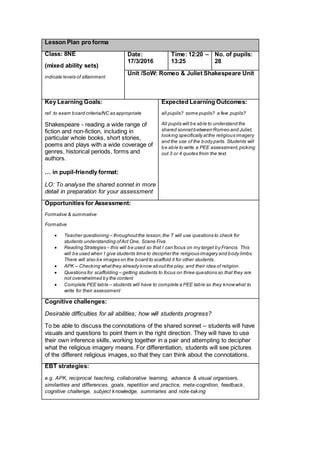
Lesson Plan pro forma
Class: 8NE
(mixed ability sets)
indicate levels of attainment
Date:
17/3/2016
Time: 12:20 –
13:25
No. of pupils:
28
Unit /SoW: Romeo & Juliet Shakespeare Unit
Key Learning Goals:
ref. to exam board criteria/NC as appropriate
Shakespeare - reading a wide range of
fiction and non-fiction, including in
particular whole books, short stories,
poems and plays with a wide coverage of
genres, historical periods, forms and
authors.
… in pupil-friendly format:
LO: To analyse the shared sonnet in more
detail in preparation for your assessment
Expected Learning Outcomes:
all pupils? some pupils? a few pupils?
All pupils will be able to understand the
shared sonnetbetween Romeo and Juliet,
looking specifically atthe religious imagery
and the use of the body parts. Students will
be able to write a PEE assessment,picking
out 3 or 4 quotes from the text.
Opportunities for Assessment:
Formative & summative
Formative
 Teacher questioning – throughoutthe lesson,the T will use questions to check for
students understanding ofAct One, Scene Five
 Reading Strategies – this will be used so that I can focus on my target by Francis. This
will be used when I give students time to decipher the religious imagery and body limbs.
There will also be images on the board to scaffold it for other students.
 APK – Checking whatthey already know aboutthe play, and their idea of religion.
 Questions for scaffolding – getting students to focus on three questions so that they are
not overwhelmed by the content
 Complete PEE table – students will have to complete a PEE table so they knowwhat to
write for their assessment
Cognitive challenges:
Desirable difficulties for all abilities; how will students progress?
To be able to discuss the connotations of the shared sonnet – students will have
visuals and questions to point them in the right direction. They will have to use
their own inference skills, working together in a pair and attempting to decipher
what the religious imagery means. For differentiation, students will see pictures
of the different religious images, so that they can think about the connotations.
EBT strategies:
e.g. APK, reciprocal teaching, collaborative learning, advance & visual organisers,
similarities and differences, goals, repetition and practice, meta-cognition, feedback,
cognitive challenge, subject knowledge, summaries and note-taking
 Collaborative learning & cognitive challenge – they will be collaborating
when they are working on their reading strategies to decipher the shared
sonnet
Key Terminology:
 Romeo & Juliet
 William Shakespeare
 Tragedy
 Romeo
Resources:
 PPT
 Differentiated slips
Homework and practice:
• N/A
8NE Lesson 15 plan
8NE Lesson 15 plan

8NE Lesson 15 plan

  • 1.
    Lesson Plan proforma Class: 8NE (mixed ability sets) indicate levels of attainment Date: 17/3/2016 Time: 12:20 – 13:25 No. of pupils: 28 Unit /SoW: Romeo & Juliet Shakespeare Unit Key Learning Goals: ref. to exam board criteria/NC as appropriate Shakespeare - reading a wide range of fiction and non-fiction, including in particular whole books, short stories, poems and plays with a wide coverage of genres, historical periods, forms and authors. … in pupil-friendly format: LO: To analyse the shared sonnet in more detail in preparation for your assessment Expected Learning Outcomes: all pupils? some pupils? a few pupils? All pupils will be able to understand the shared sonnetbetween Romeo and Juliet, looking specifically atthe religious imagery and the use of the body parts. Students will be able to write a PEE assessment,picking out 3 or 4 quotes from the text. Opportunities for Assessment: Formative & summative Formative  Teacher questioning – throughoutthe lesson,the T will use questions to check for students understanding ofAct One, Scene Five  Reading Strategies – this will be used so that I can focus on my target by Francis. This will be used when I give students time to decipher the religious imagery and body limbs. There will also be images on the board to scaffold it for other students.  APK – Checking whatthey already know aboutthe play, and their idea of religion.  Questions for scaffolding – getting students to focus on three questions so that they are not overwhelmed by the content  Complete PEE table – students will have to complete a PEE table so they knowwhat to write for their assessment Cognitive challenges: Desirable difficulties for all abilities; how will students progress? To be able to discuss the connotations of the shared sonnet – students will have visuals and questions to point them in the right direction. They will have to use their own inference skills, working together in a pair and attempting to decipher what the religious imagery means. For differentiation, students will see pictures of the different religious images, so that they can think about the connotations. EBT strategies: e.g. APK, reciprocal teaching, collaborative learning, advance & visual organisers, similarities and differences, goals, repetition and practice, meta-cognition, feedback, cognitive challenge, subject knowledge, summaries and note-taking
  • 2.
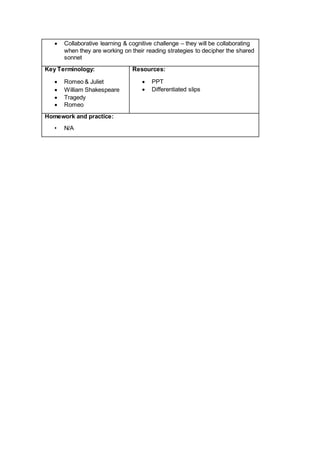
     Collaborative learning& cognitive challenge – they will be collaborating when they are working on their reading strategies to decipher the shared sonnet Key Terminology:  Romeo & Juliet  William Shakespeare  Tragedy  Romeo Resources:  PPT  Differentiated slips Homework and practice: • N/A