Lesson Plan pro forma
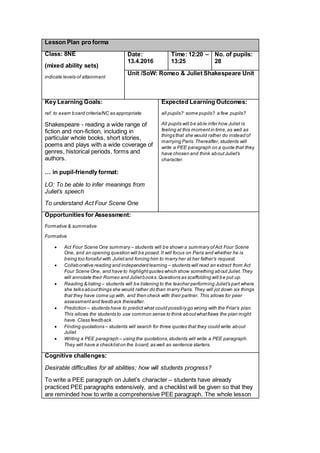
Class: 8NE
(mixed ability sets)
indicate levels of attainment
Date:
13.4.2016
Time: 12:20 –
13:25
No. of pupils:
28
Unit /SoW: Romeo & Juliet Shakespeare Unit
Key Learning Goals:
ref. to exam board criteria/NC as appropriate
Shakespeare - reading a wide range of
fiction and non-fiction, including in
particular whole books, short stories,
poems and plays with a wide coverage of
genres, historical periods, forms and
authors.
… in pupil-friendly format:
LO: To be able to infer meanings from
Juliet’s speech
To understand Act Four Scene One
Expected Learning Outcomes:
all pupils? some pupils? a few pupils?
All pupils will be able infer how Juliet is
feeling at this momentin time,as well as
things that she would rather do instead of
marrying Paris.Thereafter, students will
write a PEE paragraph on a quote that they
have chosen and think aboutJuliet’s
character.
Opportunities for Assessment:
Formative & summative
Formative
 Act Four Scene One summary – students will be shown a summary ofAct Four Scene
One, and an opening question will be posed.It will focus on Paris and whether he is
being too forceful with Julietand forcing him to marry her at her father’s request.
 Collaborative reading and independentlearning – students will read an extract from Act
Four Scene One, and have to highlightquotes which show something aboutJuliet.They
will annotate their Romeo and Julietbooks.Questions as scaffolding will be put up.
 Reading & listing – students will be listening to the teacher performing Juliet’s part where
she talks aboutthings she would rather do than marry Paris. They will jot down six things
that they have come up with, and then check with their partner. This allows for peer
assessment and feedback thereafter.
 Prediction – students have to predict what could possibly go wrong with the Friar’s plan.
This allows the students to use common sense to think aboutwhatflaws the plan might
have. Class feedback.
 Finding quotations – students will search for three quotes that they could write about
Juliet
 Writing a PEE paragraph – using the quotations,students will write a PEE paragraph.
They will have a checkliston the board,as well as sentence starters.
Cognitive challenges:
Desirable difficulties for all abilities; how will students progress?
To write a PEE paragraph on Juliet’s character – students have already
practiced PEE paragraphs extensively, and a checklist will be given so that they
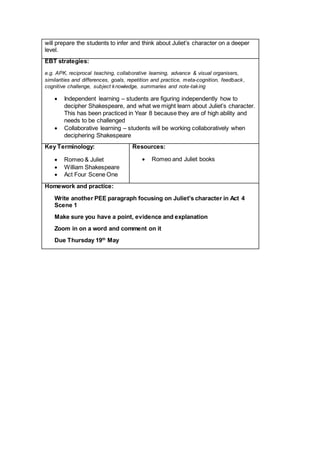
are reminded how to write a comprehensive PEE paragraph. The whole lesson
will prepare the students to infer and think about Juliet’s character on a deeper
level.
EBT strategies:
e.g. APK, reciprocal teaching, collaborative learning, advance & visual organisers,
similarities and differences, goals, repetition and practice, meta-cognition, feedback,
cognitive challenge, subject knowledge, summaries and note-taking
 Independent learning – students are figuring independently how to
decipher Shakespeare, and what we might learn about Juliet’s character.
This has been practiced in Year 8 because they are of high ability and
needs to be challenged
 Collaborative learning – students will be working collaboratively when
deciphering Shakespeare
Key Terminology:
 Romeo & Juliet
 William Shakespeare
 Act Four Scene One
Resources:
 Romeo and Juliet books
Homework and practice:
Write another PEE paragraph focusing on Juliet's character in Act 4
Scene 1
Make sure you have a point, evidence and explanation
Zoom in on a word and comment on it
Due Thursday 19th
May
8NE Act Four Scene One 13.5.2016

8NE Act Four Scene One 13.5.2016

  • 1.
    Lesson Plan proforma Class: 8NE (mixed ability sets) indicate levels of attainment Date: 13.4.2016 Time: 12:20 – 13:25 No. of pupils: 28 Unit /SoW: Romeo & Juliet Shakespeare Unit Key Learning Goals: ref. to exam board criteria/NC as appropriate Shakespeare - reading a wide range of fiction and non-fiction, including in particular whole books, short stories, poems and plays with a wide coverage of genres, historical periods, forms and authors. … in pupil-friendly format: LO: To be able to infer meanings from Juliet’s speech To understand Act Four Scene One Expected Learning Outcomes: all pupils? some pupils? a few pupils? All pupils will be able infer how Juliet is feeling at this momentin time,as well as things that she would rather do instead of marrying Paris.Thereafter, students will write a PEE paragraph on a quote that they have chosen and think aboutJuliet’s character. Opportunities for Assessment: Formative & summative Formative  Act Four Scene One summary – students will be shown a summary ofAct Four Scene One, and an opening question will be posed.It will focus on Paris and whether he is being too forceful with Julietand forcing him to marry her at her father’s request.  Collaborative reading and independentlearning – students will read an extract from Act Four Scene One, and have to highlightquotes which show something aboutJuliet.They will annotate their Romeo and Julietbooks.Questions as scaffolding will be put up.  Reading & listing – students will be listening to the teacher performing Juliet’s part where she talks aboutthings she would rather do than marry Paris. They will jot down six things that they have come up with, and then check with their partner. This allows for peer assessment and feedback thereafter.  Prediction – students have to predict what could possibly go wrong with the Friar’s plan. This allows the students to use common sense to think aboutwhatflaws the plan might have. Class feedback.  Finding quotations – students will search for three quotes that they could write about Juliet  Writing a PEE paragraph – using the quotations,students will write a PEE paragraph. They will have a checkliston the board,as well as sentence starters. Cognitive challenges: Desirable difficulties for all abilities; how will students progress? To write a PEE paragraph on Juliet’s character – students have already practiced PEE paragraphs extensively, and a checklist will be given so that they are reminded how to write a comprehensive PEE paragraph. The whole lesson
  • 2.
    will prepare thestudents to infer and think about Juliet’s character on a deeper level. EBT strategies: e.g. APK, reciprocal teaching, collaborative learning, advance & visual organisers, similarities and differences, goals, repetition and practice, meta-cognition, feedback, cognitive challenge, subject knowledge, summaries and note-taking  Independent learning – students are figuring independently how to decipher Shakespeare, and what we might learn about Juliet’s character. This has been practiced in Year 8 because they are of high ability and needs to be challenged  Collaborative learning – students will be working collaboratively when deciphering Shakespeare Key Terminology:  Romeo & Juliet  William Shakespeare  Act Four Scene One Resources:  Romeo and Juliet books Homework and practice: Write another PEE paragraph focusing on Juliet's character in Act 4 Scene 1 Make sure you have a point, evidence and explanation Zoom in on a word and comment on it Due Thursday 19th May